Compact Muon Solenoid
LHC, CERN
 Visit us: CMS Public Website, CMS Physics ;
Contact us: CMS Publications Committee
Visit us: CMS Public Website, CMS Physics ;
Contact us: CMS Publications Committee
| CMS-HIG-25-003 ; CERN-EP-2026-201 | ||
| Off-shell Higgs boson measurements: Yukawa couplings, self-coupling, compositeness, and width | ||
| CMS Collaboration | ||
| 25 July 2026 | ||
| Submitted to Physical Review D | ||
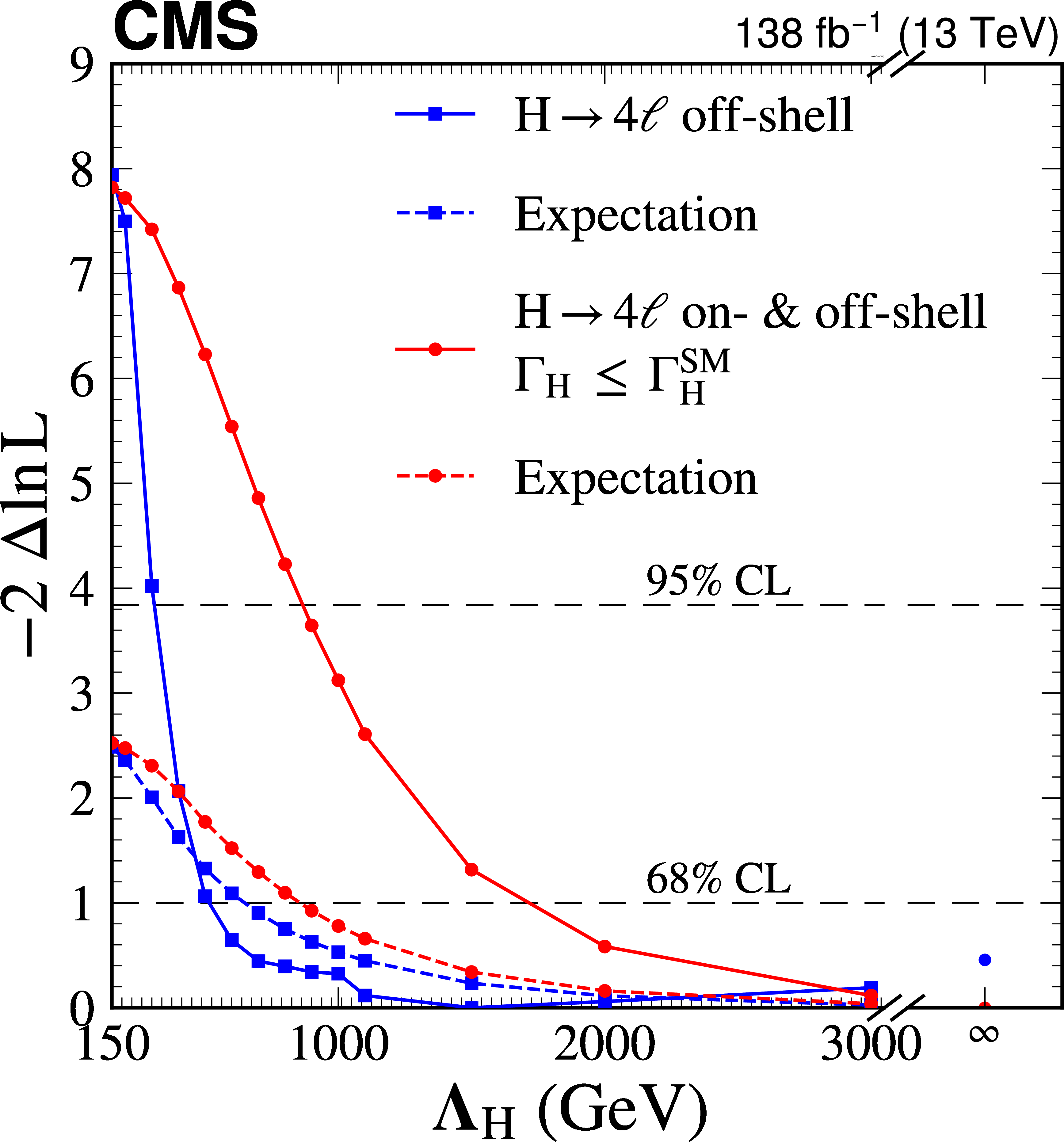
| Abstract: Measurements of Higgs boson production in the off-shell region are presented, using the four-lepton decay channel. Data from proton-proton collisions at the CERN LHC, collected by the CMS experiment and corresponding to an integrated luminosity of 138 fb$ ^{-1} $ at a center-of-mass energy of 13 TeV, are utilized. The first direct test of composite Higgs boson models is performed, with a lower limit on the compositeness scale $ \Lambda_\mathrm{H} $ set at 870 GeV at the 95% confidence level. Tests of gluon-fusion production within the standard model effective field theory framework are performed. The first constraint on the Higgs boson self-coupling in the off-shell region is obtained. By combining on- and off-shell measurements, the analysis sets the tightest constraints to date on light-quark Yukawa couplings, while relaxing assumptions such as the bound on the Higgs boson coupling to vector bosons, thereby providing more model-independent results. Constraints on the Higgs boson width are provided while accounting for a range of beyond-the-standard-model effects, including both light and heavy particles in the gluon-fusion production loop, as well as modified couplings to vector bosons. A combined analysis of the $ \mathrm{H}\to\mathrm{Z}\mathrm{Z} $ and $ \mathrm{H}\to\mathrm{W}\mathrm{W} $ channels is performed to improve sensitivity to the Higgs boson width, yielding $ \Gamma_{\mathrm{H}}= $ 5.1 $ ^{+2.0}_{-1.8} $ MeV. The scenario of no off-shell Higgs boson production is excluded at a confidence level exceeding 5 standard deviations. | ||
| Links: e-print arXiv:2607.23352 [hep-ex] (PDF) ; CDS record ; inSPIRE record ; HepData record ; CADI line (restricted) ; | ||
| Figures | |
png pdf |
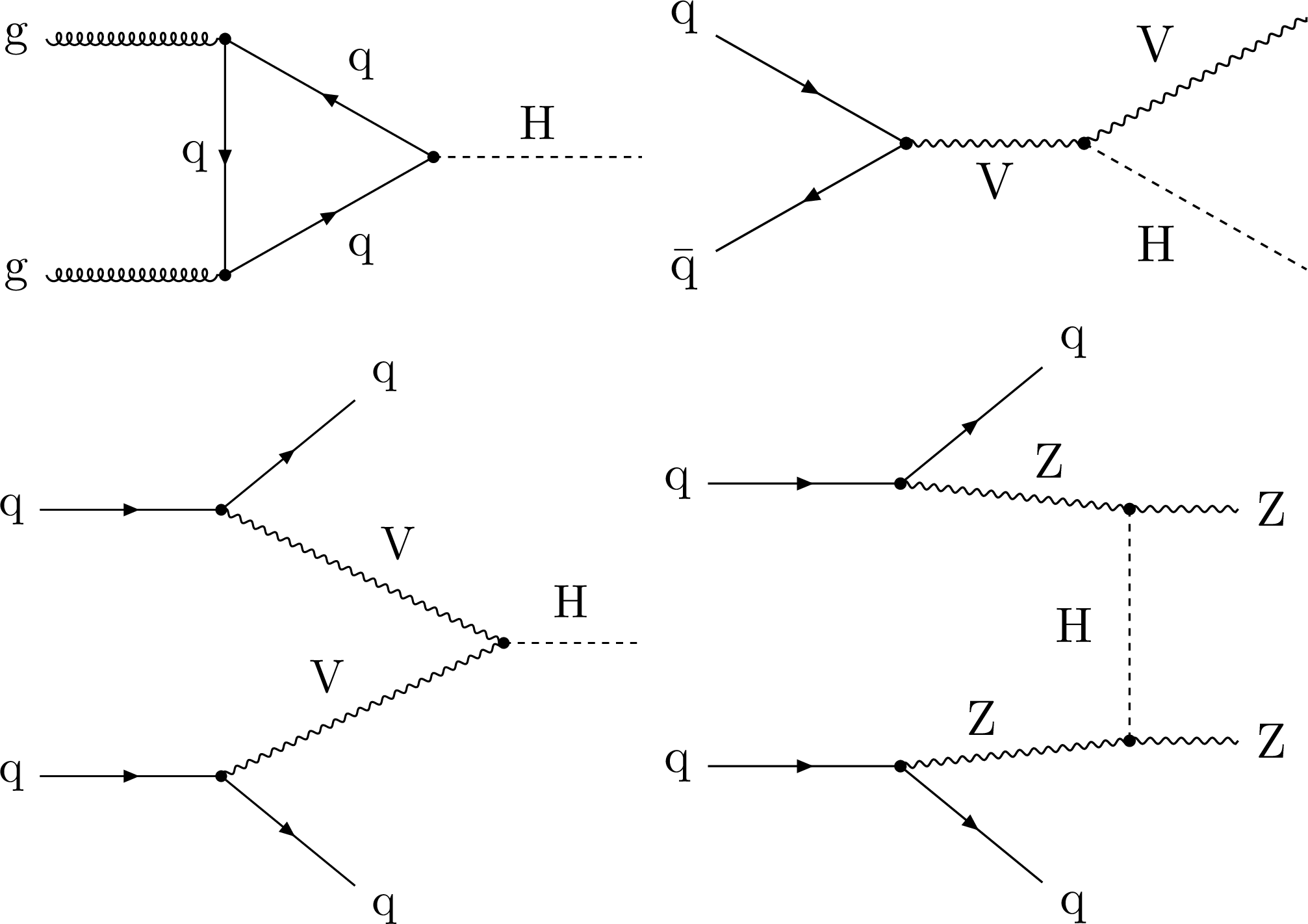
Figure 1:
Leading-order Feynman diagrams for the Higgs boson production processes considered in the off-shell region: $ \mathrm{g}\mathrm{g}\mathrm{H} $ (upper left), VH associated production (upper right), $ s $-channel VBF (lower left), and $ t $-channel VBF (lower right). |
png pdf |
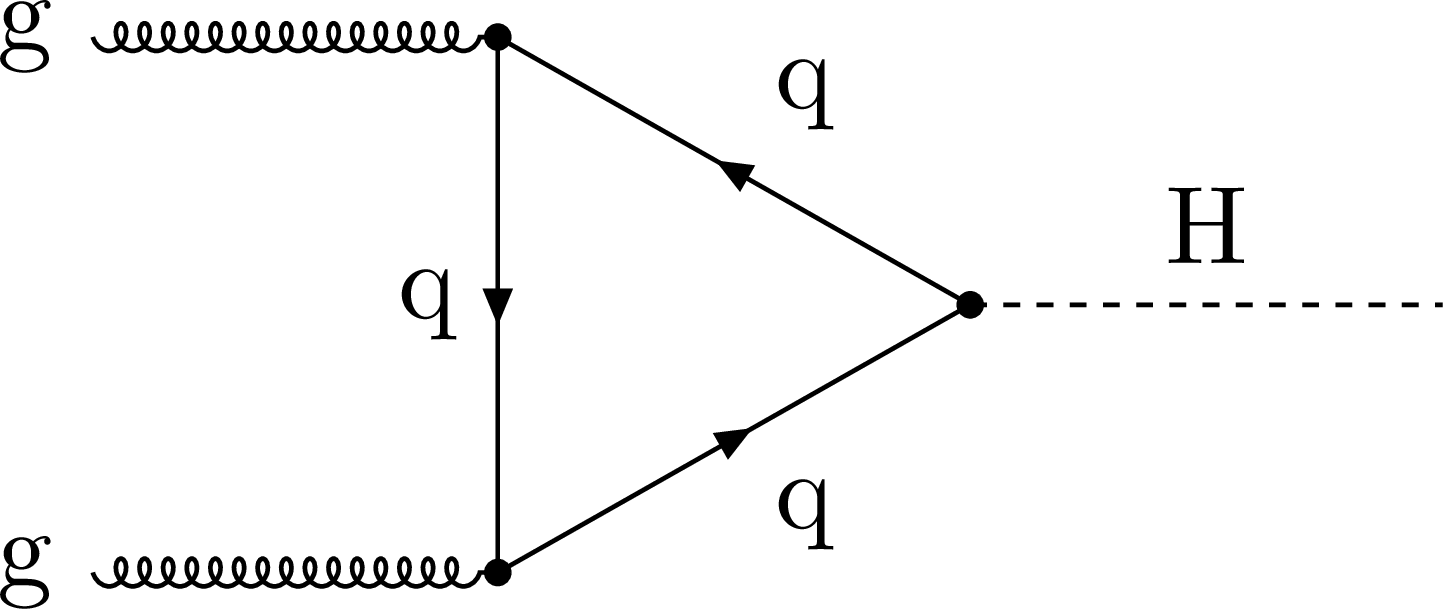
Figure 1-a:
Leading-order Feynman diagrams for the Higgs boson production processes considered in the off-shell region: $ \mathrm{g}\mathrm{g}\mathrm{H} $ (upper left), VH associated production (upper right), $ s $-channel VBF (lower left), and $ t $-channel VBF (lower right). |
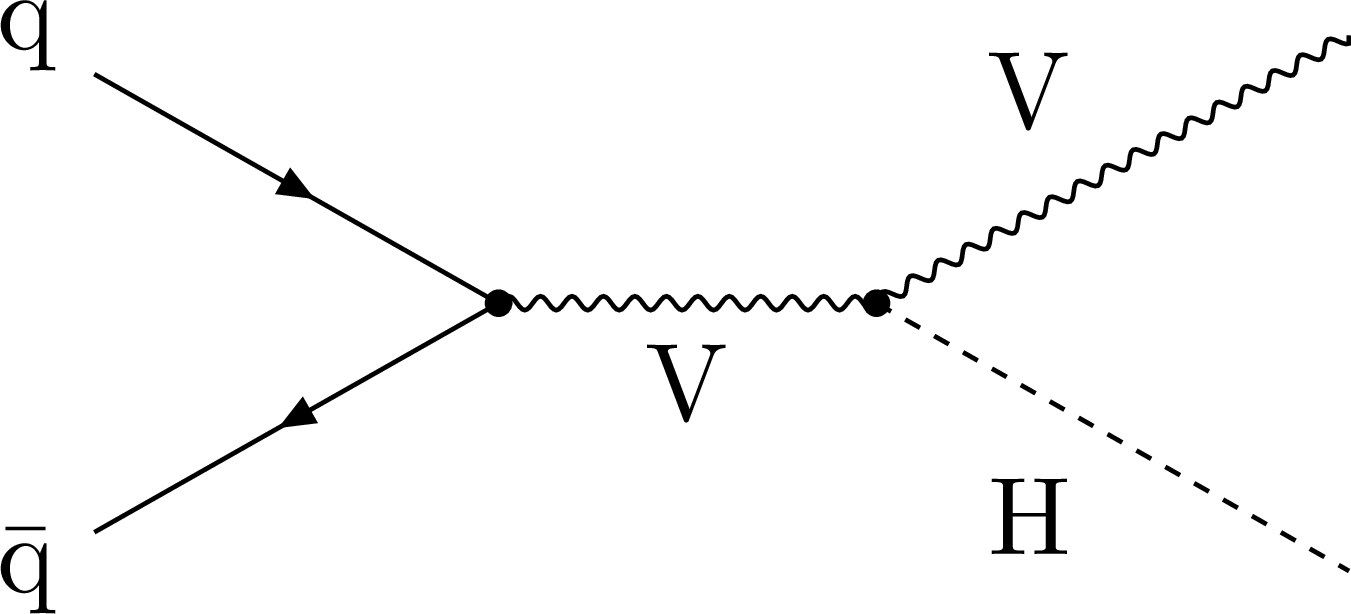
png pdf |
Figure 1-b:
Leading-order Feynman diagrams for the Higgs boson production processes considered in the off-shell region: $ \mathrm{g}\mathrm{g}\mathrm{H} $ (upper left), VH associated production (upper right), $ s $-channel VBF (lower left), and $ t $-channel VBF (lower right). |
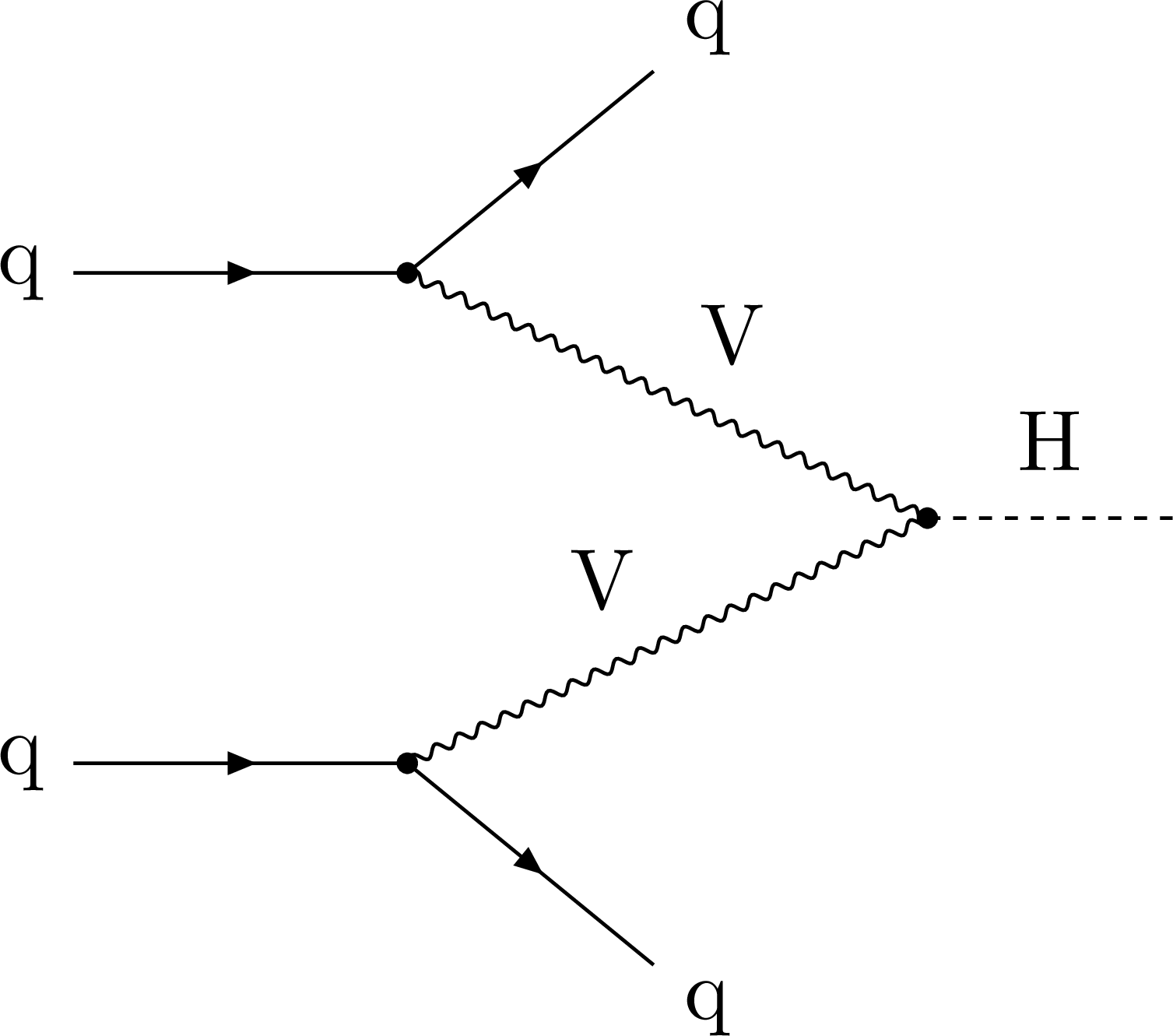
png pdf |
Figure 1-c:
Leading-order Feynman diagrams for the Higgs boson production processes considered in the off-shell region: $ \mathrm{g}\mathrm{g}\mathrm{H} $ (upper left), VH associated production (upper right), $ s $-channel VBF (lower left), and $ t $-channel VBF (lower right). |
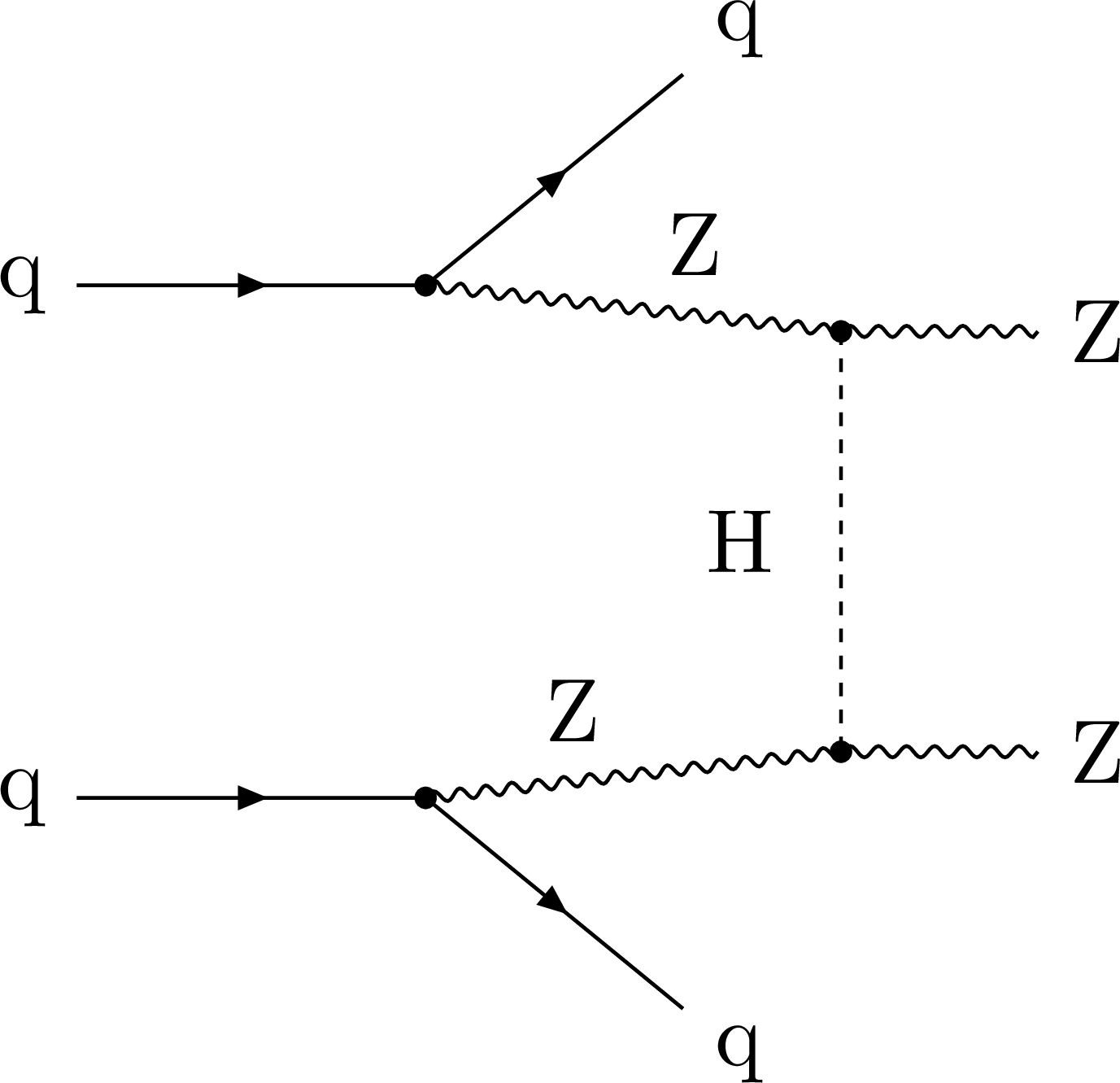
png pdf |
Figure 1-d:
Leading-order Feynman diagrams for the Higgs boson production processes considered in the off-shell region: $ \mathrm{g}\mathrm{g}\mathrm{H} $ (upper left), VH associated production (upper right), $ s $-channel VBF (lower left), and $ t $-channel VBF (lower right). |
png pdf |
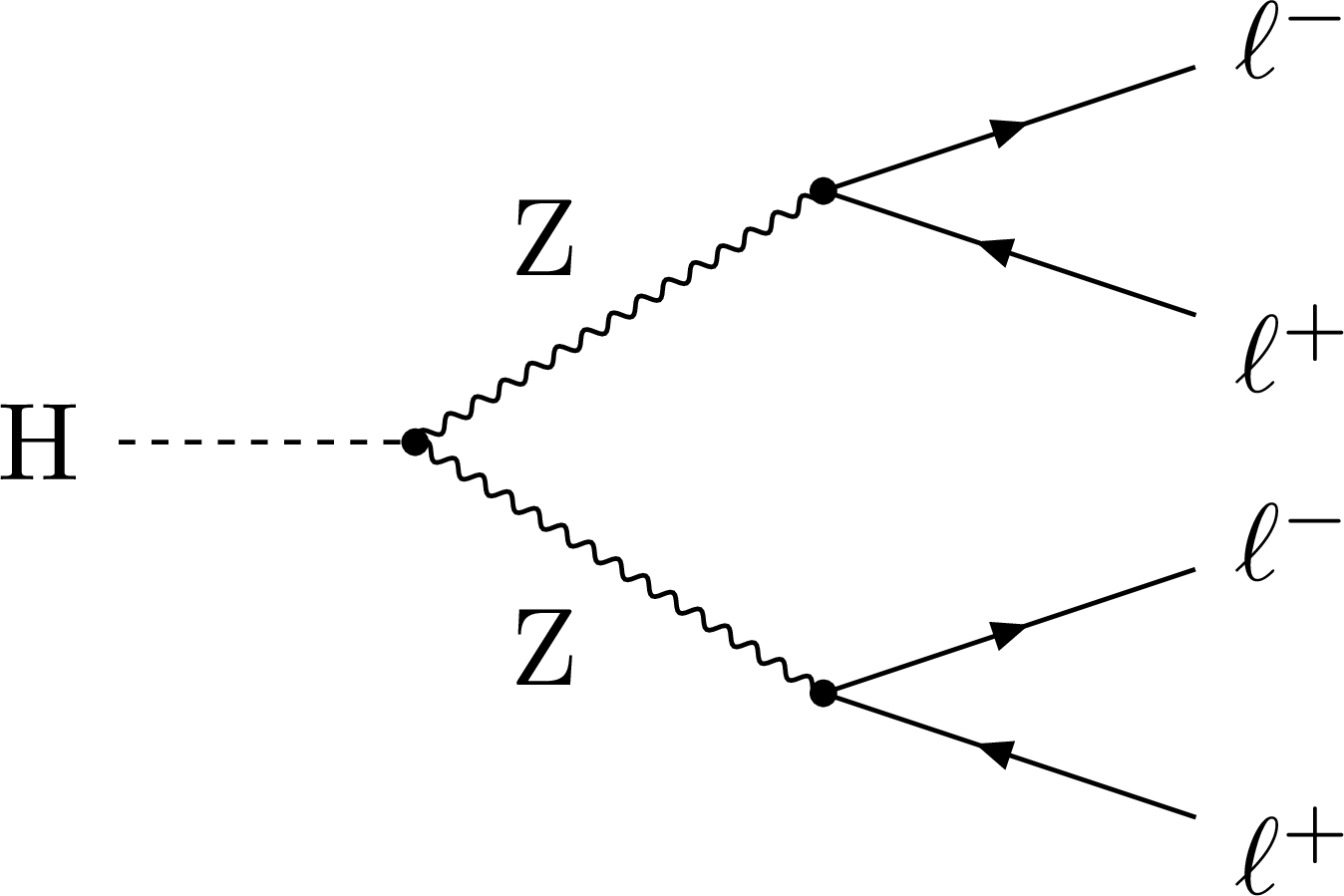
Figure 2:
The leading-order Feynman diagram illustrating the $ \mathrm{H}\to\mathrm{Z}\mathrm{Z}\to4\ell $ decay process. |
png pdf |
Figure 3:
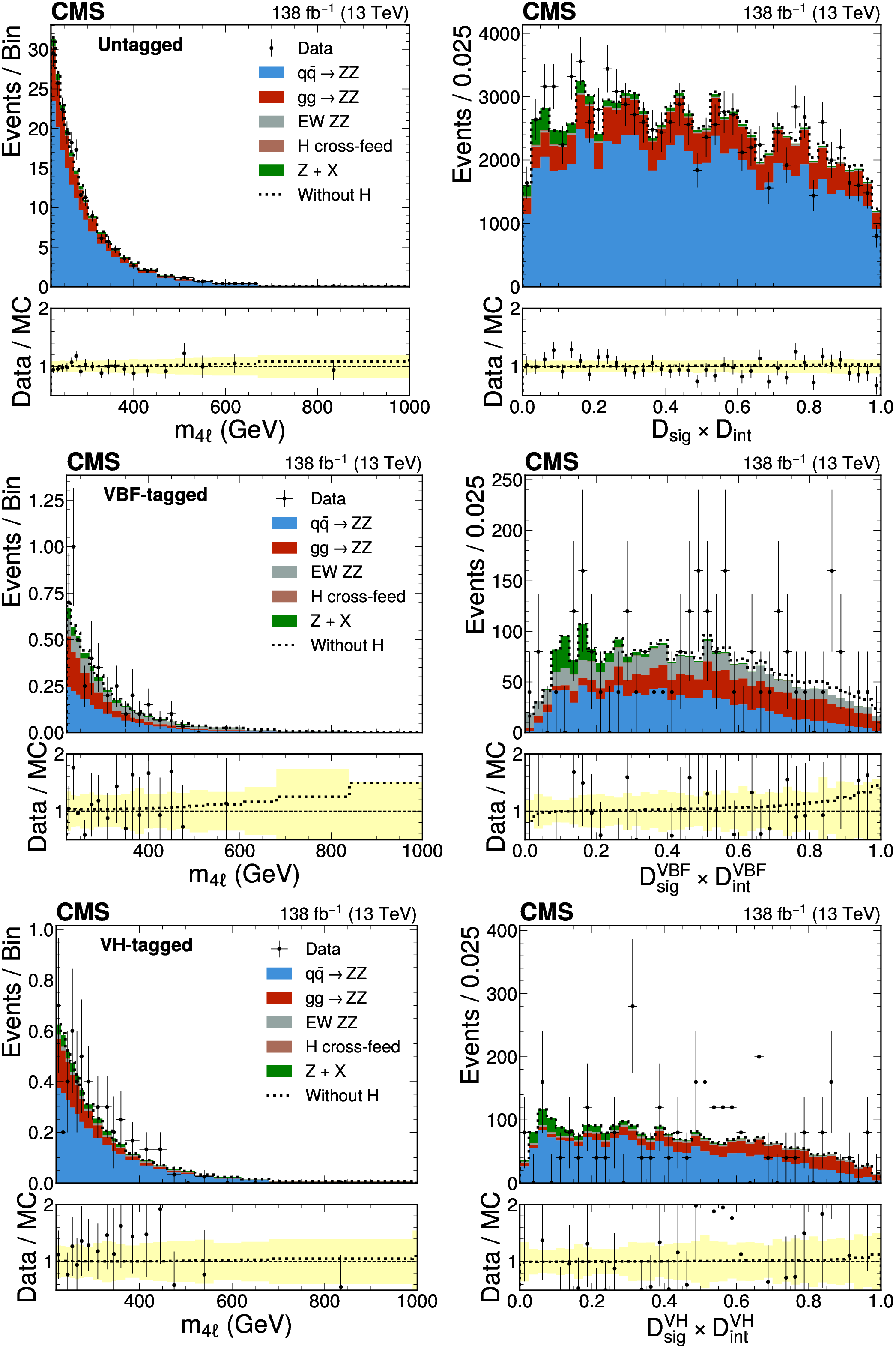
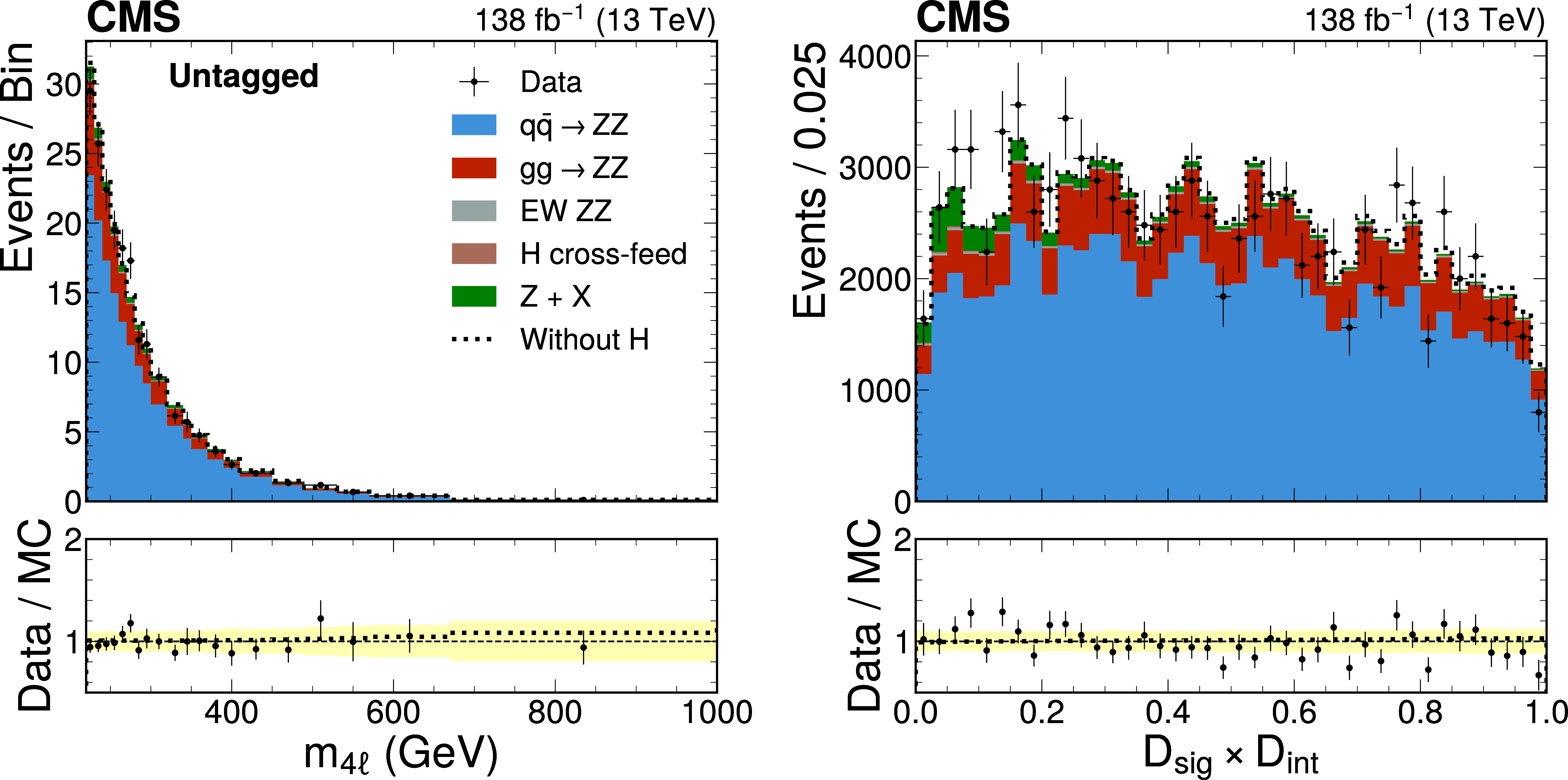
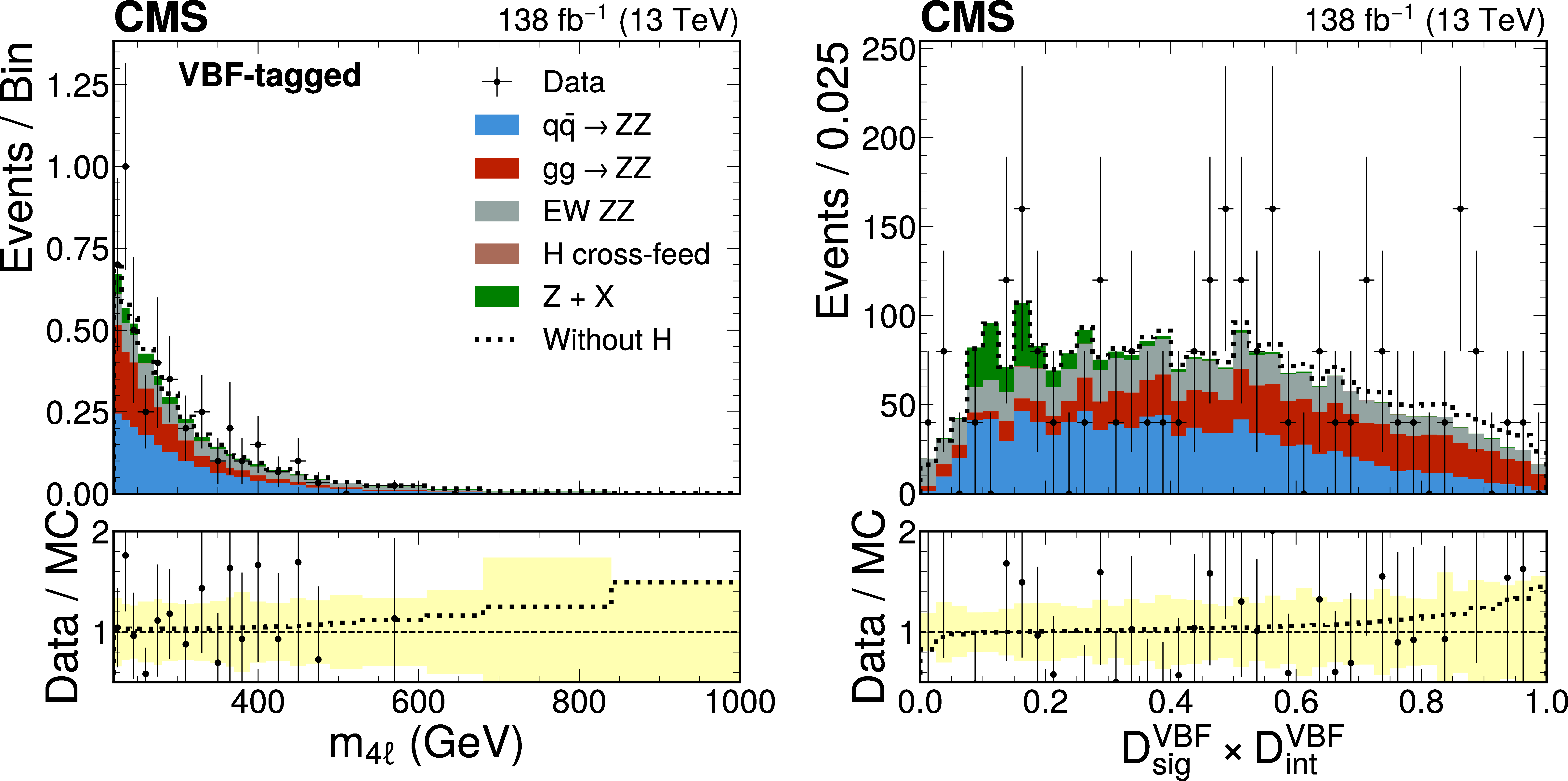
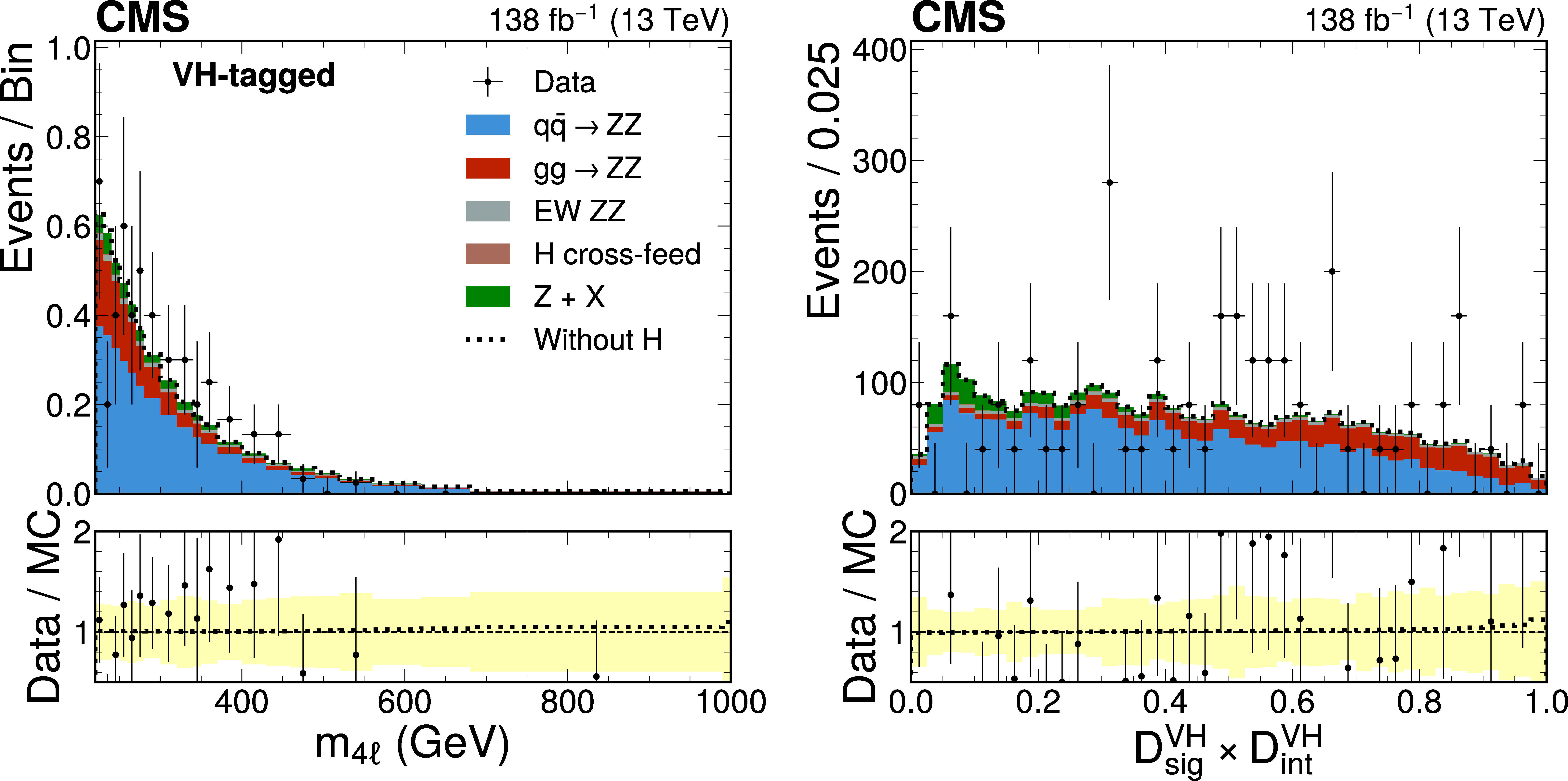
The pre-fit $ m_{4\ell} $ distributions (left) and the combined discriminants (right) in the off-shell region are shown for the untagged (upper), $ \mathrm{VBF} $-tagged (middle), and VH-tagged (lower) categories, divided by the bin width. The legend shows the expected signal, background, or their combined yield with interference for the various processes. The ratio of observation to expectation is displayed in the subpanel below the main plot with a ${\pm}$1 standard deviation uncertainty band in yellow. The dashed curve labeled ``Without H'' denotes the no-off-shell-H-production hypothesis. |
png pdf |
Figure 3-a:
The pre-fit $ m_{4\ell} $ distributions (left) and the combined discriminants (right) in the off-shell region are shown for the untagged (upper), $ \mathrm{VBF} $-tagged (middle), and VH-tagged (lower) categories, divided by the bin width. The legend shows the expected signal, background, or their combined yield with interference for the various processes. The ratio of observation to expectation is displayed in the subpanel below the main plot with a ${\pm}$1 standard deviation uncertainty band in yellow. The dashed curve labeled ``Without H'' denotes the no-off-shell-H-production hypothesis. |
png pdf |
Figure 3-b:
The pre-fit $ m_{4\ell} $ distributions (left) and the combined discriminants (right) in the off-shell region are shown for the untagged (upper), $ \mathrm{VBF} $-tagged (middle), and VH-tagged (lower) categories, divided by the bin width. The legend shows the expected signal, background, or their combined yield with interference for the various processes. The ratio of observation to expectation is displayed in the subpanel below the main plot with a ${\pm}$1 standard deviation uncertainty band in yellow. The dashed curve labeled ``Without H'' denotes the no-off-shell-H-production hypothesis. |
png pdf |
Figure 3-c:
The pre-fit $ m_{4\ell} $ distributions (left) and the combined discriminants (right) in the off-shell region are shown for the untagged (upper), $ \mathrm{VBF} $-tagged (middle), and VH-tagged (lower) categories, divided by the bin width. The legend shows the expected signal, background, or their combined yield with interference for the various processes. The ratio of observation to expectation is displayed in the subpanel below the main plot with a ${\pm}$1 standard deviation uncertainty band in yellow. The dashed curve labeled ``Without H'' denotes the no-off-shell-H-production hypothesis. |
png pdf |
Figure 4:
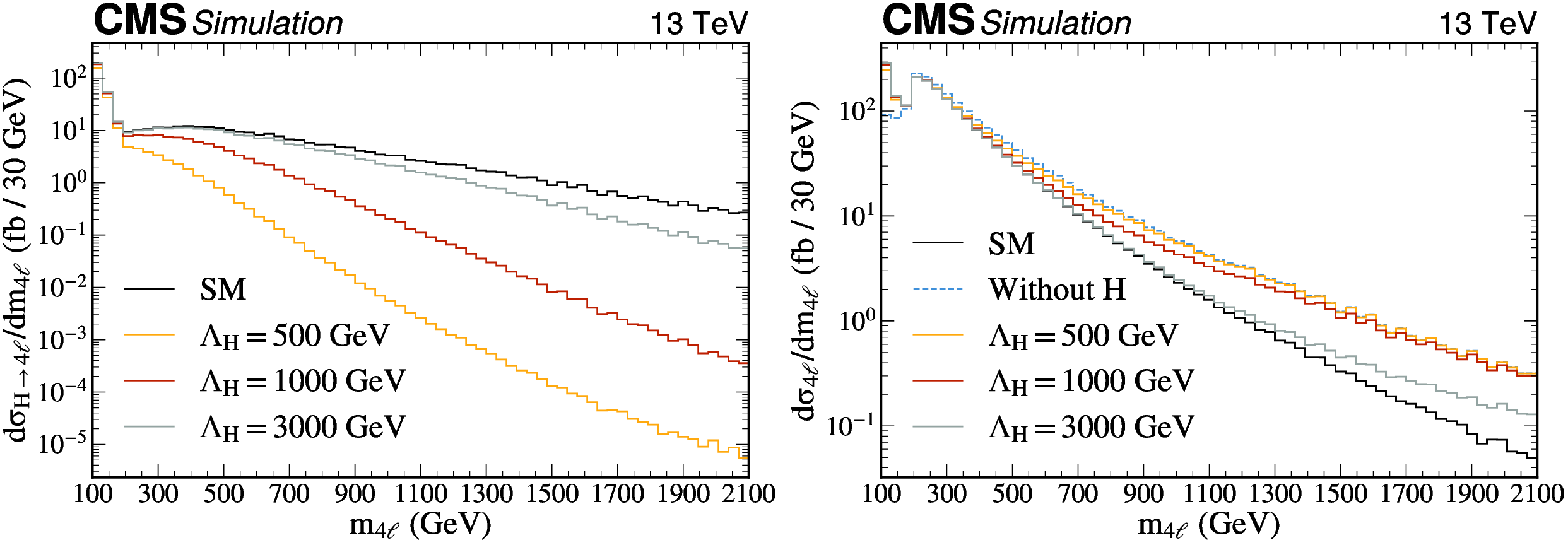
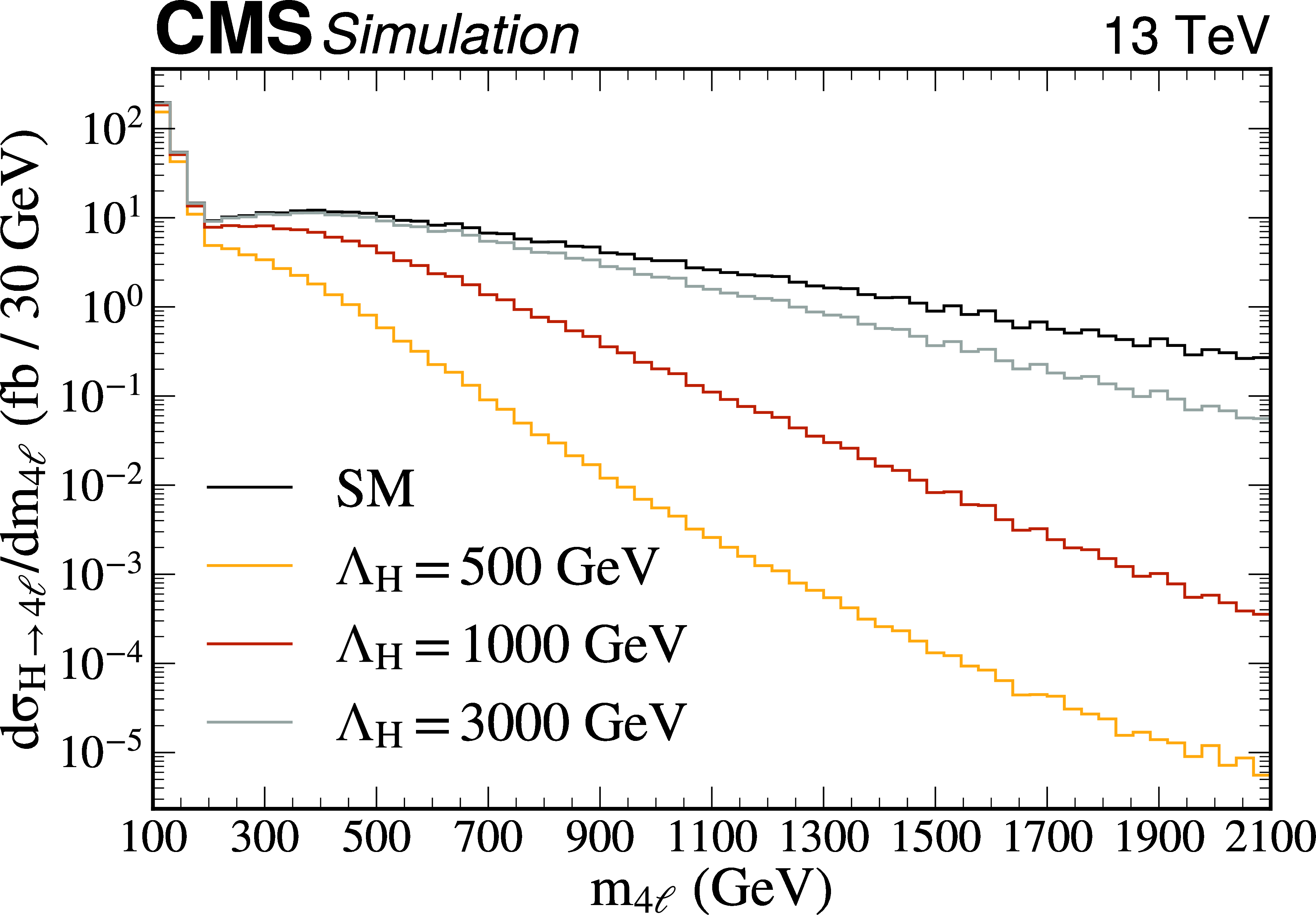
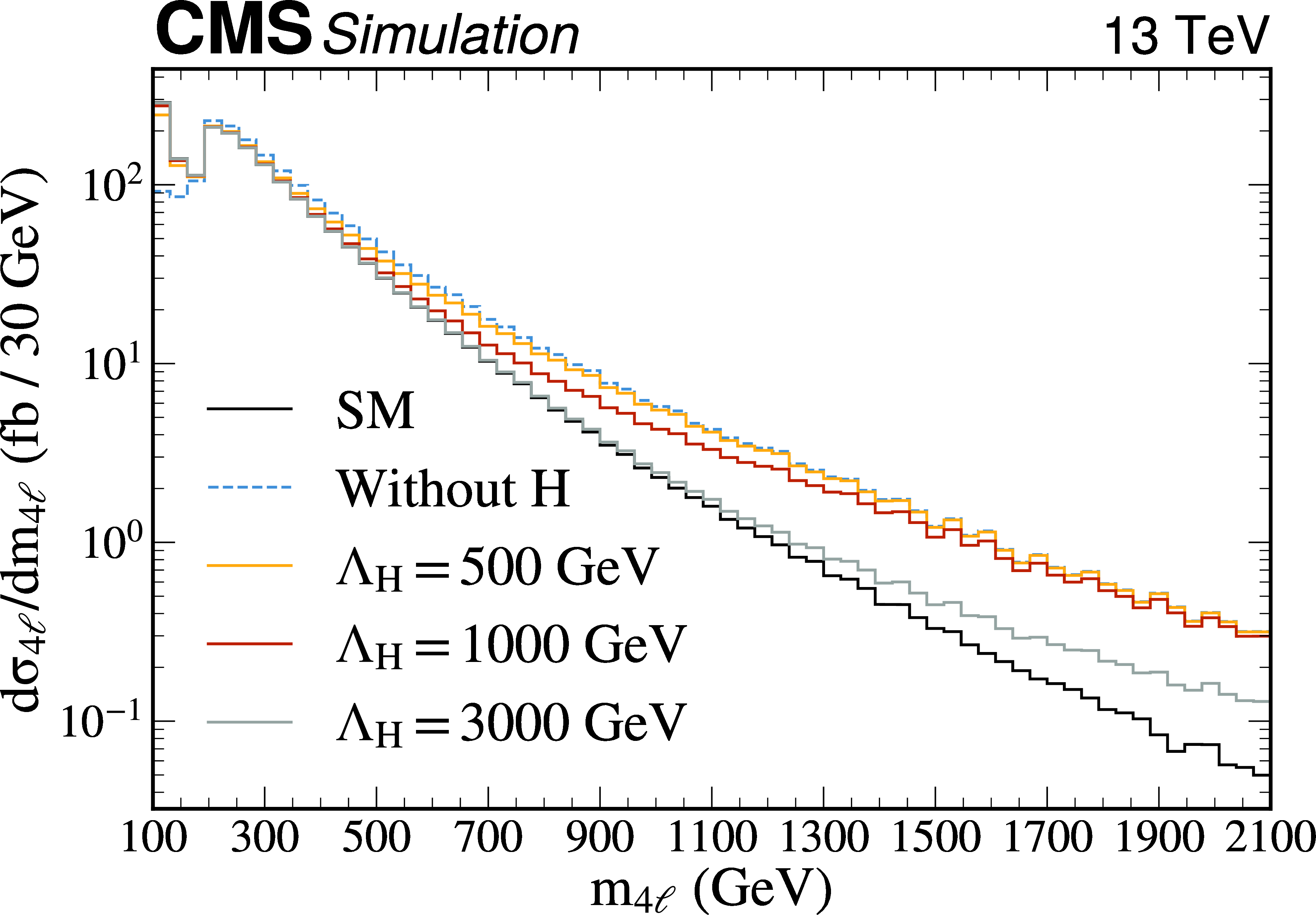
Evolution of EW production of the Higgs boson as a function of $ m_{4\ell} $ for selected values of the compositeness scale $ \Lambda_{\mathrm{H}} $: H-only production (left) and the combined four-lepton distribution including Higgs boson signal, background, and interference (right). The background-only scenario (``Without H'') is indicated by the dashed line on the right. |
png pdf |
Figure 4-a:
Evolution of EW production of the Higgs boson as a function of $ m_{4\ell} $ for selected values of the compositeness scale $ \Lambda_{\mathrm{H}} $: H-only production (left) and the combined four-lepton distribution including Higgs boson signal, background, and interference (right). The background-only scenario (``Without H'') is indicated by the dashed line on the right. |
png pdf |
Figure 4-b:
Evolution of EW production of the Higgs boson as a function of $ m_{4\ell} $ for selected values of the compositeness scale $ \Lambda_{\mathrm{H}} $: H-only production (left) and the combined four-lepton distribution including Higgs boson signal, background, and interference (right). The background-only scenario (``Without H'') is indicated by the dashed line on the right. |
png pdf |
Figure 5:
Observed (solid) and expected (dashed) profile-likelihood scans for $ \Lambda_{\mathrm{H}} $ from fits using off-shell production only (blue squares) and combined on- and off-shell production (red circles). Markers indicate the discrete $ \Lambda_{\mathrm{H}} $ points profiled. The black horizontal dashed lines mark the 68 and 95% CL thresholds. |
png pdf |
Figure 6:
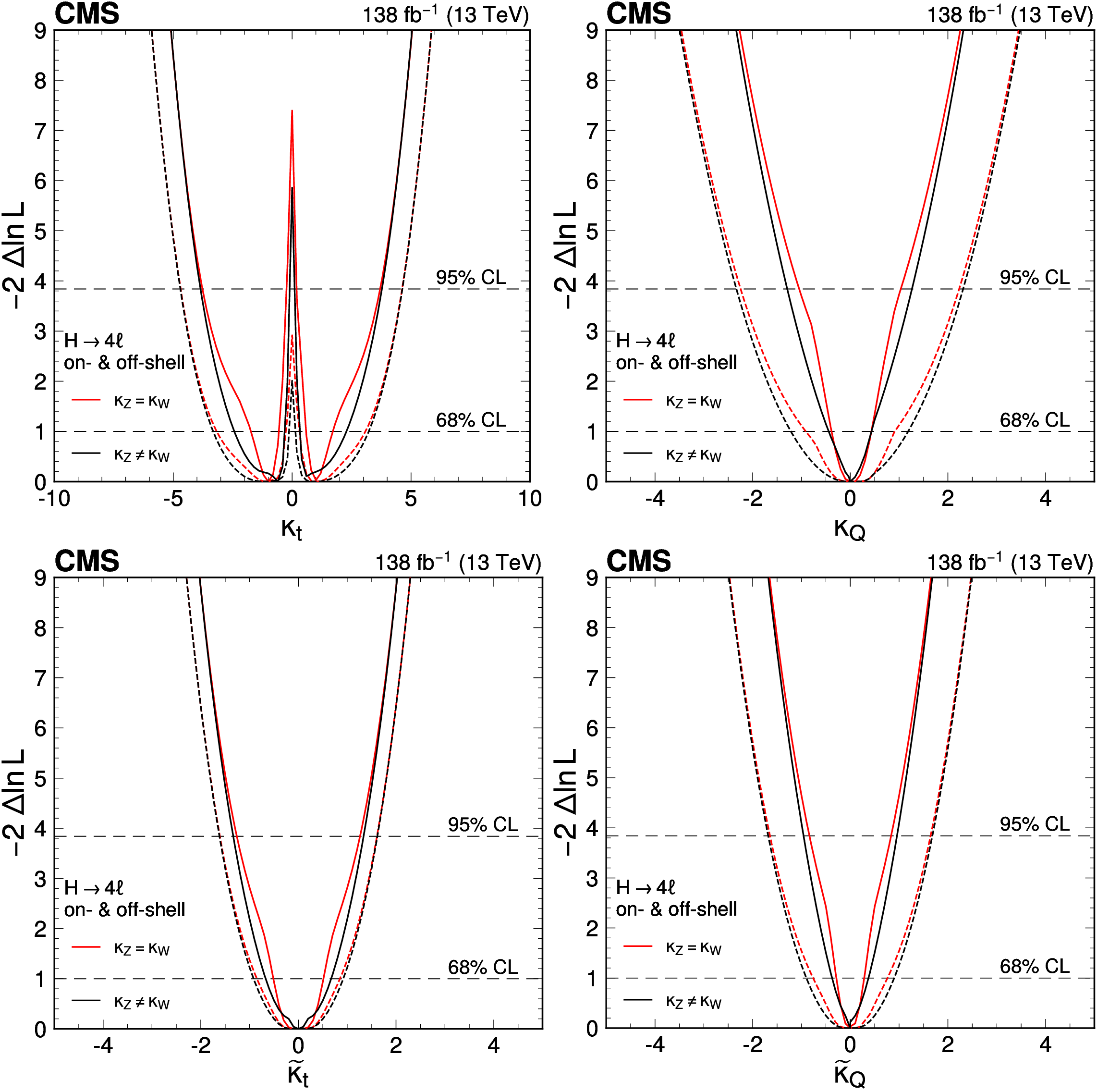
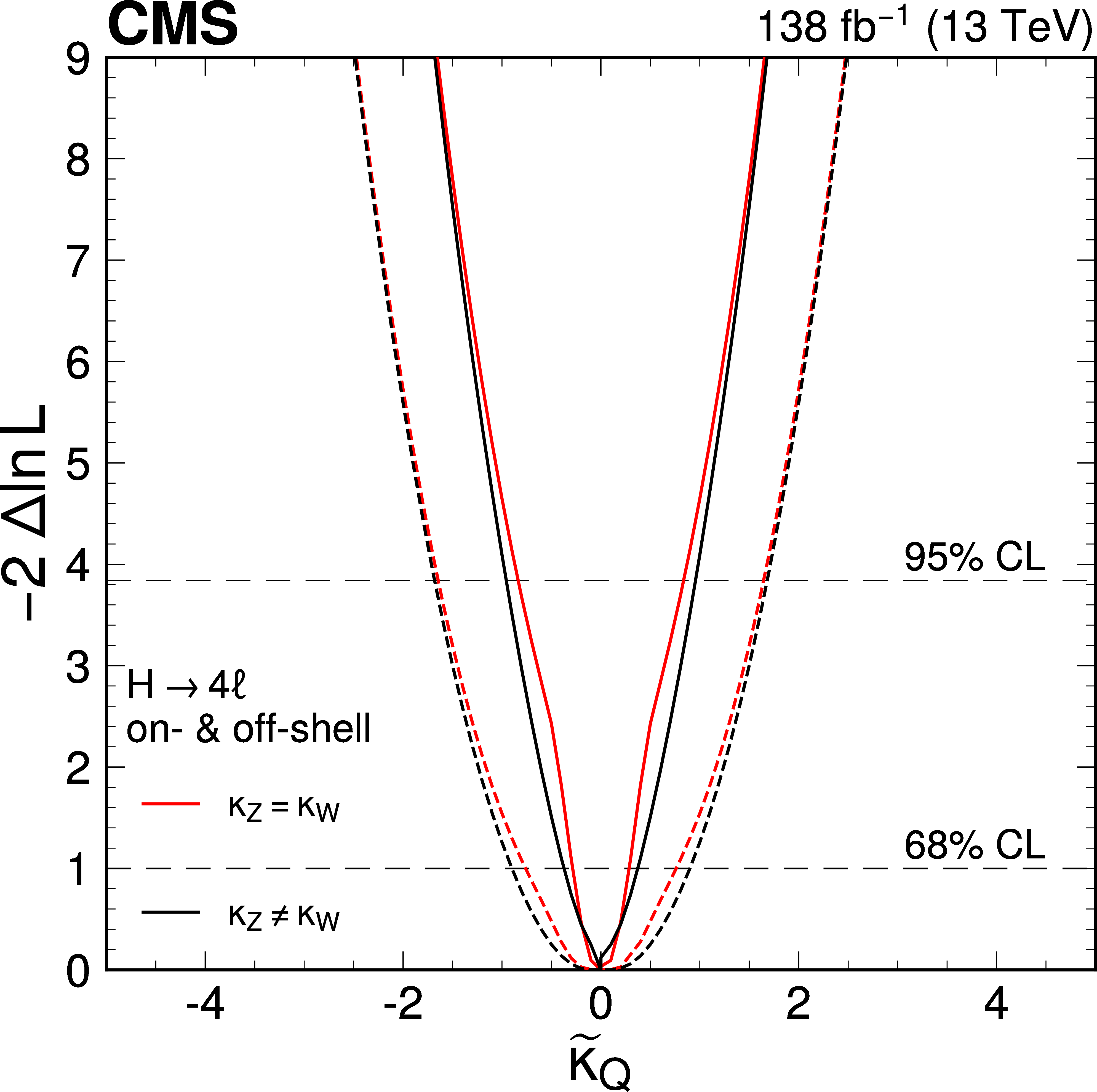
Observed (solid) and expected (dashed) scans for the couplings $ \kappa_{\mathrm{t}} $ (upper left), $ \kappa_{Q} $ (upper right), $ \widetilde{\kappa}_{\mathrm{t}} $ (lower left), and $ \widetilde{\kappa}_{Q} $ (lower right), obtained from the combined on- and off-shell fit. All four couplings, together with $ \kappa_{\mathrm{Z}} $ and $ \kappa_{\mathrm{W}} $, are allowed to vary simultaneously. The horizontal dashed lines indicate the 68 and 95% CL thresholds. |
png pdf |
Figure 6-a:
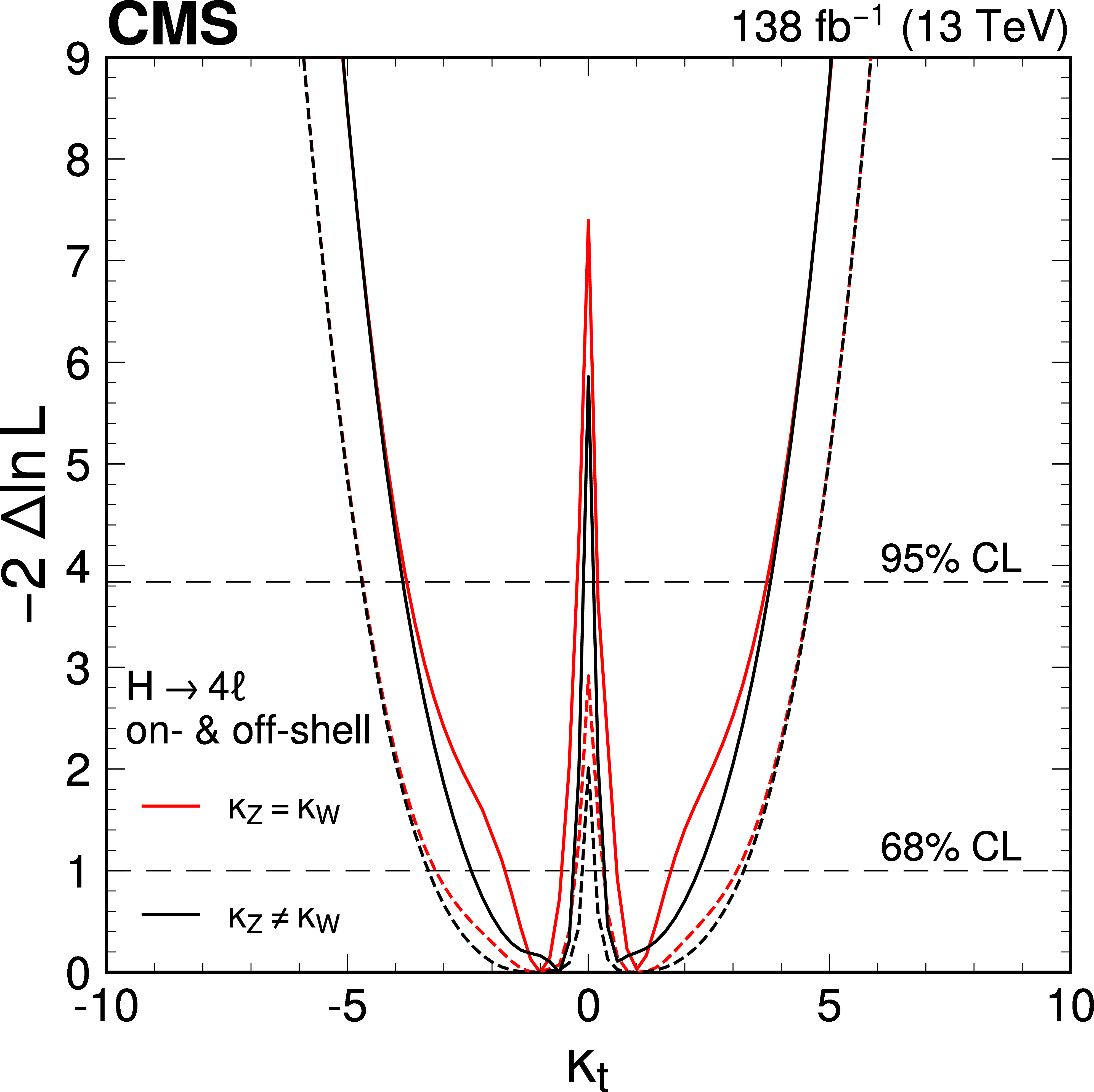
Observed (solid) and expected (dashed) scans for the couplings $ \kappa_{\mathrm{t}} $ (upper left), $ \kappa_{Q} $ (upper right), $ \widetilde{\kappa}_{\mathrm{t}} $ (lower left), and $ \widetilde{\kappa}_{Q} $ (lower right), obtained from the combined on- and off-shell fit. All four couplings, together with $ \kappa_{\mathrm{Z}} $ and $ \kappa_{\mathrm{W}} $, are allowed to vary simultaneously. The horizontal dashed lines indicate the 68 and 95% CL thresholds. |
png pdf |
Figure 6-b:
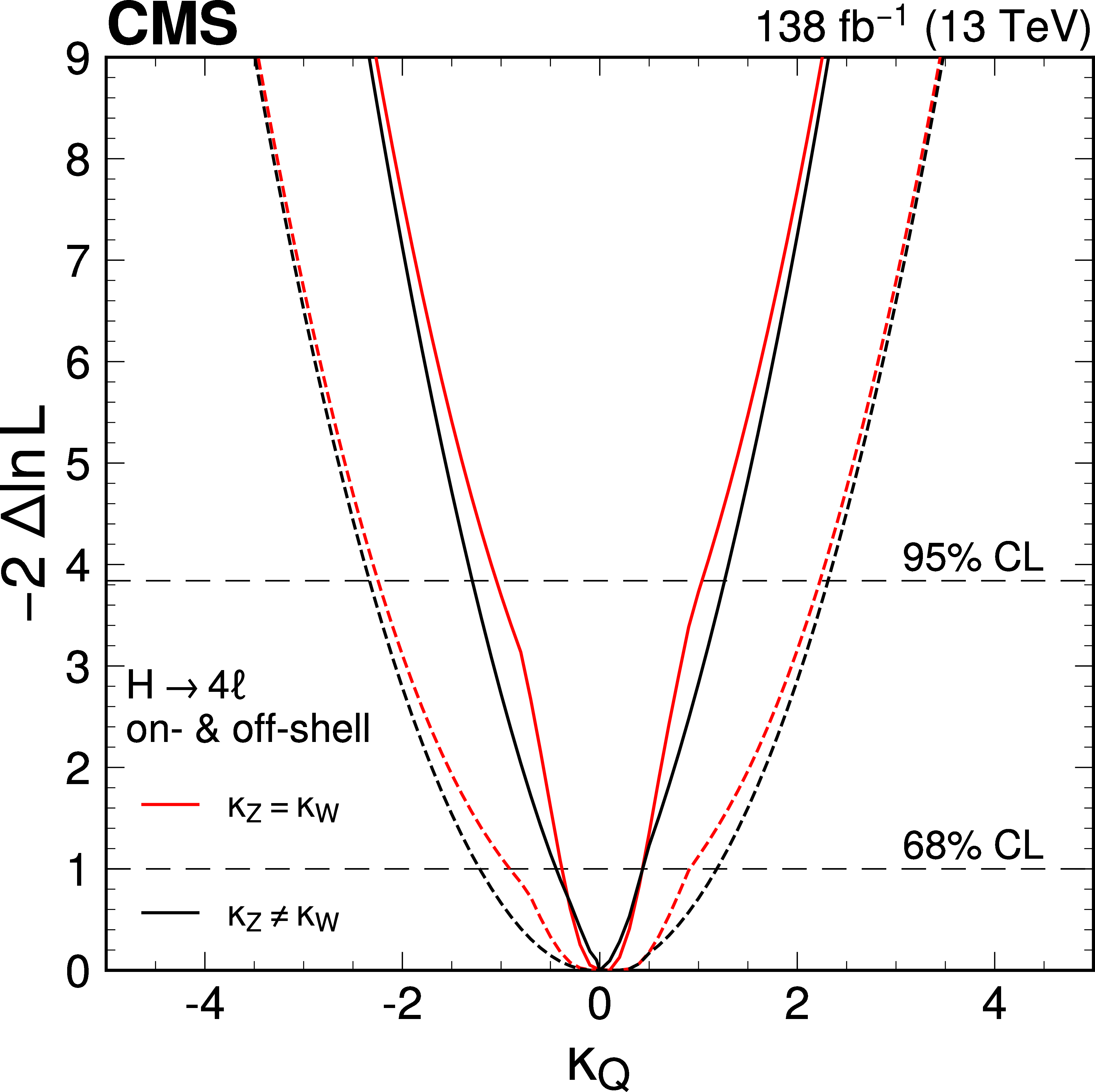
Observed (solid) and expected (dashed) scans for the couplings $ \kappa_{\mathrm{t}} $ (upper left), $ \kappa_{Q} $ (upper right), $ \widetilde{\kappa}_{\mathrm{t}} $ (lower left), and $ \widetilde{\kappa}_{Q} $ (lower right), obtained from the combined on- and off-shell fit. All four couplings, together with $ \kappa_{\mathrm{Z}} $ and $ \kappa_{\mathrm{W}} $, are allowed to vary simultaneously. The horizontal dashed lines indicate the 68 and 95% CL thresholds. |
png pdf |
Figure 6-c:
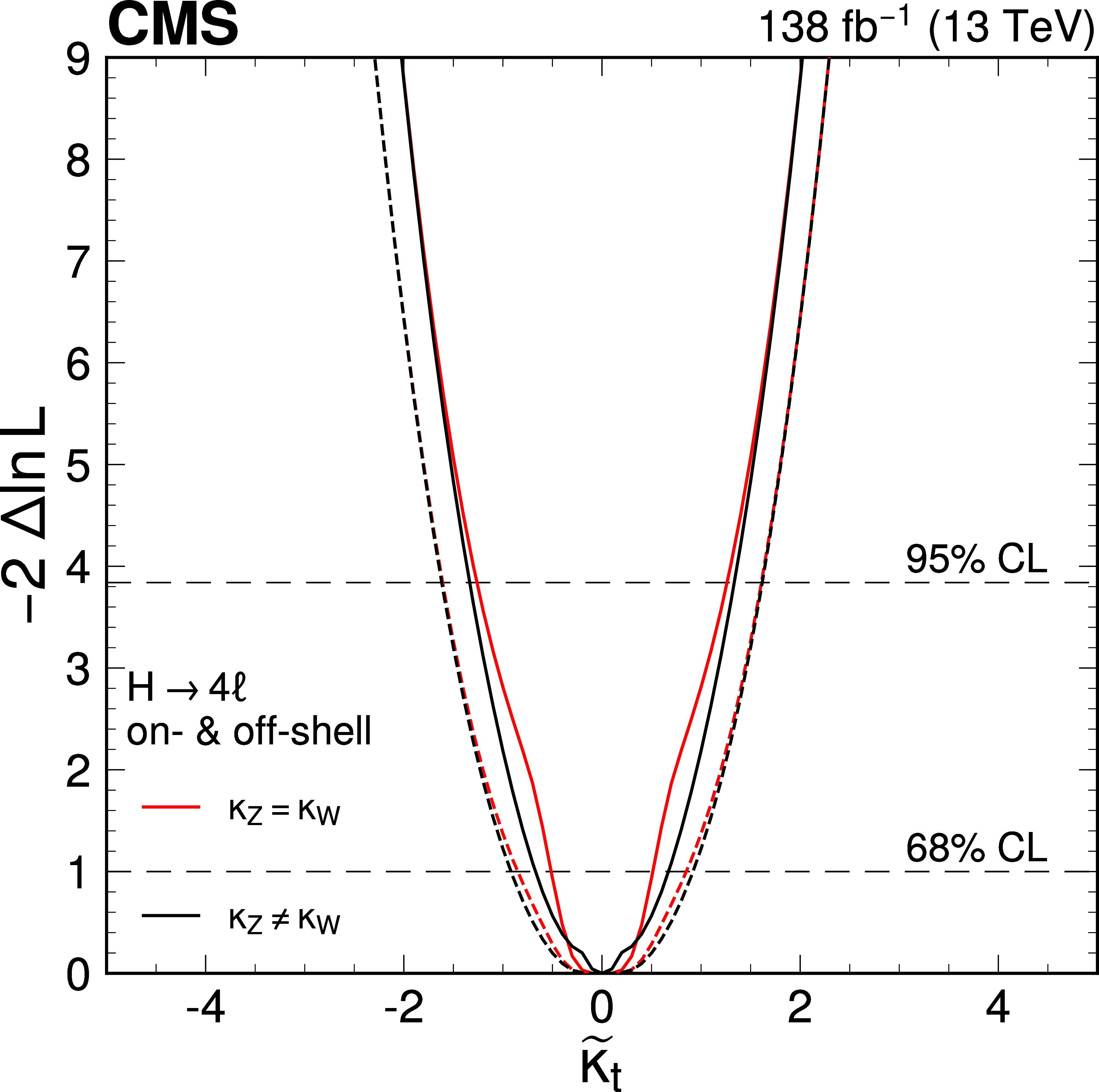
Observed (solid) and expected (dashed) scans for the couplings $ \kappa_{\mathrm{t}} $ (upper left), $ \kappa_{Q} $ (upper right), $ \widetilde{\kappa}_{\mathrm{t}} $ (lower left), and $ \widetilde{\kappa}_{Q} $ (lower right), obtained from the combined on- and off-shell fit. All four couplings, together with $ \kappa_{\mathrm{Z}} $ and $ \kappa_{\mathrm{W}} $, are allowed to vary simultaneously. The horizontal dashed lines indicate the 68 and 95% CL thresholds. |
png pdf |
Figure 6-d:
Observed (solid) and expected (dashed) scans for the couplings $ \kappa_{\mathrm{t}} $ (upper left), $ \kappa_{Q} $ (upper right), $ \widetilde{\kappa}_{\mathrm{t}} $ (lower left), and $ \widetilde{\kappa}_{Q} $ (lower right), obtained from the combined on- and off-shell fit. All four couplings, together with $ \kappa_{\mathrm{Z}} $ and $ \kappa_{\mathrm{W}} $, are allowed to vary simultaneously. The horizontal dashed lines indicate the 68 and 95% CL thresholds. |
png pdf |
Figure 7:
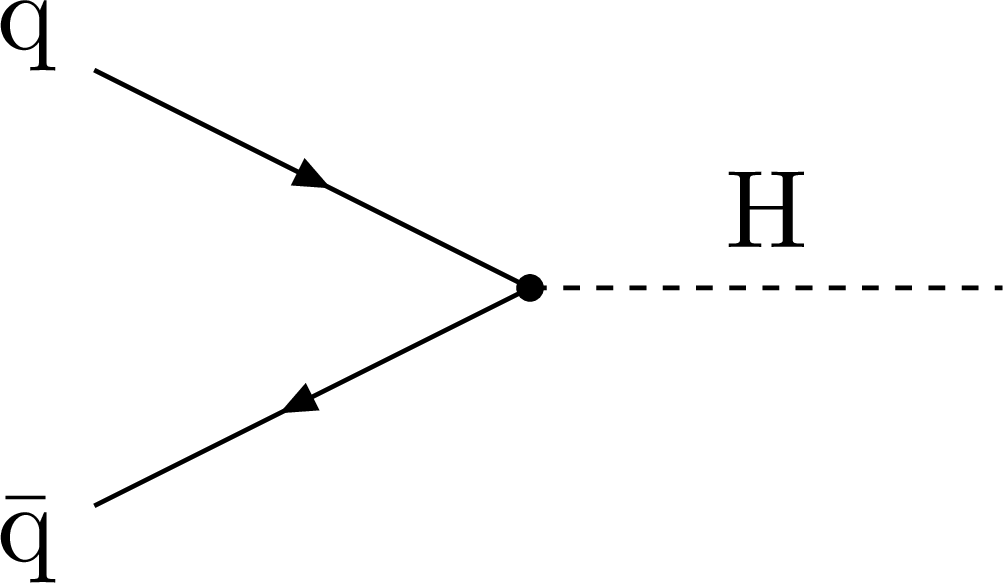
Leading-order Feynman diagram illustrating the direct quark-antiquark annihilation channel for Higgs boson production. |
png pdf |
Figure 8:
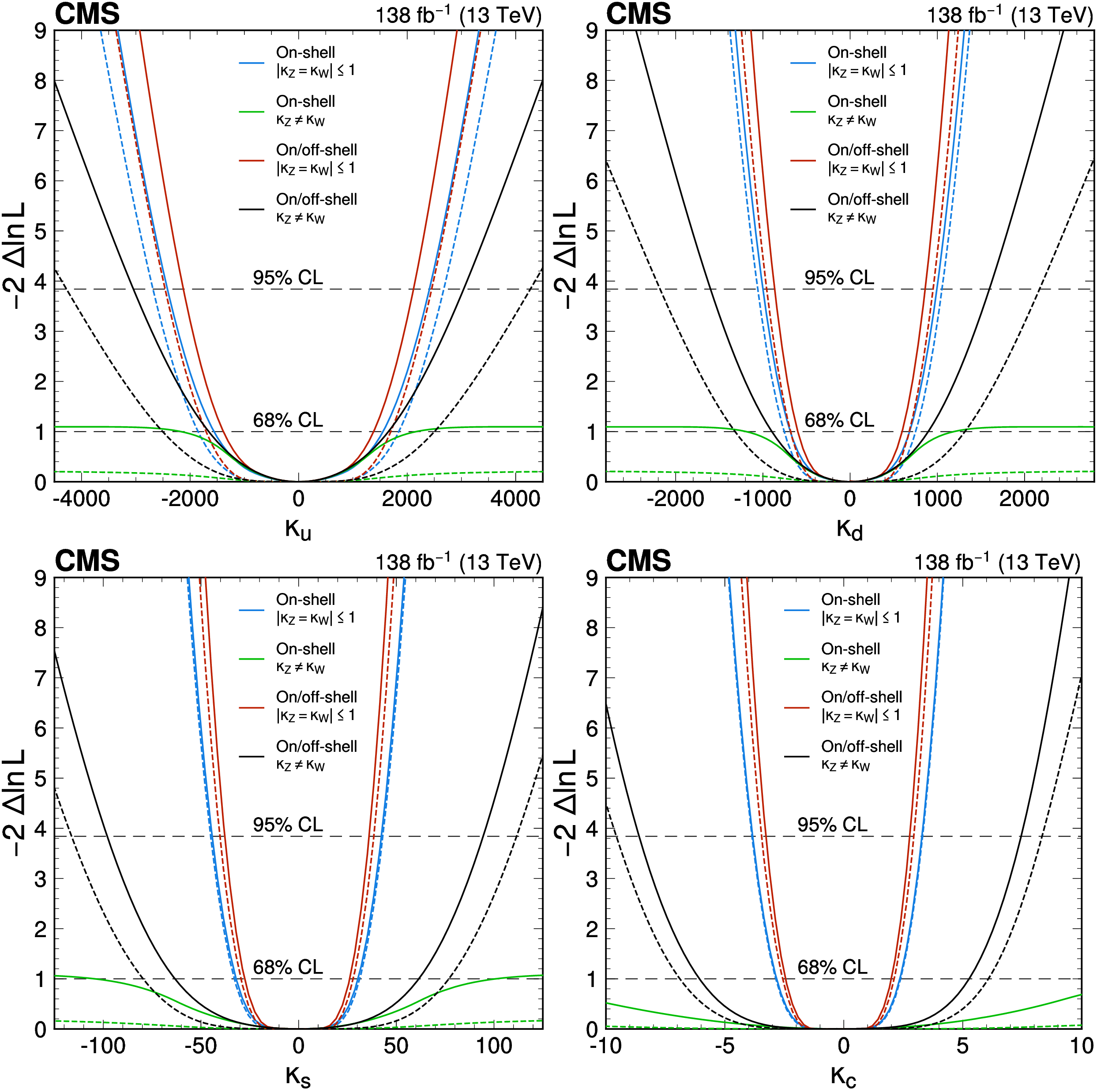
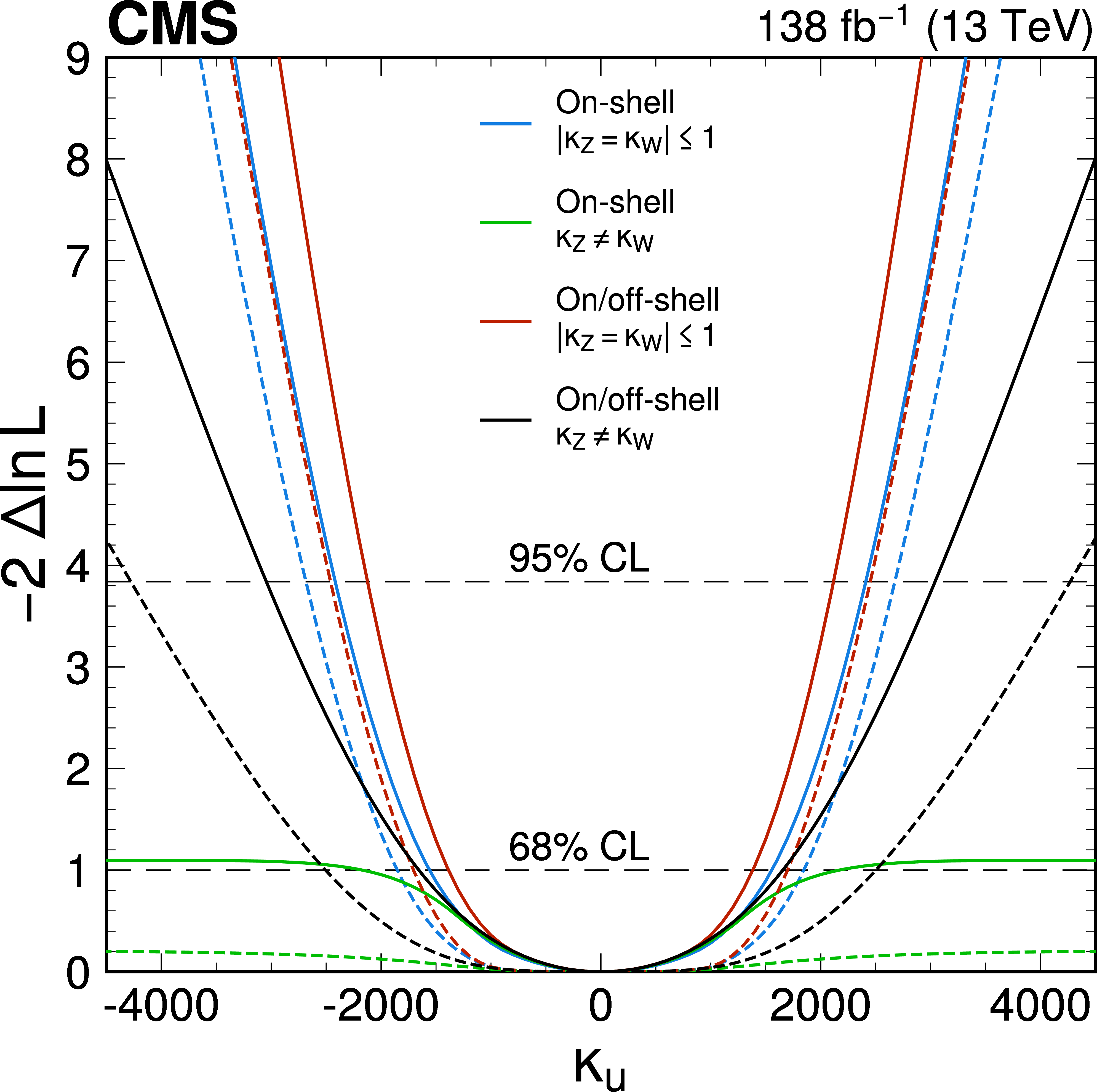
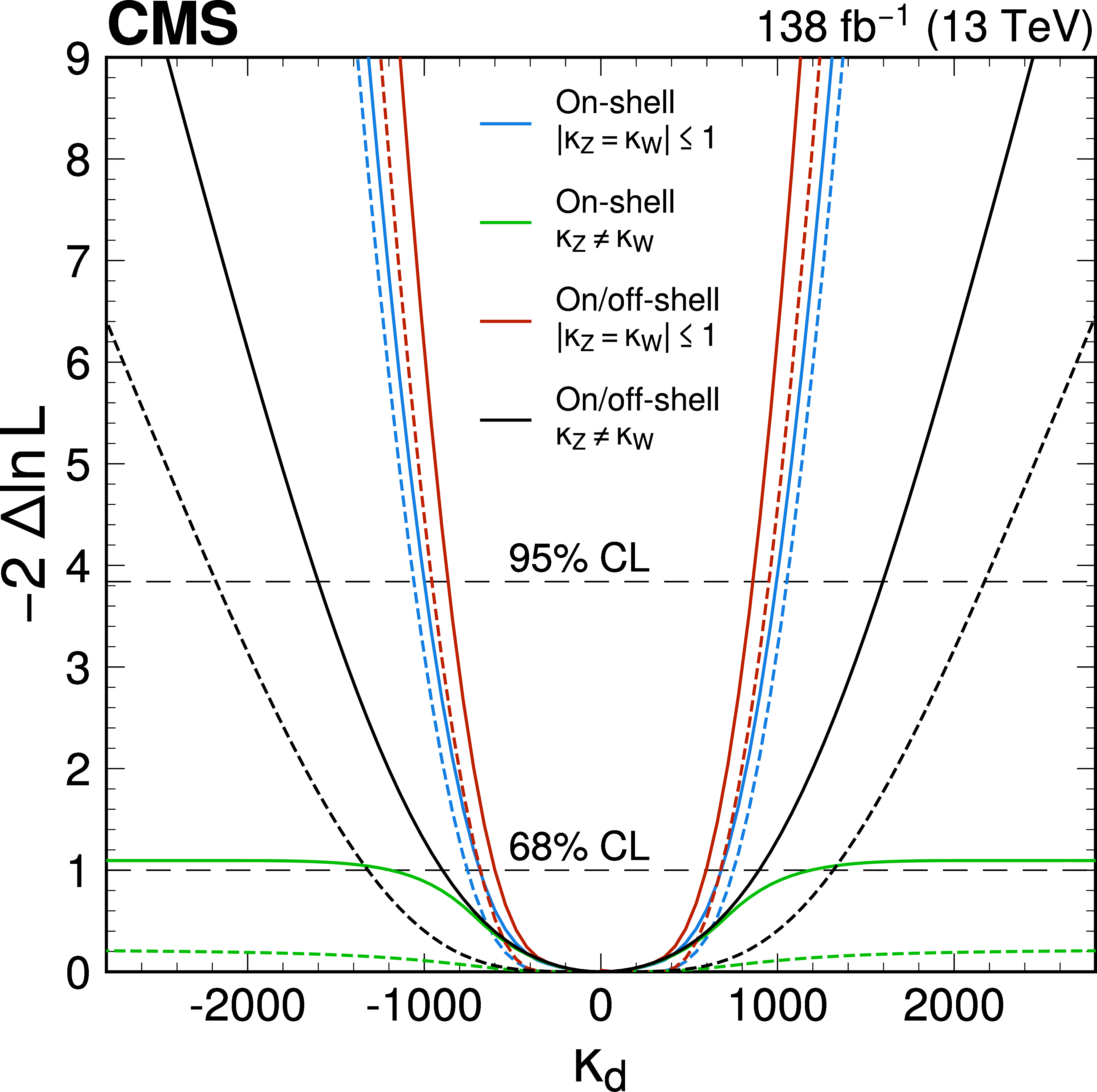
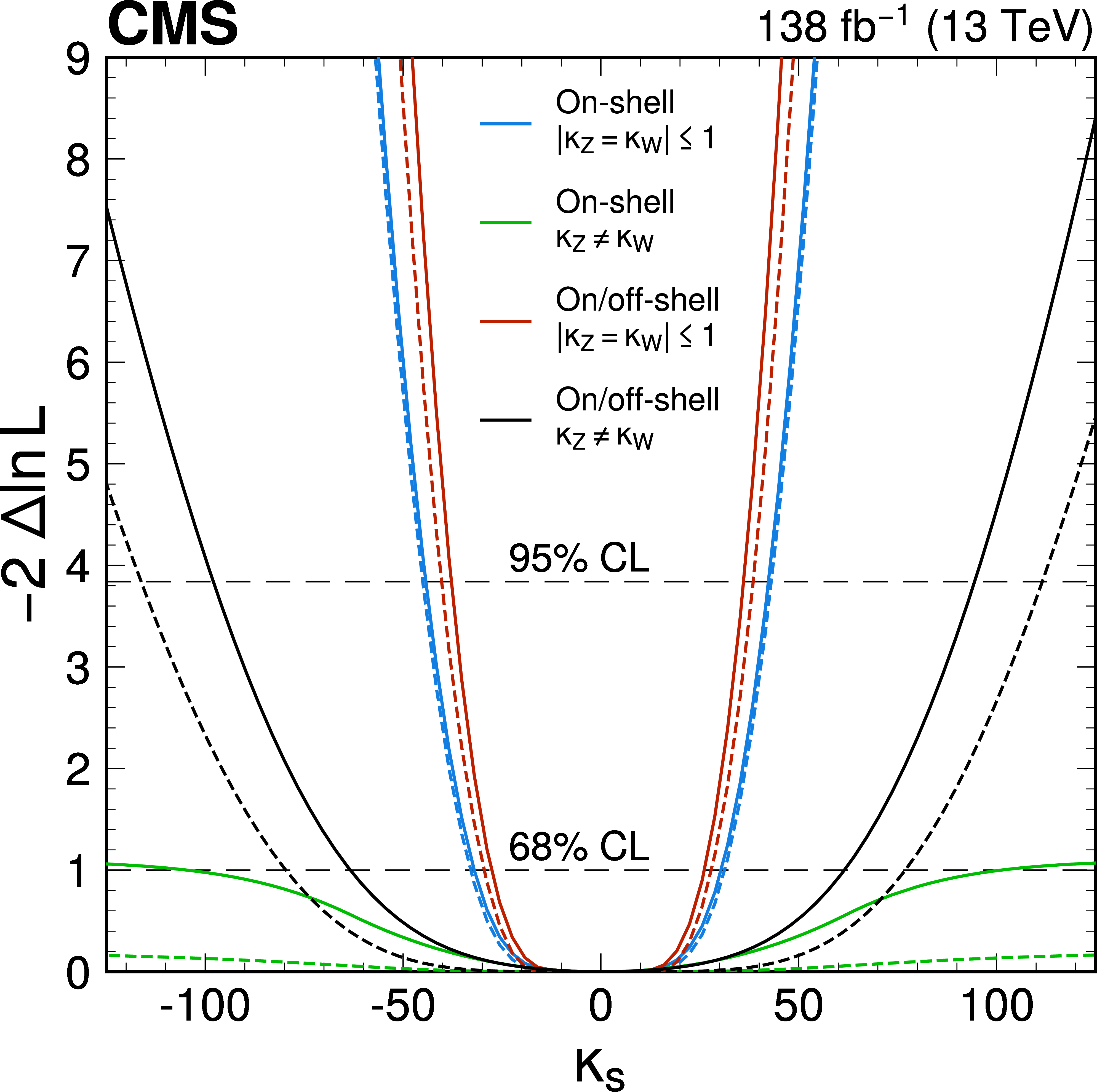
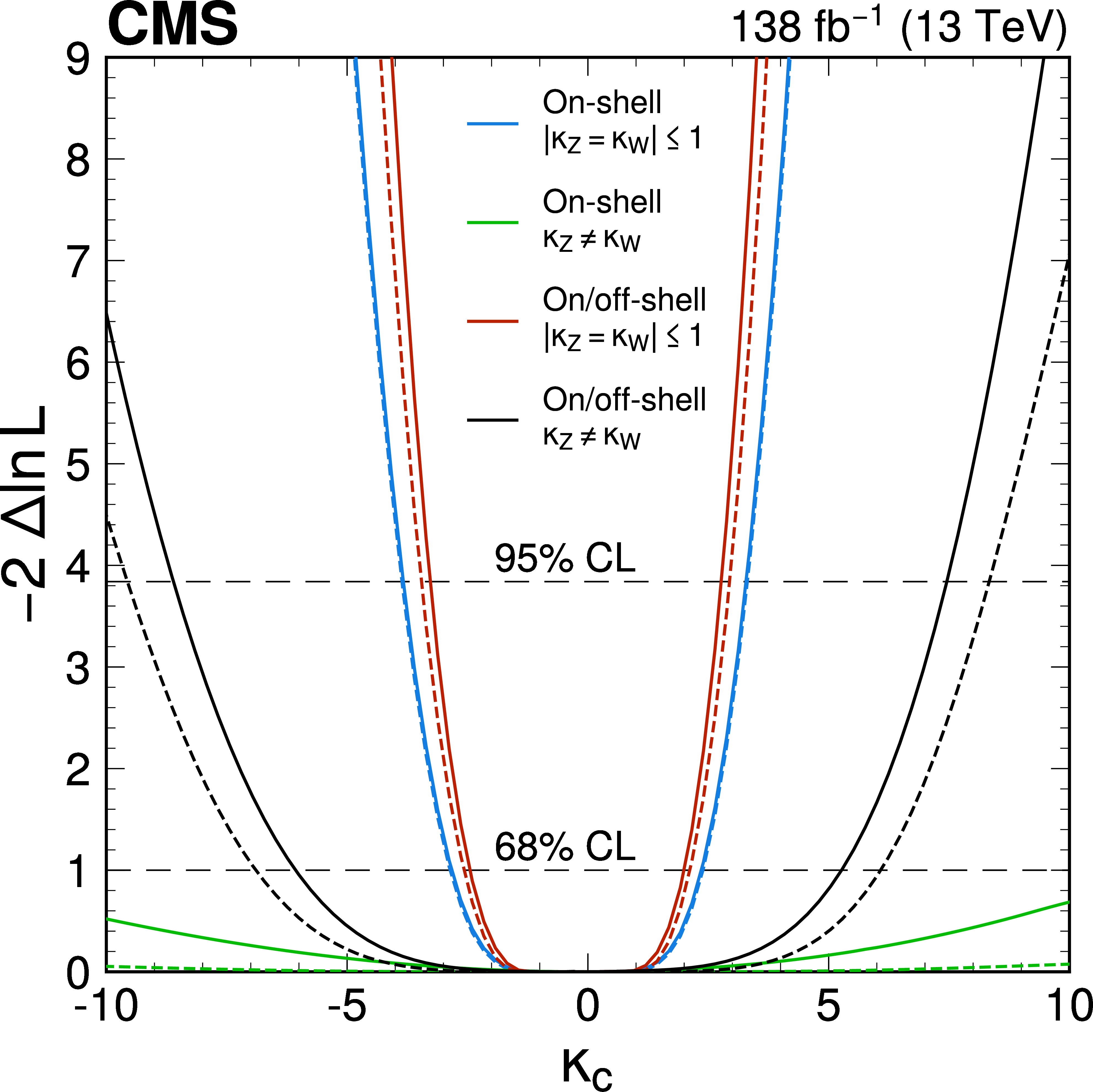
Observed (solid) and expected (dashed) profile scans of the Higgs boson coupling modifiers to the light quarks: $ \kappa_{\mathrm{u}} $ (up, upper left), $ \kappa_{\mathrm{d}} $ (down, upper right), $ \kappa_{\mathrm{s}} $ (strange, lower left), and $ \kappa_{\mathrm{c}} $ (charm, lower right), shown for four analysis configurations: on-shell only or combined on- and off-shell production, and with or without the assumptions $ |\kappa_{\mathrm{Z}}|\leq $ 1 and $ \kappa_{\mathrm{Z}}=\kappa_{\mathrm{W}} $. In each scan the other light-quark couplings are profiled simultaneously. The black horizontal dashed lines mark the 68 and 95% CL thresholds. |
png pdf |
Figure 8-a:
Observed (solid) and expected (dashed) profile scans of the Higgs boson coupling modifiers to the light quarks: $ \kappa_{\mathrm{u}} $ (up, upper left), $ \kappa_{\mathrm{d}} $ (down, upper right), $ \kappa_{\mathrm{s}} $ (strange, lower left), and $ \kappa_{\mathrm{c}} $ (charm, lower right), shown for four analysis configurations: on-shell only or combined on- and off-shell production, and with or without the assumptions $ |\kappa_{\mathrm{Z}}|\leq $ 1 and $ \kappa_{\mathrm{Z}}=\kappa_{\mathrm{W}} $. In each scan the other light-quark couplings are profiled simultaneously. The black horizontal dashed lines mark the 68 and 95% CL thresholds. |
png pdf |
Figure 8-b:
Observed (solid) and expected (dashed) profile scans of the Higgs boson coupling modifiers to the light quarks: $ \kappa_{\mathrm{u}} $ (up, upper left), $ \kappa_{\mathrm{d}} $ (down, upper right), $ \kappa_{\mathrm{s}} $ (strange, lower left), and $ \kappa_{\mathrm{c}} $ (charm, lower right), shown for four analysis configurations: on-shell only or combined on- and off-shell production, and with or without the assumptions $ |\kappa_{\mathrm{Z}}|\leq $ 1 and $ \kappa_{\mathrm{Z}}=\kappa_{\mathrm{W}} $. In each scan the other light-quark couplings are profiled simultaneously. The black horizontal dashed lines mark the 68 and 95% CL thresholds. |
png pdf |
Figure 8-c:
Observed (solid) and expected (dashed) profile scans of the Higgs boson coupling modifiers to the light quarks: $ \kappa_{\mathrm{u}} $ (up, upper left), $ \kappa_{\mathrm{d}} $ (down, upper right), $ \kappa_{\mathrm{s}} $ (strange, lower left), and $ \kappa_{\mathrm{c}} $ (charm, lower right), shown for four analysis configurations: on-shell only or combined on- and off-shell production, and with or without the assumptions $ |\kappa_{\mathrm{Z}}|\leq $ 1 and $ \kappa_{\mathrm{Z}}=\kappa_{\mathrm{W}} $. In each scan the other light-quark couplings are profiled simultaneously. The black horizontal dashed lines mark the 68 and 95% CL thresholds. |
png pdf |
Figure 8-d:
Observed (solid) and expected (dashed) profile scans of the Higgs boson coupling modifiers to the light quarks: $ \kappa_{\mathrm{u}} $ (up, upper left), $ \kappa_{\mathrm{d}} $ (down, upper right), $ \kappa_{\mathrm{s}} $ (strange, lower left), and $ \kappa_{\mathrm{c}} $ (charm, lower right), shown for four analysis configurations: on-shell only or combined on- and off-shell production, and with or without the assumptions $ |\kappa_{\mathrm{Z}}|\leq $ 1 and $ \kappa_{\mathrm{Z}}=\kappa_{\mathrm{W}} $. In each scan the other light-quark couplings are profiled simultaneously. The black horizontal dashed lines mark the 68 and 95% CL thresholds. |
png pdf |
Figure 9:
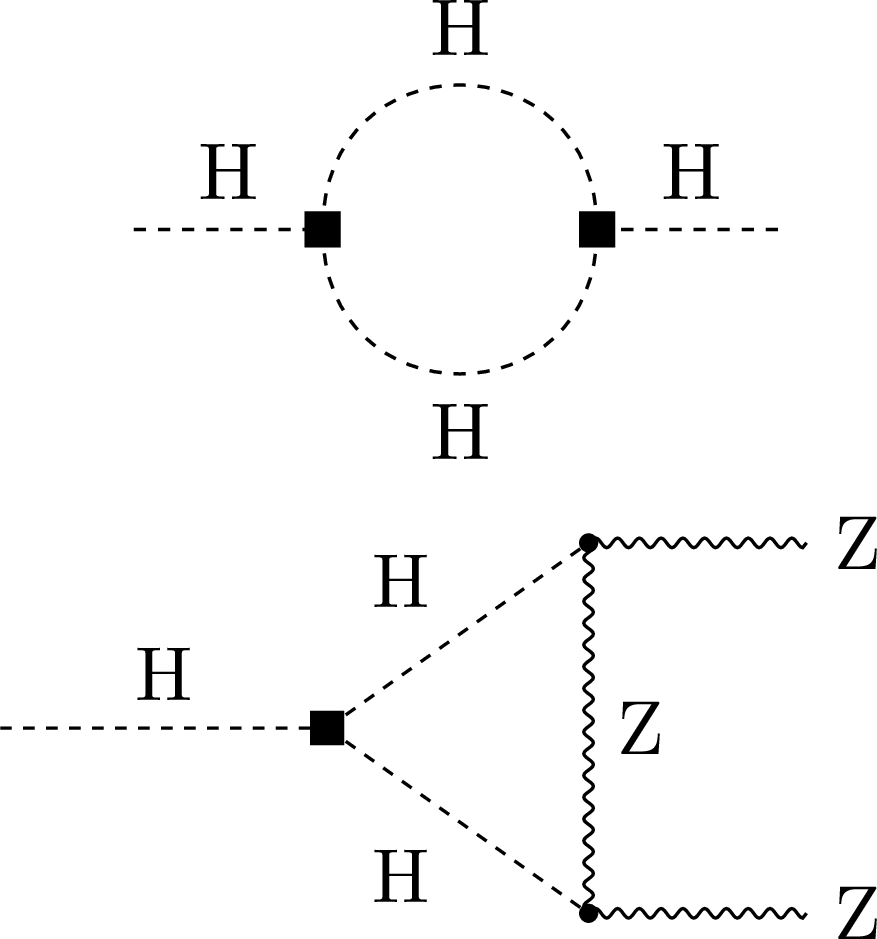
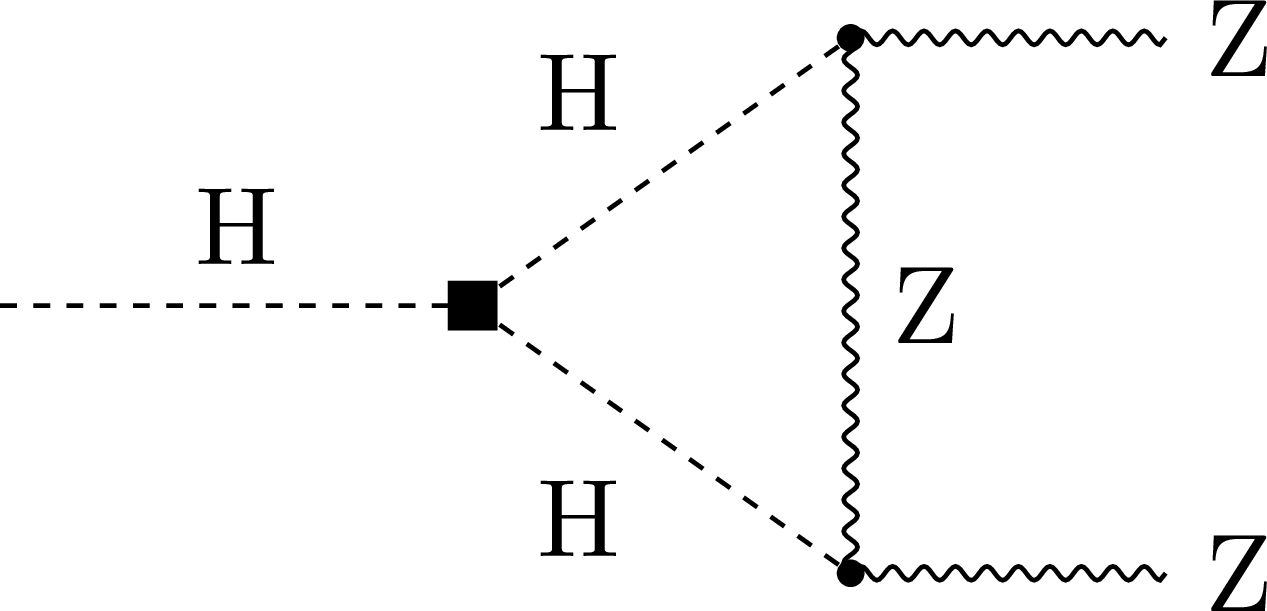
Feynman diagrams illustrating the loop-induced correction from the Higgs boson self-interaction in the propagator (upper) and in the $ \mathrm{H}\to\mathrm{Z}\mathrm{Z} $ decay (lower). Here, the black square represents the triple Higgs boson vertex. |
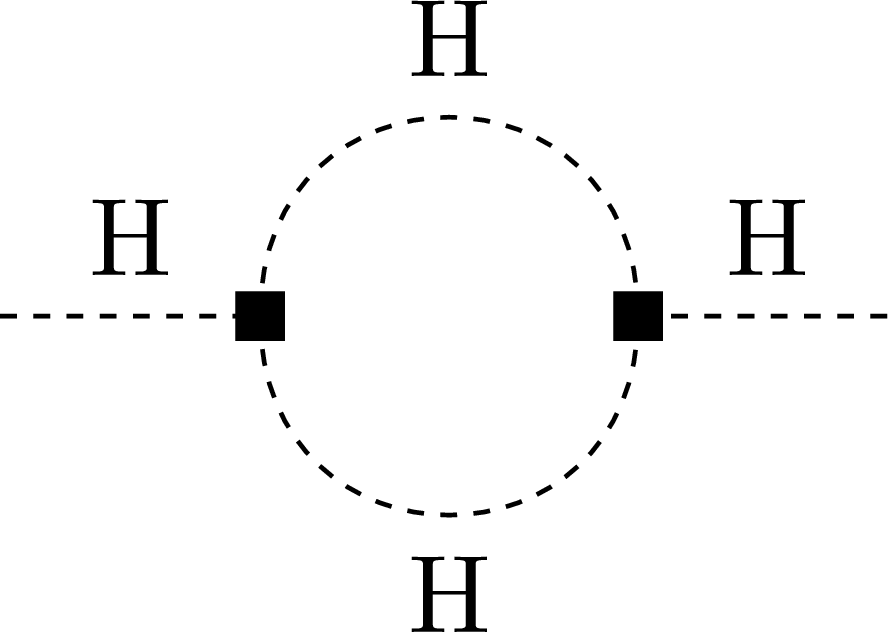
png pdf |
Figure 9-a:
Feynman diagrams illustrating the loop-induced correction from the Higgs boson self-interaction in the propagator (upper) and in the $ \mathrm{H}\to\mathrm{Z}\mathrm{Z} $ decay (lower). Here, the black square represents the triple Higgs boson vertex. |
png pdf |
Figure 9-b:
Feynman diagrams illustrating the loop-induced correction from the Higgs boson self-interaction in the propagator (upper) and in the $ \mathrm{H}\to\mathrm{Z}\mathrm{Z} $ decay (lower). Here, the black square represents the triple Higgs boson vertex. |
png pdf |
Figure 10:
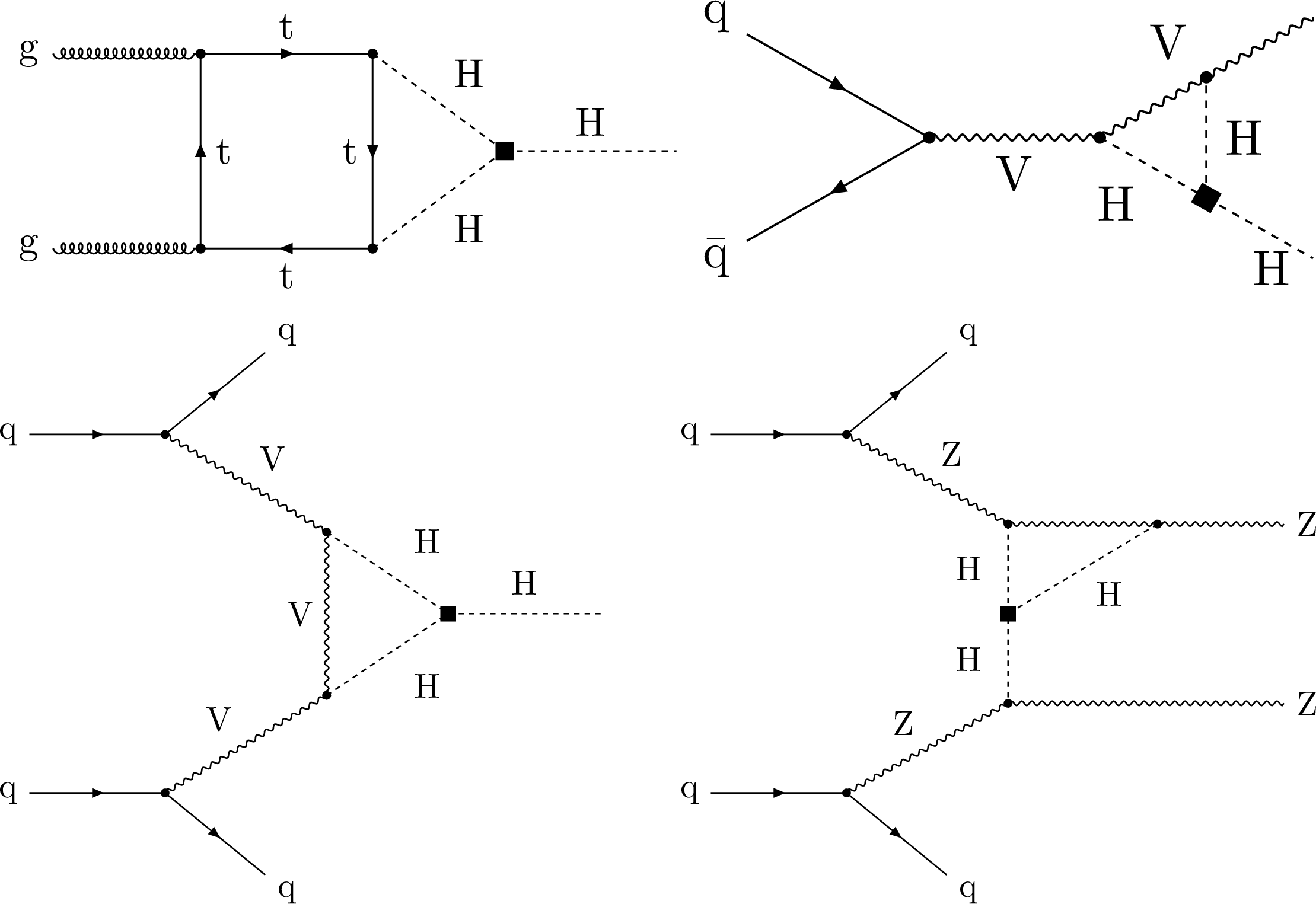
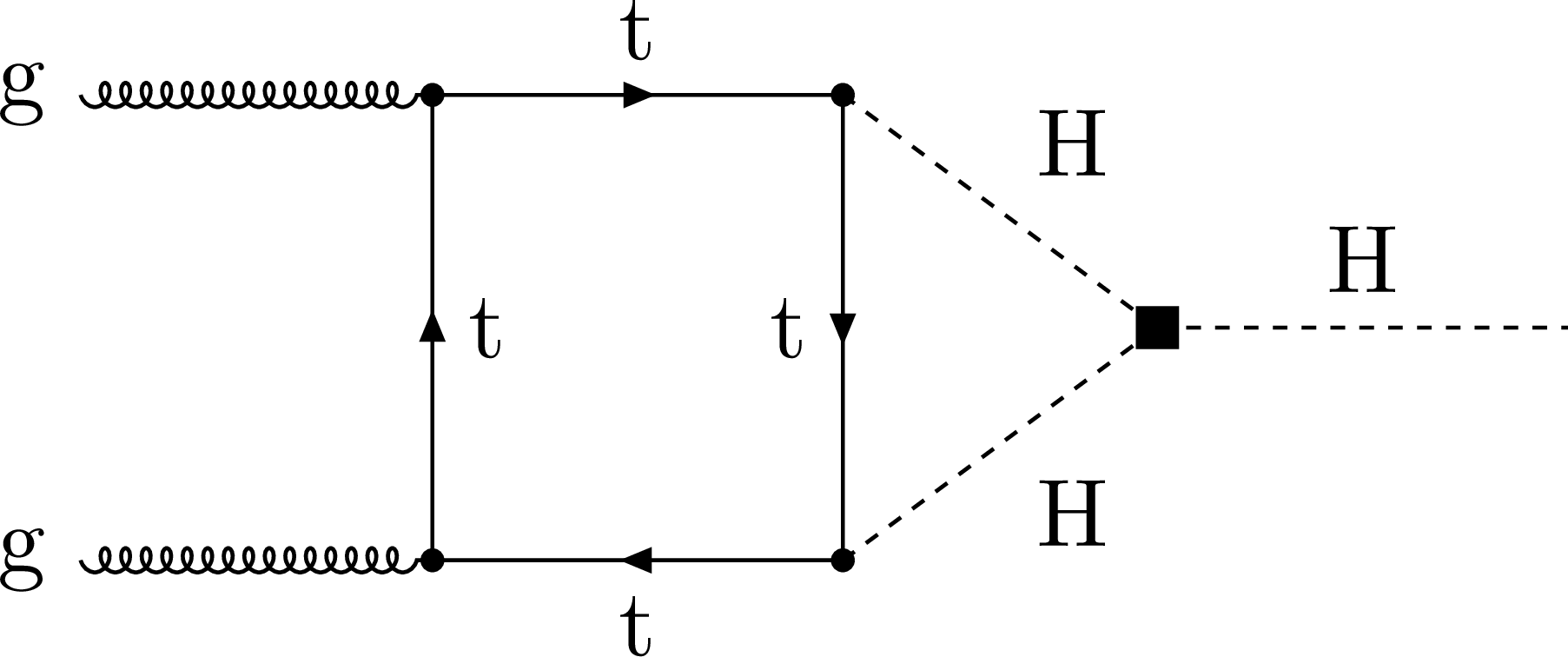
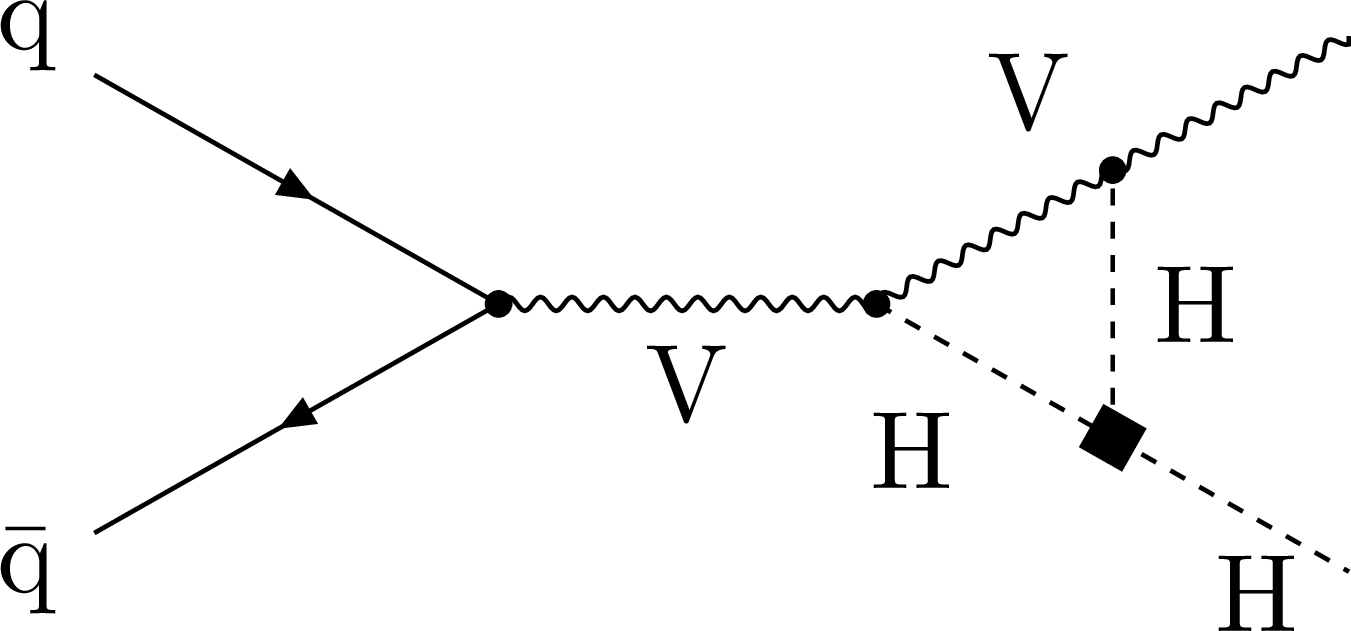
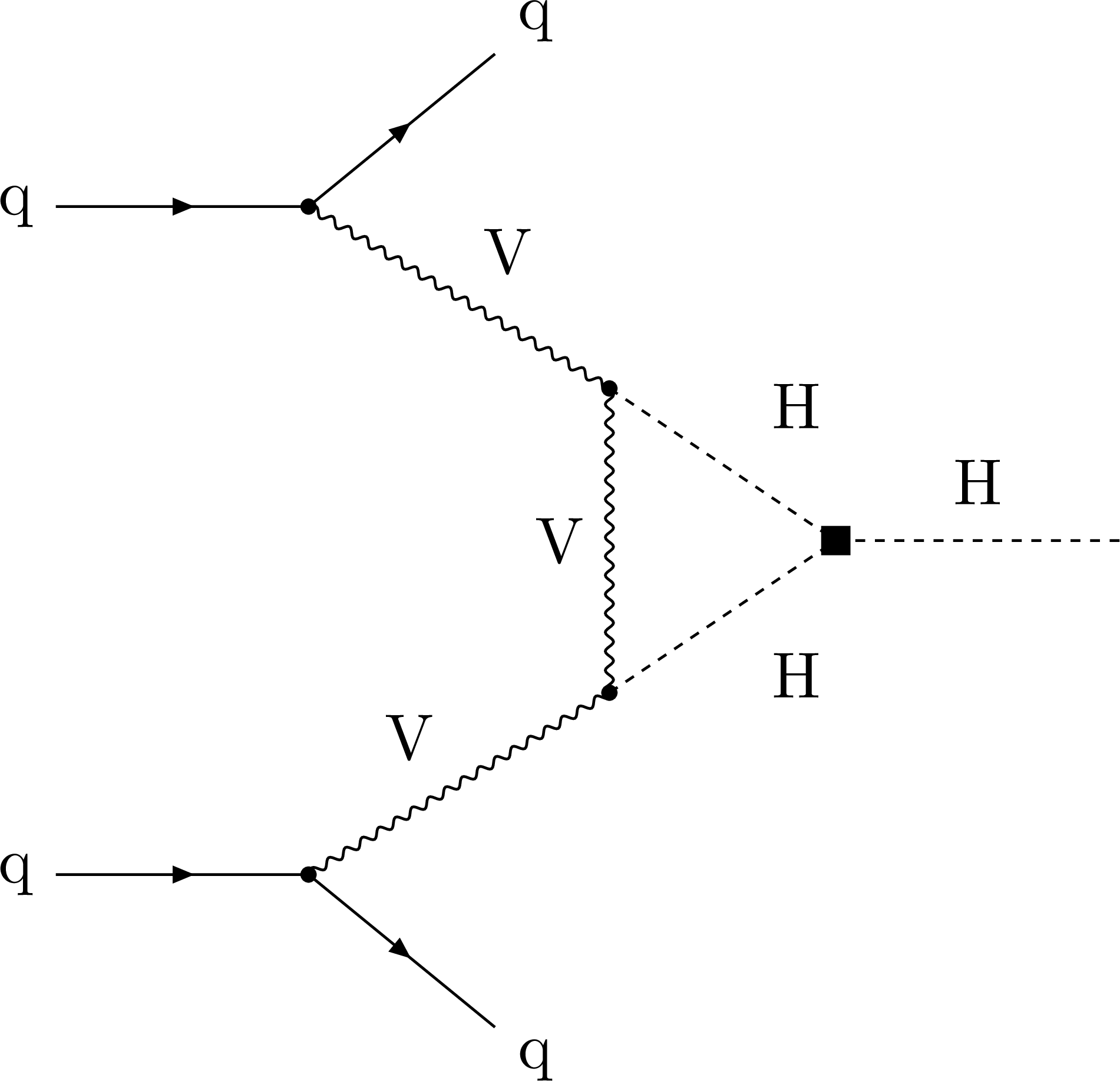
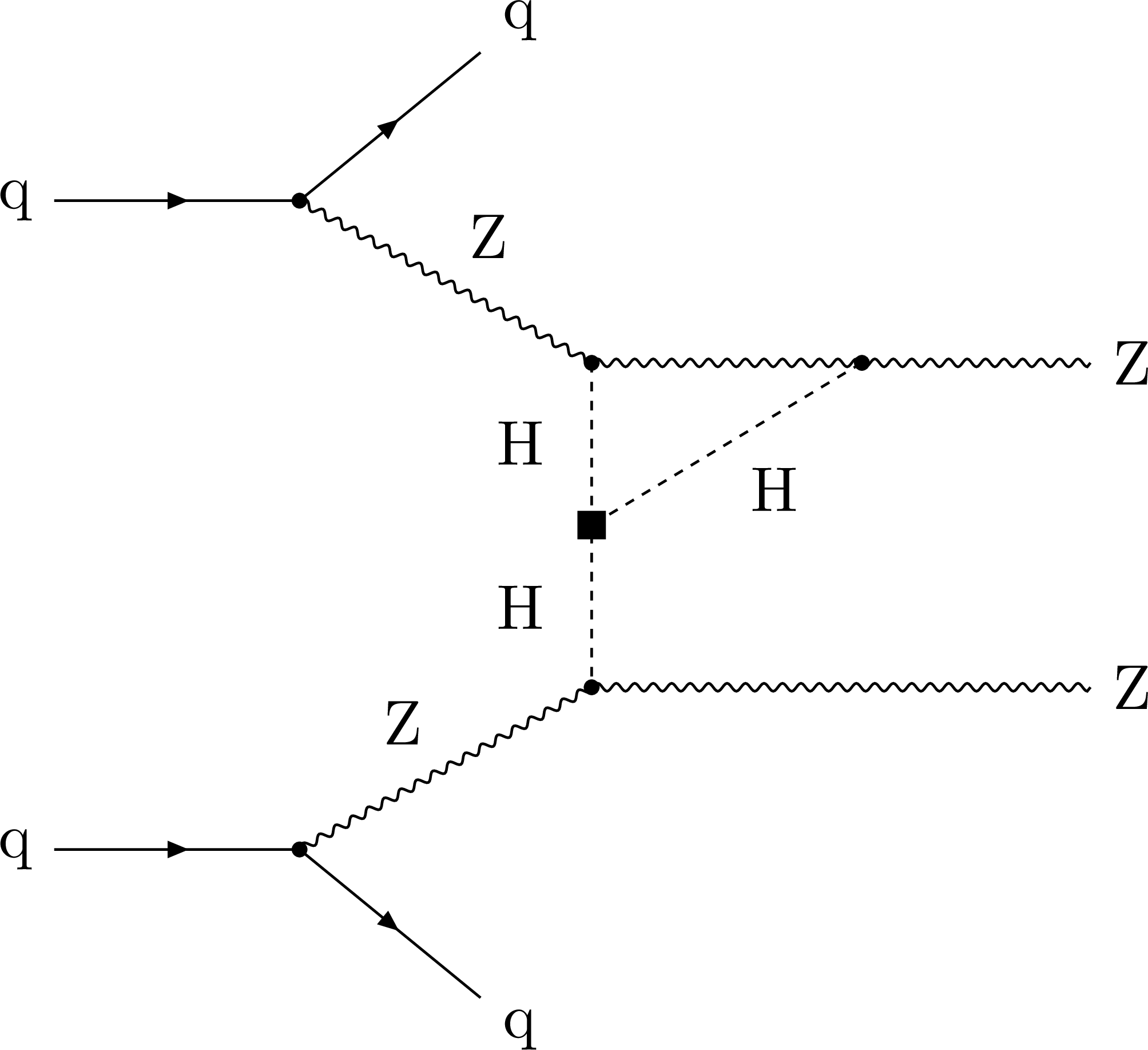
Feynman diagrams illustrating the correction from the Higgs boson self-interaction in the production processes considered in Fig. 1: $ \mathrm{g}\mathrm{g}\mathrm{H} $ (upper left), VH associated production (upper right), $ s $-channel VBF (lower left), and $ t $-channel VBF (lower right). Here, the black square represents the triple Higgs boson vertex. |
png pdf |
Figure 10-a:
Feynman diagrams illustrating the correction from the Higgs boson self-interaction in the production processes considered in Fig. 1: $ \mathrm{g}\mathrm{g}\mathrm{H} $ (upper left), VH associated production (upper right), $ s $-channel VBF (lower left), and $ t $-channel VBF (lower right). Here, the black square represents the triple Higgs boson vertex. |
png pdf |
Figure 10-b:
Feynman diagrams illustrating the correction from the Higgs boson self-interaction in the production processes considered in Fig. 1: $ \mathrm{g}\mathrm{g}\mathrm{H} $ (upper left), VH associated production (upper right), $ s $-channel VBF (lower left), and $ t $-channel VBF (lower right). Here, the black square represents the triple Higgs boson vertex. |
png pdf |
Figure 10-c:
Feynman diagrams illustrating the correction from the Higgs boson self-interaction in the production processes considered in Fig. 1: $ \mathrm{g}\mathrm{g}\mathrm{H} $ (upper left), VH associated production (upper right), $ s $-channel VBF (lower left), and $ t $-channel VBF (lower right). Here, the black square represents the triple Higgs boson vertex. |
png pdf |
Figure 10-d:
Feynman diagrams illustrating the correction from the Higgs boson self-interaction in the production processes considered in Fig. 1: $ \mathrm{g}\mathrm{g}\mathrm{H} $ (upper left), VH associated production (upper right), $ s $-channel VBF (lower left), and $ t $-channel VBF (lower right). Here, the black square represents the triple Higgs boson vertex. |
png pdf |
Figure 11:
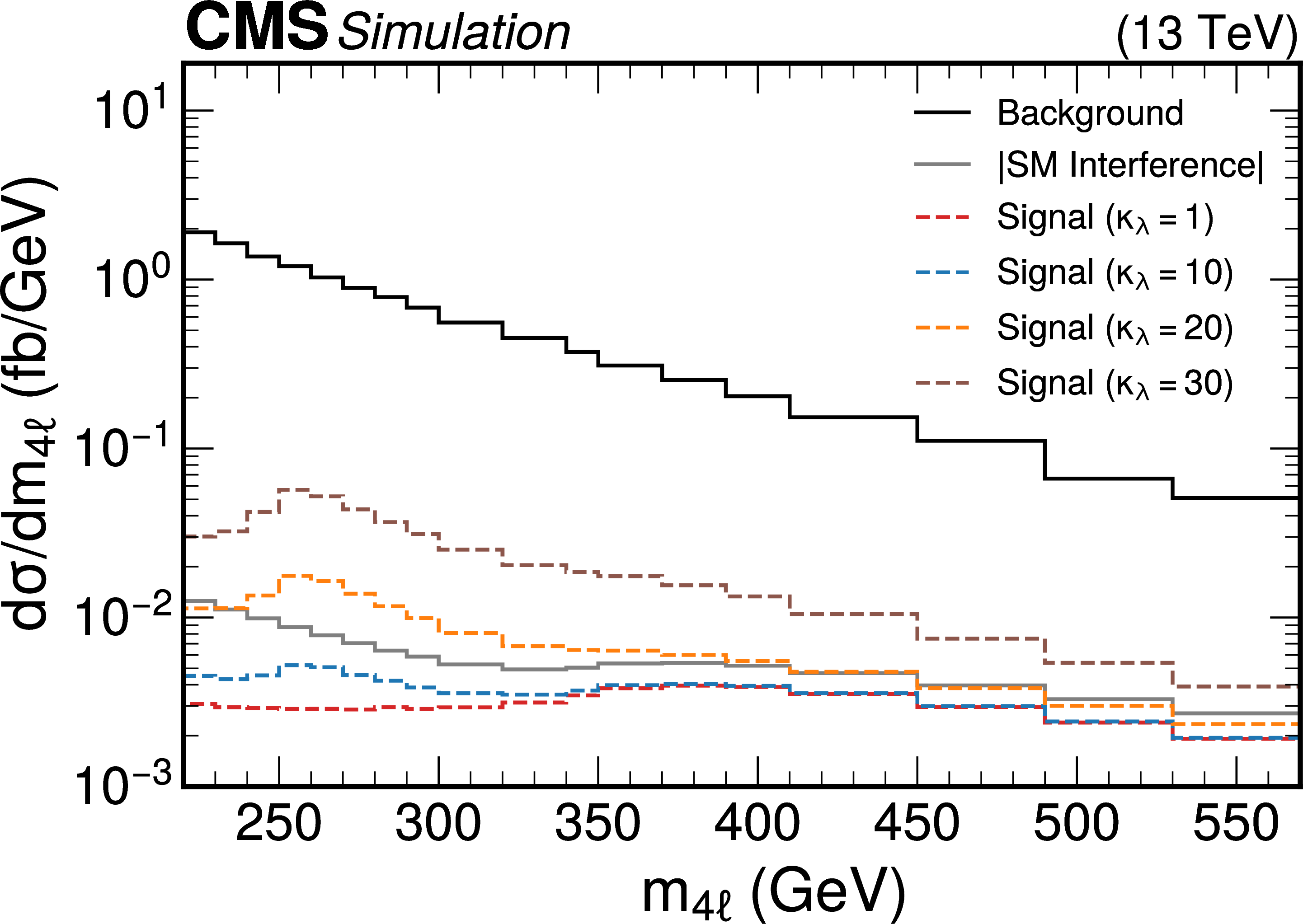
Distributions of $ m_{4\ell} $ in simulation showing the background (black), the absolute value of the interference between the SM signal and background (gray), and the signal for various $ \kappa_{\lambda} $ values: $ \kappa_{\lambda}= $ 1 (red), 10 (blue), 20 (orange), and 30 (brown). |
png pdf |
Figure 12:
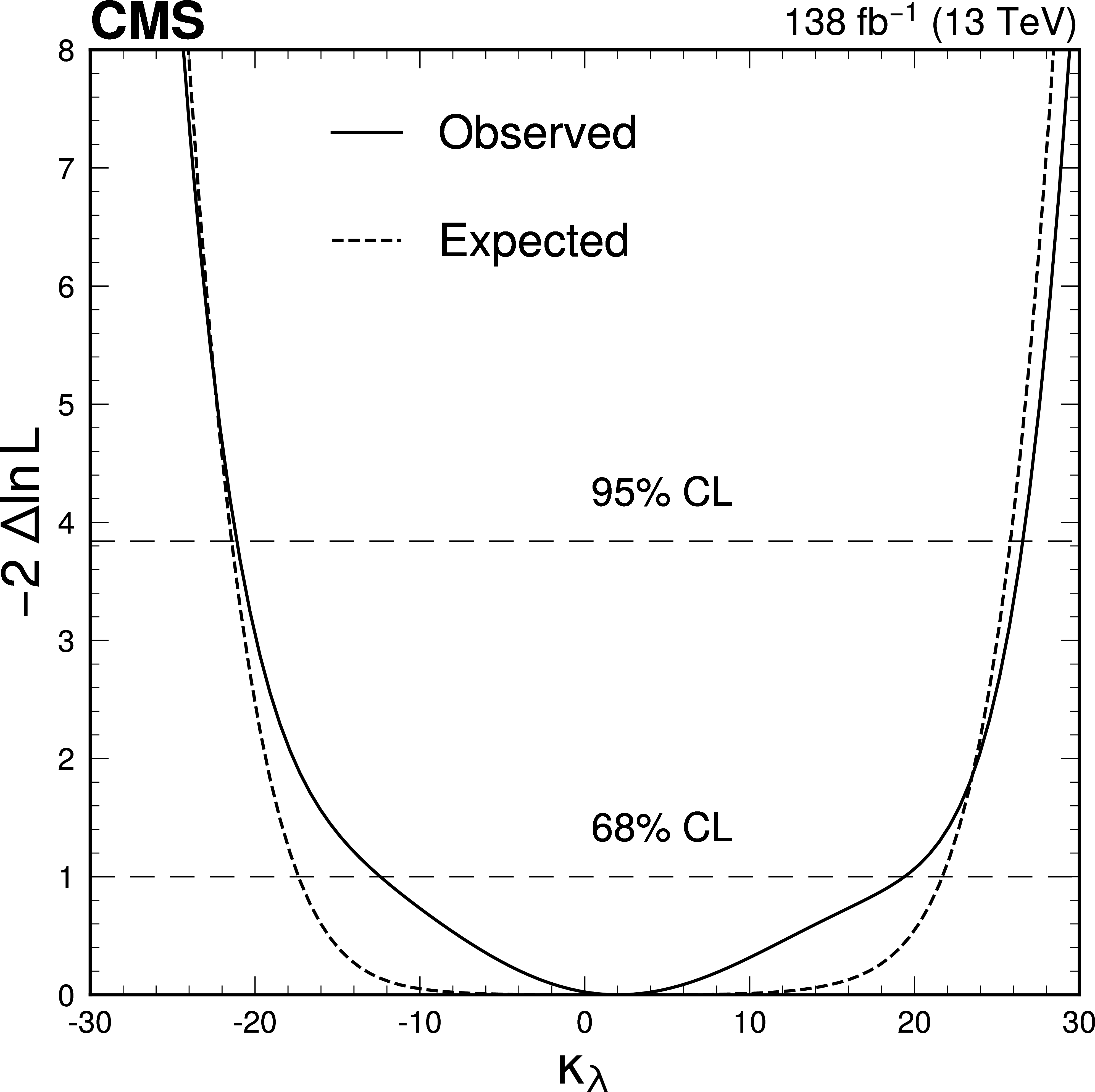
Observed (solid) and expected (dashed) profile likelihood scans from the fit for $ \kappa_{\lambda} $. The black horizontal dashed lines indicate the 68 and 95% CL thresholds. |
png pdf |
Figure 13:
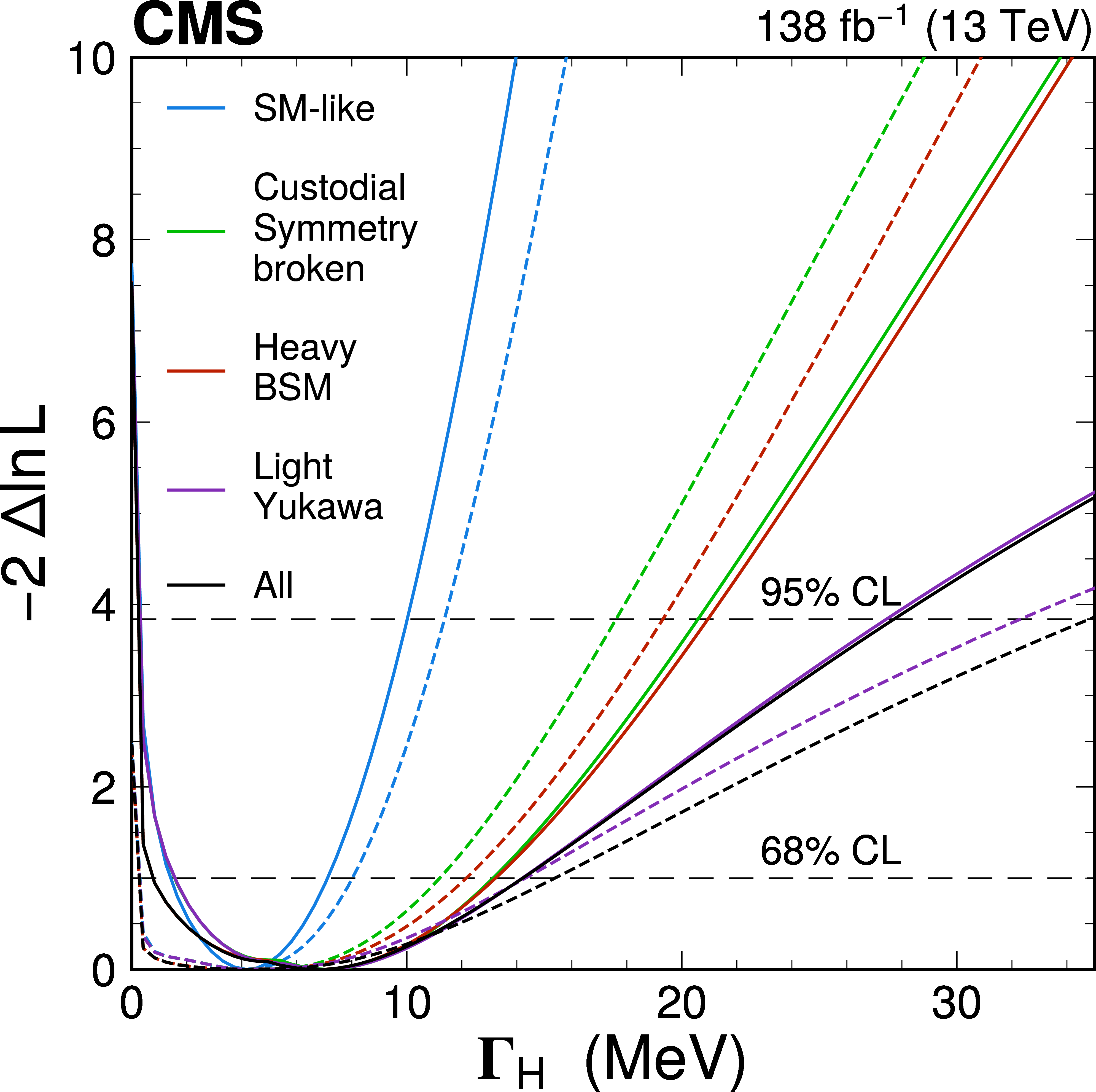
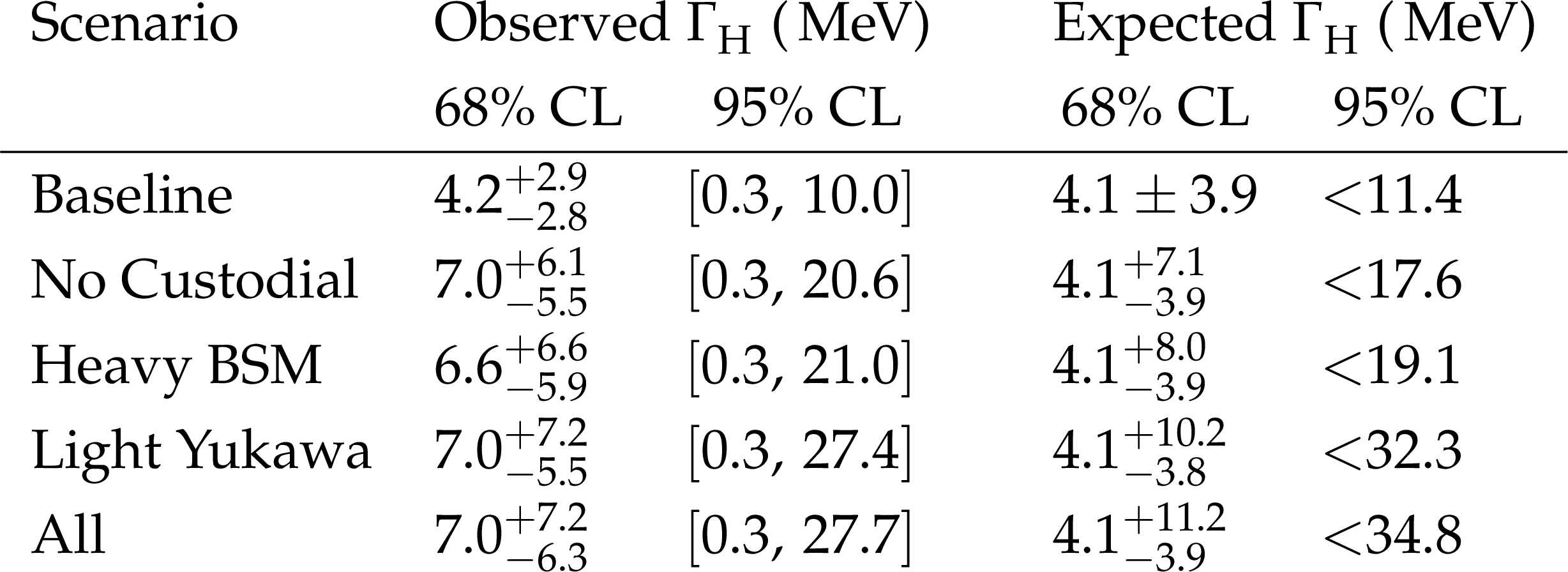
Observed (solid) and expected (dashed) scans of $ \Gamma_{\mathrm{H}} $ for $ \mathrm{H}\to\mathrm{Z}\mathrm{Z}\to4\ell $ under the five progressively inclusive BSM scenarios described in the text. The black horizontal dashed lines indicate the 68 and 95% CL thresholds. |
png pdf |
Figure 14:
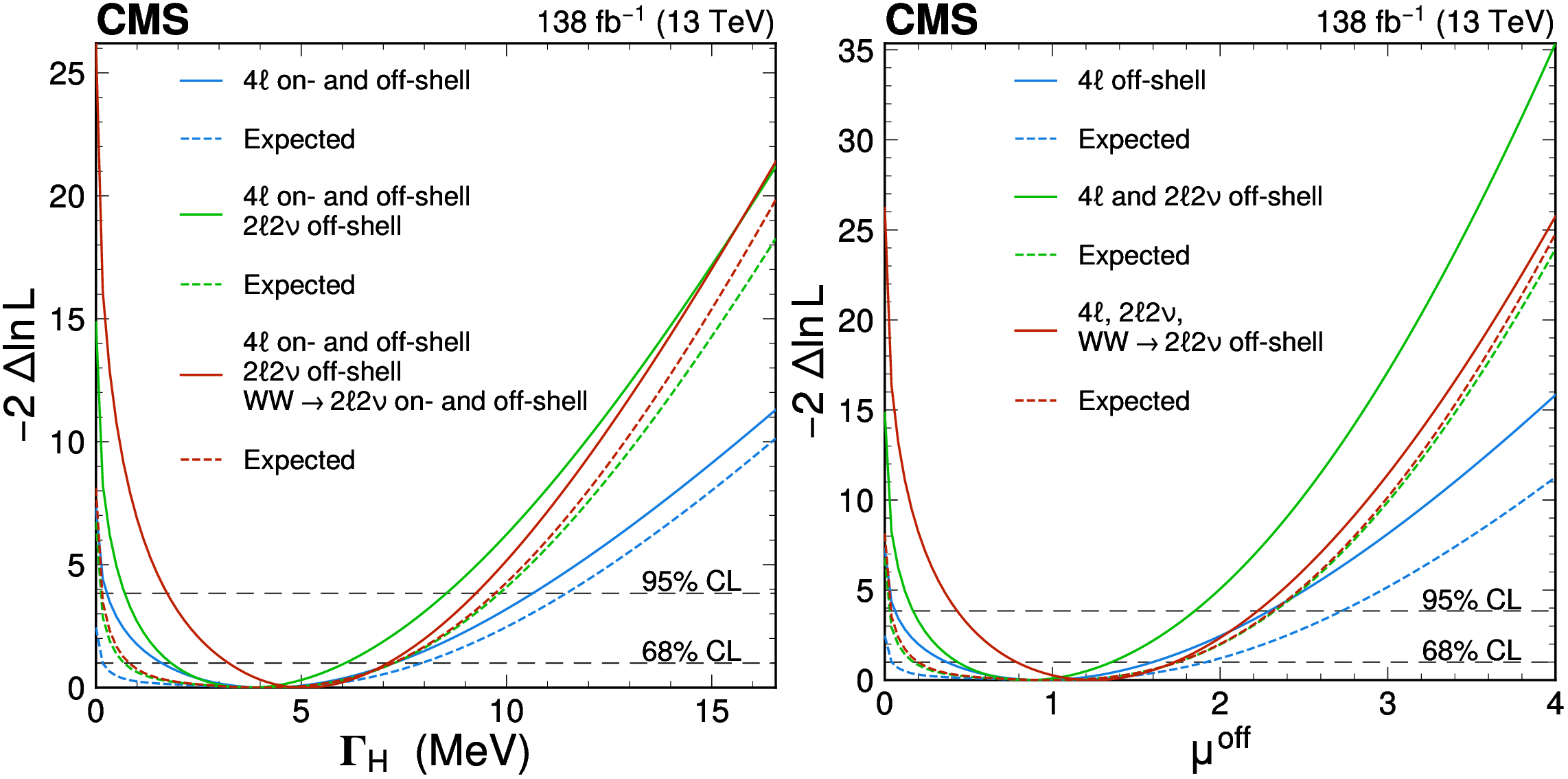
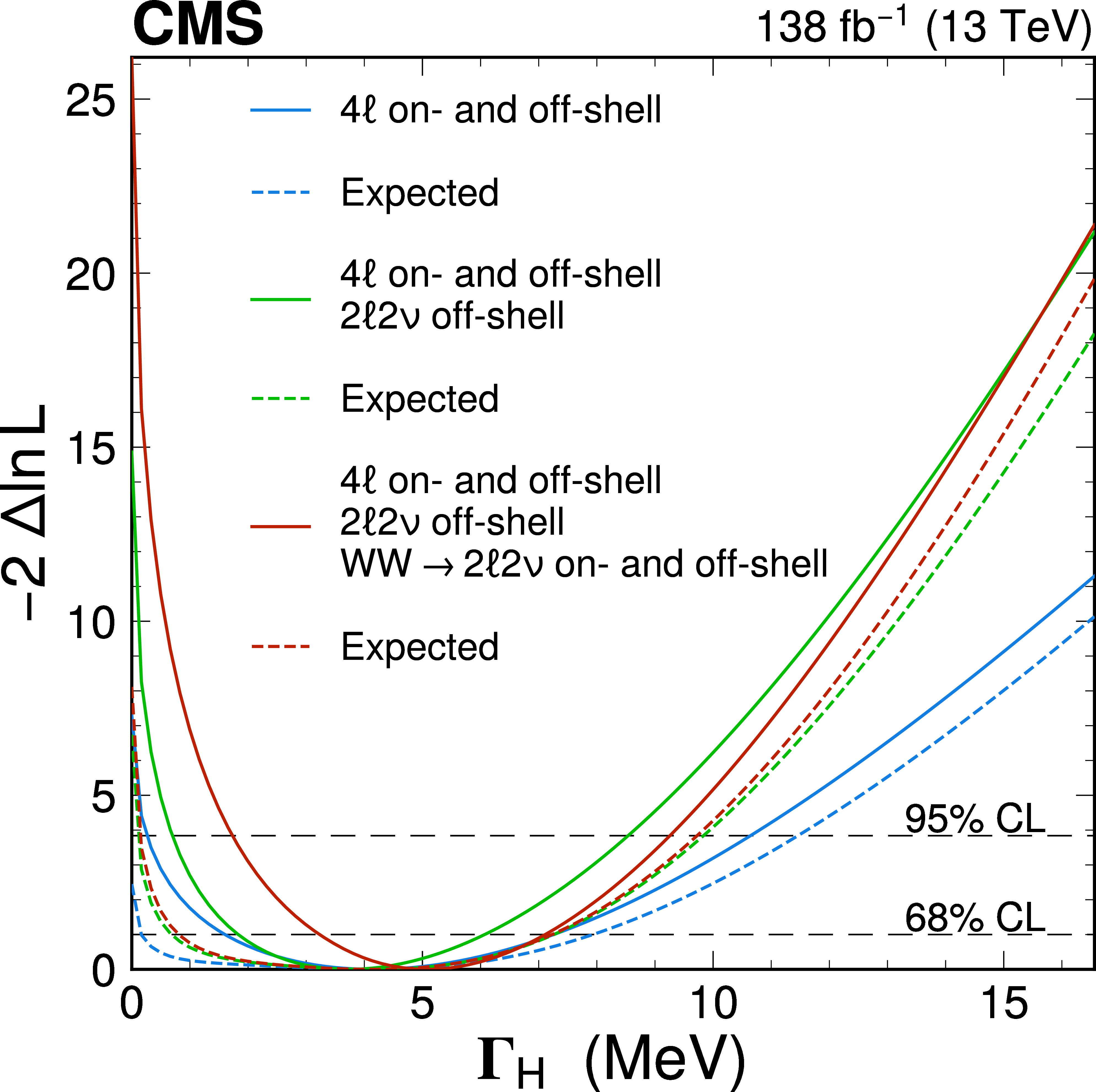
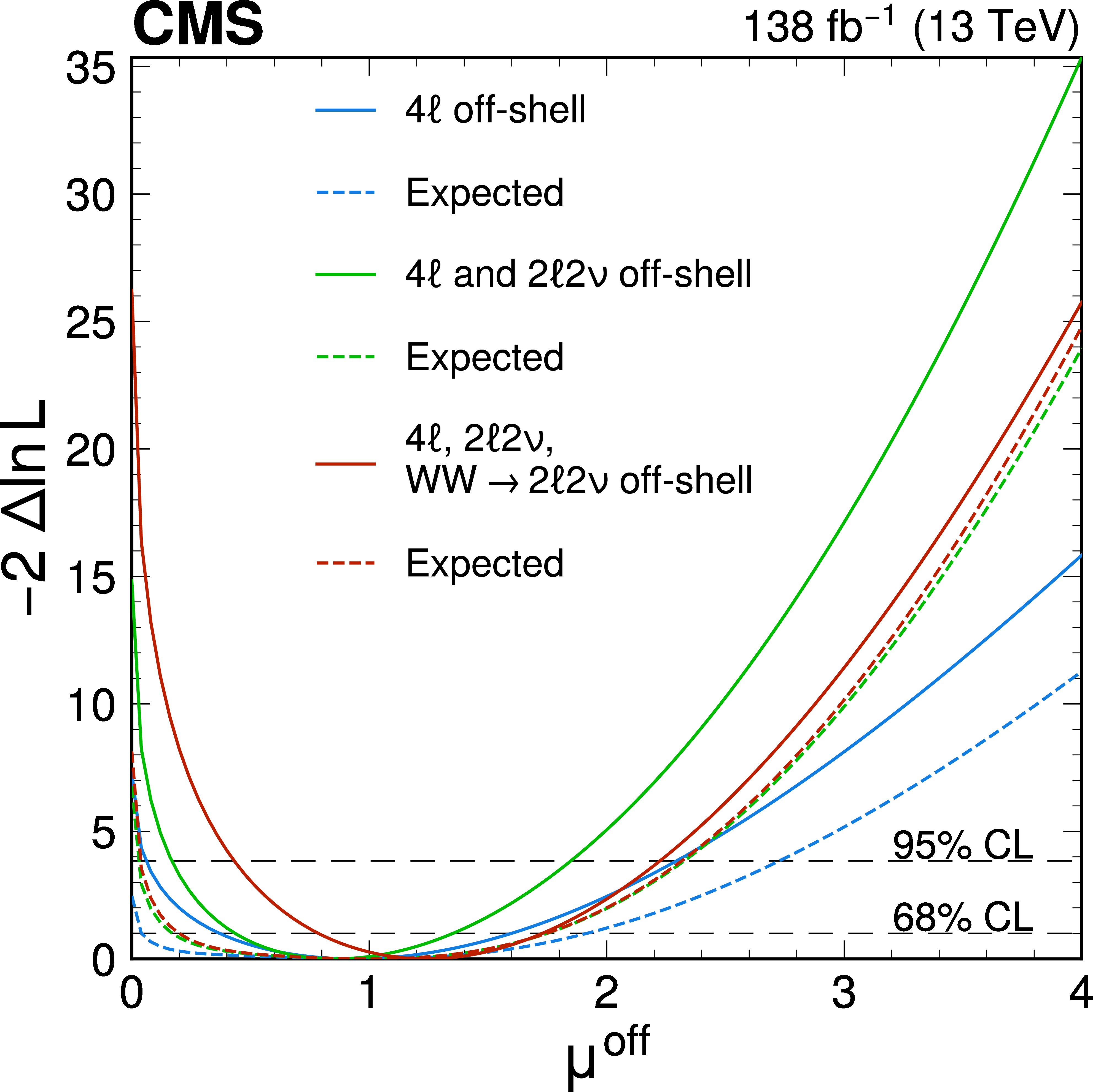
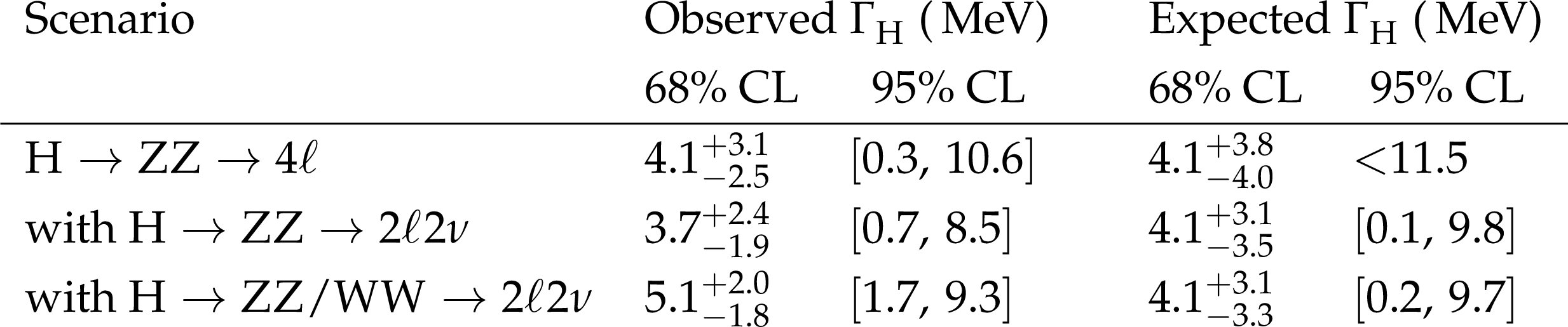
Left: Observed (solid) and expected (dashed) scans of $ \Gamma_\mathrm{H} $ for on- and off-shell $ \mathrm{H}\to\mathrm{Z}\mathrm{Z}\to4\ell $, and in combination with off-shell $ \mathrm{H}\to\mathrm{Z}\mathrm{Z}\to2\ell2\nu $, and with on- and off-shell $ \mathrm{H}\to\mathrm{W}\mathrm{W}\to2\ell2\nu $. Right: The off-shell signal strength, $ \mu^{\text{off}} $. The black horizontal dashed lines mark the 68 and 95% CL thresholds. |
png pdf |
Figure 14-a:
Left: Observed (solid) and expected (dashed) scans of $ \Gamma_\mathrm{H} $ for on- and off-shell $ \mathrm{H}\to\mathrm{Z}\mathrm{Z}\to4\ell $, and in combination with off-shell $ \mathrm{H}\to\mathrm{Z}\mathrm{Z}\to2\ell2\nu $, and with on- and off-shell $ \mathrm{H}\to\mathrm{W}\mathrm{W}\to2\ell2\nu $. Right: The off-shell signal strength, $ \mu^{\text{off}} $. The black horizontal dashed lines mark the 68 and 95% CL thresholds. |
png pdf |
Figure 14-b:
Left: Observed (solid) and expected (dashed) scans of $ \Gamma_\mathrm{H} $ for on- and off-shell $ \mathrm{H}\to\mathrm{Z}\mathrm{Z}\to4\ell $, and in combination with off-shell $ \mathrm{H}\to\mathrm{Z}\mathrm{Z}\to2\ell2\nu $, and with on- and off-shell $ \mathrm{H}\to\mathrm{W}\mathrm{W}\to2\ell2\nu $. Right: The off-shell signal strength, $ \mu^{\text{off}} $. The black horizontal dashed lines mark the 68 and 95% CL thresholds. |
| Tables | |
png pdf |
Table 1:
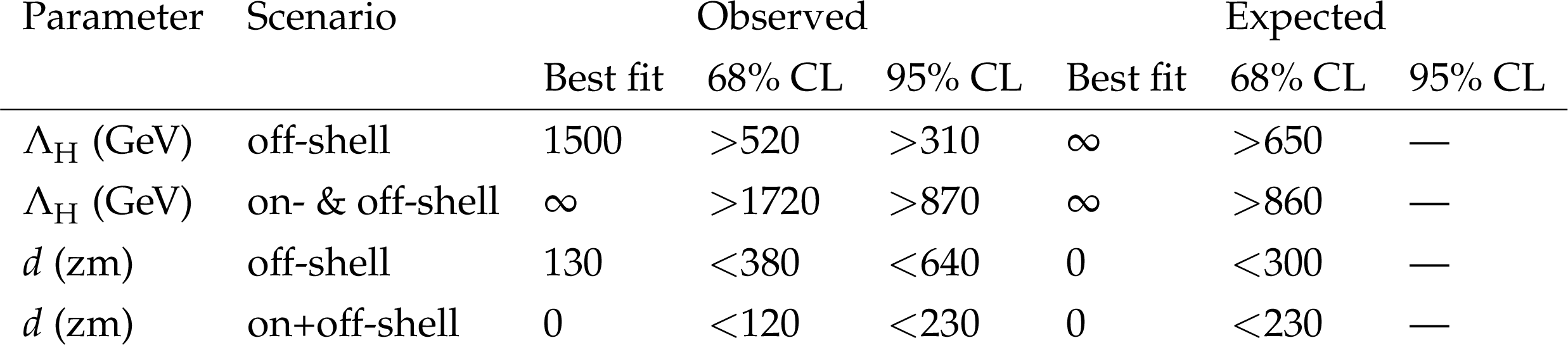
Summary of the observed and expected constraints on the parameters describing Higgs boson substructure, $ \Lambda_{\mathrm{H}} $ and $ d $, obtained from $ \mathrm{H}\to\mathrm{Z}\mathrm{Z}\to4\ell $. For each parameter the table lists the central value together with the 68 and 95% CL intervals. The hyphens at the 95% CL indicate that none of the tested hypotheses can be excluded. |
png pdf |
Table 2:
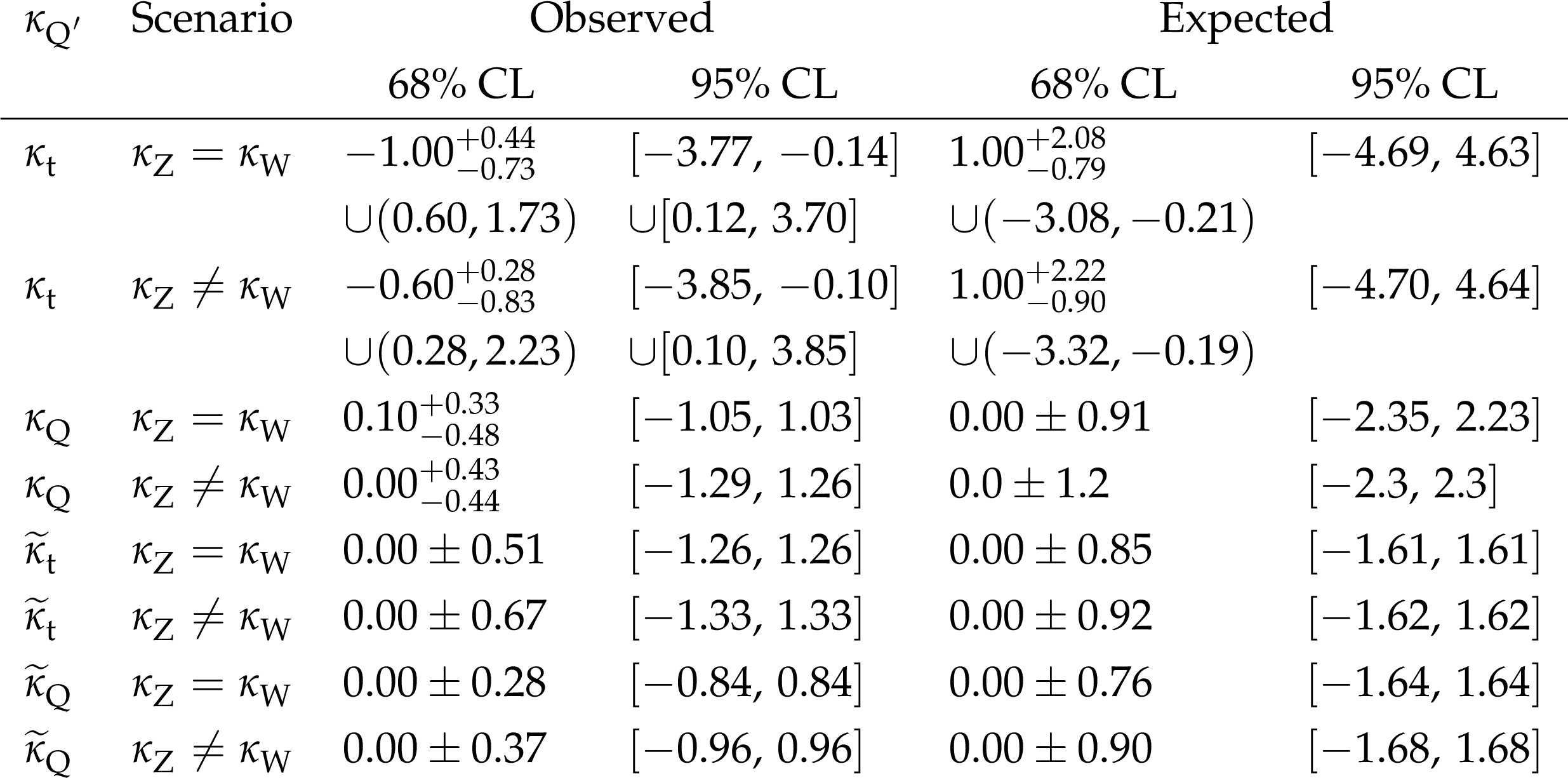
Summary of the heavy-quark Yukawa coupling measurements for $ \mathrm{H}\to\mathrm{Z}\mathrm{Z}\to4\ell $, showing central values with 68% CL uncertainties and 95% CL intervals (in square brackets), obtained from the combined on- and off-shell fit in which all heavy-quark couplings are allowed to vary simultaneously together with $ \kappa_{\mathrm{Z}} $ and $ \kappa_{\mathrm{W}} $. |
png pdf |
Table 3:
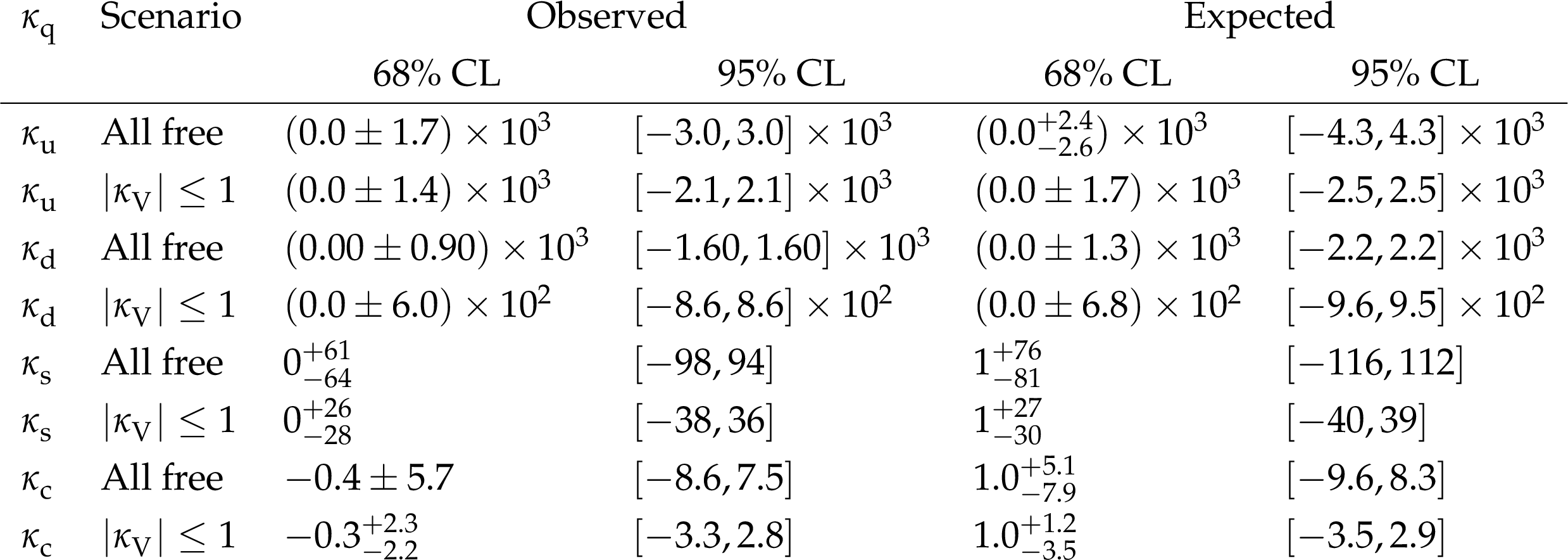
Summary of the light-quark Yukawa coupling measurements for the $ \mathrm{H}\to\mathrm{Z}\mathrm{Z}\to4\ell $ channel, showing central values with 68% CL uncertainties and 95% CL intervals (in square brackets). Results are obtained with all other light-quark couplings profiled simultaneously together with $ \kappa_{\mathrm{Z}} $ and $ \kappa_{\mathrm{W}} $. |
png pdf |
Table 4:
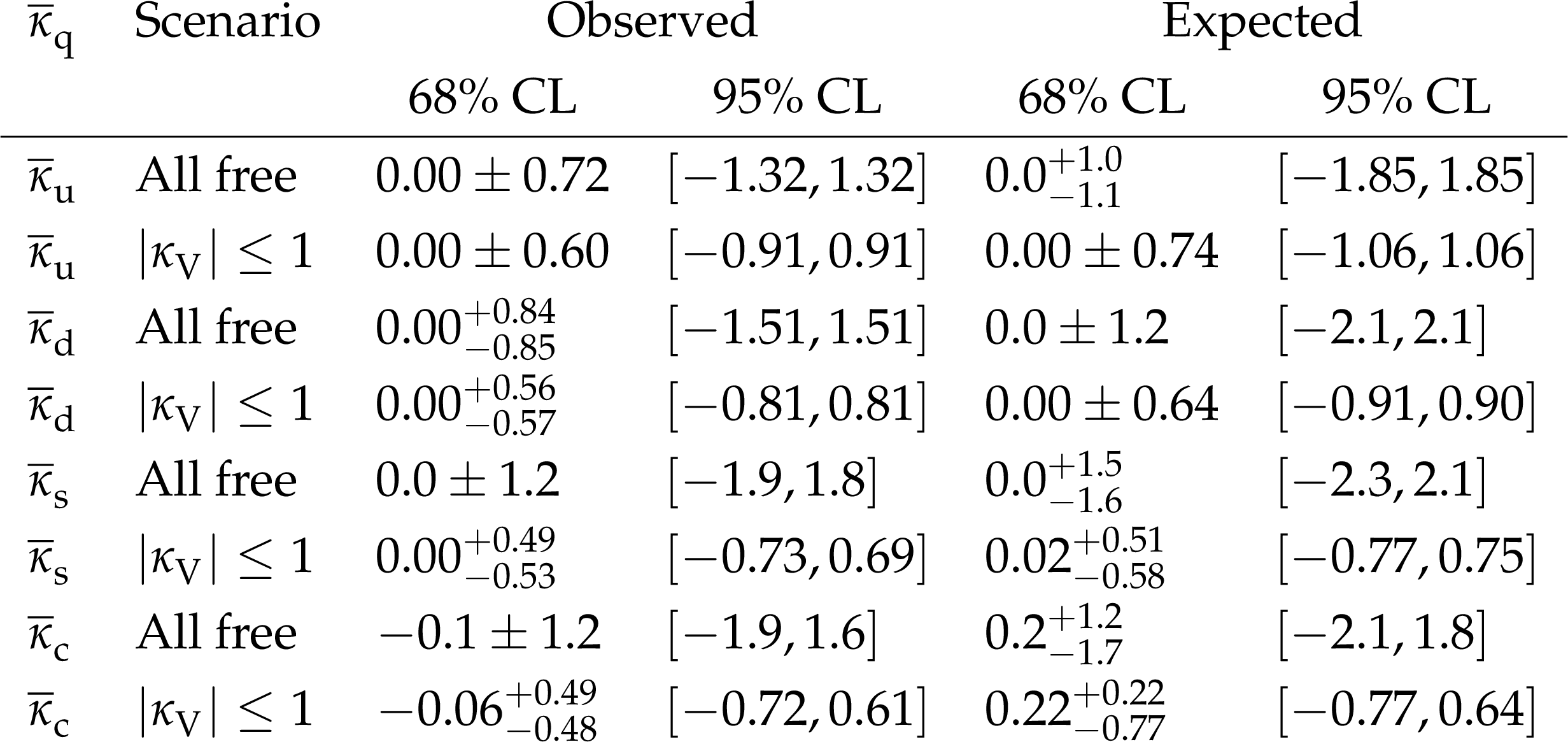
Summary of the light-quark Yukawa coupling measurements using the parameters $ \overline{\kappa}_{\mathrm{q}}=\kappa_{\mathrm{q}} m_{\mathrm{q}}/m_{\mathrm{b}} $, where the values for $ \kappa_{\mathrm{q}} $ are taken from Table. 3, showing central values with 68% CL uncertainties and 95% CL intervals (in square brackets) for the $ PH\to\mathrm{Z}\mathrm{Z}\to4\ell $ channel. Results are obtained with all other light-quark couplings and $ \kappa_{\mathrm{Z}} $ and $ \kappa_{\mathrm{W}} $ profiled. |
png pdf |
Table 5:
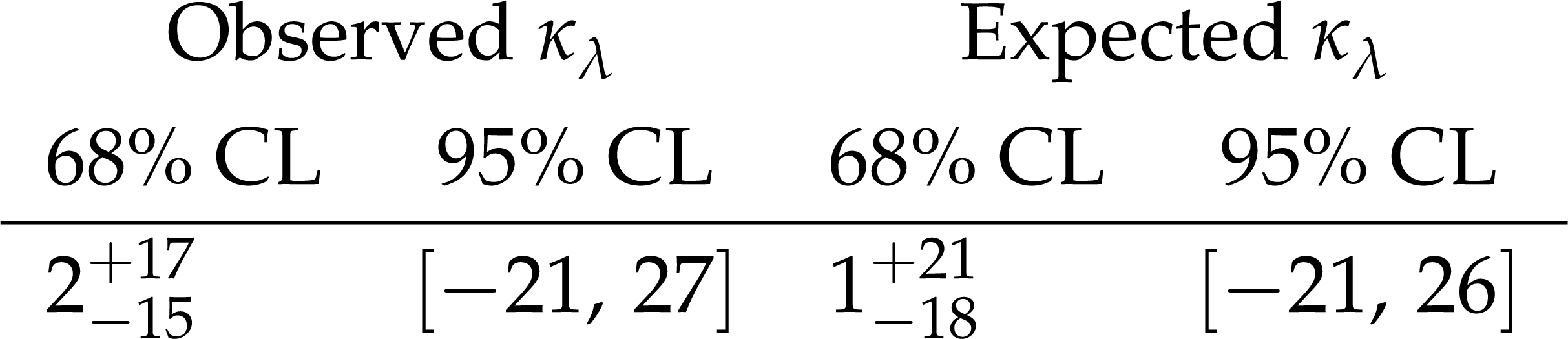
Summary of the $ \kappa_\lambda $ measurements, showing the 68% CL (central values with uncertainties) and 95% CL (in square brackets) intervals for the $ \mathrm{H}\to\mathrm{Z}\mathrm{Z}\to4\ell $. |
png pdf |
Table 6:
Summary of the measurements of the total $ \Gamma_\mathrm{H} $, showing the 68 and 95% CL intervals for $ \mathrm{H}\to\mathrm{Z}\mathrm{Z}\to4\ell $ under the five progressively more inclusive BSM scenarios discussed in text. |
png pdf |
Table 7:
Summary of the measurements of the total $ \Gamma_\mathrm{H} $, showing the 68 and 95% CL intervals for on- and off-shell $ \mathrm{H}\to\mathrm{Z}\mathrm{Z}\to4\ell $, combination with off-shell $ \mathrm{H}\to\mathrm{Z}\mathrm{Z}\to2\ell2\nu $, and with on- and off-shell $ \mathrm{H}\to\mathrm{W}\mathrm{W}\to2\ell2\nu $. |
png pdf |
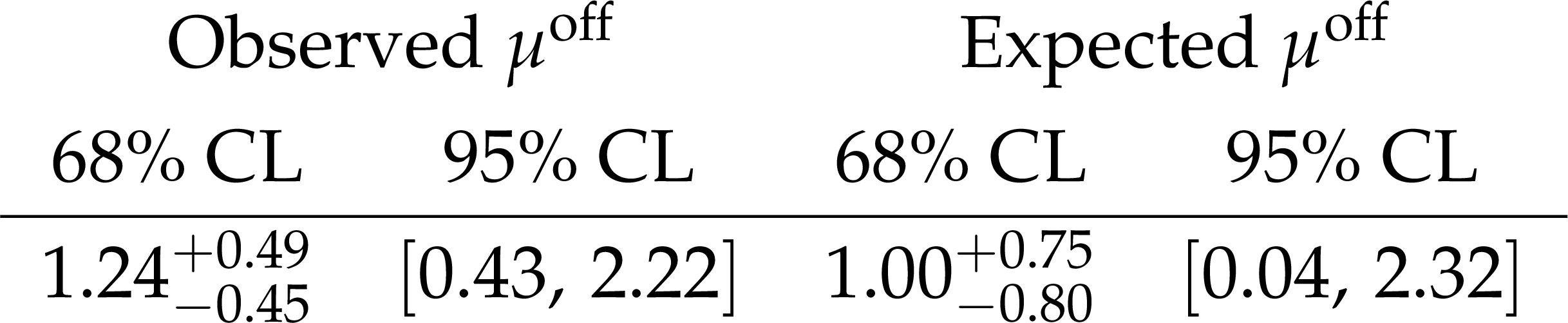
Table 8:
Summary of the combined measurement for $ \mu^\text{off} $, showing the 68 and 95% CL intervals for on- and off-shell $ \mathrm{H}\to\mathrm{Z}\mathrm{Z}\to4\ell $ in combination with off-shell $ \mathrm{H}\to\mathrm{Z}\mathrm{Z}\to2\ell2\nu $ and on- and off-shell $ \mathrm{H}\to\mathrm{W}\mathrm{W}\to2\ell2\nu $. |
| Summary |
| Using a data set of proton-proton collisions at $ \sqrt{s}= $ 13 TeV, corresponding to an integrated luminosity of 138 fb$ ^{-1} $, and improved observables, a unified study of Higgs boson production that exploits both on-shell and off-shell regions in $ \mathrm{H}\to\mathrm{Z}\mathrm{Z} $ decays was performed. The off-shell region provides distinctive shape information that complements rate measurements, and combining on- and off-shell data allows for a range of physics scenarios with reduced model dependence to be probed. Four classes of effects were tested. First, Higgs boson compositeness was probed through a $ q^{2} $-dependent form factor (where $ q^{2} $ is the squared four-momentum transfer of the Higgs boson), and a lower limit of $ \Lambda_{\mathrm{H}} > $ 870 GeV was set on the compositeness scale at 95% confidence level. Second, possible heavy colored states in the gluon-fusion loop were tested by fitting $ CP $-even and $ CP $-odd modifications of the top and a generic heavy quark ($ \kappa_{\mathrm{t}},\kappa_{\PQQ},\widetilde{\kappa}_{\mathrm{t}},\widetilde{\kappa}_{\PQQ} $). These limits can be presented as direct bounds on the couplings to the Higgs boson or translated into constraints on the corresponding standard model effective field theory (SMEFT) Wilson coefficients. Third, by combining on- and off-shell measurements, $ CP $-even deviations of the light-quark Yukawa couplings ($ \kappa_{\mathrm{u}},\kappa_{\mathrm{d}},\kappa_{\mathrm{s}},\kappa_{\mathrm{c}} $) were constrained, where the off-shell information is crucial because it allows for relaxed on-shell assumptions (for example $ |\kappa_\mathrm{V}|\leq $ 1) while retaining meaningful bounds. Fourth, off-shell kinematic information was utilized to probe the Higgs boson trilinear coupling $ \kappa_{\lambda} $ via the SMEFT operator $ \mathcal{O}_{6}=(H^{\dagger}H)^{3} $. The limits are complementary to on-shell and double-H searches because they exploit different kinematic shape signatures. Finally, the total Higgs boson width $ \Gamma_\mathrm{H} $ was investigated under progressively more general BSM hypotheses: relaxing custodial symmetry, profiling the heavy- and light-sector couplings separately, and then profiling all parameters. The off-shell method was found to be robust: introducing additional BSM degrees of freedom either reveals a direct BSM signature or leaves a strong constraint on $ \Gamma_{\mathrm{H}} $ with only modest loss of precision. A new $ \sqrt{s}= $ 13 TeV combination including the $ \mathrm{H}\to\mathrm{Z}\mathrm{Z} $ and $ \mathrm{H}\to\mathrm{W}\mathrm{W} $ channels was performed to maximize sensitivity to $ \Gamma_{\mathrm{H}} $, yielding $ \Gamma_{\mathrm{H}}= $ 5.1 $ ^{+2.0}_{-1.8} $ MeV and a 95% confidence-level interval of 1.7 to 9.4 MeV. The hypothesis of no off-shell Higgs boson production was excluded at the 5 standard deviation level. Taken together, these measurements showed that off-shell analyses substantially broaden the Higgs boson program: they deliver shape-based sensitivity to substructure, loop effects, light-quark Yukawa couplings, and the self-coupling, and they produce a BSM-aware and precise combined constraint on the total width of the Higgs boson. |
| References | ||||
| 1 | S. L. Glashow | Partial-symmetries of weak interactions | NP 22 (1961) 579 | |
| 2 | F. Englert and R. Brout | Broken symmetry and the mass of gauge vector mesons | PRL 13 (1964) 321 | |
| 3 | P. W. Higgs | Broken symmetries, massless particles and gauge fields | PL 12 (1964) 132 | |
| 4 | P. W. Higgs | Broken symmetries and the masses of gauge bosons | PRL 13 (1964) 508 | |
| 5 | G. S. Guralnik, C. R. Hagen, and T. W. B. Kibble | Global conservation laws and massless particles | PRL 13 (1964) 585 | |
| 6 | S. Weinberg | A model of leptons | PRL 19 (1967) 1264 | |
| 7 | A. Salam | Weak and electromagnetic interactions | in Elementary particle physics: relativistic groups and analyticity, N. Svartholm, ed., Almqvist \& Wiksell, Stockholm, 1968 | |
| 8 | ATLAS Collaboration | Observation of a new particle in the search for the standard model Higgs boson with the ATLAS detector at the LHC | PLB 716 (2012) 1 | 1207.7214 |
| 9 | CMS Collaboration | Observation of a new boson at a mass of 125 GeV with the CMS experiment at the LHC | PLB 716 (2012) 30 | CMS-HIG-12-028 1207.7235 |
| 10 | CMS Collaboration | Observation of a new boson with mass near 125 GeV in pp collisions at $ \sqrt{s}= $ 7 and 8 TeV | JHEP 06 (2013) 081 | CMS-HIG-12-036 1303.4571 |
| 11 | ATLAS and CMS Collaborations | Combined measurement of the Higgs boson mass in pp collisions at $ \sqrt{s}= $ 7 and 8 TeV with the ATLAS and CMS experiments | PRL 114 (2015) 191803 | 1503.07589 |
| 12 | ATLAS Collaboration | Combined measurement of the Higgs boson mass from the H $ \to\gamma\gamma $ and H $ \to $ Z$ Z^{*} \to 4\ell $ decay channels with the ATLAS detector using $ \sqrt{s} = $ 7, 8 and 13 TeV pp collision data | PRL 131 (2023) 251802 | 2308.04775 |
| 13 | CMS Collaboration | Constraints on the Higgs boson width from off-shell production and decay to Z-boson pairs | PLB 736 (2014) 64 | CMS-HIG-14-002 1405.3455 |
| 14 | ATLAS Collaboration | Constraints on the off-shell higgs boson signal strength in the high-mass ZZ and WW final states with the ATLAS detector | EPJC 75 (2015) 335 | 1503.01060 |
| 15 | CMS Collaboration | Limits on the Higgs boson lifetime and width from its decay to four charged leptons | PRD 92 (2015) 072010 | CMS-HIG-14-036 1507.06656 |
| 16 | CMS Collaboration | Search for Higgs boson off-shell production in proton-proton collisions at 7 and 8 TeV and derivation of constraints on its total decay width | JHEP 09 (2016) 051 | CMS-HIG-14-032 1605.02329 |
| 17 | ATLAS Collaboration | Constraints on off-shell Higgs boson production and the Higgs boson total width in $ \mathrm{Z}\mathrm{Z}\to4\ell $ and $ \mathrm{Z}\mathrm{Z}\to2\ell2\nu $ final states with the ATLAS detector | PLB 786 (2018) 223 | 1808.01191 |
| 18 | CMS Collaboration | Measurements of the Higgs boson width and anomalous HVV couplings from on-shell and off-shell production in the four-lepton final state | PRD 99 (2019) 112003 | CMS-HIG-18-002 1901.00174 |
| 19 | CMS Collaboration | Measurement of the Higgs boson width and evidence of its off-shell contributions to ZZ production | Nature Phys. 18 (2022) 1329 | CMS-HIG-21-013 2202.06923 |
| 20 | CMS Collaboration | Measurement of the Higgs boson mass and width using the four-lepton final state in proton-proton collisions at $ \sqrt{s}= $ 13 TeV | PRD 111 (2025) 092014 | CMS-HIG-21-019 2409.13663 |
| 21 | F. Caola and K. Melnikov | Constraining the Higgs boson width with ZZ production at the LHC | PRD 88 (2013) 054024 | 1307.4935 |
| 22 | N. Kauer and G. Passarino | Inadequacy of zero-width approximation for a light Higgs boson signal | JHEP 08 (2012) 116 | 1206.4803 |
| 23 | J. M. Campbell, R. K. Ellis, and C. Williams | Bounding the Higgs width at the LHC using full analytic results for $ \mathrm{g}\mathrm{g}\to \mathrm{e}^{-}\mathrm{e}^{+} \mu^{-} \mu^{+} $ | JHEP 04 (2014) 060 | 1311.3589 |
| 24 | G.-y. Huang and S. Zhou | Precise values of running quark and lepton masses in the standard model | PRD 103 (2021) 016010 | 2009.04851 |
| 25 | CMS Collaboration | Search for \ensuremath\gammaH production and constraints on the Yukawa couplings of light quarks to the Higgs boson | PRD 112 (2025) 112001 | CMS-HIG-23-011 2502.05665 |
| 26 | U. Haisch and G. Koole | Off-shell Higgs production at the LHC as a probe of the trilinear Higgs coupling | JHEP 02 (2022) 030 | 2111.12589 |
| 27 | CMS Collaboration | Constraints on the Higgs boson self-coupling from the combination of single and double Higgs boson production in proton-proton collisions at $ \sqrt{s}= $ 13 TeV | PLB 861 (2025) 139210 | CMS-HIG-23-006 2407.13554 |
| 28 | O. Witzel | Review on composite Higgs models | PoS LATTICE 2018 (2019) 006 | 1901.08216 |
| 29 | T. Han, S. C. I. Leung, and M. Low | Higgs to $ \mathrm{b}\overline{\mathrm{b}} $ from vector boson fusion for high-scale physics | PRD 109 (2024) 115028 | 2305.01010 |
| 30 | CMS Collaboration | HEPData record for this analysis | link | |
| 31 | CMS Collaboration | The CMS experiment at the CERN LHC | JINST 3 (2008) S08004 | |
| 32 | CMS Collaboration | Development of the CMS detector for the CERN LHC Run 3 | JINST 19 (2024) P05064 | CMS-PRF-21-001 2309.05466 |
| 33 | CMS Collaboration | The CMS trigger system | JINST 12 (2017) P01020 | CMS-TRG-12-001 1609.02366 |
| 34 | CMS Collaboration | Performance of the CMS Level-1 trigger in proton-proton collisions at $ \sqrt{s} = $ 13 TeV | JINST 15 (2020) P10017 | CMS-TRG-17-001 2006.10165 |
| 35 | CMS Collaboration | Performance of the CMS high-level trigger during LHC Run 2 | JINST 19 (2024) P11021 | CMS-TRG-19-001 2410.17038 |
| 36 | CMS Collaboration | Technical proposal for the phase-II upgrade of the CMS detector | CMS Technical proposal CERN-LHCC-2015-010, CMS-TDR-15-02, 2015 CDS |
|
| 37 | CMS Collaboration | Electron and photon reconstruction and identification with the CMS experiment at the CERN LHC | JINST 16 (2021) P05014 | CMS-EGM-17-001 2012.06888 |
| 38 | CMS Collaboration | ECAL 2016 refined calibration and Run 2 summary plots | CMS Detector Performance Note CMS-DP-2020-021, 2020 CDS |
|
| 39 | CMS Collaboration | Performance of the CMS muon detector and muon reconstruction with proton-proton collisions at $ \sqrt{s}= $ 13 TeV | JINST 13 (2018) P06015 | CMS-MUO-16-001 1804.04528 |
| 40 | M. Cacciari, G. P. Salam, and G. Soyez | The anti-$ k_{\mathrm{T}} $ jet clustering algorithm | JHEP 04 (2008) 063 | 0802.1189 |
| 41 | M. Cacciari, G. P. Salam, and G. Soyez | FastJet user manual | EPJC 72 (2012) 1896 | 1111.6097 |
| 42 | CMS Collaboration | Jet energy scale and resolution in the CMS experiment in pp collisions at 8 TeV | JINST 12 (2017) P02014 | CMS-JME-13-004 1607.03663 |
| 43 | CMS Collaboration | Measurements of production cross sections of the Higgs boson in the four-lepton final state in proton-proton collisions at $ \sqrt{s} = $ 13 TeV | EPJC 81 (2021) 488 | CMS-HIG-19-001 2103.04956 |
| 44 | T. Sjöstrand et al. | An introduction to PYTHIA 8.2 | Comput. Phys. Commun. 191 (2015) 159 | 1410.3012 |
| 45 | CMS Collaboration | Extraction and validation of a new set of CMS PYTHIA8 tunes from underlying-event measurements | EPJC 80 (2020) 4 | CMS-GEN-17-001 1903.12179 |
| 46 | NNPDF Collaboration | Unbiased global determination of parton distributions and their uncertainties at NNLO and at LO | NPB 855 (2012) 153 | 1107.2652 |
| 47 | GEANT4 Collaboration | GEANT 4 --- a simulation toolkit | NIM A 506 (2003) 250 | |
| 48 | J. M. Campbell and R. K. Ellis | MCFM for the Tevatron and the LHC | -206 10, 2010 Nucl. Phys. Proc. Suppl. 20 (2010) 5 |
1007.3492 |
| 49 | J. M. Campbell, R. K. Ellis, and C. Williams | Vector boson pair production at the LHC | JHEP 07 (2011) 018 | 1105.0020 |
| 50 | J. M. Campbell and R. K. Ellis | Higgs constraints from vector boson fusion and scattering | JHEP 04 (2015) 030 | 1502.02990 |
| 51 | Y. Gao et al. | Spin determination of single-produced resonances at hadron colliders | PRD 81 (2010) 075022 | 1001.3396 |
| 52 | S. Bolognesi et al. | Spin and parity of a single-produced resonance at the LHC | PRD 86 (2012) 095031 | 1208.4018 |
| 53 | I. Anderson et al. | Constraining anomalous $ \mathrm{H}\mathrm{V}\mathrm{V} $ interactions at proton and lepton colliders | PRD 89 (2014) 035007 | 1309.4819 |
| 54 | A. V. Gritsan, R. Röntsch, M. Schulze, and M. Xiao | Constraining anomalous Higgs boson couplings to the heavy flavor fermions using matrix element techniques | PRD 94 (2016) 055023 | 1606.03107 |
| 55 | A. V. Gritsan et al. | New features in the JHU generator framework: constraining Higgs boson properties from on-shell and off-shell production | PRD 102 (2020) 056022 | 2002.09888 |
| 56 | J. Davis et al. | Constraining anomalous Higgs boson couplings to virtual photons | PRD 105 (2022) 096027 | 2109.13363 |
| 57 | A. Ballestrero et al. | PHANTOM: a Monte Carlo event generator for six parton final states at high energy colliders | Comput. Phys. Commun. 180 (2009) 401 | 0801.3359 |
| 58 | S. Frixione, P. Nason, and C. Oleari | Matching NLO QCD computations with parton shower simulations: the POWHEG method | JHEP 11 (2007) 070 | 0709.2092 |
| 59 | E. Bagnaschi, G. Degrassi, P. Slavich, and A. Vicini | Higgs production via gluon fusion in the POWHEG approach in the SM and in the MSSM | JHEP 02 (2012) 088 | 1111.2854 |
| 60 | P. Nason and C. Oleari | NLO Higgs boson production via vector-boson fusion matched with shower in POWHEG | JHEP 02 (2010) 037 | 0911.5299 |
| 61 | G. Luisoni, P. Nason, C. Oleari, and F. Tramontano | $ \mathrm{H}\mathrm{W}^{\pm} $/HZ + 0 and 1 jet at NLO with the POWHEG BOX interfaced to GoSam and their merging within MiNLO | JHEP 10 (2013) 083 | 1306.2542 |
| 62 | H. B. Hartanto, B. Jager, L. Reina, and D. Wackeroth | Higgs boson production in association with top quarks in the POWHEG BOX | PRD 91 (2015) 094003 | 1501.04498 |
| 63 | P. Nason | A new method for combining NLO QCD with shower Monte Carlo algorithms | JHEP 11 (2004) 040 | hep-ph/0409146 |
| 64 | S. Alioli, P. Nason, C. Oleari, and E. Re | A general framework for implementing NLO calculations in shower Monte Carlo programs: the POWHEG BOX | JHEP 06 (2010) 043 | 1002.2581 |
| 65 | S. Catani and M. Grazzini | An NNLO subtraction formalism in hadron collisions and its application to Higgs boson production at the LHC | PRL 98 (2007) 222002 | hep-ph/0703012 |
| 66 | M. Grazzini | NNLO predictions for the Higgs boson signal in the $ \mathrm{H} \to \mathrm{W}\mathrm{W} \to\ell\nu\ell\nu $ and $ \mathrm{H} \to \mathrm{Z}\mathrm{Z} \to 4\ell $ decay channels | JHEP 02 (2008) 043 | 0801.3232 |
| 67 | M. Grazzini and H. Sargsyan | Heavy-quark mass effects in Higgs boson production at the LHC | JHEP 09 (2013) 129 | 1306.4581 |
| 68 | LHC Higgs Cross Section Working Group | Handbook of LHC Higgs cross sections: 4. Deciphering the nature of the Higgs sector | CERN Yellow Rep. Monogr. 2 (2017) 1 | 1610.07922 |
| 69 | F. Caola, K. Melnikov, R. Röntsch, and L. Tancredi | QCD corrections to ZZ production in gluon fusion at the LHC | PRD 92 (2015) 094028 | 1509.06734 |
| 70 | K. Melnikov and M. Dowling | Production of two Z-bosons in gluon fusion in the heavy top quark approximation | PLB 744 (2015) 43 | 1503.01274 |
| 71 | J. M. Campbell, R. K. Ellis, M. Czakon, and S. Kirchner | Two loop correction to interference in $ \mathrm{g}\mathrm{g} \to \mathrm{Z}\mathrm{Z} $ | JHEP 08 (2016) 011 | 1605.01380 |
| 72 | F. Caola et al. | QCD corrections to vector boson pair production in gluon fusion including interference effects with off-shell Higgs at the LHC | JHEP 07 (2016) 087 | 1605.04610 |
| 73 | J. Alwall et al. | The automated computation of tree-level and next-to-leading order differential cross sections, and their matching to parton shower simulations | JHEP 07 (2014) 079 | 1405.0301 |
| 74 | R. V. Harlander, S. Liebler, and H. Mantler | SusHi: A program for the calculation of Higgs production in gluon fusion and bottom-quark annihilation in the standard model and the MSSM | Comput. Phys. Commun. 184 (2013) 1605 | 1212.3249 |
| 75 | M. Grazzini, S. Kallweit, and D. Rathlev | ZZ production at the LHC: Fiducial cross sections and distributions in NNLO QCD | PLB 750 (2015) 407 | 1507.06257 |
| 76 | A. Bierweiler, T. Kasprzik, and J. H. K \"u hn | Vector-boson pair production at the LHC to $ \mathcal{O}(\alpha^3) $ accuracy | JHEP 12 (2013) 071 | 1305.5402 |
| 77 | CMS Collaboration | Particle-flow reconstruction and global event description with the CMS detector | JINST 12 (2017) P10003 | CMS-PRF-14-001 1706.04965 |
| 78 | T. Chen and C. Guestrin | XGBoost: A scalable tree boosting system | link | 1603.02754 |
| 79 | CMS Collaboration | Measurements of inclusive and differential cross sections for the Higgs boson production and decay to four-leptons in proton-proton collisions at $ \sqrt{s} = $ 13 TeV | JHEP 08 (2023) 040 | CMS-HIG-21-009 2305.07532 |
| 80 | CMS Collaboration | Pileup mitigation at CMS in 13 TeV data | JINST 15 (2020) P09018 | CMS-JME-18-001 2003.00503 |
| 81 | CMS Collaboration | Measurement of the inclusive W and Z production cross sections in pp collisions at $ \sqrt{s}= $ 7 TeV | JHEP 10 (2011) 132 | CMS-EWK-10-005 1107.4789 |
| 82 | A. Bodek et al. | Extracting muon momentum scale corrections for hadron collider experiments | EPJC 72 (2012) 2194 | 1208.3710 |
| 83 | CMS Collaboration | Identification of heavy-flavour jets with the CMS detector in pp collisions at 13 TeV | JINST 13 (2018) P05011 | CMS-BTV-16-002 1712.07158 |
| 84 | CMS Collaboration | Measurements of properties of the Higgs boson decaying into the four-lepton final state in pp collisions at $ \sqrt{s}= $ 13 TeV | JHEP 11 (2017) 047 | CMS-HIG-16-041 1706.09936 |
| 85 | CMS Collaboration | Constraints on anomalous Higgs boson couplings using production and decay information in the four-lepton final state | PLB 775 (2017) 1 | CMS-HIG-17-011 1707.00541 |
| 86 | J. Davis et al. | Maximizing returns: optimizing experimental observables at the LHC | 2601.10822 | |
| 87 | CMS Collaboration | The CMS statistical analysis and combination tool: Combine | Comput. Softw. Big Sci. 8 (2024) 19 | CMS-CAT-23-001 2404.06614 |
| 88 | G. Cowan, K. Cranmer, E. Gross, and O. Vitells | Asymptotic formulae for likelihood-based tests of new physics | EPJC 71 (2011) 1554 | 1007.1727 |
| 89 | G. J. Feldman and R. D. Cousins | Unified approach to the classical statistical analysis of small signals | PRD 57 (1998) 3873 | physics/9711021 |
| 90 | M. R. Whalley, D. Bourilkov, and R. C. Group | The Les Houches accord PDFs (LHAPDF) and LHAGLUE | in Proc. HERA and the LHC Workshop on the implications of HERA for LHC physics., 2005 | hep-ph/0508110 |
| 91 | D. Bourilkov, R. C. Group, and M. R. Whalley | LHAPDF: PDF use from the Tevatron to the LHC | in Proc. TeV4LHC Workshop - 4th meeting., 2006 | hep-ph/0605240 |
| 92 | CMS Collaboration | Precision luminosity measurement in proton-proton collisions at $ \sqrt{s} = $ 13 TeV in 2015 and 2016 at CMS | EPJC 81 (2021) 800 | CMS-LUM-17-003 2104.01927 |
| 93 | CMS Collaboration | Precision luminosity measurement in proton-proton collisions at 13 tev with the CMS detector | CMS Physics Analysis Summary, 2025 CMS-PAS-LUM-20-001 |
CMS-PAS-LUM-20-001 |
| 94 | A. Dedes et al. | Feynman rules for the standard model effective field theory in R$ _{\xi} $-gauges | JHEP 06 (2017) 143 | 1704.03888 |
| 95 | Y. Zhou | Constraining the Higgs boson coupling to light quarks in the H$ {\rightarrow} $ ZZ final states | PRD 93 (2016) 013019 | 1505.06369 |
| 96 | LHC Higgs Cross Section Working Group | Handbook of LHC Higgs cross sections: 3. Higgs properties | CERN Yellow Rep. Monogr. 4 (2013) | 1307.1347 |
| 97 | B. A. Erdelyi, R. Gröber, and N. Selimovi \' c | How large can the light quark Yukawa couplings be? | JHEP 05 (2025) 189 | 2410.08272 |
| 98 | CMS Collaboration | Constraints on anomalous Higgs boson couplings to vector bosons and fermions in its production and decay using the four-lepton final state | PRD 104 (2021) 052004 | CMS-HIG-19-009 2104.12152 |
| 99 | CMS Collaboration | Measurement of the Higgs boson total decay width using the $ \mathrm{H}\to\mathrm{W}\mathrm{W}\to\mathrm{e}\nu\mu\nu $ decay channel in proton-proton collisions at $ \sqrt{s}= $ 13 TeV | PRD 113 (2026) 092014 | CMS-HIG-24-011 2601.05168 |
|
|
Compact Muon Solenoid LHC, CERN |

|
|
|
|
|
|