
Compact Muon Solenoid
LHC, CERN
 Visit us: CMS Public Website, CMS Physics ;
Contact us: CMS Publications Committee
Visit us: CMS Public Website, CMS Physics ;
Contact us: CMS Publications Committee
| CMS-PAS-EXO-24-010 | ||
| Search for nonresonant production of strongly coupled dark matter in proton-proton collisions at $ \sqrt{s}= $ 13 TeV | ||
| CMS Collaboration | ||
| 2026-07-30 | ||
| Abstract: A search is presented for strongly coupled dark matter in the form of semivisible jets---containing both visible matter and invisible dark matter---produced in nonresonant processes, using 138 fb$ ^{-1} $ of proton-proton collision data at $ \sqrt{s}= $ 13 TeV collected with the CMS detector at the CERN LHC. The signal model includes a bifundamental scalar, $ \Phi $, that couples simultaneously to standard model quarks and dark sector quarks, the latter forming semivisible jets. The final state therefore includes moderate missing energy aligned with a jet, a signature rejected by most dark matter searches. Two separate strategies are employed to identify semivisible jets: a supervised graph neural network and an unsupervised autoencoder. No significant excess corresponding to the dark sector signal hypotheses is observed. Upper limits at 95% confidence level on signal model parameters are determined for each strategy. The supervised search excludes mediator masses of 0.5--2.4 TeV, depending on the other signal model parameters. For signal models with semivisible jets containing higher fractions of invisible dark matter, the unsupervised search demonstrates increased sensitivity and excludes mediator masses up to 2.2 TeV, whereas the supervised analysis excludes the same models up to mediator masses of 1.7--2.0 TeV. | ||
| Links: CDS record (PDF) ; CADI line (restricted) ; | ||
| Figures | |

png pdf |
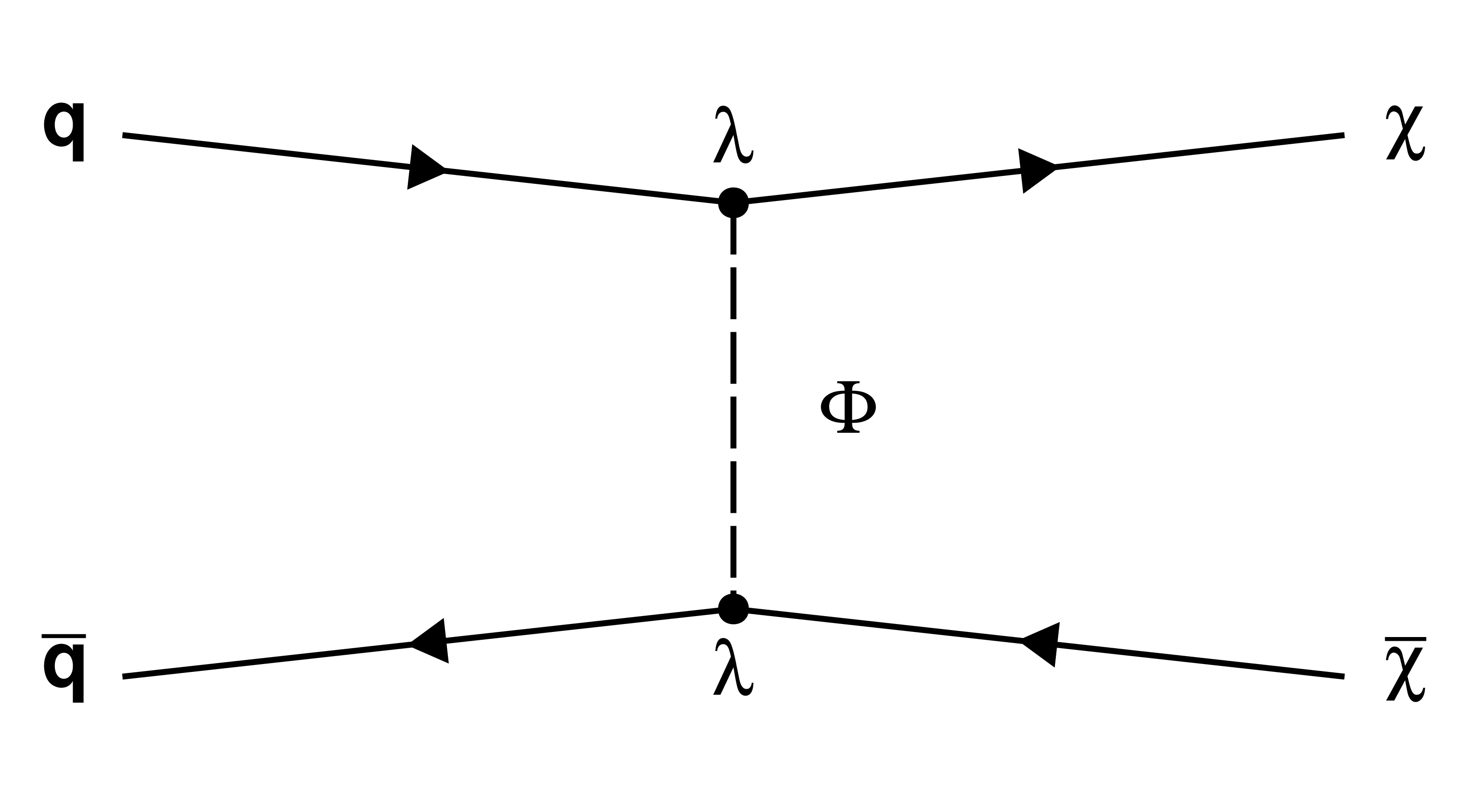
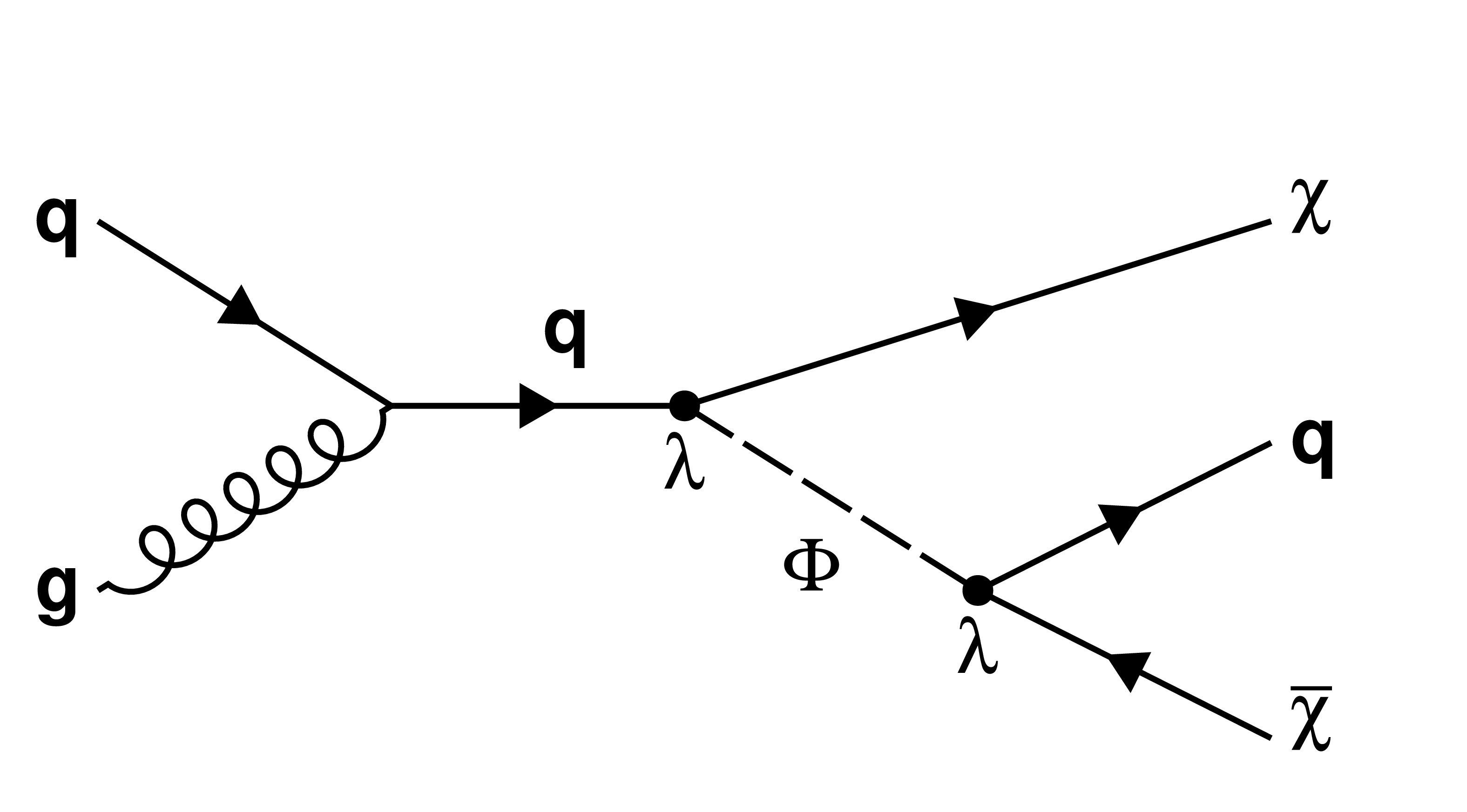
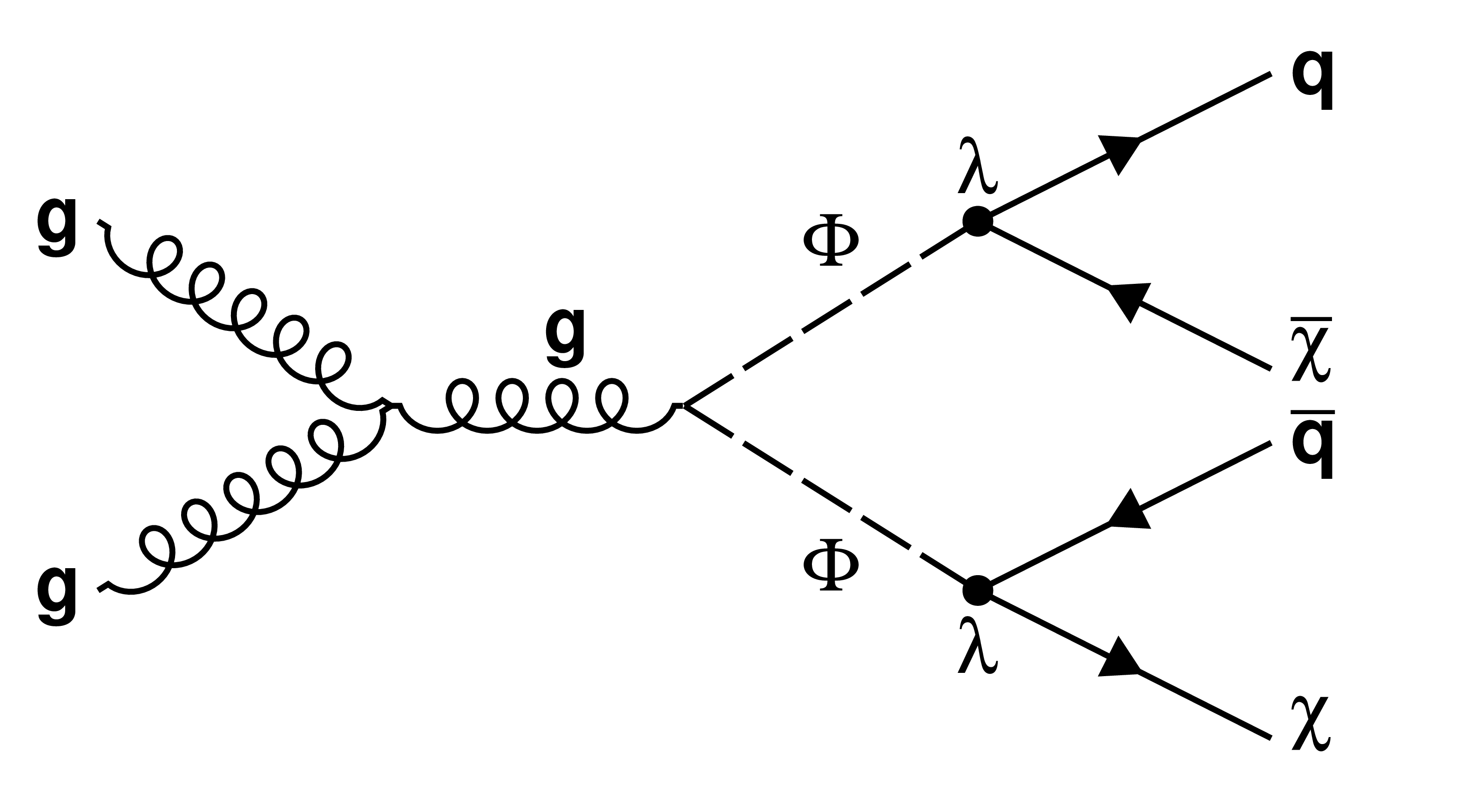
Figure 1:
Representative Feynman diagrams of leading-order production of dark quarks $ \chi $ through a bifundamental mediator $ \Phi $. Left: direct $ t $-channel production. Middle: associated production. Right: pair production. |
png pdf |
Figure 1-a:
Representative Feynman diagrams of leading-order production of dark quarks $ \chi $ through a bifundamental mediator $ \Phi $. Left: direct $ t $-channel production. Middle: associated production. Right: pair production. |
png pdf |
Figure 1-b:
Representative Feynman diagrams of leading-order production of dark quarks $ \chi $ through a bifundamental mediator $ \Phi $. Left: direct $ t $-channel production. Middle: associated production. Right: pair production. |
png pdf |
Figure 1-c:
Representative Feynman diagrams of leading-order production of dark quarks $ \chi $ through a bifundamental mediator $ \Phi $. Left: direct $ t $-channel production. Middle: associated production. Right: pair production. |
png pdf |
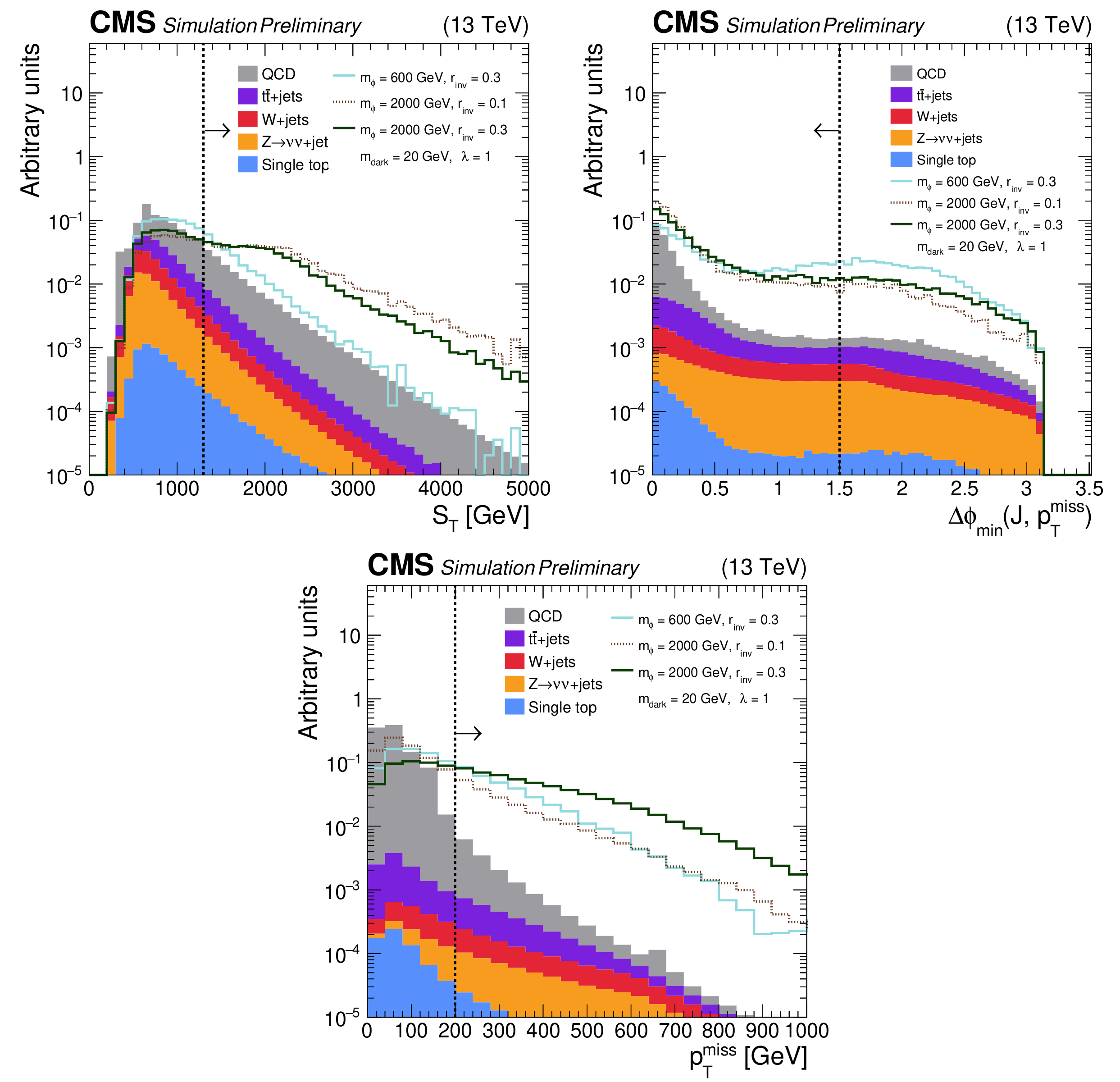
Figure 2:
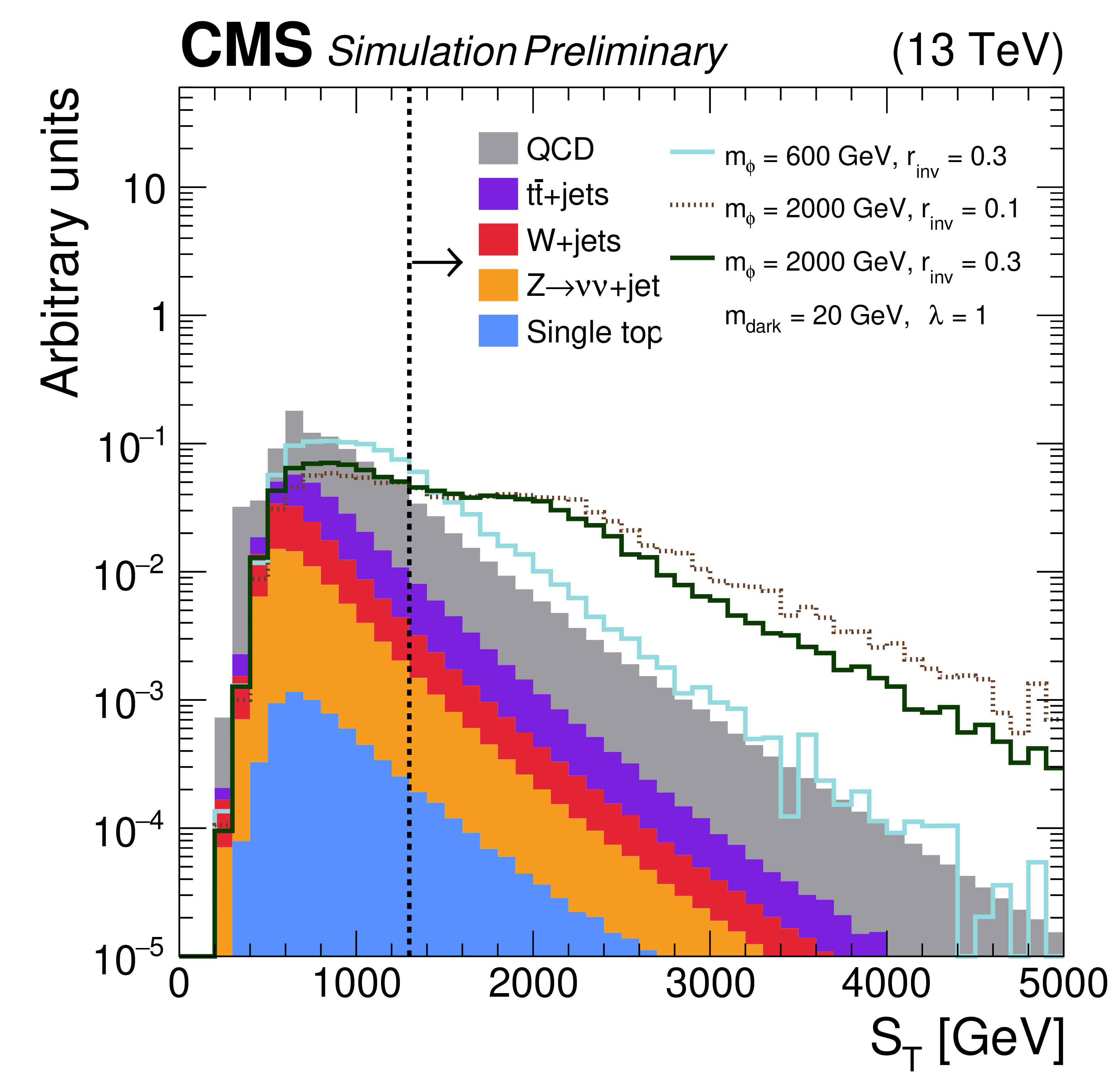
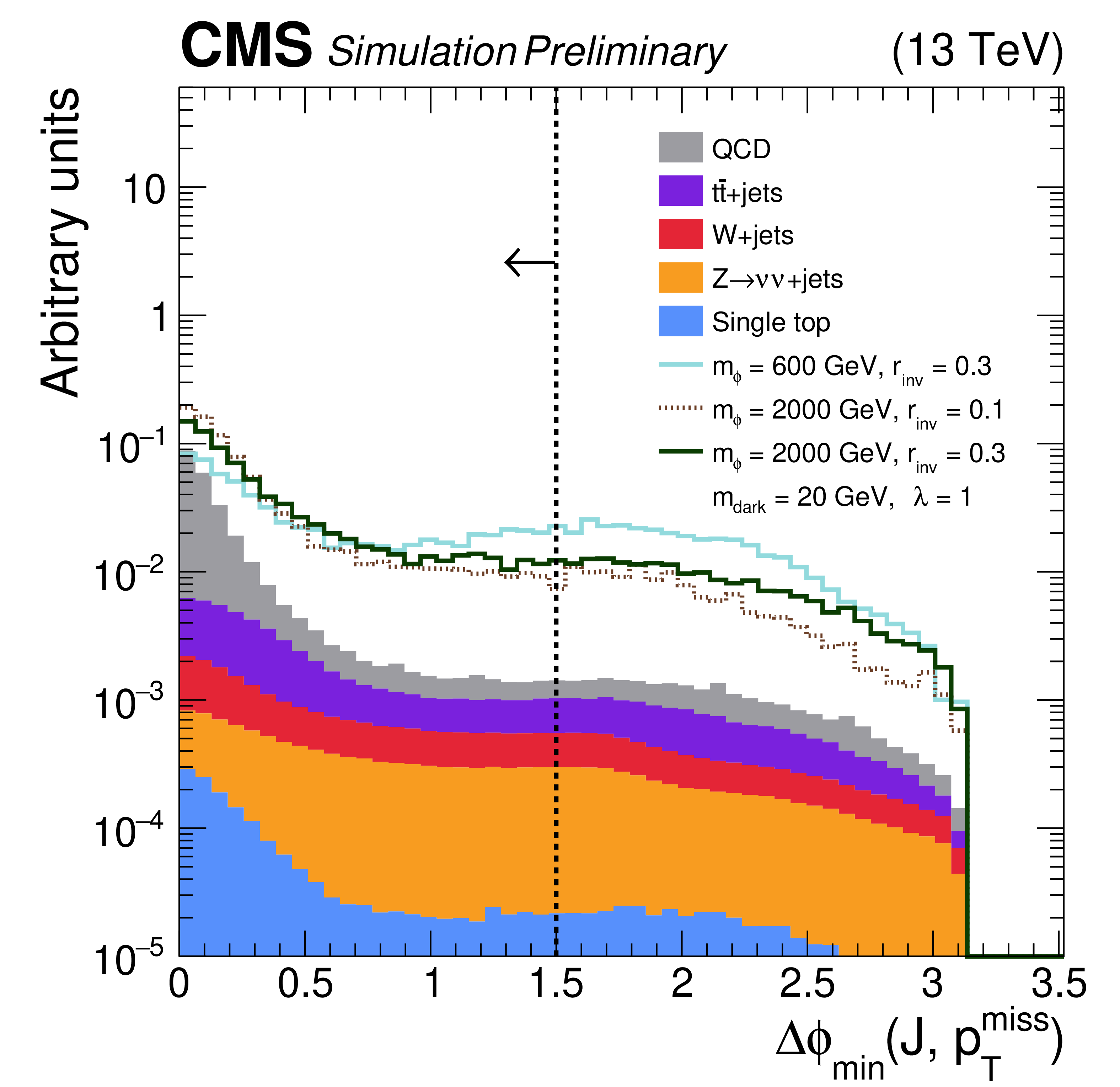
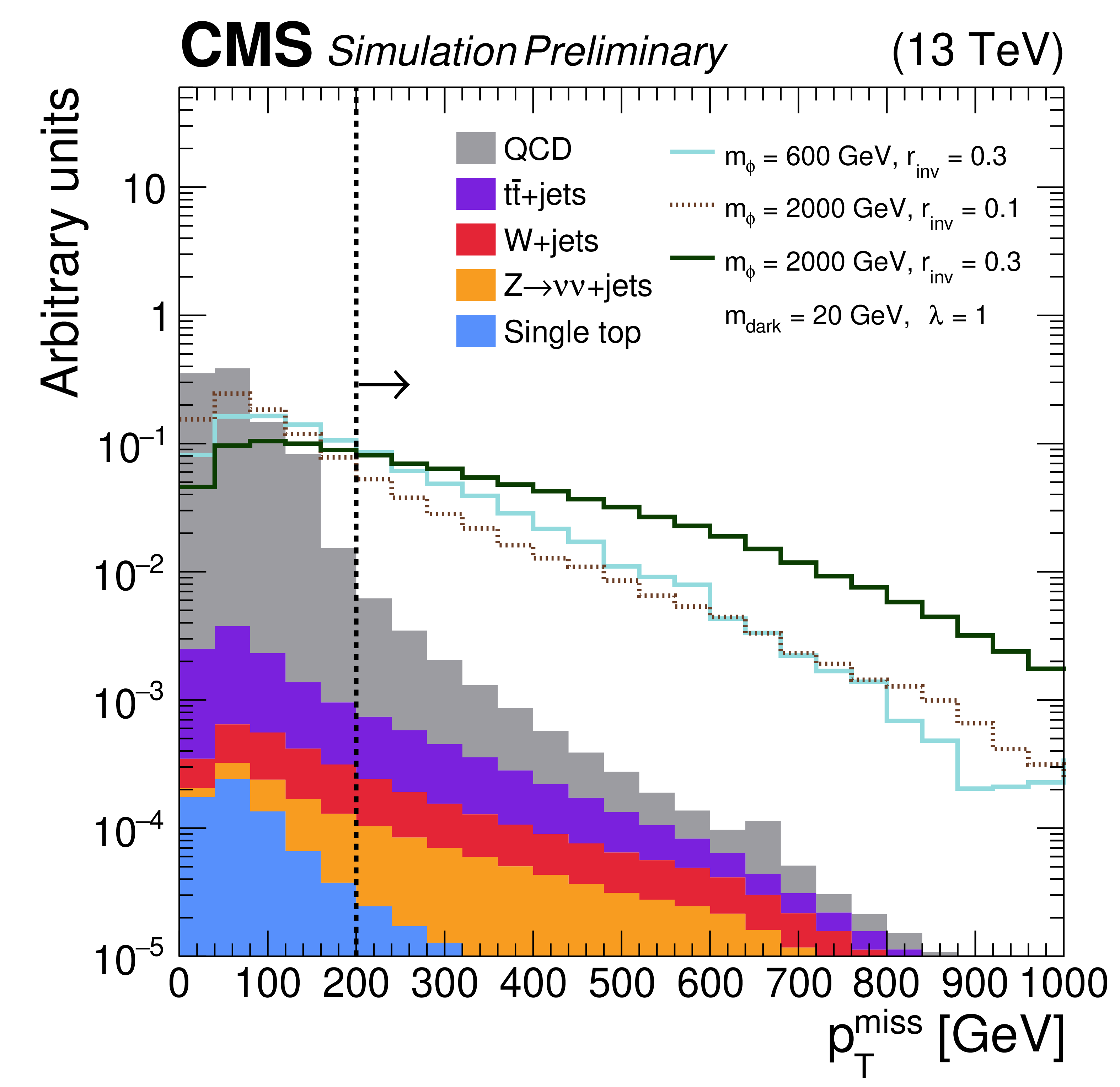
Normalized distributions of the characteristic variables $ S_{\mathrm{T}} $, $ \Delta\phi_{\text{min}} $, and $ p_{\mathrm{T}}^\text{miss} $ for the simulated SM backgrounds and several signal models. For each variable, the selection on that variable is omitted, but all other preselection criteria are applied. The vertical black dotted line indicates the preselection requirement on the variable, with the arrow indicating the region of the distribution included in the analysis. |
png pdf |
Figure 2-a:
Normalized distributions of the characteristic variables $ S_{\mathrm{T}} $, $ \Delta\phi_{\text{min}} $, and $ p_{\mathrm{T}}^\text{miss} $ for the simulated SM backgrounds and several signal models. For each variable, the selection on that variable is omitted, but all other preselection criteria are applied. The vertical black dotted line indicates the preselection requirement on the variable, with the arrow indicating the region of the distribution included in the analysis. |
png pdf |
Figure 2-b:
Normalized distributions of the characteristic variables $ S_{\mathrm{T}} $, $ \Delta\phi_{\text{min}} $, and $ p_{\mathrm{T}}^\text{miss} $ for the simulated SM backgrounds and several signal models. For each variable, the selection on that variable is omitted, but all other preselection criteria are applied. The vertical black dotted line indicates the preselection requirement on the variable, with the arrow indicating the region of the distribution included in the analysis. |
png pdf |
Figure 2-c:
Normalized distributions of the characteristic variables $ S_{\mathrm{T}} $, $ \Delta\phi_{\text{min}} $, and $ p_{\mathrm{T}}^\text{miss} $ for the simulated SM backgrounds and several signal models. For each variable, the selection on that variable is omitted, but all other preselection criteria are applied. The vertical black dotted line indicates the preselection requirement on the variable, with the arrow indicating the region of the distribution included in the analysis. |
png pdf |
Figure 3:
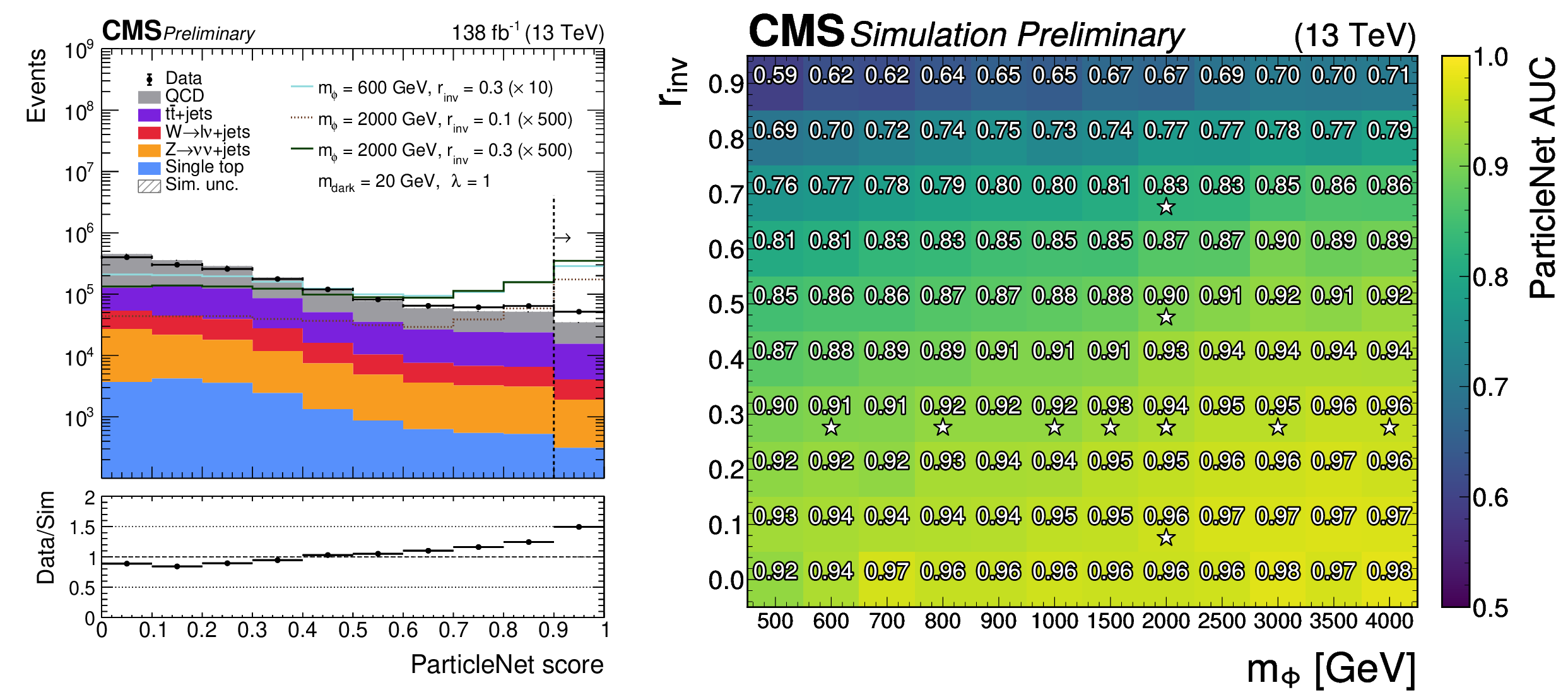
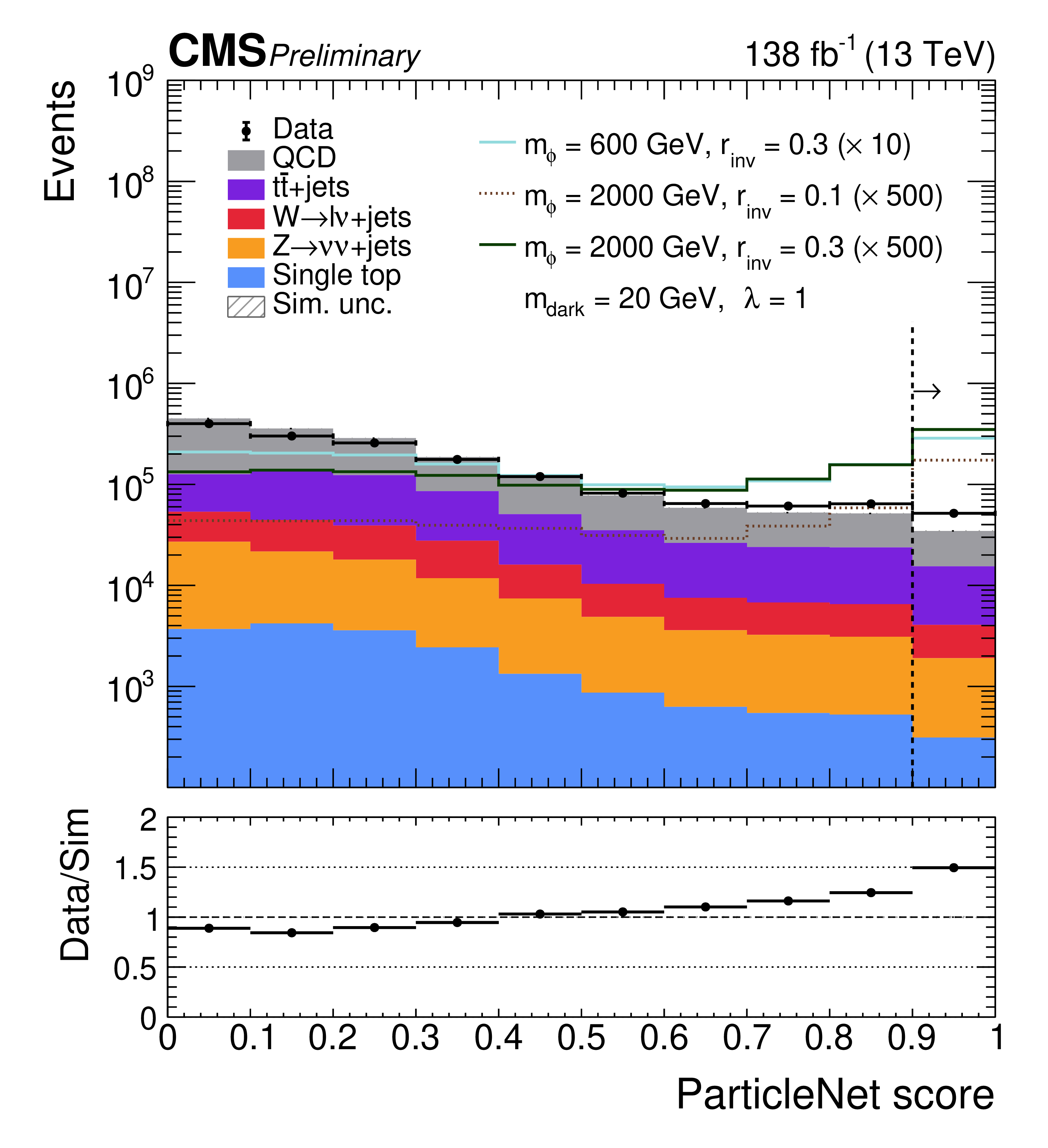
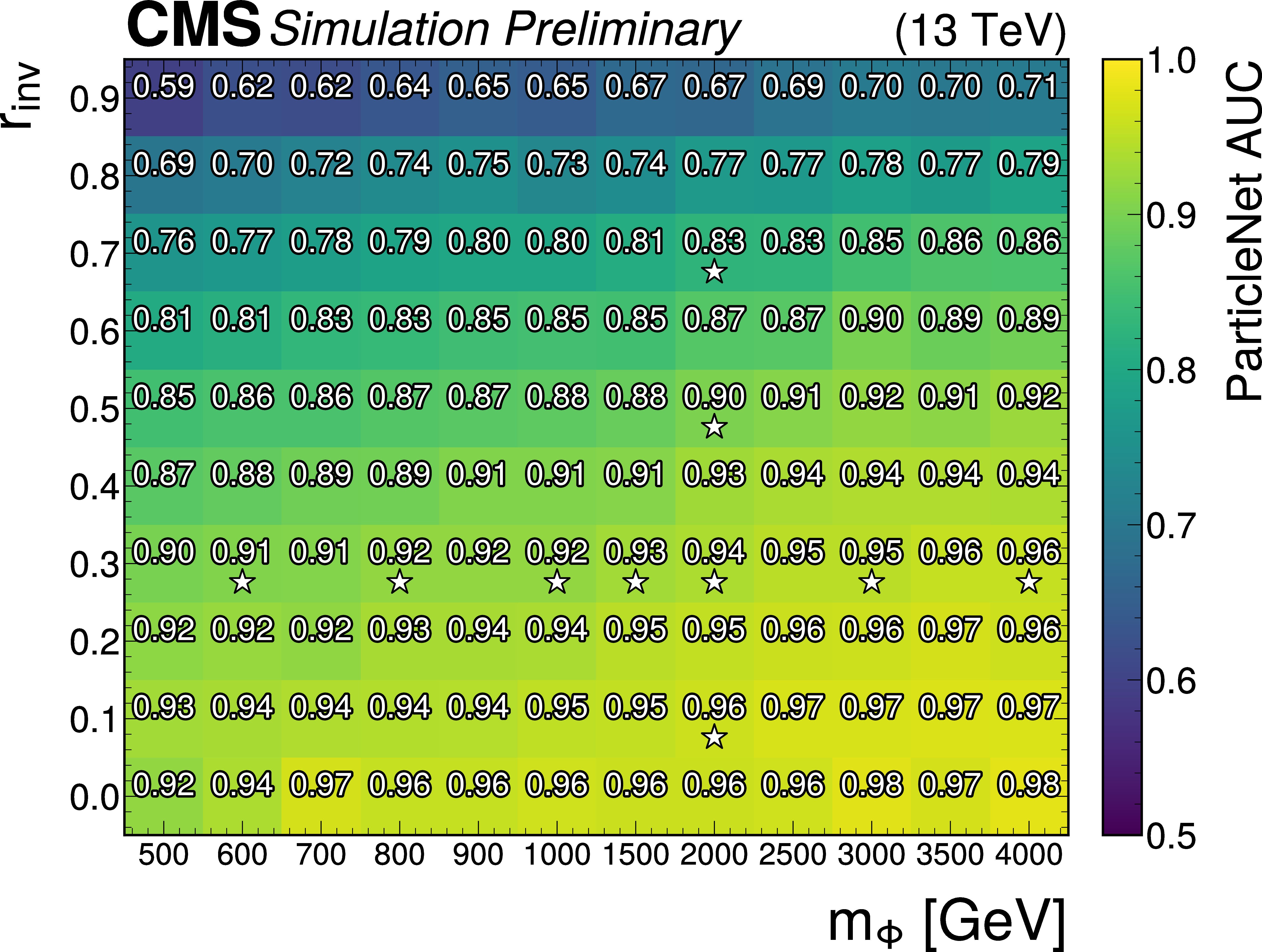
The PARTICLENET score distribution for data, background simulation, and a selection of signal models (left), and the performance discriminating between the simulated QCD background and signal models with varying $ m_{\Phi} $ and $ r_{\mathrm{inv}} $ values with $ m_{\mathrm{dark}} = $ 20 GeV, $ \lambda = $ 1 (right). The signal models used for training PARTICLENET are marked with a star. The simulated background score distributions are shown for illustration purposes only; they are not used to predict the SM background in the statistical interpretation. The signal jets are corrected for substructure-related mismodeling using their Lund jet plane density, as described in Section 7. The background simulation has no substructure correction applied. The statistical uncertainty in the background simulation from the limited number of simulated events is included but is generally small. |
png pdf |
Figure 3-a:
The PARTICLENET score distribution for data, background simulation, and a selection of signal models (left), and the performance discriminating between the simulated QCD background and signal models with varying $ m_{\Phi} $ and $ r_{\mathrm{inv}} $ values with $ m_{\mathrm{dark}} = $ 20 GeV, $ \lambda = $ 1 (right). The signal models used for training PARTICLENET are marked with a star. The simulated background score distributions are shown for illustration purposes only; they are not used to predict the SM background in the statistical interpretation. The signal jets are corrected for substructure-related mismodeling using their Lund jet plane density, as described in Section 7. The background simulation has no substructure correction applied. The statistical uncertainty in the background simulation from the limited number of simulated events is included but is generally small. |
png pdf |
Figure 3-b:
The PARTICLENET score distribution for data, background simulation, and a selection of signal models (left), and the performance discriminating between the simulated QCD background and signal models with varying $ m_{\Phi} $ and $ r_{\mathrm{inv}} $ values with $ m_{\mathrm{dark}} = $ 20 GeV, $ \lambda = $ 1 (right). The signal models used for training PARTICLENET are marked with a star. The simulated background score distributions are shown for illustration purposes only; they are not used to predict the SM background in the statistical interpretation. The signal jets are corrected for substructure-related mismodeling using their Lund jet plane density, as described in Section 7. The background simulation has no substructure correction applied. The statistical uncertainty in the background simulation from the limited number of simulated events is included but is generally small. |
png pdf |
Figure 4:
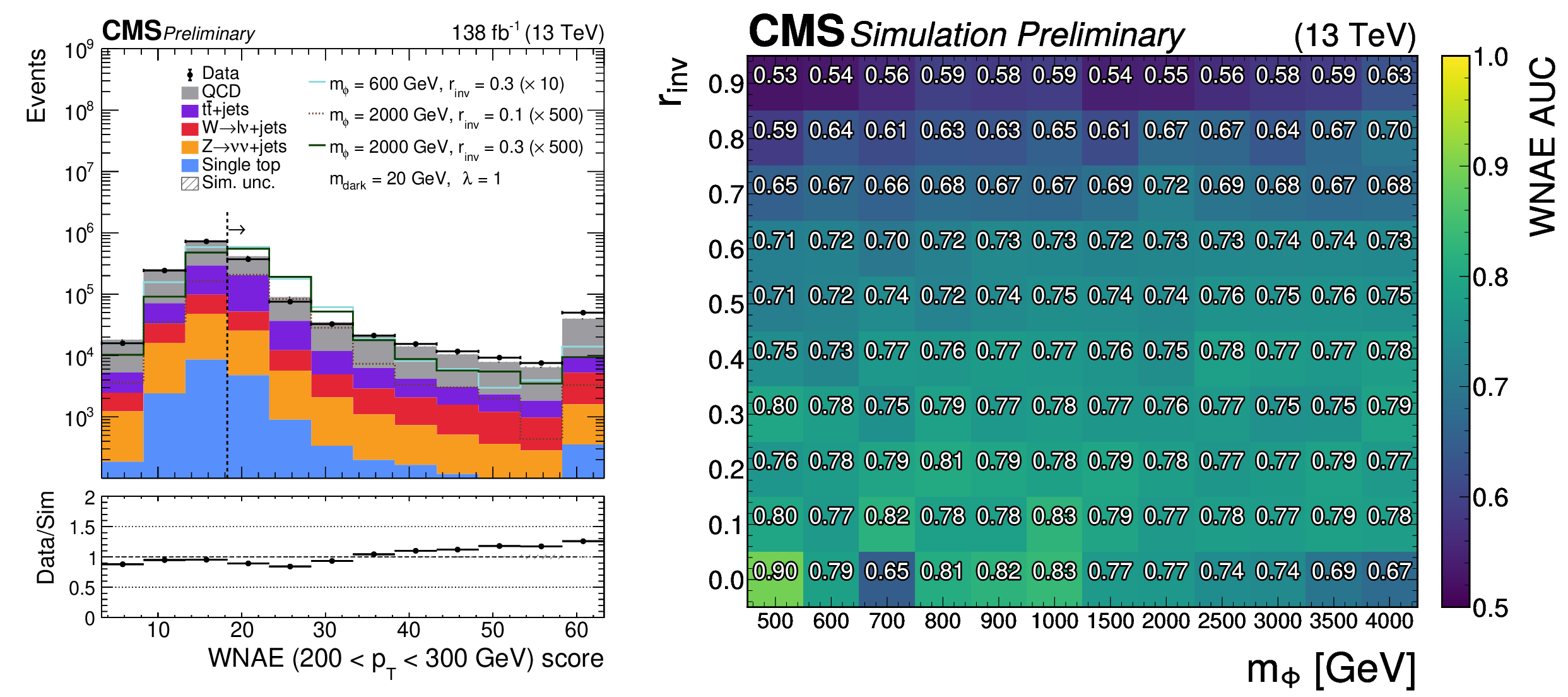
For the WNAE model trained on jets with 200 $ < p_{\mathrm{T}} < $ 300 GeV, the score distribution for data, background simulation, and a selection of signal models (left), and the performance discriminating between the simulated QCD background and signal models with varying $ m_{\Phi} $ and $ r_{\mathrm{inv}} $ values with $ m_{\mathrm{dark}} = $ 20 GeV, $ \lambda = $ 1 (right). The fluctuations of the WNAE AUC at low $ r_{\mathrm{inv}} $ and $ m_{\Phi} $ arise from the limited number of events in this region. The simulated background score distributions are shown for illustration purposes only; they are not used to predict the SM background in the statistical interpretation. The signal jets are corrected for substructure-related mismodeling using their Lund jet plane density, as described in Section 7. The background simulation has no substructure correction applied. The statistical uncertainty in the background simulation from the limited number of simulated events is included but is generally small. |
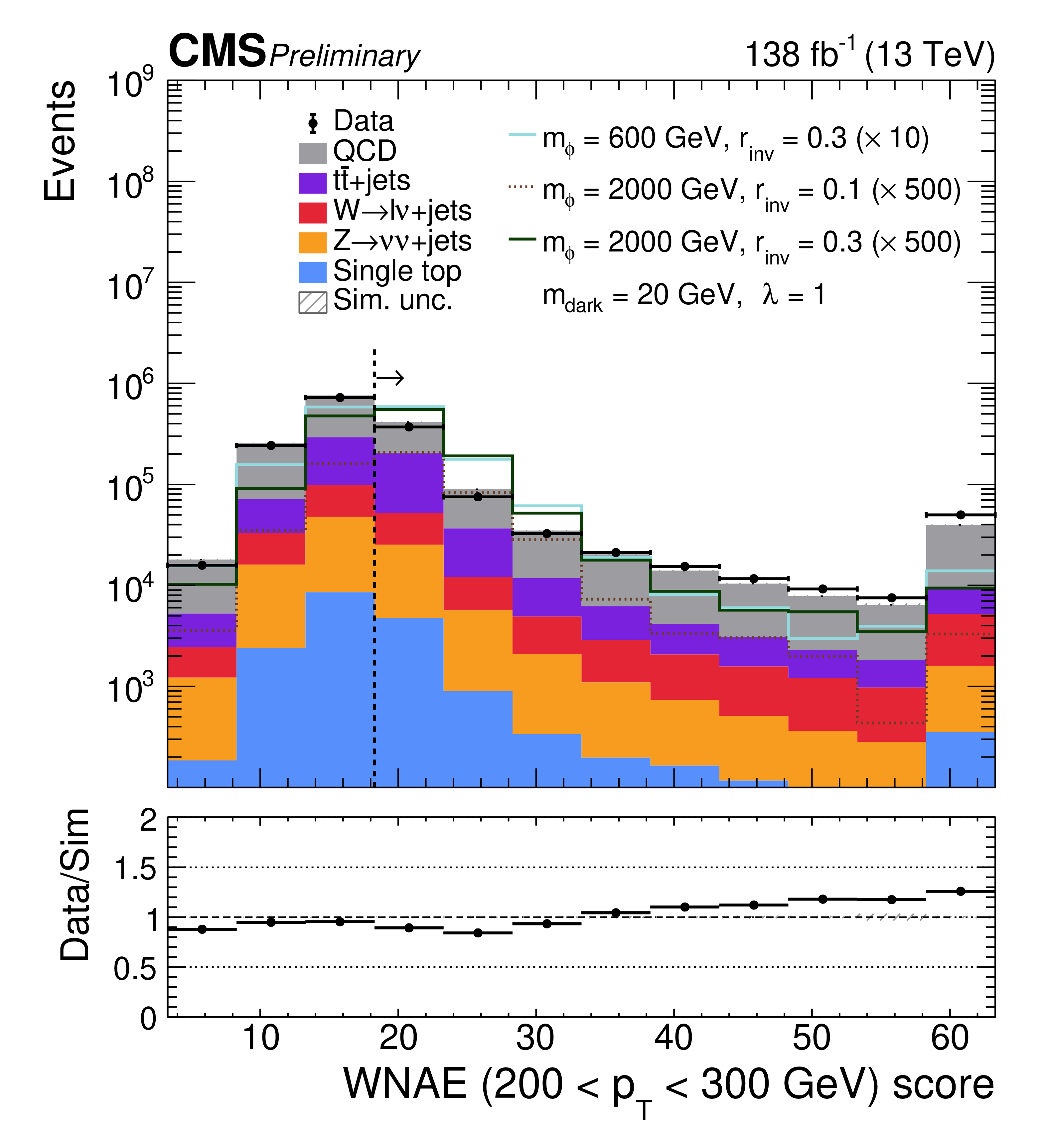
png pdf |
Figure 4-a:
For the WNAE model trained on jets with 200 $ < p_{\mathrm{T}} < $ 300 GeV, the score distribution for data, background simulation, and a selection of signal models (left), and the performance discriminating between the simulated QCD background and signal models with varying $ m_{\Phi} $ and $ r_{\mathrm{inv}} $ values with $ m_{\mathrm{dark}} = $ 20 GeV, $ \lambda = $ 1 (right). The fluctuations of the WNAE AUC at low $ r_{\mathrm{inv}} $ and $ m_{\Phi} $ arise from the limited number of events in this region. The simulated background score distributions are shown for illustration purposes only; they are not used to predict the SM background in the statistical interpretation. The signal jets are corrected for substructure-related mismodeling using their Lund jet plane density, as described in Section 7. The background simulation has no substructure correction applied. The statistical uncertainty in the background simulation from the limited number of simulated events is included but is generally small. |
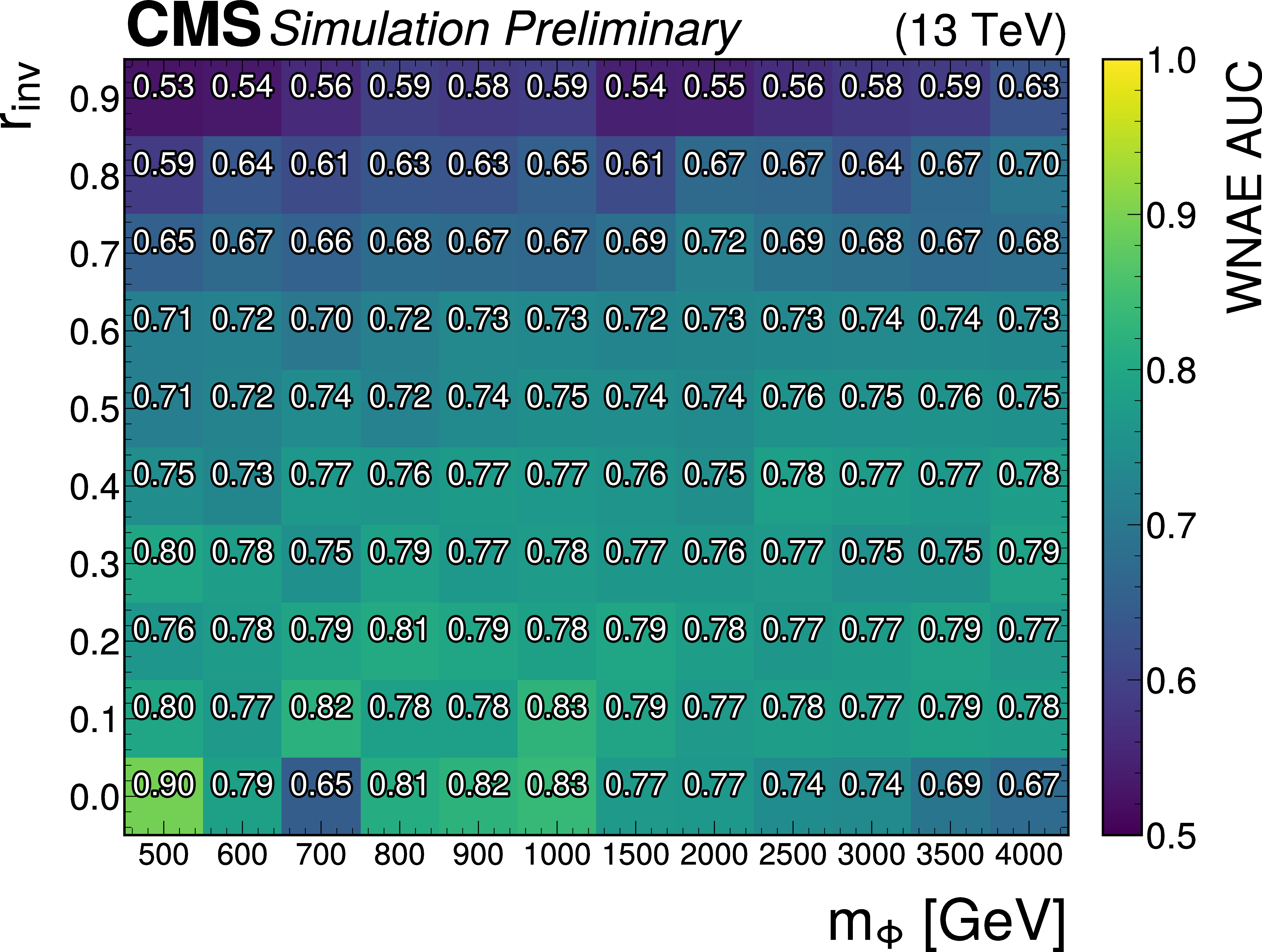
png pdf |
Figure 4-b:
For the WNAE model trained on jets with 200 $ < p_{\mathrm{T}} < $ 300 GeV, the score distribution for data, background simulation, and a selection of signal models (left), and the performance discriminating between the simulated QCD background and signal models with varying $ m_{\Phi} $ and $ r_{\mathrm{inv}} $ values with $ m_{\mathrm{dark}} = $ 20 GeV, $ \lambda = $ 1 (right). The fluctuations of the WNAE AUC at low $ r_{\mathrm{inv}} $ and $ m_{\Phi} $ arise from the limited number of events in this region. The simulated background score distributions are shown for illustration purposes only; they are not used to predict the SM background in the statistical interpretation. The signal jets are corrected for substructure-related mismodeling using their Lund jet plane density, as described in Section 7. The background simulation has no substructure correction applied. The statistical uncertainty in the background simulation from the limited number of simulated events is included but is generally small. |
png pdf |
Figure 5:
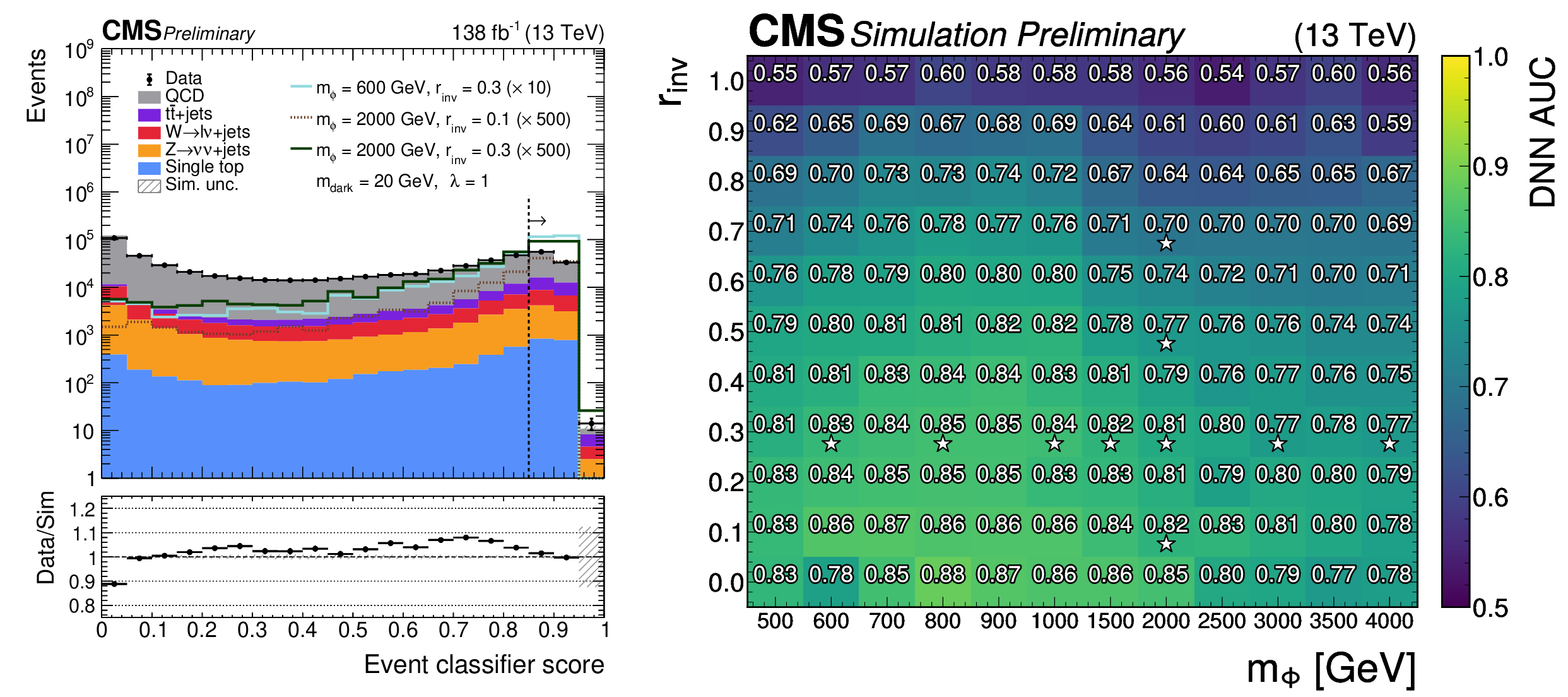
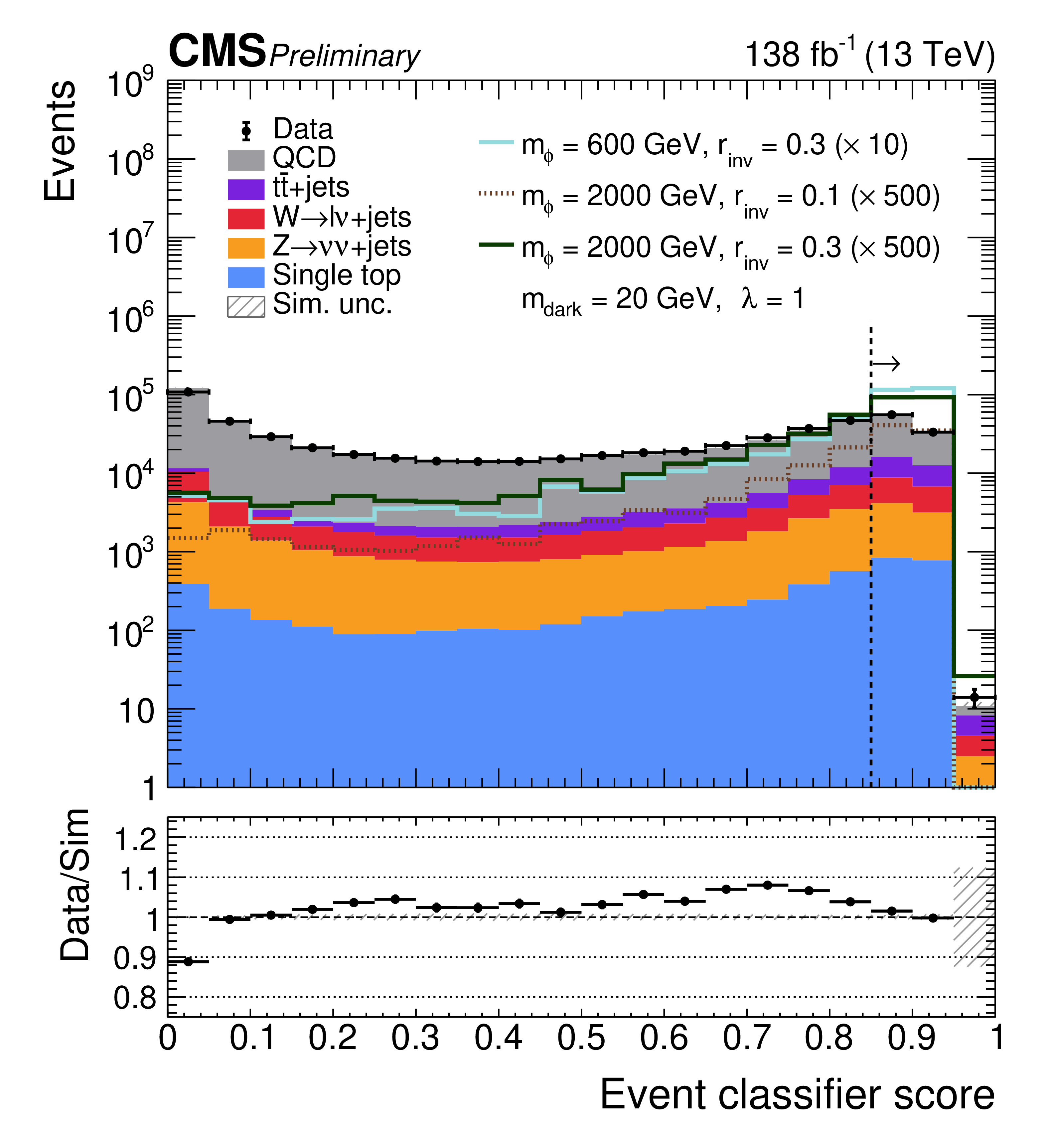
The event classifier output scores for data, background simulation, and a selection of signal models (left) and the event classifier performance evaluated on a range of signal hypotheses with $ m_{\mathrm{dark}}= $ 20 GeV, $ \lambda= $ 1, and varying $ r_{\mathrm{inv}} $ and $ m_{\Phi} $, against the total background (right). The signal models used for training the event classifier are marked with a star. The simulated background score distributions are shown for illustration purposes only; they are not used to predict the SM background in the statistical interpretation. The signal jets are corrected for substructure-related mismodeling using their Lund jet plane density, as described in Section 7. The background simulation has no substructure correction applied. The statistical uncertainty in the background simulation from the limited number of simulated events is included but is generally small. |
png pdf |
Figure 5-a:
The event classifier output scores for data, background simulation, and a selection of signal models (left) and the event classifier performance evaluated on a range of signal hypotheses with $ m_{\mathrm{dark}}= $ 20 GeV, $ \lambda= $ 1, and varying $ r_{\mathrm{inv}} $ and $ m_{\Phi} $, against the total background (right). The signal models used for training the event classifier are marked with a star. The simulated background score distributions are shown for illustration purposes only; they are not used to predict the SM background in the statistical interpretation. The signal jets are corrected for substructure-related mismodeling using their Lund jet plane density, as described in Section 7. The background simulation has no substructure correction applied. The statistical uncertainty in the background simulation from the limited number of simulated events is included but is generally small. |
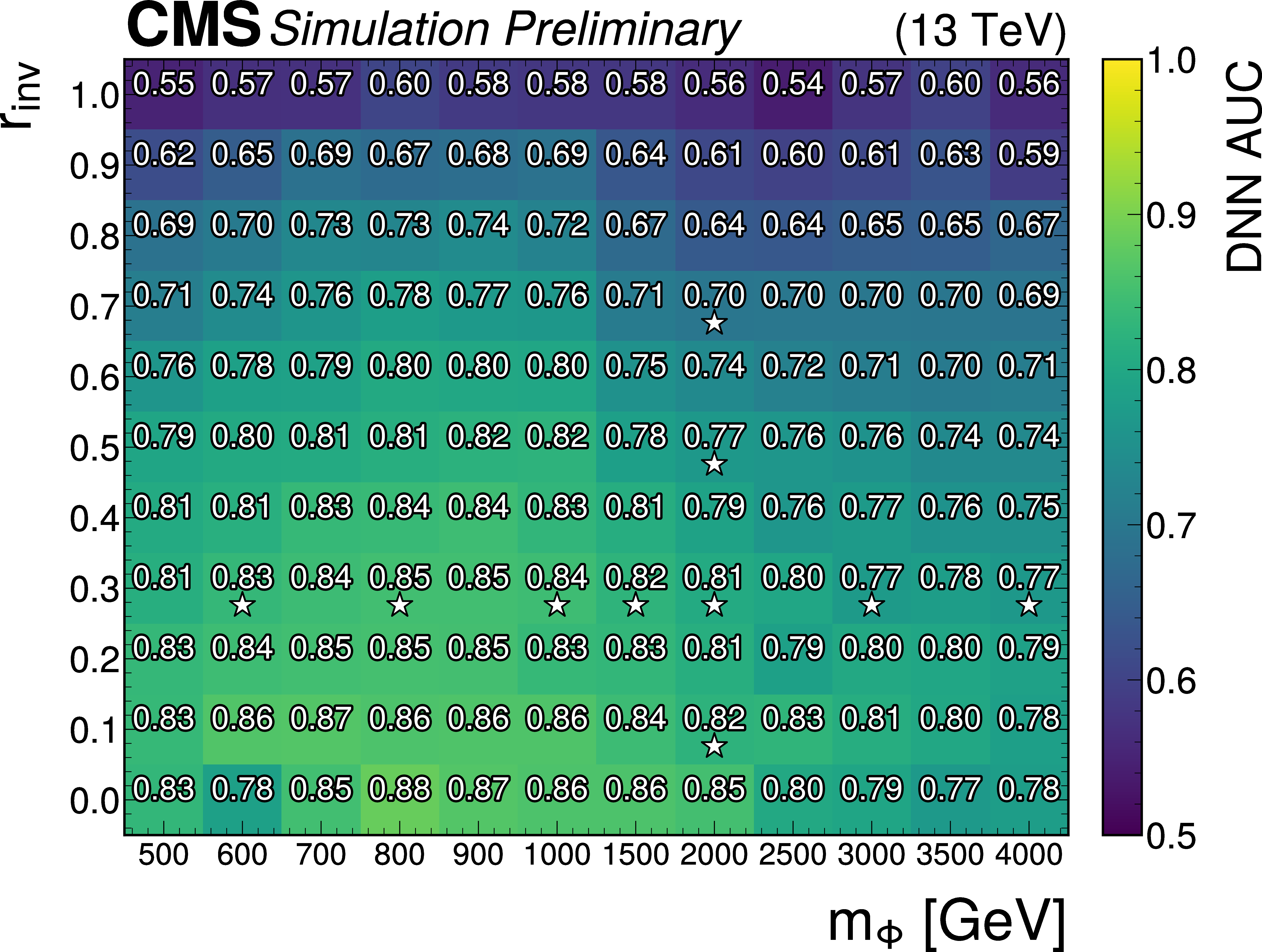
png pdf |
Figure 5-b:
The event classifier output scores for data, background simulation, and a selection of signal models (left) and the event classifier performance evaluated on a range of signal hypotheses with $ m_{\mathrm{dark}}= $ 20 GeV, $ \lambda= $ 1, and varying $ r_{\mathrm{inv}} $ and $ m_{\Phi} $, against the total background (right). The signal models used for training the event classifier are marked with a star. The simulated background score distributions are shown for illustration purposes only; they are not used to predict the SM background in the statistical interpretation. The signal jets are corrected for substructure-related mismodeling using their Lund jet plane density, as described in Section 7. The background simulation has no substructure correction applied. The statistical uncertainty in the background simulation from the limited number of simulated events is included but is generally small. |
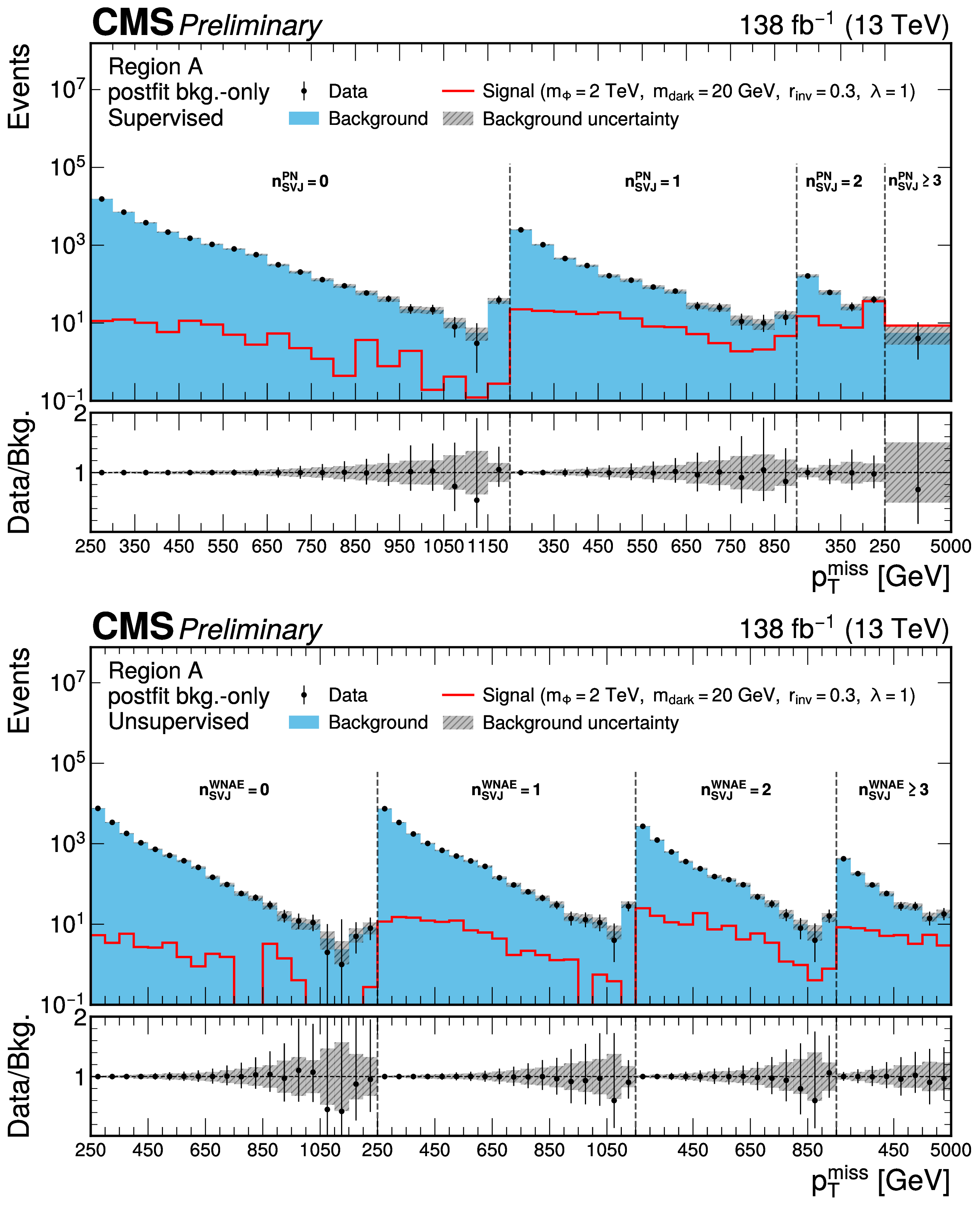
png pdf |
Figure 6:
The observed data, the postfit estimated background, and a representative signal model for the PARTICLENET supervised tagger strategy (upper) and for the WNAE unsupervised tagger strategy (lower). The plots display all three years of data taking combined, while the actual fits consider each year independently. |
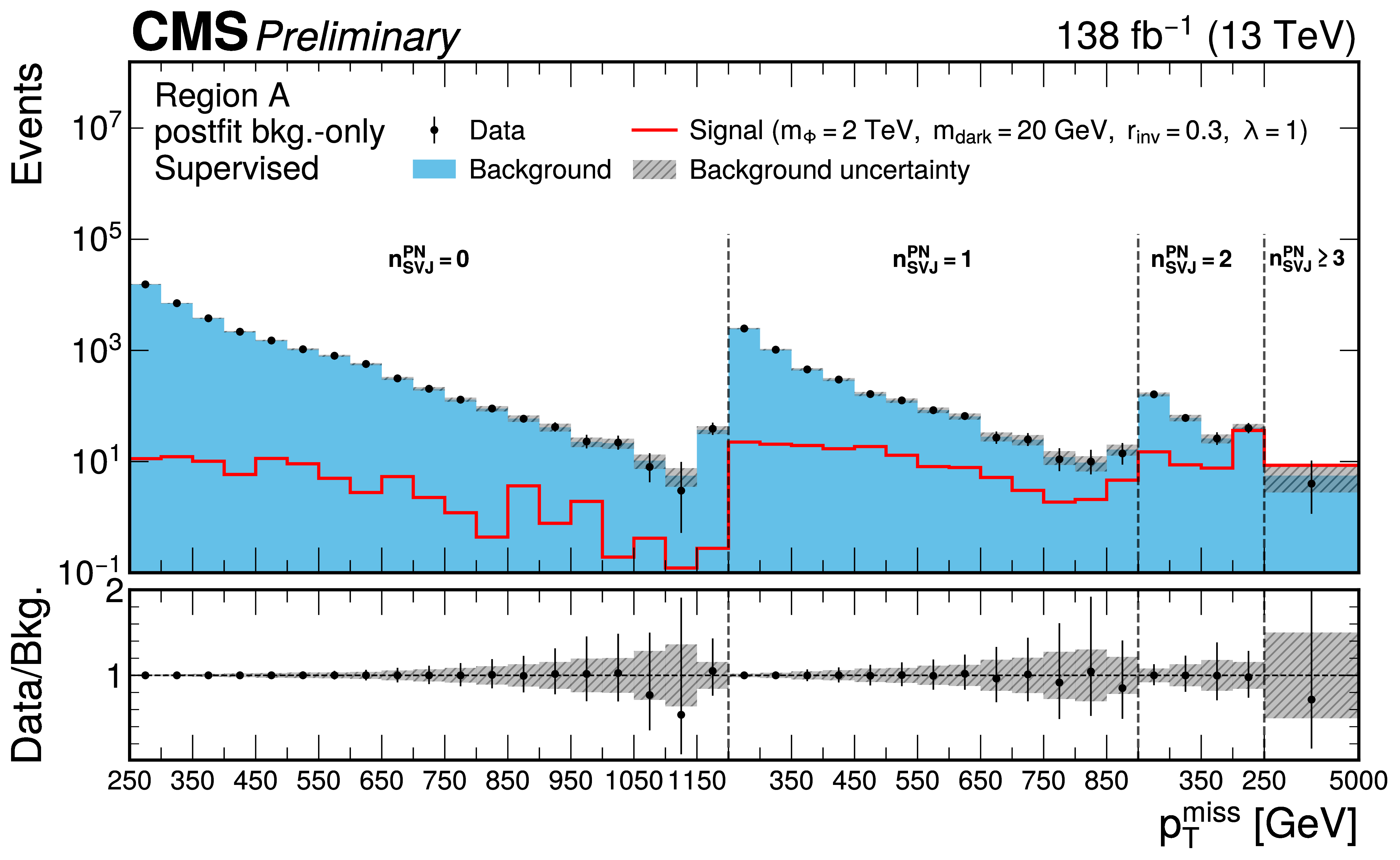
png pdf |
Figure 6-a:
The observed data, the postfit estimated background, and a representative signal model for the PARTICLENET supervised tagger strategy (upper) and for the WNAE unsupervised tagger strategy (lower). The plots display all three years of data taking combined, while the actual fits consider each year independently. |
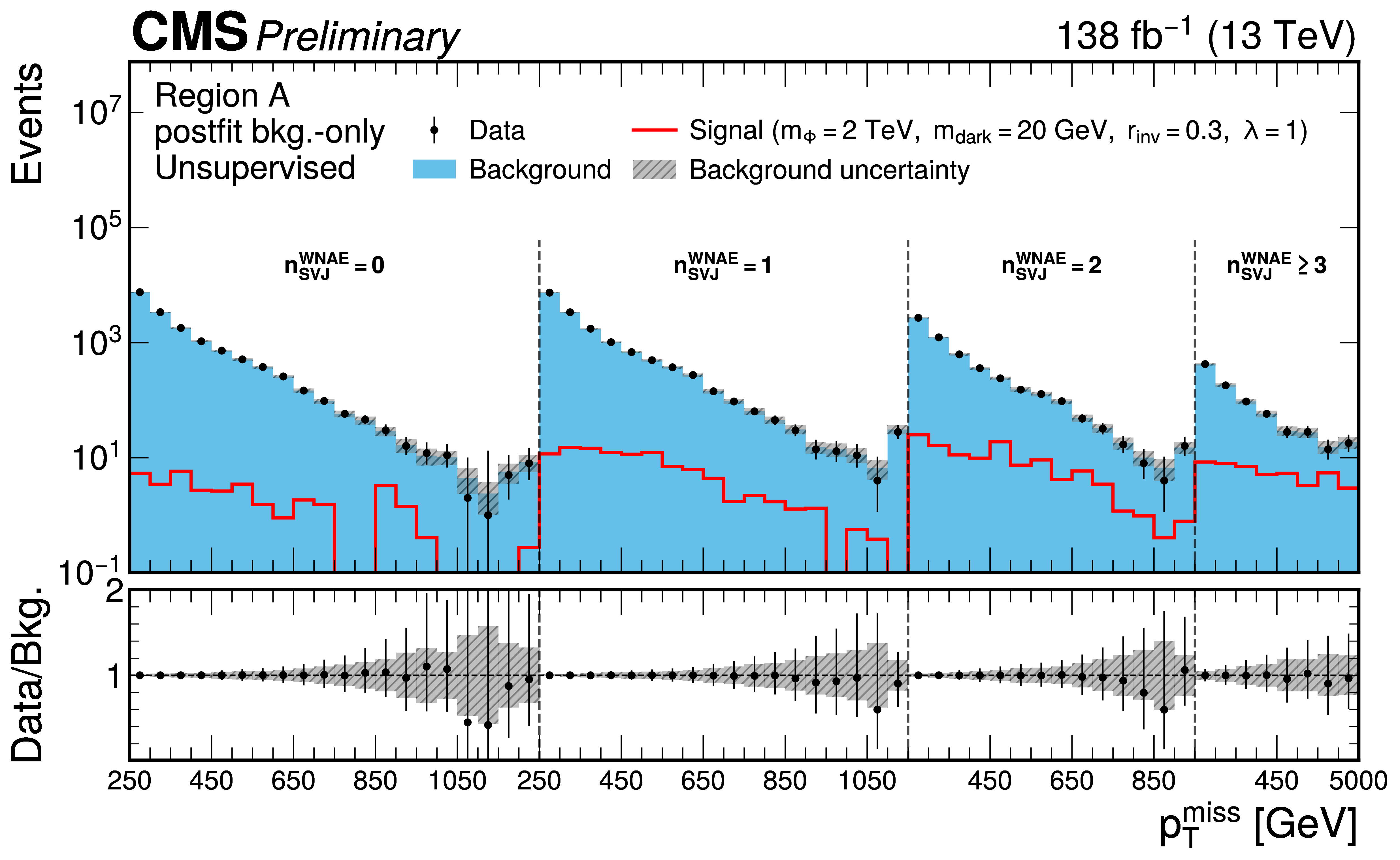
png pdf |
Figure 6-b:
The observed data, the postfit estimated background, and a representative signal model for the PARTICLENET supervised tagger strategy (upper) and for the WNAE unsupervised tagger strategy (lower). The plots display all three years of data taking combined, while the actual fits consider each year independently. |
png pdf |
Figure 7:
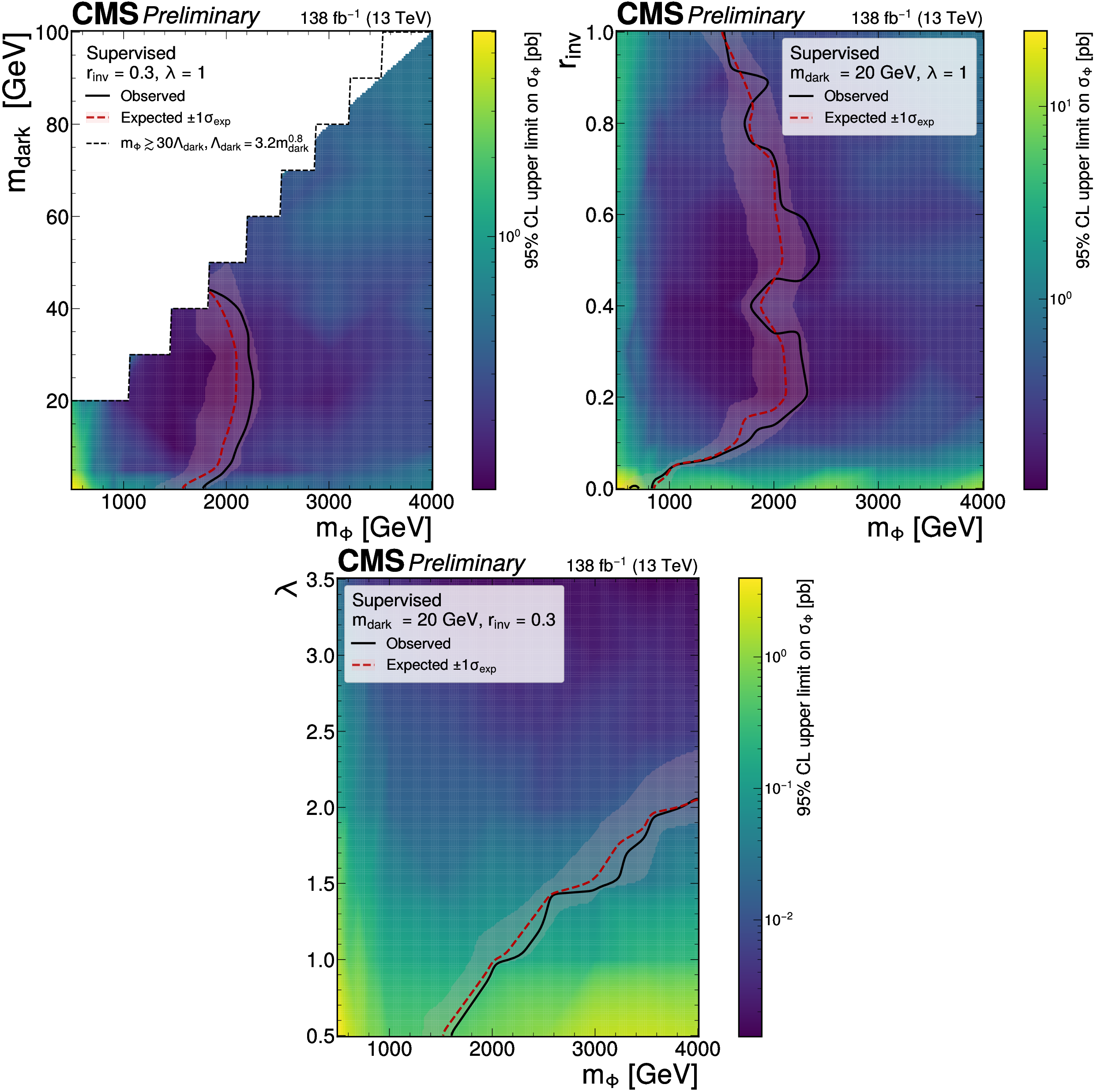
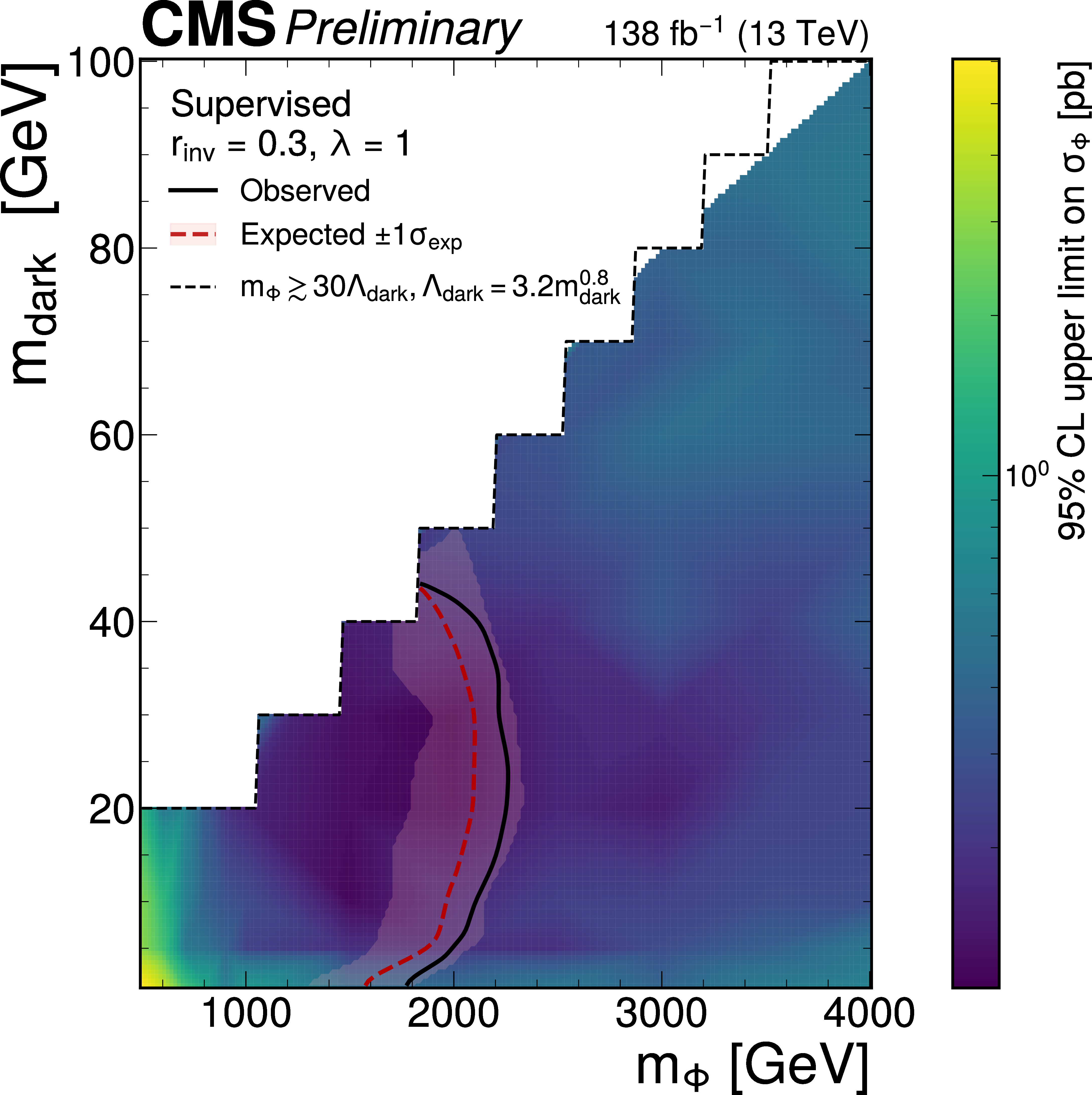
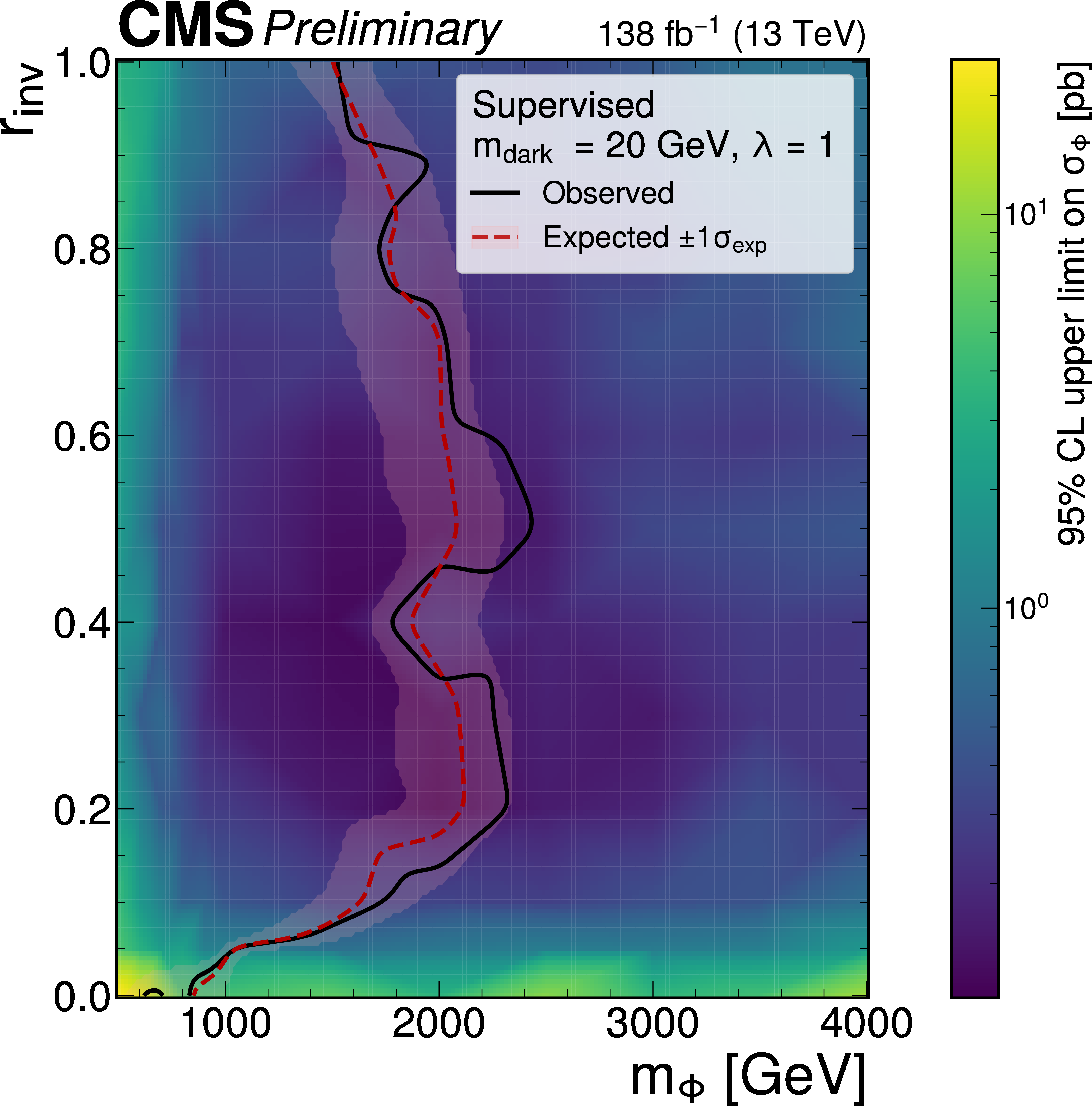
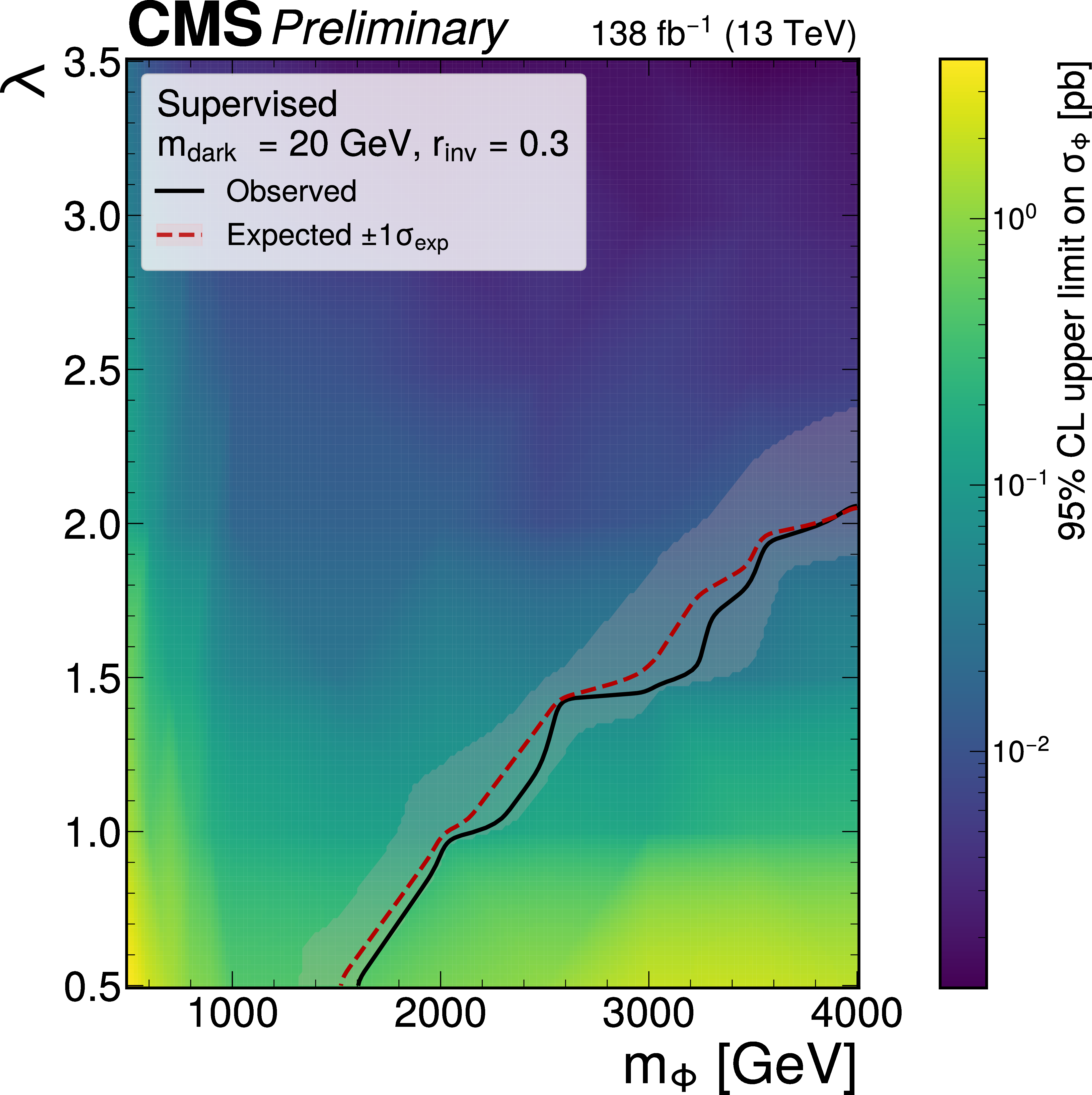
The exclusion limits as a function of $ m_{\Phi} $ and $ m_{\mathrm{dark}} $ (upper left), $ m_{\Phi} $ and $ r_{\mathrm{inv}} $ (upper right), and $ m_{\Phi} $ and $ \lambda $ (lower), combining all three data-taking years and all $ n_{\text{SVJ}}^{\text{PN}} $ categories, for the PARTICLENET supervised tagger strategy. |
png pdf |
Figure 7-a:
The exclusion limits as a function of $ m_{\Phi} $ and $ m_{\mathrm{dark}} $ (upper left), $ m_{\Phi} $ and $ r_{\mathrm{inv}} $ (upper right), and $ m_{\Phi} $ and $ \lambda $ (lower), combining all three data-taking years and all $ n_{\text{SVJ}}^{\text{PN}} $ categories, for the PARTICLENET supervised tagger strategy. |
png pdf |
Figure 7-b:
The exclusion limits as a function of $ m_{\Phi} $ and $ m_{\mathrm{dark}} $ (upper left), $ m_{\Phi} $ and $ r_{\mathrm{inv}} $ (upper right), and $ m_{\Phi} $ and $ \lambda $ (lower), combining all three data-taking years and all $ n_{\text{SVJ}}^{\text{PN}} $ categories, for the PARTICLENET supervised tagger strategy. |
png pdf |
Figure 7-c:
The exclusion limits as a function of $ m_{\Phi} $ and $ m_{\mathrm{dark}} $ (upper left), $ m_{\Phi} $ and $ r_{\mathrm{inv}} $ (upper right), and $ m_{\Phi} $ and $ \lambda $ (lower), combining all three data-taking years and all $ n_{\text{SVJ}}^{\text{PN}} $ categories, for the PARTICLENET supervised tagger strategy. |
png pdf |
Figure 8:
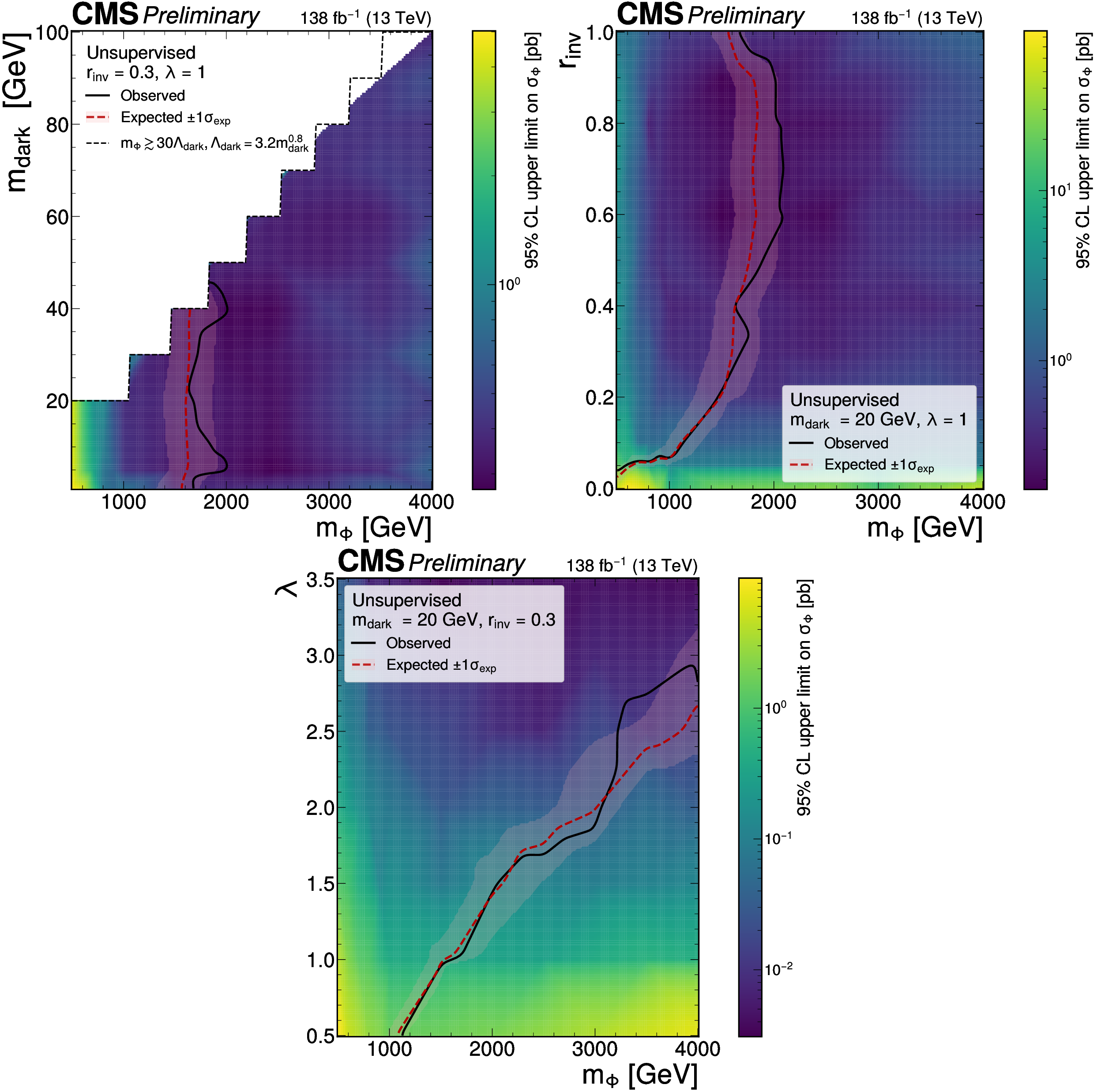
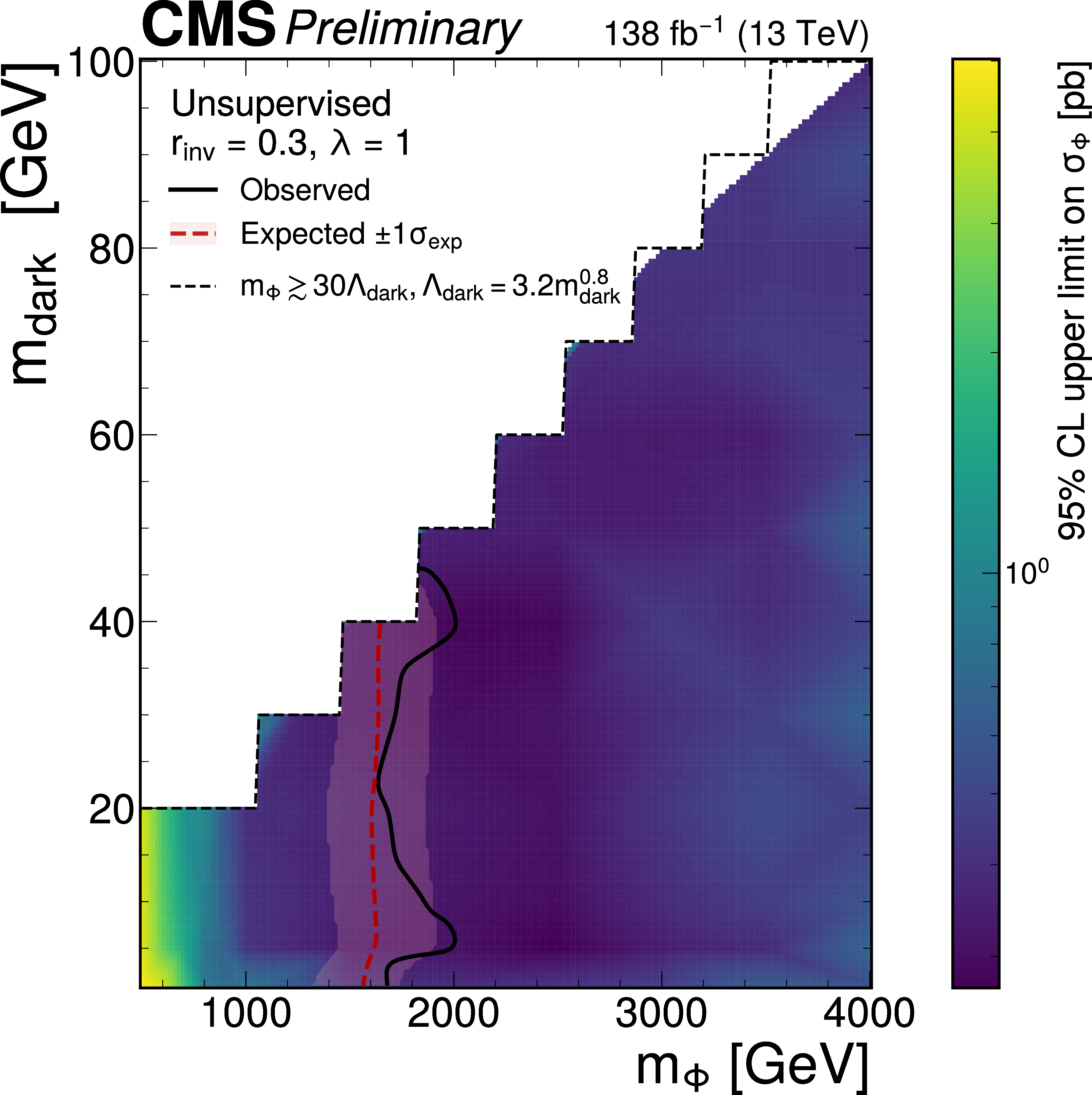
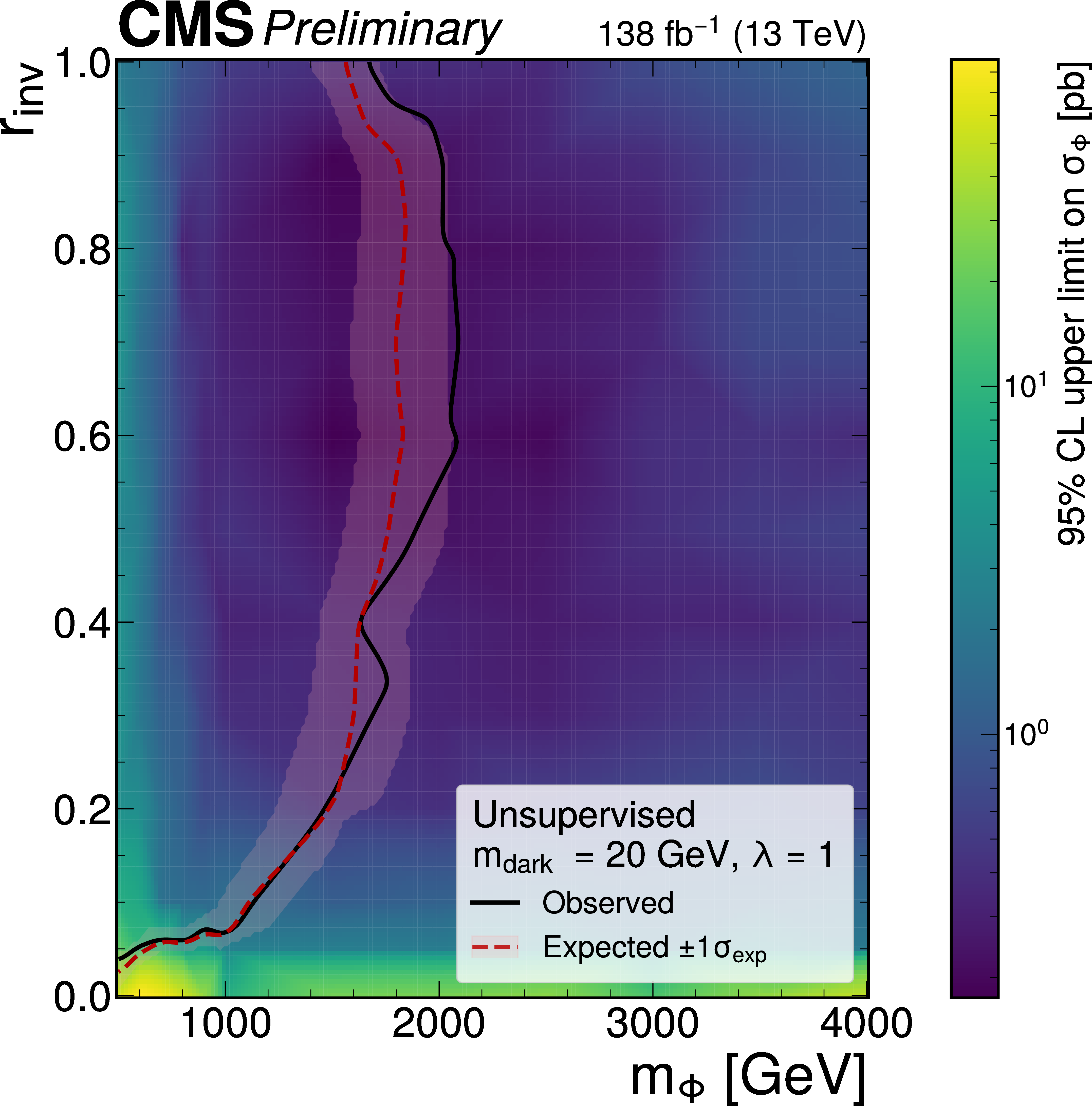
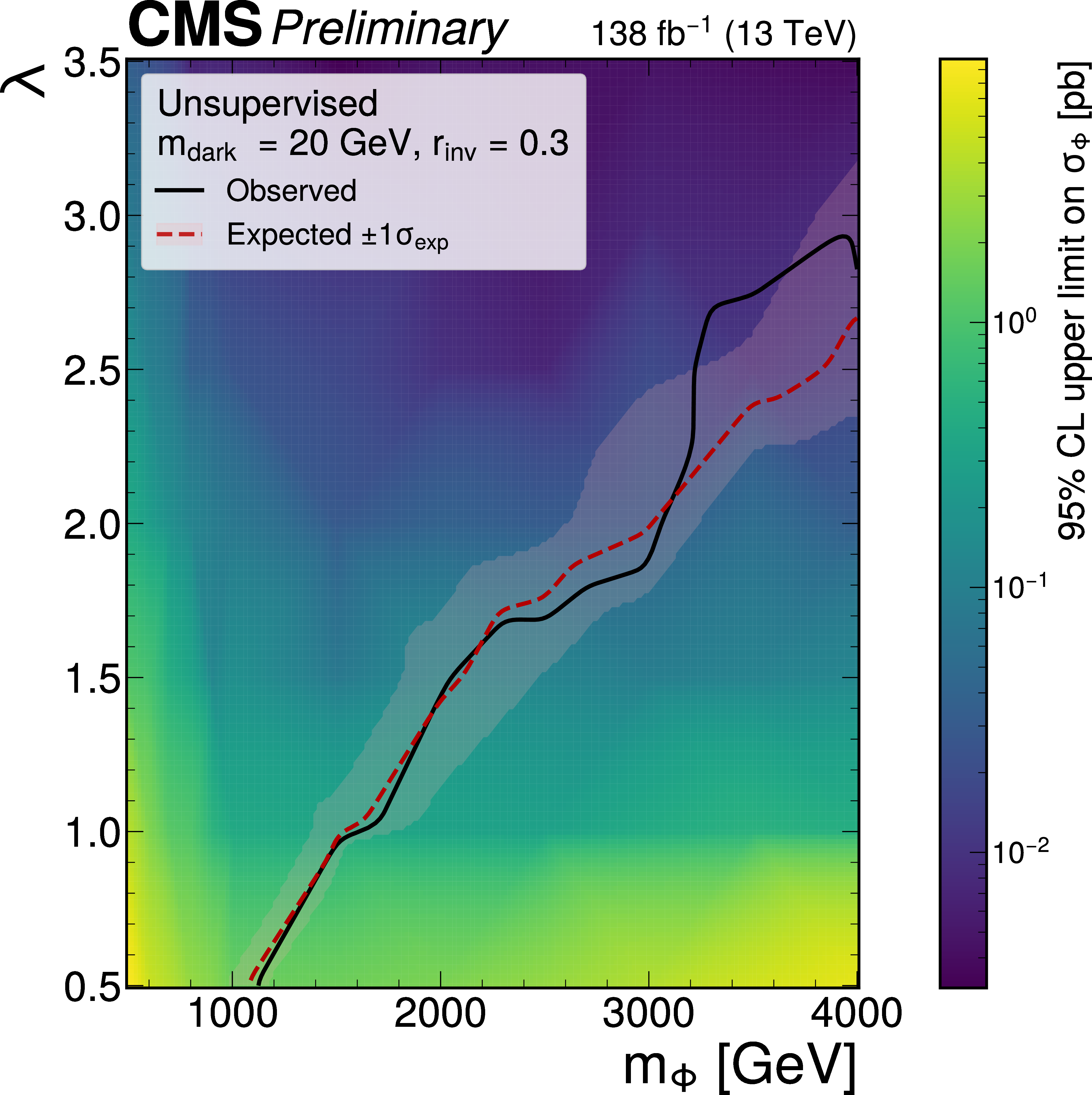
The exclusion limits as a function of $ m_{\Phi} $ and $ m_{\mathrm{dark}} $ (upper left), $ m_{\Phi} $ and $ r_{\mathrm{inv}} $ (upper right), and $ m_{\Phi} $ and $ \lambda $ (lower), combining all three data-taking years and all $ n_{\text{SVJ}}^{\text{WNAE}} $ categories, for the WNAE unsupervised tagger strategy. |
png pdf |
Figure 8-a:
The exclusion limits as a function of $ m_{\Phi} $ and $ m_{\mathrm{dark}} $ (upper left), $ m_{\Phi} $ and $ r_{\mathrm{inv}} $ (upper right), and $ m_{\Phi} $ and $ \lambda $ (lower), combining all three data-taking years and all $ n_{\text{SVJ}}^{\text{WNAE}} $ categories, for the WNAE unsupervised tagger strategy. |
png pdf |
Figure 8-b:
The exclusion limits as a function of $ m_{\Phi} $ and $ m_{\mathrm{dark}} $ (upper left), $ m_{\Phi} $ and $ r_{\mathrm{inv}} $ (upper right), and $ m_{\Phi} $ and $ \lambda $ (lower), combining all three data-taking years and all $ n_{\text{SVJ}}^{\text{WNAE}} $ categories, for the WNAE unsupervised tagger strategy. |
png pdf |
Figure 8-c:
The exclusion limits as a function of $ m_{\Phi} $ and $ m_{\mathrm{dark}} $ (upper left), $ m_{\Phi} $ and $ r_{\mathrm{inv}} $ (upper right), and $ m_{\Phi} $ and $ \lambda $ (lower), combining all three data-taking years and all $ n_{\text{SVJ}}^{\text{WNAE}} $ categories, for the WNAE unsupervised tagger strategy. |
| Tables | |
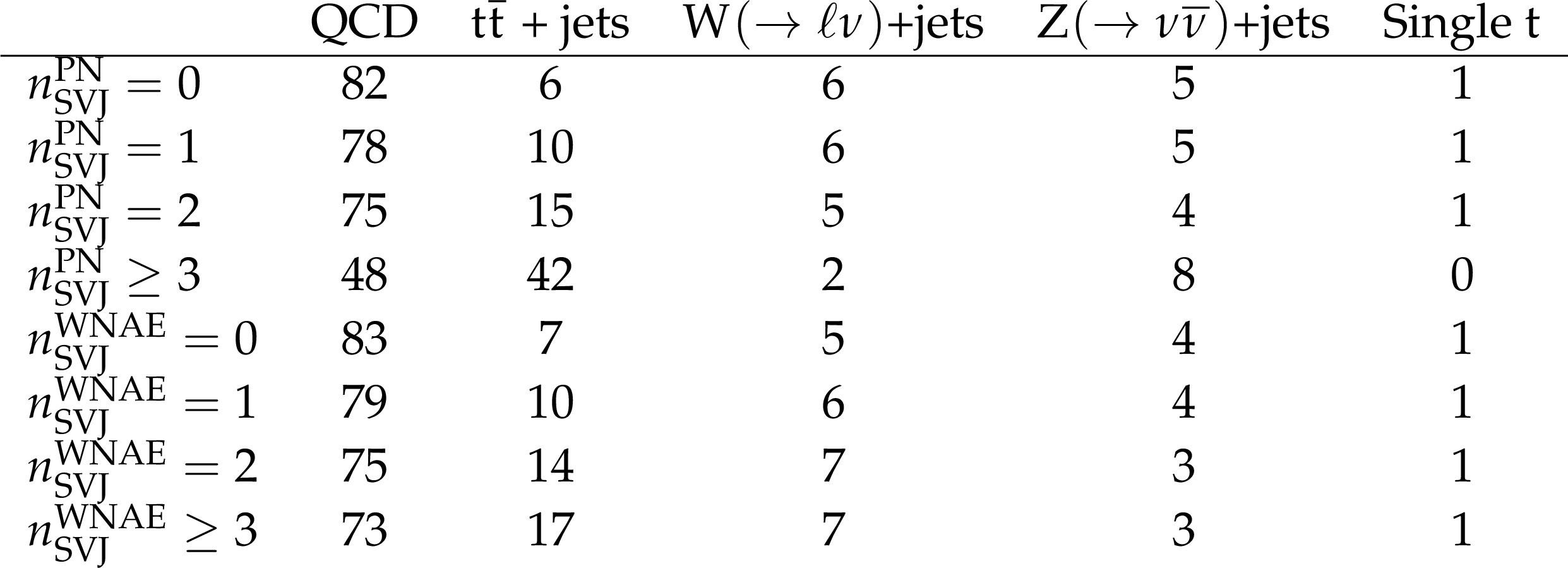
png pdf |
Table 1:
The background fractions in % after applying the preselection criteria in the different $ n_{\text{SVJ}} $ categories for the PARTICLENET and WNAE SVJ taggers. |
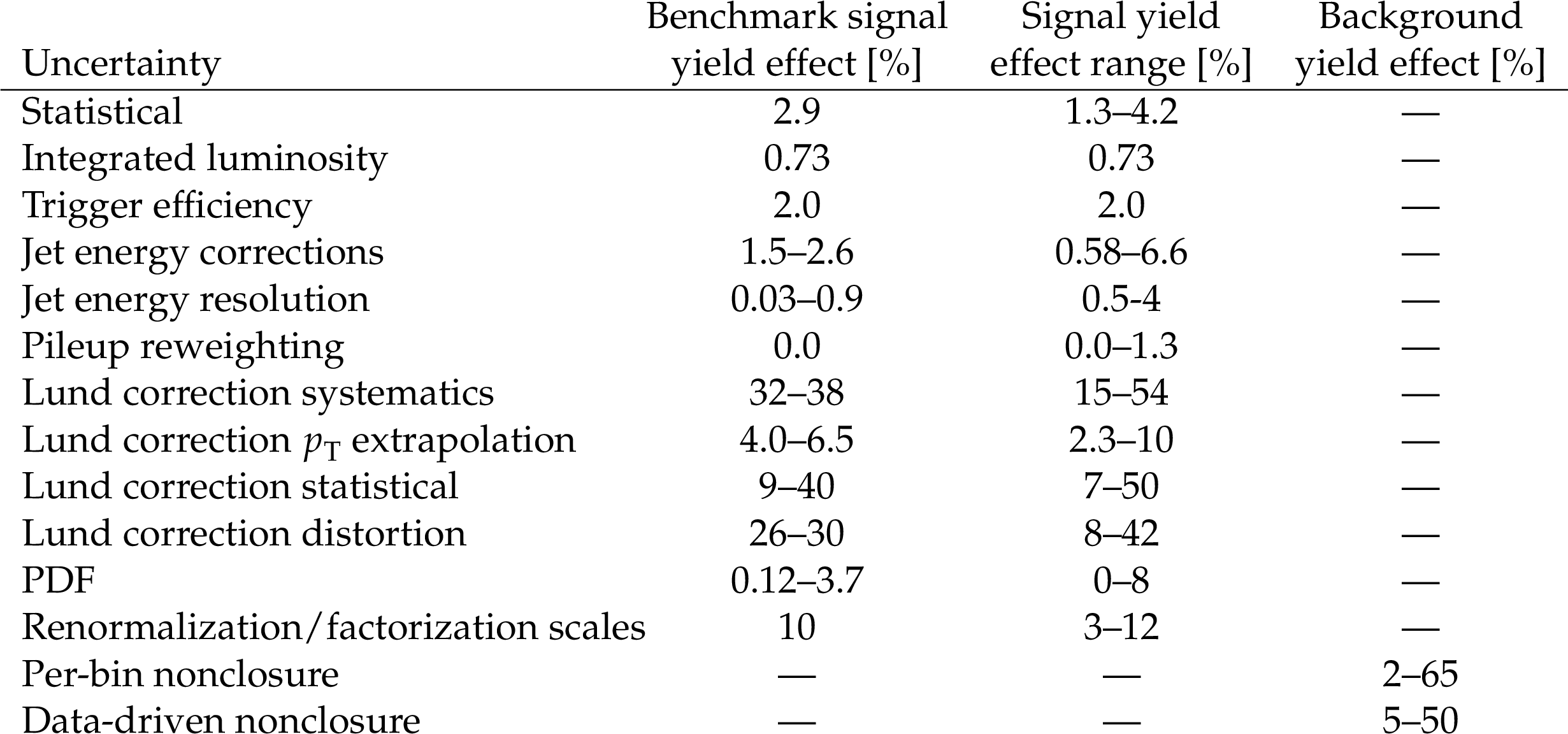
png pdf |
Table 2:
The range of effects on the signal or background yield at the preselection level for each systematic uncertainty. Values smaller than 0.01% are rounded to 0.0%. These values are given for the baseline signal hypothesis with $ m_{\Phi} = $ 2 TeV, $ m_{\mathrm{dark}} = $ 20 GeV, $ r_{\mathrm{inv}} = $ 0.3, and $ \lambda = $ 1. The 10--90% quantile range for all signal models are also provided. |
| Summary |
| This note presents the first CMS search for nonresonant production of strongly coupled dark matter. The search uses data from proton-proton collisions recorded by the CMS detector during the 2016--2018 data-taking period, corresponding to an integrated luminosity of 138 fb$ ^{-1} $ at a center-of-mass energy of 13 TeV. The signal model consists of a strongly-coupled dark sector with several flavors of dark quarks that shower and hadronize to form stable and unstable bound states called dark hadrons. The stable dark hadrons are dark matter candidates, while the unstable dark hadrons decay promptly to standard model (SM) quarks, showering and hadronizing in the visible sector to produce semivisible jets (SVJs) composed of both visible and invisible particles. This note focuses on nonresonant production via a massive scalar bifundamental mediator $ \Phi $ with a Yukawa-like coupling between the dark and the SM sectors. The search probes variations of the mediator mass $ m_{\Phi} $, the dark hadron mass $ m_{\mathrm{dark}} $, the fraction of stable, invisible dark hadrons $ r_{\mathrm{inv}} $, and the bifundamental Yukawa coupling $ \lambda $. Two complementary strategies are employed to identify SVJs, yielding two sets of results. The first uses a supervised tagger, PARTICLENET, which is model-dependent and utilizes jet constituents to identify SVJs. The second uses an unsupervised tagger, the Wasserstein normalized autoencoder, to learn the substructure of SM jets in order to identify SVJs as anomalous. The response of these taggers is sensitive to potential mismodeling of the jet substructure in the signal simulation, which is corrected using a procedure designed for jets with high subjet multiplicity. This procedure compares the Lund jet plane of the signal subjets, each of which corresponds to one SM quark, to that of subjets from the hadronic decay of a W boson in observed data. For both the supervised and unsupervised tagger strategies, the SM background is estimated from data using a deep neural network discriminator that is trained on event-level kinematic features to be decorrelated from the $ p_{\mathrm{T}}^\text{miss} $ in order to partition events into four regions, separating signal from background. The supervised tagger strategy places 95% confidence level (CL) exclusion limits on the production cross sections for different signal models, which can be interpreted to exclude ranges of signal model parameters. These exclusions include 0.5 $ \leq m_{\Phi} \leq $ 2.4 TeV, depending on the other signal model parameters. All considered values of $ m_{\mathrm{dark}} $ are excluded for mediator masses below 1.7 TeV, depending on other signal parameters. For mediator masses less than 1.5 TeV, all variations of $ \lambda $ are excluded; for the full range of mediator masses considered, $ \lambda > $ 2 is excluded. Similarly, the unsupervised tagger strategy excludes 0.5 $ \leq m_{\Phi} \leq $ 2.0 TeV, depending on the other signal model parameters. Depending on other signal model parameters, the unsupervised tagger strategy excludes all considered $ m_{\mathrm{dark}} $ masses for mediator masses up to 1.6 TeV. For the full range of mediator masses, $ \lambda > $ 3.0 is excluded. These results complement existing searches for composite dark matter originating from strongly coupled dark sectors. A set of new signal hypotheses are are excluded by placing limits on the production cross section of the massive scalar bifundamental mediator $ \Phi $. The use of machine learning to exploit both jet- and event-level information increases the sensitivity of the search and enables the exclusion of a wide range of models in the targeted parameter space. |
| References | ||||
| 1 | V. C. Rubin, N. Thonnard, and W. K. Ford, Jr. | Rotational properties of 21 SC galaxies with a large range of luminosities and radii, from NGC 4605 (R = 4 kpc) to UGC 2885 (R = 122 kpc) | Astrophys. J. 238 (1980) 471 | |
| 2 | M. Persic, P. Salucci, and F. Stel | The universal rotation curve of spiral galaxies: I. The dark matter connection | Mon. Not. Roy. Astron. Soc. 281 (1996) 27 | astro-ph/9506004 |
| 3 | D. Clowe et al. | A direct empirical proof of the existence of dark matter | Astrophys. J. 648 (2006) L109 | astro-ph/0608407 |
| 4 | DES Collaboration | Dark Energy Survey year 1 results: curved-sky weak lensing mass map | Mon. Not. Roy. Astron. Soc. 475 (2018) 3165 | 1708.01535 |
| 5 | Planck Collaboration | Planck 2018 results. VI. Cosmological parameters | Astron. Astrophys. 641 (2020) A6 | 1807.06209 |
| 6 | G. Jungman, M. Kamionkowski, and K. Griest | Supersymmetric dark matter | Phys. Rept. 267 (1996) 195 | hep-ph/9506380 |
| 7 | CMS Collaboration | Search for new physics in final states with a single photon and missing transverse momentum in proton-proton collisions at $ \sqrt{s} = $ 13 TeV | JHEP 02 (2019) 074 | CMS-EXO-16-053 1810.00196 |
| 8 | CMS Collaboration | Search for dark matter produced in association with a leptonically decaying Z boson in proton-proton collisions at $ \sqrt{s} = $ 13 TeV | EPJC 81 (2021) 13 | CMS-EXO-19-003 2008.04735 |
| 9 | CMS Collaboration | Search for new particles in events with energetic jets and large missing transverse momentum in proton-proton collisions at $ \sqrt{s} = $ 13 TeV | JHEP 11 (2021) 153 | CMS-EXO-20-004 2107.13021 |
| 10 | CMS Collaboration | Search for invisible decays of a Higgs boson produced through vector boson fusion in proton-proton collisions at $ \sqrt{s} = $ 13 TeV | PLB 793 (2019) 520 | CMS-HIG-17-023 1809.05937 |
| 11 | CMS Collaboration | Search for dark matter particles in W$ ^{+} $W$ ^{-} $ events with transverse momentum imbalance in proton-proton collisions at $ \sqrt{s} = $ 13 TeV | JHEP 03 (2024) 134 | CMS-EXO-21-012 2310.12229 |
| 12 | ATLAS Collaboration | Search for new particles in events with a hadronically decaying W or Z boson and large missing transverse momentum at $ \sqrt{s} = $ 13 TeV using the ATLAS detector | JHEP 11 (2024) 126 | 2406.01272 |
| 13 | ATLAS Collaboration | Search for invisible Higgs boson decays in vector boson fusion at $ \sqrt{s} = $ 13 TeV with the ATLAS detector | PLB 793 (2019) 499 | 1809.06682 |
| 14 | ATLAS Collaboration | Constraints on mediator-based dark matter and scalar dark energy models using $ \sqrt s = $ 13 TeV $ pp $ collision data collected by the ATLAS detector | JHEP 05 (2019) 142 | 1903.01400 |
| 15 | ATLAS Collaboration | Search for new phenomena in events with two opposite-charge leptons, jets and missing transverse momentum in pp collisions at $ \sqrt{\mathrm{s}} = $ 13 TeV with the ATLAS detector | JHEP 04 (2021) 165 | 2102.01444 |
| 16 | ATLAS Collaboration | Search for new phenomena with top quark pairs in final states with one lepton, jets, and missing transverse momentum in $ pp $ collisions at $ \sqrt{s} = $ 13 TeV with the ATLAS detector | JHEP 04 (2021) 174 | 2012.03799 |
| 17 | ATLAS Collaboration | Search for new phenomena in events with an energetic jet and missing transverse momentum in $ pp $ collisions at $ \sqrt{s} = $ 13 TeV with the ATLAS detector | PRD 103 (2021) 112006 | 2102.10874 |
| 18 | ATLAS Collaboration | Constraints on simplified dark matter models involving an s-channel mediator with the ATLAS detector in pp collisions at $ \sqrt{s} = $ 13 TeV | EPJC 84 (2024) 1102 | 2404.15930 |
| 19 | CMS Collaboration | Search for dark matter produced in association with a Higgs boson decaying to a pair of bottom quarks in proton--proton collisions at $ \sqrt{s}= $ 13 TeV | EPJC 79 (2019) 280 | CMS-EXO-16-050 1811.06562 |
| 20 | CMS Collaboration | Search for dark matter particles produced in association with a Higgs boson in proton-proton collisions at $ \sqrt{\text{s}} = $ 13 TeV | JHEP 03 (2020) 025 | CMS-EXO-18-011 1908.01713 |
| 21 | CMS Collaboration | Search for dark matter produced in association with a single top quark or a top quark pair in proton-proton collisions at $ \sqrt{s}= $ 13 TeV | JHEP 03 (2019) 141 | CMS-EXO-18-010 1901.01553 |
| 22 | ATLAS Collaboration | Search for dark matter produced in association with a single top quark and an energetic $ W $ boson in $ \sqrt{s}= $ 13 TeV $ pp $ collisions with the ATLAS detector | EPJC 83 (2023) 603 | 2211.13138 |
| 23 | CMS Collaboration | Search for dark matter produced in association with one or two top quarks in proton-proton collisions at $ \sqrt{\text{s}} = $ 13 TeV | JHEP 08 (2025) 085 | CMS-EXO-22-014 2505.05300 |
| 24 | M. J. Strassler and K. M. Zurek | Echoes of a hidden valley at hadron colliders | PLB 651 (2007) 374 | hep-ph/0604261 |
| 25 | T. Cohen, M. Lisanti, H. K. Lou, and S. Mishra-Sharma | LHC searches for dark sector showers | JHEP 11 (2017) 196 | 1707.05326 |
| 26 | P. Schwaller, D. Stolarski, and A. Weiler | Emerging jets | JHEP 05 (2015) 059 | 1502.05409 |
| 27 | CMS Collaboration | Search for new particles decaying to a jet and an emerging jet | JHEP 02 (2019) 179 | CMS-EXO-18-001 1810.10069 |
| 28 | CMS Collaboration | Search for dark QCD with emerging jets in proton-proton collisions at $ \sqrt{s} = $ 13 TeV | JHEP 07 (2024) 142 | CMS-EXO-22-015 2403.01556 |
| 29 | ATLAS Collaboration | Search for emerging jets in $ pp $ collisions at $ \sqrt{s} = $ 13.6 TeV with the ATLAS experiment | Rept. Prog. Phys. 88 (2025) 097801 | 2505.02429 |
| 30 | ATLAS Collaboration | Search for emerging jets in $ pp $ collisions at $ \sqrt{s} = $ 13 TeV with the ATLAS experiment | Submitted to Eur. Phys. J. C, 2025 | 2510.12347 |
| 31 | M. J. Strassler | Why unparticle models with mass gaps are examples of hidden valleys | 0801.0629 | |
| 32 | S. Knapen, S. Pagan Griso, M. Papucci, and D. J. Robinson | Triggering soft bombs at the LHC | JHEP 08 (2017) 076 | 1612.00850 |
| 33 | CMS Collaboration | Search for soft unclustered energy patterns in proton-proton collisions at 13 TeV | PRL 133 (2024) 191902 | CMS-EXO-23-002 2403.05311 |
| 34 | CMS Collaboration | Search for soft unclustered energy patterns produced in association with a W or Z boson in proton-proton collisions at $ \sqrt{s} = $ 13 TeV | Submitted to Phys. Lett. B, 2026 | CMS-EXO-25-007 2604.05996 |
| 35 | ATLAS Collaboration | Search for soft unclustered energy patterns containing muons in the final state in $ pp $ collisions at $ \sqrt{s} = $ 13 TeV with the ATLAS detector | Submitted to JHEP, 2026 | 2605.20015 |
| 36 | CMS Collaboration | Search for resonant production of strongly coupled dark matter in proton-proton collisions at 13 TeV | JHEP 06 (2022) 156 | CMS-EXO-19-020 2112.11125 |
| 37 | ATLAS Collaboration | Search for new physics in final states with semivisible jets or anomalous signatures using the ATLAS detector | PRD 112 (2025) 012021 | 2505.01634 |
| 38 | ATLAS Collaboration | Search for non-resonant production of semi-visible jets using Run 2 data in ATLAS | PLB 848 (2024) 138324 | 2305.18037 |
| 39 | T. Cohen, M. Lisanti, and H. K. Lou | Semi-visible jets: Dark matter undercover at the LHC | PRL 115 (2015) 171804 | 1503.00009 |
| 40 | CMS Collaboration | Precision luminosity measurement in proton-proton collisions at $ \sqrt{s} = $ 13 TeV in 2015 and 2016 at CMS | EPJC 81 (2021) 800 | CMS-LUM-17-003 2104.01927 |
| 41 | H. Qu and L. Gouskos | ParticleNet: Jet tagging via particle clouds | PRD 101 (2020) 056019 | 1902.08570 |
| 42 | CMS Collaboration | Wasserstein normalized autoencoder for anomaly detection | Mach. Learn. Sci. Tech. 7 (2025) 035030 | CMS-MLG-24-002 2510.02168 |
| 43 | CMS Collaboration | The CMS experiment at the CERN LHC | JINST 3 (2008) S08004 | |
| 44 | CMS Collaboration | Development of the CMS detector for the CERN LHC Run 3 | JINST 19 (2024) P05064 | CMS-PRF-21-001 2309.05466 |
| 45 | CMS Collaboration | Performance of the CMS Level-1 trigger in proton-proton collisions at $ \sqrt{s} = $ 13 TeV | JINST 15 (2020) P10017 | CMS-TRG-17-001 2006.10165 |
| 46 | CMS Collaboration | The CMS trigger system | JINST 12 (2017) P01020 | CMS-TRG-12-001 1609.02366 |
| 47 | CMS Collaboration | Performance of the CMS high-level trigger during LHC Run 2 | JINST 19 (2024) P11021 | CMS-TRG-19-001 2410.17038 |
| 48 | CMS Collaboration | Electron and photon reconstruction and identification with the CMS experiment at the CERN LHC | JINST 16 (2021) P05014 | CMS-EGM-17-001 2012.06888 |
| 49 | CMS Collaboration | Performance of the CMS muon detector and muon reconstruction with proton-proton collisions at $ \sqrt{s}= $ 13 TeV | JINST 13 (2018) P06015 | CMS-MUO-16-001 1804.04528 |
| 50 | CMS Collaboration | Description and performance of track and primary-vertex reconstruction with the CMS tracker | JINST 9 (2014) P10009 | CMS-TRK-11-001 1405.6569 |
| 51 | J. Rosiek | General mass insertion expansion in flavor physics | in 5th Large Hadron Collider Physics Conference, 2017 | 1708.06818 |
| 52 | A. Dedes et al. | Mass insertions vs. mass eigenstates calculations in flavour physics | JHEP 06 (2015) 151 | 1504.00960 |
| 53 | X. Marcano and R. A. Morales | Flavor techniques for LFV processes: Higgs decays in a general seesaw model | Front. in Phys. 7 (2020) 228 | 1909.05888 |
| 54 | R. Frederix et al. | The automation of next-to-leading order electroweak calculations | [Erratum: JHEP 11, 085 ()], 2018 JHEP 07 (2018) 185 |
1804.10017 |
| 55 | Y. Afik et al. | DM+$ b\bar b $ simulations with DMSimp: an update | in: Experimental and theoretical workshop, 2018 Dark Matter at the LHC 201 (2018) 8 |
1811.08002 |
| 56 | T. Sjöstrand et al. | An introduction to PYTHIA 8.2 | Comput. Phys. Commun. 191 (2015) 159 | 1410.3012 |
| 57 | G. Albouy et al. | Theory, phenomenology, and experimental avenues for dark showers: a Snowmass 2021 report | EPJC 82 (2022) 1132 | 2203.09503 |
| 58 | J. Alwall et al. | The automated computation of tree-level and next-to-leading order differential cross sections, and their matching to parton shower simulations | JHEP 07 (2014) 079 | 1405.0301 |
| 59 | J. Alwall et al. | Comparative study of various algorithms for the merging of parton showers and matrix elements in hadronic collisions | EPJC 53 (2008) 473 | 0706.2569 |
| 60 | M. Beneke, P. Falgari, S. Klein, and C. Schwinn | Hadronic top-quark pair production with NNLL threshold resummation | NPB 855 (2012) 695 | 1109.1536 |
| 61 | M. Cacciari et al. | Top-pair production at hadron colliders with next-to-next-to-leading logarithmic soft-gluon resummation | PLB 710 (2012) 612 | 1111.5869 |
| 62 | P. B ä rnreuther, M. Czakon, and A. Mitov | Percent level precision physics at the Tevatron: First genuine NNLO QCD corrections to $ \mathrm{q}\overline{\mathrm{q}}\to{\mathrm{t}\overline{\mathrm{t}}} +X $ | PRL 109 (2012) 132001 | 1204.5201 |
| 63 | M. Czakon and A. Mitov | NNLO corrections to top-pair production at hadron colliders: the all-fermionic scattering channels | JHEP 12 (2012) 054 | 1207.0236 |
| 64 | M. Czakon and A. Mitov | NNLO corrections to top pair production at hadron colliders: the quark-gluon reaction | JHEP 01 (2013) 080 | 1210.6832 |
| 65 | M. Czakon, P. Fiedler, and A. Mitov | Total top-quark pair-production cross section at hadron colliders through $ O(\alpha_\mathrm{S}^4) $ | PRL 110 (2013) 252004 | 1303.6254 |
| 66 | Y. Li and F. Petriello | Combining QCD and electroweak corrections to dilepton production in FEWZ | PRD 86 (2012) 094034 | 1208.5967 |
| 67 | NNPDF Collaboration | Parton distributions from high-precision collider data | EPJC 77 (2017) 663 | 1706.00428 |
| 68 | CMS Collaboration | Extraction and validation of a new set of CMS PYTHIA8 tunes from underlying-event measurements | EPJC 80 (2020) 4 | CMS-GEN-17-001 1903.12179 |
| 69 | \GEANTfour Collaboration | $ GEANT $ 4 --- a simulation toolkit | NIM A 506 (2003) 250 | |
| 70 | CMS Collaboration | Particle-flow reconstruction and global event description with the CMS detector | JINST 12 (2017) P10003 | CMS-PRF-14-001 1706.04965 |
| 71 | M. Cacciari, G. P. Salam, and G. Soyez | The anti-$ k_{\mathrm{T}} $ jet clustering algorithm | JHEP 04 (2008) 063 | 0802.1189 |
| 72 | M. Cacciari, G. P. Salam, and G. Soyez | FastJet user manual | EPJC 72 (2012) 1896 | 1111.6097 |
| 73 | CMS Collaboration | Performance of missing transverse momentum reconstruction in proton-proton collisions at $ \sqrt{s} = $ 13 TeV using the CMS detector | JINST 14 (2019) P07004 | CMS-JME-17-001 1903.06078 |
| 74 | CMS Collaboration | Technical proposal for the Phase-II upgrade of the Compact Muon Solenoid | CMS Technical Proposal CERN-LHCC-2015-010, CMS-TDR-15-02, 2015 CDS |
|
| 75 | CMS Collaboration | Pileup mitigation at CMS in 13 TeV data | JINST 15 (2020) P09018 | CMS-JME-18-001 2003.00503 |
| 76 | D. Bertolini, P. Harris, M. Low, and N. Tran | Pileup per particle identification | JHEP 10 (2014) 059 | 1407.6013 |
| 77 | CMS Collaboration | Jet energy scale and resolution in the CMS experiment in pp collisions at 8 TeV | JINST 12 (2017) P02014 | CMS-JME-13-004 1607.03663 |
| 78 | CMS Collaboration | Pileup mitigation at CMS in 13 TeV data | JINST 15 (2020) P09018 | CMS-JME-18-001 2003.00503 |
| 79 | E. Bols et al. | Jet flavour classification using DeepJet | JINST 15 (2020) P12012 | 2008.10519 |
| 80 | CMS Collaboration | Muon identification using multivariate techniques in the CMS experiment in proton-proton collisions at $ \sqrt{s}= $ 13 TeV | JINST 19 (2024) P02031 | CMS-MUO-22-001 2310.03844 |
| 81 | K. Rehermann and B. Tweedie | Efficient identification of boosted semileptonic top quarks at the LHC | JHEP 03 (2011) 059 | 1007.2221 |
| 82 | CMS Collaboration | Performance of missing transverse momentum reconstruction in proton-proton collisions at $ \sqrt{s} = $ 13 TeV using the CMS detector | JINST 14 (2019) P07004 | CMS-JME-17-001 1903.06078 |
| 83 | S. Yoon, Y.-K. Noh, and F. Park | Autoencoding under normalization constraints | in the International Conference on Machine Learning, 2087 Proceedings of the 3 (2087) 1 |
2105.05735 |
| 84 | CMS Collaboration | Performance of quark/gluon discrimination in 8 TeV pp data | CMS Physics Analysis Summary, 2013 CMS-PAS-JME-13-002 |
CMS-PAS-JME-13-002 |
| 85 | A. J. Larkoski, S. Marzani, G. Soyez, and J. Thaler | Soft drop | JHEP 05 (2014) 146 | 1402.2657 |
| 86 | J. Thaler and K. Van Tilburg | Identifying boosted objects with $ N $-subjettiness | JHEP 03 (2011) 015 | 1011.2268 |
| 87 | I. Moult, L. Necib, and J. Thaler | New angles on energy correlation functions | JHEP 12 (2016) 153 | 1609.07483 |
| 88 | CMS Collaboration | Machine learning method for enforcing variable independence in background estimation with LHC data: ABCDisCoTEC | Submitted to Mach. Learn. Sci. Tech., 2025 | CMS-MLG-23-003 2506.08826 |
| 89 | CDF Collaboration | A Measurement of $ \sigma B (W \to e \nu) $ and $ \sigma B (Z^0 \to e^+ e-) $ in $ \bar{p}p $ collisions at $ \sqrt{s} = $ 1800 GeV | PRD 44 (1991) 29 | |
| 90 | G. Kasieczka, B. Nachman, M. D. Schwartz, and D. Shih | Automating the ABCD method with machine learning | PRD 103 (2021) 035021 | 2007.14400 |
| 91 | W. Buttinger | Background estimation with the ABCD method featuring the TRooFit toolkit | https://api.semanticscholar.org/CorpusID:235806829 | |
| 92 | O. Behnke, K. Kröninger, G. Schott, and T. Schörner-Sadenius | Data analysis in high energy physics: a practical guide to statistical methods | eds., Wiley-VCH, Weinheim, Germany, 2013 link |
|
| 93 | A. Paszke et al. | PyTorch: an imperative style, high-performance deep learning library | in NIPS'19: 33rd International Conference on Neural Information, Curran Associates Inc, 2019 link |
1912.01703 |
| 94 | X. Glorot, A. Bordes, and Y. Bengio | Deep sparse rectifier neural networks | in the Int. Conf. on Artificial Intelligence and Statistics (AISTATS), G. Gordon, D. Dunson, and M. Dud\ík, eds., volume 15, 2011 Proc. of the 1 (2011) 315 |
|
| 95 | F. A. Dreyer, G. P. Salam, and G. Soyez | The Lund jet plane | JHEP 12 (2018) 064 | 1807.04758 |
| 96 | G. J. Sz é kely, M. L. Rizzo, and N. K. Bakirov | Measuring and testing dependence by correlation of distances | Ann. Stat. 35 (2007) 2769 | 0803.4101 |
| 97 | J. Platt and A. Barr | Constrained differential optimization | in NIPS'87: Proceedings of the 1st International Conference on Neural Information Processing Systems. MIT Press, Cambridge, MA, USA, 1987 link |
|
| 98 | CMS Collaboration | CMS luminosity measurement for the 2018 data-taking period at $ \sqrt{s}= $ 13 TeV | CMS Physics Analysis Summary, 2019 CMS-PAS-LUM-18-002 |
CMS-PAS-LUM-18-002 |
| 99 | CMS Collaboration | Measurement of the inelastic proton-proton cross section at $ \sqrt{s}= $ 13 TeV | JHEP 07 (2018) 161 | CMS-FSQ-15-005 1802.02613 |
| 100 | CMS Collaboration | A method for correcting the substructure of multiprong jets using the Lund jet plane | JHEP 11 (2025) 038 | CMS-JME-23-001 2507.07775 |
| 101 | A. Kalogeropoulos and J. Alwall | The SysCalc code: A tool to derive theoretical systematic uncertainties | 1801.08401 | |
| 102 | S. Catani, D. de Florian, M. Grazzini, and P. Nason | Soft gluon resummation for Higgs boson production at hadron colliders | JHEP 07 (2003) 028 | hep-ph/0306211 |
| 103 | M. Cacciari et al. | The $ \mathrm{t} \overline{\mathrm{t}} $ cross-section at 1.8 TeV and 1.96 TeV: a study of the systematics due to parton densities and scale dependence | JHEP 04 (2004) 068 | hep-ph/0303085 |
| 104 | CMS Collaboration | The CMS statistical analysis and combination tool: Combine | Comput. Softw. Big Sci. 8 (2024) 19 | CMS-CAT-23-001 2404.06614 |
| 105 | T. Junk | Confidence level computation for combining searches with small statistics | NIM A 434 (1999) 435 | hep-ex/9902006 |
| 106 | A. L. Read | Presentation of search results: the $ \text{CL}_\text{s} $ technique | JPG 28 (2002) 2693 | |
| 107 | G. Cowan, K. Cranmer, E. Gross, and O. Vitells | Asymptotic formulae for likelihood-based tests of new physics | EPJC 71 (2011) 1554 | 1007.1727 |
|
|
Compact Muon Solenoid LHC, CERN |

|
|
|
|
|
|