
Compact Muon Solenoid
LHC, CERN
 Visit us: CMS Public Website, CMS Physics ;
Contact us: CMS Publications Committee
Visit us: CMS Public Website, CMS Physics ;
Contact us: CMS Publications Committee
| CMS-EXO-25-007 ; CERN-EP-2026-025 | ||
| Search for soft unclustered energy patterns produced in association with a W or Z boson in proton-proton collisions at $ \sqrt{s} = $ 13 TeV | ||
| CMS Collaboration | ||
| 7 April 2026 | ||
| Phys. Lett. B 879 (2026) 140671 | ||
| Abstract: A search for a Higgs boson produced in association with a W or Z boson and decaying via a soft unclustered energy pattern (SUEP) is presented. The analysis is based on proton-proton collision data corresponding to an integrated luminosity of 138 fb$^{-1}$ collected between 2016 and 2018 at the LHC. Final states with a leptonic W or Z boson decay associated with a high multiplicity of low-momentum charged particles are explored for the first time. The results show no significant excess over the standard model background expectation. Limits are set on the production cross section of a Higgs boson that decays to a SUEP, for a range of parameters of the SUEP model. Material is provided to facilitate further interpretation of the results. | ||
| Links: e-print arXiv:2604.05996 [hep-ex] (PDF) ; CDS record ; inSPIRE record ; HepData record ; CADI line (restricted) ; | ||
| Figures | |
png pdf |
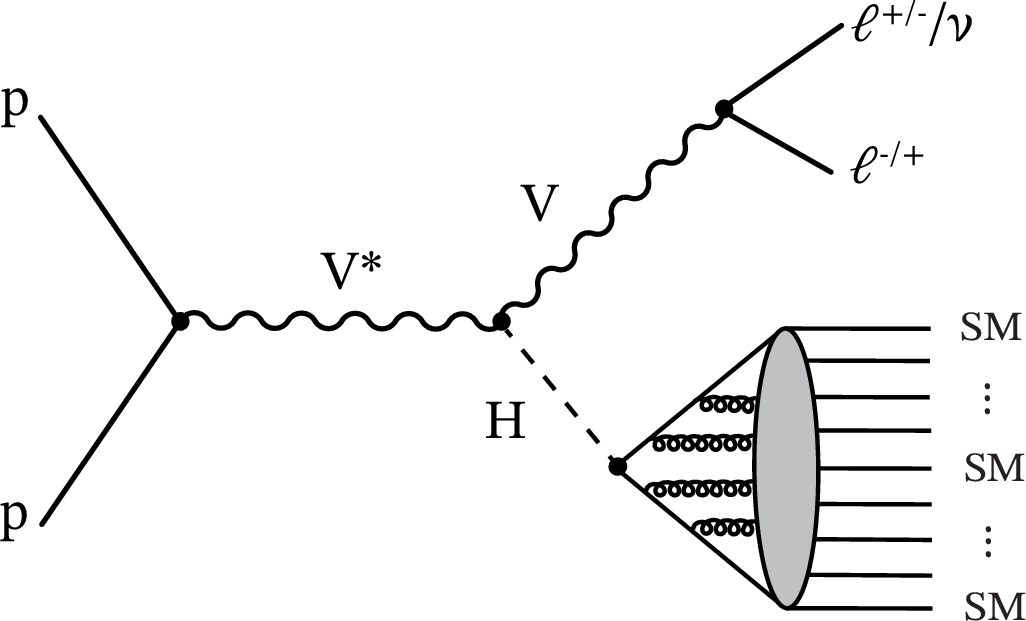
Figure 1:
Schematic diagram of the 125 GeV Higgs boson decaying to a SUEP shower, produced in association with a leptonically decaying V boson. |
png pdf |
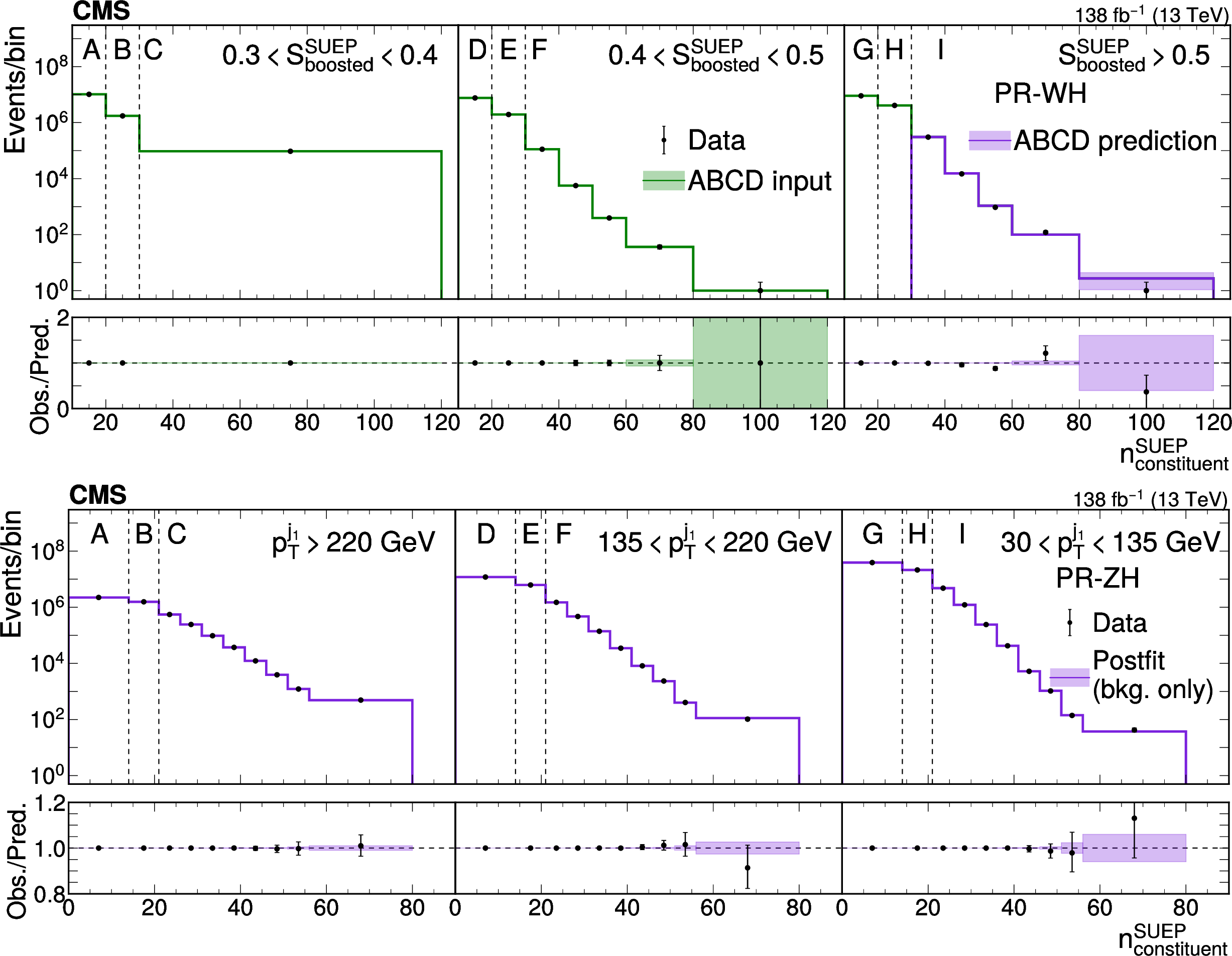
Figure 2:
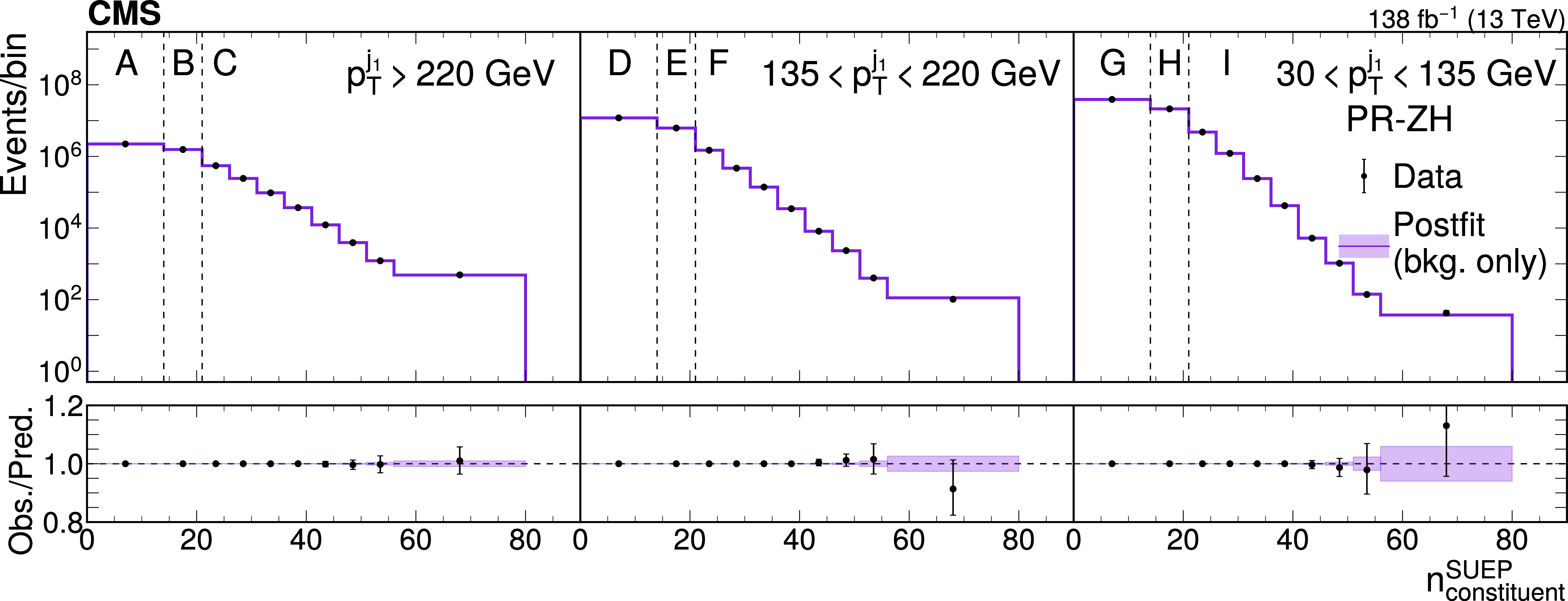
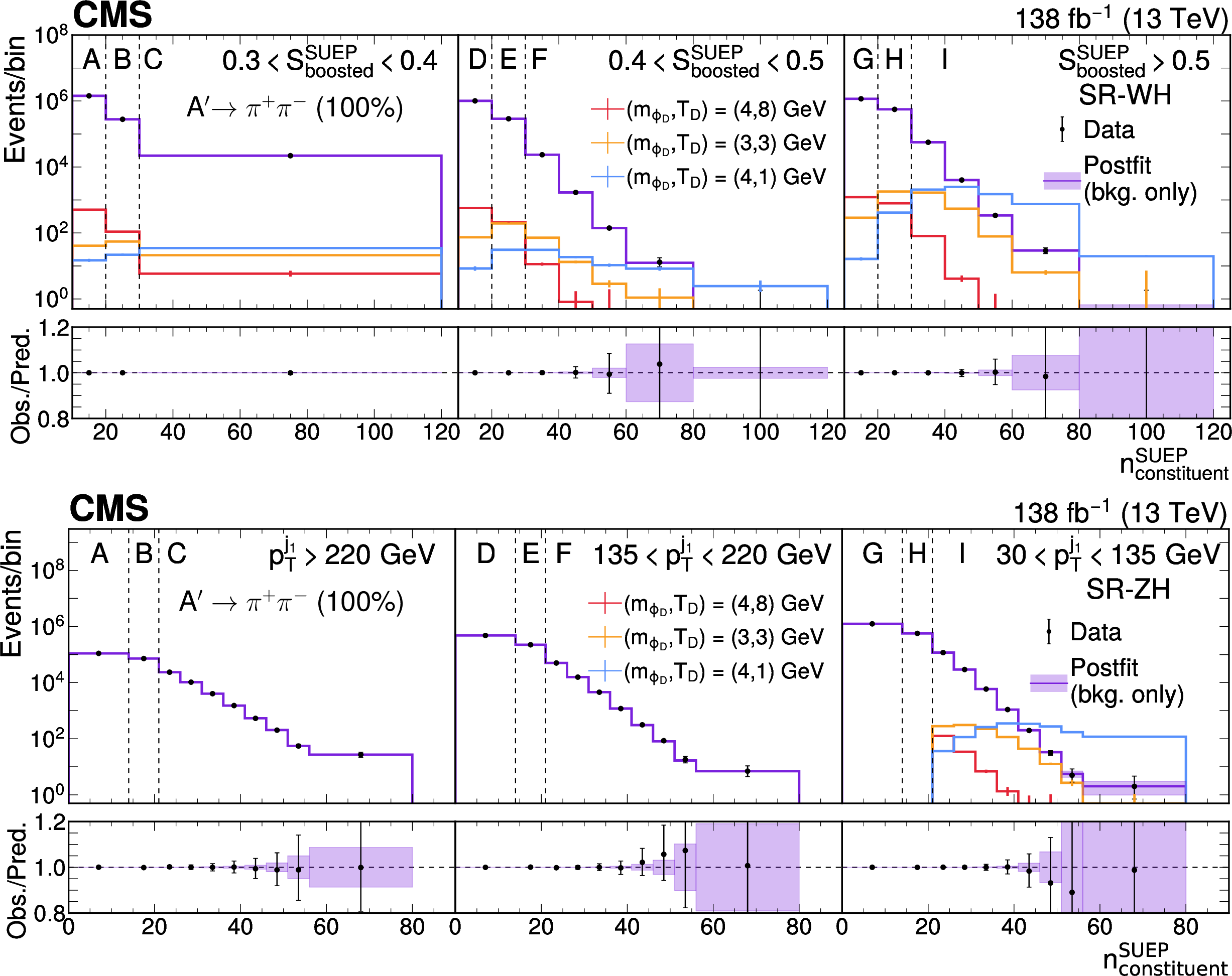
Distributions of $ n_{\text{constituent}}^{\text{SUEP}} $ in the extended ABCD subregions A--I in the PR-WH (upper) and PR-ZH (lower) regions, showing the observed data and the background predictions. The distribution is split into $ S^{\text{SUEP}}_{\text{boosted}} $ ($ p_{\mathrm{T}}^{\text{j}_{1}} $) bins for the WH (ZH) channel. The last $ n_{\text{constituent}}^{\text{SUEP}} $ bin includes the overflow events. The shaded bands indicate the uncertainties in the prediction, which are propagated to the ratios in the lower panels. |
png pdf |
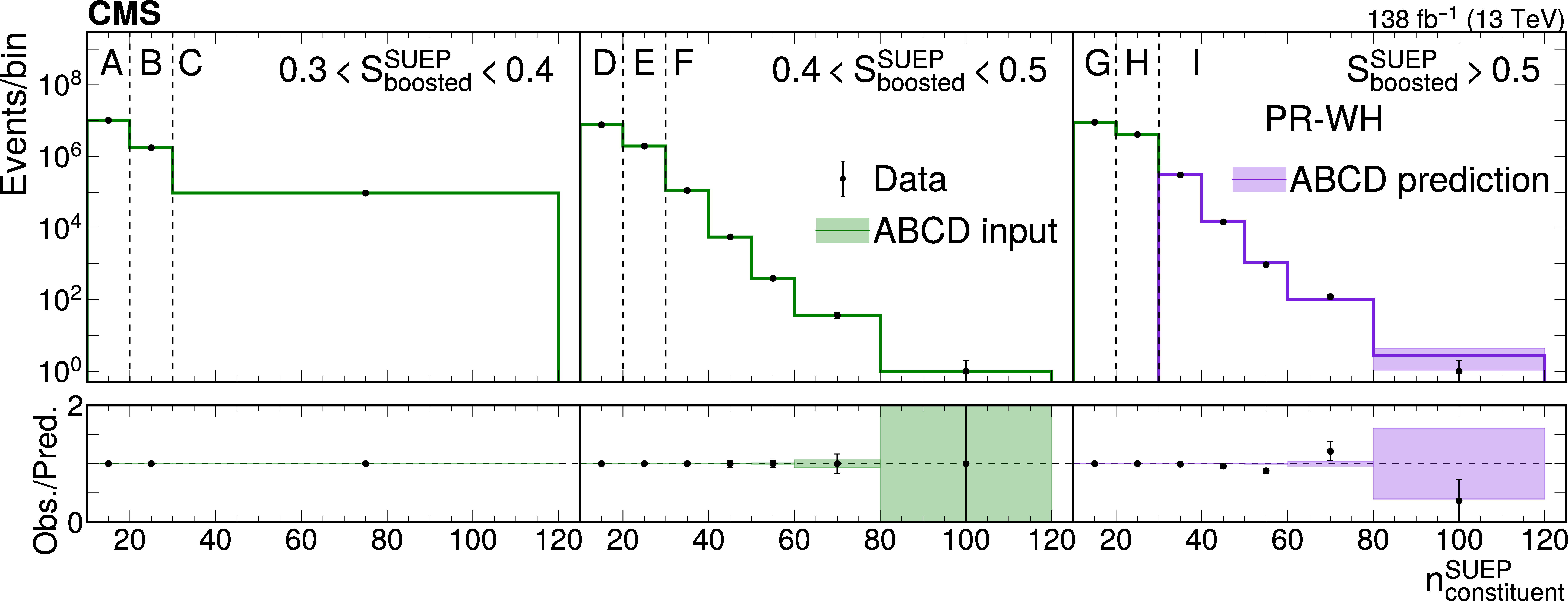
Figure 2-a:
Distributions of $ n_{\text{constituent}}^{\text{SUEP}} $ in the extended ABCD subregions A--I in the PR-WH (upper) and PR-ZH (lower) regions, showing the observed data and the background predictions. The distribution is split into $ S^{\text{SUEP}}_{\text{boosted}} $ ($ p_{\mathrm{T}}^{\text{j}_{1}} $) bins for the WH (ZH) channel. The last $ n_{\text{constituent}}^{\text{SUEP}} $ bin includes the overflow events. The shaded bands indicate the uncertainties in the prediction, which are propagated to the ratios in the lower panels. |
png pdf |
Figure 2-b:
Distributions of $ n_{\text{constituent}}^{\text{SUEP}} $ in the extended ABCD subregions A--I in the PR-WH (upper) and PR-ZH (lower) regions, showing the observed data and the background predictions. The distribution is split into $ S^{\text{SUEP}}_{\text{boosted}} $ ($ p_{\mathrm{T}}^{\text{j}_{1}} $) bins for the WH (ZH) channel. The last $ n_{\text{constituent}}^{\text{SUEP}} $ bin includes the overflow events. The shaded bands indicate the uncertainties in the prediction, which are propagated to the ratios in the lower panels. |
png pdf |
Figure 3:
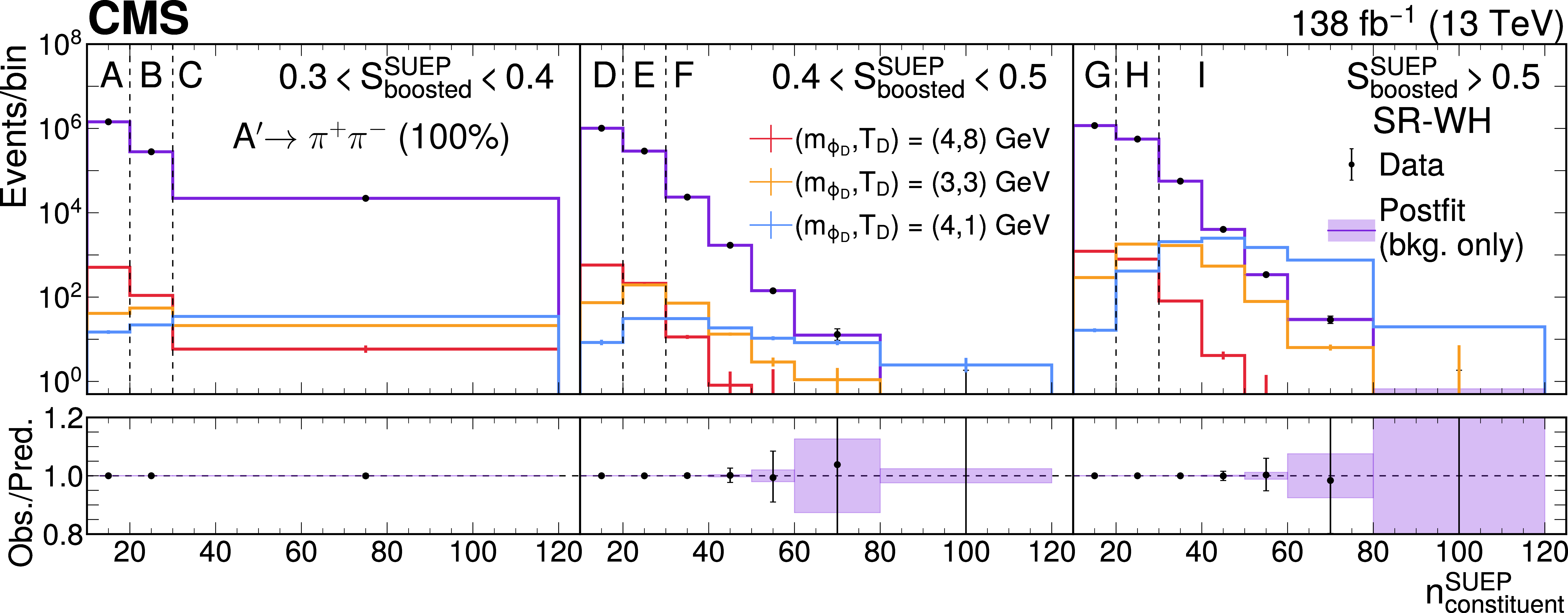
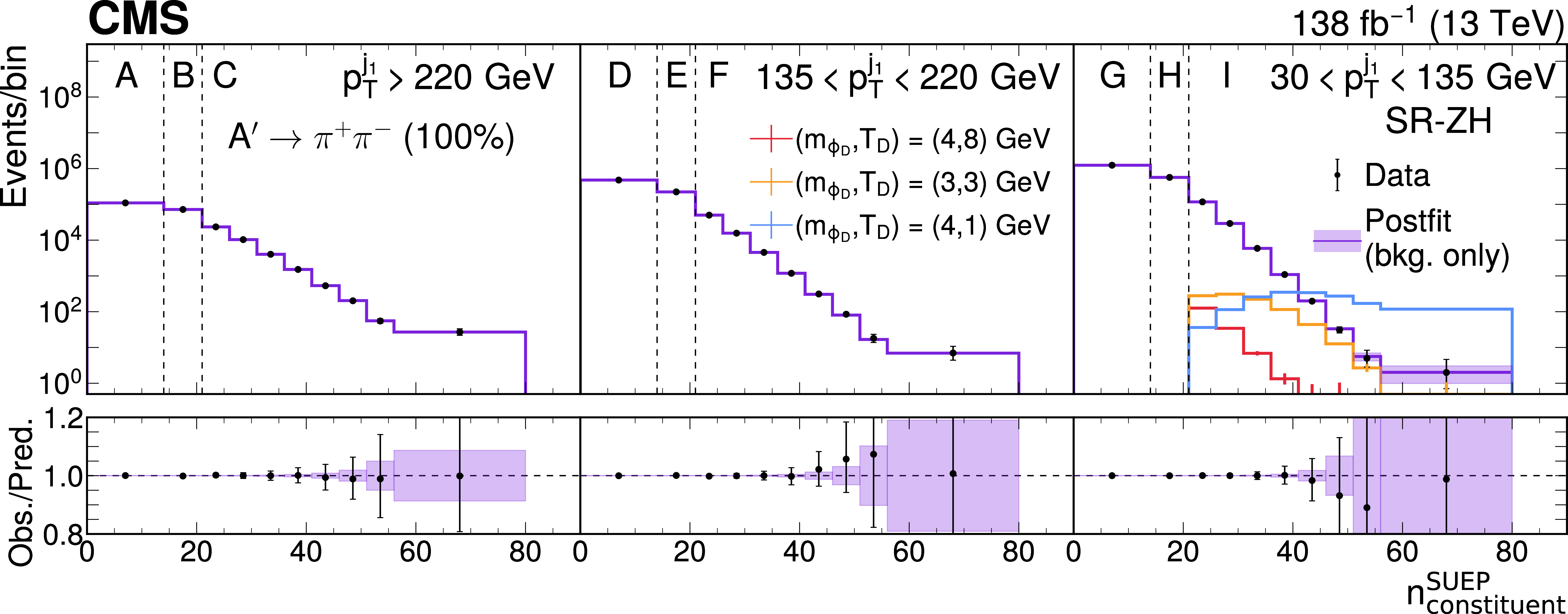
Distributions of $ n_{\text{constituent}}^{\text{SUEP}} $ in the extended ABCD subregions A--I in the SR for the WH (upper) and ZH (lower) channels, showing the observed data, the predictions from the background-only fit, and several signal hypotheses with fully hadronic decays ($ \mathcal{B}(A'\to\pi^{+}\pi^{-})=100% $): $ m_{\phi_{\text{D}}}=4 \text{GeV}, T_{\text{D}}= $ 8 GeV; $ m_{\phi_{\text{D}}}=3 \text{GeV}, T_{\text{D}}= $ 3 GeV; and $ m_{\phi_{\text{D}}}=4 \text{GeV}, T_{\text{D}}= $ 1 GeV. The distribution is split into $ S^{\text{SUEP}}_{\text{boosted}} $ ($ p_{\mathrm{T}}^{\text{j}_{1}} $) bins for the WH (ZH) channel. The last $ n_{\text{constituent}}^{\text{SUEP}} $ bin includes the overflow events. The shaded bands indicate the uncertainties in the prediction, which are propagated to the ratios in the lower panels. |
png pdf |
Figure 3-a:
Distributions of $ n_{\text{constituent}}^{\text{SUEP}} $ in the extended ABCD subregions A--I in the SR for the WH (upper) and ZH (lower) channels, showing the observed data, the predictions from the background-only fit, and several signal hypotheses with fully hadronic decays ($ \mathcal{B}(A'\to\pi^{+}\pi^{-})=100% $): $ m_{\phi_{\text{D}}}=4 \text{GeV}, T_{\text{D}}= $ 8 GeV; $ m_{\phi_{\text{D}}}=3 \text{GeV}, T_{\text{D}}= $ 3 GeV; and $ m_{\phi_{\text{D}}}=4 \text{GeV}, T_{\text{D}}= $ 1 GeV. The distribution is split into $ S^{\text{SUEP}}_{\text{boosted}} $ ($ p_{\mathrm{T}}^{\text{j}_{1}} $) bins for the WH (ZH) channel. The last $ n_{\text{constituent}}^{\text{SUEP}} $ bin includes the overflow events. The shaded bands indicate the uncertainties in the prediction, which are propagated to the ratios in the lower panels. |
png pdf |
Figure 3-b:
Distributions of $ n_{\text{constituent}}^{\text{SUEP}} $ in the extended ABCD subregions A--I in the SR for the WH (upper) and ZH (lower) channels, showing the observed data, the predictions from the background-only fit, and several signal hypotheses with fully hadronic decays ($ \mathcal{B}(A'\to\pi^{+}\pi^{-})=100% $): $ m_{\phi_{\text{D}}}=4 \text{GeV}, T_{\text{D}}= $ 8 GeV; $ m_{\phi_{\text{D}}}=3 \text{GeV}, T_{\text{D}}= $ 3 GeV; and $ m_{\phi_{\text{D}}}=4 \text{GeV}, T_{\text{D}}= $ 1 GeV. The distribution is split into $ S^{\text{SUEP}}_{\text{boosted}} $ ($ p_{\mathrm{T}}^{\text{j}_{1}} $) bins for the WH (ZH) channel. The last $ n_{\text{constituent}}^{\text{SUEP}} $ bin includes the overflow events. The shaded bands indicate the uncertainties in the prediction, which are propagated to the ratios in the lower panels. |
png pdf |
Figure 4:
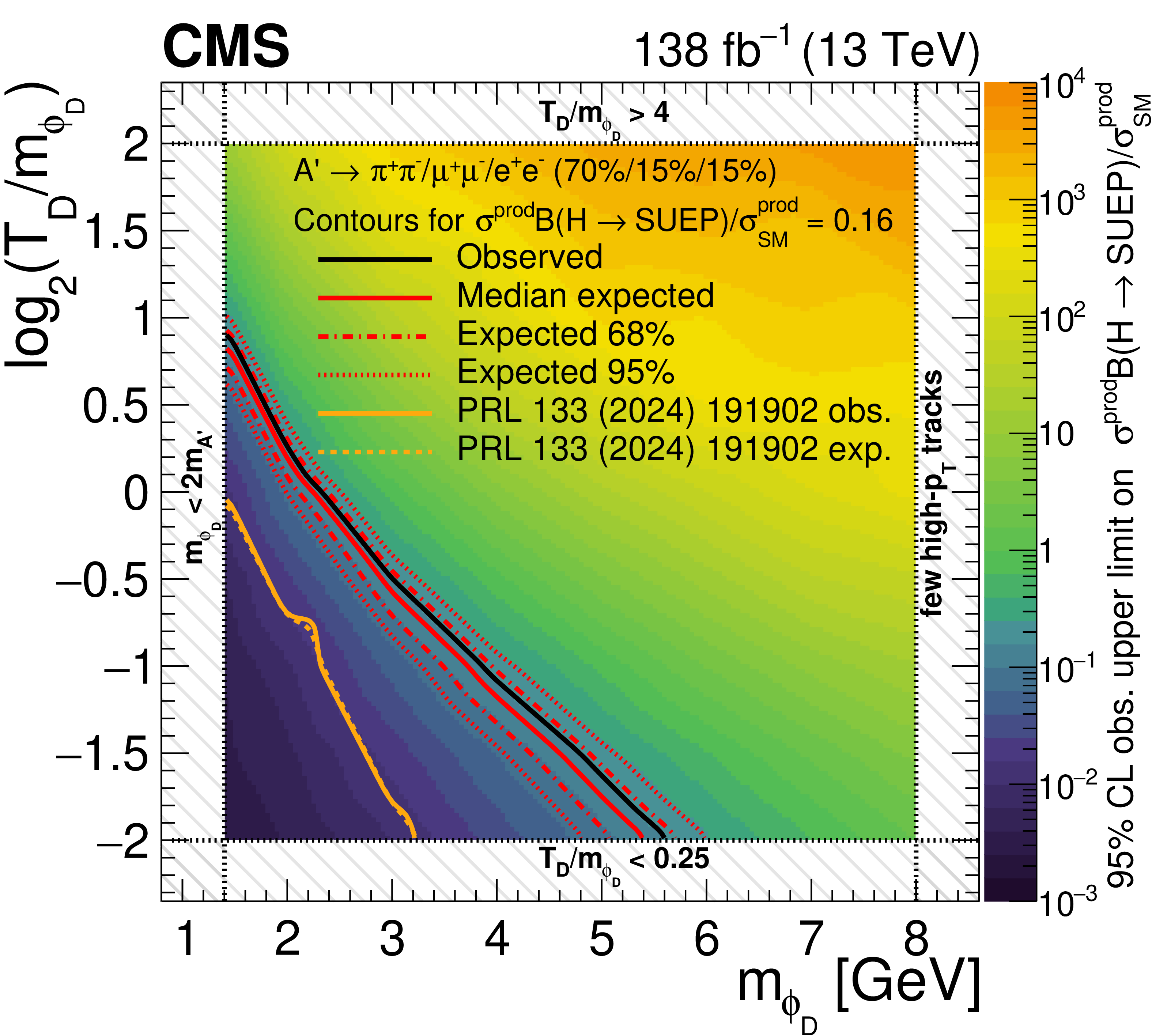
Interpretation of the results for the decay of the 125 GeV Higgs boson mediator to a SUEP, for signal models with dominantly hadronic decays. The observed upper limit from the combination of the WH and ZH channels is shown as a function of the signal model parameters $ m_{\phi_{\text{D}}} $ and $ \log_{2}(T_{\text{D}}/m_{\phi_{\text{D}}}) $. The contours for each channel are drawn for a benchmark scenario in which the observed or expected upper limit for that channel on $ \sigma^{\text{prod}}\mathcal{B}(\mathrm{H}\to\text{SUEP})/\sigma^{\text{prod}}_{\text{SM}} $ equals 0.16. |
png pdf |
Figure 5:
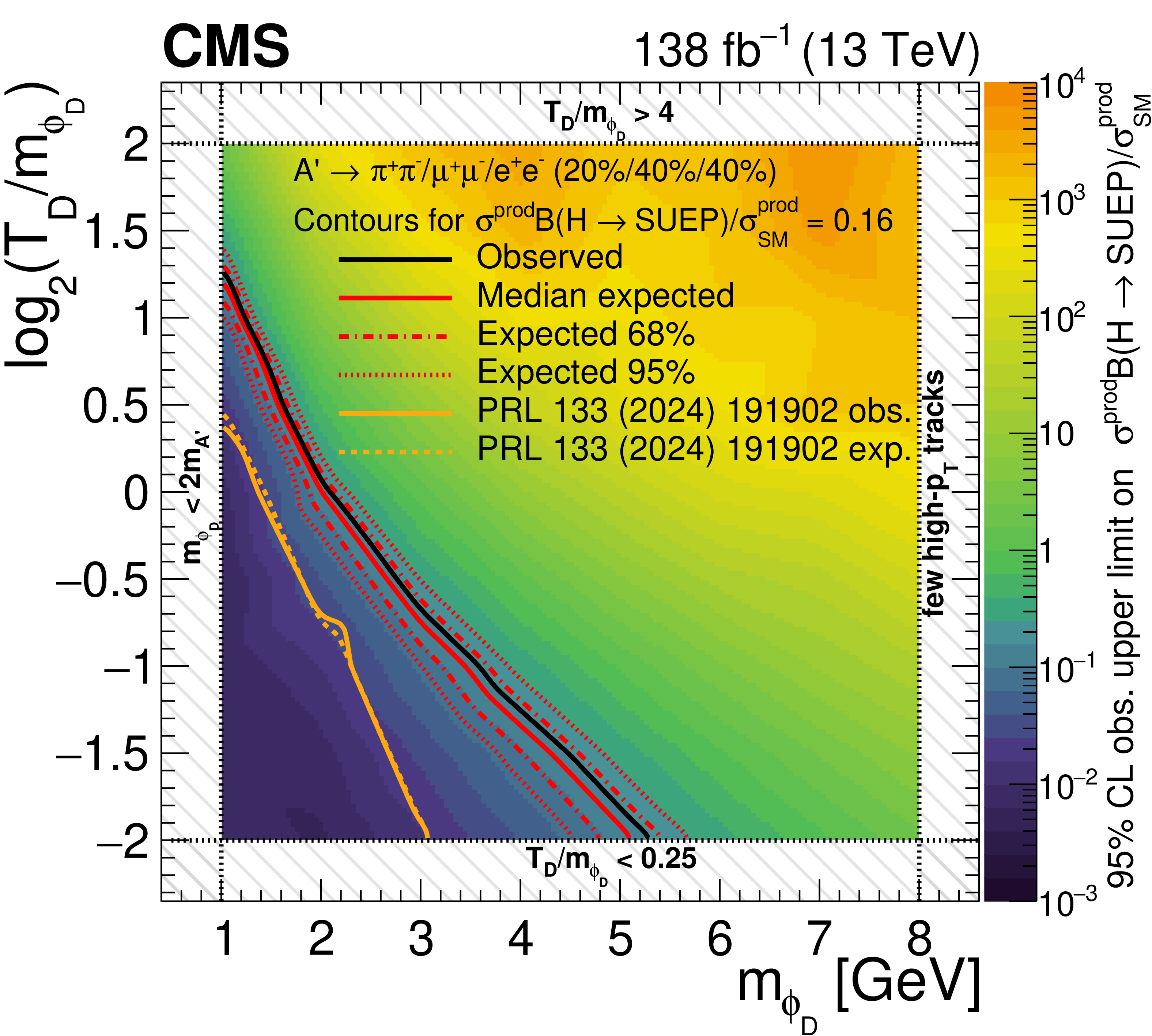
Interpretation of the results for the decay of the 125 GeV Higgs boson mediator to a SUEP, for signal models with dominantly leptonic decays. The observed upper limit from the combination of the WH and ZH channels is shown as a function of the signal model parameters $ m_{\phi_{\text{D}}} $ and $ \log_{2}(T_{\text{D}}/m_{\phi_{\text{D}}}) $. The contours for each channel are drawn for a benchmark scenario in which the observed or expected upper limit for that channel on $ \sigma^{\text{prod}}\mathcal{B}(\mathrm{H}\to\text{SUEP})/\sigma^{\text{prod}}_{\text{SM}} $ equals 0.16. |
png pdf |
Figure 6:
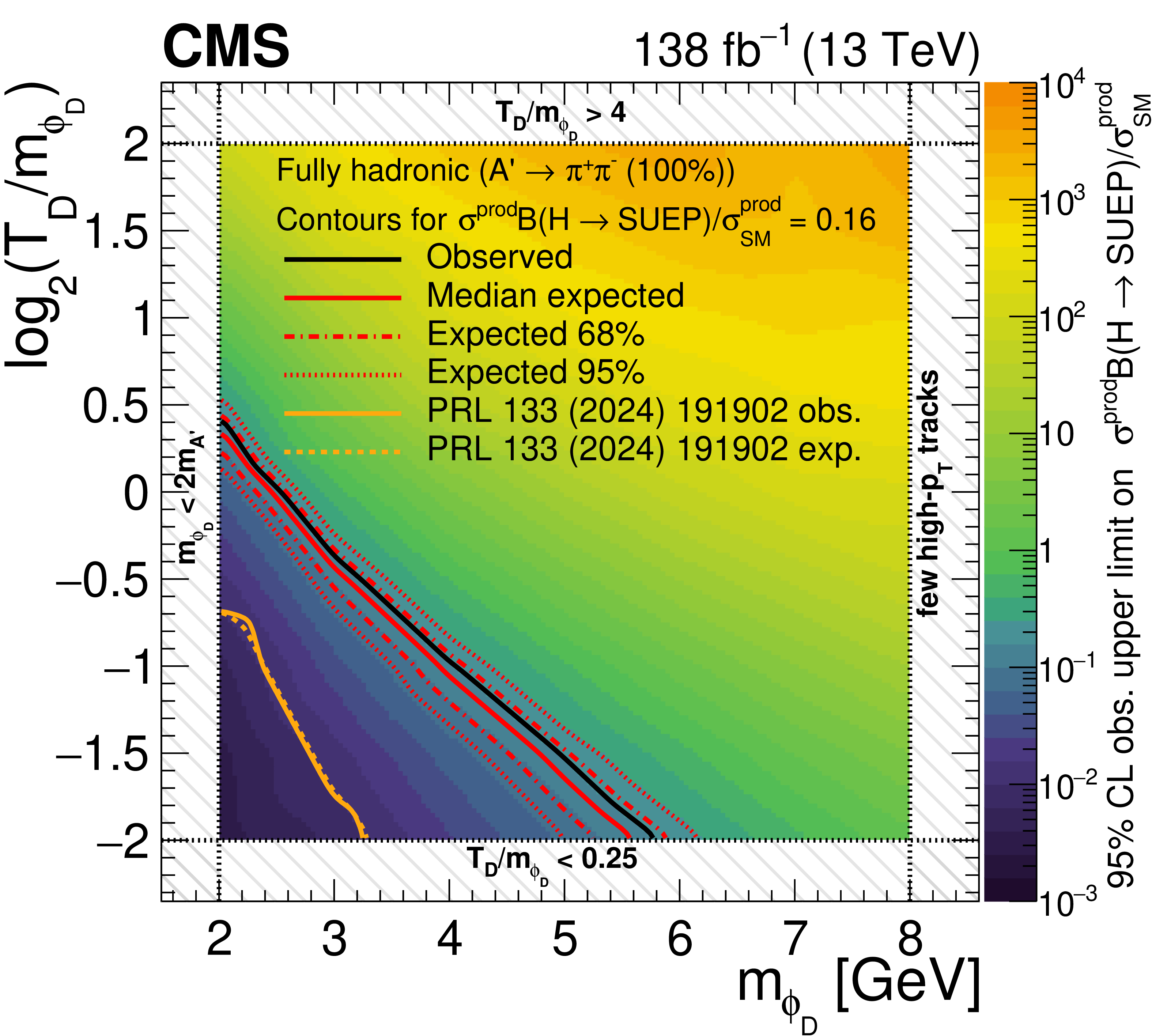
Interpretation of the results for the decay of the 125 GeV Higgs boson mediator to a SUEP, for signal models with $ \mathcal{B}(A' \to\pi^{+}\pi^{-})=100% $. The observed upper limit from the combination of the WH and ZH channels is shown as a function of the signal model parameters $ m_{\phi_{\text{D}}} $ and $ \log_{2}(T_{\text{D}}/m_{\phi_{\text{D}}}) $. The contours for each channel are drawn for a benchmark scenario in which the observed or expected upper limit for that channel on $ \sigma^{\text{prod}}\mathcal{B}(\mathrm{H}\to\text{SUEP})/\sigma^{\text{prod}}_{\text{SM}} $ equals 0.16. |
png pdf |
Figure 7:
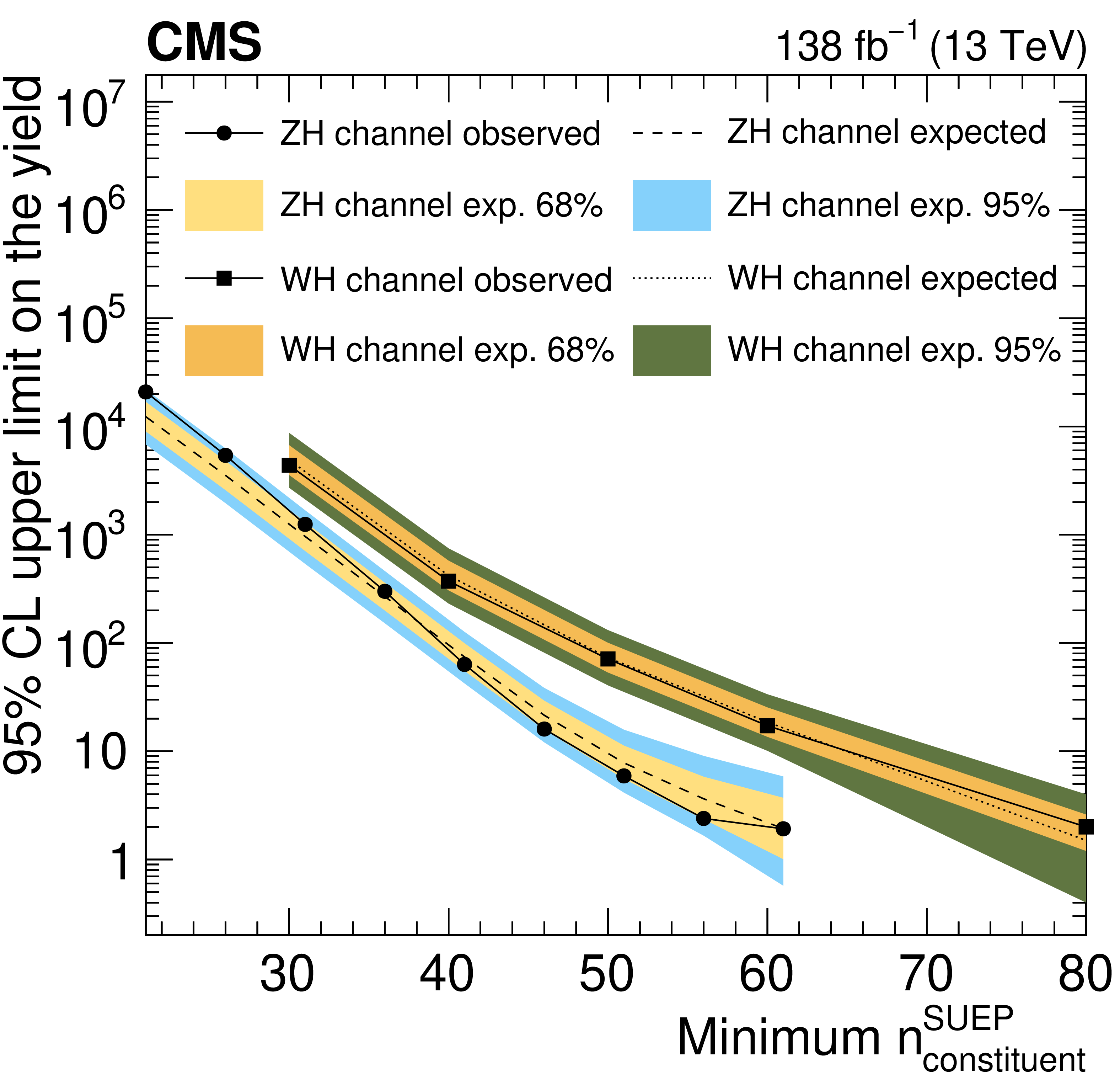
95% CL upper limits on the signal yield from the model-agnostic fit for different minimum $ n_{\text{constituent}}^{\text{SUEP}} $ values in the WH and ZH channels. |
| Summary |
| In summary, this Letter presents the first search for final states with a large-radius cluster of low-momentum, spherically distributed particles---a soft unclustered energy pattern or SUEP---and a massive vector boson. Events are selected at trigger level based on the presence of one or two charged leptons arising from the leptonic decays of the W or Z boson. This strategy improves significantly the sensitivity of the search to SUEP production via a Higgs boson mediator compared to previous results [14], with more significant improvements for signal models with higher multiplicities of low-momentum particles. Additional material is provided for full reinterpretation of the results using DELPHES and MADANALYSIS [60]. |
| References | ||||
| 1 | M. Cveti \v c , P. Langacker, and G. Shiu | Phenomenology of a three-family standardlike string model | PRD 66 (2002) 066004 | hep-ph/0205252 |
| 2 | Z. Chacko, H.-S. Goh, and R. Harnik | The twin Higgs: Natural electroweak breaking from mirror symmetry | PRL 96 (2006) 231802 | hep-ph/0506256 |
| 3 | M. J. Strassler and K. M. Zurek | Echoes of a hidden valley at hadron colliders | PLB 651 (2007) 374 | hep-ph/0604261 |
| 4 | S. A. Abel et al. | Kinetic mixing of the photon with hidden U(1)s in string phenomenology | JHEP 07 (2008) 124 | 0803.1449 |
| 5 | T. Hur, D.-W. Jung, P. Ko, and J. Y. Lee | Electroweak symmetry breaking and cold dark matter from strongly interacting hidden sector | PLB 696 (2011) 262 | 0709.1218 |
| 6 | Y. Bai and P. Schwaller | Scale of dark QCD | PRD 89 (2014) 063522 | 1306.4676 |
| 7 | P. Schwaller, D. Stolarski, and A. Weiler | Emerging jets | JHEP 05 (2015) 059 | 1502.05409 |
| 8 | T. Cohen, M. Lisanti, and H. K. Lou | Semivisible jets: Dark matter undercover at the LHC | PRL 115 (2015) 171804 | 1503.00009 |
| 9 | G. 't Hooft | A planar diagram theory for strong interactions | NPB 72 (1974) 461 | |
| 10 | J. Polchinski and M. J. Strassler | Deep inelastic scattering and gauge / string duality | JHEP 05 (2003) 012 | hep-th/0209211 |
| 11 | D. M. Hofman and J. Maldacena | Conformal collider physics: Energy and charge correlations | JHEP 05 (2008) 012 | 0803.1467 |
| 12 | M. J. Strassler | Why unparticle models with mass gaps are examples of hidden valleys | 0801.0629 | |
| 13 | S. Knapen, S. Pagan Griso, M. Papucci, and D. J. Robinson | Triggering soft bombs at the LHC | JHEP 08 (2017) 076 | 1612.00850 |
| 14 | CMS Collaboration | Search for soft unclustered energy patterns in proton-proton collisions at 13 TeV | PRL 133 (2024) 191902 | CMS-EXO-23-002 2403.05311 |
| 15 | CMS Collaboration | The CMS experiment at the CERN LHC | JINST 3 (2008) S08004 | |
| 16 | CMS Collaboration | The CMS trigger system | JINST 12 (2017) P01020 | CMS-TRG-12-001 1609.02366 |
| 17 | CMS Collaboration | Performance of the CMS Level-1 trigger in proton-proton collisions at $ \sqrt{s} = $ 13 TeV | JINST 15 (2020) P10017 | CMS-TRG-17-001 2006.10165 |
| 18 | CMS Collaboration | Performance of the CMS high-level trigger during LHC Run 2 | JINST 19 (2024) P11021 | CMS-TRG-19-001 2410.17038 |
| 19 | CMS Collaboration | Electron and photon reconstruction and identification with the CMS experiment at the CERN LHC | JINST 16 (2021) P05014 | CMS-EGM-17-001 2012.06888 |
| 20 | CMS Collaboration | Performance of the CMS muon detector and muon reconstruction with proton-proton collisions at $ \sqrt{s}= $ 13 TeV | JINST 13 (2018) P06015 | CMS-MUO-16-001 1804.04528 |
| 21 | CMS Collaboration | Description and performance of track and primary-vertex reconstruction with the CMS tracker | JINST 9 (2014) P10009 | CMS-TRK-11-001 1405.6569 |
| 22 | CMS Collaboration | Particle-flow reconstruction and global event description with the CMS detector | JINST 12 (2017) P10003 | CMS-PRF-14-001 1706.04965 |
| 23 | CMS Collaboration | Technical proposal for the Phase-II upgrade of the Compact Muon Solenoid | CMS Technical Proposal CERN-LHCC-2015-010, CMS-TDR-15-02, 2015 CDS |
|
| 24 | M. Buschmann, J. Kopp, J. Liu, and P. A. N. Machado | Lepton jets from radiating dark matter | JHEP 07 (2015) 045 | 1505.07459 |
| 25 | M. Graham, C. Hearty, and M. Williams | Searches for dark photons at accelerators | Ann. Rev. Nucl. Part. Sci. 71 (2021) 37 | 2104.10280 |
| 26 | T. Sjöstrand et al. | An introduction to PYTHIA 8.2 | Comput. Phys. Commun. 191 (2015) 159 | 1410.3012 |
| 27 | J. Barron et al. | Unsupervised hadronic SUEP at the LHC | JHEP 12 (2021) 129 | 2107.12379 |
| 28 | J. Alwall et al. | The automated computation of tree-level and next-to-leading order differential cross sections, and their matching to parton shower simulations | JHEP 07 (2014) 079 | 1405.0301 |
| 29 | R. Frederix and S. Frixione | Merging meets matching in MC@NLO | JHEP 12 (2012) 061 | 1209.6215 |
| 30 | P. Nason | A new method for combining NLO QCD with shower Monte Carlo algorithms | JHEP 11 (2004) 040 | hep-ph/0409146 |
| 31 | S. Frixione, P. Nason, and C. Oleari | Matching NLO QCD computations with parton shower simulations: the POWHEG method | JHEP 11 (2007) 070 | 0709.2092 |
| 32 | S. Alioli, P. Nason, C. Oleari, and E. Re | A general framework for implementing NLO calculations in shower Monte Carlo programs: the POWHEG BOX | JHEP 06 (2010) 043 | 1002.2581 |
| 33 | S. Alioli, S.-O. Moch, and P. Uwer | Hadronic top-quark pair-production with one jet and parton showering | JHEP 01 (2012) 137 | 1110.5251 |
| 34 | P. Nason and G. Zanderighi | $ \mathrm{W}^+ \mathrm{W}^- $, WZ and ZZ production in the POWHEG -box-v2 | EPJC 74 (2014) 2702 | 1311.1365 |
| 35 | NNPDF Collaboration | Parton distributions from high-precision collider data | EPJC 77 (2017) 663 | 1706.00428 |
| 36 | CMS Collaboration | Extraction and validation of a new set of CMS PYTHIA8 tunes from underlying-event measurements | EPJC 80 (2020) 4 | CMS-GEN-17-001 1903.12179 |
| 37 | GEANT4 Collaboration | GEANT 4---a simulation toolkit | NIM A 506 (2003) 250 | |
| 38 | M. Cacciari, G. P. Salam, and G. Soyez | The anti-$ k_{\mathrm{T}} $ jet clustering algorithm | JHEP 04 (2008) 063 | 0802.1189 |
| 39 | M. Cacciari, G. P. Salam, and G. Soyez | FastJet user manual | EPJC 72 (2012) 1896 | 1111.6097 |
| 40 | CMS Collaboration | Jet energy scale and resolution in the CMS experiment in pp collisions at 8 TeV | JINST 12 (2017) P02014 | CMS-JME-13-004 1607.03663 |
| 41 | CMS Collaboration | Jet algorithms performance in 13 TeV data | CMS Physics Analysis Summary, 2017 CMS-PAS-JME-16-003 |
CMS-PAS-JME-16-003 |
| 42 | CMS Collaboration | Identification of heavy-flavour jets with the CMS detector in pp collisions at 13 TeV | JINST 13 (2018) P05011 | CMS-BTV-16-002 1712.07158 |
| 43 | E. Bols et al. | Jet flavour classification using DeepJet | JINST 15 (2020) P12012 | 2008.10519 |
| 44 | CMS Collaboration | Performance summary of AK4 jet b tagging with data from proton-proton collisions at 13 TeV with the CMS detector | CMS Detector Performance Summary CMS-DP-2023-005, 2023 CDS |
|
| 45 | CMS Collaboration | Performance of missing transverse momentum reconstruction in proton-proton collisions at $ \sqrt{s} = $ 13 TeV using the CMS detector | JINST 14 (2019) P07004 | CMS-JME-17-001 1903.06078 |
| 46 | D. Bertolini, P. Harris, M. Low, and N. Tran | Pileup per particle identification | JHEP 10 (2014) 059 | 1407.6013 |
| 47 | C. Cesarotti, M. Reece, and M. J. Strassler | The efficacy of event isotropy as an event shape observable | JHEP 07 (2021) 215 | 2011.06599 |
| 48 | S. Choi and H. Oh | Improved extrapolation methods of data-driven background estimations in high energy physics | EPJC 81 (2021) 643 | 1906.10831 |
| 49 | CMS Collaboration | Measurement of the primary Lund jet plane density in proton-proton collisions at $ \sqrt{s} = $ 13 TeV | JHEP 05 (2024) 116 | CMS-SMP-22-007 2312.16343 |
| 50 | CMS Collaboration | Measurement of the inelastic proton-proton cross section at $ \sqrt{s}= $ 13 TeV | JHEP 07 (2018) 161 | CMS-FSQ-15-005 1802.02613 |
| 51 | CMS Collaboration | Performance of the CMS muon trigger system in proton-proton collisions at $ \sqrt{s} = $ 13 TeV | JINST 16 (2021) P07001 | CMS-MUO-19-001 2102.04790 |
| 52 | CMS Collaboration | Precision luminosity measurement in proton-proton collisions at $ \sqrt{s} = $ 13 TeV in 2015 and 2016 at CMS | EPJC 81 (2021) 800 | CMS-LUM-17-003 2104.01927 |
| 53 | CMS Collaboration | CMS luminosity measurement for the 2017 data-taking period at $ \sqrt{s} = $ 13 TeV | CMS Physics Analysis Summary CMS-PAS-LUM-17-004 |
CMS-PAS-LUM-17-004 |
| 54 | CMS Collaboration | CMS luminosity measurement for the 2018 data-taking period at $ \sqrt{s} = $ 13 TeV | CMS Physics Analysis Summary CMS-PAS-LUM-18-002 |
CMS-PAS-LUM-18-002 |
| 55 | CMS Collaboration | The CMS statistical analysis and combination tool: COMBINE | Comput. Softw. Big Sci. 8 (2024) 19 | CMS-CAT-23-001 2404.06614 |
| 56 | T. Junk | Confidence level computation for combining searches with small statistics | NIM A 434 (1999) 435 | hep-ex/9902006 |
| 57 | A. L. Read | Presentation of search results: The $ \text{CL}_\text{s} $ technique | JPG 28 (2002) 2693 | |
| 58 | CMS Collaboration | A portrait of the Higgs boson by the CMS experiment ten years after the discovery | [Corrigendum: doi:10./s41586-023-06164-8] Nature 607 (2022) 60 |
CMS-HIG-22-001 2207.00043 |
| 59 | CMS Collaboration | HEPData record for this analysis | link | |
| 60 | CMS Collaboration. | Statistical model for this analysis | link | |
| 61 | DELPHES 3 Collaboration | DELPHES 3: a modular framework for fast simulation of a generic collider experiment | JHEP 02 (2014) 057 | 1307.6346 |
|
|
Compact Muon Solenoid LHC, CERN |

|
|
|
|
|
|