
Compact Muon Solenoid
LHC, CERN
 Visit us: CMS Public Website, CMS Physics ;
Contact us: CMS Publications Committee
Visit us: CMS Public Website, CMS Physics ;
Contact us: CMS Publications Committee
| CMS-HIG-23-010 ; CERN-EP-2025-010 | ||
| Search for a cH signal in the associated production of at least one charm quark with a Higgs boson in the diphoton decay channel in pp collisions at $ \sqrt{s}= $ 13 TeV | ||
| CMS Collaboration | ||
| 11 March 2025 | ||
| JHEP 11 (2025) 060 | ||
| Abstract: This paper presents the first search for a cH signal sensitive to the coupling of the charm quark (c) to the Higgs boson (H) in the associated production of at least one charm quark with a Higgs boson decaying to two photons. The results are based on a data set of proton-proton collisions at a center-of-mass energy of 13 TeV collected with the CMS experiment at the LHC, corresponding to an integrated luminosity of 138 fb$ ^{-1} $. Assuming the standard model (SM) rates for all other Higgs boson production processes, the observed (expected) upper limit at 95% confidence level on the cH signal strength is 243 (355) times the SM prediction. Under the same assumption, the observed (expected) allowed interval on the Higgs boson to charm quark coupling modifier, $ \kappa_\mathrm{c} $, is $ |\kappa_\mathrm{c}| < $ 38.1 ($ |\kappa_\mathrm{c}| < $ 72.5) at 95% confidence level. | ||
| Links: e-print arXiv:2503.08797 [hep-ex] (PDF) ; CDS record ; inSPIRE record ; Physics Briefing ; CADI line (restricted) ; | ||
| Figures | |
png pdf |
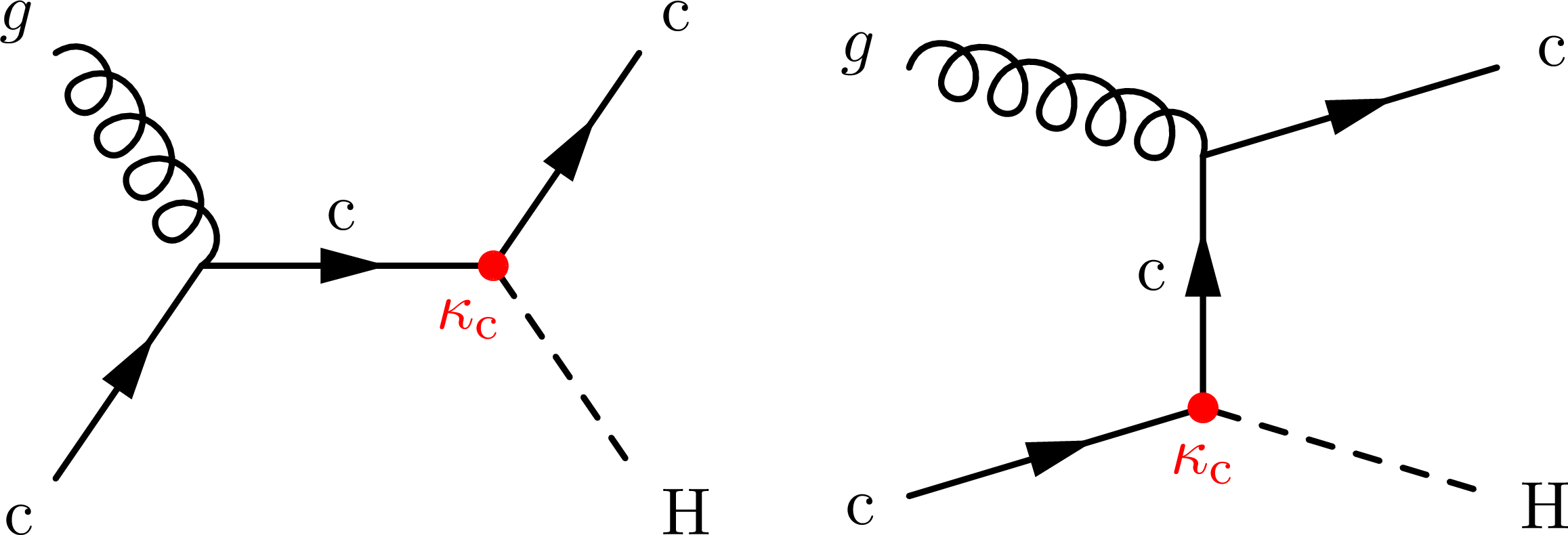
Figure 1:
Leading order Feynman diagrams that contribute to the $ \mathrm{p}\mathrm{p} \to \mathrm{c}\mathrm{H} $ process. Red dots correspond to vertices where the charm Yukawa coupling modifier $ \kappa_\mathrm{c} $ enters. |
png pdf |
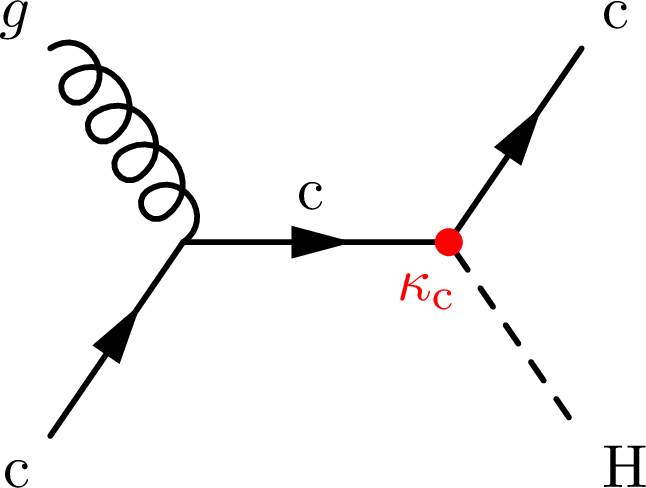
Figure 1-a:
Leading order Feynman diagrams that contribute to the $ \mathrm{p}\mathrm{p} \to \mathrm{c}\mathrm{H} $ process. Red dots correspond to vertices where the charm Yukawa coupling modifier $ \kappa_\mathrm{c} $ enters. |
png pdf |
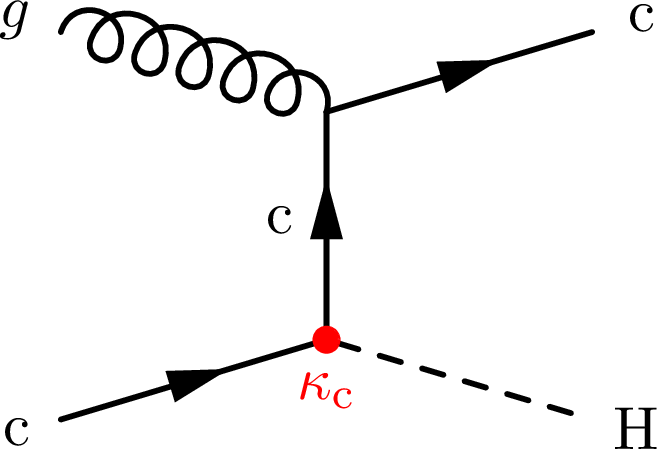
Figure 1-b:
Leading order Feynman diagrams that contribute to the $ \mathrm{p}\mathrm{p} \to \mathrm{c}\mathrm{H} $ process. Red dots correspond to vertices where the charm Yukawa coupling modifier $ \kappa_\mathrm{c} $ enters. |
png pdf |
Figure 2:
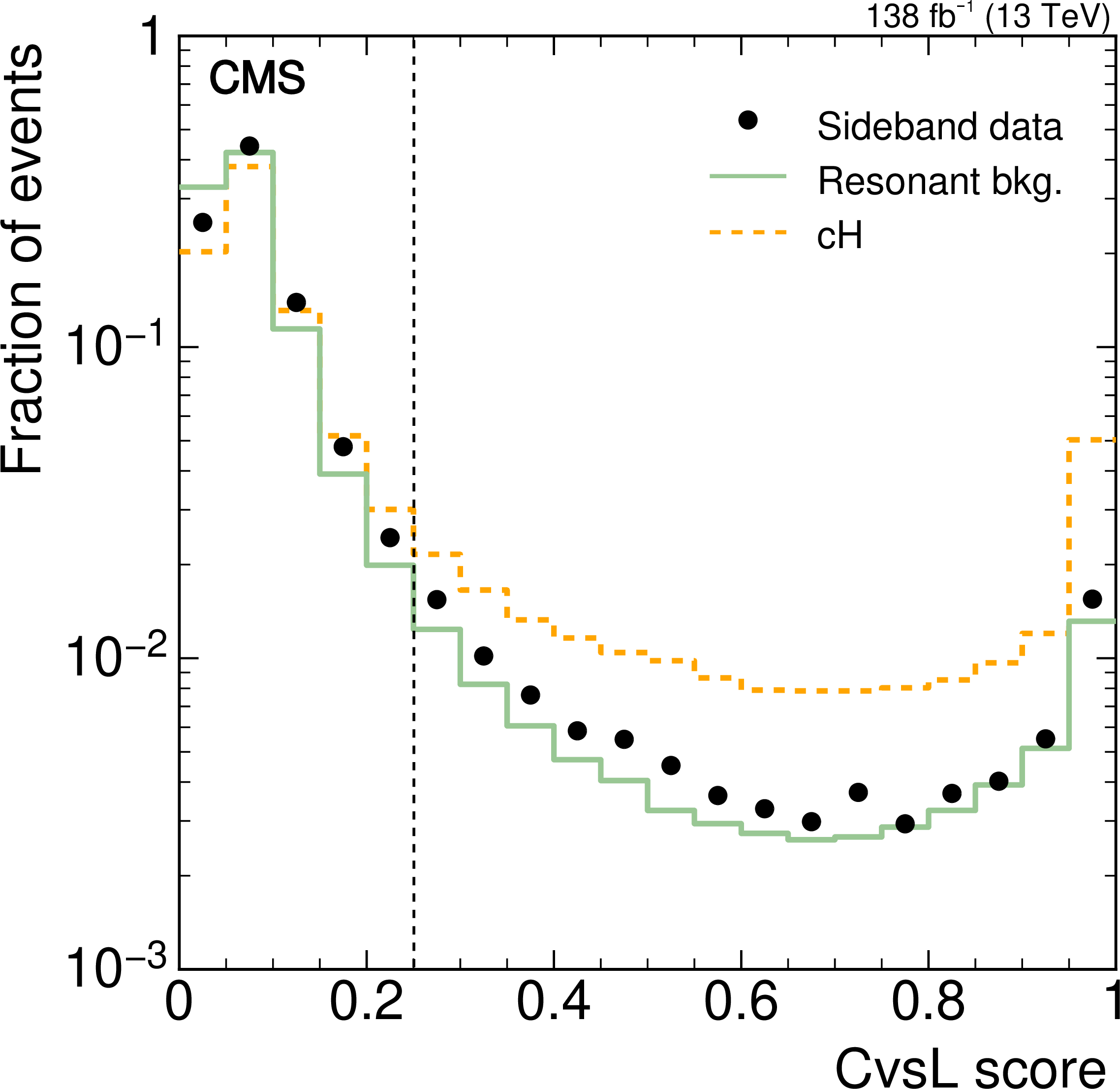
Distributions of the CvsL score for the leading jet in simulated cH signal and resonant background events and sideband data events. Error bars representing the statistical uncertainties in the data are too small to be displayed. Events with CvsL score values below the dashed vertical line are not included in the signal region. |
png pdf |
Figure 3:
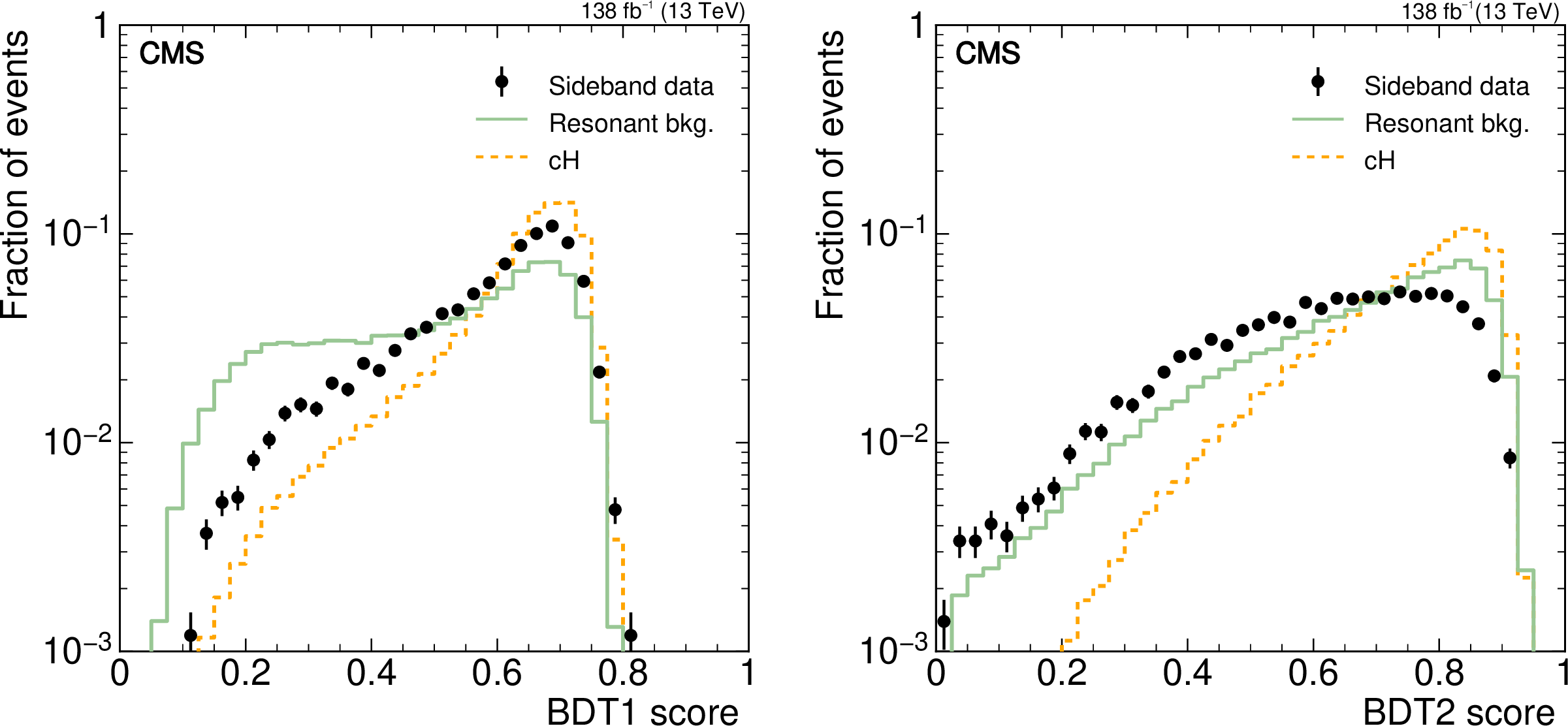
Distributions of BDT1 (left) and BDT2 outputs (right) for simulated cH signal and resonant background events, as well as sideband data (representing the continuous background) events. The BDT1 score discriminates the cH signal from the resonant background. The BDT2 score discriminates the cH signal from the continuous background. The plots are indicative of the shapes of the distributions and should not be interpreted as a comparison of their magnitudes. The error bars correspond to the statistical uncertainties. |
png pdf |
Figure 3-a:
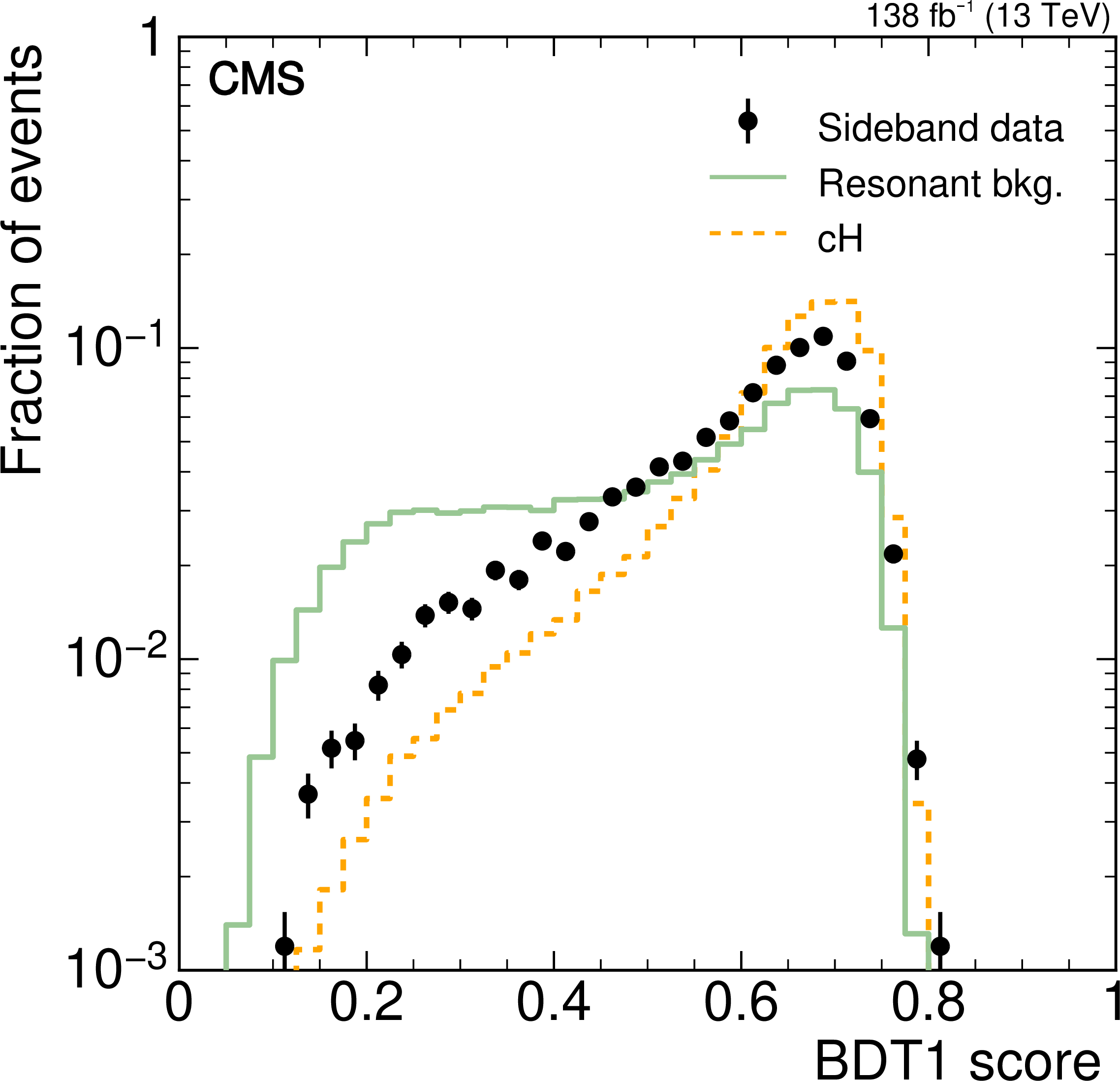
Distributions of BDT1 (left) and BDT2 outputs (right) for simulated cH signal and resonant background events, as well as sideband data (representing the continuous background) events. The BDT1 score discriminates the cH signal from the resonant background. The BDT2 score discriminates the cH signal from the continuous background. The plots are indicative of the shapes of the distributions and should not be interpreted as a comparison of their magnitudes. The error bars correspond to the statistical uncertainties. |
png pdf |
Figure 3-b:
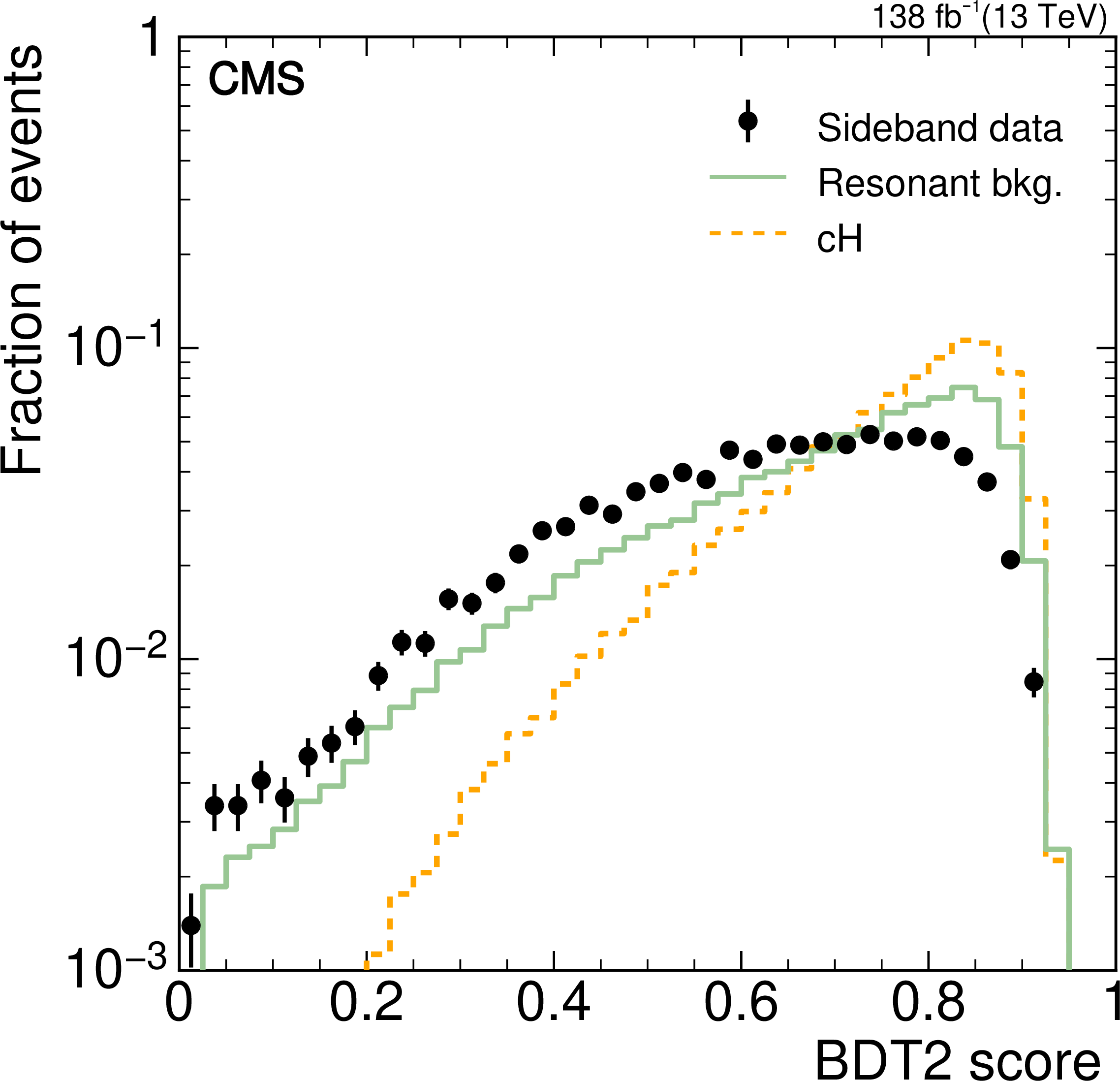
Distributions of BDT1 (left) and BDT2 outputs (right) for simulated cH signal and resonant background events, as well as sideband data (representing the continuous background) events. The BDT1 score discriminates the cH signal from the resonant background. The BDT2 score discriminates the cH signal from the continuous background. The plots are indicative of the shapes of the distributions and should not be interpreted as a comparison of their magnitudes. The error bars correspond to the statistical uncertainties. |
png pdf |
Figure 4:
Two-dimensional distributions of BDT1 output ($ y $ axis) and BDT2 output (x axis) for cH (upper left), $ \mathrm{g}\mathrm{g}\mathrm{H} $ (upper right), and sideband data (lower) in 2017 event categories. The BDT1 score discriminates the cH signal from the resonant background while the BDT2 score discriminates the cH signal from the continuous background. Event category boundaries on BDT scores are illustrated as dashed lines. |
png pdf |
Figure 4-a:
Two-dimensional distributions of BDT1 output ($ y $ axis) and BDT2 output (x axis) for cH (upper left), $ \mathrm{g}\mathrm{g}\mathrm{H} $ (upper right), and sideband data (lower) in 2017 event categories. The BDT1 score discriminates the cH signal from the resonant background while the BDT2 score discriminates the cH signal from the continuous background. Event category boundaries on BDT scores are illustrated as dashed lines. |
png pdf |
Figure 4-b:
Two-dimensional distributions of BDT1 output ($ y $ axis) and BDT2 output (x axis) for cH (upper left), $ \mathrm{g}\mathrm{g}\mathrm{H} $ (upper right), and sideband data (lower) in 2017 event categories. The BDT1 score discriminates the cH signal from the resonant background while the BDT2 score discriminates the cH signal from the continuous background. Event category boundaries on BDT scores are illustrated as dashed lines. |
png pdf |
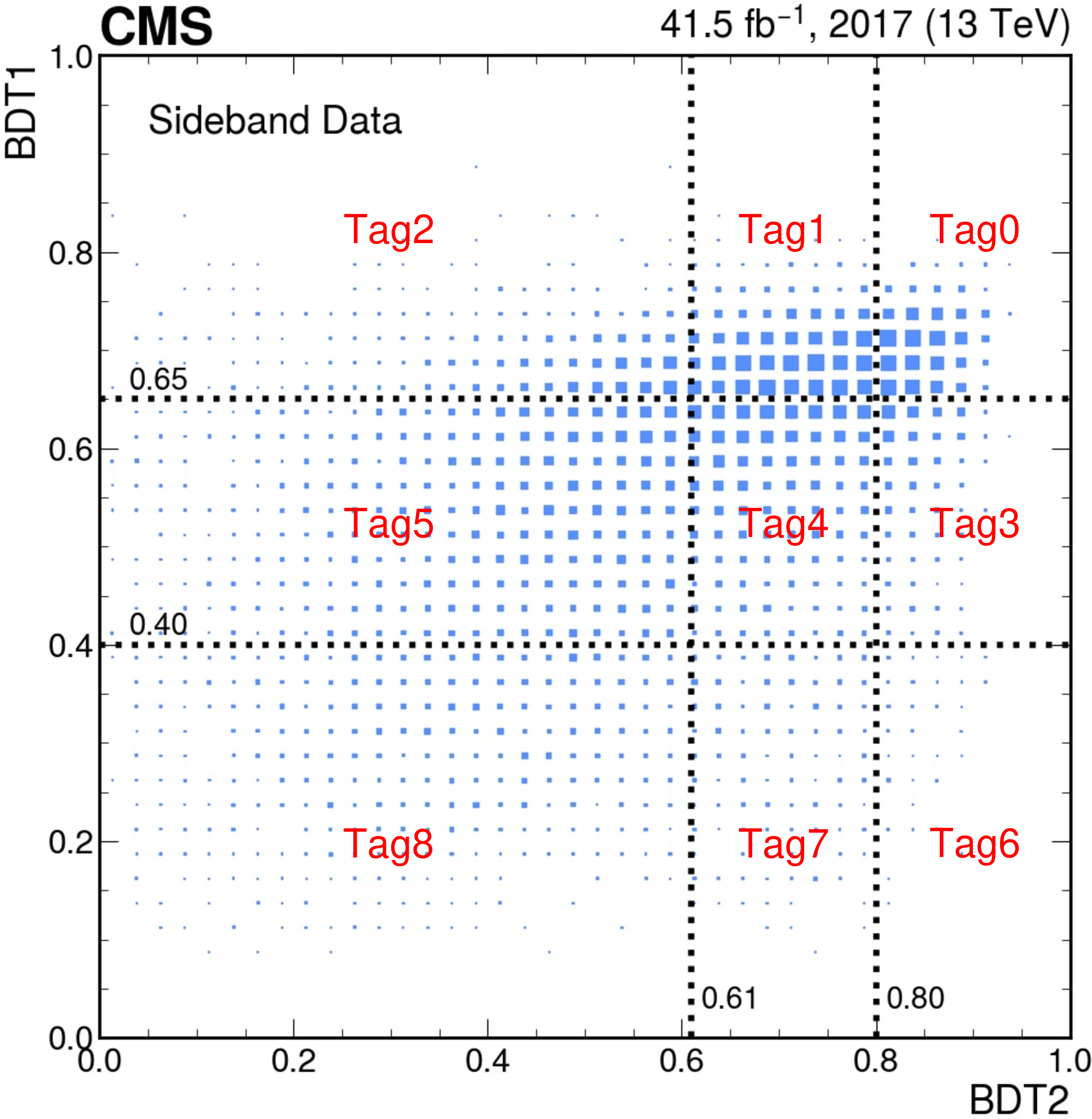
Figure 4-c:
Two-dimensional distributions of BDT1 output ($ y $ axis) and BDT2 output (x axis) for cH (upper left), $ \mathrm{g}\mathrm{g}\mathrm{H} $ (upper right), and sideband data (lower) in 2017 event categories. The BDT1 score discriminates the cH signal from the resonant background while the BDT2 score discriminates the cH signal from the continuous background. Event category boundaries on BDT scores are illustrated as dashed lines. |
png pdf |
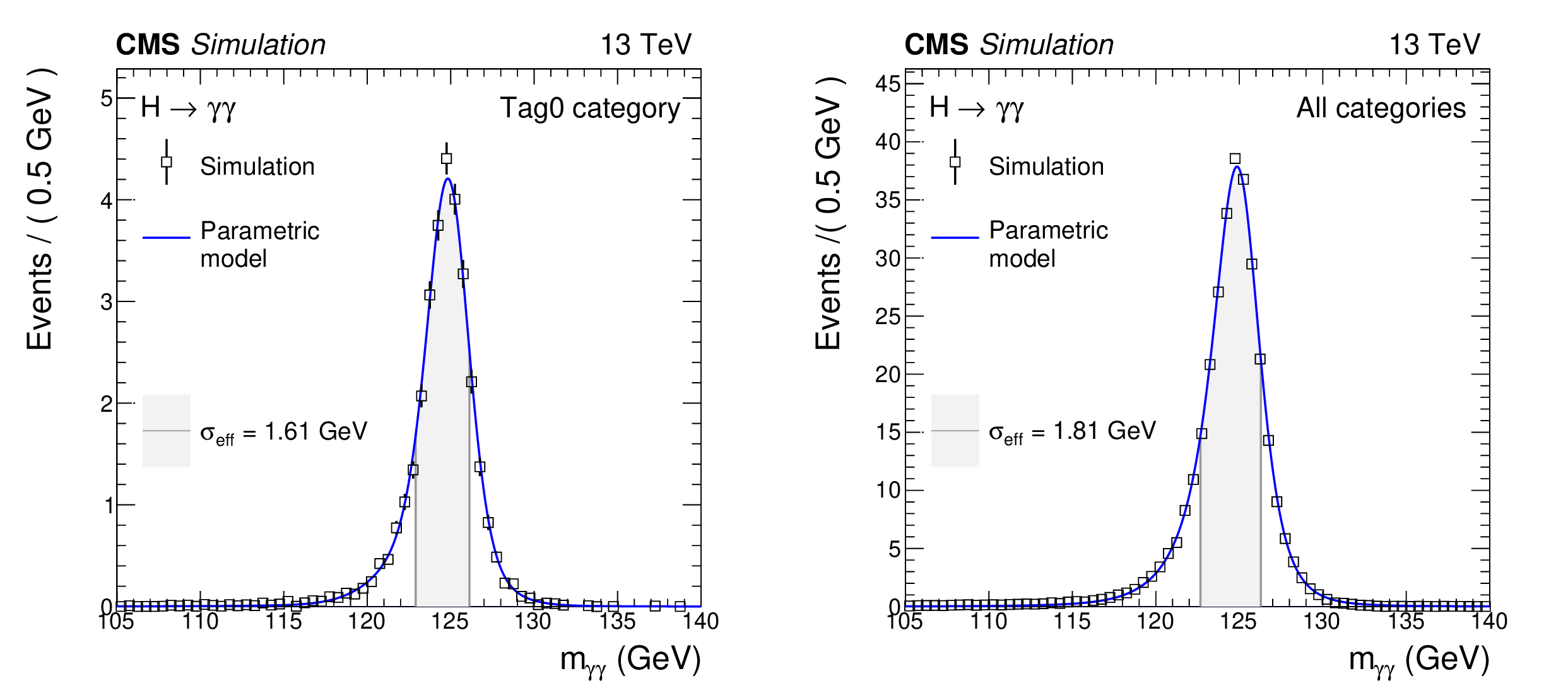
Figure 5:
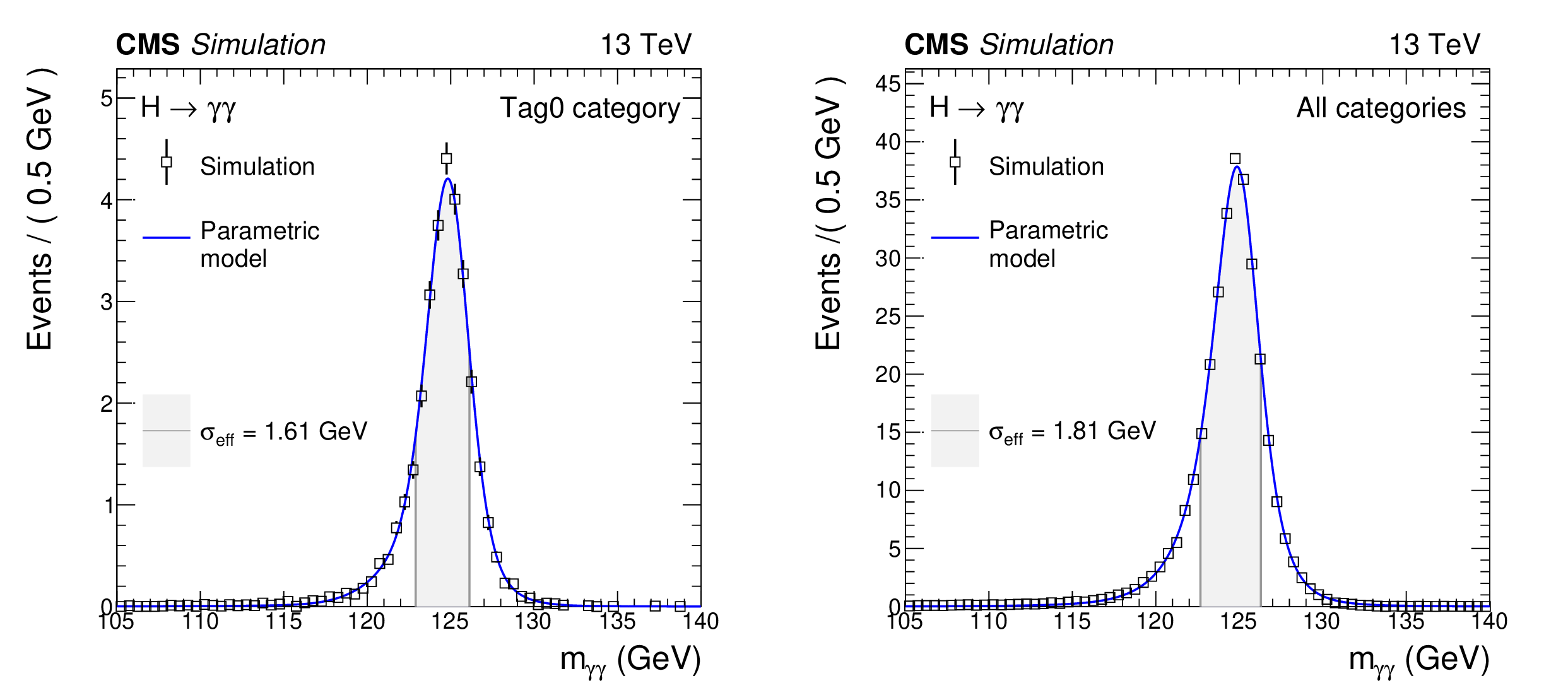
The shape of the parametric signal model for the analysis category with the tightest requirement in both BDT1 and BDT2 scores (left) and for the sum of all analysis categories (right). The open squares represent simulated events and the blue line represents the corresponding model. Also shown is the $ \sigma_{\text{eff}} $ value (half the width of the narrowest interval containing 68.3% of the diphoton mass distribution) in the grey shaded area. |
png pdf |
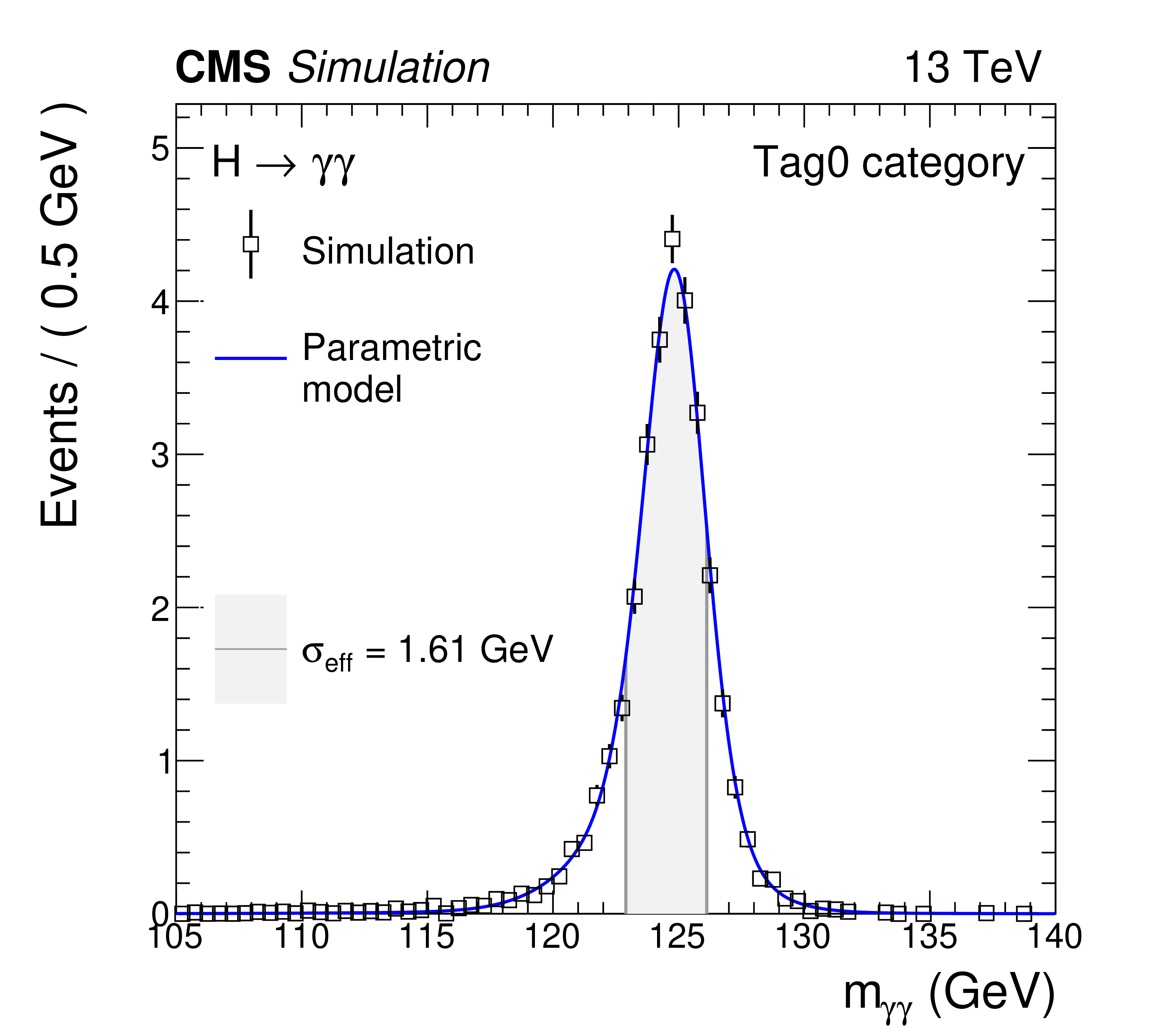
Figure 5-a:
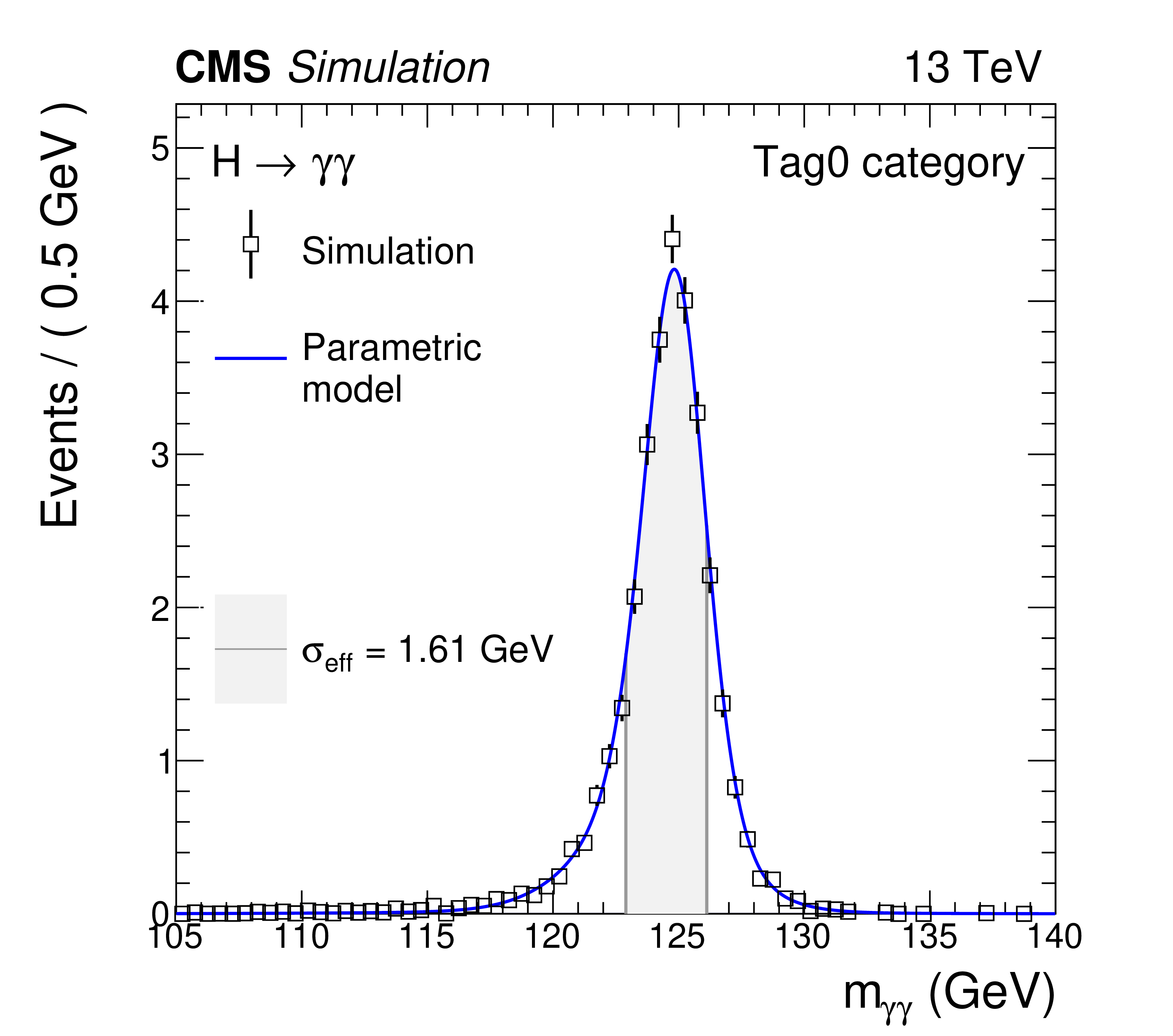
The shape of the parametric signal model for the analysis category with the tightest requirement in both BDT1 and BDT2 scores (left) and for the sum of all analysis categories (right). The open squares represent simulated events and the blue line represents the corresponding model. Also shown is the $ \sigma_{\text{eff}} $ value (half the width of the narrowest interval containing 68.3% of the diphoton mass distribution) in the grey shaded area. |
png pdf |
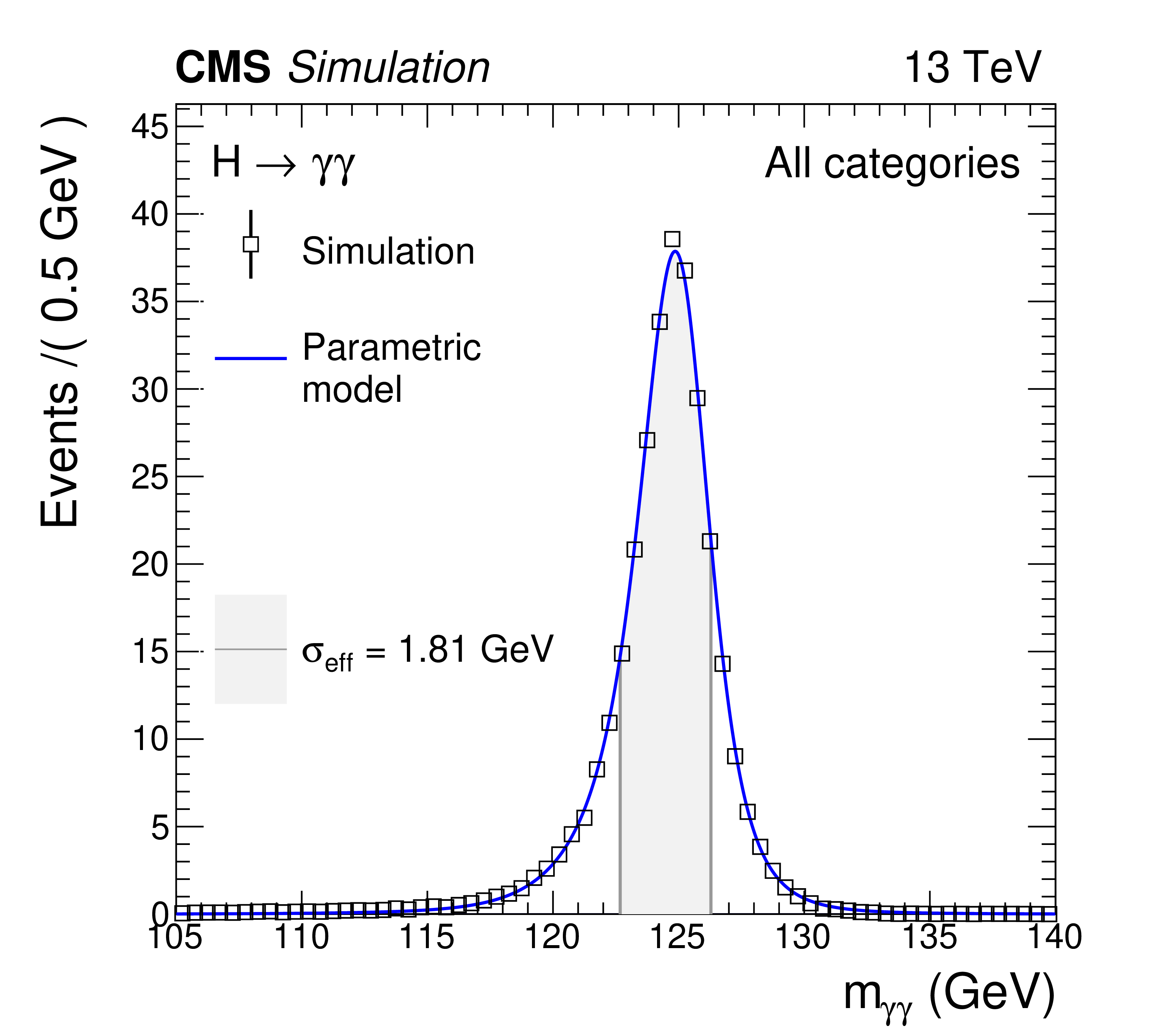
Figure 5-b:
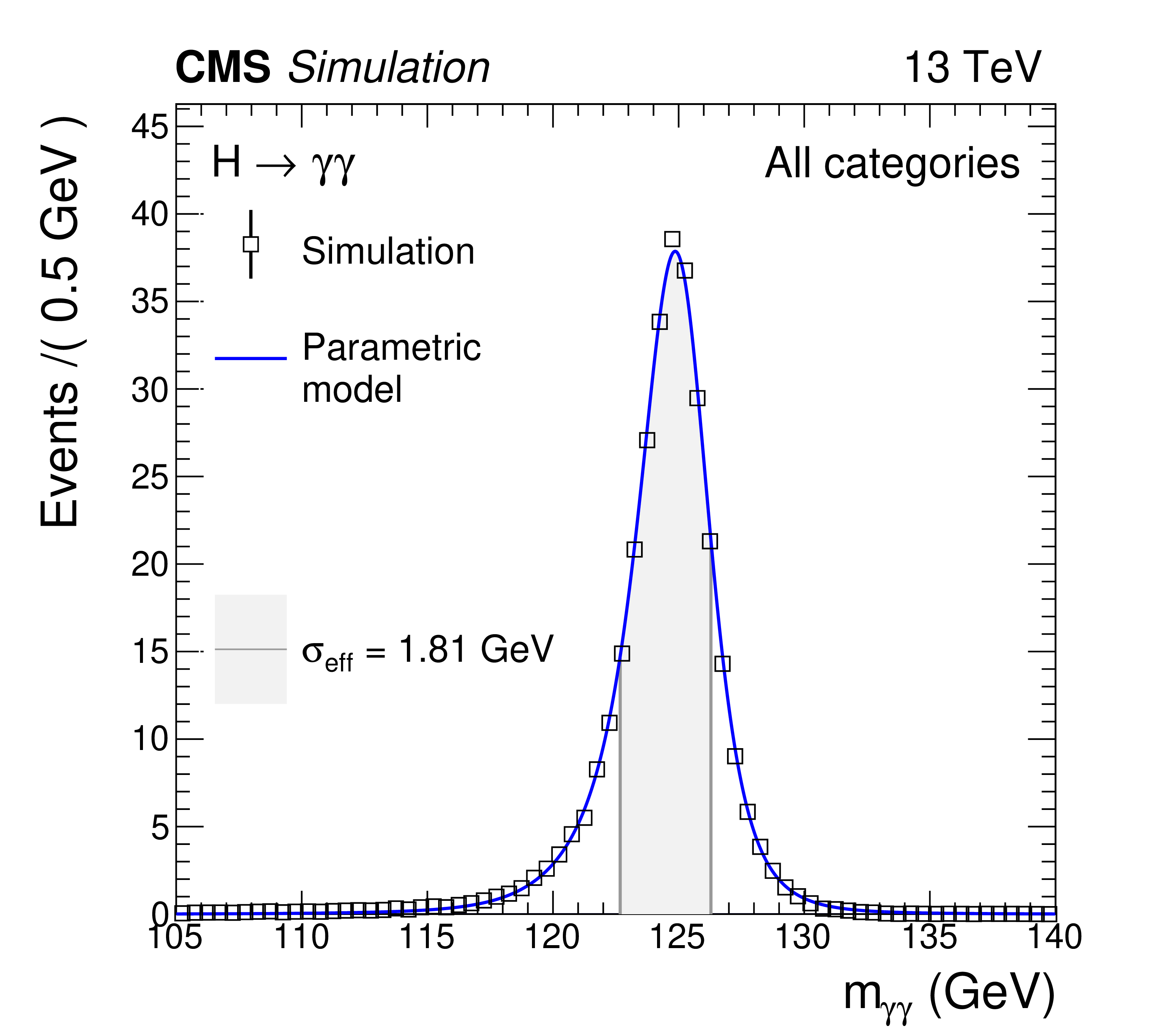
The shape of the parametric signal model for the analysis category with the tightest requirement in both BDT1 and BDT2 scores (left) and for the sum of all analysis categories (right). The open squares represent simulated events and the blue line represents the corresponding model. Also shown is the $ \sigma_{\text{eff}} $ value (half the width of the narrowest interval containing 68.3% of the diphoton mass distribution) in the grey shaded area. |
png pdf |
Figure 6:
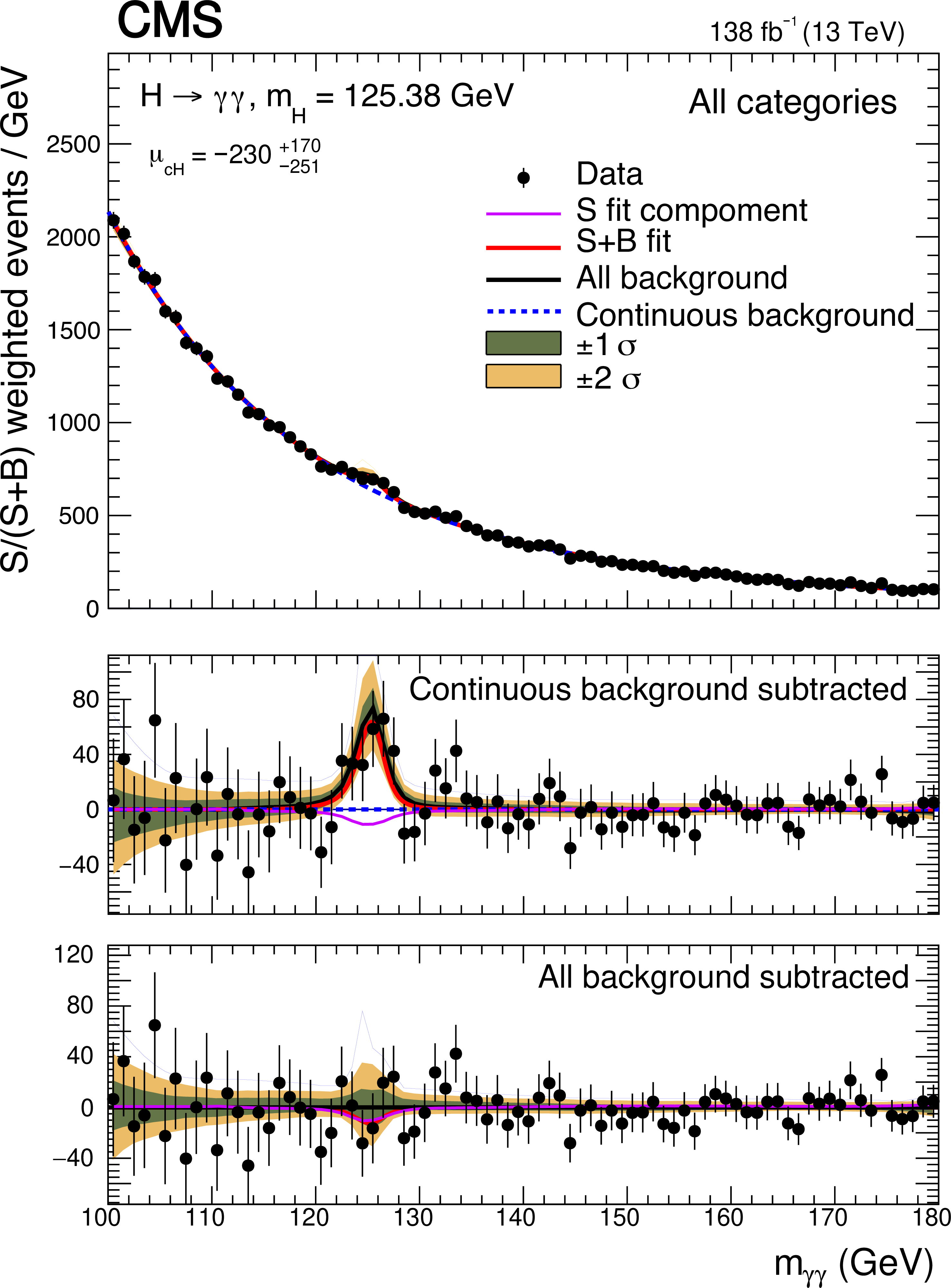
Invariant mass distribution of the selected events in all categories. For each category, the events are scaled by $ \mathrm{S}/(\mathrm{S}+\mathrm{B}) $, where S (B) is the number of expected signal (background) events in the smallest mass window containing 68.3% of the expected signal events. Curves for the signal + background fit (red), separately showing the resonant (black) and continuous (blue) backgrounds, as well as bands representing the 68.3% and 95.5% CL intervals in the background estimation, are overlaid. The middle (lower) panel shows the $ m_{\gamma\gamma} $ distribution after subtracting only the continuous background (subtracting all background components) and overlaying the curve for the fitted signal (purple). |
| Tables | |
png pdf |
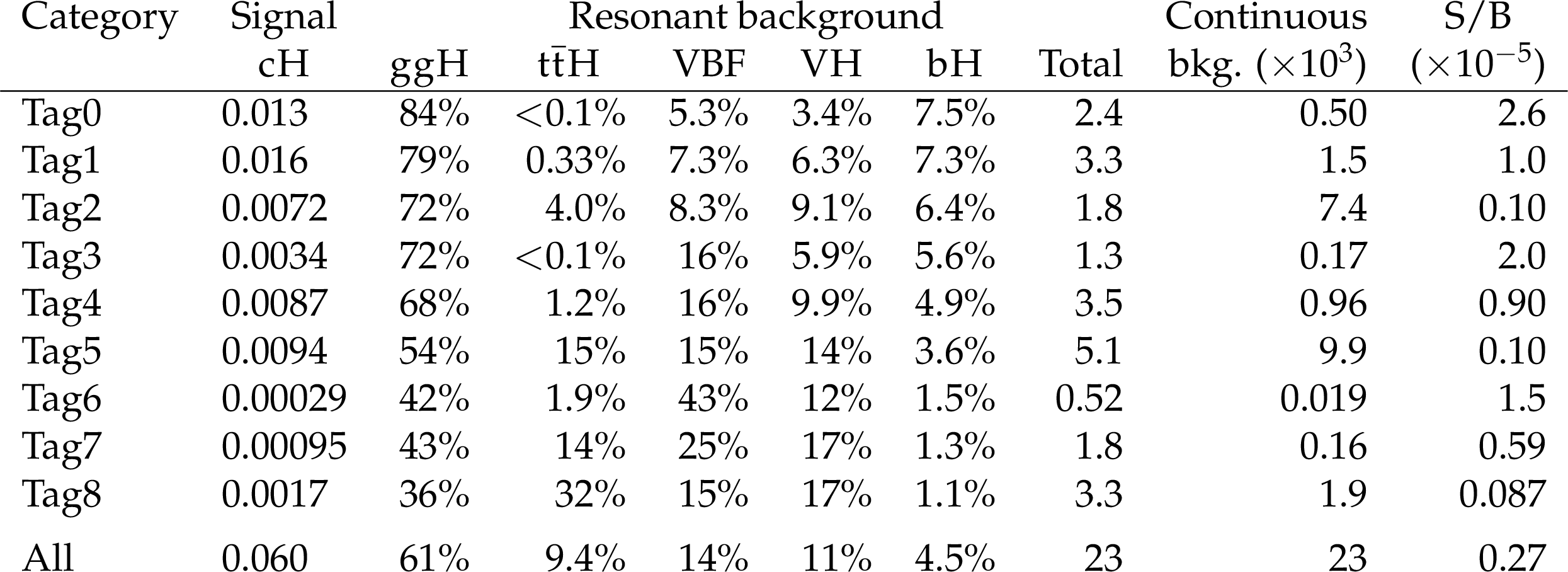
Table 1:
Number of expected signal cH ($ \mathrm{H} \to \gamma\gamma $), resonant background and continuous background events, as well as the resulting signal-over-background ratio (S/B) in the diphoton mass window [122.88, 127.88] GeV for all categories. For each category, the event yields for the three years are summed. The fraction of different production processes contributing to the resonant background ($ \mathrm{g}\mathrm{g}\mathrm{H} $, $ {\mathrm{t}\overline{\mathrm{t}}} \mathrm{H} $, VBF, VH, and $ \mathrm{b}\mathrm{H} $) is also reported. |

png pdf |
Table 2:
Impacts of several uncertainty groups divided by the total uncertainty in the signal strength measurement. The systematic uncertainties are described in Sec. 8. |
| Summary |
| We have presented the first search for a cH signal sensitive to the coupling of the charm quark (c) to the Higgs boson (H) in the associated production of at least one charm quark with a Higgs boson in proton-proton collisions at a center-of-mass energy of 13 TeV. Assuming the signal strengths of non-cH Higgs production processes in the diphoton decay channel to be as predicted by the standard model (SM), the observed and expected upper limits at 95% confidence level on the cH signal strength are 243 and 355 times the SM predictions, respectively. This search also provides sensitivity to the Yukawa coupling between the Higgs boson and the charm quark. Under the same assumption, the observed (expected) allowed interval on the Higgs boson to charm quark coupling modifier $ \kappa_\mathrm{c} $ is $ |\kappa_\mathrm{c}| < $ 38.1 ($ |\kappa_\mathrm{c}| < $ 72.5) at 95% confidence level. The analysis is presently limited by statistical and theoretical uncertainties. Improvements can be achieved by incorporating complementary Higgs boson decay channels and, as larger data sets become available, implementing more refined selection criteria and categorization strategies, such as discriminating charm and bottom quark jets and constructing classifiers distinguishing between more Higgs boson production modes. |
| References | ||||
| 1 | ATLAS Collaboration | Observation of a new particle in the search for the standard model Higgs boson with the ATLAS detector at the LHC | PLB 716 (2012) 1 | 1207.7214 |
| 2 | CMS Collaboration | Observation of a new boson at a mass of 125 GeV with the CMS experiment at the LHC | PLB 716 (2012) 30 | CMS-HIG-12-028 1207.7235 |
| 3 | CMS Collaboration | Observation of a new boson with mass near 125 GeV in pp collisions at $ \sqrt{s} = $ 7 and 8 TeV | JHEP 06 (2013) 081 | CMS-HIG-12-036 1303.4571 |
| 4 | ATLAS Collaboration | Measurements of the Higgs boson production and decay rates and coupling strengths using pp collision data at $ \sqrt{s}= $ 7 and 8 TeV in the ATLAS experiment | EPJC 76 (2016) 6 | 1507.04548 |
| 5 | CMS Collaboration | Precise determination of the mass of the Higgs boson and tests of compatibility of its couplings with the standard model predictions using proton collisions at 7 and 8 TeV | EPJC 75 (2015) 212 | CMS-HIG-14-009 1412.8662 |
| 6 | CMS Collaboration | Study of the mass and spin-parity of the Higgs boson candidate via its decays to Z boson pairs | PRL 110 (2013) 081803 | CMS-HIG-12-041 1212.6639 |
| 7 | ATLAS Collaboration | Evidence for the spin-0 nature of the Higgs boson using ATLAS data | PLB 726 (2013) 120 | 1307.1432 |
| 8 | ATLAS and CMS Collaborations | Measurements of the Higgs boson production and decay rates and constraints on its couplings from a combined ATLAS and CMS analysis of the LHC pp collision data at $ \sqrt{s}= $ 7 and 8 TeV | JHEP 08 (2016) 045 | 1606.02266 |
| 9 | CMS Collaboration | Measurements of properties of the Higgs boson decaying into the four-lepton final state in pp collisions at $ \sqrt{s}= $ 13 TeV | JHEP 11 (2017) 047 | CMS-HIG-16-041 1706.09936 |
| 10 | ATLAS Collaboration | Combined measurement of differential and total cross sections in the $ H \rightarrow \gamma \gamma $ and the $ H \rightarrow ZZ^* \rightarrow 4\ell $ decay channels at $ \sqrt{s} = $ 13 TeV with the ATLAS detector | PLB 786 (2018) 114 | 1805.10197 |
| 11 | CMS Collaboration | A measurement of the Higgs boson mass in the diphoton decay channel | PLB 805 (2020) 135425 | CMS-HIG-19-004 2002.06398 |
| 12 | CMS Collaboration | Measurement of the Higgs boson mass and width using the four-lepton final state in proton-proton collisions at $ \sqrt{s} = $ 13 TeV | Submitted to Phys. Rev. D, 2024 | CMS-HIG-21-019 2409.13663 |
| 13 | P. W. Higgs | Broken symmetries and the masses of gauge bosons | PRL 13 (1964) 508 | |
| 14 | P. W. Higgs | Broken symmetries, massless particles and gauge fields | PL 12 (1964) 132 | |
| 15 | F. Englert and R. Brout | Broken symmetry and the mass of gauge vector mesons | PRL 13 (1964) 321 | |
| 16 | P. W. Higgs | Spontaneous symmetry breakdown without massless bosons | PR 145 (1966) 1156 | |
| 17 | ATLAS Collaboration | Measurement of Higgs boson production in the diphoton decay channel in pp collisions at center-of-mass energies of 7 and 8 TeV with the ATLAS detector | PRD 90 (2014) 112015 | 1408.7084 |
| 18 | CMS Collaboration | Observation of the diphoton decay of the Higgs boson and measurement of its properties | EPJC 74 (2014) 3076 | CMS-HIG-13-001 1407.0558 |
| 19 | ATLAS Collaboration | Measurements of Higgs boson production and couplings in the four-lepton channel in pp collisions at center-of-mass energies of 7 and 8 TeV with the ATLAS detector | PRD 91 (2015) 012006 | 1408.5191 |
| 20 | CMS Collaboration | Measurement of the properties of a Higgs boson in the four-lepton final state | PRD 89 (2014) 092007 | CMS-HIG-13-002 1312.5353 |
| 21 | ATLAS Collaboration | Observation and measurement of Higgs boson decays to WW$ ^* $ with the ATLAS detector | PRD 92 (2015) 012006 | 1412.2641 |
| 22 | ATLAS Collaboration | Study of (W/Z)H production and Higgs boson couplings using $ H \rightarrow WW^{\ast} $ decays with the ATLAS detector | JHEP 08 (2015) 137 | 1506.06641 |
| 23 | CMS Collaboration | Measurement of Higgs boson production and properties in the WW decay channel with leptonic final states | JHEP 01 (2014) 096 | CMS-HIG-13-023 1312.1129 |
| 24 | ATLAS Collaboration | Evidence for the Higgs-boson Yukawa coupling to tau leptons with the ATLAS detector | JHEP 04 (2015) 117 | 1501.04943 |
| 25 | CMS Collaboration | Evidence for the 125 GeV Higgs boson decaying to a pair of $ \tau $ leptons | JHEP 05 (2014) 104 | CMS-HIG-13-004 1401.5041 |
| 26 | CMS Collaboration | Search for Higgs boson pair production in events with two bottom quarks and two tau leptons in proton-proton collisions at $ \sqrt{s}= $ 13 TeV | PLB 778 (2018) 101 | CMS-HIG-17-002 1707.02909 |
| 27 | CMS Collaboration | Measurements of properties of the Higgs boson decaying to a W boson pair in pp collisions at $ \sqrt{s}= $ 13 TeV | PLB 791 (2019) 96 | CMS-HIG-16-042 1806.05246 |
| 28 | ATLAS Collaboration | A detailed map of Higgs boson interactions by the ATLAS experiment ten years after the discovery | Nature 607 (2022) 52 | 2207.00092 |
| 29 | CMS Collaboration | A portrait of the Higgs boson by the CMS experiment ten years after the discovery | Nature 607 (2022) 60 | CMS-HIG-22-001 2207.00043 |
| 30 | CMS Collaboration | Evidence for Higgs boson decay to a pair of muons | JHEP 01 (2021) 148 | CMS-HIG-19-006 2009.04363 |
| 31 | ATLAS Collaboration | A search for the dimuon decay of the Standard Model Higgs boson with the ATLAS detector | PLB 812 (2021) 135980 | 2007.07830 |
| 32 | ATLAS Collaboration | Measurements of WH and ZH production with Higgs boson decays into bottom quarks and direct constraints on the charm Yukawa coupling in 13 TeV pp collisions with the ATLAS detector | JHEP 04 (2025) 075 | 2410.19611 |
| 33 | CMS Collaboration | Search for Higgs boson decay to a charm quark-antiquark pair in proton-proton collisions at $ \sqrt{s} = $ 13 TeV | PRL 131 (2023) 061801 | CMS-HIG-21-008 2205.05550 |
| 34 | ATLAS Collaboration | Searches for exclusive Higgs and Z boson decays into a vector quarkonium state and a photon using 139 fb$ ^{-1} $ of ATLAS $ \sqrt{s}= $ 13 TeV proton-proton collision data | EPJC 83 (2023) 781 | 2208.03122 |
| 35 | CMS Collaboration | Search for rare decays of Z and Higgs bosons to J$ /\psi $ and a photon in proton-proton collisions at $ \sqrt{s} = $ 13 TeV | EPJC 79 (2019) 94 | CMS-SMP-17-012 1810.10056 |
| 36 | I. Brivio, F. Goertz, and G. Isidori | Probing the charm quark Yukawa coupling in Higgs+charm production | PRL 115 (2015) 211801 | 1507.02916 |
| 37 | N. M. Coyle, C. E. M. Wagner, and V. Wei | Bounding the charm Yukawa coupling | PRD 100 (2019) 073013 | 1905.09360 |
| 38 | ATLAS Collaboration | Search for the associated production of charm quarks and a Higgs boson decaying into a photon pair with the ATLAS detector | JHEP 02 (2025) 045 | 2407.15550 |
| 39 | CMS Collaboration | Precision luminosity measurement in proton-proton collisions at $ \sqrt{s} = $ 13 TeV in 2015 and 2016 at CMS | EPJC 81 (2021) 800 | CMS-LUM-17-003 2104.01927 |
| 40 | CMS Collaboration | CMS luminosity measurement for the 2017 data-taking period at $ \sqrt{s} = $ 13 TeV | CMS Physics Analysis Summary, 2018 link |
CMS-PAS-LUM-17-004 |
| 41 | CMS Collaboration | CMS luminosity measurement for the 2018 data-taking period at $ \sqrt{s} = $ 13 TeV | CMS Physics Analysis Summary, 2019 link |
CMS-PAS-LUM-18-002 |
| 42 | C. Delaunay, T. Golling, G. Perez, and Y. Soreq | Enhanced Higgs boson coupling to charm pairs | PRD 89 (2014) 033014 | 1310.7029 |
| 43 | G. Perez, Y. Soreq, E. Stamou, and K. Tobioka | Constraining the charm Yukawa and Higgs-quark coupling universality | PRD 92 (2015) 033016 | 1503.00290 |
| 44 | D. Ghosh, R. S. Gupta, and G. Perez | Is the Higgs mechanism of fermion mass generation a fact? a Yukawa-less first-two-generation model | PLB 755 (2016) 504 | 1508.01501 |
| 45 | F. J. Botella, G. C. Branco, M. N. Rebelo, and J. I. Silva-Marcos | What if the masses of the first two quark families are not generated by the standard model Higgs boson? | PRD 94 (2016) 115031 | 1602.08011 |
| 46 | R. Harnik, J. Kopp, and J. Zupan | Flavor violating Higgs decays | JHEP 03 (2013) 026 | 1209.1397 |
| 47 | W. Altmannshofer et al. | Collider signatures of flavorful Higgs bosons | PRD 94 (2016) 115032 | 1610.02398 |
| 48 | CMS Collaboration | The CMS experiment at the CERN LHC | JINST 3 (2008) S08004 | |
| 49 | CMS Collaboration | Development of the CMS detector for the CERN LHC Run 3 | JINST 19 (2024) P05064 | CMS-PRF-21-001 2309.05466 |
| 50 | CMS Collaboration | Performance of the CMS Level-1 trigger in proton-proton collisions at $ \sqrt{s} = $ 13 TeV | JINST 15 (2020) P10017 | CMS-TRG-17-001 2006.10165 |
| 51 | CMS Collaboration | The CMS trigger system | JINST 12 (2017) P01020 | CMS-TRG-12-001 1609.02366 |
| 52 | CMS Collaboration | Performance of the CMS high-level trigger during LHC Run 2 | JINST 19 (2024) P11021 | CMS-TRG-19-001 2410.17038 |
| 53 | P. Nason | A new method for combining NLO QCD with shower Monte Carlo algorithms | JHEP 11 (2004) 040 | hep-ph/0409146 |
| 54 | S. Frixione, P. Nason, and C. Oleari | Matching NLO QCD computations with parton shower simulations: the POWHEG method | JHEP 11 (2007) 070 | 0709.2092 |
| 55 | S. Alioli, P. Nason, C. Oleari, and E. Re | A general framework for implementing NLO calculations in shower Monte Carlo programs: the POWHEG BOX | JHEP 06 (2010) 043 | 1002.2581 |
| 56 | E. Bagnaschi, G. Degrassi, P. Slavich, and A. Vicini | Higgs production via gluon fusion in the POWHEG approach in the SM and in the MSSM | JHEP 02 (2012) 088 | 1111.2854 |
| 57 | J. Alwall et al. | Comparative study of various algorithms for the merging of parton showers and matrix elements in hadronic collisions | EPJC 53 (2008) 473 | 0706.2569 |
| 58 | R. Frederix and S. Frixione | Merging meets matching in MC@NLO | JHEP 12 (2012) 061 | 1209.6215 |
| 59 | J. Alwall et al. | The automated computation of tree-level and next-to-leading order differential cross sections, and their matching to parton shower simulations | JHEP 07 (2014) 079 | 1405.0301 |
| 60 | LHC Higgs Cross Section Working Group | Handbook of LHC Higgs cross sections: 4. Deciphering the nature of the Higgs sector | CERN Report CERN-2017-002-M, 2016 link |
1610.07922 |
| 61 | M. Wiesemann et al. | Higgs production in association with bottom quarks | JHEP 02 (2015) 132 | 1409.5301 |
| 62 | T. Sjostrand et al. | An introduction to PYTHIA 8.2 | Comput. Phys. Commun. 191 (2015) 159 | 1410.3012 |
| 63 | CMS Collaboration | Event generator tunes obtained from underlying event and multiparton scattering measurements | EPJC 76 (2016) 155 | CMS-GEN-14-001 1512.00815 |
| 64 | CMS Collaboration | Extraction and validation of a new set of CMS PYTHIA8 tunes from underlying-event measurements | EPJC 80 (2020) 4 | CMS-GEN-17-001 1903.12179 |
| 65 | NNPDF Collaboration | Parton distributions for the LHC run II | JHEP 04 (2015) 040 | 1410.8849 |
| 66 | NNPDF Collaboration | Parton distributions from high-precision collider data | EPJC 77 (2017) 663 | 1706.00428 |
| 67 | E. Bothmann et al. | Event generation with SHERPA 2.2 | SciPost Phys. 7 (2019) 34 | 1905.09127 |
| 68 | \GEANTfour Collaboration | GEANT 4---a simulation toolkit | NIM A 506 (2003) 250 | |
| 69 | CMS Collaboration | Measurements of Higgs boson properties in the diphoton decay channel in proton-proton collisions at $ \sqrt{s} = $ 13 TeV | JHEP 11 (2018) 185 | CMS-HIG-16-040 1804.02716 |
| 70 | CMS Collaboration | Particle-flow reconstruction and global event description with the CMS detector | JINST 12 (2017) P10003 | CMS-PRF-14-001 1706.04965 |
| 71 | M. Cacciari, G. P. Salam, and G. Soyez | The anti-$ k_{\mathrm{T}} $ jet clustering algorithm | JHEP 04 (2008) 063 | 0802.1189 |
| 72 | M. Cacciari, G. P. Salam, and G. Soyez | FastJet user manual | EPJC 72 (2012) 1896 | 1111.6097 |
| 73 | CMS Collaboration | Pileup mitigation at CMS in 13 TeV data | JINST 15 (2020) P09018 | CMS-JME-18-001 2003.00503 |
| 74 | CMS Collaboration | Jet energy scale and resolution in the CMS experiment in pp collisions at 8 TeV | JINST 12 (2017) P02014 | CMS-JME-13-004 1607.03663 |
| 75 | CMS Collaboration | Electron and photon reconstruction and identification with the CMS experiment at the CERN LHC | JINST 16 (2021) P05014 | CMS-EGM-17-001 2012.06888 |
| 76 | E. Spyromitros-Xioufis, W. Groves, G. Tsoumakas, and I. Vlahavas | Multi-target regression via input space expansion: treating targets as inputs | Mach. Learn. 104 (2016) 55 | 1211.6581 |
| 77 | E. Bols et al. | Jet flavour classification using DeepJet | JINST 15 (2020) P12012 | 2008.10519 |
| 78 | CMS Collaboration | Performance of the DeepJet b tagging algorithm using 41.9/fb of data from proton-proton collisions at 13 TeV with Phase 1 CMS detector | CMS Detector Performance Note CMS-DP-2018-058, 2018 CDS |
|
| 79 | CMS Collaboration | Identification of heavy-flavor jets with the CMS detector in pp collisions at 13 TeV | JINST 13 (2018) P05011 | CMS-BTV-16-002 1712.07158 |
| 80 | T. Chen and C. Guestrin | XGBoost: A scalable tree boosting system | in Proc. 22nd Int. Conf. on Knowledge Discovery and Data Mining, p. 785. 2016 link |
1603.02754 |
| 81 | R. A. Fisher | On the interpretation of $ \chi^2 $ from contingency tables, and the calculation of p | J. R. Stat. Soc. 85 (1922) 87 | |
| 82 | P. D. Dauncey, M. Kenzie, N. Wardle, and G. J. Davies | Handling uncertainties in background shapes | JINST 10 (2015) P04015 | 1408.6865 |
| 83 | S. Manzoni et al. | Taming a leading theoretical uncertainty in HH measurements via accurate simulations for $ \textrm{b}\overline{\textrm{b}}\textrm{H} $ production | JHEP 09 (2023) 179 | 2307.09992 |
| 84 | CMS Collaboration | The CMS Statistical Analysis and Combination Tool: Combine | Comput. Softw. Big Sci. 8 (2024) 19 | CMS-CAT-23-001 2404.06614 |
| 85 | ATLAS and CMS Collaborations and the LHC Higgs Combination Group | Procedure for the LHC Higgs boson search combination in Summer 2011 | Technical Report CMS-NOTE-2011-005, ATL-PHYS-PUB-2011-11, 2011 | |
| 86 | G. Cowan, K. Cranmer, E. Gross, and O. Vitells | Asymptotic formulae for likelihood-based tests of new physics | EPJC 71 (2011) 1554 | 1007.1727 |
| 87 | CMS Collaboration | Combined effective field theory interpretation of Higgs boson, electroweak vector boson, top quark, and multi-jet measurements | Submitted to EPJC, 2025 | CMS-SMP-24-003 2504.02958 |
| 88 | CMS Collaboration | HEPData record for this analysis | link | |
|
|
Compact Muon Solenoid LHC, CERN |

|
|
|
|
|
|