Compact Muon Solenoid
LHC, CERN
 Visit us: CMS Public Website, CMS Physics ;
Contact us: CMS Publications Committee
Visit us: CMS Public Website, CMS Physics ;
Contact us: CMS Publications Committee
| CMS-SMP-25-008 ; CERN-EP-2026-232 | ||
| Evidence for the dead-cone effect in bottom quark initiated jets produced in proton-proton collisions at $ \sqrt{s} = $ 13 TeV | ||
| CMS Collaboration | ||
| 29 August 2026 | ||
| Submitted to Physical Review Letters | ||
| Abstract: The suppression of collinear gluon emissions from a massive quark, or the ``dead-cone effect,'' is the primary manifestation of quark mass effects in parton showers. A proton-proton collision data set recorded by the CMS experiment at $ \sqrt{s}= $ 13 TeV with an integrated luminosity of 59.8 fb$ ^{-1} $ is analyzed. A differential measurement is presented of the emission density of bottom quark jets, studied as a function of the angular separation between iteratively declustered subjets. The measurement is performed in bottom quark initiated jets with transverse momenta between 40 and 200 GeV originating from top quark pair production. Compared to data, a parton shower Monte Carlo model that includes the dead-cone effect is favored, while a model without the dead-cone effect is disfavored with a significance of 4.3 standard deviations. | ||
| Links: e-print arXiv:2608.29412 [hep-ex] (PDF) ; CDS record ; inSPIRE record ; HepData record ; CADI line (restricted) ; | ||
| Figures | |
png pdf |
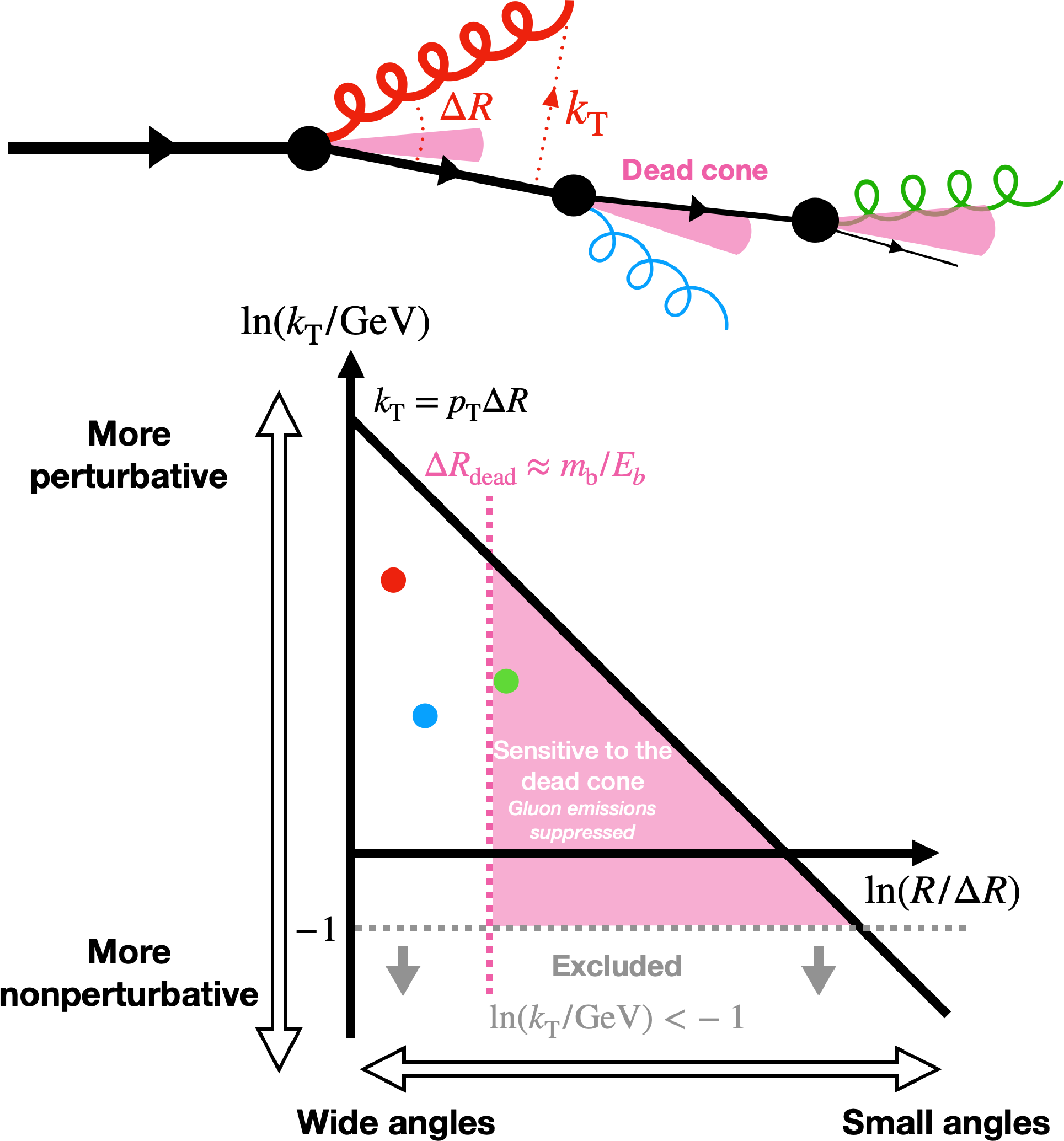
Figure 1:
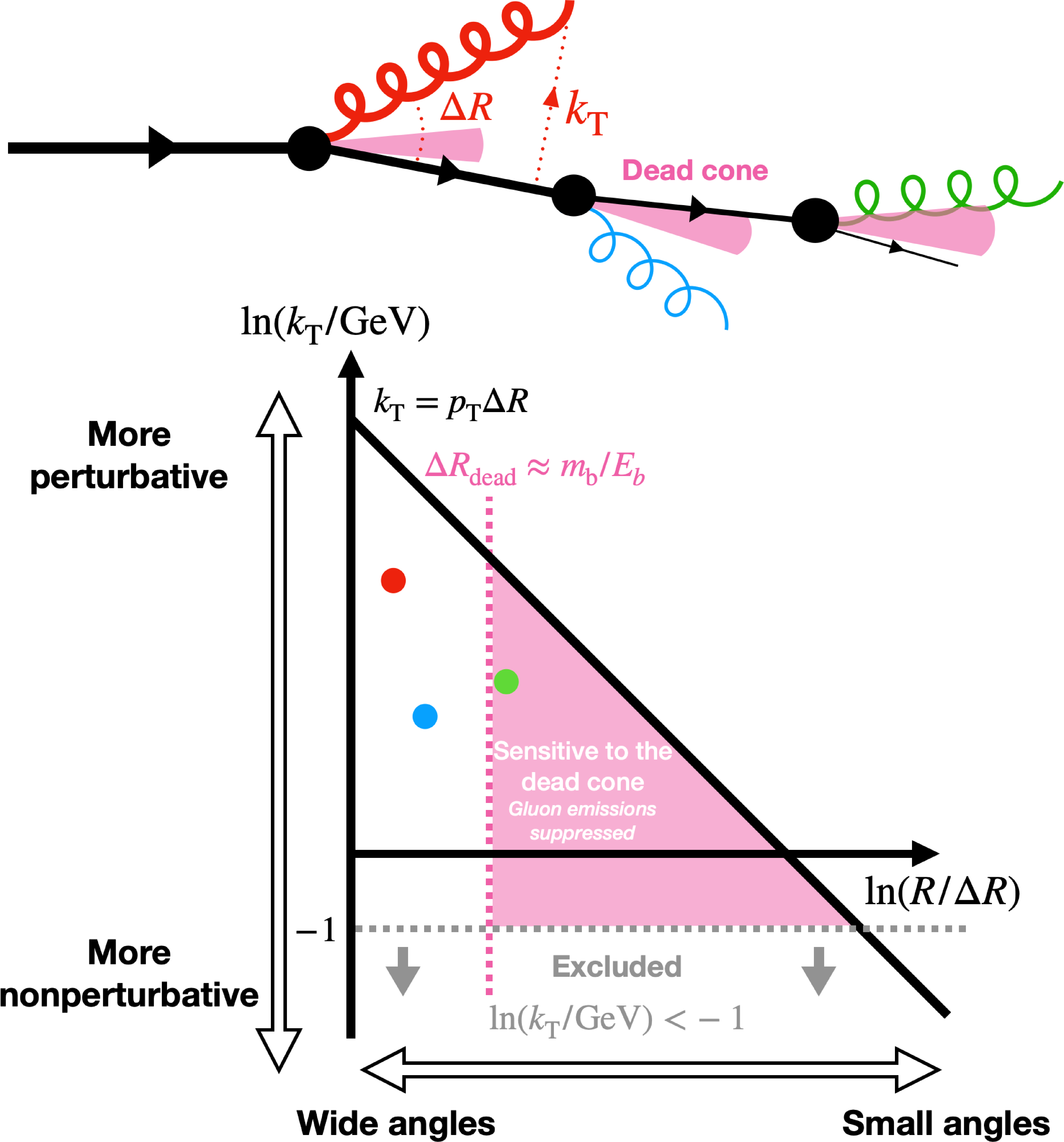
An illustration of the iterative declustering of a b quark jet to construct the Lund jet plane (LJP). The upper diagram shows the showering of a b quark (pointing arrow) ordered in descending angular separation between the b quark and the gluon radiation (curly line). The pink cones along the direction of the emitters represent the dead cones. The lower diagram shows the corresponding LJP, where each colored point corresponds to a declustering step in the upper diagram and the pink block indicates the region sensitive to the dead cone. |
png pdf |
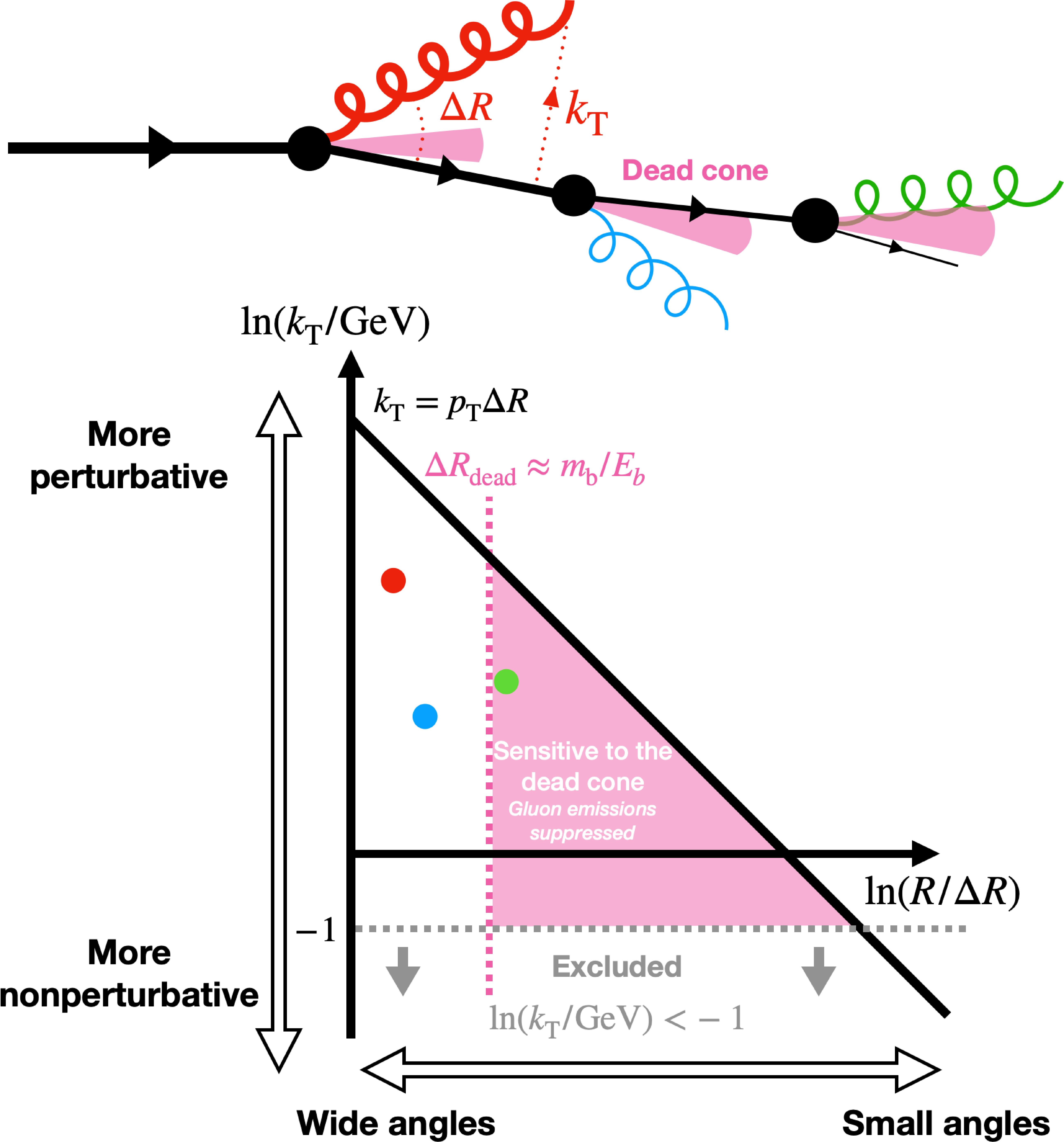
Figure 1-a:
An illustration of the iterative declustering of a b quark jet to construct the Lund jet plane (LJP). The upper diagram shows the showering of a b quark (pointing arrow) ordered in descending angular separation between the b quark and the gluon radiation (curly line). The pink cones along the direction of the emitters represent the dead cones. The lower diagram shows the corresponding LJP, where each colored point corresponds to a declustering step in the upper diagram and the pink block indicates the region sensitive to the dead cone. |
png pdf |
Figure 1-b:
An illustration of the iterative declustering of a b quark jet to construct the Lund jet plane (LJP). The upper diagram shows the showering of a b quark (pointing arrow) ordered in descending angular separation between the b quark and the gluon radiation (curly line). The pink cones along the direction of the emitters represent the dead cones. The lower diagram shows the corresponding LJP, where each colored point corresponds to a declustering step in the upper diagram and the pink block indicates the region sensitive to the dead cone. |
png pdf |
Figure 2:
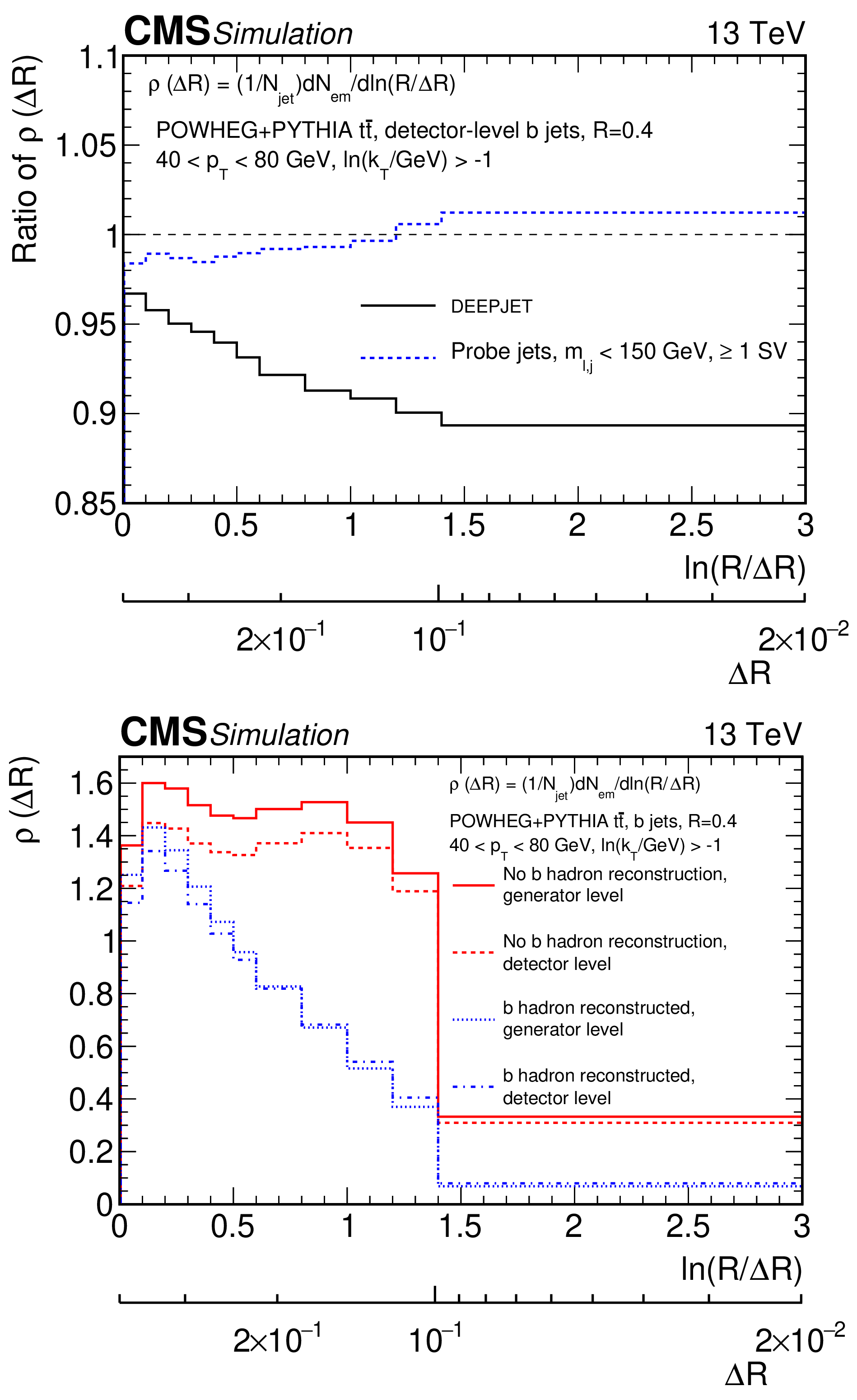
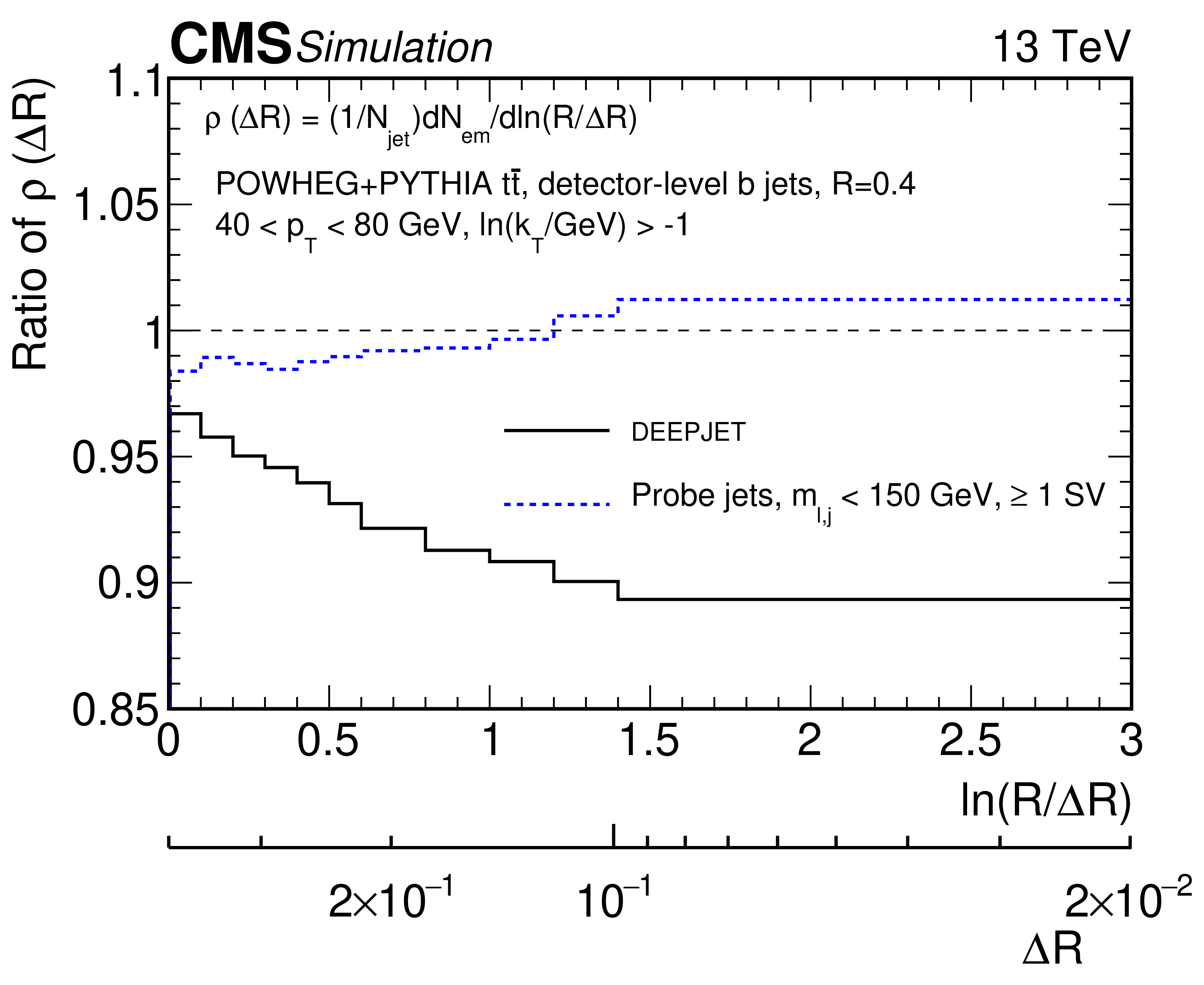
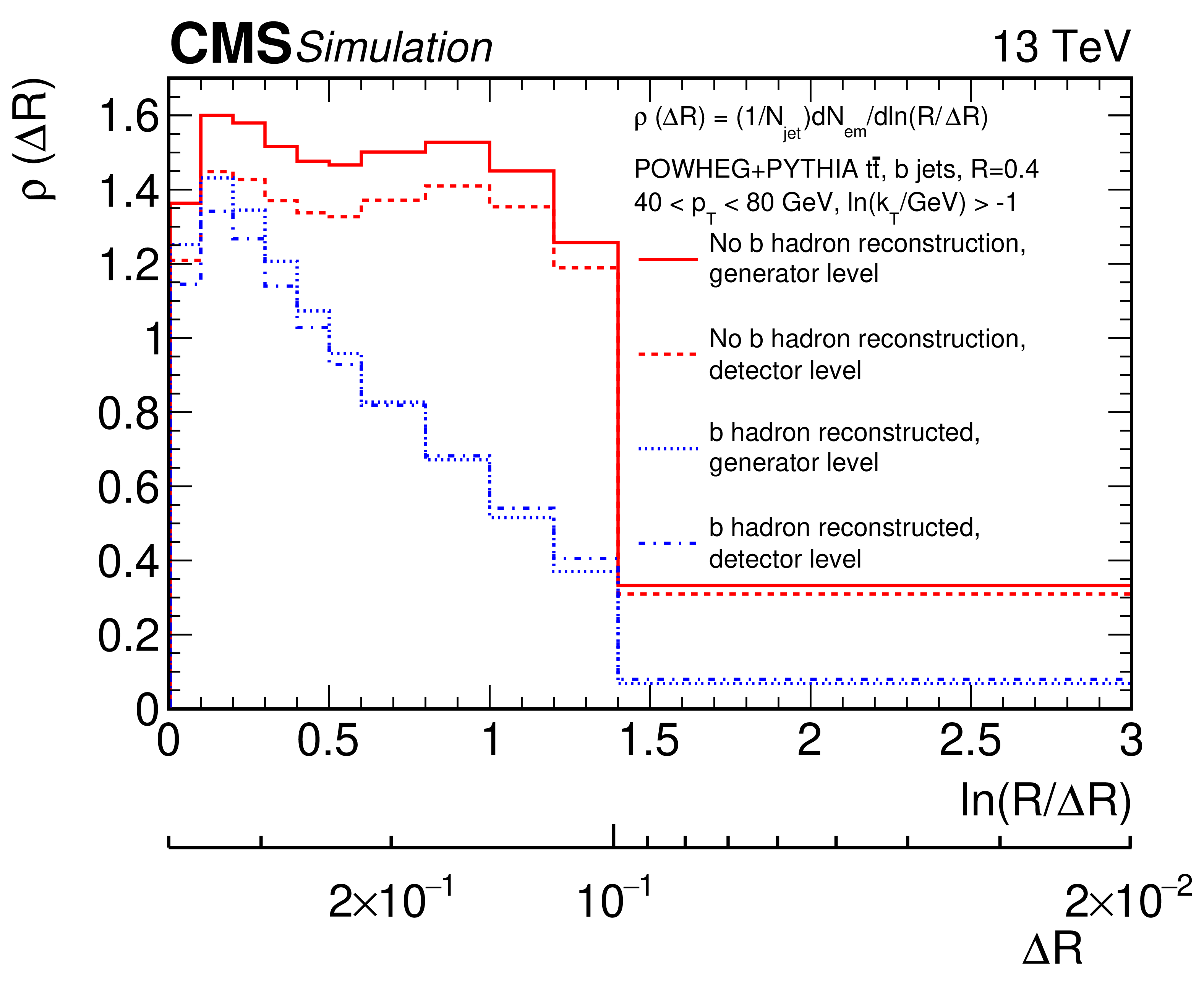
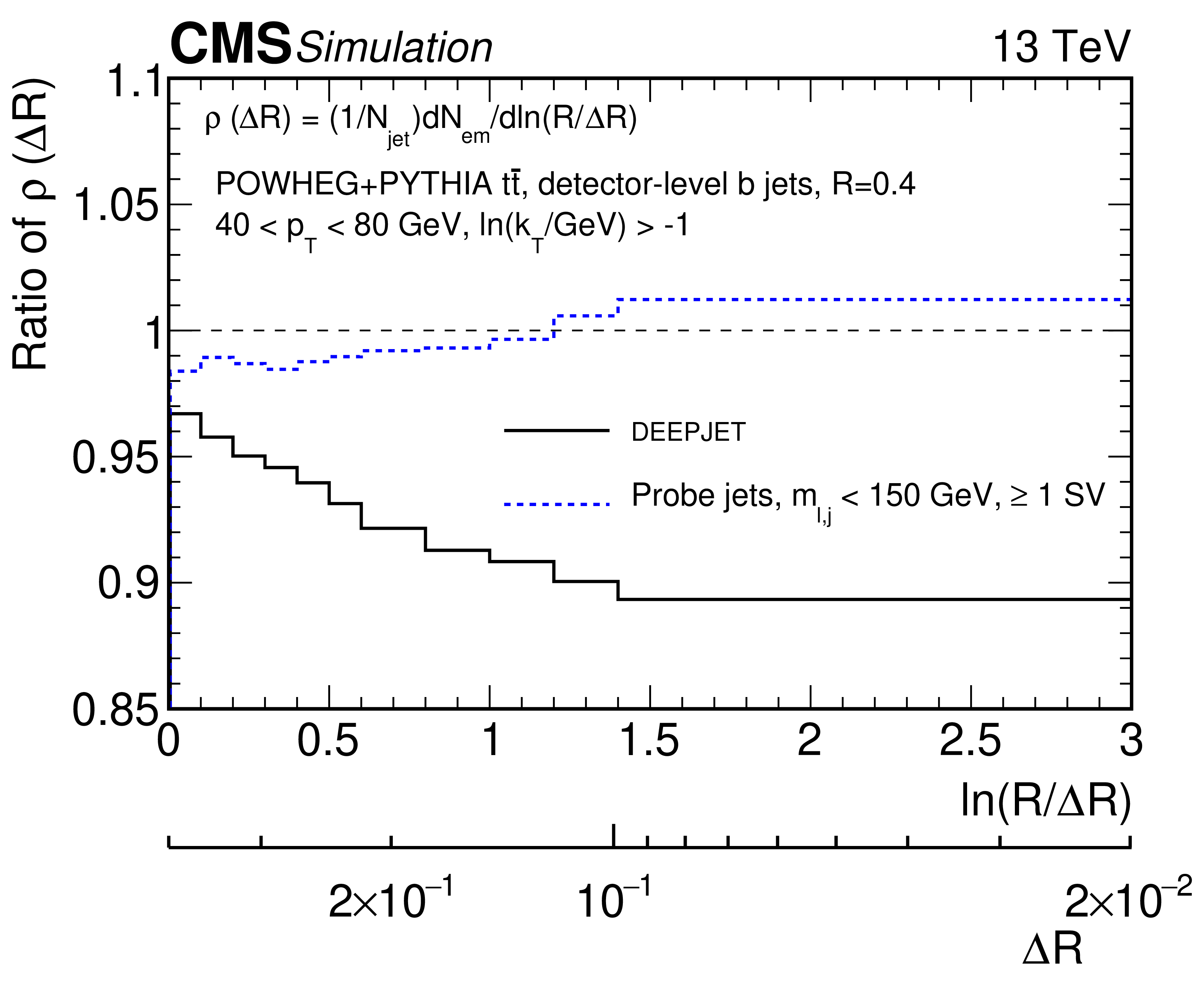
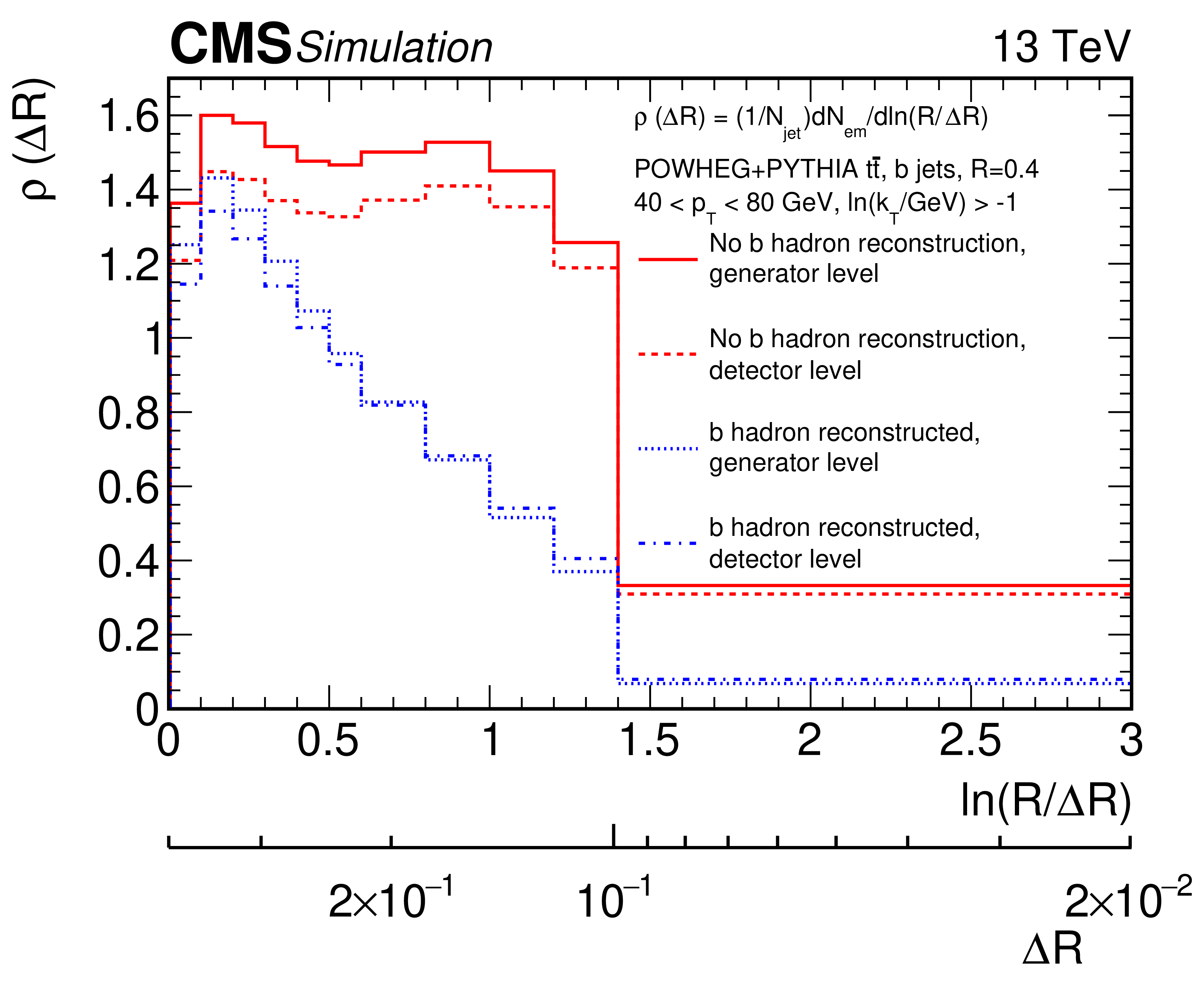
(Upper) Ratio of the emission density distribution between the b quark jets selected using either the DEEPJET b tagger or the T&P method to the b quark jets selected using generator-level information. (Lower) The detector-level and generator-level emission density distributions for b quark jets with 40 $ < p_{\mathrm{T}} < $ 80 GeV in the POWHEG +PYTHIA\ $ \mathrm{t} \overline{\mathrm{t}} $ sample are shown with and without the partial b hadron reconstruction, either with generator-level information or with the transformer encoder. The statistical uncertainties are too small to be visible in either panel. |
png pdf |
Figure 2-a:
(Upper) Ratio of the emission density distribution between the b quark jets selected using either the DEEPJET b tagger or the T&P method to the b quark jets selected using generator-level information. (Lower) The detector-level and generator-level emission density distributions for b quark jets with 40 $ < p_{\mathrm{T}} < $ 80 GeV in the POWHEG +PYTHIA\ $ \mathrm{t} \overline{\mathrm{t}} $ sample are shown with and without the partial b hadron reconstruction, either with generator-level information or with the transformer encoder. The statistical uncertainties are too small to be visible in either panel. |
png pdf |
Figure 2-b:
(Upper) Ratio of the emission density distribution between the b quark jets selected using either the DEEPJET b tagger or the T&P method to the b quark jets selected using generator-level information. (Lower) The detector-level and generator-level emission density distributions for b quark jets with 40 $ < p_{\mathrm{T}} < $ 80 GeV in the POWHEG +PYTHIA\ $ \mathrm{t} \overline{\mathrm{t}} $ sample are shown with and without the partial b hadron reconstruction, either with generator-level information or with the transformer encoder. The statistical uncertainties are too small to be visible in either panel. |
png pdf |
Figure 2-c:
(Upper) Ratio of the emission density distribution between the b quark jets selected using either the DEEPJET b tagger or the T&P method to the b quark jets selected using generator-level information. (Lower) The detector-level and generator-level emission density distributions for b quark jets with 40 $ < p_{\mathrm{T}} < $ 80 GeV in the POWHEG +PYTHIA\ $ \mathrm{t} \overline{\mathrm{t}} $ sample are shown with and without the partial b hadron reconstruction, either with generator-level information or with the transformer encoder. The statistical uncertainties are too small to be visible in either panel. |
png pdf |
Figure 2-d:
(Upper) Ratio of the emission density distribution between the b quark jets selected using either the DEEPJET b tagger or the T&P method to the b quark jets selected using generator-level information. (Lower) The detector-level and generator-level emission density distributions for b quark jets with 40 $ < p_{\mathrm{T}} < $ 80 GeV in the POWHEG +PYTHIA\ $ \mathrm{t} \overline{\mathrm{t}} $ sample are shown with and without the partial b hadron reconstruction, either with generator-level information or with the transformer encoder. The statistical uncertainties are too small to be visible in either panel. |
png pdf |
Figure 3:
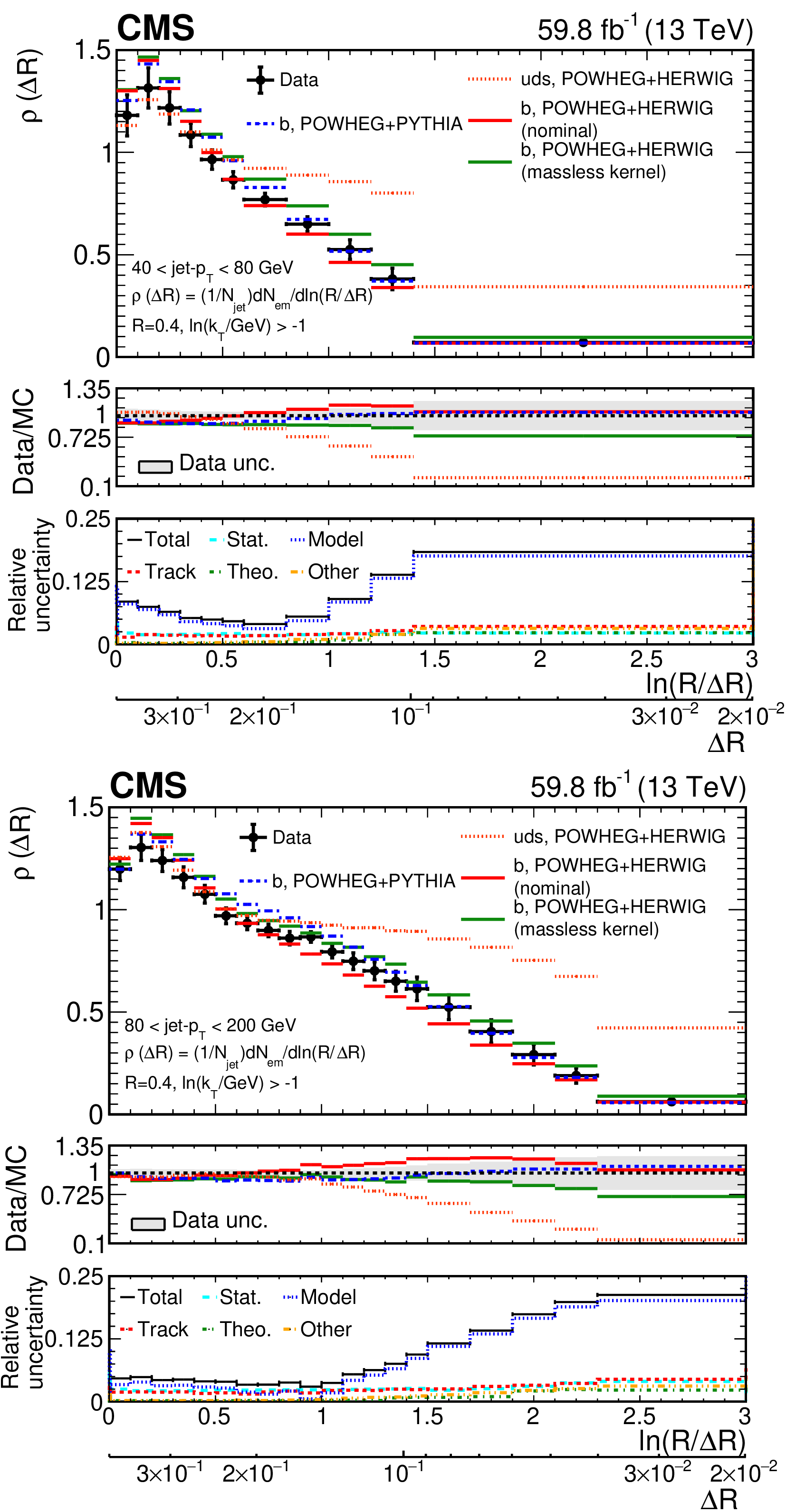
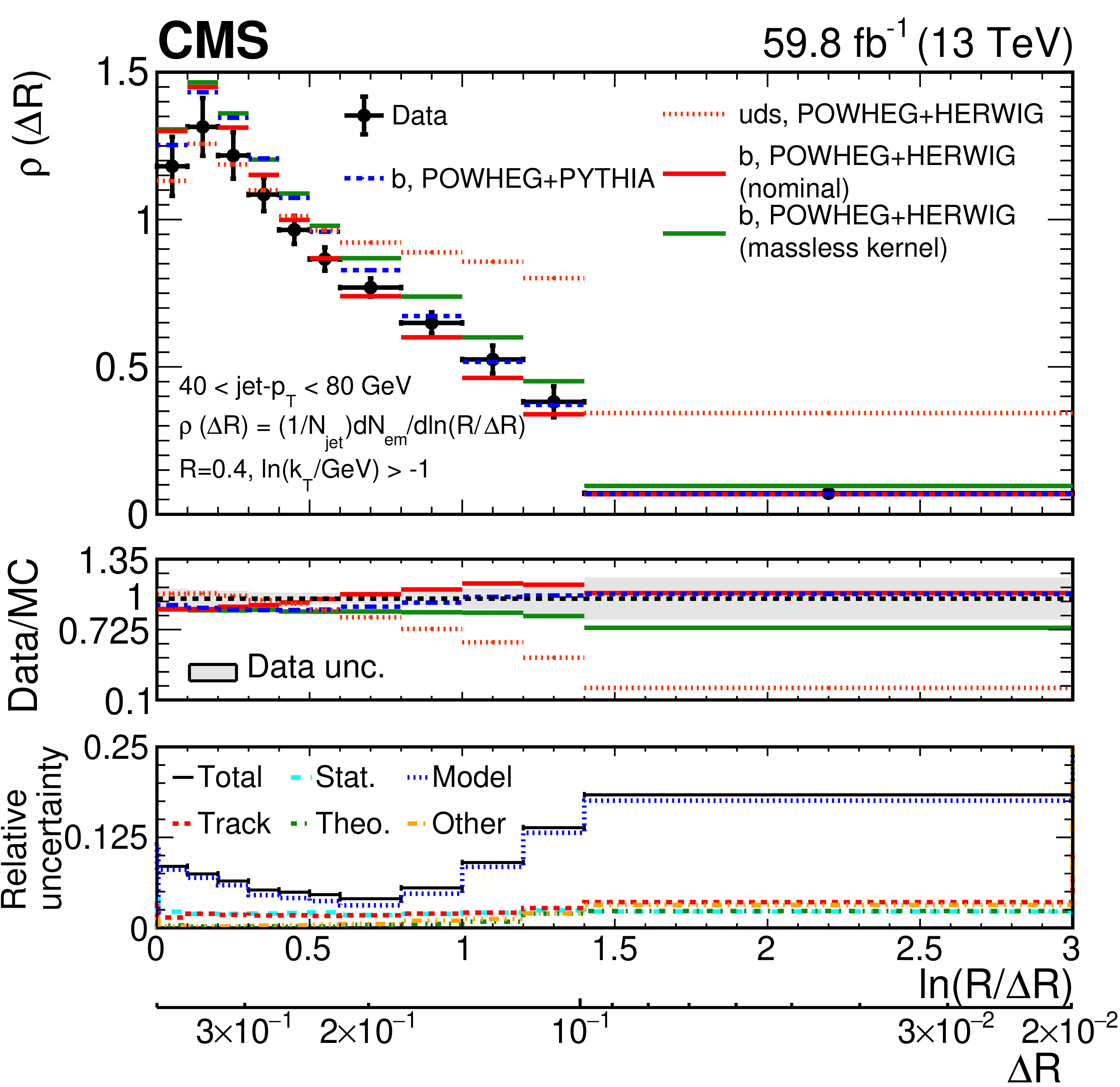
The measured emission density per $ {\ln(R/{\Delta R})} $ for b quark jets with (upper) 40 $ < p_{\mathrm{T}} < $ 80 GeV and (lower) 80 $ < p_{\mathrm{T}} < $ 200 GeV, with vertical error bars representing the total uncertainties. Data are compared with the generator-level distributions from different MC samples. The middle panels show the ratio of the data to the MC predictions with a dashed line at one for reference. The total uncertainties of the data are shown as the gray band. The lower panels show the breakdown of the data uncertainties into various sources. |
png pdf |
Figure 3-a:
The measured emission density per $ {\ln(R/{\Delta R})} $ for b quark jets with (upper) 40 $ < p_{\mathrm{T}} < $ 80 GeV and (lower) 80 $ < p_{\mathrm{T}} < $ 200 GeV, with vertical error bars representing the total uncertainties. Data are compared with the generator-level distributions from different MC samples. The middle panels show the ratio of the data to the MC predictions with a dashed line at one for reference. The total uncertainties of the data are shown as the gray band. The lower panels show the breakdown of the data uncertainties into various sources. |
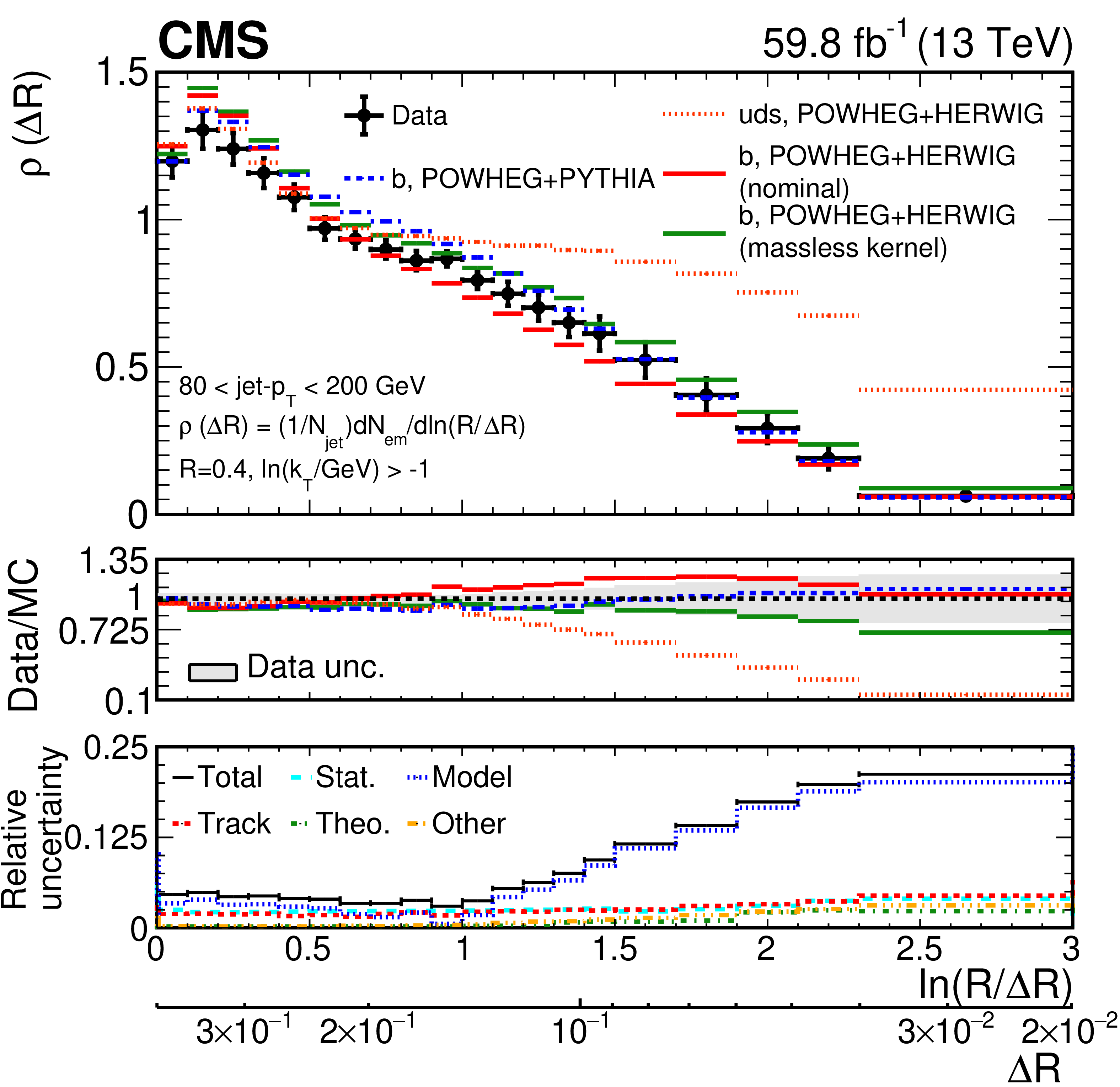
png pdf |
Figure 3-b:
The measured emission density per $ {\ln(R/{\Delta R})} $ for b quark jets with (upper) 40 $ < p_{\mathrm{T}} < $ 80 GeV and (lower) 80 $ < p_{\mathrm{T}} < $ 200 GeV, with vertical error bars representing the total uncertainties. Data are compared with the generator-level distributions from different MC samples. The middle panels show the ratio of the data to the MC predictions with a dashed line at one for reference. The total uncertainties of the data are shown as the gray band. The lower panels show the breakdown of the data uncertainties into various sources. |
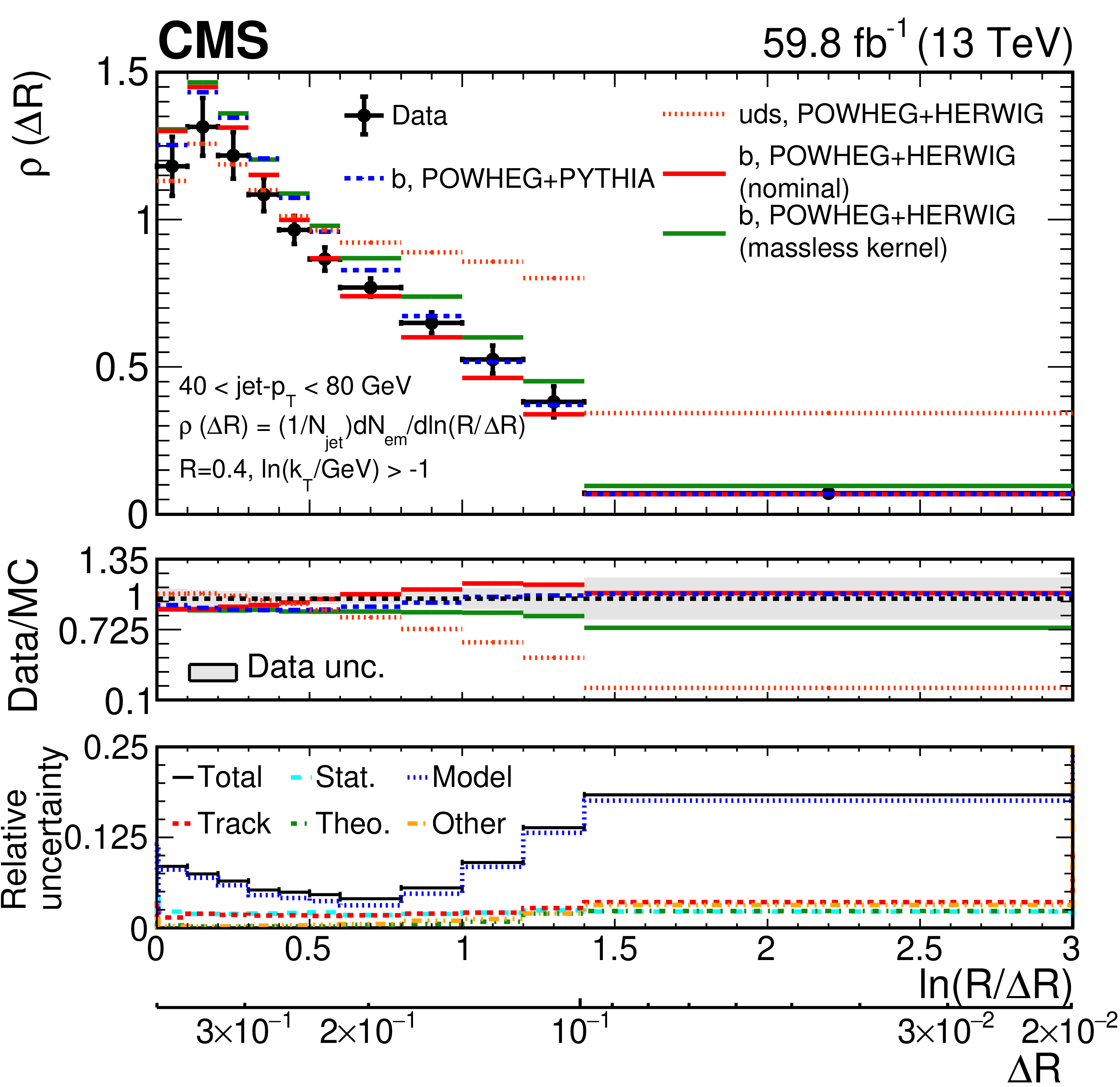
png pdf |
Figure 3-c:
The measured emission density per $ {\ln(R/{\Delta R})} $ for b quark jets with (upper) 40 $ < p_{\mathrm{T}} < $ 80 GeV and (lower) 80 $ < p_{\mathrm{T}} < $ 200 GeV, with vertical error bars representing the total uncertainties. Data are compared with the generator-level distributions from different MC samples. The middle panels show the ratio of the data to the MC predictions with a dashed line at one for reference. The total uncertainties of the data are shown as the gray band. The lower panels show the breakdown of the data uncertainties into various sources. |
png pdf |
Figure 3-d:
The measured emission density per $ {\ln(R/{\Delta R})} $ for b quark jets with (upper) 40 $ < p_{\mathrm{T}} < $ 80 GeV and (lower) 80 $ < p_{\mathrm{T}} < $ 200 GeV, with vertical error bars representing the total uncertainties. Data are compared with the generator-level distributions from different MC samples. The middle panels show the ratio of the data to the MC predictions with a dashed line at one for reference. The total uncertainties of the data are shown as the gray band. The lower panels show the breakdown of the data uncertainties into various sources. |
png pdf |
Figure 4:
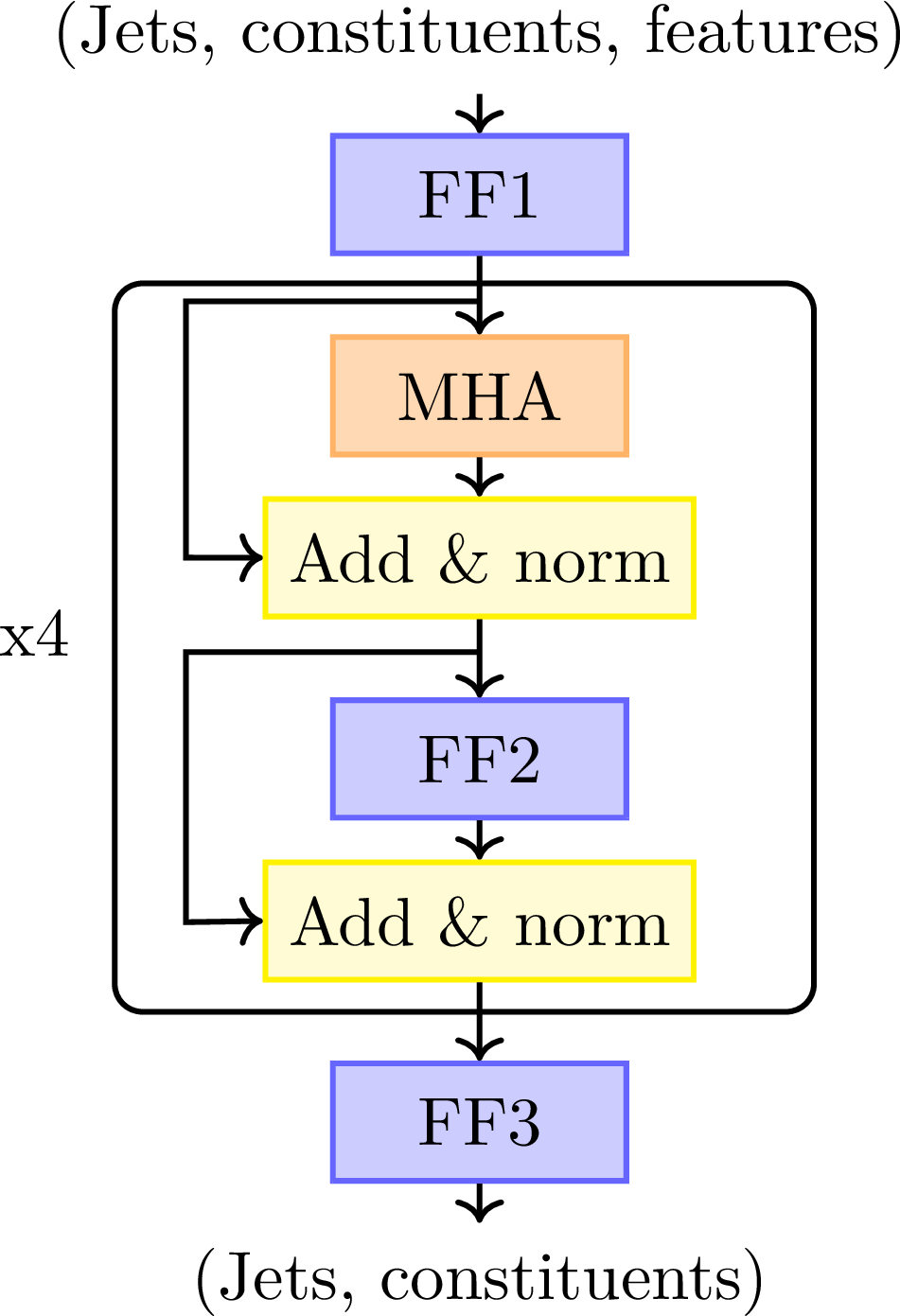
Architecture of the transformer encoder trained to identify b hadron decay products in jets. Input to the network are three-dimensional arrays that represent the number of jets, the number of constituents in a jet, and the number of features. The first feed forward (FF1) block is a single-layered dense network that expands the feature dimension to 128. This is followed by the multihead attention (MHA) block with four heads, and another FF block (FF2) with two layers. Both blocks keep 128 hidden dimensions. Skip connections and layer normalizations (Add & norm) are added in between the MHA and FF1, and after FF2. The MHA, FF2, and Add & norm blocks are repeated together for four different times. The final block is a single-layered FF (FF3) that contracts the final output to two-dimensional arrays representing a sequence of probabilities for each constituent in a jet to be a b hadron decay product or not. |
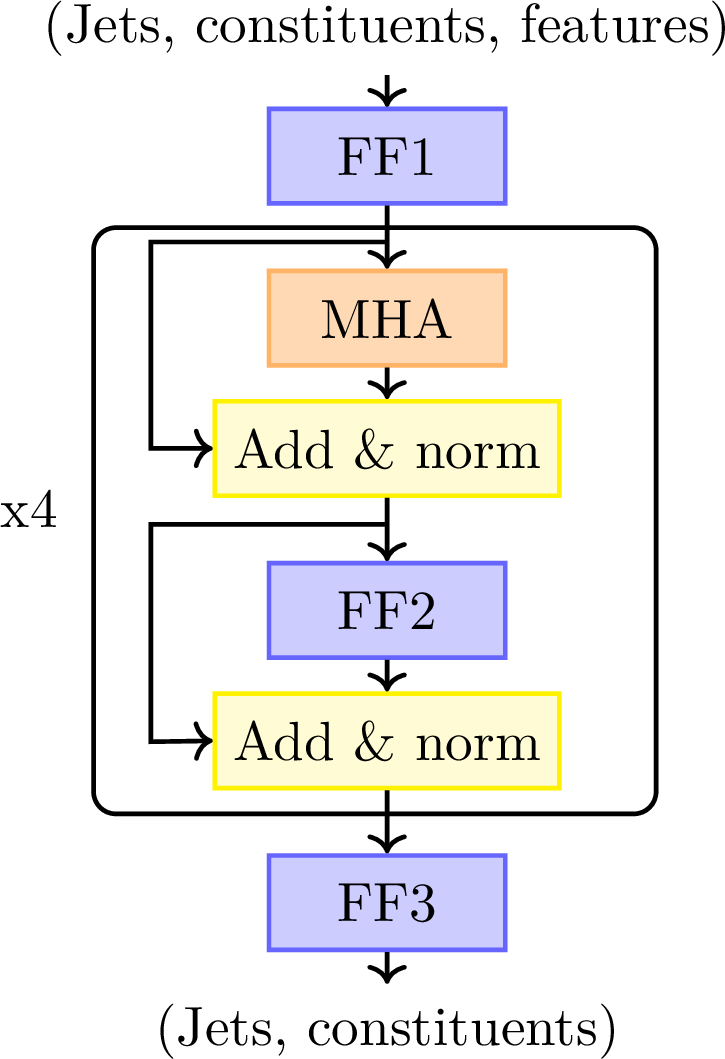
png pdf |
Figure 4-a:
Architecture of the transformer encoder trained to identify b hadron decay products in jets. Input to the network are three-dimensional arrays that represent the number of jets, the number of constituents in a jet, and the number of features. The first feed forward (FF1) block is a single-layered dense network that expands the feature dimension to 128. This is followed by the multihead attention (MHA) block with four heads, and another FF block (FF2) with two layers. Both blocks keep 128 hidden dimensions. Skip connections and layer normalizations (Add & norm) are added in between the MHA and FF1, and after FF2. The MHA, FF2, and Add & norm blocks are repeated together for four different times. The final block is a single-layered FF (FF3) that contracts the final output to two-dimensional arrays representing a sequence of probabilities for each constituent in a jet to be a b hadron decay product or not. |
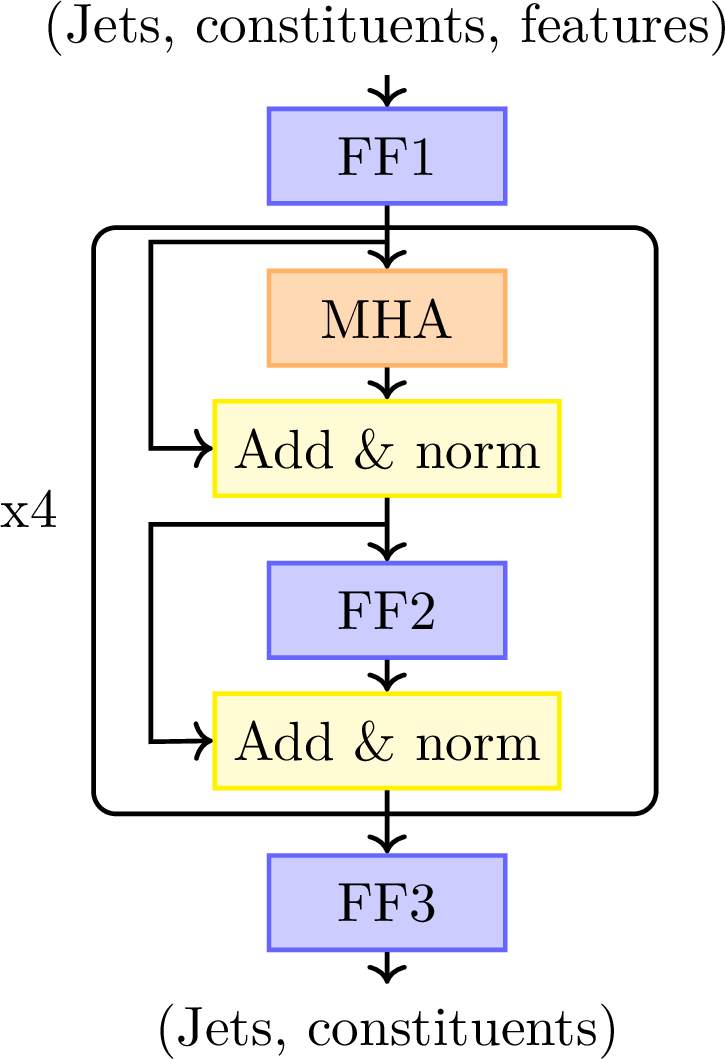
png pdf |
Figure 4-b:
Architecture of the transformer encoder trained to identify b hadron decay products in jets. Input to the network are three-dimensional arrays that represent the number of jets, the number of constituents in a jet, and the number of features. The first feed forward (FF1) block is a single-layered dense network that expands the feature dimension to 128. This is followed by the multihead attention (MHA) block with four heads, and another FF block (FF2) with two layers. Both blocks keep 128 hidden dimensions. Skip connections and layer normalizations (Add & norm) are added in between the MHA and FF1, and after FF2. The MHA, FF2, and Add & norm blocks are repeated together for four different times. The final block is a single-layered FF (FF3) that contracts the final output to two-dimensional arrays representing a sequence of probabilities for each constituent in a jet to be a b hadron decay product or not. |
| Tables | |

png pdf |
Table 1:
Performance of the TFE to identify b hadron decay products in jets in the training, testing, and validation sets of the POWHEG +PYTHIA dileptonic $ \mathrm{t} \overline{\mathrm{t}} $ sample. |
| Summary |
| In summary, a measurement of the emission density distribution in bottom quark initiated jets (b jets) from top quark pair events in proton-proton collisions at $\sqrt{s}=13$ TeV with the CMS detector has been presented. A sample of b jets with minimized flavor tagging biases is selected with a tag-and-probe method. A transformer encoder is trained to partially reconstruct b hadrons in jets and preserve an uncontaminated angle-ordered emission history, reconstructed on the Lund jet plane [36][37]. A new experimental benchmark is provided to compare with analytical quantum chromodynamics predictions including the effect of quark masses [26][51] and for parton shower model development [50]. A suppression of collinear emissions relative to a light-quark simulation is shown by the measured emission density distribution. Compared to data, a parton shower Monte Carlo model that includes the dead-cone effect is favored, while a model without the dead-cone effect is disfavored with a significance of 4.3 standard deviations. |
| References | ||||
| 1 | G. P. Salam | Towards jetography | EPJC 67 (2010) 637 | 0906.1833 |
| 2 | A. J. Larkoski, I. Moult, and B. Nachman | Jet substructure at the Large Hadron Collider: a review of recent advances in theory and machine learning | Phys. Rept. 841 (2020) 1 | 1709.04464 |
| 3 | R. Kogler et al. | Jet substructure at the Large Hadron Collider: experimental review | Rev. Mod. Phys. 91 (2019) 045003 | 1803.06991 |
| 4 | S. Marzani, G. Soyez, and M. Spannowsky | Looking inside jets: an introduction to jet substructure and boosted-object phenomenology | volume 958. Springer, arXiv:.2, 2019 link |
|
| 5 | CMS Collaboration | Observation of Higgs boson decay to bottom quarks | PRL 121 (2018) 121801 | CMS-HIG-18-016 1808.08242 |
| 6 | CMS Collaboration | Search for nonresonant Higgs boson pair production in final states with two bottom quarks and two photons in proton-proton collisions at $ \sqrt{s} = $ 13 TeV | JHEP 03 (2021) 257 | CMS-HIG-19-018 2011.12373 |
| 7 | CMS Collaboration | Search for Higgs boson pair production in the four b quark final state in proton-proton collisions at $ \sqrt{s} = $ 13 TeV | PRL 129 (2022) 081802 | CMS-HIG-20-005 2202.09617 |
| 8 | CMS Collaboration | Search for nonresonant Higgs boson pair production in the four leptons plus two b jets final state in proton-proton collisions at $ \sqrt{s} = $ 13 TeV | JHEP 06 (2023) 130 | CMS-HIG-20-004 2206.10657 |
| 9 | CMS Collaboration | Measurement of the Higgs boson production rate in association with top quarks in final states with electrons, muons, and hadronically decaying tau leptons at $ \sqrt{s} = $ 13 TeV | EPJC 81 (2021) 378 | CMS-HIG-19-008 2011.03652 |
| 10 | CMS Collaboration | Measurement of the $ \textrm{t}\overline{\textrm{t}}\textrm{H} $ and tH production rates in the H $ \rightarrow \textrm{b}\overline{\textrm{b}} $ decay channel using proton-proton collision data at $ \sqrt{s} = $ 13 TeV | JHEP 02 (2025) 097 | CMS-HIG-19-011 2407.10896 |
| 11 | CMS Collaboration | Measurements of $ \mathrm{t\bar{t}}\mathrm{H} $ production and the CP structure of the Yukawa interaction between the Higgs boson and top quark in the diphoton decay channel | PRL 125 (2020) 061801 | CMS-HIG-19-013 2003.10866 |
| 12 | CMS Collaboration | Simultaneous probe of the charm and bottom quark Yukawa couplings using ttH events | PRL 136 (2026) 011801 | CMS-HIG-24-018 2509.22535 |
| 13 | ATLAS, CMS Collaboration | Combination of measurements of the top quark mass from data collected by the ATLAS and CMS experiments at $ \sqrt{s} = $ 7 and 8 TeV | PRL 132 (2024) 261902 | 2402.08713 |
| 14 | CMS Collaboration | Review of top quark mass measurements in CMS | Phys. Rept. 1115 (2025) 116 | CMS-TOP-23-003 2403.01313 |
| 15 | CMS Collaboration | Measurement of differential $ \mathrm{t \bar t} $ production cross sections in the full kinematic range using lepton+jets events from proton-proton collisions at $ \sqrt {s} = $ 13 TeV | PRD 104 (2021) 092013 | CMS-TOP-20-001 2108.02803 |
| 16 | ATLAS, CMS Collaboration | Combination of inclusive top quark pair production cross section measurements using ATLAS and CMS data at $ \sqrt{s} = $ 7 and 8 TeV | JHEP 07 (2023) 213 | 2205.13830 |
| 17 | CMS Collaboration | Measurement of differential $ \mathrm{t\bar{t}} $ production cross sections using top quarks at large transverse momenta in pp collisions at $ \sqrt{s} = $ 13 TeV | PRD 103 (2021) 052008 | CMS-TOP-18-013 2008.07860 |
| 18 | CMS Collaboration | Measurement of $ \mathrm{t\bar t} $ normalized multidifferential cross sections in pp collisions at $ \sqrt s= $ 13 TeV, and simultaneous determination of the strong coupling strength, top quark pole mass, and parton distribution functions | EPJC 80 (2020) 658 | CMS-TOP-18-004 1904.05237 |
| 19 | CMS Collaboration | First measurement of the top quark pair production cross section in proton-proton collisions at $ \sqrt{s} = $ 13.6 TeV | JHEP 08 (2023) 204 | CMS-TOP-22-012 2303.10680 |
| 20 | ATLAS Collaboration | Search for resonances in the mass distribution of jet pairs with one or two jets identified as b jets in proton-proton collisions at $ \sqrt{s}= $ 13 TeV with the ATLAS detector | PRD 98 (2018) 032016 | 1805.09299 |
| 21 | CMS Collaboration | Search for supersymmetry in proton-proton collisions at 13 TeV in final states with jets and missing transverse momentum | JHEP 10 (2019) 244 | CMS-SUS-19-006 1908.04722 |
| 22 | ATLAS Collaboration | Search for supersymmetry in final states with missing transverse momentum and three or more b jets in 139 fb$ ^{-1} $ of proton-proton collisions at $ \sqrt{s} = $ 13 TeV with the ATLAS detector | EPJC 83 (2023) 561 | 2211.08028 |
| 23 | Y. L. Dokshitzer, V. A. Khoze, and S. I. Troian | On specific QCD properties of heavy quark fragmentation ('dead cone') | JPG 17 (1991) 1602 | |
| 24 | Particle Data Group Collaboration | Review of particle physics | PRD 110 (2024) 030001 | |
| 25 | L. Cunqueiro and M. P\l osko \'n | Searching for the dead cone effects with iterative declustering of heavy-flavor jets | PRD 99 (2019) 074027 | 1812.00102 |
| 26 | A. Ghira, S. Marzani, and G. Soyez | The Lund b jet plane | JHEP 05 (2026) 247 | 2512.17408 |
| 27 | DELPHI Collaboration | Hadronization properties of b quarks compared to light quarks in e$ ^+ $ e$ ^- \to \mathrm{q} \overline{\mathrm{q}} $ from 183 to 200 GeV | PLB 479 (2000) 118 | hep-ex/0103022 |
| 28 | CDF Collaboration | Measurement of b jet shapes in inclusive jet production in $ \mathrm{p}\bar{\mathrm{p}} $ collisions at $ \sqrt{s} = $ 1.96 TeV | PRD 78 (2008) 072005 | 0806.1699 |
| 29 | ATLAS Collaboration | Measurement of jet shapes in top quark pair events at $ \sqrt{s} = $ 7 TeV using the ATLAS detector | EPJC 73 (2013) 2676 | 1307.5749 |
| 30 | S. Kluth, W. Ochs, and R. Perez Ramos | Observation of the dead cone effect in charm and bottom quark jets and its QCD explanation | PRD 107 (2023) 094039 | 2303.13343 |
| 31 | ALICE Collaboration | Direct observation of the dead-cone effect in quantum chromodynamics | Nature 605 (2022) 440 | 2106.05713 |
| 32 | LHCb Collaboration | Measurement of the Lund plane for light- and beauty-quark jets | PRD 112 (2025) 072015 | 2505.23530 |
| 33 | CMS Collaboration | Jet fragmentation function and groomed substructure of bottom quark jets in proton-proton collisions at 5.02 TeV | JHEP 04 (2026) 147 | CMS-HIN-24-005 2511.10666 |
| 34 | CMS Collaboration | Exploring small-angle emissions in charm quark jets in proton-proton collisions at $ \sqrt{s}= $ 5.02 TeV | JHEP 05 (2026) 176 | CMS-HIN-24-007 2507.13469 |
| 35 | CMS Collaboration | Precision luminosity measurement in proton-proton collisions at 13 TeV with the CMS detector | CMS Physics Analysis Summary, 2025 CMS-PAS-LUM-20-001 |
CMS-PAS-LUM-20-001 |
| 36 | B. Andersson, G. Gustafson, L. L ö nnblad, and U. Pettersson | Coherence effects in deep inelastic scattering | Z. Phys. C 43 (1989) 625 | |
| 37 | F. A. Dreyer, G. P. Salam, and G. Soyez | The Lund jet plane | JHEP 12 (2018) 064 | 1807.04758 |
| 38 | ATLAS Collaboration | Explaining the ATLAS GN2 flavor tagging algorithm with integrated gradients | ATLAS Public Note ATL-PHYS-PUB-2025-029, 2025 | |
| 39 | CMS Collaboration | Identification of heavy-flavor jets with the CMS detector in pp collisions at 13 TeV | JINST 13 (2018) P05011 | CMS-BTV-16-002 1712.07158 |
| 40 | CMS Collaboration | Measurements of inclusive W and Z cross sections in pp collisions at $ \sqrt{s}= $ 7 TeV | JHEP 01 (2011) 080 | CMS-EWK-10-002 1012.2466 |
| 41 | CMS Collaboration | Performance of the CMS muon detector and muon reconstruction with proton-proton collisions at $ \sqrt{s}= $ 13 TeV | JINST 13 (2018) P06015 | CMS-MUO-16-001 1804.04528 |
| 42 | CMS Collaboration | Electron and photon reconstruction and identification with the CMS experiment at the CERN LHC | JINST 16 (2021) P05014 | CMS-EGM-17-001 2012.06888 |
| 43 | ATLAS Collaboration | Measurements of jet observables sensitive to b quark fragmentation in $ \mathrm{t\bar{t}} $ events at the LHC with the ATLAS detector | PRD 106 (2022) 032008 | 2202.13901 |
| 44 | ATLAS Collaboration | Measurement of the Lund jet plane using charged particles in 13 TeV proton-proton collisions with the ATLAS detector | PRL 124 (2020) 222002 | 2004.03540 |
| 45 | ALICE Collaboration | Measurement of the primary Lund jet plane density in pp collisions at $ \sqrt{s} = \rm{13} $ TeV with ALICE | PoS EPS-HEP 364, 2022 link |
2111.00020 |
| 46 | CMS Collaboration | Measurement of the primary Lund jet plane density in proton-proton collisions at $ \sqrt{\textrm{s}} = $ 13 TeV | JHEP 05 (2024) 116 | CMS-SMP-22-007 2312.16343 |
| 47 | ATLAS Collaboration | Measurements of Lund subjet multiplicities in 13 TeV proton-proton collisions with the ATLAS detector | PLB 859 (2024) 139090 | 2402.13052 |
| 48 | M. Cacciari, G. P. Salam, and G. Soyez | The anti-$ k_t $ jet clustering algorithm | JHEP 04 (2008) 063 | 0802.1189 |
| 49 | Y. L. Dokshitzer, G. D. Leder, S. Moretti, and B. R. Webber | Better jet clustering algorithms | JHEP 08 (1997) 001 | hep-ph/9707323 |
| 50 | M. Dasgupta et al. | Parton showers beyond leading logarithmic accuracy | PRL 125 (2020) 052002 | 2002.11114 |
| 51 | A. Lifson, G. P. Salam, and G. Soyez | Calculating the primary Lund jet plane density | JHEP 10 (2020) 170 | 2007.06578 |
| 52 | A. Buckley et al. | rivet user manual | Comput. Phys. Commun. 184 (2013) 2803 | 1003.0694 |
| 53 | CMS Collaboration | HEPData record for this analysis | link | |
| 54 | CMS Collaboration | The CMS experiment at the CERN LHC | JINST 3 (2008) S08004 | |
| 55 | CMS Collaboration | Development of the CMS detector for the CERN LHC Run 3 | JINST 19 (2024) P05064 | CMS-PRF-21-001 2309.05466 |
| 56 | CMS Collaboration | Performance of the CMS Level-1 trigger in proton-proton collisions at $ \sqrt{s} = $ 13 TeV | JINST 15 (2020) P10017 | CMS-TRG-17-001 2006.10165 |
| 57 | CMS Collaboration | The CMS trigger system | JINST 12 (2017) P01020 | CMS-TRG-12-001 1609.02366 |
| 58 | CMS Collaboration | Performance of the CMS high-level trigger during LHC Run 2 | JINST 19 (2024) P11021 | CMS-TRG-19-001 2410.17038 |
| 59 | CMS Collaboration | Description and performance of track and primary-vertex reconstruction with the CMS tracker | JINST 9 (2014) P10009 | CMS-TRK-11-001 1405.6569 |
| 60 | CMS Collaboration | Particle-flow reconstruction and global event description with the CMS detector | JINST 12 (2017) P10003 | CMS-PRF-14-001 1706.04965 |
| 61 | CMS Collaboration | Technical proposal for the Phase-II upgrade of the Compact Muon Solenoid | CMS Technical Proposal CERN-LHCC-2015-010, CMS-TDR-15-02, 2015 CDS |
|
| 62 | CMS Collaboration | Pileup mitigation at CMS in 13 TeV data | JINST 15 (2020) P09018 | CMS-JME-18-001 2003.00503 |
| 63 | CMS Collaboration | Measurement of $ \mathrm{B}\bar{\mathrm{B}} $ angular correlations based on secondary vertex reconstruction at $ \sqrt{s}= $ 7 TeV | JHEP 03 (2011) 136 | CMS-BPH-10-010 1102.3194 |
| 64 | M. Cacciari, G. P. Salam, and G. Soyez | Fastjet user manual | EPJC 72 (2012) 1896 | 1111.6097 |
| 65 | CMS Collaboration | Jet energy scale and resolution in the CMS experiment in pp collisions at 8 TeV | JINST 12 (2017) P02014 | CMS-JME-13-004 1607.03663 |
| 66 | M. Cacciari and G. P. Salam | Pileup subtraction using jet areas | PLB 659 (2008) 119 | 0707.1378 |
| 67 | ATLAS Collaboration | Measurement of jet track functions in pp collisions at $ \sqrt{s}= $ 13 TeV with the ATLAS detector | PLB 868 (2025) 139680 | 2502.02062 |
| 68 | P. Nason | A new method for combining NLO QCD with shower Monte Carlo algorithms | JHEP 11 (2004) 040 | hep-ph/0409146 |
| 69 | S. Frixione, P. Nason, and C. Oleari | Matching NLO QCD computations with parton shower simulations: the powheg method | JHEP 11 (2007) 070 | 0709.2092 |
| 70 | S. Alioli, P. Nason, C. Oleari, and E. Re | A general framework for implementing NLO calculations in shower Monte Carlo programs: the powheg box | JHEP 06 (2010) 043 | 1002.2581 |
| 71 | S. Alioli et al. | Jet pair production in powheg | JHEP 04 (2011) 081 | 1012.3380 |
| 72 | S. Alioli, P. Nason, C. Oleari, and E. Re | NLO Higgs boson production via gluon fusion matched with shower in powheg | JHEP 04 (2009) 002 | 0812.0578 |
| 73 | E. Bagnaschi, G. Degrassi, P. Slavich, and A. Vicini | Higgs production via gluon fusion in the powheg approach in the SM and in the MSSM | JHEP 02 (2012) 088 | 1111.2854 |
| 74 | G. Heinrich et al. | NLO predictions for Higgs boson pair production with full top quark mass dependence matched to parton showers | JHEP 08 (2017) 088 | 1703.09252 |
| 75 | G. Buchalla et al. | Higgs boson pair production in non-linear effective field theory with full $ m_\mathrm{t} $-dependence at NLO QCD | JHEP 09 (2018) 057 | 1806.05162 |
| 76 | R. Frederix and S. Frixione | Merging meets matching in mc@nlo | JHEP 12 (2012) 061 | 1209.6215 |
| 77 | T. Sj ö strand et al. | An introduction to pythia 8.2 | Comput. Phys. Commun. 191 (2015) 159 | 1410.3012 |
| 78 | CMS Collaboration | Extraction and validation of a new set of CMS pythia 8 tunes from underlying-event measurements | EPJC 80 (2020) 4 | CMS-GEN-17-001 1903.12179 |
| 79 | NNPDF Collaboration Collaboration | Parton distributions from high-precision collider data | EPJC 77 (2017) 663 | 1706.00428 |
| 80 | J. Bellm et al. | herwig 7.0/herwig++ 3.0 release note | EPJC 76 (2016) 196 | 1512.01178 |
| 81 | CMS Collaboration | Development and validation of herwig 7 tunes from CMS underlying-event measurements | EPJC 81 (2021) 312 | CMS-GEN-19-001 2011.03422 |
| 82 | J. Bellm et al. | The physics of herwig 7 | 2512.16645 | |
| 83 | GEANT4 Collaboration | GEANT 4---a simulation toolkit | NIM A 506 (2003) 250 | |
| 84 | E. Bols et al. | Jet flavor classification using DeepJet | JINST 15 (2020) P12012 | 2008.10519 |
| 85 | et al. | Attention is all you need | A. Vaswani in Advances in neural information processing systems, I. Guyon et al., eds., volume 30. Curran Associates, Inc, 2017 link |
1706.03762 |
| 86 | G. D'Agostini | A multidimensional unfolding method based on Bayes' theorem | NIM A 362 (1995) 487 | |
| 87 | L. Brenner et al. | Comparison of unfolding methods using RooFitUnfold | Int. J. Mod. Phys. A 35 (2020) 2050145 | 1910.14654 |
| 88 | L. Demortier | P values and nuisance parameters | in Proc. Workshop on statistical issues for LHC physics, PHYSTAT-LHC\/, 2007 link |
|
| 89 | CMS Collaboration | Tracking performances for charged pions with Run2 Legacy data | CMS Detector Performance Summary CMS-DP-2022-012, 2022 CDS |
|
| 90 | J. Butterworth et al. | PDF4LHC recommendations for LHC Run II | JPG 43 (2016) 023001 | 1510.03865 |
| 91 | PDF4LHC Working Group Collaboration | The PDF4LHC21 combination of global PDF fits for the LHC Run III | JPG 49 (2022) 080501 | 2203.05506 |
| 92 | CMS Collaboration | Measurements of $ \mathrm{t\overline{t}} $ differential cross sections in proton-proton collisions at $ \sqrt{s}= $ 13 TeV using events containing two leptons | JHEP 02 (2019) 149 | CMS-TOP-17-014 1811.06625 |
| 93 | CMS Collaboration | Measurement of differential cross sections for top quark pair production using the lepton+jets final state in proton-proton collisions at 13 TeV | PRD 95 (2017) 092001 | CMS-TOP-16-008 1610.04191 |
| 94 | CMS Collaboration | Performance of b tagging algorithms in proton-proton collisions at 13 TeV with Phase 1 CMS detector | CMS Detector Performance Note CMS-DP-2018-033, 2018 CDS |
|
| 95 | CMS Collaboration | Measurement of the inelastic proton-proton cross section at $ \sqrt{s}= $ 13 TeV | JHEP 07 (2018) 161 | CMS-FSQ-15-005 1802.02613 |
| 96 | B. Efron | Bootstrap methods: another look at the jackknife | Annals Statist. 7 (1979) 1 | |
| 97 | SLD Collaboration | A measurement of $ R_{b} $ using a vertex mass tag | PRL 80 (1998) 660 | hep-ex/9708015 |
| 98 | A. Paszke et al. | PyTorch: an imperative style, high-performance deep learning library | in 3rd Int. Conf. on Neural Information Processing Systems\/, Curran Associates Inc, 2019 Proc. 3 (2019) 12 |
1912.01703 |
| 99 | J. Ansel et al. | PyTorch 2: faster machine learning through dynamic python bytecode transformation and graph compilation | in the ACM Int. Conf. on Architectural Support for Programming Languages and Operating Systems\/, ASPLOS '24, Association for Computing Machinery, 2024 Proc. 2 (2024) 929 |
|
| 100 | I. Loshchilov and F. Hutter | Decoupled weight decay regularization | in Proc. Int. Conf. on Learning Representations\/, 2017 | 1711.05101 |
|
|
Compact Muon Solenoid LHC, CERN |

|
|
|
|
|
|