Compact Muon Solenoid
LHC, CERN
 Visit us: CMS Public Website, CMS Physics ;
Contact us: CMS Publications Committee
Visit us: CMS Public Website, CMS Physics ;
Contact us: CMS Publications Committee
| CMS-HIN-24-005 ; CERN-EP-2025-058 | ||
| Jet fragmentation function and groomed substructure of bottom quark jets in proton-proton collisions at 5.02 TeV | ||
| CMS Collaboration | ||
| 7 November 2025 | ||
| JHEP 04 (2026) 147 | ||
| Abstract: A measurement of the substructure of bottom quark jets (b jets) in proton-proton (pp) collisions is presented. The measurement uses data collected in pp collisions at $ \sqrt{s} = $ 5.02 TeV recorded by the CMS experiment in 2017, corresponding to an integrated luminosity of 301 pb$^{-1}$. An algorithm to identify and cluster the charged decay daughters of b hadrons is developed for this analysis, which facilitates the exposure of the gluon radiation pattern of b jets using iterative Cambridge--Aachen declustering. The soft-drop-groomed jet radius, $ R_{\mathrm{g}} $, and momentum balance, $ z_{\mathrm{g}} $, of b quark jets are presented. These observables can be used to test perturbative quantum chromodynamics predictions that account for mass effects. Because the b hadron is partially reconstructed from its charged decay daughters, only charged particles are used for the jet substructure studies. In addition, a jet fragmentation function, $ z_{{\mathrm{b},\text{ch}}} $, is measured, which is defined as the distribution of the ratio of the transverse momentum ($ p_{\mathrm{T}} $) of the partially reconstructed b hadron with respect to the charged-particle component of the jet $ p_{\mathrm{T}} $. The substructure variable distributions are unfolded to the charged-particle level. The b jet substructure is compared to the substructure of jets in an inclusive jet sample that is dominated by light-quark and gluon jets in order to assess the role of the b quark mass. A strong suppression of emissions at small $ R_{\mathrm{g}} $ values is observed for b jets when compared to inclusive jets, consistent with the dead-cone effect. The measurement is also compared with theoretical predictions from Monte Carlo event generators. This is the first substructure measurement of b jets that clusters together the b hadron decay daughters. | ||
| Links: e-print arXiv:2511.10666 [hep-ex] (PDF) ; CDS record ; inSPIRE record ; CADI line (restricted) ; | ||
| Figures | |
png pdf |
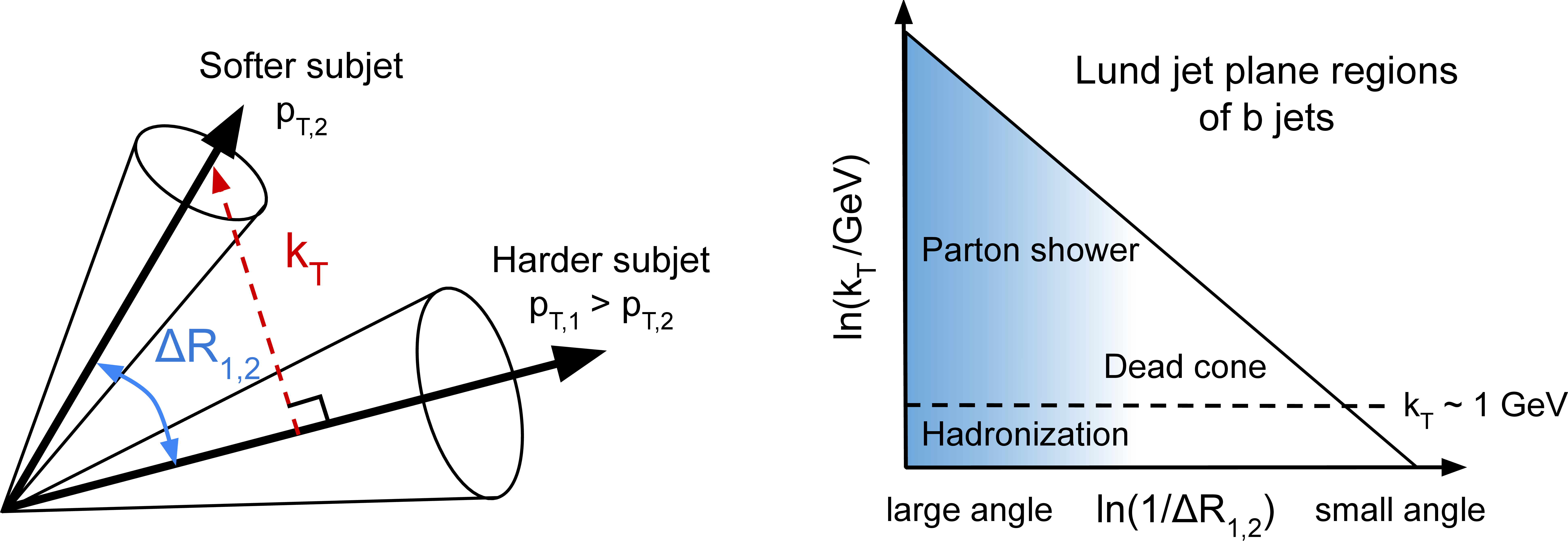
Figure 1:
Left panel: A schematic diagram of two Cambridge--Aachen subjets, such as those found with the soft-drop grooming algorithm. The splitting angle $ \Delta R_{1,2} $ and the relative transverse momentum $ k_{\mathrm{T}} $ between the two subjets are annotated. Right panel: The Lund jet plane regions of bottom quark jets. The vertical axis is the logarithm of the relative transverse momentum $ k_{\mathrm{T}}/ $GeV of the softer subjet with respect to the harder subjet. The horizontal axis is the logarithm of the inverse of the opening angle between the softer and harder subjets, $ \Delta R_{1,2} $. The Lund jet plane is expected to be dominated by hadronization effects for $ k_{\mathrm{T}} $ below the GeV scale. Above the GeV scale, the Lund jet plane provides information on the parton showering description. Emissions are suppressed at small angles due to the dead-cone effect. The b hadron decays (not depicted) populate the same region. The blue shading, fading from left to right, represents the density of emissions in the primary Lund jet plane for b quark jets. |
png pdf |
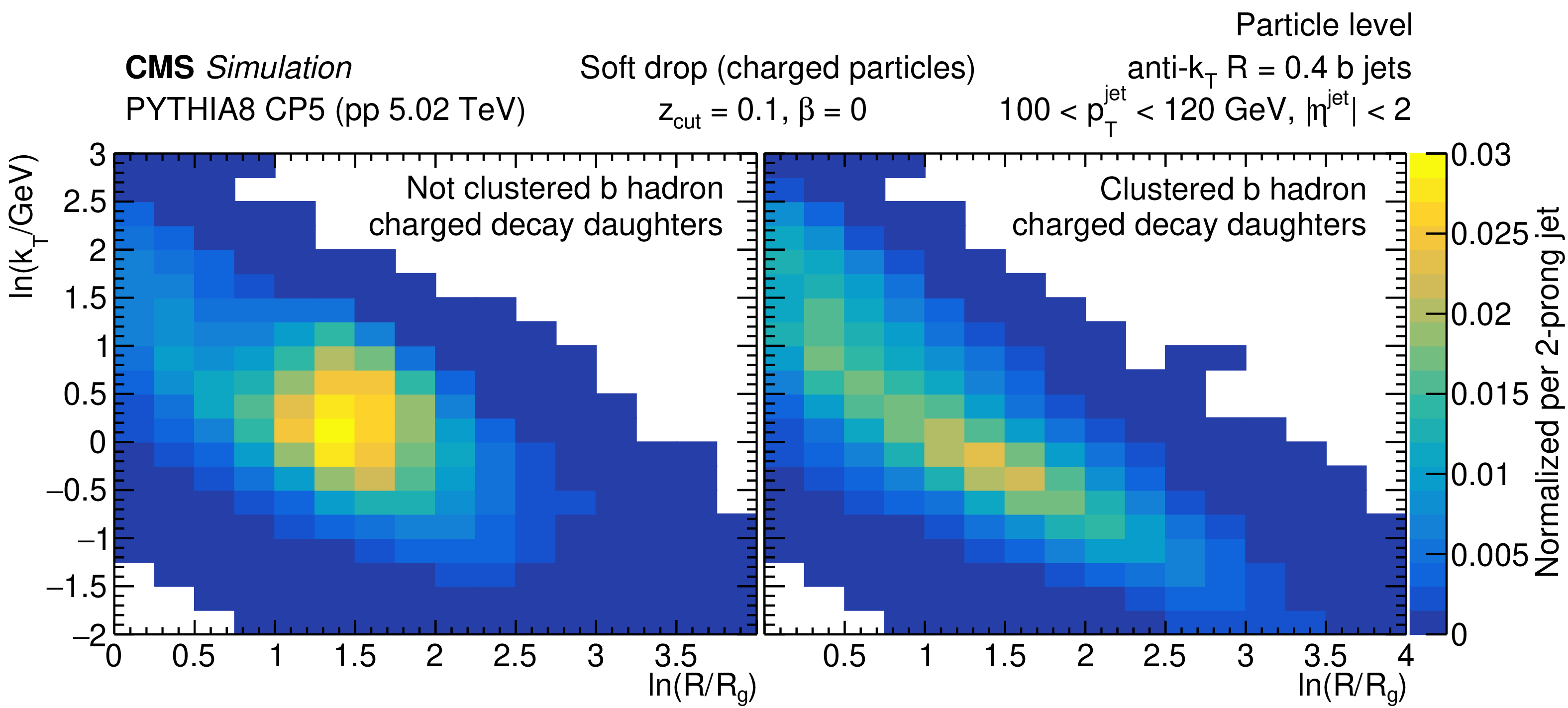
Figure 2:
The Lund jet plane of the soft-drop emissions of b quark jets at the particle-level of the PYTHIA8 CP5 simulation. The vertical axis is the logarithm of the $ k_{\mathrm{T}}/ $GeV of the emission, whereas the horizontal axis is the logarithm of $ R $/$ R_{\mathrm{g}} $, such that large-angle emissions populate the left-hand side of the diagrams and small-angle emissions populate the right-hand side. On the left-hand side, the SD algorithm is applied to the charged-particle jet constituents including the b hadron decay daughters. On the right-hand side, the b hadron charged decay daughters have been clustered together prior to the SD grooming, i.e.,, the charged component of the b hadron remains intact. The effect of the decays can be observed in the yellow hotspot at small angles and low $ k_{\mathrm{T}} $ on the left. |
png pdf |
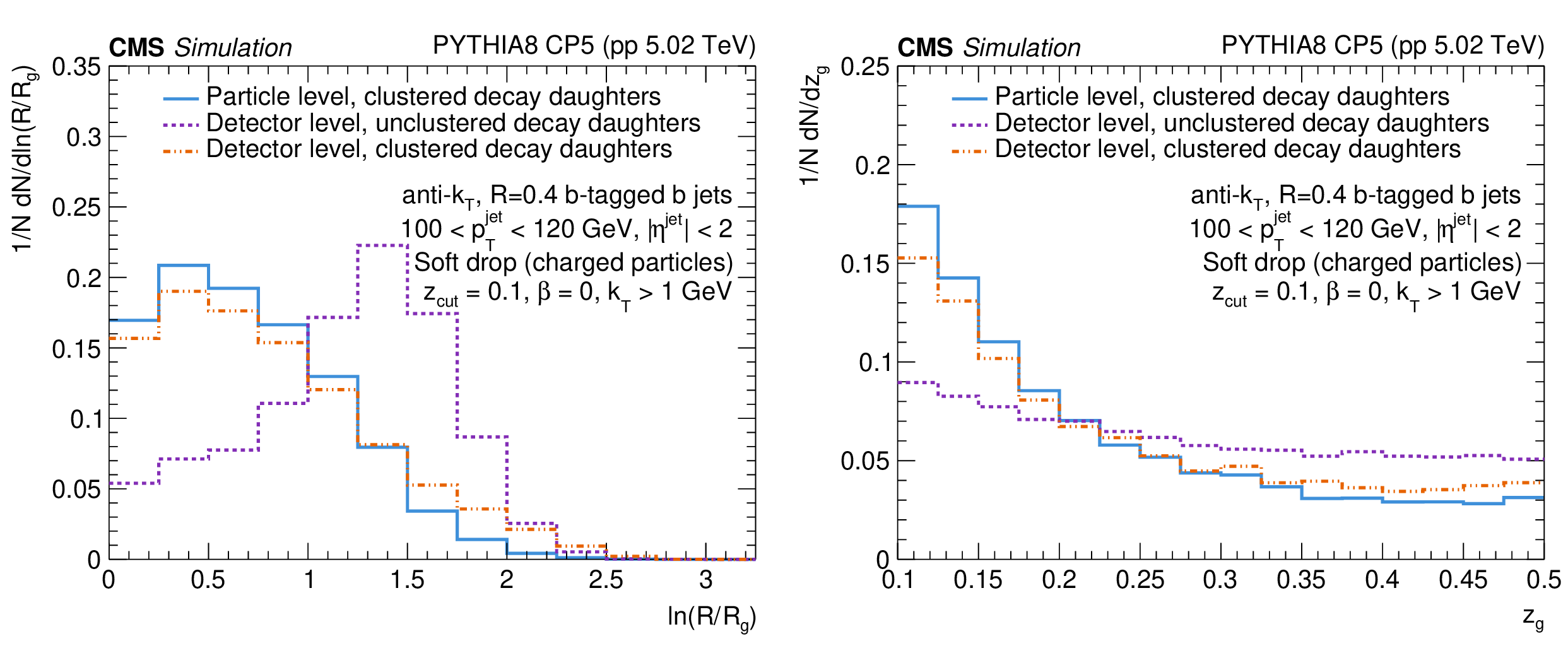
Figure 3:
The modification of the $ R_{\mathrm{g}} $ (left) and $ z_{\mathrm{g}} $ (right) distributions at the detector level without (violet dotted curve) and with (orange dashed-dotted curve) the partial reconstruction of the b hadron, compared to the particle-level distribution with the charged part of the generated b hadron intact (blue solid curve). The events are produced by the PYTHIA8 CP5 generator. |
png pdf |
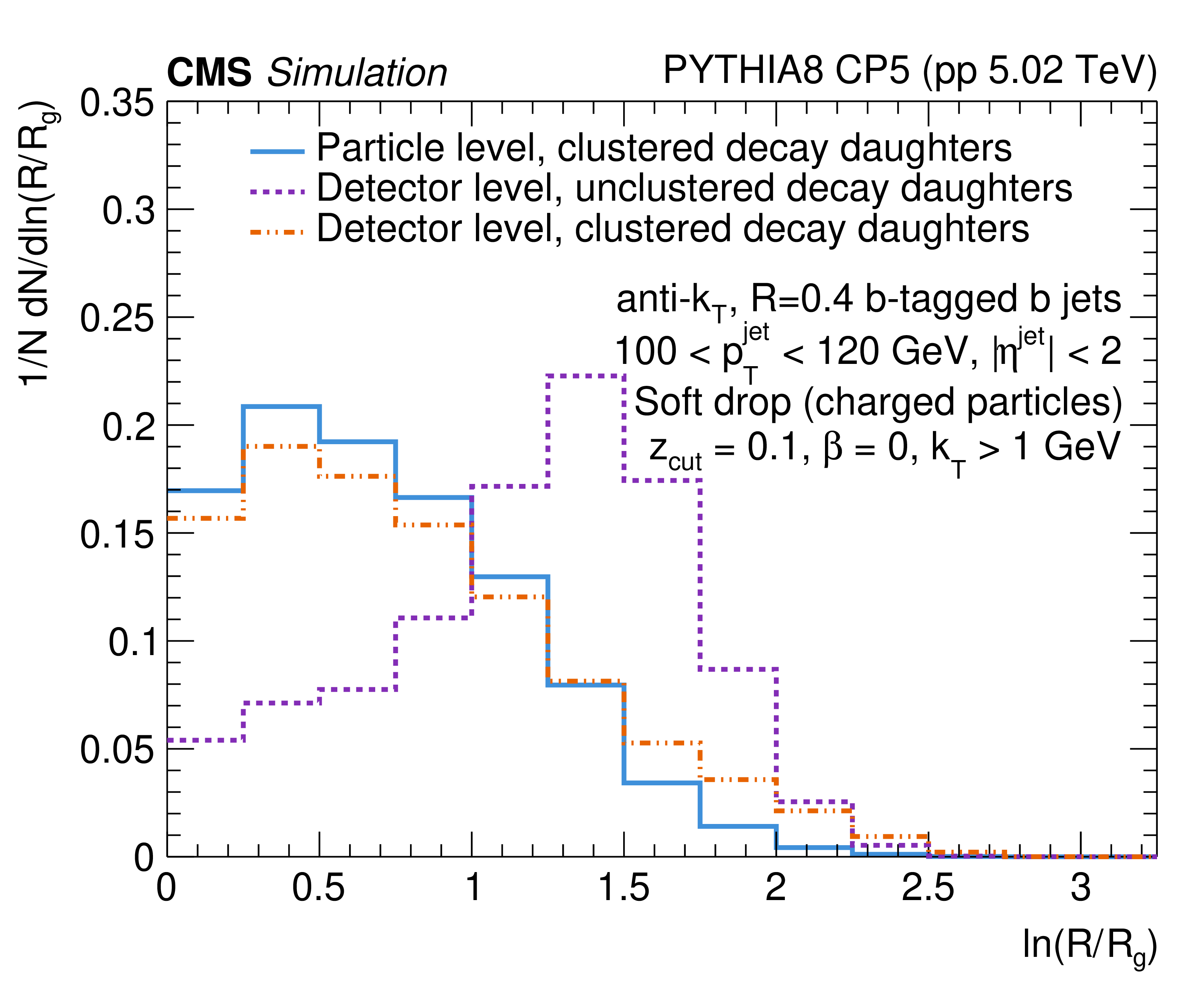
Figure 3-a:
The modification of the $ R_{\mathrm{g}} $ (left) and $ z_{\mathrm{g}} $ (right) distributions at the detector level without (violet dotted curve) and with (orange dashed-dotted curve) the partial reconstruction of the b hadron, compared to the particle-level distribution with the charged part of the generated b hadron intact (blue solid curve). The events are produced by the PYTHIA8 CP5 generator. |
png pdf |
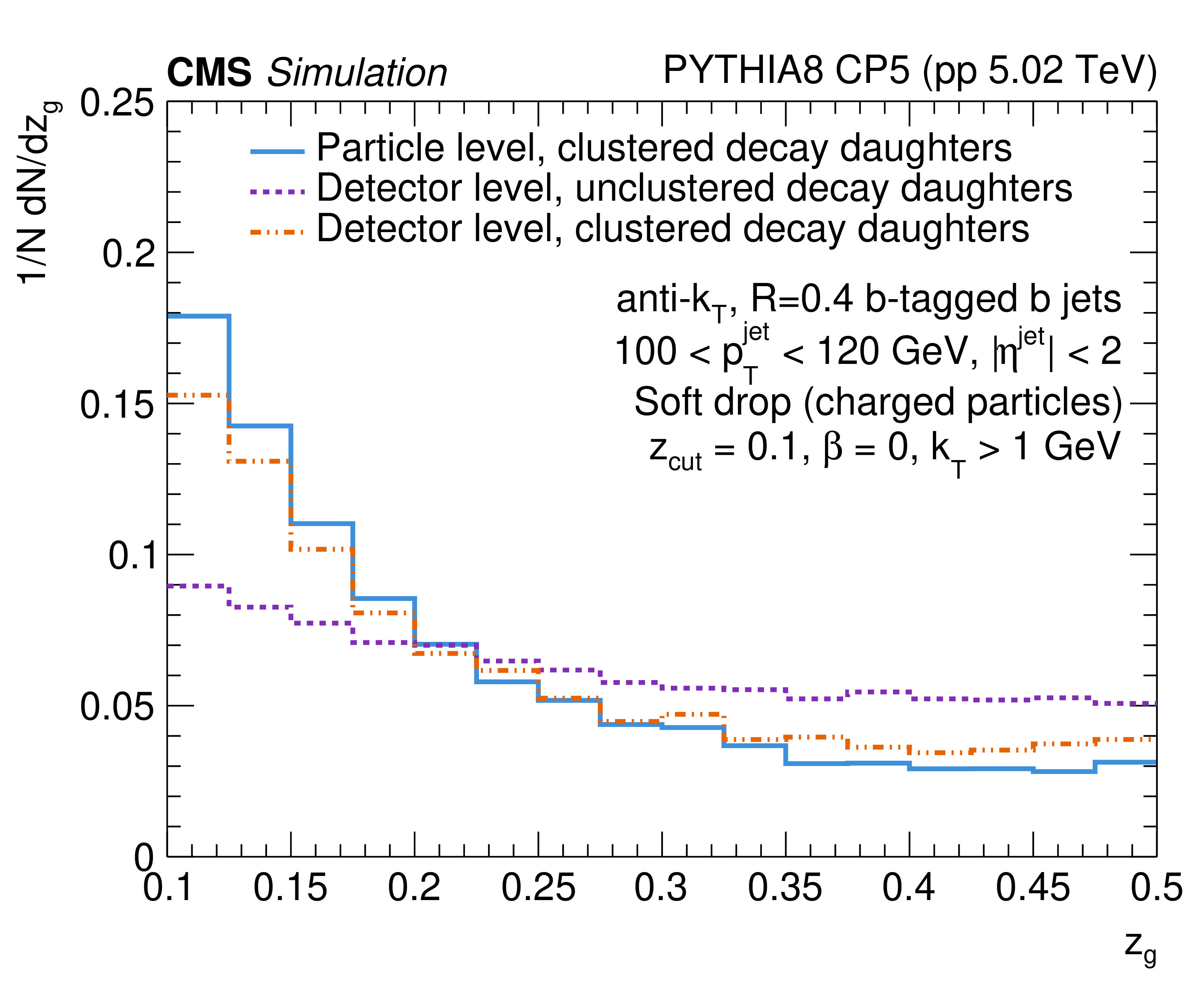
Figure 3-b:
The modification of the $ R_{\mathrm{g}} $ (left) and $ z_{\mathrm{g}} $ (right) distributions at the detector level without (violet dotted curve) and with (orange dashed-dotted curve) the partial reconstruction of the b hadron, compared to the particle-level distribution with the charged part of the generated b hadron intact (blue solid curve). The events are produced by the PYTHIA8 CP5 generator. |
png pdf |
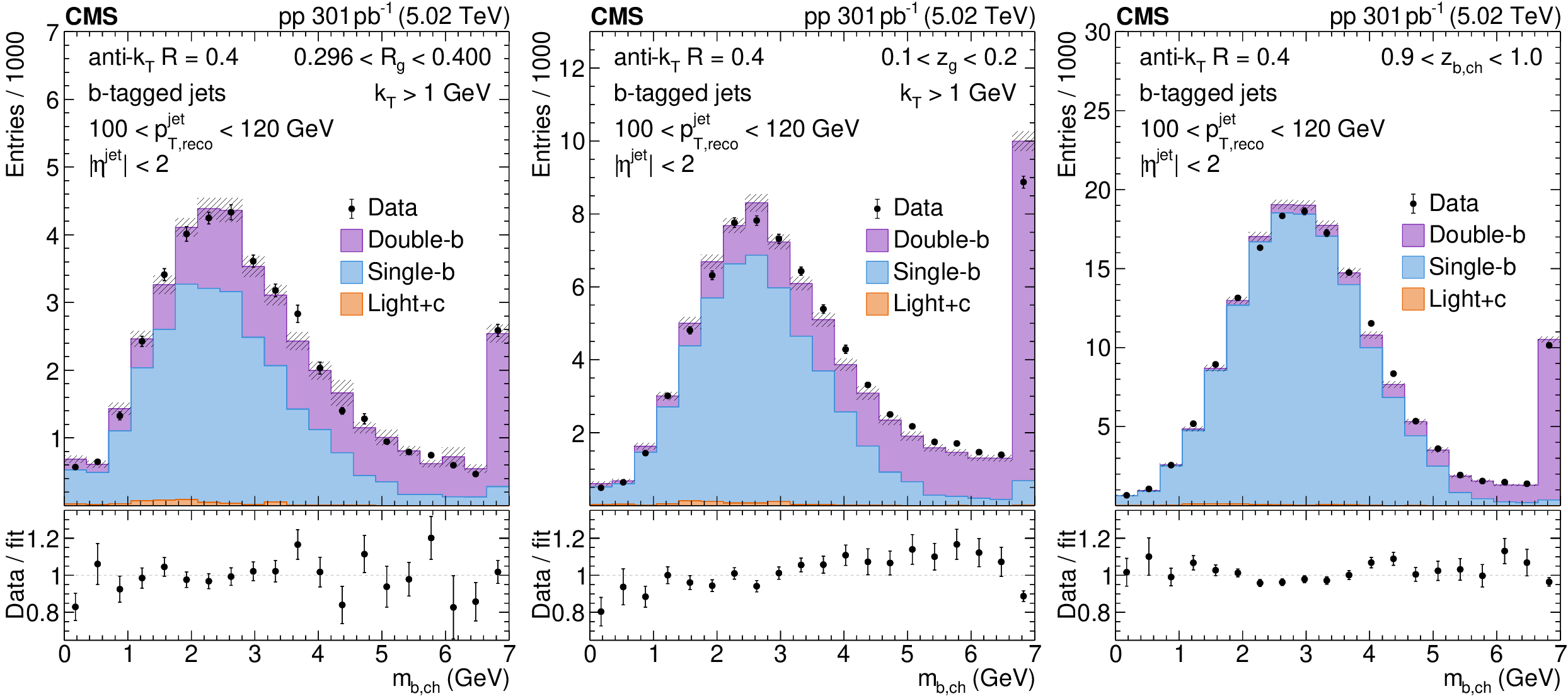
Figure 4:
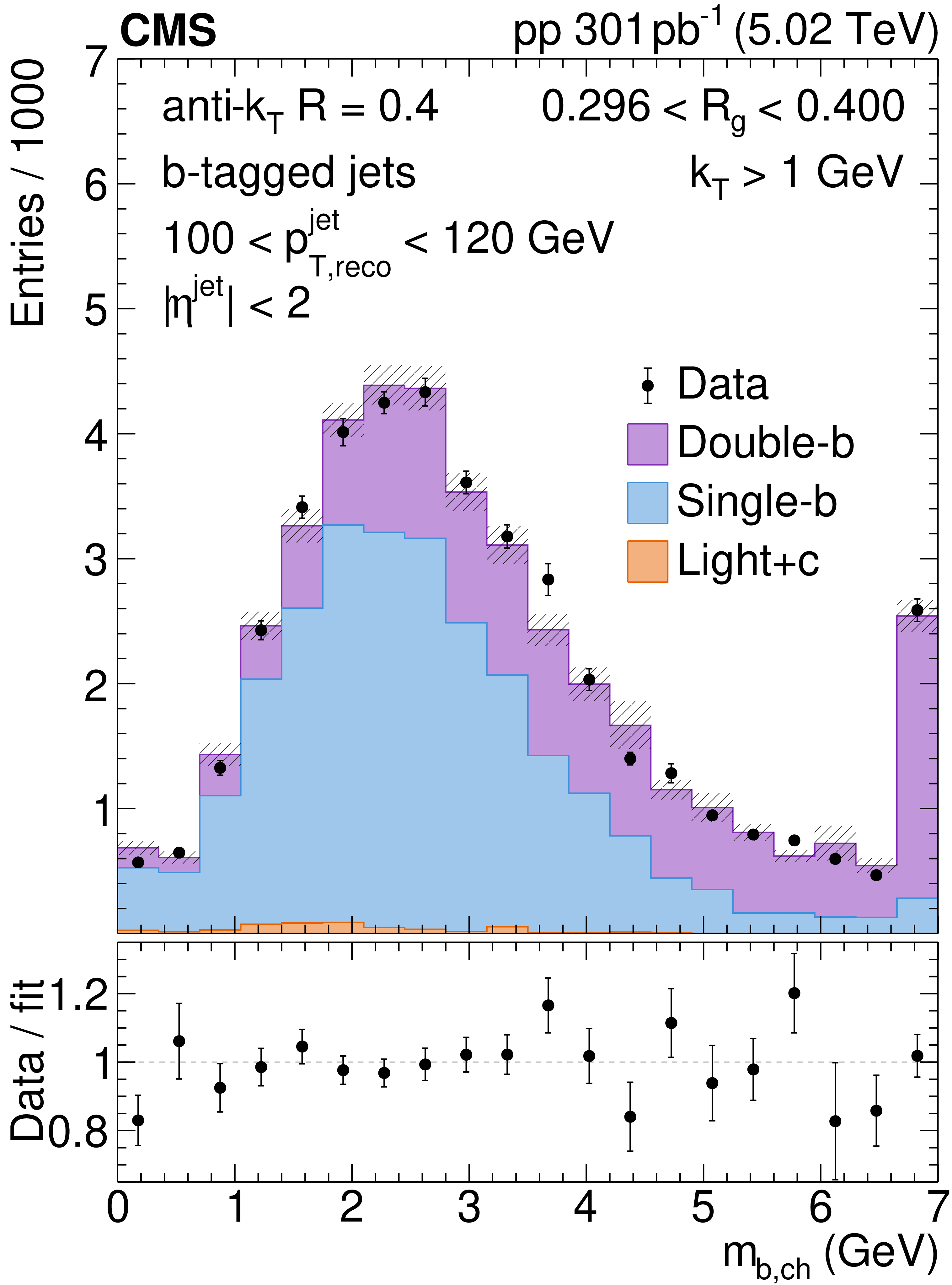
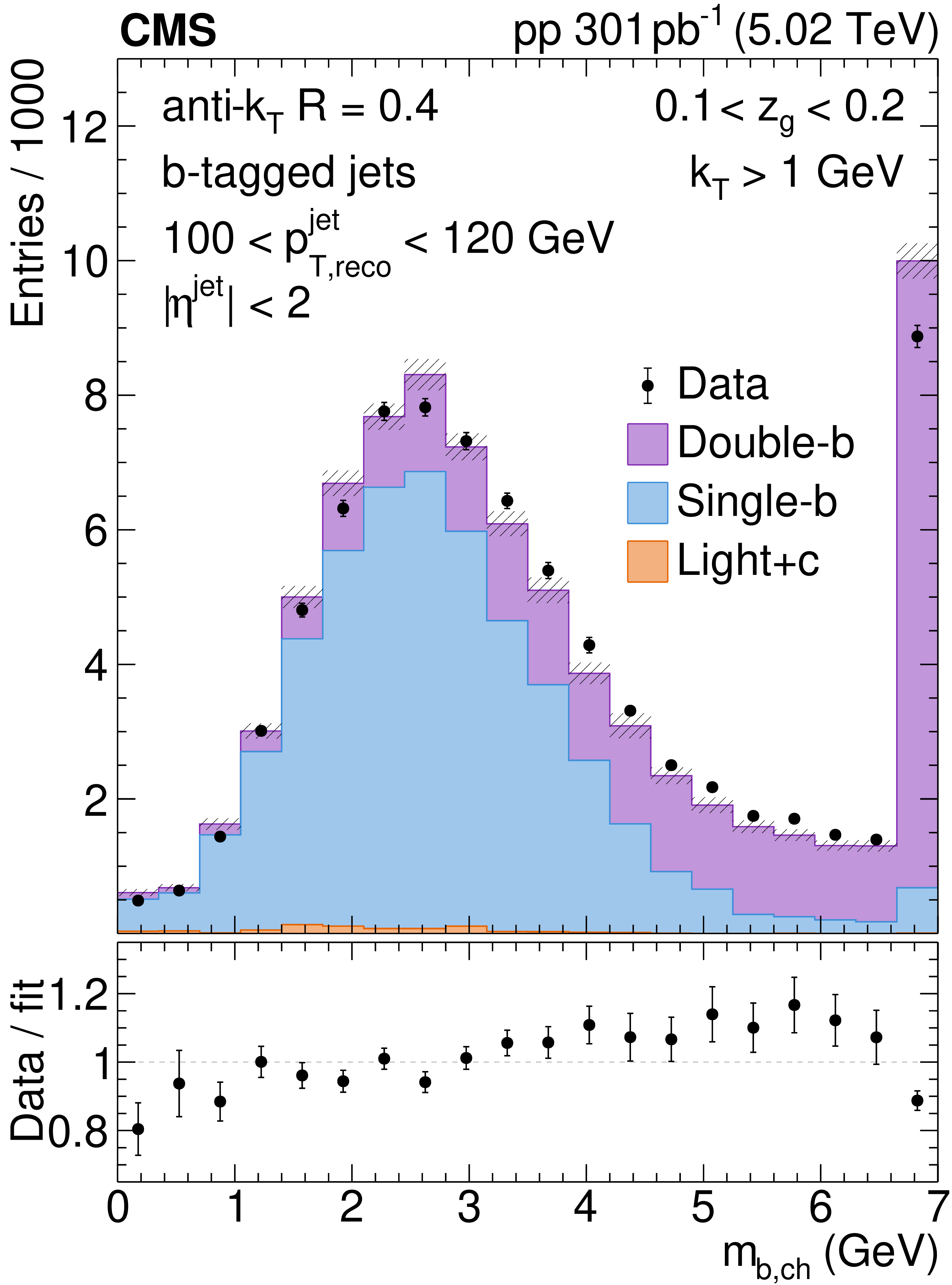
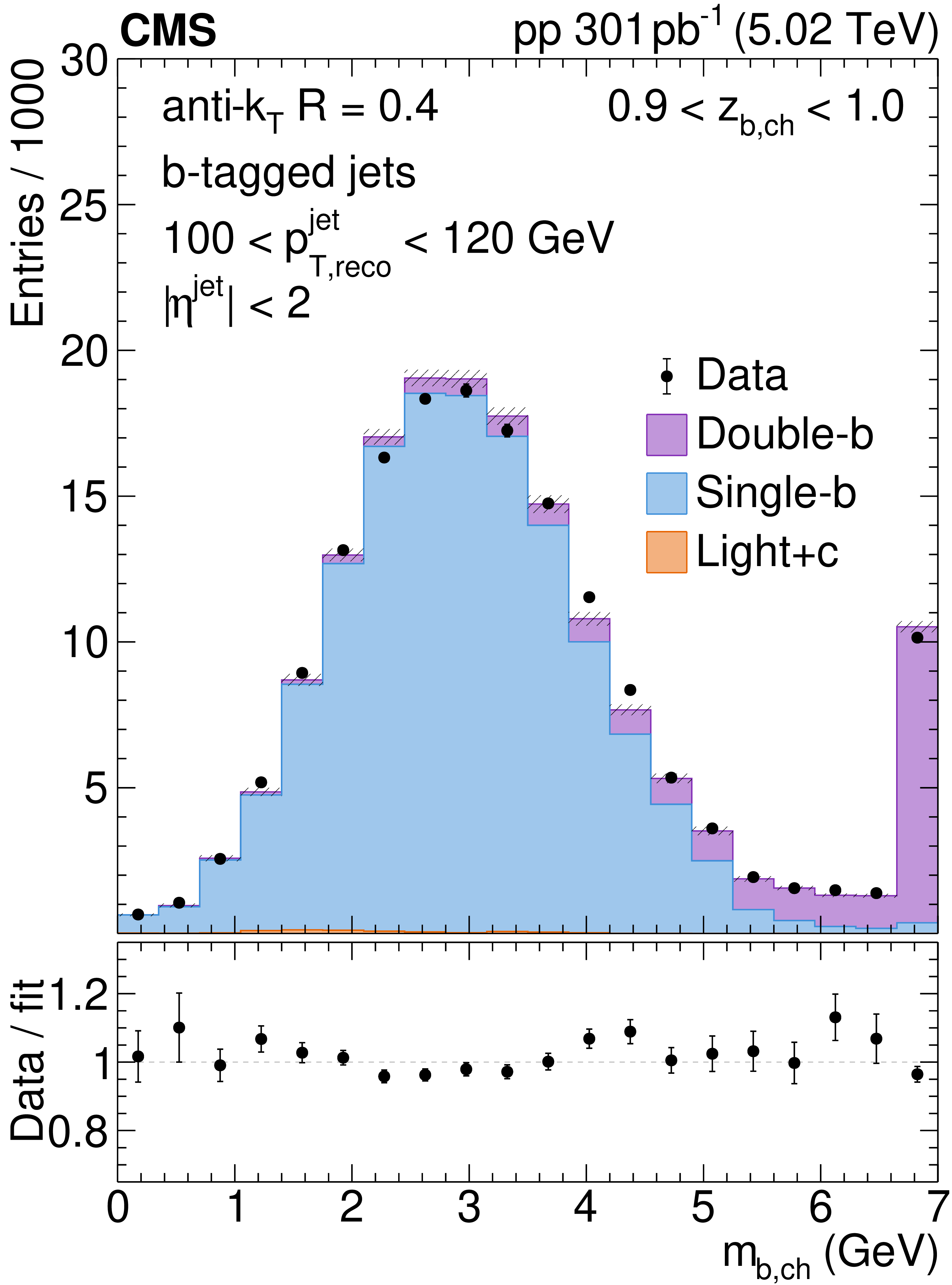
Examples of the fit of the partially reconstructed b hadron mass to double-b, single-b, and light+c jet templates coming from PYTHIA8 CP5. From left to right, the distributions in selected $ R_{\mathrm{g}} $, $ z_{\mathrm{g}} $, and $ z_{{\mathrm{b},\text{ch}}} $ bins are presented. The black points represent the data counts, while the violet, blue, and orange filled curves represent the double-b, single-b, and light+c jet templates, with the fractions acquired from the fit. The ratio between the data and the fit values is presented in the lower panels. |
png pdf |
Figure 4-a:
Examples of the fit of the partially reconstructed b hadron mass to double-b, single-b, and light+c jet templates coming from PYTHIA8 CP5. From left to right, the distributions in selected $ R_{\mathrm{g}} $, $ z_{\mathrm{g}} $, and $ z_{{\mathrm{b},\text{ch}}} $ bins are presented. The black points represent the data counts, while the violet, blue, and orange filled curves represent the double-b, single-b, and light+c jet templates, with the fractions acquired from the fit. The ratio between the data and the fit values is presented in the lower panels. |
png pdf |
Figure 4-b:
Examples of the fit of the partially reconstructed b hadron mass to double-b, single-b, and light+c jet templates coming from PYTHIA8 CP5. From left to right, the distributions in selected $ R_{\mathrm{g}} $, $ z_{\mathrm{g}} $, and $ z_{{\mathrm{b},\text{ch}}} $ bins are presented. The black points represent the data counts, while the violet, blue, and orange filled curves represent the double-b, single-b, and light+c jet templates, with the fractions acquired from the fit. The ratio between the data and the fit values is presented in the lower panels. |
png pdf |
Figure 4-c:
Examples of the fit of the partially reconstructed b hadron mass to double-b, single-b, and light+c jet templates coming from PYTHIA8 CP5. From left to right, the distributions in selected $ R_{\mathrm{g}} $, $ z_{\mathrm{g}} $, and $ z_{{\mathrm{b},\text{ch}}} $ bins are presented. The black points represent the data counts, while the violet, blue, and orange filled curves represent the double-b, single-b, and light+c jet templates, with the fractions acquired from the fit. The ratio between the data and the fit values is presented in the lower panels. |
png pdf |
Figure 5:
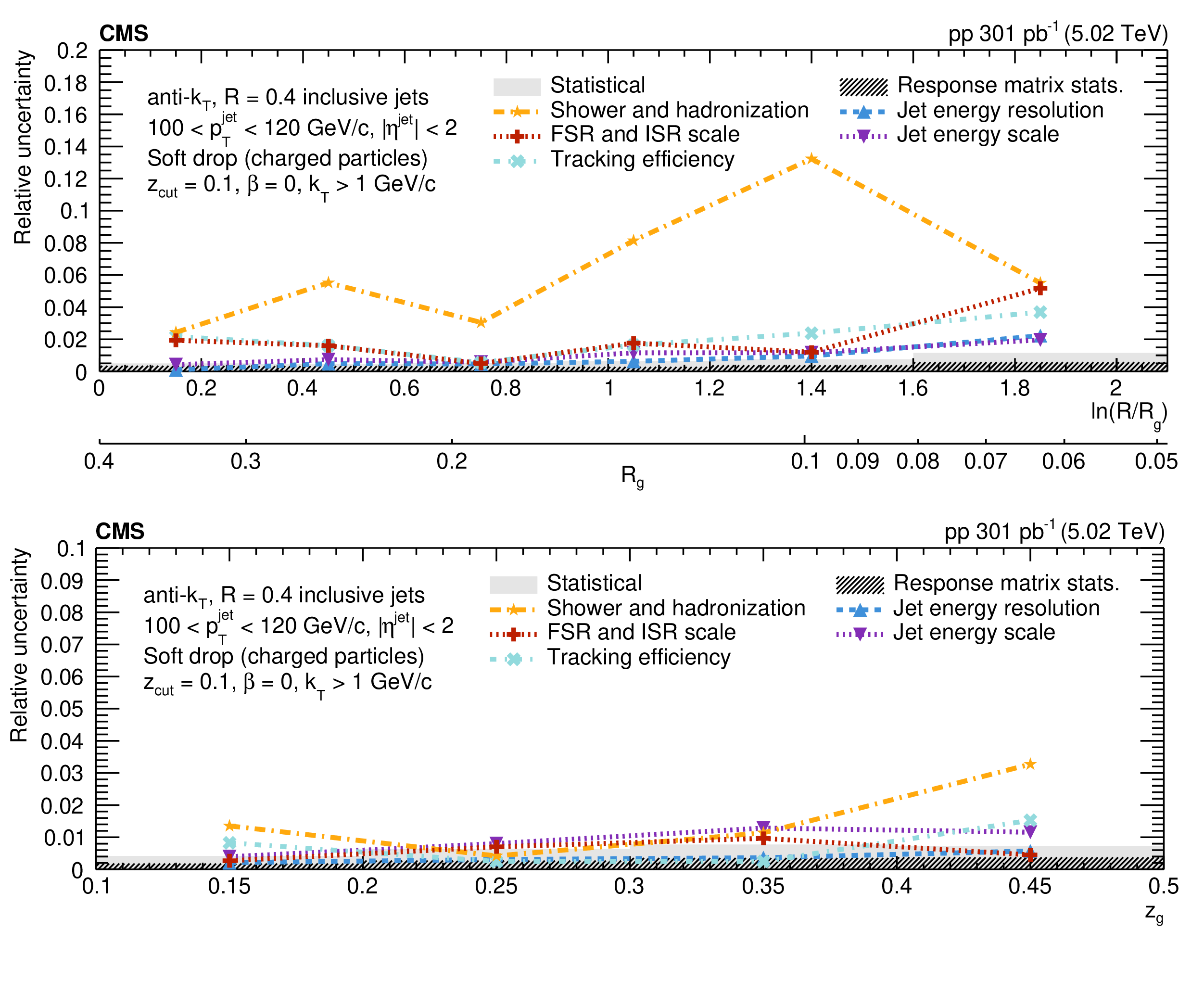
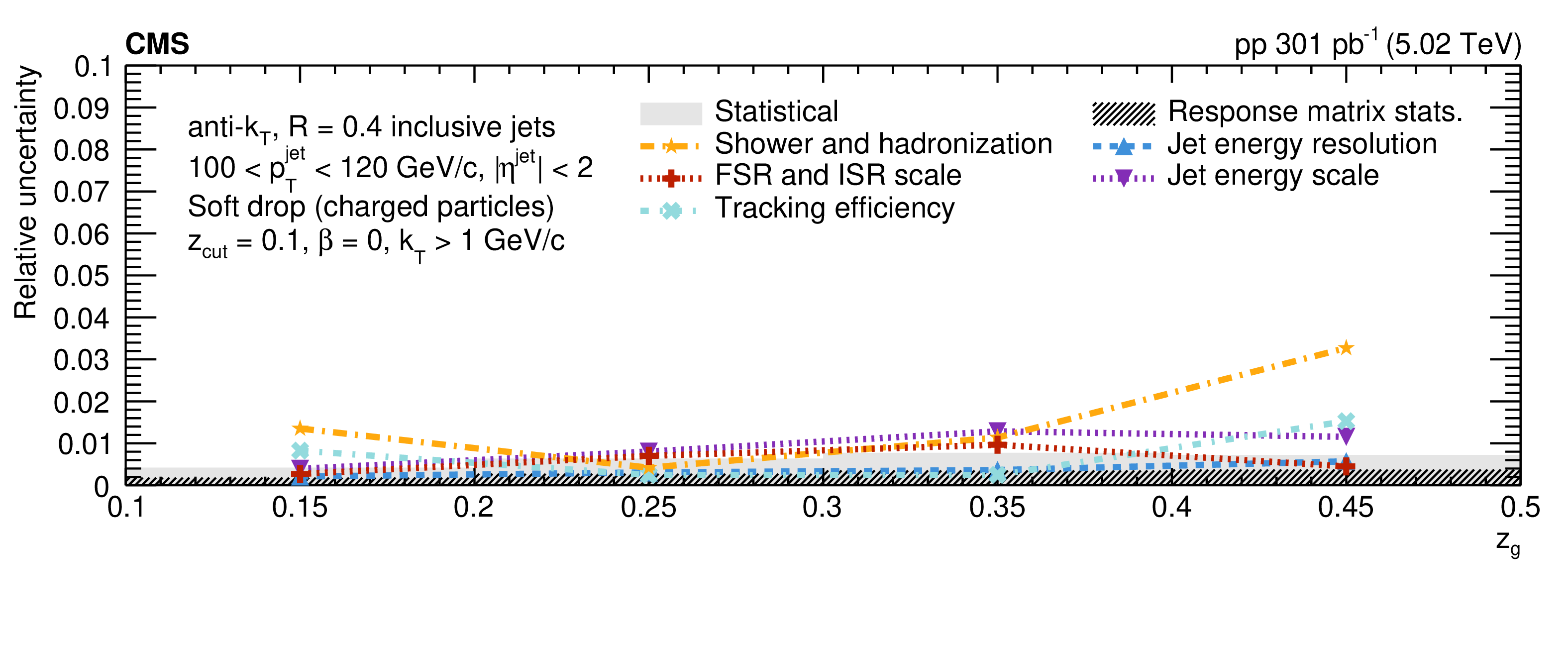
The breakdown of systematic uncertainties for inclusive jets (upper panel: $ R_{\mathrm{g}} $, lower panel: $ z_{\mathrm{g}} $). The statistical uncertainty is also shown in gray shaded boxes. |
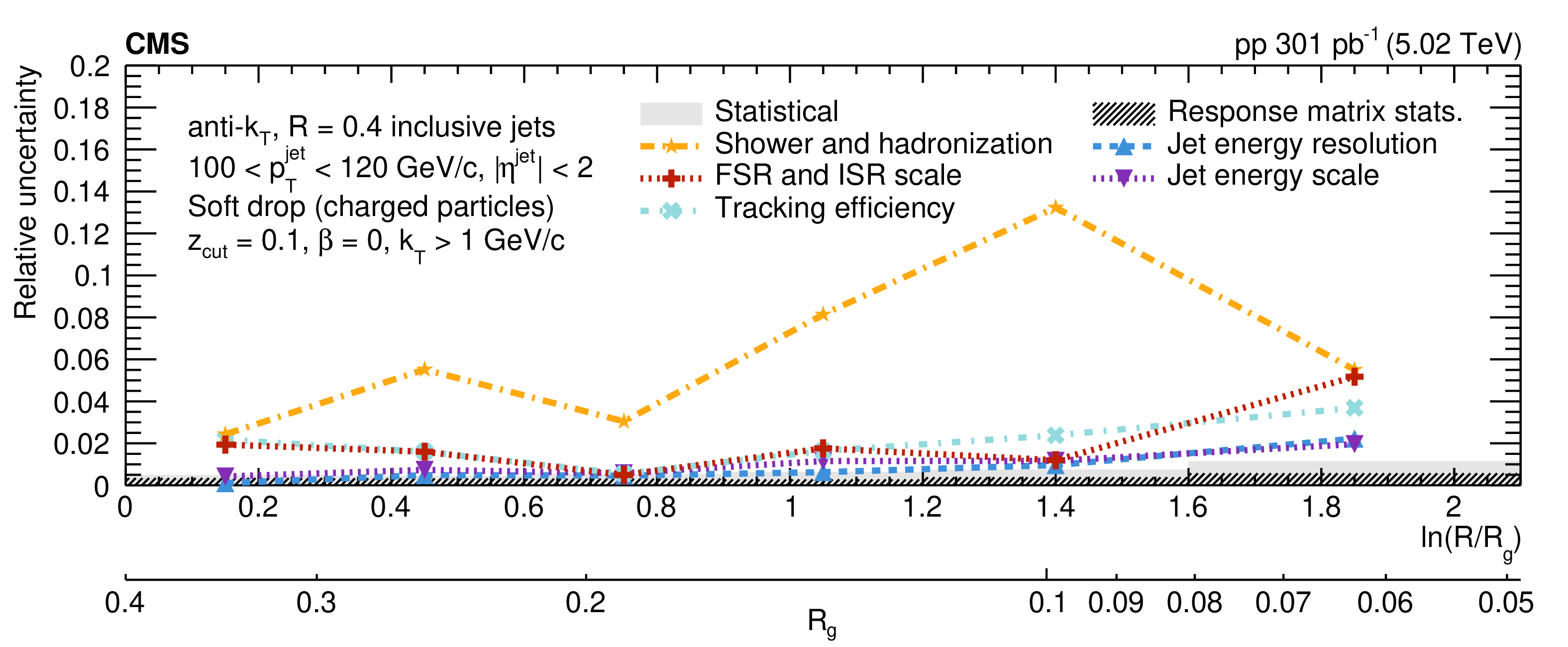
png pdf |
Figure 5-a:
The breakdown of systematic uncertainties for inclusive jets (upper panel: $ R_{\mathrm{g}} $, lower panel: $ z_{\mathrm{g}} $). The statistical uncertainty is also shown in gray shaded boxes. |
png pdf |
Figure 5-b:
The breakdown of systematic uncertainties for inclusive jets (upper panel: $ R_{\mathrm{g}} $, lower panel: $ z_{\mathrm{g}} $). The statistical uncertainty is also shown in gray shaded boxes. |
png pdf |
Figure 6:
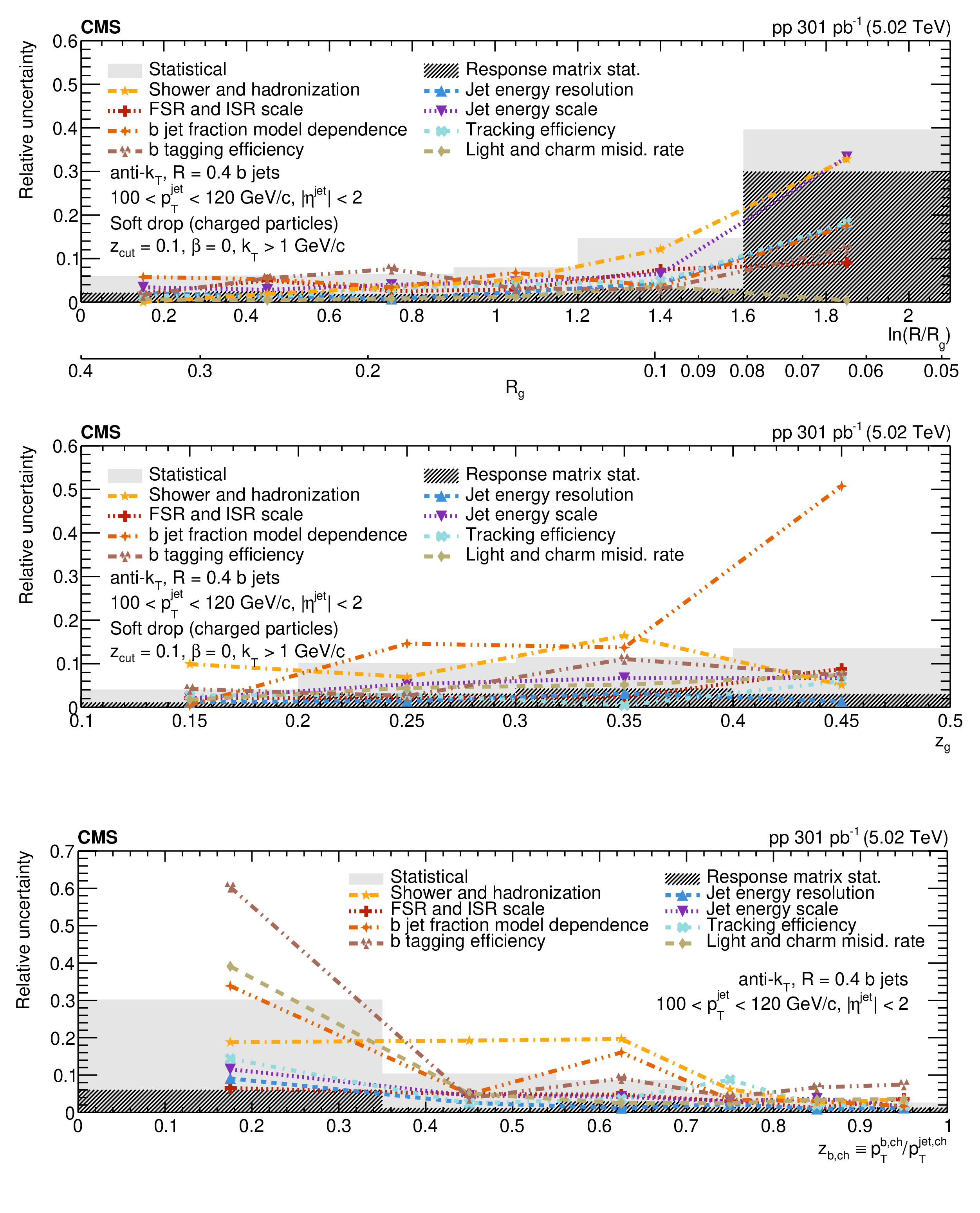
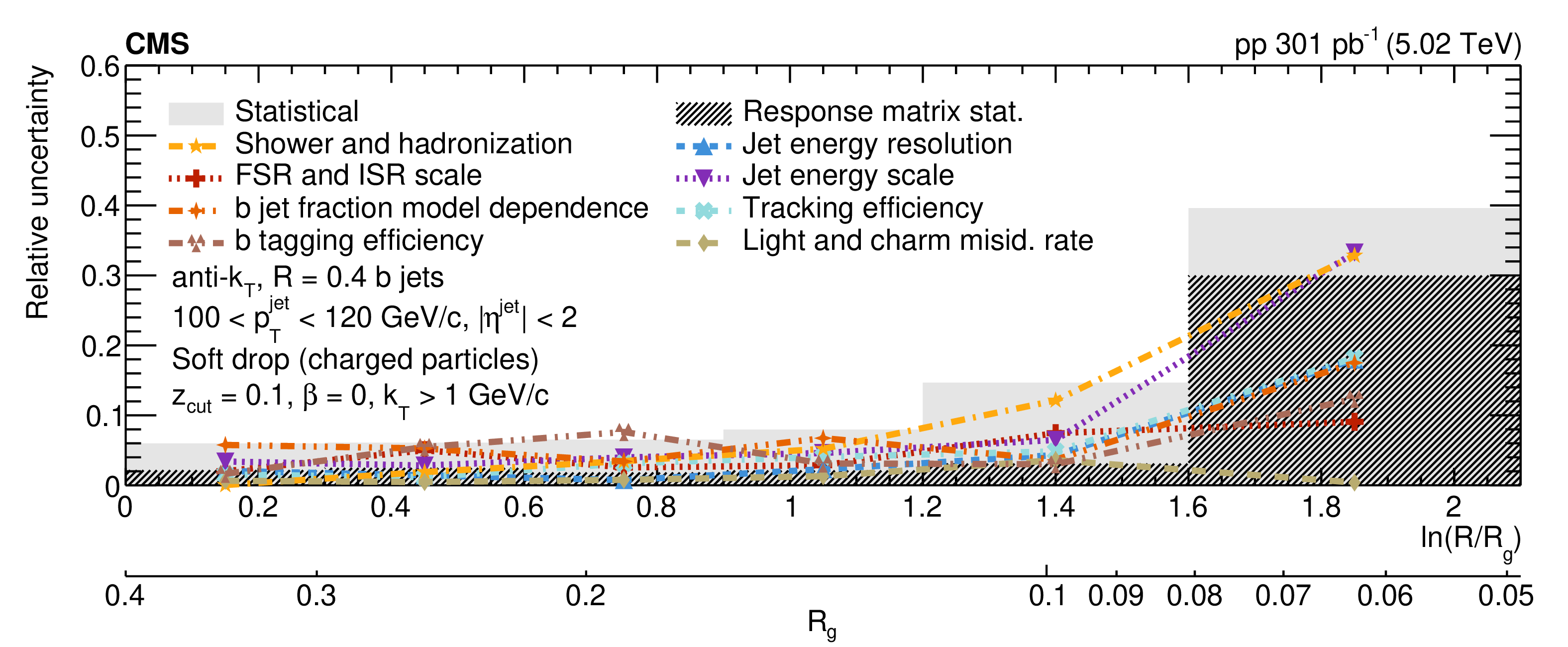
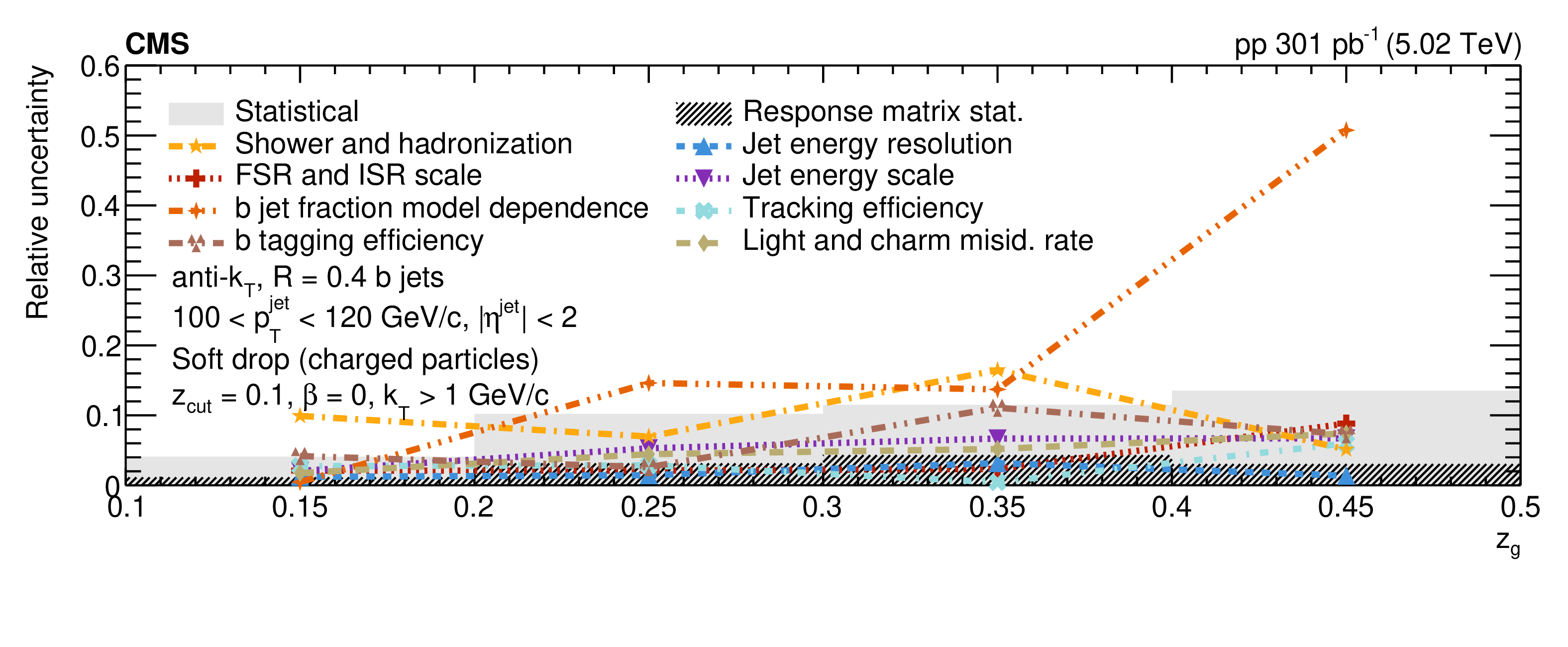
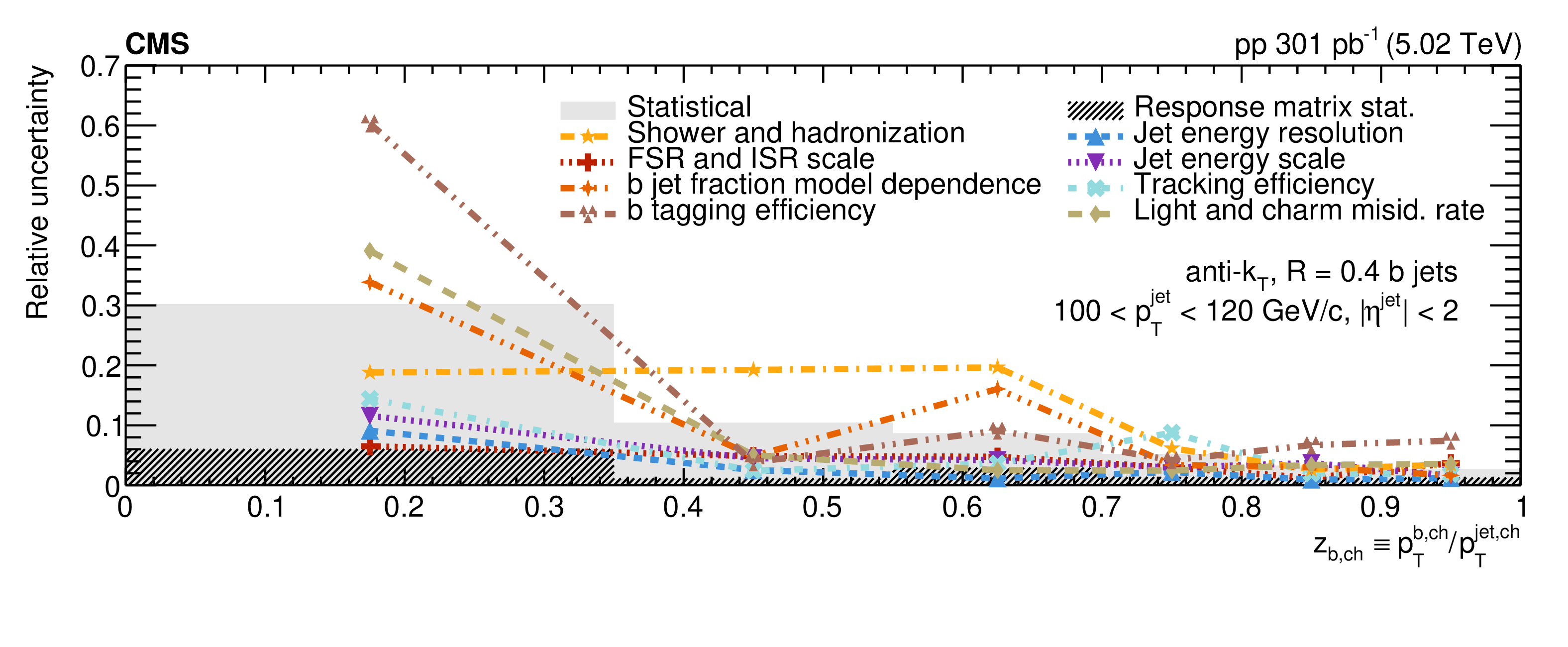
The breakdown of systematic uncertainties for b jets (upper panel: $ R_{\mathrm{g}} $, middle panel: $ z_{\mathrm{g}} $, lower panel: $ z_{{\mathrm{b},\text{ch}}} $). The statistical uncertainty is also shown in gray shaded boxes. |
png pdf |
Figure 6-a:
The breakdown of systematic uncertainties for b jets (upper panel: $ R_{\mathrm{g}} $, middle panel: $ z_{\mathrm{g}} $, lower panel: $ z_{{\mathrm{b},\text{ch}}} $). The statistical uncertainty is also shown in gray shaded boxes. |
png pdf |
Figure 6-b:
The breakdown of systematic uncertainties for b jets (upper panel: $ R_{\mathrm{g}} $, middle panel: $ z_{\mathrm{g}} $, lower panel: $ z_{{\mathrm{b},\text{ch}}} $). The statistical uncertainty is also shown in gray shaded boxes. |
png pdf |
Figure 6-c:
The breakdown of systematic uncertainties for b jets (upper panel: $ R_{\mathrm{g}} $, middle panel: $ z_{\mathrm{g}} $, lower panel: $ z_{{\mathrm{b},\text{ch}}} $). The statistical uncertainty is also shown in gray shaded boxes. |
png pdf |
Figure 7:
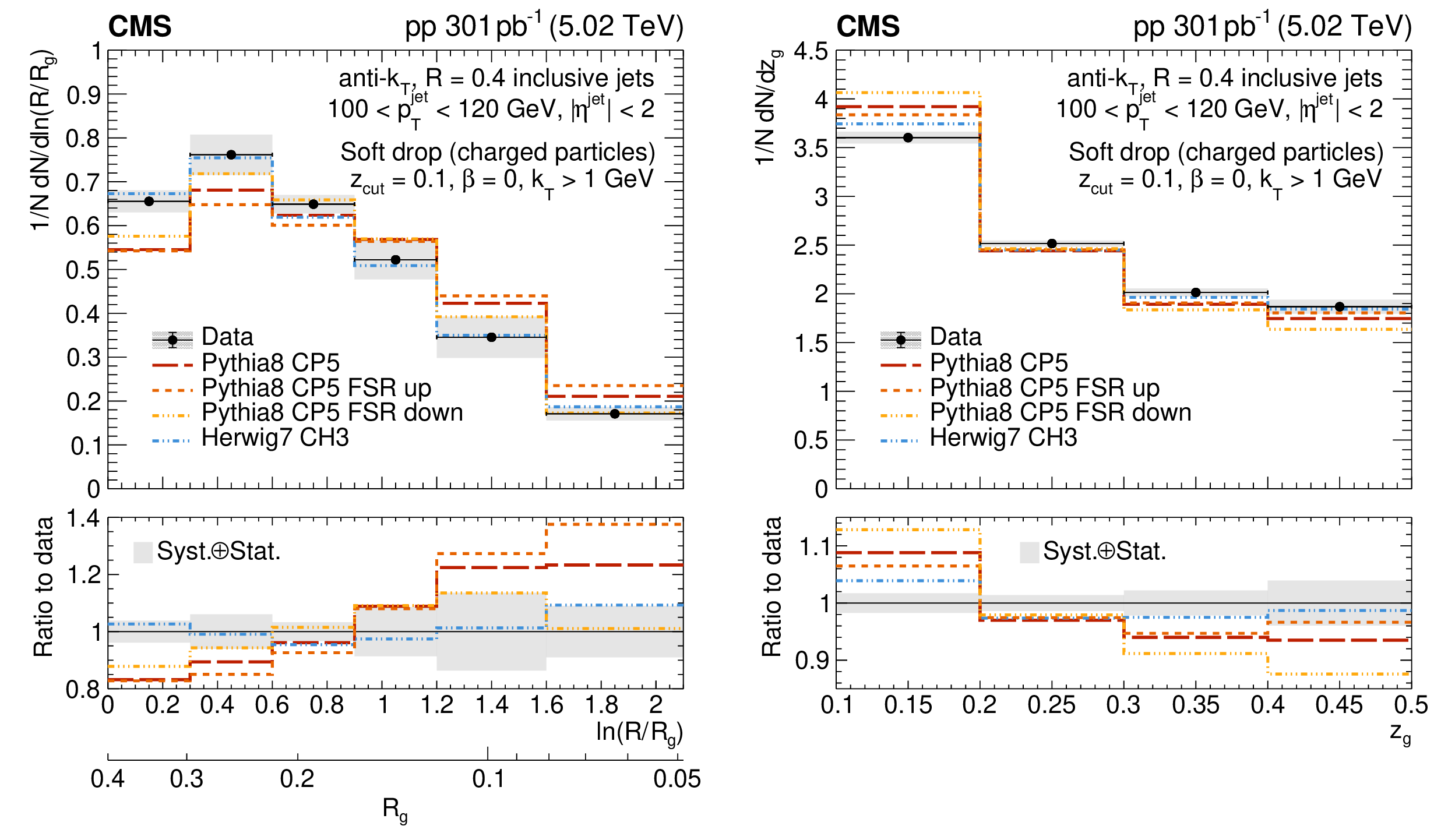
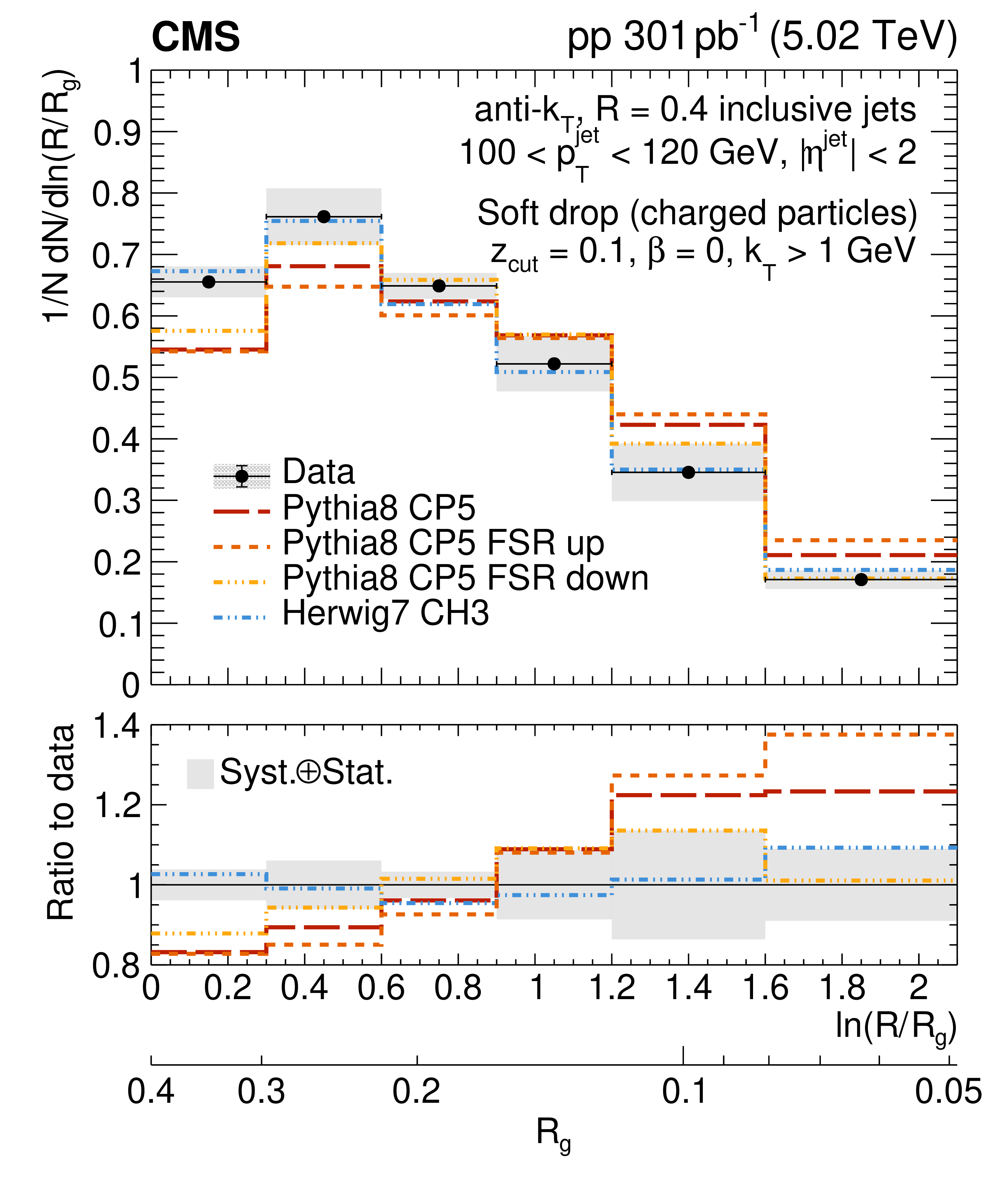
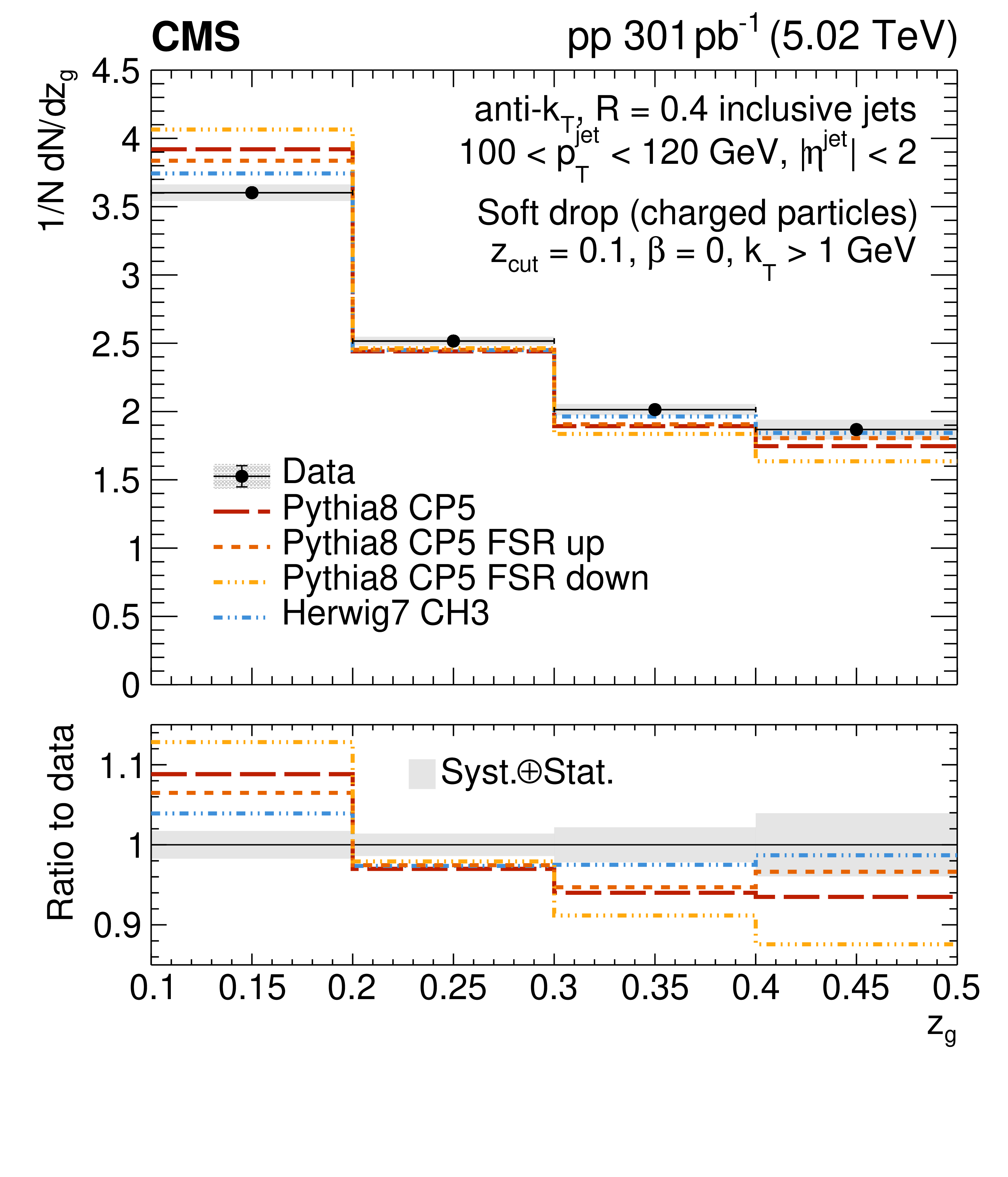
Distributions of groomed substructure observables $ R_{\mathrm{g}} $ (left) and $ z_{\mathrm{g}} $ (right) corrected to the charged-particle level for inclusive jets. The gray band represents the systematic uncertainties added in quadrature, while the vertical bars represent the statistical uncertainty. Distributions coming from the PYTHIA8 CP5 and HERWIG 7 CH3 MC event generators are also presented. The ratio of the MC simulations to the data is presented in the lower panels. |
png pdf |
Figure 7-a:
Distributions of groomed substructure observables $ R_{\mathrm{g}} $ (left) and $ z_{\mathrm{g}} $ (right) corrected to the charged-particle level for inclusive jets. The gray band represents the systematic uncertainties added in quadrature, while the vertical bars represent the statistical uncertainty. Distributions coming from the PYTHIA8 CP5 and HERWIG 7 CH3 MC event generators are also presented. The ratio of the MC simulations to the data is presented in the lower panels. |
png pdf |
Figure 7-b:
Distributions of groomed substructure observables $ R_{\mathrm{g}} $ (left) and $ z_{\mathrm{g}} $ (right) corrected to the charged-particle level for inclusive jets. The gray band represents the systematic uncertainties added in quadrature, while the vertical bars represent the statistical uncertainty. Distributions coming from the PYTHIA8 CP5 and HERWIG 7 CH3 MC event generators are also presented. The ratio of the MC simulations to the data is presented in the lower panels. |
png pdf |
Figure 8:
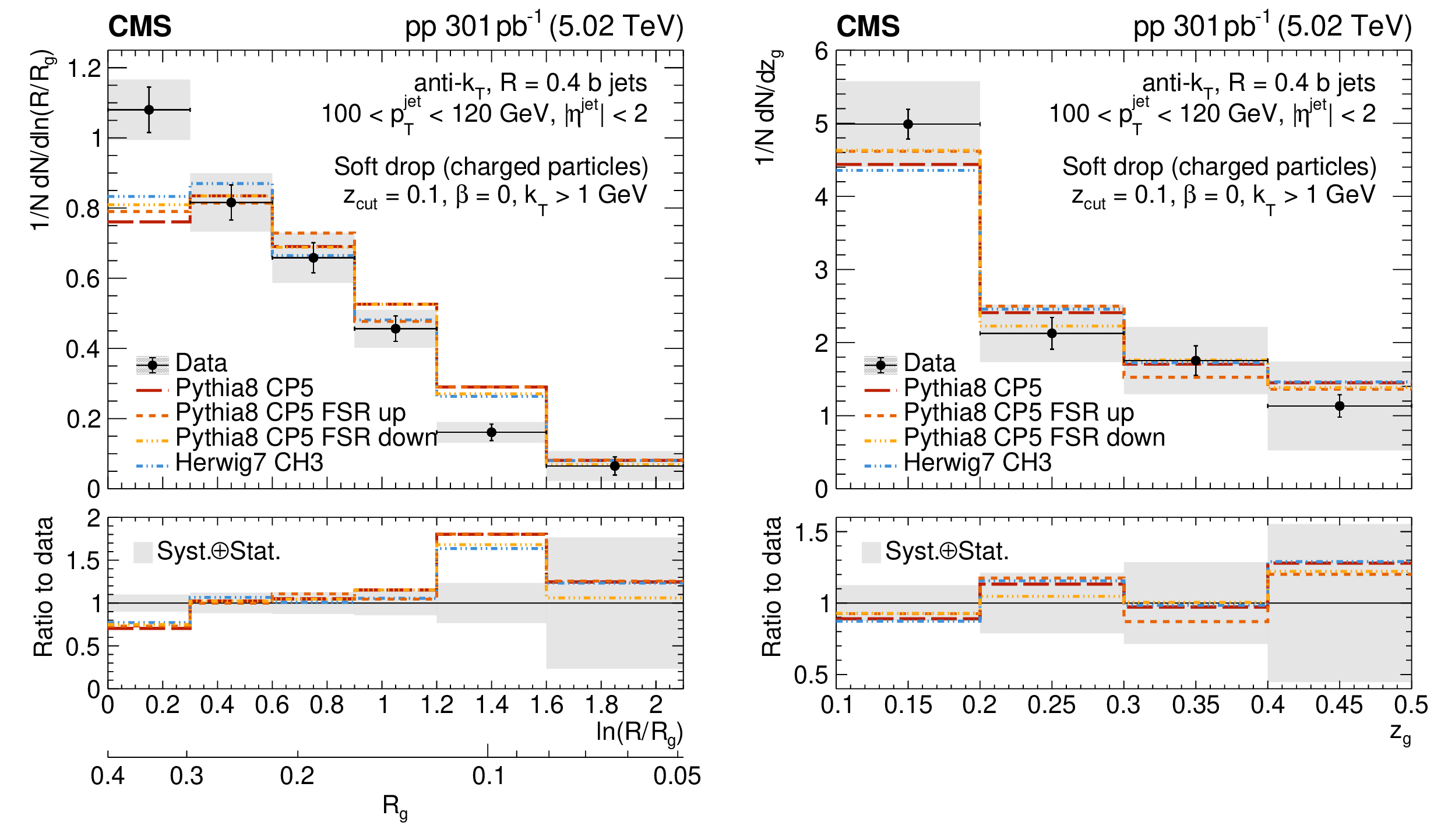
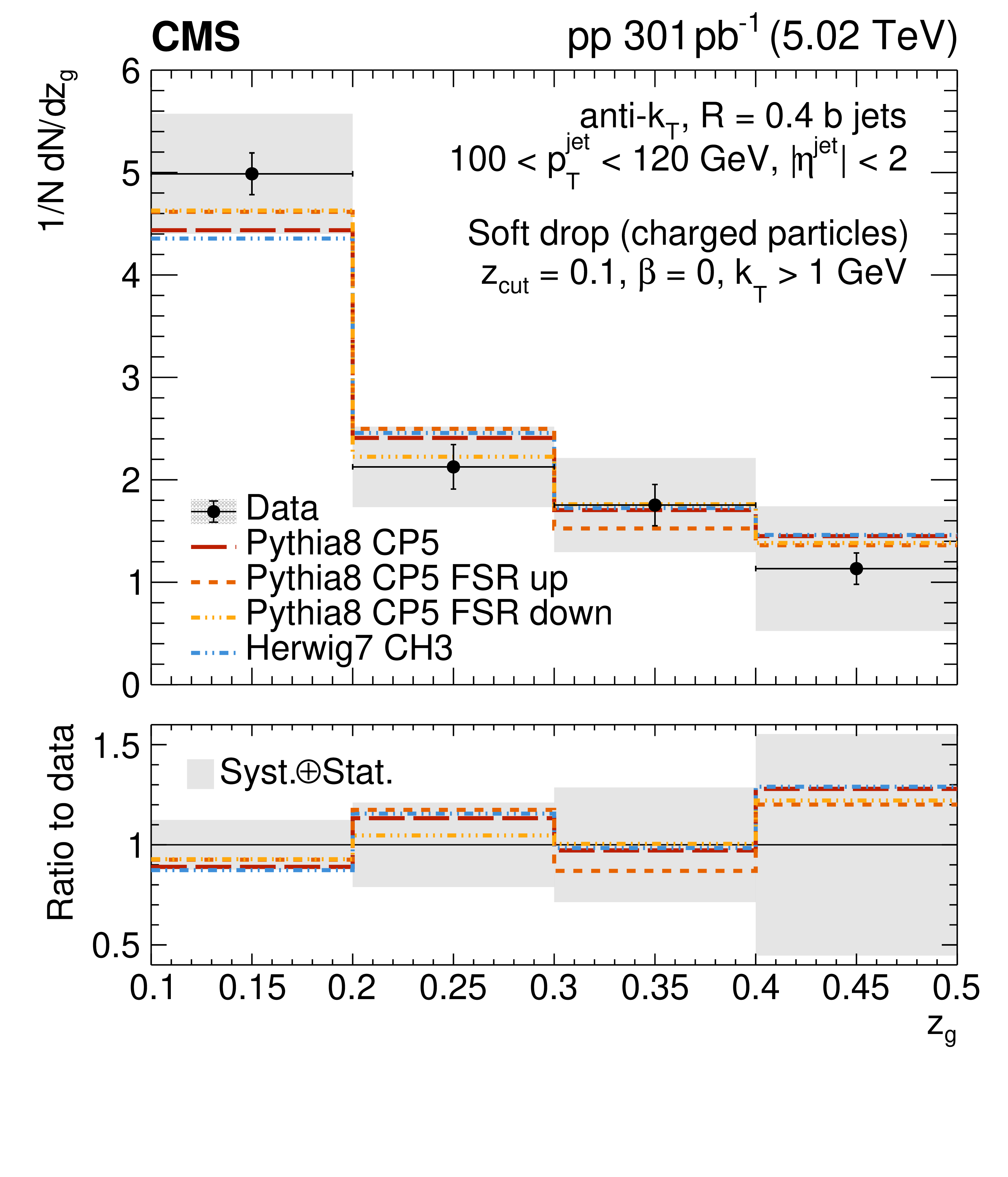
Distributions of the groomed substructure observables $ R_{\mathrm{g}} $ (left) and $ z_{\mathrm{g}} $ (right) corrected to the charged-particle level for b jets. Distributions coming from the PYTHIA8 CP5 and HERWIG 7 CH3 MC event generators are also presented. The ratio of the MC simulations to the data is presented in the lower panels. |
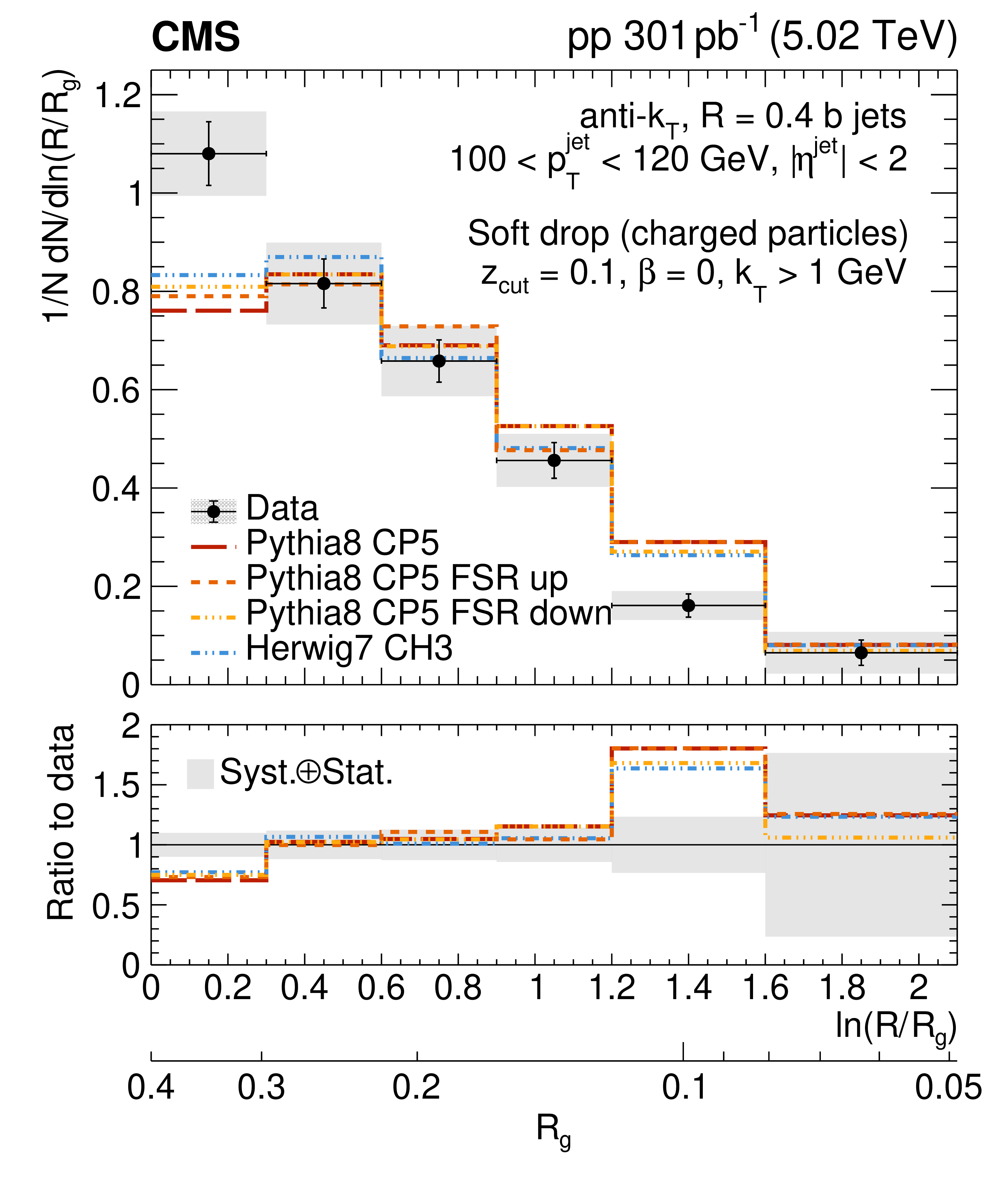
png pdf |
Figure 8-a:
Distributions of the groomed substructure observables $ R_{\mathrm{g}} $ (left) and $ z_{\mathrm{g}} $ (right) corrected to the charged-particle level for b jets. Distributions coming from the PYTHIA8 CP5 and HERWIG 7 CH3 MC event generators are also presented. The ratio of the MC simulations to the data is presented in the lower panels. |
png pdf |
Figure 8-b:
Distributions of the groomed substructure observables $ R_{\mathrm{g}} $ (left) and $ z_{\mathrm{g}} $ (right) corrected to the charged-particle level for b jets. Distributions coming from the PYTHIA8 CP5 and HERWIG 7 CH3 MC event generators are also presented. The ratio of the MC simulations to the data is presented in the lower panels. |
png pdf |
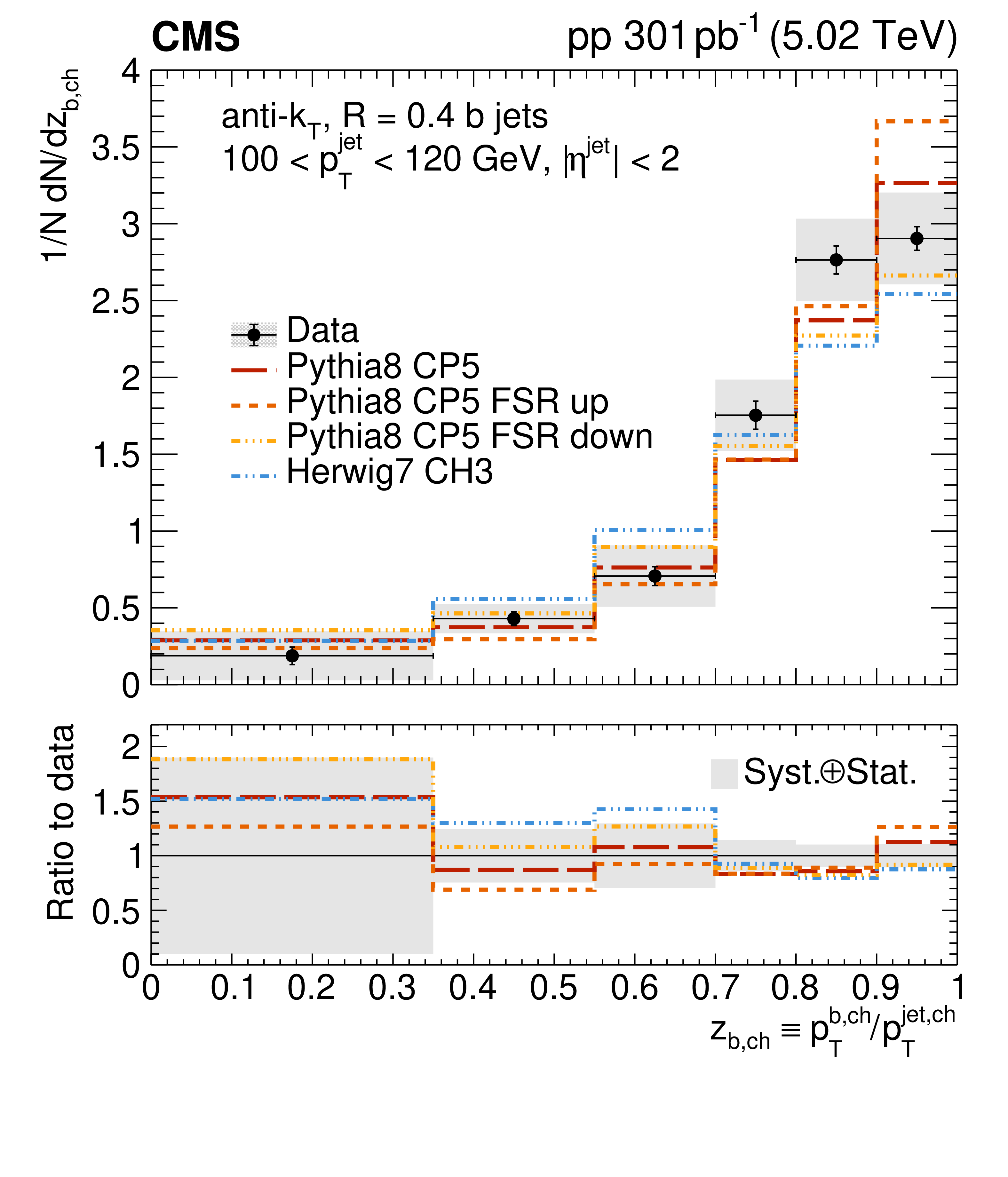
Figure 9:
The distribution of the jet fragmentation function $ z_{{\mathrm{b},\text{ch}}} $ corrected to the charged-particle level. Distributions coming from the PYTHIA8 CP5 and HERWIG 7 CH3 MC event generators are also presented. The ratio of the MC simulations to the data is presented in the lower panel. |
png pdf |
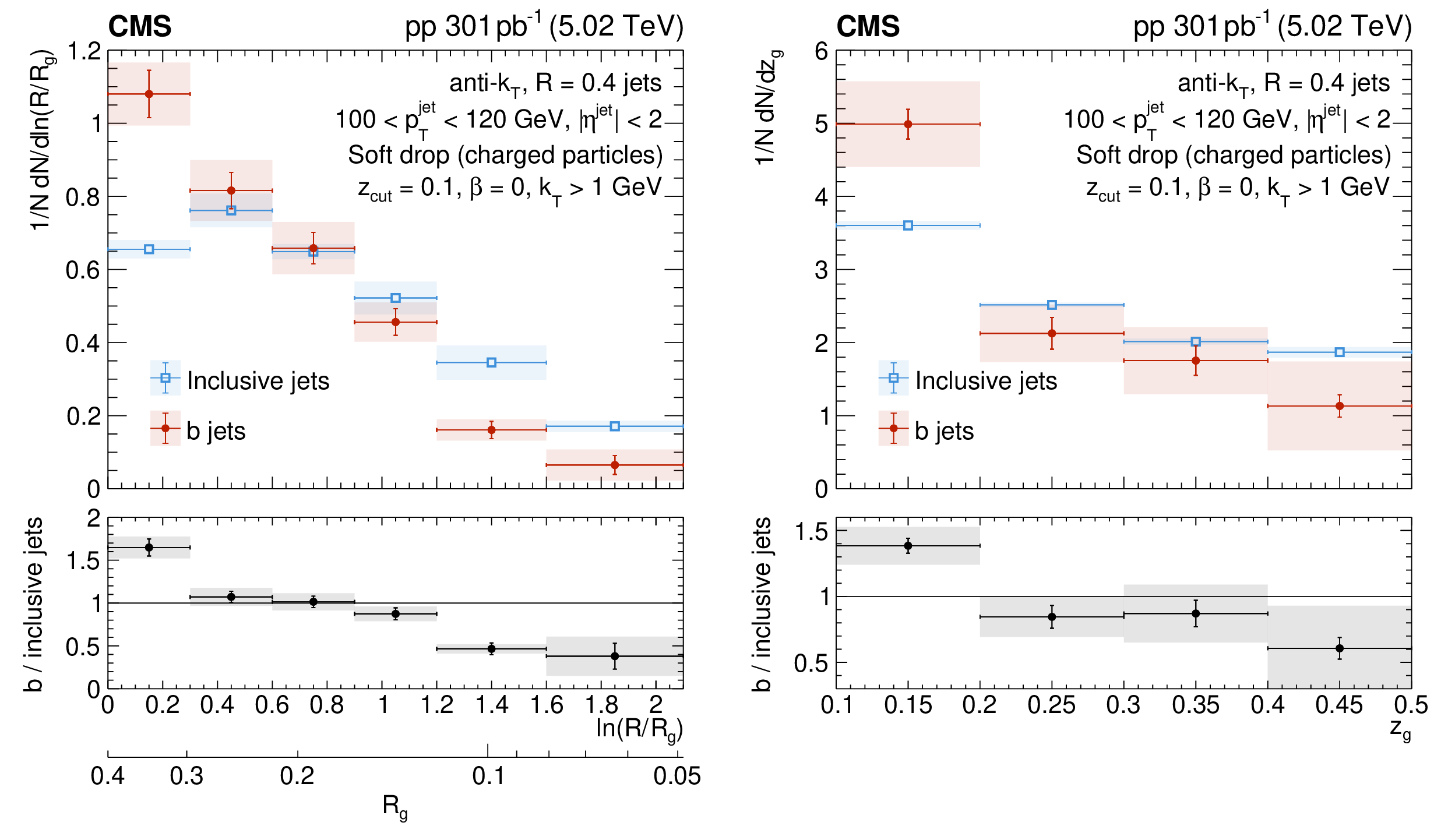
Figure 10:
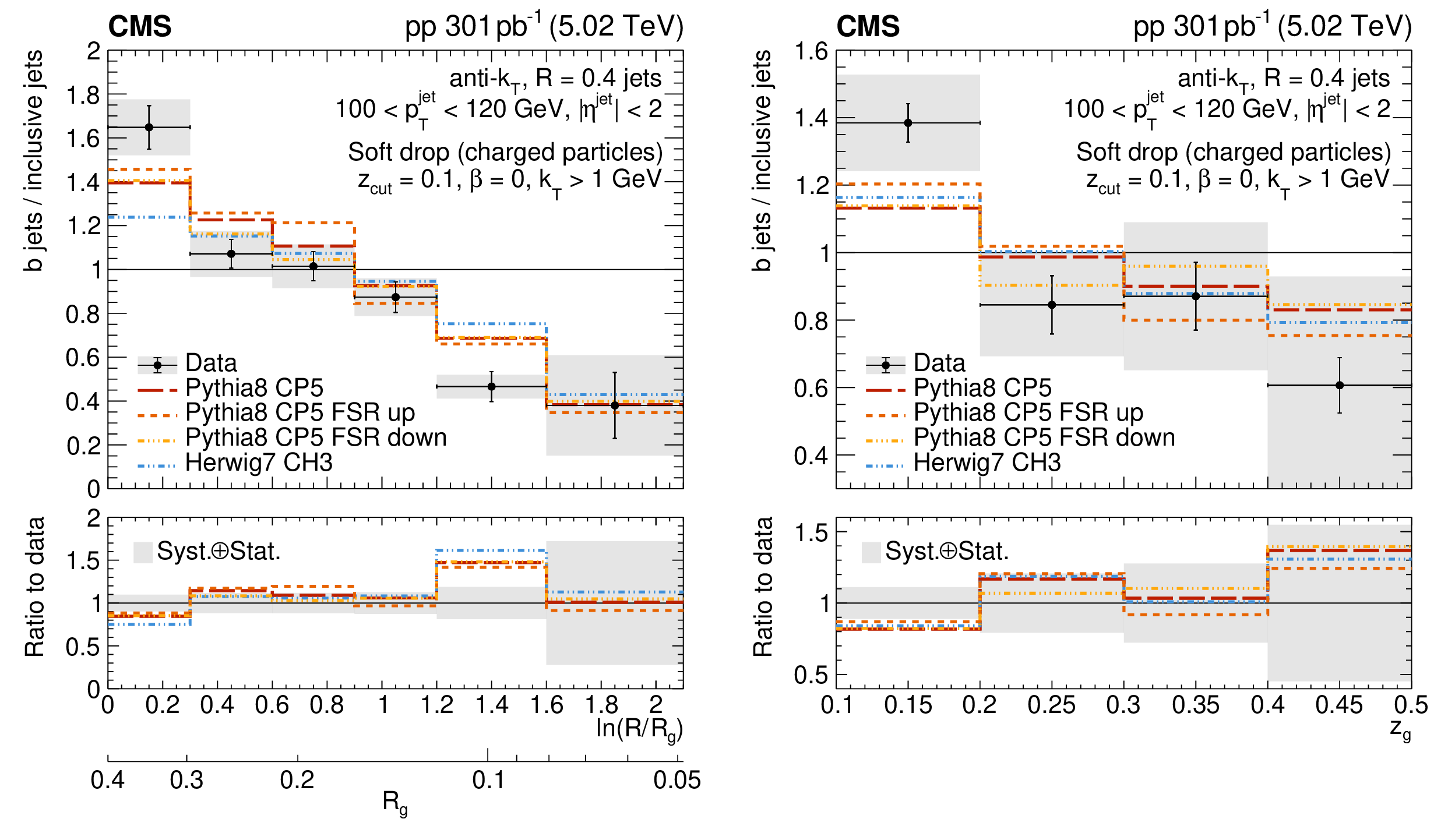
A comparison of the groomed observables $ R_{\mathrm{g}} $ (left) and $ z_{\mathrm{g}} $ (right) between b and inclusive jets. Most sources of systematic uncertainty are considered fully correlated in the ratio, which is presented in the lower panels, with the exception of those related to flavor and the response matrix. |
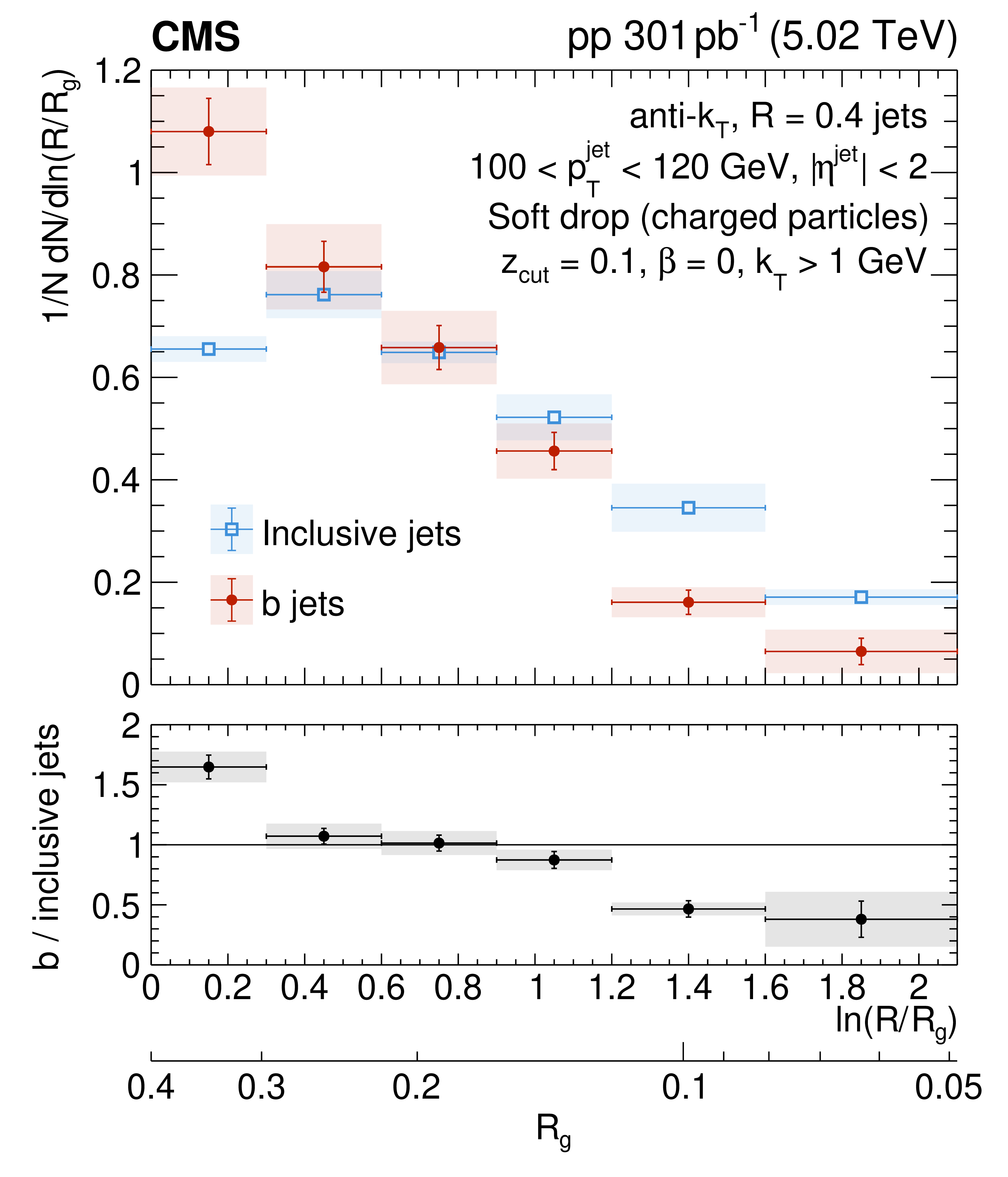
png pdf |
Figure 10-a:
A comparison of the groomed observables $ R_{\mathrm{g}} $ (left) and $ z_{\mathrm{g}} $ (right) between b and inclusive jets. Most sources of systematic uncertainty are considered fully correlated in the ratio, which is presented in the lower panels, with the exception of those related to flavor and the response matrix. |
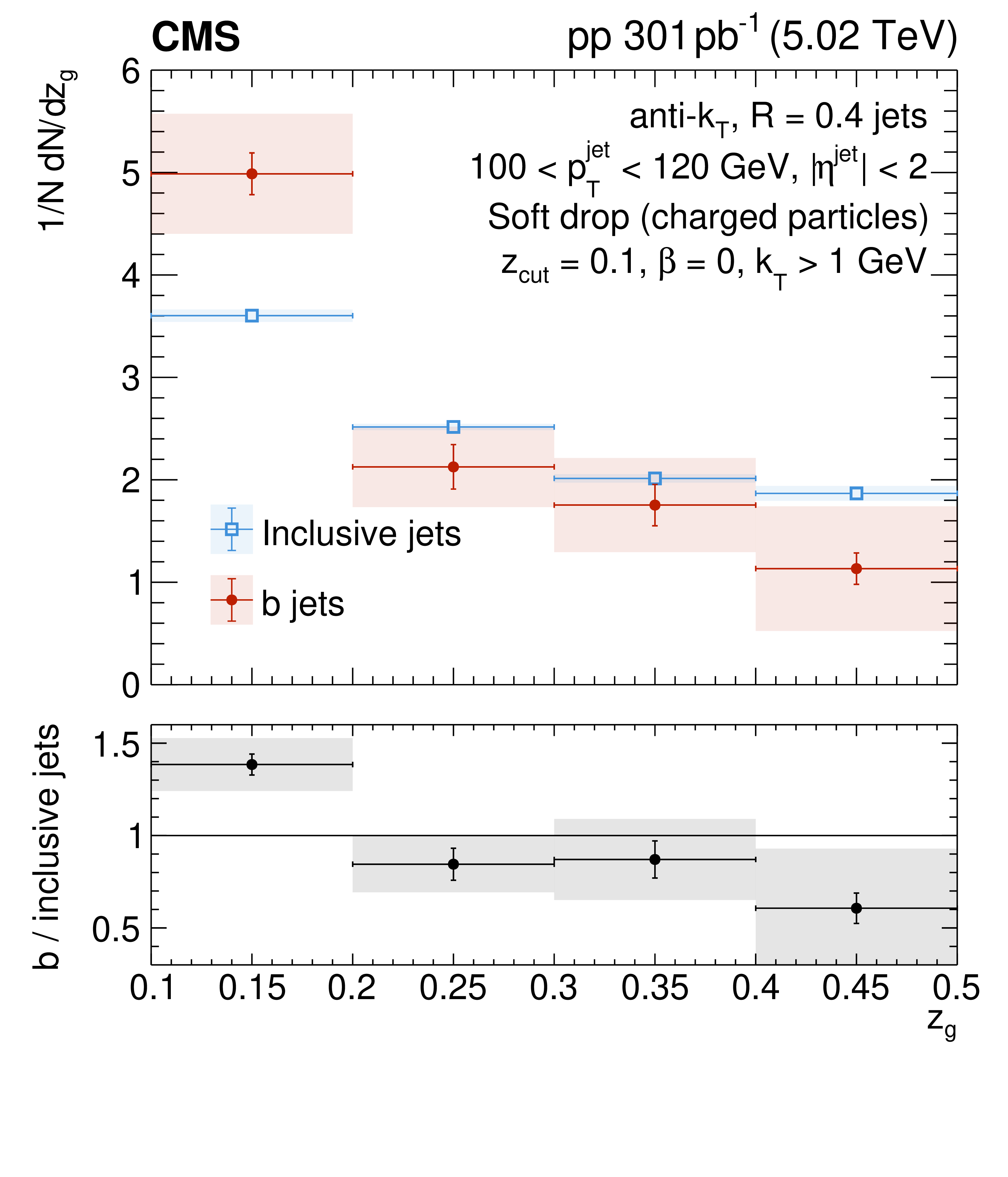
png pdf |
Figure 10-b:
A comparison of the groomed observables $ R_{\mathrm{g}} $ (left) and $ z_{\mathrm{g}} $ (right) between b and inclusive jets. Most sources of systematic uncertainty are considered fully correlated in the ratio, which is presented in the lower panels, with the exception of those related to flavor and the response matrix. |
png pdf |
Figure 11:
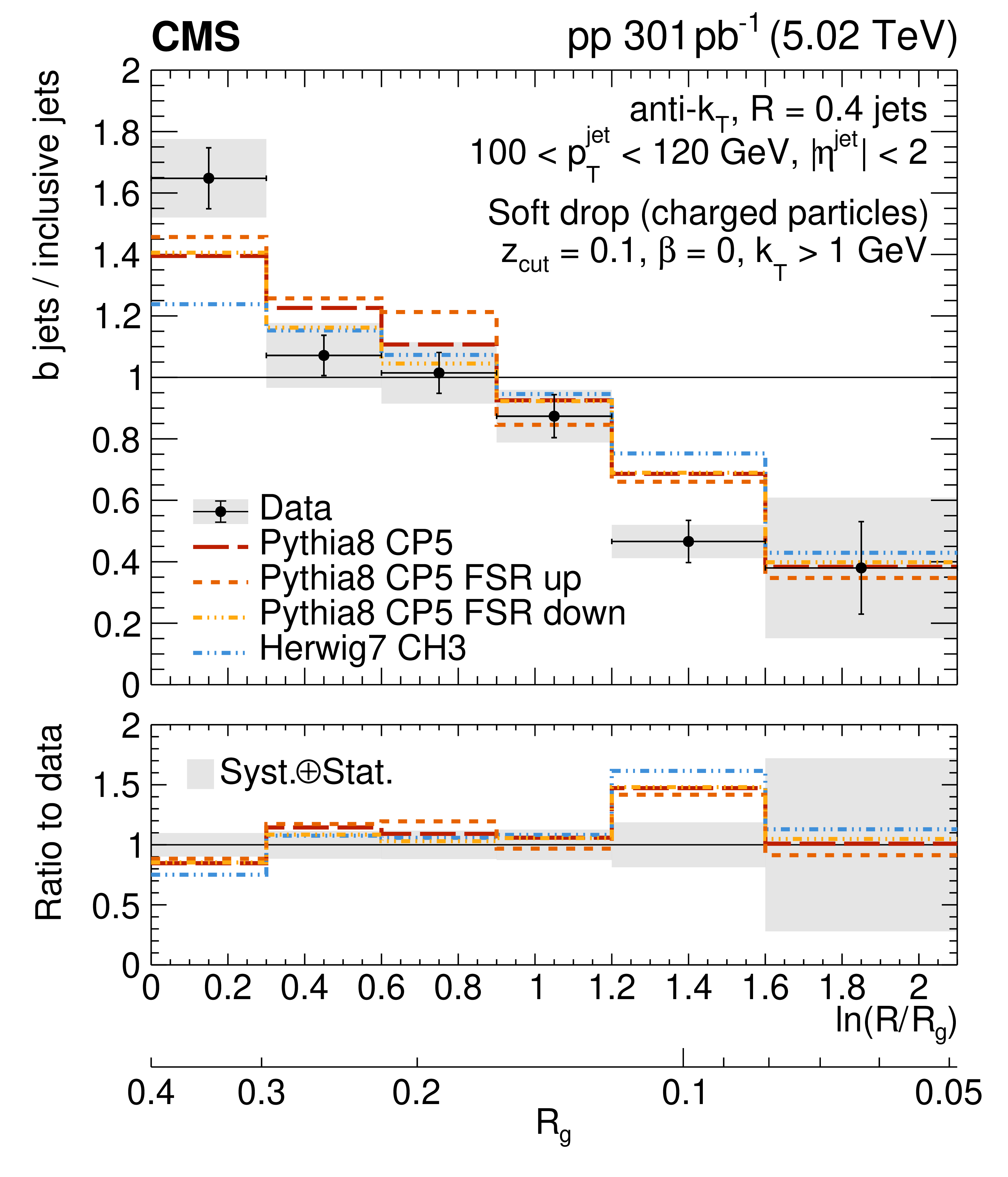
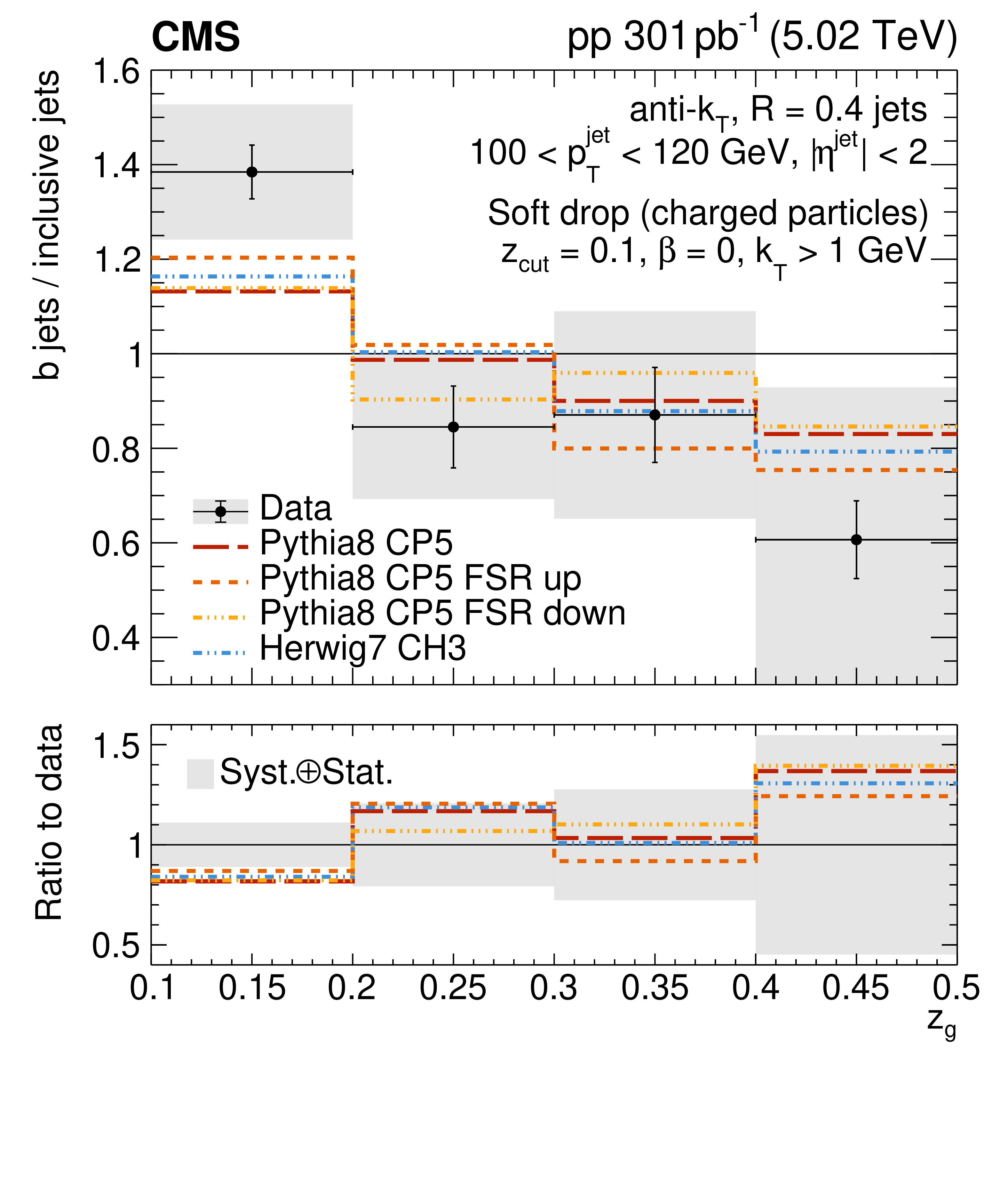
The ratio of the groomed observables $ R_{\mathrm{g}} $ (left) and $ z_{\mathrm{g}} $ (right) between b and inclusive jets compared to the PYTHIA8 CP5 and HERWIG 7 CH3 MC event generators. Most sources of systematic uncertainty are considered fully correlated in the ratio, with the exception of those related to flavor and the response matrix. The ratio of the MC simulations to the data is presented in the lower panels. |
png pdf |
Figure 11-a:
The ratio of the groomed observables $ R_{\mathrm{g}} $ (left) and $ z_{\mathrm{g}} $ (right) between b and inclusive jets compared to the PYTHIA8 CP5 and HERWIG 7 CH3 MC event generators. Most sources of systematic uncertainty are considered fully correlated in the ratio, with the exception of those related to flavor and the response matrix. The ratio of the MC simulations to the data is presented in the lower panels. |
png pdf |
Figure 11-b:
The ratio of the groomed observables $ R_{\mathrm{g}} $ (left) and $ z_{\mathrm{g}} $ (right) between b and inclusive jets compared to the PYTHIA8 CP5 and HERWIG 7 CH3 MC event generators. Most sources of systematic uncertainty are considered fully correlated in the ratio, with the exception of those related to flavor and the response matrix. The ratio of the MC simulations to the data is presented in the lower panels. |
png pdf |
Figure 12:
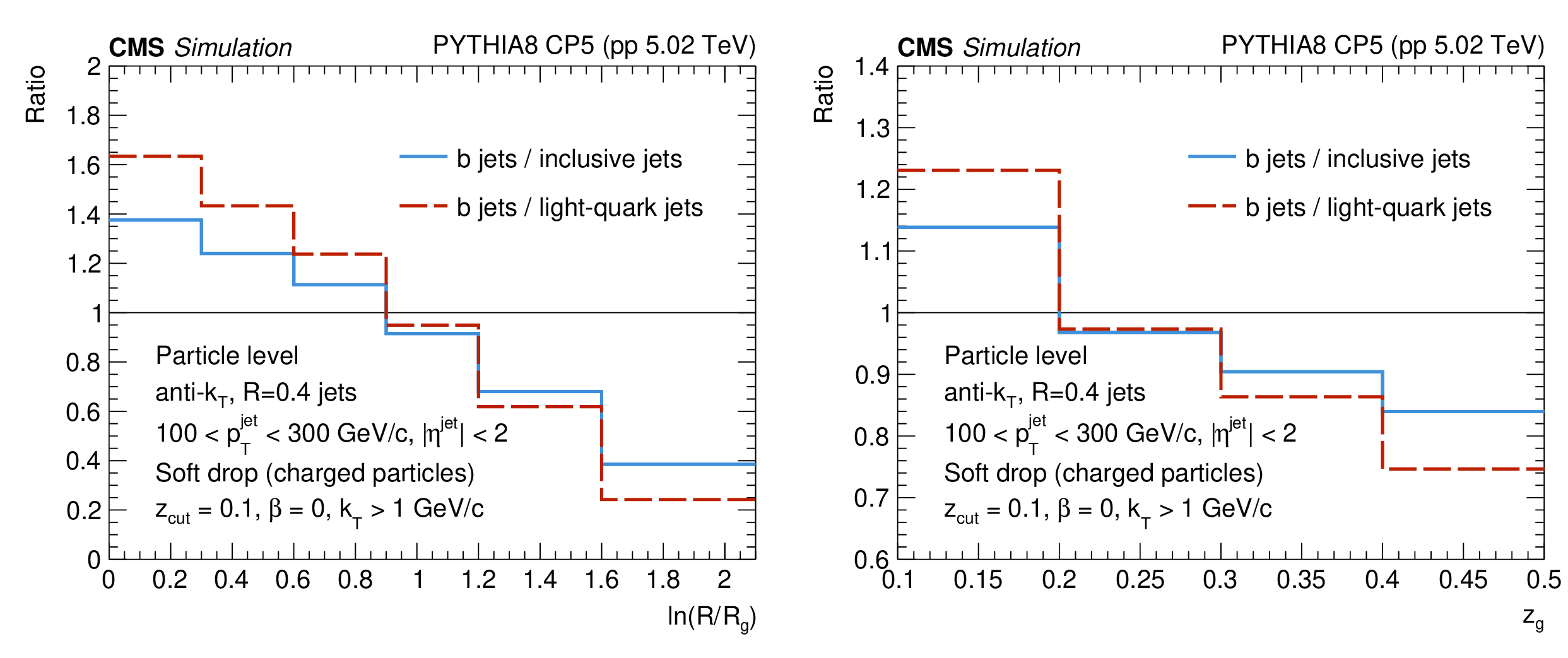
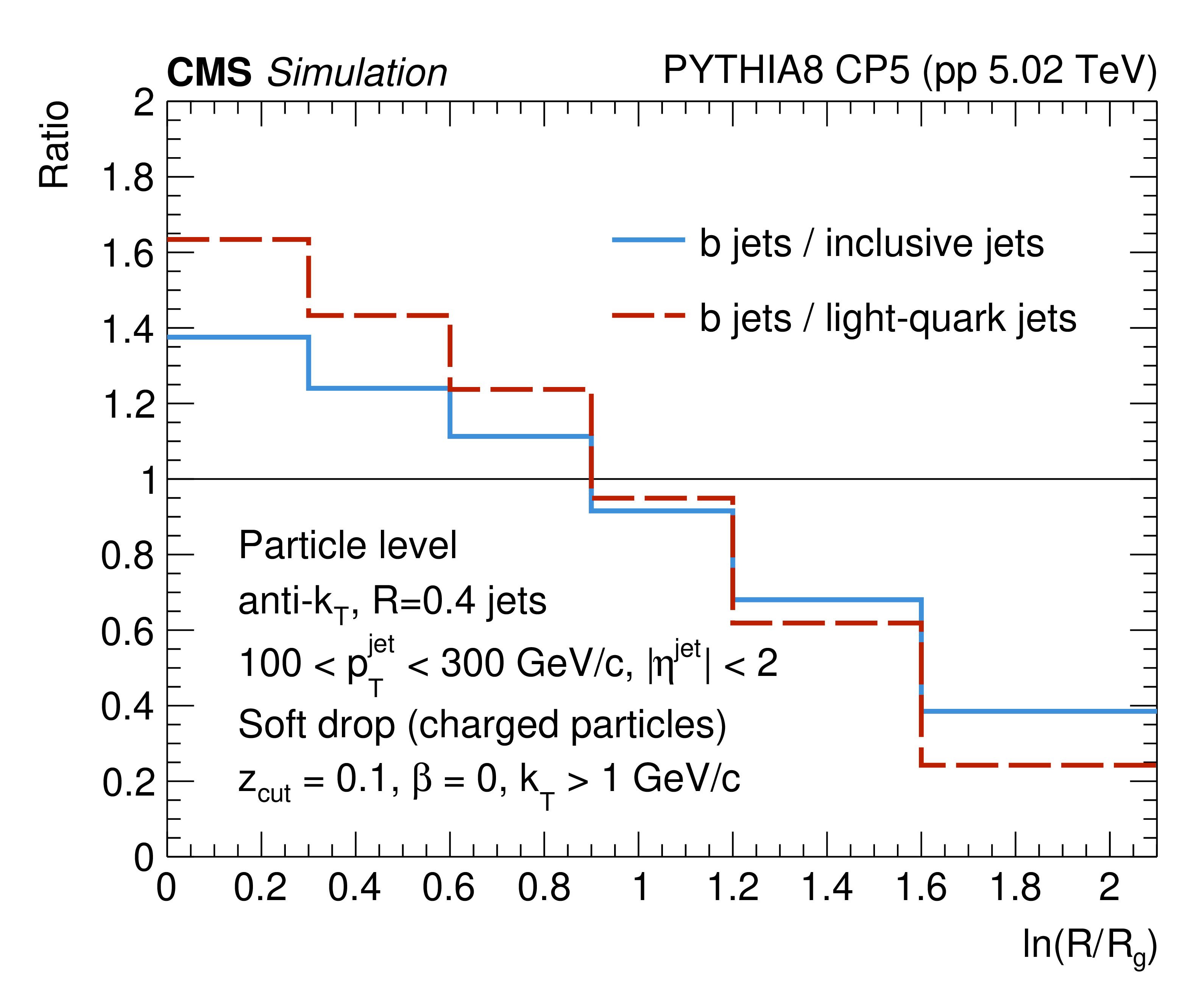
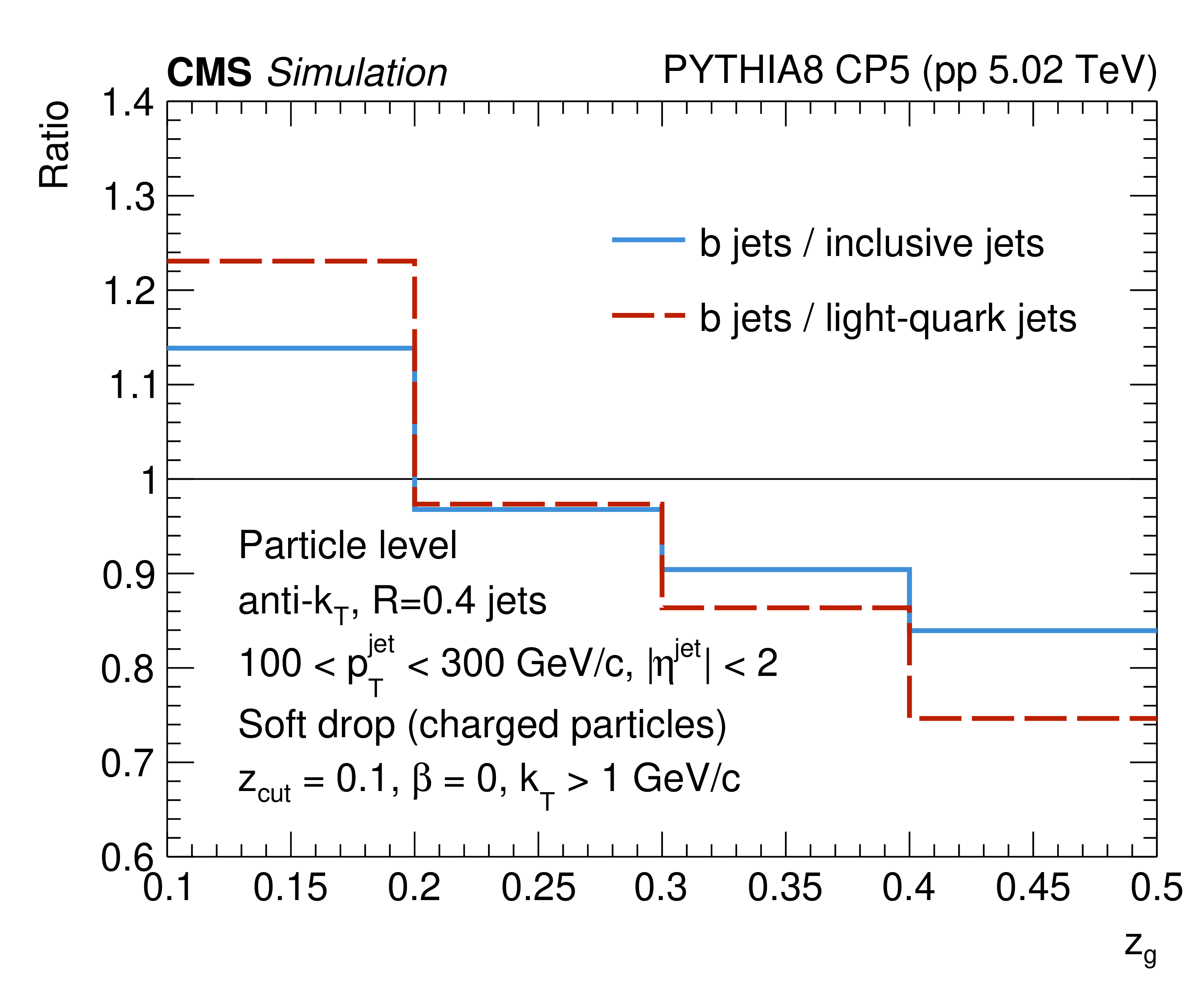
The ratio of the groomed observables $ R_{\mathrm{g}} $ (left) and $ z_{\mathrm{g}} $ (right) between b and light-quark (dashed red line) or inclusive jets (solid blue line) at the particle level of the PYTHIA8 CP5 event generator. |
png pdf |
Figure 12-a:
The ratio of the groomed observables $ R_{\mathrm{g}} $ (left) and $ z_{\mathrm{g}} $ (right) between b and light-quark (dashed red line) or inclusive jets (solid blue line) at the particle level of the PYTHIA8 CP5 event generator. |
png pdf |
Figure 12-b:
The ratio of the groomed observables $ R_{\mathrm{g}} $ (left) and $ z_{\mathrm{g}} $ (right) between b and light-quark (dashed red line) or inclusive jets (solid blue line) at the particle level of the PYTHIA8 CP5 event generator. |
png pdf |
Figure 13:
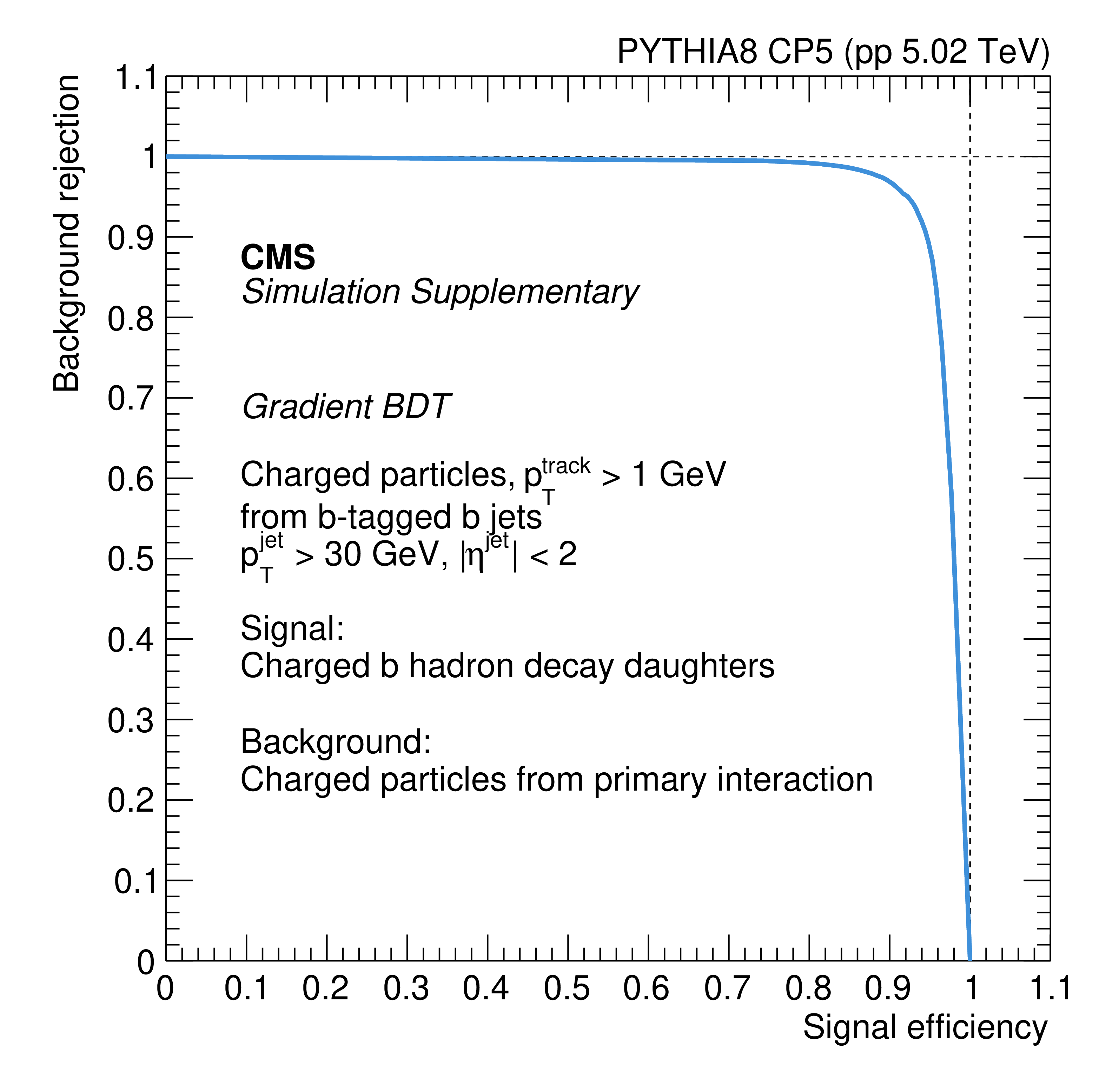
The background rejection rate versus the signal efficiency for the b hadron decay product identification. The model is a gradient boosted decision tree with 11 input variables related to tracking and secondary vertex information. ``Background'' refers to charged particles coming from the primary interaction, while ``signal'' signifies charged particles resulting from a b hadron decay. Dashed lines are drawn at 1 for each axis. The intersection of those lines is the optimal performance of a classifier. |
png pdf |
Figure 14:
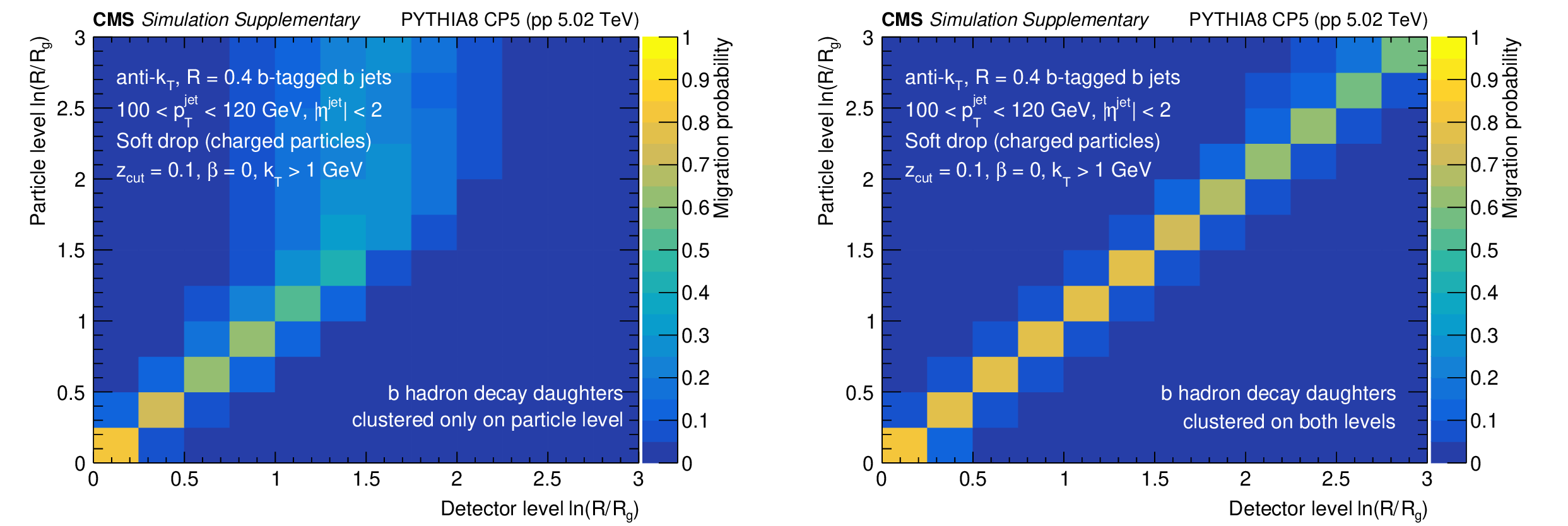
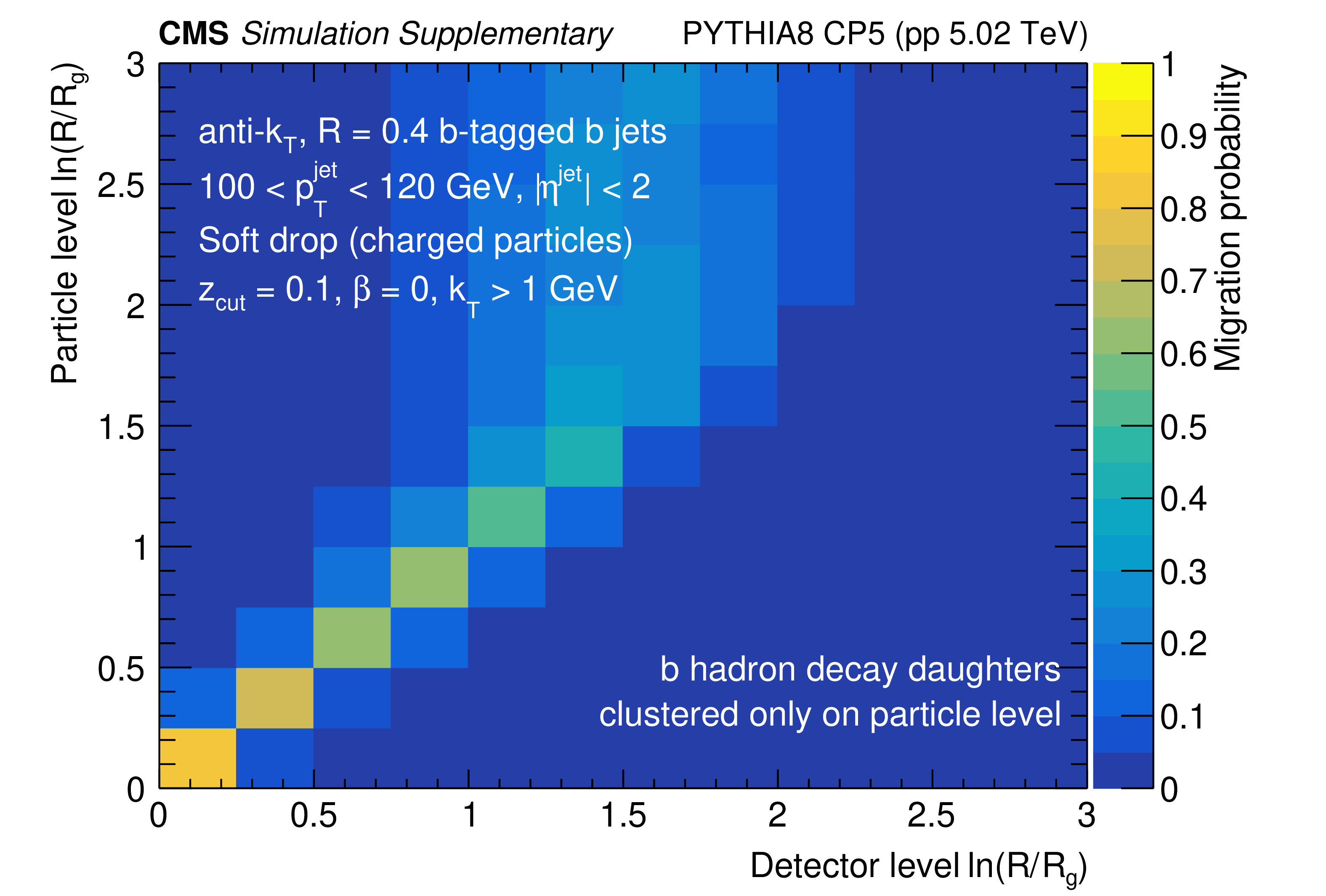
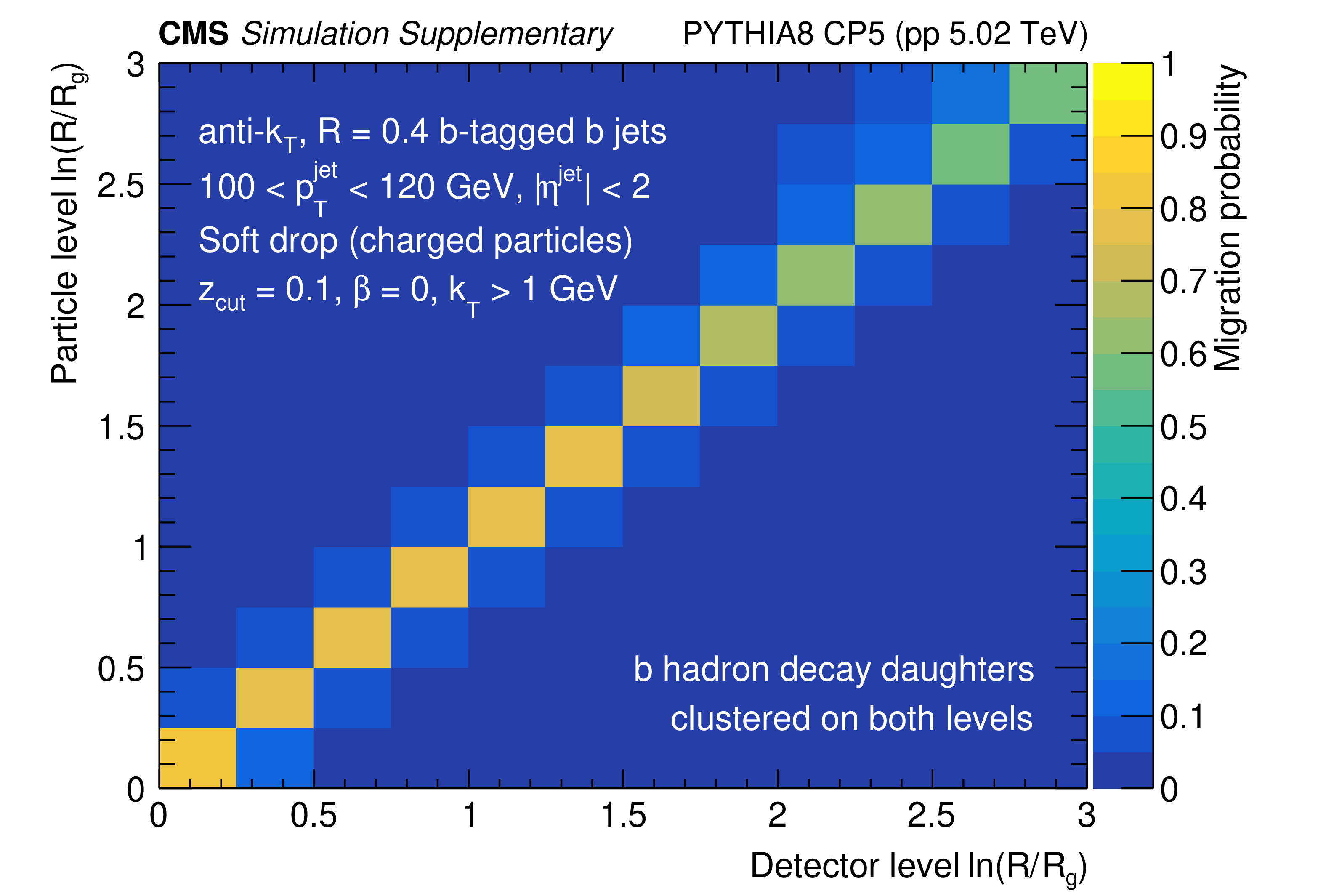
The migration matrices of $ R_{\mathrm{g}} $ for b jets. The particle level corresponds to clustered b hadron decay products. In the left panel, the decay products are present during the iterative declustering at the detector level, while in the right panel, the decay products have been identified using the gradient boosted decision tree and they have been clustered together into the partially reconstructed b hadron and replaced in the jet constituents. |
png pdf |
Figure 14-a:
The migration matrices of $ R_{\mathrm{g}} $ for b jets. The particle level corresponds to clustered b hadron decay products. In the left panel, the decay products are present during the iterative declustering at the detector level, while in the right panel, the decay products have been identified using the gradient boosted decision tree and they have been clustered together into the partially reconstructed b hadron and replaced in the jet constituents. |
png pdf |
Figure 14-b:
The migration matrices of $ R_{\mathrm{g}} $ for b jets. The particle level corresponds to clustered b hadron decay products. In the left panel, the decay products are present during the iterative declustering at the detector level, while in the right panel, the decay products have been identified using the gradient boosted decision tree and they have been clustered together into the partially reconstructed b hadron and replaced in the jet constituents. |
| Summary |
| This paper presents measurements of the substructure of bottom quark jets (b jets) and of inclusive jets in proton-proton collisions at $ \sqrt{s} = $ 5.02 TeV using data corresponding to an integrated luminosity of 301 pb$^{-1}$ collected in 2017 with the CMS experiment. The jets considered were initially clustered with the anti-$ k_{\mathrm{T}} $ algorithm using a distance parameter of $ R = $ 0.4, and had transverse momentum 100 $ < p_{\mathrm{T}} < $ 120 GeV and pseudorapidity $ |\eta| < $ 2. The substructure observables are calculated using the charged-particle constituents of the jets. The groomed jet radius $ R_{\mathrm{g}} $, groomed momentum balance $ z_{\mathrm{g}} $, and the jet fragmentation function $ z_{{\mathrm{b},\text{ch}}} $ are measured and corrected to the charged-particle level. Corrections include background subtraction, migration effects, and efficiency corrections. A challenge in the interpretation of previous b jet substructure measurements is that the b hadron decay daughters are clustered in the jet on an equal footing with the hadrons that are produced from the transition from partons to hadrons. To better understand the gluon radiation pattern of b jets, the b hadron decay daughters need to be handled in a careful way experimentally. This measurement uses a novel algorithm to identify and cluster the b hadron charged decay daughters of b-tagged jets in a generic way, which allows for a cleaner interpretation of the measured substructure variable distributions in terms of the parton showering description. The contributions from gluon, light-quark, charm quark jets, and jets originating from gluon splitting ($ \mathrm{g} \to \mathrm{b} \overline{\mathrm{b}} $) are subtracted from the measurements. The distributions are unfolded to the charged-particle level using unregularized unfolding. The correction to the charged-particle level accounts also for the removal of the particle-level biases that arise from the usage of b tagging. The charged-particle-level distributions have uncertainties of the order of 5% and reaching up to 20% in certain bins. The dominant systematic uncertainty is related to the physics model (PYTHIA8 CP5 or HERWIG 7 CH3) used in extraction of the corrections. The groomed momentum balance distributions of inclusive jets and b jets are well described by both PYTHIA8 CP5 and HERWIG 7 CH3. The description of the groomed jet radius, however, depends on the jet flavor and the physics model. The HERWIG 7 CH3 prediction agrees well with the data in the case of inclusive jets, while a bigger discrepancy is observed for b jets. The PYTHIA8 CP5 generator fails to describe either distribution. The jet fragmentation function, on the other hand, is described better by PYTHIA8 CP5 at high values of $ z_{{\mathrm{b},\text{ch}}} $, i.e.,, for cases where the b hadron carries a substantial amount of the jet $ p_{\mathrm{T}} $. The $ z_{{\mathrm{b},\text{ch}}} \approx $ 1 region corresponds to b jets without splittings that satisfy the soft-drop condition. Therefore, $ z_{\mathrm{g}} $, $ R_{\mathrm{g}} $, and $ z_{{\mathrm{b},\text{ch}}} $ can be used simultaneously to constrain nonperturbative and perturbative aspects of b jet substructure. The $ R_{\mathrm{g}} $ distribution for b jets is found to differ significantly from that of inclusive jets. The suppression at small $ R_{\mathrm{g}} $ for b jets is consistent with the expectations of the dead-cone effect. The b jets also have a more asymmetric $ z_{\mathrm{g}} $ distribution than the inclusive jet reference, indicating that the b quark carries a greater amount of momentum when emitting gluons. The identified b quark dead cone may serve as a control region for isolated medium-induced radiation in Pb-Pb collisions in a future measurement. |
| References | ||||
| 1 | A. J. Larkoski, I. Moult, and B. Nachman | Jet substructure at the Large Hadron Collider: a review of recent advances in theory and machine learning | Phys. Rept. 841 (2020) 1 | 1709.04464 |
| 2 | S. Marzani, G. Soyez, and M. Spannowsky | Looking inside jets: an introduction to jet substructure and boosted-object phenomenology | Lect. Notes Phys. 958 (2019) 1 | 1901.10342 |
| 3 | R. Kogler | Advances in jet substructure at the LHC: algorithms, measurements and searches for new physical phenomena | volume 284 of Springer Tracts Mod. Phys. Springer, ISBN 978-3-030-72857-1, 978-3-030-72858-8, 2021 link |
|
| 4 | V. N. Gribov and L. N. Lipatov | Deep inelastic electron-proton scattering in perturbation theory | Sov. J. Nucl. Phys. 15 (1972) 438 | |
| 5 | Y. L. Dokshitzer | Calculation of the structure functions for deep inelastic scattering and $ \mathrm{e}^+\mathrm{e}^- $ annihilation by perturbation theory in quantum chromodynamics | Sov. Phys. JETP 46 (1977) 641 | |
| 6 | G. Altarelli and G. Parisi | Asymptotic freedom in parton language | NPB 126 (1977) 298 | |
| 7 | S. Catani, S. Dittmaier, and Z. Trocsanyi | One loop singular behavior of QCD and SUSY QCD amplitudes with massive partons | PLB 500 (2001) 149 | hep-ph/0011222 |
| 8 | P. Ilten, N. L. Rodd, J. Thaler, and M. Williams | Disentangling heavy flavor at colliders | PRD 96 (2017) 054019 | 1702.02947 |
| 9 | Y. L. Dokshitzer, V. A. Khoze, and S. I. Troian | On specific QCD properties of heavy quark fragmentation ('dead cone') | JPG 17 (1991) 1602 | |
| 10 | ALICE Collaboration | Direct observation of the dead-cone effect in quantum chromodynamics | Nature 605 (2022) 440 | 2106.05713 |
| 11 | CMS Collaboration | Identification of heavy-flavor jets with the CMS detector in pp collisions at 13 TeV | JINST 13 (2018) P05011 | CMS-BTV-16-002 1712.07158 |
| 12 | R. Kogler, B. Nachman, A. Schmidt (editors) and others | Jet substructure at the Large Hadron Collider: experimental review | Rev. Mod. Phys. 91 (2019) 045003 | 1803.06991 |
| 13 | CMS Collaboration | Evidence of b jet quenching in PbPb collisions at $ \sqrt{\smash[b]{s_{_{\mathrm{NN}}}}}= $ 2.76 TeV | PRL 113 (2014) 132301 | CMS-HIN-12-003 1312.4198 |
| 14 | ATLAS Collaboration | Measurement of the nuclear modification factor of b jets in 5.02 TeV PbPb collisions with the ATLAS detector | EPJC 83 (2023) 438 | 2204.13530 |
| 15 | CMS Collaboration | Comparing transverse momentum balance of b jet pairs in pp and PbPb collisions at $ \sqrt{\smash[b]{s_{_{\mathrm{NN}}}}}= $ 5.02 TeV | JHEP 03 (2018) 181 | CMS-HIN-16-005 1802.00707 |
| 16 | CMS Collaboration | Overview of high-density QCD studies with the CMS experiment at the LHC | Phys. Rept. 1115 (2025) 219 | CMS-HIN-23-011 2405.10785 |
| 17 | L. Cunqueiro and M. Ploskon | Searching for the dead-cone effects with iterative declustering of heavy-flavor jets | PRD 99 (2019) 074027 | 1812.00102 |
| 18 | L. Cunqueiro, D. Napoletano, and A. Soto-Ontoso | Dead-cone searches in heavy-ion collisions using the jet tree | PRD 107 (2023) 094008 | 2211.11789 |
| 19 | CMS Collaboration | Search for medium effects using jets from bottom quarks in PbPb collisions at $ \sqrt {\smash [b]{s_{_{\mathrm {NN}}}}}= $ 5.02 TeV | PLB 844 (2023) 137849 | CMS-HIN-20-003 2210.08547 |
| 20 | C. Lee, P. Shrivastava, and V. Vaidya | Predictions for energy correlators probing substructure of groomed heavy-quark jets | JHEP 09 (2019) 045 | 1901.09095 |
| 21 | DELPHI Collaboration | A study of the b-quark fragmentation function with the DELPHI detector at LEP I and an averaged distribution obtained at the Z pole | EPJC 71 (2011) 1557 | 1102.4748 |
| 22 | OPAL Collaboration | Inclusive analysis of the b quark fragmentation function in Z decays at LEP | EPJC 29 (2003) 463 | hep-ex/0210031 |
| 23 | S. Kluth, W. Ochs, and R. Perez Ramos | Observation of the dead-cone effect in charm and bottom quark jets and its QCD explanation | PRD 107 (2023) 094039 | 2303.13343 |
| 24 | A. J. Larkoski, S. Marzani, G. Soyez, and J. Thaler | Soft drop | JHEP 05 (2014) 146 | 1402.2657 |
| 25 | M. Dasgupta, A. Fregoso, S. Marzani, and G. P. Salam | Towards an understanding of jet substructure | JHEP 09 (2013) 029 | 1307.0007 |
| 26 | Y. L. Dokshitzer, G. D. Leder, S. Moretti, and B. R. Webber | Better jet clustering algorithms | JHEP 08 (1997) 001 | hep-ph/9707323 |
| 27 | S. Caletti, A. Ghira, and S. Marzani | On heavy-flavor jets with soft drop | EPJC 84 (2024) 212 | 2312.11623 |
| 28 | ALEPH Collaboration | Study of the fragmentation of b quarks into $ {\mathrm{B}} $ mesons at the Z peak | PLB 512 (2001) 30 | hep-ex/0106051 |
| 29 | ATLAS Collaboration | Measurement of b-quark fragmentation properties in jets using the decay $ B^{\pm} \to J/\psi K^{\pm} $ in pp collisions at $ \sqrt{s} = $ 13 TeV with the ATLAS detector | JHEP 12 (2021) 131 | 2108.11650 |
| 30 | ATLAS Collaboration | Measurements of jet observables sensitive to b-quark fragmentation in $ \mathrm{t} \overline{\mathrm{t}} $ events at the LHC with the ATLAS detector | PRD 106 (2022) 032008 | 2202.13901 |
| 31 | CMS Collaboration | HEPData record for this analysis | link | |
| 32 | CMS Collaboration | The CMS experiment at the CERN LHC | JINST 3 (2008) S08004 | |
| 33 | CMS Collaboration | Development of the CMS detector for the CERN LHC Run 3 | JINST 19 (2024) P05064 | CMS-PRF-21-001 2309.05466 |
| 34 | CMS Collaboration | Technical proposal for the Phase-2 upgrade of the Compact Muon Solenoid | CMS Technical Proposal CERN-LHCC-2015-010, CMS-TDR-15-02, 2015 link |
|
| 35 | A. M. Sirunyan et al. | Particle-flow reconstruction and global event description with the CMS detector | JINST 12 (2017) P10003 | 1706.04965 |
| 36 | M. Cacciari, G. P. Salam, and G. Soyez | The anti-$ k_{\mathrm{T}} $ jet clustering algorithm | JHEP 04 (2008) 063 | 0802.1189 |
| 37 | M. Cacciari, G. P. Salam, and G. Soyez | FastJet user manual | EPJC 72 (2012) 1896 | 1111.6097 |
| 38 | CMS Collaboration | Pileup mitigation at CMS in 13 TeV data | JINST 15 (2020) P09018 | CMS-JME-18-001 2003.00503 |
| 39 | CMS Collaboration | Jet energy scale and resolution in the CMS experiment in pp collisions at 8 TeV | JINST 12 (2017) P02014 | CMS-JME-13-004 1607.03663 |
| 40 | H. Qu and L. Gouskos | ParticleNet: jet tagging via particle clouds | PRD 101 (2020) 056019 | 1902.08570 |
| 41 | CMS Tracker Group | The CMS Phase-1 pixel detector upgrade | JINST 16 (2021) P02027 | 2012.14304 |
| 42 | CMS Collaboration | Track impact parameter resolution for the full pseudorapidity coverage in the 2017 dataset with the CMS Phase-1 pixel detector | CMS Detector Performance Note CMS-DP-2020-049, 2020 CDS |
|
| 43 | CMS Collaboration | Performance of the CMS Level-1 trigger in proton-proton collisions at $ \sqrt{s} = $ 13 TeV | JINST 15 (2020) P10017 | CMS-TRG-17-001 2006.10165 |
| 44 | CMS Collaboration | The CMS trigger system | JINST 12 (2017) P01020 | CMS-TRG-12-001 1609.02366 |
| 45 | CMS Collaboration | Luminosity measurement in proton-proton collisions at 5.02 TeV in 2017 at CMS | CMS Physics Analysis Summary, 2021 CMS-PAS-LUM-19-001 |
CMS-PAS-LUM-19-001 |
| 46 | T. Sjöstrand et al. | An introduction to PYTHIA8.2 | Comput. Phys. Commun. 191 (2015) 159 | 1410.3012 |
| 47 | CMS Collaboration | Extraction and validation of a new set of CMS PYTHIA8 tunes from underlying-event measurements | EPJC 80 (2020) 4 | CMS-GEN-17-001 1903.12179 |
| 48 | E. Norrbin and T. Sjostrand | QCD radiation off heavy particles | NPB 603 (2001) 297 | hep-ph/0010012 |
| 49 | C. Bierlich et al. | A comprehensive guide to the physics and usage of PYTHIA8.3 | SciPost Phys. Codeb. 2022 (2022) 8 | 2203.11601 |
| 50 | B. Andersson, G. Gustafson, G. Ingelman, and T. Sjostrand | Parton fragmentation and string dynamics | Phys. Rept. 97 (1983) 31 | |
| 51 | T. Sjostrand | The merging of jets | PLB 142 (1984) 420 | |
| 52 | M. G. Bowler | $ \mathrm{e}^+\mathrm{e}^- $ production of heavy quarks in the string model | Z. Phys. C 11 (1981) 169 | |
| 53 | J. Bellm et al. | HERWIG 7.1 Release Note | 1705.06919 | |
| 54 | CMS Collaboration | Development and validation of HERWIG 7 tunes from CMS underlying-event measurements | EPJC 81 (2021) 312 | CMS-GEN-19-001 2011.03422 |
| 55 | S. Gieseke, P. Stephens, and B. Webber | New formalism for QCD parton showers | JHEP 12 (2003) 045 | hep-ph/0310083 |
| 56 | G. Marchesini and B. R. Webber | Simulation of QCD coherence in heavy quark production and decay | NPB 330 (1990) 261 | |
| 57 | B. R. Webber | A QCD model for jet fragmentation including soft gluon interference | NPB 238 (1984) 492 | |
| 58 | NNPDF Collaboration | Parton distributions for the LHC Run 2 | JHEP 04 (2015) 040 | 1410.8849 |
| 59 | GEANT4 Collaboration | GEANT 4---a simulation toolkit | NIM A 506 (2003) 250 | |
| 60 | M. Wobisch and T. Wengler | Hadronization corrections to jet cross sections in deep inelastic scattering | in Workshop on Monte Carlo generators for HERA physics, p. 270. 1998 link |
hep-ph/9907280 |
| 61 | F. A. Dreyer, G. P. Salam, and G. Soyez | The Lund jet plane | JHEP 12 (2018) 064 | 1807.04758 |
| 62 | ALICE Collaboration | Measurement of the groomed jet radius and momentum splitting fraction in pp and PbPb collisions at $ \sqrt {\smash [b]{s_{_{\mathrm {NN}}}}} = $ 5.02 TeV | PRL 128 (2022) 102001 | 2107.12984 |
| 63 | ATLAS Collaboration | Measurement of soft-drop jet observables in pp collisions with the ATLAS detector at $ \sqrt{s}= $ 13 TeV | PRD 101 (2020) 052007 | 1912.09837 |
| 64 | CMS Collaboration | Study of quark and gluon jet substructure in $ \mathrm{Z}+ $jet and dijet events from pp collisions | JHEP 01 (2022) 188 | CMS-SMP-20-010 2109.03340 |
| 65 | CMS Collaboration | Measurements of the differential jet cross section as a function of the jet mass in dijet events from proton-proton collisions at $ \sqrt{s}= $ 13 TeV | JHEP 11 (2018) 113 | CMS-SMP-16-010 1807.05974 |
| 66 | ATLAS Collaboration | Measurement of jet-substructure observables in top quark, W boson and light jet production in proton-proton collisions at $ \sqrt{s}= $ 13 TeV with the ATLAS detector | JHEP 08 (2019) 033 | 1903.02942 |
| 67 | ATLAS Collaboration | Measurements of Lund subjet multiplicities in 13 TeV proton-proton collisions with the ATLAS detector | PLB 859 (2024) 139090 | 2402.13052 |
| 68 | ATLAS Collaboration | Measurement of the Lund jet plane using charged particles in 13 TeV proton-proton collisions with the ATLAS detector | PRL 124 (2020) 222002 | 2004.03540 |
| 69 | CMS Collaboration | Measurement of the primary Lund jet plane density in proton-proton collisions at $ \sqrt{s}= $ 13 TeV | JHEP 05 (2024) 116 | CMS-SMP-22-007 2312.16343 |
| 70 | ATLAS Collaboration | Measurement of the Lund jet plane in hadronic decays of top quarks and W bosons with the ATLAS detector | EPJC 85 (2025) 416 | 2407.10879 |
| 71 | ALICE Collaboration | Measurements of groomed-jet substructure of charm jets tagged by D0 mesons in proton-proton collisions at $ \sqrt{s} = $ 13 TeV | PRL 131 (2023) 192301 | 2208.04857 |
| 72 | Particle Data Group Collaboration | Review of particle physics | PRD 110 (2024) 030001 | |
| 73 | CMS Collaboration | Measurement of jet substructure observables in $ \mathrm{t} \overline{\mathrm{t}} $ events from proton-proton collisions at $ \sqrt{s}= $ 13 TeV | PRD 98 (2018) 092014 | CMS-TOP-17-013 1808.07340 |
| 74 | CMS Collaboration | Measurement of b jet shapes in proton-proton collisions at $ \sqrt{s}= $ 5.02 TeV | JHEP 05 (2021) 054 | CMS-HIN-18-020 2005.14219 |
| 75 | LHCb Collaboration | Study of $ \mathrm{J}/\psi $ production in jets | PRL 118 (2017) 192001 | 1701.05116 |
| 76 | CMS Collaboration | Identification of b quark jets with the CMS experiment | JINST 8 (2013) P04013 | CMS-BTV-12-001 1211.4462 |
| 77 | L. Brenner et al. | Comparison of unfolding methods using RooFitUnfold | Int. J. Mod. Phys. A 35 (2020) 2050145 | 1910.14654 |
| 78 | T. Adye | Unfolding algorithms and tests using RooUnfold | in PHYSTAT 2011, p. 313. CERN, Geneva, 2011 link |
1105.1160 |
| 79 | M. Cacciari et al. | The $ \mathrm{t} \overline{\mathrm{t}} $ cross section at 1.8 TeV and 1.96 TeV: a study of the systematics due to parton densities and scale dependence | JHEP 04 (2004) 068 | hep-ph/0303085 |
| 80 | S. Catani, D. de Florian, M. Grazzini, and P. Nason | Soft-gluon resummation for Higgs boson production at hadron colliders | JHEP 07 (2003) 028 | hep-ph/0306211 |
| 81 | M. H. Quenouille | Approximate tests of correlation in time-series | J. Royal Stat. Soc. B 11 (1949) 68 | |
| 82 | M. H. Quenouille | Notes on bias in estimation | Biometrika 43 (1956) 353 | |
| 83 | R. G. Miller | The jackknife---a review | Biometrika 61 (1974) 1 | |
|
|
Compact Muon Solenoid LHC, CERN |

|
|
|
|
|
|