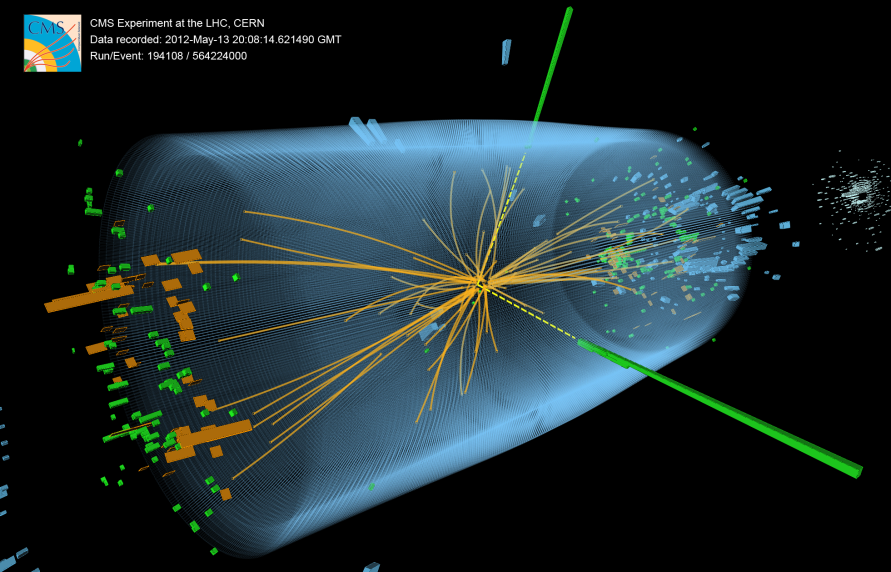
CMS logoCMS event Hgg
Compact Muon Solenoid
LHC, CERN

CMS-PAS-SUS-23-013
Search for dark matter produced in association with a dark Higgs boson decaying into a bottom quark pair in proton-proton collisions at $ \sqrt{s}= $ 13 TeV
Abstract: A search for dark matter produced in association with a dark Higgs boson decaying into a bottom quark pair has been performed in proton-proton collisions at a center-of-mass energy of 13 TeV collected with the CMS detector during the 2016-2018 data-taking period at the CERN LHC. The analyzed data sample corresponds to an integrated luminosity of 138 fb$ ^{-1} $. The results are interpreted in terms of a novel theoretical model of dark matter production that, together with a spin-1 gauge boson mediator, predicts the existence of a Higgs-boson-like particle in the dark sector (i.e., a dark Higgs boson). This search focuses on an experimental signature with large missing transverse momentum from dark matter production and a resonant structure in the invariant mass of the bottom quark pair from the dark Higgs boson decay. Limits at the 95% confidence level on the signal strength for dark Higgs boson mass hypotheses below 160 GeV are set for the first time with CMS data. Values of the mediator mass up to 2.5-4.5 TeV are excluded depending on the dark Higgs boson mass.
Figures & Tables Summary References CMS Publications
Figures

png pdf
Figure 1:
Feynman diagram for the associated production of a $ \mathrm{H}_{\text{D}} $ boson and $ \chi $ particles. The interaction with SM quarks is mediated by a $ \mathrm{Z}^{'} $ boson, and the $ \mathrm{H}_{\text{D}} $ boson mixes with the SM Higgs boson through the $ \theta_{\text{h}} $ mixing angle. In this paper we focus on the decay of the $ \mathrm{H}_{\text{D}} $ boson into a b quark-antiquark pair, which is dominant at lower masses.

png pdf
Figure 2:
Postfit $ m_{\text{SD}} $ distributions in bins of $ U $ for all three years combined. The upper panels present stacked postfit predictions for the backgrounds superimposed on the data. The lower panels present the ratio between the data and the background predictions. The ratio between the data and the postfit prediction is represented by the blue dots, while the ratio between the data and the prefit prediction is represented by the red ones. Only statistical uncertainties are shown.

png pdf
Figure 3:
Expected and observed exclusion limits at the 95% CL on the signal strength $ \mu=\sigma/\sigma_\text{theo} $ as a function of $ m_{\mathrm{Z}^{'}} $ for a $ \mathrm{H}_{\text{D}} $ boson mass of 50 GeV. Only scenarios where the DM particle is more massive than the $ \mathrm{H}_{\text{D}} $ boson are considered. The black solid line indicates the observed exclusion boundary corresponding to $ \mu= $ 1. The black dashed and dotted lines represent the expected exclusion and the 68 and 95% CL intervals around the expected boundary, respectively. Parameter combinations corresponding to larger values of $ \mu $ are excluded.

png pdf
Figure 4:
Expected and observed exclusion limits at the 95% CL on the signal strength $ \mu=\sigma/\sigma_\text{theo} $ as a function of $ m_{\mathrm{Z}^{'}} $ for a $ \mathrm{H}_{\text{D}} $ boson mass of 70 GeV. Only scenarios where the DM particle is more massive than the $ \mathrm{H}_{\text{D}} $ boson are considered. The black solid line indicates the observed exclusion boundary corresponding to $ \mu= $ 1. The black dashed and dotted lines represent the expected exclusion and the 68 and 95% CL intervals around the expected boundary, respectively. Parameter combinations corresponding to larger values of $ \mu $ are excluded.

png pdf
Figure 5:
Expected and observed exclusion limits at the 95% CL on the signal strength $ \mu=\sigma/\sigma_\text{theo} $ as a function of $ m_{\mathrm{Z}^{'}} $ for a $ \mathrm{H}_{\text{D}} $ boson mass of 90 GeV. Only scenarios where the DM particle is more massive than the $ \mathrm{H}_{\text{D}} $ boson are considered. The black solid line indicates the observed exclusion boundary corresponding to $ \mu= $ 1. The black dashed and dotted lines represent the expected exclusion and the 68 and 95% CL intervals around the expected boundary, respectively. Parameter combinations corresponding to larger values of $ \mu $ are excluded.

png pdf
Figure 6:
Expected and observed exclusion limits at the 95% CL on the signal strength $ \mu=\sigma/\sigma_\text{theo} $ as a function of $ m_{\mathrm{Z}^{'}} $ for a $ \mathrm{H}_{\text{D}} $ boson mass of 110 GeV. Only scenarios where the DM particle is more massive than the $ \mathrm{H}_{\text{D}} $ boson are considered. The black solid line indicates the observed exclusion boundary corresponding to $ \mu= $ 1. The black dashed and dotted lines represent the expected exclusion and the 68 and 95% CL intervals around the expected boundary, respectively. Parameter combinations corresponding to larger values of $ \mu $ are excluded.

png pdf
Figure 7:
Expected and observed exclusion limits at the 95% CL on the signal strength $ \mu=\sigma/\sigma_\text{theo} $ as a function of $ m_{\mathrm{Z}^{'}} $ for a $ \mathrm{H}_{\text{D}} $ boson mass of 130 GeV. Only scenarios where the DM particle is more massive than the $ \mathrm{H}_{\text{D}} $ boson are considered. The black solid line indicates the observed exclusion boundary corresponding to $ \mu= $ 1. The black dashed and dotted lines represent the expected exclusion and the 68 and 95% CL intervals around the expected boundary, respectively. Parameter combinations corresponding to larger values of $ \mu $ are excluded.

png pdf
Figure 8:
Expected and observed exclusion limits at the 95% CL on the signal strength $ \mu=\sigma/\sigma_\text{theo} $ as a function of $ m_{\mathrm{Z}^{'}} $ for a $ \mathrm{H}_{\text{D}} $ boson mass of 150 GeV. Only scenarios where the DM particle is more massive than the $ \mathrm{H}_{\text{D}} $ boson are considered. The black solid line indicates the observed exclusion boundary corresponding to $ \mu= $ 1. The black dashed and dotted lines represent the expected exclusion and the 68 and 95% CL intervals around the expected boundary, respectively. Parameter combinations corresponding to larger values of $ \mu $ are excluded.
Tables

png pdf
Table 1:
Expected yields from background processes in the SR. The values shown are from Monte Carlo simulation and the uncertainties are statistical-only. The expected yields for a reference signal hypothesis with m$ _{Z'} = $ 1000 GeV, m$ _{h_{s}} = $ 130 GeV, and m$ _{DM} = $ 150 GeV are also reported.

png pdf
Table 2:
Summary of requirements that define the different analysis regions. A "\checkmark" means the requirement is enforced; an "X" means the variable is left unconstrained in that region (the cut is not applied).

png pdf
Table 3:
Summary of statistical and systematic uncertainties included in the analysis. The value given for each rate uncertainty is the pre-fit maximum value. Uncertainties in the shape of the distributions are instead labeled as such.
Summary
A search for physics beyond the standard model in events with a resonant pair of b quarks and large missing transverse momentum has been presented. A data set of proton-proton collisions at a center-of-mass energy of 13 TeV, corresponding to an integrated luminosity of 138 fb$ ^{-1} $ is analyzed. A joint maximum likelihood fit spanning a set of signal and control regions is used to constrain the standard model background contributions to the data and to extract a possible signal. The result is interpreted in terms of exclusion limits at the 95% confidence level on the parameters of a model of production of a $ \mathrm{H}_{\text{D}} $ boson in association with dark matter particles. Values of the mediator mass of up to 2.5-4.5 TeV are excluded, depending on the mass of the $ \mathrm{H}_{\text{D}} $ boson and assuming couplings of $ g_\mathrm{q}= $ 0.25 between the mediator and quarks, and $ g_{\chi} = $ 1.0 between the mediator and the DM particles. \newpage
References
1 N. Arkani-Hamed, D. P. Finkbeiner, T. R. Slatyer, and N. Weiner A theory of dark matter Physical Review D 7 (2009) 9 0810.0713
2 F. Zwicky On the Masses of Nebulae and of Clusters of Nebulae Astrophysical Journal 8 (1937) 6
3 G. Bertone, D. Hooper, and J. Silk Particle dark matter: Evidence, candidates and constraints Phys. Rept. 405 (2005) 279 hep-ph/0404175
4 D. Abercrombie et al. Dark matter benchmark models for early lhc run-2 searches: Report of the atlas/cms dark matter forum Physics of the Dark Universe 2 (2020) 7 1507.00966
5 CMS Collaboration Search for new particles in events with energetic jets and large missing transverse momentum in proton-proton collisions at $ \sqrt{s} = $ 13 TeV JHEP 11 (2021) 153 CMS-EXO-20-004
2107.13021
6 ATLAS Collaboration Search for new phenomena in events with an energetic jet and missing transverse momentum in $ pp $ collisions at $ \sqrt{s}=13\text{ }\text{ }\mathrm{TeV} $ with the atlas detector (Jun, ) 11, 2021
PRD 10 (2021) 3
2102.10874
7 M. Duerr et al. Hunting the dark Higgs JHEP 04 (2017) 143 1701.08780
8 N. F. Bell, Y. Cai, and R. K. Leane Dark Forces in the Sky: Signals from Z$ ^{\prime} $ and the Dark Higgs JCAP 08 (2016) 001 1605.09382
9 F. Kahlhoefer, K. Schmidt-Hoberg, T. Schwetz, and S. Vogl Implications of unitarity and gauge invariance for simplified dark matter models JHEP 02 (2016) 016 1510.02110
10 N. F. Bell, Y. Cai, and R. K. Leane Impact of mass generation for spin-1 mediator simplified models JCAP 01 (2017) 039 1610.03063
11 LHC Dark Matter Working Group Recommendations of the LHC dark matter working group: Comparing LHC searches for dark matter mediators in visible and invisible decay channels and calculations of the thermal relic density Phys. Dark Univ. 26 (2019) 100377 1703.05703
12 M. T. Frandsen et al. LHC and Tevatron Bounds on the Dark Matter Direct Detection Cross-Section for Vector Mediators JHEP 07 (2012) 123 1204.3839
13 CMS Collaboration A portrait of the Higgs boson by the CMS experiment ten years after the discovery. Nature 607 (2022) 60 CMS-HIG-22-001
2207.00043
14 ATLAS Collaboration Search for dark matter produced in association with a dark Higgs boson decaying into $ W^{+}W^{-} $ in the one-lepton final state at $ \sqrt{s} = $ 13 TeV using 139 fb$ ^{-1} $ of $ pp $ collisions recorded with the ATLAS detector JHEP 07 (2023) 116 2211.07175
15 CMS Collaboration Search for dark matter particles in W$ ^{+} $W$ ^{-} $ events with transverse momentum imbalance in proton-proton collisions at $ \sqrt{s} = $ 13 TeV JHEP 03 (2024) 134 CMS-EXO-21-012
2310.12229
16 ATLAS Collaboration Search for Dark Matter Produced in Association with a Dark Higgs Boson in the b\=b Final State Using pp Collisions at s=13 TeV with the ATLAS Detector PRL 134 (2025) 121801 2407.10549
17 CMS Collaboration The CMS experiment at the CERN LHC JINST 3 (2008) S08004
18 CMS Collaboration Development of the CMS detector for the CERN LHC Run 3 JINST 19 (2024) P05064 CMS-PRF-21-001
2309.05466
19 CMS Collaboration Description and performance of track and primary-vertex reconstruction with the CMS tracker JINST 9 (2014) P10009 CMS-TRK-11-001
1405.6569
20 CMS Tracker Group Collaboration The CMS phase-1 pixel detector upgrade JINST 16 (2021) P02027 2012.14304
21 CMS Collaboration Track impact parameter resolution for the full pseudo rapidity coverage in the 2017 dataset with the CMS phase-1 pixel detector CMS Detector Performance Summary CMS-DP-2020-049, 2020
CDS
22 CMS Collaboration 2017 tracking performance plots CMS Detector Performance Summary CMS-DP-2017-015, 2017
CDS
23 CMS Collaboration Technical proposal for the Phase-II upgrade of the Compact Muon Solenoid CMS Technical Proposal CERN-LHCC-2015-010, CMS-TDR-15-02, 2015
CDS
24 CMS Collaboration Performance of the CMS Level-1 trigger in proton-proton collisions at $ \sqrt{s} = $ 13 TeV JINST 15 (2020) P10017 CMS-TRG-17-001
2006.10165
25 CMS Collaboration The CMS trigger system JINST 12 (2017) P01020 CMS-TRG-12-001
1609.02366
26 CMS Collaboration Performance of the CMS high-level trigger during LHC Run 2 JINST 19 (2024) P11021 CMS-TRG-19-001
2410.17038
27 CMS Collaboration Particle-flow reconstruction and global event description with the CMS detector JINST 12 (2017) P10003 CMS-PRF-14-001
1706.04965
28 CMS Collaboration Electron and photon reconstruction and identification with the CMS experiment at the CERN LHC JINST 16 (2021) P05014 CMS-EGM-17-001
2012.06888
29 CMS Collaboration Performance of the CMS muon detector and muon reconstruction with proton-proton collisions at $ \sqrt{s}= $ 13 TeV JINST 13 (2018) P06015 CMS-MUO-16-001
1804.04528
30 CMS Collaboration Reconstruction and identification of $ \tau $ lepton decays to hadrons and $ \nu_\tau $ at CMS JINST 11 (2016) P01019 CMS-TAU-14-001
1510.07488
31 CMS Collaboration Identification of hadronic tau lepton decays using a deep neural network JINST 17 (2022) P07023 CMS-TAU-20-001
2201.08458
32 M. Cacciari, G. P. Salam, and G. Soyez The anti-$ k_{\mathrm{T}} $ jet clustering algorithm JHEP 04 (2008) 063 0802.1189
33 M. Cacciari, G. P. Salam, and G. Soyez Fastjet user manual EPJC 72 (2012) 1896
34 CMS Collaboration Jet energy scale and resolution in the CMS experiment in pp collisions at 8 TeV JINST 12 (2017) P02014 CMS-JME-13-004
1607.03663
35 CMS Collaboration Pileup mitigation at CMS in 13 TeV data JINST 15 (2020) P09018 CMS-JME-18-001
2003.00503
36 D. Berteloni, H. P., M. Low, and N. Tran Pileup per particle identification JHEP 59 (2014) 1407.6013
37 E. Bols et al. Jet Flavour Classification Using DeepJet JINST 15 (2020) P12012 2008.10519
38 CMS Collaboration Performance summary of AK4 jet b tagging with data from proton-proton collisions at 13 TeV with the CMS detector technical report, 2023
CDS
39 M. Dasgupta, A. Fregoso, S. Marzani, and G. P. Salam Towards an understanding of jet substructure JHEP 09 (2013) 029 1307.0007
40 J. M. Butterworth, A. R. Davison, M. Rubin, and G. P. Salam Jet substructure as a new Higgs search channel at the LHC PRL 100 (2008) 242001 0802.2470
41 A. J. Larkoski, S. Marzani, G. Soyez, and J. Thaler Soft drop JHEP 201 (2014) 4 1402.2657
42 CMS Collaboration Identification of heavy, energetic, hadronically decaying particles using machine-learning techniques JINST 15 (2020) P06005 CMS-JME-18-002
2004.08262
43 CMS Collaboration Performance of missing transverse momentum reconstruction in proton-proton collisions at $ \sqrt{s} = $ 13 TeV using the CMS detector JINST 14 (2019) P07004 CMS-JME-17-001
1903.06078
44 T. Sjöstrand et al. An introduction to PYTHIA 8.2 Comput. Phys. Commun. 191 (2015) 159 1410.3012
45 CMS Collaboration Extraction and validation of a new set of CMS PYTHIA8 tunes from underlying-event measurements EPJC 80 (2020) 4 CMS-GEN-17-001
1903.12179
46 GEANT4 Collaboration GEANT 4---a simulation toolkit NIM A 506 (2003) 250
47 The NNPDF collaboration et al. Parton distributions for the LHC run II JHEP 04 (2015) 40 1410.8849
48 NNPDF Collaboration Parton distributions from high-precision collider data Eur. Phys. J. 77 (2017) 663 1706.00428
49 J. Alwall et al. The automated computation of tree-level and next-to-leading order differential cross sections, and their matching to parton shower simulations JHEP 07 (2014) 079 1405.0301
50 M. L. Mangano, M. Moretti, F. Piccinini, and M. Treccani Matching matrix elements and shower evolution for top-quark production in hadronic collisions JHEP 01 (2007) 013 hep-ph/0611129
51 R. Frederix and S. Frixione Merging meets matching in MC@NLO JHEP 12 (2012) 061 1209.6215
52 M. Czakon, P. Fiedler, and A. Mitov Total top-quark pair-production cross section at hadron colliders through $ o(\alpha^4_s) $ PRL 110 (2013) 252004 1303.6254
53 P. Nason A New method for combining NLO QCD with shower Monte Carlo algorithms JHEP 11 (2004) 040 hep-ph/0409146
54 S. Frixione, P. Nason, and C. Oleari Matching NLO QCD computations with Parton Shower simulations: the POWHEG method JHEP 11 (2007) 070 0709.2092
55 S. Alioli, P. Nason, C. Oleari, and E. Re A general framework for implementing NLO calculations in shower Monte Carlo programs: the POWHEG BOX JHEP 06 (2010) 043 1002.2581
56 S. Alioli, P. Nason, C. Oleari, and E. Re NLO single-top production matched with shower in POWHEG: $ s $- and $ t $-channel contributions JHEP 09 (2009) 111 0907.4076
57 E. Re Single-top Wt-channel production matched with parton showers using the POWHEG method EPJC 71 (2011) 1547 1009.2450
58 M. Aliev et al. HATHOR: HAdronic Top and Heavy quarks crOss section calculatoR Comput. Phys. Commun. 182 (2011) 1034 1007.1327
59 P. Kant et al. HATHOR for single top-quark production: Updated predictions and uncertainty estimates for single top-quark production in hadronic collisions Comput. Phys. Commun. 191 (2015) 74 1406.4403
60 T. Gehrmann et al. W$ ^+ $W$ ^- $ production at hadron colliders in next to next to leading order QCD PRL 113 (2014) 212001 1408.5243
61 J. M. Campbell and R. K. Ellis An update on vector boson pair production at hadron colliders PRD 60 (1999) 113006 hep-ph/9905386
62 J. M. Lindert et al. Precise predictions for $ V+ $ jets dark matter backgrounds Eur. Phys. J. 77 (2017) 829 1705.04664
63 CMS Collaboration Precision luminosity measurement in proton-proton collisions at $ \sqrt{s} = $ 13 TeV in 2015 and 2016 at CMS EPJC 81 (2021) 800 CMS-LUM-17-003
2104.01927
64 CMS Collaboration CMS luminosity measurement for the 2017 data-taking period at $ \sqrt{s} = $ 13 TeV CMS Physics Analysis Summary, 2018
link
CMS-PAS-LUM-17-004
65 CMS Collaboration CMS luminosity measurement for the 2018 data-taking period at $ \sqrt{s} = $ 13 TeV CMS Physics Analysis Summary, 2019
link
CMS-PAS-LUM-18-002
66 CMS Collaboration Performance of the CMS missing transverse momentum reconstruction in pp data at $ \sqrt{s} = $ 8 TeV JINST 10 (2015) P02006 CMS-JME-13-003
1411.0511
67 CMS Collaboration Search for new physics in final states with an energetic jet or a hadronically decaying $ {\mathrm{W}} $ or $ {\mathrm{Z}} $ boson and transverse momentum imbalance at $ \sqrt{s}= $ 13 TeV PRD 97 (2018) 092005 CMS-EXO-16-048
1712.02345
68 J. S. Conway Incorporating Nuisance Parameters in Likelihoods for Multisource Spectra in PHYSTAT 2011
link
1103.0354
69 A. L. Read Presentation of search results: The CL$ _{\text{s}} $ technique JPG 28 (2002) 2693
70 T. Junk Confidence level computation for combining searches with small statistics NIM A 434 (1999) 435 hep-ex/9902006
71 G. Cowan, K. Cranmer, E. Gross, and O. Vitells Asymptotic formulae for likelihood-based tests of new physics EPJC 71 (2011) 1554 1007.1727
Compact Muon Solenoid
LHC, CERN