
Compact Muon Solenoid
LHC, CERN
 Visit us: CMS Public Website, CMS Physics ;
Contact us: CMS Publications Committee
Visit us: CMS Public Website, CMS Physics ;
Contact us: CMS Publications Committee
| CMS-PAS-HIG-25-008 | ||
| Search for nonresonant HH production in the bb$ \tau\tau $ final state in proton-proton collisions at $ \sqrt{s}= $ 13.6 TeV | ||
| CMS Collaboration | ||
| 2026-08-06 | ||
| Abstract: A search is presented for Higgs boson pair (HH) production in the bb$ \tau\tau $ final state via gluon-gluon fusion and vector boson fusion, using proton-proton collisions recorded by the CMS detector at the LHC at $ \sqrt{s}= $ 13.6 TeV, for an integrated luminosity of 172 fb$ ^{-1} $. Events are selected requiring at least one hadronically decaying $ \tau $ lepton. Machine learning techniques are used to enhance signal identification and extraction. The data are found to be consistent with the standard model (SM) expectation for the backgrounds. Observed (expected) upper limits at 95% confidence level (CL) are set on the HH production cross section of 6.6 (3.9) and 81 (85) times the SM prediction, for the inclusive and vector boson fusion processes, respectively. These results are combined with 138 fb$ ^{-1} $ of data recorded at $ \sqrt{s}= $ 13 TeV, for a total integrated luminosity of 310 fb$ ^{-1} $, giving combined observed (expected) 95% CL upper limits of 4.0 (3.0) and 62 (70) times the SM prediction for the two processes, respectively. The self-coupling parameter is constrained at 95% CL to $ -2.5 < \kappa_\lambda < $ 9.4 (expected: $ -1.5 < \kappa_\lambda < $ 8.4), and the coupling of two Higgs bosons to two vector bosons to 0.02 $ < \kappa_\text{2V} < $ 2.1 (expected: $ -0.1 < \kappa_\text{2V} < $ 2.2). | ||
| Links: CDS record (PDF) ; CADI line (restricted) ; | ||
| Figures | |
png pdf |
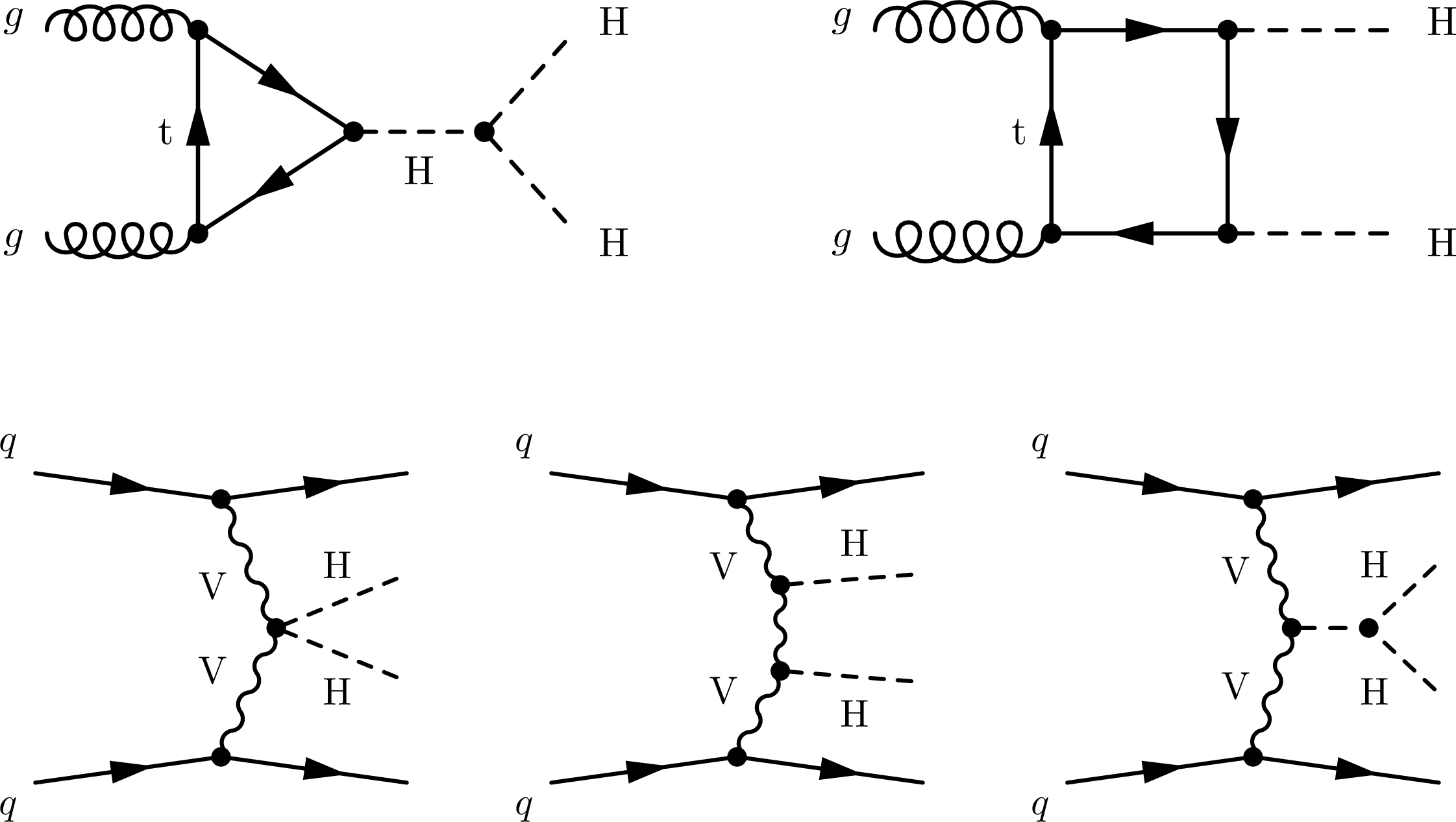
Figure 1:
Leading-order Feynman diagrams contributing to Higgs boson pair production via gluon-gluon fusion (upper row) and vector boson fusion (lower row) in the SM. |

png pdf |
Figure 1-a:
Leading-order Feynman diagrams contributing to Higgs boson pair production via gluon-gluon fusion (upper row) and vector boson fusion (lower row) in the SM. |
png pdf |
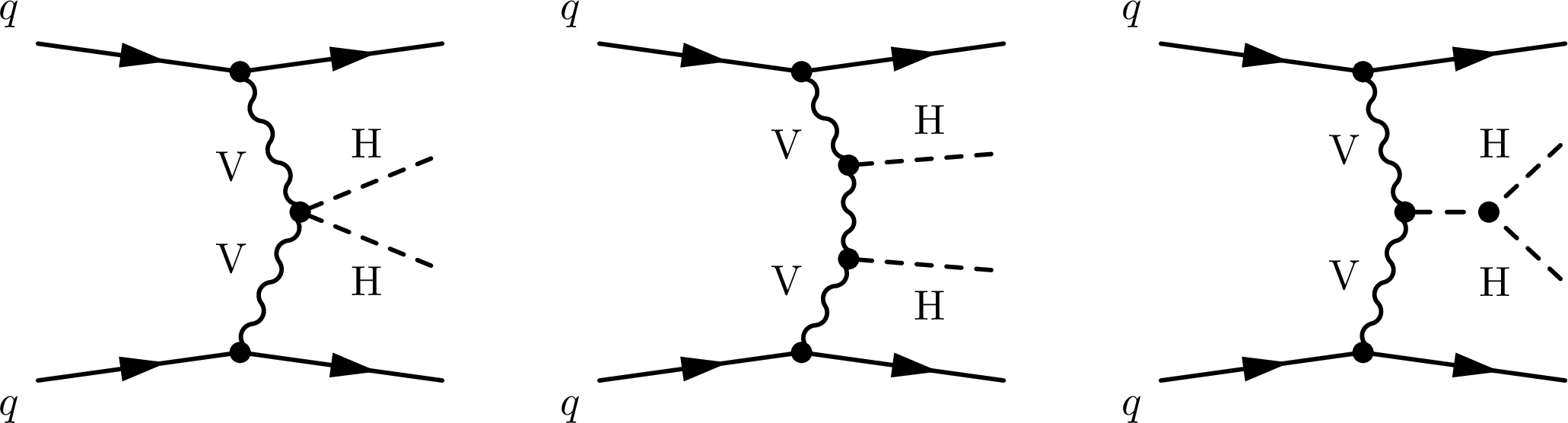
Figure 1-b:
Leading-order Feynman diagrams contributing to Higgs boson pair production via gluon-gluon fusion (upper row) and vector boson fusion (lower row) in the SM. |
png pdf |
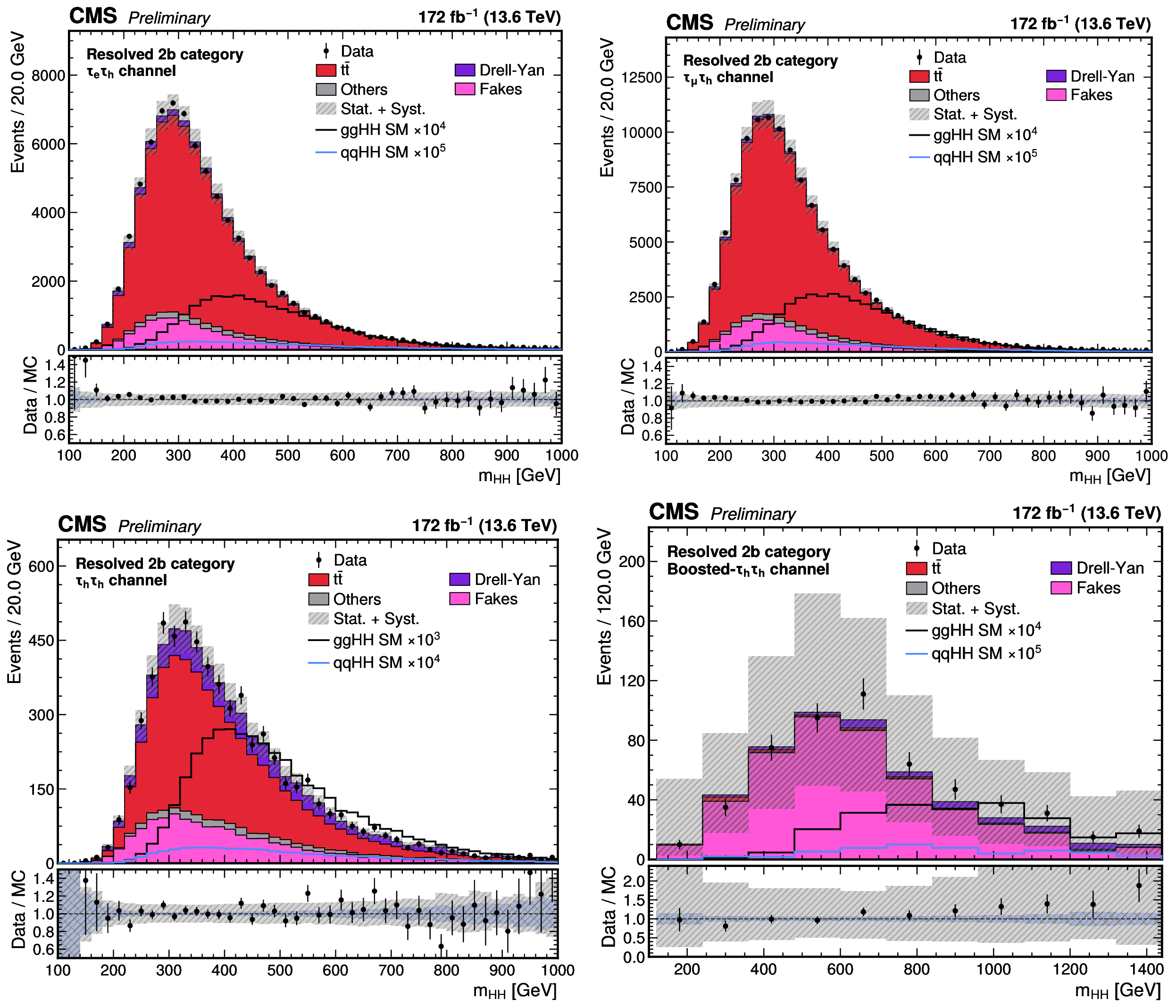
Figure 2:
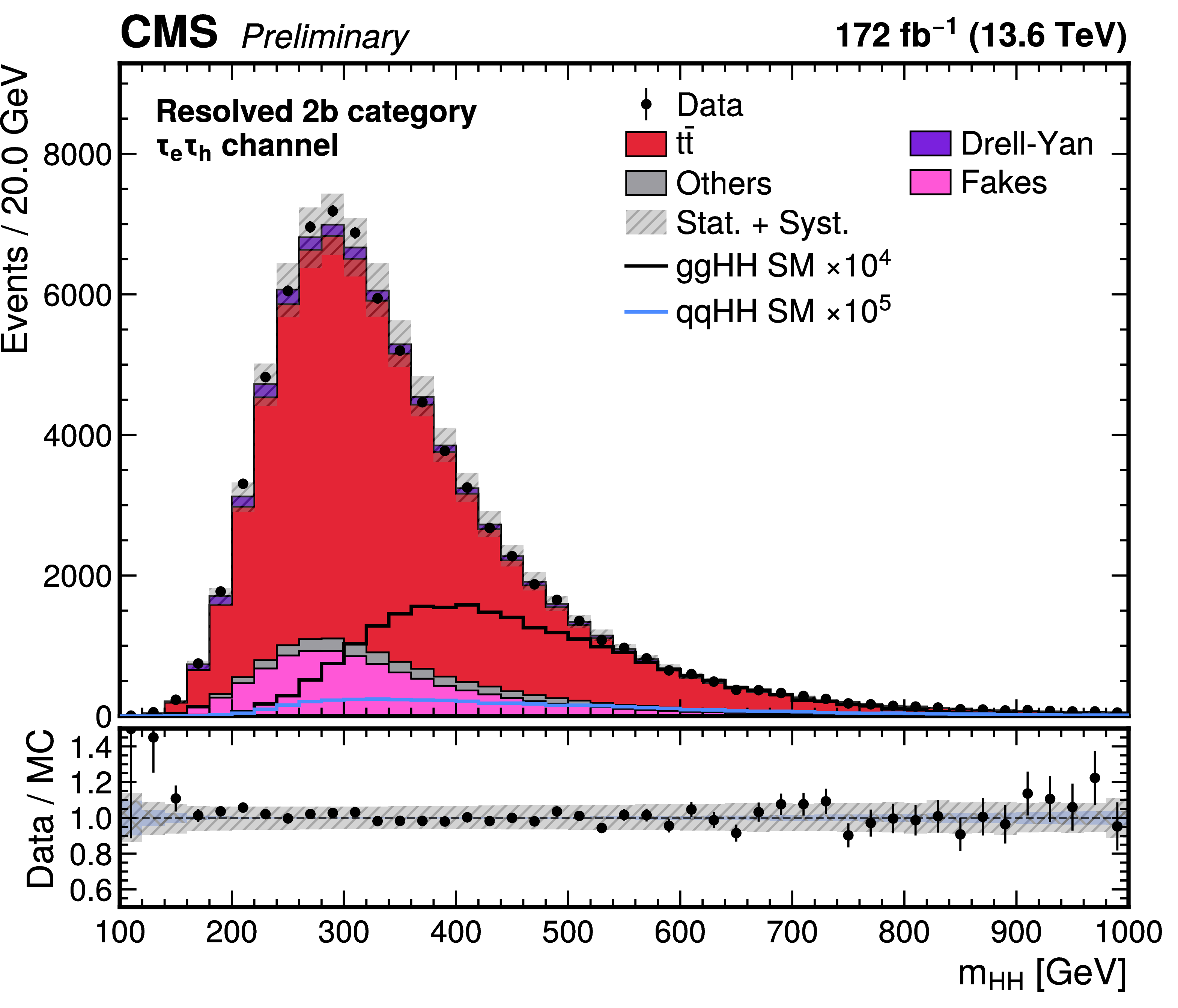
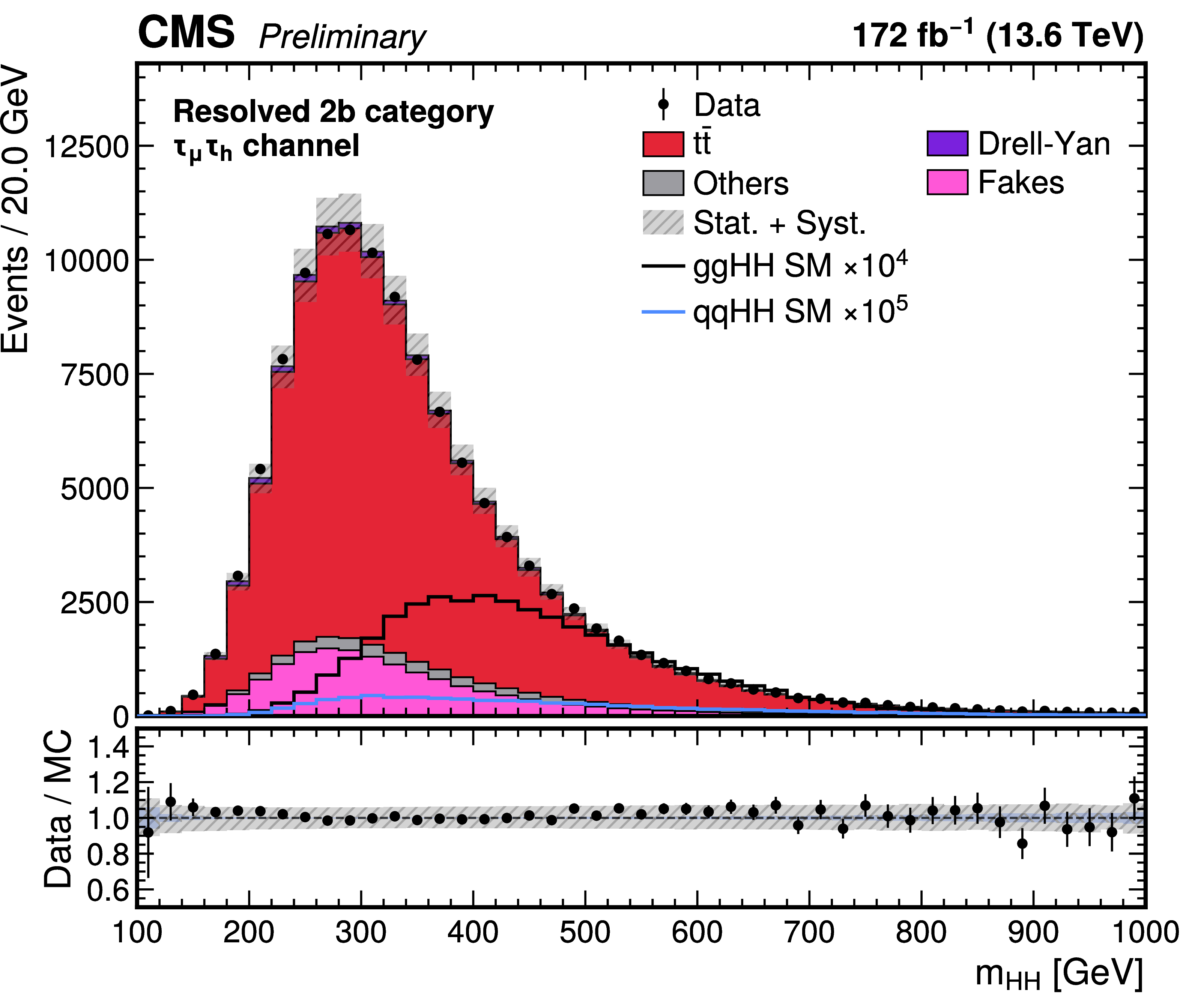
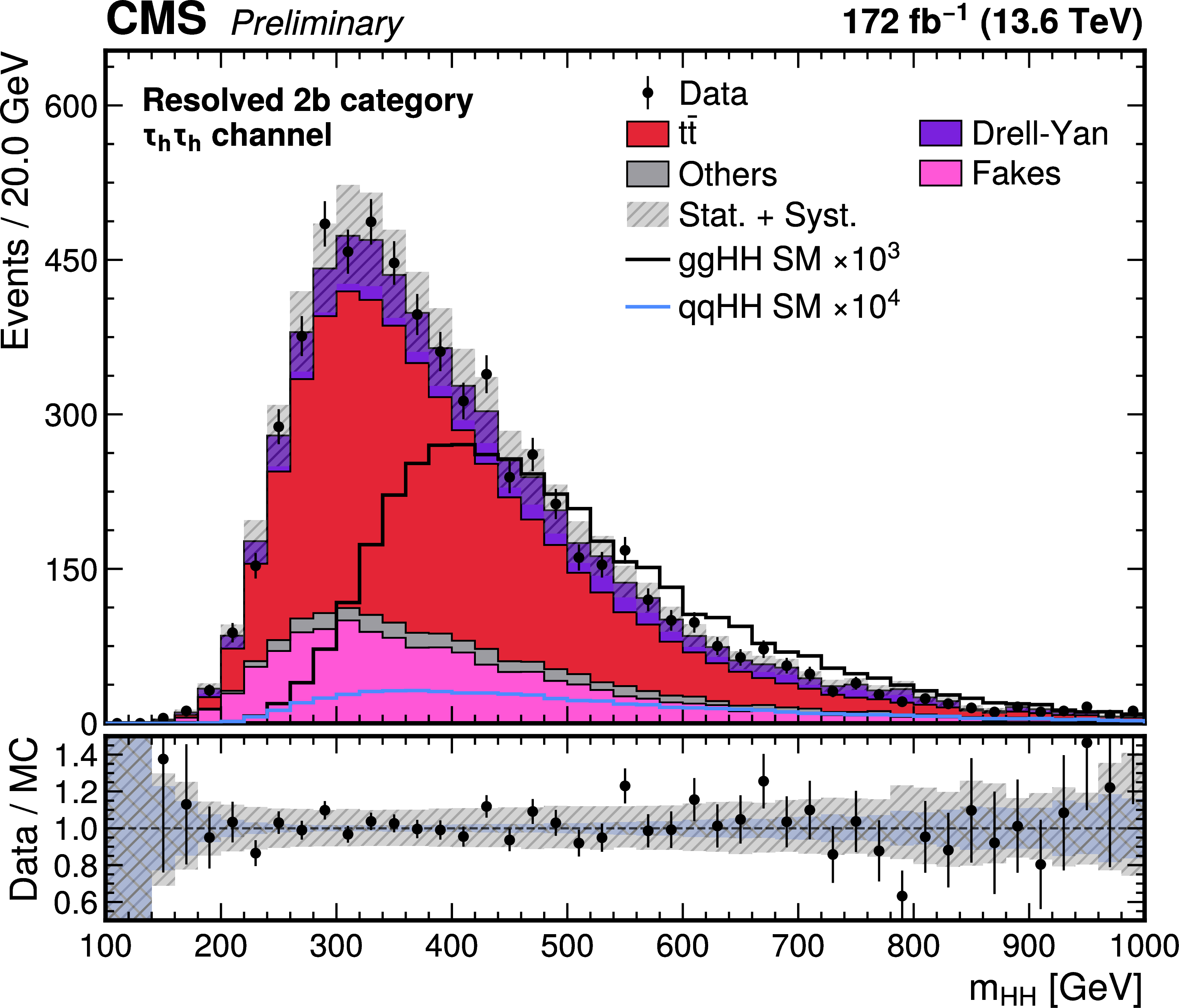
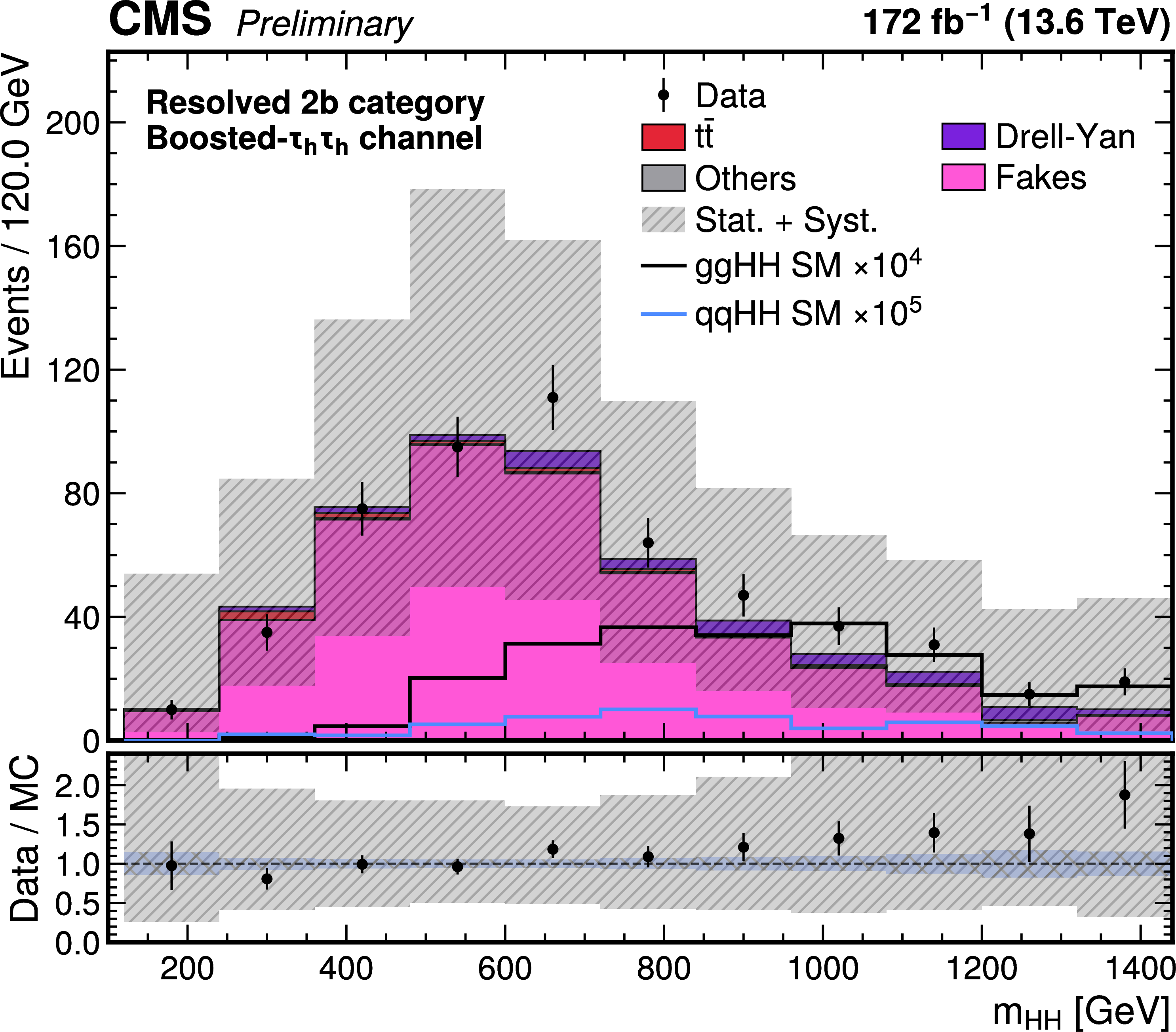
Pre-fit distributions of the reconstructed HH mass ($ m_{\mathrm{H}\mathrm{H}} $) in the most sensitive category of the analysis (resolved 2b). Events are shown in the $ \tau_\mathrm{e}\tau_h $ (upper left), $ \tau_\mu\tau_h $ (upper right), $ \tau_h\tau_h $ (bottom left), and boosted-$ \tau_h\tau_h $ (bottom right) channels for the full 2022--2024 data-taking period, after the selections described in the text. |
png pdf |
Figure 2-a:
Pre-fit distributions of the reconstructed HH mass ($ m_{\mathrm{H}\mathrm{H}} $) in the most sensitive category of the analysis (resolved 2b). Events are shown in the $ \tau_\mathrm{e}\tau_h $ (upper left), $ \tau_\mu\tau_h $ (upper right), $ \tau_h\tau_h $ (bottom left), and boosted-$ \tau_h\tau_h $ (bottom right) channels for the full 2022--2024 data-taking period, after the selections described in the text. |
png pdf |
Figure 2-b:
Pre-fit distributions of the reconstructed HH mass ($ m_{\mathrm{H}\mathrm{H}} $) in the most sensitive category of the analysis (resolved 2b). Events are shown in the $ \tau_\mathrm{e}\tau_h $ (upper left), $ \tau_\mu\tau_h $ (upper right), $ \tau_h\tau_h $ (bottom left), and boosted-$ \tau_h\tau_h $ (bottom right) channels for the full 2022--2024 data-taking period, after the selections described in the text. |
png pdf |
Figure 2-c:
Pre-fit distributions of the reconstructed HH mass ($ m_{\mathrm{H}\mathrm{H}} $) in the most sensitive category of the analysis (resolved 2b). Events are shown in the $ \tau_\mathrm{e}\tau_h $ (upper left), $ \tau_\mu\tau_h $ (upper right), $ \tau_h\tau_h $ (bottom left), and boosted-$ \tau_h\tau_h $ (bottom right) channels for the full 2022--2024 data-taking period, after the selections described in the text. |
png pdf |
Figure 2-d:
Pre-fit distributions of the reconstructed HH mass ($ m_{\mathrm{H}\mathrm{H}} $) in the most sensitive category of the analysis (resolved 2b). Events are shown in the $ \tau_\mathrm{e}\tau_h $ (upper left), $ \tau_\mu\tau_h $ (upper right), $ \tau_h\tau_h $ (bottom left), and boosted-$ \tau_h\tau_h $ (bottom right) channels for the full 2022--2024 data-taking period, after the selections described in the text. |
png pdf |
Figure 3:
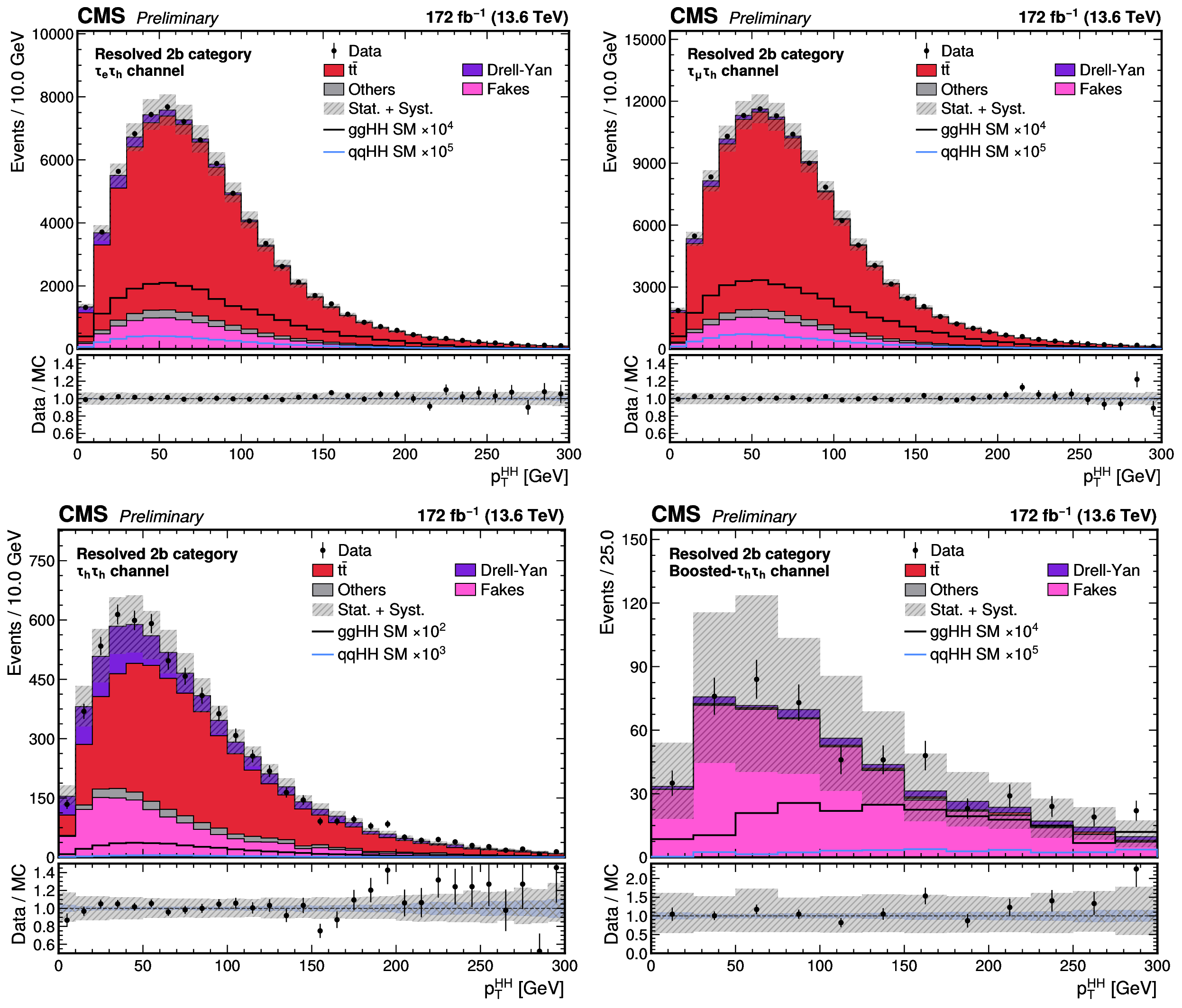
Pre-fit distributions of the reconstructed HH transverse momentum ($ p_{\mathrm{T}}^{\mathrm{H}\mathrm{H}} $) in the most sensitive category of the analysis (resolved 2b). Events are shown in the $ \tau_\mathrm{e}\tau_h $ (upper left), $ \tau_\mu\tau_h $ (upper right), $ \tau_h\tau_h $ (bottom left), and boosted-$ \tau_h\tau_h $ (bottom right) channels for the full 2022--2024 data-taking period, after the selections described in the text. |
png pdf |
Figure 3-a:
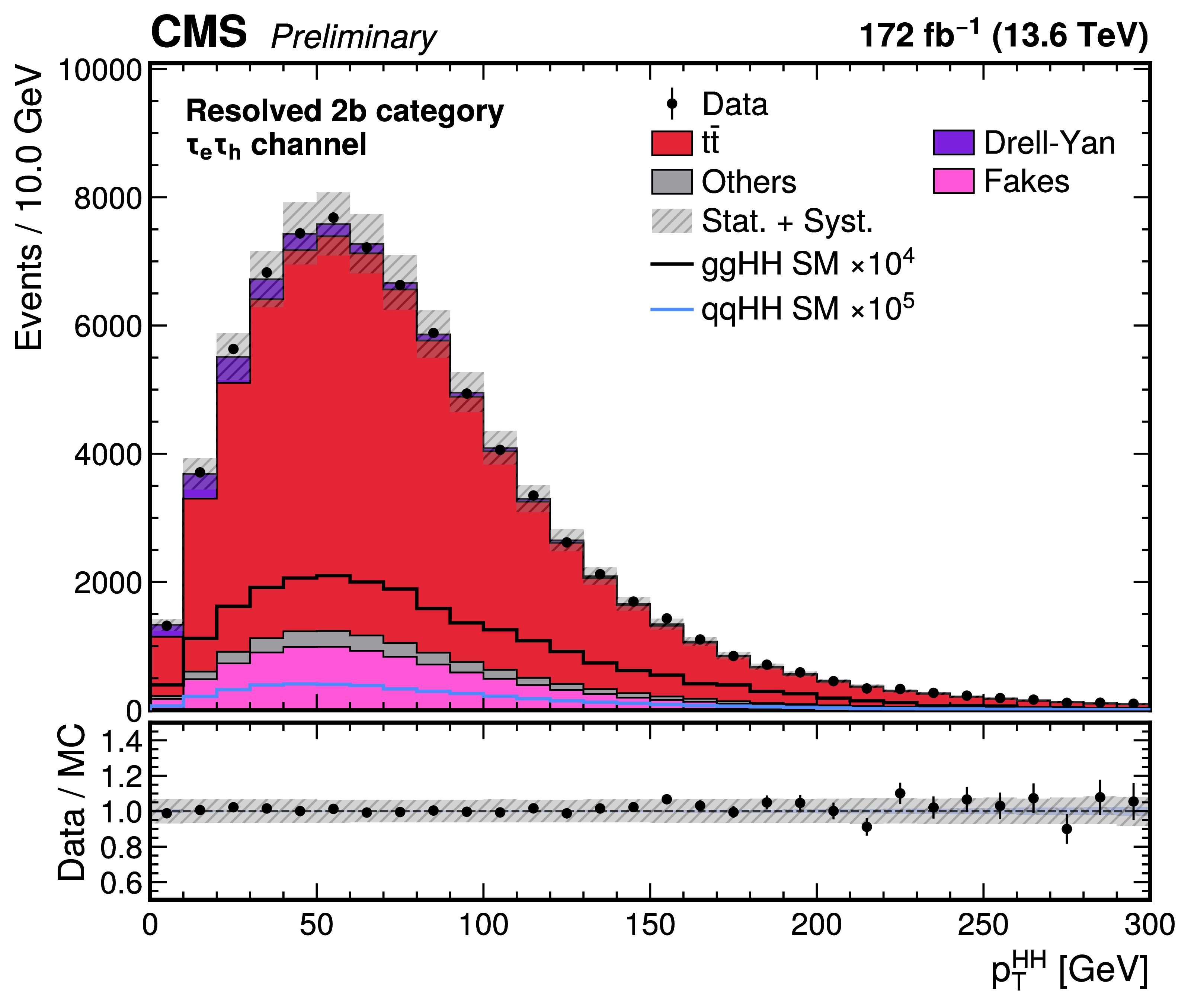
Pre-fit distributions of the reconstructed HH transverse momentum ($ p_{\mathrm{T}}^{\mathrm{H}\mathrm{H}} $) in the most sensitive category of the analysis (resolved 2b). Events are shown in the $ \tau_\mathrm{e}\tau_h $ (upper left), $ \tau_\mu\tau_h $ (upper right), $ \tau_h\tau_h $ (bottom left), and boosted-$ \tau_h\tau_h $ (bottom right) channels for the full 2022--2024 data-taking period, after the selections described in the text. |
png pdf |
Figure 3-b:
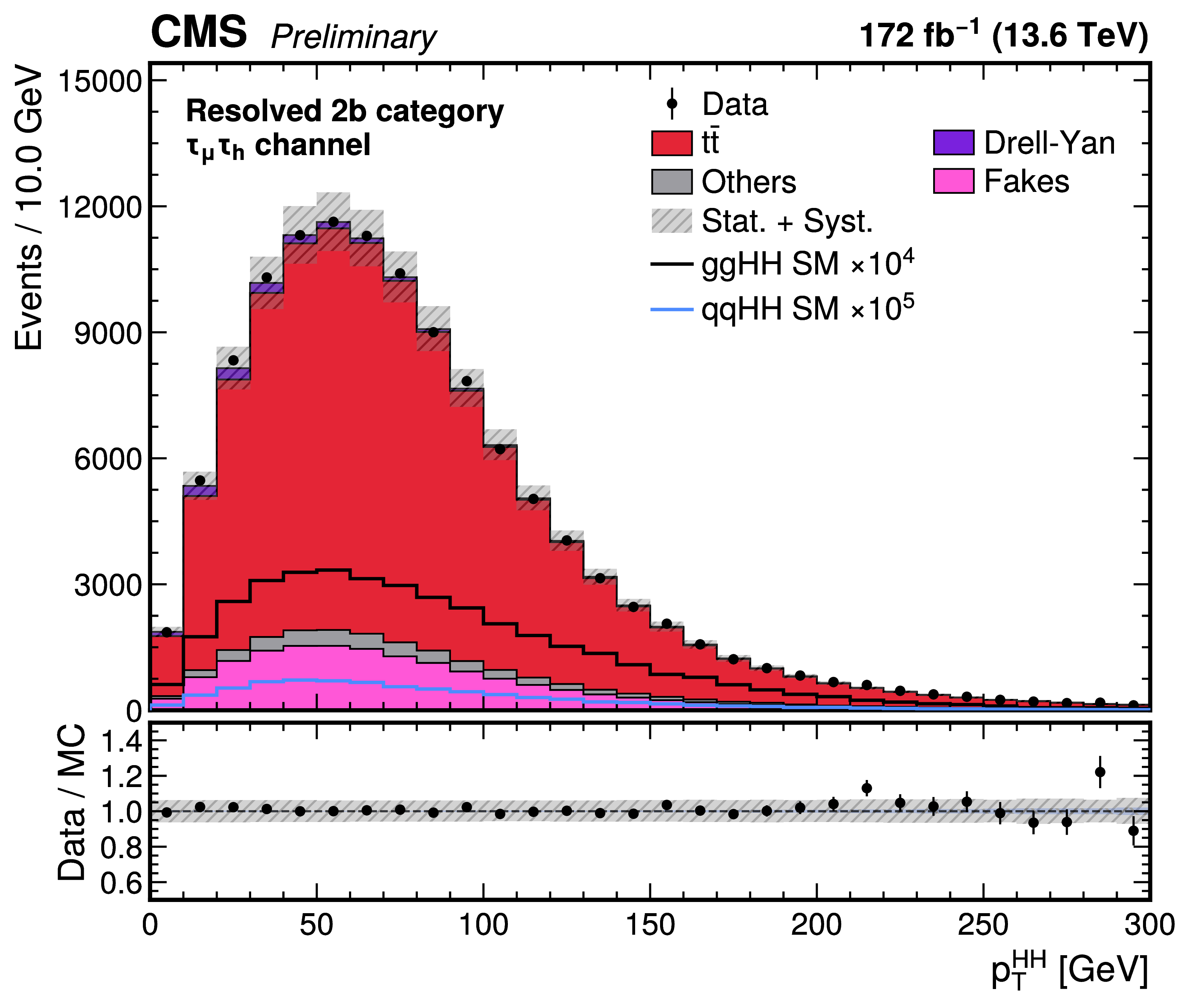
Pre-fit distributions of the reconstructed HH transverse momentum ($ p_{\mathrm{T}}^{\mathrm{H}\mathrm{H}} $) in the most sensitive category of the analysis (resolved 2b). Events are shown in the $ \tau_\mathrm{e}\tau_h $ (upper left), $ \tau_\mu\tau_h $ (upper right), $ \tau_h\tau_h $ (bottom left), and boosted-$ \tau_h\tau_h $ (bottom right) channels for the full 2022--2024 data-taking period, after the selections described in the text. |
png pdf |
Figure 3-c:
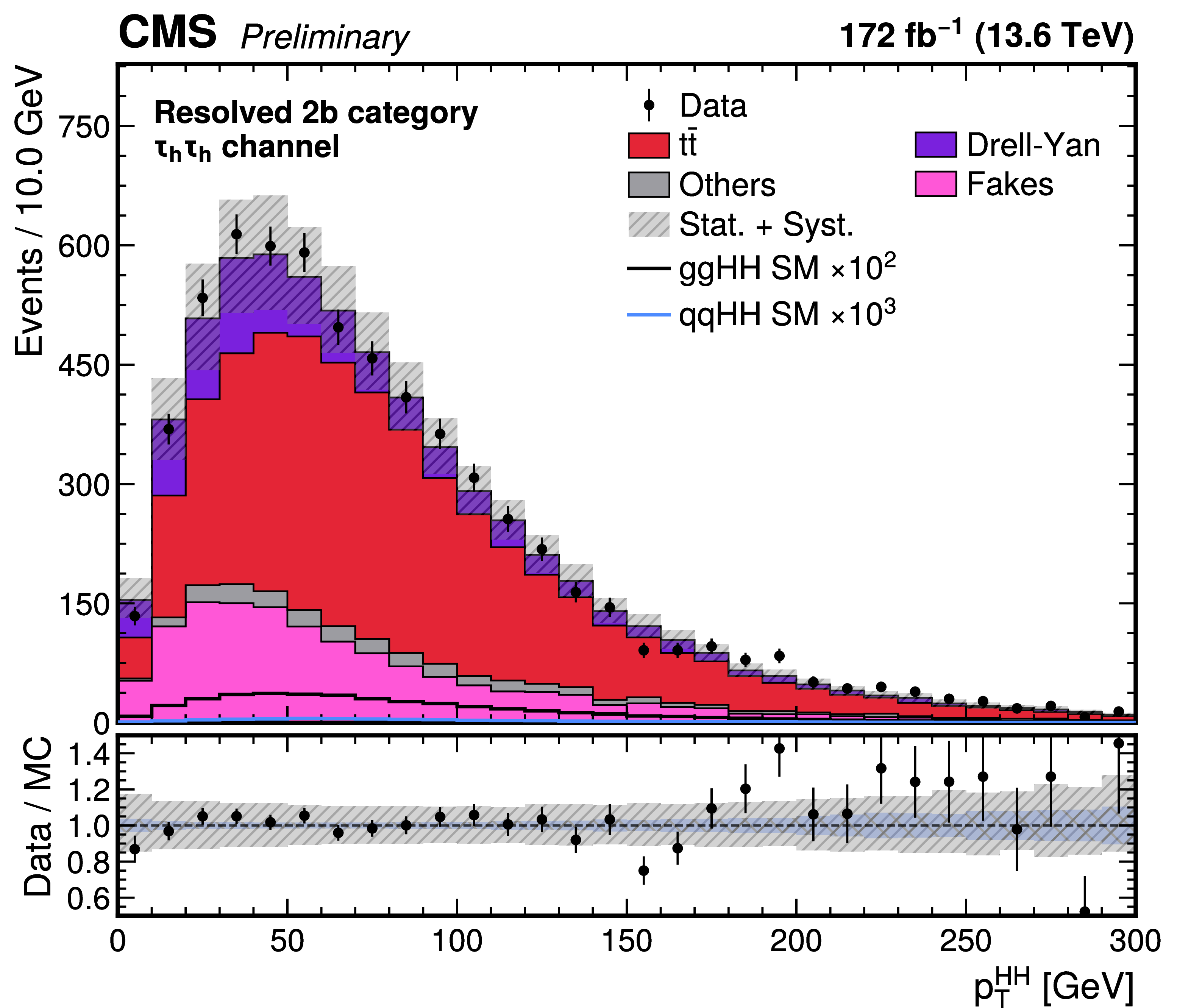
Pre-fit distributions of the reconstructed HH transverse momentum ($ p_{\mathrm{T}}^{\mathrm{H}\mathrm{H}} $) in the most sensitive category of the analysis (resolved 2b). Events are shown in the $ \tau_\mathrm{e}\tau_h $ (upper left), $ \tau_\mu\tau_h $ (upper right), $ \tau_h\tau_h $ (bottom left), and boosted-$ \tau_h\tau_h $ (bottom right) channels for the full 2022--2024 data-taking period, after the selections described in the text. |
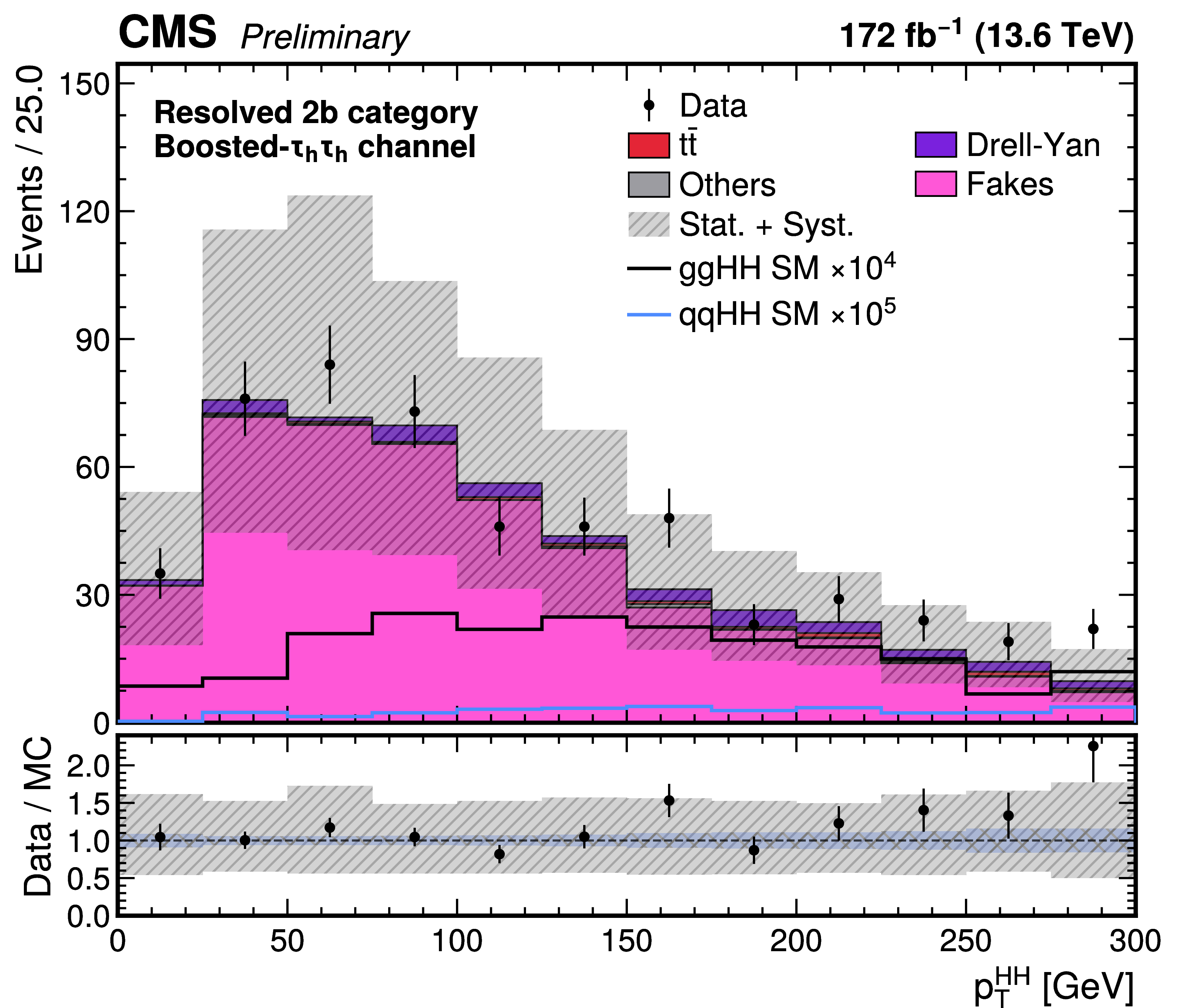
png pdf |
Figure 3-d:
Pre-fit distributions of the reconstructed HH transverse momentum ($ p_{\mathrm{T}}^{\mathrm{H}\mathrm{H}} $) in the most sensitive category of the analysis (resolved 2b). Events are shown in the $ \tau_\mathrm{e}\tau_h $ (upper left), $ \tau_\mu\tau_h $ (upper right), $ \tau_h\tau_h $ (bottom left), and boosted-$ \tau_h\tau_h $ (bottom right) channels for the full 2022--2024 data-taking period, after the selections described in the text. |
png pdf |
Figure 4:
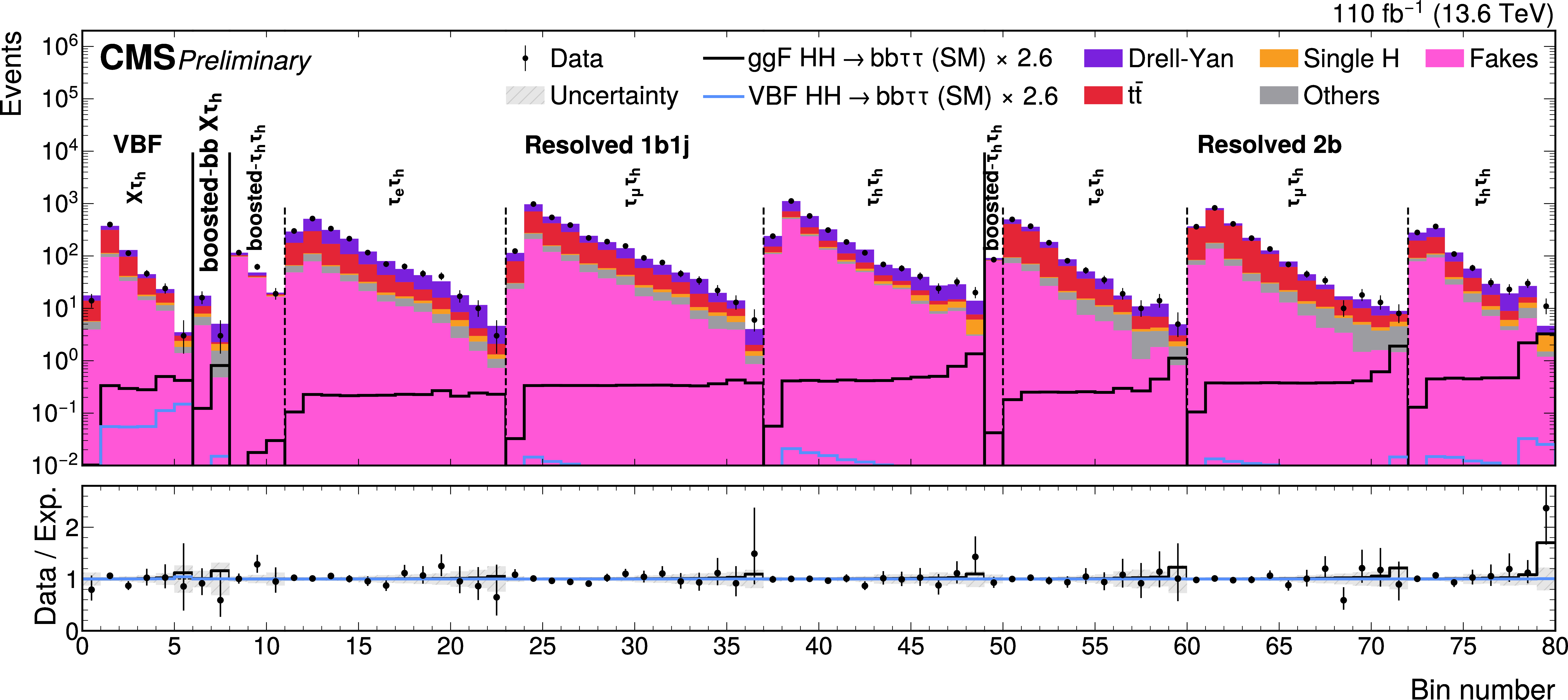
DNN score distributions in the 2024 data-taking signal regions after the maximum-likelihood fit to data. The signal distributions are scaled to the best-fit signal strength modifier obtained from the 13.6 TeV dataset, $ \mu = $ 2.6. The signal regions correspond to the merged $ X\tau_\mathrm{h} $ channel in the boosted-$ bb $ and VBF topologies, and to the resolved categories $ resolved 2b $ and $ resolved 1b1j $ for each of the four $ \tau\tau $ final states: $ \tau_\mu\tau_h $ $, $ \tau_\mathrm{e}\tau_h $, $ \tau_h \tau_h $, and boosted-$ \tau_h \tau_h $. |
png pdf |
Figure 5:
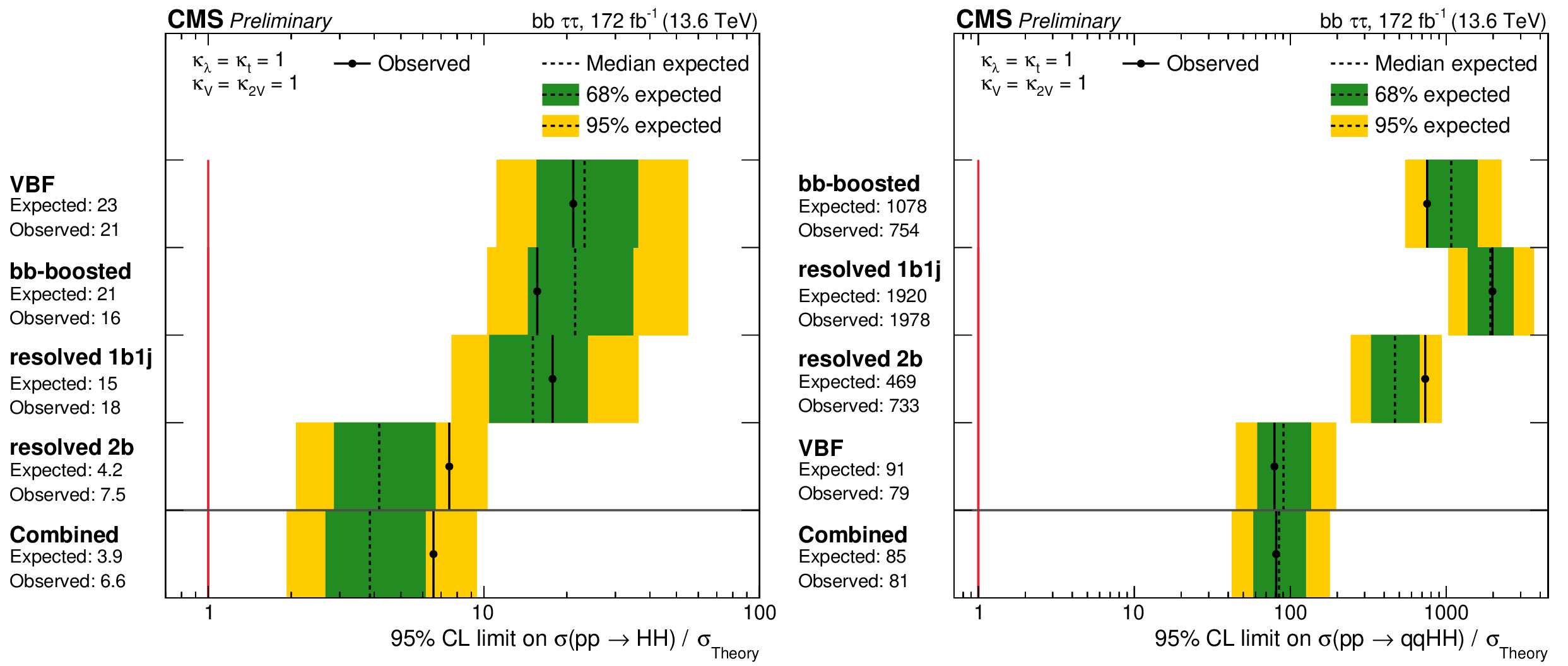
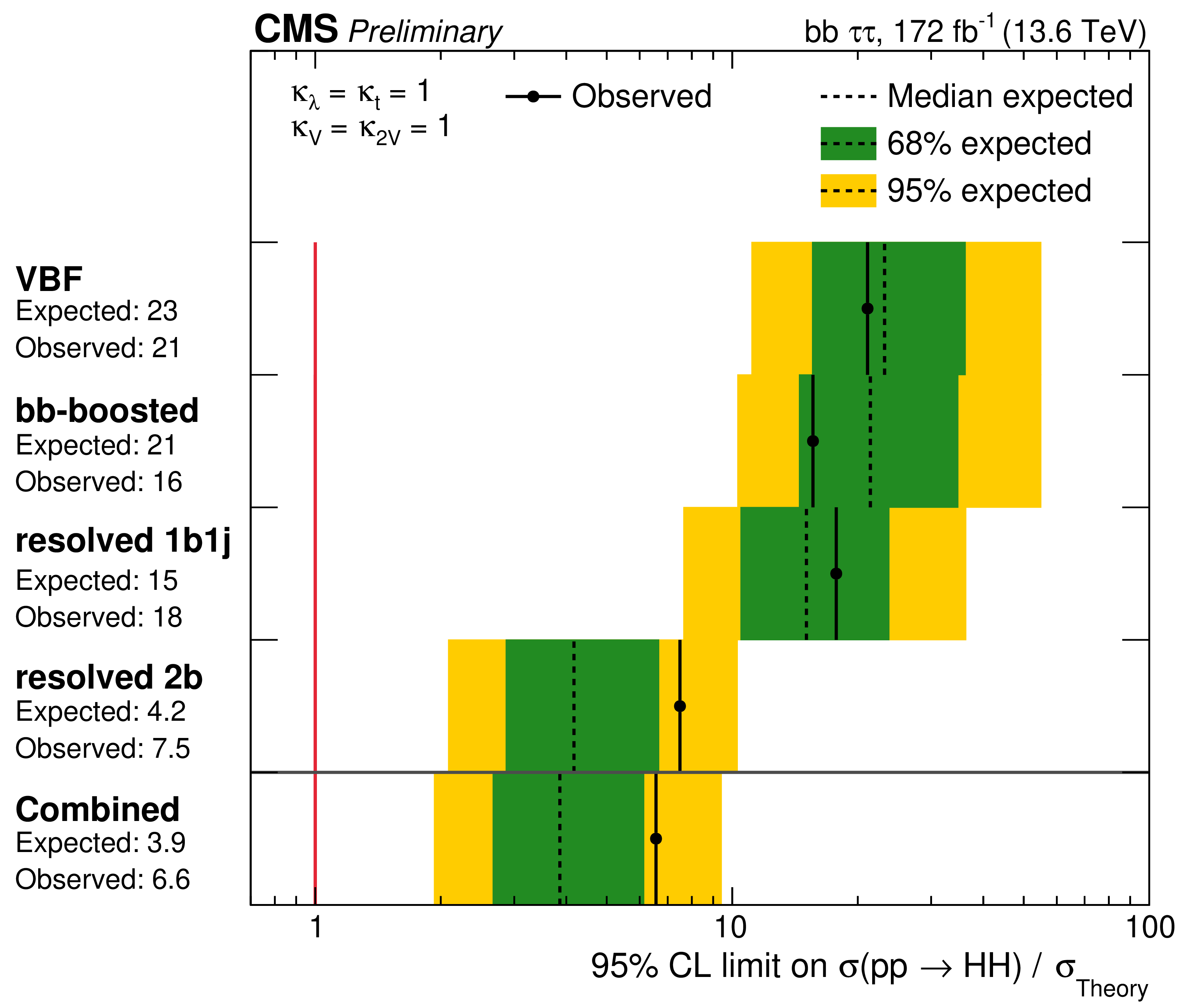
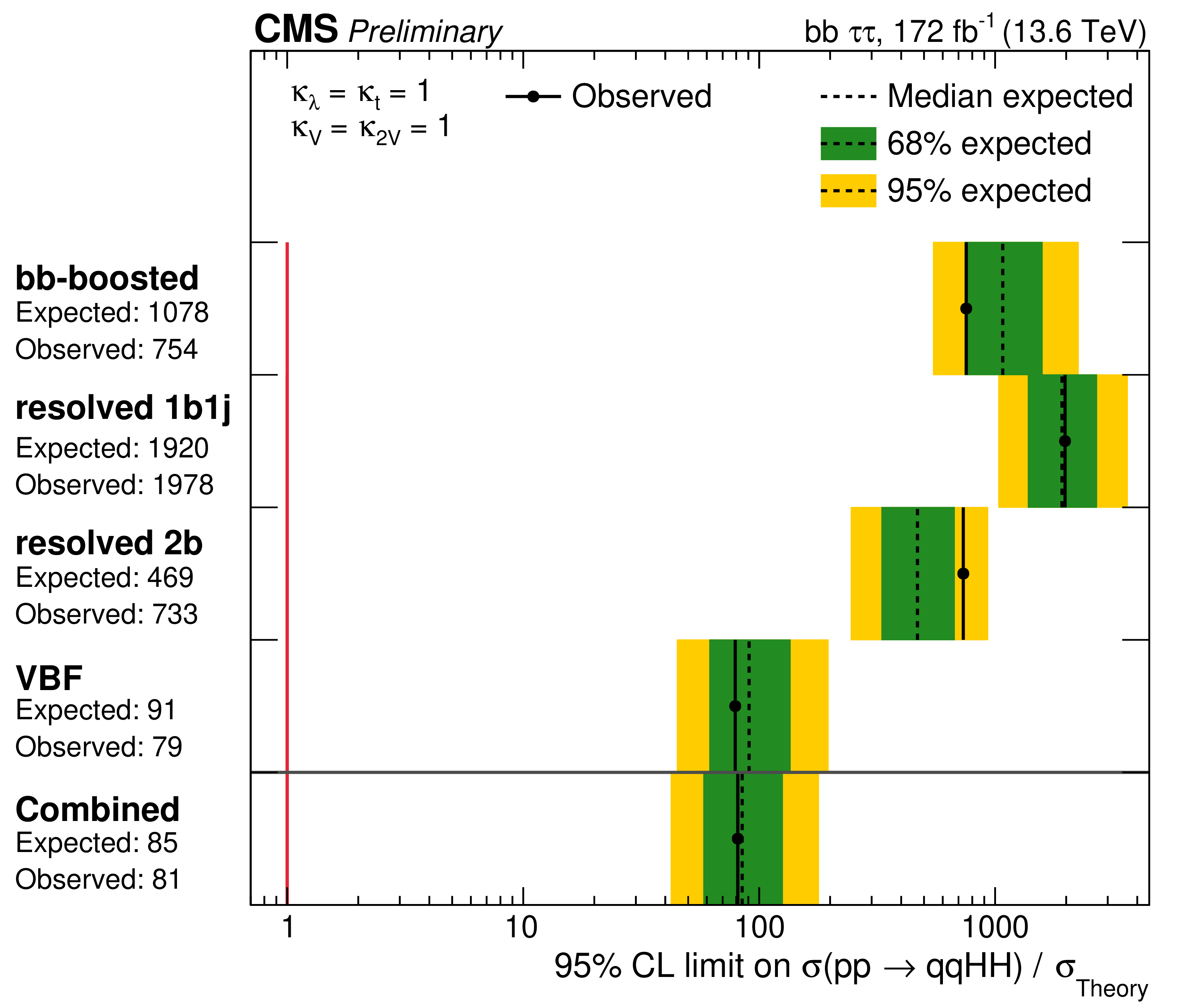
Observed and expected limits on the production cross section at the 95% CL, computed per category for an integrated luminosity of 172 fb$ ^{-1} $ and at a center of mass energy of 13.6 TeV. |
png pdf |
Figure 5-a:
Observed and expected limits on the production cross section at the 95% CL, computed per category for an integrated luminosity of 172 fb$ ^{-1} $ and at a center of mass energy of 13.6 TeV. |
png pdf |
Figure 5-b:
Observed and expected limits on the production cross section at the 95% CL, computed per category for an integrated luminosity of 172 fb$ ^{-1} $ and at a center of mass energy of 13.6 TeV. |
png pdf |
Figure 6:
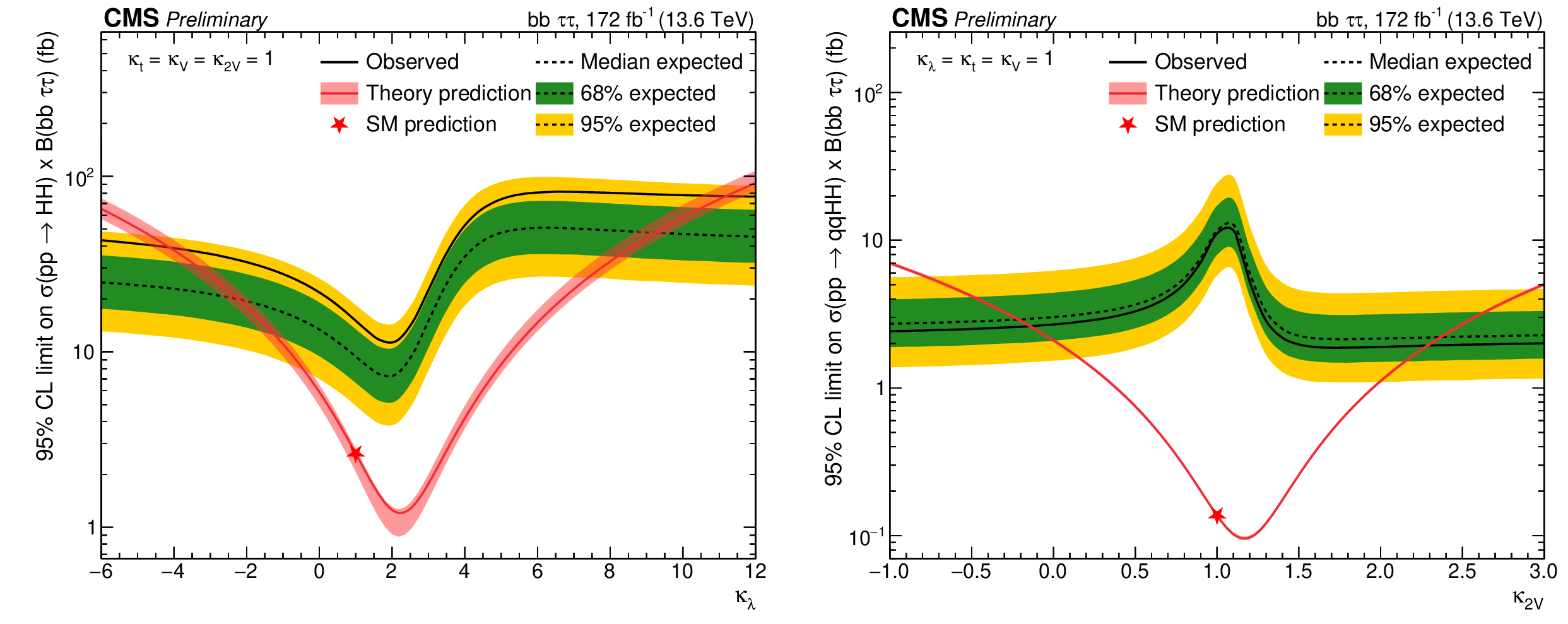
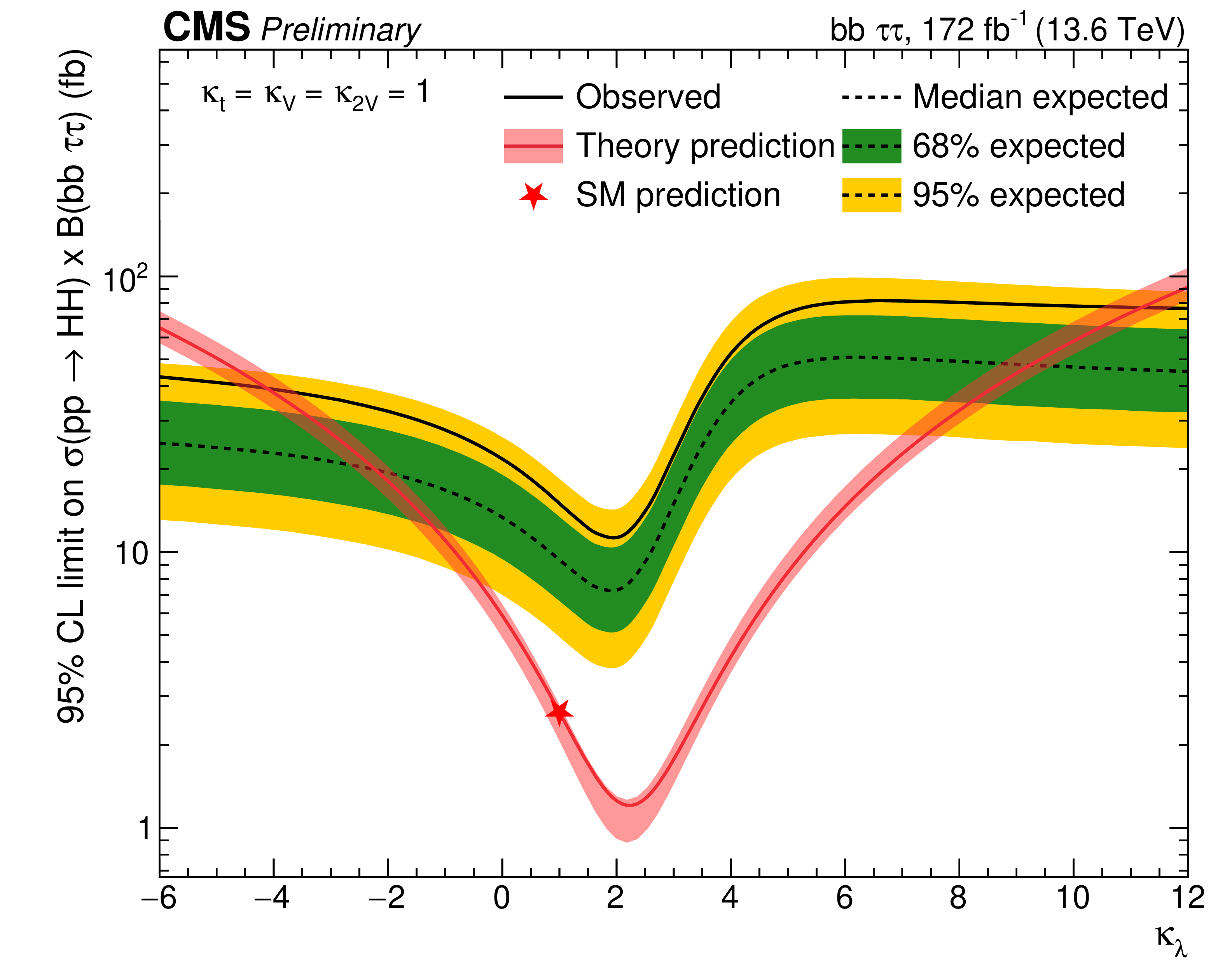
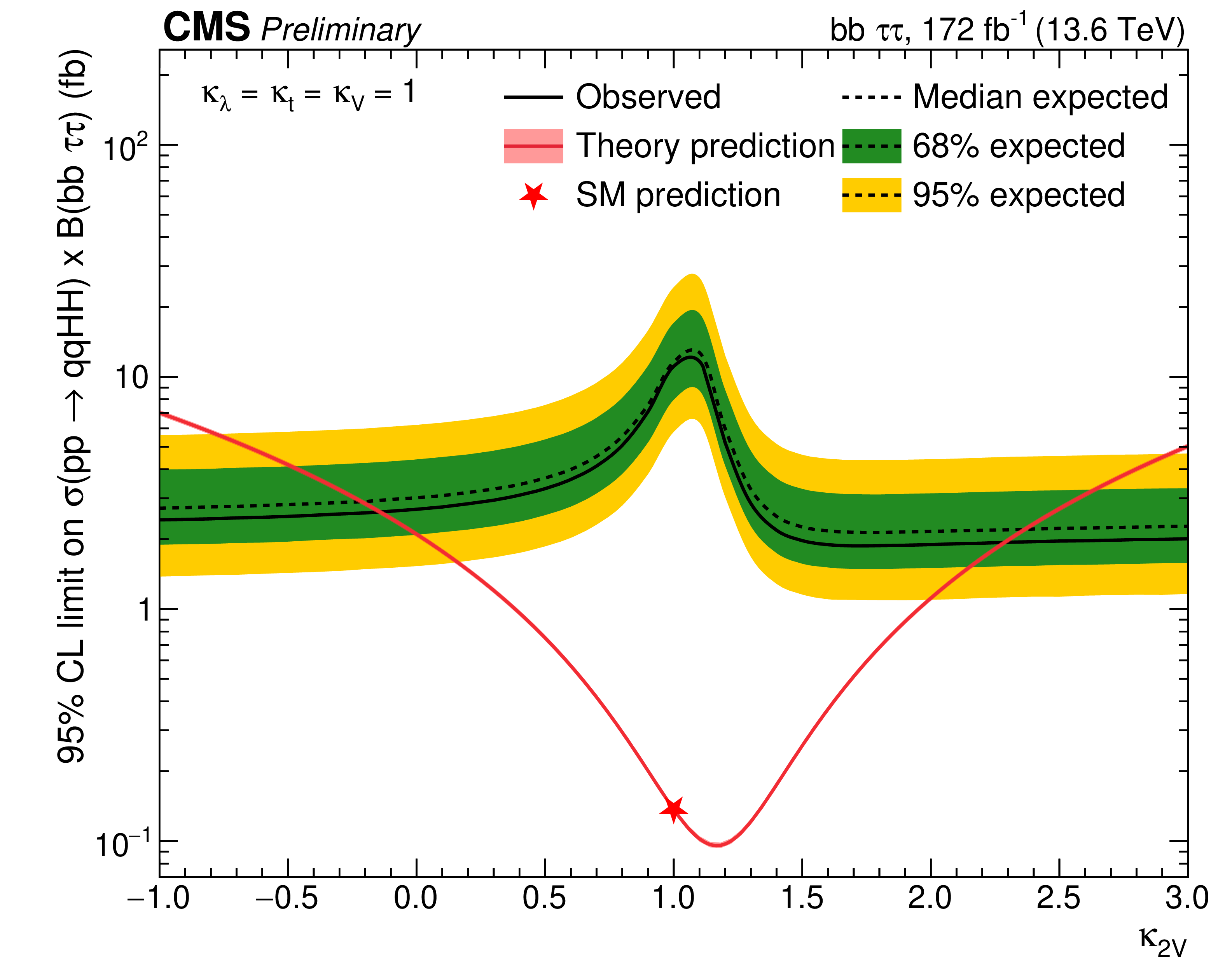
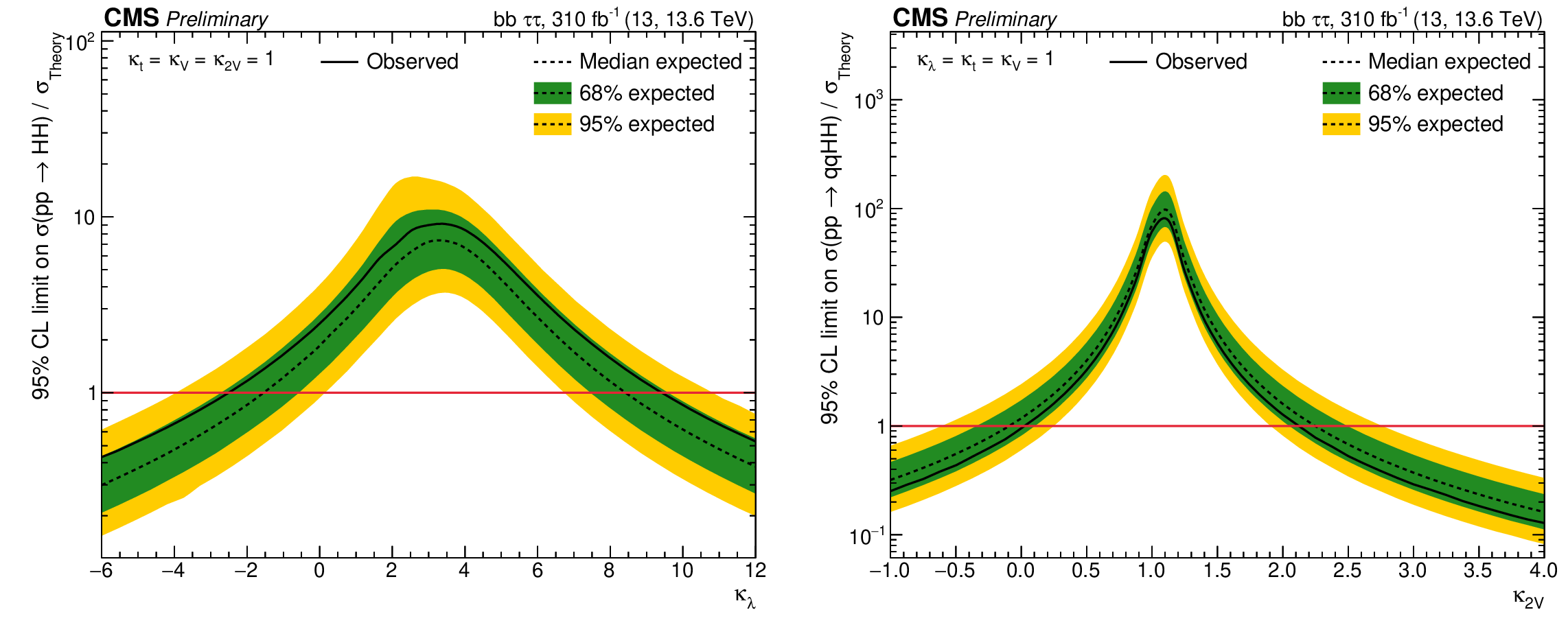
Observed and expected 95% CL upper limits on the HH production cross section times the bb$\tau\tau$ branching fraction as a function of $ \kappa_\lambda $ for the HH inclusive production mode (left) and as a function of $ \kappa_{2V} $ for the qqHH production mode (right). Coupling modifiers not considered in the scans are fixed to their SM values. The red line and band indicate the SM prediction for the HH production cross section and its theoretical uncertainty, respectively. |
png pdf |
Figure 6-a:
Observed and expected 95% CL upper limits on the HH production cross section times the bb$\tau\tau$ branching fraction as a function of $ \kappa_\lambda $ for the HH inclusive production mode (left) and as a function of $ \kappa_{2V} $ for the qqHH production mode (right). Coupling modifiers not considered in the scans are fixed to their SM values. The red line and band indicate the SM prediction for the HH production cross section and its theoretical uncertainty, respectively. |
png pdf |
Figure 6-b:
Observed and expected 95% CL upper limits on the HH production cross section times the bb$\tau\tau$ branching fraction as a function of $ \kappa_\lambda $ for the HH inclusive production mode (left) and as a function of $ \kappa_{2V} $ for the qqHH production mode (right). Coupling modifiers not considered in the scans are fixed to their SM values. The red line and band indicate the SM prediction for the HH production cross section and its theoretical uncertainty, respectively. |
png pdf |
Figure 7:
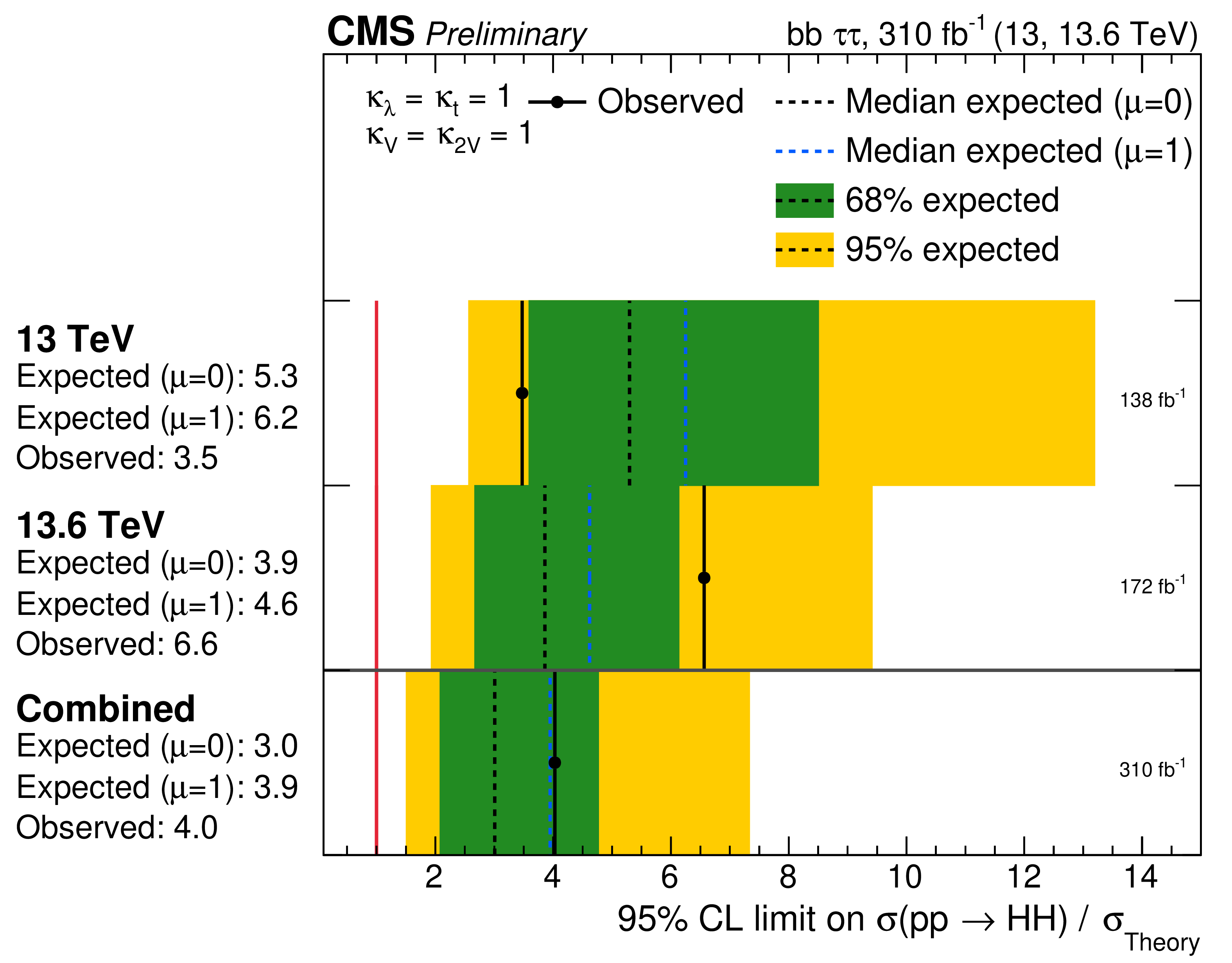
Expected and observed 95% CL limits on the HH production cross section at the SM point ($ k_\lambda = $ 1), shown for the $ \mu= $ 0 and $ \mu= $ 1 signal-strength hypotheses. The $ \pm1\sigma $ (green) and $ \pm2\sigma $ (yellow) uncertainty bands are shown for the expected limit under the $ \mu= $ 0 hypothesis. |
png pdf |
Figure 8:
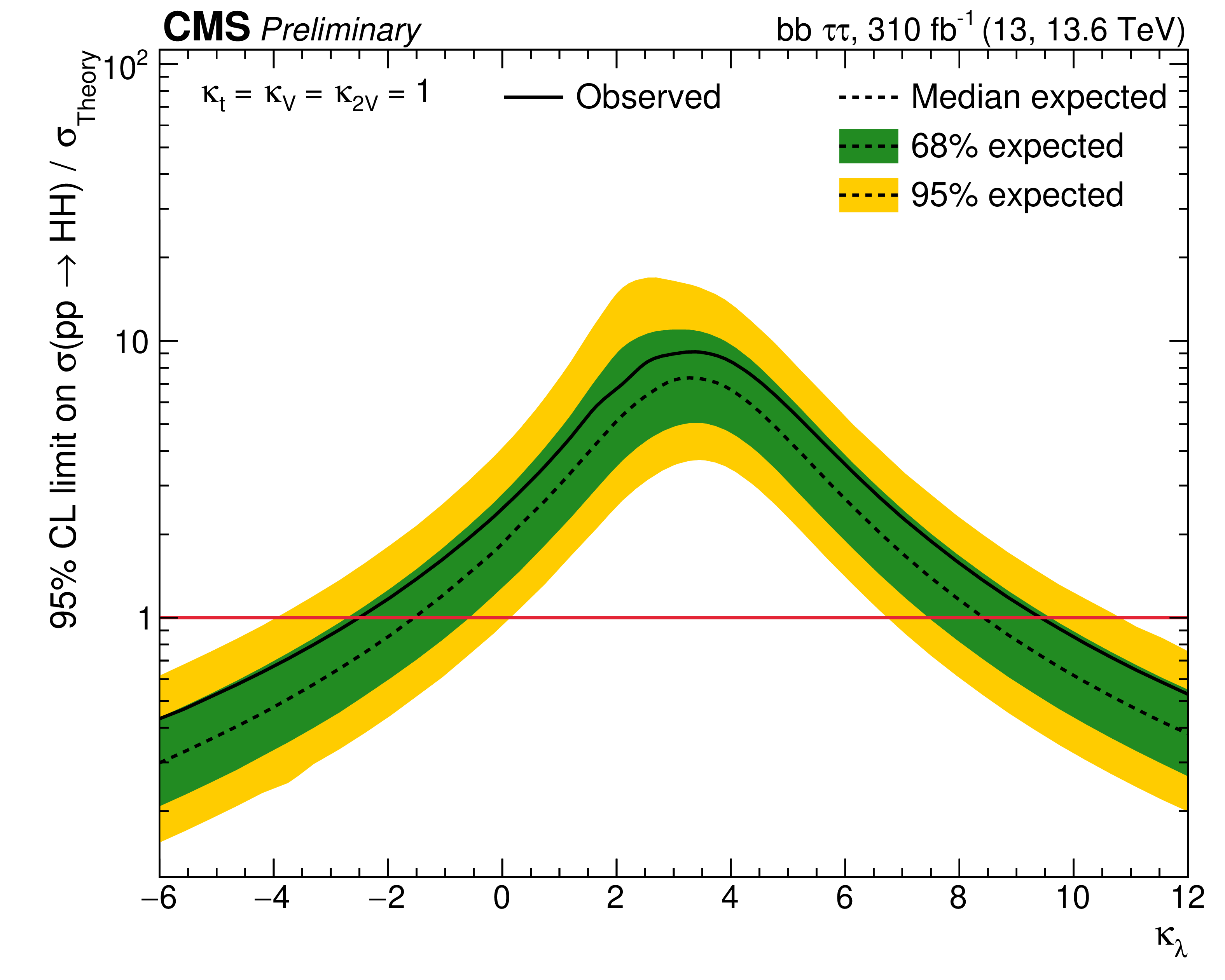
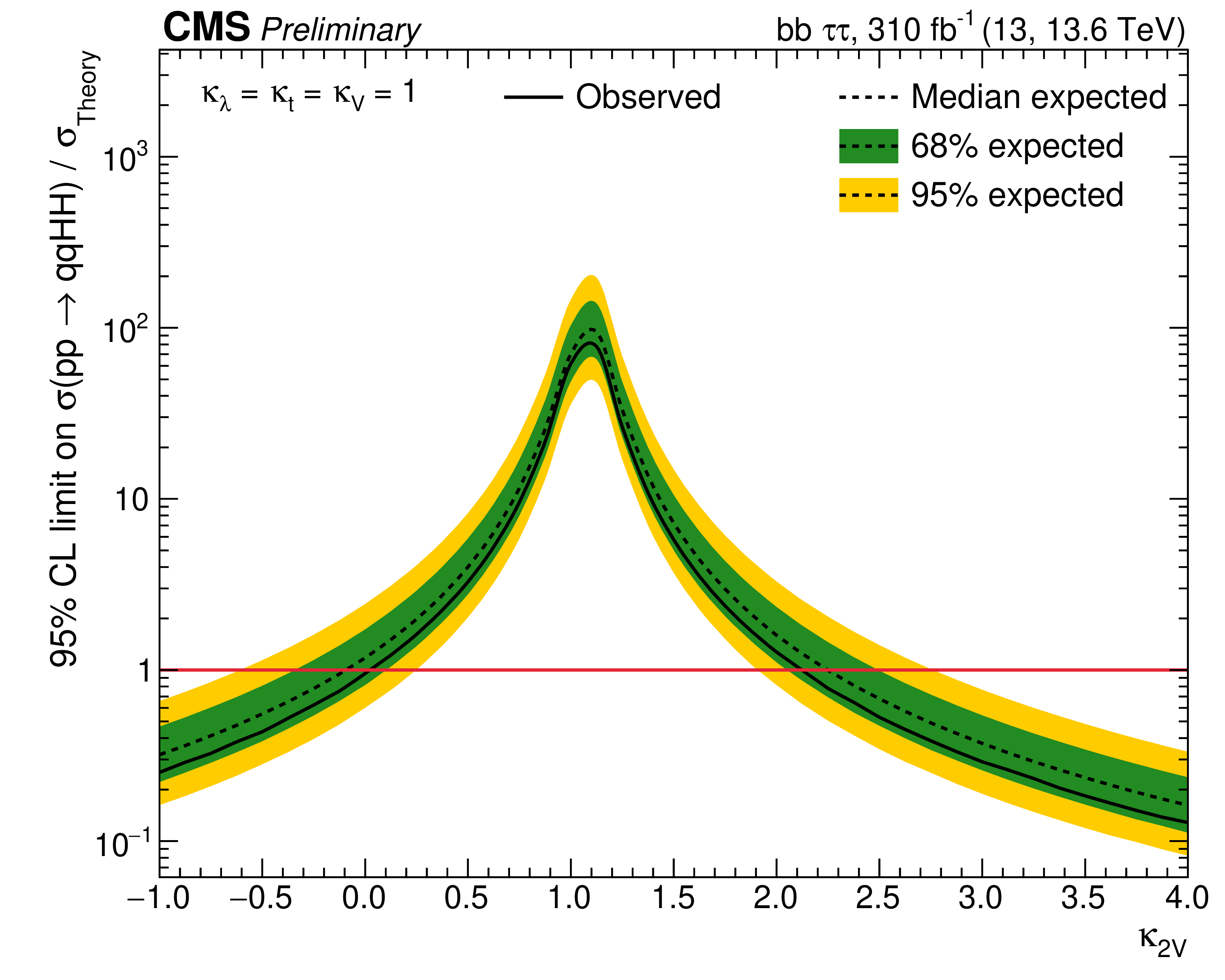
Observed and expected limits at 95% CL on the ggHH + qqHH signal strength as a function of $ k_\lambda $ (left) and on the qqHH signal strength as a function of $ \kappa_{2V} $ (right), with all other couplings set to their SM expectation. |
png pdf |
Figure 8-a:
Observed and expected limits at 95% CL on the ggHH + qqHH signal strength as a function of $ k_\lambda $ (left) and on the qqHH signal strength as a function of $ \kappa_{2V} $ (right), with all other couplings set to their SM expectation. |
png pdf |
Figure 8-b:
Observed and expected limits at 95% CL on the ggHH + qqHH signal strength as a function of $ k_\lambda $ (left) and on the qqHH signal strength as a function of $ \kappa_{2V} $ (right), with all other couplings set to their SM expectation. |
png pdf |
Figure 9:
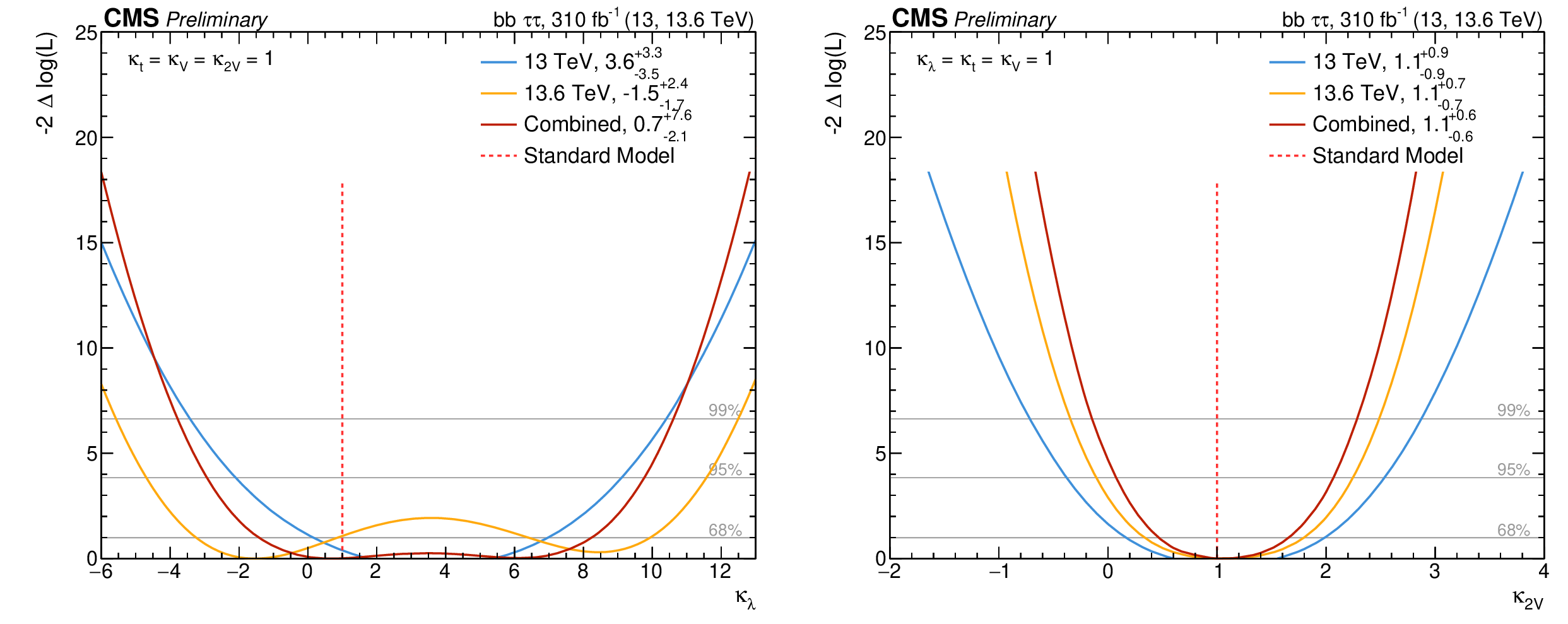
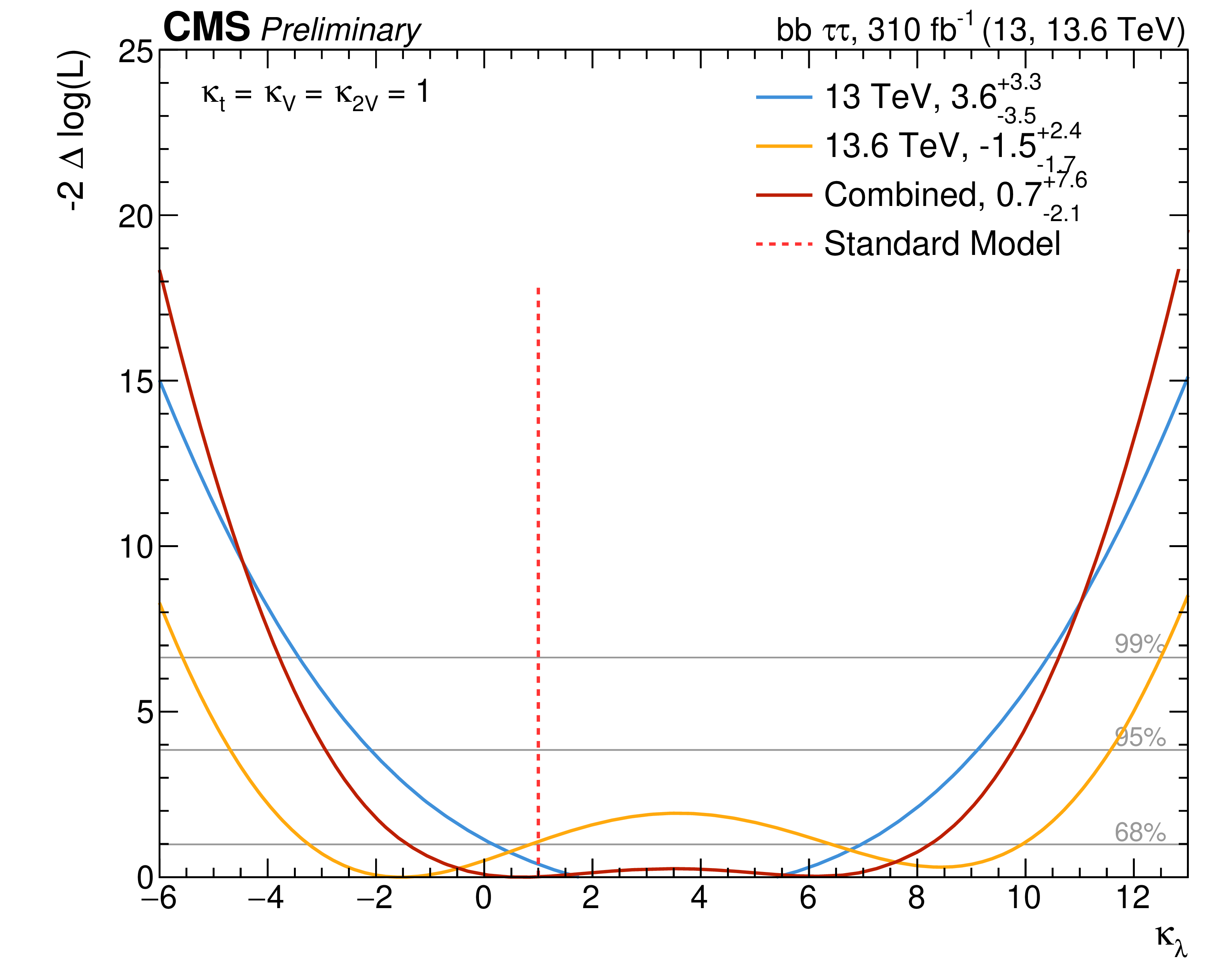
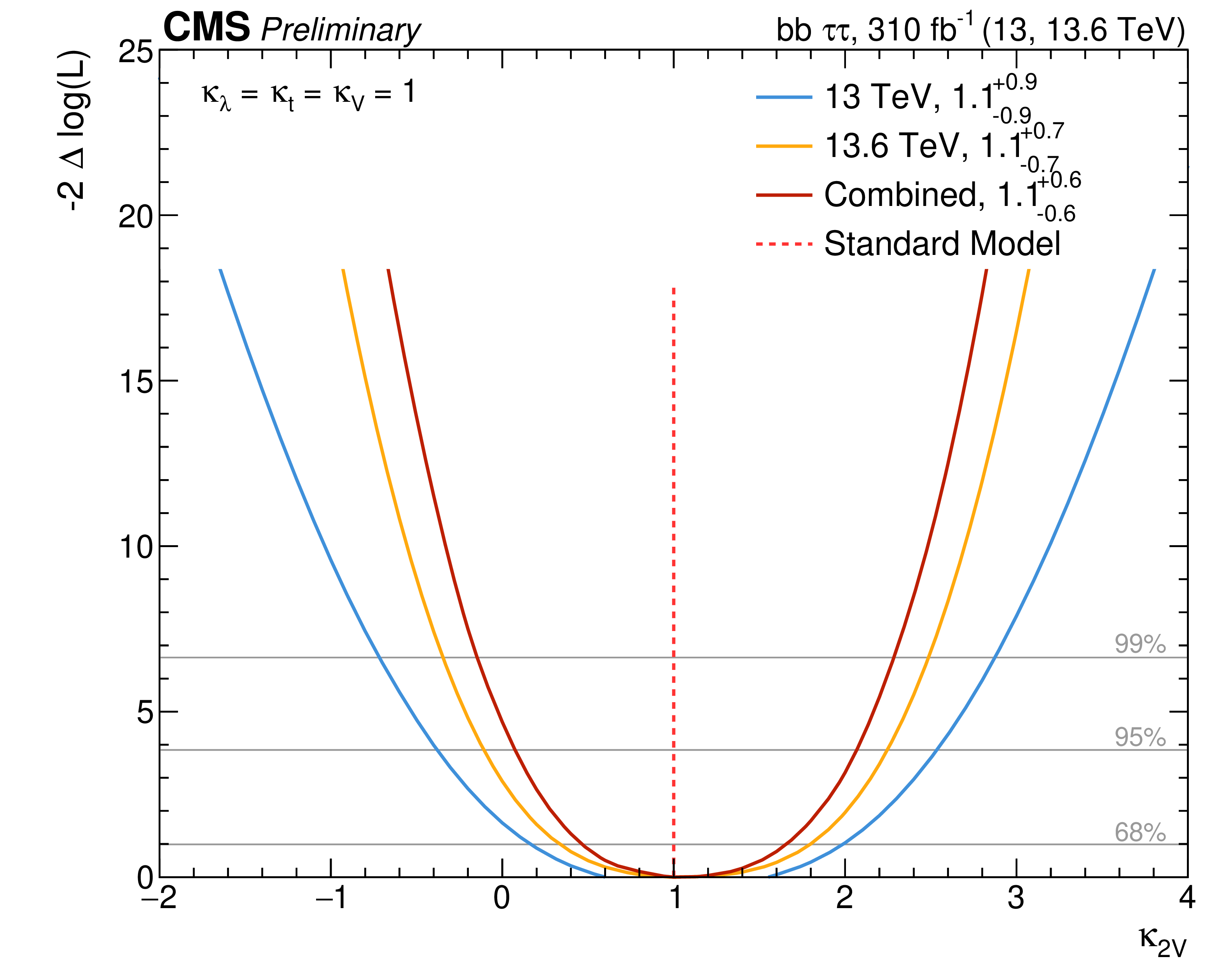
Observed likelihood scans as functions of $ k_\lambda $ (left) and $ k_{2V} $ (right), shown separately for the Run 2 and Run 3 datasets and for their combination. |
png pdf |
Figure 9-a:
Observed likelihood scans as functions of $ k_\lambda $ (left) and $ k_{2V} $ (right), shown separately for the Run 2 and Run 3 datasets and for their combination. |
png pdf |
Figure 9-b:
Observed likelihood scans as functions of $ k_\lambda $ (left) and $ k_{2V} $ (right), shown separately for the Run 2 and Run 3 datasets and for their combination. |
png pdf |
Figure 10:
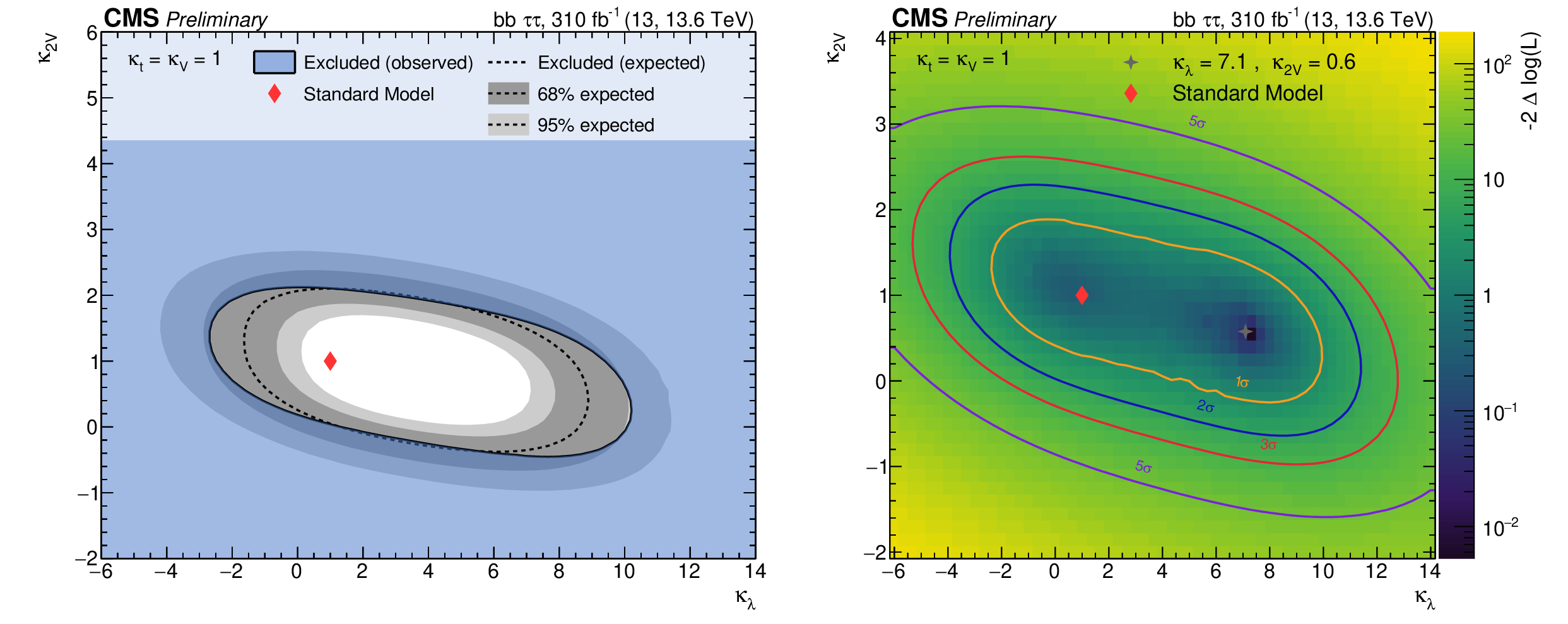
The 2D exclusion region at 95% CL in the $ k_{2V} $ versus $ k_\lambda $ plane (left) and the corresponding 2D likelihood scan (right) are shown for the Run 3 combination with Run 2. Couplings not shown in the scans are fixed to their SM values. The SM configuration is indicated by a red diamond. |
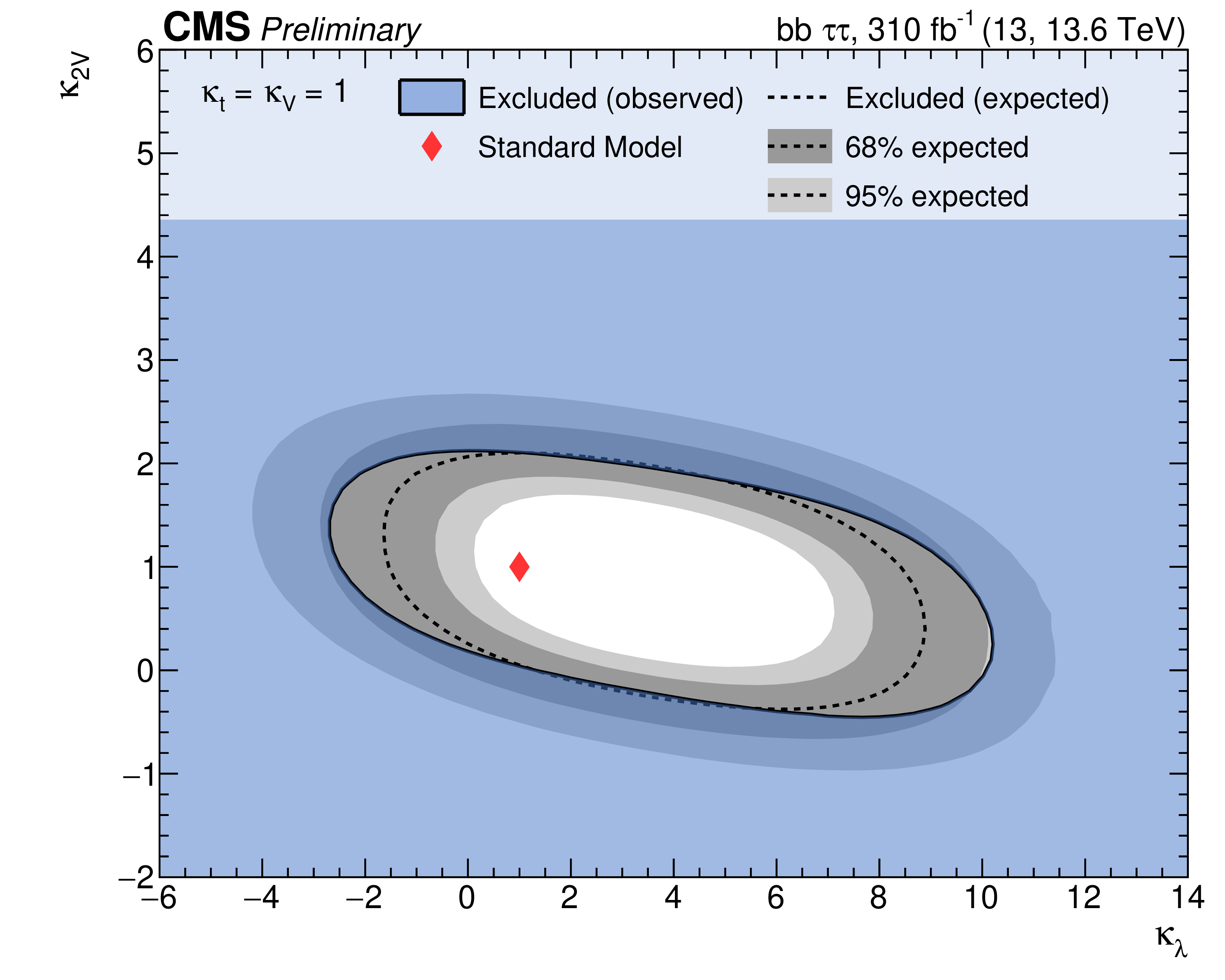
png pdf |
Figure 10-a:
The 2D exclusion region at 95% CL in the $ k_{2V} $ versus $ k_\lambda $ plane (left) and the corresponding 2D likelihood scan (right) are shown for the Run 3 combination with Run 2. Couplings not shown in the scans are fixed to their SM values. The SM configuration is indicated by a red diamond. |
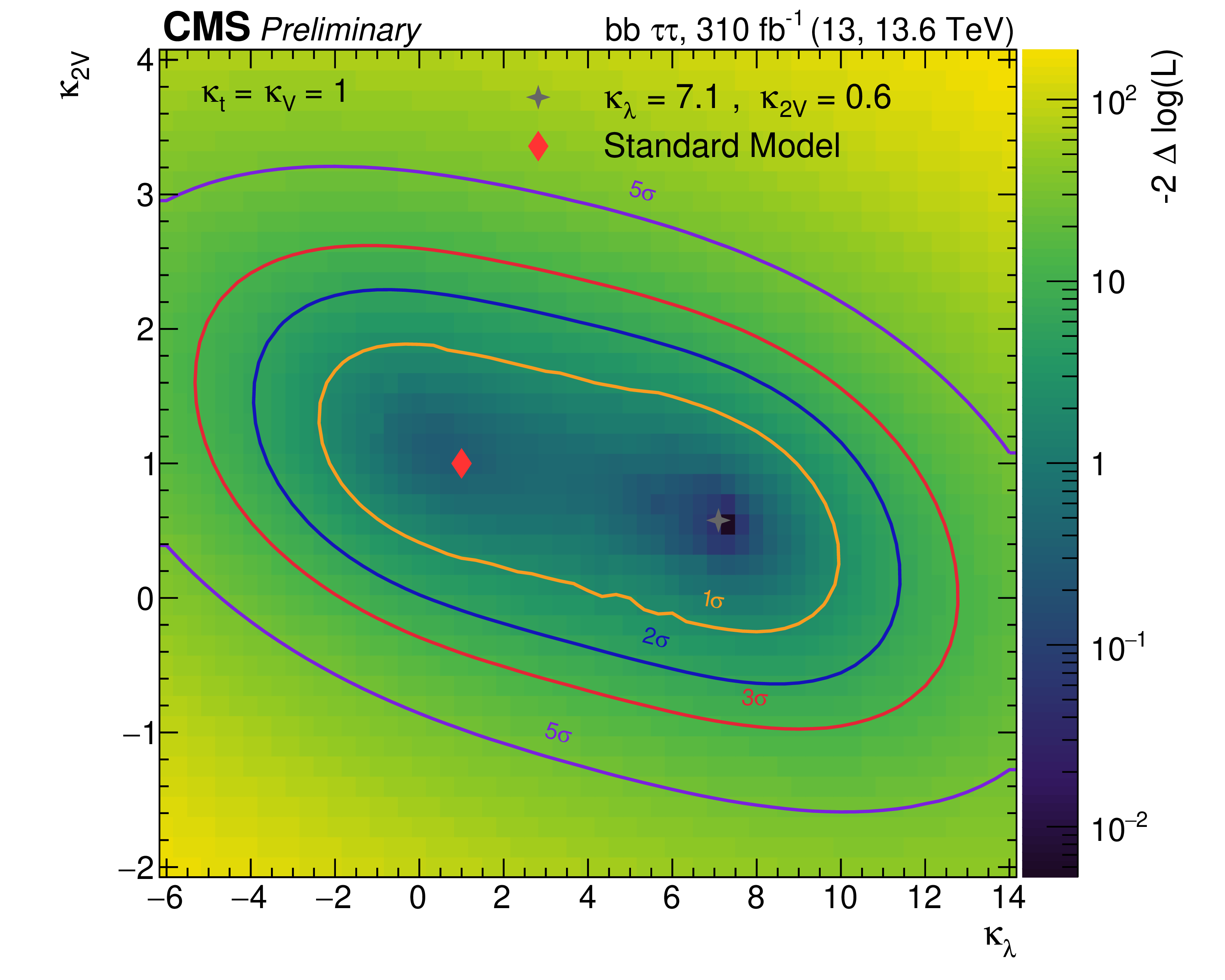
png pdf |
Figure 10-b:
The 2D exclusion region at 95% CL in the $ k_{2V} $ versus $ k_\lambda $ plane (left) and the corresponding 2D likelihood scan (right) are shown for the Run 3 combination with Run 2. Couplings not shown in the scans are fixed to their SM values. The SM configuration is indicated by a red diamond. |
| Tables | |
png pdf |
Table 1:
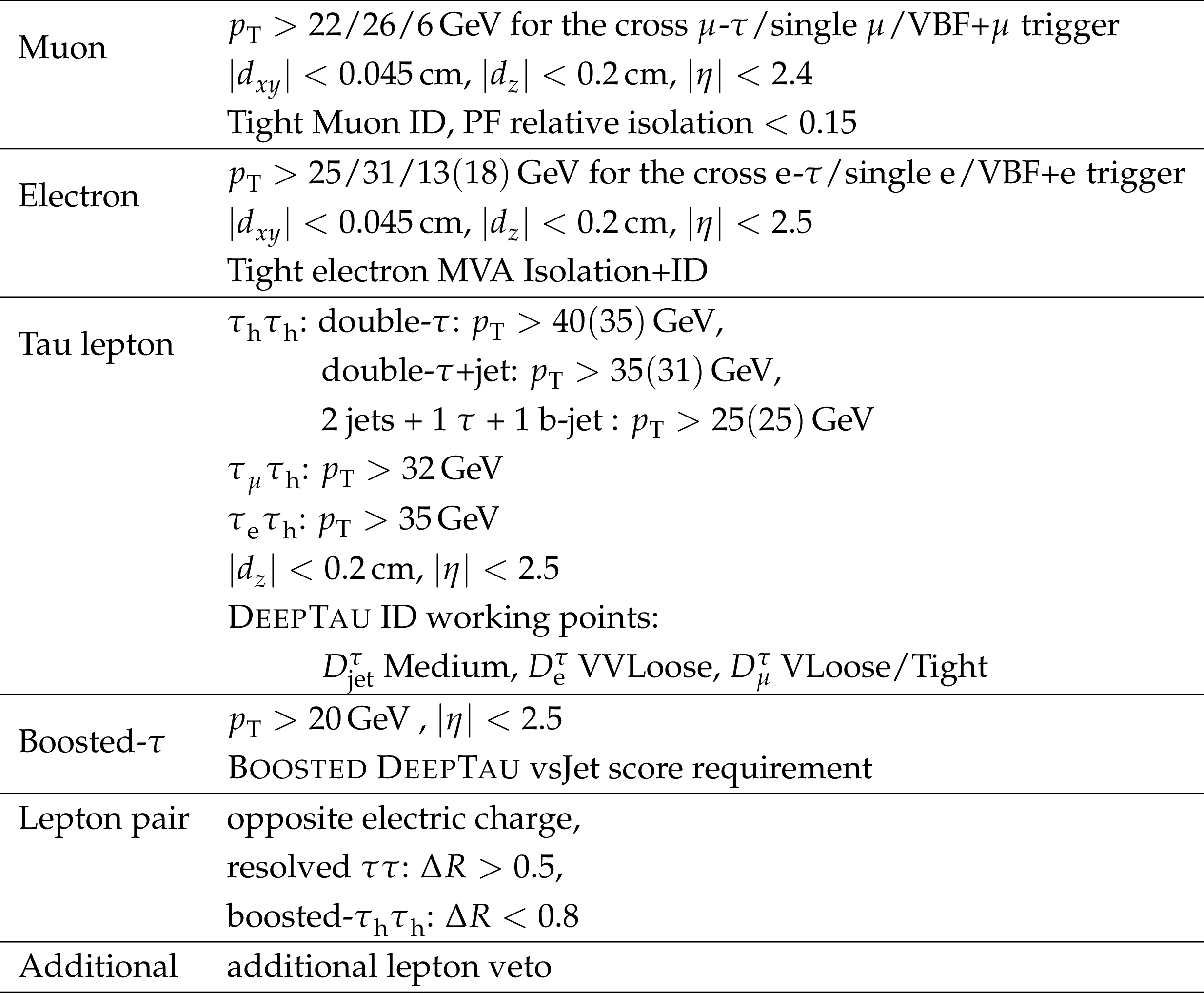
Summary of selections applied to the reconstructed $ \tau\tau $ candidate pair. The thresholds reflect the trigger-dependent strategy where applicable, including cross-lepton, single-lepton, VBF, and dedicated di-$ \tau $ triggers. Values in parentheses correspond to alternative thresholds used in specific data-taking periods. For the $ \tau_\mathrm{h} \tau_\mathrm{h} $ channel, the quoted $ p_{\mathrm{T}} $ thresholds apply to both $ \tau_\mathrm{h} $ candidates. Here, $ d_{xy} $ and $ d_z $ denote the transverse and longitudinal impact parameters with respect to the primary vertex, respectively.} |
png pdf |
Table 2:
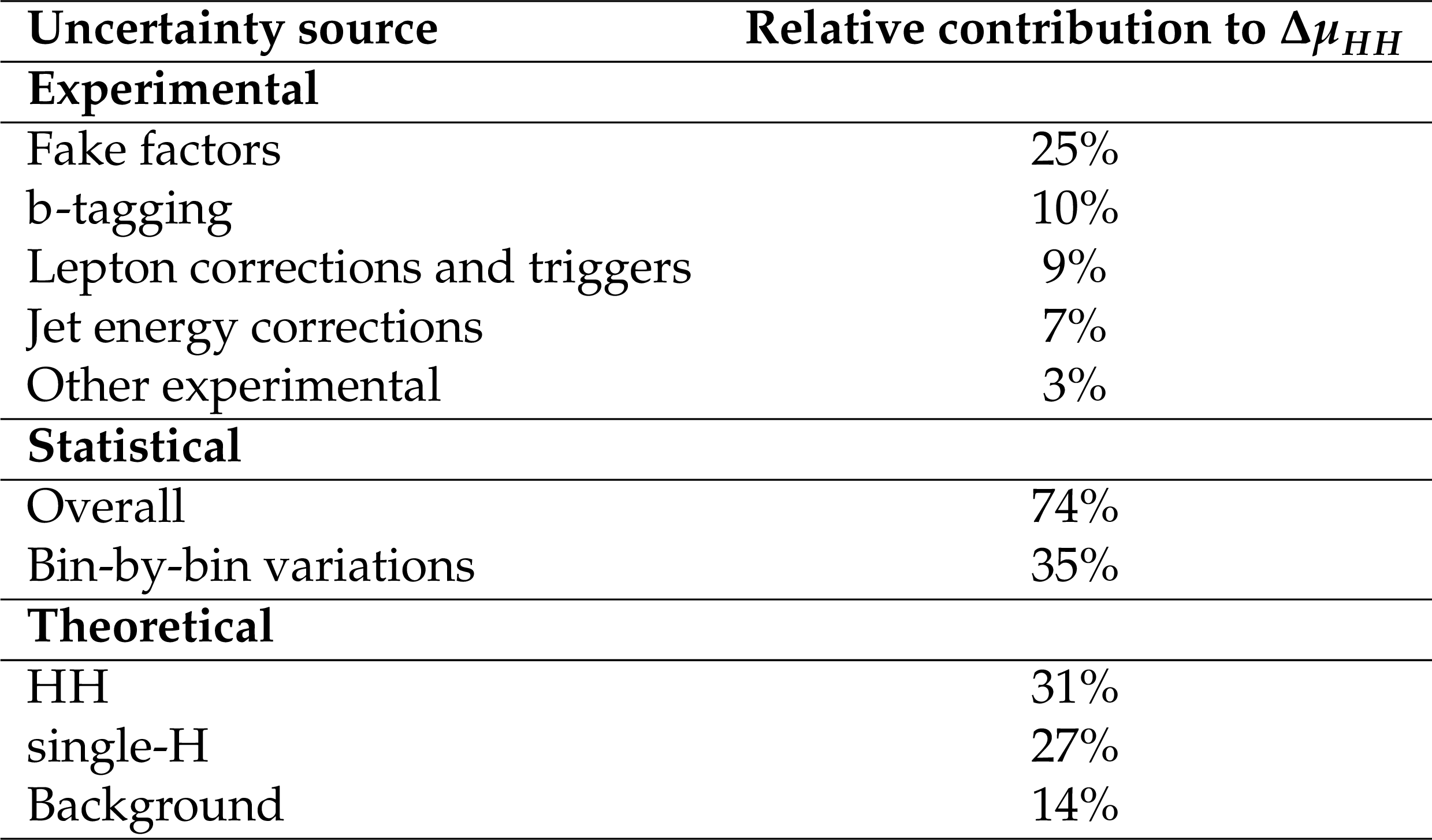
Breakdown of the major sources of uncertainty in the measurement of the signal strength. The post-fit uncertainty in $ \mu $ is separated into experimental, statistical and theoretical components. |
png pdf |
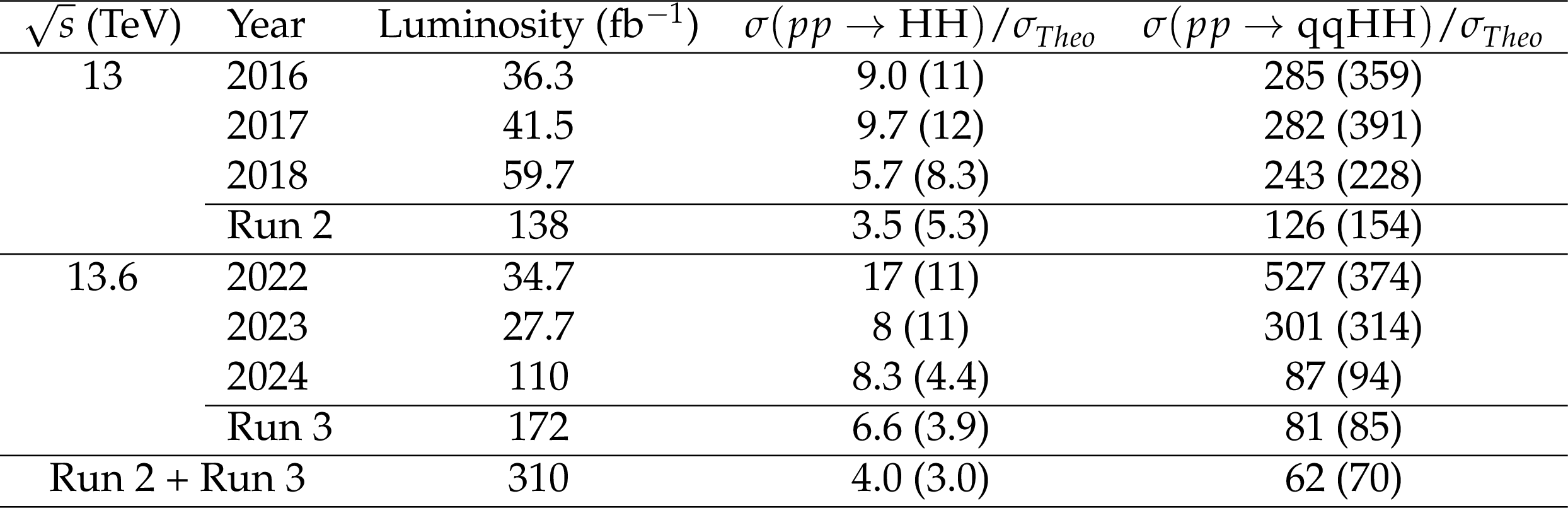
Table 3:
95% CL limits on inclusive (ggHH+qqHH) $ \sigma(pp \to HH )/\sigma $ and qqHH-only $ \sigma(pp \to qqHH)/\sigma $ for the different years and their combination. The observed limits are shown first, with the expected limits under the background-only ($ \mu= $ 0) hypothesis given in parentheses. |
| Summary |
| A search for nonresonant Higgs boson production in the $ bb$\tau\tau$ $ final state has been presented. The dataset analyzed consists of 172 $ \mbox{ \text{fb}^{-1}} $ of proton-proton collisions at a center-of-mass energy of $ \sqrt{s} = 13.6 \text{TeV} $, collected by the CMS experiment in the years 2022, 2023, and 2024. The events are selected requiring at least one hadronically decaying $ \tau $ lepton, resulting in three distinct final states, $ \tau_\textrm{e}\tau_{{\text h}} $, $ \tau_\mu\tau_{{\text h}} $, and $ \tau_{{\text h}}\tau_{{\text h}} $. Jet substructure techniques are employed to probe boosted production in $ \mathrm{H}\to\mathrm{b}\mathrm{b} $ and $ \mathrm{H}\to\tau\tau $. The search benefits from new dedicated trigger algorithms designed to enhance HH topologies and involves several Machine Learning discriminators targeting reconstruction of hadronic objects, signal identification, and signal extraction. An observed (expected) upper limit at 95% confidence level (CL) on the HH production cross section is set to 6.6 (3.9) times the SM prediction for the inclusive HH cross section, and to 81 (85) times the SM prediction for the vector boson fusion HH cross section. The Higgs boson self-coupling parameter is constrained at 95% CL to be within $ -4.1 < k_\lambda < 11.2 (-2.2 < k_\lambda < 9.2) $, and the coupling of two Higgs bosons to two vector bosons to $ -0.2 < k_{2V} < 2.3 (-0.2 < k_{2V} < 2.4) $. The results are combined with 138 fb$ ^{-1} $ of data collected at $ \sqrt{s} = 13 \text{TeV} $ in the period 2016-2018, for a total integrated luminosity of 310 fb$ ^{-1} $. This combination sets 95% CL limits on the production cross section of 4.0 (3.0) times the SM prediction for the inclusive HH cross section, and 62 (70) times the SM prediction for the vector boson fusion HH cross section. In this combination, the Higgs boson self-coupling parameter is constrained at 95% CL to be within $ -2.5 < k_\lambda < $ 9.4 (with an expected limit of $ -1.5 < k_\lambda < $ 8.4), and the coupling of two Higgs bosons to two vector bosons to 0.02 $ < k_{2V} < $ 2.1 (with an expected limit of $ -0.1 < k_{2V} < $ 2.2). |
| References | ||||
| 1 | ATLAS Collaboration | Observation of a new particle in the search for the Standard Model Higgs boson with the ATLAS detector at the LHC | PLB 716 (2012) 1 | 1207.7214 |
| 2 | CMS Collaboration | Observation of a new boson at a mass of 125 GeV with the CMS experiment at the LHC | PLB 716 (2012) 30 | CMS-HIG-12-028 1207.7235 |
| 3 | CMS Collaboration | A measurement of the Higgs boson mass in the diphoton decay channel | PLB 805 (2020) 135425 | CMS-HIG-19-004 2002.06398 |
| 4 | CMS Collaboration | Measurement of the Higgs boson mass and width using the four-lepton final state in proton-proton collisions at $ \sqrt{s}=13\text{ }\text{ }\mathrm{TeV} $ | PRD 111 (2025) 092014 | CMS-HIG-21-019 2409.13663 |
| 5 | ATLAS Collaboration | Combined measurement of the Higgs boson mass from the $ H\rightarrow\gamma\gamma $ and $ H \rightarrow Z{Z}^{*} \rightarrow 4\ell $ decay channels with the ATLAS detector using $ \sqrt{s}= $ 7, 8, and 13 TeV $ pp $ collision data | PRL 131 (2023) 25 | 2308.04775 |
| 6 | CMS Collaboration | A portrait of the Higgs boson by the CMS experiment ten years after the discovery | Nature 607 (2022) 60 | CMS-HIG-22-001 2207.00043 |
| 7 | ATLAS Collaboration | A detailed map of Higgs boson interactions by the ATLAS experiment ten years after the discovery | [Erratum: Nature 612, E24 ()], 2022 Nature 607 (2022) 52 |
2207.00092 |
| 8 | ATLAS and CMS Collaborations | Combination of ATLAS and CMS searches for Higgs boson pair production at $ \sqrt{s} = $ 13 TeV | Submitted to Phys. Rev. Lett, 2026 | 2602.23991 |
| 9 | M. Grazzini et al. | Higgs boson pair production at NNLO with top quark mass effects | JHEP 05 (2018) 059 | 1803.02463 |
| 10 | J. Baglio et al. | $ gg \rightarrow HH $: Combined uncertainties | PRD 103 (2021) 056002 | 2008.11626 |
| 11 | F. A. Dreyer, A. Karlberg, J.-N. Lang, and M. Pellen | Precise predictions for double-Higgs production via vector-boson fusion | EPJC 80 (2020) 11 | 2005.13341 |
| 12 | F. A. Dreyer and A. Karlberg | Vector-boson fusion Higgs pair production at $ {\mathrm{N}}^{3}\mathrm{LO} $ | PRD 98 (2018) 114016 | 1811.07906 |
| 13 | ATLAS Collaboration | Combination of searches for Higgs boson pair production in pp collisions at $ \sqrt{s}= $ 13 TeV with the ATLAS detector | PRL 133 (2024) 101801 | 2406.09971 |
| 14 | CMS Collaboration | Search for nonresonant Higgs boson pair production in final state with two bottom quarks and two tau leptons in proton-proton collisions at $ \sqrt{s} = $ 13 TeV | PLB 842 (2023) 137531 | CMS-HIG-20-010 2206.09401 |
| 15 | ATLAS Collaboration | Search for resonant and non-resonant Higgs boson pair production in the $ \mathrm{b}\overline{\mathrm{b}}\tau^{+}\tau^{-} $ decay channel using 13 TeV pp collision data from the ATLAS detector | JHEP 07 (2023) 040 | 2209.10910 |
| 16 | ATLAS Collaboration | Improved analysis of non-resonant Higgs boson pair production in the $ b\bar{b}\tau^+\tau^- $ final state with 196 fb$ ^{-1} $ of data collected at $ \sqrt{s} = $ 13 TeV and 13.6 TeV with the ATLAS detector | link | 2607.26879 |
| 17 | CMS Collaboration | The CMS experiment at the CERN LHC | JINST 3 (2008) S08004 | |
| 18 | CMS Collaboration | Development of the CMS detector for the CERN LHC Run 3 | JINST 19 (2024) P05064 | CMS-PRF-21-001 2309.05466 |
| 19 | CMS Collaboration | Performance of the CMS Level-1 trigger in proton-proton collisions at $ \sqrt{s} = $ 13 TeV | JINST 15 (2020) P10017 | CMS-TRG-17-001 2006.10165 |
| 20 | CMS Collaboration | The CMS trigger system | JINST 12 (2017) P01020 | CMS-TRG-12-001 1609.02366 |
| 21 | CMS Collaboration | Performance of the CMS high-level trigger during LHC Run 2 | JINST 19 (2024) P11021 | CMS-TRG-19-001 2410.17038 |
| 22 | CMS Collaboration | Electron and photon reconstruction and identification with the CMS experiment at the CERN LHC | JINST 16 (2021) P05014 | CMS-EGM-17-001 2012.06888 |
| 23 | CMS Collaboration | Performance of the CMS muon detector and muon reconstruction with proton-proton collisions at $ \sqrt{s}= $ 13 TeV | JINST 13 (2018) P06015 | CMS-MUO-16-001 1804.04528 |
| 24 | CMS Collaboration | Description and performance of track and primary-vertex reconstruction with the CMS tracker | JINST 9 (2014) P10009 | CMS-TRK-11-001 1405.6569 |
| 25 | CMS Collaboration | Particle-flow reconstruction and global event description with the CMS detector | JINST 12 (2017) P10003 | CMS-PRF-14-001 1706.04965 |
| 26 | CMS Collaboration | Performance of reconstruction and identification of $ \tau $ leptons decaying to hadrons and $ \nu_\tau $ in pp collisions at $ \sqrt{s}= $ 13 TeV | JINST 13 (2018) P10005 | CMS-TAU-16-003 1809.02816 |
| 27 | CMS Collaboration | Jet energy scale and resolution in the CMS experiment in pp collisions at 8 TeV | JINST 12 (2017) P02014 | CMS-JME-13-004 1607.03663 |
| 28 | CMS Collaboration | Performance of missing transverse momentum reconstruction in proton-proton collisions at $ \sqrt{s} = $ 13 TeV using the CMS detector | JINST 14 (2019) P07004 | CMS-JME-17-001 1903.06078 |
| 29 | P. Nason | A new method for combining NLO QCD with shower Monte Carlo algorithms | JHEP 11 (2004) 040 | hep-ph/0409146 |
| 30 | S. Frixione, P. Nason, and C. Oleari | Matching NLO QCD computations with parton shower simulations: the POWHEG method | JHEP 11 (2007) 070 | 0709.2092 |
| 31 | S. Alioli, P. Nason, C. Oleari, and E. Re | A general framework for implementing NLO calculations in shower Monte Carlo programs: the POWHEG BOX | JHEP 06 (2010) 043 | 1002.2581 |
| 32 | E. Bagnaschi, G. Degrassi, P. Slavich, and A. Vicini | Higgs production via gluon fusion in the POWHEG approach in the SM and in the MSSM | JHEP 02 (2012) 088 | 1111.2854 |
| 33 | J. Alwall et al. | The automated computation of tree-level and next-to-leading order differential cross sections, and their matching to parton shower simulations | JHEP 07 (2014) 079 | 1405.0301 |
| 34 | CMS Collaboration | Combination of searches for nonresonant Higgs boson pair production in proton-proton collisions at $ \sqrt{s}= $ 13 TeV | Submitted to J. Phys. G, 2025 | CMS-HIG-20-011 2510.07527 |
| 35 | R. Frederix and S. Frixione | Merging meets matching in MC@NLO | JHEP 12 (2012) 061 | 1209.6215 |
| 36 | C. Bierlich et al. | A comprehensive guide to the physics and usage of PYTHIA 8.3 | SciPost Phys. Codeb. 2022 (2022) 8 | 2203.11601 |
| 37 | CMS Collaboration | Extraction and validation of a new set of CMS PYTHIA8 tunes from underlying-event measurements | EPJC 80 (2020) 1 | CMS-GEN-17-001 1903.12179 |
| 38 | R. D. Ball et al. | Parton distributions for the LHC run II | JHEP 04 (2015) 040 | 1410.8849 |
| 39 | R. D. Ball et al. | Parton distributions from high-precision collider data | EPJC 77 (2017) 663 | 1706.00428 |
| 40 | GEANT4 Collaboration | GEANT4---a simulation toolkit | NIM A 506 (2003) 250 | |
| 41 | M. Cacciari, G. P. Salam, and G. Soyez | The anti-$ k_{\mathrm{T}} $ jet clustering algorithm | JHEP 04 (2008) 063 | 0802.1189 |
| 42 | M. Cacciari, G. P. Salam, and G. Soyez | FastJet user manual | EPJC 72 (2012) 1896 | 1111.6097 |
| 43 | Y. L. Dokshitzer, G. D. Leder, S. Moretti, and B. R. Webber | Better jet clustering algorithms | JHEP 08 (1997) 001 | hep-ph/9707323 |
| 44 | M. Wobisch and T. Wengler | Hadronization corrections to jet cross-sections in deep inelastic scattering | in Proceedings of the Workshop on Monte Carlo Generators for HERA Physics, Hamburg, Germany, 1998 link |
hep-ph/9907280 |
| 45 | M. Dasgupta, A. Fregoso, S. Marzani, and G. P. Salam | Towards an understanding of jet substructure | JHEP 09 (2013) 029 | 1307.0007 |
| 46 | J. M. Butterworth, A. R. Davison, M. Rubin, and G. P. Salam | Jet substructure as a new Higgs search channel at the LHC | PRL 100 (2008) 242001 | 0802.2470 |
| 47 | D. Bertolini, P. Harris, M. Low, and N. Tran | Pileup per particle identification | JHEP 10 (2014) 059 | 1407.6013 |
| 48 | CMS Collaboration | Pileup mitigation at CMS in 13 TeV data | JINST 15 (2020) P09018 | CMS-JME-18-001 2003.00503 |
| 49 | CMS Collaboration | Jet energy scale and resolution measurement with Run 2 Legacy Data Collected by CMS at 13 TeV | CMS Detector Performance Summary CMS-DP-2021-033, 2021 CDS |
|
| 50 | H. Qu and L. Gouskos | Jet tagging via particle clouds | PRD 101 (2020) 056019 | 1902.08570 |
| 51 | CMS Collaboration | Run 3 commissioning results of heavy-flavor jet tagging at $ \sqrt{s}= $ 13.6 TeV with CMS data using a modern framework for data processing | CMS Detector Performance Summary CMS-DP-2024-024, 2024 CDS |
|
| 52 | CMS Collaboration | A unified approach for jet tagging in Run 3 at $ \sqrt{s}= $ 13.6 TeV in CMS | CMS Detector Performance Summary CMS-DP-2024-066, 2024 CDS |
|
| 53 | CMS Collaboration | ECAL 2016 refined calibration and Run2 summary plots | CMS Detector Performance Summary CMS-DP-2020-021, 2020 CDS |
|
| 54 | CMS Collaboration | Identification of hadronic tau lepton decays using a deep neural network | JINST 17 (2022) P07023 | CMS-TAU-20-001 2201.08458 |
| 55 | CMS Collaboration | Identification of tau leptons using a convolutional neural network with domain adaptation | JINST 20 (2025) 12 | CMS-TAU-24-001 2511.05468 |
| 56 | CMS Collaboration | High-level hadronic tau lepton triggers of the CMS experiment in proton-proton collisions at $ \sqrt{s}= $ 13.6 TeV | JINST 21 (2026) 04 | CMS-TAU-24-002 2602.11359 |
| 57 | CMS Collaboration | Performance of hadronic tau reconstruction at the High Level Trigger using 2024 data from the CMS experiment at CERN | CMS Detector Performance Summary CMS-DP-2026-008, 2026 CDS |
|
| 58 | CMS Collaboration | Performance of tau lepton reconstruction at High Level Trigger using 2022 data from the CMS experiment at CERN | CMS Detector Performance Summary CMS-DP-2023-024, 2023 CDS |
|
| 59 | CMS Collaboration | Enriching the physics program of the CMS experiment via data scouting and data parking | Phys. Rept. 1115 (2025) 678 | CMS-EXO-23-007 2403.16134 |
| 60 | CMS Collaboration | Performance of boosted tau lepton identification with DeepTau Framework (Boosted DeepTau) | cms detector performance summary, 2025 CDS |
|
| 61 | F. Rosenblatt | The perceptron: A probabilistic model for information storage and organization in the brain | no. 6, 386, 1957 Psychological Review 65 (1957) |
|
| 62 | S. Linnainmaa | The representation of the cumulative rounding error of an algorithm as a Taylor expansion of the local rounding errors | Master's thesis, Univ. Helsinki, 1970 | |
| 63 | P. J. Werbos | Applications of advances in nonlinear sensitivity analysis | in the IFIP Conference, 31.8 - 4.9, NYC, 1981 Proceedings of the 1 (1981) 762 |
|
| 64 | D. E. Rumelhart , G. E. Hinton , and R. J. Williams | Learning representations by back-propagating errors | Nature 323 (1986) 533 | |
| 65 | M. Erdmann, E. Geiser, Y. Rath, and M. Rieger | Lorentz boost networks: Autonomous physics-inspired feature engineering | JINST 14 (2019) P06006 | 1812.09722 |
| 66 | CMS Collaboration | Search for new resonances decaying into a pair of Higgs bosons in the bb$ \tau\tau $ final state in proton-proton collisions at $ \sqrt{s}= $ 13 TeV | cms physics analysis summary, CERN, Geneva, 2026 CDS |
|
| 67 | G. Huang , Z. Liu , L. Van Der Maaten , and K. Q. Weinberger | Densely connected convolutional networks | in IEEE Conference on Computer Vision and Pattern Recognition (CVPR), 2017 | 1608.06993 |
| 68 | C. Bernaciak, M. S. A. Buschmann, A. Butter, and T. Plehn | Fox-Wolfram moments in Higgs physics | PRD 87 (2013) 7 | 1212.4436 |
| 69 | CMS Collaboration | Measurement of the differential cross section for top quark pair production in pp collisions at $ \sqrt{s}= $ 8 TeV | EPJC 75 (2015) 542 | CMS-TOP-12-028 1505.04480 |
| 70 | CMS Collaboration | The CMS Statistical Analysis and Combination Tool: Combine | Comput. Softw. Big Sci. 8 (2024) 19 | CMS-CAT-23-001 2404.06614 |
| 71 | W. Verkerke and D. Kirkby | The roofit toolkit for data modeling | link | |
| 72 | L. Moneta et al. | The RooStats Project | PoS ACAT 057, 2010 link |
1009.1003 |
| 73 | CMS Collaboration | Luminosity measurement in proton-proton collisions at 13.6 TeV in 2022 at CMS | CMS Physics Analysis Summary, 2024 CMS-PAS-LUM-22-001 |
CMS-PAS-LUM-22-001 |
| 74 | CMS Collaboration | Measurement of the offline integrated luminosity for the CMS proton-proton collision dataset recorded in 2023 | CMS Detector Performance Summary CMS-DP-2024-068, 2024 CDS |
|
| 75 | CMS Collaboration | Measurement of the integrated luminosity with the CMS proton-proton dataset at $ \sqrt{s}= $ 13.6 TeV recorded in 2024 | CMS Detector Performance Summary CMS-DP-2026-003, 2026 CDS |
|
| 76 | CMS Collaboration | Measurement of the inelastic proton-proton cross section at $ \sqrt{s}= $ 13 tev | JHEP 07 (2018) 161 | CMS-FSQ-15-005 1802.02613 |
| 77 | Karlberg et al. | Ad interim recommendations for the Higgs boson production cross sections at $ \sqrt{s} = $ 13.6 TeV | link | |
| 78 | Manzoni et al. | Taming a leading theoretical uncertainty in HH measurements via accurate simulations for bbH production | link | |
| 79 | LHC Higgs Cross Section Working Group Collaboration | Handbook of LHC Higgs Cross Sections: 4. Deciphering the Nature of the Higgs Sector | technical report, 2016 link |
1610.07922 |
| 80 | CMS Collaboration | Jet energy scale and resolution measurements using Run3 data collected by CMS in 2022 and 2023 at 13.6 TeV | CMS Detector Performance Summary CMS-DP-2024-039, 2024 CDS |
|
| 81 | CMS Collaboration | Jet energy scale and resolution measurements using Run3 data collected by the CMS experiment in 2024 at 13.6 TeV | CMS Detector Performance Summary CMS-DP-2025-042, 2025 CDS |
|
| 82 | CMS Collaboration | Electron and photon reconstruction and identification performance at CMS in 2022 and 2023 | CMS Detector Performance Summary CMS-DP-2024-052, 2024 CDS |
|
| 83 | M. Czakon et al. | Top-pair production at the LHC through NNLO QCD and NLO EW | JHEP 10 (2017) 186 | 1705.04105 |
| 84 | F. Garwood | Fiducial limits for the poisson distribution | Biometrika 28 (1936) 3/4 | |
| 85 | R. Barlow and C. Beeston | Fitting using finite Monte Carlo samples | Comput. Phys. Commun. 77 (1993) 2 | |
| 86 | G. Cowan, K. Cranmer, E. Gross, and O. Vitells | Asymptotic formulae for likelihood-based tests of new physics | EPJC 71 (2011) 1554 | 1007.1727 |
| 87 | ATLAS and CMS Collaborations, and LHC Higgs Combination Group | Procedure for the LHC Higgs boson search combination in Summer 2011 | Technical Report CMS-NOTE-2011-005, ATL-PHYS-PUB-2011-11, 2011 | |
| 88 | T. Junk | Confidence level computation for combining searches with small statistics | NIM A 434 (1999) 435 | hep-ex/9902006 |
| 89 | A. L. Read | Presentation of search results: The $ \text{CL}_\text{s} $ technique | JPG 28 (2002) 2693 | |
| 90 | L. Alasfar et al. | Effective field theory descriptions of Higgs boson pair production | SciPost Phys. Comm. Rep. 2, 2024 link |
2304.01968 |
|
|
Compact Muon Solenoid LHC, CERN |

|
|
|
|
|
|