
Compact Muon Solenoid
LHC, CERN
 Visit us: CMS Public Website, CMS Physics ;
Contact us: CMS Publications Committee
Visit us: CMS Public Website, CMS Physics ;
Contact us: CMS Publications Committee
| CMS-PAS-B2G-24-011 | ||
| Search for new resonances decaying into a pair of Higgs bosons in the $ \mathrm{b}\mathrm{b}\tau\tau $ final state in proton-proton collisions at $ \sqrt{s}= $ 13 TeV | ||
| CMS Collaboration | ||
| 2026-07-22 | ||
| Abstract: A search for resonances decaying into a pair of Standard Model Higgs bosons in the $ b\bar{b}\tau^+\tau^- $ final state is presented. The analysis is based on proton-proton collision data collected by the CMS experiment at the CERN LHC during the 2016-2018 period at a center-of-mass energy of $ \sqrt{s}= $ 13 TeV, corresponding to an integrated luminosity of 138 fb$ ^{-1} $. Narrow spin-0 and spin-2 resonances with masses ranging from 250 to 3000 GeV are considered. Events with at least one hadronically decaying $ \tau $ lepton are selected and a parameterized deep neural network is used to discriminate signals associated with resonances of various masses from the background. This analysis improves upon the most recent searches in this final state by ATLAS and CMS in the mass range 800-1500 GeV. The results are also interpreted in the context of the warped extra dimensions model. | ||
| Links: CDS record (PDF) ; CADI line (restricted) ; | ||
| Figures | |
png pdf |
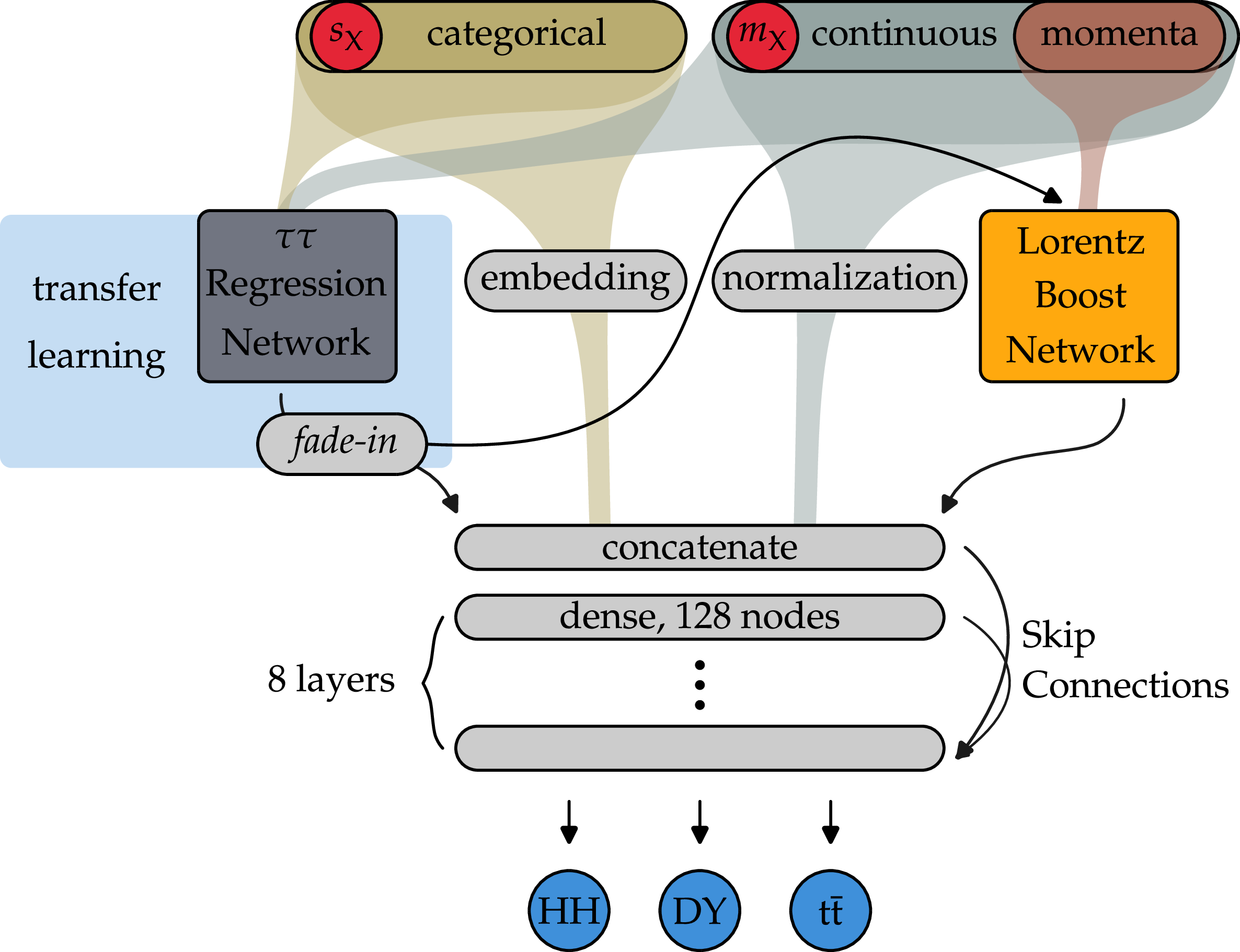
Figure 1:
Architecture of the parameterized DNN used for the signal extraction. The dedicated \tautau mass regression network is incorporated via \textittransfer learning and connected to the rest of the network from its last layers through a \textitfade-in layer, which slowly introduces the output of the regression to the rest of the network during training. |
png pdf |
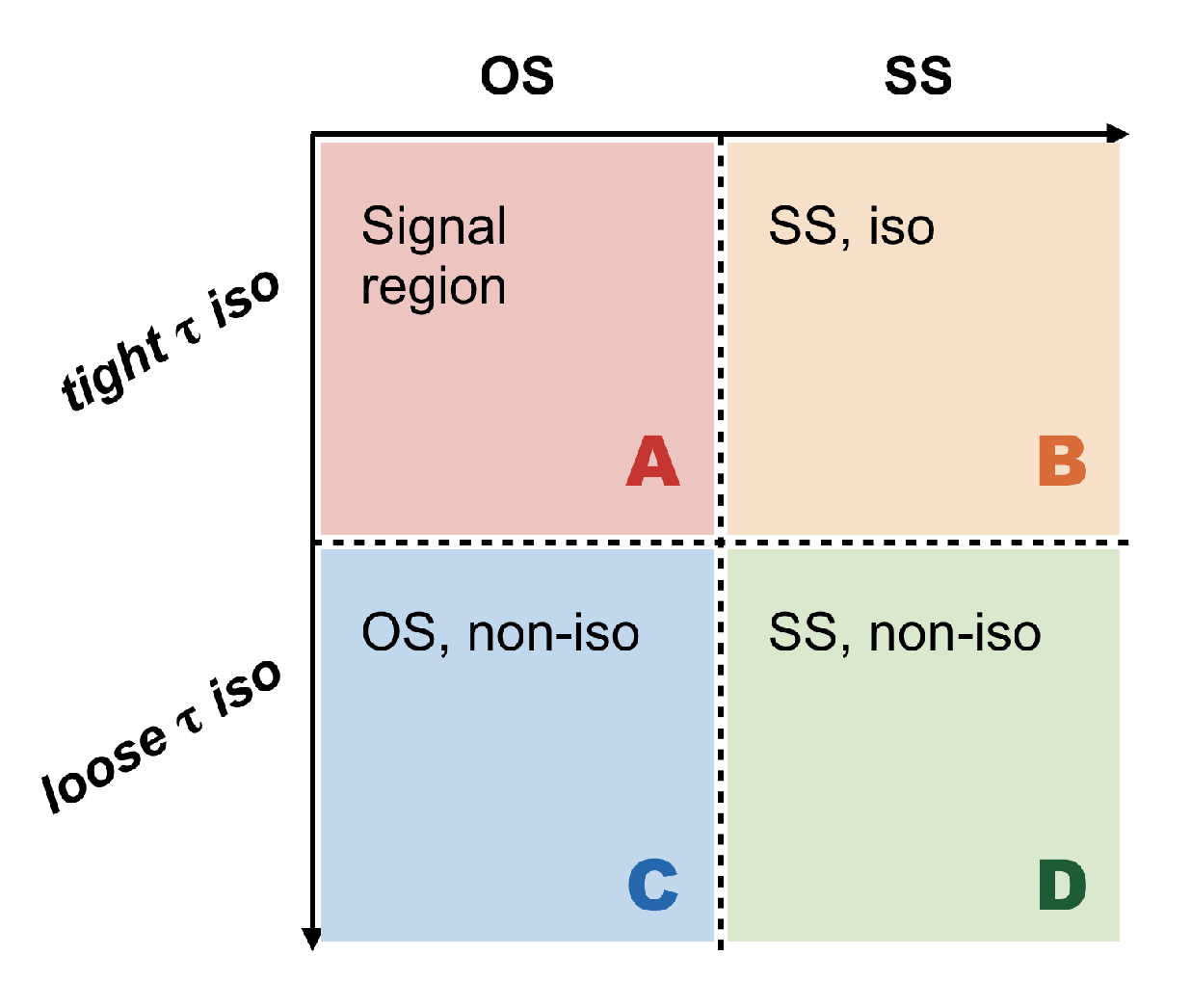
Figure 2:
Definition of ABCD method regions used for the evaluation of the QCD background, where the regions are defined using information on the best identified $ \tau_\mathrm{h} $ isolation, and on the sign configuration of the lepton pair: opposite-sign (OS) or same-sign (SS). |
png pdf |
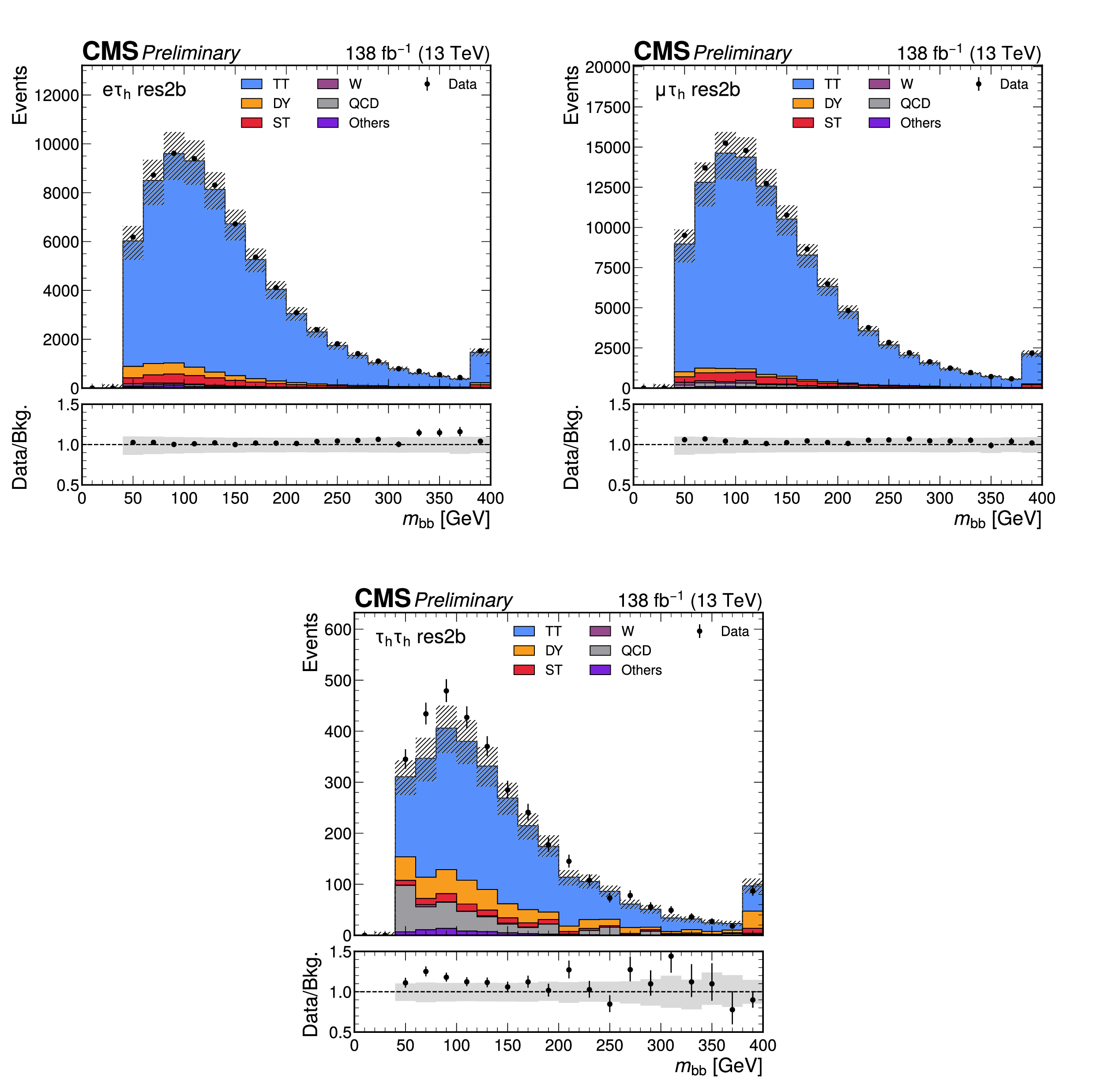
Figure 3:
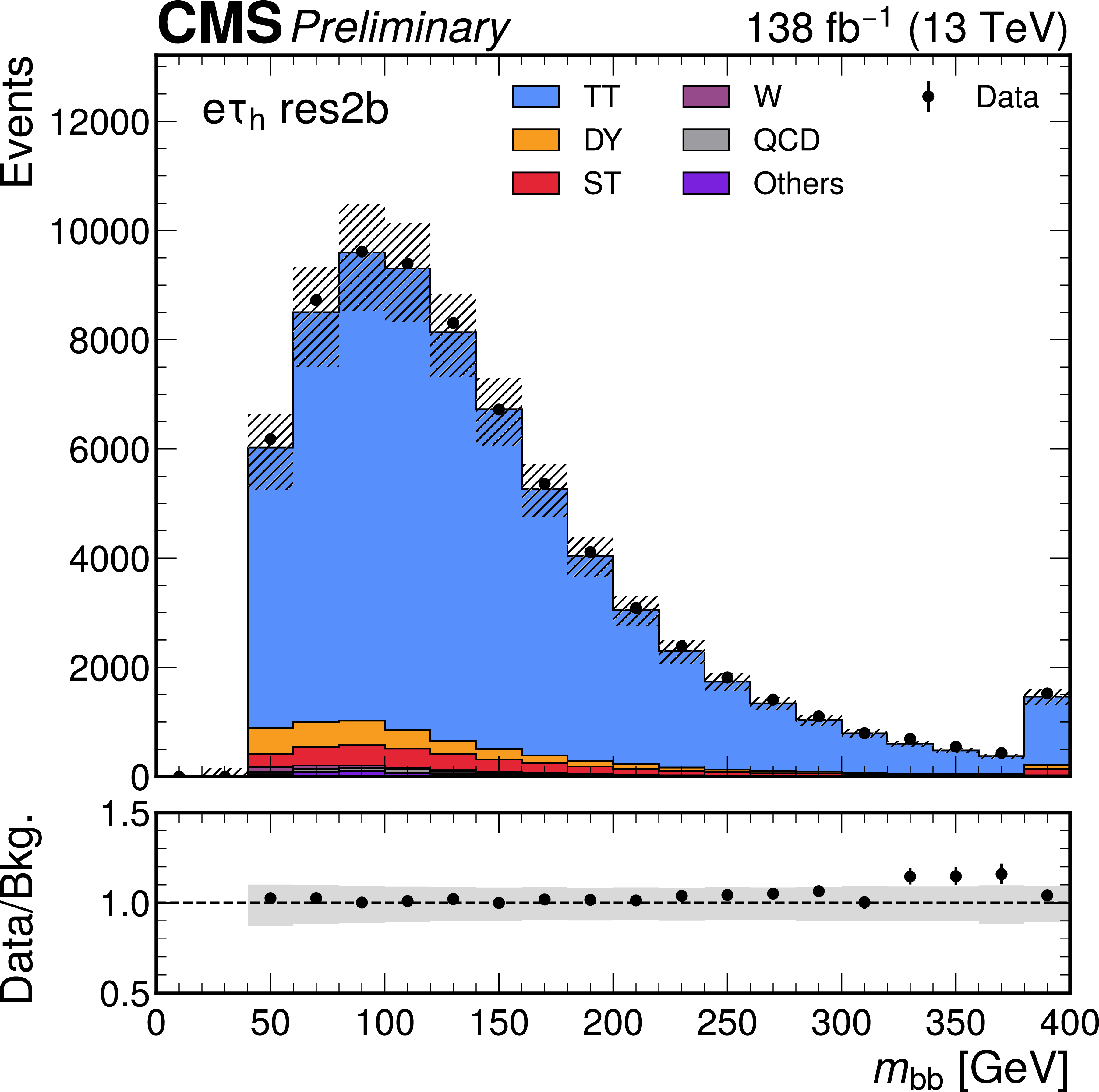
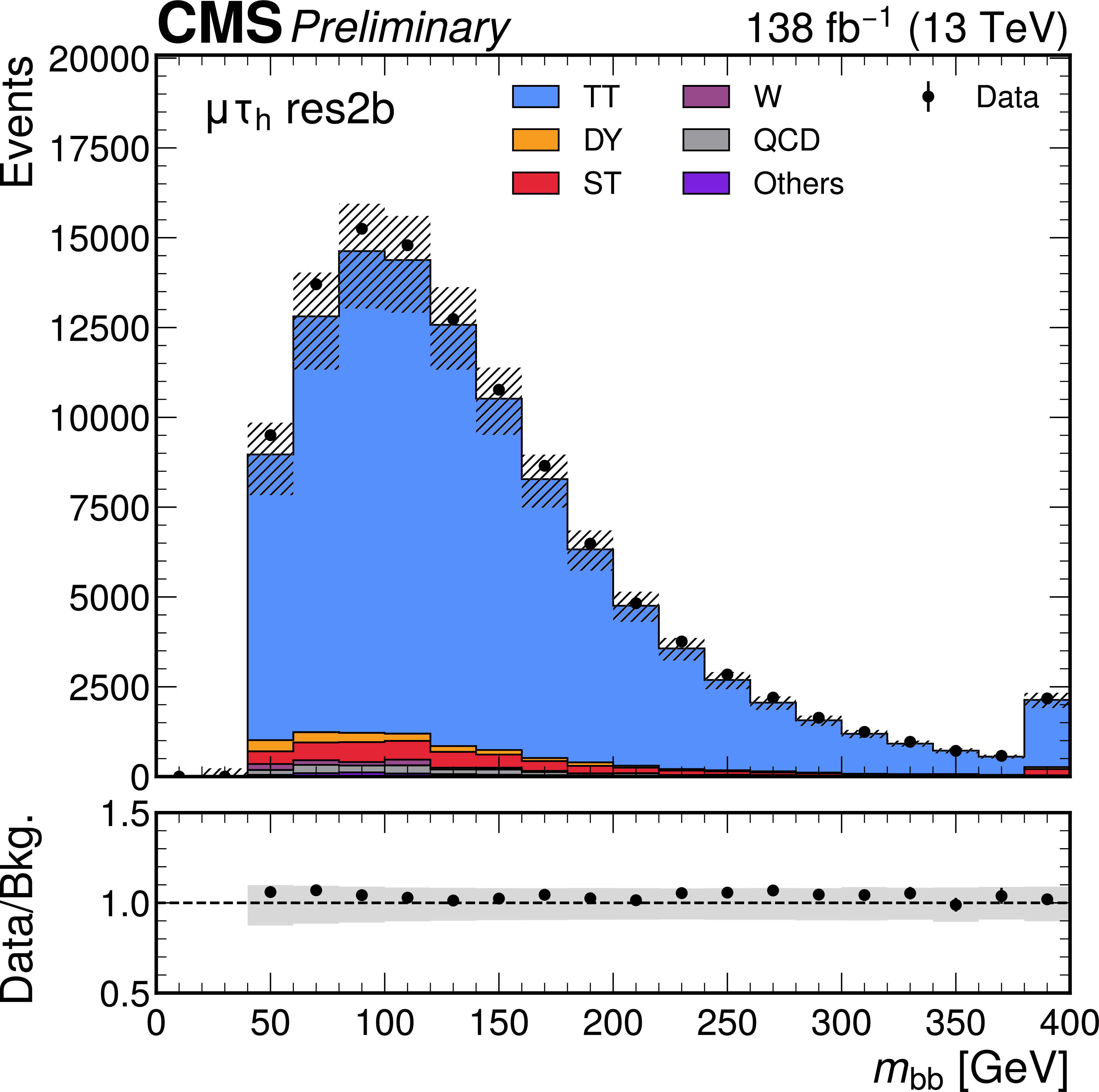
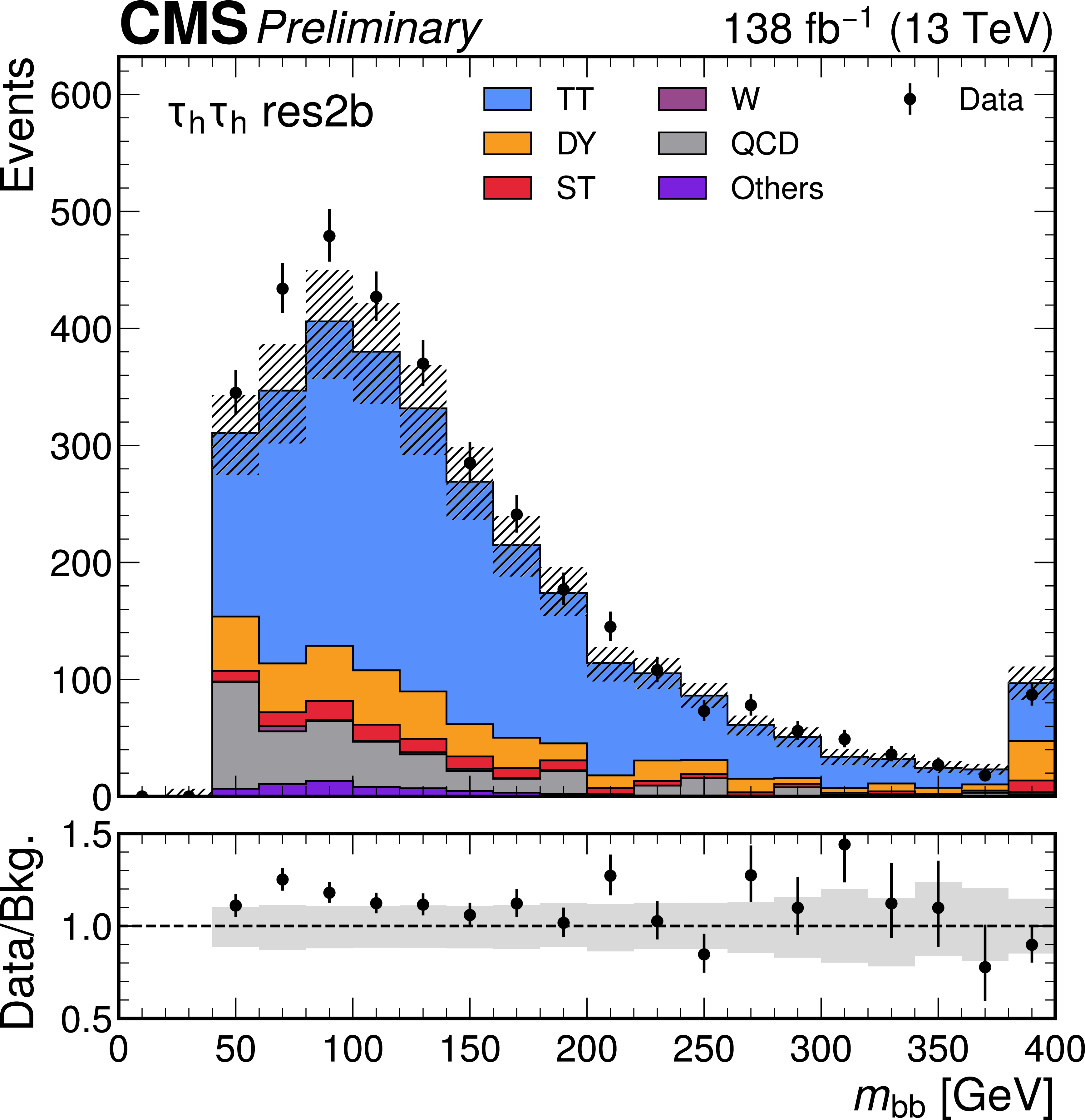
Pre-fit distributions of the b-jet pair invariant mass for events falling in the res2b category of the $ \tau_\mathrm{e}\tau_\mathrm{h} $ (top-left), $ \tau_\mu\tau_\mathrm{h} $ (top-right) and $ \tau_\mathrm{h}\tau_\mathrm{h} $ (bottom) channels. The shaded bands represent the statistical and systematic uncertainties. The lower panel shows the ratio of data yield over background prediction. |
png pdf |
Figure 3-a:
Pre-fit distributions of the b-jet pair invariant mass for events falling in the res2b category of the $ \tau_\mathrm{e}\tau_\mathrm{h} $ (top-left), $ \tau_\mu\tau_\mathrm{h} $ (top-right) and $ \tau_\mathrm{h}\tau_\mathrm{h} $ (bottom) channels. The shaded bands represent the statistical and systematic uncertainties. The lower panel shows the ratio of data yield over background prediction. |
png pdf |
Figure 3-b:
Pre-fit distributions of the b-jet pair invariant mass for events falling in the res2b category of the $ \tau_\mathrm{e}\tau_\mathrm{h} $ (top-left), $ \tau_\mu\tau_\mathrm{h} $ (top-right) and $ \tau_\mathrm{h}\tau_\mathrm{h} $ (bottom) channels. The shaded bands represent the statistical and systematic uncertainties. The lower panel shows the ratio of data yield over background prediction. |
png pdf |
Figure 3-c:
Pre-fit distributions of the b-jet pair invariant mass for events falling in the res2b category of the $ \tau_\mathrm{e}\tau_\mathrm{h} $ (top-left), $ \tau_\mu\tau_\mathrm{h} $ (top-right) and $ \tau_\mathrm{h}\tau_\mathrm{h} $ (bottom) channels. The shaded bands represent the statistical and systematic uncertainties. The lower panel shows the ratio of data yield over background prediction. |
png pdf |
Figure 4:
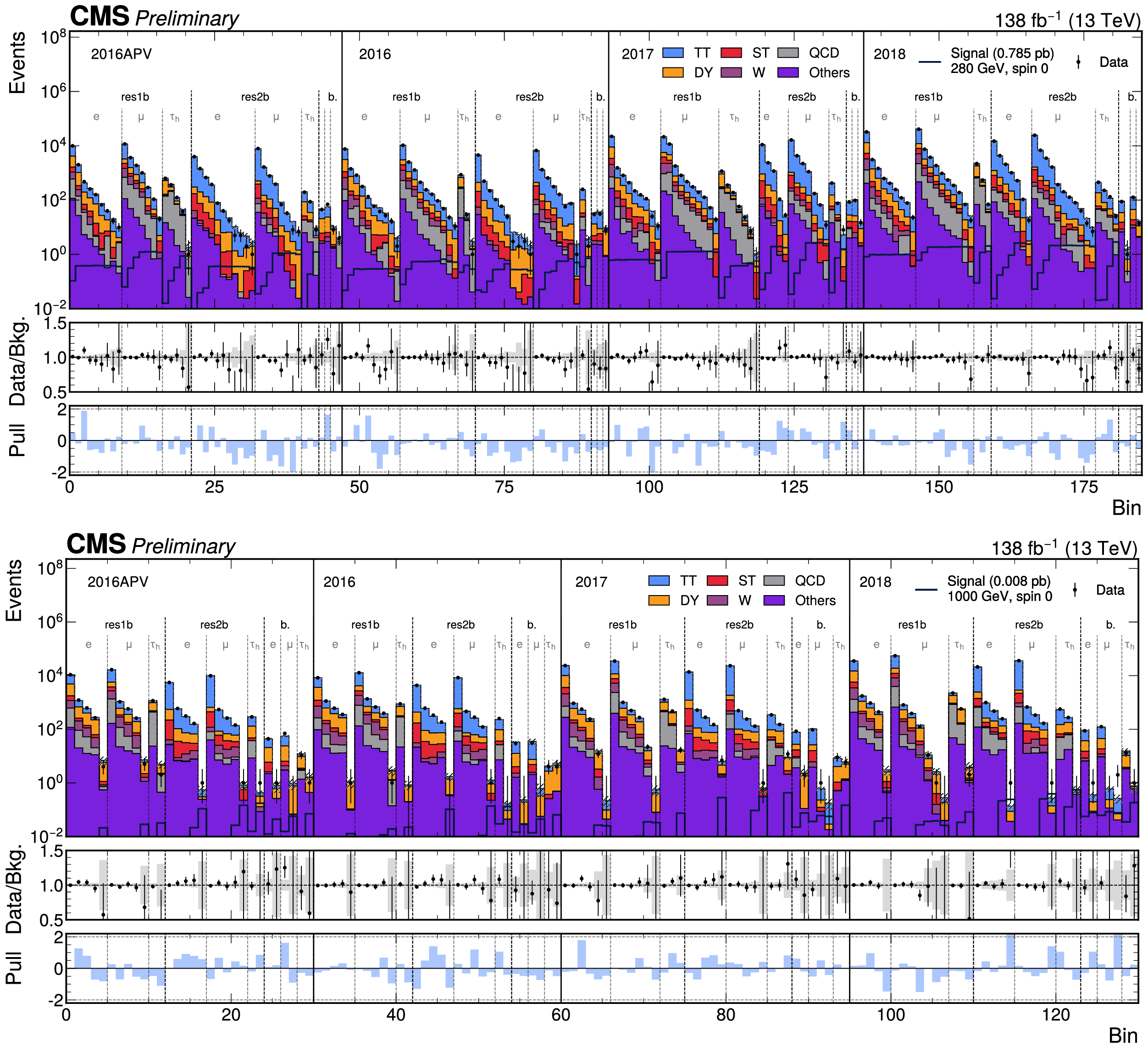
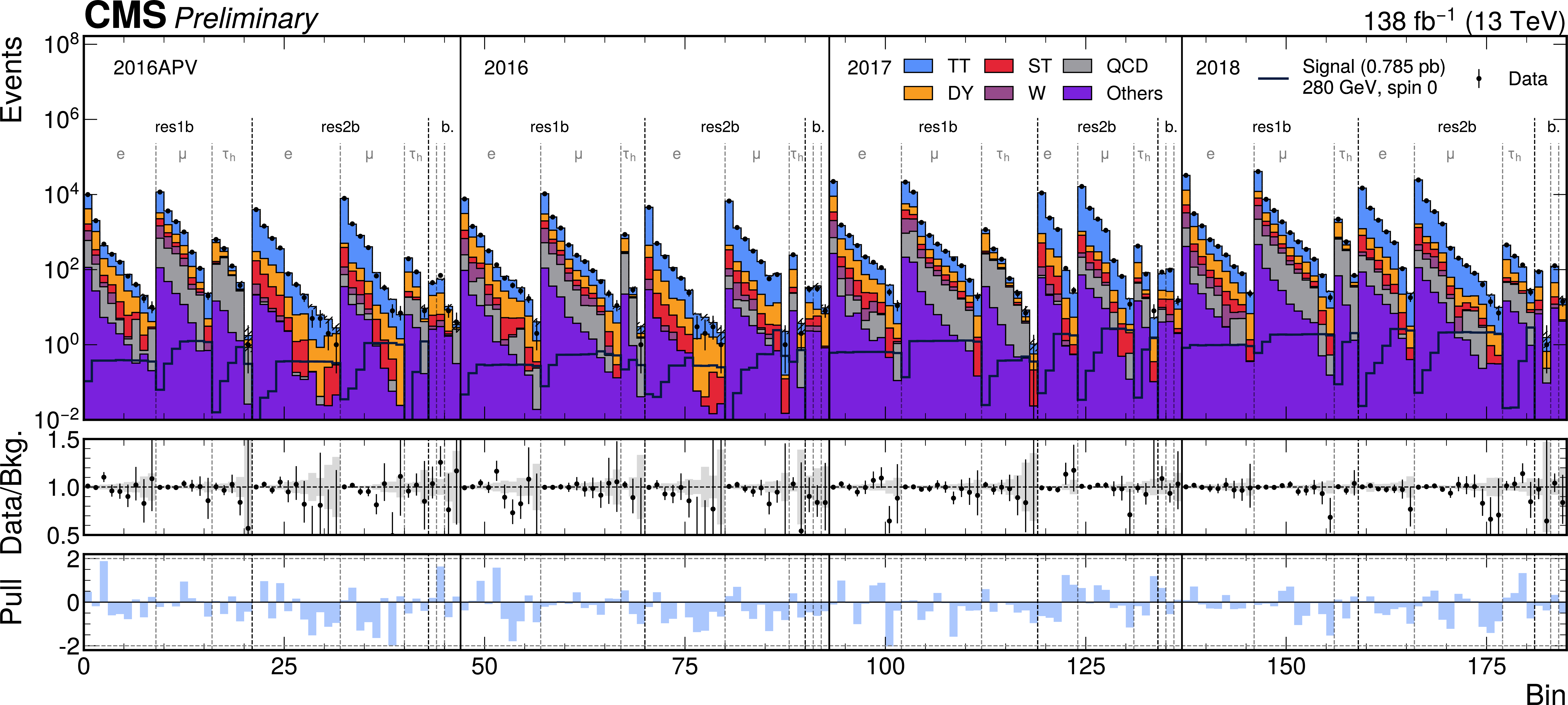
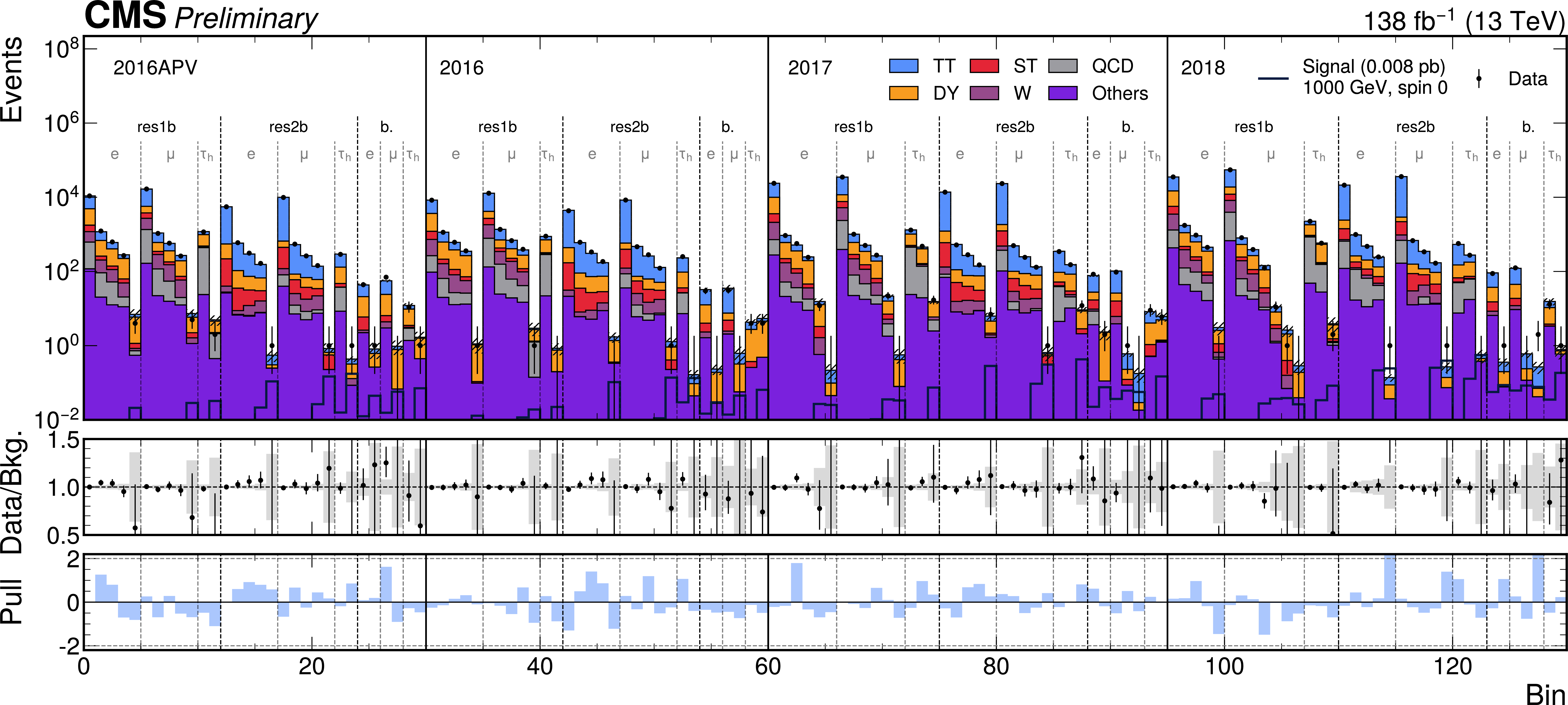
Distributions of the parameterized DNN output score used for signal extraction. The plots show all fit channels and categories side by side for each data-taking periods, for the mass point $ m_{\text{X}} = $ 0.28 TeV (top), and $ m_{\text{X}} = $ 1 TeV (bottom). The middle panel depicts the ratio of the data yield over background prediction, while the bottom panel shows the pull of each bin. The signal histograms are scaled to the measured upper limit on the signal cross section. |
png pdf |
Figure 4-a:
Distributions of the parameterized DNN output score used for signal extraction. The plots show all fit channels and categories side by side for each data-taking periods, for the mass point $ m_{\text{X}} = $ 0.28 TeV (top), and $ m_{\text{X}} = $ 1 TeV (bottom). The middle panel depicts the ratio of the data yield over background prediction, while the bottom panel shows the pull of each bin. The signal histograms are scaled to the measured upper limit on the signal cross section. |
png pdf |
Figure 4-b:
Distributions of the parameterized DNN output score used for signal extraction. The plots show all fit channels and categories side by side for each data-taking periods, for the mass point $ m_{\text{X}} = $ 0.28 TeV (top), and $ m_{\text{X}} = $ 1 TeV (bottom). The middle panel depicts the ratio of the data yield over background prediction, while the bottom panel shows the pull of each bin. The signal histograms are scaled to the measured upper limit on the signal cross section. |
png pdf |
Figure 5:
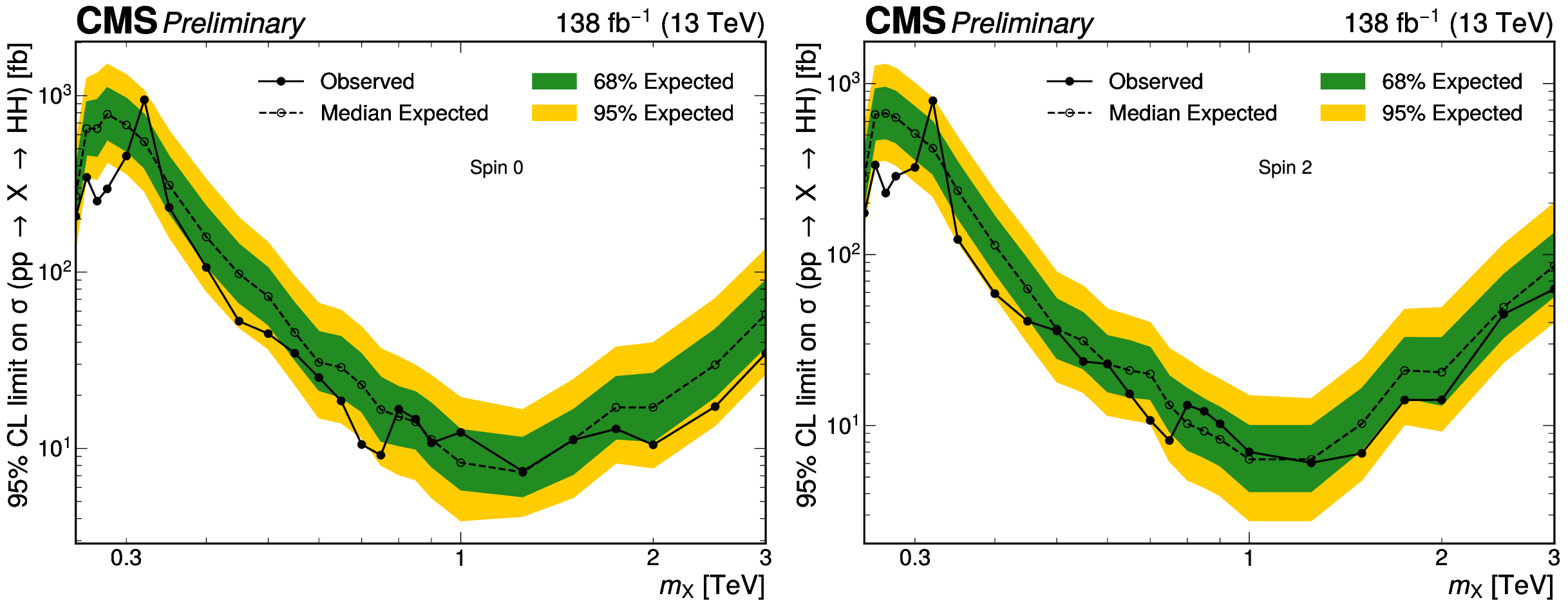
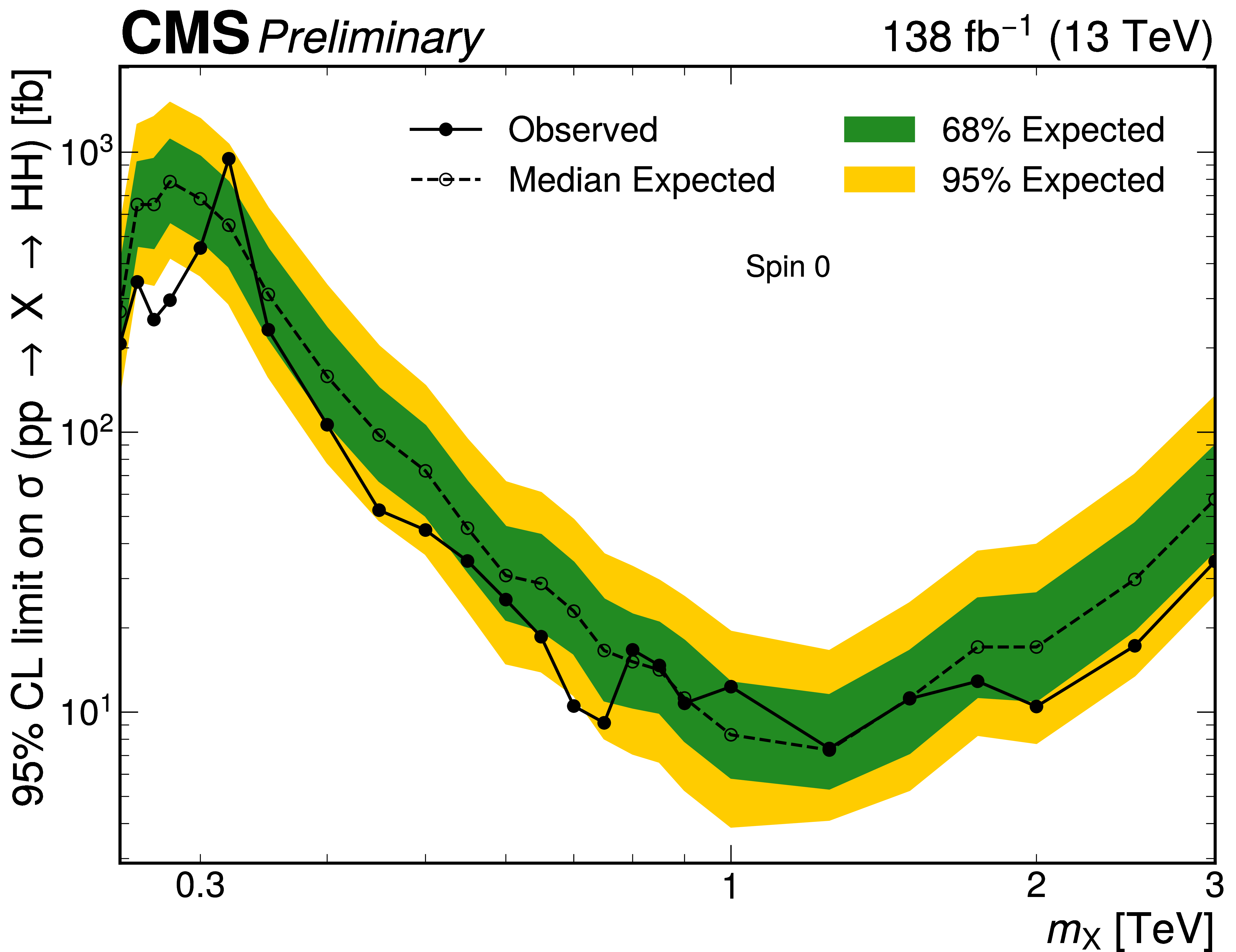
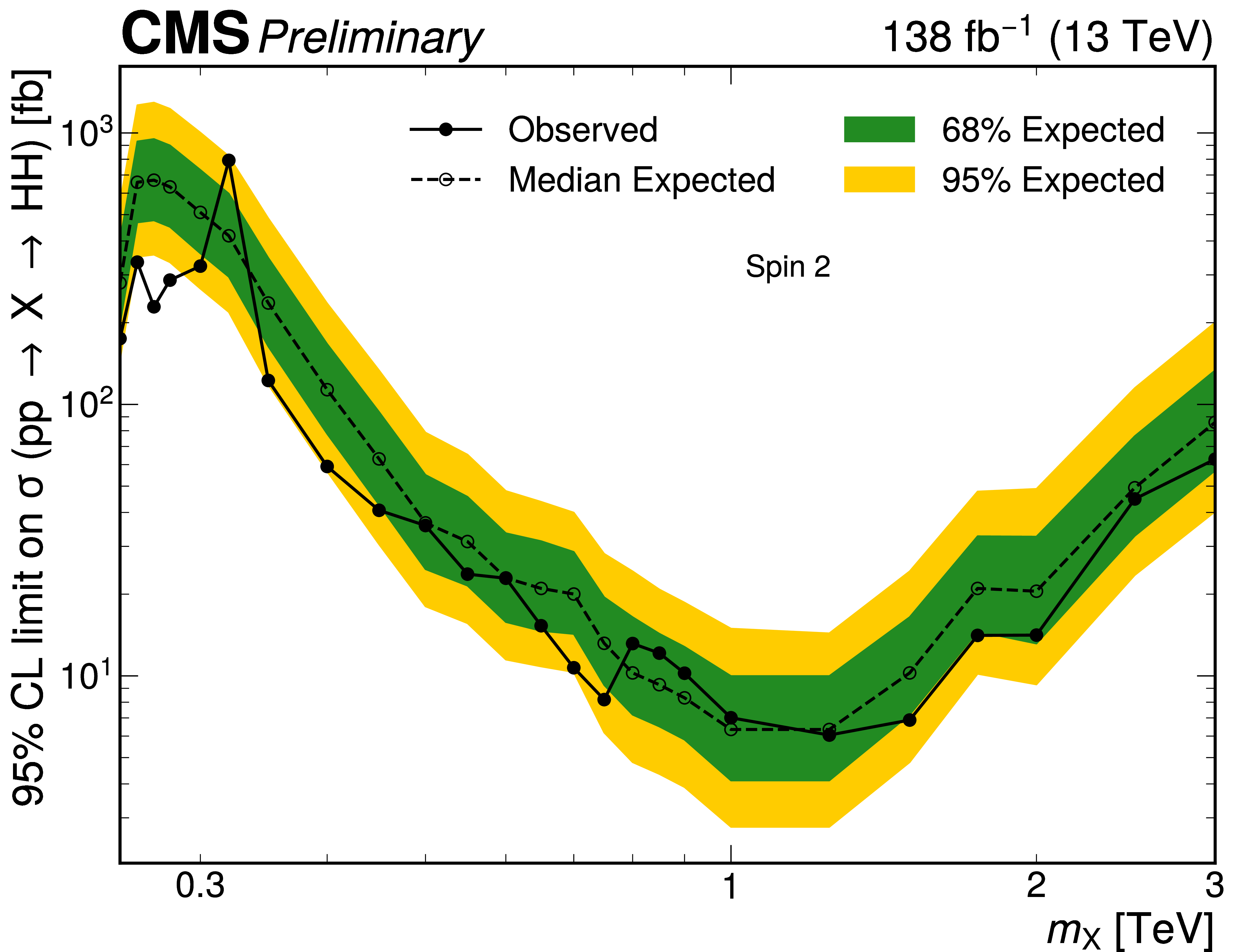
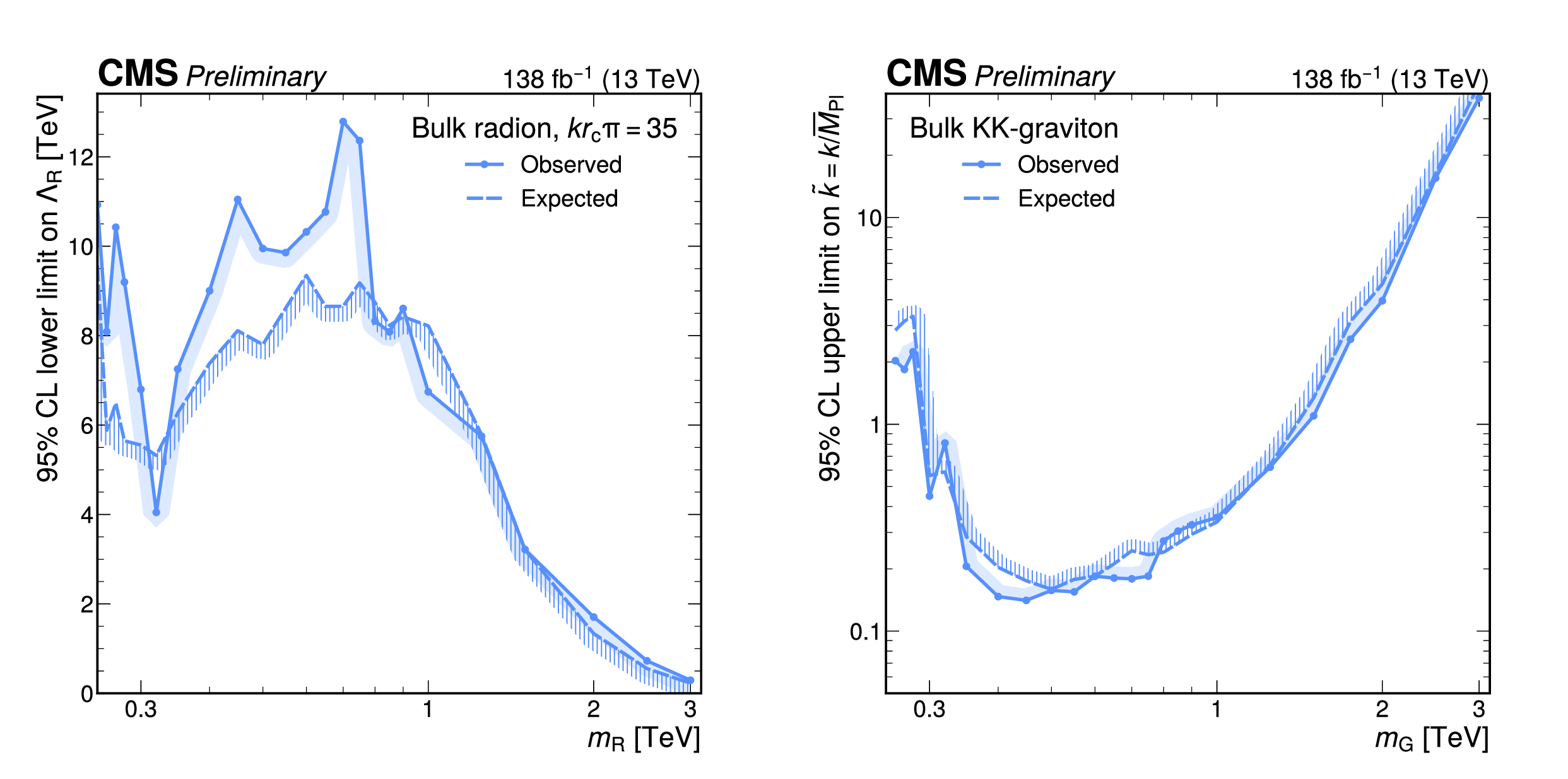
95% CL limits on the $ \mathrm{p}\mathrm{p} \rightarrow $X$ \rightarrow \mathrm{H}\mathrm{H} $ cross section as a function of $ m_{\text{X}} $, assuming a resonance of spin 0 (left) and of spin 2 (right). |
png pdf |
Figure 5-a:
95% CL limits on the $ \mathrm{p}\mathrm{p} \rightarrow $X$ \rightarrow \mathrm{H}\mathrm{H} $ cross section as a function of $ m_{\text{X}} $, assuming a resonance of spin 0 (left) and of spin 2 (right). |
png pdf |
Figure 5-b:
95% CL limits on the $ \mathrm{p}\mathrm{p} \rightarrow $X$ \rightarrow \mathrm{H}\mathrm{H} $ cross section as a function of $ m_{\text{X}} $, assuming a resonance of spin 0 (left) and of spin 2 (right). |
png pdf |
Figure 6:
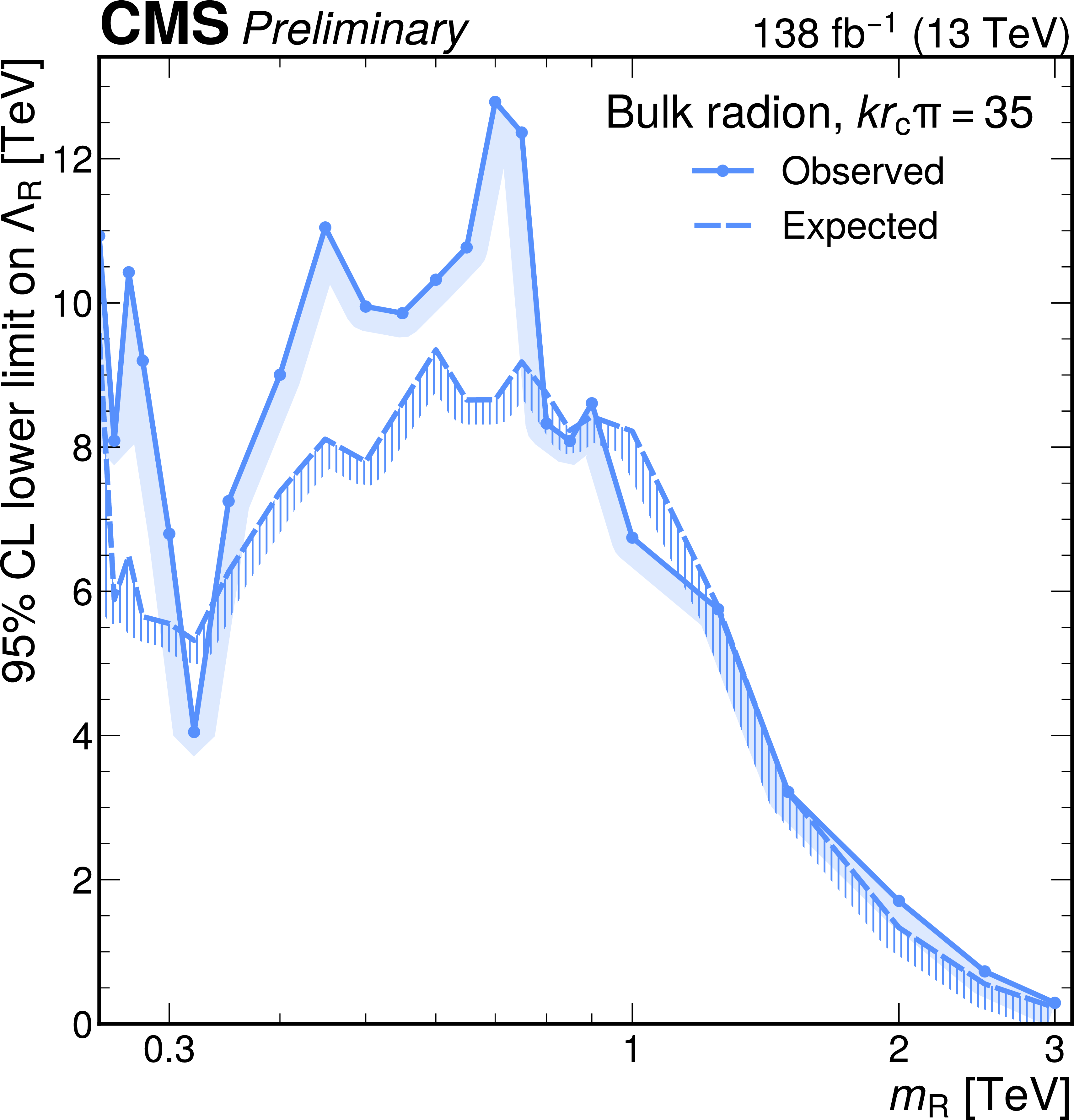
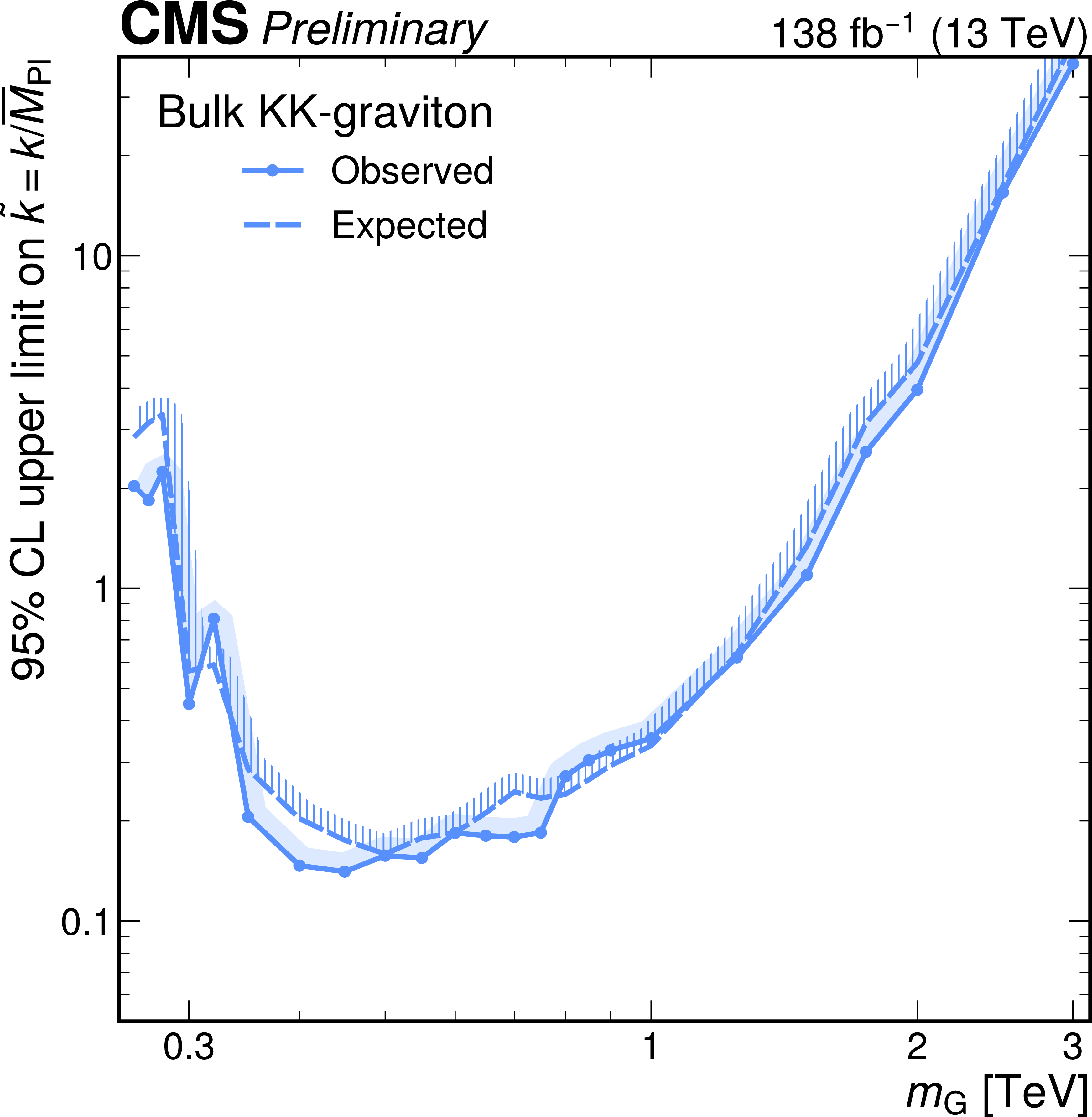
Observed and expected 95% CL limits on parameters of the spin-0 and spin-2 signal models. (Left) Limits on the ultraviolet cutoff scale $ \Lambda_{\text{R}} $ of the spin-0 radion model, as functions of the radion mass $ m_{\text{R}} $. (Right) Limits on $ \tilde{k} $ of the spin-2 graviton model, as functions of the graviton mass $ m_{\text{G}} $. The shaded bands indicate the direction of exclusion of the parameter space ($ \Lambda_{\text{R}} $ is excluded below the curve, while $ \tilde{k} $ is excluded above the curve). |
png pdf |
Figure 6-a:
Observed and expected 95% CL limits on parameters of the spin-0 and spin-2 signal models. (Left) Limits on the ultraviolet cutoff scale $ \Lambda_{\text{R}} $ of the spin-0 radion model, as functions of the radion mass $ m_{\text{R}} $. (Right) Limits on $ \tilde{k} $ of the spin-2 graviton model, as functions of the graviton mass $ m_{\text{G}} $. The shaded bands indicate the direction of exclusion of the parameter space ($ \Lambda_{\text{R}} $ is excluded below the curve, while $ \tilde{k} $ is excluded above the curve). |
png pdf |
Figure 6-b:
Observed and expected 95% CL limits on parameters of the spin-0 and spin-2 signal models. (Left) Limits on the ultraviolet cutoff scale $ \Lambda_{\text{R}} $ of the spin-0 radion model, as functions of the radion mass $ m_{\text{R}} $. (Right) Limits on $ \tilde{k} $ of the spin-2 graviton model, as functions of the graviton mass $ m_{\text{G}} $. The shaded bands indicate the direction of exclusion of the parameter space ($ \Lambda_{\text{R}} $ is excluded below the curve, while $ \tilde{k} $ is excluded above the curve). |
| Tables | |
png pdf |
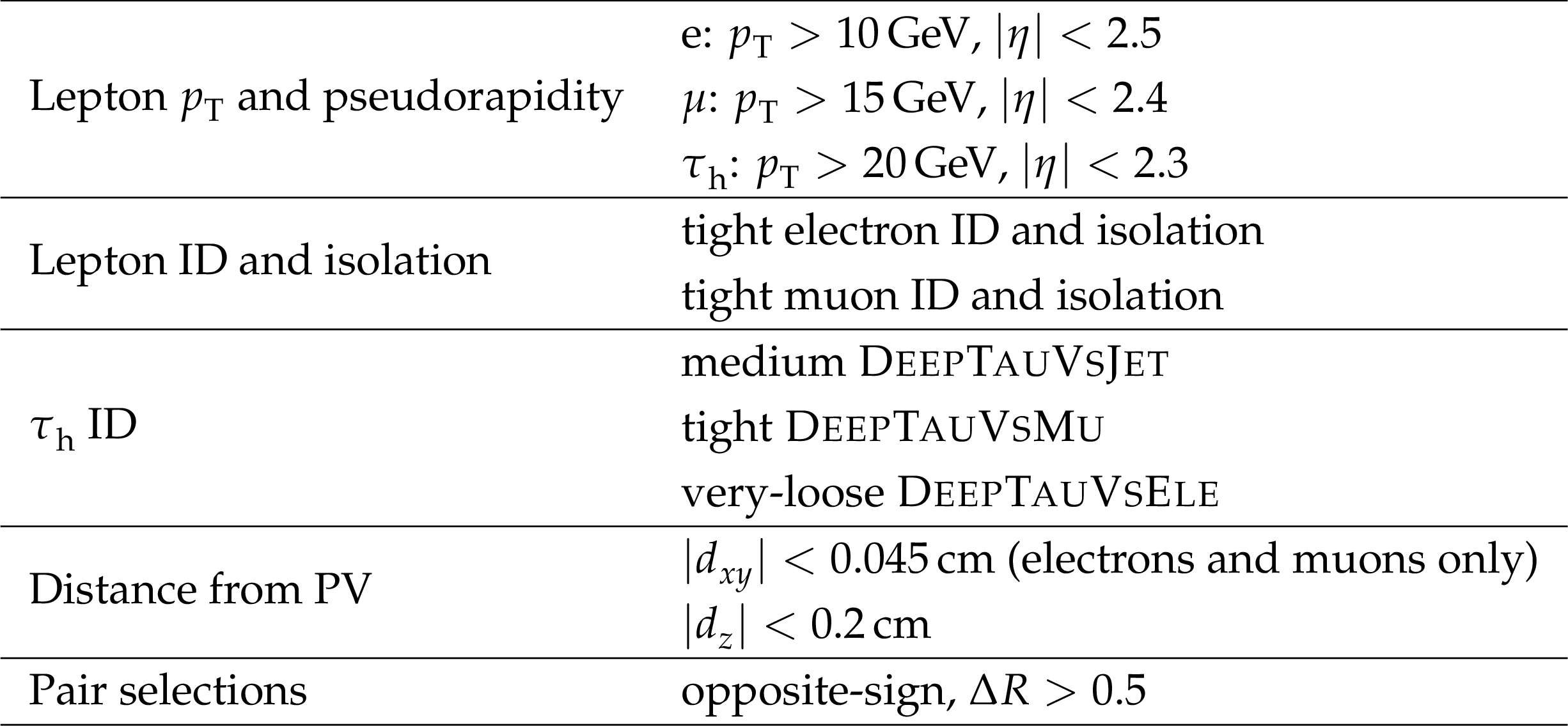
Table 1:
Summary of selections applied to the \tautau candidate pair. The lepton $ p_{\mathrm{T}} $ thresholds reported correspond to the minimal cut applied, and tighter requirements may be used depending on the trigger that selected the event. |
png pdf |
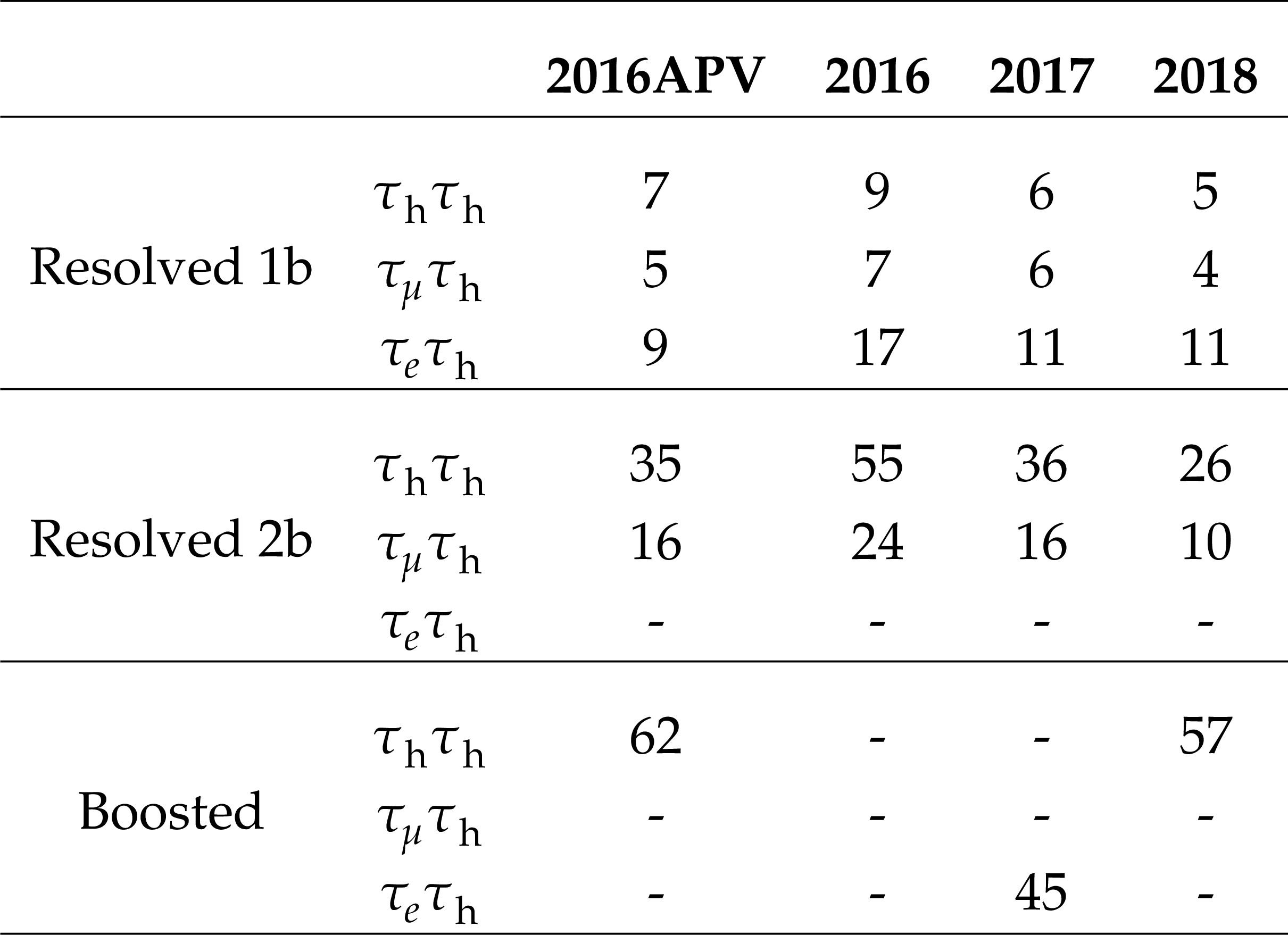
Table 2:
Uncertainties (in %) in the QCD background yield estimation. Cells are empty if the QCD estimate is zero. |
| Summary |
| A search for resonances decaying into a pair of SM Higgs bosons, in the $ \mathrm{b}\mathrm{b}\tau\tau $ final state has been presented. The analysis is based on proton-proton collision data collected by the CMS experiment at the LHC during 2016--2018 period at a center-of-mass energy of $ \sqrt{s}= $ 13 TeV, corresponding to an integrated luminosity of 138 fb$ ^{-1} $. A parameterized deep neural network is used to discriminate possible signals associated with spin-0 and spin-2 resonances within a mass range from 250 to 3000 GeV from background events. Both spin-0 and spin-2 resonances in the mass range from 250 to 3000 GeV are considered. In the absence of significant excess in data, limits are set on the $ \text{pp}\rightarrow \text{X} \rightarrow \text{HH} $ production cross section for both spin hypotheses, with observed upper limits ranging from 970.7 fb at $ m_{\text{X}}=320 \text{GeV} $ down to 7.4 fb at $ m_{\text{X}}=1250 \text{GeV} $ for spin-0 resonances, and 792.9 fb at $ m_{\text{X}}=320 \text{GeV} $ down to 6.0 fb at $ m_{\text{X}}=1250 \text{GeV} $ for spin-2 resonances. This analysis improves upon the most recent searches in this final state by the ATLAS [21] and CMS [19,18] Collaborations in the mass range 800-1500 GeV, with observed upper limits tighter by up to a factor of five at high masses. The results are also interpreted in the warped extra dimensions model. |
| References | ||||
| 1 | ATLAS Collaboration | Observation of a new particle in the search for the standard model Higgs boson with the ATLAS detector at the LHC | PLB 716 (2012) 01 | 1207.7214 |
| 2 | CMS Collaboration | Observation of a new boson at a mass of 125 GeV with the CMS experiment at the LHC | PLB 716 (2012) 30 | CMS-HIG-12-028 1207.7235 |
| 3 | CMS Collaboration | Observation of a new boson with mass near 125 GeV in pp collisions at $ \sqrt{s} = $ 7 and 8 TeV | JHEP 06 (2013) 081 | CMS-HIG-12-036 1303.4571 |
| 4 | N. Craig | Naturalness: A Snowmass White Paper | EPJC 83 (2023) 825 | 2205.05708 |
| 5 | A. D. Sakharov | Violation of cp in variance, c asymmetry, and baryon asymmetry of the universe | Phys. Usp. 34 (1991) 392 | |
| 6 | G. C. Branco et al. | Theory and phenomenology of two-Higgs-doublet models | Phys. Rept. 516 (2012) 1 | 1106.0034 |
| 7 | L. Randall and R. Sundrum | A large mass hierarchy from a small extra dimension | PRL 83 (1999) 3370 | hep-ph/9905221 |
| 8 | L. Randall and R. Sundrum | An Alternative to compactification | PRL 83 (1999) 4690 | hep-th/9906064 |
| 9 | W. D. Goldberger and M. B. Wise | Modulus stabilization with bulk fields | PRL 83 (1999) 4922 | hep-ph/9907447 |
| 10 | O. DeWolfe, D. Z. Freedman, S. S. Gubser, and A. Karch | Modeling the fifth dimension with scalars and gravity | PRD 62 (2000) 046008 | hep-th/9909134 |
| 11 | C. Csaki, M. Graesser, L. Randall, and J. Terning | Cosmology of brane models with radion stabilization | PRD 62 (2000) 045015 | hep-ph/9911406 |
| 12 | H. Davoudiasl, J. L. Hewett, and T. G. Rizzo | Phenomenology of the Randall-Sundrum gauge hierarchy model | PRL 84 (2000) 2080 | hep-ph/9909255 |
| 13 | C. Csaki, M. L. Graesser, and G. D. Kribs | Radion dynamics and electroweak physics | PRD 63 (2001) 065002 | hep-th/0008151 |
| 14 | K. Agashe, H. Davoudiasl, G. Perez, and A. Soni | Warped gravitons at the LHC and beyond | PRD 76 (2007) 036006 | hep-ph/0701186 |
| 15 | The ATLAS Collaboration | Combination of searches for resonant Higgs boson pair production using $ pp $ collisions at $ \sqrt{s}= $ 13 TeV with the ATLAS detector | PRL 132 (2024) 231801 | 2311.15956 |
| 16 | CMS Collaboration | Searches for Higgs boson production through decays of heavy resonances | Phys. Rept. 1115 (2025) 368 | 2403.16926 |
| 17 | CMS Collaboration | Search for nonresonant Higgs boson pair production in final state with two bottom quarks and two tau leptons in proton-proton collisions at $ \sqrt{s}= $ 13 TeV | PLB 842 (2023) 137531 | CMS-HIG-20-010 2206.09401 |
| 18 | CMS Collaboration | Search for heavy resonances decaying into two Higgs bosons in the $ \mathrm{b\bar{b}}\tau^+\tau^- $ final state in proton-proton collisions at $ \sqrt{s} = $ 13 TeV | 2601.20011 | |
| 19 | CMS Collaboration | Search for a heavy Higgs boson decaying into two lighter Higgs bosons in the $ \tau\tau $bb final state at 13 TeV | JHEP 11 (2021) 057 | CMS-HIG-20-014 2106.10361 |
| 20 | CMS Collaboration | Search for Higgs boson pair production in events with two bottom quarks and two tau leptons in proton--proton collisions at $ \sqrt{s}= $ 13 TeV | PLB 778 (2018) 101 | CMS-HIG-17-002 1707.02909 |
| 21 | The ATLAS Collaboration | Search for resonant and non-resonant Higgs boson pair production in the $ b\bar{b}\tau^+\tau^- $ decay channel using 13 TeV $ pp $ collision data from the ATLAS detector | JHEP 07 (2023) 040 | 2209.10910 |
| 22 | CMS Collaboration | Electron and photon reconstruction and identification with the CMS experiment at the CERN LHC | JINST 16 (2021) P05014 | CMS-EGM-17-001 2012.06888 |
| 23 | CMS Collaboration | Performance of the CMS muon detector and muon reconstruction with proton-proton collisions at $ \sqrt{s}= $ 13 TeV | JINST 13 (2018) P06015 | CMS-MUO-16-001 1804.04528 |
| 24 | CMS Collaboration | Description and performance of track and primary-vertex reconstruction with the CMS tracker | JINST 9 (2014) P10009 | CMS-TRK-11-001 1405.6569 |
| 25 | CMS Collaboration | Performance of the CMS Level-1 trigger in proton-proton collisions at $ \sqrt{s} = $ 13 TeV | JINST 15 (2020) P10017 | CMS-TRG-17-001 2006.10165 |
| 26 | CMS Collaboration | The CMS trigger system | JINST 12 (2017) P01020 | CMS-TRG-12-001 1609.02366 |
| 27 | CMS Collaboration | Performance of the CMS high-level trigger during LHC Run 2 | JINST 19 (2024) P11021 | CMS-TRG-19-001 2410.17038 |
| 28 | CMS Collaboration | The CMS experiment at the CERN LHC | JINST 3 (2008) S08004 | |
| 29 | CMS Collaboration | Development of the CMS detector for the CERN LHC Run 3 | JINST 19 (2024) P05064 | |
| 30 | J. Alwall et al. | The automated computation of tree-level and next-to-leading order differential cross sections, and their matching to parton shower simulations | JHEP 07 (2014) 79 | 1405.0301 |
| 31 | P. Nason | A New method for combining NLO QCD with shower Monte Carlo algorithms | JHEP 11 (2004) 040 | hep-ph/0409146 |
| 32 | S. Frixione, P. Nason, and C. Oleari | Matching NLO QCD computations with Parton Shower simulations: the POWHEG method | JHEP 11 (2007) 070 | 0709.2092 |
| 33 | S. Alioli, P. Nason, C. Oleari, and E. Re | A general framework for implementing NLO calculations in shower Monte Carlo programs: the POWHEG BOX | JHEP 06 (2010) 043 | 1002.2581 |
| 34 | R. Frederix and S. Frixione | Merging meets matching in MC@NLO | JHEP 12 (2012) 61 | 1209.6215 |
| 35 | J. Alwall et al. | Comparative study of various algorithms for the merging of parton showers and matrix elements in hadronic collisions | EPJC 53 (2007) 473 | 0706.2569 |
| 36 | T. Sjöstrand et al. | An introduction to PYTHIA 8.2 | Comp. Phys. Commun. 191 (2015) 159 | 1410.3012 |
| 37 | CMS Collaboration | Extraction and validation of a new set of CMS PYTHIA8 tunes from underlying-event measurements | EPJC 80 (2020) 4 | CMS-GEN-17-001 1903.12179 |
| 38 | R. D. Ball et al. | Parton distributions from high-precision collider data | EPJC 77 (2017) 663 | 1706.00428 |
| 39 | GEANT4 Collaboration | GEANT 4---a simulation toolkit | NIM A 506 (2003) 250 | |
| 40 | CMS Collaboration | Particle-flow reconstruction and global event description with the CMS detector | JINST 12 (2017) P10003 | CMS-PRF-14-001 1706.04965 |
| 41 | CMS Collaboration | Performance of missing transverse momentum reconstruction in proton-proton collisions at $ \sqrt{s} = $ 13 TeV using the CMS detector | JINST 14 (2019) P07004 | CMS-JME-17-001 1903.06078 |
| 42 | CMS Collaboration | ECAL 2016 refined calibration and Run2 summary plots | CMS Detector Performance Summary CMS-DP-2020-021, 2020 CDS |
|
| 43 | CMS Collaboration | Performance of $ \tau $-lepton reconstruction and identification in CMS | JINST 7 (2012) P01001 | CMS-TAU-11-001 1109.6034 |
| 44 | CMS Collaboration | Reconstruction and identification of $ \tau $ lepton decays to hadrons and $ \nu_\tau $ at CMS | JINST 11 (2016) P01019 | CMS-TAU-14-001 1510.07488 |
| 45 | CMS Collaboration | Performance of reconstruction and identification of $ \tau $ leptons decaying to hadrons and $ \nu_\tau $ in proton-proton collisions at $ \sqrt{s}= $ 13 TeV | JINST 13 (2018) P10005 | CMS-TAU-16-003 1809.02816 |
| 46 | CMS Collaboration | Identification of hadronic tau lepton decays using a deep neural network | JINST 17 (2022) P07023 | CMS-TAU-20-001 2201.08458 |
| 47 | CMS Collaboration | Identification of tau leptons using a convolutional neural network with domain adaptation | JINST 20 (2025) P12032 | CMS-TAU-24-001 2511.05468 |
| 48 | M. Cacciari, G. P. Salam, and G. Soyez | The anti-$ k_{\mathrm{T}} $ jet clustering algorithm | JHEP 04 (2008) 063 | 0802.1189 |
| 49 | M. Cacciari, G. P. Salam, and G. Soyez | FastJet user manual | EPJC 72 (2012) 1896 | 1111.6097 |
| 50 | Y. L. Dokshitzer, G. D. Leder, S. Moretti, and B. R. Webber | Better jet clustering algorithms | JHEP 08 (1997) 001 | hep-ph/9707323 |
| 51 | M. Wobisch and T. Wengler | Hadronization corrections to jet cross-sections in deep inelastic scattering | in Proc. Workshop on Monte Carlo Generators for HERA Physics, Hamburg, Germany, 1998 link |
hep-ph/9907280 |
| 52 | M. Dasgupta, A. Fregoso, S. Marzani, and G. P. Salam | Towards an understanding of jet substructure | JHEP 09 (2013) 029 | 1307.0007 |
| 53 | J. M. Butterworth, A. R. Davison, M. Rubin, and G. P. Salam | Jet substructure as a new Higgs search channel at the LHC | PRL 100 (2008) 242001 | 0802.2470 |
| 54 | CMS Collaboration | Pileup mitigation at CMS in $ \sqrt{s}= $ 13 TeV data | JINST 15 (2020) P09018 | CMS-JME-18-001 2003.00503 |
| 55 | D. Bertolini, P. Harris, M. Low, and N. Tran | Pileup per particle identification | JHEP 10 (2014) 059 | 1407.6013 |
| 56 | CMS Collaboration | Jet energy scale and resolution measurement with Run-2 legacy data collected by CMS at $ \sqrt{s}= $ 13 TeV | CMS Detector Performance Summary CMS-DP-2021-033, CERN, 2021 CDS |
|
| 57 | E. Bols et al. | Jet flavour classification using DeepJet | JINST 15 (2020) P12012 | 2008.10519 |
| 58 | H. Qu and L. Gouskos | Jet tagging via particle clouds | PRD 101 (2020) 056019 | 1902.08570 |
| 59 | CMS Collaboration | Performance of heavy-flavour jet identification in boosted topologies in proton-proton collisions at $ \sqrt{s} = $ 13 TeV | CMS Physics Analysis Summary, 2023 CMS-PAS-BTV-22-001 |
CMS-PAS-BTV-22-001 |
| 60 | CMS Collaboration | Operation and performance of the CMS silicon strip tracker with proton-proton collisions at the CERN LHC | JINST 20 (2025) P08027 | CMS-TRK-20-002 2506.17195 |
| 61 | F. Rosenblatt | The perceptron: A probabilistic model for information storage and organization in the brain | Psychol. Rev. 65 (1957) 386 | |
| 62 | S. Linnainmaa | The representation of the cumulative rounding error of an algorithm as a Taylor expansion of the local rounding errors | Master's thesis, Univ. Helsinki, 1970 | |
| 63 | P. J. Werbos | Applications of advances in nonlinear sensitivity analysis | in the IFIP Conference, 31.8 - 4.9, NYC, 1981 Proc. 1 (1981) 762 |
|
| 64 | D. E. Rumelhart , G. E. Hinton , and R. J. Williams | Learning representations by back-propagating errors | Nature 323 (1986) 533 | |
| 65 | P. Baldi et al. | Parameterized neural networks for high-energy physics | EPJC 76 (2016) 235 | 1601.07913 |
| 66 | C. Guo and F. Berkhahn | Entity embeddings of categorical variables | link | 1604.06737 |
| 67 | S. Ioffe and C. Szegedy | Batch normalization: Accelerating deep network training by reducing internal covariate shift | ||
| 68 | M. Erdmann, E. Geiser, Y. Rath, and M. Rieger | Lorentz boost networks: Autonomous physics-inspired feature engineering | JINST 14 (2019) P06006 | 1812.09722 |
| 69 | CMS Collaboration | Precision luminosity measurement in proton-proton collisions at $ \sqrt{s} = $ 13 TeV in 2015 and 2016 at CMS | EPJC 81 (2021) 800 | CMS-LUM-17-003 2104.01927 |
| 70 | CMS Collaboration | CMS luminosity measurement for the 2017 data-taking period at $ \sqrt{s} = $ 13 TeV | CMS Physics Analysis Summary, 2018 link |
CMS-PAS-LUM-17-004 |
| 71 | CMS Collaboration | CMS luminosity measurement for the 2018 data-taking period at $ \sqrt{s} = $ 13 TeV | CMS Physics Analysis Summary, 2019 link |
CMS-PAS-LUM-18-002 |
| 72 | LHC Higgs Cross Section Working Group | Handbook of LHC Higgs Cross Sections: 4. Deciphering the Nature of the Higgs Sector | link | |
| 73 | CMS Collaboration | Measurement of the inelastic proton-proton cross section at $ \sqrt{s}= $ 13 TeV | JHEP 07 (2018) 161 | CMS-FSQ-15-005 1802.02613 |
| 74 | CMS Collaboration | The CMS statistical analysis and combination tool: Combine | Comput. Softw. Big Sci. 8 (2024) 19 | CMS-CAT-23-001 2404.06614 |
| 75 | W. Verkerke and D. Kirkby | The RooFit toolkit for data modeling | in th Int. Conf. on Computing in High Energy and Nuclear Physics (CHEP ): La Jolla CA, United States, March 24--28,, 2003 Proc. 1 (2003) 3 |
physics/0306116 |
| 76 | L. Moneta et al. | The roostats project | link | 1009.1003 |
|
|
Compact Muon Solenoid LHC, CERN |

|
|
|
|
|
|