
Compact Muon Solenoid
LHC, CERN
 Visit us: CMS Public Website, CMS Physics ;
Contact us: CMS Publications Committee
Visit us: CMS Public Website, CMS Physics ;
Contact us: CMS Publications Committee
| CMS-HIN-25-015 ; CERN-EP-2026-188 | ||
| Evidence for sequential $ \Upsilon{\textrm{(nS)}} $ suppression in light ion collisions | ||
| CMS Collaboration | ||
| 15 July 2026 | ||
| Submitted to Physical Review Letters | ||
| Abstract: Bound states of heavy quark-antiquark pairs, known as quarkonia, have long been regarded as particularly sensitive probes of the quark-gluon plasma (QGP). Comparing quarkonium yields in collisions of heavy nuclei, such as gold or lead, with a proton-proton (pp) reference reveals a characteristic pattern of sequential suppression, in which weakly-bound excited states are more strongly suppressed than the ground states. We report the first measurements of the three lowest mass $ \mathrm{S} $-wave vector bottomonium resonances, the ground state $ \Upsilon{\textrm{(1S)}} $ and the excited states $ \Upsilon{\textrm{(2S)}} $ and $ \Upsilon{\textrm{(3S)}} $, in oxygen-oxygen collisions at a center-of-mass energy per nucleon pair of $ \sqrt{\smash[b]{s_{_{\mathrm{NN}}}}}= $ 5.36 TeV. Measurements of the yields of the $ \Upsilon{\textrm{(1S)}} $ and $ \Upsilon{\textrm{(2S)}} $ resonances in neon-neon collisions, at the same $ \sqrt{\smash[b]{s_{_{\mathrm{NN}}}}} $, are also presented. The $ \Upsilon{\textrm{(2S)}} $/$ \Upsilon{\textrm{(1S)}} $ ratio is found to be significantly below the measured pp reference value, and the $ \Upsilon{\textrm{(3S)}} $/$ \Upsilon{\textrm{(1S)}} $ ratio shows an even larger reduction. The significance of the relative $ \Upsilon{\textrm{(3S)}} $ to $ \Upsilon{\textrm{(2S)}} $ suppression exceeds three standard deviations. These results provide evidence for the sequential suppression of $ \Upsilon{\textrm{(nS)}} $ states in light ion collisions, similar to observations made in lead-lead and gold-gold collisions, generally attributed to the presence of a QGP medium. | ||
| Links: e-print arXiv:2607.13758 [hep-ex] (PDF) ; CDS record ; inSPIRE record ; HepData record ; Physics Briefing ; CADI line (restricted) ; | ||
| Figures | Summary | Additional Figures | References | CMS Publications |
|---|
| Figures | |
png pdf |
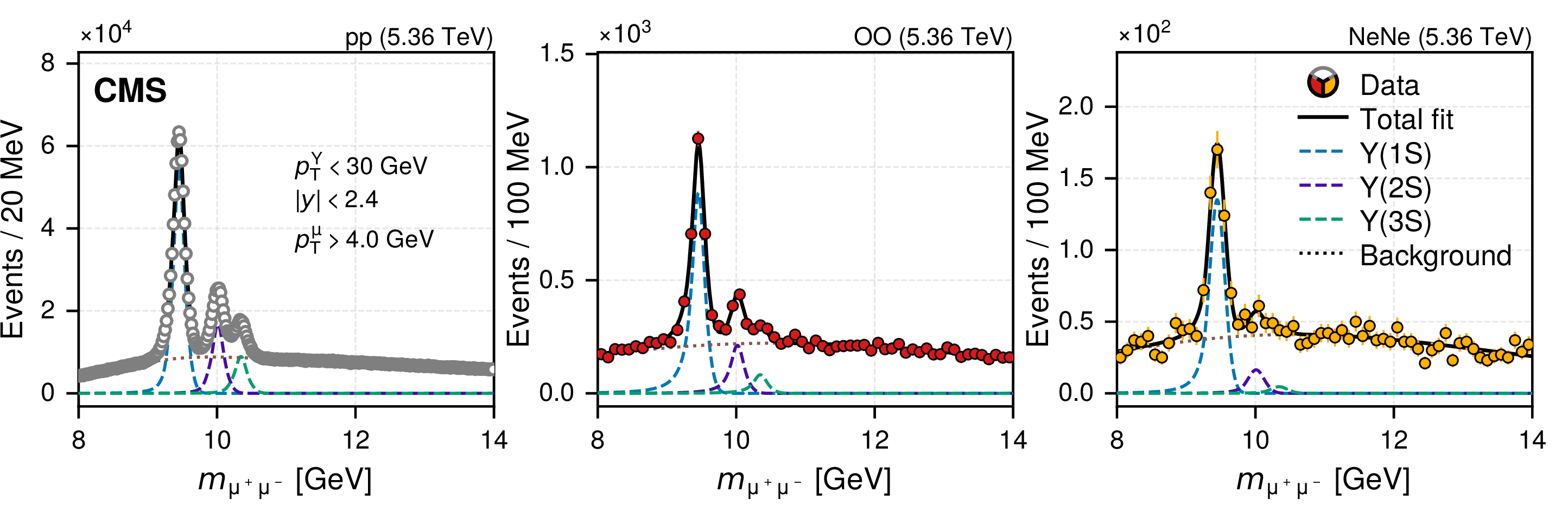
Figure 1:
Muon pair invariant mass distributions in pp (left), $ \text{OO} $ (middle), and $ \text{NeNe} $ (right) collisions. The overlaid curves show the corresponding fit results, integrated over muon pair $ p_{\mathrm{T}} < $ 30 GeV and $ |y| < $ 2.4. In each case the total fit model is shown as a solid line, while the individual $ \Upsilon $ signal components and the background are shown as dashed lines. |
png pdf |
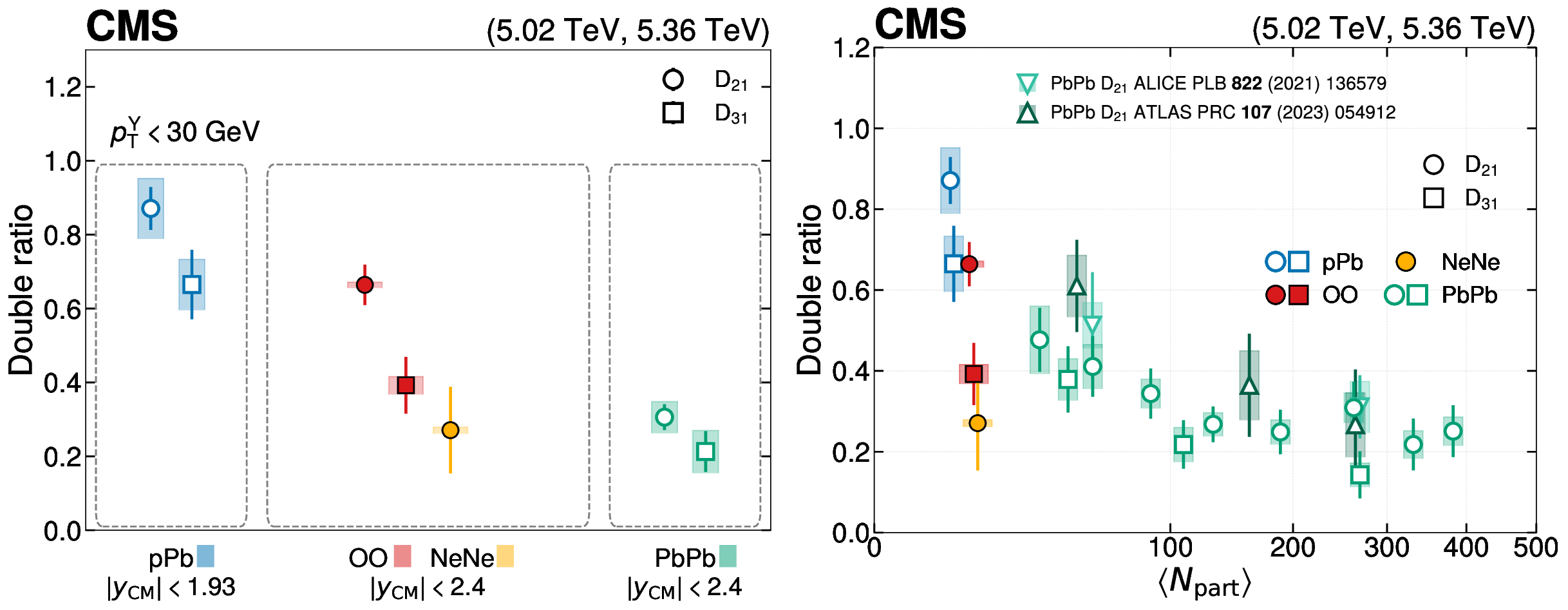
Figure 2:
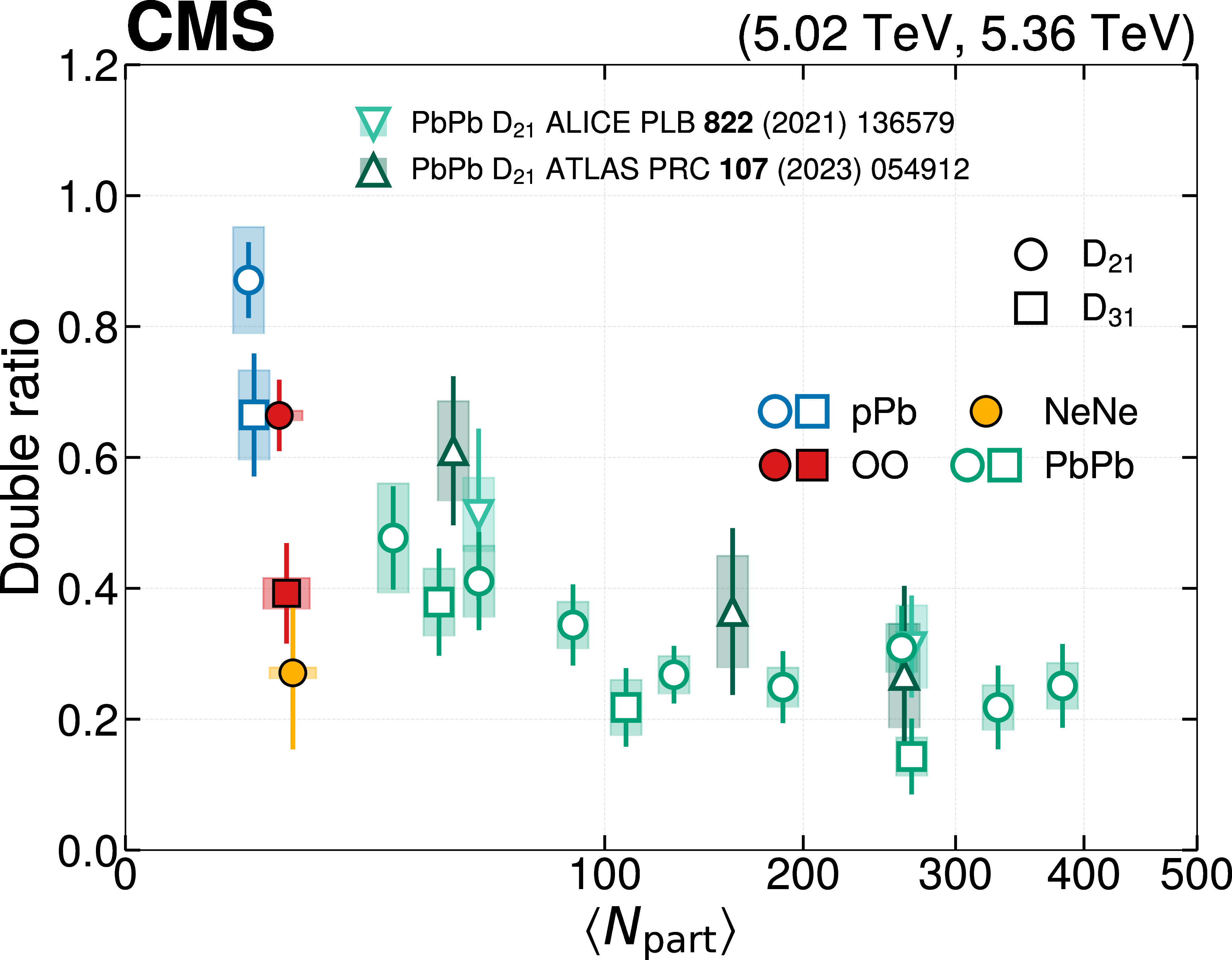
The measured double ratios $ D_{21} $ and $ D_{31} $ for $ \mathrm{p}\text{Pb} $ [26], $ \text{OO} $, $ \text{NeNe} $, and PbPb [19,20] collisions (left), exhibiting a clear hierarchy that evolves with increasing system size. The rapidity $ y_{\mathrm{CM}} $ is defined in the center-of-mass (CM) frame. The double ratios are separately shown as a function of $ \langle N_{\text{part}}\rangle $ (right), and are compared with previous PbPb [21,22] measurements performed at the LHC. For visibility purposes, the horizontal axis is displayed on a square root scale. |
png pdf |
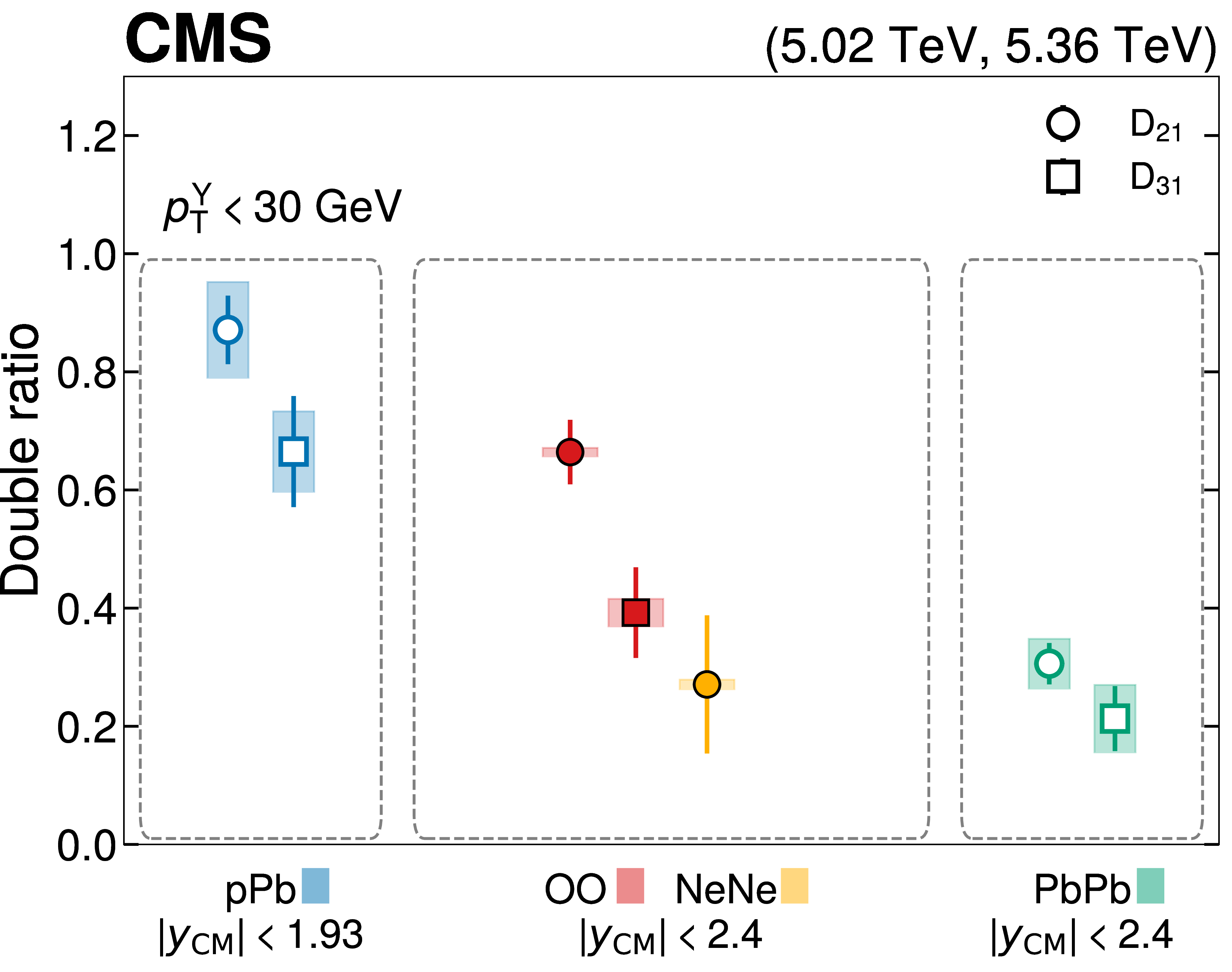
Figure 2-a:
The measured double ratios $ D_{21} $ and $ D_{31} $ for $ \mathrm{p}\text{Pb} $ [26], $ \text{OO} $, $ \text{NeNe} $, and PbPb [19,20] collisions (left), exhibiting a clear hierarchy that evolves with increasing system size. The rapidity $ y_{\mathrm{CM}} $ is defined in the center-of-mass (CM) frame. The double ratios are separately shown as a function of $ \langle N_{\text{part}}\rangle $ (right), and are compared with previous PbPb [21,22] measurements performed at the LHC. For visibility purposes, the horizontal axis is displayed on a square root scale. |
png pdf |
Figure 2-b:
The measured double ratios $ D_{21} $ and $ D_{31} $ for $ \mathrm{p}\text{Pb} $ [26], $ \text{OO} $, $ \text{NeNe} $, and PbPb [19,20] collisions (left), exhibiting a clear hierarchy that evolves with increasing system size. The rapidity $ y_{\mathrm{CM}} $ is defined in the center-of-mass (CM) frame. The double ratios are separately shown as a function of $ \langle N_{\text{part}}\rangle $ (right), and are compared with previous PbPb [21,22] measurements performed at the LHC. For visibility purposes, the horizontal axis is displayed on a square root scale. |
png pdf |
Figure 3:
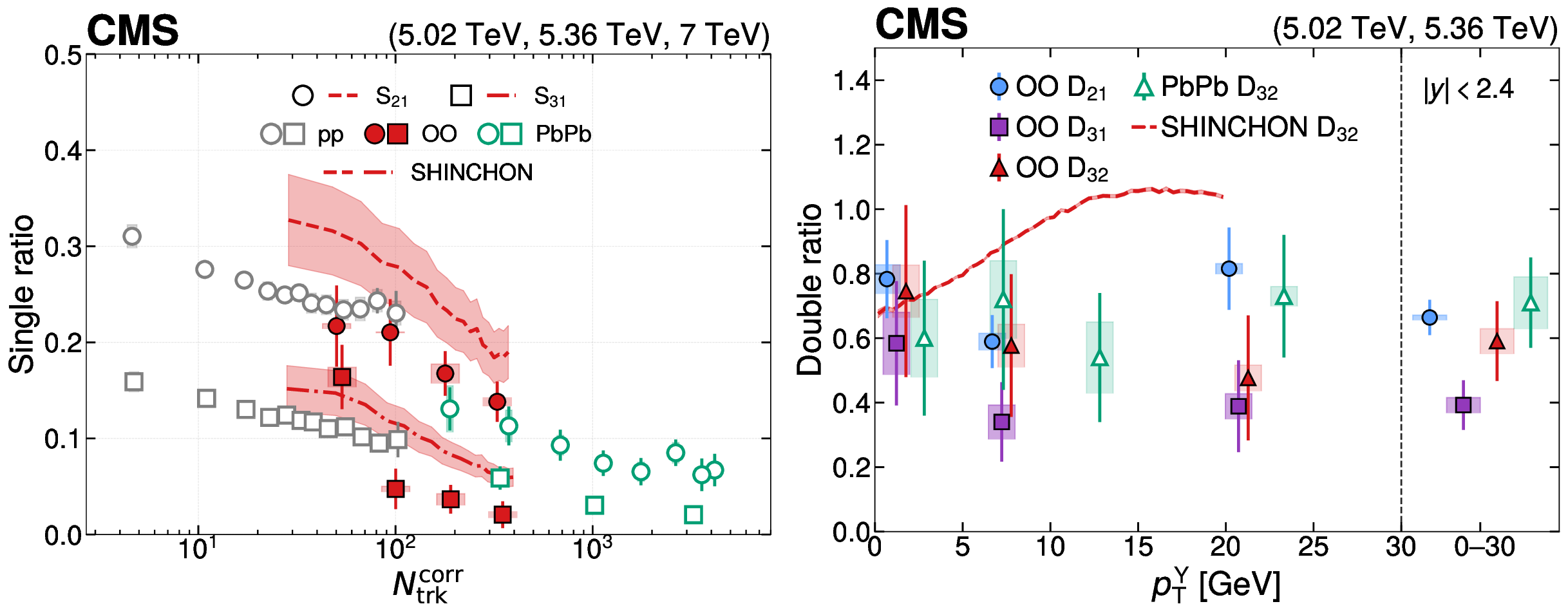
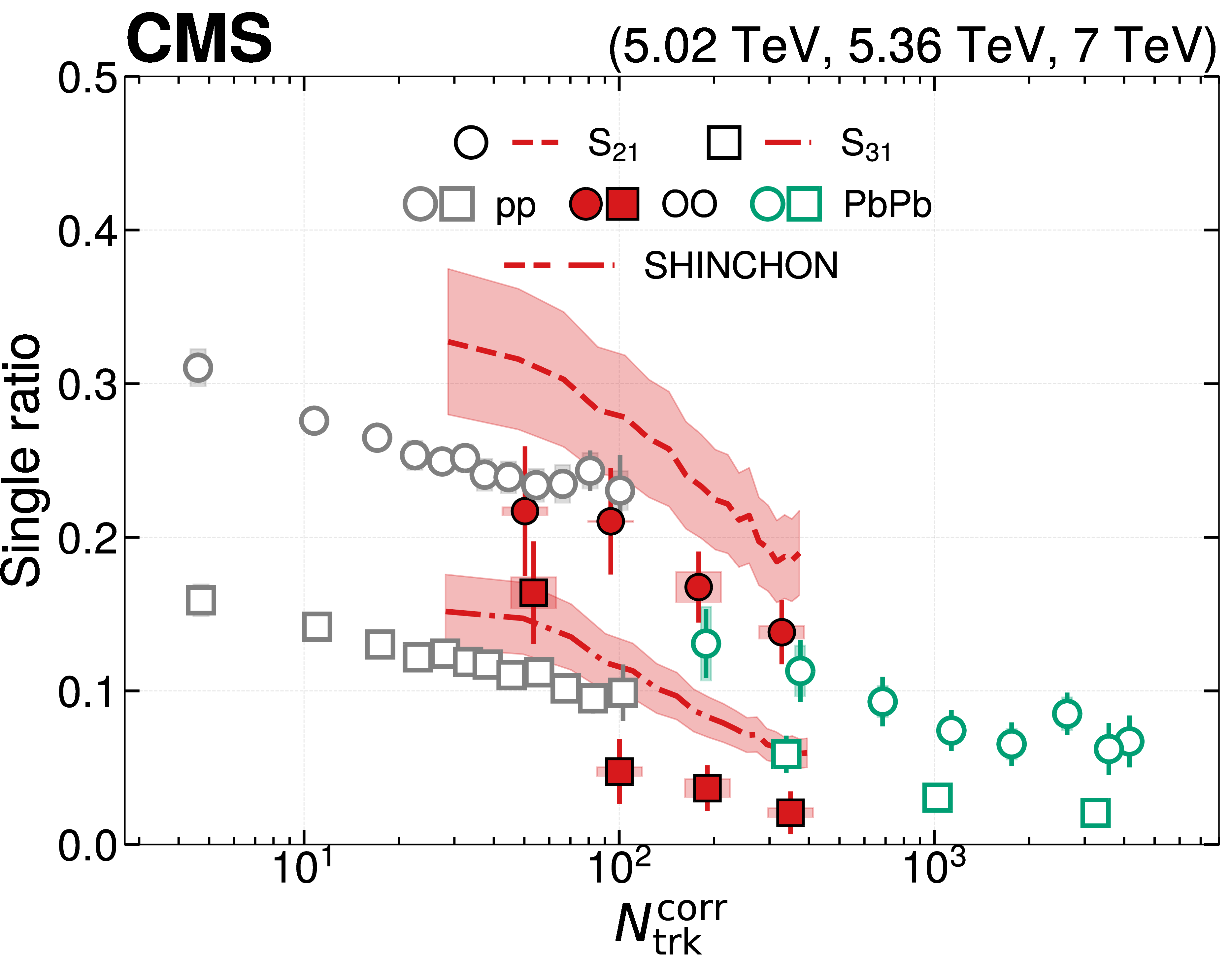
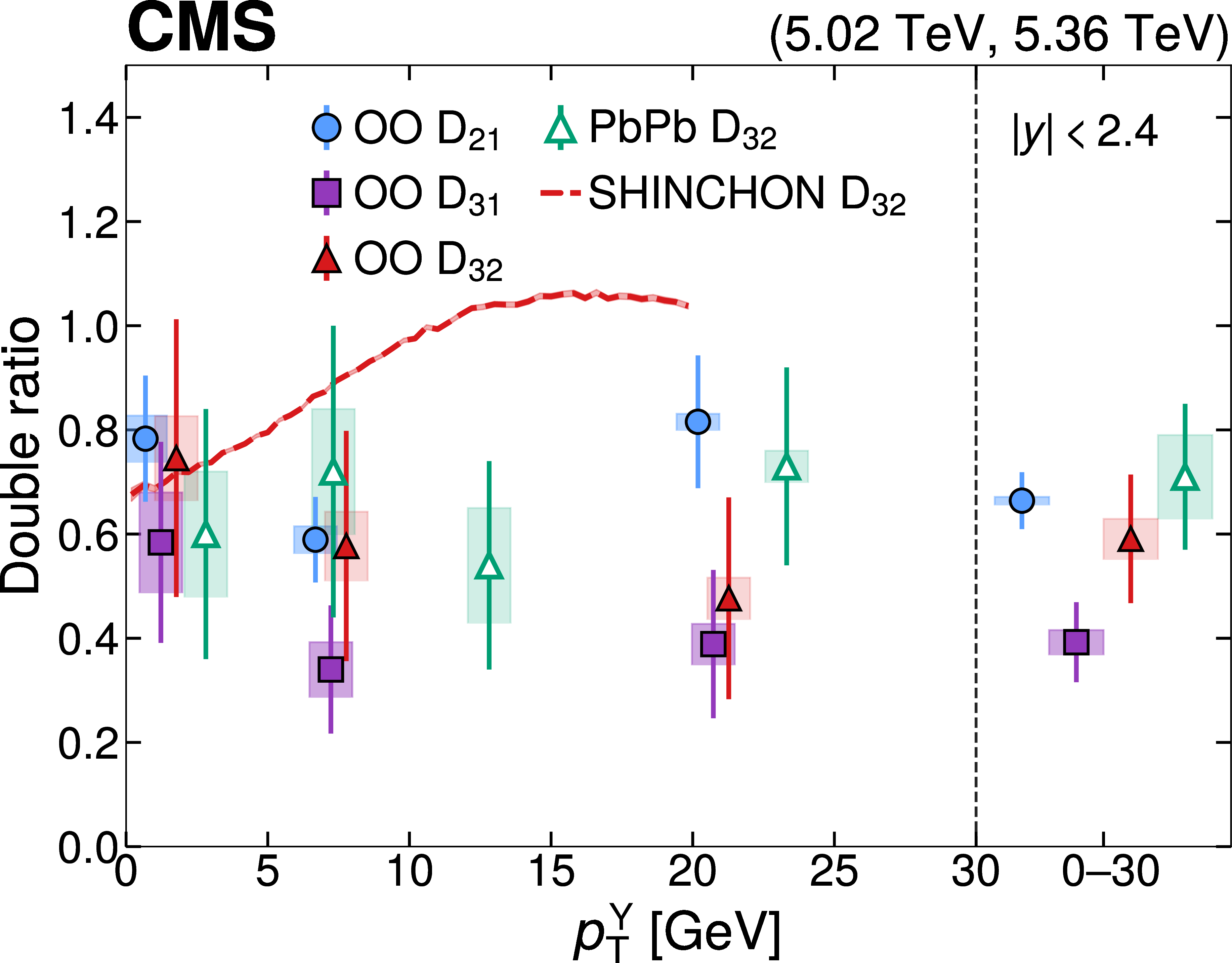
The single ratios $ S_{21} $ and $ S_{31} $ as a function of $ N_{\text{trk}}^{\text{corr}} $ (left), overlaid with LHC measurements in pp [75] and PbPb [19,20] collisions. Measured double ratios $ D_{32} $ (right) as a function of the muon pair $ p_{\mathrm{T}} $ in $ \text{OO} $ and PbPb [19,20] collisions, with the two points at the far right showing the $ p_{\mathrm{T}} $-integrated values for $ p_{\mathrm{T}} < $ 30 GeV and $ |y| < $ 2.4. For $ \text{OO} $ collisions, predictions obtained with the SHINCHON framework [76] are compared with the measured $ S_{21} $, $ S_{31} $, and $ D_{32} $ values. The shaded bands around the model predictions reflect the uncertainties in the calculation. |
png pdf |
Figure 3-a:
The single ratios $ S_{21} $ and $ S_{31} $ as a function of $ N_{\text{trk}}^{\text{corr}} $ (left), overlaid with LHC measurements in pp [75] and PbPb [19,20] collisions. Measured double ratios $ D_{32} $ (right) as a function of the muon pair $ p_{\mathrm{T}} $ in $ \text{OO} $ and PbPb [19,20] collisions, with the two points at the far right showing the $ p_{\mathrm{T}} $-integrated values for $ p_{\mathrm{T}} < $ 30 GeV and $ |y| < $ 2.4. For $ \text{OO} $ collisions, predictions obtained with the SHINCHON framework [76] are compared with the measured $ S_{21} $, $ S_{31} $, and $ D_{32} $ values. The shaded bands around the model predictions reflect the uncertainties in the calculation. |
png pdf |
Figure 3-b:
The single ratios $ S_{21} $ and $ S_{31} $ as a function of $ N_{\text{trk}}^{\text{corr}} $ (left), overlaid with LHC measurements in pp [75] and PbPb [19,20] collisions. Measured double ratios $ D_{32} $ (right) as a function of the muon pair $ p_{\mathrm{T}} $ in $ \text{OO} $ and PbPb [19,20] collisions, with the two points at the far right showing the $ p_{\mathrm{T}} $-integrated values for $ p_{\mathrm{T}} < $ 30 GeV and $ |y| < $ 2.4. For $ \text{OO} $ collisions, predictions obtained with the SHINCHON framework [76] are compared with the measured $ S_{21} $, $ S_{31} $, and $ D_{32} $ values. The shaded bands around the model predictions reflect the uncertainties in the calculation. |
| Summary |
| In summary, the $ \Upsilon{\textrm{(1S)}} $, $ \Upsilon{\textrm{(2S)}} $, and $ \Upsilon{\textrm{(3S)}} $ states are measured for the first time in oxygen-oxygen collisions, with the $ \Upsilon{\textrm{(1S)}} $ and $ \Upsilon{\textrm{(2S)}} $ states also measured in neon-neon collisions. The data were recorded with the CMS detector at the LHC in 2025 and collected at a nucleon-nucleon center-of-mass energy of 5.36 TeV. Proton-proton (pp) collisions at the same energy provided the reference baseline. The suppression of these states is quantified through ratios that compare excited-to-reference-state $ \Upsilon $ meson yields within ion-ion collisions and, separately, relative to the corresponding pp yields. These observables isolate final-state medium effects by canceling many common experimental uncertainties and reducing sensitivity to initial-state effects. The measurements reveal significant suppression of the $ \Upsilon{\textrm{(2S)}} $ and $ \Upsilon{\textrm{(3S)}} $ states, with significances exceeding five standard deviations when measured relative to $ \Upsilon{\textrm{(1S)}} $. The suppression of $ \Upsilon{\textrm{(3S)}} $ relative to $ \Upsilon{\textrm{(2S)}} $ exceeds three standard deviations, providing evidence for sequential $ \Upsilon{\textrm{(nS)}} $ meson suppression in light ion collisions. Moreover, the overall magnitude and transverse momentum dependence of the $ \Upsilon{\textrm{(3S)}} / \Upsilon{\textrm{(2S)}} $ ratio are compatible between oxygen-oxygen and lead-lead collisions, supporting a common interpretation of sequential $ \Upsilon $ meson suppression in the two systems. These results reinforce earlier findings that quarkonium suppression may not require large volumes of matter and provide new constraints for theoretical models aiming to describe bottomonium production from pp to heavy ion collisions. |
| Additional Figures | |
png pdf |
Additional Figure 1:
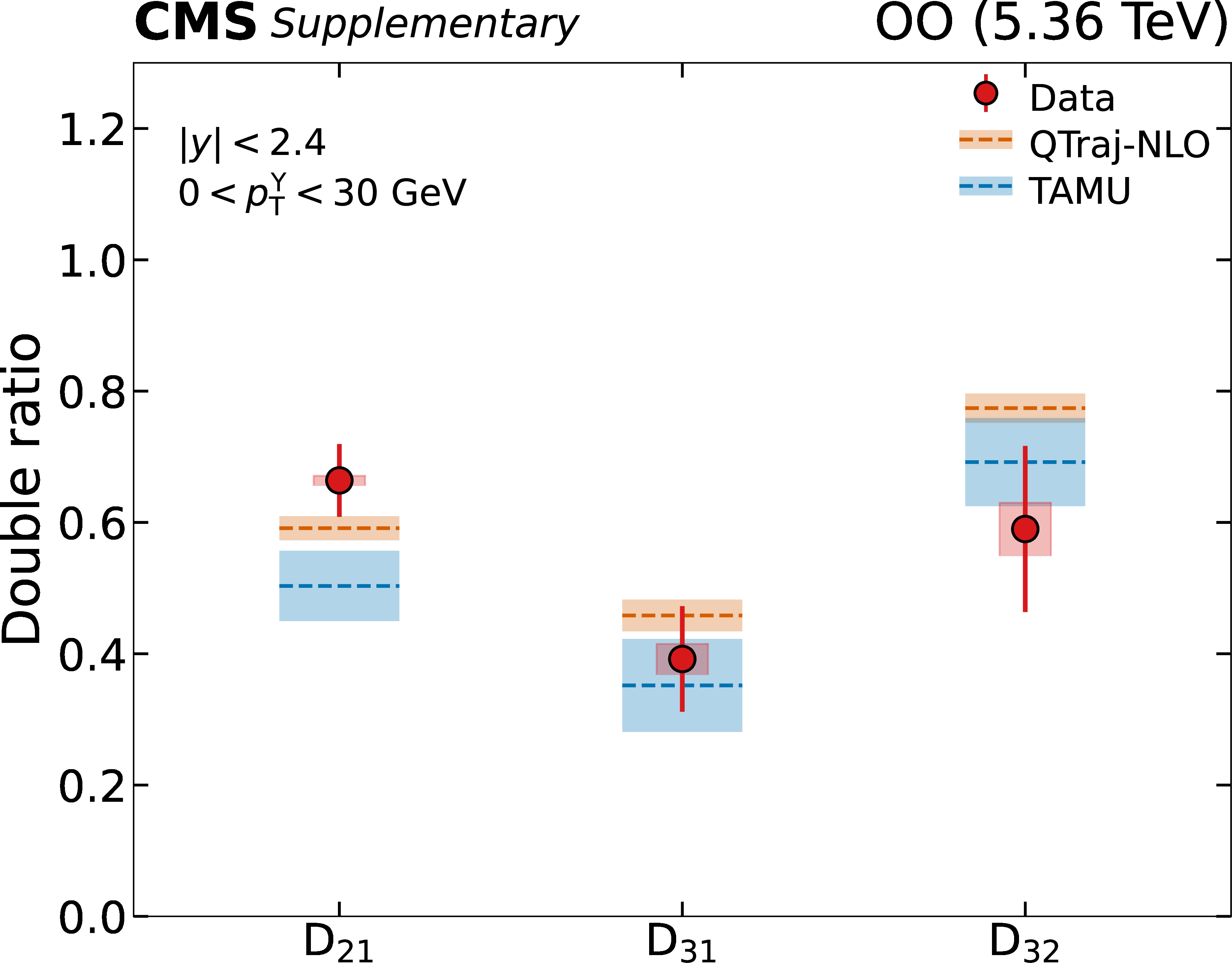
Integrated double ratios $D_{21}$, $D_{31}$, and $D_{32}$ in $\text{OO}$ collisions at $ \sqrt{\smash[b]{s_{_{\mathrm{NN}}}}}= $ 5.36 TeV for $ 0 < p_{\mathrm{T}} <30 $ GeV and $ |y| < 2.4 $. The vertical bars and boxes on the data points indicate the statistical and systematic uncertainties, respectively. The results are compared with the KSU--Munich quantum-transport calculation [77] implemented in QTraj-NLO [78][79], and the TAMU-NP transport model [11][80]. The QTraj-NLO band corresponds to $ \hat{\kappa}=5 $--$ 7 $ and includes quantum regeneration. The TAMU-NP result shows the total contribution, including both primordial production and regeneration. |
png pdf |
Additional Figure 2:
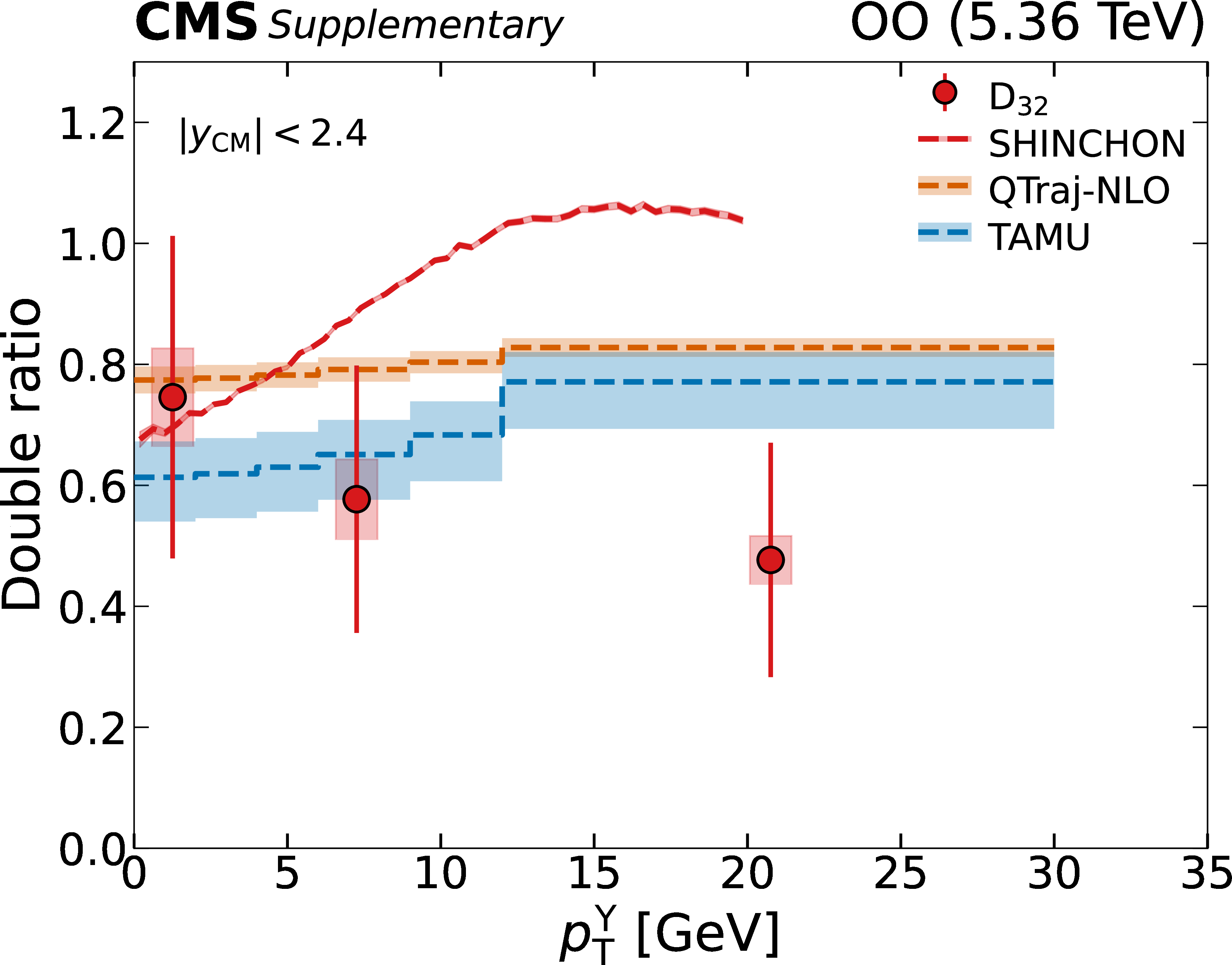
Double ratio $D_{32}$ as a function of the $ \Upsilon $ transverse momentum in $\text{OO}$ collisions at $ \sqrt{\smash[b]{s_{_{\mathrm{NN}}}}}= $ 5.36 TeV for $ |y| < 2.4 $. The vertical bars and boxes on the data points indicate the statistical and systematic uncertainties, respectively. The measurement is compared with predictions from the SHINCHON framework [76], the KSU--Munich quantum-transport calculation [77] implemented in QTraj-NLO [78][79], and the TAMU-NP transport model [11][80]. |
| References | ||||
| 1 | J. Ellis | Personal memories of 50 years of quarkonia | NPB 1018 (2025) 117062 | 2506.10643 |
| 2 | J. W. Harris and B. Muller | The search for the quark-gluon plasma | Ann. Rev. Nucl. Part. Sci. 46 (1996) 71 | hep-ph/9602235 |
| 3 | T. Matsui and H. Satz | $ \mathrm{J}/\psi $ suppression by quark-gluon plasma formation | PLB 178 (1986) 416 | |
| 4 | A. Andronic and R. Arnaldi | Quarkonia and deconfined quark-gluon matter in heavy ion collisions | Ann. Rev. Nucl. Part. Sci. 75 (2025) 351 | 2501.08290 |
| 5 | L. Apolin \'a rio, Y.-J. Lee, and M. Winn | Heavy quarks and jets as probes of the QGP | Prog. Part. Nucl. Phys. 127 (2022) 103990 | 2203.16352 |
| 6 | R. L. Thews, M. Schroedter, and J. Rafelski | Enhanced $ \mathrm{J}/\psi $ production in deconfined quark matter | Phys. Rev. C 63 (2001) 054905 | hep-ph/0007323 |
| 7 | P. Braun-Munzinger and J. Stachel | (Non)thermal aspects of charmonium production and a new look at $ \mathrm{J}/\psi $ suppression | PLB 490 (2000) 196 | nucl-th/0007059 |
| 8 | X. Du, M. He, and R. Rapp | Color screening and regeneration of bottomonia in high-energy heavy ion collisions | Phys. Rev. C 96 (2017) 054901 | 1706.08670 |
| 9 | X. Yao et al. | Coupled Boltzmann transport equations of heavy quarks and quarkonia in quark-gluon plasma | JHEP 01 (2021) 046 | 2004.06746 |
| 10 | N. Brambilla et al. | Regeneration of bottomonia in an open quantum systems approach | PRD 108 (2023) L011502 | 2302.11826 |
| 11 | B. Wu and R. Rapp | Bottomonium transport in a strongly coupled quark-gluon plasma | PLB 873 (2026) 140223 | 2508.20995 |
| 12 | P. B. Bahavar, J. Uphoff, and C. Greiner | Hadronic versus partonic $ \mathrm{J}/\psi $ production in the statistical hadronization model | Phys. Rev. C 90 (2014) 061901 | 1404.4517 |
| 13 | A. Andronic, P. Braun-Munzinger, K. Redlich, and J. Stachel | Statistical hadronization of b quarks in PbPb collisions at LHC energy: a case for partial equilibration of b quarks? | Acta Phys. Polon. Supp. 16 (2023) 1 | 2209.14562 |
| 14 | A. Andronic et al. | Comparative study of quarkonium transport in hot QCD matter | Eur. Phys. J. A 60 (2024) 88 | 2402.04366 |
| 15 | Particle Data Group , S. Navas et al. | Review of particle physics | PRD 110 (2024) 030001 | |
| 16 | CMS Collaboration | Overview of high-density QCD studies with the CMS experiment at the LHC | Phys. Rept. 1115 (2025) 219 | CMS-HIN-23-011 2405.10785 |
| 17 | CMS Collaboration | Indications of suppression of excited $ \Upsilon $ states in PbPb collisions at $ \sqrt{\smash[b]{s_{_{\mathrm{NN}}}}} = $ 2.76 TeV | PRL 107 (2011) 052302 | CMS-HIN-11-007 1105.4894 |
| 18 | CMS Collaboration | Observation of sequential $ \Upsilon $ suppression in PbPb collisions | PRL 109 (2012) 222301 | CMS-HIN-11-011 1208.2826 |
| 19 | CMS Collaboration | Measurement of nuclear modification factors of $ \Upsilon{\textrm{(1S)}} $, $ \Upsilon{\textrm{(2S)}} $, and $ \Upsilon{\textrm{(3S)}} $ mesons in PbPb collisions at $ \sqrt{\smash[b]{s_{_{\mathrm{NN}}}}} = $ 5.02 TeV | PLB 790 (2019) 270 | CMS-HIN-16-023 1805.09215 |
| 20 | CMS Collaboration | Observation of the $ \Upsilon{\textrm{(3S)}} $ meson and suppression of $ \Upsilon $ states in PbPb collisions at $ \sqrt{\smash[b]{s_{_{\mathrm{NN}}}}} = $ 5.02 TeV | PRL 133 (2024) 022302 | CMS-HIN-21-007 2303.17026 |
| 21 | ALICE Collaboration | $ \Upsilon $ production and nuclear modification at forward rapidity in PbPb collisions at $ \sqrt{\smash[b]{s_{_{\mathrm{NN}}}}} = $ 5.02 TeV | PLB 822 (2021) 136579 | 2011.05758 |
| 22 | ATLAS Collaboration | Production of $ \Upsilon $(n\textS) mesons in PbPb and pp collisions at 5.02 TeV | Phys. Rev. C 107 (2023) 054912 | 2205.03042 |
| 23 | STAR Collaboration | Observation of sequential $ \Upsilon $ suppression in AuAu collisions at $ \sqrt{\smash[b]{s_{_{\mathrm{NN}}}}} = $ 200 GeV with the STAR experiment | PRL 130 (2023) 112301 | 2207.06568 |
| 24 | ALICE Collaboration | $ \Upsilon $ production in $ \mathrm{p}\text{Pb} $ collisions at $ \sqrt{\smash[b]{s_{_{\mathrm{NN}}}}} = $ 8.16 TeV | PLB 806 (2020) 135486 | 1910.14405 |
| 25 | ATLAS Collaboration | Measurement of quarkonium production in $ \mathrm{p}\text{Pb} $ and pp collisions at 5.02 TeV with the ATLAS detector | EPJC 78 (2018) 171 | 1709.03089 |
| 26 | CMS Collaboration | Nuclear modification of $ \Upsilon $ states in $ \mathrm{p}\text{Pb} $ collisions at $ \sqrt{\smash[b]{s_{_{\mathrm{NN}}}}} = $ 5.02 TeV | PLB 835 (2022) 137397 | CMS-HIN-18-005 2202.11807 |
| 27 | LHCb Collaboration | Study of $ \Upsilon $ production in $ \mathrm{p}\text{Pb} $ collisions at $ \sqrt{\smash[b]{s_{_{\mathrm{NN}}}}} = $ 8.16 TeV | JHEP 11 (2018) 194 | 1810.07655 |
| 28 | A. Emerick, X. Zhao, and R. Rapp | Bottomonia in the quark gluon plasma and their production at RHIC and LHC | Eur. Phys. J. A 48 (2012) 72 | 1111.6537 |
| 29 | P. Bagchi, A. Das, and A. P. Mishra | Does quarkonia suppression serve as a probe for the deconfinement in small systems? | PRD 110 (2024) 014017 | 2310.12267 |
| 30 | R. Sahoo | Possible formation of QGP-droplets in proton-proton collisions at the CERN Large Hadron Collider | AAPPS Bull. 29 (2019) 16 | 1908.10566 |
| 31 | F. G. Gardim, R. Krupczak, and T. N. da Silva | Smallest drop of QGP: thermodynamic properties of $ \mathrm{p}\text{Pb} $ collisions | Phys. Rev. C 109 (2024) 014904 | 2212.11710 |
| 32 | W. Ke and I. Vitev | Searching for QGP droplets with high-$ p_{\mathrm{T}} $ hadrons and heavy flavor | Phys. Rev. C 107 (2023) 064903 | 2204.00634 |
| 33 | PHENIX Collaboration | Disentangling centrality bias and final-state effects in the production of high-$ p_{\mathrm{T}} $ neutral pions using direct photon in d+Au collisions at $ \sqrt{\smash[b]{s_{_{\mathrm{NN}}}}} = $ 200 GeV | PRL 134 (2025) 022302 | 2303.12899 |
| 34 | E. G. Ferreiro and J.-P. Lansberg | Is bottomonium suppression in proton-nucleus and nucleus-nucleus collisions at LHC energies due to the same effects? | JHEP 10 (2018) 094 | 1804.04474 |
| 35 | CMS Collaboration | Event activity dependence of relative Y(nS) production in pPb collisions at 8.16 TeV | CMS Physics Analysis Summary, 2026 CMS-PAS-HIN-25-005 |
CMS-PAS-HIN-25-005 |
| 36 | E. Waagaard et al. | Charting the luminosity capabilities of the CERN Large Hadron Collider with various nuclear species | NIM A 1083 (2026) 171118 | 2508.19653 |
| 37 | J. Brewer, A. Mazeliauskas, and W. van der Schee | Opportunities of $ \text{OO} $ and pO collisions at the LHC | in Opportunities of OO and pO collisions at the LHC. 202 (1900) 1 |
2103.01939 |
| 38 | ALICE Collaboration | Evidence of nuclear geometry-driven anisotropic flow in $ \text{OO} $ and $ \text{NeNe} $ collisions at $ \sqrt{\smash[b]{s_{_{\mathrm{NN}}}}} = $ 5.36 TeV | Submitted to Phys. Rev. Lett., 2025 | 2509.06428 |
| 39 | ATLAS Collaboration | Measurement of the azimuthal anisotropy of charged particles in $ \sqrt{\smash[b]{s_{_{\mathrm{NN}}}}}= $ 5.36 TeV $ ^{16}\mathrm{O}+^{16}\mathrm{O} $ and $ ^{20}\mathrm{Ne}+^{20}\mathrm{Ne} $ collisions with the ATLAS detector | Phys. Rev. C 113 (2026) 045205 | 2509.05171 |
| 40 | CMS Collaboration | Observation of long-range collective flow in $ \text{OO} $ and $ \text{NeNe} $ collisions and implications for nuclear structure studies | Accepted by Phys. Rev. Lett., 2025 | CMS-HIN-25-009 2510.02580 |
| 41 | CMS Collaboration | Observation of suppressed charged-particle production in ultrarelativistic oxygen-oxygen collisions | PRL 136 (2026) 162301 | CMS-HIN-25-008 2510.09864 |
| 42 | CMS Collaboration | System-size dependence of charged-particle suppression in ultrarelativistic nucleus-nucleus collisions | Accepted by Phys. Lett. B, 2026 | CMS-HIN-25-014 2602.21325 |
| 43 | LHCb Collaboration | Study of nuclear effects on charm production in light ion collisions | Preprint, 2026 | 2605.27273 |
| 44 | CMS Collaboration | Centrality dependence of charged-hadron pseudorapidity distributions in oxygen-oxygen collisions at $ \sqrt{\smash[b]{s_{_{\mathrm{NN}}}}}= $ 5.36 TeV | Submitted to Phys. Lett. B, 2026 | 2606.02285 |
| 45 | ALICE Collaboration | Evidence for parton energy loss in oxygen-oxygen collisions at $ \sqrt{\smash[b]{s_{_{\mathrm{NN}}}}}= $ 5.36 TeV | Submitted to Phys. Rev. Lett., 2026 | 2606.19967 |
| 46 | ATLAS Collaboration | Measurements of charged-particle pseudorapidity and transverse momentum distributions in $ \text{OO} $ and $ \text{NeNe} $ collisions at $ \sqrt{\smash[b]{s_{_{\mathrm{NN}}}}}= $ 5.36 TeV with the ATLAS detector | Submitted to Phys. Rev. C, 2026 | 2606.20257 |
| 47 | ATLAS Collaboration | Observation of centrality-dependent dijet transverse momentum imbalance in $ \text{OO} $\ and $ \text{NeNe} $\ collisions at $ \sqrt{\smash[b]{s_{_{\mathrm{NN}}}}}= $ 5.36 TeV with the ATLAS detector | Submitted to Phys. Rev. Lett., 2026 | 2606.20463 |
| 48 | CMS Collaboration | Luminosity measurement for lead-lead collisions at $ \sqrt{\smash[b]{s_{_{\mathrm{NN}}}}} = $ 5.02 TeV in 2015 and 2018 at CMS | Submitted to Eur. Phys. J. C, 2025 | CMS-LUM-20-002 2503.03946 |
| 49 | CMS Collaboration | Observation of nuclear suppression in coherent $ \Upsilon{\textrm{(1S)}} $\ photoproduction off heavy nuclei at the LHC | Submitted to Phys. Rev. Lett., 2026 | CMS-HIN-24-013 2604.05814 |
| 50 | CMS Collaboration | Suppression of excited $ \Upsilon $ states relative to the ground state in PbPb collisions at $ \sqrt{\smash[b]{s_{_{\mathrm{NN}}}}} = $ 5.02 TeV | PRL 120 (2018) 142301 | CMS-HIN-16-008 1706.05984 |
| 51 | CMS Collaboration | HEPData record for this analysis | link | |
| 52 | CMS Collaboration | The CMS experiment at the CERN LHC | JINST 3 (2008) S08004 | |
| 53 | CMS Collaboration | Development of the CMS detector for the CERN LHC Run 3 | JINST 19 (2024) P05064 | CMS-PRF-21-001 2309.05466 |
| 54 | CMS Collaboration | Performance of the CMS level-1 trigger in pp collisions at $ \sqrt{s} = $ 13 TeV | JINST 15 (2020) P10017 | CMS-TRG-17-001 2006.10165 |
| 55 | CMS Collaboration | The CMS trigger system | JINST 12 (2017) P01020 | CMS-TRG-12-001 1609.02366 |
| 56 | CMS Collaboration | Performance of electron reconstruction and selection with the CMS detector in pp collisions at $ \sqrt{s} = $ 8 TeV | JINST 10 (2015) P06005 | CMS-EGM-13-001 1502.02701 |
| 57 | CMS Collaboration | Performance of the CMS muon detector and muon reconstruction with pp collisions at $ \sqrt{s} = $ 13 TeV | JINST 13 (2018) P06015 | CMS-MUO-16-001 1804.04528 |
| 58 | CMS Collaboration | Performance of photon reconstruction and identification with the CMS detector in pp collisions at $ \sqrt{s} = $ 8 TeV | JINST 10 (2015) P08010 | CMS-EGM-14-001 1502.02702 |
| 59 | CMS Collaboration | Description and performance of track and primary-vertex reconstruction with the CMS tracker | JINST 9 (2014) P10009 | CMS-TRK-11-001 1405.6569 |
| 60 | CMS Collaboration | Technical proposal for the Phase-II upgrade of the Compact Muon Solenoid | CMS Technical Proposal CERN-LHCC-2015-010, CMS-TDR-15-02, CERN, 2015 CDS |
|
| 61 | CMS Collaboration | Particle-flow reconstruction and global event description with the CMS detector | JINST 12 (2017) P10003 | CMS-PRF-14-001 1706.04965 |
| 62 | CMS Collaboration | Performance of CMS muon reconstruction from pp to heavy ion collisions | JINST 19 (2024) P09012 | CMS-MUO-21-001 2404.17377 |
| 63 | C. Bierlich et al. | A comprehensive guide to the physics and usage of PYTHIA 8.3 | SciPost Phys. Codeb. 2022 (2022) 8 | 2203.11601 |
| 64 | CMS Collaboration | Extraction and validation of a new set of CMS PYTHIA8 tunes from underlying-event measurements | EPJC 80 (2020) 4 | CMS-GEN-17-001 1903.12179 |
| 65 | CMS Collaboration | Measurement of the $ \Upsilon{\textrm{(1S)}} $, $ \Upsilon{\textrm{(2S)}} $, and $ \Upsilon{\textrm{(3S)}} $ polarizations in pp collisions at $ \sqrt{s} = $ 7 TeV | PRL 110 (2013) 081802 | CMS-BPH-11-023 1209.2922 |
| 66 | CMS Collaboration | $ \Upsilon(n\text{S}) $ polarizations versus particle multiplicity in pp collisions at $ \sqrt{s} = $ 7 TeV | PLB 761 (2016) 31 | CMS-HIN-15-003 1603.02913 |
| 67 | LHCb Collaboration | Measurement of the $ \Upsilon $ polarizations in pp collisions at $ \sqrt{s} = $ 7 and 8 TeV | JHEP 12 (2017) 110 | 1709.01301 |
| 68 | ALICE Collaboration | First measurement of quarkonium polarization in nuclear collisions at the LHC | PLB 815 (2021) 136146 | 2005.11128 |
| 69 | CMS Collaboration | Measurement of the azimuthal anisotropy of $ \Upsilon{\textrm{(1S)}} $ and $ \Upsilon{\textrm{(2S)}} $ mesons in PbPb collisions at $ \sqrt{\smash[b]{s_{_{\mathrm{NN}}}}} = $ 5.02 TeV | PLB 819 (2021) 136385 | CMS-HIN-19-002 2006.07707 |
| 70 | X.-N. Wang and M. Gyulassy | HIJING: a Monte Carlo model for multiple jet production in pp, $ \mathrm{p}\text{Pb} $ and $ \text{AA} $ collisions | PRD 44 (1991) 3501 | |
| 71 | GEANT4 Collaboration | GEANT 4---a simulation toolkit | NIM A 506 (2003) 250 | |
| 72 | M. J. Oreglia | A study of the reactions $ \psi^\prime \to \gamma \gamma \psi $ | PhD thesis, Stanford University, SLAC Report SLAC-R-236, 1980 link |
|
| 73 | J. E. Gaiser | Charmonium spectroscopy from radiative decays of the $ \mathrm{J}/\psi $ and $ \psi^\prime $ | PhD thesis, Stanford University, SLAC Report SLAC-R-255, 1982 link |
|
| 74 | C. Loizides | Glauber predictions for oxygen and neon collisions at energies available at the CERN Large Hadron Collider | Phys. Rev. C 113 (2026) 014914 | 2507.05853 |
| 75 | CMS Collaboration | Investigation into the event-activity dependence of $ \Upsilon{\textrm{(nS)}} $ relative production in pp collisions at $ \sqrt{s} = $ 7 TeV | JHEP 11 (2020) 001 | CMS-BPH-14-009 2007.04277 |
| 76 | J. Kim et al. | Model study on $ \Upsilon{\textrm{(nS)}} $ modification in small collision systems | Phys. Rev. C 107 (2023) 054905 | 2209.12303 |
| 77 | M. Strickland, S. Thapa, and R. Vogt | Bottomonium suppression in 5.02 and 8.16~TeV p-Pb collisions | Phys. Rev. D 109 (2024) 096016 | 2401.16704 |
| 78 | H. B. Omar et al. | QTRAJ 1.0: A Lindblad equation solver for heavy-quarkonium dynamics | Comput. Phys. Commun. 273 (2022) 108266 | 2107.06147 |
| 79 | N. Brambilla et al. | Heavy quarkonium dynamics at next-to-leading order in the binding energy over temperature | JHEP 08 (2022) 303 | 2205.10289 |
| 80 | S. Thapa, B. Wu, R. Vogt, and R. Rapp | Semiclassical treatment of bottomonium suppression and regeneration in p+Pb collisions | Phys. Rev. D 113 (2026) 056006 | 2510.03456 |
|
|
Compact Muon Solenoid LHC, CERN |

|
|
|
|
|
|