
Compact Muon Solenoid
LHC, CERN
 Visit us: CMS Public Website, CMS Physics ;
Contact us: CMS Publications Committee
Visit us: CMS Public Website, CMS Physics ;
Contact us: CMS Publications Committee
| CMS-HIN-25-014 ; CERN-EP-2026-032 | ||
| System-size dependence of charged-particle suppression in ultrarelativistic nucleus-nucleus collisions | ||
| CMS Collaboration | ||
| 24 February 2026 | ||
| Phys. Lett. B 880 (2026) 140679 | ||
| Abstract: High-energy partons lose energy while propagating through the hot, strongly interacting medium produced in ultrarelativistic nucleus-nucleus collisions, leading to a suppression of particle production at high transverse momentum ($ p_{\mathrm{T}} $). The dependence of this energy loss on the size of the colliding nuclear system has yet to be firmly established experimentally. This Letter presents a systematic study of charged-particle suppression across four different nucleus-nucleus collision systems using nuclear modification factors ($ R_{\text{AA}} $) measured by the CMS Collaboration at the CERN LHC. Previous CMS measurements of $ R_{\text{AA}} $ in oxygen-oxygen, xenon-xenon, and lead-lead collisions are recast with identical $ p_{\mathrm{T}} $ intervals and are complemented by the first measurement of the charged-particle $ R_{\text{AA}} $ in neon-neon collisions at $ \sqrt{\smash[b]{s_{_{\mathrm{NN}}}}} = $ 5.36 TeV. The neon-neon data correspond to an integrated luminosity of 0.76$ \text{nb}^{-1}$. The $ R_{\text{AA}} $ in all collision systems examined show similar qualitative trends, but have a magnitude which is ordered with the nucleon number $ A $. The $ R_{\text{AA}} $ feature a downward slope at low $ p_{\mathrm{T}} $, a local minimum at around 5--7 GeV, and an upward slope with increasing $ p_{\mathrm{T}} $. The $ R_{\text{AA}} $ are also compared in terms of $ A^{1/3} $, which is proportional to the nuclear radius. Models including only initial-state nuclear effects fail to reproduce the observed trends, whereas energy loss models reproduce the trends in the region $ p_{\mathrm{T}} > $ 9.6 GeV. | ||
| Links: e-print arXiv:2602.21325 [hep-ex] (PDF) ; CDS record ; inSPIRE record ; Physics Briefing ; CADI line (restricted) ; | ||
| Figures | Summary | Additional Figures | References | CMS Publications |
|---|
| Figures | |
png pdf |
Figure 1:
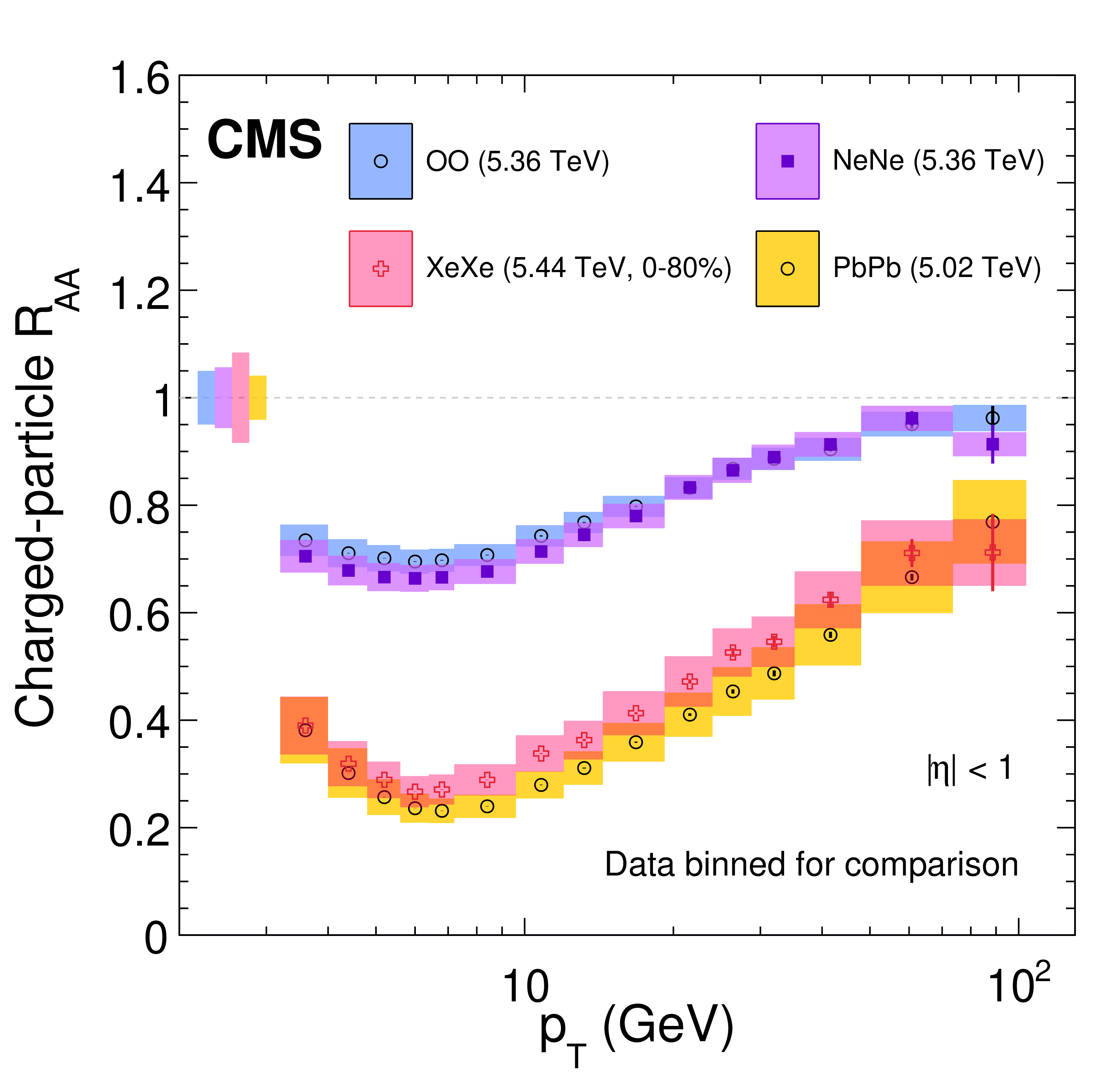
Charged-particle $ R_{\text{AA}} $ values versus $ p_{\mathrm{T}} $ measured in $ \text{NeNe} $ collisions at 5.36 TeV compared to previous measurements in centrality-integrated $ \text{OO} $ collisions at 5.36 TeV [22], 0--80% centrality $ \text{XeXe} $ at 5.44 TeV [9], and minimum bias PbPb collisions at 5.02 TeV [12]. The vertical error bars represent statistical uncertainties and the boxes represent systematic uncertainties. Global normalization uncertainties are not included directly in the data markers error bands, but they are instead represented by the various boxes on the left around unity. For this compilation plot, a uniform $ p_{\mathrm{T}} $ binning scheme is adopted to ensure a consistent comparison across collision systems, as described in the text. The same results with finer binning can be found in \addmatterapp:nominalSection 3. |
png pdf |
Figure 2:
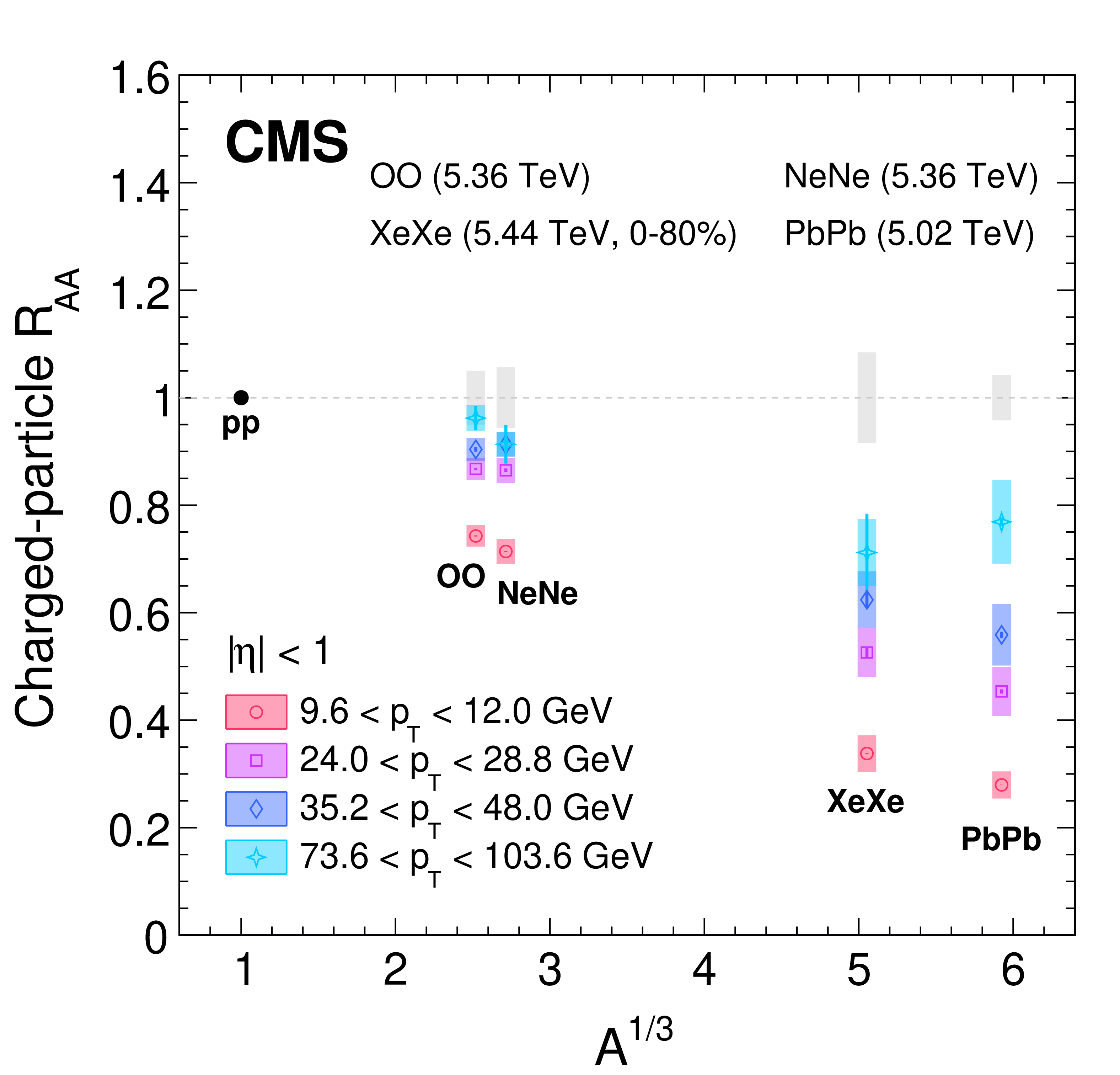
Charged-particle $ R_{\text{AA}} $ values, in intervals of $ p_{\mathrm{T}} $, versus $ A^{1/3} $ of the AA colliding system. The open markers represent the measured $ R_{\text{AA}} $, with the vertical bars representing the statistical uncertainty, and the vertical band representing the experimental uncertainty. Global normalization uncertainties for each data set are shown in the light-gray boxes around unity. For visualization purposes, a subset of four out of the fifteen $ p_{\mathrm{T}} $ intervals is presented. A point for pp collisions at $ A= $ 1, in which the $ R_{\text{AA}} $ is unity by definition, is also included in the upper left. |
png pdf |
Figure 3:
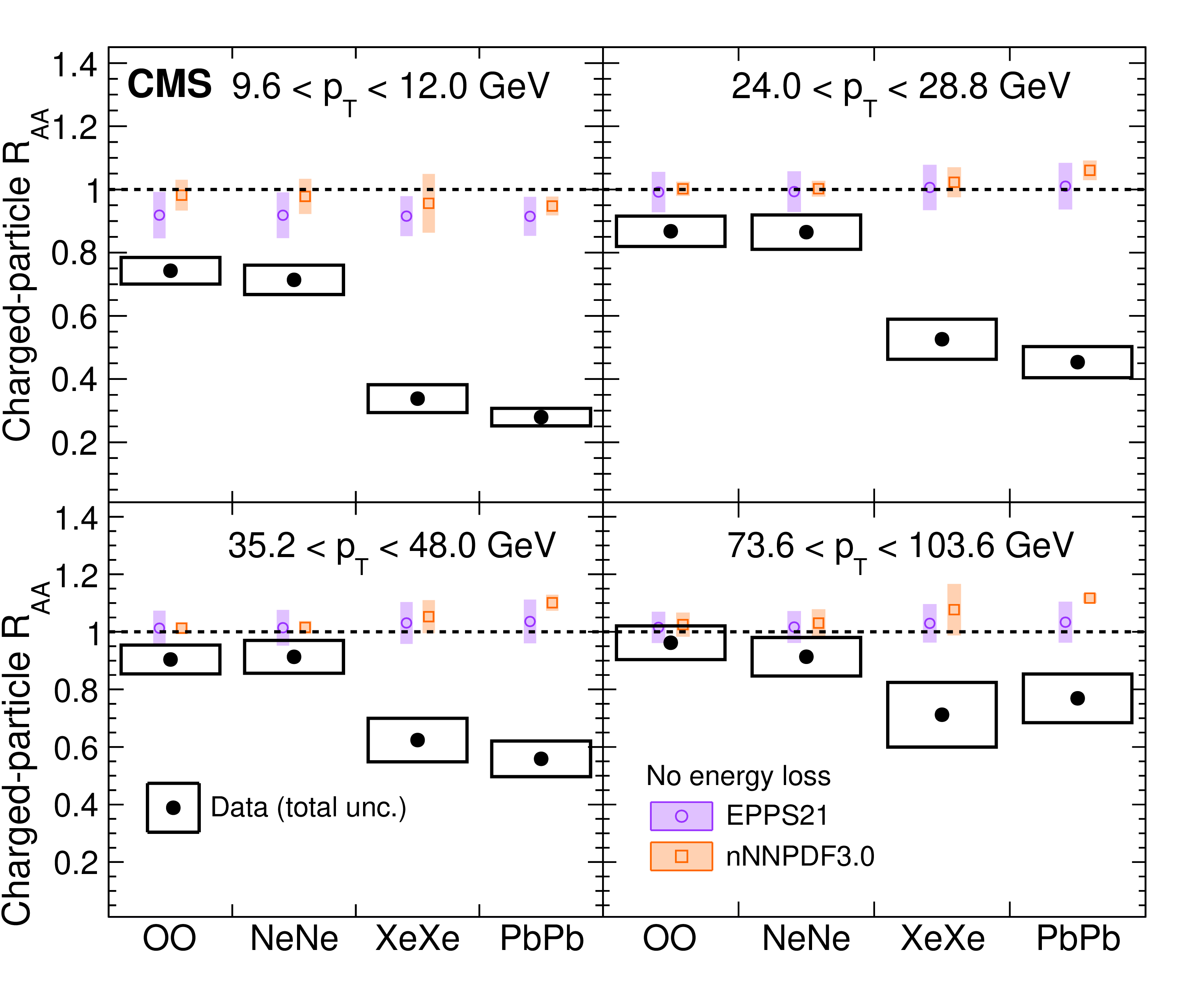
Comparison of the charged-particle $ R_{\text{AA}} $ measured in $ \text{OO} $ [22], $ \text{NeNe} $, $ \text{XeXe} $ [9], and PbPb [12] collisions with NLO pQCD calculations that incorporate only initial-state effects through nPDFs and do not include parton energy loss [57,58]. The open boxes with black circular markers represent the data. The box height represents the total experimental uncertainty obtained from the quadratic combination of statistical, systematic, and global normalization uncertainties. The purple markers correspond to calculations using the EPPS21 nPDF set [59], while the orange markers represent calculations based on the nNNPDF3.0 nPDF set [60]. The vertical uncertainty bands reflect the combined scale-variation and nPDF uncertainties, with the latter providing the dominant contribution. |
png pdf |
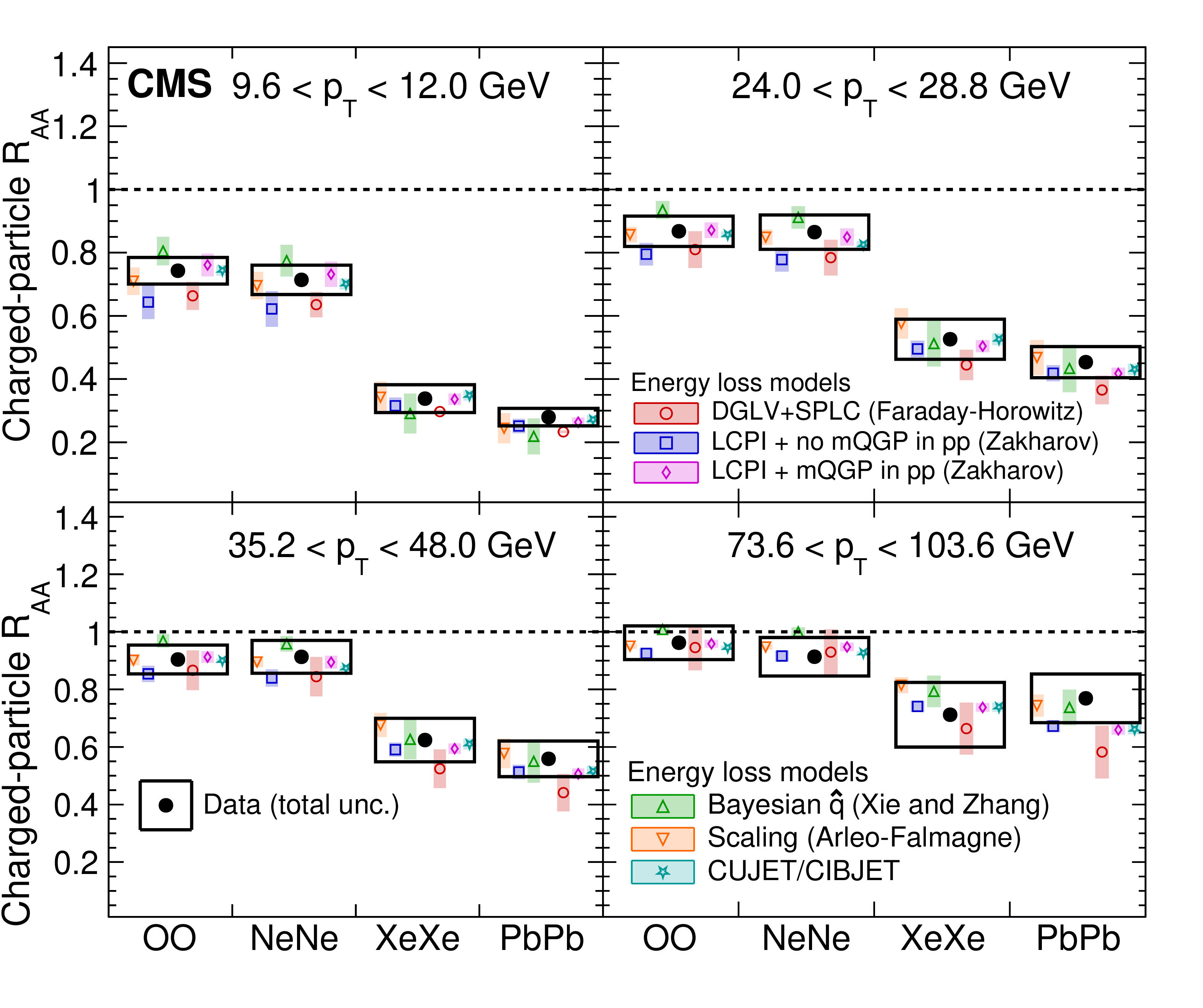
Figure 4:
Comparison of the charged-particle $ R_{\text{AA}} $ measured in $ \text{OO} $ [22], $ \text{NeNe} $, $ \text{XeXe} $ [9], and PbPb [12] collisions with calculations that incorporate parton energy loss effects [61,62,63,64,65,66,67,68,69]. The open boxes with black circular markers represent the data, with the box height indicating the total experimental uncertainty obtained from the quadratic combination of statistical, systematic, and global normalization uncertainties. The other colored markers represent theoretical predictions based on different approaches, as described in the text. The uncertainty band is smaller than the marker size for some of the calculations. |
| Summary |
| This Letter presents a systematic study of the system-size dependence of the charged-particle nuclear modification factor ($ R_{\text{AA}} $) versus transverse momentum ($ p_{\mathrm{T}} $). The study is based on a cross-system comparison that minimizes centrality selection biases. For this purpose, the analysis reports the first measurement of the charged-particle $ R_{\text{AA}} $ in minimum bias neon-neon (NeNe) collisions at a center-of-mass energy per nucleon pair of 5.36 TeV, based on data collected in 2025 and corresponding to an integrated luminosity of 0.76$ \text{nb}^{-1}$. By comparing existing CMS measurements in oxygen-oxygen, xenon-xenon, and lead-lead collisions with the new $ \text{NeNe} $ results, this analysis samples nuclear systems across a broad range of nucleon number values ($ A $). This enables an evaluation of the role that the system size has on energy loss. The $ R_{\text{AA}} $ is measured for charged particles with pseudorapidity $ |\eta| < $ 1 using identical $ p_{\mathrm{T}} $ intervals across all collision systems, which allows for a direct comparison of nuclear suppression effects with $ A $, which characterizes the system size. The $ R_{\text{AA}} $ at a given $ p_{\mathrm{T}} $ value is found to monotonically decrease as a function of the cubic root of the nucleon number $ A^{1/3} $, a quantity that is related to the nuclear radius. The $ p_{\mathrm{T}} $ dependences of $ R_{\text{AA}} $ in all collision systems have similar qualitative shapes, with a local minimum at about 5--7 GeV. The inclusion of the $ \text{NeNe} $ system extends the coverage in system size and enables a more complete mapping of the evolution of suppression effects across collision systems. Comparisons with theoretical calculations show that baseline perturbative quantum chromodynamics predictions incorporating nuclear parton distribution functions predict only modest modifications relative to $ R_{\text{AA}} = $ 1, with a weak dependence on $ A $. In contrast, models that also include parton energy loss reproduce the observed monotonic evolution of $ R_{\text{AA}} $ with increasing $ A $. Differences among these calculations in the predicted $ R_{\text{AA}} $ value and its detailed system-size dependence reflect variations in the modeling of medium effects. Overall, models incorporating parton energy loss describe the measurements within experimental and theoretical uncertainties. This study constrains the existence and characteristics of any transition towards a deconfined, hot medium as the system size increases. Hence, this measurement offers guidance for the selection of ion species in future nuclear physics programs at the LHC. |
| Additional Figures | |
png pdf |
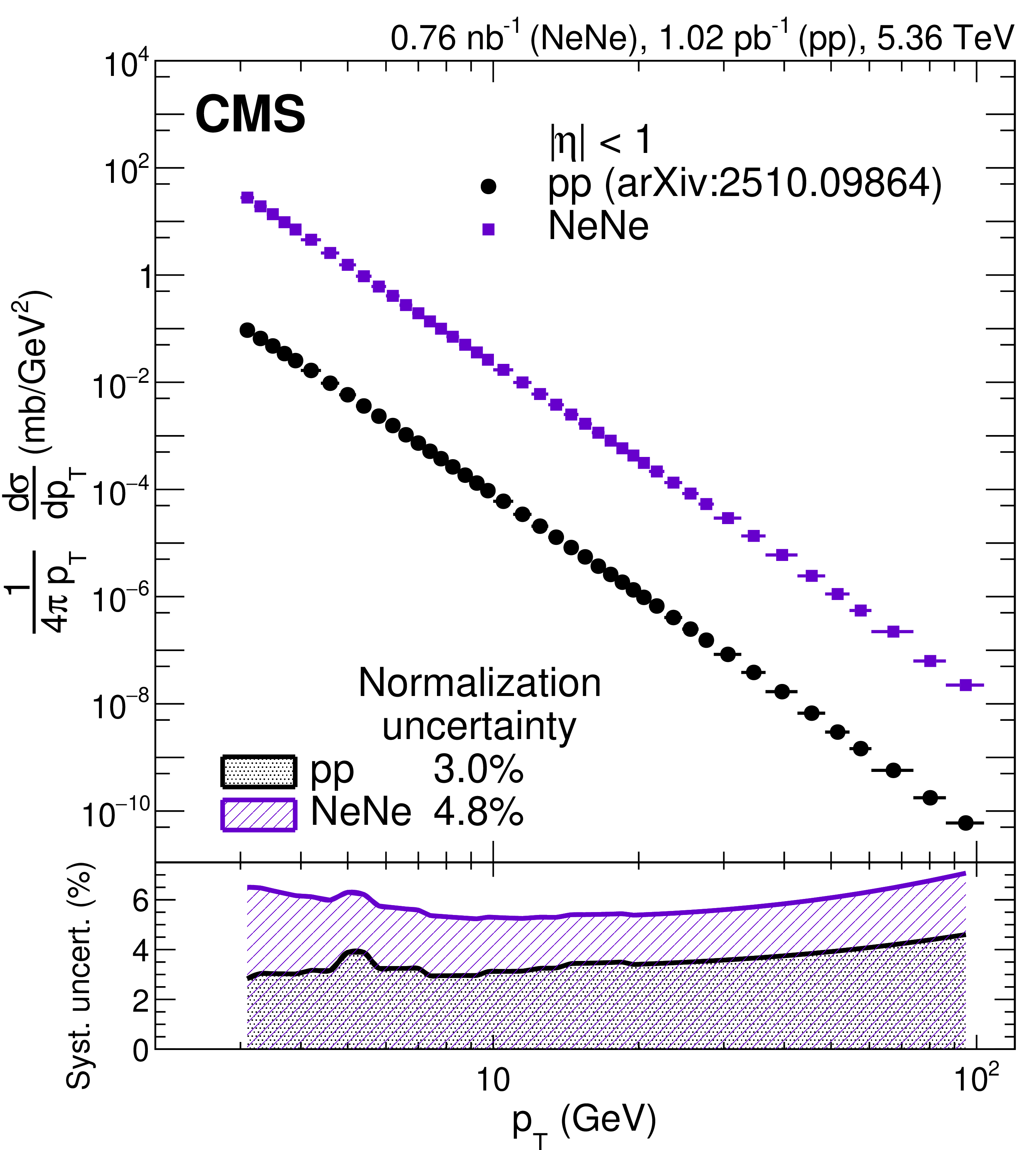
Additional Figure 1:
Differential invariant cross section spectrum as function of $ p_{\mathrm{T}} $ of primary charged particles measured in NeNe collisions at $ \sqrt{\smash[b]{s_{_{\mathrm{NN}}}}} = 5.36$ TeV at midrapidity. The pp spectrum is from Ref. [22]. The markers show the average cross section across the entire bin width, not the cross section value at the center of each bin. Statistical uncertainties are smaller than the markers. |
png pdf |
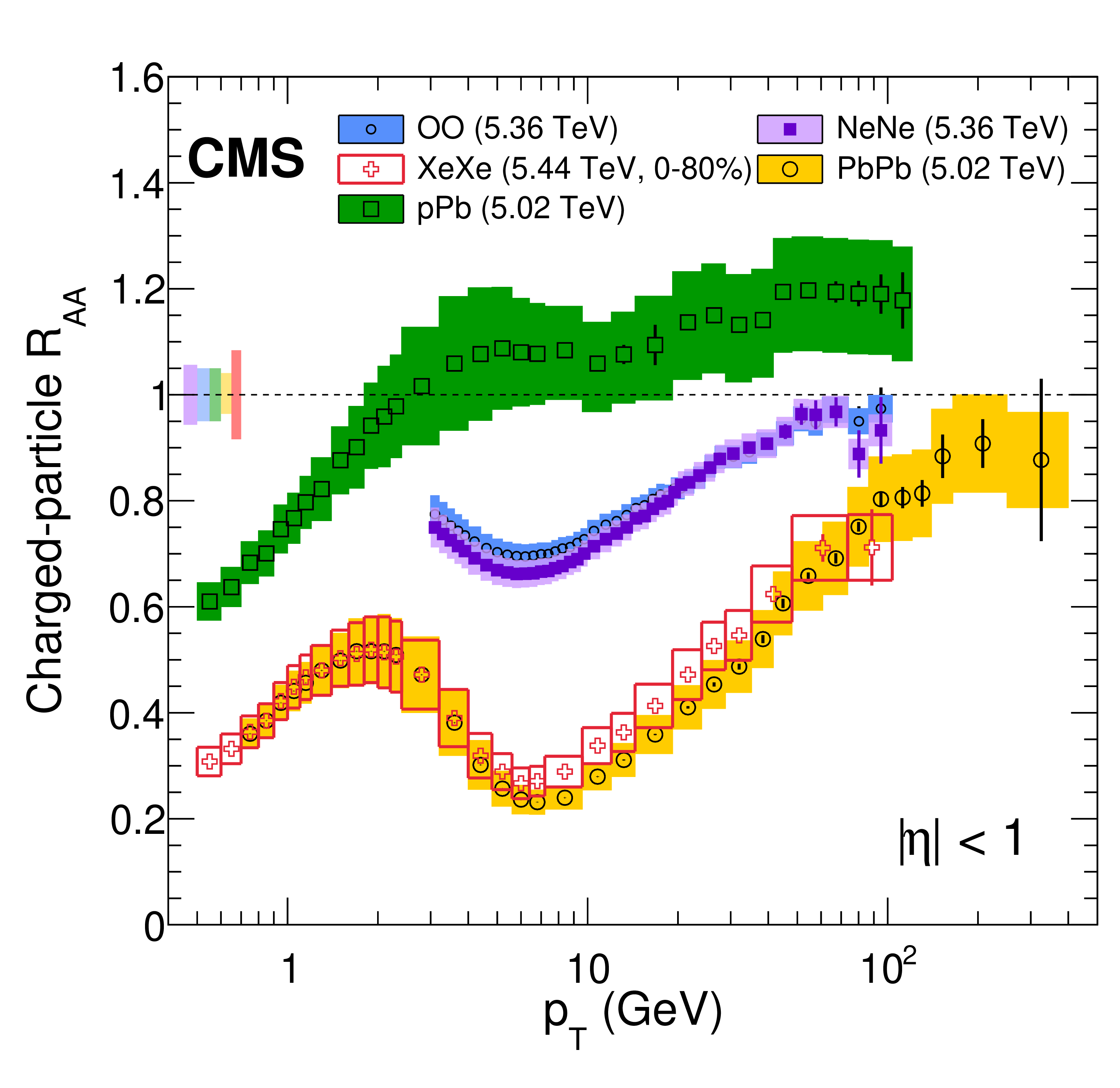
Additional Figure 2:
Charged-particle nuclear modification factor $ R_{\text{AA}} $ measured using the nominal $ p_{\mathrm{T}} $ binning for OO, NeNe, XeXe, PbPb, and pPb collisions. The vertical bands around the markers indicate the total experimental uncertainties, while the vertical error bars show the statistical uncertainties. The boxes on the left, centered at unity, represent the relative normalization uncertainty for each collision system. |
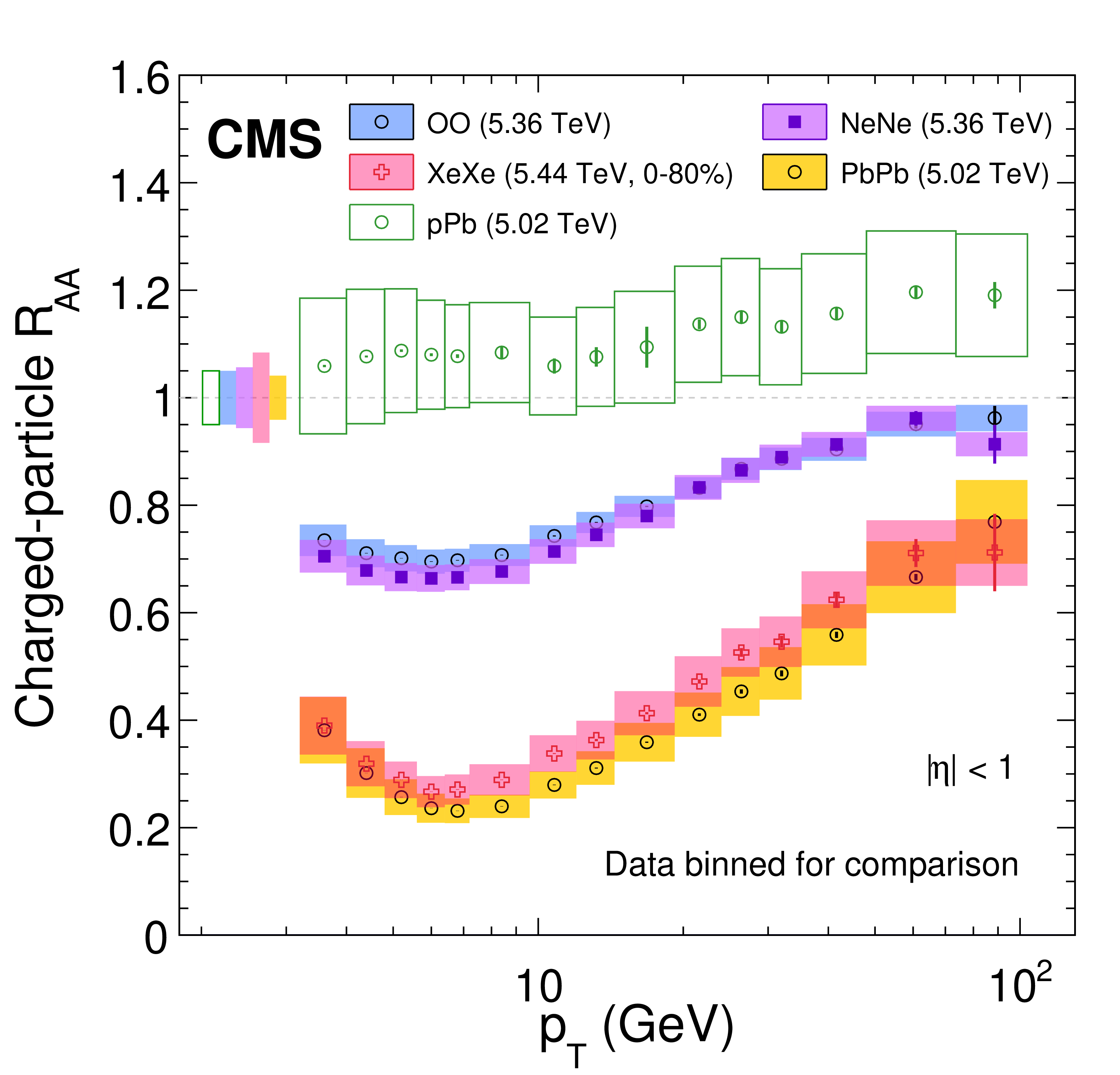
png pdf |
Additional Figure 3:
Charged-particle nuclear modification factor $ R_{\text{AA}} $ measured using the common $ p_{\mathrm{T}} $ binning scheme for OO, NeNe, XeXe, PbPb, and pPb collisions. The vertical bands around the markers indicate the total experimental uncertainties, while the vertical error bars show the statistical uncertainties. The boxes on the left, centered at unity, represent the relative normalization uncertainty for each collision system. |
png pdf |
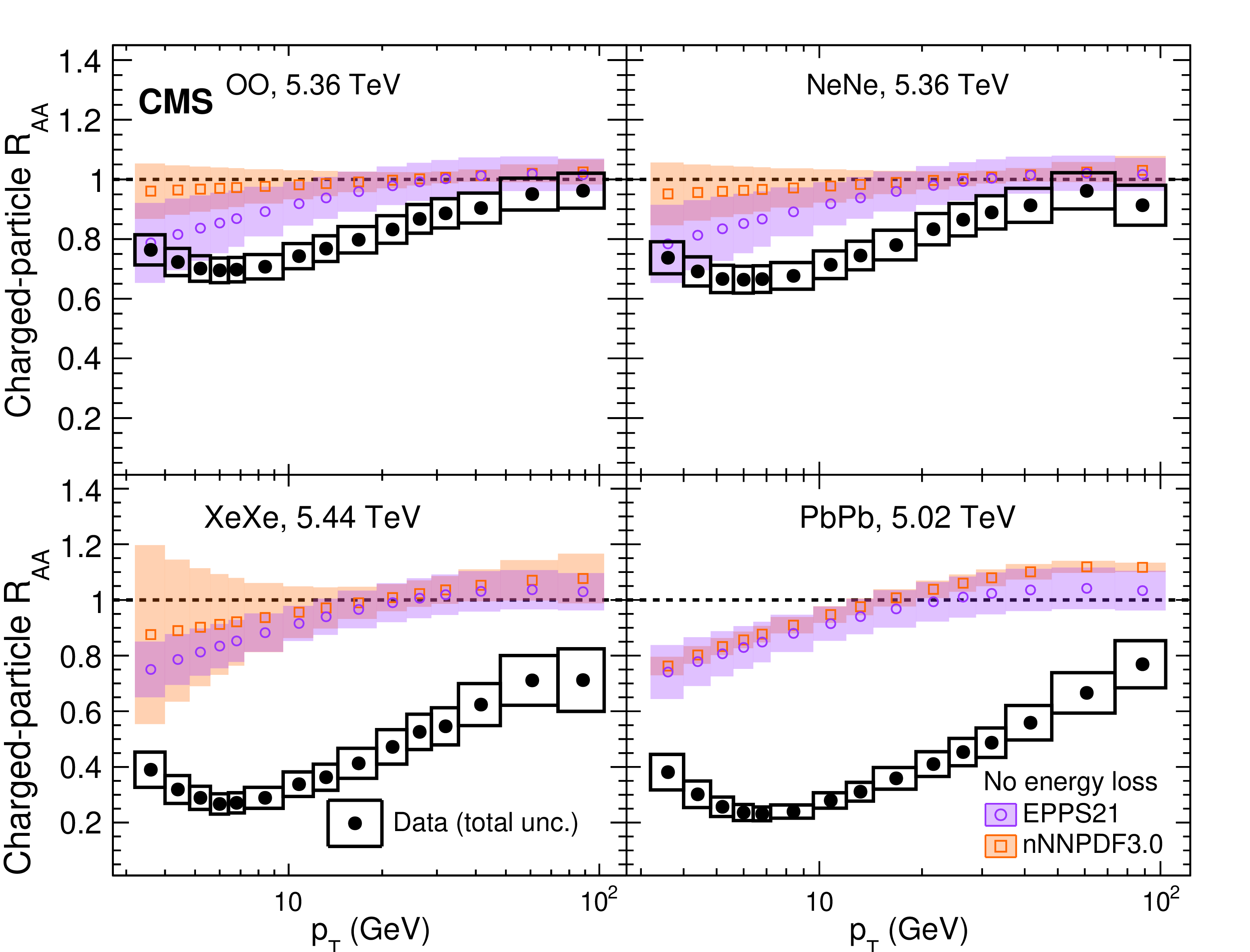
Additional Figure 4:
Charged-particle $ R_{\text{AA}} $ as a function of $ p_{\mathrm{T}} $ in minimum bias OO ($\sqrt{\smash[b]{s_{_{\mathrm{NN}}}}}=5.36$ TeV), minimum bias NeNe (5.36 TeV), XeXe (0--80%, 5.44 TeV), and minimum bias PbPb (5.02 TeV) collisions. The measurements are compared with theoretical calculations without final-state energy loss [57][58], illustrating the expected size of initial-state nuclear effects. The purple markers correspond to calculations using the EPPS21 nPDF set [59], while the orange markers represent calculations based on the nNNPDF3.0 nPDF set [60]. Details of the calculations are discussed in the main body of the text. |
png pdf |
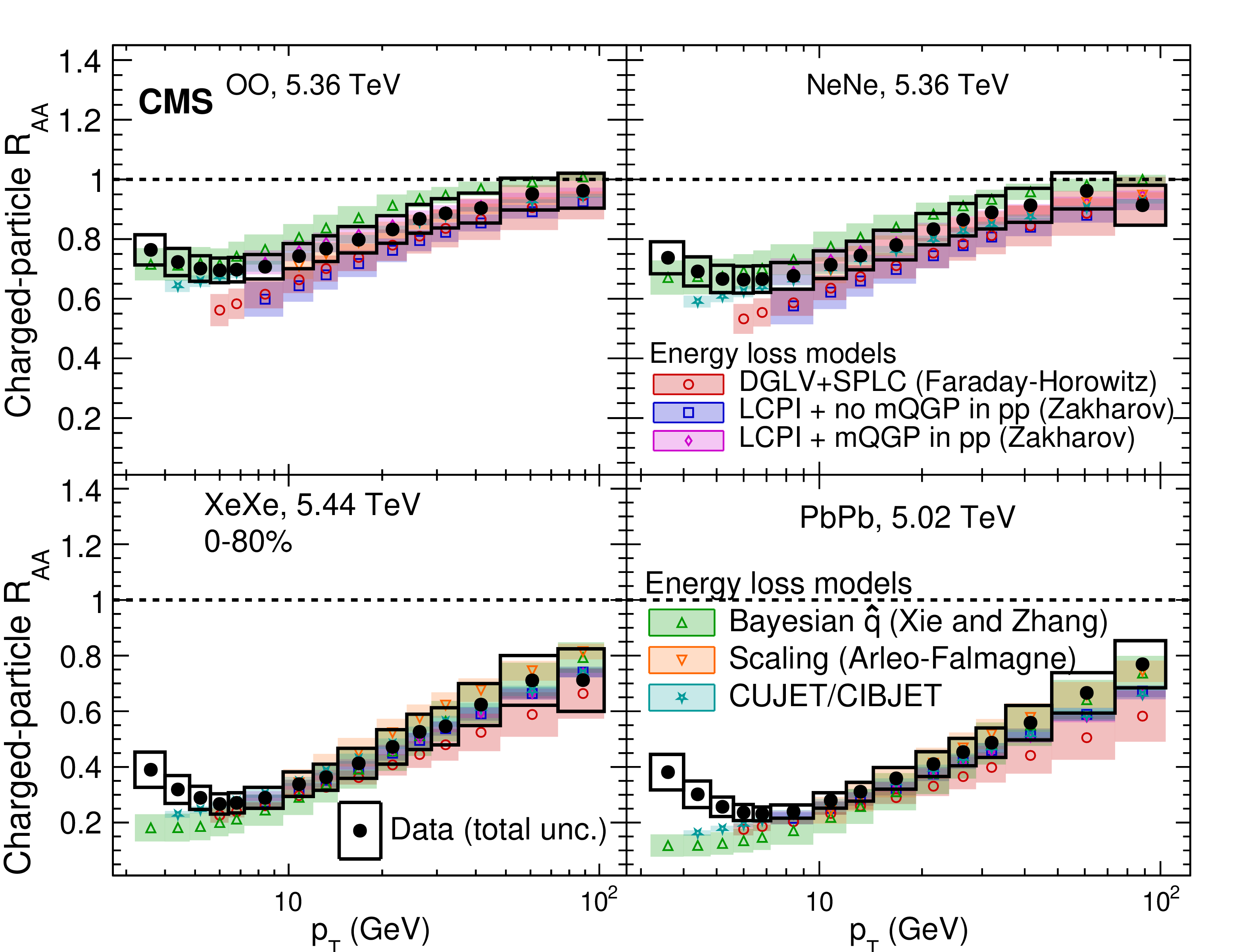
Additional Figure 5:
Charged-particle $ R_{\text{AA}} $ as a function of $ p_{\mathrm{T}} $ in minimum bias OO ($\sqrt{\smash[b]{s_{_{\mathrm{NN}}}}}=5.36$ TeV), minimum bias NeNe (5.36 TeV), XeXe (0--80%, 5.44 TeV), and minimum bias PbPb (5.02 TeV) collisions. The measurements are compared with theoretical calculations that include parton energy loss in the medium [61-69]. Details of the calculations are discussed in the main body of the text. |
png pdf |
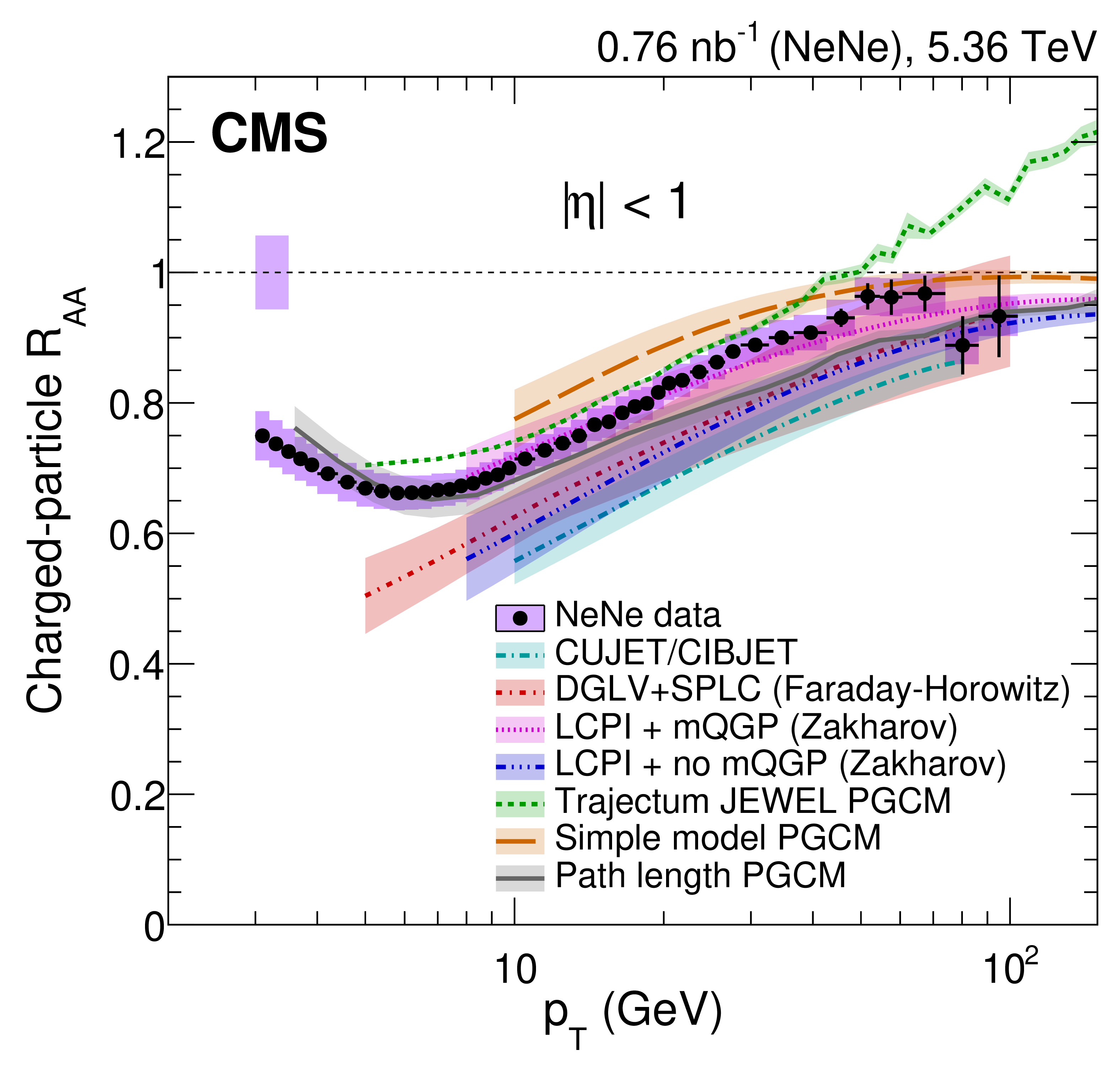
Additional Figure 6:
Theoretical predictions for the charged-particle $ R_{\text{AA}} $ in NeNe collisions compared to the measured NeNe $ R_{\text{AA}} $ [59][62-65][67][68][73-88], provided prior to the release of the preliminary NeNe and OO results. |
| References | ||||
| 1 | W. Busza, K. Rajagopal, and W. van der Schee | Heavy ion collisions: The big picture, and the big questions | Ann. Rev. Nucl. Part. Sci. 68 (2018) 339 | 1802.04801 |
| 2 | CMS Collaboration | Overview of high-density QCD studies with the CMS experiment at the LHC | Phys. Rept. 1115 (2025) 219 | CMS-HIN-23-011 2405.10785 |
| 3 | D. d'Enterria | Jet quenching | Landolt--Bornstein 23 471, 2010 link |
0902.2011 |
| 4 | L. Cunqueiro and A. M. Sickles | Studying the QGP with jets at the LHC and RHIC | Prog. Part. Nucl. Phys. 124 (2022) 103940 | 2110.14490 |
| 5 | L. Apolin \'a rio, Y.-J. Lee, and M. Winn | Heavy quarks and jets as probes of the QGP | Prog. Part. Nucl. Phys. 127 (2022) 103990 | 2203.16352 |
| 6 | M. Gyulassy and M. Plumer | Jet quenching in dense matter | PLB 243 (1990) 432 | |
| 7 | J. D. Bjorken | Energy loss of energetic partons in quark-gluon plasma: possible extinction of high $ p_\text{T} $ jets in hadron-hadron collisions | technical report, Fermilab, Batavia, IL, 1982 link |
|
| 8 | CMS Collaboration | Search for jet quenching with dijets from high-multiplicity $ \mathrm{p}\text{Pb} $ collisions at $ \sqrt{\smash[b]{s_{_{\mathrm{NN}}}}} = $ 8.16 TeV | JHEP 07 (2025) 118 | CMS-HIN-23-010 2504.08507 |
| 9 | CMS Collaboration | Charged-particle nuclear modification factors in $ \text{XeXe} $ collisions at $ \sqrt{\smash[b]{s_{_{\mathrm{NN}}}}} = $ 5.44 TeV | JHEP 10 (2018) 138 | CMS-HIN-18-004 1809.00201 |
| 10 | ATLAS Collaboration | Strong constraints on jet quenching in centrality-dependent $ \mathrm{p}\text{Pb} $ collisions at 5.02 TeV from ATLAS | PRL 131 (2023) 072301 | 2206.01138 |
| 11 | ALICE Collaboration | Constraints on jet quenching in $ \mathrm{p}\text{Pb} $ collisions at $ \sqrt{\smash[b]{s_{_{\mathrm{NN}}}}} = $ 5.02 TeV measured by the event-activity dependence of semi-inclusive hadron-jet distributions | PLB 783 (2018) 3054 | 1712.05603 |
| 12 | CMS Collaboration | Charged-particle nuclear modification factors in PbPb and $ \mathrm{p}\text{Pb} $ collisions at $ \sqrt{\smash[b]{s_{_{\mathrm{NN}}}}}= $ 5.02 TeV | JHEP 04 (2017) 039 | CMS-HIN-15-015 1611.01664 |
| 13 | ALICE Collaboration | Transverse momentum dependence of inclusive primary charged-particle production in $ \mathrm{p}\text{Pb} $ collisions at $ \sqrt{\smash[b]{s_{_{\mathrm{NN}}}}}= $ 5.02 TeV | EPJC 74 (2014) 3054 | 1405.2737 |
| 14 | ATLAS Collaboration | Charged-hadron production in pp, $ \mathrm{p}\text{Pb} $, PbPb, and $ \text{XeXe} $ collisions at $ \sqrt{\smash[b]{s_{_{\mathrm{NN}}}}}= $ 5 TeV with the ATLAS detector at the LHC | JHEP 07 (2023) 074 | 2211.15257 |
| 15 | C. Loizides and A. Morsch | Absence of jet quenching in peripheral nucleus-nucleus collisions | PLB 773 (2017) 408 | 1705.08856 |
| 16 | CMS Collaboration | Constraints on the initial state of PbPb Collisions via measurements of Z boson yields and azimuthal anisotropy at $ \sqrt{\smash[b]{s_{_{\mathrm{NN}}}}}= $ 5.02 TeV | PRL 127 (2021) 102002 | CMS-HIN-19-003 2103.14089 |
| 17 | J. Brewer, A. Mazeliauskas, and W. van der Schee | Opportunities of OO and $ p $O collisions at the LHC | in Opportunities of OO and pO collisions at the LHC, 2021 | 2103.01939 |
| 18 | R. Bruce et al. | Studies for an LHC pilot run with oxygen beams | in the Int. Particle Accelerator Conf., 2021 Proc. 1 (2021) 2 |
|
| 19 | R. Alemany Fernandez | Prospects for light-ion operation at the HL-LHC: machine developments and physics opportunities | PoS LHCP 335, 2025 link |
|
| 20 | D. d'Enterria and C. Loizides | Progress in the Glauber model at collider energies | Ann. Rev. Nucl. Part. Sci. 71 (2021) 315 | 2011.14909 |
| 21 | C. Loizides | Glauber modeling of high-energy nuclear collisions at the subnucleon level | Phys. Rev. C 94 (2016) 024914 | 1603.07375 |
| 22 | CMS Collaboration | Discovery of suppressed charged-particle production in ultrarelativistic oxygen-oxygen collisions | Submitted to Phys. Rev. Lett, 2025 | CMS-HIN-25-008 2510.09864 |
| 23 | CMS Collaboration | HEPData record for this analysis | link | |
| 24 | CMS Collaboration | The CMS experiment at the CERN LHC | JINST 3 (2008) S08004 | |
| 25 | CMS Collaboration | Development of the CMS detector for the CERN LHC Run 3 | JINST 19 (2024) P05064 | |
| 26 | CMS Collaboration | Performance of the CMS Level-1 trigger in proton-proton collisions at $ \sqrt{s} = $ 13 TeV | JINST 15 (2020) P10017 | CMS-TRG-17-001 2006.10165 |
| 27 | CMS Collaboration | The CMS trigger system | JINST 12 (2017) P01020 | CMS-TRG-12-001 1609.02366 |
| 28 | CMS Collaboration | Performance of the CMS high-level trigger during LHC Run 2 | JINST 19 (2024) P11021 | CMS-TRG-19-001 2410.17038 |
| 29 | CMS Collaboration | Electron and photon reconstruction and identification with the CMS experiment at the CERN LHC | JINST 16 (2021) P05014 | CMS-EGM-17-001 2012.06888 |
| 30 | CMS Collaboration | Performance of the CMS muon detector and muon reconstruction with proton-proton collisions at $ \sqrt{s}= $ 13 TeV | JINST 13 (2018) P06015 | CMS-MUO-16-001 1804.04528 |
| 31 | CMS Collaboration | Description and performance of track and primary-vertex reconstruction with the CMS tracker | JINST 9 (2014) P10009 | CMS-TRK-11-001 1405.6569 |
| 32 | CMS Collaboration | Particle-flow reconstruction and global event description with the CMS detector | JINST 12 (2017) P10003 | CMS-PRF-14-001 1706.04965 |
| 33 | Tracker Group of the CMS Collaboration | The CMS phase-1 pixel detector upgrade | JINST 16 (2021) P02027 | 2012.14304 |
| 34 | CMS Collaboration | Track impact parameter resolution for the full pseudorapidity coverage in the 2017 dataset with the CMS phase-1 pixel detector | CMS Detector Performance Note CMS-DP-2020-049, 2020 CDS |
|
| 35 | S. van der Meer | Calibration of the effective beam height in the ISR | Technical Report CERN-ISR-PO-68-31, ISR-PO-68-31, 1968 | |
| 36 | CMS Collaboration | Luminosity measurement for lead-lead collisions at $ \sqrt{\smash[b]{s_{_{\mathrm{NN}}}}} = $ 5.02 TeV in 2015 and 2018 at CMS | Submitted to Eur. Phys. J. C, 2025 | CMS-LUM-20-002 2503.03946 |
| 37 | CMS Collaboration | Luminosity determination using Z boson production at the CMS experiment | EPJC 84 (2024) 26 | CMS-LUM-21-001 2309.01008 |
| 38 | A. J. Baltz et al. | The physics of ultraperipheral collisions at the LHC | Phys. Rept. 458 (2008) 1 | 0706.3356 |
| 39 | I. A. Pshenichnov et al. | Nuclear multifragmentation induced by electromagnetic fields of ultrarelativistic heavy ions | Phys. Rev. C 57 (1998) 1920 | nucl-th/9711030 |
| 40 | S. J. Das and A. Baty | A data-driven method to estimate contamination from light ion beam transmutation at colliders | Submitted to Phys. Rev. C, 2025 | 2509.09736 |
| 41 | X.-N. Wang and M. Gyulassy | HIJING: A Monte Carlo model for multiple jet production in pp, pA and AA collisions | PRD 44 (1991) 3501 | |
| 42 | C. Bierlich et al. | A comprehensive guide to the physics and usage of PYTHIA 8.3 | SciPost Phys. Codeb. 2022 (2022) 8 | 2203.11601 |
| 43 | CMS Collaboration | Extraction and validation of a new set of CMS PYTHIA8 tunes from underlying-event measurements | EPJC 80 (2020) 4 | CMS-GEN-17-001 1903.12179 |
| 44 | S. R. Klein et al. | STARlight: A Monte Carlo simulation program for ultra-peripheral collisions of relativistic ions | Comput. Phys. Commun. 212 (2017) 258 | 1607.03838 |
| 45 | GEANT4 Collaboration | GEANT 4---a simulation toolkit | NIM A 506 (2003) 250 | |
| 46 | ALICE Collaboration | Production of light-flavor hadrons in pp collisions at $ \sqrt{s}= $ 7 and $ \sqrt{s} = $ 13 TeV | EPJC 81 (2021) 256 | 2005.11120 |
| 47 | ALICE Collaboration | Multiplicity dependence of charged pion, kaon, and (anti)proton production at large transverse momentum in $ \mathrm{p}\text{Pb} $ collisions at $ \sqrt{\smash[b]{s_{_{\mathrm{NN}}}}} = $ 5.02 TeV | PLB 760 (2016) 720 | 1601.03658 |
| 48 | ALICE Collaboration | Production of charged pions, kaons, and (anti-)protons in PbPb and inelastic pp collisions at $ \sqrt{\smash[b]{s_{_{\mathrm{NN}}}}} = $ 5.02 TeV | Phys. Rev. C 101 (2020) 044907 | 1910.07678 |
| 49 | ALICE Collaboration | Enhanced production of multi-strange hadrons in high-multiplicity proton-proton collisions | Nature Phys. 13 (2017) 535 | 1606.07424 |
| 50 | CMS Collaboration | First measurement of pseudorapidity distributions of charged hadrons in oxygen-oxygen collisions at $ \sqrt{\smash[b]{s_{_{\mathrm{NN}}}}} = $ 5.36 TeV with CMS | CMS Physics Analysis Summary, 2025 CMS-PAS-HIN-25-010 |
CMS-PAS-HIN-25-010 |
| 51 | C. Loizides | Glauber predictions for oxygen and neon collisions at energies available at the CERN Large Hadron Collider | Phys. Rev. C 113 (2026) 014914 | 2507.05853 |
| 52 | CMS Collaboration | Measurement of tracking efficiency | CMS Physics Analysis Summary, 2010 link |
|
| 53 | CMS Collaboration | Charged particle nuclear modification factor in neon-neon collisions and system-size dependence of nuclear suppression effects | CDS | |
| 54 | D. Antreasyan et al. | Production of hadrons at large transverse momentum in 200, 300 and 400 GeV pp and pn collisions | PRD 19 (1979) 764 | |
| 55 | ATLAS Collaboration | Evidence for the collective nature of radial flow in PbPb collisions with the ATLAS detector | PRL 136 (2026) 032301 | 2503.24125 |
| 56 | ALICE Collaboration | Long-range transverse momentum correlations and radial flow in PbPb collisions at the LHC | PRL 136 (2026) 032302 | 2504.04796 |
| 57 | A. Huss et al. | Discovering partonic rescattering in light nucleus collisions | PRL 126 (2021) 192301 | 2007.13754 |
| 58 | A. Mazeliauskas | Energy loss baseline for light hadrons in oxygen-oxygen collisions at $ \sqrt{\smash[b]{s_{_{\mathrm{NN}}}}} = $ 5.36 TeV | 2509.07008 | |
| 59 | K. J. Eskola, P. Paakkinen, H. Paukkunen, and C. A. Salgado | EPPS21: a global QCD analysis of nuclear PDFs | EPJC 82 (2022) 413 | 2112.12462 |
| 60 | R. Abdul Khalek et al. | nNNPDF3.0: evidence for a modified partonic structure in heavy nuclei | EPJC 82 (2022) 507 | 2201.12363 |
| 61 | C. Faraday et al. | From lead to helium: discovery potential for jet quenching in the smallest collision systems | 2512.17832 | |
| 62 | C. Faraday and W. A. Horowitz | Statistical analysis of pQCD energy loss across system size, flavor, $ \sqrt{\smash[b]{s_{_{\mathrm{NN}}}}} $, and $ p_{\mathrm{T}} $ | JHEP 11 (2025) 019 | 2505.14568 |
| 63 | M. Gyulassy, P. Levai, and I. Vitev | Jet quenching in thin quark gluon plasmas. 1. Formalism | NPB 571 (2000) 197 | hep-ph/9907461 |
| 64 | M. Djordjevic and M. Gyulassy | Heavy quark radiative energy loss in QCD matter | Nucl. Phys. A 733 (2004) 265 | nucl-th/0310076 |
| 65 | B. G. Zakharov | Jet quenching from heavy to light ion collisions | JHEP 09 (2021) 087 | 2105.09350 |
| 66 | F. Arleo and G. Falmagne | Probing the path-length dependence of parton energy loss via scaling properties in heavy ion collisions | PRD 109 (2024) L051503 | 2212.01324 |
| 67 | S. Shi, J. Liao, and M. Gyulassy | Global constraints from RHIC and LHC on transport properties of QCD fluids in CUJET/CIBJET framework | Chin. Phys. C 43 (2019) 044101 | 1808.05461 |
| 68 | S. Shi, J. Liao, and M. Gyulassy | Probing the color structure of the perfect QCD fluids via soft-hard-event-by-event azimuthal correlations | Chin. Phys. C 42 (2018) 104104 | 1804.01915 |
| 69 | Y. Guo, J. Liao, and S. Shi | Bayesian inference of the magnetic component of quark-gluon plasma | 2510.16838 | |
| 70 | F. Jonas et al. | A compendium of cold-nuclear matter baseline predictions in light-ion collisions | 2602.15928 | |
| 71 | M. Xie, W. Ke, H. Zhang, and X.-N. Wang | Information-field-based global Bayesian inference of the jet transport coefficient | Phys. Rev. C 108 (2023) L011901 | 2206.01340 |
| 72 | L. Pang, Q. Wang, and X.-N. Wang | Effects of initial flow velocity fluctuation in event-by-event (3+1)D hydrodynamics | Phys. Rev. C 86 (2012) 024911 | 1205.5019 |
|
|
Compact Muon Solenoid LHC, CERN |

|
|
|
|
|
|