
Compact Muon Solenoid
LHC, CERN
 Visit us: CMS Public Website, CMS Physics ;
Contact us: CMS Publications Committee
Visit us: CMS Public Website, CMS Physics ;
Contact us: CMS Publications Committee
| CMS-PAS-HIN-25-005 | ||
| Event activity dependence of relative $ \Upsilon $(nS) production in pPb collisions at 8.16 TeV | ||
| CMS Collaboration | ||
| 2026-05-17 | ||
| Abstract: The relative production of the excited bottomonium states, $ \Upsilon $(2S) and $ \Upsilon $(3S), with respect to the ground state $ \Upsilon $(1S) is measured via the dimuon decay channel in proton-lead collisions at a center-of-mass energy per nucleon pair of $ \sqrt {\smash [b]{s_{_{\mathrm {NN}}}}} = $ 8.16 TeV. The analysis is based on data collected in 2016 with the CMS detector at the LHC, corresponding to an integrated luminosity of 175 $ \text{nb}^{-1} $. The measurements are performed as functions of event activity, characterized by the charged-particle multiplicity measured within the pseudorapidity range $ |\eta| < $ 2.4, as well as the total transverse energy deposited in the forward region 4.0 $ < |\eta| < $ 5.2. A decreasing behavior of the excited-state to ground-state yield ratios is observed with increasing charged-particle multiplicity and forward transverse energy. The measurements are compared with theoretical predictions that consider interactions of bottomonium states either with nearby particles produced in the same collision or with a hot medium that may form during the system evolution. The results provide new constraints on models describing the hadronization and modification of heavy quarks in nuclear collisions. | ||
| Links: CDS record (PDF) ; CADI line (restricted) ; | ||
| Figures | |
png pdf |
Figure 1:
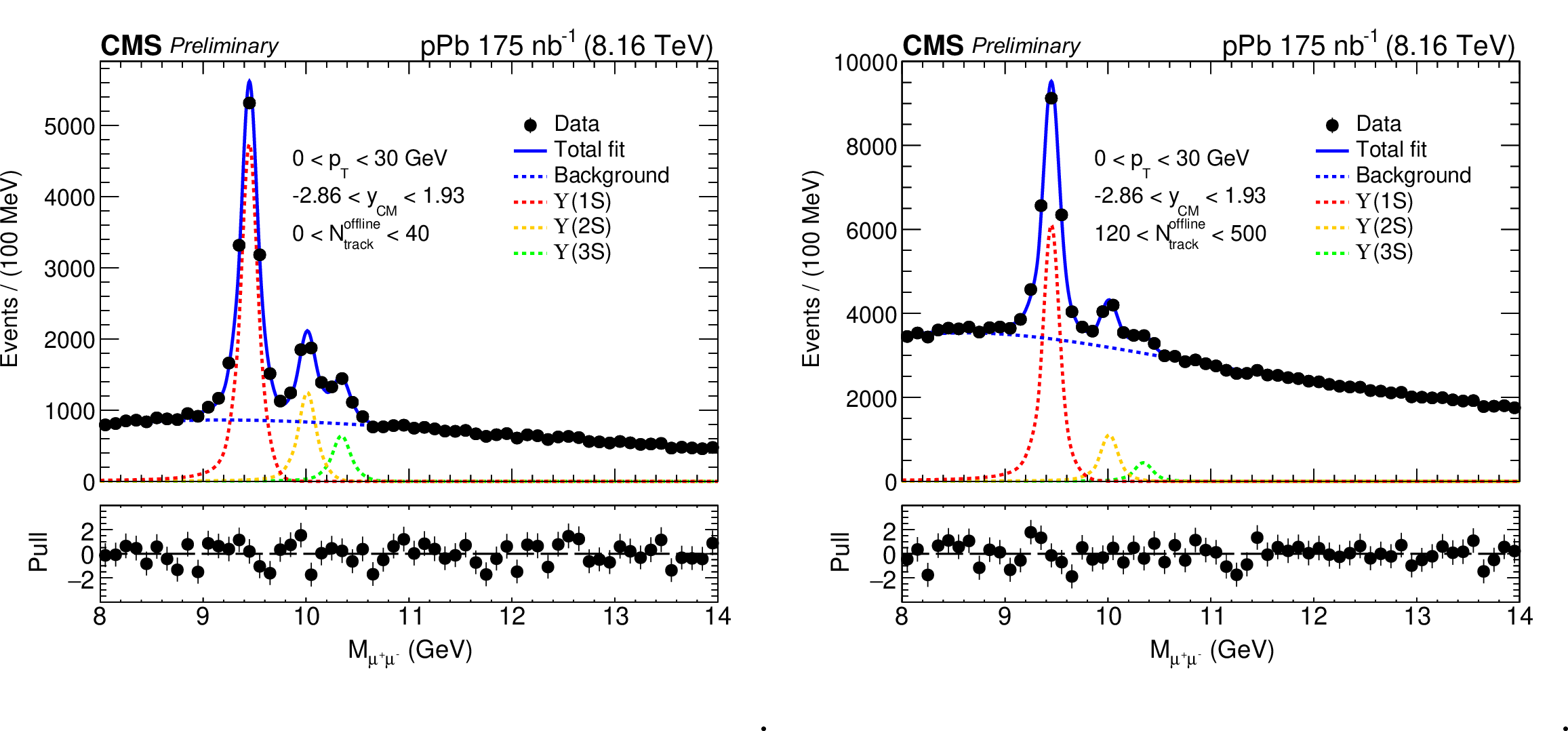
Invariant mass spectra of opposite-sign dimuons in pPb collisions, showing the $ \Upsilon(\mathrm{nS}) $ resonances for $ -2.86 < y_{\mathrm{CM}} < $ 1.93 and $ p_{\mathrm{T}} < $ 30 GeV. The left panel corresponds to low-multiplicity events, while the right panel shows high-multiplicity events. The solid blue curve represents the total fit, with the background component shown by the dashed blue line. |
png pdf |
Figure 1-a:
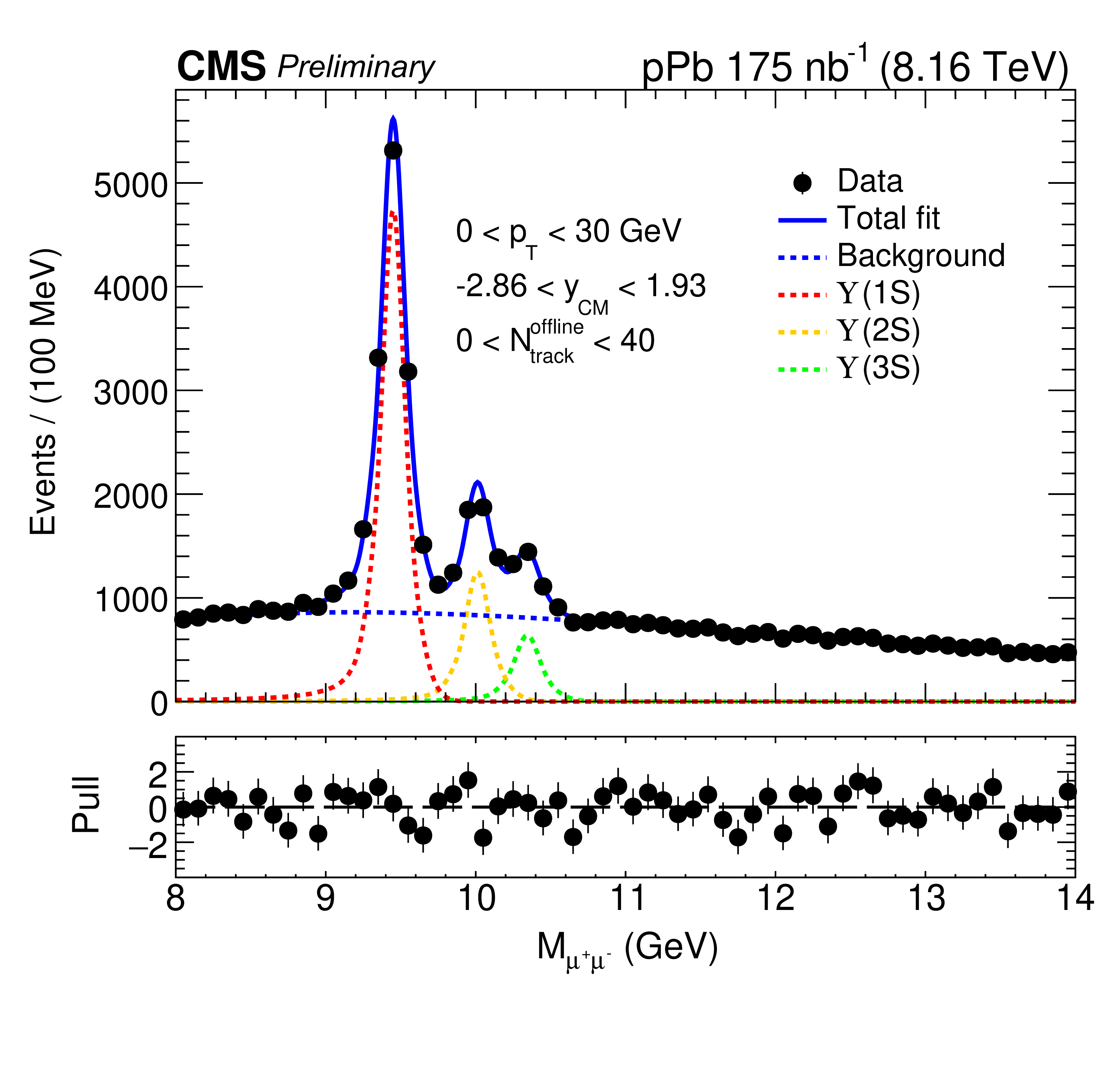
Invariant mass spectra of opposite-sign dimuons in pPb collisions, showing the $ \Upsilon(\mathrm{nS}) $ resonances for $ -2.86 < y_{\mathrm{CM}} < $ 1.93 and $ p_{\mathrm{T}} < $ 30 GeV. The left panel corresponds to low-multiplicity events, while the right panel shows high-multiplicity events. The solid blue curve represents the total fit, with the background component shown by the dashed blue line. |
png pdf |
Figure 1-b:
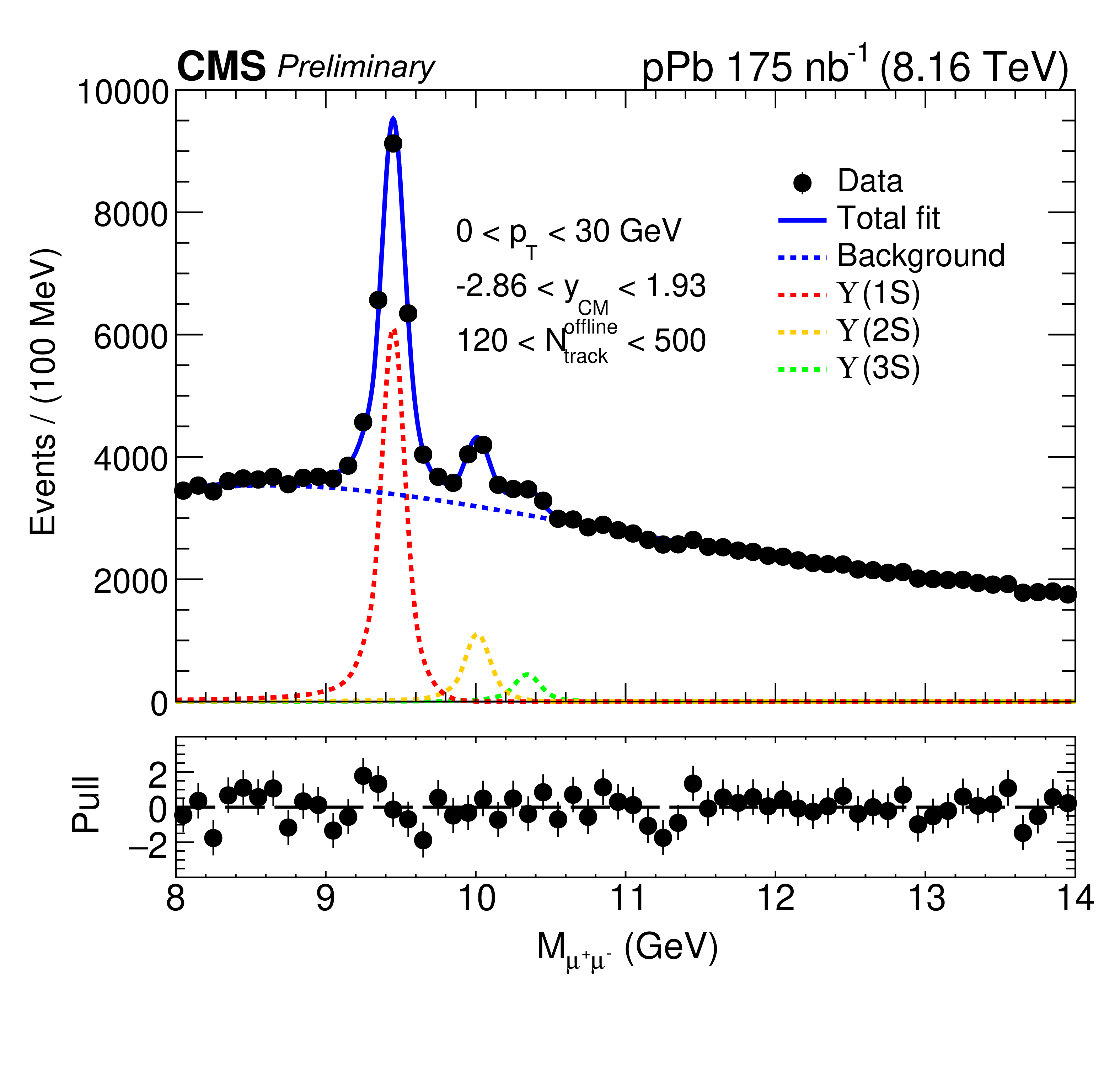
Invariant mass spectra of opposite-sign dimuons in pPb collisions, showing the $ \Upsilon(\mathrm{nS}) $ resonances for $ -2.86 < y_{\mathrm{CM}} < $ 1.93 and $ p_{\mathrm{T}} < $ 30 GeV. The left panel corresponds to low-multiplicity events, while the right panel shows high-multiplicity events. The solid blue curve represents the total fit, with the background component shown by the dashed blue line. |
png pdf |
Figure 2:
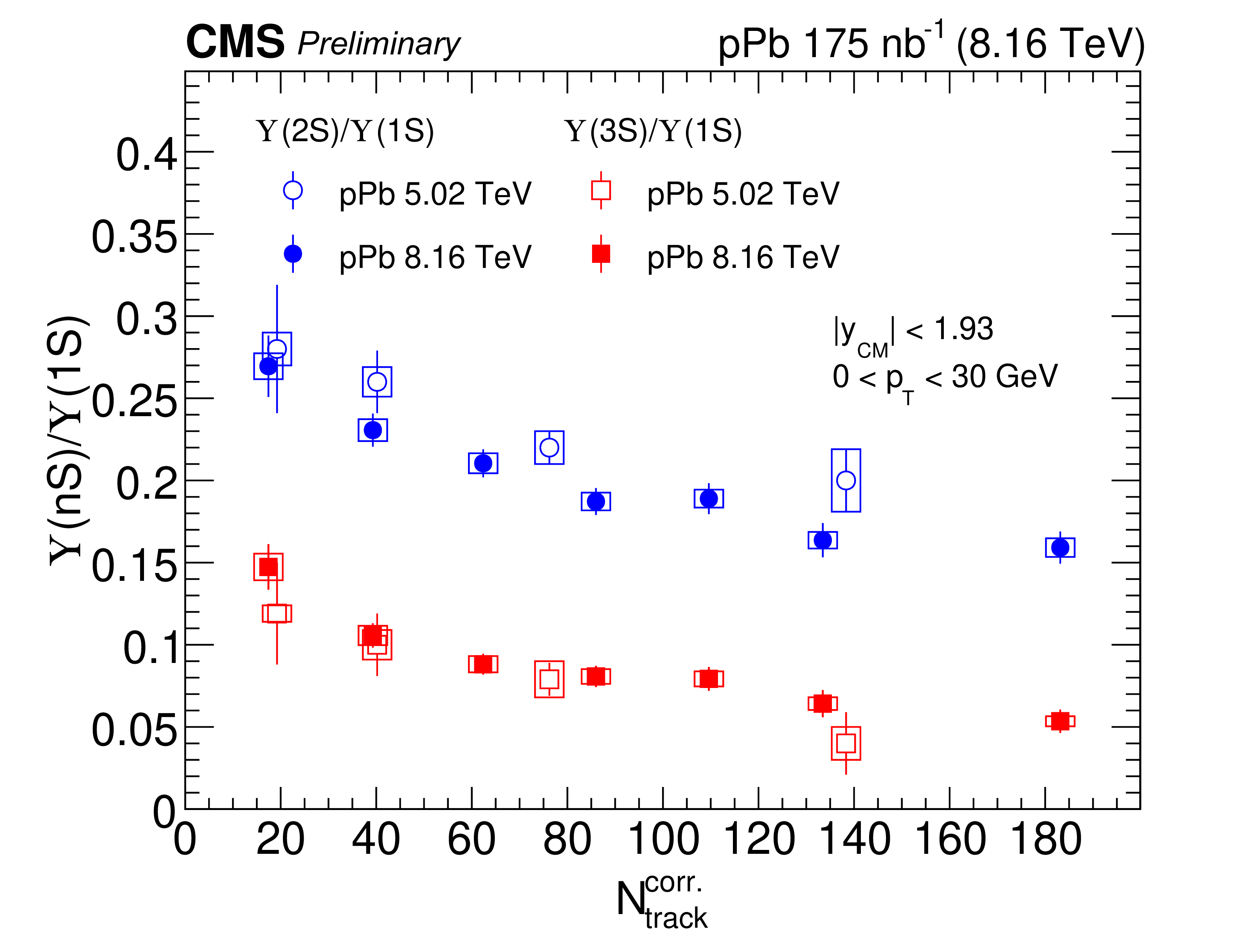
Measured $ \Upsilon{\textrm{(2S)}}/\Upsilon{\textrm{(1S)}} $ and $ \Upsilon{\textrm{(3S)}}/\Upsilon{\textrm{(1S)}} $ yield ratios as a function of $ N_{\mathrm{track}}^{\mathrm{corr.}} $, in pPb collisions at $ \sqrt{\smash[b]{s_{_{\mathrm{NN}}}}} = $ 8.16 TeV. The results are compared with the previous CMS measurement at 5.02 TeV [48], within the same rapidity and $ p_{\mathrm{T}} $ ranges. Statistical and systematic uncertainties are shown as error bars and boxes, respectively. |
png pdf |
Figure 3:
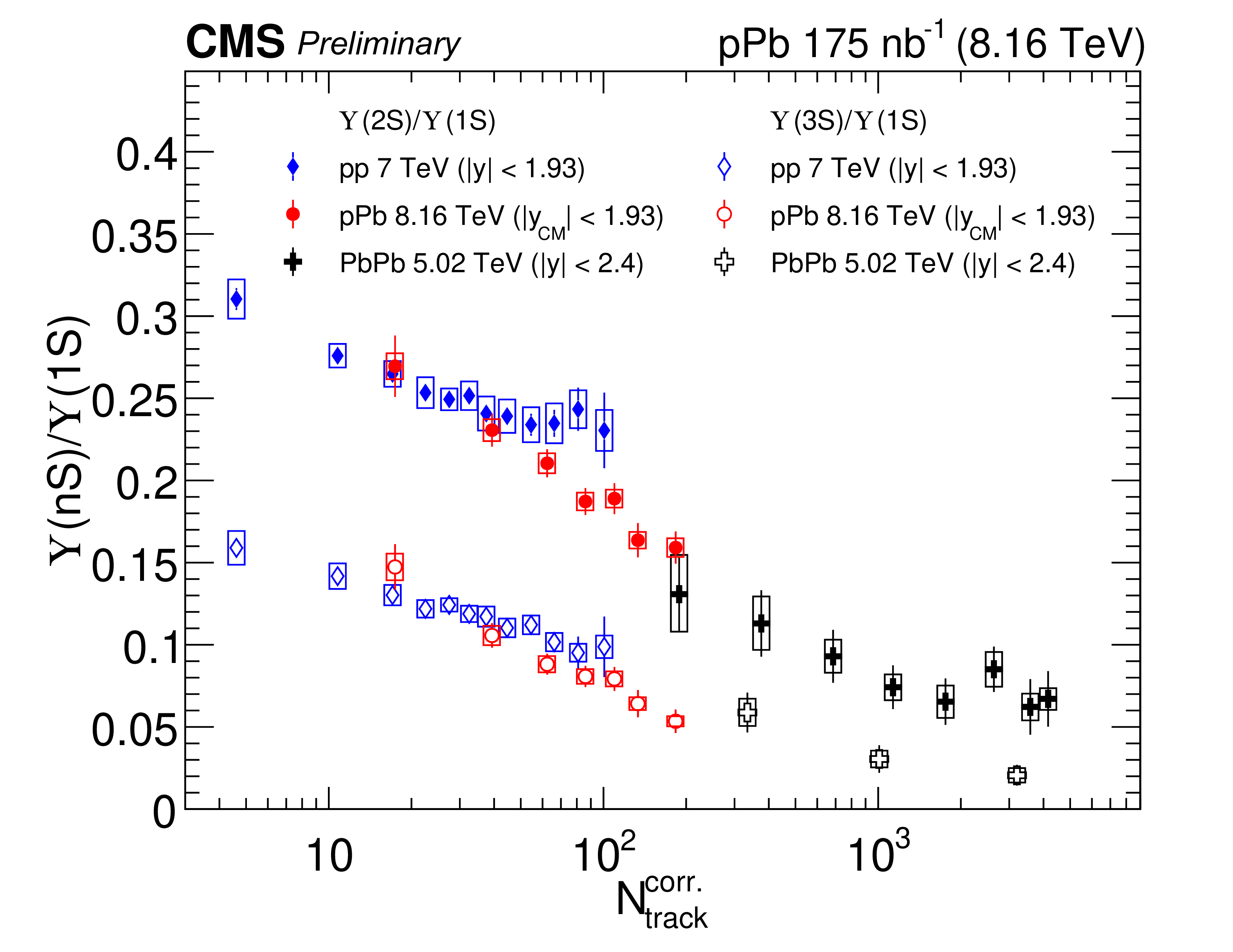
Comparison of the $ \Upsilon{\textrm{(2S)}}/\Upsilon{\textrm{(1S)}} $ and $ \Upsilon{\textrm{(3S)}}/\Upsilon{\textrm{(1S)}} $ yield ratios as a function of charged-particle multiplicity across different collision systems. The new p--Pb results at $ \sqrt{\smash[b]{s_{_{\mathrm{NN}}}}} = $ 8.16 TeV are compared with earlier CMS measurements in pp collisions at $ \sqrt{s} = $ 7 TeV [49] and in Pb--Pb collisions at $ \sqrt{\smash[b]{s_{_{\mathrm{NN}}}}} = $ 5.02 TeV [94]. Statistical and systematic uncertainties are shown as error bars and boxes, respectively. |
png pdf |
Figure 4:
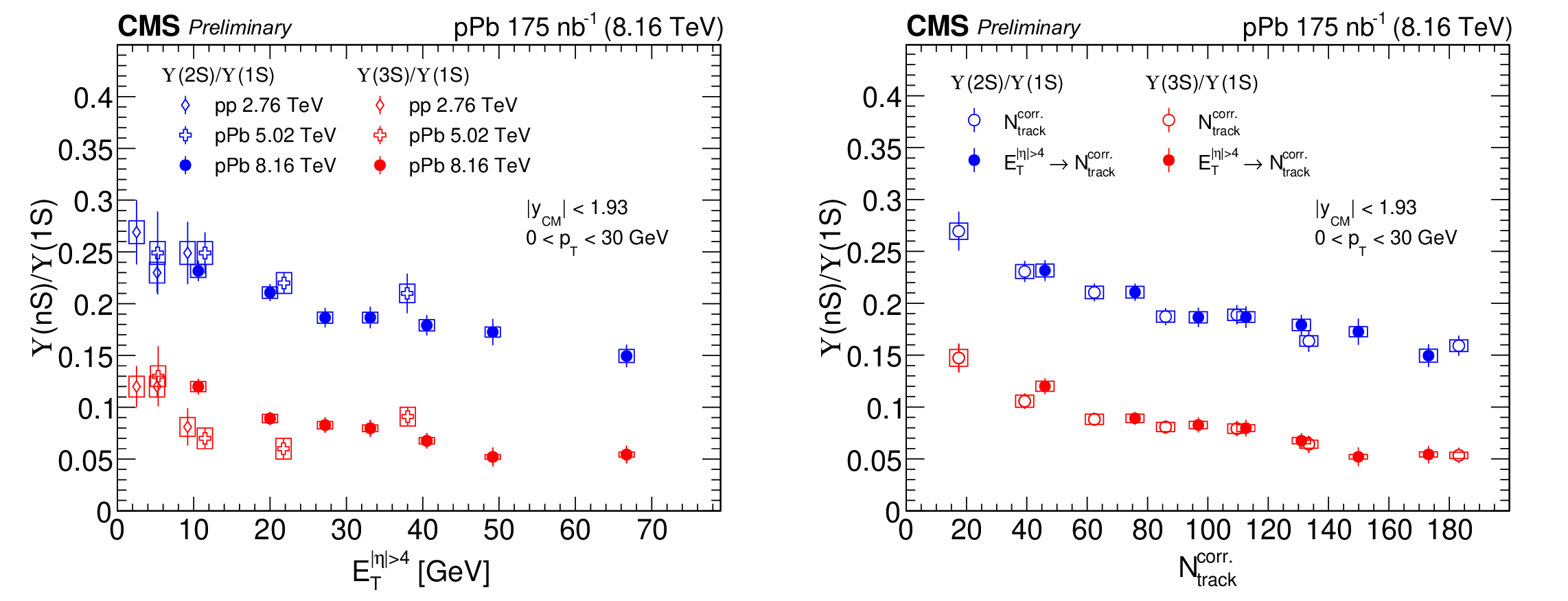
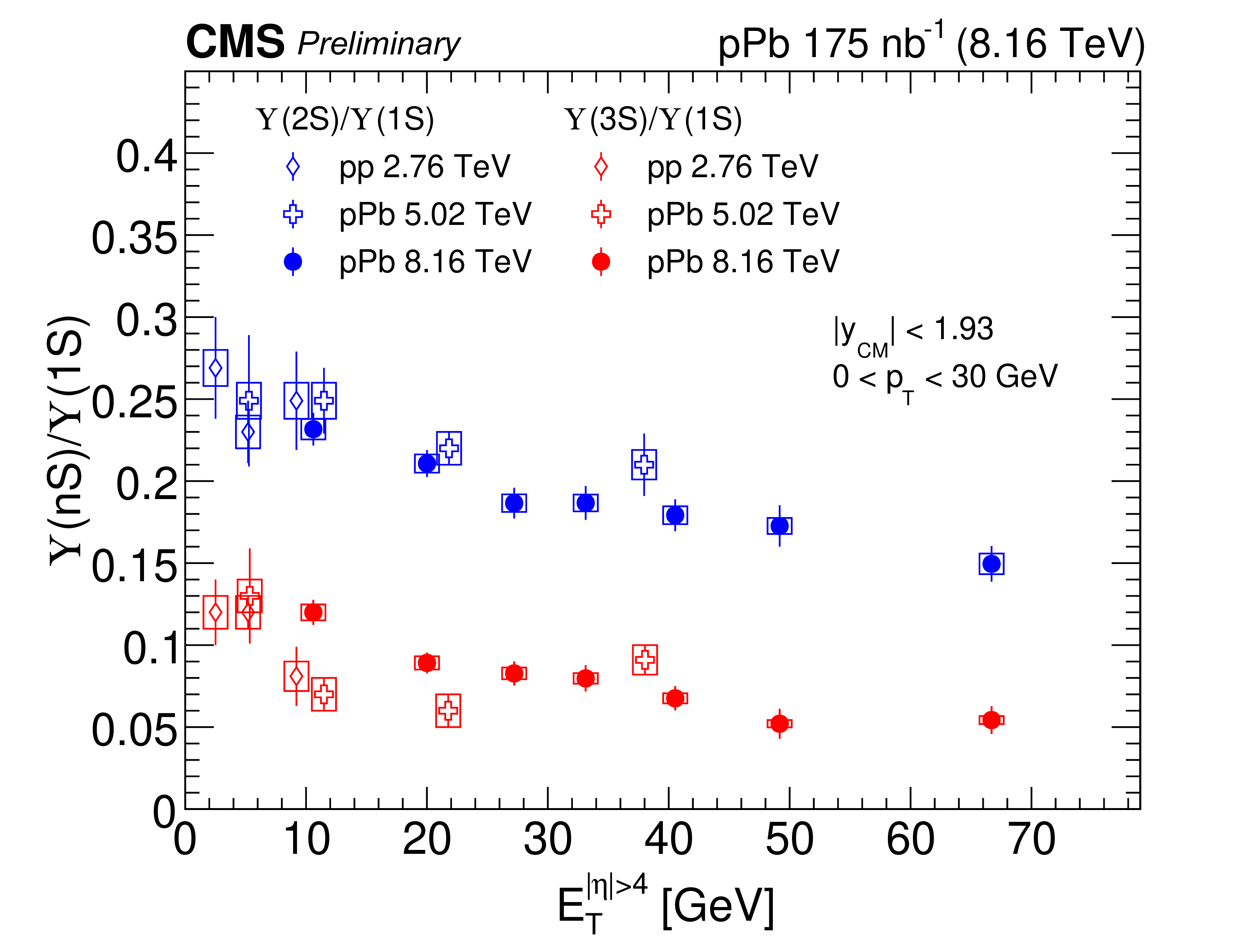
(Left) The $ \Upsilon{\textrm{(2S)}}/\Upsilon{\textrm{(1S)}} $ and $ \Upsilon{\textrm{(3S)}}/\Upsilon{\textrm{(1S)}} $ ratios as a function of $ E_{T}(|\eta| > 4) $. The results are compared with previous measurements in pp collisions at $ \sqrt{s} = $ 2.76 TeV and in $ \mathrm{p} $Pb collisions at $ \sqrt{\smash[b]{s_{_{\mathrm{NN}}}}} = $ 5.02 TeV [48]. (Right) The same data points are shown as a function of $ N_{\mathrm{track}}^{\mathrm{corr.}} $, after taking into account the correlation between $ N_{\mathrm{track}}^{\mathrm{corr.}} $ and $ E_{T}(|\eta| > 4) $. Statistical and systematic uncertainties are shown as error bars and boxes, respectively. |
png pdf |
Figure 4-a:
(Left) The $ \Upsilon{\textrm{(2S)}}/\Upsilon{\textrm{(1S)}} $ and $ \Upsilon{\textrm{(3S)}}/\Upsilon{\textrm{(1S)}} $ ratios as a function of $ E_{T}(|\eta| > 4) $. The results are compared with previous measurements in pp collisions at $ \sqrt{s} = $ 2.76 TeV and in $ \mathrm{p} $Pb collisions at $ \sqrt{\smash[b]{s_{_{\mathrm{NN}}}}} = $ 5.02 TeV [48]. (Right) The same data points are shown as a function of $ N_{\mathrm{track}}^{\mathrm{corr.}} $, after taking into account the correlation between $ N_{\mathrm{track}}^{\mathrm{corr.}} $ and $ E_{T}(|\eta| > 4) $. Statistical and systematic uncertainties are shown as error bars and boxes, respectively. |
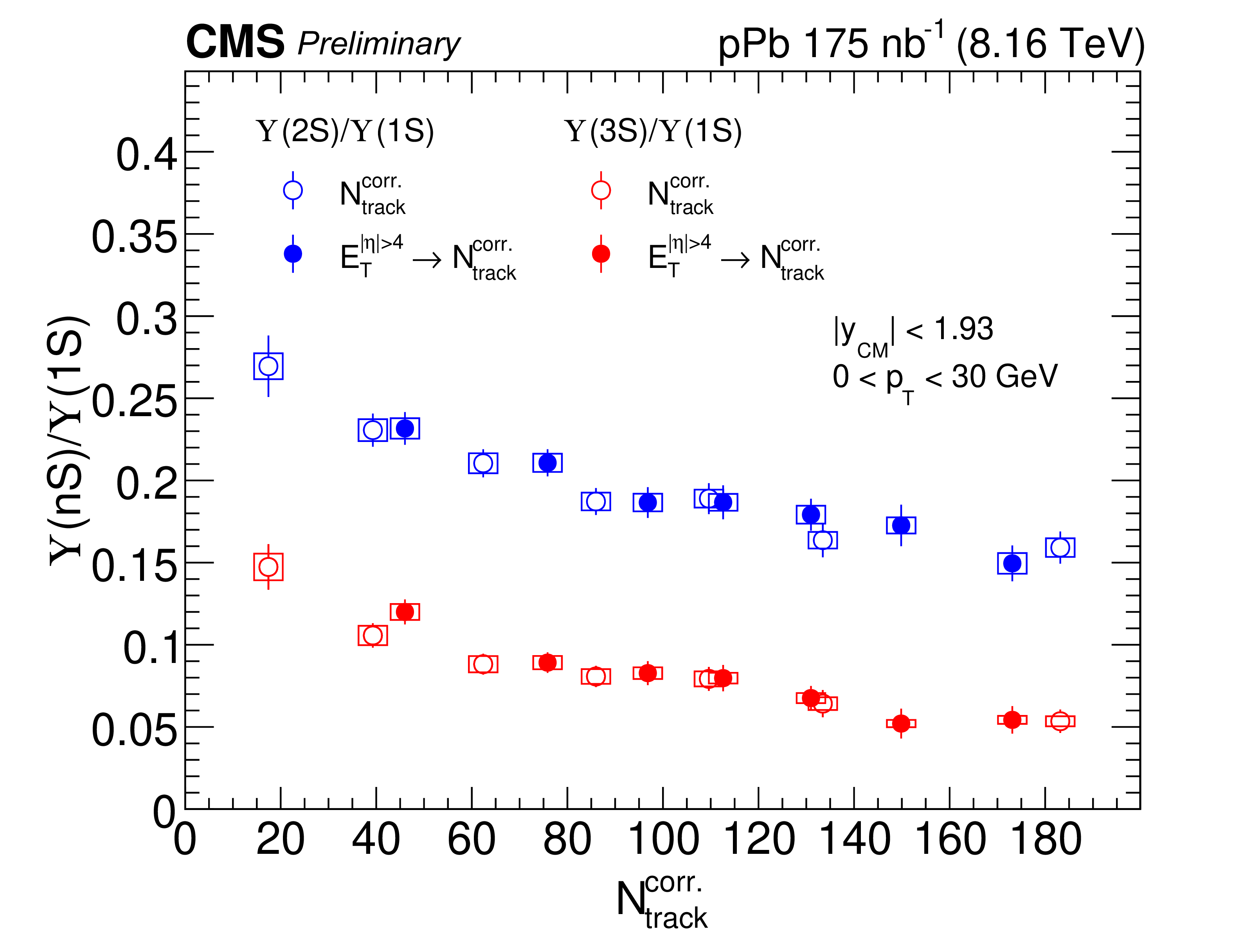
png pdf |
Figure 4-b:
(Left) The $ \Upsilon{\textrm{(2S)}}/\Upsilon{\textrm{(1S)}} $ and $ \Upsilon{\textrm{(3S)}}/\Upsilon{\textrm{(1S)}} $ ratios as a function of $ E_{T}(|\eta| > 4) $. The results are compared with previous measurements in pp collisions at $ \sqrt{s} = $ 2.76 TeV and in $ \mathrm{p} $Pb collisions at $ \sqrt{\smash[b]{s_{_{\mathrm{NN}}}}} = $ 5.02 TeV [48]. (Right) The same data points are shown as a function of $ N_{\mathrm{track}}^{\mathrm{corr.}} $, after taking into account the correlation between $ N_{\mathrm{track}}^{\mathrm{corr.}} $ and $ E_{T}(|\eta| > 4) $. Statistical and systematic uncertainties are shown as error bars and boxes, respectively. |
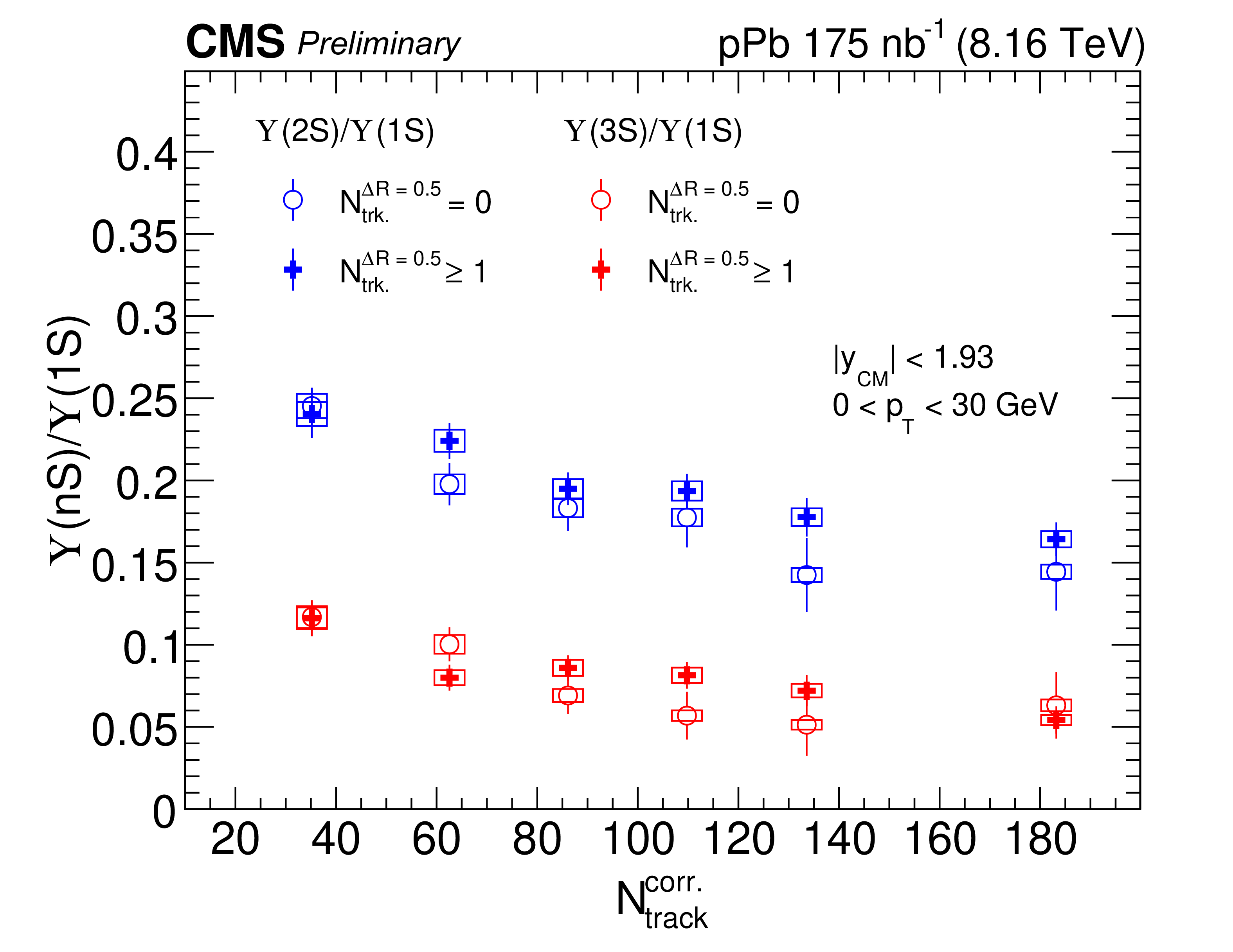
png pdf |
Figure 5:
Measured $ \Upsilon{\textrm{(2S)}}/\Upsilon{\textrm{(1S)}} $ and $ \Upsilon{\textrm{(3S)}}/\Upsilon{\textrm{(1S)}} $ ratios as a function of $ N_{\mathrm{track}}^{\mathrm{corr.}} $, shown separately for events with no nearby tracks ($ N^{\Delta R}_{\mathrm{track}}= $ 0) and with at least one track ($ N^{\Delta R}_{\mathrm{track}}\geq $ 1) within $ \Delta R = $ 0.5. Statistical and systematic uncertainties are shown as error bars and boxes, respectively. |
png pdf |
Figure 6:
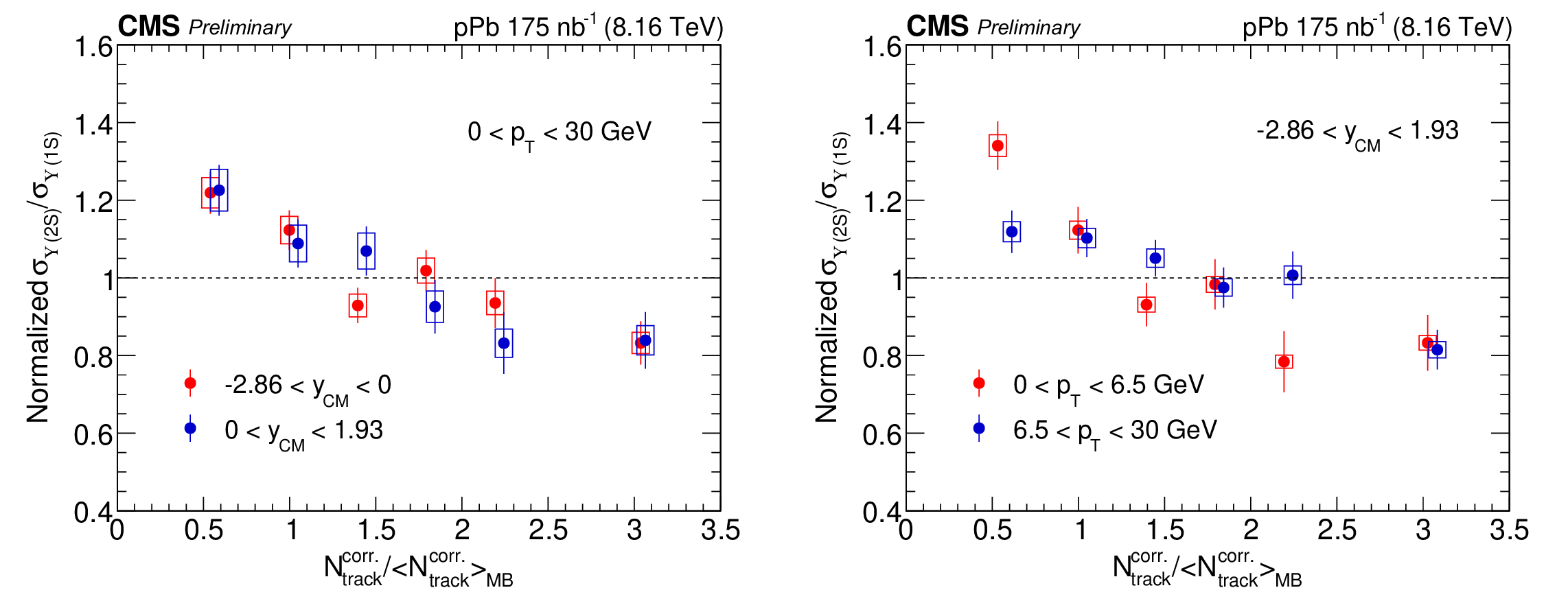
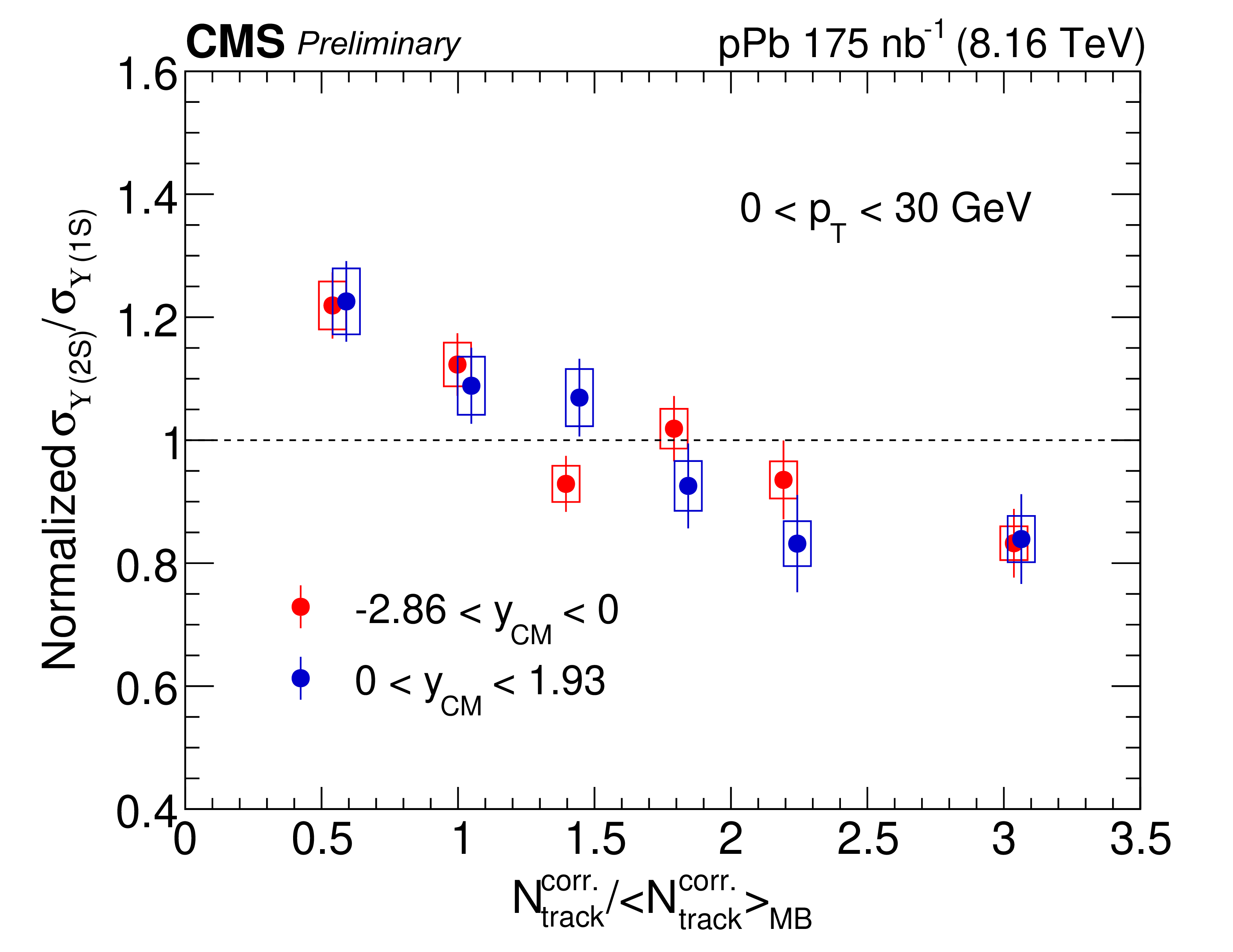
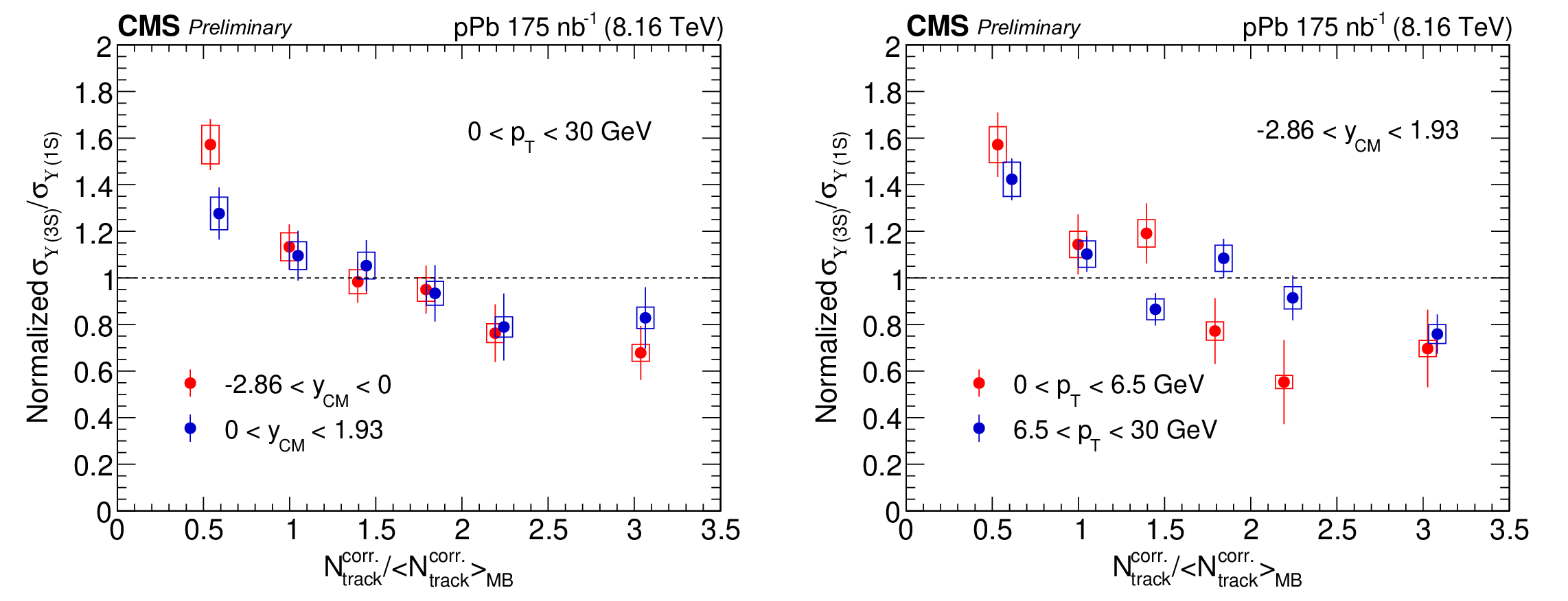
Normalized $ \Upsilon{\textrm{(2S)}}/\Upsilon{\textrm{(1S)}} $ cross section ratios as a function of normalized charged-particle multiplicity, shown separately for differential rapidity (left) and $ p_{\mathrm{T}} $ (right) intervals. Statistical and systematic uncertainties are shown as error bars and boxes, respectively. |
png pdf |
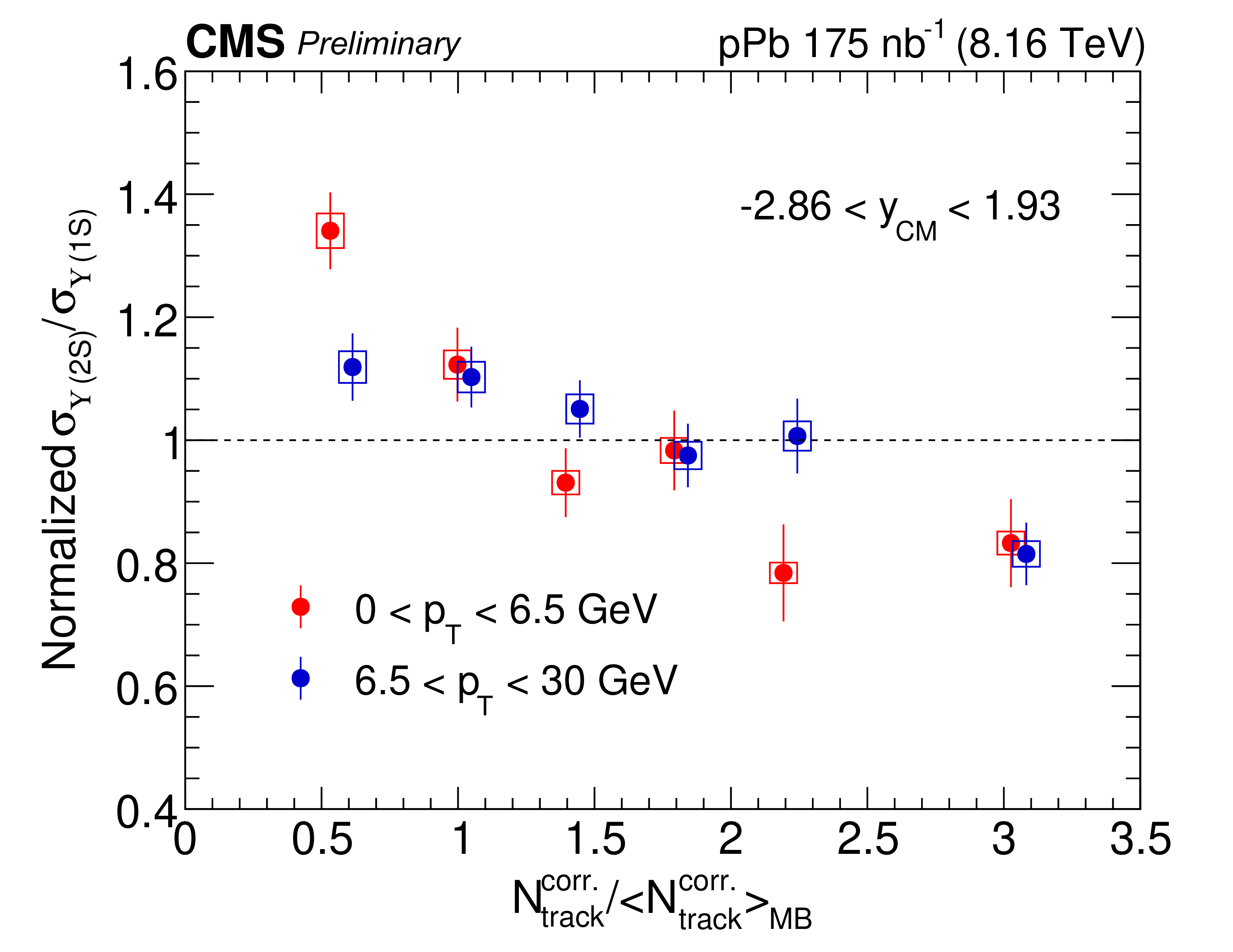
Figure 6-a:
Normalized $ \Upsilon{\textrm{(2S)}}/\Upsilon{\textrm{(1S)}} $ cross section ratios as a function of normalized charged-particle multiplicity, shown separately for differential rapidity (left) and $ p_{\mathrm{T}} $ (right) intervals. Statistical and systematic uncertainties are shown as error bars and boxes, respectively. |
png pdf |
Figure 6-b:
Normalized $ \Upsilon{\textrm{(2S)}}/\Upsilon{\textrm{(1S)}} $ cross section ratios as a function of normalized charged-particle multiplicity, shown separately for differential rapidity (left) and $ p_{\mathrm{T}} $ (right) intervals. Statistical and systematic uncertainties are shown as error bars and boxes, respectively. |
png pdf |
Figure 7:
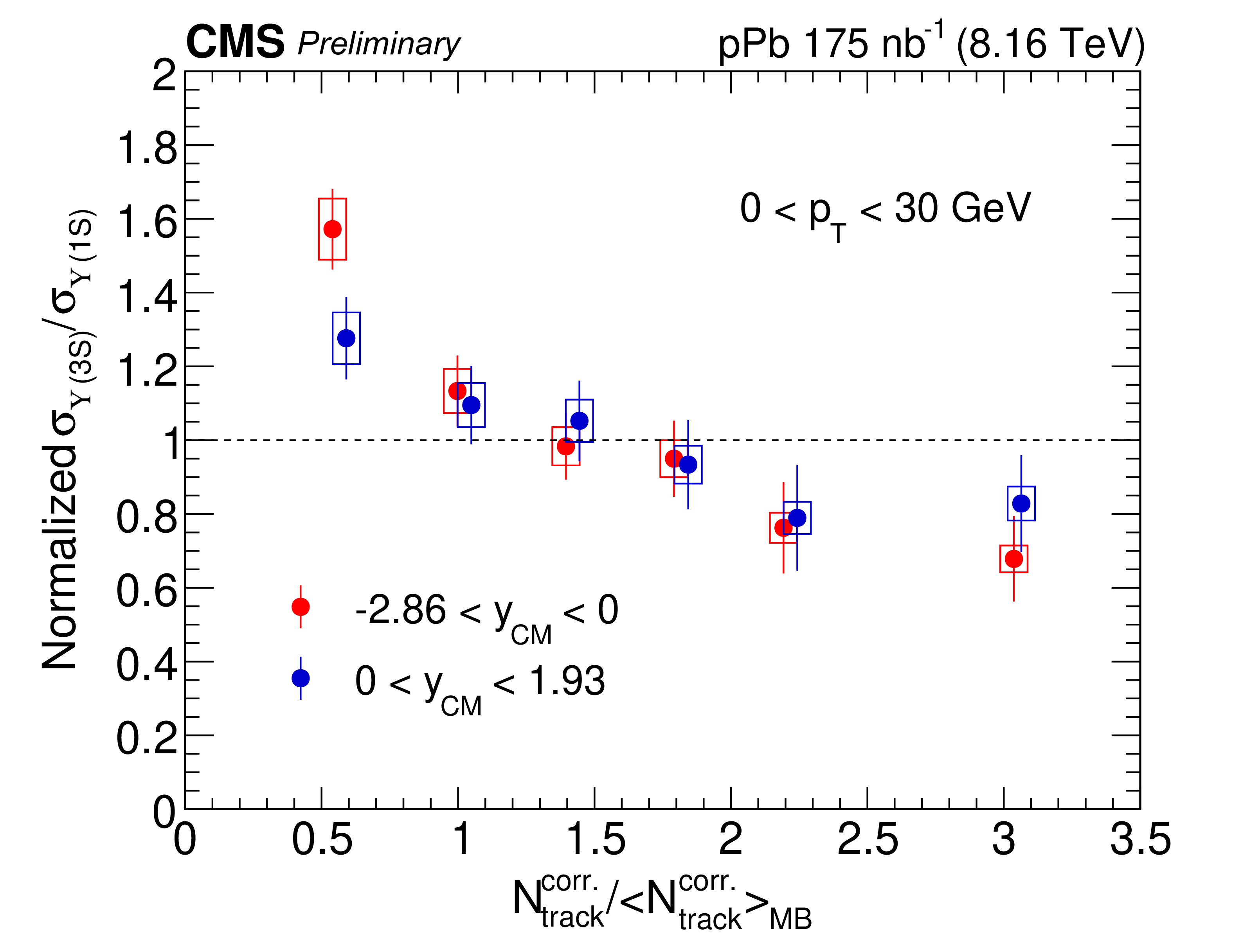
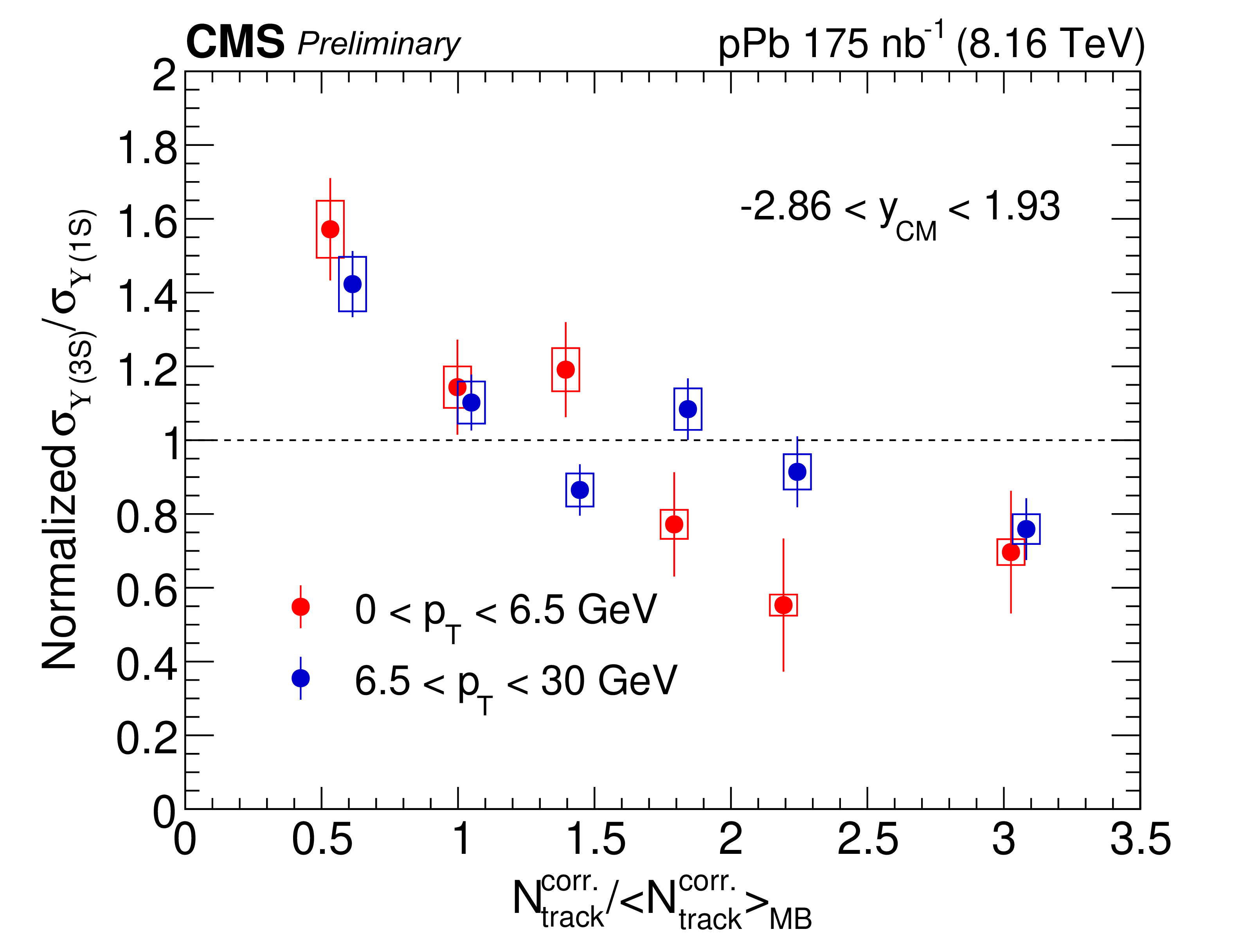
Normalized $ \Upsilon{\textrm{(3S)}}/\Upsilon{\textrm{(1S)}} $ cross section ratios as a function of normalized charged-particle multiplicity, shown separately for differential rapidity (left) and $ p_{\mathrm{T}} $ (right) intervals. Statistical and systematic uncertainties are shown as error bars and boxes, respectively. |
png pdf |
Figure 7-a:
Normalized $ \Upsilon{\textrm{(3S)}}/\Upsilon{\textrm{(1S)}} $ cross section ratios as a function of normalized charged-particle multiplicity, shown separately for differential rapidity (left) and $ p_{\mathrm{T}} $ (right) intervals. Statistical and systematic uncertainties are shown as error bars and boxes, respectively. |
png pdf |
Figure 7-b:
Normalized $ \Upsilon{\textrm{(3S)}}/\Upsilon{\textrm{(1S)}} $ cross section ratios as a function of normalized charged-particle multiplicity, shown separately for differential rapidity (left) and $ p_{\mathrm{T}} $ (right) intervals. Statistical and systematic uncertainties are shown as error bars and boxes, respectively. |
png pdf |
Figure 8:
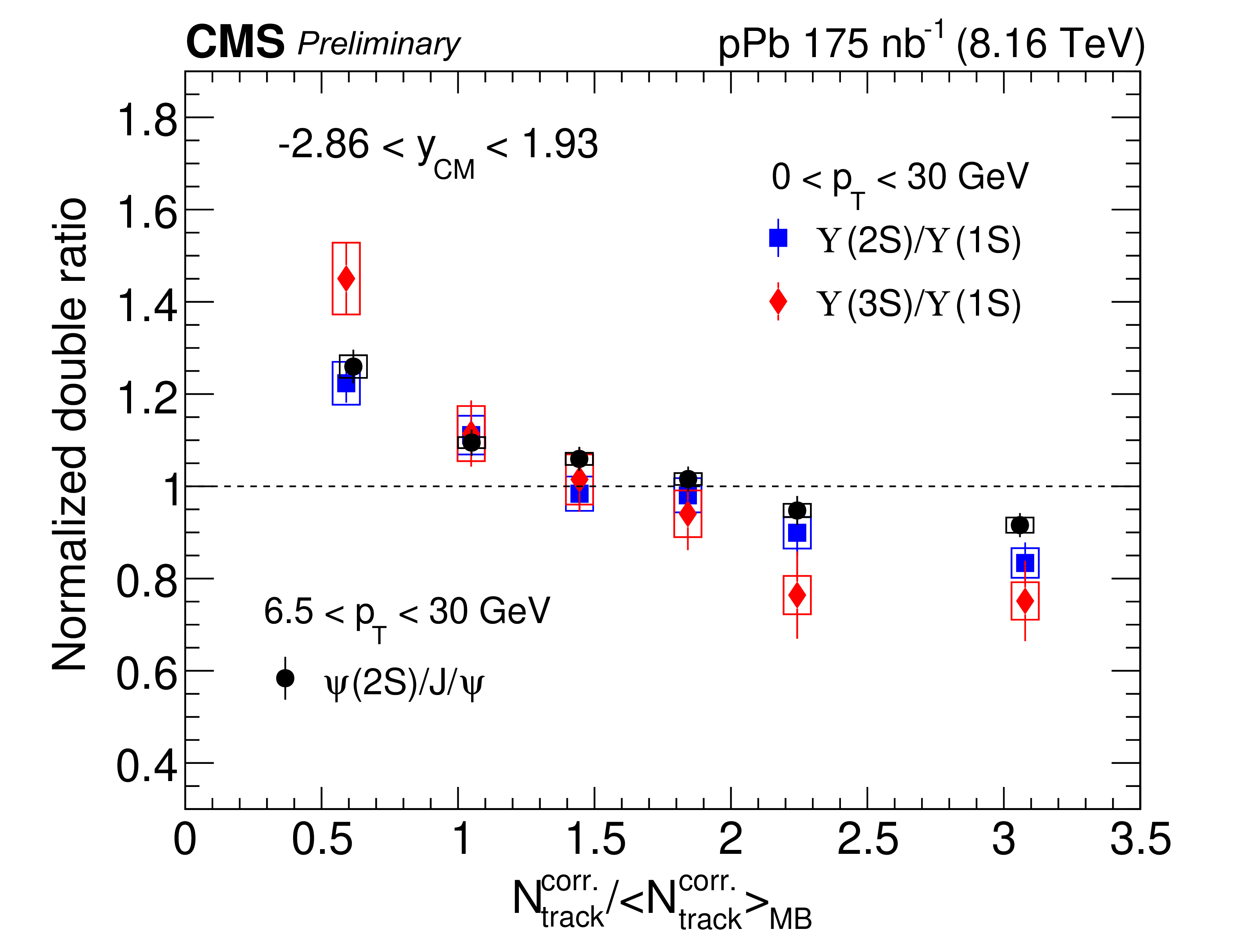
Normalized $ \Upsilon{\textrm{(2S)}}/\Upsilon{\textrm{(1S)}} $ and $ \Upsilon{\textrm{(3S)}}/\Upsilon{\textrm{(1S)}} $ cross section ratios as a function of normalized charged-particle multiplicity in the rapidity interval $ -2.86 < y_{\mathrm{CM}} < $ 1.93 and 0 $ < p_{T} < $ 30 GeV. The results are also compared with the charmonium measurement in the same rapidity range for 6.5 $ < p_{T} < $ 30 GeV [95]. Statistical and systematic uncertainties are shown as error bars and boxes, respectively.. |
png pdf |
Figure 9:
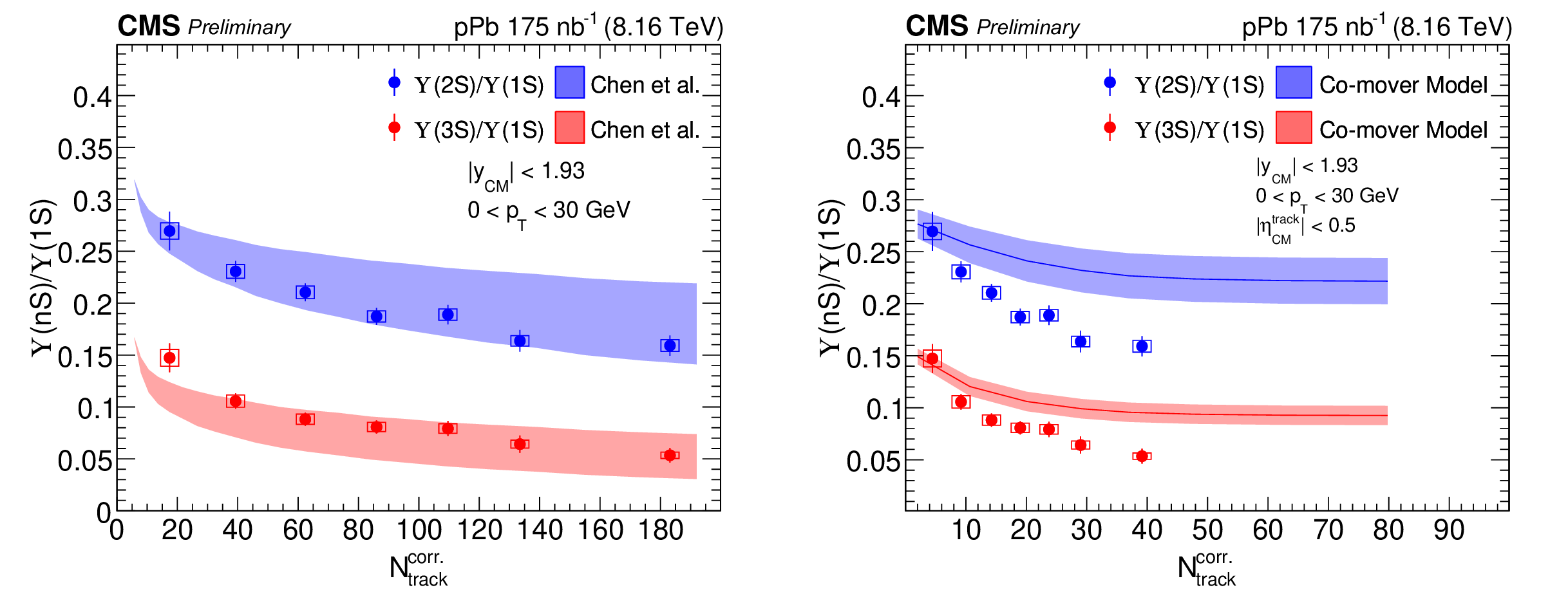
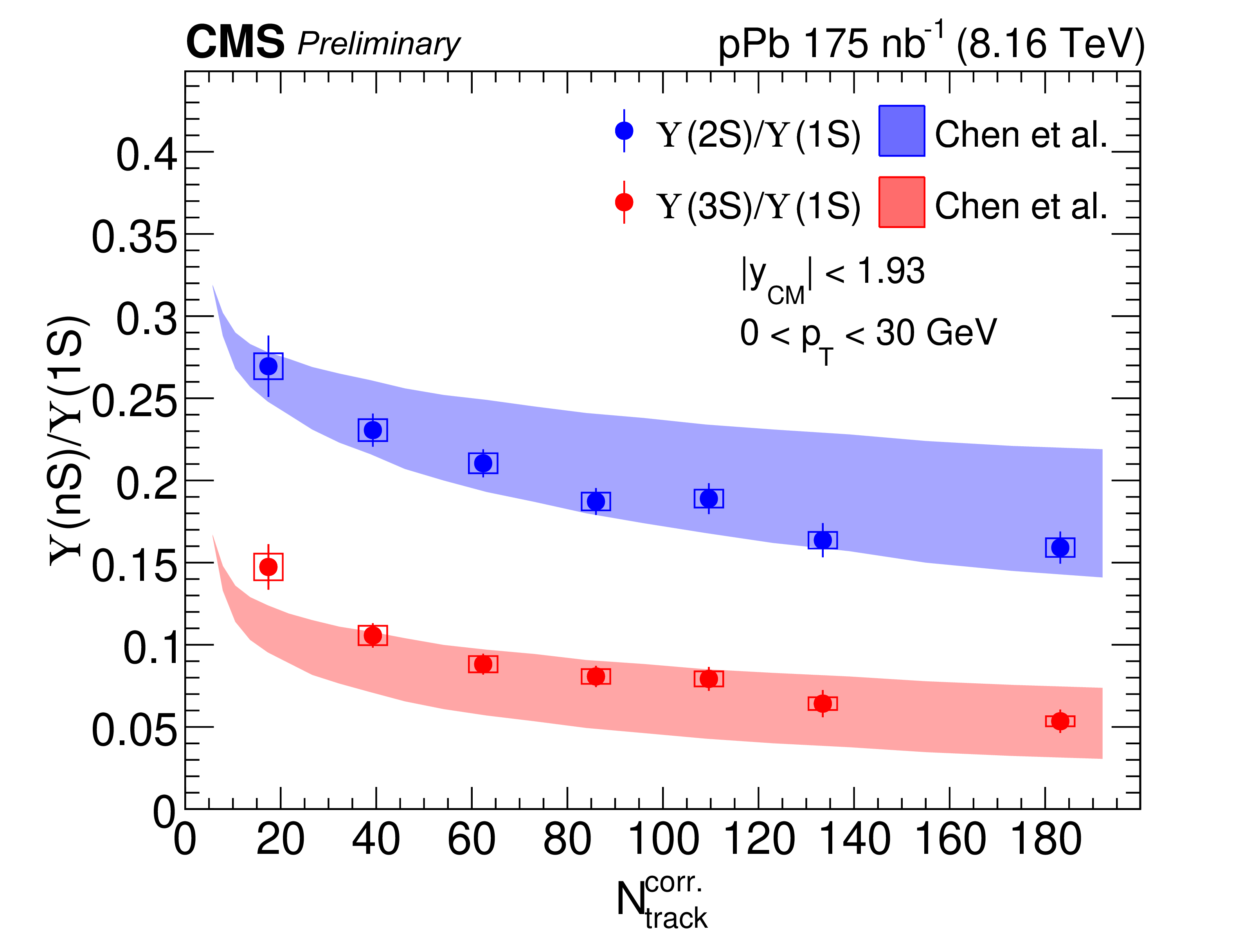
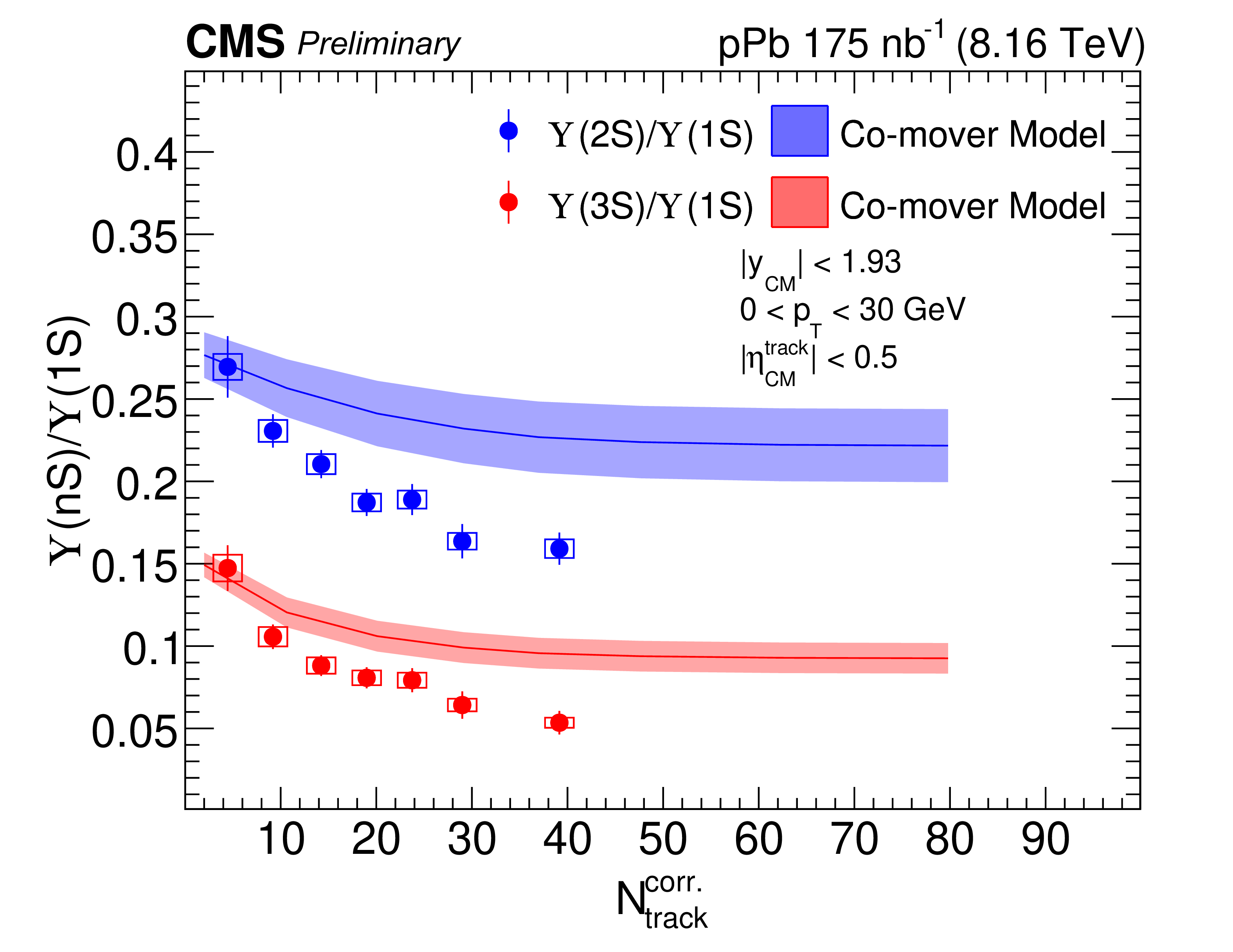
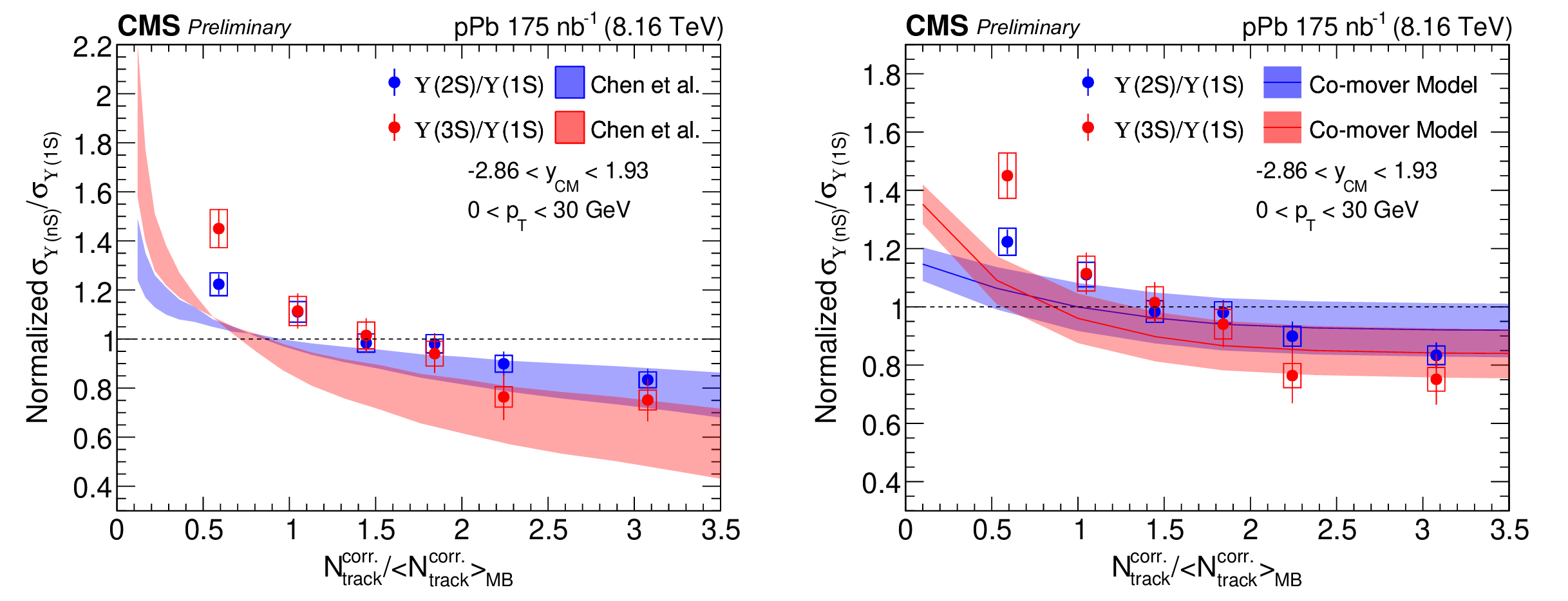
(Left) $ \Upsilon{\textrm{(2S)}}/\Upsilon{\textrm{(1S)}} $ and $ \Upsilon{\textrm{(3S)}}/\Upsilon{\textrm{(1S)}} $ with respect to $ \text{N}^{{\text{corr.}}}_{\text{track}} $. The results are compared with a theoretical model incorporating QGP formation [68]. (Right) $ \Upsilon{\textrm{(2S)}}/\Upsilon{\textrm{(1S)}} $ and $ \Upsilon{\textrm{(3S)}}/\Upsilon{\textrm{(1S)}} $ with respect to the charged-particle multiplicity measured in $ |\eta^{\mathrm{track}}_{\mathrm{CM}}| < $ 0.5. The results are compared with a theoretical model incorporating the co-mover effect [70]. |
png pdf |
Figure 9-a:
(Left) $ \Upsilon{\textrm{(2S)}}/\Upsilon{\textrm{(1S)}} $ and $ \Upsilon{\textrm{(3S)}}/\Upsilon{\textrm{(1S)}} $ with respect to $ \text{N}^{{\text{corr.}}}_{\text{track}} $. The results are compared with a theoretical model incorporating QGP formation [68]. (Right) $ \Upsilon{\textrm{(2S)}}/\Upsilon{\textrm{(1S)}} $ and $ \Upsilon{\textrm{(3S)}}/\Upsilon{\textrm{(1S)}} $ with respect to the charged-particle multiplicity measured in $ |\eta^{\mathrm{track}}_{\mathrm{CM}}| < $ 0.5. The results are compared with a theoretical model incorporating the co-mover effect [70]. |
png pdf |
Figure 9-b:
(Left) $ \Upsilon{\textrm{(2S)}}/\Upsilon{\textrm{(1S)}} $ and $ \Upsilon{\textrm{(3S)}}/\Upsilon{\textrm{(1S)}} $ with respect to $ \text{N}^{{\text{corr.}}}_{\text{track}} $. The results are compared with a theoretical model incorporating QGP formation [68]. (Right) $ \Upsilon{\textrm{(2S)}}/\Upsilon{\textrm{(1S)}} $ and $ \Upsilon{\textrm{(3S)}}/\Upsilon{\textrm{(1S)}} $ with respect to the charged-particle multiplicity measured in $ |\eta^{\mathrm{track}}_{\mathrm{CM}}| < $ 0.5. The results are compared with a theoretical model incorporating the co-mover effect [70]. |
png pdf |
Figure 10:
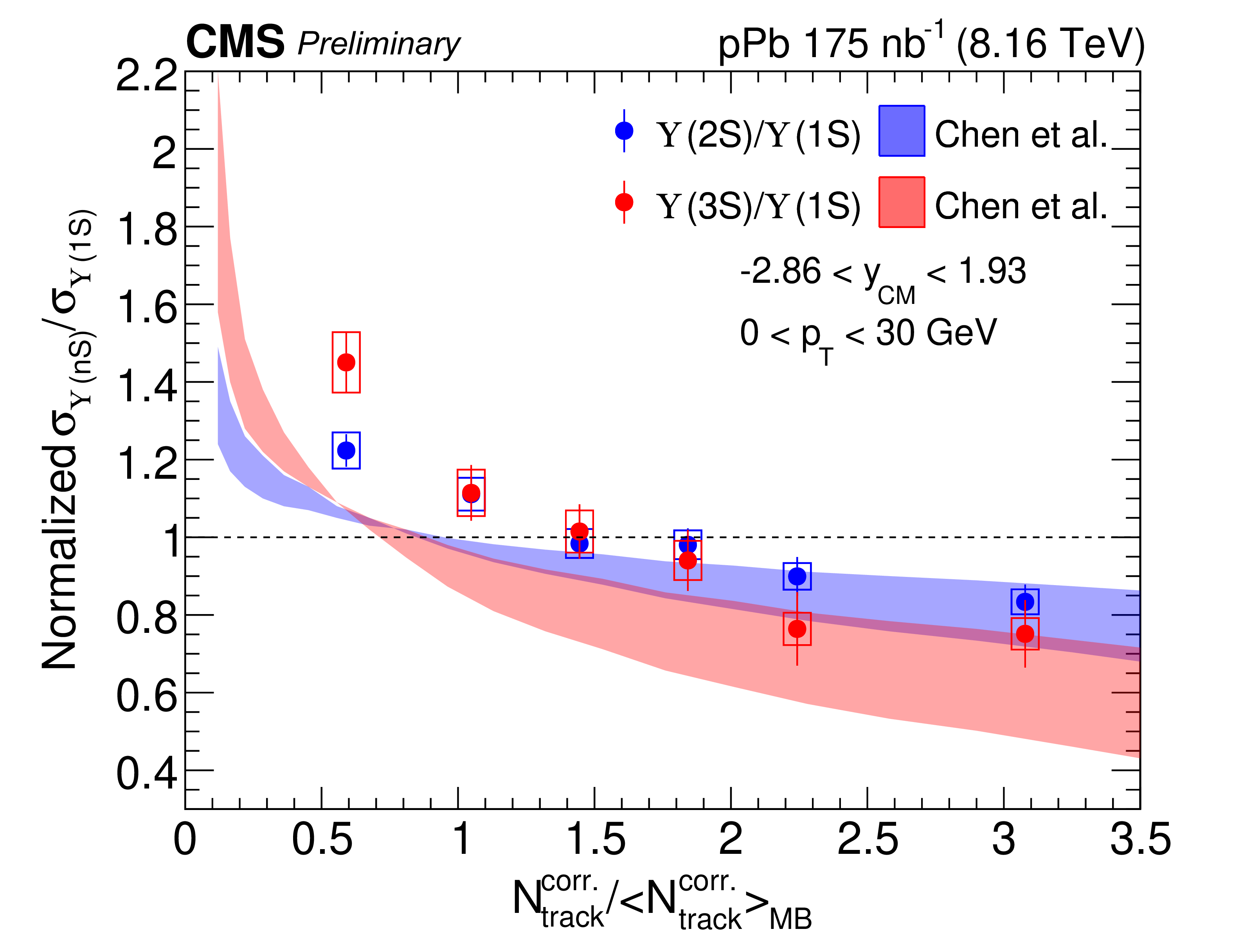
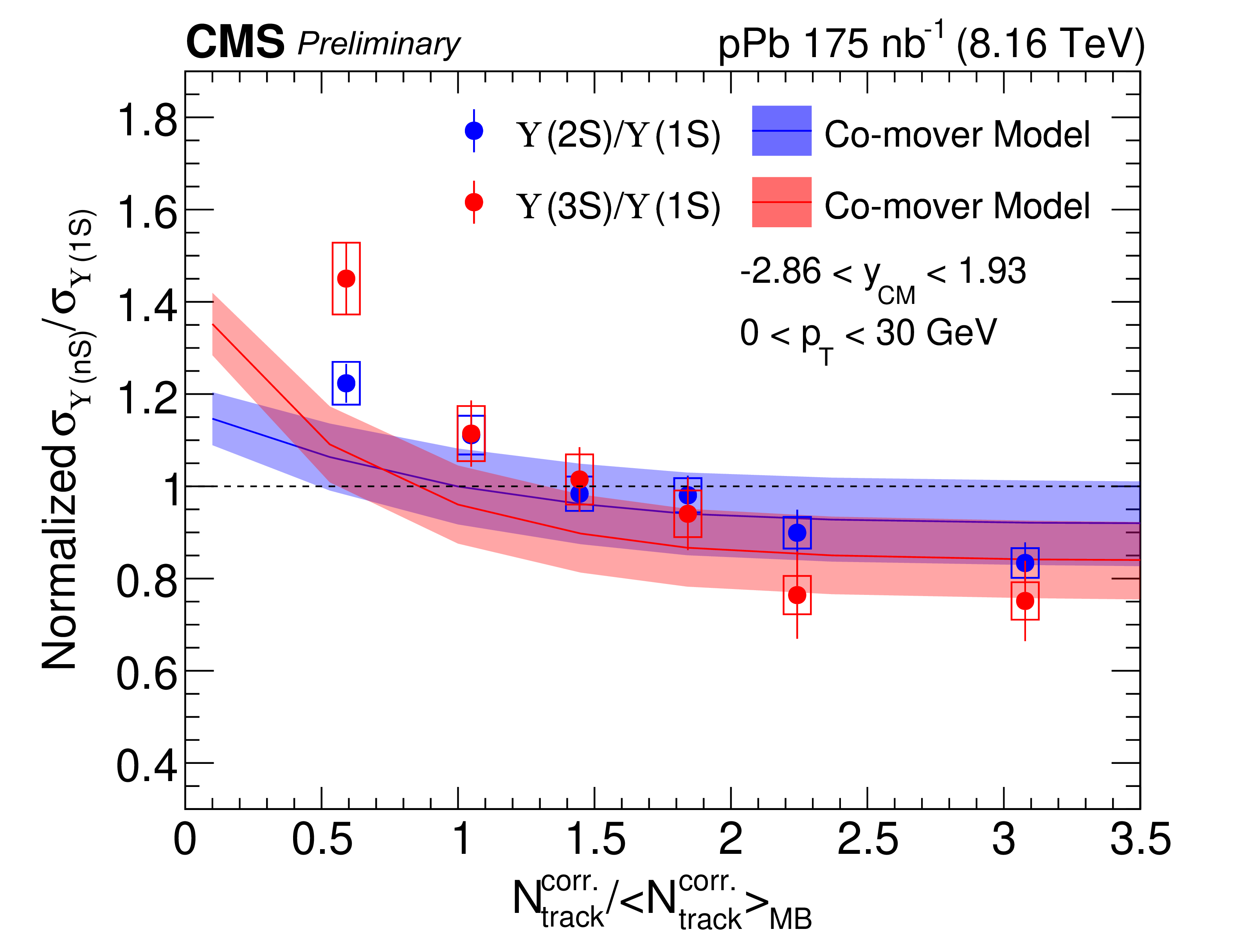
(Left) Normalized $ \Upsilon{\textrm{(2S)}}/\Upsilon{\textrm{(1S)}} $ and $ \Upsilon{\textrm{(3S)}}/\Upsilon{\textrm{(1S)}} $ with respect to normalized charged-particle multiplicity in the rapidity interval $ -2.86 < y_{\mathrm{CM}} < $ 1.93 and 0 $ < p_{T} < $ 30 GeV. The results are compared with a theoretical model incorporating QGP formation [68]. (Right) Normalized $ \Upsilon{\textrm{(2S)}}/\Upsilon{\textrm{(1S)}} $ and $ \Upsilon{\textrm{(3S)}}/\Upsilon{\textrm{(1S)}} $ with respect to normalized charged-particle multiplicity in the rapidity interval $ -2.86 < y_{\mathrm{CM}} < $ 1.93 and 0 $ < p_{T} < $ 30 GeV. The results are compared with a theoretical model incorporating the co-mover effect [70]. |
png pdf |
Figure 10-a:
(Left) Normalized $ \Upsilon{\textrm{(2S)}}/\Upsilon{\textrm{(1S)}} $ and $ \Upsilon{\textrm{(3S)}}/\Upsilon{\textrm{(1S)}} $ with respect to normalized charged-particle multiplicity in the rapidity interval $ -2.86 < y_{\mathrm{CM}} < $ 1.93 and 0 $ < p_{T} < $ 30 GeV. The results are compared with a theoretical model incorporating QGP formation [68]. (Right) Normalized $ \Upsilon{\textrm{(2S)}}/\Upsilon{\textrm{(1S)}} $ and $ \Upsilon{\textrm{(3S)}}/\Upsilon{\textrm{(1S)}} $ with respect to normalized charged-particle multiplicity in the rapidity interval $ -2.86 < y_{\mathrm{CM}} < $ 1.93 and 0 $ < p_{T} < $ 30 GeV. The results are compared with a theoretical model incorporating the co-mover effect [70]. |
png pdf |
Figure 10-b:
(Left) Normalized $ \Upsilon{\textrm{(2S)}}/\Upsilon{\textrm{(1S)}} $ and $ \Upsilon{\textrm{(3S)}}/\Upsilon{\textrm{(1S)}} $ with respect to normalized charged-particle multiplicity in the rapidity interval $ -2.86 < y_{\mathrm{CM}} < $ 1.93 and 0 $ < p_{T} < $ 30 GeV. The results are compared with a theoretical model incorporating QGP formation [68]. (Right) Normalized $ \Upsilon{\textrm{(2S)}}/\Upsilon{\textrm{(1S)}} $ and $ \Upsilon{\textrm{(3S)}}/\Upsilon{\textrm{(1S)}} $ with respect to normalized charged-particle multiplicity in the rapidity interval $ -2.86 < y_{\mathrm{CM}} < $ 1.93 and 0 $ < p_{T} < $ 30 GeV. The results are compared with a theoretical model incorporating the co-mover effect [70]. |
png pdf |
Figure 11:
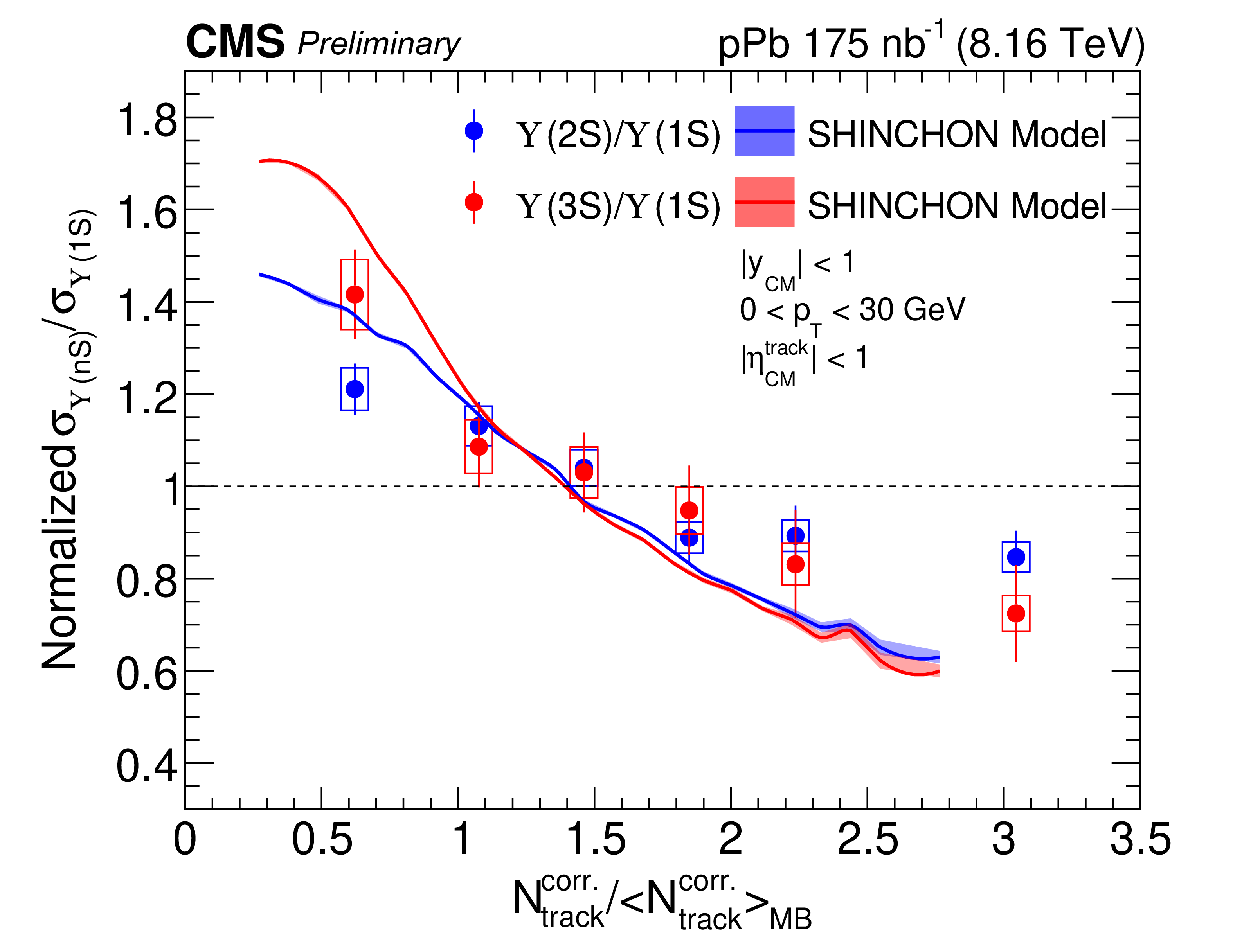
Normalized $ \Upsilon{\textrm{(2S)}}/\Upsilon{\textrm{(1S)}} $ and $ \Upsilon{\textrm{(3S)}}/\Upsilon{\textrm{(1S)}} $ as functions of the normalized charged-particle multiplicity measured in $ |\eta^{\mathrm{track}}_{\mathrm{CM}}| < $ 1, for the kinematic region $ |y_{\mathrm{CM}}| < $ 1 and $ p_{\mathrm{T}} < $ 30 GeV. The results are compared with a MC simulation that incorporates a realistic description of the medium produced in heavy-ion collisions, including event-by-event initial collision geometry and hydrodynamic evolution [97]. |
| Summary |
| Measurements of the relative production of bottomonium in $ \mathrm{p}\text{Pb} $ collisions at a center-of-mass collision energy per nucleon pair of $ \sqrt{\smash[b]{s_{_{\mathrm{NN}}}}} = $ 8.16 TeV have been presented. The relative yield ratios $ \Upsilon{\textrm{(2S)}}/\Upsilon{\textrm{(1S)}} $ and $ \Upsilon{\textrm{(3S)}}/\Upsilon{\textrm{(1S)}} $ are found decrease with increasing event activity. This trend is consistent with earlier pPb measurement at 5.02 TeV, but with substantially improved precision and an extended reach in event activity. Similar conclusions are found when measuring the event activity at forward rapidities, as compared to midrapidities, providing a strong indication that the observed suppression reflects a physical effect rather than an artifact of the activity definition. When compared to other collision systems, the new pPb results bridge the gap between pp and PbPb measurements, establishing a continuous suppression trend from high-multiplicity pp through pPb to peripheral PbPb collisions. No significant difference is observed in the suppression trend when comparing isolated $ \Upsilon $ mesons to those with charged particles nearby, indicating that this effect is tied to the global event environment rather than to local particle activity. Differential studies show no significant additional dependence on rapidity or transverse momentum beyond the global multiplicity trend. The inclusive bottomonium results are found to be consistent, within uncertainties, with the corresponding charmonium measurement, despite the large mass difference between the two quarkonium families. This consistency suggests that similar final-state mechanisms may be responsible for the observed suppression. Altogether, these measurements provide the most precise determination of multiplicity-dependent bottomonium suppression in pPb collisions to date. The precision achieved in this measurement establishes a stringent benchmark for future theoretical efforts to constrain quarkonium production and hadronization dynamics in small collision systems. |
| References | ||||
| 1 | W. Busza, K. Rajagopal, and W. van der Schee | Heavy ion collisions: The big picture, and the big questions | Ann. Rev. Nucl. Part. Sci. 68 (2018) 339 | 1802.04801 |
| 2 | CMS Collaboration | Overview of high-density QCD studies with the CMS experiment at the LHC | Phys. Rep. 1115 (2025) 219 | CMS-HIN-23-011 2405.10785 |
| 3 | ALICE Collaboration | The ALICE experiment: A journey through QCD | EPJC 84 (2024) 813 | 2211.04384 |
| 4 | G. T. Bodwin, E. Braaten, and G. P. Lepage | Rigorous QCD analysis of inclusive annihilation and production of heavy quarkonium | PRD 51 (1995) 1125 | hep-ph/9407339 |
| 5 | T. Matsui and H. Satz | $ {\mathrm{J}/\psi} $ suppression by quark-gluon plasma formation | PLB 178 (1986) 416 | |
| 6 | F. Karsch, M. T. Mehr, and H. Satz | Color screening and deconfinement for bound states of heavy quarks | Z. Phys. C 37 (1988) 617 | |
| 7 | D. Kharzeev and H. Satz | Quarkonium interactions in hadronic matter | PLB 334 (1994) 155 | hep-ph/9405414 |
| 8 | M. Laine, O. Philipsen, P. Romatschke, and M. Tassler | Real-time static potential in hot QCD | JHEP 03 (2007) 054 | hep-ph/0611300 |
| 9 | N. Brambilla, J. Ghiglieri, A. Vairo, and P. Petreczky | Static quark-antiquark pairs at finite temperature | PRD 78 (2008) 014017 | 0804.0993 |
| 10 | N. Brambilla et al. | Heavy quarkonium in a weakly-coupled quark-gluon plasma below the melting temperature | JHEP 09 (2010) 038 | 1007.4156 |
| 11 | J.-P. Blaizot, D. De Boni, P. Faccioli, and G. Garberoglio | Heavy quark bound states in a quark-gluon plasma: Dissociation and recombination | Nucl. Phys. A 946 (2016) 49 | 1503.03857 |
| 12 | H. van Hees, V. Greco, and R. Rapp | Heavy-quark probes of the quark-gluon plasma at RHIC | Phys. Rev. C 73 (2006) 034913 | nucl-th/0508055 |
| 13 | F. Gross et al. | 50 Years of Quantum Chromodynamics | EPJC 83 (2023) 1125 | 2212.11107 |
| 14 | A. Mocsy, P. Petreczky, and M. Strickland | Quarkonia in the Quark Gluon Plasma | Int. J. Mod. Phys. A 28 (2013) 1340012 | 1302.2180 |
| 15 | A. Andronic et al. | Heavy-flavour and quarkonium production in the LHC era: from proton-proton to heavy-ion collisions | EPJC 76 (2016) 107 | 1506.03981 |
| 16 | A. Beraudo, J. P. Blaizot, and C. Ratti | Real and imaginary-time $ Q\bar{Q} $ correlators in a thermal medium | Nucl. Phys. A 806 (2008) 312 | 0712.4394 |
| 17 | M. A. Escobedo and J. Soto | Non-relativistic bound states at finite temperature (I): The Hydrogen atom | Phys. Rev. A 78 (2008) 032520 | 0804.0691 |
| 18 | A. Dumitru, Y. Guo, and M. Strickland | The Imaginary part of the static gluon propagator in an anisotropic (viscous) QCD plasma | PRD 79 (2009) 114003 | 0903.4703 |
| 19 | M. Margotta et al. | Quarkonium states in a complex-valued potential | PRD 83 (2011) 105019 | 1101.4651 |
| 20 | N. Brambilla, M. A. Escobedo, J. Ghiglieri, and A. Vairo | Thermal width and gluo-dissociation of quarkonium in pNRQCD | JHEP 12 (2011) 116 | 1109.5826 |
| 21 | N. Brambilla, M. A. Escobedo, J. Ghiglieri, and A. Vairo | Thermal width and quarkonium dissociation by inelastic parton scattering | JHEP 05 (2013) 130 | 1303.6097 |
| 22 | R. Larsen, S. Meinel, S. Mukherjee, and P. Petreczky | Thermal broadening of bottomonia: Lattice nonrelativistic QCD with extended operators | PRD 100 (2019) 074506 | 1908.08437 |
| 23 | HotQCD Collaboration | Static quark-antiquark interactions at nonzero temperature from lattice QCD | PRD 105 (2022) 054513 | 2110.11659 |
| 24 | N. Brambilla et al. | Bottomonium production in heavy-ion collisions using quantum trajectories: Differential observables and momentum anisotropy | PRD 104 (2021) 094049 | 2107.06222 |
| 25 | X. Yao et al. | Coupled Boltzmann transport equations of heavy quarks and quarkonia in quark-gluon plasma | JHEP 01 (2021) 046 | 2004.06746 |
| 26 | X. Du, M. He, and R. Rapp | Color screening and regeneration of bottomonia in high-energy heavy-ion collisions | Phys. Rev. C 96 (2017) 054901 | 1706.08670 |
| 27 | R. L. Thews, M. Schroedter, and J. Rafelski | Enhanced $ \text{J}/\psi $ production in deconfined quark matter | Phys. Rev. C 63 (2001) 054905 | hep-ph/0007323 |
| 28 | P. Braun-Munzinger and J. Stachel | (Non)thermal aspects of charmonium production and a new look at $ \text{J}/\psi $ suppression | PLB 490 (2000) 196 | nucl-th/0007059 |
| 29 | N. Brambilla, M. A. Escobedo, J. Soto, and A. Vairo | Quarkonium suppression in heavy-ion collisions: An open quantum system approach | PRD 96 (2017) 034021 | 1612.07248 |
| 30 | A. Emerick, X. Zhao, and R. Rapp | Bottomonia in the quark-gluon plasma and their production at RHIC and LHC | Eur. Phys. J. A 48 (2012) 72 | 1111.6537 |
| 31 | NA38 Collaboration | $ \psi^{\prime} $ and $ \text{J}/\psi $ production in p--W, p--U and S--U interactions at 200 GeV/nucleon | PLB 345 (1995) 617 | |
| 32 | NA50 Collaboration | $ \text{J}/\psi $ and $ \psi^{\prime} $ production and their normal nuclear absorption in proton-nucleus collisions at 400 GeV | EPJC 48 (2006) 329 | nucl-ex/0612012 |
| 33 | NA50 Collaboration | Charmonium production and nuclear absorption in p-A interactions at 450 GeV | EPJC 33 (2004) 31 | |
| 34 | NA51 Collaboration | $ \text{J}/\psi $, $ \psi^{\prime} $ and Drell-Yan production in pp and pd interactions at 450 GeV/c | PLB 438 (1998) 35 | |
| 35 | NA60 Collaboration | $ \text{J}/\psi $ production in proton-nucleus collisions at 158 and 400 GeV | PLB 706 (2012) 263 | 1004.5523 |
| 36 | D. M. Alde et al. | $ A $ dependence of $ \text{J}/\psi $ and $ \psi^{\prime} $ production at 800 GeV/c | PRL 66 (1991) 133 | |
| 37 | NuSea Collaboration | Measurement of $ \text{J}/\psi $ and $ \psi^{\prime} $ suppression in p--A collisions at 800 GeV/c | PRL 84 (2000) 3256 | nucl-ex/9909007 |
| 38 | SeaQuest Collaboration | Measurement of $ \text{J}/\psi $ and $ \psi $ (2S) production in $ {\mathrm{p}}+{\mathrm{p}} $ and $ {\mathrm{p}}+\mathrm{d} $ interactions at 120 GeV | PLB 858 (2024) 139032 | 2406.11459 |
| 39 | HERA-B Collaboration | Kinematic distributions and nuclear effects of $ \text{J}/\psi $ production in 920 GeV fixed-target proton-nucleus collisions | EPJC 60 (2009) 525 | 0812.0734 |
| 40 | PHENIX Collaboration | Measurement of $ \text{J}/\psi $ at forward and backward rapidity in $ {\mathrm{p}}+{\mathrm{p}} $, $ {\mathrm{p}}+\mathrm{Al} $, $ {\mathrm{p}}+\mathrm{Au} $, and $ ^{3}\mathrm{He}+\mathrm{Au} $ collisions at $ \sqrt{\smash[b]{s_{_{\mathrm{NN}}}}}= $ 200 GeV | Phys. Rev. C 102 (2020) 014902 | 1910.14487 |
| 41 | PHENIX Collaboration | Measurement of $ \psi(2S) $ nuclear modification at backward and forward rapidity in $ \mathrm{p}+\mathrm{p} $, $ \mathrm{p}+\mathrm{Al} $, and $ \mathrm{p}+\mathrm{Au} $ collisions at $ \sqrt{\smash[b]{s_{_{\mathrm{NN}}}}}= $ 200 GeV | Phys. Rev. C 105 (2022) 064912 | 2202.03863 |
| 42 | STAR Collaboration | Measurement of cold nuclear matter effects for inclusive $ \text{J}/\psi $ in $ {\mathrm{p}}+\mathrm{Au} $ collisions at $ \sqrt{\smash[b]{s_{_{\mathrm{NN}}}}}= $ 200 GeV | PLB 825 (2022) 136865 | 2110.09666 |
| 43 | PHENIX Collaboration | Multiplicity dependent $ \text{J}/\psi $ and $ \psi $ (2S) production at forward and backward rapidity in $ {\mathrm{p}}+{\mathrm{p}} $ collisions at $ \sqrt{s}= $ 200 GeV | Phys. Rev. D. (to be published), 2024 | 2409.03728 |
| 44 | CMS Collaboration | Measurement of prompt $ \psi(2S) \to \mathrm{J}/\psi $ yield ratios in Pb-Pb and $ \mathrm{p}-\mathrm{p} $ collisions at $ \sqrt{\smash[b]{s_{_{\mathrm{NN}}}}} = $ 2.76 TeV | PRL 113 (2014) 262301 | CMS-HIN-12-007 1410.1804 |
| 45 | CMS Collaboration | Relative modification of prompt \ensuremath\psi(2S) and $ {\mathrm{J}/\psi} $ yields from pp to PbPb collisions at $ \sqrt{\smash[b]{s_{_{\mathrm{NN}}}}}= $ 5.02 TeV | PRL 118 (2017) 162301 | CMS-HIN-16-004 1611.01438 |
| 46 | CMS Collaboration | Nuclear modification of $ \Upsilon $ states in pPb collisions at $ \sqrt{\smash[b]{s_{_{\mathrm{NN}}}}} = $ 5.02 TeV | PLB 835 (2022) 137397 | CMS-HIN-18-005 2202.11807 |
| 47 | CMS Collaboration | Measurement of prompt $ \psi $(2S) production cross sections in proton-lead and proton-proton collisions at $ \sqrt{\smash[b]{s_{_{\mathrm{NN}}}}}= $ 5.02 TeV | PLB 790 (2019) 509 | CMS-HIN-16-015 1805.02248 |
| 48 | CMS Collaboration | Event Activity Dependence of Y(nS) Production in $ \sqrt{\smash[b]{s_{_{\mathrm{NN}}}}} = $ 5.02 TeV pPb and $ \sqrt{s} = $ 2.76 TeV pp Collisions | JHEP 04 (2014) 103 | CMS-HIN-13-003 1312.6300 |
| 49 | CMS Collaboration | Investigation into the event-activity dependence of $ \Upsilon(nS) $ relative production in proton-proton collisions at $ \sqrt{s} = $ 7 TeV | JHEP 11 (2020) 001 | CMS-BPH-14-009 2007.04277 |
| 50 | LHCb Collaboration | Study of $ \Upsilon $ production in $ \mathrm{p} $Pb collisions at $ \sqrt{\smash[b]{s_{_{\mathrm{NN}}}}}= $ 8.16 TeV | JHEP 11 (2018) 194 | 1810.07655 |
| 51 | LHCb Collaboration | Study of $ \psi(2S) $ production and cold nuclear matter effects in pPb collisions at $ \sqrt{\smash[b]{s_{_{\mathrm{NN}}}}} = $ 5 TeV | JHEP 03 (2016) 133 | 1601.07878 |
| 52 | ALICE Collaboration | $ \Upsilon $ production in p--Pb and Pb--Pb collisions with ALICE at the LHC | Nucl. Part. Phys. Proc. 289 (2017) 397 | 1612.06691 |
| 53 | ALICE Collaboration | Measurement of nuclear effects on $ \psi\rm{(2S)} $ production in p-Pb collisions at $ \sqrt{\smash[b]{s_{_{\mathrm{NN}}}}} = $ 8.16 TeV | JHEP 07 (2020) 237 | 2003.06053 |
| 54 | ATLAS Collaboration | Measurement of quarkonium production in proton-lead and proton-proton collisions at 5.02 $ \mathrm {TeV} $ with the ATLAS detector | EPJC 78 (2018) 171 | 1709.03089 |
| 55 | LHCb Collaboration | Prompt and nonprompt $ \text{J}/\psi $ production and nuclear modification in $ \mathrm{p} $Pb collisions at $ \sqrt{\smash[b]{s_{_{\mathrm{NN}}}}}= $ 8.16 TeV | PLB 774 (2017) 159 | 1706.07122 |
| 56 | H. Khanpour and S. Atashbar Tehrani | Global analysis of nuclear parton distribution functions and their uncertainties at next-to-next-to-leading order | PRD 93 (2016) 014026 | 1601.00939 |
| 57 | F. Arleo and S. Peigné | Quarkonium suppression in heavy-ion collisions from coherent energy loss in cold nuclear matter | JHEP 10 (2014) 073 | 1407.5054 |
| 58 | F. Arleo, R. Kolevatov, S. Peign é , and M. Rustamova | Centrality and $ p_{\perp} $ dependence of $ {\mathrm{J}/\psi} $ suppression in proton-nucleus collisions from parton energy loss | JHEP 05 (2013) 155 | 1304.0901 |
| 59 | F. Arleo and S. Peigne | Heavy-quarkonium suppression in p-A collisions from parton energy loss in cold QCD matter | JHEP 03 (2013) 122 | 1212.0434 |
| 60 | J. L. Nagle and W. A. Zajc | Small system collectivity in relativistic hadronic and nuclear collisions | Annu. Rev. Nucl. Part. Sci. 68 (2018) 211 | 1801.03477 |
| 61 | J. F. Grosse-Oetringhaus and U. A. Wiedemann | A decade of collectivity in small systems | 2407.07484 | |
| 62 | PHENIX Collaboration | Creation of quark-gluon plasma droplets with three distinct geometries | Nat. Phys. 15 (2019) 214 | 1805.02973 |
| 63 | E. G. Ferreiro | Charmonium dissociation and recombination at LHC: Revisiting comovers | PLB 731 (2014) 57 | 1210.3209 |
| 64 | E. G. Ferreiro | Excited charmonium suppression in proton-nucleus collisions as a consequence of comovers | PLB 749 (2015) 98 | 1411.0549 |
| 65 | X. Du and R. Rapp | In-medium charmonium production in proton-nucleus collisions | JHEP 03 (2019) 015 | 1808.10014 |
| 66 | L. Wen and B. Chen | Bottomonium sequential suppression and strong heavy-quark potential in heavy-ion collisions | PLB 839 (2023) 137774 | 2208.10050 |
| 67 | L. Wen, X. Du, S. Shi, and B. Chen | Investigating color screening in proton-nucleus collisions with complex potentials | Chin. Phys. C 46 (2022) 114102 | 2205.07520 |
| 68 | Y. Bai and B. Chen | Probing QGP droplets with charmonium in high-multiplicity proton-proton collisions | no. 11, 1193, 2024 EPJC 84 (2024) |
2407.10566 |
| 69 | S. Gavin and R. Vogt | Charmonium suppression by comover scattering in Pb + Pb collisions | PRL 78 (1997) 1006 | hep-ph/9606460 |
| 70 | E. G. Ferreiro and J.-P. Lansberg | Is bottomonium suppression in proton-nucleus and nucleus-nucleus collisions at LHC energies due to the same effects? | JHEP 10 (2018) 094 | 1804.04474 |
| 71 | LHCb Collaboration | Multiplicity dependence of $ \sigma_{\psi(2S)}/\sigma_{\mathrm{J}/\psi} $ in pp collisions at $ \sqrt{s}= $ 13 TeV | 2312.15201 | |
| 72 | ALICE Collaboration | Measurement of $ \psi $(2S) production as a function of charged-particle pseudorapidity density in pp collisions at $ \sqrt{s} = $ 13 TeV and p-Pb collisions at $ \sqrt{\smash[b]{s_{_{\mathrm{NN}}}}} = $ 8.16 TeV with ALICE at the LHC | JHEP 06 (2023) 147 | 2204.10253 |
| 73 | LHCb Collaboration | Prompt and nonprompt $ \psi $ (2S) production in $ \mathrm{p} $Pb collisions at $ \sqrt{\smash[b]{s_{_{\mathrm{NN}}}}}= $ 8.16 TeV | JHEP 04 (2024) 111 | 2401.11342 |
| 74 | CMS Collaboration | Performance of the CMS Level-1 trigger in proton-proton collisions at $ \sqrt{s} = $ 13 TeV | JINST 15 (2020) P10017 | CMS-TRG-17-001 2006.10165 |
| 75 | CMS Collaboration | The CMS trigger system | JINST 12 (2017) P01020 | CMS-TRG-12-001 1609.02366 |
| 76 | CMS Collaboration | The CMS experiment at the CERN LHC | JINST 3 (2008) S08004 | |
| 77 | CMS Collaboration | CMS luminosity measurement using 2016 proton-nucleus collisions at nucleon-nucleon center-of-mass energy of 8.16 TeV | CMS Physics Analysis Summary, CERN, 2018 link |
CMS-PAS-LUM-17-002 |
| 78 | CMS Collaboration | Precision luminosity measurement in proton-proton collisions at $ \sqrt{s} = $ 13 TeV in 2015 and 2016 at CMS | EPJC 81 (2021) 800 | CMS-LUM-17-003 2104.01927 |
| 79 | CMS Collaboration | Pseudorapidity distributions of charged hadrons in proton-lead collisions at $ {\sqrt{\smash[b]{s_{_{\mathrm{NN}}}}}}= $ 5.02 and 8.16 TeV | JHEP 01 (2018) 45 | CMS-HIN-16-021 1710.09355 |
| 80 | CMS Collaboration | Description and performance of track and primary-vertex reconstruction with the CMS tracker | JINST 9 (2014) P10009 | CMS-TRK-11-001 1405.6569 |
| 81 | CMS Collaboration | Constraints on the chiral magnetic effect using charge-dependent azimuthal correlations in $ \mathrm{p}\mathrm{Pb} $ and PbPb collisions at the CERN Large Hadron Collider | Phys. Rev. C 97 (2018) 044912 | CMS-HIN-17-001 1708.01602 |
| 82 | CMS Collaboration | Observation of correlated azimuthal anisotropy fourier harmonics in pp and $ \mathrm{p}+\mathrm{Pb} $ collisions at the LHC | PRL 120 (2018) 092301 | CMS-HIN-16-022 1709.09189 |
| 83 | C. Bierlich et al. | A comprehensive guide to the physics and usage of PYTHIA 8.3 | SciPost Phys. Codeb. 2022 (2022) 8 | 2203.11601 |
| 84 | CMS Collaboration | Event generator tunes obtained from underlying event and multiparton scattering measurements | EPJC 76 (2016) 155 | CMS-GEN-14-001 1512.00815 |
| 85 | T. Pierog et al. | EPOS LHC: Test of collective hadronization with data measured at the CERN Large Hadron Collider | Phys. Rev. C 92 (2015) 034906 | 1306.0121 |
| 86 | GEANT4 Collaboration | GEANT 4---a simulation toolkit | NIM A 506 (2003) 250 | |
| 87 | CMS Collaboration | Performance of CMS muon reconstruction in pp collision events at $ {\sqrt{\smash[b]{s_{_{\mathrm{NN}}}}}}= $ 7 TeV | JINST 7 (2012) P10002 | CMS-MUO-10-004 1206.4071 |
| 88 | CMS Collaboration | Performance of the CMS muon detector and muon reconstruction with proton-proton collisions at $ {\sqrt{s}=13} $ TeV | JINST 13 (2018) P06015 | CMS-MUO-16-001 1804.04528 |
| 89 | R. E. Kalman | A new approach to linear filtering and prediction problems | J. Basic Eng. D 82 (1960) 35 | |
| 90 | M. J. Oreglia | A study of the reactions $ \psi^{\prime} \to \gamma \gamma \psi $ | PhD thesis, Stanford University, SLAC Report SLAC-R-236, 1980 link |
|
| 91 | Particle Data Group Collaboration | Review of particle physics | PRD 110 (2024) 030001 | |
| 92 | CMS Collaboration | Measurement of the inclusive W and Z production cross sections in pp collisions at $ \sqrt{s}= $ 7 TeV | JHEP 10 (2011) 132 | CMS-EWK-10-005 1107.4789 |
| 93 | CMS Collaboration | Performance of CMS muon reconstruction from proton-proton to heavy ion collisions | JINST 19 (2024) P09012 | CMS-MUO-21-001 2404.17377 |
| 94 | CMS Collaboration | Observation of the $ \Upsilon(3S) $ Meson and Suppression of $ \Upsilon $ States in Pb--Pb Collisions at $ \sqrt{\smash[b]{s_{_{\mathrm{NN}}}}}= $ 5.02 TeV | no. 2, 022302, 2024 PRL 133 (2024) |
CMS-HIN-21-007 2303.17026 |
| 95 | CMS Collaboration | Observation of the charged-particle multiplicity dependence of $ \sigma_{\psi(\mathrm{2S})}/\sigma_{\mathrm{J}/\psi} $ in pPb collisions at $ \sqrt{\smash[b]{s_{_{\mathrm{NN}}}}}= $ 8.16 TeV | no. 9, 092301, 2025 PRL 135 (2025) |
CMS-HIN-24-001 2503.02139 |
| 96 | LHCb Collaboration | Measurement of \ensuremath\psi(2S) to $ {\mathrm{J}/\psi} $ cross-section ratio as function of multiplicity in pPb collisions at $ \sqrt{\smash[b]{s_{_{\mathrm{NN}}}}}= $ 8.16 TeV | JHEP 11 (2025) 169 | 2506.08624 |
| 97 | J. Kim et al. | Model study on \ensuremath\Upsilon(nS) modification in small collision systems | no. 5, 054905, 2023 Phys. Rev. C 107 (2023) |
2209.12303 |
|
|
Compact Muon Solenoid LHC, CERN |

|
|
|
|
|
|