
Compact Muon Solenoid
LHC, CERN
 Visit us: CMS Public Website, CMS Physics ;
Contact us: CMS Publications Committee
Visit us: CMS Public Website, CMS Physics ;
Contact us: CMS Publications Committee
| CMS-PAS-SUS-24-008 | ||
| Search for exotic decays of the Higgs boson into a pair of light bosons with two b jets and two photons in the final state with full Run 2 dataset at 13 TeV | ||
| CMS Collaboration | ||
| 2026-05-31 | ||
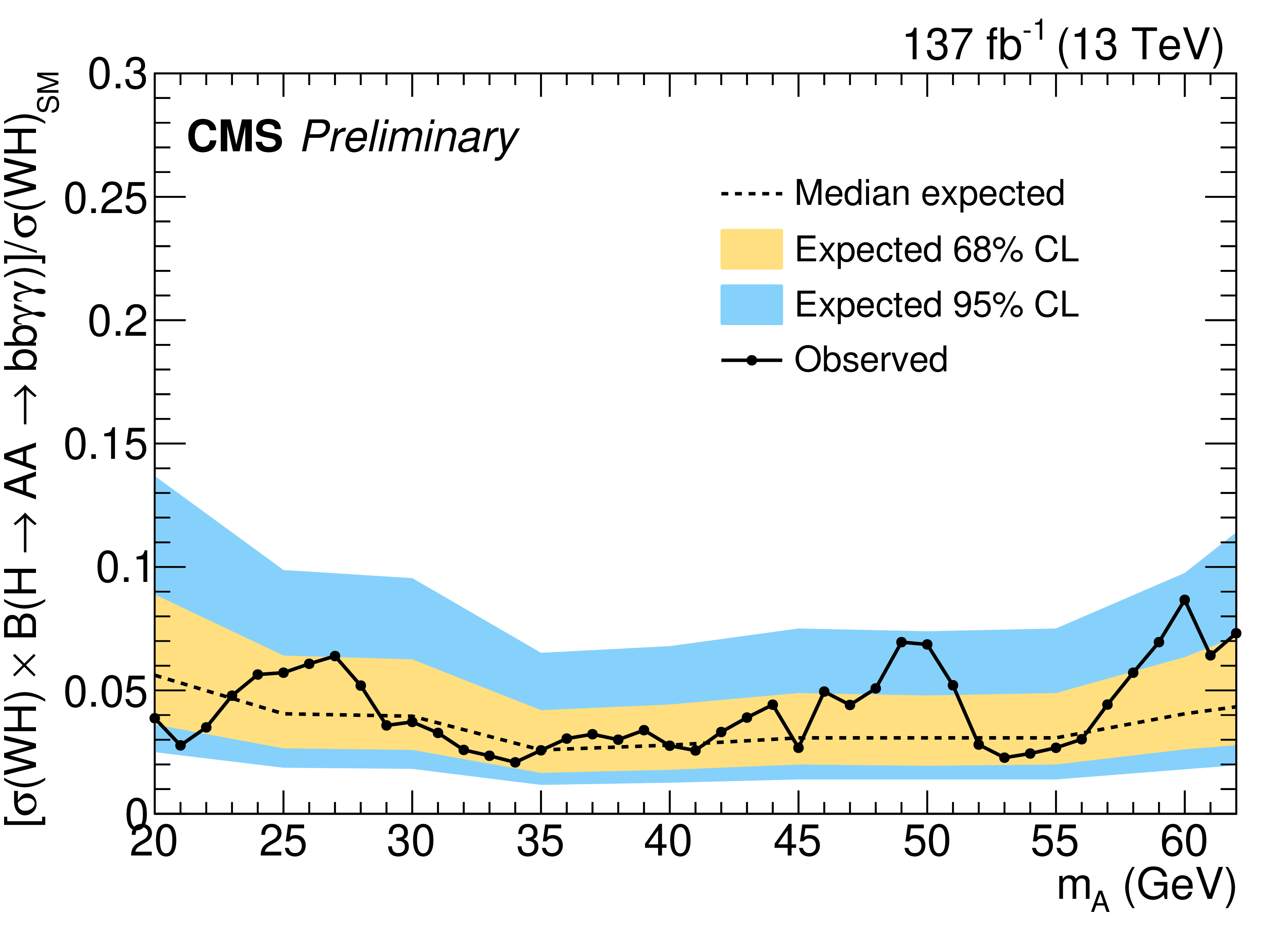
| Abstract: A search is presented for the exotic decay of the Standard Model Higgs boson into a pair of light bosons (A) in the mass range 20--62 GeV, which decay into a pair of b quarks and a pair of photons, respectively. The analysis is based on the full Run 2 dataset recorded with the CMS detector at a center-of-mass energy of 13 TeV corresponding to an integrated luminosity of 137 $ \text{fb}^{-1} $. The search is performed in the VH (V=W/Z boson) production channel of the Higgs boson. No significant deviation from the standard model expectation is observed. Hence, model independent upper limits at 95 percent Confidence Level are set on the branching fraction $ \mathcal{B}(\text{H} \rightarrow \text{AA} \rightarrow \text{bb}\gamma\gamma) $ for the WH and ZH channels separately, in the leptonic decay modes of the vector bosons, as well as for their statistical combination. The observed (expected) upper limits on the $ \mathcal{B}(\text{H} \rightarrow \text{AA} \rightarrow \text{bb}\gamma\gamma) $ for the WH channel range from 0.04 (0.06) for $ m_{\text{A}} = $ 20 GeV to 0.07 (0.04) for $ m_{\text{A}} = $ 62 GeV. The upper limits presented for the combined channel are found to be dominated by the WH one. | ||
| Links: CDS record (PDF) ; CADI line (restricted) ; | ||
| Figures | |
png pdf |
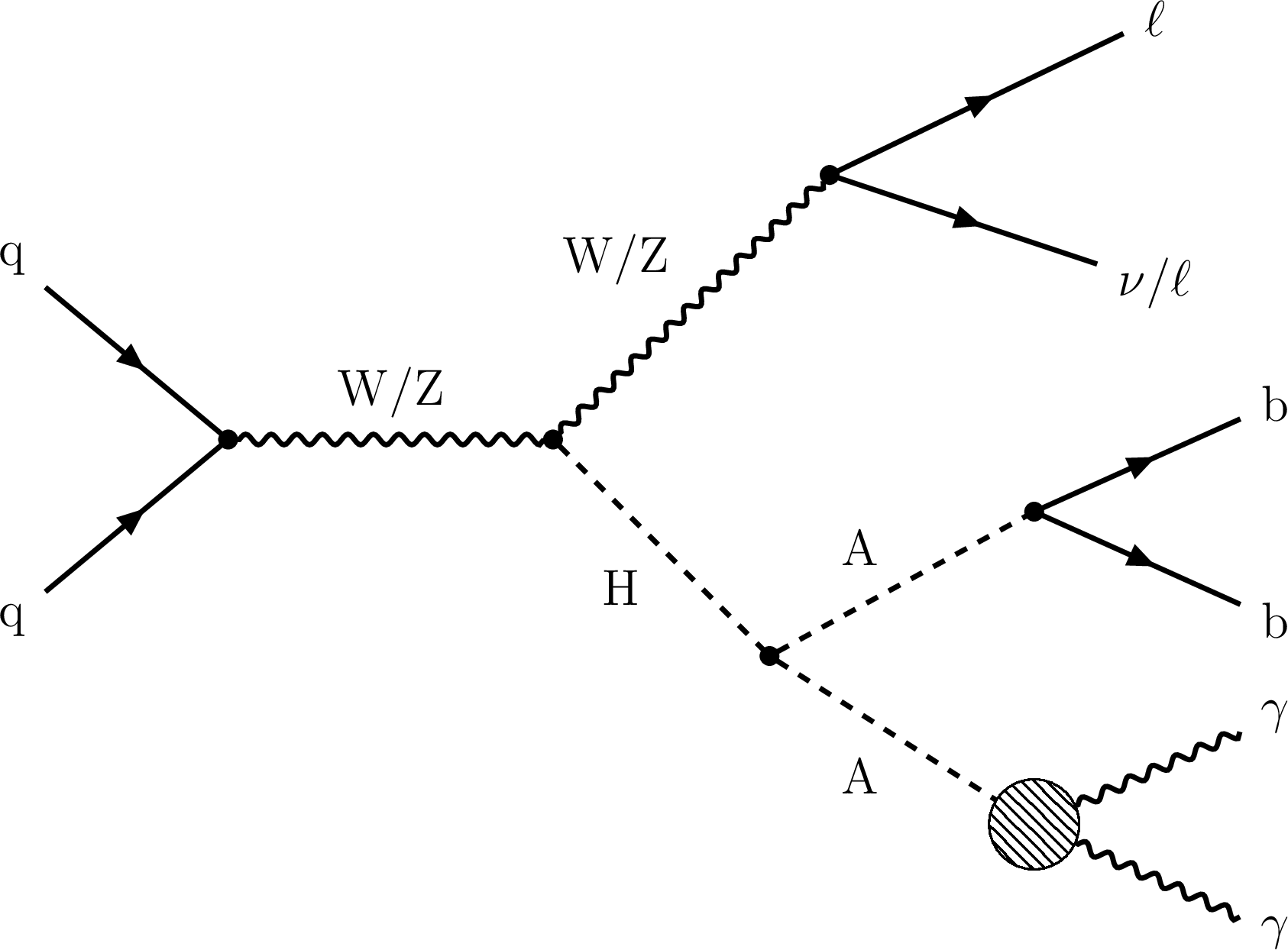
Figure 1:
Schematic diagram of the signal topology. Here `$ \ell $' can be either `$ e $', `$ \mu $' or `$ \tau $'. |
png pdf |
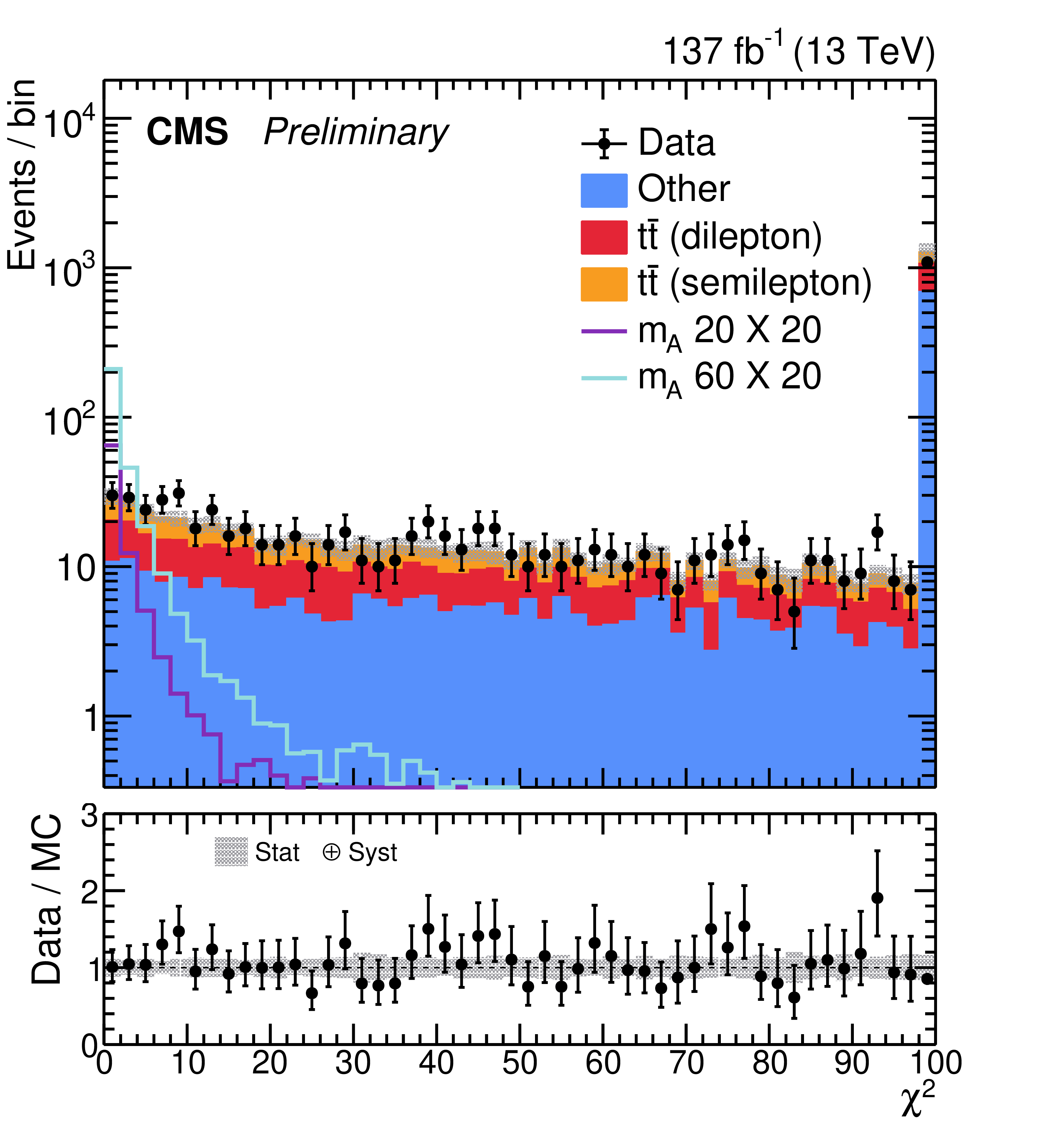
Figure 2:
The $ \chi^2 $ distribution for the WH channel, combining the electron and muon channels across all three years of Run 2. The last bin includes the overflow. The simulated background processes include $ {\mathrm{t}\overline{\mathrm{t}}} $ (semileptonic and dileptonic decays), while contributions from other SM processes such as $ {\mathrm{t}\overline{\mathrm{t}}} +\gamma+\text{jets} $ and DY are grouped together and denoted as ``Other'', as shown in the legend. The data are represented by black points. Distributions for $ m_{A} = 20 \text{GeV} (\times20) $ and $ m_{A} = 60 \text{GeV} (\times20) $ signal hypotheses are overlaid. The gray band corresponds to the total uncertainty in the simulated samples, while the vertical bars on the data points indicate the statistical uncertainty of the data. |
png pdf |
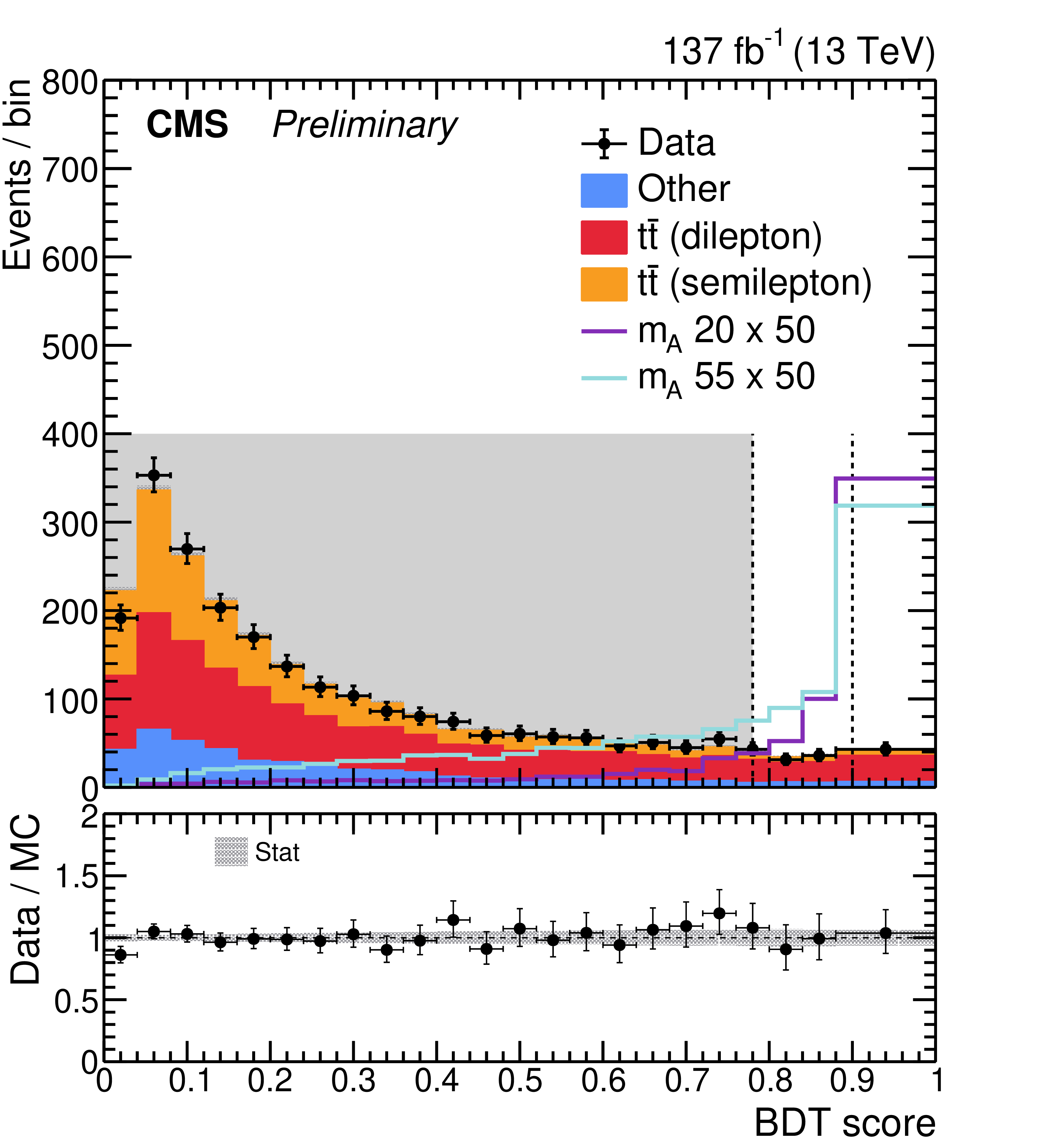
Figure 3:
The BDT score distribution for the WH channel, combining the electron and muon channels across all three years of Run 2. The simulated background processes include $ {\mathrm{t}\overline{\mathrm{t}}} $ (semileptonic and dileptonic decays), while contributions from other SM processes such as $ {\mathrm{t}\overline{\mathrm{t}}} +\gamma+\text{jets} $ and DY are grouped together and denoted as ``Other'', as shown in the legend. The data are represented by black points. Distributions for $ m_{A} = 20 \text{GeV} (\times50) $ and $ m_{A} = 55 \text{GeV} (\times50) $ signal hypotheses are overlaid. The gray band corresponds to the statistical uncertainty in the simulated samples, while the vertical bars on the data points indicate the statistical uncertainty of the data. The shaded region denotes the control region (CR), and the two vertical dashed lines indicate the BDT score boundaries that define the two analysis categories. |
png pdf |
Figure 4:
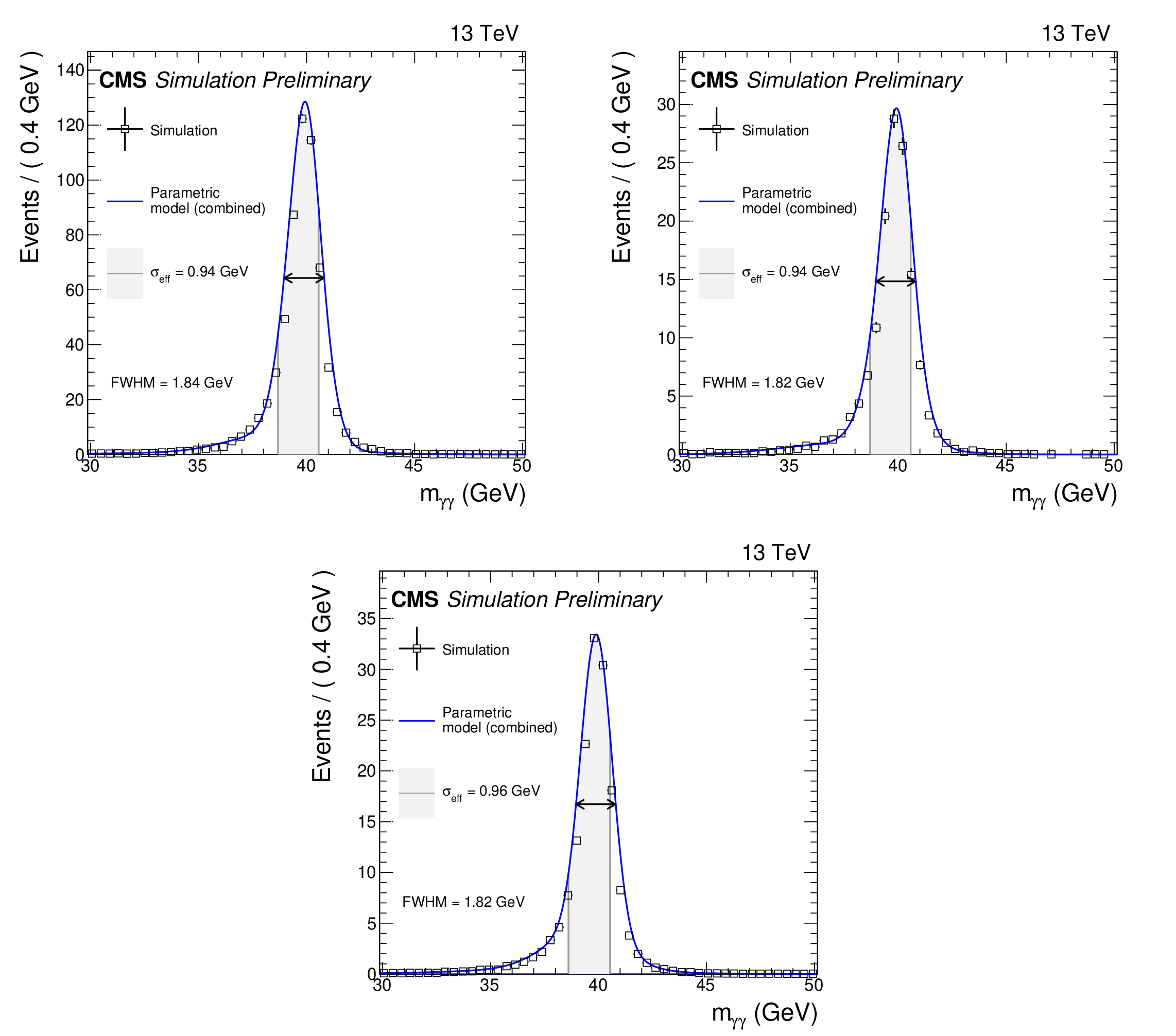
The signal models for the $ m_{\text{A}} = $ 40 GeV mass hypothesis in the most significant (upper left) and least significant (upper right) categories of the WH channel, and for the ZH channel (lower). The effective standard deviation ($ \sigma_{\text{eff}} $), defined as half of the smallest interval that contains 68.3% of the invariant mass distribution, is provided for each model. |
png pdf |
Figure 4-a:
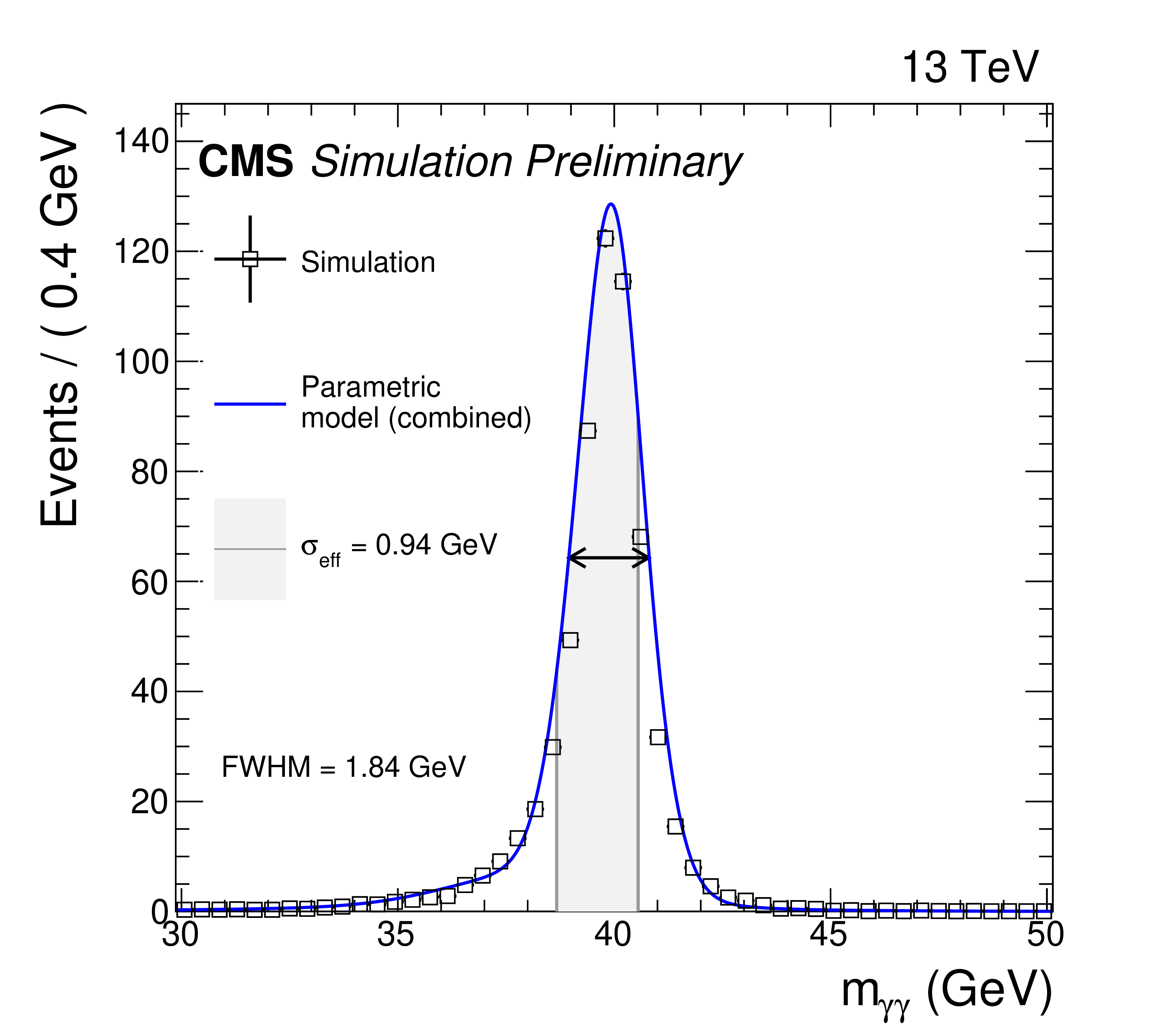
The signal models for the $ m_{\text{A}} = $ 40 GeV mass hypothesis in the most significant (upper left) and least significant (upper right) categories of the WH channel, and for the ZH channel (lower). The effective standard deviation ($ \sigma_{\text{eff}} $), defined as half of the smallest interval that contains 68.3% of the invariant mass distribution, is provided for each model. |
png pdf |
Figure 4-b:
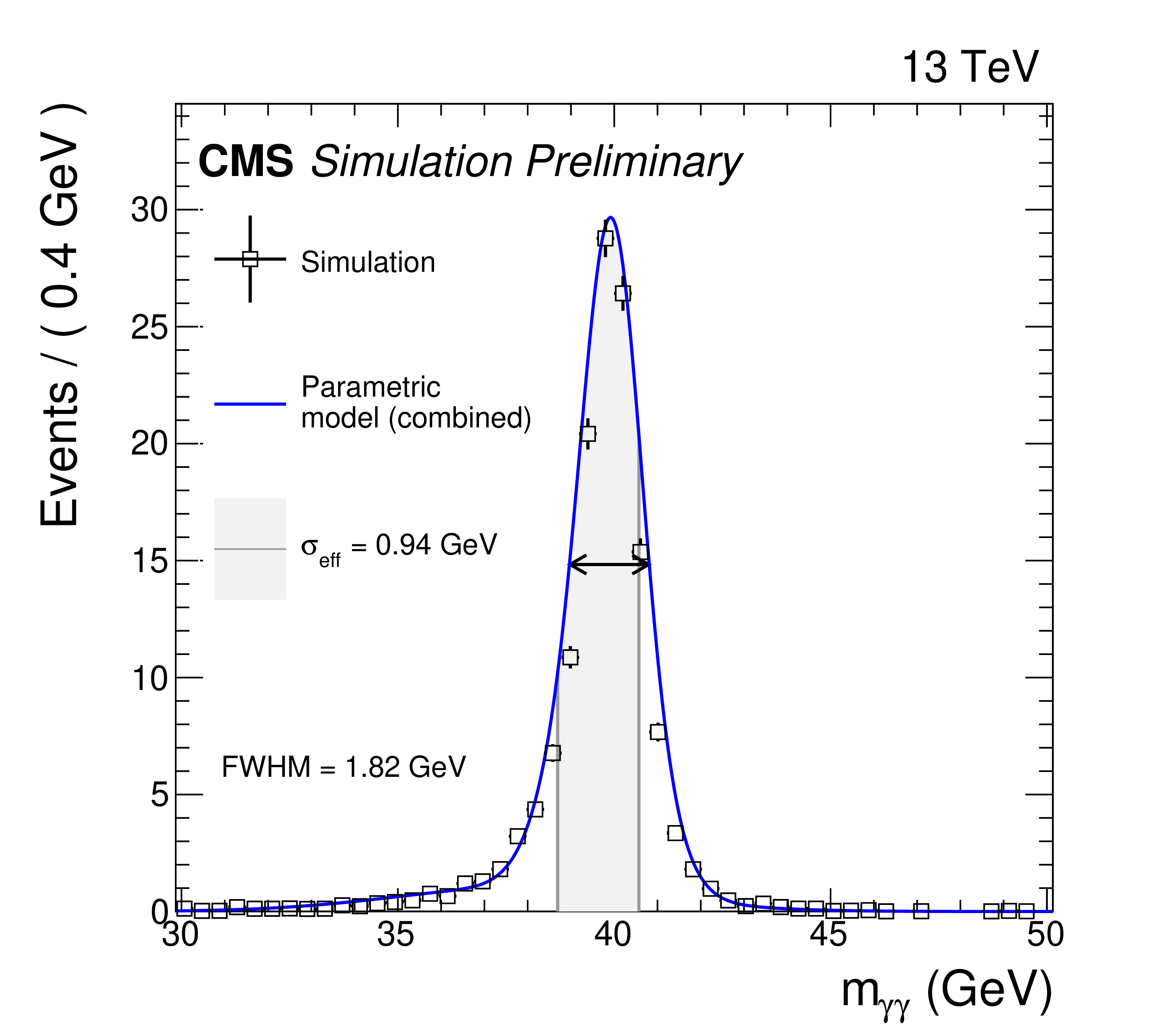
The signal models for the $ m_{\text{A}} = $ 40 GeV mass hypothesis in the most significant (upper left) and least significant (upper right) categories of the WH channel, and for the ZH channel (lower). The effective standard deviation ($ \sigma_{\text{eff}} $), defined as half of the smallest interval that contains 68.3% of the invariant mass distribution, is provided for each model. |
png pdf |
Figure 4-c:
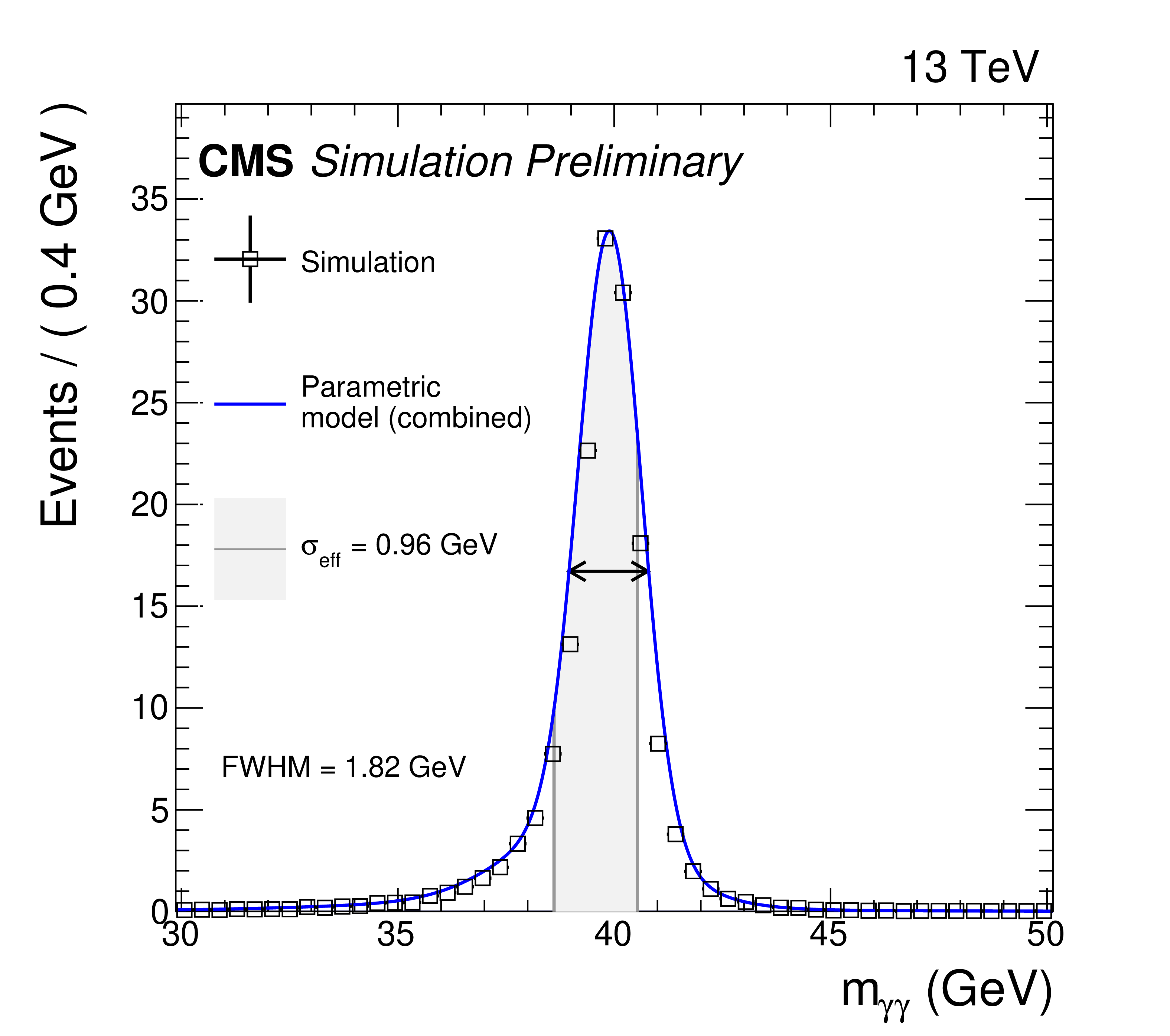
The signal models for the $ m_{\text{A}} = $ 40 GeV mass hypothesis in the most significant (upper left) and least significant (upper right) categories of the WH channel, and for the ZH channel (lower). The effective standard deviation ($ \sigma_{\text{eff}} $), defined as half of the smallest interval that contains 68.3% of the invariant mass distribution, is provided for each model. |
png pdf |
Figure 5:
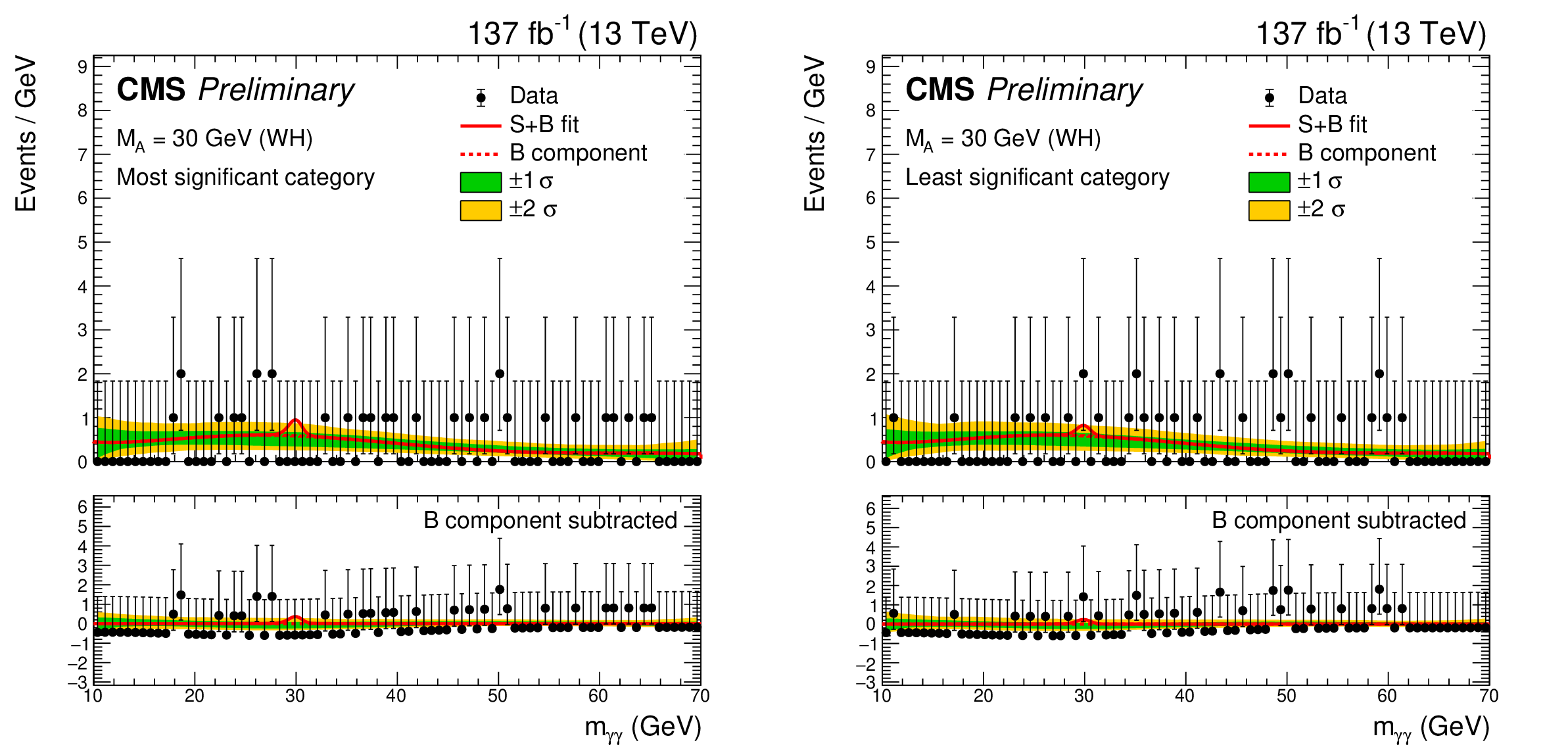
The $ m_{\gamma\gamma} $ distributions for data (black points) and the fitted signal-plus-background models for $ m_{\text{A}} = $ 30 GeV in the most significant (left) and least significant (right) categories of the WH channel. The solid red line shows the total signal-plus-background contribution, whereas the dashed red line shows the background component only. The lower panel in each plot presents the residual data yield after background subtraction. The green and yellow bands present the one and two standard deviation uncertainties in the background component of the fit, respectively. |
png pdf |
Figure 5-a:
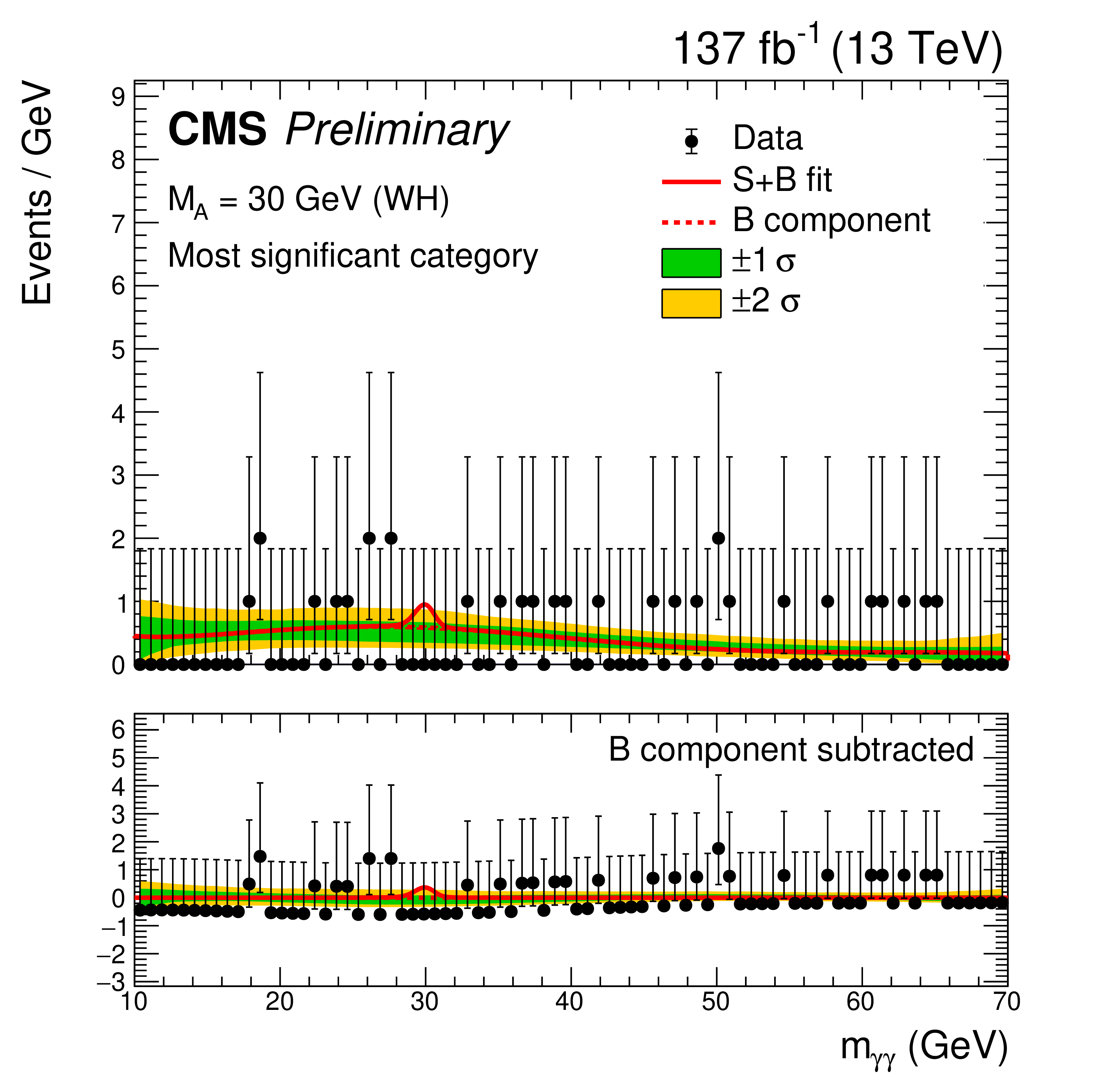
The $ m_{\gamma\gamma} $ distributions for data (black points) and the fitted signal-plus-background models for $ m_{\text{A}} = $ 30 GeV in the most significant (left) and least significant (right) categories of the WH channel. The solid red line shows the total signal-plus-background contribution, whereas the dashed red line shows the background component only. The lower panel in each plot presents the residual data yield after background subtraction. The green and yellow bands present the one and two standard deviation uncertainties in the background component of the fit, respectively. |
png pdf |
Figure 5-b:
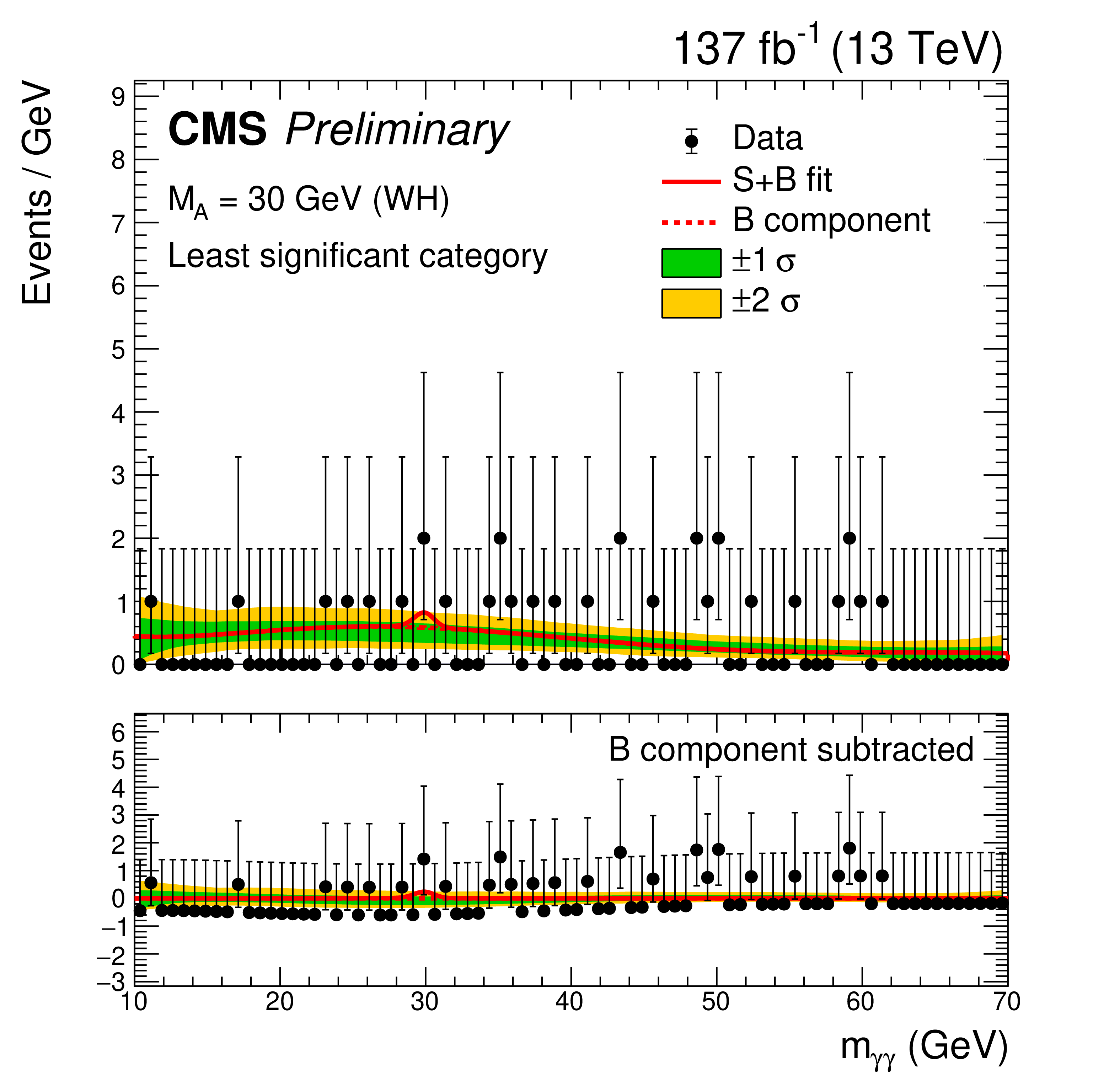
The $ m_{\gamma\gamma} $ distributions for data (black points) and the fitted signal-plus-background models for $ m_{\text{A}} = $ 30 GeV in the most significant (left) and least significant (right) categories of the WH channel. The solid red line shows the total signal-plus-background contribution, whereas the dashed red line shows the background component only. The lower panel in each plot presents the residual data yield after background subtraction. The green and yellow bands present the one and two standard deviation uncertainties in the background component of the fit, respectively. |
png pdf |
Figure 6:
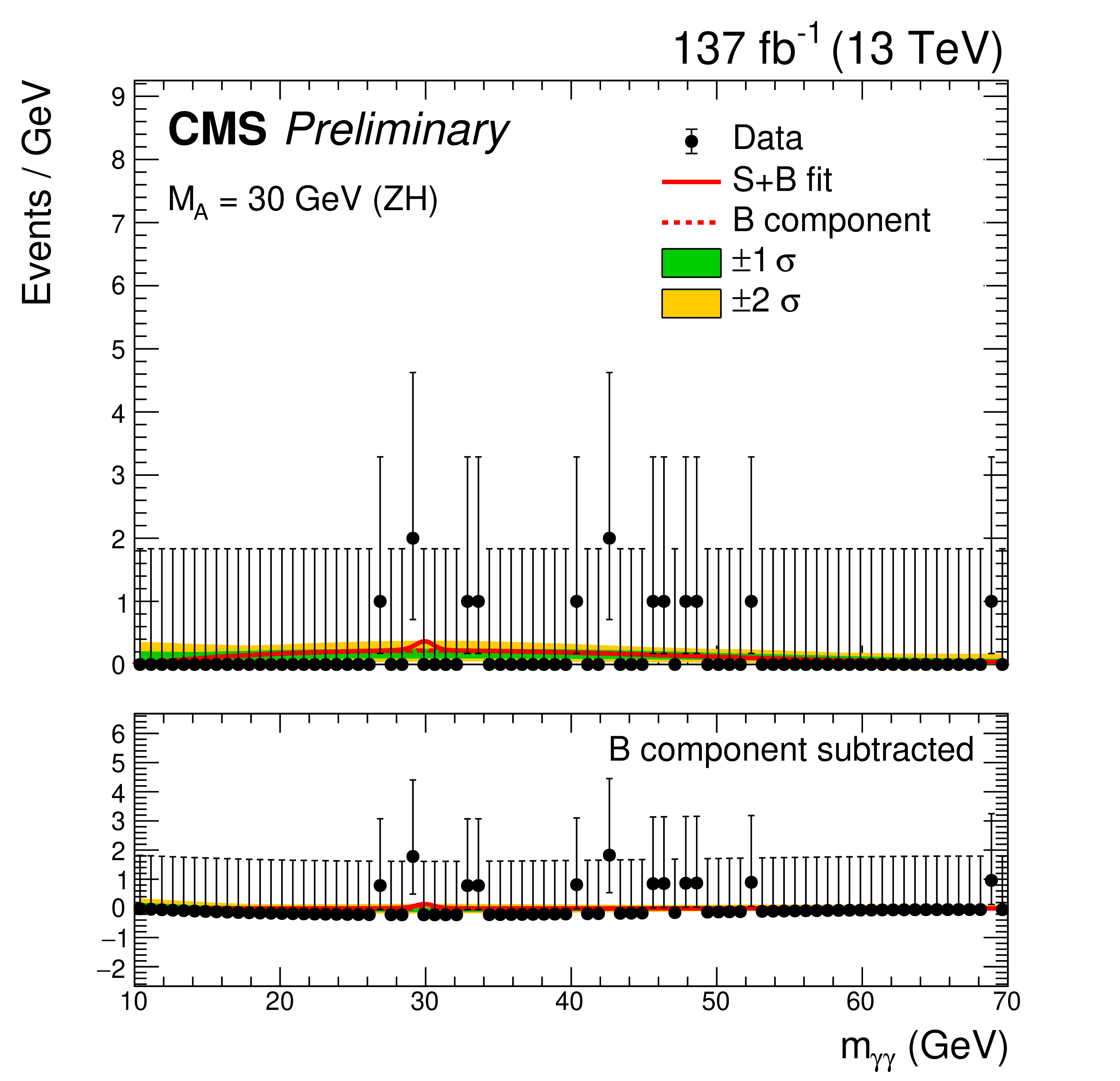
The $ m_{\gamma\gamma} $ distribution for data (black points) and the fitted signal-plus-background model for $ m_{\text{A}} = $ 30 GeV in the ZH channel. The solid red line shows the total signal-plus-background contribution, whereas the dashed red line shows the background component only. The lower panel presents the residual data yield after background subtraction. The green and yellow bands present the one and two standard deviation uncertainties in the background component of the fit, respectively. |
png pdf |
Figure 7:
The 95% confidence level (CL) upper limits on the product of the cross section and branching fraction, $ \sigma_{\text{WH}} \mathcal{B}(\text{H} \rightarrow \text{AA} \rightarrow \text{bb}\gamma\gamma) $, normalized to the SM prediction, for the WH channel. The yellow and blue bands represent the one and two standard deviation (68% and 95% CL) expected limit intervals, respectively. The limits are calculated assuming only the leptonic decay modes of $ \text{W} $ ($ \text{W} \rightarrow \ell\nu $; where $ \ell = $ e, $ \mu $ or $ \tau $) and $ \mathcal{B}(\text{H} \rightarrow \text{AA} \rightarrow \text{bb}\gamma\gamma) = 100% $. |
png pdf |
Figure 8:
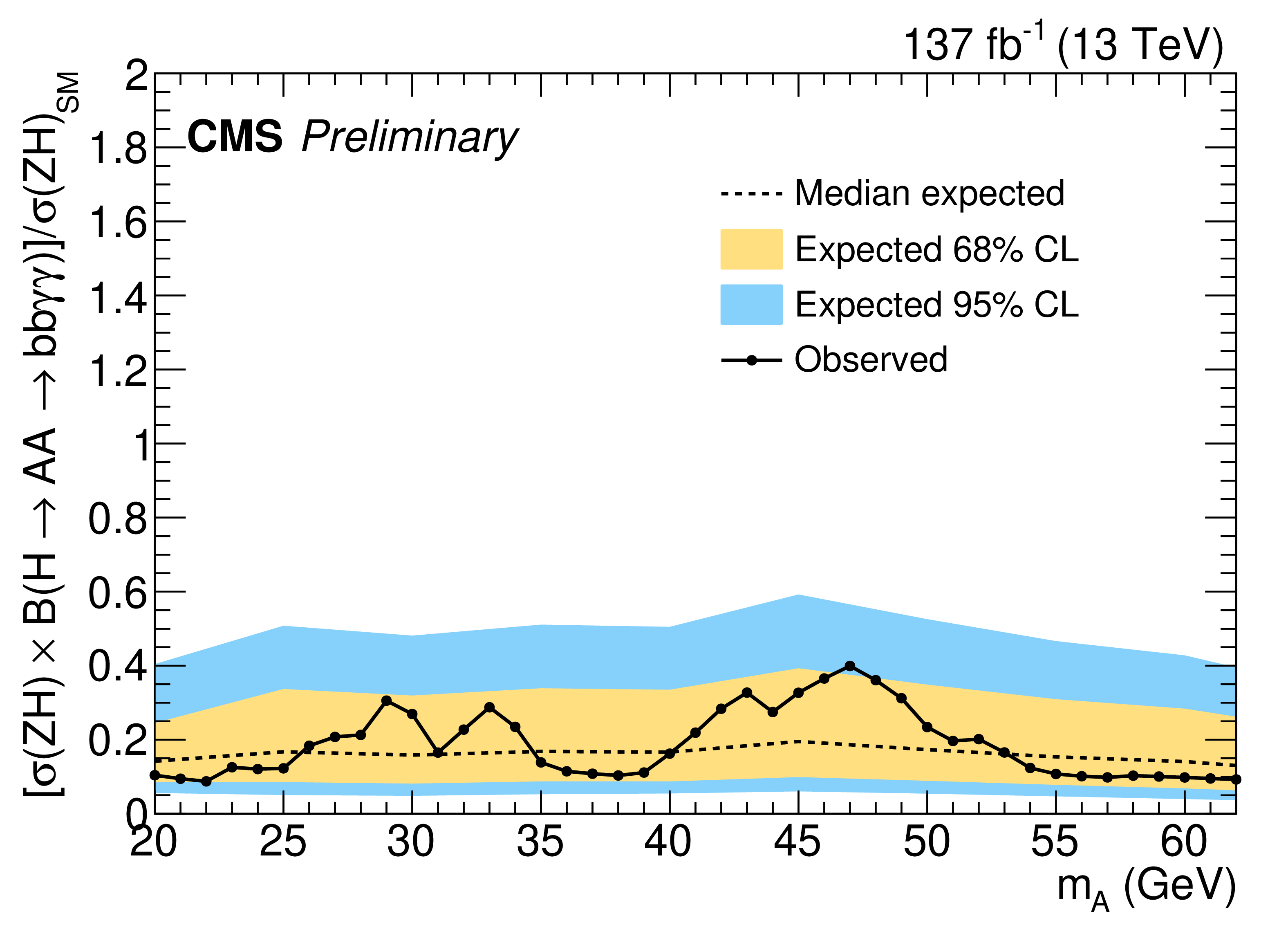
The 95% confidence level (CL) upper limits on the product of the cross section and branching fraction, $ \sigma_{\text{ZH}} \mathcal{B}(\text{H} \rightarrow \text{AA} \rightarrow \text{bb}\gamma\gamma) $, normalized to the SM prediction, for the ZH channel. The yellow and blue bands represent the one and two standard deviation (68% and 95% CL) expected limit intervals, respectively. The limits are calculated assuming only the leptonic decay modes of $ \text{Z} $ ($ \text{Z} \rightarrow \ell\ell $; where $ \ell = $ e, $ \mu $ or $ \tau $) and $ \mathcal{B}(\text{H} \rightarrow \text{AA} \rightarrow \text{bb}\gamma\gamma) = 100% $. |
png pdf |
Figure 9:
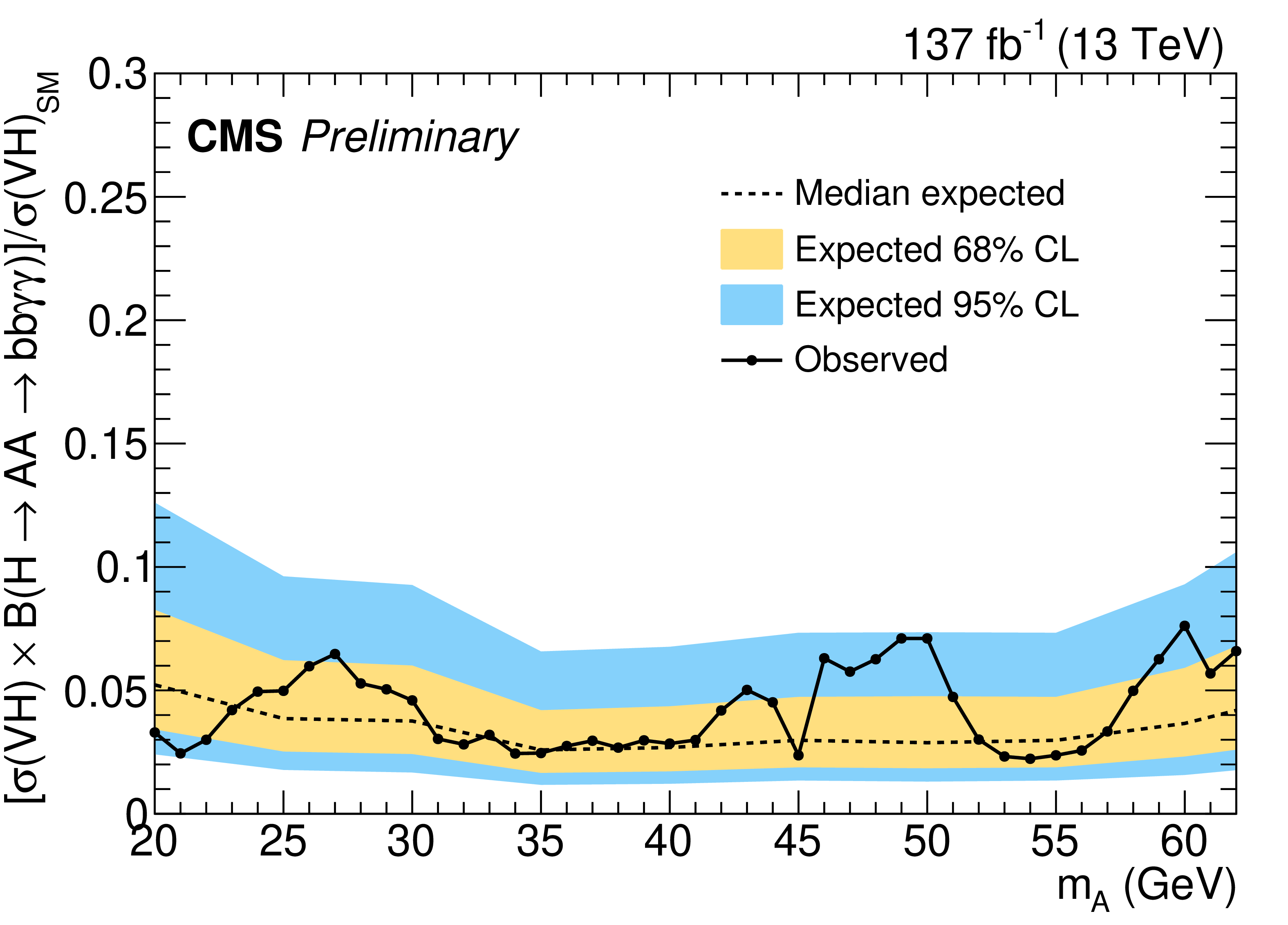
The 95% confidence level (CL) upper limits on the product of the cross section and branching fraction, $ \sigma_{\text{VH}} \mathcal{B}(\text{H} \rightarrow \text{AA} \rightarrow \text{bb}\gamma\gamma) $, normalized to the SM prediction, for the combined WH and ZH channels. The yellow and blue bands represent the one and two standard deviation (68% and 95% CL) expected limit intervals, respectively. The limits are calculated assuming $ \mathcal{B}(\text{H} \rightarrow \text{AA} \rightarrow \text{bb}\gamma\gamma) = 100% $. |
| Tables | |
png pdf |
Table 1:
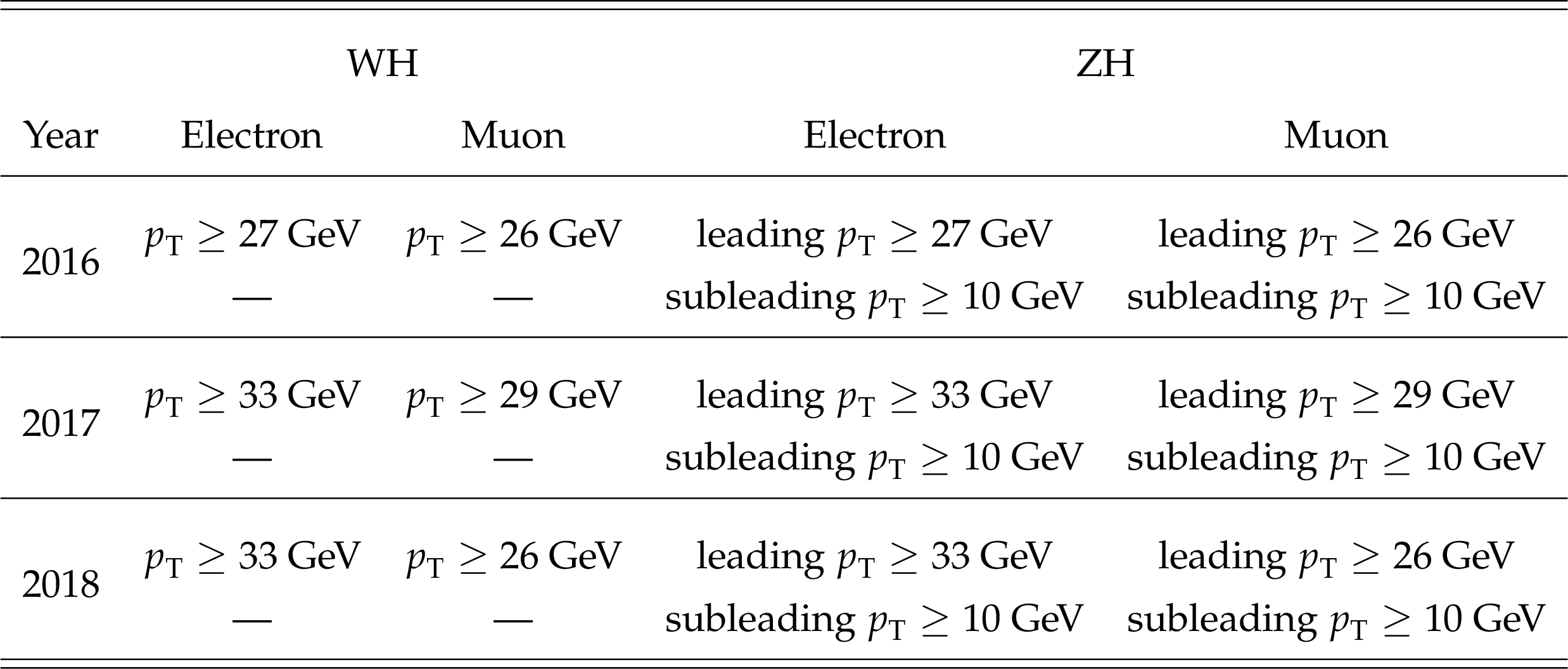
Offline lepton $ p_{\mathrm{T}} $ thresholds for the WH and ZH channels. |
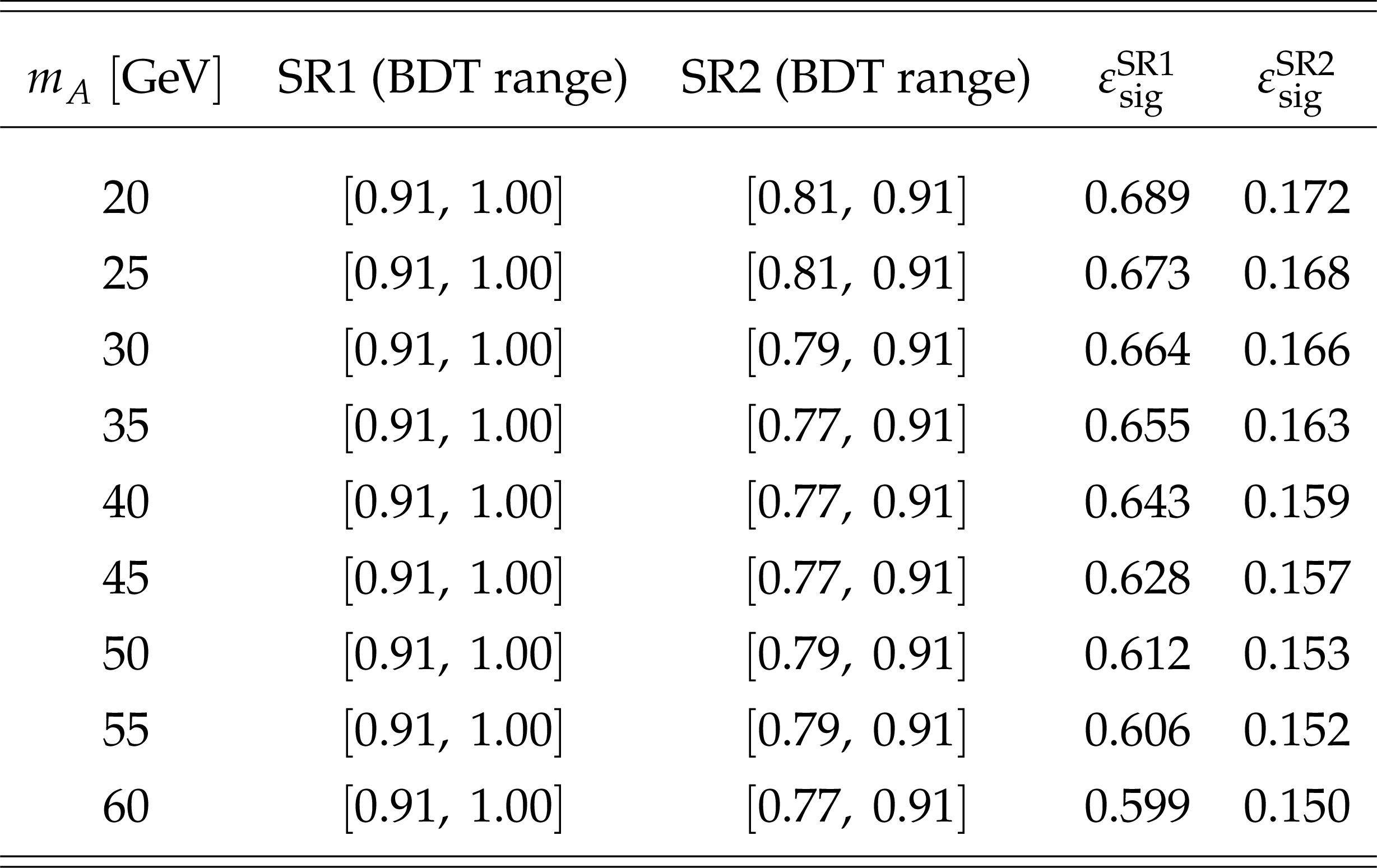
png pdf |
Table 2:
BDT score boundaries and signal efficiencies in each category. |
| Summary |
| A search for the exotic decay of the standard model Higgs boson in the decay channel $ \text{H} \rightarrow \text{AA} \rightarrow \text{bb}\gamma\gamma $, using proton-proton collision data corresponding to an integrated luminosity of 137 $ \text{fb}^{-1} $, is presented. The search is performed in the WH and ZH production modes, where the W or Z boson decays leptonically, focusing on the $ m_{\text{A}} $ range from 20 to 62 GeV. In the absence of any significant excess of events over and above the SM prediction, model-independent upper limits on the branching fraction $ \mathcal{B}(\text{H} \rightarrow \text{AA} \rightarrow \text{bb}\gamma\gamma) $ are presented at the 95% confidence level. The observed (expected) upper limits on the branching fraction for the WH channel range from 0.04 (0.06) for $ m_{\text{A}} = $ 20 GeV to 0.07 (0.04) for $ m_{\text{A}} = $ 62 GeV. The combined upper limits are dominated by the WH channel. These are the first exclusion limits on a light boson arising from the SM Higgs boson decay in the $ \text{bb}\gamma\gamma $ final state at the LHC. |
| References | ||||
| 1 | ATLAS Collaboration | Observation of a new particle in the search for the Standard Model Higgs boson with the ATLAS detector at the LHC | PLB 716 (2012) 1 | 1207.7214 |
| 2 | CMS Collaboration | Observation of a New Boson at a Mass of 125 GeV with the CMS Experiment at the LHC | PLB 716 (2012) 30 | CMS-HIG-12-028 1207.7235 |
| 3 | CMS Collaboration | A portrait of the Higgs boson by the CMS experiment ten years after the discovery. | Nature 607 (2022) no. 7917 | CMS-HIG-22-001 2207.00043 |
| 4 | ATLAS Collaboration | A detailed map of Higgs boson interactions by the ATLAS experiment ten years after the discovery | Nature 607 (2022) no. 7917 | 2207.00092 |
| 5 | CMS Collaboration | A search for decays of the Higgs boson to invisible particles in events with a top-antitop quark pair or a vector boson in proton-proton collisions at $ \sqrt{s} = 13 \text {Te}\hspace{-.08em}\text {V} $ | EPJC 83 (2023) no. 10 | CMS-HIG-21-007 2303.01214 |
| 6 | U. Ellwanger, C. Hugonie, and A. M. Teixeira | The Next-to-Minimal Supersymmetric Standard Model | Phys. Rept. 496 (2010) 1 | 0910.1785 |
| 7 | S. Baum and N. R. Shah | Two Higgs Doublets and a Complex Singlet: Disentangling the Decay Topologies and Associated Phenomenology | JHEP 12 (2018) 044 | 1808.02667 |
| 8 | CMS Collaboration | Search for light bosons in decays of the 125 GeV Higgs boson in proton-proton collisions at $ \sqrt{s}= $ 8 TeV | JHEP 10 (2017) 076 | CMS-HIG-16-015 1701.02032 |
| 9 | D. Curtin et al. | Exotic decays of the 125 GeV Higgs boson | PRD 90 (2014) no. 7 | 1312.4992 |
| 10 | CMS Collaboration | Search for exotic decays of the Higgs boson to a pair of pseudoscalars in the $ \mu\mu $bb and $ \tau\tau $bb final states | EPJC 84 (2024) no. 5 | CMS-HIG-22-007 2402.13358 |
| 11 | CMS Collaboration | Search for a light pseudoscalar Higgs boson in the boosted $ \mu\mu\tau\tau $ final state in proton-proton collisions at $ \sqrt{s}= $ 13 TeV | JHEP 08 (2020) 139 | CMS-HIG-18-024 2005.08694 |
| 12 | CMS Collaboration | Search for light pseudoscalar boson pairs produced from Higgs boson decays using the 4\ensuremath\tau and 2\ensuremath\mu2\ensuremath\tau final states in proton-proton collisions at $ \sqrt{s}= $ 13 TeV | JHEP 04 (2026) 132 | CMS-SUS-24-002 2508.06947 |
| 13 | CMS Collaboration | Search for the decay of the Higgs boson to a pair of light pseudoscalar bosons in the final state with four bottom quarks in proton-proton collisions at $ \sqrt{\textrm{s}} = $ 13 TeV | JHEP 06 (2024) 097 | CMS-HIG-18-026 2403.10341 |
| 14 | CMS Collaboration | Search for the exotic decay of the Higgs boson into two light pseudoscalars with four photons in the final state in proton-proton collisions at $ \sqrt{s} = $ 13 TeV | JHEP 07 (2023) 148 | CMS-HIG-21-003 2208.01469 |
| 15 | ATLAS Collaboration | Search for Higgs bosons decaying to $ aa $ in the $ \mu\mu\tau\tau $ final state in $ pp $ collisions at $ \sqrt{s} = $ 8 TeV with the ATLAS experiment | PRD 92 (2015) no. 5 | 1505.01609 |
| 16 | ATLAS Collaboration | Search for Higgs boson decays into a pair of pseudoscalar particles in the $ bb\mu\mu $ final state with the ATLAS detector in $ pp $ collisions at $ \sqrt s = $ 13 TeV | PRD 105 (2022) no. 1 | 2110.00313 |
| 17 | ATLAS Collaboration | Search for Higgs boson decays into two new low-mass spin-0 particles in the 4$ b $ channel with the ATLAS detector using $ pp $ collisions at $ \sqrt{s}= $ 13 TeV | PRD 102 (2020) no. 11 | 2005.12236 |
| 18 | ATLAS Collaboration | Search for Higgs boson decays into a pair of pseudoscalar particles in the \ensuremath\gamma\ensuremath\gamma\ensuremath\tau$ _{had} $\ensuremath\tau$ _{had} $ final state using pp collisions at $ \sqrt{\textrm{s}} = $ 13 TeV with the ATLAS detector | JHEP 03 (2025) 190 | 2412.14046 |
| 19 | ATLAS Collaboration | Search for Higgs boson decays into pairs of light (pseudo)scalar particles in the $ \gamma\gamma jj $ final state in $ pp $ collisions at $ \sqrt{s}= $ 13 TeV with the ATLAS detector | PLB 782 (2018) 750 | 1803.11145 |
| 20 | CMS Collaboration | Search for exotic Higgs boson decays $ H \to \mathcal{A}\mathcal{A} \to 4\gamma $ with events containing two merged diphotons in proton-proton collisions at $ \sqrt{s} = $ 13 TeV | PRL 131 (2023) 101801 | CMS-HIG-21-016 2209.06197 |
| 21 | M. Guchait and J. Kumar | Light Higgs Bosons in NMSSM at the LHC | Int. J. Mod. Phys. A 31 (2016) no. 12 | 1509.02452 |
| 22 | M. Guchait and J. Kumar | Diphoton Signal of light pseudoscalar in NMSSM at the LHC | PRD 95 (2017) no. 3 | 1608.05693 |
| 23 | CMS Collaboration | Development of the CMS detector for the CERN LHC Run 3 | JINST 19 (2024) no. 05 | CMS-PRF-21-001 2309.05466 |
| 24 | CMS Collaboration | The CMS trigger system | JINST 12 (2017) P01020 | CMS-TRG-12-001 1609.02366 |
| 25 | CMS Collaboration | The CMS high level trigger | EPJC 46 (2006) 605 | hep-ex/0512077 |
| 26 | CMS Collaboration | Particle-flow reconstruction and global event description with the CMS detector | JINST 12 (2017) no. 10 | CMS-PRF-14-001 1706.04965 |
| 27 | CMS Collaboration | Performance of missing transverse momentum reconstruction in proton-proton collisions at $ \sqrt{s} = $ 13 TeV using the CMS detector | JINST 14 (2019) no. 07 | CMS-JME-17-001 1903.06078 |
| 28 | CMS Collaboration | Search for an exotic decay of the Higgs boson to a pair of light pseudoscalars in the final state with two muons and two b quarks in pp collisions at 13 TeV | PLB 795 (2019) 398 | CMS-HIG-18-011 1812.06359 |
| 29 | T. Chen and C. Guestrin | XGBoost: A Scalable Tree Boosting System | link | 1603.02754 |
| 30 | J. Alwall et al. | The automated computation of tree-level and next-to-leading order differential cross sections, and their matching to parton shower simulations | JHEP 07 (2014) 079 | 1405.0301 |
| 31 | CMS Collaboration | Event generator tunes obtained from underlying event and multiparton scattering measurements | EPJC 76 (2016) no. 3 | CMS-GEN-14-001 1512.00815 |
| 32 | CMS Collaboration | Extraction and validation of a new set of CMS PYTHIA8 tunes from underlying-event measurements | EPJC 80 (2020) no. 1 | CMS-GEN-17-001 1903.12179 |
| 33 | LHC Higgs Cross Section Working Group Collaboration | Handbook of LHC Higgs Cross Sections: 4. Deciphering the Nature of the Higgs Sector | CERN Yellow Rep. Monogr. 2 (2017) 1 | 1610.07922 |
| 34 | ATLAS Collaboration | Precise measurements of W- and Z-boson transverse momentum spectra with the ATLAS detector using pp collisions at $ \sqrt{s} = $ 5.02 TeV and 13 TeV | EPJC 84 (2024) no. 10 | 2404.06204 |
| 35 | M. L. Mangano et al. | ALPGEN, a generator for hard multiparton processes in hadronic collisions | JHEP 07 (2003) 001 | hep-ph/0206293 |
| 36 | M. L. Mangano, M. Moretti, F. Piccinini, and M. Treccani | Matching matrix elements and shower evolution for top-quark production in hadronic collisions | JHEP 01 (2007) 013 | hep-ph/0611129 |
| 37 | T. Sjöstrand et al. | An introduction to PYTHIA 8.2 | Comput. Phys. Commun. 191 (2015) 159 | 1410.3012 |
| 38 | GEANT4 Collaboration | GEANT 4---a simulation toolkit | NIM A 506 (2003) 250 | |
| 39 | CMS Collaboration | Electron and photon reconstruction and identification with the CMS experiment at the CERN LHC | JINST 16 (2021) no. 05 | CMS-EGM-17-001 2012.06888 |
| 40 | CMS Collaboration | Performance of the CMS muon detector and muon reconstruction with proton-proton collisions at $ \sqrt{s}= $ 13 TeV | JINST 13 (2018) no. 06 | CMS-MUO-16-001 1804.04528 |
| 41 | CMS Collaboration | Pileup mitigation at CMS in 13 TeV data | JINST 15 (2020) no. 09 | CMS-JME-18-001 2003.00503 |
| 42 | M. Cacciari, G. P. Salam, and G. Soyez | The anti-$ k_t $ jet clustering algorithm | JHEP 04 (2008) 063 | 0802.1189 |
| 43 | M. Cacciari, G. P. Salam, and G. Soyez | FastJet User Manual | EPJC 72 (2012) 1896 | 1111.6097 |
| 44 | E. Bols et al. | Jet Flavour Classification Using DeepJet | JINST 15 (2020) no. 12 | 2008.10519 |
| 45 | G. Cowan | Statistical Data Analysis in Particle Physics | Oxford University Press, 1998 | |
| 46 | P. Baldi, P. Sadowski, and D. Whiteson | Searching for Exotic Particles in High-Energy Physics with Deep Learning | Nature Commun. 5 (2014) 4308 | 1402.4735 |
| 47 | CMS Collaboration | Measurements of Higgs boson production cross sections and couplings in the diphoton decay channel at $ \sqrt{\mathrm{s}} = $ 13 TeV | JHEP 07 (2021) 027 | CMS-HIG-19-015 2103.06956 |
| 48 | P. D. Dauncey, M. Kenzie, N. Wardle, and G. J. Davies | Handling uncertainties in background shapes: the discrete profiling method | JINST 10 (2015) no. 04 | 1408.6865 |
| 49 | CMS Collaboration | Precision luminosity measurement in proton-proton collisions at $ \sqrt{s} = $ 13 TeV in 2015 and 2016 at CMS | EPJC 81 (2021) 800 | CMS-LUM-17-003 2104.01927 |
| 50 | CMS Collaboration | CMS luminosity measurement for the 2017 data-taking period at $ \sqrt{s} = $ 13 TeV | CMS Physics Analysis Summary, 2018 CMS-PAS-LUM-17-004 |
CMS-PAS-LUM-17-004 |
| 51 | CMS Collaboration | CMS luminosity measurement for the 2018 data-taking period at $ \sqrt{s} = $ 13 TeV | CMS Physics Analysis Summary, 2019 CMS-PAS-LUM-18-002 |
CMS-PAS-LUM-18-002 |
| 52 | CMS Collaboration | Identification of heavy-flavour jets with the CMS detector in pp collisions at 13 TeV | JINST 13 (2018) no. 05 | CMS-BTV-16-002 1712.07158 |
| 53 | CMS Collaboration | Jet energy scale and resolution in the CMS experiment in pp collisions at 8 TeV | JINST 12 (2017) no. 02 | CMS-JME-13-004 1607.03663 |
| 54 | NNPDF Collaboration | Parton distributions from high-precision collider data | EPJC 77 (2017) no. 10 | 1706.00428 |
| 55 | J. Butterworth et al. | PDF4LHC recommendations for LHC Run II | JPG 43 (2016) 023001 | 1510.03865 |
| 56 | LHC Higgs Cross Section Working Group Collaboration | Handbook of LHC Higgs Cross Sections: 1. Inclusive Observables | cern yellow report, CERN, 1, 2011 link |
1101.0593 |
| 57 | S. Mrenna and P. Skands | Automated Parton-Shower Variations in Pythia 8 | PRD 94 (2016) no. 7 | 1605.08352 |
| 58 | W. Verkerke and D. Kirkby | The roofit toolkit for data modeling | https://arxiv.org/abs/physics/0306116, 2003 link |
|
| 59 | CMS Collaboration | The CMS Statistical Analysis and Combination Tool: Combine | Comput. Softw. Big Sci. 8 (2024) no. 1 | CMS-CAT-23-001 2404.06614 |
|
|
Compact Muon Solenoid LHC, CERN |

|
|
|
|
|
|