
Compact Muon Solenoid
LHC, CERN
 Visit us: CMS Public Website, CMS Physics ;
Contact us: CMS Publications Committee
Visit us: CMS Public Website, CMS Physics ;
Contact us: CMS Publications Committee
| CMS-SUS-21-005 ; CERN-EP-2026-130 | ||
| Search for new physics using single-lepton events with high multiplicities of jets and b jets in proton-proton collisions at $ \sqrt{s}= $ 13 TeV | ||
| CMS Collaboration | ||
| 8 June 2026 | ||
| Accepted for publication in the Journal of High Energy Physics | ||
| Abstract: This paper presents a search for beyond the standard model physics using single-lepton events with a high multiplicity of jets, including those identified as bottom quark jets, without a requirement on missing transverse momentum. The analysis is based on proton-proton collision data collected with the CMS detector at the CERN LHC at a center-of-mass energy of 13 TeV, corresponding to an integrated luminosity of 138 fb$ ^{-1} $. This search is sensitive to $ R $-parity violating supersymmetry models, where supersymmetric particles can decay into standard-model particles through interactions that violate baryon number conservation. In particular, the signal model considered is gluino pair production, where each gluino decays into top, bottom, and strange quarks. The sum of large-radius jet masses is used to distinguish the signal from background, as it effectively captures the features of high jet multiplicity and high interaction energy. No significant excess of data over the background predictions is observed. Gluinos in this model have been excluded for masses below 1890 GeV at 95% confidence level. | ||
| Links: e-print arXiv:2606.09567 [hep-ex] (PDF) ; CDS record ; inSPIRE record ; HepData record ; CADI line (restricted) ; | ||
| Figures | |
png pdf |
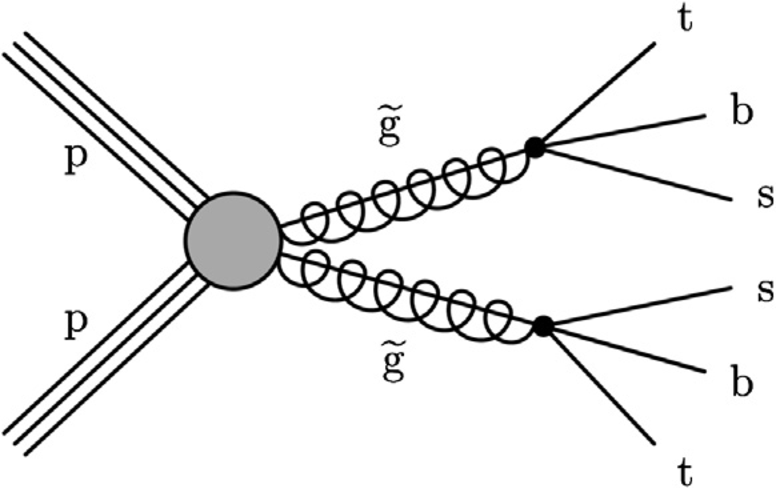
Figure 1:
Diagram of the signal model considered in this analysis. Gluinos are produced in pairs and decay to t, b, and s. |
png pdf |
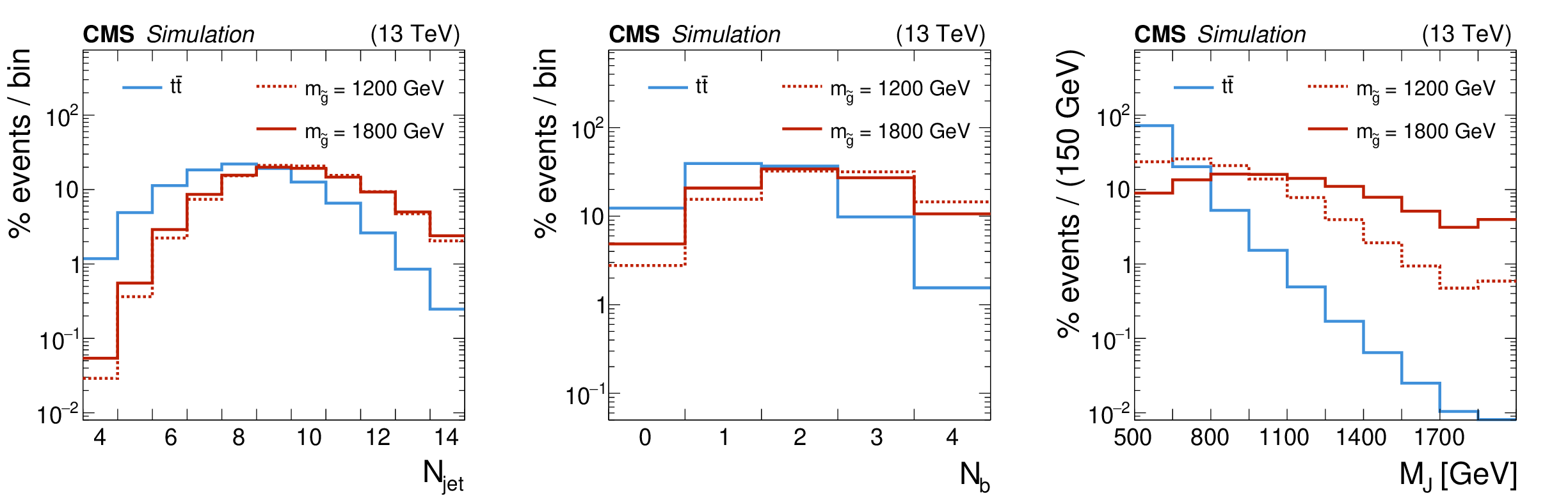
Figure 2:
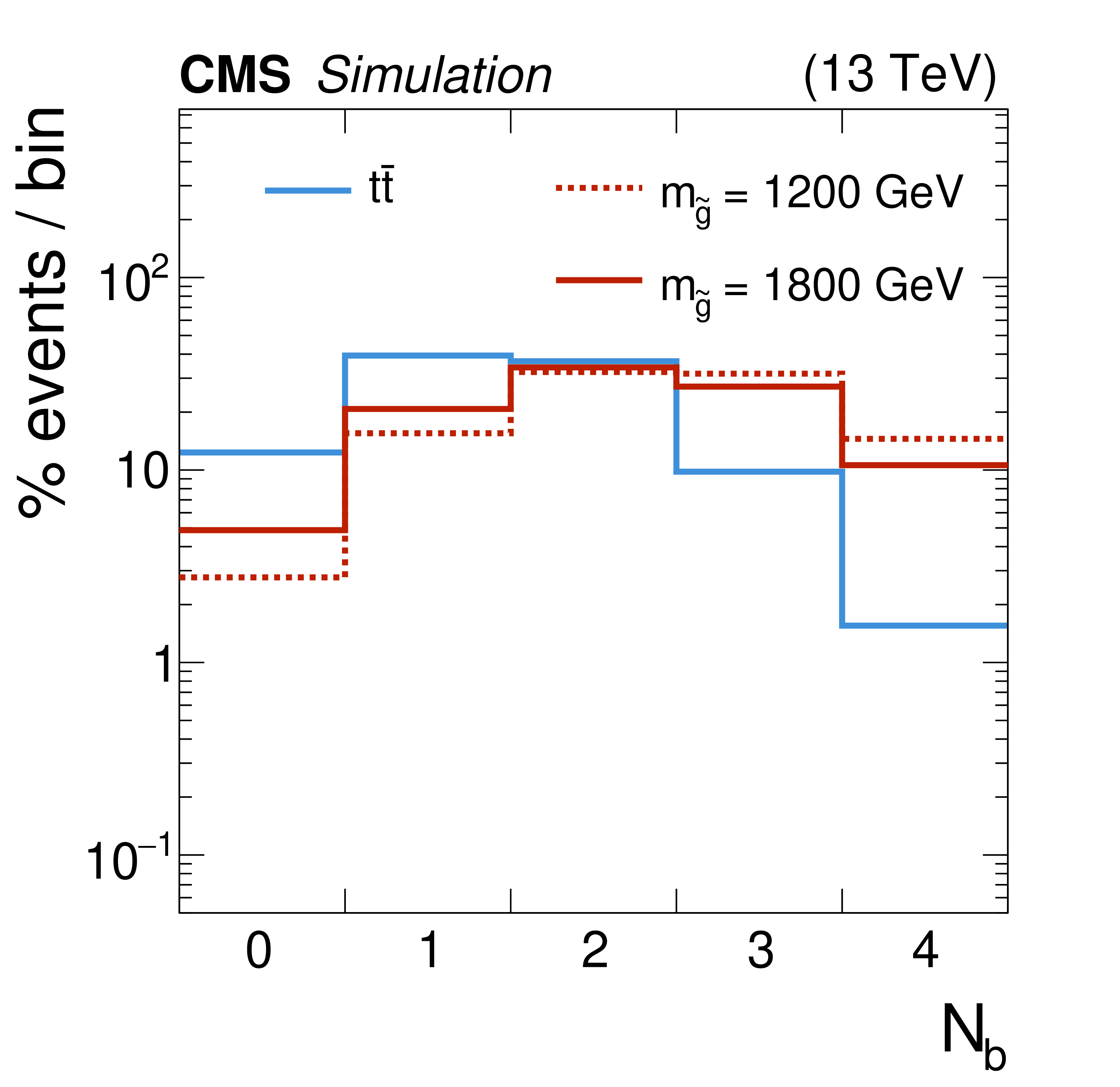
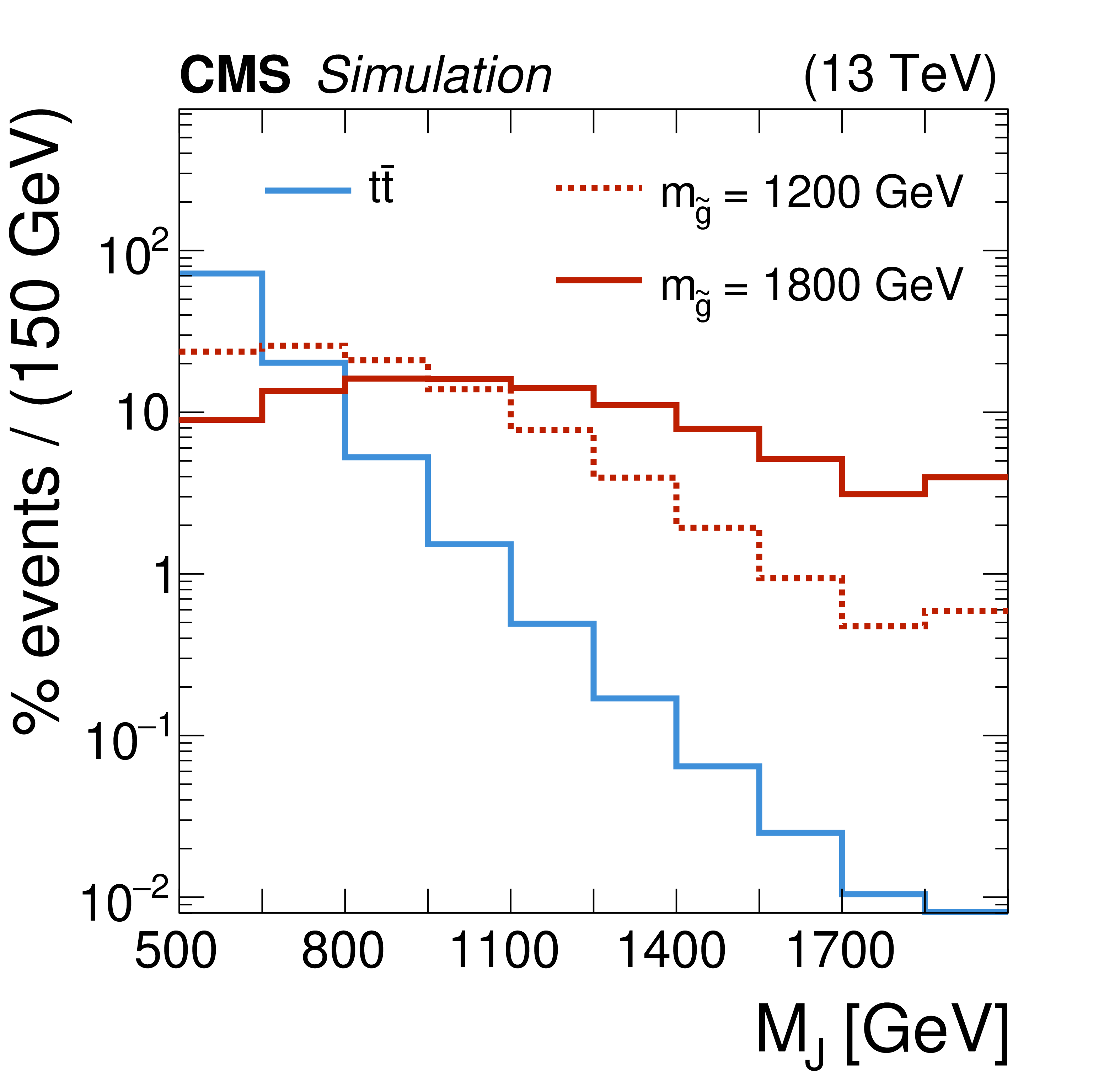
Distributions of $ N_{\text{jet}} $ (left), $ N_{\mathrm{b}} $ (middle), and $ M_{\mathrm{J}} $ (right) for $ {\mathrm{t}\overline{\mathrm{t}}} $ and signal events in two gluino mass scenarios, after applying the baseline selection, as described in Section 3. |
png pdf |
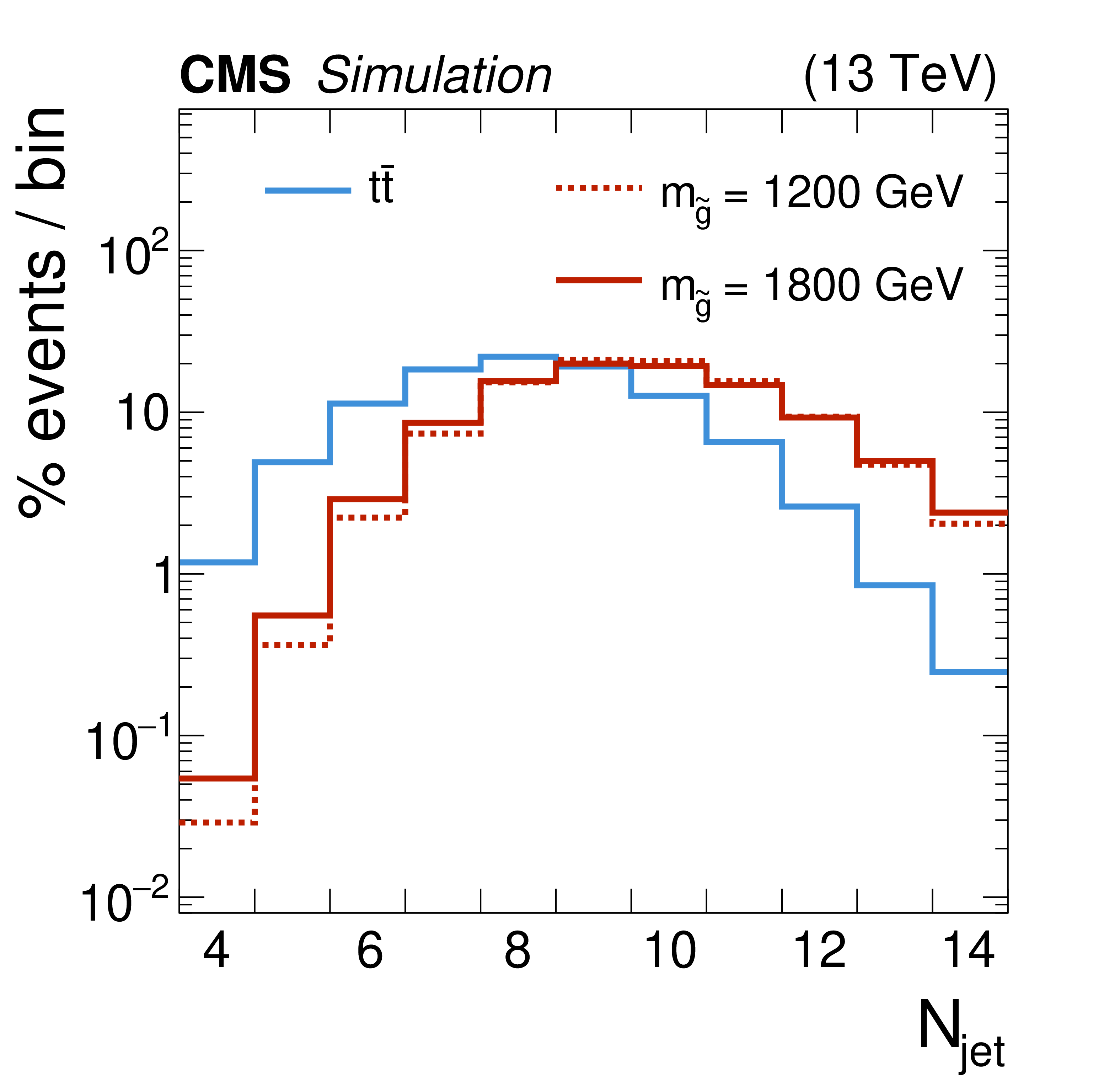
Figure 2-a:
Distributions of $ N_{\text{jet}} $ (left), $ N_{\mathrm{b}} $ (middle), and $ M_{\mathrm{J}} $ (right) for $ {\mathrm{t}\overline{\mathrm{t}}} $ and signal events in two gluino mass scenarios, after applying the baseline selection, as described in Section 3. |
png pdf |
Figure 2-b:
Distributions of $ N_{\text{jet}} $ (left), $ N_{\mathrm{b}} $ (middle), and $ M_{\mathrm{J}} $ (right) for $ {\mathrm{t}\overline{\mathrm{t}}} $ and signal events in two gluino mass scenarios, after applying the baseline selection, as described in Section 3. |
png pdf |
Figure 2-c:
Distributions of $ N_{\text{jet}} $ (left), $ N_{\mathrm{b}} $ (middle), and $ M_{\mathrm{J}} $ (right) for $ {\mathrm{t}\overline{\mathrm{t}}} $ and signal events in two gluino mass scenarios, after applying the baseline selection, as described in Section 3. |
png pdf |
Figure 3:
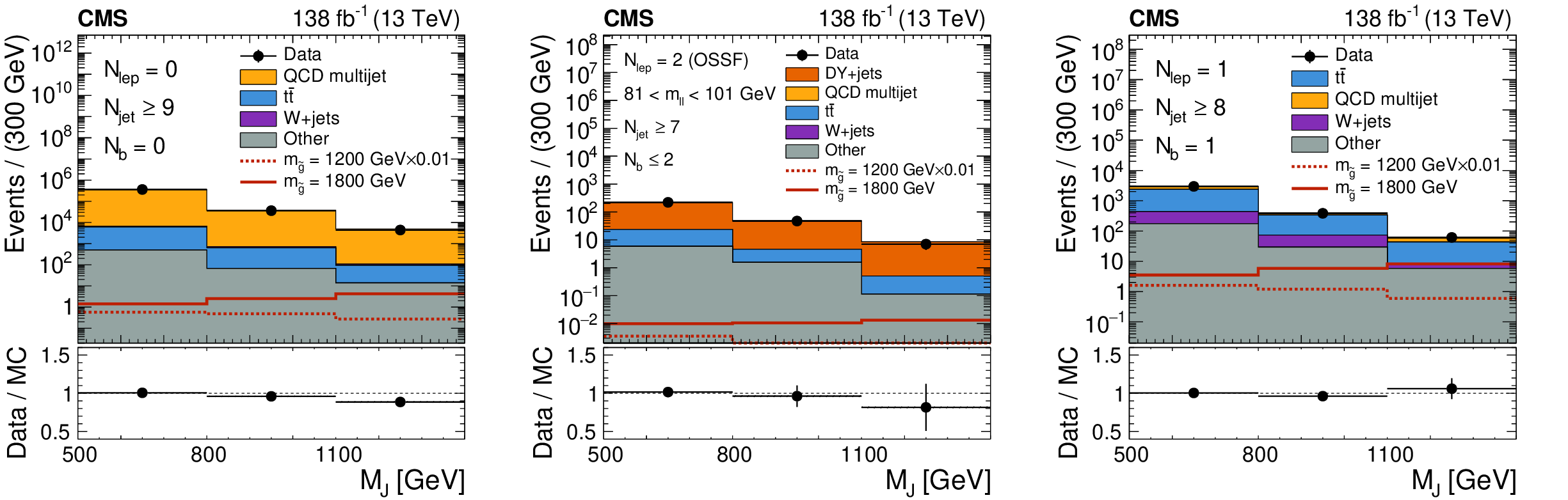
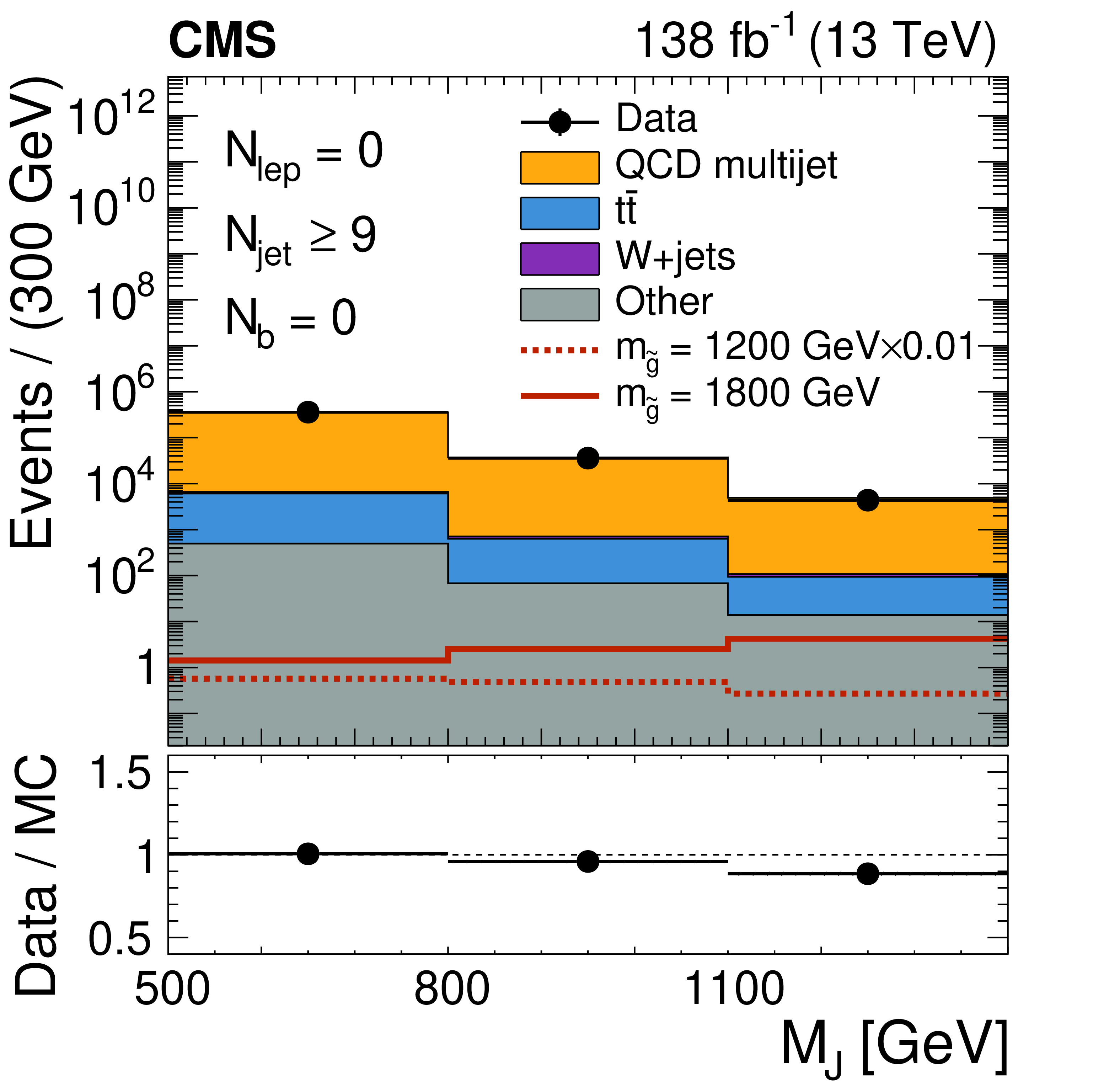
Comparison of $ M_{\mathrm{J}} $ shapes between data and simulation in the CRs used to measure the $ \kappa $ factors for QCD multijet (left), W+jets (middle), and $ {\mathrm{t}\overline{\mathrm{t}}} $ (right). The selection corresponds to $ N_{\text{lep}}= $ 0, $ N_{\text{jet}}\ge $ 9, $ N_{\mathrm{b}}= $ 0 for QCD multijet; a DY+jets background dominated region with $ N_{\text{lep}}= $ 2, $ N_{\text{jet}}\ge $ 7, $ N_{\mathrm{b}}\le $ 2 for W+jets; and $ N_{\text{lep}}= $ 1, $ N_{\text{jet}}\ge $ 8, $ N_{\mathrm{b}}= $ 1 for $ {\mathrm{t}\overline{\mathrm{t}}} $. The simulation is normalized to data in all regions. |
png pdf |
Figure 3-a:
Comparison of $ M_{\mathrm{J}} $ shapes between data and simulation in the CRs used to measure the $ \kappa $ factors for QCD multijet (left), W+jets (middle), and $ {\mathrm{t}\overline{\mathrm{t}}} $ (right). The selection corresponds to $ N_{\text{lep}}= $ 0, $ N_{\text{jet}}\ge $ 9, $ N_{\mathrm{b}}= $ 0 for QCD multijet; a DY+jets background dominated region with $ N_{\text{lep}}= $ 2, $ N_{\text{jet}}\ge $ 7, $ N_{\mathrm{b}}\le $ 2 for W+jets; and $ N_{\text{lep}}= $ 1, $ N_{\text{jet}}\ge $ 8, $ N_{\mathrm{b}}= $ 1 for $ {\mathrm{t}\overline{\mathrm{t}}} $. The simulation is normalized to data in all regions. |
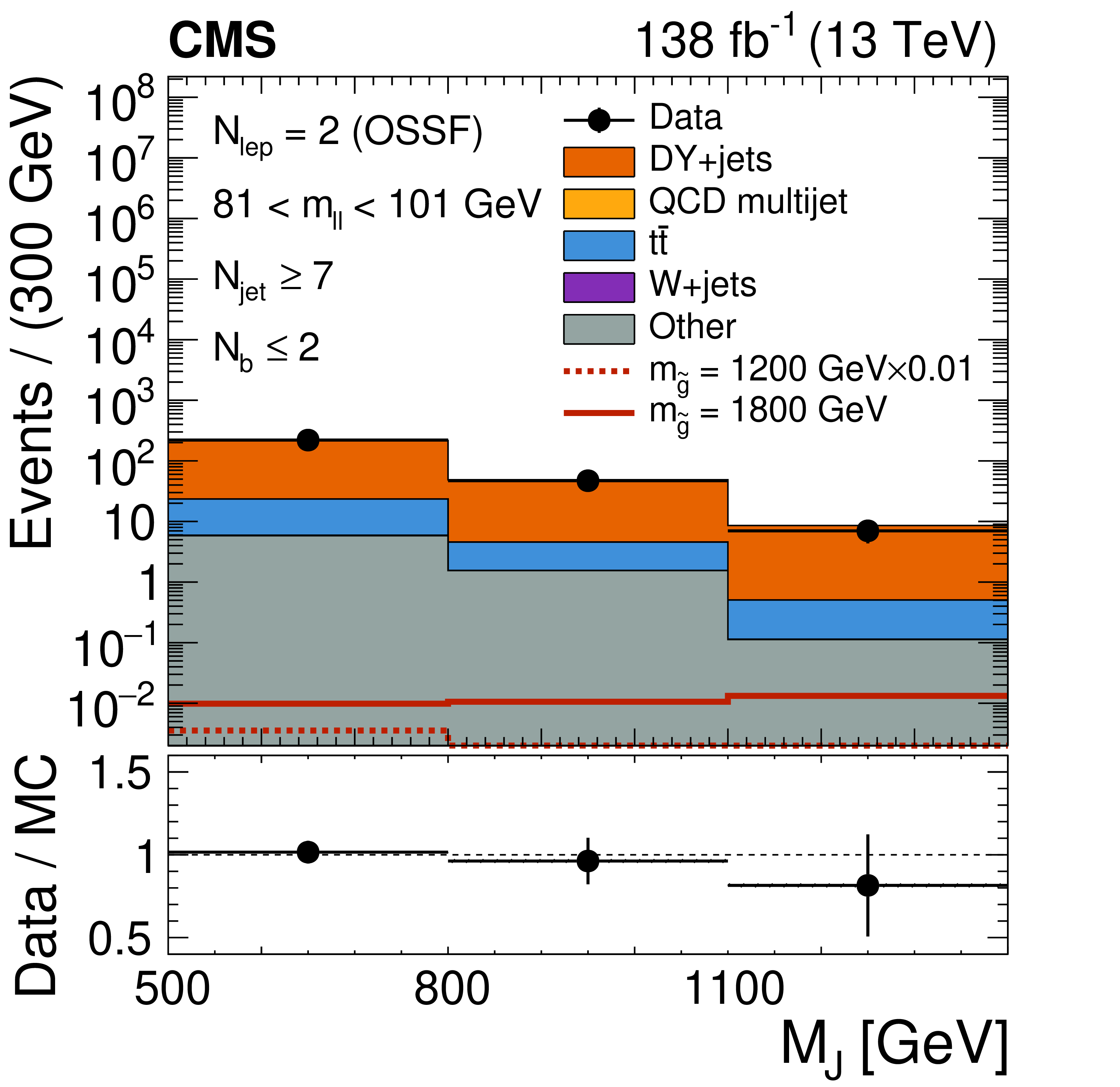
png pdf |
Figure 3-b:
Comparison of $ M_{\mathrm{J}} $ shapes between data and simulation in the CRs used to measure the $ \kappa $ factors for QCD multijet (left), W+jets (middle), and $ {\mathrm{t}\overline{\mathrm{t}}} $ (right). The selection corresponds to $ N_{\text{lep}}= $ 0, $ N_{\text{jet}}\ge $ 9, $ N_{\mathrm{b}}= $ 0 for QCD multijet; a DY+jets background dominated region with $ N_{\text{lep}}= $ 2, $ N_{\text{jet}}\ge $ 7, $ N_{\mathrm{b}}\le $ 2 for W+jets; and $ N_{\text{lep}}= $ 1, $ N_{\text{jet}}\ge $ 8, $ N_{\mathrm{b}}= $ 1 for $ {\mathrm{t}\overline{\mathrm{t}}} $. The simulation is normalized to data in all regions. |
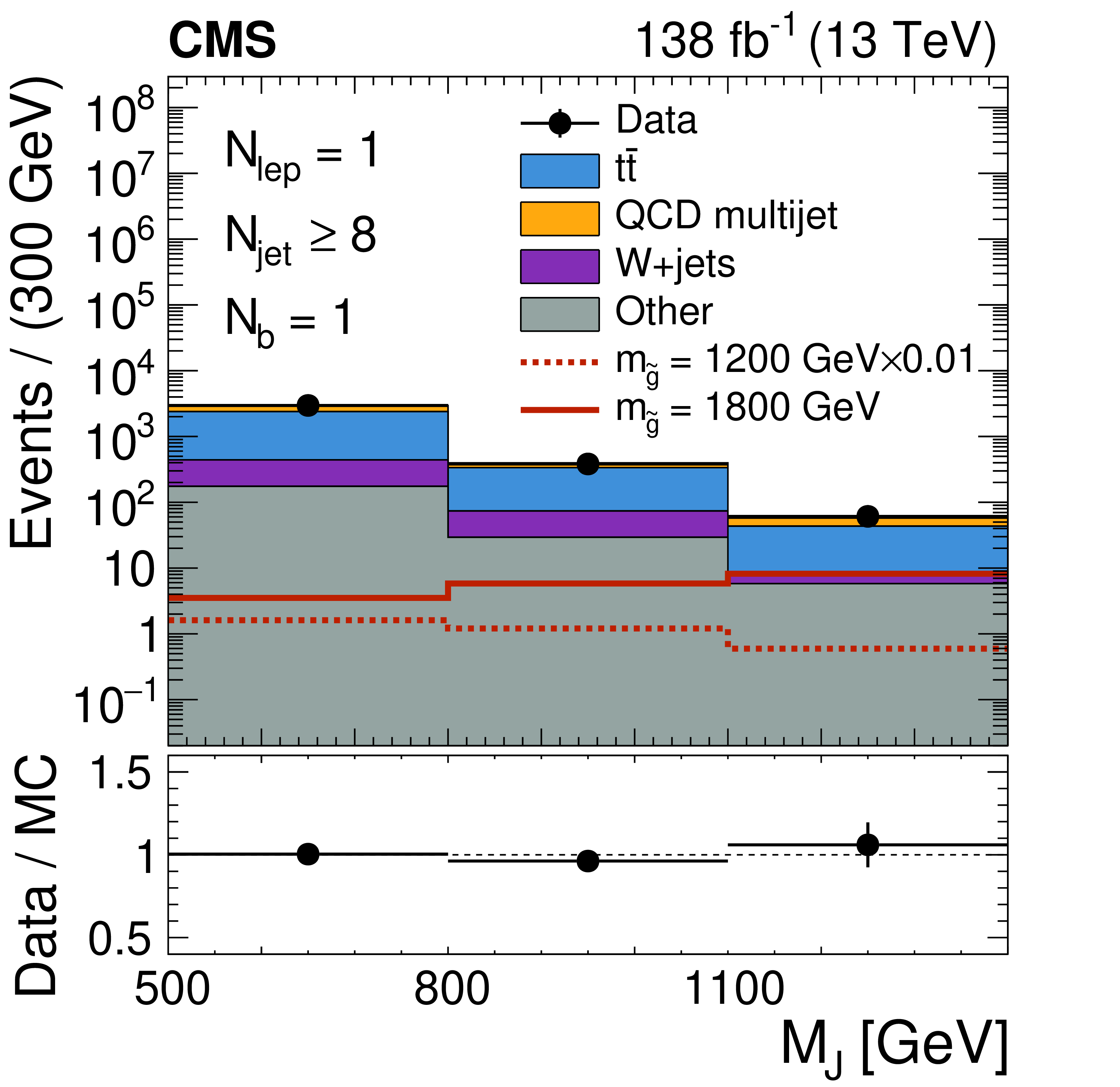
png pdf |
Figure 3-c:
Comparison of $ M_{\mathrm{J}} $ shapes between data and simulation in the CRs used to measure the $ \kappa $ factors for QCD multijet (left), W+jets (middle), and $ {\mathrm{t}\overline{\mathrm{t}}} $ (right). The selection corresponds to $ N_{\text{lep}}= $ 0, $ N_{\text{jet}}\ge $ 9, $ N_{\mathrm{b}}= $ 0 for QCD multijet; a DY+jets background dominated region with $ N_{\text{lep}}= $ 2, $ N_{\text{jet}}\ge $ 7, $ N_{\mathrm{b}}\le $ 2 for W+jets; and $ N_{\text{lep}}= $ 1, $ N_{\text{jet}}\ge $ 8, $ N_{\mathrm{b}}= $ 1 for $ {\mathrm{t}\overline{\mathrm{t}}} $. The simulation is normalized to data in all regions. |
png pdf |
Figure 4:
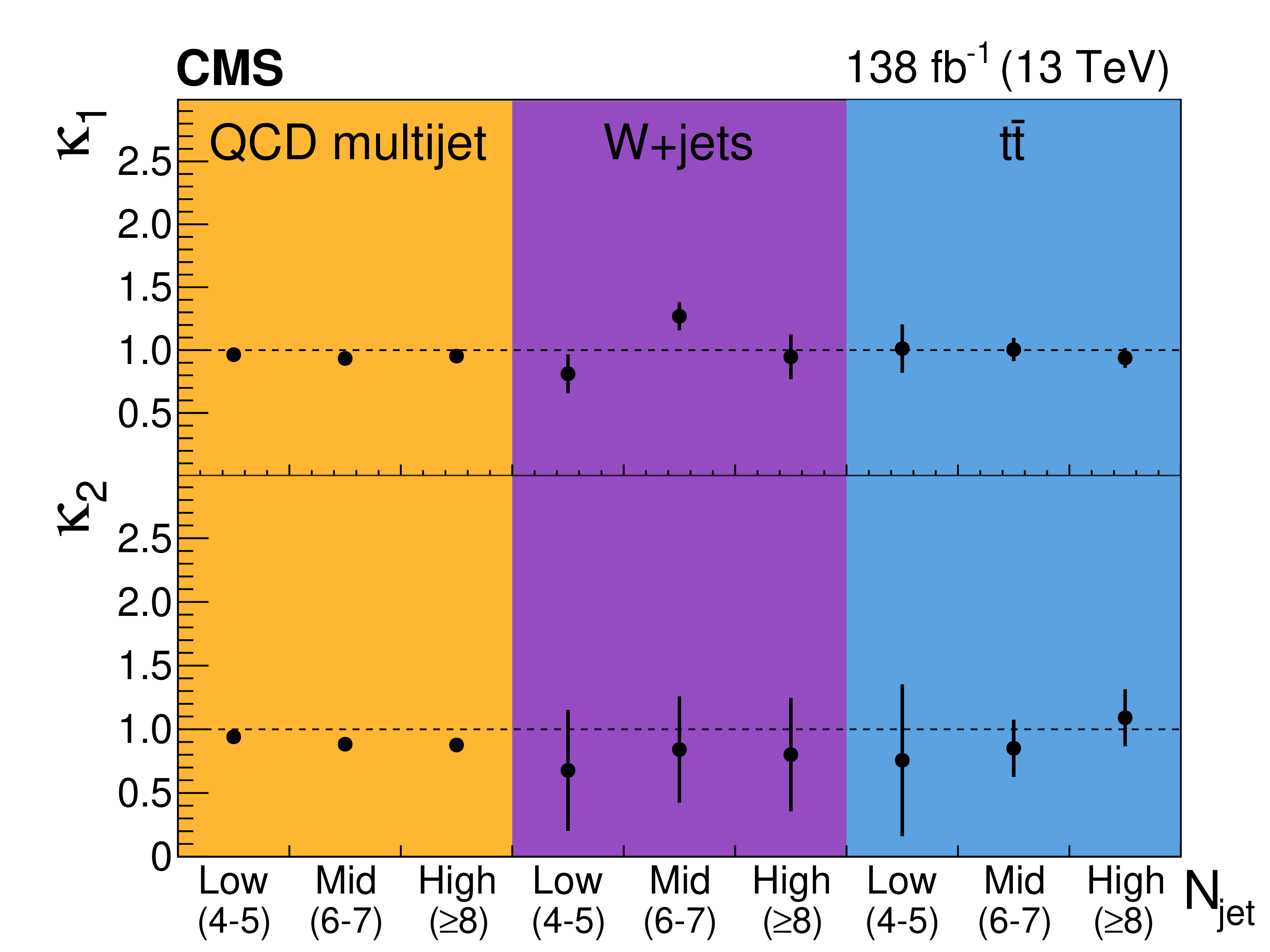
The $ \kappa $ factors measured in control regions for the QCD multijet (yellow left), W+jets (purple middle), and $ {\mathrm{t}\overline{\mathrm{t}}} $ (blue right) backgrounds. The upper and lower panels correspond to $ \kappa_1 $ and $ \kappa_2 $, respectively. In each case, the three points indicate the $ \kappa $ values in each $ N_{\text{jet}} $ bin. The error bars include the statistical uncertainties of data (dominant) and MC simulation samples. |
png pdf |
Figure 5:
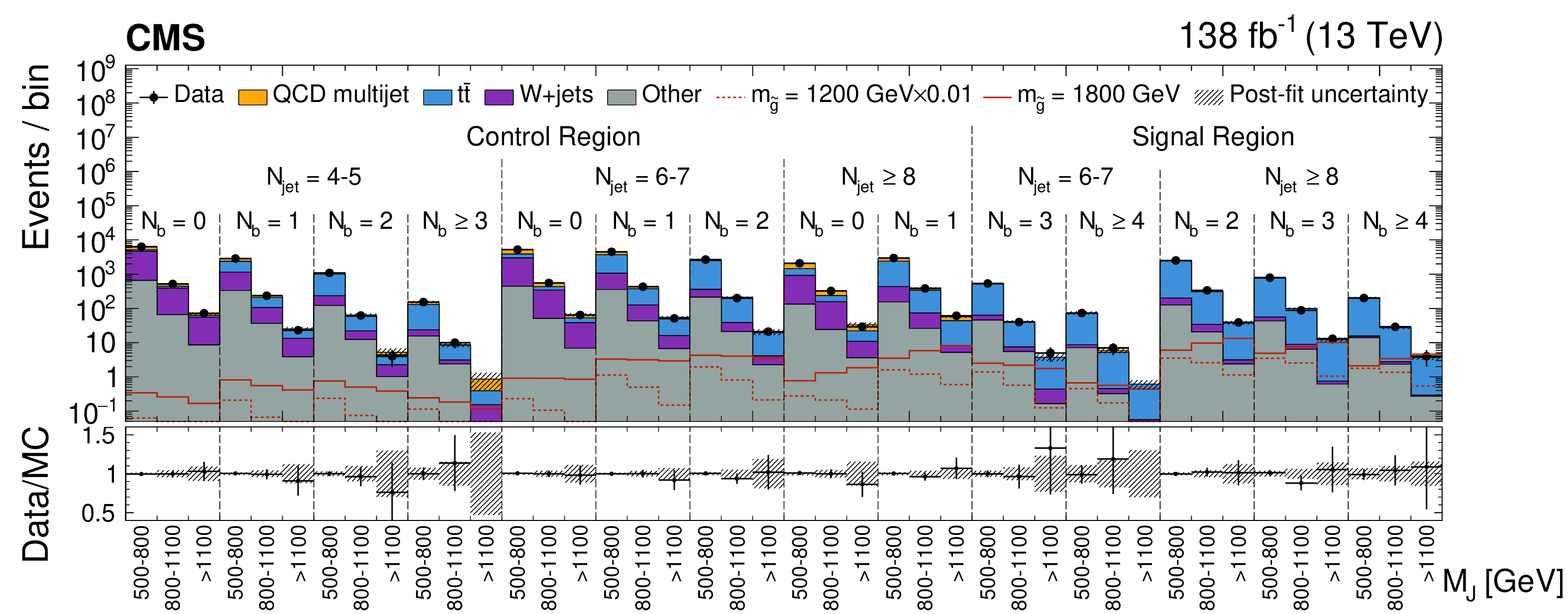
Background-only post-fit $ M_{\mathrm{J}} $ distributions in the $ N_{\text{lep}}= $ 1 region for all three data-taking years, with pre-fit signal overlaid. The three $ M_{\mathrm{J}} $ bins used, defined as 500 $ < M_{\mathrm{J}} < $ 800, 800 $ < M_{\mathrm{J}} < $ 1100, and $ M_{\mathrm{J}} > $ 1100 GeV, are shown from left to right. The data-to-simulation ratio is shown in the lower panel, where the hatched band represents the total (statistical and systematic) uncertainty in the background prediction. |
png pdf |
Figure 6:
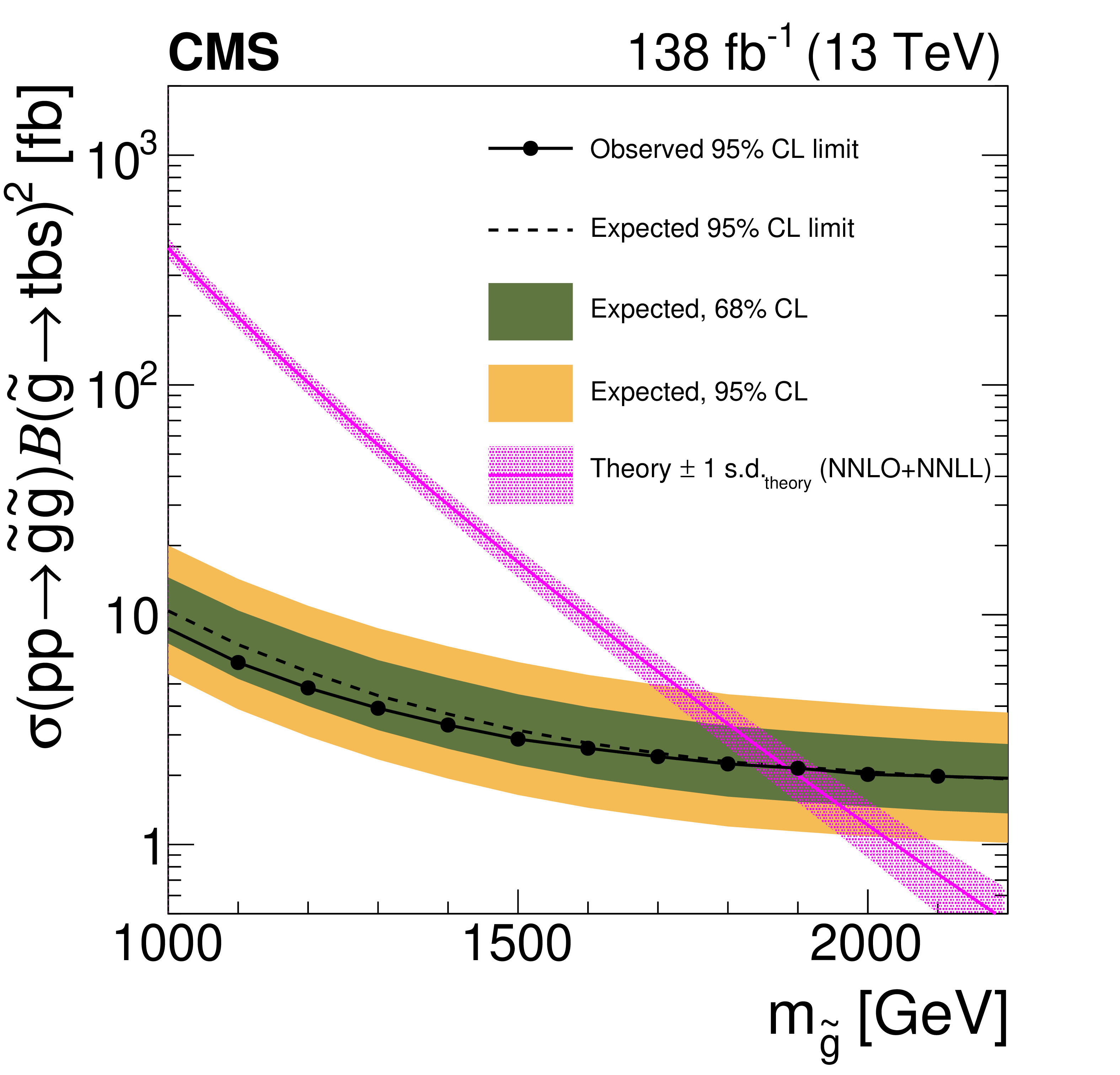
Cross section upper limits at 95% CL compared to the predicted cross section of gluino pair production with $ \mathrm{\widetilde{g}}\to\mathrm{t}\mathrm{b}\mathrm{s} $ (magenta). The theoretical uncertainties in the cross section are represented by the dotted band corresponding to ${\pm}$1 standard deviation (s.d.). The expected limits are shown by the black dashed line, with 68% and 95% CL variations indicated by the green inner and yellow outer bands, respectively. The observed limit is shown as a black solid line with dots. |
| Tables | |
png pdf |
Table 1:
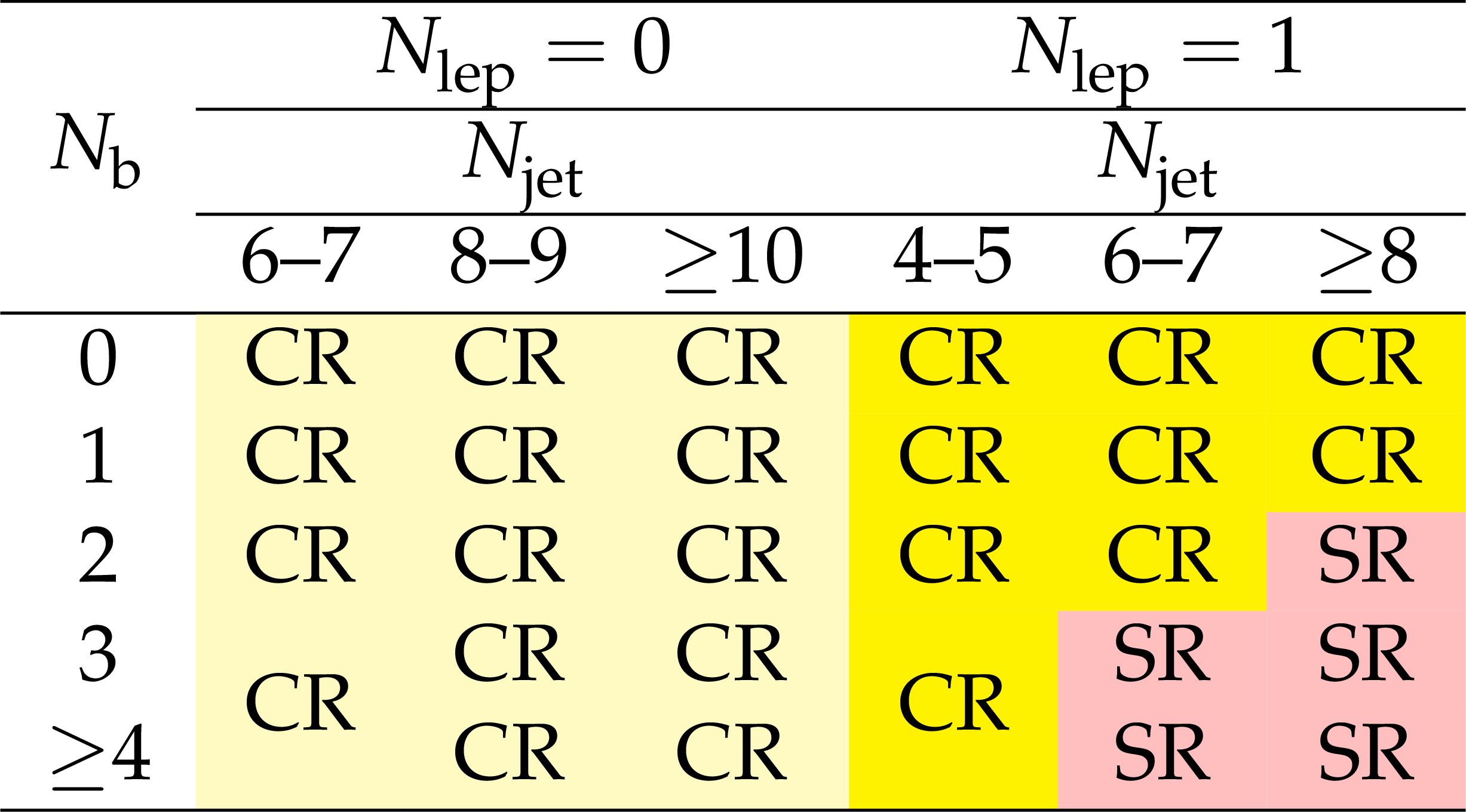
A diagram representing the analysis regions after the baseline selection. Here, ``CR'' denotes a control region and ``SR'' denotes a signal region. Darker yellow indicates regions where the $ M_{\mathrm{J}} $ template is used, while lighter yellow corresponds to regions where it is not used. |

png pdf |
Table 2:
Selection criteria applied for measuring the $ \kappa $ factors of the main backgrounds. |
png pdf |
Table 3:
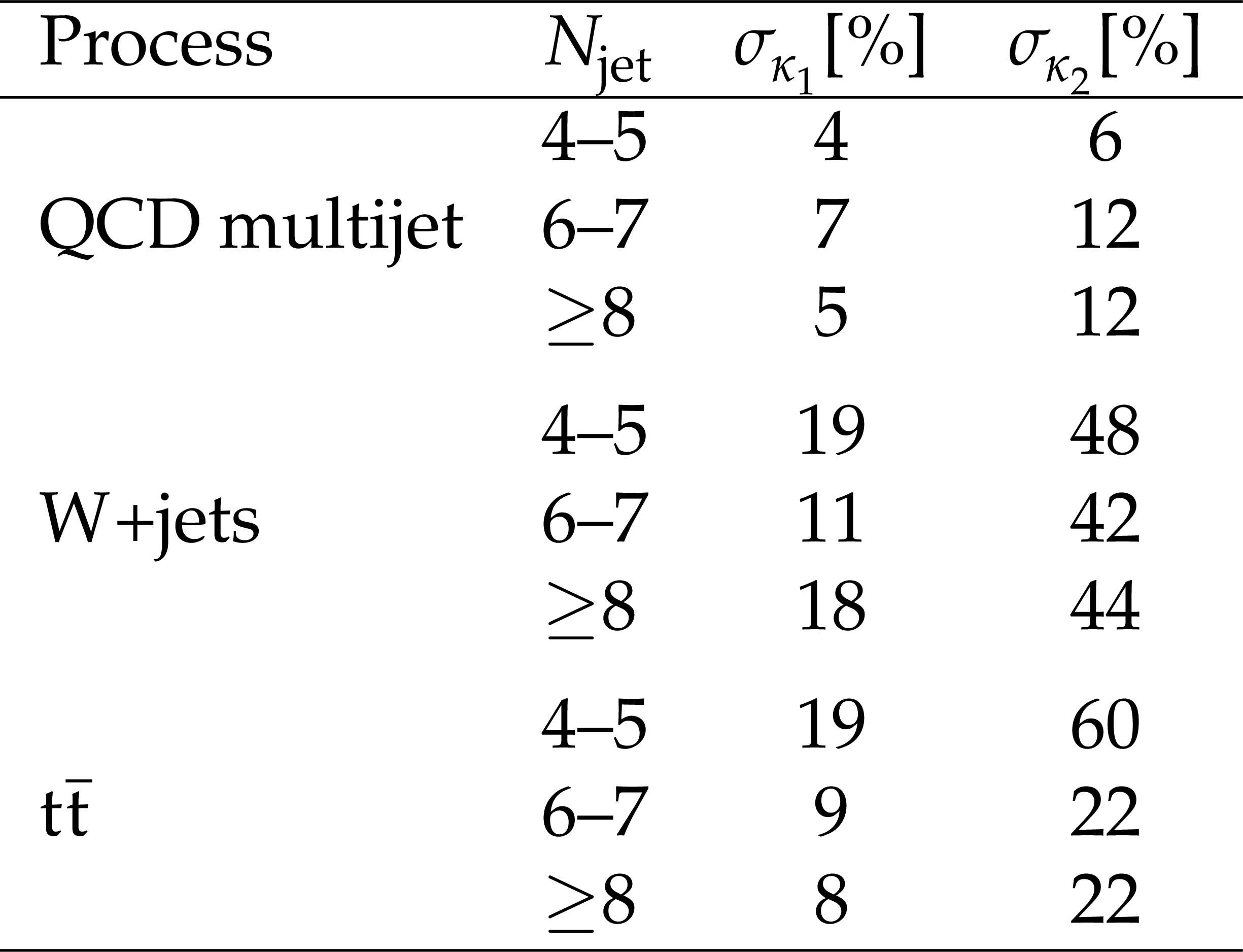
Uncertainties in the $ \kappa $ factors for QCD multijet, W+jets, and $ {\mathrm{t}\overline{\mathrm{t}}} $ backgrounds in the three $ N_{\text{jet}} $ regions used in the global fit. |
png pdf |
Table 4:
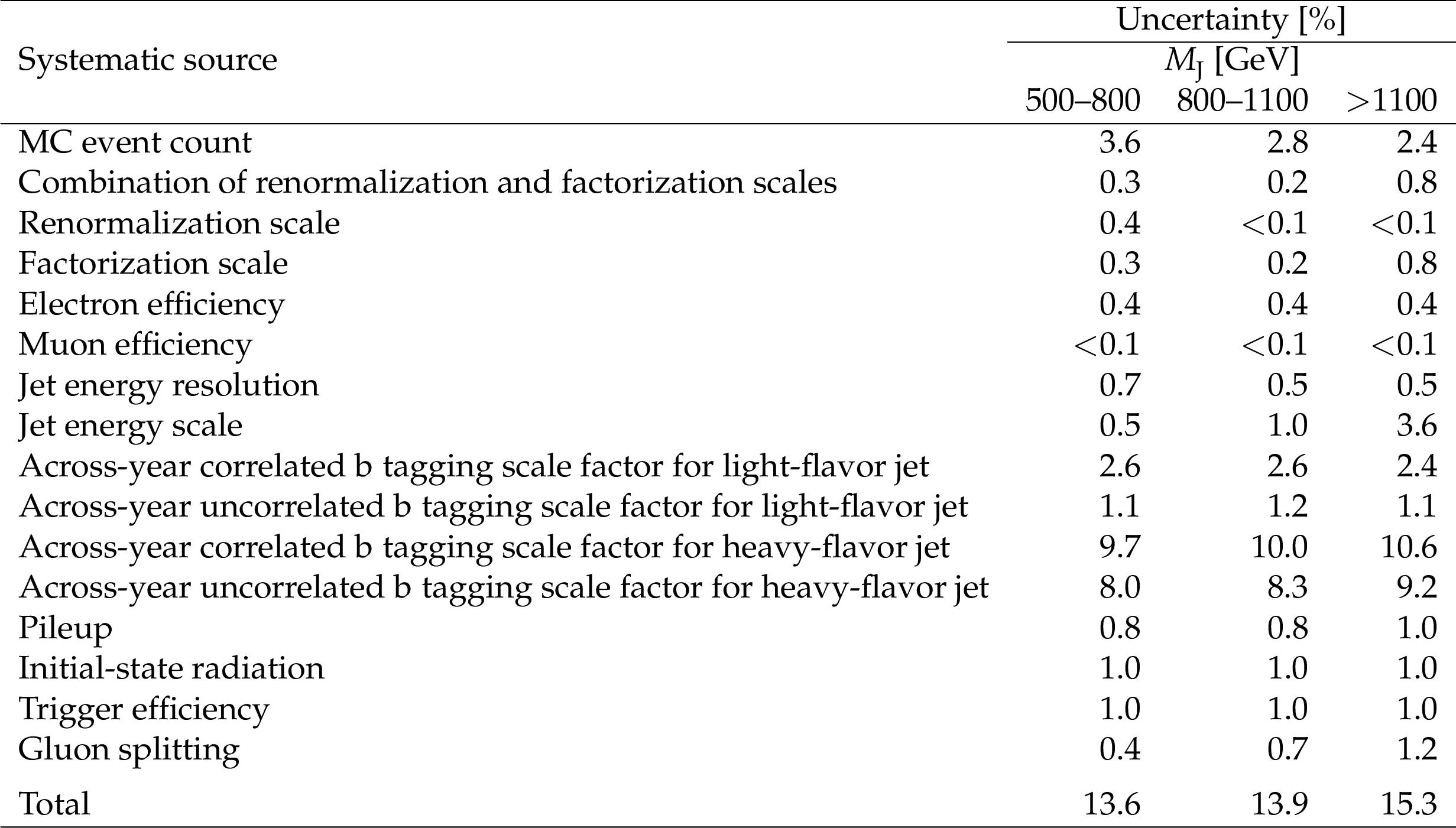
List of signal systematic uncertainties and their effects on the yields in the $ N_{\text{jet}}\ge $ 8 and $ N_{\mathrm{b}}\ge $ 4 bin for all three years combined. The signal model corresponds to $ m_{\mathrm{\widetilde{g}}}= $ 1800 GeV. |
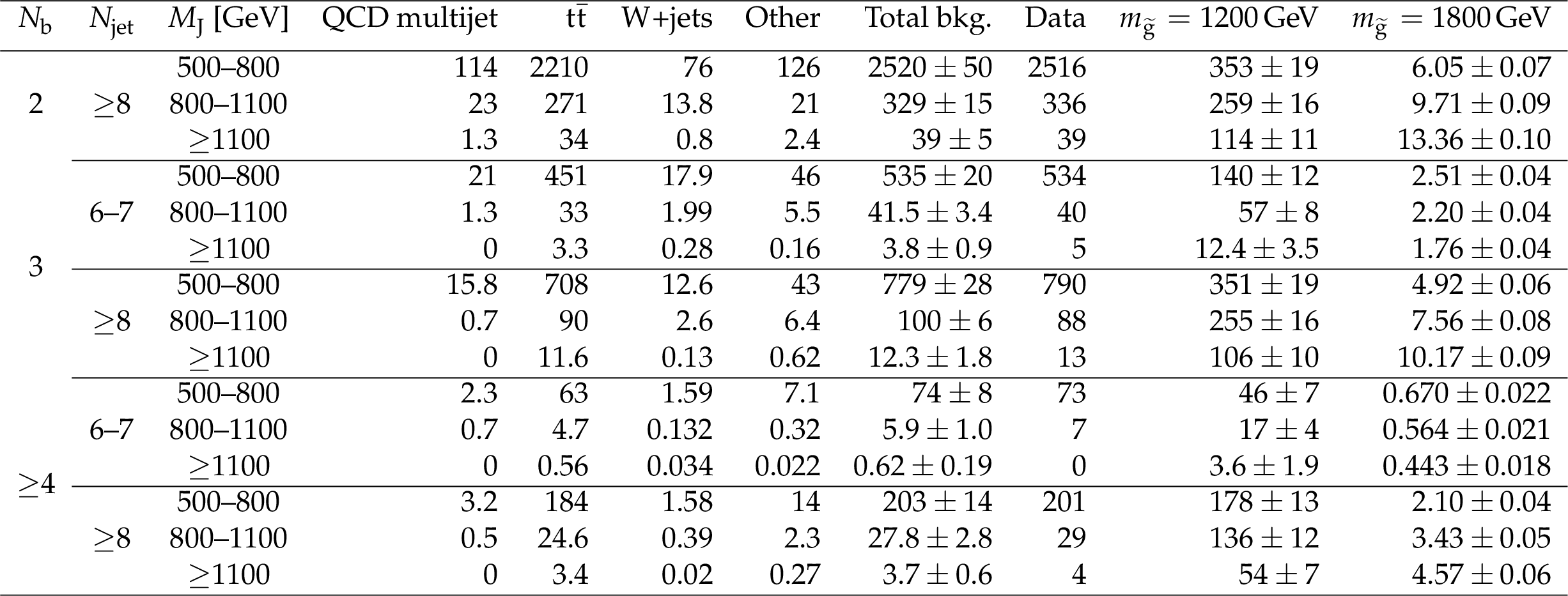
png pdf |
Table 5:
Background-only post-fit yields in the SR for all three data-taking years, with pre-fit signal yields. The uncertainty shown for total background corresponds to the post-fit uncertainty, while that for the signal is statistical only. |
| Summary |
| This analysis investigates the existence of physics beyond the standard model in events characterized by high multiplicities of jets and bottom quark (b) jets in the single-lepton final state, without a requirement on missing transverse momentum. The scalar sum of the large-radius jet masses ($ M_{\mathrm{J}} $) in an event is used for both background rejection and prediction. A simultaneous fit to the $ M_{\mathrm{J}} $ templates, in bins of jet multiplicity $ N_{\text{jet}} $ and the number of b-tagged jets $ N_{\mathrm{b}} $, is performed to extract potential excesses in data. The templates, derived from simulation, are corrected by measurements comparing data and simulation in dedicated control regions. This method enables a data-driven prediction of background across bins of $ N_{\text{jet}} $, $ N_{\mathrm{b}} $, and $ M_{\mathrm{J}} $. The observed event yields are consistent with the background predictions. The result is interpreted within the framework of $ R $-parity violating supersymmetry under the minimal flavor violating scenario. The search focuses on gluino pair production, where each gluino decays to a top, a bottom, and a strange quark via the $ \lambda^{\prime\prime}_{323} $ coupling. Using proton-proton collisions at $ \sqrt{s}= $ 13 TeV from the CERN LHC collected by the CMS experiment from 2016 to 2018 and corresponding to an integrated luminosity of 138 fb$ ^{-1} $, gluinos are excluded up to a mass of 1890 GeV at 95% confidence level. This result exceeds existing limits on the considered gluino pair production model. |
| References | ||||
| 1 | R. Barbieri and G. F. Giudice | Upper bounds on supersymmetric particle masses | NPB 306 (1988) 63 | |
| 2 | G. 't Hooft | Naturalness, chiral symmetry, and spontaneous chiral symmetry breaking | NATO Sci. Ser. B 59 (1980) 135 | |
| 3 | E. Witten | Dynamical breaking of supersymmetry | NPB 188 (1981) 513 | |
| 4 | M. Dine, W. Fischler, and M. Srednicki | Supersymmetric technicolor | NPB 189 (1981) 575 | |
| 5 | S. Dimopoulos and S. Raby | Supercolor | NPB 192 (1981) 353 | |
| 6 | S. Dimopoulos and H. Georgi | Softly broken supersymmetry and SU(5) | NPB 193 (1981) 150 | |
| 7 | R. K. Kaul and P. Majumdar | Cancellation of quadratically divergent mass corrections in globally supersymmetric spontaneously broken gauge theories | NPB 199 (1982) 36 | |
| 8 | H. P. Nilles | Supersymmetry, supergravity and particle physics | Phys. Rept. 110 (1984) 1 | |
| 9 | H. E. Haber and G. L. Kane | The search for supersymmetry: probing physics beyond the standard model | Phys. Rept. 117 (1985) 75 | |
| 10 | S. Dimopoulos, S. Raby, and F. Wilczek | Supersymmetry and the scale of unification | PRD 24 (1981) 1681 | |
| 11 | L. E. Ib \'a \ n ez and G. G. Ross | Low-energy predictions in supersymmetric grand unified theories | PLB 105 (1981) 439 | |
| 12 | M. B. Einhorn and D. R. T. Jones | The weak mixing angle and unification mass in supersymmetric SU(5) | NPB 196 (1982) 475 | |
| 13 | W. J. Marciano and G. Senjanovi \'c | Predictions of supersymmetric grand unified theories | PRD 25 (1982) 3092 | |
| 14 | G. R. Farrar and P. Fayet | Phenomenology of the production, decay, and detection of new hadronic states associated with supersymmetry | PLB 76 (1978) 575 | |
| 15 | R. Barbier et al. | $ {R} $-parity-violating supersymmetry | Phys. Rept. 420 (2005) 1 | |
| 16 | C. Cs \'a ki, Y. Grossman, and B. Heidenreich | Minimal flavor violation supersymmetry: a natural theory for $ R $-parity violation | PRD 85 (2012) 095009 | 1111.1239 |
| 17 | Super-Kamiokande Collaboration | Neutron-antineutron oscillation search using a 0.37 megaton-years exposure of super-kamiokande | PRD 103 (2021) 012008 | 2012.02607 |
| 18 | CMS Collaboration | Search for $ R $-parity violating supersymmetry in pp collisions at $ \sqrt{s}= $ 13 TeV using b jets in a final state with a single lepton, many jets, and high sum of large-radius jet masses | PLB 783 (2018) 114 | CMS-SUS-16-040 1712.08920 |
| 19 | CMS Collaboration | Searches for $ R $-parity-violating supersymmetry in pp collisions at $ \sqrt{s} = $ 8 TeV in final states with 0-4 leptons | PRD 94 (2016) 112009 | CMS-SUS-14-003 1606.08076 |
| 20 | ATLAS Collaboration | Search for $ R $-parity-violating supersymmetry in a final state containing leptons and many jets with the ATLAS experiment using $ \sqrt{s} = $ 13 TeV proton-proton collision data | EPJC 81 (2021) 1023 | 2106.09609 |
| 21 | A. Hook, E. Izaguirre, M. Lisanti, and J. G. Wacker | High multiplicity searches at the LHC using jet masses | PRD 85 (2012) 055029 | 1202.0558 |
| 22 | T. Cohen, E. Izaguirre, M. Lisanti, and H. K. Lou | Jet substructure by accident | JHEP 03 (2013) 161 | 1212.1456 |
| 23 | S. El Hedri, A. Hook, M. Jankowiak, and J. G. Wacker | Learning how to count: a high multiplicity search for the LHC | JHEP 08 (2013) 136 | 1302.1870 |
| 24 | ATLAS Collaboration | Search for massive supersymmetric particles decaying to many jets using the ATLAS detector in pp collisions at $ \sqrt{s}= $ 8 TeV | PRD 91 (2015) 112016 | 1502.05686 |
| 25 | ATLAS Collaboration | Search for new phenomena in final states with large jet multiplicities and missing transverse momentum at $ \sqrt{s}= $ 8 TeV proton-proton collisions using the ATLAS experiment | JHEP 10 (2013) 130 | 1308.1841 |
| 26 | CMS Collaboration | Search for supersymmetry in pp collisions at $ \sqrt{s}= $ 13 TeV in the single-lepton final state using the sum of masses of large-radius jets | JHEP 08 (2016) 122 | CMS-SUS-15-007 1605.04608 |
| 27 | CMS Collaboration | Search for supersymmetry in $ pp $ collisions at $ \sqrt{s}= $ 13 TeV in the single-lepton final state using the sum of masses of large-radius jets | PRL 119 (2017) 151802 | CMS-SUS-16-037 1705.04673 |
| 28 | CMS Collaboration | HEPData record for this analysis | link | |
| 29 | CMS Collaboration | Precision luminosity measurement in proton-proton collisions at $ \sqrt{s}= $ 13 TeV in 2015 and 2016 at CMS | EPJC 81 (2021) 800 | CMS-LUM-17-003 2104.01927 |
| 30 | CMS Collaboration | CMS luminosity measurement for the 2017 data-taking period at $ \sqrt{s}= $ 13 TeV | CMS Physics Analysis Summary, 2018 CMS-PAS-LUM-17-004 |
CMS-PAS-LUM-17-004 |
| 31 | CMS Collaboration | CMS luminosity measurement for the 2018 data-taking period at $ \sqrt{s}= $ 13 TeV | CMS Physics Analysis Summary, 2018 CMS-PAS-LUM-18-002 |
CMS-PAS-LUM-18-002 |
| 32 | CMS Collaboration | The CMS experiment at the CERN LHC | JINST 3 (2008) S08004 | |
| 33 | CMS Collaboration | Development of the CMS detector for the CERN LHC Run 3 | JINST 19 (2024) P05064 | CMS-PRF-21-001 2309.05466 |
| 34 | CMS Collaboration | Performance of the CMS Level-1 trigger in proton-proton collisions at $ \sqrt{s} = $ 13 TeV | JINST 15 (2020) P10017 | CMS-TRG-17-001 2006.10165 |
| 35 | CMS Collaboration | The CMS trigger system | JINST 12 (2017) P01020 | CMS-TRG-12-001 1609.02366 |
| 36 | CMS Collaboration | Performance of the CMS high-level trigger during LHC Run 2 | JINST 19 (2024) P11021 | CMS-TRG-19-001 2410.17038 |
| 37 | CMS Collaboration | Electron and photon reconstruction and identification with the CMS experiment at the CERN LHC | JINST 16 (2021) P05014 | CMS-EGM-17-001 2012.06888 |
| 38 | CMS Collaboration | Performance of the CMS muon detector and muon reconstruction with proton-proton collisions at $ \sqrt{s}= $ 13 TeV | JINST 13 (2018) P06015 | CMS-MUO-16-001 1804.04528 |
| 39 | CMS Collaboration | Description and performance of track and primary-vertex reconstruction with the CMS tracker | JINST 9 (2014) P10009 | CMS-TRK-11-001 1405.6569 |
| 40 | J. Alwall et al. | The automated computation of tree-level and next-to-leading order differential cross sections, and their matching to parton shower simulations | JHEP 07 (2014) 079 | 1405.0301 |
| 41 | P. Nason | A new method for combining NLO QCD with shower Monte Carlo algorithms | JHEP 11 (2004) 040 | hep-ph/0409146 |
| 42 | S. Frixione, P. Nason, and C. Oleari | Matching NLO QCD computations with parton shower simulations: the POWHEG method | JHEP 11 (2007) 070 | 0709.2092 |
| 43 | S. Alioli, P. Nason, C. Oleari, and E. Re | A general framework for implementing NLO calculations in shower Monte Carlo programs: the POWHEG BOX | JHEP 06 (2010) 043 | 1002.2581 |
| 44 | T. Sjöstrand et al. | An introduction to PYTHIA 8.2 | Comput. Phys. Commun. 191 (2015) 159 | 1410.3012 |
| 45 | C. Duhr and B. Fuks | A superspace module for the feynrules package | Comput. Phys. Commun. 182 (2011) 2404 | 1102.4191 |
| 46 | L. Darm é et al. | Ufo 2.0: the `universal feynman output' format | EPJC 83 (2023) 631 | 2304.09883 |
| 47 | W. Beenakker et al. | NNLL-fast 2.0: coloured sparticle production at the LHC Run 3 with $ \sqrt{s}= $ 13.6 TeV | SciPost Phys. Core 7 (2024) 072 | 2404.18837 |
| 48 | R. D. Ball et al. | Parton distributions from high-precision collider data | EPJC 77 (2017) 663 | |
| 49 | J. Alwall et al. | Comparative study of various algorithms for the merging of parton showers and matrix elements in hadronic collisions | EPJC 53 (2008) 473 | 0706.2569 |
| 50 | R. Frederix and S. Frixione | Merging meets matching in MC@NLO | JHEP 12 (2012) 061 | 1209.6215 |
| 51 | CMS Collaboration | Extraction and validation of a new set of CMS PYTHIA8 tunes from underlying-event measurements | EPJC 80 (2020) 4 | CMS-GEN-17-001 1903.12179 |
| 52 | GEANT4 Collaboration | GEANT 4---a simulation toolkit | NIM A 506 (2003) 250 | |
| 53 | CMS Collaboration | Particle-flow reconstruction and global event description with the CMS detector | JINST 12 (2017) P10003 | CMS-PRF-14-001 1706.04965 |
| 54 | M. Cacciari, G. P. Salam, and G. Soyez | The anti-$ k_{\mathrm{T}} $ jet clustering algorithm | JHEP 04 (2008) 063 | 0802.1189 |
| 55 | M. Cacciari, G. P. Salam, and G. Soyez | FastJet user manual | EPJC 72 (2012) 1896 | 1111.6097 |
| 56 | M. Cacciari and G. P. Salam | Pileup subtraction using jet areas | PLB 659 (2008) 119 | 0707.1378 |
| 57 | CMS Collaboration | Jet algorithms performance in 13 TeV data | technical report, 2017 CDS |
|
| 58 | CMS Collaboration | Identification of heavy-flavour jets with the CMS detector in pp collisions at 13 TeV | JINST 13 (2018) P05011 | CMS-BTV-16-002 1712.07158 |
| 59 | K. Rehermann and B. Tweedie | Efficient identification of boosted semileptonic top quarks at the LHC | JHEP 03 (2011) 059 | 1007.2221 |
| 60 | CMS Collaboration | Search for direct pair production of supersymmetric top quarks decaying to all-hadronic final states in pp collisions at $ \sqrt{s}= $ 8 TeV | EPJC 76 (2016) 460 | CMS-SUS-13-023 1603.00765 |
| 61 | ATLAS Collaboration | Search for direct pair production of the top squark in all-hadronic final states in proton-proton collisions at $ \sqrt{s}= $ 8 TeV with the ATLAS detector | JHEP 09 (2014) 015 | 1406.1122 |
| 62 | CMS Collaboration | Measurement of the cross section for $ \mathrm{t\bar{t}} $ production with additional jets and b jets in pp collisions at $ \sqrt{s} = $ 13 TeV | JHEP 07 (2020) 125 | CMS-TOP-18-002 2003.06467 |
| 63 | CMS Collaboration | The CMS statistical analysis and combination tool: COMBINE | Comput. Softw. Big Sci. 8 (2024) 19 | CMS-CAT-23-001 2404.06614 |
| 64 | T. Junk | Confidence level computation for combining searches with small statistics | NIM A 434 (1999) 435 | hep-ex/9902006 |
| 65 | A. L. Read | Presentation of search results: the $ CL_{s} $ technique | JPG 28 (2002) 2693 | |
| 66 | G. Cowan, K. Cranmer, E. Gross, and O. Vitells | Asymptotic formulae for likelihood-based tests of new physics | EPJC 71 (2011) 1554 | 1007.1727 |
|
|
Compact Muon Solenoid LHC, CERN |

|
|
|
|
|
|