
Compact Muon Solenoid
LHC, CERN
 Visit us: CMS Public Website, CMS Physics ;
Contact us: CMS Publications Committee
Visit us: CMS Public Website, CMS Physics ;
Contact us: CMS Publications Committee
| CMS-SMP-23-001 ; CERN-EP-2026-144 | ||
| Observation of electroweak production of pairs of Z bosons in proton-proton collisions at 13 TeV | ||
| CMS Collaboration | ||
| 18 June 2026 | ||
| Accepted for publication in Physical Review Letters | ||
| Abstract: The first evidence of electroweak (EW) production of pairs of Z bosons in association with two jets ($\text{jj}$) in the final state $ \mathrm{Z}\mathrm{Z} \text{jj}\to\ell\ell\nu\nu \text{jj} $, where $ \ell = \mathrm{e}, \mu $, is reported by the CMS experiment. The analysis is based on a data sample of proton-proton (pp) collisions at $ \sqrt{s} = $ 13 TeV, corresponding to an integrated luminosity of 138 fb$ ^{-1} $. Events are selected by requiring exactly two leptons of same flavor and opposite charge, large missing transverse momentum, and two jets with a large rapidity separation and large invariant mass. The EW production cross section in a fiducial volume is $ \sigma_{\mathrm{EW}}(\mathrm{p}\mathrm{p} \to \mathrm{Z}\mathrm{Z} \text{jj}\to\ell\ell\nu\nu \text{jj}) = $ 0.37 $ ^{+0.14}_{-0.12} $ (stat) $^{+0.06}_{-0.06}$ (syst) fb, in agreement with the standard model prediction of 0.39 $ \pm $ 0.06 fb. The observed (expected) significance of the signal is 3.1 (2.8) standard deviations. Limits on anomalous quartic gauge couplings are derived in terms of dimension-8 effective field theory operators. A combination with the previously reported result from the ZZ decay channel with four charged leptons yields an observed (expected) significance of 5.0 (4.5) standard deviations for the EW production of Z boson pairs. | ||
| Links: e-print arXiv:2606.20558 [hep-ex] (PDF) ; CDS record ; inSPIRE record ; HepData record ; CADI line (restricted) ; | ||
| Figures | |
png pdf |
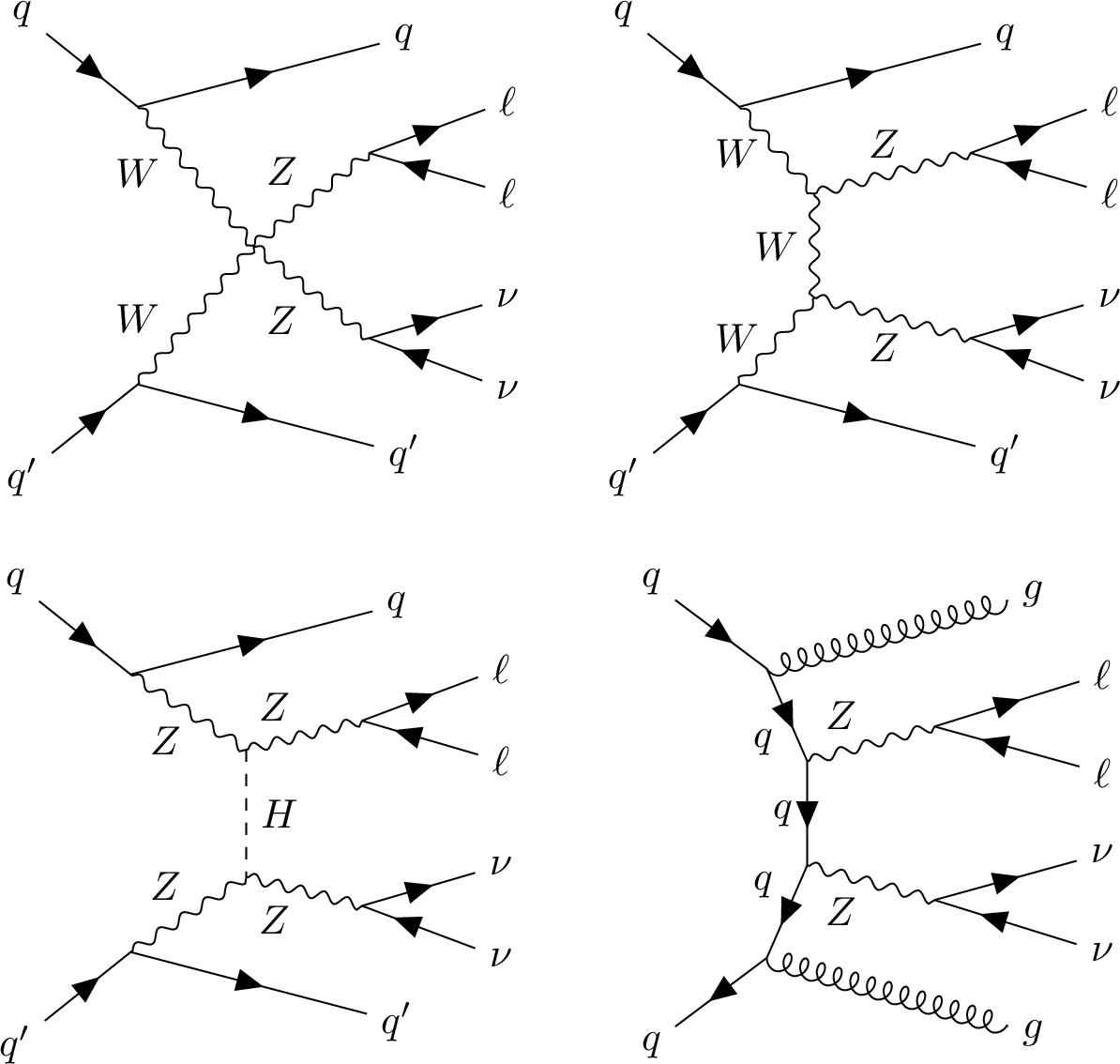
Figure 1:
Example Feynman diagrams of the signal EW ZZ process (first three diagrams) and the QCD ZZ background process (last diagram). |
png pdf |
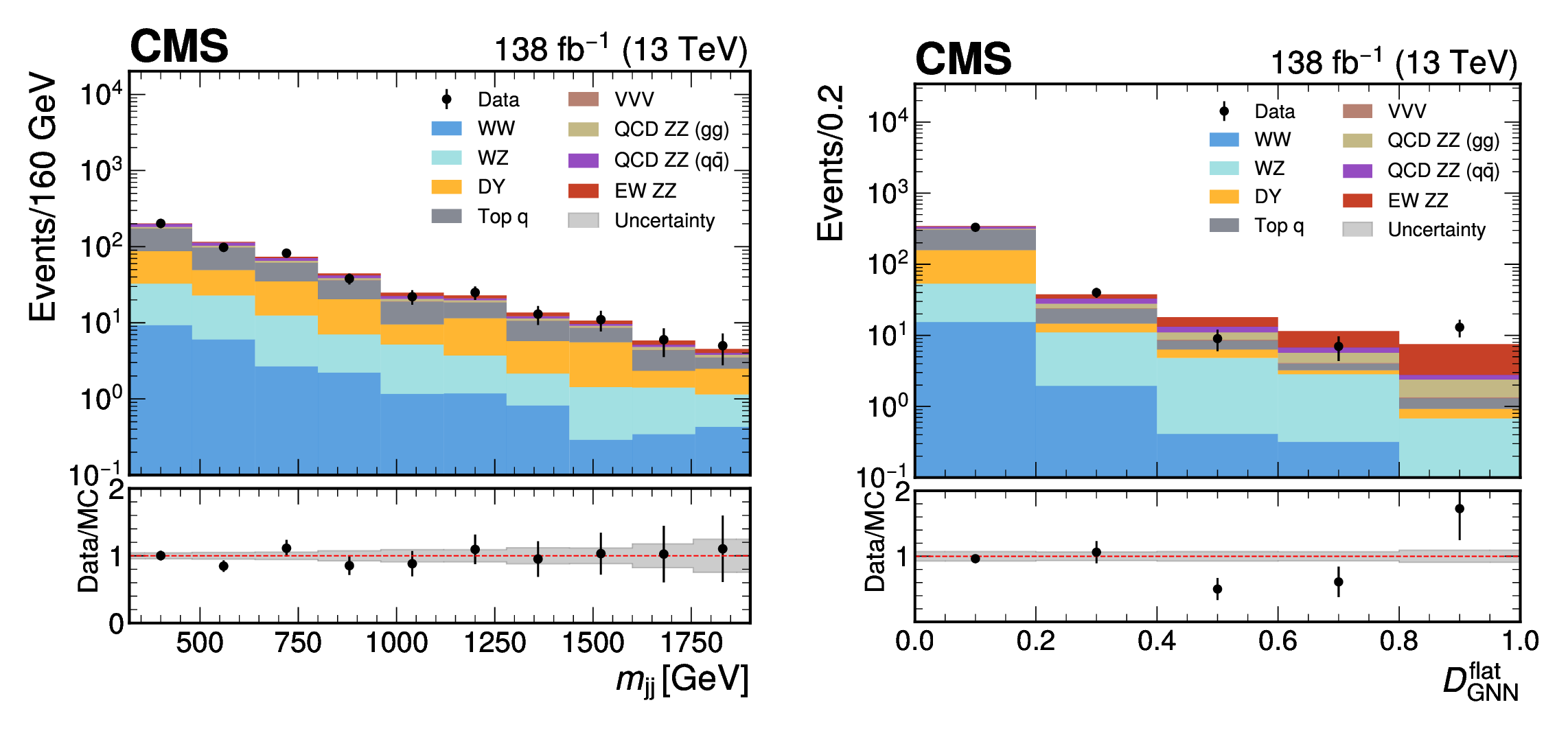
Figure 2:
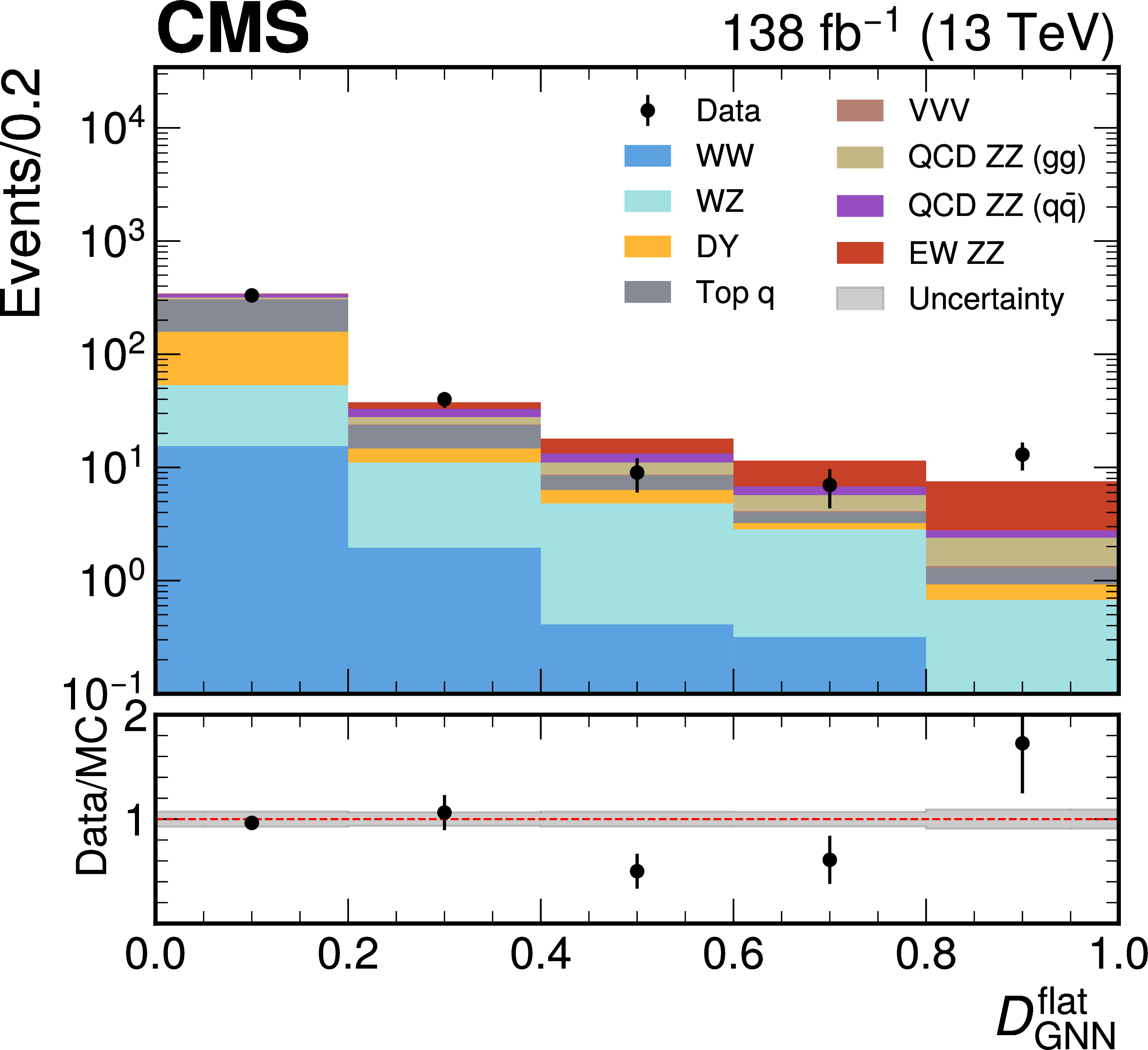
Distributions of the dijet invariant mass (left) and the flattened GNN discriminator (right) in the SR after the maximum likelihood fit. The data are shown as black points, whereas the stacked histograms represent the fitted signal and background contributions. The vertical bars on the data points represent the statistical uncertainties. The gray band indicates the total uncertainty in the prediction after the fit, including both statistical and systematic components. |
png pdf |
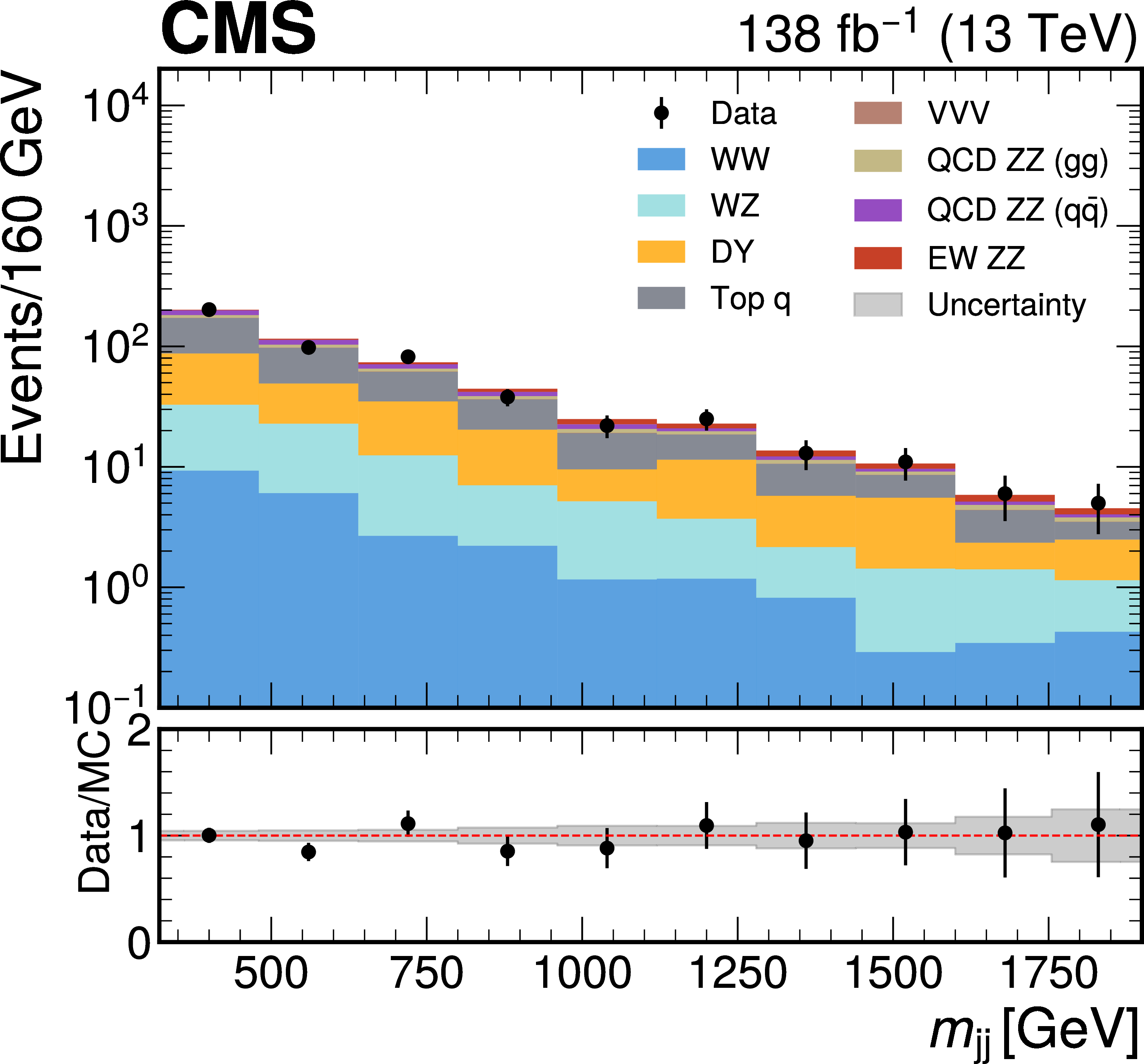
Figure 2-a:
Distributions of the dijet invariant mass (left) and the flattened GNN discriminator (right) in the SR after the maximum likelihood fit. The data are shown as black points, whereas the stacked histograms represent the fitted signal and background contributions. The vertical bars on the data points represent the statistical uncertainties. The gray band indicates the total uncertainty in the prediction after the fit, including both statistical and systematic components. |
png pdf |
Figure 2-b:
Distributions of the dijet invariant mass (left) and the flattened GNN discriminator (right) in the SR after the maximum likelihood fit. The data are shown as black points, whereas the stacked histograms represent the fitted signal and background contributions. The vertical bars on the data points represent the statistical uncertainties. The gray band indicates the total uncertainty in the prediction after the fit, including both statistical and systematic components. |
png pdf |
Figure 3:
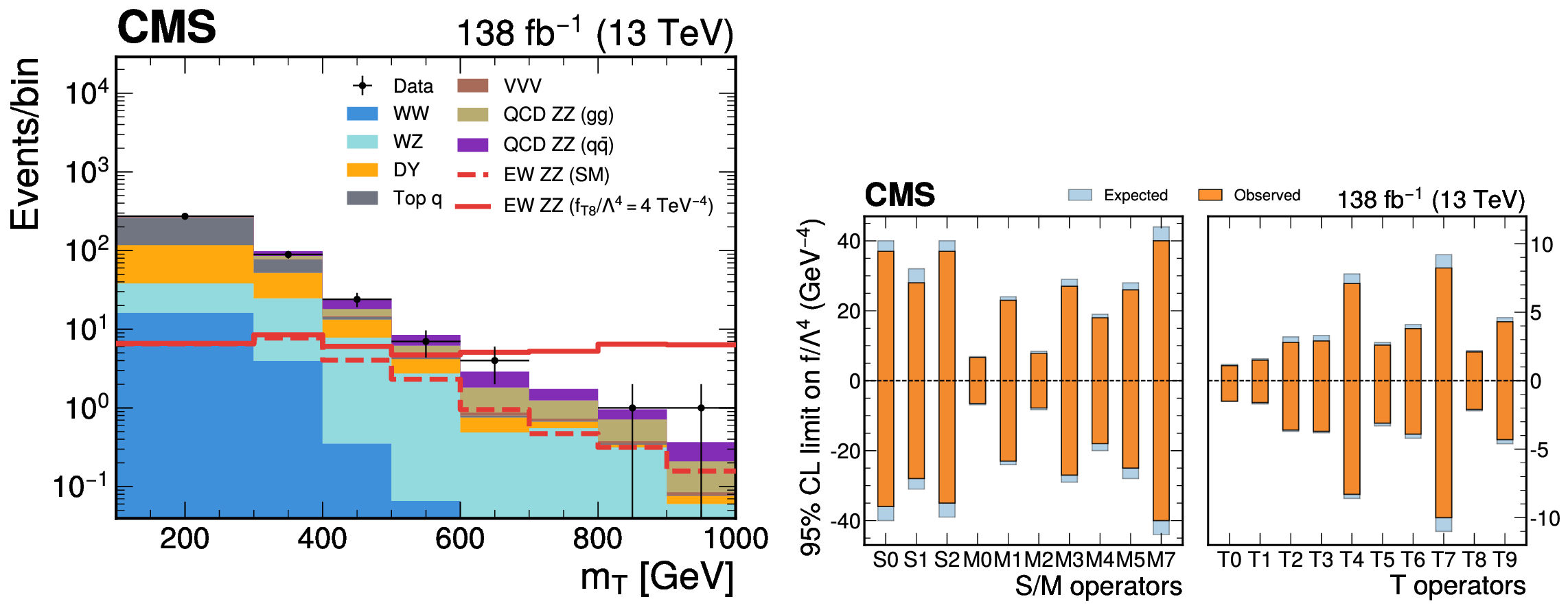
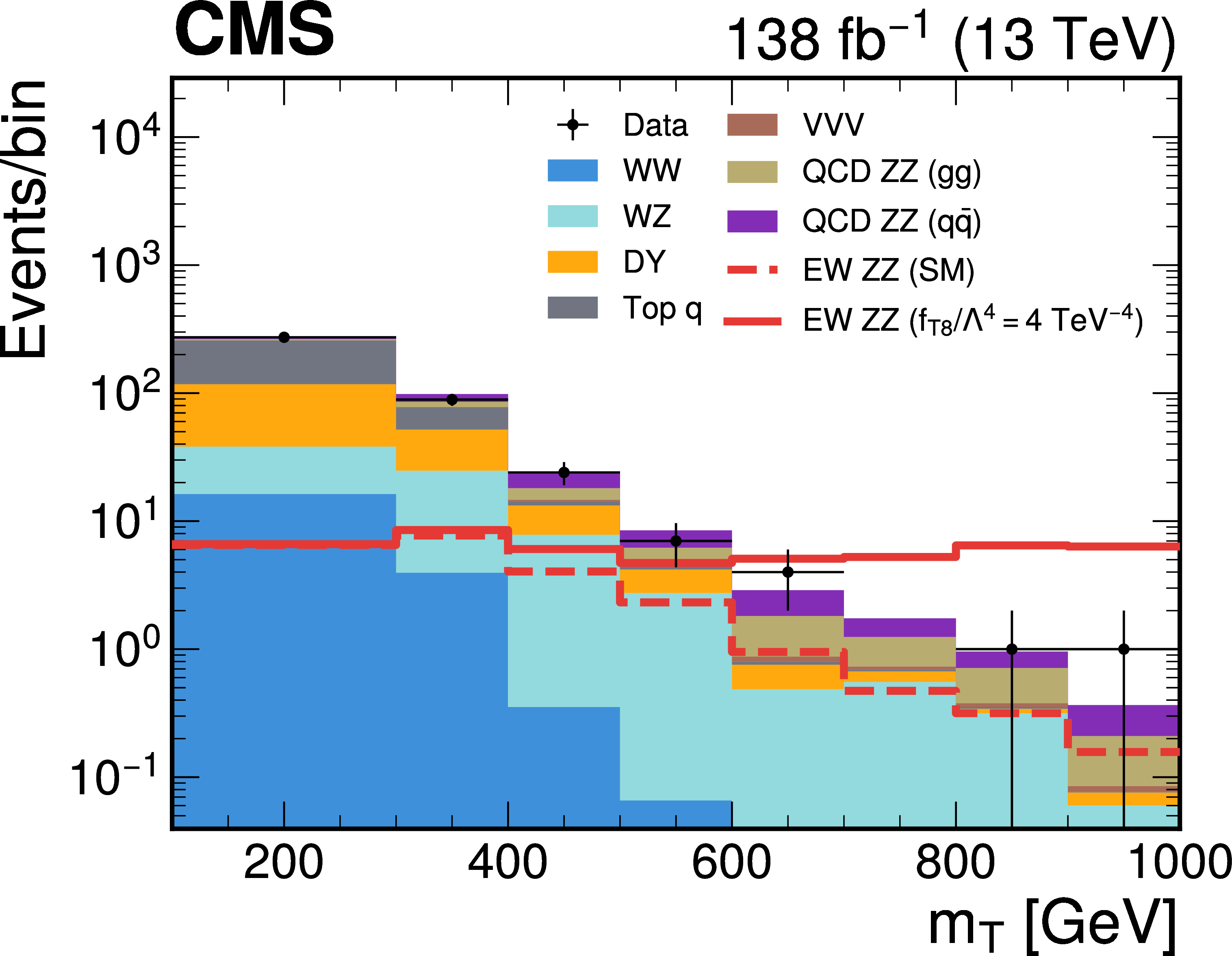
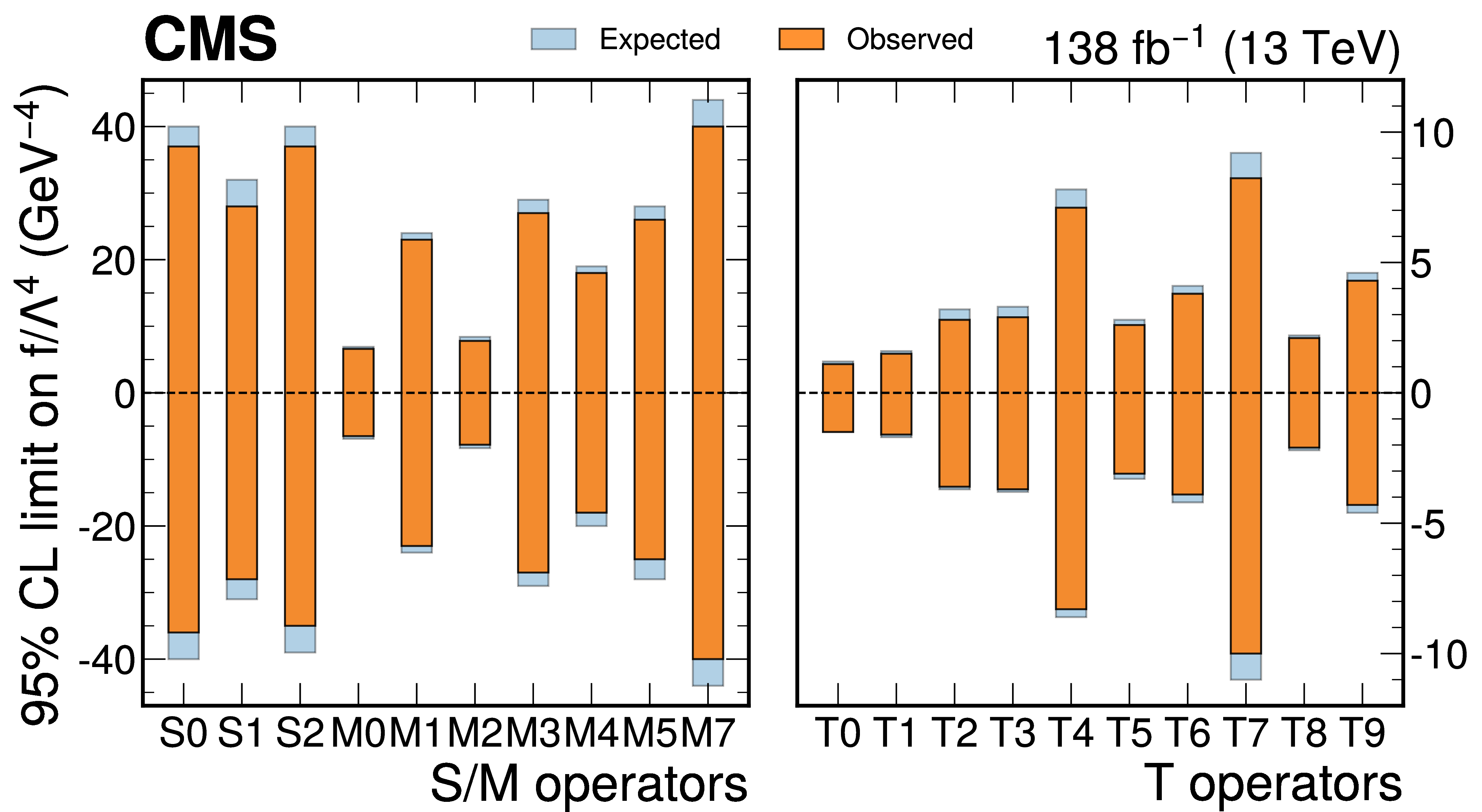
The $ m_{\mathrm{T}} $ distribution (left) with the expected contribution from a T8 operator, showing SM case (dashed red) and $ f_{\mathrm{T8}}/\Lambda^4 = 4\text{TeV}^{-4} $ (solid red). The vertical bars on the data points represent the statistical uncertainties. The expected and observed limits (right) at 95% CL are obtained from the likelihood fits. |
png pdf |
Figure 3-a:
The $ m_{\mathrm{T}} $ distribution (left) with the expected contribution from a T8 operator, showing SM case (dashed red) and $ f_{\mathrm{T8}}/\Lambda^4 = 4\text{TeV}^{-4} $ (solid red). The vertical bars on the data points represent the statistical uncertainties. The expected and observed limits (right) at 95% CL are obtained from the likelihood fits. |
png pdf |
Figure 3-b:
The $ m_{\mathrm{T}} $ distribution (left) with the expected contribution from a T8 operator, showing SM case (dashed red) and $ f_{\mathrm{T8}}/\Lambda^4 = 4\text{TeV}^{-4} $ (solid red). The vertical bars on the data points represent the statistical uncertainties. The expected and observed limits (right) at 95% CL are obtained from the likelihood fits. |
| Tables | |
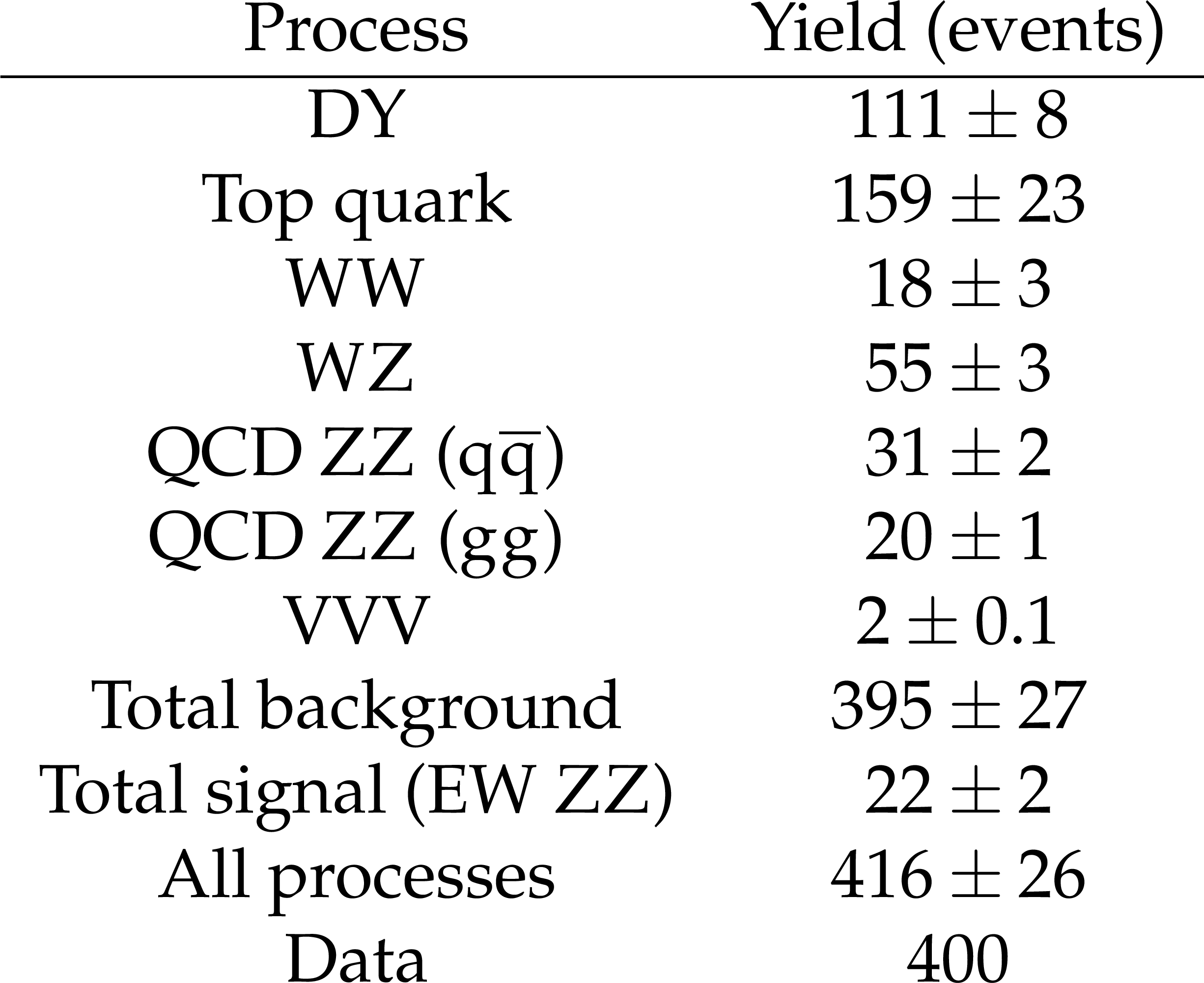
png pdf |
Table 1:
Estimated event yields for signal and background processes in the SR after the maximum likelihood fit, with associated uncertainties including the statistical and systematic components, for the $ \ell\ell\nu\nu $ channel only. The QCD-induced production of Z boson pairs is shown separately for $ \mathrm{q}\overline{\mathrm{q}} $ and $ \mathrm{g}\mathrm{g} $ initial states. V denotes W or Z. |
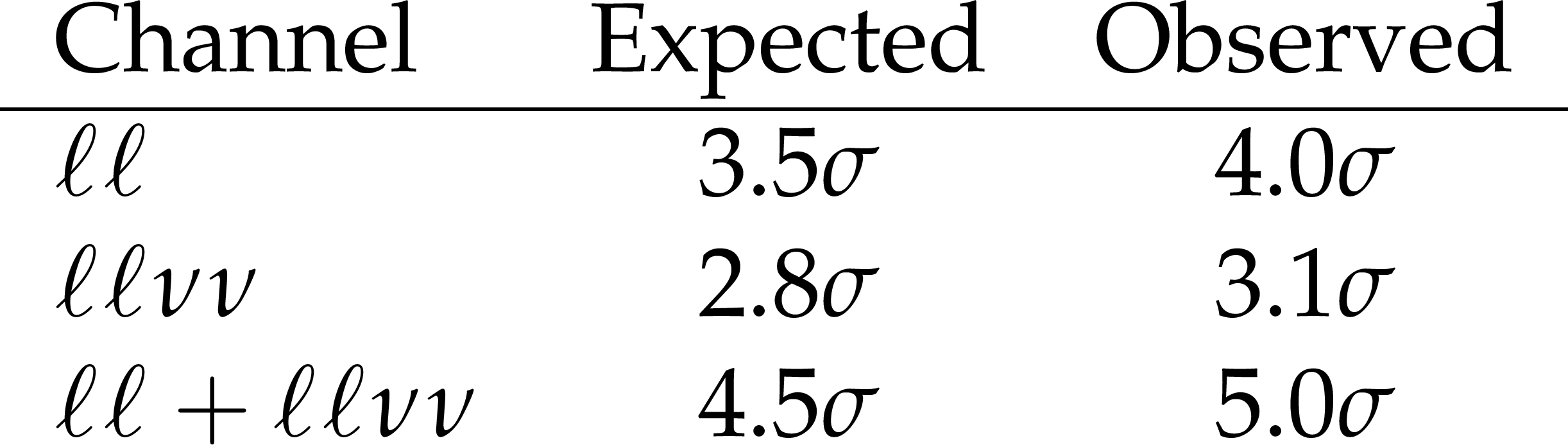
png pdf |
Table 2:
Observed and expected significances of EW ZZ production in the $ \ell\ell\nu\nu $ and $ \ell\ell\ell^{'}\ell^{'}$ channels, and their combination. |
| Summary |
| In summary, we report the first evidence for electroweak (EW) production of Z boson pairs in the final state $ \mathrm{Z}\mathrm{Z} \text{jj}\to\ell\ell\nu\nu \text{jj} $, with a significance of 3.1 standard deviations. The measured fiducial cross section is in agreement with the standard model predictions. A search for anomalous quartic gauge couplings shows no evidence of beyond the standard model effects. Limits are set in terms of dimension-8 effective field theory operators. A combination with the previously reported result from the ZZ decay channel with four charged leptons [2] yields an observed (expected) significance of 5.0 (4.5) standard deviations for the EW production of Z boson pairs. With the addition of this result, the CMS experiment has observed EW production of all pairs of massive gauge bosons: WW (both same-sign and opposite-sign), WZ, and ZZ. |
| References | ||||
| 1 | B. W. Lee, C. Quigg, and H. B. Thacker | Weak interactions at very high energies: The role of the Higgs-boson mass | PRD 16 (1977) 1519 | |
| 2 | CMS Collaboration | Evidence for electroweak production of four charged leptons and two jets in proton-proton collisions at $ \sqrt {s} = $ 13 TeV | PLB 812 (2021) 135992 | CMS-SMP-20-001 2008.07013 |
| 3 | CMS Collaboration | Performance of missing transverse momentum reconstruction in proton-proton collisions at $ \sqrt{s} = $ 13 TeV using the CMS detector | JINST 14 (2019) P07004 | CMS-JME-17-001 1903.06078 |
| 4 | E. d. S. Almeida, O. J. P. Eboli, and M. C. Gonzalez-Garcia | Unitarity constraints on anomalous quartic couplings | PRD 101 (2020) 113003 | 2004.05174 |
| 5 | C. F. Anders et al. | Vector boson scattering: Recent experimental and theory developments | Rev. Phys. 3 (2018) 44 | 1801.04203 |
| 6 | O. J. P. Eboli, M. C. Gonzalez-Garcia, and J. K. Mizukoshi | $ pp \to $ jje$ ^\pm\mu^\pm\nu\nu $ and jje$ ^\pm\mu^\mp\nu\nu $ at $ \mathcal{O}(\alpha_{\mathrm{em}}^6) $ and $ \mathcal{O}(\alpha_{\mathrm{em}}^4 \alpha_s^2) $ for the study of the quartic electroweak gauge boson vertex at CERN LHC | PRD 74 (2006) 073005 | hep-ph/0606118 |
| 7 | CMS Collaboration | Observation of electroweak production of same-sign W boson pairs in the two jet and two same-sign lepton final state in proton-proton collisions at $ \sqrt{s} = $ 13 TeV | PRL 120 (2018) 081801 | CMS-SMP-17-004 1709.05822 |
| 8 | CMS Collaboration | Observation of electroweak $ \mathrm{W}^{+}\mathrm{W}^{-} $ pair production in association with two jets in proton-proton collisions at $ \sqrt{s}= $ 13 TeV | PLB 841 (2023) 137495 | CMS-SMP-21-001 2205.05711 |
| 9 | CMS Collaboration | Measurements of production cross sections of WZ and same-sign WW boson pairs in association with two jets in proton-proton collisions at $ \sqrt{s}= $ 13 TeV | PLB 809 (2020) 135710 | CMS-SMP-19-012 2005.01173 |
| 10 | ATLAS Collaboration | Observation of electroweak production of two jets and a Z-boson pair | Nat. Phys. 19 (2023) 237 | 2004.10612 |
| 11 | CMS Collaboration | The CMS experiment at the CERN LHC | JINST 3 (2008) S08004 | |
| 12 | CMS Collaboration | Development of the CMS detector for the CERN LHC Run 3 | JINST 19 (2024) P05064 | CMS-PRF-21-001 2309.05466 |
| 13 | CMS Collaboration | Performance of the CMS Level-1 trigger in proton-proton collisions at $ \sqrt{s} = $ 13 TeV | JINST 15 (2020) P10017 | CMS-TRG-17-001 2006.10165 |
| 14 | CMS Collaboration | The CMS trigger system | JINST 12 (2017) P01020 | CMS-TRG-12-001 1609.02366 |
| 15 | CMS Collaboration | Performance of the CMS high-level trigger during LHC Run 2 | JINST 19 (2024) P11021 | CMS-TRG-19-001 2410.17038 |
| 16 | CMS Collaboration | Electron and photon reconstruction and identification with the CMS experiment at the CERN LHC | JINST 16 (2021) P05014 | CMS-EGM-17-001 2012.06888 |
| 17 | CMS Collaboration | Performance of the CMS muon detector and muon reconstruction with proton-proton collisions at $ \sqrt{s}= $ 13 TeV | JINST 13 (2018) P06015 | CMS-MUO-16-001 1804.04528 |
| 18 | CMS Collaboration | Description and performance of track and primary-vertex reconstruction with the CMS tracker | JINST 9 (2014) P10009 | CMS-TRK-11-001 1405.6569 |
| 19 | CMS Collaboration | Particle-flow reconstruction and global event description with the CMS detector | JINST 12 (2017) P10003 | CMS-PRF-14-001 1706.04965 |
| 20 | CMS Collaboration | Performance of reconstruction and identification of $ \tau $ leptons decaying to hadrons and $ \nu_\tau $ in pp collisions at $ \sqrt{s}= $ 13 TeV | JINST 13 (2018) P10005 | CMS-TAU-16-003 1809.02816 |
| 21 | CMS Collaboration | Jet energy scale and resolution in the CMS experiment in pp collisions at 8 TeV | JINST 12 (2017) P02014 | CMS-JME-13-004 1607.03663 |
| 22 | M. Cacciari, G. P. Salam, and G. Soyez | The anti-$ k_{\mathrm{T}} $ jet clustering algorithm | JHEP 04 (2008) 063 | 0802.1189 |
| 23 | M. Cacciari, G. P. Salam, and G. Soyez | FastJet user manual | EPJC 72 (2012) 1896 | 1111.6097 |
| 24 | CMS Collaboration | Identification of heavy-flavour jets with the CMS detector in pp collisions at 13 TeV | JINST 13 (2018) P05011 | CMS-BTV-16-002 1712.07158 |
| 25 | E. Bols et al. | Jet flavour classification using DeepJet | JINST 15 (2020) P12012 | 2008.10519 |
| 26 | CMS Collaboration | Performance of the DeepJet b tagging algorithm using 41.9 fb$ ^{-1} $ of data from proton-proton collisions at 13 TeV with Phase 1 CMS detector | CMS Detector Performance Summary CMS-DP-2018-058, 2018 CDS |
|
| 27 | CMS Collaboration | Measurement of the inclusive W and Z production cross sections in pp collisions at $ \sqrt{s}= $ 7 TeV | JHEP 10 (2011) 132 | CMS-EWK-10-005 1107.4789 |
| 28 | S. Alioli, P. Nason, C. Oleari, and E. Re | A general framework for implementing NLO calculations in shower Monte Carlo programs: the POWHEG BOX | JHEP 06 (2010) 043 | 1002.2581 |
| 29 | T. Sjöstrand et al. | An introduction to PYTHIA 8.2 | Comput. Phys. Commun. 191 (2015) 159 | 1410.3012 |
| 30 | B. Cabouat and T. Sjöstrand | Some dipole shower studies | EPJC 78 (2018) 226 | 1710.00391 |
| 31 | B. J ä ger et al. | Parton-shower effects in Higgs production via Vector-Boson Fusion | EPJC 80 (2020) 756 | 2003.12435 |
| 32 | J. M. Campbell and R. K. Ellis | MCFM for the Tevatron and the LHC | Nucl. Phys. Proc. Suppl. 20 (2010) 5 | 1007.3492 |
| 33 | S. Frixione, P. Nason, and G. Ridolfi | A positive-weight next-to-leading-order Monte Carlo for heavy flavour hadroproduction | JHEP 09 (2007) 126 | 0707.3088 |
| 34 | E. Re | Single-top Wt-channel production matched with parton showers using the POWHEG method | EPJC 71 (2011) 1547 | 1009.2450 |
| 35 | NNPDF Collaboration | Parton distributions from high-precision collider data | EPJC 77 (2017) 663 | 1706.00428 |
| 36 | CMS Collaboration | Extraction and validation of a new set of CMS PYTHIA8 tunes from underlying-event measurements | EPJC 80 (2020) 4 | CMS-GEN-17-001 1903.12179 |
| 37 | GEANT4 Collaboration | GEANT 4---a simulation toolkit | NIM A 506 (2003) 250 | |
| 38 | E. A. Moreno et al. | JEDI-net: a jet identification algorithm based on interaction networks | EPJC 80 (2020) 58 | 1908.05318 |
| 39 | CMS Collaboration | The CMS statistical analysis and combination tool: Combine | Comput. Softw. Big Sci. 8 (2024) 19 | CMS-CAT-23-001 2404.06614 |
| 40 | R. Barlow and C. Beeston | Fitting using finite Monte Carlo samples | Comput. Phys. Commun. 77 (1993) 219 | |
| 41 | J. S. Conway | Incorporating nuisance parameters in likelihoods for multisource spectra | 1103.0354 | |
| 42 | G. Cowan, K. Cranmer, E. Gross, and O. Vitells | Asymptotic formulae for likelihood-based tests of new physics | EPJC 71 (2011) 1554 | 1007.1727 |
| 43 | A. L. Read | Presentation of search results: The $ \text{CL}_\text{s} $ technique | JPG 28 (2002) 2693 | |
| 44 | T. Junk | Confidence level computation for combining searches with small statistics | NIM A 434 (1999) 435 | hep-ex/9902006 |
| 45 | CMS Collaboration | Measurement and effective field theory interpretation of the photon--fusion production cross section of a pair of W bosons in proton--proton collisions at $ \sqrt{s}= $ 13 TeV | Submitted to JHEP | CMS-SMP-24-019 2601.21574 |
| 46 | CMS Collaboration | Measurements of the $ \mathrm{pp}\rightarrow \mathrm{W}^{\pm}\gamma\gamma $ and $ \mathrm{pp}\rightarrow \mathrm{Z}\gamma\gamma $ cross sections at $ \sqrt{s}= $ 13 TeV and limits on anomalous quartic gauge couplings | JHEP 10 (2021) 174 | CMS-SMP-19-013 2105.12780 |
| 47 | CMS Collaboration | Measurement of the electroweak production of Z$ \gamma $ and two jets in proton-proton collisions at $ \sqrt{s}= $ 13 TeV and constraints on anomalous quartic gauge couplings | PRD 104 (2021) 072001 | CMS-SMP-20-016 2106.11082 |
| 48 | CMS Collaboration | Measurement of the electroweak production of W$ \gamma $ in association with two jets in proton-proton collisions at $ \sqrt{s}= $ 13 TeV | PRD 108 (2023) 032017 | CMS-SMP-21-011 2212.12592 |
| 49 | CMS Collaboration | Vector boson scattering and anomalous quartic couplings in final states with $ \ell\nu \mathrm{qq} $ or $ \ell\ell \mathrm{qq} $ plus jets using proton-proton collisions at $ \sqrt{s}= $ 13 TeV | JHEP 03 (2026) 022 | CMS-SMP-22-011 2510.00118 |
| 50 | CMS Collaboration | HEPData record for this analysis | link | |
| 51 | ATLAS and CMS Collaborations, and the LHC Higgs Combination Group | Procedure for the LHC Higgs boson search combination in Summer 2011 | link | |
| 52 | CMS Collaboration | Performance of the CMS electromagnetic calorimeter in pp collisions at $ \sqrt{s}= $ 13 TeV | JINST 19 (2024) P09004 | CMS-EGM-18-002 2403.15518 |
| 53 | CMS Collaboration | Precision luminosity measurement in proton-proton collisions at $ \sqrt{s}= $ 13 TeV with the CMS detector | CMS Physics Analysis Summary, 2025 link |
CMS-PAS-LUM-20-001 |
| 54 | H.-L. Lai et al. | New parton distributions for collider physics | PRD 82 (2010) 074024 | 1007.2241 |
| 55 | A. D. Martin, W. J. Stirling, R. S. Thorne, and G. Watt | Parton distributions for the LHC | EPJC 63 (2009) 189 | 0901.0002 |
| 56 | NNPDF Collaboration | Impact of heavy quark masses on parton distributions and LHC phenomenology | NPB 849 (2011) | 1101.1300 |
| 57 | J. Butterworth et al. | PDF4LHC recommendations for LHC Run II | JPG 43 (2016) 023001 | 1510.03865 |
| 58 | NNPDF Collaboration | Parton distributions for the LHC Run II | JHEP 04 (2015) 040 | 1410.8849 |
| 59 | CMS Collaboration | Search for dark matter produced in association with a leptonically decaying Z boson in proton-proton collisions at $ \sqrt{s} = $ 13 TeV | EPJC 81 (2021) 13 | CMS-EXO-19-003 2008.04735 |
| 60 | A. Bierweiler, T. Kasprzik, and J. H. K \"u hn | Vector-boson pair production at the LHC to $ \mathcal{O}(\alpha^3) $ accuracy | JHEP 12 (2013) 071 | 1305.5402 |
| 61 | S. Gieseke, T. Kasprzik, and J. H. Kahn | Vector-boson pair production and electroweak corrections in HERWIG++ | EPJC 74 (2014) 2988 | 1401.3964 |
| 62 | J. Baglio, L. D. Ninh, and M. M. Weber | Massive gauge boson pair production at the LHC: a next-to-leading order story | PRD 88 (2013) 113005 | 1307.4331 |
| 63 | J. Alwall et al. | The automated computation of tree-level and next-to-leading order differential cross sections, and their matching to parton shower simulations | JHEP 07 (2014) 079 | 1405.0301 |
| 64 | A. Manohar, P. Nason, G. P. Salam, and G. Zanderighi | How bright is the proton? A precise determination of the photon parton distribution function | PRL 117 (2016) 242002 | 1607.04266 |
| 65 | S. Frixione et al. | Weak corrections to Higgs hadroproduction in association with a top-quark pair | JHEP 09 (2014) 065 | 1407.0823 |
| 66 | S. Frixione et al. | Electroweak and QCD corrections to top-pair hadroproduction in association with heavy bosons | JHEP 06 (2015) 184 | 1504.03446 |
|
|
Compact Muon Solenoid LHC, CERN |

|
|
|
|
|
|