
Compact Muon Solenoid
LHC, CERN
 Visit us: CMS Public Website, CMS Physics ;
Contact us: CMS Publications Committee
Visit us: CMS Public Website, CMS Physics ;
Contact us: CMS Publications Committee
| CMS-EXO-24-012 ; CERN-EP-2026-051 | ||
| Search for low-mass resonances decaying to $ \tau\tau $ in proton-proton collisions at $ \sqrt{s} = $ 13.6 TeV | ||
| CMS Collaboration | ||
| 24 May 2026 | ||
| Submitted to Physical Review Letters | ||
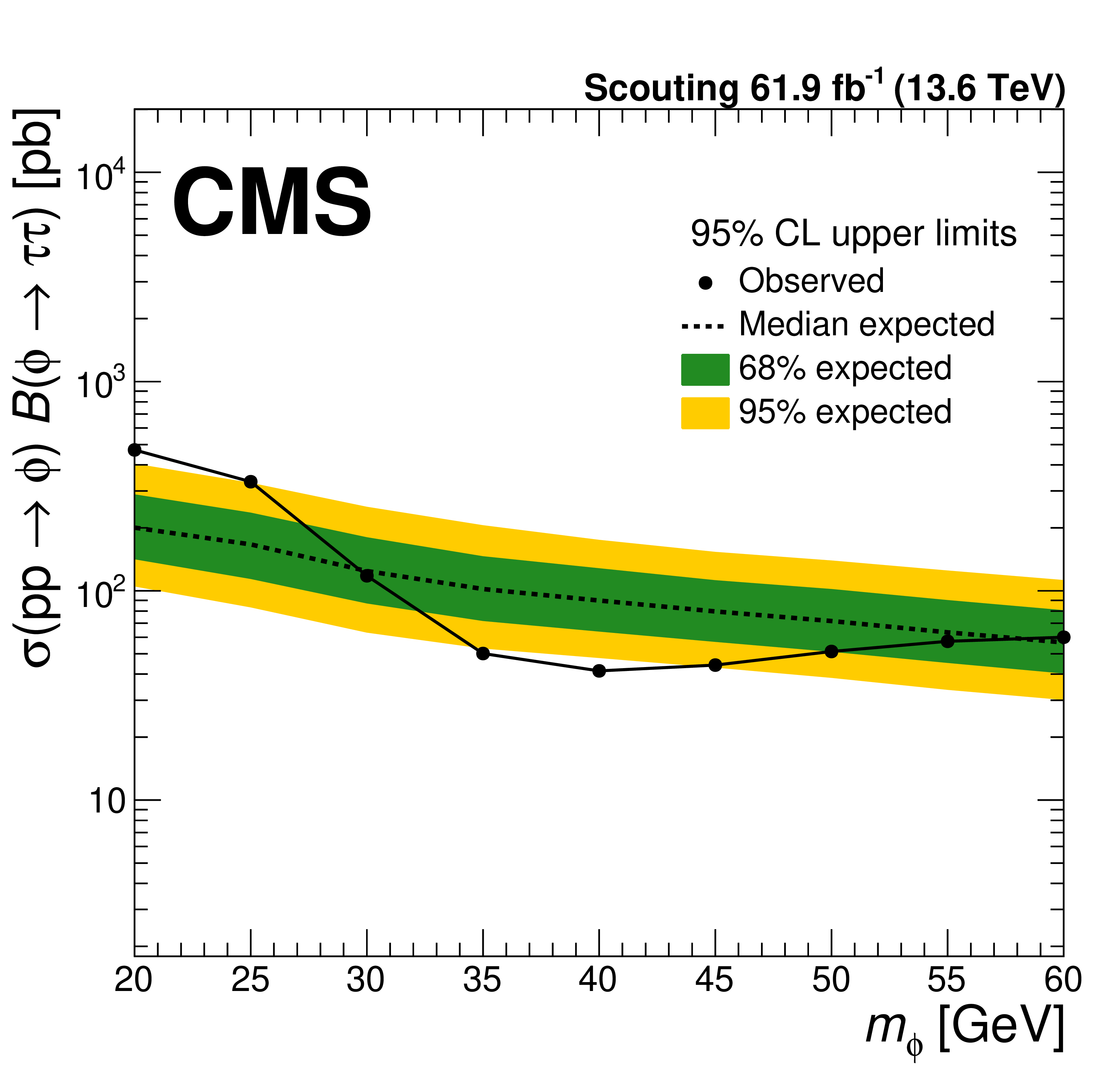
| Abstract: An inclusive search is presented for spin-zero bosons decaying to $ \tau\tau $ in a previously unexplored mass range between 20 and 60 GeV using proton-proton collision data at $ \sqrt{s}= $ 13.6 TeV, corresponding to an integrated luminosity of 61.9 fb$ ^{-1} $ recorded by CMS in 2022--2023. The search is performed using a high-rate trigger stream in combination with a novel low-momentum hadronic tau reconstruction algorithm. No significant excess above the standard model background is observed. Upper limits on the product of the spin-zero resonance production cross section and branching fraction to $ \tau\tau $ are set at 95% confidence level between 40 and 400 pb. | ||
| Links: e-print arXiv:2605.25103 [hep-ex] (PDF) ; CDS record ; inSPIRE record ; HepData record ; CADI line (restricted) ; | ||
| Figures | |
png pdf |
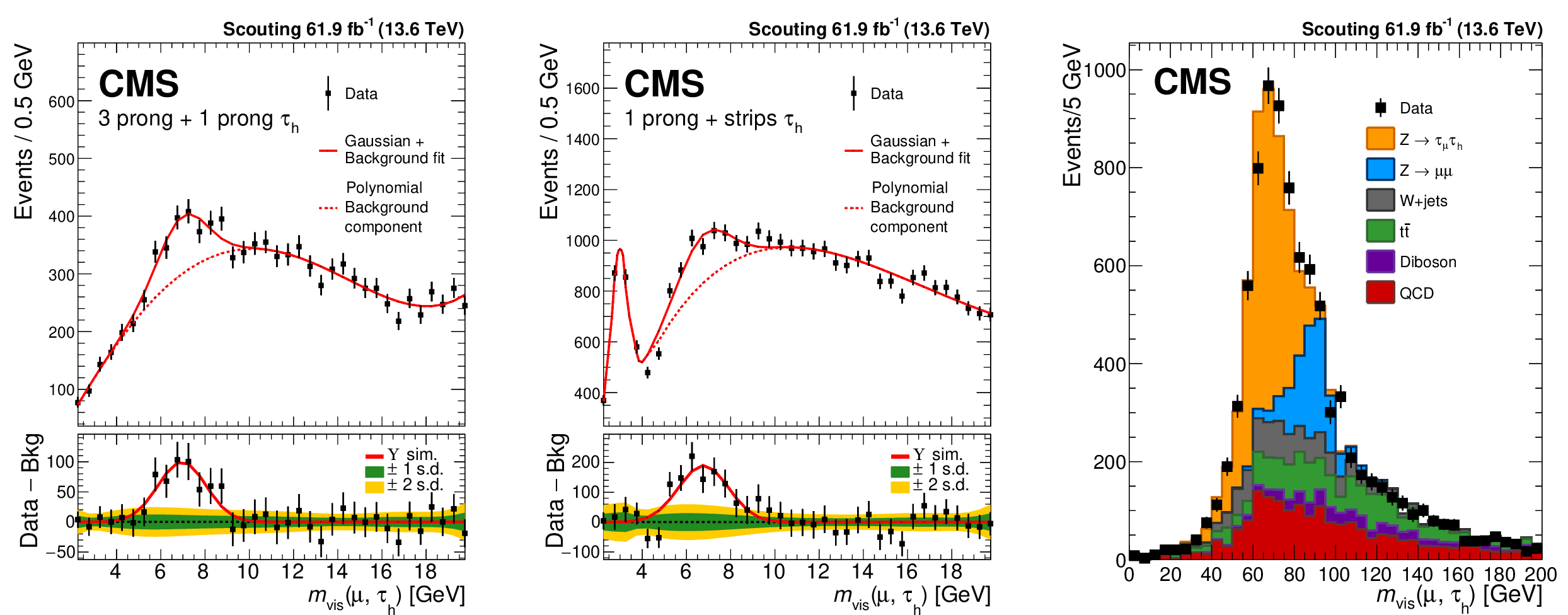
Figure 1:
The $ m_{\text{vis}}(\mu,\tau_\mathrm{h}) $ distribution in the Z boson selection region is shown for data, simulated $ \mathrm{Z}\to\tau_{\mu}\tau_\mathrm{h} $ events, and background processes. The QCD background is estimated from same-sign data, while all other backgrounds are taken from simulation. The fitted $ \mathrm{Z}\to\tau_{\mu}\tau_\mathrm{h} $ signal agrees with SM expectations. |
png pdf |
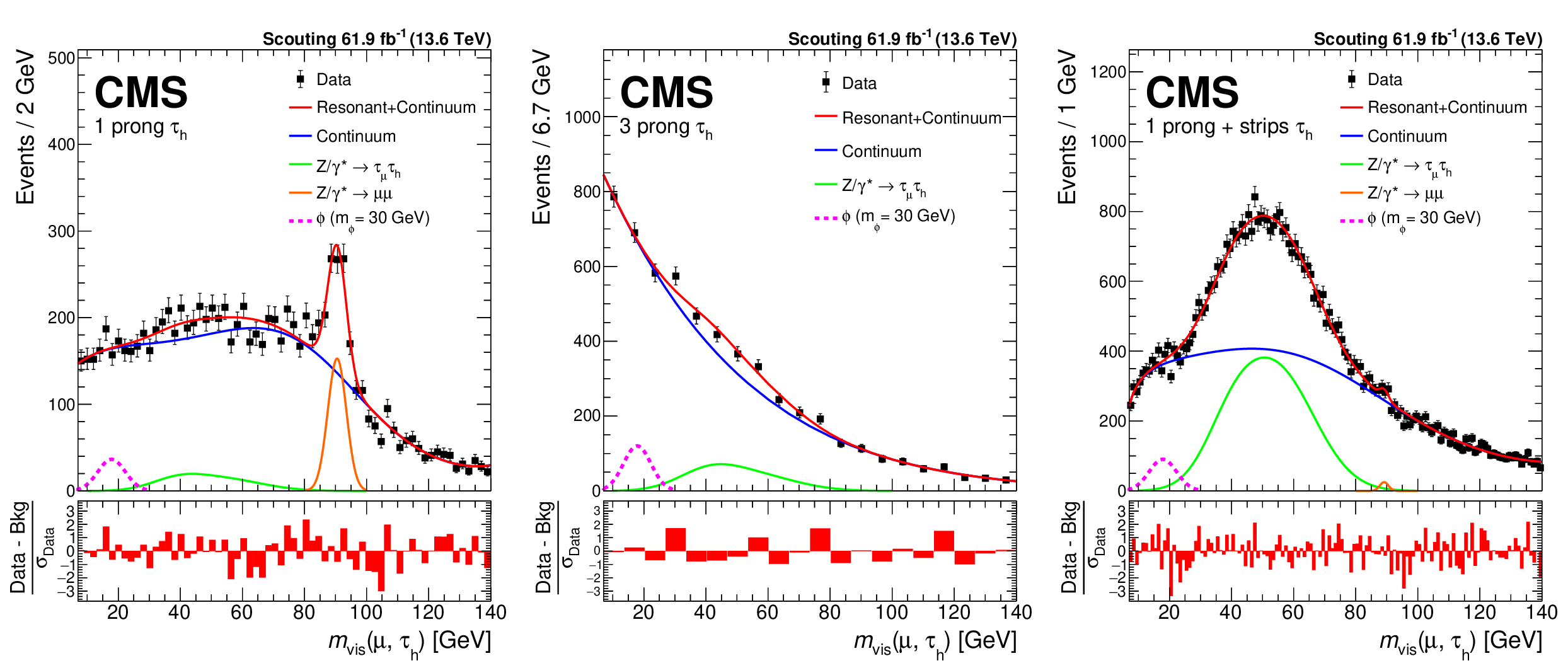
Figure 2:
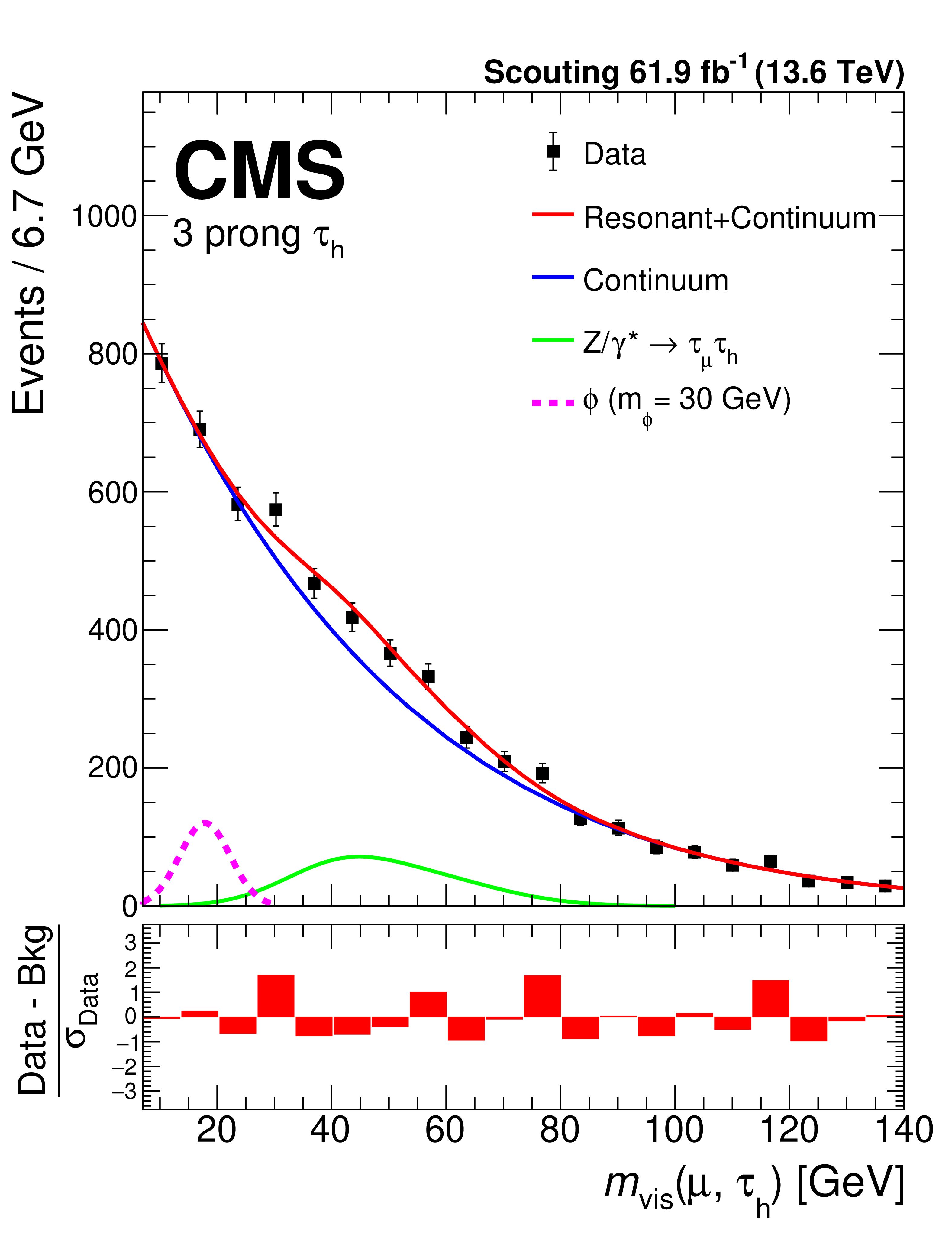
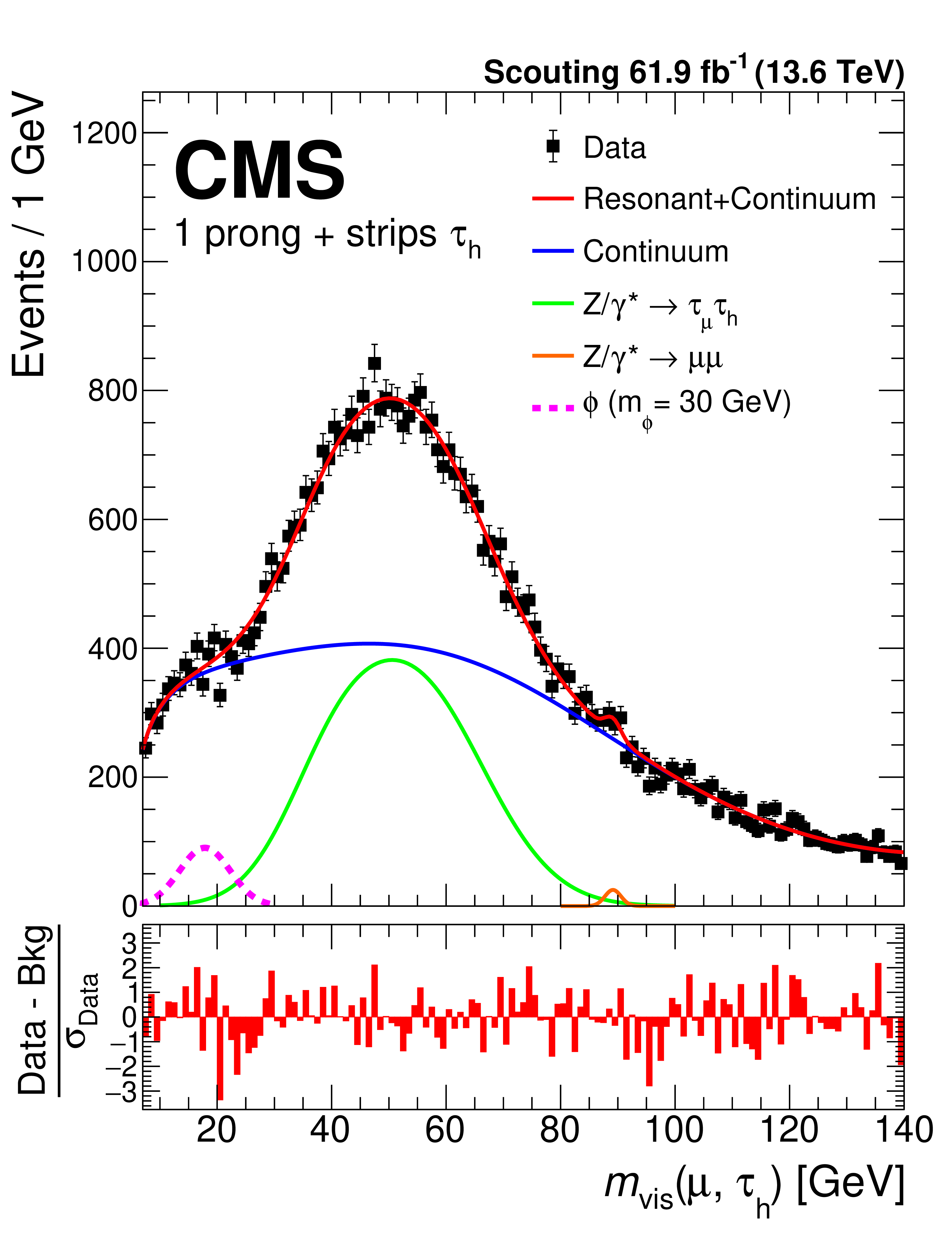
Distributions of $ m_{\text{vis}}(\mu,\tau_\mathrm{h}) $ (points with error bars) in the $ \phi $ boson search region, separated by hadronic decay mode with fit results (lines). All plots contain a $ \mathrm{Z}/\gamma^*\to\tau\tau $ component determined by simulations overlaid on the continuum fit. The leftmost plot shows the single-prong final-state with contamination due to $ \mathrm{Z}\to\mu\mu $ events (orange) at 91 GeV. The center and right plots show the three-prong and one-prong-plus-one or two-strips respectively. The lower panels of each plot show the differences between the background estimation and the data, divided by the uncertainty in the data points. The $ m_{\text{vis}}(\mu,\tau_\mathrm{h}) $ range corresponding to $ \phi $ masses from 20 to 60 GeV is 10 to 40 GeV. |
png pdf |
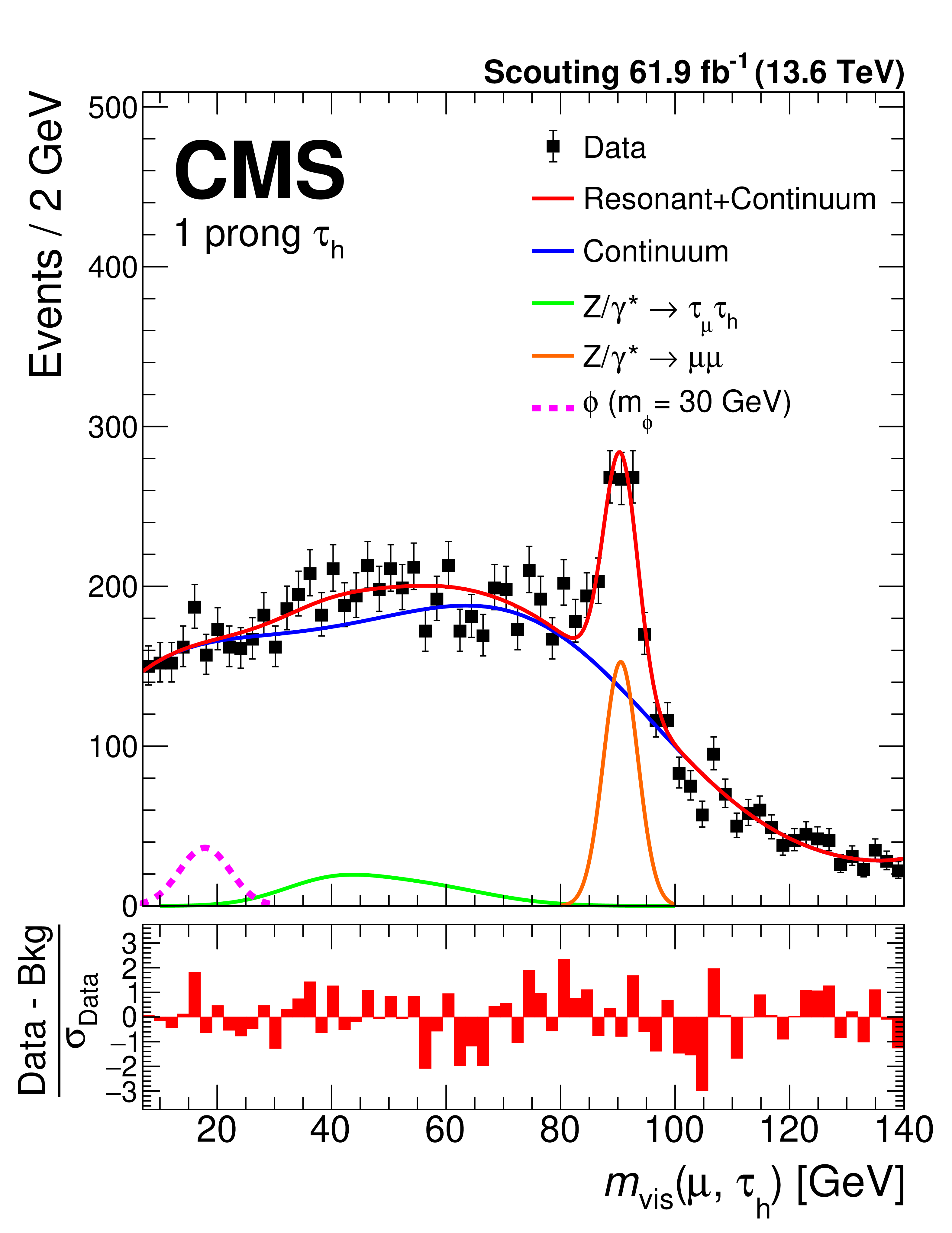
Figure 2-a:
Distributions of $ m_{\text{vis}}(\mu,\tau_\mathrm{h}) $ (points with error bars) in the $ \phi $ boson search region, separated by hadronic decay mode with fit results (lines). All plots contain a $ \mathrm{Z}/\gamma^*\to\tau\tau $ component determined by simulations overlaid on the continuum fit. The leftmost plot shows the single-prong final-state with contamination due to $ \mathrm{Z}\to\mu\mu $ events (orange) at 91 GeV. The center and right plots show the three-prong and one-prong-plus-one or two-strips respectively. The lower panels of each plot show the differences between the background estimation and the data, divided by the uncertainty in the data points. The $ m_{\text{vis}}(\mu,\tau_\mathrm{h}) $ range corresponding to $ \phi $ masses from 20 to 60 GeV is 10 to 40 GeV. |
png pdf |
Figure 2-b:
Distributions of $ m_{\text{vis}}(\mu,\tau_\mathrm{h}) $ (points with error bars) in the $ \phi $ boson search region, separated by hadronic decay mode with fit results (lines). All plots contain a $ \mathrm{Z}/\gamma^*\to\tau\tau $ component determined by simulations overlaid on the continuum fit. The leftmost plot shows the single-prong final-state with contamination due to $ \mathrm{Z}\to\mu\mu $ events (orange) at 91 GeV. The center and right plots show the three-prong and one-prong-plus-one or two-strips respectively. The lower panels of each plot show the differences between the background estimation and the data, divided by the uncertainty in the data points. The $ m_{\text{vis}}(\mu,\tau_\mathrm{h}) $ range corresponding to $ \phi $ masses from 20 to 60 GeV is 10 to 40 GeV. |
png pdf |
Figure 2-c:
Distributions of $ m_{\text{vis}}(\mu,\tau_\mathrm{h}) $ (points with error bars) in the $ \phi $ boson search region, separated by hadronic decay mode with fit results (lines). All plots contain a $ \mathrm{Z}/\gamma^*\to\tau\tau $ component determined by simulations overlaid on the continuum fit. The leftmost plot shows the single-prong final-state with contamination due to $ \mathrm{Z}\to\mu\mu $ events (orange) at 91 GeV. The center and right plots show the three-prong and one-prong-plus-one or two-strips respectively. The lower panels of each plot show the differences between the background estimation and the data, divided by the uncertainty in the data points. The $ m_{\text{vis}}(\mu,\tau_\mathrm{h}) $ range corresponding to $ \phi $ masses from 20 to 60 GeV is 10 to 40 GeV. |
png pdf |
Figure 3:
The 95% CL upper limits on the product of the cross section and branching fraction, $ \sigma(\mathrm{p}\mathrm{p}\to\phi)\mathcal{B}(\phi\to\tau\tau) $ in pb. The dotted line represents the median expected limits while the yellow and blue bands indicate the 68 and 95% expected bands, respectively. The solid line shows the observed limits. |
| Tables | |

png pdf |
Table 1:
Summary of selection criteria for the $ \phi $ boson and Z boson regions. |
| Summary |
| In summary, an inclusive search for low-mass spin-zero $ \phi $ bosons decaying to tau leptons with a hadronic signature has been performed in a previously unexplored mass range using proton-proton collision data at $\sqrt{s}=13.6$ TeV, collected with the CMS detector at the LHC in 2022--2023. This search demonstrates the efficacy of a novel low-momentum $ \tau_\mathrm{h} $ reconstruction algorithm implemented in a high-rate data stream. These innovations allow unprecedented sensitivity to new physics with tau leptons. |
| References | ||||
| 1 | ATLAS Collaboration | Observation of a new particle in the search for the standard model Higgs boson with the ATLAS detector at the LHC | PLB 716 (2012) 1 | 1207.7214 |
| 2 | CMS Collaboration | Observation of a new boson at a mass of 125 GeV with the CMS experiment at the LHC | PLB 716 (2012) 30 | CMS-HIG-12-028 1207.7235 |
| 3 | CMS Collaboration | Observation of a new boson with mass near 125 GeV in pp collisions at $ \sqrt{s}= $ 7 and 8 TeV | JHEP 06 (2013) 081 | CMS-HIG-12-036 1303.4571 |
| 4 | Super-Kamiokande Collaboration | Evidence for oscillation of atmospheric neutrinos | PRL 81 (1998) 1562 | hep-ex/9807003 |
| 5 | Muon g-2 Collaboration | Measurement of the positive muon anomalous magnetic moment to 0.46 ppm | PRL 126 (2021) 141801 | 2104.03281 |
| 6 | LHCb Collaboration | Test of lepton universality in beauty-quark decays | Nature Phys. 18 (2022) 277 | 2103.11769 |
| 7 | P. Fayet | Supergauge invariant extension of the Higgs mechanism and a model for the electron and its neutrino | NPB 90 (1975) 104 | |
| 8 | P. Fayet | Spontaneously broken supersymmetric theories of weak, electromagnetic and strong interactions | PLB 69 (1977) 489 | |
| 9 | S. Weinberg | A model of leptons | PRL 19 (1967) 1264 | |
| 10 | D. Curtin et al. | Exotic decays of the 125 GeV Higgs boson | PRD 90 (2014) 075004 | 1312.4992 |
| 11 | CMS Collaboration | Luminosity measurement in proton-proton collisions at 13.6 TeV in 2022 at CMS | CMS Physics Analysis Summary, 2024 CMS-PAS-LUM-22-001 |
CMS-PAS-LUM-22-001 |
| 12 | CMS Collaboration | Measurement of the offline integrated luminosity for the CMS proton-proton collision dataset recorded in 2023 | CMS Detector Performance Note CMS-DP-2024-068, 2024 CDS |
|
| 13 | CMS Collaboration | Enriching the physics program of the CMS experiment via data scouting and data parking | Phys. Rept. 1115 (2025) 678 | CMS-EXO-23-007 2403.16134 |
| 14 | CMS Collaboration | Performance of the CMS high-level trigger during LHC Run 2 | JINST 19 (2024) P11021 | CMS-TRG-19-001 2410.17038 |
| 15 | ATLAS Collaboration | Search for the neutral Higgs bosons of the minimal supersymmetric standard model in pp collisions at $ \sqrt{s}= $ 7 TeV with the ATLAS detector | JHEP 02 (2013) 095 | 1211.6956 |
| 16 | ATLAS Collaboration | Search for neutral Higgs bosons of the minimal supersymmetric standard model in pp collisions at $ \sqrt{s} = $ 8 TeV with the ATLAS detector | JHEP 11 (2014) 056 | 1409.6064 |
| 17 | ATLAS Collaboration | Search for minimal supersymmetric standard model Higgs bosons $ H/A $ and for a $ Z^{\prime} $ boson in the $ \tau \tau $ final state produced in $ pp $ collisions at $ \sqrt{s}= $ 13 TeV with the ATLAS detector | EPJC 76 (2016) 585 | 1608.00890 |
| 18 | ATLAS Collaboration | Search for additional heavy neutral Higgs and gauge bosons in the ditau final state produced in 36 fb$ ^{-1} $ of pp collisions at $ \sqrt{s}= $ 13 TeV with the ATLAS detector | JHEP 01 (2018) 055 | 1709.07242 |
| 19 | ATLAS Collaboration | Search for heavy Higgs bosons decaying into two tau leptons with the ATLAS detector using $ pp $ collisions at $ \sqrt{s}= $ 13 TeV | PRL 125 (2020) 051801 | 2002.12223 |
| 20 | ATLAS Collaboration | Search for a light CP-odd Higgs boson decaying into a pair of \ensuremath\tau-leptons in proton-proton collisions at $ \sqrt{s} = $ 13 TeV with the ATLAS detector | JHEP 12 (2024) 126 | 2409.20381 |
| 21 | CMS Collaboration | Search for neutral MSSM Higgs bosons decaying to tau pairs in $ pp $ collisions at $ \sqrt{s}= $ 7 TeV | PRL 106 (2011) 231801 | CMS-HIG-10-002 1104.1619 |
| 22 | CMS Collaboration | Search for neutral Higgs bosons decaying to tau pairs in $ pp $ collisions at $ \sqrt{s}= $ 7 TeV | PLB 713 (2012) 68 | CMS-HIG-11-029 1202.4083 |
| 23 | CMS Collaboration | Search for neutral MSSM Higgs bosons decaying to a pair of tau leptons in pp collisions | JHEP 10 (2014) 160 | CMS-HIG-13-021 1408.3316 |
| 24 | CMS Collaboration | Search for a low-mass pseudoscalar Higgs boson produced in association with a $ b\bar{b} $ pair in $ pp $ collisions at $ \sqrt{s} = $ 8 TeV | PLB 758 (2016) 296 | CMS-HIG-14-033 1511.03610 |
| 25 | CMS Collaboration | Search for additional neutral MSSM Higgs bosons in the $ \tau\tau $ final state in proton-proton collisions at $ \sqrt{s}= $ 13 TeV | JHEP 09 (2018) 007 | CMS-HIG-17-020 1803.06553 |
| 26 | CMS Collaboration | Searches for additional Higgs bosons and for vector leptoquarks in $ \tau\tau $ final states in proton-proton collisions at $ \sqrt{s} = $ 13 TeV | JHEP 07 (2023) 073 | CMS-HIG-21-001 2208.02717 |
| 27 | CMS Collaboration | HEPData record for this analysis | link | |
| 28 | CMS Collaboration | The CMS experiment at the CERN LHC | JINST 3 (2008) S08004 | |
| 29 | CMS Collaboration | Development of the CMS detector for the CERN LHC Run 3 | JINST 19 (2024) P05064 | CMS-PRF-21-001 2309.05466 |
| 30 | CMS Collaboration | Performance of the CMS Level-1 trigger in proton-proton collisions at $ \sqrt{s} = $ 13 TeV | JINST 15 (2020) P10017 | CMS-TRG-17-001 2006.10165 |
| 31 | CMS Collaboration | The CMS trigger system | JINST 12 (2017) P01020 | CMS-TRG-12-001 1609.02366 |
| 32 | CMS Collaboration | Electron and photon reconstruction and identification with the CMS experiment at the CERN LHC | JINST 16 (2021) P05014 | CMS-EGM-17-001 2012.06888 |
| 33 | CMS Collaboration | Performance of the CMS muon detector and muon reconstruction with proton-proton collisions at $ \sqrt{s}= $ 13 TeV | JINST 13 (2018) P06015 | CMS-MUO-16-001 1804.04528 |
| 34 | CMS Collaboration | Description and performance of track and primary-vertex reconstruction with the CMS tracker | JINST 9 (2014) P10009 | CMS-TRK-11-001 1405.6569 |
| 35 | CMS Collaboration | Particle-flow reconstruction and global event description with the CMS detector | JINST 12 (2017) P10003 | CMS-PRF-14-001 1706.04965 |
| 36 | CMS Collaboration | Performance of reconstruction and identification of $ \tau $ leptons decaying to hadrons and $ \nu_\tau $ in pp collisions at $ \sqrt{s}= $ 13 TeV | JINST 13 (2018) P10005 | CMS-TAU-16-003 1809.02816 |
| 37 | CMS Collaboration | Jet energy scale and resolution in the CMS experiment in $ pp $ collisions at 8 TeV | JINST 12 (2017) P02014 | CMS-JME-13-004 1607.03663 |
| 38 | CMS Collaboration | Performance of missing transverse momentum reconstruction in proton-proton collisions at $ \sqrt{s} = $ 13 TeV using the CMS detector | JINST 14 (2019) P07004 | CMS-JME-17-001 1903.06078 |
| 39 | J. Alwall et al. | The automated computation of tree-level and next-to-leading order differential cross sections, and their matching to parton shower simulations | JHEP 07 (2014) 079 | 1405.0301 |
| 40 | J. Alwall et al. | Comparative study of various algorithms for the merging of parton showers and matrix elements in hadronic collisions | EPJC 53 (2008) 473 | 0706.2569 |
| 41 | P. Nason | A new method for combining NLO QCD with shower Monte Carlo algorithms | JHEP 11 (2004) 040 | hep-ph/0409146 |
| 42 | S. Frixione, P. Nason, and C. Oleari | Matching NLO QCD computations with parton shower simulations: the POWHEG method | JHEP 11 (2007) 070 | 0709.2092 |
| 43 | S. Alioli, P. Nason, C. Oleari, and E. Re | A general framework for implementing NLO calculations in shower Monte Carlo programs: the POWHEG BOX | JHEP 06 (2010) 043 | 1002.2581 |
| 44 | S. Alioli, P. Nason, C. Oleari, and E. Re | NLO vector-boson production matched with shower in POWHEG | JHEP 07 (2008) 060 | 0805.4802 |
| 45 | S. Frixione, P. Nason, and G. Ridolfi | A positive-weight next-to-leading-order Monte Carlo for heavy flavour hadroproduction | JHEP 09 (2007) 126 | 0707.3088 |
| 46 | T. Sjöstrand et al. | An introduction to PYTHIA 8.2 | Comput. Phys. Commun. 191 (2015) 159 | 1410.3012 |
| 47 | CMS Collaboration | Extraction and validation of a new set of CMS PYTHIA8 tunes from underlying-event measurements | EPJC 80 (2020) 4 | CMS-GEN-17-001 1903.12179 |
| 48 | NNPDF Collaboration | Parton distributions for the LHC Run II | JHEP 04 (2015) 040 | 1410.8849 |
| 49 | GEANT4 Collaboration | GEANT 4---a simulation toolkit | NIM A 506 (2003) 250 | |
| 50 | CDF Collaboration | Search for neutral MSSM Higgs bosons decaying to tau pairs in $ p\bar{p} $ collisions at $ \sqrt{s} = $ 1.96 TeV | PRL 96 (2006) 011802 | hep-ex/0508051 |
| 51 | Particle Data Group , S. Navas et al. | Review of particle physics | PRD 110 (2024) 030001 | |
| 52 | CMS Collaboration | Measurements of the inclusive W and Z boson production cross sections and their ratios in proton-proton collisions at $ \sqrt{s}= $ 13.6 TeV | JHEP 01 (2026) 047 | CMS-SMP-22-017 2503.09742 |
| 53 | UA2 Collaboration | A measurement of two jet decays of the $ W $ and $ Z $ bosons at the CERN $ \bar{p} p $ collider | Z. Phys. C 49 (1991) 17 | |
| 54 | ATLAS Collaboration | Search for low-mass dijet resonances using trigger-level jets with the ATLAS detector in $ pp $ collisions at $ \sqrt{s}= $ 13 TeV | PRL 121 (2018) 081801 | 1804.03496 |
| 55 | H. Akaike | A new look at the statistical model identification | IEEE Trans. Automatic Control 19 (1974) 716 | |
| 56 | CMS Collaboration | The CMS statistical analysis and combination tool: Combine | Comput. Softw. Big Sci. 8 (2024) 19 | CMS-CAT-23-001 2404.06614 |
| 57 | A. L. Read | Presentation of search results: The CL$ _{\text{s}} $ technique | JPG 28 (2002) 2693 | |
| 58 | T. Junk | Confidence level computation for combining searches with small statistics | NIM A 434 (1999) 435 | hep-ex/9902006 |
| 59 | G. Cowan, K. Cranmer, E. Gross, and O. Vitells | Asymptotic formulae for likelihood-based tests of new physics | EPJC 71 (2011) 1554 | 1007.1727 |
| 60 | M. Cacciari, G. P. Salam, and G. Soyez | The anti-$ k_{\mathrm{T}} $ jet clustering algorithm | JHEP 04 (2008) 063 | 0802.1189 |
| 61 | M. Cacciari, G. P. Salam, and G. Soyez | FastJet user manual | EPJC 72 (2012) 1896 | 1111.6097 |
| 62 | M. Cacciari and G. P. Salam | Dispelling the $ N^{3} $ myth for the $ k_{\mathrm{T}} $ jet-finder | PLB 641 (2006) 57 | hep-ph/0512210 |
| 63 | P. T. Komiske, E. M. Metodiev, and J. Thaler | Energy flow networks: Deep sets for particle jets | JHEP 01 (2019) 121 | 1810.05165 |
|
|
Compact Muon Solenoid LHC, CERN |

|
|
|
|
|
|