
Compact Muon Solenoid
LHC, CERN
 Visit us: CMS Public Website, CMS Physics ;
Contact us: CMS Publications Committee
Visit us: CMS Public Website, CMS Physics ;
Contact us: CMS Publications Committee
| CMS-BPH-24-004 ; CERN-EP-2026-004 | ||
| Measurement of the $ \Upsilon{\textrm{(1S)}} $, $ \Upsilon{\textrm{(2S)}} $, and $ \Upsilon{\textrm{(3S)}} $ differential cross sections in pp collisions at $ \sqrt{s} = $ 13.6 TeV | ||
| CMS Collaboration | ||
| 27 January 2026 | ||
| JHEP 07 (2026) 106 | ||
| Abstract: The production cross sections of the $ \Upsilon{\textrm{(1S)}} $, $ \Upsilon{\textrm{(2S)}} $, and $ \Upsilon{\textrm{(3S)}} $ mesons are measured in proton-proton collisions at $ \sqrt{s}= $ 13.6 TeV, using a data sample collected in 2022 by the CMS experiment and corresponding to an integrated luminosity of 37.4 fb$ ^{-1} $. The measurement is performed in the $ \mu^{+}\mu^{-} $ decay channels, differentially as a function of transverse momentum in the 20--200 GeV range, in the $ |y| < $ 0.6 and 0.6 $ < |y| < $ 1.2 rapidity intervals. | ||
| Links: e-print arXiv:2601.20023 [hep-ex] (PDF) ; CDS record ; inSPIRE record ; CADI line (restricted) ; | ||
| Figures | |
png pdf |
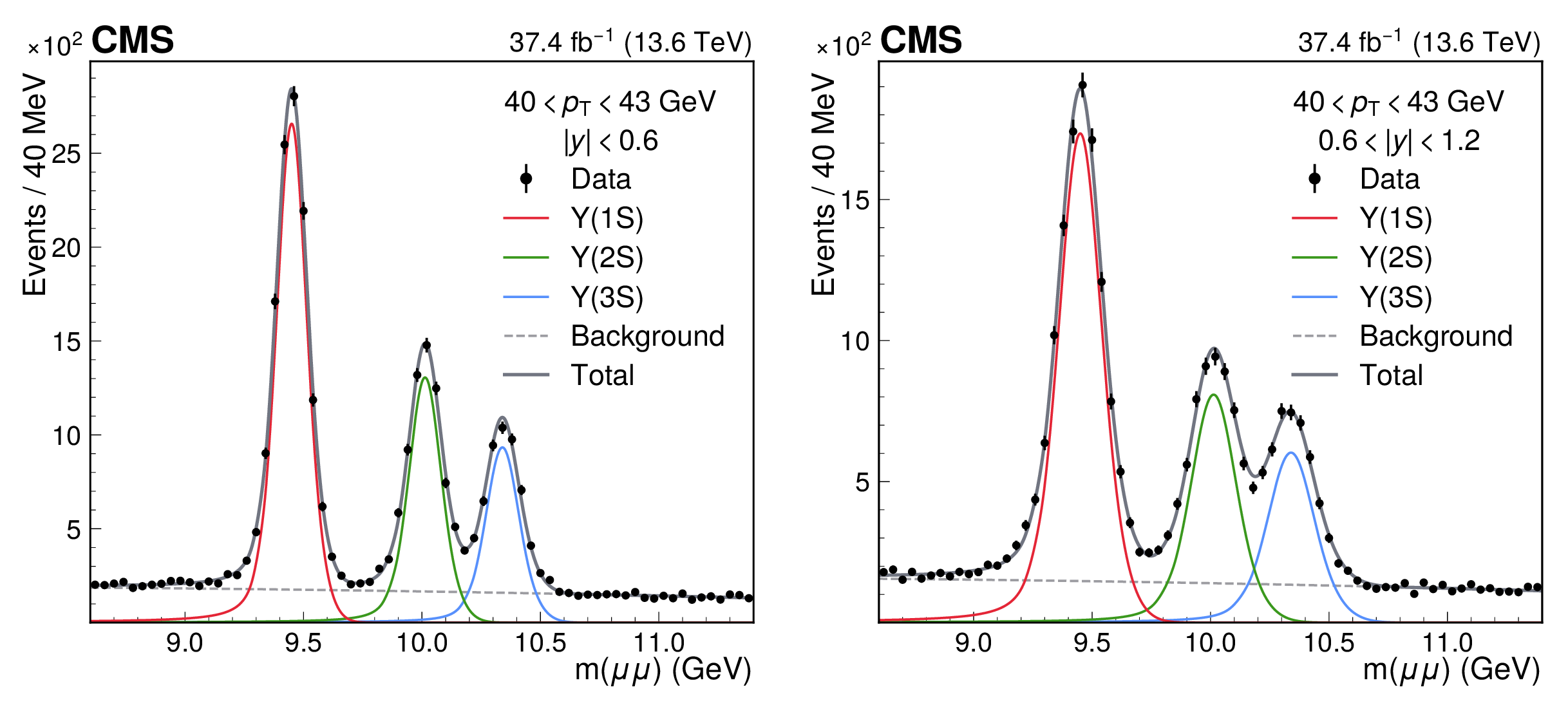
Figure 1:
Invariant mass distributions of the dimuons measured in two illustrative $ p_{\mathrm{T}} $ and $ |y| $ ranges. The results of the fits are represented by the solid coloured lines (signal peaks), the dashed gray lines (background), and the solid black lines (total). |
png pdf |
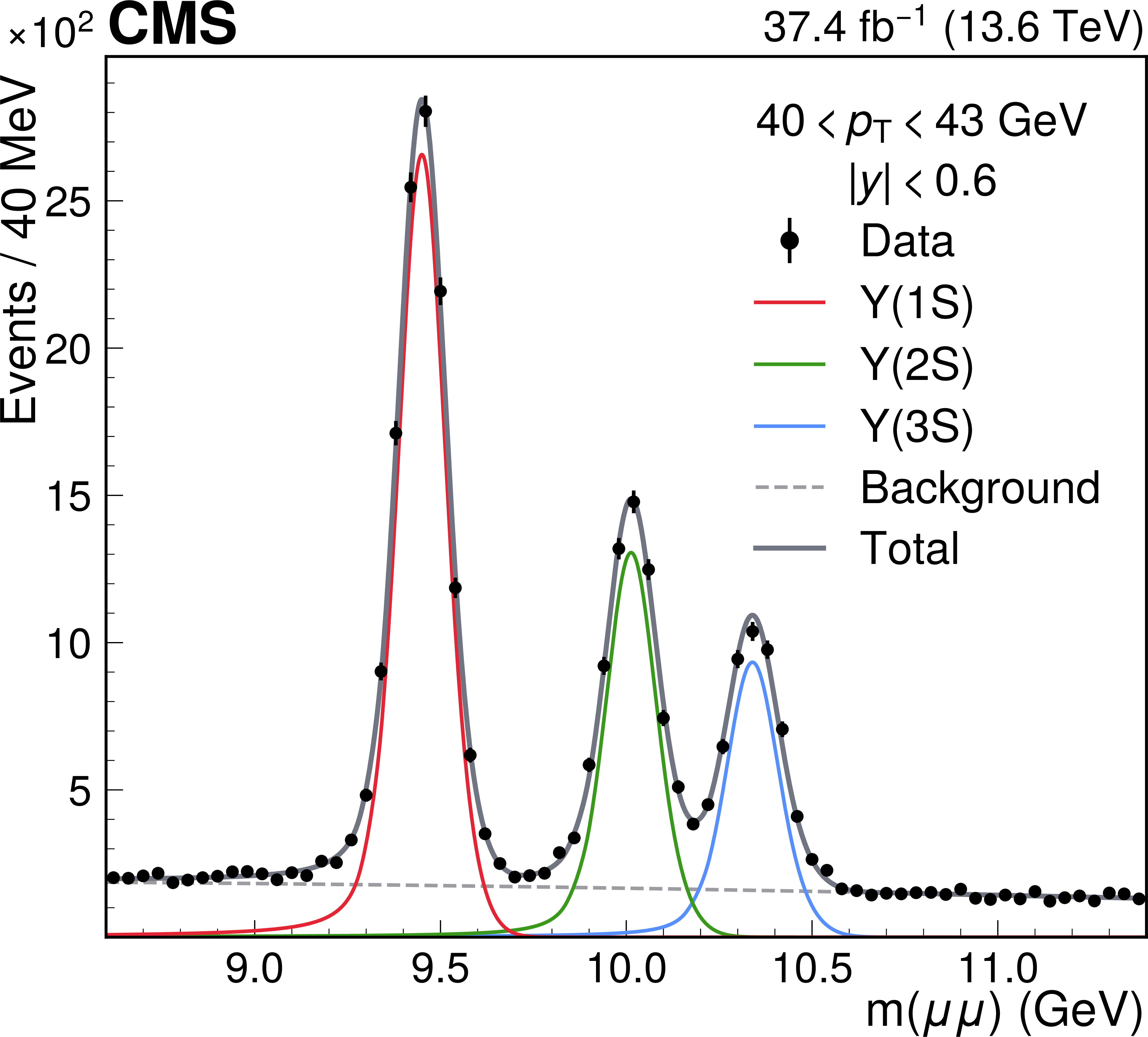
Figure 1-a:
Invariant mass distributions of the dimuons measured in two illustrative $ p_{\mathrm{T}} $ and $ |y| $ ranges. The results of the fits are represented by the solid coloured lines (signal peaks), the dashed gray lines (background), and the solid black lines (total). |
png pdf |
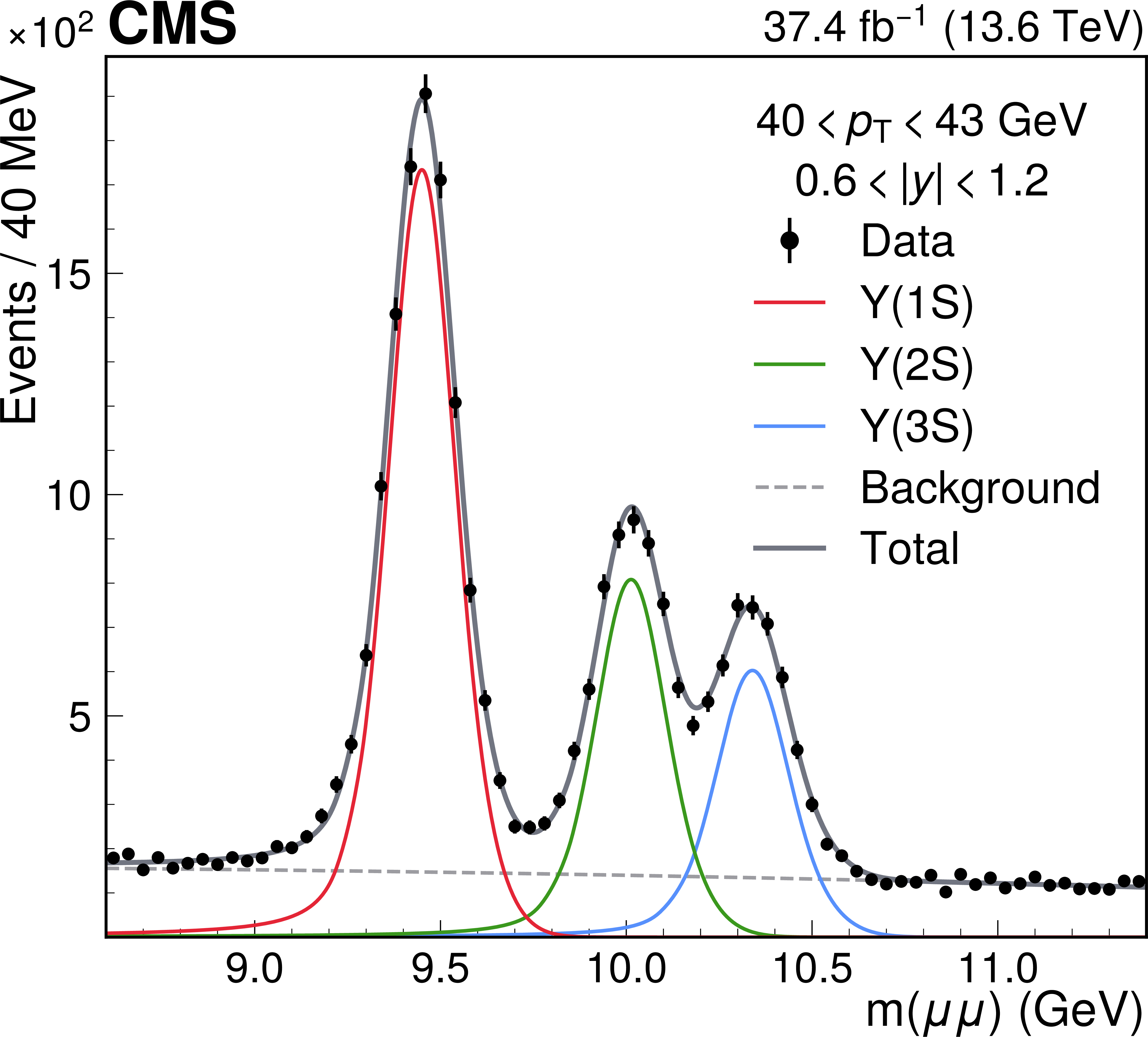
Figure 1-b:
Invariant mass distributions of the dimuons measured in two illustrative $ p_{\mathrm{T}} $ and $ |y| $ ranges. The results of the fits are represented by the solid coloured lines (signal peaks), the dashed gray lines (background), and the solid black lines (total). |

png pdf |
Figure 2:
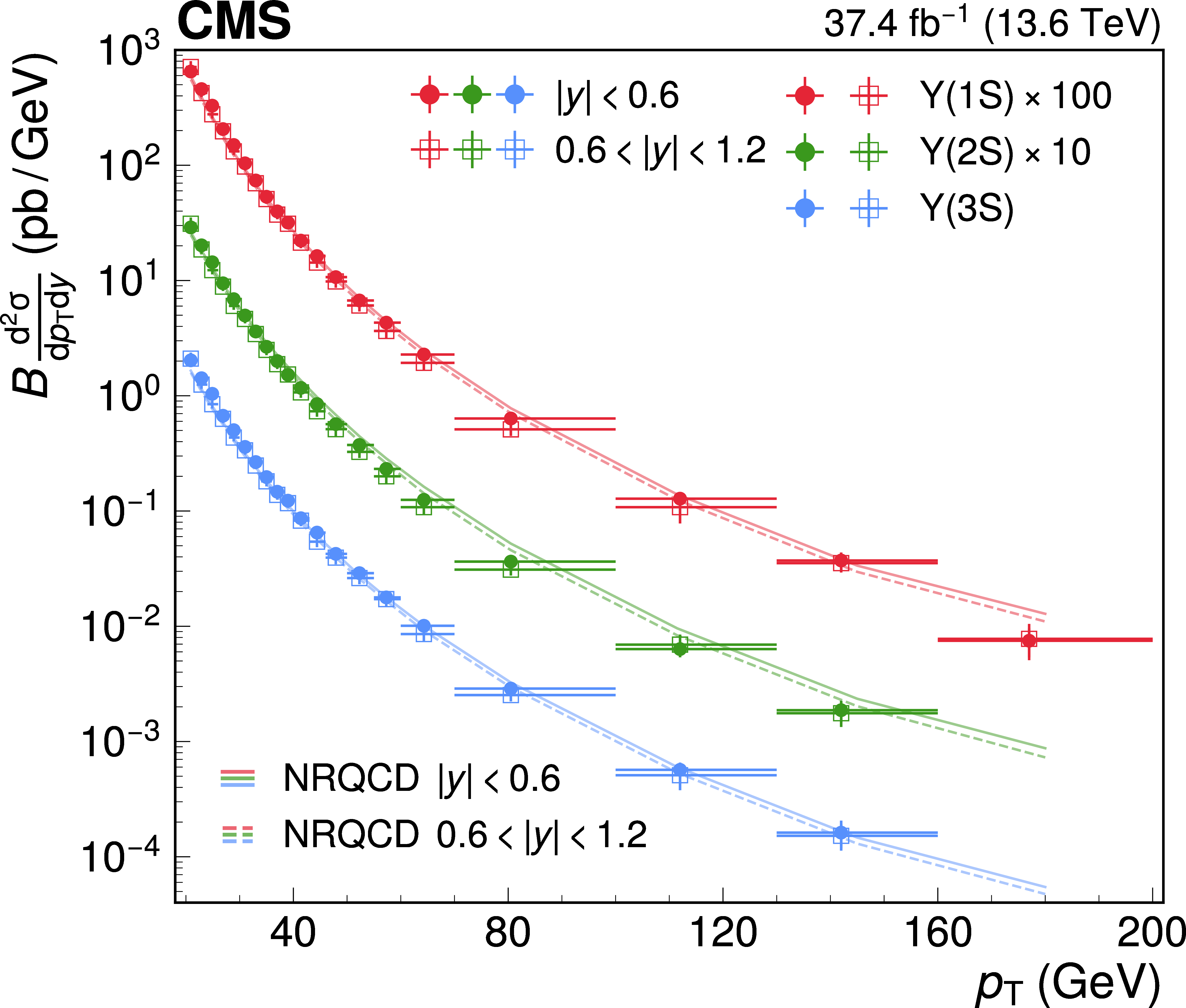
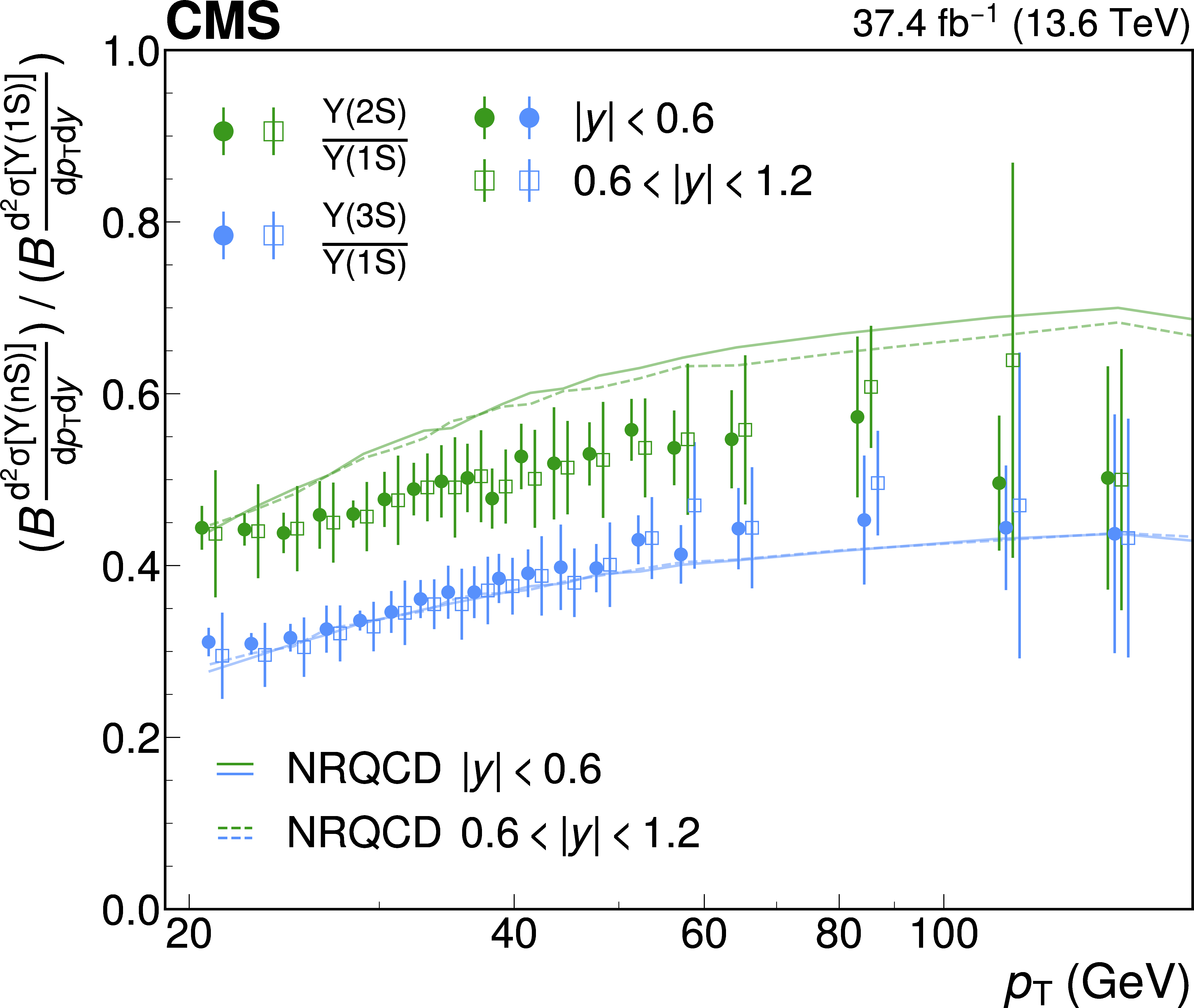
Left: measured $ p_{\mathrm{T}} $-differential $ \Upsilon{\textrm{(1S)}} $ (red), $ \Upsilon{\textrm{(2S)}} $ (green), and $ \Upsilon{\textrm{(3S)}} $ (blue) cross sections times the $ \mu^{+}\mu^{-} $ decay branching fractions, per rapidity unit, in the 0--0.6 (filled circles) and 0.6--1.2 (open squares) $ |y| $ ranges. For visibility, the $ \Upsilon{\textrm{(1S)}} $ and $ \Upsilon{\textrm{(2S)}} $ values are scaled by factors of 100 and 10, respectively. Right: Corresponding $ \Upsilon{\textrm{(2S)}} $ over $ \Upsilon{\textrm{(1S)}} $ (green) and $ \Upsilon{\textrm{(3S)}} $ over $ \Upsilon{\textrm{(1S)}} $ (blue) ratios, in the 0--0.6 (filled circles) and 0.6--1.2 (open squares) $ |y| $ ranges. For visibility purposes, the data points are slightly displaced in the $ x $ axis. In both panels, the error bars represent the total uncertainties. The NRQCD curves are shown for illustration. |
png pdf |
Figure 2-a:
Left: measured $ p_{\mathrm{T}} $-differential $ \Upsilon{\textrm{(1S)}} $ (red), $ \Upsilon{\textrm{(2S)}} $ (green), and $ \Upsilon{\textrm{(3S)}} $ (blue) cross sections times the $ \mu^{+}\mu^{-} $ decay branching fractions, per rapidity unit, in the 0--0.6 (filled circles) and 0.6--1.2 (open squares) $ |y| $ ranges. For visibility, the $ \Upsilon{\textrm{(1S)}} $ and $ \Upsilon{\textrm{(2S)}} $ values are scaled by factors of 100 and 10, respectively. Right: Corresponding $ \Upsilon{\textrm{(2S)}} $ over $ \Upsilon{\textrm{(1S)}} $ (green) and $ \Upsilon{\textrm{(3S)}} $ over $ \Upsilon{\textrm{(1S)}} $ (blue) ratios, in the 0--0.6 (filled circles) and 0.6--1.2 (open squares) $ |y| $ ranges. For visibility purposes, the data points are slightly displaced in the $ x $ axis. In both panels, the error bars represent the total uncertainties. The NRQCD curves are shown for illustration. |
png pdf |
Figure 2-b:
Left: measured $ p_{\mathrm{T}} $-differential $ \Upsilon{\textrm{(1S)}} $ (red), $ \Upsilon{\textrm{(2S)}} $ (green), and $ \Upsilon{\textrm{(3S)}} $ (blue) cross sections times the $ \mu^{+}\mu^{-} $ decay branching fractions, per rapidity unit, in the 0--0.6 (filled circles) and 0.6--1.2 (open squares) $ |y| $ ranges. For visibility, the $ \Upsilon{\textrm{(1S)}} $ and $ \Upsilon{\textrm{(2S)}} $ values are scaled by factors of 100 and 10, respectively. Right: Corresponding $ \Upsilon{\textrm{(2S)}} $ over $ \Upsilon{\textrm{(1S)}} $ (green) and $ \Upsilon{\textrm{(3S)}} $ over $ \Upsilon{\textrm{(1S)}} $ (blue) ratios, in the 0--0.6 (filled circles) and 0.6--1.2 (open squares) $ |y| $ ranges. For visibility purposes, the data points are slightly displaced in the $ x $ axis. In both panels, the error bars represent the total uncertainties. The NRQCD curves are shown for illustration. |

png pdf |
Figure 3:
Ratios of $ \Upsilon{\textrm{(1S)}} $ cross sections between this measurement, made at $ \sqrt{s} = $ 13.6 TeV, and previous measurements, made at 7 and 13 TeV [29,30], treating all uncertainties as uncorrelated. For visibility purposes, the data points are slightly displaced in the $ x $ axis. |
| Tables | |
png pdf |
Table A1:
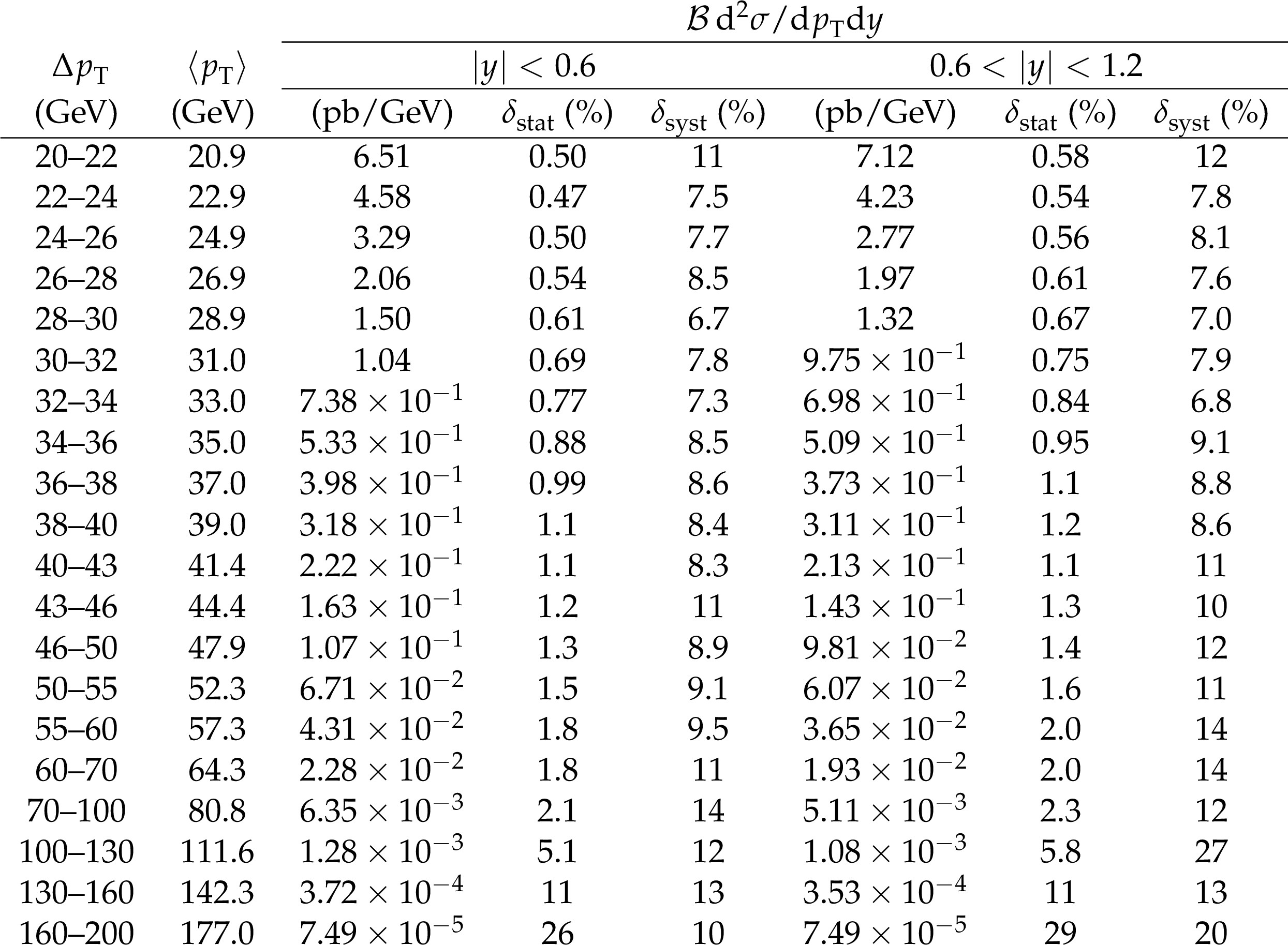
The $ \Upsilon $(1S) differential cross section times dimuon branching fraction, $ \mathcal{B} \mathrm{d}^2\sigma/\mathrm{d}p_{\mathrm{T}}\mathrm{d}y $, in two rapidity ranges, for the unpolarized scenario. The relative uncertainties (statistical and systematic) are given in percent. The systematic uncertainties are considered to be fully correlated. |
png pdf |
Table A2:
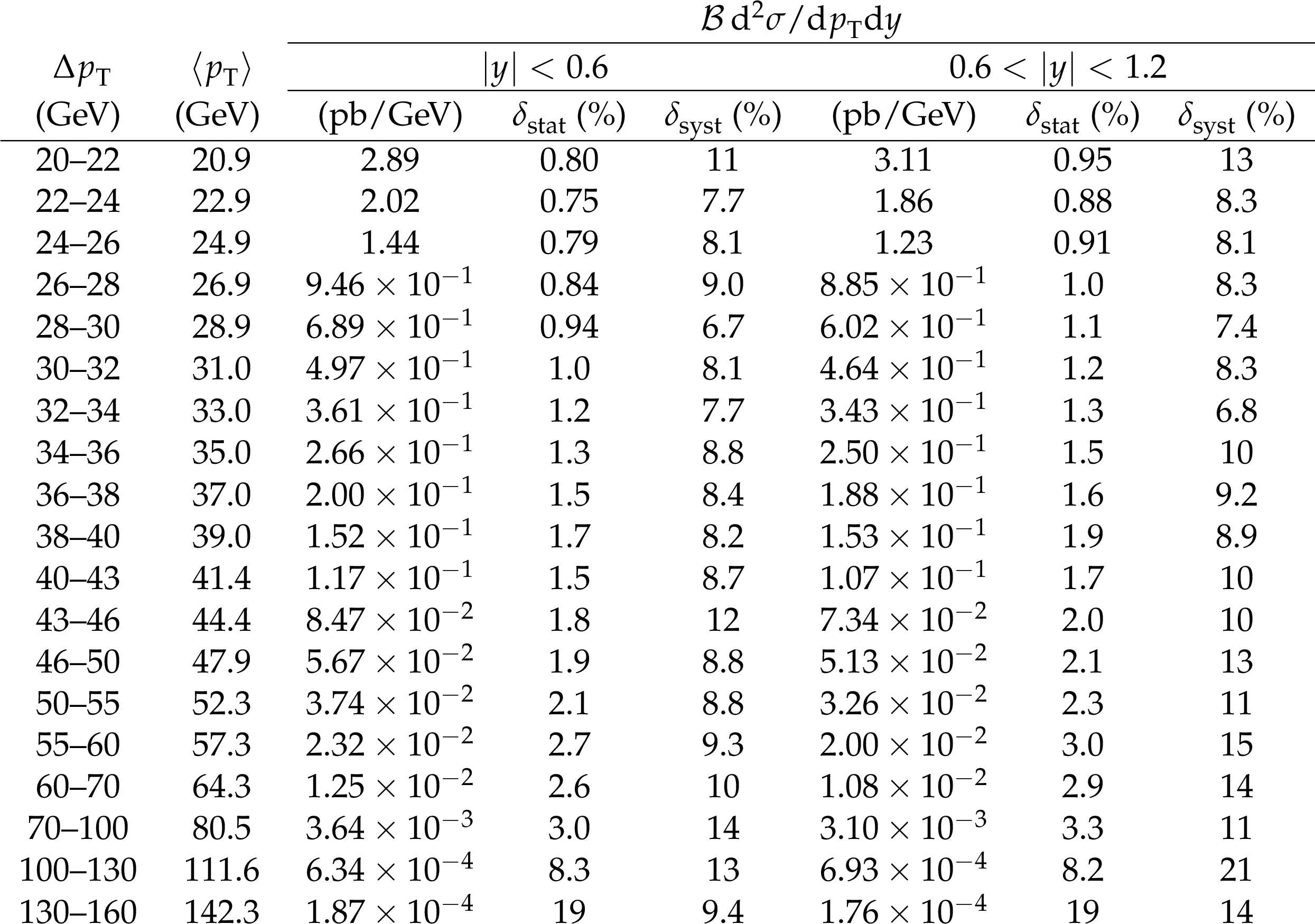
The $ \Upsilon $(2S) differential cross section times dimuon branching fraction, $ \mathcal{B} \mathrm{d}^2\sigma/\mathrm{d}p_{\mathrm{T}}\mathrm{d}y $, in two rapidity ranges, for the unpolarized scenario. The relative uncertainties (statistical and systematic) are given in percent. The systematic uncertainties are considered to be fully correlated. |
png pdf |
Table A3:
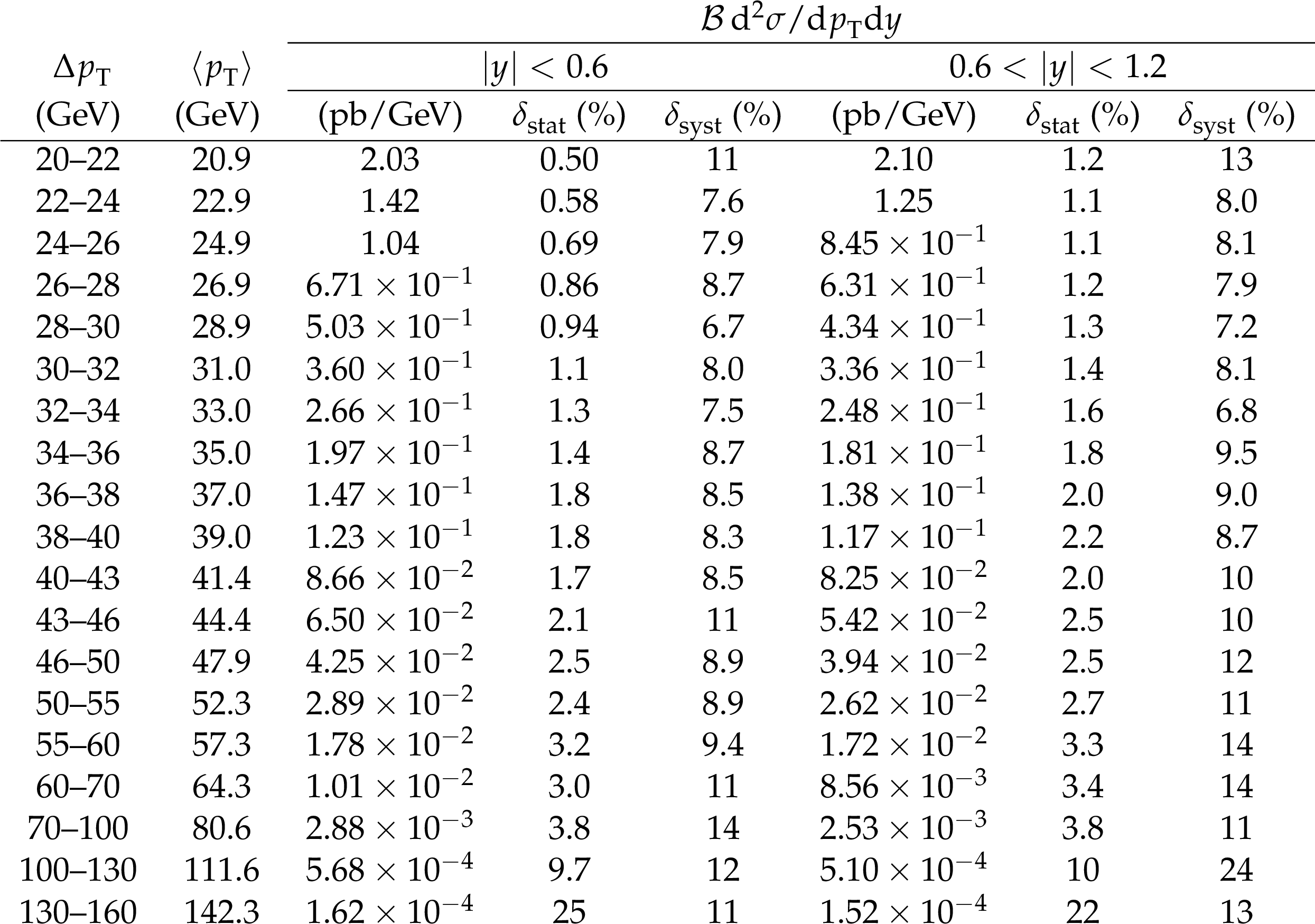
The $ \Upsilon $(3S) differential cross section times dimuon branching fraction, $ \mathcal{B} \mathrm{d}^2\sigma/\mathrm{d}p_{\mathrm{T}}\mathrm{d}y $, in two rapidity ranges, for the unpolarized scenario. The relative uncertainties (statistical and systematic) are given in percent. The systematic uncertainties are considered to be fully correlated. |
png pdf |
Table A4:
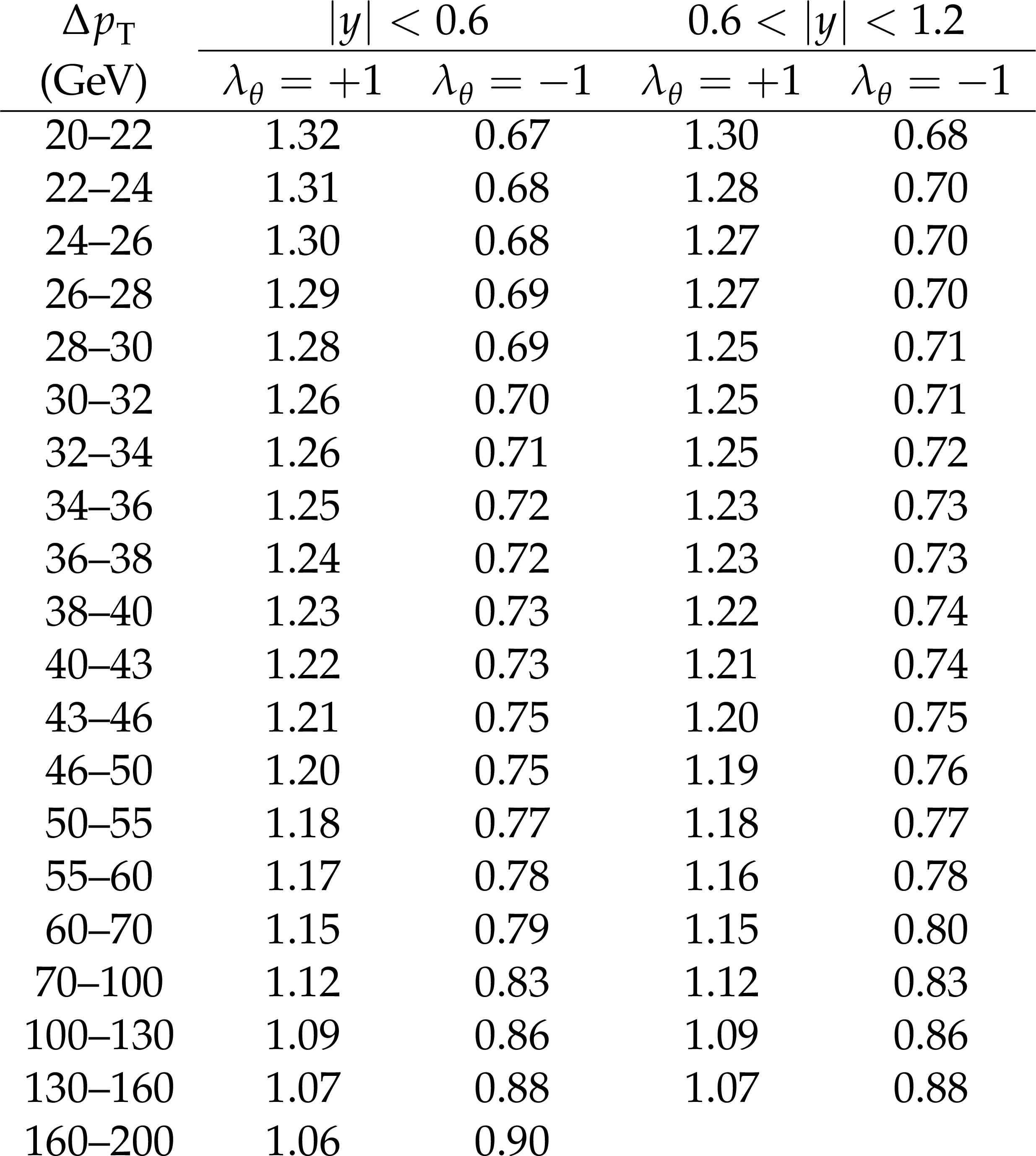
Scaling factors needed to obtain the $ \Upsilon $($ n $S) differential cross sections corresponding to two extreme polarization scenarios in the helicity frame, $ \lambda_{\theta}^{\mathrm{HX}} = + $ 1 or-1, from the values reported in Tables 1--3. |
| Summary |
| The cross sections of the $ \Upsilon{\textrm{(1S)}} $, $ \Upsilon{\textrm{(2S)}} $, and $ \Upsilon{\textrm{(3S)}} $ bottomonium states, times the branching fractions of their dimuon decays, were measured as a function of their transverse momentum in a broad $ p_{\mathrm{T}} $ range, from 20 to 200 GeV, in two rapidity regions, $ |y| < $ 0.6 and 0.6 $ < |y| < $ 1.2. The analysis was based on an event sample of pp collisions at $ \sqrt{s} = $ 13.6 TeV, collected by CMS in 2022 and corresponding to an integrated luminosity of 37.4 fb$ ^{-1} $. The reported cross sections include feed-down contributions from heavier bottomonia. These results are an important input to global fits of quarkonium cross sections and polarizations performed to extract the long-distance matrix elements that determine inclusive quarkonium production in the NRQCD framework. |
| References | ||||
| 1 | Quarkonium Working Group Collaboration | Heavy quarkonium physics | CERN Yellow Reports: Monographs, CERN-2005-005, 2005 link |
hep-ph/0412158 |
| 2 | N. Brambilla et al. | Heavy quarkonium: progress, puzzles, and opportunities | EPJC 71 (2011) 1534 | 1010.5827 |
| 3 | G. Bodwin, E. Braaten, and P. Lepage | Rigorous QCD analysis of inclusive annihilation and production of heavy quarkonium | PRD 51 (1995) 1125 | hep-ph/9407339 |
| 4 | M. Butenschön and B. A. Kniehl | $ \mathrm{J}/\psi $ production in NRQCD: A global analysis of yield and polarization | Nucl. Phys. B Proc. Suppl. 222 (2012) 151 | 1201.3862 |
| 5 | K.-T. Chao et al. | $ \mathrm{J}/\psi $ polarization at hadron colliders in nonrelativistic QCD | PRL 108 (2012) 242004 | 1201.2675 |
| 6 | M. Butenschön and B. A. Kniehl | Next-to-leading-order tests of NRQCD factorization with $ \mathrm{J}/\psi $ yield and polarization | Mod. Phys. Lett. A 28 (2013) 1350027 | 1212.2037 |
| 7 | B. Gong, L.-P. Wan, J.-X. Wang, and H.-F. Zhang | Polarization for prompt $ \mathrm{J}/\psi $ and $ \psi\mathrm{(2S)} $ production at the Tevatron and LHC | PRL 110 (2013) 042002 | 1205.6682 |
| 8 | P. Faccioli, C. Lourenço, J. Seixas, and H. Wöhri | Towards the experimental clarification of quarkonium polarization | EPJC 69 (2010) 657 | 1006.2738 |
| 9 | M. Butenschön and B. A. Kniehl | $ \mathrm{J}/\psi $ polarization at Tevatron and LHC: nonrelativistic-QCD factorization at the crossroads | PRL 108 (2012) 172002 | 1201.1872 |
| 10 | P. Faccioli et al. | Quarkonium production in the LHC era: A polarized perspective | PLB 736 (2014) 98 | 1403.3970 |
| 11 | G. T. Bodwin et al. | Fragmentation contributions to hadroproduction of prompt $ \mathrm{J}/\psi $, $ \chi_{{\mathrm{c}}J} $, and $ \psi\mathrm{(2S)} $ states | PRD 93 (2016) 034041 | 1509.07904 |
| 12 | P. Faccioli et al. | From identical S- and P-wave $ p_{\mathrm{T}} $ spectra to maximally distinct polarizations: probing NRQCD with $ \chi $ states | EPJC 78 (2018) 268 | 1802.01106 |
| 13 | K. Wang, Y.-Q. Ma, and K.-T. Chao | $ \Upsilon $(1S) prompt production at the Tevatron and LHC in nonrelativistic QCD | PRD 85 (2012) 114003 | 1202.6012 |
| 14 | B. Gong, L.-P. Wan, J.-X. Wang, and H.-F. Zhang | Complete next-to-leading-order study on the yield and polarization of $ \Upsilon $(1S,2S,3S) at the Tevatron and LHC | PRL 112 (2014) 032001 | 1305.0748 |
| 15 | H. Han et al. | $ \Upsilon $($ n $S) and $ \chi_b $($ n $P) production at hadron colliders in nonrelativistic QCD | PRD 94 (2016) 014028 | 1410.8537 |
| 16 | CMS Collaboration | Prompt and non-prompt $ \mathrm{J}/\psi $ production in pp collisions at $ \sqrt{s} = $ 7 TeV | EPJC 71 (2011) 1575 | CMS-BPH-10-002 1011.4193 |
| 17 | CMS Collaboration | $ \mathrm{J}/\psi $ and $ \psi\mathrm{(2S)} $ production in pp collisions at $ \sqrt{s} = $ 7 TeV | JHEP 02 (2012) 011 | CMS-BPH-10-014 1111.1557 |
| 18 | LHCb Collaboration | Measurement of $ \mathrm{J}/\psi $ production in pp collisions at $ \sqrt{s} = $ 7 TeV | EPJC 71 (2011) 1645 | 1103.0423 |
| 19 | ALICE Collaboration | Rapidity and transverse momentum dependence of inclusive $ \mathrm{J}/\psi $ production in pp collisions at $ \sqrt{s} = $ 7 TeV | PLB 704 (2011) 442 | 1105.0380 |
| 20 | ATLAS Collaboration | Measurement of the production cross-section of $ \psi\mathrm{(2S)} \to {\mathrm{J}/\psi} (\to \mu^{+} \mu^{-}) \pi^{+} \pi^{-} $ in pp collisions at $ \sqrt{s} = $ 7 TeV at ATLAS | JHEP 09 (2014) 079 | 1407.5532 |
| 21 | CMS Collaboration | Measurement of $ \mathrm{J}/\psi $ and $ \psi\mathrm{(2S)} $ prompt double-differential cross sections in pp collisions at $ \sqrt{s} = $ 7 TeV | PRL 114 (2015) 191802 | CMS-BPH-14-001 1502.04155 |
| 22 | LHCb Collaboration | Measurement of forward $ \mathrm{J}/\psi $ production cross-sections in pp collisions at $ \sqrt{s} = $ 13 TeV | JHEP 10 (2015) 172 | 1509.00771 |
| 23 | ATLAS Collaboration | Measurement of the differential cross-sections of prompt and non-prompt production of $ \mathrm{J}/\psi $ and $ \psi\mathrm{(2S)} $ in pp collisions at $ \sqrt{s} = $ 7 and 8 TeV with the ATLAS detector | EPJC 76 (2016) 283 | 1512.03657 |
| 24 | ATLAS Collaboration | Measurement of the production cross-section of $ \mathrm{J}/\psi $ and $ \psi\mathrm{(2S)} $ mesons in pp collisions at $ \sqrt{s} = $ 13 TeV with the ATLAS detector | EPJC 84 (2024) 169 | 2309.17177 |
| 25 | CMS Collaboration | Upsilon production cross section in pp collisions at $ \sqrt{s} = $ 7 TeV | PRD 83 (2011) 112004 | CMS-BPH-10-003 1012.5545 |
| 26 | LHCb Collaboration | Measurement of Upsilon production in pp collisions at $ \sqrt{s} = $ 7 TeV | EPJC 72 (2012) 2025 | 1202.6579 |
| 27 | ATLAS Collaboration | Measurement of Upsilon production in 7 TeV pp collisions at ATLAS | PRD 87 (2013) 052004 | 1211.7255 |
| 28 | CMS Collaboration | Measurement of the $ \Upsilon $(1S), $ \Upsilon $(2S), and $ \Upsilon $(3S) cross sections in pp collisions at $ \sqrt{s} = $ 7 TeV | PLB 727 (2013) 101 | CMS-BPH-11-001 1303.5900 |
| 29 | CMS Collaboration | Measurements of the $ \Upsilon $(1S), $ \Upsilon $(2S), and $ \Upsilon $(3S) differential cross sections in pp collisions at $ \sqrt{s} = $ 7 TeV | PLB 749 (2015) 14 | CMS-BPH-12-006 1501.07750 |
| 30 | CMS Collaboration | Measurement of quarkonium production cross sections in pp collisions at $ \sqrt{s}= $ 13 TeV | PLB 780 (2018) 251 | CMS-BPH-15-005 1710.11002 |
| 31 | ALICE Collaboration | $ \mathrm{J}/\psi $ polarization in pp collisions at $ \sqrt{s} = $ 7 TeV | PRL 108 (2012) 082001 | 1111.1630 |
| 32 | CMS Collaboration | Measurement of the prompt $ \mathrm{J}/\psi $ and $ \psi\mathrm{(2S)} $ polarizations in pp collisions at $ \sqrt{s} = $ 7 TeV | PLB 727 (2013) 381 | CMS-BPH-13-003 1307.6070 |
| 33 | CMS Collaboration | Measurement of the $ \Upsilon $(1S), $ \Upsilon $(2S), and $ \Upsilon $(3S) polarizations in pp collisions at $ \sqrt{s} = $ 7 TeV | PRL 110 (2013) 081802 | CMS-BPH-11-023 1209.2922 |
| 34 | LHCb Collaboration | Measurement of $ \mathrm{J}/\psi $ polarization in pp collisions at $ \sqrt{s} = $ 7 TeV | EPJC 73 (2013) 2631 | 1307.6379 |
| 35 | LHCb Collaboration | Measurement of $ \psi\mathrm{(2S)} $ polarisation in pp collisions at $ \sqrt{s} = $ 7 TeV | EPJC 74 (2014) 2872 | 1403.1339 |
| 36 | CMS Collaboration | Constraints on the $ \chi_{c1} $ versus $ \chi_{c2} $ polarizations in proton-proton collisions at $ \sqrt{s} = $ 8 TeV | PRL 124 (2020) 162002 | CMS-BPH-13-001 1912.07706 |
| 37 | CMS Collaboration | Measurement of the polarizations of prompt and non-prompt $ \mathrm{J}/\psi $ and $ \psi\mathrm{(2S)} $ mesons produced in pp collisions at $ \sqrt{s} = $ 13 TeV | PLB 858 (2024) 139044 | CMS-BPH-22-009 2406.14409 |
| 38 | Y. Zhao et al. | Experimental review of the quarkonium physics at the LHC | Symmetry 17 (2025) 1521 | 2509.10330 |
| 39 | CMS Collaboration | HEPData | HEPData record for this analysis link |
|
| 40 | CMS Collaboration | The CMS experiment at the CERN LHC | JINST 3 (2008) S08004 | |
| 41 | CMS Collaboration | Electron and photon reconstruction and identification with the CMS experiment at the CERN LHC | JINST 16 (2021) P05014 | CMS-EGM-17-001 2012.06888 |
| 42 | CMS Collaboration | Performance of the CMS muon detector and muon reconstruction with proton-proton collisions at $ \sqrt{s} = $ 13 TeV | JINST 13 (2018) P06015 | CMS-MUO-16-001 1804.04528 |
| 43 | CMS Collaboration | Description and performance of track and primary-vertex reconstruction with the CMS tracker | JINST 9 (2014) P10009 | CMS-TRK-11-001 1405.6569 |
| 44 | CMS Collaboration | Development of the CMS detector for the CERN LHC Run 3 | JINST 19 (2024) P05064 | CMS-PRF-21-001 2309.05466 |
| 45 | CMS Collaboration | Performance of the CMS Level-1 trigger in proton-proton collisions at $ \sqrt{s} = $ 13 TeV | JINST 15 (2020) P10017 | CMS-TRG-17-001 2006.10165 |
| 46 | CMS Collaboration | The CMS trigger system | JINST 12 (2017) P01020 | CMS-TRG-12-001 1609.02366 |
| 47 | CMS Collaboration | Performance of the CMS high-level trigger during LHC Run 2 | JINST 19 (2024) P11021 | CMS-TRG-19-001 2410.17038 |
| 48 | T. Sjöstrand et al. | An introduction to PYTHIA 8.2 | Comput. Phys. Commun. 191 (2015) 159 | 1410.3012 |
| 49 | C. Bierlich et al. | A comprehensive guide to the physics and usage of PYTHIA 8.3 | SciPost Phys. Codebases 8, 2022 link |
2203.11601 |
| 50 | CMS Collaboration | Extraction and validation of a new set of CMS PYTHIA 8 tunes from underlying-event measurements | EPJC 80 (2020) 4 | CMS-GEN-17-001 1903.12179 |
| 51 | NNPDF Collaboration | Parton distributions from high-precision collider data | EPJC 77 (2017) 663 | 1706.00428 |
| 52 | N. Davidson, T. Przedzinski, and Z. W \c a s | PHOTOS interface in C++: technical and physics documentation | Comput. Phys. Commun. 199 (2016) 86 | 1011.0937 |
| 53 | GEANT4 Collaboration | GEANT 4---a simulation toolkit | NIM A 506 (2003) 250 | |
| 54 | W. Verkerke and D. P. Kirkby | The RooFit toolkit for data modeling | eConf C0303241 MOLT007, 2003 | physics/0306116 |
| 55 | M. J. Oreglia | A study of the reactions $ \psi^\prime \to \gamma \gamma \psi $ | PhD thesis, Stanford University, 1980 link |
|
| 56 | Particle Data Group , S. Navas et al. | Review of particle physics | PRD 110 (2024) 030001 | |
| 57 | CMS Collaboration | Luminosity measurement for the 2022 pp data-taking period | CMS Physics Analysis Summary, 2022 link |
CMS-PAS-LUM-22-001 |
| 58 | M. Pivk and F. R. Le Diberder | sPlot: a statistical tool to unfold data distributions | NIM A 555 (2005) 356 | physics/0402083 |
| 59 | Y. Feng, B. Gong, C.-H. Chang, and J.-X. Wang | Complete study on polarization of $ \Upsilon $($ n $S) hadroproduction at QCD next-to-leading order | Chin. Phys. C 45 (2021) 013117 | 2009.03028 |
|
|
Compact Muon Solenoid LHC, CERN |

|
|
|
|
|
|