
Compact Muon Solenoid
LHC, CERN
 Visit us: CMS Public Website, CMS Physics ;
Contact us: CMS Publications Committee
Visit us: CMS Public Website, CMS Physics ;
Contact us: CMS Publications Committee
| CMS-PAS-SMP-26-015 | ||
| Observation of the production of high-p$ _\mathrm{T} $ jets or electroweak bosons with an intact forward proton in pp collisions at $ \sqrt{s}= $ 13.6 TeV | ||
| CMS Collaboration | ||
| 2026-07-30 | ||
| Abstract: The first observation of the production of energetic jets or electroweak bosons in proton-proton collisions in association with a tagged forward proton is reported. The analysis is based on a data sample of 2.0$ \mathrm{fb}^{-1} $ of pp collisions at $ \sqrt{s} = $ 13.6 TeV, collected by CMS at low instantaneous luminosity ($ \langle \mu \rangle= $ 5) during special runs of the LHC in 2026. Protons carrying approximately 87--97$ % $ of the nominal beam energy are detected using the CMS Precision Proton Spectrometer (PPS), in association with centrally produced jets, W, or Z bosons. A longitudinal boost correlation between the tagged-proton arm and the central system rapidity is observed, and the corresponding forward-backward asymmetry is quantified for the production of jets, and for W and Z bosons. The fiducial fraction of inclusive hard-scattering events containing a correlated proton within the PPS acceptance is measured to be 1.0$ % $, 1.1$ % $, and 0.44$ % $ for the W boson, Z boson, and jet channels, respectively. In addition, these fractions are measured differentially as a function of jet multiplicity, W boson charge, and the invariant mass of the central multijet system, up to values exceeding the TeV scale. | ||
| Links: CDS record (PDF) ; CADI line (restricted) ; | ||
| Figures | |
png pdf |
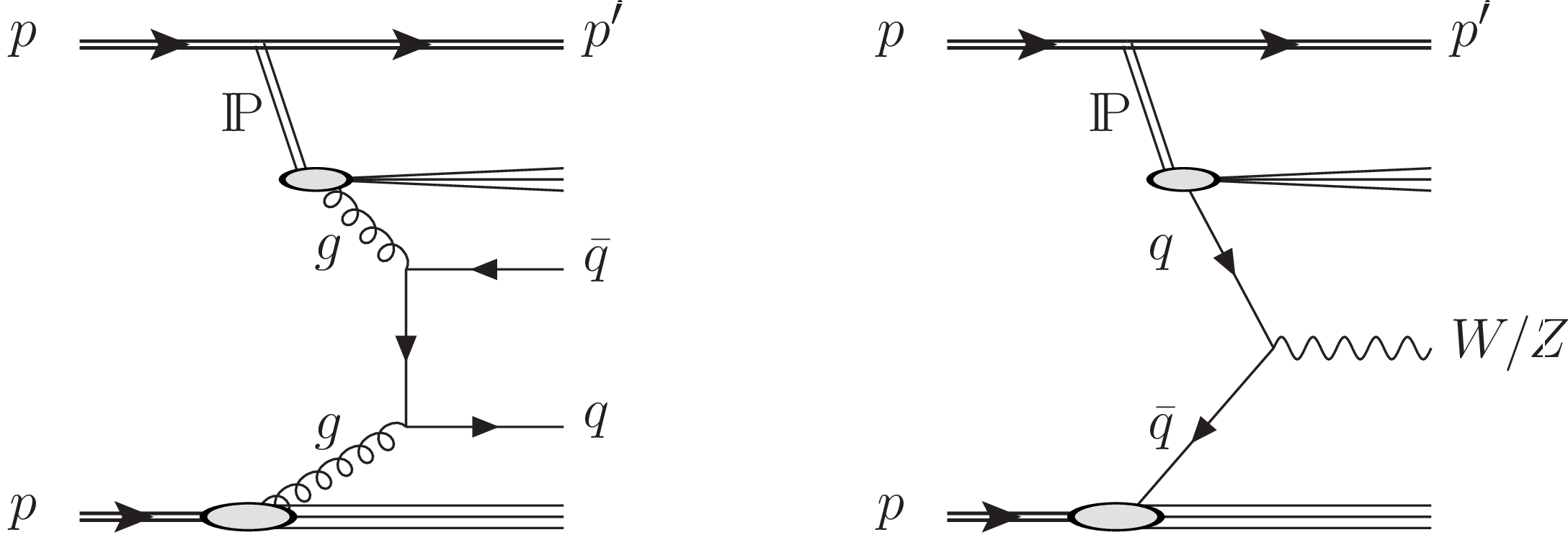
Figure 1:
Leading-order diagrams for the production of an intact forward proton in association with jets (left) or an electroweak boson (right) in pp collisions. |
png pdf |
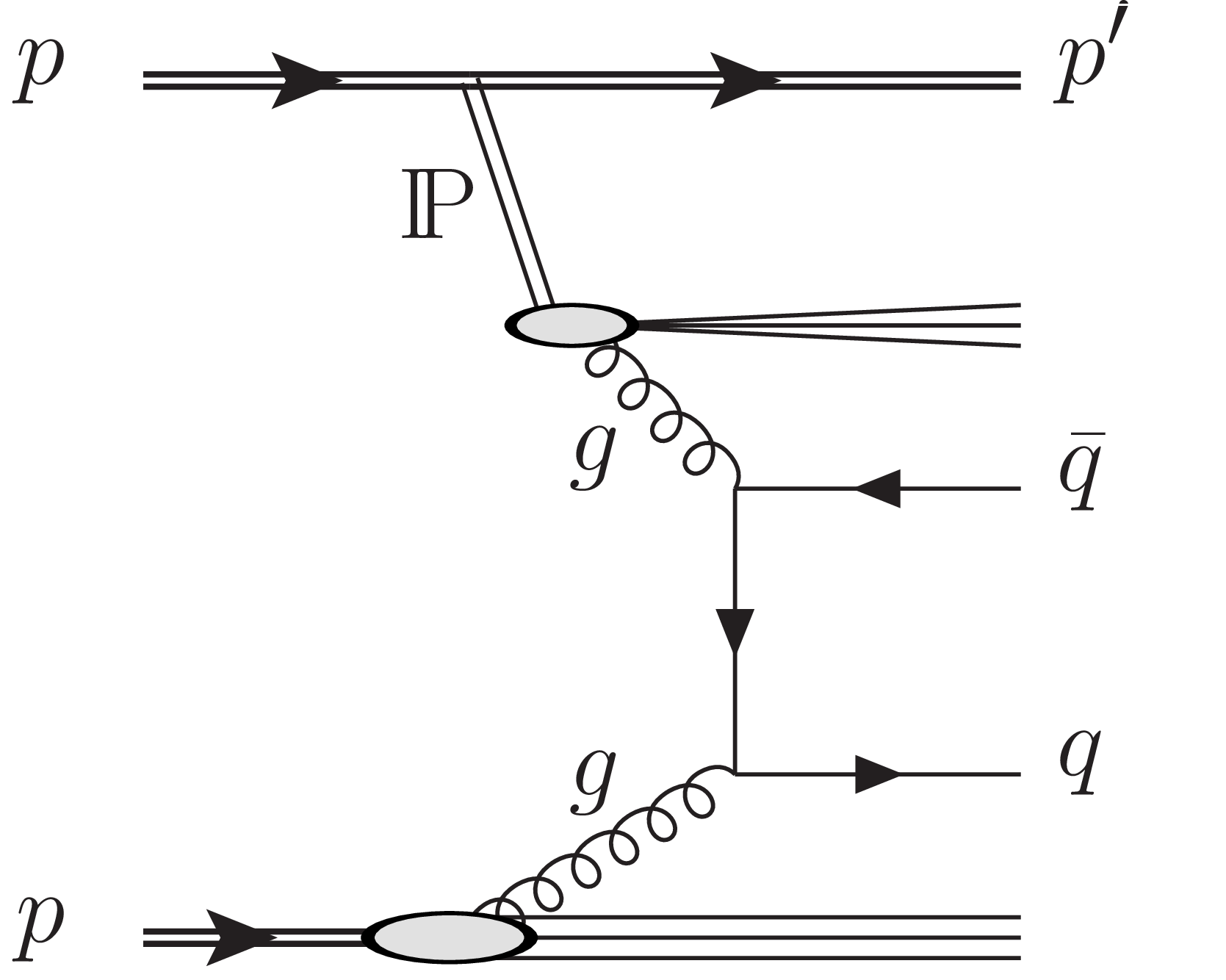
Figure 1-a:
Leading-order diagrams for the production of an intact forward proton in association with jets (left) or an electroweak boson (right) in pp collisions. |
png pdf |
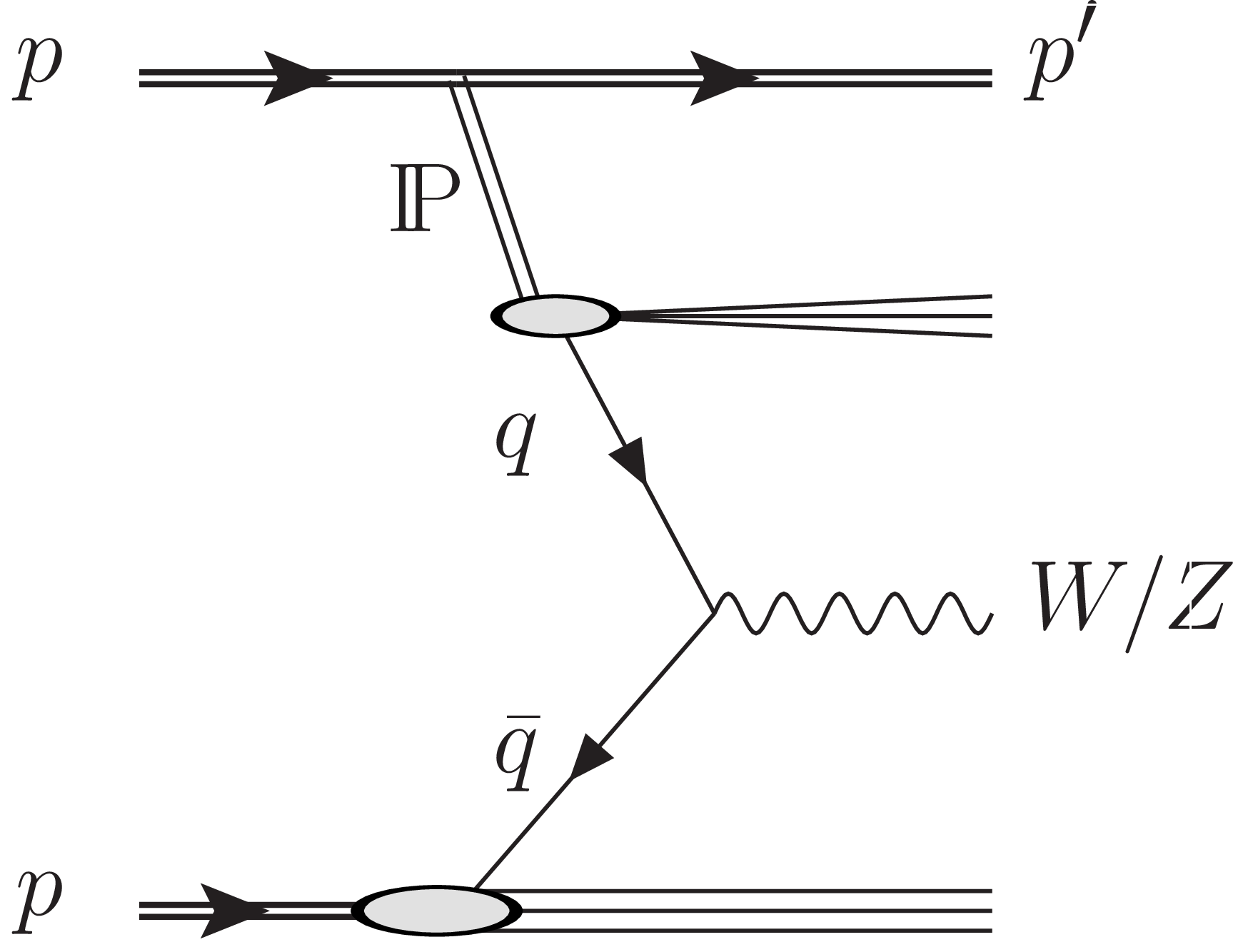
Figure 1-b:
Leading-order diagrams for the production of an intact forward proton in association with jets (left) or an electroweak boson (right) in pp collisions. |
png pdf |
Figure 2:
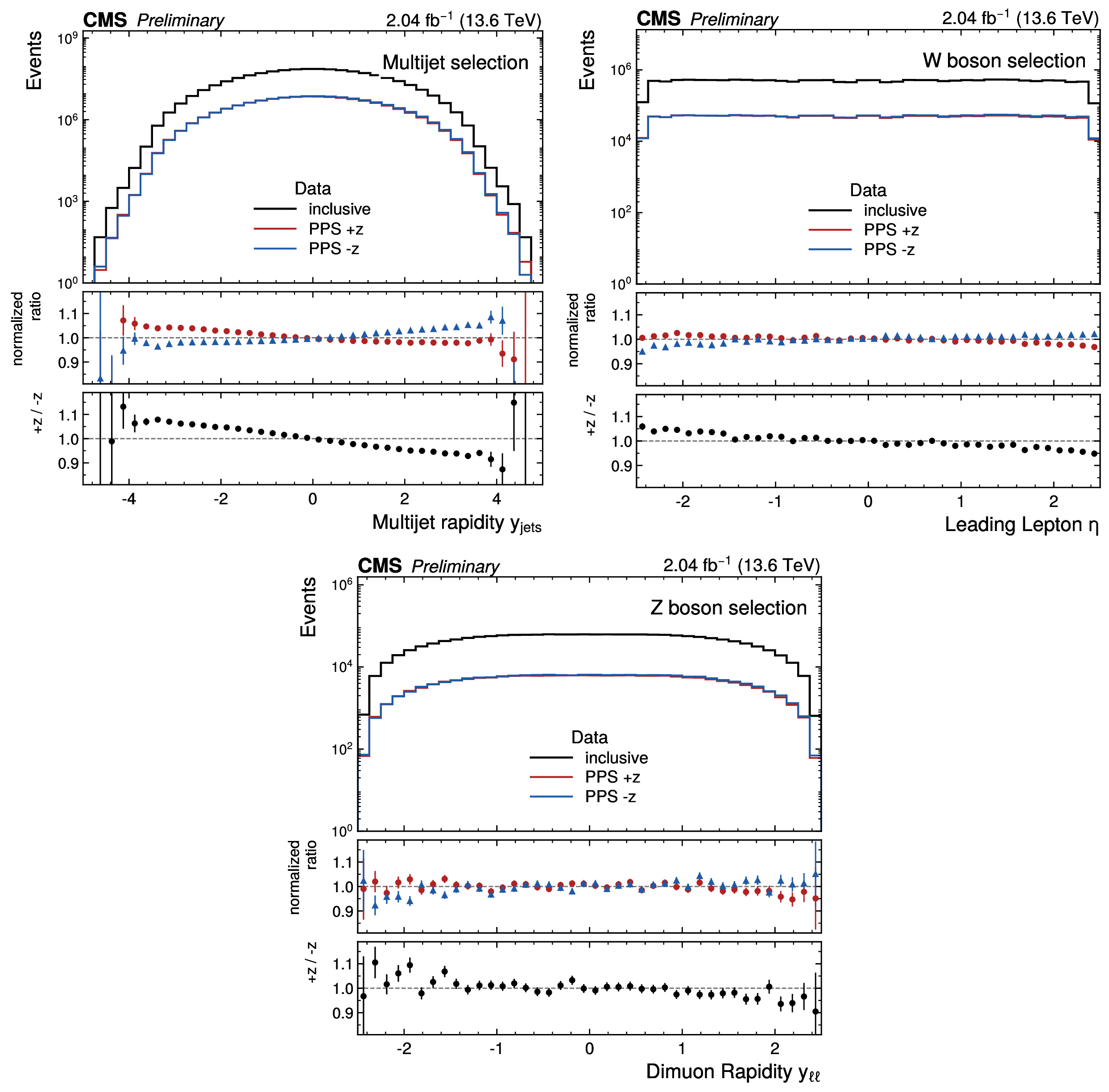
The rapidity of the central jet system in the multijet channel (upper left), pseudorapidity of the leading muon in the W channel (upper right), and rapidity of the dimuon system in the Z channel (lower) are shown for the inclusive selection without proton requirement (black), and for the subsamples with at least one proton in the $ z > $ 0 PPS arm (red) or the $ z < $ 0 PPS arm (blue). The normalized ratios are shown in the lower panels. |
png pdf |
Figure 2-a:
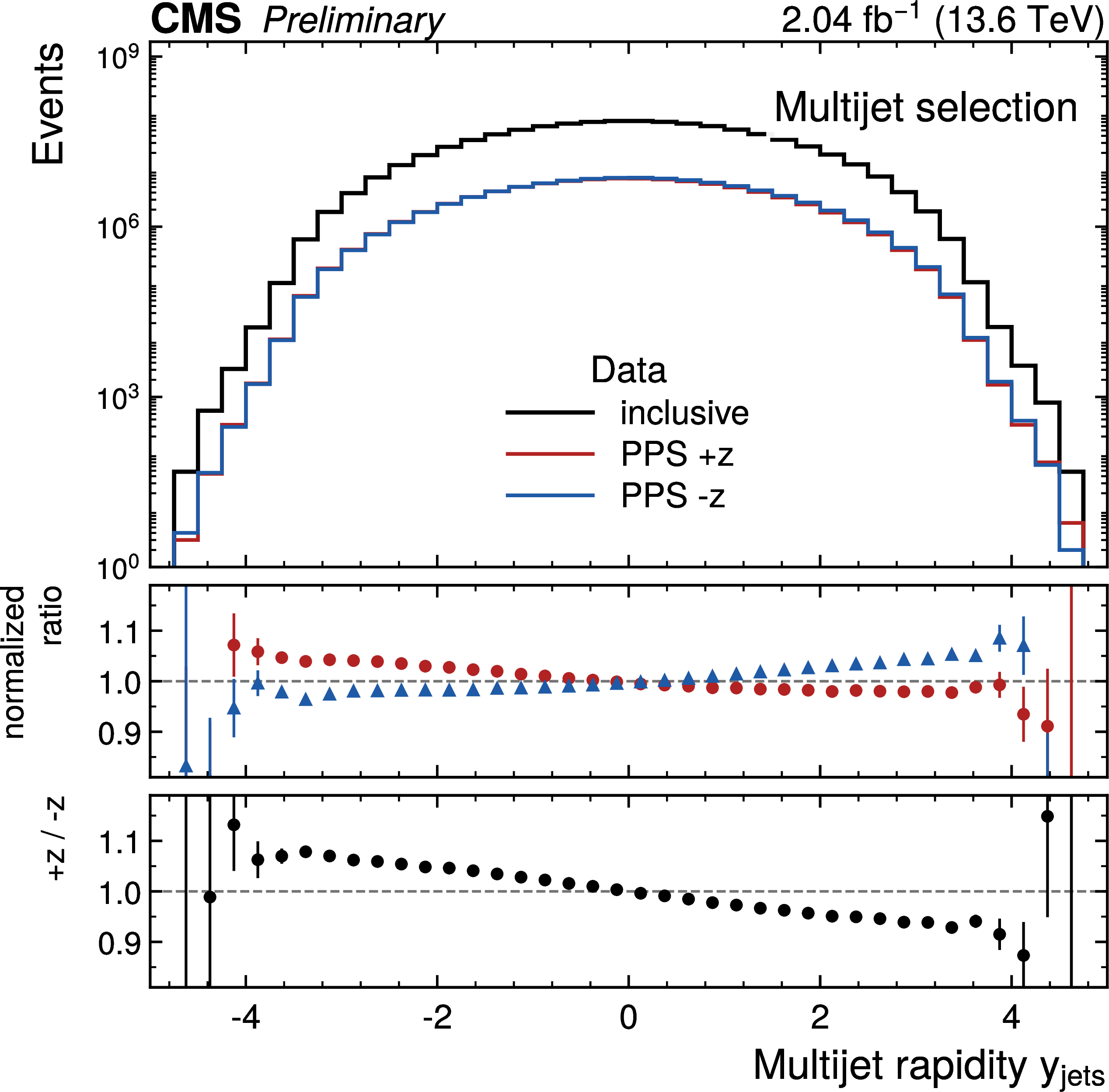
The rapidity of the central jet system in the multijet channel (upper left), pseudorapidity of the leading muon in the W channel (upper right), and rapidity of the dimuon system in the Z channel (lower) are shown for the inclusive selection without proton requirement (black), and for the subsamples with at least one proton in the $ z > $ 0 PPS arm (red) or the $ z < $ 0 PPS arm (blue). The normalized ratios are shown in the lower panels. |
png pdf |
Figure 2-b:
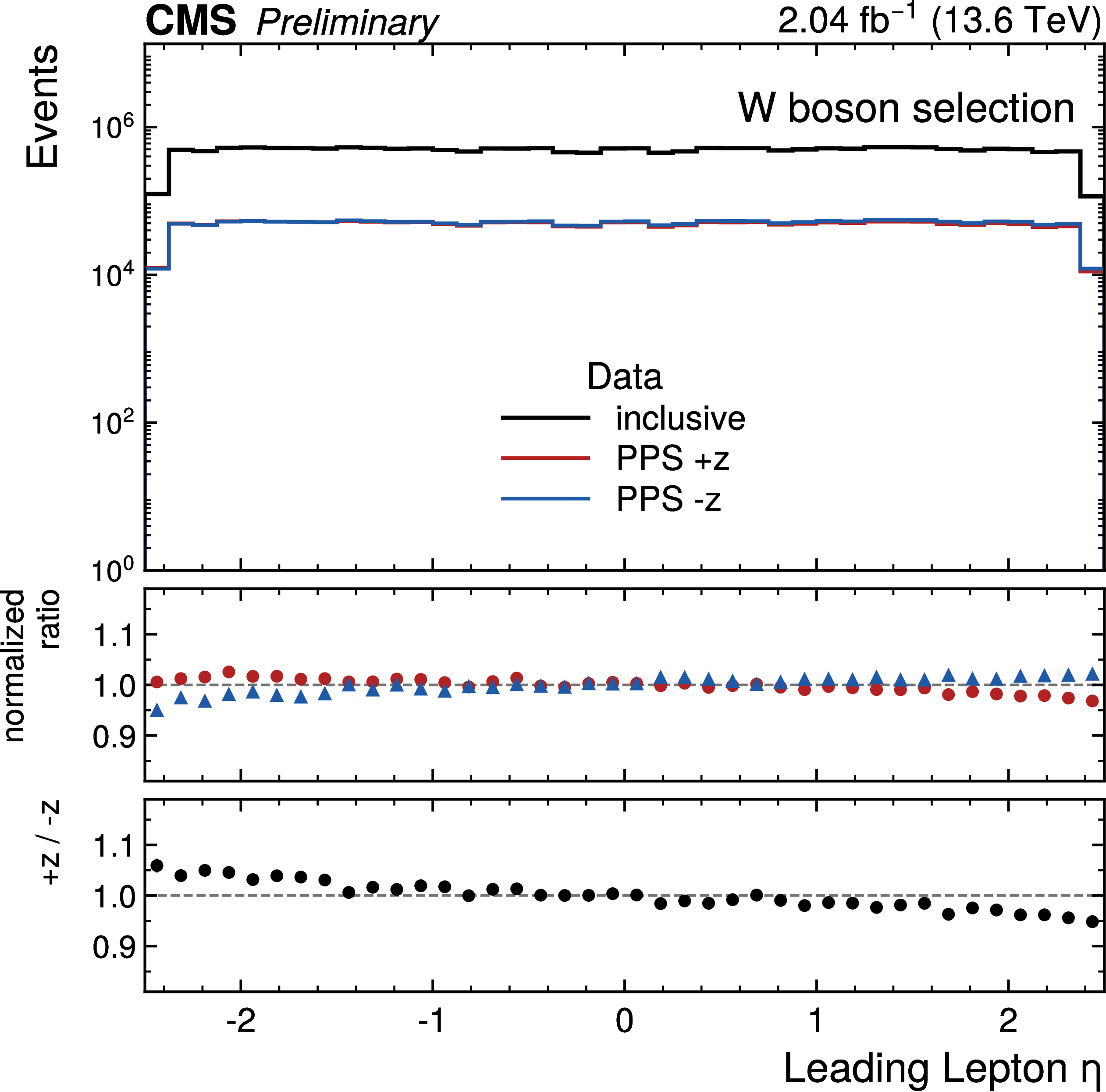
The rapidity of the central jet system in the multijet channel (upper left), pseudorapidity of the leading muon in the W channel (upper right), and rapidity of the dimuon system in the Z channel (lower) are shown for the inclusive selection without proton requirement (black), and for the subsamples with at least one proton in the $ z > $ 0 PPS arm (red) or the $ z < $ 0 PPS arm (blue). The normalized ratios are shown in the lower panels. |
png pdf |
Figure 2-c:
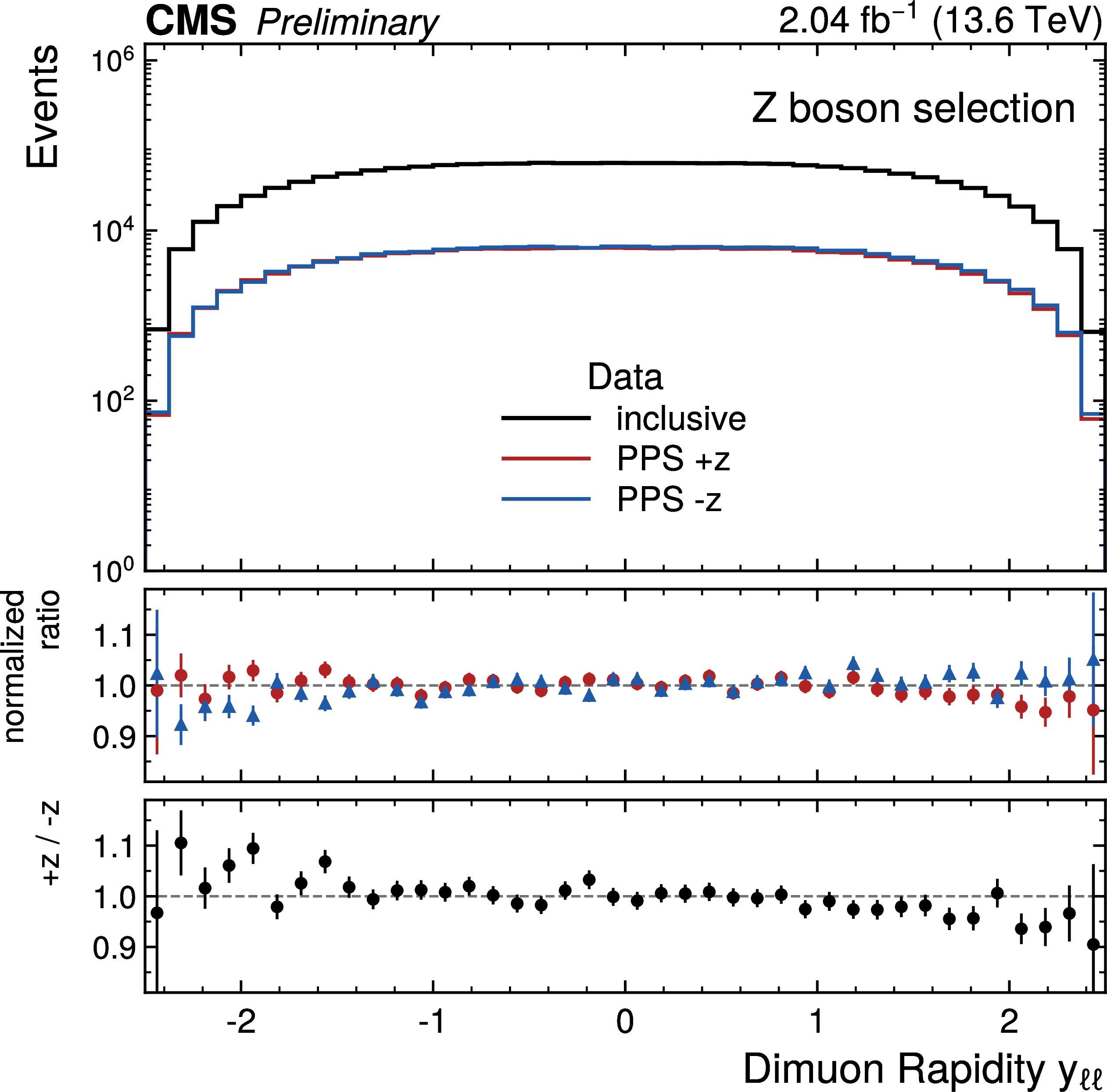
The rapidity of the central jet system in the multijet channel (upper left), pseudorapidity of the leading muon in the W channel (upper right), and rapidity of the dimuon system in the Z channel (lower) are shown for the inclusive selection without proton requirement (black), and for the subsamples with at least one proton in the $ z > $ 0 PPS arm (red) or the $ z < $ 0 PPS arm (blue). The normalized ratios are shown in the lower panels. |
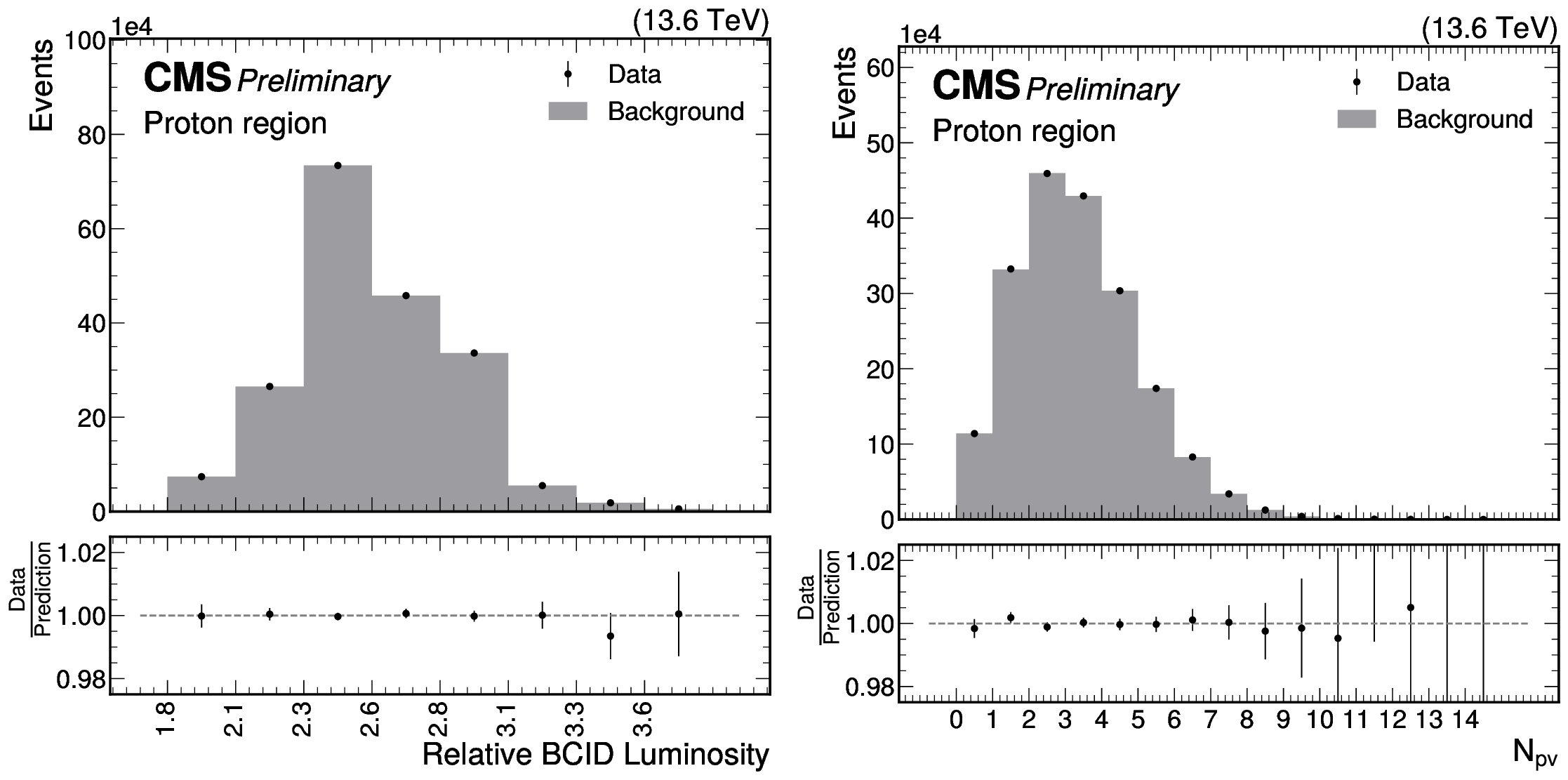
png pdf |
Figure 3:
Post-fit comparison of the predicted number of pileup protons from the statistical model fitted to zero-bias data from run 402537. Shown are the projections in bins of estimated relative luminosity (left) and number of reconstructed primary vertices $ N_\mathrm{pv} $ (right). The relative luminosity integrated over one run is estimated per LHC bunch crossing ID (BCID) and the primary vertices are reconstructed event-by-event. |
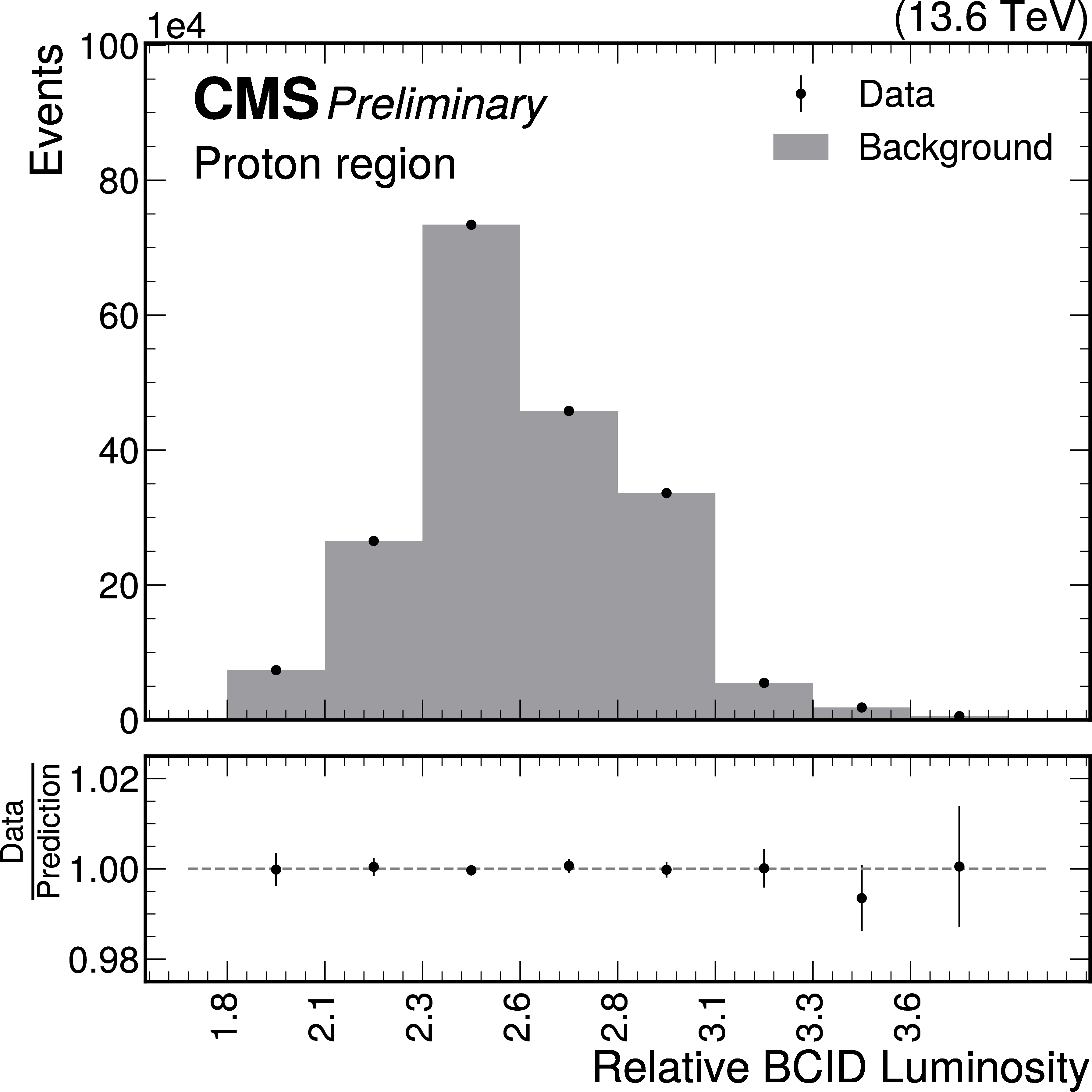
png pdf |
Figure 3-a:
Post-fit comparison of the predicted number of pileup protons from the statistical model fitted to zero-bias data from run 402537. Shown are the projections in bins of estimated relative luminosity (left) and number of reconstructed primary vertices $ N_\mathrm{pv} $ (right). The relative luminosity integrated over one run is estimated per LHC bunch crossing ID (BCID) and the primary vertices are reconstructed event-by-event. |
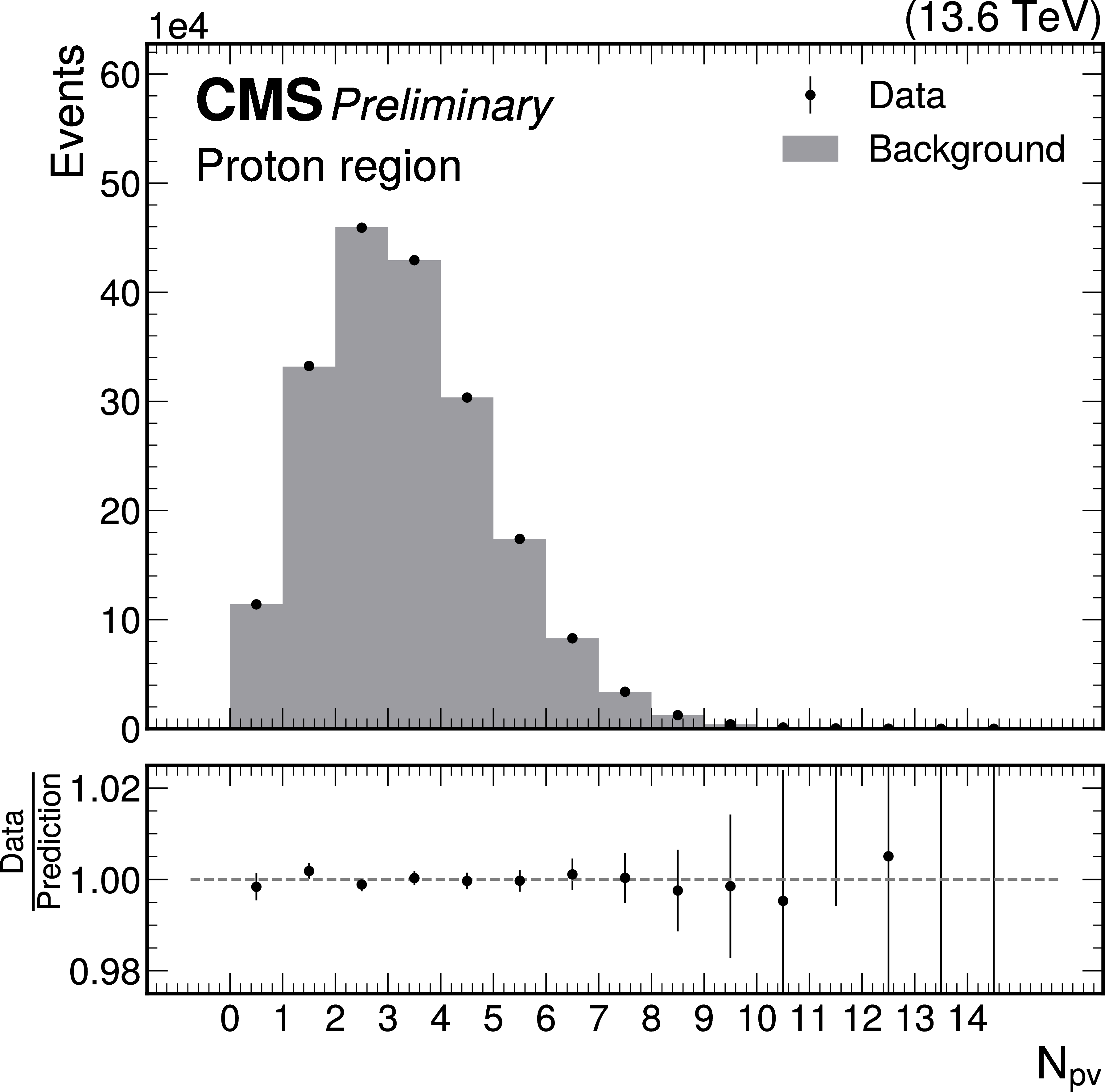
png pdf |
Figure 3-b:
Post-fit comparison of the predicted number of pileup protons from the statistical model fitted to zero-bias data from run 402537. Shown are the projections in bins of estimated relative luminosity (left) and number of reconstructed primary vertices $ N_\mathrm{pv} $ (right). The relative luminosity integrated over one run is estimated per LHC bunch crossing ID (BCID) and the primary vertices are reconstructed event-by-event. |
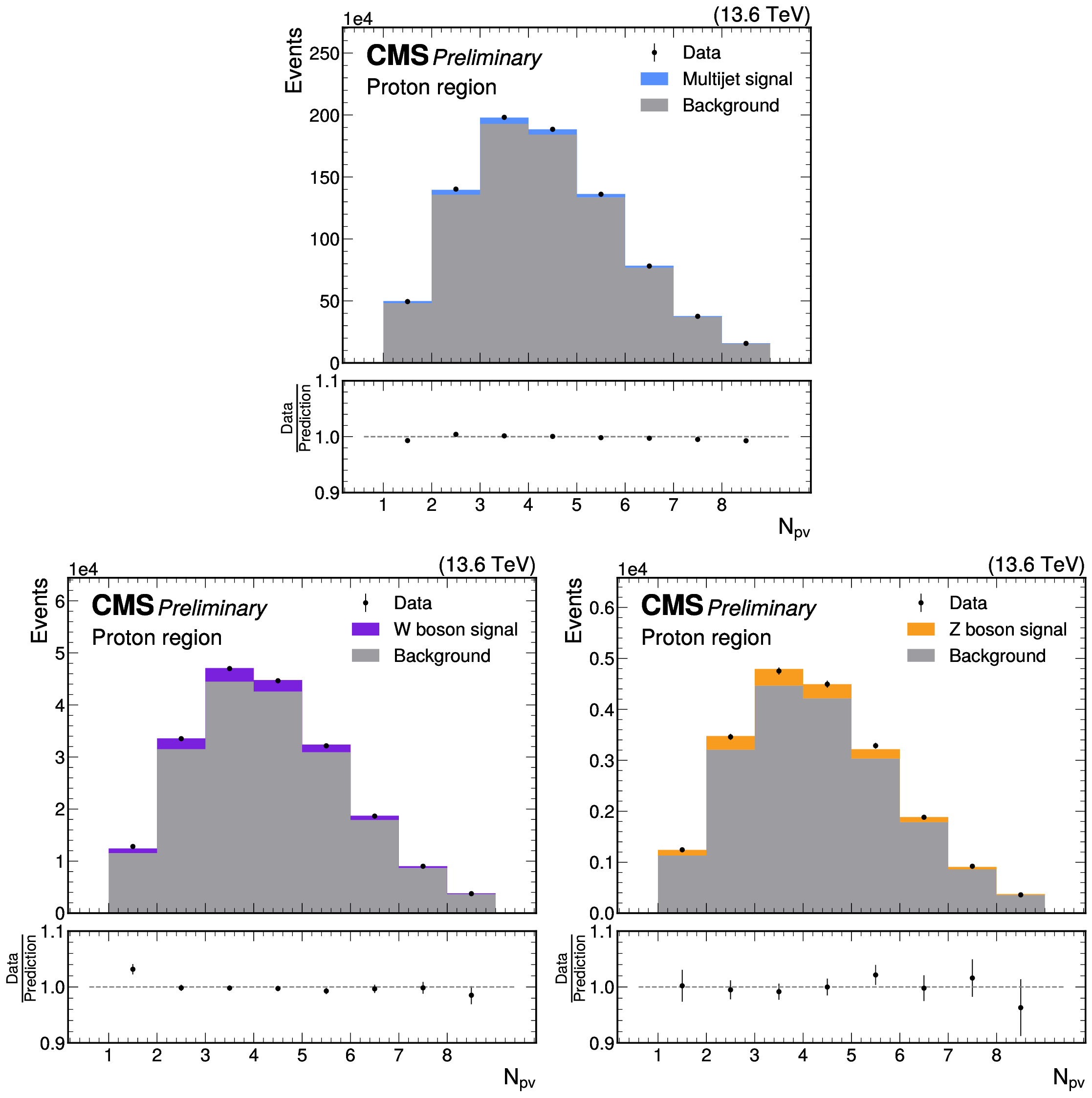
png pdf |
Figure 4:
Post-fit comparison between data and the statistical model including the signal component, fitted to the data selected in the multijet channel (upper), W channel (lower left) and Z channel (lower right) for run 402537. Shown is the projection as a function of the number of reconstructed primary vertices $ N_\mathrm{pv} $ (right). |
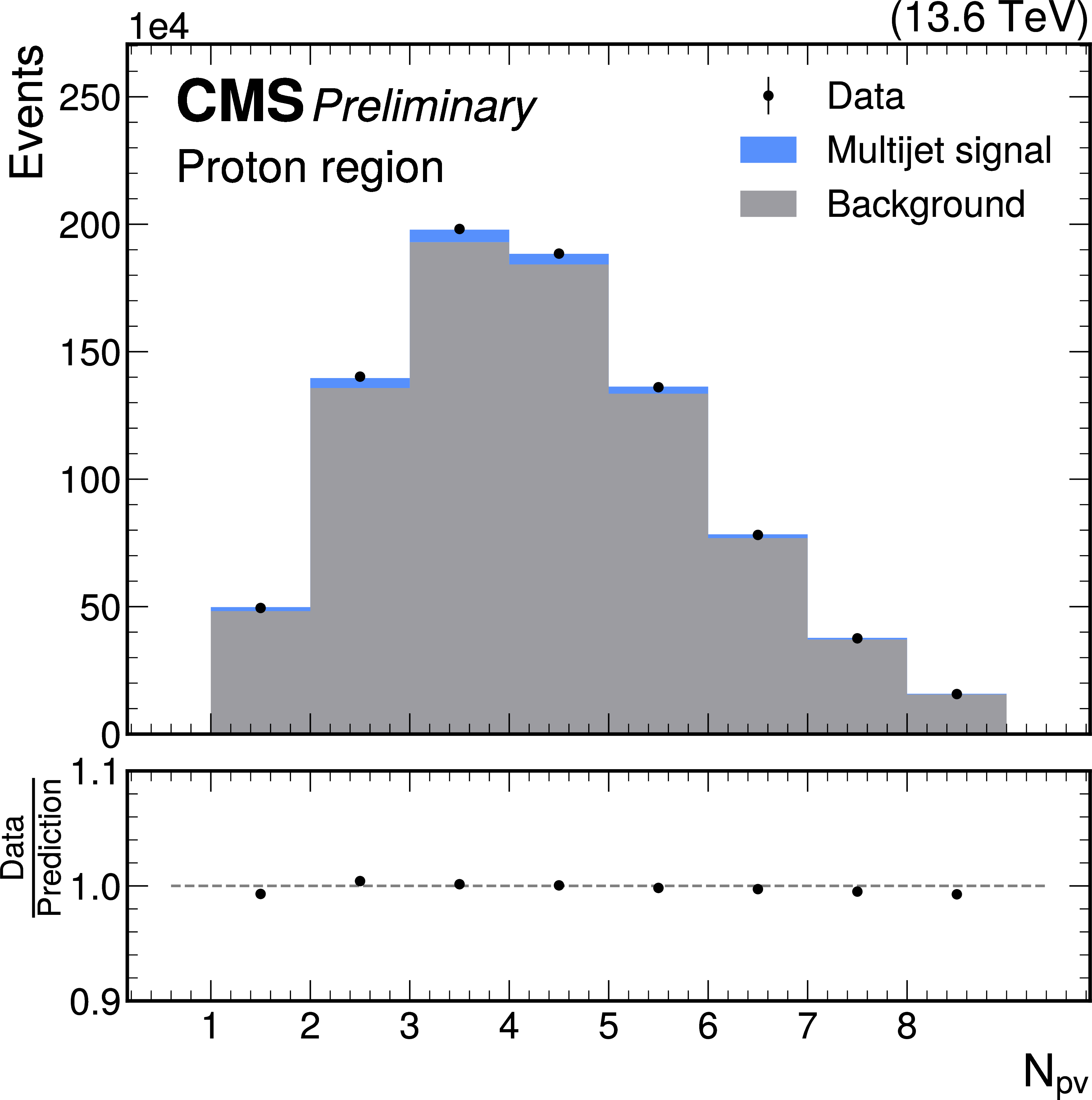
png pdf |
Figure 4-a:
Post-fit comparison between data and the statistical model including the signal component, fitted to the data selected in the multijet channel (upper), W channel (lower left) and Z channel (lower right) for run 402537. Shown is the projection as a function of the number of reconstructed primary vertices $ N_\mathrm{pv} $ (right). |
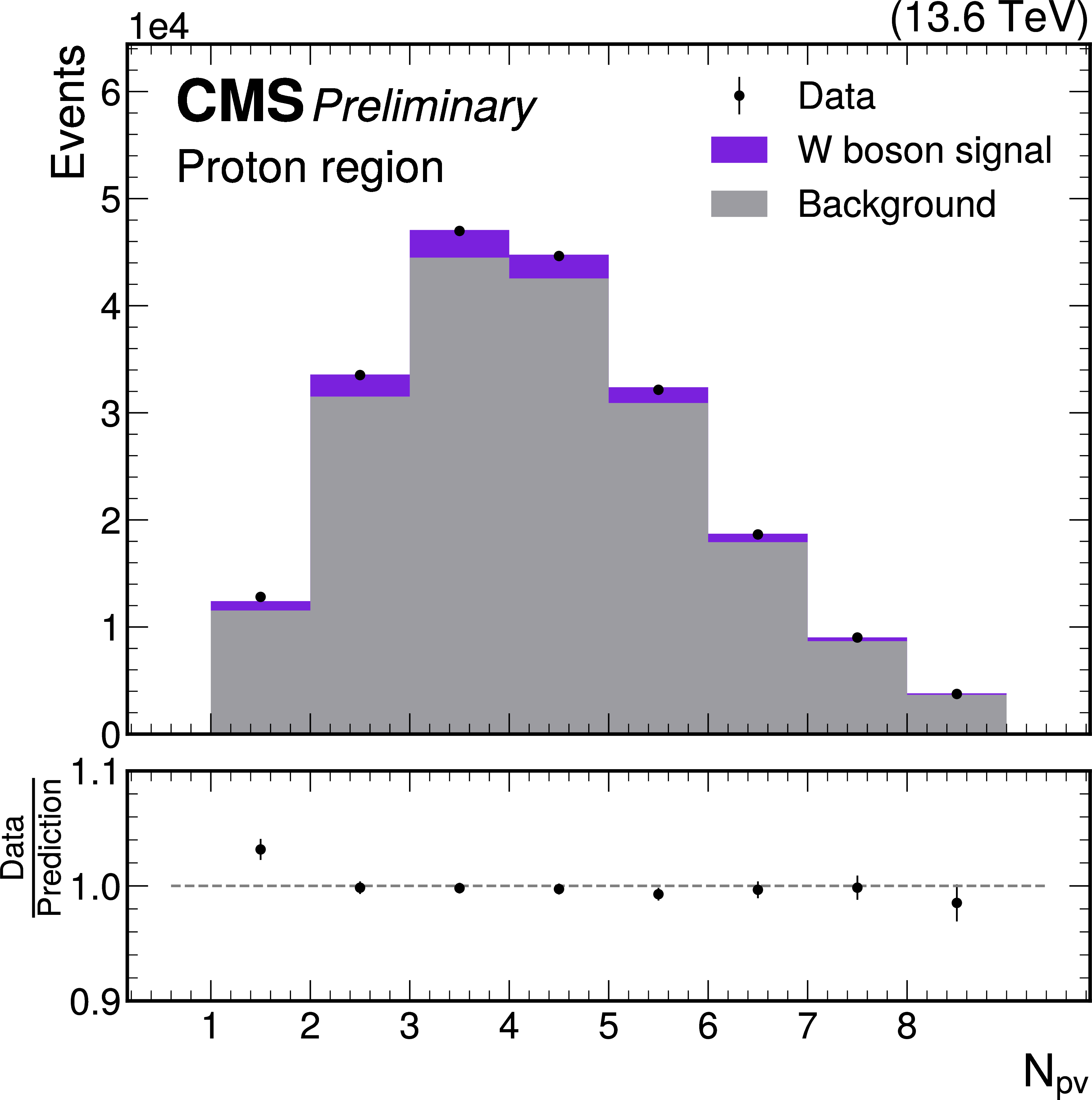
png pdf |
Figure 4-b:
Post-fit comparison between data and the statistical model including the signal component, fitted to the data selected in the multijet channel (upper), W channel (lower left) and Z channel (lower right) for run 402537. Shown is the projection as a function of the number of reconstructed primary vertices $ N_\mathrm{pv} $ (right). |
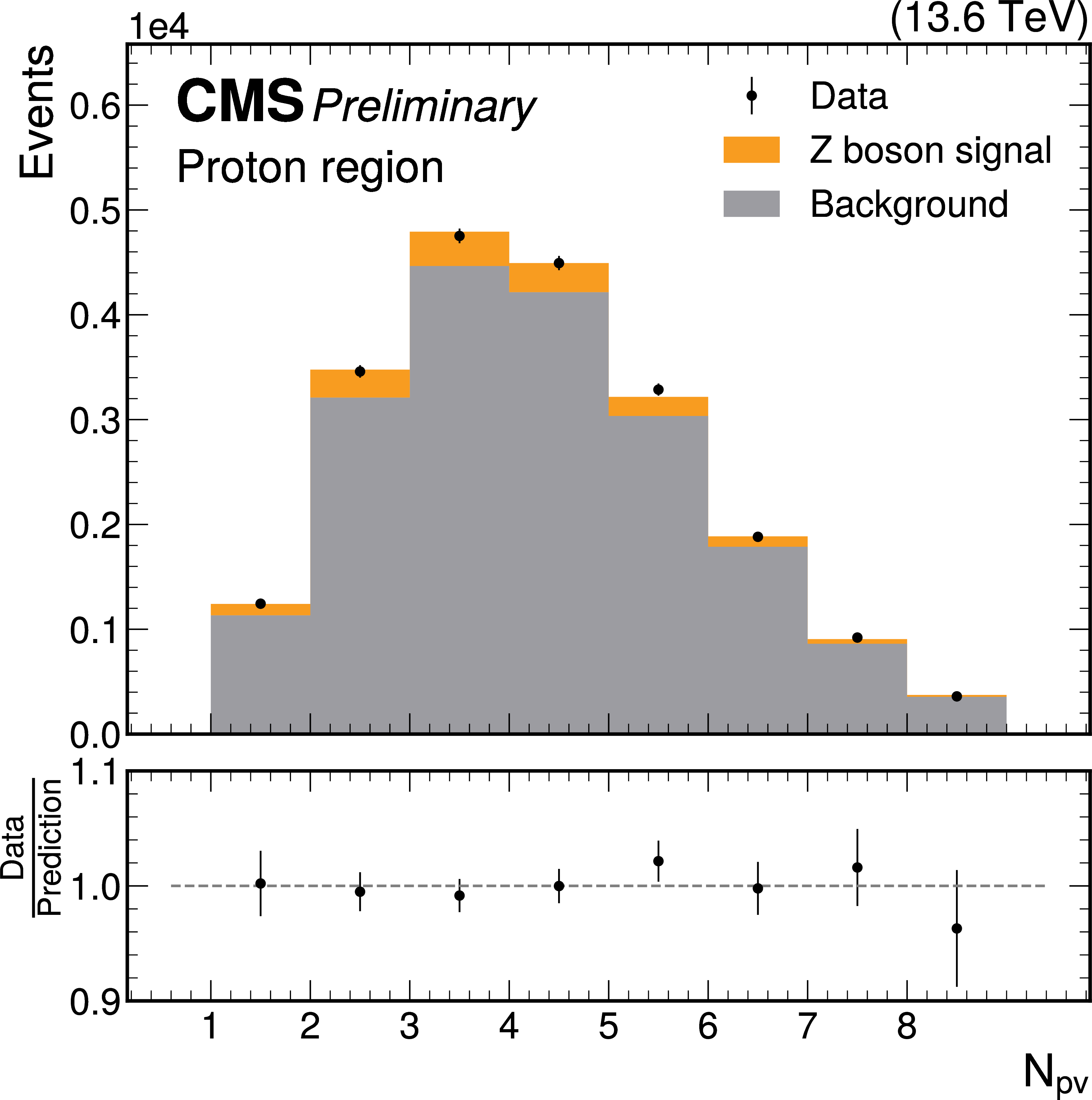
png pdf |
Figure 4-c:
Post-fit comparison between data and the statistical model including the signal component, fitted to the data selected in the multijet channel (upper), W channel (lower left) and Z channel (lower right) for run 402537. Shown is the projection as a function of the number of reconstructed primary vertices $ N_\mathrm{pv} $ (right). |
png pdf |
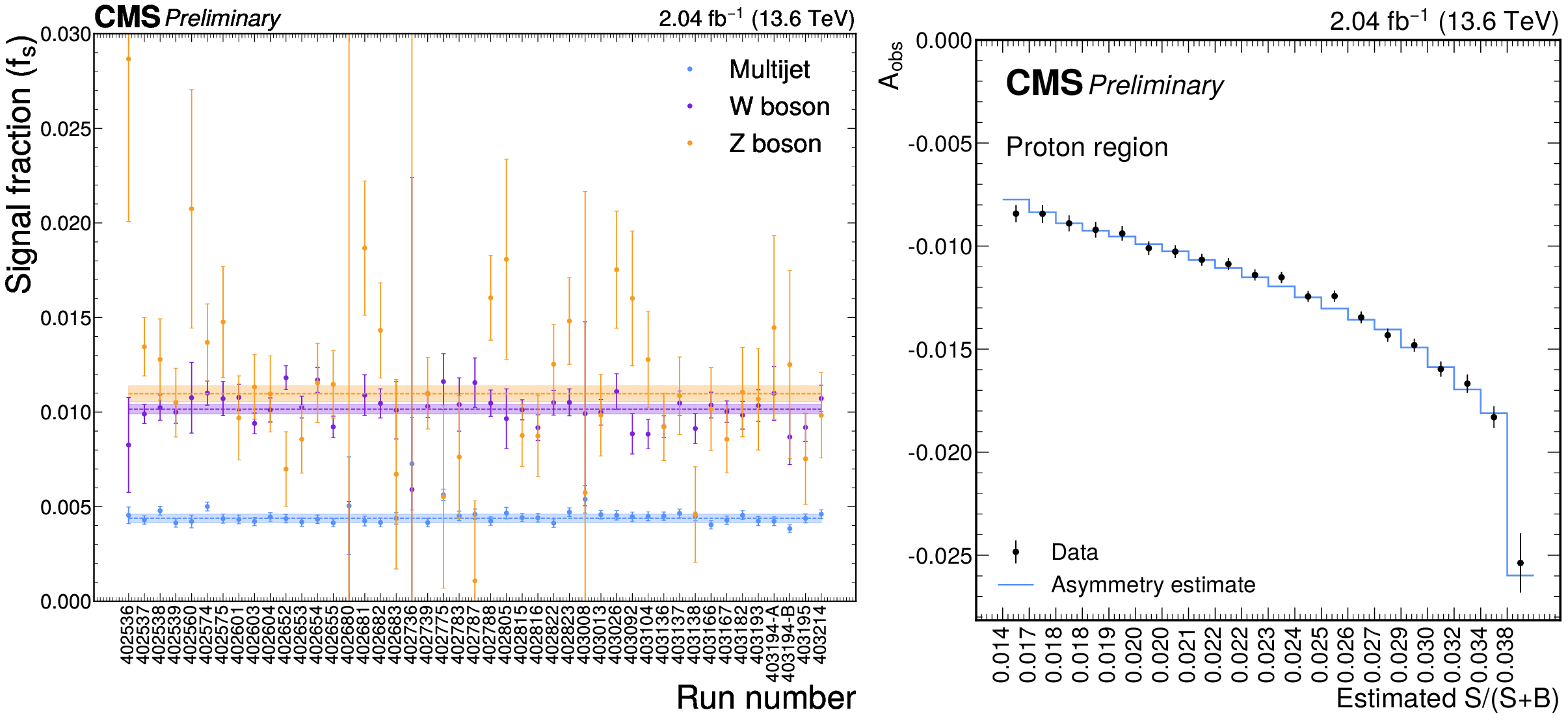
Figure 5:
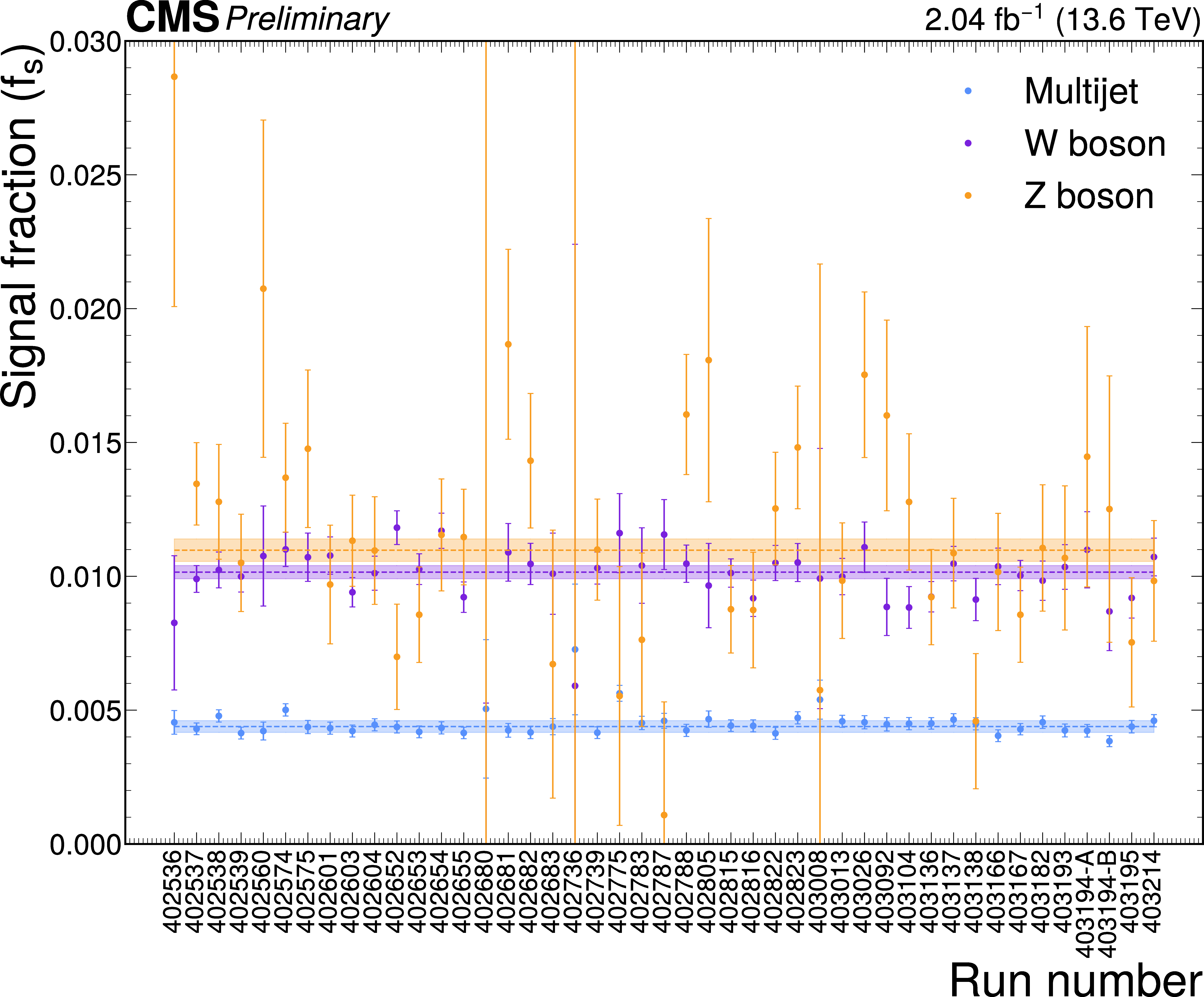
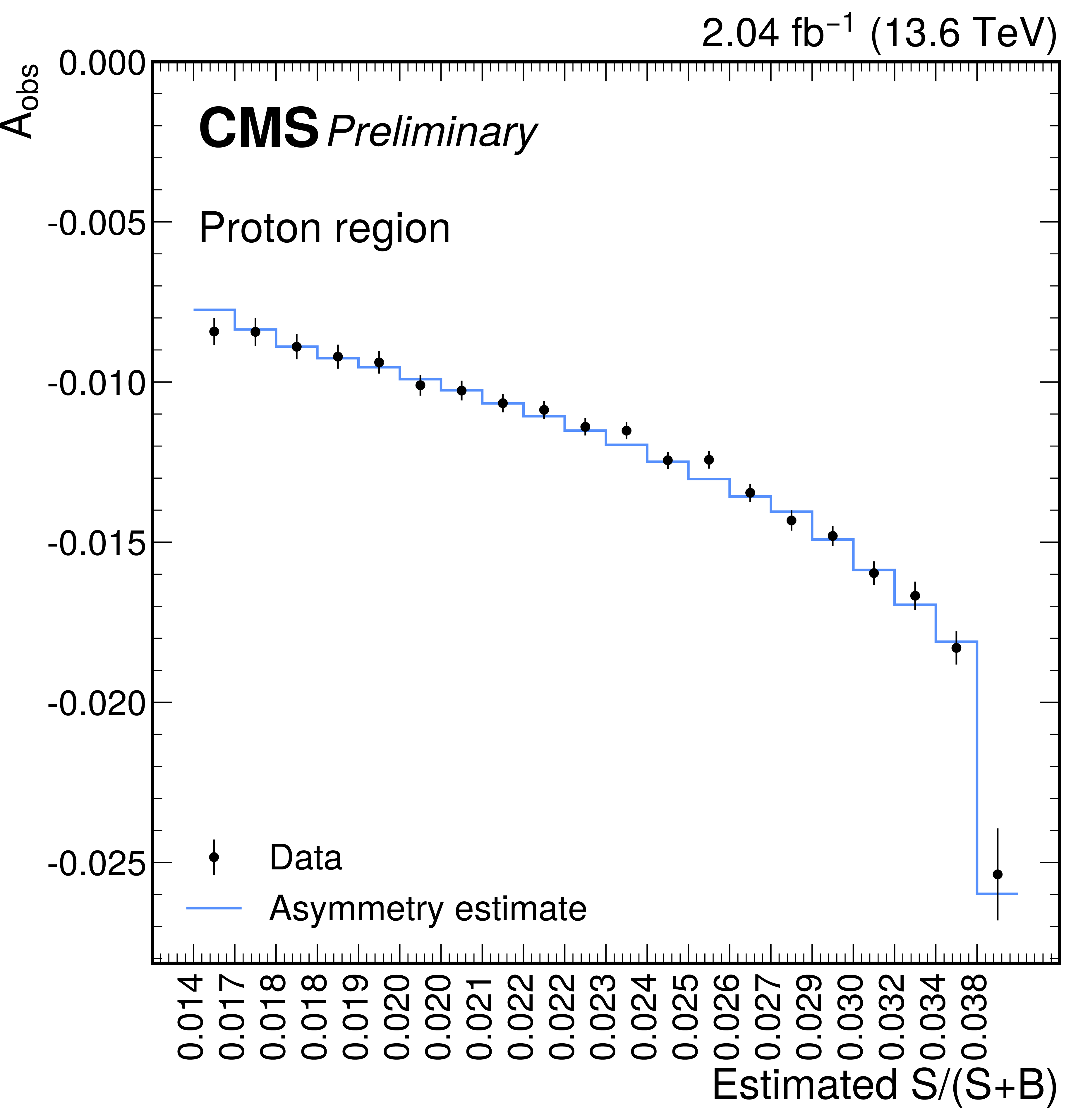
Extracted signal fraction $ f_s $ in the Multijet, W, and Z channels, for all runs of the low-pileup data set (left). The fitted fractions are stable within the statistical uncertainties, and not compatible with zero. Runs 403194-A and 403194-B are short runs with even lower pileup of $ \langle \mu \rangle= $ 2 and $ \langle \mu \rangle= $ 1 respectively. The right plot shows how the predicted $ A_\mathrm{ obs} $ agrees with data, over a wide range of estimated signal purity, in the multijet channel, combining all runs including also the very-low-pileup run 403194. |
png pdf |
Figure 5-a:
Extracted signal fraction $ f_s $ in the Multijet, W, and Z channels, for all runs of the low-pileup data set (left). The fitted fractions are stable within the statistical uncertainties, and not compatible with zero. Runs 403194-A and 403194-B are short runs with even lower pileup of $ \langle \mu \rangle= $ 2 and $ \langle \mu \rangle= $ 1 respectively. The right plot shows how the predicted $ A_\mathrm{ obs} $ agrees with data, over a wide range of estimated signal purity, in the multijet channel, combining all runs including also the very-low-pileup run 403194. |
png pdf |
Figure 5-b:
Extracted signal fraction $ f_s $ in the Multijet, W, and Z channels, for all runs of the low-pileup data set (left). The fitted fractions are stable within the statistical uncertainties, and not compatible with zero. Runs 403194-A and 403194-B are short runs with even lower pileup of $ \langle \mu \rangle= $ 2 and $ \langle \mu \rangle= $ 1 respectively. The right plot shows how the predicted $ A_\mathrm{ obs} $ agrees with data, over a wide range of estimated signal purity, in the multijet channel, combining all runs including also the very-low-pileup run 403194. |
png pdf |
Figure 6:
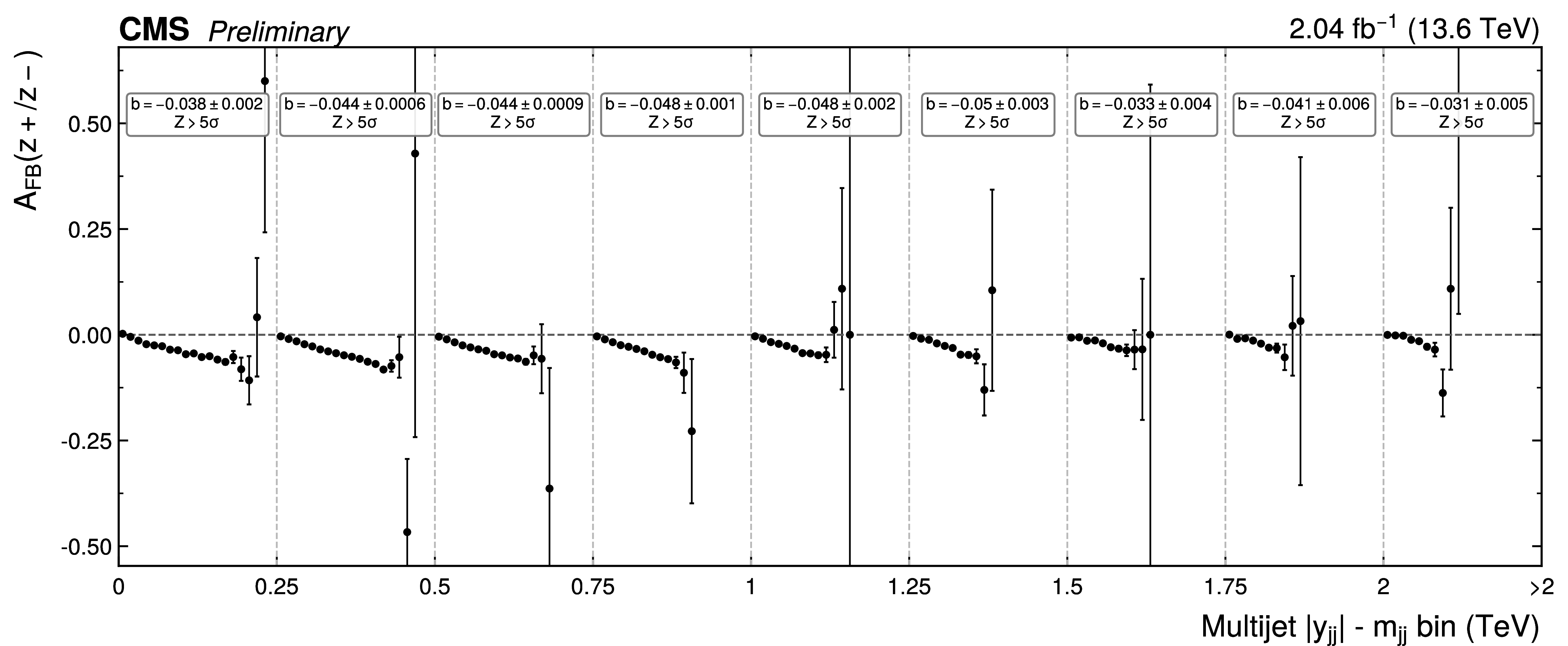
The forward-backward asymmetry $ A_\mathrm{FB}(z+/z-) $ in bins of the multijet invariant mass $ m_\mathrm{jj} $. In each mass bin, the $ A_\mathrm{FB} $ points are shown versus multijet $ |y_{jj}| $, between 0 and 2.5. The value $ b $ is the statistically weighted linear-fit slope of $ A_\mathrm{FB} $ as a function of $ |y_{jj}| $ in that $ m_\mathrm{jj} $ bin, and $ Z $ is the one-sided significance for a negative slope, $ \max(0, -b/\sigma_b) $. |
png pdf |
Figure 7:
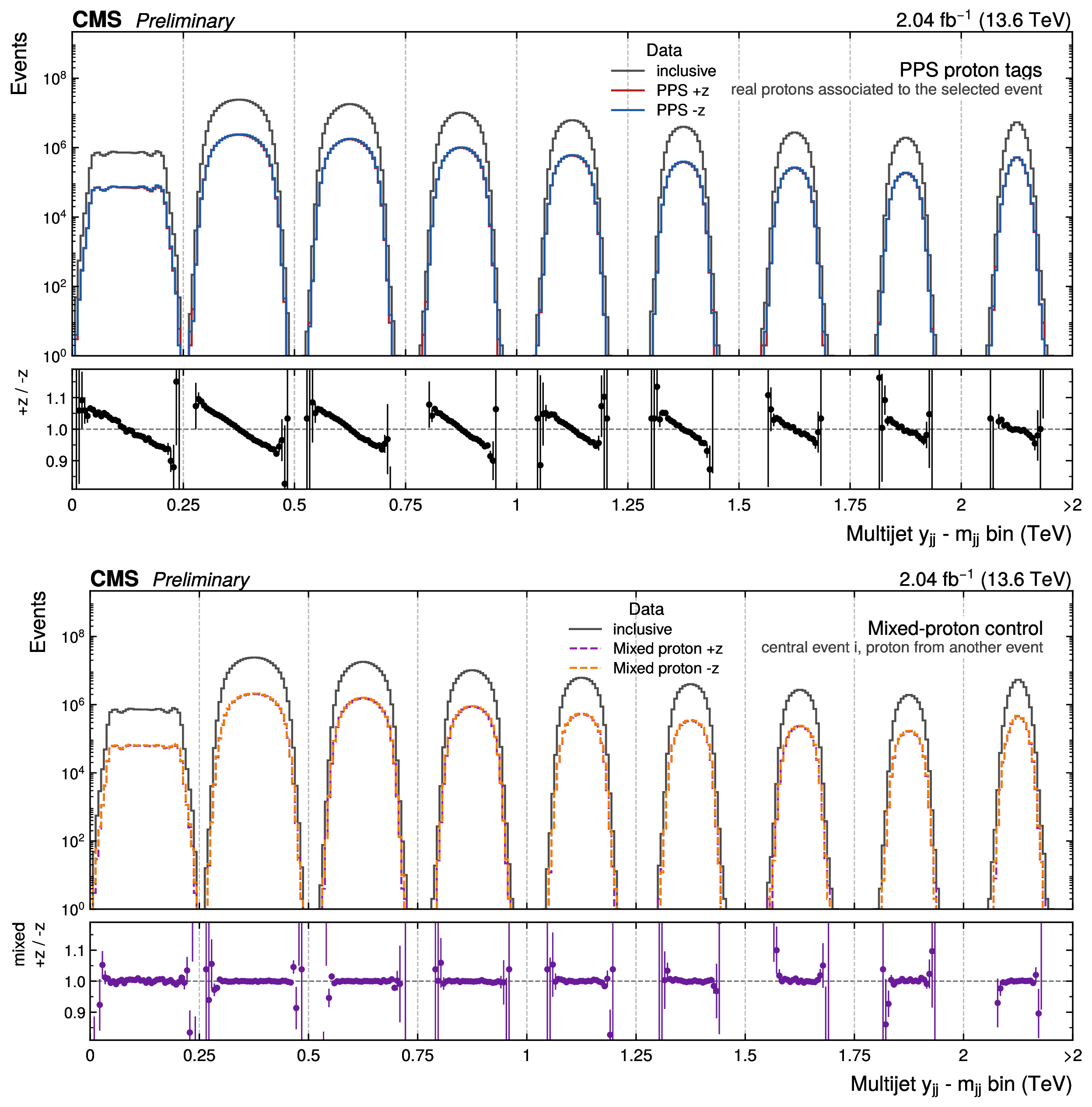
The ratio of proton-tagged events relative to the inclusively selected sample is shown as a function of the multijet rapidity $ y_{jj} $ between --4.7 and 4.7, in bins of the invariant mass of the multijet system, for the multijet channel (upper). In the lower panel the same plot is shown when mixing the protons from one event with the centrally selected event from a different event, as a null test. |
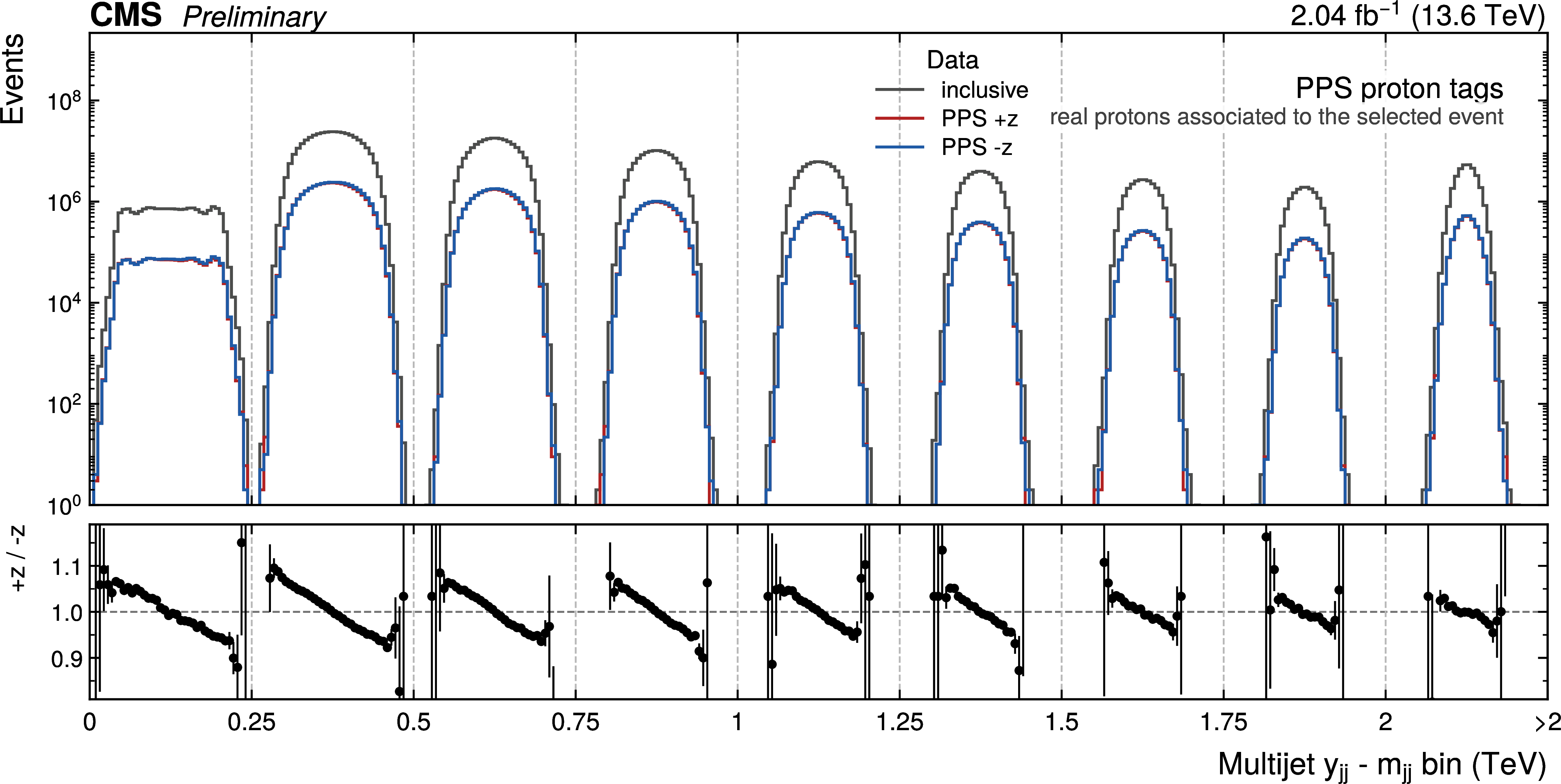
png pdf |
Figure 7-a:
The ratio of proton-tagged events relative to the inclusively selected sample is shown as a function of the multijet rapidity $ y_{jj} $ between --4.7 and 4.7, in bins of the invariant mass of the multijet system, for the multijet channel (upper). In the lower panel the same plot is shown when mixing the protons from one event with the centrally selected event from a different event, as a null test. |
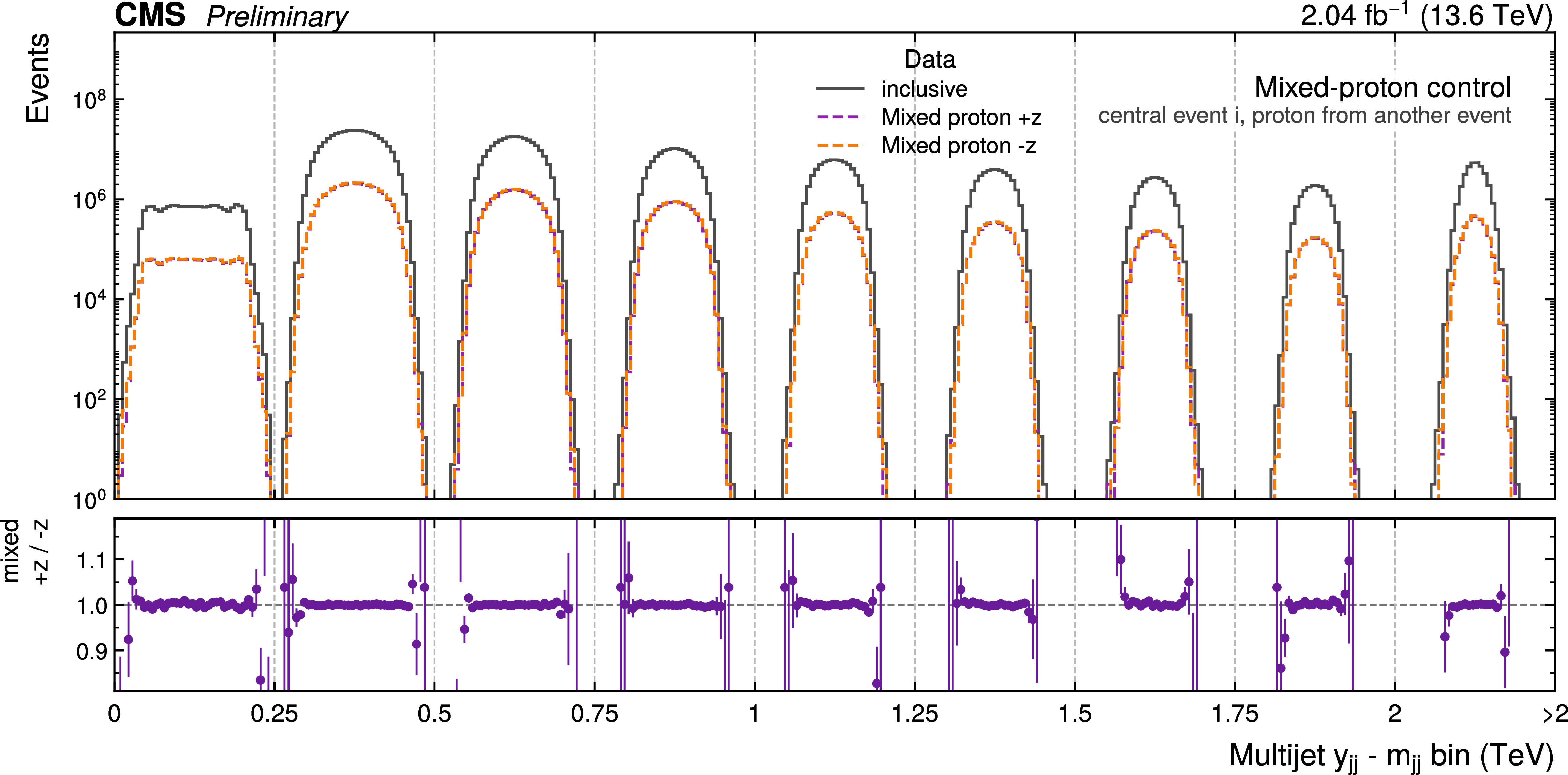
png pdf |
Figure 7-b:
The ratio of proton-tagged events relative to the inclusively selected sample is shown as a function of the multijet rapidity $ y_{jj} $ between --4.7 and 4.7, in bins of the invariant mass of the multijet system, for the multijet channel (upper). In the lower panel the same plot is shown when mixing the protons from one event with the centrally selected event from a different event, as a null test. |
| Tables | |

png pdf |
Table 1:
Number of selected events and observed proton tag rates in the selected event samples. The quantities $ R_{\mathrm{tag}}^{z > 0} $ and $ R_{\mathrm{tag}}^{z < 0} $ are the fractions of selected events with at least one reconstructed proton in the corresponding PPS arm. The quantity $ R_{\mathrm{tag}}^{\mathrm{any}} $ is the fraction of selected events with at least one reconstructed proton in either PPS arm and is the observed tag rate used in the signal-fraction extraction. The quantity $ R_{\mathrm{PU}}^{\mathrm{any}} $ is the expected random-proton tag rate in either PPS arm, estimated from zero-bias events after matching the bunch-crossing, pileup, and PPS detector status conditions of each selected sample. |

png pdf |
Table 2:
Observed tagged-sample asymmetry, inferred fiducial signal asymmetry, and fiducial signal fraction. The signal asymmetry is obtained from $ A_S=A_{\mathrm{obs}}R^{\mathrm{incl.}}_{\mathrm{tag}}/(f_S C_{m}) $. Where $ R^{\mathrm{incl.}}_{tag} $ is the proton tagging rate when proton tags in opposite arms are both counted, and $ C_m $ is a correction for events with both a signal and background proton in opposite arms. |
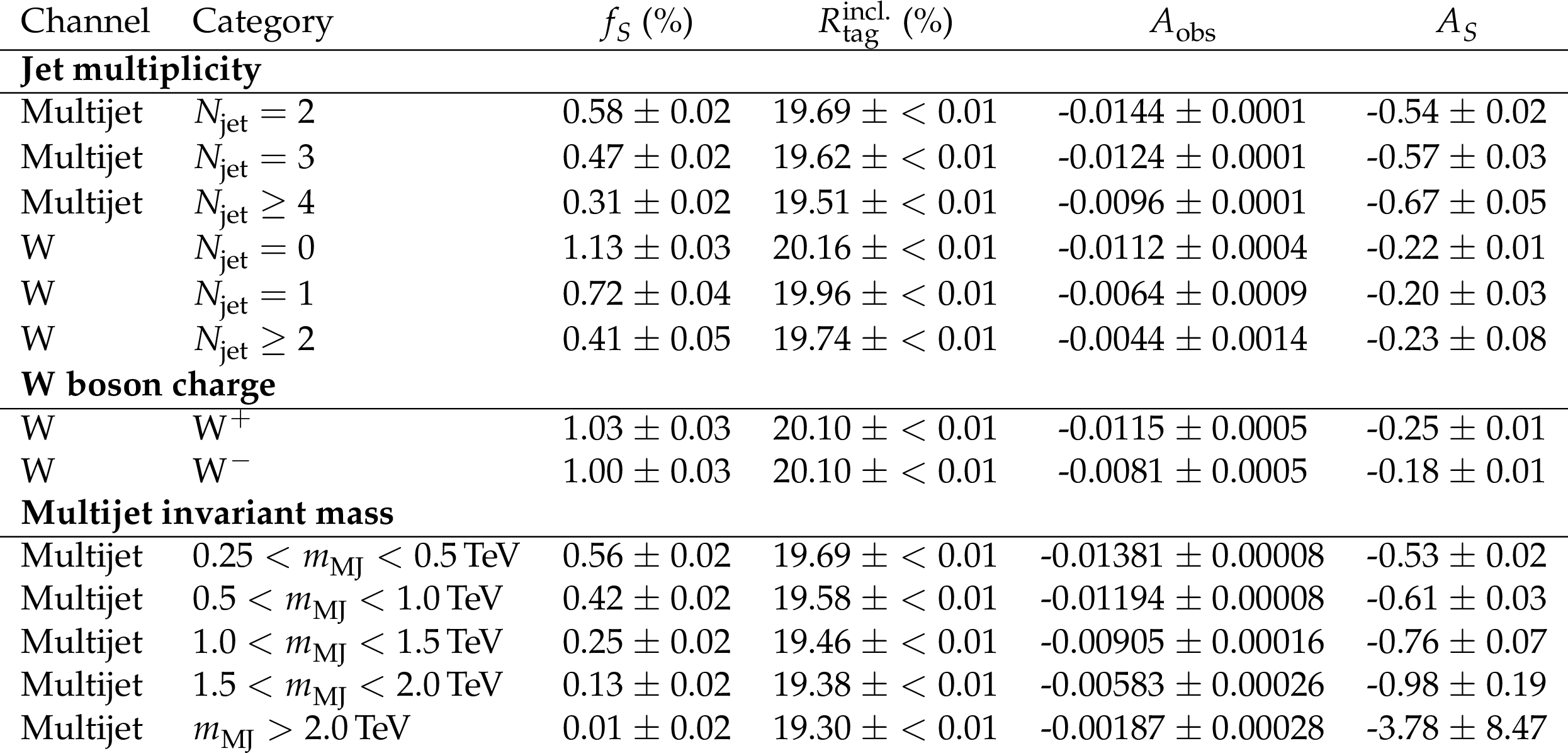
png pdf |
Table 3:
Differential measurements of the observed tagged-sample asymmetry, inferred fiducial signal asymmetry, and fiducial signal fraction. The results are shown as a function of jet multiplicity in the multijet, W boson, and Z boson samples, the W boson charge, and the invariant mass of the multijet system. The signal asymmetry is obtained from $ A_S=A_{\mathrm{obs}}R^{\mathrm{incl.}}_{\mathrm{tag}}/(f_S C_{m}) $. Where $ R^{\mathrm{incl/}}_{tag} $ is the proton tagging rate when proton tags in opposite arms are both counted, and $ C_m $ is a correction for events with both a signal and background proton in opposite arms. |
| Summary |
| In summary, the production of high-mass central events containing TeV-scale jets with an intact forward proton is observed for the first time. The forward protons with momentum loss between approximately 3% and 13%, are tagged in the CMS PPS detector. In addition, proton-tagged Z bosons are observed for the first time with a significance well above five standard deviations, and W bosons for the first time at the LHC. The data were collected in a dedicated run period in 2026, during which CMS collected data at a low instantaneous luminosity ($\langle \mu \rangle=5$). In all cases a tagged-sample forward--backward asymmetry is observed, with a sign indicating that the central system is boosted away from the tagged proton. In all channels, the fiducial signal fraction is measured and observed to be different from zero. These fractions are measured differentially as a function of jet multiplicity, W boson charge, and the invariant mass of the central multijet system, for masses up to 2 TeV. The values for the in-fiducial signal fractions $f_s$ reported in this note have not been corrected for the $\xi$-dependent proton tagging efficiency inside the PPS acceptance, and should therefore be interpreted as lower limits of the true values. |
| References | ||||
| 1 | LHC Forward Physics Working Group | LHC Forward Physics | JPG 43 (2016) 110201 | 1611.05079 |
| 2 | CMS and TOTEM Collaborations | Proton reconstruction with the CMS-TOTEM Precision Proton Spectrometer | JINST 18 (2023) P09009 | 2210.05854 |
| 3 | CMS Collaboration | Forward Energy Flow, Central Charged-Particle Multiplicities, and Pseudorapidity Gaps in W and Z Boson Events from pp Collisions at $ \sqrt{s} = $ 7 TeV | EPJC 72 (2012) 1839 | CMS-FWD-10-008 1110.0181 |
| 4 | CMS and TOTEM Collaborations | Measurement of single-diffractive dijet production in proton-proton collisions at $ \sqrt{s} = $ 8 TeV with the CMS and TOTEM experiments | [Erratum: Eur.Phys.J.C 81, 383 ()], 2020 EPJC 80 (2020) 1164 |
2002.12146 |
| 5 | CDF Collaboration | Diffractive Dijets with a Leading Antiproton in $ \bar{p}p $ Collisions at $ \sqrt{s} = $ 1800 GeV | PRL 84 (2000) 5043 | |
| 6 | CDF Collaboration | Diffractive W and Z Production at the Fermilab Tevatron | PRD 82 (2010) 112004 | 1007.5048 |
| 7 | CMS Collaboration | The CMS experiment at the CERN LHC | JINST 3 (2008) S08004 | |
| 8 | CMS Collaboration | Development of the CMS detector for the CERN LHC Run 3 | JINST 19 (2024) P05064 | CMS-PRF-21-001 2309.05466 |
| 9 | CMS Collaboration | Performance of the CMS Level-1 trigger in proton-proton collisions at $ \sqrt{s} = $ 13 TeV | JINST 15 (2020) P10017 | CMS-TRG-17-001 2006.10165 |
| 10 | CMS Collaboration | The CMS trigger system | JINST 12 (2017) P01020 | CMS-TRG-12-001 1609.02366 |
| 11 | CMS Collaboration | Performance of the CMS high-level trigger during LHC Run 2 | JINST 19 (2024) P11021 | CMS-TRG-19-001 2410.17038 |
| 12 | CMS Collaboration | Electron and photon reconstruction and identification with the CMS experiment at the CERN LHC | JINST 16 (2021) P05014 | CMS-EGM-17-001 2012.06888 |
| 13 | CMS Collaboration | Performance of the CMS muon detector and muon reconstruction with proton-proton collisions at $ \sqrt{s}= $ 13 TeV | JINST 13 (2018) P06015 | CMS-MUO-16-001 1804.04528 |
| 14 | CMS Collaboration | Description and performance of track and primary-vertex reconstruction with the CMS tracker | JINST 9 (2014) P10009 | CMS-TRK-11-001 1405.6569 |
| 15 | CMS Collaboration | Particle-flow reconstruction and global event description with the CMS detector | JINST 12 (2017) P10003 | CMS-PRF-14-001 1706.04965 |
| 16 | CMS Collaboration | Performance of reconstruction and identification of $ \tau $ leptons decaying to hadrons and $ \nu_\tau $ in pp collisions at $ \sqrt{s}= $ 13 TeV | JINST 13 (2018) P10005 | CMS-TAU-16-003 1809.02816 |
| 17 | CMS Collaboration | Jet energy scale and resolution in the CMS experiment in pp collisions at 8 TeV | JINST 12 (2017) P02014 | CMS-JME-13-004 1607.03663 |
| 18 | CMS Collaboration | Performance of missing transverse momentum reconstruction in proton-proton collisions at $ \sqrt{s} = $ 13 TeV using the CMS detector | JINST 14 (2019) P07004 | CMS-JME-17-001 1903.06078 |
| 19 | CMS Collaboration | Precision luminosity measurement in proton-proton collisions at $ \sqrt{s} = $ 13 TeV in 2015 and 2016 at CMS | EPJC 81 (2021) 800 | CMS-LUM-17-003 2104.01927 |
| 20 | CMS Collaboration | Measurements of the $ W $ boson rapidity, helicity, double-differential cross sections, and charge asymmetry in $ pp $ collisions at $ \sqrt {s} = $ 13 TeV | PRD 102 (2020) 092012 | CMS-SMP-18-012 2008.04174 |
| 21 | CMS Collaboration | Measurement of the inclusive cross sections for W and Z boson production in proton-proton collisions at $ \sqrt{\textrm{s}} = $ 5.02 and 13 TeV | JHEP 04 (2025) 162 | CMS-SMP-20-004 2408.03744 |
| 22 | CMS Collaboration | High-precision measurement of the W boson mass with the CMS experiment | Nature 652 (2026) | CMS-SMP-23-002 2412.13872 |
| 23 | G. G. Ohlsen and P. W. Keaton | Techniques for measurement of spin-1/2 and spin-1 polarization analyzing tensors | NIM 109 (1973) 41 | |
| 24 | STAR Collaboration | Transverse Single-Spin Asymmetry and Cross-Section for $ \pi^0 $ and $ \eta $ Mesons at Large Feynman-$ x $ in Polarized $ p+p $ Collisions at $ \sqrt{s}= $ 200 GeV | PRD 86 (2012) 051101 | 1205.6826 |
| 25 | PHENIX Collaboration | Transverse single-spin asymmetry of midrapidity $ \pi^0 $ and $ \eta $ mesons in $ p+ $Au and $ p+ $Al collisions at $ \sqrt {\smash [b]{s_{_{\mathrm {NN}}}}}= $ 200 GeV | PRD 107 (2023) 112004 | 2303.07190 |
|
|
Compact Muon Solenoid LHC, CERN |

|
|
|
|
|
|