Compact Muon Solenoid
LHC, CERN
 Visit us: CMS Public Website, CMS Physics ;
Contact us: CMS Publications Committee
Visit us: CMS Public Website, CMS Physics ;
Contact us: CMS Publications Committee
| CMS-PAS-HIN-25-017 | ||
| Measurement of the jet quenching effect with Z + jet events in pp and PbPb collisions at 5.36 TeV | ||
| CMS Collaboration | ||
| 2026-07-14 | ||
| Abstract: This note presents the first unfolded measurement of the transverse momentum imbalance between a Z boson and its recoiling leading jet in lead-lead (PbPb) and proton-proton (pp) collisions at a nucleon-nucleon center-of-mass energy of 5.36 TeV. The Z bosons are reconstructed through their dimuon decays. The data samples were collected by the CMS experiment at the LHC, corresponding to integrated luminosities of 1.64 $ \mathrm{nb}^{-1} $ and 479 $ \mathrm{pb}^{-1} $ for PbPb and pp collisions, respectively. The momentum imbalance, $ x_{Zj} = p_\mathrm{T}^\mathrm{jet}/p_\mathrm{T}^\mathrm{Z} $, is measured for Z bosons with transverse momentum $ p_\mathrm{T}^\mathrm{Z} > $ 40 GeV and the leading recoiling jet with $ p_\mathrm{T}^\mathrm{jet} > $ 30 GeV, $ |\eta^\mathrm{jet}| < $ 2.1 and $ \Delta\phi_{Zj} > 7\pi/ $ 8. The per-Z-boson jet yield distributions $ (1/N_{Z})(\mathrm{d}N/\mathrm{d}x_{Zj}) $, measured as a function of $ x_{Zj} $, are corrected for detector effects via an unfolding procedure and reported at the particle level. A significant modification of the unfolded $ x_{Zj} $ distribution is observed in the 30% most central PbPb collisions compared to the pp reference data, due to partonic energy loss (jet quenching) in the quark-gluon plasma. Comparisons with the Hybrid model reveal that while the model captures the suppression of balanced Z+jet, it overestimates the energy loss for highly quenched jets and exhibits insensitivity to medium wake and elastic scattering effects at small jet radii. | ||
| Links: CDS record (PDF) ; CADI line (restricted) ; | ||
| Figures | |
png pdf |
Figure 1:
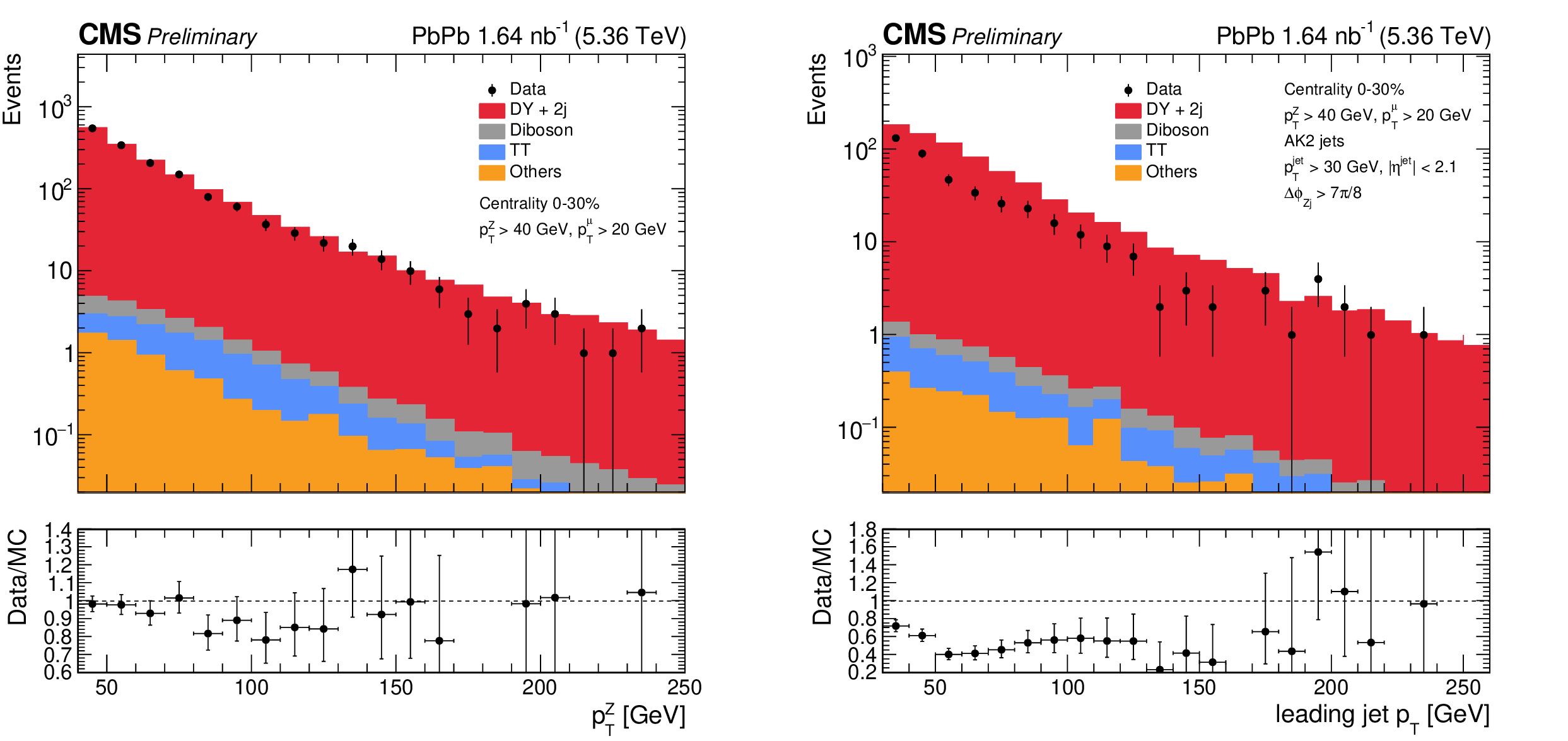
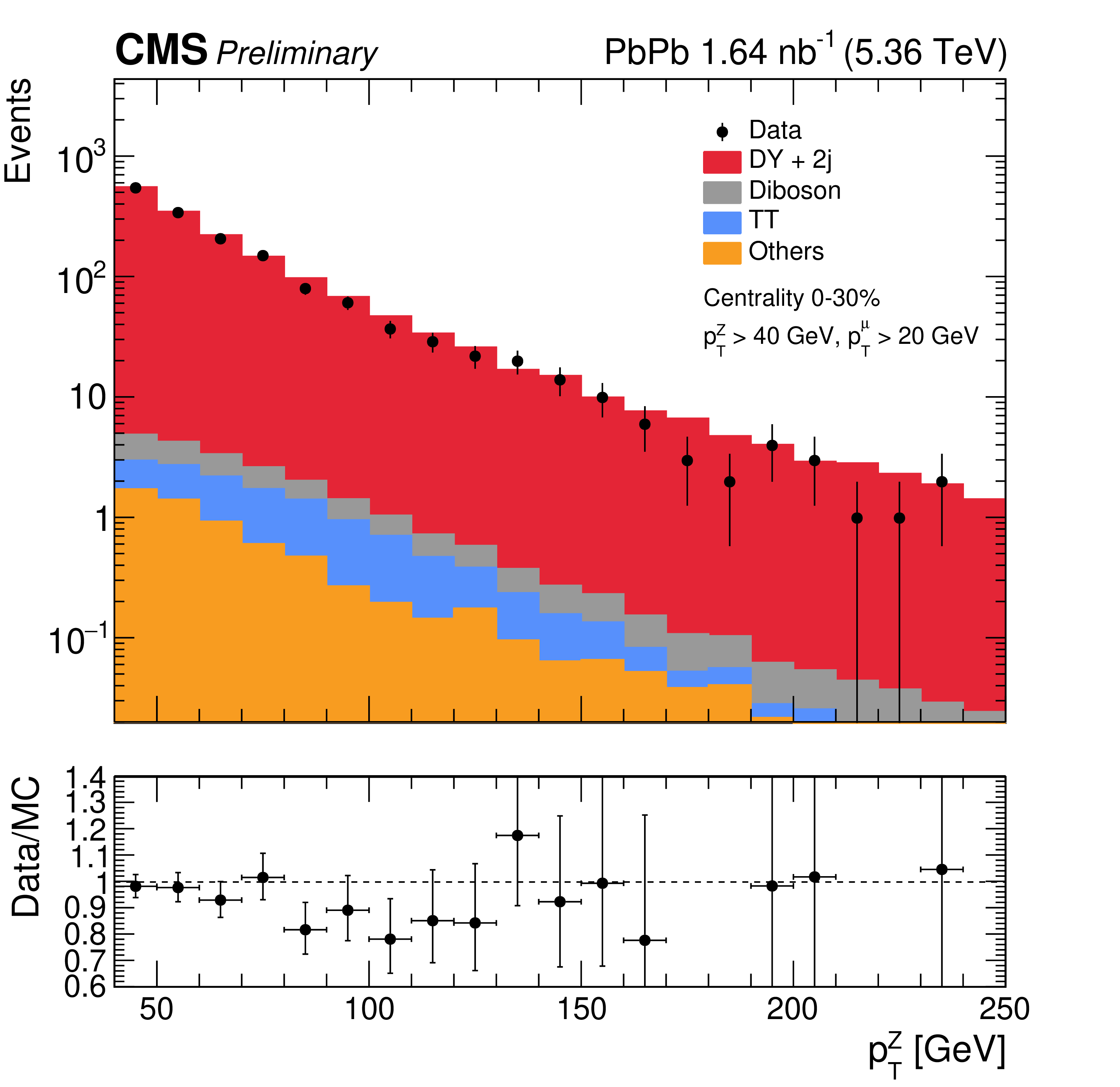
Detector-level distributions of the transverse momentum for inclusive Z boson candidates (left) and reconstructed jets (right) in 0--30% central PbPb collisions at $ \sqrt {\smash [b]{s_{_{\mathrm {NN}}}}} = $ 5.36 TeV. The data (points) are compared to the sum of the simulated signal and background processes (histograms). The simulated signal corresponds to an unquenched baseline; therefore, the observed suppression of the reconstructed jet $ p_\mathrm{T} $ in data relative to the simulation is a consequence of jet quenching in the medium. The lower panels show the corresponding data-to-MC ratios. Vertical bars represent the statistical uncertainties. |
png pdf |
Figure 1-a:
Detector-level distributions of the transverse momentum for inclusive Z boson candidates (left) and reconstructed jets (right) in 0--30% central PbPb collisions at $ \sqrt {\smash [b]{s_{_{\mathrm {NN}}}}} = $ 5.36 TeV. The data (points) are compared to the sum of the simulated signal and background processes (histograms). The simulated signal corresponds to an unquenched baseline; therefore, the observed suppression of the reconstructed jet $ p_\mathrm{T} $ in data relative to the simulation is a consequence of jet quenching in the medium. The lower panels show the corresponding data-to-MC ratios. Vertical bars represent the statistical uncertainties. |
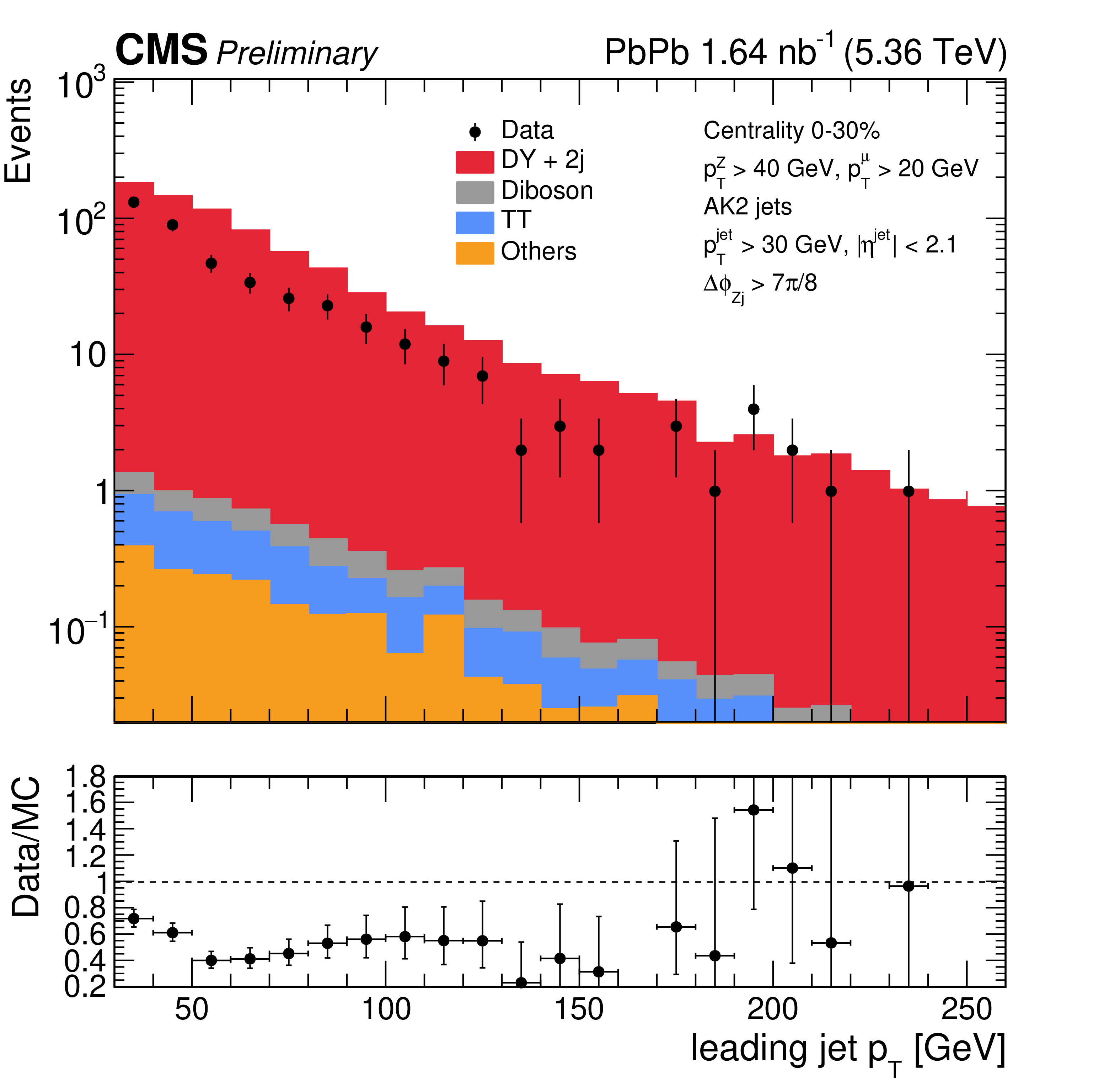
png pdf |
Figure 1-b:
Detector-level distributions of the transverse momentum for inclusive Z boson candidates (left) and reconstructed jets (right) in 0--30% central PbPb collisions at $ \sqrt {\smash [b]{s_{_{\mathrm {NN}}}}} = $ 5.36 TeV. The data (points) are compared to the sum of the simulated signal and background processes (histograms). The simulated signal corresponds to an unquenched baseline; therefore, the observed suppression of the reconstructed jet $ p_\mathrm{T} $ in data relative to the simulation is a consequence of jet quenching in the medium. The lower panels show the corresponding data-to-MC ratios. Vertical bars represent the statistical uncertainties. |
png pdf |
Figure 2:
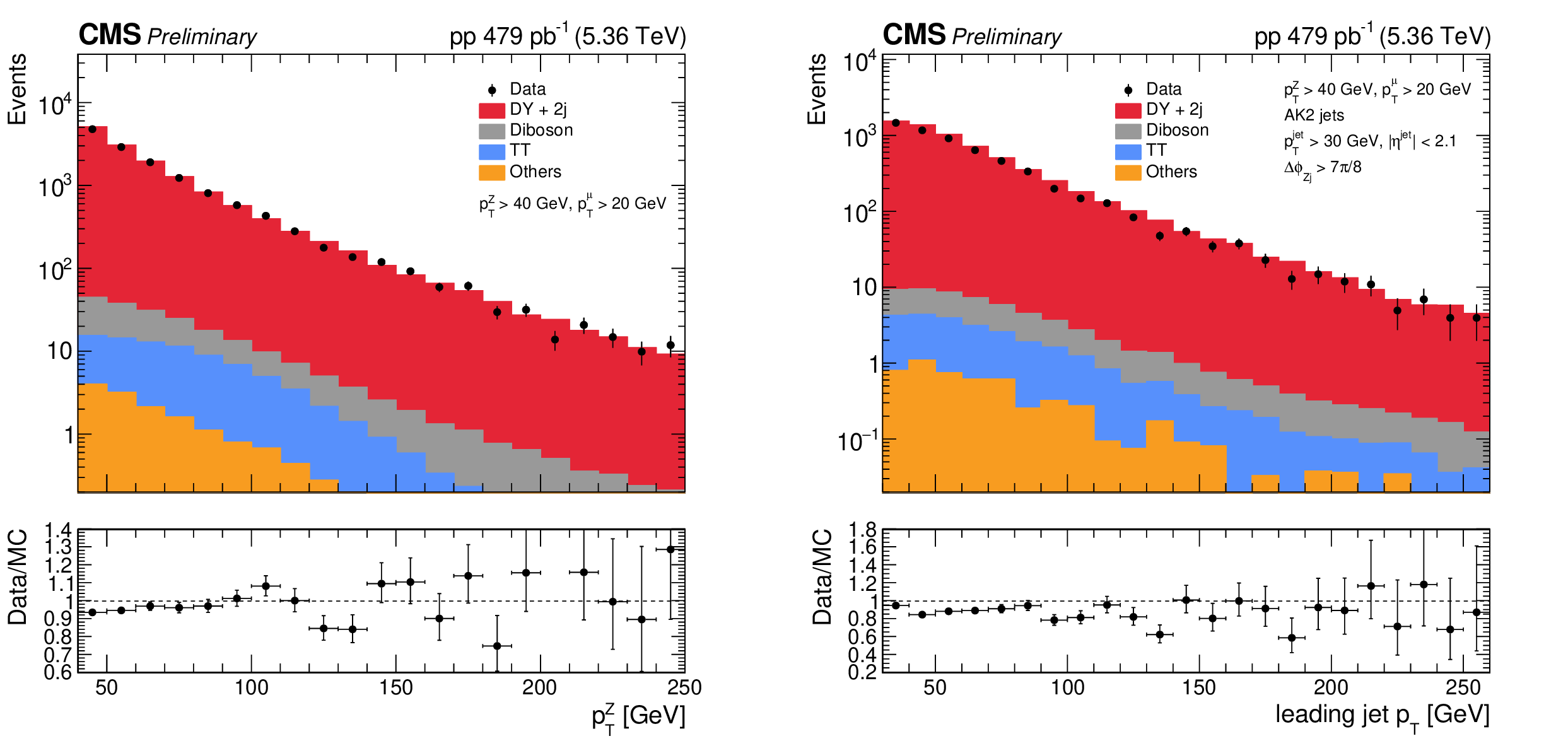
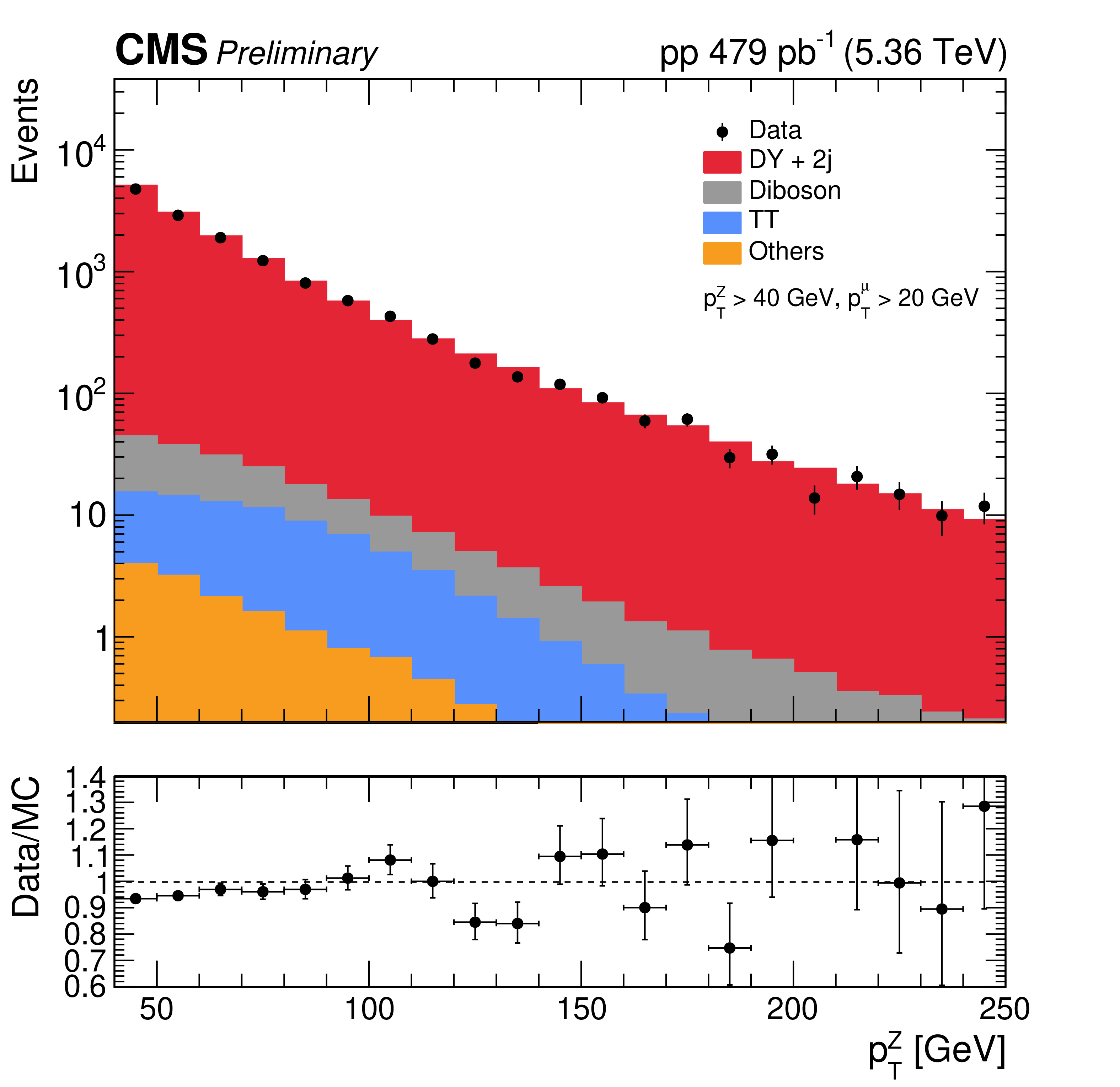
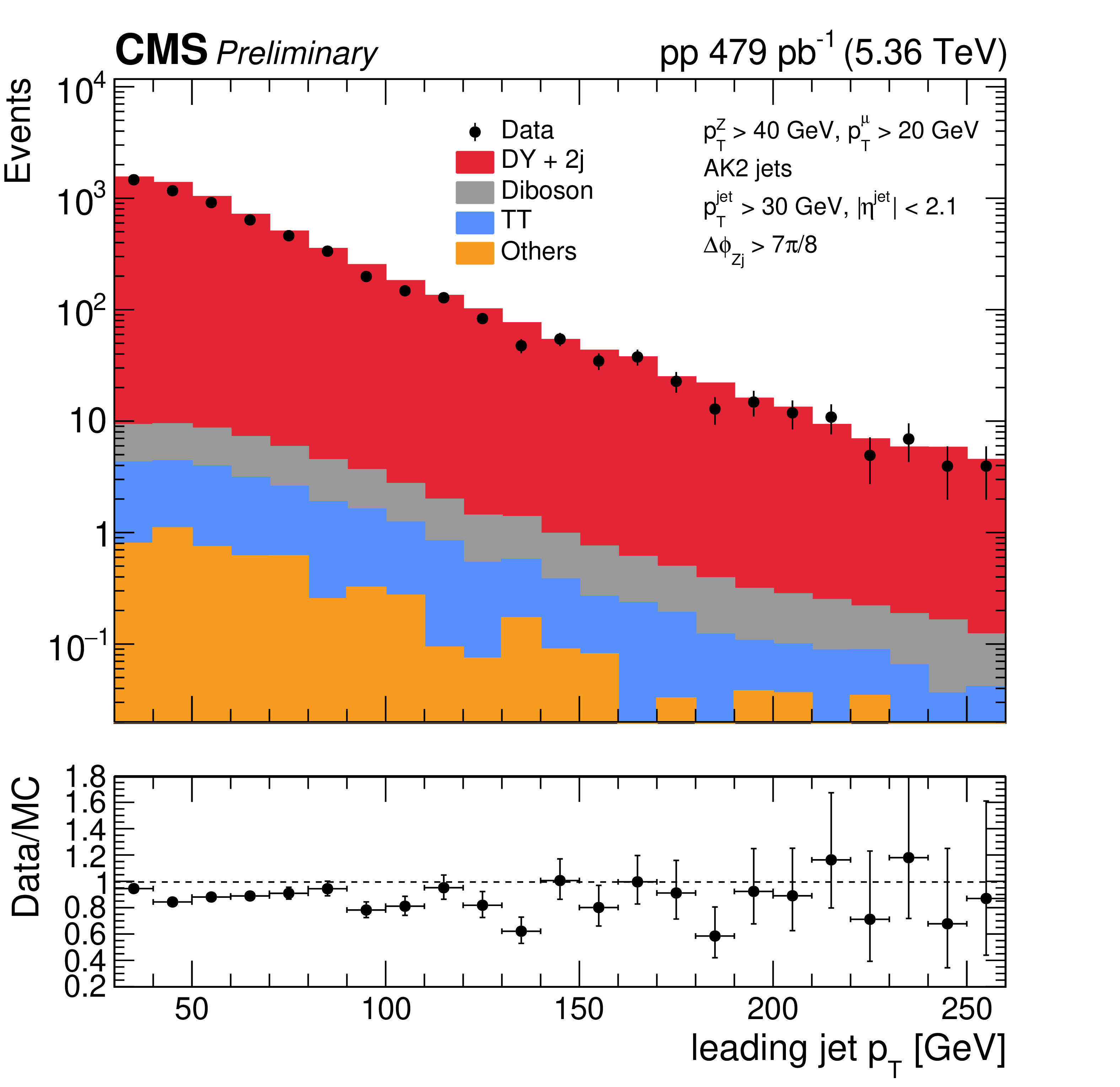
Detector-level distributions of the transverse momentum for inclusive Z boson candidates (left) and reconstructed jets (right) in pp collisions at $ \sqrt{s} = $ 5.36 TeV. The data (points) are compared to the sum of the simulated signal and background processes (histograms). The lower panels show the corresponding data-to-MC ratios. Vertical bars represent the statistical uncertainties. |
png pdf |
Figure 2-a:
Detector-level distributions of the transverse momentum for inclusive Z boson candidates (left) and reconstructed jets (right) in pp collisions at $ \sqrt{s} = $ 5.36 TeV. The data (points) are compared to the sum of the simulated signal and background processes (histograms). The lower panels show the corresponding data-to-MC ratios. Vertical bars represent the statistical uncertainties. |
png pdf |
Figure 2-b:
Detector-level distributions of the transverse momentum for inclusive Z boson candidates (left) and reconstructed jets (right) in pp collisions at $ \sqrt{s} = $ 5.36 TeV. The data (points) are compared to the sum of the simulated signal and background processes (histograms). The lower panels show the corresponding data-to-MC ratios. Vertical bars represent the statistical uncertainties. |
png pdf |
Figure 3:
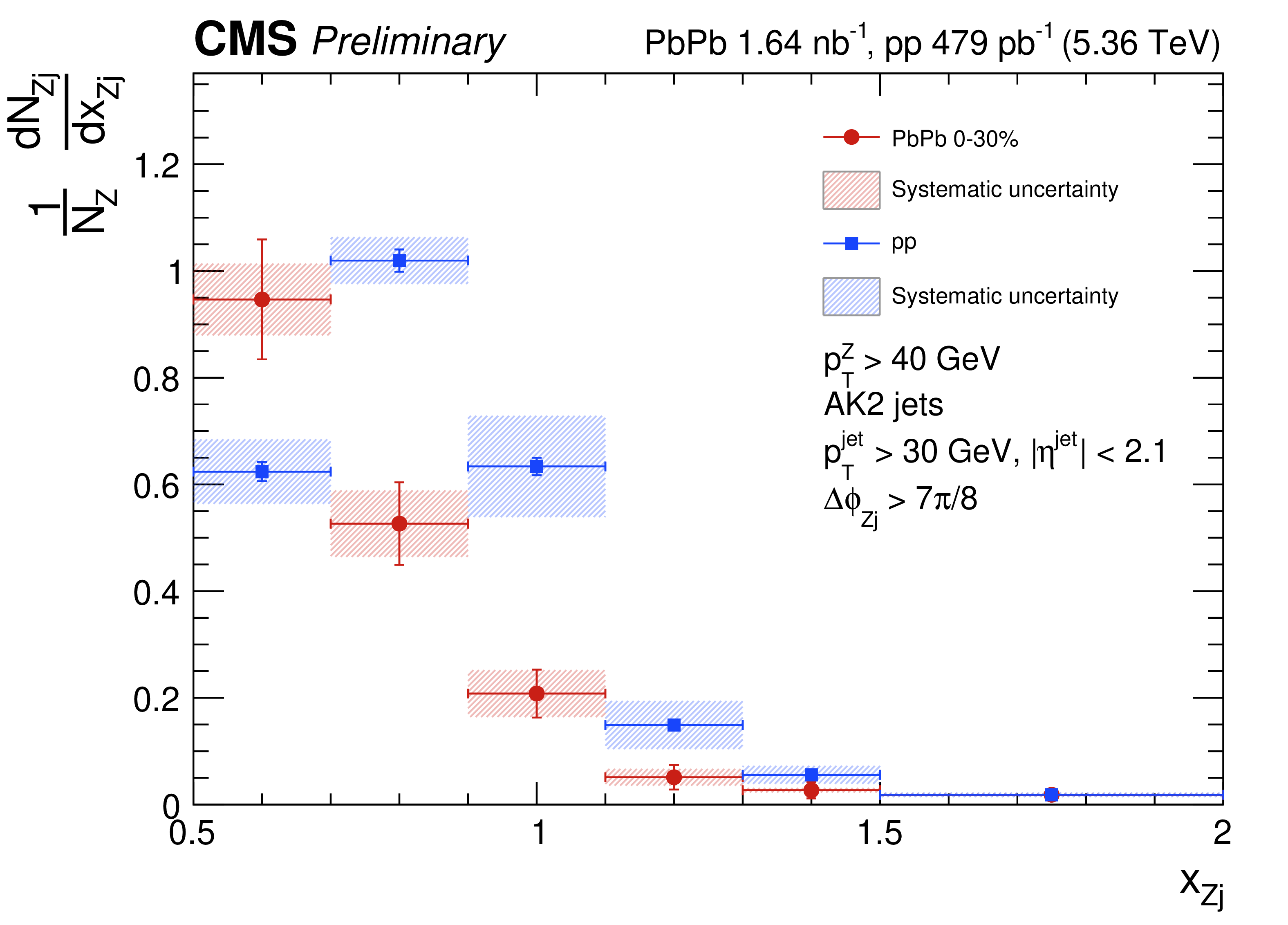
Unfolded distribution of $ x_{Zj} $, normalized by the number of Z events, for 0--30% central PbPb collisions and pp reference data at 5.36 TeV. Vertical bars represent statistical uncertainties, while the shaded areas represent the total systematic uncertainties. |
png pdf |
Figure 4:
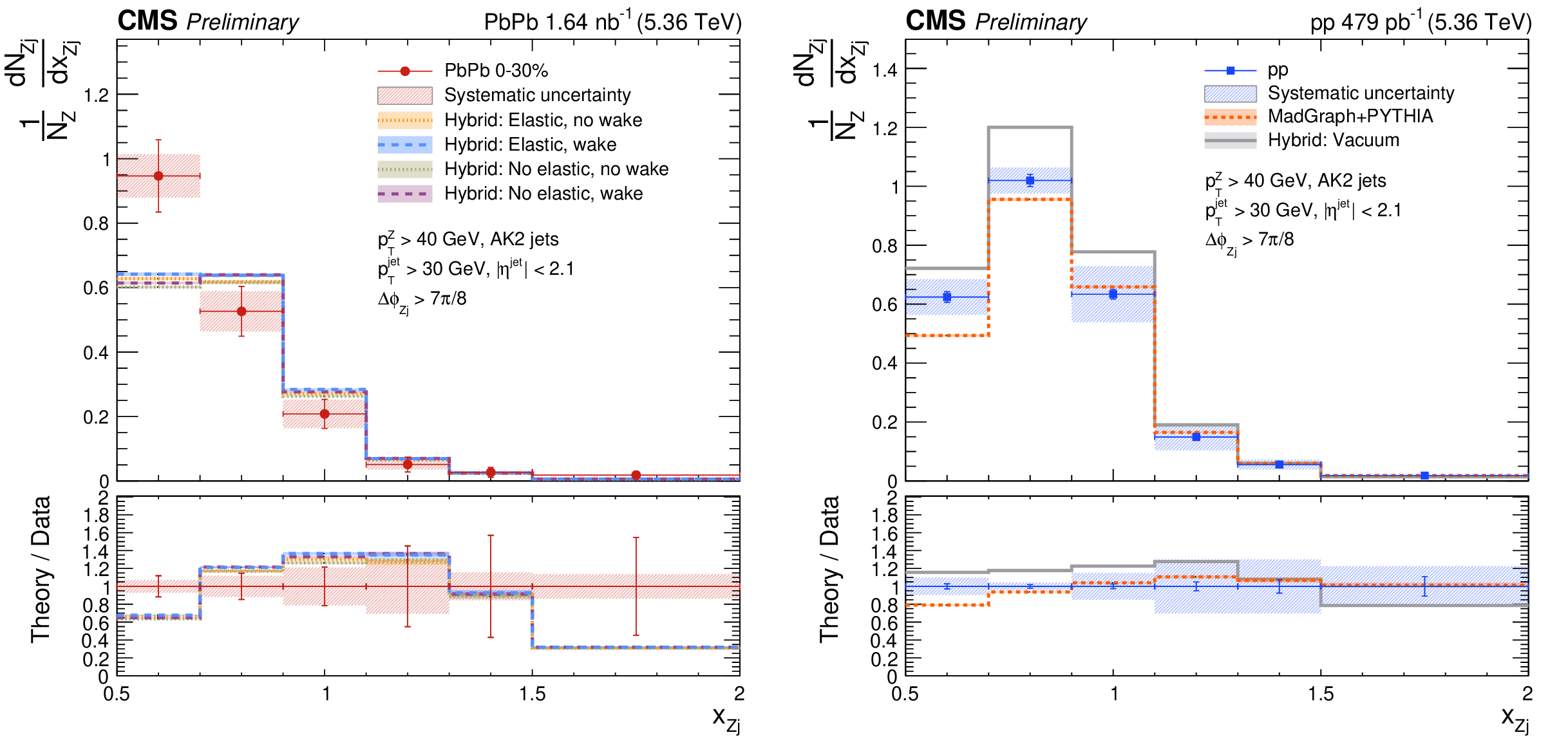
Comparisons of the $ x_{Zj} $ distributions normalized by the number of Z bosons. Left: Unfolded PbPb data compared to the four quenched Hybrid model scenarios. Right: Unfolded pp data compared to the Hybrid vacuum and MADGRAPH+PYTHIA reference predictions. The lower panels show the corresponding ratios of the MC calculations and data. The bands around the data represent the total experimental uncertainties, whereas the vertical bars represent the statistical uncertainties. The bands around the theory predictions represent the statistical uncertainties of the prediction. |
png pdf |
Figure 4-a:
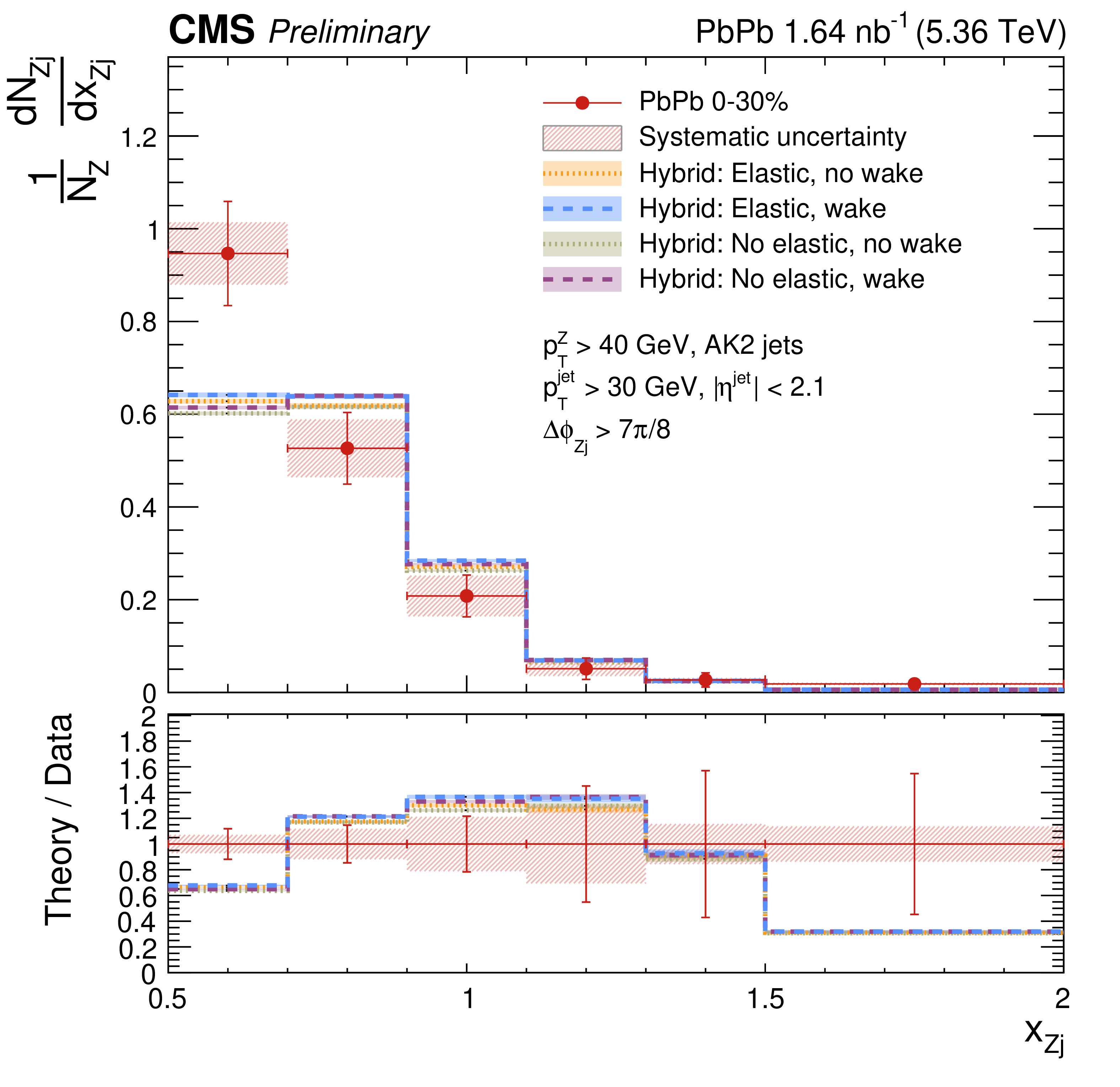
Comparisons of the $ x_{Zj} $ distributions normalized by the number of Z bosons. Left: Unfolded PbPb data compared to the four quenched Hybrid model scenarios. Right: Unfolded pp data compared to the Hybrid vacuum and MADGRAPH+PYTHIA reference predictions. The lower panels show the corresponding ratios of the MC calculations and data. The bands around the data represent the total experimental uncertainties, whereas the vertical bars represent the statistical uncertainties. The bands around the theory predictions represent the statistical uncertainties of the prediction. |
png pdf |
Figure 4-b:
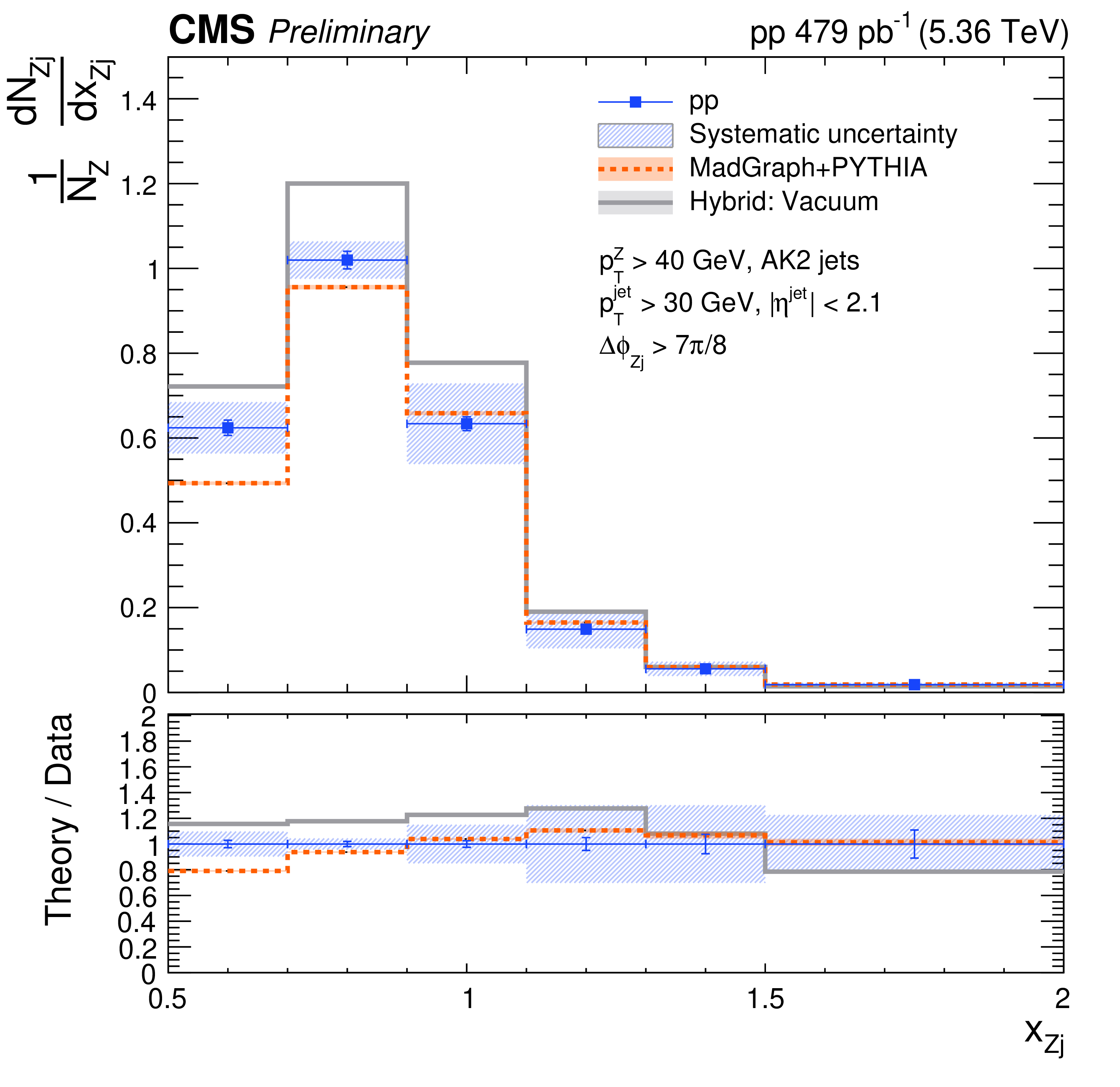
Comparisons of the $ x_{Zj} $ distributions normalized by the number of Z bosons. Left: Unfolded PbPb data compared to the four quenched Hybrid model scenarios. Right: Unfolded pp data compared to the Hybrid vacuum and MADGRAPH+PYTHIA reference predictions. The lower panels show the corresponding ratios of the MC calculations and data. The bands around the data represent the total experimental uncertainties, whereas the vertical bars represent the statistical uncertainties. The bands around the theory predictions represent the statistical uncertainties of the prediction. |
png pdf |
Figure 5:
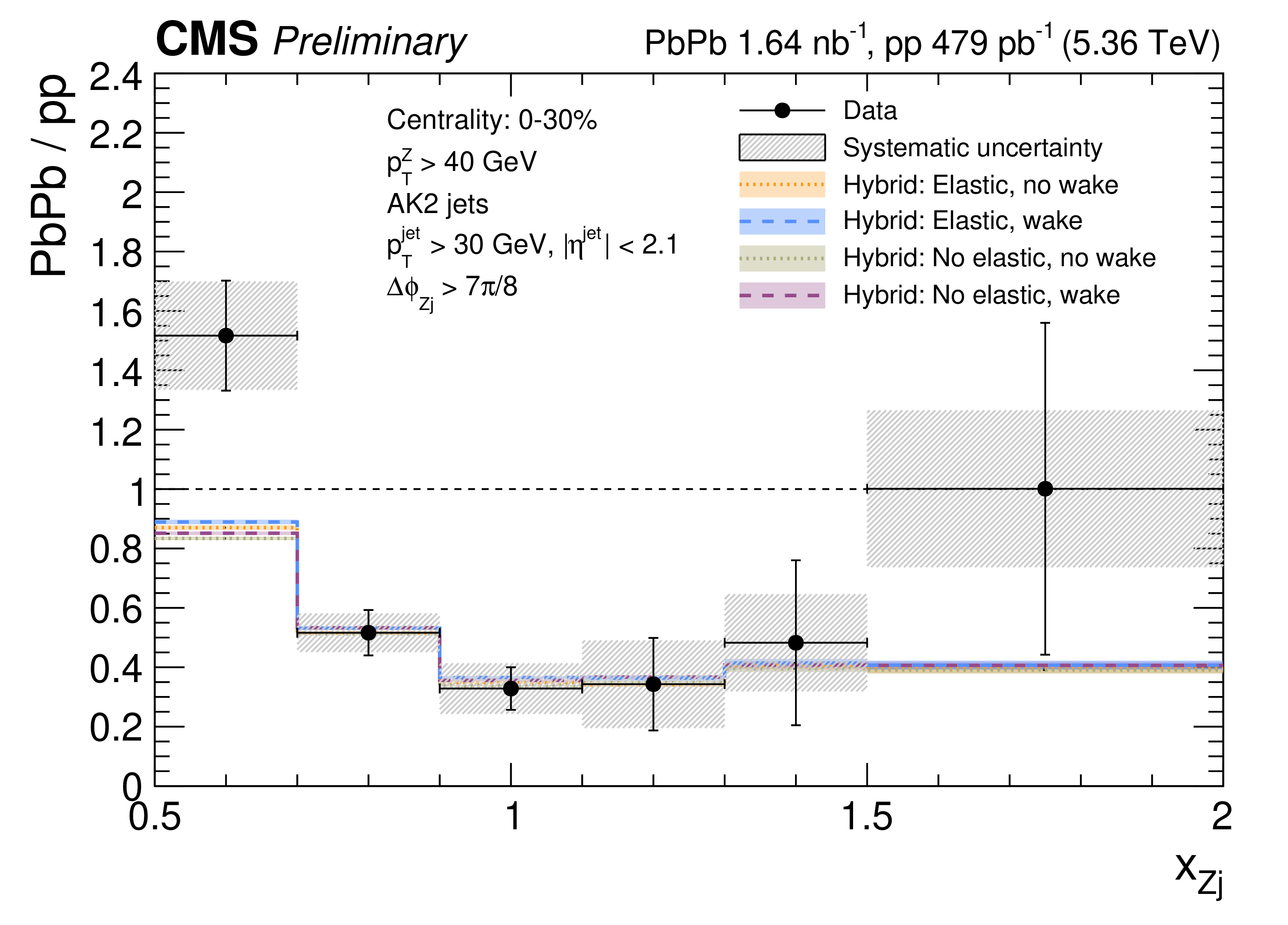
Ratio of the unfolded $ x_{Zj} $ distributions (PbPb/pp) compared to the corresponding medium/vacuum ratios predicted by the four scenarios of the Hybrid model. The bands around the data points represent the total experimental uncertainties, whereas the vertical bars represent the statistical uncertainties. The uncertainties in the PbPb-to-pp ratio have been obtained assuming the PbPb and pp measurements are uncorrelated. The bands around the theory predictions represent the statistical uncertainties of the prediction. |
| Tables | |
png pdf |
Table 1:
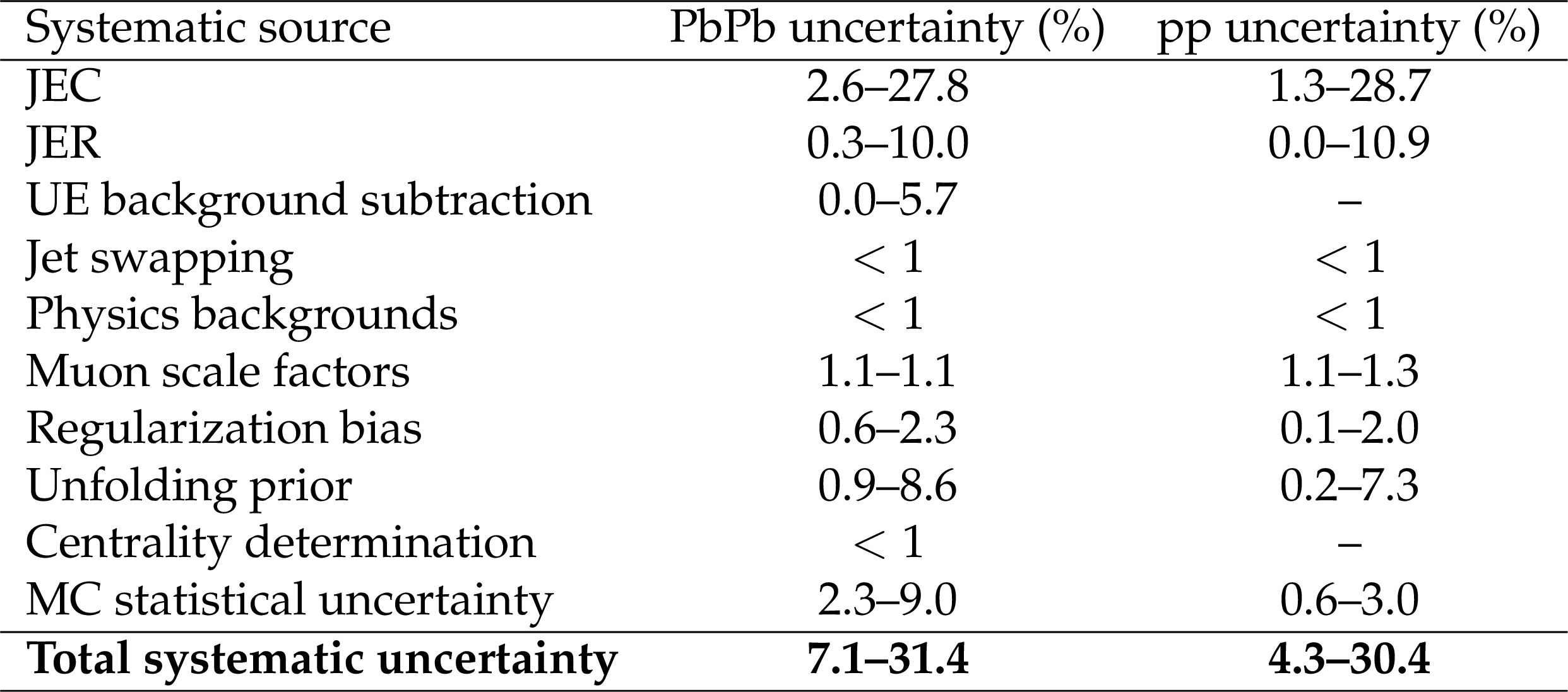
Relative systematic uncertainties (%) for the unfolded $ x_{Zj} $ distribution in PbPb and pp collisions. The ranges reflect the variations across the measured $ x_{Zj} $ bins. The total systematic uncertainty is calculated as the quadratic sum of the individual components. Values smaller than 1% are denoted as $ < $ 1. |
| Summary |
| In summary, we presented the measurement of the transverse momentum imbalance between a Z boson and its recoiling leading jet, $ x_{Zj} = p_\mathrm{T}^\mathrm{jet} / p_\mathrm{T}^\mathrm{Z} $, for PbPb and pp collisions at 5.36 TeV. Data were collected by the CMS experiment, corresponding to integrated luminosities of 1.64 $ {nb}^{-1} $ and 479 $ {pb}^{-1} $, respectively. A significant modification of the jet momentum balance is observed in central (0--30%) PbPb collisions compared to the pp reference. In particular, for central PbPb events the yield decreases monotonically with increasing $ x_{Zj} $ over the measured range, in strong contrast to the sharply peaked distributions in pp events. Furthermore, the unfolded data exhibit a strong suppression of highly balanced jet pairs and an overall shift of the distribution towards lower $ x_{Zj} $ values. A decoupled shape-normalization statistical test confirms that this modification is significant at the 5.0 standard deviation level against the null hypothesis of no medium modification. The measurements are compared to predictions from the Hybrid coupling model, which reproduces the suppression of balanced jets in PbPb collisions, but fails to describe the migration of jets toward low $ x_{Zj} $. The tension with the predictions from the Hybrid model at low $ x_{Zj} $, which is also observed in analogous $ \gamma $+jet measurements, suggests an over-quenching effect within the model's energy loss implementation near the kinematic threshold. Additionally, the comparison reveals that the inclusive $ x_{Zj} $ observable using small-radius jets ($ R= $ 0.2) is largely insensitive to specific microscopic interactions, such as Moli\`ere scatterings and the medium wake. These high-precision measurements provide essential constraints on theoretical models of parton-medium interactions and suggest the need for an improved treatment of the wake, also for small-radius jets, and in general the inclusion of next-to-leading-order effects, which can affect jet multiplicity. Future studies, including the exploration of larger jet radii and jet substructure observables, will be instrumental in further disentangling macroscopic bulk energy loss from microscopic quasiparticle interactions within the quark-gluon plasma. |
| References | ||||
| 1 | W. Busza, K. Rajagopal, and W. van der Schee | Heavy ion collisions: the big picture and the big questions | Ann. Rev. Nucl. Part. Sci. 68 (2018) 339 | 1802.04801 |
| 2 | A. Adams et al. | Strongly correlated quantum fluids: ultracold quantum gases, quantum chromodynamic plasmas, and holographic duality | New J. Phys. 14 (2012) 115009 | 1205.5180 |
| 3 | F. Karsch | The Phase transition to the quark gluon plasma: Recent results from lattice calculations | Nucl. Phys. A 590 (1995) 367C | hep-lat/9503010 |
| 4 | J. C. Collins and M. J. Perry | Superdense Matter: Neutrons Or Asymptotically Free Quarks? | PRL 34 (1975) 1353 | |
| 5 | J. D. Bjorken | Highly relativistic nucleus-nucleus collisions: the central rapidity region | PRD 27 (1983) 140 | |
| 6 | G.-Y. Qin and X.-N. Wang | Jet quenching in high-energy heavy ion collisions | Int. J. Mod. Phys. E 24 (2015) 1530014 | 1511.00790 |
| 7 | J.-P. Blaizot and Y. Mehtar-Tani | Jet structure in heavy ion collisions | Int. J. Mod. Phys. E 24 (2015) 1530012 | 1503.05958 |
| 8 | J. Casalderrey-Solana and C. A. Salgado | Introductory lectures on jet quenching in heavy ion collisions | Acta Phys. Polon. B 38 (2007) 3731 | 0712.3443 |
| 9 | Z. Conesa del Valle | Vector bosons in heavy-ion collisions at the LHC | EPJC 61 (2009) 729 | |
| 10 | V. Kartvelishvili, R. Kvatadze, and R. Shanidze | On Z and Z + jet production in heavy ion collisions | PLB 356 (1995) 589 | |
| 11 | CMS Collaboration | Jet Momentum Dependence of Jet Quenching in PbPb Collisions at $ \sqrt {\smash [b]{s_{_{\mathrm {NN}}}}}= $ 2.76 TeV | PLB 712 (2012) 176 | CMS-HIN-11-013 1202.5022 |
| 12 | ATLAS Collaboration | Measurement of jet $ p_{\mathrm{T}} $ correlations in Pb+Pb and $ pp $ collisions at $ \sqrt{s_{\mathrm{NN}}}= $ 2.76 TeV with the ATLAS detector | PLB 774 (2017) 379 | 1706.09363 |
| 13 | CMS Collaboration | Study of jet quenching with isolated-photon+jet correlations in PbPb and pp collisions at $ \sqrt{s_{\mathrm{NN}}} = $ 5.02 TeV | PLB 785 (2018) 14 | CMS-HIN-16-002 1711.09738 |
| 14 | CMS Collaboration | Girth and groomed radius of jets recoiling against isolated photons in lead-lead and proton-proton collisions at $ \sqrt{s_{\mathrm{NN}}} = $ 5.02 TeV | PLB 861 (2025) 139088 | CMS-HIN-23-001 2405.02737 |
| 15 | CMS Collaboration | Study of Z boson production in PbPb collisions at $ \sqrt {\smash [b]{s_{_{\mathrm {NN}}}}} = $ 2.76 TeV | PRL 106 (2011) 212301 | CMS-HIN-10-003 1102.5435 |
| 16 | CMS Collaboration | Study of jet quenching with Z+jet correlations in PbPb and pp collisions at $ \sqrt {\smash [b]{s_{_{\mathrm {NN}}}}}= $ 5.02 TeV | PRL 119 (2017) 082301 | CMS-HIN-15-013 1702.01060 |
| 17 | CMS Collaboration | The CMS experiment at the CERN LHC | JINST 3 (2008) S08004 | |
| 18 | CMS Collaboration | Development of the CMS detector for the CERN LHC Run 3 | JINST 19 (2024) P05064 | CMS-PRF-21-001 2309.05466 |
| 19 | CMS Collaboration | Electron and photon reconstruction and identification with the CMS experiment at the CERN LHC | JINST 16 (2021) P05014 | CMS-EGM-17-001 2012.06888 |
| 20 | CMS Collaboration | Performance of the CMS muon detector and muon reconstruction with proton-proton collisions at $ \sqrt{s}= $ 13 TeV | JINST 13 (2018) P06015 | |
| 21 | CMS Collaboration | Description and performance of track and primary-vertex reconstruction with the CMS tracker | JINST 9 (2014) P10009 | CMS-TRK-11-001 1405.6569 |
| 22 | CMS Collaboration | Particle-flow reconstruction and global event description with the CMS detector | JINST 12 (2017) P10003 | CMS-PRF-14-001 1706.04965 |
| 23 | CMS Collaboration | Performance of reconstruction and identification of $ \tau $ leptons decaying to hadrons and $ \nu_\tau $ in pp collisions at $ \sqrt{s}= $ 13 TeV | JINST 13 (2018) P10005 | CMS-TAU-16-003 1809.02816 |
| 24 | CMS Collaboration | Jet energy scale and resolution in the CMS experiment in pp collisions at 8 TeV | JINST 12 (2017) P02014 | CMS-JME-13-004 1607.03663 |
| 25 | CMS Collaboration | Performance of missing transverse momentum reconstruction in proton-proton collisions at $ \sqrt{s} = $ 13 TeV using the CMS detector | JINST 14 (2019) P07004 | CMS-JME-17-001 1903.06078 |
| 26 | CMS Collaboration Collaboration | Observation and studies of jet quenching in pbpb collisions at $ \sqrt {\smash [b]{s_{_{\mathrm {NN}}}}}= $ 2.76 tev | Phys. Rev. C 84 (2011) 024906 | |
| 27 | CMS Collaboration | Performance of the CMS Level-1 trigger in proton-proton collisions at $ \sqrt{s} = $ 13 TeV | JINST 15 (2020) P10017 | CMS-TRG-17-001 2006.10165 |
| 28 | CMS Collaboration | The CMS trigger system | JINST 12 (2017) P01020 | CMS-TRG-12-001 1609.02366 |
| 29 | CMS Collaboration | Performance of the CMS high-level trigger during LHC Run 2 | JINST 19 (2024) P11021 | CMS-TRG-19-001 2410.17038 |
| 30 | J. Alwall et al. | The automated computation of tree-level and next-to-leading order differential cross sections, and their matching to parton shower simulations | JHEP 07 (2014) 079 | 1405.0301 |
| 31 | R. Frederix and S. Frixione | Merging meets matching in MC@NLO | JHEP 12 (2012) 061 | 1209.6215 |
| 32 | C. Bierlich et al. | A comprehensive guide to the physics and usage of PYTHIA 8.3 | SciPost Phys. Codeb. 2022 (2022) 8 | 2203.11601 |
| 33 | CMS Collaboration | Extraction and validation of a new set of CMS PYTHIA 8 tunes from underlying-event measurements | EPJC 80 (2020) 4 | CMS-GEN-17-001 1903.12179 |
| 34 | P. Nason | A new method for combining NLO QCD with shower Monte Carlo | JHEP 11 (2004) 040 | hep-ph/0409146 |
| 35 | I. P. Lokhtin et al. | Heavy ion event generator HYDJET++ (HYDrodynamics plus JETs) | Comput. Phys. Commun. 180 (2009) 779 | |
| 36 | \GEANTfour Collaboration | GEANT 4---a simulation toolkit | NIM A 506 (2003) 250 | |
| 37 | CMS Collaboration | First measurement of jet axis decorrelation with photon-tagged jets in pp and PbPb collisions at 5.02 TeV | CMS-HIN-21-019 2602.18279 |
|
| 38 | K. C. Zapp | JEWEL 2.0.0: directions for use | EPJC 74 (2014) 2762 | 1311.0048 |
| 39 | R. Kunnawalkam Elayavalli and K. C. Zapp | Simulating V+jet processes in heavy ion collisions with JEWEL | EPJC 76 (2016) 695 | 1608.03099 |
| 40 | C. Loizides, J. Kamin, and D. d'Enterria | Improved Monte Carlo Glauber predictions at present and future nuclear colliders | [Erratum: https://doi.org/10.1103/PhysRevC.99.01Phys. Rev. C 99, 01 ()], 2018 Phys. Rev. C 97 (2018) 054910 |
1710.07098 |
| 41 | CMS Collaboration | Performance of CMS muon reconstruction from proton-proton to heavy ion collisions | JINST 19 (2024) P09012 | CMS-MUO-21-001 2404.17377 |
| 42 | CMS Collaboration | Measurement of the top quark pair production cross section in PbPb collisions at $ \sqrt {\smash [b]{s_{_{\mathrm {NN}}}}} = $ 5.36 TeV | CMS-HIN-24-021 2604.27091 |
|
| 43 | M. Cacciari, G. P. Salam, and G. Soyez | The anti-$ k_{\mathrm{T}} $ jet clustering algorithm | JHEP 04 (2008) 063 | 0802.1189 |
| 44 | M. Cacciari, G. P. Salam, and G. Soyez | FastJet user manual | EPJC 72 (2012) 1896 | 1111.6097 |
| 45 | H. A. Andrews et al. | Novel tools and observables for jet physics in heavy-ion collisions | Journal of Physics G:, 2020 Nuclear and Particle Physics 47 (2020) 065102 |
|
| 46 | P. Berta, M. Spousta, D. W. Miller, and R. Leitner | Particle-level pileup subtraction for jets and jet shapes | Journal of High Energy Physics 2014 (2014) 92 | |
| 47 | O. Kodolova, I. Vardanyan, A. Nikitenko, and A. Oulianov | The performance of the jet identification and reconstruction in heavy ions collisions with CMS detector | EPJC 50 (2007) 117 | |
| 48 | ALICE Collaboration | Measurement of Event Background Fluctuations for Charged Particle Jet Reconstruction in Pb-Pb collisions at $ \sqrt {\smash [b]{s_{_{\mathrm {NN}}}}} = $ 2.76 TeV | JHEP 03 (2012) 053 | 1201.2423 |
| 49 | T. C. collaboration | Determination of jet energy calibration and transverse momentum resolution in cms | Journal of Instrumentation 6 (2011) P11002 | |
| 50 | CMS Collaboration | Comparing transverse momentum balance of b jet pairs in pp and PbPb collisions at $ \sqrt{s_{\mathrm{NN}}}= $ 5.02 TeV | JHEP 03 (2018) 181 | CMS-HIN-16-005 1802.00707 |
| 51 | G. D'Agostini | A multidimensional unfolding method based on Bayes' theorem | NIM A 362 (1995) 487 | |
| 52 | CERN | Proceedings of the PHYSTAT 2011 Workshop on Statistical Issues Related to Discovery Claims in Search Experiments and Unfolding | link | |
| 53 | J. D. Gibbons and S. Chakraborti | Nonparametric Statistical Inference | Chapman and Hall/CRC, 6th edition, 2020 link |
|
| 54 | R. A. Fisher | Statistical methods for research workers | Oliver and Boyd, Edinburgh, 1925 | |
| 55 | A. S. Kudinoor, A. Y.-T. Lin, D. Pablos, and K. Rajagopal | A Breath of Fresh Air for Moli\`ere: Detecting Moli\`ere Scattering using Jet Substructure Observables in Oxygen Collisions | 2603.23596 | |
| 56 | ATLAS Collaboration | Measurement of photon-jet transverse momentum correlations in 5.02 TeV Pb + Pb and $ pp $ collisions with ATLAS | PLB 789 (2019) 167 | 1809.07280 |
| 57 | Z. Hulcher, A. S. Kudinoor, D. Pablos, and K. Rajagopal | Sensitivity of Jet Observables to Moli\`ere Scattering Off Quasiparticles in Quark-Gluon Plasma | 2603.08776 | |
| 58 | ALICE Collaboration | Search for quasi-particle scattering in the quark-gluon plasma with jet splittings in pp and Pb-Pb collisions at $ \sqrt{s_{\rm NN}} = $ 5.02 TeV | PRL 135 (2025) 031901 | 2409.12837 |
|
|
Compact Muon Solenoid LHC, CERN |

|
|
|
|
|
|