
Compact Muon Solenoid
LHC, CERN
 Visit us: CMS Public Website, CMS Physics ;
Contact us: CMS Publications Committee
Visit us: CMS Public Website, CMS Physics ;
Contact us: CMS Publications Committee
| CMS-PAS-BPH-26-005 | ||
| Measurement of time-dependent $ CP $ violation in $ \mathrm{B}^0_{(\mathrm{s})} \to \mathrm{J}/\psi \mathrm{K}^0_\text{S} $ decays with the CMS detector | ||
| CMS Collaboration | ||
| 2026-05-27 | ||
| Abstract: A measurement of time-dependent $ CP $ violation in $ \mathrm{B}^0 \to \mathrm{J}/\psi \mathrm{K}^0_\text{S} $ and $ \mathrm{B}^0_\mathrm{s} \to \mathrm{J}/\psi \mathrm{K}^0_\text{S} $ decays is presented, using proton-proton collision data collected with the CMS detector at the CERN LHC at $ \sqrt{s} = $ 13.6 TeV during 2022-2025, corresponding to an integrated luminosity of 274 fb$ ^{-1} $. The $ CP $-violating parameters $ S $ and $ C $, describing mixing-induced and direct $ CP $ violation, respectively, are extracted from a fit to the time-dependent $ CP $ asymmetry, using samples of approximately 1.4 million reconstructed $ \mathrm{B}^0 $ and 16 thousand reconstructed $ \mathrm{B}^0_\mathrm{s} $ signal candidates. The production flavour of the B meson is determined using a dedicated flavour-tagging framework comprising opposite-side muon, electron, and jet taggers, together with a same-side tagger for $ \mathrm{B}^0_\mathrm{s} $ decays, all based on state-of-the-art AI architectures. The measured values are $ S_{\mathrm{B}^0} = $ 0.710 $ \pm $ 0.013 (stat) $ \pm $ 0.009 (syst), $ C_{\mathrm{B}^0} = $ 0.013 $ \pm $ 0.011 (stat) $ \pm $ 0.006 (syst), $ S_{\mathrm{B}^0_\mathrm{s}} = $ 0.00 $ \pm $ 0.19 (stat) $ \pm $ 0.00 (syst), and $ C_{\mathrm{B}^0_\mathrm{s}} = - $ 0.18 $ \pm $ 0.23 (stat) $ \pm $ 0.01 (syst). All results are consistent with standard model predictions. | ||
| Links: CDS record (PDF) ; Physics Briefing ; CADI line (restricted) ; | ||
| Figures | |
png pdf |
Figure 1:
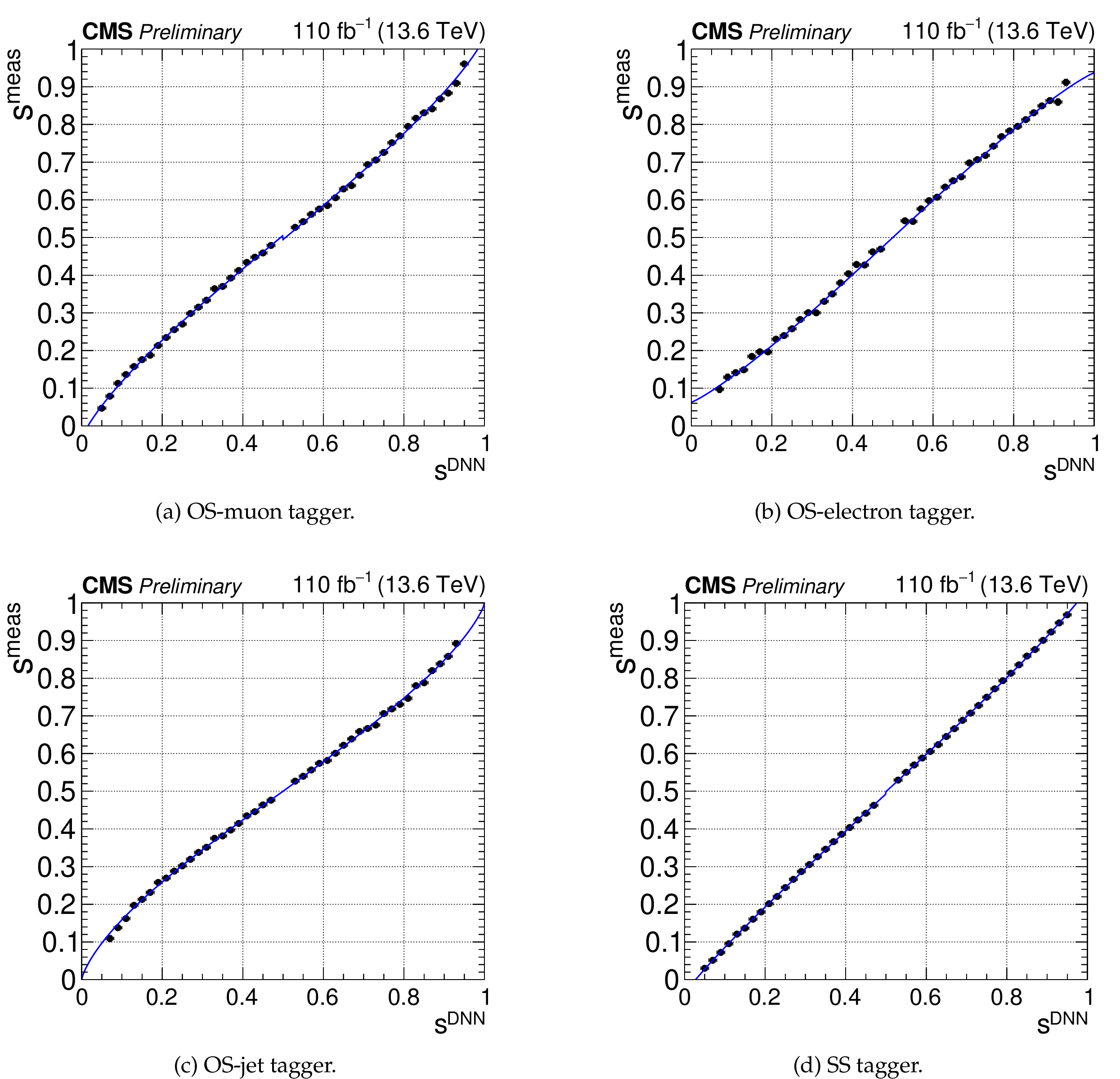
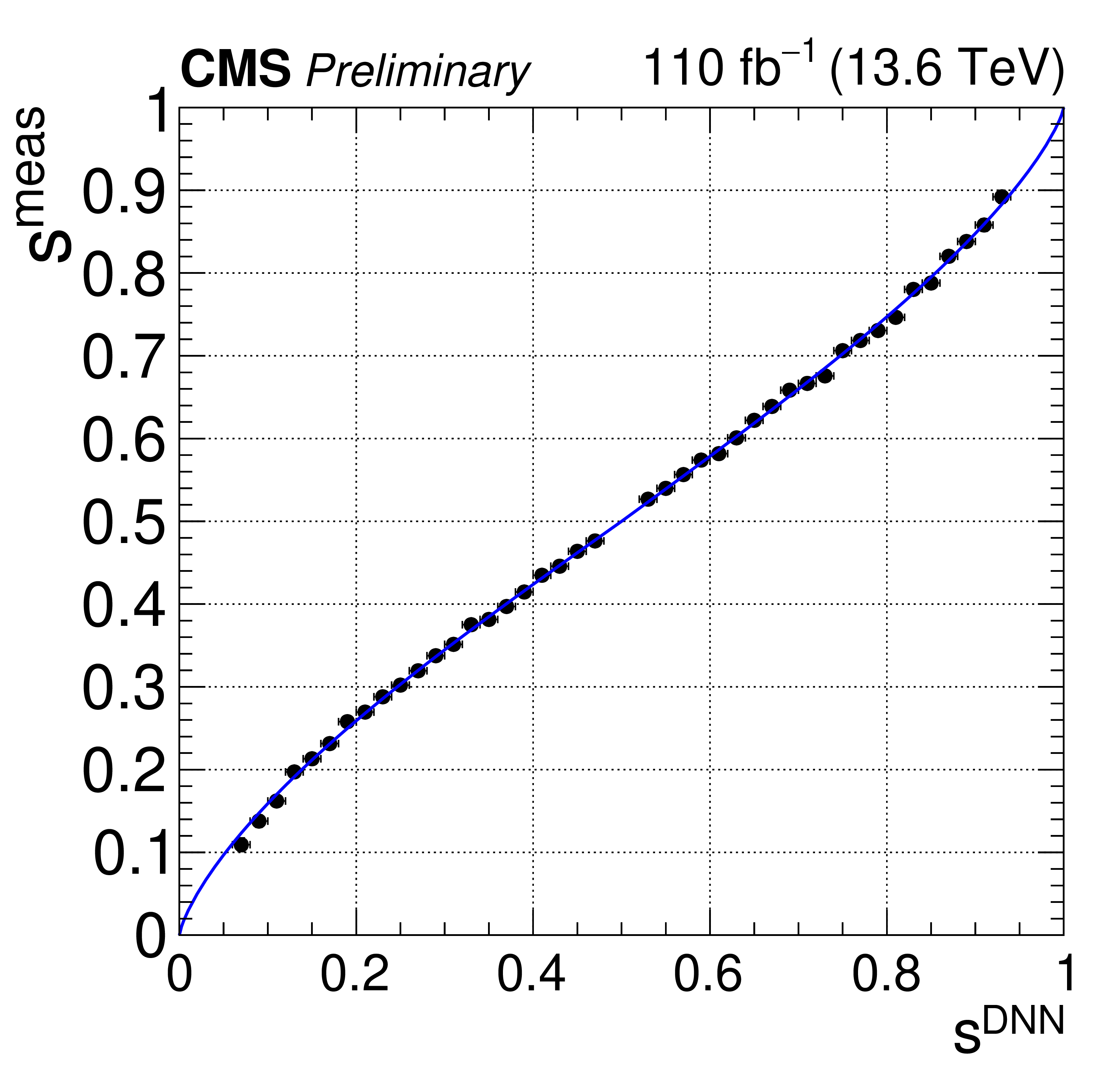
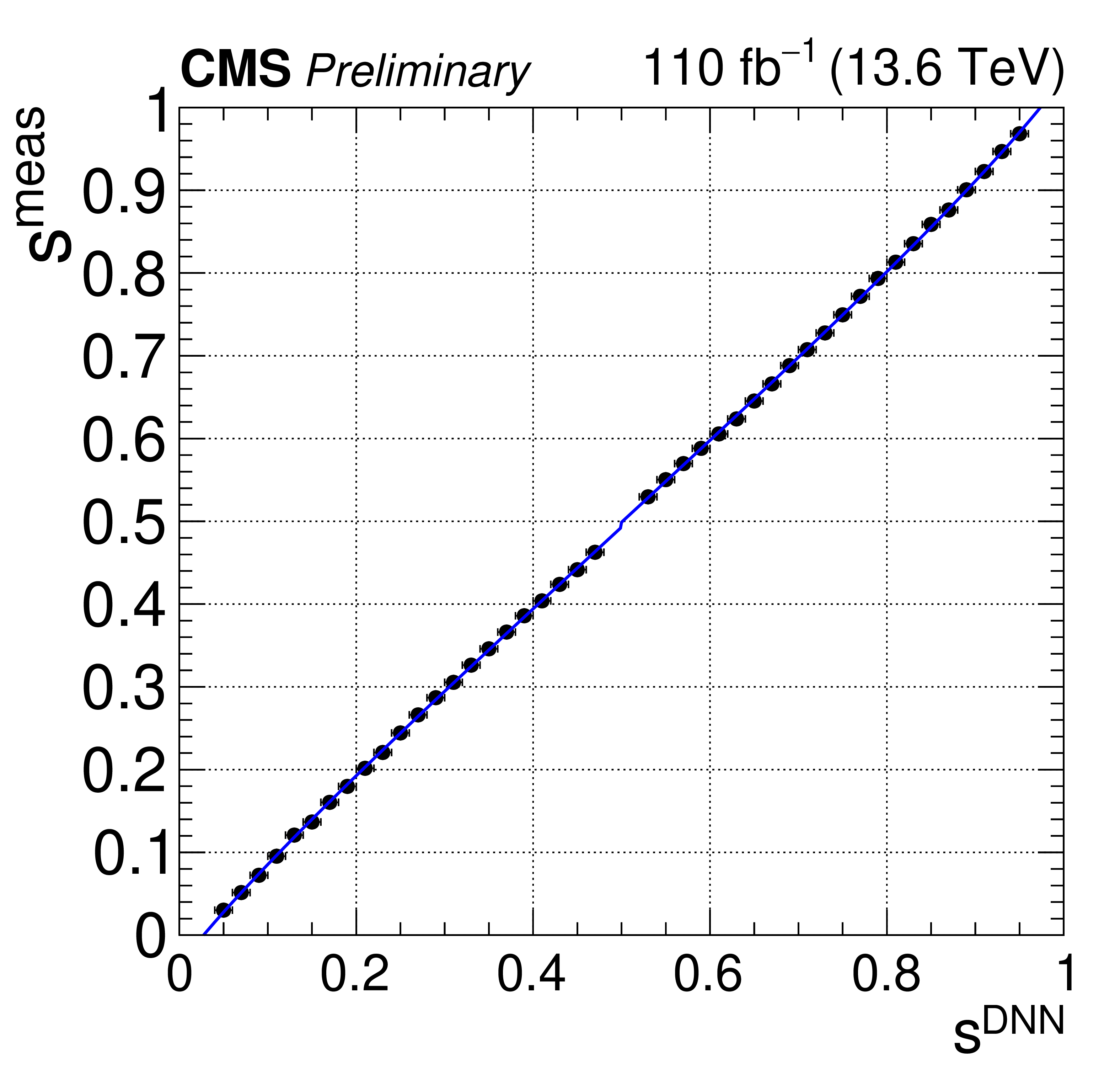
Results of the flavour tagging DNNs score calibration fit on $ {\mathrm{B}^{+}} \to \mathrm{J}/\psi \mathrm{K^+} $ decays for 2024 data, the largest data set. The measured tagging accuracy probability is plotted versus the value predicted by the tagging algorithm. The solid line shows the results of the Platt scaling calibration fit to data. |
png pdf |
Figure 1-a:
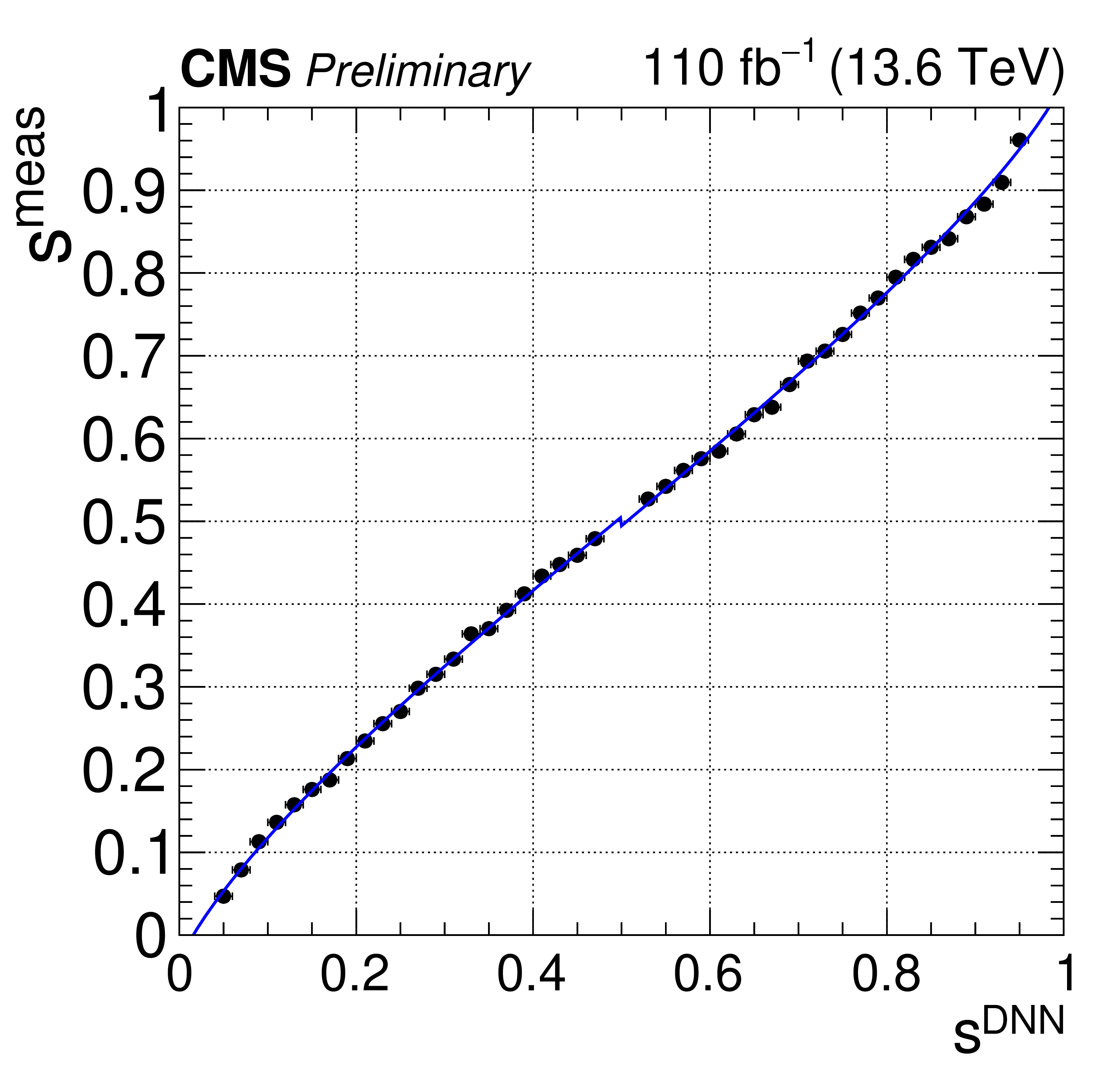
Results of the flavour tagging DNNs score calibration fit on $ {\mathrm{B}^{+}} \to \mathrm{J}/\psi \mathrm{K^+} $ decays for 2024 data, the largest data set. The measured tagging accuracy probability is plotted versus the value predicted by the tagging algorithm. The solid line shows the results of the Platt scaling calibration fit to data. |
png pdf |
Figure 1-b:
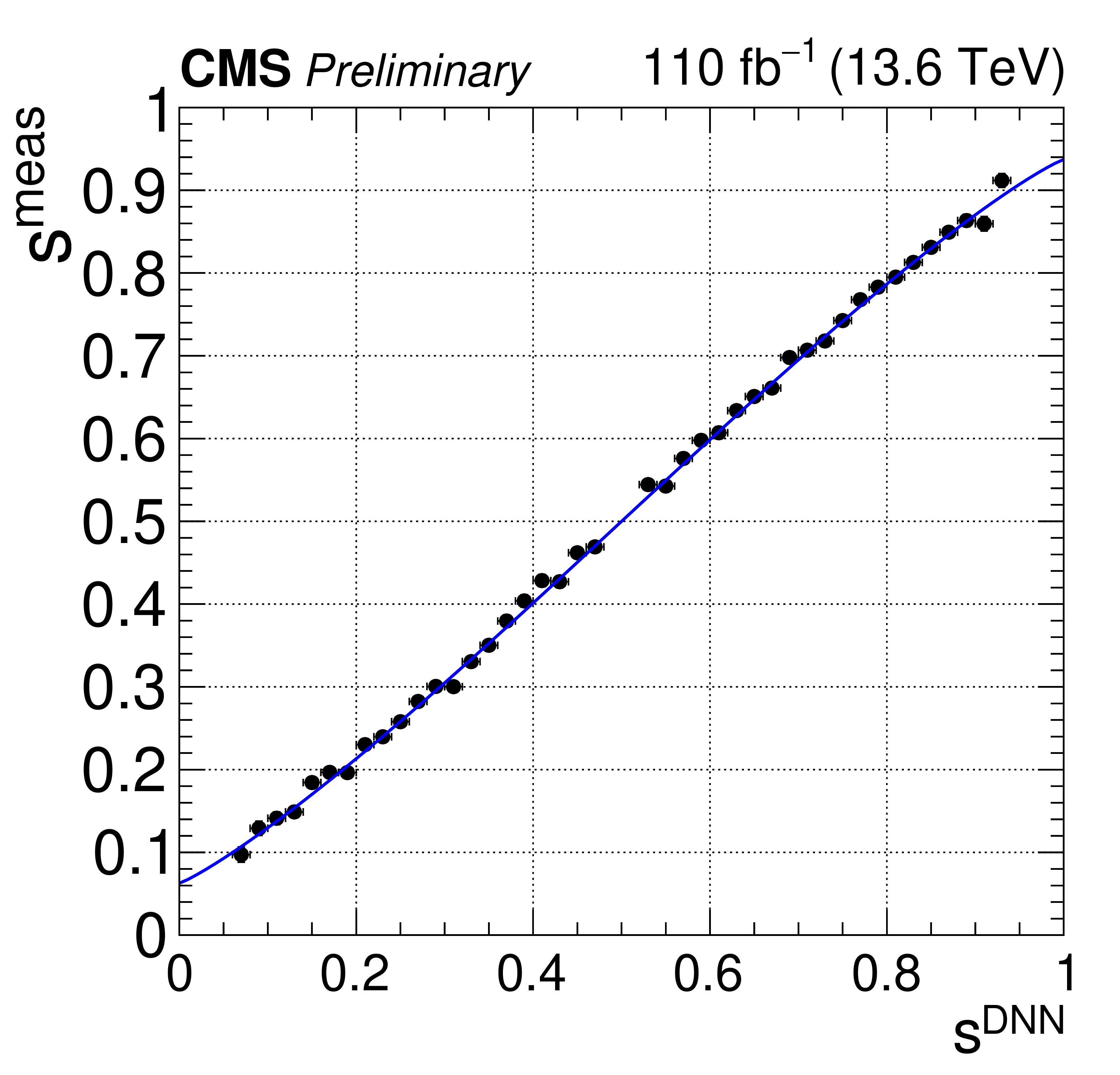
Results of the flavour tagging DNNs score calibration fit on $ {\mathrm{B}^{+}} \to \mathrm{J}/\psi \mathrm{K^+} $ decays for 2024 data, the largest data set. The measured tagging accuracy probability is plotted versus the value predicted by the tagging algorithm. The solid line shows the results of the Platt scaling calibration fit to data. |
png pdf |
Figure 1-c:
Results of the flavour tagging DNNs score calibration fit on $ {\mathrm{B}^{+}} \to \mathrm{J}/\psi \mathrm{K^+} $ decays for 2024 data, the largest data set. The measured tagging accuracy probability is plotted versus the value predicted by the tagging algorithm. The solid line shows the results of the Platt scaling calibration fit to data. |
png pdf |
Figure 1-d:
Results of the flavour tagging DNNs score calibration fit on $ {\mathrm{B}^{+}} \to \mathrm{J}/\psi \mathrm{K^+} $ decays for 2024 data, the largest data set. The measured tagging accuracy probability is plotted versus the value predicted by the tagging algorithm. The solid line shows the results of the Platt scaling calibration fit to data. |
png pdf |
Figure 2:
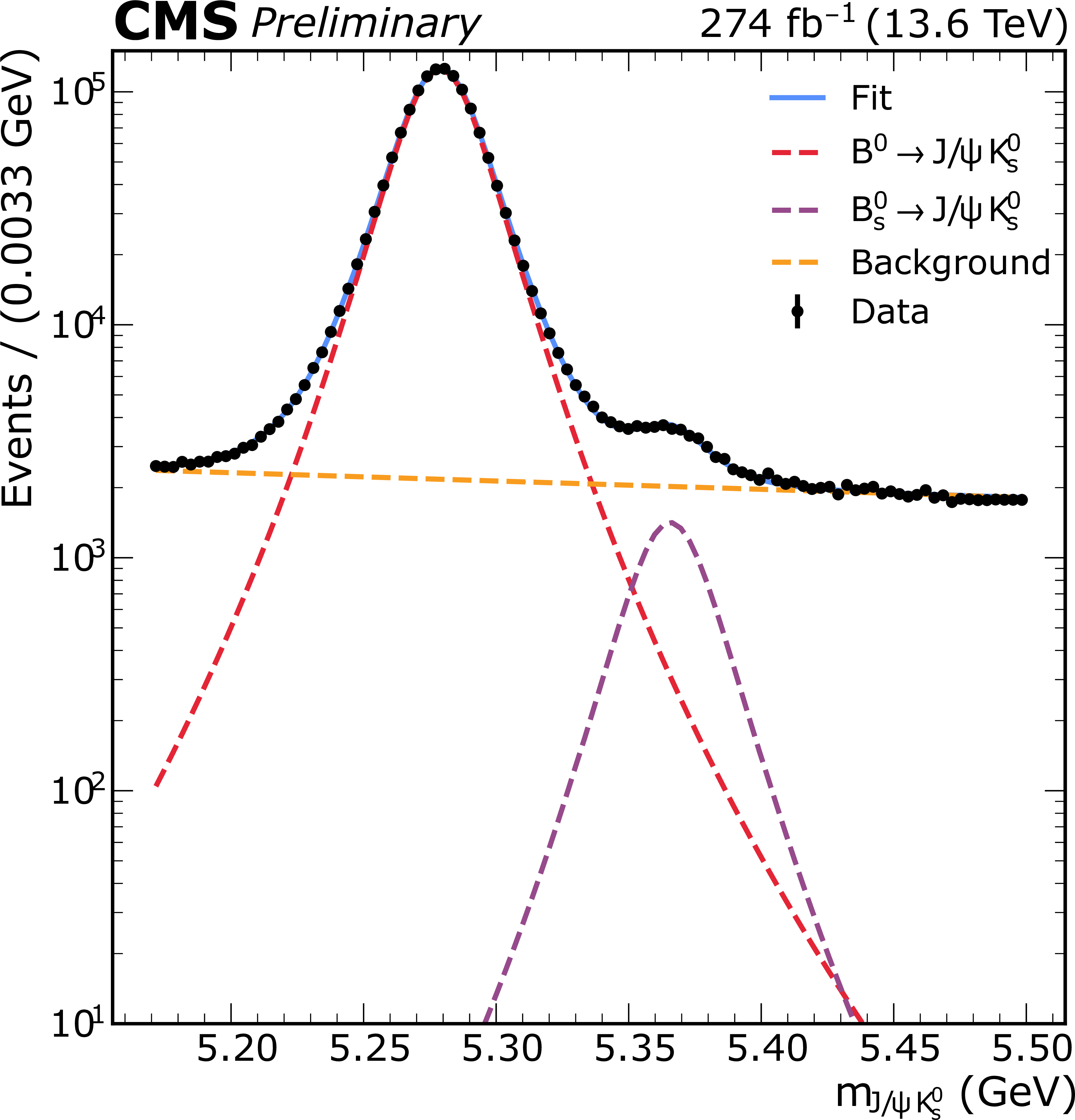
Mass distribution of the selected candidates, with the result of the fit overlaid. The signal components are shown in blue ($ {\mathrm{B}^0} \to \mathrm{J}/\psi \mathrm{K^0_S} $) and orange ($ \mathrm{B}_{s}^{0} \to \mathrm{J}/\psi \mathrm{K^0_S} $), while the combinatorial background is shown in green. |
png pdf |
Figure 3:
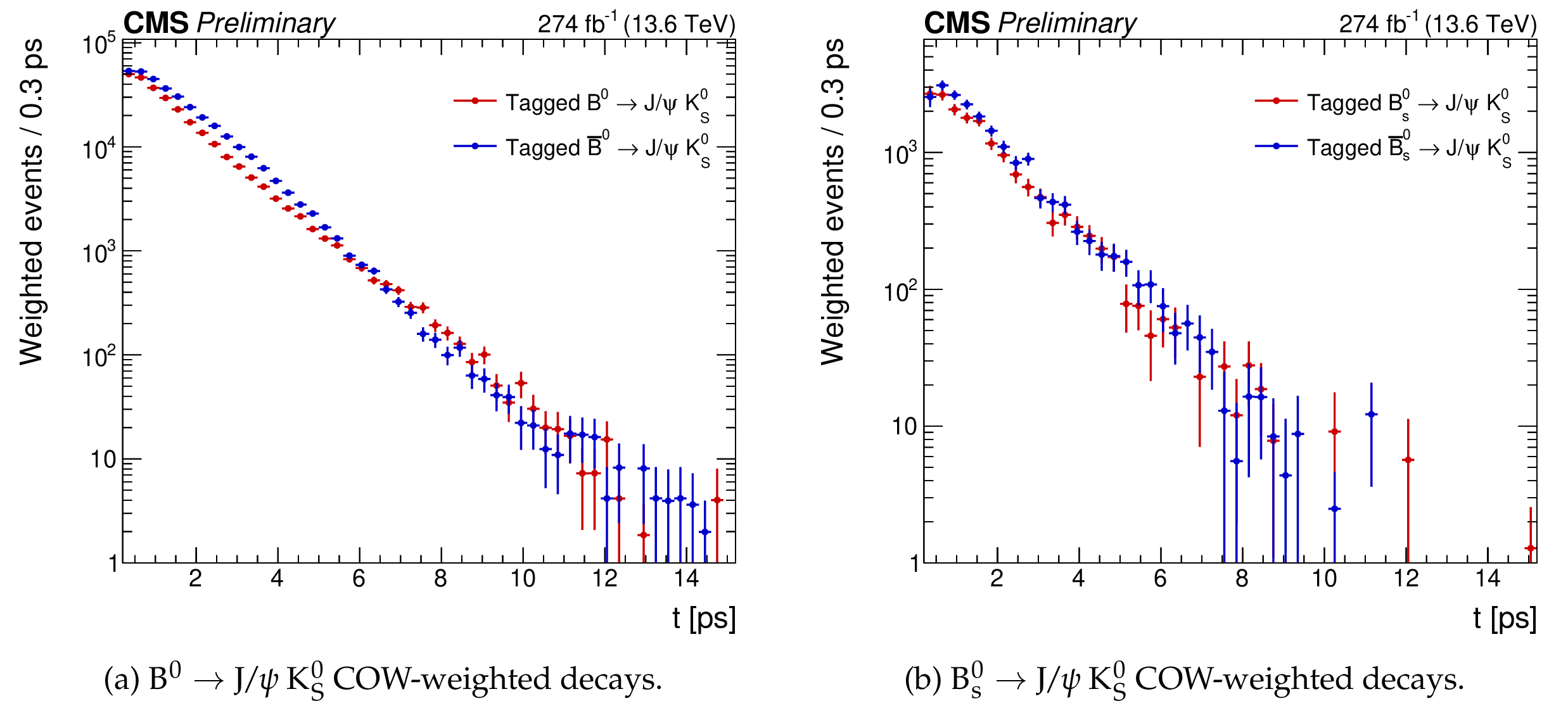
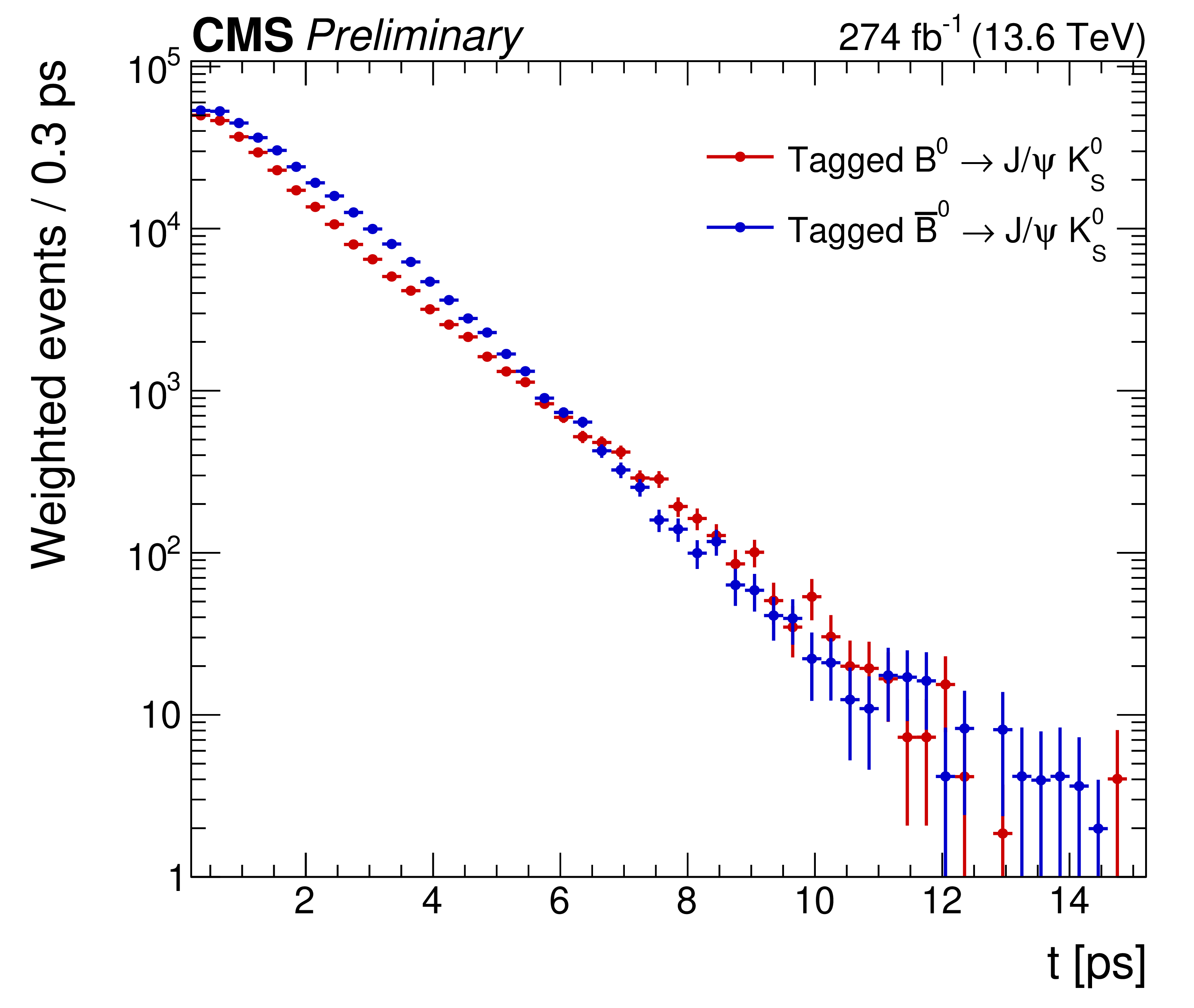
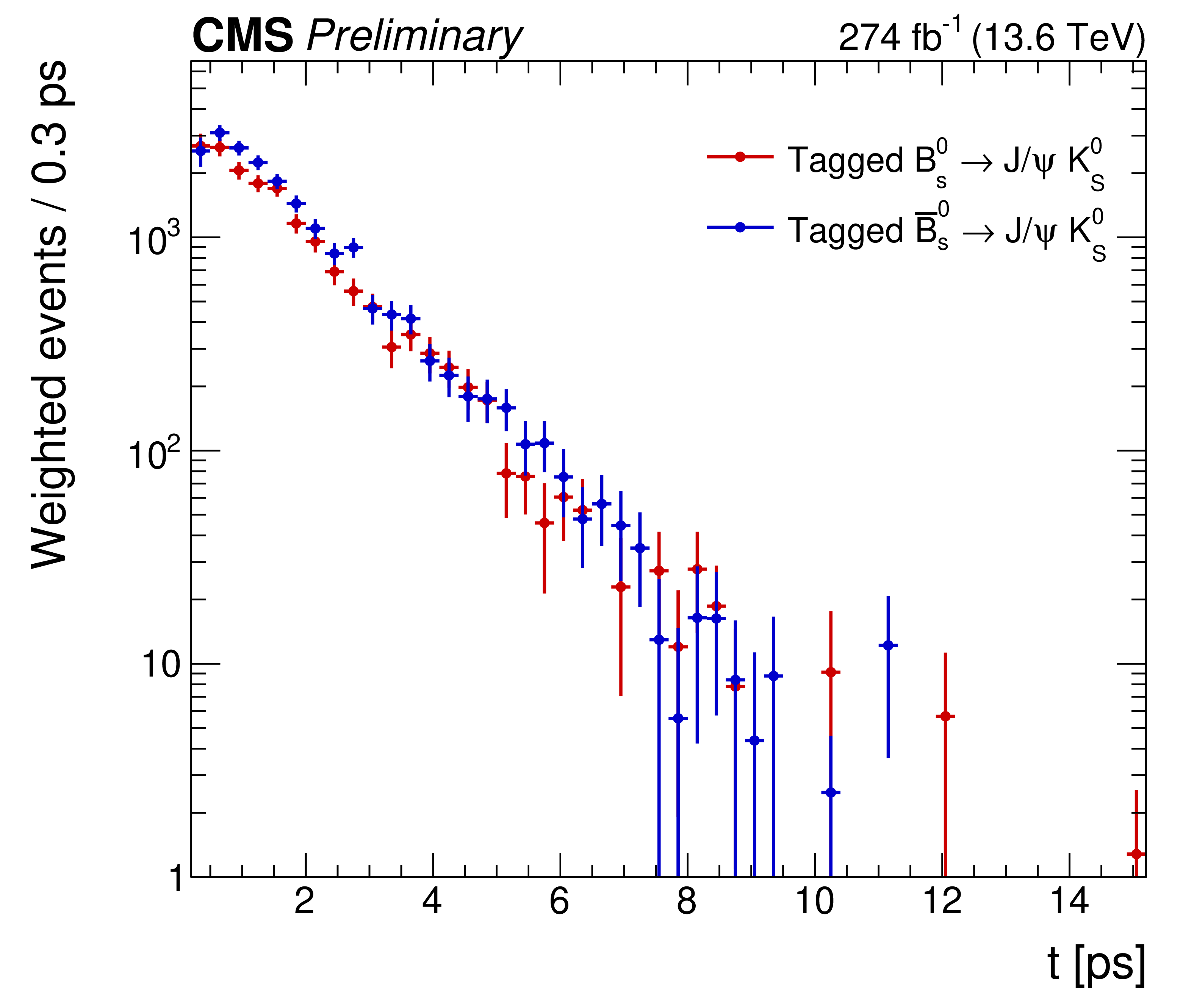
Reconstructed proper decay time distribution of the selected candidates, COW-weighted for the $ {\mathrm{B}^0} $ (left) and $ \mathrm{B}_{s}^{0} $ (right) hypothesis. Only tagged candidates tagged as $ {\mathrm{B}}^{0}_{(s)} $ (blue) and $ \overline{\mathrm{B}}^{0}_{(s)} $ (red) are shown. |
png pdf |
Figure 3-a:
Reconstructed proper decay time distribution of the selected candidates, COW-weighted for the $ {\mathrm{B}^0} $ (left) and $ \mathrm{B}_{s}^{0} $ (right) hypothesis. Only tagged candidates tagged as $ {\mathrm{B}}^{0}_{(s)} $ (blue) and $ \overline{\mathrm{B}}^{0}_{(s)} $ (red) are shown. |
png pdf |
Figure 3-b:
Reconstructed proper decay time distribution of the selected candidates, COW-weighted for the $ {\mathrm{B}^0} $ (left) and $ \mathrm{B}_{s}^{0} $ (right) hypothesis. Only tagged candidates tagged as $ {\mathrm{B}}^{0}_{(s)} $ (blue) and $ \overline{\mathrm{B}}^{0}_{(s)} $ (red) are shown. |
png pdf |
Figure 4:
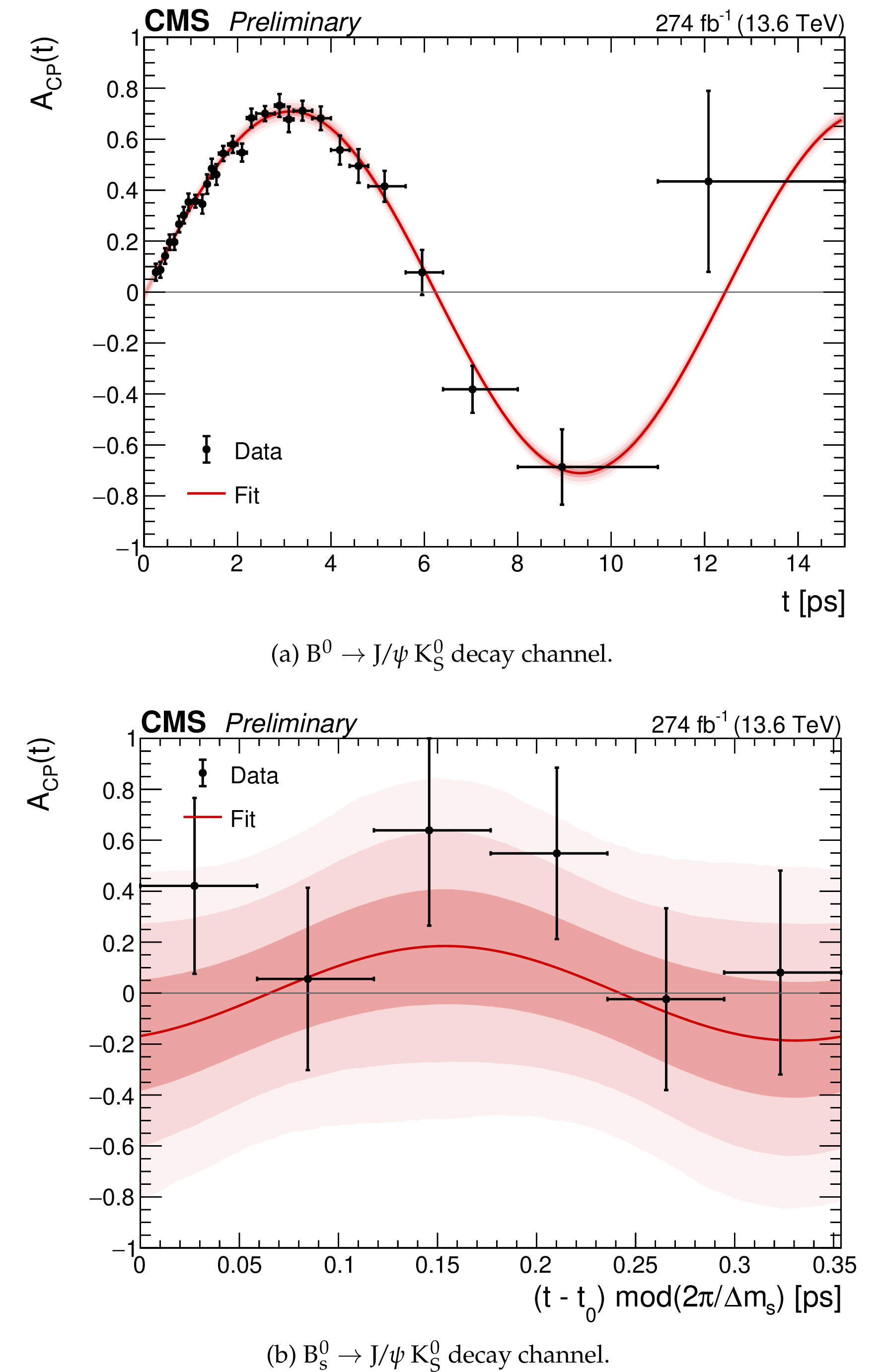
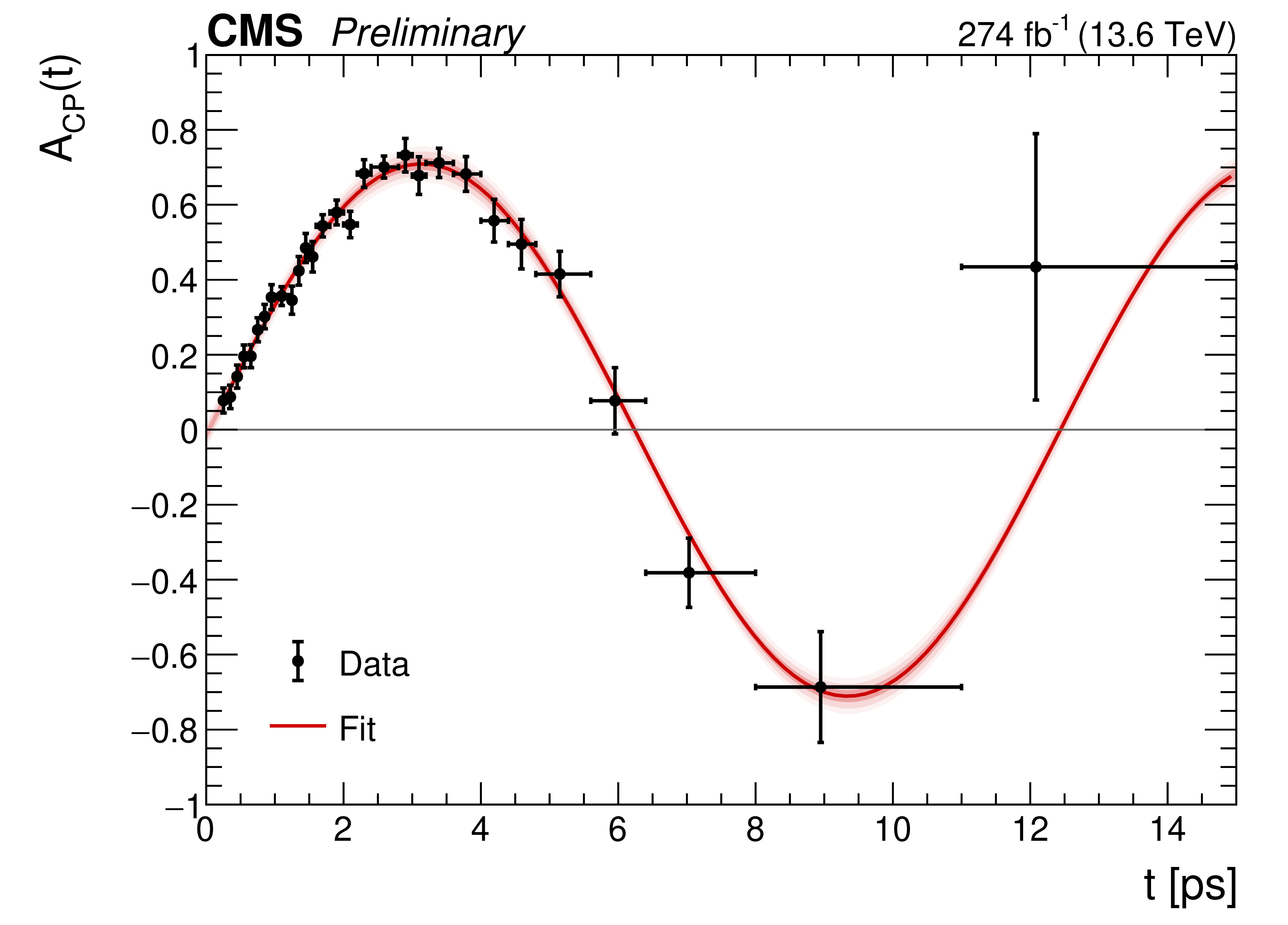
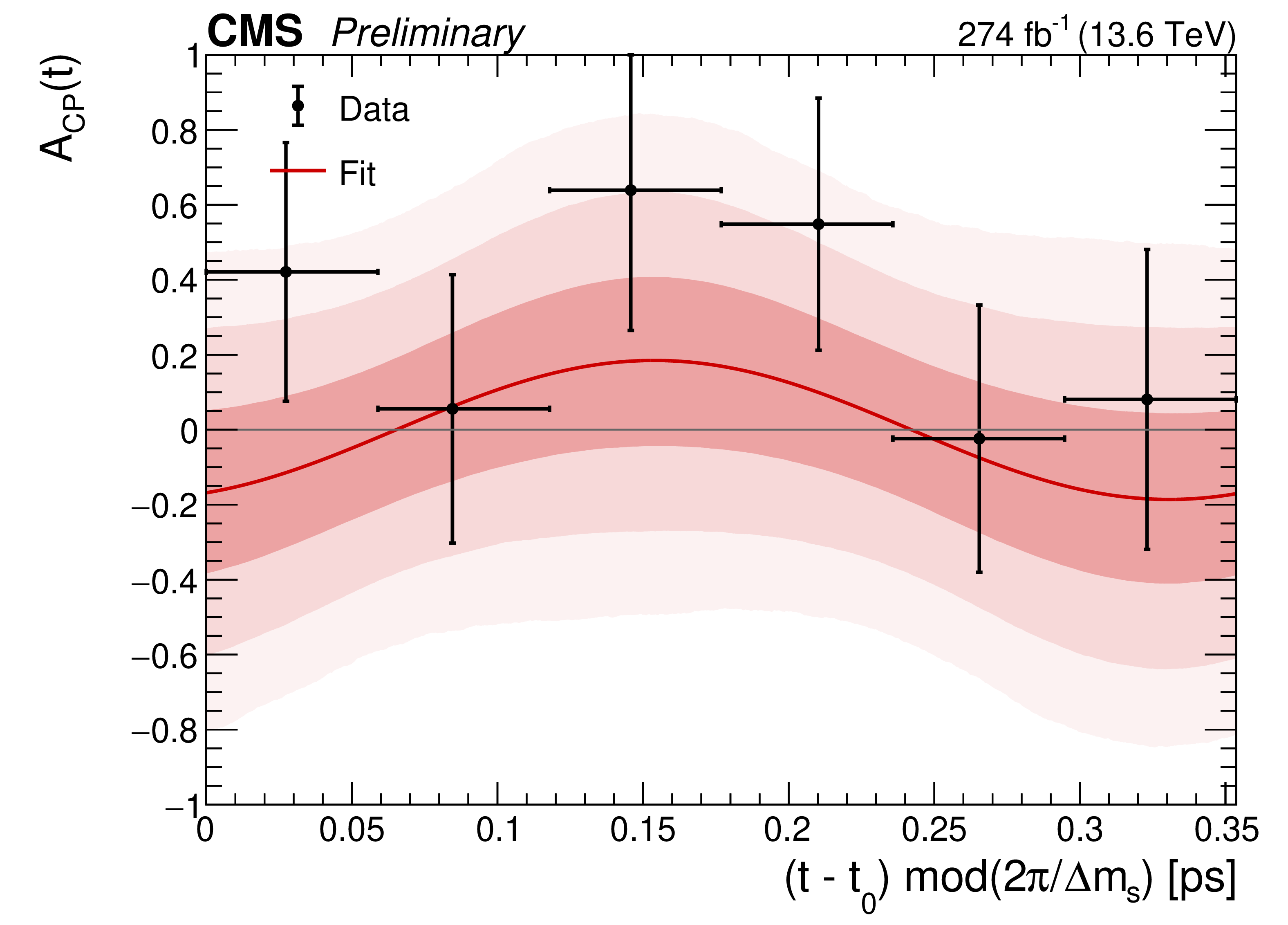
Time-dependent $ CP $ asymmetry in $ {\mathrm{B}}^0_{(s)} \to \mathrm{J}/\psi \mathrm{K^0_S} $ decays, with the result of the fit overlaid. The shaded bands indicate the one, two, and three standard deviation confidence intervals of the fitted function. |
png pdf |
Figure 4-a:
Time-dependent $ CP $ asymmetry in $ {\mathrm{B}}^0_{(s)} \to \mathrm{J}/\psi \mathrm{K^0_S} $ decays, with the result of the fit overlaid. The shaded bands indicate the one, two, and three standard deviation confidence intervals of the fitted function. |
png pdf |
Figure 4-b:
Time-dependent $ CP $ asymmetry in $ {\mathrm{B}}^0_{(s)} \to \mathrm{J}/\psi \mathrm{K^0_S} $ decays, with the result of the fit overlaid. The shaded bands indicate the one, two, and three standard deviation confidence intervals of the fitted function. |
png pdf |
Figure 5:
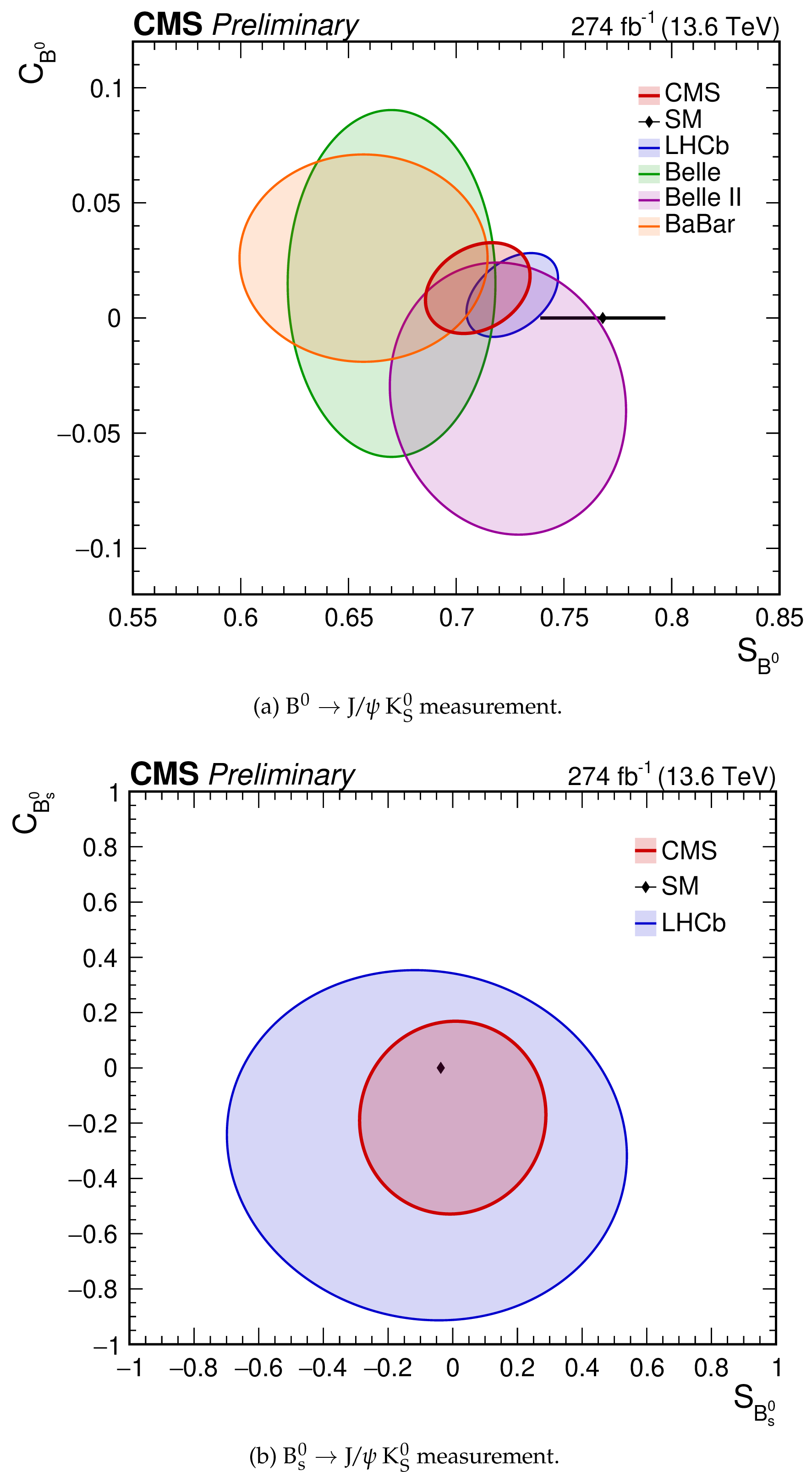
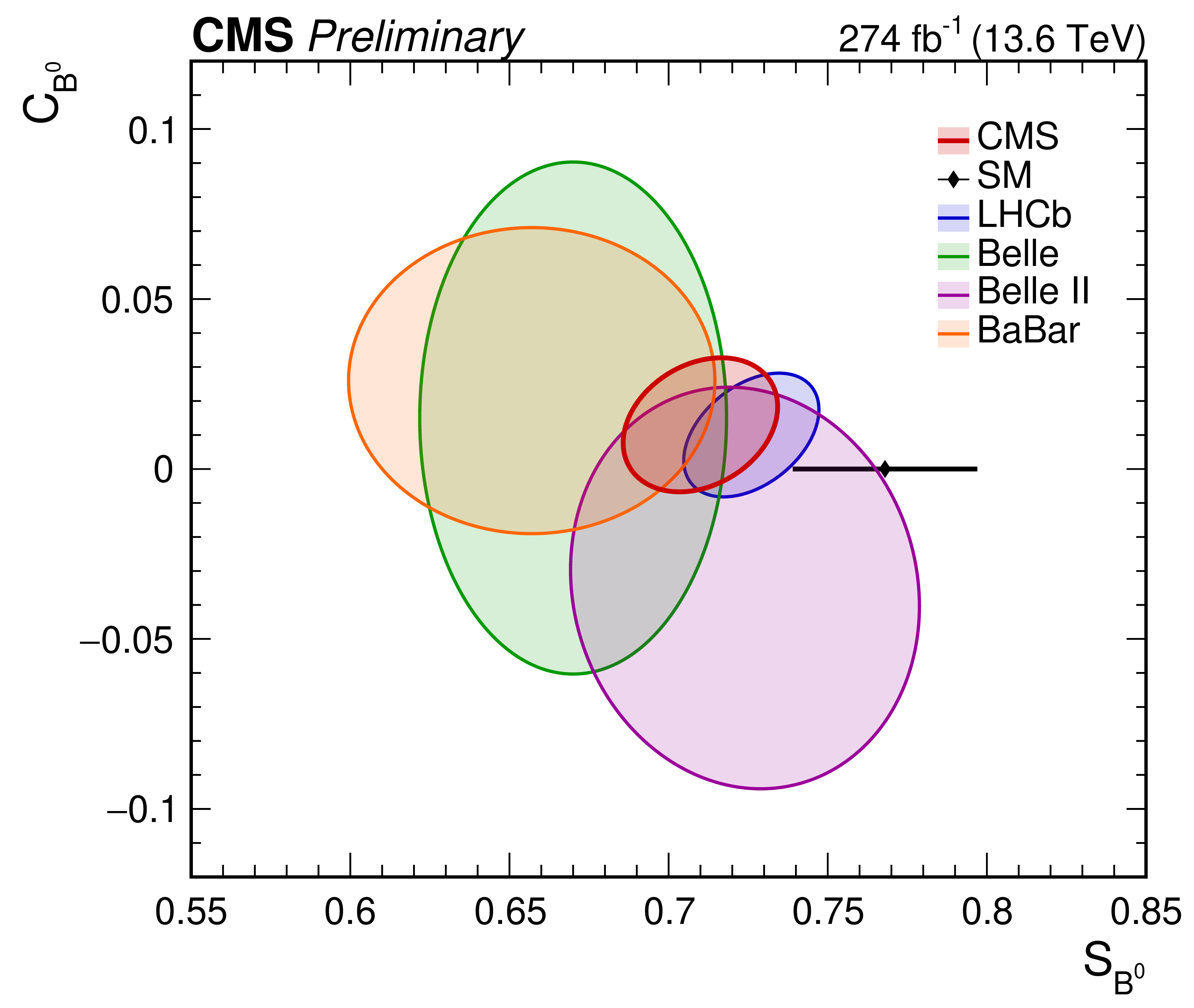
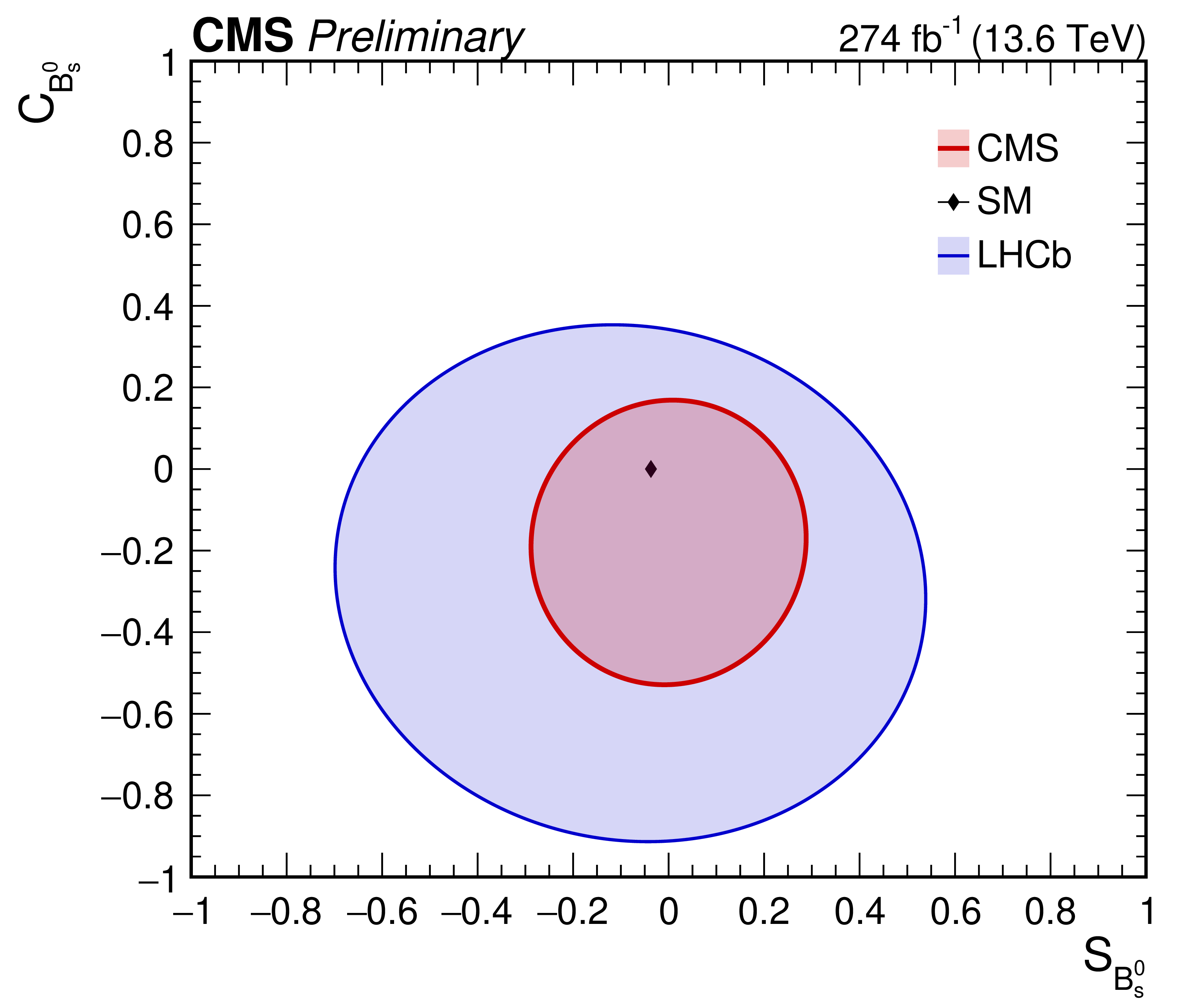
Two-dimensional ($ S $, $ C $) 68.3% CL contours obtained from the CPV measurements compared with the latest SM-based predictions [1] and the latest experimental results from BaBar, Belle, Belle-II, and LHCb [49]. |
png pdf |
Figure 5-a:
Two-dimensional ($ S $, $ C $) 68.3% CL contours obtained from the CPV measurements compared with the latest SM-based predictions [1] and the latest experimental results from BaBar, Belle, Belle-II, and LHCb [49]. |
png pdf |
Figure 5-b:
Two-dimensional ($ S $, $ C $) 68.3% CL contours obtained from the CPV measurements compared with the latest SM-based predictions [1] and the latest experimental results from BaBar, Belle, Belle-II, and LHCb [49]. |
| Tables | |
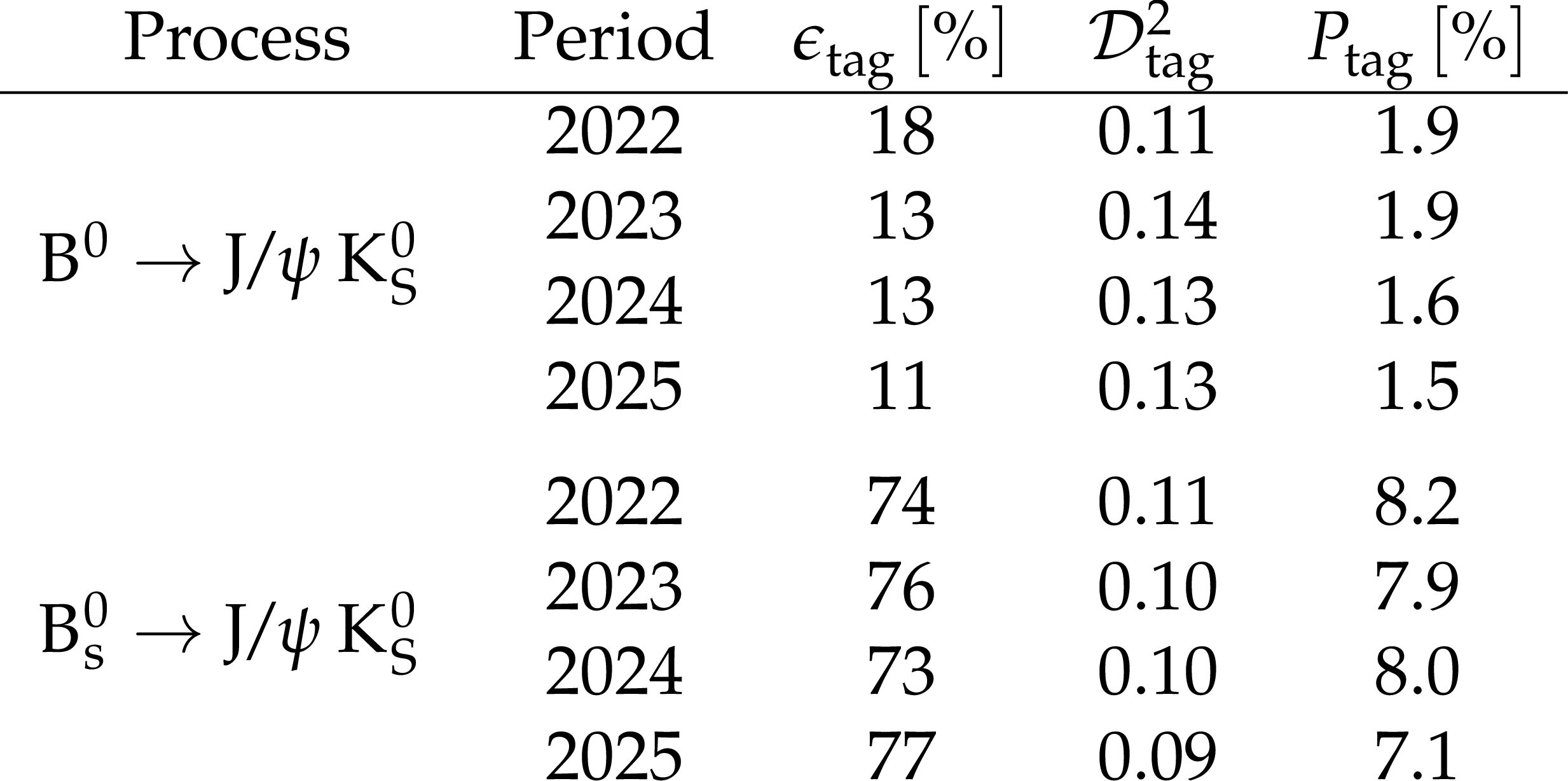
png pdf |
Table 1:
Calibrated tagging performance evaluated in the $ {\mathrm{B}}^0_{(s)} \to \mathrm{J}/\psi \mathrm{K^0_S} $ data sample for different data-taking periods. The effective dilution $ \mathcal{D}_\text{tag}^2 $ is obtained from the measured tagging efficiency $ \epsilon_\text{tag} $ and tagging power $ P_\text{tag} $. |
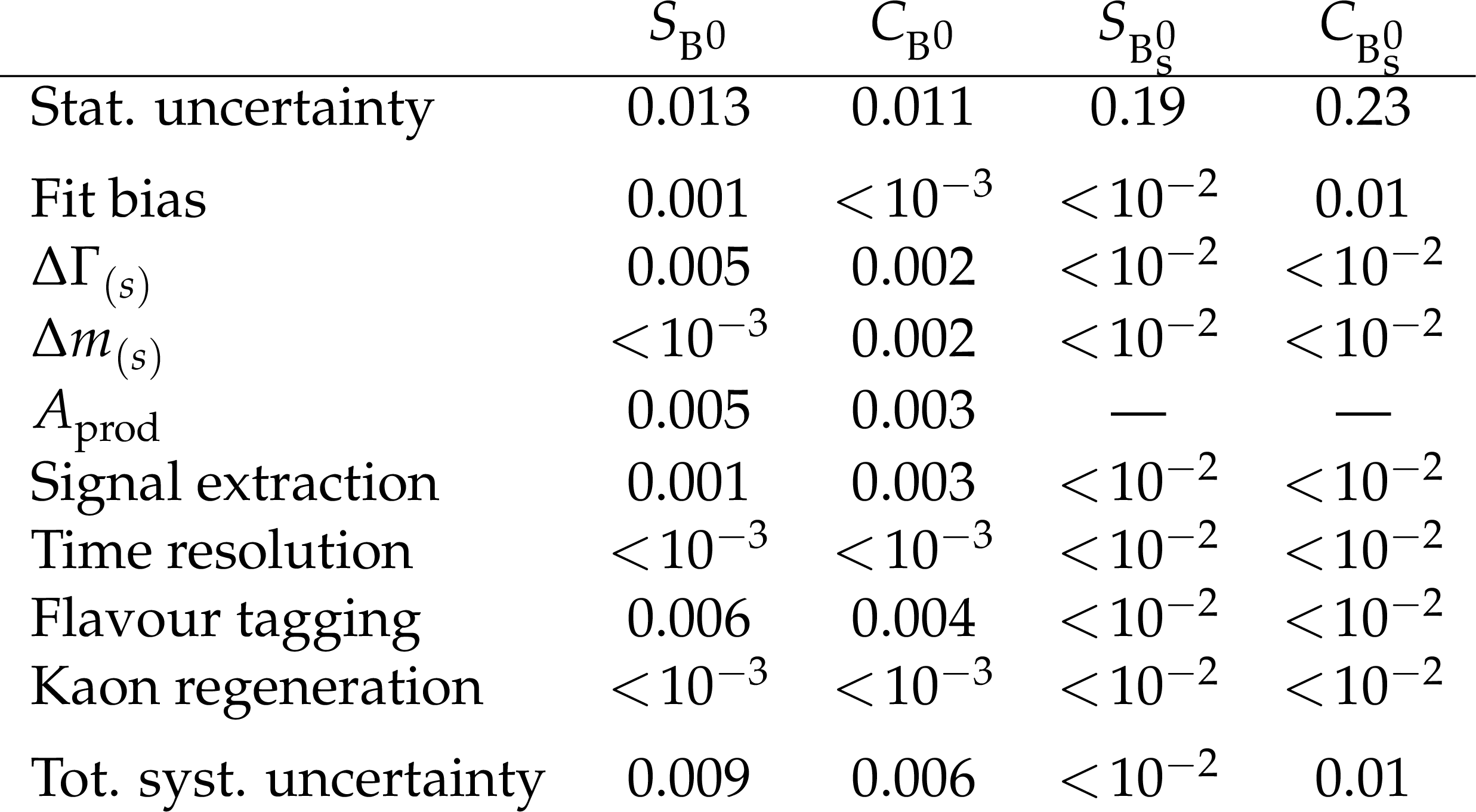
png pdf |
Table 2:
Summary of the systematic uncertainties for the physics parameters. The dashes ($ \text{---} $) indicate that the corresponding uncertainty is either not applicable or it was not evaluated. Statistical uncertainties are also presented to ease comparisons. |
| Summary |
| A measurement of time-dependent $ CP $ violation in $ {\mathrm{B}^0} \to \mathrm{J}/\psi \mathrm{K^0_S} $ and $ \mathrm{B}_{s}^{0} \to \mathrm{J}/\psi \mathrm{K^0_S} $ decays has been presented, using pp collision data collected with the CMS detector at $ \sqrt{s} = $ 13.6 TeV during 2022--2025, corresponding to an integrated luminosity of 274 fb$^{-1}$. The $ CP $-violating parameters $ S $ and $ C $, describing mixing-induced and direct CPV respectively, are extracted from fits to the time-dependent $ CP $ asymmetry constructed from approximately 1.4 million $ {\mathrm{B}^0} $ and 16 thousand $ \mathrm{B}_{s}^{0} $ signal candidates. The initial $ {\mathrm{B}}^{0}_{(s)} $ meson flavour at production is determined using a novel tagging framework based on the Particle Transformer architecture, comprising opposite-side muon, electron, and jet taggers together with a same-side tagger for the $ \mathrm{B}_{s}^{0} $ mode. Background contributions are statistically subtracted using the COW technique, which avoids any explicit modeling of background distributions in the physics observables. The measured values are $ S_{{\mathrm{B}^0}} = $ 0.710 $ \pm $ 0.016, $ C_{{\mathrm{B}^0}} = $ 0.013 $ \pm $ 0.012, $ S_{\mathrm{B}_{s}^{0}} = $ 0.00 $ \pm $ 0.19, and $ C_{\mathrm{B}_{s}^{0}} = - $ 0.18 $ \pm $ 0.23. All results are consistent with SM predictions. The simultaneous analysis of both modes within a single experiment provides a coherent probe of the CKM flavour sector and offers direct sensitivity to penguin-induced shifts in the interpretation of $ \sin{2\beta} $, contributing to the broader programme of precision tests of the SM in the $ {\mathrm{B}^0} $ and $ \mathrm{B}_{s}^{0} $ meson system, and enables further constraints on possible BSM contributions to quark flavour-changing processes. |
| References | ||||
| 1 | UTfit Collaboration | New UTfit analysis of the unitarity triangle in the Cabibbo--Kobayashi--Maskawa scheme | Rend. Lincei Sci. Fis. Nat. 34 (2023) 37 | 2212.03894 |
| 2 | BABAR Collaboration | Observation of $ CP $ violation in the $ \mathrm{B}^0 $ meson system | PRL 87 (2001) 091801 | |
| 3 | Belle Collaboration | Observation of large $ CP $ violation in the neutral B meson system | PRL 87 (2001) 091802 | |
| 4 | BABAR Collaboration | Measurement of time-dependent $ CP $ asymmetry in $ \mathrm{B}^0 \to \mathrm{c} \bar{\mathrm{c}} \mathrm{K}^{(*0)} $ decays | PRD 79 (2009) 072009 | 0902.1708 |
| 5 | Belle Collaboration | Precise measurement of the $ CP $ violation parameter $ \sin2\phi_1 $ in $ \mathrm{B}^0\to(\mathrm{c}\bar{\mathrm{c}}) \mathrm{K}^0 $ decays | PRL 108 (2012) 171802 | 1201.4643 |
| 6 | LHCb Collaboration | Measurement of $ CP $ violation in $ \mathrm{B}^0\to \mathrm{J}/\psi \mathrm{K}^0_\text{S} $ decays | PRL 115 (2015) 031601 | |
| 7 | LHCb Collaboration | Measurement of $ CP $ violation in $ \mathrm{B}^0\rightarrow \mathrm{J}/\psi \mathrm{K}^0_\text{S} $ and $ \mathrm{B}^0\rightarrow\psi(2S) \mathrm{K}^0_\text{S} $ decays | JHEP 11 (2017) 170 | 1709.03944 |
| 8 | LHCb Collaboration | Measurement of $ CP $ violation in $ \mathrm{B}^0 \to \psi(\to \ell^+\ell^-) \mathrm{K}^0_\text{S}(\to \pi^+\pi^-) $ decays | PRL 132 (2024) 021801 | 2309.09728 |
| 9 | R. Fleischer | Extracting $ \gamma $ from $ \mathrm{B}_{\mathrm{s}(\mathrm{d})} \to \mathrm{J}/\psi \mathrm{K}^0_{S} $ and $ \mathrm{B}_{\mathrm{d}(\mathrm{s})} \to D^+_{\mathrm{d}(\mathrm{s})} D^-_{\mathrm{d}(\mathrm{s})} $ | EPJC 10 (1999) 299 | hep-ph/9903455 |
| 10 | M. Ciuchini, M. Pierini, and L. Silvestrini | Effect of penguin operators in the $ \mathrm{B}^0 \rightarrow \mathrm{J}/\psi \mathrm{K}^{0} CP $ asymmetry | PRL 95 (2005) 221804 | |
| 11 | M. Z. Barel, K. De Bruyn, R. Fleischer, and E. Malami | In pursuit of new physics with $ \mathrm{B}^0 \to \mathrm{J}/\psi \mathrm{K}^0 $ and $ \mathrm{B}_\mathrm{s}^0\to \mathrm{J}/\psi \phi $ decays at the high-precision frontier | JPG 48 (2021) 065002 | 2010.14423 |
| 12 | K. De Bruyn, R. Fleischer, and E. Malami | How to tame penguins: advancing to high-precision measurements of $ \phi_\mathrm{d} $ and $ \phi_\mathrm{s} $ | EPJC 86 (2026) 215 | 2505.06102 |
| 13 | LHCb Collaboration | Measurement of the time-dependent $ CP $ asymmetries in $ \mathrm{B}^0_\mathrm{s} \to \mathrm{J}/\psi \mathrm{K}_\text{S}^0 $ | Journal of High Energy Physics 2015 (2015) 131 | |
| 14 | CMS Collaboration | The CMS experiment at the CERN LHC | JINST 3 (2008) S08004 | |
| 15 | CMS Collaboration | Development of the CMS detector for the CERN LHC Run 3 | JINST 19 (2024) P05064 | CMS-PRF-21-001 2309.05466 |
| 16 | CMS Collaboration | Performance of the CMS Level-1 trigger in proton-proton collisions at $ \sqrt{s} = $ 13 TeV | JINST 15 (2020) P10017 | CMS-TRG-17-001 2006.10165 |
| 17 | CMS Collaboration | The CMS trigger system | JINST 12 (2017) P01020 | CMS-TRG-12-001 1609.02366 |
| 18 | CMS Collaboration | Performance of the CMS high-level trigger during LHC Run 2 | JINST 19 (2024) P11021 | CMS-TRG-19-001 2410.17038 |
| 19 | CMS Collaboration | Electron and photon reconstruction and identification with the CMS experiment at the CERN LHC | JINST 16 (2021) P05014 | CMS-EGM-17-001 2012.06888 |
| 20 | CMS Collaboration | Performance of the CMS muon detector and muon reconstruction with proton-proton collisions at $ \sqrt{s}= $ 13 TeV | JINST 13 (2018) P06015 | CMS-MUO-16-001 1804.04528 |
| 21 | CMS Collaboration | Description and performance of track and primary-vertex reconstruction with the CMS tracker | JINST 9 (2014) P10009 | CMS-TRK-11-001 1405.6569 |
| 22 | CMS Collaboration | Particle-flow reconstruction and global event description with the CMS detector | JINST 12 (2017) P10003 | CMS-PRF-14-001 1706.04965 |
| 23 | CMSnoop | none | JINST 16 (2021) P02027 | 2012.14304 |
| 24 | CMS Collaboration | Track impact parameter resolution for the full pseudo rapidity coverage in the 2017 dataset with the CMS Phase-1 pixel detector | CMS Detector Performance Summary CMS-DP-2020-049, 2020 CDS |
|
| 25 | CMS Collaboration | ECAL 2016 refined calibration and Run2 summary plots | CMS Detector Performance Summary CMS-DP-2020-021, 2020 CDS |
|
| 26 | CMS Collaboration | Pileup mitigation at CMS in 13 TeV data | JINST 15 (2020) P09018 | CMS-JME-18-001 2003.00503 |
| 27 | CMS Collaboration | Jet energy scale and resolution in the CMS experiment in pp collisions at 8 TeV | JINST 12 (2017) P02014 | CMS-JME-13-004 1607.03663 |
| 28 | CMS Collaboration | Enriching the physics program of the CMS experiment via data scouting and data parking | Phys. Rept. 1115 (2025) 678 | CMS-EXO-23-007 2403.16134 |
| 29 | Particle Data Group Collaboration | Review of particle physics | PRD 110 (2024) 030001 | |
| 30 | T. Sjöstrand et al. | An introduction to PYTHIA 8.2 | Comput. Phys. Commun. 191 (2015) 159 | 1410.3012 |
| 31 | CMS Collaboration | Extraction and validation of a new set of CMS PYTHIA8 tunes from underlying-event measurements | EPJC 80 (2020) 4 | CMS-GEN-17-001 1903.12179 |
| 32 | NNPDF Collaboration | Parton distributions from high-precision collider data | EPJC 77 (2017) 663 | 1706.00428 |
| 33 | D. J. Lange | The EvtGen particle decay simulation package | NIM A 462 (2001) 152 | |
| 34 | E. Barberio, B. van Eijk, and Z. W \c a s | PHOTOS --- a universal Monte Carlo for QED radiative corrections in decays | Comput. Phys. Commun. 66 (1991) 115 | |
| 35 | E. Barberio and Z. W \c a s | PHOTOS --- a universal Monte Carlo for QED radiative corrections: version 2.0 | Comput. Phys. Commun. 79 (1994) 291 | |
| 36 | GEANT4 Collaboration | GEANT 4---a simulation toolkit | NIM A 506 (2003) 250 | |
| 37 | H. G. Moser and A. Roussarie | Mathematical methods for $ \mathrm{B}^0 $--$ \overline{\mathrm{B}}^0 $ oscillation analyses | Nucl. Instrum. Methods Phys. Res., A 384, no. CERN-OPEN-99-030. CERN-ALEPH-PUB-96-005. 2-3, 491, 1996 link |
|
| 38 | H. Qu, C. Li, and S. Qian | Particle transformer for jet tagging | link | |
| 39 | CMS Collaboration | b-hive: a modular training framework for state-of-the-art object-tagging within the Python ecosystem at the CMS experiment | CDS | |
| 40 | J. C. Platt | Probabilistic outputs for support vector machines and comparisons to regularized likelihood methods | in Advances in Large Margin Classifiers, MIT Press, 1999 | |
| 41 | G. Schwarz | Estimating the dimension of a model | The Annals of Statistics 6 (1978) 461 | |
| 42 | H. Dembinski, M. Kenzie, C. Langenbruch, and M. Schmelling | Custom Orthogonal Weight functions (COWs) for event classification | Nuclear Instruments and Methods in Physics Research Section A: Accelerators, Spectrometers, 2022 Detectors and Associated Equipment 1040 (2022) 167270 |
|
| 43 | M. Pivk and F. R. Le Diberder | SPlot: a statistical tool to unfold data distributions | NIM A 555 (2005) 356 | physics/0402083 |
| 44 | N. L. Johnson | Systems of frequency curves generated by methods of translation | Biometrika 36 (1949) 149 | |
| 45 | ATLAS Collaboration | Measurement of the relative width difference of the $ \mathrm{B}^0 $--$ \overline{\mathrm{B}}^0 $ system with the atlas detector | Journal of High Energy Physics 2016 (2016) 81 | |
| 46 | W. Verkerke and D. Kirkby | The RooFit toolkit for data modeling | physics/0306116 | |
| 47 | W. Fetscher et al. | Regeneration of arbitrary coherent neutral kaon states: a new method for measuring the $ \mathrm{K}^0 $--$ \overline{\mathrm{k}}^0 $ forward scattering amplitude | Zeitschrift fur Physik C: Particles and Fields 72 543, 1996 link |
|
| 48 | CKMfitter Collaboration | Predictions of selected flavour observables within the Standard Model | PRD 84 (2011) 033005 | 1106.4041 |
| 49 | S. Banerjee et al. | Averages of $ b $-hadron, $ c $-hadron, and $ \tau $-lepton properties as of 2023 | 2411.18639 | |
|
|
Compact Muon Solenoid LHC, CERN |

|
|
|
|
|
|