Compact Muon Solenoid
LHC, CERN
 Visit us: CMS Public Website, CMS Physics ;
Contact us: CMS Publications Committee
Visit us: CMS Public Website, CMS Physics ;
Contact us: CMS Publications Committee
| CMS-PAS-HIN-25-009 | ||
| Collective flow in OO and NeNe collisions at $ \sqrt{s_{_{NN}}} = $ 5.36 TeV | ||
| CMS Collaboration | ||
| 2025-09-08 | ||
| Abstract: The collective flow in oxygen-oxygen (OO) and neon-neon (NeNe) collisions provide important information about the origin of collectivity in small collision systems. They also serve as probes for nuclear structure of O and Ne nuclei. The elliptic ($ v_{2} $) and triangular ($ v_{3} $) flow harmonics of charged particles from two-particle correlations, as well as $ v_{2} $ values from four-particle correlations, are measured as functions of the nuclear overlap from peripheral to central OO and NeNe collisions at a center-of-mass energy per nucleon pair of $ \sqrt{s_{_{NN}}} = $ 5.36 TeV. The data were obtained with the CMS detector at the LHC and correspond to integrated luminosity of 7 nb$^{-1} $ for OO collisions and 0.8 nb$^{-1} $ for NeNe collisions. The $ v_2 $ values show a similar trend as previously observed in PbPb collisions where the values decrease towards central collisions, reflecting the initial geometry of the overlapping area of the AA collisions. An increasing trend is observed for $ v_{3} $ values from peripheral to central collisions, in contrast with the observation in PbPb collisions, indicating different initial state fluctuations in small and large collision systems. The ratio of NeNe to OO $ v_{2} $ values shows a significant increasing trend towards central collisions, while the $ v_{3} $ ratio shows a decreasing trend. A comparison of hydrodynamic models that include $ ab $ $ initio $ nuclear structure conditions to these results provides important information on how the collective flow is influenced by the initial collision geometry in small collision systems, including how the nuclear deformation and $ \alpha $-clustering in O and Ne nuclei affects the resulting bulk dynamics. | ||
|
Links:
CDS record (PDF) ;
CADI line (restricted) ;
These preliminary results are superseded in this paper, Accepted by PRL. |
||
| Figures | |
png pdf |
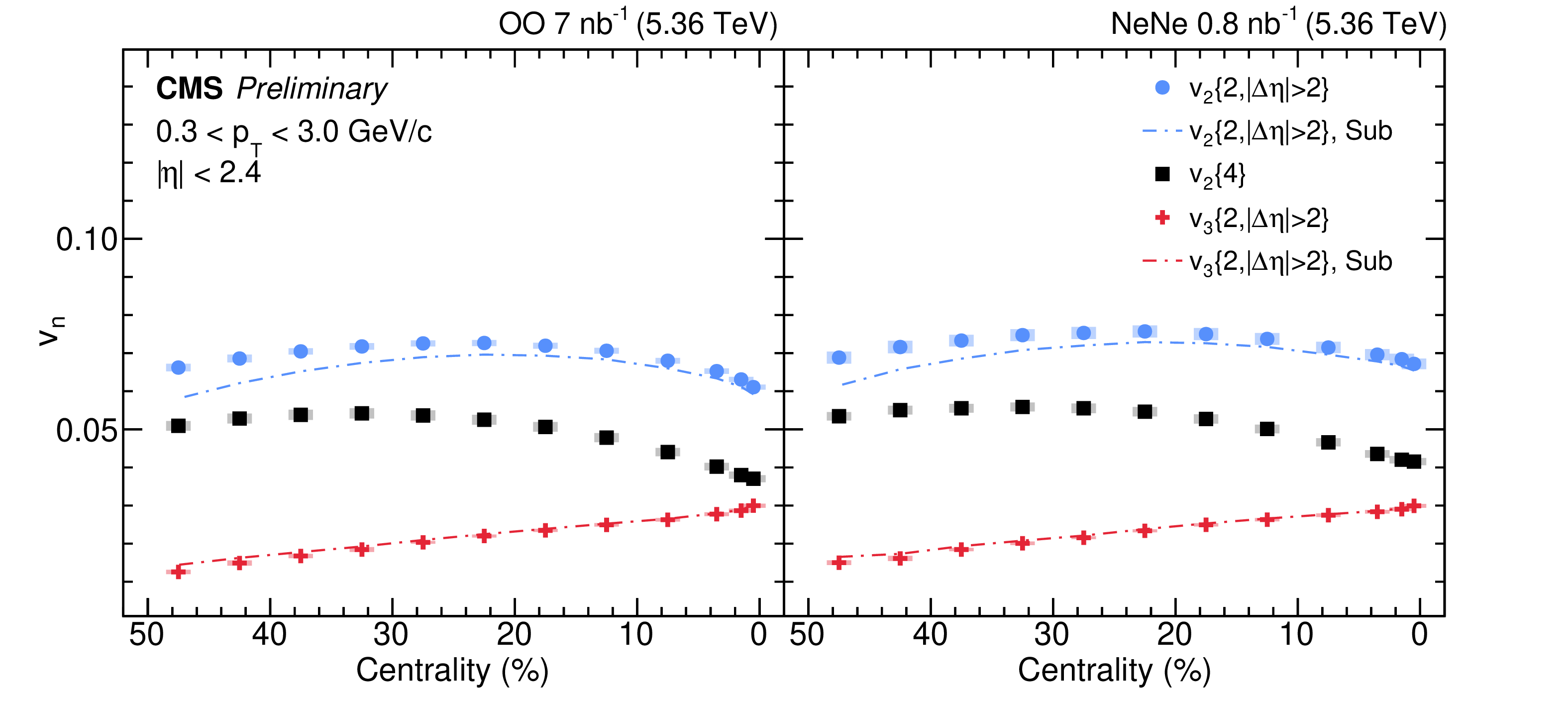
Figure 1:
Results of $ v_{2}\{2,|\Delta\eta| > 2\} $, $ v_{3}\{2,|\Delta\eta| > 2\} $ and $ v_{2}\{4\} $ for charged particles with 0.3 $ < p_{\mathrm{T}} < $ 3.0 GeV/$c$ and $ |\eta| < $ 2.4 as functions of centrality in OO (left) and NeNe (right) collisions at $ \sqrt{\smash[b]{s_{_{\mathrm{NN}}}}} = $ 5.36 TeV. The $ v_{2}\{2,|\Delta\eta| > 2\} $ and $ v_{3}\{2,|\Delta\eta| > 2\} $ results after subtracting correlations from 70-80% centrality range are shown as dot-dashed lines. Vertical error bars correspond to statistical uncertainties, while the shaded boxes denote the systematic uncertainties. |
png pdf |
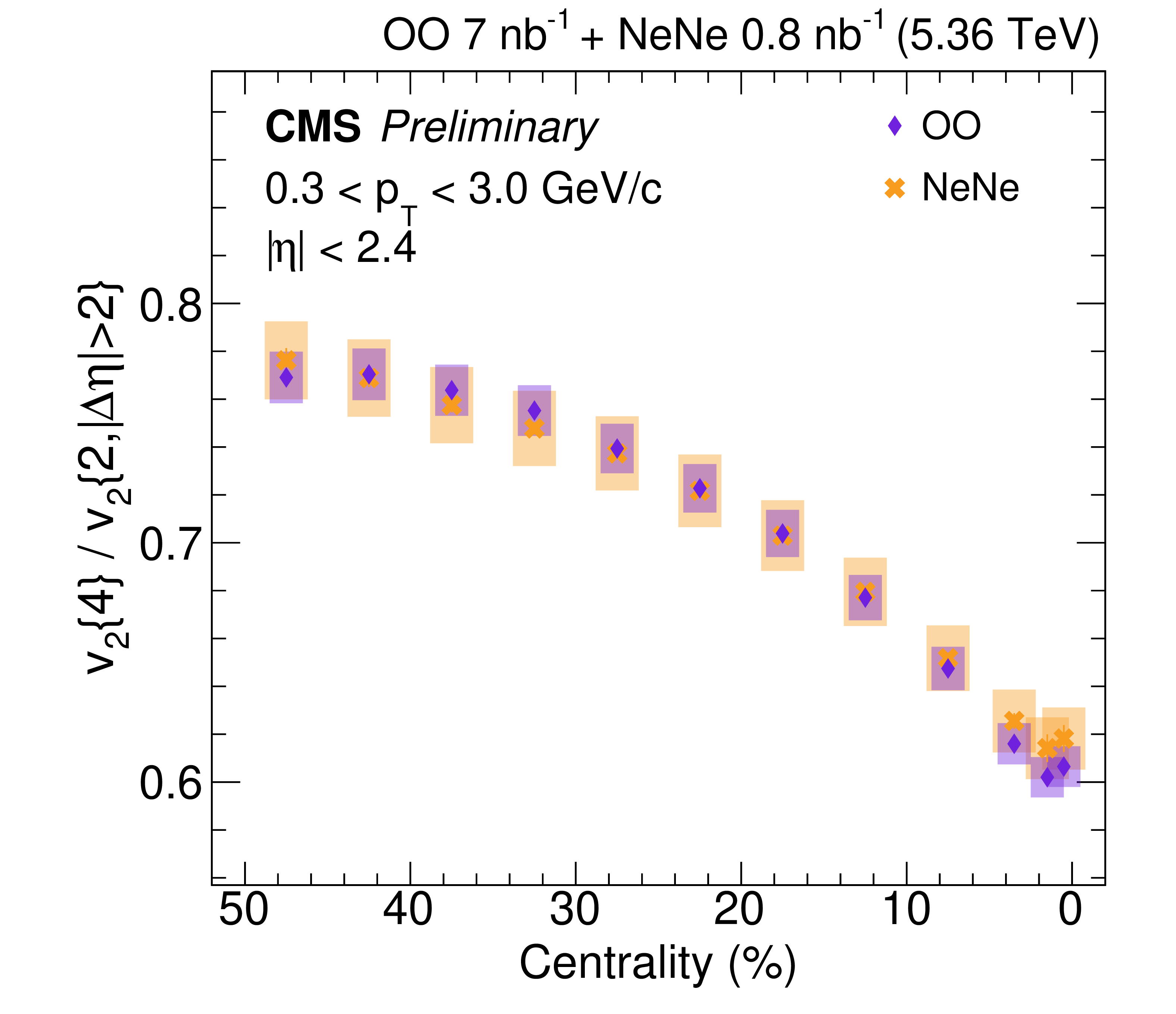
Figure 2:
Ratios between $ v_{2}\{4\} $ and $ v_{2}\{2,|\Delta\eta| > 2\} $ as functions of centrality in OO and NeNe collisions at $ \sqrt{\smash[b]{s_{_{\mathrm{NN}}}}} = $ 5.36 TeV. Vertical error bars correspond to statistical uncertainties, while the shaded boxes denote the systematic uncertainties. |
png pdf |
Figure 3:
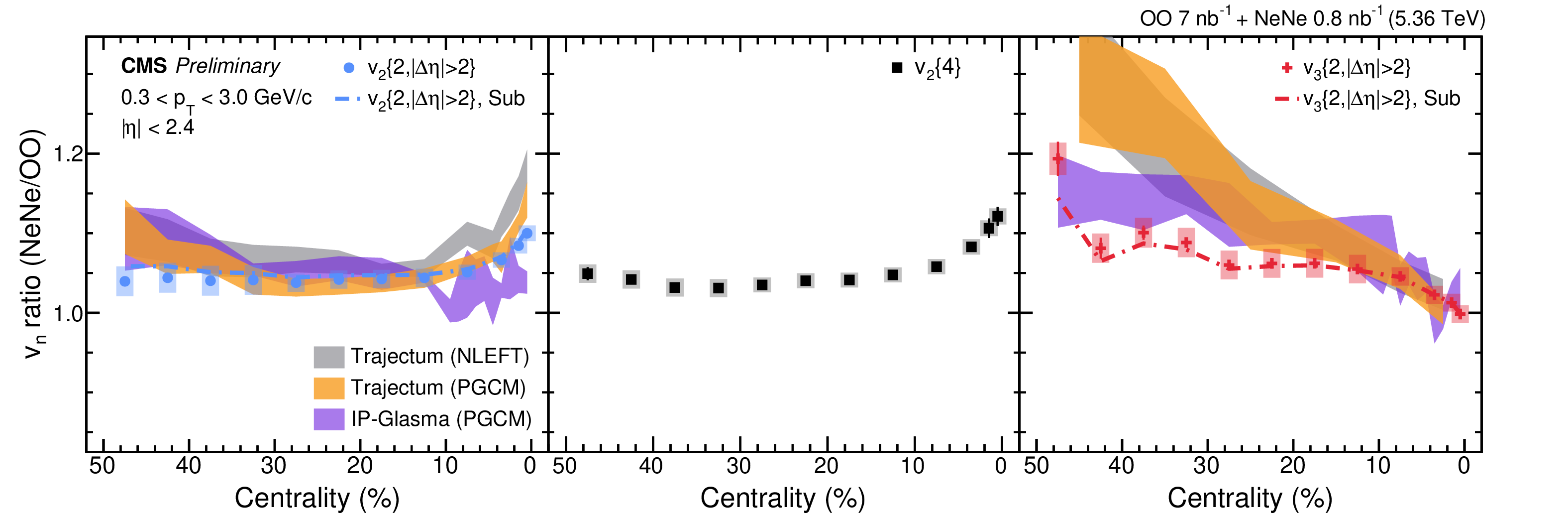
The ratios of $ v_{2}\{2,|\Delta\eta| > 2\} $ (left), $ v_{2}\{4\} $ (middle), and $ v_{3}\{2,|\Delta\eta| > 2\} $(right) values in NeNe and OO collisions as functions of centrality. The results after subtracting correlations from the 70-80% centrality range are shown as dot-dashed lines. Model calculations with different initial conditions [53,69] are plotted for comparison. Vertical error bars correspond to statistical uncertainties, while the shaded boxes denote the systematic uncertainties. |
png pdf |
Figure 4:
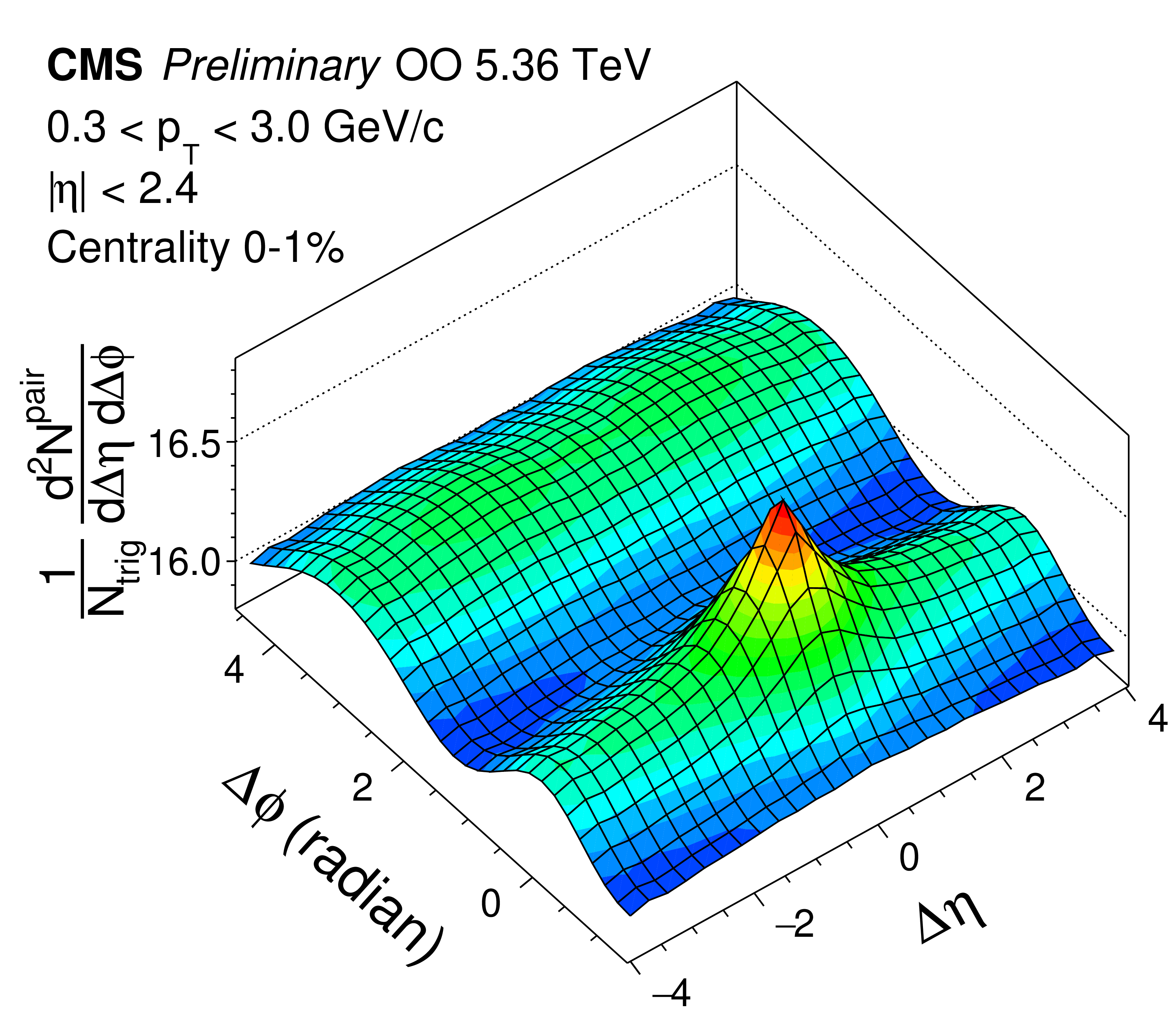
The two-dimensional per-trigger-particle associated yield for charged particles with 0.3 $ < p_{\mathrm{T}} < $ 3.0 GeV/$c$ and $ |\eta| < $ 2.4 for events with centrality 0-1% in OO collisions at $ \sqrt{\smash[b]{s_{_{\mathrm{NN}}}}} = $ 5.36 TeV. |
png pdf |
Figure 5:
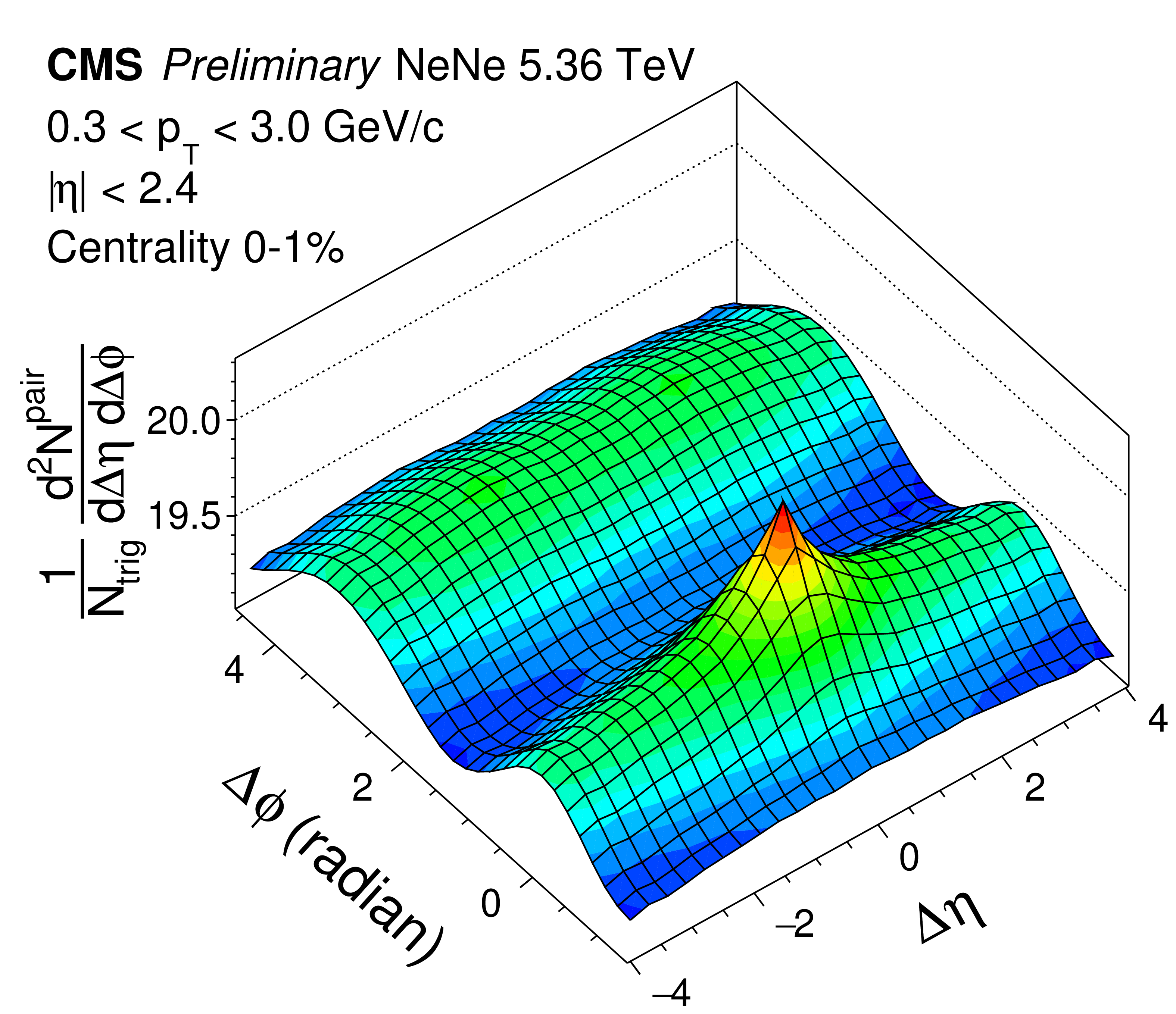
The two-dimensional per-trigger-particle associated yield for charged particles with 0.3 $ < p_{\mathrm{T}} < $ 3.0 GeV/$c$ and $ |\eta| < $ 2.4 for events with centrality 0-1% in NeNe collisions at $ \sqrt{\smash[b]{s_{_{\mathrm{NN}}}}} = $ 5.36 TeV. |
png pdf |
Figure 6:
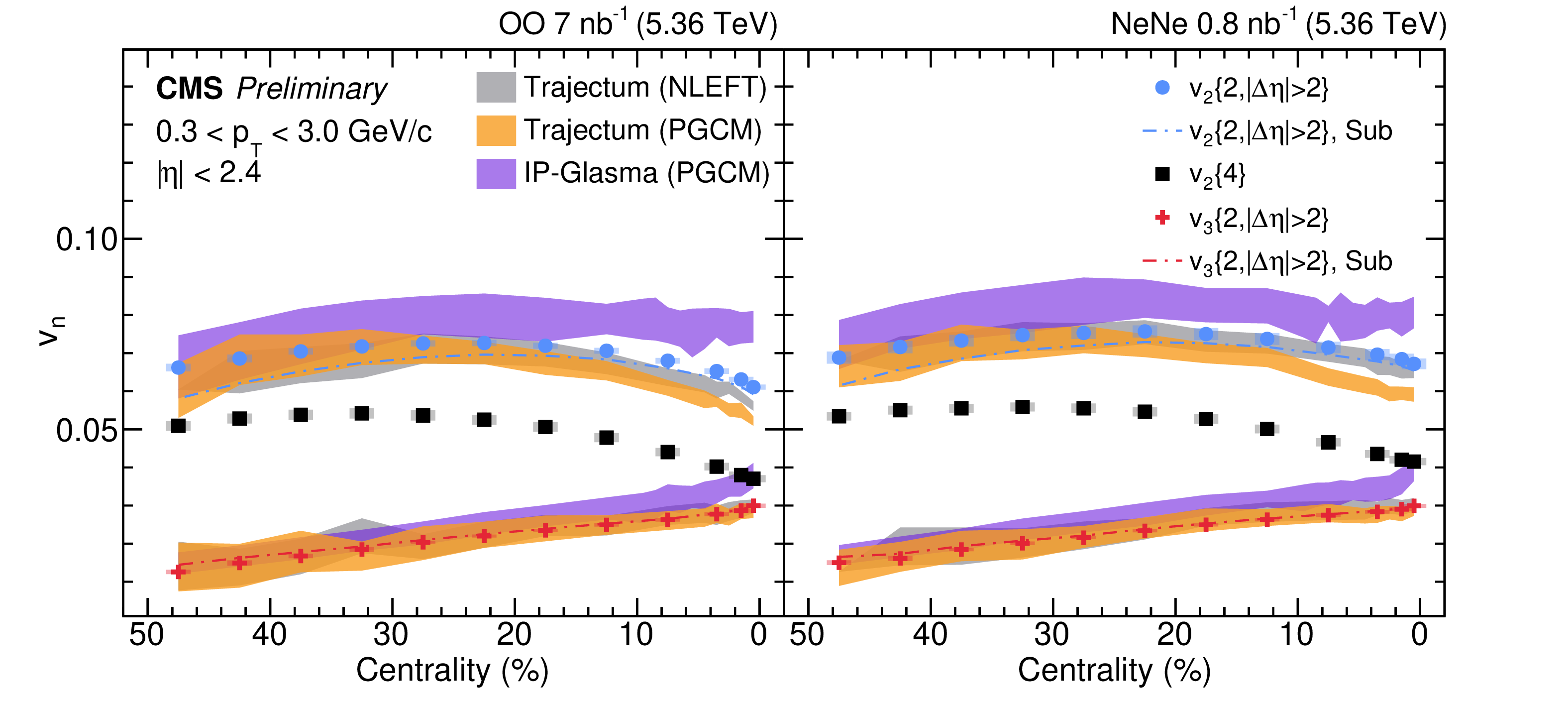
Results of $ v_{2}\{2,|\Delta\eta| > 2\} $, $ v_{3}\{2,|\Delta\eta| > 2\} $ and $ v_{2}\{4\} $ for charged particles with 0.3 $ < p_{\mathrm{T}} < $ 3.0 GeV/$c$ and $ |\eta| < $ 2.4 as functions of centrality in OO (left) and NeNe (right) collisions at $ \sqrt{\smash[b]{s_{_{\mathrm{NN}}}}} = $ 5.36 TeV. The $ v_{2}\{2,|\Delta\eta| > 2\} $ and $ v_{3}\{2,|\Delta\eta| > 2\} $ results after subtracting correlations from the 70-80% centrality range are shown as dot-dashed lines. Model calculations for $ v_{2}\{2,|\Delta\eta| > 2\} $ and $ v_{3}\{2,|\Delta\eta| > 2\} $ with different initial conditions [53,69] are plotted for comparison. Vertical error bars correspond to statistical uncertainties, while the shaded boxes denote the systematic uncertainties. |

png pdf |
Figure 7:
The ratios of $ v_{2}\{2,|\Delta\eta| > 2\} $ (left), $ v_{2}\{4\} $ (middle), and $ v_{3}\{2,|\Delta\eta| > 2\} $(right) values in NeNe and OO collisions as functions of centrality. The results after subtracting correlations from the 70-80% centrality range are shown as dot-dashed lines. Vertical error bars correspond to statistical uncertainties, while the shaded boxes denote the systematic uncertainties. |

png pdf |
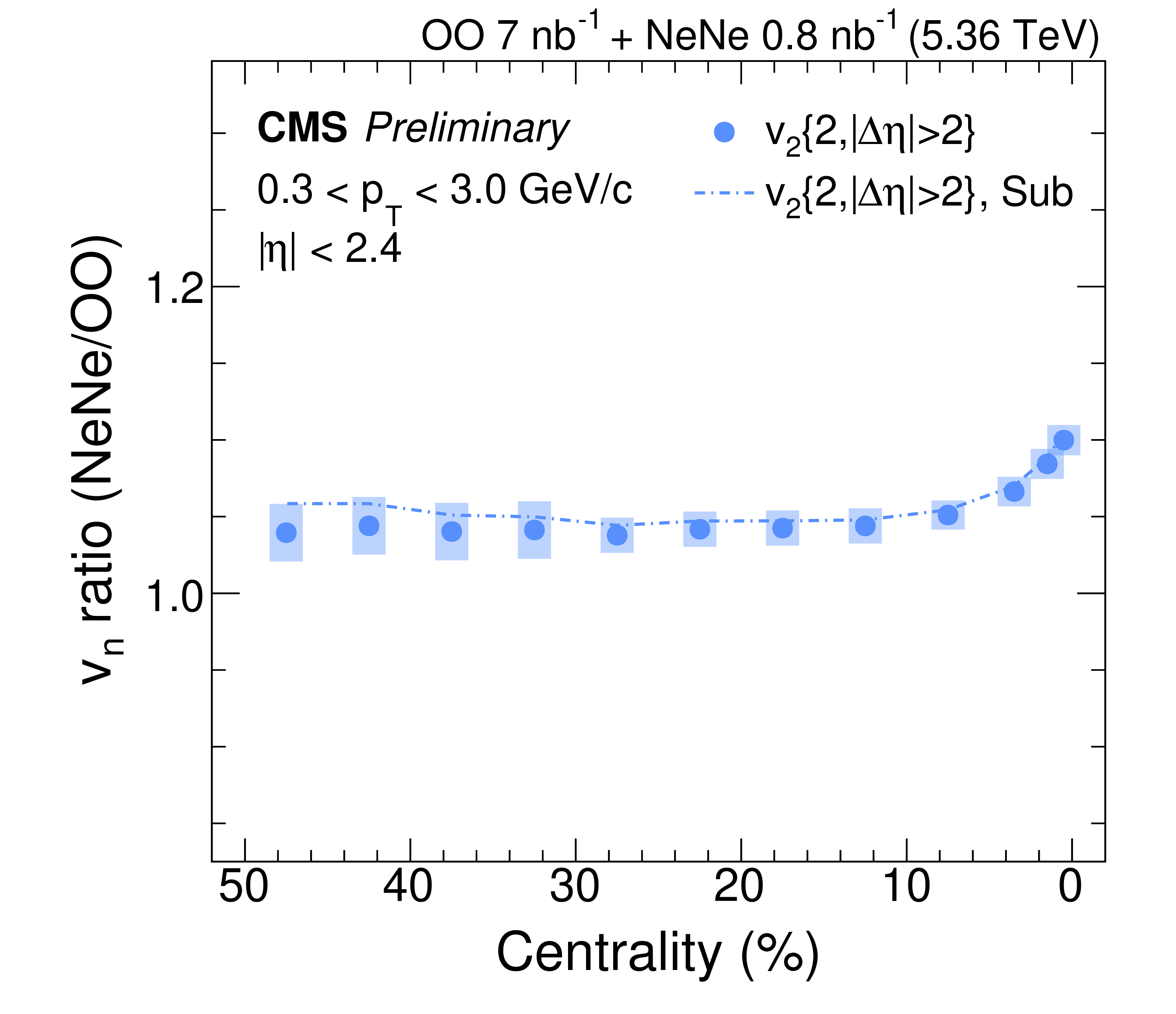
Figure 8:
The ratios of $ v_{2}\{2,|\Delta\eta| > 2\} $ values in NeNe and OO collisions as functions of centrality. The results after subtracting correlations from the 70-80% centrality range are shown as dot-dashed lines. Model calculations with different initial conditions [53,69] are plotted for comparison. Vertical error bars correspond to statistical uncertainties, while the shaded boxes denote the systematic uncertainties. |
png pdf |
Figure 9:
The ratios of $ v_{2}\{2,|\Delta\eta| > 2\} $ values in NeNe and OO collisions as functions of centrality. The results after subtracting correlations from the 70-80% centrality range are shown as dot-dashed lines. Vertical error bars correspond to statistical uncertainties, while the shaded boxes denote the systematic uncertainties. |

png pdf |
Figure 10:
The ratios of $ v_{2}\{4\} $ values in NeNe and OO collisions as functions of centrality. Vertical error bars correspond to statistical uncertainties, while the shaded boxes denote the systematic uncertainties. |
png pdf |
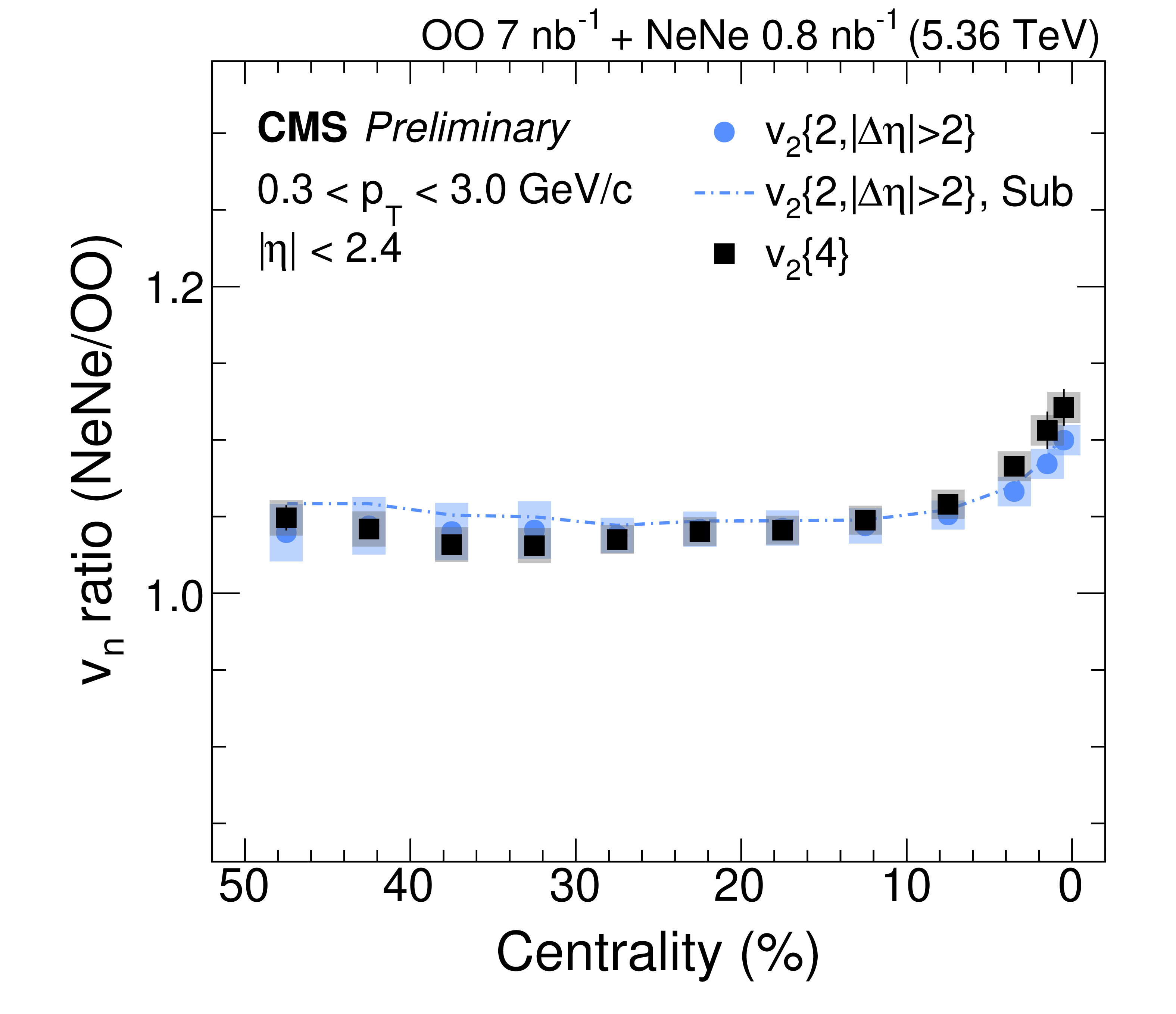
Figure 11:
The ratios of $ v_{2}\{2,|\Delta\eta| > 2\} $ and $ v_{2}\{4\} $ values in NeNe and OO collisions as functions of centrality. Vertical error bars correspond to statistical uncertainties, while the shaded boxes denote the systematic uncertainties. |

png pdf |
Figure 12:
The ratios of $ v_{3}\{2,|\Delta\eta| > 2\} $ values in NeNe and OO collisions as functions of centrality. The results after subtracting correlations from the 70-80% centrality range are shown as dot-dashed lines. Model calculations with different initial conditions [53,69] are plotted for comparison. Vertical error bars correspond to statistical uncertainties, while the shaded boxes denote the systematic uncertainties. |

png pdf |
Figure 13:
The ratios of $ v_{3}\{2,|\Delta\eta| > 2\} $ values in NeNe and OO collisions as functions of centrality. The results after subtracting correlations from the 70-80% centrality range are shown as dot-dashed lines. Vertical error bars correspond to statistical uncertainties, while the shaded boxes denote the systematic uncertainties. |
| Tables | |
png pdf |
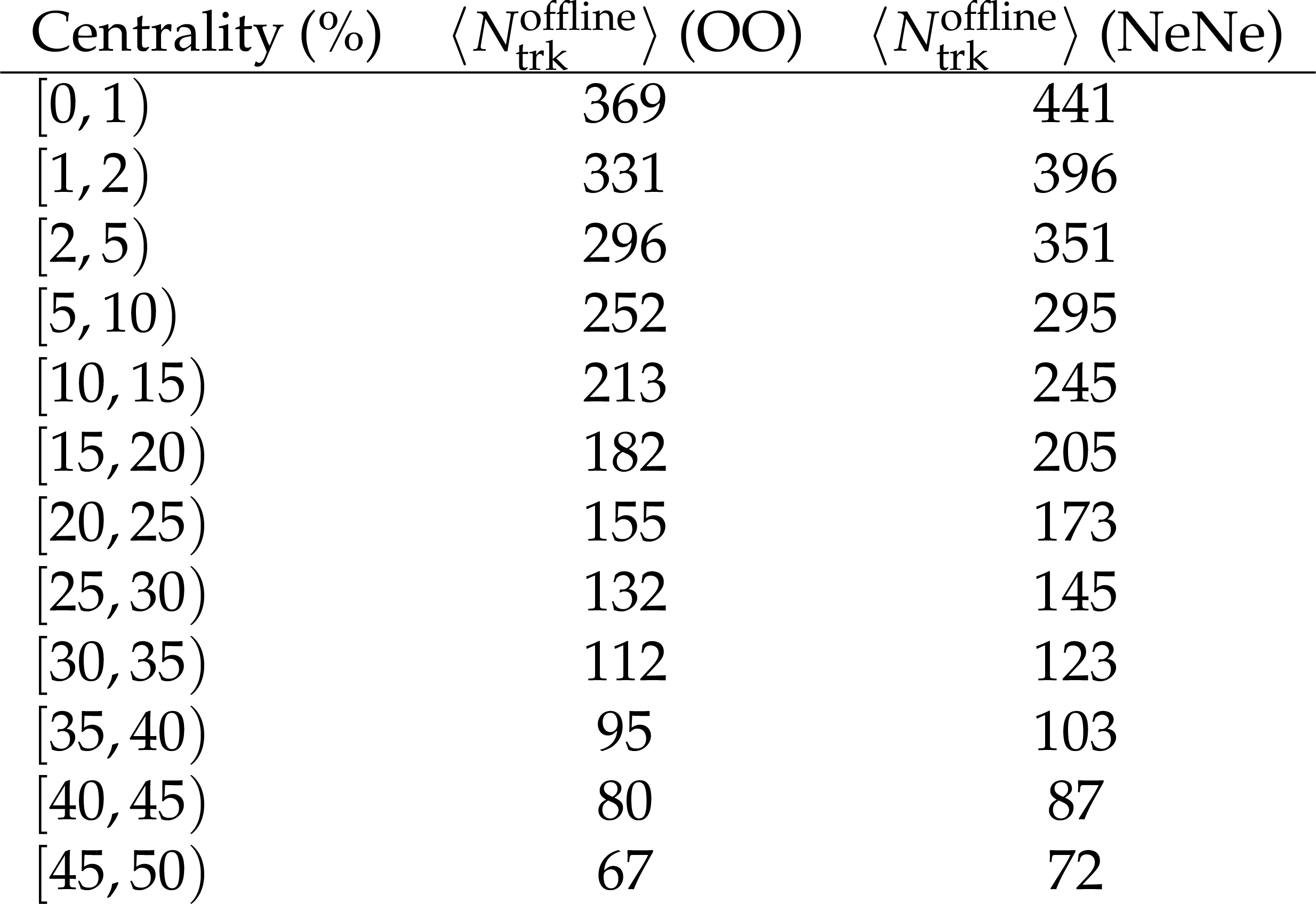
Table 1:
The average number of $ N_\text{trk}^\text{offline} $ in each centrality range in OO and NeNe collisions. |
| Summary |
| In summary, the azimuthal dependence of particle emission in OO and NeNe collisions at a center-of-mass energy per nucleon pair of 5.36 TeV is studied. The elliptic ($ v_2 $) and triangular ($ v_3 $) flow harmonics as a function of the collision overlap geometry are presented in the centrality range between 50 and 0%, where 0% corresponds to complete overlap of the colliding nuclei. The $ v_2 $ values based on two-particle correlations that require a pseudorapidity gap $ |\Delta\eta| > $ 2 between particles in a pair, $ v_{2}\{2,|\Delta\eta| > 2\} $, are compared to corresponding four-particle correlation values, $ v_2\{4\} $. The $ v_{2} $ results increase from peripheral to central collisions, reaching a maximum, and decrease towards the most central region, reflecting the initial geometry of the overlapping area of colliding nuclei. The ratio of $ v_{2}\{4\} $ to $ v_{2}\{2,|\Delta\eta| > 2\} $ shows a decreasing trend from peripheral to central collisions, similar to what is observed in PbPb collisions. The $ v_3 $ results based on two-particle correlations with a pseudorapidity gap requirement, $ v_{3}\{2,|\Delta\eta| > 2\} $, increase monotonically from peripheral to central collisions. This differs from the behavior in PbPb collisions. A significant increasing trend is observed in the ratio of $ v_{2}\{2,|\Delta\eta| > 2\} $ and $ v_{2}\{4\} $ values of NeNe over OO collisions in the most central region, while the ratio of $ v_{3}\{2,|\Delta\eta| > 2\} $ results is decreasing from peripheral to central collisions. Comparing hydrodynamic calculations with ab initio initial conditions implementing the nuclear deformation and $ \alpha $-clustering effects to the data, the $ v_{2}\{2,|\Delta\eta| > 2\} $ ratio results are better described by the Trajectum calculations using the projected generator coordinate method than either the nuclear lattice effective field theory calculation or the IP-Glasma+MUSIC calculation. The model calculations capture the decreasing trend of $ v_{3}\{2,|\Delta\eta| > 2\} $ ratio of NeNe over OO, but tend to over-estimate the magnitude of results in the 20-50% centrality region. These results shed light on how collective flow in small collision systems depends on the initial collision geometry, and provide important information on the nuclear deformation and $ \alpha $-clustering structure in O and Ne nuclei. |
| References | ||||
| 1 | E. V. Shuryak | Theory of hadronic plasma | Sov. Phys. JETP 47 (1978) 212 | |
| 2 | J. C. Collins and M. J. Perry | Superdense matter: neutrons or asymptotically free quarks? | PRL 34 (1975) 1353 | |
| 3 | B. H. Alver, C. Gombeaud, M. Luzum, and J.-Y. Ollitrault | Triangular flow in hydrodynamics and transport theory | Phys. Rev. C 82 (2010) 034913 | 1007.5469 |
| 4 | B. Schenke, S. Jeon, and C. Gale | Elliptic and triangular flow in event-by-event (3+1)D viscous hydrodynamics | PRL 106 (2011) 042301 | 1009.3244 |
| 5 | Z. Qiu, C. Shen, and U. Heinz | Hydrodynamic elliptic and triangular flow in Pb-Pb collisions at $ \sqrt{s}= $ 2.76ATeV | PLB 707 (2012) 151--155 | 1110.3033 |
| 6 | STAR Collaboration | Distributions of charged hadrons associated with high transverse momentum particles in pp and Au+Au collisions at $ \sqrt {\smash [b]{s_{_{\mathrm {NN}}}}} = $ 200 GeV | PRL 95 (2005) 152301 | nucl-ex/0501016 |
| 7 | STAR Collaboration | Long range rapidity correlations and jet production in high energy nuclear collisions | Phys. Rev. C 80 (2009) 064912 | 0909.0191 |
| 8 | PHOBOS Collaboration | High transverse momentum triggered correlations over a large pseudorapidity acceptance in Au+Au collisions at $ \sqrt {\smash [b]{s_{_{\mathrm {NN}}}}} = $ 200 GeV | PRL 104 (2010) 062301 | 0903.2811 |
| 9 | CMS Collaboration | Long-range and short-range dihadron angular correlations in central PbPb collisions at a nucleon-nucleon center of mass energy of 2.76 TeV | JHEP 07 (2011) 076 | CMS-HIN-11-001 1105.2438 |
| 10 | CMS Collaboration | Centrality dependence of dihadron correlations and azimuthal anisotropy harmonics in PbPb collisions at $ \sqrt {\smash [b]{s_{_{\mathrm {NN}}}}}= $ 2.76 TeV | EPJC 72 (2012) 2012 | CMS-HIN-11-006 1201.3158 |
| 11 | ALICE Collaboration | Elliptic flow of charged particles in Pb-Pb collisions at 2.76 TeV | PRL 105 (2010) 252302 | 1011.3914 |
| 12 | ATLAS Collaboration | Measurement of the azimuthal anisotropy for charged particle production in $ \sqrt {\smash [b]{s_{_{\mathrm {NN}}}}}= $ 2.76 TeV lead-lead collisions with the ATLAS detector | Phys. Rev. C 86 (2012) 014907 | 1203.3087 |
| 13 | CMS Collaboration | Measurement of the elliptic anisotropy of charged particles produced in PbPb collisions at $ \sqrt{s}_{NN} = $ 2.76 TeV | Phys. Rev. C 87 (2013) 014902 | CMS-HIN-10-002 1204.1409 |
| 14 | CMS Collaboration | Studies of azimuthal dihadron correlations in ultra-central PbPb collisions at $ \sqrt {\smash [b]{s_{_{\mathrm {NN}}}}} = $ 2.76 TeV | JHEP 02 (2014) 088 | CMS-HIN-12-011 1312.1845 |
| 15 | CMS Collaboration | Overview of high-density QCD studies with the CMS experiment at the LHC | Accepted by Physics Reports, 2024 | CMS-HIN-23-011 2405.10785 |
| 16 | CMS Collaboration | Observation of long-range near-side angular correlations in proton-proton collisions at the LHC | JHEP 09 (2010) 091 | CMS-QCD-10-002 1009.4122 |
| 17 | ATLAS Collaboration | Observation of long-range elliptic azimuthal anisotropies in $ \sqrt{s}= $ 13 and 2.76 TeV pp collisions with the ATLAS detector | PRL 116 (2016) 172301 | 1509.04776 |
| 18 | CMS Collaboration | Measurement of long-range near-side two-particle angular correlations in pp collisions at $ \sqrt{s}= $ 13 TeV | PRL 116 (2016) 172302 | CMS-FSQ-15-002 1510.03068 |
| 19 | CMS Collaboration | Evidence for collectivity in pp collisions at the LHC | PLB 765 (2017) 193 | CMS-HIN-16-010 1606.06198 |
| 20 | CMS Collaboration | Studies of charm and beauty hadron long-range correlations in pp and pPb collisions at LHC energies | PLB 813 (2021) 136036 | CMS-HIN-19-009 2009.07065 |
| 21 | CMS Collaboration | Observation of long-range near-side angular correlations in proton-lead collisions at the LHC | PLB 718 (2013) 795 | CMS-HIN-12-015 1210.5482 |
| 22 | ALICE Collaboration | Long-range angular correlations on the near and away side in pPb collisions at $ {\sqrt{\smash[b]{s_{_{\mathrm{NN}}}}}}= $ 5.02 TeV | PLB 719 (2013) 29 | 1212.2001 |
| 23 | ATLAS Collaboration | Observation of associated near-side and away-side long-range correlations in $ {\sqrt{\smash[b]{s_{_{\mathrm{NN}}}}}}= $ 5.02 TeV proton-lead collisions with the ATLAS detector | PRL 110 (2013) 182302 | 1212.5198 |
| 24 | LHCb Collaboration | Measurements of long-range near-side angular correlations in $ {\sqrt{\smash[b]{s_{_{\mathrm{NN}}}}}}= $ 5 TeV proton-lead collisions in the forward region | PLB 762 (2016) 473 | 1512.00439 |
| 25 | CMS Collaboration | Elliptic flow of charm and strange hadrons in high-multiplicity pPb collisions at $ {\sqrt{\smash[b]{s_{_{\mathrm{NN}}}}}}= $ 8.16 TeV | PRL 121 (2018) 082301 | CMS-HIN-17-003 1804.09767 |
| 26 | CMS Collaboration | Observation of prompt J/$ \psi $ meson elliptic flow in high-multiplicity pPb collisions at $ {\sqrt{\smash[b]{s_{_{\mathrm{NN}}}}}}= $ 8.16 TeV | PLB 791 (2019) 172 | CMS-HIN-18-010 1810.01473 |
| 27 | CMS Collaboration | Strange hadron collectivity in pPb and PbPb collisions | JHEP 05 (2023) 007 | CMS-HIN-19-004 2205.00080 |
| 28 | PHENIX Collaboration | Creation of quark-gluon plasma droplets with three distinct geometries | Nature Phys. 15 (2019) 214 | 1805.02973 |
| 29 | STAR Collaboration | Measurements of the elliptic and triangular azimuthal anisotropies in central $ ^{3}\mathrm{He}+\mathrm{Au} $, $ d+\mathrm{Au} $ and $ p+\mathrm{Au} $ collisions at $ {\sqrt{\smash[b]{s_{_{\mathrm{NN}}}}}}= $ 200 GeV | PRL 130 (2023) 242301 | 2210.11352 |
| 30 | J. L. Nagle and W. A. Zajc | Small system collectivity in relativistic hadronic and nuclear collisions | Ann. Rev. Nucl. Part. Sci. 68 (2018) 211 | 1801.03477 |
| 31 | K. Dusling, W. Li, and B. Schenke | Novel collective phenomena in high-energy proton-proton and proton-nucleus collisions | Int. J. Mod. Phys. E 25 (2016) 1630002 | 1509.07939 |
| 32 | B. Schenke | The smallest fluid on earth | Rept. Prog. Phys. 84 (2021) 082301 | 2102.11189 |
| 33 | W. Zhao, S. Ryu, C. Shen, and B. Schenke | 3D structure of anisotropic flow in small collision systems at energies available at the BNL Relativistic Heavy Ion Collider | Phys. Rev. C 107 (2023) 014904 | 2211.16376 |
| 34 | P. Bozek and W. Broniowski | The torque effect and fluctuations of entropy deposition in rapidity in ultra-relativistic nuclear collisions | PLB 752 (2016) 206--211 | 1506.02817 |
| 35 | CMS Collaboration | Charged-particle angular correlations in XeXe collisions at $ \sqrt{s_{_\mathrm{NN}}}= $ 5.44 TeV | Phys. Rev. C 100 (2019) 044902 | CMS-HIN-18-001 1901.07997 |
| 36 | H. Li et al. | Probing the neutron skin with ultrarelativistic isobaric collisions | PRL 125 (2020) 222301 | 1910.06170 |
| 37 | H.-j. Xu et al. | Probing nuclear structure with mean transverse momentum in relativistic isobar collisions | Phys. Rev. C 108 (2023) L011902 | 2111.14812 |
| 38 | C. Zhang and J. Jia | Evidence of quadrupole and octupole deformations in $ ^{96}\mathrm{Zr} $+$ ^{96}\mathrm{Zr} $ and $ ^{96}\mathrm{Ru} $+$ ^{96}\mathrm{Ru} $ collisions at ultrarelativistic energies | PRL 128 (2022) 022301 | 2109.01631 |
| 39 | W. Ryssens, G. Giacalone, B. Schenke, and C. Shen | Evidence of hexadecapole deformation in uranium-238 at the Relativistic Heavy Ion Collider | PRL 130 (2023) 212302 | 2302.13617 |
| 40 | H.-j. Xu, J. Zhao, and F. Wang | Hexadecapole deformation of $ ^{238}\mathrm{U} $ from relativistic heavy-ion collisions using a nonlinear response coefficient | PRL 132 (2024) 262301 | 2402.16550 |
| 41 | STAR Collaboration | Imaging shapes of atomic nuclei in high-energy nuclear collisions | Nature 635 (2024) 67--72 | 2401.06625 |
| 42 | G. Giacalone et al. | Anisotropic flow in fixed-target $ ^{208}\mathrm{Pb} $+$ ^{20}\mathrm{Ne} $ collisions as a probe of quark-gluon plasma | PRL 134 (2025) 082301 | 2405.20210 |
| 43 | D. Robson | Evidence for the tetrahedral nature of $ ^{16}\mathrm{O} $ | PRL 42 (1979) 876--879 | |
| 44 | L. Pauling | Comment on the test for tetrahedral symmetry in the $ ^{16}\mathrm{O} $ nucleus and its relation to the shell model | PRL 49 (1982) 1119--1119 | |
| 45 | R. Bijker and F. Iachello | Evidence for tetrahedral symmetry in $ ^{16}\mathrm{O} $ | PRL 112 (2014) 152501 | 1403.6773 |
| 46 | S. Marcos, H. Flocard, and P. H. Heenen | Influence of left-right asymmetry degrees of freedom in self-consistent calculations of $ ^{20}\mathrm{Ne} $ | Nucl. Phys. A 410 (1983) 125--136 | |
| 47 | L. M. Robledo and G. F. Bertsch | Global systematics of octupole excitations in even-even nuclei | Phys. Rev. C 84 (2011) 054302 | 1107.3581 |
| 48 | P. Marevicet al. | Quadrupole and octupole collectivity and cluster structures in neon isotopes | Phys. Rev. C 97 (2018) 024334 | 1802.02873 |
| 49 | E. Epelbaum et al. | Ab initio calculation of the spectrum and structure of $ ^{16}\mathrm{O} $ | PRL 112 (2014) 102501 | 1312.7703 |
| 50 | S. C. Pieper, K. Varga, and R. B. Wiringa | Quantum Monte Carlo calculations of A=9, A=10 nuclei | Phys. Rev. C 66 (2002) 044310 | nucl-th/0206061 |
| 51 | D. Lee | Lattice simulations for few- and many-body systems | Prog. Part. Nucl. Phys. 63 (2009) 117--154 | 0804.3501 |
| 52 | C. Zhang et al. | Ab-initio nucleon-nucleon correlations and their impact on high energy $ ^{16}\mathrm{O} $+$ ^{16}\mathrm{O} $ collisions | PLB 862 (2025) 139322 | 2404.08385 |
| 53 | G. Giacalone et al. | Exploiting $ ^{20}\mathrm{Ne} $ isotopes for precision characterizations of collectivity in small systems | PRL 135 (2025) 012302 | 2402.05995 |
| 54 | CMS Collaboration | Description and performance of track and primary-vertex reconstruction with the CMS tracker | JINST 9 (2014) P10009 | CMS-TRK-11-001 1405.6569 |
| 55 | CMS Collaboration | The CMS experiment at the CERN LHC | JINST 3 (2008) S08004 | |
| 56 | CMS Collaboration | Development of the CMS detector for the CERN LHC Run 3 | JINST 19 (2024) P05064 | CMS-PRF-21-001 2309.05466 |
| 57 | CMS Collaboration | Observation and studies of jet quenching in PbPb collisions at nucleon-nucleon center-of-mass energy $ \sqrt{s_{_\mathrm{NN}}} = $ 2.76 TeV | Phys. Rev. C 84 (2011) 024906 | CMS-HIN-10-004 1102.1957 |
| 58 | CMS Collaboration | Multiplicity and transverse momentum dependence of two- and four-particle correlations in pPb and PbPb collisions | PLB 724 (2013) 213 | CMS-HIN-13-002 1305.0609 |
| 59 | CMS Collaboration | Long-range two-particle correlations of strange hadrons with charged particles in pPb and PbPb collisions at LHC energies | PLB 742 (2015) 200 | CMS-HIN-14-002 1409.3392 |
| 60 | CMS Collaboration | Evidence for collective multi-particle correlations in pPb collisions | PRL 115 (2015) 012301 | CMS-HIN-14-006 1502.05382 |
| 61 | A. Bilandzic, R. Snellings, and S. Voloshin | Flow analysis with cumulants: Direct calculations | Phys. Rev. C 83 (2011) 044913 | 1010.0233 |
| 62 | CMS Collaboration | Measurement of higher-order harmonic azimuthal anisotropy in PbPb collisions at $ \sqrt {\smash [b]{s_{_{\mathrm {NN}}}}} = $ 2.76 TeV | Phys. Rev. C 89 (2014) 044906 | CMS-HIN-11-005 1310.8651 |
| 63 | J.-Y. Ollitrault, A. M. Poskanzer, and S. A. Voloshin | Effect of flow fluctuations and nonflow on elliptic flow methods | Phys. Rev. C 80 (2009) 014904 | 0904.2315 |
| 64 | ATLAS Collaboration | Measurement of flow harmonics with multi-particle cumulants in Pb+Pb collisions at $ \sqrt{s_{\mathrm {NN}}}= $ 2.76 TeV with the ATLAS detector | EPJC 74 (2014) 3157 | 1408.4342 |
| 65 | M. Frosini et al. | In-medium $ k $-body reduction of $ n $-body operators: A flexible symmetry-conserving approach based on the sole one-body density matrix | Eur. Phys. J. A 57 (2021) 151 | 2102.10120 |
| 66 | J. M. Yao et al. | Ab initio treatment of collective correlations and the neutrinoless double beta decay of $ ^{48} $Ca | PRL 124 (2020) 232501 | 1908.05424 |
| 67 | T. A. Lähde and U.-G. Meißner | Nuclear Lattice Effective Field Theory: An introduction | ISBN 978-3-030-14187-5, 978-3-030-14189-9, 2019 link |
|
| 68 | D. Lee | Recent progress in nuclear lattice simulations | Front. in Phys. 8 (2020) 174 | |
| 69 | H. Mäntysaari, B. Schenke, C. Shen, and W. Zhao | Collision-energy dependence in heavy-ion collisions from nonlinear QCD evolution | PRL 135 (2025) 022302 | 2502.05138 |
|
|
Compact Muon Solenoid LHC, CERN |

|
|
|
|
|
|