Compact Muon Solenoid
LHC, CERN
 Visit us: CMS Public Website, CMS Physics ;
Contact us: CMS Publications Committee
Visit us: CMS Public Website, CMS Physics ;
Contact us: CMS Publications Committee
| CMS-EXO-24-031 ; CERN-EP-2025-235 | ||
| Search for light pseudoscalar bosons, pair-produced in Higgs boson decays in the four-electron final state in proton-proton collisions at $ \sqrt{s} = $ 13 TeV | ||
| CMS Collaboration | ||
| 24 November 2025 | ||
| Accepted for publication in Phys. Rev. Lett. | ||
| Abstract: A search for pairs of light neutral pseudoscalar bosons (A) resulting from the decay of a Higgs boson is performed. The search is conducted using LHC proton-proton collision data at $ \sqrt{s} = $ 13 TeV, collected with the CMS detector in 2016--2018 and corresponding to an integrated luminosity of 138 fb$ ^{-1} $. The A boson decays into a highly collimated electron-positron pair. A novel multivariate algorithm using tracks and calorimeter information is developed to identify these distinctive signatures, and events are selected with two such merged electron-positron pairs. No significant excess above the standard model background predictions is observed. Upper limits on the branching fraction for $ \mathrm{H}\to {\mathrm{A}} {\mathrm{A}} \to4\mathrm{e} $ are set at 95% confidence level, for masses between 10 and 100 MeV and proper decay lengths below 100 m, reaching branching fraction sensitivities as low as 10$^{-5} $. This is the first search for Higgs boson decays to four electrons via light pseudoscalars at the LHC. It significantly improves the experimental sensitivity to axion-like particles with masses below 100 MeV. | ||
| Links: e-print arXiv:2511.19563 [hep-ex] (PDF) ; CDS record ; inSPIRE record ; HepData record ; Physics Briefing ; CADI line (restricted) ; | ||
| Figures | |
png pdf |
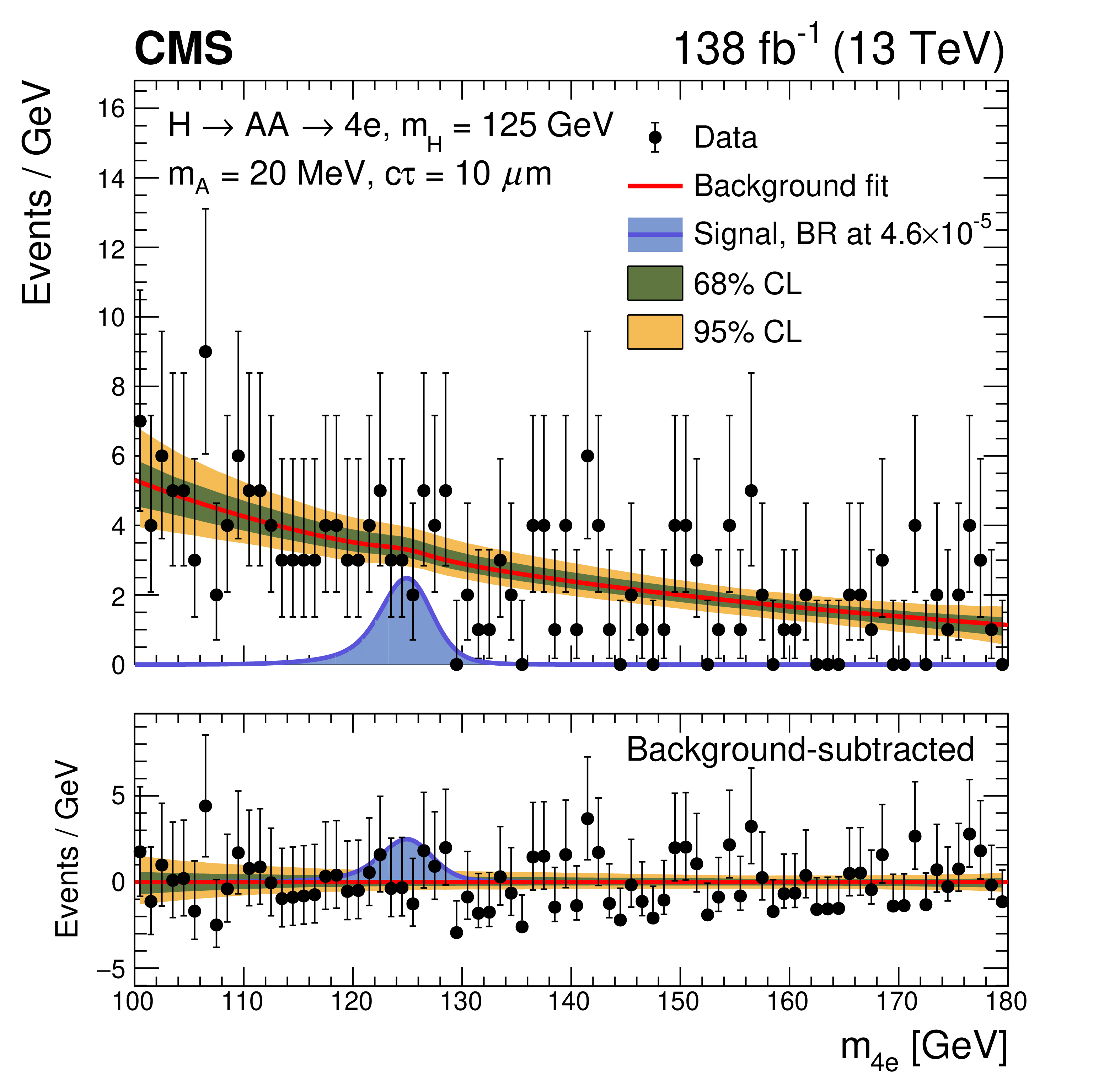
Figure 1:
Invariant mass distribution of the four-electron system ($ m_{4\mathrm{e}} $) for selected events (points), compared to the background-only fit (red) with its 68% and 95% CL uncertainty bands (green and yellow). A non-stacked benchmark signal (blue) for a Higgs boson decaying to a pair of ALPs with $ m_{ {\mathrm{A}} }= $ 20 MeV and $ c\tau= $ 10 $\mu$m is overlaid and normalized to a branching ratio of 4.6 $ \times$ 10$^{-5} $, which corresponds to the 95% CL upper limit value set by this analysis. The lower panel shows the same data after subtracting the background fit. |
png pdf |
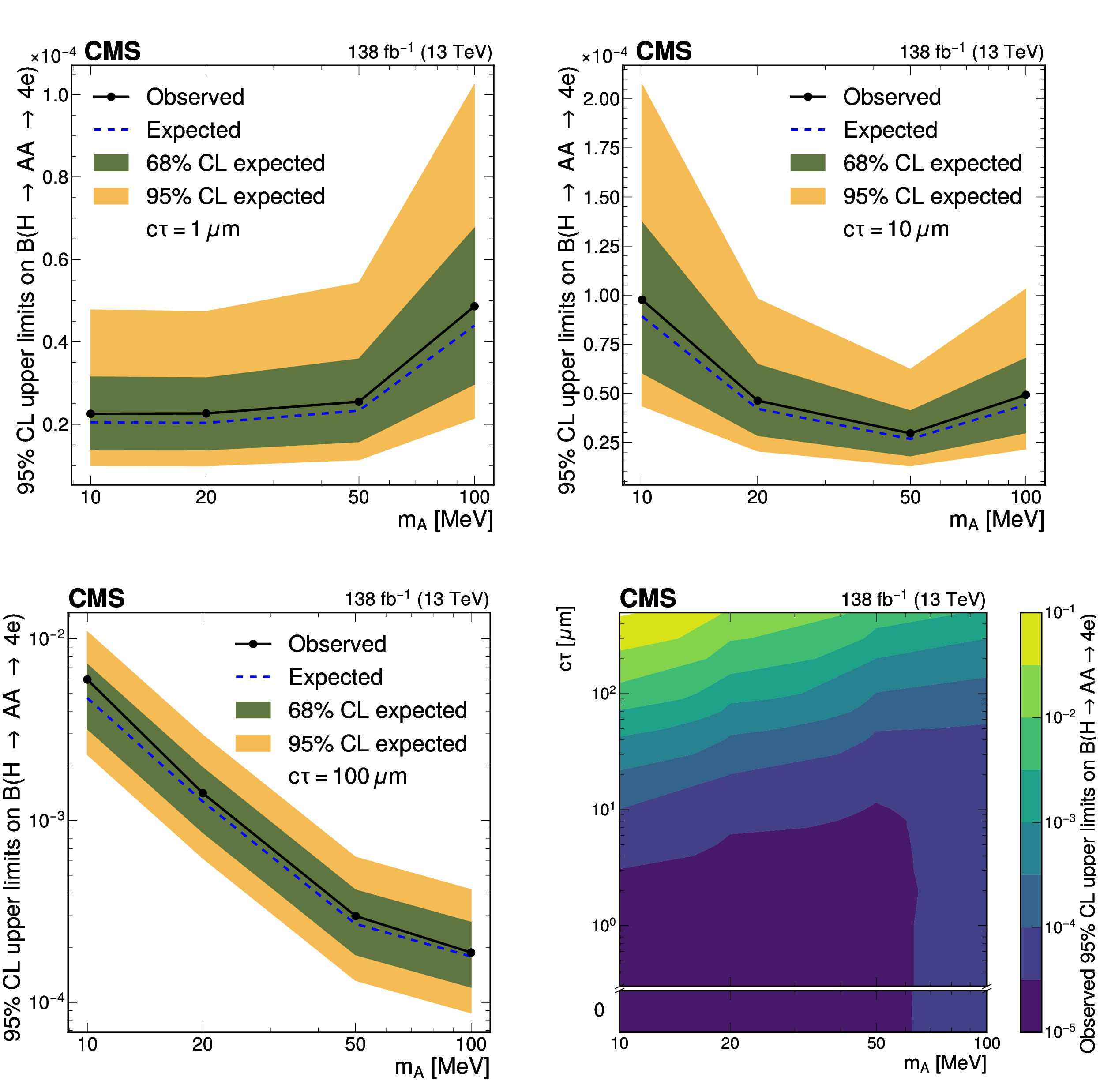
Figure 2:
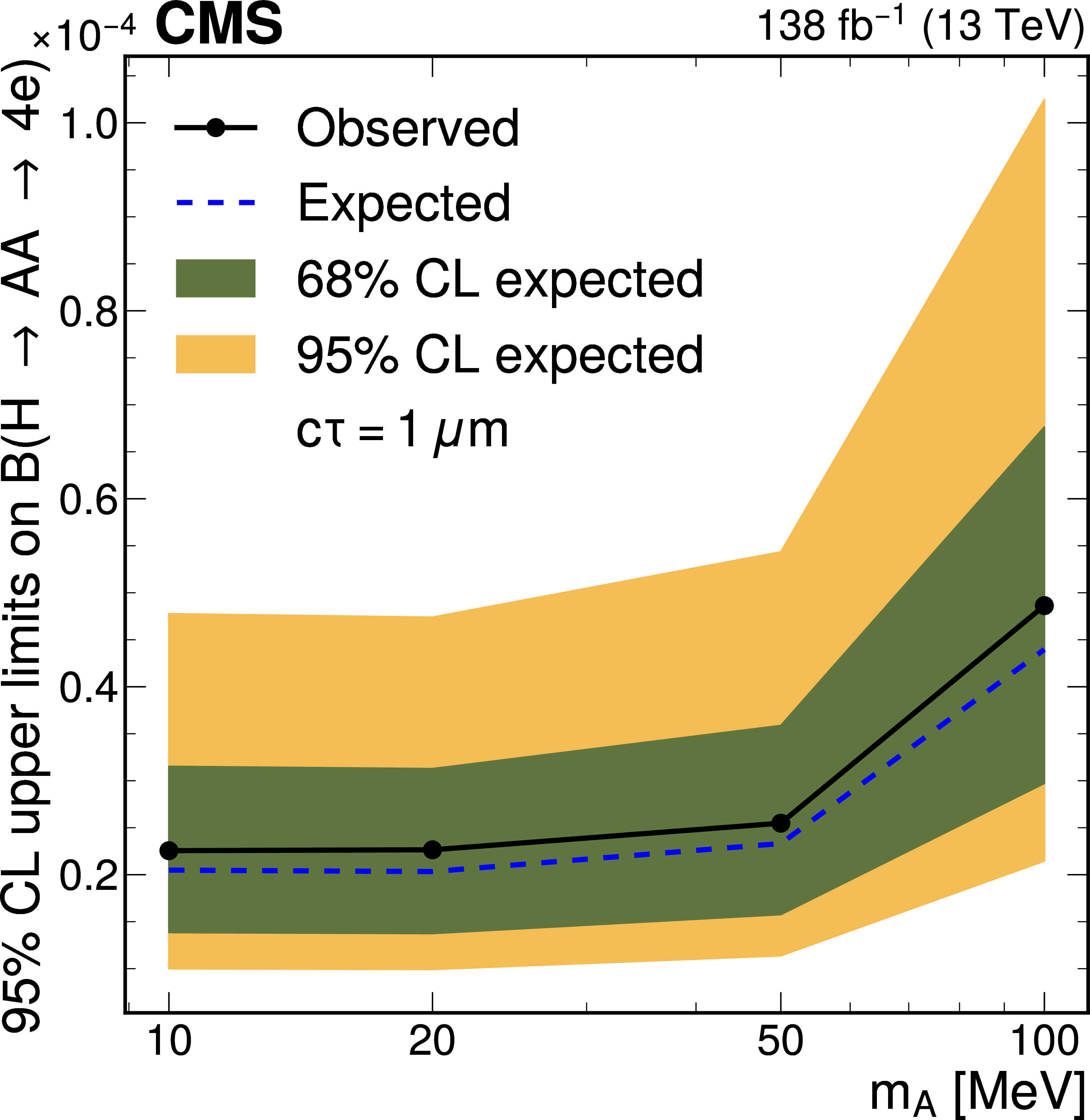
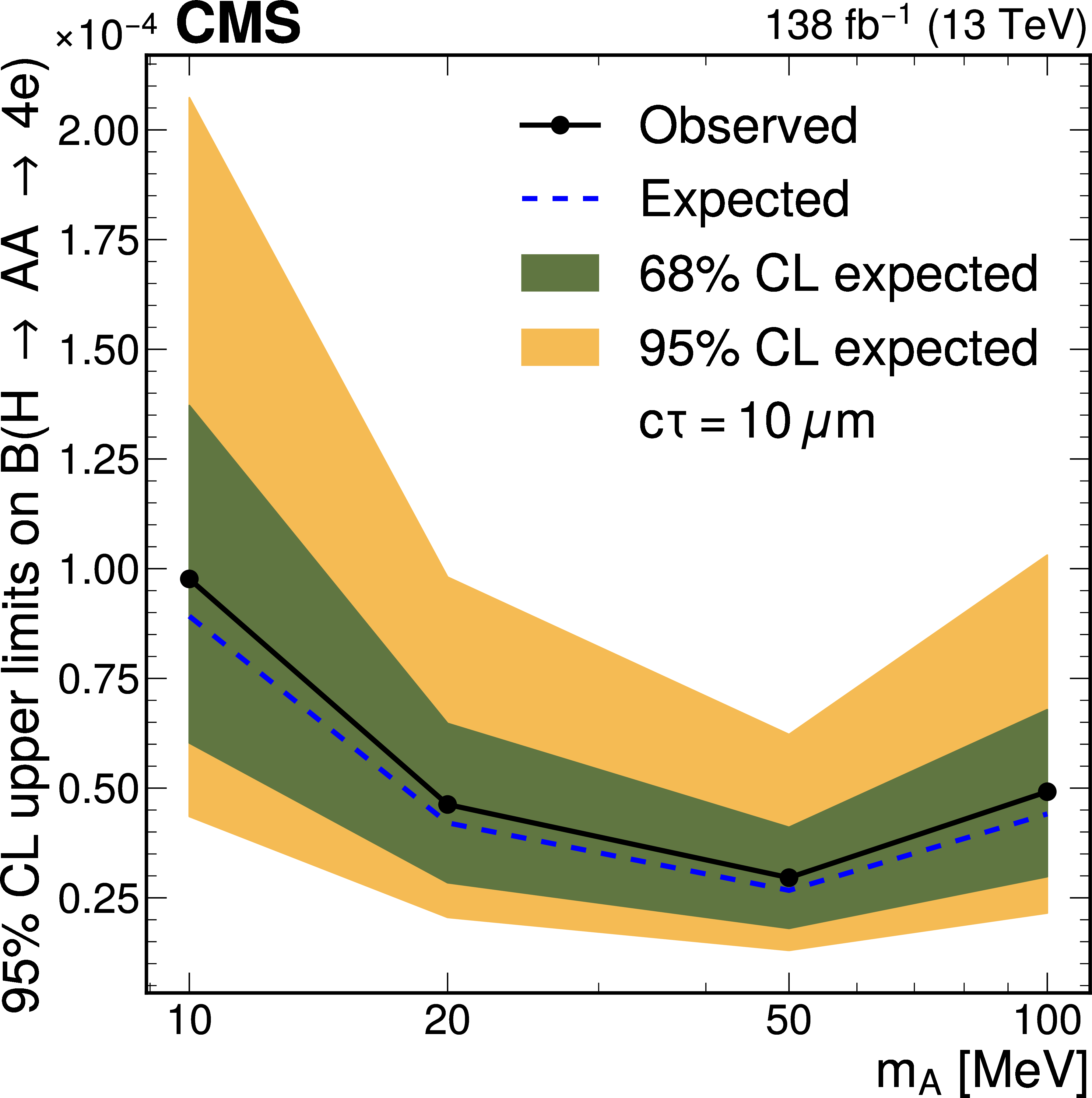
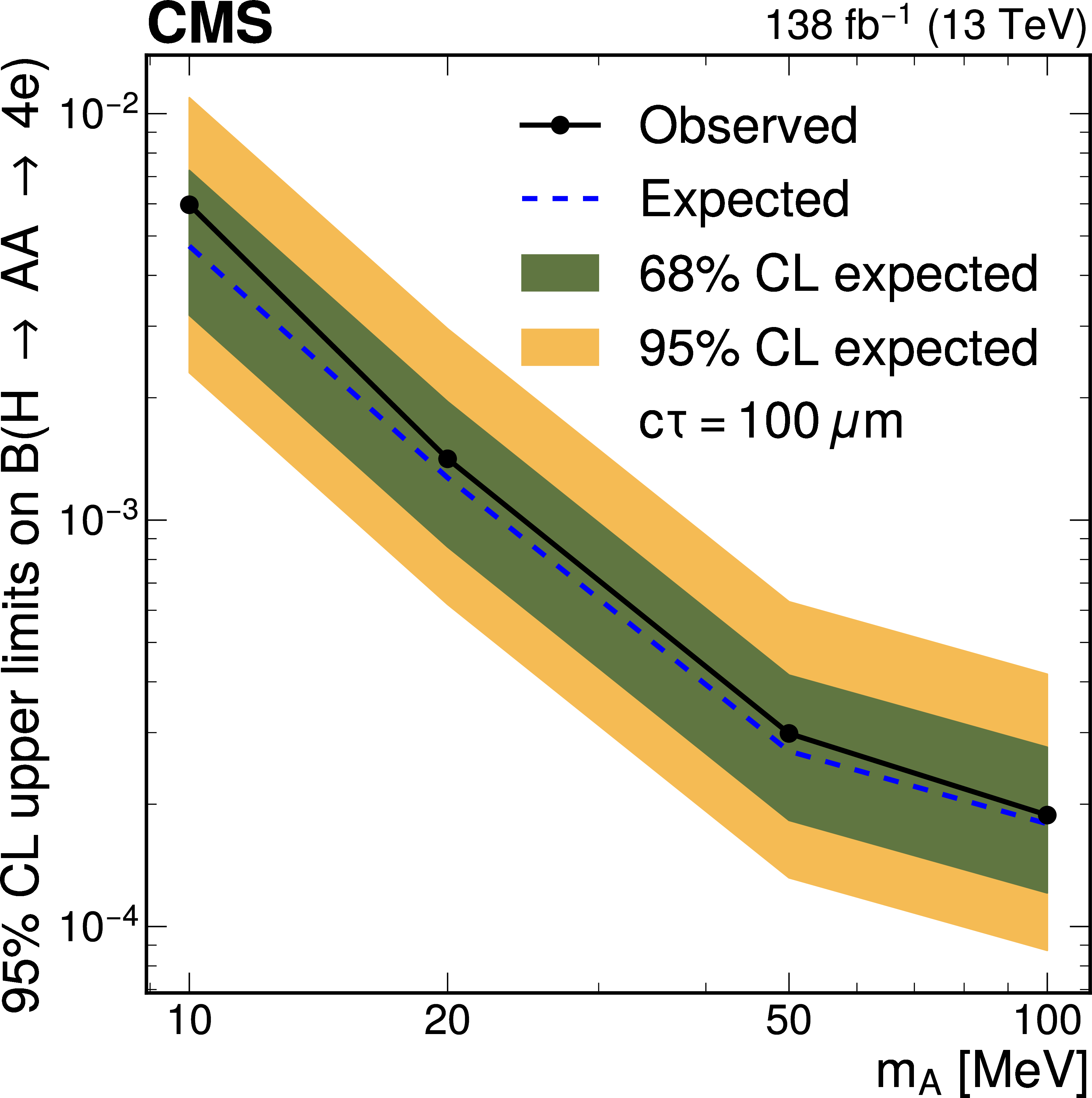
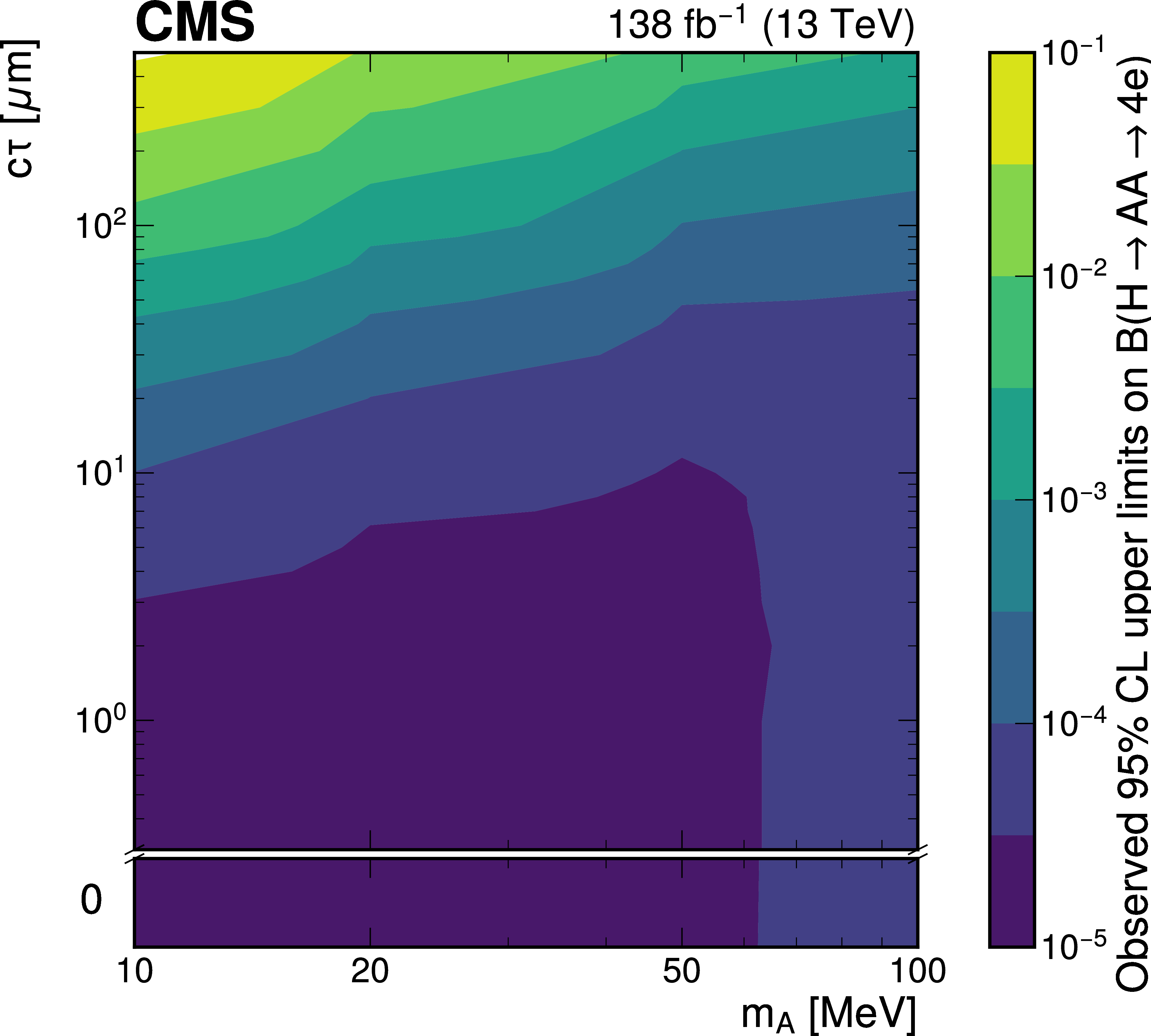
Observed (solid points) and expected (dashed lines) 95% CL upper limits on the Higgs boson branching fraction to a pair of ALPs decaying into electron-positron pairs ($ \mathrm{H}\to {\mathrm{A}} {\mathrm{A}} \to\mathrm{e}\mathrm{e} $), shown as a function of the ALP mass for benchmark proper decay lengths of 1 m (upper left), 10 m (upper right), and 100 m (lower left). The green and yellow bands represent the one and two standard deviation confidence intervals around the expected limits. The lower right panel shows a map of the observed 95% CL upper limit, shown as a color scale, as a function of the ALP mass $ m_{ {\mathrm{A}} } $ and proper decay length $ c\tau $. |
png pdf |
Figure 2-a:
Observed (solid points) and expected (dashed lines) 95% CL upper limits on the Higgs boson branching fraction to a pair of ALPs decaying into electron-positron pairs ($ \mathrm{H}\to {\mathrm{A}} {\mathrm{A}} \to\mathrm{e}\mathrm{e} $), shown as a function of the ALP mass for benchmark proper decay lengths of 1 m (upper left), 10 m (upper right), and 100 m (lower left). The green and yellow bands represent the one and two standard deviation confidence intervals around the expected limits. The lower right panel shows a map of the observed 95% CL upper limit, shown as a color scale, as a function of the ALP mass $ m_{ {\mathrm{A}} } $ and proper decay length $ c\tau $. |
png pdf |
Figure 2-b:
Observed (solid points) and expected (dashed lines) 95% CL upper limits on the Higgs boson branching fraction to a pair of ALPs decaying into electron-positron pairs ($ \mathrm{H}\to {\mathrm{A}} {\mathrm{A}} \to\mathrm{e}\mathrm{e} $), shown as a function of the ALP mass for benchmark proper decay lengths of 1 m (upper left), 10 m (upper right), and 100 m (lower left). The green and yellow bands represent the one and two standard deviation confidence intervals around the expected limits. The lower right panel shows a map of the observed 95% CL upper limit, shown as a color scale, as a function of the ALP mass $ m_{ {\mathrm{A}} } $ and proper decay length $ c\tau $. |
png pdf |
Figure 2-c:
Observed (solid points) and expected (dashed lines) 95% CL upper limits on the Higgs boson branching fraction to a pair of ALPs decaying into electron-positron pairs ($ \mathrm{H}\to {\mathrm{A}} {\mathrm{A}} \to\mathrm{e}\mathrm{e} $), shown as a function of the ALP mass for benchmark proper decay lengths of 1 m (upper left), 10 m (upper right), and 100 m (lower left). The green and yellow bands represent the one and two standard deviation confidence intervals around the expected limits. The lower right panel shows a map of the observed 95% CL upper limit, shown as a color scale, as a function of the ALP mass $ m_{ {\mathrm{A}} } $ and proper decay length $ c\tau $. |
png pdf |
Figure 2-d:
Observed (solid points) and expected (dashed lines) 95% CL upper limits on the Higgs boson branching fraction to a pair of ALPs decaying into electron-positron pairs ($ \mathrm{H}\to {\mathrm{A}} {\mathrm{A}} \to\mathrm{e}\mathrm{e} $), shown as a function of the ALP mass for benchmark proper decay lengths of 1 m (upper left), 10 m (upper right), and 100 m (lower left). The green and yellow bands represent the one and two standard deviation confidence intervals around the expected limits. The lower right panel shows a map of the observed 95% CL upper limit, shown as a color scale, as a function of the ALP mass $ m_{ {\mathrm{A}} } $ and proper decay length $ c\tau $. |
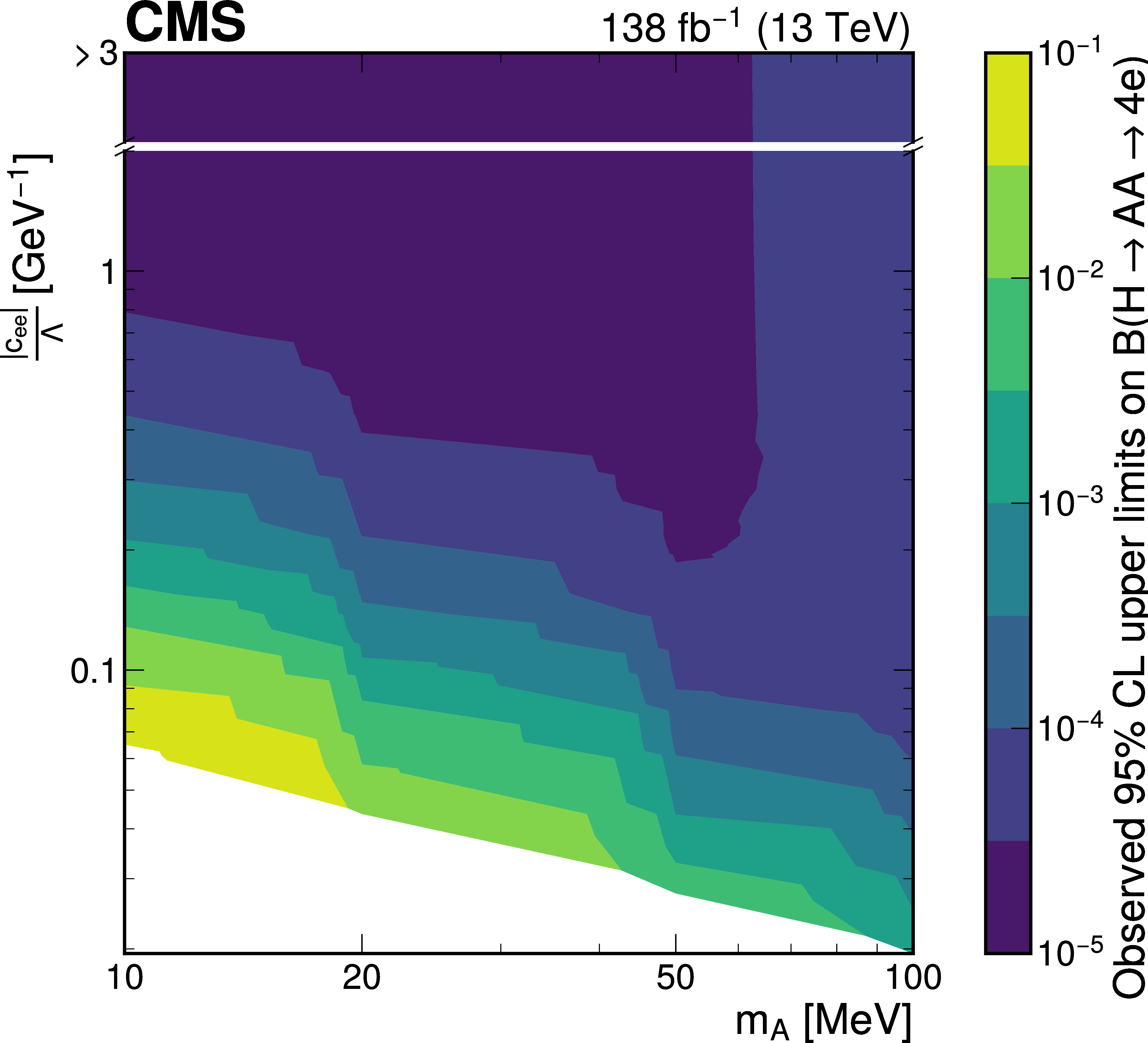
png pdf |
Figure 3:
A map of the observed 95% CL upper limit on the Higgs boson branching fraction for $ \mathrm{H}\to {\mathrm{A}} {\mathrm{A}} \to4\mathrm{e} $, as a function of the ALP mass and the ratio of the ALP coupling to electrons to the energy scale of the ALP effective interaction. |
| Summary |
| This analysis establishes the first direct limits on the Higgs boson exotic decay $ \mathrm{H}\to {\mathrm{A}} {\mathrm{A}} \to4\mathrm{e} $ for an axion-like particle A with a mass of $ \mathcal{O}$(10) MeV, reaching branching fraction sensitivities as low as 10$^{-5} $. The limiting factor for the sensitivity of this analysis is the number of events in data, while the leading systematic uncertainty arises from the identification efficiency of merged electron-positron pairs. This search explores previously inaccessible parameter space and provides the most stringent constraints to date on this model, establishing a new benchmark for future axion-like particle searches at the LHC. |
| References | ||||
| 1 | F. Wilczek | Problem of Strong $ P $ and $ T $ Invariance in the Presence of Instantons | PRL 40 (1978) 279 | |
| 2 | R. D. Peccei and H. R. Quinn | CP Conservation in the Presence of Instantons | PRL 38 (1977) 1440 | |
| 3 | N. F. Ramsey | The tensor force between two protons at long range | Physica A 96 (1979) 285 | |
| 4 | S. Weinberg | A New Light Boson? | PRL 40 (1978) 223 | |
| 5 | J. E. Moody and F. Wilczek | New Macroscopic Forces? | PRD 30 (1984) 130 | |
| 6 | J. E. Kim and G. Carosi | Axions and the strong CP problem | Rev. Mod. Phys. 82 (2010) 557 | 0807.3125 |
| 7 | Z. G. Berezhiani and M. Y. Khlopov | Cosmology of Spontaneously Broken Gauge Family Symmetry | Z. Phys. C 49 (1991) 73 | |
| 8 | J. Liu, N. McGinnis, C. E. M. Wagner, and X.-P. Wang | Challenges for a QCD Axion at the 10 MeV Scale | JHEP 05 (2021) 138 | 2102.10118 |
| 9 | S. Girmohanta, S. Nakagawa, Y. Nakai, and J. Xu | How viable is a QCD axion near 10 MeV? | JHEP 10 (2024) 153 | 2405.13425 |
| 10 | M. Jiang et al. | Search for axion-like dark matter with spin-based amplifiers | Nature Phys. 17 (2021) 1402 | 2102.01448 |
| 11 | K. Choi, S. H. Im, and C. Sub Shin | Recent Progress in the Physics of Axions and Axion-Like Particles | Ann. Rev. Nucl. Part. Sci. 71 (2021) 225 | 2012.05029 |
| 12 | A. J. Krasznahorkay et al. | Observation of Anomalous Internal Pair Creation in $ ^8Be $: A Possible Indication of a Light, Neutral Boson | PRL 116 (2016) 042501 | 1504.01527 |
| 13 | MEG II Collaboration | Search for the X17 particle in $ ^{7}\textrm{Li}(\textrm{p},\textrm{e}^+ \textrm{e}^{-}) ^{8}\textrm{Be} $ processes with the MEG II detector | EPJC 85 (2025) 763 | 2411.07994 |
| 14 | PADME Collaboration | Search for a new 17 MeV resonance via $ e^+e^- $ annihilation with the PADME Experiment | 2505.24797 | |
| 15 | M. Bauer, M. Neubert, and A. Thamm | LHC as an Axion Factory: Probing an Axion Explanation for $ (g-2)_\mu $ with Exotic Higgs Decays | PRL 119 (2017) 031802 | 1704.08207 |
| 16 | J. Liu, X. Ma, L.-T. Wang, and X.-P. Wang | ALP explanation to the muon (g-2) and its test at future Tera-Z and Higgs factories | PRD 107 (2023) 095016 | 2210.09335 |
| 17 | CMS Collaboration | Search for exotic Higgs boson decays $ H \to \mathcal{A}\mathcal{A} \to 4\gamma $ with events containing two merged diphotons in proton-proton collisions at $ \sqrt{s} = $ 13 TeV | PRL 131 (2023) 101801 | CMS-HIG-21-016 2209.06197 |
| 18 | CMS Collaboration | The CMS experiment at the CERN LHC | JINST 3 (2008) S08004 | |
| 19 | CMS Collaboration | Development of the CMS detector for the CERN LHC Run 3 | JINST 19 (2024) P05064 | CMS-PRF-21-001 2309.05466 |
| 20 | CMS Collaboration | HEPData record for this analysis | link | |
| 21 | CMS Collaboration | Performance of the CMS Level-1 trigger in proton-proton collisions at $ \sqrt{s} = $ 13 TeV | JINST 15 (2020) P10017 | CMS-TRG-17-001 2006.10165 |
| 22 | CMS Collaboration | The CMS trigger system | JINST 12 (2017) P01020 | CMS-TRG-12-001 1609.02366 |
| 23 | CMS Collaboration | Electron and photon reconstruction and identification with the CMS experiment at the CERN LHC | JINST 16 (2021) P05014 | CMS-EGM-17-001 2012.06888 |
| 24 | CMS Collaboration | Performance of the CMS muon detector and muon reconstruction with proton-proton collisions at $ \sqrt{s}= $ 13 TeV | JINST 13 (2018) P06015 | CMS-MUO-16-001 1804.04528 |
| 25 | CMS Collaboration | Description and performance of track and primary-vertex reconstruction with the CMS tracker | JINST 9 (2014) P10009 | CMS-TRK-11-001 1405.6569 |
| 26 | CMS Collaboration | Particle-flow reconstruction and global event description with the CMS detector | JINST 12 (2017) P10003 | CMS-PRF-14-001 1706.04965 |
| 27 | CMS Collaboration | Performance of reconstruction and identification of $ \tau $ leptons decaying to hadrons and $ \nu_\tau $ in pp collisions at $ \sqrt{s} = $ 13 TeV | JINST 13 (2018) P10005 | CMS-TAU-16-003 1809.02816 |
| 28 | CMS Collaboration | Jet energy scale and resolution in the CMS experiment in pp collisions at 8 TeV | JINST 12 (2017) P02014 | CMS-JME-13-004 1607.03663 |
| 29 | CMS Collaboration | Performance of missing transverse momentum reconstruction in proton-proton collisions at $ \sqrt{s} = $ 13 TeV using the CMS detector | JINST 14 (2019) P07004 | CMS-JME-17-001 1903.06078 |
| 30 | E. Bagnaschi, G. Degrassi, P. Slavich, and A. Vicini | Higgs production via gluon fusion in the POWHEG approach in the SM and in the MSSM | JHEP 02 (2012) 088 | 1111.2854 |
| 31 | P. Nason | A new method for combining NLO QCD with shower Monte Carlo algorithms | JHEP 11 (2004) 040 | hep-ph/0409146 |
| 32 | S. Frixione, P. Nason, and C. Oleari | Matching NLO QCD computations with parton shower simulations: the POWHEG method | JHEP 11 (2007) 070 | 0709.2092 |
| 33 | S. Alioli, P. Nason, C. Oleari, and E. Re | A general framework for implementing NLO calculations in shower Monte Carlo programs: the POWHEG BOX | JHEP 06 (2010) 043 | 1002.2581 |
| 34 | T. Sjostrand et al. | An introduction to PYTHIA 8.2 | Comput. Phys. Commun. 191 (2015) 159 | 1410.3012 |
| 35 | CMS Collaboration | Extraction and validation of a new set of CMS PYTHIA8 tunes from underlying-event measurements | EPJC 80 (2020) 4 | CMS-GEN-17-001 1903.12179 |
| 36 | NNPDF Collaboration | Parton distributions from high-precision collider data | EPJC 77 (2017) 663 | 1706.00428 |
| 37 | R. Frederix and S. Frixione | Merging meets matching in MC@NLO | JHEP 12 (2012) 061 | 1209.6215 |
| 38 | J. Alwall et al. | The automated computation of tree-level and next-to-leading order differential cross sections, and their matching to parton shower simulations | JHEP 07 (2014) 079 | 1405.0301 |
| 39 | P. F. Monni et al. | MiNNLO$ _\mathrm{PS} $: a new method to match NNLO QCD to parton showers | JHEP 05 (2020) 143 | 1908.06987 |
| 40 | P. F. Monni, E. Re, and M. Wiesemann | MiNNLO$ _{\text {PS}} $: optimizing 2 $ \rightarrow $ 1 hadronic processes | EPJC 80 (2020) 1075 | 2006.04133 |
| 41 | E. Bothmann et al. | Event generation with Sherpa 2.2 | SciPost Phys 7 (2019) 034 | 1905.09127 |
| 42 | NNPDF Collaboration | Parton distributions for the LHC Run II | JHEP 04 (2015) 040 | 1410.8849 |
| 43 | CMS Collaboration | Single and Double Electron Trigger Efficiencies using the full Run 2 dataset | CMS Detector Performance Summaries CMS-DP-2020-016, 2020 CDS |
|
| 44 | CMS Collaboration | Reconstruction of decays to merged photons using end-to-end deep learning with domain continuation in the CMS detector | PRD 108 (2023) 052002 | CMS-EGM-20-001 2204.12313 |
| 45 | W. Adam, R. Frühwirth, A. Strandlie, and T. Todor | Reconstruction of Electrons with the Gaussian-Sum Filter in the CMS Tracker at the LHC | link | |
| 46 | R. Fruhwirth, W. Waltenberger, and P. Vanlaer | Adaptive vertex fitting | JPG 34 (2007) N343 | |
| 47 | T. Chen and C. Guestrin | XGBoost: A scalable tree boosting system | in Proc. 22nd ACM SIGKDD Int. Conf. on Knowledge Discovery and Data Mining, KDD '16, p. 785. Association for Computing Machinery, New York, NY, USA, 2016 link |
|
| 48 | CMS Collaboration | Technical proposal for the Phase-II upgrade of the Compact Muon Solenoid | CMS Technical Proposal CERN-LHCC-2015-010, CMS-TDR-15-02, 2015 CDS |
|
| 49 | R. A. Fisher | On the interpretation of $ \chi^2 $ from contingency tables, and the calculation of p | J. R. Stat. Soc. 85 (1922) 87 | |
| 50 | CMS Collaboration | Measurements of $ \mathrm{t\bar{t}H} $ Production and the CP Structure of the Yukawa Interaction between the Higgs Boson and Top Quark in the Diphoton Decay Channel | PRL 125 (2020) 061801 | CMS-HIG-19-013 2003.10866 |
| 51 | CMS Collaboration | Search for a standard model-like Higgs boson in the mass range between 70 and 110 GeV in the diphoton final state in proton-proton collisions at $ \sqrt{s}= $ 13TeV | PLB 860 (2025) 139067 | CMS-HIG-20-002 2405.18149 |
| 52 | P. D. Dauncey, M. Kenzie, N. Wardle, and G. J. Davies | Handling uncertainties in background shapes: the discrete profiling method | JINST 10 (2015) P04015 | 1408.6865 |
| 53 | M. J. Oreglia | A Study of the Reactions $ \psi^\prime \to \gamma\gamma \psi $ | PhD thesis, Stanford University, Stanford, USA, December, Ph.D. thesis, 1980 link |
|
| 54 | J. E. Gaiser | Charmonium Spectroscopy from Radiative Decays of the $ J/\psi $ and $ \psi' $ | PhD thesis, Stanford University, Stanford, USA, August, Ph.D. thesis, 1982 link |
|
| 55 | CMS Collaboration | Precision luminosity measurement in proton-proton collisions at $ \sqrt{s}= $ 13 TeV in 2015 and 2016 at CMS | EPJC 81 (2021) 800 | CMS-LUM-17-003 2104.01927 |
| 56 | CMS Collaboration | CMS luminosity measurement for the 2017 data-taking period at $ \sqrt{s}= $ 13 TeV | CMS Physics Analysis Summary, 2018 CMS-PAS-LUM-17-004 |
CMS-PAS-LUM-17-004 |
| 57 | CMS Collaboration | CMS luminosity measurement for the 2018 data-taking period at $ \sqrt{s}= $ 13 TeV | CMS Physics Analysis Summary, 2019 CMS-PAS-LUM-18-002 |
CMS-PAS-LUM-18-002 |
| 58 | LHC Higgs Cross Section Working Group | Handbook of LHC Higgs cross sections: 4. Deciphering the nature of the Higgs sector | CERN Report CERN-2017-002-M, 2016 link |
1610.07922 |
| 59 | CMS Collaboration | The CMS statistical analysis and combination tool: Combine | Comput. Softw. Big Sci. 8 (2024) 19 | CMS-CAT-23-001 2404.06614 |
| 60 | H. Georgi, D. B. Kaplan, and L. Randall | Manifesting the invisible axion at low-energies | PLB 169 (1986) 73 | |
|
|
Compact Muon Solenoid LHC, CERN |

|
|
|
|
|
|