Compact Muon Solenoid
LHC, CERN
 Visit us: CMS Public Website, CMS Physics ;
Contact us: CMS Publications Committee
Visit us: CMS Public Website, CMS Physics ;
Contact us: CMS Publications Committee
| CMS-EXO-24-006 ; CERN-EP-2026-022 | ||
| Search for heavy resonances decaying into four-lepton final states via light bosons in proton-proton collisions at $ \sqrt{s} = $ 13 TeV | ||
| CMS Collaboration | ||
| 14 April 2026 | ||
| Submitted to Physical Review Letters | ||
| Abstract: A search for a resonance heavier than 250 GeV decaying into four leptons via two intermediate bosons is presented. The search uses proton-proton collision data at $ \sqrt{s} = $ 13 TeV collected by the CMS experiment, corresponding to an integrated luminosity of 138 fb$ ^{-1} $. Novel techniques are used to enhance the sensitivity to a collimated pair of dileptons reconstructed as a single merged object, resulting from the decay of an intermediate light boson. No significant excess of data over the background predictions is observed. Upper limits are set on the production cross section for a four-lepton resonance, including the previously unexplored phase space at the LHC with a dilepton mass of 0.4--15 GeV. | ||
| Links: e-print arXiv:2604.14236 [hep-ex] (PDF) ; CDS record ; inSPIRE record ; HepData record ; CADI line (restricted) ; | ||
| Figures | |
png pdf |
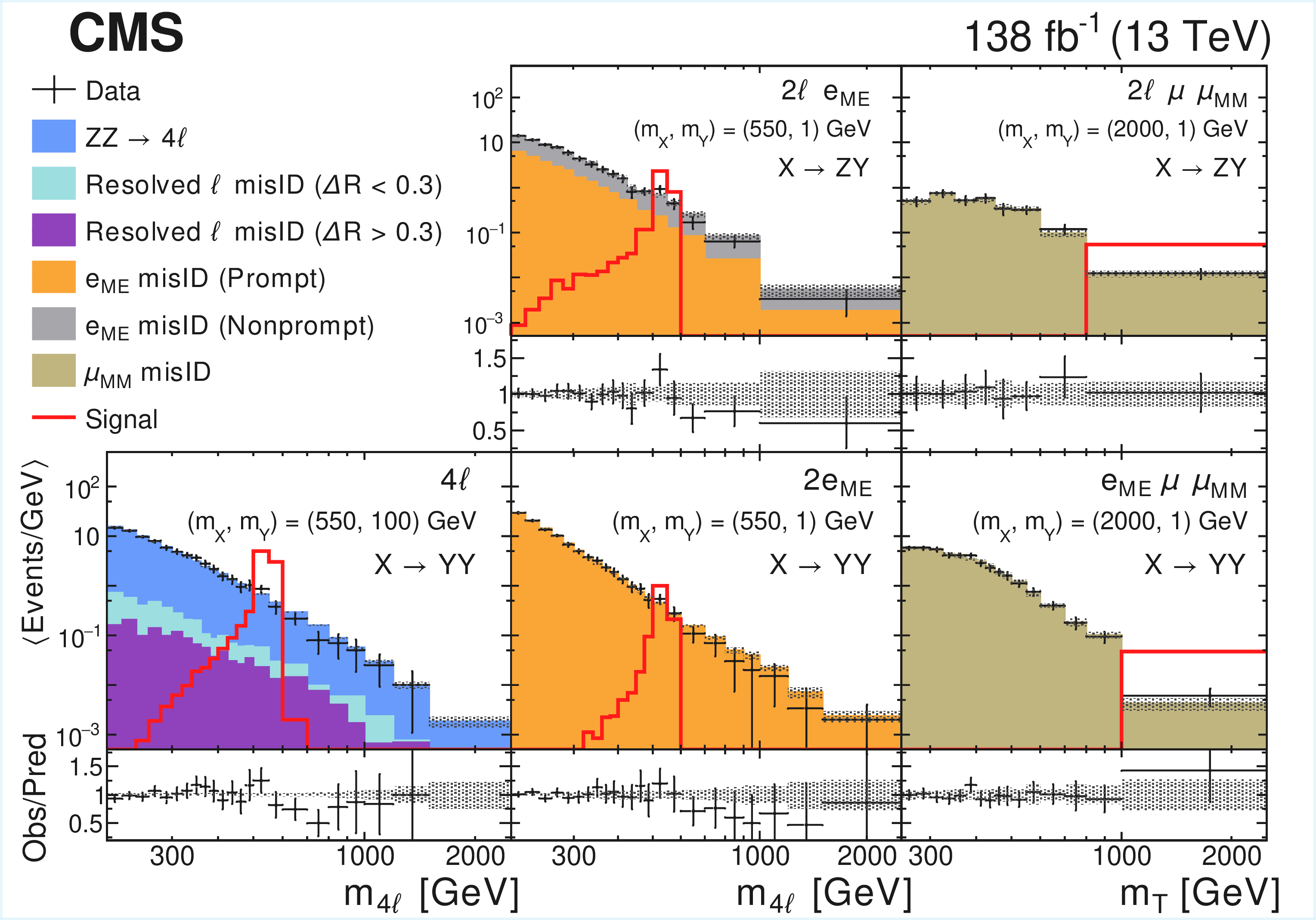
Figure 1:
The observed and predicted $ m_{4\ell} $ (left and center) and $ m_{\mathrm{T}} $ (right) distributions after the likelihood fit with the background-only hypothesis. The lower panel shows the ratio of the number of observed events to the predicted background. The shaded band represents the post-fit background uncertainty, incorporating both systematic and statistical sources. The red histogram shows a simulated signal mass spectrum for a given mass and decay mode hypothesis, normalized to the cross section times branching fraction of 10fb. |
png pdf |
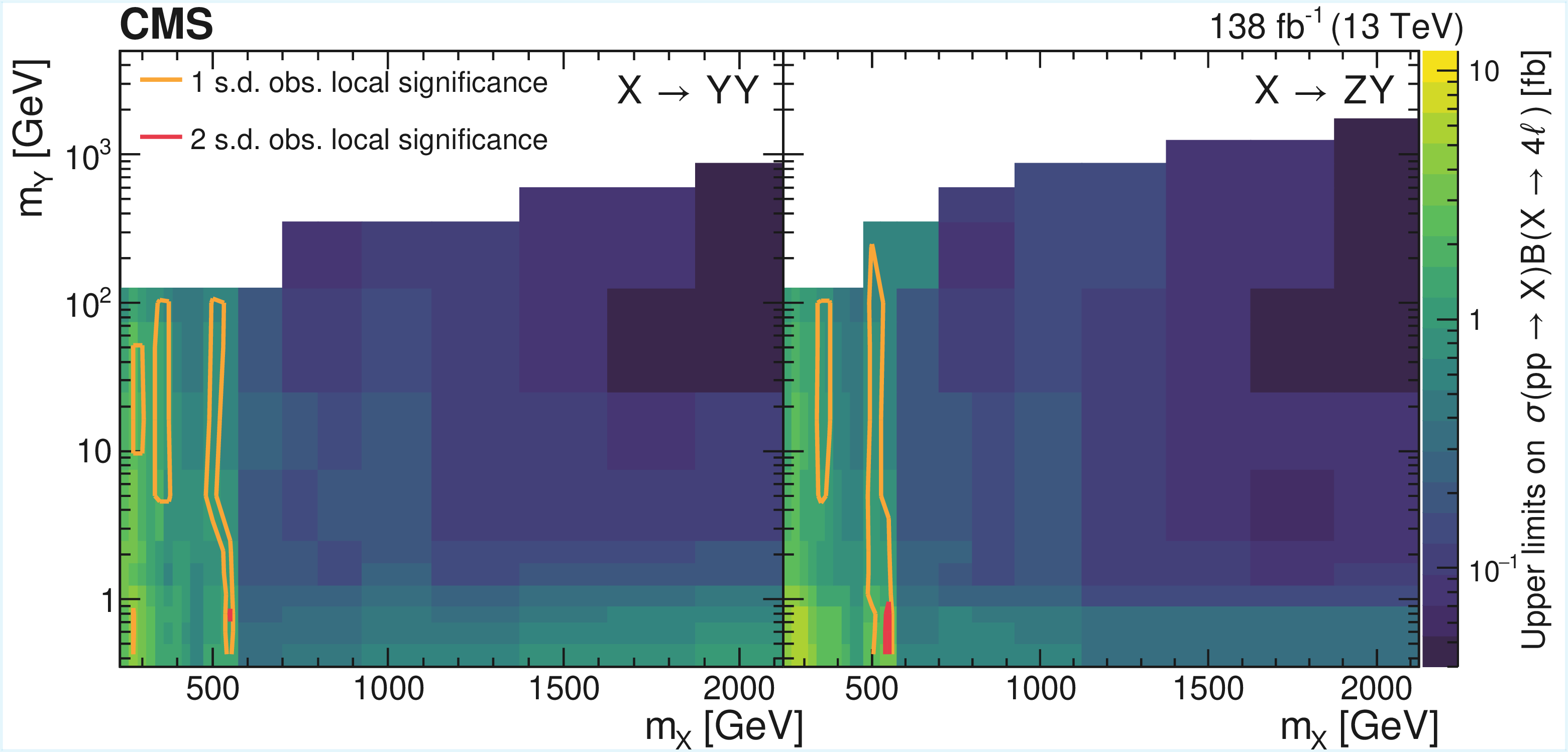
Figure 2:
The observed limit on the product of the cross section and branching fraction for (left) $ \mathrm{X}\to{\mathrm{Y}} {\mathrm{Y}} \to4\ell $ and (right) $ \mathrm{X}\to\mathrm{Z}{\mathrm{Y}} \to4\ell $ signal hypotheses. The orange (red) solid line represents the 1 (2) s.d. observed local significance contour. |
png pdf |
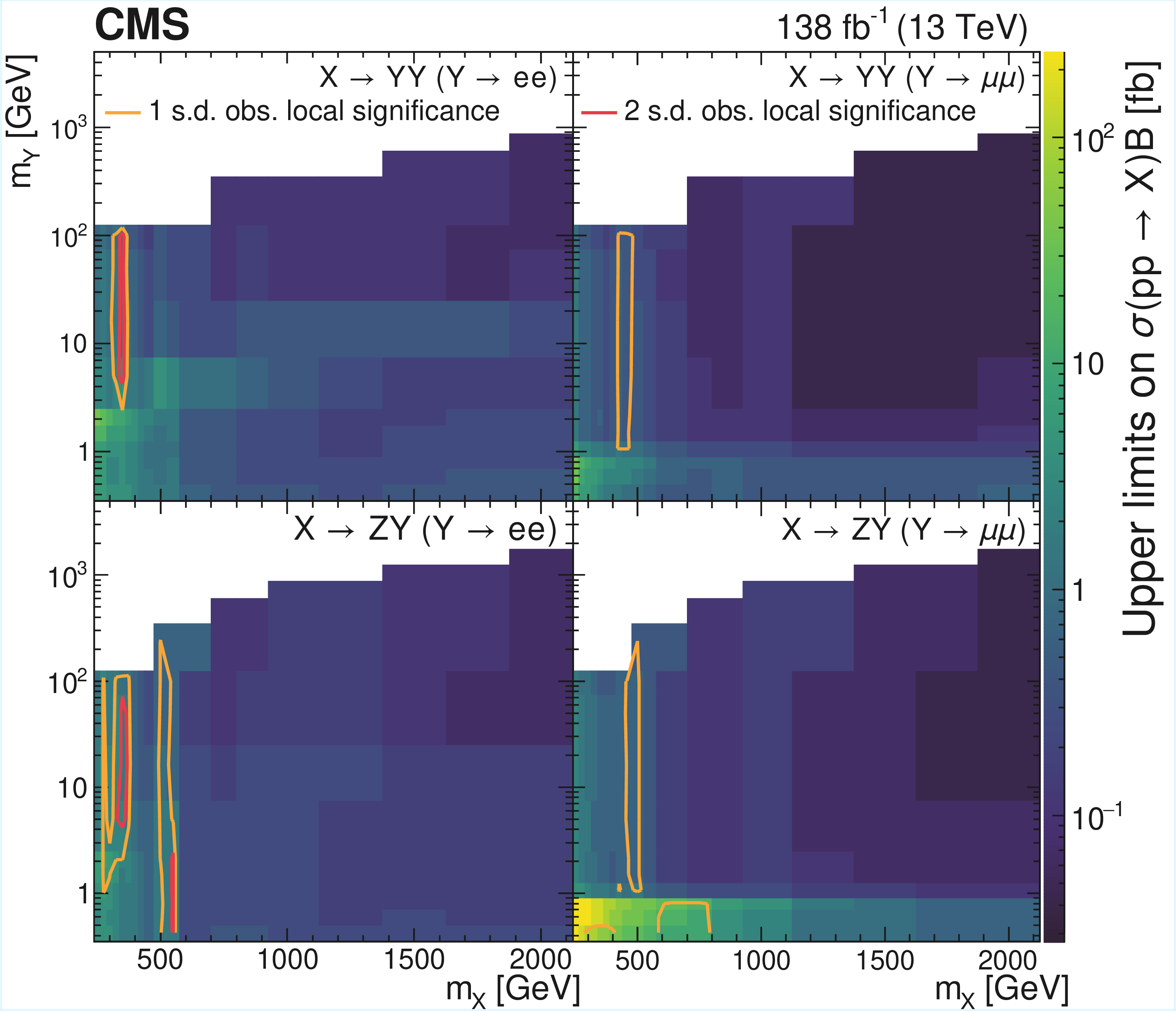
Figure 3:
The observed limit on the product of the cross section and branching fraction for (upper left) $ \mathrm{X}\to{\mathrm{Y}} {\mathrm{Y}} \to4\mathrm{e} $, (upper right) $ \mathrm{X}\to{\mathrm{Y}} {\mathrm{Y}} \to4\mu $, (lower left) $ \mathrm{X}\to\mathrm{Z}{\mathrm{Y}} \to2\ell2\mathrm{e} $, and (lower right) $ \mathrm{X}\to\mathrm{Z}{\mathrm{Y}} \to2\ell2\mu $ signal hypotheses, where the Z boson decays into either a dielectron or dimuon. The orange (red) solid line represents the 1 (2) s.d. observed local significance contour. |
| Tables | |
png pdf |
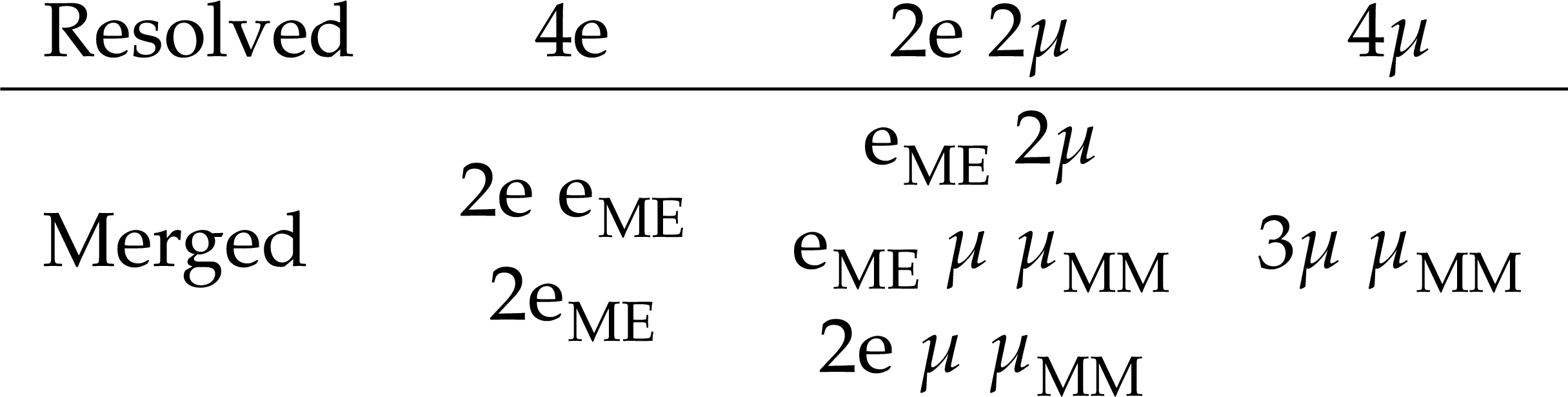
Table 1:
The SRs, where each region is defined by the listed reconstructed leptons in an event. The e and $ \mu $ represent resolved leptons, while $ \mathrm{e}_{\mathrm{ME}} $ and $ \mu_{\mathrm{MM}} $ represent the merged electron and missing muon, respectively. |
png pdf |
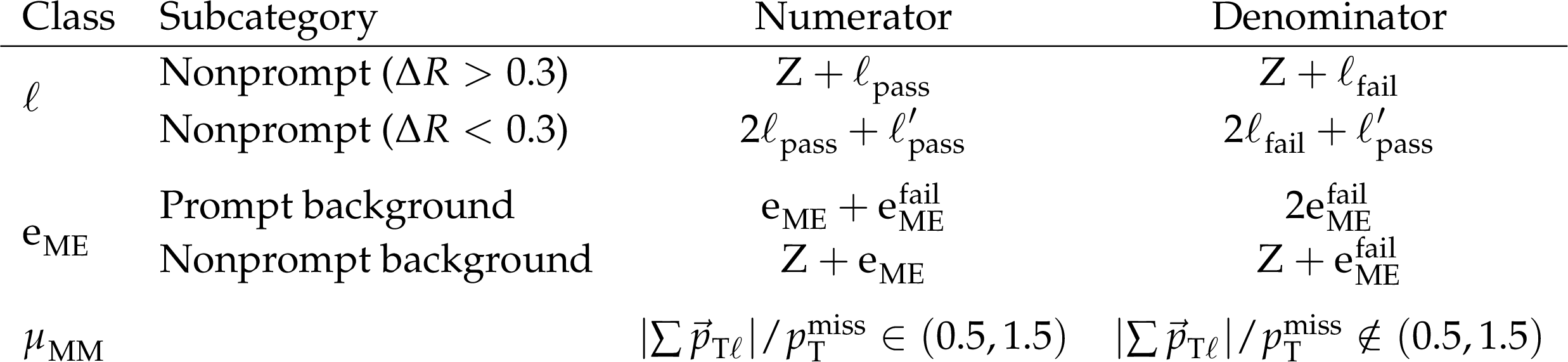
Table 2:
A summary of the CRs used to derive the misidentification factors for different lepton classes. The Z represents an SM Z boson candidate, formed by two opposite-sign same-flavor resolved leptons passing the ID criteria with an invariant mass of 91 $ \pm $ 7 GeV, and $ \ell^{\prime} $ denotes a resolved lepton with a different flavor (e or $ \mu $) than \ell. |
| Summary |
| In summary, a model-independent search for a resonance heavier than 250 GeV decaying into four-lepton final states has been presented for the $X \to YY \to 4\ell$ and $X \to ZY \to 4\ell$ channels, where X and Y are hypothetical new bosons with masses $m_{X}$ and $m_{Y}$. The search uses proton-proton collision data at $\sqrt{s} = 13$ TeV collected with the CMS detector at the LHC, corresponding to an integrated luminosity of 138 fb$ ^{-1}$. Decays of a light Y boson with a mass $\lesssim$10 GeV can result in final states with a large Lorentz boost, resulting in highly collimated dielectron or dimuon signatures. A dedicated merged-electron identification is developed to enhance signal sensitivity to collimated dielectrons from a low-mass $m_{Y}$. Events with collimated dimuons are analyzed using the missing transverse momentum vector as a proxy for the missing muon. The maximum local (global) observed significance is 2.4 (1.8) standard deviations at $m_{X} = 550$ GeV and $m_{Y} = 0.8$ GeV in the $X \to ZY \to 4\ell$ channel. The 95% confidence level upper limits on the product of cross section and branching fraction to 4$\ell$ final states are set in the range $m_{X} > 250$ GeV and $m_{Y} > 0.4$ GeV. |
| References | ||||
| 1 | G. C. Branco et al. | Theory and phenomenology of two-Higgs-doublet models | Phys. Rept. 516 (2012) 1 | 1106.0034 |
| 2 | D. Curtin, R. Essig, S. Gori, and J. Shelton | Illuminating dark photons with high-energy colliders | JHEP 02 (2015) 157 | 1412.0018 |
| 3 | V. Barger and H.-S. Lee | Four-lepton resonance at the Large Hadron Collider | PRD 85 (2012) 055030 | 1111.0633 |
| 4 | CMS Collaboration | Search for low-mass dilepton resonances in Higgs boson decays to four-lepton final states in proton-proton collisions at $ \sqrt{s} = $ 13 TeV | EPJC 82 (2022) 290 | CMS-HIG-19-007 2111.01299 |
| 5 | ATLAS Collaboration | Search for Higgs bosons decaying into new spin-0 or spin-1 particles in four-lepton final states with the ATLAS detector with 139 $ \textrm{fb}^{-1} $ of pp collision data at$ \sqrt{s} = $ 13 TeV | JHEP 03 (2022) 41 | 2110.13673 |
| 6 | CMS Collaboration | Search for a new scalar resonance decaying to a pair of Z bosons in proton-proton collisions at $ \sqrt{s}= $ 13 TeV | JHEP 06 (2018) 127 | CMS-HIG-17-012 1804.01939 |
| 7 | ATLAS Collaboration | Search for heavy resonances decaying into a pair of Z bosons in the $ \ell^{+}\ell^{-}\ell^{\prime +}\ell^{\prime -} $ and $ \ell^{+}\ell^{-}\nu\bar{\nu} $ final states using 139 $ \textrm{fb}^{-1} $ of proton-proton collisions at $ \sqrt{s} = $ 13 TeV with the ATLAS detector | EPJC 81 (2021) 332 | 2009.14791 |
| 8 | ATLAS Collaboration | Search for a new scalar decaying into new spin-1 bosons in four-lepton final states with the ATLAS detector | PLB 865 (2025) 139472 | 2410.16781 |
| 9 | CMS Collaboration | The CMS experiment at the CERN LHC | JINST 3 (2008) S08004 | |
| 10 | CMS Collaboration | Development of the CMS detector for the CERN LHC Run 3 | JINST 19 (2024) P05064 | |
| 11 | CMS Collaboration | The CMS trigger system | JINST 12 (2017) P01020 | CMS-TRG-12-001 1609.02366 |
| 12 | CMS Collaboration | Performance of the CMS Level-1 trigger in proton-proton collisions at $ \sqrt{s} = $ 13 TeV | JINST 15 (2020) P10017 | CMS-TRG-17-001 2006.10165 |
| 13 | CMS Collaboration | Performance of the CMS high-level trigger during LHC Run 2 | JINST 19 (2024) P11021 | CMS-TRG-19-001 2410.17038 |
| 14 | CMS Collaboration | Electron and photon reconstruction and identification with the CMS experiment at the CERN LHC | JINST 16 (2021) P05014 | CMS-EGM-17-001 2012.06888 |
| 15 | CMS Collaboration | Performance of the CMS muon detector and muon reconstruction with proton-proton collisions at $ \sqrt{s}= $ 13 TeV | JINST 13 (2018) P06015 | CMS-MUO-16-001 1804.04528 |
| 16 | CMS Collaboration | Description and performance of track and primary-vertex reconstruction with the CMS tracker | JINST 9 (2014) P10009 | CMS-TRK-11-001 1405.6569 |
| 17 | CMS Collaboration | Particle-flow reconstruction and global event description with the CMS detector | JINST 12 (2017) P10003 | CMS-PRF-14-001 1706.04965 |
| 18 | CMS Collaboration | Performance of reconstruction and identification of $ \tau $ leptons decaying to hadrons and $ \nu_\tau $ in pp collisions at $ \sqrt{s}= $ 13 TeV | JINST 13 (2018) P10005 | CMS-TAU-16-003 1809.02816 |
| 19 | CMS Collaboration | Jet energy scale and resolution in the CMS experiment in pp collisions at 8 TeV | JINST 12 (2017) P02014 | CMS-JME-13-004 1607.03663 |
| 20 | CMS Collaboration | Performance of missing transverse momentum reconstruction in proton-proton collisions at $ \sqrt{s} = $ 13 TeV using the CMS detector | JINST 14 (2019) P07004 | CMS-JME-17-001 1903.06078 |
| 21 | CMS Collaboration | Pileup mitigation at CMS in 13 TeV data | JINST 15 (2020) P09018 | CMS-JME-18-001 2003.00503 |
| 22 | T. Sjöstrand et al. | An introduction to PYTHIA 8.2 | Comput. Phys. Commun. 191 (2015) 159 | 1410.3012 |
| 23 | J. Alwall et al. | The automated computation of tree-level and next-to-leading order differential cross sections, and their matching to parton shower simulations | JHEP 07 (2014) 79 | 1405.0301 |
| 24 | P. Nason | A new method for combining NLO QCD with shower Monte Carlo algorithms | JHEP 11 (2004) 040 | hep-ph/0409146 |
| 25 | S. Frixione, P. Nason, and C. Oleari | Matching NLO QCD computations with Parton Shower simulations: the POWHEG method | JHEP 11 (2007) 070 | 0709.2092 |
| 26 | S. Alioli, P. Nason, C. Oleari, and E. Re | A general framework for implementing NLO calculations in shower Monte Carlo programs: the POWHEG BOX | JHEP 06 (2010) 043 | 1002.2581 |
| 27 | P. Nason and G. Zanderighi | $ W^+ W^- $, $ W Z $ and $ Z Z $ production in the POWHEG-BOX-V2 | EPJC 74 (2014) 2702 | 1311.1365 |
| 28 | CMS Collaboration | Extraction and validation of a new set of CMS Pythia8 tunes from underlying-event measurements | EPJC 80 (2020) 4 | CMS-GEN-17-001 1903.12179 |
| 29 | R. D. Ball et al. | Parton distributions from high-precision collider data | EPJC 77 (2017) 663 | 1706.00428 |
| 30 | GEANT4 Collaboration | GEANT4---a simulation toolkit | NIM A 506 (2003) 250 | |
| 31 | CMS Collaboration | Search for leptophobic $ \textrm{Z}^{\prime} $ bosons decaying into four-lepton final states in proton-proton collisions at $ \sqrt{s} = $ 8 TeV | PLB 773 (2017) 563 | CMS-EXO-14-006 1701.01345 |
| 32 | CMS Collaboration | Highly boosted dielectron identification in proton-proton collisions at $ \sqrt{s} = $ 13 TeV | CMS Physics Analysis Summary, 2025 CMS-PAS-EGM-24-002 |
CMS-PAS-EGM-24-002 |
| 33 | CMS Collaboration | Performance of the reconstruction and identification of high-momentum muons in proton-proton collisions at $ \sqrt{s} = $ 13 TeV | JINST 15 (2020) P02027 | CMS-MUO-17-001 1912.03516 |
| 34 | CMS Collaboration | Measurements of properties of the Higgs boson decaying into the four-lepton final state in pp collisions at $ \sqrt{s} = $ 13 TeV | JHEP 11 (2017) 47 | CMS-HIG-16-041 1706.09936 |
| 35 | CMS Collaboration | Precision luminosity measurement in proton-proton collisions at $ \sqrt{s}= $ 13 TeV in 2015 and 2016 at CMS | EPJC 81 (2021) 800 | CMS-LUM-17-003 2104.01927 |
| 36 | CMS Collaboration | CMS luminosity measurement for the 2017 data-taking period at $ \sqrt{s}= $ 13 TeV | CMS Physics Analysis Summary, 2018 CMS-PAS-LUM-17-004 |
CMS-PAS-LUM-17-004 |
| 37 | CMS Collaboration | CMS luminosity measurement for the 2018 data-taking period at $ \sqrt{s}= $ 13 TeV | CMS Physics Analysis Summary, 2019 CMS-PAS-LUM-18-002 |
CMS-PAS-LUM-18-002 |
| 38 | CMS Collaboration | Measurement of the inelastic proton-proton cross section at $ \sqrt{s}= $ 13 TeV | JHEP 07 (2018) 161 | CMS-FSQ-15-005 1802.02613 |
| 39 | T. Junk | Confidence level computation for combining searches with small statistics | NIM A 434 (1999) 435 | |
| 40 | CMS Collaboration | The CMS statistical analysis and combination tool: Combine | Comput. Softw. Big Sci. 8 (2024) 19 | CMS-CAT-23-001 2404.06614 |
| 41 | W. Verkerke and D. Kirkby | The RooFit toolkit for data modeling | in th Int. Conf. on Computing in High Energy and Nuclear Physics (CHEP ), 2003 Proc. 1 (2003) 3 |
physics/0306116 |
| 42 | L. Moneta et al. | The RooStats project | in th Int. Workshop on Advanced Computing and Analysis Techniques in Physics Research (ACAT ), 2010 Proc. 1 (2010) 3 |
1009.1003 |
| 43 | E. Gross and O. Vitells | Trial factors for the look elsewhere effect in high energy physics | EPJC 70 (2010) 525 | 1005.1891 |
| 44 | CMS Collaboration | HEPData record for this analysis | link | |
|
|
Compact Muon Solenoid LHC, CERN |

|
|
|
|
|
|