
Compact Muon Solenoid
LHC, CERN
 Visit us: CMS Public Website, CMS Physics ;
Contact us: CMS Publications Committee
Visit us: CMS Public Website, CMS Physics ;
Contact us: CMS Publications Committee
| CMS-EXO-23-001 ; CERN-EP-2026-124 | ||
| Search for soft unclustered energy patterns in proton-proton collisions at $ \sqrt{s} = $ 13 TeV using data scouting | ||
| CMS Collaboration | ||
| 10 July 2026 | ||
| Submitted to Physical Review Letters | ||
| Abstract: A search for soft unclustered energy patterns (SUEPs) is conducted using proton-proton collision data corresponding to an integrated luminosity of 127 fb$^{-1}$ at a center-of-mass energy of 13 TeV, collected via the data scouting stream of the CMS experiment at the LHC. Only the results of the high-level trigger reconstruction are recorded to enable a lower threshold on the hadronic activity. This increases the acceptance for SUEP signatures, which are predicted by hidden-valley models with a large 't Hooft coupling. The observed results are consistent with the standard model background prediction. The most stringent limits to date are set on the gluon fusion production of heavy scalar mediators resulting in SUEP-like signals. | ||
| Links: e-print arXiv:2607.09621 [hep-ex] (PDF) ; CDS record ; inSPIRE record ; HepData record ; CADI line (restricted) ; | ||
| Figures | |
png pdf |
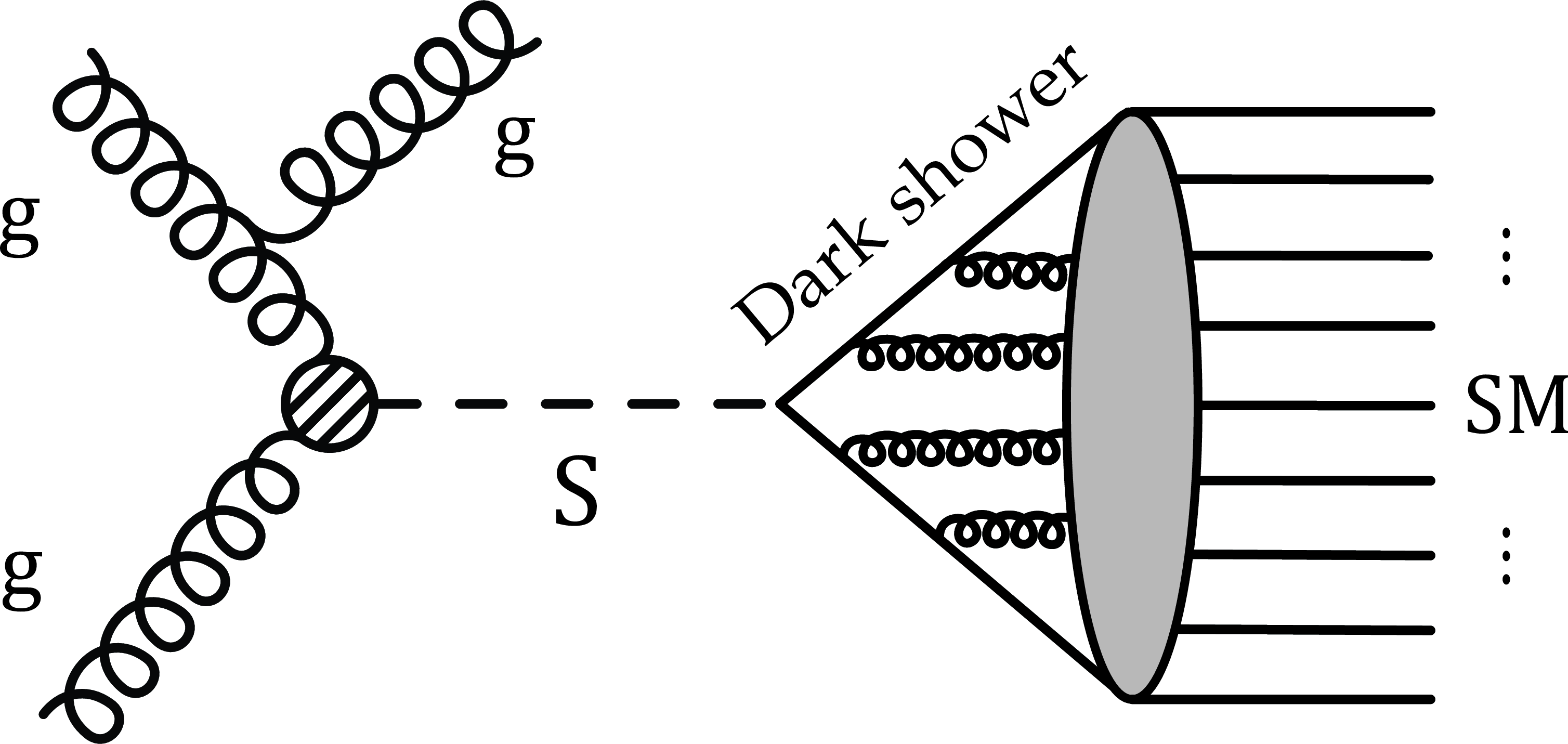
Figure 1:
A schematic diagram of the SUEP signal production with initial-state radiation. |
png pdf |
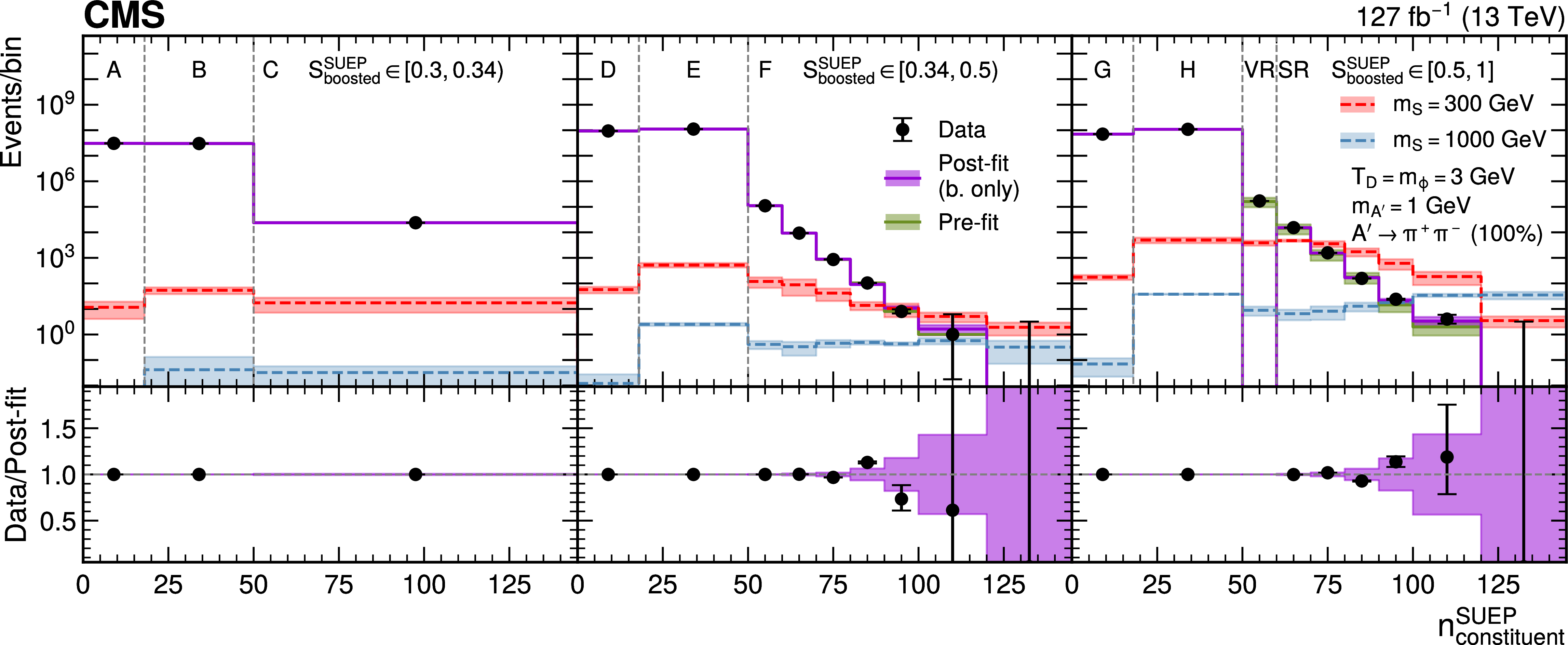
Figure 2:
The observed $ n_{\text{constituent}}^{\text{SUEP}} $ distributions for various ranges of $ S^{\text{SUEP}}_{\text{boosted}} $ (left: 0.3 $ < S^{\text{SUEP}}_{\text{boosted}} < $ 0.34, middle: 0.34 $ < S^{\text{SUEP}}_{\text{boosted}} < $ 0.5, right: $ S^{\text{SUEP}}_{\text{boosted}} > $ 0.5), compared to the background prediction in the SR. The pre-fit expected background from Eq. \eqrefeq:extended-ABCD, the background-only fit result, and two signal models with $ m_{\text{S}} = $ 300 and 1000 GeV are shown, as well as their uncertainties. Both signal models have $ T_{\text{D}} = m_{\phi} = $ 3 GeV and $ m_{{A}{\prime} } = $ 1 GeV (fully hadronic decays). The vertical dashed lines mark the boundaries that separate the CRs, the VR, and the SR. The lower panels show the ratio of data to the post-fit background prediction. |
png pdf |
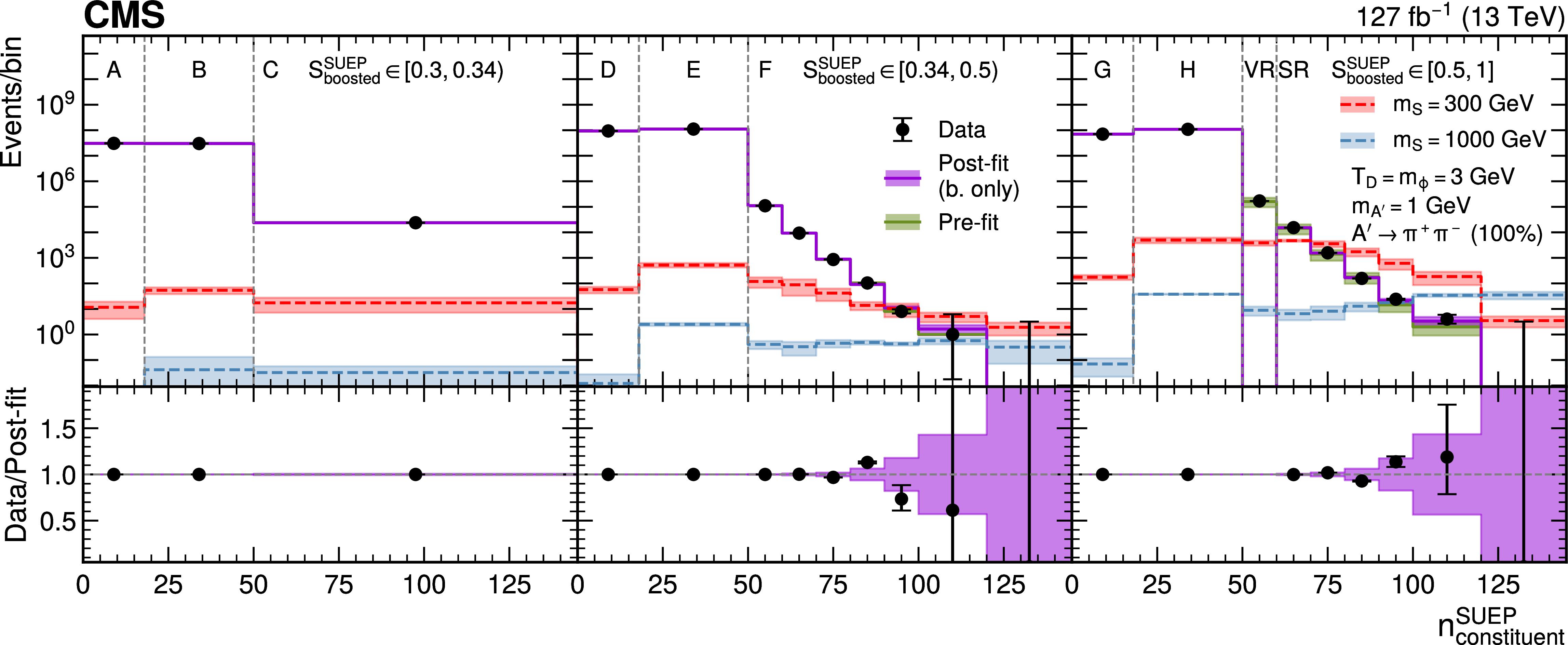
Figure 3:
The observed $ n_{\text{constituent}}^{\text{SUEP}} $ distributions for various ranges of $ S^{\text{SUEP}}_{\text{boosted}} $ (left: 0.3 $ < S^{\text{SUEP}}_{\text{boosted}} < $ 0.34, middle: 0.34 $ < S^{\text{SUEP}}_{\text{boosted}} < $ 0.5, right: $ S^{\text{SUEP}}_{\text{boosted}} > $ 0.5), compared to the background prediction in the SR. The pre-fit expected background from Eq. \eqrefeq:extended-ABCD, the background-only fit result, and two signal models with $ m_{\text{S}} = $ 300 and 1000 GeV are shown, as well as their uncertainties. Both signal models have $ T_{\text{D}} = m_{\phi} = $ 3 GeV and $ m_{{A}{\prime} } = $ 1 GeV (fully hadronic decays). The vertical dashed lines mark the boundaries that separate the CRs, the VR, and the SR. The lower panels show the ratio of data to the post-fit background prediction. |
png pdf |
Figure 4:
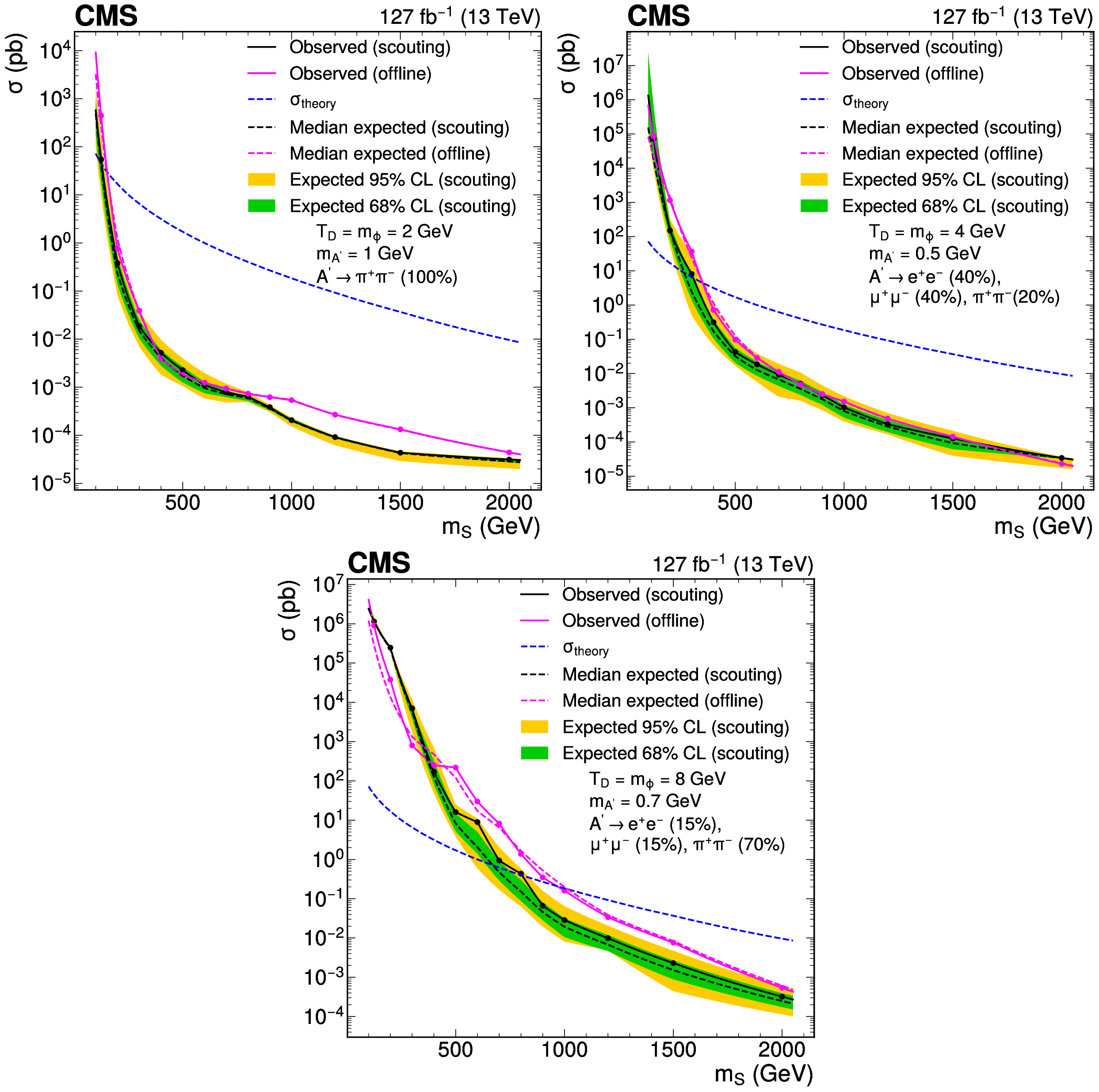
Expected and observed 95% CL upper limits on the simplified scalar-mediator SUEP cross sections as functions of the mediator mass $ m_{\text{S}} $, with a comparison to the corresponding limits from the previous CMS offline search [32]. Signal models with different values of the temperature, dark hadron mass, and dark photon mass are shown. Upper left: $ T_{\text{D}} = m_{\phi} = $ 2 GeV, $ m_{{A}{\prime} } = $ 1 GeV (fully hadronic decays). Upper right: $ T_{\text{D}} = m_{\phi} = $ 4 GeV, $ m_{{A}{\prime} } = $ 0.5 GeV (lepton-dominated decays). Lower: $ T_{\text{D}} = m_{\phi} = $ 8 GeV, $ m_{{A}{\prime} } = $ 0.7 GeV (hadron-dominated decays). |
png pdf |
Figure 4-a:
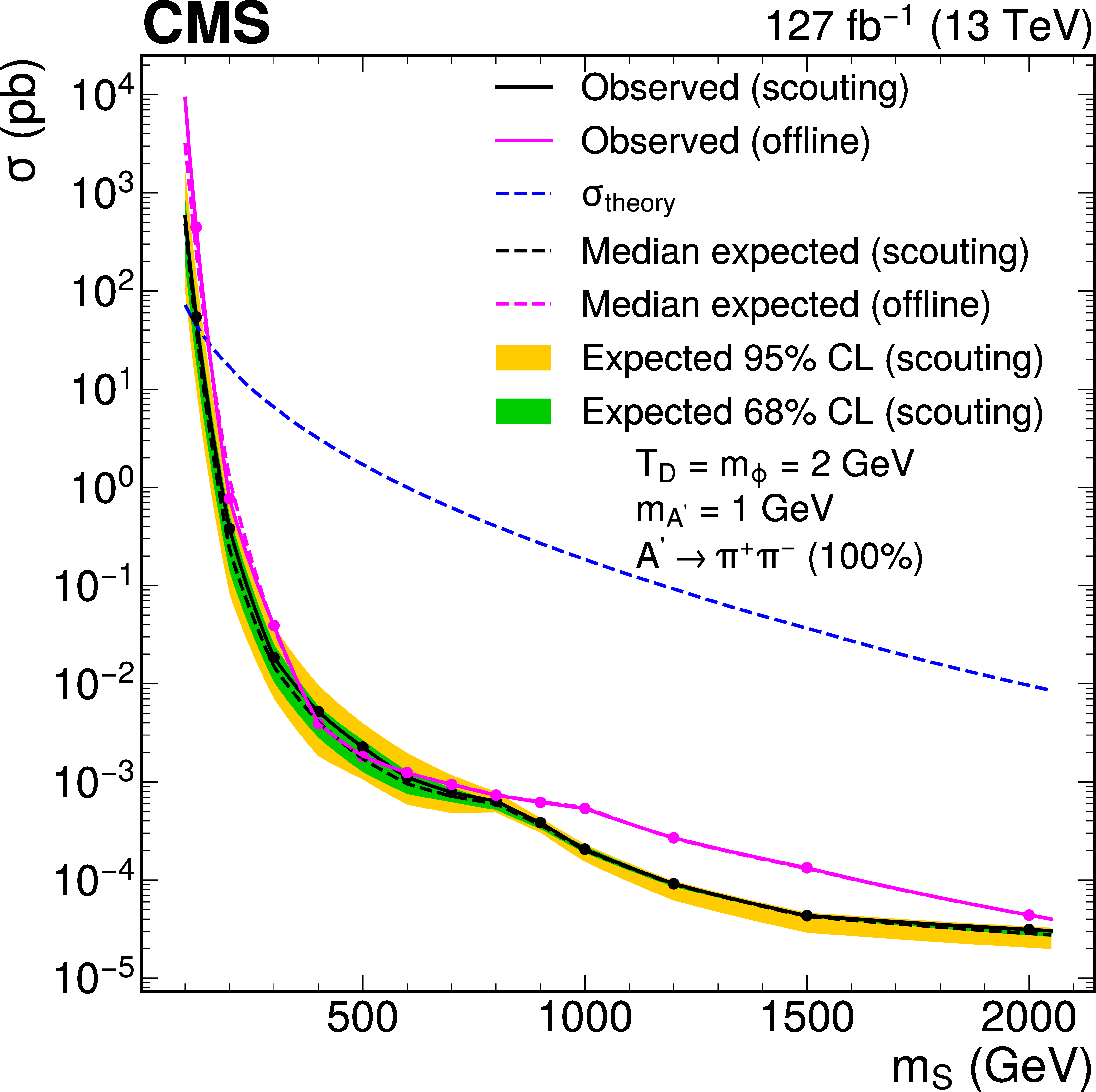
Expected and observed 95% CL upper limits on the simplified scalar-mediator SUEP cross sections as functions of the mediator mass $ m_{\text{S}} $, with a comparison to the corresponding limits from the previous CMS offline search [32]. Signal models with different values of the temperature, dark hadron mass, and dark photon mass are shown. Upper left: $ T_{\text{D}} = m_{\phi} = $ 2 GeV, $ m_{{A}{\prime} } = $ 1 GeV (fully hadronic decays). Upper right: $ T_{\text{D}} = m_{\phi} = $ 4 GeV, $ m_{{A}{\prime} } = $ 0.5 GeV (lepton-dominated decays). Lower: $ T_{\text{D}} = m_{\phi} = $ 8 GeV, $ m_{{A}{\prime} } = $ 0.7 GeV (hadron-dominated decays). |
png pdf |
Figure 4-b:
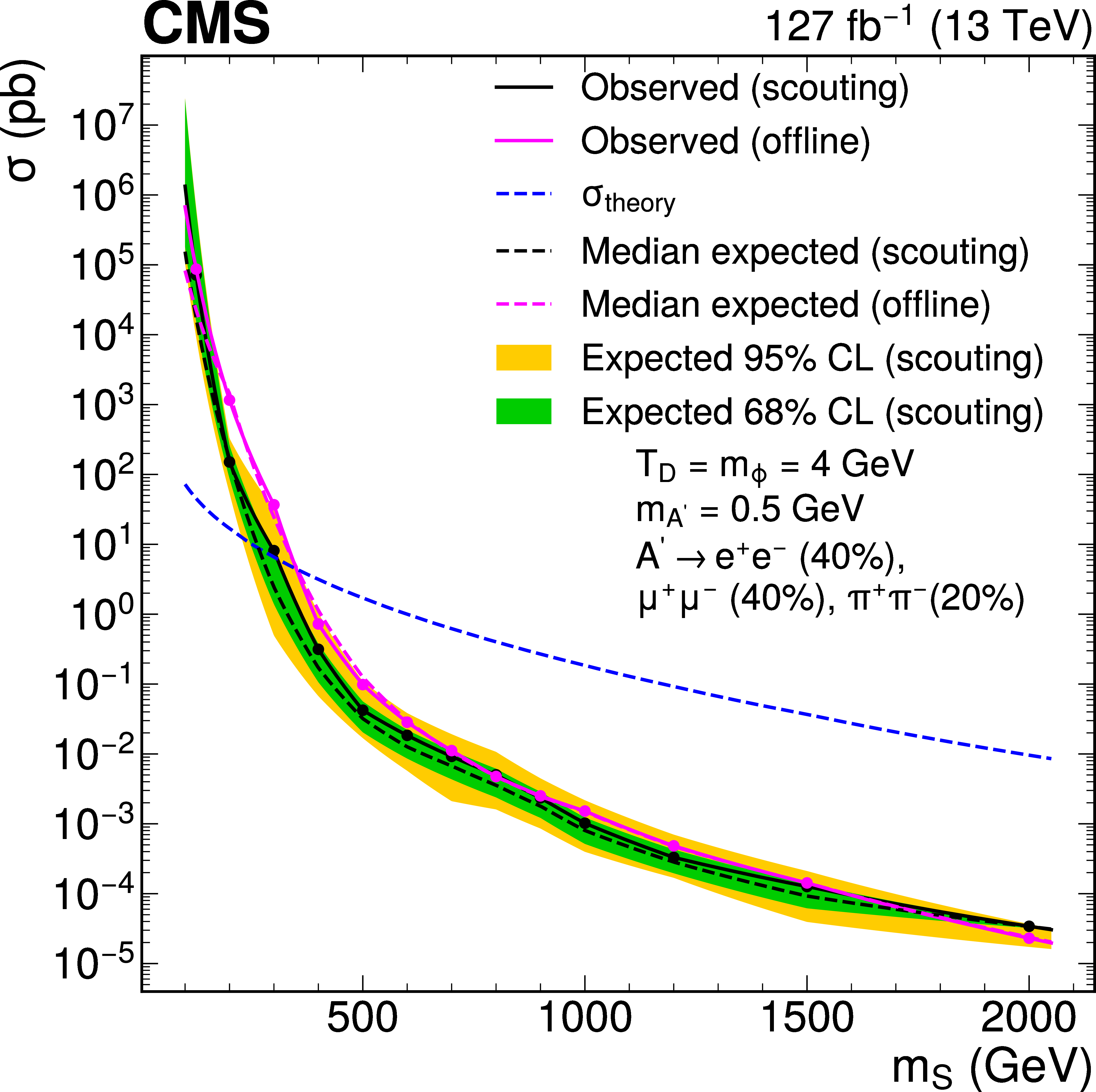
Expected and observed 95% CL upper limits on the simplified scalar-mediator SUEP cross sections as functions of the mediator mass $ m_{\text{S}} $, with a comparison to the corresponding limits from the previous CMS offline search [32]. Signal models with different values of the temperature, dark hadron mass, and dark photon mass are shown. Upper left: $ T_{\text{D}} = m_{\phi} = $ 2 GeV, $ m_{{A}{\prime} } = $ 1 GeV (fully hadronic decays). Upper right: $ T_{\text{D}} = m_{\phi} = $ 4 GeV, $ m_{{A}{\prime} } = $ 0.5 GeV (lepton-dominated decays). Lower: $ T_{\text{D}} = m_{\phi} = $ 8 GeV, $ m_{{A}{\prime} } = $ 0.7 GeV (hadron-dominated decays). |
png pdf |
Figure 4-c:
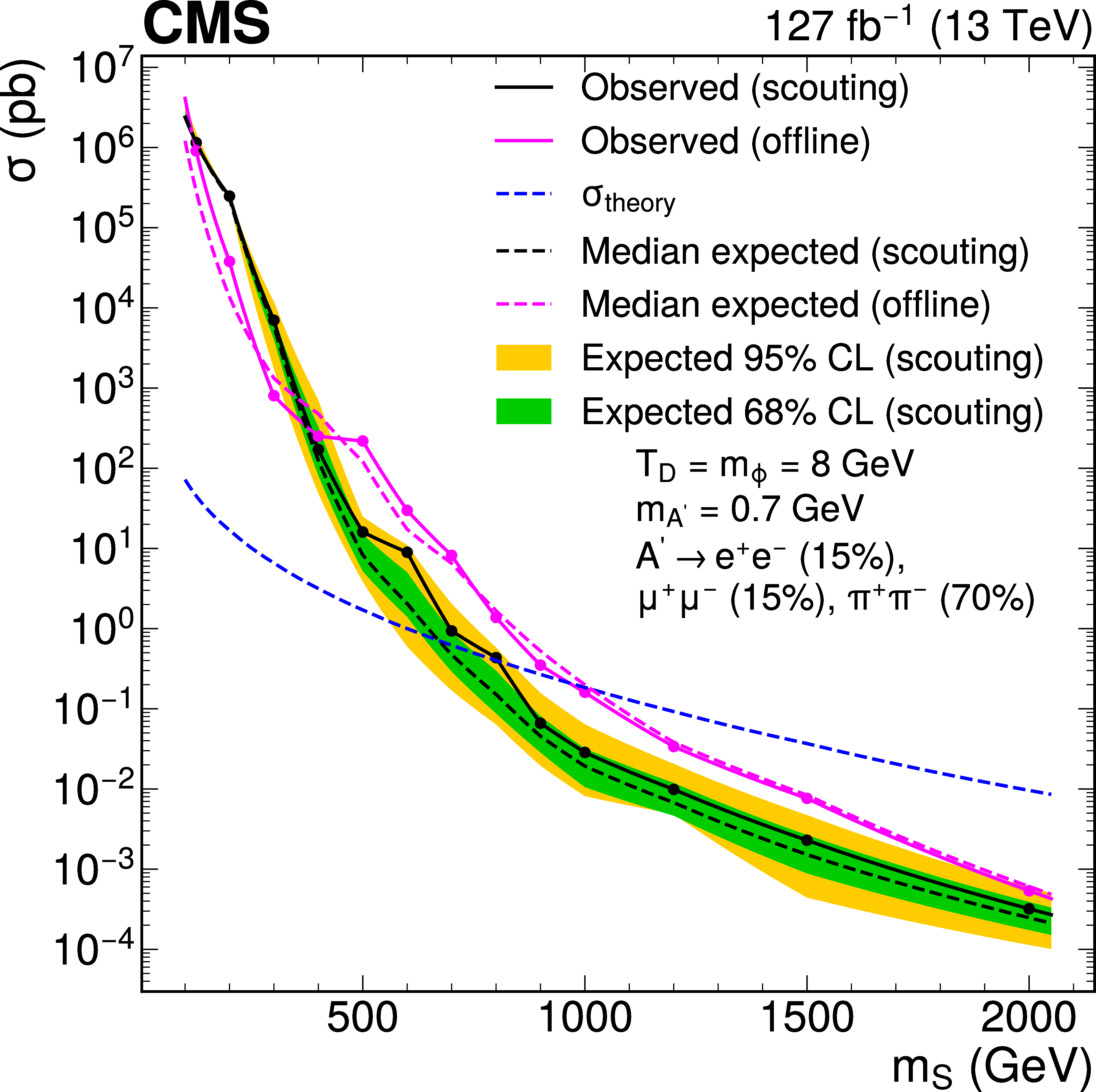
Expected and observed 95% CL upper limits on the simplified scalar-mediator SUEP cross sections as functions of the mediator mass $ m_{\text{S}} $, with a comparison to the corresponding limits from the previous CMS offline search [32]. Signal models with different values of the temperature, dark hadron mass, and dark photon mass are shown. Upper left: $ T_{\text{D}} = m_{\phi} = $ 2 GeV, $ m_{{A}{\prime} } = $ 1 GeV (fully hadronic decays). Upper right: $ T_{\text{D}} = m_{\phi} = $ 4 GeV, $ m_{{A}{\prime} } = $ 0.5 GeV (lepton-dominated decays). Lower: $ T_{\text{D}} = m_{\phi} = $ 8 GeV, $ m_{{A}{\prime} } = $ 0.7 GeV (hadron-dominated decays). |
png pdf |
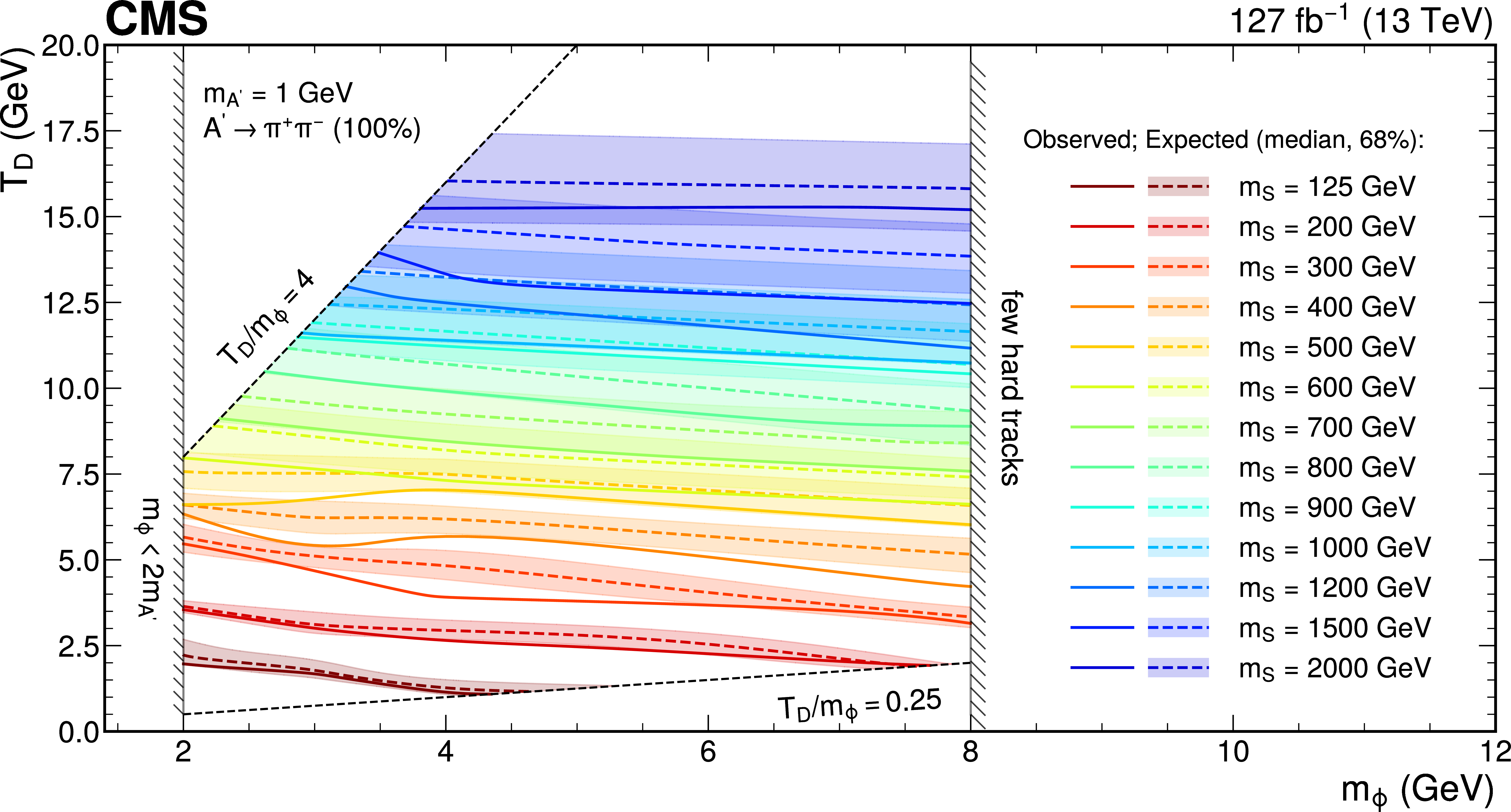
Figure 5:
Expected and observed 95% CL exclusion limits in the $ (T_{\text{D}},m_{\phi}) $ plane, assuming ggF production of scalar mediators $ \text{S} $ with the nominal cross sections and $ m_{{A}{\prime} } = $ 1 GeV (fully hadronic decays). The region below each curve is excluded for that signal model. |
png pdf |
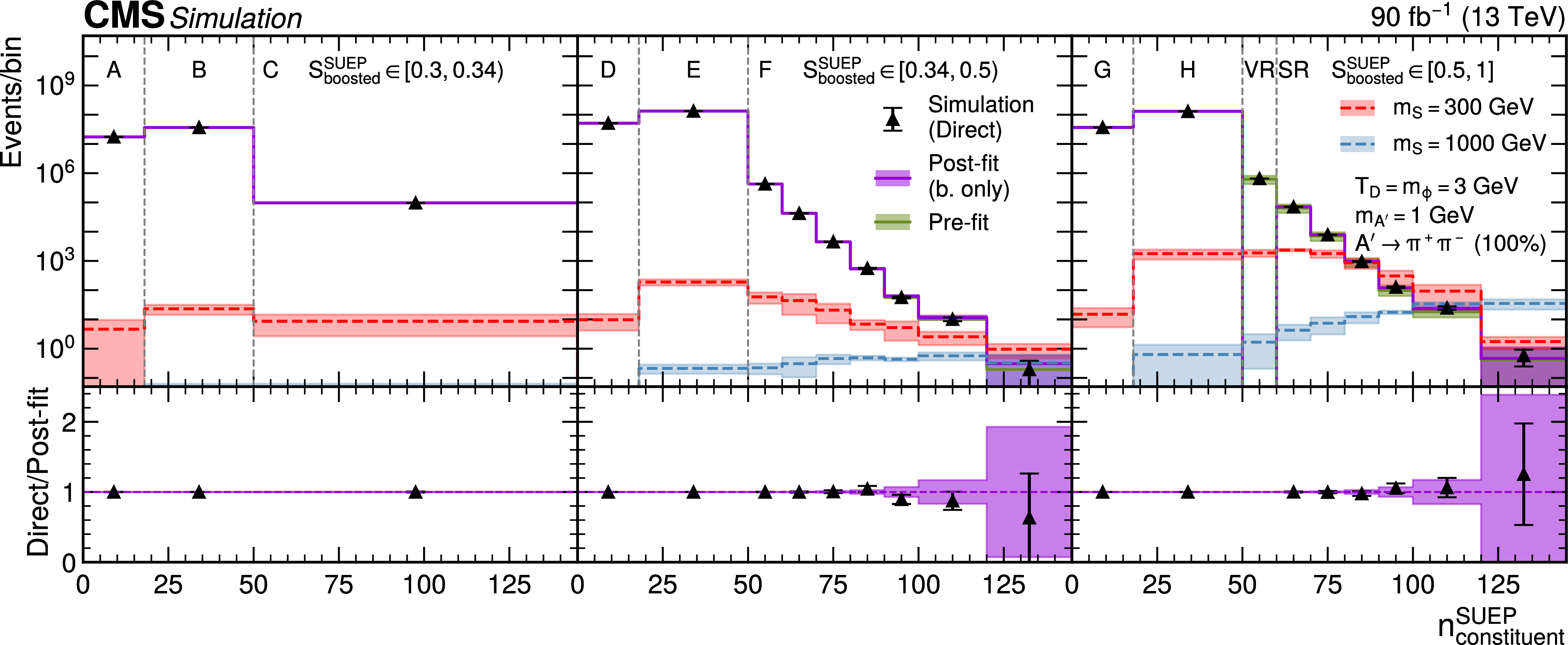
Figure 6:
The $ n_{\text{constituent}}^{\text{SUEP}} $ distributions for various ranges of $ S^{\text{SUEP}}_{\text{boosted}} $ (left: 0.3 $ < S^{\text{SUEP}}_{\text{boosted}} < $ 0.34, middle: 0.34 $ < S^{\text{SUEP}}_{\text{boosted}} < $ 0.5, right: $ S^{\text{SUEP}}_{\text{boosted}} \geq $ 0.5) in QCD multijet simulation, comparing the extended ABCD prediction to the yield directly from the simulation in the SR. The pre-fit expected background from Eq. \eqrefeq:extended-ABCD, the background-only fit results, and two signal models with $ m_{\text{S}} = $ 300 and 1000 GeV are shown, as well as their uncertainties. Both signal models have $ T_{\text{D}} = m_{\phi} = $ 3 GeV and $ m_{{A}{\prime} } = $ 1 GeV (fully hadronic decays). The vertical dashed lines mark the boundaries that separate the CRs, the VR, and the SR. Simulated samples corresponding to the 2017 and 2018 data-taking conditions are used. The lower panels show the ratio of data to the post-fit background prediction. |
png pdf |
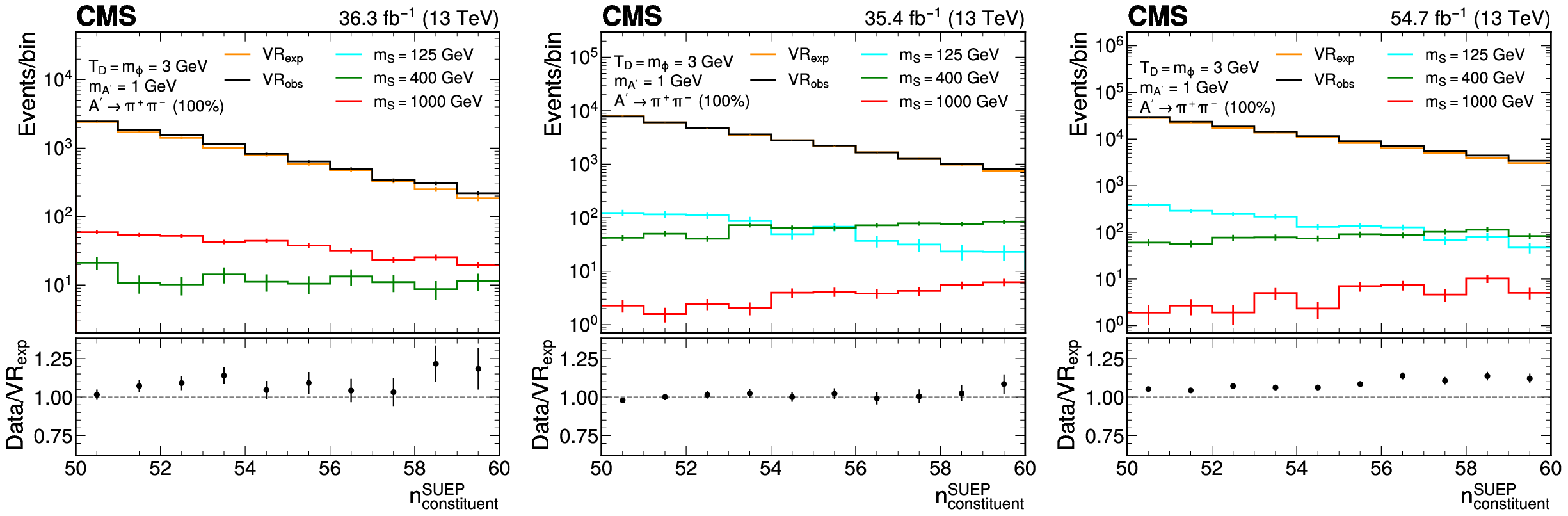
Figure 7:
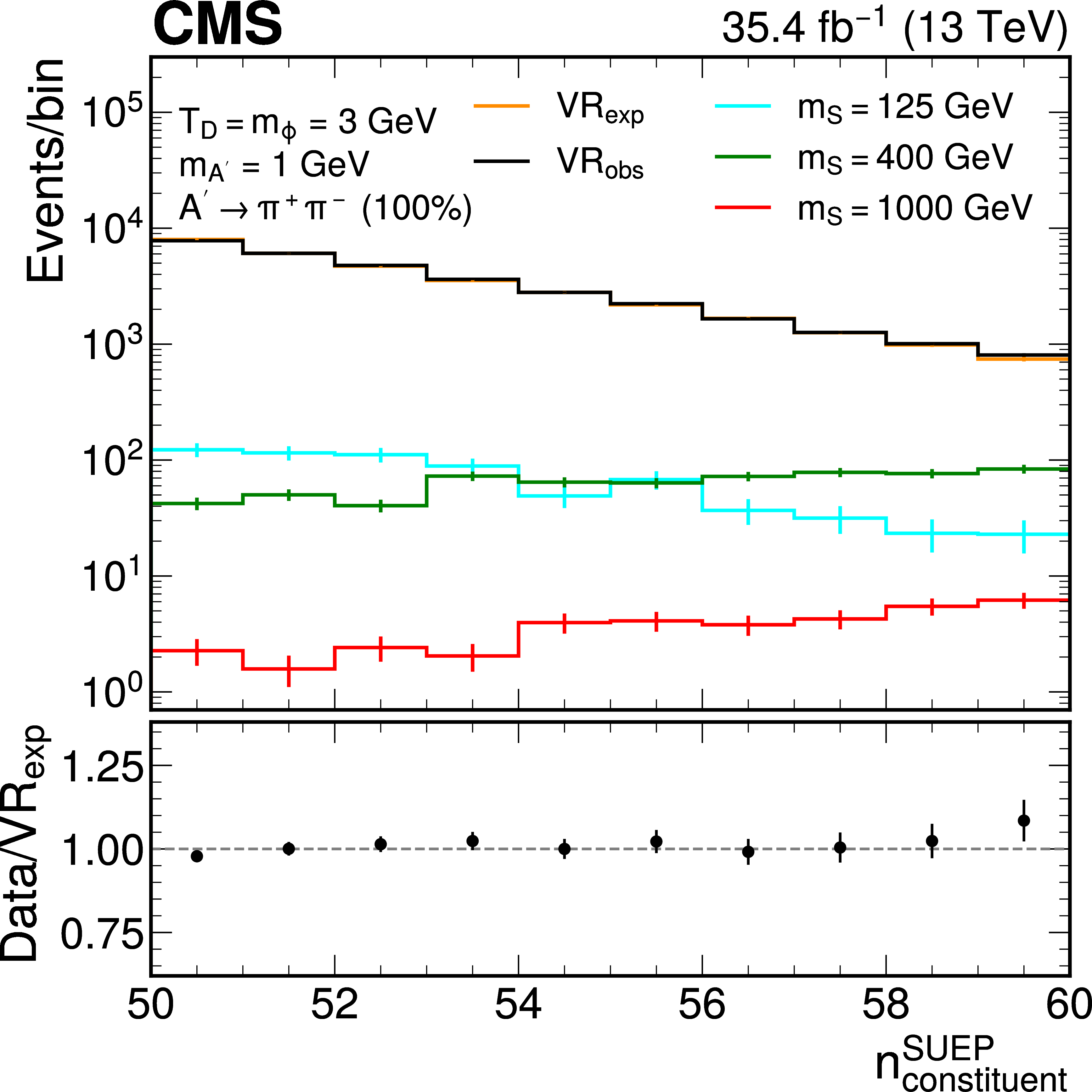
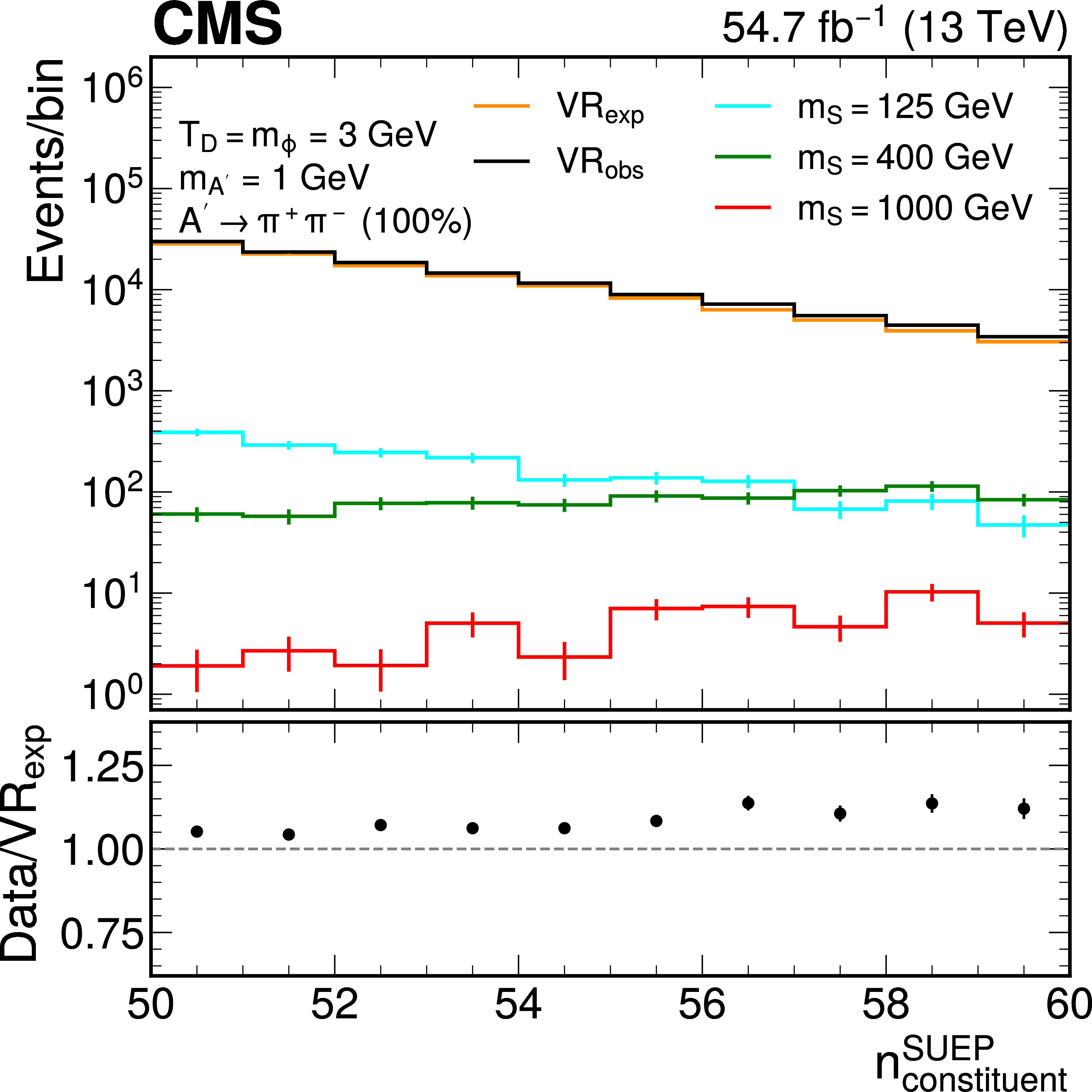
Validation of the extended ABCD method (left: 2016, middle: 2017, right: 2018) in the VR, where signal is negligible compared to background, as shown for signal models with $ m_{\text{S}} = 125, 400\text{, and} $ 1000 GeV, $ T_{\text{D}} = m_{\phi} = $ 3 GeV, and $ m_{{A}{\prime} } = $ 1 GeV (fully hadronic decays). The lower panels show the ratio of data to the expected background in the VR. |
png pdf |
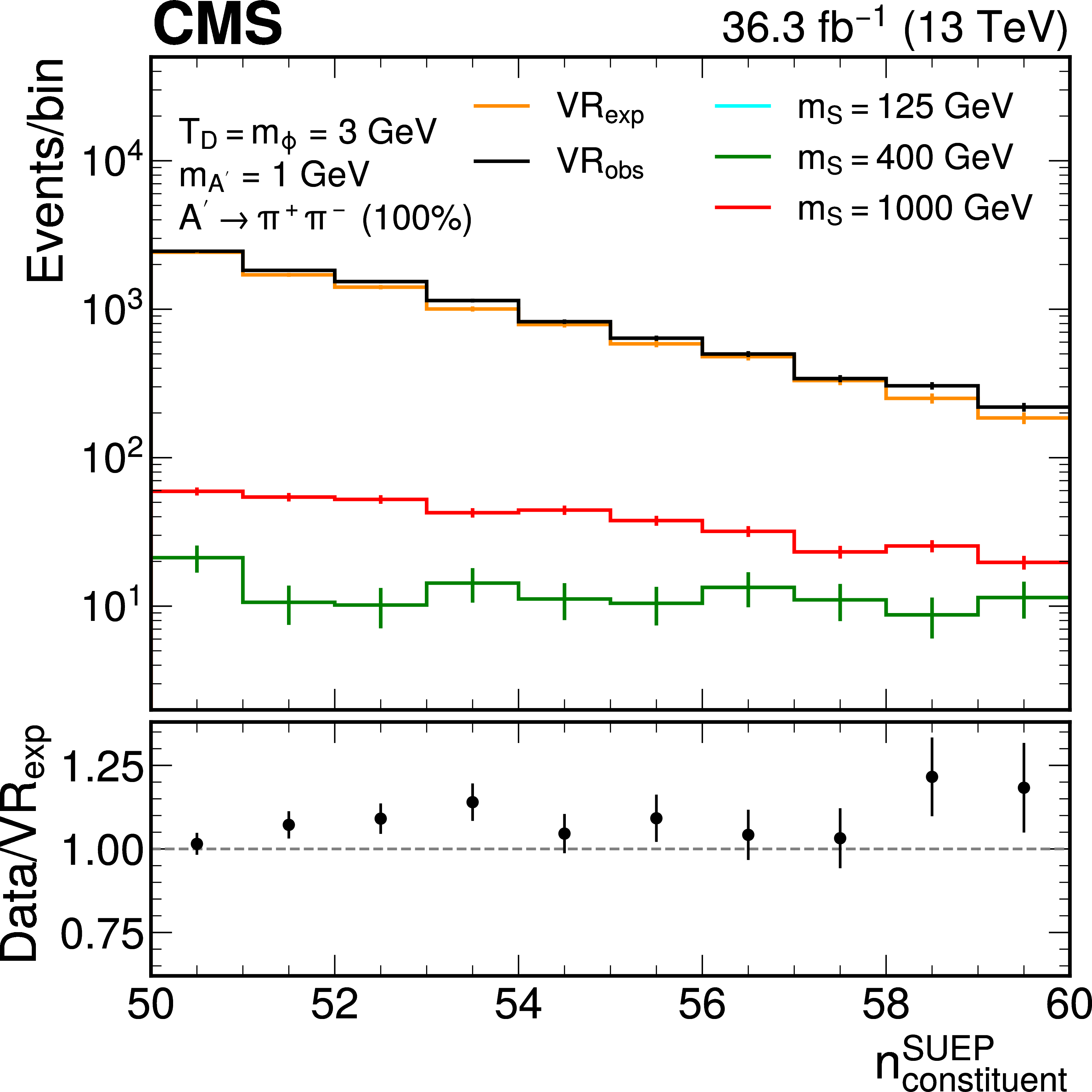
Figure 7-a:
Validation of the extended ABCD method (left: 2016, middle: 2017, right: 2018) in the VR, where signal is negligible compared to background, as shown for signal models with $ m_{\text{S}} = 125, 400\text{, and} $ 1000 GeV, $ T_{\text{D}} = m_{\phi} = $ 3 GeV, and $ m_{{A}{\prime} } = $ 1 GeV (fully hadronic decays). The lower panels show the ratio of data to the expected background in the VR. |
png pdf |
Figure 7-b:
Validation of the extended ABCD method (left: 2016, middle: 2017, right: 2018) in the VR, where signal is negligible compared to background, as shown for signal models with $ m_{\text{S}} = 125, 400\text{, and} $ 1000 GeV, $ T_{\text{D}} = m_{\phi} = $ 3 GeV, and $ m_{{A}{\prime} } = $ 1 GeV (fully hadronic decays). The lower panels show the ratio of data to the expected background in the VR. |
png pdf |
Figure 7-c:
Validation of the extended ABCD method (left: 2016, middle: 2017, right: 2018) in the VR, where signal is negligible compared to background, as shown for signal models with $ m_{\text{S}} = 125, 400\text{, and} $ 1000 GeV, $ T_{\text{D}} = m_{\phi} = $ 3 GeV, and $ m_{{A}{\prime} } = $ 1 GeV (fully hadronic decays). The lower panels show the ratio of data to the expected background in the VR. |
| Summary |
| In summary, a search has been reported for soft unclustered energy patterns (SUEPs) at the LHC using scouting proton-proton collision data at $ \sqrt{s} = $ 13 TeV, corresponding to an integrated luminosity of 127 fb$^{-1}$. This data set is recorded by a high-level trigger with a lower threshold on the scalar sum ($H_T$) of jet transverse momenta ($p_T$) compared to the standard $H_T$ triggers, offsetting the increase in rate by saving limited event content. The characteristic isotropic event shape of SUEP signals is recovered by analyzing the jet in the SUEP-candidate rest frame and selecting particles from only the SUEP candidate, which is chosen as the jet with the highest constituent multiplicity out of the two highest $p_T$ large-radius jets. The standard model background from quantum chromodynamics multijet processes is estimated from data control regions. The search sets the most stringent limits on a large range of SUEP models with a temperature and dark-hadron mass around a few GeV, and scalar mediator masses above 125 GeV. |
| References | ||||
| 1 | M. J. Strassler and K. M. Zurek | Echoes of a hidden valley at hadron colliders | PLB 651 (2007) 374 | hep-ph/0604261 |
| 2 | B. Batell, M. Low, E. T. Neil, and C. B. Verhaaren | Review of neutral naturalness | Phys. Rept. 1165 (2026) 1 | 2203.05531 |
| 3 | N. Craig | Naturalness: past, present, and future | EPJC 83 (2023) 825 | 2205.05708 |
| 4 | T. Cohen, M. Lisanti, and H. K. Lou | Semivisible jets: Dark matter undercover at the LHC | PRL 115 (2015) 171804 | 1503.00009 |
| 5 | P. Schwaller, D. Stolarski, and A. Weiler | Emerging jets | JHEP 05 (2015) 059 | 1502.05409 |
| 6 | S. Knapen, S. Pagan Griso, M. Papucci, and D. J. Robinson | Triggering soft bombs at the LHC | JHEP 08 (2017) 076 | 1612.00850 |
| 7 | CMS Collaboration | Dark sector searches with the CMS experiment | Phys. Rept. 1115 (2025) 448 | CMS-EXO-23-005 2405.13778 |
| 8 | CMS Collaboration | Enriching the physics program of the CMS experiment via data scouting and data parking | Phys. Rept. 1115 (2025) 678 | CMS-EXO-23-007 2403.16134 |
| 9 | E. V. Shuryak | What RHIC experiments and theory tell us about properties of quark-gluon plasma? | Nucl. Phys. A 750 (2005) 64 | hep-ph/0405066 |
| 10 | T. Sch ä fer and E. V. Shuryak | Instantons in QCD | Rev. Mod. Phys. 70 (1998) 323 | hep-ph/9610451 |
| 11 | P. Kovtun, D. T. Son, and A. O. Starinets | Viscosity in strongly interacting quantum field theories from black hole physics | PRL 94 (2005) 111601 | hep-th/0405231 |
| 12 | J. Casalderrey | Gauge/string duality, hot QCD and heavy ion collisions | Cambridge University Press, 2014 link |
|
| 13 | M. J. Strassler | Why unparticle models with mass gaps are examples of hidden valleys | 0801.0629 | |
| 14 | J. Barron et al. | Unsupervised hadronic SUEP at the LHC | JHEP 12 (2021) 129 | 2107.12379 |
| 15 | S. C. Park | Black holes and the LHC: A review | Prog. Part. Nucl. Phys. 67 (2012) 617 | 1203.4683 |
| 16 | LHC Higgs Cross Section Working Group | Handbook of LHC Higgs cross sections: 4. Deciphering the nature of the Higgs sector | CERN Report CERN-2017-002-M, 2016 link |
1610.07922 |
| 17 | S. Carrazza et al. | An unbiased Hessian representation for Monte Carlo PDFs | EPJC 75 (2015) 369 | 1505.06736 |
| 18 | T. Sjöstrand et al. | An introduction to PYTHIA 8.2 | Comput. Phys. Commun. 191 (2015) 159 | 1410.3012 |
| 19 | CMS Collaboration | Extraction and validation of a new set of CMS PYTHIA8 tunes from underlying-event measurements | EPJC 80 (2020) 4 | CMS-GEN-17-001 1903.12179 |
| 20 | GEANT4 Collaboration | GEANT 4---a simulation toolkit | NIM A 506 (2003) 250 | |
| 21 | CMS Collaboration | The CMS experiment at the CERN LHC | JINST 3 (2008) S08004 | |
| 22 | CMS Collaboration | Development of the CMS detector for the CERN LHC Run 3 | JINST 19 (2024) P05064 | CMS-PRF-21-001 2309.05466 |
| 23 | CMS Collaboration | Electron and photon reconstruction and identification with the CMS experiment at the CERN LHC | JINST 16 (2021) P05014 | CMS-EGM-17-001 2012.06888 |
| 24 | CMS Collaboration | Performance of the CMS muon detector and muon reconstruction with proton-proton collisions at $ \sqrt{s}= $ 13 TeV | JINST 13 (2018) P06015 | CMS-MUO-16-001 1804.04528 |
| 25 | CMS Collaboration | Description and performance of track and primary-vertex reconstruction with the CMS tracker | JINST 9 (2014) P10009 | CMS-TRK-11-001 1405.6569 |
| 26 | CMS Collaboration | Particle-flow reconstruction and global event description with the CMS detector | JINST 12 (2017) P10003 | CMS-PRF-14-001 1706.04965 |
| 27 | CMS Collaboration | Jet energy scale and resolution in the CMS experiment in pp collisions at 8 TeV | JINST 12 (2017) P02014 | CMS-JME-13-004 1607.03663 |
| 28 | CMS Collaboration | Performance of missing transverse momentum reconstruction in proton-proton collisions at $ \sqrt{s} = $ 13 TeV using the CMS detector | JINST 14 (2019) P07004 | CMS-JME-17-001 1903.06078 |
| 29 | CMS Collaboration | Performance of the CMS Level-1 trigger in proton-proton collisions at $ \sqrt{s} = $ 13 TeV | JINST 15 (2020) P10017 | CMS-TRG-17-001 2006.10165 |
| 30 | CMS Collaboration | Performance of the CMS high-level trigger during LHC Run 2 | JINST 19 (2024) P11021 | CMS-TRG-19-001 2410.17038 |
| 31 | CMS Collaboration | The CMS trigger system | JINST 12 (2017) P01020 | CMS-TRG-12-001 1609.02366 |
| 32 | CMS Collaboration | Search for soft unclustered energy patterns in proton-proton collisions at 13 TeV | PRL 133 (2024) 191902 | CMS-EXO-23-002 2403.05311 |
| 33 | CMS Collaboration | Search for soft unclustered energy patterns produced in association with a W or Z boson in proton-proton collisions at s=13TeV | PLB 879 (2026) 140671 | CMS-EXO-25-007 2604.05996 |
| 34 | ATLAS Collaboration | Search for soft unclustered energy patterns containing muons in the final state in pp collisions at $ \sqrt{s} = $ 13 TeV with the ATLAS detector | Submitted to JHEP, 2026 | 2605.20015 |
| 35 | M. Cacciari, G. P. Salam, and G. Soyez | The anti-$ k_{\mathrm{T}} $ jet clustering algorithm | JHEP 04 (2008) 063 | 0802.1189 |
| 36 | M. Cacciari, G. P. Salam, and G. Soyez | FastJet user manual | EPJC 72 (2012) 1896 | 1111.6097 |
| 37 | C. Cesarotti, M. Reece, and M. J. Strassler | The efficacy of event isotropy as an event shape observable | JHEP 07 (2021) 215 | 2011.06599 |
| 38 | S. Choi and H. Oh | Improved extrapolation methods of data-driven background estimations in high energy physics | EPJC 81 (2021) 643 | 1906.10831 |
| 39 | CMS Collaboration | Precision luminosity measurement in proton-proton collisions at $ \sqrt{s} = $ 13 TeV in 2015 and 2016 at CMS | EPJC 81 (2021) 800 | CMS-LUM-17-003 2104.01927 |
| 40 | CMS Collaboration | CMS luminosity measurement for the 2017 data-taking period at $ \sqrt{s} = $ 13 TeV | CMS Physics Analysis Summary, CERN, 2018 CMS-PAS-LUM-17-004 |
CMS-PAS-LUM-17-004 |
| 41 | CMS Collaboration | CMS luminosity measurement for the 2018 data-taking period at $ \sqrt{s} = $ 13 TeV | CMS Physics Analysis Summary, CERN, 2019 CMS-PAS-LUM-18-002 |
CMS-PAS-LUM-18-002 |
| 42 | K. Becker et al. | Precise predictions for boosted Higgs production | SciPost Phys. Core 7 (2024) 001 | 2005.07762 |
| 43 | CMS Collaboration | Tracking performance for charged pions with Run2 Legacy data | CMS Detector Performance Note CMS-DP-2022-012, 2022 link |
|
| 44 | CMS Collaboration | Muon tracking efficiency for 2018 dataset using tag and probe method | CMS Detector Performance Note CMS-DP-2020-013, 2019 CDS |
|
| 45 | CMS Collaboration | The CMS statistical analysis and combination tool: Combine | Comput. Softw. Big Sci. 8 (2024) 19 | CMS-CAT-23-001 2404.06614 |
| 46 | T. Junk | Confidence level computation for combining searches with small statistics | NIM A 434 (1999) 435 | hep-ex/9902006 |
| 47 | A. L. Read | Presentation of search results: The $ \text{CL}_\text{s} $ technique | JPG 28 (2002) 2693 | |
| 48 | G. Cowan, K. Cranmer, E. Gross, and O. Vitells | Asymptotic formulae for likelihood-based tests of new physics | EPJC 71 (2011) 1554 | 1007.1727 |
| 49 | CMS Collaboration | HEPData record for this analysis | link | |
|
|
Compact Muon Solenoid LHC, CERN |

|
|
|
|
|
|