
Compact Muon Solenoid
LHC, CERN
 Visit us: CMS Public Website, CMS Physics ;
Contact us: CMS Publications Committee
Visit us: CMS Public Website, CMS Physics ;
Contact us: CMS Publications Committee
| CMS-B2G-24-014 ; CERN-EP-2025-299 | ||
| Search for heavy resonances decaying into two Higgs bosons in the $\mathrm{b\bar{b}}\tau^+\tau^-$ final state in proton-proton collisions at $\sqrt{s}$ = 13 TeV | ||
| CMS Collaboration | ||
| 27 January 2026 | ||
| Eur. Phys. J. C 86 (2026) 901 | ||
| Abstract: A search is presented for massive narrow-width resonances in the mass range of 1$-$4.5 TeV, decaying into pairs of Higgs bosons (HH). The search uses proton-proton collision data at a center-of-mass energy of 13 TeV collected with the CMS detector at the CERN LHC during 2016$-$2018, corresponding to an integrated luminosity of 138 fb$^{-1}$. The analysis targets final states where one Higgs boson decays into a pair of bottom quarks and the other into a pair of tau leptons, X $\to$ HH $\to$ $\mathrm{b\bar{b}}\tau^+\tau^-$. It uses a single large jet to reconstruct the H $\to$ $\mathrm{b\bar{b}}$ decay, while the H $\to$ $\tau^+\tau^-$ decay products can either be contained within a single large jet or appear as two isolated tau leptons. The observed data are consistent with standard model background expectations. Upper limits at 95% confidence level are set on the production cross section for resonant HH production for masses between 1 and 4.5 TeV. This analysis sets the most sensitive limits to date on X $\to$ HH $\to$ $\mathrm{b\bar{b}}\tau^+\tau^-$ decays in the mass range of 1.4 to 4.5 TeV. | ||
| Links: e-print arXiv:2601.20011 [hep-ex] (PDF) ; CDS record ; inSPIRE record ; Physics Briefing ; CADI line (restricted) ; | ||
| Figures | |
png pdf |
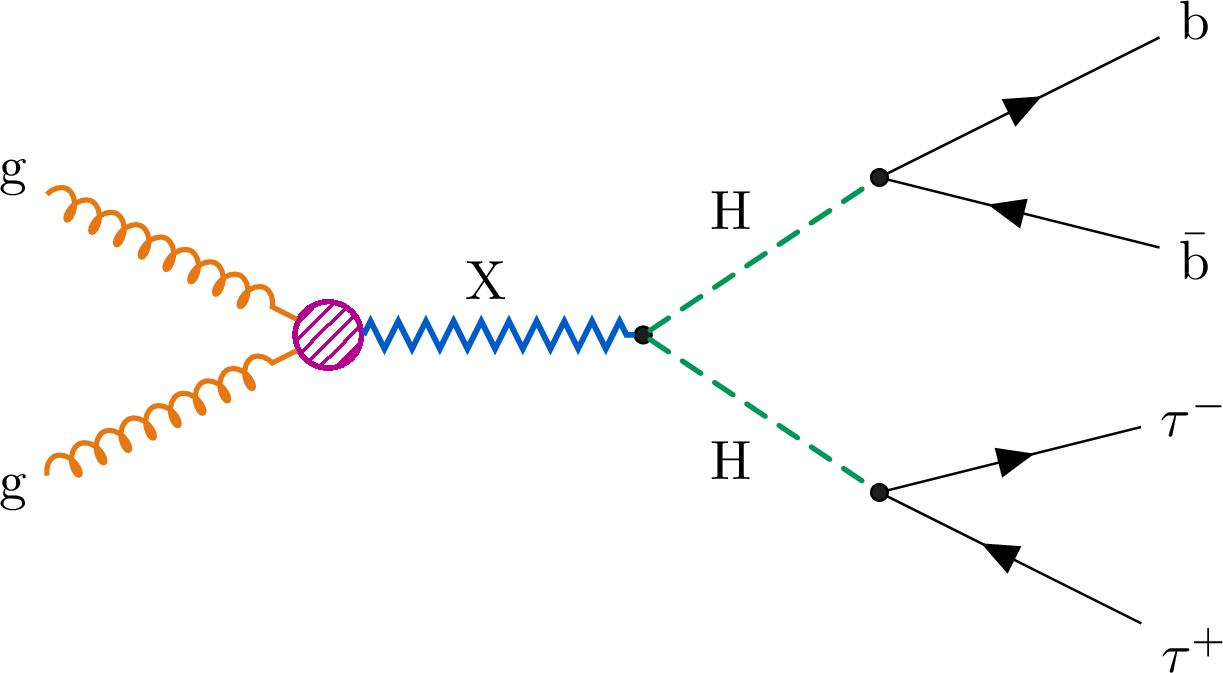
Figure 1:
A representative diagram for the production of a spin-0 radion or a spin-2 graviton $ \mathrm{X} $, which decays into two SM Higgs bosons. One Higgs boson decays into a $ \mathrm{b}\overline{\mathrm{b}} $ pair and the other into a $ \tau^{+}\tau^{-} $ pair. |
png pdf |
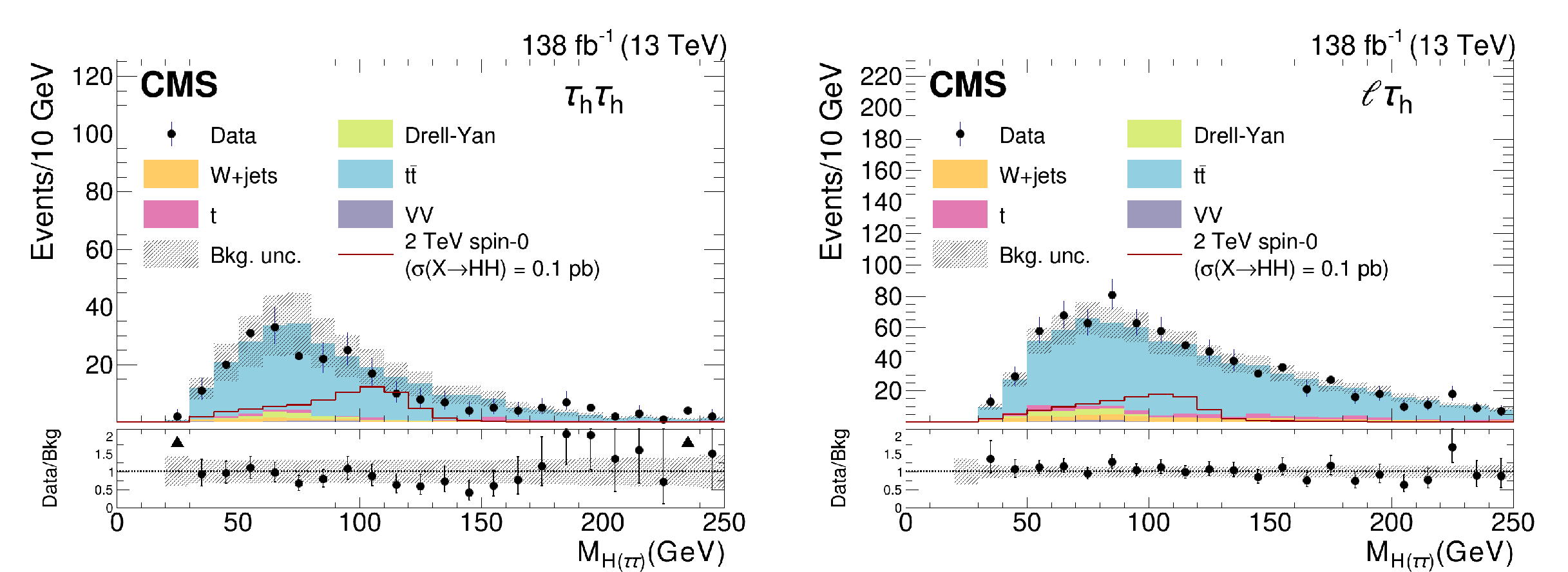
Figure 2:
Distribution of the invariant mass of the di-$ \tau $ system, reconstructed with the FASTMTT algorithm, after the full event selection in the $ \tau_\mathrm{h}\tau_\mathrm{h} $ (left) and $ \ell\tau_\mathrm{h} $ (right) channels. The data (solid circles) are compared to the background simulation (filled histograms), where the gray bands represent the total background uncertainty, obtained from the post-fit values of the dominant systematic uncertainties and the statistical uncertainties in the simulated samples. The $ \mathrm{X} \to \mathrm{HH} $ signal simulation (solid red line) is overlaid and normalized to $\sigma( \mathrm{X} \to \mathrm{HH} )=0.1 $ pb for illustration. The ratio between the data and the total expected background contribution is shown in the lower panel, where a solid black triangle indicates those bins where the ratio exceeds the axis range. |
png pdf |
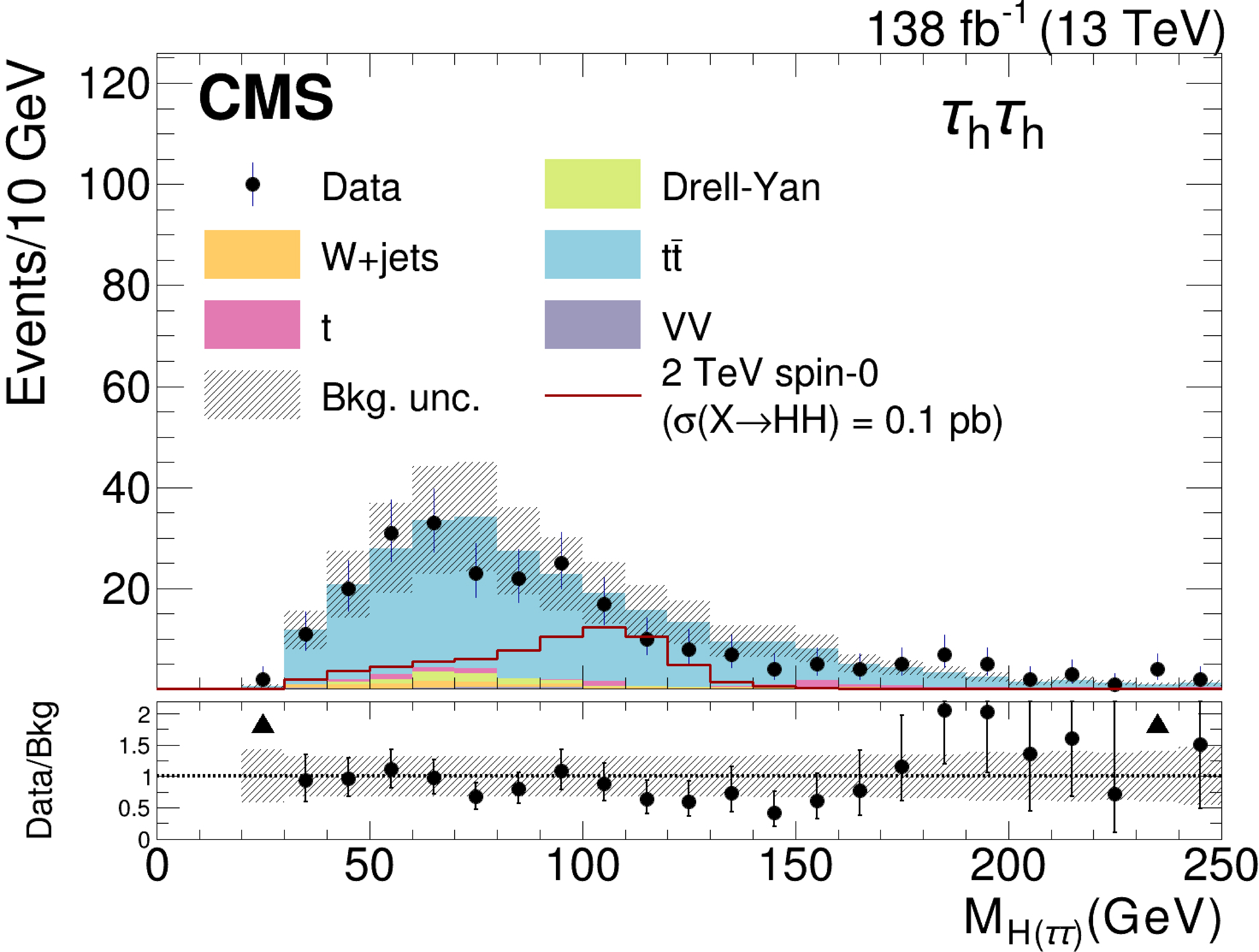
Figure 2-a:
Distribution of the invariant mass of the di-$ \tau $ system, reconstructed with the FASTMTT algorithm, after the full event selection in the $ \tau_\mathrm{h}\tau_\mathrm{h} $ (left) and $ \ell\tau_\mathrm{h} $ (right) channels. The data (solid circles) are compared to the background simulation (filled histograms), where the gray bands represent the total background uncertainty, obtained from the post-fit values of the dominant systematic uncertainties and the statistical uncertainties in the simulated samples. The $ \mathrm{X} \to \mathrm{HH} $ signal simulation (solid red line) is overlaid and normalized to $\sigma( \mathrm{X} \to \mathrm{HH} )=0.1 $ pb for illustration. The ratio between the data and the total expected background contribution is shown in the lower panel, where a solid black triangle indicates those bins where the ratio exceeds the axis range. |
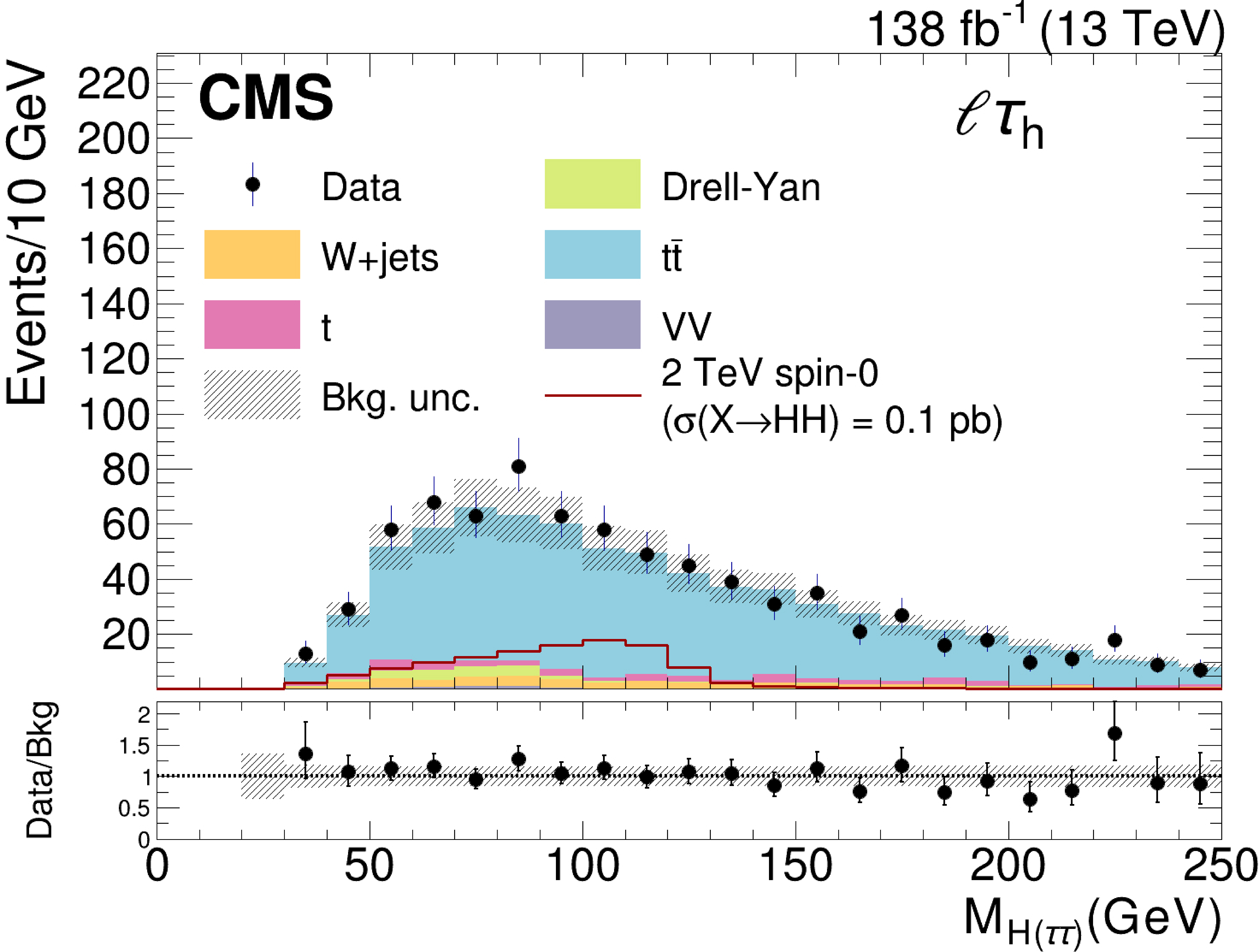
png pdf |
Figure 2-b:
Distribution of the invariant mass of the di-$ \tau $ system, reconstructed with the FASTMTT algorithm, after the full event selection in the $ \tau_\mathrm{h}\tau_\mathrm{h} $ (left) and $ \ell\tau_\mathrm{h} $ (right) channels. The data (solid circles) are compared to the background simulation (filled histograms), where the gray bands represent the total background uncertainty, obtained from the post-fit values of the dominant systematic uncertainties and the statistical uncertainties in the simulated samples. The $ \mathrm{X} \to \mathrm{HH} $ signal simulation (solid red line) is overlaid and normalized to $\sigma( \mathrm{X} \to \mathrm{HH} )=0.1 $ pb for illustration. The ratio between the data and the total expected background contribution is shown in the lower panel, where a solid black triangle indicates those bins where the ratio exceeds the axis range. |
png pdf |
Figure 3:
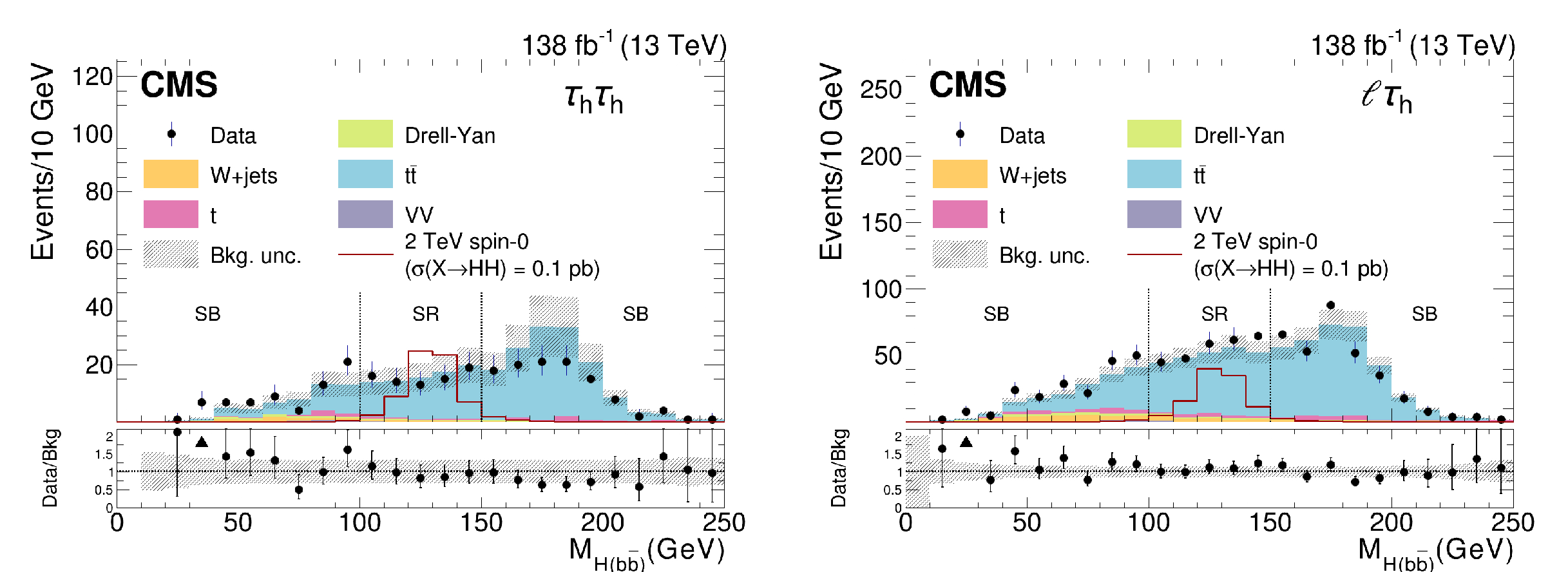
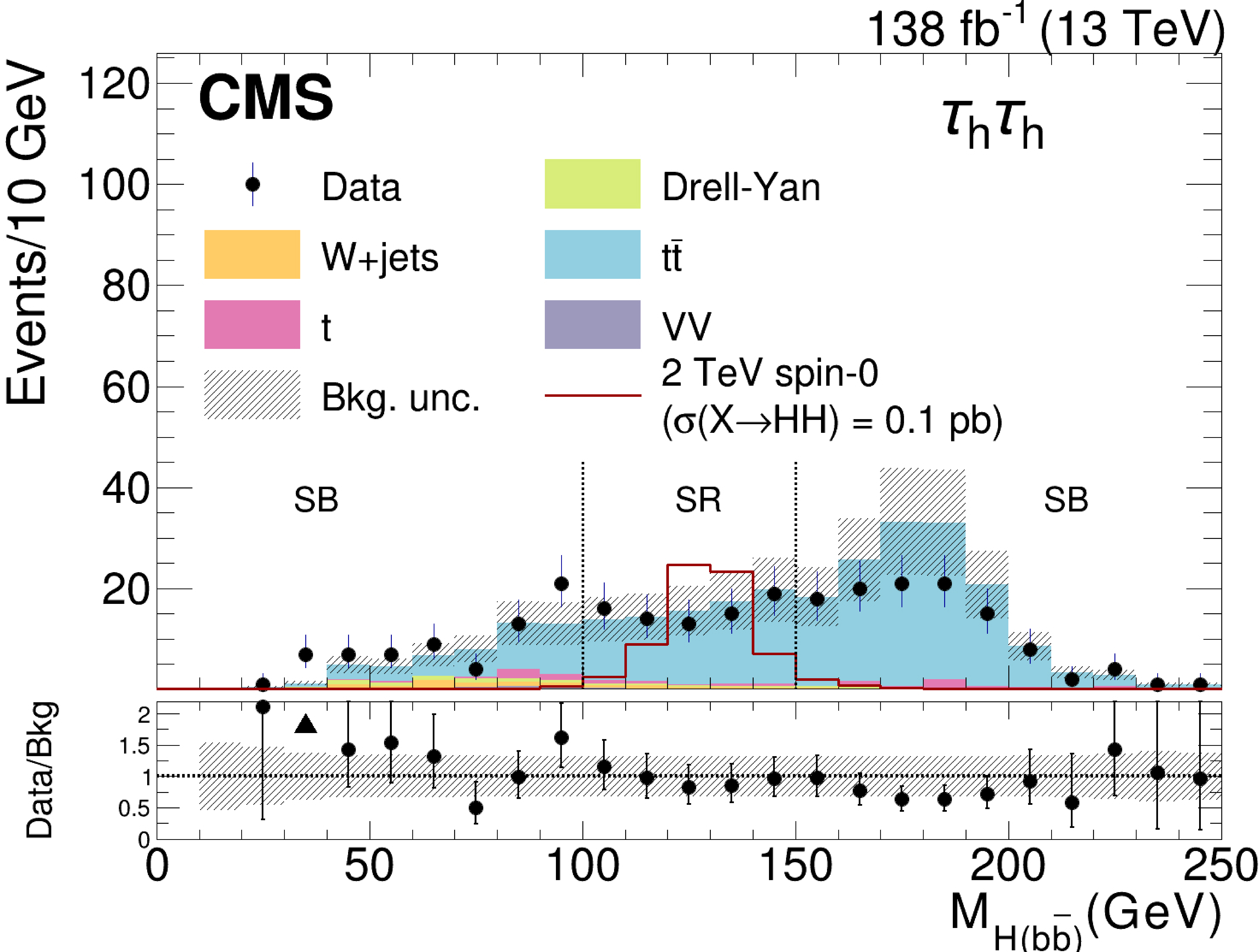
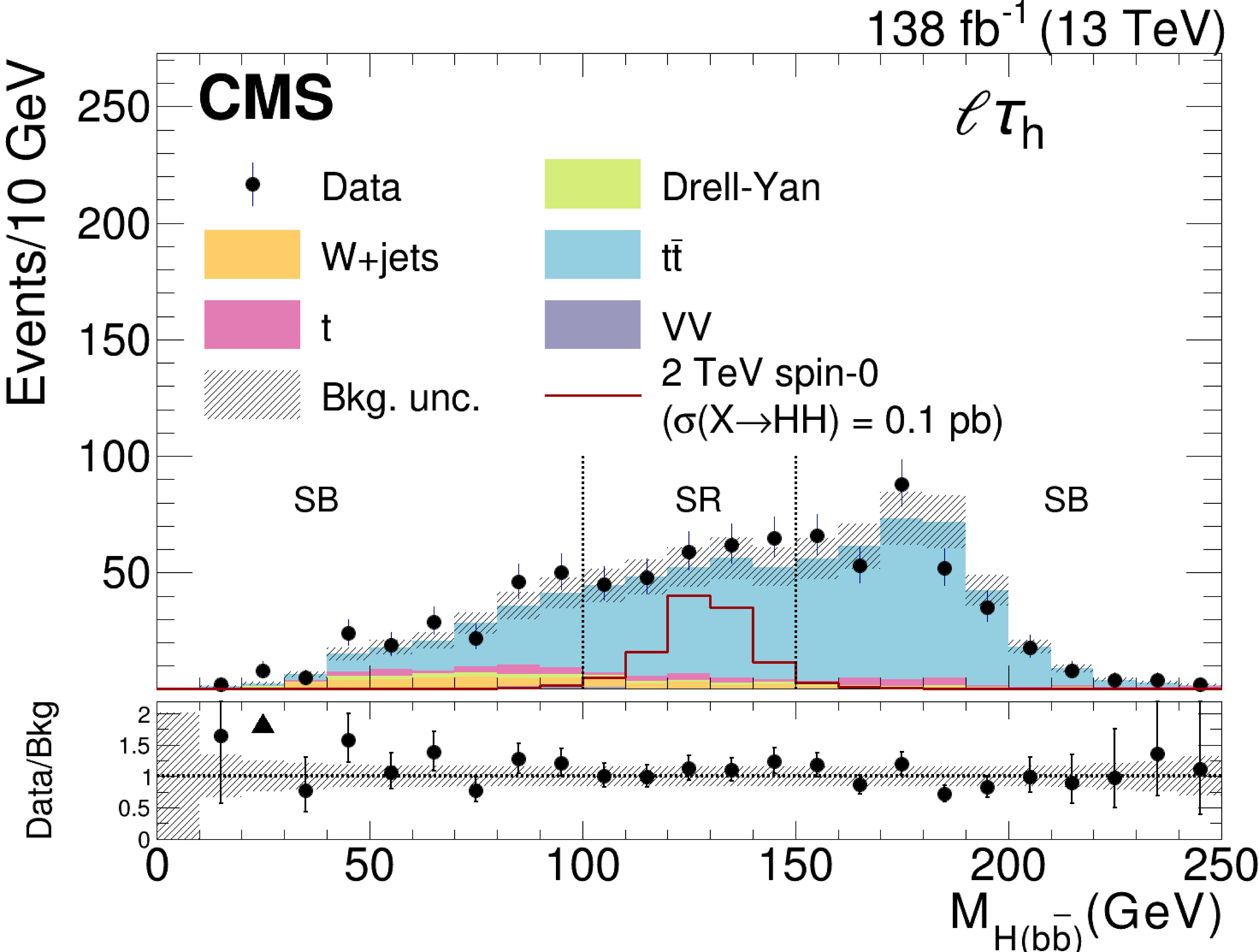
Distribution of $ M_{\mathrm{H}(\mathrm{b}\overline{\mathrm{b}})} $ obtained from the leading AK8 jet in the event after the full event selection for the $ \tau_\mathrm{h}\tau_\mathrm{h} $ (left) and $ \ell\tau_\mathrm{h} $ (right) channels. The signal-enriched region (SR) is defined as 100 $ < M_{\mathrm{H}(\mathrm{b}\overline{\mathrm{b}})} < $ 150 GeV. The sideband (SB) is immediately adjacent to the SR, on either side. The data (solid circles) are compared to the background simulation (filled histograms), where the gray bands represent the total background uncertainty, obtained from the post-fit values of the dominant systematic uncertainties and the statistical uncertainties in the simulated samples. The $ \mathrm{X} \to \mathrm{HH} $ signal simulation (solid red line) is overlaid and normalized to $\sigma( \mathrm{X} \to \mathrm{HH} )=0.1 $ pb for illustration. The ratio between the data and the total expected background contribution is shown in the lower panel, where a solid black triangle indicates those bins where the ratio exceeds the axis range. |
png pdf |
Figure 3-a:
Distribution of $ M_{\mathrm{H}(\mathrm{b}\overline{\mathrm{b}})} $ obtained from the leading AK8 jet in the event after the full event selection for the $ \tau_\mathrm{h}\tau_\mathrm{h} $ (left) and $ \ell\tau_\mathrm{h} $ (right) channels. The signal-enriched region (SR) is defined as 100 $ < M_{\mathrm{H}(\mathrm{b}\overline{\mathrm{b}})} < $ 150 GeV. The sideband (SB) is immediately adjacent to the SR, on either side. The data (solid circles) are compared to the background simulation (filled histograms), where the gray bands represent the total background uncertainty, obtained from the post-fit values of the dominant systematic uncertainties and the statistical uncertainties in the simulated samples. The $ \mathrm{X} \to \mathrm{HH} $ signal simulation (solid red line) is overlaid and normalized to $\sigma( \mathrm{X} \to \mathrm{HH} )=0.1 $ pb for illustration. The ratio between the data and the total expected background contribution is shown in the lower panel, where a solid black triangle indicates those bins where the ratio exceeds the axis range. |
png pdf |
Figure 3-b:
Distribution of $ M_{\mathrm{H}(\mathrm{b}\overline{\mathrm{b}})} $ obtained from the leading AK8 jet in the event after the full event selection for the $ \tau_\mathrm{h}\tau_\mathrm{h} $ (left) and $ \ell\tau_\mathrm{h} $ (right) channels. The signal-enriched region (SR) is defined as 100 $ < M_{\mathrm{H}(\mathrm{b}\overline{\mathrm{b}})} < $ 150 GeV. The sideband (SB) is immediately adjacent to the SR, on either side. The data (solid circles) are compared to the background simulation (filled histograms), where the gray bands represent the total background uncertainty, obtained from the post-fit values of the dominant systematic uncertainties and the statistical uncertainties in the simulated samples. The $ \mathrm{X} \to \mathrm{HH} $ signal simulation (solid red line) is overlaid and normalized to $\sigma( \mathrm{X} \to \mathrm{HH} )=0.1 $ pb for illustration. The ratio between the data and the total expected background contribution is shown in the lower panel, where a solid black triangle indicates those bins where the ratio exceeds the axis range. |
png pdf |
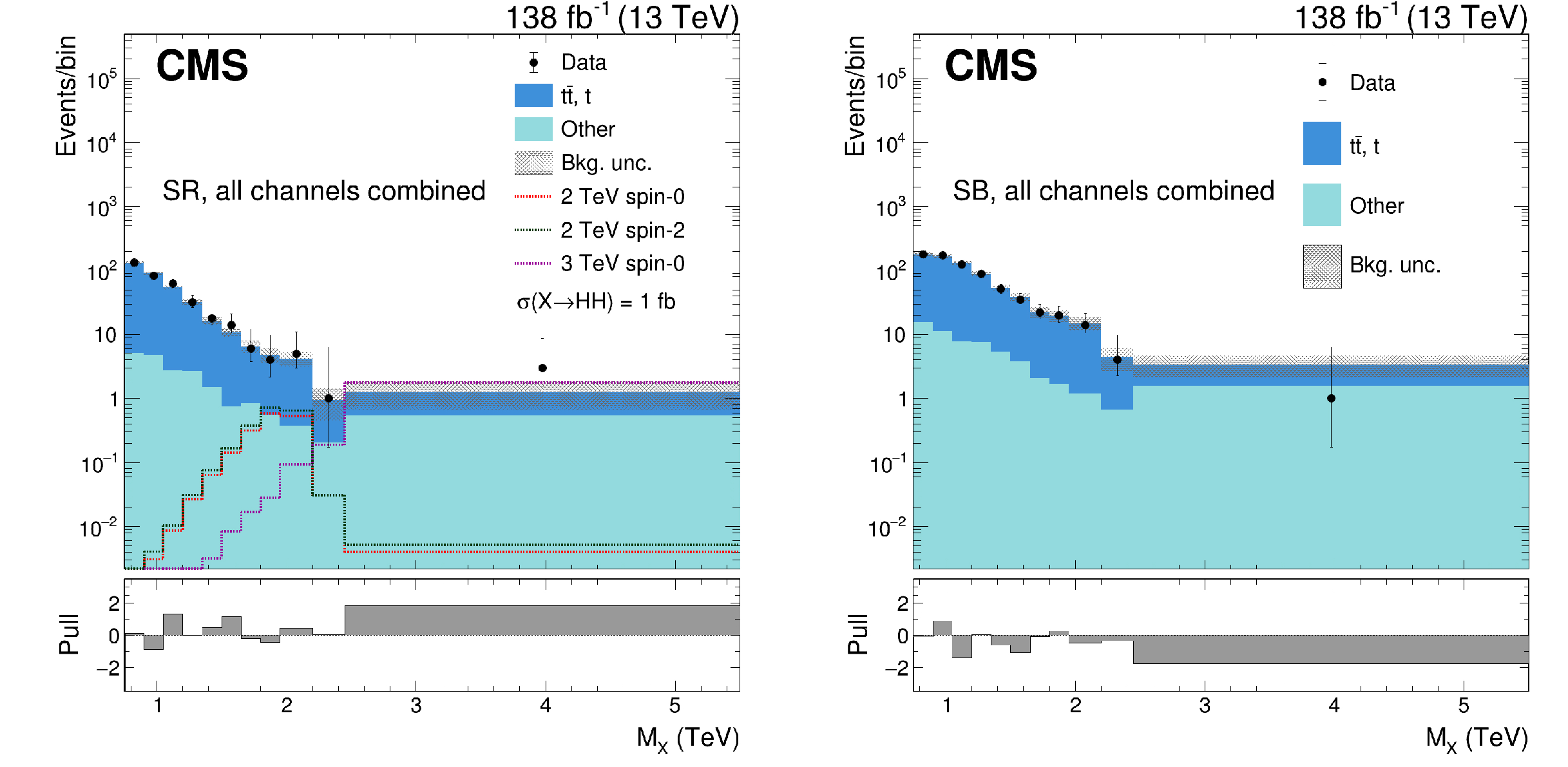
Figure 4:
Post-fit reconstructed mass distribution of resonance $ \mathrm{X} $ in the SR (left) and SB (right) after applying all selection criteria, for the sum of the $ \tau_\mathrm{h}\tau_\mathrm{h} $ and $ \ell\tau_\mathrm{h} $ channels. Minor background contributions are grouped into a single category labeled ``Other''. Also shown are several signal predictions in dashed colored lines for visualization only. The lower panels show the ``Pull'' defined as $ \text{(Data - Prediction)/Prediction uncertainty} $. |
png pdf |

Figure 4-a:
Post-fit reconstructed mass distribution of resonance $ \mathrm{X} $ in the SR (left) and SB (right) after applying all selection criteria, for the sum of the $ \tau_\mathrm{h}\tau_\mathrm{h} $ and $ \ell\tau_\mathrm{h} $ channels. Minor background contributions are grouped into a single category labeled ``Other''. Also shown are several signal predictions in dashed colored lines for visualization only. The lower panels show the ``Pull'' defined as $ \text{(Data - Prediction)/Prediction uncertainty} $. |
png pdf |

Figure 4-b:
Post-fit reconstructed mass distribution of resonance $ \mathrm{X} $ in the SR (left) and SB (right) after applying all selection criteria, for the sum of the $ \tau_\mathrm{h}\tau_\mathrm{h} $ and $ \ell\tau_\mathrm{h} $ channels. Minor background contributions are grouped into a single category labeled ``Other''. Also shown are several signal predictions in dashed colored lines for visualization only. The lower panels show the ``Pull'' defined as $ \text{(Data - Prediction)/Prediction uncertainty} $. |
png pdf |
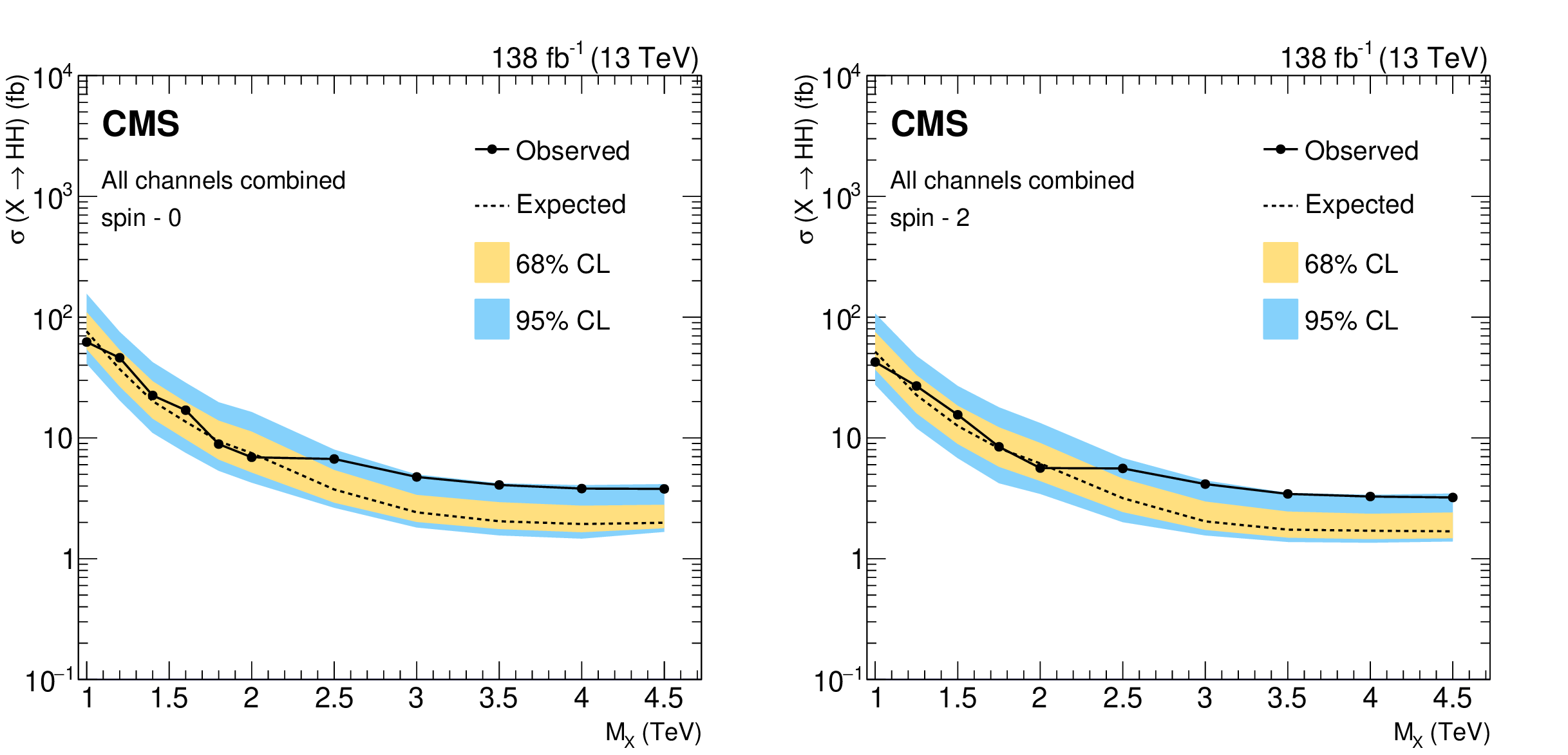
Figure 5:
Expected and observed upper limits at 95% CL on the production cross section of resonant HH production for a spin-0 (left) and spin-2 (right) narrow resonance. This calculation assumes SM branching fractions of the H boson as discussed in Section 1. The observed limits are higher than the expected limits for mass points above 2.5 TeV, primarily because of the excess of events visible in the highest bin of Fig. 4 (left). |

png pdf |
Figure 5-a:
Expected and observed upper limits at 95% CL on the production cross section of resonant HH production for a spin-0 (left) and spin-2 (right) narrow resonance. This calculation assumes SM branching fractions of the H boson as discussed in Section 1. The observed limits are higher than the expected limits for mass points above 2.5 TeV, primarily because of the excess of events visible in the highest bin of Fig. 4 (left). |

png pdf |
Figure 5-b:
Expected and observed upper limits at 95% CL on the production cross section of resonant HH production for a spin-0 (left) and spin-2 (right) narrow resonance. This calculation assumes SM branching fractions of the H boson as discussed in Section 1. The observed limits are higher than the expected limits for mass points above 2.5 TeV, primarily because of the excess of events visible in the highest bin of Fig. 4 (left). |
| Tables | |
png pdf |
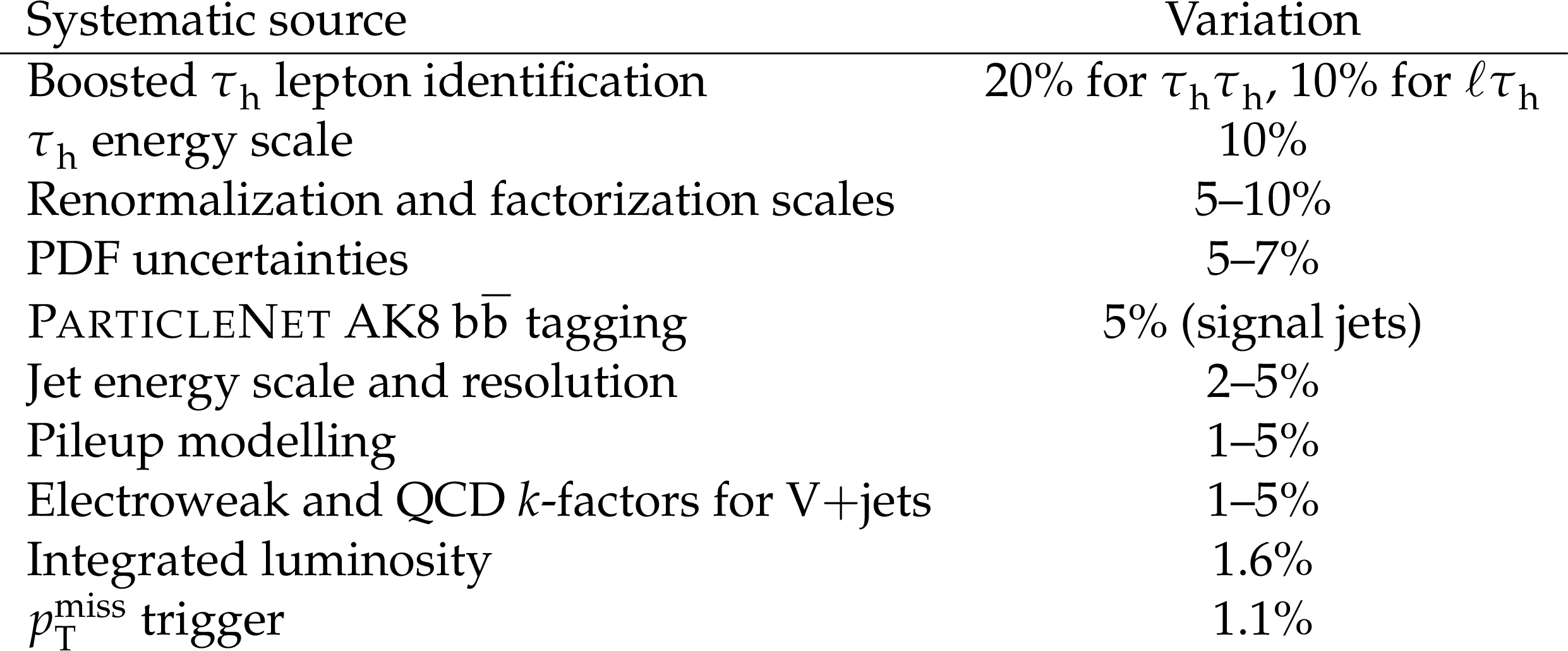
Table 1:
Summary of the dominant systematic uncertainty sources and the typical size of their inferred variation on the resonance yield. Sources with small overall impact on the analysis, such as electron or muon reconstruction and identification, are not listed in the table. |
| Summary |
| A search has been presented for heavy resonant Higgs boson pair (HH) production in the $ \mathrm{b}\overline{\mathrm{b}}\tau^{+}\tau^{-} $ final state, exploring resonance masses between 1 and 4.5 TeV. The analysis is based on pp collision data collected with the CMS detector during 2016--2018, corresponding to an integrated luminosity of 138 fb$ ^{-1} $ at a center-of-mass energy of 13 TeV. In this mass regime, the H bosons produced are boosted sufficiently to result in collimated decay products. The reconstruction and identification of such boosted objects are enhanced using advanced machine learning techniques, including a graph convolutional neural network for merged $ \mathrm{b}\overline{\mathrm{b}} $ jets and a convolutional neural network for boosted $ \tau^{+}\tau^{-} $ identification. No significant deviation from the standard model background expectation is observed, and 95% confidence level upper limits are set on the production cross section of a heavy resonance decaying to HH, evaluated independently for both spin-0 and spin-2 hypotheses. This analysis sets the most sensitive upper bounds to date on the production of $ \mathrm{X} \to \mathrm{H}\mathrm{H} \to \mathrm{b}\overline{\mathrm{b}}\tau^{+}\tau^{-} $ in the mass range of 1.4 to 4.5 TeV. |
| References | ||||
| 1 | CMS Collaboration | Observation of a new boson at a mass of 125 GeV with the CMS experiment at the LHC | PLB 716 (2012) 30 | CMS-HIG-12-028 1207.7235 |
| 2 | CMS Collaboration | Observation of a new boson with mass near 125 GeV in pp collisions at $ \sqrt{s} = $ 7 and 8 TeV | JHEP 06 (2013) 081 | CMS-HIG-12-036 1303.4571 |
| 3 | ATLAS Collaboration | Observation of a new particle in the search for the standard model Higgs boson with the ATLAS detector at the LHC | PLB 716 (2012) 1 | 1207.7214 |
| 4 | ATLAS Collaboration | Evidence for the spin-0 nature of the Higgs boson using ATLAS data | PLB 726 (2013) 120 | 1307.1432 |
| 5 | M. E. Peskin | What is the Hierarchy Problem? | NPB 1018 (2025) 116971 | 2505.00694 |
| 6 | L. Randall and R. Sundrum | A large mass hierarchy from a small extra dimension | PRL 83 (1999) 3370 | hep-ph/9905221 |
| 7 | L. Randall and R. Sundrum | An alternative to compactification | PRL 83 (1999) 4690 | hep-th/9906064 |
| 8 | W. D. Goldberger and M. B. Wise | Modulus stabilization with bulk fields | PRL 83 (1999) 4922 | hep-ph/9907447 |
| 9 | O. DeWolfe, D. Freedman, S. S. Gubser, and A. Karch | Modeling the fifth dimension with scalars and gravity | PRD 62 (2000) 046008 | hep-th/9909134 |
| 10 | C. Csaki, M. Graesser, L. Randall, and J. Terning | Cosmology of brane models with radion stabilization | PRD 62 (2000) 045015 | hep-ph/9911406 |
| 11 | H. Davoudiasl, J. Hewett, and T. Rizzo | Phenomenology of the Randall--Sundrum gauge hierarchy model | PRL 84 (2000) 2080 | hep-ph/9909255 |
| 12 | K. Agashe, H. Davoudiasl, G. Perez, and A. Soni | Warped gravitons at the CERN LHC and beyond | PRD 76 (2007) 036006 | hep-ph/0701186 |
| 13 | CMS Collaboration | Search for heavy resonances decaying into two Higgs bosons or into a Higgs boson and a W or Z boson in proton-proton collisions at 13 TeV | JHEP 01 (2019) 051 | 1808.01365 |
| 14 | ATLAS Collaboration | Reconstruction and identification of boosted di-$ \tau $ systems in a search for Higgs boson pairs using 13 TeV proton-proton collision data in ATLAS | JHEP 11 (2020) 163 | 2007.14811 |
| 15 | ATLAS Collaboration | Search for resonant and non-resonant Higgs boson pair production in the $ \mathrm{b}\overline{\mathrm{b}}{\tau^{+}\tau^{-}} $ decay channel using 13 TeV $ {\mathrm{p}\mathrm{p}} $ collision data from the ATLAS detector | JHEP 07 (2023) 040 | 2209.10910 |
| 16 | LHC Higgs Cross Section Working Group | Handbook of LHC Higgs cross sections: 4. Deciphering the nature of the Higgs sector | CERN Report CERN-2017-002-M, 2016 link |
1610.07922 |
| 17 | Particle Data Group , S. Navas et al. | Review of particle physics | PRD 110 (2024) 030001 | |
| 18 | H. Qu and L. Gouskos | Jet tagging via particle clouds | PRD 101 (2020) 056019 | 1902.08570 |
| 19 | CMS Collaboration | Search for narrow high-mass resonances in proton-proton collisions at $ \sqrt{s}= $ 8 TeV decaying to Z and Higgs bosons | PLB 748 (2015) 255 | CMS-EXO-13-007 1502.04994 |
| 20 | CMS Collaboration | Identification of hadronic tau lepton decays using a deep neural network | JINST 17 (2022) P07023 | CMS-TAU-20-001 2201.08458 |
| 21 | CMS Collaboration | HEPData record for this analysis | link | |
| 22 | CMS Collaboration | The CMS experiment at the CERN LHC | JINST 3 (2008) S08004 | |
| 23 | CMS Collaboration | Development of the CMS detector for the CERN LHC Run 3 | JINST 19 (2024) P05064 | CMS-PRF-21-001 2309.05466 |
| 24 | CMS Collaboration | The CMS trigger system | JINST 12 (2017) P01020 | CMS-TRG-12-001 1609.02366 |
| 25 | CMS Collaboration | Performance of the CMS Level-1 trigger in proton-proton collisions at $ \sqrt{s} = $ 13 TeV | JINST 15 (2020) P10017 | CMS-TRG-17-001 2006.10165 |
| 26 | CMS Collaboration | Performance of the CMS high-level trigger during LHC Run 2 | JINST 19 (2024) P11021 | CMS-TRG-19-001 2410.17038 |
| 27 | CMS Collaboration | Technical proposal for the Phase-II upgrade of the Compact Muon Solenoid | CMS Technical Proposal CERN-LHCC-2015-010, CMS-TDR-15-02, 2015 link |
|
| 28 | S. Frixione, P. Nason, and C. Oleari | Matching NLO QCD computations with parton shower simulations: the POWHEG method | JHEP 11 (2007) 070 | 0709.2092 |
| 29 | S. Alioli, P. Nason, C. Oleari, and E. Re | A general framework for implementing NLO calculations in shower Monte Carlo programs: the POWHEG box | JHEP 06 (2010) 043 | 1002.2581 |
| 30 | M. Czakon et al. | Top-pair production at the LHC through NNLO QCD and NLO EW | JHEP 10 (2017) 186 | 1705.04105 |
| 31 | J. Alwall et al. | The automated computation of tree-level and next-to-leading order differential cross sections, and their matching to parton shower simulations | JHEP 07 (2014) 079 | 1405.0301 |
| 32 | M. L. Mangano, M. Moretti, F. Piccinini, and M. Treccani | Matching matrix elements and shower evolution for top-pair production in hadronic collisions | JHEP 01 (2007) 013 | hep-ph/0611129 |
| 33 | A. Denner, S. Dittmaier, T. Kasprzik, and A. Muck | Electroweak corrections to W+jet hadroproduction including leptonic W-boson decays | JHEP 08 (2009) 075 | 0906.1656 |
| 34 | A. Denner, S. Dittmaier, T. Kasprzik, and A. Muck | Electroweak corrections to dilepton+jet production at hadron colliders | JHEP 06 (2011) 069 | 1103.0914 |
| 35 | A. Denner, S. Dittmaier, T. Kasprzik, and A. Maeck | Electroweak corrections to monojet production at the LHC | EPJC 73 (2013) 2297 | 1211.5078 |
| 36 | J. H. Kuhn, A. Kulesza, S. Pozzorini, and M. Schulze | Electroweak corrections to hadronic photon production at large transverse momenta | JHEP 03 (2006) 059 | hep-ph/0508253 |
| 37 | S. Kallweit et al. | NLO electroweak automation and precise predictions for W+multijet production at the LHC | JHEP 04 (2015) 012 | 1412.5157 |
| 38 | S. Kallweit et al. | NLO QCD+EW predictions for V+jets including off-shell vector-boson decays and multijet merging | JHEP 04 (2016) 021 | 1511.08692 |
| 39 | T. Sjöstrand et al. | An introduction to PYTHIA 8.2 | Comput. Phys. Commun. 191 (2015) 159 | 1410.3012 |
| 40 | J. Alwall et al. | Comparative study of various algorithms for the merging of parton showers and matrix elements in hadronic collisions | EPJC 53 (2008) 473 | 0706.2569 |
| 41 | R. Frederix and S. Frixione | Merging meets matching in MC@NLO | JHEP 12 (2012) 061 | 1209.6215 |
| 42 | NNPDF Collaboration | Parton distributions from high-precision collider data | EPJC 77 (2017) 663 | 1706.00428 |
| 43 | CMS Collaboration | Extraction and validation of a new set of CMS PYTHIA8 tunes from underlying-event measurements | EPJC 80 (2020) 4 | CMS-GEN-17-001 1903.12179 |
| 44 | GEANT4 Collaboration | GEANT 4---a simulation toolkit | NIM A 506 (2003) 250 | |
| 45 | CMS Collaboration | Particle-flow reconstruction and global event description with the CMS detector | JINST 12 (2017) P10003 | CMS-PRF-14-001 1706.04965 |
| 46 | M. Cacciari, G. P. Salam, and G. Soyez | The anti-$ k_{\mathrm{T}} $ jet clustering algorithm | JHEP 04 (2008) 063 | 0802.1189 |
| 47 | M. Cacciari, G. P. Salam, and G. Soyez | FASTJET user manual | EPJC 72 (2012) 1896 | 1111.6097 |
| 48 | CMS Collaboration | Performance of missing transverse momentum reconstruction in proton-proton collisions at $ \sqrt{s} = $ 13 TeV using the CMS detector | JINST 14 (2019) P07004 | CMS-JME-17-001 1903.06078 |
| 49 | D. Bertolini, P. Harris, M. Low, and N. Tran | Pileup per particle identification | JHEP 10 (2014) 059 | 1407.6013 |
| 50 | E. Bols et al. | Jet flavour classification using DeepJet | JINST 15 (2020) P12012 | 2008.10519 |
| 51 | CMS Collaboration | Performance of reconstruction and identification of $ \tau $ leptons decaying to hadrons and $ \nu_\tau $ in pp collisions at $ \sqrt{s}= $ 13 TeV | JINST 13 (2018) P10005 | CMS-TAU-16-003 1809.02816 |
| 52 | M. Wobisch and T. Wengler | Hadronization corrections to jet cross-sections in deep inelastic scattering | in Proc. Workshop on Monte Carlo generators for HERA physics, Hamburg, Germany, 1998 link |
hep-ph/9907280 |
| 53 | CMS Collaboration | Reconstruction and identification of $ \tau $ lepton decays to hadrons and $ \nu_{\!\tau} $ at CMS | JINST 7 (2012) P01001 | CMS-TAU-11-001 1109.6034 |
| 54 | CMS Collaboration | Performance of boosted tau lepton identification with DeepTau Framework (Boosted DeepTau) | CMS Detector Performance Summary CMS-DP-2025-047, 2025 CDS |
|
| 55 | CMS Collaboration | Performance of electron reconstruction and selection with the CMS detector in proton-proton collisions at $ \sqrt{s}= $ 8 TeV | JINST 10 (2015) P06005 | CMS-EGM-13-001 1502.02701 |
| 56 | CMS Collaboration | Performance of CMS muon reconstruction in $ {\mathrm{p}\mathrm{p}} $ collision events at $ \sqrt{s}= $ 7 TeV | JINST 7 (2012) P10002 | CMS-MUO-10-004 1206.4071 |
| 57 | A. J. Larkoski, S. Marzani, G. Soyez, and J. Thaler | Soft drop | JHEP 05 (2014) 146 | 1402.2657 |
| 58 | W. Matyszkiewicz and A. Kalinowski | Tau-pair invariant mass estimation using maximum likelihood estimation and collinear approximation | Acta Phys. Polon. Supp. 18 (2025) 5 | |
| 59 | R. K. Ellis, I. Hinchliffe, M. Soldate, and J. J. van der Bij | Higgs decay to $ \tau^{+}\tau^{-} $: A possible signature of intermediate mass Higgs bosons at high energy hadron colliders | NPB 297 (1988) 221 | |
| 60 | CMS Collaboration | The CMS statistical analysis and combination tool: combine | Comput. Softw. Big Sci. 8 (2024) 19 | CMS-CAT-23-001 2404.06614 |
| 61 | W. Verkerke and D. Kirkby | The RooFit toolkit for data modeling | in th In. Conf. on Computing in High Energy and Nuclear Physics (CHEP ): La Jolla CA, United States, March 24--28, 2003 Proc. 1 (2003) 3 |
physics/0306116 |
| 62 | L. Moneta et al. | The RooStats project | in th International Workshop on Advanced Computing and Analysis Techniques in Physics Research (ACAT ): Jaipur, India, February 22--27... [PoS (ACAT) 057], 2010 Proc. 1 (2010) 3 |
1009.1003 |
| 63 | CMS Collaboration | Precision luminosity measurement in proton-proton collisions at $ \sqrt{s}= $ 13 TeV in 2015 and 2016 at CMS | EPJC 81 (2021) 800 | CMS-LUM-17-003 2104.01927 |
| 64 | CMS Collaboration | Precision luminosity measurement in proton-proton collisions at $ \sqrt{s}= $ 13 TeV with the CMS detector | CMS Physics Analysis Summary, 2025 CMS-PAS-LUM-20-001 |
CMS-PAS-LUM-20-001 |
| 65 | NNPDF Collaboration | Parton distributions for the LHC run II | JHEP 04 (2015) 040 | 1410.8849 |
| 66 | J. Butterworth et al. | PDF4LHC recommendations for LHC Run II | JPG 43 (2016) 023001 | 1510.03865 |
| 67 | CMS Collaboration | Measurement of the inelastic proton-proton cross section at $ \sqrt{s}= $ 13 TeV | JHEP 07 (2018) 161 | CMS-FSQ-15-005 1802.02613 |
| 68 | CMS Collaboration | Jet energy scale and resolution in the CMS experiment in $ {\mathrm{p}\mathrm{p}} $ collisions at 8 TeV | JINST 12 (2017) P02014 | CMS-JME-13-004 1607.03663 |
| 69 | CMS Collaboration | Identification of heavy-flavour jets with the CMS detector in $ {\mathrm{p}\mathrm{p}} $ collisions at 13 TeV | JINST 13 (2018) P05011 | CMS-BTV-16-002 1712.07158 |
| 70 | R. Barlow and C. Beeston | Fitting using finite Monte Carlo samples | Comput. Phys. Commun. 77 (1993) 219 | |
|
|
Compact Muon Solenoid LHC, CERN |

|
|
|
|
|
|