
Compact Muon Solenoid
LHC, CERN
 Visit us: CMS Public Website, CMS Physics ;
Contact us: CMS Publications Committee
Visit us: CMS Public Website, CMS Physics ;
Contact us: CMS Publications Committee
| CMS-B2G-24-009 ; CERN-EP-2026-090 | ||
| Search for a top-philic $ \mathrm{Z}^{'} $ boson decaying into a $ \mathrm{t} \overline{\mathrm{t}} $ pair in a final state with jets and an electron or muon in proton-proton collisions at $ \sqrt{s} = $ 13 TeV | ||
| CMS Collaboration | ||
| 2 August 2026 | ||
| Submitted to the Journal of High Energy Physics | ||
| Abstract: A search for a top-philic $ \mathrm{Z}^{'} $ boson in a final state with jets and an electron or muon is presented. The search is based on a sample of proton-proton collision data collected at $ \sqrt{s} = $ 13 TeV by the CMS experiment at the CERN LHC during 2016-2018, corresponding to an integrated luminosity of 138 fb $^{-1} $. The top-philic $ \mathrm{Z}^{'} $ boson is produced in association with a top-antitop quark pair ( $ \mathrm{t} \overline{\mathrm{t}} $) and decays into a $ \mathrm{t} \overline{\mathrm{t}} $ pair, as it couples exclusively to top quarks. The analysis aims to identify a heavy $ \mathrm{Z}^{'} $ boson that produces Lorentz-boosted top quarks, whose hadronic decay products are merged into large-radius jets. A machine-learning algorithm is employed to identify such jets. The distribution of the invariant mass of the two top quark candidates with the highest transverse momentum is used as the discriminant variable in a $ \mathrm{Z}^{'} $ boson mass range of 0.5--3 TeV, with intrinsic widths of 4, 10, 20, and 50% relative to its mass. The results obtained are found to be in agreement with the standard model background prediction. Upper limits at 95% confidence level are set on the production cross section of the $ \mathrm{Z}^{'} $ boson, for each of the decay widths as a function of its mass. These results represent the most stringent constraints to date on the existence of a top-philic $ \mathrm{Z}^{'} $ boson. | ||
| Links: e-print arXiv:2608.01251 [hep-ex] (PDF) ; CDS record ; inSPIRE record ; HepData record ; CADI line (restricted) ; | ||
| Figures | |
png pdf |
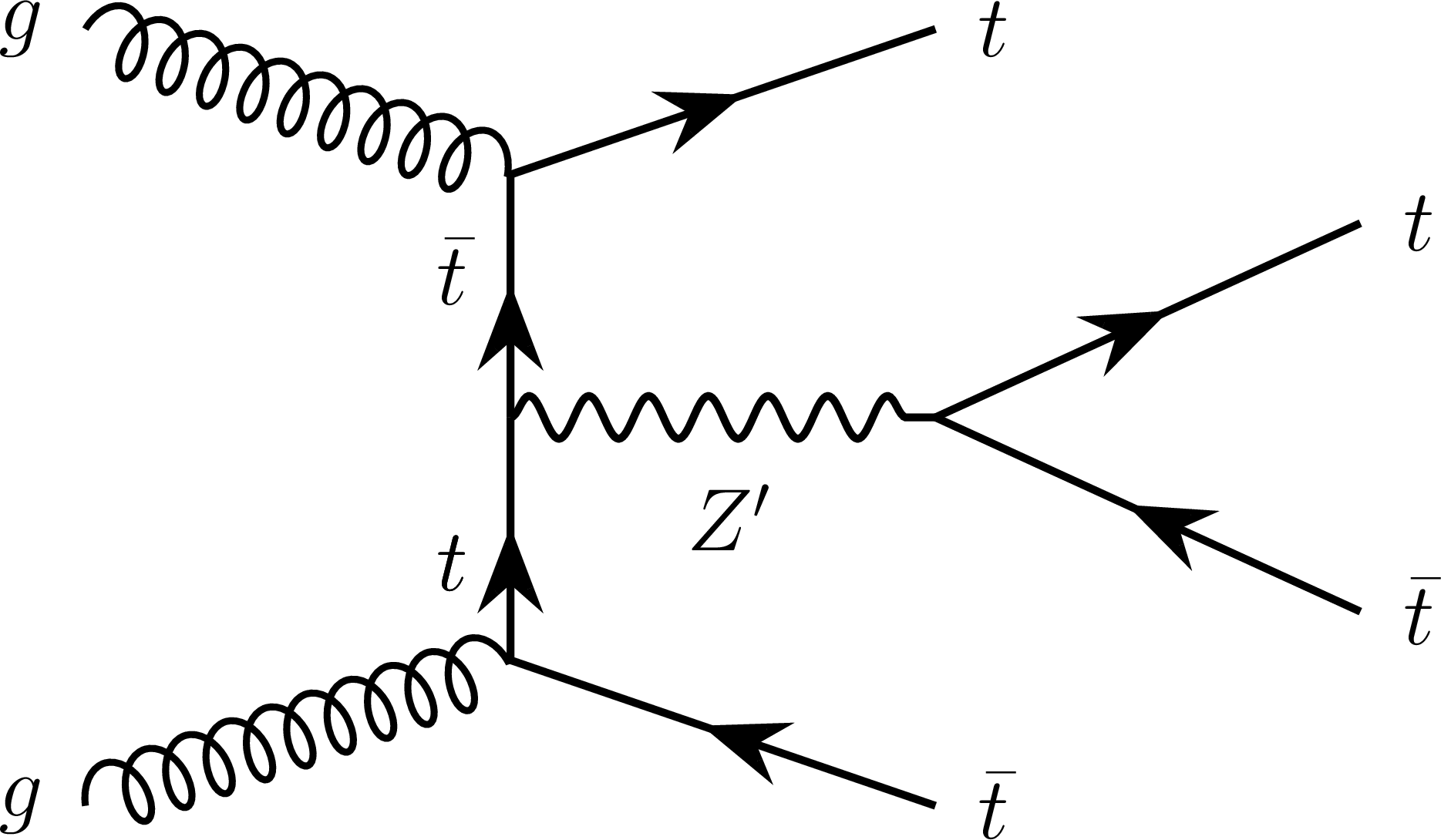
Figure 1:
Feynman diagram of a top-philic $ \mathrm{Z}^{'} $ boson produced in association with a top quark pair and decaying to a top quark pair. |
png pdf |
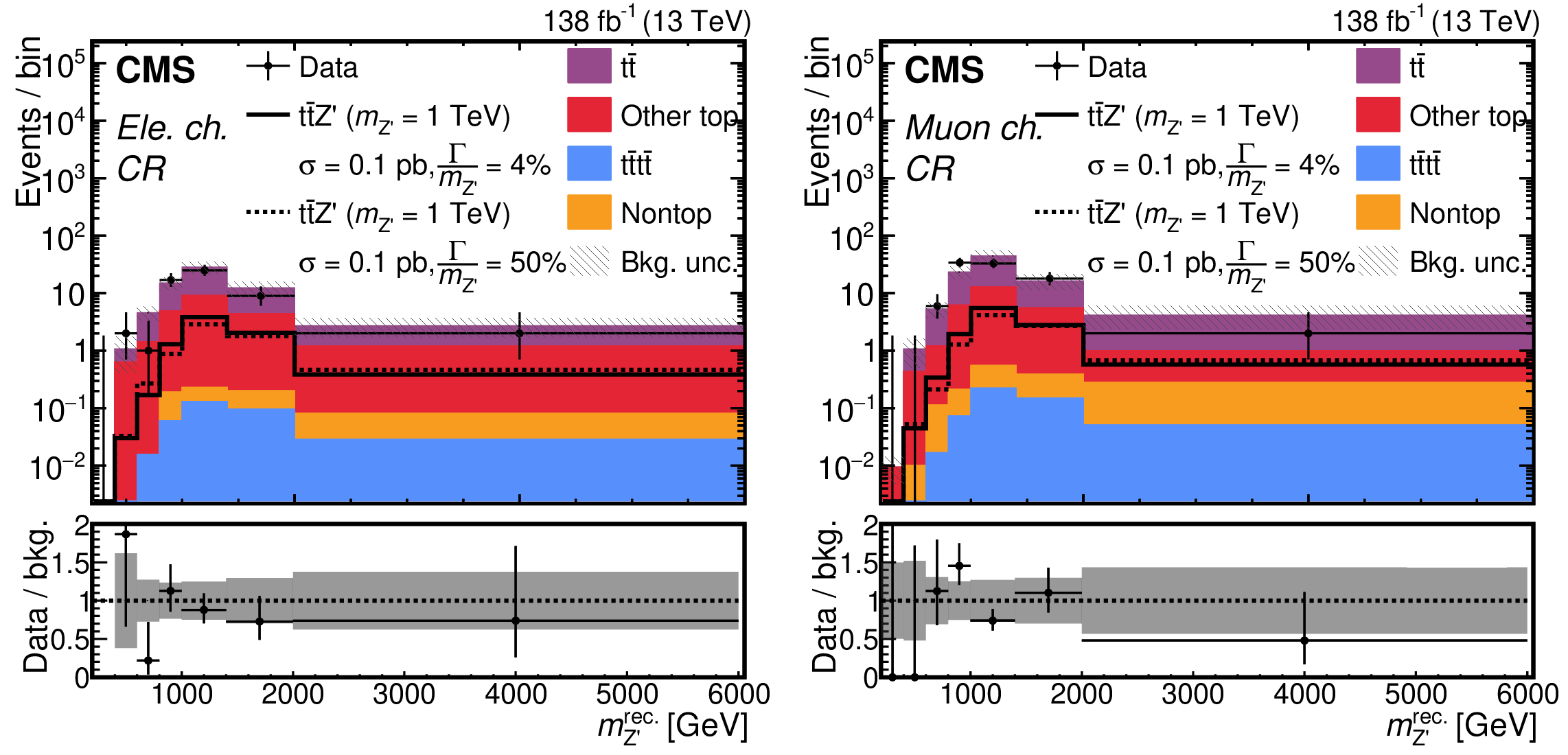
Figure 2:
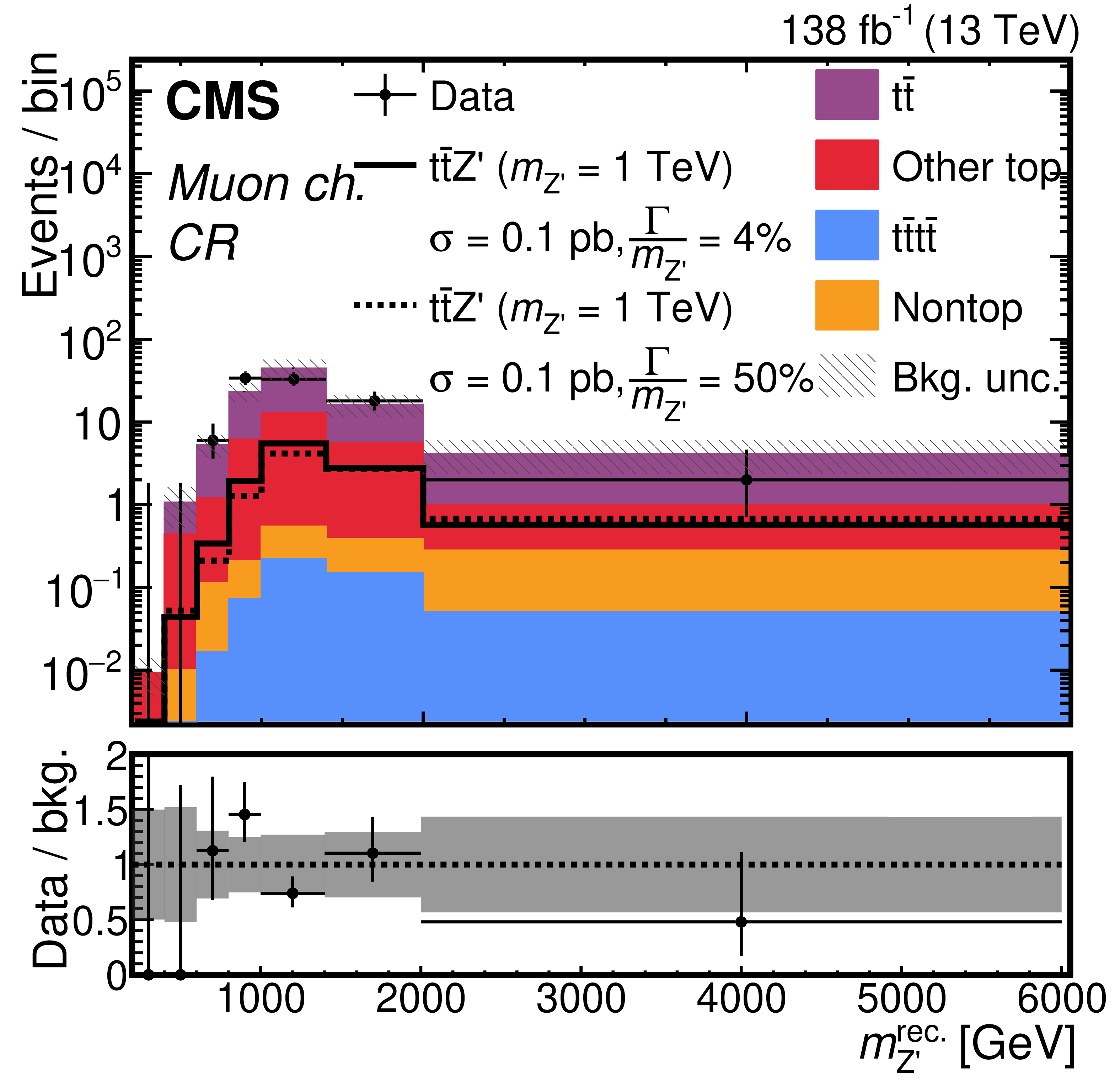
Prefit distributions of $ m_{{\mathrm{Z}^{'}} }^{\text{rec}} $ for the expected background (stacked histograms), data (black points), and two $ \mathrm{Z}^{'} $ signal hypotheses with a mass of 1 TeV and $ \Gamma_{{\mathrm{Z}^{'}} }/m_{{\mathrm{Z}^{'}} } = $ 4 (solid black line) or 50% (dashed black line) for events in the electron (left) and muon (right) channels of the CR. Both signal hypotheses are normalized to a cross section of 0.1$ \text{pb}$. The hatched band in the upper panels represents the total uncertainty in the SM background expectation. The lower panels display the ratio of the data and the SM background, and the total uncertainty in the latter is shown as a grey band. |
png pdf |
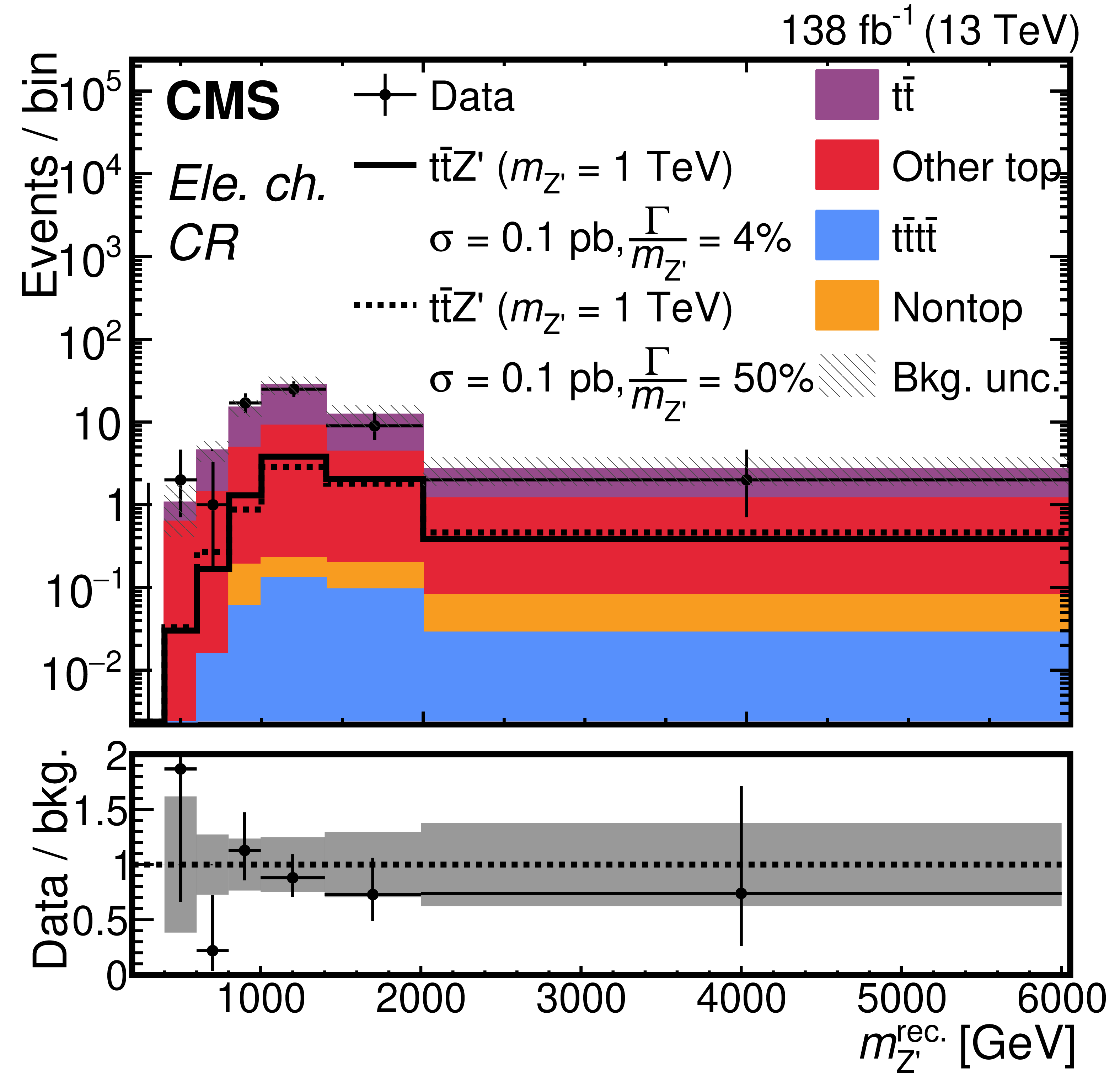
Figure 2-a:
Prefit distributions of $ m_{{\mathrm{Z}^{'}} }^{\text{rec}} $ for the expected background (stacked histograms), data (black points), and two $ \mathrm{Z}^{'} $ signal hypotheses with a mass of 1 TeV and $ \Gamma_{{\mathrm{Z}^{'}} }/m_{{\mathrm{Z}^{'}} } = $ 4 (solid black line) or 50% (dashed black line) for events in the electron (left) and muon (right) channels of the CR. Both signal hypotheses are normalized to a cross section of 0.1$ \text{pb}$. The hatched band in the upper panels represents the total uncertainty in the SM background expectation. The lower panels display the ratio of the data and the SM background, and the total uncertainty in the latter is shown as a grey band. |
png pdf |
Figure 2-b:
Prefit distributions of $ m_{{\mathrm{Z}^{'}} }^{\text{rec}} $ for the expected background (stacked histograms), data (black points), and two $ \mathrm{Z}^{'} $ signal hypotheses with a mass of 1 TeV and $ \Gamma_{{\mathrm{Z}^{'}} }/m_{{\mathrm{Z}^{'}} } = $ 4 (solid black line) or 50% (dashed black line) for events in the electron (left) and muon (right) channels of the CR. Both signal hypotheses are normalized to a cross section of 0.1$ \text{pb}$. The hatched band in the upper panels represents the total uncertainty in the SM background expectation. The lower panels display the ratio of the data and the SM background, and the total uncertainty in the latter is shown as a grey band. |
png pdf |
Figure 3:
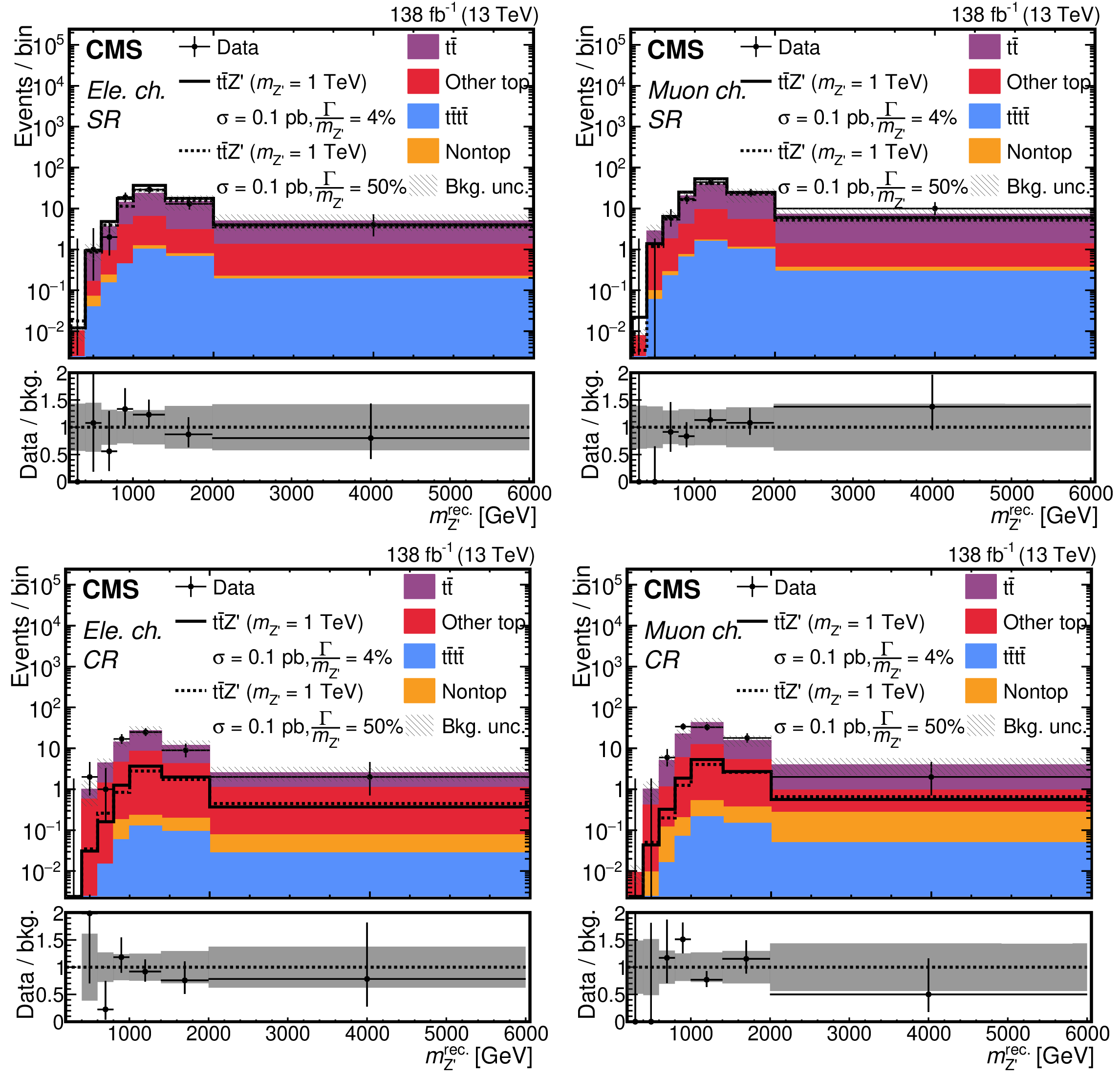
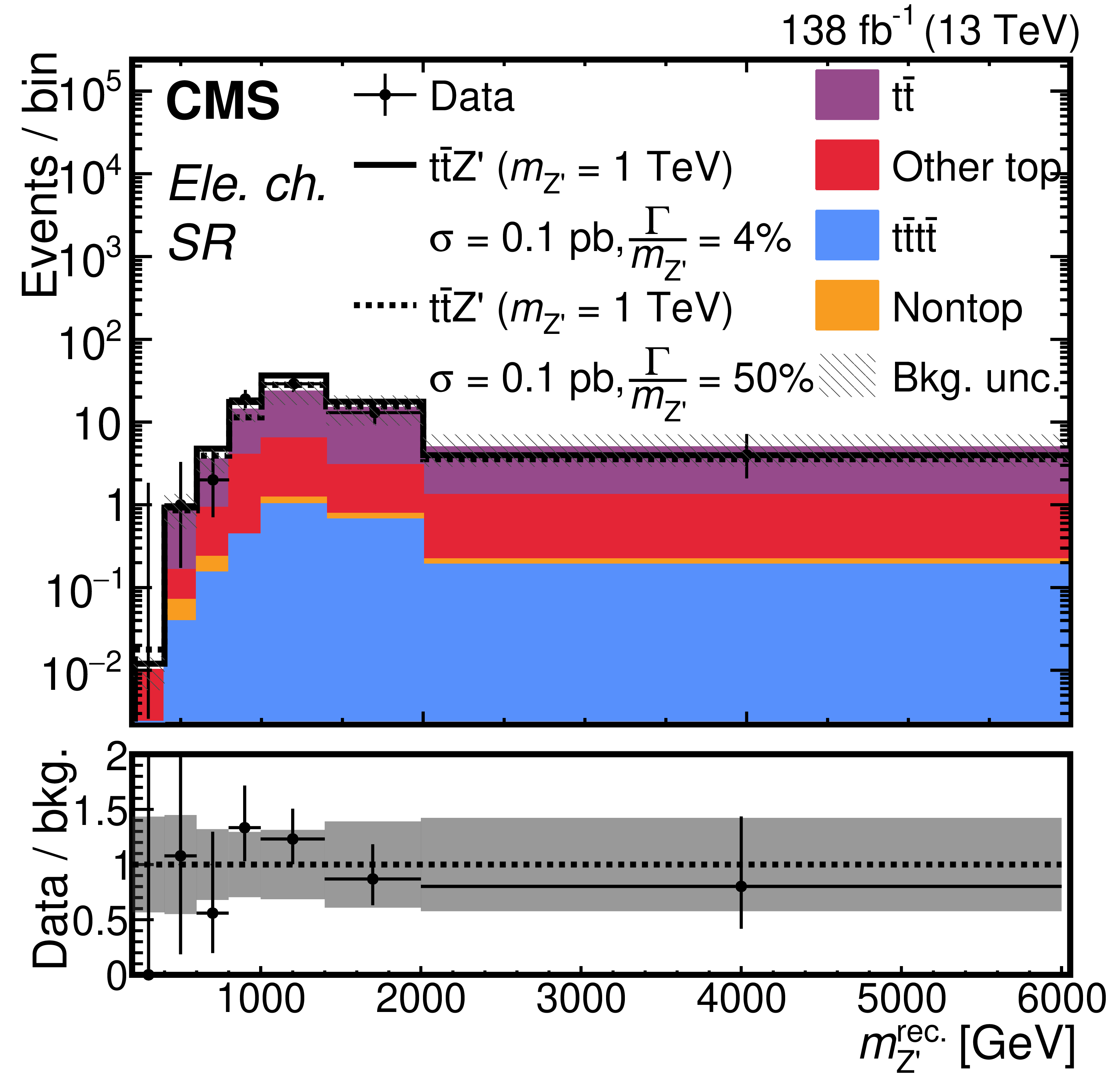
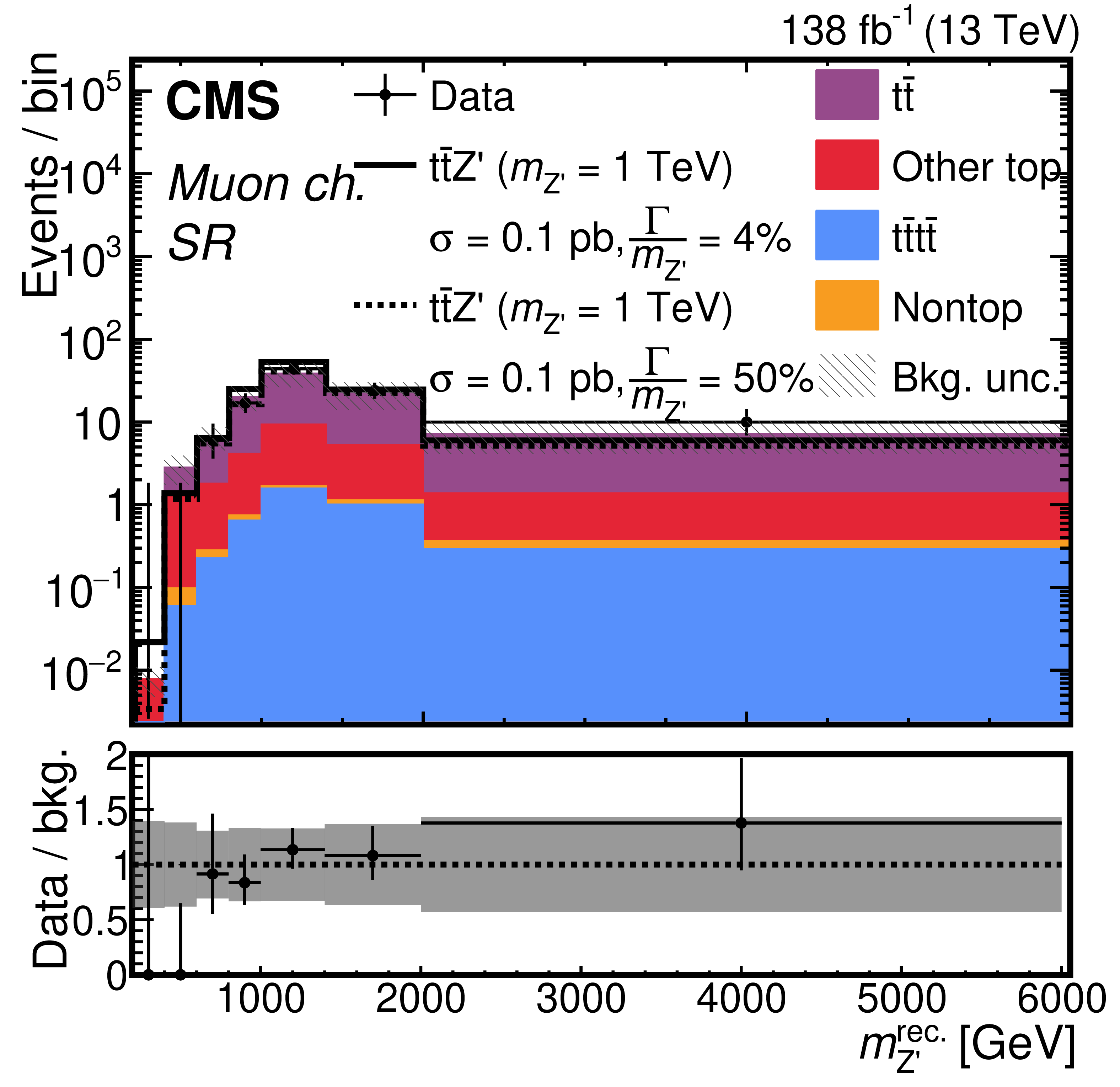
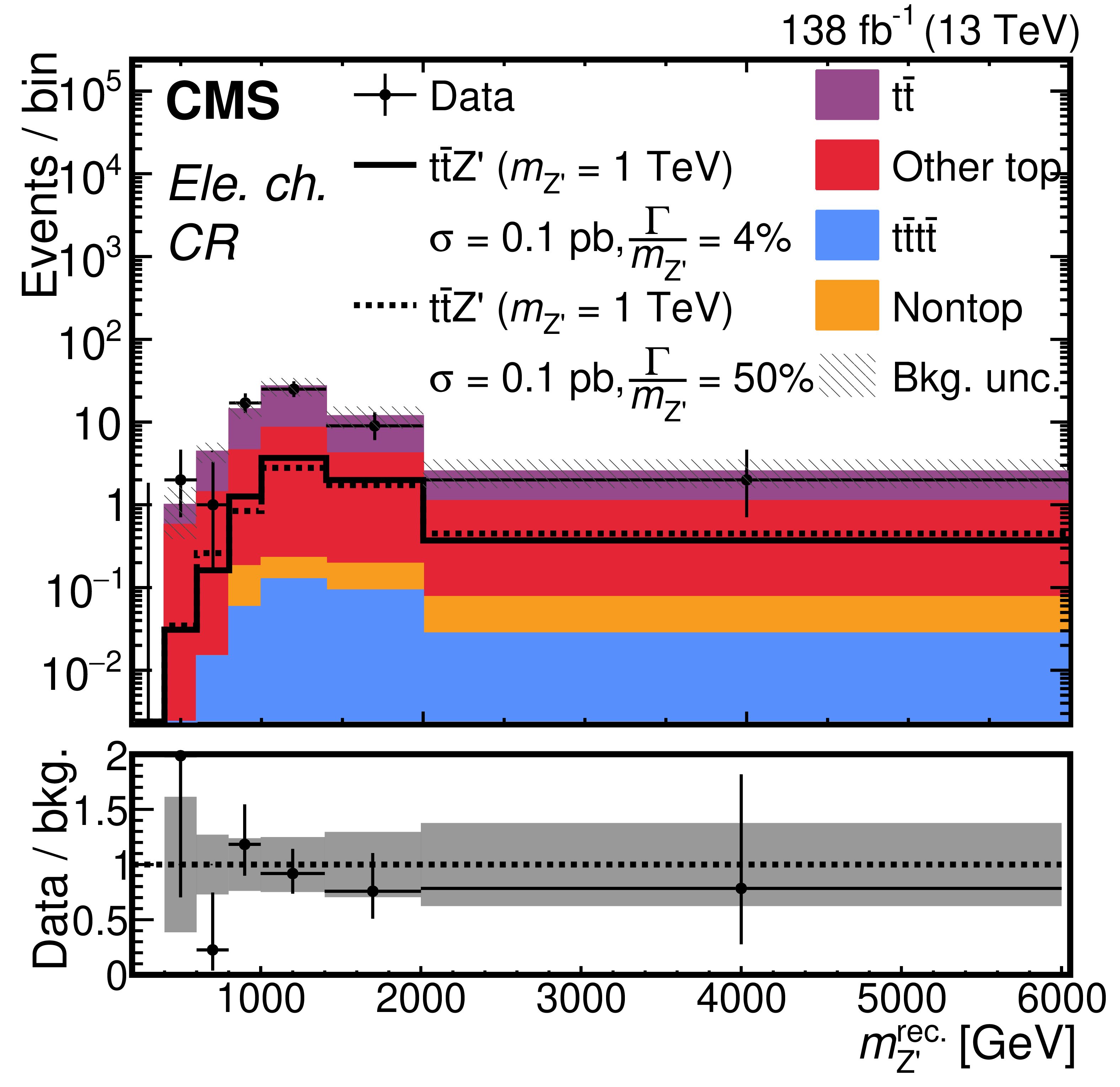
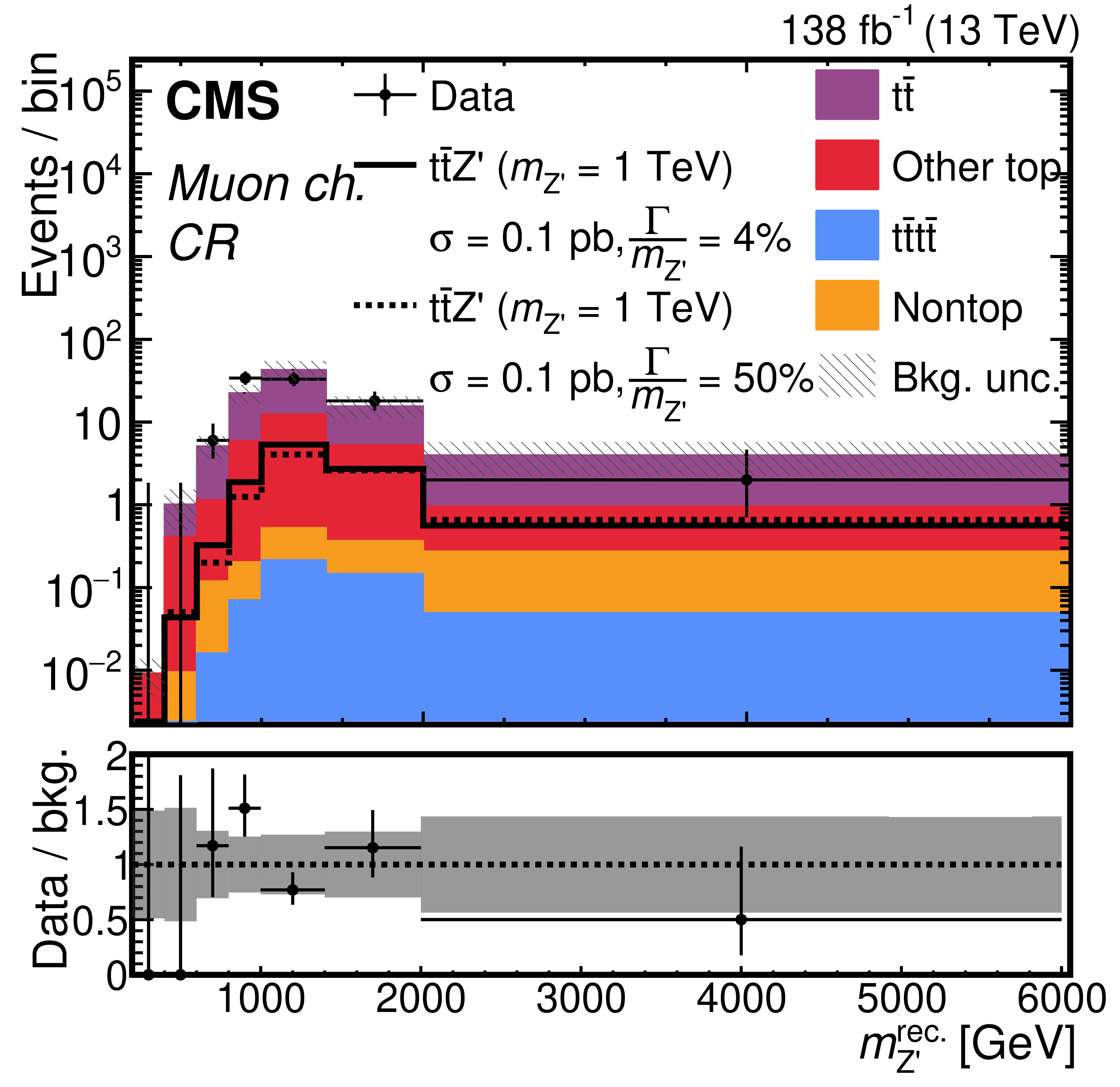
Postfit distributions of $ m_{{\mathrm{Z}^{'}} }^{\text{rec}} $ for the expected background (stacked histograms), data (black points), and two $ \mathrm{Z}^{'} $ signal hypotheses with a mass of 1 TeV and $ \Gamma_{{\mathrm{Z}^{'}} }/m_{{\mathrm{Z}^{'}} } = $ 4 (solid black line) or 50% (dashed black line) for events in the electron (left) and muon (right) channels of the SR (upper row) and CR (lower row). Both signal hypotheses are normalized to a cross section of 0.1$ \text{pb}$. The hatched band in the upper panels represents the total uncertainty in the SM background expectation. The lower panels display the ratio of the data and the SM background, and the total uncertainty in the latter is shown as a grey band. |
png pdf |
Figure 3-a:
Postfit distributions of $ m_{{\mathrm{Z}^{'}} }^{\text{rec}} $ for the expected background (stacked histograms), data (black points), and two $ \mathrm{Z}^{'} $ signal hypotheses with a mass of 1 TeV and $ \Gamma_{{\mathrm{Z}^{'}} }/m_{{\mathrm{Z}^{'}} } = $ 4 (solid black line) or 50% (dashed black line) for events in the electron (left) and muon (right) channels of the SR (upper row) and CR (lower row). Both signal hypotheses are normalized to a cross section of 0.1$ \text{pb}$. The hatched band in the upper panels represents the total uncertainty in the SM background expectation. The lower panels display the ratio of the data and the SM background, and the total uncertainty in the latter is shown as a grey band. |
png pdf |
Figure 3-b:
Postfit distributions of $ m_{{\mathrm{Z}^{'}} }^{\text{rec}} $ for the expected background (stacked histograms), data (black points), and two $ \mathrm{Z}^{'} $ signal hypotheses with a mass of 1 TeV and $ \Gamma_{{\mathrm{Z}^{'}} }/m_{{\mathrm{Z}^{'}} } = $ 4 (solid black line) or 50% (dashed black line) for events in the electron (left) and muon (right) channels of the SR (upper row) and CR (lower row). Both signal hypotheses are normalized to a cross section of 0.1$ \text{pb}$. The hatched band in the upper panels represents the total uncertainty in the SM background expectation. The lower panels display the ratio of the data and the SM background, and the total uncertainty in the latter is shown as a grey band. |
png pdf |
Figure 3-c:
Postfit distributions of $ m_{{\mathrm{Z}^{'}} }^{\text{rec}} $ for the expected background (stacked histograms), data (black points), and two $ \mathrm{Z}^{'} $ signal hypotheses with a mass of 1 TeV and $ \Gamma_{{\mathrm{Z}^{'}} }/m_{{\mathrm{Z}^{'}} } = $ 4 (solid black line) or 50% (dashed black line) for events in the electron (left) and muon (right) channels of the SR (upper row) and CR (lower row). Both signal hypotheses are normalized to a cross section of 0.1$ \text{pb}$. The hatched band in the upper panels represents the total uncertainty in the SM background expectation. The lower panels display the ratio of the data and the SM background, and the total uncertainty in the latter is shown as a grey band. |
png pdf |
Figure 3-d:
Postfit distributions of $ m_{{\mathrm{Z}^{'}} }^{\text{rec}} $ for the expected background (stacked histograms), data (black points), and two $ \mathrm{Z}^{'} $ signal hypotheses with a mass of 1 TeV and $ \Gamma_{{\mathrm{Z}^{'}} }/m_{{\mathrm{Z}^{'}} } = $ 4 (solid black line) or 50% (dashed black line) for events in the electron (left) and muon (right) channels of the SR (upper row) and CR (lower row). Both signal hypotheses are normalized to a cross section of 0.1$ \text{pb}$. The hatched band in the upper panels represents the total uncertainty in the SM background expectation. The lower panels display the ratio of the data and the SM background, and the total uncertainty in the latter is shown as a grey band. |
png pdf |
Figure 4:
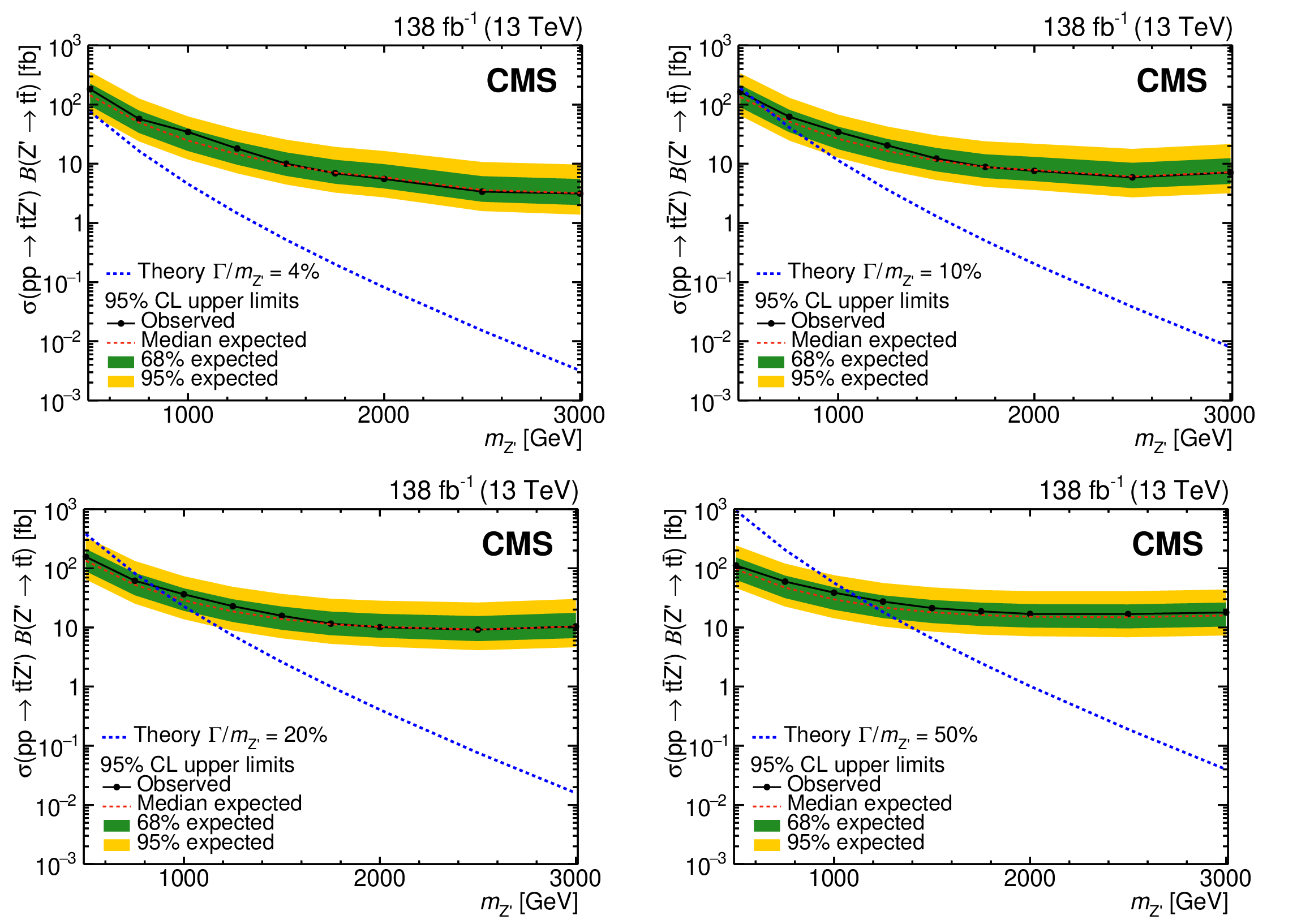
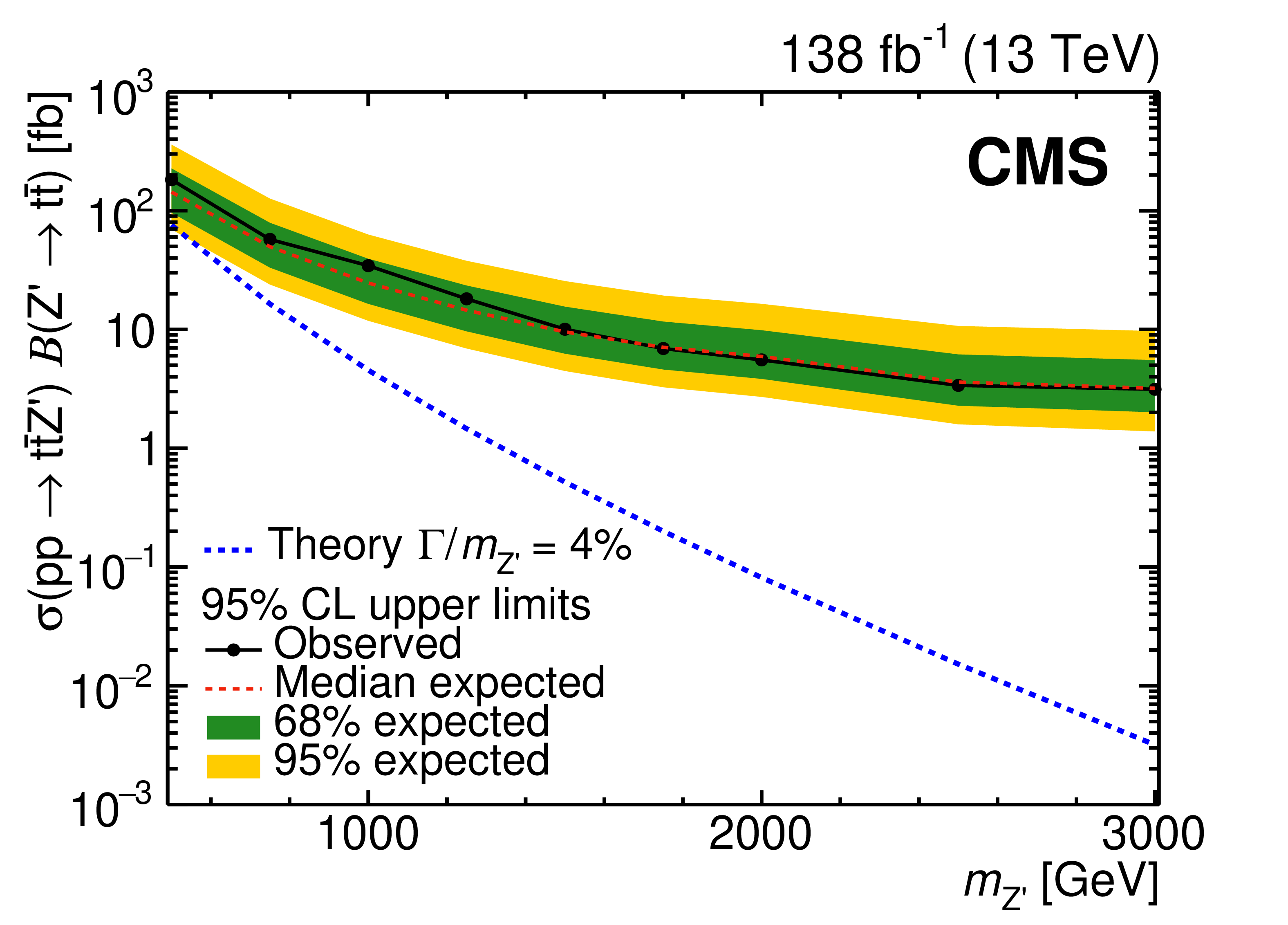
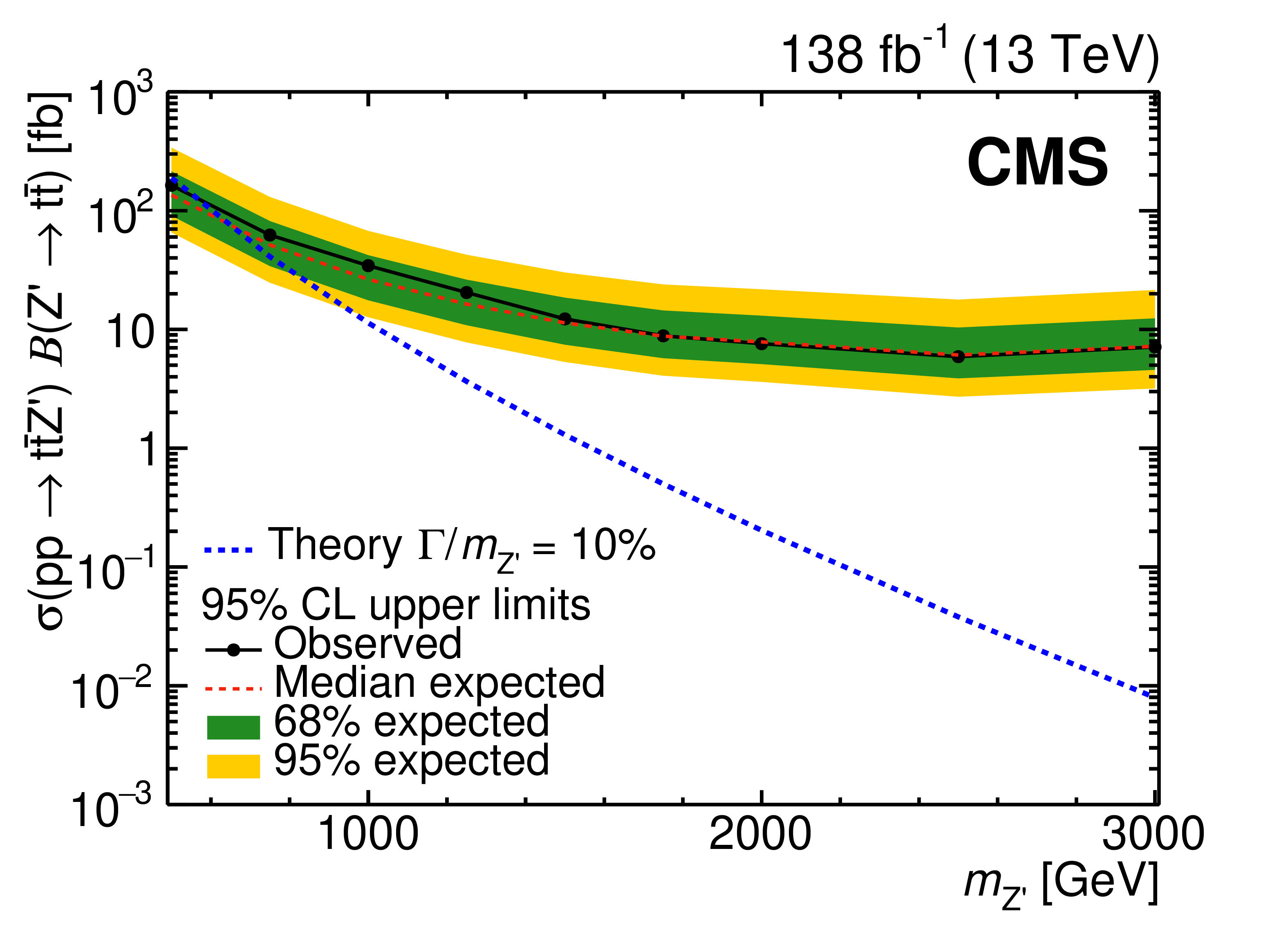
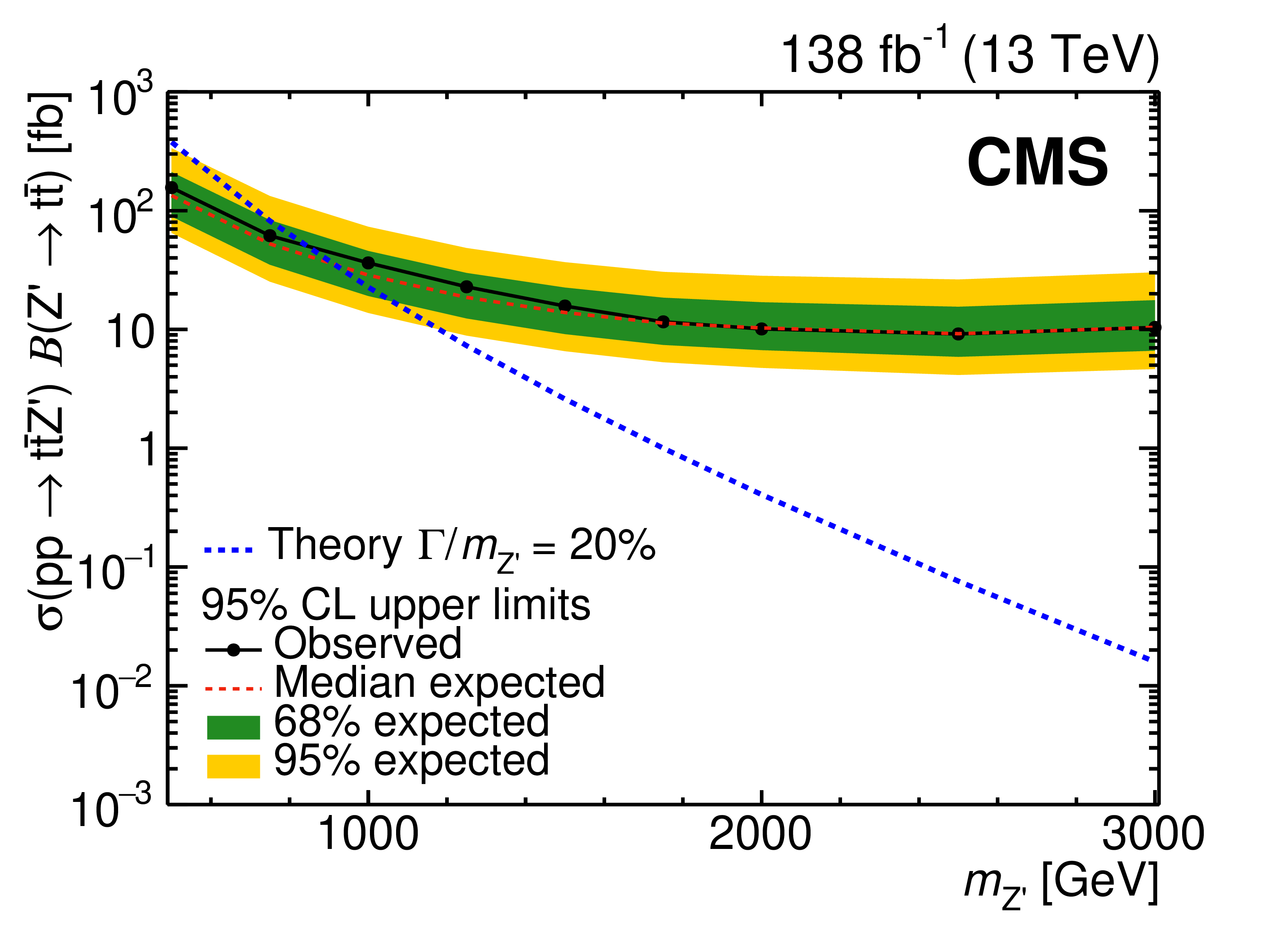
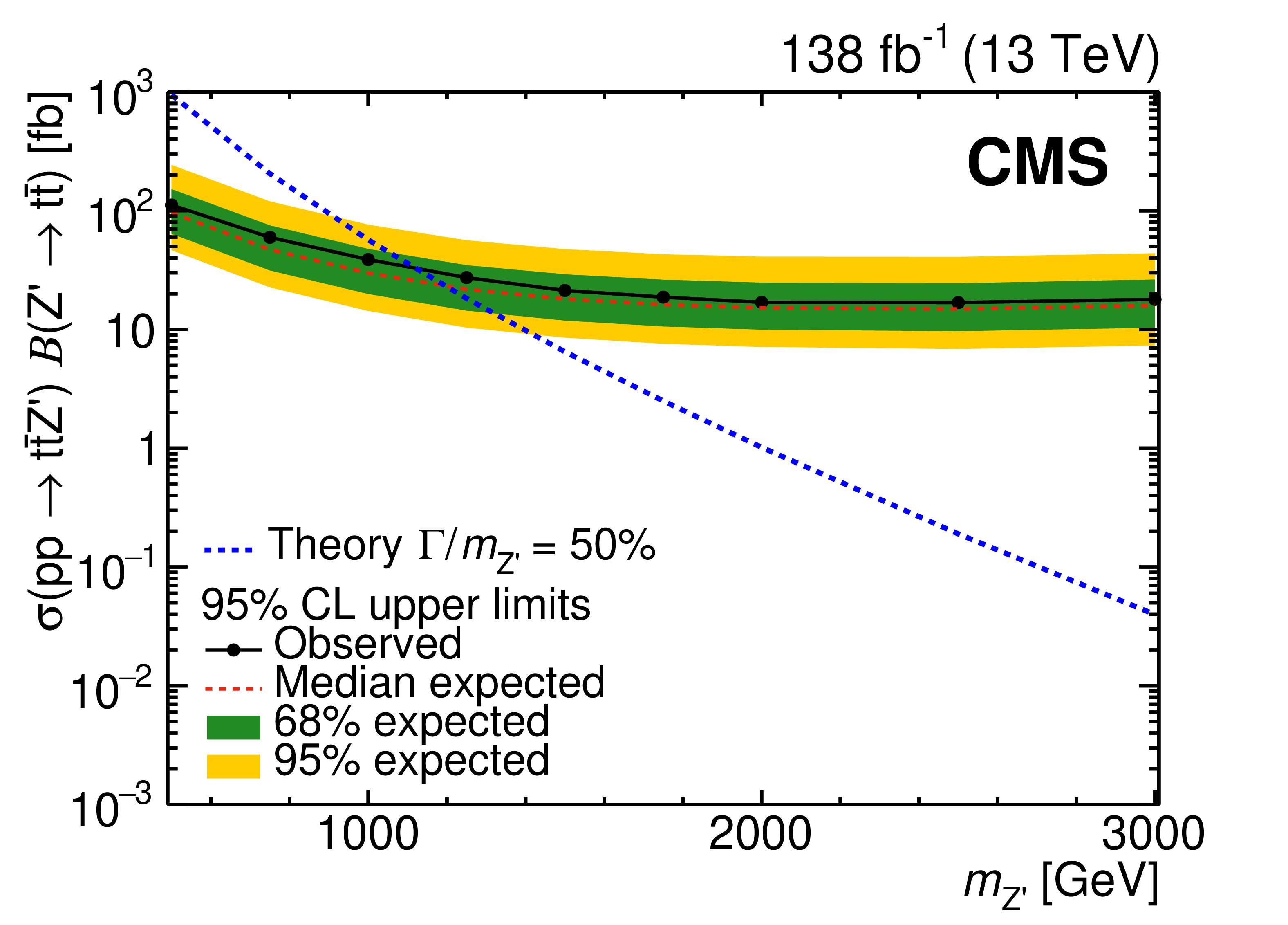
Observed (black points) and expected (dashed red line) upper limits on $ \sigma(\mathrm{p}\mathrm{p}\to {\mathrm{t}\overline{\mathrm{t}}} {\mathrm{Z}^{'}} )\mathcal{B}({\mathrm{Z}^{'}} \to {\mathrm{t}\overline{\mathrm{t}}} ) $ at 95% CL as functions of the $ \mathrm{Z}^{'} $ boson mass for $ \Gamma_{{\mathrm{Z}^{'}} }/m_{{\mathrm{Z}^{'}} } = $ 4 (upper left), 10 (upper right), 20 (lower left), and 50% (lower right), obtained combining the electron and muon channels and the 2016--2018 data-taking years. The inner (green) band and the outer (yellow) band indicate the regions containing 68 and 95%, respectively, of the distribution of limits expected under the background-only hypothesis. The dashed blue line indicates the theoretical prediction at LO based on the model implementation in Ref. [44]. |
png pdf |
Figure 4-a:
Observed (black points) and expected (dashed red line) upper limits on $ \sigma(\mathrm{p}\mathrm{p}\to {\mathrm{t}\overline{\mathrm{t}}} {\mathrm{Z}^{'}} )\mathcal{B}({\mathrm{Z}^{'}} \to {\mathrm{t}\overline{\mathrm{t}}} ) $ at 95% CL as functions of the $ \mathrm{Z}^{'} $ boson mass for $ \Gamma_{{\mathrm{Z}^{'}} }/m_{{\mathrm{Z}^{'}} } = $ 4 (upper left), 10 (upper right), 20 (lower left), and 50% (lower right), obtained combining the electron and muon channels and the 2016--2018 data-taking years. The inner (green) band and the outer (yellow) band indicate the regions containing 68 and 95%, respectively, of the distribution of limits expected under the background-only hypothesis. The dashed blue line indicates the theoretical prediction at LO based on the model implementation in Ref. [44]. |
png pdf |
Figure 4-b:
Observed (black points) and expected (dashed red line) upper limits on $ \sigma(\mathrm{p}\mathrm{p}\to {\mathrm{t}\overline{\mathrm{t}}} {\mathrm{Z}^{'}} )\mathcal{B}({\mathrm{Z}^{'}} \to {\mathrm{t}\overline{\mathrm{t}}} ) $ at 95% CL as functions of the $ \mathrm{Z}^{'} $ boson mass for $ \Gamma_{{\mathrm{Z}^{'}} }/m_{{\mathrm{Z}^{'}} } = $ 4 (upper left), 10 (upper right), 20 (lower left), and 50% (lower right), obtained combining the electron and muon channels and the 2016--2018 data-taking years. The inner (green) band and the outer (yellow) band indicate the regions containing 68 and 95%, respectively, of the distribution of limits expected under the background-only hypothesis. The dashed blue line indicates the theoretical prediction at LO based on the model implementation in Ref. [44]. |
png pdf |
Figure 4-c:
Observed (black points) and expected (dashed red line) upper limits on $ \sigma(\mathrm{p}\mathrm{p}\to {\mathrm{t}\overline{\mathrm{t}}} {\mathrm{Z}^{'}} )\mathcal{B}({\mathrm{Z}^{'}} \to {\mathrm{t}\overline{\mathrm{t}}} ) $ at 95% CL as functions of the $ \mathrm{Z}^{'} $ boson mass for $ \Gamma_{{\mathrm{Z}^{'}} }/m_{{\mathrm{Z}^{'}} } = $ 4 (upper left), 10 (upper right), 20 (lower left), and 50% (lower right), obtained combining the electron and muon channels and the 2016--2018 data-taking years. The inner (green) band and the outer (yellow) band indicate the regions containing 68 and 95%, respectively, of the distribution of limits expected under the background-only hypothesis. The dashed blue line indicates the theoretical prediction at LO based on the model implementation in Ref. [44]. |
png pdf |
Figure 4-d:
Observed (black points) and expected (dashed red line) upper limits on $ \sigma(\mathrm{p}\mathrm{p}\to {\mathrm{t}\overline{\mathrm{t}}} {\mathrm{Z}^{'}} )\mathcal{B}({\mathrm{Z}^{'}} \to {\mathrm{t}\overline{\mathrm{t}}} ) $ at 95% CL as functions of the $ \mathrm{Z}^{'} $ boson mass for $ \Gamma_{{\mathrm{Z}^{'}} }/m_{{\mathrm{Z}^{'}} } = $ 4 (upper left), 10 (upper right), 20 (lower left), and 50% (lower right), obtained combining the electron and muon channels and the 2016--2018 data-taking years. The inner (green) band and the outer (yellow) band indicate the regions containing 68 and 95%, respectively, of the distribution of limits expected under the background-only hypothesis. The dashed blue line indicates the theoretical prediction at LO based on the model implementation in Ref. [44]. |
| Summary |
| A search for a top-philic $ \mathrm{Z}^{'} $ boson produced in association with a pair of top quarks and decaying into a top quark pair has been presented. It is based on a sample of proton-proton collision data collected at $ \sqrt{s} = $ 13 TeV, by the CMS experiment at the CERN LHC in 2016-2018, corresponding to an integrated luminosity of 138 fb $^{-1} $. The search focuses on the single-lepton (electron or muon) channel, in association with hadronically decaying top quarks. The case of a significant mass difference between the $ \mathrm{Z}^{'} $ boson and the top quark is considered, resulting in highly Lorentz-boosted top quarks reconstructed as large-radius jets using the PARTICLENET algorithm, which uses advanced machine-learning techniques to improve the signal-to-background ratio and enhances the search sensitivity. The reconstructed $ \mathrm{Z}^{'} $ boson mass is used to probe for the presence of a beyond-the-standard-model signal. The observations are consistent with standard model predictions. Exclusion limits are set on a top-philic $ \mathrm{Z}^{'} $ boson as a function of the $ \mathrm{Z}^{'} $ boson mass and for widths ranging from 4 to 50% of its mass. The lower limits on the $ {\mathrm{t}\overline{\mathrm{t}}} {\mathrm{Z}^{'}} $ production cross section, at 95% confidence level, range between 170 and 3$ \text{fb}$ for a relative width of 4% over the mass range between 500 and 3000 GeV. For widths of 10, 20, and 50%, the ranges are 160--6, 160--9, and 110--17$ \text{fb}$, respectively, corresponding to lower limits on the $ \mathrm{Z}^{'} $ boson mass of 560, 850, and 1130 GeV, respectively. These results represent the most stringent limits to date on the existence of a $ \mathrm{Z}^{'} $ boson that couples exclusively to top quarks. |
| References | ||||
| 1 | S. Cullen, M. Perelstein, and M. E. Peskin | TeV strings and collider probes of large extra dimensions | PRD 62 (2000) 055012 | hep-ph/0001166 |
| 2 | J. L. Hewett and T. G. Rizzo | Low-energy phenomenology of superstring-inspired E(6) models | Phys. Rept. 183 (1989) 193 | |
| 3 | U. Baur, M. Spira, and P. M. Zerwas | Excited quark and lepton production at hadron colliders | PRD 42 (1990) 815 | |
| 4 | P. H. Frampton and S. L. Glashow | Chiral color: An alternative to the standard model | PLB 190 (1987) 157 | |
| 5 | R. S. Chivukula, A. Farzinnia, E. H. Simmons, and R. Foadi | Production of massive color-octet vector bosons at next-to-leading order | PRD 85 (2012) 054005 | 1111.7261 |
| 6 | E. H. Simmons | Coloron phenomenology | PRD 55 (1997) 1678 | hep-ph/9608269 |
| 7 | T. Han, I. Lewis, and Z. Liu | Colored resonant signals at the LHC: Largest rate and simplest topology | JHEP 12 (2010) 085 | 1010.4309 |
| 8 | A. Leike | The phenomenology of extra neutral gauge bosons | Phys. Rept. 317 (1999) 143 | hep-ph/9805494 |
| 9 | P. Langacker | The physics of heavy $ {\mathrm{Z}^{'}} $ gauge bosons | Rev. Mod. Phys. 81 (2009) 1199 | 0801.1345 |
| 10 | H. Harari | Composite models for quarks and leptons | Phys. Rep. 104 (1984) 159 | |
| 11 | O. W. Greenberg and C. A. Nelson | Composite models of leptons | PRD 10 (1974) 2567 | |
| 12 | J. C. Pati, A. Salam, and J. A. Strathdee | Are quarks composite? | PLB 59 (1975) 265 | |
| 13 | R. Leonardi et al. | Hunting for heavy composite Majorana neutrinos at the LHC | EPJC 76 (2016) 593 | 1510.07988 |
| 14 | R. N. Mohapatra and J. C. Pati | A natural left-right symmetry | PRD 11 (1975) 2558 | |
| 15 | W.-Y. Keung and G. Senjanovi \'c | Majorana neutrinos and the production of the right-handed charged gauge boson | PRL 50 (1983) 1427 | |
| 16 | C. O. Dib, C. S. Kim, K. Wang, and J. Zhang | Distinguishing Dirac/Majorana sterile neutrinos at the LHC | PRD 94 (2016) 013005 | 1605.01123 |
| 17 | Y. Cai, T. Han, T. Li, and R. Ruiz | Lepton-number violation: Seesaw models and their collider tests | Front. in Phys. 6 (2018) 40 | 1711.02180 |
| 18 | B. Gripaios | Composite leptoquarks at the LHC | JHEP 02 (2010) 045 | 0910.1789 |
| 19 | S. Ajmal et al. | Searching for exclusive leptoquarks with the Nambu–Jona–Lasinio composite model at the LHC and HL-LHC | JHEP 08 (2024) 176 | 2311.18472 |
| 20 | M. Kramer, T. Plehn, M. Spira, and P. M. Zerwas | Pair production of scalar leptoquarks at the CERN LHC | PRD 71 (2005) 057503 | hep-ph/0411038 |
| 21 | I. Dor \v s ner et al. | Physics of leptoquarks in precision experiments and at particle colliders | Phys. Rept. 641 (2016) 1 | 1603.04993 |
| 22 | D. Barbosa et al. | Probing a $ \mathrm{Z}^{\prime} $ with non-universal fermion couplings through top quark fusion, decays to bottom quarks, and machine learning techniques | EPJC 83 (2023) 413 | 2210.15813 |
| 23 | P. Cox, A. D. Medina, T. S. Ray, and A. Spray | Novel collider and dark matter phenomenology of a top-philic Z$ ^{'} $ | JHEP 06 (2016) 110 | 1512.00471 |
| 24 | Y. Zhang | Top quark mediated dark matter | PLB 720 (2013) 137 | 1212.2730 |
| 25 | S. Baek, P. Ko, and P. Wu | Top-philic scalar dark matter with a vector-like fermionic top partner | JHEP 10 (2016) 117 | 1606.00072 |
| 26 | C. Arina et al. | A comprehensive approach to dark matter studies: Exploration of simplified top-philic models | JHEP 11 (2016) 111 | 1605.09242 |
| 27 | M. R. Buckley, D. Feld, and D. Goncalves | Scalar simplified models for dark matter | PRD 91 (2015) 015017 | 1410.6497 |
| 28 | J. D'Hondt et al. | Signatures of top flavour-changing dark matter | JHEP 03 (2016) 060 | 1511.07463 |
| 29 | G. Ferretti and D. Karateev | Fermionic UV completions of composite Higgs models | JHEP 03 (2014) 077 | 1312.5330 |
| 30 | L. Vecchi | A dangerous irrelevant UV-completion of the composite Higgs | JHEP 02 (2017) 094 | 1506.00623 |
| 31 | K. Agashe, A. Delgado, M. J. May, and R. Sundrum | RS1, custodial isospin and precision tests | JHEP 08 (2003) 050 | hep-ph/0308036 |
| 32 | S.-S. Xue | Higgs boson origin from a gauge symmetric theory of massive composite particles and massless $ \mathrm{W}^{\pm} $ and $ \mathrm{Z}^0 $ bosons at the TeV scale | NPB 990 (2023) 116168 | 2210.04825 |
| 33 | K. Agashe, R. Contino, and A. Pomarol | The minimal composite Higgs model | NPB 719 (2005) 165 | hep-ph/0412089 |
| 34 | N. Arkani-Hamed, A. G. Cohen, E. Katz, and A. E. Nelson | The littlest Higgs | JHEP 07 (2002) 034 | hep-ph/0206021 |
| 35 | A. Pomarol and J. Serra | Top quark compositeness: Feasibility and implications | PRD 78 (2008) 074026 | 0806.3247 |
| 36 | P. J. Fox, I. Low, and Y. Zhang | Top-philic $ \mathrm{Z}^\prime $ forces at the LHC | JHEP 03 (2018) 074 | 1801.03505 |
| 37 | S.-S. Xue | Why is the top quark much heavier than other fermions? | PLB 721 (2013) 347 | 1301.4254 |
| 38 | D. Liu and R. Mahbubani | Probing top-antitop resonances with $ \mathrm{t}\bar{\mathrm{t}} $ scattering at LHC14 | JHEP 04 (2016) 116 | 1511.09452 |
| 39 | M. Abdullah et al. | A heavy neutral gauge boson near the Z boson mass pole via third generation fermions at the LHC | PLB 803 (2020) 135326 | 1912.00102 |
| 40 | R. Leonardi et al. | Phenomenology at the LHC of composite particles from strongly interacting standard model fermions via four-fermion operators of NJL type | EPJC 80 (2020) 309 | 1810.11420 |
| 41 | Y. Chung | Naturalness-motivated composite Higgs model for generating the top Yukawa coupling | PRD 109 (2024) 095021 | 2309.00072 |
| 42 | N. Craig | Naturalness: Past, present, and future | EPJC 83 (2023) 825 | 2205.05708 |
| 43 | G. F. Giudice | Naturally speaking: The naturalness criterion and physics at the LHC | World Scientific, 2008 link |
|
| 44 | J. H. Kim, K. Kong, S. J. Lee, and G. Mohlabeng | Probing TeV scale top-philic resonances with boosted top-tagging at the High Luminosity LHC | PRD 94 (2016) 035023 | 1604.07421 |
| 45 | ATLAS Collaboration | Observation of four-top-quark production in the multilepton final state with the ATLAS detector | EPJC 83 (2023) 496 | 2303.15061 |
| 46 | CMS Collaboration | Observation of four top quark production in proton-proton collisions at $ \sqrt{s}= $ 13 TeV | PLB 847 (2023) 138290 | CMS-TOP-22-013 2305.13439 |
| 47 | ATLAS Collaboration | Measurement of the $ \mathrm{t}\bar{\mathrm{t}}\mathrm{t}\bar{\mathrm{t}} $ production cross section in pp collisions at $ \sqrt{s} = $ 13 TeV with the ATLAS detector | JHEP 11 (2021) 118 | 2106.11683 |
| 48 | CMS Collaboration | Evidence for four-top quark production in proton-proton collisions at $ \sqrt{s}= $ 13 TeV | PLB 844 (2023) 138076 | CMS-TOP-21-005 2303.03864 |
| 49 | ATLAS Collaboration | Search for top-philic heavy resonances in pp collisions at $ \sqrt{s}= $ 13 TeV with the ATLAS detector | EPJC 84 (2024) 157 | 2304.01678 |
| 50 | H. Qu and L. Gouskos | ParticleNet: Jet tagging via particle clouds | PRD 101 (2020) 056019 | 1902.08570 |
| 51 | CMS Collaboration | HEPData record for this analysis | link | |
| 52 | CMS Collaboration | The CMS experiment at the CERN LHC | JINST 3 (2008) S08004 | |
| 53 | CMS Collaboration | Development of the CMS detector for the CERN LHC Run 3 | JINST 19 (2024) P05064 | CMS-PRF-21-001 2309.05466 |
| 54 | CMS Collaboration | Performance of the CMS level-1 trigger in proton-proton collisions at $ \sqrt{s} = $ 13 TeV | JINST 15 (2020) P10017 | CMS-TRG-17-001 2006.10165 |
| 55 | CMS Collaboration | The CMS trigger system | JINST 12 (2017) P01020 | CMS-TRG-12-001 1609.02366 |
| 56 | CMS Collaboration | Performance of the CMS High-Level Trigger during LHC Run 2 | JINST 19 (2024) P11021 | CMS-TRG-19-001 2410.17038 |
| 57 | CMS Collaboration | Electron and photon reconstruction and identification with the CMS experiment at the CERN LHC | JINST 16 (2021) P05014 | CMS-EGM-17-001 2012.06888 |
| 58 | CMS Collaboration | Performance of the CMS muon detector and muon reconstruction with proton-proton collisions at $ \sqrt{s}= $ 13 TeV | JINST 13 (2018) P06015 | CMS-MUO-16-001 1804.04528 |
| 59 | CMS Collaboration | Description and performance of track and primary-vertex reconstruction with the CMS tracker | JINST 9 (2014) P10009 | CMS-TRK-11-001 1405.6569 |
| 60 | NNPDF Collaboration | Parton distributions from high-precision collider data | EPJC 77 (2017) 663 | 1706.00428 |
| 61 | T. Sjöstrand et al. | An introduction to PYTHIA 8.2 | Comput. Phys. Commun. 191 (2015) 159 | 1410.3012 |
| 62 | CMS Collaboration | Extraction and validation of a new set of CMS PYTHIA8 tunes from underlying-event measurements | EPJC 80 (2020) 4 | CMS-GEN-17-001 1903.12179 |
| 63 | J. Alwall et al. | The automated computation of tree-level and next-to-leading order differential cross sections, and their matching to parton shower simulations | JHEP 07 (2014) 079 | 1405.0301 |
| 64 | C. Degrande | Automatic evaluation of UV and R2 terms for beyond the standard model Lagrangians: a proof-of-principle | Comput. Phys. Commun. 197 (2015) 239 | 1406.3030 |
| 65 | G. C. Branco, L. Lavoura, and J. P. Silva | CP Violation | volume 103 of International Series of Monographs on Physics. Clarandon Press, Oxford, 1999 | |
| 66 | C. Degrande et al. | UFO - the universal FeynRules output | Comput. Phys. Commun. 183 (2012) 1201 | 1108.2040 |
| 67 | N. Greiner et al. | Model-independent production of a top-philic resonance at the LHC | JHEP 04 (2015) 029 | 1410.6099 |
| 68 | P. Nason | A new method for combining NLO QCD with shower Monte Carlo algorithms | JHEP 11 (2004) 040 | hep-ph/0409146 |
| 69 | S. Frixione, P. Nason, and C. Oleari | Matching NLO QCD computations with parton shower simulations: The POWHEG method | JHEP 11 (2007) 070 | 0709.2092 |
| 70 | S. Alioli, P. Nason, C. Oleari, and E. Re | A general framework for implementing NLO calculations in shower Monte Carlo programs: The POWHEG BOX | JHEP 06 (2010) 043 | 1002.2581 |
| 71 | T. Je \v z o and P. Nason | On the treatment of resonances in next-to-leading order calculations matched to a parton shower | JHEP 12 (2015) 065 | 1509.09071 |
| 72 | M. Beneke, P. Falgari, S. Klein, and C. Schwinn | Hadronic top-quark pair production with NNLL threshold resummation | NPB 855 (2012) 695 | 1109.1536 |
| 73 | M. Cacciari et al. | Top-pair production at hadron colliders with next-to-next-to-leading logarithmic soft-gluon resummation | PLB 710 (2012) 612 | 1111.5869 |
| 74 | P. B ä rnreuther, M. Czakon, and A. Mitov | Percent-level-precision physics at the Tevatron: Next-to-next-to-leading order QCD corrections to $ \mathrm{q}\overline{\mathrm{q}}\to\mathrm{t}\overline{\mathrm{t}}+\text{X} $ | PRL 109 (2012) 132001 | 1204.5201 |
| 75 | M. Czakon and A. Mitov | NNLO corrections to top-pair production at hadron colliders: The all-fermionic scattering channels | JHEP 12 (2012) 054 | 1207.0236 |
| 76 | M. Czakon and A. Mitov | NNLO corrections to top pair production at hadron colliders: The quark-gluon reaction | JHEP 01 (2013) 080 | 1210.6832 |
| 77 | M. Czakon, P. Fiedler, and A. Mitov | Total top-quark pair-production cross section at hadron colliders through $ \mathcal{O}(\alpha_{\mathrm{s}}^4) $ | PRL 110 (2013) 252004 | 1303.6254 |
| 78 | M. Czakon and A. Mitov | Top++: A program for the calculation of the top-pair cross-section at hadron colliders | Comput. Phys. Commun. 185 (2014) 2930 | 1112.5675 |
| 79 | GEANT4 Collaboration | GEANT 4---a simulation toolkit | NIM A 506 (2003) 250 | |
| 80 | CMS Collaboration | Particle-flow reconstruction and global event description with the CMS detector | JINST 12 (2017) P10003 | CMS-PRF-14-001 1706.04965 |
| 81 | CMS Collaboration | Performance of reconstruction and identification of $ \tau $ leptons decaying to hadrons and $ \nu_\tau $ in pp collisions at $ \sqrt{s}= $ 13 TeV | JINST 13 (2018) P10005 | CMS-TAU-16-003 1809.02816 |
| 82 | CMS Collaboration | Jet energy scale and resolution in the CMS experiment in pp collisions at 8 TeV | JINST 12 (2017) P02014 | CMS-JME-13-004 1607.03663 |
| 83 | CMS Collaboration | Performance of missing transverse momentum reconstruction in proton-proton collisions at $ \sqrt{s} = $ 13 TeV using the CMS detector | JINST 14 (2019) P07004 | CMS-JME-17-001 1903.06078 |
| 84 | CMS Collaboration | ECAL 2016 refined calibration and Run 2 summary plots | CMS Detector Performance Summary CMS-DP-2020-021, 2020 CDS |
|
| 85 | M. Cacciari, G. P. Salam, and G. Soyez | The anti-$ k_{\mathrm{T}} $ jet clustering algorithm | JHEP 04 (2008) 063 | 0802.1189 |
| 86 | M. Cacciari, G. P. Salam, and G. Soyez | FastJet user manual | EPJC 72 (2012) 1896 | 1111.6097 |
| 87 | CMS Collaboration | Pileup mitigation at CMS in 13 TeV data | JINST 15 (2020) P09018 | CMS-JME-18-001 2003.00503 |
| 88 | E. Bols et al. | Jet flavour classification using DeepJet | JINST 15 (2020) P12012 | 2008.10519 |
| 89 | CMS Collaboration | Identification of heavy-flavour jets with the CMS detector in pp collisions at 13 TeV | JINST 13 (2018) P05011 | CMS-BTV-16-002 1712.07158 |
| 90 | CMS Collaboration | Machine learning-based identification of highly Lorentz-boosted hadronically decaying particles at the CMS experiment | CMS Physics Analysis Summary, 2019 CMS-PAS-JME-18-002 |
CMS-PAS-JME-18-002 |
| 91 | CMS Collaboration | Precision luminosity measurement in proton-proton collisions at $ \sqrt{s} = $ 13 TeV in 2015 and 2016 at CMS | EPJC 81 (2021) 800 | CMS-LUM-17-003 2104.01927 |
| 92 | CMS Collaboration | CMS luminosity measurement for the 2017 data-taking period at $ \sqrt{s}= $ 13 TeV | CMS Physics Analysis Summary, 2018 link |
CMS-PAS-LUM-17-004 |
| 93 | CMS Collaboration | CMS luminosity measurement for the 2018 data-taking period at $ \sqrt{s}= $ 13 TeV | CMS Physics Analysis Summary, 2019 link |
CMS-PAS-LUM-18-002 |
| 94 | CMS Collaboration | Measurement of the inelastic proton-proton cross section at $ \sqrt{s}= $ 13 TeV | JHEP 07 (2018) 161 | CMS-FSQ-15-005 1802.02613 |
| 95 | J. Butterworth et al. | PDF4LHC recommendations for LHC Run II | JPG 43 (2016) 023001 | 1510.03865 |
| 96 | R. J. Barlow and C. Beeston | Fitting using finite Monte Carlo samples | Comput. Phys. Commun. 77 (1993) 219 | |
| 97 | J. S. Conway | Incorporating nuisance parameters in likelihoods for multisource spectra | PHYSTAT 201 (2011) 115 | 1103.0354 |
| 98 | T. Junk | Confidence level computation for combining searches with small statistics | NIM A 434 (1999) 435 | hep-ex/9902006 |
| 99 | A. L. Read | Presentation of search results: the CL$ _{\text{s}} $ technique | in Durham IPPP Workshop: Advanced Statistical Techniques in Particle Physics, Durham, UK, March, 2002 JPG 28 (2002) 2693 |
|
| 100 | G. Cowan, K. Cranmer, E. Gross, and O. Vitells | Asymptotic formulae for likelihood-based tests of new physics | EPJC 71 (2011) 1554 | 1007.1727 |
| 101 | CMS Collaboration | The CMS statistical analysis and combination tool: Combine | Comput. Softw. Big Sci. 8 (2024) 19 | CMS-CAT-23-001 2404.06614 |
| 102 | W. Verkerke and D. Kirkby | The RooFit toolkit for data modeling | in the International Conference on Computing in High Energy and Nuclear Physics (CHEP ): La Jolla CA, United States, March 24--28,.. [eConf C0303241 MOLT007], 2003 Proc. 1 (2003) 3 |
physics/0306116 |
| 103 | L. Moneta et al. | The RooStats project | in the International Workshop on Advanced Computing and Analysis Techniques in Physics Research (ACAT ): Jaipur, India, February 22--27,.. [PoS (ACAT) 057], 2010 Proc. 1 (2010) 3 |
1009.1003 |
|
|
Compact Muon Solenoid LHC, CERN |

|
|
|
|
|
|