Compact Muon Solenoid
LHC, CERN
 Visit us: CMS Public Website, CMS Physics ;
Contact us: CMS Publications Committee
Visit us: CMS Public Website, CMS Physics ;
Contact us: CMS Publications Committee
| CMS-PAS-HIN-26-002 | ||
| Measurements of $ \Lambda $ hyperon spin correlations in proton-proton and proton-lead collisions | ||
| CMS Collaboration | ||
| 2026-05-17 | ||
| Abstract: The spin correlations of $ \Lambda\Lambda $, $ \Lambda\overline{\Lambda} $, and $ \overline{\Lambda}\overline{\Lambda} $ hyperon pairs are measured in proton-proton (pp) collisions at $ \sqrt{s}= $ 13 TeV and proton-lead (pPb) collisions at $ \sqrt {\smash [b]{s_{_{\mathrm {NN}}}}} = $ 8.16 TeV at the LHC. The data were collected with the CMS detector, corresponding to integrated luminosities of 28.6 $ \mathrm{pb}^{-1} $ and 186 $ \mathrm{nb}^{-1} $ for pp and pPb collisions, respectively. The analysis is performed for hyperons with the transverse momentum 0.8 $ < p_{\mathrm{T}} < $ 6.0 GeV and pseudorapidity $ |\eta| < $ 2.4. The spin correlations are studied as functions of the hyperon pair separation, defined as $ \Delta R = \sqrt{(\Delta \eta)^2 + (\Delta \phi)^2} $. Negative values of the spin correlation are observed at small $ \Delta R $ for the $ \Lambda\Lambda $ and $ \overline{\Lambda}\overline{\Lambda} $ pairs, while the $ \Lambda\overline{\Lambda} $ results do not show a significant deviation from zero within the uncertainties. The magnitude of the correlation shows a decreasing trend with the $ \Delta R $ increase, becoming consistent with zero at large $ \Delta R $. The correlation values integrated over the full $ \Delta R $ range have negative central values for all hyperon pair combinations, and tend to have larger magnitudes for the $ \Lambda\Lambda $ and $ \overline{\Lambda}\overline{\Lambda} $ pairs than for the $ \Lambda\overline{\Lambda} $ pairs. Larger correlation values are observed in pp compared to pPb collisions, particularly at small $ \Delta R $. A comparison with the measurement by the STAR Collaboration in pp collisions at $ \sqrt{s}= $ 200 GeV shows a different behavior of the $ \Lambda\overline{\Lambda} $ correlation at small $ \Delta R $. These results extend the study of hyperon pair spin correlations to the LHC energies and provide new information on the energy dependence of their behavior at small $ \Delta R $. | ||
| Links: CDS record (PDF) ; CADI line (restricted) ; | ||
| Figures | |
png pdf |
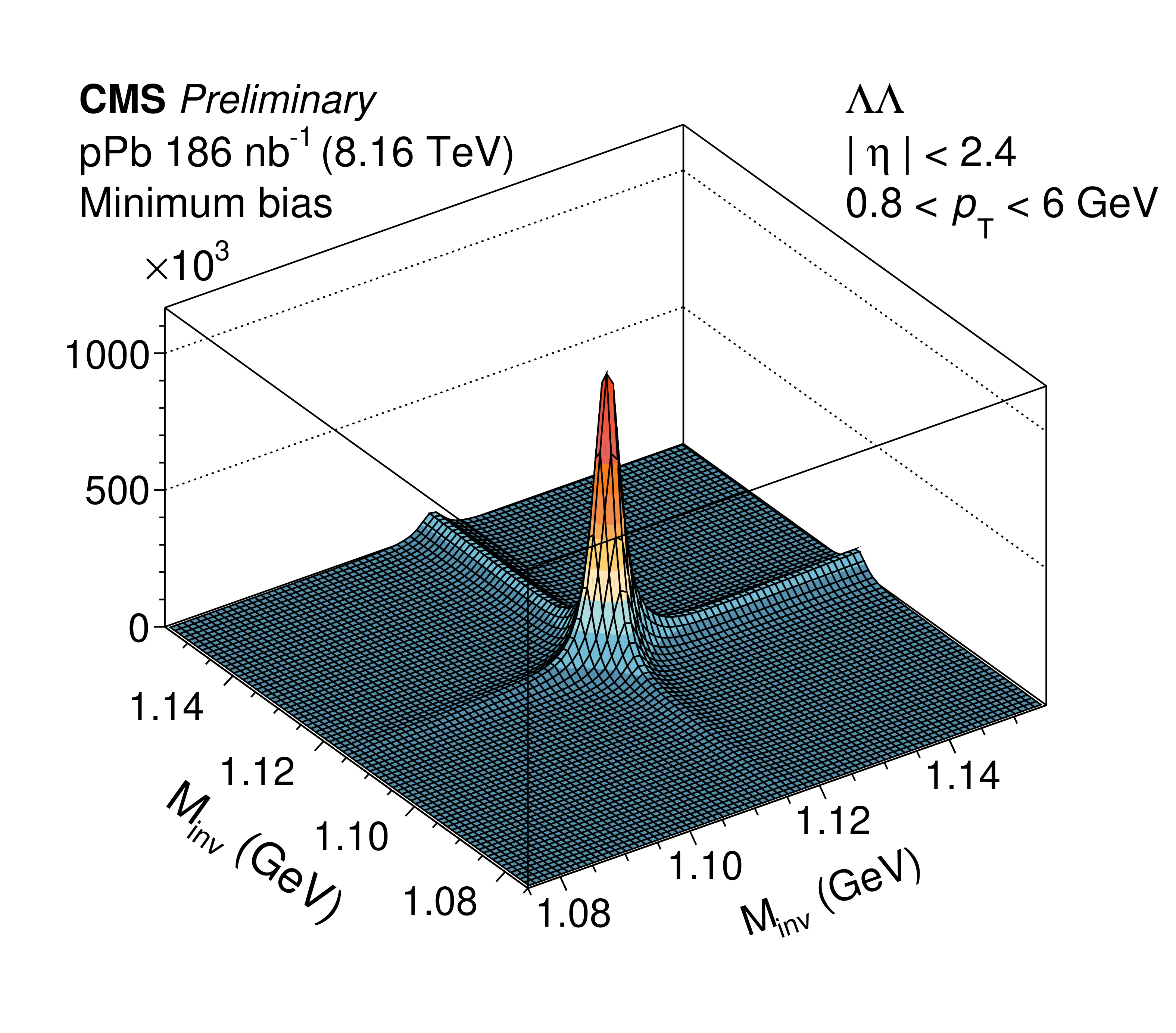
Figure 1:
The two-dimensional invariant mass distributions of the reconstructed $ \Lambda\Lambda $ candidate pairs with 0.8 $ < p_{\mathrm{T}} < $ 6.0 GeV and $ |\eta| < $ 2.4 in 8.16 TeV pPb collisions. |
png pdf |
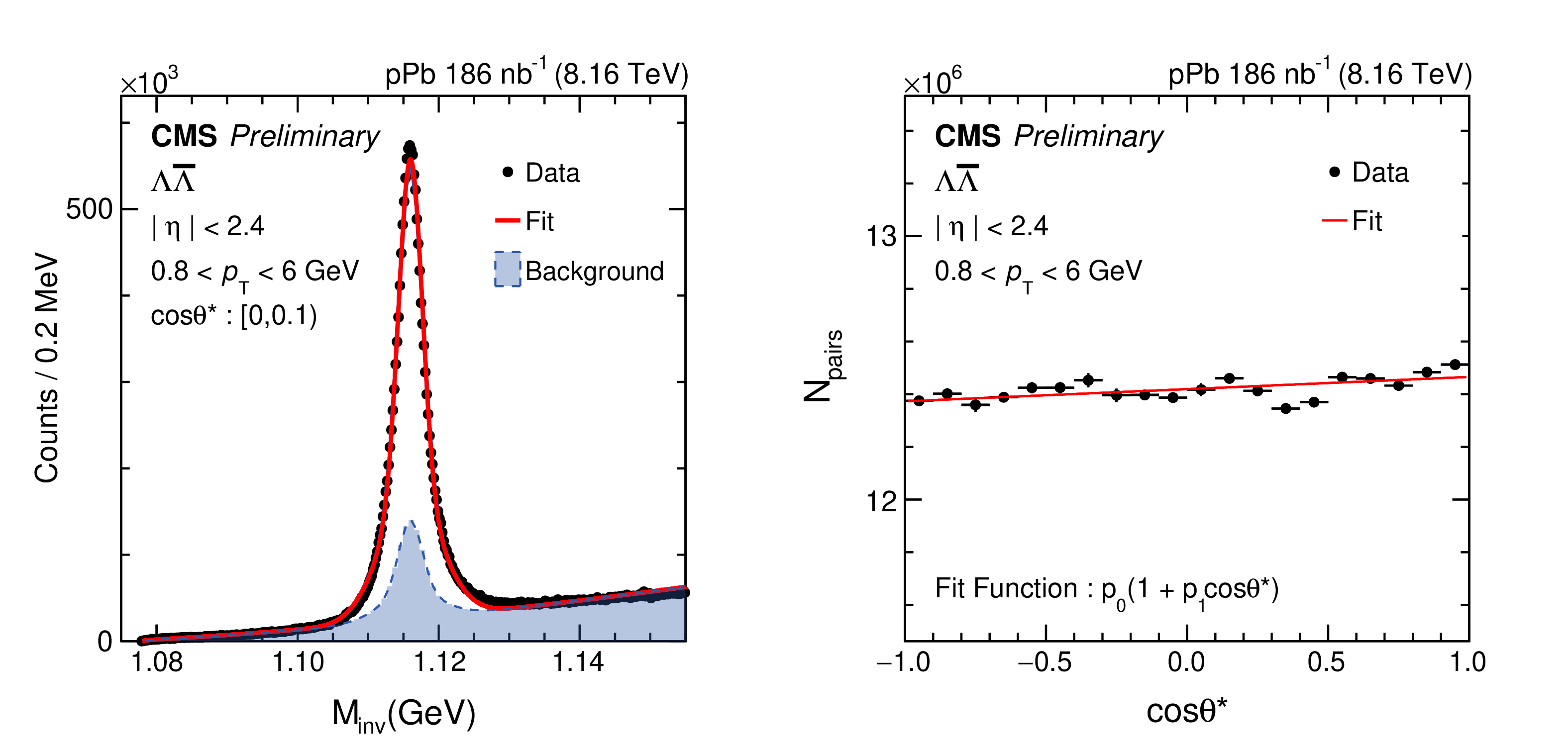
Figure 2:
Left: One-dimensional invariant mass distribution of $ \Lambda\overline{\Lambda} $ candidate pairs, obtained by projecting the two-dimensional invariant mass distribution onto the $ \Lambda $ axis. The fit result, including the signal and combinatorial background components, is shown by the red line. Right: The acceptance-corrected $ dN/d\cos(\theta^{*}) $ distribution for $ \Lambda\overline{\Lambda} $ pairs with 0.8 $ < p_{\mathrm{T}} < $ 6.0 GeV and $ |\eta| < $ 2.4 in pPb collisions with the results of the fit to a linear function (red line). The vertical bars, representing the statistical uncertainties, are typically smaller than the marker size. |
png pdf |
Figure 3:
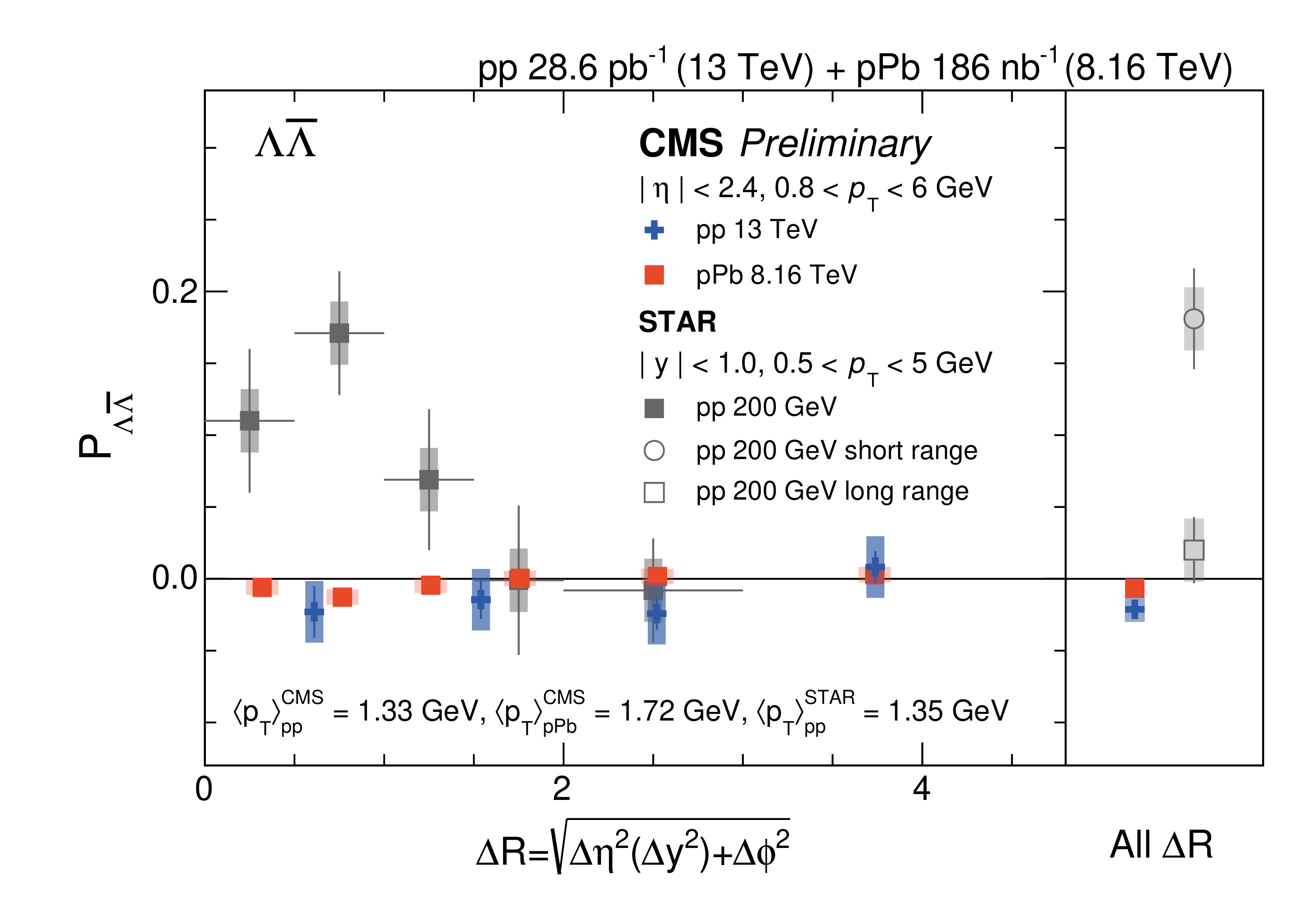
Spin correlation $ P_{\Lambda_{1},\Lambda_{2}} $ distributions as functions of $ \Delta R $ for $ \Lambda\overline{\Lambda} $ pairs with 0.8 $ < p_{\mathrm{T}} < $ 6.0 GeV and $ |\eta| < $ 2.4 in $ \text{pp} $ and pPb collisions. The right panel shows the corresponding results integrated over the full $ \Delta R $ range. The STAR results with $ |y| < $ 1 in $ \text{pp} $ collisions at $ \sqrt{s}= $ 200 GeV [19] are shown for comparison, with the definition of \dR shown in parentheses in the $ x $ axis title. The STAR short- (long-) range result is extracted from $ \Lambda\overline{\Lambda} $ pairs with $ |y| < $ 0.5 and $ |\phi| < \pi/ $ 3 (0.5 $ < |y| < $ 2 and/or $ \pi/3 < |\phi| < \pi $). The vertical bars represent the statistical uncertainties, while the shaded areas show the systematic ones. |
png pdf |
Figure 4:
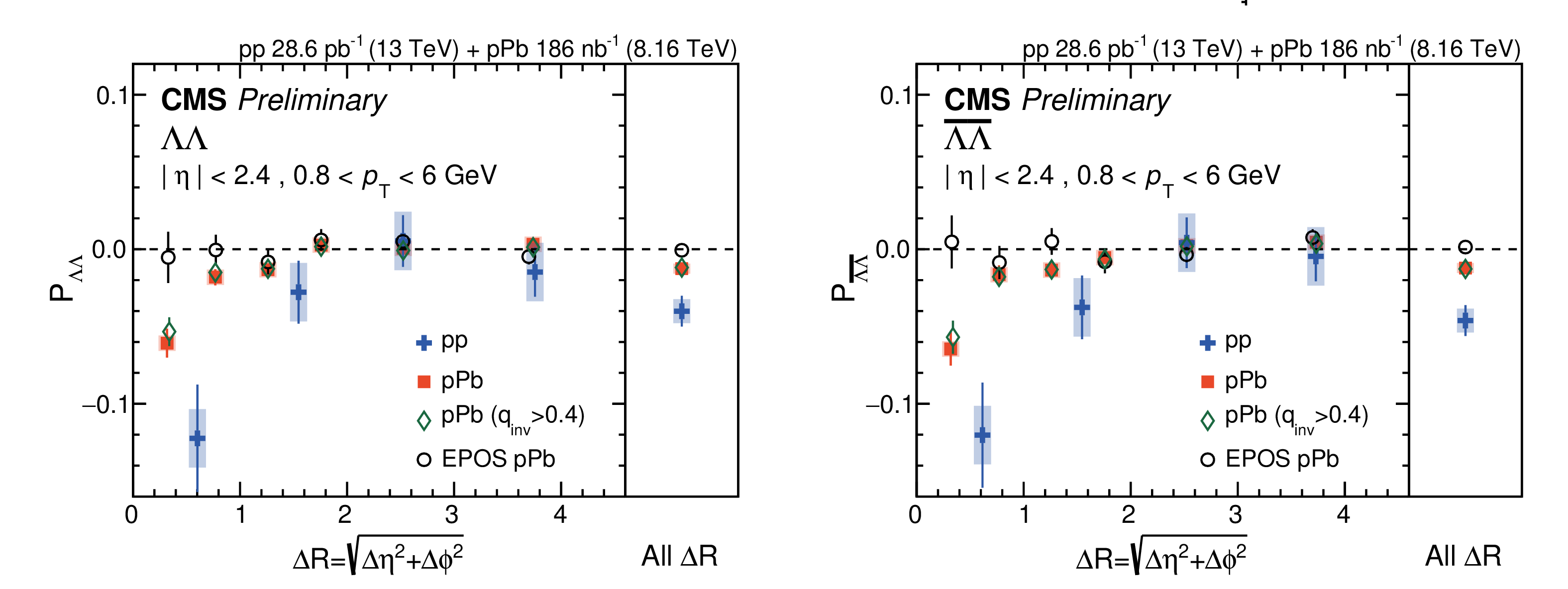
The $ P_{\Lambda_{1},\Lambda_{2}} $ values as functions of $ \Delta R $ for $ \Lambda\Lambda $ (left) and $ \overline{\Lambda}\overline{\Lambda} $ (right) pairs with 0.8 $ < p_{\mathrm{T}} < $ 6.0 GeV and $ |\eta| < $ 2.4 in $ \text{pp} $ and pPb collisions. The right panel shows the corresponding results integrated over the full $ \Delta R $ range. The results for pPb collisions with an additional requirement of $ q_{\text{inv}} > $ 0.4 GeV are also shown. The corresponding EPOS results are included for comparison. The vertical bars represent statistical uncertainties, and shaded bands represent systematic uncertainties. |
png pdf |
Figure 5:
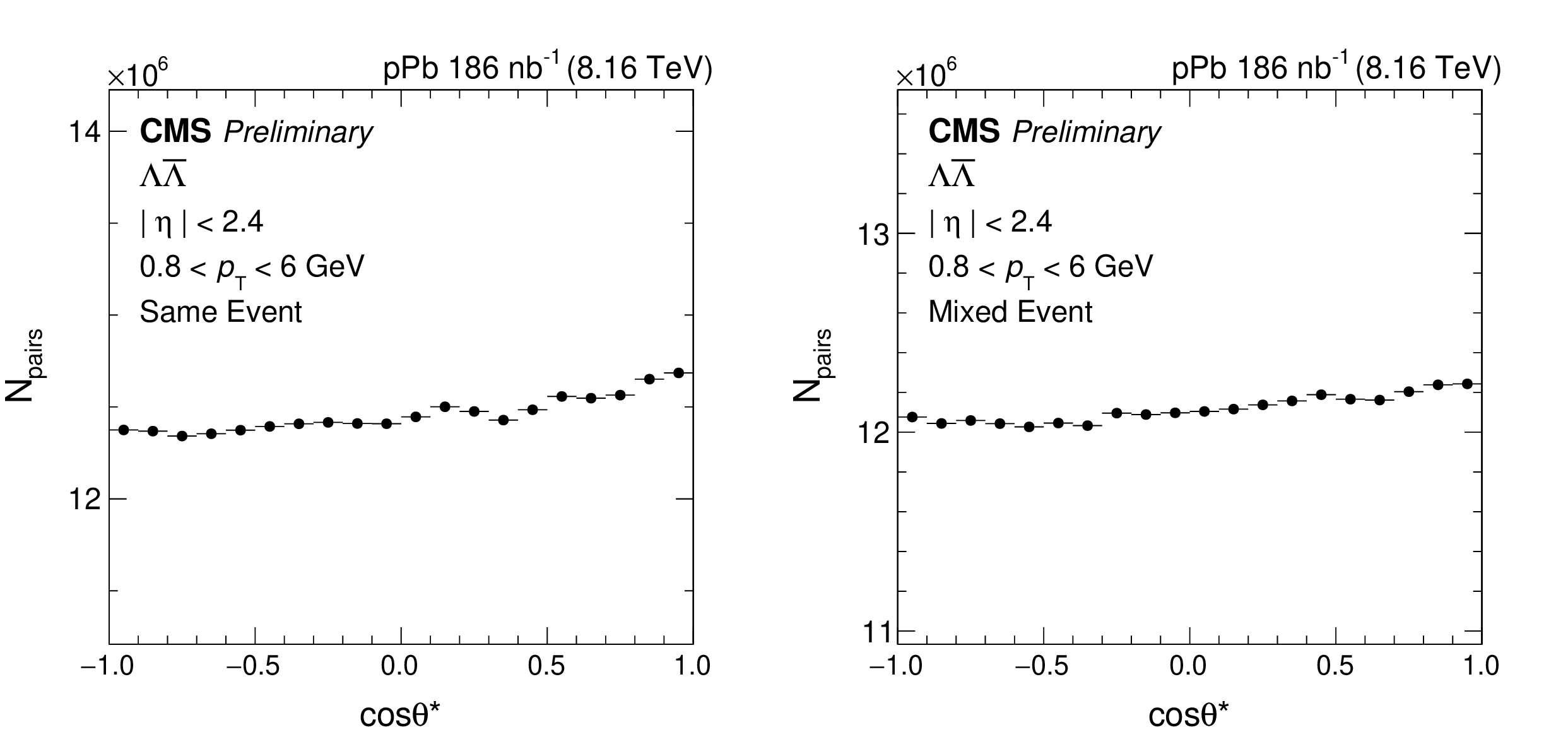
Left: Same-event $ dN/d\cos(\theta^{*}) $ distribution for $ \Lambda\overline{\Lambda} $ pairs with 0.8 $ < p_{\mathrm{T}} < $ 6.0 GeV and $ |\eta| < $ 2.4 in pPb collisions. Right: Mixed-event $ dN/d\cos(\theta^{*}) $ distribution for $ \Lambda\overline{\Lambda} $ pairs with 0.8 $ < p_{\mathrm{T}} < $ 6.0 GeV and $ |\eta| < $ 2.4 in pPb collisions. The vertical bars, representing the statistical uncertainties, are typically smaller than the marker size. |
png pdf |
Figure 5-a:
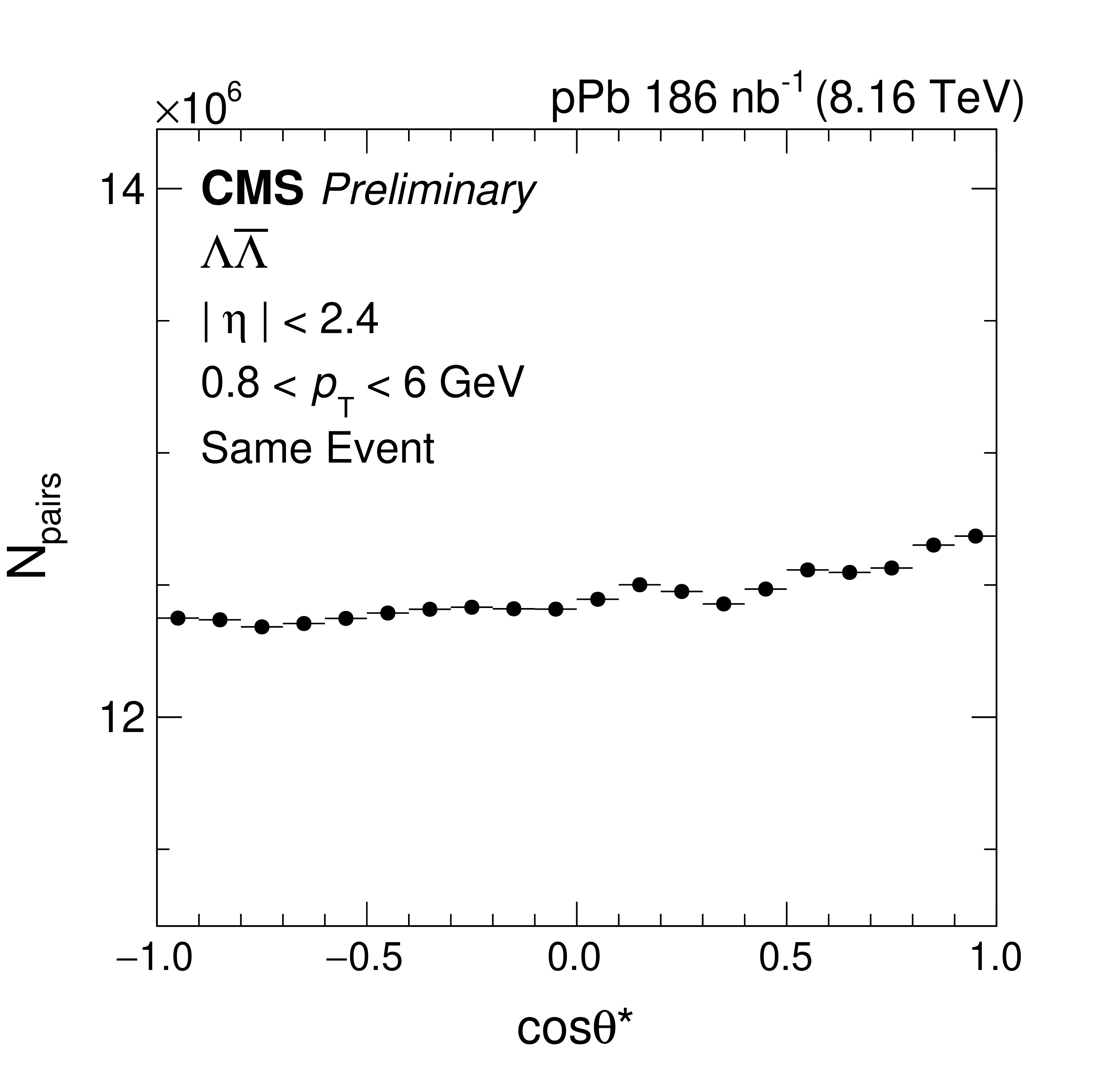
Left: Same-event $ dN/d\cos(\theta^{*}) $ distribution for $ \Lambda\overline{\Lambda} $ pairs with 0.8 $ < p_{\mathrm{T}} < $ 6.0 GeV and $ |\eta| < $ 2.4 in pPb collisions. Right: Mixed-event $ dN/d\cos(\theta^{*}) $ distribution for $ \Lambda\overline{\Lambda} $ pairs with 0.8 $ < p_{\mathrm{T}} < $ 6.0 GeV and $ |\eta| < $ 2.4 in pPb collisions. The vertical bars, representing the statistical uncertainties, are typically smaller than the marker size. |
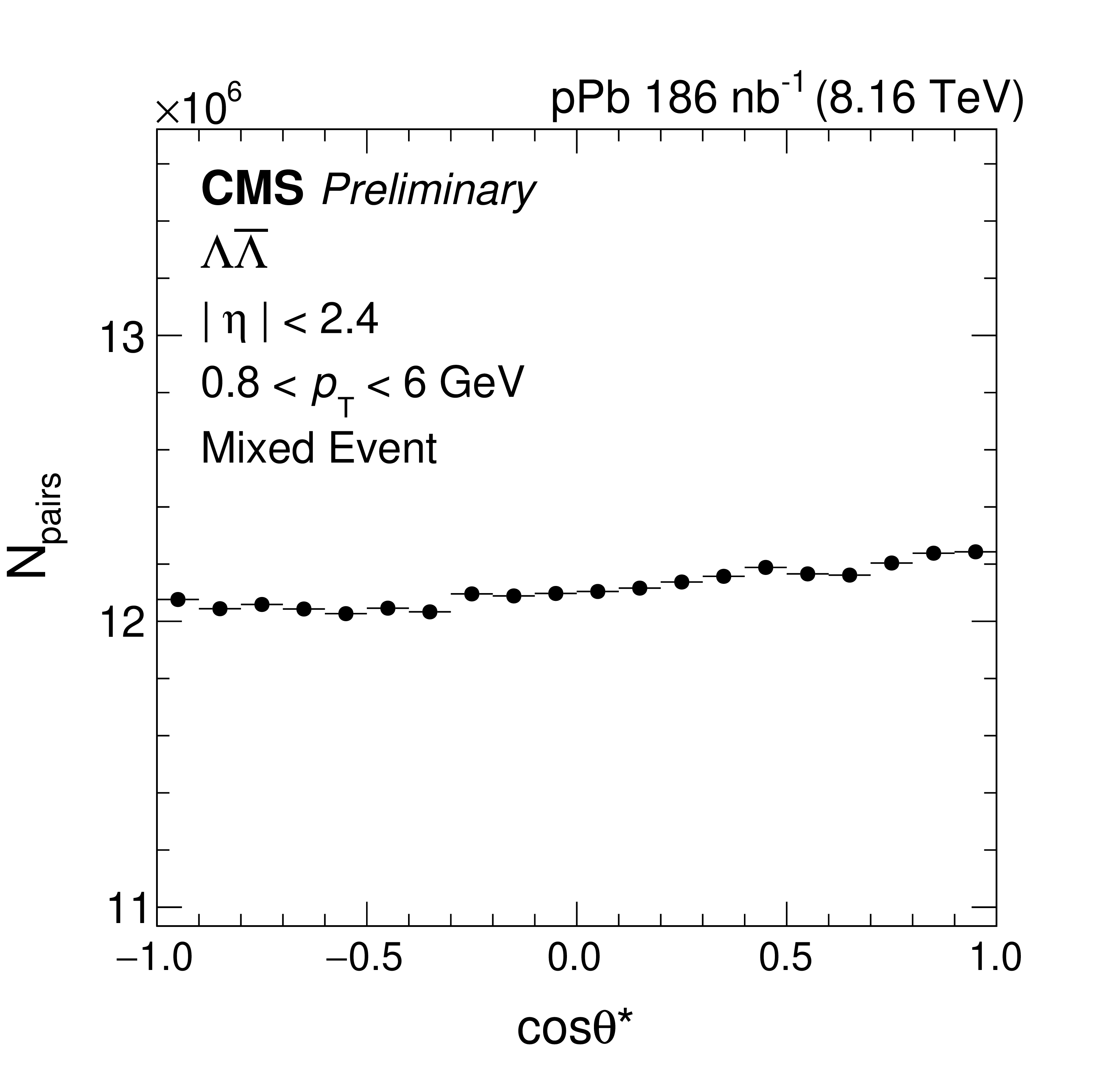
png pdf |
Figure 5-b:
Left: Same-event $ dN/d\cos(\theta^{*}) $ distribution for $ \Lambda\overline{\Lambda} $ pairs with 0.8 $ < p_{\mathrm{T}} < $ 6.0 GeV and $ |\eta| < $ 2.4 in pPb collisions. Right: Mixed-event $ dN/d\cos(\theta^{*}) $ distribution for $ \Lambda\overline{\Lambda} $ pairs with 0.8 $ < p_{\mathrm{T}} < $ 6.0 GeV and $ |\eta| < $ 2.4 in pPb collisions. The vertical bars, representing the statistical uncertainties, are typically smaller than the marker size. |
png pdf |
Figure 6:
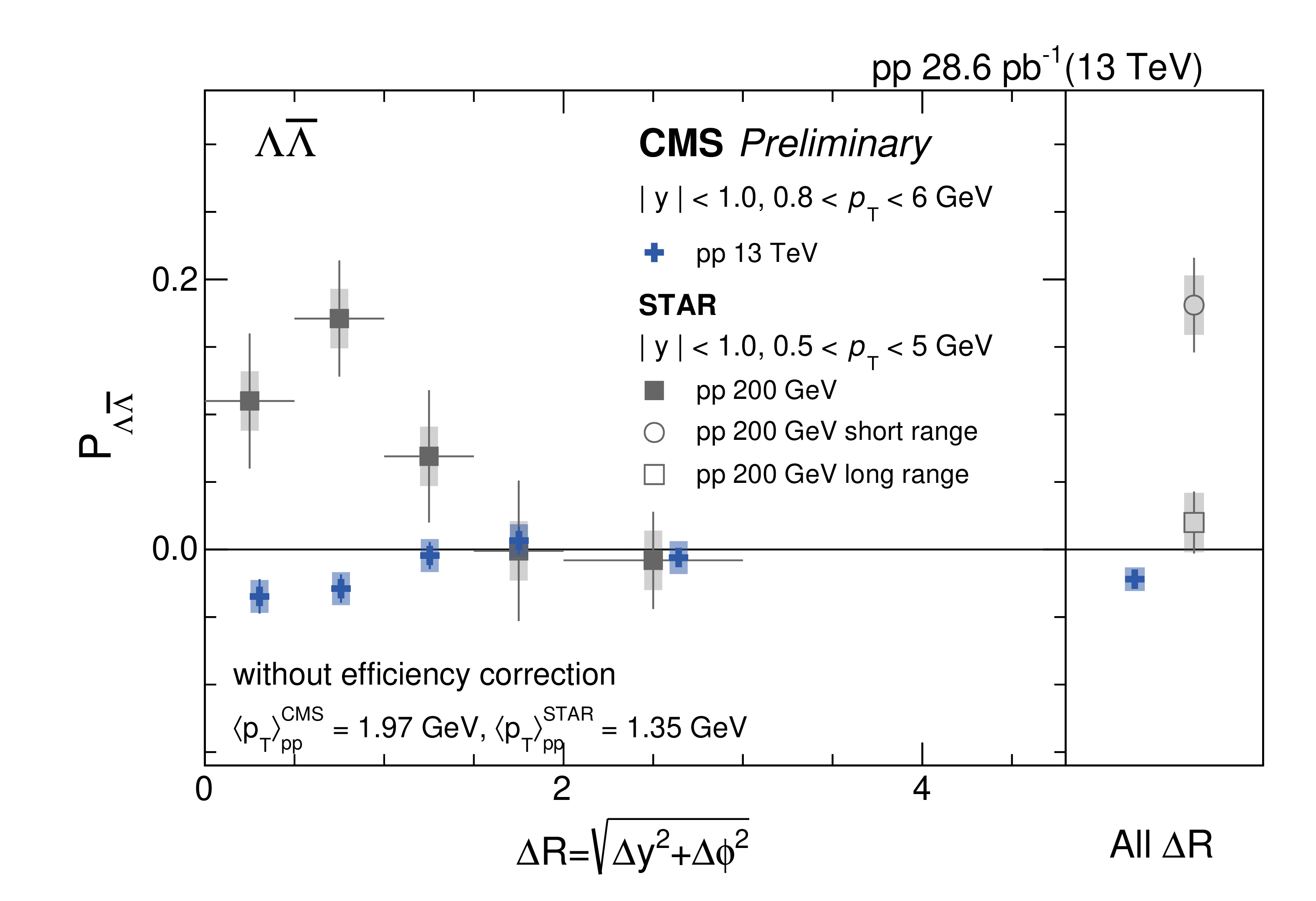
Spin correlation $ P_{\Lambda_{1},\Lambda_{2}} $ distributions as functions of $ \Delta R $ for $ \Lambda\overline{\Lambda} $ pairs with 0.8 $ < p_{\mathrm{T}} < $ 6.0 GeV and $ |y| < $ 1.0 in $ \text{pp} $ collisions. The right panel shows the corresponding results integrated over the full $ \Delta R $ range. The results are not corrected for $ \Lambda $/$ \overline{\Lambda} $ reconstruction efficiency. The STAR results in $ \text{pp} $ collisions at $ \sqrt{s}= $ 200 GeV [19] are shown for comparison. The STAR short- (long-) range result is extracted from $ \Lambda\overline{\Lambda} $ pairs with $ |y| < $ 0.5 and $ |\phi| < \pi/ $ 3 (0.5 $ < |y| < $ 2 and/or $ \pi/3 < |\phi| < \pi $). Vertical bars show statistical uncertainties. Shaded areas show systematic uncertainties. |
png pdf |
Figure 7:
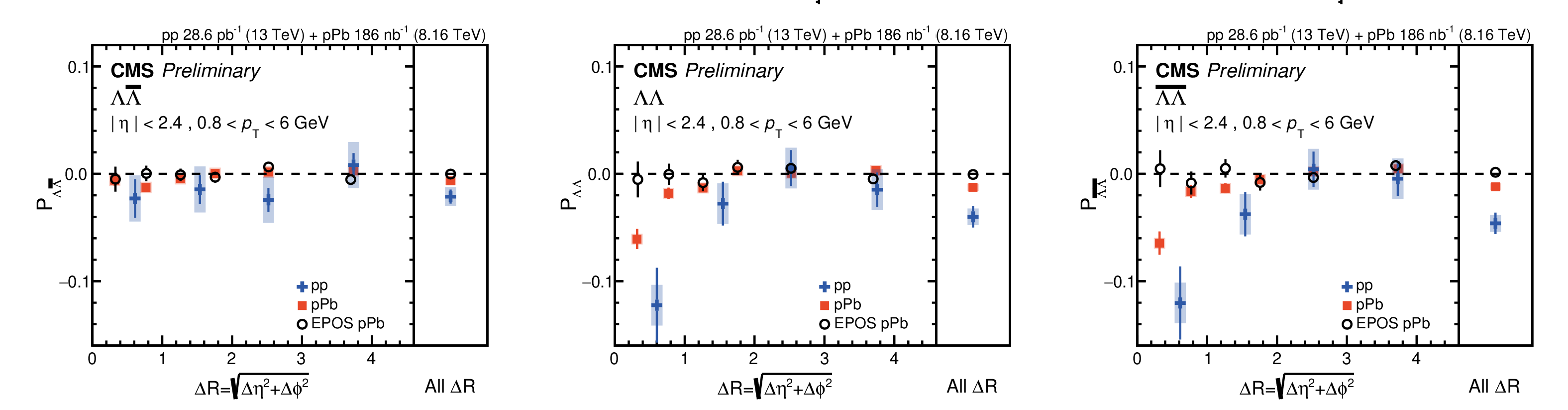
The $ P_{\Lambda_{1},\Lambda_{2}} $ values as functions of $ \Delta R $ for $ \Lambda\overline{\Lambda} $ (left), $ \Lambda\Lambda $(middle) and $ \overline{\Lambda}\overline{\Lambda} $ (right) pairs with 0.8 $ < p_{\mathrm{T}} < $ 6.0 GeV and $ |\eta| < $ 2.4 in $ \text{pp} $ and pPb collisions. The right panel shows the corresponding results integrated over the full $ \Delta R $ range. The corresponding EPOS results are included for comparison. The vertical bars represent statistical uncertainties, and shaded bands represent systematic uncertainties |
png pdf |
Figure 8:
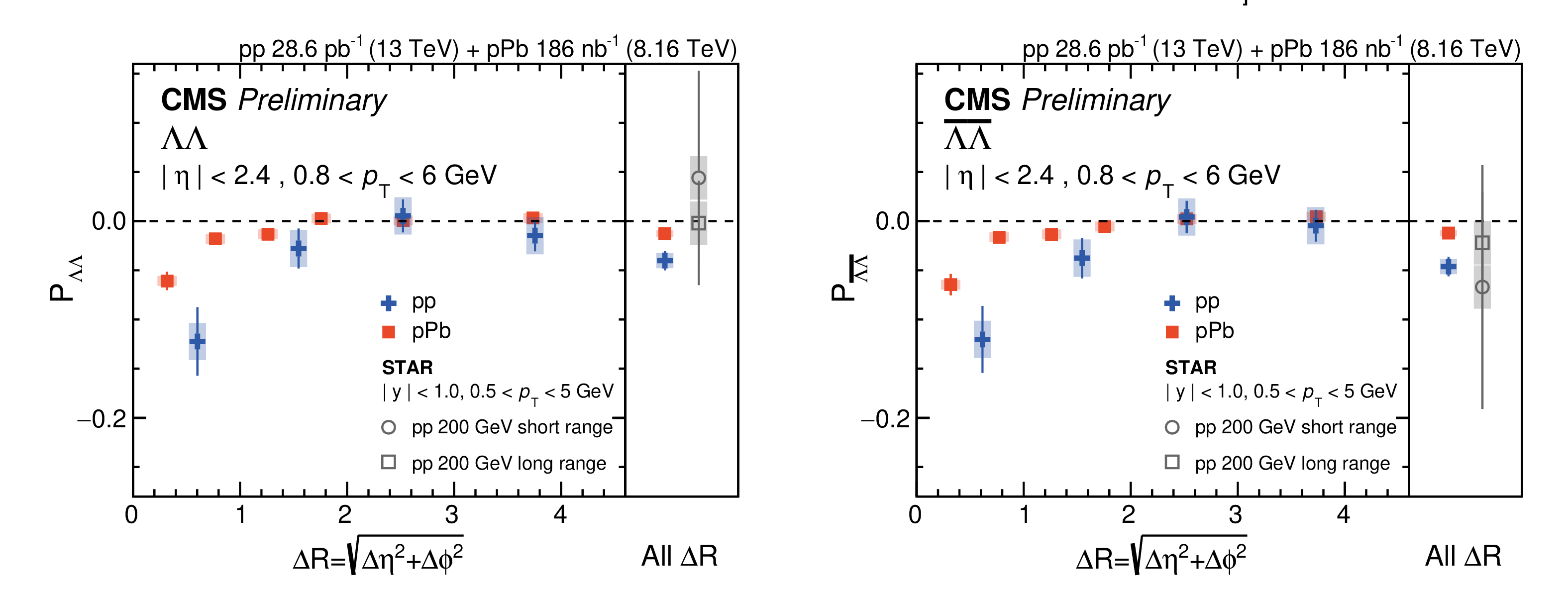
The $ P_{\Lambda_{1},\Lambda_{2}} $ values as functions of $ \Delta R $ for $ \Lambda\Lambda $ (left) and $ \overline{\Lambda}\overline{\Lambda} $ (right) pairs with 0.8 $ < p_{\mathrm{T}} < $ 6.0 GeV and $ |\eta| < $ 2.4 in $ \text{pp} $ and pPb collisions. The right panel shows the corresponding results integrated over the full $ \Delta R $ range. The STAR results in $ \text{pp} $ collisions at $ \sqrt{s}= $ 200 GeV [19] are shown for comparison. The STAR short- (long-) range result is extracted from $ \Lambda\Lambda $ and $ \overline{\Lambda}\overline{\Lambda} $ pairs with $ |y| < $ 0.5 and $ |\phi| < \pi/ $ 3 (0.5 $ < |y| < $ 2 and/or $ \pi/3 < |\phi| < \pi $). The vertical bars represent statistical uncertainties, and shaded bands represent systematic uncertainties. |
| Tables | |
png pdf |
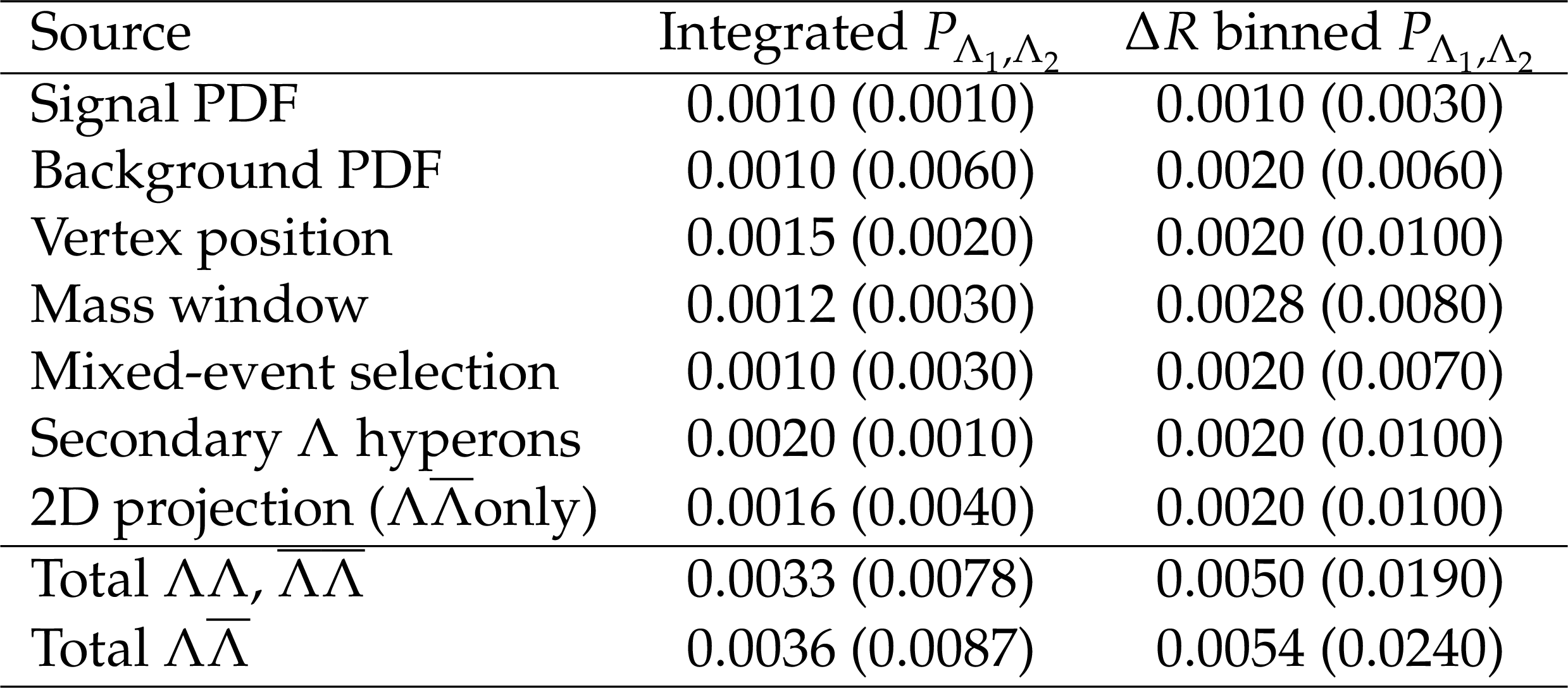
Table 1:
Summary of systematic uncertainties in the $ P_{\Lambda_{1},\Lambda_{2}} $ values are shown for the integrated results and for results binned in $ \Delta R $ in pPb ($ \text{pp} $) collisions. |
| Summary |
| In summary, the spin correlations of $ \Lambda\overline{\Lambda} $, $ \Lambda\Lambda $, and $ \overline{\Lambda}\overline{\Lambda} $ pairs with 0.8 $ < p_{\mathrm{T}} < $ 6.0 GeV and $ |\eta| < $ 2.4 have been measured in proton-proton collisions at $ \sqrt{s}= $ 13 TeV and proton-lead collisions at $ \sqrt{\smash[b]{s_{_{\mathrm{NN}}}}}= $ 8.16 TeV collected with the CMS detector in 2018 and 2016, respectively. The dependence on the hyperon pair separation, defined as $ \Delta R = \sqrt{(\Delta \eta)^2 + (\Delta \phi)^2} $, is studied. Negative $ P_{\Lambda_{1},\Lambda_{2}} $ values are observed at small $ \Delta R $ for $ \Lambda\Lambda $ and $ \overline{\Lambda}\overline{\Lambda} $ pairs, while the $ \Lambda\overline{\Lambda} $ results do not show a statistically significant deviation from zero within the uncertainties. The magnitude of $ P_{\Lambda_{1},\Lambda_{2}} $ shows a decreasing trend with the $ \Delta R $ increase, becoming consistent with zero at large $ \Delta R $. The $ P_{\Lambda_{1},\Lambda_{2}} $ values integrated over the full $ \Delta R $ range for all types of pairs are found to be negative, and tend to have larger magnitudes for $ \Lambda\Lambda $ and $ \overline{\Lambda}\overline{\Lambda} $ than for $ \Lambda\overline{\Lambda} $ pairs. A trend of larger $ P_{\Lambda_{1},\Lambda_{2}} $ values is seen in proton-proton than in proton-lead collisions, particularly at small $ \Delta R $. Results obtained with an additional requirement of excluding pairs with small relative four-momentum are consistent with those without this requirement, suggesting that the observed behavior is not dominated by Hanbury--Brown--Twiss correlations. A comparison with the corresponding measurement by the STAR Collaboration in proton-proton collisions at $ \sqrt{s}= $ 200 GeV shows a different behavior for the $ \Lambda\overline{\Lambda} $ pair correlations at small $ \Delta R $. These results extend the study of $ \Lambda $ hyperon spin correlations to the LHC energies and suggest a collision energy dependence in the small-$ \Delta R $ region, with the underlying mechanisms remaining an open question. |
| References | ||||
| 1 | C. A. Aidala, S. D. Bass, D. Hasch, and G. K. Mallot | The spin structure of the nucleon | Rev. Mod. Phys. 85 (2013) 655 | 1209.2803 |
| 2 | E. Leader and C. Lorc é | The angular momentum controversy: What\textquoterights it all about and does it matter? | Phys. Rept. 541 (2014) 163 | 1309.4235 |
| 3 | X. Ji | Generalized parton distributions | Ann. Rev. Nucl. Part. Sci. 54 (2004) 413 | |
| 4 | A. Accardi et al. | Electron Ion Collider: The next QCD frontier: Understanding the glue that binds us all | Eur. Phys. J. A 52 (2016) 268 | 1212.1701 |
| 5 | K. G. Wilson | Confinement of quarks | PRD 10 (1974) 2445 | |
| 6 | Particle Data Group Collaboration | Review of particle physics | PRD 110 (2024) 030001 | |
| 7 | G. Bunce et al. | Lambda0 hyperon polarization in inclusive production by 300 GeV protons on beryllium | PRL 36 (1976) 1113 | |
| 8 | HERA-B Collaboration | Polarization of Lambda and anti-Lambda in 920 GeV fixed-target proton-nucleus collisions | PLB 638 (2006) 415 | hep-ex/0603047 |
| 9 | COMPASS Collaboration | Measurement of the Collins and Sivers asymmetries on transversely polarised protons | PLB 692 (2010) 240 | 1005.5609 |
| 10 | ZEUS Collaboration | Measurement of $ K^0_{S} $, $ \Lambda $, $ \overline{\Lambda} $ production at HERA | EPJC 51 (2007) 1 | hep-ex/0612023 |
| 11 | STAR Collaboration | Longitudinal spin transfer to Lambda and anti-Lambda hyperons in polarized proton-proton collisions at 200 GeV | PRD 80 (2009) 111102 | 0910.1428 |
| 12 | STAR Collaboration | Measurement of the cross section and longitudinal double-spin asymmetry for di-jet production in polarized $ \text{pp} $ collisions at $ \sqrt{s} = $ 200 GeV | PRD 95 (2017) 071103 | 1610.06616 |
| 13 | STAR Collaboration | Longitudinal double-spin asymmetries for dijet production at intermediate pseudorapidity in polarized $ \text{pp} $ collisions at $ \sqrt{s}= $ 200 GeV | PRD 98 (2018) 032011 | 1805.09742 |
| 14 | STAR Collaboration | Global $ \Lambda $ hyperon polarization in nuclear collisions: evidence for the most vortical fluid | Nature 548 (2017) 62 | 1701.06657 |
| 15 | ALICE Collaboration | Global polarization of $ \Lambda $/$ \overline{\Lambda} $ hyperons in Pb-Pb collisions at $ \sqrt {s_{NN}} = $ 2.76 and 5.02 TeV | Phys. Rev. C 101 (2020) 044611 | 1909.01281 |
| 16 | ATLAS Collaboration | Measurement of the transverse polarization of $ \Lambda $ and $ \overline{\Lambda} $ hyperons produced in proton-proton collisions at $ \sqrt{s}= $ 7 TeV using the ATLAS detector | PRD 91 (2015) 032004 | 1412.1692 |
| 17 | CMS Collaboration | Observation of \ensuremath\Lambda hyperon local polarization in p-Pb collisions at 8.16 TeV | PRL 135 (2025) 132301 | CMS-HIN-24-002 2502.07898 |
| 18 | J. Ellis and D. S. Hwang | Spin correlations of Lambda anti-Lambda pairs as a probe of quark-antiquark pair production | EPJC 72 (2012) 1877 | 1108.5319 |
| 19 | STAR Collaboration | Measuring spin correlation between quarks during QCD confinement | Nature 650 (2026) 65 | 2506.05499 |
| 20 | Z.-T. Liang and X.-N. Wang | Globally polarized quark-gluon plasma in non-central A+A collisions | PRL 94 (2005) 102301 | nucl-th/0410079 |
| 21 | J.-H. Gao et al. | Global quark polarization in non-central A+A collisions | Phys. Rev. C 77 (2008) 044902 | 0710.2943 |
| 22 | ALICE Collaboration | Polarization of $ \Lambda $ and $ \overline{\Lambda} $ hyperons along the beam direction in Pb-Pb collisions at $ \sqrt {s_{NN}} = $ 5.02 TeV | PRL 128 (2022) 172005 | 2107.11183 |
| 23 | STAR Collaboration | Hyperon polarization along the beam direction relative to the second and third harmonic event planes in isobar collisions at 200 GeV | PRL 131 (2023) 202301 | 2303.09074 |
| 24 | STAR Collaboration | Pattern of global spin alignment of \ensuremath\phi and K$ ^{*0} $ mesons in heavy-ion collisions | Nature 614 (2023) 244 | 2204.02302 |
| 25 | X.-L. Sheng et al. | Spin alignment of vector mesons in heavy-ion collisions | PRL 131 (2023) 042304 | 2205.15689 |
| 26 | J.-p. Lv et al. | Global quark spin correlations in relativistic heavy ion collisions | PRD 109 (2024) 114003 | 2402.13721 |
| 27 | X.-L. Sheng, X.-Y. Wu, D. H. Rischke, and X.-N. Wang | Hyperon spin correlation in high-energy heavy-ion collisions | PRL 136 (2026) 082301 | 2508.03496 |
| 28 | R. Lednicky | Correlation femtoscopy | Nucl. Phys. A 774 (2006) 189 | nucl-th/0510020 |
| 29 | CMS Collaboration | The CMS experiment at the CERN LHC | JINST 3 (2008) S08004 | |
| 30 | CMS Collaboration | Development of the CMS detector for the CERN LHC Run 3 | JINST 19 (2024) P05064 | CMS-PRF-21-001 2309.05466 |
| 31 | CMS Collaboration | Performance of the Level-1 trigger in proton-proton collisions at $ \sqrt{s} = $ 13 TeV | JINST 15 (2020) P10017 | CMS-TRG-17-001 2006.10165 |
| 32 | CMS Collaboration | The CMS trigger system | JINST, 2017, P01020 | CMS-TRG-12-001 1609.02366 |
| 33 | CMS Collaboration | Performance of the CMS high-level trigger during LHC Run 2 | JINST 19 (2024) P11021 | CMS-TRG-19-001 2410.17038 |
| 34 | CMS Collaboration | Electron and photon reconstruction and identification with the CMS experiment at the CERN LHC | JINST 16 (2021) P05014 | CMS-EGM-17-001 2012.06888 |
| 35 | CMS Collaboration | Performance of the CMS muon detector and muon reconstruction with proton-proton collisions at $ \sqrt{s}= $ 13 TeV | JINST 13 (2018) P06015 | CMS-MUO-16-001 1804.04528 |
| 36 | CMS Collaboration | Description and performance of track and primary-vertex reconstruction with the CMS tracker | JINST 9 (2014) P10009 | CMS-TRK-11-001 1405.6569 |
| 37 | CMS Collaboration | Long-range two-particle correlations of strange hadrons with charged particles in pPb and PbPb collisions at LHC energies | PLB 742 (2015) 200 | CMS-HIN-14-002 1409.3392 |
| 38 | CMS Collaboration | Multiplicity and rapidity dependence of strange hadron production in pp, pPb, and PbPb collisions at the LHC | PLB 768 (2017) 103 | CMS-HIN-15-006 1605.06699 |
| 39 | CMS Collaboration | Evidence for collectivity in pp collisions at the LHC | PLB 765 (2017) 193 | CMS-HIN-16-010 1606.06198 |
| 40 | CMS Collaboration | Elliptic flow of charm and strange hadrons in high-multiplicity pPb collisions at $ \sqrt{s_{_\mathrm{NN}}} = $ 8.16 TeV | PRL 121 (2018) 082301 | CMS-HIN-17-003 1804.09767 |
| 41 | CMS Collaboration | Studies of charm and beauty hadron long-range correlations in pp and pPb collisions at LHC energies | PLB 813 (2021) 136036 | CMS-HIN-19-009 2009.07065 |
| 42 | T. Sjöstrand et al. | An introduction to PYTHIA 8.2 | Comput. Phys. Commun. 191 (2015) 159 | 1410.3012 |
| 43 | T. Pierog et al. | EPOS LHC: Test of collective hadronization with data measured at the CERN Large Hadron Collider | Phys. Rev. C 92 (2015) 034906 | 1306.0121 |
| 44 | GEANT4 Collaboration | GEANT4 - a simulation toolkit | NIM A 506 (2003) 250 | |
| 45 | CMS Collaboration | Observation of long-range near-side angular correlations in proton-proton collisions at the LHC | JHEP 09 (2010) 091 | CMS-QCD-10-002 1009.4122 |
| 46 | ATLAS Collaboration | Observation of long-range elliptic azimuthal anisotropies in $ \sqrt{s}= $13 and 2.76 TeV $ \text{pp} $ collisions with the ATLAS detector | PRL 116 (2016) 172301 | 1509.04776 |
| 47 | CMS Collaboration | Measurement of long-range near-side two-particle angular correlations in pp collisions at $ \sqrt s = $13 TeV | PRL 116 (2016) 172302 | CMS-FSQ-15-002 1510.03068 |
| 48 | CMS Collaboration | Observation of long-range near-side angular correlations in proton-lead collisions at the LHC | PLB 718 (2013) 795 | CMS-HIN-12-015 1210.5482 |
| 49 | ALICE Collaboration | Long-range angular correlations on the near and away side in p-Pb collisions at $ \sqrt {\smash [b]{s_{_{\mathrm {NN}}}}}= $ 5.02 TeV | PLB 719 (2013) 29 | 1212.2001 |
| 50 | ATLAS Collaboration | Observation of associated near-side and away-side long-range correlations in $ \sqrt {\smash [b]{s_{_{\mathrm {NN}}}}} = $ 5.02 tev proton-lead collisions with the ATLAS detector | PRL 110 (2013) 182302 | 1212.5198 |
| 51 | LHCb Collaboration | Measurements of long-range near-side angular correlations in $ \sqrt{\smash[b]{s_{_{\mathrm{NN}}}}}= $ 5 TeV proton-lead collisions in the forward region | PLB 762 (2016) 473 | 1512.00439 |
| 52 | CMS Collaboration | Observation of prompt J/$ \psi $ meson elliptic flow in high-multiplicity pPb collisions at $ \sqrt{\smash[b]{s_{_{\mathrm{NN}}}}}= $ 8.16 TeV | PLB 791 (2019) 172 | CMS-HIN-18-010 1810.01473 |
| 53 | CMS Collaboration | Strange hadron collectivity in pPb and PbPb collisions | JHEP 05 (2023) 007 | CMS-HIN-19-004 2205.00080 |
| 54 | CMS Collaboration | Overview of high-density QCD studies with the CMS experiment at the LHC | Phys. Rept. 1115 (2025) 219 | CMS-HIN-23-011 2405.10785 |
| 55 | A. Lesnik et al. | Observation of a difference between polarization and analyzing power in Lambda0 production with 6-GeV/c polarized protons | PRL 35 (1975) 770 | |
| 56 | W. Gong, G. Parida, Z. Tu, and R. Venugopalan | Measurement of bell-type inequalities and quantum entanglement from \ensuremath\Lambda-hyperon spin correlations at high energy colliders | PRD 106 (2022) L031501 | 2107.13007 |
| 57 | N. A. Tornqvist | The decay $ J/\psi \to \Lambda \bar{\Lambda} \to \pi^- p \pi^+ \bar{p} $ as an Einstein-Podolsky-Rosen experiment | Phys. Lett. A 117 (1986) 1 | |
| 58 | N. A. Tornqvist | Suggestion for Einstein-Podolsky-Rosen experiments using reactions like $ e^+ e^- \to \Lambda \bar{\Lambda} \to \pi^- p \pi^+ \bar{p} $ | Found. Phys. 11 (1981) 171 | |
| 59 | BESIII Collaboration | Polarization and entanglement in baryon-antibaryon pair production in electron-positron annihilation | Nature Phys. 15 (2019) 631 | 1808.08917 |
| 60 | CMS Collaboration | Strange hadron production in pp and pPb collisions at $ \sqrt {\smash [b]{s_{_{\mathrm {NN}}}}}= $ 5.02 TeV | Phys. Rev. C 101 (2020) 064906 | CMS-HIN-16-013 1910.04812 |
| 61 | ALICE Collaboration | Centrality dependence of pion freeze-out radii in Pb-Pb collisions at $ \sqrt{s}_{NN}= $ 2.76 TeV | Phys. Rev. C 93 (2016) 024905 | 1507.06842 |
| 62 | CMS Collaboration | Measurement of Bose-Einstein correlations in pp collisions at $ \sqrt{s}= $ 0.9 and 7 TeV | JHEP 05 (2011) 029 | CMS-QCD-10-023 1101.3518 |
| 63 | STAR Collaboration | Pion interferometry in Au+Au collisions at 200 GeV | Phys. Rev. C 71 (2005) 044906 | nucl-ex/0411036 |
| 64 | CMS Collaboration | $ K_{S}^{0} $ and \ensuremath\Lambda(\ensuremath\Lambda) two-particle femtoscopic correlations in PbPb collisions at 5.02 TeV | PLB 857 (2024) 138936 | CMS-HIN-21-006 2301.05290 |
|
|
Compact Muon Solenoid LHC, CERN |

|
|
|
|
|
|