
Compact Muon Solenoid
LHC, CERN
 Visit us: CMS Public Website, CMS Physics ;
Contact us: CMS Publications Committee
Visit us: CMS Public Website, CMS Physics ;
Contact us: CMS Publications Committee
| CMS-PAS-EXO-24-027 | ||
| Search for low-mass resonances decaying into a quark-antiquark pair produced with an initial state radiation photon in proton-proton collisions at $ \sqrt{s} = $ 13 TeV | ||
| CMS Collaboration | ||
| 2026-05-18 | ||
| Abstract: A search for low-mass resonances decaying to a quark-antiquark pair in the mass range of 10 to 150 GeV is presented. This search uses proton-proton collision data at $ \sqrt{s} = $ 13 TeV, collected by the CMS detector at the CERN LHC in 2016--2018, corresponding to an integrated luminosity of 138 fb$ ^{-1} $. The analysis strategy makes use of an initial-state radiation photon recoiling against the resonance. As a result, the resonance is produced with high transverse momentum, and the quark-antiquark decay products are reconstructed as a single large-radius jet with an internal two-pronged structure. A machine learning algorithm is used to distinguish such jets from the background. The results are interpreted in the context of a spin-1, leptophobic Z$ ^{\prime} $ boson, which is a dark matter mediator candidate. No significant excess is observed when searching for this signature above the standard model background in the jet mass spectrum. Upper limits at the 95% confidence level are set on the coupling strength of the Z$ ^{\prime} $ to quark-antiquark pairs. This represents the most sensitive search in the mass range of 10 to 50 GeV for resonances decaying to quark-antiquark pairs to date. | ||
| Links: CDS record (PDF) ; CADI line (restricted) ; | ||
| Figures | |
png pdf |
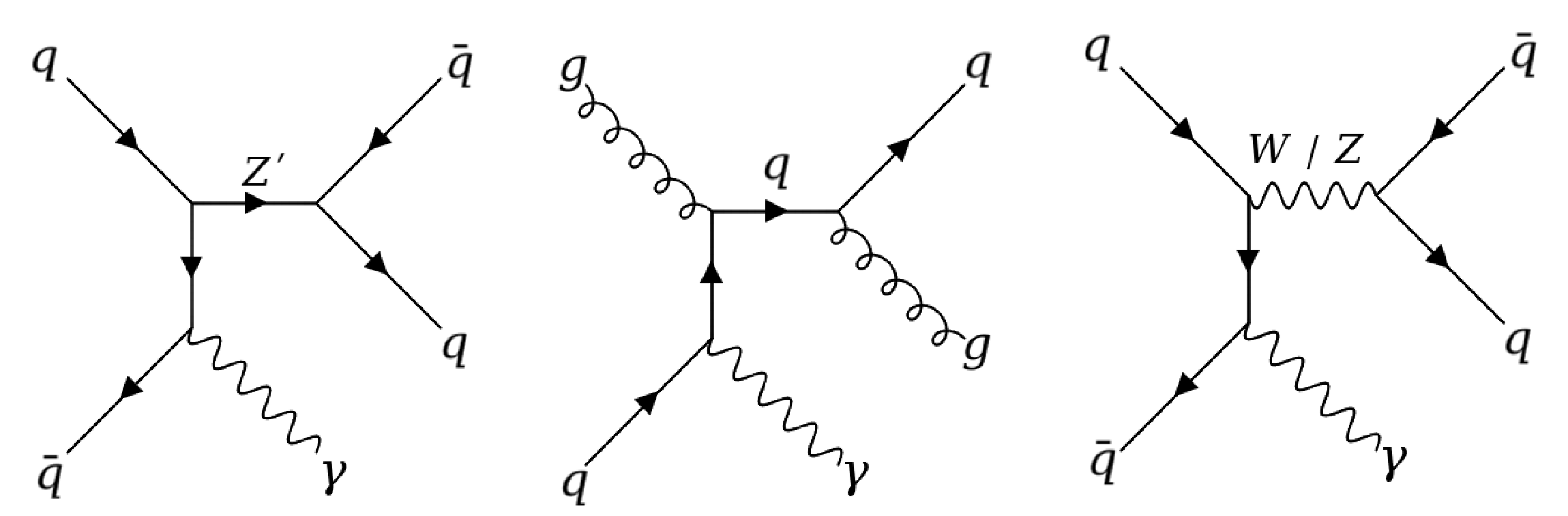
Figure 1:
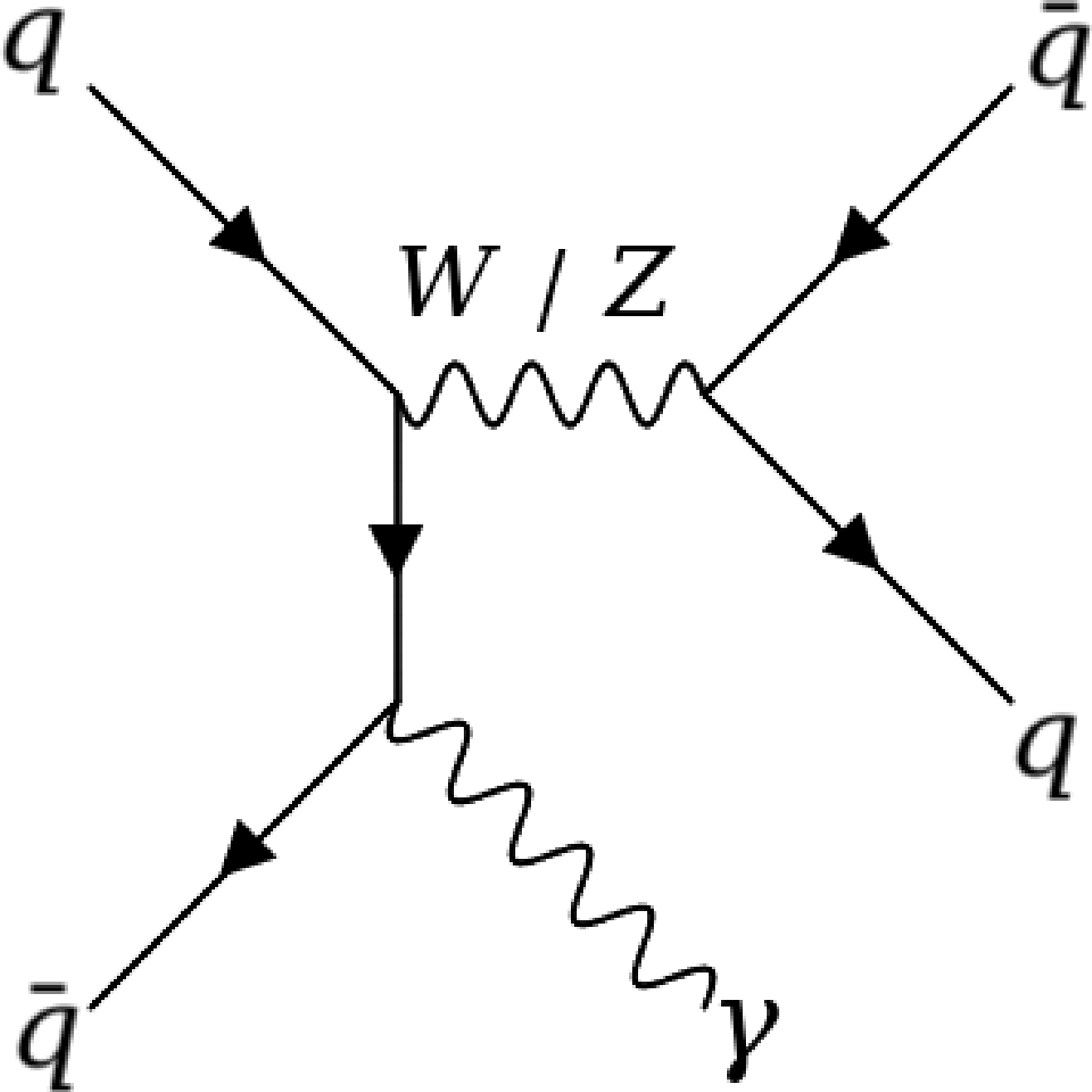
Leading-order Feynman diagrams for models used in this analysis: signal production of a $ \mathrm{Z}^{'} $ decaying to $ \mathrm{q} \overline{\mathrm{q}} $ produced in association with an ISR photon (left), the nonresonant background of multijet QCD events produced in association with a high-$ p_{\mathrm{T}} $ photon $ \gamma+\text{jets} $ (center), and the primary resonant background, $ \mathrm{W}/\mathrm{Z}+\gamma $ (right). |
png pdf |
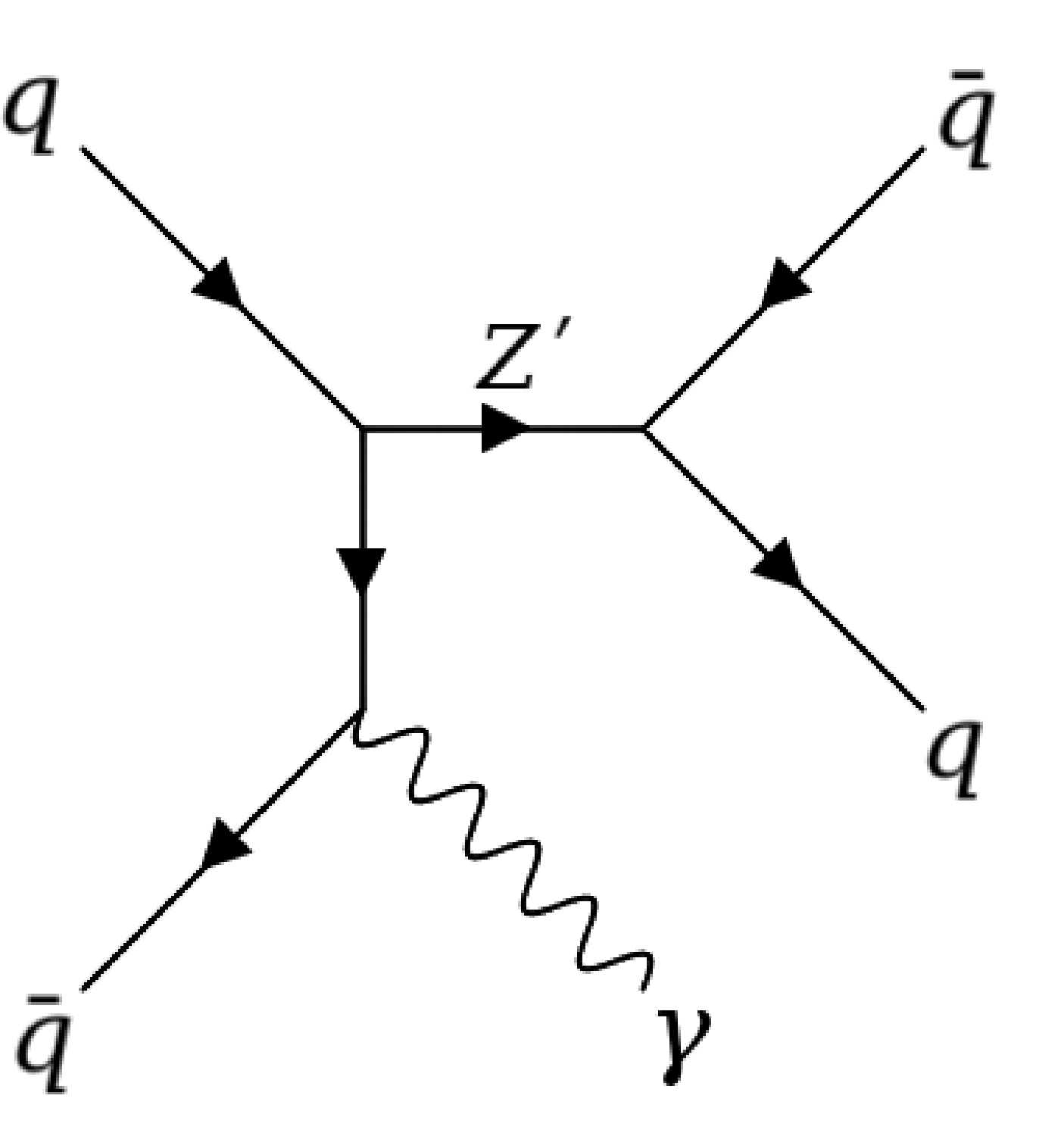
Figure 1-a:
Leading-order Feynman diagrams for models used in this analysis: signal production of a $ \mathrm{Z}^{'} $ decaying to $ \mathrm{q} \overline{\mathrm{q}} $ produced in association with an ISR photon (left), the nonresonant background of multijet QCD events produced in association with a high-$ p_{\mathrm{T}} $ photon $ \gamma+\text{jets} $ (center), and the primary resonant background, $ \mathrm{W}/\mathrm{Z}+\gamma $ (right). |
png pdf |
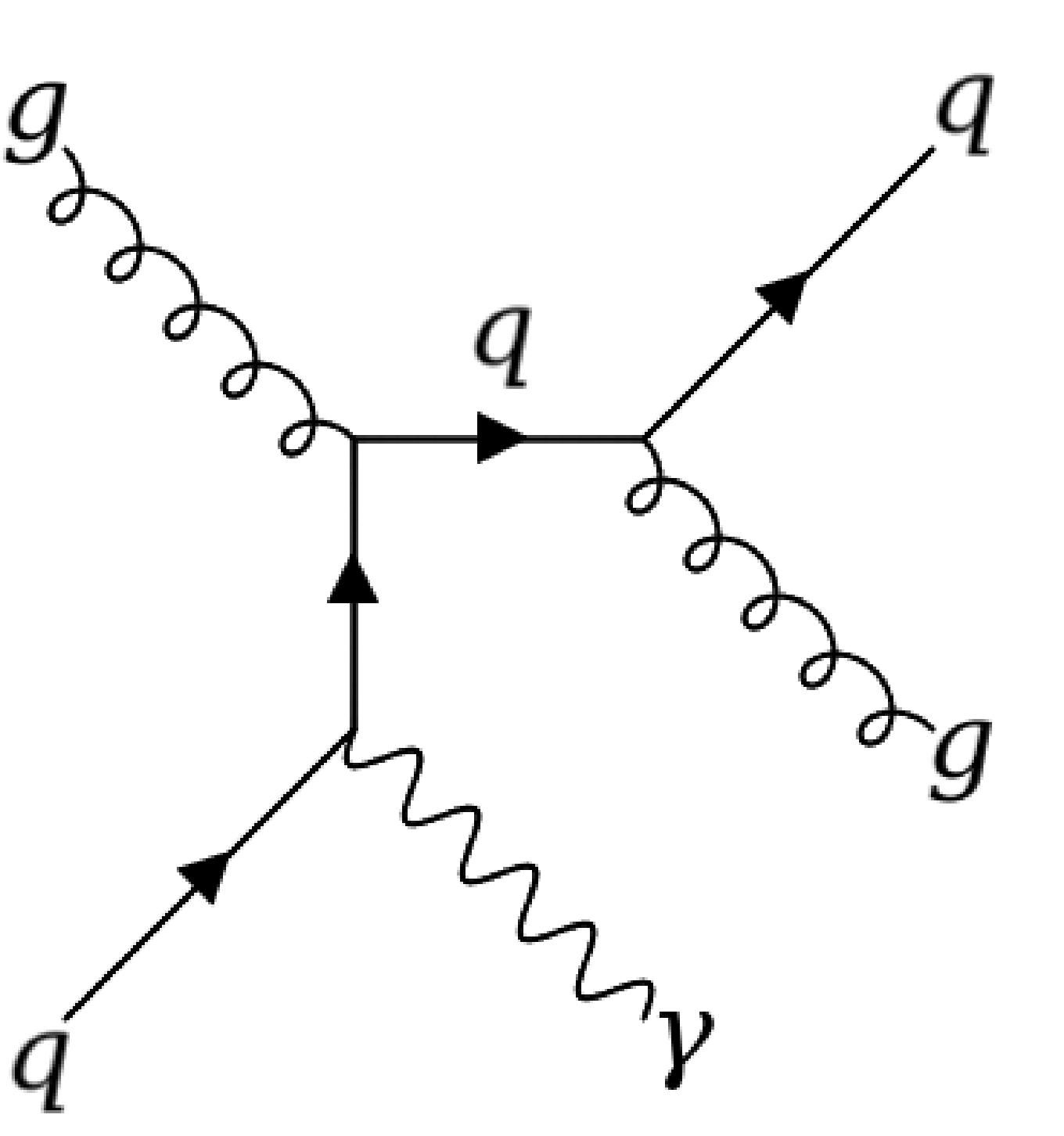
Figure 1-b:
Leading-order Feynman diagrams for models used in this analysis: signal production of a $ \mathrm{Z}^{'} $ decaying to $ \mathrm{q} \overline{\mathrm{q}} $ produced in association with an ISR photon (left), the nonresonant background of multijet QCD events produced in association with a high-$ p_{\mathrm{T}} $ photon $ \gamma+\text{jets} $ (center), and the primary resonant background, $ \mathrm{W}/\mathrm{Z}+\gamma $ (right). |
png pdf |
Figure 1-c:
Leading-order Feynman diagrams for models used in this analysis: signal production of a $ \mathrm{Z}^{'} $ decaying to $ \mathrm{q} \overline{\mathrm{q}} $ produced in association with an ISR photon (left), the nonresonant background of multijet QCD events produced in association with a high-$ p_{\mathrm{T}} $ photon $ \gamma+\text{jets} $ (center), and the primary resonant background, $ \mathrm{W}/\mathrm{Z}+\gamma $ (right). |
png pdf |
Figure 2:
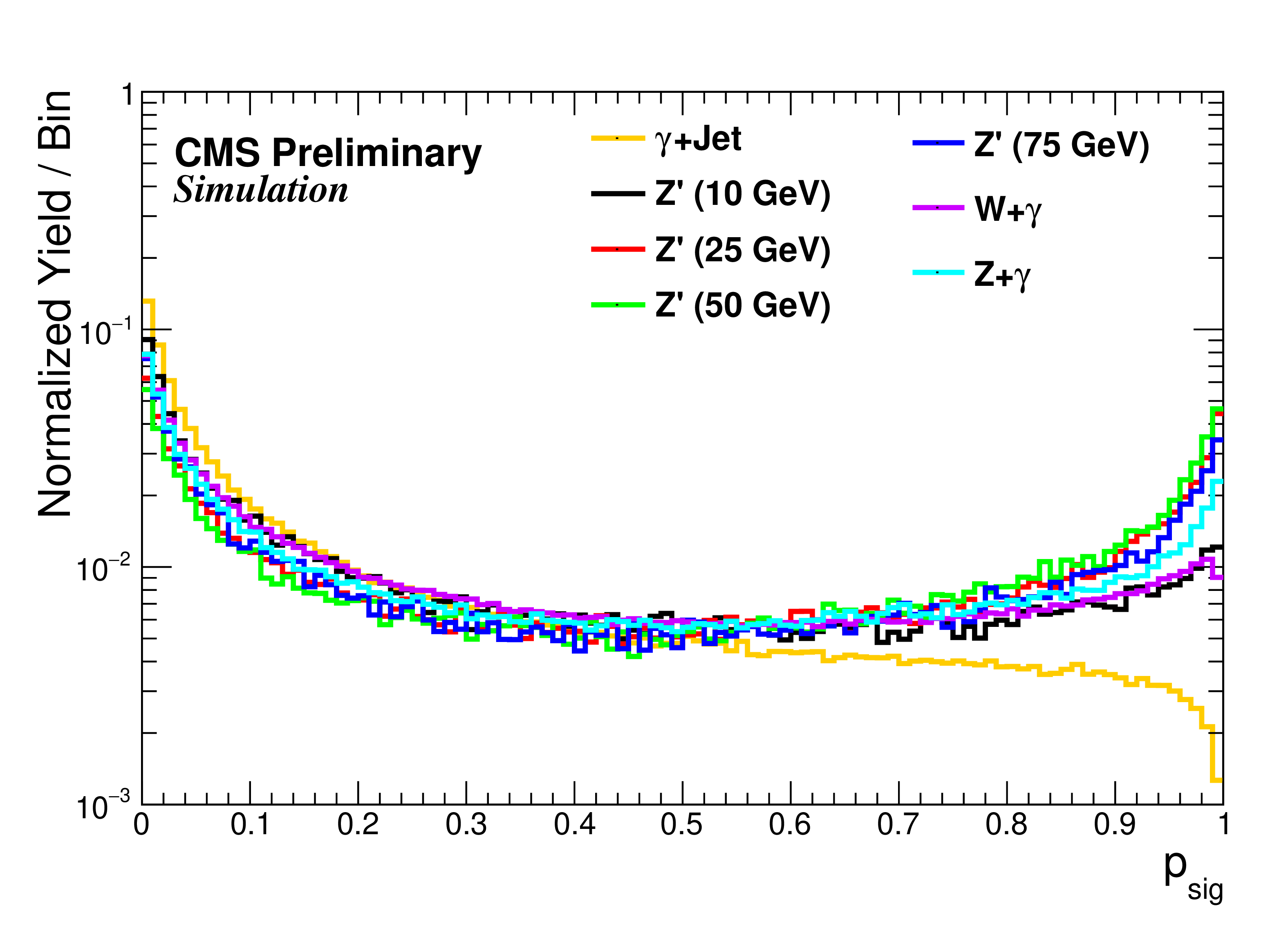
The $ p_{\text{sig}} $ scores for simulated background events, including $ \gamma+\text{jets} $ (yellow), $ \mathrm{W}+\gamma $ (purple), and $ \mathrm{Z}+\gamma $ (cyan), and representative $ \mathrm{Z}^{'} $ signal events with masses of 10 (black), 25 (red), 50 (green), and 75 (blue) GeV. The primary nonresonant background process, $ \gamma+\text{jets} $, peaks at a value of zero, while the resonant backgrounds, $ \mathrm{W}+\gamma $ and $ \mathrm{Z}+\gamma $, and the $ \mathrm{Z}^{'} $ signal processes peak at one. The integral of each distribution has been normalized to unity. |
png pdf |
Figure 3:
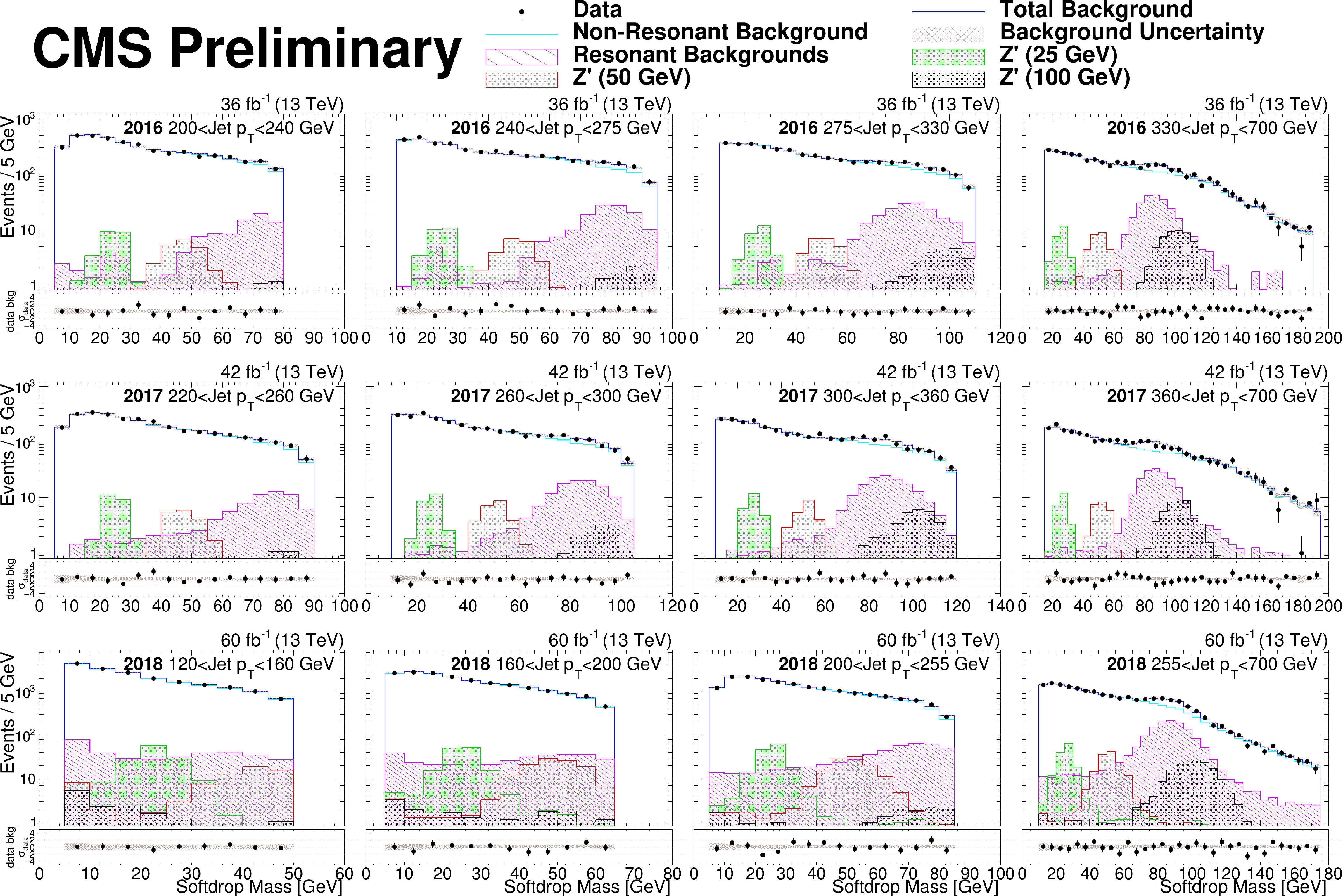
Jet $ m_{\mathrm{SD}} $ distributions fitted using a background-only hypothesis for all data-taking periods. Top row (2016), left to right: jet $ p_{\mathrm{T}} $ in the ranges 200--240, 240--275, 275--300, and 300-700 GeV. Middle row (2017), left to right: jet $ p_{\mathrm{T}} $ in the ranges 220--260, 260--300, 300--360, and 360--700 GeV. Bottom row (2018), left to right: jet $ p_{\mathrm{T}} $ in the ranges 120--160, 160--200, 200-255, adn 255--700 GeV. The data (black dots), nonresonant background (cyan), resonant backgrounds (purple), and total background (blue) are shown. Representative signals for $ \mathrm{Z}^{'} $ masses of 25, 50, and 100 GeV are also shown, scaled to their fitted yields in the signal-plus-background fit. The lower panel shows the residual difference between data and the total background divided by the statistical uncertainty in the data, and the gray band represents the background uncertainty divided by the data statistical uncertainty. Due to the jet $ \rho $ selection applied, high masses are restricted in the lower jet $ p_{\mathrm{T}} $ bins, leading to no events above a certain mass value in a given jet $ p_{\mathrm{T}} $ bin. |
png pdf |
Figure 4:
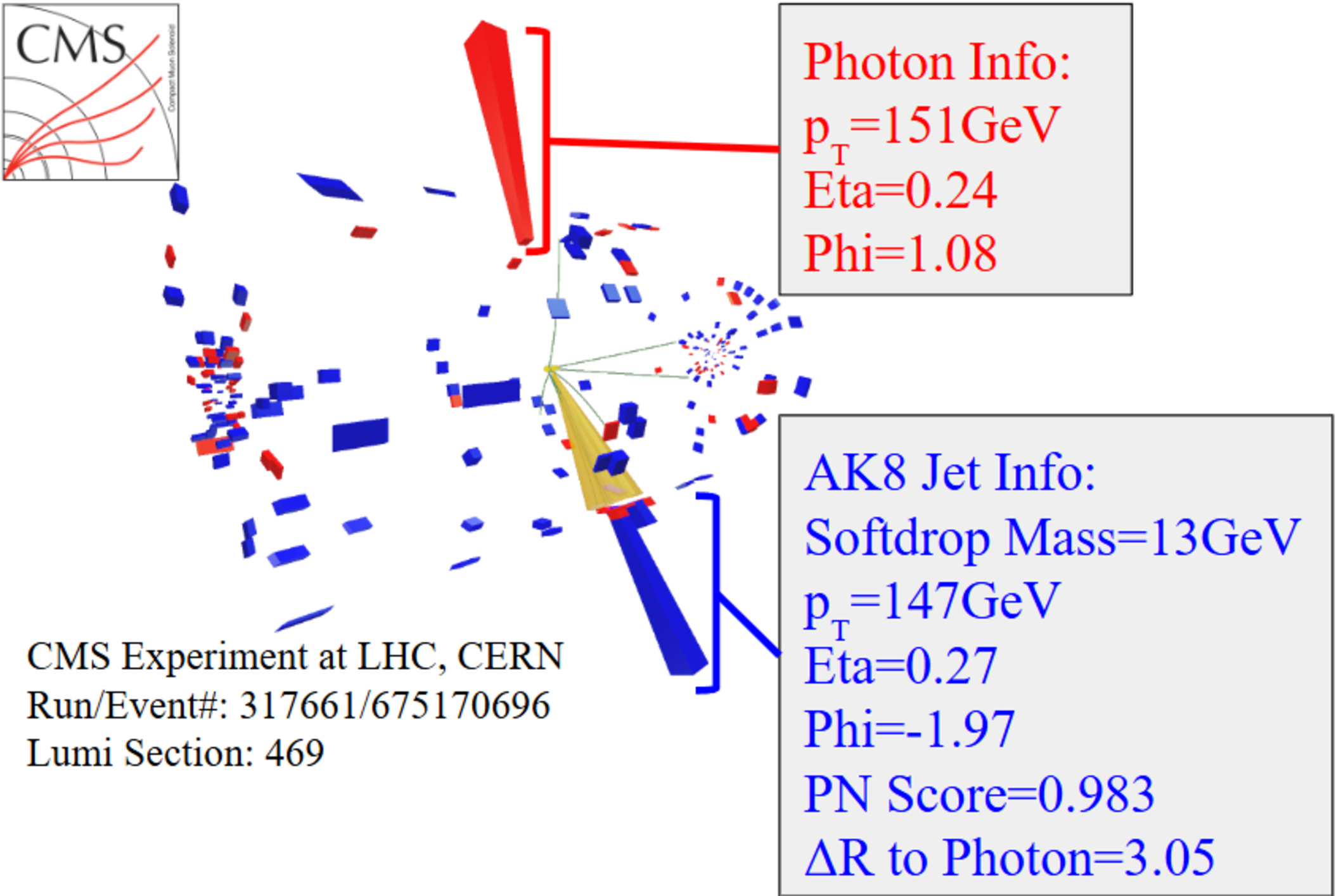
A three-dimensional event display of an SR candidate event from 2018 data. The event display shows energy from the ECAL in red, energy from the HCAL in blue, and charged particle tracks in green. A cone around the energy depositions reconstructed as a jet is shown in yellow. For the photon $ p_{\mathrm{T}} $, $ \eta $, and $ \phi $ values are shown in red text. For the jet $ m_{SD} $, $ p_{\mathrm{T}} $, $ \eta $, $ \phi $, $ p_{\text{sig}} $, and $ \Delta R $ separation between the photon and jet are shown in blue text. |
png pdf |
Figure 5:
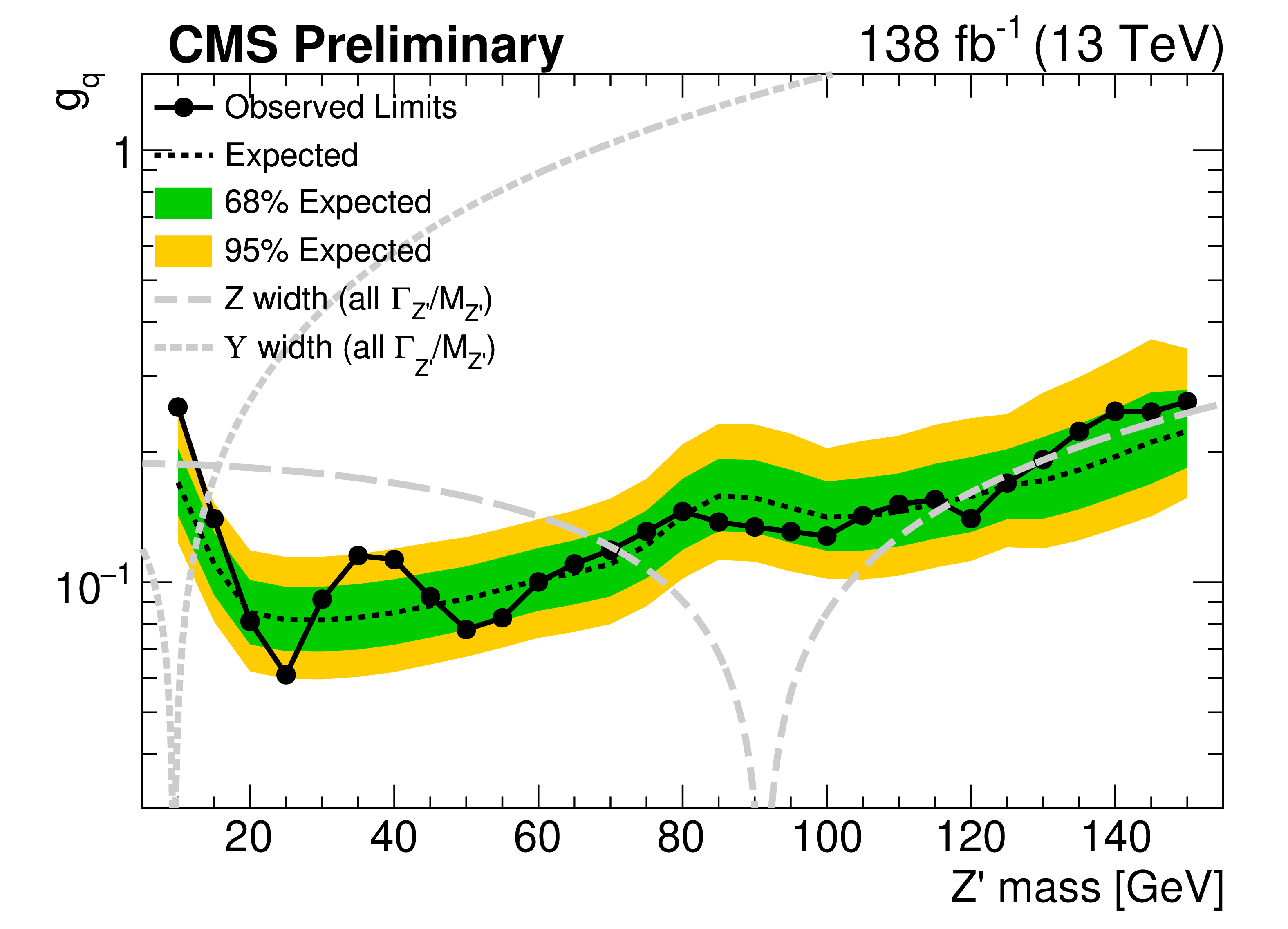
Upper limits at 95%CL on the coupling strength $ g_{\mathrm{q}} $ between $ \mathrm{Z}^{'} $ and quarks. The $ \mathrm{Z}^{'} $ is assumed to decay to all quark flavors equally, and the branching ratio for decay to quark-antiquark pairs is assumed to be 100%. The observed limit is shown as a solid black line. The dashed black line and the green and yellow bands represent the expected limits and its variation of one and two standard deviations, respectively. Indirect constraints from Z and $ \Upsilon $ decay widths are also shown [61]. |
| Tables | |
png pdf |
Table 1:
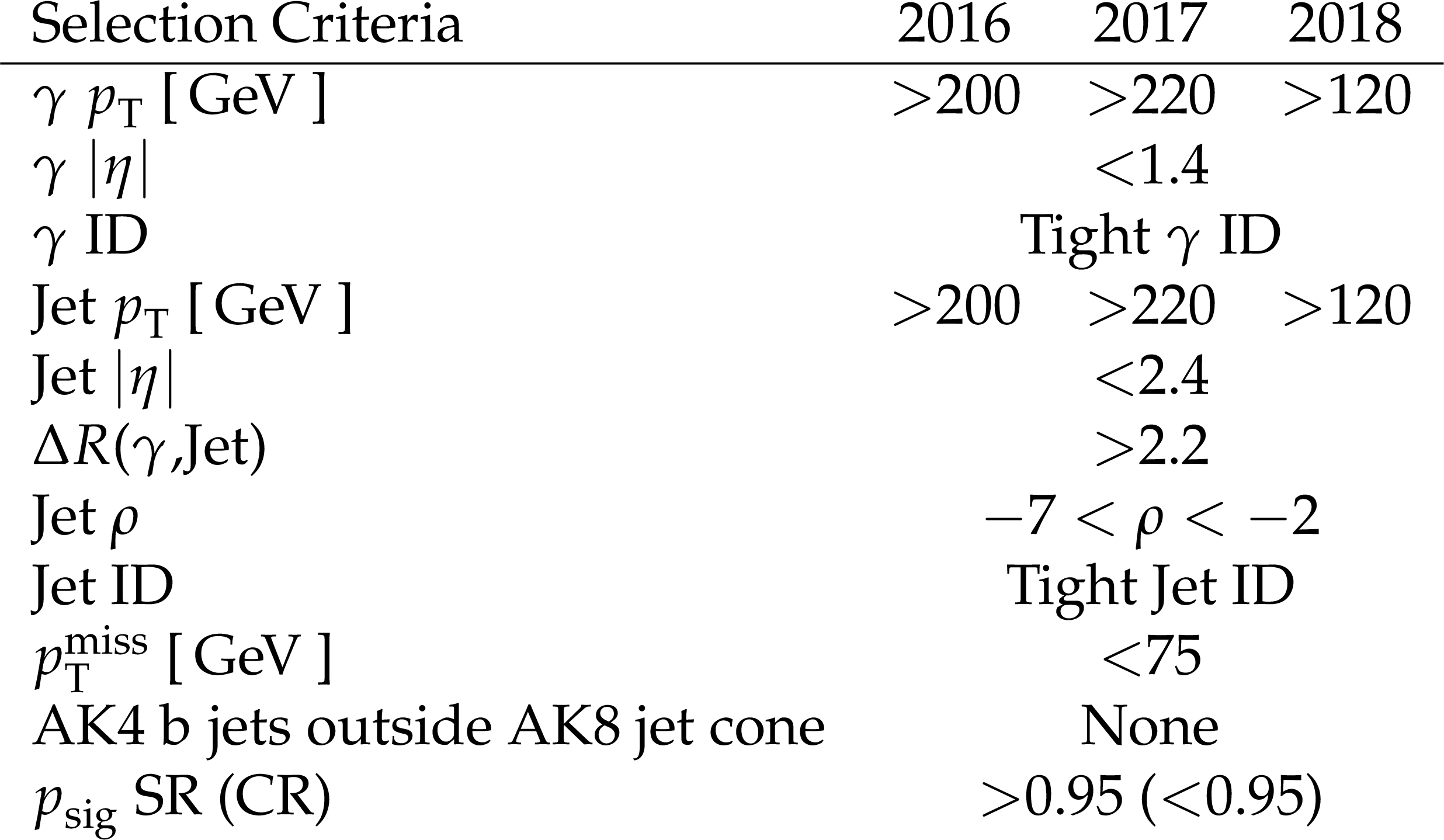
Summary of event selection criteria applied in the analysis. |
png pdf |
Table 2:
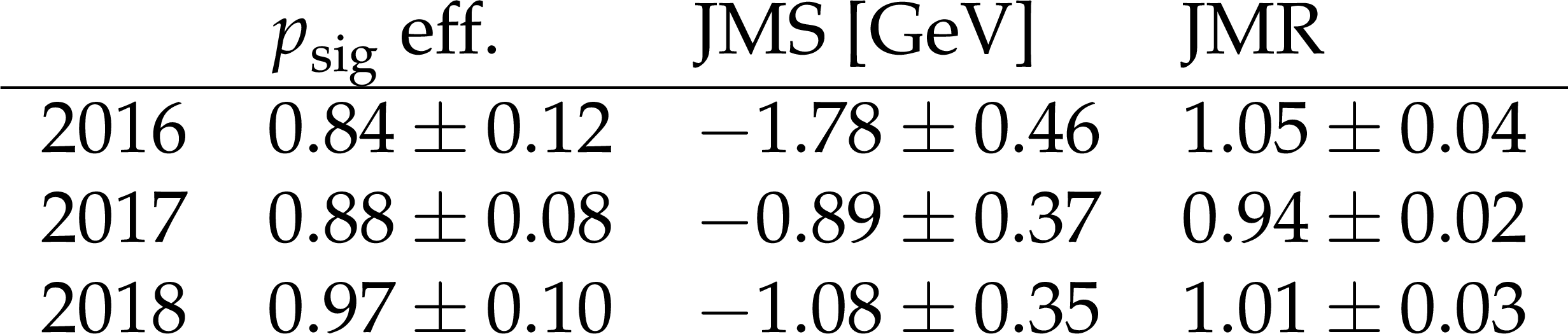
Summary of corrections to the simulation of resonant signal and background contributions derived from the $ \mathrm{t} \overline{\mathrm{t}} $ CR. |
png pdf |
Table 3:
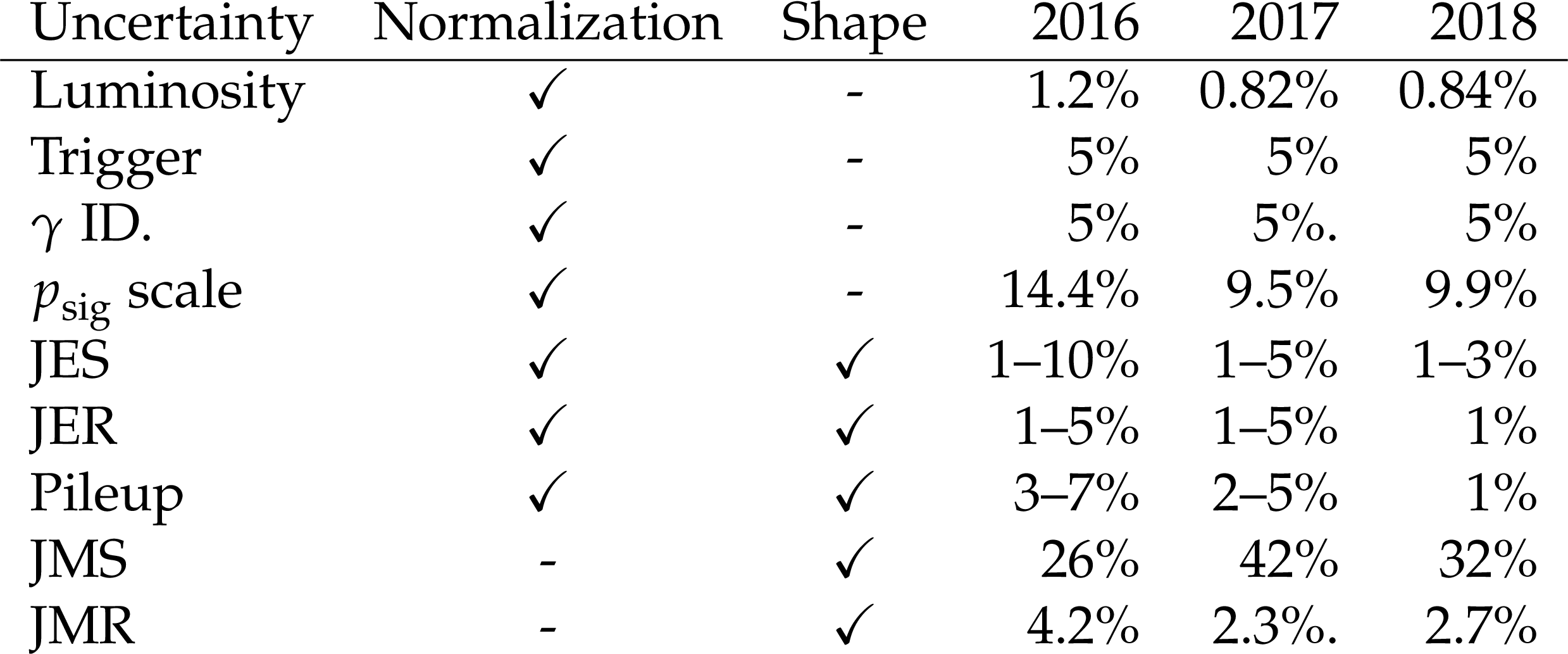
Summary of all systematic uncertainties applied to signal and resonant background simulations. The names, types (normalization and/or shape), and values for all data-taking periods are shown. Shape systematics affect the shape of the $ m_{\mathrm{SD}} $ distribution, normalization systematics affect the yield of the $ m_{\mathrm{SD}} $ distribution in a given jet $ p_{\mathrm{T}} $ bin. |
| Summary |
| A search for narrow quark-antiquark resonances in the mass range of 10 to 150 GeV has been presented, using proton-proton collision data at $ \sqrt{s}= $ 13 TeV, collected by the CMS detector at the CERN LHC in 2016--2018, corresponding to an integrated luminosity of 138 fb$ ^{-1} $. The analysis strategy targets a final state where an initial-state radiation photon recoils against the resonance. As a result, the resonance is produced with high transverse momentum, and the quark-antiquark decay products are reconstructed as a single large-radius jet with an internal two-pronged structure. The resonances are distinguished from background using the machine learning algorithm called PARTICLENET. A portion of the data uses a trigger with a lower threshold on the photon transverse momentum, allowing the analysis to further probe the lower mass resonance region. The results are interpreted in the context of a new spin-1 vector boson, a leptophobic $ \mathrm{Z}^{'} $, which is a dark matter mediator candidate. Searching for this signature as a localized excess above the standard model background in the jet soft-drop mass spectrum reveals no significant excess. Upper limits at the 95% confidence level are set on the coupling strength of the $ \mathrm{Z}^{'} $ decaying to quark-antiquark pairs. This represents the most sensitive search in the mass range of 10 to 50 GeV for resonances decaying into quark-antiquark pairs to date. |
| References | ||||
| 1 | A. Hayrapetyan et al. | Dark sector searches with the CMS experiment | Phys. Rept. 1115 (2025) 448 | 2405.13778 |
| 2 | B. A. Dobrescu and F. Yu | Coupling-mass mapping of dijet peak searches | Phys. Rev. D 88 035021, 2013 | 1306.2629 |
| 3 | A. Boveia et al. | Recommendations on presenting LHC searches for missing transverse energy signals using simplified $ s $-channel models of dark matter | Phys. Dark Univ. 27 (2020) 100365 | 1603.04156 |
| 4 | CMS Collaboration | Search for resonant and nonresonant new phenomena in high-mass dilepton final states at $ \sqrt{s} = $ 13 TeV | JHEP 07 (2021) 208 | CMS-EXO-19-019 2103.02708 |
| 5 | ATLAS Collaboration | Search for high-mass dilepton resonances using 139 fb$ ^{-1} $ of $ pp $ collision data collected at $ \sqrt{s}= $13 TeV with the ATLAS detector | PLB 796 (2019) | 1903.06248 |
| 6 | UA1 Collaboration | Two-jet mass distributions at the CERN proton-antiproton collider | Physi. Lett. B 209 127, 1988 | |
| 7 | UA2 Collaboration | A search for new intermediate vector bosons and excited quarks decaying to two-jets at the CERN $ \bar{p}p $ collider | Nuc. Phys. B 400 3, 1993 | |
| 8 | CDF Collaboration | Search for new particles decaying into dijets in proton-antiproton collisions at $ \sqrt{s}= $1.96 TeV | PRD 79 (2009) 112002 | |
| 9 | D0 Collaboration | Search for new particles in the two-jet decay channel with the D0 detector | PRD 69 (2004) 111101 | |
| 10 | CMS Collaboration | Search for low-mass quark-antiquark resonances produced in association with a photon at $ \sqrt {s} = $ 13 TeV | PRL 123 (2019) 231803 | CMS-EXO-17-027 1905.10331 |
| 11 | ATLAS Collaboration | Search for boosted low-mass resonances decaying into hadrons produced in association with a photon in pp collisions at $ \sqrt{s} = $ 13 TeV with the ATLAS detector | JHEP 01 (2025) 099 | 2408.00049 |
| 12 | CMS Collaboration | Search for low-mass vector and scalar resonances decaying into a quark-antiquark pair in proton-proton collisions at $ \sqrt{s} = $ 13 TeV | link | CMS-EXO-24-007 2603.21965 |
| 13 | J. Dolen et al. | Thinking outside the ROCs: Designing decorrelated taggers (DDT) for jet substructure | JHEP 05 (2016) 156 | 1603.00027 |
| 14 | CMS Collaboration | The CMS experiment at the CERN LHC | JINST 3 (2008) S08004 | |
| 15 | CMS Collaboration | Development of the CMS detector for the CERN LHC Run 3 | JINST 19 (2024) P05064 | CMS-PRF-21-001 2309.05466 |
| 16 | CMS Collaboration | Performance of the CMS Level-1 trigger in proton-proton collisions at $ \sqrt{s} = $ 13 TeV | JINST 15 (2020) P10017 | CMS-TRG-17-001 2006.10165 |
| 17 | CMS Collaboration | The CMS trigger system | JINST 12 (2017) P01020 | CMS-TRG-12-001 1609.02366 |
| 18 | CMS Collaboration | Performance of the CMS high-level trigger during LHC Run 2 | JINST 19 (2024) P11021 | CMS-TRG-19-001 2410.17038 |
| 19 | CMS Collaboration | Electron and photon reconstruction and identification with the CMS experiment at the CERN LHC | JINST 16 (2021) P05014 | CMS-EGM-17-001 2012.06888 |
| 20 | CMS Collaboration | Performance of the CMS muon detector and muon reconstruction with proton-proton collisions at $ \sqrt{s}= $ 13 TeV | JINST 13 (2018) P06015 | CMS-MUO-16-001 1804.04528 |
| 21 | CMS Collaboration | Description and performance of track and primary-vertex reconstruction with the CMS tracker | JINST 9 (2014) P10009 | CMS-TRK-11-001 1405.6569 |
| 22 | J. Alwall et al. | The automated computation of tree-level and next-to-leading order differential cross sections, and their matching to parton shower simulations | JHEP 07 (2014) 079 | 1405.0301 |
| 23 | T. Sjöstrand et al. | An introduction to PYTHIA 8.2 | Comput. Phys. Commun. 191 (2015) 159 | 1410.3012 |
| 24 | CMS Collaboration | Extraction and validation of a new set of CMS PYTHIA8 tunes from underlying-event measurements | EPJC 80 (2020) 4 | CMS-GEN-17-001 1903.12179 |
| 25 | GEANT4 Collaboration | GEANT 4---a simulation toolkit | NIM A 506 (2003) 250 | |
| 26 | J. Alwall et al. | Comparative study of various algorithms for the merging of parton showers and matrix elements in hadronic collisions | EPJC 53 (2008) 473 | 0706.2569 |
| 27 | R. Frederix and S. Frixione | Merging meets matching in MC@NLO | JHEP 12 (2012) 061 | 1209.6215 |
| 28 | NNPDF Collaboration | Parton distributions from high-precision collider data | EPJC 77 (2017) 663 | 1706.00428 |
| 29 | P. Artoisenet, R. Frederix, O. Mattelaer, and R. Rietkerk | Automatic spin-entangled decays of heavy resonances in Monte Carlo simulations | JHEP 03 (2013) 015 | 1212.3460 |
| 30 | J. M. Lindert et al. | Precise predictions for $ V+ $jets dark matter backgrounds | EPJC 77 (2017) 829 | 1705.04664 |
| 31 | M. Czakon, P. Fiedler, and A. Mitov | Total top-quark pair-production cross section at hadron colliders through $ o(\alpha^4_s) $ | PRL 110 (2013) 252004 | 1303.6254 |
| 32 | CMS Collaboration | Particle-flow reconstruction and global event description with the CMS detector | JINST 12 (2017) P10003 | CMS-PRF-14-001 1706.04965 |
| 33 | M. Cacciari, G. P. Salam, and G. Soyez | The anti-$ k_{\mathrm{T}} $ jet clustering algorithm | JHEP 04 (2008) 063 | 0802.1189 |
| 34 | M. Cacciari, G. P. Salam, and G. Soyez | FastJet user manual | EPJC 72 (2012) 1896 | 1111.6097 |
| 35 | CMS Collaboration | Pileup mitigation at CMS in 13 TeV data | JINST 15 (2020) P09018 | CMS-JME-18-001 2003.00503 |
| 36 | CMS Collaboration | Jet energy scale and resolution in the CMS experiment in pp collisions at 8 TeV | JINST 12 (2017) P02014 | CMS-JME-13-004 1607.03663 |
| 37 | CMS Collaboration | Performance of missing transverse momentum reconstruction in proton-proton collisions at $ \sqrt{s} = $ 13 TeV using the CMS detector | JINST 14 (2019) P07004 | CMS-JME-17-001 1903.06078 |
| 38 | Y. L. Dokshitzer, G. D. Leder, S. Moretti, and B. R. Webber | Better jet clustering algorithms | JHEP 08 (1997) 001 | hep-ph/9707323 |
| 39 | M. Wobisch and T. Wengler | Hadronization corrections to jet cross-sections in deep inelastic scattering | in Workshop on Monte Carlo Generators for HERA Physics (Plenary Starting Meeting), 1998 | hep-ph/9907280 |
| 40 | M. Dasgupta, A. Fregoso, S. Marzani, and G. P. Salam | Towards an understanding of jet substructure | JHEP 09 (2013) 029 | 1307.0007 |
| 41 | J. M. Butterworth, A. R. Davison, M. Rubin, and G. P. Salam | Jet substructure as a new Higgs search channel at the LHC | PRL 100 (2008) 242001 | 0802.2470 |
| 42 | A. J. Larkoski, S. Marzani, G. Soyez, and J. Thaler | Soft drop | JHEP 05 (2014) 146 | 1402.2657 |
| 43 | H. Qu and L. Gouskos | ParticleNet: Jet tagging via particle clouds | PRD 101 (2020) 056019 | 1902.08570 |
| 44 | CMS Collaboration | Identification of highly Lorentz-boosted heavy particles using graph neural networks and new mass decorrelation techniques | CMS Detector Performance Summary CMS-DP-2020-002, 2020 CDS |
|
| 45 | CMS Collaboration | Jet algorithms performance in 13 TeV data | CMS Physics Analysis Summary, 2017 CMS-PAS-JME-16-003 |
CMS-PAS-JME-16-003 |
| 46 | ATLAS Collaboration | Measurement of soft-drop jet observables in $ \mathrm{pp} $ collisions with the ATLAS detector at $ \sqrt {s} = $ 13 TeV | PRD 101 (2020) 052007 | 1912.09837 |
| 47 | CMS Collaboration | Identification of heavy-flavour jets with the CMS detector in pp collisions at 13 TeV | JINST 13 (2018) P05011 | CMS-BTV-16-002 1712.07158 |
| 48 | R. A. Fisher | On the interpretation of $ \chi^{2} $ from contingency tables, and the calculation of P | J. R. Stat. Soc. 85 (1922) 87 | |
| 49 | CMS Collaboration | The CMS statistical analysis and combination tool: COMBINE | Comput. Softw. Big Sci. 8 (2024) 19 | CMS-CAT-23-001 2404.06614 |
| 50 | W. Verkerke and D. Kirkby | The RooFit toolkit for data modeling | Conf 0303241 (2003) MOLT007 | |
| 51 | L. Moneta et al. | The RooStats Project | PoS ACAT 057, 2010 link |
1009.1003 |
| 52 | M. Baak, S. Gadatsch, R. Harrington, and W. Verkerke | Interpolation between multi-dimensional histograms using a new non-linear moment morphing method | NIM A 771 (2015) 39 | 1410.7388 |
| 53 | CMS Collaboration | Precision luminosity measurement in proton-proton collisions at $ \sqrt{s} = $ 13 TeV in 2015 and 2016 at CMS | EPJC 81 (2021) 800 | CMS-LUM-17-003 2104.01927 |
| 54 | CMS Collaboration | CMS luminosity measurement for the 2017 data-taking period at $ \sqrt{s} = $ 13 TeV | CMS Physics Analysis Summary, 2018 link |
CMS-PAS-LUM-17-004 |
| 55 | CMS Collaboration | CMS luminosity measurement for the 2018 data-taking period at $ \sqrt{s} = $ 13 TeV | CMS Physics Analysis Summary, 2019 link |
CMS-PAS-LUM-18-002 |
| 56 | R. Barlow and C. Beeston | Fitting using finite Monte Carlo samples | Comput. Phys. Commun. 77 (1993) 219 | |
| 57 | A. Read | Linear interpolation of histograms | NIM A 425 (1999) 357 | |
| 58 | T. Junk | Confidence level computation for combining searches with small statistics | NIM A 434 (1999) 435 | hep-ex/9902006 |
| 59 | A. L. Read | Presentation of search results: the CL$ _s $ technique | JPG 28 (2002) 2693 | |
| 60 | G. Cowan, K. Cranmer, E. Gross, and O. Vitells | Asymptotic formulae for likelihood-based tests of new physics | EPJC 71 (2011) 1554 | 1007.1727 |
| 61 | B. A. Dobrescu and C. Frugiuele | Hidden GeV-Scale Interactions of Quarks | PRL 113 (2014) 061801 | 1404.3947 |
|
|
Compact Muon Solenoid LHC, CERN |

|
|
|
|
|
|