
Compact Muon Solenoid
LHC, CERN
 Visit us: CMS Public Website, CMS Physics ;
Contact us: CMS Publications Committee
Visit us: CMS Public Website, CMS Physics ;
Contact us: CMS Publications Committee
| CMS-PAS-BPH-24-005 | ||
| Simultaneous differential branching fraction and isospin asymmetry measurements of rare $ \mathrm{b \to s} \mu \mu $ decays with 2022--2024 data | ||
| CMS Collaboration | ||
| 2026-08-20 | ||
| Abstract: In the standard model (SM), flavor-changing neutral-current decays corresponding to b$ \to $s$ \mu\mu $ transitions are forbidden at tree level and proceed only through higher-order electroweak loop diagrams. These decays are therefore rare and sensitive probes of potential physics beyond the SM. This note reports the differential branching fractions, $ d\mathcal{B}/dq^{2} $, as a function of the squared dimuon invariant mass, $ q^{2} $, for six rare decays of b-flavored hadrons, $ \mathrm{B}^{+}\to \mathrm{K}^{+}\mu\mu $, $ \mathrm{B}^{+}\to \mathrm{K}^{*+}\mu\mu $, $ \mathrm{B}^{0}\to \mathrm{K}_{\mathrm{S}}^{0}\mu\mu $, $ \mathrm{B}^{0}\to \mathrm{K}^{*0}\mu\mu $, $ \mathrm{B}_{\mathrm{s}}^{0}\to\phi\mu\mu $, and $ \Lambda_{\mathrm{b}}^{0}\to\Lambda^{0}\mu\mu $. The isospin asymmetries of $ \mathrm{B}^{+} $ vs $ \mathrm{B}^{0} $ are also measured, for pseudoscalar and vector K final states, as function of $ q^2 $. The measured $ d\mathcal{B}/dq^{2} $ fractions are consistent with previous experimental results and remain below the SM predictions, while the measured isospin asymmetries are consistent with SM expectations. The results are obtained using proton-proton collisions recorded by the CMS detector during 2022-2024 at $ \sqrt{s}=13.6 \mathrm{TeV} $, corresponding to an integrated luminosity of 172 fb$ ^{-1} $. | ||
| Links: CDS record (PDF) ; CADI line (restricted) ; | ||
| Figures | |
png pdf |
Figure 1:
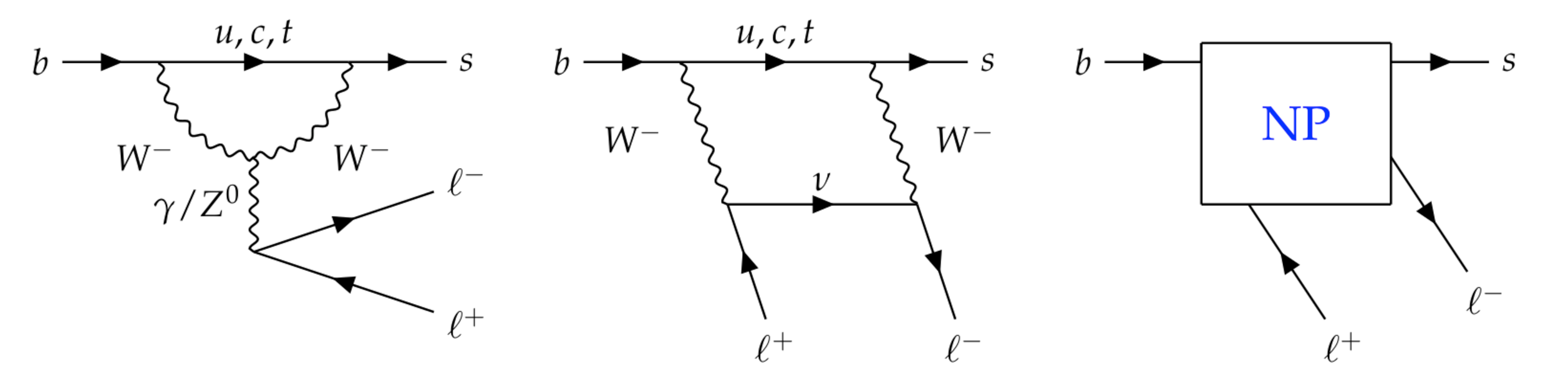
Feynman diagrams for the decay of a b quark into a s quark and a lepton pair in the SM ("penguin" diagram - left and "box" diagram center) and in a NP scenario (right). |
png pdf |
Figure 2:
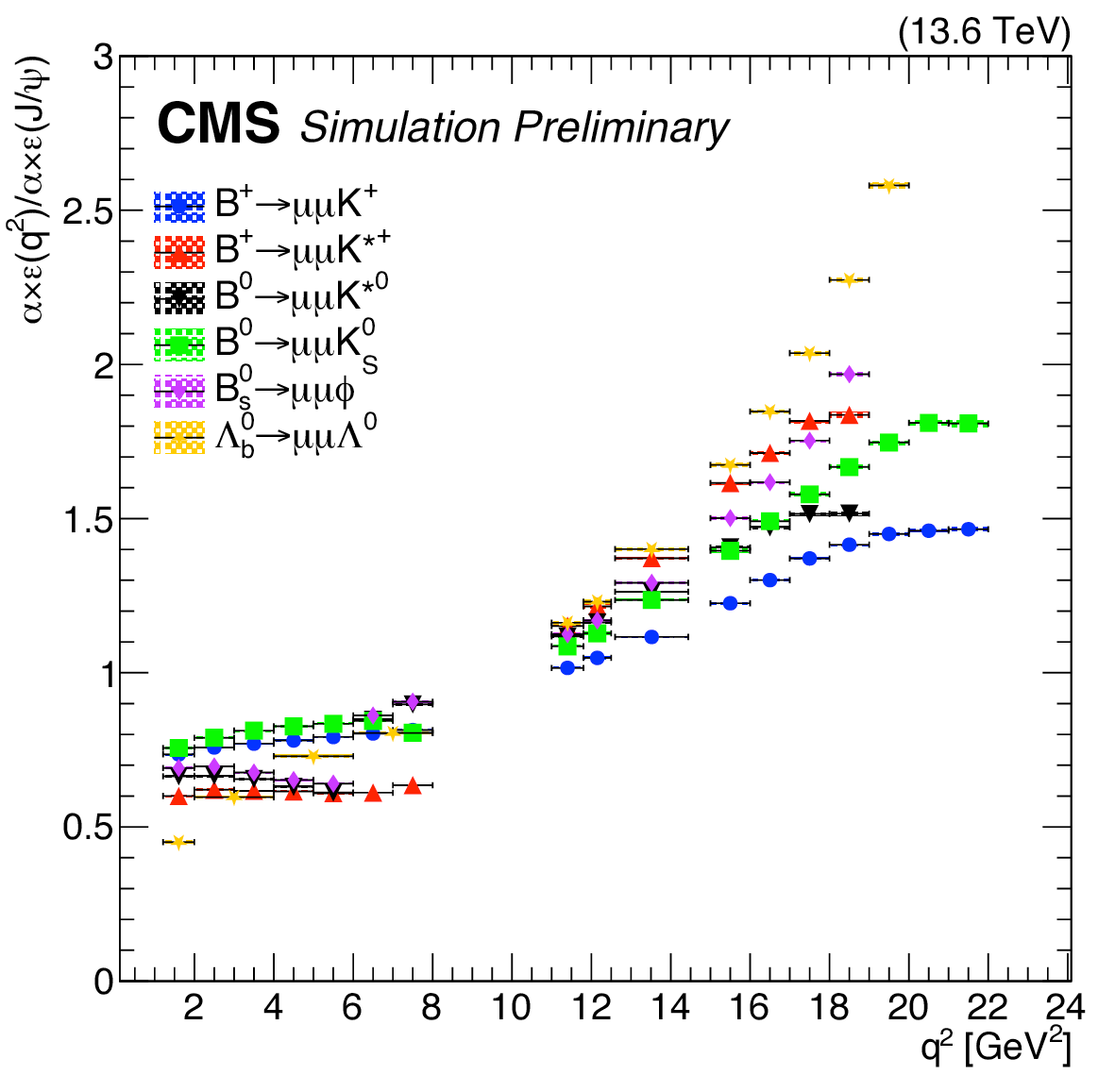
Total efficiency as a function of the $ q^{2} $ normalized to the efficiency product of the $ \mathrm{J}/\psi $ mode. |
png pdf |
Figure 3:
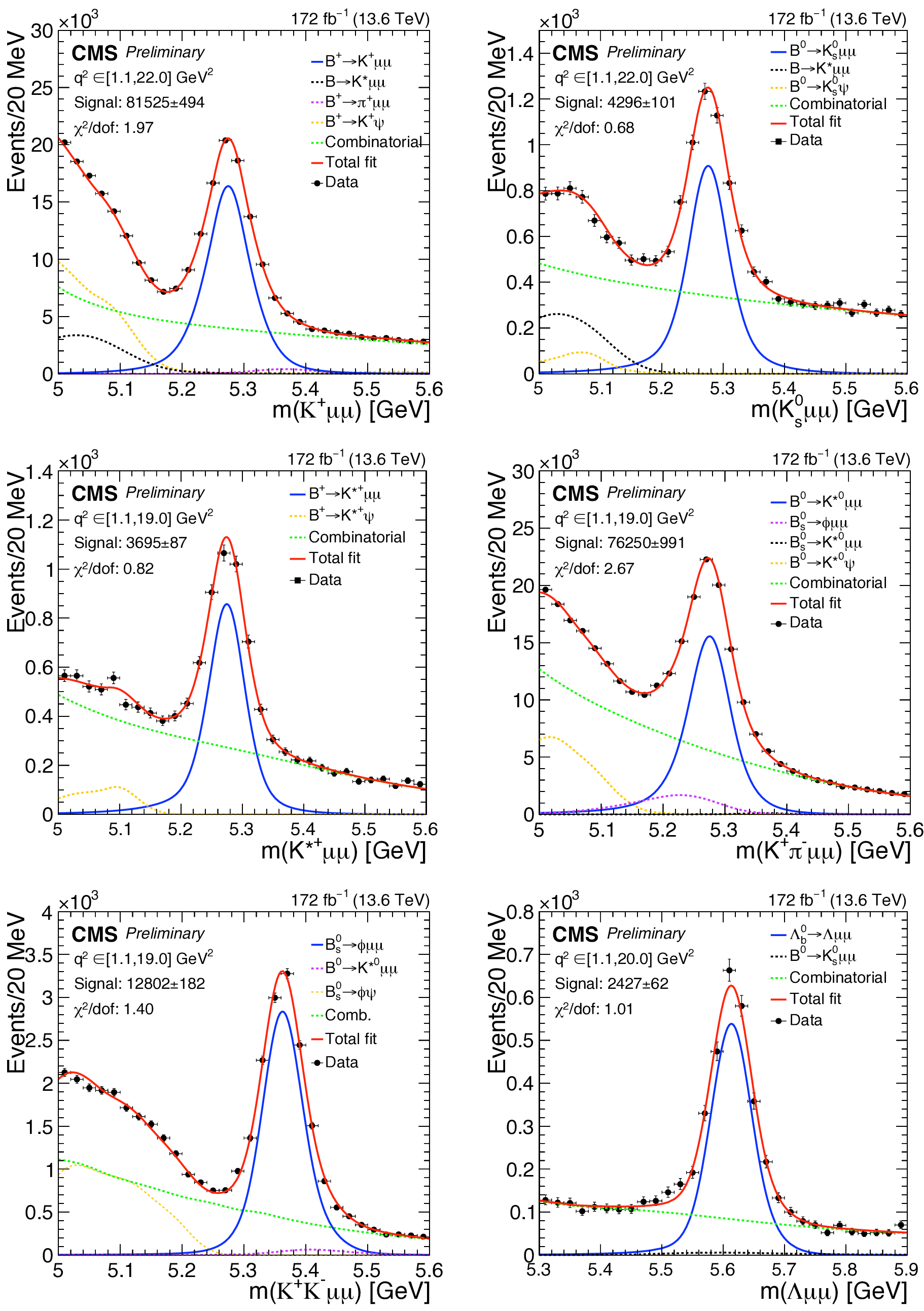
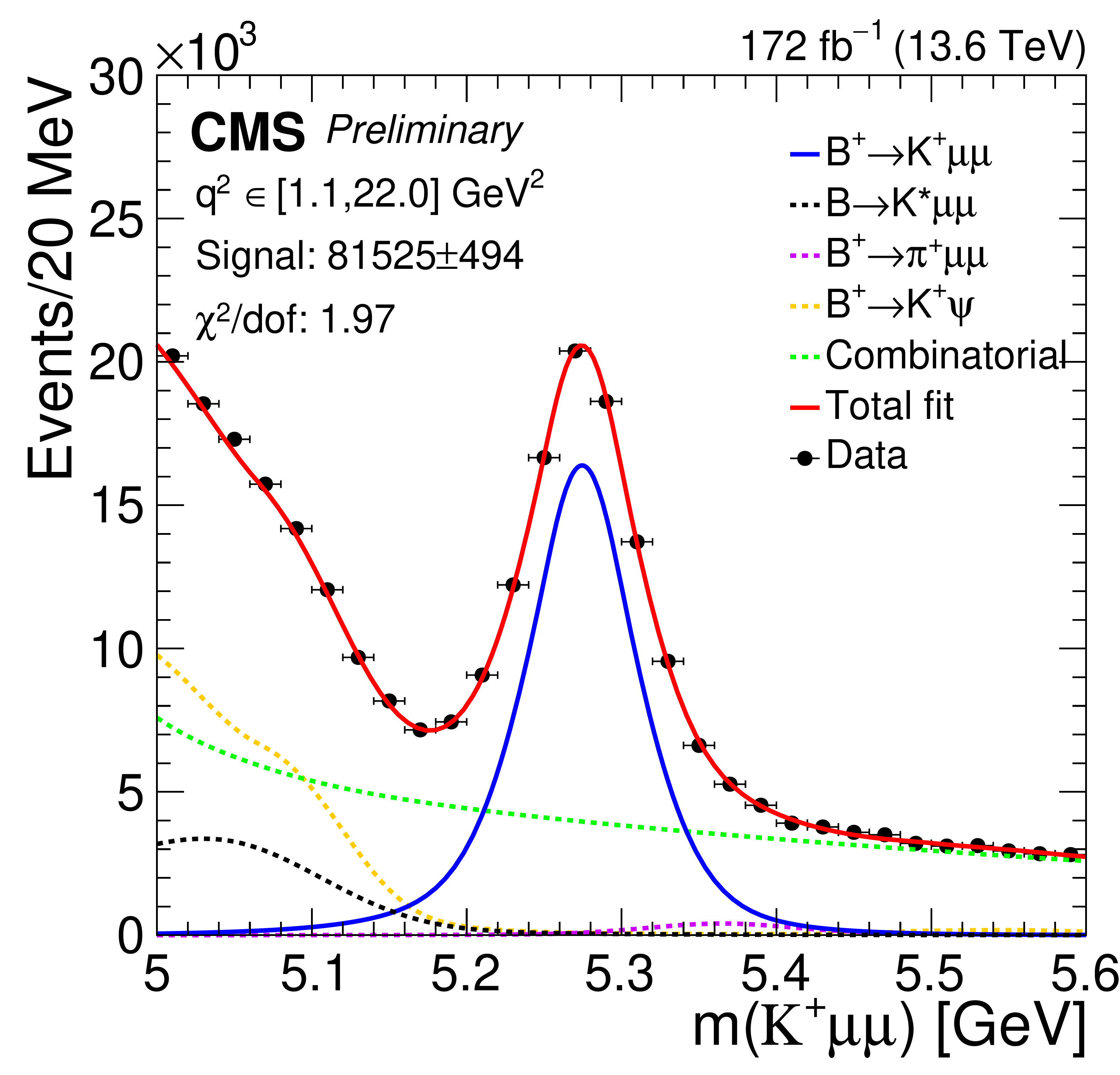
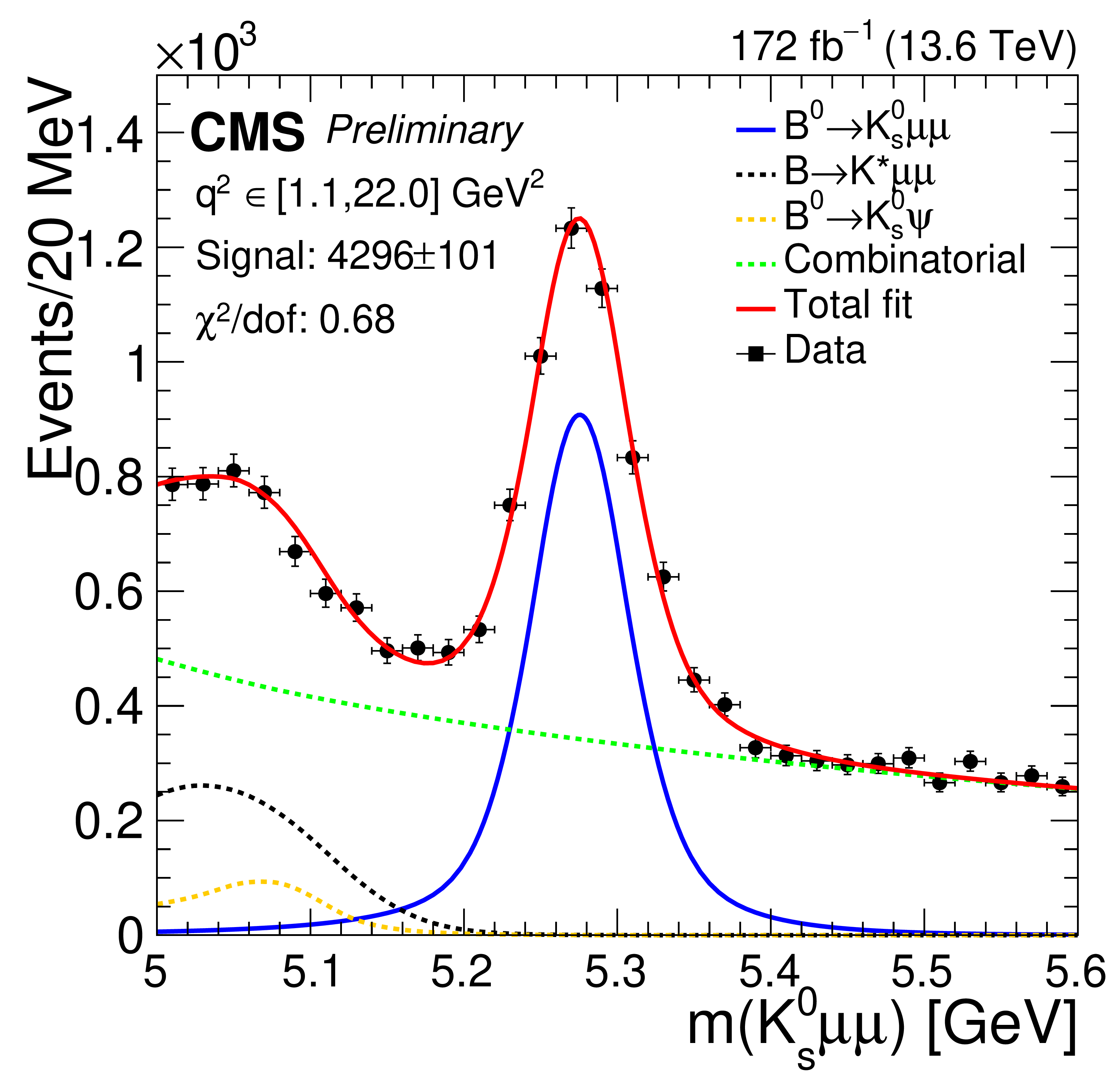
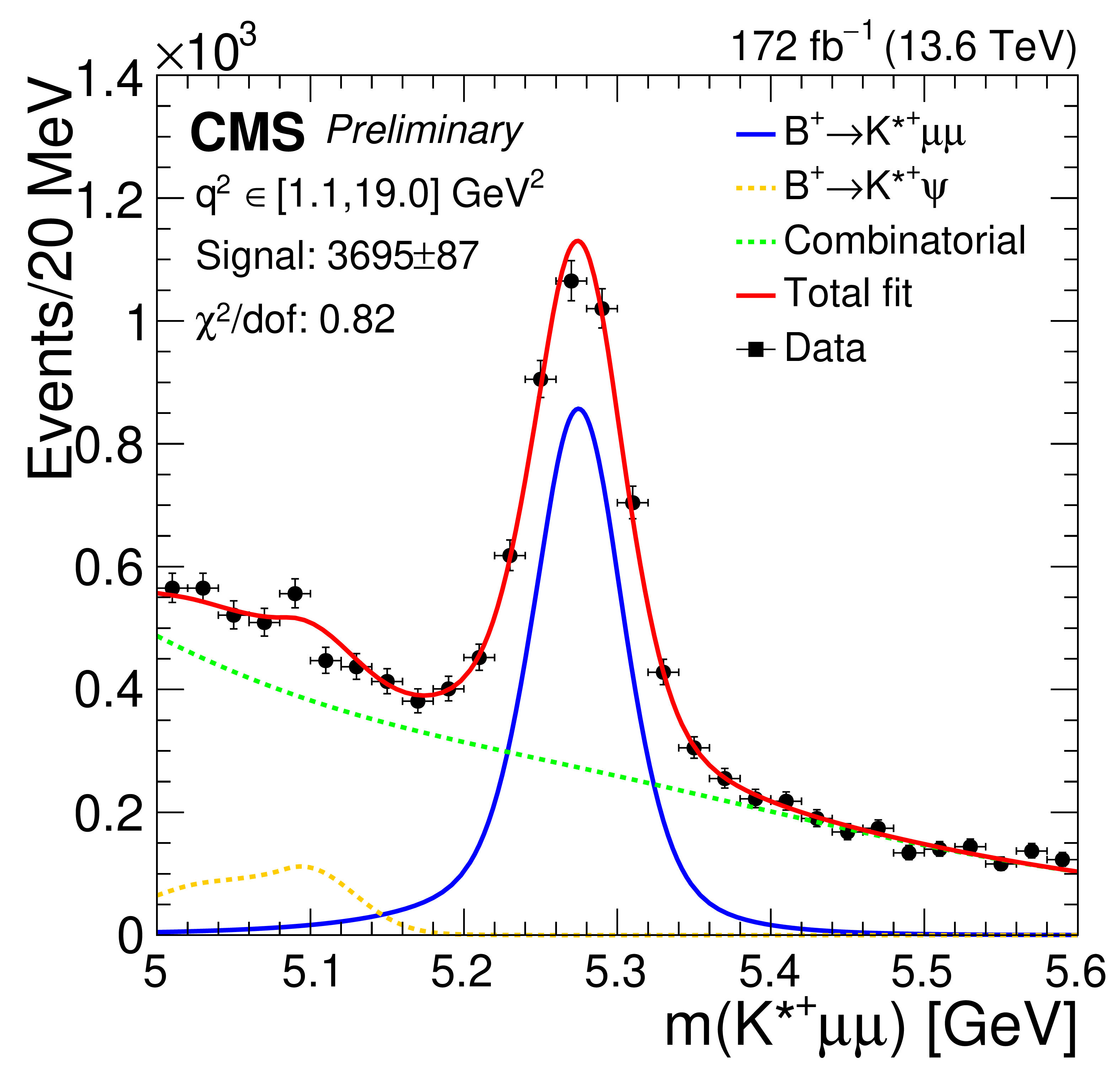
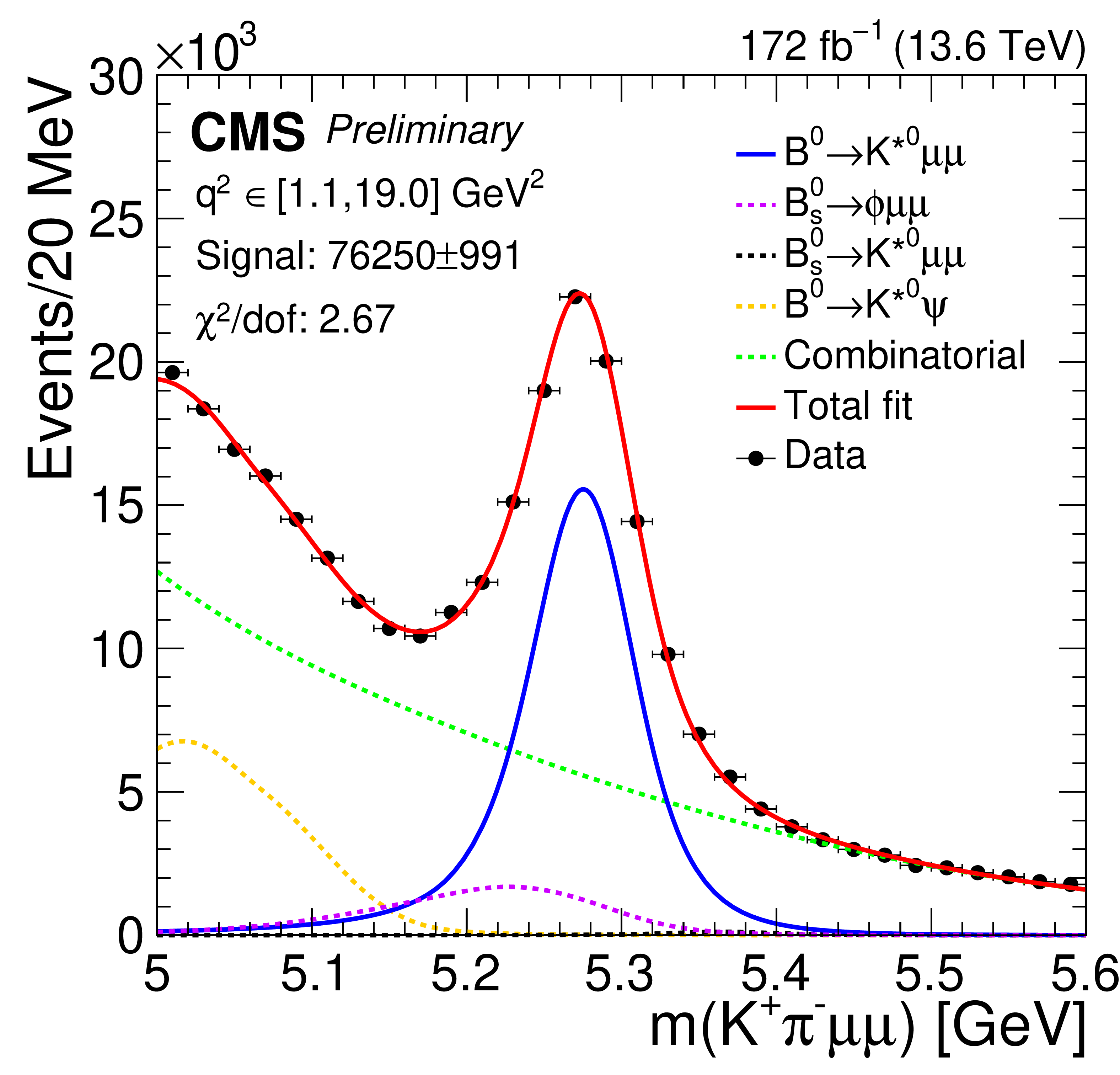
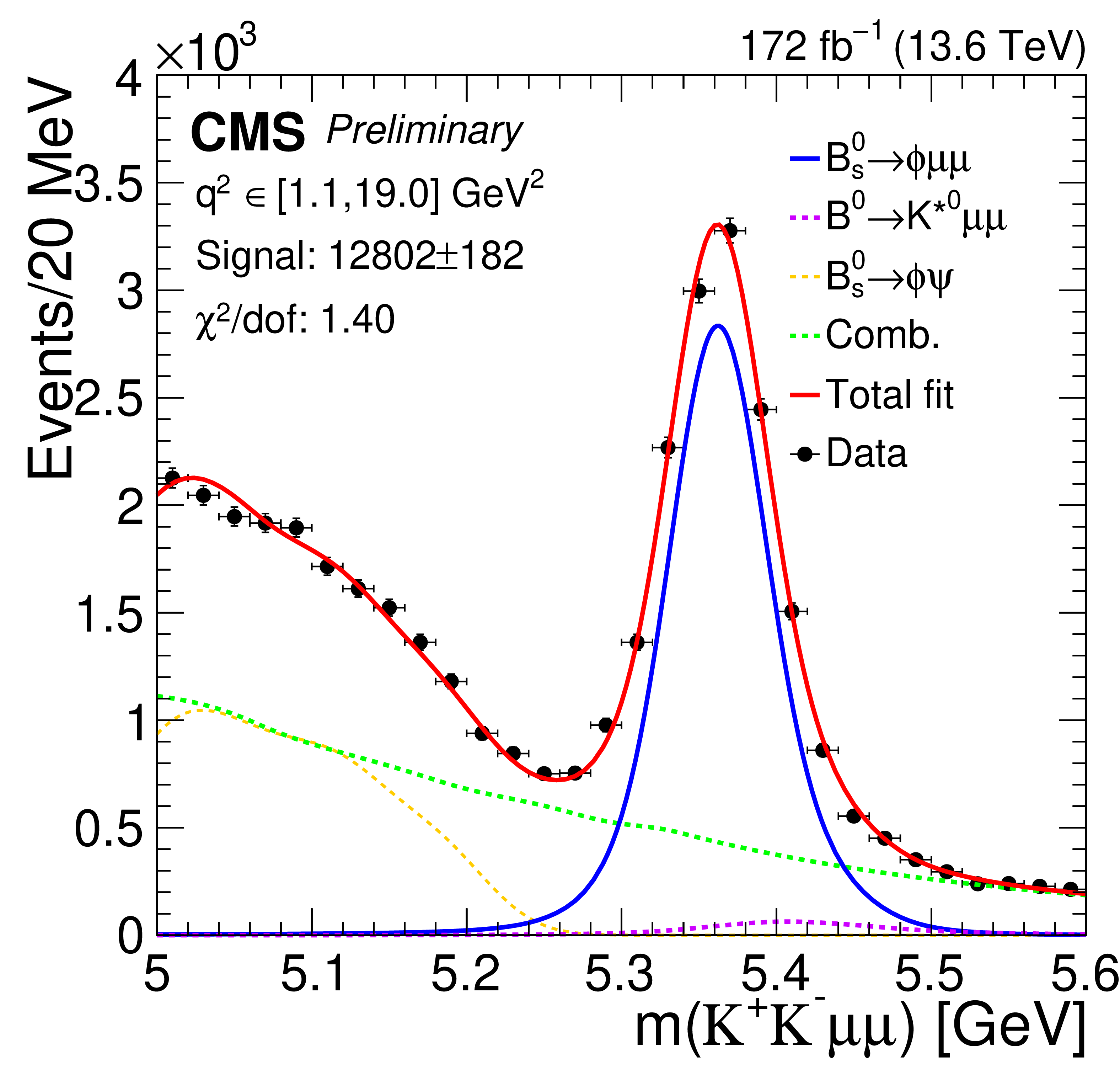
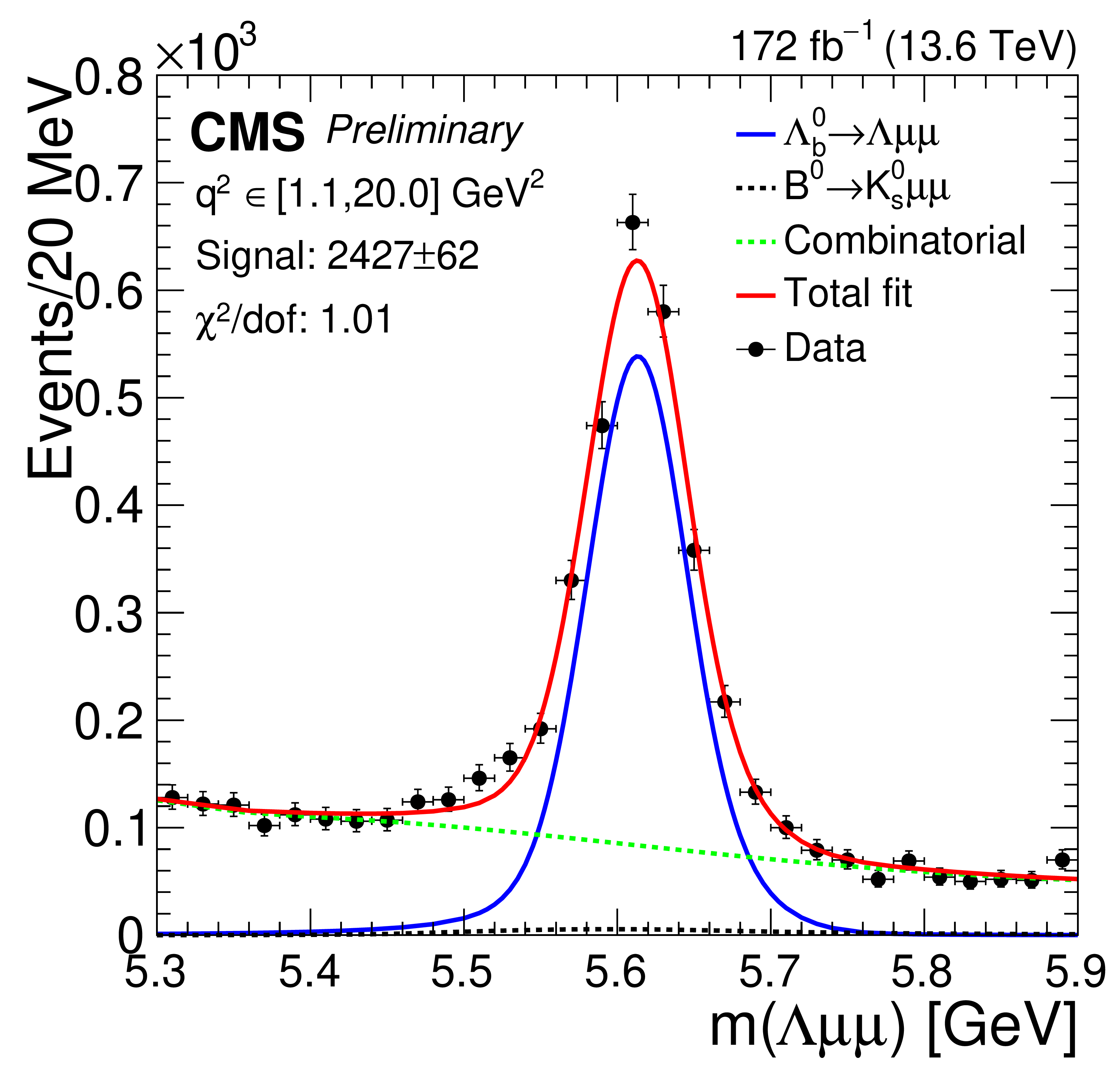
Simultaneous fit to the mass distributions for the six rare decays $ X_{\mathrm{b}}\to\Upsilon_{\mathrm{s}}\mu\mu $ decays, using the full 2022--2024 data. The $ {\mathrm{B}^{+}}\to\mathrm{K^+}\mu\mu $ channel is displayed in upper left figure; $ {\mathrm{B}^0}\to\mathrm{K^0_S}\mu\mu $ in upper right; $ {\mathrm{B}^{+}}\to\mathrm{K}^{*+}\mu\mu $ in middle left; $ {\mathrm{B}^0}\to{\mathrm{K}}^{\ast0} \mu\mu $ in middle right; $ \mathrm{B}_{s}\to\phi\mu\mu $ in lower left; and $ \Lambda_{b}^{0}\to\Lambda\mu\mu $ in lower right. |
png pdf |
Figure 3-a:
Simultaneous fit to the mass distributions for the six rare decays $ X_{\mathrm{b}}\to\Upsilon_{\mathrm{s}}\mu\mu $ decays, using the full 2022--2024 data. The $ {\mathrm{B}^{+}}\to\mathrm{K^+}\mu\mu $ channel is displayed in upper left figure; $ {\mathrm{B}^0}\to\mathrm{K^0_S}\mu\mu $ in upper right; $ {\mathrm{B}^{+}}\to\mathrm{K}^{*+}\mu\mu $ in middle left; $ {\mathrm{B}^0}\to{\mathrm{K}}^{\ast0} \mu\mu $ in middle right; $ \mathrm{B}_{s}\to\phi\mu\mu $ in lower left; and $ \Lambda_{b}^{0}\to\Lambda\mu\mu $ in lower right. |
png pdf |
Figure 3-b:
Simultaneous fit to the mass distributions for the six rare decays $ X_{\mathrm{b}}\to\Upsilon_{\mathrm{s}}\mu\mu $ decays, using the full 2022--2024 data. The $ {\mathrm{B}^{+}}\to\mathrm{K^+}\mu\mu $ channel is displayed in upper left figure; $ {\mathrm{B}^0}\to\mathrm{K^0_S}\mu\mu $ in upper right; $ {\mathrm{B}^{+}}\to\mathrm{K}^{*+}\mu\mu $ in middle left; $ {\mathrm{B}^0}\to{\mathrm{K}}^{\ast0} \mu\mu $ in middle right; $ \mathrm{B}_{s}\to\phi\mu\mu $ in lower left; and $ \Lambda_{b}^{0}\to\Lambda\mu\mu $ in lower right. |
png pdf |
Figure 3-c:
Simultaneous fit to the mass distributions for the six rare decays $ X_{\mathrm{b}}\to\Upsilon_{\mathrm{s}}\mu\mu $ decays, using the full 2022--2024 data. The $ {\mathrm{B}^{+}}\to\mathrm{K^+}\mu\mu $ channel is displayed in upper left figure; $ {\mathrm{B}^0}\to\mathrm{K^0_S}\mu\mu $ in upper right; $ {\mathrm{B}^{+}}\to\mathrm{K}^{*+}\mu\mu $ in middle left; $ {\mathrm{B}^0}\to{\mathrm{K}}^{\ast0} \mu\mu $ in middle right; $ \mathrm{B}_{s}\to\phi\mu\mu $ in lower left; and $ \Lambda_{b}^{0}\to\Lambda\mu\mu $ in lower right. |
png pdf |
Figure 3-d:
Simultaneous fit to the mass distributions for the six rare decays $ X_{\mathrm{b}}\to\Upsilon_{\mathrm{s}}\mu\mu $ decays, using the full 2022--2024 data. The $ {\mathrm{B}^{+}}\to\mathrm{K^+}\mu\mu $ channel is displayed in upper left figure; $ {\mathrm{B}^0}\to\mathrm{K^0_S}\mu\mu $ in upper right; $ {\mathrm{B}^{+}}\to\mathrm{K}^{*+}\mu\mu $ in middle left; $ {\mathrm{B}^0}\to{\mathrm{K}}^{\ast0} \mu\mu $ in middle right; $ \mathrm{B}_{s}\to\phi\mu\mu $ in lower left; and $ \Lambda_{b}^{0}\to\Lambda\mu\mu $ in lower right. |
png pdf |
Figure 3-e:
Simultaneous fit to the mass distributions for the six rare decays $ X_{\mathrm{b}}\to\Upsilon_{\mathrm{s}}\mu\mu $ decays, using the full 2022--2024 data. The $ {\mathrm{B}^{+}}\to\mathrm{K^+}\mu\mu $ channel is displayed in upper left figure; $ {\mathrm{B}^0}\to\mathrm{K^0_S}\mu\mu $ in upper right; $ {\mathrm{B}^{+}}\to\mathrm{K}^{*+}\mu\mu $ in middle left; $ {\mathrm{B}^0}\to{\mathrm{K}}^{\ast0} \mu\mu $ in middle right; $ \mathrm{B}_{s}\to\phi\mu\mu $ in lower left; and $ \Lambda_{b}^{0}\to\Lambda\mu\mu $ in lower right. |
png pdf |
Figure 3-f:
Simultaneous fit to the mass distributions for the six rare decays $ X_{\mathrm{b}}\to\Upsilon_{\mathrm{s}}\mu\mu $ decays, using the full 2022--2024 data. The $ {\mathrm{B}^{+}}\to\mathrm{K^+}\mu\mu $ channel is displayed in upper left figure; $ {\mathrm{B}^0}\to\mathrm{K^0_S}\mu\mu $ in upper right; $ {\mathrm{B}^{+}}\to\mathrm{K}^{*+}\mu\mu $ in middle left; $ {\mathrm{B}^0}\to{\mathrm{K}}^{\ast0} \mu\mu $ in middle right; $ \mathrm{B}_{s}\to\phi\mu\mu $ in lower left; and $ \Lambda_{b}^{0}\to\Lambda\mu\mu $ in lower right. |
png pdf |
Figure 4:
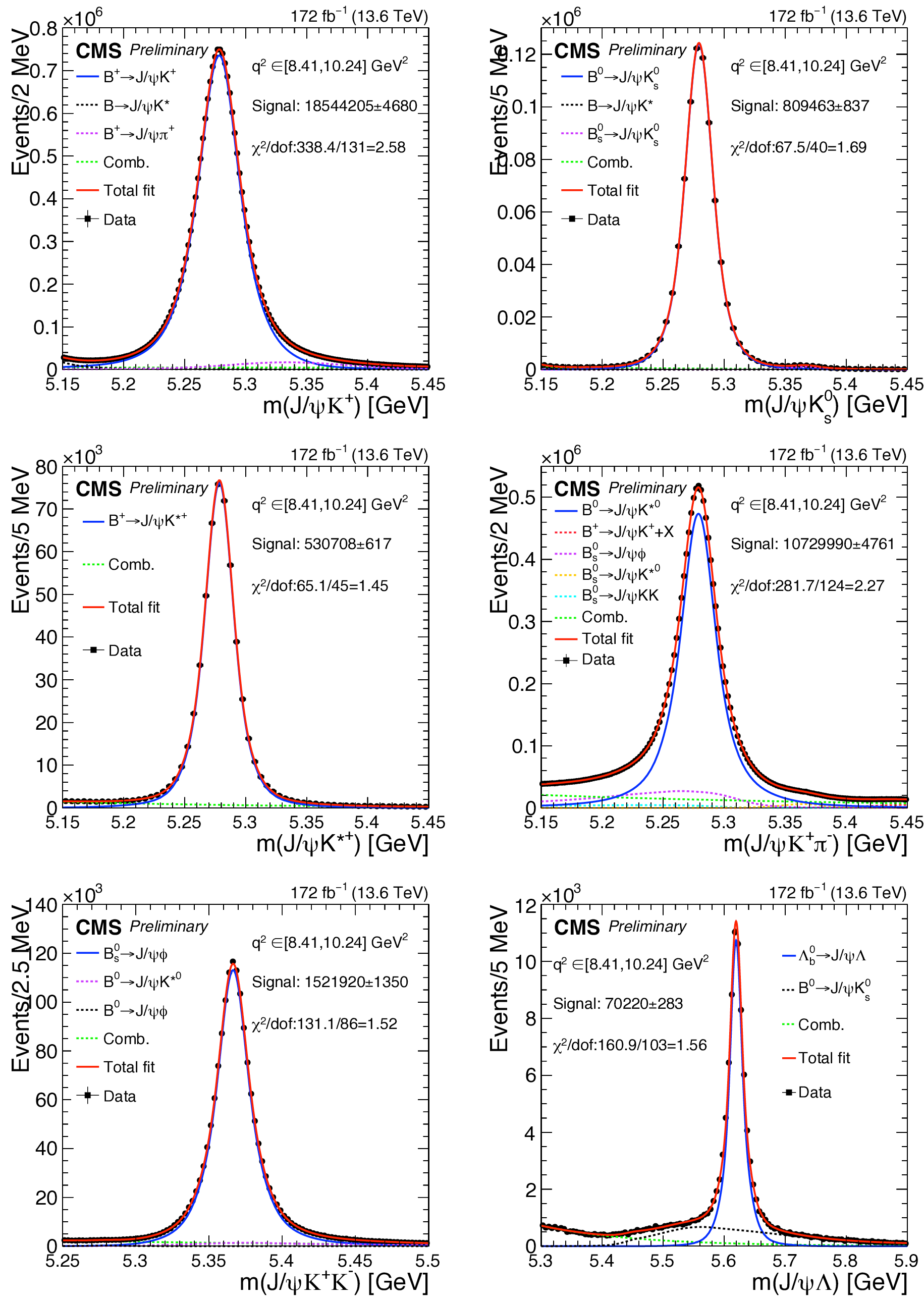
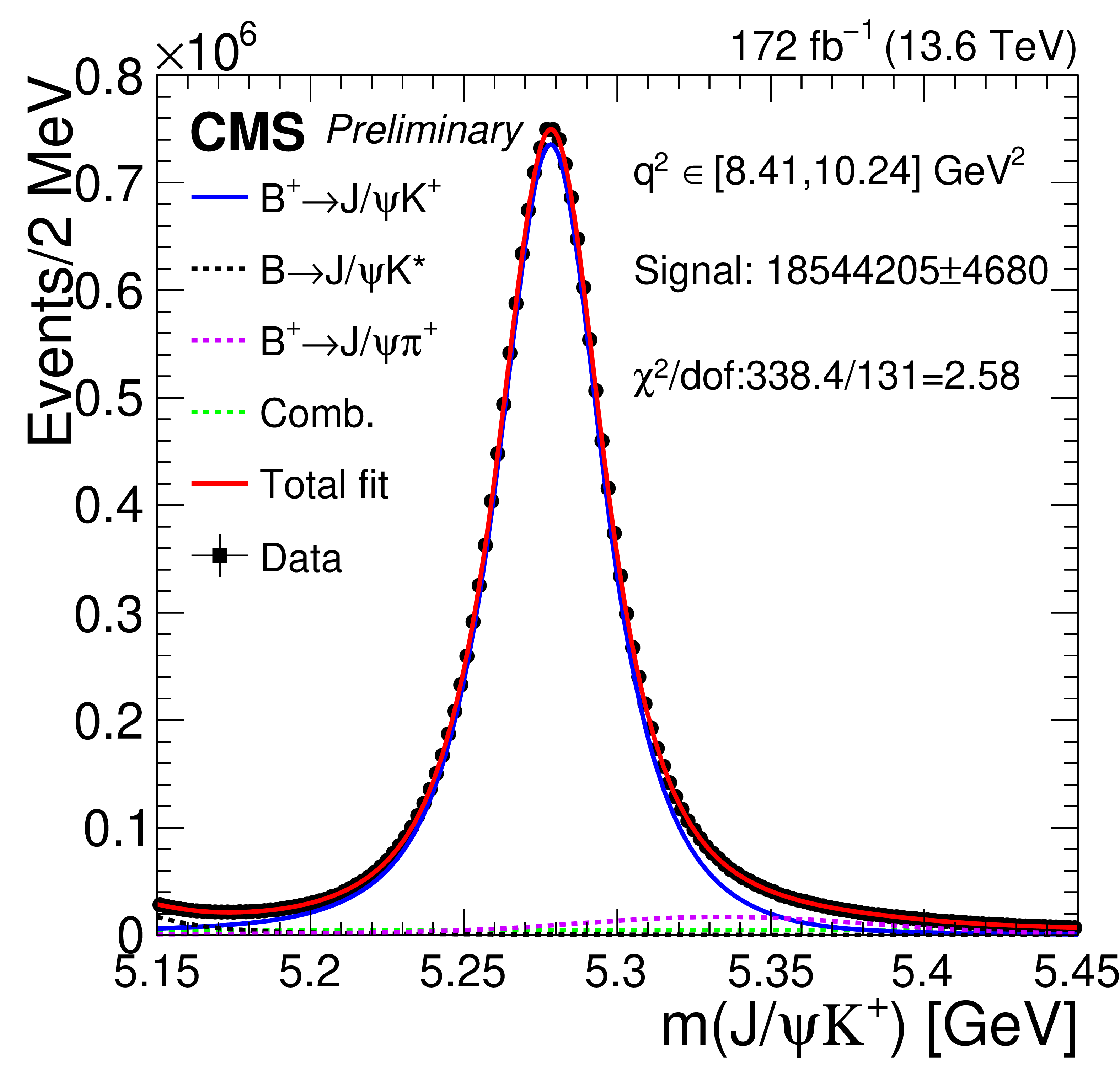
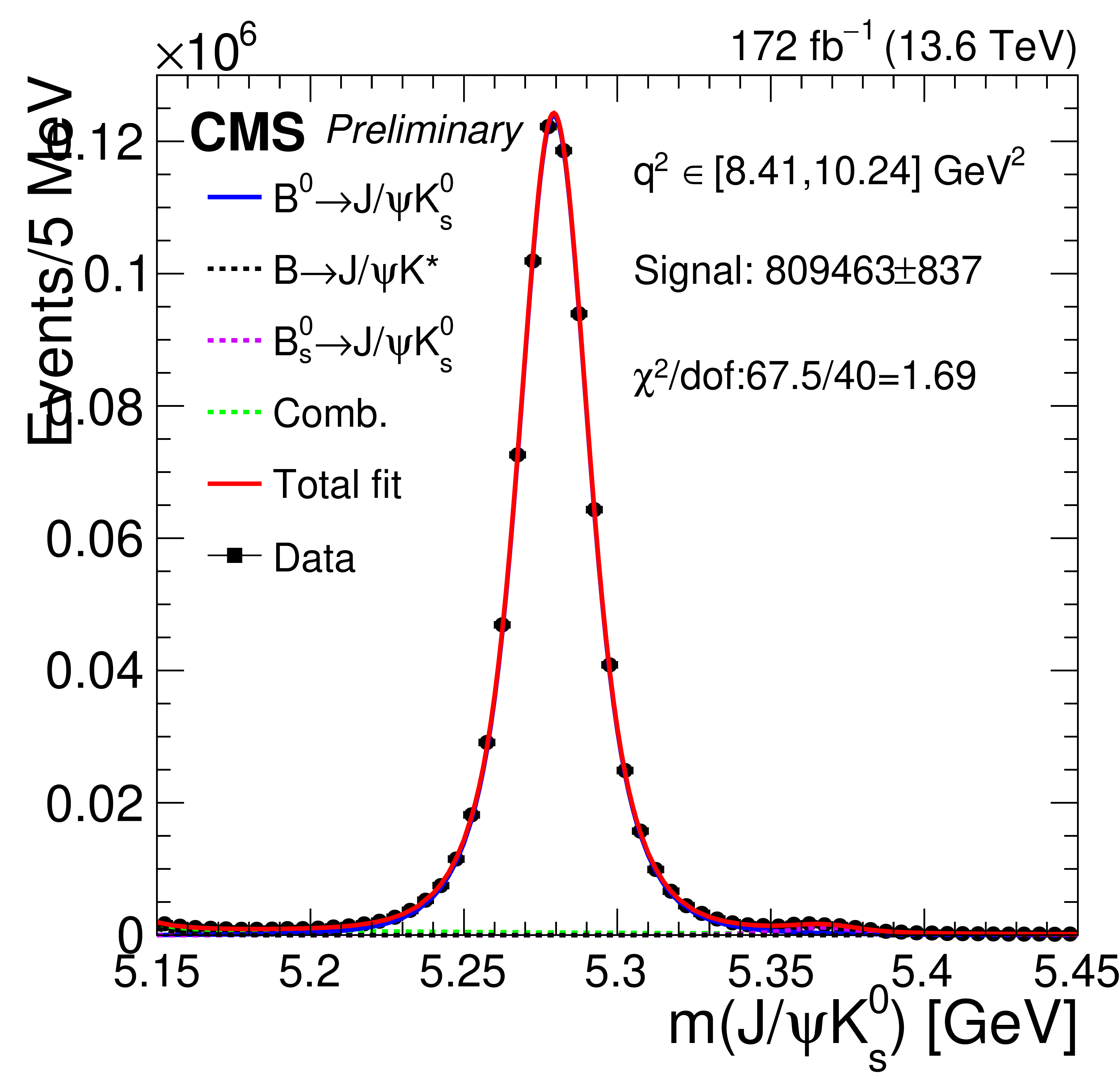
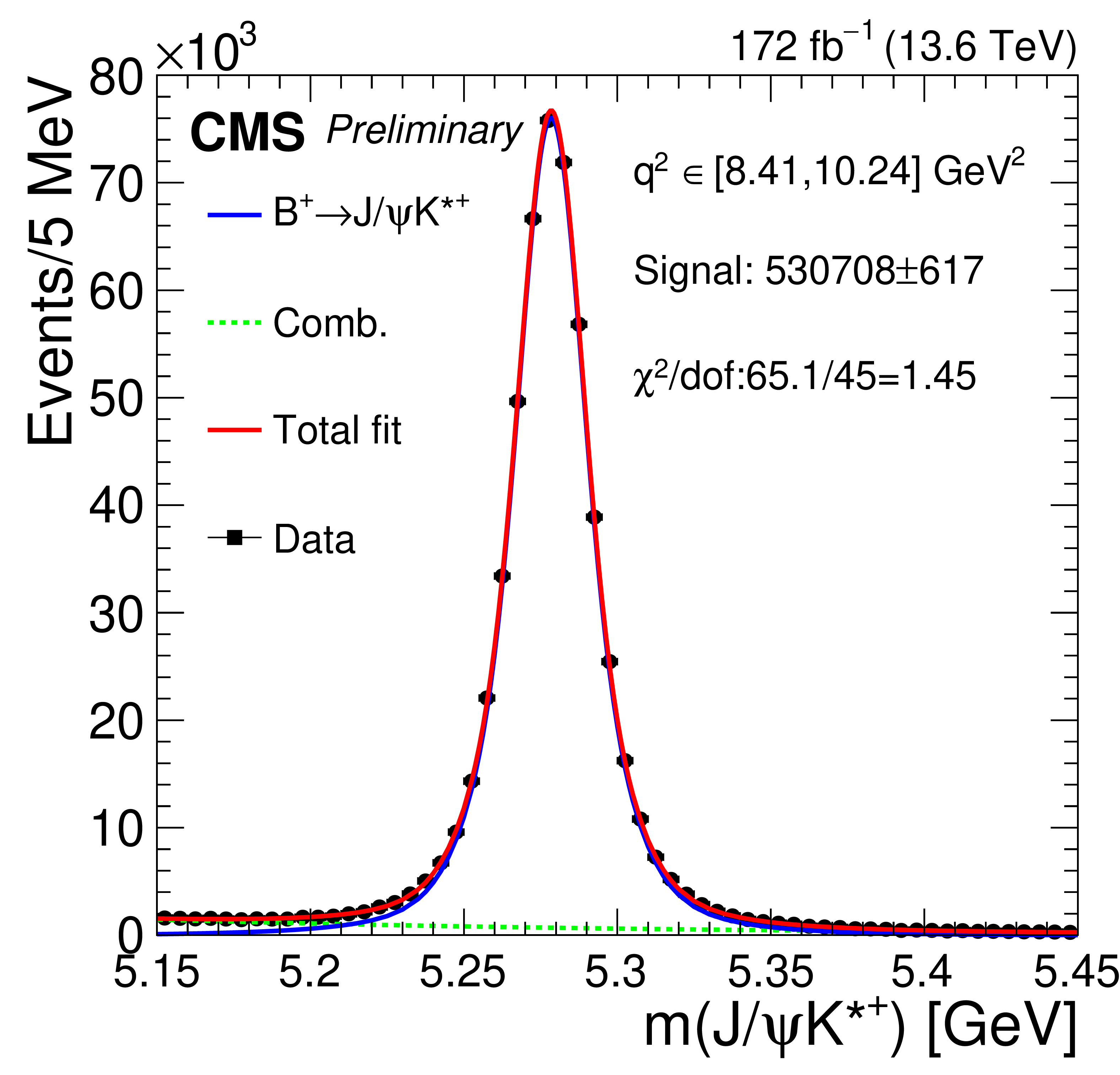
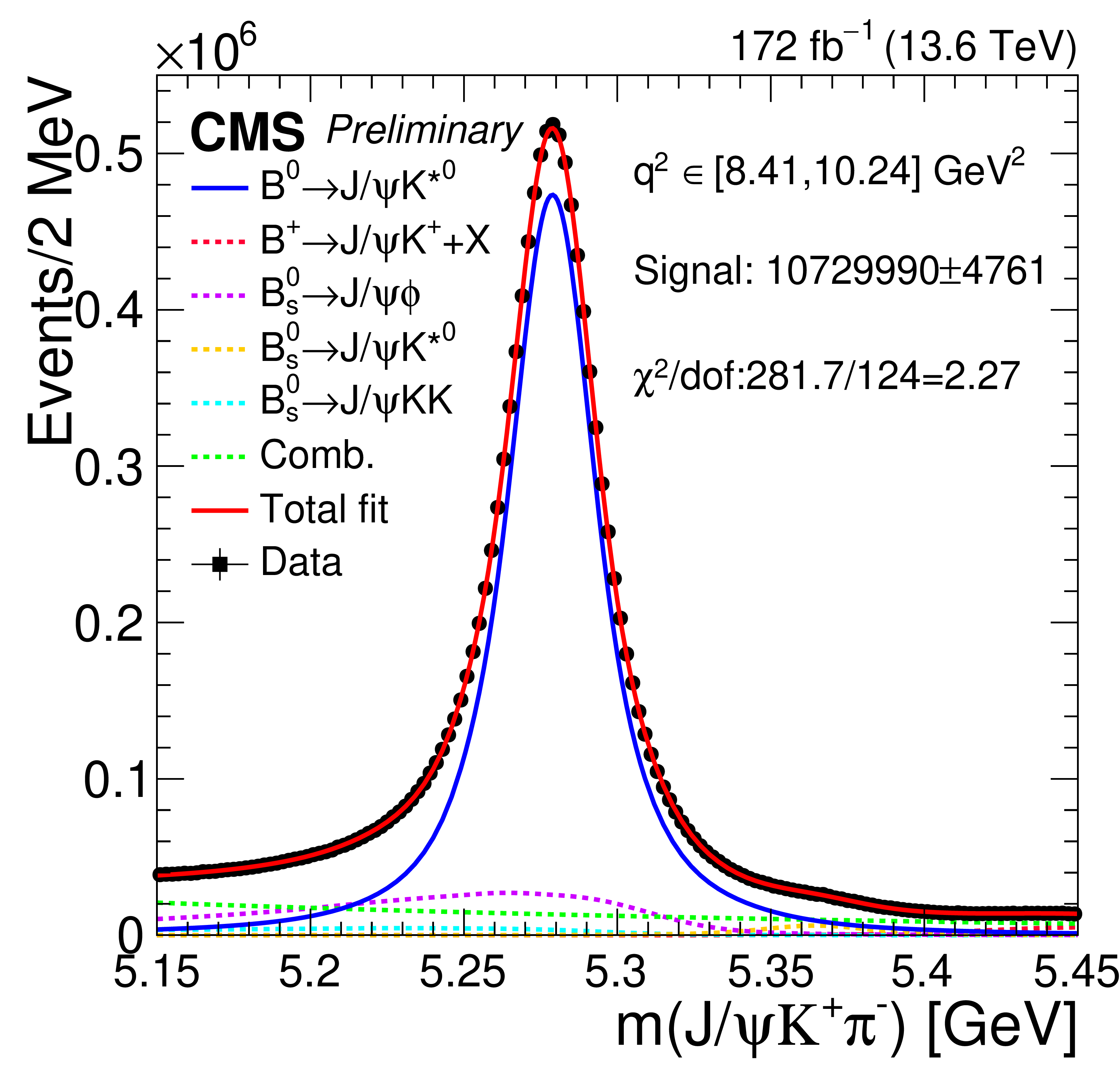
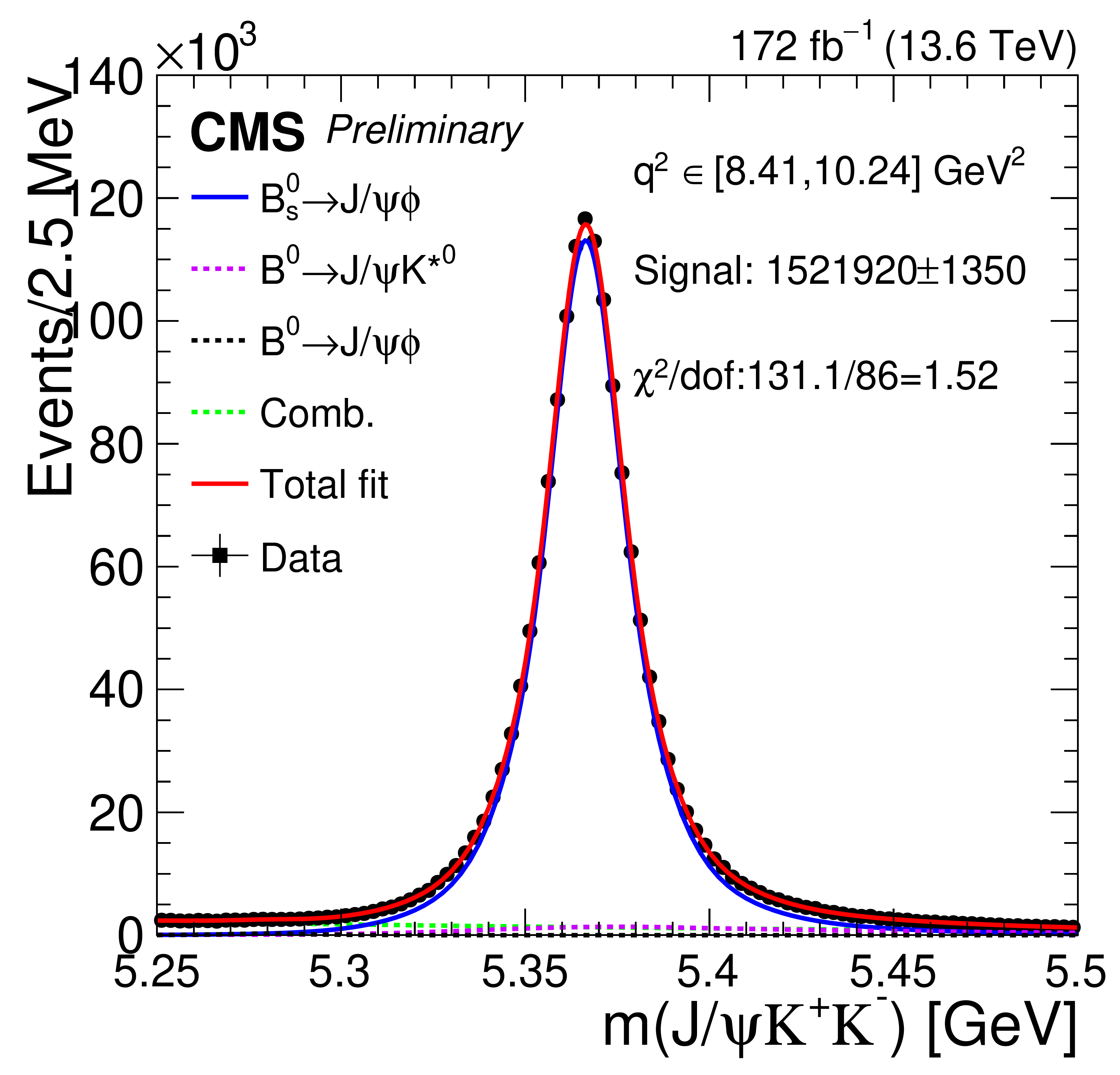
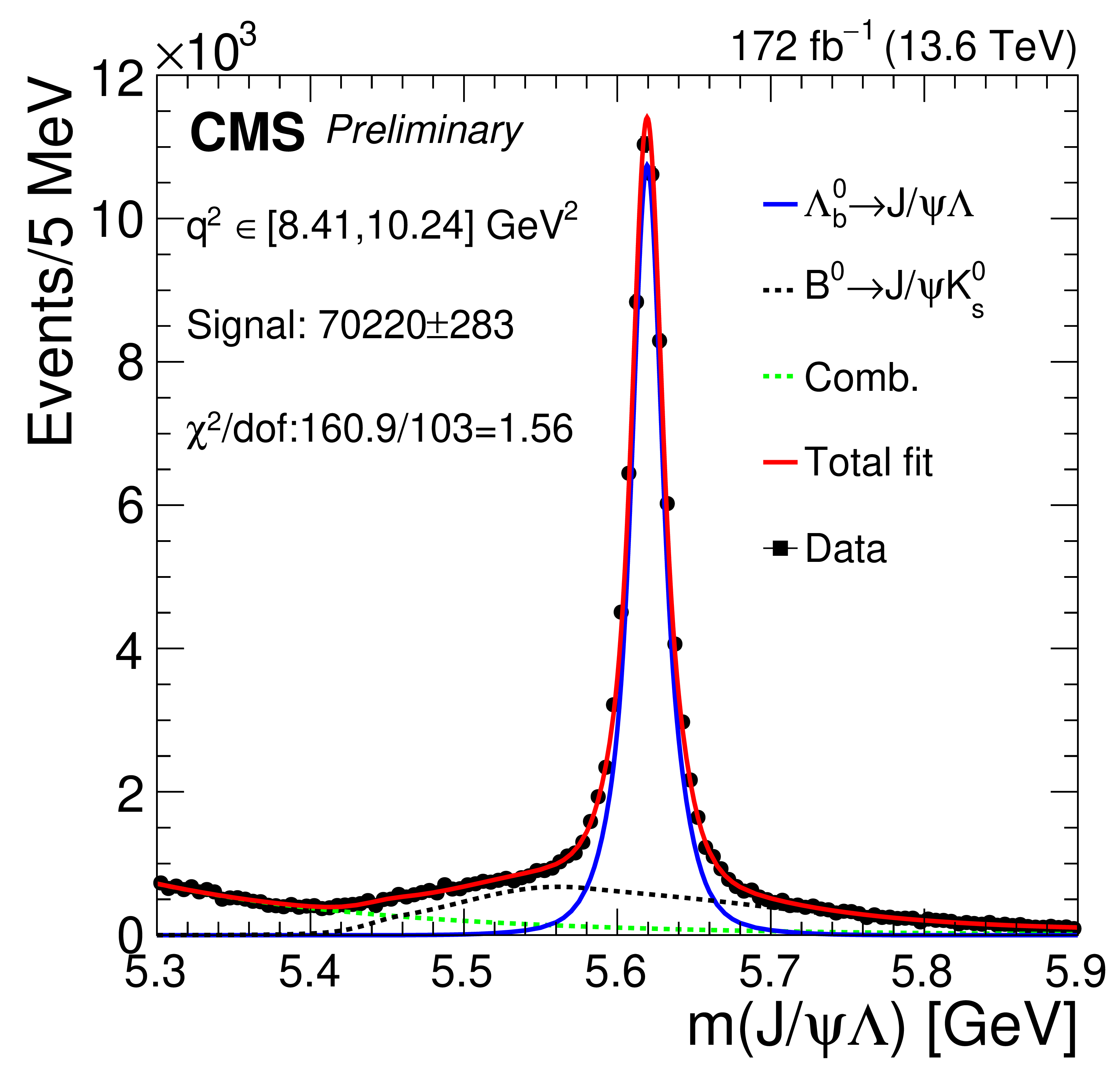
Simultaneous fit to the mass distributions for the six resonant decays $ X_{\mathrm{b}}\to \mathrm{J}/\psi \Upsilon_{\mathrm{s}} $ decays, using the full 2022--2024 data. The $ {\mathrm{B}^{+}}\to\mathrm{J}/\psi\mathrm{K^+} $ channel is displayed in upper left figure; $ {\mathrm{B}^0}\to\mathrm{J}/\psi\mathrm{K^0_S} $ in upper right; $ {\mathrm{B}^{+}}\to\mathrm{J}/\psi\mathrm{K}^{*+} $ in middle left; $ {\mathrm{B}^0}\to\mathrm{J}/\psi{\mathrm{K}}{\ast0} $ in middle right; $ \mathrm{B}_{s}\to\mathrm{J}/\psi\phi $ in lower left; and $ \Lambda_{b}^{0}\to\mathrm{J}/\psi\Lambda $ in lower right. |
png pdf |
Figure 4-a:
Simultaneous fit to the mass distributions for the six resonant decays $ X_{\mathrm{b}}\to \mathrm{J}/\psi \Upsilon_{\mathrm{s}} $ decays, using the full 2022--2024 data. The $ {\mathrm{B}^{+}}\to\mathrm{J}/\psi\mathrm{K^+} $ channel is displayed in upper left figure; $ {\mathrm{B}^0}\to\mathrm{J}/\psi\mathrm{K^0_S} $ in upper right; $ {\mathrm{B}^{+}}\to\mathrm{J}/\psi\mathrm{K}^{*+} $ in middle left; $ {\mathrm{B}^0}\to\mathrm{J}/\psi{\mathrm{K}}{\ast0} $ in middle right; $ \mathrm{B}_{s}\to\mathrm{J}/\psi\phi $ in lower left; and $ \Lambda_{b}^{0}\to\mathrm{J}/\psi\Lambda $ in lower right. |
png pdf |
Figure 4-b:
Simultaneous fit to the mass distributions for the six resonant decays $ X_{\mathrm{b}}\to \mathrm{J}/\psi \Upsilon_{\mathrm{s}} $ decays, using the full 2022--2024 data. The $ {\mathrm{B}^{+}}\to\mathrm{J}/\psi\mathrm{K^+} $ channel is displayed in upper left figure; $ {\mathrm{B}^0}\to\mathrm{J}/\psi\mathrm{K^0_S} $ in upper right; $ {\mathrm{B}^{+}}\to\mathrm{J}/\psi\mathrm{K}^{*+} $ in middle left; $ {\mathrm{B}^0}\to\mathrm{J}/\psi{\mathrm{K}}{\ast0} $ in middle right; $ \mathrm{B}_{s}\to\mathrm{J}/\psi\phi $ in lower left; and $ \Lambda_{b}^{0}\to\mathrm{J}/\psi\Lambda $ in lower right. |
png pdf |
Figure 4-c:
Simultaneous fit to the mass distributions for the six resonant decays $ X_{\mathrm{b}}\to \mathrm{J}/\psi \Upsilon_{\mathrm{s}} $ decays, using the full 2022--2024 data. The $ {\mathrm{B}^{+}}\to\mathrm{J}/\psi\mathrm{K^+} $ channel is displayed in upper left figure; $ {\mathrm{B}^0}\to\mathrm{J}/\psi\mathrm{K^0_S} $ in upper right; $ {\mathrm{B}^{+}}\to\mathrm{J}/\psi\mathrm{K}^{*+} $ in middle left; $ {\mathrm{B}^0}\to\mathrm{J}/\psi{\mathrm{K}}{\ast0} $ in middle right; $ \mathrm{B}_{s}\to\mathrm{J}/\psi\phi $ in lower left; and $ \Lambda_{b}^{0}\to\mathrm{J}/\psi\Lambda $ in lower right. |
png pdf |
Figure 4-d:
Simultaneous fit to the mass distributions for the six resonant decays $ X_{\mathrm{b}}\to \mathrm{J}/\psi \Upsilon_{\mathrm{s}} $ decays, using the full 2022--2024 data. The $ {\mathrm{B}^{+}}\to\mathrm{J}/\psi\mathrm{K^+} $ channel is displayed in upper left figure; $ {\mathrm{B}^0}\to\mathrm{J}/\psi\mathrm{K^0_S} $ in upper right; $ {\mathrm{B}^{+}}\to\mathrm{J}/\psi\mathrm{K}^{*+} $ in middle left; $ {\mathrm{B}^0}\to\mathrm{J}/\psi{\mathrm{K}}{\ast0} $ in middle right; $ \mathrm{B}_{s}\to\mathrm{J}/\psi\phi $ in lower left; and $ \Lambda_{b}^{0}\to\mathrm{J}/\psi\Lambda $ in lower right. |
png pdf |
Figure 4-e:
Simultaneous fit to the mass distributions for the six resonant decays $ X_{\mathrm{b}}\to \mathrm{J}/\psi \Upsilon_{\mathrm{s}} $ decays, using the full 2022--2024 data. The $ {\mathrm{B}^{+}}\to\mathrm{J}/\psi\mathrm{K^+} $ channel is displayed in upper left figure; $ {\mathrm{B}^0}\to\mathrm{J}/\psi\mathrm{K^0_S} $ in upper right; $ {\mathrm{B}^{+}}\to\mathrm{J}/\psi\mathrm{K}^{*+} $ in middle left; $ {\mathrm{B}^0}\to\mathrm{J}/\psi{\mathrm{K}}{\ast0} $ in middle right; $ \mathrm{B}_{s}\to\mathrm{J}/\psi\phi $ in lower left; and $ \Lambda_{b}^{0}\to\mathrm{J}/\psi\Lambda $ in lower right. |
png pdf |
Figure 4-f:
Simultaneous fit to the mass distributions for the six resonant decays $ X_{\mathrm{b}}\to \mathrm{J}/\psi \Upsilon_{\mathrm{s}} $ decays, using the full 2022--2024 data. The $ {\mathrm{B}^{+}}\to\mathrm{J}/\psi\mathrm{K^+} $ channel is displayed in upper left figure; $ {\mathrm{B}^0}\to\mathrm{J}/\psi\mathrm{K^0_S} $ in upper right; $ {\mathrm{B}^{+}}\to\mathrm{J}/\psi\mathrm{K}^{*+} $ in middle left; $ {\mathrm{B}^0}\to\mathrm{J}/\psi{\mathrm{K}}{\ast0} $ in middle right; $ \mathrm{B}_{s}\to\mathrm{J}/\psi\phi $ in lower left; and $ \Lambda_{b}^{0}\to\mathrm{J}/\psi\Lambda $ in lower right. |
png pdf |
Figure 5:
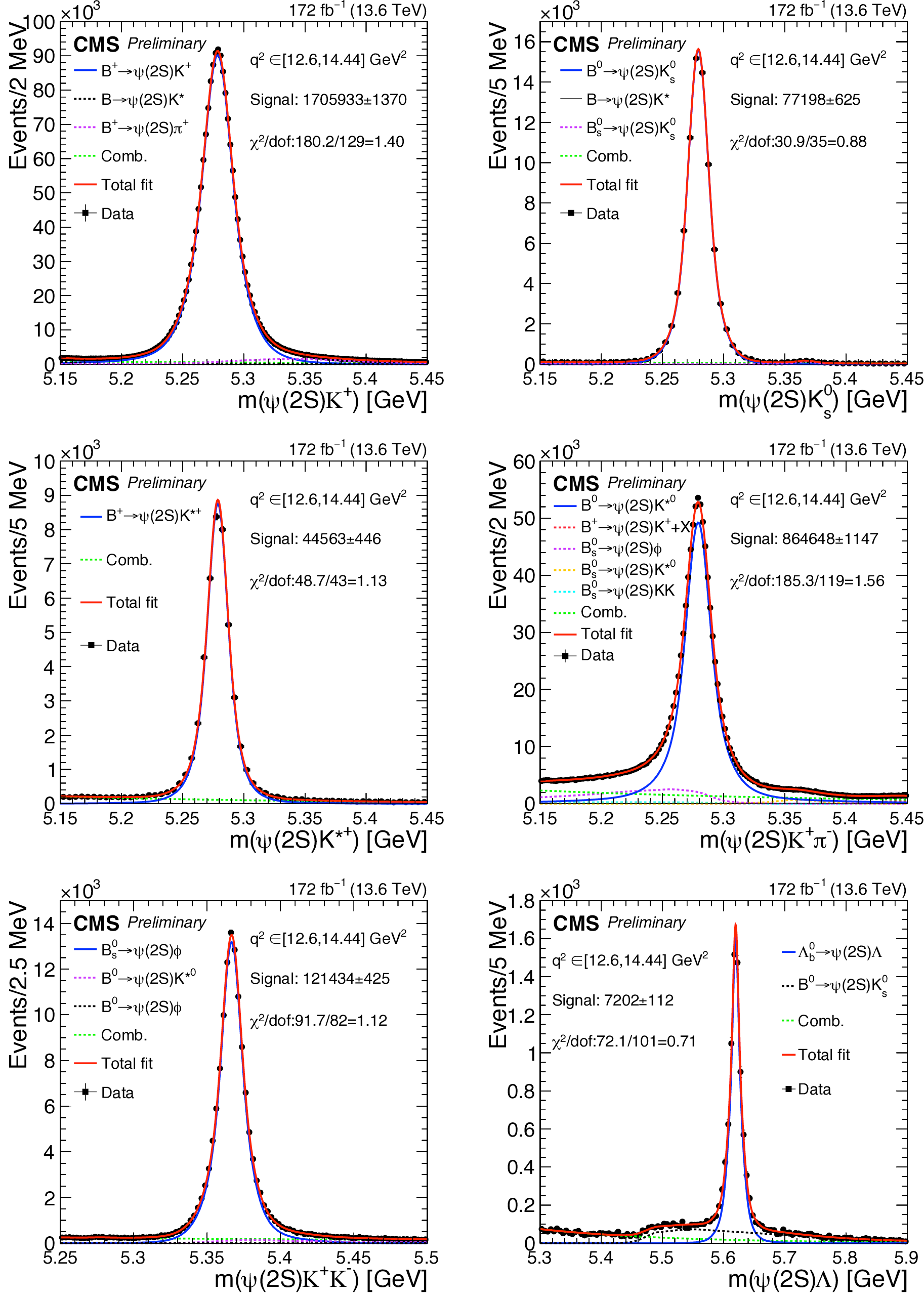
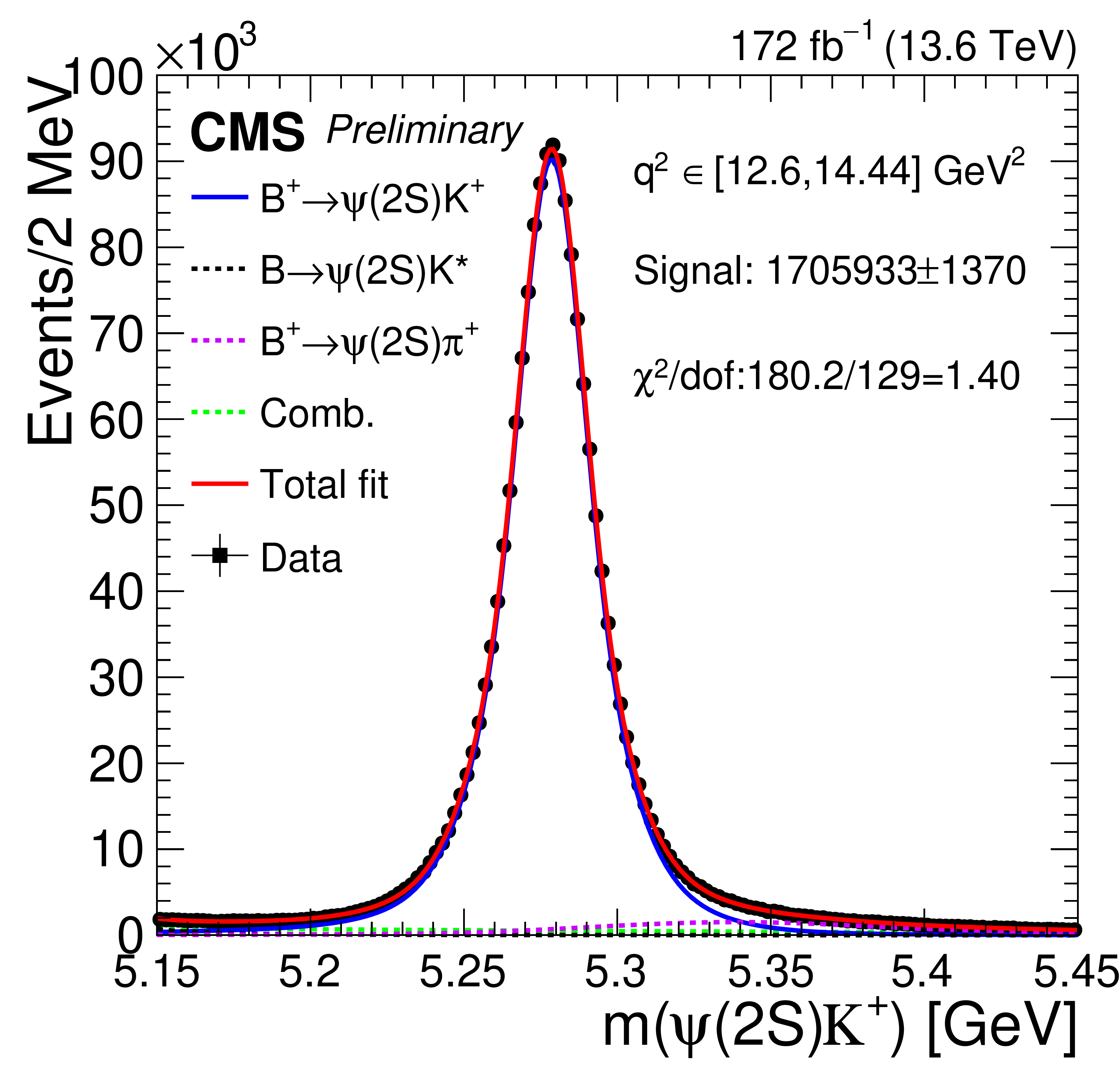
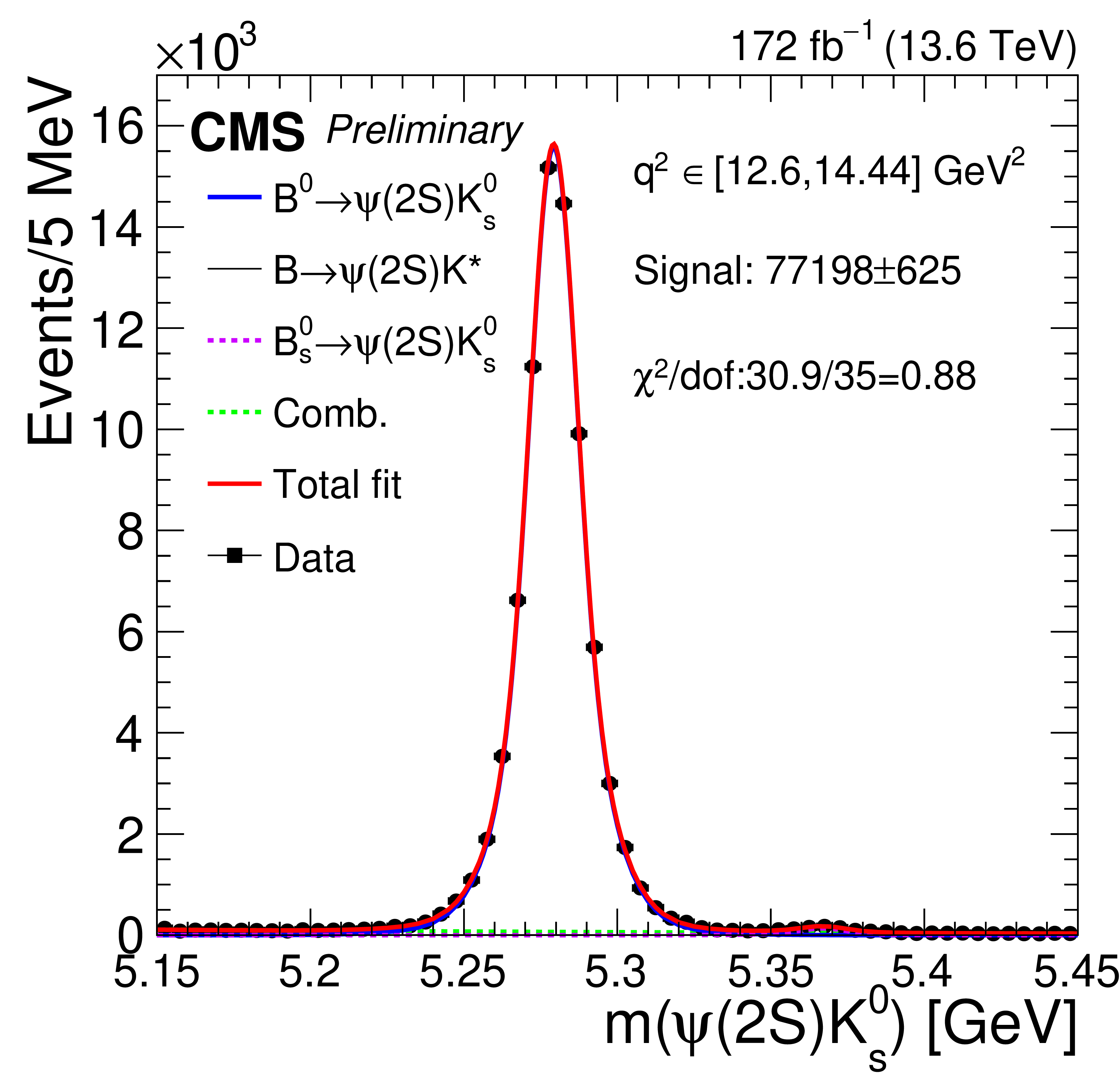
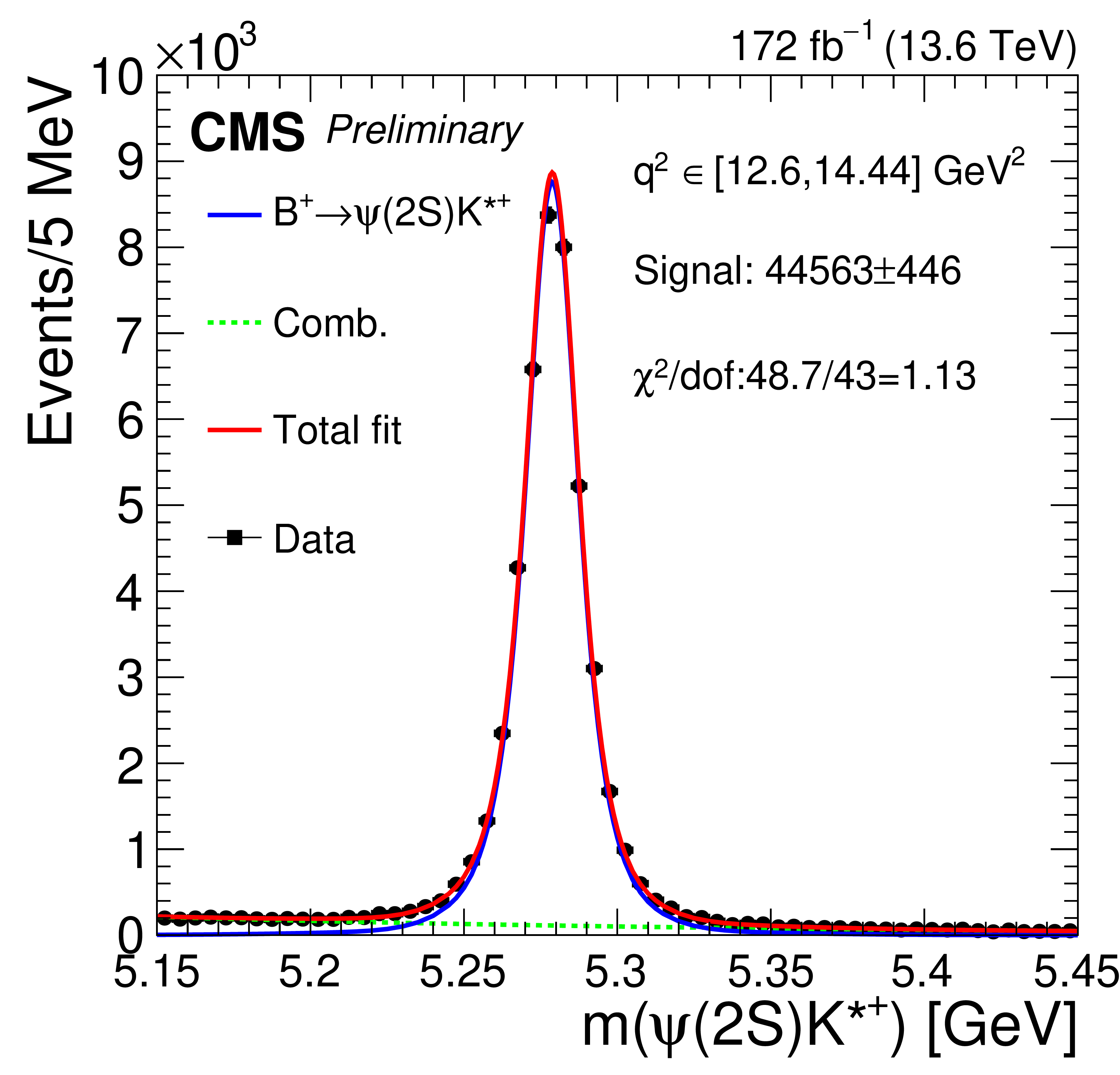
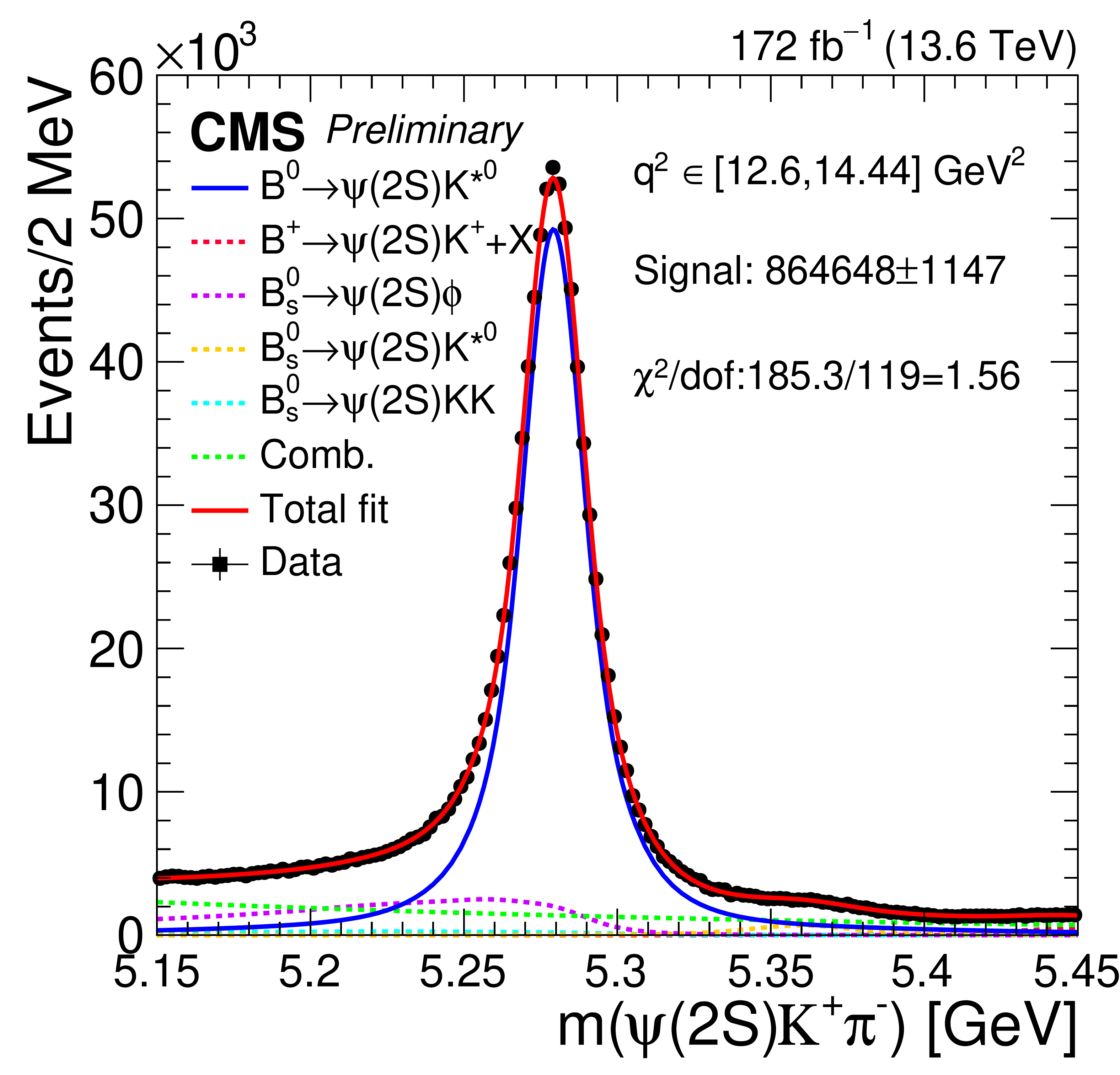
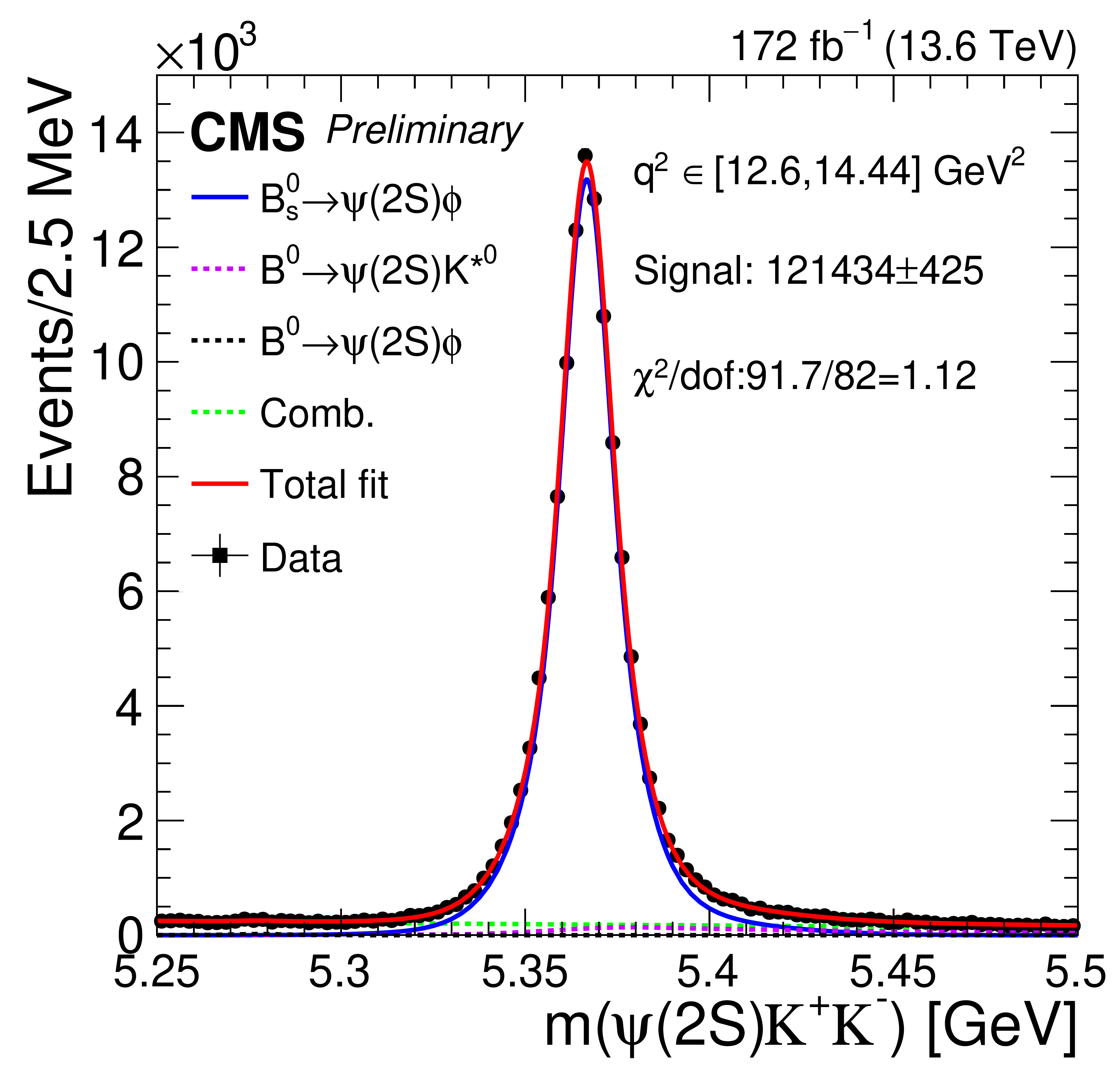
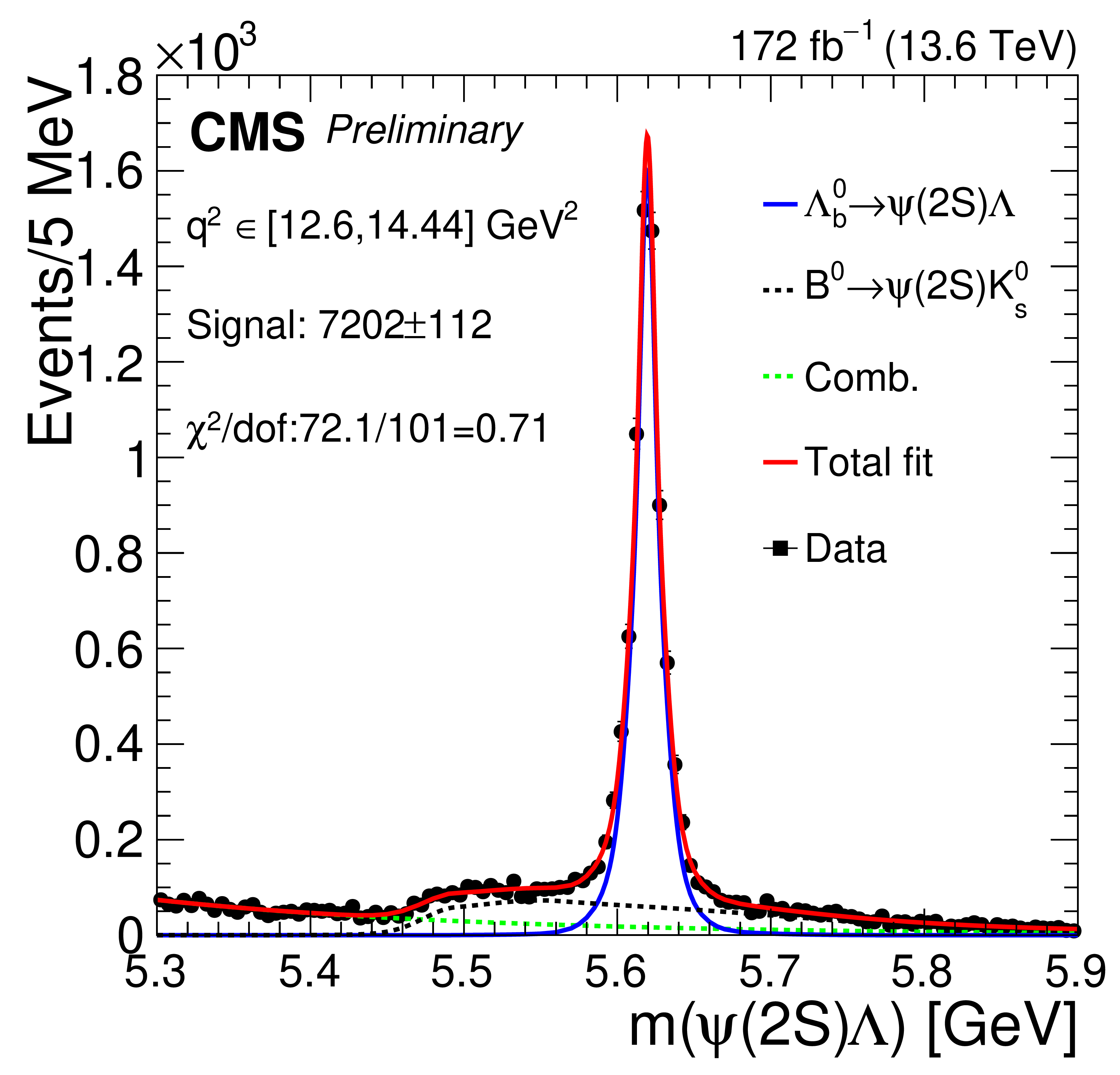
Simultaneous fit to the mass distributions for the six resonant decays $ X_{\mathrm{b}}\to \psi(2S) \Upsilon_{\mathrm{s}} $ decays, using the full 2022--2024 data. The $ {\mathrm{B}^{+}}\to\psi(2S)\mathrm{K^+} $ channel is displayed in upper left figure; $ {\mathrm{B}^0}\to\psi(2S)\mathrm{K^0_S} $ in upper right; $ {\mathrm{B}^{+}}\to\psi(2S)\mathrm{K}^{*+} $ in middle left; $ {\mathrm{B}^0}\to\psi(2S){\mathrm{K}}{\ast0} $ in middle right; $ \mathrm{B}_{s}\to\psi(2S)\phi $ in lower left; and $ \Lambda_{b}^{0}\to\psi(2S)\Lambda^{0} $ in lower right. |
png pdf |
Figure 5-a:
Simultaneous fit to the mass distributions for the six resonant decays $ X_{\mathrm{b}}\to \psi(2S) \Upsilon_{\mathrm{s}} $ decays, using the full 2022--2024 data. The $ {\mathrm{B}^{+}}\to\psi(2S)\mathrm{K^+} $ channel is displayed in upper left figure; $ {\mathrm{B}^0}\to\psi(2S)\mathrm{K^0_S} $ in upper right; $ {\mathrm{B}^{+}}\to\psi(2S)\mathrm{K}^{*+} $ in middle left; $ {\mathrm{B}^0}\to\psi(2S){\mathrm{K}}{\ast0} $ in middle right; $ \mathrm{B}_{s}\to\psi(2S)\phi $ in lower left; and $ \Lambda_{b}^{0}\to\psi(2S)\Lambda^{0} $ in lower right. |
png pdf |
Figure 5-b:
Simultaneous fit to the mass distributions for the six resonant decays $ X_{\mathrm{b}}\to \psi(2S) \Upsilon_{\mathrm{s}} $ decays, using the full 2022--2024 data. The $ {\mathrm{B}^{+}}\to\psi(2S)\mathrm{K^+} $ channel is displayed in upper left figure; $ {\mathrm{B}^0}\to\psi(2S)\mathrm{K^0_S} $ in upper right; $ {\mathrm{B}^{+}}\to\psi(2S)\mathrm{K}^{*+} $ in middle left; $ {\mathrm{B}^0}\to\psi(2S){\mathrm{K}}{\ast0} $ in middle right; $ \mathrm{B}_{s}\to\psi(2S)\phi $ in lower left; and $ \Lambda_{b}^{0}\to\psi(2S)\Lambda^{0} $ in lower right. |
png pdf |
Figure 5-c:
Simultaneous fit to the mass distributions for the six resonant decays $ X_{\mathrm{b}}\to \psi(2S) \Upsilon_{\mathrm{s}} $ decays, using the full 2022--2024 data. The $ {\mathrm{B}^{+}}\to\psi(2S)\mathrm{K^+} $ channel is displayed in upper left figure; $ {\mathrm{B}^0}\to\psi(2S)\mathrm{K^0_S} $ in upper right; $ {\mathrm{B}^{+}}\to\psi(2S)\mathrm{K}^{*+} $ in middle left; $ {\mathrm{B}^0}\to\psi(2S){\mathrm{K}}{\ast0} $ in middle right; $ \mathrm{B}_{s}\to\psi(2S)\phi $ in lower left; and $ \Lambda_{b}^{0}\to\psi(2S)\Lambda^{0} $ in lower right. |
png pdf |
Figure 5-d:
Simultaneous fit to the mass distributions for the six resonant decays $ X_{\mathrm{b}}\to \psi(2S) \Upsilon_{\mathrm{s}} $ decays, using the full 2022--2024 data. The $ {\mathrm{B}^{+}}\to\psi(2S)\mathrm{K^+} $ channel is displayed in upper left figure; $ {\mathrm{B}^0}\to\psi(2S)\mathrm{K^0_S} $ in upper right; $ {\mathrm{B}^{+}}\to\psi(2S)\mathrm{K}^{*+} $ in middle left; $ {\mathrm{B}^0}\to\psi(2S){\mathrm{K}}{\ast0} $ in middle right; $ \mathrm{B}_{s}\to\psi(2S)\phi $ in lower left; and $ \Lambda_{b}^{0}\to\psi(2S)\Lambda^{0} $ in lower right. |
png pdf |
Figure 5-e:
Simultaneous fit to the mass distributions for the six resonant decays $ X_{\mathrm{b}}\to \psi(2S) \Upsilon_{\mathrm{s}} $ decays, using the full 2022--2024 data. The $ {\mathrm{B}^{+}}\to\psi(2S)\mathrm{K^+} $ channel is displayed in upper left figure; $ {\mathrm{B}^0}\to\psi(2S)\mathrm{K^0_S} $ in upper right; $ {\mathrm{B}^{+}}\to\psi(2S)\mathrm{K}^{*+} $ in middle left; $ {\mathrm{B}^0}\to\psi(2S){\mathrm{K}}{\ast0} $ in middle right; $ \mathrm{B}_{s}\to\psi(2S)\phi $ in lower left; and $ \Lambda_{b}^{0}\to\psi(2S)\Lambda^{0} $ in lower right. |
png pdf |
Figure 5-f:
Simultaneous fit to the mass distributions for the six resonant decays $ X_{\mathrm{b}}\to \psi(2S) \Upsilon_{\mathrm{s}} $ decays, using the full 2022--2024 data. The $ {\mathrm{B}^{+}}\to\psi(2S)\mathrm{K^+} $ channel is displayed in upper left figure; $ {\mathrm{B}^0}\to\psi(2S)\mathrm{K^0_S} $ in upper right; $ {\mathrm{B}^{+}}\to\psi(2S)\mathrm{K}^{*+} $ in middle left; $ {\mathrm{B}^0}\to\psi(2S){\mathrm{K}}{\ast0} $ in middle right; $ \mathrm{B}_{s}\to\psi(2S)\phi $ in lower left; and $ \Lambda_{b}^{0}\to\psi(2S)\Lambda^{0} $ in lower right. |
png pdf |
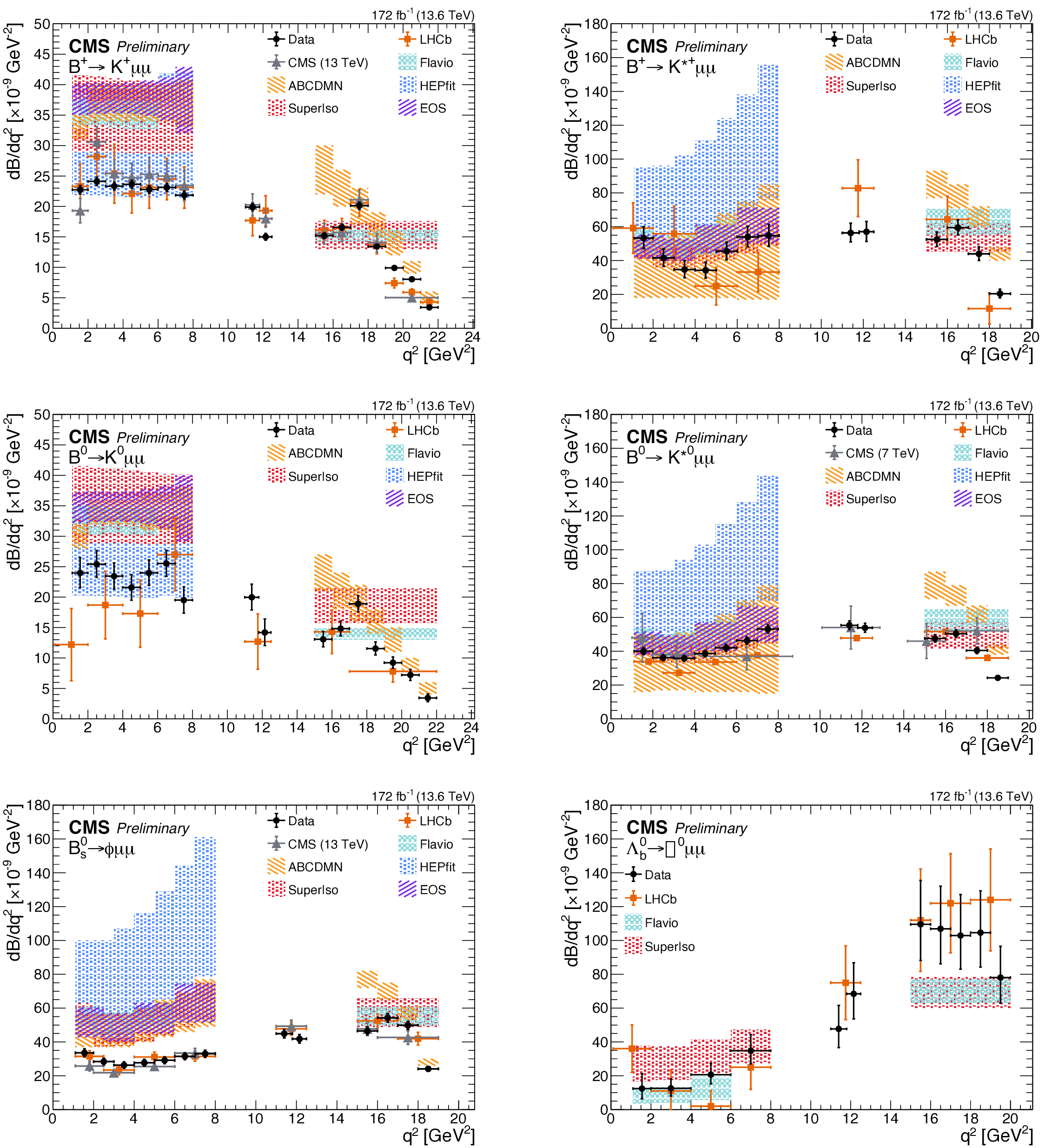
Figure 6:
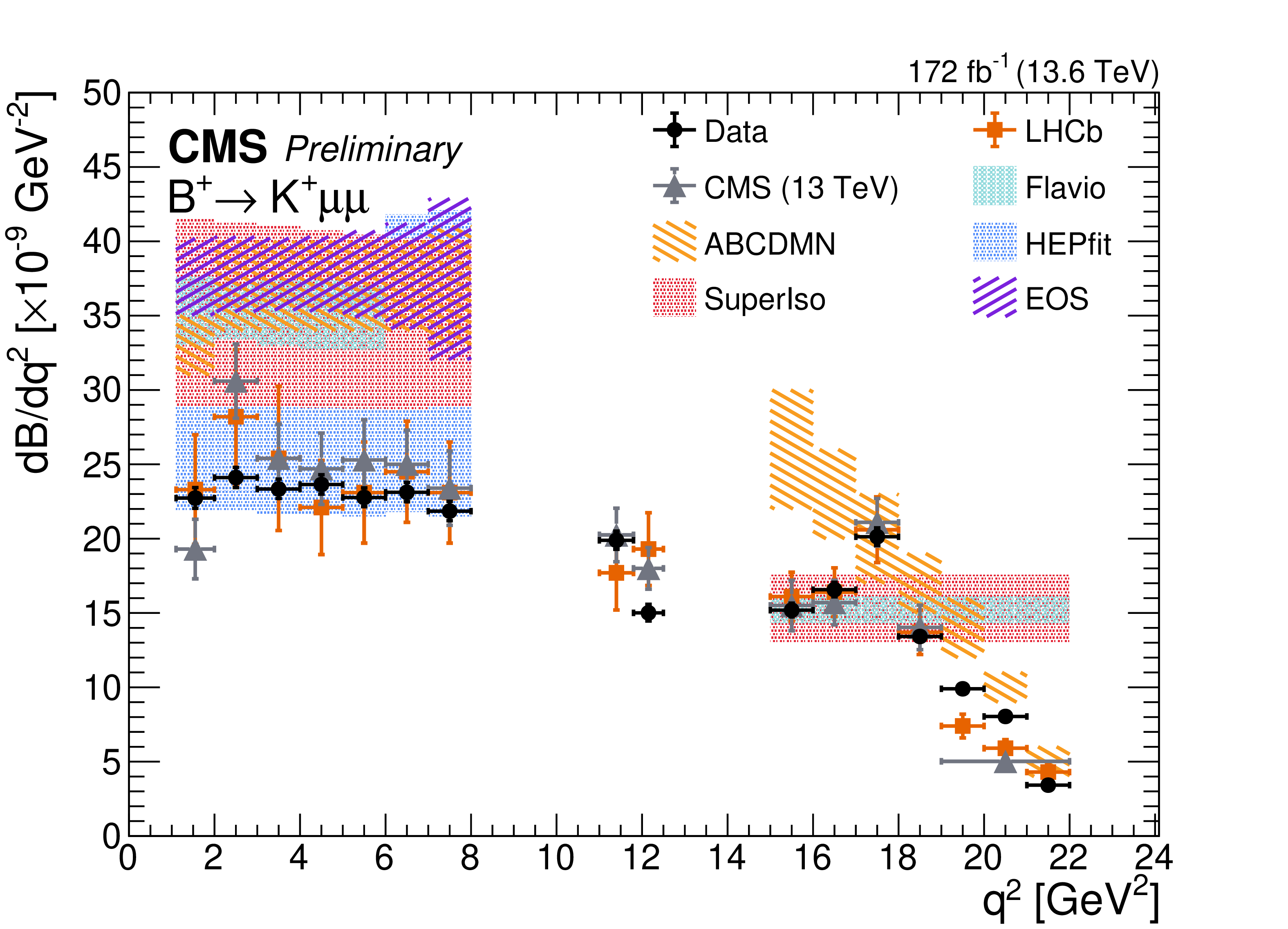
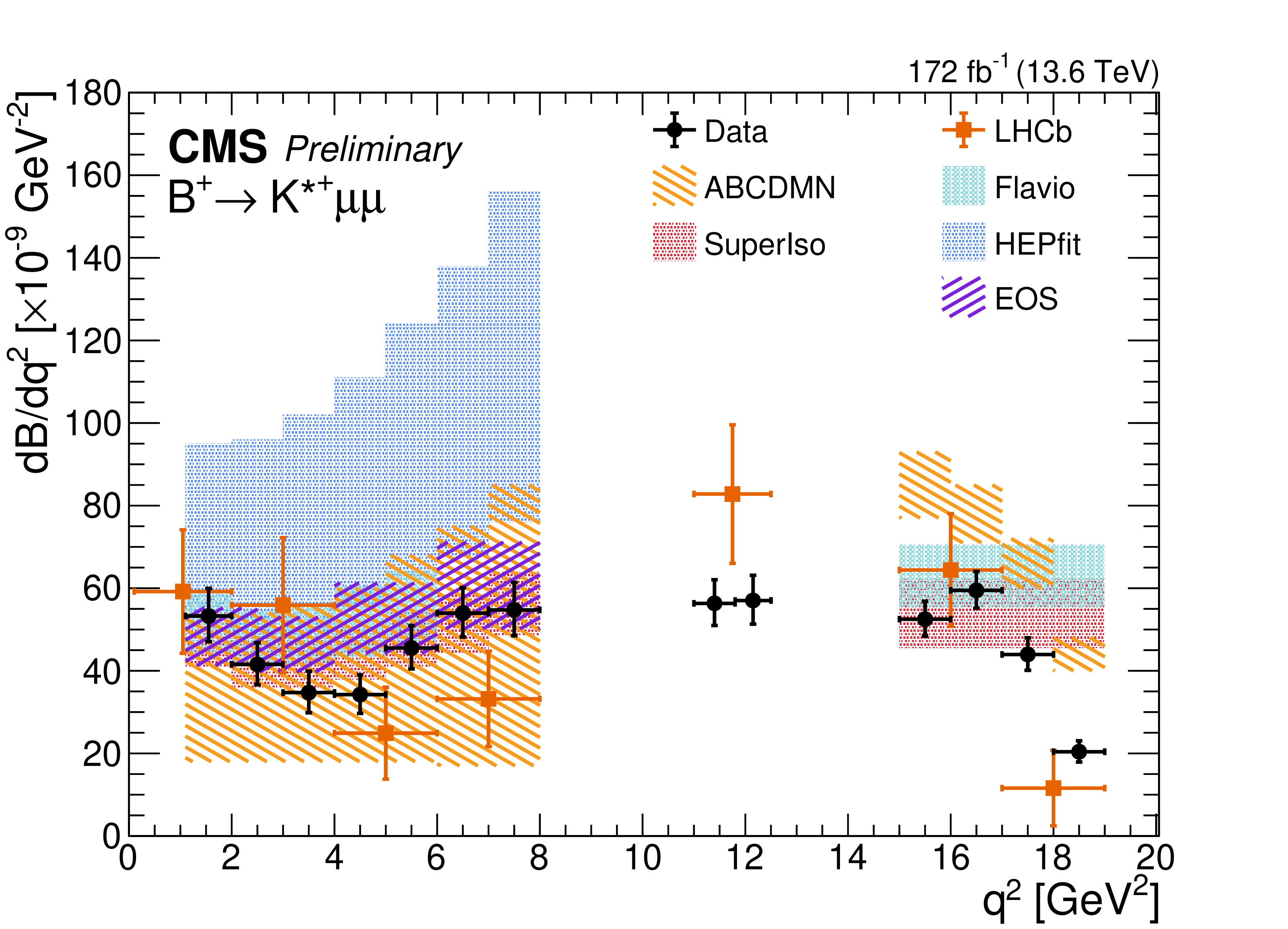
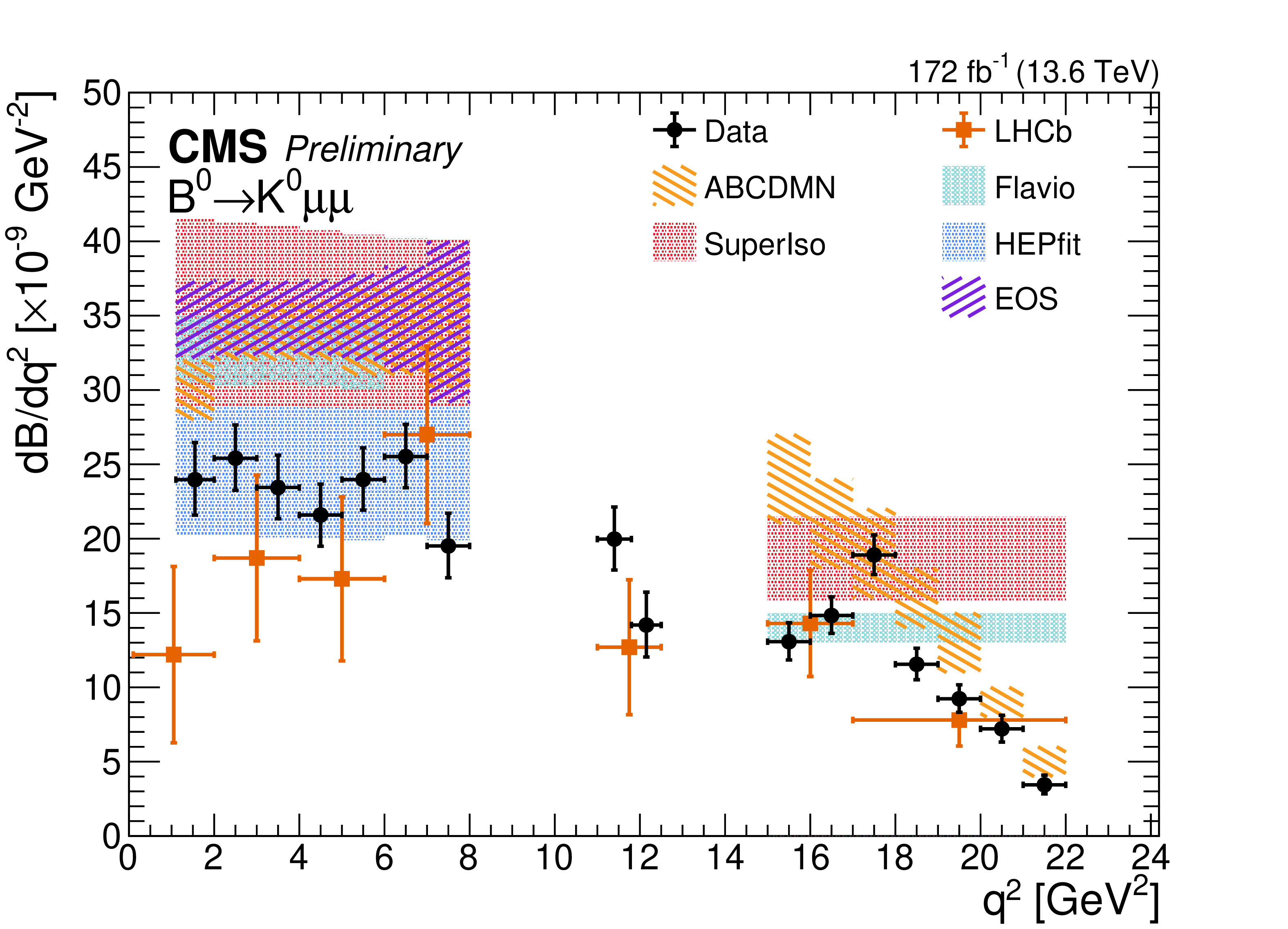
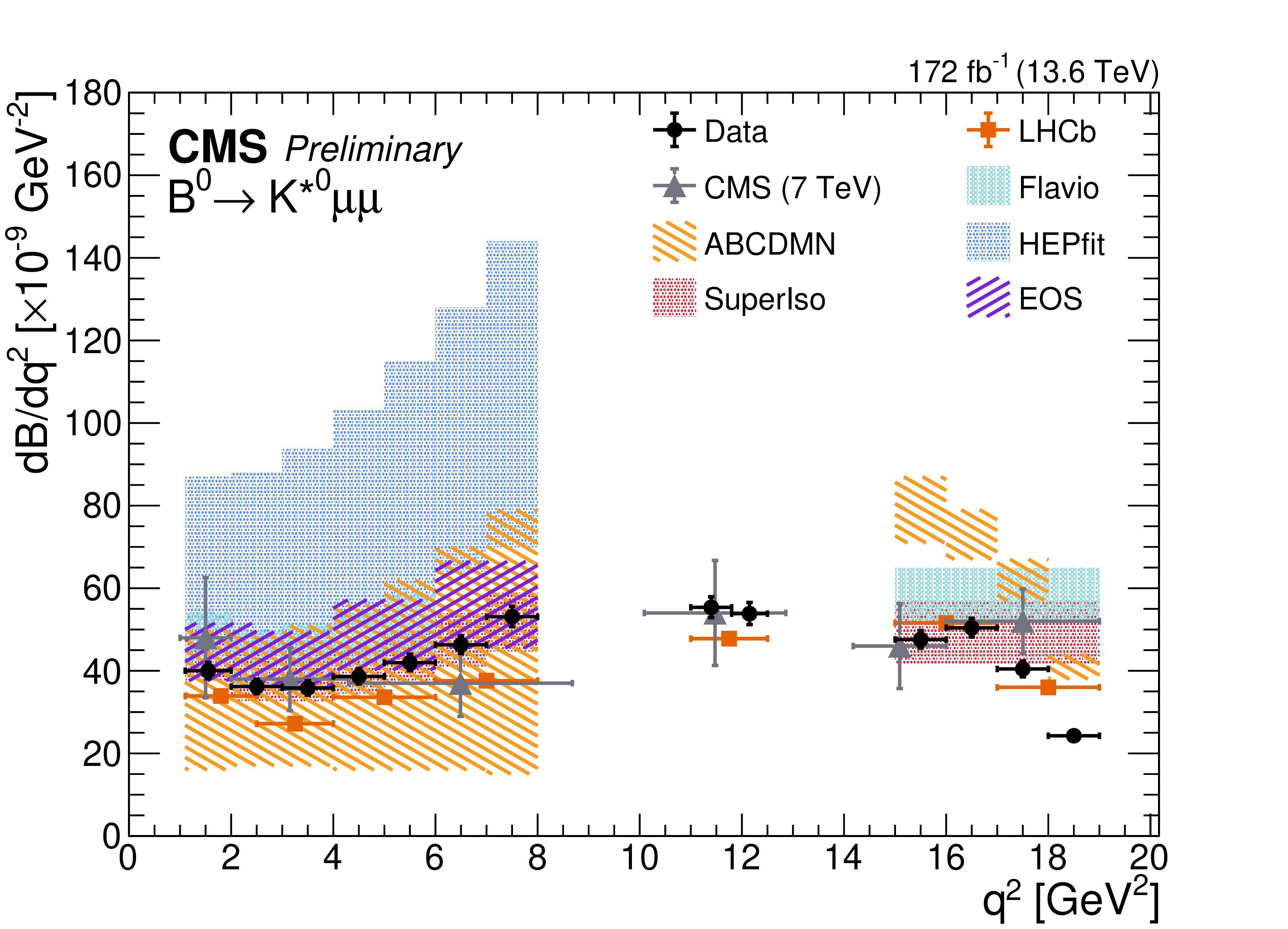
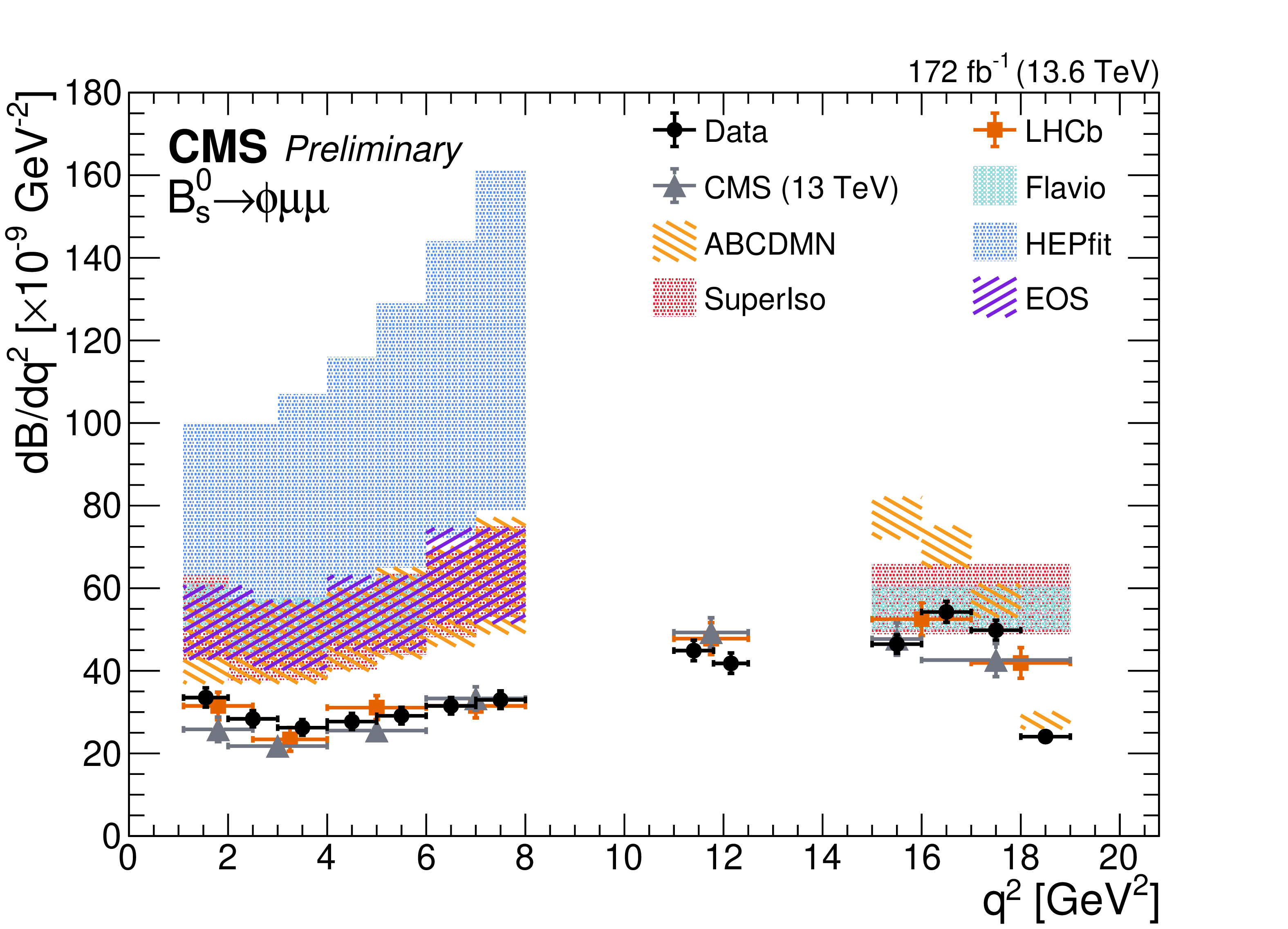
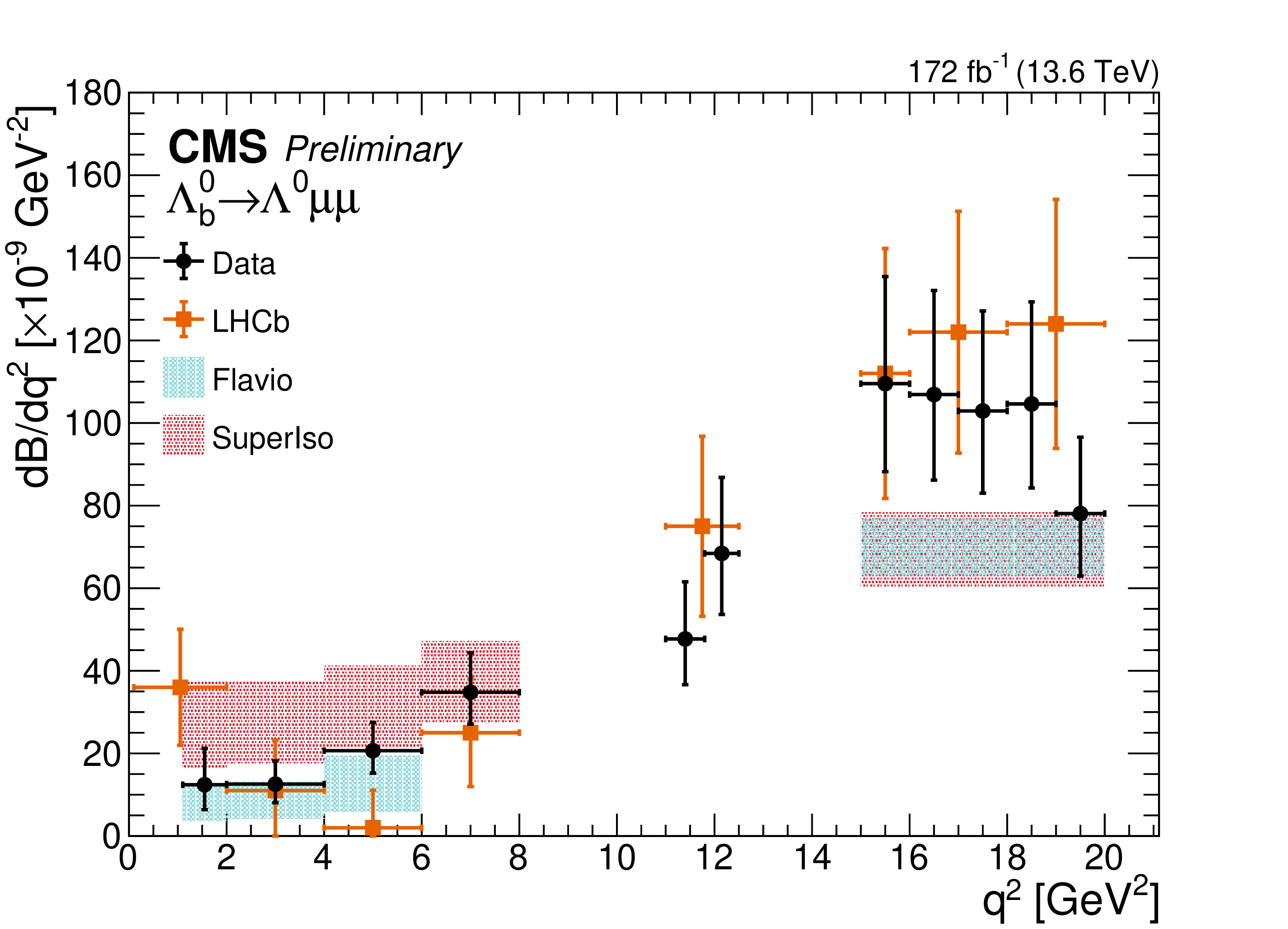
Comparison of measured differential Branching Fraction with the theoretical prediction taken from the Flavio package for (a) $ {\mathrm{B}^{+}}\to \mathrm{K^+}\mu\mu $, $ {\mathrm{B}^{+}}\to\mathrm{K}^{*+}\mu\mu $, (c) $ {\mathrm{B}^0}\to \mathrm{K^0_S}\mu\mu $, (d) $ {\mathrm{B}^0}\to{\mathrm{K}}^{\ast0} \mu\mu $, (e) $ \mathrm{B}_{s}^{0}\to\phi\mu\mu $, and (f) $ \Lambda_{b}^{0}\to\Lambda\mu\mu $. |
png pdf |
Figure 6-a:
Comparison of measured differential Branching Fraction with the theoretical prediction taken from the Flavio package for (a) $ {\mathrm{B}^{+}}\to \mathrm{K^+}\mu\mu $, $ {\mathrm{B}^{+}}\to\mathrm{K}^{*+}\mu\mu $, (c) $ {\mathrm{B}^0}\to \mathrm{K^0_S}\mu\mu $, (d) $ {\mathrm{B}^0}\to{\mathrm{K}}^{\ast0} \mu\mu $, (e) $ \mathrm{B}_{s}^{0}\to\phi\mu\mu $, and (f) $ \Lambda_{b}^{0}\to\Lambda\mu\mu $. |
png pdf |
Figure 6-b:
Comparison of measured differential Branching Fraction with the theoretical prediction taken from the Flavio package for (a) $ {\mathrm{B}^{+}}\to \mathrm{K^+}\mu\mu $, $ {\mathrm{B}^{+}}\to\mathrm{K}^{*+}\mu\mu $, (c) $ {\mathrm{B}^0}\to \mathrm{K^0_S}\mu\mu $, (d) $ {\mathrm{B}^0}\to{\mathrm{K}}^{\ast0} \mu\mu $, (e) $ \mathrm{B}_{s}^{0}\to\phi\mu\mu $, and (f) $ \Lambda_{b}^{0}\to\Lambda\mu\mu $. |
png pdf |
Figure 6-c:
Comparison of measured differential Branching Fraction with the theoretical prediction taken from the Flavio package for (a) $ {\mathrm{B}^{+}}\to \mathrm{K^+}\mu\mu $, $ {\mathrm{B}^{+}}\to\mathrm{K}^{*+}\mu\mu $, (c) $ {\mathrm{B}^0}\to \mathrm{K^0_S}\mu\mu $, (d) $ {\mathrm{B}^0}\to{\mathrm{K}}^{\ast0} \mu\mu $, (e) $ \mathrm{B}_{s}^{0}\to\phi\mu\mu $, and (f) $ \Lambda_{b}^{0}\to\Lambda\mu\mu $. |
png pdf |
Figure 6-d:
Comparison of measured differential Branching Fraction with the theoretical prediction taken from the Flavio package for (a) $ {\mathrm{B}^{+}}\to \mathrm{K^+}\mu\mu $, $ {\mathrm{B}^{+}}\to\mathrm{K}^{*+}\mu\mu $, (c) $ {\mathrm{B}^0}\to \mathrm{K^0_S}\mu\mu $, (d) $ {\mathrm{B}^0}\to{\mathrm{K}}^{\ast0} \mu\mu $, (e) $ \mathrm{B}_{s}^{0}\to\phi\mu\mu $, and (f) $ \Lambda_{b}^{0}\to\Lambda\mu\mu $. |
png pdf |
Figure 6-e:
Comparison of measured differential Branching Fraction with the theoretical prediction taken from the Flavio package for (a) $ {\mathrm{B}^{+}}\to \mathrm{K^+}\mu\mu $, $ {\mathrm{B}^{+}}\to\mathrm{K}^{*+}\mu\mu $, (c) $ {\mathrm{B}^0}\to \mathrm{K^0_S}\mu\mu $, (d) $ {\mathrm{B}^0}\to{\mathrm{K}}^{\ast0} \mu\mu $, (e) $ \mathrm{B}_{s}^{0}\to\phi\mu\mu $, and (f) $ \Lambda_{b}^{0}\to\Lambda\mu\mu $. |
png pdf |
Figure 6-f:
Comparison of measured differential Branching Fraction with the theoretical prediction taken from the Flavio package for (a) $ {\mathrm{B}^{+}}\to \mathrm{K^+}\mu\mu $, $ {\mathrm{B}^{+}}\to\mathrm{K}^{*+}\mu\mu $, (c) $ {\mathrm{B}^0}\to \mathrm{K^0_S}\mu\mu $, (d) $ {\mathrm{B}^0}\to{\mathrm{K}}^{\ast0} \mu\mu $, (e) $ \mathrm{B}_{s}^{0}\to\phi\mu\mu $, and (f) $ \Lambda_{b}^{0}\to\Lambda\mu\mu $. |
png pdf |
Figure 7:
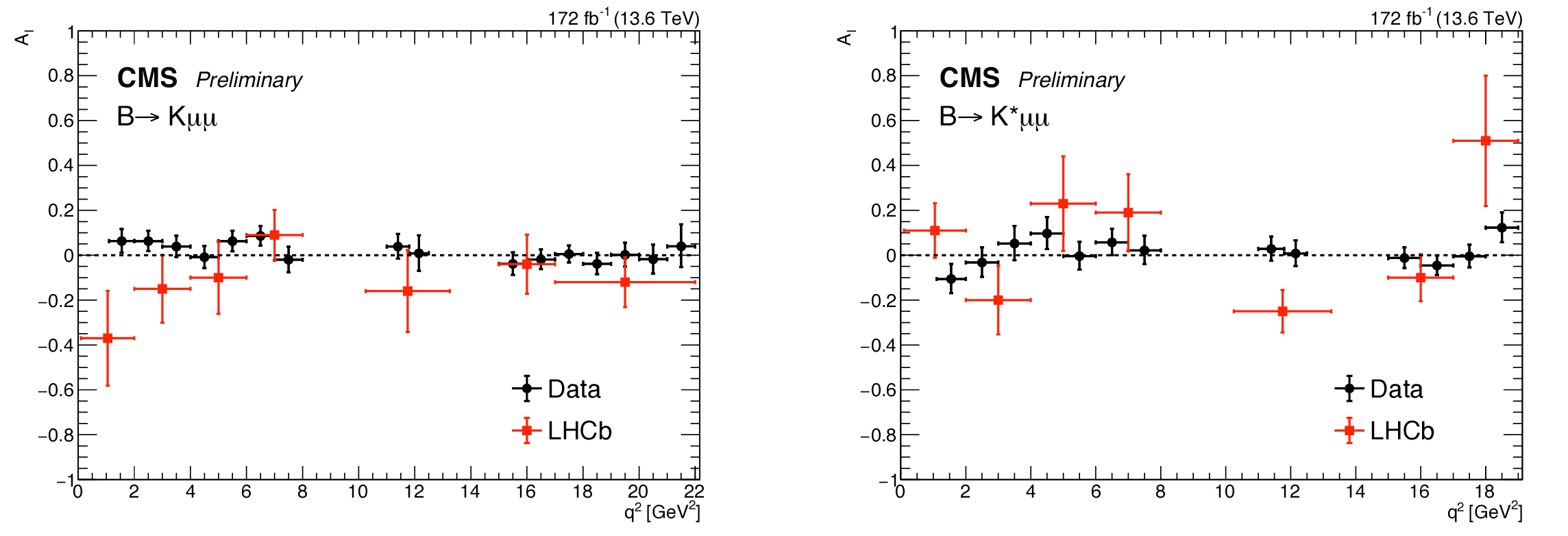
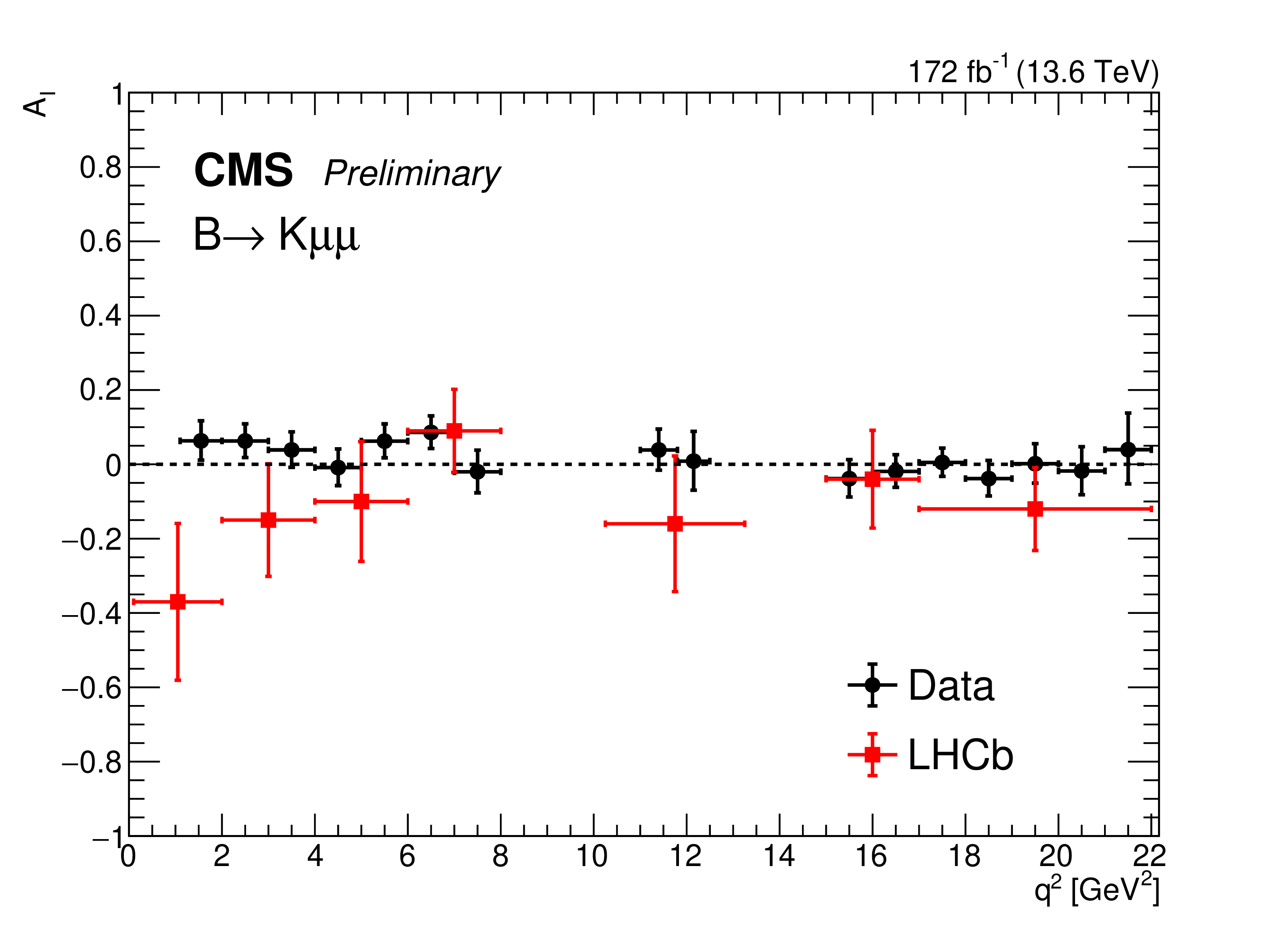
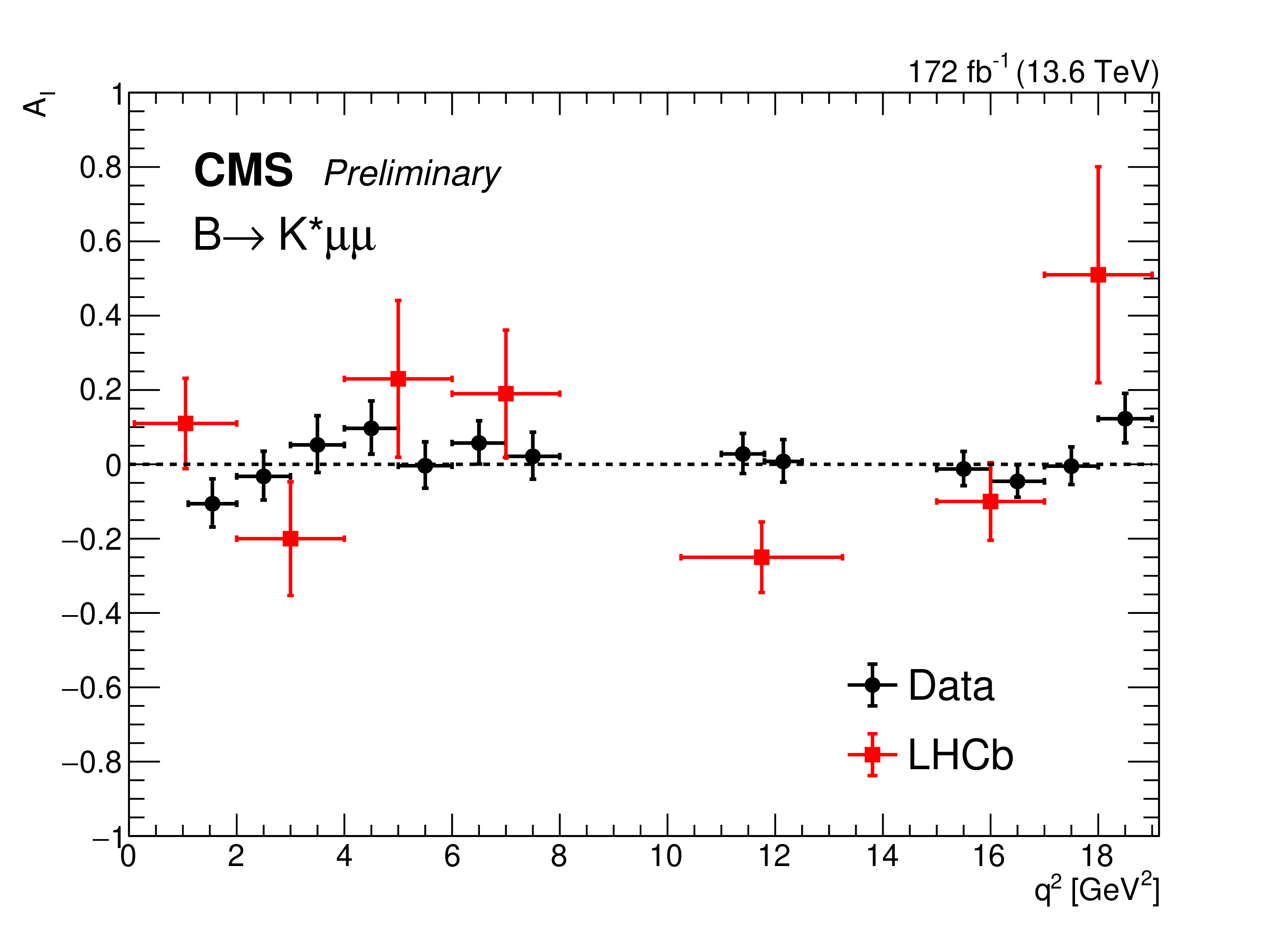
CP-averaged isospin asymmetries measured as functions of $ q^{2} $ for $ {\mathrm{B}}\to\mathrm{K}\mu\mu $ (left) and $ {\mathrm{B}}\to\mathrm{K}^{*}\mu\mu $ (right) decays modes. |
png pdf |
Figure 7-a:
CP-averaged isospin asymmetries measured as functions of $ q^{2} $ for $ {\mathrm{B}}\to\mathrm{K}\mu\mu $ (left) and $ {\mathrm{B}}\to\mathrm{K}^{*}\mu\mu $ (right) decays modes. |
png pdf |
Figure 7-b:
CP-averaged isospin asymmetries measured as functions of $ q^{2} $ for $ {\mathrm{B}}\to\mathrm{K}\mu\mu $ (left) and $ {\mathrm{B}}\to\mathrm{K}^{*}\mu\mu $ (right) decays modes. |
png pdf |
Figure 8:
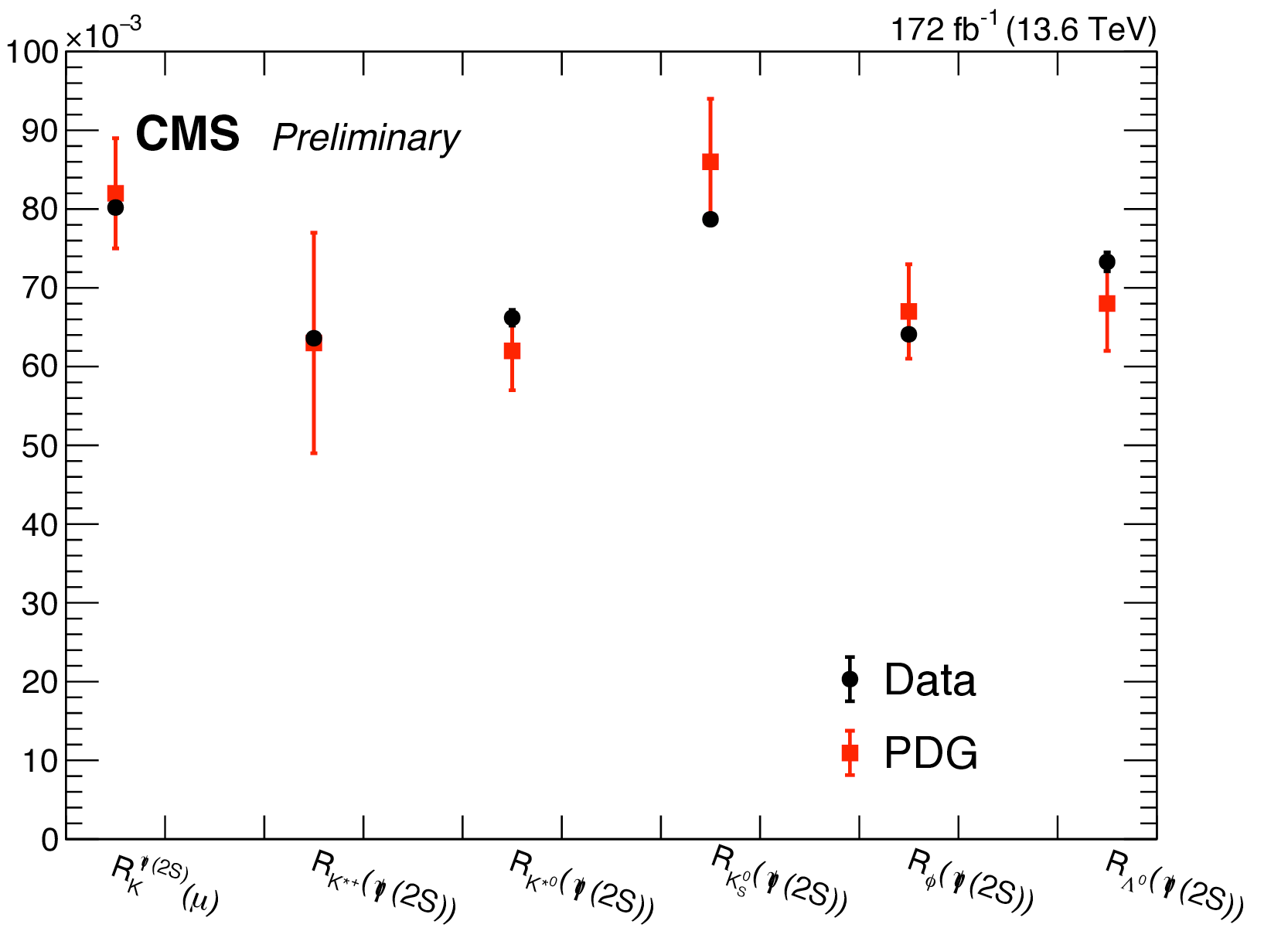
The $ R_{\Upsilon_{\mathrm{s}}}(\psi(2S)) $ ratios. |
png pdf |
Figure 9:
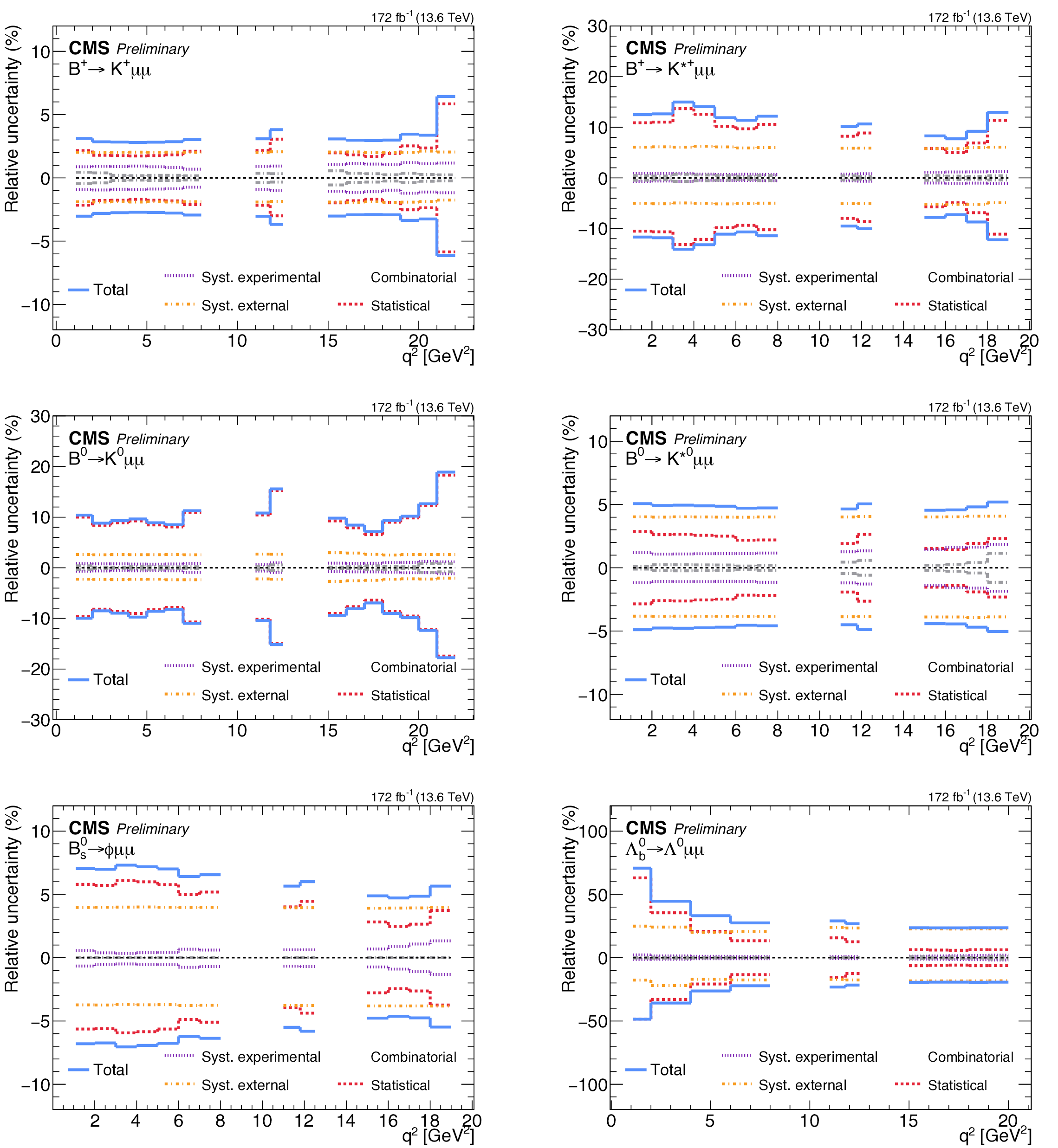
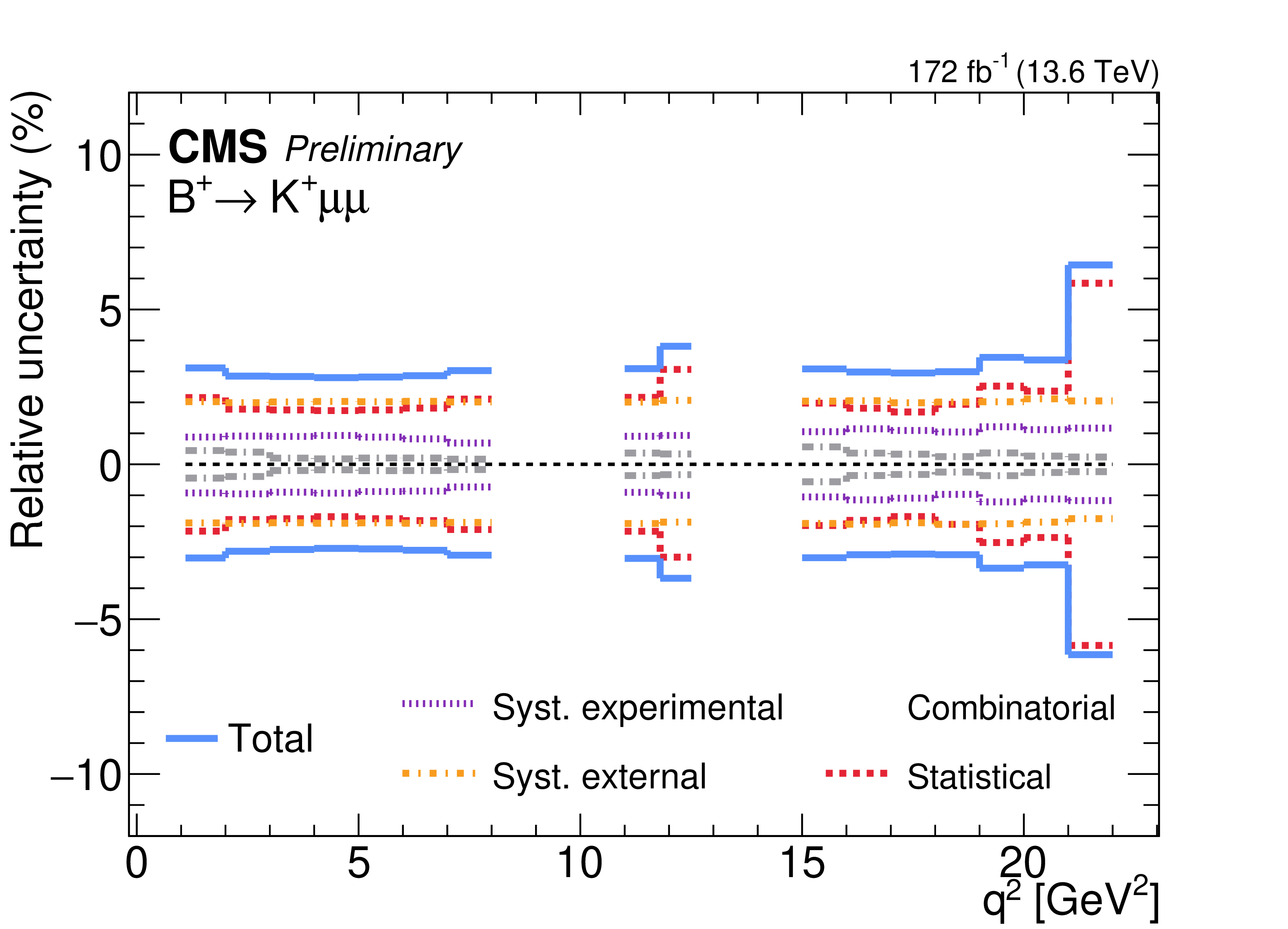
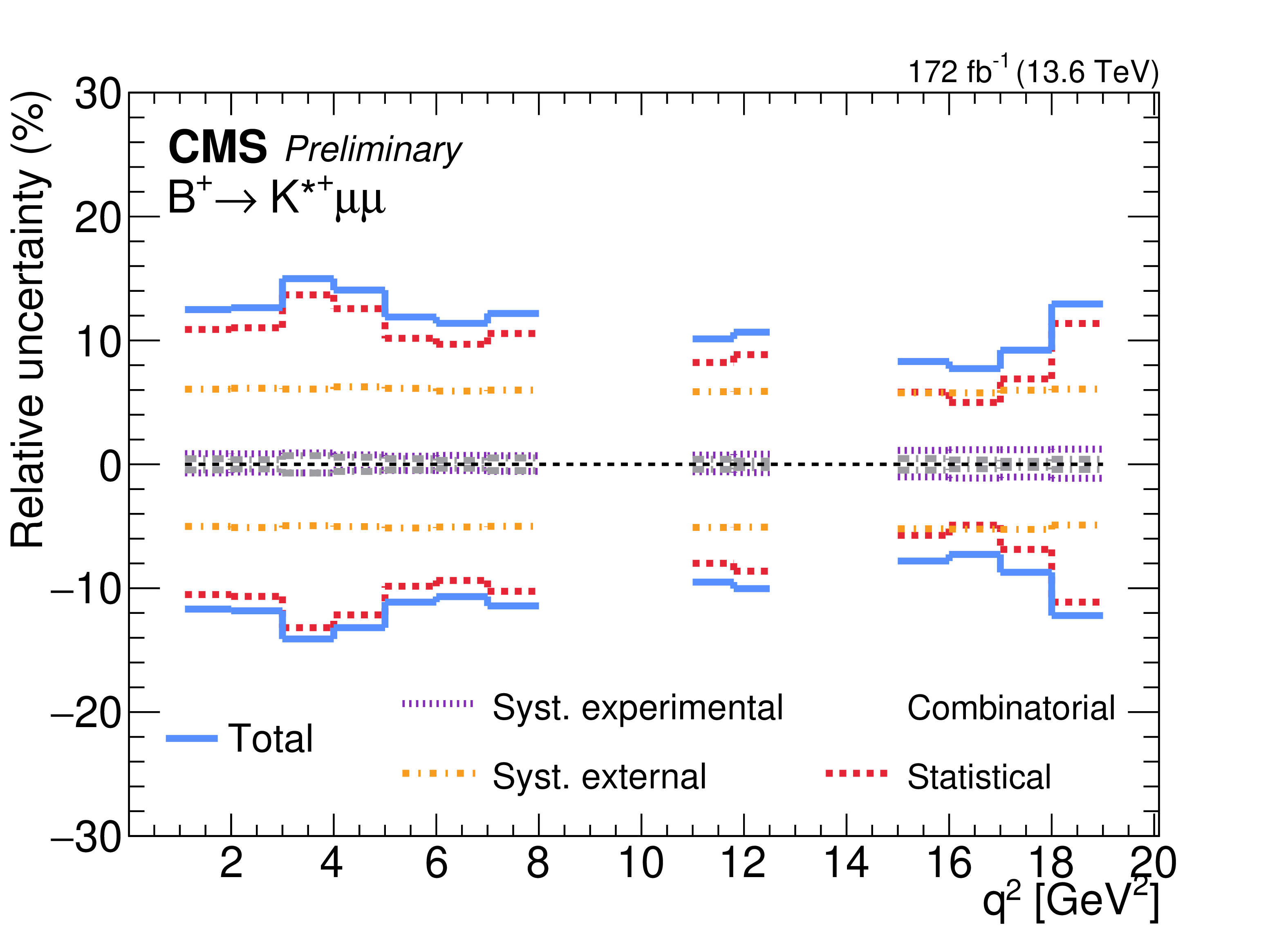
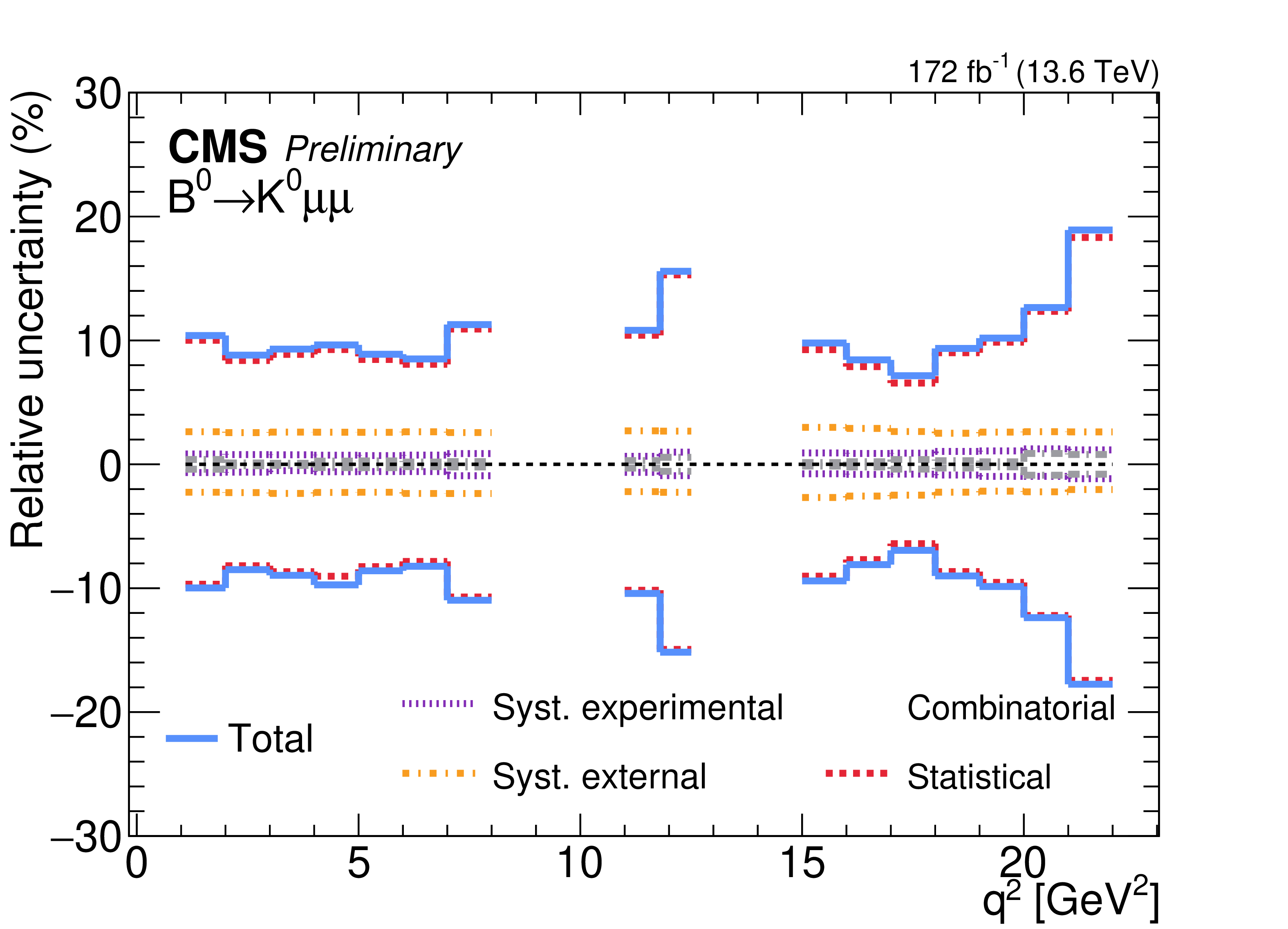
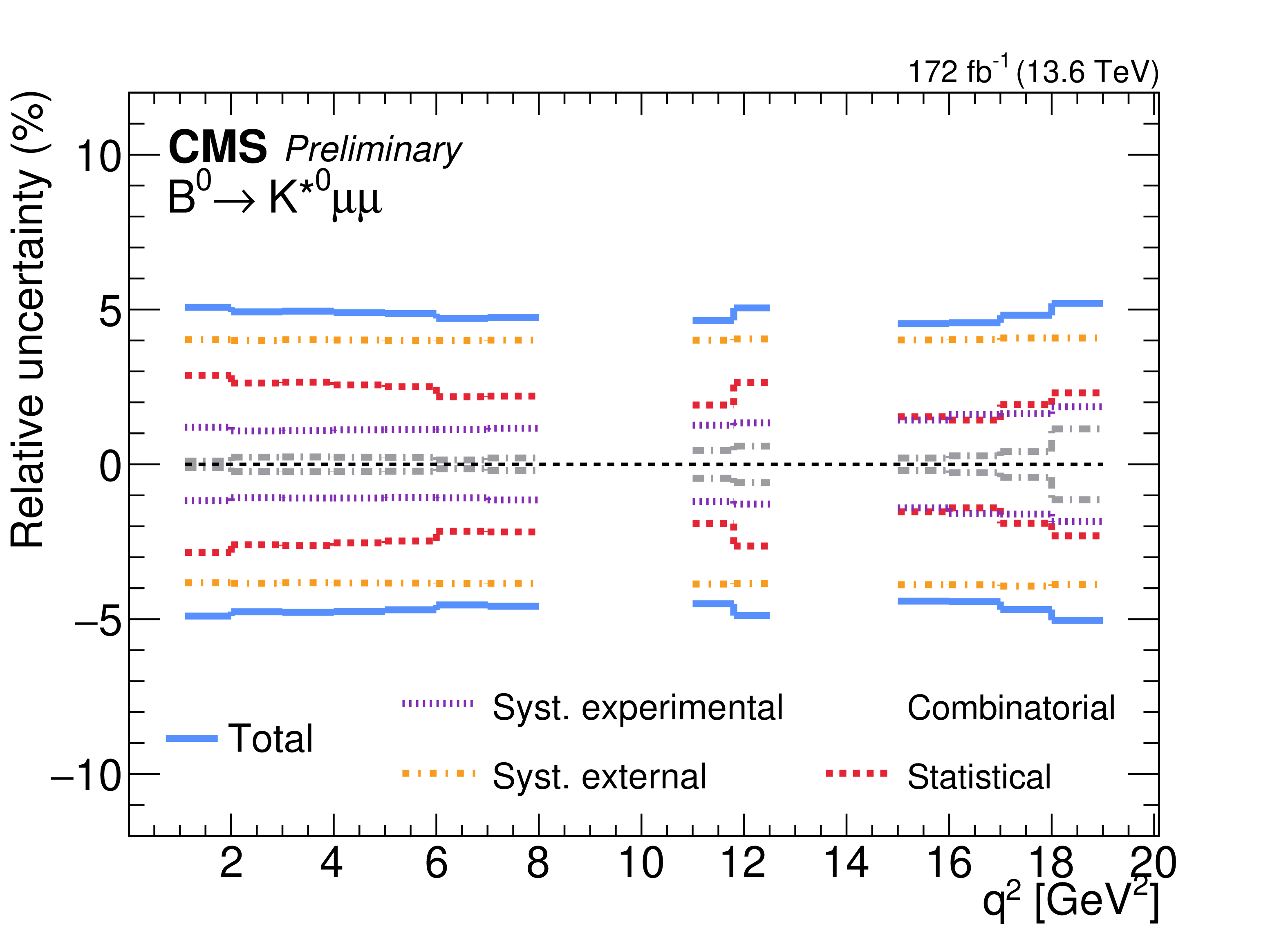
Breakdown of uncertainties using the COMBINE package for $ {\mathrm{B}^{+}}\to \mathrm{K^+}\mu\mu $ in upper left figure, $ {\mathrm{B}^{+}}\to\mathrm{K}^{*+}\mu\mu $ in upper right, $ {\mathrm{B}^0}\to \mathrm{K^0}\mu\mu $ in middle left, $ {\mathrm{B}^0}\to{\mathrm{K}}^{\ast0} \mu\mu $ in middle right, $ \mathrm{B}_{s}^{0}\to\phi\mu\mu $ in lower left and $ \Lambda_{b}^{0}\to\Lambda\mu\mu $ in lower right. |
png pdf |
Figure 9-a:
Breakdown of uncertainties using the COMBINE package for $ {\mathrm{B}^{+}}\to \mathrm{K^+}\mu\mu $ in upper left figure, $ {\mathrm{B}^{+}}\to\mathrm{K}^{*+}\mu\mu $ in upper right, $ {\mathrm{B}^0}\to \mathrm{K^0}\mu\mu $ in middle left, $ {\mathrm{B}^0}\to{\mathrm{K}}^{\ast0} \mu\mu $ in middle right, $ \mathrm{B}_{s}^{0}\to\phi\mu\mu $ in lower left and $ \Lambda_{b}^{0}\to\Lambda\mu\mu $ in lower right. |
png pdf |
Figure 9-b:
Breakdown of uncertainties using the COMBINE package for $ {\mathrm{B}^{+}}\to \mathrm{K^+}\mu\mu $ in upper left figure, $ {\mathrm{B}^{+}}\to\mathrm{K}^{*+}\mu\mu $ in upper right, $ {\mathrm{B}^0}\to \mathrm{K^0}\mu\mu $ in middle left, $ {\mathrm{B}^0}\to{\mathrm{K}}^{\ast0} \mu\mu $ in middle right, $ \mathrm{B}_{s}^{0}\to\phi\mu\mu $ in lower left and $ \Lambda_{b}^{0}\to\Lambda\mu\mu $ in lower right. |
png pdf |
Figure 9-c:
Breakdown of uncertainties using the COMBINE package for $ {\mathrm{B}^{+}}\to \mathrm{K^+}\mu\mu $ in upper left figure, $ {\mathrm{B}^{+}}\to\mathrm{K}^{*+}\mu\mu $ in upper right, $ {\mathrm{B}^0}\to \mathrm{K^0}\mu\mu $ in middle left, $ {\mathrm{B}^0}\to{\mathrm{K}}^{\ast0} \mu\mu $ in middle right, $ \mathrm{B}_{s}^{0}\to\phi\mu\mu $ in lower left and $ \Lambda_{b}^{0}\to\Lambda\mu\mu $ in lower right. |
png pdf |
Figure 9-d:
Breakdown of uncertainties using the COMBINE package for $ {\mathrm{B}^{+}}\to \mathrm{K^+}\mu\mu $ in upper left figure, $ {\mathrm{B}^{+}}\to\mathrm{K}^{*+}\mu\mu $ in upper right, $ {\mathrm{B}^0}\to \mathrm{K^0}\mu\mu $ in middle left, $ {\mathrm{B}^0}\to{\mathrm{K}}^{\ast0} \mu\mu $ in middle right, $ \mathrm{B}_{s}^{0}\to\phi\mu\mu $ in lower left and $ \Lambda_{b}^{0}\to\Lambda\mu\mu $ in lower right. |
png pdf |
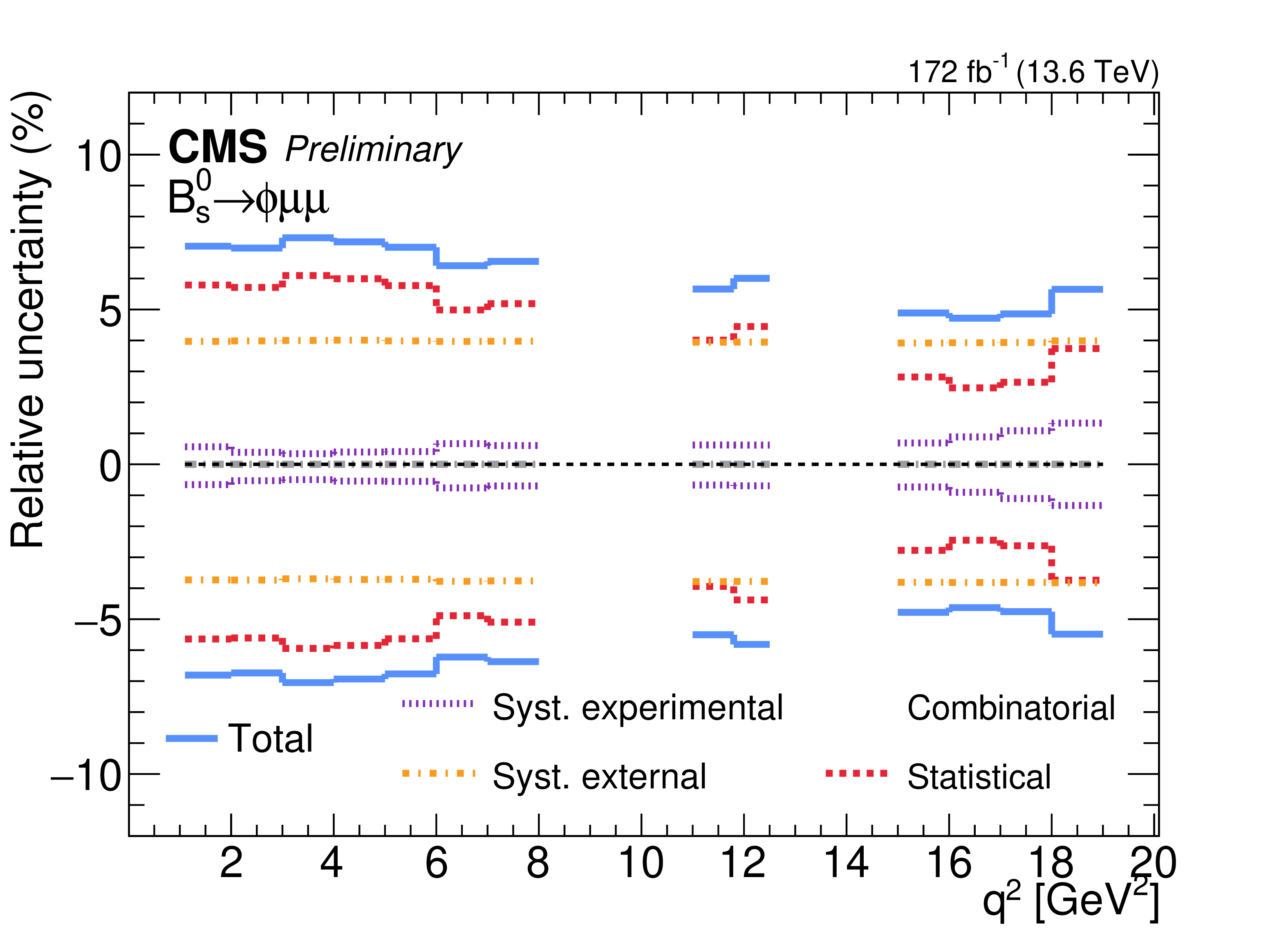
Figure 9-e:
Breakdown of uncertainties using the COMBINE package for $ {\mathrm{B}^{+}}\to \mathrm{K^+}\mu\mu $ in upper left figure, $ {\mathrm{B}^{+}}\to\mathrm{K}^{*+}\mu\mu $ in upper right, $ {\mathrm{B}^0}\to \mathrm{K^0}\mu\mu $ in middle left, $ {\mathrm{B}^0}\to{\mathrm{K}}^{\ast0} \mu\mu $ in middle right, $ \mathrm{B}_{s}^{0}\to\phi\mu\mu $ in lower left and $ \Lambda_{b}^{0}\to\Lambda\mu\mu $ in lower right. |
png pdf |
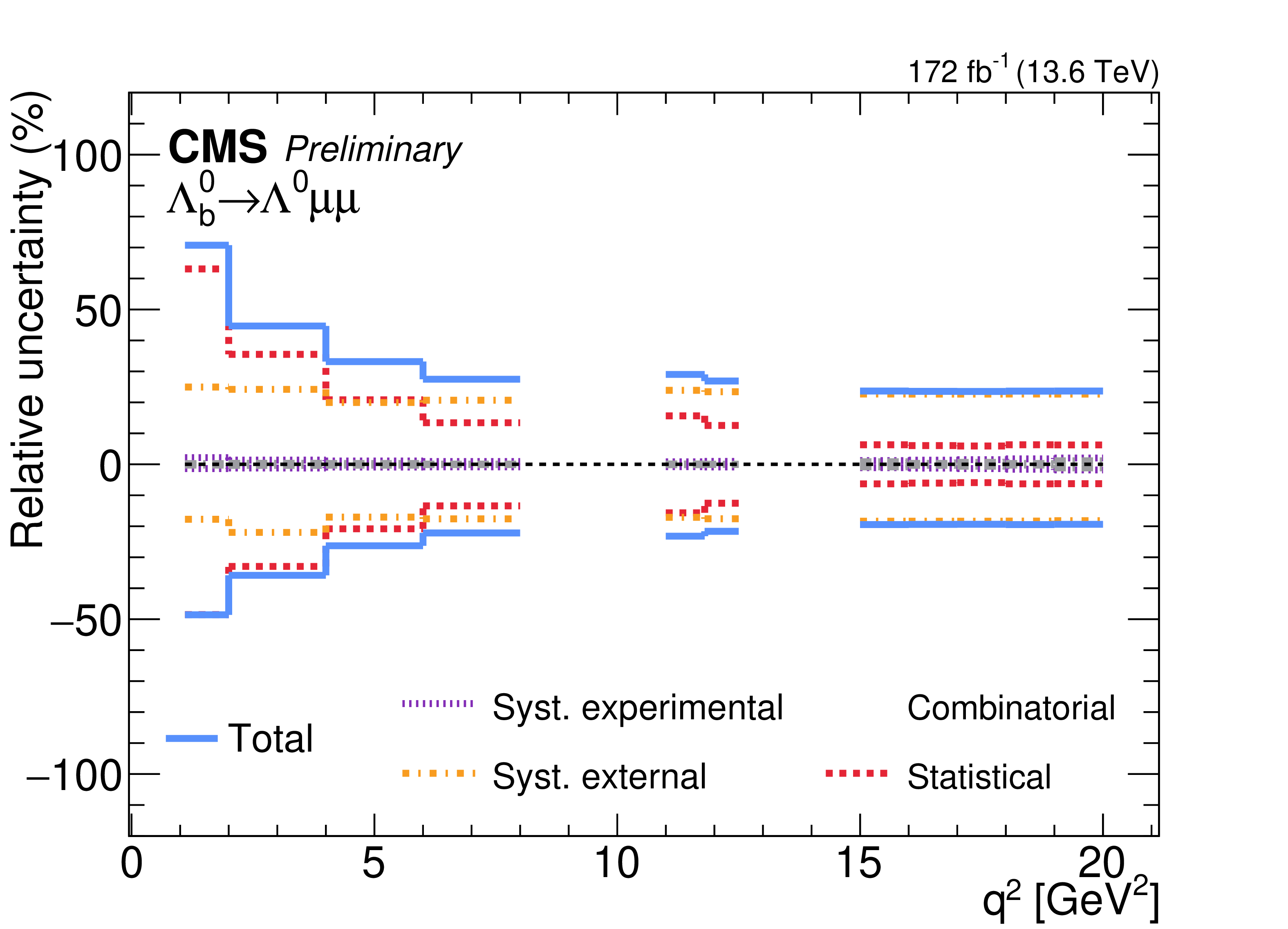
Figure 9-f:
Breakdown of uncertainties using the COMBINE package for $ {\mathrm{B}^{+}}\to \mathrm{K^+}\mu\mu $ in upper left figure, $ {\mathrm{B}^{+}}\to\mathrm{K}^{*+}\mu\mu $ in upper right, $ {\mathrm{B}^0}\to \mathrm{K^0}\mu\mu $ in middle left, $ {\mathrm{B}^0}\to{\mathrm{K}}^{\ast0} \mu\mu $ in middle right, $ \mathrm{B}_{s}^{0}\to\phi\mu\mu $ in lower left and $ \Lambda_{b}^{0}\to\Lambda\mu\mu $ in lower right. |
png pdf |
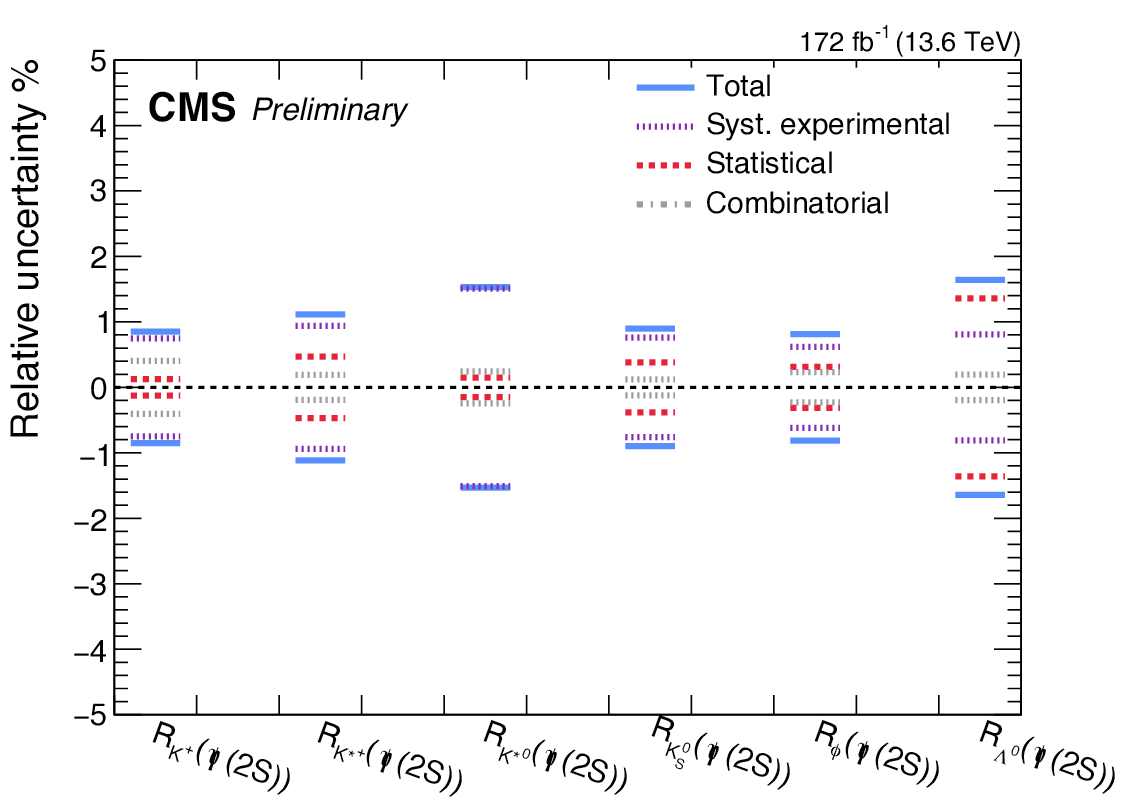
Figure 10:
Breakdown of uncertainties using the COMBINE package for the $ R_{\Upsilon_{\mathrm{s}}}(\psi(2S)) $ ratios. |
| Tables | |
png pdf |
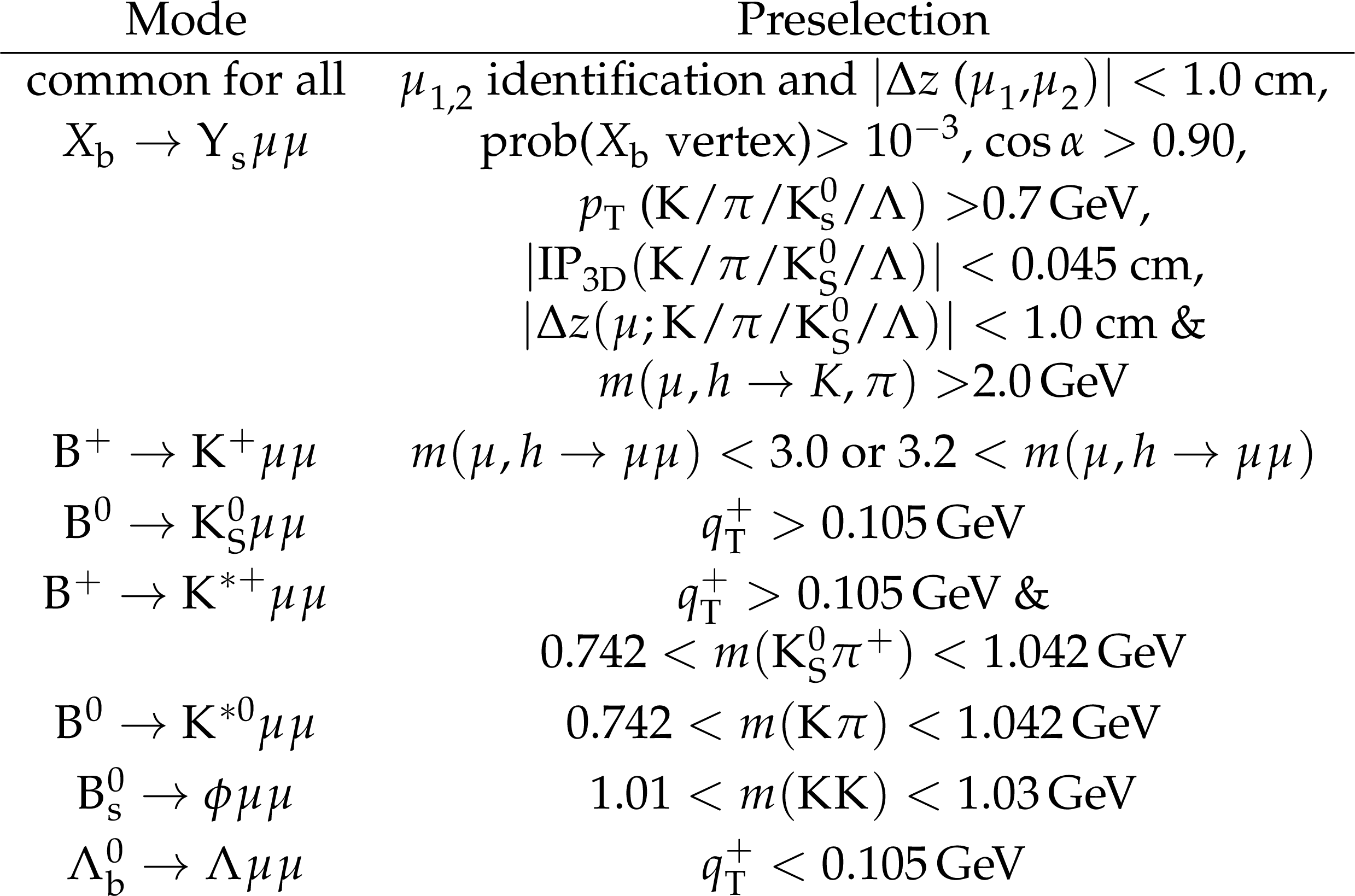
Table 1:
Preselection |
png pdf |
Table 2:
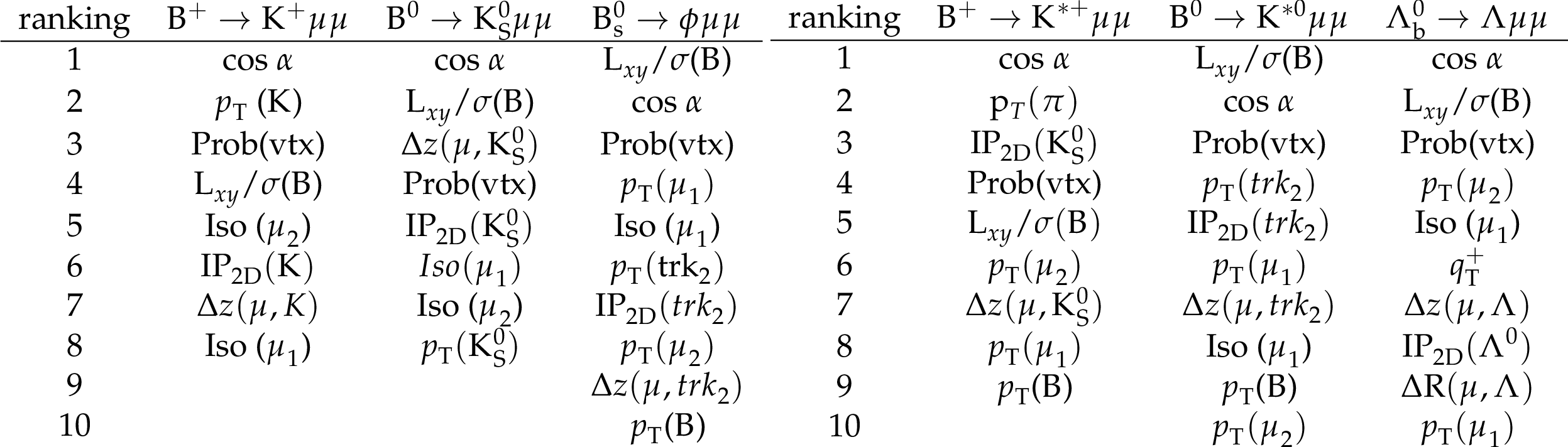
List of BDT training variables. The training variables are listed according to their importance on the BDT output. |
png pdf |
Table 3:
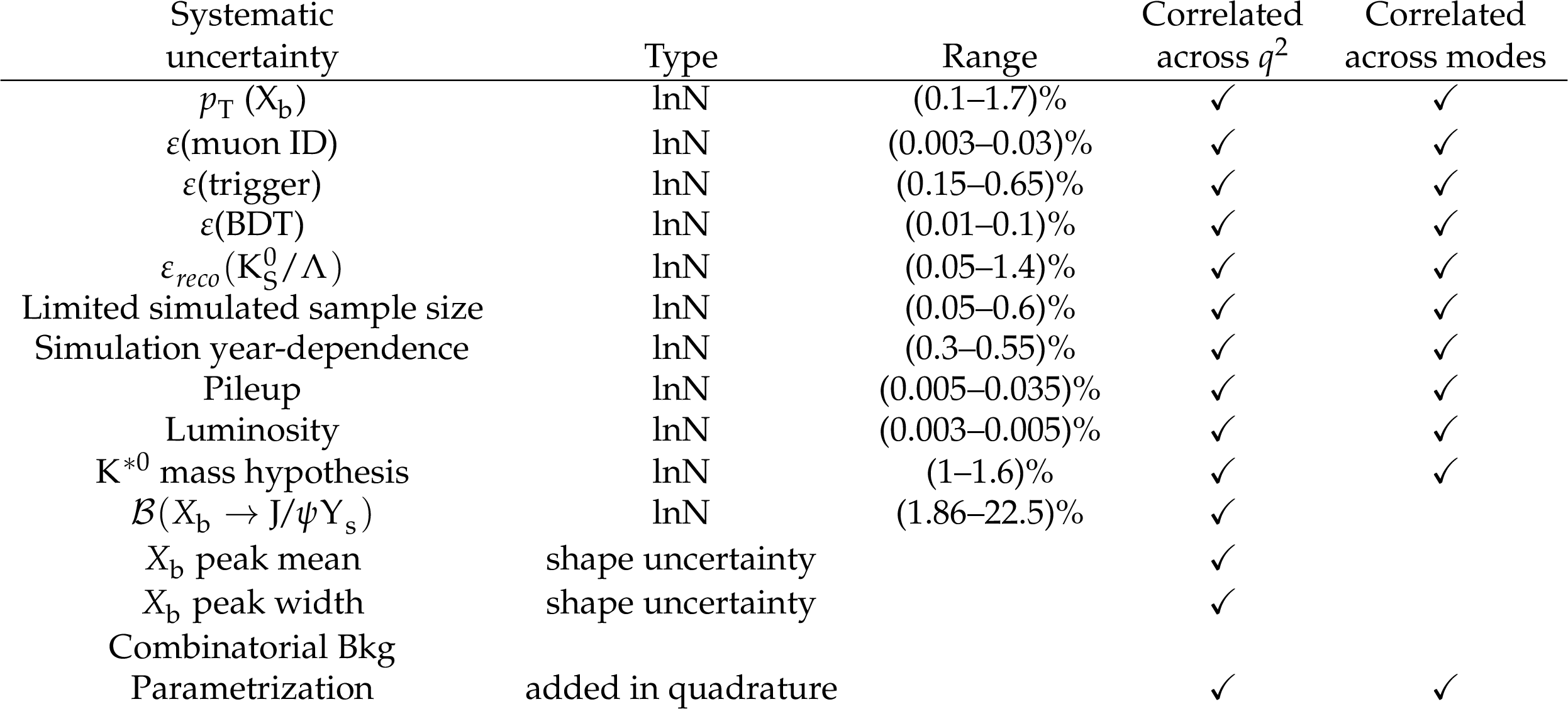
Systematic uncertainties of branching ratios. The "Range" column corresponds to the minimum and maximum value of the uncertainty across the $ q^{2} $ bins and decay modes. |
png pdf |
Table 4:
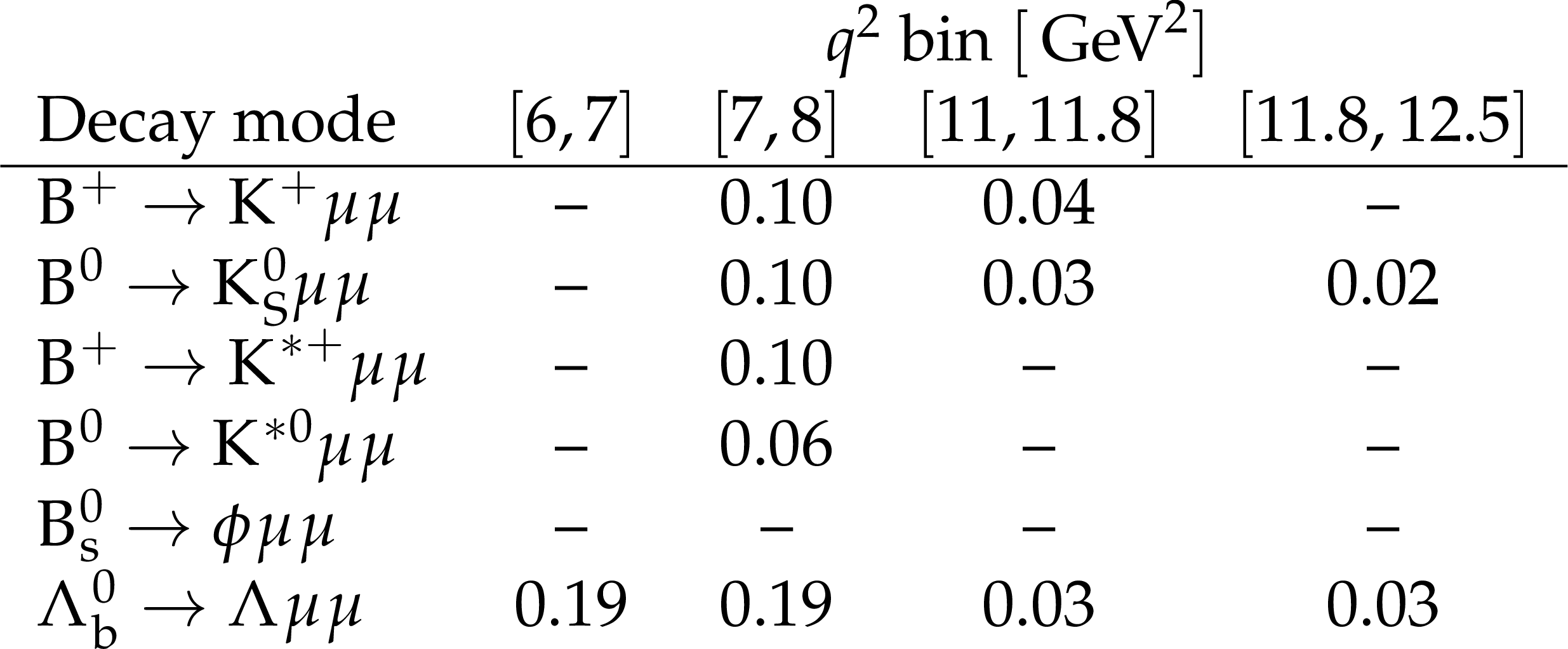
$ \Delta m $ values. |
png pdf |
Table 5:
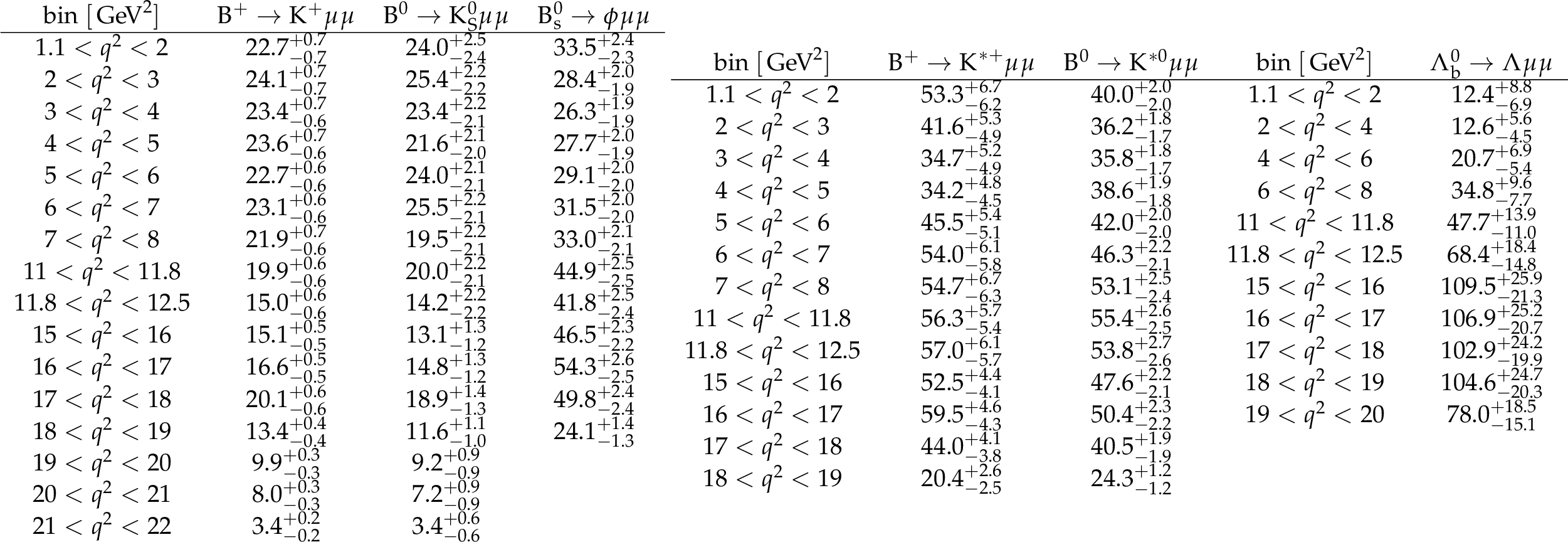
Differential branching fraction results $ [ \text{GeV}^{-2}] $ along with the total uncertainties at 68% CL intervals. The values shown are multiplied by a factor of $ 10^{9} $. |
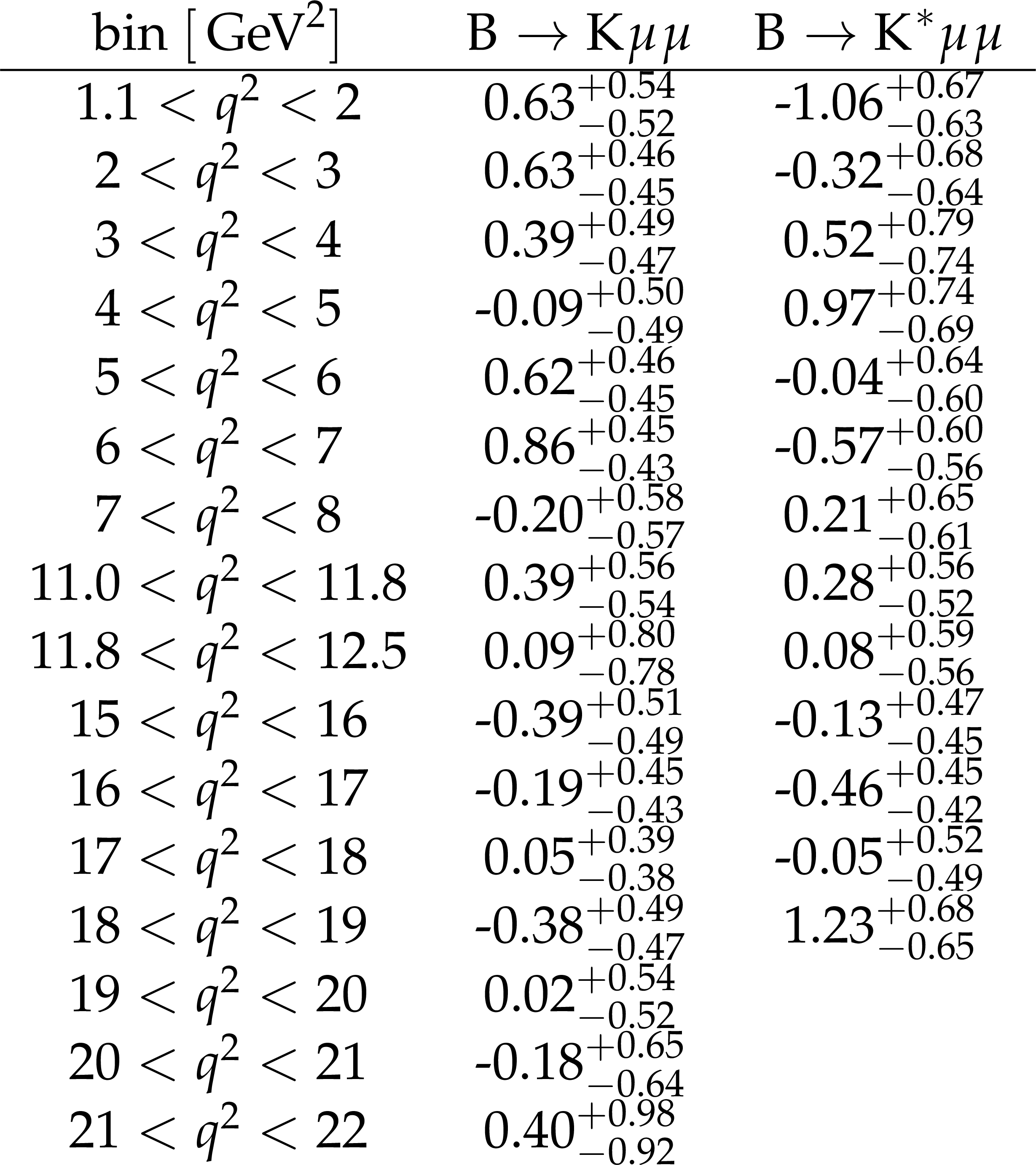
png pdf |
Table 6:
Isospin asymmetry results along with the total uncertainties at 68% CL intervals. The values shown are multiplied by a factor of 10. |
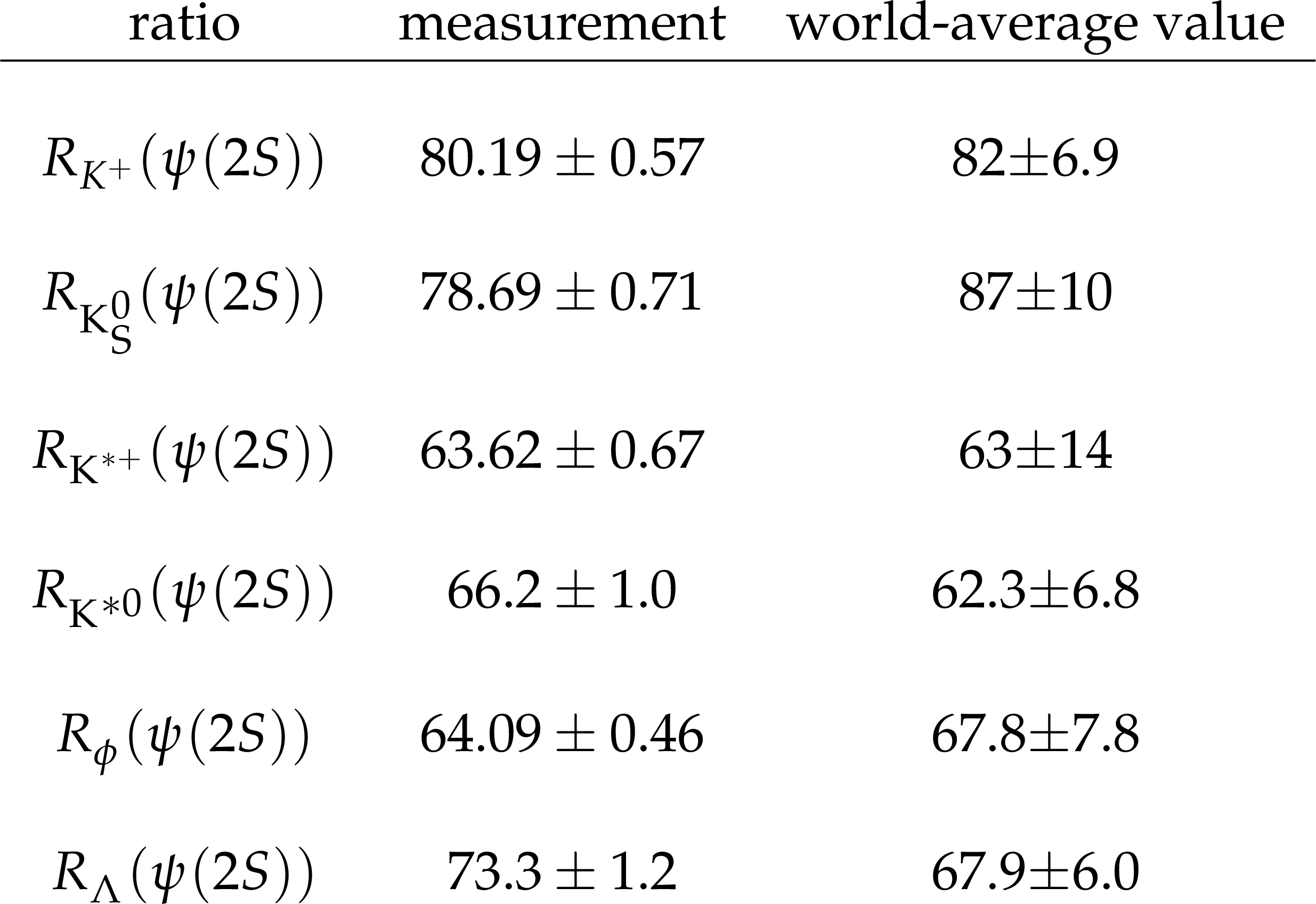
png pdf |
Table 7:
$ R_{\Upsilon_{\mathrm{s}}}(\psi(2S)) $ measurements along with the total uncertainties. The values shown are multiplied by a factor of $ \times 10^{3} $. |
| Summary |
| This note presents measurements of the differential branching fraction measurements as a function of the squared dimuon invariant mass $ d\mathcal{B}/dq^{2} $, for six rare decays of b-flavored hadrons, described at quark level by flavor-changing neutral-currents $ \mathrm{b}\to\mathrm{s}\mu\mu $: $ {\mathrm{B}^{+}}\to\mathrm{K^+}\mu\mu $, $ {\mathrm{B}^{+}}\to K^{*+}\mu\mu $, $ {\mathrm{B}^0}\to\mathrm{K^0_S}\mu\mu $, $ {\mathrm{B}^0}\to{\mathrm{K}}^{\ast0} \mu\mu $, $ \mathrm{B}_{s}\to\phi\mu\mu $, and $ \Lambda_{b}^{0}\to\Lambda\mu\mu $. All differential branching fractions are measured with respect to the corresponding resonant decay with a $ \mathrm{J}/\psi $, to limit the systematic uncertainties. The results are obtained using proton-proton collisions recorded by the CMS detector at CERN LHC during 2022--2024 at $ \sqrt{s}= $ 13.6 TeV, corresponding to an integrated luminosity of 172 fb$ ^{-1} $. The results, along with the 68% CL statistical and systematic uncertainties, are obtained by fitting simultaneously the mass distributions of these decay modes and $ q^{2} $ bins using the CMS statistical analysis tool. The results are compared with the SM theoretical predictions calculated with various software packages. The pseudoscalar $ {\mathrm{B}^{+}}\to\mathrm{K^+}\mu\mu $ and $ {\mathrm{B}^0}\to\mathrm{K^0_S}\mu\mu $ modes are at the edges of the theory bands, while the vector $ {\mathrm{B}^{+}}\to\mathrm{K}^{*+}\mu\mu $ and $ {\mathrm{B}^0}\to{\mathrm{K}}^{\ast0} \mu\mu $ modes are closer to the predictions. The $ \mathrm{B}_{s}\to\phi\mu\mu $ mode is lower than all the theory predictions, as already seen by LHCb and previous CMS measurement, but with smaller uncertainties. The $ \Lambda_{b}^{0}\to\Lambda\mu\mu $ mode is dominated by the statistical uncertainty. In all cases, the tendencies that have been reported for the $ d\mathcal{B}/dq^{2} $ observables with respect to the theoretical predictions from other analyses and other experiments are verified from the current work. The statistical uncertainty is significantly reduced with respect to previous CMS and LHCb and results and are now comparable with the external systematic uncertainties arising from the normalization $ X_{\mathrm{b}}\to \mathrm{J}/\psi \Upsilon_{\mathrm{s}} $ modes. The isospin asymmetries for the pseudoscalar $ {\mathrm{B}}\to\mathrm{K}\mu\mu $ and vector $ {\mathrm{B}}\to\mathrm{K^{\ast}(892)}\mu\mu $ modes are measured, as a function of $ q^{2} $, and the results are compatible with zero, i.e.,, with the SM prediction, with significant uncertainty reduction, and more $ q^{2} $ bins due to larger sample. In addition, all the $ R_{\Upsilon_{\mathrm{s}}}(\psi(2S)) $ ratios are consistent with the corresponding world-average values, with uncertainties that are more than an order of magnitude smaller. For all the results, the compatibility with data from 2022, 2023, and 2024 is observed. |
| References | ||||
| 1 | UA1 Collaboration | A search for rare B meson decays at the CERN Sp$ \bar{p} $S collider | Physics Letters B 262 (1991) 163 | |
| 2 | A. Ali, T. Mannel, and T. Morozumi | Forward-backward asymmetry of dilepton angular distribution in the decay $ b\to s\ell^{+}\ell^{-} $ | Physics Letters B 273 (1991) 505 | |
| 3 | CLEO Collaboration | Improved Upper Limits on the Flavor-Changing Neutral Current Decays $ \mathit{B}\rightarrow\mathit{K}{\ell}^{+}{\ell}^{-} $ and $ \mathit{B}\rightarrow{\mathit{K}}^{*}(892){\ell}^{+}{\ell}^{-} $ | PRL 87 (2001) 181803 | hep-ex/0106060 |
| 4 | Belle Collaboration | Observation of the decay $ \mathit{B}\rightarrow\mathit{K}{\mathit{l}}^{+}{\mathit{l}}^{-} $ | PRL 88 (2001) 021801 | hep-ex/0109026 |
| 5 | Belle Collaboration | Observation of $ B\rightarrow{K}^{*}{\ell}^{+}{\ell}^{-} $ | PRL 91 (2003) 261601 | hep-ex/0308044 |
| 6 | Belle Collaboration | Measurement of the Differential Branching Fraction and Forward-Backward Asymmetry for $ B\rightarrow{K}^{(*)}{l}^{+}{l}^{-} $ | PRL 103 (2009) 171801 | 0904.0770 |
| 7 | CDF Collaboration | Measurement of the Forward-Backward Asymmetry in the $ B\rightarrow{K}^{(*)}{\mu}^{+}{\mu}^{-} $ Decay and First Observation of the $ {B}_{s}^{0}\rightarrow\phi{\mu}^{+}{\mu}^{-} $ Decay | PRL 106 (2011) 161801 | 1101.1028 |
| 8 | BABAR Collaboration | Measurement of branching fractions and rate asymmetries in the rare decays $ B\rightarrow{K}^{(*)}{\ell}^{+}{\ell}^{-} $ | PRD 86 (2012) 032012 | 1204.3933 |
| 9 | LHCb Collaboration | Differential branching fraction and angular analysis of the decay $ B^{0} \to K^{*0} \mu^{+}\mu^{-} $ | JHEP 08 (2013) 131 | 1304.6325 |
| 10 | LHCb Collaboration | Measurement of the isospin asymmetry in $ B \to K^{(*)}\mu^+\mu^- $ decays | JHEP 07 (2012) 133 | 1205.3422 |
| 11 | LHCb Collaboration | Test of lepton universality in b$ \rightarrow $ s $ l^{+} l^{-} $ decays | Physical review letters 131 (2023) 051803 | 2212.09152 |
| 12 | LHCb Collaboration | Test of lepton universality with B$ ^{0}\rightarrow $ K$ ^{*0}l^{+}l^{-} $ decays | JHEP 08 (2017) 055 | 1705.05802 |
| 13 | LHCb Collaboration | Tests of Lepton Universality using B$ ^{0}\rightarrow $ K$ _{S}^{0} l^{+} l^{-} $ and B$ ^{+}\rightarrow $ K$ ^{*+} l^{+} l^{-} $ Decays | Physical review letters 128 (2022) 191802 | 2110.09501 |
| 14 | LHCb Collaboration | Angular analysis and differential branching fraction of the decay B$ _{s}^{0}\rightarrow \phi\mu^+ \mu^- $ | Journal of High Energy Physics 2015 (2015) 1 | 1506.08777 |
| 15 | LHCb Collaboration | Differential branching fraction and angular analysis of $ \Lambda_{b}^{0}\rightarrow \Lambda\mu^{+}\mu^{-} $ decays | Journal of High Energy Physics 2015 (2015) 1 | 1503.07138 |
| 16 | CMS Collaboration | Angular analysis and branching fraction measurement of the decay $ B^{0}\to K^{*0}\mu^{+}\mu^{-} $ | Physics Letters B 727 (2013) 77 | CMS-BPH-11-009 1308.3409 |
| 17 | CMS Collaboration | Test of lepton flavor universality in $ \text{B}^{\pm} \to \text{K}^{\pm}\mu^+\mu^- $ and $ \text{B}^{\pm} \to \text{K}^{\pm}\text{e}^+\text{e}^- $ decays in proton-proton collisions at $ \sqrt{\textit{s}} = \text{13} \text{TeV} $ | Reports on Progress in Physics 87 (2024) 077802 | CMS-BPH-22-005 2401.07090 |
| 18 | CMS Collaboration | Measurement of angular observables and differential branching fraction for BsToPhiMuMu at 13 TeV | technical report, CERN, Geneva, 2026 link |
|
| 19 | J. Lyon and R. Zwicky | Isospin asymmetries in $ B\rightarrow\mathbf{(}{K}^{*},\rho\mathbf{)}\gamma/{l}^{\mathbf{+}}{l}^{\mathbf{-}} $ and $ B\rightarrowK{l}^{\mathbf{+}}{l}^{\mathbf{-}} $ in and beyond the standard model | PRD 88 (2013) 094004 | 1305.4797 |
| 20 | Particle Data Group Collaboration | Review of particle physics | PRD 110 (2024) 030001 | |
| 21 | CMS Collaboration | The CMS experiment at the CERN LHC | JINST 3 (2008) S08004 | |
| 22 | CMS Collaboration | Development of the CMS detector for the CERN LHC Run 3 | JINST 19 (2024) P05064 | CMS-PRF-21-001 2309.05466 |
| 23 | CMS Collaboration | Performance of the CMS Level-1 trigger in proton-proton collisions at $ \sqrt{s} = $ 13 TeV | JINST 15 (2020) P10017 | CMS-TRG-17-001 2006.10165 |
| 24 | CMS Collaboration | The CMS trigger system | JINST 12 (2017) P01020 | CMS-TRG-12-001 1609.02366 |
| 25 | CMS Collaboration | Performance of the CMS high-level trigger during LHC Run 2 | JINST 19 (2024) P11021 | CMS-TRG-19-001 2410.17038 |
| 26 | CMS Collaboration | Electron and photon reconstruction and identification with the CMS experiment at the CERN LHC | JINST 16 (2021) P05014 | CMS-EGM-17-001 2012.06888 |
| 27 | CMS Collaboration | Performance of the CMS muon detector and muon reconstruction with proton-proton collisions at $ s=\sqrt{13} $ TeV | JINST 13 (2018) P06015 | CMS-MUO-16-001 1804.04528 |
| 28 | CMS Collaboration | Description and performance of track and primary-vertex reconstruction with the CMS tracker | JINST 9 (2014) P10009 | CMS-TRK-11-001 1405.6569 |
| 29 | CMS Collaboration | Particle-flow reconstruction and global event description with the CMS detector | JINST 12 (2017) P10003 | CMS-PRF-14-001 1706.04965 |
| 30 | CMS Collaboration | Track impact parameter resolution for the full pseudo rapidity coverage in the 2017 dataset with the CMS phase-1 Pixel detector | link | |
| 31 | CMS Collaboration | Enriching the physics program of the CMS experiment via data scouting and data parking | Physics Reports 1115 (2025) 678 | CMS-EXO-23-007 2403.16134 |
| 32 | NNPDF Collaboration | Parton distributions from high-precision collider data | EPJC 77 (2017) 663 | 1706.00428 |
| 33 | T. Sjöstrand et al. | An introduction to PYTHIA 8.2 | Comput. Phys. Commun. 191 (2015) 159 | 1410.3012 |
| 34 | CMS Collaboration | Extraction and validation of a new set of CMS PYTHIA8 tunes from underlying-event measurements | EPJC 80 (2020) 4 | CMS-GEN-17-001 1903.12179 |
| 35 | D. J. Lange | The EvtGen particle decay simulation package | NIM A 462 (2001) 152 | |
| 36 | N. Davidson, T. Przedzinski, and Z. Was | Photos interface in C++: Technical and physics documentation | Computer Physics Communications 199 (2016) 86 | 1011.0937 |
| 37 | GEANT4 Collaboration | GEANT 4---a simulation toolkit | NIM A 506 (2003) 250 | |
| 38 | P. Ball and R. Zwicky | $ B_{d,s} \to \rho, \omega, K^*, \phi $ decay form-factors from light-cone sum rules revisited | PRD 71 (2005) 014029 | hep-ph/0412079 |
| 39 | A. Bharucha, D. M. Straub, and R. Zwicky | $ B\to V\ell^{+}\ell^{-} $ in the Standard Model from light-cone sum rules | Journal of High Energy Physics 2016 (2016) 1 | 1503.05534 |
| 40 | N. Gubernari, A. Kokulu, and D. van Dyk | B$ \to $P and B$ \to $V form factors from B-meson light-cone sum rules beyond leading twist | Journal of High Energy Physics 2019 (2019) | 1811.00983 |
| 41 | HPQCD Collaboration | B$ \to $K and D$ \to $K form factors from fully relativistic lattice QCD | PRD 107 (2023) 014510 | 2207.12468 |
| 42 | BaBar Collaboration | Measurement of the $ B \to J/\psi K^*(892) $ decay amplitudes | PRL 87 (2001) 241801 | hep-ex/0107049 |
| 43 | G. Mart \'\i et al. | Measurement of the $ \Lambda_{b}^{0}\to $J/$ \psi \Lambda $ angular distribution and the $ \Lambda_{b}^{0} $ polarisation in pp collisions | Journal of High Energy Physics, 2020 link |
2004.10563 |
| 44 | K. Prokofiev and T. Speer | A kinematic and a decay chain reconstruction library | link | |
| 45 | J. Podolanski and R. Armenteros | III. Analysis of V-events | The London, Edinburgh, and, 1954 Dublin Philosophical Magazine and Journal of Science 45 (1954) 13 |
|
| 46 | T. Chen and C. Guestrin | XGBoost: a scalable tree boosting system | link | 1603.02754 |
| 47 | M. Pivk and F. R. Le Diberder | Plots: A statistical tool to unfold data distributions | Nuclear Instruments and Methods in Physics Research Section A: Accelerators, Spectrometers, 2005 Detectors and Associated Equipment 555 (2005) 356 |
physics/0402083 |
| 48 | A. Barontini et al. | An FONLL prescription with coexisting flavor number pdfs | Journal of High Energy Physics 2024 (2024) 4 | 2408.07383 |
| 49 | CMS Collaboration | Performance of CMS muon reconstruction in pp collision events at $ s=\sqrt{7} $ TeV | Journal of Instrumentation 7 (2012) P10002 | CMS-MUO-10-004 1206.4071 |
| 50 | CMS Collaboration | The CMS statistical analysis and combination tool: Combine | Submitted to Comput. Softw. Big Sci, 2024 link |
CMS-CAT-23-001 2404.06614 |
| 51 | W. Verkerke and D. P. Kirkby | The RooFit toolkit for data modeling | in the International Conference for Computing in High-Energy and Nuclear Physics (CHEP03)... [eConf C0303241, MOLT007], 2003 Proceedings of the 1 (2003) 3 |
physics/0306116 |
| 52 | L. Moneta et al. | The RooStats Project | PoS ACAT 057, 2010 link |
1009.1003 |
| 53 | F. E. James | Statistical Methods in Experimental Physics | World Scientific, Singapore, 2 edition,, ISBN 978-981-270-527-3, 2006 link |
|
| 54 | D. M. Straub | Flavio: a python package for flavour and precision phenomenology in the standard model and beyond | arXiv preprint arXiv:1810.08132, 2018 link |
1810.08132 |
| 55 | D. van Dyk et al. | EOS: a software for flavor physics phenomenology | The European Physical Journal C 82 (2022) 569 | 2111.15428 |
| 56 | J. de Blas et al. | \textttHEPfit: a code for the combination of indirect and direct constraints on high energy physics models | The European Physical Journal C 80 (2020) 456 | 1910.14012 |
| 57 | M. Alguer'o et al. | To (b)e or not to (b)e: no electrons at LHCb | The European Physical Journal C 83 (2023) 648 | 2304.07330 |
| 58 | F. Mahmoudi | Superiso v2.3: A program for calculating flavor physics observables in supersymmetry | Computer Physics Communications 180 (2009) 1579 | 0808.3144 |
| 59 | W. Altmannshofer and D. M. Straub | New physics in $ b \to s $ transitions after LHC run 1 | The European Physical Journal C 75 (2015) 382 | 1411.3161 |
| 60 | N. Gubernari, M. Reboud, D. van Dyk, and J. Virto | Dispersive analysis of $ B \to K^{(*)} $ and $ B_s \to \phi $ form factors | Journal of High Energy Physics 2023 (2023) 153 | 2305.06301 |
| 61 | N. Gubernari, M. Reboud, D. van Dyk, and J. Virto | Improved theory predictions and global analysis of exclusive $ b \to s\mu^{+}\mu^{-} $ processes | Journal of High Energy Physics 2022 (2022) 133 | 2206.03797 |
| 62 | M. Ciuchini et al. | Charming penguins and lepton universality violation in $ b \to s\ell^{+}\ell^{-} $ decays | The European Physical Journal C 83 (2023) 64 | 2110.10126 |
| 63 | M. Ciuchini et al. | A Dispersive Look at Rare $ B $-meson Semileptonic Decays | link | 2607.03531 |
|
|
Compact Muon Solenoid LHC, CERN |

|
|
|
|
|
|