Compact Muon Solenoid
LHC, CERN
 Visit us: CMS Public Website, CMS Physics ;
Contact us: CMS Publications Committee
Visit us: CMS Public Website, CMS Physics ;
Contact us: CMS Publications Committee
| CMS-PAS-HIN-25-008 | ||
| Measurement of the charged particle nuclear modification factor in oxygen-oxygen collisions with CMS | ||
| CMS Collaboration | ||
| 2025-08-09 | ||
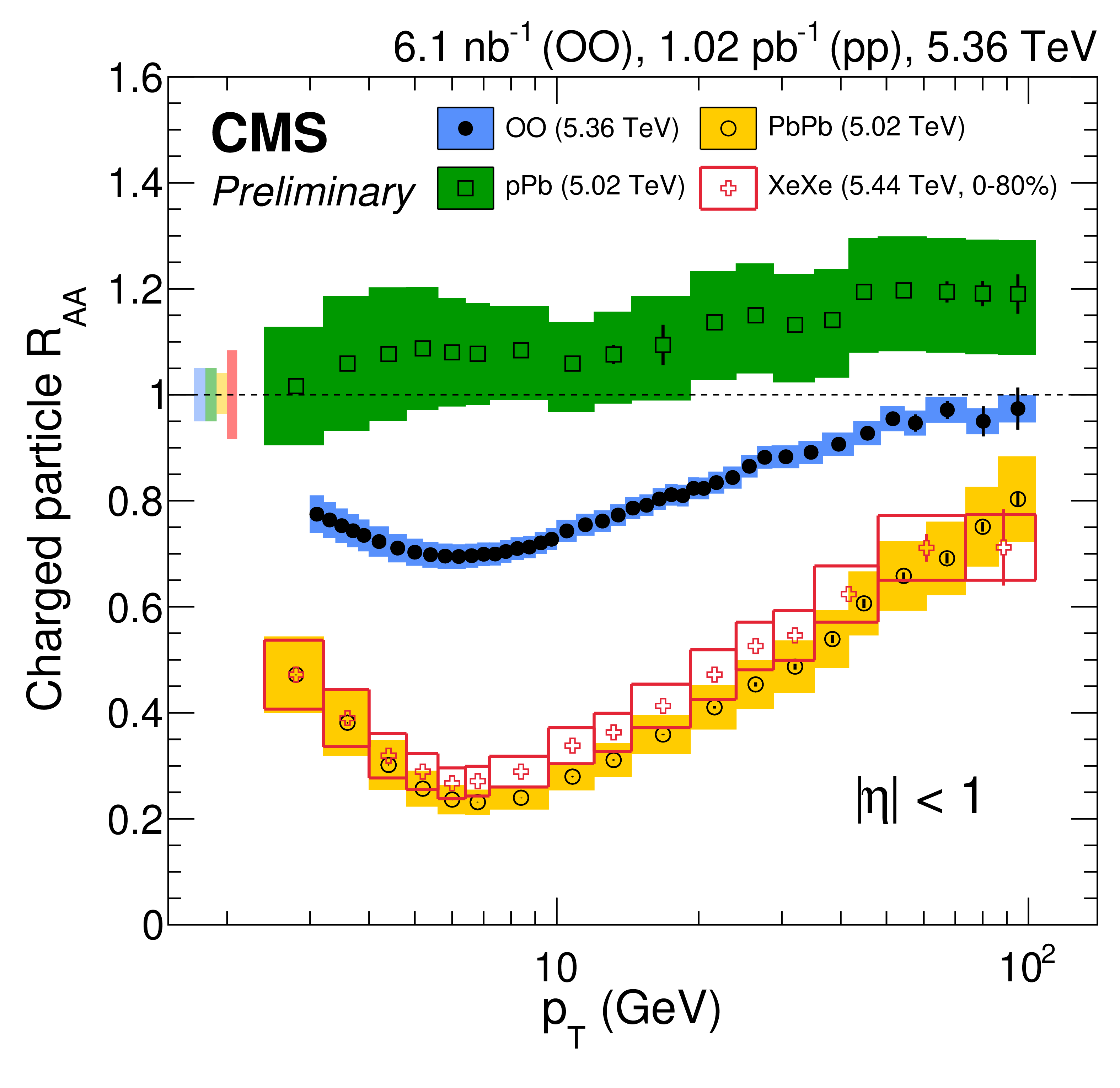
| Abstract: A hot medium, known as the quark-gluon plasma (QGP), is created in collisions of relativistic heavy nuclei such as lead or gold. Highly energetic quarks and gluons, collectively referred to as partons, lose energy as they travel through the QGP leading to suppressed production of particles with transverse momenta ($ p_{\mathrm{T}} $) of roughly 10-100 GeV. This suppression is typically quantified with the nuclear modification factor ($ R_{\text{AA}} $). Questions regarding what minimum system size is required to see parton energy loss effects remain, as no such suppression has been seen in smaller proton-lead collisions. Experiments involving light nuclei examine a domain that lies between these two extreme cases. Using 6.1 nb$^{-1} $ of oxygen-oxygen (OO) collisions and 1.02 pb$^{-1} $ of proton-proton data collected at a nucleon-nucleon center-of-mass energy of $ \sqrt{\smash[b]{s_{_{\mathrm{NN}}}}}= $ 5.36 TeV by the CMS experiment at the CERN LHC, charged particle invariant cross sections and the OO charged particle $ R_{\text{AA}} $ are measured as a function of particle $ p_{\mathrm{T}} $ for the first time. The $ R_{\text{AA}} $ is notably suppressed, with a local minimum of 0.69 $ \pm $ 0.04 at $ p_{\mathrm{T}}= $ 6 GeV, but increases to a value of 0.97 $ \pm $ 0.06 at $ p_{\mathrm{T}}= $ 100 GeV. To evaluate if parton energy loss effects may be present in OO collisions, the data are compared to previous measurements of other collision systems and a variety of theoretical models. | ||
|
Links:
CDS record (PDF) ;
CADI line (restricted) ;
These preliminary results are superseded in this paper, PRL 136 (2026) 162301. |
||
| Figures | |
png pdf |
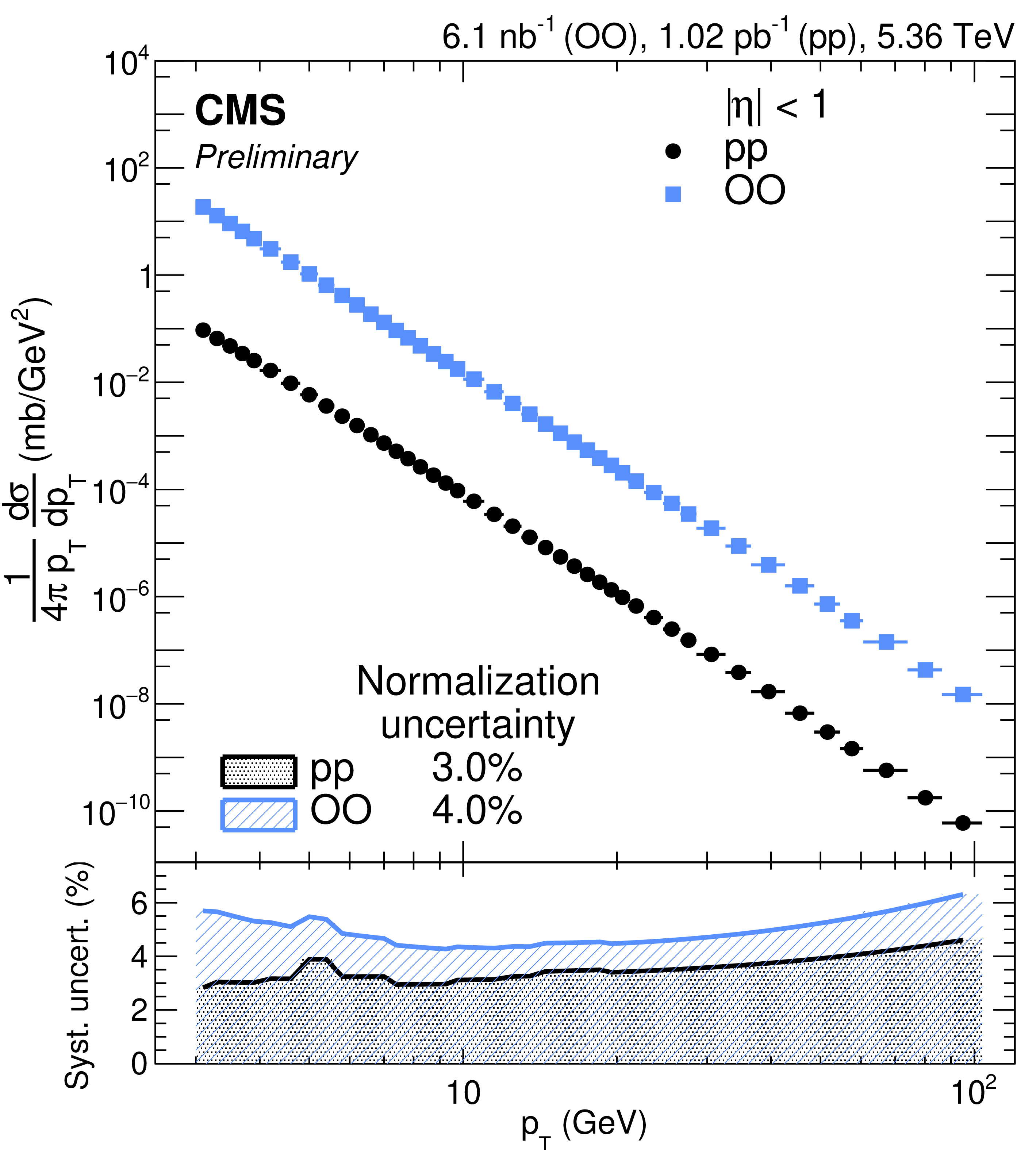
Figure 1:
Charged particle spectra for pp (black circles) and $ \text{OO} $ collisions (blue squares). Statistical uncertainties are smaller than the markers. The markers show the average cross section across the entire bin width, not the cross section value at the center of each bin. |
png pdf |
Figure 2:
The charged particle $ R_{\text{AA}} $ for 5.36 TeV $ \text{OO} $ collisions (solid markers) as a function of particle $ p_{\mathrm{T}} $. Error bars represent statistical uncertainties and boxes represent systematic uncertainties not related to the luminosity calibration. The $ R_{\text{AA}} $ for $ \mathrm{p}\text{Pb} $ [19,29], $ \text{XeXe} $ [22], and PbPb [19] collisions (open markers) are also shown. Normalization uncertainties are shown by the bands on the left around unity. |
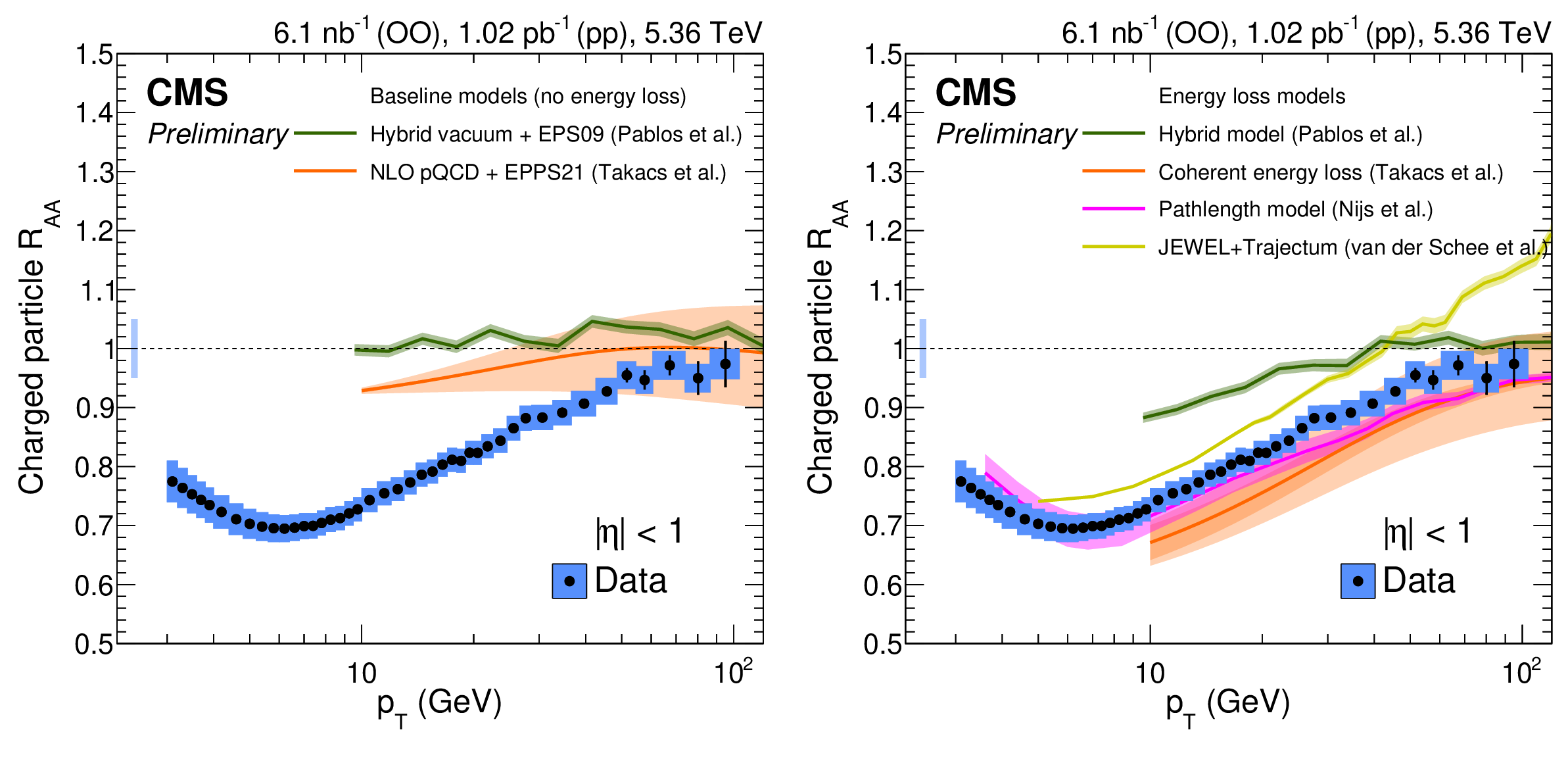
png pdf |
Figure 3:
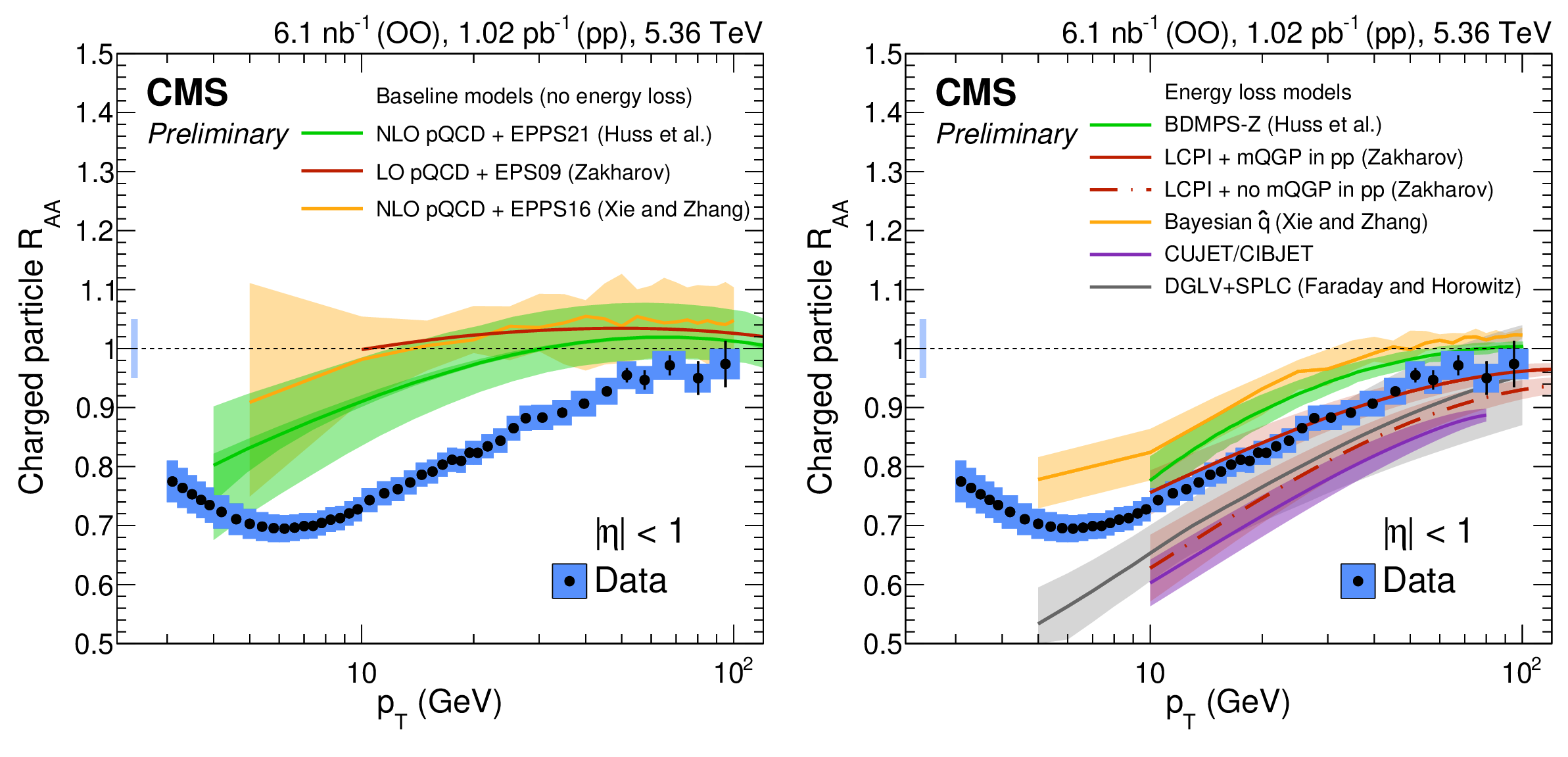
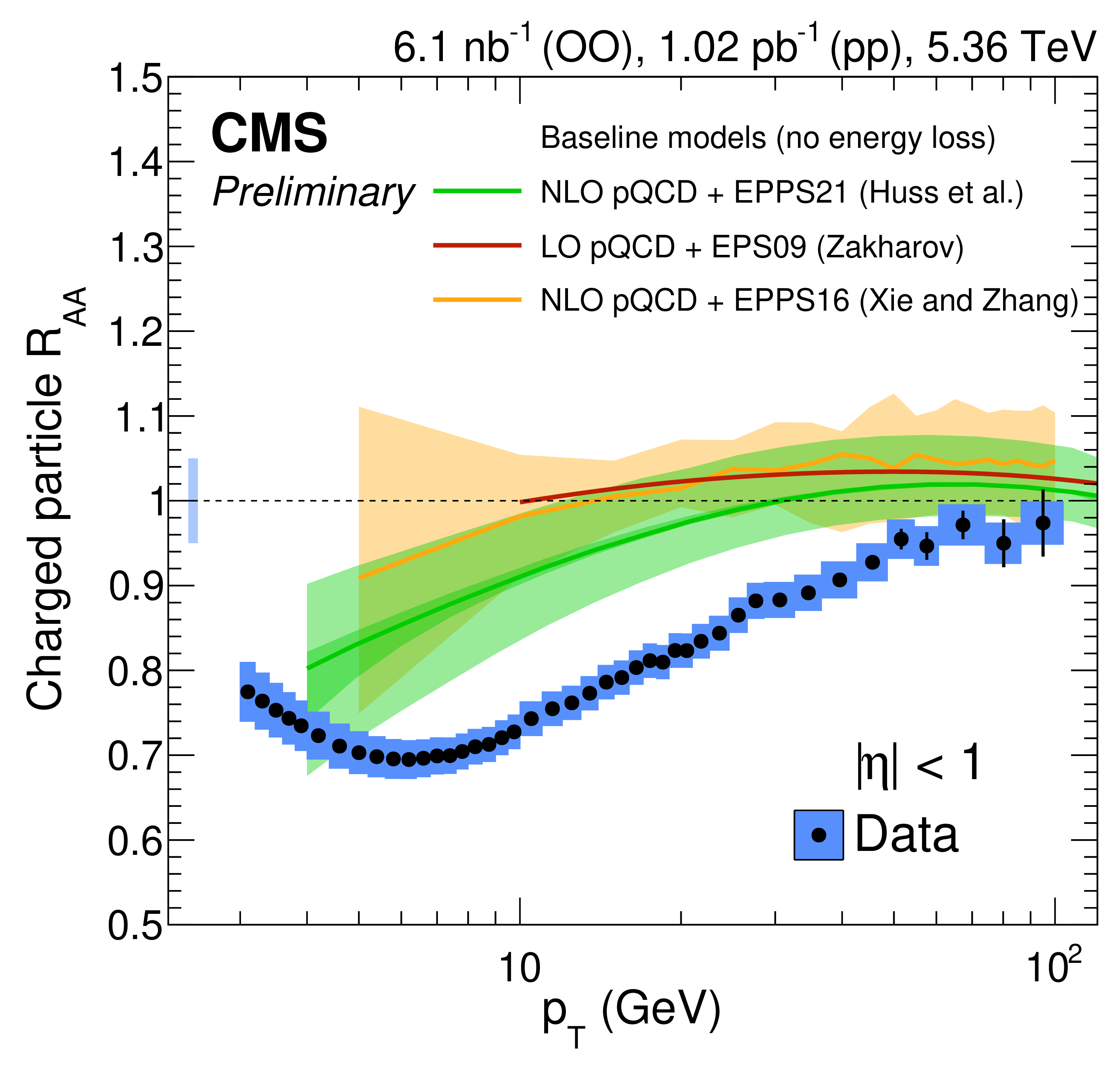
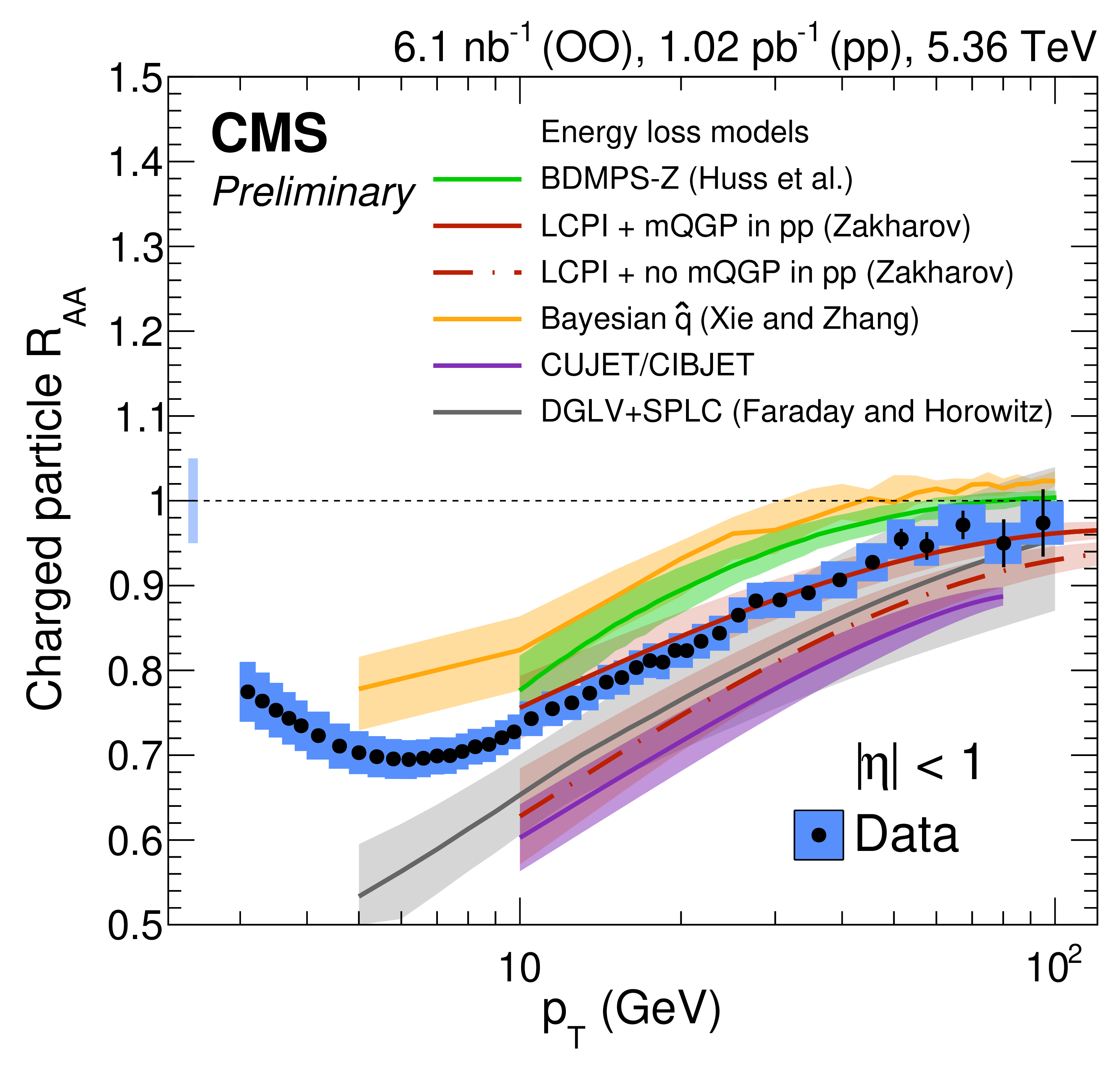
Comparison of the OO $ R_{\text{AA}} $ to various theoretical predictions [33,34,35,73,74,75]. Models in left panel are baselines that do not include parton energy loss, while models on the right include energy loss. |
png pdf |
Figure 3-a:
Comparison of the OO $ R_{\text{AA}} $ to various theoretical predictions [33,34,35,73,74,75]. Models in left panel are baselines that do not include parton energy loss, while models on the right include energy loss. |
png pdf |
Figure 3-b:
Comparison of the OO $ R_{\text{AA}} $ to various theoretical predictions [33,34,35,73,74,75]. Models in left panel are baselines that do not include parton energy loss, while models on the right include energy loss. |
png pdf |
Figure 4:
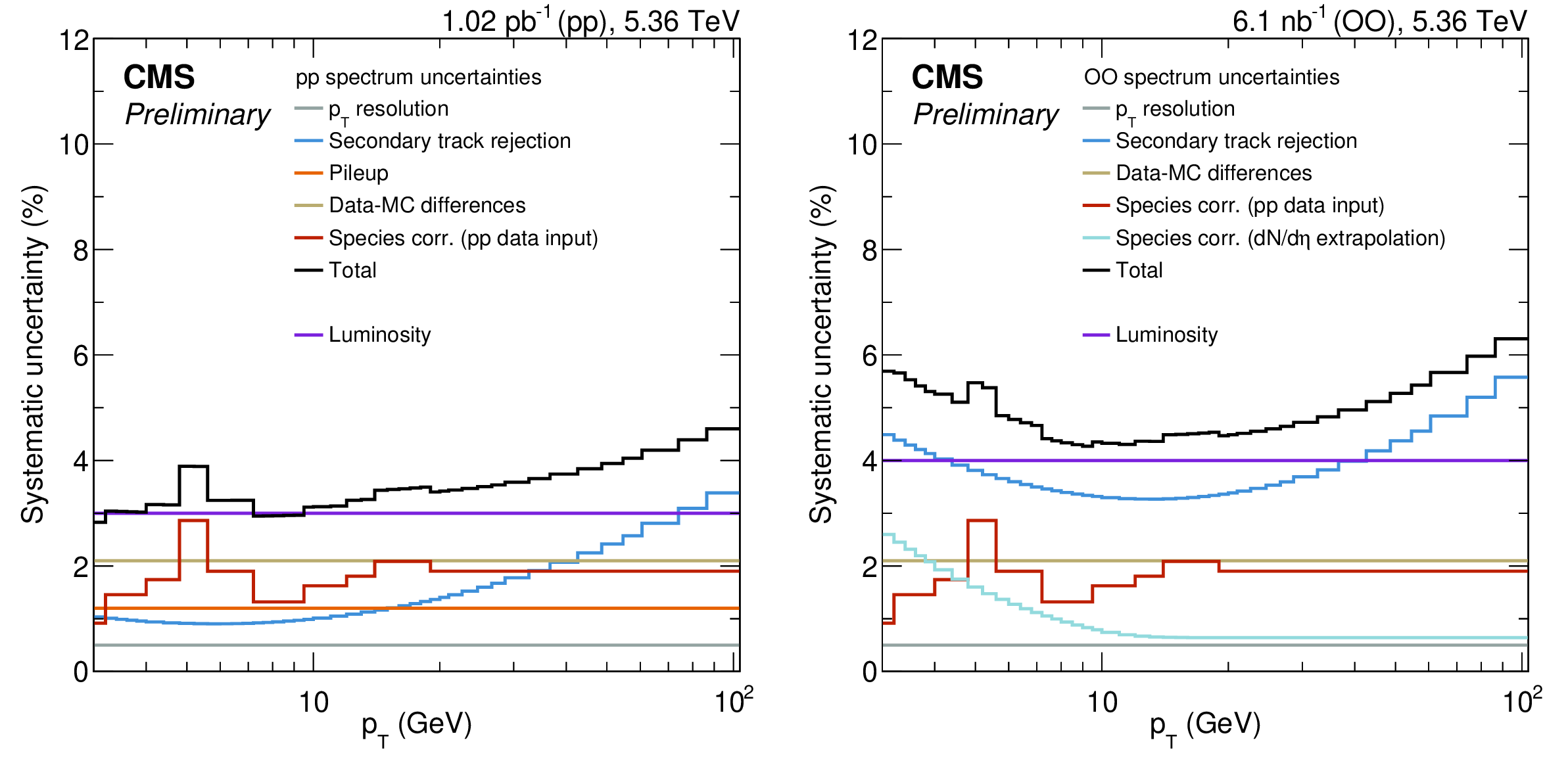
Systematic uncertainties related to the 5.36 TeV pp spectrum (left) and $ \text{OO} $ spectrum (right). |
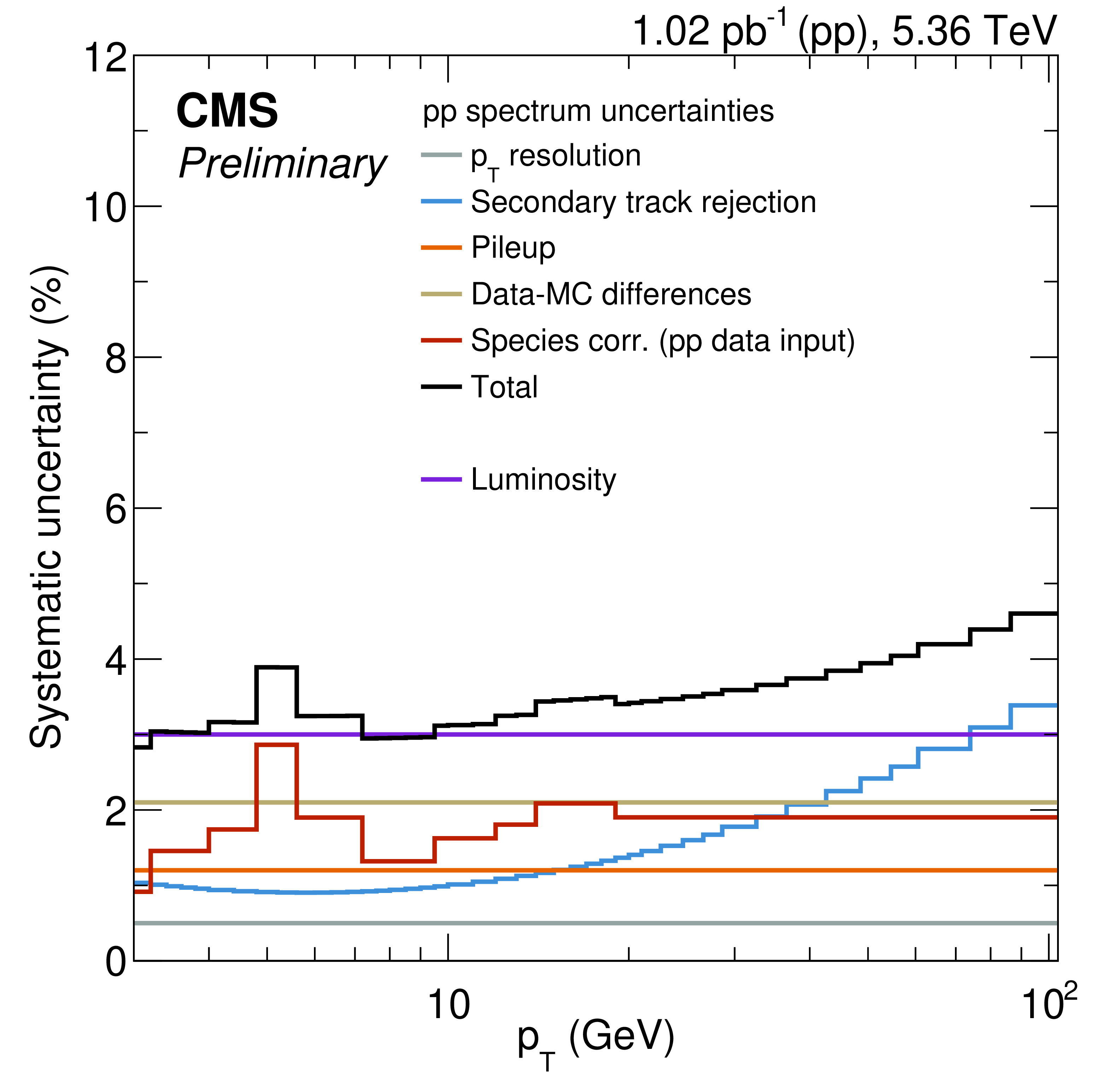
png pdf |
Figure 4-a:
Systematic uncertainties related to the 5.36 TeV pp spectrum (left) and $ \text{OO} $ spectrum (right). |
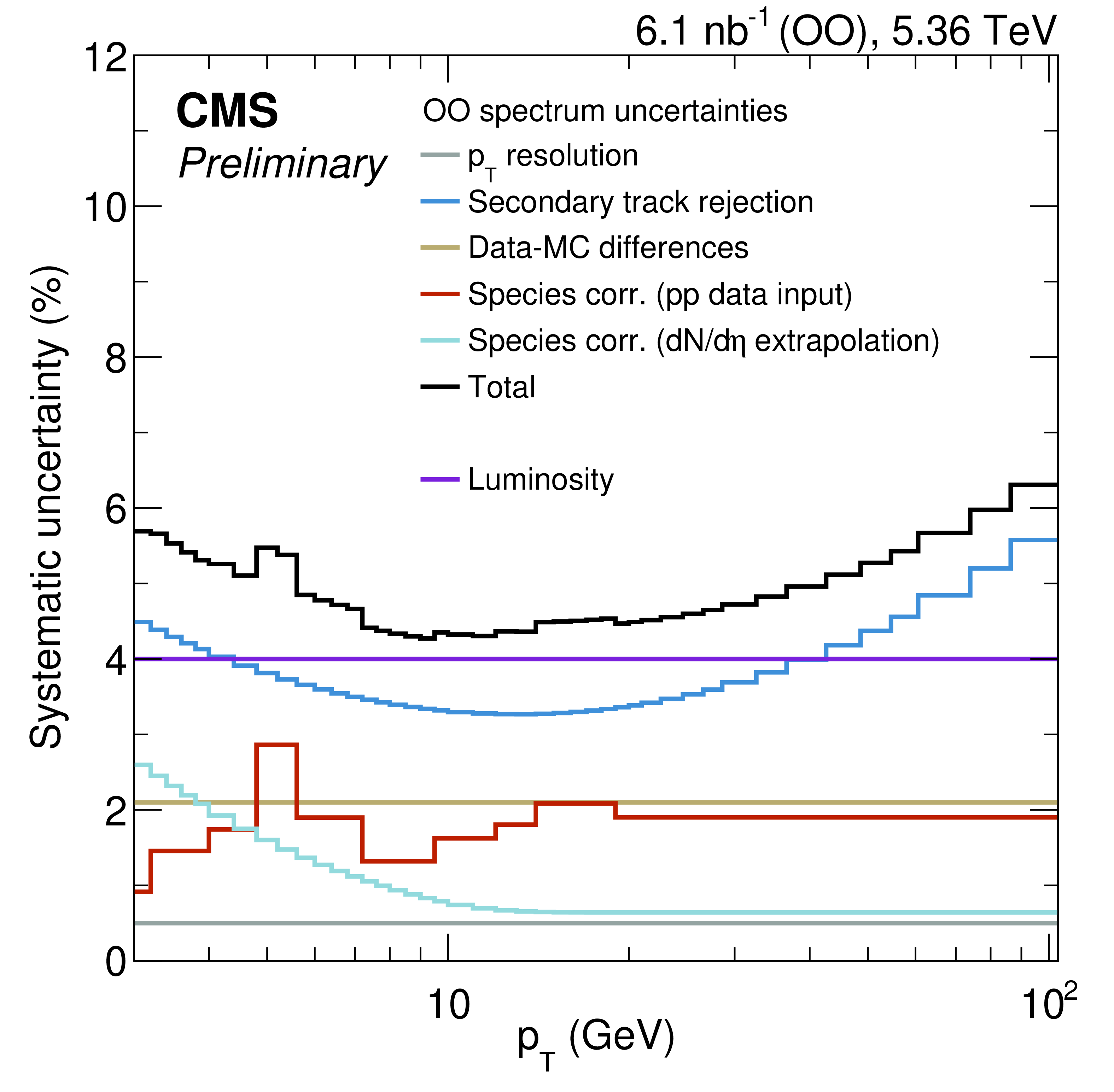
png pdf |
Figure 4-b:
Systematic uncertainties related to the 5.36 TeV pp spectrum (left) and $ \text{OO} $ spectrum (right). |
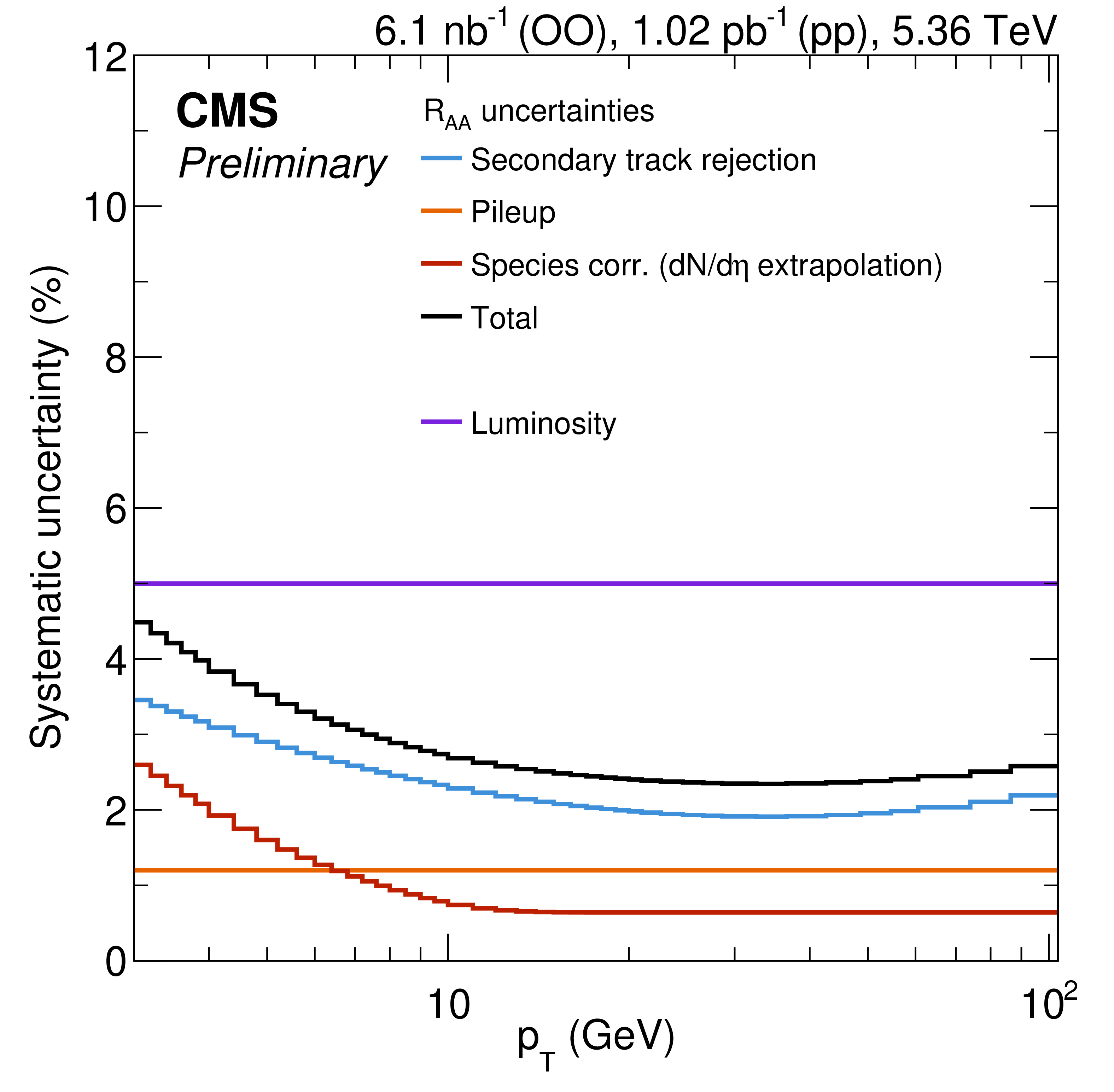
png pdf |
Figure 5:
Systematic uncertainties related to measurement of $ R_{\text{AA}} $ for 5.36 TeV $ \text{OO} $ collisions. |
png pdf |
Figure 6:
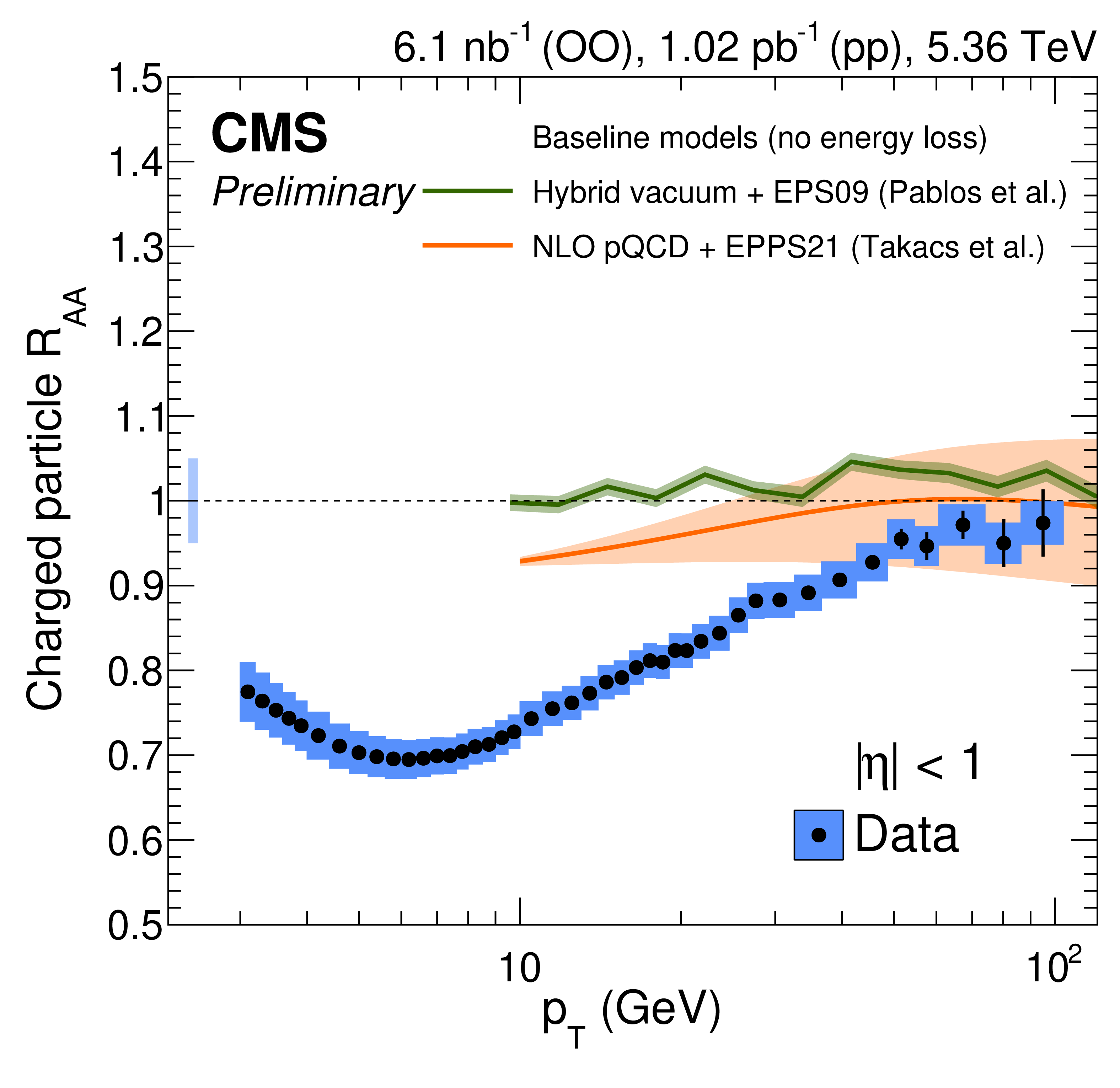
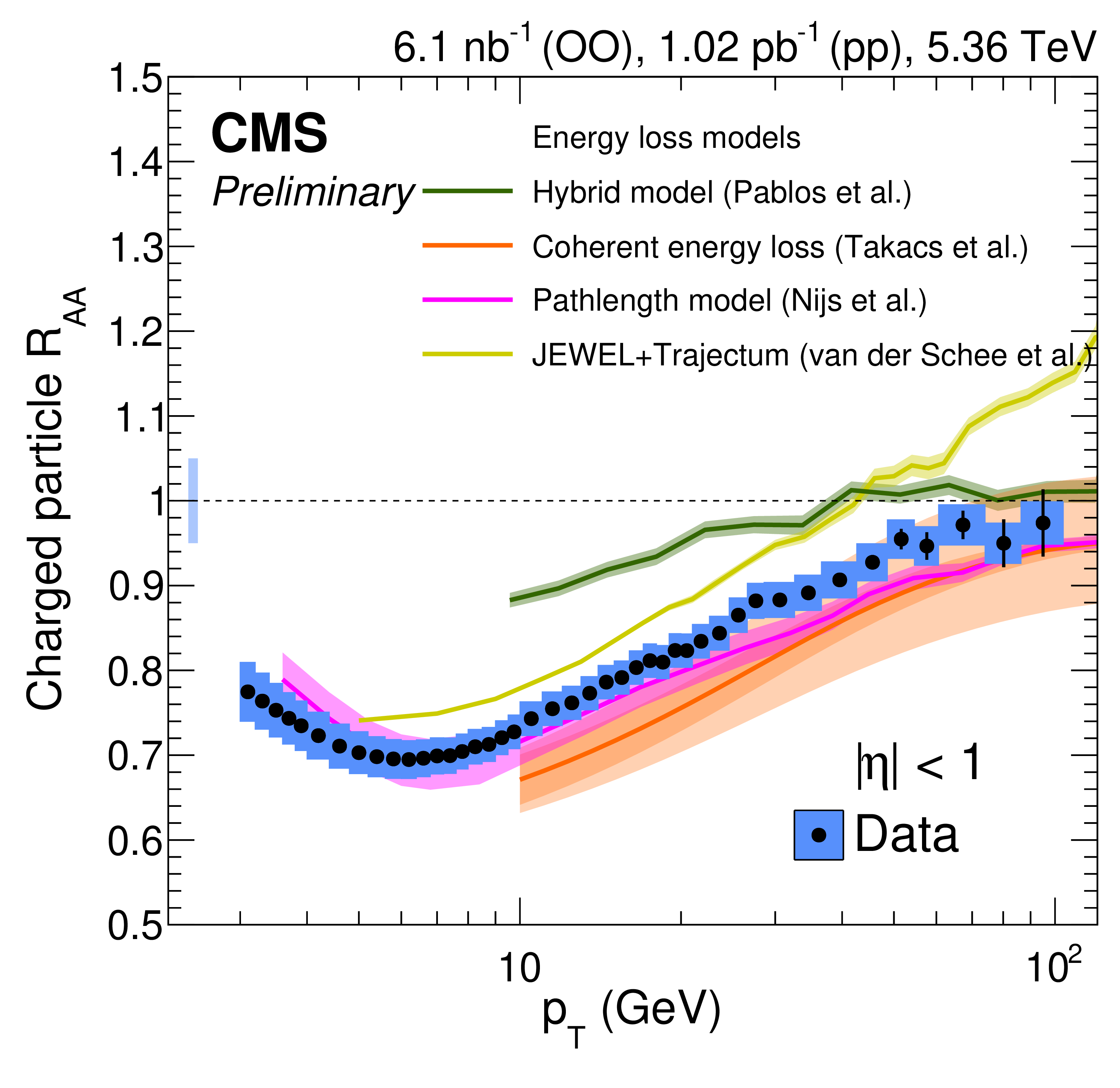
Comparison of the OO $ R_{\text{AA}} $ to various theoretical predictions [79,81,82,83,84,88]. Models in left panel are baselines that do not include parton energy loss, while models on the right include energy loss. |
png pdf |
Figure 6-a:
Comparison of the OO $ R_{\text{AA}} $ to various theoretical predictions [79,81,82,83,84,88]. Models in left panel are baselines that do not include parton energy loss, while models on the right include energy loss. |
png pdf |
Figure 6-b:
Comparison of the OO $ R_{\text{AA}} $ to various theoretical predictions [79,81,82,83,84,88]. Models in left panel are baselines that do not include parton energy loss, while models on the right include energy loss. |
png pdf |
Figure 7:
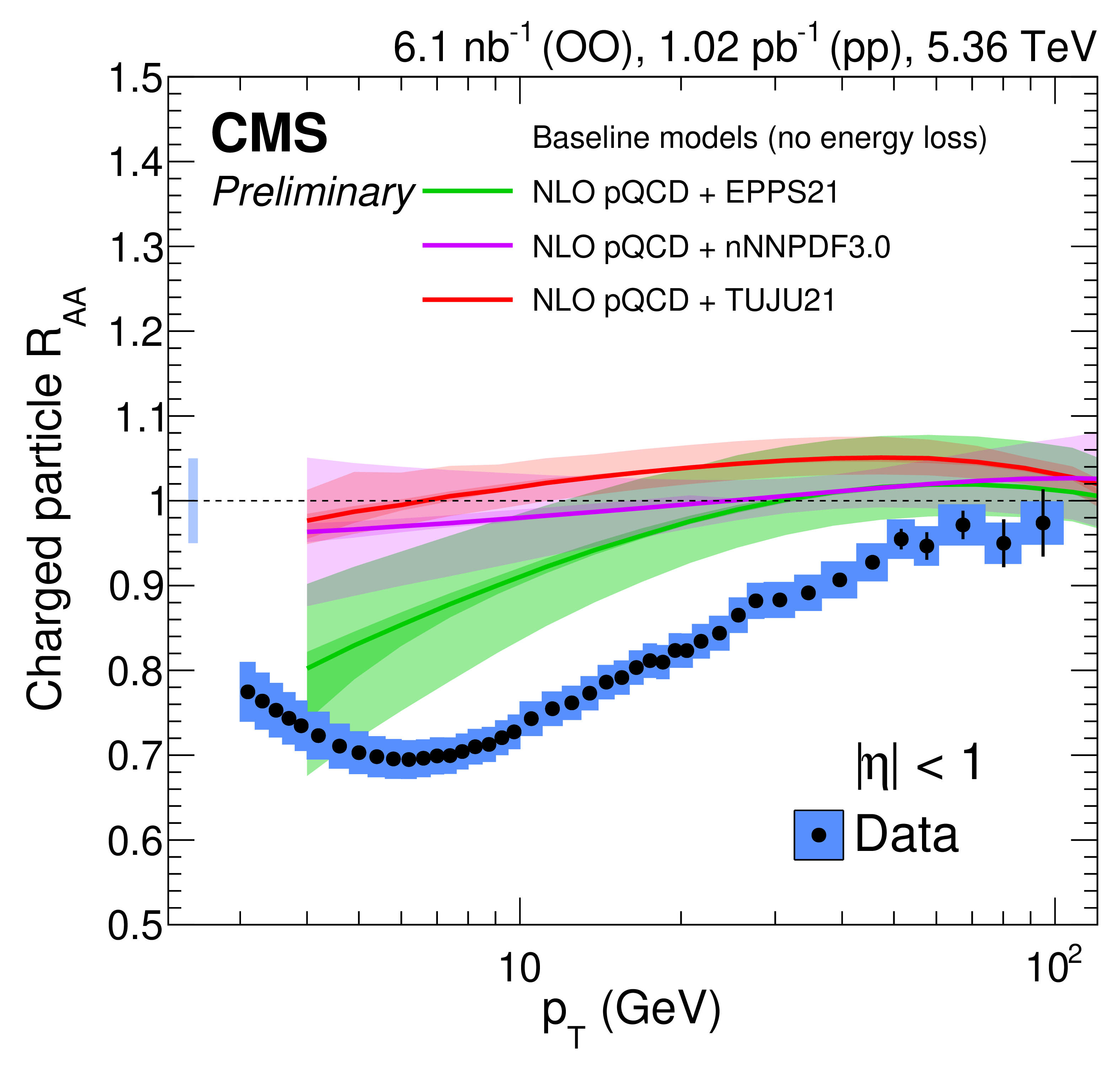
Comparison of the OO $ R_{\text{AA}} $ to a theoretical model [33] without energy loss effects that uses three different nPDF hypotheses [69,90,91]. |
| Summary |
| In summary, we report the first measurement of the charged particle nuclear modification factor ($ R_{\text{AA}} $) as a function of transverse momentum ($ p_{\mathrm{T}} $) in oxygen-oxygen collisions at a center of mass energy per nucleon pair of 5.36 TeV. The $ R_{\text{AA}} $ is significantly suppressed with a value of 0.69 $ \pm $ 0.04 around 6 GeV but rises to become consistent with unity at $ p_{\mathrm{T}}= $ 100 GeV. Comparisons with previous measurements of other collision systems reveal a system-size dependence of $ R_{\text{AA}} $ suppression in ion collisions. The data are more consistent with theoretical models that incorporate parton energy loss effects as compared to baseline models without energy loss, supporting the hypothesis that a medium of sufficient size to give rise to observable parton energy loss is created. This measurement constrains models attempting to predict jet quenching in small systems and represents an important first step towards the realization of a physics program examining collisions of light nuclei at TeV-scale energies. |
| References | ||||
| 1 | W. Busza, K. Rajagopal, and W. van der Schee | Heavy ion collisions: The big picture, and the big questions | Ann. Rev. Nucl. Part. Sci. 68 (2018) 339 | 1802.04801 |
| 2 | E. V. Shuryak | Quantum chromodynamics and the theory of superdense matter | Phys. Rept. 61 (1980) 71 | |
| 3 | CMS Collaboration | Overview of high-density QCD studies with the CMS experiment at the LHC | Phys. Rept. 1115 (2025) 219 | CMS-HIN-23-011 2405.10785 |
| 4 | ALICE Collaboration | The ALICE experiment: a journey through QCD | EPJC 83 (2024) 813 | 2211.04384 |
| 5 | BRAHMS Collaboration | Quark gluon plasma and color glass condensate at RHIC? The perspective from the BRAHMS experiment | Nucl. Phys. A 757 (2005) 1 | nucl-ex/0410020 |
| 6 | PHOBOS Collaboration | The PHOBOS perspective on discoveries at RHIC | Nucl. Phys. A 757 (2005) 28 | nucl-ex/0410022 |
| 7 | STAR Collaboration | Experimental and theoretical challenges in the search for the quark gluon plasma: The STAR Collaboration's critical assessment of the evidence from RHIC collisions | Nucl. Phys. A 757 (2005) 102 | nucl-ex/0501009 |
| 8 | PHENIX Collaboration | Formation of dense partonic matter in relativistic nucleus-nucleus collisions at RHIC: Experimental evaluation by the PHENIX collaboration | Nucl. Phys. A 757 (2005) 184 | nucl-ex/0410003 |
| 9 | D. J. Gross and F. Wilczek | Ultraviolet behavior of nonabelian gauge theories | PRL 30 (1973) 1343 | |
| 10 | H. D. Politzer | Reliable perturbative results for strong interactions? | PRL 30 (1973) 1346 | |
| 11 | M. Gyulassy and M. Plumer | Jet quenching in dense matter | PLB 243 (1990) 432 | |
| 12 | S. Cao and X.-N. Wang | Jet quenching and medium response in high-energy heavy-ion collisions: a review | Rept. Prog. Phys. 84 (2021) 024301 | 2002.04028 |
| 13 | M. Connors, C. Nattrass, R. Reed, and S. Salur | Jet measurements in heavy ion physics | Rev. Mod. Phys. 90 (2018) 025005 | 1705.01974 |
| 14 | WA98 Collaboration | Transverse mass distributions of neutral pions from Pb-208 induced reactions at 158-A-GeV | EPJC 23 (2002) 225 | nucl-ex/0108006 |
| 15 | D. G. d'Enterria | Indications of suppressed high p(T) hadron production in nucleus - nucleus collisions at CERN-SPS | PLB 596 (2004) 32 | nucl-ex/0403055 |
| 16 | CMS Collaboration | Study of high-$ p_{\mathrm{T}} $ charged particle suppression in PbPb compared to pp collisions at $ \sqrt{\smash[b]{s_{_{\mathrm{NN}}}}}= $ 2.76 TeV | EPJC 72 (2012) 1945 | CMS-HIN-10-005 1202.2554 |
| 17 | ALICE Collaboration | Centrality dependence of charged particle production at large transverse momentum in Pb--Pb collisions at $ \sqrt{\smash[b]{s_{_{\mathrm{NN}}}}} = $ 2.76 TeV | PLB 720 (2013) 52 | 1208.2711 |
| 18 | ATLAS Collaboration | Measurement of charged-particle spectra in Pb+Pb collisions at $ \sqrt{\smash[b]{s_{_{\mathrm{NN}}}}} = $ 2.76 TeV with the ATLAS detector at the LHC | JHEP 09 (2015) 050 | 1504.04337 |
| 19 | CMS Collaboration | Charged-particle nuclear modification factors in PbPb and pPb collisions at $ \sqrt{\smash[b]{s_{_{\mathrm{NN}}}}}= $ 5.02 TeV | JHEP 04 (2017) 039 | CMS-HIN-15-015 1611.01664 |
| 20 | ALICE Collaboration | Transverse momentum spectra and nuclear modification factors of charged particles in pp, p-Pb and Pb-Pb collisions at the LHC | JHEP 11 (2018) 013 | 1802.09145 |
| 21 | ATLAS Collaboration | Charged-hadron production in pp, $ \mathrm{p} $+Pb, Pb+Pb, and Xe+Xe collisions at $ \sqrt{\smash[b]{s_{_{\mathrm{NN}}}}}= $ 5 TeV with the ATLAS detector at the LHC | JHEP 07 (2023) 074 | 2211.15257 |
| 22 | CMS Collaboration | Charged-particle nuclear modification factors in XeXe collisions at $ \sqrt{\smash[b]{s_{_{\mathrm{NN}}}}} = $ 5.44 TeV | JHEP 10 (2018) 138 | CMS-HIN-18-004 1809.00201 |
| 23 | ALICE Collaboration | Transverse momentum spectra and nuclear modification factors of charged particles in Xe-Xe collisions at $ \sqrt{\smash[b]{s_{_{\mathrm{NN}}}}} = $ 5.44 TeV | PLB 788 (2019) 166 | 1805.04399 |
| 24 | CMS Collaboration | Observation of long-range near-side angular correlations in proton-lead collisions at the LHC | PLB 718 (2013) 795 | CMS-HIN-12-015 1210.5482 |
| 25 | CMS Collaboration | Strange hadron production in pp and pPb collisions at $ \sqrt{\smash[b]{s_{_{\mathrm{NN}}}}}= $ 5.02 TeV | Phys. Rev. C 101 (2020) 064906 | CMS-HIN-16-013 1910.04812 |
| 26 | ALICE Collaboration | Enhanced production of multi-strange hadrons in high-multiplicity proton-proton collisions | Nature Phys. 13 (2017) 535 | 1606.07424 |
| 27 | J. L. Nagle and W. A. Zajc | Small system collectivity in relativistic hadronic and nuclear collisions | Ann. Rev. Nucl. Part. Sci. 68 (2018) 211 | 1801.03477 |
| 28 | CMS Collaboration | Search for jet quenching with dijets from high-multiplicity pPb collisions at $ \sqrt{\smash[b]{s_{_{\mathrm{NN}}}}} = $ 8.16 TeV | JHEP 07 (2025) 118 | CMS-HIN-23-010 2504.08507 |
| 29 | CMS Collaboration | Nuclear effects on the transverse momentum spectra of charged particles in pPb collisions at $ \sqrt{\smash[b]{s_{_{\mathrm{NN}}}}} = $ 5.02 TeV | EPJC 75 (2015) 237 | CMS-HIN-12-017 1502.05387 |
| 30 | ATLAS Collaboration | Strong constraints on jet quenching in centrality-dependent p+Pb collisions at 5.02 TeV from ATLAS | PRL 131 (2023) 072301 | 2206.01138 |
| 31 | ALICE Collaboration | Constraints on jet quenching in p-Pb collisions at $ \sqrt{\smash[b]{s_{_{\mathrm{NN}}}}} = $ 5.02 TeV measured by the event-activity dependence of semi-inclusive hadron-jet distributions | PLB 783 (2018) 95 | 1712.05603 |
| 32 | ALICE Collaboration | Transverse momentum dependence of inclusive primary charged-particle production in p-Pb collisions at $ \sqrt{\smash[b]{s_{_{\mathrm{NN}}}}}= $ 5.02 TeV | EPJC 74 (2014) 3054 | 1405.2737 |
| 33 | A. Huss et al. | Discovering partonic rescattering in light nucleus collisions | PRL 126 (2021) 192301 | 2007.13754 |
| 34 | A. Huss et al. | Predicting parton energy loss in small collision systems | Phys. Rev. C 103 (2021) 054903 | 2007.13758 |
| 35 | B. G. Zakharov | Jet quenching from heavy to light ion collisions | JHEP 09 (2021) 087 | 2105.09350 |
| 36 | W. Ke and I. Vitev | Searching for QGP droplets with high-$ p_{\mathrm{T}} $ hadrons and heavy flavor | Phys. Rev. C 107 (2023) 064903 | 2204.00634 |
| 37 | Z. Citron et al. | Report from Working Group 5: Future physics opportunities for high-density QCD at the LHC with heavy-ion and proton beams | CERN Yellow Rep. Monogr. 7 (2019) 1159 | 1812.06772 |
| 38 | D. d'Enterria and C. Loizides | Progress in the Glauber model at collider energies | Ann. Rev. Nucl. Part. Sci. 71 (2021) 315 | 2011.14909 |
| 39 | C. Loizides | Glauber modeling of high-energy nuclear collisions at the subnucleon level | Phys. Rev. C 94 (2016) 024914 | 1603.07375 |
| 40 | CMS Collaboration | The CMS experiment at the CERN LHC | JINST 3 (2008) S08004 | |
| 41 | CMS Collaboration | Development of the CMS detector for the CERN LHC Run 3 | JINST 19 (2024) P05064 | |
| 42 | CMS Collaboration | Performance of the CMS Level-1 trigger in proton-proton collisions at $ \sqrt{s} = $ 13 TeV | JINST 15 (2020) P10017 | CMS-TRG-17-001 2006.10165 |
| 43 | CMS Collaboration | The CMS trigger system | JINST 12 (2017) P01020 | CMS-TRG-12-001 1609.02366 |
| 44 | CMS Collaboration | Performance of the CMS high-level trigger during LHC run 2 | JINST 19 (2024) P11021 | CMS-TRG-19-001 2410.17038 |
| 45 | CMS Collaboration | Electron and photon reconstruction and identification with the CMS experiment at the CERN LHC | JINST 16 (2021) P05014 | CMS-EGM-17-001 2012.06888 |
| 46 | CMS Collaboration | Performance of the CMS muon detector and muon reconstruction with proton-proton collisions at $ \sqrt{s}= $ 13 TeV | JINST 13 (2018) P06015 | CMS-MUO-16-001 1804.04528 |
| 47 | CMS Collaboration | Description and performance of track and primary-vertex reconstruction with the CMS tracker | JINST 9 (2014) P10009 | CMS-TRK-11-001 1405.6569 |
| 48 | CMS Collaboration | Particle-flow reconstruction and global event description with the CMS detector | JINST 12 (2017) P10003 | CMS-PRF-14-001 1706.04965 |
| 49 | CMS Tracker Group Collaboration | The CMS phase-1 pixel detector upgrade | JINST 16 (2021) P02027 | 2012.14304 |
| 50 | CMS Collaboration | Track impact parameter resolution for the full pseudo rapidity coverage in the 2017 dataset with the CMS phase-1 pixel detector | CMS Detector Performance Summary CMS-DP-2020-049, 2020 CDS |
|
| 51 | T. Sjostrand, S. Mrenna, and P. Z. Skands | A brief introduction to PYTHIA 8.1 | Comput. Phys. Commun. 178 (2008) 852 | 0710.3820 |
| 52 | CMS Collaboration | Extraction and validation of a new set of CMS PYTHIA8 tunes from underlying-event measurements | EPJC 80 (2020) 4 | CMS-GEN-17-001 1903.12179 |
| 53 | X.-N. Wang and M. Gyulassy | HIJING: A Monte Carlo model for multiple jet production in pp, pA and AA collisions | PRD 44 (1991) 3501 | |
| 54 | A. J. Baltz et al. | The physics of ultraperipheral collisions at the LHC | Phys. Rept. 458 (2008) 1 | 0706.3356 |
| 55 | S. R. Klein et al. | STARlight: A Monte Carlo simulation program for ultra-peripheral collisions of relativistic ions | Comput. Phys. Commun. 212 (2017) 258 | 1607.03838 |
| 56 | GEANT4 Collaboration | GEANT 4---a simulation toolkit | NIM A 506 (2003) 250 | |
| 57 | S. van der Meer | Calibration of the effective beam height in the ISR | technical report, CERN, Geneva, 1968 | |
| 58 | CMS Collaboration | Luminosity determination using Z boson production at the CMS experiment | EPJC 84 (2024) 26 | CMS-LUM-21-001 2309.01008 |
| 59 | I. A. Pshenichnov et al. | Nuclear multifragmentation induced by electromagnetic fields of ultrarelativistic heavy ions | Phys. Rev. C 57 (1998) 1920 | nucl-th/9711030 |
| 60 | ALICE Collaboration | Production of light-flavor hadrons in pp collisions at $ \sqrt{s} = $ 7 and $ \sqrt{s} = $ 13 TeV | EPJC 81 (2021) 256 | 2005.11120 |
| 61 | ALICE Collaboration | Multiplicity dependence of charged pion, kaon, and (anti)proton production at large transverse momentum in p-Pb collisions at $ \mathbf{\sqrt{{\textit s}_{\rm NN}}} = $ 5.02 TeV | PLB 760 (2016) 720 | 1601.03658 |
| 62 | ALICE Collaboration | Production of charged pions, kaons, and (anti-)protons in Pb-Pb and inelastic pp collisions at $ \sqrt{\smash[b]{s_{_{\mathrm{NN}}}}} = $ 5.02 TeV | Phys. Rev. C 101 (2020) 044907 | 1910.07678 |
| 63 | CMS Collaboration | Measurement of tracking efficiency | CMS Physics Analysis Summary, 2010 link |
|
| 64 | CMS Collaboration | Charged particle transverse momentum spectra in $ pp $ collisions at $ \sqrt{s} = $ 0.9 and 7 TeV | JHEP 08 (2011) 086 | CMS-QCD-10-008 1104.3547 |
| 65 | CMS Collaboration | Measurement of charged particle spectra in minimum-bias events from proton-proton collisions at $ \sqrt{s}=13 \text {TeV} $ | EPJC 78 (2018) 697 | CMS-FSQ-16-011 1806.11245 |
| 66 | D. Antreasyan et al. | Production of hadrons at large transverse momentum in 200, 300 and 400 GeV pp and pn collisions | PRD 19 (1979) 764 | |
| 67 | ATLAS Collaboration | Evidence for the collective nature of radial flow in Pb+Pb collisions with the ATLAS detector | Submitted to PRL, 2025 | 2503.24125 |
| 68 | ALICE Collaboration | Long-range transverse momentum correlations and radial flow in Pb-Pb collisions at the LHC | Submitted to PRL, 2025 | 2504.04796 |
| 69 | K. J. Eskola, P. Paakkinen, H. Paukkunen, and C. A. Salgado | EPPS21: a global QCD analysis of nuclear PDFs | EPJC 82 (2022) 413 | 2112.12462 |
| 70 | K. J. Eskola, H. Paukkunen, and C. A. Salgado | EPS09: A new generation of NLO and LO nuclear parton distribution functions | JHEP 04 (2009) 065 | 0902.4154 |
| 71 | K. J. Eskola, P. Paakkinen, H. Paukkunen, and C. A. Salgado | EPPS16: Nuclear parton distributions with LHC data | EPJC 77 (2017) 163 | 1612.05741 |
| 72 | L. Pang, Q. Wang, and X.-N. Wang | Effects of initial flow velocity fluctuation in event-by-event (3+1)D hydrodynamics | Phys. Rev. C 86 (2012) 024911 | 1205.5019 |
| 73 | M. Xie, W. Ke, H. Zhang, and X.-N. Wang | Information-field-based global Bayesian inference of the jet transport coefficient | Phys. Rev. C 108 (2023) L011901 | 2206.01340 |
| 74 | S. Shi, J. Liao, and M. Gyulassy | Global constraints from RHIC and LHC on transport properties of QCD fluids in CUJET/CIBJET framework | Chin. Phys. C 43 (2019) 044101 | 1808.05461 |
| 75 | S. Shi, J. Liao, and M. Gyulassy | Probing the Color Structure of the Perfect QCD Fluids via Soft-Hard-Event-by-Event Azimuthal Correlations | Chin. Phys. C 42 (2018) 104104 | 1804.01915 |
| 76 | M. Djordjevic and M. Gyulassy | Heavy quark radiative energy loss in QCD matter | Nucl. Phys. A 733 (2004) 265 | nucl-th/0310076 |
| 77 | M. Gyulassy, P. Levai, and I. Vitev | Jet quenching in thin quark gluon plasmas. 1. Formalism | NPB 571 (2000) 197 | hep-ph/9907461 |
| 78 | C. Faraday and W. A. Horowitz | Statistical analysis of pQCD energy loss across system size, flavor, $ \sqrt{\smash[b]{s_{_{\mathrm{NN}}}}} $, and $ p_T $ | 2505.14568 | |
| 79 | J. Casalderrey-Solana et al. | A hybrid strong/weak coupling approach to jet quenching | [Erratum: JHEP 09, 175 ()], 2014 JHEP 10 (2014) 019 |
1405.3864 |
| 80 | H. M ä ntysaari, B. Schenke, C. Shen, and W. Zhao | Collision-energy dependence in heavy-ion collisions from nonlinear QCD evolution | PRL 135 (2025) 022302 | 2502.05138 |
| 81 | J. Gebhard, A. Mazeliauskas, and A. Takacs | No-quenching baseline for energy loss signals in oxygen-oxygen collisions | JHEP 04 (2025) 034 | 2410.22405 |
| 82 | Y. Mehtar-Tani, D. Pablos, and K. Tywoniuk | Cone-size dependence of jet suppression in heavy-ion collisions | PRL 127 (2021) 252301 | 2101.01742 |
| 83 | A. Takacs and K. Tywoniuk | Quenching effects in the cumulative jet spectrum | JHEP 10 (2021) 038 | 2103.14676 |
| 84 | Y. Mehtar-Tani, D. Pablos, and K. Tywoniuk | Jet suppression and azimuthal anisotropy from RHIC to LHC | PRD 110 (2024) 014009 | 2402.07869 |
| 85 | G. Nijs, W. van der Schee, U. G \"u rsoy, and R. Snellings | Transverse momentum differential global analysis of heavy-ion collisions | PRL 126 (2021) 202301 | 2010.15130 |
| 86 | G. Nijs, W. van der Schee, U. G \"u rsoy, and R. Snellings | Bayesian analysis of heavy ion collisions with the heavy ion computational framework Trajectum | Phys. Rev. C 103 (2021) 054909 | 2010.15134 |
| 87 | W. van der Schee, Y.-J. Lee, G. Nijs, and Y. Chen | Hard probes in isobar collisions as a probe of the neutron skin | PLB 856 (2024) 138953 | 2307.11836 |
| 88 | W. van der Schee et al. | Three models for charged hadron nuclear modification from light to heavy ions | 2509.04299 | |
| 89 | I. Kolb é | JEWEL on a (2+1)D background with applications to small systems and substructure | 2303.14166 | |
| 90 | R. Abdul Khalek et al. | nNNPDF3.0: evidence for a modified partonic structure in heavy nuclei | EPJC 82 (2022) 507 | 2201.12363 |
| 91 | I. Helenius, M. Walt, and W. Vogelsang | NNLO nuclear parton distribution functions with electroweak-boson production data from the LHC | PRD 105 (2022) 094031 | 2112.11904 |
|
|
Compact Muon Solenoid LHC, CERN |
|
|
|
|
|
|