Compact Muon Solenoid
LHC, CERN
 Visit us: CMS Public Website, CMS Physics ;
Contact us: CMS Publications Committee
Visit us: CMS Public Website, CMS Physics ;
Contact us: CMS Publications Committee
| CMS-PAS-EXO-24-031 | ||
| Search for light pseudoscalar a bosons in $ \mathrm{H}\to\mathrm{a}\mathrm{a}\to4\mathrm{e} $ decays in pp collisions at $ \sqrt{s} = $ 13 TeV | ||
| CMS Collaboration | ||
| 19 May 2025 | ||
| Abstract: A search for pairs of light neutral bosons ($ \mathrm{a} $) resulting from the decay of a Higgs boson is performed. The $ \mathrm{a} $ bosons have a mass in the range of 10 to 100 MeV and decay into an electron-positron pair. The search is conducted using proton-proton collision data at $ \sqrt{s} = $ 13 TeV, corresponding to an integrated luminosity of 138 fb$ ^{-1} $. Due to the low mass of the $ \mathrm{a} $ bosons their decay products are highly collimated and are merged into single detector objects. A novel multivariate identification technique is developed to identify these distinctive signatures, and events are selected with two such merged electron-positron pairs. No significant excess above the standard model prediction is observed. Upper limits on the branching fraction for $ \mathrm{H}\to\mathrm{a}\mathrm{a}\to4\mathrm{e} $ are set at the 95% confidence level, reaching sensitivities as low as $ \mathcal{O}(10^{-5}) $. The measured limits are further interpreted in an effective axion-like particle and Higgs-coupling model, confirming the LHC's potential as a unique axion-like particle search facility. | ||
|
Links:
CDS record (PDF) ;
CADI line (restricted) ;
These preliminary results are superseded in this paper, Accepted by PRL. |
||
| Figures | |
png pdf |
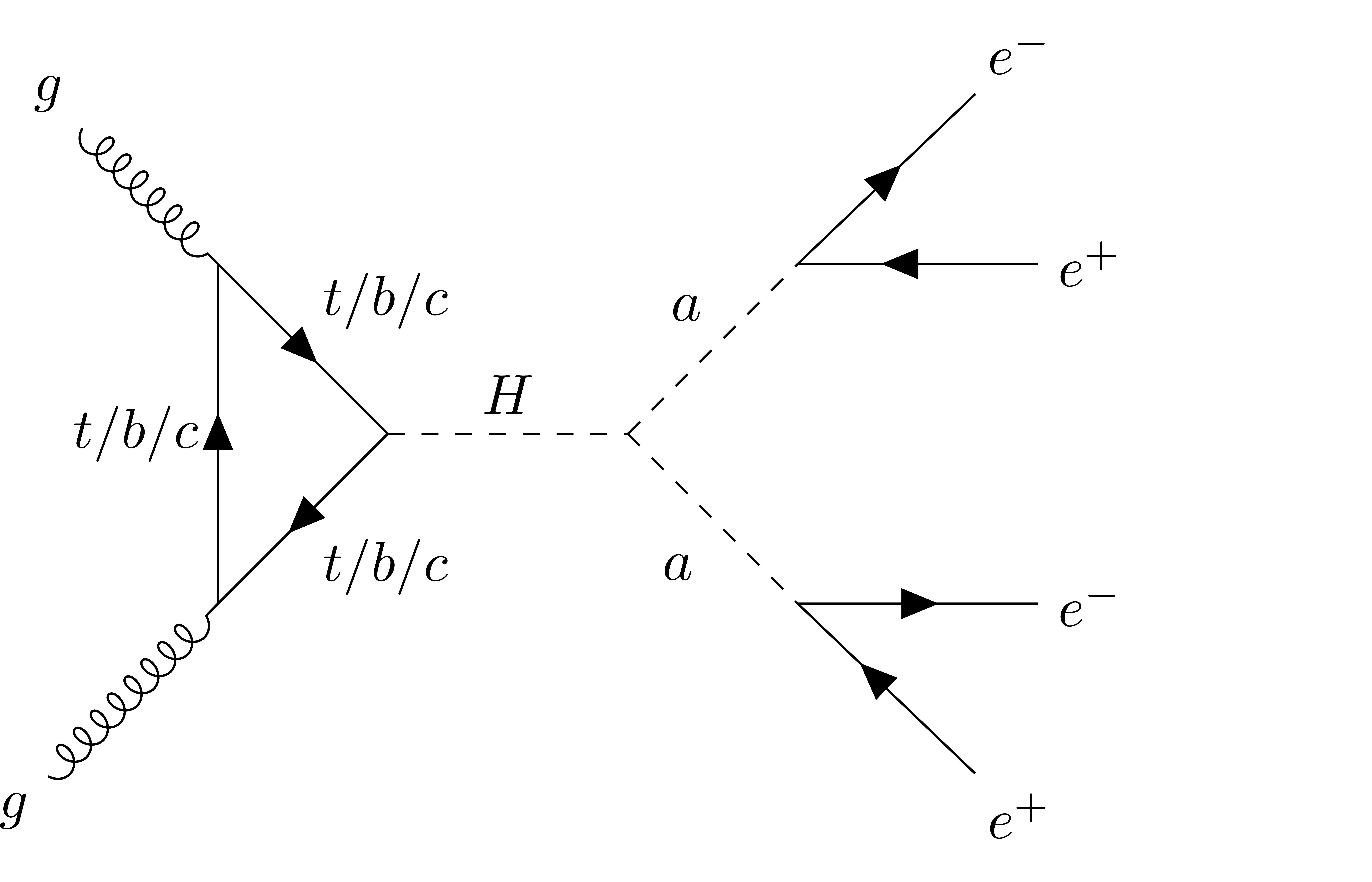
Figure 1:
Feynman diagram of gluon-gluon fusion, via an intermediate heavy quark loop, producing a Higgs boson which decays to two axion-like particles, each further decaying to electron-positron pairs. |
png pdf |
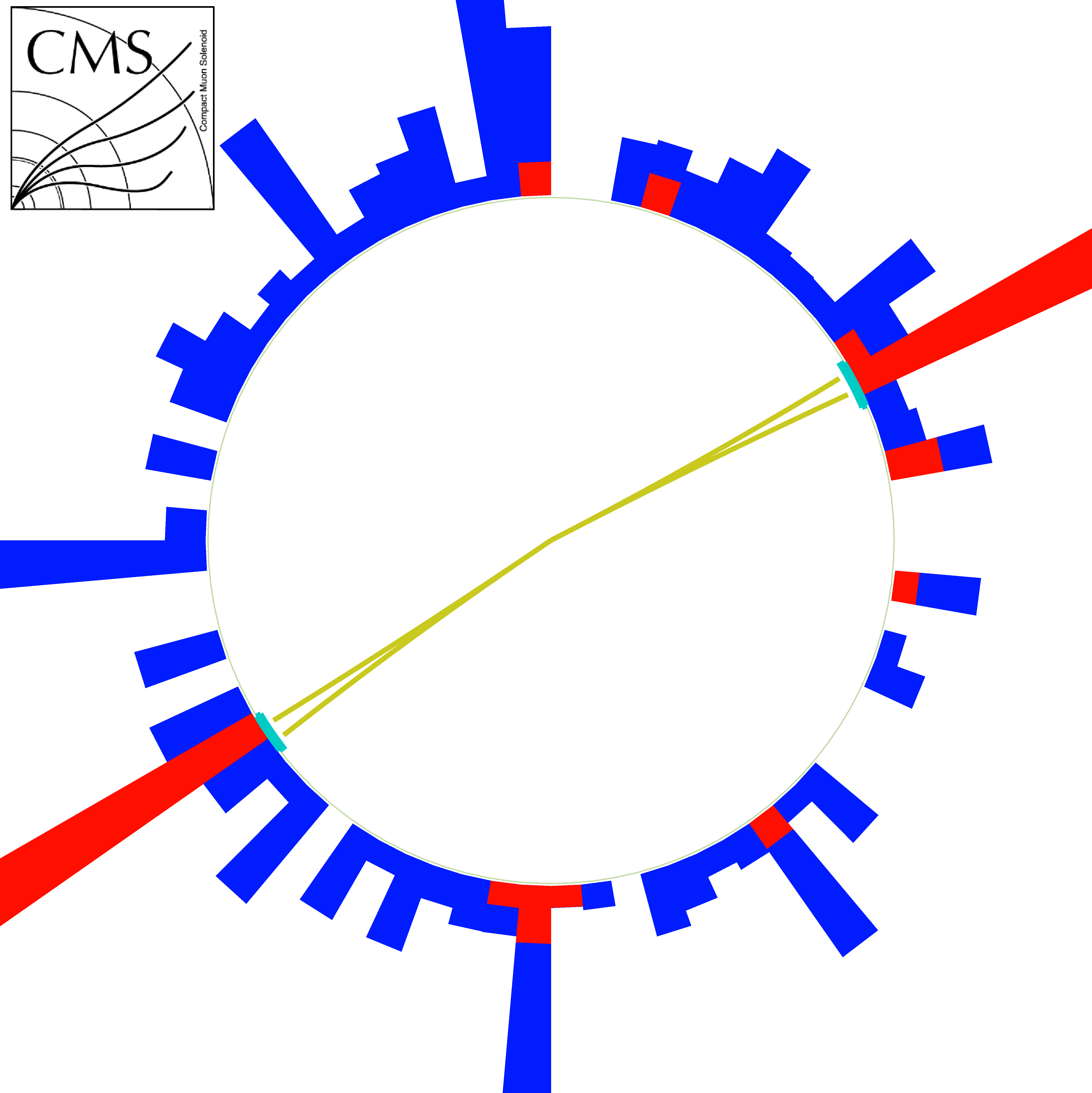
Figure 2:
An $ \mathrm{H}\to\mathrm{a}\mathrm{a}\to4\mathrm{e} $ event with two merged electron pairs. In each pair, the two reconstructed GSF tracks, one for each electron, are shown as the yellow lines, while the cyan region on the circle represents the corresponding reconstructed supercluster. The blue and red shapes represent the energy deposit from HCAL and ECAL respectively. |
png pdf |
Figure 3:
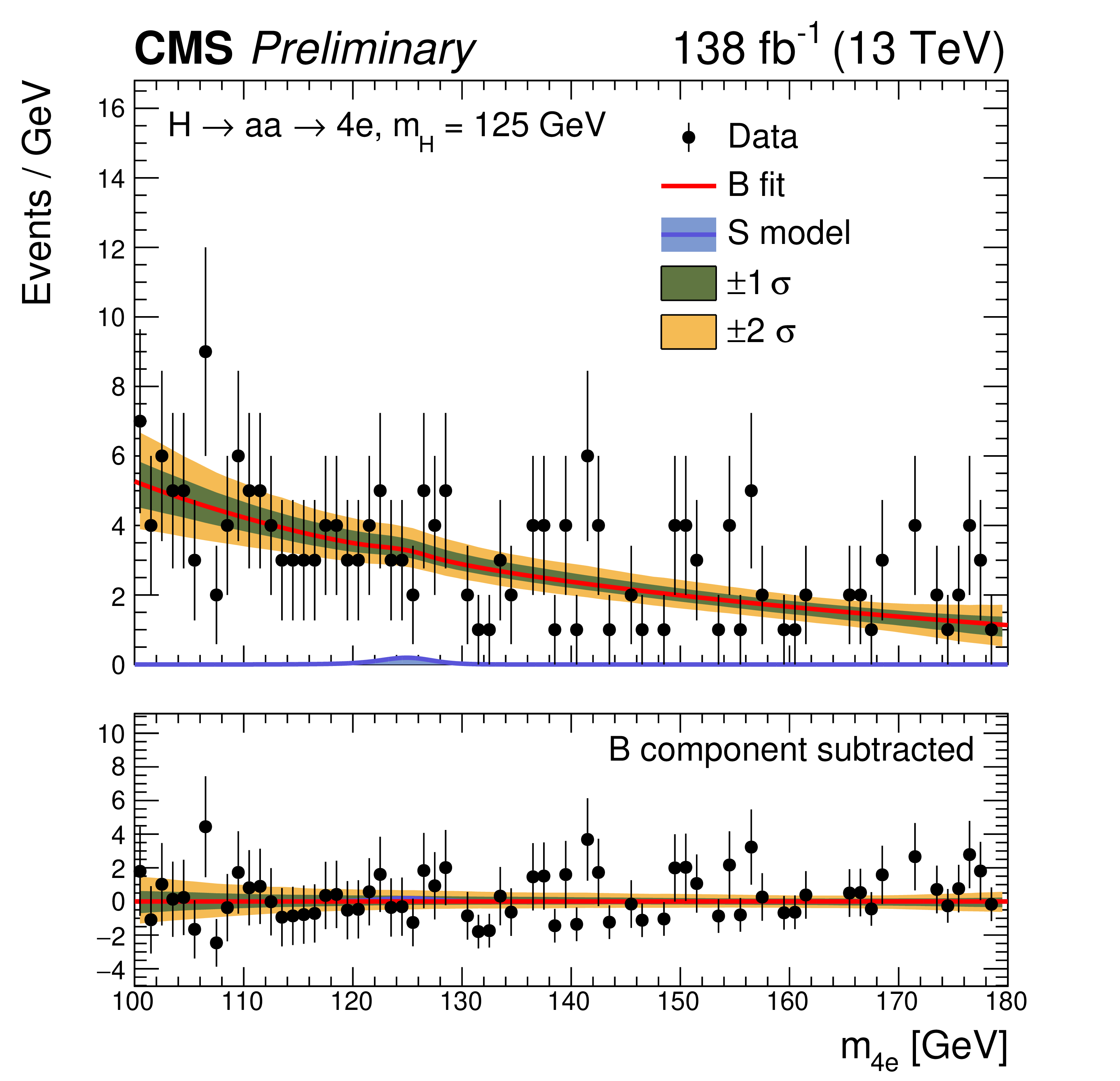
(upper) Invariant mass distribution of four electrons ($ m_{4\mathrm{e}} $) for selected events (points), compared to a fit of the background (red), with one (green) and two (yellow) standard deviation uncertainty bands, and the extracted signal (blue), shown as an example for a Higgs boson decaying to pairs of axion-like particles ($ \mathrm{a} $) with a mass of 20 MeV and a mean proper decay length to electron pairs $ c\tau = 10\,\mu\text{m} $. (lower) The lower panel shows the same data after subtracting the background fit. |
png pdf |
Figure 4:
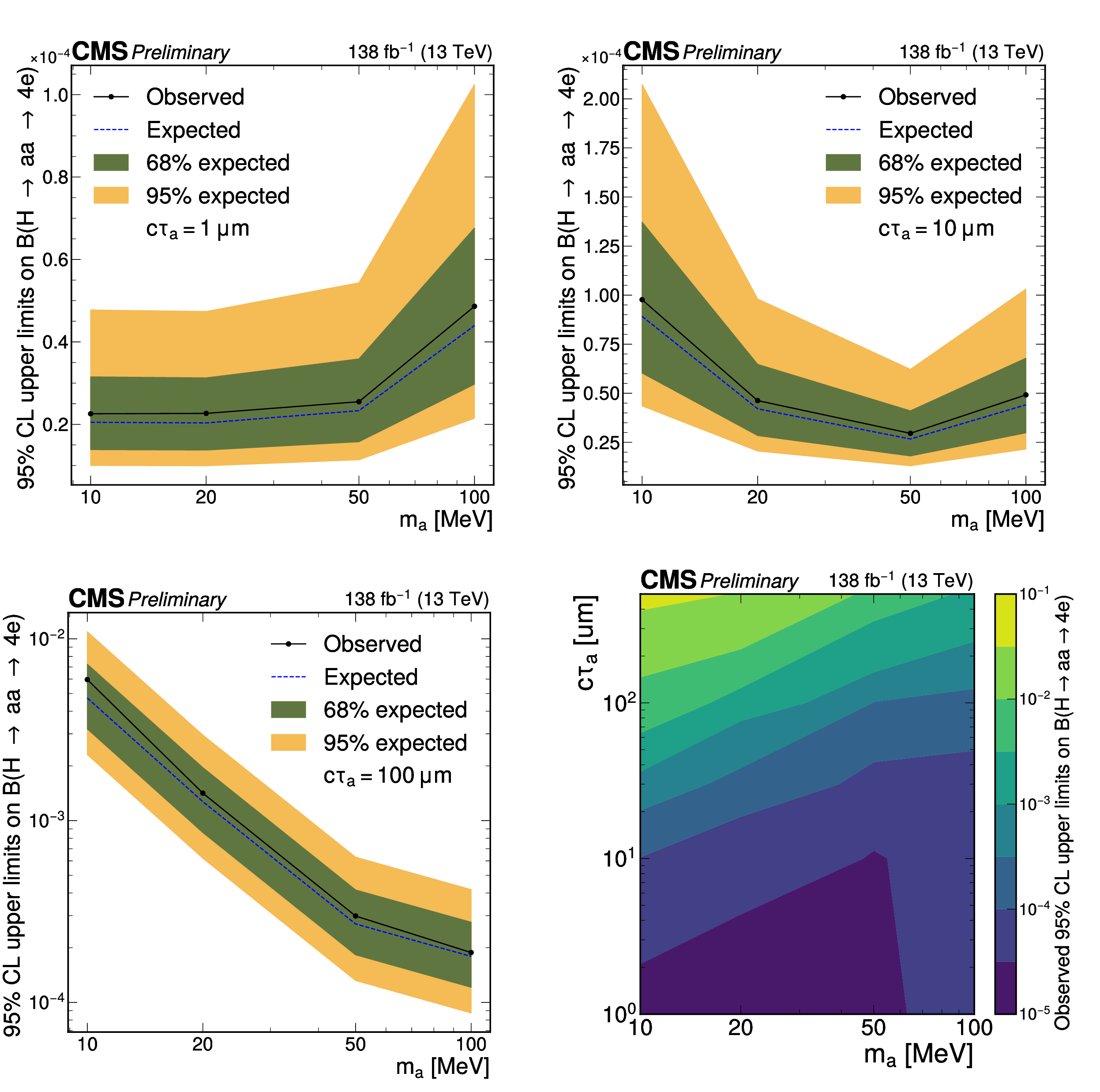
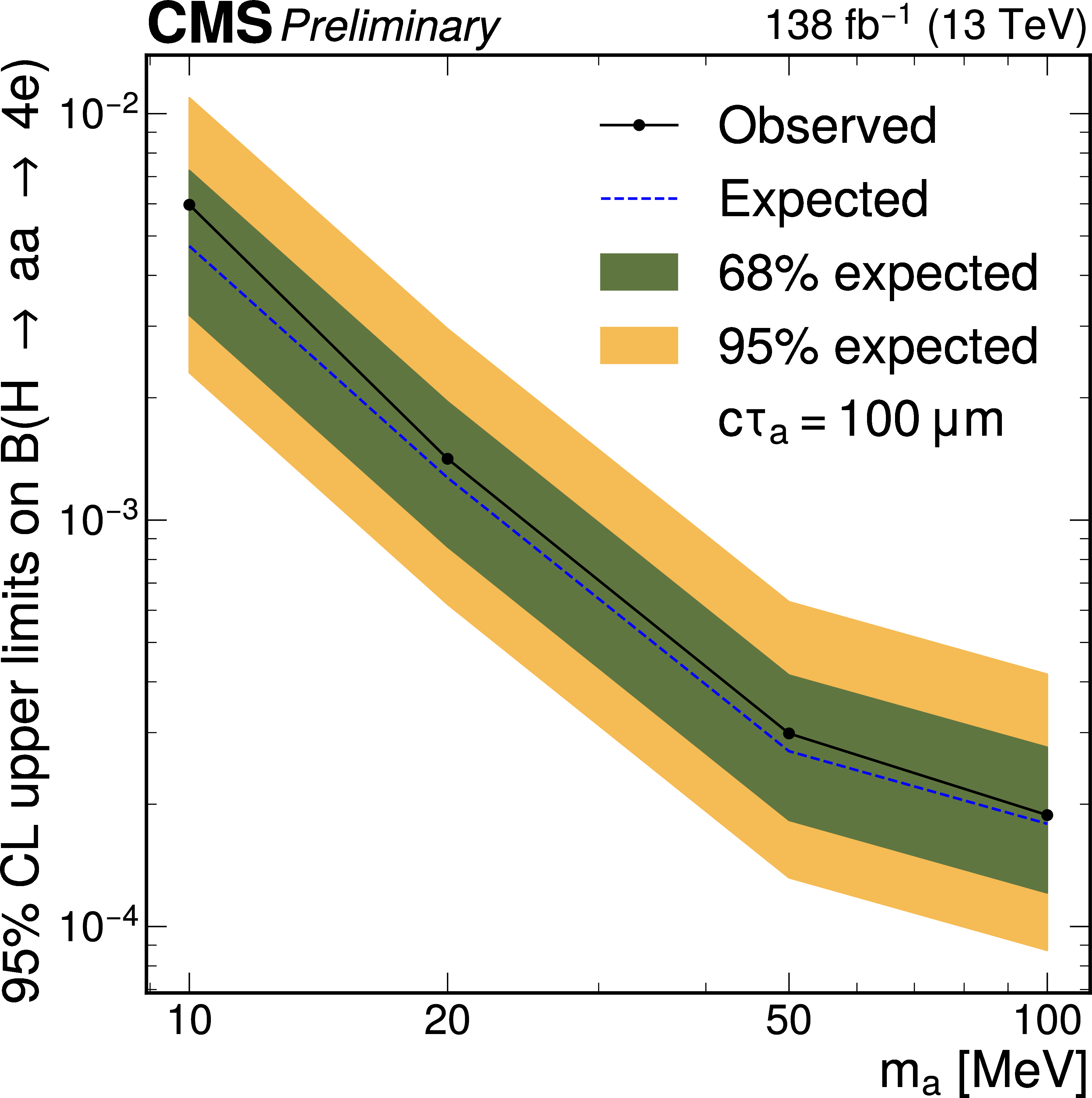
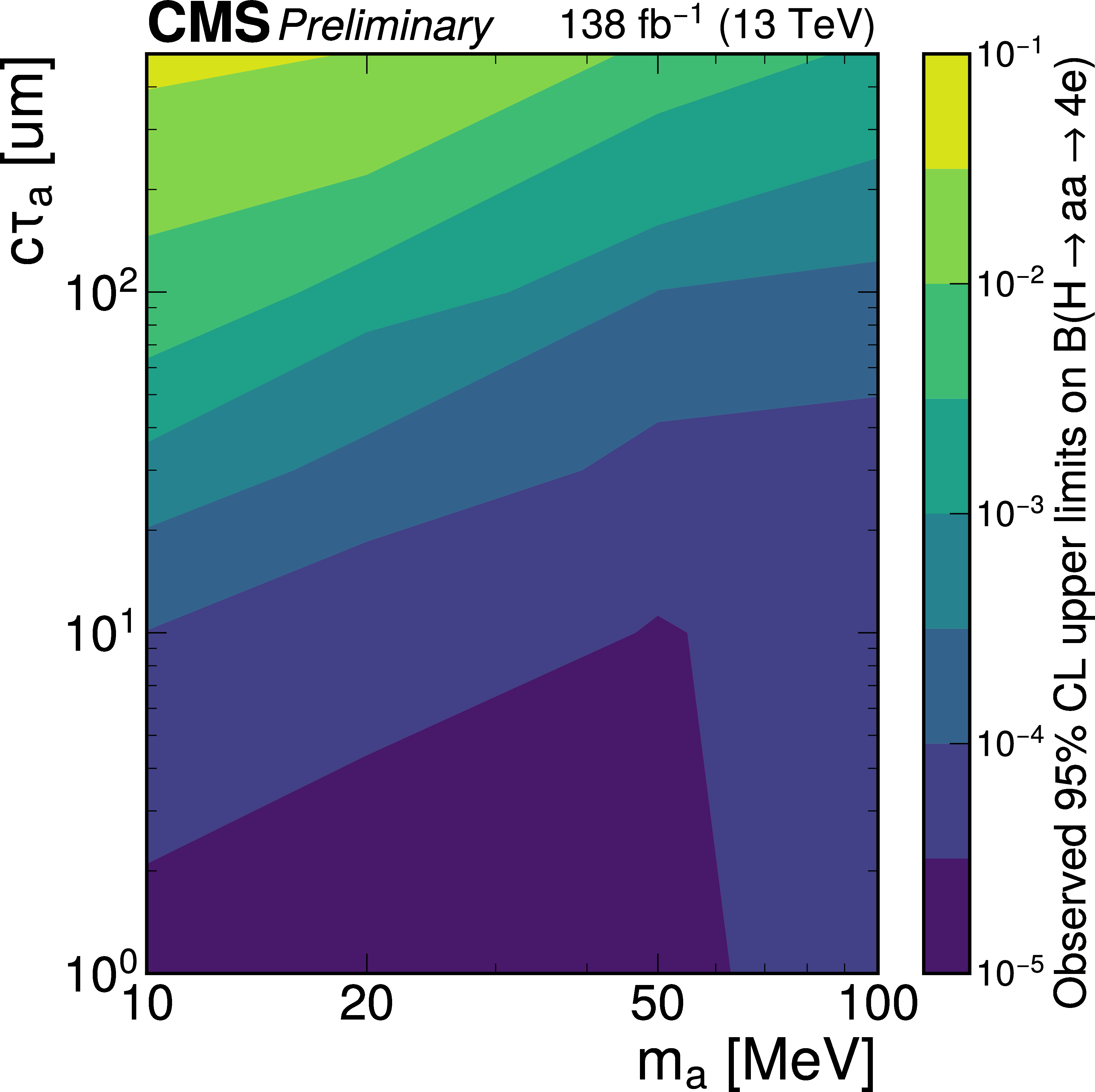
As a function of the mass of an axion-like particle ($ \mathrm{a} $), the observed (points) and expected (dashed) upper limits at 95% CL on the Higgs boson branching fraction for Higgs boson decays to a pairs in the four-electron final state, for scenarios with $ \mathrm{a} $ decay lengths of 1$ \,\mu\text{m} $ (upper left), 10$ \,\mu\text{m} $ (upper right), and 100$ \,\mu\text{m} $ (lower left). The one (green) and two (yellow) standard deviation bands are also shown. The observed limits on the branching fraction in the 2d decay length vs. A mass plane is also shown (lower right). |
png pdf |
Figure 4-a:
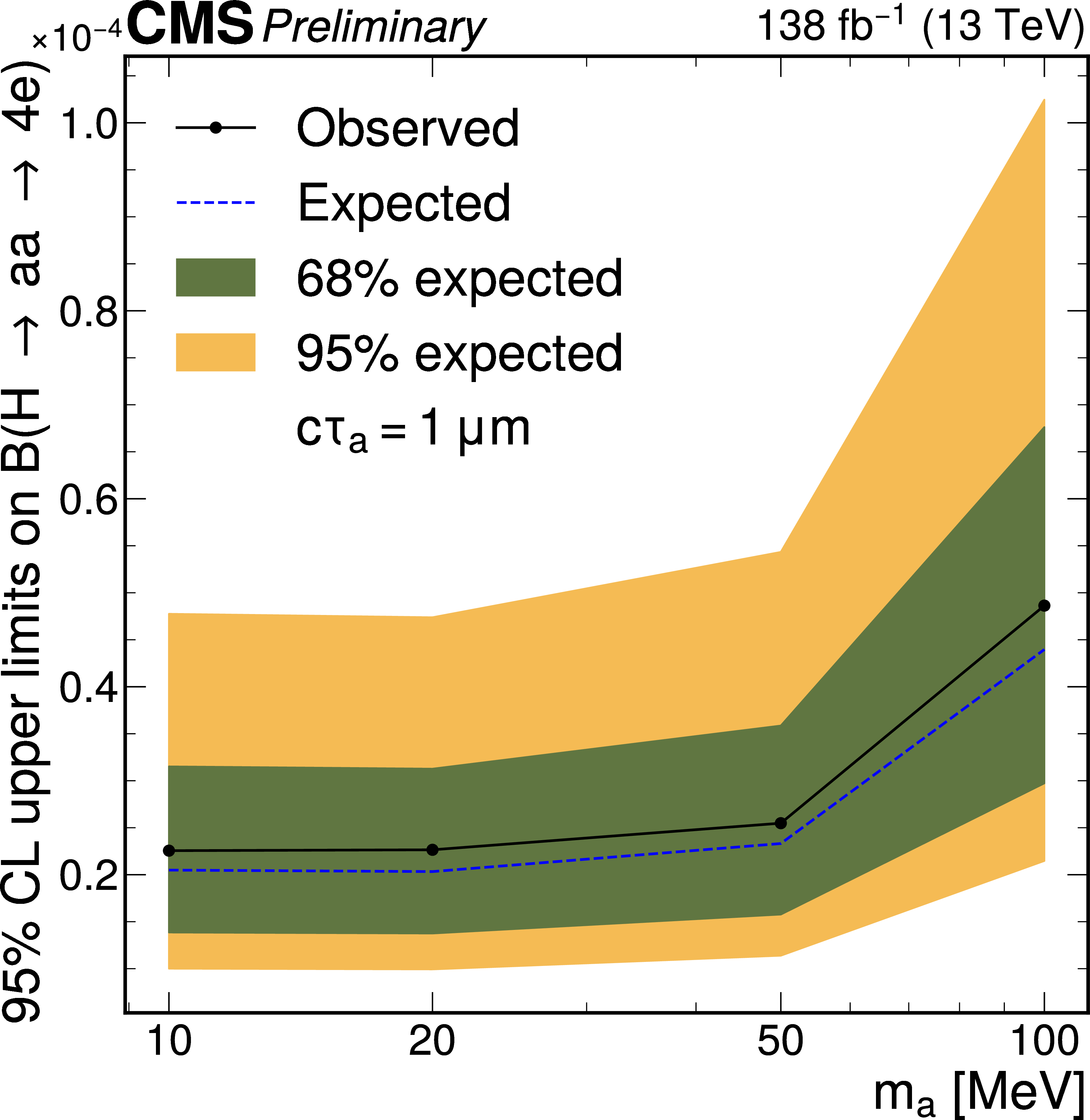
As a function of the mass of an axion-like particle ($ \mathrm{a} $), the observed (points) and expected (dashed) upper limits at 95% CL on the Higgs boson branching fraction for Higgs boson decays to a pairs in the four-electron final state, for scenarios with $ \mathrm{a} $ decay lengths of 1$ \,\mu\text{m} $ (upper left), 10$ \,\mu\text{m} $ (upper right), and 100$ \,\mu\text{m} $ (lower left). The one (green) and two (yellow) standard deviation bands are also shown. The observed limits on the branching fraction in the 2d decay length vs. A mass plane is also shown (lower right). |
png pdf |
Figure 4-b:
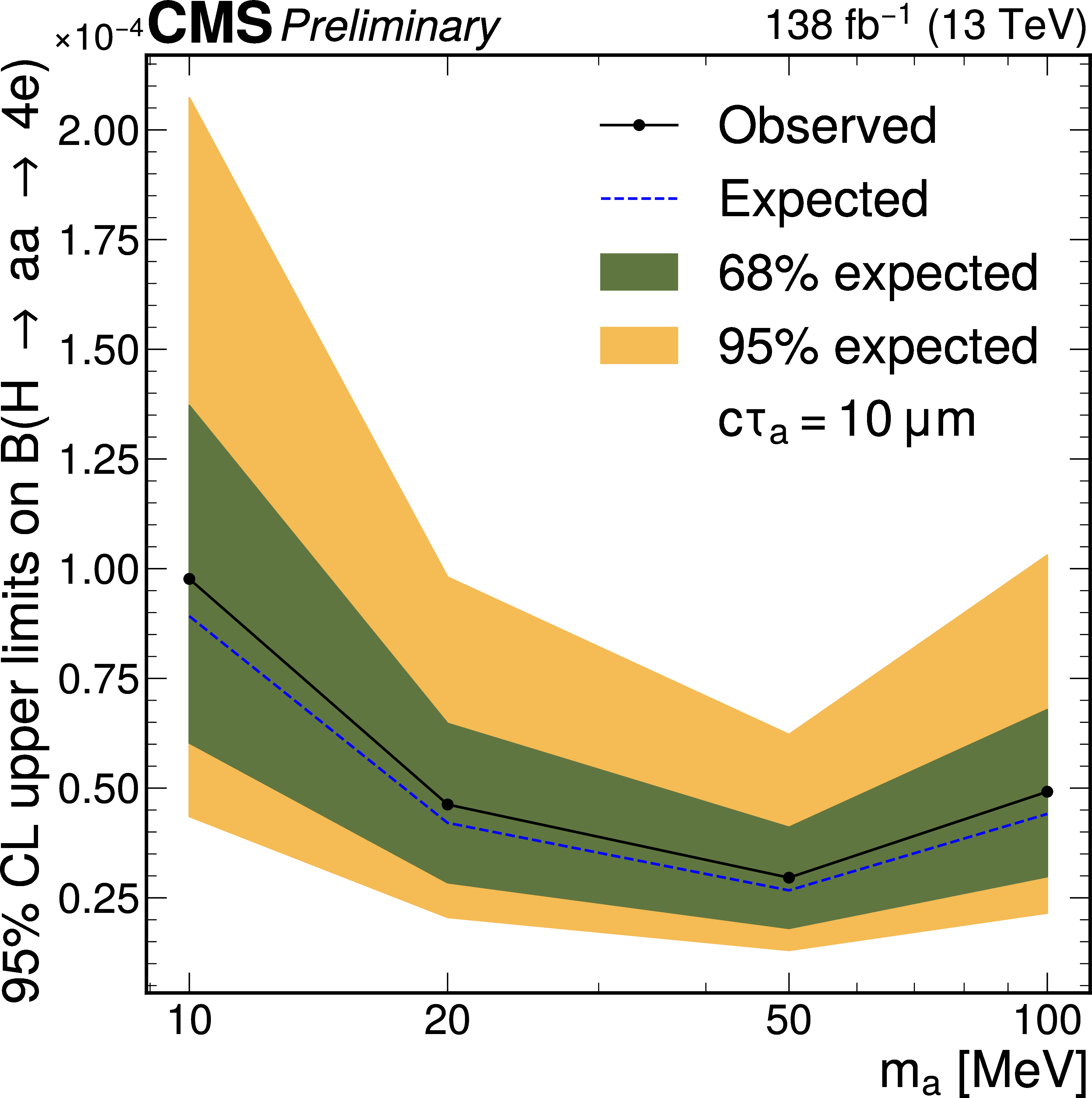
As a function of the mass of an axion-like particle ($ \mathrm{a} $), the observed (points) and expected (dashed) upper limits at 95% CL on the Higgs boson branching fraction for Higgs boson decays to a pairs in the four-electron final state, for scenarios with $ \mathrm{a} $ decay lengths of 1$ \,\mu\text{m} $ (upper left), 10$ \,\mu\text{m} $ (upper right), and 100$ \,\mu\text{m} $ (lower left). The one (green) and two (yellow) standard deviation bands are also shown. The observed limits on the branching fraction in the 2d decay length vs. A mass plane is also shown (lower right). |
png pdf |
Figure 4-c:
As a function of the mass of an axion-like particle ($ \mathrm{a} $), the observed (points) and expected (dashed) upper limits at 95% CL on the Higgs boson branching fraction for Higgs boson decays to a pairs in the four-electron final state, for scenarios with $ \mathrm{a} $ decay lengths of 1$ \,\mu\text{m} $ (upper left), 10$ \,\mu\text{m} $ (upper right), and 100$ \,\mu\text{m} $ (lower left). The one (green) and two (yellow) standard deviation bands are also shown. The observed limits on the branching fraction in the 2d decay length vs. A mass plane is also shown (lower right). |
png pdf |
Figure 4-d:
As a function of the mass of an axion-like particle ($ \mathrm{a} $), the observed (points) and expected (dashed) upper limits at 95% CL on the Higgs boson branching fraction for Higgs boson decays to a pairs in the four-electron final state, for scenarios with $ \mathrm{a} $ decay lengths of 1$ \,\mu\text{m} $ (upper left), 10$ \,\mu\text{m} $ (upper right), and 100$ \,\mu\text{m} $ (lower left). The one (green) and two (yellow) standard deviation bands are also shown. The observed limits on the branching fraction in the 2d decay length vs. A mass plane is also shown (lower right). |
png pdf |
Figure 5:
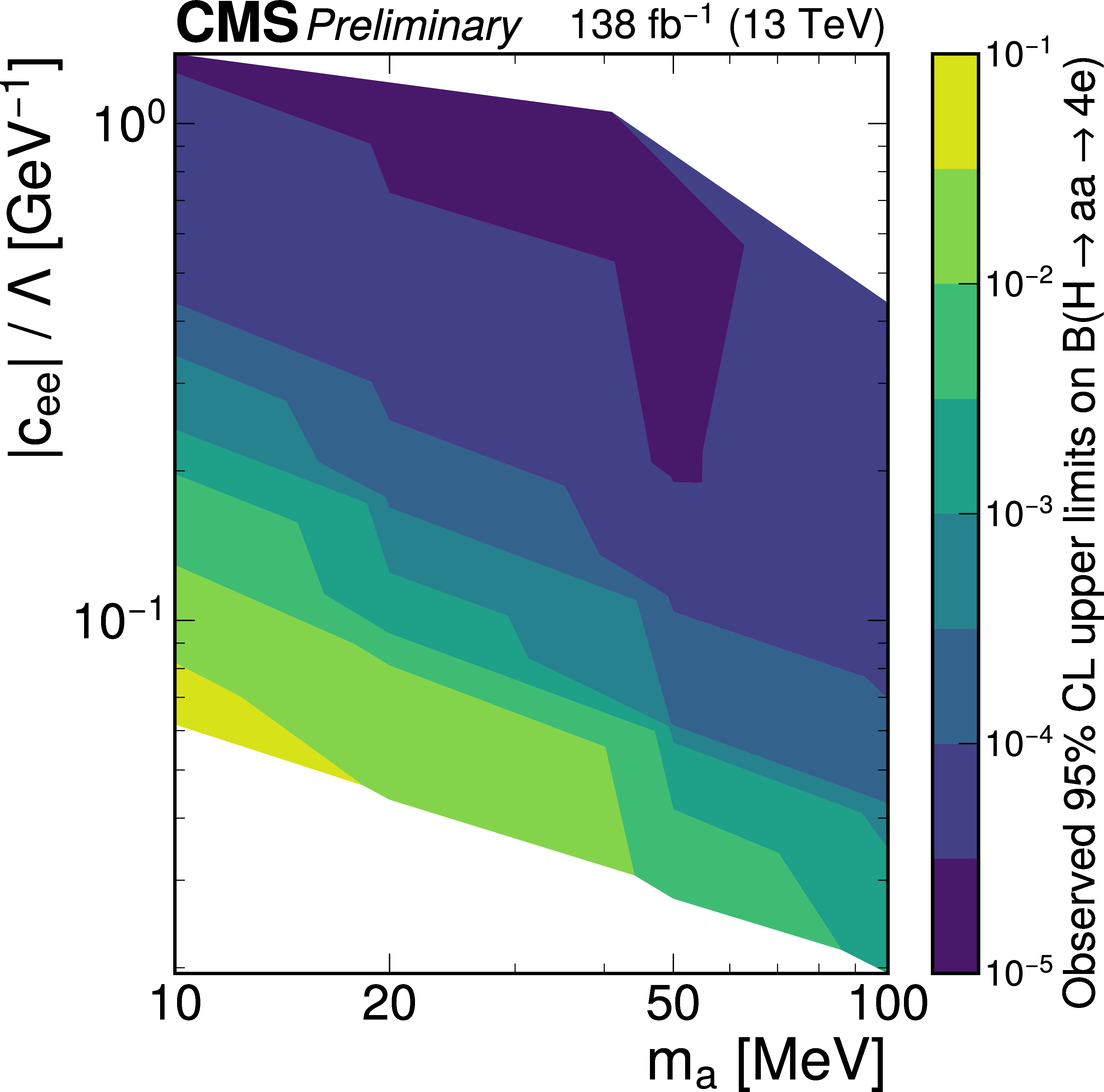
The observed upper limits at 95% CL on the Higgs boson branching fraction for $ \mathrm{H}\to\mathrm{a}\mathrm{a}\to4\mathrm{e} $, as a function of the ALP mass and the ratio of the ALP coupling to electrons and the energy scale of the ALP effective interaction. |
| Tables | |

png pdf |
Table 1:
Scale factors (SFs) with their statistical uncertainties for different CMS data-taking eras. |
| Summary |
| References | ||||
| 1 | F. Wilczek | Problem of Strong $ P $ and $ T $ Invariance in the Presence of Instantons | PRL 40 (1978) 279 | |
| 2 | R. D. Peccei and H. R. Quinn | CP Conservation in the Presence of Instantons | PRL 38 (1977) 1440 | |
| 3 | N. F. Ramsey | The tensor force between two protons at long range | Physica A 96 (1979) 285 | |
| 4 | S. Weinberg | A New Light Boson? | PRL 40 (1978) 223 | |
| 5 | J. E. Moody and F. Wilczek | NEW MACROSCOPIC FORCES? | PRD 30 (1984) 130 | |
| 6 | M. Jiang et al. | Search for axion-like dark matter with spin-based amplifiers | Nature Phys. 1 (1900) 7 | 2102.01448 |
| 7 | J. E. Kim and G. Carosi | Axions and the Strong CP Problem | Rev. Mod. Phys. 82 (2010) 557 | 0807.3125 |
| 8 | Z. G. Berezhiani and M. Y. Khlopov | Cosmology of Spontaneously Broken Gauge Family Symmetry | Z. Phys. C 49 (1991) 73 | |
| 9 | J. Jaeckel and A. Ringwald | The Low-Energy Frontier of Particle Physics | Ann. Rev. Nucl. Part. Sci. 60 (2010) 405 | 1002.0329 |
| 10 | P. Langacker | The Physics of Heavy $ Z^\prime $ Gauge Bosons | Rev. Mod. Phys. 81 (2009) 1199 | 0801.1345 |
| 11 | J. Liu, N. McGinnis, C. E. M. Wagner, and X.-P. Wang | Challenges for a QCD Axion at the 10 MeV Scale | JHEP 05 (2021) 138 | 2102.10118 |
| 12 | S. Girmohanta, S. Nakagawa, Y. Nakai, and J. Xu | How viable is a QCD axion near 10 MeV? | JHEP 10 (2024) 153 | 2405.13425 |
| 13 | Muon g-2 Collaboration | Measurement of the Positive Muon Anomalous Magnetic Moment to 0.20 ppm | PRL 131 (2023) 161802 | 2308.06230 |
| 14 | A. J. Krasznahorkay et al. | Observation of Anomalous Internal Pair Creation in Be8: A Possible Indication of a Light, Neutral Boson | PRL 116 (2016) 042501 | 1504.01527 |
| 15 | MEG II Collaboration | Search for the X17 particle in $ ^{7}\mathrm{Li}(\mathrm{p},\mathrm{e}^+ \mathrm{e}^{-}) ^{8}\mathrm{Be} $ processes with the MEG II detector | 2411.07994 | |
| 16 | M. Bauer, M. Neubert, and A. Thamm | LHC as an Axion Factory: Probing an Axion Explanation for $ (g-2)_\mu $ with Exotic Higgs Decays | PRL 119 (2017) 031802 | 1704.08207 |
| 17 | CMS Collaboration | Search for exotic Higgs boson decays $ H \to \mathcal{A}\mathcal{A} \to 4\gamma $ with events containing two merged diphotons in proton-proton collisions at $ \sqrt{s} $ = 13 TeV | PRL 131 (2023) 101801 | CMS-HIG-21-016 2209.06197 |
| 18 | CMS Collaboration | The CMS experiment at the CERN LHC | JINST 3 (2008) S08004 | |
| 19 | CMS Collaboration | Development of the CMS detector for the CERN LHC Run 3 | Accepted by JINST, 2023 | CMS-PRF-21-001 2309.05466 |
| 20 | CMS Collaboration | Performance of the CMS Level-1 trigger in proton-proton collisions at $ \sqrt{s} = $ 13 TeV | JINST 15 (2020) P10017 | CMS-TRG-17-001 2006.10165 |
| 21 | CMS Collaboration | The CMS trigger system | JINST 12 (2017) P01020 | CMS-TRG-12-001 1609.02366 |
| 22 | CMS Collaboration | Electron and photon reconstruction and identification with the CMS experiment at the CERN LHC | JINST 16 (2021) P05014 | CMS-EGM-17-001 2012.06888 |
| 23 | CMS Collaboration | Performance of the CMS muon detector and muon reconstruction with proton-proton collisions at $ \sqrt{s}= $ 13 TeV | JINST 13 (2018) P06015 | CMS-MUO-16-001 1804.04528 |
| 24 | CMS Collaboration | Description and performance of track and primary-vertex reconstruction with the CMS tracker | JINST 9 (2014) P10009 | CMS-TRK-11-001 1405.6569 |
| 25 | CMS Collaboration | Particle-flow reconstruction and global event description with the CMS detector | JINST 12 (2017) P10003 | CMS-PRF-14-001 1706.04965 |
| 26 | CMS Collaboration | Performance of reconstruction and identification of $ \tau $ leptons decaying to hadrons and $ \nu_\tau $ in pp collisions at $ \sqrt{s} = $ 13 TeV | JINST 13 (2018) P10005 | CMS-TAU-16-003 1809.02816 |
| 27 | CMS Collaboration | Jet energy scale and resolution in the CMS experiment in pp collisions at 8 TeV | JINST 12 (2017) P02014 | CMS-JME-13-004 1607.03663 |
| 28 | CMS Collaboration | Performance of missing transverse momentum reconstruction in proton-proton collisions at $ \sqrt{s} = $ 13 TeV using the CMS detector | JINST 14 (2019) P07004 | CMS-JME-17-001 1903.06078 |
| 29 | E. Bagnaschi, G. Degrassi, P. Slavich, and A. Vicini | Higgs production via gluon fusion in the POWHEG approach in the SM and in the MSSM | JHEP 02 (2012) 088 | 1111.2854 |
| 30 | P. Nason | A new method for combining NLO QCD with shower Monte Carlo algorithms | JHEP 11 (2004) 040 | hep-ph/0409146 |
| 31 | S. Frixione, P. Nason, and C. Oleari | Matching NLO QCD computations with parton shower simulations: the POWHEG method | JHEP 11 (2007) 070 | 0709.2092 |
| 32 | S. Alioli, P. Nason, C. Oleari, and E. Re | A general framework for implementing NLO calculations in shower Monte Carlo programs: the POWHEG BOX | JHEP 06 (2010) 043 | 1002.2581 |
| 33 | T. Sjöstrand et al. | An introduction to PYTHIA 8.2 | Comput. Phys. Commun. 191 (2015) 159 | 1410.3012 |
| 34 | CMS Collaboration | Extraction and validation of a new set of CMS PYTHIA8 tunes from underlying-event measurements | EPJC 80 (2020) 4 | CMS-GEN-17-001 1903.12179 |
| 35 | NNPDF Collaboration | Parton distributions from high-precision collider data | EPJC 77 (2017) 663 | 1706.00428 |
| 36 | J. Alwall et al. | The automated computation of tree-level and next-to-leading order differential cross sections, and their matching to parton shower simulations | JHEP 07 (2014) 079 | 1405.0301 |
| 37 | R. Frederix and S. Frixione | Merging meets matching in MC@NLO | JHEP 12 (2012) 061 | 1209.6215 |
| 38 | P. F. Monni et al. | MiNNLO$ _{PS} $: a new method to match NNLO QCD to parton showers | JHEP 05 (2020) 143 | 1908.06987 |
| 39 | P. F. Monni, E. Re, and M. Wiesemann | MiNNLO$ _{\text {PS}} $: optimizing 2 $ \rightarrow $ 1 hadronic processes | EPJC 80 (2020) 1075 | 2006.04133 |
| 40 | T. Gleisberg et al. | Event generation with SHERPA 1.1 | JHEP 02 (2009) 007 | 0811.4622 |
| 41 | NNPDF Collaboration | Parton distributions for the LHC Run II | JHEP 04 (2015) 040 | 1410.8849 |
| 42 | CMS Collaboration | Reconstruction of decays to merged photons using end-to-end deep learning with domain continuation in the CMS detector | PRD 10 (1900) 8 | CMS-EGM-20-001 2204.12313 |
| 43 | W. Adam, R. Fr\"uhwirth, A. Strandlie, and T. Todor | Reconstruction of Electrons with the Gaussian-Sum Filter in the CMS Tracker at the LHC | ||
| 44 | R. Fruhwirth, W. Waltenberger, and P. Vanlaer | Adaptive vertex fitting | JPG 34 (2007) N343 | |
| 45 | T. Chen and C. Guestrin | XGBoost: A scalable tree boosting system | in Proc. 22nd ACM SIGKDD Int. Conf. on Knowledge Discovery and Data Mining, KDD '16, Association for Computing Machinery, New York, NY, USA, 2016 link |
|
| 46 | CMS Collaboration | Measurements of $ \mathrm{t\bar{t}}H $ Production and the CP Structure of the Yukawa Interaction between the Higgs Boson and Top Quark in the Diphoton Decay Channel | PRL 125 (2020) 061801 | CMS-HIG-19-013 2003.10866 |
| 47 | CMS Collaboration | Search for a standard model-like Higgs boson in the mass range between 70 and 110 GeV in the diphoton final state in proton-proton collisions at $ \sqrt{s} $=13TeV | PLB 860 (2025) 139067 | CMS-HIG-20-002 2405.18149 |
| 48 | T. Skwarnicki | A study of the radiative CASCADE transitions between the Upsilon-Prime and Upsilon resonances | PhD thesis, Cracow, INP, 1986 | |
| 49 | M. Oreglia | A Study of the Reactions $ \psi^\prime \to \gamma \gamma \psi $ | PhD Thesis, Stanford University, 1980 | |
| 50 | CMS Collaboration | The CMS statistical analysis and combination tool: \textscCombine | Comput. Softw. Big Sci. 8 (2024) 19 | CMS-CAT-23-001 2404.06614 |
| 51 | H. Georgi, D. B. Kaplan, and L. Randall | Manifesting the Invisible Axion at Low-energies | PLB 169 (1986) 73 | |
|
|
Compact Muon Solenoid LHC, CERN |

|
|
|
|
|
|