
Compact Muon Solenoid
LHC, CERN
 Visit us: CMS Public Website, CMS Physics ;
Contact us: CMS Publications Committee
Visit us: CMS Public Website, CMS Physics ;
Contact us: CMS Publications Committee
| CMS-SUS-24-003 ; CERN-EP-2025-186 | ||
| Search for Higgsinos in final states with low-momentum lepton-track pairs at 13 TeV | ||
| CMS Collaboration | ||
| 20 November 2025 | ||
| Phys. Rev. D 113, 092009 | ||
| Abstract: We present a search for the pair production of Higgsinos in final states with large missing transverse momentum and either two reconstructed muons or a reconstructed lepton (muon or electron) and an isolated track. The analyzed data correspond to proton-proton collisions with an integrated luminosity of 137 fb$ ^{-1} $, collected by the CMS experiment at $ \sqrt{s}= $ 13 TeV in 2016, 2017, and 2018. The signal scenario assumes two neutralino states, $ \tilde{\chi}_{2}^{0} $ and $ \tilde{\chi}_{1}^{0} $, with a small mass difference in the range 1-10 GeV and a chargino $ \tilde{\chi}_{1}^{\pm} $ with an intermediate mass. The analysis focuses on the decay of the heavier neutralino into the lighter one and a virtual Z boson, which decays into two same-flavor leptons. The leptons have small transverse momentum and/or a small opening angle between the identified muons. An isolated track is used to recover events in which only one of the two leptons is identified. Multivariate discriminants are used to enhance the sensitivity by efficiently rejecting backgrounds from SM processes or misreconstructed tracks and/or leptons. The search explores a unique phase space and probes a previously unexplored region of the signal model parameter space. Mass differences between the two neutralinos are probed down to 1.5 GeV, assuming a Higgsino mass of 100 GeV. The maximum excluded Higgsino mass is 115 GeV. | ||
| Links: e-print arXiv:2511.16394 [hep-ex] (PDF) ; CDS record ; inSPIRE record ; CADI line (restricted) ; | ||
| Figures | |
png pdf |
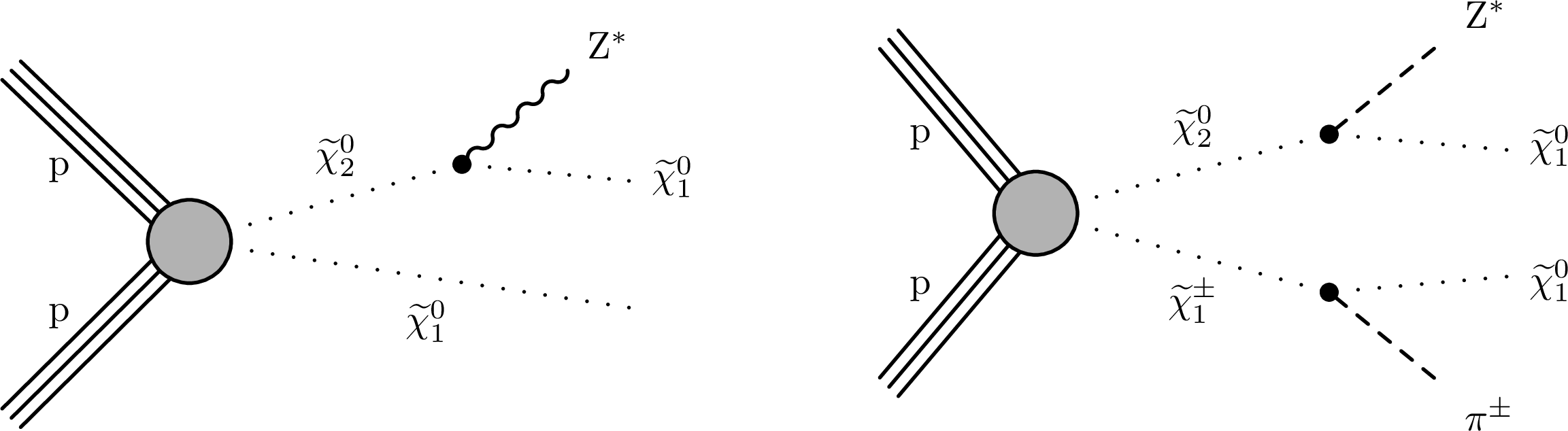
Figure 1:
Diagrams illustrating the production and decay of electroweakinos in the Higgsino simplified model via the $ \tilde{\chi}_{2}^{0}\tilde{\chi}_{1}^{0} $ (left) and $ \tilde{\chi}_{2}^{0}\tilde{\chi}_{1}^{\pm} $ (right) processes. |
png pdf |
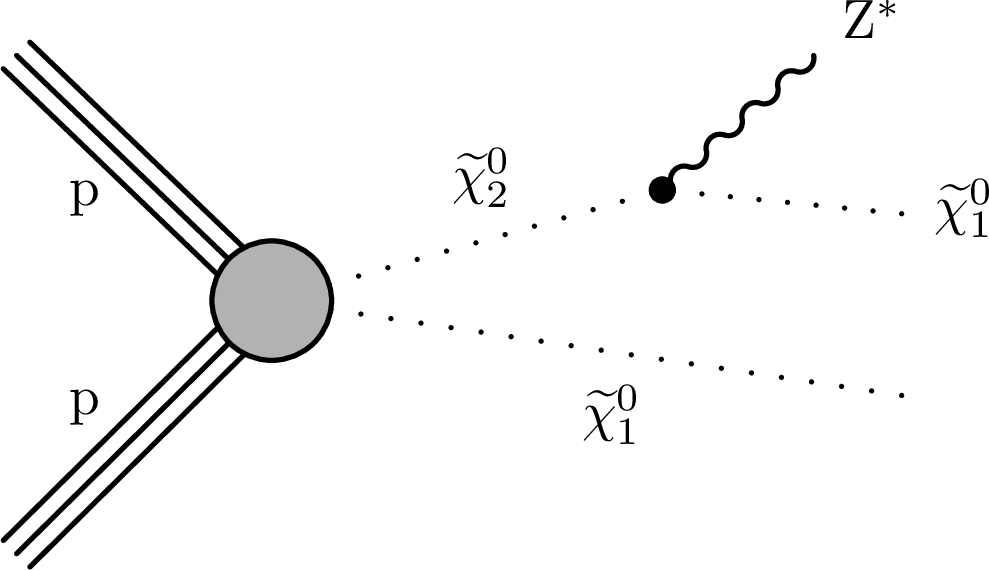
Figure 1-a:
Diagrams illustrating the production and decay of electroweakinos in the Higgsino simplified model via the $ \tilde{\chi}_{2}^{0}\tilde{\chi}_{1}^{0} $ (left) and $ \tilde{\chi}_{2}^{0}\tilde{\chi}_{1}^{\pm} $ (right) processes. |
png pdf |
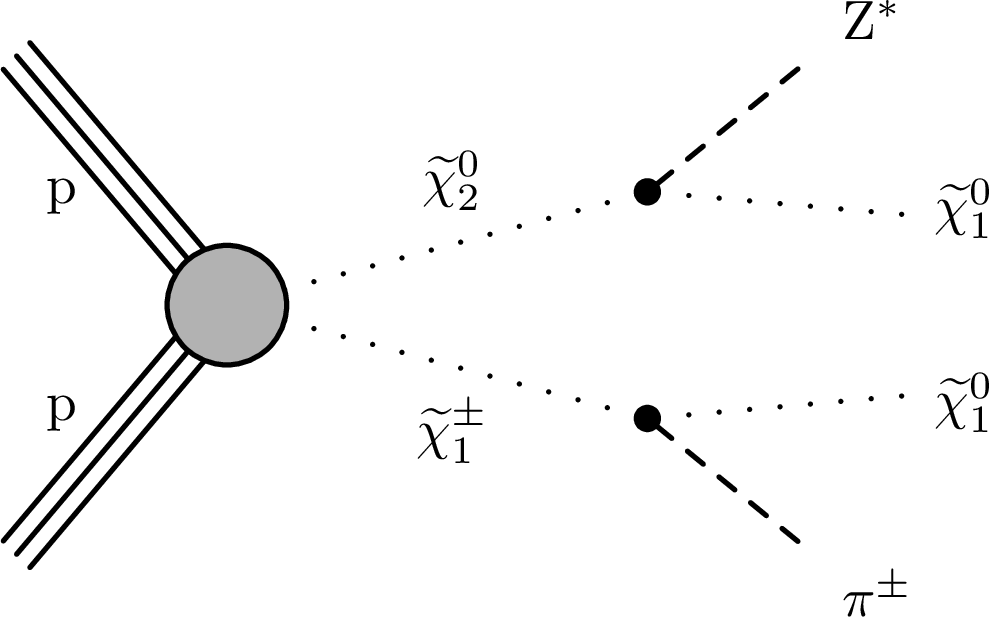
Figure 1-b:
Diagrams illustrating the production and decay of electroweakinos in the Higgsino simplified model via the $ \tilde{\chi}_{2}^{0}\tilde{\chi}_{1}^{0} $ (left) and $ \tilde{\chi}_{2}^{0}\tilde{\chi}_{1}^{\pm} $ (right) processes. |
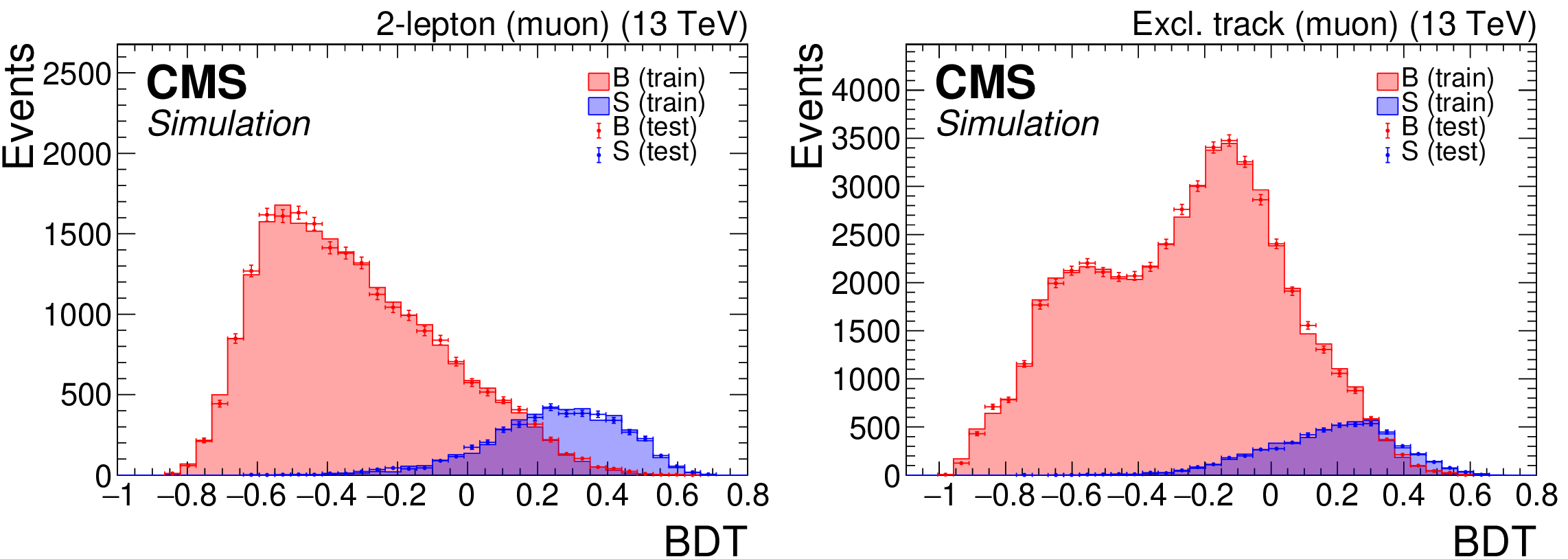
png pdf |
Figure 2:
Unweighted distributions of the event-level BDT scores for events from the signal and background training samples in the dimuon category (left) and the muon+track category (right), based on the Phase1 detector configuration. |
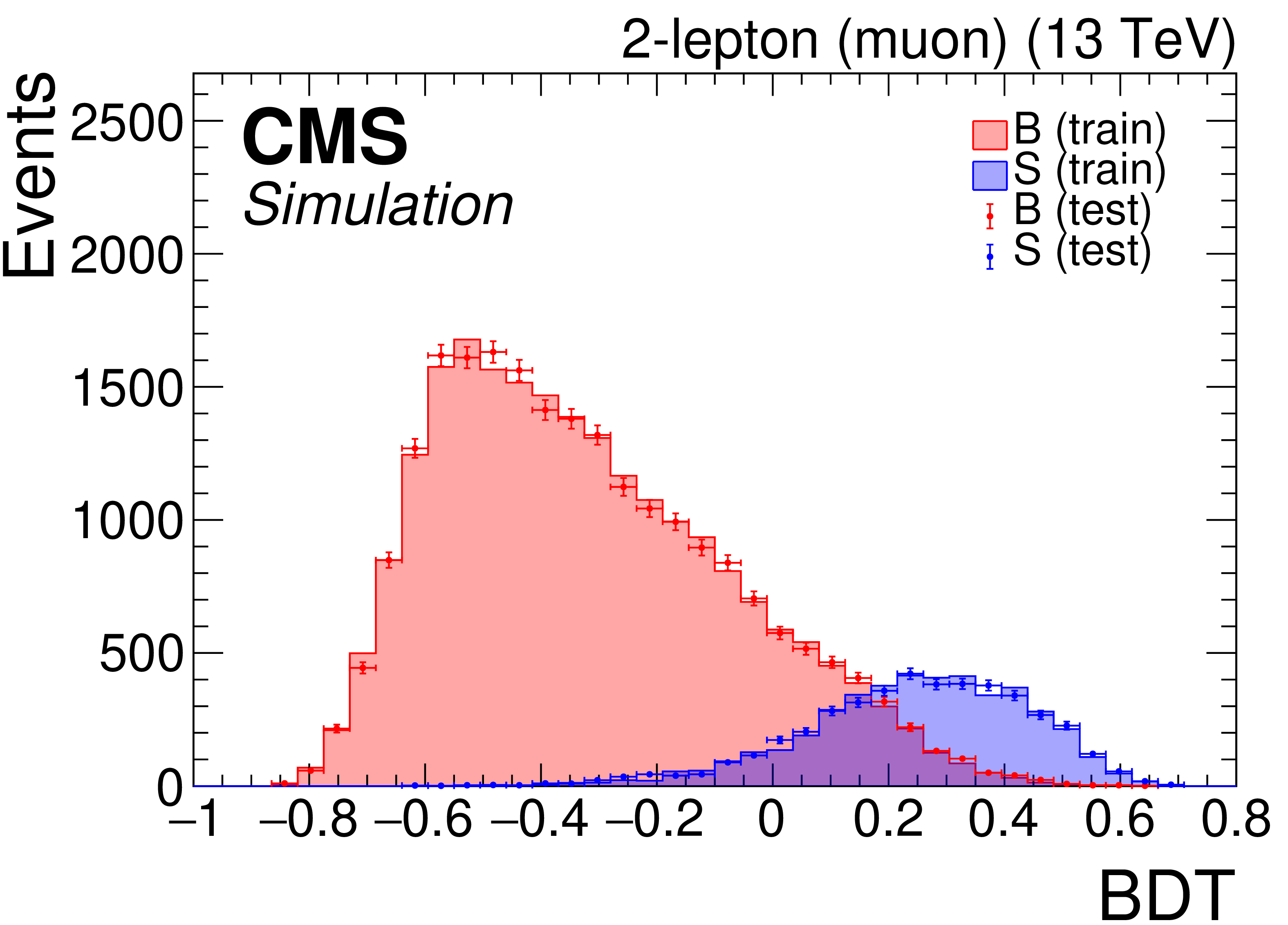
png pdf |
Figure 2-a:
Unweighted distributions of the event-level BDT scores for events from the signal and background training samples in the dimuon category (left) and the muon+track category (right), based on the Phase1 detector configuration. |
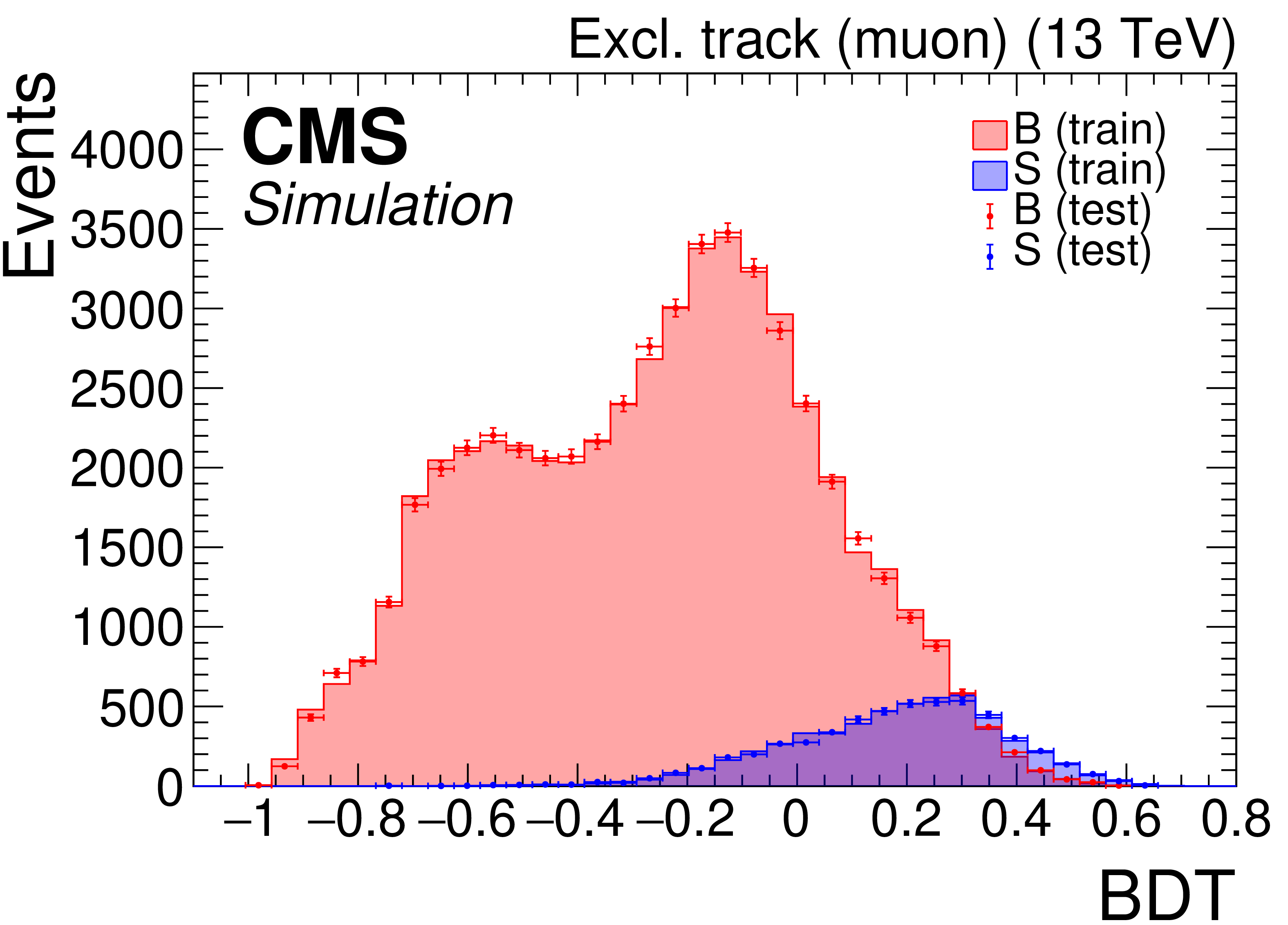
png pdf |
Figure 2-b:
Unweighted distributions of the event-level BDT scores for events from the signal and background training samples in the dimuon category (left) and the muon+track category (right), based on the Phase1 detector configuration. |
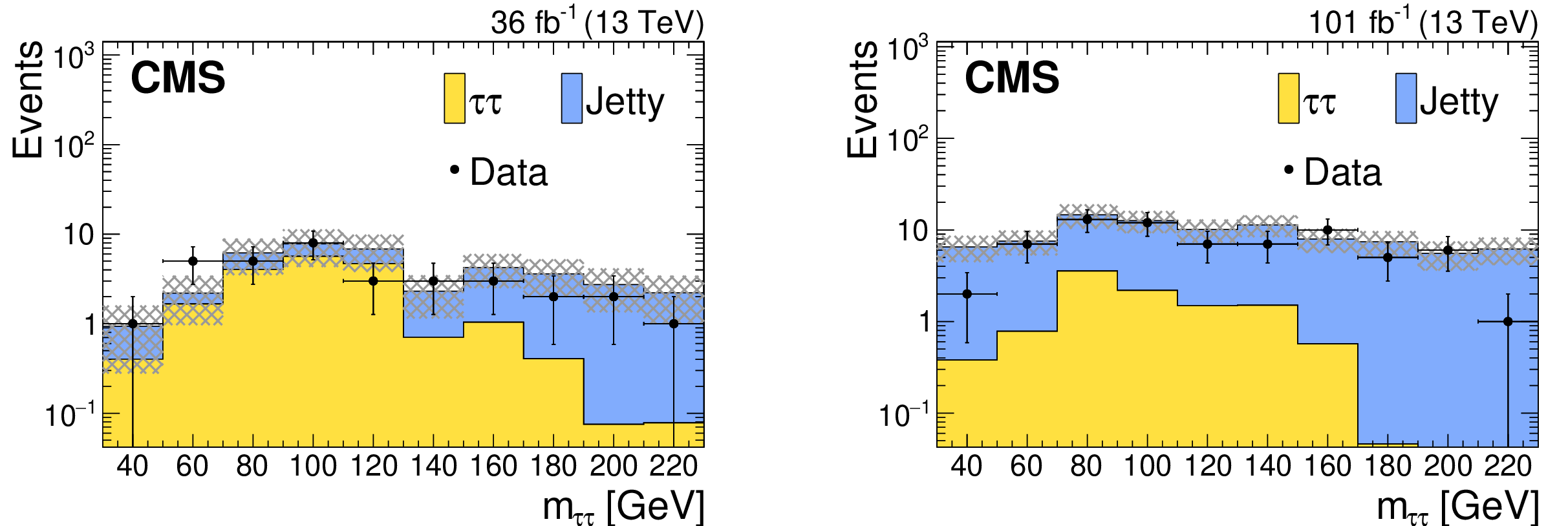
png pdf |
Figure 3:
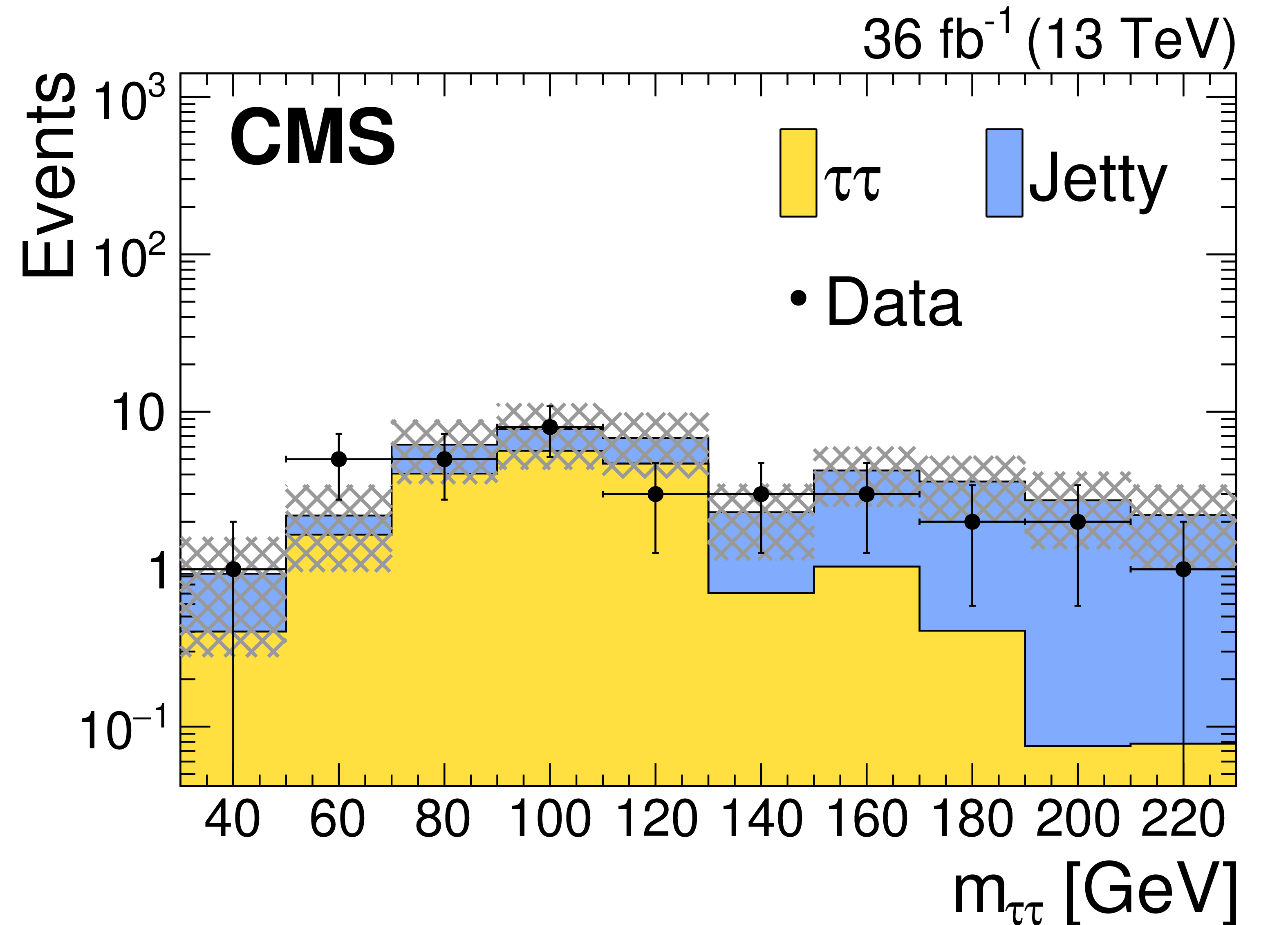
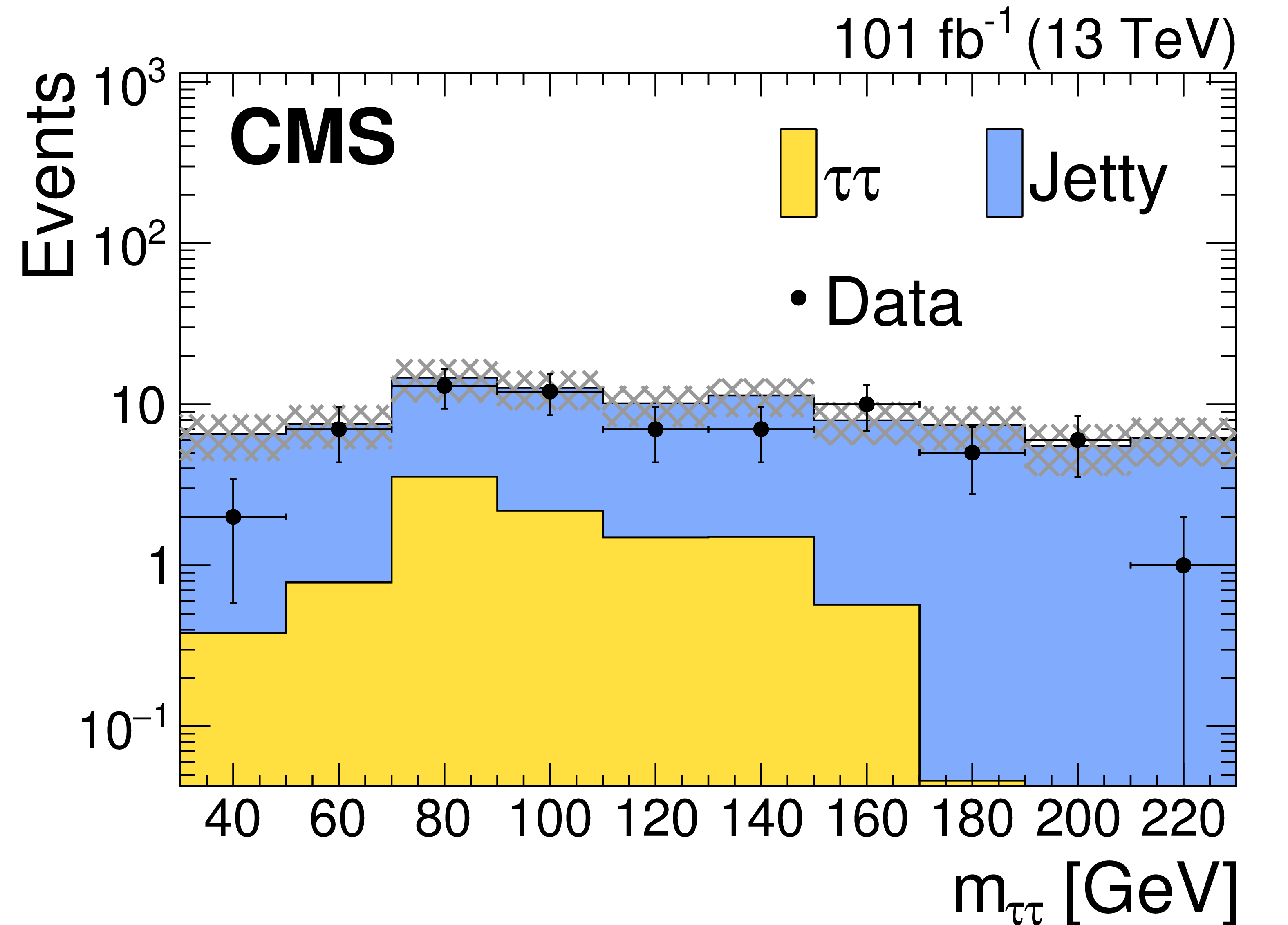
Distributions of the reconstructed ditau invariant mass ($ m_{\tau\tau} $) in the BDT sideband CR, shown for Phase0 (left) and Phase1 (right) detector configurations. The non-$ \tau\tau $ background is estimated using the data-driven Jetty background method described in the text. The gray hatching shows the statistical uncertainty in the background prediction. |
png pdf |
Figure 3-a:
Distributions of the reconstructed ditau invariant mass ($ m_{\tau\tau} $) in the BDT sideband CR, shown for Phase0 (left) and Phase1 (right) detector configurations. The non-$ \tau\tau $ background is estimated using the data-driven Jetty background method described in the text. The gray hatching shows the statistical uncertainty in the background prediction. |
png pdf |
Figure 3-b:
Distributions of the reconstructed ditau invariant mass ($ m_{\tau\tau} $) in the BDT sideband CR, shown for Phase0 (left) and Phase1 (right) detector configurations. The non-$ \tau\tau $ background is estimated using the data-driven Jetty background method described in the text. The gray hatching shows the statistical uncertainty in the background prediction. |
png pdf |
Figure 4:
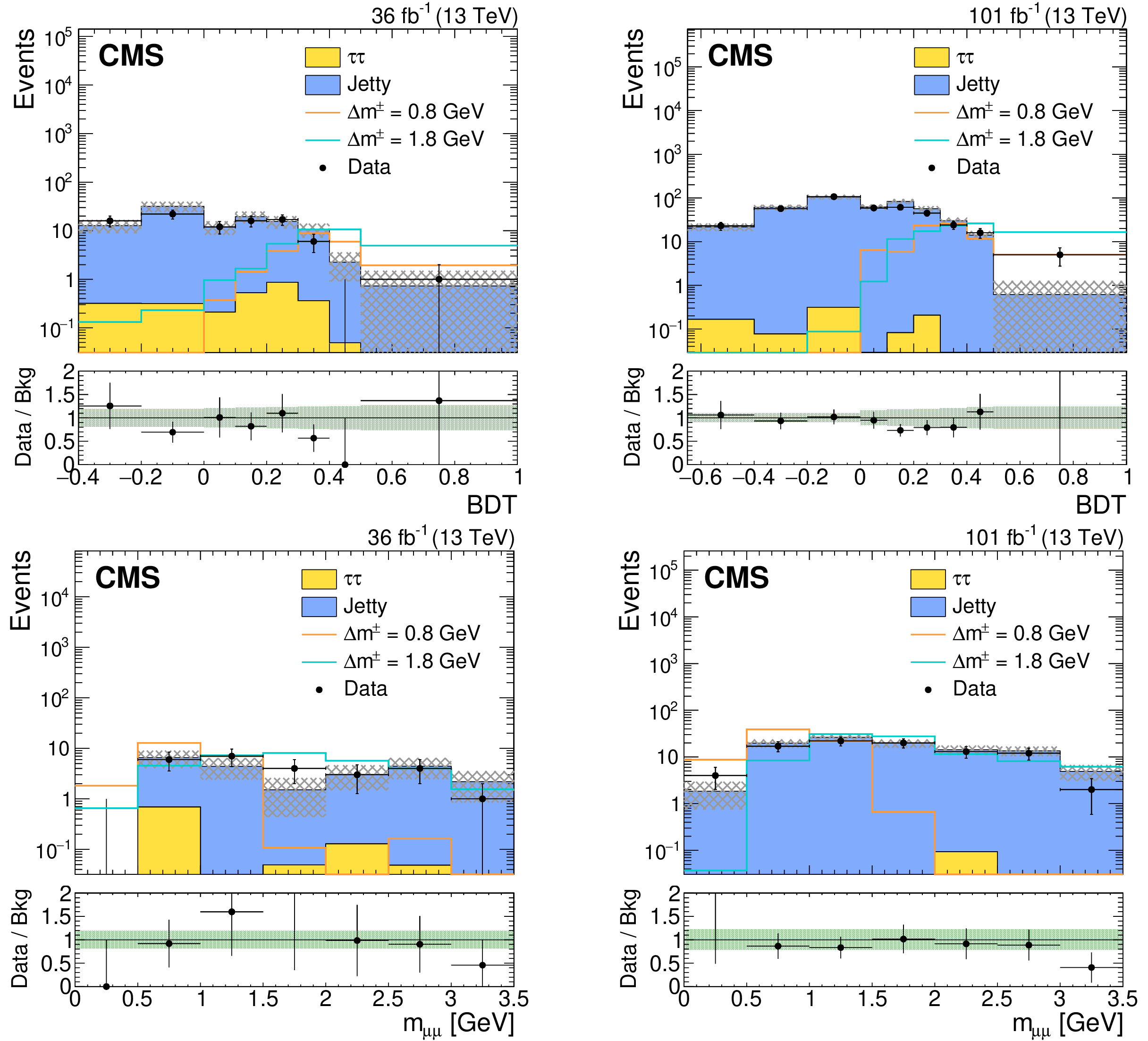
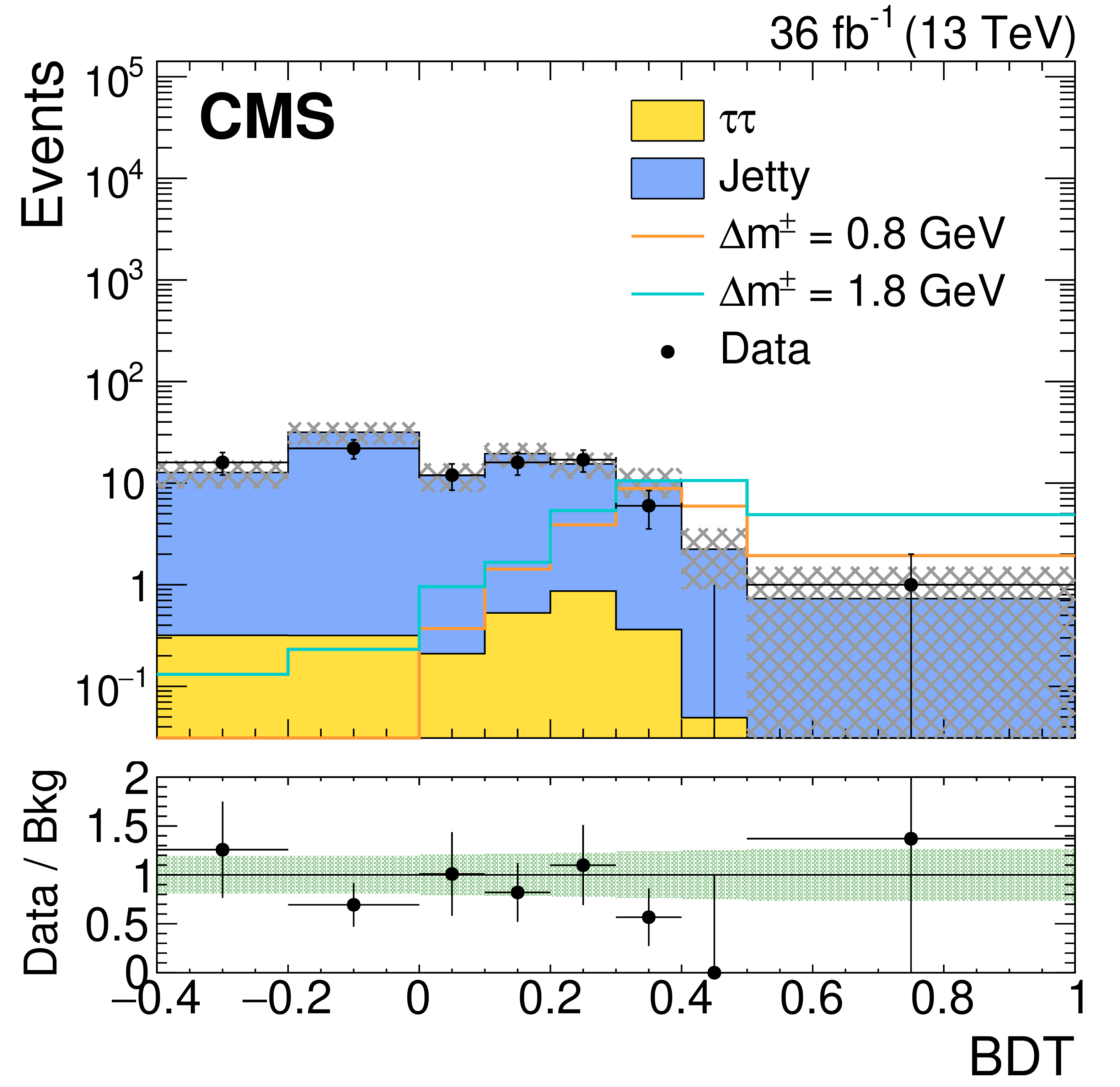
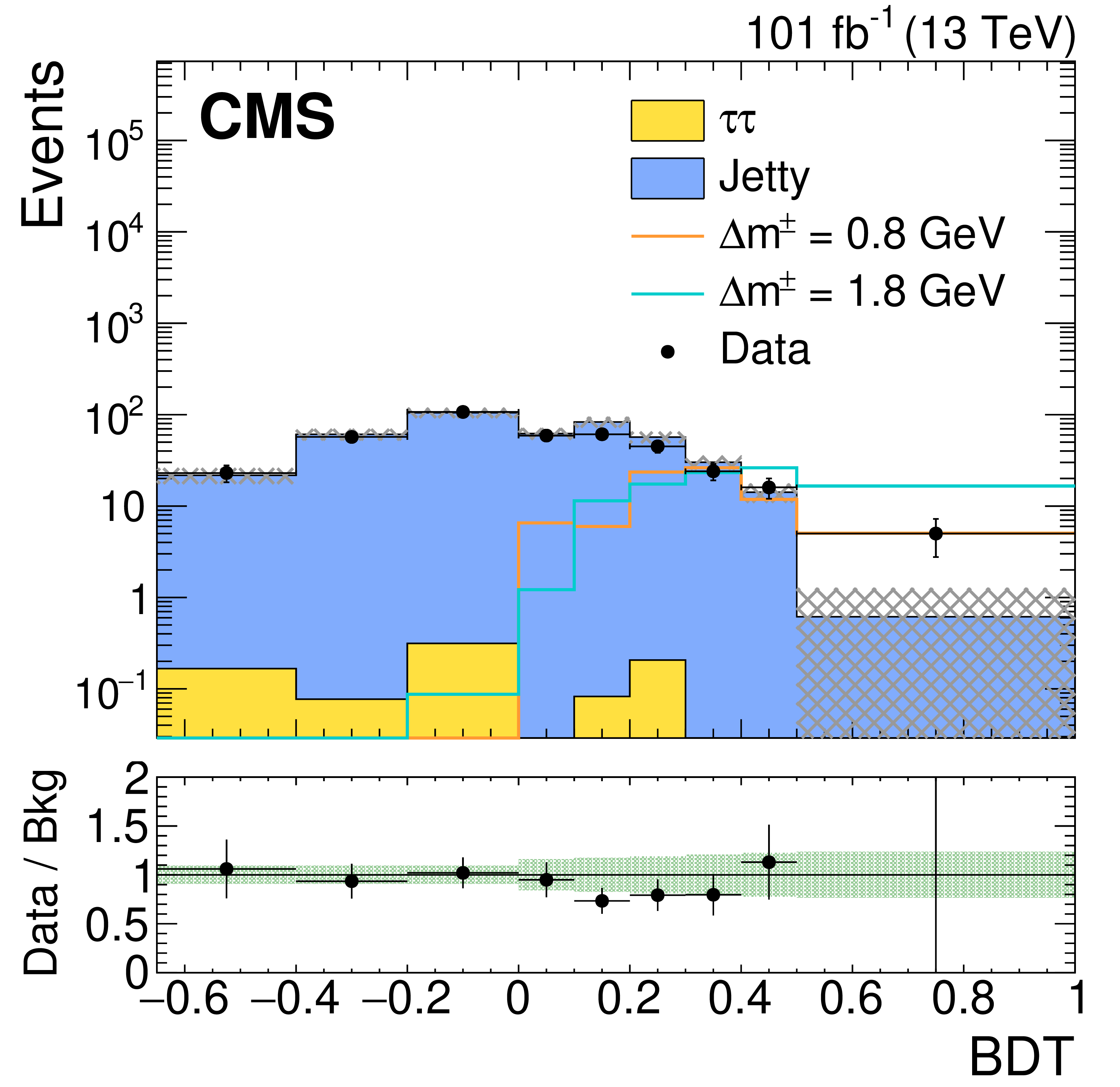
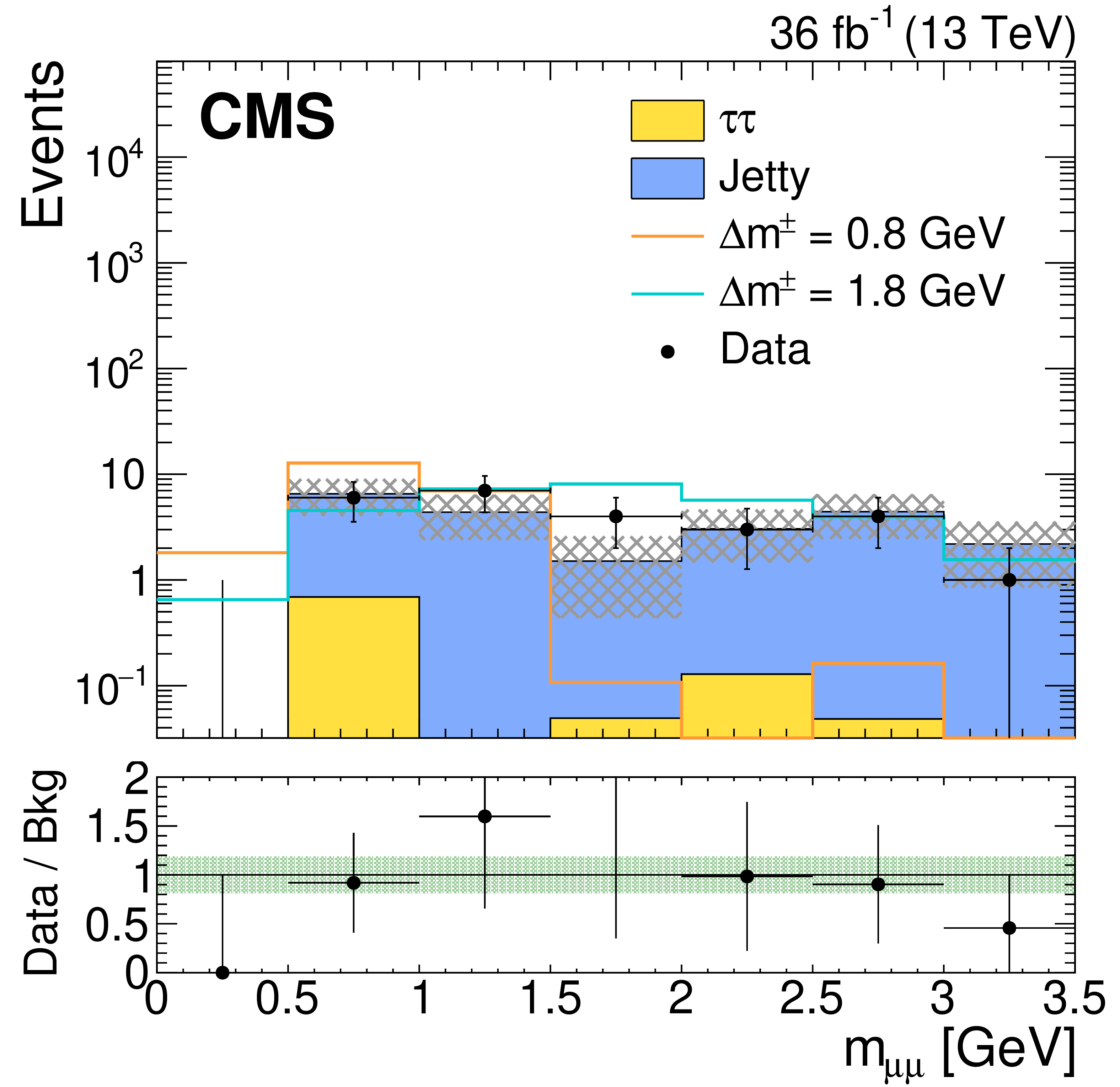
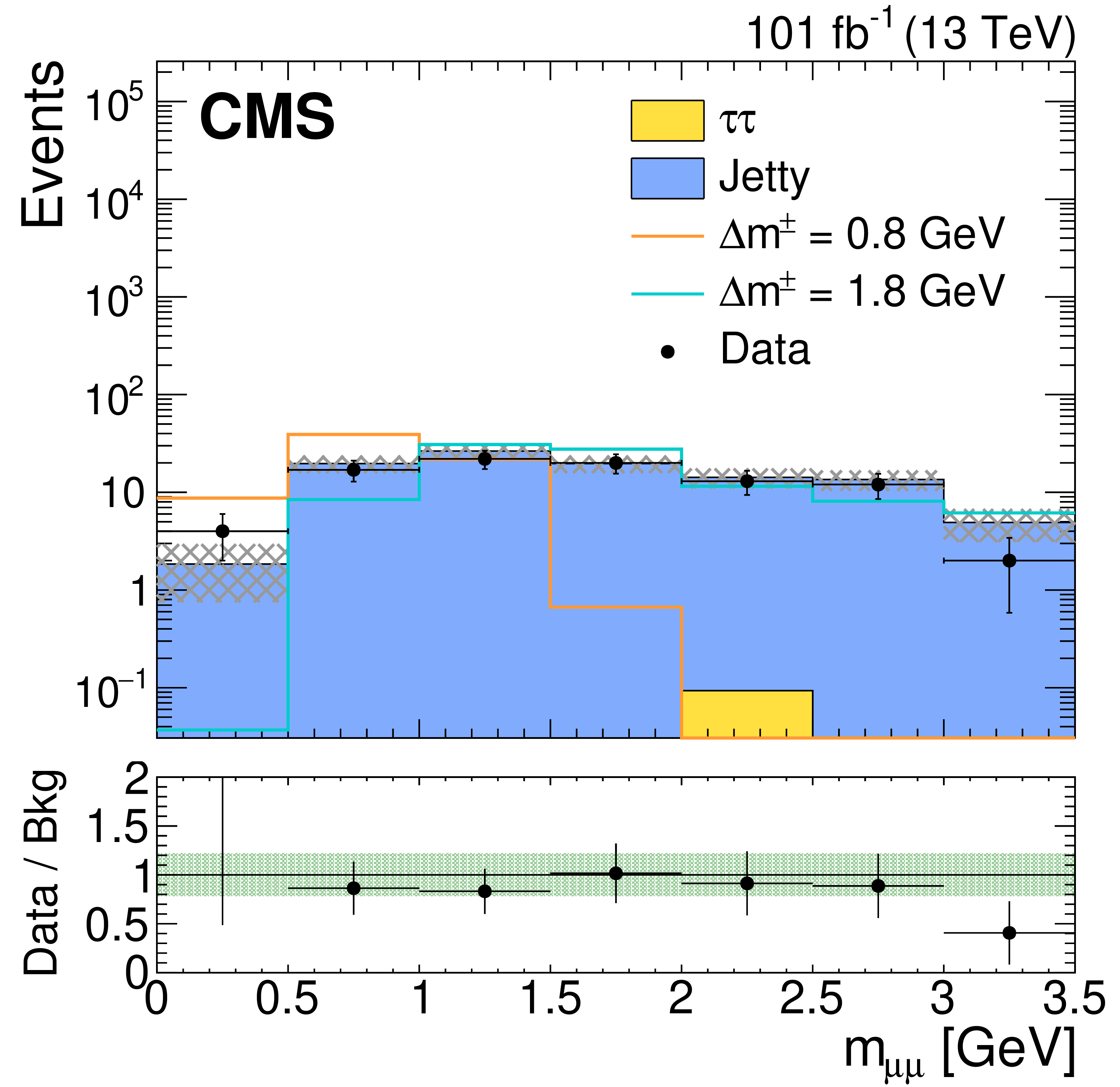
Prefit expected and observed distributions of the event BDT output score in the SRs for the dimuon category (upper) and of the dimuon invariant mass for events with event classifier scores greater than 0.1 (lower), shown separately for Phase0 (left) and Phase1 (right) configurations. The gray hatching shows the statistical uncertainty in the background prediction. In the lower panel, the green band indicates the relative systematic uncertainty in the predicted background, while the black bars represent the total uncertainty, including both statistical and systematic components. Two example signal scenarios are also shown as colored lines. |
png pdf |
Figure 4-a:
Prefit expected and observed distributions of the event BDT output score in the SRs for the dimuon category (upper) and of the dimuon invariant mass for events with event classifier scores greater than 0.1 (lower), shown separately for Phase0 (left) and Phase1 (right) configurations. The gray hatching shows the statistical uncertainty in the background prediction. In the lower panel, the green band indicates the relative systematic uncertainty in the predicted background, while the black bars represent the total uncertainty, including both statistical and systematic components. Two example signal scenarios are also shown as colored lines. |
png pdf |
Figure 4-b:
Prefit expected and observed distributions of the event BDT output score in the SRs for the dimuon category (upper) and of the dimuon invariant mass for events with event classifier scores greater than 0.1 (lower), shown separately for Phase0 (left) and Phase1 (right) configurations. The gray hatching shows the statistical uncertainty in the background prediction. In the lower panel, the green band indicates the relative systematic uncertainty in the predicted background, while the black bars represent the total uncertainty, including both statistical and systematic components. Two example signal scenarios are also shown as colored lines. |
png pdf |
Figure 4-c:
Prefit expected and observed distributions of the event BDT output score in the SRs for the dimuon category (upper) and of the dimuon invariant mass for events with event classifier scores greater than 0.1 (lower), shown separately for Phase0 (left) and Phase1 (right) configurations. The gray hatching shows the statistical uncertainty in the background prediction. In the lower panel, the green band indicates the relative systematic uncertainty in the predicted background, while the black bars represent the total uncertainty, including both statistical and systematic components. Two example signal scenarios are also shown as colored lines. |
png pdf |
Figure 4-d:
Prefit expected and observed distributions of the event BDT output score in the SRs for the dimuon category (upper) and of the dimuon invariant mass for events with event classifier scores greater than 0.1 (lower), shown separately for Phase0 (left) and Phase1 (right) configurations. The gray hatching shows the statistical uncertainty in the background prediction. In the lower panel, the green band indicates the relative systematic uncertainty in the predicted background, while the black bars represent the total uncertainty, including both statistical and systematic components. Two example signal scenarios are also shown as colored lines. |
png pdf |
Figure 5:
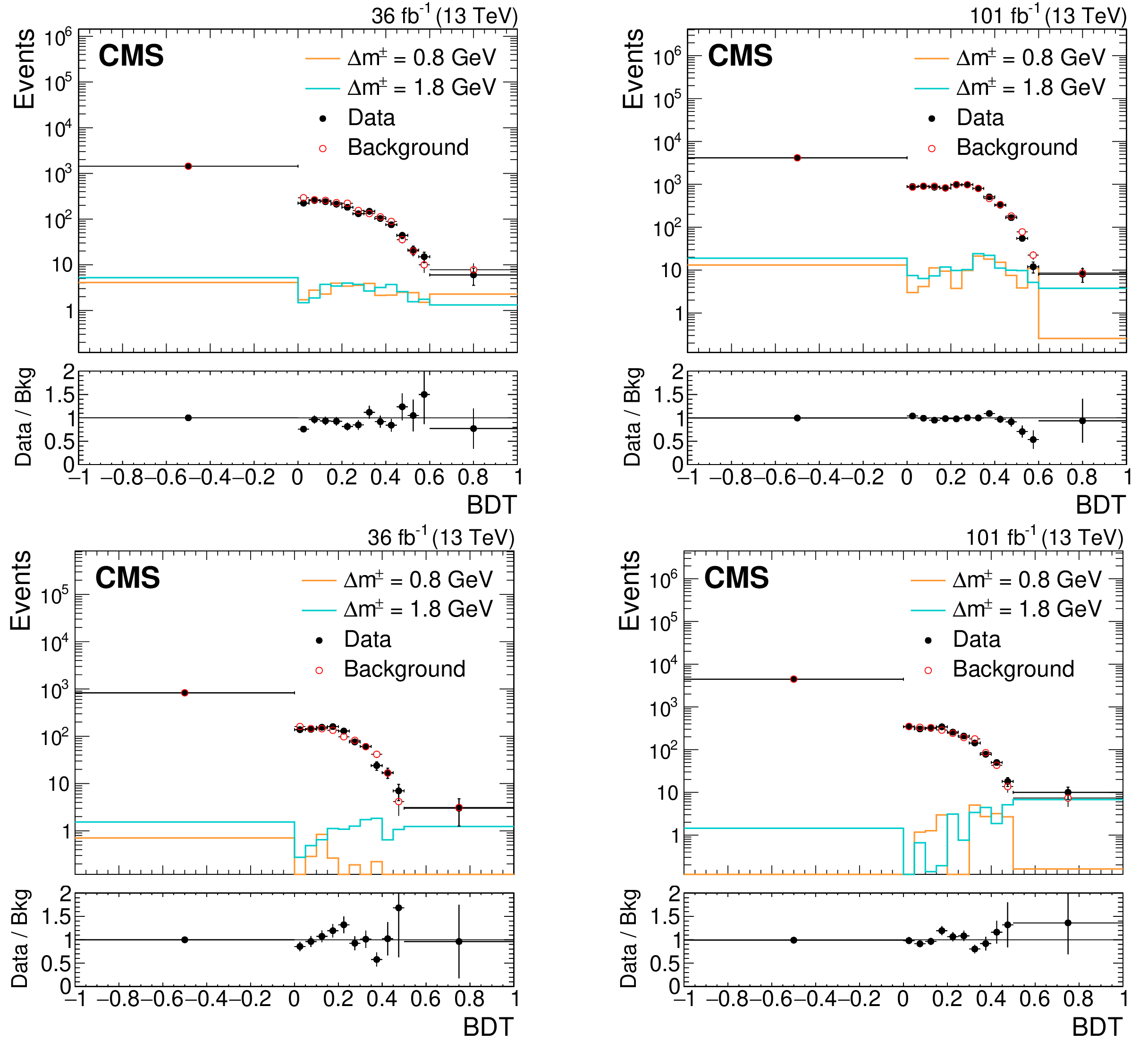
Prefit expected and observed distributions of the event BDT output score in the SRs for the muon + exclusive track category (upper), and the electron + exclusive track category (lower), shown separately for Phase0 (left) and Phase1 (right). In the lower panel, the vertical black bars represent the total uncertainty, including both statistical and systematic components. Example signal benchmark scenarios are also shown as colored lines. |
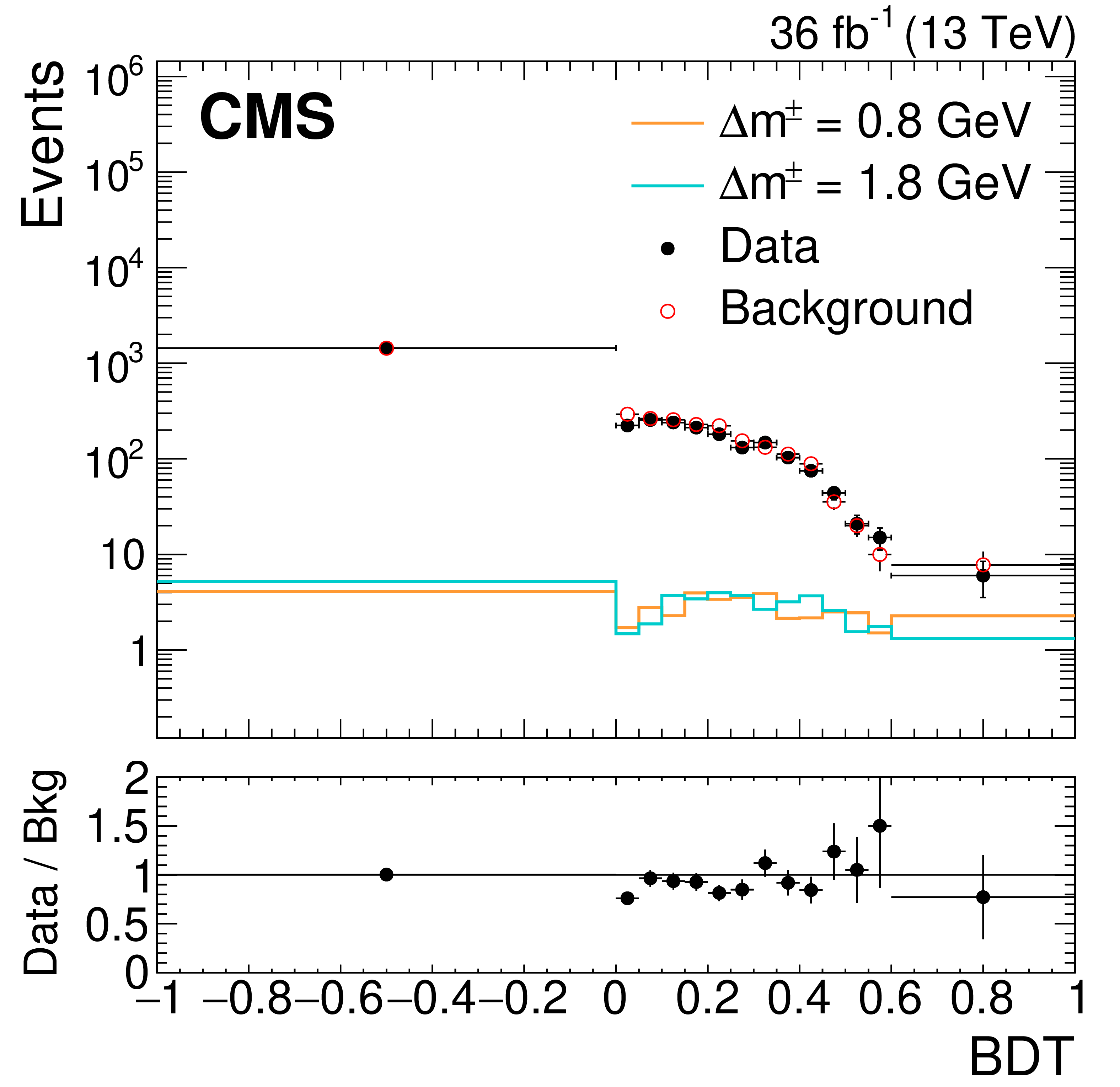
png pdf |
Figure 5-a:
Prefit expected and observed distributions of the event BDT output score in the SRs for the muon + exclusive track category (upper), and the electron + exclusive track category (lower), shown separately for Phase0 (left) and Phase1 (right). In the lower panel, the vertical black bars represent the total uncertainty, including both statistical and systematic components. Example signal benchmark scenarios are also shown as colored lines. |
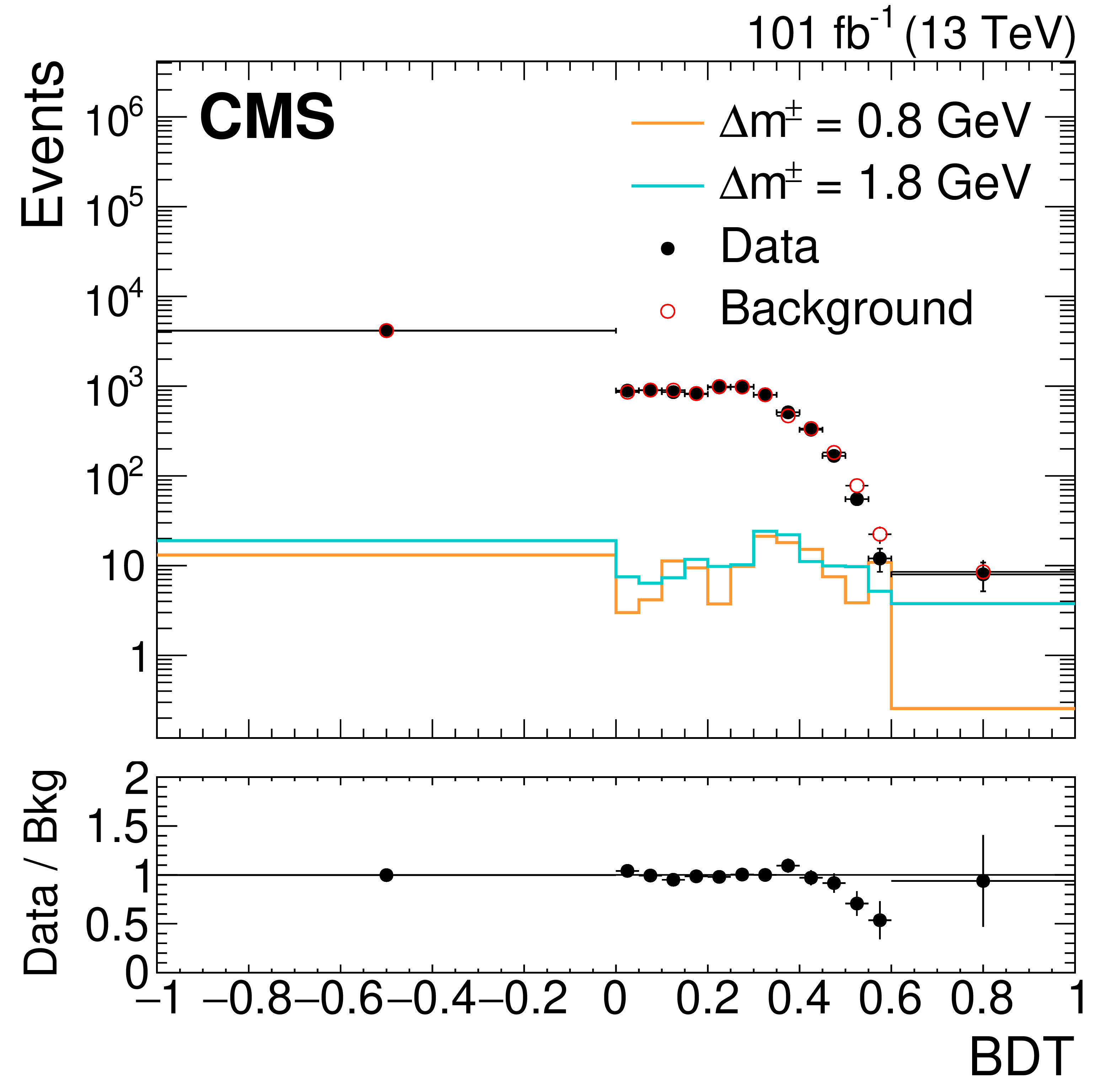
png pdf |
Figure 5-b:
Prefit expected and observed distributions of the event BDT output score in the SRs for the muon + exclusive track category (upper), and the electron + exclusive track category (lower), shown separately for Phase0 (left) and Phase1 (right). In the lower panel, the vertical black bars represent the total uncertainty, including both statistical and systematic components. Example signal benchmark scenarios are also shown as colored lines. |
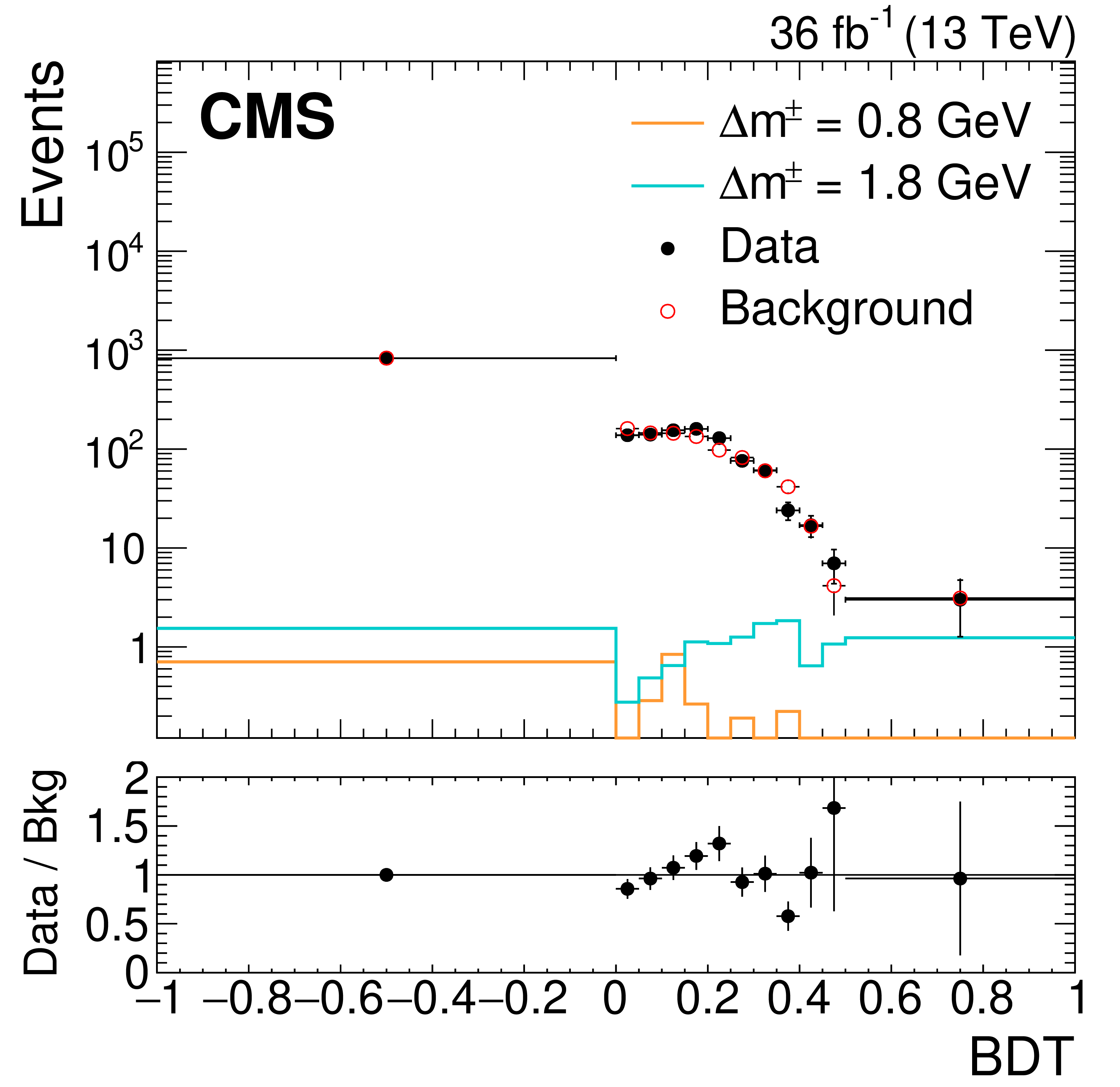
png pdf |
Figure 5-c:
Prefit expected and observed distributions of the event BDT output score in the SRs for the muon + exclusive track category (upper), and the electron + exclusive track category (lower), shown separately for Phase0 (left) and Phase1 (right). In the lower panel, the vertical black bars represent the total uncertainty, including both statistical and systematic components. Example signal benchmark scenarios are also shown as colored lines. |
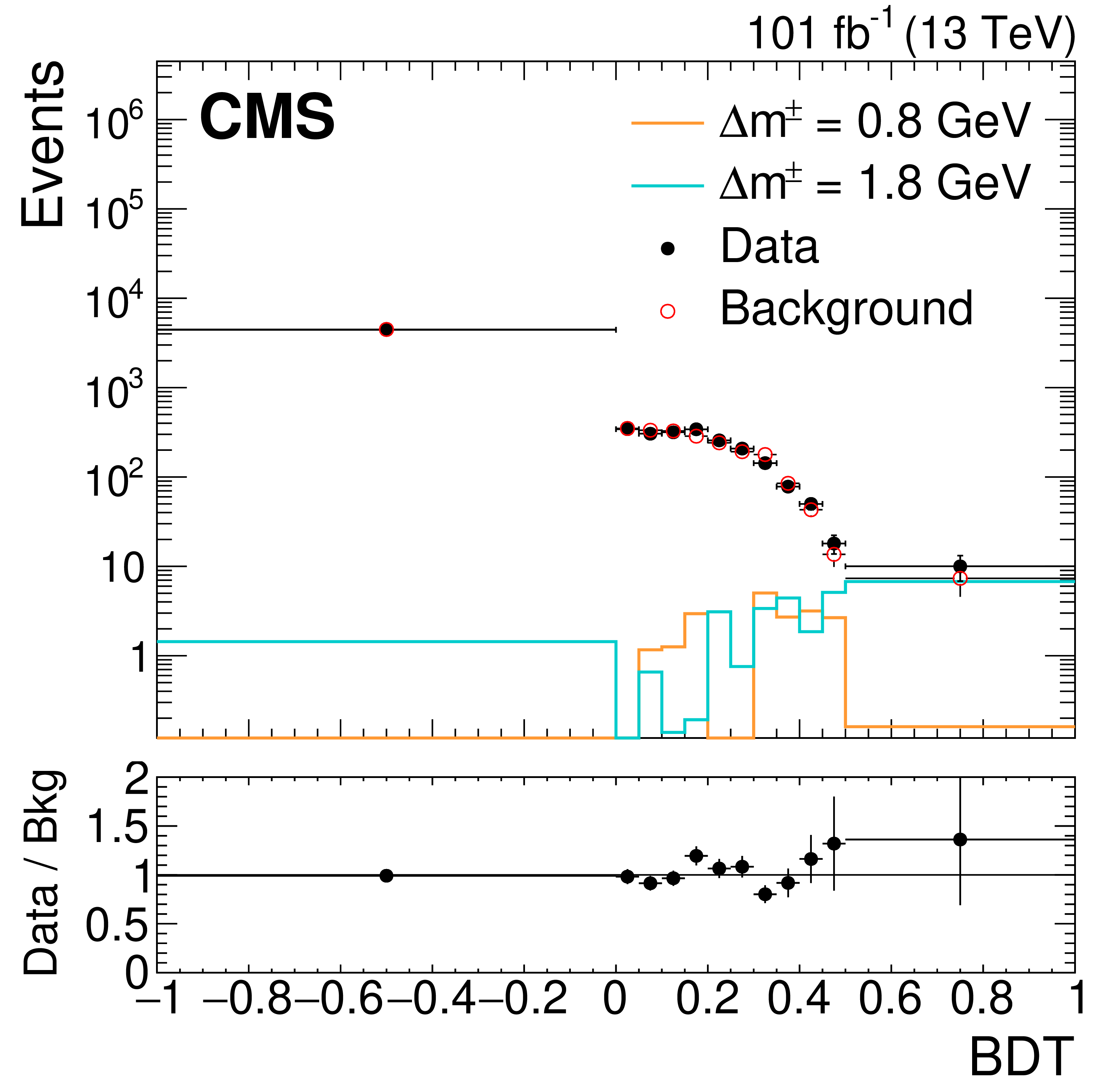
png pdf |
Figure 5-d:
Prefit expected and observed distributions of the event BDT output score in the SRs for the muon + exclusive track category (upper), and the electron + exclusive track category (lower), shown separately for Phase0 (left) and Phase1 (right). In the lower panel, the vertical black bars represent the total uncertainty, including both statistical and systematic components. Example signal benchmark scenarios are also shown as colored lines. |
png pdf |
Figure 6:
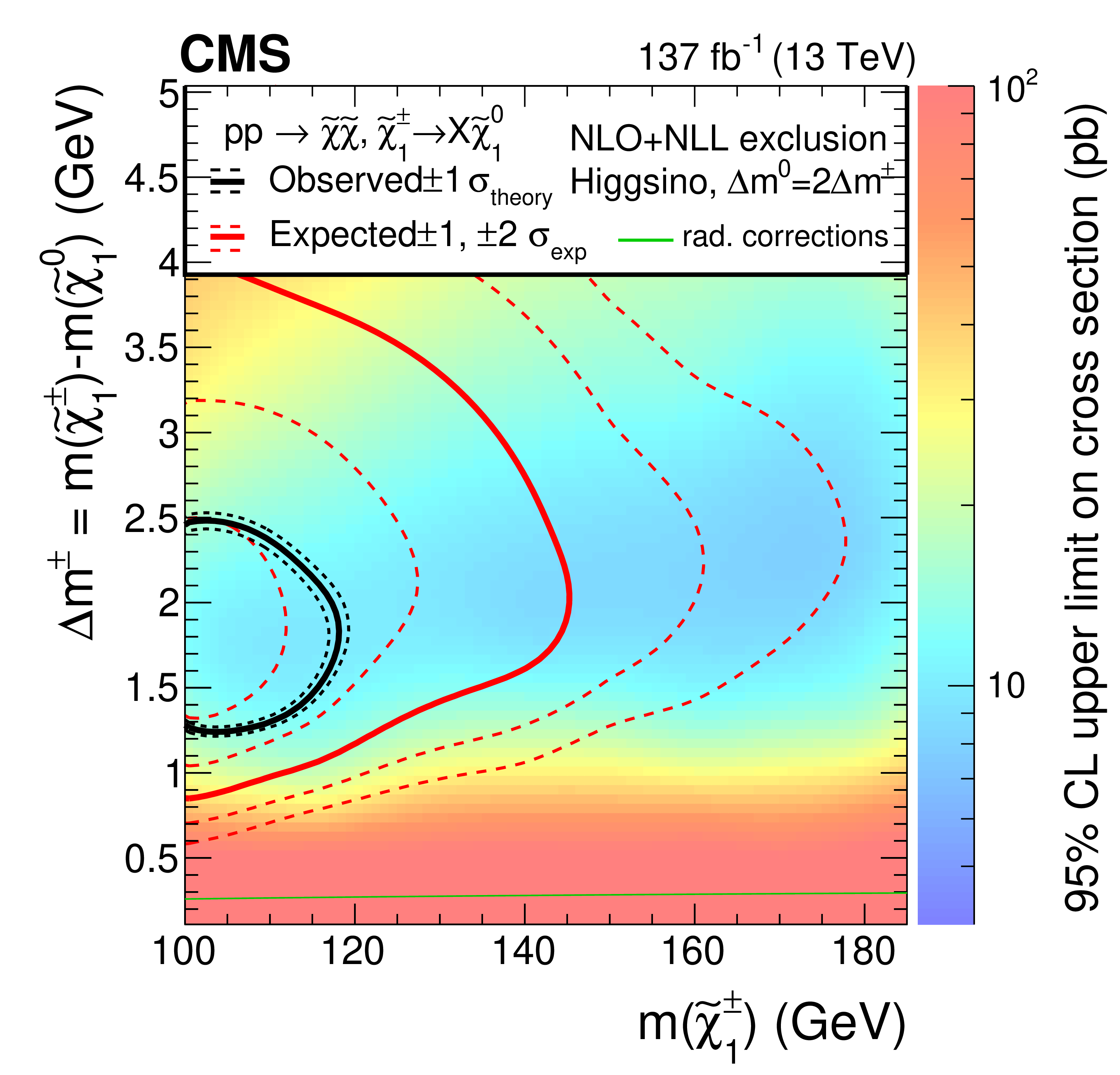
The 95% CL upper limits on the fully degenerate Higgsino production cross section, calculated at NLO+NLL precision [80,81], based on all analysis channels studied in this paper. All relevant production modes are simulated at LO, and the Z* boson is set to decay into either two electrons or two muons with a branching fraction of 5%. The expected (red) and observed (black) exclusion contours are shown assuming the theoretical cross section. Dashed red lines indicate the expected limits with $ \pm $1 and $ \pm $2 standard deviation experimental uncertainties. Dashed black lines indicate the observed limit when varying the theoretical cross section by its uncertainty. The green line represents the minimum $ \Delta m^\pm $ allowed by the theoretical calculation accounting for radiative corrections, as described in Ref. [24]. |
| Tables | |
png pdf |
Table 1:
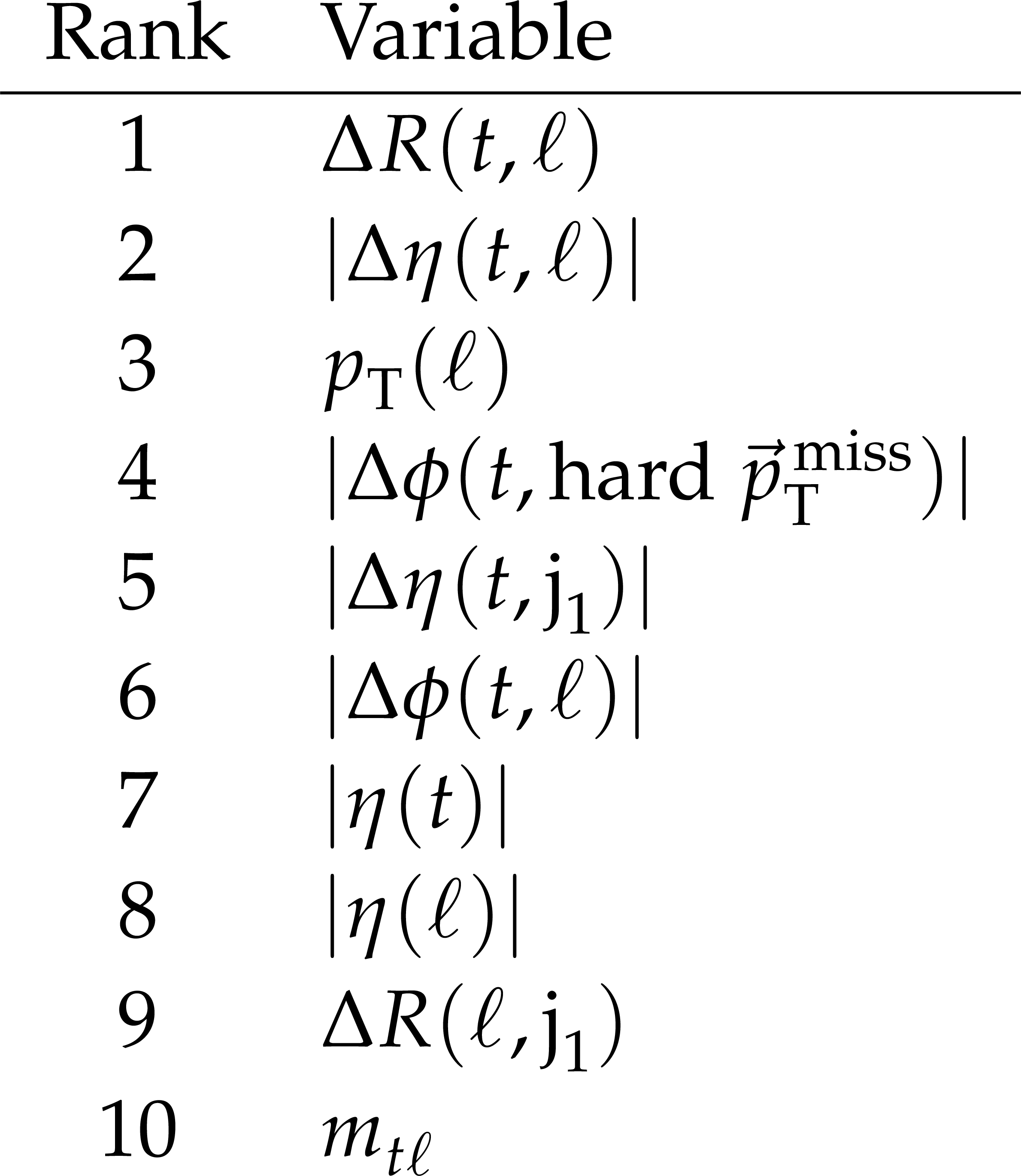
Input variables to the BDT used for selecting signal tracks in events in the exclusive track category, ranked by their importance in descending order. The symbol \ell refers to a candidate lepton while $ t $ refers to an exclusive track, with their invariant mass denoted $ m_{t\ell} $. |
png pdf |
Table 2:
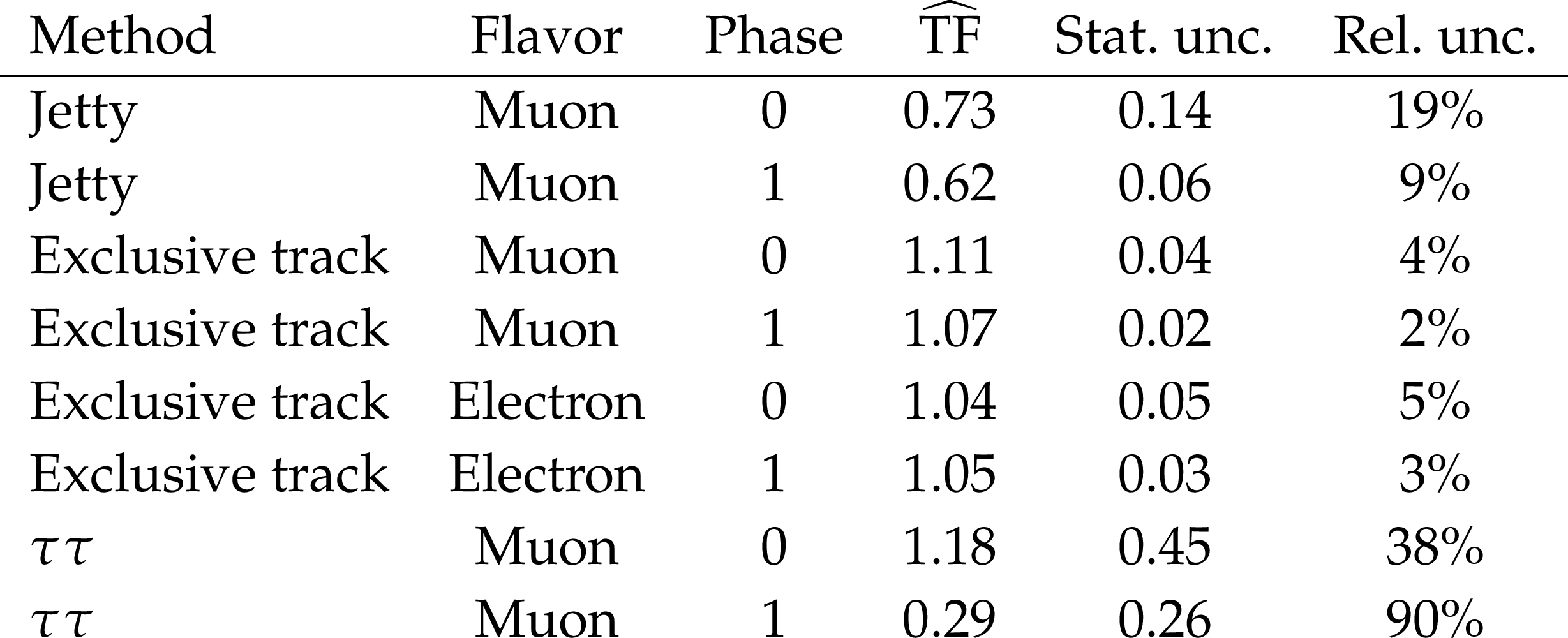
Transfer factors and their associated statistical uncertainties used to extrapolate background predictions from CRs to the SR. |
| Summary |
| A search for Higgsino pair production in compressed mass spectra scenarios is performed using low-momentum dimuon and lepton-track pairs in proton-proton collisions at $ \sqrt{s}= $ 13 TeV, based on a data sample corresponding to an integrated luminosity of 137 fb$ ^{-1} $ [82,83,84] collected in 2016, 2017, and 2018 with the CMS detector. The results are interpreted in a simplified model featuring a dark matter candidate neutralino $ \tilde{\chi}_{1}^{0} $ that is nearly mass-degenerate with a slightly heavier neutralino $ \tilde{\chi}_{2}^{0} $ and charginos $ \tilde{\chi}_{1}^{\pm} $. The search targets a region of parameter space where sensitivity was limited in previous analyses [31,33], and extends the reach by 0.5-2 GeV in the most compressed phase space. This region, characterized by low-mass Higgsinos, is of particular theoretical interest because of its relevance for naturalness and fine-tuning arguments [15,16,17], addressing both the large and small hierarchy problems. Mass differences between the lighter and heavier neutralinos are probed down to 1.5 GeV, assuming a Higgsino mass of 100 GeV. The maximum excluded Higgsino mass is 115 GeV, corresponding to a mass difference of 3.5 GeV. These results place stringent constraints on natural supersymmetry and other models predicting electroweak multiplet dark matter. |
| References | ||||
| 1 | F. Zwicky | On the masses of nebulae and of clusters of nebulae | Astrophys. J. 86 (1937) 217 | |
| 2 | V. C. Rubin and W. K. Ford, Jr. | Rotation of the Andromeda Nebula from a spectroscopic survey of emission regions | Astrophys. J. 159 (1970) 379 | |
| 3 | L. Lopez Honorez, E. Nezri, J. F. Oliver, and M. H. G. Tytgat | The inert doublet model: an archetype for dark matter | JCAP 02 (2007) 028 | hep-ph/0612275 |
| 4 | D. Tucker-Smith and N. Weiner | Inelastic dark matter | PRD 64 (2001) 043502 | hep-ph/0101138 |
| 5 | E. Izaguirre, G. Krnjaic, and B. Shuve | Discovering inelastic thermal relic dark matter at colliders | PRD 93 (2016) 063523 | 1508.03050 |
| 6 | P. Ramond | Dual theory for free fermions | PRD 3 (1971) 2415 | |
| 7 | Y. A. Gol'fand and E. P. Likhtman | Extension of the algebra of Poincare group generators and violation of $ {P} $ invariance | JETP Lett. 13 (1971) 323 | |
| 8 | A. Neveu and J. H. Schwarz | Factorizable dual model of pions | NPB 31 (1971) 86 | |
| 9 | D. V. Volkov and V. P. Akulov | Possible universal neutrino interaction | JETP Lett. 16 (1972) 438 | |
| 10 | J. Wess and B. Zumino | A Lagrangian model invariant under supergauge transformations | PLB 49 (1974) 52 | |
| 11 | J. Wess and B. Zumino | Supergauge transformations in four dimensions | NPB 70 (1974) 39 | |
| 12 | P. Fayet | Supergauge invariant extension of the Higgs mechanism and a model for the electron and its neutrino | NPB 90 (1975) 104 | |
| 13 | P. Fayet and S. Ferrara | Supersymmetry | Phys. Rept. 32 (1977) 249 | |
| 14 | H. Nilles | Supersymmetry, supergravity and particle physics | Phys. Rept. 110 (1984) 1 | |
| 15 | S. P. Martin | A supersymmetry primer | Adv. Ser. Direct. High Energy Phys. 21 (2010) 1 | hep-ph/9709356 |
| 16 | R. Barbieri and G. F. Giudice | Upper bounds on supersymmetric particle masses | NPB 306 (1988) 63 | |
| 17 | B. de Carlos and J. A. Casas | One-loop analysis of the electroweak breaking in supersymmetric models and the fine-tuning problem | PLB 309 (1993) 320 | hep-ph/9303291 |
| 18 | ATLAS Collaboration | Statistical combination of ATLAS \mboxRun 2 searches for charginos and neutralinos at the LHC | PRL 133 (2024) 031802 | 2402.08347 |
| 19 | CMS Collaboration | Combined search for electroweak production of winos, binos, higgsinos, and sleptons in proton-proton collisions at $ \sqrt{s}= $ 13 TeV | PRD 109 (2024) 112001 | CMS-SUS-21-008 2402.01888 |
| 20 | S. Ask | A review of the supersymmetry searches at LEP | in Proc. 38th Rencontres de Moriond on Electroweak Interactions and Unified Theories: Les Arcs, France, March 15--22, 2003. 2003 | hep-ex/0305007 |
| 21 | LZ Collaboration | First dark matter search results from the LUX-ZEPLIN (LZ) experiment | PRL 131 (2023) 041002 | 2207.03764 |
| 22 | XENON100 Collaboration | XENON100 dark matter results from a combination of 477 live days | PRD 94 (2016) 122001 | 1609.06154 |
| 23 | PandaX Collaboration | First dark matter search results from the PandaX-I experiment | Sci. China Phys. Mech. Astron. 57 (2014) 2024 | 1408.5114 |
| 24 | N. Nagata and S. Shirai | Higgsino dark matter in high-scale supersymmetry | JHEP 01 (2015) 029 | 1410.4549 |
| 25 | ALEPH Collaboration | Search for charginos nearly mass degenerate with the lightest neutralino in $ \mathrm{e}^+\mathrm{e}^- $ collisions at centre-of-mass energies up to 209 GeV | PLB 533 (2002) 223 | hep-ex/0203020 |
| 26 | ALEPH Collaboration | Absolute mass lower limit for the lightest neutralino of the MSSM from $ \mathrm{e}^+\mathrm{e}^- $ data at $ \sqrt{s} $ up to 209 GeV | PLB 583 (2004) 247 | |
| 27 | DELPHI Collaboration | Searches for supersymmetric particles in $ \mathrm{e}^+\mathrm{e}^- $ collisions up to 208 GeV and interpretation of the results within the MSSM | EPJC 31 (2003) 421 | hep-ex/0311019 |
| 28 | L3 Collaboration | Search for charginos with a small mass difference with the lightest supersymmetric particle at $ \sqrt{s}= $ 189 GeV | PLB 482 (2000) 31 | hep-ex/0002043 |
| 29 | OPAL Collaboration | Search for anomalous production of di-lepton events with missing transverse momentum in $ \mathrm{e}^+\mathrm{e}^- $ collisions at $ \sqrt{s}= $ 183--209 GeV | EPJC 32 (2004) 453 | hep-ex/0309014 |
| 30 | OPAL Collaboration | Search for nearly mass-degenerate charginos and neutralinos at LEP | EPJC 29 (2003) 479 | hep-ex/0210043 |
| 31 | ATLAS Collaboration | Searches for electroweak production of supersymmetric particles with compressed mass spectra in $ \sqrt{s}= $ 13 TeV $ {\mathrm{p}\mathrm{p}} $ collisions with the ATLAS detector | PRD 101 (2020) 052005 | 1911.12606 |
| 32 | ATLAS Collaboration | Search for chargino-neutralino pair production in final states with three leptons and missing transverse momentum in $ \sqrt{s}= $ 13 TeV $ {\mathrm{p}\mathrm{p}} $ collisions with the ATLAS detector | EPJC 81 (2021) 1118 | 2106.01676 |
| 33 | CMS Collaboration | Search for supersymmetry in final states with two or three soft leptons and missing transverse momentum in proton-proton collisions at $ \sqrt{s}= $ 13 TeV | JHEP 04 (2022) 091 | CMS-SUS-18-004 2111.06296 |
| 34 | CMS Collaboration | Search for disappearing tracks in proton-proton collisions at $ \sqrt{s}= $ 13 TeV | PLB 806 (2020) 135502 | CMS-EXO-19-010 2004.05153 |
| 35 | ATLAS Collaboration | Search for long-lived charginos based on a disappearing-track signature using 136 fb$ ^{-1} $ of $ {\mathrm{p}\mathrm{p}} $ collisions at $ \sqrt{s}= $ 13 TeV with the ATLAS detector | EPJC 82 (2022) 606 | 2201.02472 |
| 36 | CMS Collaboration | Search for supersymmetry in final states with disappearing tracks in proton-proton collisions at $ \sqrt{s}= $ 13 TeV | PRD 109 (2024) 072007 | CMS-SUS-21-006 2309.16823 |
| 37 | ATLAS Collaboration | Search for nearly mass-degenerate Higgsinos using low-momentum mildly displaced tracks in $ {\mathrm{p}\mathrm{p}} $ collisions at $ \sqrt{s}= $ 13 TeV with the ATLAS detector | PRL 132 (2024) 221801 | 2401.14046 |
| 38 | CMS Collaboration | HEPData record for this analysis | link | |
| 39 | CMS Collaboration | The CMS experiment at the CERN LHC | JINST 3 (2008) S08004 | |
| 40 | CMS Collaboration | Development of the CMS detector for the CERN LHC \mboxRun 3 | JINST 19 (2024) P05064 | CMS-PRF-21-001 2309.05466 |
| 41 | CMS Collaboration | Performance of the CMS Level-1 trigger in proton-proton collisions at $ \sqrt{s}= $ 13 TeV | JINST 15 (2020) P10017 | CMS-TRG-17-001 2006.10165 |
| 42 | CMS Collaboration | The CMS trigger system | JINST 12 (2017) P01020 | CMS-TRG-12-001 1609.02366 |
| 43 | CMS Collaboration | Performance of the CMS high-level trigger during LHC \mboxRun 2 | JINST 19 (2024) P11021 | CMS-TRG-19-001 2410.17038 |
| 44 | CMS Collaboration | Electron and photon reconstruction and identification with the CMS experiment at the CERN LHC | JINST 16 (2021) P05014 | CMS-EGM-17-001 2012.06888 |
| 45 | CMS Collaboration | Performance of the CMS muon detector and muon reconstruction with proton-proton collisions at $ \sqrt{s}= $ 13 TeV | JINST 13 (2018) P06015 | CMS-MUO-16-001 1804.04528 |
| 46 | CMS Collaboration | Description and performance of track and primary-vertex reconstruction with the CMS tracker | JINST 9 (2014) P10009 | CMS-TRK-11-001 1405.6569 |
| 47 | CMS Collaboration | Particle-flow reconstruction and global event description with the CMS detector | JINST 12 (2017) P10003 | CMS-PRF-14-001 1706.04965 |
| 48 | CMS Collaboration | Jet energy scale and resolution in the CMS experiment in $ {\mathrm{p}\mathrm{p}} $ collisions at 8 TeV | JINST 12 (2017) P02014 | CMS-JME-13-004 1607.03663 |
| 49 | CMS Collaboration | Performance of missing transverse momentum reconstruction in proton-proton collisions at $ \sqrt{s}= $ 13 TeV using the CMS detector | JINST 14 (2019) P07004 | CMS-JME-17-001 1903.06078 |
| 50 | CMS Tracker Group Collaboration | The CMS Phase-1 pixel detector upgrade | JINST 16 (2021) P02027 | 2012.14304 |
| 51 | W. Adam, R. Fruhwirth, A. Strandlie, and T. Todorov | Reconstruction of electrons with the gaussian-sum filter in the CMS tracker at the LHC | JPG 31 (2005) N9 | physics/0306087 |
| 52 | CMS Collaboration | Performance of electron reconstruction and selection with the CMS detector in proton-proton collisions at $ \sqrt{s}= $ 8 TeV | JINST 10 (2015) P06005 | CMS-EGM-13-001 1502.02701 |
| 53 | M. Cacciari, G. P. Salam, and G. Soyez | The anti-$ k_{\mathrm{T}} $ jet clustering algorithm | JHEP 04 (2008) 063 | 0802.1189 |
| 54 | M. Cacciari, G. P. Salam, and G. Soyez | FASTJET user manual | EPJC 72 (2012) 1896 | 1111.6097 |
| 55 | CMS Collaboration | Identification of heavy-flavour jets with the CMS detector in $ {\mathrm{p}\mathrm{p}} $ collisions at 13 TeV | JINST 13 (2018) P05011 | CMS-BTV-16-002 1712.07158 |
| 56 | J. Alwall et al. | The automated computation of tree-level and next-to-leading order differential cross sections, and their matching to parton shower simulations | JHEP 07 (2014) 079 | 1405.0301 |
| 57 | J. Alwall et al. | Comparative study of various algorithms for the merging of parton showers and matrix elements in hadronic collisions | EPJC 53 (2008) 473 | 0706.2569 |
| 58 | R. Frederix and S. Frixione | Merging meets matching in MC@NLO | JHEP 12 (2012) 061 | 1209.6215 |
| 59 | P. Nason | A new method for combining NLO QCD with shower Monte Carlo algorithms | JHEP 11 (2004) 040 | hep-ph/0409146 |
| 60 | S. Frixione, P. Nason, and C. Oleari | Matching NLO QCD computations with parton shower simulations: the POWHEG method | JHEP 11 (2007) 070 | 0709.2092 |
| 61 | S. Alioli, P. Nason, C. Oleari, and E. Re | A general framework for implementing NLO calculations in shower Monte Carlo programs: the POWHEG box | JHEP 06 (2010) 043 | 1002.2581 |
| 62 | S. Alioli, P. Nason, C. Oleari, and E. Re | NLO single-top production matched with shower in POWHEG: $ s $- and $ t $-channel contributions | JHEP 09 (2009) 111 | 0907.4076 |
| 63 | E. Re | Single-top $ {\mathrm{W}\mathrm{t}} $-channel production matched with parton showers using the POWHEG method | EPJC 71 (2011) 1547 | 1009.2450 |
| 64 | CMS Collaboration | Event generator tunes obtained from underlying event and multiparton scattering measurements | EPJC 76 (2016) 155 | CMS-GEN-14-001 1512.00815 |
| 65 | CMS Collaboration | Extraction and validation of a new set of CMS PYTHIA8 tunes from underlying-event measurements | EPJC 80 (2020) 4 | CMS-GEN-17-001 1903.12179 |
| 66 | T. Sjostrand et al. | An introduction to PYTHIA8.2 | Comput. Phys. Commun. 191 (2015) 159 | 1410.3012 |
| 67 | GEANT4 Collaboration | GEANT 4---a simulation toolkit | NIM A 506 (2003) 250 | |
| 68 | NNPDF Collaboration | Parton distributions with QED corrections | NPB 877 (2013) 290 | 1308.0598 |
| 69 | NNPDF Collaboration | Parton distributions from high-precision collider data | EPJC 77 (2017) 663 | 1706.00428 |
| 70 | CMS Collaboration , S. Abdullin et al. | The fast simulation of the CMS detector at LHC | in Proc. 18th International Conference on Computing in High Energy and Nuclear Physics (CHEP ): Taipei, Taiwan, October 18--22,. [], 2011 J. Phys. Conf. Ser. 331 (2011) 032049 |
|
| 71 | A. Giammanco | The fast simulation of the CMS experiment | in Proc. 20th International Conference on Computing in High Energy and Nuclear Physics (CHEP ): Amsterdam, The Netherlands, October 14--18,. [], 2014 J. Phys. Conf. Ser. 513 (2014) 022012 |
|
| 72 | J. Therhaag | tmva: Toolkit for multivariate data analysis in root | in Proc. 35th International Conference on High Energy Physics (ICHEP 2010): Paris, France, July 21--28, 2010. 2010. [PoS (ICHEP2010) 510] link |
|
| 73 | R. K. Ellis, I. Hinchliffe, M. Soldate, and J. J. van der Bij | Higgs decay to $ {\tau^{+}\tau^{-}} $: A possible signature of intermediate mass Higgs bosons at high energy hadron colliders | NPB 297 (1988) 221 | |
| 74 | ATLAS Collaboration | Expected performance of the ATLAS experiment: detector, trigger and physics | link | 0901.0512 |
| 75 | CMS Collaboration | CMS physics technical design report, volume II: Physics performance | JPG 34 (2007) 995 | |
| 76 | G. Cowan, K. Cranmer, E. Gross, and O. Vitells | Asymptotic formulae for likelihood-based tests of new physics | EPJC 71 (2011) 1554 | 1007.1727 |
| 77 | T. Junk | Confidence level computation for combining searches with small statistics | NIM A 434 (1999) 435 | hep-ex/9902006 |
| 78 | A. L. Read | Presentation of search results: The $ \text{CL}_\text{s} $ technique | JPG 28 (2002) 2693 | |
| 79 | CMS Collaboration | The CMS statistical analysis and combination tool: combine | Comput. Softw. Big Sci. 8 (2024) 19 | CMS-CAT-23-001 2404.06614 |
| 80 | B. Fuks, M. Klasen, D. R. Lamprea, and M. Rothering | Gaugino production in proton-proton collisions at a center-of-mass energy of 8 TeV | JHEP 10 (2012) 081 | 1207.2159 |
| 81 | B. Fuks, M. Klasen, D. R. Lamprea, and M. Rothering | Precision predictions for electroweak superpartner production at hadron colliders with resummino | EPJC 73 (2013) 2480 | 1304.0790 |
| 82 | CMS Collaboration | Precision luminosity measurement in proton-proton collisions at $ \sqrt{s}= $ 13 TeV in 2015 and 2016 at CMS | EPJC 81 (2021) 800 | CMS-LUM-17-003 2104.01927 |
| 83 | CMS Collaboration | CMS luminosity measurement for the 2017 data-taking period at $ \sqrt{s}= $ 13 TeV | CMS Physics Analysis Summary, 2018 CMS-PAS-LUM-17-004 |
CMS-PAS-LUM-17-004 |
| 84 | CMS Collaboration | CMS luminosity measurement for the 2018 data-taking period at $ \sqrt{s}= $ 13 TeV | CMS Physics Analysis Summary, 2019 CMS-PAS-LUM-18-002 |
CMS-PAS-LUM-18-002 |
|
|
Compact Muon Solenoid LHC, CERN |

|
|
|
|
|
|