Compact Muon Solenoid
LHC, CERN
 Visit us: CMS Public Website, CMS Physics ;
Contact us: CMS Publications Committee
Visit us: CMS Public Website, CMS Physics ;
Contact us: CMS Publications Committee
| CMS-HIN-25-020 ; CERN-EP-2026-231 | ||
| Observation of enhanced baryon production using strange hadrons in oxygen-oxygen collisions | ||
| CMS Collaboration | ||
| 18 August 2026 | ||
| Submitted to Physical Review Letters | ||
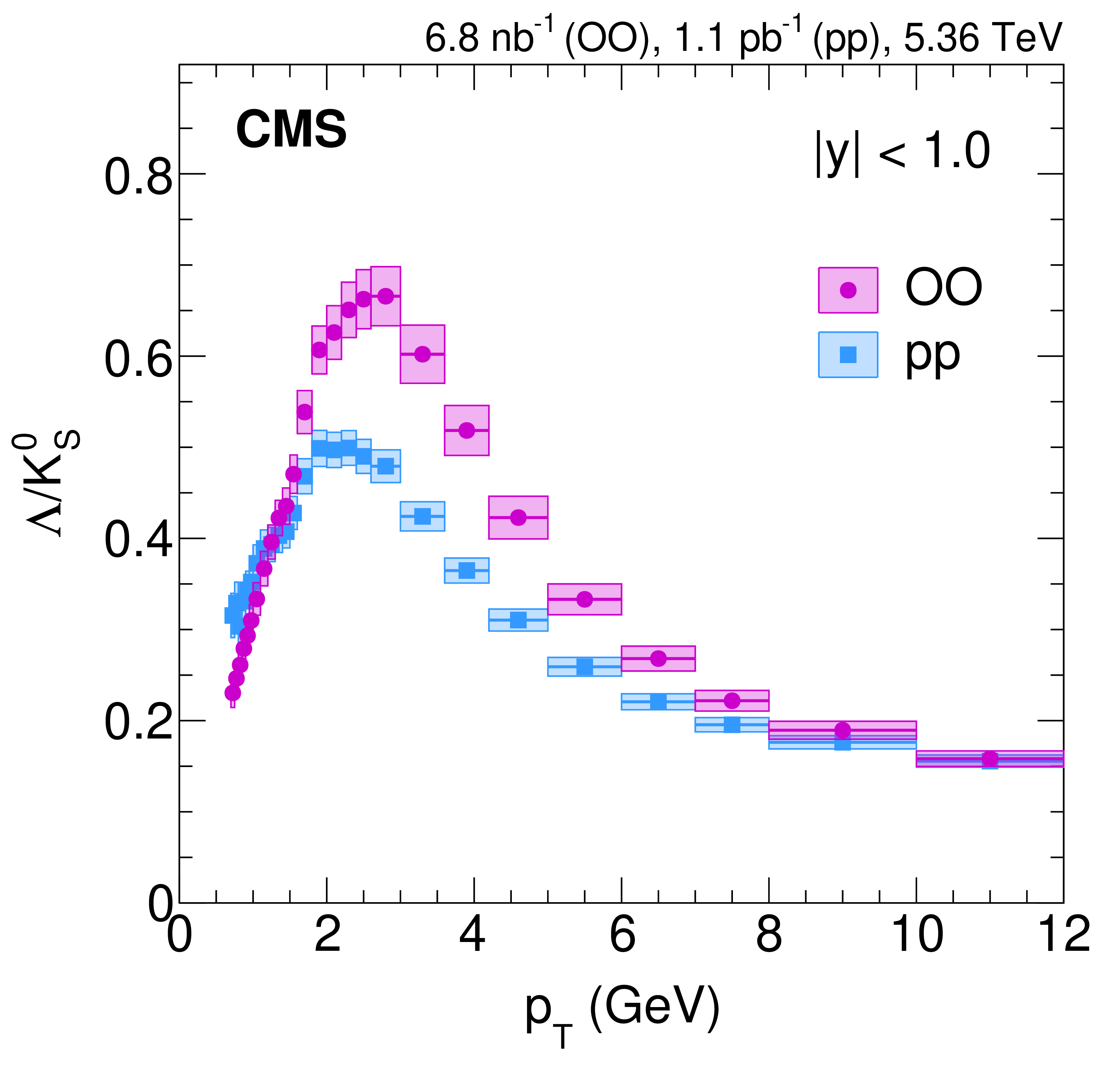
| Abstract: A hot deconfined medium known as the quark-gluon plasma (QGP) is created in collisions of ultrarelativistic heavy nuclei. In these systems, hadron production is strongly modified relative to proton-proton (pp) interactions. In the hadron transverse momentum region 2 $ < p_{\mathrm{T}} < $ 5 GeV, collective radial flow and quark coalescence are important mechanisms that can produce such modifications. While these effects are well-established for collisions of large ions, such as lead, it is unknown if they are present in systems produced using smaller ions. To address this question, the $ p_{\mathrm{T}} $ spectra of two strange hadrons, $ \mathrm{K^0_S} $ and $ \Lambda $, are measured in oxygen-oxygen ($ \text{OO} $) and pp collisions at a center-of-mass energy per nucleon pair of 5.36 TeV. The measurements are performed using the CMS detector at the LHC, and the $ \text{OO} $ and pp datasets correspond to integrated luminosities of 6.8$ \text{nb}^{-1}$ and 1.1$ \text{pb}^{-1}$, respectively. The spectral modification of $ \mathrm{K^0_S} $ mesons in $ \text{OO} $ collisions relative to pp collisions is found to be similar to that of inclusive charged hadrons. Conversely, the $ \Lambda $-to-$ \mathrm{K^0_S} $ cross section ratio exhibits a pronounced enhancement in $ \text{OO} $ collisions when compared to pp collisions. The results provide the first observation of a baryon-to-meson enhancement in $ \text{OO} $ collisions and suggest the formation of a deconfined medium, offering insight into the roles of strangeness, radial flow, and quark coalescence in QGP. | ||
| Links: e-print arXiv:2608.18256 [hep-ex] (PDF) ; CDS record ; inSPIRE record ; HepData record ; CADI line (restricted) ; | ||
| Figures | Summary | Additional Figures | References | CMS Publications |
|---|
| Figures | |
png pdf |
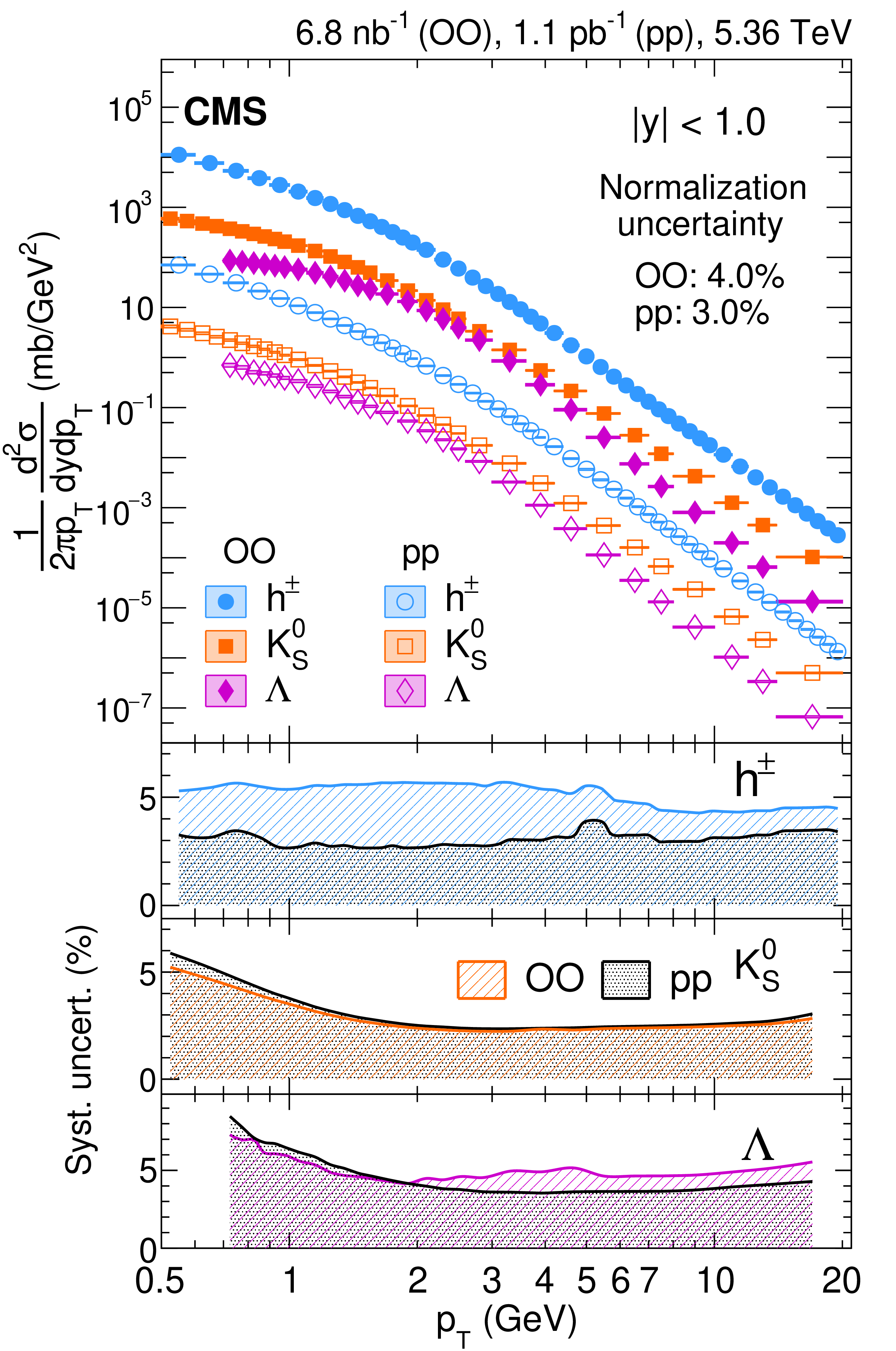
Figure 1:
(Upper panel) Invariant differential cross sections of charged hadrons (blue circles), $ \mathrm{K^0_S} $ mesons (orange squares), and $ \Lambda $ baryons (magenta diamonds) in $ \text{OO} $ (solid markers) and pp (open markers) collisions as a function of $ p_{\mathrm{T}} $. The markers show the cross section averaged across the entire bin width. Statistical uncertainties are shown as error bars and are smaller than the marker size. (Lower panels) Systematic uncertainties, with normalization uncertainties excluded, for the corresponding cross sections in $ \text{OO} $ (colored band) and pp (black band) collisions. |
png pdf |
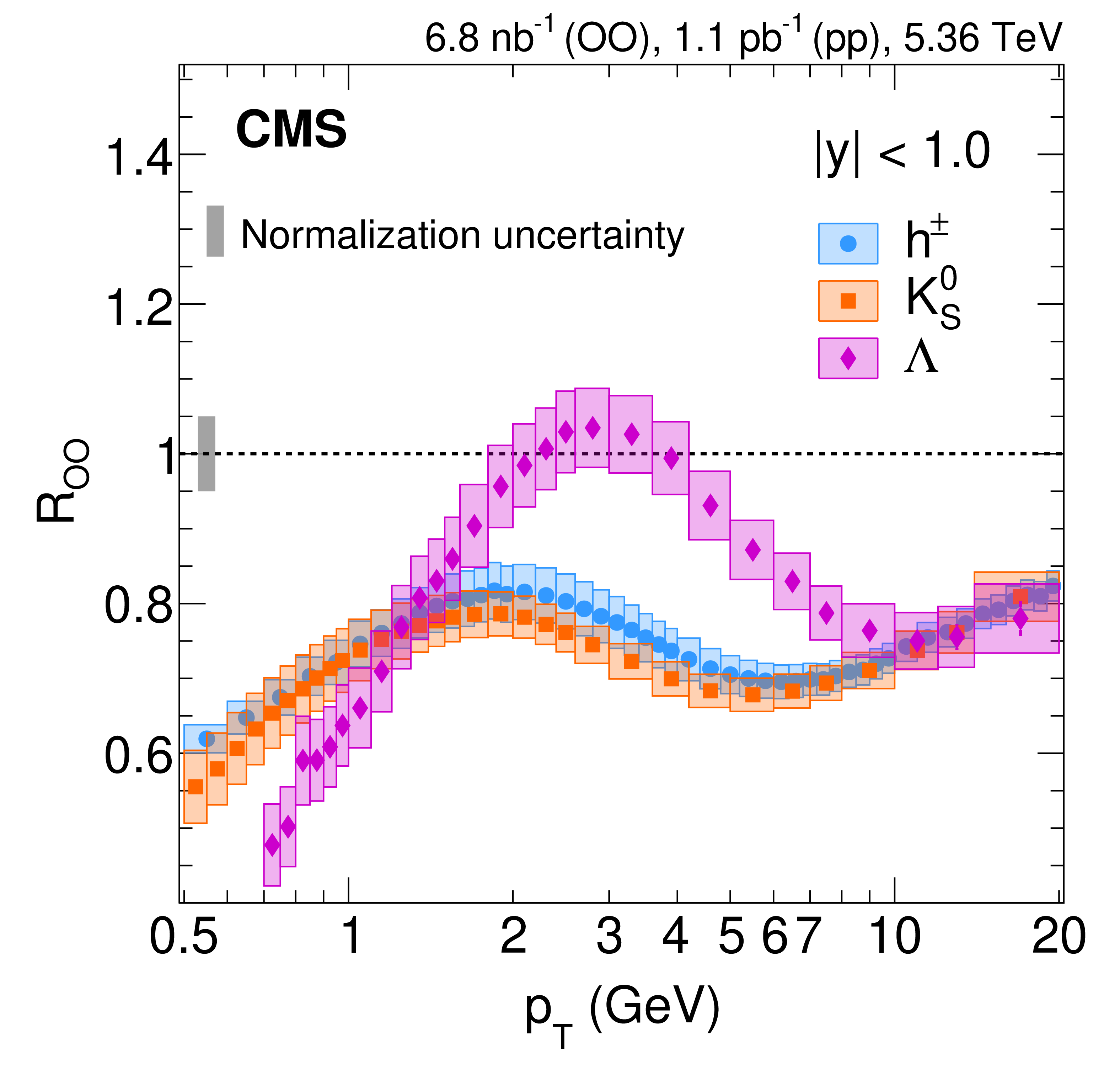
Figure 2:
The charged-hadron (blue circles), $ \mathrm{K^0_S} $ meson (orange squares) and $ \Lambda $ baryon (magenta diamonds) nuclear modification factors in $ \text{OO} $ collisions. Statistical uncertainties are shown as error bars, while boxes show systematic uncertainties after excluding the normalization uncertainty. The normalization uncertainty is shown by the gray band around unity. |
png pdf |
Figure 3:
The ratio of the $ \Lambda $ baryon to $ \mathrm{K^0_S} $ meson cross sections in $ \text{OO} $ (magenta circles) and pp (blue squares) collisions as a function of $ p_{\mathrm{T}} $. Statistical uncertainties are shown as error bars and are smaller than the marker size. The boxes show the total systematic uncertainties. |
| Summary |
| In summary, the invariant cross sections of $ \mathrm{K^0_S} $ and $ \Lambda $ particles as a function of transverse momentum ($p_T$) have been measured for the first time in oxygen-oxygen ($ \text{OO} $) collisions at a center-of-mass energy per nucleon pair of 5.36 TeV. Using a baseline measurement performed with proton-proton (pp) collisions at the same collision energy, the nuclear modification factor in $ \text{OO} $ collisions, $ {R_\text{OO}} $, is reported. The $ {R_\text{OO}} $ of $ \mathrm{K^0_S} $ mesons is consistent with that of charged hadrons, whereas the $ {R_\text{OO}} $ of $ \Lambda $ baryons shows a significant enhancement relative to charged hadrons in the range 2 $< p_{\mathrm{T}} < $ 8 GeV. At higher $ p_{\mathrm{T}} $, both $ \mathrm{K^0_S} $ and $ \Lambda $ $ {R_\text{OO}} $ values are significantly suppressed, likely indicating the presence of parton energy loss effects in a deconfined medium. An enhancement of the $ \Lambda $/$ \mathrm{K^0_S} $ differential cross section ratio in $ \text{OO} $ collisions relative to pp collisions is observed for 2.3 $ < p_{\mathrm{T}} < $ 5.2 GeV, with a significance exceeding five standard deviations. This establishes the first observation of a baryon-to-meson enhancement in $ \text{OO} $ collisions and indicates modified hadron production suggesting quark coalescence and collective radial flow in a strongly interacting deconfined medium. |
| Additional Figures | |
png pdf |
Additional Figure 1:
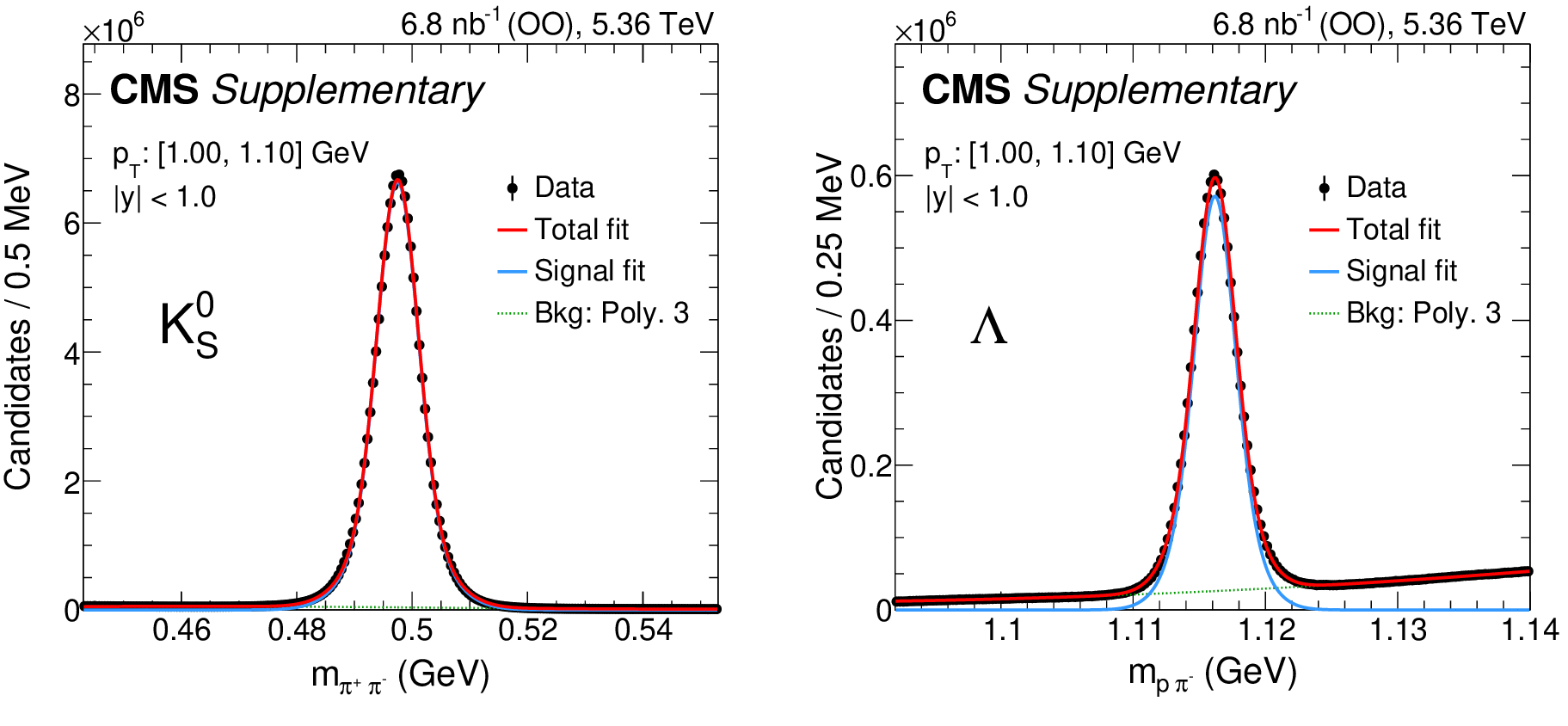
The invariant mass distributions of $ \mathrm{K^0_S} $ meson candidates (left) and $ \Lambda $ baryon candidates (right) for oxygen-oxygen collisions. The distributions are shown for candidates with $ 1.0< p_{\mathrm{T}} <1.1 $ GeV and $ |y|<1.0 $. The curves represent fits using a model consisting of a double Gaussian signal component and a third-degree polynomial background component. |
png pdf |
Additional Figure 1-a:
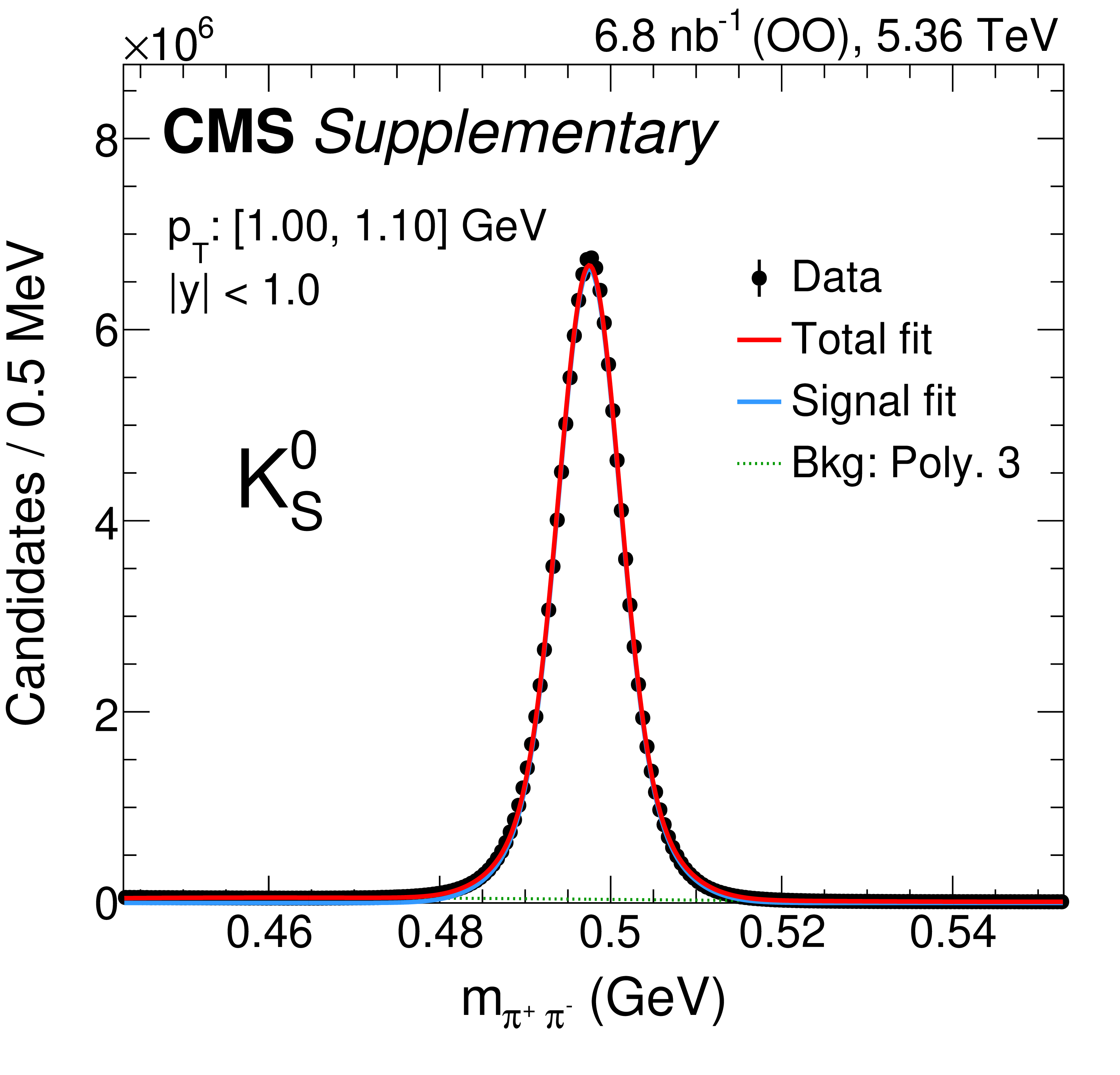
The invariant mass distributions of $ \mathrm{K^0_S} $ meson candidates (left) and $ \Lambda $ baryon candidates (right) for oxygen-oxygen collisions. The distributions are shown for candidates with $ 1.0< p_{\mathrm{T}} <1.1 $ GeV and $ |y|<1.0 $. The curves represent fits using a model consisting of a double Gaussian signal component and a third-degree polynomial background component. |
png pdf |
Additional Figure 1-b:
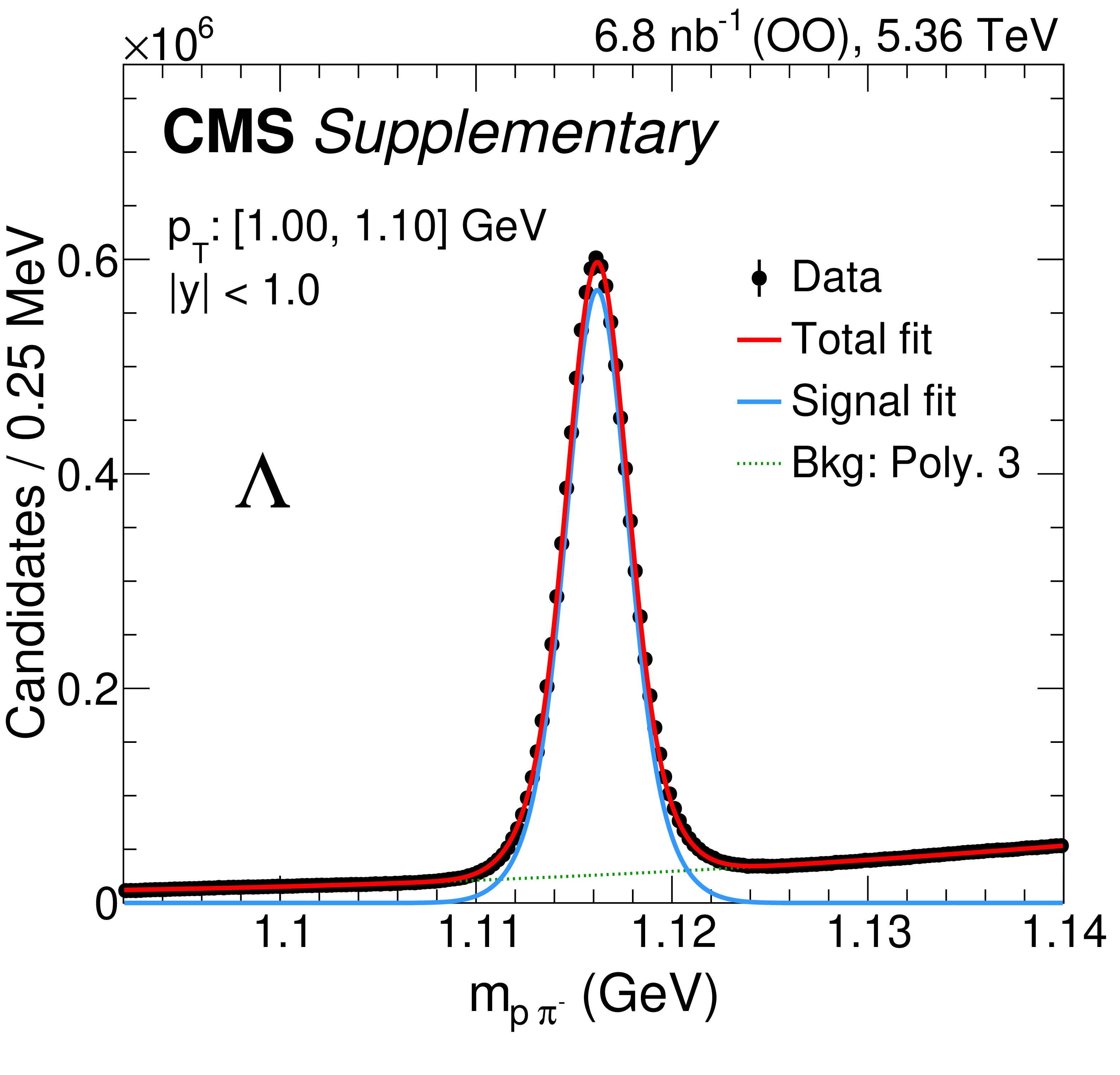
The invariant mass distributions of $ \mathrm{K^0_S} $ meson candidates (left) and $ \Lambda $ baryon candidates (right) for oxygen-oxygen collisions. The distributions are shown for candidates with $ 1.0< p_{\mathrm{T}} <1.1 $ GeV and $ |y|<1.0 $. The curves represent fits using a model consisting of a double Gaussian signal component and a third-degree polynomial background component. |
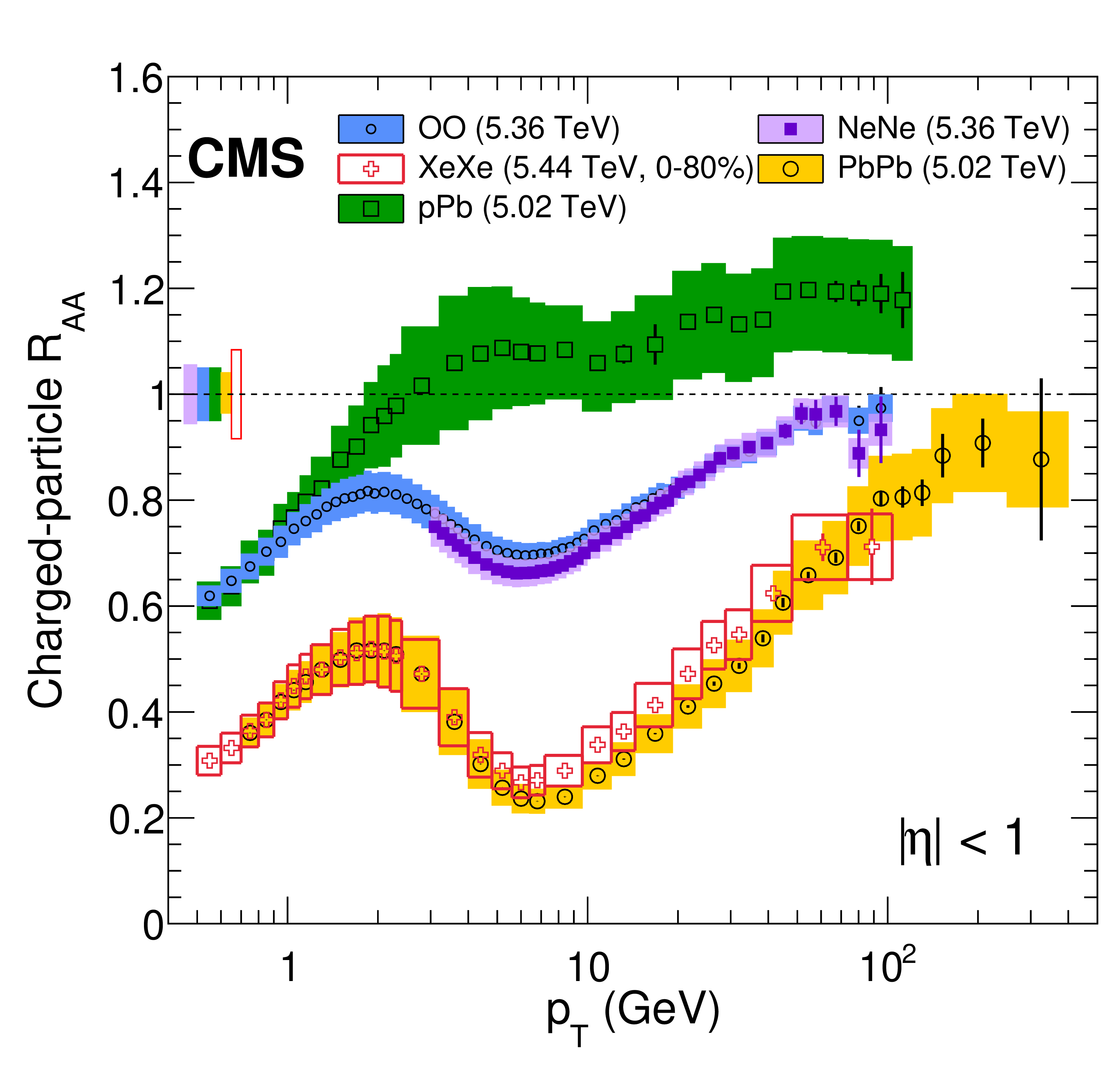
png pdf |
Additional Figure 2:
Charged-particle nuclear modification factor, $R_\text{AA}$, measured for $\text{OO}$, NeNe, XeXe, PbPb, and pPb collisions. The bands around the markers indicate the total systematic uncertainties after excluding the normalization uncertainties, while the error bars show the statistical uncertainties. The boxes on the left, centered at unity, represent the relative normalization uncertainty for each collision system. |
| References | ||||
| 1 | W. Busza, K. Rajagopal, and W. van der Schee | Heavy ion collisions: The big picture, and the big questions | Ann. Rev. Nucl. Part. Sci. 68 (2018) 339 | 1802.04801 |
| 2 | E. V. Shuryak | Quantum chromodynamics and the theory of superdense matter | Phys. Rept. 61 (1980) 71 | |
| 3 | B. Andersson, G. Gustafson, G. Ingelman, and T. Sjostrand | Parton fragmentation and string dynamics | Phys. Rept. 97 (1983) 31 | |
| 4 | B. R. Webber | A QCD model for jet fragmentation including soft gluon interference | NPB 238 (1984) 492 | |
| 5 | J. Aichelin and K. Werner | Centrality dependence of strangeness enhancement in ultrarelativistic heavy ion collisions: A core-corona effect | [Erratum: Phys. Rev. C 81 () 02, ], 2009 Phys. Rev. C 79 (2009) 064907 |
0810.4465 |
| 6 | P. Koch, B. Muller, and J. Rafelski | Strangeness in relativistic heavy ion collisions | Phys. Rept. 142 (1986) 167 | |
| 7 | WA97 Collaboration | Strangeness enhancement at mid-rapidity in Pb Pb collisions at 158-A-GeV/c | PLB 449 (1999) 401 | |
| 8 | NA49 Collaboration | Energy dependence of pion and kaon production in central Pb + Pb collisions | Phys. Rev. C 66 (2002) 054902 | nucl-ex/0205002 |
| 9 | NA57 Collaboration | Strangeness enhancements at central rapidity in 40 A GeV/c Pb-Pb collisions | JPG 37 (2010) 045105 | 1001.1884 |
| 10 | STAR Collaboration | Enhanced strange baryon production in Au + Au collisions compared to $ \mathrm{p} + \mathrm{p} $ at $ \sqrt{\smash[b]{s_{_{\mathrm{NN}}}}} = $ 200 GeV | Phys. Rev. C 77 (2008) 044908 | 0705.2511 |
| 11 | R. J. Fries, V. Greco, and P. Sorensen | Coalescence models for hadron formation from quark gluon plasma | Ann. Rev. Nucl. Part. Sci. 58 (2008) 177 | 0807.4939 |
| 12 | V. Minissale, F. Scardina, and V. Greco | Quark coalescence from RHIC to LHC | J. Phys. Conf. Ser. 636 (2015) 012014 | |
| 13 | C. M. Hung and E. V. Shuryak | Equation of state, radial flow and freezeout in high-energy heavy ion collisions | Phys. Rev. C 57 (1998) 1891 | hep-ph/9709264 |
| 14 | PHENIX Collaboration | Scaling properties of proton and anti-proton production in $ \sqrt{\smash[b]{s_{_{\mathrm{NN}}}}} $ 200 GeV Au+Au collisions | PRL 91 (2003) 172301 | nucl-ex/0305036 |
| 15 | STAR Collaboration | Scaling properties of hyperon production in Au+Au collisions at $ \sqrt{s} = $ 200 GeV | PRL 98 (2007) 062301 | nucl-ex/0606014 |
| 16 | STAR Collaboration | Energy dependence of $ \pi^{\pm} $, $ \mathrm{p} $ and $ \overline{\mathrm{p}} $ transverse momentum spectra for Au+Au collisions at $ \sqrt{\smash[b]{s_{_{\mathrm{NN}}}}} = $ 62.4 and 200 GeV | PLB 655 (2007) 104 | nucl-ex/0703040 |
| 17 | STAR Collaboration | Strangeness enhancement in Cu+Cu and Au+Au collisions at $ \sqrt{\smash[b]{s_{_{\mathrm{NN}}}}} = $ 200 GeV | PRL 108 (2012) 072301 | 1107.2955 |
| 18 | ALICE Collaboration | $ \mathrm{K^0_S} $ and $ \Lambda $ production in Pb-Pb collisions at $ \sqrt{\smash[b]{s_{_{\mathrm{NN}}}}} = $ 2.76 TeV | PRL 111 (2013) 222301 | 1307.5530 |
| 19 | ALICE Collaboration | Multi-strange baryon production at mid-rapidity in Pb-Pb collisions at $ \sqrt{\smash[b]{s_{_{\mathrm{NN}}}}} = $ 2.76 TeV | [Erratum: Phys. Lett. B 734, () 409, ], 2014 PLB 728 (2014) 216 |
1307.5543 |
| 20 | ALICE Collaboration | Enhanced production of multi-strange hadrons in high-multiplicity proton-proton collisions | Nature Phys. 13 (2017) 535 | 1606.07424 |
| 21 | ALICE Collaboration | Multiplicity dependence of (multi-)strange hadron production in proton-proton collisions at $ \sqrt{\smash[b]{s_{_{\mathrm{NN}}}}} = $ 13 TeV | EPJC 80 (2020) 167 | 1908.01861 |
| 22 | ALICE Collaboration | Strangeness production as a function of charged-particle multiplicity in proton-proton collisions at $ \sqrt{s}= $ 5.02 TeV | Submitted to Phys. Rev. C, 2025 | 2511.10306 |
| 23 | ALICE Collaboration | Multiplicity dependence of pion, kaon, proton and lambda production in p-Pb collisions at $ \sqrt{\smash[b]{s_{_{\mathrm{NN}}}}} = $ 5.02 TeV | PLB 728 (2014) 25 | 1307.6796 |
| 24 | ALICE Collaboration | Multi-strange baryon production in p-Pb collisions at $ \sqrt{\smash[b]{s_{_{\mathrm{NN}}}}}= $ 5.02 TeV | PLB 758 (2016) 389 | 1512.07227 |
| 25 | STAR Collaboration | Strangeness production in d+Au collisions at $ \sqrt{\smash[b]{s_{_{\mathrm{NN}}}}} = $ 200 GeV in STAR | Nucl. Phys. A 830 (2009) 845C | 0907.2633 |
| 26 | ATLAS Collaboration | Charged-hadron and identified-hadron ($ \mathrm{K^0_S} $, $ \Lambda $, $ \Xi^{-} $) yield measurements in photonuclear Pb+Pb and p+Pb collisions at $ \sqrt{\smash[b]{s_{_{\mathrm{NN}}}}}= $ 5.02 TeV with ATLAS | Phys. Rev. C 111 (2025) 064908 | 2503.08181 |
| 27 | J. L. Nagle and W. A. Zajc | Small system collectivity in relativistic hadronic and nuclear collisions | Ann. Rev. Nucl. Part. Sci. 68 (2018) 211 | 1801.03477 |
| 28 | R. D. Weller and P. Romatschke | One fluid to rule them all: viscous hydrodynamic description of event-by-event central p+p, p+Pb and Pb+Pb collisions at $ \sqrt{s}= $ 5.02 TeV | PLB 774 (2017) 351 | 1701.07145 |
| 29 | A. Ortiz Velasquez et al. | Color reconnection and flowlike patterns in pp collisions | PRL 111 (2013) 042001 | 1303.6326 |
| 30 | C. Bierlich and J. R. Christiansen | Effects of color reconnection on hadron flavor observables | PRD 92 (2015) 094010 | 1507.02091 |
| 31 | C. Bierlich, G. Gustafson, L. Lönnblad, and A. Tarasov | Effects of overlapping strings in pp collisions | JHEP 03 (2015) 148 | 1412.6259 |
| 32 | CMS Collaboration | Observation of suppressed charged-particle production in ultrarelativistic oxygen-oxygen collisions | PRL 136 (2026) 162301 | CMS-HIN-25-008 2510.09864 |
| 33 | CMS Collaboration | Observation of long-range collective flow in OO and NeNe collisions and implications for nuclear structure studies | Accepted by Phys. Rev. Lett, 2025 | CMS-HIN-25-009 2510.02580 |
| 34 | ALICE Collaboration | Evidence of nuclear geometry-driven anisotropic flow in OO and Ne-Ne collisions at $ \sqrt{\smash[b]{s_{_{\mathrm{NN}}}}} = $ 5.36 TeV | Submitted to Phys. Rev. Lett, 2025 | 2509.06428 |
| 35 | ATLAS Collaboration | Measurement of the azimuthal anisotropy of charged particles in $ \sqrt{\smash[b]{s_{_{\mathrm{NN}}}}}= $ 5.36 TeV $ ^{16} $O+$ ^{16} $O and $ ^{20} $Ne+$ ^{20} $Ne collisions with the ATLAS detector | Phys. Rev. C 113 (2026) 045205 | 2509.05171 |
| 36 | ALICE Collaboration | Evidence for parton energy loss in oxygen-oxygen collisions at $ \sqrt{\smash[b]{s_{_{\mathrm{NN}}}}}= $ 5.36 TeV | Submitted to Phys. Rev. Lett, 2026 | 2606.19967 |
| 37 | CMS Collaboration | Evidence for sequential $ \Upsilon $(nS) suppression in light ion collisions | Submitted to Phys. Rev. Lett, 2026 | CMS-HIN-25-015 2607.13758 |
| 38 | LHCb Collaboration | Study of nuclear effects on charm production in light-ion collisions | Accepted by Phys. Rev. Lett, 2026 | 2605.27273 |
| 39 | CMS Collaboration | Centrality dependence of charged-hadron pseudorapidity distributions in oxygen-oxygen collisions at $ \sqrt{\smash[b]{s_{_{\mathrm{NN}}}}} = $ 5.36 TeV | Submitted to Phys. Lett. B, 2026 | 2606.02285 |
| 40 | CMS Collaboration | HEPData record for this analysis | link | |
| 41 | CMS Collaboration | The CMS experiment at the CERN LHC | JINST 3 (2008) S08004 | |
| 42 | CMS Collaboration | Development of the CMS detector for the CERN LHC Run 3 | JINST 19 (2024) P05064 | CMS-PRF-21-001 2309.05466 |
| 43 | CMS Collaboration | Performance of the CMS Level-1 trigger in proton-proton collisions at $ \sqrt{s} = $ 13 TeV | JINST 15 (2020) P10017 | CMS-TRG-17-001 2006.10165 |
| 44 | CMS Collaboration | The CMS trigger system | JINST 12 (2017) P01020 | CMS-TRG-12-001 1609.02366 |
| 45 | CMS Collaboration | Performance of the CMS high-level trigger during LHC run 2 | JINST 19 (2024) P11021 | CMS-TRG-19-001 2410.17038 |
| 46 | CMS Collaboration | Electron and photon reconstruction and identification with the CMS experiment at the CERN LHC | JINST 16 (2021) P05014 | CMS-EGM-17-001 2012.06888 |
| 47 | CMS Collaboration | Performance of the CMS muon detector and muon reconstruction with proton-proton collisions at $ \sqrt{s}= $ 13 TeV | JINST 13 (2018) P06015 | CMS-MUO-16-001 1804.04528 |
| 48 | CMS Collaboration | Description and performance of track and primary-vertex reconstruction with the CMS tracker | JINST 9 (2014) P10009 | CMS-TRK-11-001 1405.6569 |
| 49 | CMS Collaboration | Particle-flow reconstruction and global event description with the CMS detector | JINST 12 (2017) P10003 | CMS-PRF-14-001 1706.04965 |
| 50 | Tracker Group of the Collaboration | The CMS phase-1 pixel detector upgrade | JINST 16 (2021) P02027 | 2012.14304 |
| 51 | CMS Collaboration | Track impact parameter resolution for the full pseudo rapidity coverage in the 2017 dataset with the CMS phase-1 pixel detector | CMS Detector Performance Note CMS-DP-2020-049, 2020 CDS |
|
| 52 | C. Bierlich et al. | A comprehensive guide to the physics and usage of PYTHIA 8.3 | SciPost Phys. Codeb. 2022 (2022) 8 | 2203.11601 |
| 53 | CMS Collaboration | Extraction and validation of a new set of CMS PYTHIA8 tunes from underlying-event measurements | EPJC 80 (2020) 4 | CMS-GEN-17-001 1903.12179 |
| 54 | X.-N. Wang and M. Gyulassy | HIJING: A Monte Carlo model for multiple jet production in pp, pA and AA collisions | PRD 44 (1991) 3501 | |
| 55 | GEANT4 Collaboration | GEANT 4---a simulation toolkit | NIM A 506 (2003) 250 | |
| 56 | S. van der Meer | Calibration of the effective beam height in the ISR | Technical Report CERN-ISR-PO-68-31, ISR-PO-68-31, 1968 | |
| 57 | CMS Collaboration | Luminosity measurement for lead-lead collisions at $ \sqrt{\smash[b]{s_{_{\mathrm{NN}}}}} = $ 5.02 TeV in 2015 and 2018 at CMS | Submitted to Eur. Phys. J. C, 2025 | CMS-LUM-20-002 2503.03946 |
| 58 | CMS Collaboration | Luminosity determination using Z boson production at the CMS experiment | EPJC 84 (2024) 26 | CMS-LUM-21-001 2309.01008 |
| 59 | A. J. Baltz et al. | The physics of ultraperipheral collisions at the LHC | Phys. Rept. 458 (2008) 1 | 0706.3356 |
| 60 | I. A. Pshenichnov et al. | Nuclear multifragmentation induced by electromagnetic fields of ultrarelativistic heavy ions | Phys. Rev. C 57 (1998) 1920 | nucl-th/9711030 |
| 61 | S. J. Das and A. Baty | Data-driven method to estimate contamination from light ion beam transmutation at colliders | Phys. Rev. C 113 (2026) 044907 | 2509.09736 |
| 62 | R. Fruhwirth | Application of Kalman filtering to track and vertex fitting | NIM A 262 (1987) 444 | |
| 63 | CMS Collaboration | Measurements of inclusive W and Z cross sections in pp collisions at $ \sqrt{s}= $ 7 TeV | JHEP 01 (2011) 080 | CMS-EWK-10-002 1012.2466 |
| 64 | Particle Data Group | The review of particle physics | Int. J. Mod. Phys. A 41 (2026) 2630011 | |
| 65 | U. Heinz and R. Snellings | Collective flow and viscosity in relativistic heavy-ion collisions | Ann. Rev. Nucl. Part. Sci. 63 (2013) 123 | 1301.2826 |
| 66 | K. Jiang $\it et $ $\it al $. | Onset of radial flow in p+p collisions | Phys. Rev. C 91 (2015) 024910 | 1312.4230 |
| 67 | M. Klasen and H. Paukkunen | Nuclear parton distribution functions after the first decade of LHC data | Ann. Rev. Nucl. Part. Sci. 74 (2024) 49 | 2311.00450 |
| 68 | A. Huss et al. | Discovering partonic rescattering in light nucleus collisions | PRL 126 (2021) 192301 | 2007.13754 |
| 69 | ALICE Collaboration | Centrality dependence of the nuclear modification factor of charged pions, kaons, and protons in Pb-Pb collisions at $ \sqrt{\smash[b]{s_{_{\mathrm{NN}}}}}= $ 2.76 TeV | Phys. Rev. C 93 (2016) 034913 | 1506.07287 |
|
|
Compact Muon Solenoid LHC, CERN |

|
|
|
|
|
|