
Compact Muon Solenoid
LHC, CERN
 Visit us: CMS Public Website, CMS Physics ;
Contact us: CMS Publications Committee
Visit us: CMS Public Website, CMS Physics ;
Contact us: CMS Publications Committee
| CMS-PAS-TOP-26-001 | ||
| Measurement of the $ \vert V_{\mathrm{cb}}\vert $ element of the CKM matrix from top quark pair events in proton-proton collisions at $ \sqrt{s}= $ 13 TeV | ||
| CMS Collaboration | ||
| 2026-07-30 | ||
| Abstract: A measurement of the magnitude of the Cabibbo-Kobayashi-Maskawa matrix element $ \vert V_{\mathrm{cb}}\vert $ is presented using top quark pair events produced in proton-proton collisions at $ \sqrt{s}= $ 13 TeV. The data correspond to an integrated luminosity of 138 fb$ ^{-1} $ collected by the CMS experiment at the LHC. The measurement targets the lepton+jets final state, where one W boson decays leptonically and the other hadronically. The value of $ \vert V_{\mathrm{cb}}\vert $ is extracted from the branching fraction of the $ \mathrm{W}{\rightarrow}\mathrm{cb} $ decay. To identify this rare signal amid the dominant $ \mathrm{W}{\rightarrow}\mathrm{ud} $ and $ \mathrm{W}{\rightarrow}\mathrm{cs} $ backgrounds, a multivariate discriminator based primarily on the b jet tagging information of the jets assigned to the hadronic W boson decay is used. The measured value is $ \vert V_{\mathrm{cb}}\vert=4.59 ^{+0.44}_{-0.48} $ (stat) $ ^{+0.64}_{-0.76} $ (syst) $ \times10^{-2} $. This result represents the most precise measurement of $ \vert V_{\mathrm{cb}}\vert $ from on-shell W boson decays at a hadron collider, providing a complementary determination at the electroweak scale that is independent of the nonperturbative QCD inputs used in measurements based on semileptonic B-hadron decays. | ||
| Links: CDS record (PDF) ; CADI line (restricted) ; | ||
| Figures | |
png pdf |
Figure 1:
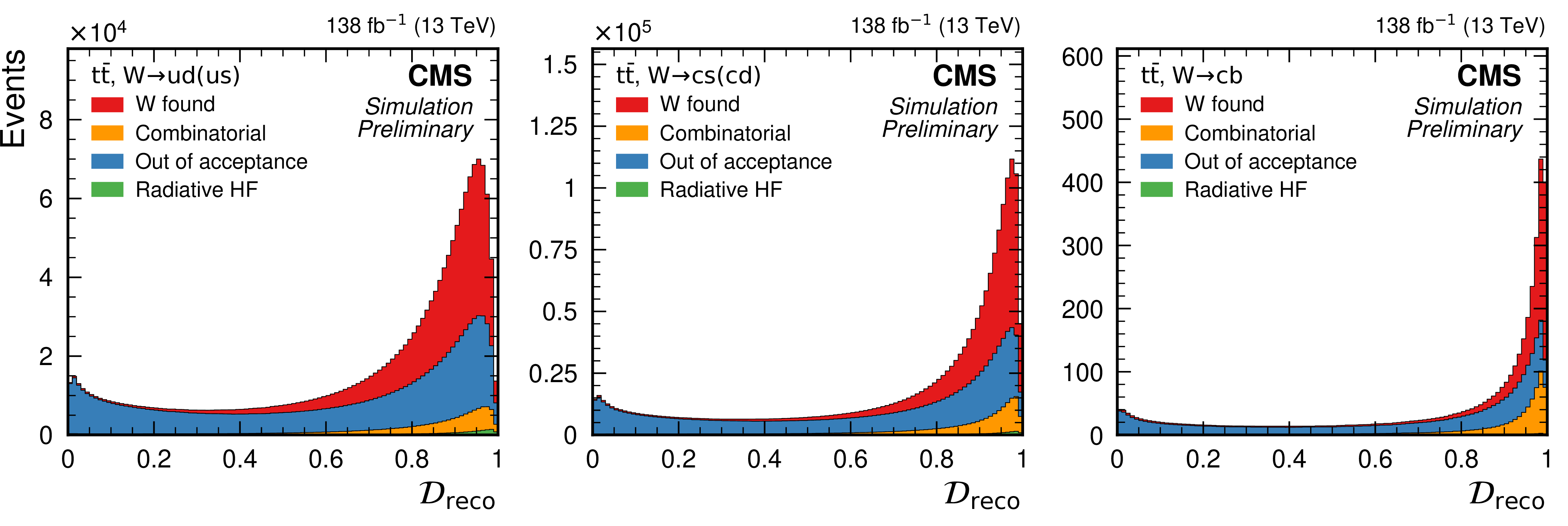
Distributions of the $ \mathcal{D}_{\mathrm{reco}} $ evaluated on simulated lepton+jets $ \mathrm{t} \overline{\mathrm{t}} $ events, categorized by the hadronic W boson decay mode: $ \mathrm{W}{\to}\mathrm{u}\mathrm{d} (\mathrm{u}\mathrm{s}) $ (left), $ \mathrm{W}{\to}\mathrm{c}\mathrm{s} (\mathrm{c}\mathrm{d}) $ (center), and the signal $ \mathrm{W}{\to}\mathrm{c}\mathrm{b} $ (right). The stacked histograms represent the categorization of the selected jet-parton assignments based on generator-level truth information, as defined in the text. |
png pdf |
Figure 2:
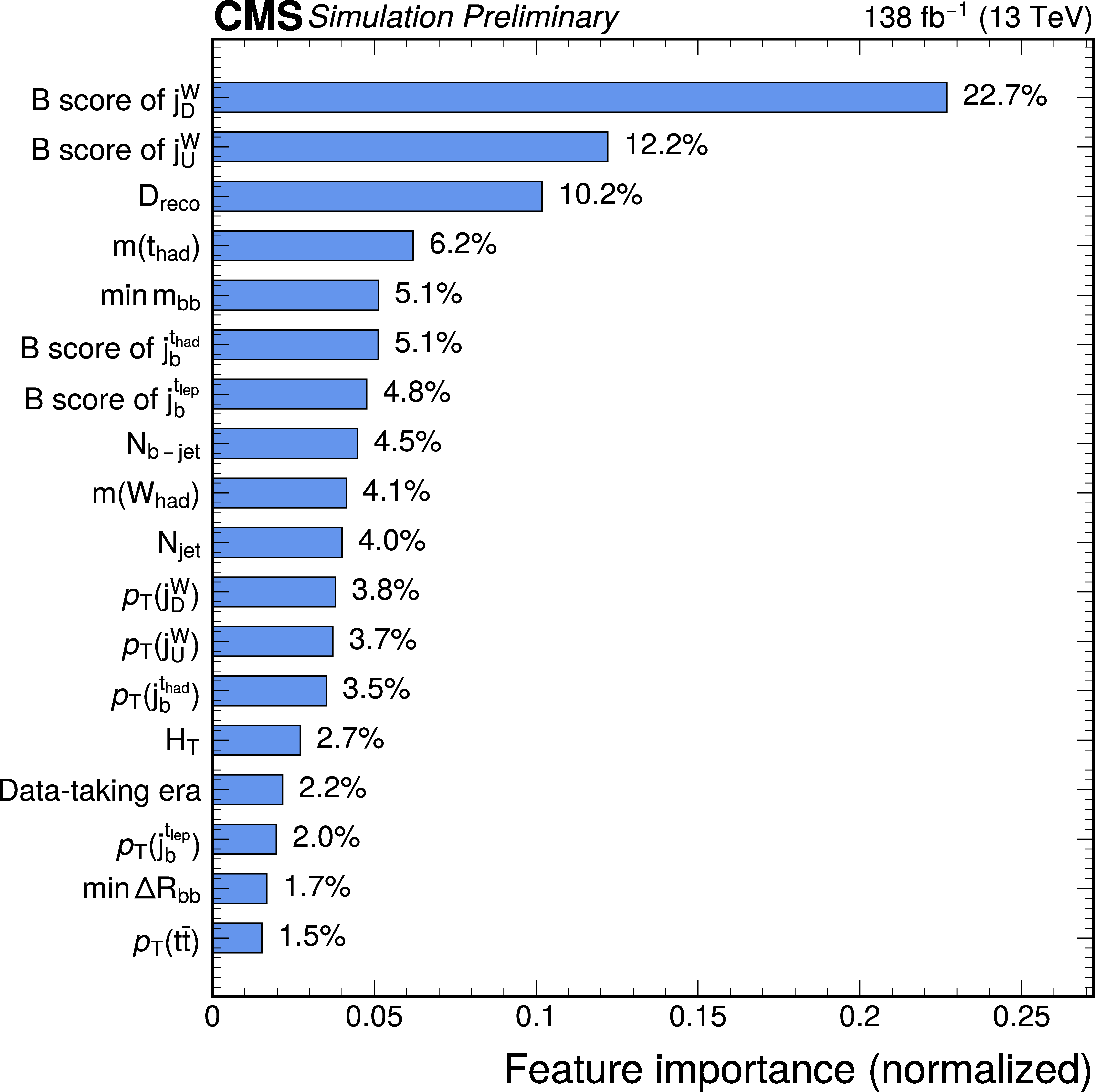
Feature importance for the $ \mathcal{D}_{\mathrm{W}{\to}\mathrm{c}\mathrm{b}} $ discriminant as determined by the TabNet model during training. |
png pdf |
Figure 3:
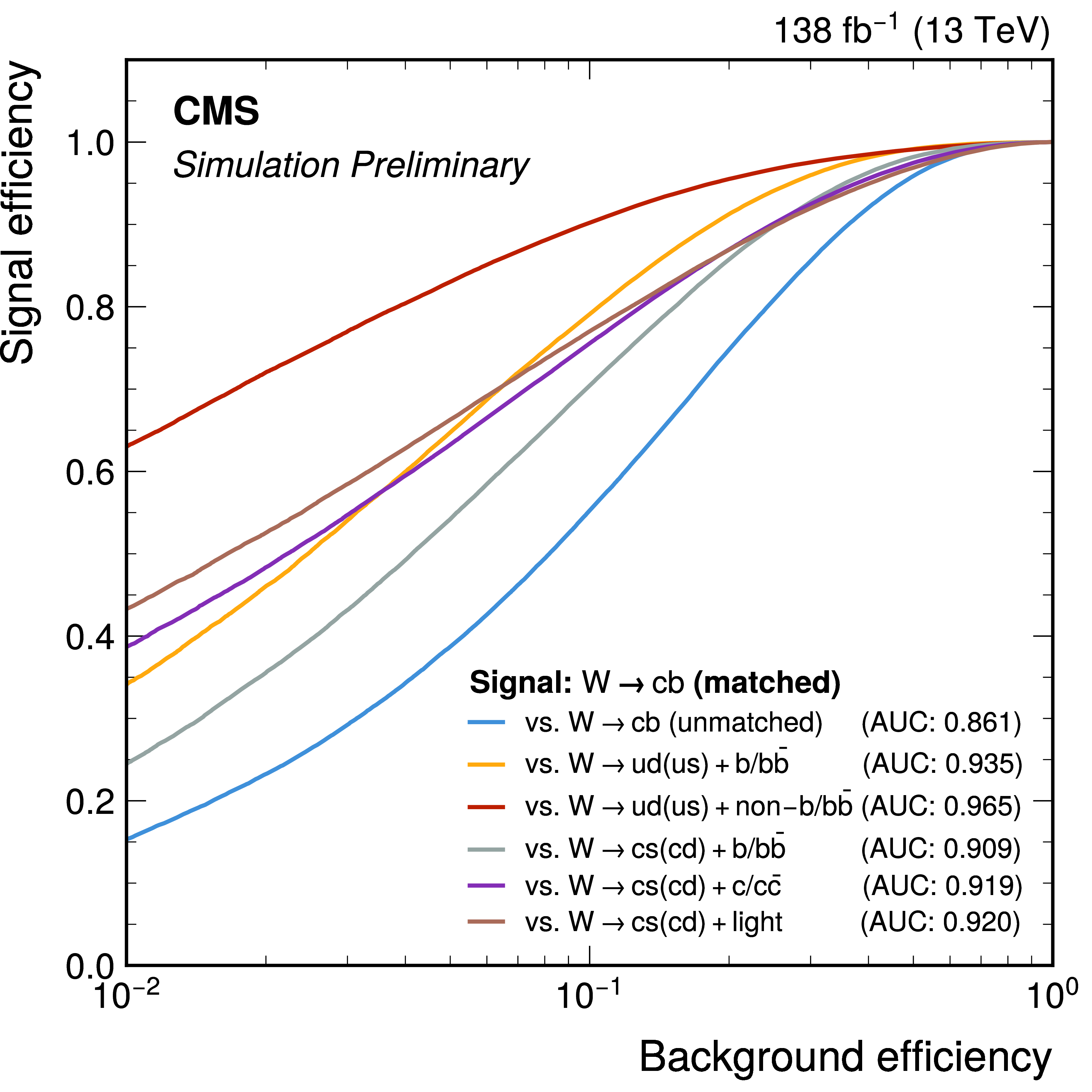
Receiver operating characteristic (ROC) curves evaluating the binary classification performance of the $ \mathcal{D}_{\mathrm{W}{\to}\mathrm{c}\mathrm{b}} $ discriminant. The curves demonstrate the separation power of the correctly matched $ \mathrm{W}{\to}\mathrm{c}\mathrm{b} $ signal against various topologies, which are explicitly categorized by the hadronic W boson decay mode and the additional heavy-flavor jet content. The definitions of the signal and background classes, including the matching requirement, are given in Table 2. |
png pdf |
Figure 4:
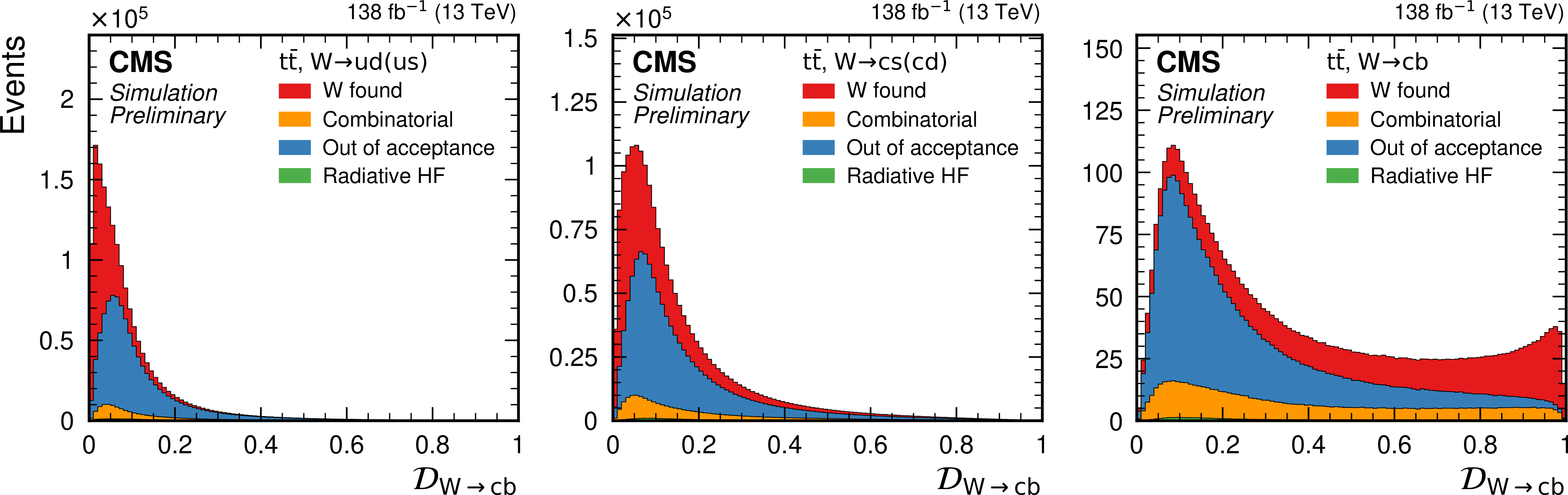
Distributions of the $ \mathcal{D}_{\mathrm{W}{\to}\mathrm{c}\mathrm{b}} $ discriminator for simulated events, categorized by the hadronic W boson decay mode: $ \mathrm{W}{\to}\mathrm{u}\mathrm{d} (\mathrm{u}\mathrm{s}) $ (left), $ \mathrm{W}{\to}\mathrm{c}\mathrm{s} (\mathrm{c}\mathrm{d}) $ (center), and $ \mathrm{W}{\to}\mathrm{c}\mathrm{b} $ (right). The stacked histograms represent the categorization of the jet-parton assignments, following the identical definitions established in figure 1. |
png pdf |
Figure 5:
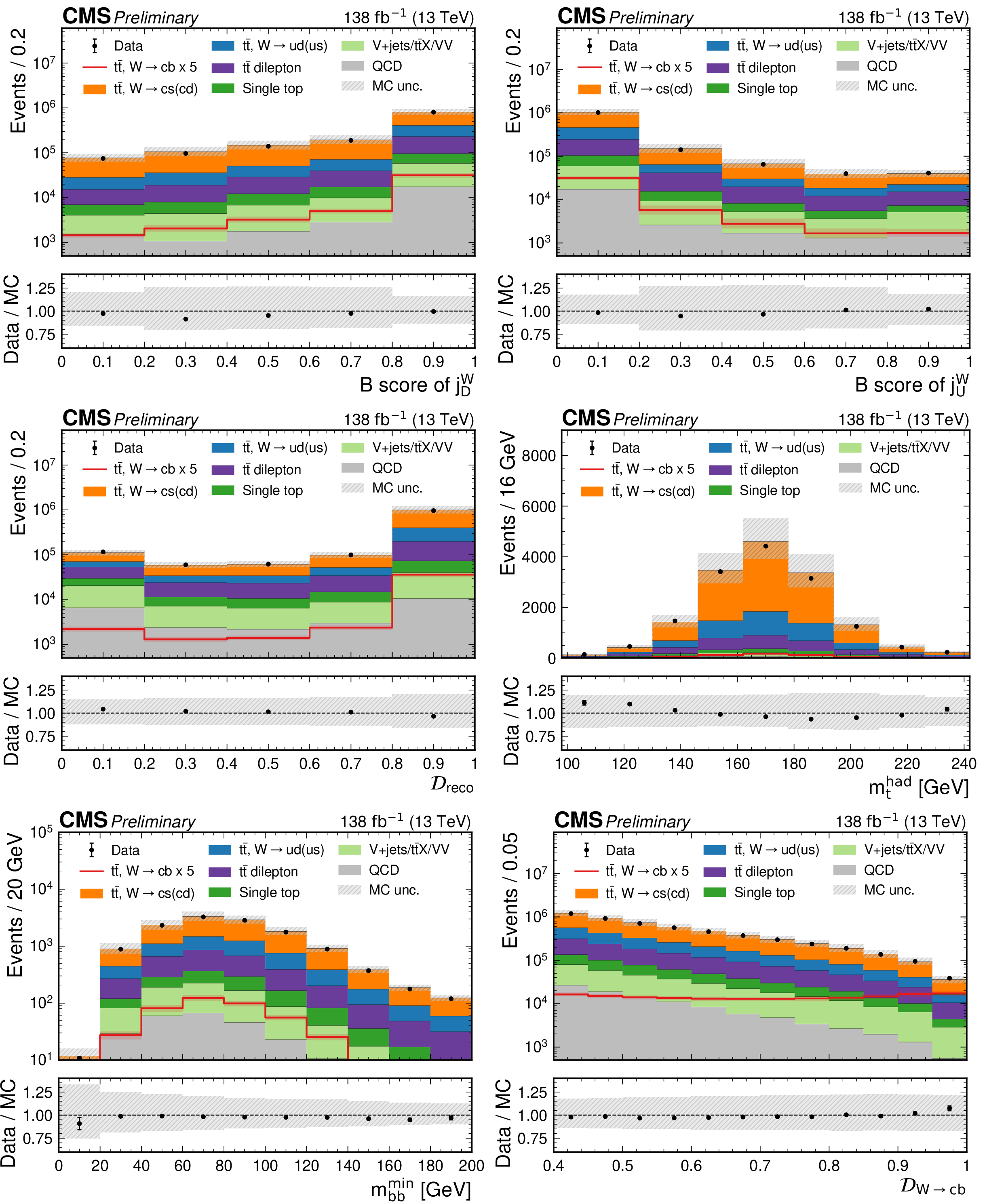
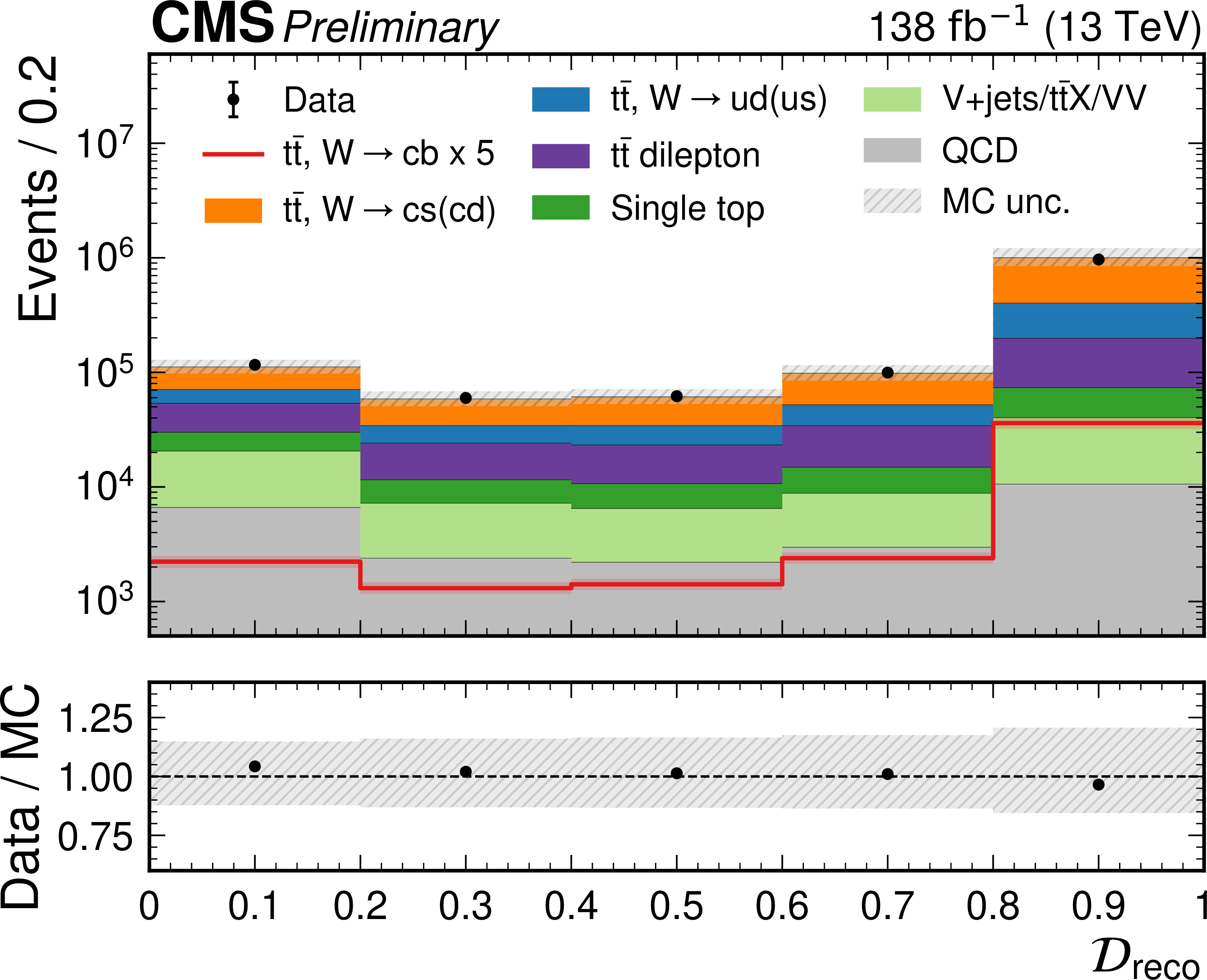
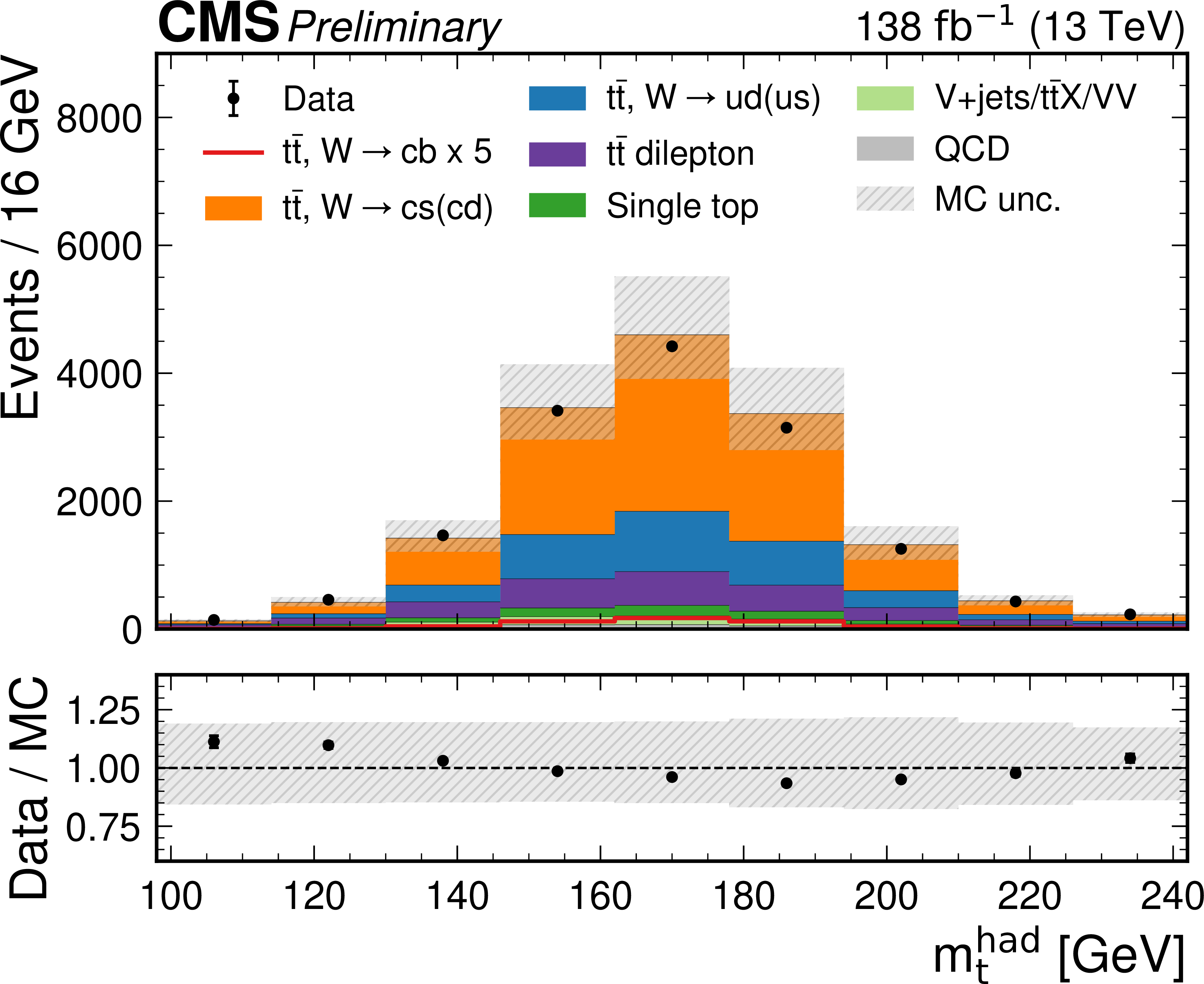
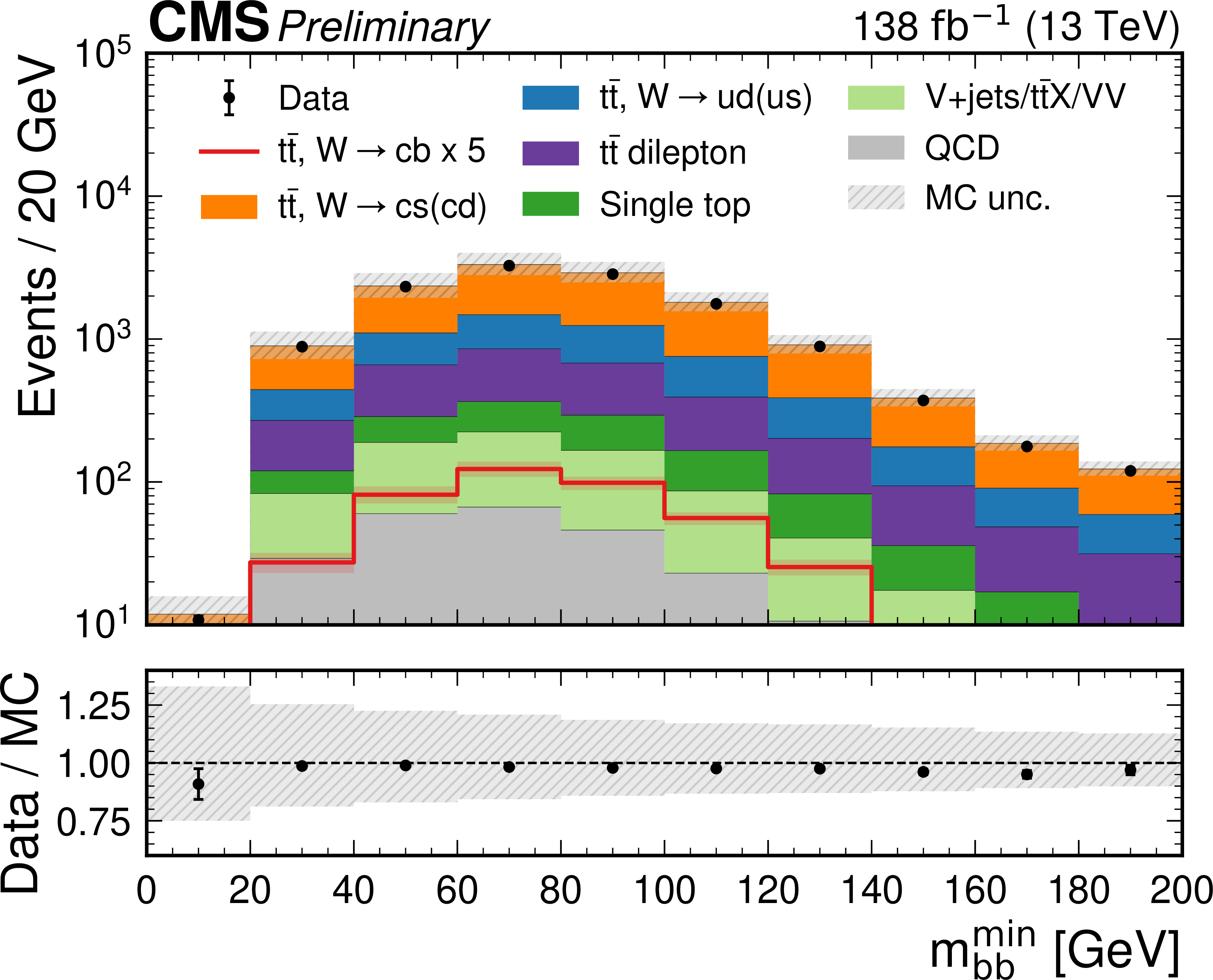
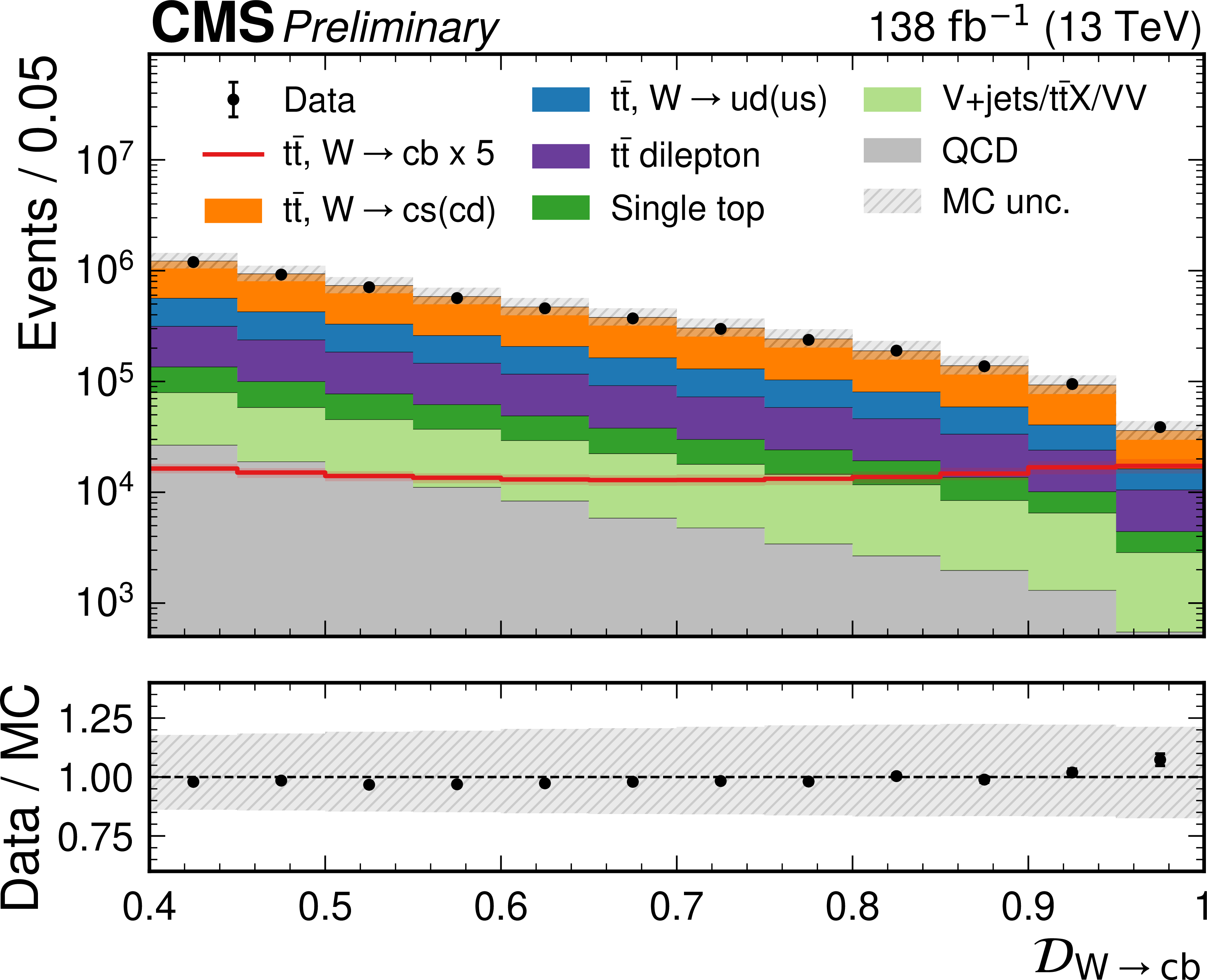
Pre-fit distributions in the single-lepton region of the $ B $ scores of the $ j_{D}^{W} $ (upper left) and $ j_{U}^{W} $ (upper right) candidates, the $ \mathcal{D}_{\mathrm{reco}} $ discriminator (middle left), the reconstructed hadronic top quark mass (middle right), the $ \min m_{\mathrm{b}\mathrm{b}} $ observable (lower left), and the $ \mathcal{D}_{\mathrm{W}{\to}\mathrm{c}\mathrm{b}} $ discriminator (lower right). The signal contribution is overlaid and is not included in the stacked background prediction. For visual clarity, $ {\mathrm{t}\overline{\mathrm{t}}} {+}\text{HF} $ contributions are included in the $ \mathrm{t} \overline{\mathrm{t}} $ categories labeled by the hadronic W boson decay mode and in the $ \mathrm{t} \overline{\mathrm{t}} $ dilepton category. The uncertainty bands include statistical and systematic components before the likelihood fit. |
png pdf |
Figure 5-a:
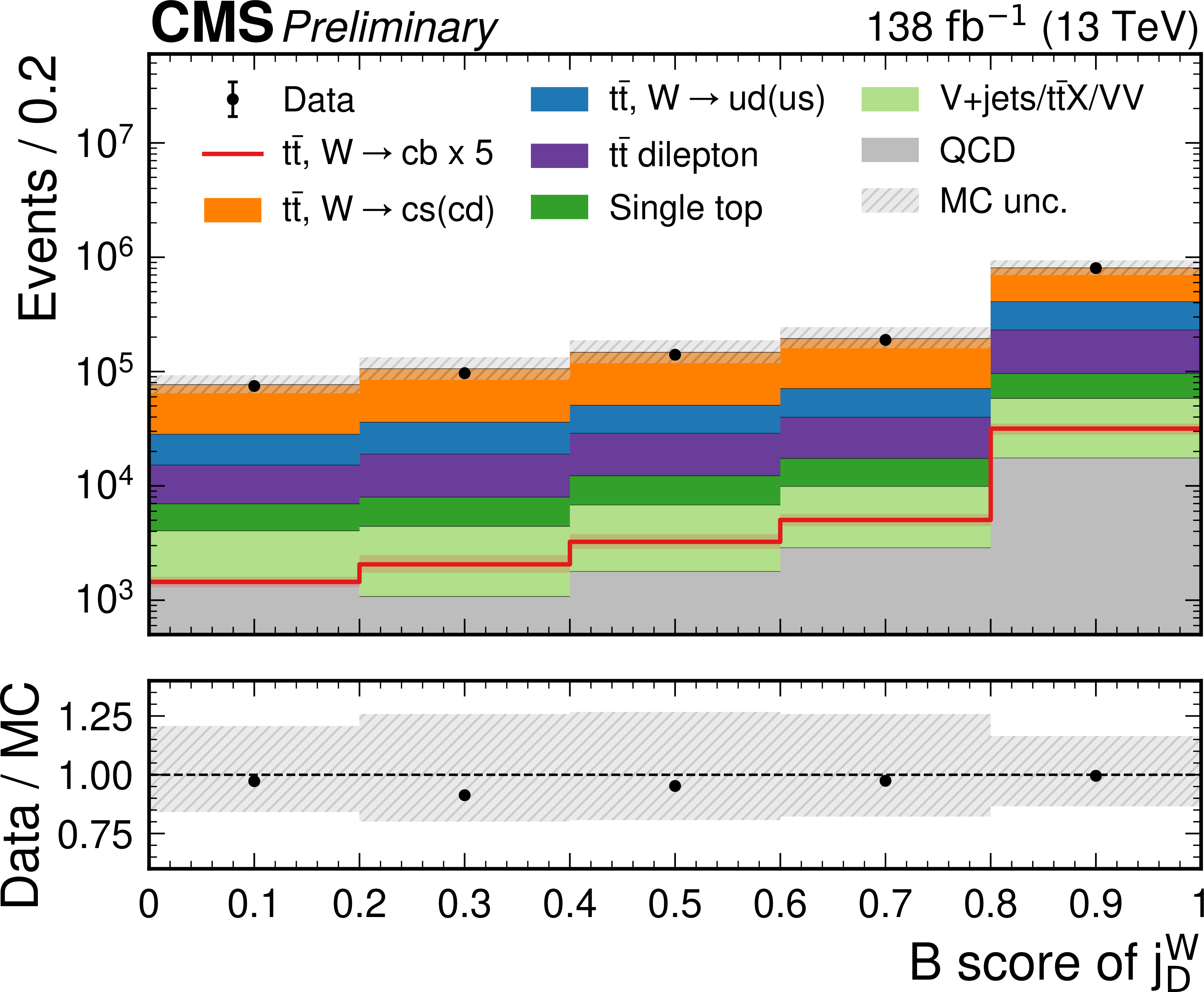
Pre-fit distributions in the single-lepton region of the $ B $ scores of the $ j_{D}^{W} $ (upper left) and $ j_{U}^{W} $ (upper right) candidates, the $ \mathcal{D}_{\mathrm{reco}} $ discriminator (middle left), the reconstructed hadronic top quark mass (middle right), the $ \min m_{\mathrm{b}\mathrm{b}} $ observable (lower left), and the $ \mathcal{D}_{\mathrm{W}{\to}\mathrm{c}\mathrm{b}} $ discriminator (lower right). The signal contribution is overlaid and is not included in the stacked background prediction. For visual clarity, $ {\mathrm{t}\overline{\mathrm{t}}} {+}\text{HF} $ contributions are included in the $ \mathrm{t} \overline{\mathrm{t}} $ categories labeled by the hadronic W boson decay mode and in the $ \mathrm{t} \overline{\mathrm{t}} $ dilepton category. The uncertainty bands include statistical and systematic components before the likelihood fit. |
png pdf |
Figure 5-b:
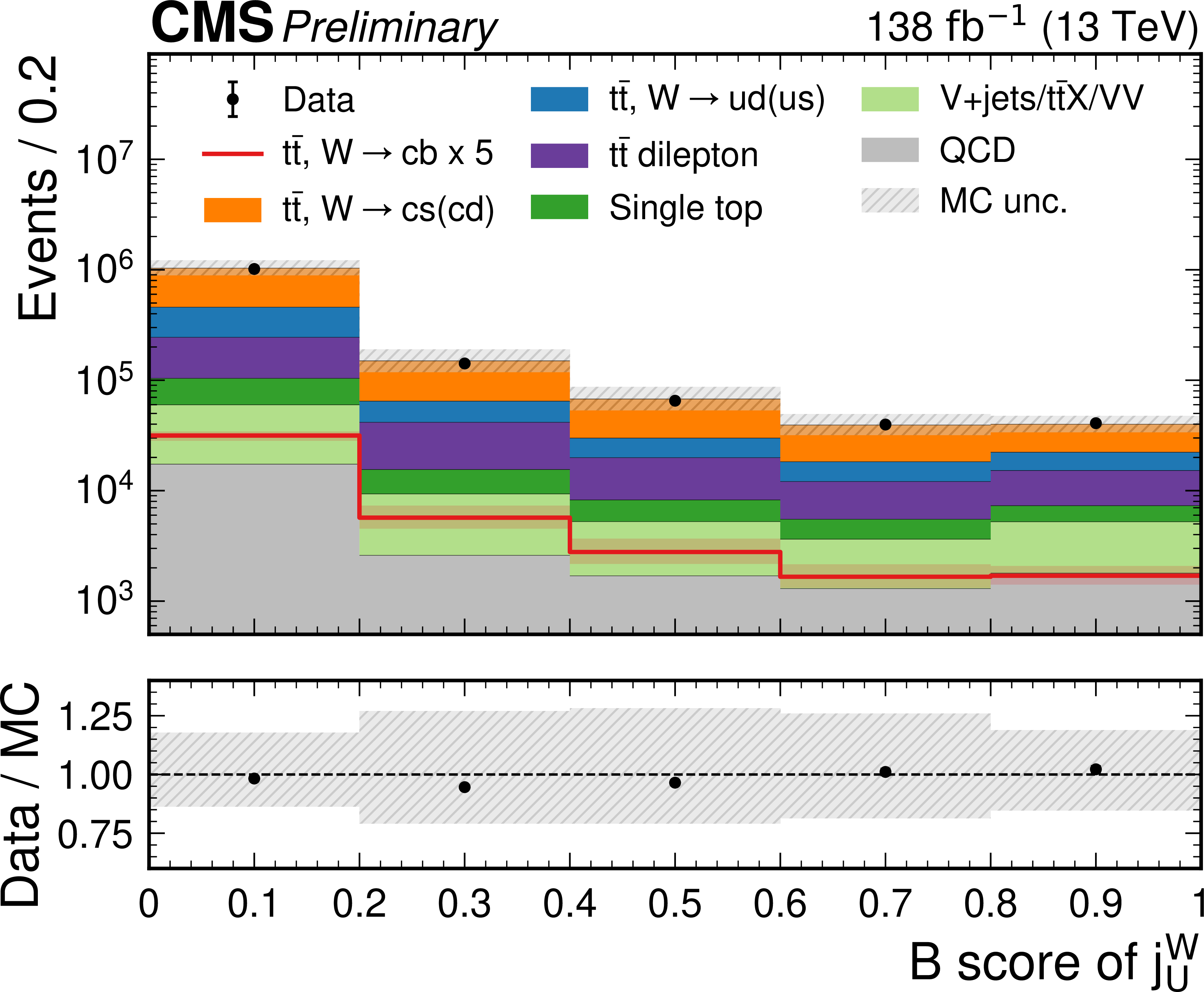
Pre-fit distributions in the single-lepton region of the $ B $ scores of the $ j_{D}^{W} $ (upper left) and $ j_{U}^{W} $ (upper right) candidates, the $ \mathcal{D}_{\mathrm{reco}} $ discriminator (middle left), the reconstructed hadronic top quark mass (middle right), the $ \min m_{\mathrm{b}\mathrm{b}} $ observable (lower left), and the $ \mathcal{D}_{\mathrm{W}{\to}\mathrm{c}\mathrm{b}} $ discriminator (lower right). The signal contribution is overlaid and is not included in the stacked background prediction. For visual clarity, $ {\mathrm{t}\overline{\mathrm{t}}} {+}\text{HF} $ contributions are included in the $ \mathrm{t} \overline{\mathrm{t}} $ categories labeled by the hadronic W boson decay mode and in the $ \mathrm{t} \overline{\mathrm{t}} $ dilepton category. The uncertainty bands include statistical and systematic components before the likelihood fit. |
png pdf |
Figure 5-c:
Pre-fit distributions in the single-lepton region of the $ B $ scores of the $ j_{D}^{W} $ (upper left) and $ j_{U}^{W} $ (upper right) candidates, the $ \mathcal{D}_{\mathrm{reco}} $ discriminator (middle left), the reconstructed hadronic top quark mass (middle right), the $ \min m_{\mathrm{b}\mathrm{b}} $ observable (lower left), and the $ \mathcal{D}_{\mathrm{W}{\to}\mathrm{c}\mathrm{b}} $ discriminator (lower right). The signal contribution is overlaid and is not included in the stacked background prediction. For visual clarity, $ {\mathrm{t}\overline{\mathrm{t}}} {+}\text{HF} $ contributions are included in the $ \mathrm{t} \overline{\mathrm{t}} $ categories labeled by the hadronic W boson decay mode and in the $ \mathrm{t} \overline{\mathrm{t}} $ dilepton category. The uncertainty bands include statistical and systematic components before the likelihood fit. |
png pdf |
Figure 5-d:
Pre-fit distributions in the single-lepton region of the $ B $ scores of the $ j_{D}^{W} $ (upper left) and $ j_{U}^{W} $ (upper right) candidates, the $ \mathcal{D}_{\mathrm{reco}} $ discriminator (middle left), the reconstructed hadronic top quark mass (middle right), the $ \min m_{\mathrm{b}\mathrm{b}} $ observable (lower left), and the $ \mathcal{D}_{\mathrm{W}{\to}\mathrm{c}\mathrm{b}} $ discriminator (lower right). The signal contribution is overlaid and is not included in the stacked background prediction. For visual clarity, $ {\mathrm{t}\overline{\mathrm{t}}} {+}\text{HF} $ contributions are included in the $ \mathrm{t} \overline{\mathrm{t}} $ categories labeled by the hadronic W boson decay mode and in the $ \mathrm{t} \overline{\mathrm{t}} $ dilepton category. The uncertainty bands include statistical and systematic components before the likelihood fit. |
png pdf |
Figure 5-e:
Pre-fit distributions in the single-lepton region of the $ B $ scores of the $ j_{D}^{W} $ (upper left) and $ j_{U}^{W} $ (upper right) candidates, the $ \mathcal{D}_{\mathrm{reco}} $ discriminator (middle left), the reconstructed hadronic top quark mass (middle right), the $ \min m_{\mathrm{b}\mathrm{b}} $ observable (lower left), and the $ \mathcal{D}_{\mathrm{W}{\to}\mathrm{c}\mathrm{b}} $ discriminator (lower right). The signal contribution is overlaid and is not included in the stacked background prediction. For visual clarity, $ {\mathrm{t}\overline{\mathrm{t}}} {+}\text{HF} $ contributions are included in the $ \mathrm{t} \overline{\mathrm{t}} $ categories labeled by the hadronic W boson decay mode and in the $ \mathrm{t} \overline{\mathrm{t}} $ dilepton category. The uncertainty bands include statistical and systematic components before the likelihood fit. |
png pdf |
Figure 5-f:
Pre-fit distributions in the single-lepton region of the $ B $ scores of the $ j_{D}^{W} $ (upper left) and $ j_{U}^{W} $ (upper right) candidates, the $ \mathcal{D}_{\mathrm{reco}} $ discriminator (middle left), the reconstructed hadronic top quark mass (middle right), the $ \min m_{\mathrm{b}\mathrm{b}} $ observable (lower left), and the $ \mathcal{D}_{\mathrm{W}{\to}\mathrm{c}\mathrm{b}} $ discriminator (lower right). The signal contribution is overlaid and is not included in the stacked background prediction. For visual clarity, $ {\mathrm{t}\overline{\mathrm{t}}} {+}\text{HF} $ contributions are included in the $ \mathrm{t} \overline{\mathrm{t}} $ categories labeled by the hadronic W boson decay mode and in the $ \mathrm{t} \overline{\mathrm{t}} $ dilepton category. The uncertainty bands include statistical and systematic components before the likelihood fit. |
png pdf |
Figure 6:
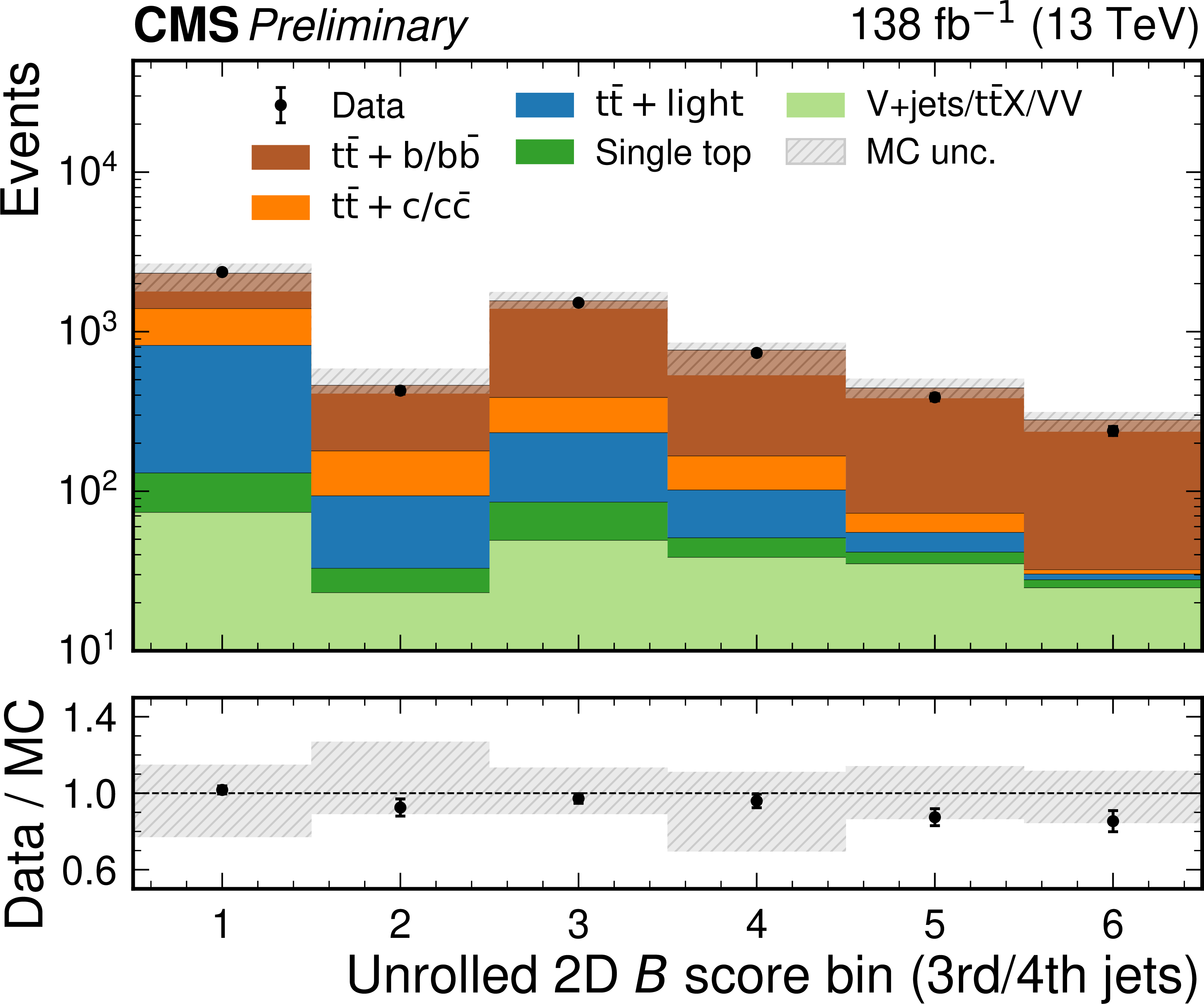
Pre-fit distribution of the unrolled 2D $ B $ template in the dilepton control region. The $ \mathrm{t} \overline{\mathrm{t}} $ contributions are grouped by the flavor content of additional jets; the detailed generator-level categories are defined in section 3. The uncertainty band includes statistical and systematic components before the likelihood fit. |
png pdf |
Figure 7:
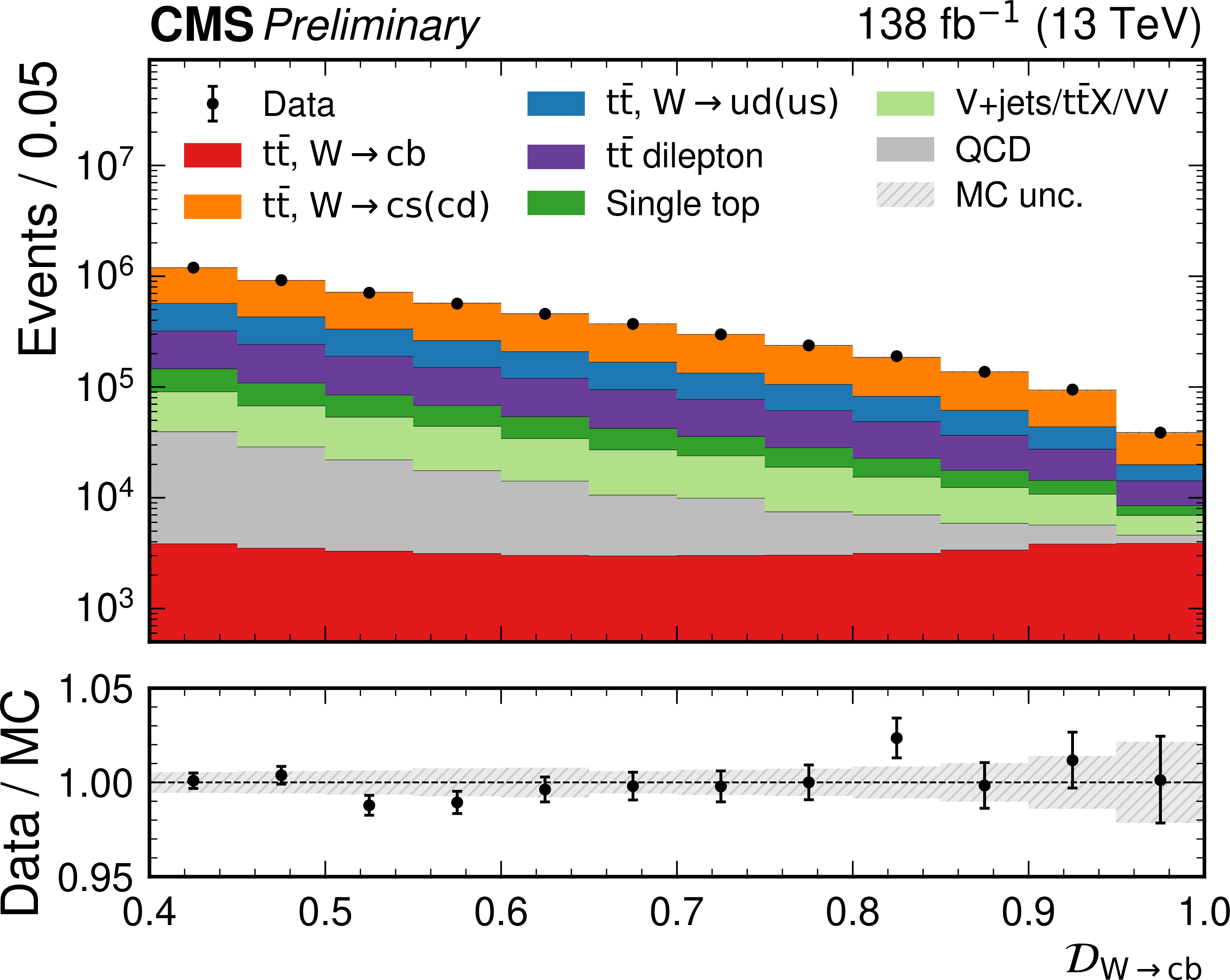
Post-fit distributions of the $ \mathcal{D}_{\mathrm{W}{\to}\mathrm{c}\mathrm{b}} $ discriminator in the single-lepton region. For visual clarity, $ {\mathrm{t}\overline{\mathrm{t}}} {+}\text{HF} $ contributions are included in the $ \mathrm{t} \overline{\mathrm{t}} $ categories labeled by the hadronic W boson decay mode and in the $ \mathrm{t} \overline{\mathrm{t}} $ dilepton category. The uncertainty bands include both statistical and systematic components. |
png pdf |
Figure 8:
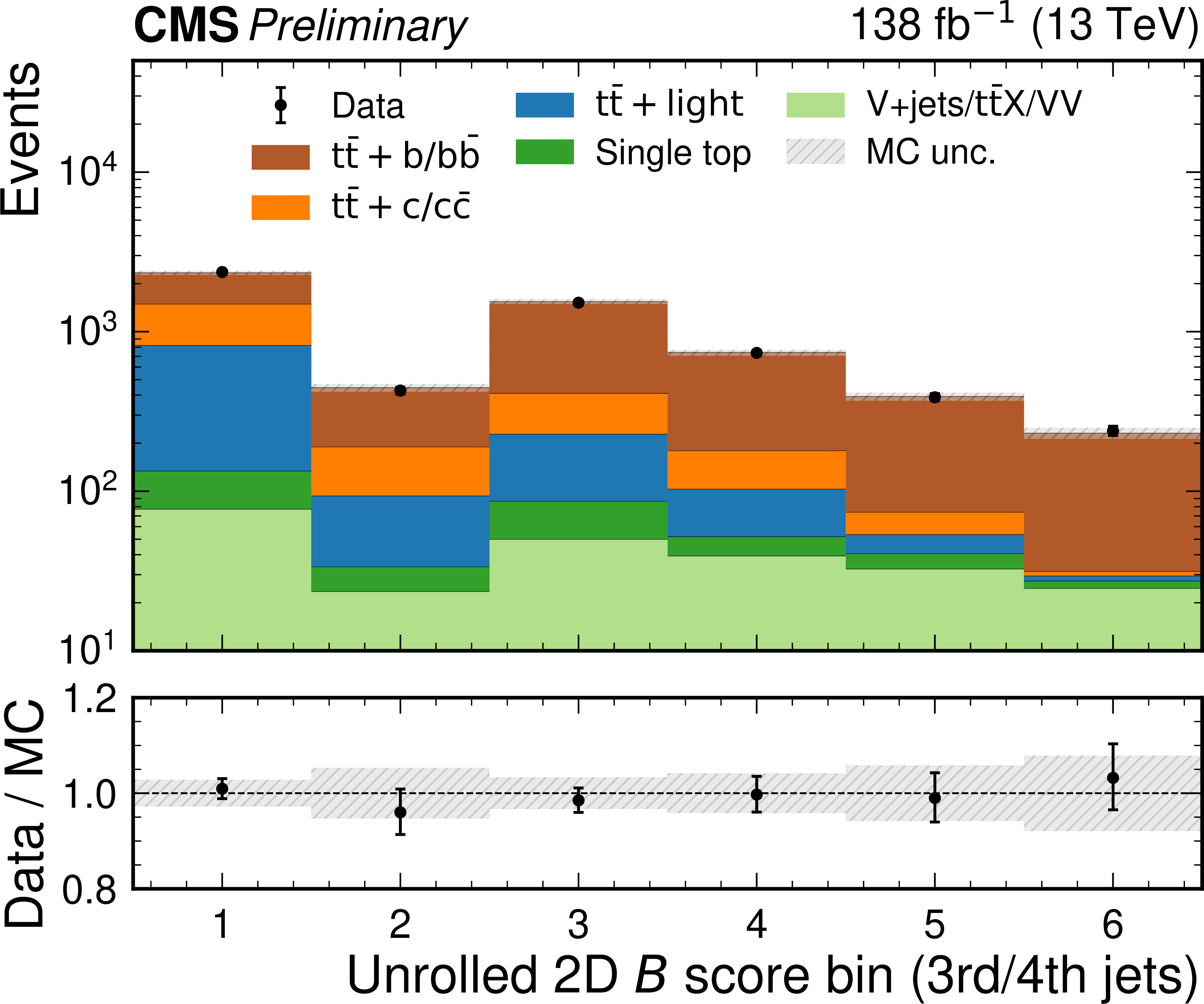
Post-fit distributions of the unrolled 2D $ B $ template in the dilepton control region. The $ \mathrm{t} \overline{\mathrm{t}} $ contributions are grouped by the flavor content of additional jets; the detailed generator-level categories are defined in section 3. The uncertainty bands include both statistical and systematic components. |
png pdf |
Figure 9:
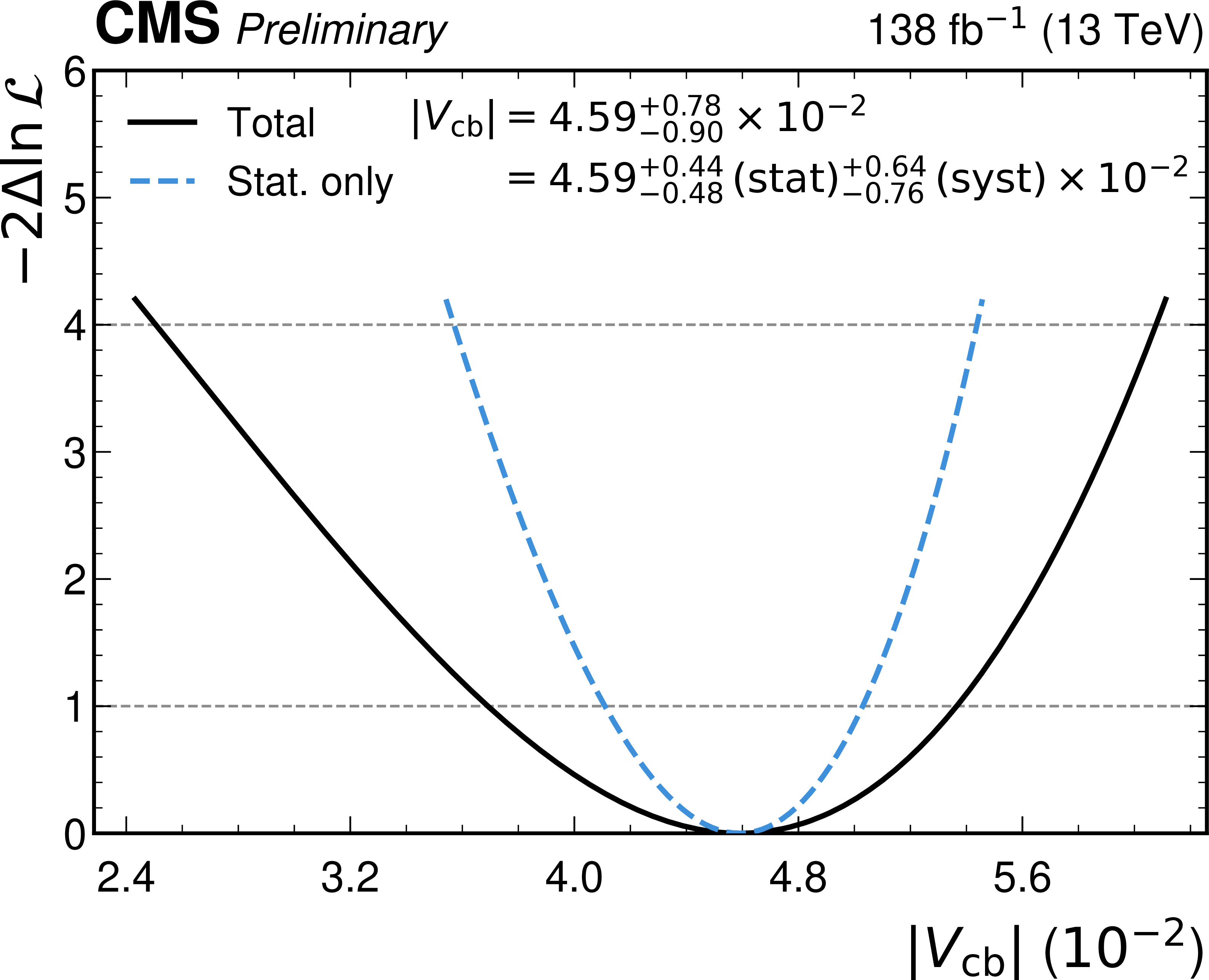
Profile likelihood scan as a function of $ |V_{\mathrm{c}\mathrm{b}}| $. The horizontal lines at $ -2\Delta ln \mathcal{L} = 1 $ and 4 indicate the 68% and 95% confidence intervals, respectively. |
png pdf |
Figure 10:
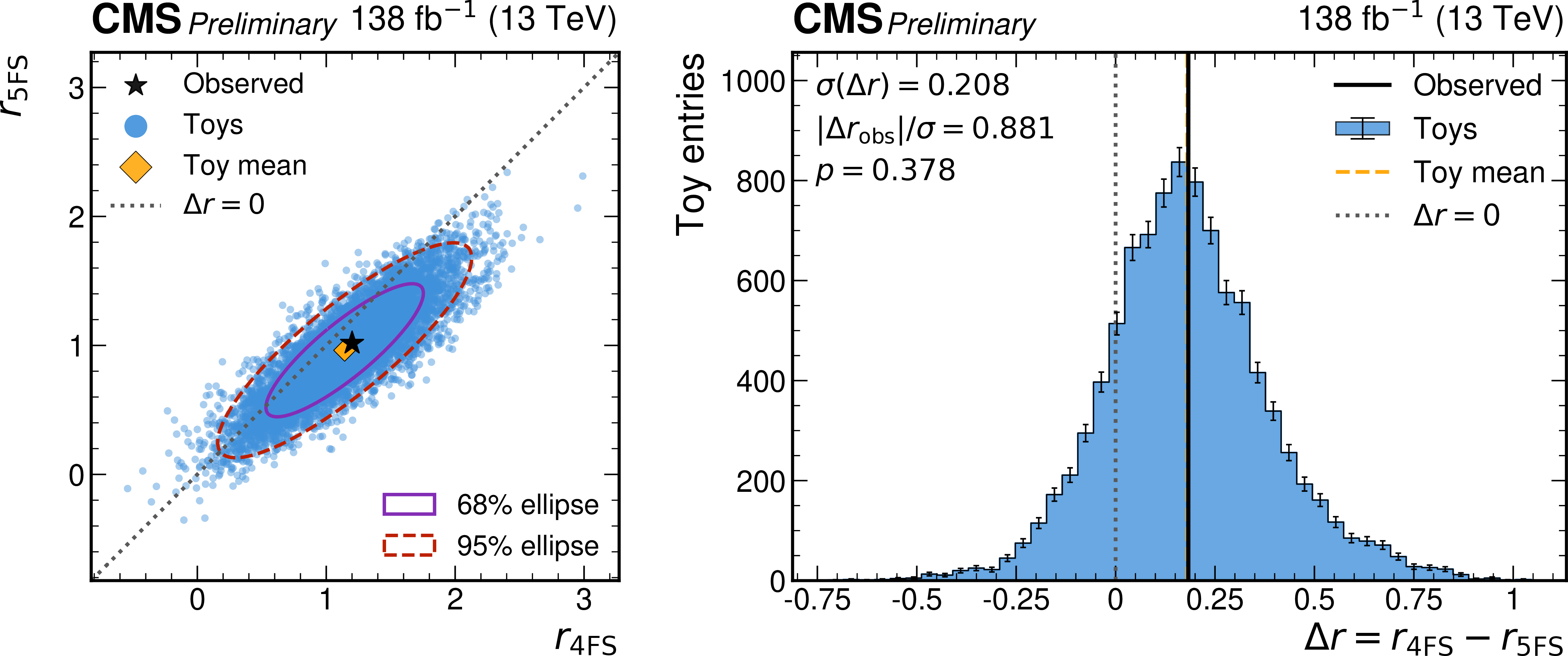
Bootstrap compatibility test of the POI values obtained with the 4FS and 5FS fits. The left panel shows the paired $ ( r_\mathrm{4FS} , r_\mathrm{5FS} ) $ distribution, and the right panel shows the distribution of $ Delta r = r_\mathrm{4FS} - r_\mathrm{5FS} $. |
| Tables | |
png pdf |
Table 1:
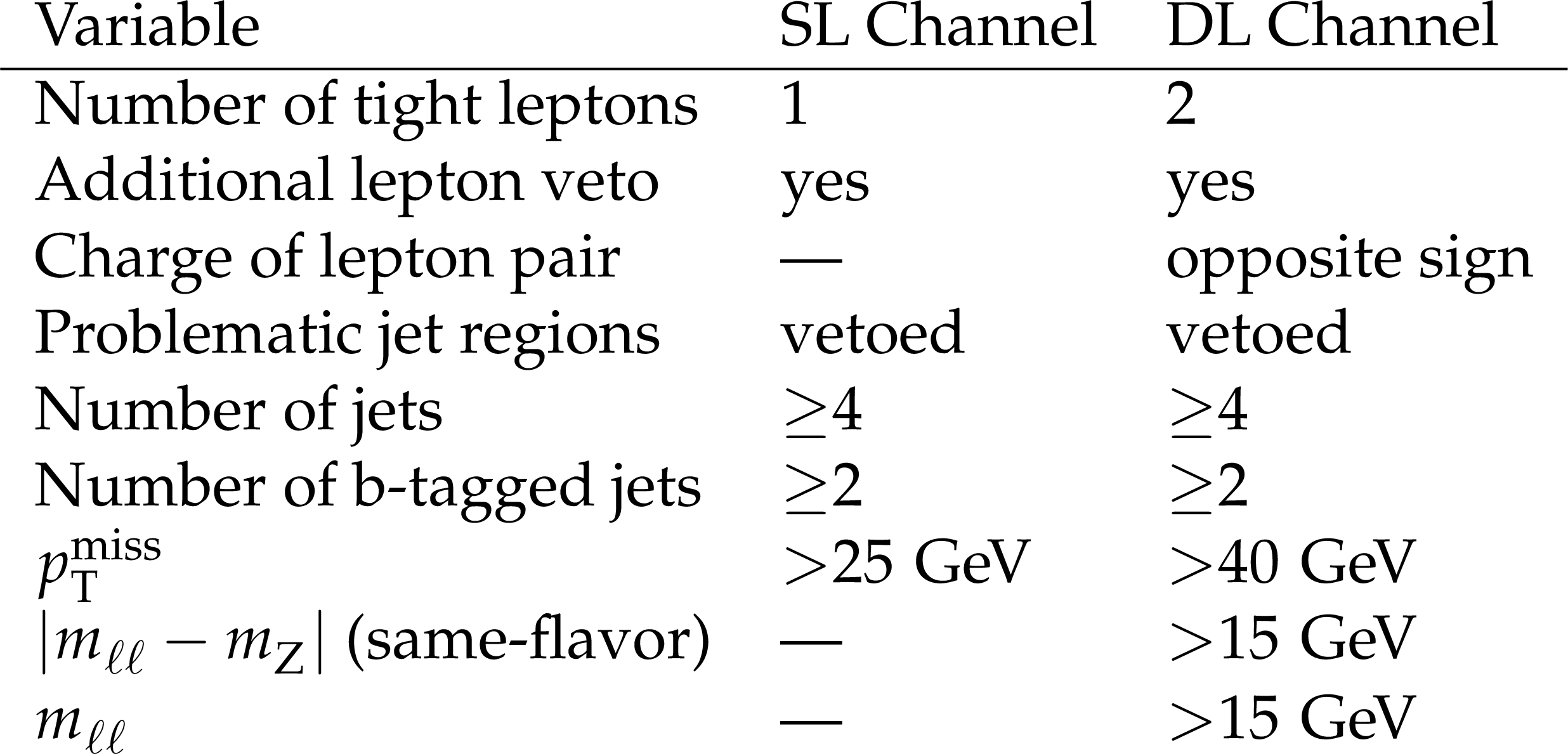
Summary of event selection. |
png pdf |
Table 2:
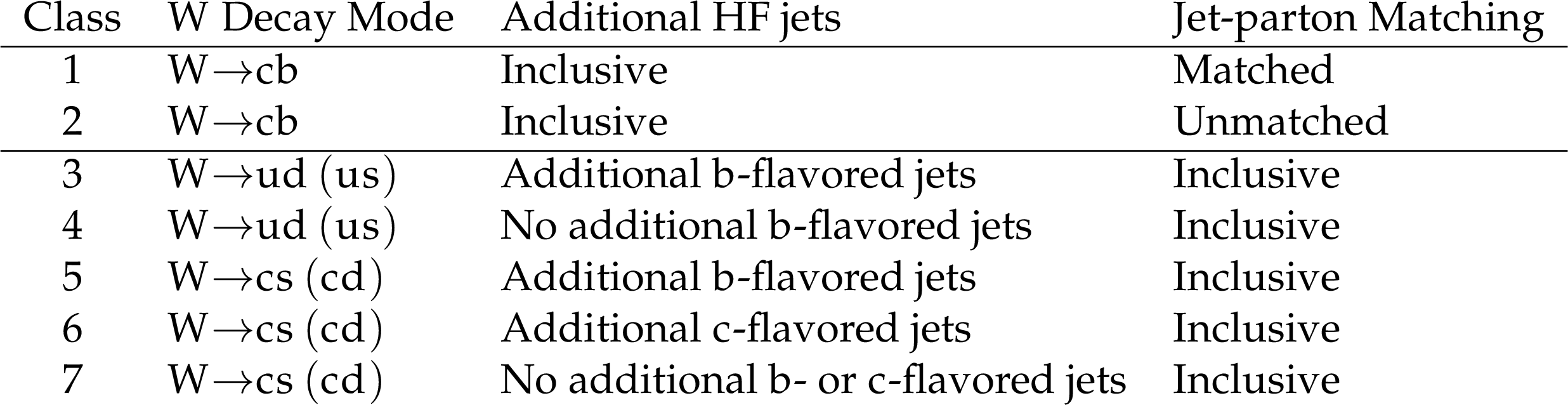
Definition of the seven training classes for the $ \mathcal{D}_{\mathrm{W}{\to}\mathrm{c}\mathrm{b}} $ discriminant. The events are categorized into seven distinct classes based on the decay mode of the hadronic W boson, the presence and flavor of additional heavy-flavor jets, and the success of the jet-parton matching during the $ \mathrm{t} \overline{\mathrm{t}} $ reconstruction. Classes 1 and 2 constitute the targeted signal process, while Classes 3 through 7 represent the various background topologies. The additional b-flavored jet class comprises the $ {\mathrm{t}\overline{\mathrm{t}}} {+}\mathrm{b} $, $ {\mathrm{t}\overline{\mathrm{t}}} {+}2\mathrm{b} $, and $ {\mathrm{t}\overline{\mathrm{t}}} {+}\mathrm{b}\mathrm{b} $ generator-level categories, whereas the additional c-flavored jet class comprises the $ {\mathrm{t}\overline{\mathrm{t}}} {+}\mathrm{c} $ and $ {\mathrm{t}\overline{\mathrm{t}}} {+}\mathrm{c}\overline{\mathrm{c}} $ generator-level categories. |
png pdf |
Table 3:
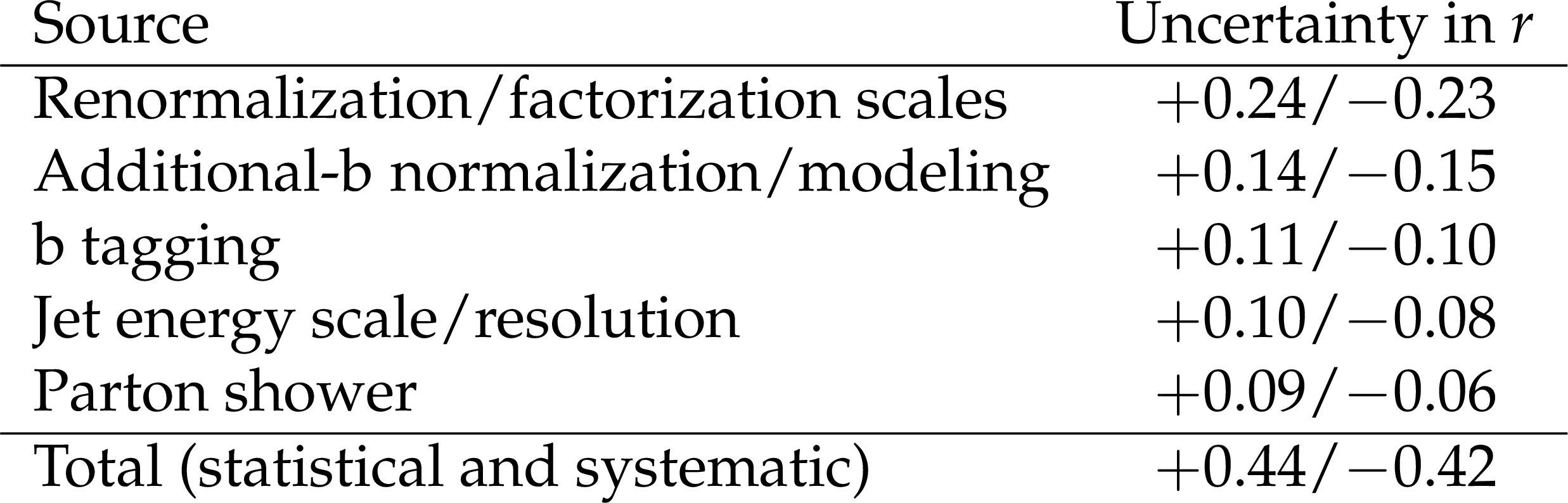
Leading contributions to the uncertainty in the fitted signal strength $(r)$. Each contribution is evaluated from profile-likelihood scans by fixing the corresponding group of nuisance parameters. Because correlations between different nuisance-parameter groups cannot be uniquely assigned in this procedure, the individual contributions are not expected to add in quadrature to the total uncertainty. |
| Summary |
| A measurement of the magnitude of the Cabibbo--Kobayashi--Maskawa (CKM) matrix element $ |V_{\mathrm{c}\mathrm{b}}| $ is presented using top-quark pair ( $ \mathrm{t} \overline{\mathrm{t}} $) events in the lepton+jets final state produced in proton-proton collisions at $ \sqrt{s} = $ 13 TeV. The data correspond to an integrated luminosity of 138 fb$ ^{-1} $ collected by the CMS experiment. The analysis exploits the hadronic decay of the W boson in $ \mathrm{t} \overline{\mathrm{t}} $ events to determine $ |V_{\mathrm{c}\mathrm{b}}| $ at the electroweak scale, without relying on the nonperturbative QCD inputs required in semileptonic b-flavored hadron decay measurements. The $ \mathrm{t} \overline{\mathrm{t}} $ system is reconstructed using a boosted decision tree algorithm, and a dedicated discriminator is constructed to separate the $ \mathrm{W}{\to}\mathrm{c}\mathrm{b} $ signal from the dominant $ \mathrm{t} \overline{\mathrm{t}} $ backgrounds using flavor-tagging and kinematic information. A simultaneous binned maximum-likelihood fit is applied to the signal region and control regions to extract the signal strength. Backgrounds from $ \mathrm{t} \overline{\mathrm{t}} $ production with additional heavy-flavor jets are constrained in the fit, with the nominal modeling of the additional-b component based on a dedicated NLO $ {\mathrm{t}\overline{\mathrm{t}}} \mathrm{b}\overline{\mathrm{b}} $ prediction (4FS). An alternative fit using the inclusive $ \mathrm{t} \overline{\mathrm{t}} $ prediction at NLO in QCD (5FS) is found to be compatible with the nominal result within the sensitivity of the analysis. The measured signal strength is $ r = 1.20^{+0.44}_{-0.42} $, corresponding to \[ |V_{\mathrm{c}\mathrm{b}}| = 4.59^{+0.44}_{-0.48} (\mathrm{stat}) ^{+0.64}_{-0.76} (\mathrm{syst}) \times 10^-2. \] The uncertainties include both statistical and systematic contributions and are dominated by the modeling of $ \mathrm{t} \overline{\mathrm{t}} $ production with additional heavy-flavor jets and by flavor-tagging uncertainties. The measured value is consistent within uncertainties with both the inclusive and exclusive determinations from semileptonic $ {\mathrm{B}} $ meson decays [9]. Although its precision is currently lower than that of those determinations, it provides a theoretically complementary probe of $ |V_{\mathrm{c}\mathrm{b}}| $ through the decay of an on-shell W boson at the electroweak scale. This result represents the most sensitive hadron-collider constraint to date on $ |V_{\mathrm{c}\mathrm{b}}| $ from W boson decays. Future measurements will benefit from the increased luminosity and the enhanced heavy-flavor tagging performance expected in CMS Run 3. Furthermore, extending the phase space to include the boosted regime offers a promising complementary avenue, where specialized boosted-jet tagging techniques can help suppress backgrounds and reduce systematic uncertainties [62]. The synergy between the resolved-channel strategy established in this work and future boosted-regime analyses holds the potential to reach the precision required to shed light on the long-standing discrepancy between inclusive and exclusive determinations of $ |V_{\mathrm{c}\mathrm{b}}| $. |
| References | ||||
| 1 | M. Bordone, B. Capdevila, and P. Gambino | Three loop calculations and inclusive $ |V_{\mathrm{c}\mathrm{b}}| $ | PLB 822 (2021) 136679 | 2107.00604 |
| 2 | F. Bernlochner et al. | First extraction of inclusive $ |V_{\mathrm{c}\mathrm{b}}| $ from $ q^2 $ moments | JHEP 10 (2022) 068 | 2205.10274 |
| 3 | BaBar Collaboration | Extraction of form factors from a four-dimensional angular analysis of $ {\overline{\mathrm{B}}\to\mathrm{D}^{*}\ell^-\overline{\nu}_{\ell}} $ | PRL 123 (2019) 091801 | 1903.10002 |
| 4 | Belle-II Collaboration | Determination of $ |V_{\mathrm{c}\mathrm{b}}| $ using $ {\overline{\mathrm{B}}^{0}\to\mathrm{D}^{*+}\ell^-\overline{\nu}_{\ell}} $ decays with \mboxBelle II | PRD 108 (2023) 092013 | 2310.01170 |
| 5 | Belle Collaboration | Measurement of angular coefficients of $ {\overline{\mathrm{B}}\to\mathrm{D}^{*}\ell\overline{\nu}_{\ell}} $: Implications for $ |V_{\mathrm{c}\mathrm{b}}| $ and tests of lepton flavor universality | PRL 133 (2024) 131801 | 2310.20286 |
| 6 | BaBar Collaboration | Measurement of $ |V_{\mathrm{c}\mathrm{b}}| $ and the form-factor slope in $ {\overline{\mathrm{B}}\to\mathrm{D}\ell^-\overline{\nu}_{\ell}} $ decays in events tagged by a fully reconstructed $ {\mathrm{B}} $ meson | PRL 104 (2010) 011802 | 0904.4063 |
| 7 | Belle Collaboration | Measurement of the decay $ {{\mathrm{B}}\to\mathrm{D}\ell\nu_{\ell}} $ in fully reconstructed events and determination of the Cabibbo--Kobayashi--Maskawa matrix element $ |V_{\mathrm{c}\mathrm{b}}| $ | PRD 93 (2016) 032006 | 1510.03657 |
| 8 | Belle-II Collaboration | Determination of $ |V_{\mathrm{c}\mathrm{b}}| $ from $ {{\mathrm{B}}\to\mathrm{D}\ell\nu} $ decays using 2019--2021 \mboxBelle II data | 2210.13143 | |
| 9 | Particle Data Group , S. Navas et al. | Review of particle physics | PRD 110 (2024) 030001 | |
| 10 | P. F. Harrison and V. E. Vladimirov | A method to determine $ |V_{\mathrm{c}\mathrm{b}}| $ at the weak scale in top decays at the LHC | JHEP 01 (2019) 191 | 1810.09424 |
| 11 | S. Choi and B. Kim | Measurement of the CKM matrix element $ |V_{\mathrm{c}\mathrm{b}}| $ from top quark pair events at the LHC | J. Korean Phys. Soc. 78 (2021) 1023 | |
| 12 | ATLAS Collaboration | Measurement of the $ |V_{\mathrm{c}\mathrm{b}}| $ element of the CKM matrix in $ \mathrm{t} \overline{\mathrm{t}} $ decays with the ATLAS detector | JHEP 07 (2026) 078 | 2603.16414 |
| 13 | CMS Collaboration | The CMS experiment at the CERN LHC | JINST 3 (2008) S08004 | |
| 14 | CMS Collaboration | Development of the CMS detector for the CERN LHC \mboxRun 3 | JINST 19 (2024) P05064 | CMS-PRF-21-001 2309.05466 |
| 15 | CMS Collaboration | Performance of the CMS Level-1 trigger in proton-proton collisions at $ \sqrt{s}= $ 13 TeV | JINST 15 (2020) P10017 | CMS-TRG-17-001 2006.10165 |
| 16 | CMS Collaboration | The CMS trigger system | JINST 12 (2017) P01020 | CMS-TRG-12-001 1609.02366 |
| 17 | CMS Collaboration | Performance of the CMS high-level trigger during LHC \mboxRun 2 | JINST 19 (2024) P11021 | CMS-TRG-19-001 2410.17038 |
| 18 | CMS Collaboration | Electron and photon reconstruction and identification with the CMS experiment at the CERN LHC | JINST 16 (2021) P05014 | CMS-EGM-17-001 2012.06888 |
| 19 | CMS Collaboration | Performance of the CMS muon detector and muon reconstruction with proton-proton collisions at $ \sqrt{s}= $ 13 TeV | JINST 13 (2018) P06015 | CMS-MUO-16-001 1804.04528 |
| 20 | CMS Collaboration | Description and performance of track and primary-vertex reconstruction with the CMS tracker | JINST 9 (2014) P10009 | CMS-TRK-11-001 1405.6569 |
| 21 | CMS Collaboration | Particle-flow reconstruction and global event description with the CMS detector | JINST 12 (2017) P10003 | CMS-PRF-14-001 1706.04965 |
| 22 | M. Cacciari, G. P. Salam, and G. Soyez | The anti-$ k_{\mathrm{T}} $ jet clustering algorithm | JHEP 04 (2008) 063 | 0802.1189 |
| 23 | M. Cacciari, G. P. Salam, and G. Soyez | FASTJET user manual | EPJC 72 (2012) 1896 | 1111.6097 |
| 24 | CMS Collaboration | Jet energy scale and resolution in the CMS experiment in $ {\mathrm{p}\mathrm{p}} $ collisions at 8 TeV | JINST 12 (2017) P02014 | CMS-JME-13-004 1607.03663 |
| 25 | CMS Collaboration | Pileup mitigation at CMS in 13 TeV data | JINST 15 (2020) P09018 | CMS-JME-18-001 2003.00503 |
| 26 | CMS Collaboration | Identification of heavy-flavour jets with the CMS detector in $ {\mathrm{p}\mathrm{p}} $ collisions at 13 TeV | JINST 13 (2018) P05011 | CMS-BTV-16-002 1712.07158 |
| 27 | E. Bols et al. | Jet flavour classification using DeepJet | JINST 15 (2020) P12012 | 2008.10519 |
| 28 | CMS Collaboration | Performance summary of AK4 jet b tagging with data from proton-proton collisions at 13 TeV with the CMS detector | CMS Detector Performance Note CMS-DP-2023-005, 2023 CDS |
|
| 29 | CMS Collaboration | Performance of missing transverse momentum reconstruction in proton-proton collisions at $ \sqrt{s}= $ 13 TeV using the CMS detector | JINST 14 (2019) P07004 | CMS-JME-17-001 1903.06078 |
| 30 | D. Bertolini, P. Harris, M. Low, and N. Tran | Pileup per particle identification | JHEP 10 (2014) 059 | 1407.6013 |
| 31 | P. Nason | A new method for combining NLO QCD with shower Monte Carlo algorithms | JHEP 11 (2004) 040 | hep-ph/0409146 |
| 32 | S. Frixione, P. Nason, and C. Oleari | Matching NLO QCD computations with parton shower simulations: the POWHEG method | JHEP 11 (2007) 070 | 0709.2092 |
| 33 | S. Alioli, P. Nason, C. Oleari, and E. Re | A general framework for implementing NLO calculations in shower Monte Carlo programs: the POWHEG box | JHEP 06 (2010) 043 | 1002.2581 |
| 34 | S. Frixione, G. Ridolfi, and P. Nason | A positive-weight next-to-leading-order Monte Carlo for heavy flavour hadroproduction | JHEP 09 (2007) 126 | 0707.3088 |
| 35 | NNPDF Collaboration | Parton distributions from high-precision collider data | EPJC 77 (2017) 663 | 1706.00428 |
| 36 | NNPDF Collaboration | Unbiased global determination of parton distributions and their uncertainties at NNLO and at LO | NPB 855 (2012) 153 | 1107.2652 |
| 37 | M. Czakon and A. Mitov | top++: a program for the calculation of the top-pair cross-section at hadron colliders | Comput. Phys. Commun. 185 (2014) 2930 | 1112.5675 |
| 38 | T. Sjöstrand et al. | An introduction to pythia 8.2 | Computer Physics Communications 191 (2015) 159 | 1410.3012 |
| 39 | CMS Collaboration | Extraction and validation of a new set of CMS PYTHIA 8 tunes from underlying-event measurements | EPJC 80 (2020) 4 | CMS-GEN-17-001 1903.12179 |
| 40 | T. Je \v z o and P. Nason | On the treatment of resonances in next-to-leading order calculations matched to a parton shower | JHEP 12 (2015) 065 | 1509.09071 |
| 41 | T. Je \v z o, J. M. Lindert, N. Moretti, and S. Pozzorini | New NLOPS predictions for $ \mathrm{t} \overline{\mathrm{t}} $ +b-jet production at the LHC | EPJC 78 (2018) 502 | 1802.00426 |
| 42 | F. Buccioni et al. | OpenLoops 2 | EPJC 79 (2019) 866 | 1907.13071 |
| 43 | M. Cacciari, G. P. Salam, and G. Soyez | The catchment area of jets | JHEP 04 (2008) 005 | 0802.1188 |
| 44 | S. Alioli, P. Nason, C. Oleari, and E. Re | NLO single-top production matched with shower in POWHEG: $ s $- and $ t $-channel contributions | JHEP 09 (2009) 111 | 0907.4076 |
| 45 | E. Re | Single-top $ {\mathrm{W}\mathrm{t}} $-channel production matched with parton showers using the POWHEG method | EPJC 71 (2011) 1547 | 1009.2450 |
| 46 | J. Alwall et al. | The automated computation of tree-level and next-to-leading order differential cross sections, and their matching to parton shower simulations | JHEP 07 (2014) 079 | 1405.0301 |
| 47 | J. Alwall et al. | Comparative study of various algorithms for the merging of parton showers and matrix elements in hadronic collisions | EPJC 53 (2008) 473 | 0706.2569 |
| 48 | R. Frederix and S. Frixione | Merging meets matching in MC@NLO | JHEP 12 (2012) 061 | 1209.6215 |
| 49 | GEANT4 Collaboration | GEANT 4---a simulation toolkit | NIM A 506 (2003) 250 | |
| 50 | T. Chen and C. Guestrin | XGBoost: A scalable tree boosting system | in 2nd ACM SIGKDD International Conference on Knowledge Discovery and Data Mining: San Francisco CA, USA, August 13--17,, 2016 Proc. 2 (2016) 2 |
1603.02754 |
| 51 | CMS Collaboration | A deep neural network for simultaneous estimation of b jet energy and resolution | Comput. Softw. Big Sci. 4 (2020) 10 | CMS-HIG-18-027 1912.06046 |
| 52 | S. O. Arik and T. Pfister | TabNet: Attentive interpretable tabular learning | 1908.07442 | |
| 53 | J. Zhang and A. C. Sanderson | JADE: Adaptive differential evolution with optional external archive | IEEE Trans. Evol. Comput. 13 (2009) 945 | |
| 54 | CMS Collaboration | First measurement of the cross section for top quark pair production with additional charm jets using dileptonic final states in $ {\mathrm{p}\mathrm{p}} $ collisions at $ \sqrt{s}= $ 13 TeV | PLB 820 (2021) 136565 | CMS-TOP-20-003 2012.09225 |
| 55 | CMS Collaboration | Reweighting simulated events using machine-learning techniques in the CMS experiment | EPJC 85 (2025) 495 | CMS-MLG-24-001 2411.03023 |
| 56 | S. Argyropoulos and T. Sjostrand | Effects of color reconnection on $ \mathrm{t} \overline{\mathrm{t}} $ final states at the LHC | JHEP 11 (2014) 043 | 1407.6653 |
| 57 | J. R. Christiansen and P. Z. Skands | String formation beyond leading colour | JHEP 08 (2015) 003 | 1505.01681 |
| 58 | CMS Collaboration | Jet energy scale and resolution measurement with \mboxRun 2 legacy data collected by CMS at 13 TeV | CMS Detector Performance Note CMS-DP-2021-033, 2021 CDS |
|
| 59 | CMS Collaboration | Precision luminosity measurement in proton-proton collisions at $ \sqrt{s}= $ 13 TeV in 2015 and 2016 at CMS | EPJC 81 (2021) 800 | CMS-LUM-17-003 2104.01927 |
| 60 | CMS Collaboration | Precision luminosity measurement in proton-proton collisions at a center-of-mass energy of 13 TeV with the CMS detector at the Large Hadron Collider | Submitted to Phys. Rev. X, 2026 | CMS-LUM-20-001 2606.26832 |
| 61 | CMS Collaboration | The CMS statistical analysis and combination tool: combine | Comput. Softw. Big Sci. 8 (2024) 19 | CMS-CAT-23-001 2404.06614 |
| 62 | Y. Zhao et al. | Novel $ |V_{\mathrm{c}\mathrm{b}}| $ extraction method via boosted $ {\mathrm{b}\mathrm{c}} $-tagging with in-situ calibration | 2503.00118 | |
|
|
Compact Muon Solenoid LHC, CERN |

|
|
|
|
|
|