Compact Muon Solenoid
LHC, CERN
 Visit us: CMS Public Website, CMS Physics ;
Contact us: CMS Publications Committee
Visit us: CMS Public Website, CMS Physics ;
Contact us: CMS Publications Committee
| CMS-PAS-HIN-25-013 | ||
| Study of the charm-quark dead cone in heavy-ion collisions | ||
| CMS Collaboration | ||
| 2026-07-06 | ||
| Abstract: This note presents the first measurement of the dead-cone effect for the charm quark in heavy-ion collisions. PbPb data recorded by the CMS detector at the CERN LHC in 2018 is used. The data correspond to a center-of-mass energy of 5.02 TeV and to an integrated luminosity of 1.7 $ \mathrm{nb}^{-1} $. The observable under study is the angular distribution of hard, collinear intrajet emissions from inclusive and prompt $ \mathrm{D}^0 $- meson-tagged jets in heavy-ion collisions. The emissions are selected by the late-$ k_\mathrm{T} $ grooming algorithm. The angular distribution of late-$ k_\mathrm{T} $ emissions in heavy ions is shifted towards large angles in $ \mathrm{D}^0 $-jets compared to inclusive jets. This is consistent with a suppression of collinear splittings for $ \mathrm{D}^0 $-jets as expected from the dead-cone effect. The shift is consistent with that observed in a previous measurement in pp collisions. This indicates that, within uncertainties, and within the kinematic region covered by the analysis, the dead cone of the charm quark is not filled by quark-gluon-plasma-induced radiation in heavy-ion collisions. | ||
| Links: CDS record (PDF) ; Physics Briefing ; CADI line (restricted) ; | ||
| Figures | |
png pdf |
Figure 1:
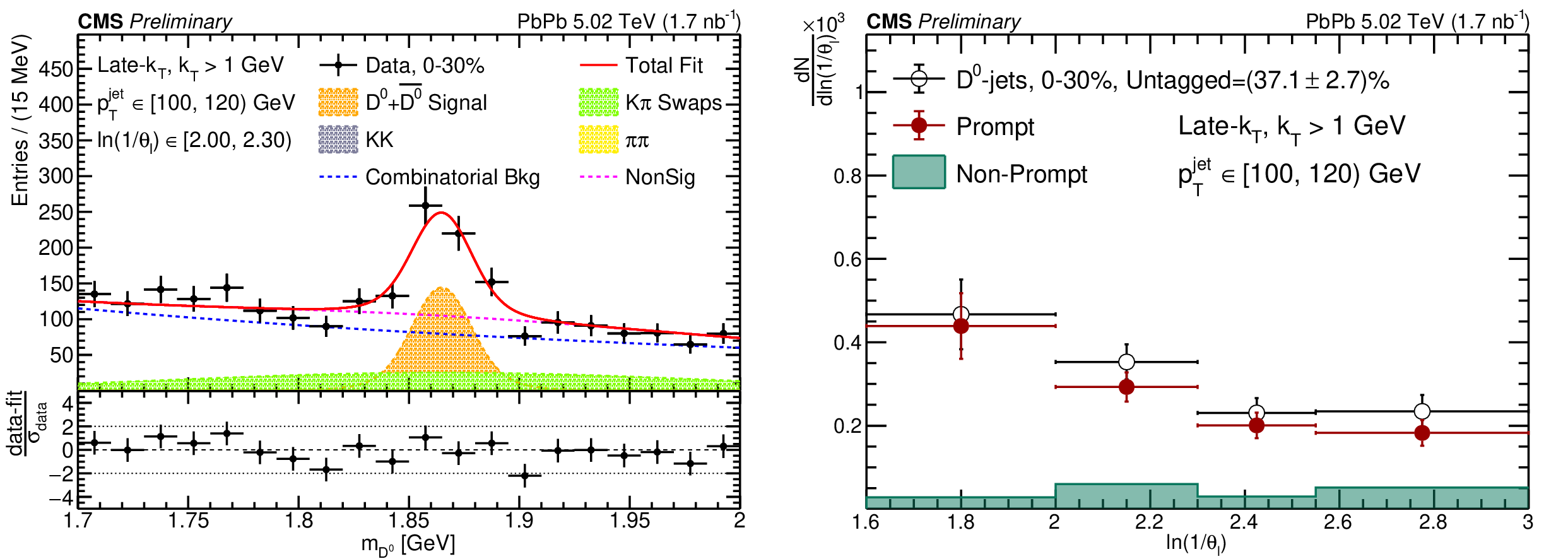
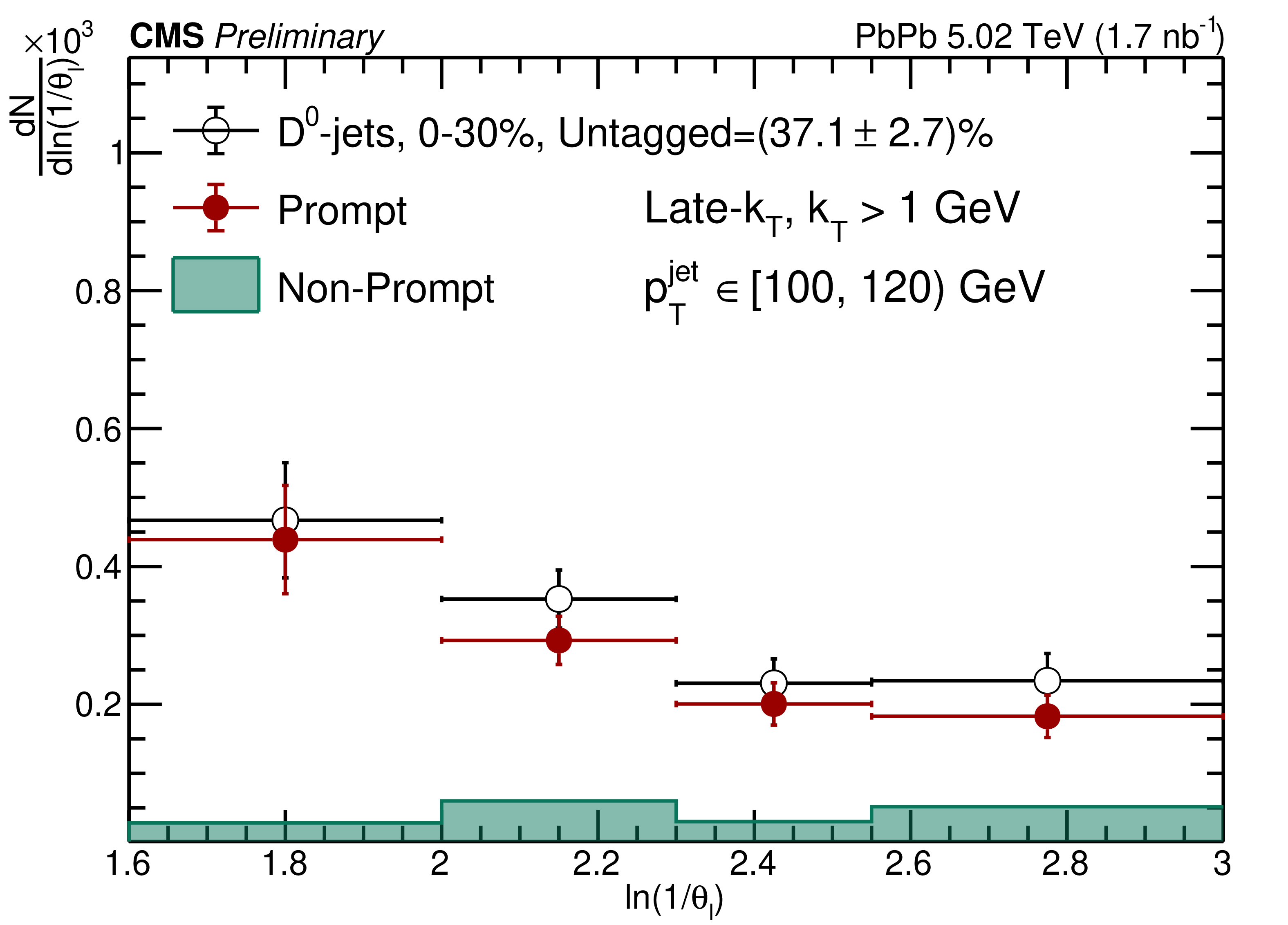
Left: invariant mass distribution of K$ \pi $ pairs for $ \mathrm{D^0} $ jet candidates and fit (red line) for jets with momentum 100 $ \leq p_{\mathrm{T}}^{\text{jet}} < $ 120 GeV and late-$ k_{\mathrm{T}} $ splitting angle 2 $ \leq \ln(1/\theta_{\text{l}}) < $ 2.3. The different components of the fit are the signal (orange-shaded area), K$ \pi $ swaps (green-shaded area), KK and $ \pi\pi $ (gray- and yellow-shaded areas), combinatorial background (blue line), and the non-signal (pink line) fit component, taking into account all the different background sources just mentioned. Right: splitting angle distribution for D$ ^0 $ meson-tagged jets (black points), and the prompt component (red points) after the non-prompt component (cyan-shaded area) subtraction, as well as the untagged fraction of jets not satisfying late-$ k_{\mathrm{T}} $ groomer, in 100 $ \le p_{\mathrm{T}}^{\text{jet}} < $ 120 GeV. |
png pdf |
Figure 1-a:
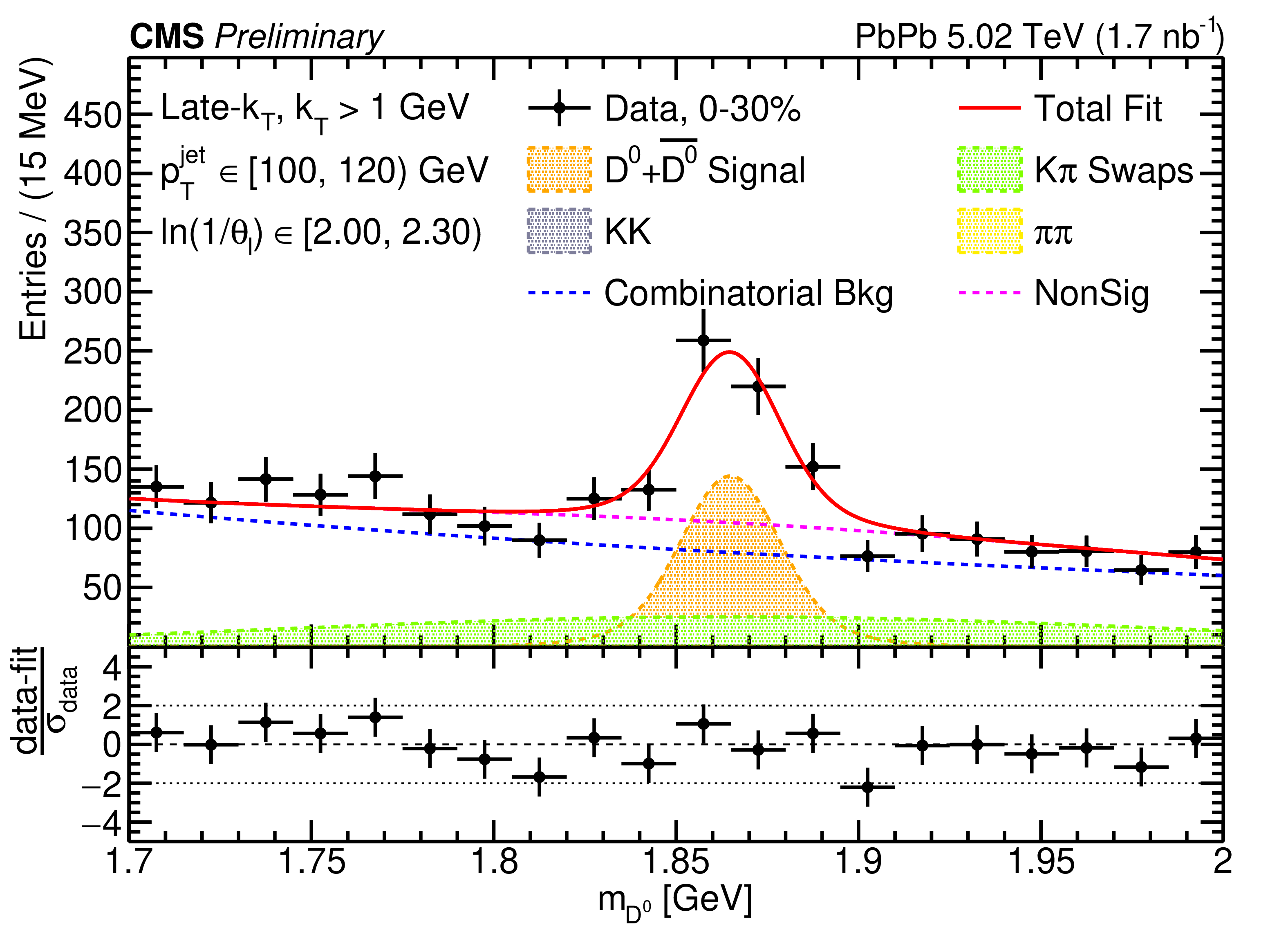
Left: invariant mass distribution of K$ \pi $ pairs for $ \mathrm{D^0} $ jet candidates and fit (red line) for jets with momentum 100 $ \leq p_{\mathrm{T}}^{\text{jet}} < $ 120 GeV and late-$ k_{\mathrm{T}} $ splitting angle 2 $ \leq \ln(1/\theta_{\text{l}}) < $ 2.3. The different components of the fit are the signal (orange-shaded area), K$ \pi $ swaps (green-shaded area), KK and $ \pi\pi $ (gray- and yellow-shaded areas), combinatorial background (blue line), and the non-signal (pink line) fit component, taking into account all the different background sources just mentioned. Right: splitting angle distribution for D$ ^0 $ meson-tagged jets (black points), and the prompt component (red points) after the non-prompt component (cyan-shaded area) subtraction, as well as the untagged fraction of jets not satisfying late-$ k_{\mathrm{T}} $ groomer, in 100 $ \le p_{\mathrm{T}}^{\text{jet}} < $ 120 GeV. |
png pdf |
Figure 1-b:
Left: invariant mass distribution of K$ \pi $ pairs for $ \mathrm{D^0} $ jet candidates and fit (red line) for jets with momentum 100 $ \leq p_{\mathrm{T}}^{\text{jet}} < $ 120 GeV and late-$ k_{\mathrm{T}} $ splitting angle 2 $ \leq \ln(1/\theta_{\text{l}}) < $ 2.3. The different components of the fit are the signal (orange-shaded area), K$ \pi $ swaps (green-shaded area), KK and $ \pi\pi $ (gray- and yellow-shaded areas), combinatorial background (blue line), and the non-signal (pink line) fit component, taking into account all the different background sources just mentioned. Right: splitting angle distribution for D$ ^0 $ meson-tagged jets (black points), and the prompt component (red points) after the non-prompt component (cyan-shaded area) subtraction, as well as the untagged fraction of jets not satisfying late-$ k_{\mathrm{T}} $ groomer, in 100 $ \le p_{\mathrm{T}}^{\text{jet}} < $ 120 GeV. |
png pdf |
Figure 2:
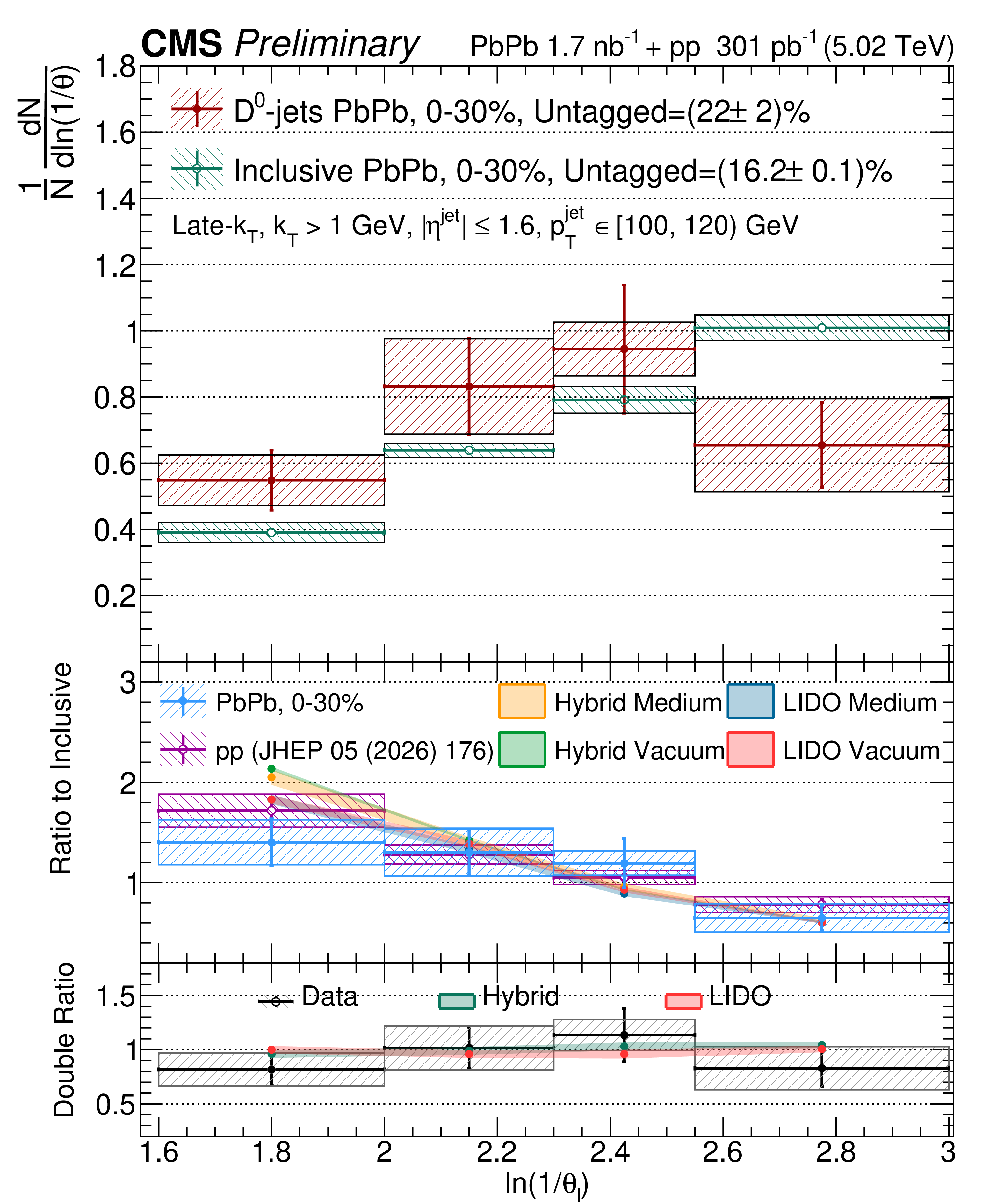
Upper panel: late-$ k_{\mathrm{T}} $ angular distribution for Prompt-$ \mathrm{D^0} $ mesons in jets (red line) and inclusive jets (cyan line). Middle panel: ratio prompt $ D $ meson-tagged to inclusive jets in PbPb collisions (blue line), ratio prompt $ \mathrm{D^0} $ meson-tagged to inclusive jets in proton-proton collisions (purple line), and quenched models predictions for the ratio with diffusion effects -- orange-shaded area, and the vacuum prediction -- green-shaded area of Hybrid model, and LIDO medium -- dark-blue-shaded area and vacuum -- red-shaded area. Lower panel: PbPb-to-pp double ratio. The ratio is consistent with unity within uncertainties, indicating no significant modification of the suppression of small-angle emissions in PbPb collisions, this suggests that the dead cone is intact in PbPb collisions as predicted by theory. The fraction of late-$ k_{\mathrm{T}} $ untagged jets, for $ \mathrm{D^0} $ meson-tagged jets is about 22% and for inclusive jets is about 16%. |
| Tables | |
png pdf |
Table 1:
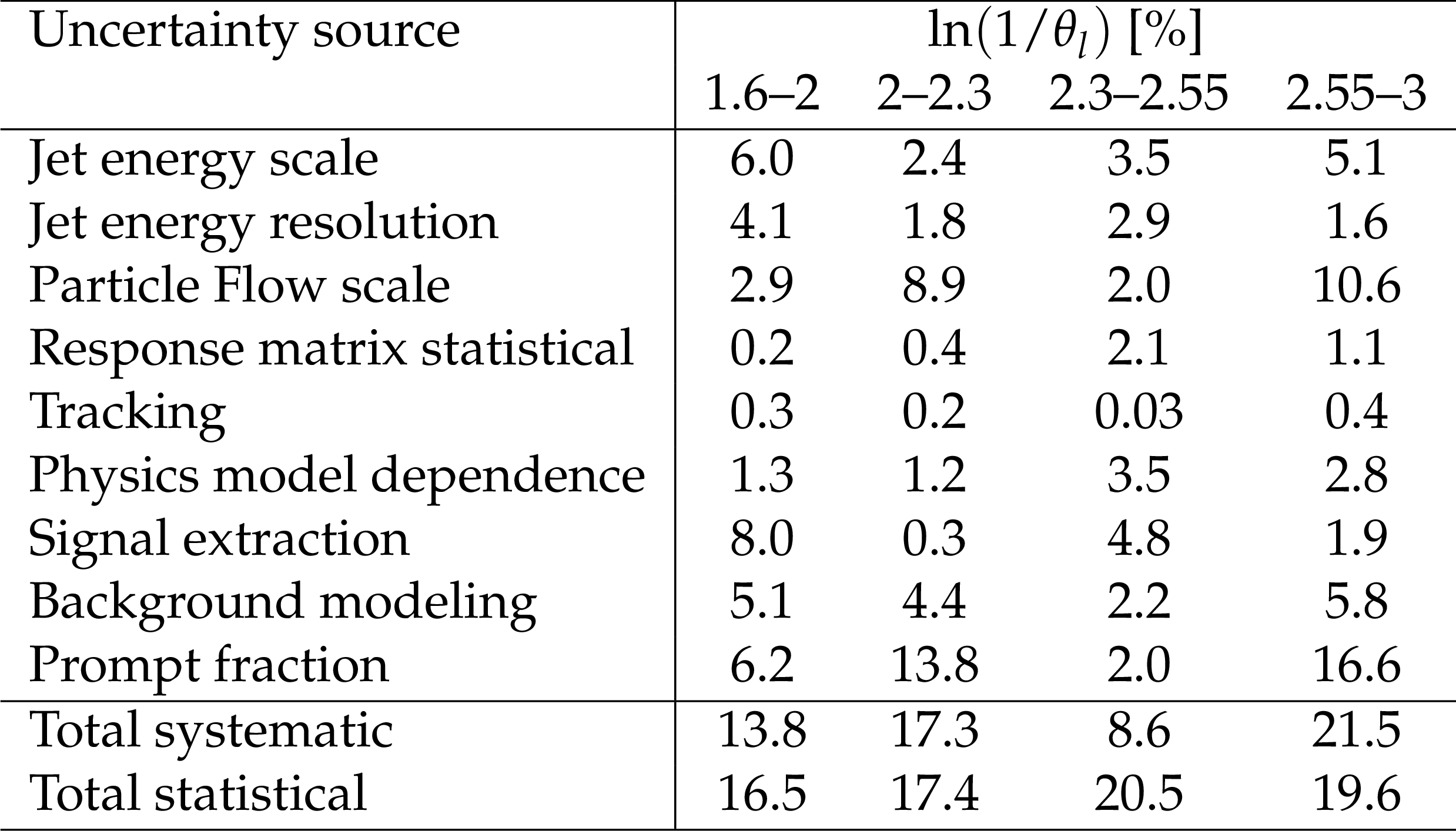
Summary of systematic uncertainties (relative) in each bin of $ \ln(1/\theta_{l}) $ in percent for prompt $ \mathrm{D}^0 $-tagged jets. |
png pdf |
Table 2:
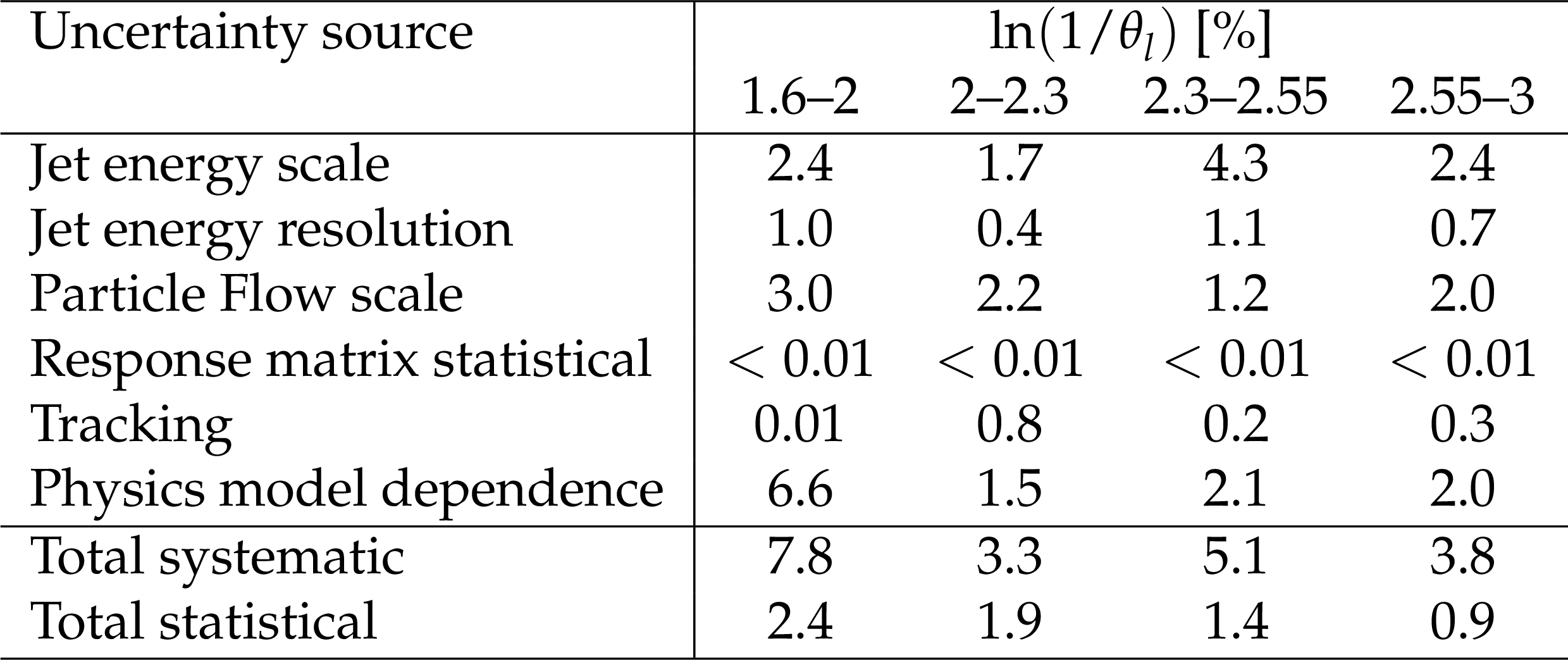
Summary of systematic uncertainties (relative) in each bin of $ \ln(1/\theta_{l}) $ in percent for Inclusive jets. |
| Summary |
| This note presents the first measurement of the dead-cone effect for charm quarks in heavy-ion collisions. Jet substructure techniques allow inspection of the jet radiation pattern and enhance sensitivity to quark mass effects, compared with measurements that treat jets as monolithic objects. This enables measurements of mass effects even for quarks with masses as small as that of the charm quark, and for high-energy jets. The angular distribution of hard, collinear emissions selected by the late-$ k_{\mathrm{T}} $ grooming algorithm is measured for inclusive and prompt $ \mathrm{D^0} $-tagged jets. Compared to inclusive jets, $ \mathrm{D^0} $-jets exhibit a suppression of small-angle emissions, consistent with the expected dead-cone effect. The observed angular distribution is compatible with the corresponding measurement in pp collisions, yielding a double ratio consistent with unity within uncertainties. These results provide no evidence that the quark-gluon plasma modifies the suppression of radiation in the charm dead-cone region within the kinematic reach and experimental precision of this measurement. |
| References | ||||
| 1 | W. Busza, K. Rajagopal, and W. van der Schee | Heavy ion collisions: the big picture and the big questions | Ann. Rev. Nucl. Part. Sci. 68 (2018) 339 | 1802.04801 |
| 2 | A. Adams et al. | Strongly correlated quantum fluids: ultracold quantum gases, quantum chromodynamic plasmas, and holographic duality | New J. Phys. 14 (2012) 115009 | 1205.5180 |
| 3 | CMS Collaboration | Overview of high-density QCD studies with the CMS experiment at the LHC | Phys. Rep. 1115 (2025) 219 | CMS-HIN-23-011 2405.10785 |
| 4 | S. Cao and X.-N. Wang | Jet quenching and medium response in high-energy heavy-ion collisions: a review | Rept. Prog. Phys. 84 (2021) 024301 | 2002.04028 |
| 5 | M. Gyulassy and M. Plumer | Jet quenching in dense matter | PLB 243 (1990) 432 | hep-ph/9408344 |
| 6 | R. Baier et al. | Radiative energy loss of high-energy quarks and gluons in a finite-volume quark-gluon plasma | NPB 483 (1997) 291 | hep-ph/9607355 |
| 7 | R. Baier et al. | Radiative energy loss and $ p_{\mathrm{T}} $ broadening of high-energy partons in nuclei | NPB 484 (1997) 265 | hep-ph/9608322 |
| 8 | J. Casalderrey-Solana, Y. Mehtar-Tani, C. A. Salgado, and K. Tywoniuk | New picture of jet quenching dictated by color coherence | PLB 725 (2013) 357 | 1210.7765 |
| 9 | Y. L. Dokshitzer, V. A. Khoze, and S. I. Troian | On specific QCD properties of heavy quark fragmentation ('dead cone') | JPG 17 (1991) 1602 | |
| 10 | ALICE Collaboration | Direct observation of the dead-cone effect in quantum chromodynamics | [Erratum: Nature 607, E22 ()], 2022 Nature 605 (2022) 440 |
2106.05713 |
| 11 | CMS Collaboration | Exploring small-angle emissions in charm quark jets in proton-proton collisions at $ \sqrt{s} = $ 5.02 TeV | JHEP 05 (2025) 176 | CMS-HIN-24-007 2507.13469 |
| 12 | LHCb Collaboration | Measurement of the Lund plane for light- and beauty-quark jets | PRD 112 (2025) 072015 | 2505.23530 |
| 13 | CMS Collaboration | Jet fragmentation function and groomed substructure of bottom quark jets in proton-proton collisions at 5.02 TeV | JHEP 04 (2026) 147 | CMS-HIN-24-005 2511.10666 |
| 14 | S. Marzani, G. Soyez, and M. Spannowsky | Looking inside jets: an introduction to jet substructure and boosted-object phenomenology | volume 958. Springer, 2019 link |
|
| 15 | G.-Y. Qin and X.-N. Wang | Jet quenching in high-energy heavy-ion collisions | Int. J. Mod. Phys. E 24 (2015) 1530014 | 1511.00790 |
| 16 | N. Armesto, C. A. Salgado, and U. A. Wiedemann | Medium induced gluon radiation off massive quarks fills the dead cone | PRD 69 (2004) 114003 | hep-ph/0312106 |
| 17 | L. Cunqueiro, D. Napoletano, and A. Soto-Ontoso | Dead cone searches in heavy-ion collisions using the jet tree | PRD 107 (2023) 094008 | 2211.11789 |
| 18 | C. Andres et al. | Seeing beauty in the quark-gluon plasma with energy correlators | PRD 110 (2024) L031503 | 2307.15110 |
| 19 | A. Lifson, G. P. Salam, and G. Soyez | Calculating the primary Lund jet plane density | JHEP 10 (2020) 170 | 2007.06578 |
| 20 | F. A. Dreyer, G. P. Salam, and G. Soyez | The Lund jet plane | JHEP 12 (2018) 064 | 1807.04758 |
| 21 | Y. L. Dokshitzer, G. D. Leder, S. Moretti, and B. R. Webber | Better jet clustering algorithms | JHEP 08 (1997) 001 | hep-ph/9707323 |
| 22 | L. Cunqueiro and M. P\l osko\'n | Searching for the dead cone effects with iterative declustering of heavy-flavor jets | PRD 99 (2019) 074027 | 1812.00102 |
| 23 | CMS Collaboration | Luminosity measurement for lead-lead collisions at $ \sqrt{s_{\mathrm{NN}}} = $ 5.02 TeV in 2015 and 2018 at CMS | CMS-LUM-20-002 2503.03946 |
|
| 24 | CMS Collaboration | The CMS experiment at the CERN LHC | JINST 3 (2008) S08004 | |
| 25 | CMS Collaboration | Development of the CMS detector for the CERN LHC Run 3 | JINST 19 (2024) P05064 | CMS-PRF-21-001 2309.05466 |
| 26 | CMS Collaboration | Performance of the CMS Level-1 trigger in proton-proton collisions at $ \sqrt{s} = $ 13 TeV | JINST 15 (2020) P10017 | CMS-TRG-17-001 2006.10165 |
| 27 | CMS Collaboration | The CMS trigger system | JINST 12 (2017) P01020 | CMS-TRG-12-001 1609.02366 |
| 28 | CMS Collaboration | Electron and photon reconstruction and identification with the CMS experiment at the CERN LHC | JINST 16 (2021) P05014 | CMS-EGM-17-001 2012.06888 |
| 29 | CMS Collaboration | Performance of the CMS muon detector and muon reconstruction with proton-proton collisions at $ \sqrt{s}= $ 13 TeV | JINST 13 (2018) P06015 | CMS-MUO-16-001 1804.04528 |
| 30 | CMS Collaboration | Description and performance of track and primary-vertex reconstruction with the CMS tracker | JINST 9 (2014) P10009 | CMS-TRK-11-001 1405.6569 |
| 31 | CMS Collaboration | Particle-flow reconstruction and global event description with the CMS detector | JINST 12 (2017) P10003 | CMS-PRF-14-001 1706.04965 |
| 32 | C. Loizides, J. Kamin, and D. d'Enterria | Improved Monte Carlo Glauber predictions at present and future nuclear colliders | Phys. Rev. C 97 (2018) 054910 | 1710.07098 |
| 33 | CMS Collaboration | Observation and studies of jet quenching in PbPb collisions at nucleon-nucleon center-of-mass energy $ \sqrt{\smash[b]{s_{_{\mathrm{NN}}}}} = $ 2.76 TeV | Phys. Rev. C 84 (2011) 024906 | CMS-HIN-10-004 1102.1957 |
| 34 | T. Sj$\text ö $strand et al. | An introduction to PYTHIA8.2 | Comput. Phys. Commun. 191 (2015) 159 | 1410.3012 |
| 35 | CMS Collaboration | Extraction and validation of a new set of CMS PYTHIA8 tunes from underlying-event measurements | EPJC 80 (2020) 4 | CMS-GEN-17-001 1903.12179 |
| 36 | I. P. Lokhtin and A. M. Snigirev | A model of jet quenching in ultrarelativistic heavy ion collisions and high-$ p_{\mathrm{T}} $ hadron spectra at RHIC | EPJC 45 (2006) 211 | hep-ph/0506189 |
| 37 | GEANT4 Collaboration | GEANT 4---a simulation toolkit | NIM A 506 (2003) 250 | |
| 38 | M. Cacciari, G. P. Salam, and G. Soyez | The anti-$ k_{\mathrm{T}} $ jet clustering algorithm | JHEP 04 (2008) 063 | 0802.1189 |
| 39 | M. Cacciari, G. P. Salam, and G. Soyez | FastJet user manual | EPJC 72 (2012) 1896 | 1111.6097 |
| 40 | H. A. Andrews et al. | Novel tools and observables for jet physics in heavy ion collisions | JPG 47 (2020) 065102 | 1808.03689 |
| 41 | P. Berta, M. Spousta, D. W. Miller, and R. Leitner | Particle-level pileup subtraction for jets and jet shapes | JHEP 06 (2014) 092 | 1403.3108 |
| 42 | O. Kodolova, I. Vardanyan, A. Nikitenko, and A. Oulianov | The performance of the jet identification and reconstruction in heavy ions collisions with CMS detector | EPJC 50 (2007) 117 | |
| 43 | ALICE Collaboration | Measurement of event background fluctuations for charged particle jet reconstruction in PbPb collisions at $ \sqrt{\smash[b]{s_{_{\mathrm{NN}}}}} = $ 2.76 TeV | JHEP 03 (2012) 053 | 1201.2423 |
| 44 | CMS Collaboration | Determination of jet energy calibration and transverse momentum resolution in CMS | JINST 6 (2011) P11002 | CMS-JME-10-011 1107.4277 |
| 45 | CMS Collaboration | Jet energy scale and resolution in the CMS experiment in pp collisions at 8 TeV | JINST 12 (2017) P02014 | CMS-JME-13-004 1607.03663 |
| 46 | Particle Data Group , S. Navas et al. | Review of particle physics | PRD 110 (2024) 030001 | |
| 47 | CMS Collaboration | Studies of charm quark diffusion inside jets using PbPb and pp collisions at $ \sqrt {\smash [b]{s_{_{\mathrm {NN}}}}} = $ 5.02 TeV | PRL 125 (2020) 102001 | CMS-HIN-18-007 1911.01461 |
| 48 | T. Skwarnicki | A study of the radiative cascade transitions between the Upsilon-prime and Upsilon resonances | PhD thesis, Institute of Nuclear Physics, Krakow, DESY-F31-86-02, 1986 | |
| 49 | CMS Collaboration | Measurements of azimuthal anisotropy of nonprompt $ \mathrm{D^0} $ mesons in PbPb collisions at 5.02TeV | PLB 850 (2024) 138389 | CMS-HIN-21-003 2212.01636 |
| 50 | G. D'Agostini | A multidimensional unfolding method based on Bayes' theorem | NIM A 362 (1995) 487 | 1010.0632 |
| 51 | T. Adye | Unfolding algorithms and tests using RooUnfold | in Proc. Workshop on Statistical Issues Related to Discovery Claims in Search Experiments and Unfolding, H. Prosper and L. Lyons, eds., Geneva, Switzerland, 2011 PHYSTAT 2011 (2011) 313 |
1105.1160 |
| 52 | CMS Collaboration | Single-particle response in the CMS calorimeters | CMS Physics Analysis Summary, 2010 link |
|
| 53 | J. Casalderrey-Solana et al. | A hybrid strong/weak coupling approach to jet quenching | JHEP 10 (2014) 019 | 1405.3864 |
| 54 | J. Casalderrey-Solana et al. | Jet wake from linearized hydrodynamics | JHEP 05 (2021) 230 | 2010.01140 |
| 55 | CMS Collaboration | Girth and groomed radius of jets recoiling against isolated photons in lead-lead and proton-proton collisions at $ \sqrt{\smash[b]{s_{_{\mathrm{NN}}}}} = $ 5.02 TeV | PLB 861 (2025) 139088 | CMS-HIN-23-001 2405.02737 |
| 56 | CMS Collaboration | Nuclear modification factor of D$ ^0 $ mesons in PbPb collisions at $ \sqrt {\smash [b]{s_{_{\mathrm {NN}}}}} = $ 5.02 TeV | PLB 782 (2018) 474 | CMS-HIN-16-001 1708.04962 |
| 57 | A. Beraudo, J. F. Du Plessis, D. Pablos, and K. Rajagopal | Heavy Quark Energy Loss in the Hybrid Model | 2510.24847 | |
| 58 | W. Ke, Y. Xu, and S. A. Bass | Linearized Boltzmann-Langevin model for heavy quark transport in hot and dense QCD matter | Phys. Rev. C 98 (2018) 064901 | 1806.08848 |
| 59 | W. Ke, Y. Xu, and S. A. Bass | Modified Boltzmann approach for modeling the splitting vertices induced by the hot QCD medium in the deep Landau-Pomeranchuk-Migdal region | Phys. Rev. C 100 (2019) 064911 | 1810.08177 |
| 60 | M. Cacciari, M. Greco, and P. Nason | The $ p_T $ spectrum in heavy-flavour hadroproduction. | JHEP 05 (1998) 007 | hep-ph/9803400 |
|
|
Compact Muon Solenoid LHC, CERN |

|
|
|
|
|
|