Compact Muon Solenoid
LHC, CERN
 Visit us: CMS Public Website, CMS Physics ;
Contact us: CMS Publications Committee
Visit us: CMS Public Website, CMS Physics ;
Contact us: CMS Publications Committee
| CMS-PAS-EXO-24-021 | ||
| Search for new charged gauge bosons in the e/$ \mu $ + p$ _\mathrm{T}^\mathrm{miss} $ channel using pp collisions at $ \sqrt{s} = $ 13.6 TeV | ||
| CMS Collaboration | ||
| 2026-03-17 | ||
| Abstract: A search for physics beyond the standard model in final states with an electron or muon and missing transverse momentum is presented. The analysis uses data from proton-proton collisions at a centre-of-mass energy of 13.6 TeV, collected with the CMS detector at the LHC in 2022 and 2023 and corresponding to an integrated luminosity of 62 fb$ ^{-1} $. The study is performed assuming the production of a W$ ^{'} $ boson as predicted by the sequential standard model and decaying into a muon or electron plus imbalanced p$ _\mathrm{T} $ in the event. Model independent limits are also reported. | ||
| Links: CDS record (PDF) ; CADI line (restricted) ; | ||
| Figures | |
png pdf |
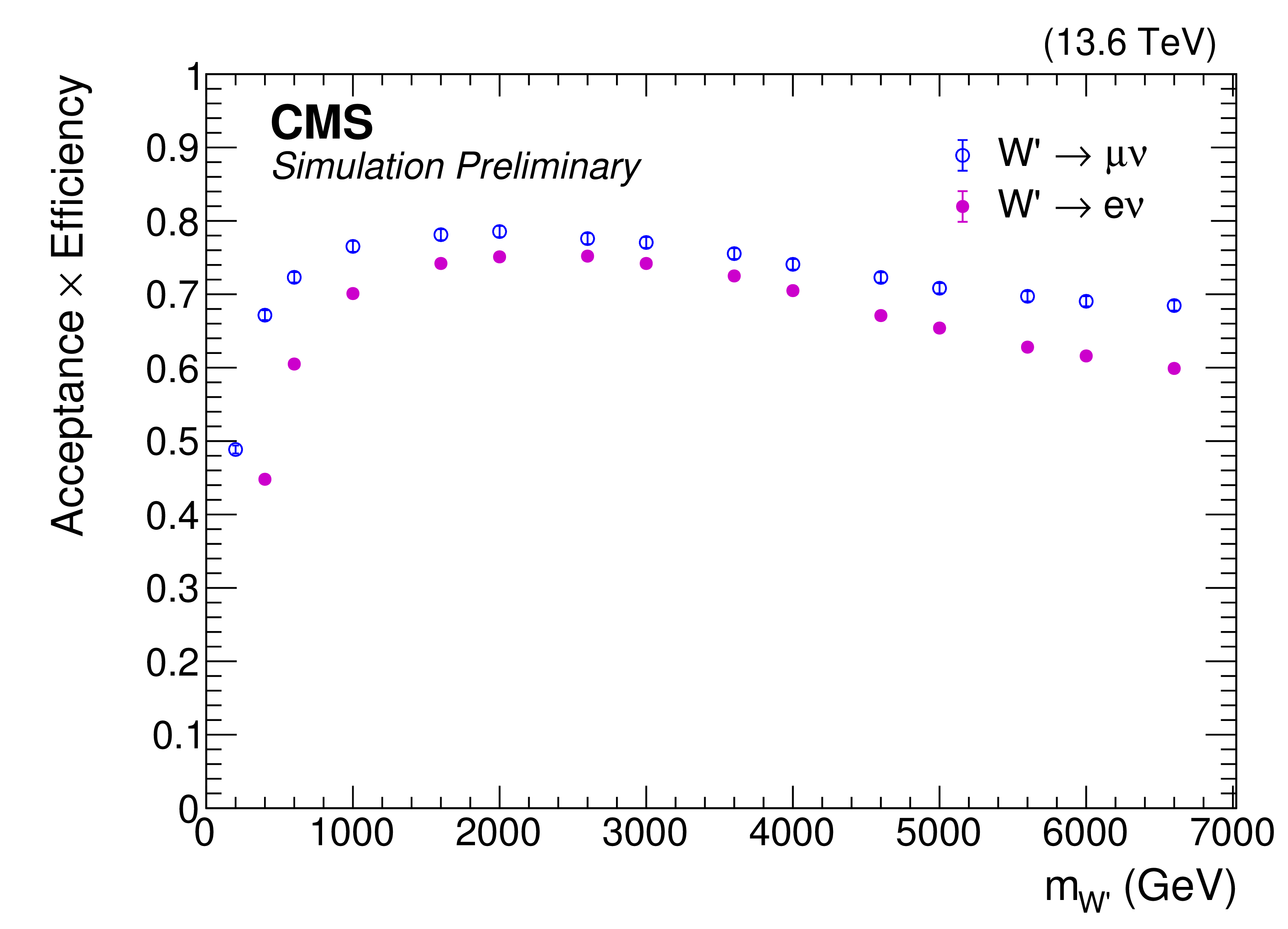
Figure 1:
Product of acceptance times efficiency for the simulated SSM $ \mathrm{W^{'}} $ signal, as a function of the $ \mathrm{W^{'}} $ mass, after all selection criteria are applied for the electron (purple markers) and the muon (blue markers) decay channels. The drop in signal efficiency at higher $ \mathrm{W^{'}} $ masses comes from the kinematic properties of off-shell $ \mathrm{W^{'}} $ boson production. At larger mass scales, the cross-section becomes increasingly dominated by off-shell events that populate the low-mass region. Consequently, a substantial fraction of these events is suppressed by trigger and offline $ p_{\mathrm{T}} $ selection criteria, resulting in a lower overall efficiency as the $ \mathrm{W^{'}} $ mass increases. |
png pdf |
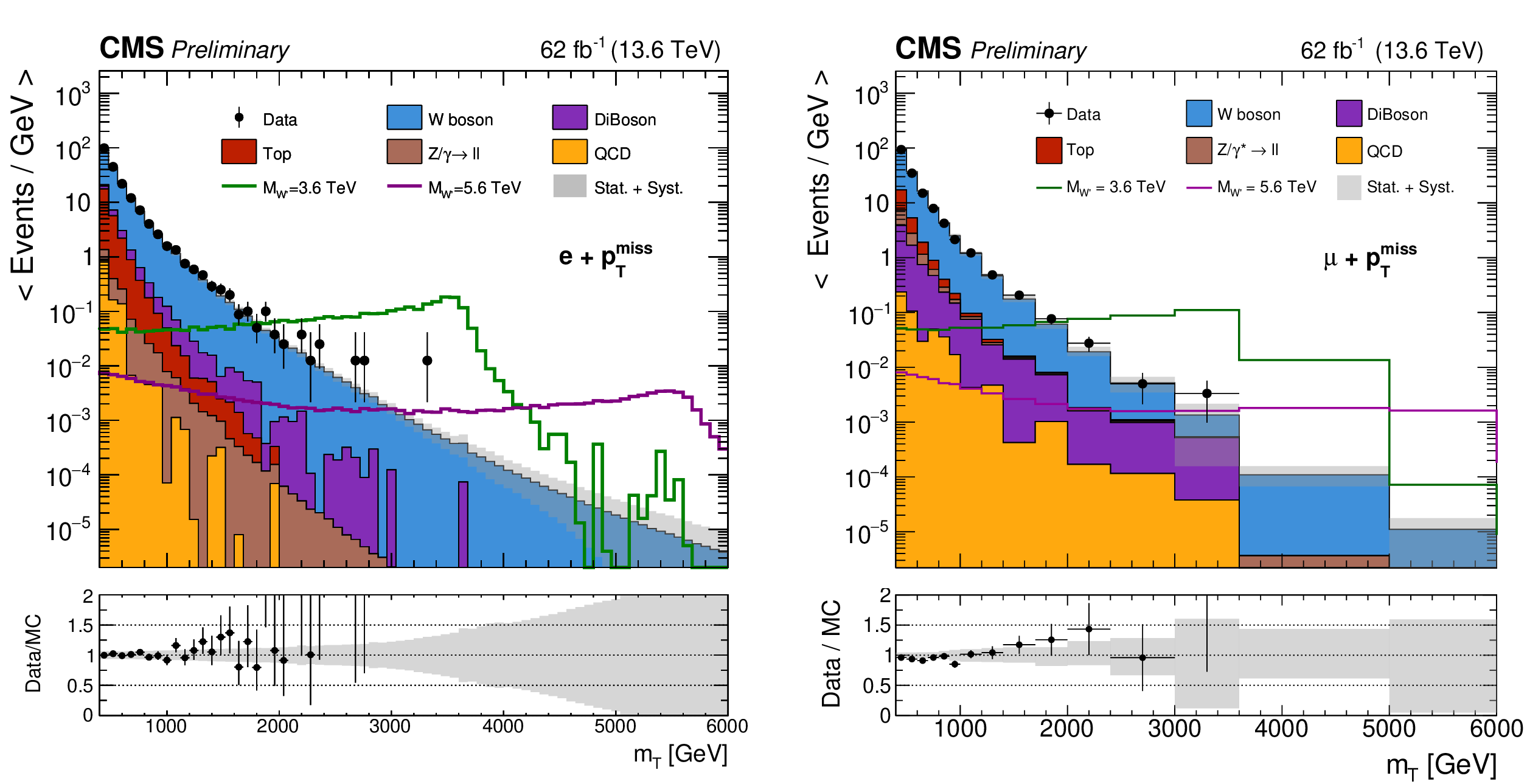
Figure 2:
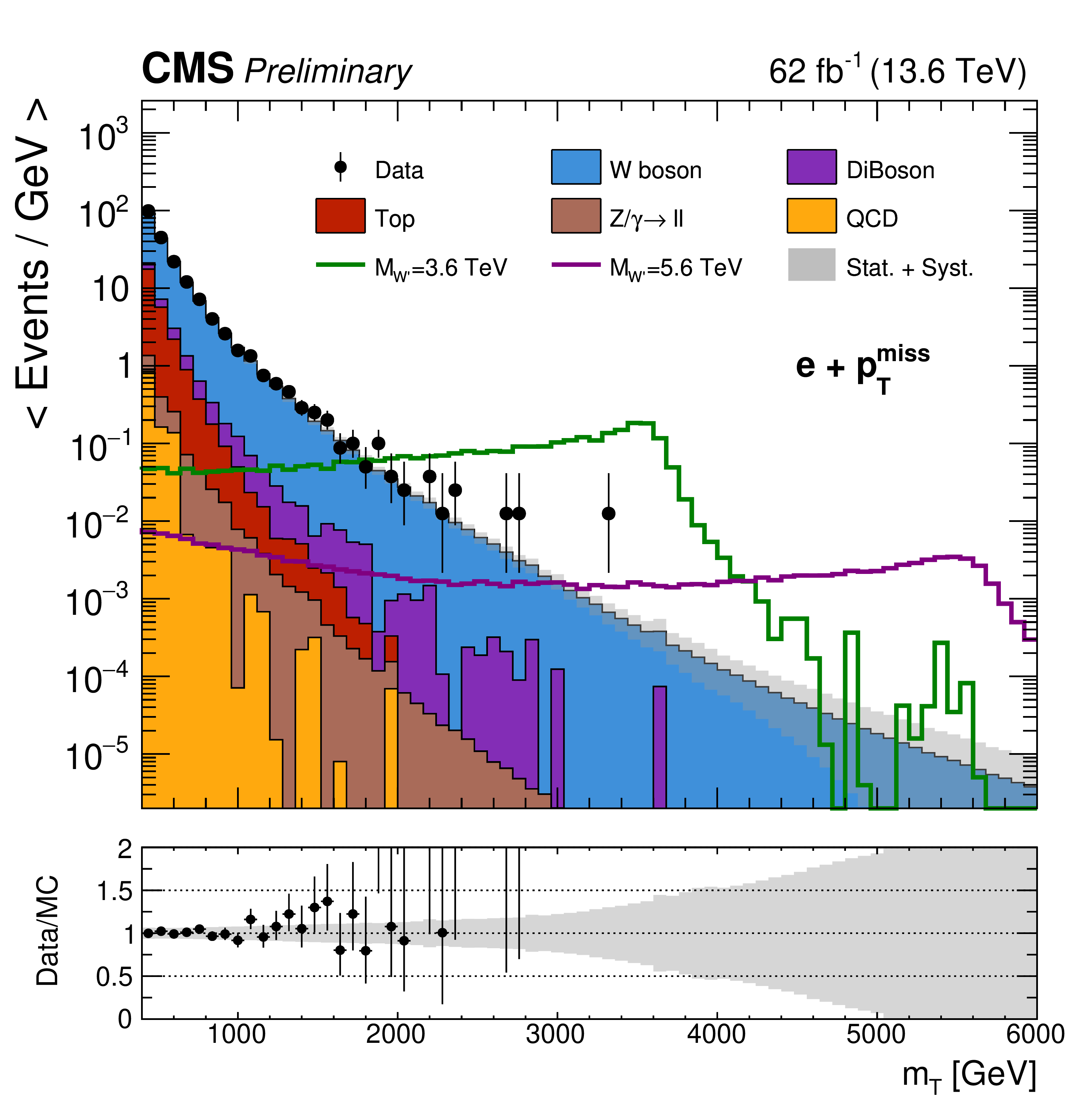
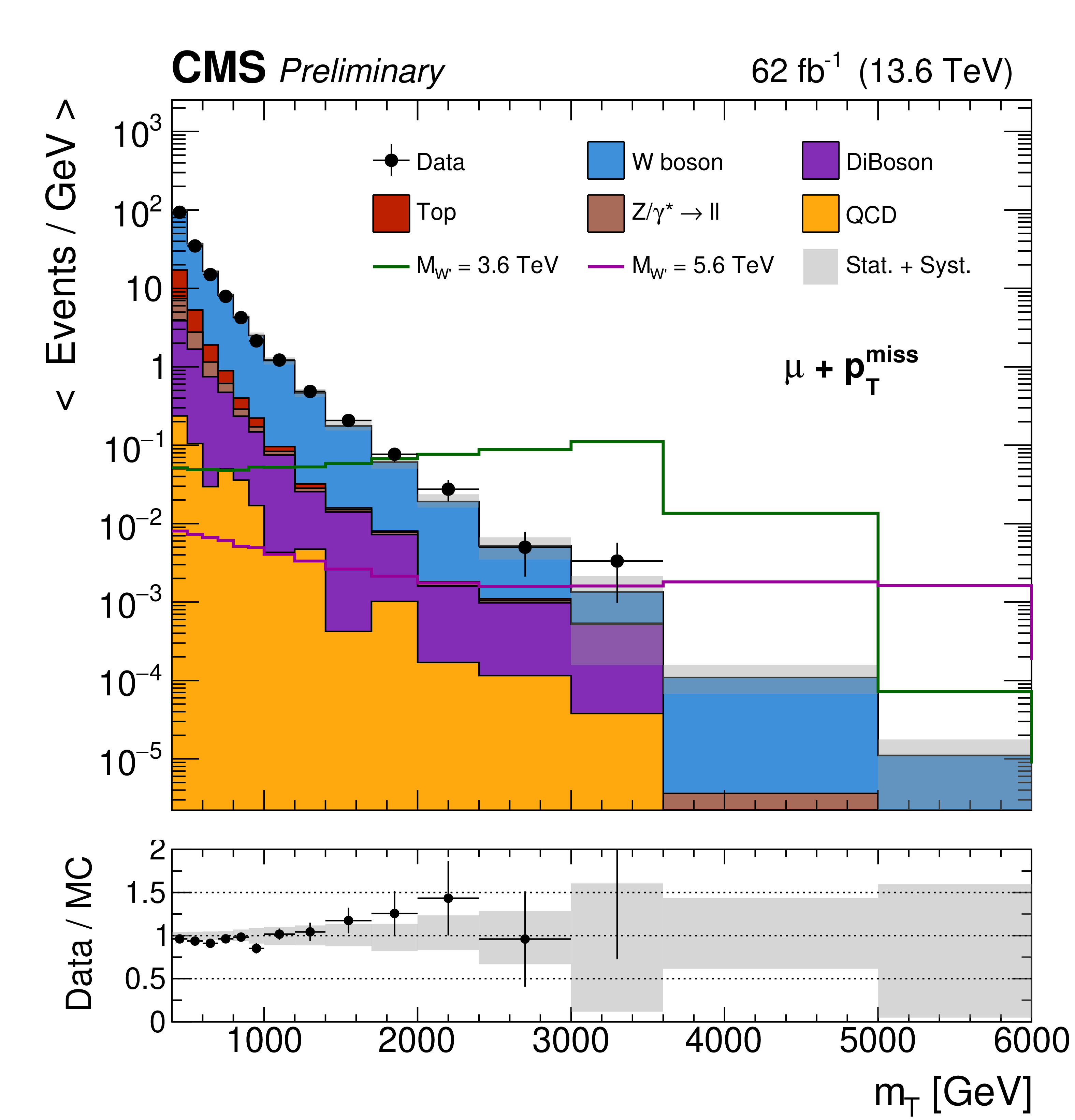
Distributions for $ m_\mathrm{T} $ for the electron (left) and muon (right) decay channels for 2022 and 2023 data (black points) for a total integrated luminosity of $ {\cal L}=62 $fb$^{-1} $, together with the SM prediction (coloured histograms) after applying the complete selection criteria. Two signal distributions are presented, with contributions normalized to the data luminosity analyzed, corresponding to SSM $ \mathrm{W^{'}} $ boson masses of 3.6 and 5.6 TeV. The lower panels show the ratios of data to the SM prediction, and the shaded bands represent the per bin statistical plus systematic uncertainties. |
png pdf |
Figure 2-a:
Distributions for $ m_\mathrm{T} $ for the electron (left) and muon (right) decay channels for 2022 and 2023 data (black points) for a total integrated luminosity of $ {\cal L}=62 $fb$^{-1} $, together with the SM prediction (coloured histograms) after applying the complete selection criteria. Two signal distributions are presented, with contributions normalized to the data luminosity analyzed, corresponding to SSM $ \mathrm{W^{'}} $ boson masses of 3.6 and 5.6 TeV. The lower panels show the ratios of data to the SM prediction, and the shaded bands represent the per bin statistical plus systematic uncertainties. |
png pdf |
Figure 2-b:
Distributions for $ m_\mathrm{T} $ for the electron (left) and muon (right) decay channels for 2022 and 2023 data (black points) for a total integrated luminosity of $ {\cal L}=62 $fb$^{-1} $, together with the SM prediction (coloured histograms) after applying the complete selection criteria. Two signal distributions are presented, with contributions normalized to the data luminosity analyzed, corresponding to SSM $ \mathrm{W^{'}} $ boson masses of 3.6 and 5.6 TeV. The lower panels show the ratios of data to the SM prediction, and the shaded bands represent the per bin statistical plus systematic uncertainties. |
png pdf |
Figure 3:
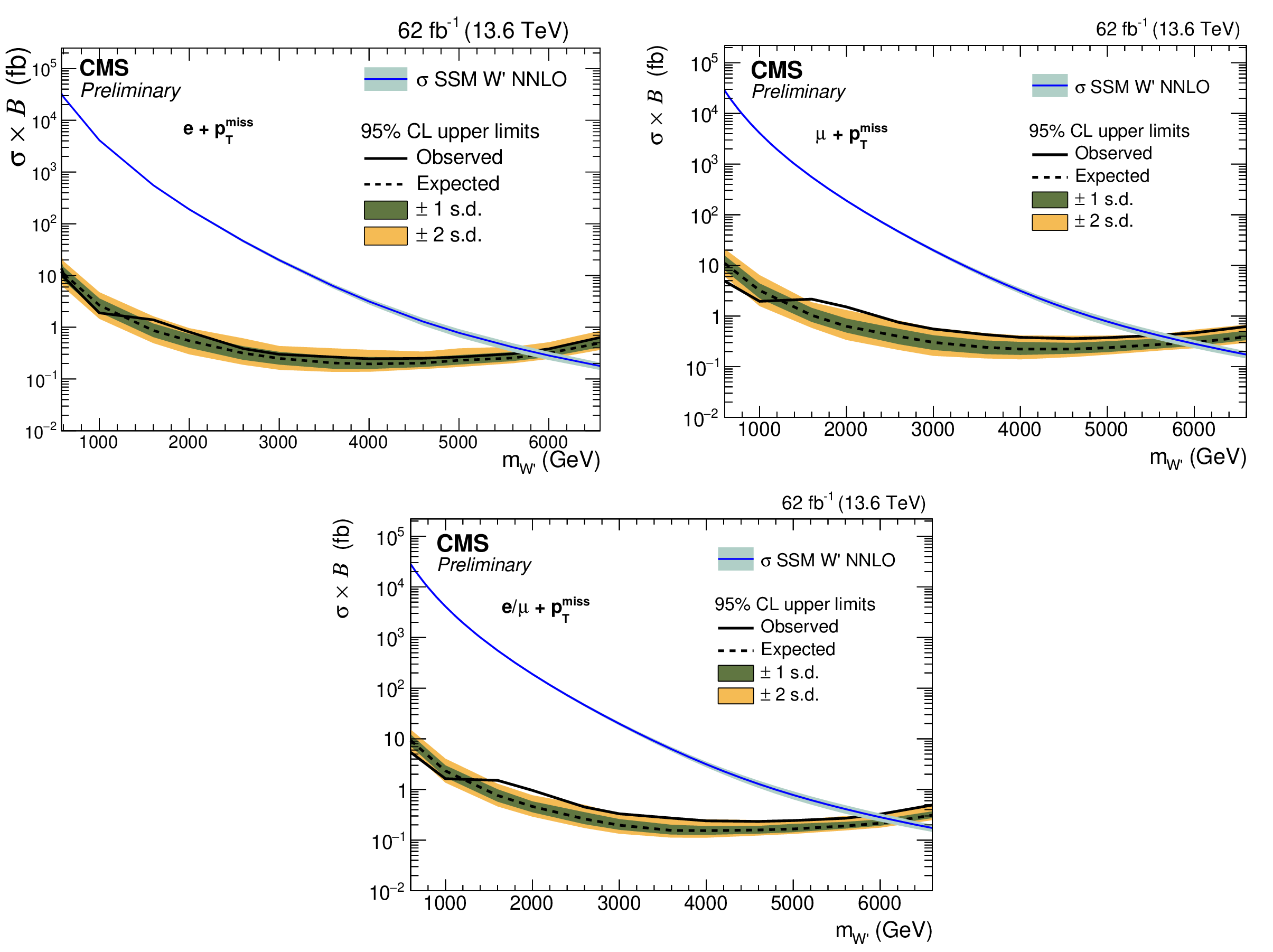
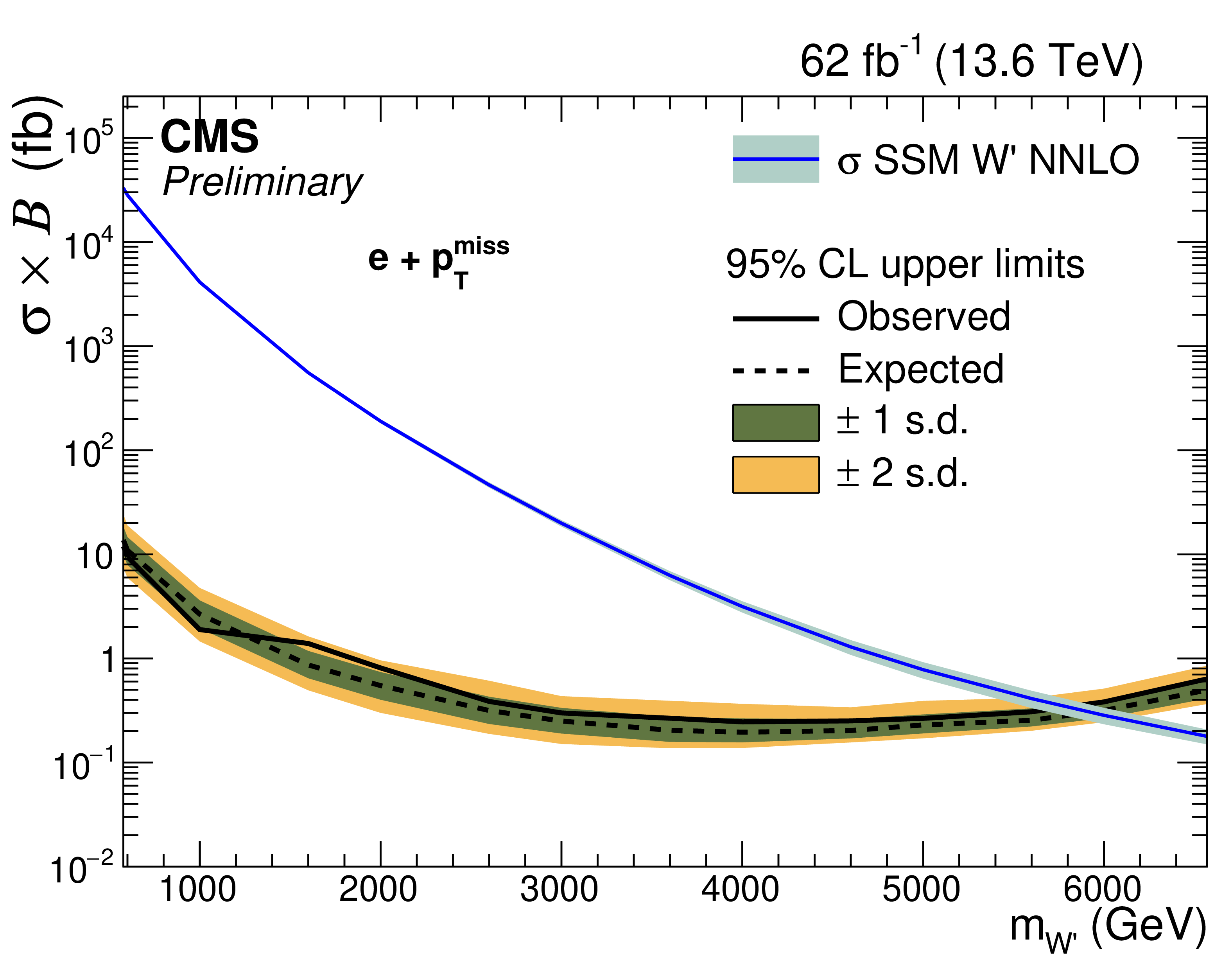
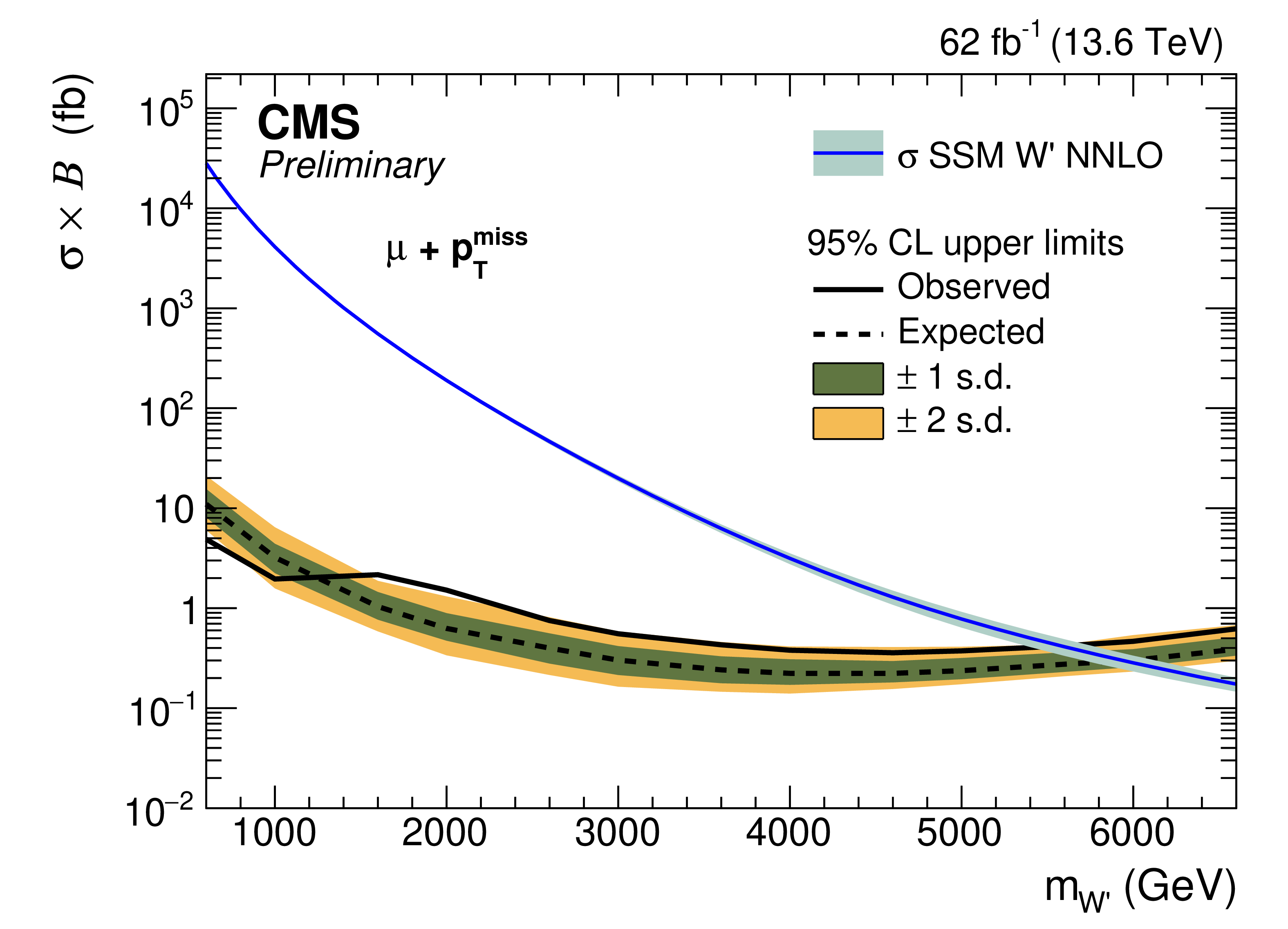
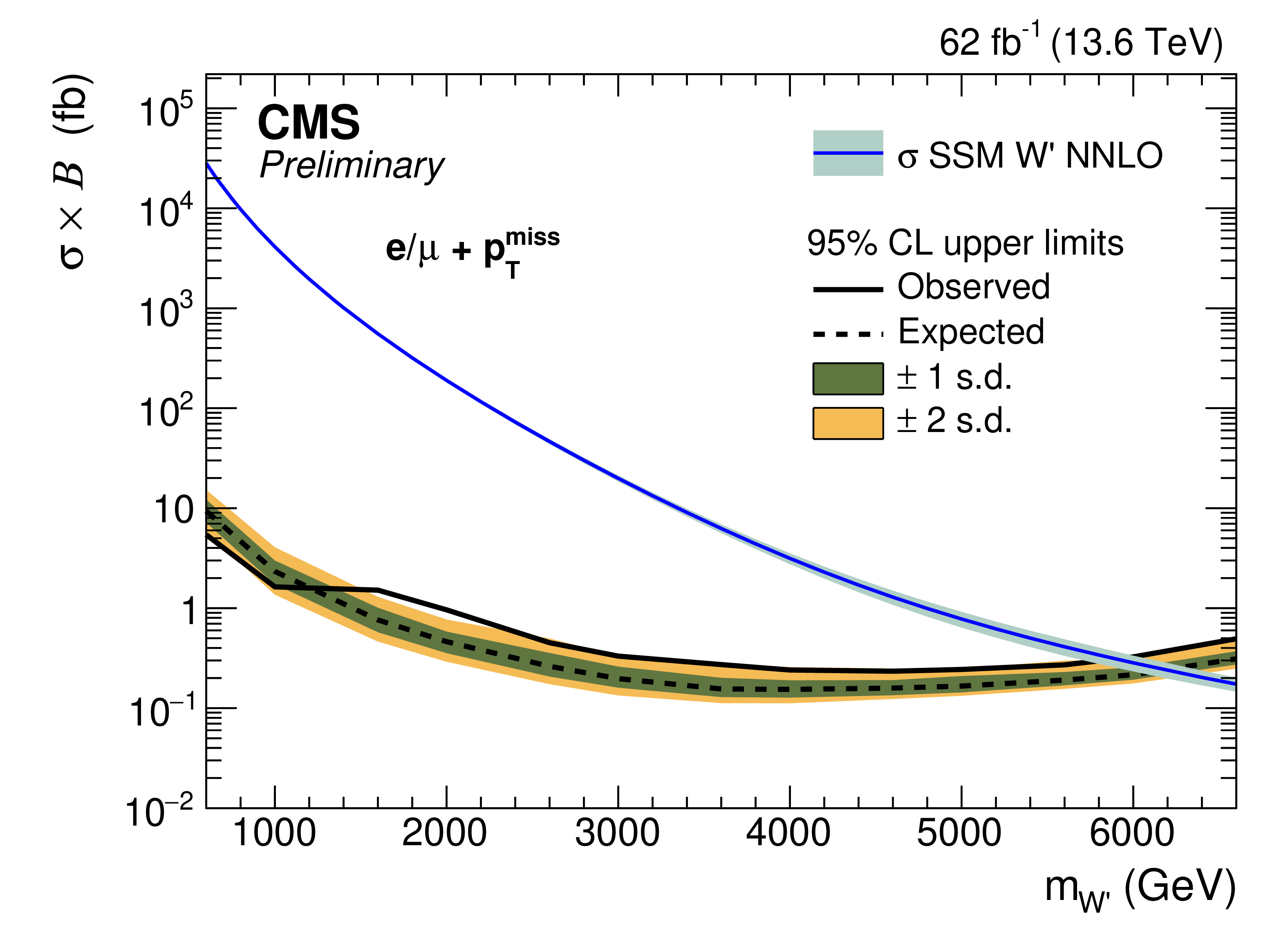
Observed (solid line) and expected (dashed line) upper limits at 95% CL on the product $ \sigma_{\mathrm{W^{'}}} \mathcal{B}(\mathrm{W^{'}} \rightarrow\ell\nu) $ for an SSM $ \mathrm{W^{'}} $ model as a function of $ \mathrm{W^{'}} $ boson mass, derived for the electron (top left) and muon (top right) decay channels, and the combination of both channels (bottom) using 2022 and 2023 collected data. The shaded bands represent the one (green) and two (yellow) standard deviation uncertainty bands for the expected limits. The theoretical prediction for SSM at NNLO-QCD level is shown (blue line) with a narrow gray band corresponding to the PDF and $ \alpha_{s} $ uncertainties. |
png pdf |
Figure 3-a:
Observed (solid line) and expected (dashed line) upper limits at 95% CL on the product $ \sigma_{\mathrm{W^{'}}} \mathcal{B}(\mathrm{W^{'}} \rightarrow\ell\nu) $ for an SSM $ \mathrm{W^{'}} $ model as a function of $ \mathrm{W^{'}} $ boson mass, derived for the electron (top left) and muon (top right) decay channels, and the combination of both channels (bottom) using 2022 and 2023 collected data. The shaded bands represent the one (green) and two (yellow) standard deviation uncertainty bands for the expected limits. The theoretical prediction for SSM at NNLO-QCD level is shown (blue line) with a narrow gray band corresponding to the PDF and $ \alpha_{s} $ uncertainties. |
png pdf |
Figure 3-b:
Observed (solid line) and expected (dashed line) upper limits at 95% CL on the product $ \sigma_{\mathrm{W^{'}}} \mathcal{B}(\mathrm{W^{'}} \rightarrow\ell\nu) $ for an SSM $ \mathrm{W^{'}} $ model as a function of $ \mathrm{W^{'}} $ boson mass, derived for the electron (top left) and muon (top right) decay channels, and the combination of both channels (bottom) using 2022 and 2023 collected data. The shaded bands represent the one (green) and two (yellow) standard deviation uncertainty bands for the expected limits. The theoretical prediction for SSM at NNLO-QCD level is shown (blue line) with a narrow gray band corresponding to the PDF and $ \alpha_{s} $ uncertainties. |
png pdf |
Figure 3-c:
Observed (solid line) and expected (dashed line) upper limits at 95% CL on the product $ \sigma_{\mathrm{W^{'}}} \mathcal{B}(\mathrm{W^{'}} \rightarrow\ell\nu) $ for an SSM $ \mathrm{W^{'}} $ model as a function of $ \mathrm{W^{'}} $ boson mass, derived for the electron (top left) and muon (top right) decay channels, and the combination of both channels (bottom) using 2022 and 2023 collected data. The shaded bands represent the one (green) and two (yellow) standard deviation uncertainty bands for the expected limits. The theoretical prediction for SSM at NNLO-QCD level is shown (blue line) with a narrow gray band corresponding to the PDF and $ \alpha_{s} $ uncertainties. |
png pdf |
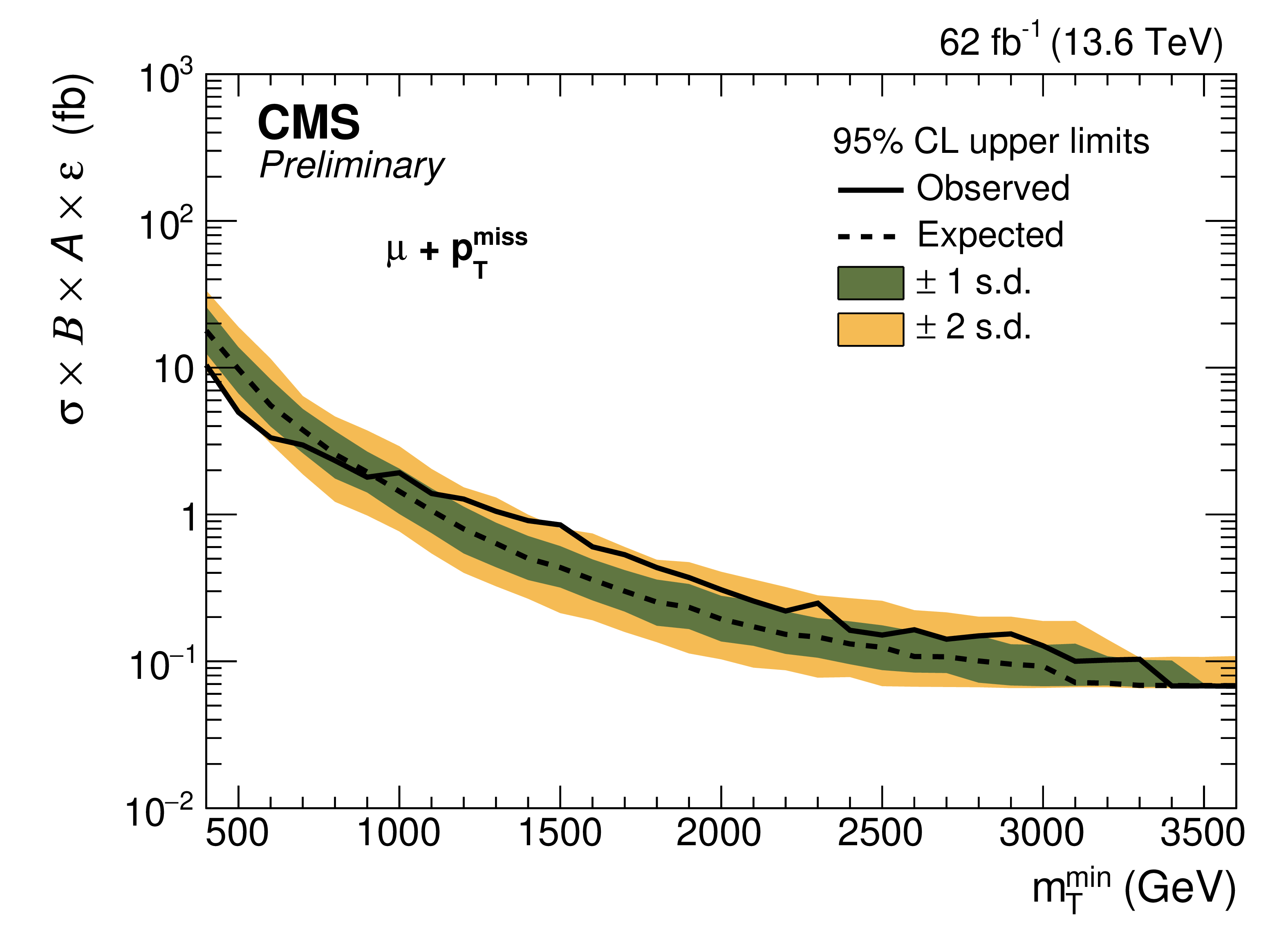
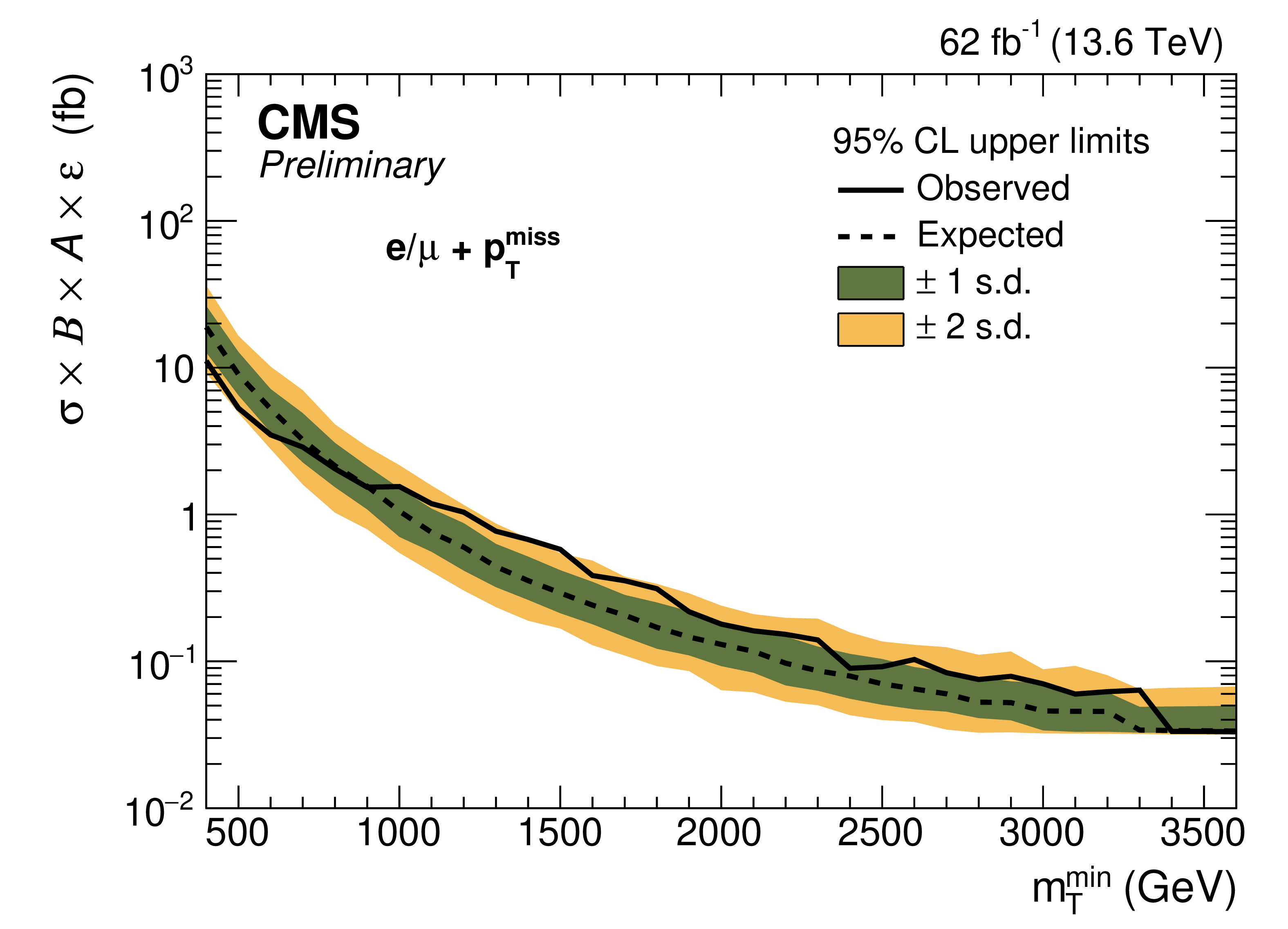
Figure 4:
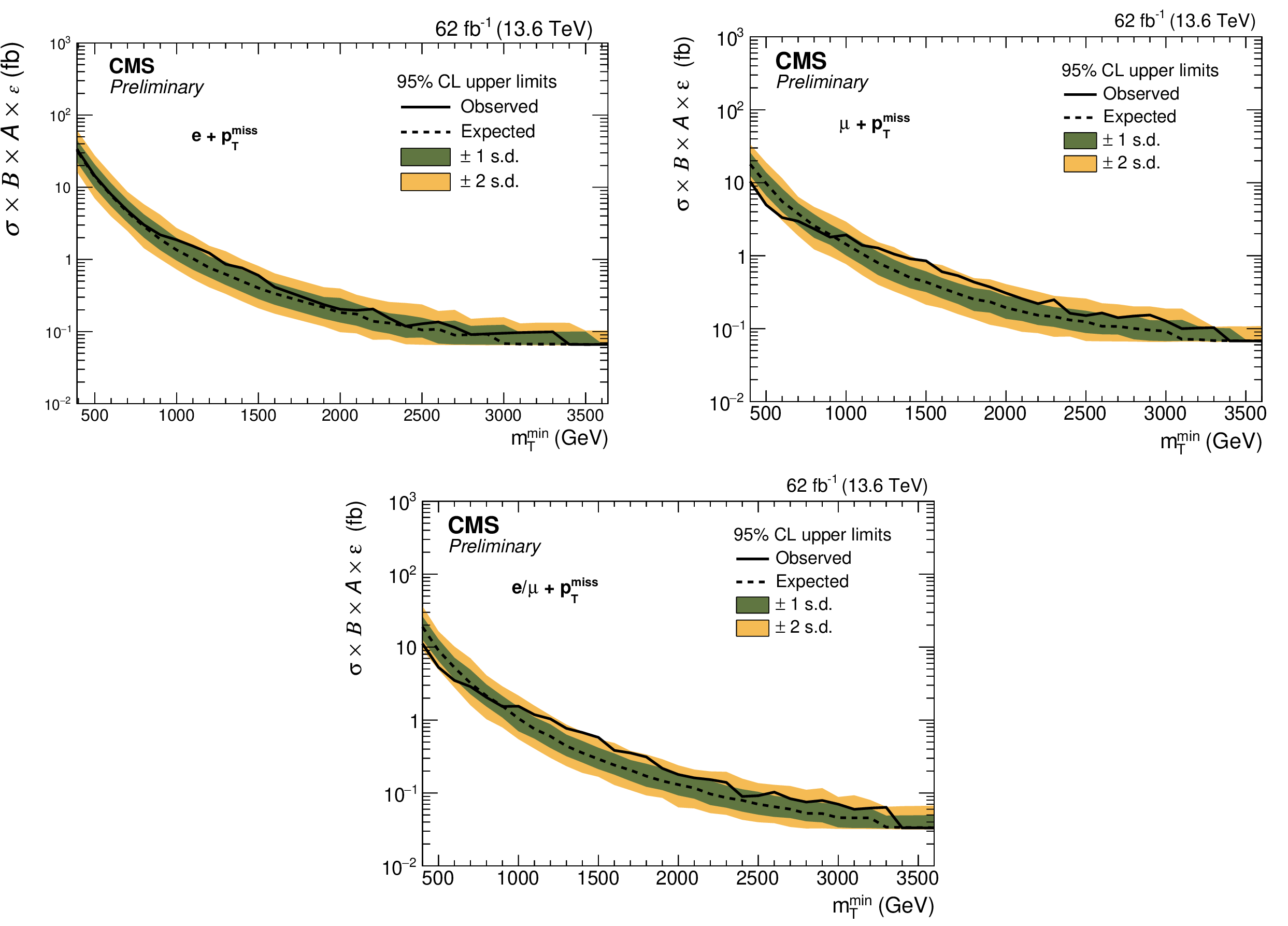
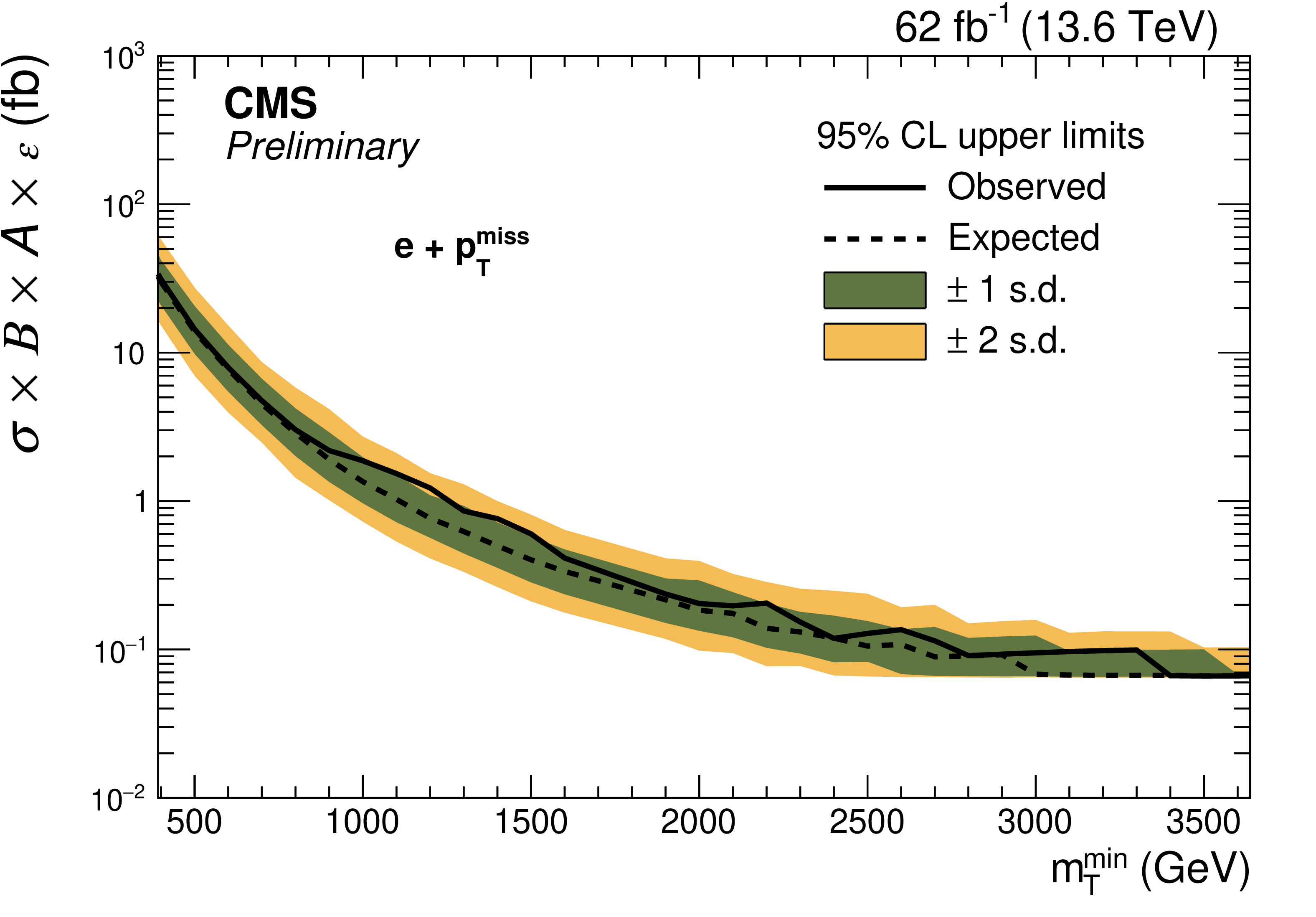
The 95% CL observed (solid line) and expected (dashed line) model-independent cross section limits as a function of the $ M_\mathrm{T}^\mathrm{min} $ threshold for the electron decay channel (top left) and the muon decay channel (top right). The limits correspond to an integrated luminosity of 62 fb$ ^{-1} $. The one (green) and two (yellow) standard deviation uncertainty bands for the expected limits are shown. The lower plot shows the limits for the combination of both decay channels. |
png pdf |
Figure 4-a:
The 95% CL observed (solid line) and expected (dashed line) model-independent cross section limits as a function of the $ M_\mathrm{T}^\mathrm{min} $ threshold for the electron decay channel (top left) and the muon decay channel (top right). The limits correspond to an integrated luminosity of 62 fb$ ^{-1} $. The one (green) and two (yellow) standard deviation uncertainty bands for the expected limits are shown. The lower plot shows the limits for the combination of both decay channels. |
png pdf |
Figure 4-b:
The 95% CL observed (solid line) and expected (dashed line) model-independent cross section limits as a function of the $ M_\mathrm{T}^\mathrm{min} $ threshold for the electron decay channel (top left) and the muon decay channel (top right). The limits correspond to an integrated luminosity of 62 fb$ ^{-1} $. The one (green) and two (yellow) standard deviation uncertainty bands for the expected limits are shown. The lower plot shows the limits for the combination of both decay channels. |
png pdf |
Figure 4-c:
The 95% CL observed (solid line) and expected (dashed line) model-independent cross section limits as a function of the $ M_\mathrm{T}^\mathrm{min} $ threshold for the electron decay channel (top left) and the muon decay channel (top right). The limits correspond to an integrated luminosity of 62 fb$ ^{-1} $. The one (green) and two (yellow) standard deviation uncertainty bands for the expected limits are shown. The lower plot shows the limits for the combination of both decay channels. |
png pdf |
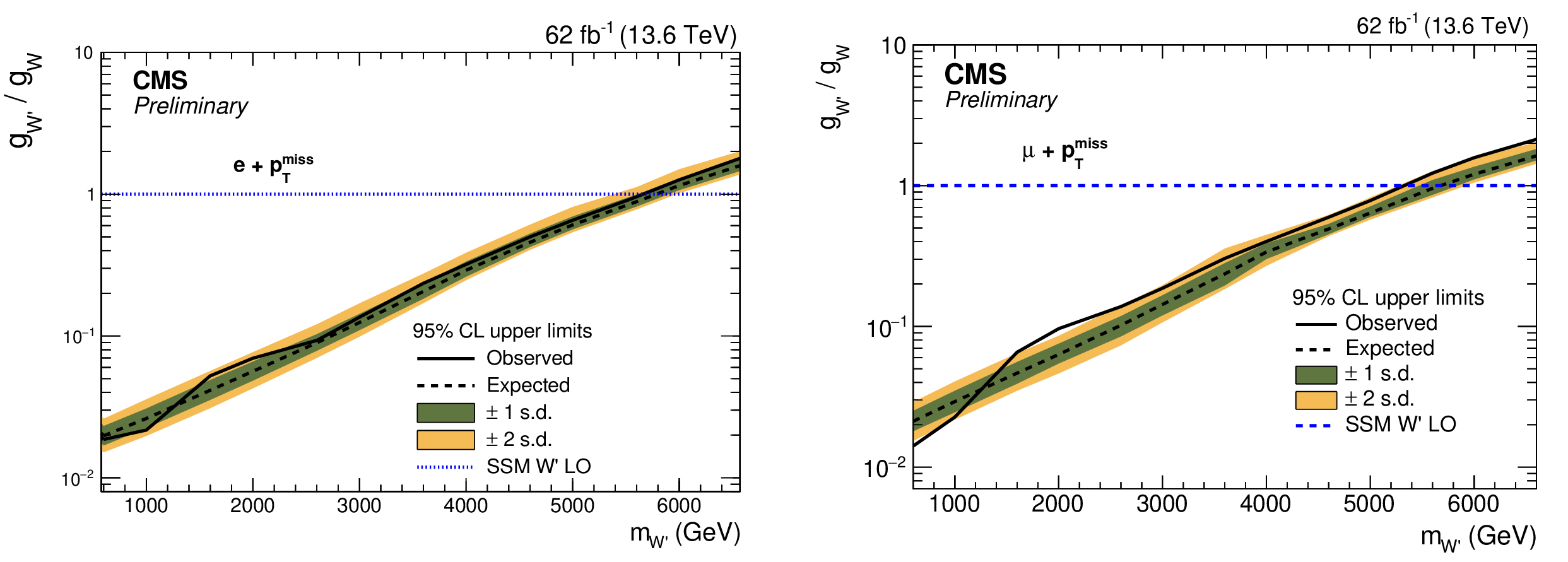
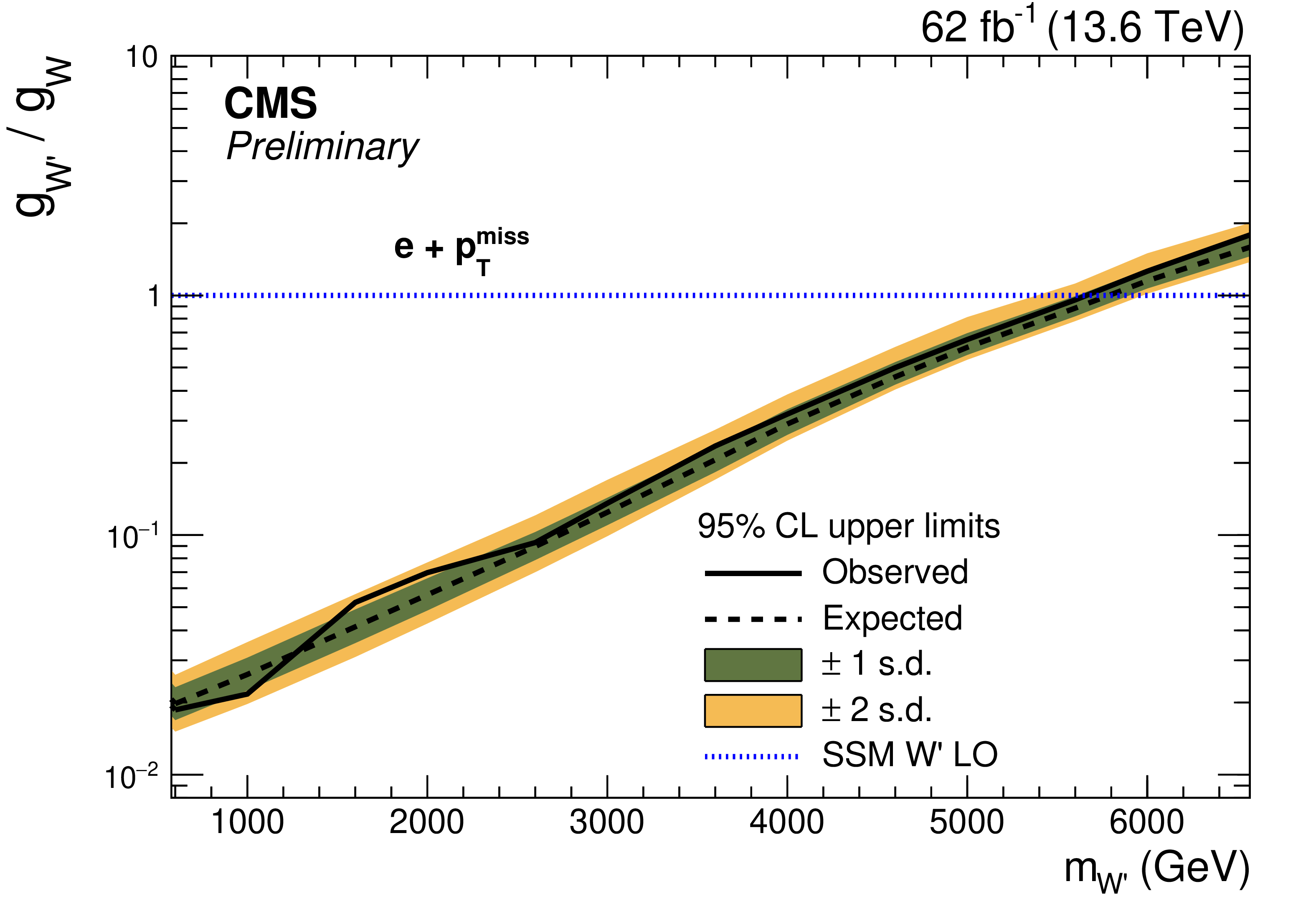
Figure 5:
Observed (solid line) and expected (dashed line) upper limits at 95% CL on the coupling strength ratio, $ g_{\mathrm{W^{'}}}/g_{\mathrm{W}} $ as a function of the mass of the $ \mathrm{W^{'}} $ boson. They are shown for the electron (left) and muon (right) channels. The one and two standard deviation uncertainty bands for the expected limits are shown. The area above the limit curve is excluded. The dotted line represents the case of the SSM $ \mathrm{W^{'}} $ coupling, $ g_{\mathrm{W^{'}}} $, being equal to $ g_{\mathrm{W}} $, the SM coupling. |
png pdf |
Figure 5-a:
Observed (solid line) and expected (dashed line) upper limits at 95% CL on the coupling strength ratio, $ g_{\mathrm{W^{'}}}/g_{\mathrm{W}} $ as a function of the mass of the $ \mathrm{W^{'}} $ boson. They are shown for the electron (left) and muon (right) channels. The one and two standard deviation uncertainty bands for the expected limits are shown. The area above the limit curve is excluded. The dotted line represents the case of the SSM $ \mathrm{W^{'}} $ coupling, $ g_{\mathrm{W^{'}}} $, being equal to $ g_{\mathrm{W}} $, the SM coupling. |
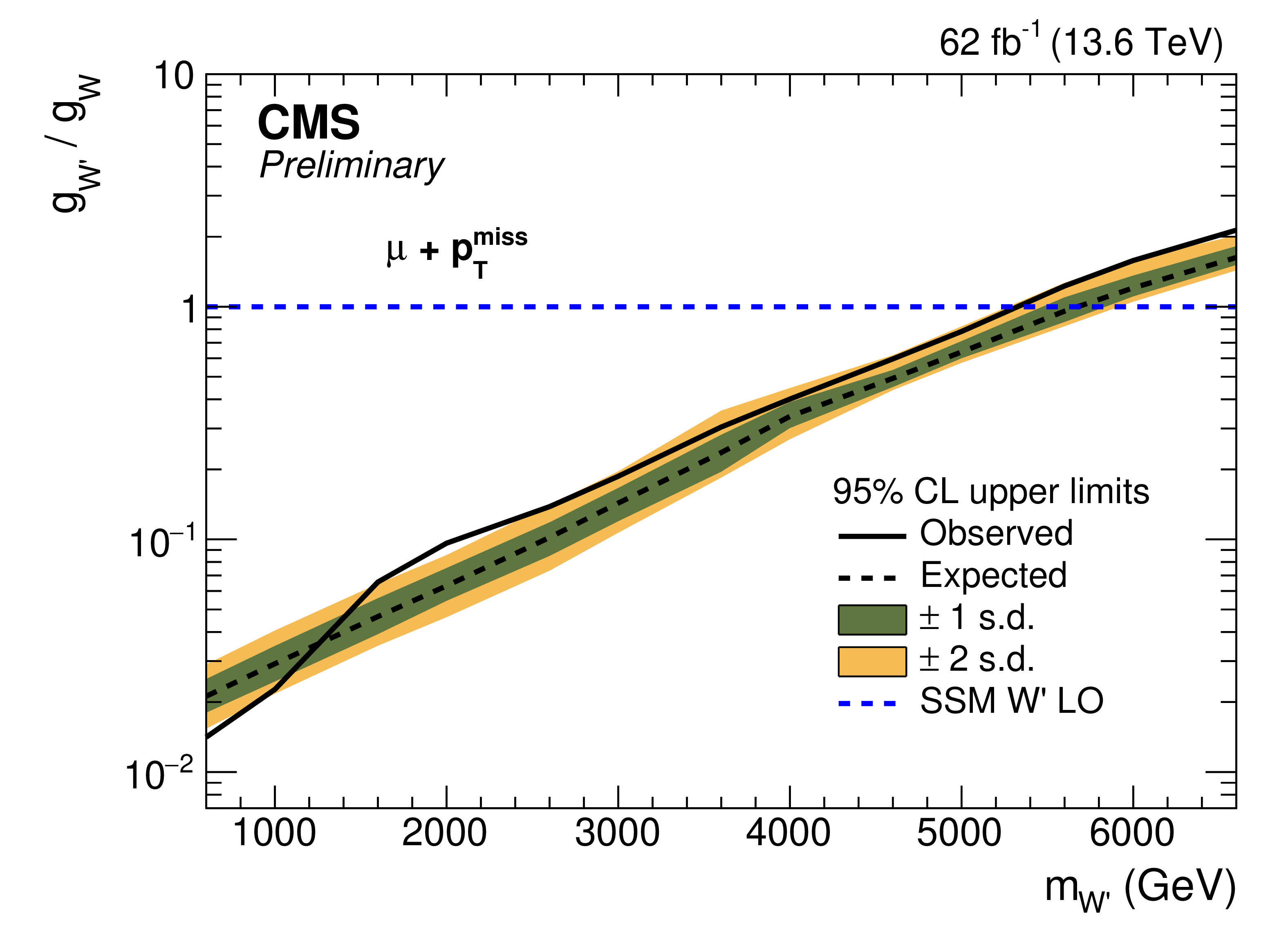
png pdf |
Figure 5-b:
Observed (solid line) and expected (dashed line) upper limits at 95% CL on the coupling strength ratio, $ g_{\mathrm{W^{'}}}/g_{\mathrm{W}} $ as a function of the mass of the $ \mathrm{W^{'}} $ boson. They are shown for the electron (left) and muon (right) channels. The one and two standard deviation uncertainty bands for the expected limits are shown. The area above the limit curve is excluded. The dotted line represents the case of the SSM $ \mathrm{W^{'}} $ coupling, $ g_{\mathrm{W^{'}}} $, being equal to $ g_{\mathrm{W}} $, the SM coupling. |
| Tables | |

png pdf |
Table 1:
The 95% CL observed (expected) limits for the product $ \sigma_{\mathrm{W^{'}}} \mathcal{B}(\mathrm{W^{'}} \rightarrow\ell\nu) $ for the production and decay of a SSM $ \mathrm{W^{'}} $ boson, derived from the data collected each year, for the electron and muon channels and their combination. The corresponding Run2 limits as published in [none-none-none] are shown for comparison. |
| Summary |
| A search for new physics based on the high-$ m_\mathrm{T} $ region of single lepton (electron or muon) and missing transverse momentum final states, has been performed using the proton proton collision data collected during 2022 and 2023 at $ \sqrt{s}= $ 13.6 TeV, corresponding to an integrated luminosity of 62 fb$ ^{-1} $. No evidence for new physics is observed. These observations are interpreted as limits on the parameters of $ \mathrm{W^{'}} $ bosons as predicted by the sequential standard model (SSM). The exclusion limits at 95% CL on the $ \mathrm{W^{'}} $ mass are found to be 5.7 and 5.6 TeV for the electron and muon channels, respectively. The 95% CL exclusion limit from the combination of both channels is 5.9 TeV. Variations in the coupling strength of the SSM $ \mathrm{W^{'}} $ bosons are also studied. Models for which the ratio of the coupling strength of the $ \mathrm{W^{'}} $ boson to the SM W boson is at the level of 2 $ \times10^{-2} $ are excluded for $ \mathrm{W^{'}} $ masses up to 0.5 TeV. For higher masses the constraint on the coupling weakens, approaching $ g_{\mathrm{W^{'}}}/g_{\mathrm{W}} = $ 1 at the value of the $ \mathrm{W^{'}} $ mass corresponding to the exclusion limit obtained in the SSM analysis. Model-independent limits are also provided that can be used to constrain parameters of several models through reinterpretations. |
| References | ||||
| 1 | R. N. Mohapatra and J. C. Pati | A ``Natural'' left-right symmetry | PRD 11 (1975) 2558 | |
| 2 | R. N. Mohapatra and J. C. Pati | Left-right gauge symmetry and an ``isoconjugate'' model of $ \mathrm{CP} $ violation | PRD 11 (1975) 566 | |
| 3 | J. C. Pati and A. Salam | Lepton number as the fourth color | Physical Review D 10 (1974) 275 | |
| 4 | G. Senjanovic and R. N. Mohapatra | Exact left-right symmetry and spontaneous violation of parity | Physical Review D 12 (1975) 1502 | |
| 5 | CMS Collaboration | Performance of missing transverse momentum reconstruction in proton-proton collisions at $ \sqrt{s}= $ 13 TeV using the CMS detector | JINST 14 (2019) P07004 | CMS-JME-17-001 1903.06078 |
| 6 | G. Altarelli, B. Mele, and M. Ruiz-Altaba | Searching for new heavy vector bosons in $ \mathrm{p}\overline{\mathrm{p}} $ colliders | Z. Phys. C 45 (1989) 109 | |
| 7 | ATLAS Collaboration | ATLAS search for a heavy gauge boson decaying to a charged lepton and a neutrino in pp collisions at $ \sqrt{s}= $ 7 TeV | EPJC 72 (2012) 2241 | 1209.4446 |
| 8 | CMS Collaboration | Search for leptonic decays of $ \mathrm{W^{'}} $ bosons in pp collisions at $ \sqrt{s}= $ 7 TeV | JHEP 08 (2012) 023 | CMS-EXO-11-024 1204.4764 |
| 9 | ATLAS Collaboration | Search for new particles in events with one lepton and missing transverse momentum in pp collisions at $ \sqrt{s}= $ 8 TeV with the ATLAS detector | JHEP 09 (2014) 037 | 1407.7494 |
| 10 | CMS Collaboration | Search for physics beyond the standard model in final states with a lepton and missing transverse energy in proton-proton collisions at $ \sqrt{s}= $ 8 TeV | PRD 91 (2015) 092005 | CMS-EXO-12-060 1408.2745 |
| 11 | ATLAS Collaboration | Search for a new heavy gauge boson resonance decaying into a lepton and missing transverse momentum in 36 fb$^{-1}$ of pp collisions at $ \sqrt{s}= $ 13 TeV with the ATLAS experiment | EPJC 78 (2018) 401 | 1706.04786 |
| 12 | CMS Collaboration | Search for heavy gauge $ \mathrm{W^{'}} $ boson in events with an energetic lepton and large missing transverse momentum at $ \sqrt{s}= $ 13 TeV | PLB 770 (2017) 278 | CMS-EXO-15-006 1612.09274 |
| 13 | CMS Collaboration | Search for high-mass resonances in final states with a lepton and missing transverse momentum at $ \sqrt{s}= $ 13 TeV | JHEP 06 (2018) 128 | CMS-EXO-16-033 1803.11133 |
| 14 | ATLAS Collaboration | Search for a heavy charged boson in events with a charged lepton and missing transverse momentum from pp collisions at $ \sqrt{s}= $ 13 TeV with the ATLAS detector | PRD 100 (2019) 052013 | 1906.05609 |
| 15 | CMS Collaboration | Search for new physics in the lepton plus missing transverse momentum final state in proton-proton collisions at $ \sqrt{s} = $ 13 TeV | JHEP 2022 (2022) no. 7, 2022 | CMS-EXO-19-017 2202.06075 |
| 16 | CMS Collaboration | The CMS experiment at the CERN LHC | JINST 3 (2008) S08004 | |
| 17 | CMS Collaboration | Development of the CMS detector for the CERN LHC Run 3 | JINST 19 (2024) P05064 | |
| 18 | CMS Collaboration | Performance of the CMS Level-1 trigger in proton-proton collisions at $ \sqrt{s} = $ 13 TeV | JINST 15 (2020) P10017 | CMS-TRG-17-001 2006.10165 |
| 19 | CMS Collaboration | The CMS trigger system | JINST 12 (2017) P01020 | CMS-TRG-12-001 1609.02366 |
| 20 | CMS Collaboration | Performance of the CMS high-level trigger during LHC Run 2 | JINST 19 (2024) P11021 | CMS-TRG-19-001 2410.17038 |
| 21 | J. Alwall et al. | MadGraph 5: going beyond | JHEP 06 (2011) 128 | 1106.0522 |
| 22 | NNPDF Collaboration | Parton distributions from high-precision collider data | EPJC 77 (2017) 663 | 1706.00428 |
| 23 | CMS Collaboration | Extraction and validation of a new set of CMS PYTHIA8 tunes from underlying-event measurements | EPJC 80 (2020) 4 | CMS-GEN-17-001 1903.12179 |
| 24 | R. Vogt | The usage of the K factor in heavy ion physics | Acta Phys. Hung. A 17 (2003) 75 | hep-ph/0207359 |
| 25 | Y. Li and F. Petriello | Combining QCD and electroweak corrections to dilepton production in FEWZ | PRD 86 (2012) 094034 | 1208.5967 |
| 26 | J. Alwall, S. Hoech, F. Krauss, and et al | Comparative study of various algorithms for the merging of parton showers and matrix elements in hadronic collisions | Eur.Phys.J.C 53 (2008) 473 | 0706.2569 |
| 27 | T. Sjöstrand et al. | An introduction to PYTHIA 8.2 | Comput. Phys. Commun. 191 (2015) 159 | 1410.3012 |
| 28 | A. Arbuzov et al. | Update of the MCSANC Monte Carlo integrator, v. 1.20 | JETP Lett. 103 (2016) no. 2, 131--136 | 1509.03052 |
| 29 | S. Alioli et al. | Precision studies of observables in $ p p \rightarrow W \rightarrow l\nu _l $ and $ pp \rightarrow \gamma,Z \rightarrow l^+ l^- $ processes at the LHC | Eur. Phys. J. C77, no. 5, 280, 2017 | 1606.02330 |
| 30 | F. Buccioni and et al. | Mixed QCD-electroweak corrections to dilepton production at the LHC in the high invariant mass region | Journal of High Energy Physics 202 (2022) 2 | |
| 31 | J. Alwall et al. | The automated computation of tree-level and next-to-leading order differential cross sections, and their matching to parton shower simulations | JHEP 07 (2014) 079 | 1405.0301 |
| 32 | R. Frederix and S. Frixione | Merging meets matching in MC@NLO | JHEP 12 (2012) 061 | 1209.6215 |
| 33 | P. Nason | A new method for combining NLO QCD with shower Monte Carlo algorithms | JHEP 11 (2004) 040 | hep-ph/0409146 |
| 34 | S. Frixione, P. Nason, and C. Oleari | Matching NLO QCD computations with parton shower simulations: the POWHEG method | JHEP 11 (2007) 070 | 0709.2092 |
| 35 | S. Alioli, P. Nason, C. Oleari, and E. Re | A general framework for implementing NLO calculations in shower Monte Carlo programs: the POWHEG BOX | JHEP 06 (2010) 043 | 1002.2581 |
| 36 | M. Czakon, P. Fiedler, and A. Mitov | Total top-quark pair-production cross section at hadron colliders through $ \mathcal{O}({\alpha}_{S}^{4}) $ | PRL 110 (2013) 252004 | 1303.6254 |
| 37 | M. Czakon et al. | Top-pair production at the LHC through NNLO QCD and NLO EW | JHEP 10 (2017) 186 | 1705.04105 |
| 38 | T. Gehrmann et al. | $ {\mathrm{W}^{+}\mathrm{W}^{-}} $ production at hadron colliders in Next-to-next-to-leading order QCD | PRL 113 (2014) 212001 | 1408.5243 |
| 39 | J. M. Campbell, R. K. Ellis, and C. Williams | Vector boson pair production at the LHC | JHEP 07 (2011) 018 | 1105.0020 |
| 40 | F. Cascioli et al. | ZZ production at hadron colliders in NNLO QCD | PLB 735 (2014) 311 | |
| 41 | GEANT4 Collaboration | GEANT 4---a simulation toolkit | NIM A 506 (2003) 250 | |
| 42 | J. Allison et al. | Recent developments in GEANT 4 | NIM A 835 (2016) 186 | |
| 43 | CMS Collaboration | Measurement of the inelastic proton-proton cross section at $ \sqrt{s}= $ 13 TeV | JHEP 07 (2018) 161 | CMS-FSQ-15-005 1802.02613 |
| 44 | CMS Collaboration | Technical proposal for the Phase-II upgrade of the Compact Muon Solenoid | CMS Technical Proposal CERN-LHCC-2015-010, CMS-TDR-15-02, 2015 CDS |
|
| 45 | CMS Collaboration | Particle-flow reconstruction and global event description with the CMS detector | JINST 12 (2017) P10003 | CMS-PRF-14-001 1706.04965 |
| 46 | CMS Collaboration | Electron and photon reconstruction and identification with the CMS experiment at the CERN LHC | JINST 16 (2021) P05014 | CMS-EGM-17-001 2012.06888 |
| 47 | CMS Collaboration | Performance of the CMS muon detector and muon reconstruction with proton-proton collisions at $ \sqrt{s}= $ 13 TeV | JINST 13 (2018) no. 06, P06015 | |
| 48 | CMS Collaboration | Performance of the reconstruction and identification of high-momentum muons in proton-proton collisions at sqrt(s) = 13 TeV | JINST 15 (2020) no. 02, P0 | |
| 49 | M. Cacciari, G. P. Salam, and G. Soyez | The anti-$ k_{\mathrm{T}} $ jet clustering algorithm | JHEP 04 (2008) 063 | 0802.1189 |
| 50 | M. Cacciari, G. P. Salam, and G. Soyez | FastJet user manual | EPJC 72 (2012) 1896 | 1111.6097 |
| 51 | CMS Collaboration | Pileup mitigation at CMS in 13 TeV data | JINST 15 (2020) P09018 | CMS-JME-18-001 2003.00503 |
| 52 | D. Bertolini, P. Harris, M. Low, and N. Tran | Pileup per particle identification | JHEP 10 (2014) 059 | 1407.6013 |
| 53 | CMS Collaboration | Jet energy scale and resolution in the CMS experiment in pp collisions at 8 TeV | JINST 12 (2017) P02014 | CMS-JME-13-004 1607.03663 |
| 54 | CMS Collaboration | Identification of heavy-flavour jets with the CMS detector in pp collisions at 13 TeV | JINST 13 (2018) P05011 | CMS-BTV-16-002 1712.07158 |
| 55 | CMS Collaboration | Performance of missing transverse momentum reconstruction in proton-proton collisions at $ \sqrt{s} = $ 13 TeV using the CMS detector | JINST 14 (2019) P07004 | CMS-JME-17-001 1903.06078 |
| 56 | CMS Collaboration | Measurement of the inclusive W and Z production cross sections in pp collisions at $ \sqrt{s}= $ 7 TeV | JHEP 10 (2011) 132 | CMS-EWK-10-005 1107.4789 |
| 57 | CMS Collaboration | Muon ID and Isolation efficiencies with muons in proton-proton collisions at sqrt(s) = 13.6 TeV | CMS Detector Performance Summary CERN-CMS-DP-2024-067, 2024 CDS |
|
| 58 | CMS Collaboration | Muon momentum calibration with proton-proton collisions at sqrt(s) = 13.6 TeV | CMS Detector Performance Summary CERN-CMS-DP-2024-065, 2024 CDS |
|
| 59 | CMS Collaboration | Luminosity measurement in proton-proton collisions at sqrt(s) = 13.6 TeV in 2022 at CMS | CMS Physics Analysis Summary, 2024 CMS-PAS-LUM-22-001 |
CMS-PAS-LUM-22-001 |
| 60 | CMS Collaboration | Measurement of the offline integrated luminosity for the cms pp collision dataset recorded in 2023 | CMS Detector Performance Summary CERN-CMS-2024-068, CMS-DP-2024-068, 2024 CDS |
|
| 61 | J. Butterworth et al. | PDF4LHC recommendations for LHC Run II | 1510.03865 | |
| 62 | Particle Data Group Collaboration | Review of particle physics | Chin. Phys. C 40 (2016) 100001 | |
| 63 | CMS Collaboration | The CMS statistical analysis and combination tool: COMBINE | Comput. Softw. Big Sci. 8 (2024) 19 | CMS-CAT-23-001 2404.06614 |
| 64 | W. Verkerke and D. P. Kirkby | The RooFit toolkit for data modeling | eConf C0303241 MOLT007, 2003 | physics/0306116 |
| 65 | L. Moneta et al. | The RooStats Project | PoS ACAT 057, 2010 | 1009.1003 |
|
|
Compact Muon Solenoid LHC, CERN |

|
|
|
|
|
|