
Compact Muon Solenoid
LHC, CERN
 Visit us: CMS Public Website, CMS Physics ;
Contact us: CMS Publications Committee
Visit us: CMS Public Website, CMS Physics ;
Contact us: CMS Publications Committee
| CMS-PAS-BPH-25-009 | ||
| Observation of a peaking structure in the $ \Upsilon(1S) \phi(1020) $ channel in proton-proton collisions at $ \sqrt{s}= $ 13 TeV | ||
| CMS Collaboration | ||
| 2026-05-18 | ||
| Abstract: The $ \Upsilon(1S) \phi(1020) $ invariant mass spectrum is investigated with an event sample of proton-proton collisions at $ \sqrt{s}= $ 13 TeV, collected by the CMS experiment at the LHC in 2016--2018 and corresponding to an integrated luminosity of 140 fb$^{-1}$. A peaking structure is observed at a $ \Upsilon(1S) \phi(1020) $ invariant mass of $ M_{\Upsilon\phi} = 10, $ 512.60 $ \pm $ 0.21 (stat) $ \pm $ 0.20 (syst) $ \pm 0.11\;(M_{\Upsilon}) \text{MeV} $, where the last uncertainty reflects the precision of the world-average determination of the $ \Upsilon(1S) $ meson mass. The width of this structure is consistent with the instrumental mass resolution, as estimated from simulation. While the mass measurement in this hadronic decay mode is consistent with the current measurement of $ \chi_{b1}{3P} $ mass, obtained from the analysis of the radiative decay to $ \Upsilon(3S)\gamma $, a possible exotic interpretation of the observed structure, such as a four-quark $ b\bar{b}s\bar{s} $ state or a hybrid state, cannot be excluded, since the well-established $ \chi_{b2}{3P} $ partner is not seen in this channel with the present data. | ||
| Links: CDS record (PDF) ; Physics Briefing ; CADI line (restricted) ; | ||
| Figures | |
png pdf |
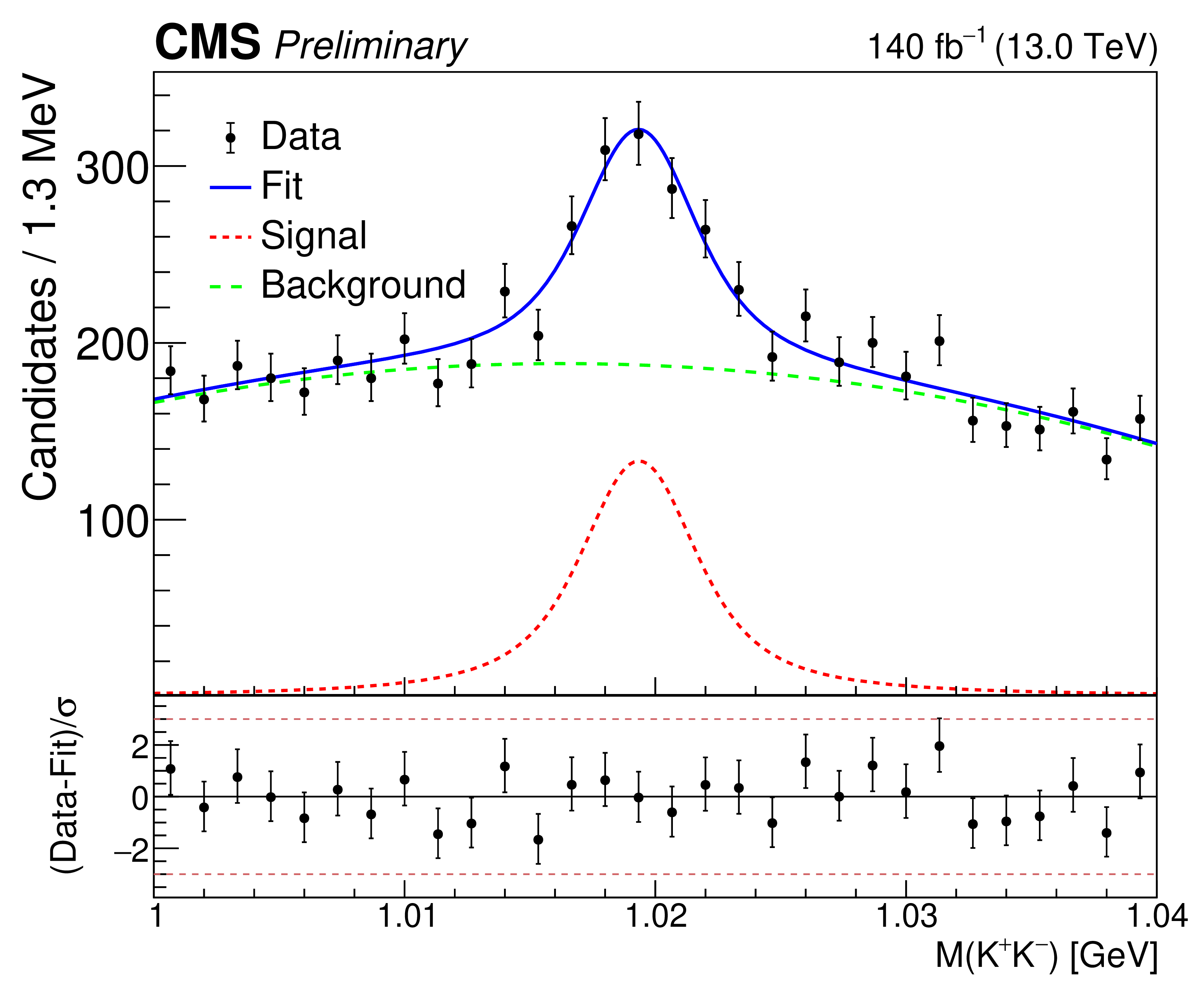
Figure 1:
The $ K^{+}K^{-} $ invariant mass for the $ \Upsilon KK $ candidates, within a $ \pm $ 4.8 MeV window around the mass value of the $ \Upsilon \phi $ peak, is presented with the fit result (and its components) superimposed. The $ \phi $ signal is modelled with a Voigtian function where the mass resolution is fixed at the value (1.21 MeV) obtained by simulation studies. The fit estimates a mass value 1019.35 $ \pm $ 0.26 MeV consistent with the PDG average of the $ \phi $ meson ( 1019.46 $ \pm $ 0.02 MeV), and a natural width value ( 4.11 $ \pm $ 1.17 MeV) consistent with the PDG average ( 4.24 $ \pm $ 0.01 MeV) as well. |
png pdf |
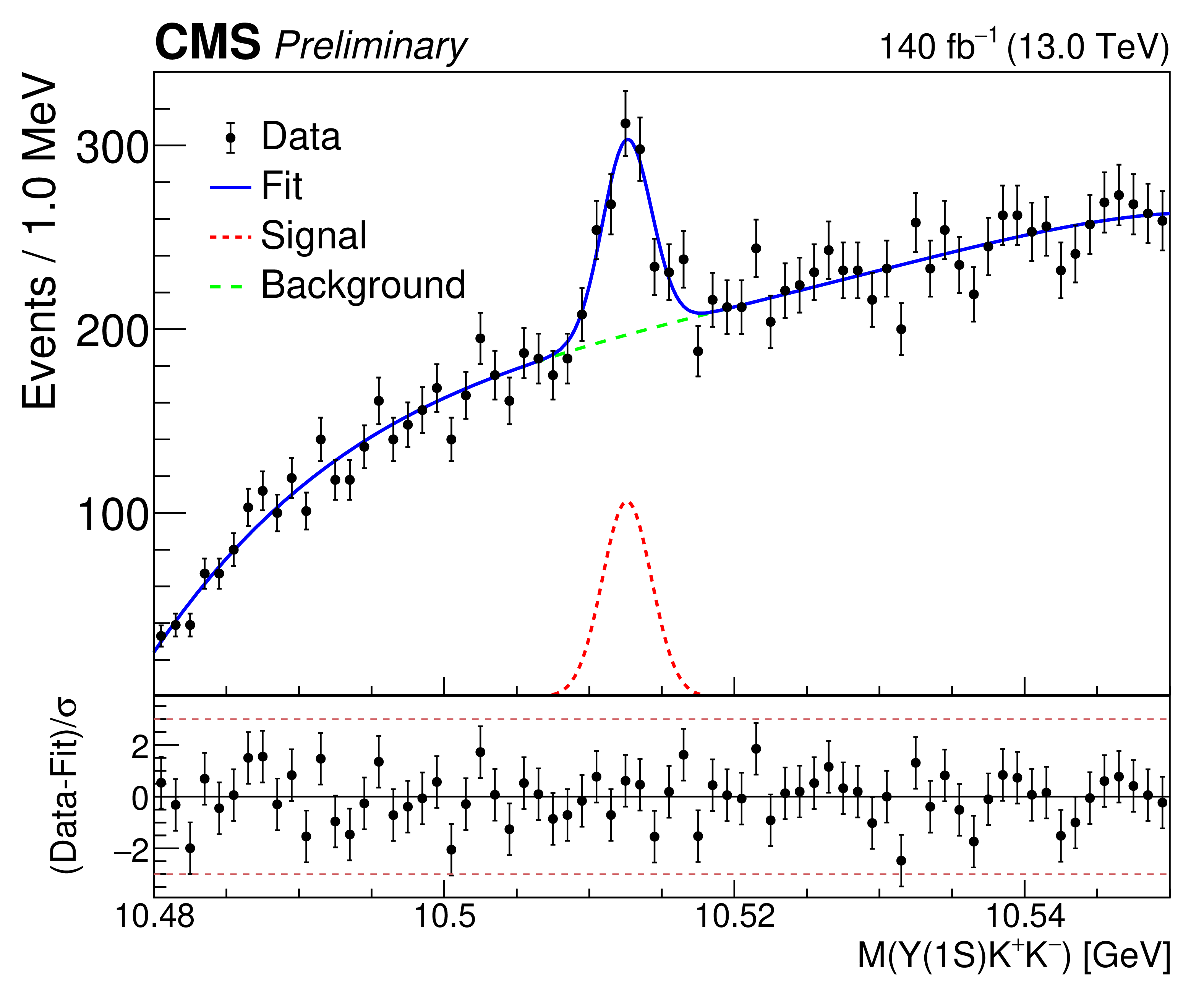
Figure 2:
The $ \Upsilon KK $ invariant mass distribution in data (black points with error bars) when $ |M(\mathrm{K^+} \mathrm{K^-})-m_{\phi}^{\text{PDG}}| < $ 6.15 MeV. The fit result (solid blue line) is superimposed and is a sum of two components, the signal (dashed red line) and the background (long-dashed green line). The details of the fit model are described in the main text. The lower panel shows the pull distribution, defined as the difference between the data and the fit value in each bin, divided by the combined uncertainty. |
png pdf |
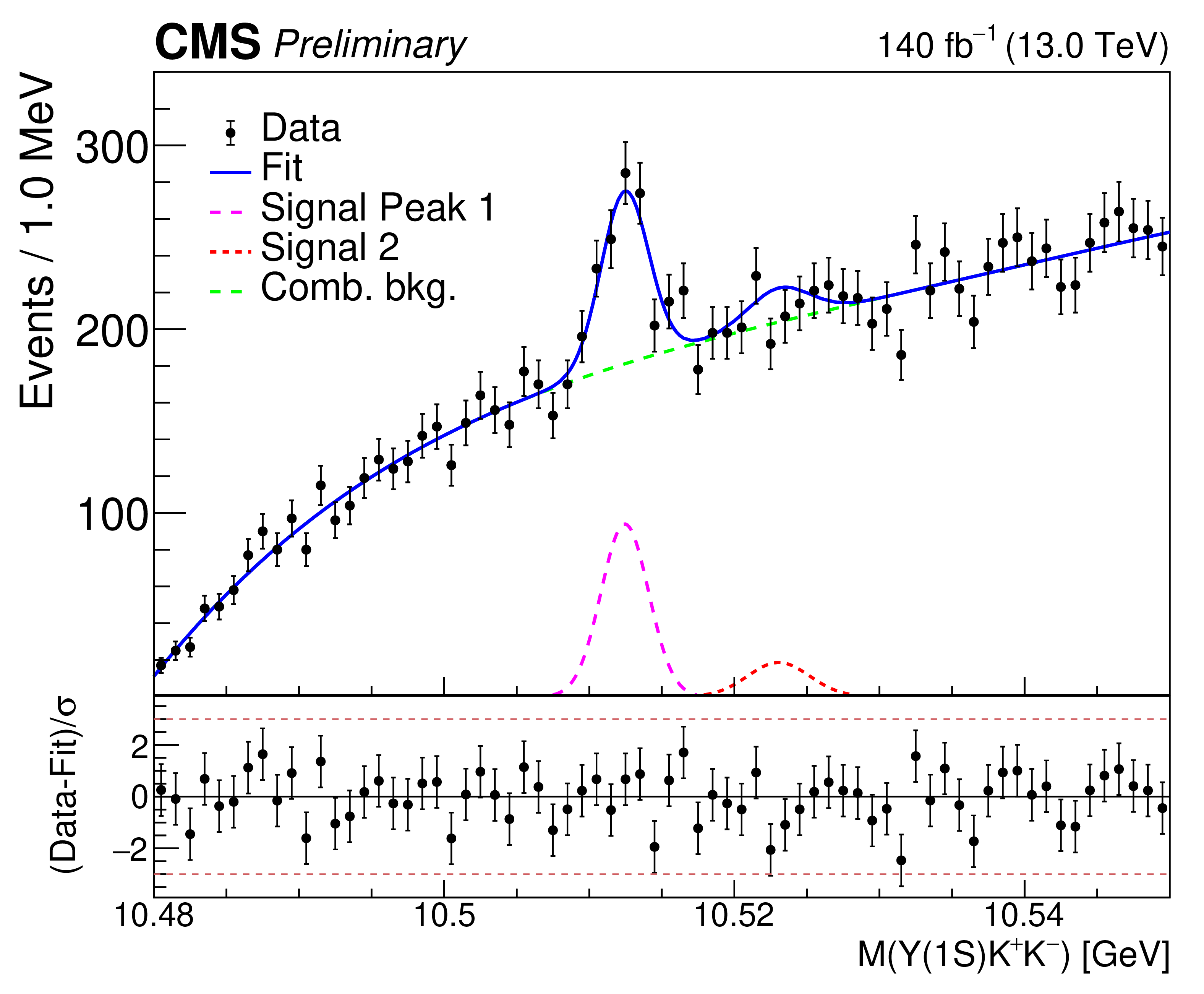
Figure 3:
The $ \Upsilon KK $ invariant mass distribution in data (black points with error bars) when $ |M(\mathrm{K^+} \mathrm{K^-})-m_{\phi}^{\text{PDG}}| < $ 6.15 MeV and, additionally, the $ \Upsilon{\textrm{(2S)}} $-veto is applied on the top of the selection criteria discussed in the main text. The model of the superimposed fit includes two Gaussian functions for two signals with means fixed and the two widths fixed at the values of the mass resolutions estimated from simulation. The yield of the observed signal is also fixed to the value estimated in a fit without the possible second signal so that, in this fit, only the yield of the second possible signal is left free to vary in the two-states signal model. Consequently the statistical significance of the second possible signal is estimated to be slightly above 1 standard deviation. |
| Summary |
| In summary, a peaking structure with an estimated yield of $450 \pm 59$ candidates and the mass of $10,512.60 \pm 0.21$ (stat) $ \pm 0.20$ (syst) $\pm 0.11 (M_{\Upsilon})$ MeV, where the last uncertainty is associated to the use of the ${\Upsilon}P{1S}$ mass [49] as kinematic constraint in the vertex fit, has been observed by investigating the ${\Upsilon}P{1S}K^+K^-$ invariant mass spectrum with the dikaon invariant mass within a narrow window around the $\phi$ meson. The observation is based on proton-proton collision data collected by the CMS experiment at $\sqrt{s} = 13$ TeV during 2016--2018. The width of the observed peak is compatible with the instrumental mass resolution, and its mass is compatible within 1.5 standard deviations with the mass for the bottomonium excited state $\chi_{b1}{3P}$ of $10,513.42 \pm 0.41$ (stat) $ \pm 0.18$ (syst) MeV measured in its radiative decays [11]. Assuming the observed peaking structure is the $\chi_{b1}{3P}$ state, the local statistical significance of the signal is estimated to exceed 10 standard deviations. However, the absence of a statistically significant signal for the $\chi_{b2}$ spin-2 partner in the same channel, despite the expectations of a similar rate for the two processes (or at least a not strongly suppressed spin-2 partner), may suggest an alternative nonconventional interpretation of the observed signal as a new exotic state. Thus, whereas the identification with $\chi_{b1}{3P}$ seems plausible, no definitive conclusion about the nature of this resonance can be drawn with the analysed data. |
| References | ||||
| 1 | E288 Collaboration | Observation of a Dimuon Resonance at 9.5 GeV in 400 GeV Proton-Nucleus Collisions | PRL 39 (1977) 252 | |
| 2 | K. Ueno et al. | Evidence for the $ \Upsilon^{\prime\prime} $ and a Search for New Narrow Resonances | PRL 42 (1979) 486 | |
| 3 | J. K. Bienlein et al. | Observation of a Narrow Resonance at 10.02-GeV in e+ e- Annihilations | PLB 78 (1978) 360 | |
| 4 | K. Han et al. | Observation of $ P $-wave $ \mathrm{b} \overline{\mathrm{b}} $ bound states | PRL 49 (1982) 1612 | |
| 5 | C. Klopfenstein et al. | Observation of the Lowest $ P $ Wave $ b \bar{b} $ Bound States | PRL 51 (1983) 160 | |
| 6 | BaBar Collaboration | Observation of the bottomonium ground state in the decay $ \Upsilon{\textrm{(3S)}} \to \gamma \eta_\mathrm{b} $ | [Erratum: 10.1103/PhysRevLett.102.01] PRL 101 (2008) 071801 |
0807.1086 |
| 7 | CLEO Collaboration | First observation of a \PGUP1D state | PRD 70 (2004) 032001 | hep-ex/0404021 |
| 8 | BaBar Collaboration | Observation of the $ \Upsilon{1^3D_J} $ Bottomonium State through Decays to $ \pi^+\pi^-\Upsilon{1S} $ | PRD 82 (2010) 111102 | 1004.0175 |
| 9 | Belle Collaboration | Evidence for the $ \eta_b(2S) $ and observation of $ h_b(1P) \to \eta_b(1S) \gamma $ and $ h_b(2P) \to \eta_b(1S) \gamma $ | PRL 109 (2012) 232002 | 1205.6351 |
| 10 | ATLAS Collaboration | Observation of a new $ \chi_b $ state in radiative transitions to $ \Upsilon(1S) $ and $ \Upsilon(2S) $ at ATLAS | PRL 108 (2012) 152001 | 1112.5154 |
| 11 | CMS Collaboration | Observation of the $ \chi_\mathrm{b1} $(3P) and $ \chi_\mathrm{b2} $(3P) and measurement of their masses | PRL 121 (2018) 092002 | CMS-BPH-17-008 1805.11192 |
| 12 | C. Oswald and T. K. Pedlar | Results in $ B_s $ physics and bottomonium spectroscopy using the Belle $ \Upsilon({\rm 5S}) $ data | Mod. Phys. Lett. A 28 (2013) 1330036 | 1311.3547 |
| 13 | Belle Collaboration | Observation of a new structure near 10.75 gev in the energy dependence of the $ e^+e^{-} \to \Upsilon(ns) \pi^{+}\pi^{-} $ (n = 1, 2, 3) cross sections | JHEP 10 (2019) 220 | 1905.05521 |
| 14 | CLEO Collaboration | Observation of the hadronic transitions $ \chi_{\mathrm{b}1,2} $(2P) $ \to \omega \Upsilon (1S) $ | PRL 92 (2004) 222002 | hep-ex/0307034 |
| 15 | Belle Collaboration | Study of $ \chi_{bJ}(2P) \to \omega \Upsilon(1S) $ at Belle | PRL 135 (2025) 121902 | 2407.00879 |
| 16 | BaBar Collaboration | Study of $ \chi_{b1,2}(2P) \to \omega \Upsilon(1S) $ transitions in $ \Upsilon(3S) \to \gamma \chi_{b1,2}(2P) $ decays at BaBar | 2512.08363 | |
| 17 | Belle Collaboration | Observation of $ e^+e^- \to \pi^+ \pi^- \pi^0 \chi_{bJ} $ and Search for $ X_b \to \omega \Upsilon(1S) $ at $ \sqrt{s}= $ 10.867 GeV | PRL 113 (2014) 142001 | 1408.0504 |
| 18 | Belle II Collaboration | Observation of $ {e}^{+}{e}^{-}\rightarrow\omega{\chi}_{bJ}(1p) $ and search for $ {X}_{b}\rightarrow\omega\Upsilon(1s) $ at $ \sqrt{s} $ near 10.75 gev | PRL 130 (2023) 091902 | |
| 19 | Belle Collaboration | Observation of anomalous $ \Upsilon{\textrm{(1S)}}\pi^{+}\pi^{-} $ and $ \Upsilon{\textrm{(2S)}}\pi^{+}\pi^{-} $ production near the $ \Upsilon{\textrm{(5S)}} $ resonance | PRL 100 (2008) 112001 | 0710.2577 |
| 20 | LHCb Collaboration | Amplitude analysis of $ B^+\to J/\psi \phi K^+ $ decays | PRD 95 (2017) 012002 | 1606.07898 |
| 21 | LHCb Collaboration | Observation of structure in the $ J /\psi $ -pair mass spectrum | Sci. Bull. 65 (2020) 1983 | 2006.16957 |
| 22 | ATLAS Collaboration | Observation of an Excess of Dicharmonium Events in the Four-Muon Final State with the ATLAS Detector | PRL 131 (2023) 151902 | 2304.08962 |
| 23 | CMS Collaboration | New Structures in the J/\ensuremath\psiJ/\ensuremath\psi Mass Spectrum in Proton-Proton Collisions at s=13 TeV | PRL 132 (2024) 111901 | CMS-BPH-21-003 2306.07164 |
| 24 | LHCb Collaboration | Observation of $ J/\psi\phi $ structures consistent with exotic states from amplitude analysis of $ B^+\to J/\psi \phi K^+ $ decays | PRL 118 (2017) 022003 | 1606.07895 |
| 25 | G.-J. Ding | Possible Molecular States of D*(s) anti-D*(s) System and Y(4140) | EPJC 64 (2009) 297 | 0904.1782 |
| 26 | E. Braaten, L.-P. He, and A. Mohapatra | Masses of doubly heavy tetraquarks with error bars | PRD 103 (2021) 016001 | 2006.08650 |
| 27 | Y. Song and D. Jia | Mass spectra of doubly heavy tetraquarks in diquark\ensuremath-antidiquark picture | Commun. Theor. Phys. 75 (2023) 055201 | 2301.00376 |
| 28 | V. Patel, J. Oudichhya, and A. K. Rai | Spectroscopic study of $ \mathrm{s}\mathrm{s}\overline{\mathrm{b}}\overline{\mathrm{b}} $ and $ \mathrm{b}\mathrm{b}\overline{\mathrm{b}}\overline{\mathrm{b}} $ tetraquarks using Regge phenomenology | Int. J. Mod. Phys. A 40 (2025) 2550152 | 2509.23149 |
| 29 | W.-X. Zhang, H. Xu, and D. Jia | Masses and magnetic moments of hadrons with one and two open heavy quarks: Heavy baryons and tetraquarks | PRD 104 (2021) 114011 | 2109.07040 |
| 30 | S.-Q. Luo et al. | Exotic tetraquark states with the $ qq\bar{Q}\bar{Q} $ configuration | EPJC 77 (2017) 709 | 1707.01180 |
| 31 | P. Junnarkar, N. Mathur, and M. Padmanath | Study of doubly heavy tetraquarks in Lattice QCD | PRD 99 (2019) 034507 | 1810.12285 |
| 32 | H.-X. Chen et al. | Understanding the internal structures of the $ X(4140) $, $ X(4274) $, $ X(4500) $ and $ X(4700) $ | EPJC 77 (2017) 160 | 1606.03179 |
| 33 | CMS Collaboration | Precision luminosity measurement in proton-proton collisions at $ \sqrt{s} = $ 13 TeV in 2015 and 2016 at CMS | EPJC 81 (2021) 800 | CMS-LUM-17-003 2104.01927 |
| 34 | CMS Collaboration | CMS luminosity measurement for the 2017 data-taking period at $ \sqrt{s} = $ 13 TeV | CMS Physics Analysis Summary, 2018 CMS-PAS-LUM-17-004 |
CMS-PAS-LUM-17-004 |
| 35 | CMS Collaboration | CMS luminosity measurement for the 2018 data-taking period at $ \sqrt{s} = $ 13 TeV | CMS Physics Analysis Summary, 2019 CMS-PAS-LUM-18-002 |
CMS-PAS-LUM-18-002 |
| 36 | CMS Collaboration | HEPData record for this analysis | link | |
| 37 | CMS Collaboration | The CMS experiment at the CERN LHC | JINST 3 (2008) S08004 | |
| 38 | CMS Collaboration | Development of the CMS detector for the CERN LHC Run 3 | JINST 19 (2024) P05064 | CMS-PRF-21-001 2309.05466 |
| 39 | CMS Collaboration | The CMS trigger system | JINST 12 (2017) P01020 | CMS-TRG-12-001 1609.02366 |
| 40 | CMS Collaboration | Performance of the CMS Level-1 trigger in proton-proton collisions at $ \sqrt{s} = $ 13 TeV | JINST 15 (2020) P10017 | CMS-TRG-17-001 2006.10165 |
| 41 | CMS Collaboration | Performance of the CMS high-level trigger during LHC Run 2 | JINST 19 (2024) P11021 | CMS-TRG-19-001 2410.17038 |
| 42 | CMS Collaboration | Electron and photon reconstruction and identification with the CMS experiment at the CERN LHC | JINST 16 (2021) P05014 | CMS-EGM-17-001 2012.06888 |
| 43 | CMS Collaboration | Performance of the CMS muon detector and muon reconstruction with proton-proton collisions at $ \sqrt{s}= $ 13 TeV | JINST 13 (2018) P06015 | CMS-MUO-16-001 1804.04528 |
| 44 | CMS Collaboration | Description and performance of track and primary-vertex reconstruction with the CMS tracker | JINST 9 (2014) P10009 | CMS-TRK-11-001 1405.6569 |
| 45 | CMS Collaboration | Particle-flow reconstruction and global event description with the CMS detector | JINST 12 (2017) P10003 | CMS-PRF-14-001 1706.04965 |
| 46 | CMS Collaboration | Strategies and performance of the CMS silicon tracker alignment during LHC Run 2 | NIM A 1037 (2022) 166795 | CMS-TRK-20-001 2111.08757 |
| 47 | CMS Tracker Group Collaboration | The CMS phase-1 pixel detector upgrade | JINST 16 (2021) P02027 | 2012.14304 |
| 48 | CMS Collaboration | Technical proposal for the Phase-II upgrade of the Compact Muon Solenoid | CMS Technical Proposal CERN-LHCC-2015-010, CMS-TDR-15-02, 2015 CDS |
|
| 49 | Particle Data Group Collaboration | Review of particle physics | PRD 110 (2024) 030001 | |
| 50 | T. Sjöstrand et al. | An introduction to PYTHIA 8.2 | Comput. Phys. Commun. 191 (2015) 159 | 1410.3012 |
| 51 | CMS Collaboration | Extraction and validation of a new set of CMS PYTHIA8 tunes from underlying-event measurements | EPJC 80 (2020) 4 | CMS-GEN-17-001 1903.12179 |
| 52 | D. J. Lange | The EvtGen particle decay simulation package | NIM A 462 (2001) 152 | |
| 53 | E. Barberio, B. van Eijk, and Z. W \c a s | PHOTOS: A universal Monte Carlo for QED radiative corrections in decays | Comput. Phys. Commun. 66 (1991) 115 | |
| 54 | E. Barberio and Z. W \c a s | PHOTOS: A universal Monte Carlo for QED radiative corrections. version 2.0 | Comput. Phys. Commun. 79 (1994) 291 | |
| 55 | GEANT4 Collaboration | GEANT 4---a simulation toolkit | NIM A 506 (2003) 250 | |
| 56 | G. Cowan, K. Cranmer, E. Gross, and O. Vitells | Asymptotic formulae for likelihood-based tests of new physics | EPJC 71 (2011) 1554 | 1007.1727 |
| 57 | S. S. Wilks | The large-sample distribution of the likelihood ratio for testing composite hypotheses | Annals Math. Statist. 9 (1938) 60 | |
| 58 | S. Jackman | Bayesian analysis for the social sciences | John Wiley & Sons, New Jersey, USA, 2009 link |
|
| 59 | CMS Collaboration | CMS Software | link | |
| 60 | ARGUS Collaboration | Search for hadronic $ b \to u $ decays | PLB 241 (1990) 278 | |
| 61 | CMS Collaboration | Measurement of the production cross section ratio sigma(chi[b2](1P)) / sigma(chi[b1](1P)) in pp collisions at $ \sqrt{s} = $ 8 TeV | PLB 743 (2015) 383 | CMS-BPH-13-005 1409.5761 |
| 62 | E. Gross and O. Vitells | Trial factors for the look elsewhere effect in high energy physics | EPJC 70 (2010) 525 | 1005.1891 |
|
|
Compact Muon Solenoid LHC, CERN |

|
|
|
|
|
|