Compact Muon Solenoid
LHC, CERN
 Visit us: CMS Public Website, CMS Physics ;
Contact us: CMS Publications Committee
Visit us: CMS Public Website, CMS Physics ;
Contact us: CMS Publications Committee
| CMS-HIN-24-003 ; CERN-EP-2025-095 | ||
| Measurement of D$^0$ meson photoproduction in ultraperipheral heavy ion collisions | ||
| CMS Collaboration | ||
| 10 September 2025 | ||
| Phys. Rev. Lett. 136, 122303 | ||
|
Abstract:
This Letter reports the first measurement of photonuclear D$^0$ meson production in ultraperipheral heavy ion collisions. The study is performed using lead-lead collision data, with an integrated luminosity of 1.34 nb$^{-1}$, collected by the CMS experiment at a nucleon-nucleon center-of-mass energy of 5.36 TeV. Photonuclear events, where one of the colliding nuclei breaks up and the other remains intact, are selected based on breakup neutron emissions and by requiring no particle activity in a large rapidity interval in the direction of the photon-emitting nucleus. The D$^0$ mesons are reconstructed via the $ \mathrm{D^0}\to\mathrm{K^-}\pi^{+} $ decay channel, with the cross section measured as a function of D$^0$ meson transverse momentum and rapidity. The results are compared with next-to-leading-order perturbative QCD calculations that employ recent parametrizations of the lead nuclear parton distribution functions, as well as with predictions based on the color glass condensate framework. This measurement is the first photonuclear collision study characterizing parton distribution functions of lead nuclei for parton fractional momenta $ x $ (relative to the nucleon) ranging approximately from a few 10$^{-4} $ to 10$^{-2} $ for different hard energy scale $ Q^{2} $ selections. This work is dedicated to the memory of our colleague and friend, Michele Arneodo. Michele was a generous mentor, a passionate physicist, and a kind soul who inspired both students and collaborators with his wisdom, warmth, and dedication to science. His contributions to diffractive physics and his support for young scientists leave a lasting legacy. He will be deeply missed. | ||
| Links: e-print arXiv:2509.08626 [hep-ex] (PDF) ; CDS record ; inSPIRE record ; HepData record ; Physics Briefing ; CADI line (restricted) ; | ||
| Figures | |
png pdf |
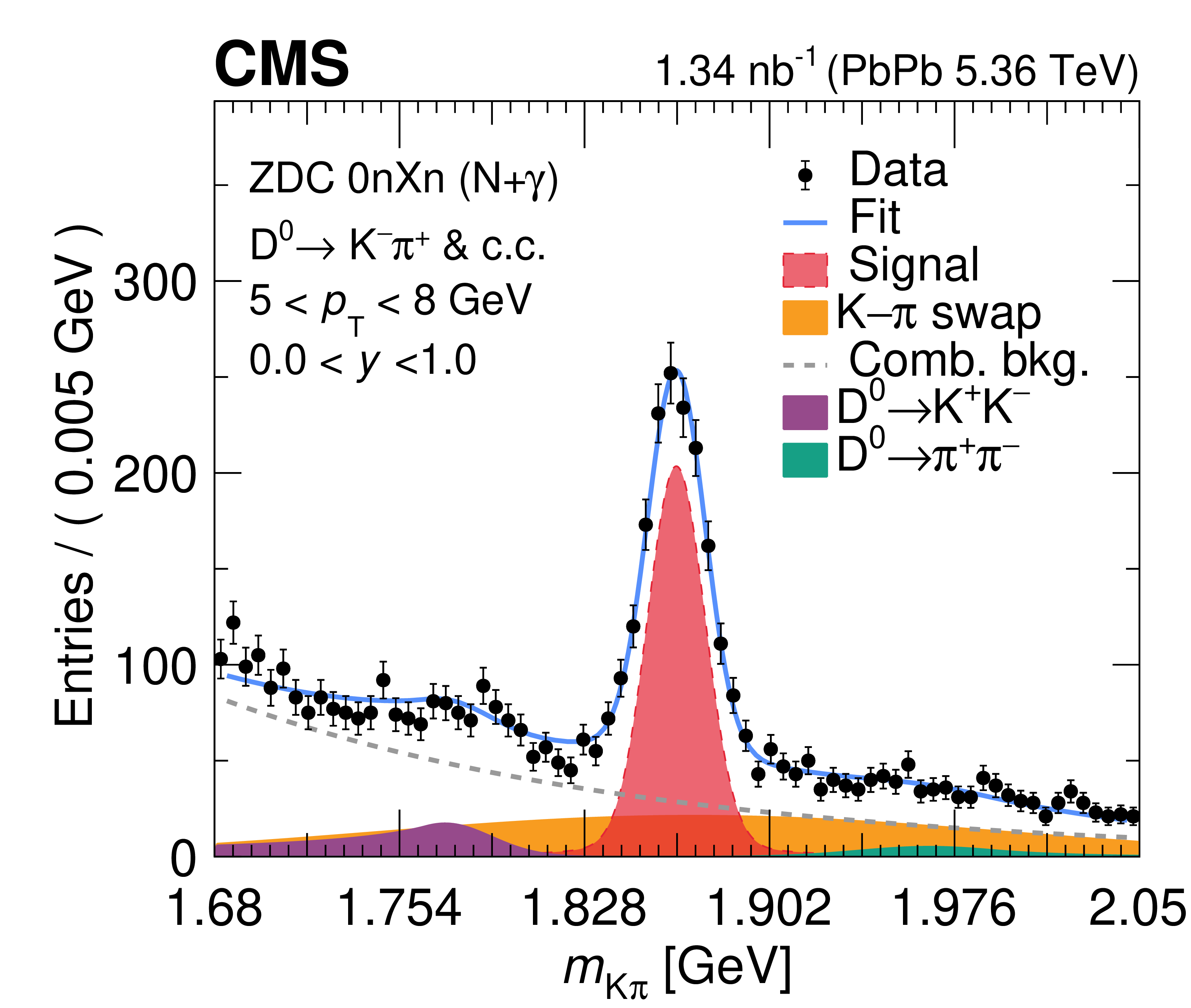
Figure 1:
Invariant mass distribution of D$^0$ mesons with 5 $ < p_{\mathrm{T}} < $ 8 GeV and 0.0 $ < y < $ 1.0. The description of the fit template is provided in the text. |
png pdf |
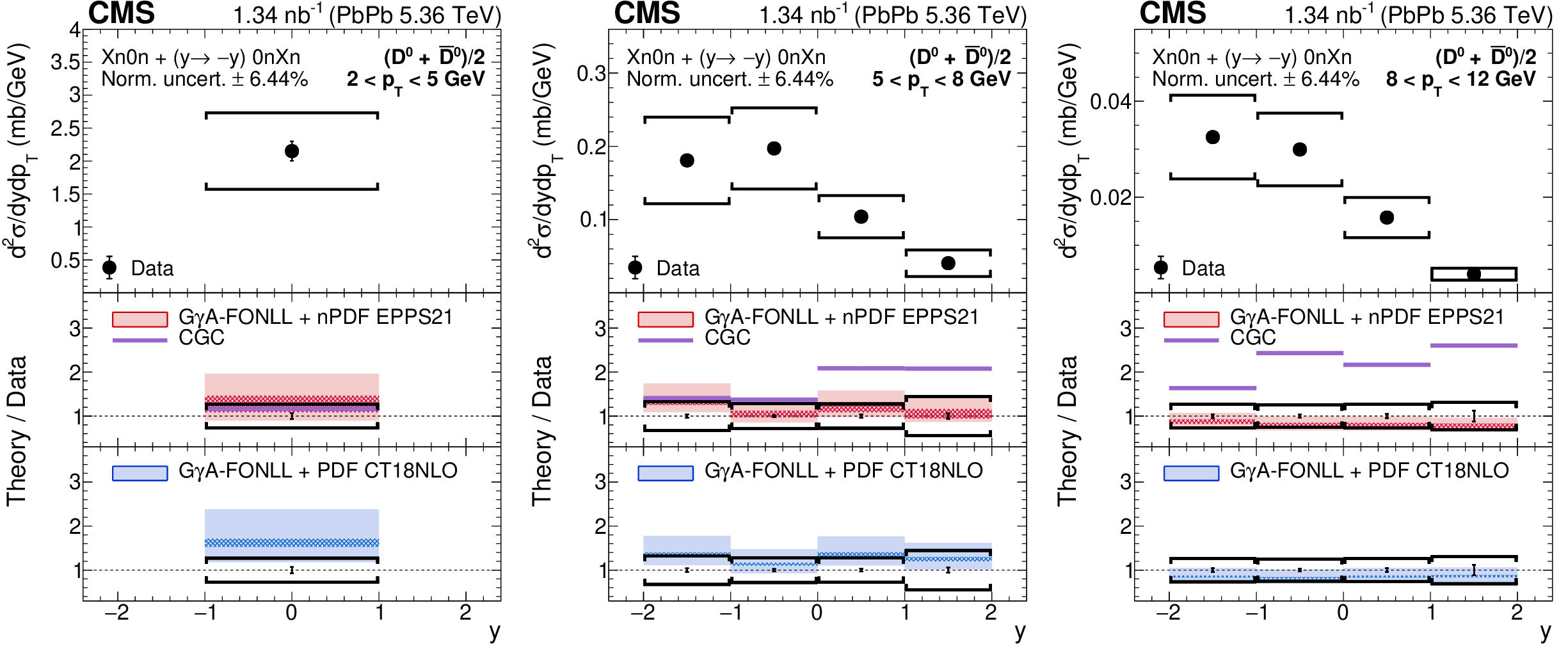
Figure 2:
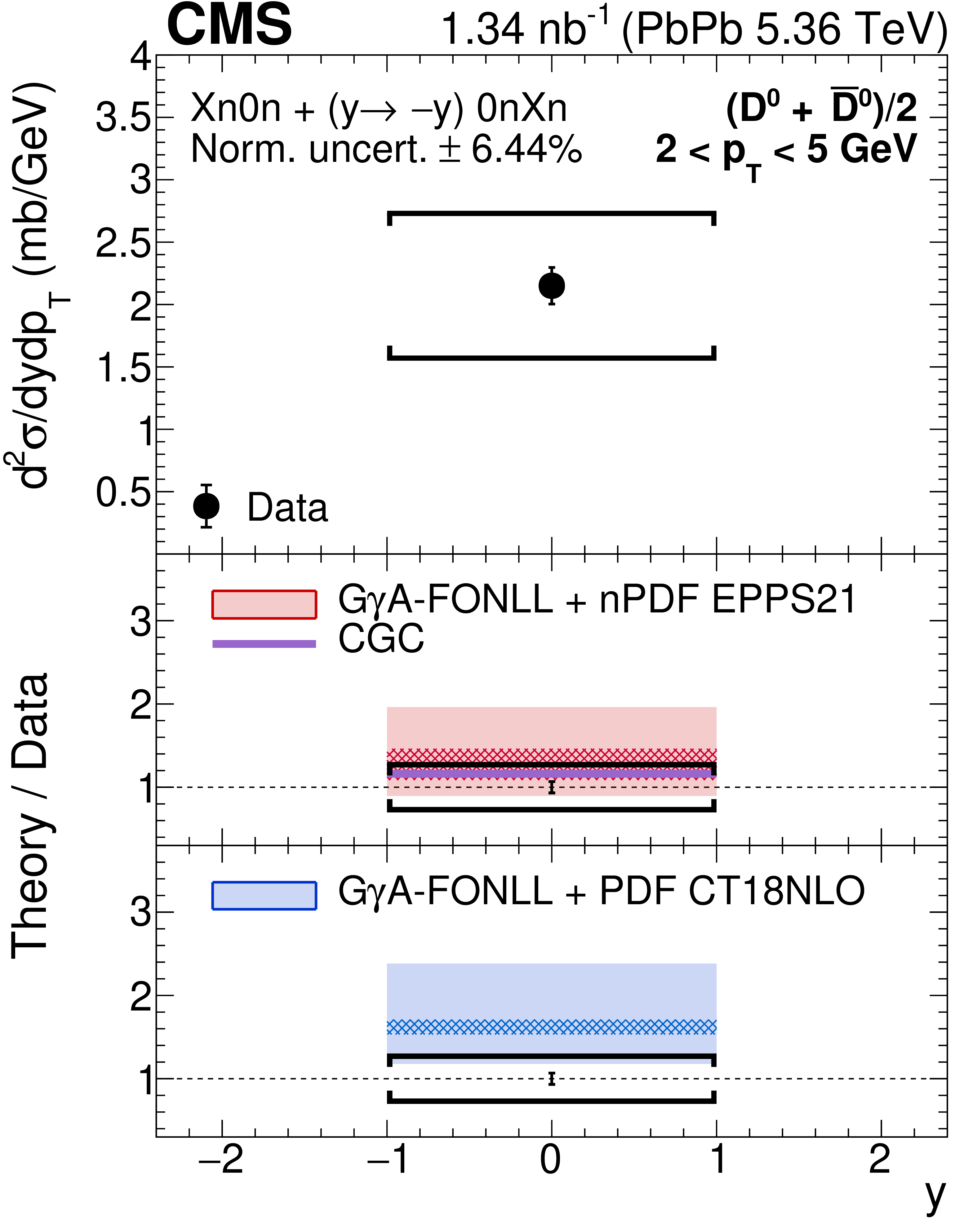
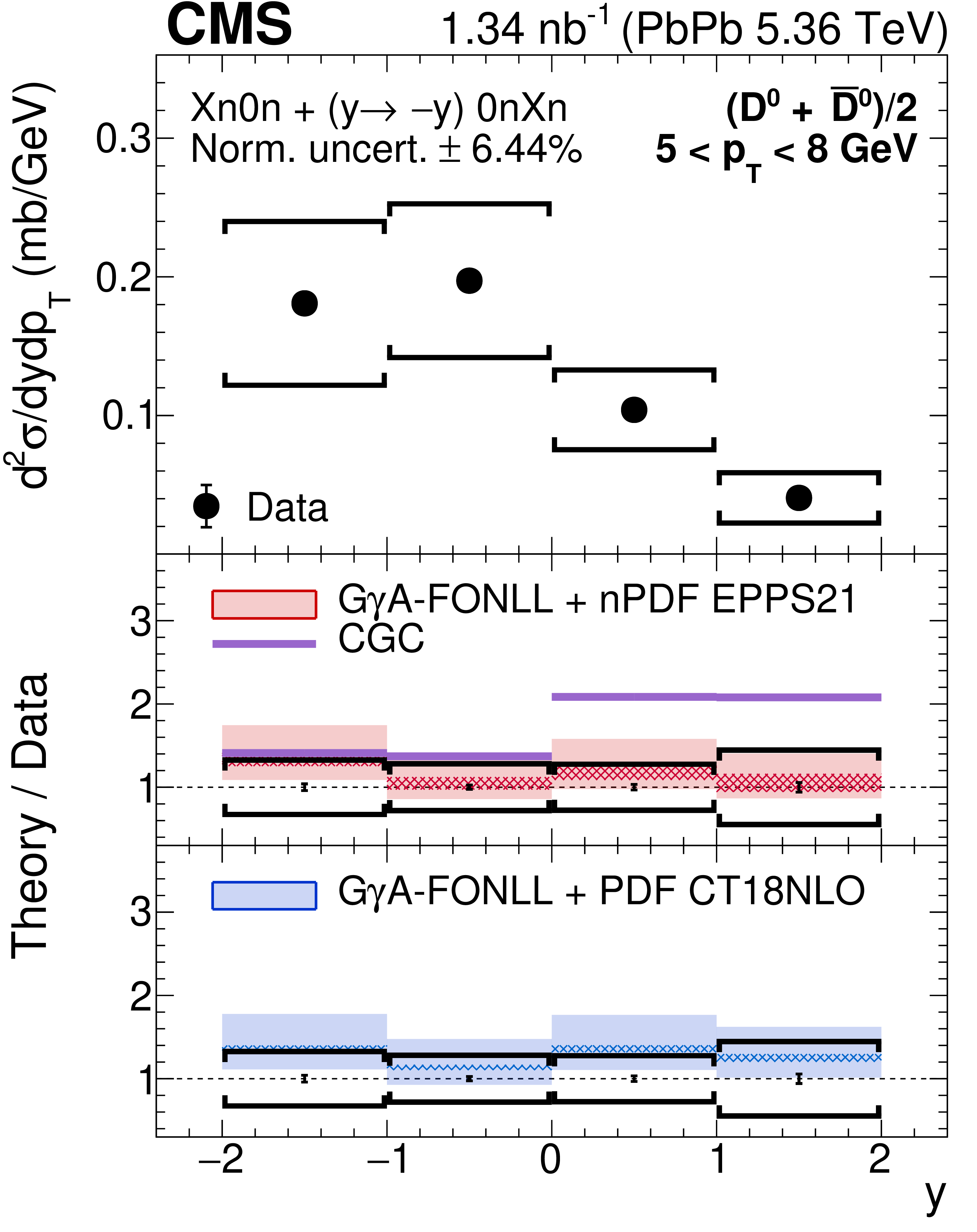
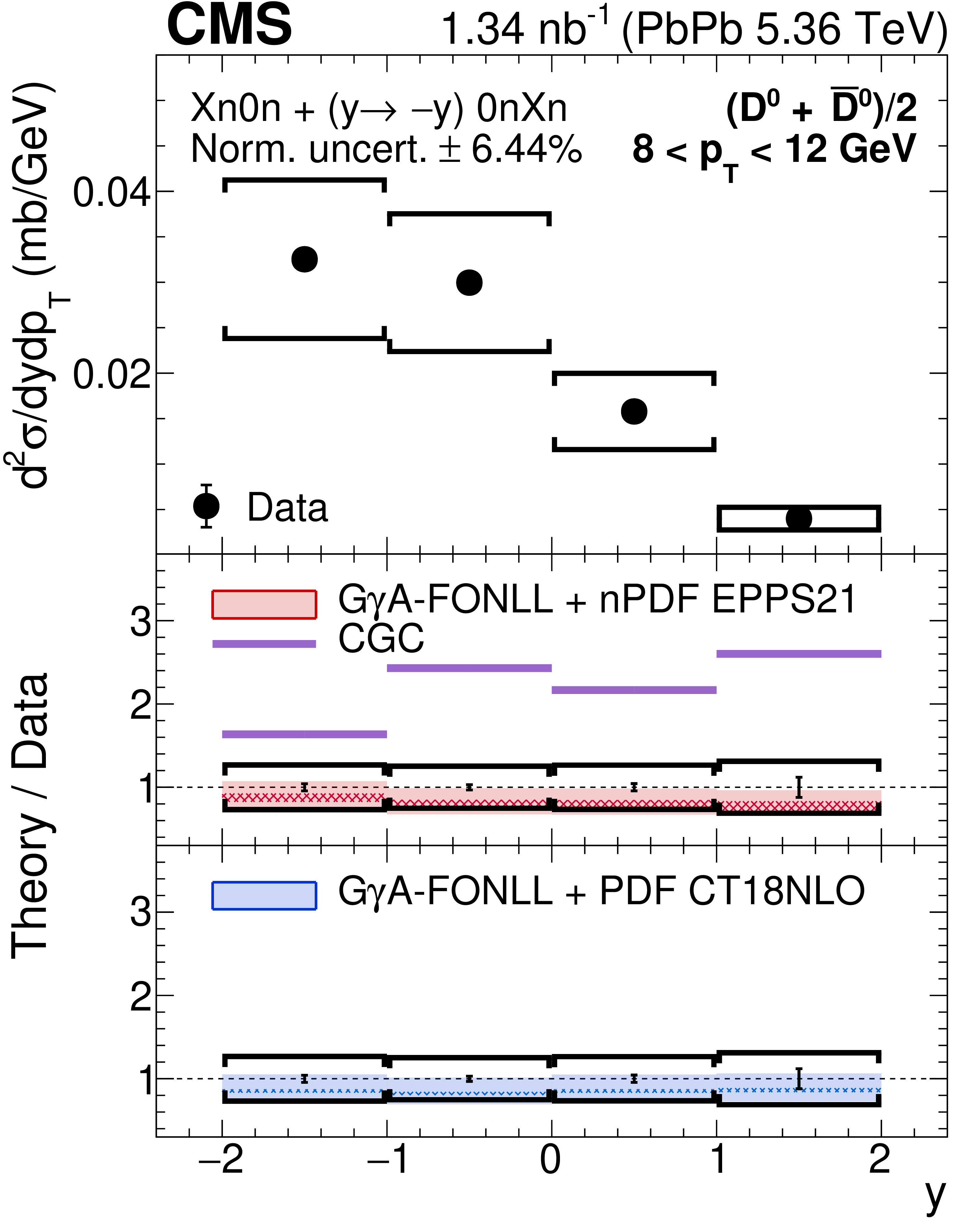
Cross sections for D$^0$ production in $ \gamma\mathrm{N} $ events ($ \mathrm{X}\mathrm{n}0\mathrm{n}+0\mathrm{n}\mathrm{X}\mathrm{n} $) in three $ p_{\mathrm{T}} $ intervals. Vertical bars (brackets) indicate statistical (systematic) uncertainties. Sub-panels show theory-over-data ratios: the middle panel compares G$ \gamma $A-FONLL with EPPS21 lead nPDFs and a CGC calculation [15], while the bottom panel shows G$ \gamma $A-FONLL with CT18NLO proton PDFs. Light-shaded bands reflect scale variations, hatched bands represent PDF and nPDF uncertainties. Vertical bars (brackets) represent statistical (systematic) uncertainties on data. |
png pdf |
Figure 2-a:
Cross sections for D$^0$ production in $ \gamma\mathrm{N} $ events ($ \mathrm{X}\mathrm{n}0\mathrm{n}+0\mathrm{n}\mathrm{X}\mathrm{n} $) in three $ p_{\mathrm{T}} $ intervals. Vertical bars (brackets) indicate statistical (systematic) uncertainties. Sub-panels show theory-over-data ratios: the middle panel compares G$ \gamma $A-FONLL with EPPS21 lead nPDFs and a CGC calculation [15], while the bottom panel shows G$ \gamma $A-FONLL with CT18NLO proton PDFs. Light-shaded bands reflect scale variations, hatched bands represent PDF and nPDF uncertainties. Vertical bars (brackets) represent statistical (systematic) uncertainties on data. |
png pdf |
Figure 2-b:
Cross sections for D$^0$ production in $ \gamma\mathrm{N} $ events ($ \mathrm{X}\mathrm{n}0\mathrm{n}+0\mathrm{n}\mathrm{X}\mathrm{n} $) in three $ p_{\mathrm{T}} $ intervals. Vertical bars (brackets) indicate statistical (systematic) uncertainties. Sub-panels show theory-over-data ratios: the middle panel compares G$ \gamma $A-FONLL with EPPS21 lead nPDFs and a CGC calculation [15], while the bottom panel shows G$ \gamma $A-FONLL with CT18NLO proton PDFs. Light-shaded bands reflect scale variations, hatched bands represent PDF and nPDF uncertainties. Vertical bars (brackets) represent statistical (systematic) uncertainties on data. |
png pdf |
Figure 2-c:
Cross sections for D$^0$ production in $ \gamma\mathrm{N} $ events ($ \mathrm{X}\mathrm{n}0\mathrm{n}+0\mathrm{n}\mathrm{X}\mathrm{n} $) in three $ p_{\mathrm{T}} $ intervals. Vertical bars (brackets) indicate statistical (systematic) uncertainties. Sub-panels show theory-over-data ratios: the middle panel compares G$ \gamma $A-FONLL with EPPS21 lead nPDFs and a CGC calculation [15], while the bottom panel shows G$ \gamma $A-FONLL with CT18NLO proton PDFs. Light-shaded bands reflect scale variations, hatched bands represent PDF and nPDF uncertainties. Vertical bars (brackets) represent statistical (systematic) uncertainties on data. |
| Summary |
| To summarize, this Letter presented the first measurement of the inclusive, prompt and nonprompt, photonuclear D$^0$ meson cross section as a function of transverse momentum and rapidity in ultraperipheral heavy-ion collisions. Exploiting the clean environment of photonuclear interactions, where final state and hadronization effects are largely reduced compared to hadronic production, this measurement provides novel constraints on nuclear matter over a wide range of parton momentum fraction $ x $ and interaction energy scale $ Q^{2} $. Comparisons with theory provide discrimination among parton distribution function parametrizations and challenge calculations based on nonlinear quantum chromodynamics evolution at high $ Q^{2} $. By demonstrating both its experimental feasibility and theoretical relevance, this study establishes open heavy-flavor production in ultraperipheral LHC collisions as a powerful probe of parton dynamics in nuclei. |
| References | ||||
| 1 | M. Strikman, R. Vogt, and S. N. White | Probing small $ x $ parton densities in ultraperipheral AA and pA collisions at the LHC | PRL 96 (2006) 082001 | hep-ph/0508296 |
| 2 | S. Klein and P. Steinberg | Photonuclear and two-photon interactions at high-energy nuclear colliders | Ann. Rev. Nucl. Part. Sci. 70 (2020) 323 | 2005.01872 |
| 3 | CMS Collaboration | Overview of high-density QCD studies with the CMS experiment at the LHC | Phys. Rept. 1115 (2025) 219 | CMS-HIN-23-011 2405.10785 |
| 4 | S. R. Klein, J. Nystrand, and R. Vogt | Heavy quark photoproduction in ultraperipheral heavy ion collisions | Phys. Rev. C 66 (2002) 044906 | hep-ph/0206220 |
| 5 | M. Cacciari, G. M. Innocenti, and A. M. Sta \'s to | Inclusive open charm photoproduction in ultraperipheral collisions at hthe LHC with G$ \gamma $A-FONLL | 2506.09893 | |
| 6 | O. Behnke, A. Geiser, and M. Lisovyi | Charm, beauty and top at HERA | Prog. Part. Nucl. Phys. 84 (2015) 1 | 1506.07519 |
| 7 | ALICE Collaboration | D-meson production in p-Pb collisions at $ \sqrt{\smash[b]{s_{_{\mathrm{NN}}}}}= $ 5.02 TeV and in pp collisions at $ \sqrt{s}= $ 7 TeV | Phys. Rev. C 94 (2016) 054908 | 1605.07569 |
| 8 | LHCb Collaboration | Study of prompt $ \mathrm{D^0} $ meson production in $ p\mathrm{Pb} $ collisions at $ \sqrt{\smash[b]{s_{_{\mathrm{NN}}}}}= $ 5 TeV | JHEP 10 (2017) 090 | 1707.02750 |
| 9 | CMS Collaboration | Elliptic flow of charm and strange hadrons in high-multiplicity pPb collisions at $ \sqrt{s_{_\mathrm{NN}}} = $ 8.16 TeV | PRL 121 (2018) 082301 | CMS-HIN-17-003 1804.09767 |
| 10 | ALICE Collaboration | $ \Lambda^+_c $ production and baryon-to-meson ratios in pp and p-Pb collisions at$ \sqrt{s_{_\mathrm{NN}}} = $ 5.02 TeV at the LHC | PRL 127 (2021) 202301 | 2011.06078 |
| 11 | LHCb Collaboration | Observation of strangeness enhancement with charmed mesons in high-multiplicity $ p\mathrm{Pb} $ collisions at $ \sqrt{s_{_\mathrm{NN}}} = $ 8.16 TeV | PRD 110 (2023) L031105 | 2311.08490 |
| 12 | V. P. Goncalves and C. A. Bertulani | Peripheral heavy ion collisions as a probe of the nuclear gluon distribution | Phys. Rev. C 65 (2002) 054905 | hep-ph/0110370 |
| 13 | V. P. Goncalves and M. V. T. Machado | The QCD pomeron in ultraperipheral heavy ion collisions. 3. Photonuclear production of heavy quarks | EPJC 31 (2003) 371 | hep-ph/0308120 |
| 14 | A. Adeluyi, C. A. Bertulani, and M. J. Murray | Nuclear effects in photoproduction of heavy quarks and vector mesons in ultraperipheral PbPb and pPb collisions at the LHC | Phys. Rev. C 86 (2012) 047901 | 1208.6258 |
| 15 | P. Gimeno-Estivill, T. Lappi, and H. Mäntysaari | Inclusive $ \mathrm{D}^0 $ photoproduction in ultraperipheral collisions | 2503.16108 | |
| 16 | CMS Collaboration | HEPData record for this analysis | link | |
| 17 | O. Suranyi et al. | Performance of the CMS Zero Degree Calorimeters in pPb collisions at the LHC | JINST 16 (2021) P05008 | 2102.06640 |
| 18 | CMS Collaboration | L1 trigger and ZDC performance during 2023 heavy ion run | CMS Detector Performance Note CMS-DP-2024-002, 2023 CDS |
|
| 19 | CMS Collaboration | Particle-flow reconstruction and global event description with the CMS detector | JINST 12 (2017) P10003 | CMS-PRF-14-001 1706.04965 |
| 20 | CMS Collaboration | The CMS trigger system | JINST 12 (2017) P01020 | CMS-TRG-12-001 1609.02366 |
| 21 | CMS Collaboration | The CMS experiment at the CERN LHC | JINST 3 (2008) S08004 | |
| 22 | CMS Collaboration | Development of the CMS detector for the CERN LHC Run 3 | JINST 19 (2024) P05064 | |
| 23 | CMS Collaboration | Performance of missing transverse momentum reconstruction in proton-proton collisions at $ \sqrt{s} = $ 13 TeV using the CMS detector | JINST 14 (2019) P07004 | CMS-JME-17-001 1903.06078 |
| 24 | C. Bierlich et al. | A comprehensive guide to the physics and usage of PYTHIA 8.3 | SciPost Phys. Codeb. 2022 (2022) 8 | 2203.11601 |
| 25 | I. Helenius | Simulations of photo-nuclear dijets with Pythia 8 and their sensitivity to nuclear PDFs | PoS DIS 113, 2018 link |
1806.07326 |
| 26 | F. Cornet, P. Jankowski, M. Krawczyk, and A. Lorca | New 5-flavor LO analysis and parametrization of parton distributions in the real photon | PRD 68 (2003) 014010 | |
| 27 | K. J. Eskola, P. Paakkinen, H. Paukkunen, and C. A. Salgado | EPPS21: a global QCD analysis of nuclear PDFs | EPJC 82 (2022) 413 | 2112.12462 |
| 28 | GEANT4 Collaboration | GEANT4 --- a simulation toolkit | NIM A 506 (2003) 250 | |
| 29 | D. J. Lange | The EVTGEN particle decay simulation package | NIM A 462 (2001) 152 | |
| 30 | E. Barberio, B. van Eijk, and Z. Was | PHOTOS: A universal Monte Carlo for QED radiative corrections in decays | Comput. Phys. Commun. 66 (1991) 115 | |
| 31 | CMS Collaboration | Nuclear modification factor of D$ ^0 $ mesons in PbPb collisions at $ \sqrt{\smash[b]{s_{_{\mathrm{NN}}}}} = $ 5.02 TeV | PLB 782 (2018) 474 | CMS-HIN-16-001 1708.04962 |
| 32 | CMS Collaboration | Description and performance of track and primary-vertex reconstruction with the CMS tracker | JINST 9 (2014) P10009 | CMS-TRK-11-001 1405.6569 |
| 33 | Particle Data Group | Review of particle physics | PRD 110 (2024) 030001 | |
| 34 | G. E. Forden and D. H. Saxon | Improving vertex position determination by using a kinematic fit | technical report, RAL, Chilton, 1985 | |
| 35 | ALICE Collaboration | Measurement of the cross section for electromagnetic dissociation with neutron emission in PbPb Collisions at $ \sqrt{\smash[b]{s_{_{\mathrm{NN}}}}} = $ 2.76 TeV | PRL 109 (2012) 252302 | 1203.2436 |
| 36 | CMS Collaboration | Search for the rare decay D$ ^0 \to \mu^+\mu^- $ in proton-proton collisions at $ \sqrt{s} = $ 13.6 TeV | Submitted to Phys. Rev. Lett, 2025 | CMS-BPH-23-008 2506.06152 |
| 37 | CMS Collaboration | CMS luminosity measurement for nucleus-nucleus collisions at 5.02 TeV in Run 2 | technical report, CERN, Geneva, 2024 CDS |
|
| 38 | M. Cacciari, M. Greco, and P. Nason | The $ p_{\mathrm{T}} $ spectrum in heavy-flavor hadroproduction. | JHEP 05 (1998) 007 | hep-ph/9803400 |
| 39 | M. Cacciari, S. Frixione, and P. Nason | The $ p_{\mathrm{T}} $ spectrum in heavy-flavor photoproduction | JHEP 03 (2001) 006 | hep-ph/0102134 |
| 40 | S. Frixione and P. Nason | Phenomenological study of charm photoproduction at HERA | JHEP 03 (2002) 053 | hep-ph/0201281 |
| 41 | K. J. Eskola et al. | Spatial resolution of dijet photoproduction in near-encounter ultraperipheral nuclear collisions | Phys. Rev. C 110 (2024) 054906 | 2404.09731 |
| 42 | T.-J. Hou et al. | New CTEQ global analysis of quantum chromodynamics with high-precision data from the LHC | PRD 103 (2021) 014013 | 1912.10053 |
|
|
Compact Muon Solenoid LHC, CERN |

|
|
|
|
|
|