Compact Muon Solenoid
LHC, CERN
 Visit us: CMS Public Website, CMS Physics ;
Contact us: CMS Publications Committee
Visit us: CMS Public Website, CMS Physics ;
Contact us: CMS Publications Committee
| CMS-PAS-HIN-25-022 | ||
| Azimuthal anisotropy of prompt $ \Lambda_{\mathrm{c}}^{\pm} $ baryons in PbPb collisions at $ \sqrt{s_{\mathrm{NN}}} = $ 5.36 TeV | ||
| CMS Collaboration | ||
| 2026-08-03 | ||
| Abstract: The azimuthal anisotropy of $ \Lambda_{\mathrm{c}}^{\pm} $ baryons in lead-lead (PbPb) collisions at a center-of-mass energy per nucleon pair of 5.36 TeV is presented. The data were collected by the CMS experiment at the CERN LHC in 2023 and correspond to an integrated luminosity of 1.48 $ \mathrm{nb}^{-1} $. The anisotropy is characterized by the second-order Fourier coefficient ($ v_{2} $) of the azimuthal distribution. Using the exclusive hadronic decay channel $ \Lambda_{\mathrm{c}}^{\pm} \to \mathrm{p}\mathrm{K}^{\mp}\pi^{\pm} $, the $ \Lambda_{\mathrm{c}}^{\pm} $ candidates with transverse momenta 4 $ < p_{\mathrm{T}} < $ 40 GeV are measured in the mid-rapidity range $ |y| < $ 1.0. Results for the 30 $ -50% $ centrality interval, where 0% centrality corresponds to full overlap of the colliding nuclei, are compared with a prompt $ \mathrm{D}^{0} $ meson measurement and with theoretical transport models. Models that include radiative energy loss of high-$ p_{\mathrm{T}} $ quarks in the created medium can describe the experimental observations. Crucially, at high $ p_{\mathrm{T}} $ ($ > $ 10 GeV), the $ \Lambda_{\mathrm{c}}^{\pm} $ baryon and $ \mathrm{D}^{0} $ meson $ v_{2} $ coefficients are comparable, as determined with improved precision compared to previous measurements. This convergence indicates that hadronization-specific collective effects subside at high momentum, where the path-length dependence of the partonic energy loss becomes the dominant mechanism shaping the charm-flavor anisotropy. | ||
| Links: CDS record (PDF) ; CADI line (restricted) ; | ||
| Figures | |
png pdf |
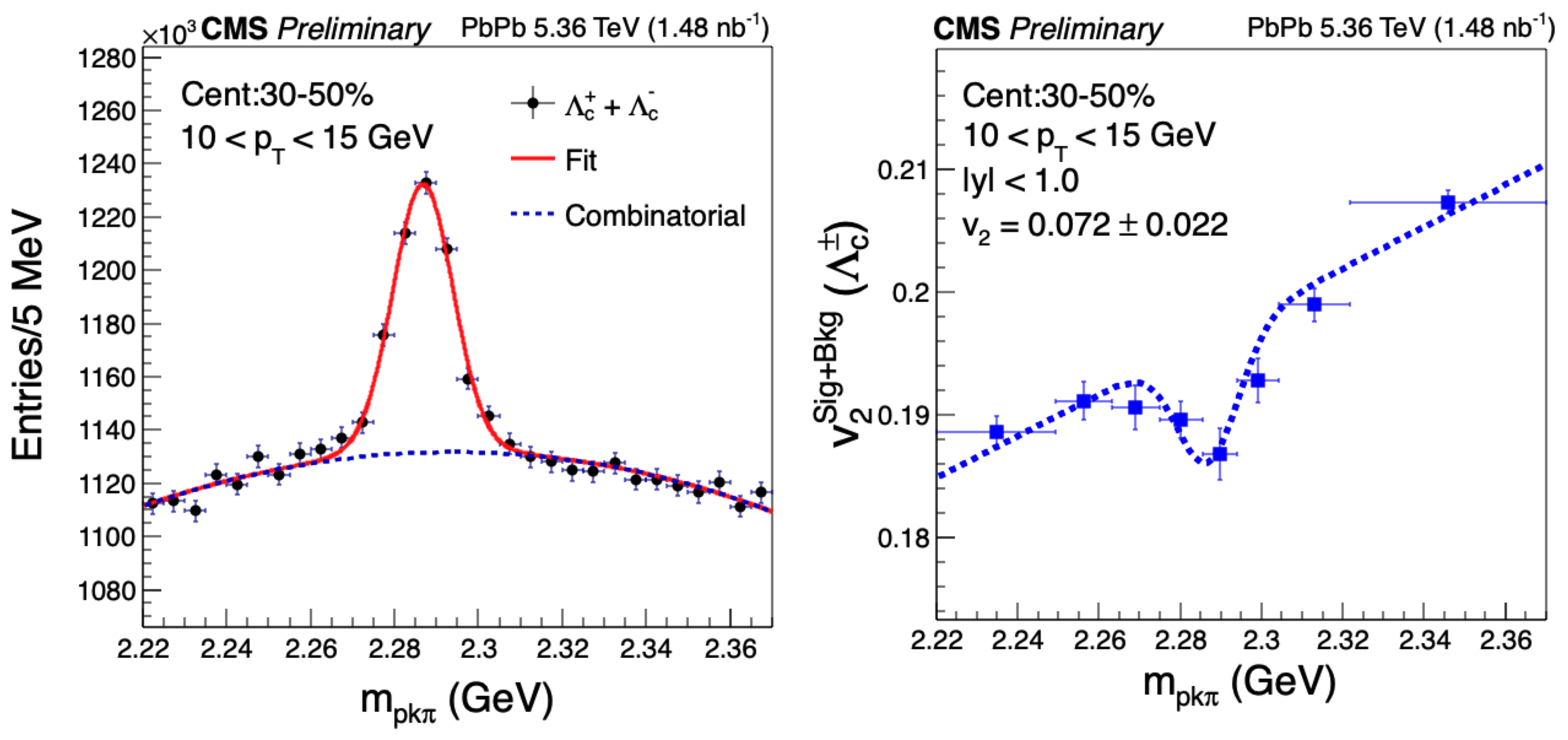
Figure 1:
The left panel shows an example of the invariant mass ($ m_{\text{inv}} $) spectrum fit for $ \Lambda_{\mathrm{c}}^{\pm} $ candidates in the $ \Lambda_{\mathrm{c}}^{\pm} $ $ p_{\mathrm{T}} $ range 10--15 GeV for the centrality interval 30--50%. The right panel shows an example of the simultaneous fit where the $ v_{2} $ value of the combined signal and background ($ {v_2}^\text{Sig+Bkg} $) is modeled as a function of the invariant mass. For both panels, the horizontal lines represent the $ m_{\text{inv}} $ mass binning and the vertical lines represent the statistical uncertainties. |
png pdf |
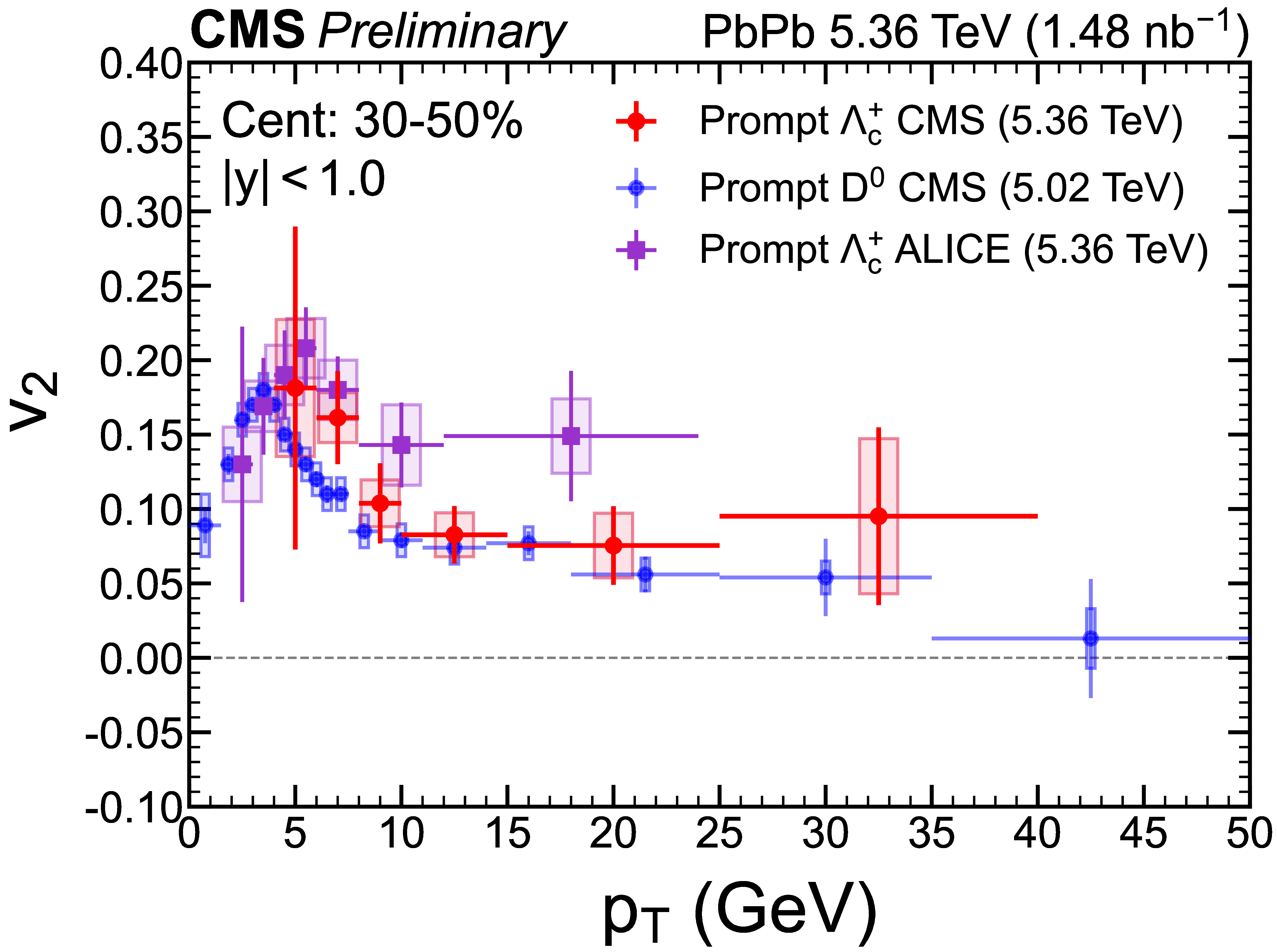
Figure 2:
The $ v_{2} $ coefficients for prompt $ \Lambda_{\mathrm{c}}^{\pm} $ baryons (filled red circles) as a function of $ p_{\mathrm{T}} $ in PbPb collisions at $ \sqrt{\smash[b]{s_{_{\mathrm{NN}}}}} = $ 5.36 TeV in the 30--50% centrality interval. The results are compared with prompt $ \mathrm{D^0} $ meson measurements (open blue circles) from CMS [16] and $ \Lambda_{\mathrm{c}}^{\pm} $ measurements (filled purple boxes) from the ALICE Collaboration [44]. The vertical bars and shaded boxes represent statistical and systematic uncertainties, respectively. Horizontal bars indicate the $ p_{\mathrm{T}} $ bin widths. |
png pdf |
Figure 3:
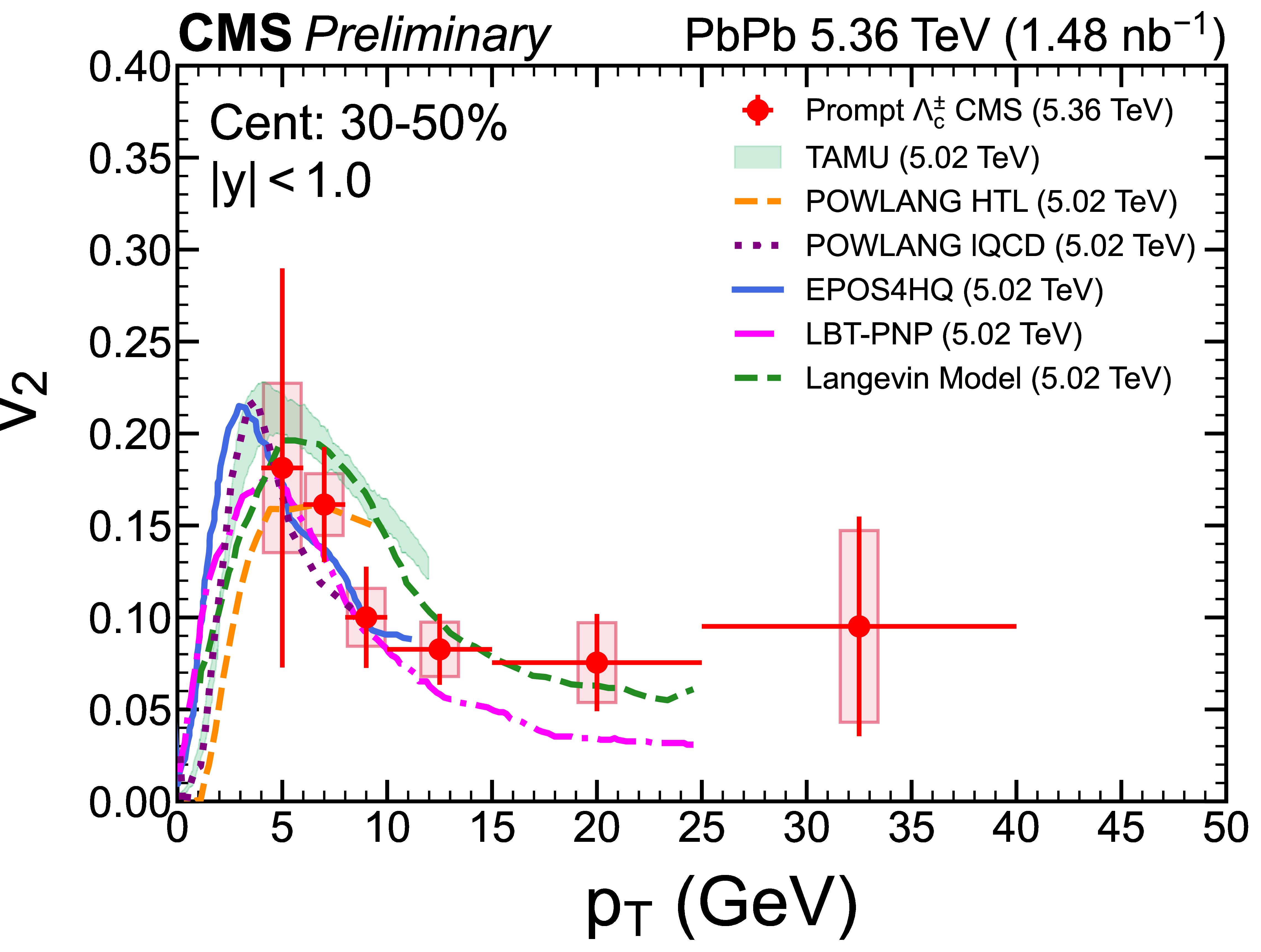
The elliptic flow coefficient $ v_{2} $ of prompt $ \Lambda_{\mathrm{c}}^{\pm} $ baryons as a function of $ p_{\mathrm{T}} $ in PbPb collisions at $ \sqrt{\smash[b]{s_{_{\mathrm{NN}}}}} = $ 5.36 TeV, for the 30--50% centrality interval and $ |y| < $ 1.0. The CMS results (red markers) are compared with theoretical model predictions calculated at $ \sqrt{\smash[b]{s_{_{\mathrm{NN}}}}} = $ 5.02 TeV, including EPOS4HQ (solid blue curve), POWLANG HTL (dashed orange curve) and lQCD (dotted purple curve), LBT (dot-dashed pink curve), and Langevin-based calculations (dashed green curve) [45,46,47,48,49,50,51], as well as the TAMU prediction (green shaded band) [52]. Vertical bars and open boxes represent statistical and systematic uncertainties, respectively. |
| Tables | |
png pdf |
Table 1:
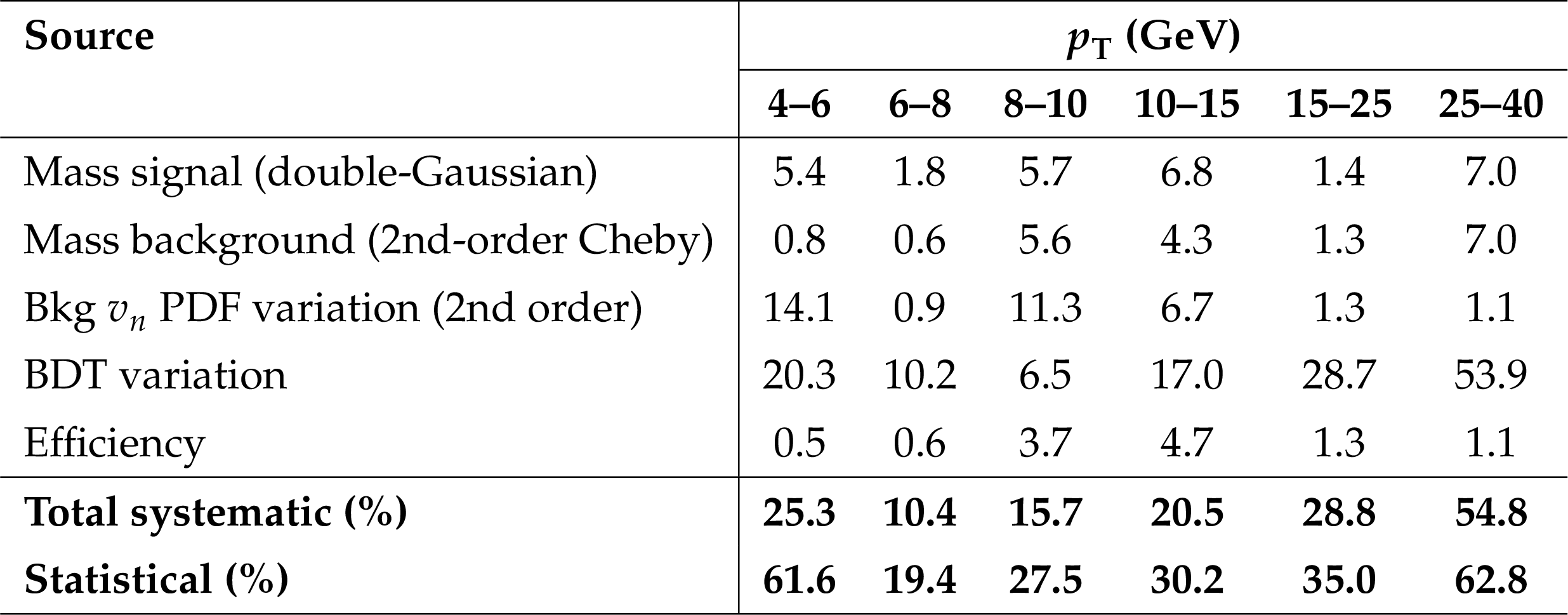
Relative systematic and statistical uncertainties (% of $ v_{2}^{\text{nom}} $) for $ \Lambda_{\mathrm{c}}^{\pm} $ $ v_{2} $ in the 30--50% centrality interval. Each entry is $ \delta_{\text{sys},i}/v_{2}^{\text{nom}}\times 100% $ and the total systematic row is the quadrature sum. |
| Summary |
| The elliptic flow Fourier coefficient ($ v_{2} $) of prompt $ \Lambda_{\mathrm{c}}^{\pm} $ baryons is measured by the CMS Collaboration in lead-lead collisions at a center-of-mass energy per nucleon pair of 5.36 TeV. Collisions are selected in the 30--50% centrality range, where centrality is based on the fraction of the total inelastic cross section, with 0% centrality corresponding to complete overlap of the colliding nuclei. The $ v_{2} $ values are found to be positive across the measured transverse momentum range (4 $ < p_{\mathrm{T}} < $ 40 GeV). In the lower $ p_{\mathrm{T}} $ range (4 $ < p_{\mathrm{T}} < $ 8 GeV), the magnitude of the $ v_{2} $ values indicates that charm quarks participate significantly in the collective expansion of the hot, dense medium created in the collision, known as the quark-gluon plasma (QGP). When compared with prompt $ \mathrm{D^0} $ mesons, larger prompt $ \Lambda_{\mathrm{c}}^{\pm} $ values in the 6 $ < p_{\mathrm{T}} < $ 8 GeV range are qualitatively consistent with quark coalescence, a hadronization mechanism in which a baryon forms by combining three nearby quarks from the medium, so that its flow reflects the combined motion of its three constituents rather than that of a single quark, as for a meson. However, the current statistical uncertainties are too large to claim increased baryon $ v_{2} $ values with confidence. At higher transverse momenta ($ p_{\mathrm{T}} > $ 10 GeV), significantly improved precision over previous measurements is achieved. Here, the $ v_{2} $ values of $ \Lambda_{\mathrm{c}}^{\pm} $ baryons and $ \mathrm{D^0} $ mesons are found to be comparable. In this range, the positive $ v_{2} $ values are predominantly attributed to the path-length dependence of partonic energy loss as quarks traverse the QGP, rather than to collective expansion of the medium. The experimental results are well described by models that combine quark coalescence at lower $ p_{\mathrm{T}} $ with parton energy loss in the QGP at higher $ p_{\mathrm{T}} $, reinforcing this two-mechanism picture of charm-flavor anisotropy. |
| References | ||||
| 1 | BRAHMS Collaboration | Quark-gluon plasma and color glass condensate at RHIC? the perspective from the BRAHMS experiment | Nucl. Phys. A 757 (2005) 1 | nucl-ex/0410020 |
| 2 | PHOBOS Collaboration | The PHOBOS perspective on discoveries at RHIC | Nucl. Phys. A 757 (2005) 28 | nucl-ex/0410022 |
| 3 | STAR Collaboration | Experimental and theoretical challenges in the search for the quark-gluon plasma: the STAR collaboration's critical assessment of the evidence from RHIC collisions | Nucl. Phys. A 757 (2005) 102 | nucl-ex/0501009 |
| 4 | PHENIX Collaboration | Formation of dense partonic matter in relativistic nucleus-nucleus collisions at RHIC: experimental evaluation by the PHENIX collaboration | Nucl. Phys. A 757 (2005) 184 | nucl-ex/0410003 |
| 5 | CMS Collaboration | Overview of high-density QCD studies with the CMS experiment at the LHC | Phys. Rept. 1115 (2025) 219 | CMS-HIN-23-011 2405.10785 |
| 6 | F. Prino and R. Rapp | Open heavy flavor in QCD matter and in nuclear collisions | JPG 43 (2016) 093002 | 1603.00529 |
| 7 | J.-Y. Ollitrault | Anisotropy as a signature of transverse collective flow | PRD 46 (1992) 229 | |
| 8 | U. Heinz and R. Snellings | Collective flow and viscosity in relativistic heavy-ion collisions | Ann. Rev. Nucl. Part. Sci. 63 (2013) 123 | 1301.2826 |
| 9 | C. Gale, S. Jeon, and B. Schenke | Hydrodynamic modeling of heavy-ion collisions | Int. J. Mod. Phys. A 28 (2013) 1340011 | 1301.5893 |
| 10 | M. Gyulassy, I. Vitev, and X.-N. Wang | High $ p_{\mathrm{T}} $ azimuthal asymmetry in noncentral A+A at RHIC | PRL 86 (2001) 2537 | nucl-th/0012092 |
| 11 | E. V. Shuryak | Azimuthal asymmetry at large $ p_{\mathrm{T}} $ seem to be too large for a pure 'jet quenching' | Phys. Rev. C 66 (2002) 027902 | nucl-th/0112042 |
| 12 | ALICE Collaboration | Direct observation of the dead-cone effect in quantum chromodynamics | Nature 605 (2022) 440 | 2106.05713 |
| 13 | Y. L. Dokshitzer and D. E. Kharzeev | Heavy-quark colorimetry of QCD matter | PLB 519 (2001) 199 | hep-ph/0106202 |
| 14 | ALICE Collaboration | D-meson azimuthal anisotropy in midcentral PbPb collisions at $ \sqrt{\smash[b]{s_{_{\mathrm{NN}}}}}= $ 5.02 TeV | PRL 120 (2018) 102301 | 1707.01005 |
| 15 | CMS Collaboration | Measurement of prompt $ \mathrm{D^0} $ meson azimuthal anisotropy in PbPb collisions at $ \sqrt{\smash[b]{s_{_{\mathrm{NN}}}}}= $ 5.02 TeV | PRL 120 (2018) 202301 | CMS-HIN-16-007 1708.03497 |
| 16 | CMS Collaboration | Measurement of prompt $ \mathrm{D}^0 $ and $ \overline{\mathrm{D}}^0 $ meson azimuthal anisotropy and search for strong electric fields in PbPb collisions at $ \sqrt{\smash[b]{s_{_{\mathrm{NN}}}}}= $ 5.02 TeV | PLB 816 (2021) 136253 | CMS-HIN-19-008 2009.12628 |
| 17 | ATLAS Collaboration | Measurement of azimuthal anisotropy of muons from charm and bottom hadrons in Pb+Pb collisions at $ \sqrt{\smash[b]{s_{_{\mathrm{NN}}}}}= $ 5.02 TeV with the ATLAS detector | PLB 807 (2020) 135595 | 2003.03565 |
| 18 | ALICE Collaboration | $ \mathrm{J}/\psi $ elliptic and triangular flow in PbPb collisions at $ \sqrt{\smash[b]{s_{_{\mathrm{NN}}}}}= $ 5.02 TeV | JHEP 10 (2020) 141 | 2005.14518 |
| 19 | ALICE Collaboration | Transverse-momentum and event-shape dependence of D-meson flow harmonics in PbPb collisions at $ \sqrt{\smash[b]{s_{_{\mathrm{NN}}}}}= $ 5.02 TeV | PLB 813 (2021) 136054 | 2005.11131 |
| 20 | CMS Collaboration | Probing charm quark dynamics via multiparticle correlations in PbPb collisions at $ \sqrt{\smash[b]{s_{_{\mathrm{NN}}}}}= $ 5.02 TeV | PRL 129 (2022) 022001 | CMS-HIN-20-001 2112.12236 |
| 21 | CMS Collaboration | Measurements of the azimuthal anisotropy of prompt and nonprompt charmonia in PbPb collisions at $ \sqrt {\smash [b]{s_{_{\mathrm {NN}}}}} = $ 5.02 TeV | JHEP 10 (2023) 115 | CMS-HIN-21-008 2305.16928 |
| 22 | R. J. Fries, B. M \"u ller, C. Nonaka, and S. A. Bass | Hadronization in heavy-ion collisions: recombination and fragmentation of partons | PRL 90 (2003) 202303 | nucl-th/0301087 |
| 23 | V. Greco, C. M. Ko, and P. L é vai | Parton coalescence and the antiproton/pion anomaly at RHIC | PRL 90 (2003) 202302 | nucl-th/0301093 |
| 24 | M. He, R. J. Fries, and R. Rapp | Heavy-quark diffusion and hadronization in quark-gluon plasma | Phys. Rev. C 86 (2012) 014903 | 1106.6006 |
| 25 | CMS Collaboration | Development of the CMS detector for the CERN LHC Run 3 | JINST 19 (2024) P05064 | CMS-PRF-21-001 2309.05466 |
| 26 | CMS Collaboration | Electron and photon reconstruction and identification with the CMS experiment at the CERN LHC | JINST 16 (2021) P05014 | CMS-EGM-17-001 2012.06888 |
| 27 | CMS Collaboration | Performance of the CMS muon detector and muon reconstruction with proton-proton collisions at $ \sqrt{s}= $ 13 TeV | JINST 13 (2018) P06015 | CMS-MUO-16-001 1804.04528 |
| 28 | CMS Collaboration | Observation and studies of jet quenching in PbPb collisions at $ \sqrt{\smash[b]{s_{_{\mathrm{NN}}}}}= $ 2.76 TeV | Phys. Rev. C 84 (2011) 024906 | CMS-HIN-10-004 1102.1957 |
| 29 | CMS Collaboration | Performance of the CMS level-1 trigger in proton-proton collisions at $ \sqrt{s}= $ 13 TeV | JINST 15 (2020) P10017 | CMS-TRG-17-001 2006.10165 |
| 30 | CMS Collaboration | Performance of the CMS high-level trigger during LHC Run 2 | JINST 19 (2024) P11021 | CMS-TRG-19-001 2410.17038 |
| 31 | CMS Collaboration | Charged-particle nuclear modification factors in PbPb and pPb collisions at $ \sqrt{\smash[b]{s_{_{\mathrm{NN}}}}}= $ 5.02 TeV | JHEP 04 (2017) 039 | CMS-HIN-15-015 1611.01664 |
| 32 | T. Sjöstrand et al. | An introduction to PYTHIA 8.2 | Comput. Phys. Commun. 191 (2015) 159 | 1410.3012 |
| 33 | CMS Collaboration | Extraction and validation of a new set of CMS PYTHIA8 tunes from underlying-event measurements | EPJC 80 (2020) 4 | CMS-GEN-17-001 1903.12179 |
| 34 | D. J. Lange | The EVTGEN particle decay simulation package | NIM A 462 (2001) 152 | |
| 35 | I. P. Lokhtin and A. M. Snigirev | A model of jet quenching in ultrarelativistic heavy ion collisions and high-$ p_{\mathrm{T}} $ hadron spectra at RHIC | EPJC 45 (2006) 211 | hep-ph/0506189 |
| 36 | GEANT4 Collaboration | GEANT 4---a simulation toolkit | NIM A 506 (2003) 250 | |
| 37 | CMS Collaboration | Description and performance of track and primary-vertex reconstruction with the CMS tracker | JINST 9 (2014) P10009 | CMS-TRK-11-001 1405.6569 |
| 38 | Particle Data Group Collaboration | Review of particle physics | PRD 110 (2024) 030001 | |
| 39 | A. Hocker et al. | TMVA --- toolkit for multivariate data analysis | PoS ACAT 04 (2007) 0 | physics/0703039 |
| 40 | T. Fawcett | An introduction to ROC analysis | Pattern Recognition Letters 27 (2006) 861 | |
| 41 | STAR Collaboration | Elliptic flow from two- and four-particle correlations in Au+Au collisions at $ \sqrt{\smash[b]{s_{_{\mathrm{NN}}}}}= $ 130 GeV | Phys. Rev. C 66 (2002) 034904 | nucl-ex/0206001 |
| 42 | A. M. Poskanzer and S. A. Voloshin | Methods for analyzing anisotropic flow in relativistic nuclear collisions | Phys. Rev. C 58 (1998) 1671 | nucl-ex/9805001 |
| 43 | NA49 Collaboration | Directed and elliptic flow of charged pions and protons in Pb+Pb collisions at 40A and 158A GeV | Phys. Rev. C 68 (2003) 034903 | nucl-ex/0303001 |
| 44 | ALICE Collaboration | Evidence of different $ \Lambda_{\mathrm{c}} $ baryon and D meson elliptic flow in PbPb collisions at $ \sqrt{\smash[b]{s_{_{\mathrm{NN}}}}}= $ 5.36 TeV with ALICE at the LHC | 2603.18966 | |
| 45 | J. Zhao et al. | Heavy flavour hadron production in relativistic heavy ion collisions at rhic and lhc in epos4hq | Phys. Rev. C 110 (2024) 024909 | 2401.17096 |
| 46 | A. Beraudo et al. | In-medium hadronization of heavy quarks and its effect on charmed meson and baryon distributions in heavy-ion collisions | EPJC 82 (2022) 607 | 2202.08732 |
| 47 | A. Beraudo et al. | Heavy-flavor transport and hadronization in $ pp $ collisions | PRD 109 (2024) L011501 | 2306.02152 |
| 48 | W. Ke, Y. Xu, and S. A. Bass | Linearized Boltzmann-Langevin model for heavy quark transport in hot and dense QCD matter | Phys. Rev. C 98 (2018) 064901 | 1806.08848 |
| 49 | W.-J. Xing, G.-Y. Qin, and S. Cao | Perturbative and non-perturbative interactions between heavy quarks and quark-gluon plasma within a unified approach | PLB 838 (2023) 137733 | 2112.15062 |
| 50 | S.-Q. Li et al. | Scaling behaviors of heavy flavor meson suppression and flow in different nuclear collision systems at the LHC | EPJC 81 (2021) 1035 | 2108.06648 |
| 51 | S.-Q. Li et al. | Heavy flavor quenching and flow: the roles of initial condition, pre-equilibrium evolution, and in-medium interaction | Chin. Phys. C 44 (2020) 114101 | 2005.03330 |
| 52 | M. He and R. Rapp | Hadronization and charm-hadron ratios in heavy-ion collisions | PRL 124 (2020) 042301 | 1905.09216 |
| 53 | ALICE Collaboration | Energy dependence and fluctuations of anisotropic flow in PbPb collisions at $ \sqrt{\smash[b]{s_{_{\mathrm{NN}}}}}= $ 5.02 and 2.76 TeV | JHEP 07 (2018) 103 | 1804.02944 |
|
|
Compact Muon Solenoid LHC, CERN |

|
|
|
|
|
|