Compact Muon Solenoid
LHC, CERN
 Visit us: CMS Public Website, CMS Physics ;
Contact us: CMS Publications Committee
Visit us: CMS Public Website, CMS Physics ;
Contact us: CMS Publications Committee
| CMS-PAS-EXO-25-021 | ||
| Search for resonant new phenomena in high-mass dilepton final states at $ \sqrt{s}= $ 13.6 TeV | ||
| CMS Collaboration | ||
| 2026-05-16 | ||
| Abstract: A search for heavy new resonances decaying into pairs of electrons or muons is presented. The search uses proton-proton collision data at a centre-of-mass energy of $ \sqrt{s}= $ 13.6 TeV, collected by the CMS experiment at the LHC during 2022-2025 and corresponding to an integrated luminosity of 283 fb$ ^{-1} $. A model-independent search for heavy resonances is conducted covering a wide mass range spanning from 200 GeV to 6 TeV. No significant deviation is observed with respect to the Standard Model expectation. Upper limits are presented on the ratio of the product of the production cross section and the branching fraction to dileptons of a new narrow resonance to that of the Z boson. These provide the most stringent lower limits to date on the mass for various spin-1 particles and spin-2 gravitons in the Randall-Sundrum model. In particular, lower mass limits of 5.55 (4.95) TeV are set on $ \text{Z'}_\mathrm{SSM} $ ($ \text{Z'}_\psi $) bosons at 95% confidence level. | ||
| Links: CDS record (PDF) ; Physics Briefing ; CADI line (restricted) ; | ||
| Figures & Tables | Summary | Additional Figures | References | CMS Publications |
|---|
| Figures | |
png pdf |
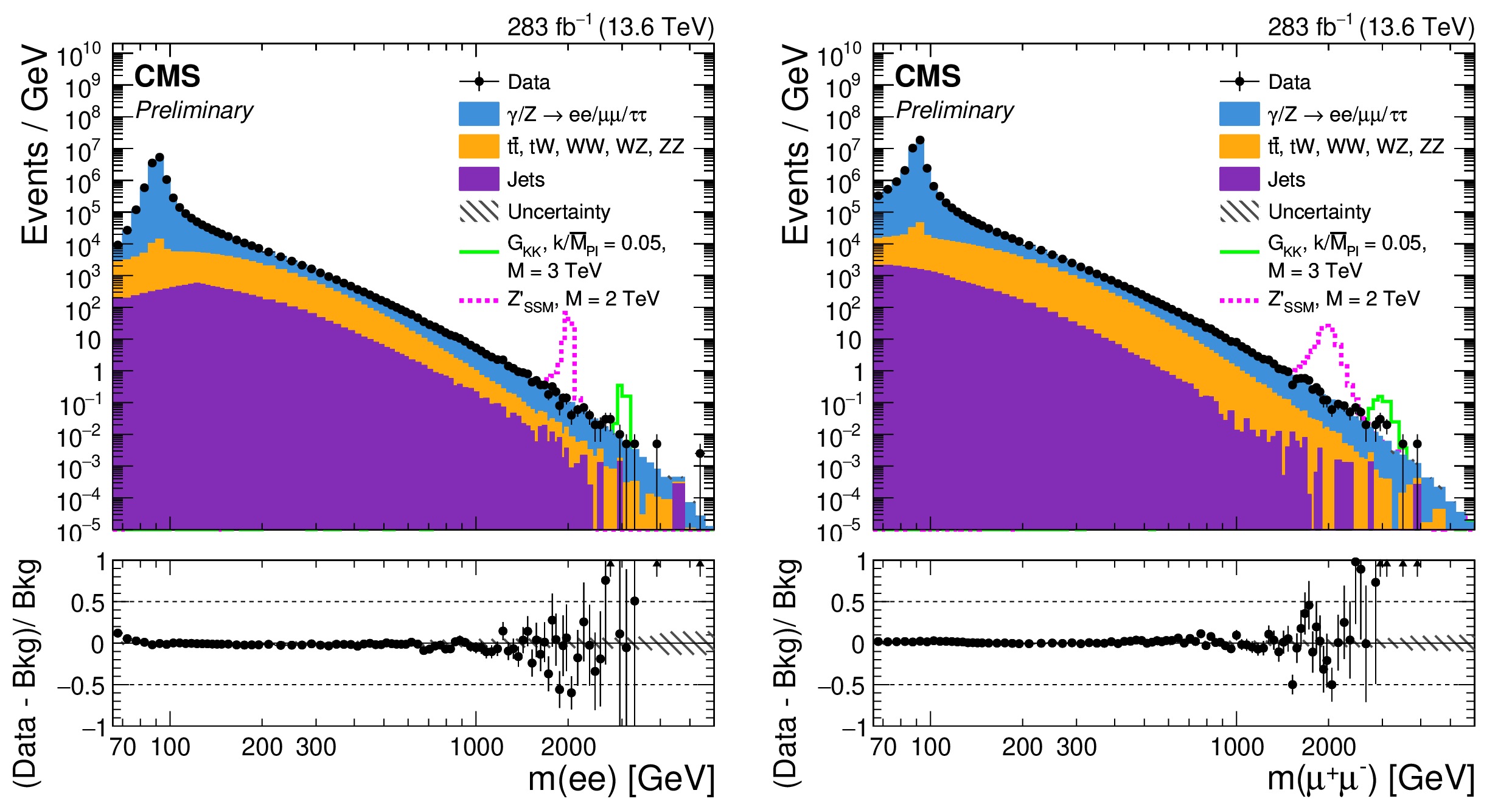
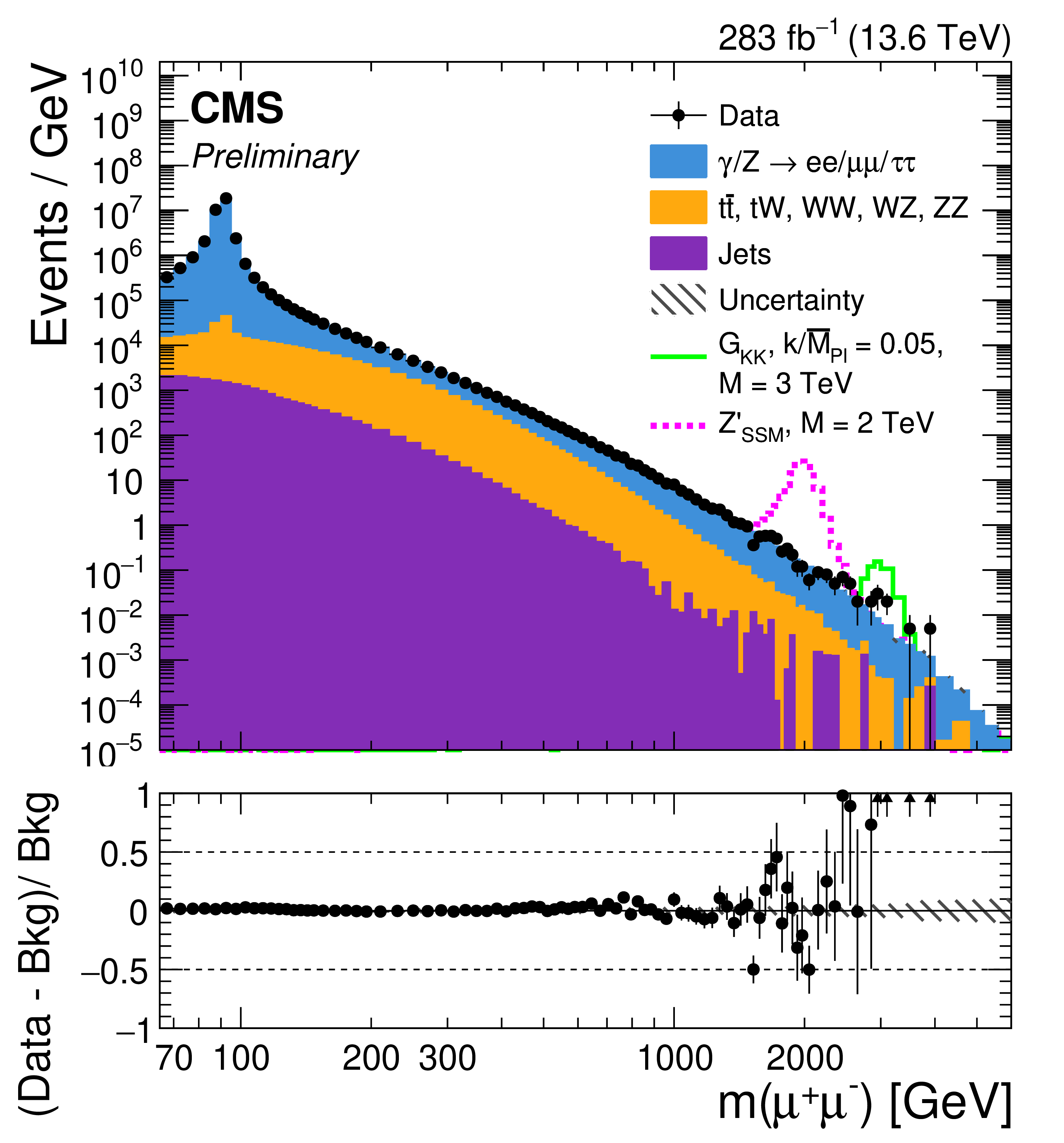
Figure 1:
The dielectron (left) and dimuon (right) invariant mass distribution combining the two $ \eta $ categories of each lepton channel. Two example signal distributions for a $ \mathrm{Z}^{'}_\mathrm{SSM} $ with a mass of 2 TeV and a $ \mathrm{G}_\mathrm{KK} $ with a mass of 3 TeV and coupling parameter of $ k/\overline{M}_\mathrm{Pl} = $ 0.05 are also depicted for illustration. |
png pdf |
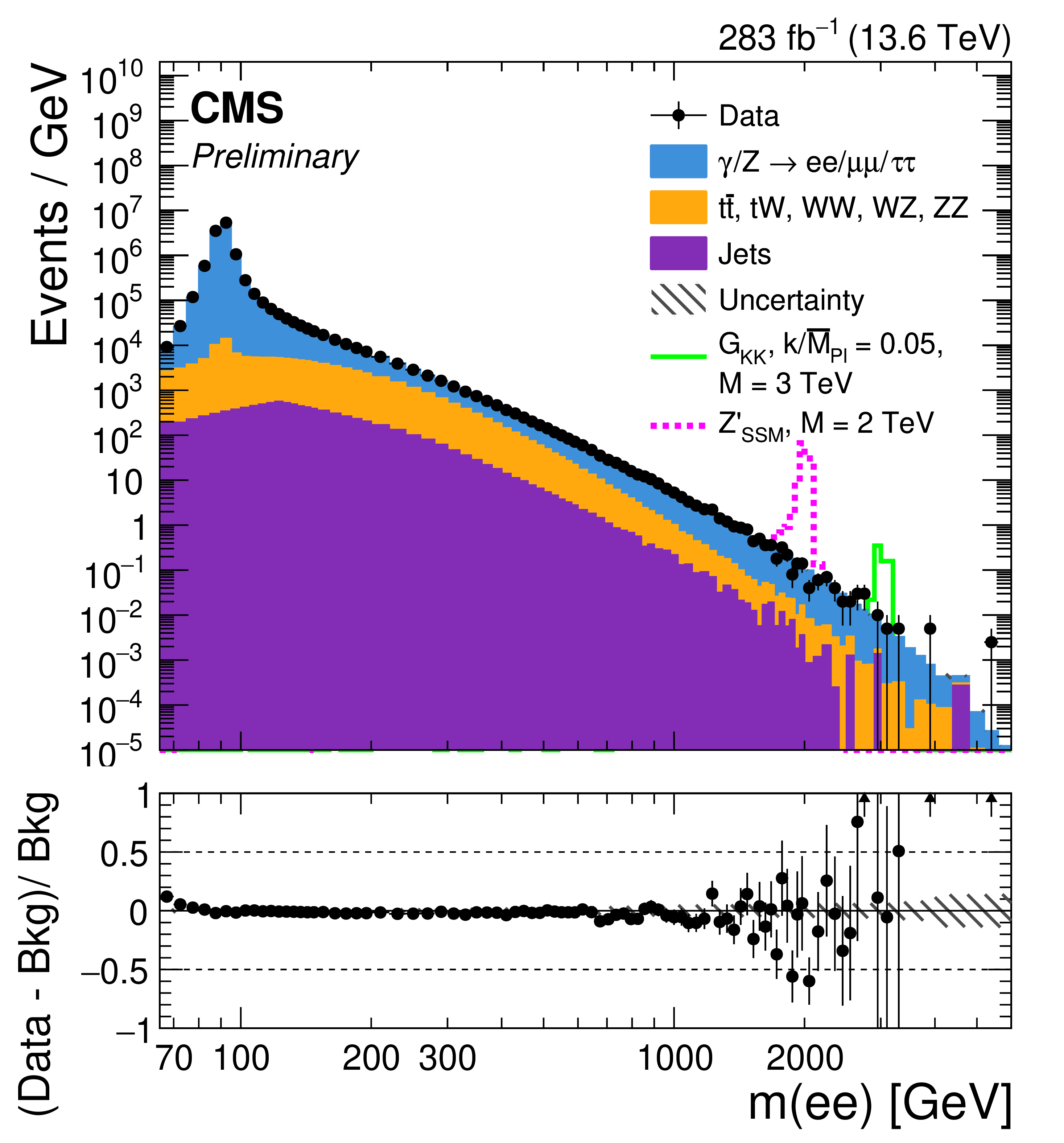
Figure 1-a:
The dielectron (left) and dimuon (right) invariant mass distribution combining the two $ \eta $ categories of each lepton channel. Two example signal distributions for a $ \mathrm{Z}^{'}_\mathrm{SSM} $ with a mass of 2 TeV and a $ \mathrm{G}_\mathrm{KK} $ with a mass of 3 TeV and coupling parameter of $ k/\overline{M}_\mathrm{Pl} = $ 0.05 are also depicted for illustration. |
png pdf |
Figure 1-b:
The dielectron (left) and dimuon (right) invariant mass distribution combining the two $ \eta $ categories of each lepton channel. Two example signal distributions for a $ \mathrm{Z}^{'}_\mathrm{SSM} $ with a mass of 2 TeV and a $ \mathrm{G}_\mathrm{KK} $ with a mass of 3 TeV and coupling parameter of $ k/\overline{M}_\mathrm{Pl} = $ 0.05 are also depicted for illustration. |
png pdf |
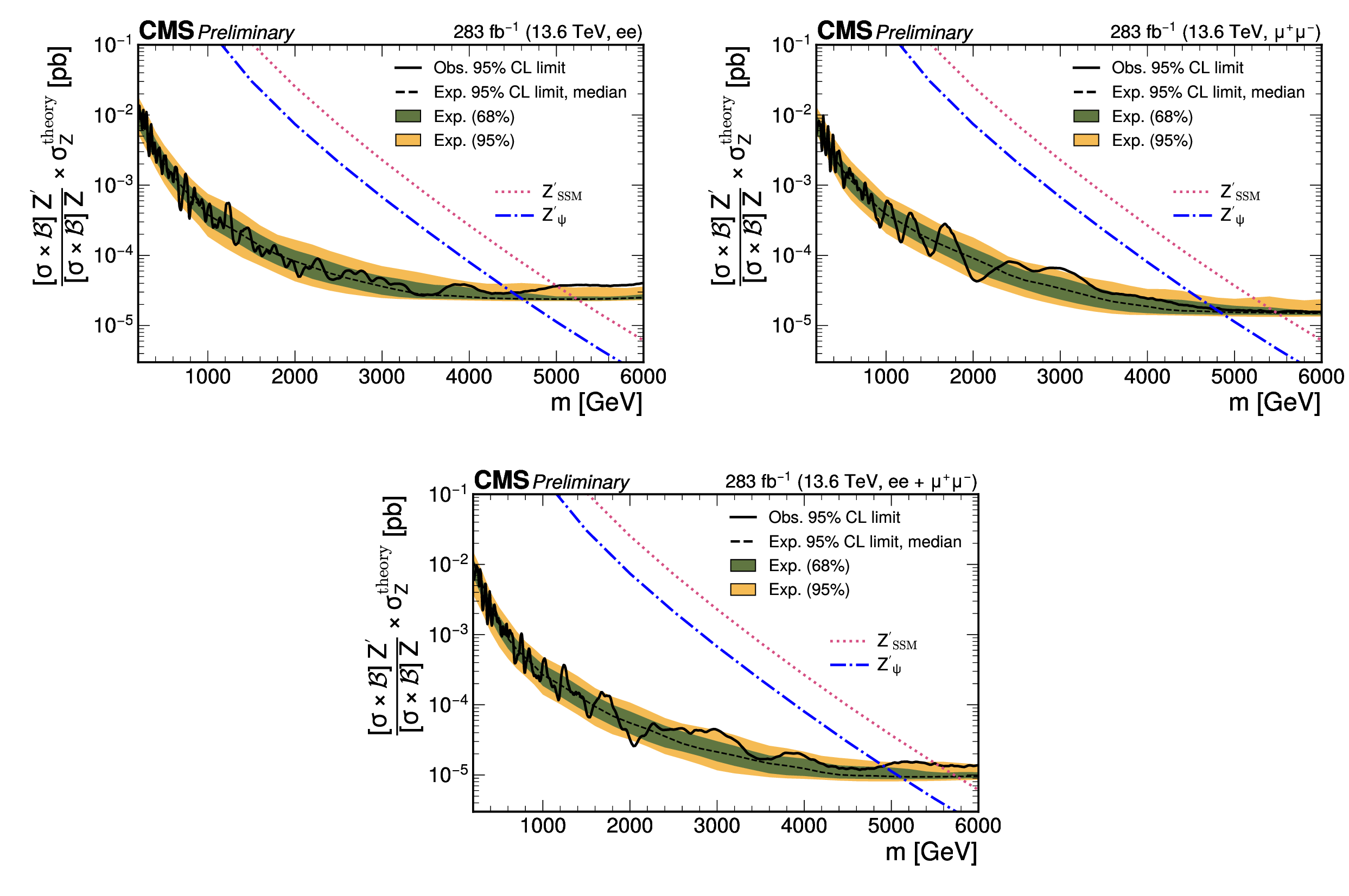
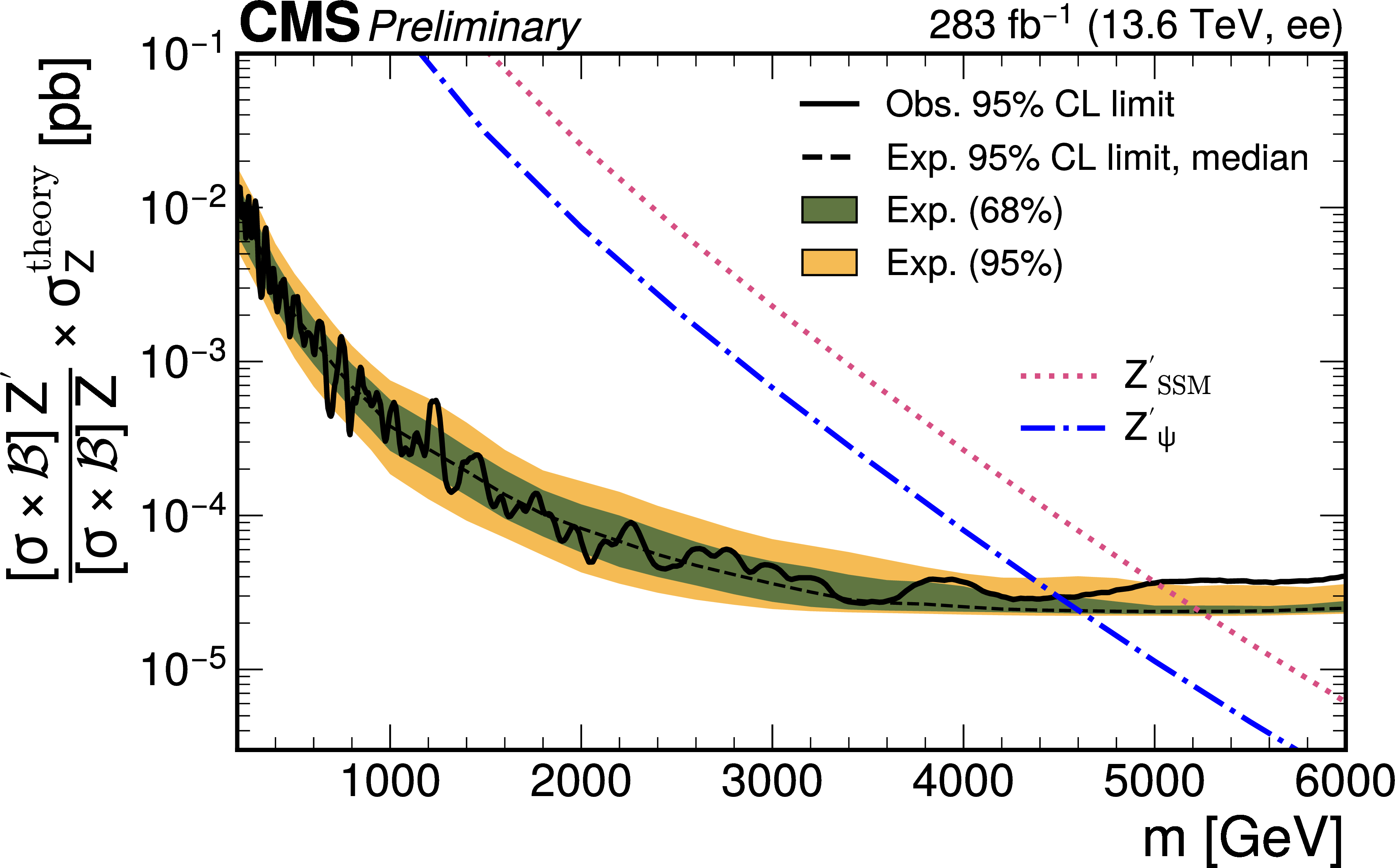
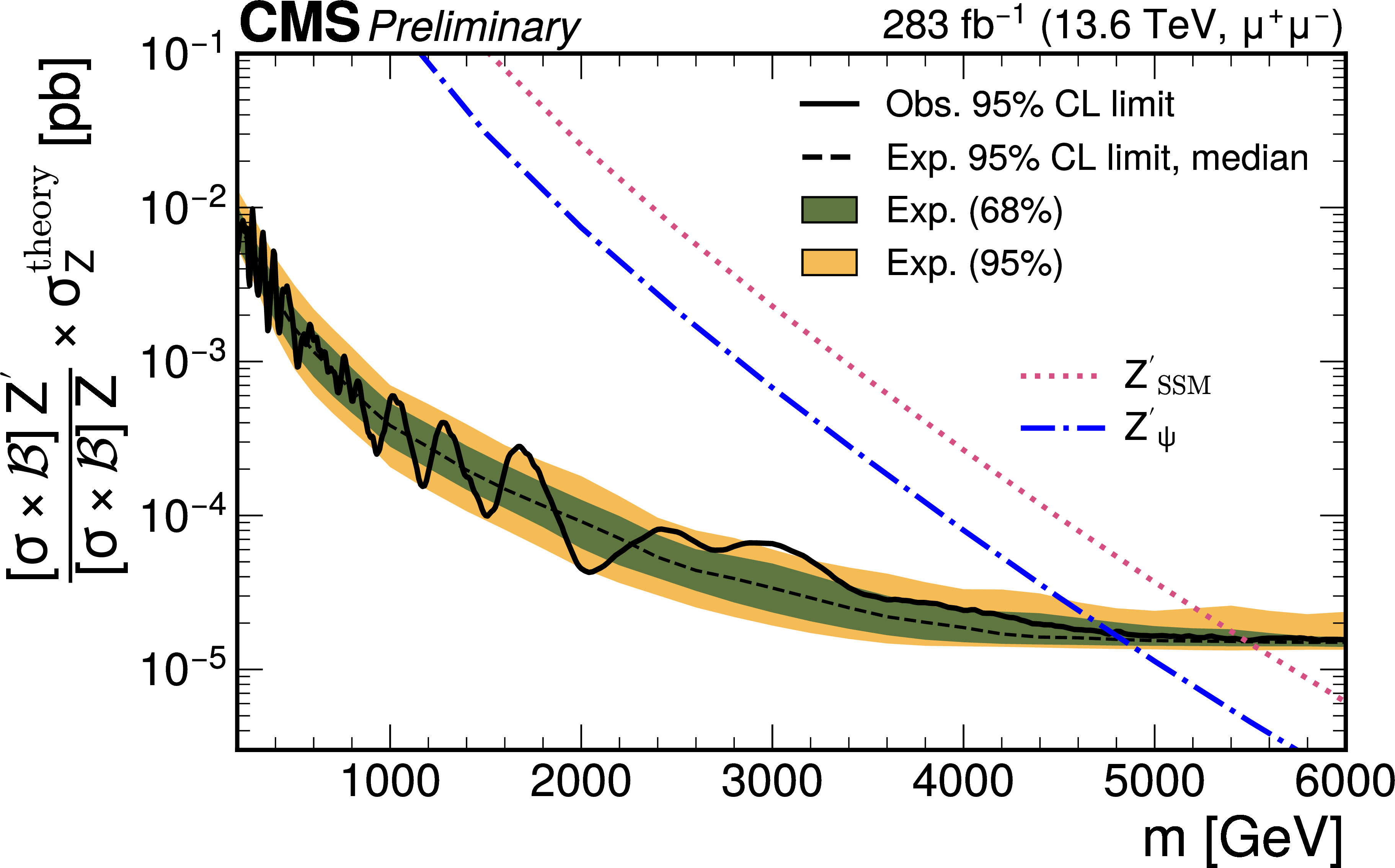
Figure 2:
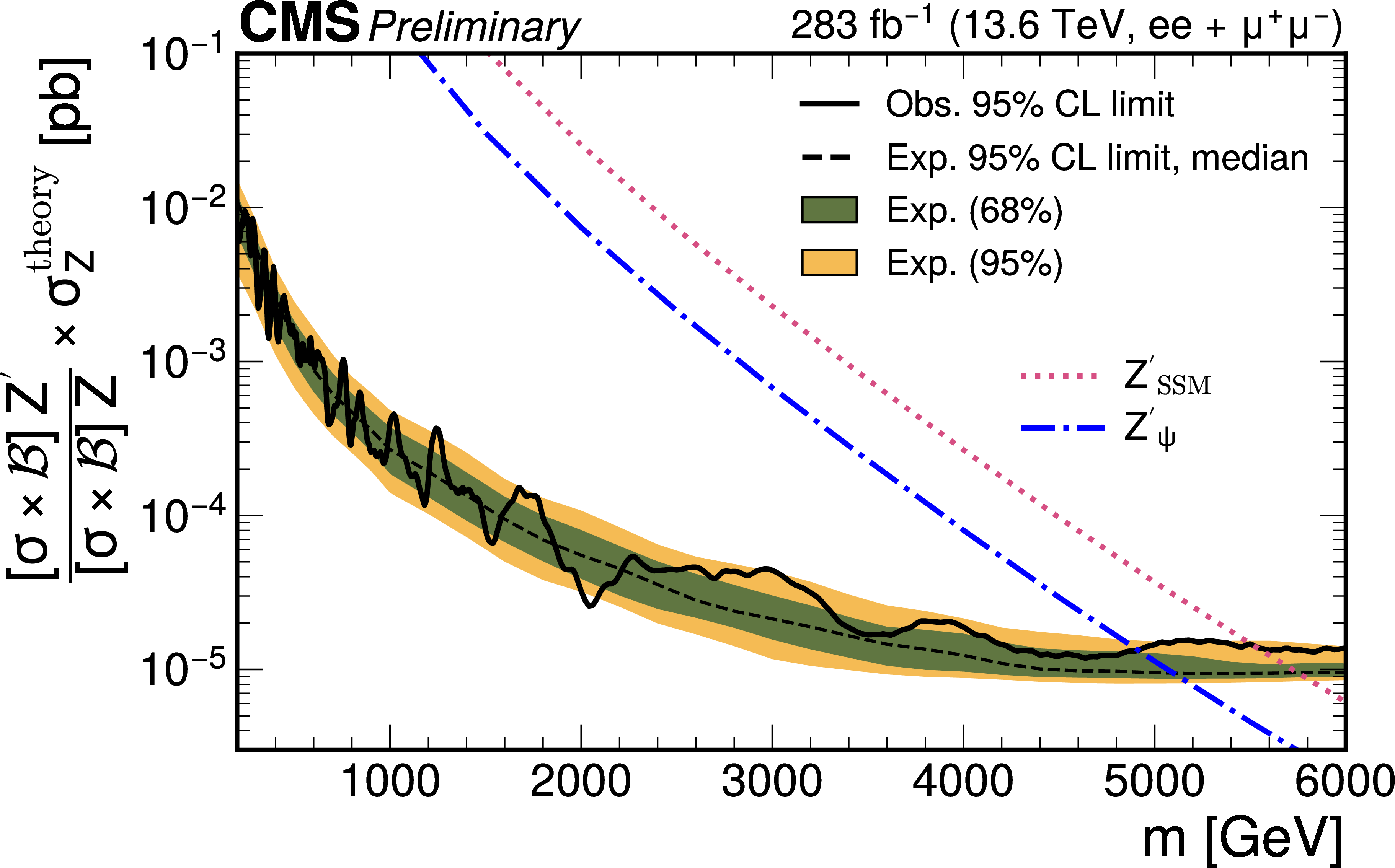
The upper limits at 95% CL on the product of the production cross section and the branching fraction for a spin-1 resonance with a width equal to 0.6% of the resonance mass, relative to the product of the production cross section and the branching fraction of a Z boson, for the dielectron channel (top left), the dimuon channel (top right), and their combination (bottom). The shaded bands correspond to the 68 and 95% quantiles for the expected limits. Simulated predictions for $ \mathrm{Z}^{'}_\mathrm{SSM} $ and $ \mathrm{Z}^{'}_\psi $ resonances are shown for comparison. |
png pdf |
Figure 2-a:
The upper limits at 95% CL on the product of the production cross section and the branching fraction for a spin-1 resonance with a width equal to 0.6% of the resonance mass, relative to the product of the production cross section and the branching fraction of a Z boson, for the dielectron channel (top left), the dimuon channel (top right), and their combination (bottom). The shaded bands correspond to the 68 and 95% quantiles for the expected limits. Simulated predictions for $ \mathrm{Z}^{'}_\mathrm{SSM} $ and $ \mathrm{Z}^{'}_\psi $ resonances are shown for comparison. |
png pdf |
Figure 2-b:
The upper limits at 95% CL on the product of the production cross section and the branching fraction for a spin-1 resonance with a width equal to 0.6% of the resonance mass, relative to the product of the production cross section and the branching fraction of a Z boson, for the dielectron channel (top left), the dimuon channel (top right), and their combination (bottom). The shaded bands correspond to the 68 and 95% quantiles for the expected limits. Simulated predictions for $ \mathrm{Z}^{'}_\mathrm{SSM} $ and $ \mathrm{Z}^{'}_\psi $ resonances are shown for comparison. |
png pdf |
Figure 2-c:
The upper limits at 95% CL on the product of the production cross section and the branching fraction for a spin-1 resonance with a width equal to 0.6% of the resonance mass, relative to the product of the production cross section and the branching fraction of a Z boson, for the dielectron channel (top left), the dimuon channel (top right), and their combination (bottom). The shaded bands correspond to the 68 and 95% quantiles for the expected limits. Simulated predictions for $ \mathrm{Z}^{'}_\mathrm{SSM} $ and $ \mathrm{Z}^{'}_\psi $ resonances are shown for comparison. |
png pdf |
Figure 3:
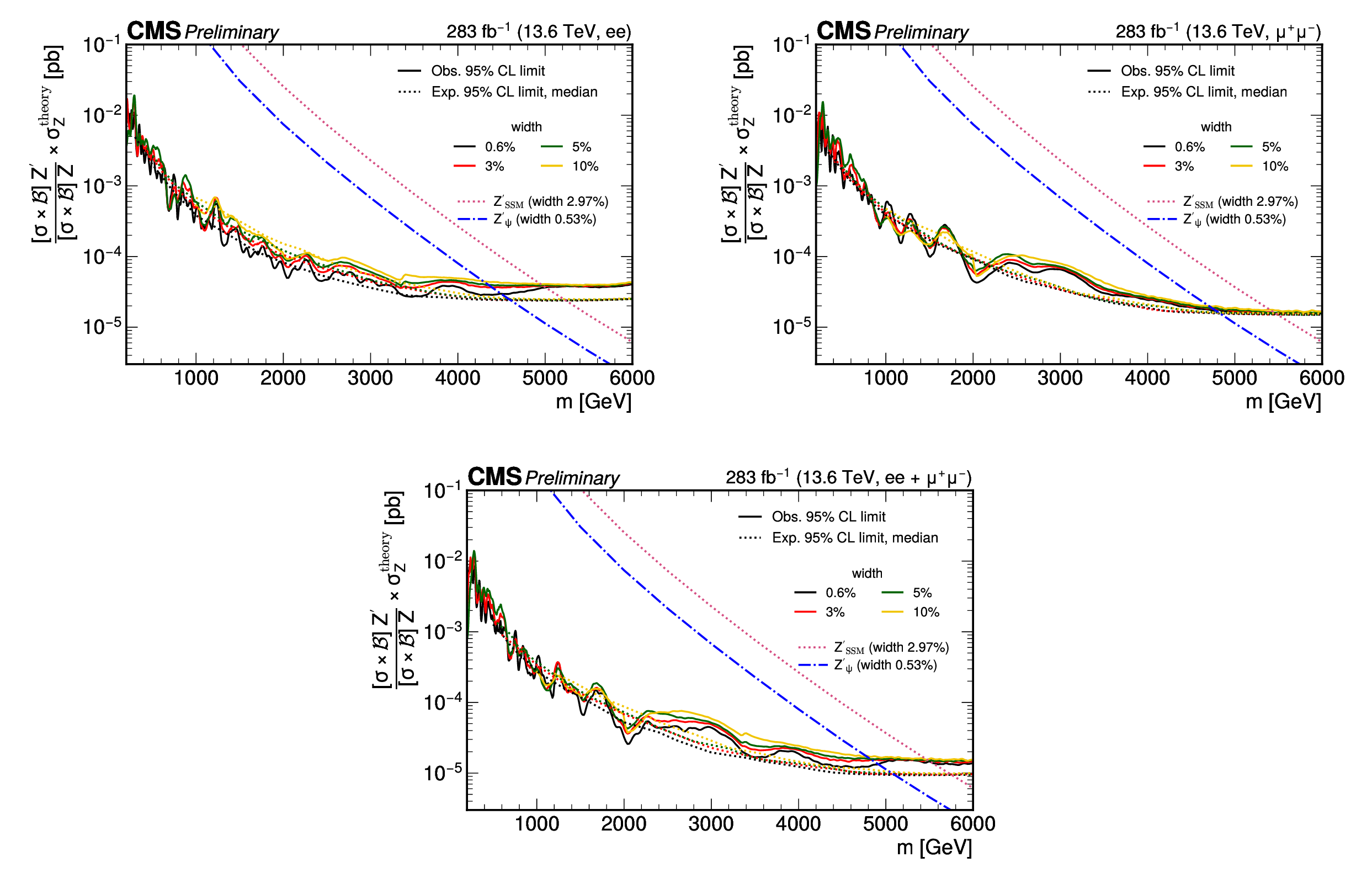
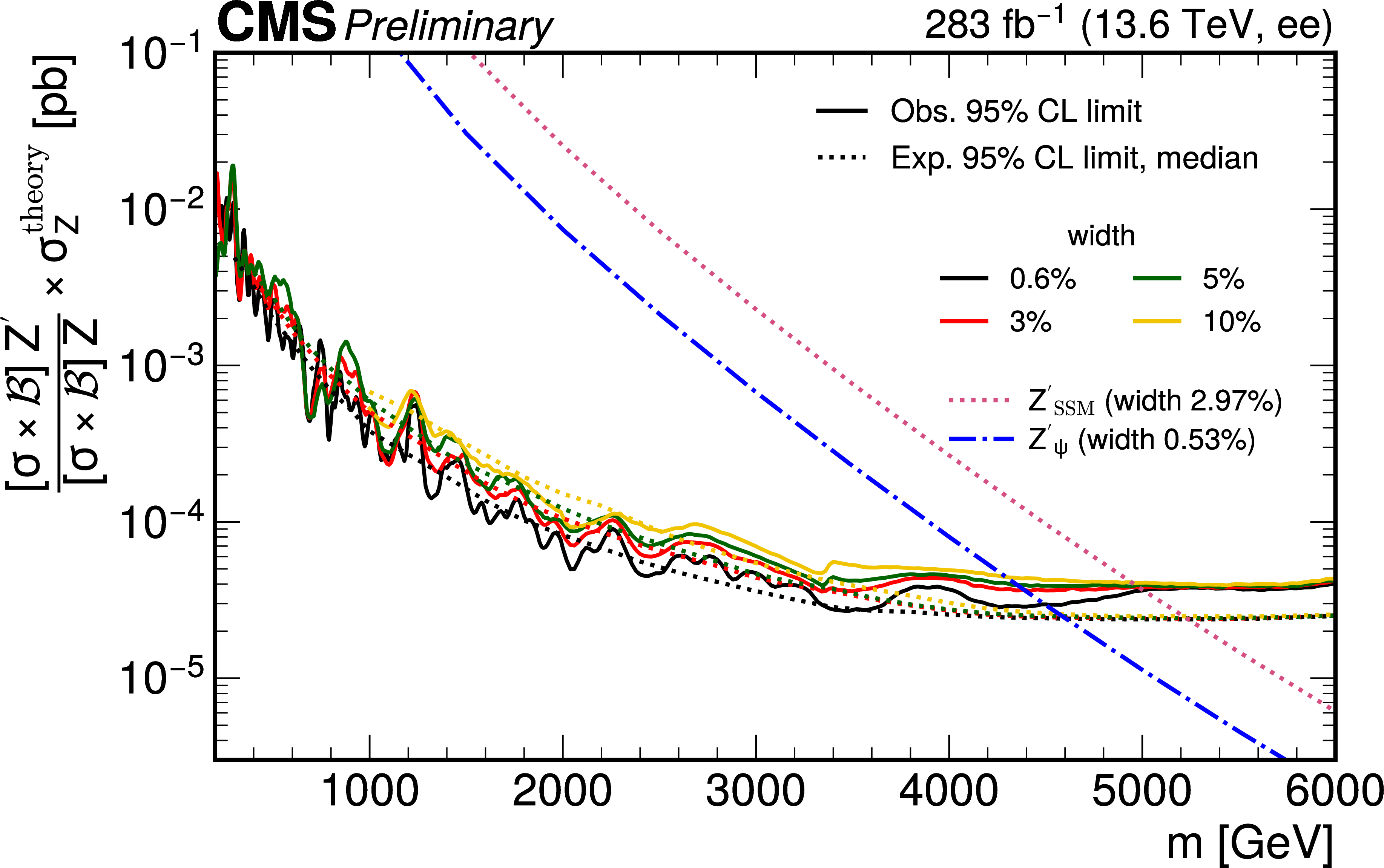
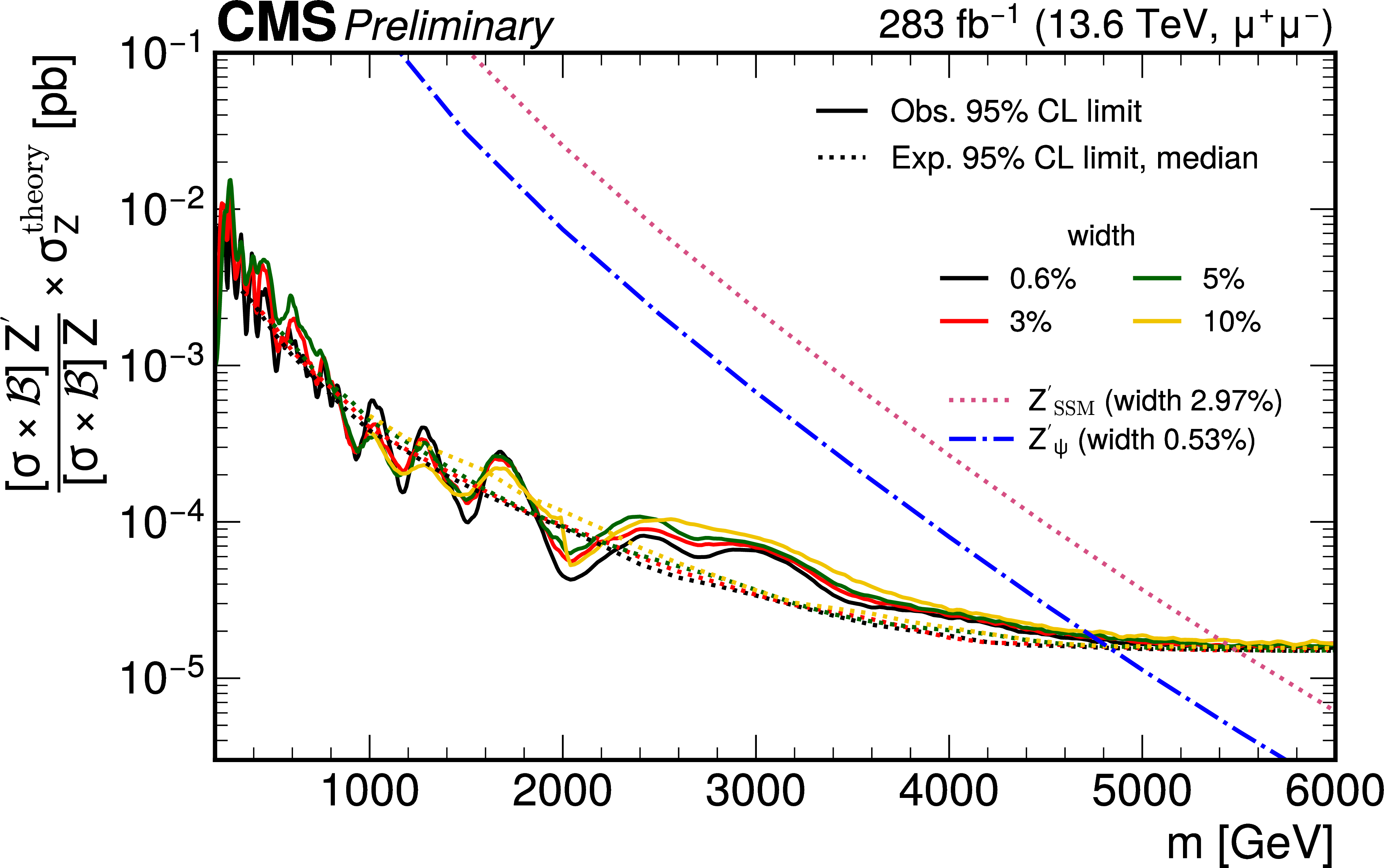
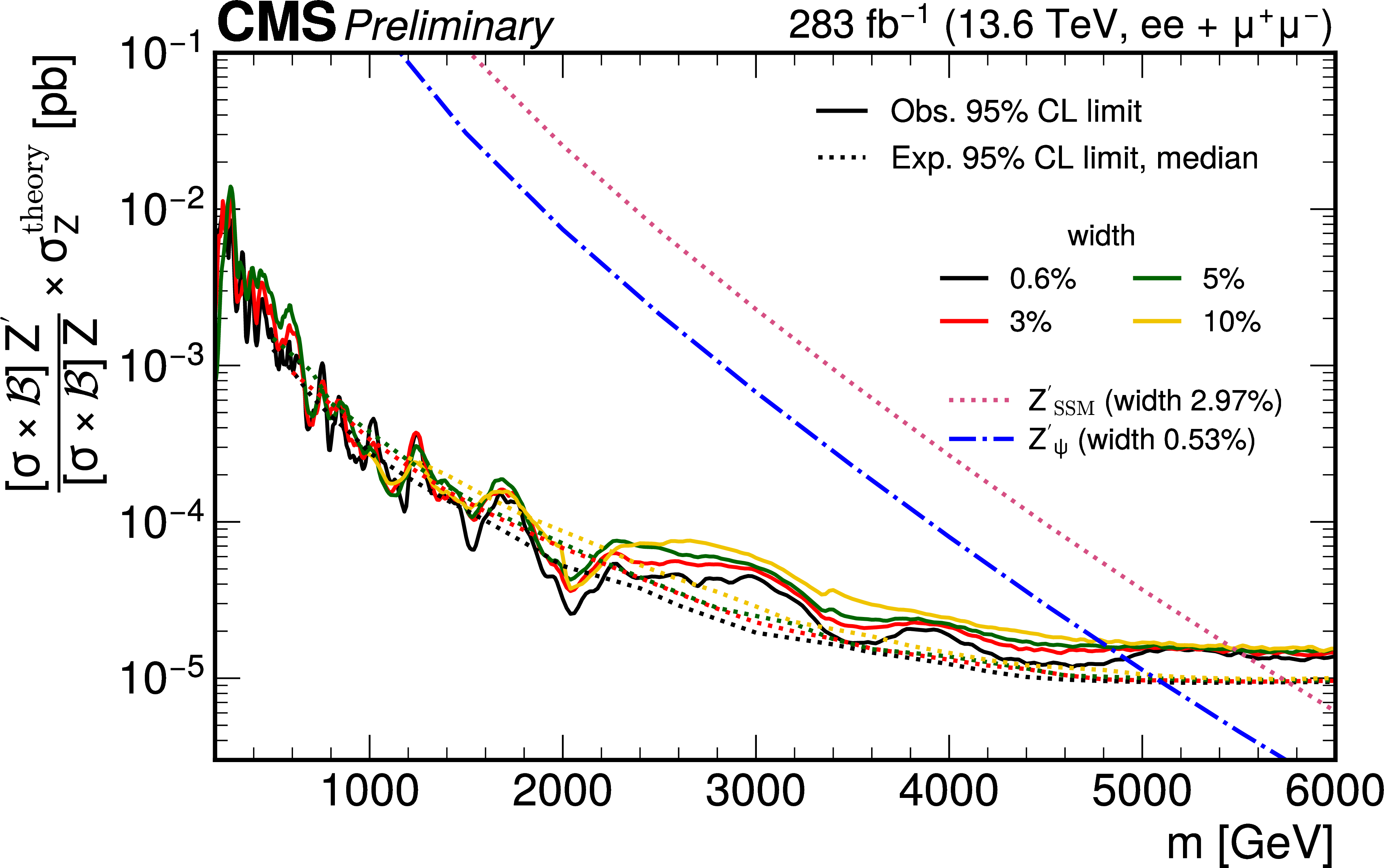
The upper limits at 95% CL on the product of the production cross section and the branching fraction for a spin-1 resonance, for widths equal to 0.6%, 3%, 5%, and 10% of the resonance mass, relative to the product of the production cross section and the branching fraction of a Z boson, for the dielectron channel (top left), the dimuon channel (top right), and their combination (bottom). Theoretical cross section predictions for the spin-1 $ \mathrm{Z}^{'}_\mathrm{SSM} $ and $ \mathrm{Z}^{'}_\psi $ resonances are shown for comparison. |
png pdf |
Figure 3-a:
The upper limits at 95% CL on the product of the production cross section and the branching fraction for a spin-1 resonance, for widths equal to 0.6%, 3%, 5%, and 10% of the resonance mass, relative to the product of the production cross section and the branching fraction of a Z boson, for the dielectron channel (top left), the dimuon channel (top right), and their combination (bottom). Theoretical cross section predictions for the spin-1 $ \mathrm{Z}^{'}_\mathrm{SSM} $ and $ \mathrm{Z}^{'}_\psi $ resonances are shown for comparison. |
png pdf |
Figure 3-b:
The upper limits at 95% CL on the product of the production cross section and the branching fraction for a spin-1 resonance, for widths equal to 0.6%, 3%, 5%, and 10% of the resonance mass, relative to the product of the production cross section and the branching fraction of a Z boson, for the dielectron channel (top left), the dimuon channel (top right), and their combination (bottom). Theoretical cross section predictions for the spin-1 $ \mathrm{Z}^{'}_\mathrm{SSM} $ and $ \mathrm{Z}^{'}_\psi $ resonances are shown for comparison. |
png pdf |
Figure 3-c:
The upper limits at 95% CL on the product of the production cross section and the branching fraction for a spin-1 resonance, for widths equal to 0.6%, 3%, 5%, and 10% of the resonance mass, relative to the product of the production cross section and the branching fraction of a Z boson, for the dielectron channel (top left), the dimuon channel (top right), and their combination (bottom). Theoretical cross section predictions for the spin-1 $ \mathrm{Z}^{'}_\mathrm{SSM} $ and $ \mathrm{Z}^{'}_\psi $ resonances are shown for comparison. |
png pdf |
Figure 4:
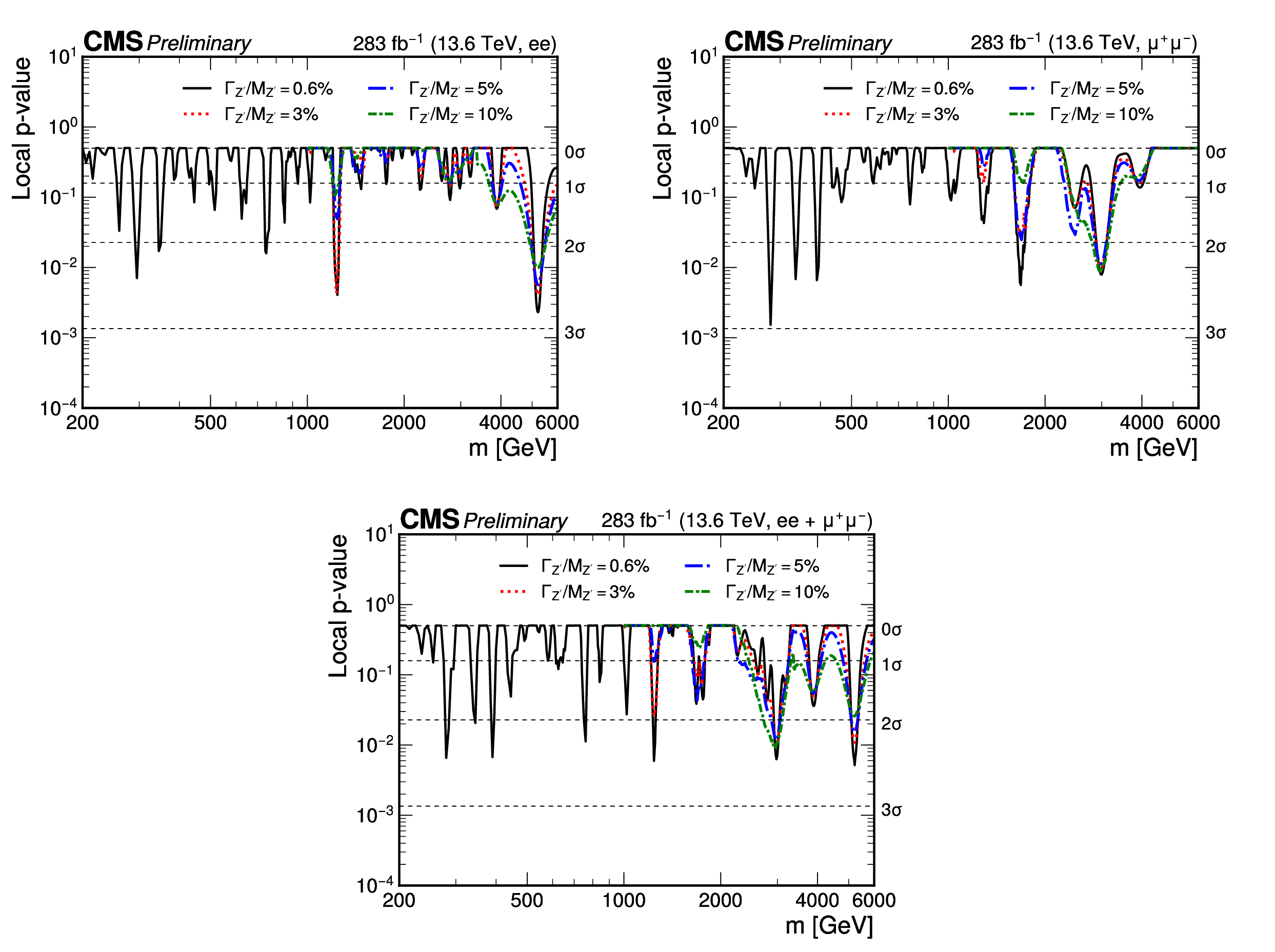
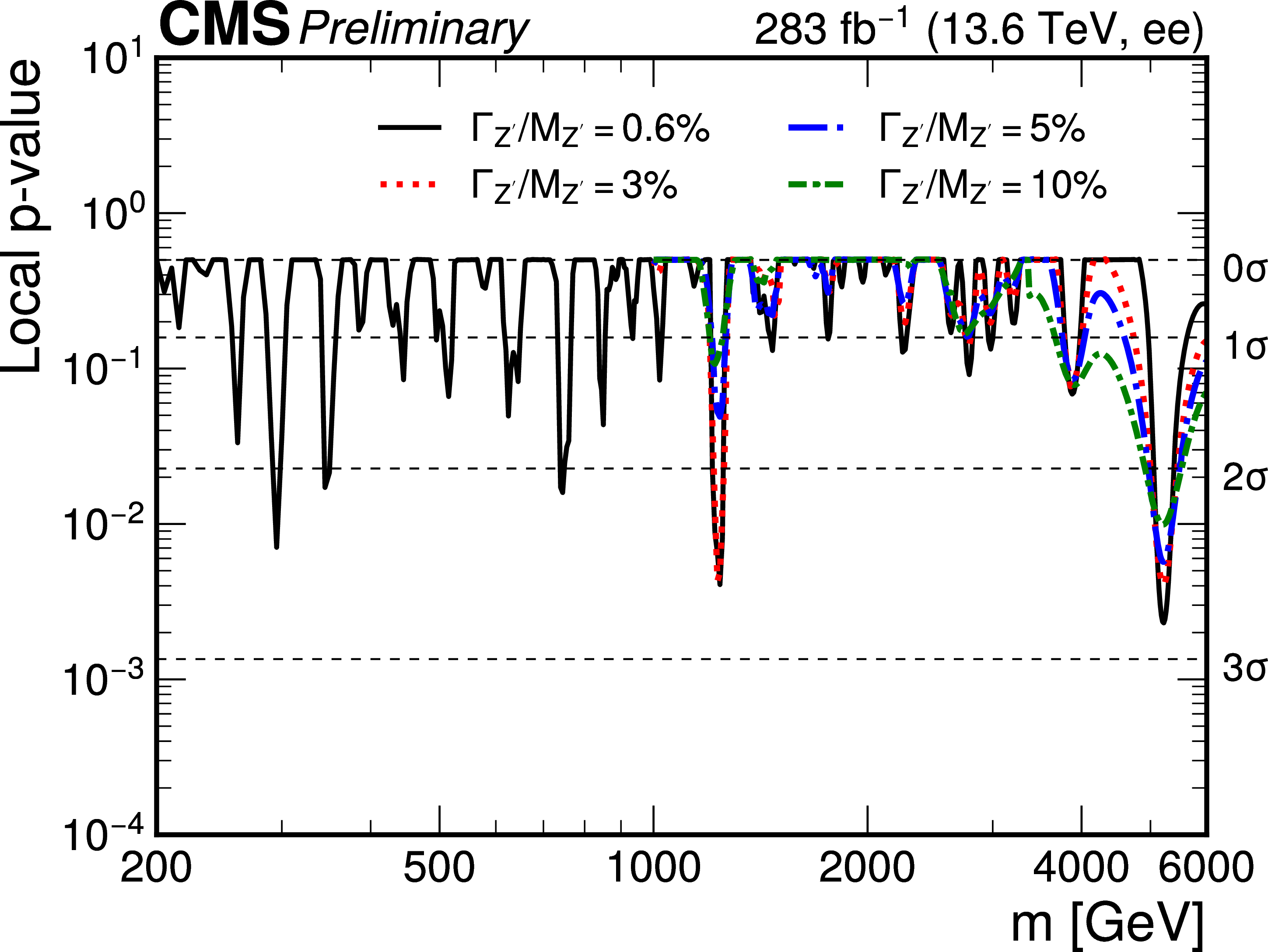
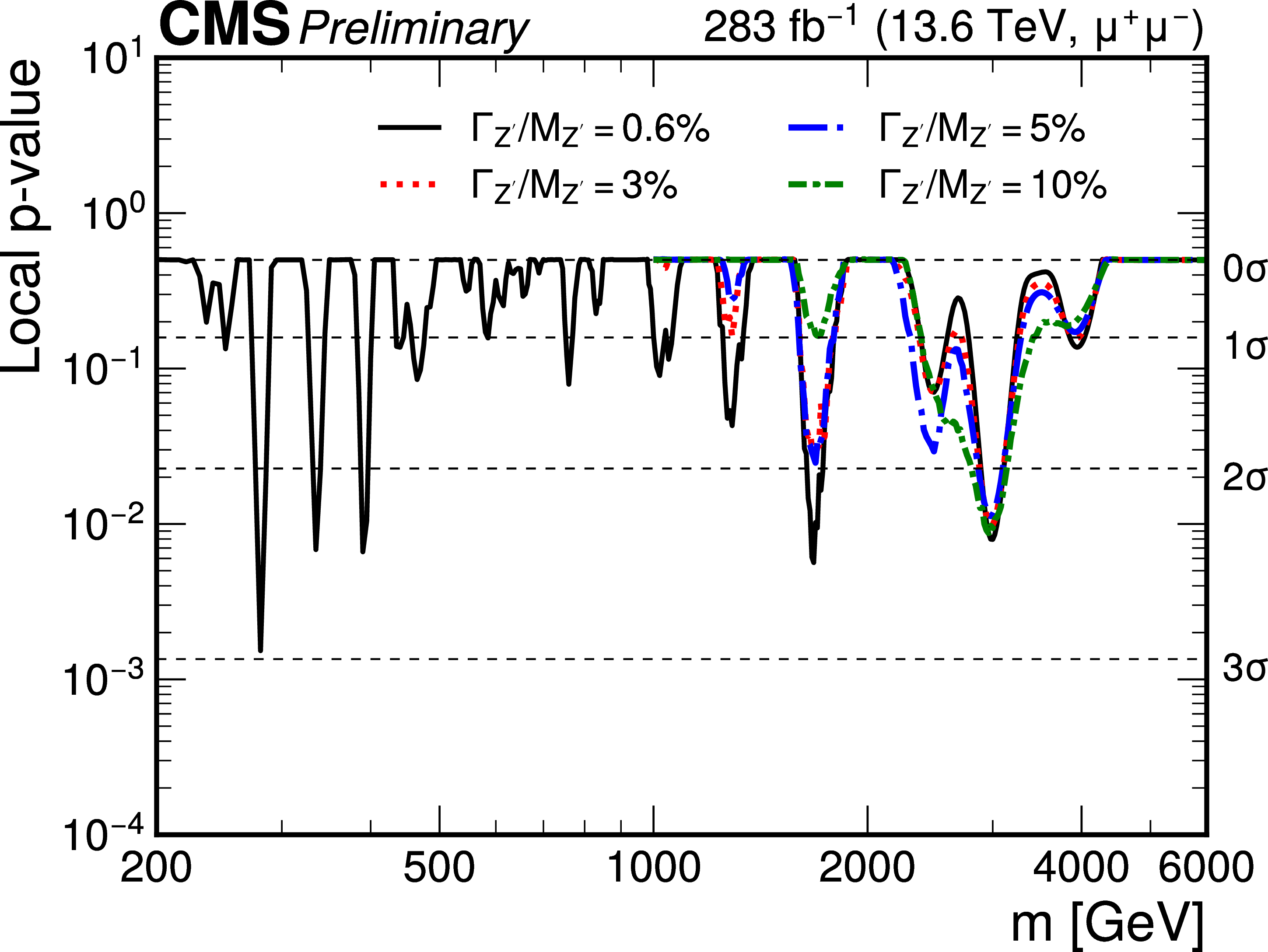
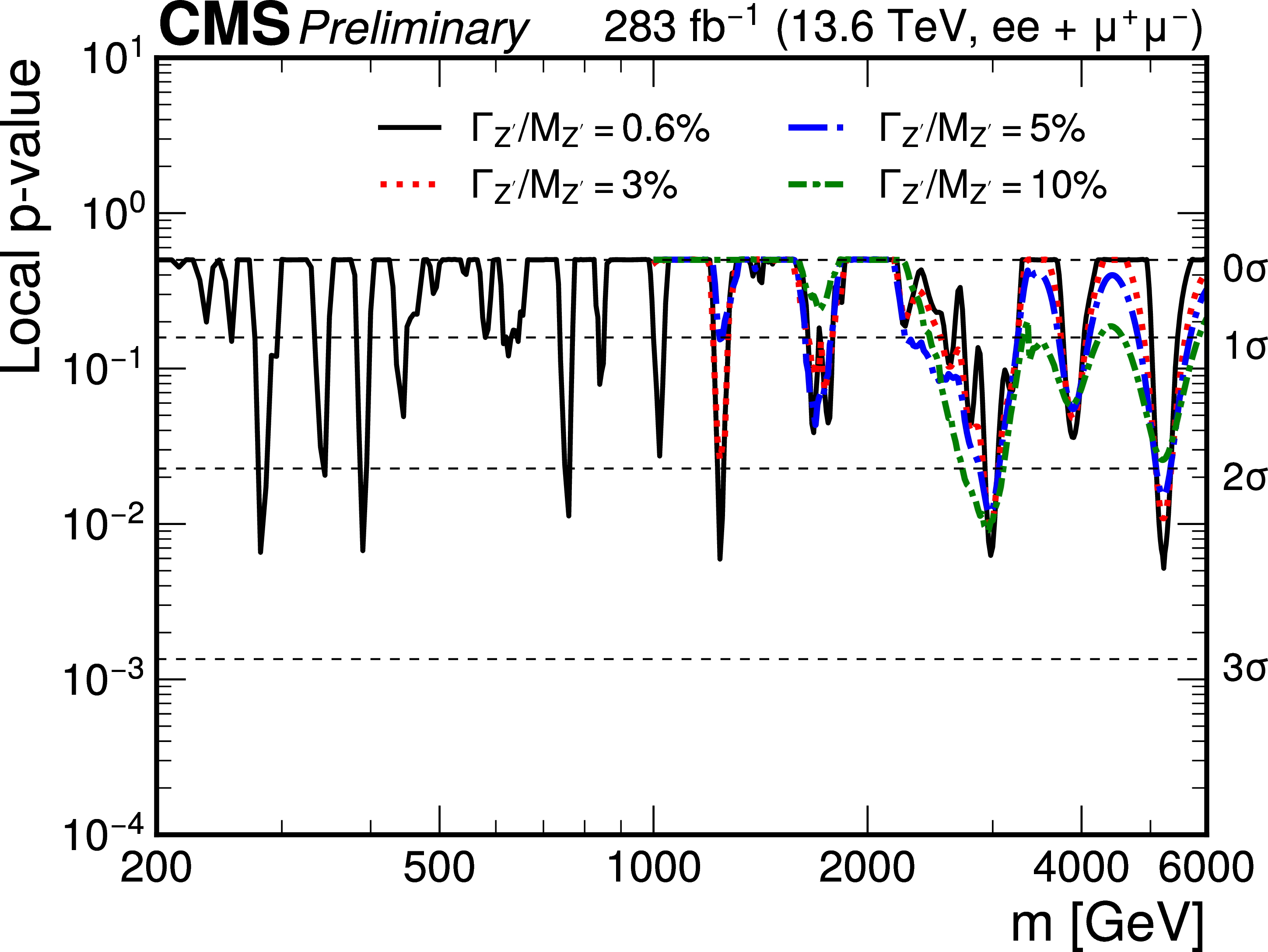
The observed local p-value for a given resonance mass hypothesis for the dielectron channel (top left), the dimuon channel (top right), and their combination (bottom), as a function of the dilepton invariant mass. The four different lines correspond to different signal width hypotheses. |
png pdf |
Figure 4-a:
The observed local p-value for a given resonance mass hypothesis for the dielectron channel (top left), the dimuon channel (top right), and their combination (bottom), as a function of the dilepton invariant mass. The four different lines correspond to different signal width hypotheses. |
png pdf |
Figure 4-b:
The observed local p-value for a given resonance mass hypothesis for the dielectron channel (top left), the dimuon channel (top right), and their combination (bottom), as a function of the dilepton invariant mass. The four different lines correspond to different signal width hypotheses. |
png pdf |
Figure 4-c:
The observed local p-value for a given resonance mass hypothesis for the dielectron channel (top left), the dimuon channel (top right), and their combination (bottom), as a function of the dilepton invariant mass. The four different lines correspond to different signal width hypotheses. |
png pdf |
Figure 5:
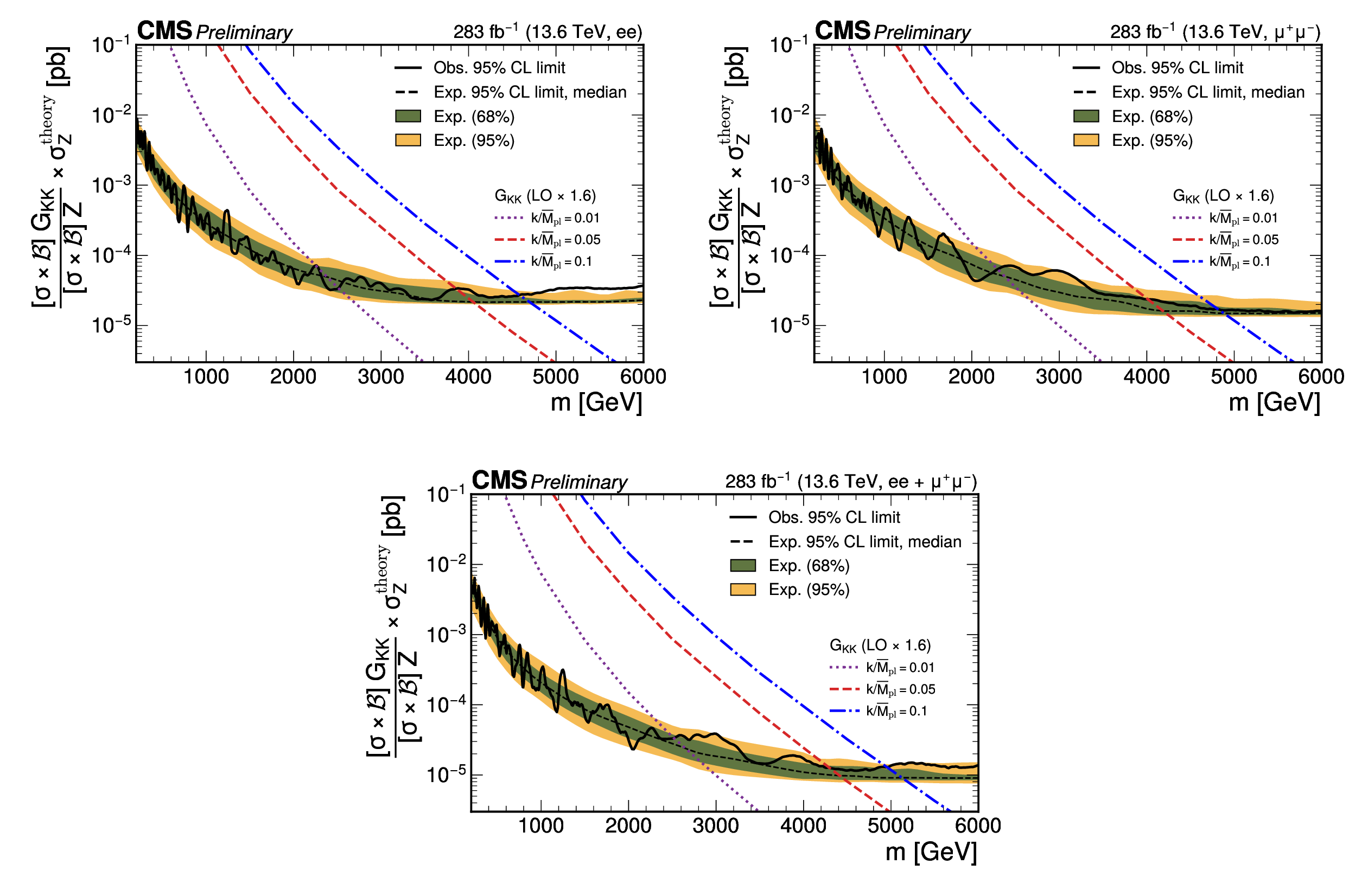
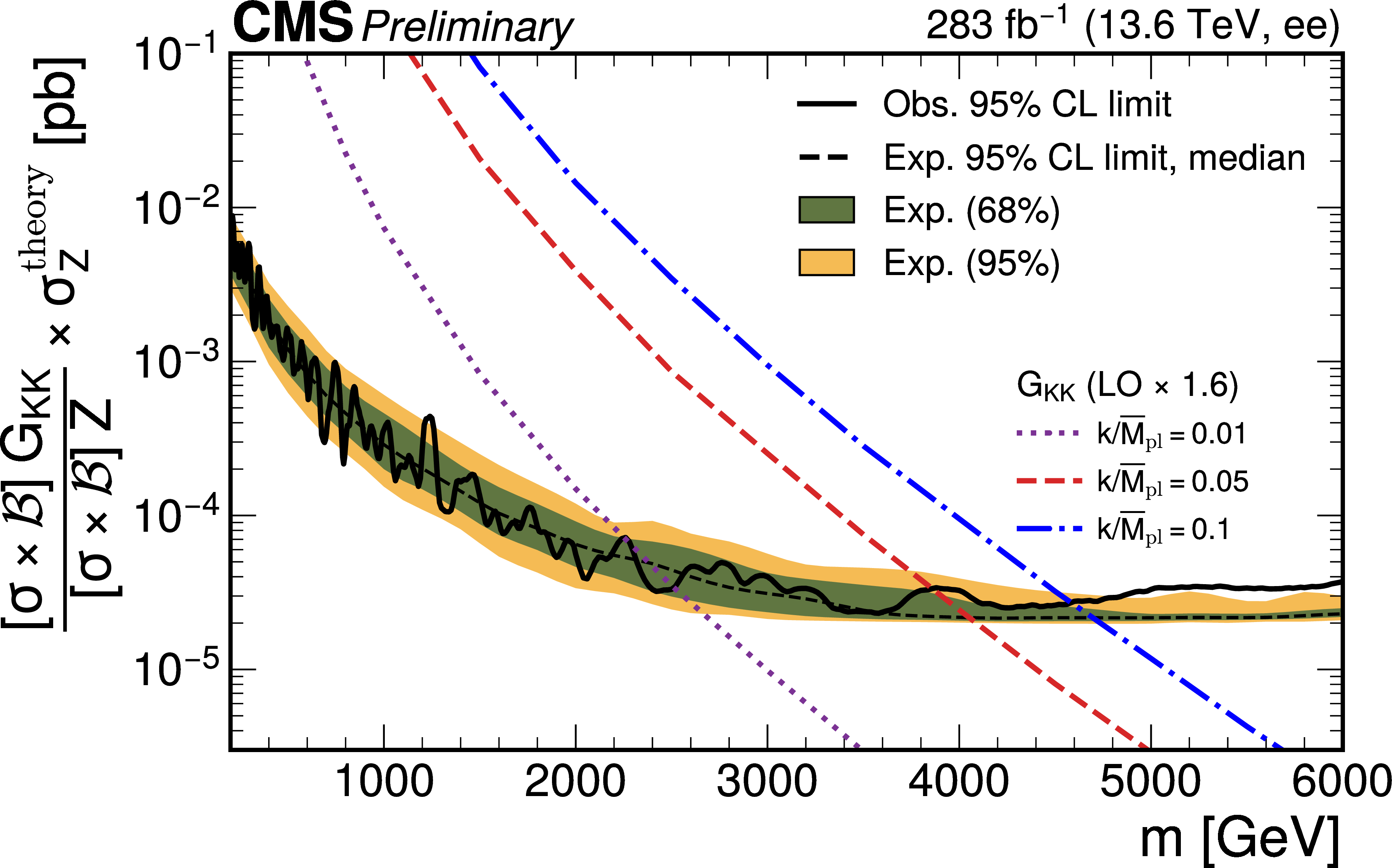
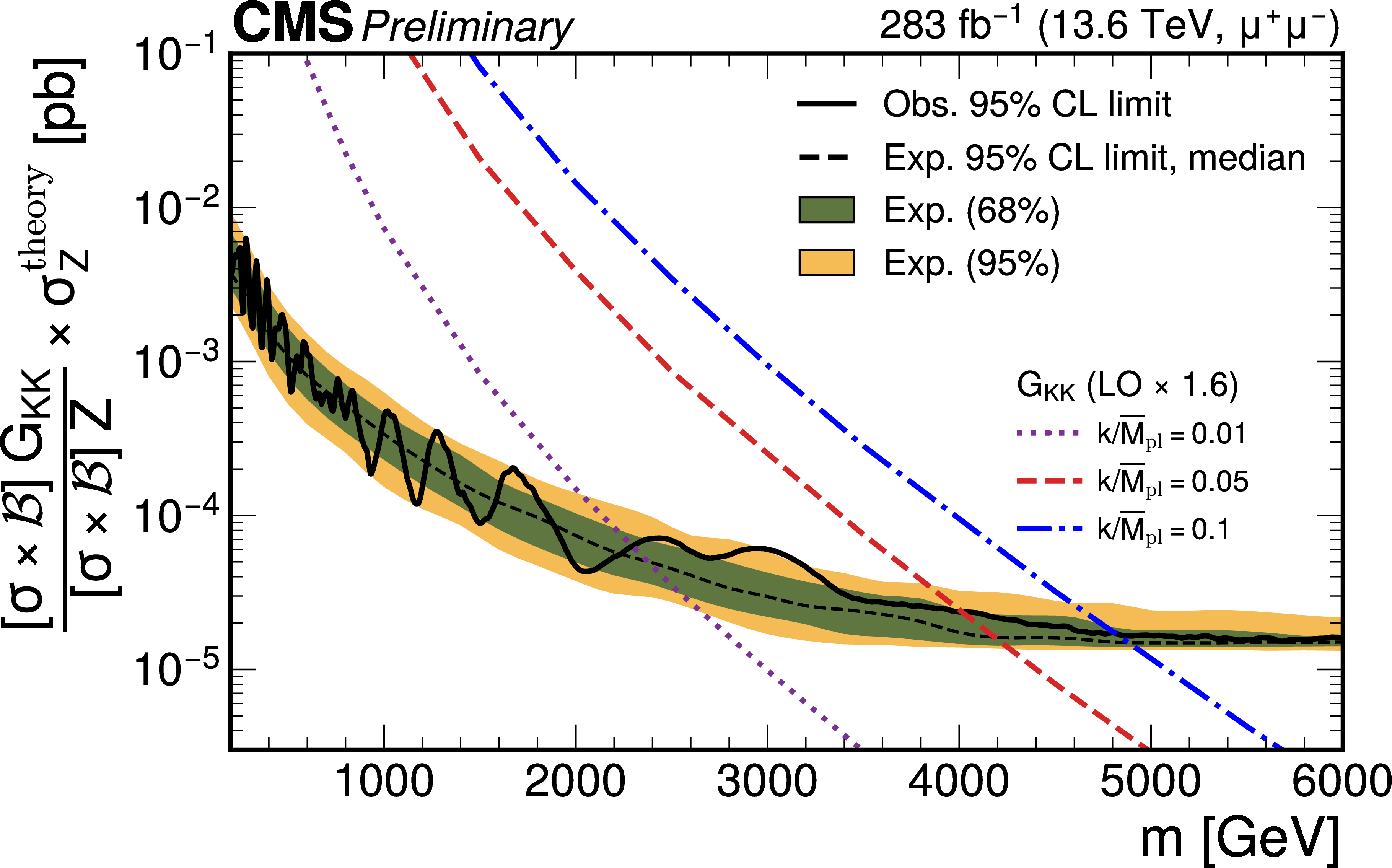
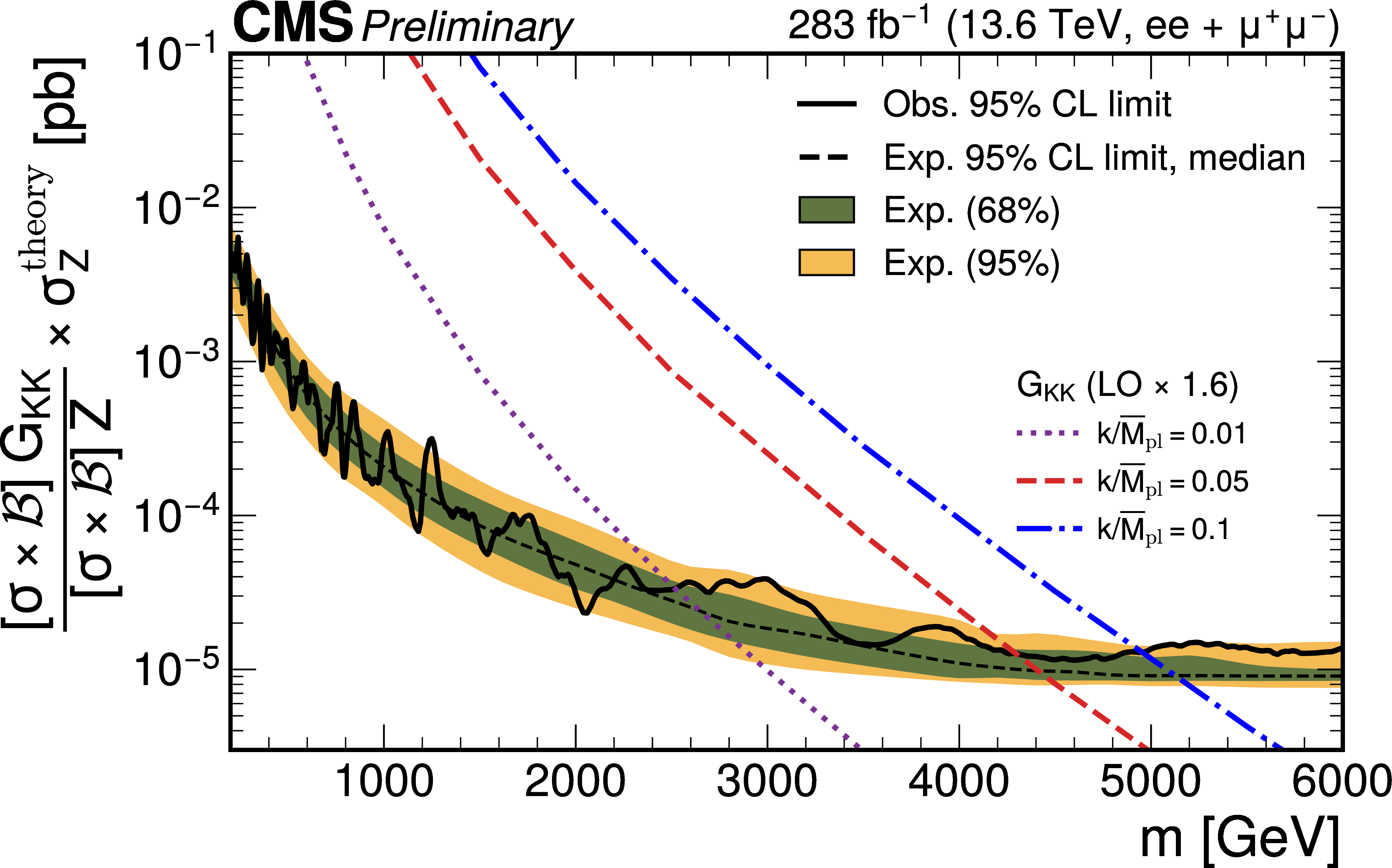
The upper limits at 95% CL on the product of the production cross section and the branching fraction for a spin-2 resonance, relative to the product of the production cross section and the branching fraction of a Z boson, for the dielectron channel (top left), the dimuon channel (top right), and their combination (bottom). The shaded bands correspond to the 68 and 95% quantiles for the expected limits. Theoretical predictions for the cross section of a $ \mathrm{G}_\mathrm{KK} $ graviton with a width equal to 0.01, 0.36, and 1.42% corresponding to coupling parameters $ k/\overline{M}_\mathrm{Pl} $ of 0.01, 0.05, and 0.1 are also depicted. |
png pdf |
Figure 5-a:
The upper limits at 95% CL on the product of the production cross section and the branching fraction for a spin-2 resonance, relative to the product of the production cross section and the branching fraction of a Z boson, for the dielectron channel (top left), the dimuon channel (top right), and their combination (bottom). The shaded bands correspond to the 68 and 95% quantiles for the expected limits. Theoretical predictions for the cross section of a $ \mathrm{G}_\mathrm{KK} $ graviton with a width equal to 0.01, 0.36, and 1.42% corresponding to coupling parameters $ k/\overline{M}_\mathrm{Pl} $ of 0.01, 0.05, and 0.1 are also depicted. |
png pdf |
Figure 5-b:
The upper limits at 95% CL on the product of the production cross section and the branching fraction for a spin-2 resonance, relative to the product of the production cross section and the branching fraction of a Z boson, for the dielectron channel (top left), the dimuon channel (top right), and their combination (bottom). The shaded bands correspond to the 68 and 95% quantiles for the expected limits. Theoretical predictions for the cross section of a $ \mathrm{G}_\mathrm{KK} $ graviton with a width equal to 0.01, 0.36, and 1.42% corresponding to coupling parameters $ k/\overline{M}_\mathrm{Pl} $ of 0.01, 0.05, and 0.1 are also depicted. |
png pdf |
Figure 5-c:
The upper limits at 95% CL on the product of the production cross section and the branching fraction for a spin-2 resonance, relative to the product of the production cross section and the branching fraction of a Z boson, for the dielectron channel (top left), the dimuon channel (top right), and their combination (bottom). The shaded bands correspond to the 68 and 95% quantiles for the expected limits. Theoretical predictions for the cross section of a $ \mathrm{G}_\mathrm{KK} $ graviton with a width equal to 0.01, 0.36, and 1.42% corresponding to coupling parameters $ k/\overline{M}_\mathrm{Pl} $ of 0.01, 0.05, and 0.1 are also depicted. |
| Tables | |
png pdf |
Table 1:
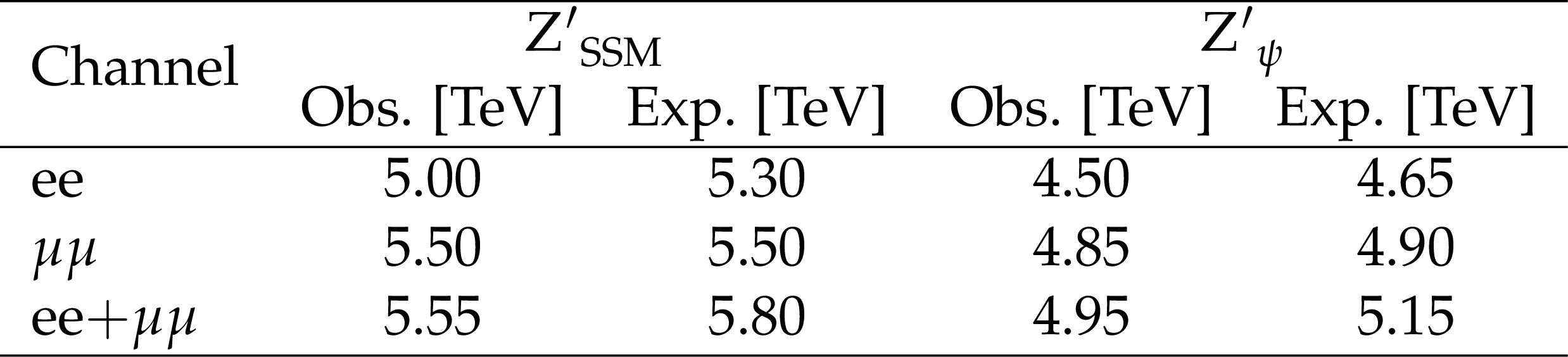
The observed (Obs.) and expected (Exp.) 95% CL lower limits on the masses of spin-1 $ \mathrm{Z}^{'}_\mathrm{SSM} $ and $ \mathrm{Z}^{'}_\psi $ bosons. |

png pdf |
Table 2:
Observed (Obs.) and expected (Exp.) 95% CL lower limits on the masses of a spin-2 GKK graviton with coupling parameters of $ k/\overline{M}_\mathrm{Pl} $ of 0.01, 0.05, and 0.1. |
| Summary |
| A search for resonant new physics in the dilepton invariant mass spectrum has been performed using proton--proton collision data collected at $ \sqrt{s} = $ 13.6 TeV, corresponding to an integrated luminosity of 283 fb$ ^{-1} $. Events containing high-mass dielectron and dimuon pairs were reconstructed and selected using algorithms optimised for leptons with high transverse momentum. The observed invariant mass distributions are found to be consistent with the predictions of the SM, and no significant excess is observed. Upper limits at 95% confidence level are set on the ratio of the production cross section times branching fraction to dileptons for a new narrow resonance relative to that of the SM Z boson. The results are interpreted in benchmark models predicting spin-1 resonances, including the Sequential Standard Model (SSM) and superstring-inspired scenarios. Lower mass limits of 5.55 (4.95) TeV\ are obtained for the $ \mathrm{Z}^{'}_\mathrm{SSM} $\ ($ \mathrm{Z}^{'}_\psi $) models. The results are also interpreted in the context of spin-2 graviton excitations in the Randall--Sundrum model of warped extra dimensions. For a coupling parameter $ k/\overline{M}_{\mathrm{Pl}} $ of 0.01, 0.05, and 0.1, graviton masses below 2.5, 4.4, and 5.0 TeV\ are excluded, respectively, at 95% confidence level. The limits obtained for both spin-1 and spin-2 resonances represent the most stringent constraints to date in the dilepton final state. |
| Additional Figures | |
png pdf |
Additional Figure 1:
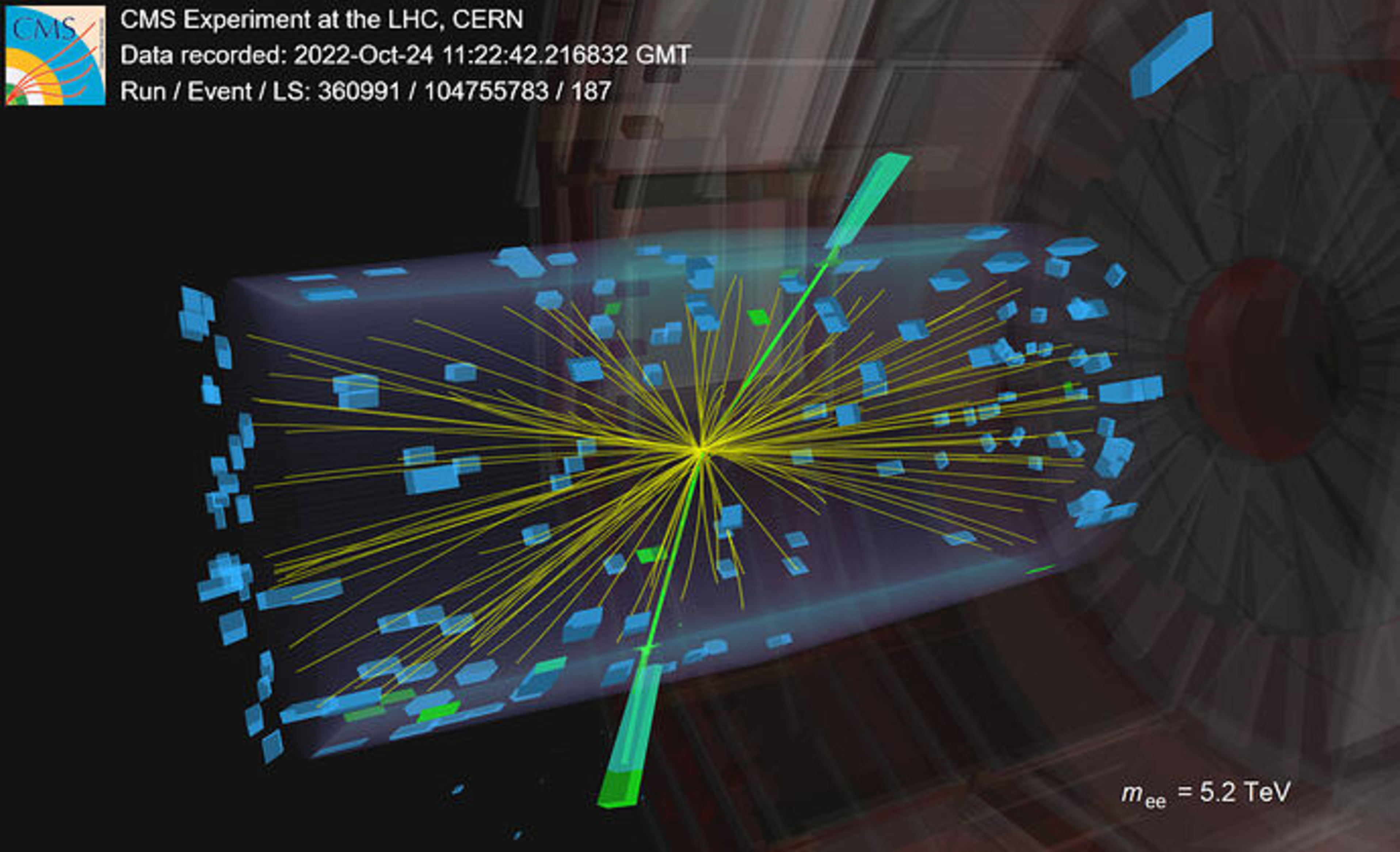
Event display of a high-mass dielectron candidate with an invariant mass of 5.2~TeV recorded in proton-proton collisions at $\sqrt{s}=13.6~\mathrm{TeV}$. |
png pdf |
Additional Figure 2:
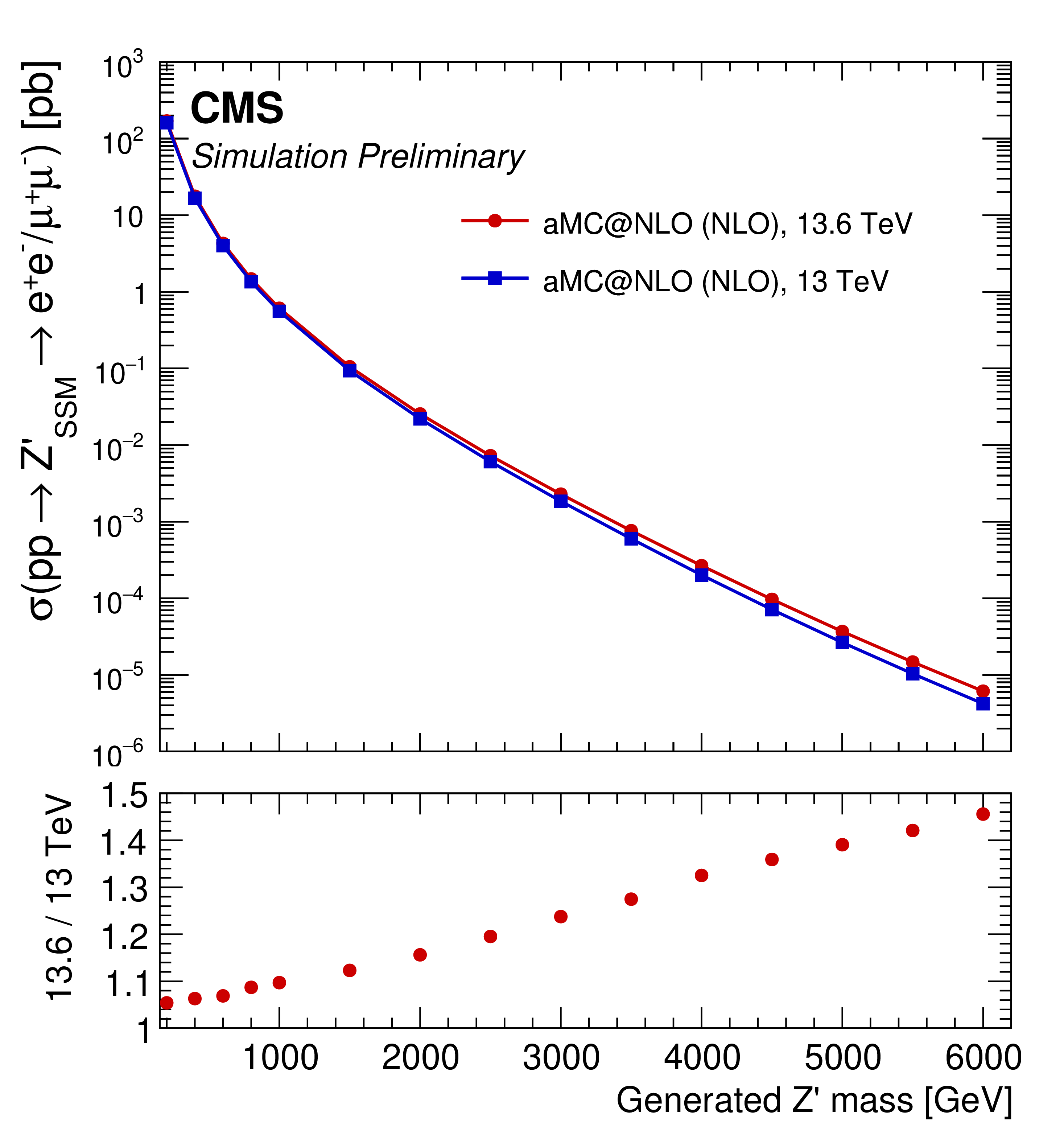
Comparison of the production cross section times branching ratio for a $\mathrm{Z}^{'}_\mathrm{SSM} $ boson decaying to dileptons as a function of the generated resonance mass, comparing next-to-leading-order QCD predictions at $\sqrt{s}=13$ and $13.6~\mathrm{TeV}$. |
png pdf |
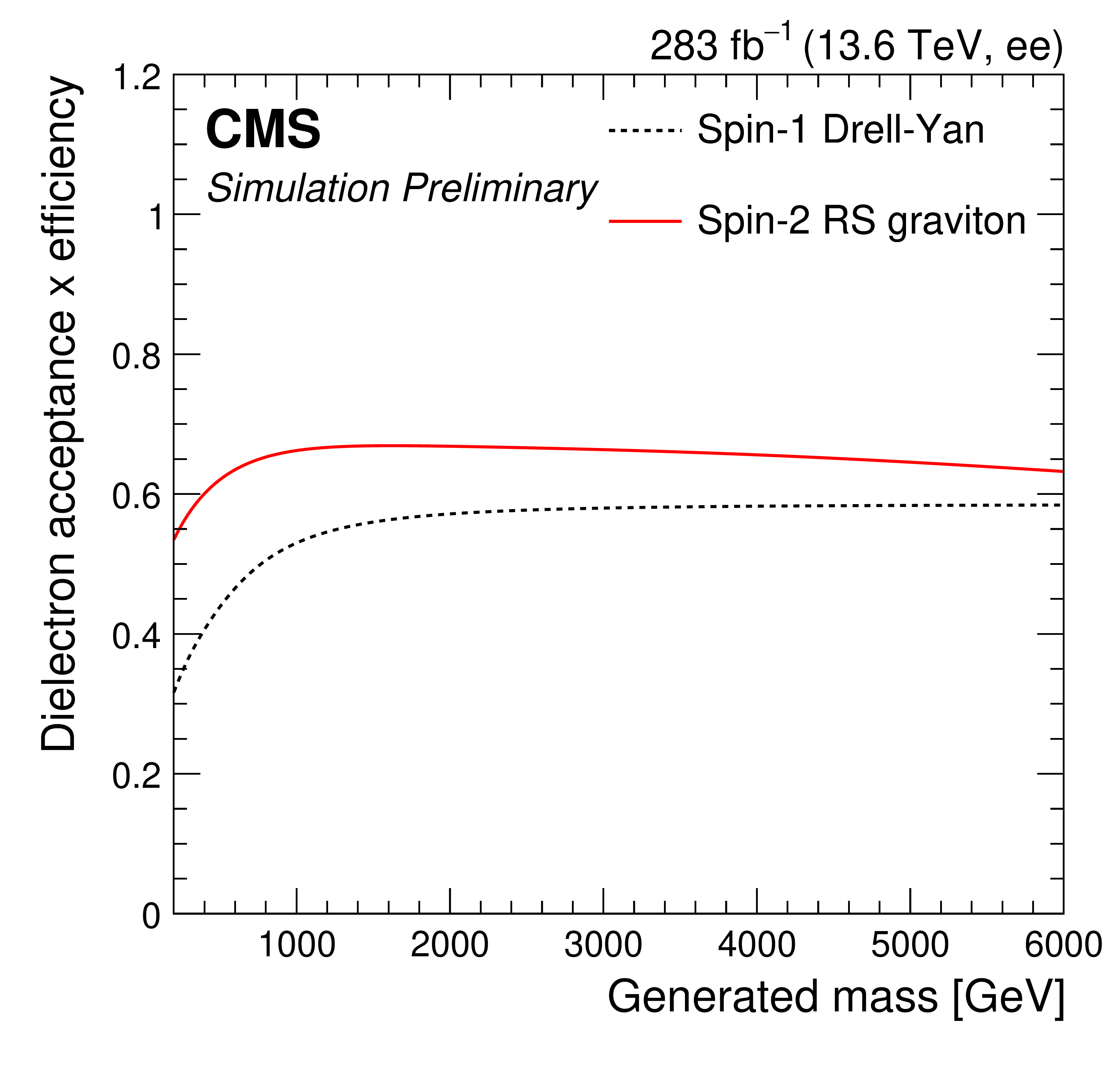
Additional Figure 3:
Acceptance times efficiency for spin-1 and spin-2 resonance models in the dielectron final state as a function of the generated dielectron invariant mass. |
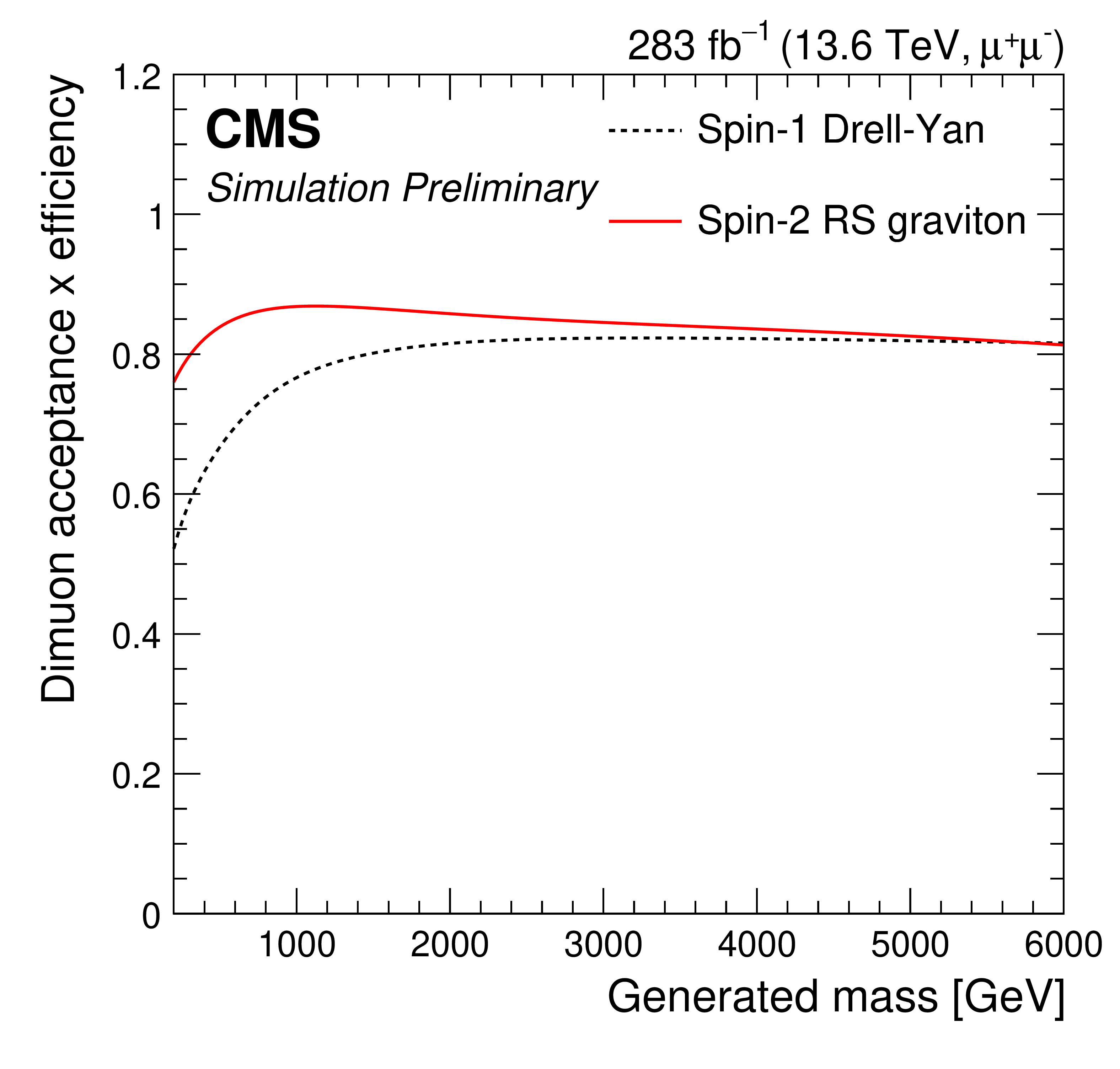
png pdf |
Additional Figure 4:
Acceptance times efficiency for spin-1 and spin-2 resonance models in the dimuon final state as a function of the generated dimuon invariant mass. |
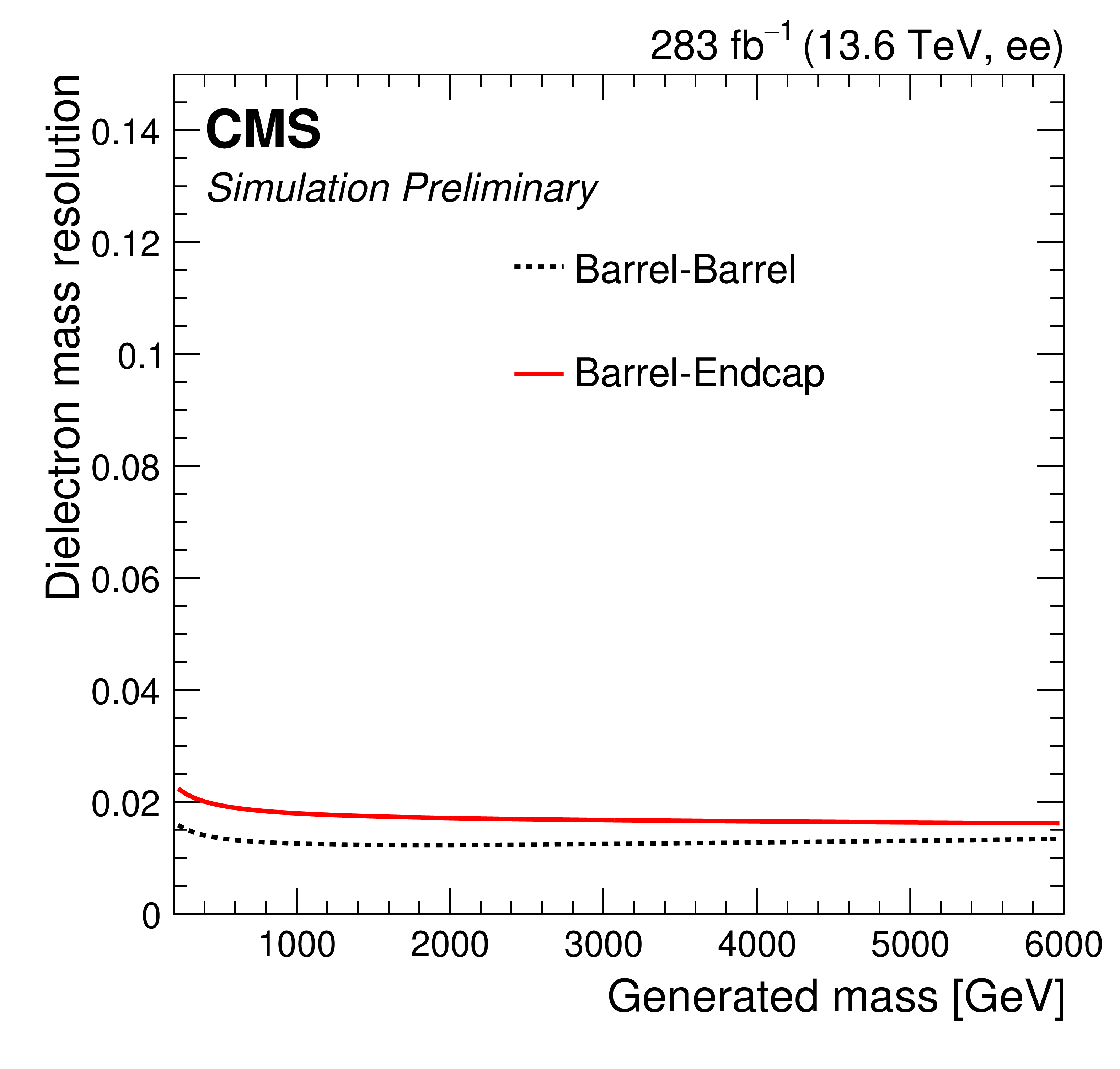
png pdf |
Additional Figure 5:
Dielectron invariant mass resolution as a function of the generated dielectron mass, obtained from Drell--Yan simulation. |
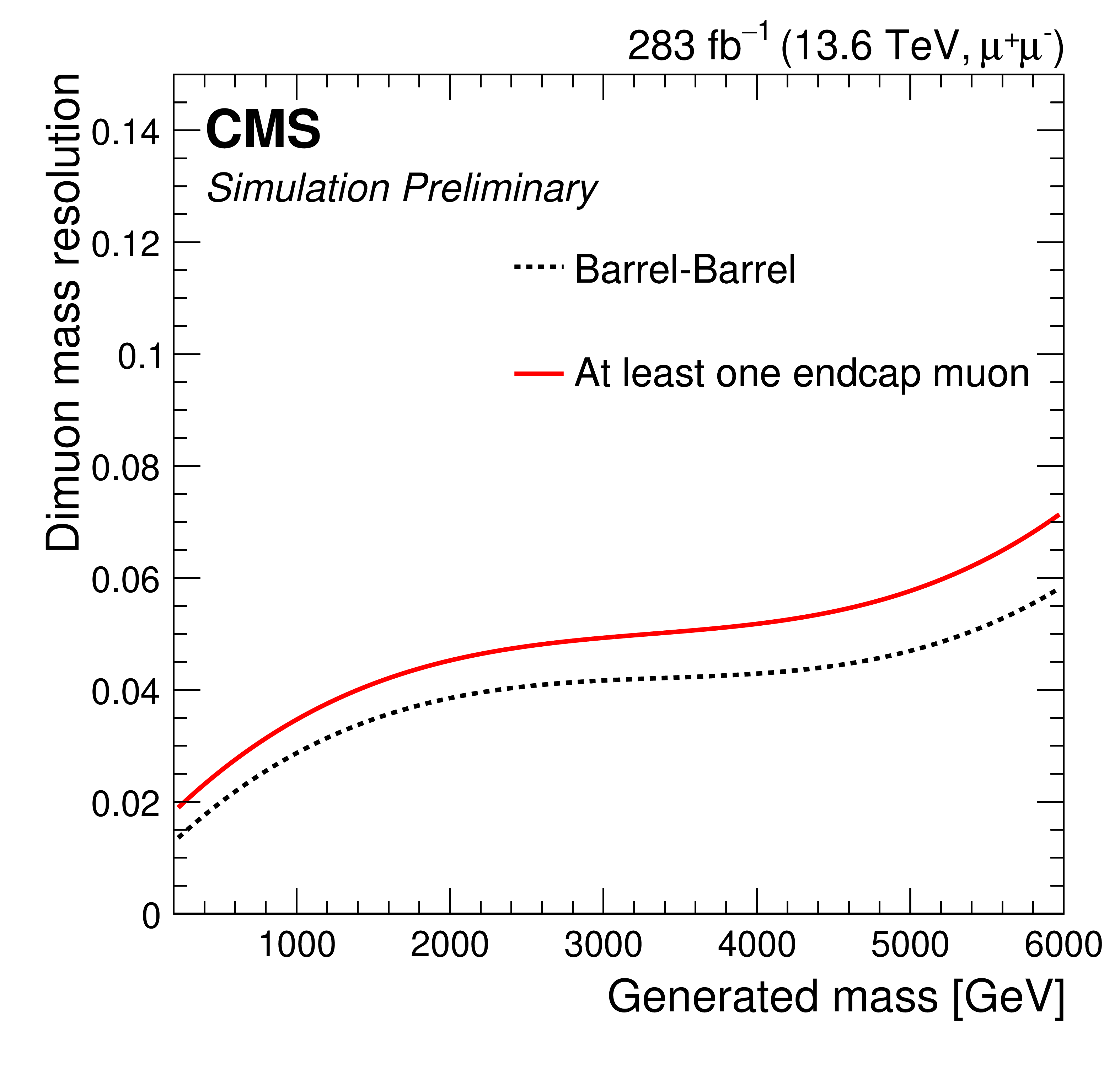
png pdf |
Additional Figure 6:
Dimuon invariant mass resolution as a function of the generated dimuon mass, obtained from Drell--Yan simulation. |
png pdf |
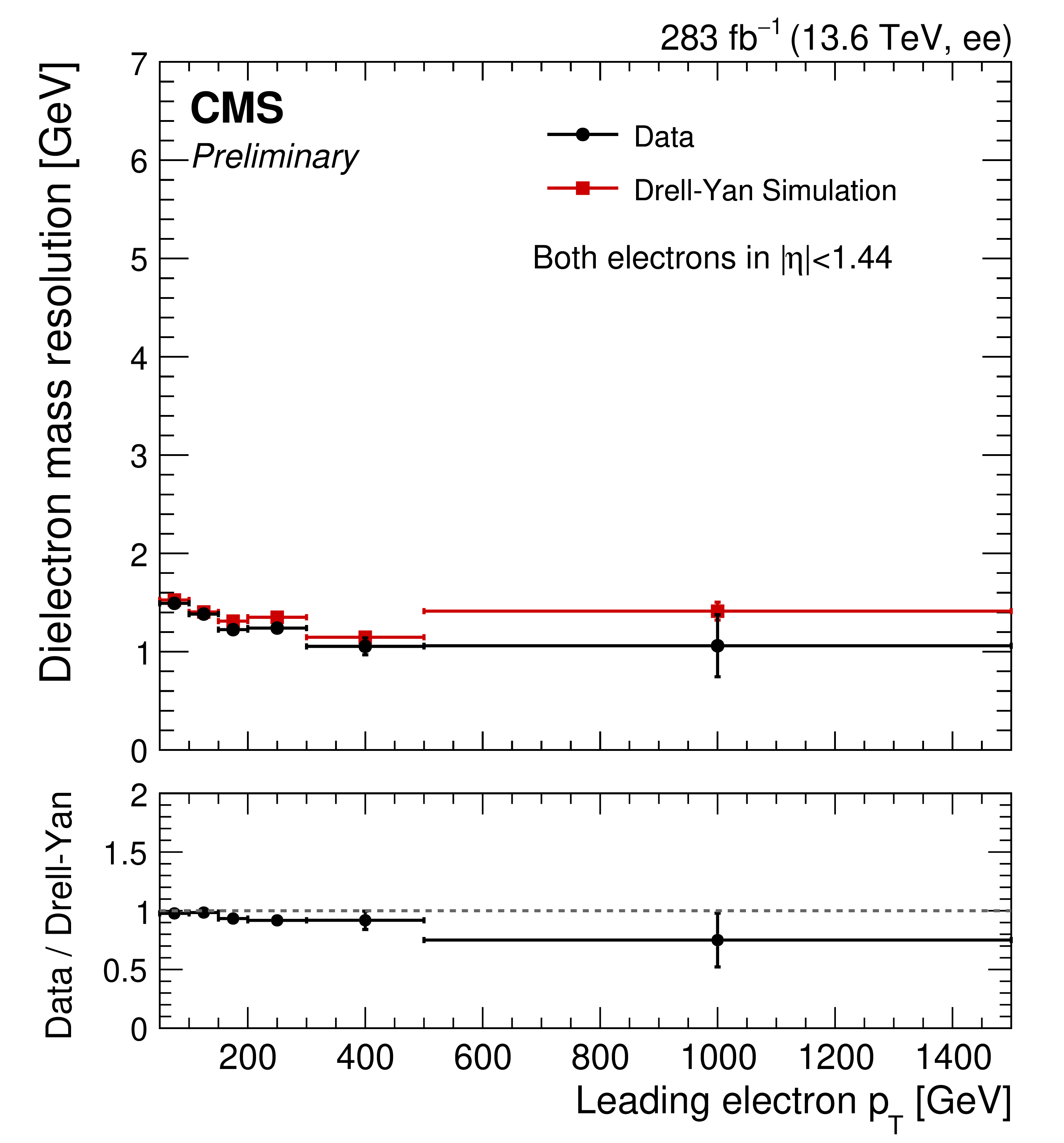
Additional Figure 7:
Dielectron invariant mass resolution at the $Z$ boson peak as a function of leading electron transverse momentum for events with both electrons in the barrel region, comparing data and simulation. |
png pdf |
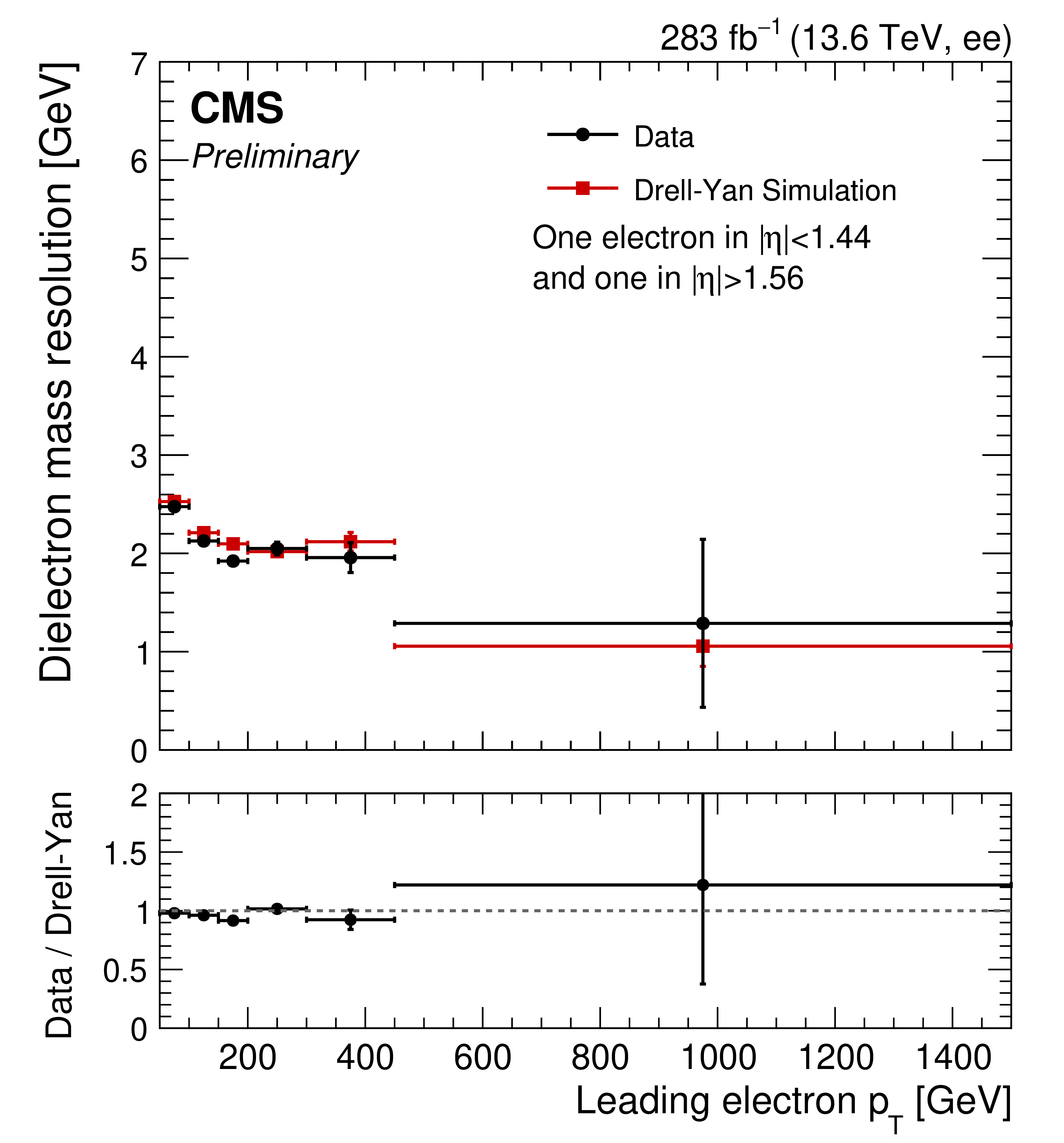
Additional Figure 8:
Dielectron invariant mass resolution at the $Z$ boson peak as a function of leading electron transverse momentum for events with one barrel and one endcap electron, comparing data and simulation. |
png pdf |
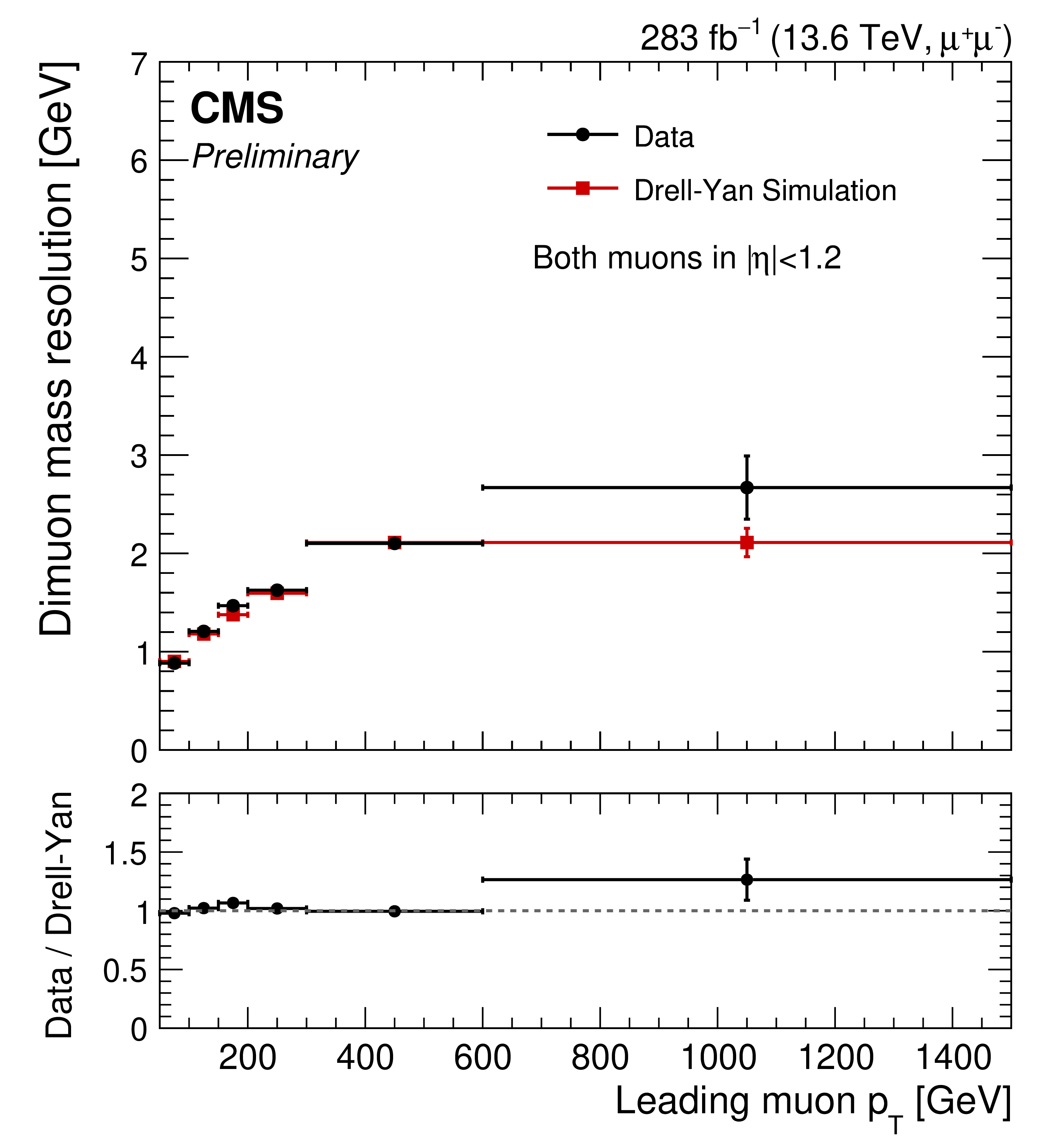
Additional Figure 9:
Dimuon invariant mass resolution at the $Z$ boson peak as a function of leading muon transverse momentum for events with both muons in the barrel region, comparing data and simulation. |
png pdf |
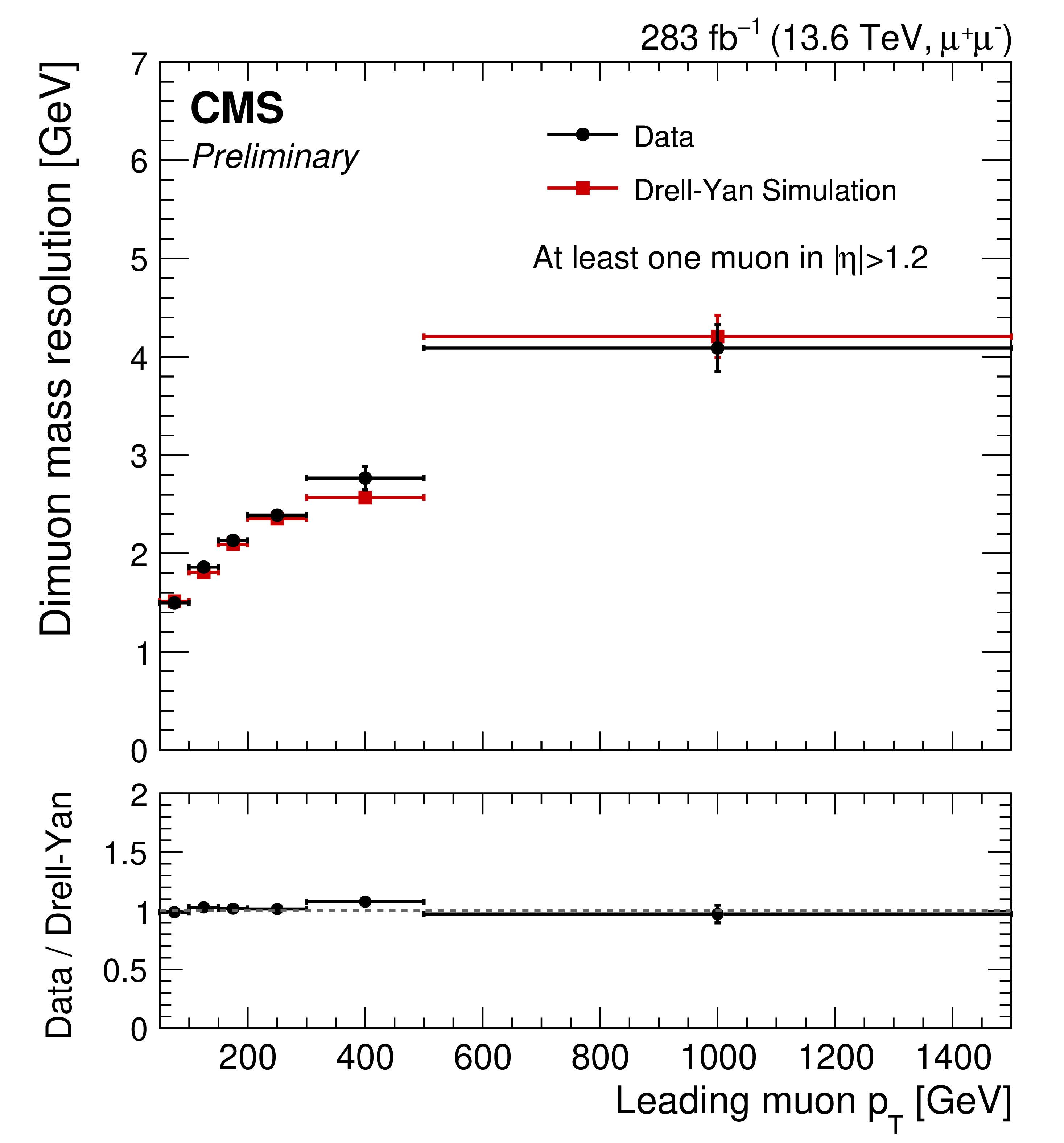
Additional Figure 10:
Dimuon invariant mass resolution at the $Z$ boson peak as a function of leading muon transverse momentum for events with at least one endcap muon, comparing data and simulation. |
png pdf |
Additional Figure 11:
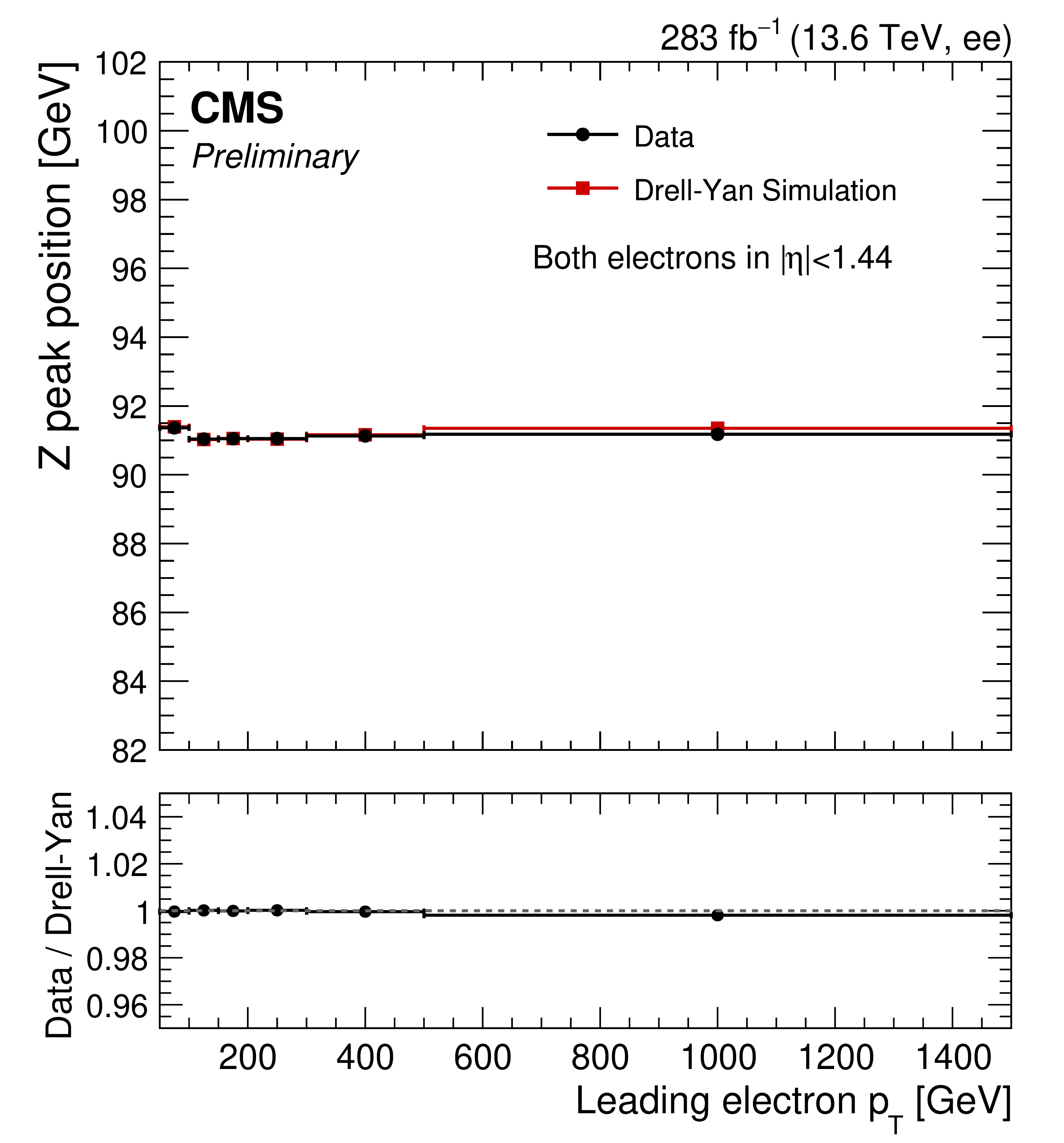
Dielectron mass scale at the $Z$ boson peak as a function of leading electron transverse momentum for events with both electrons in the barrel region, comparing data and simulation. |
png pdf |
Additional Figure 12:
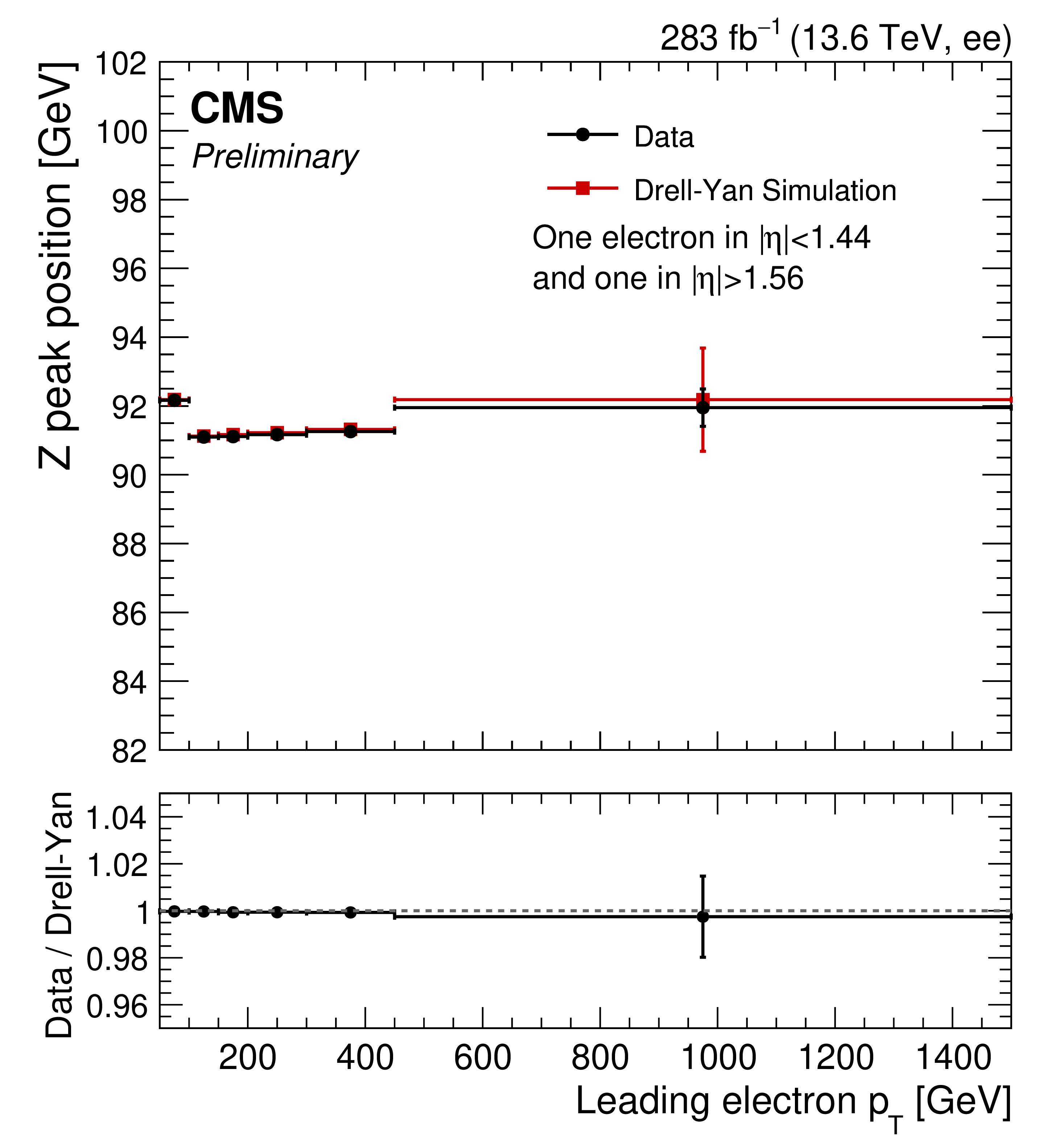
Dielectron mass scale at the $Z$ boson peak as a function of leading electron transverse momentum for events with one barrel and one endcap electron, comparing data and simulation. |
png pdf |
Additional Figure 13:
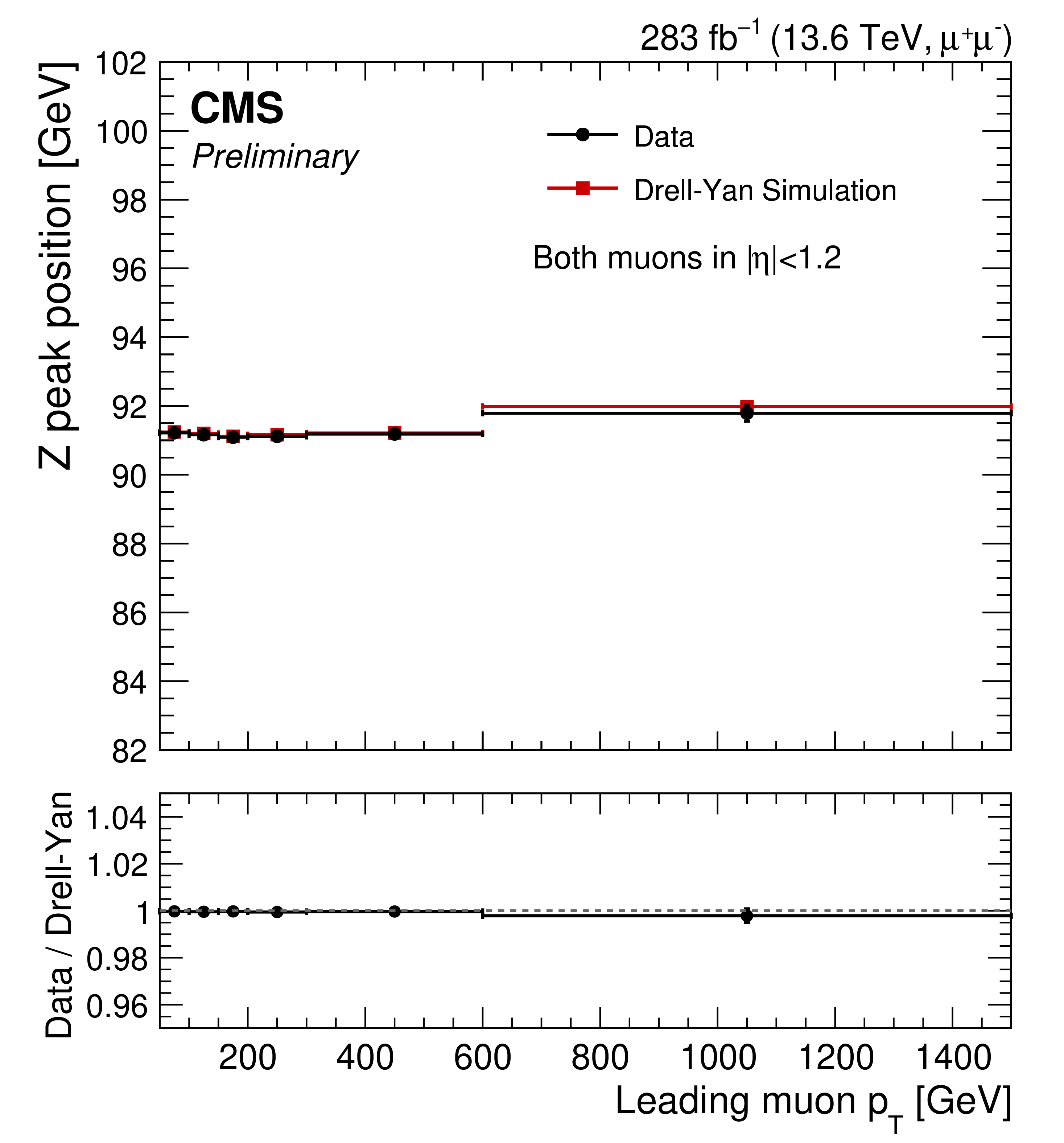
Dimuon mass scale at the $Z$ boson peak as a function of leading muon transverse momentum for events with both muons in the barrel region, comparing data and simulation. |
png pdf |
Additional Figure 14:
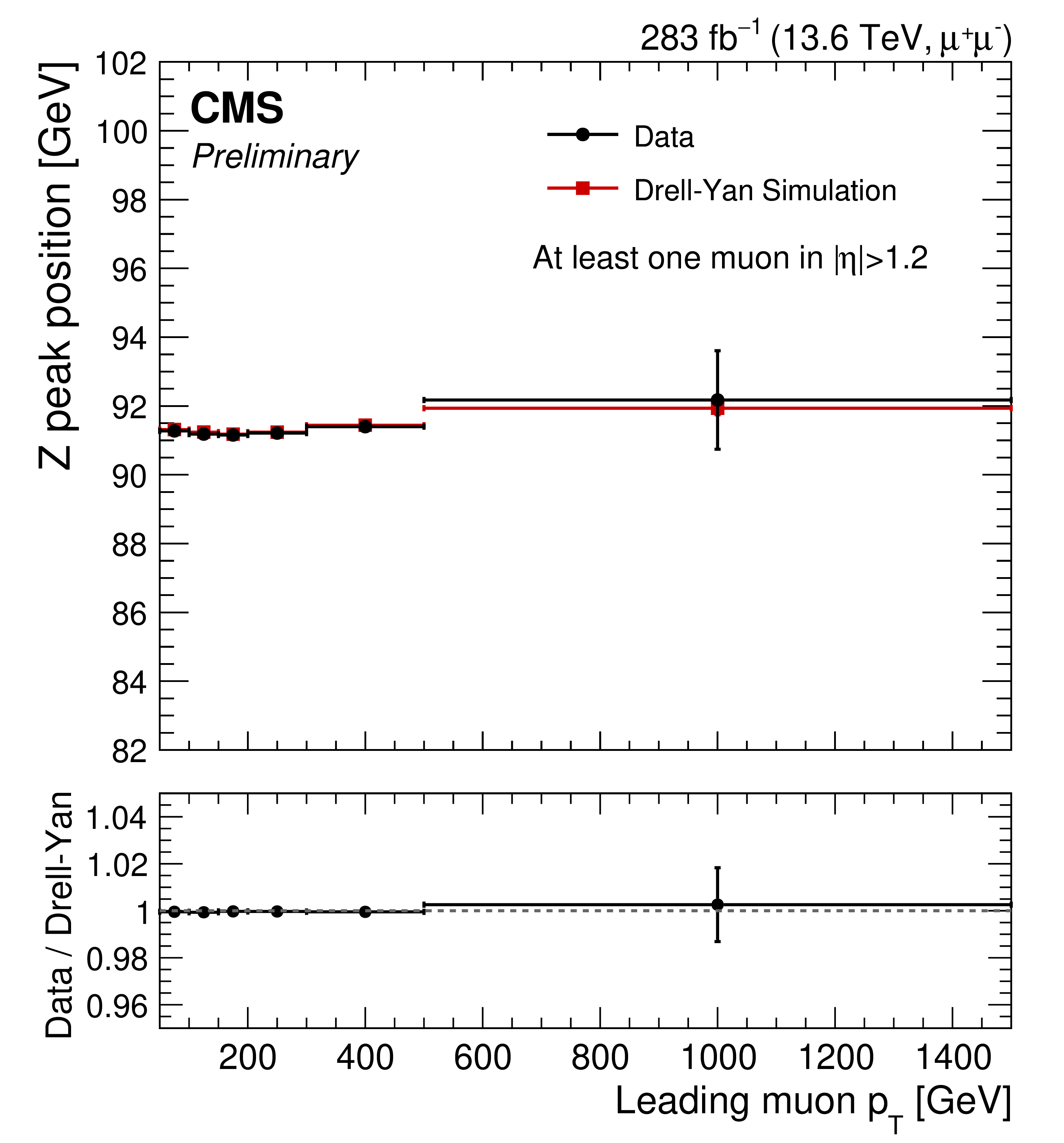
Dimuon mass scale at the $Z$ boson peak as a function of leading muon transverse momentum for events with at least one endcap muon, comparing data and simulation. |
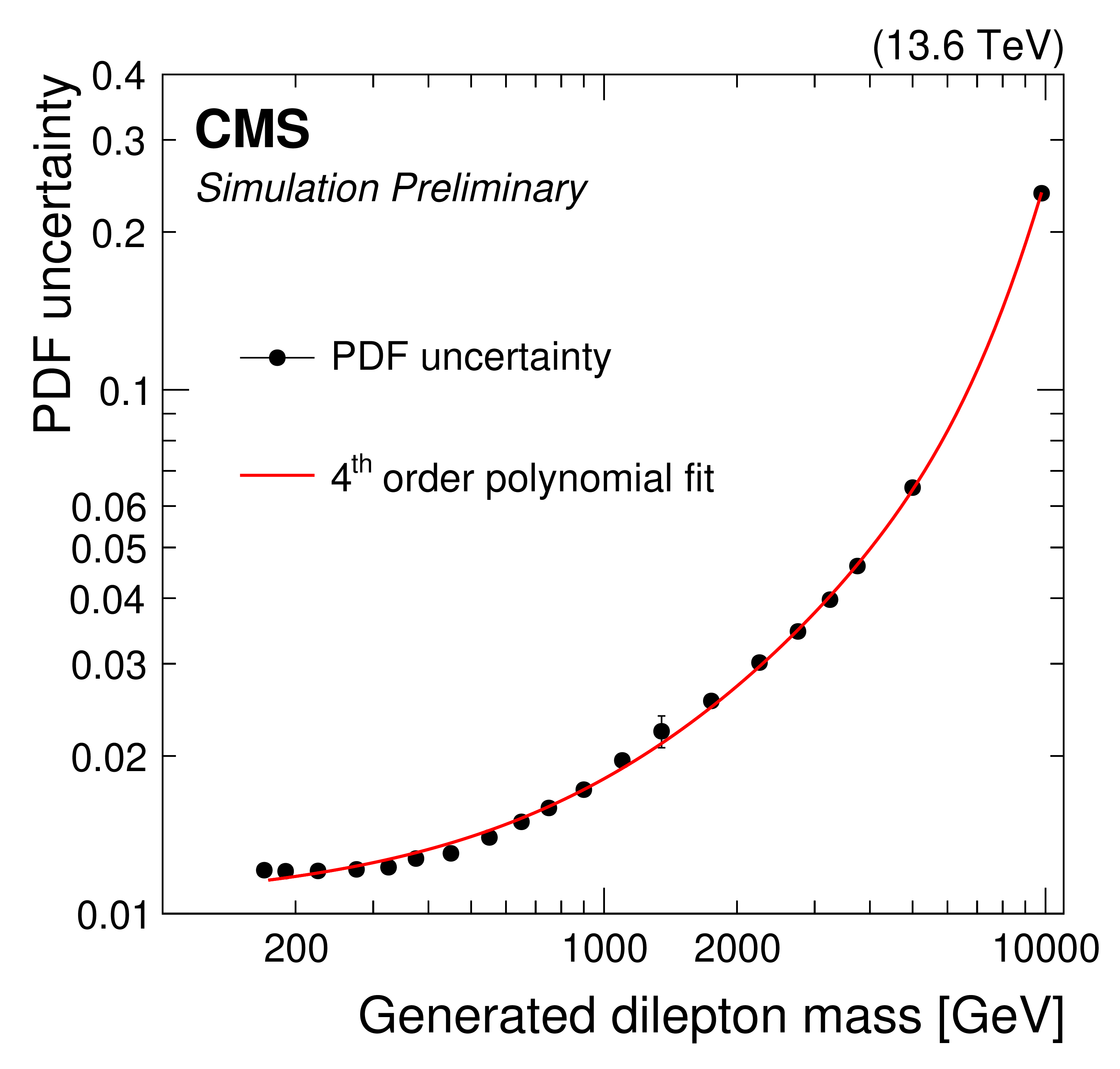
png pdf |
Additional Figure 15:
Relative parton distribution function (PDF) uncertainty on the Drell--Yan background as a function of the dilepton invariant mass. |
| References | ||||
| 1 | A. Leike | The phenomenology of extra neutral gauge bosons | Phys. Rept. 317 (1999) 143 | hep-ph/9805494 |
| 2 | P. Langacker | The physics of heavy $ {\mathrm{Z}^{'}} $ gauge bosons | Rev. Mod. Phys. 81 (2009) 1199 | 0801.1345 |
| 3 | L. Randall and R. Sundrum | A large mass hierarchy from a small extra dimension | PRL 83 (1999) 3370 | hep-ph/9905221 |
| 4 | CMS Collaboration | Search for resonances in the dilepton mass distribution in pp collisions at $ \sqrt{s}= $ 7 TeV | JHEP 05 (2011) 093 | CMS-EXO-10-013 1103.0981 |
| 5 | CMS Collaboration | Search for narrow resonances in dilepton mass spectra in pp collisions at $ \sqrt{s}= $ 7 TeV | PLB 714 (2012) 158 | CMS-EXO-11-019 1206.1849 |
| 6 | CMS Collaboration | Search for heavy narrow dilepton resonances in pp collisions at $ \sqrt{s}= $ 7 TeV and $ \sqrt{s}= $ 8 TeV | PLB 720 (2013) 63 | CMS-EXO-12-015 1212.6175 |
| 7 | CMS Collaboration | Search for physics beyond the standard model in dilepton mass spectra in proton-proton collisions at $ \sqrt{s}= $ 8 TeV | JHEP 04 (2015) 025 | CMS-EXO-12-061 1412.6302 |
| 8 | CMS Collaboration | Search for narrow resonances in dilepton mass spectra in proton-proton collisions at $ \sqrt{s} = $ 13 TeV and combination with 8 TeV data | PLB 768 (2017) 57 | CMS-EXO-15-005 1609.05391 |
| 9 | CMS Collaboration | Search for high-mass resonances in dilepton final states in proton-proton collisions at $ \sqrt{s}= $ 13 TeV | JHEP 06 (2018) 120 | CMS-EXO-16-047 1803.06292 |
| 10 | ATLAS Collaboration | Search for high mass dilepton resonances in pp collisions at $ \sqrt{s}= $ 7 TeV with the ATLAS experiment | PLB 700 (2011) 163 | 1103.6218 |
| 11 | ATLAS Collaboration | Search for high-mass resonances decaying to dilepton final states in pp collisions at $ \sqrt{s}= $ 7 TeV with the ATLAS detector | JHEP 11 (2012) 138 | 1209.2535 |
| 12 | ATLAS Collaboration | Search for high-mass dilepton resonances in pp collisions at $ \sqrt{s}= $ 8 TeV with the ATLAS detector | PRD 90 (2014) 052005 | 1405.4123 |
| 13 | ATLAS Collaboration | Search for new high-mass phenomena in the dilepton final state using 36.1 fb$ ^{-1} $ of proton-proton collision data at $ \sqrt{s} = $ 13 TeV with the ATLAS detector | JHEP 10 (2017) 182 | 1707.02424 |
| 14 | CMS Collaboration | Search for resonant and nonresonant new phenomena in high-mass dilepton final states at $ \sqrt{s} = $ 13 TeV | JHEP 07 (2021) 208 | CMS-EXO-19-019 2103.02708 |
| 15 | ATLAS Collaboration | Search for high-mass dilepton resonances using 139 fb$ ^{-1} $ of $ pp $ collision data collected at $ \sqrt{s}= $13 TeV with the ATLAS detector | PLB 796 (2019) 68 | 1903.06248 |
| 16 | CMS Collaboration | The CMS experiment at the CERN LHC | JINST 3 (2008) S08004 | 0809.2032 |
| 17 | CMS Collaboration | Development of the CMS detector for the CERN LHC Run 3 | Journal of Instrumentation 19 (2024) P05064 | 2310.01800 |
| 18 | CMS Collaboration | Performance of the CMS Level-1 trigger in proton-proton collisions at $ \sqrt{s} = $ 13 TeV | JINST 15 (2020) P10017 | CMS-TRG-17-001 2006.10165 |
| 19 | CMS Collaboration | The CMS trigger system | JINST 12 (2017) P01020 | CMS-TRG-12-001 1609.02366 |
| 20 | CMS Collaboration | Performance of the CMS high-level trigger during LHC Run 2 | JINST 19 (2024) P11021 | CMS-TRG-19-001 2410.17038 |
| 21 | CMS Collaboration | Performance of photon reconstruction and identification with the CMS detector in proton-proton collisions at sqrt(s) = 8 TeV | JINST 10 (2015) P08010 | CMS-EGM-14-001 1502.02702 |
| 22 | CMS Collaboration | Performance of the CMS muon detector and muon reconstruction with proton-proton collisions at $ \sqrt{s}= $ 13 TeV | JINST 13 (2018) P06015 | CMS-MUO-16-001 1804.04528 |
| 23 | CMS Collaboration | Description and performance of track and primary-vertex reconstruction with the CMS tracker | JINST 9 (2014) P10009 | CMS-TRK-11-001 1405.6569 |
| 24 | E. Accomando et al. | $ {\mathrm{Z}^{'}} $ physics with early LHC data | PRD 83 (2011) 075012 | 1010.6058 |
| 25 | G. Altarelli, B. Mele, and M. Ruiz-Altaba | Searching for new heavy vector bosons in $ \mathrm{p}\overline{\mathrm{p}} $ colliders | Z. Phys. C 45 (1989) 109 | |
| 26 | J. L. Hewett and T. G. Rizzo | Low-energy phenomenology of superstring-inspired $ E_6 $ models | Physics Reports 183 (1989) 193 | |
| 27 | E. Accomando et al. | Z' at the LHC: Interference and finite width effects in Drell-Yan | JHEP 10 (2013) 153 | 1304.6700 |
| 28 | M. S. Carena, A. Daleo, B. A. Dobrescu, and T. M. P. Tait | $ {\mathrm{Z}^{'}} $ gauge bosons at the Tevatron | PRD 70 (2004) 093009 | hep-ph/0408098 |
| 29 | L. Randall and R. Sundrum | An alternative to compactification | PRL 83 (1999) 4690 | hep-th/9906064 |
| 30 | P. Nason | A new method for combining NLO QCD with shower Monte Carlo algorithms | JHEP 11 (2004) 040 | hep-ph/0409146 |
| 31 | S. Frixione, P. Nason, and C. Oleari | Matching NLO QCD computations with parton shower simulations: the POWHEG method | JHEP 11 (2007) 070 | 0709.2092 |
| 32 | S. Alioli, P. Nason, C. Oleari, and E. Re | A general framework for implementing NLO calculations in shower Monte Carlo programs: the POWHEG BOX | JHEP 06 (2010) 043 | 1002.2581 |
| 33 | S. Alioli, P. Nason, C. Oleari, and E. Re | NLO vector-boson production matched with shower in POWHEG | JHEP 07 (2008) 060 | 0805.4802 |
| 34 | S. Frixione, P. Nason, and G. Ridolfi | A positive-weight next-to-leading-order Monte Carlo for heavy flavour hadroproduction | JHEP 09 (2007) 126 | 0707.3088 |
| 35 | E. Re | Single-top $ \mathrm{W}\mathrm{t} $-channel production matched with parton showers using the POWHEG method | EPJC 71 (2011) 1547 | 1009.2450 |
| 36 | NNPDF Collaboration | Parton distributions from high-precision collider data | EPJC 77 (2017) 663 | 1706.00428 |
| 37 | M. R. Whalley, D. Bourilkov, and R. C. Group | The Les Houches accord PDFs (LHAPDF) and LHAGLUE | in HERA and the LHC: A Workshop on the implications of HERA for LHC physics. Proceedings, Part B, 2005 | hep-ph/0508110 |
| 38 | D. Bourilkov, R. C. Group, and M. R. Whalley | LHAPDF: PDF use from the Tevatron to the LHC | in TeV4LHC Workshop 4th meeting Batavia, Illinois, 2006 October 2 (2006) 0 |
hep-ph/0605240 |
| 39 | A. Buckley et al. | LHAPDF6: parton density access in the LHC precision era | EPJC 75 (2015) 132 | 1412.7420 |
| 40 | T. Sjöstrand et al. | An introduction to PYTHIA 8.2 | Comput. Phys. Commun. 191 (2015) 159 | 1410.3012 |
| 41 | CMS Collaboration | Extraction and validation of a new set of CMS PYTHIA8 tunes from underlying-event measurements | EPJC 80 (2020) 4 | CMS-GEN-17-001 1903.12179 |
| 42 | Y. Li and F. Petriello | Combining QCD and electroweak corrections to dilepton production in FEWZ | PRD 86 (2012) 094034 | 1208.5967 |
| 43 | A. Manohar, P. Nason, G. P. Salam, and G. Zanderighi | How bright is the proton? A precise determination of the photon parton distribution function | PRL 117 (2016) 242002 | 1607.04266 |
| 44 | J. Butterworth et al. | PDF4LHC recommendations for LHC Run II | JPG 43 (2016) 023001 | 1510.03865 |
| 45 | R. D. Ball et al. | The PDF4LHC21 combination of global PDF fits for the LHC Run III | Journal of Physics G, Nuclear and Particle Physics 49 (2022) 080501 | 2203.05506 |
| 46 | D. Bourilkov | Photon-induced background for dilepton searches and measurements in pp collisions at 13 TeV | 1606.00523 | |
| 47 | D. Bourilkov | Exploring the LHC landscape with dileptons | 1609.08994 | |
| 48 | M. Czakon and A. Mitov | Top++: a program for the calculation of the top-pair cross-section at hadron colliders | Comput. Phys. Commun. 185 (2014) 2930 | 1112.5675 |
| 49 | N. Kidonakis | Two-loop soft anomalous dimensions for single top quark associated production with a W$ ^{-} $ or H$ ^{-} $ | PRD 82 (2010) 054018 | 1005.4451 |
| 50 | GEANT4 Collaboration | GEANT 4---a simulation toolkit | NIM A 506 (2003) 250 | |
| 51 | CMS Collaboration | Performance of electron reconstruction and selection with the CMS detector in proton-proton collisions at $ \sqrt{s}= $ 8 TeV | JINST 10 (2015) P06005 | CMS-EGM-13-001 1502.02701 |
| 52 | Particle Data Group Collaboration | Review of particle physics | Physical Review D 110 (2024) 030001 | |
| 53 | CMS Collaboration | Performance of CMS muon reconstruction in pp collision events at $ \sqrt{s} = $ 7 TeV | JINST 7 (2012) P10002 | CMS-MUO-10-004 1206.4071 |
| 54 | CMS Collaboration | Performance of the reconstruction and identification of high-momentum muons in proton-proton collisions at $ \sqrt{s} = $ 13 TeV | JINST 15 (2020) P02027 | CMS-MUO-17-001 1912.03516 |
| 55 | M. J. Oreglia | A study of the reactions $ \psi^\prime \to \gamma \gamma \psi $ | PhD thesis, Stanford University, SLAC Report SLAC-R-236, 1980 link |
|
| 56 | Particle Data Group , P. A. Zyla et al. | Review of particle physics | Prog. Theor. Exp. Phys. 2020 (2020) 083C01 | |
| 57 | CMS Collaboration | The CMS statistical analysis and combination tool: Combine | Comput. Softw. Big Sci. 8 (2024) 19 | CMS-CAT-23-001 2404.06614 |
| 58 | W. Verkerke and D. Kirkby | The RooFit toolkit for data modeling | in the International Conference on Computing in High Energy and Nuclear Physics (CHEP ): La Jolla CA, United States, March 24--28,.. [eConf C0303241 MOLT007], 2003 Proc. 1 (2003) 3 |
physics/0306116 |
| 59 | L. Moneta et al. | The RooStats project | In the International Workshop on Advanced Computing and Analysis Techniques in Physics Research (ACAT). SISSA,. PoS(ACAT)057, 2010 link |
1009.1003 |
| 60 | CMS Collaboration | Measurements of the inclusive W and Z boson production cross sections and their ratios in proton-proton collisions at $ \sqrt{s}= $ 13.6 TeV | JHEP 01 (2026) 047 | CMS-SMP-22-017 2503.09742 |
| 61 | CMS Collaboration | Observation of a new boson at a mass of 125 GeV with the CMS experiment at the LHC | PLB 716 (2012) 30 | CMS-HIG-12-028 1207.7235 |
|
|
Compact Muon Solenoid LHC, CERN |

|
|
|
|
|
|