Compact Muon Solenoid
LHC, CERN
 Visit us: CMS Public Website, CMS Physics ;
Contact us: CMS Publications Committee
Visit us: CMS Public Website, CMS Physics ;
Contact us: CMS Publications Committee
| CMS-PAS-EXO-25-019 | ||
| Search for low-mass resonances decaying to a pair of muons in proton-proton collisions at $ \sqrt{s} = $ 13.6 TeV | ||
| CMS Collaboration | ||
| 2026-05-16 | ||
| Abstract: A search for prompt production of low-mass dimuon resonances is reported using proton-proton collision events at $ \sqrt{s} = $ 13.6 TeV collected by the CMS detector in 2022-2024, corresponding to an integrated luminosity of 175$ \mathrm{fb}^{-1} $. The search employs a newly developed inclusive dimuon trigger and probes the existence of GeV-scale dark photons. The search is performed by looking for narrow peaks in the dimuon mass spectrum in the ranges of 0.88-0.92$ \mathrm{GeV} $, 1.10-2.88$ \mathrm{GeV} $, and 4.00-7.95$ \mathrm{GeV} $. Model-independent upper limits are set for resonances within the fiducial acceptance. No obvious excess is observed. The most stringent constraints to date on minimal dark photon models are placed. | ||
| Links: CDS record (PDF) ; CADI line (restricted) ; | ||
| Figures | |
png pdf |
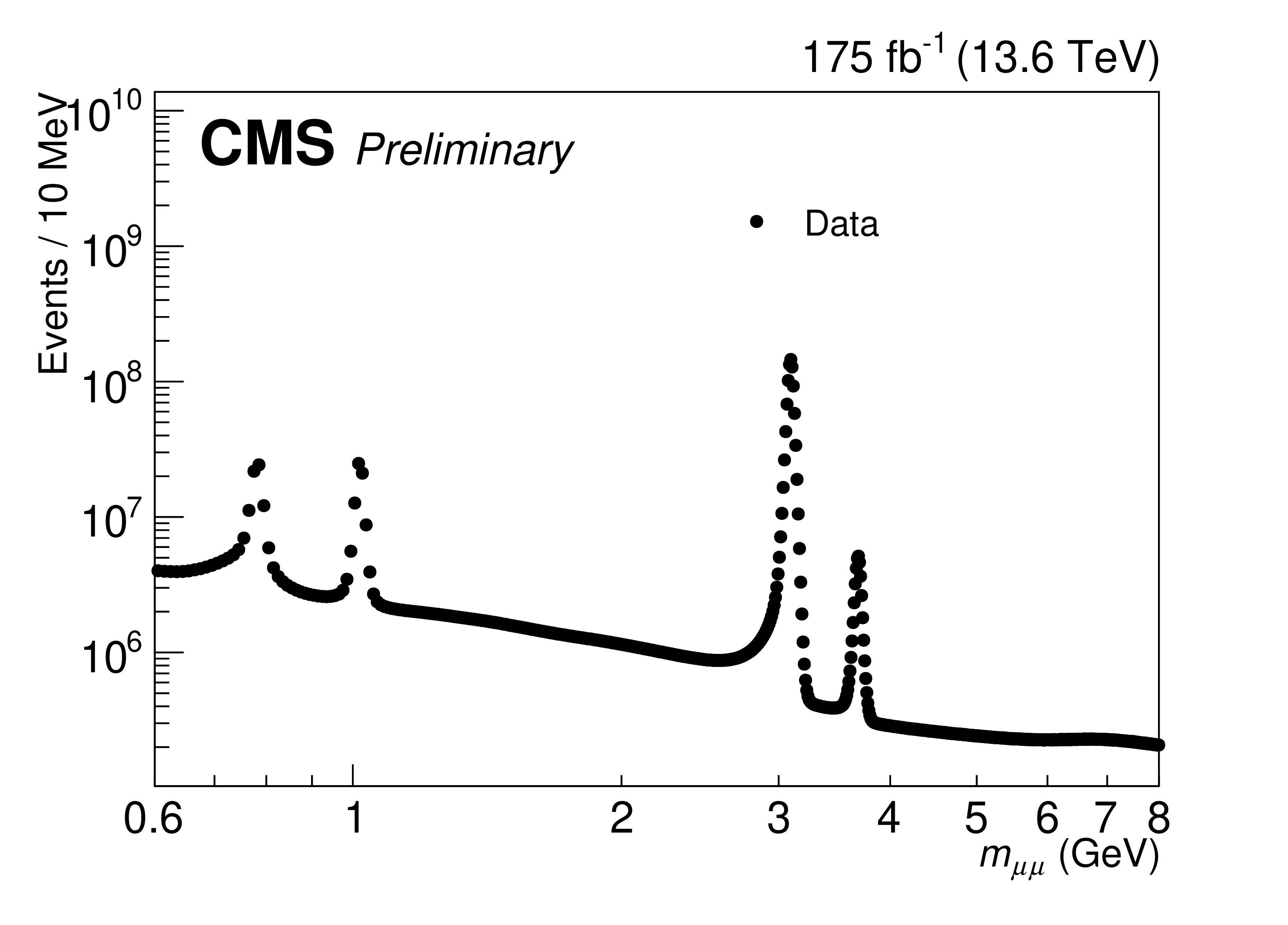
Figure 1:
The $ m_{\mu\mu} $ distribution obtained with the data collected during 2022--2024 after the full selection. |
png pdf |
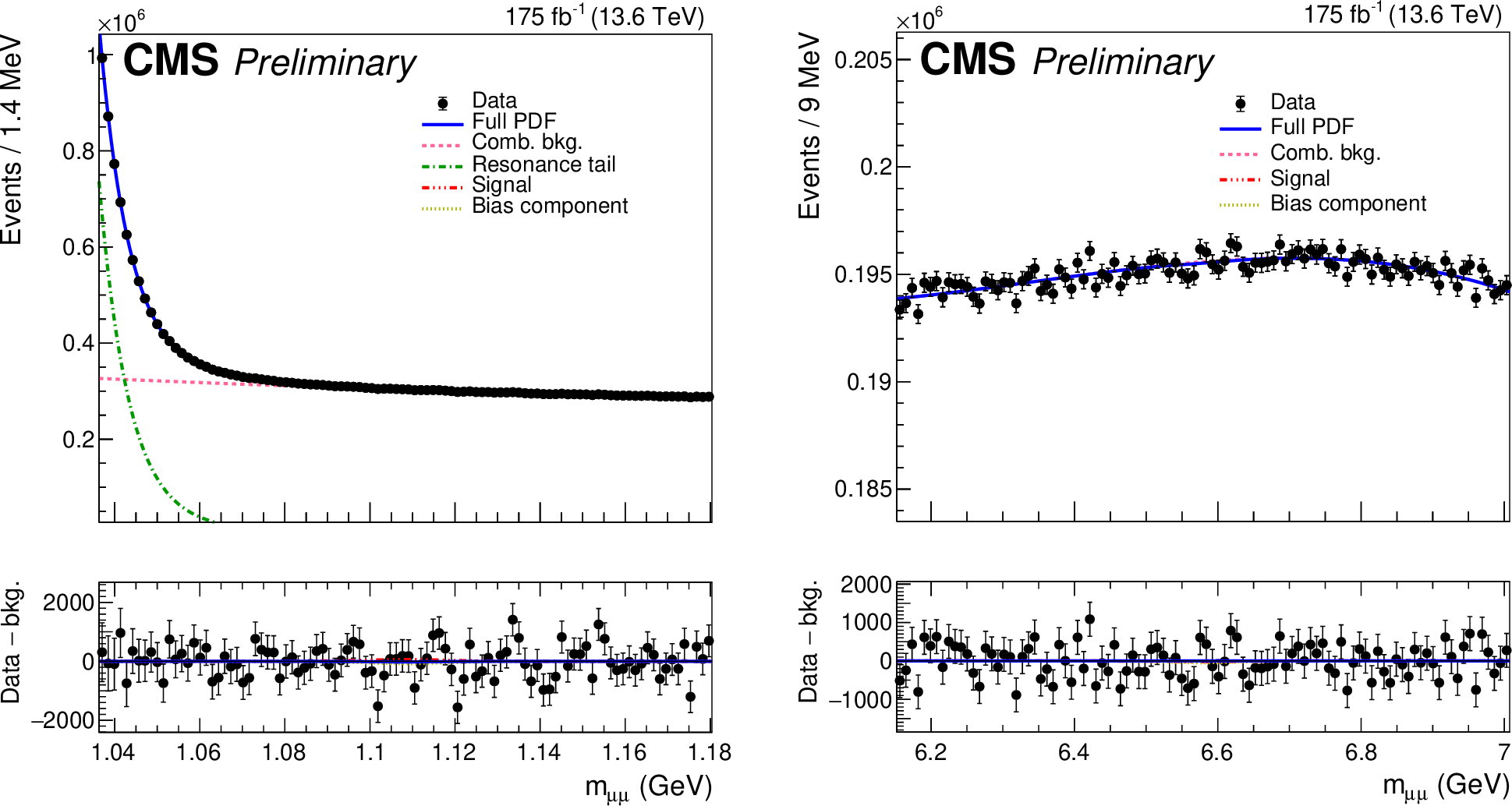
Figure 2:
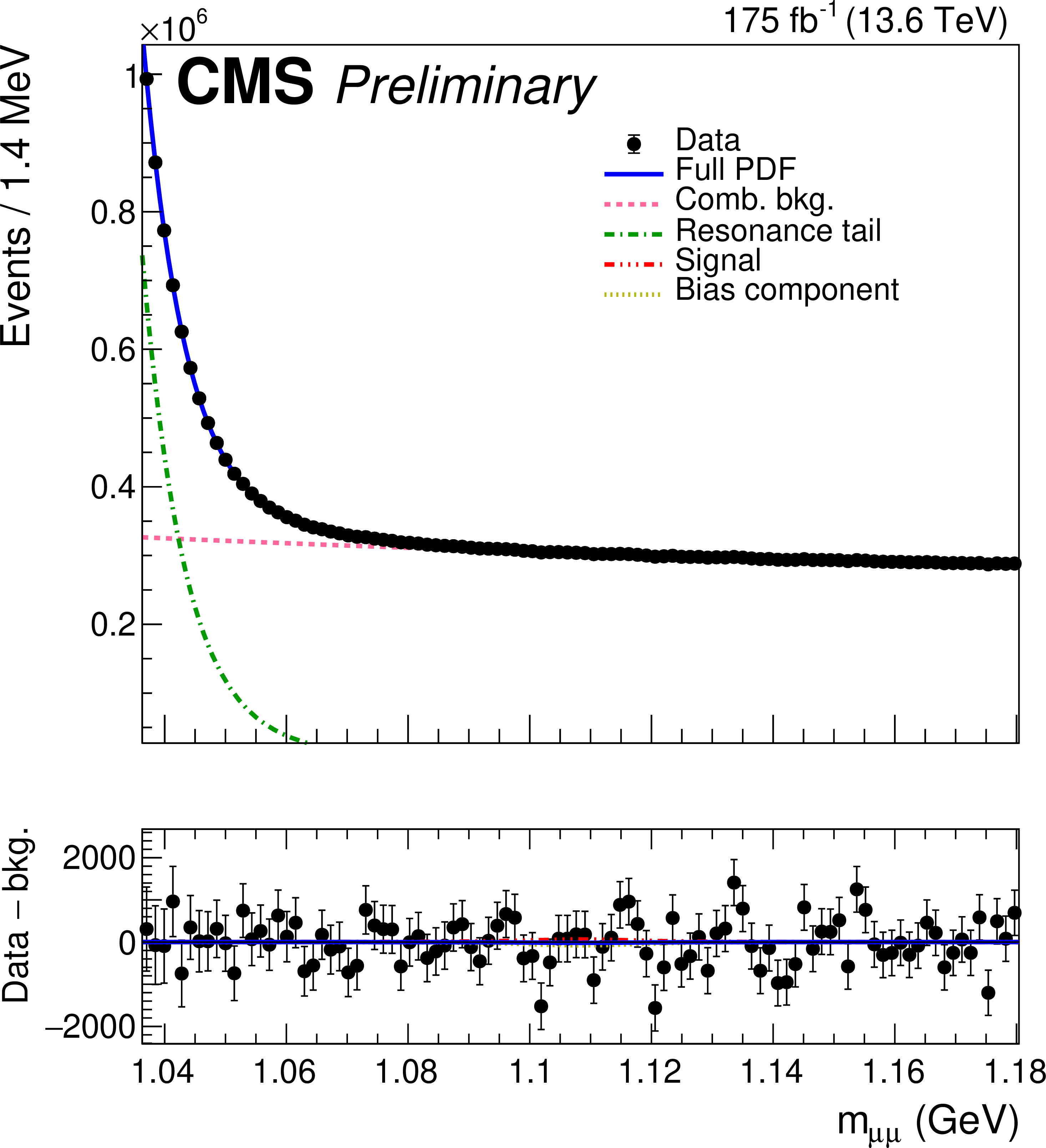
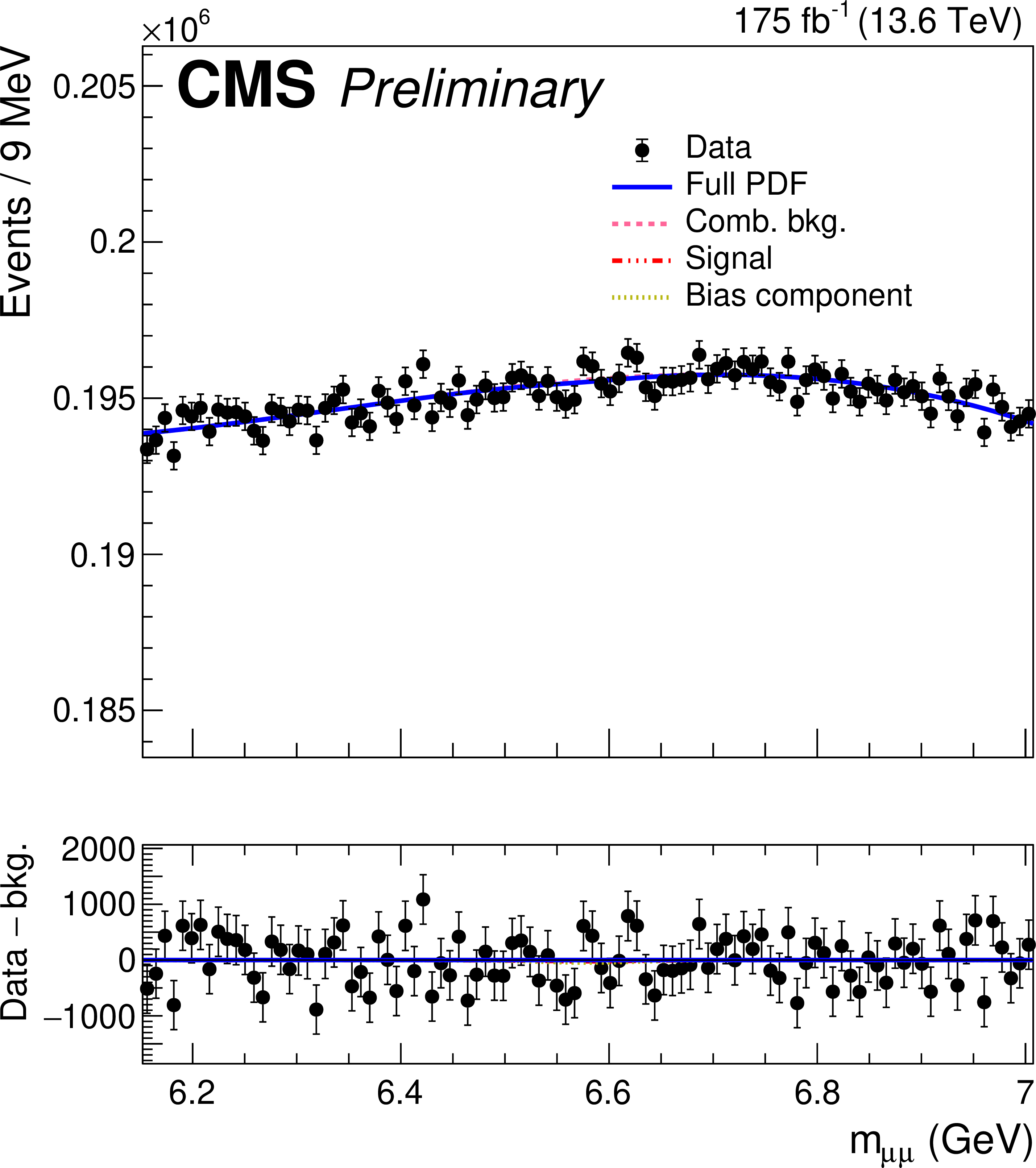
Postfit distributions for the dark photon search for the dark photon search at 1.108 GeV (left) and 6.580 GeV (right) using data collected during 2022--2024. The lower panel shows the data and the fit result after subtracting the total background component of the fit. |
png pdf |
Figure 2-a:
Postfit distributions for the dark photon search for the dark photon search at 1.108 GeV (left) and 6.580 GeV (right) using data collected during 2022--2024. The lower panel shows the data and the fit result after subtracting the total background component of the fit. |
png pdf |
Figure 2-b:
Postfit distributions for the dark photon search for the dark photon search at 1.108 GeV (left) and 6.580 GeV (right) using data collected during 2022--2024. The lower panel shows the data and the fit result after subtracting the total background component of the fit. |
png pdf |
Figure 3:
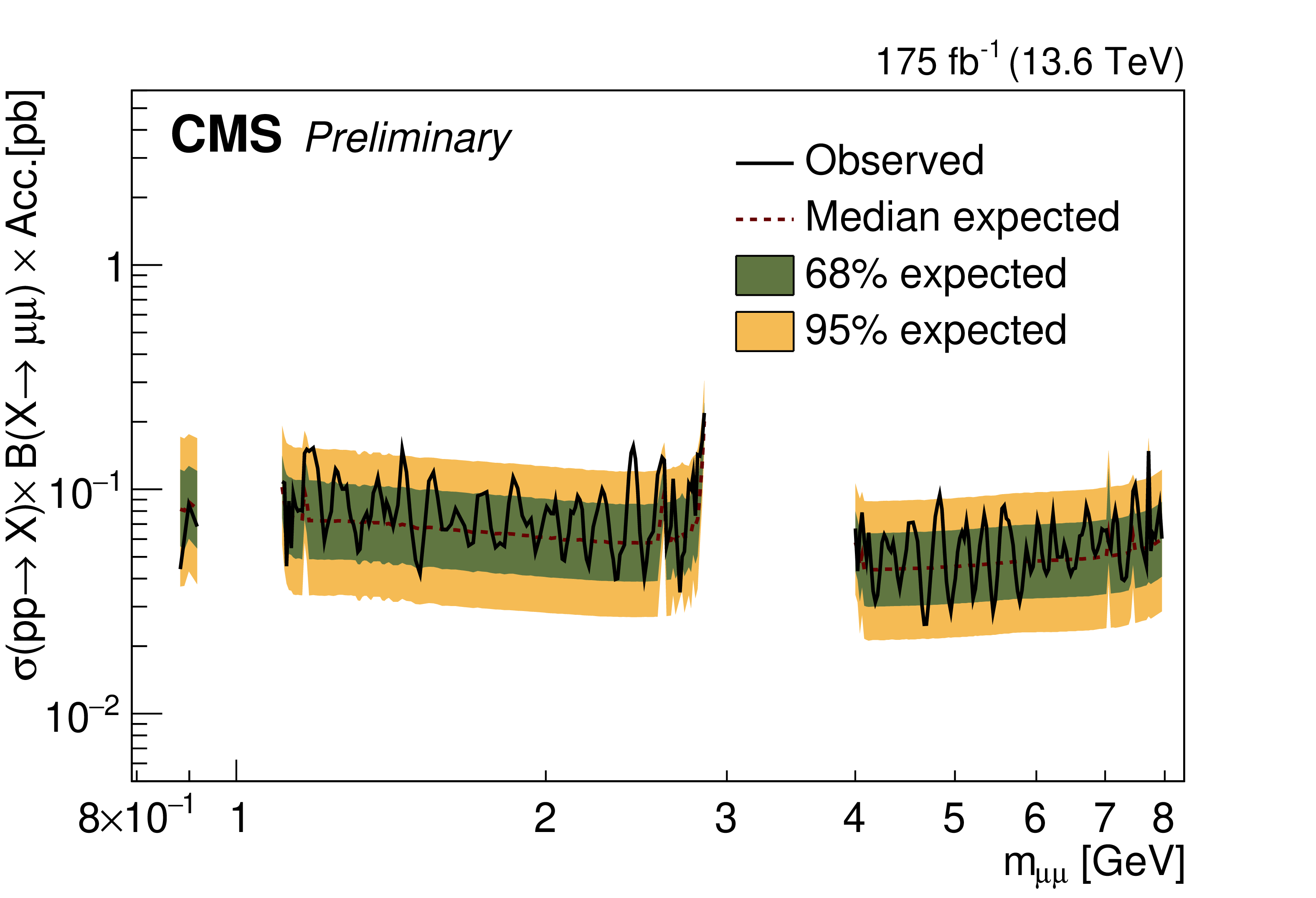
Expected and observed model-independent limits on the cross section times branching fraction of the signals to dimuons at 95% CL for data collected during 2022--2024. The intervals 0.92--1.10 and 2.9--4.0 GeV are excluded because of the presence of $ \phi $, $ \mathrm{J}/\psi $, and $ \PGyP{2S} $ resonances. |
png pdf |
Figure 4:
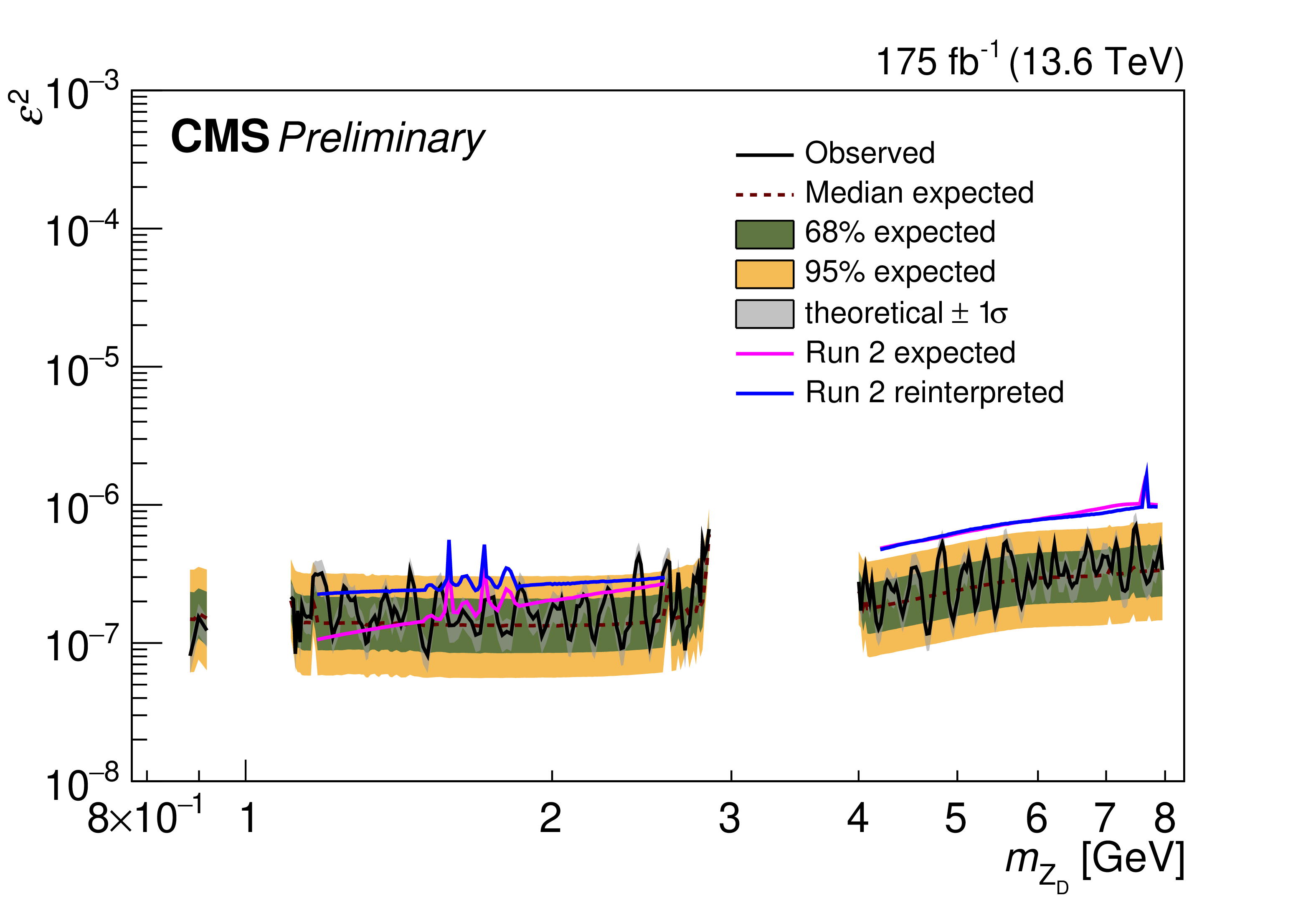
Upper limits at 90% CL on the square of the kinetic mixing coefficient $ \varepsilon $ in the minimal model of a dark photon. Observed and expected values for this analysis are compared to the expected limits from the original Run 2 publication and those re-interpreted from Run 2 measurements using the current framework. |
png pdf |
Figure 5:
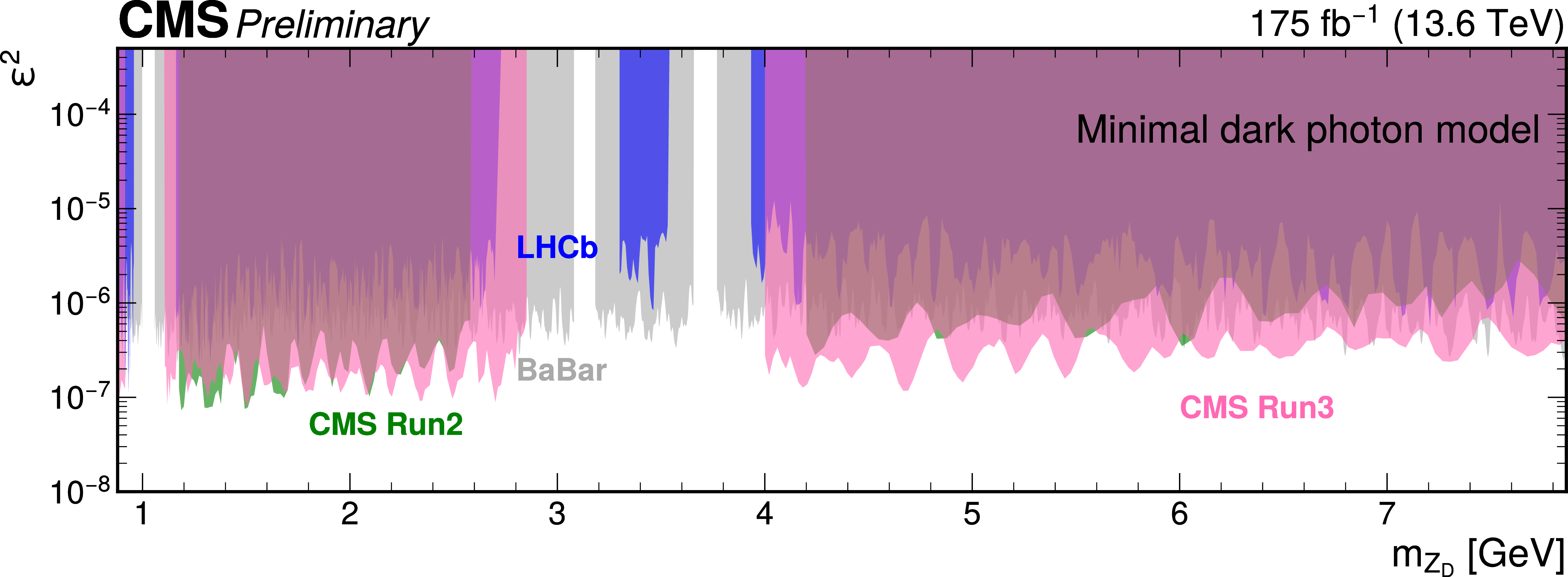
Observed upper limits at 90% CL on the square of the kinetic mixing coefficient $ \varepsilon $ in the minimal model of a dark photon from the CMS search (pink). The results are compared with the existing limits at 90% CL provided by LHCb [5] (blue), BaBar [4] (gray), and CMS Run 2 measurement [7] (green). |
| Tables | |
png pdf |
Table 1:
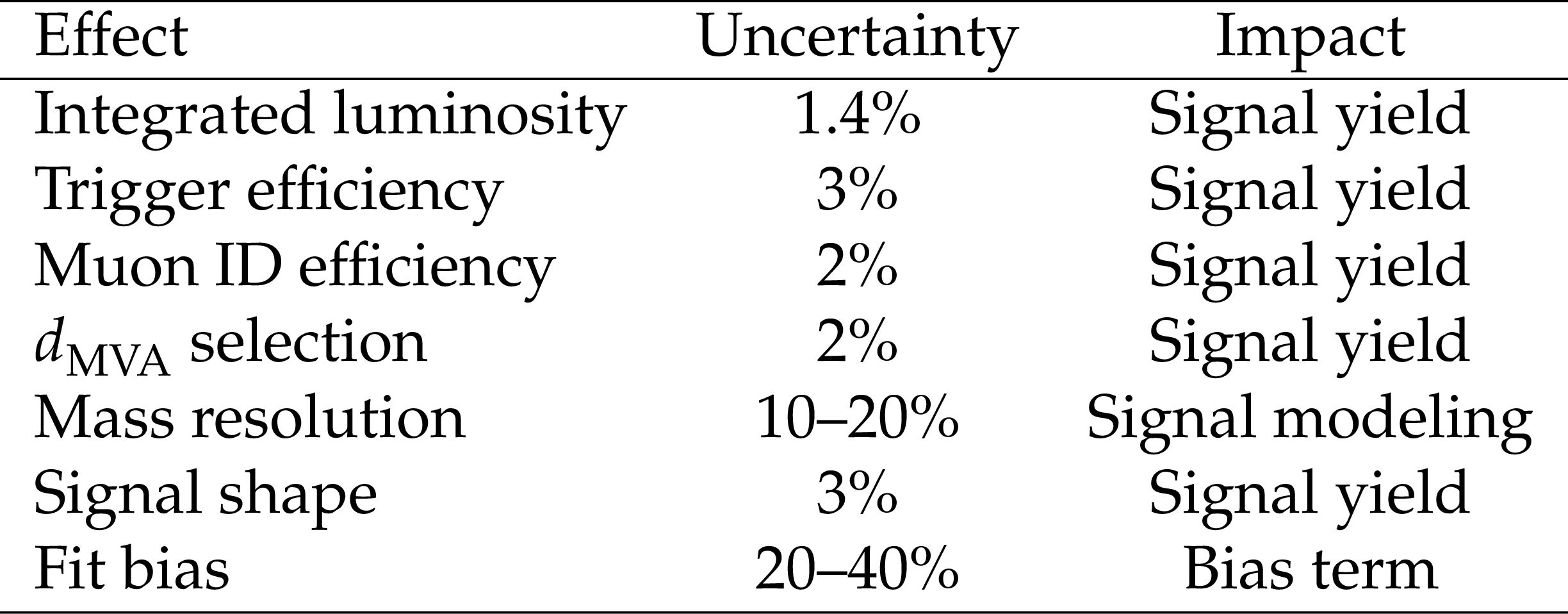
Summary of the experimental systematic uncertainties in the model-independent search for a dimuon resonance. |
| Summary |
| In summary, a search for the prompt production of a narrow resonance decaying to a pair of muons is presented, using proton-proton collision data recorded by the CMS experiment at $\sqrt{s} = 13.6$ TeV corresponding to an integrated luminosity of 175$ \mathrm{fb}^{-1} $. The search is performed in the dimuon mass regions of 0.88--0.92 GeV, 1.10--2.88 GeV, and 4.00--7.95 GeV using a newly developed inclusive dimuon trigger using the parking data processing and storage model. This allowed an improvement in the selection relative to Run~2 due to the full offline reconstruction being available for these events. The direct production of dark photons decaying to dimuons is probed, and no significant excess above the fitted background is observed. This analysis achieves the most stringent constraints across the probed mass range, representing a significant improvement over the previous best results [5,7]. |
| References | ||||
| 1 | B. Holdom | Two U(1)'s and $ \epsilon $ charge shifts | Phys. Lett. B 166 196, 1986 | |
| 2 | P. Galison and A. Manohar | Two Z's or not two Z's? | Phys. Lett. B 136 279, 1984 | |
| 3 | D. Curtin, R. Essig, S. Gori, and J. Shelton | Illuminating dark photons with high-energy colliders | JHEP 02 (2015) 157 | 1412.0018 |
| 4 | BaBar Collaboration | Search for a dark photon in $ \text{e}^+\text{e}^- $ collisions at BaBar | PRL 113 (2014) 201801 | 1406.2980 |
| 5 | LHCb Collaboration | Search for $ A'\to\mu^+\mu^- $ decays | PRL 124 (2020) 041801 | 1910.06926 |
| 6 | LHCb Collaboration | Searches for low-mass dimuon resonances | JHEP 10 (2020) 156 | 2007.03923 |
| 7 | CMS Collaboration | Search for direct production of GeV-scale resonances decaying to a pair of muons in proton-proton collisions at $ \sqrt{s} = $ 13 TeV | JHEP 12 (2023) 070 | CMS-EXO-21-005 2309.16003 |
| 8 | M. Bauer, P. Foldenauer, and J. Jaeckel | Hunting all the hidden photons | JHEP 07 (2018) 094 | 1803.05466 |
| 9 | CMS Collaboration | Enriching the physics program of the CMS experiment via data scouting and data parking | Phys. Rep. 1115 (2025) 678 | CMS-EXO-23-007 2403.16134 |
| 10 | CMS Collaboration | The CMS experiment at the CERN LHC | JINST 3 (2008) S08004 | |
| 11 | CMS Collaboration | Development of the CMS detector for the CERN LHC Run 3 | JINST 19 (2024) P05064 | |
| 12 | CMS Collaboration | Performance of the CMS Level-1 trigger in proton-proton collisions at $ \sqrt{s} = $ 13 TeV | JINST 15 (2020) P10017 | CMS-TRG-17-001 2006.10165 |
| 13 | CMS Collaboration | The CMS trigger system | JINST 12 (2017) P01020 | CMS-TRG-12-001 1609.02366 |
| 14 | CMS Collaboration | Performance of the CMS high-level trigger during LHC Run 2 | JINST 19 (2024) P11021 | CMS-TRG-19-001 2410.17038 |
| 15 | CMS Collaboration | Electron and photon reconstruction and identification with the CMS experiment at the CERN LHC | JINST 16 (2021) P05014 | CMS-EGM-17-001 2012.06888 |
| 16 | CMS Collaboration | Performance of the CMS muon detector and muon reconstruction with proton-proton collisions at $ \sqrt{s}= $ 13 TeV | JINST 13 (2018) P06015 | CMS-MUO-16-001 1804.04528 |
| 17 | CMS Collaboration | Description and performance of track and primary-vertex reconstruction with the CMS tracker | JINST 9 (2014) P10009 | CMS-TRK-11-001 1405.6569 |
| 18 | CMS Collaboration | Particle-flow reconstruction and global event description with the CMS detector | JINST 12 (2017) P10003 | CMS-PRF-14-001 1706.04965 |
| 19 | T. Sjöstrand et al. | An introduction to PYTHIA 8.2 | Comput. Phys. Commun. 191 (2015) 159 | 1410.3012 |
| 20 | CMS Collaboration | Extraction and validation of a new set of CMS PYTHIA8 tunes from underlying-event measurements | EPJC 80 (2020) 4 | CMS-GEN-17-001 1903.12179 |
| 21 | GEANT4 Collaboration | GEANT 4---a simulation toolkit | NIM A 506 (2003) 250 | |
| 22 | NNPDF Collaboration | Parton distributions for the LHC Run II | JHEP 04 (2015) 040 | 1410.8849 |
| 23 | K. Prokofiev and T. Speer | A kinematic and a decay chain reconstruction library | in Proceedings of Computing in High Energy and Nuclear Physics 200 (2005) 411 | |
| 24 | T. Chen and C. Guestrin | XGBoost: A scalable tree boosting system | in the ACM SIGKDD Int. Conf. on Knowledge Discovery and Data Mining\/, KDD '16, ACM, New York, NY, USA, 2016 Proc. 2 (2016) 785 |
|
| 25 | CMS Collaboration | Search for the rare decay $ \mathrm{D^0}\to\mu^{+}\mu^{-} $ in proton-proton collisions at $ \sqrt{s}= $ 13.6 TeV | PRL 135 (2025) 151803 | CMS-BPH-23-008 2506.06152 |
| 26 | CMS Collaboration | Identification of low-momentum muons in the CMS detector using multivariate techniques in proton-proton collisions at $ \sqrt{s}= $ 13.6 TeV | JINST 20 (2025) P04021 | CMS-MUO-24-001 2412.17590 |
| 27 | P. D. Dauncey, M. Kenzie, N. Wardle, and G. J. Davies | Handling uncertainties in background shapes: the discrete profiling method | JINST 10 (2015) P04015 | 1408.6865 |
| 28 | R. A. Fisher | On the interpretation of $ \chi^{2} $ from contingency tables, and the calculation of P | J. R. Stat. Soc. 85 (1922) 87 | |
| 29 | Particle Data Group , S. Navas et al. | Review of particle physics | PRD 110 (2024) 030001 | |
| 30 | CMS Collaboration | Luminosity measurement in proton-proton collisions at 13.6 TeV in 2022 at CMS | CMS Physics Analysis Summary, 2024 CMS-PAS-LUM-22-001 |
CMS-PAS-LUM-22-001 |
| 31 | CMS Collaboration | Measurement of the offline integrated luminosity for the CMS proton-proton collision dataset recorded in 2023 | CMS Detector Performance Summary CMS-DP-2024-068, 2024 CDS |
|
| 32 | CMS Collaboration | Performance of CMS muon reconstruction in pp collision events at $ \sqrt{s} = $ 7 TeV | JINST 7 (2012) P10002 | CMS-MUO-10-004 1206.4071 |
| 33 | CMS Collaboration | The CMS statistical analysis and combination tool: COMBINE | Comput. Softw. Big Sci. 8 (2024) 19 | CMS-CAT-23-001 2404.06614 |
| 34 | K. R. Dienes, C. F. Kolda, and J. March-Russell | Kinetic mixing and the supersymmetric gauge hierarchy | NPB 492 (1997) 104 | hep-ph/9610479 |
| 35 | S. Gopalakrishna, S. Jung, and J. D. Wells | Higgs boson decays to four fermions through an Abelian hidden sector | PRD 78 (2008) 055002 | 0801.3456 |
| 36 | D. Curtin et al. | Exotic decays of the 125 GeV Higgs boson | PRD 90 (2014) 075004 | 1312.4992 |
| 37 | J. Alwall et al. | The automated computation of tree-level and next-to-leading order differential cross sections, and their matching to parton shower simulations | JHEP 07 (2014) 079 | 1405.0301 |
| 38 | S. Camarda et al. | DYTurbo: Fast predictions for Drell-Yan processes | EPJC 80 (2020) 251 | 1910.07049 |
| 39 | P. Ilten, Y. Soreq, M. Williams, and W. Xue | Serendipity in dark photon searches | JHEP 06 (2018) 004 | 1801.04847 |
|
|
Compact Muon Solenoid LHC, CERN |

|
|
|
|
|
|