
Compact Muon Solenoid
LHC, CERN
 Visit us: CMS Public Website, CMS Physics ;
Contact us: CMS Publications Committee
Visit us: CMS Public Website, CMS Physics ;
Contact us: CMS Publications Committee
| CMS-PAS-BPH-24-007 | ||
| Search for the rare $ \mathrm{B^0_s} (\mathrm{B}^0)\to \mu^+ \mu^- \mu^+ \mu^- $ decays in proton-proton collisions | ||
| CMS Collaboration | ||
| 2026-03-24 | ||
| Abstract: A search for the rare decays $ \mathrm{B^0_s}\to \mu^+ \mu^- \mu^+ \mu^- $ and $ \mathrm{B}^0 \to \mu^+ \mu^- \mu^+ \mu^- $ is performed with a sample of proton-proton collisions at $ \sqrt{s}= $ 13.6 TeV collected in 2022--2024 and corresponding to an integrated luminosity of 171 fb$ ^{-1} $. Signal candidates are reconstructed from four-muon final states and are normalized to the kinematically similar process $ \mathrm{B_s^0} \to \mathrm{J}\!/\!\psi(\mu^+ \mu^-) \phi(\mu^+ \mu^-) $, thus reducing systematic uncertainties. No significant excesses over the expected backgrounds are observed. Assuming only one signal process at a time, 95% confidence level upper limits are obtained on the branching fractions $ \mathcal{B}(\mathrm{B}^0 \to \mu^+ \mu^- \mu^+ \mu^-) < 1.3 (1.4) \times 10^{-10} $ and $ \mathcal{B}(\mathrm{B^0_s} \to \mu^+ \mu^- \mu^+ \mu^-) < 5.7 (6.0) \times 10^{-10} $, where the values in parentheses denote the expected limits. These results represent an improvement of about 30% with respect to the previous best bounds. For the first time, exclusion contours in the $ \mathcal{B}(\mathrm{B}^0 \to \mu^+ \mu^- \mu^+ \mu^-) $ vs. $ \mathcal{B}(\mathrm{B^0_s} \to \mu^+ \mu^- \mu^+ \mu^-) $ plane are also obtained from a scan over branching fraction pairs. | ||
| Links: CDS record (PDF) ; Physics Briefing ; CADI line (restricted) ; | ||
| Figures & Tables | Summary | Additional Figures | References | CMS Publications |
|---|
| Figures | |
png pdf |
Figure 1:
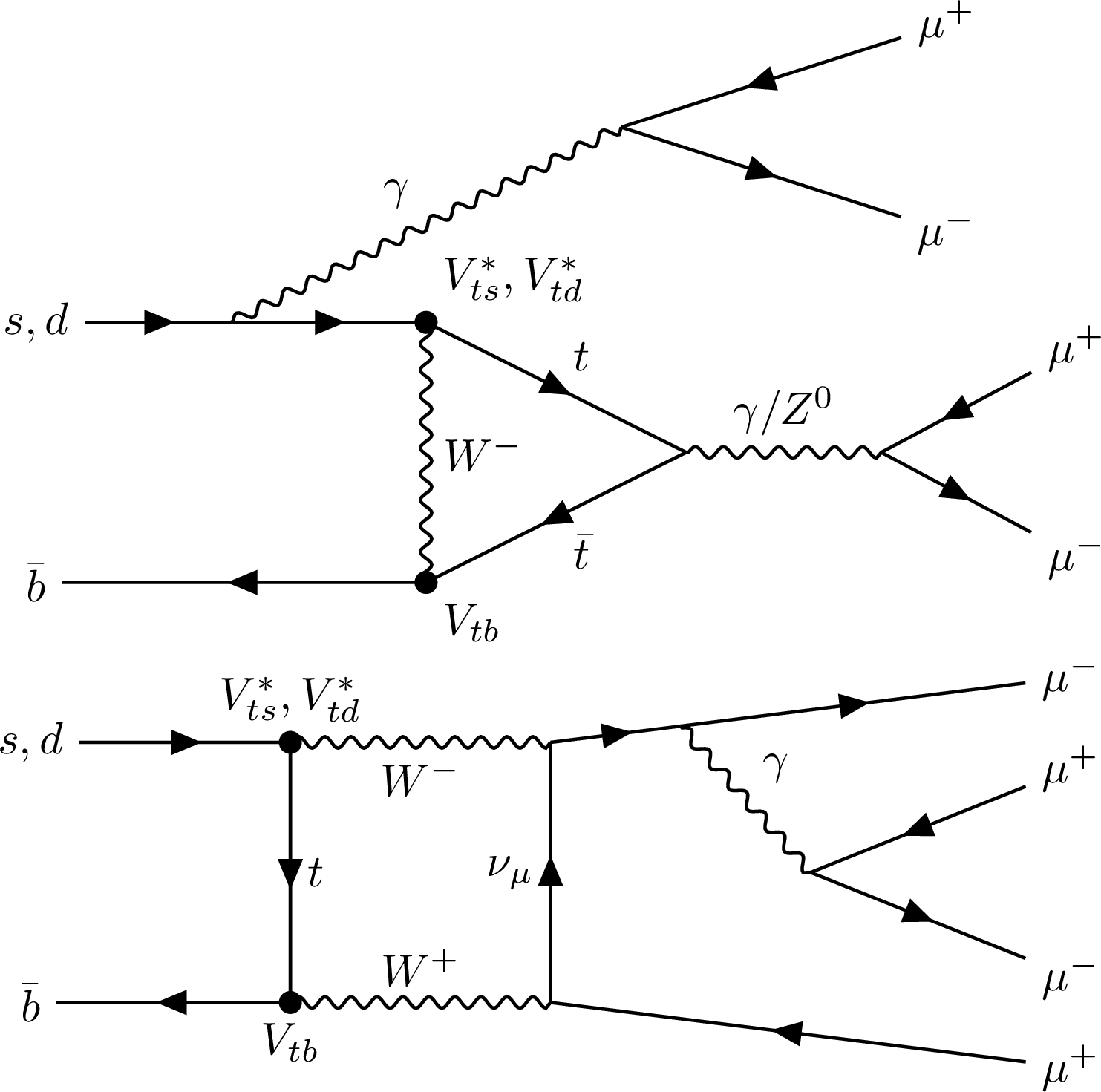
Two possible $ \mathrm{B}_{s}^{0}({\mathrm{B}^0}) \rightarrow 4 \mu $ Feynman diagrams foreseen in the SM, ``penguin" (upper) and ``box" (lower). The relevant CKM elements, $ V_{tb} $ and $ V_{ts}^*,V_{td}^* $, are indicated. The photon emission can occur from any charged fermion line. |
png pdf |
Figure 1-a:
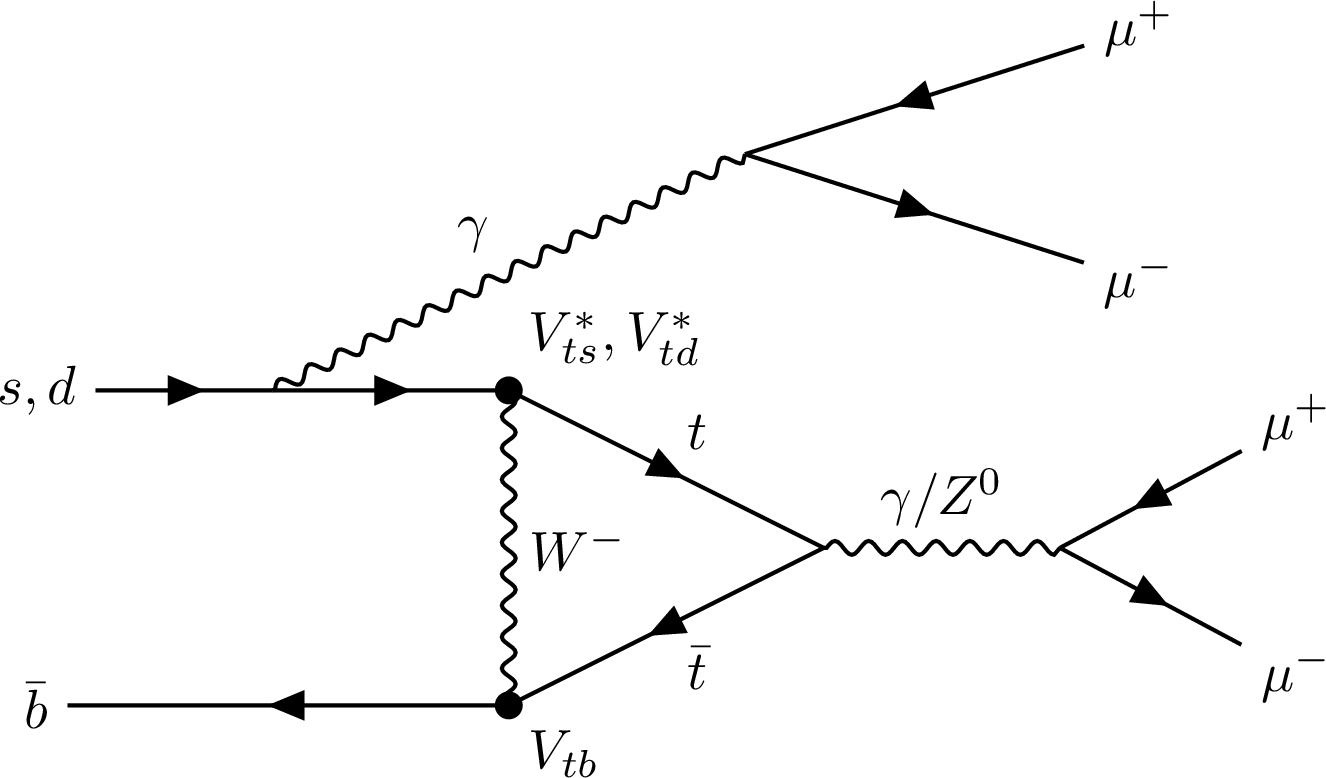
Two possible $ \mathrm{B}_{s}^{0}({\mathrm{B}^0}) \rightarrow 4 \mu $ Feynman diagrams foreseen in the SM, ``penguin" (upper) and ``box" (lower). The relevant CKM elements, $ V_{tb} $ and $ V_{ts}^*,V_{td}^* $, are indicated. The photon emission can occur from any charged fermion line. |
png pdf |
Figure 1-b:
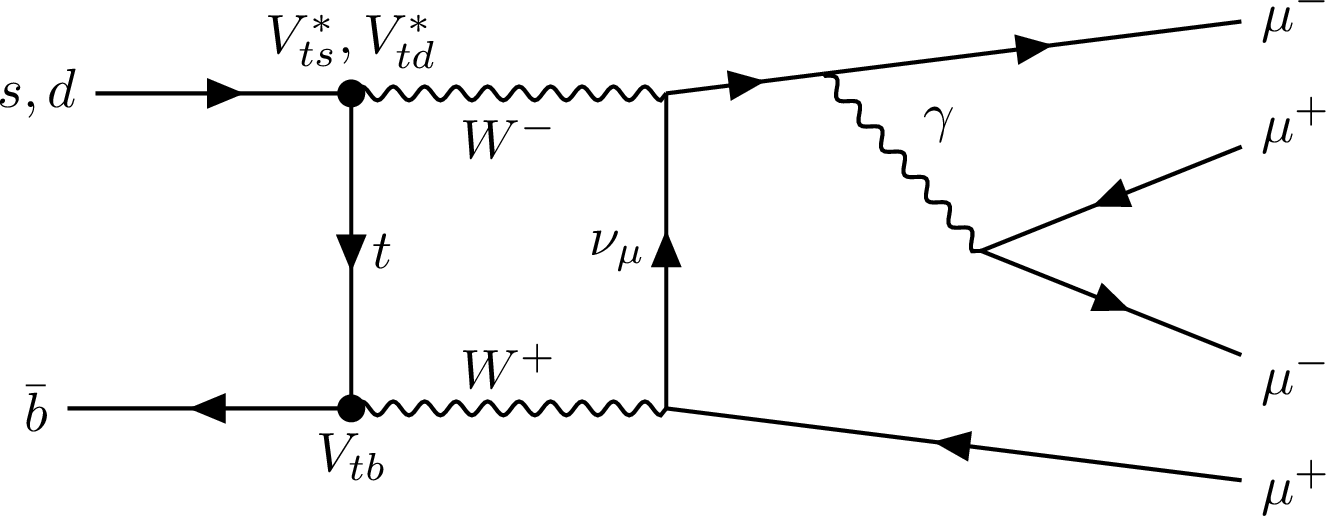
Two possible $ \mathrm{B}_{s}^{0}({\mathrm{B}^0}) \rightarrow 4 \mu $ Feynman diagrams foreseen in the SM, ``penguin" (upper) and ``box" (lower). The relevant CKM elements, $ V_{tb} $ and $ V_{ts}^*,V_{td}^* $, are indicated. The photon emission can occur from any charged fermion line. |
png pdf |
Figure 2:
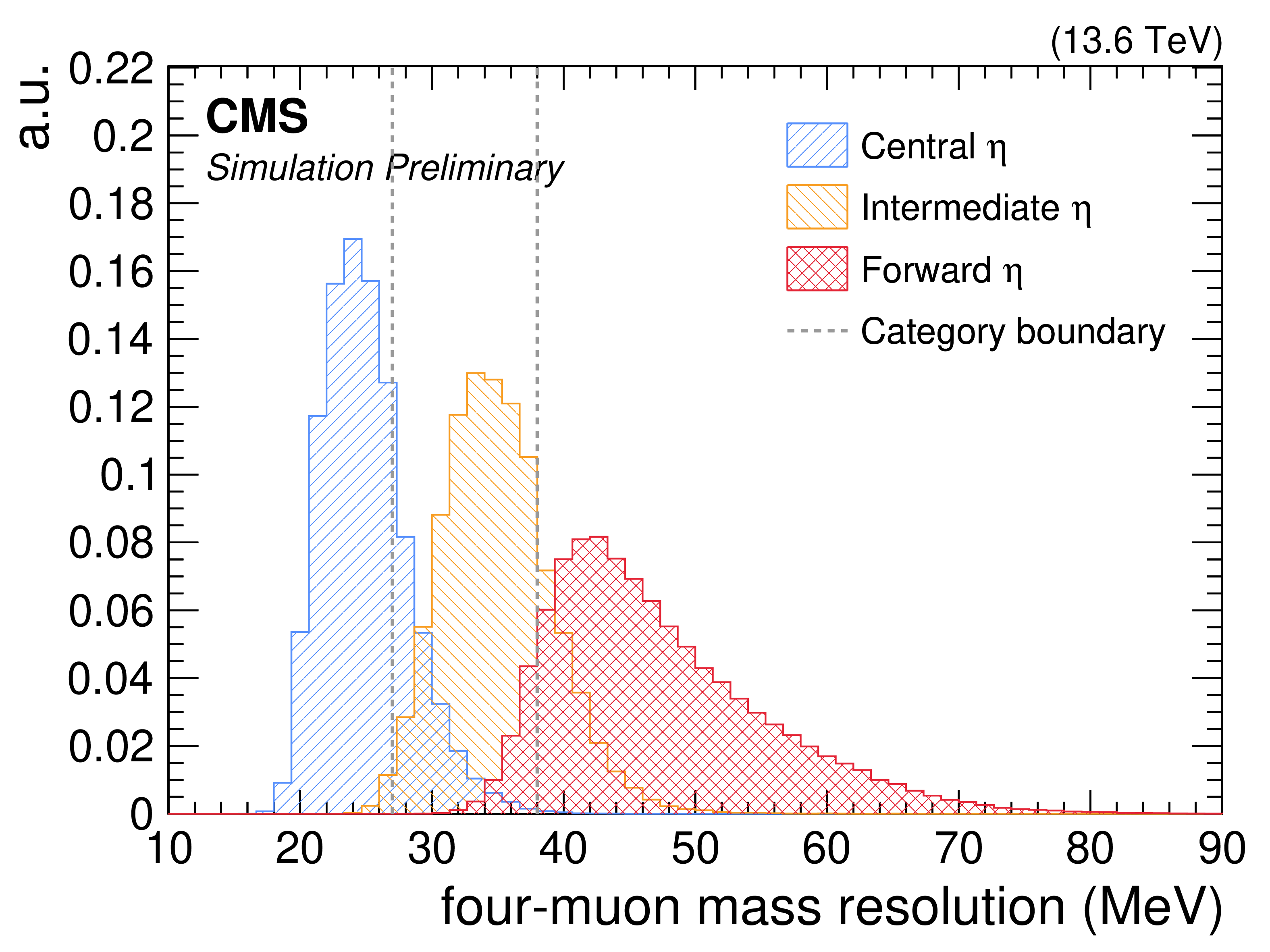
Four-muon mass resolution in three different pseudorapidity regions, with edges at 0.8 and 1.2. The vertical dashed lines represent the boundaries of the A, B, and C categories reported in Table 1. Each histogram is normalized to unit area. |
png pdf |
Figure 3:
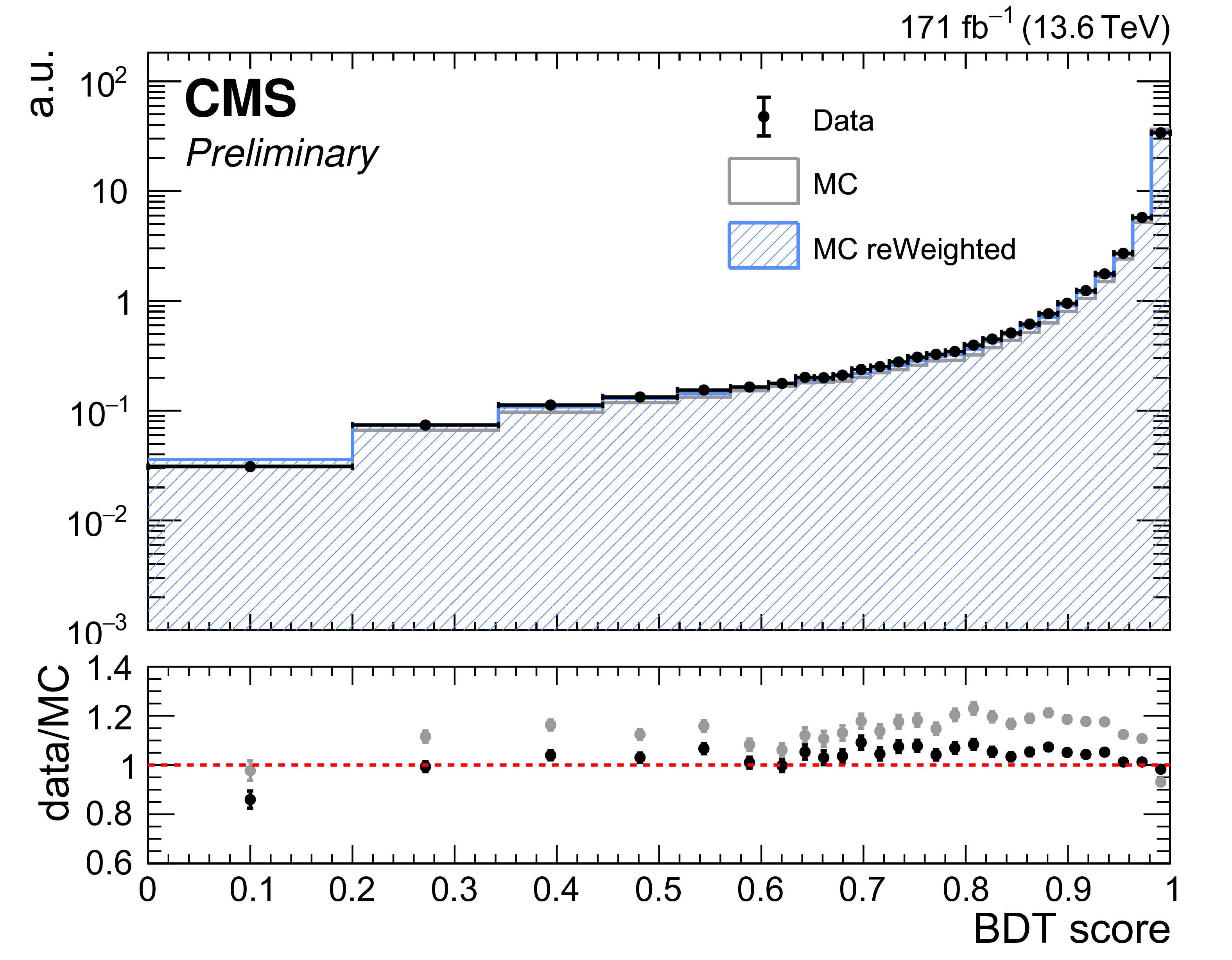
Comparison of the BDT score distribution between the $ \mathrm{B}_{s}^{0} \to \mathrm{J}/\psi (\mu\mu) \phi (\mathrm{K}\mathrm{K}) $ simulation and background-subtracted data. The initial disagreement is corrected by the applied reweighting. |
png pdf |
Figure 4:
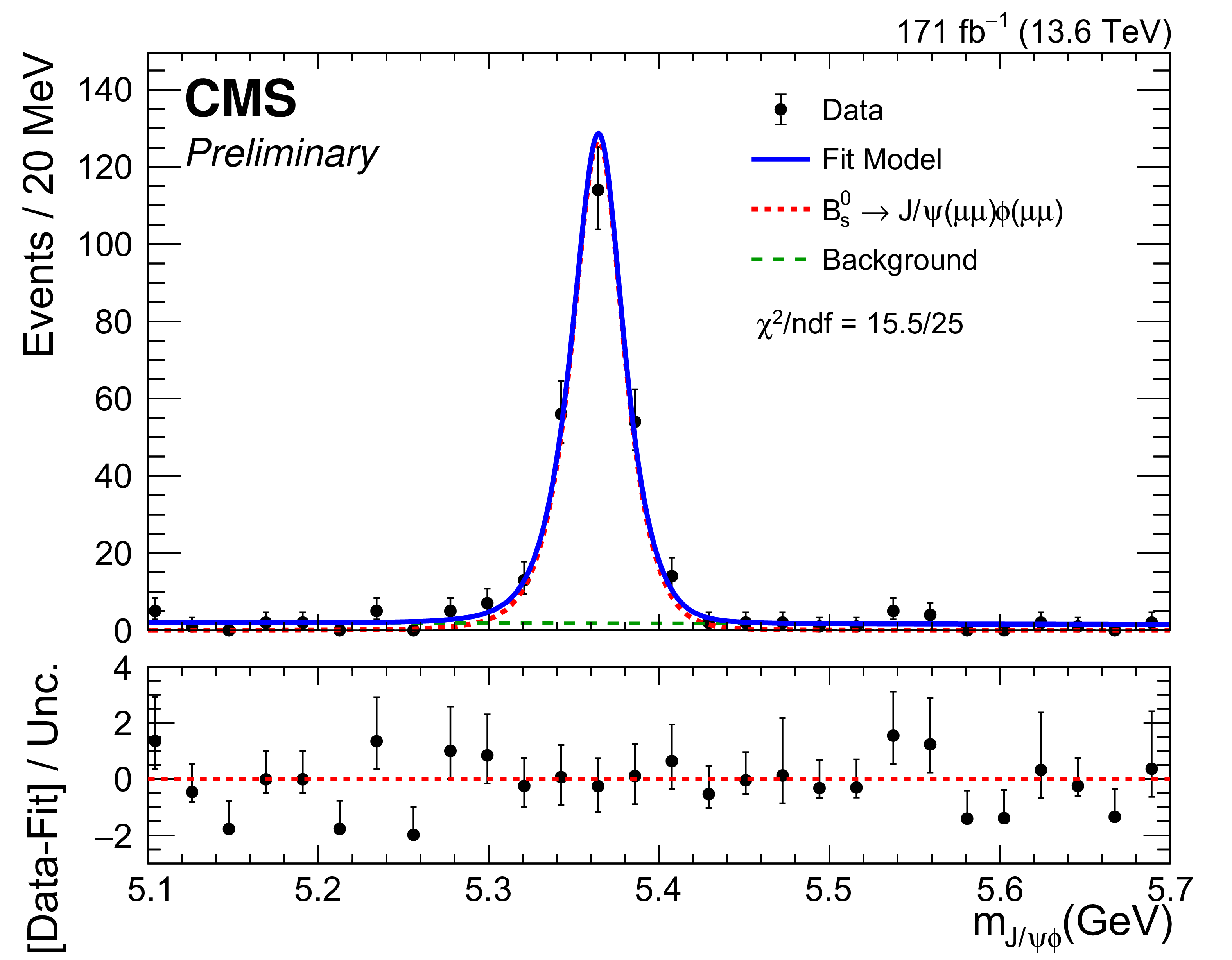
Fit to data in the normalization channel $ \mathrm{B}_{s}^{0}\to\mathrm{J}/\psi(\mu\mu)\phi(\mu\mu) $ |
png pdf |
Figure 5:
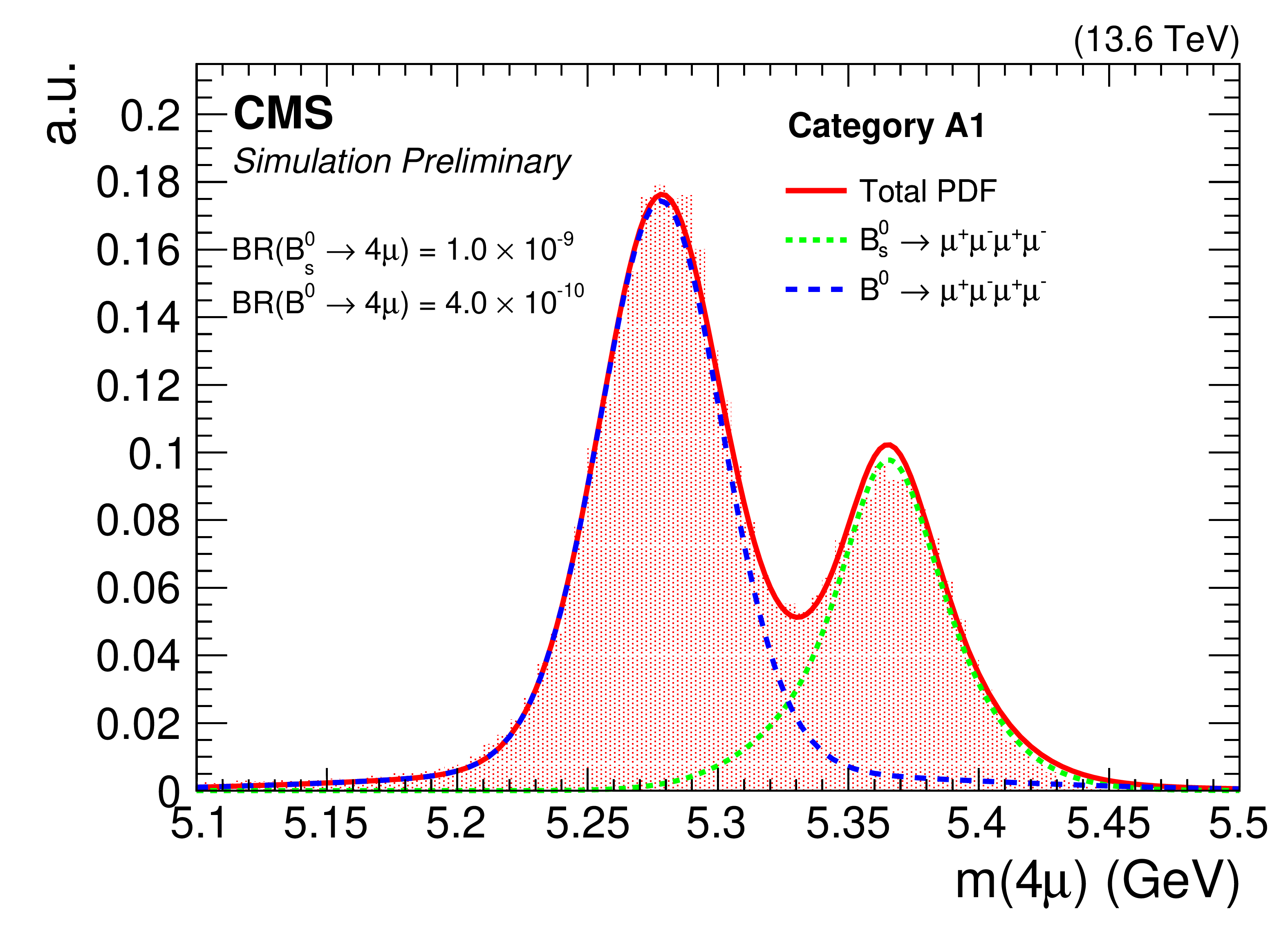
Combined signal PDF in the A1 category, for $ \mathcal{B}(\mathrm{B}_{s}^{0}\to4\mu)=1.0\times 10^{-9} $ and $ \mathcal{B}({\mathrm{B}^0}\to4\mu) = 4\times 10^{-10} $. |
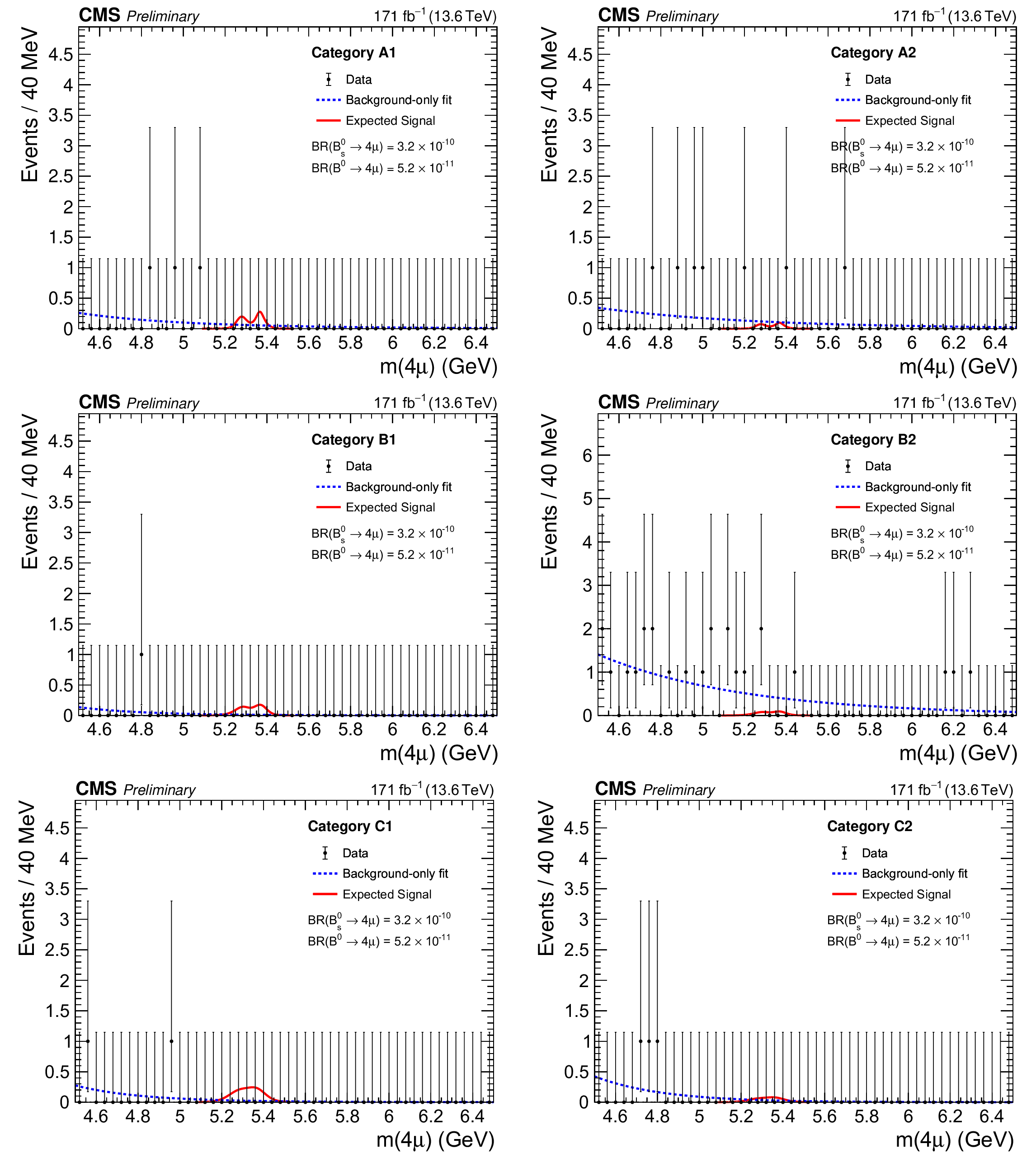
png pdf |
Figure 6:
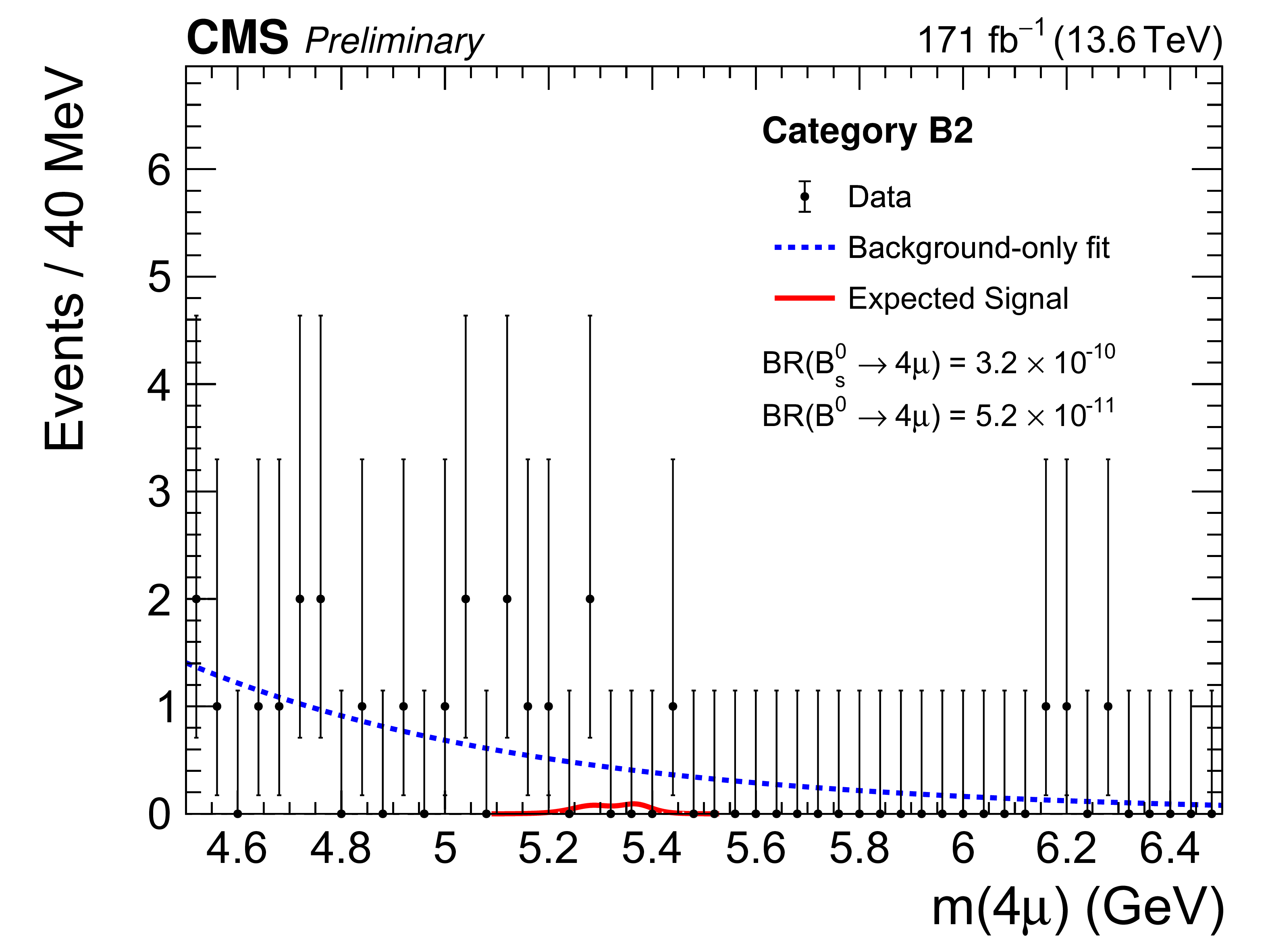
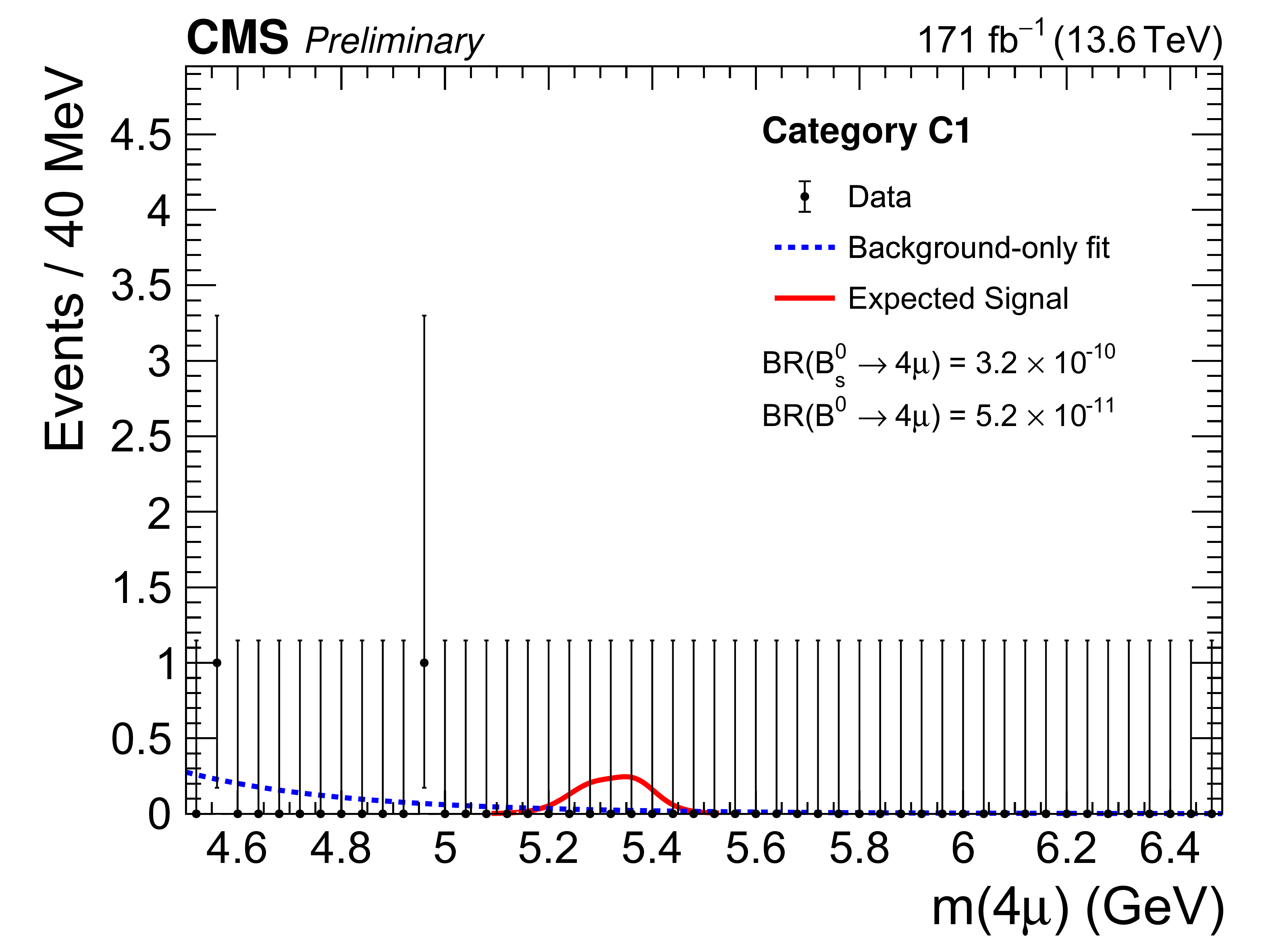
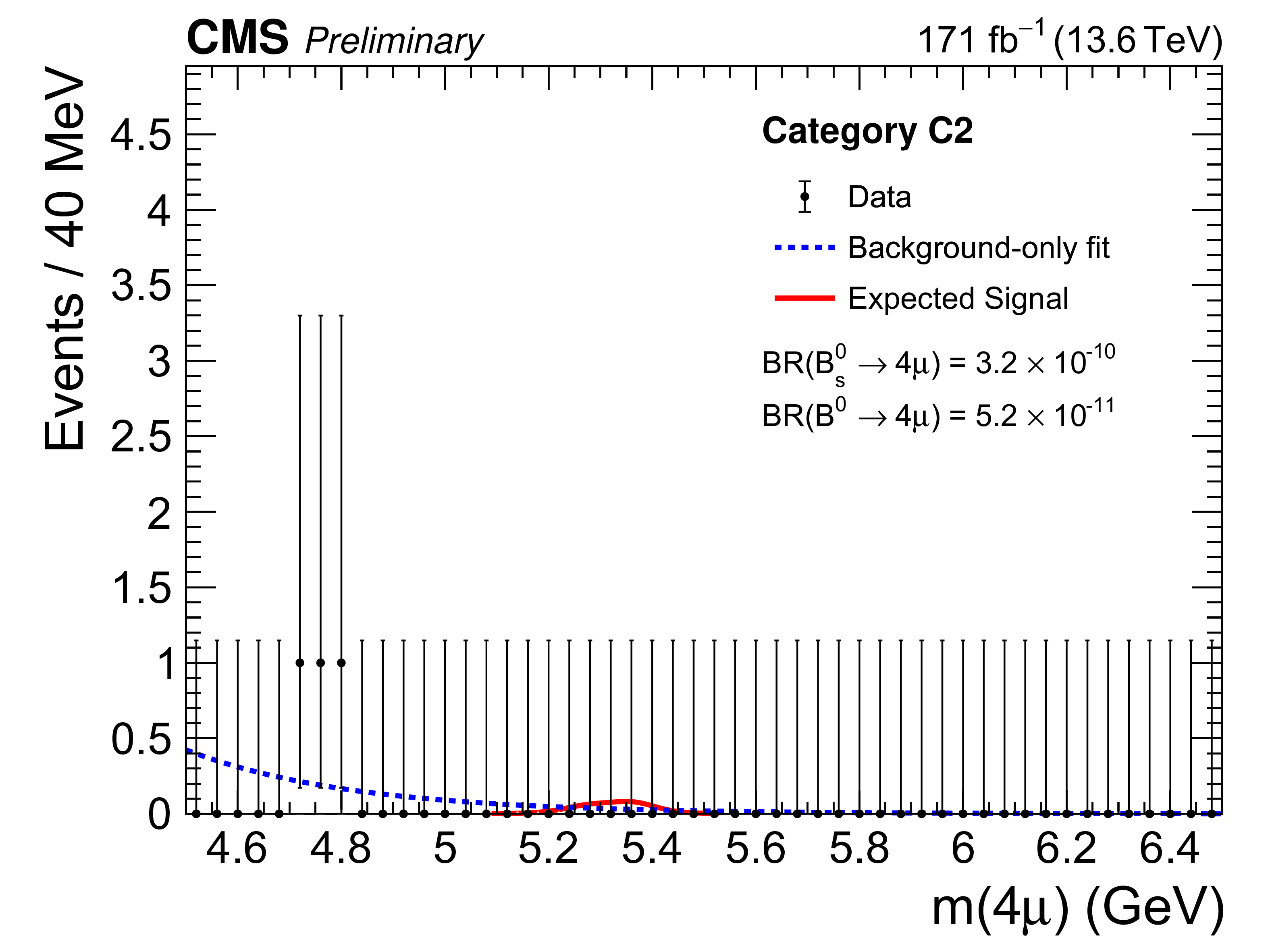
Four-muon mass distributions for the six event categories. The combined expected signal PDFs for branching ratios $ \mathcal{B}(\mathrm{B}_{s}^{0}\to 4\mu) = 3.2 \times 10^{-10} $ and $ \mathcal{B}({\mathrm{B}^0}\to 4\mu)= 5.2 \times 10^{-11} $ are also shown. |
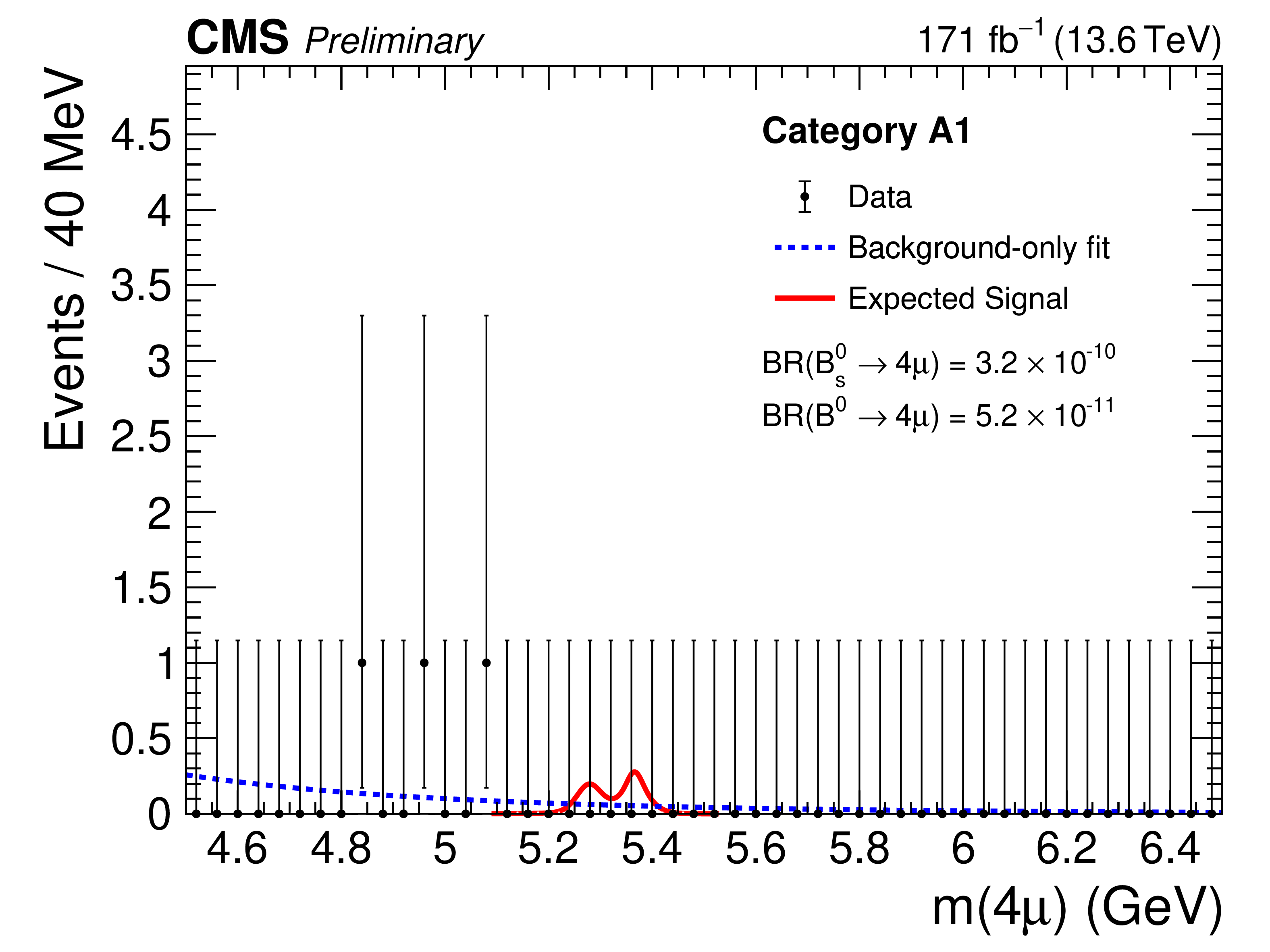
png pdf |
Figure 6-a:
Four-muon mass distributions for the six event categories. The combined expected signal PDFs for branching ratios $ \mathcal{B}(\mathrm{B}_{s}^{0}\to 4\mu) = 3.2 \times 10^{-10} $ and $ \mathcal{B}({\mathrm{B}^0}\to 4\mu)= 5.2 \times 10^{-11} $ are also shown. |
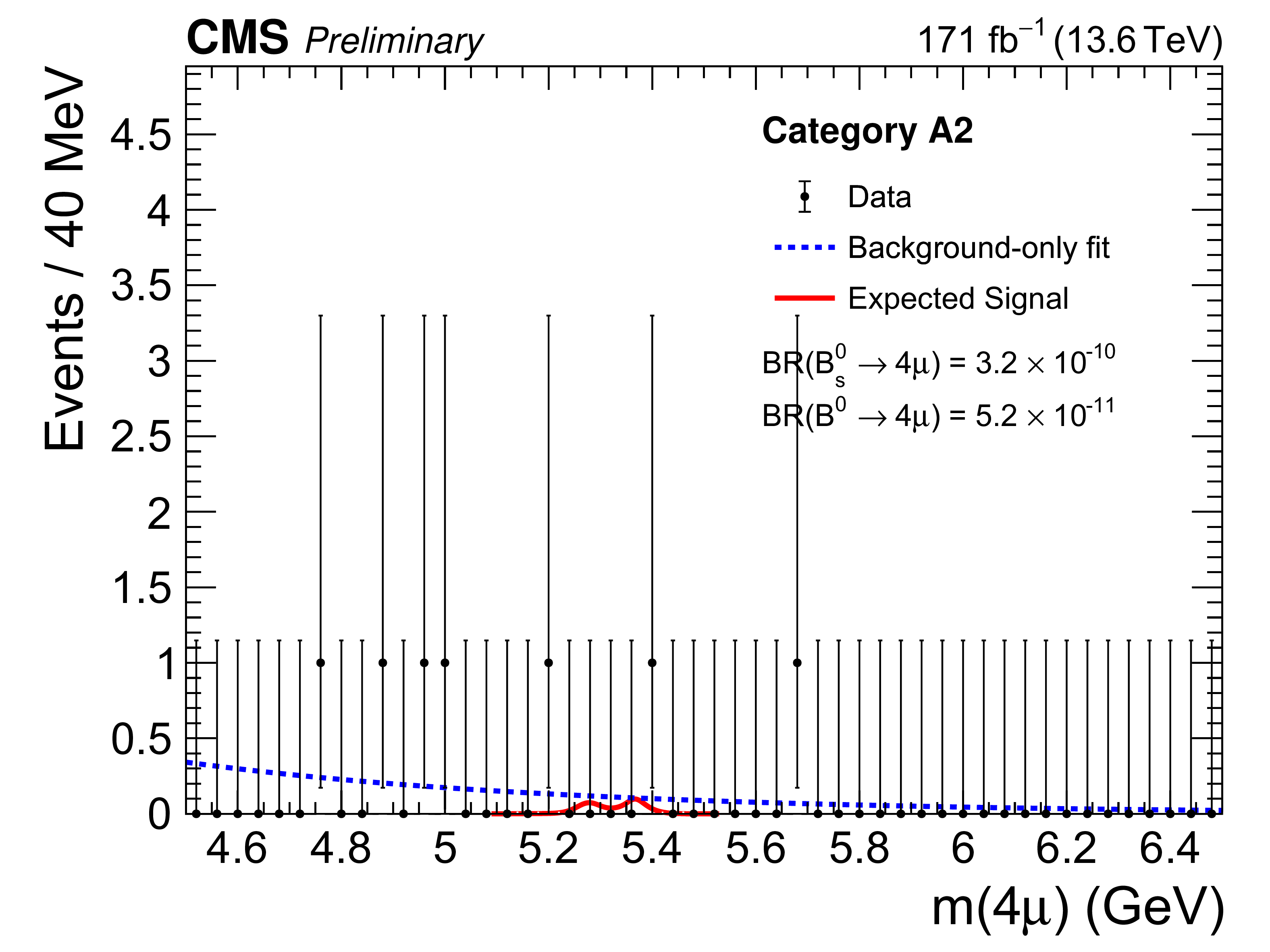
png pdf |
Figure 6-b:
Four-muon mass distributions for the six event categories. The combined expected signal PDFs for branching ratios $ \mathcal{B}(\mathrm{B}_{s}^{0}\to 4\mu) = 3.2 \times 10^{-10} $ and $ \mathcal{B}({\mathrm{B}^0}\to 4\mu)= 5.2 \times 10^{-11} $ are also shown. |
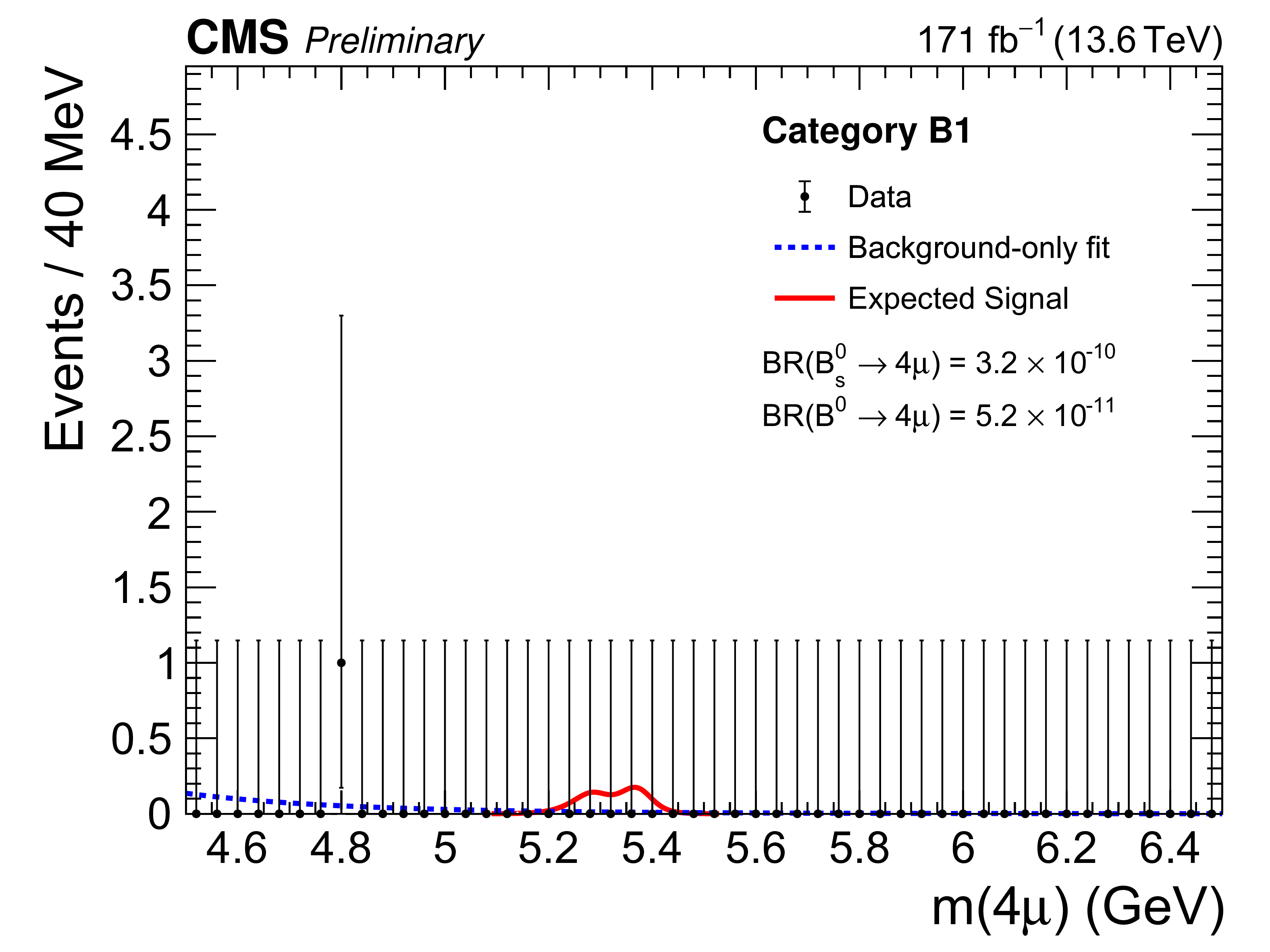
png pdf |
Figure 6-c:
Four-muon mass distributions for the six event categories. The combined expected signal PDFs for branching ratios $ \mathcal{B}(\mathrm{B}_{s}^{0}\to 4\mu) = 3.2 \times 10^{-10} $ and $ \mathcal{B}({\mathrm{B}^0}\to 4\mu)= 5.2 \times 10^{-11} $ are also shown. |
png pdf |
Figure 6-d:
Four-muon mass distributions for the six event categories. The combined expected signal PDFs for branching ratios $ \mathcal{B}(\mathrm{B}_{s}^{0}\to 4\mu) = 3.2 \times 10^{-10} $ and $ \mathcal{B}({\mathrm{B}^0}\to 4\mu)= 5.2 \times 10^{-11} $ are also shown. |
png pdf |
Figure 6-e:
Four-muon mass distributions for the six event categories. The combined expected signal PDFs for branching ratios $ \mathcal{B}(\mathrm{B}_{s}^{0}\to 4\mu) = 3.2 \times 10^{-10} $ and $ \mathcal{B}({\mathrm{B}^0}\to 4\mu)= 5.2 \times 10^{-11} $ are also shown. |
png pdf |
Figure 6-f:
Four-muon mass distributions for the six event categories. The combined expected signal PDFs for branching ratios $ \mathcal{B}(\mathrm{B}_{s}^{0}\to 4\mu) = 3.2 \times 10^{-10} $ and $ \mathcal{B}({\mathrm{B}^0}\to 4\mu)= 5.2 \times 10^{-11} $ are also shown. |
png pdf |
Figure 7:
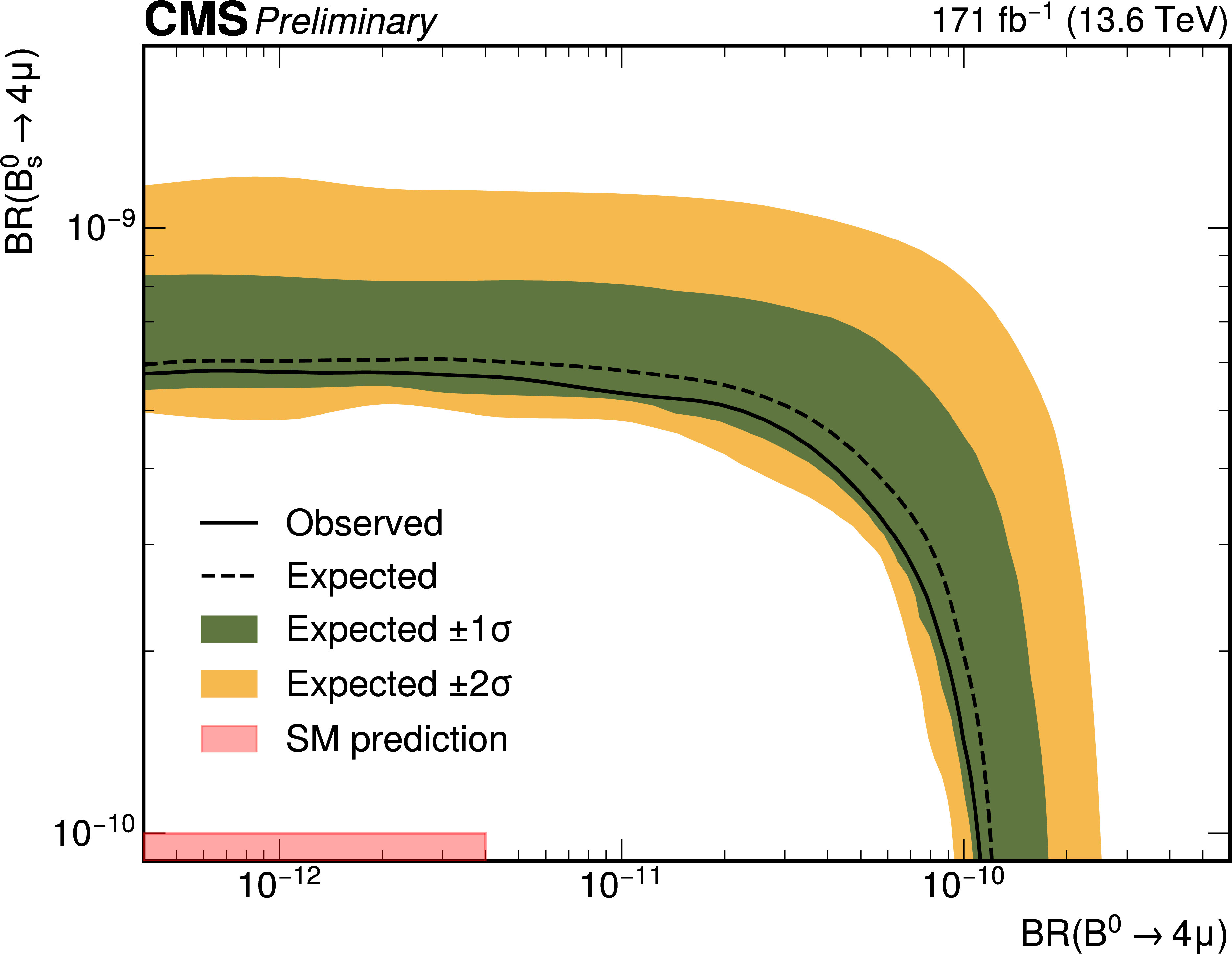
Exclusion limits at 95% CL in the $ \mathcal{B}({\mathrm{B}^0} \rightarrow \mu^{+} \mu^{-} \mu^{+} \mu^{-}) $ vs.\ $ \mathcal{B}(\mathrm{B}_{s}^{0} \rightarrow \mu^{+} \mu^{-} \mu^{+} \mu^{-}) $ plane. |
| Tables | |

png pdf |
Table 1:
Mass resolution categories, with their corresponding signal region and veto definitions. The signal mass windows and the veto regions are defined to extend three standard deviations on either side of the $ {\mathrm{B}} $ mass values [44] (below the $ {\mathrm{B}^0} $ and above the $ \mathrm{B}_{s}^{0} $ mass) and $ \mathrm{J}/\psi $, \PGyP2S, $ \phi $, and $ \omega $ meson masses, respectively. |
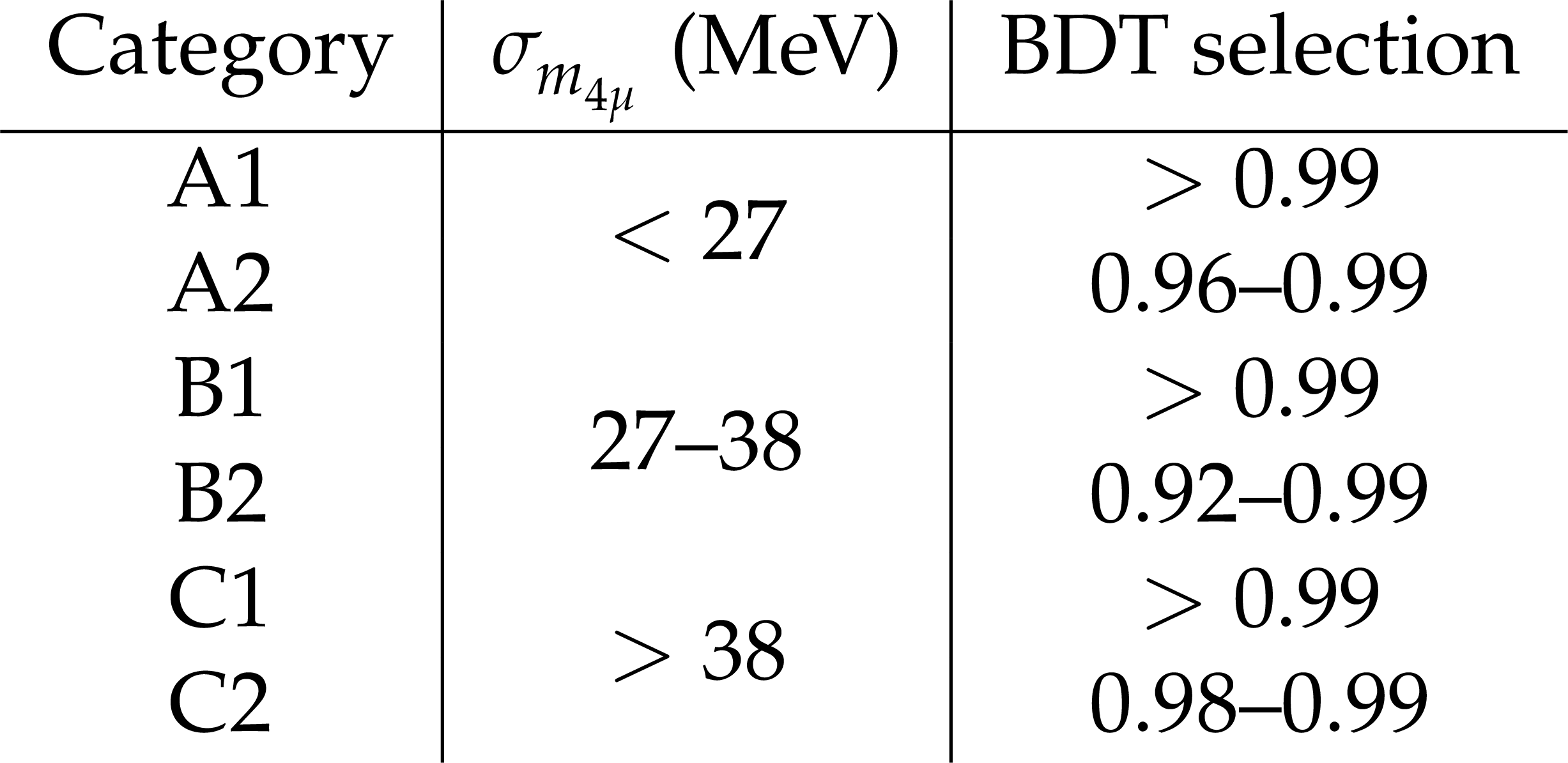
png pdf |
Table 2:
Event categories. The three mass resolution regions, defined in Table 1, are subdivided into six subcategories, based on the BDT score. The signal purity is higher for the higher-resolution and higher-score categories. |
png pdf |
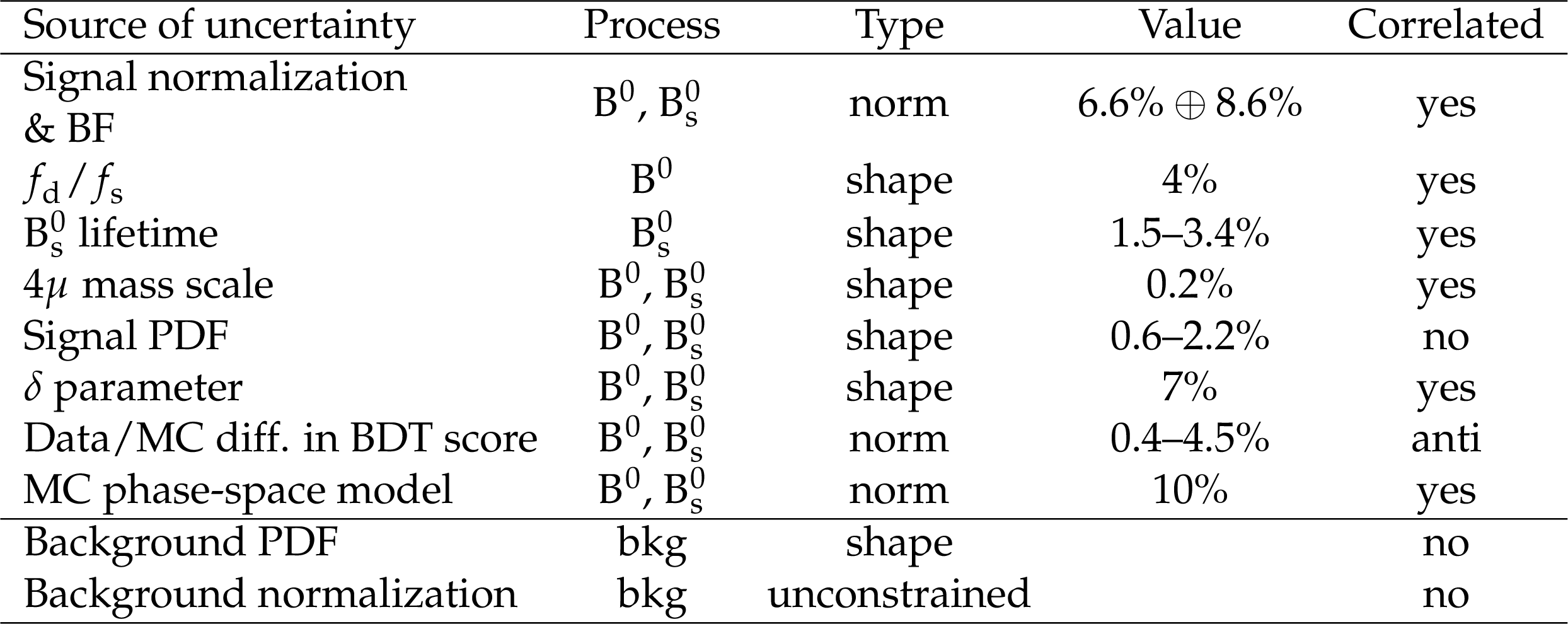
Table 3:
Summary of systematic uncertainties. The `norm` uncertainties directly affect the signal yield, while the `shape` uncertainties affect the shape of the signal or background PDFs. The symbol $ \oplus $ indicates the sum in quadrature, while the dash indicates that a range of systematic uncertainties is applied to different event categories. In the last column, `yes` indicates that the uncertainty is correlated across all six categories, whereas `anti` indicates that the uncertainty is anti-correlated between the subcategories 1 and 2 within the same mass resolution bin, while independent of the other ones. |
| Summary |
| A search for the rare decays $ \mathrm{B}_{s}^{0} \to \mu^{+} \mu^{-} \mu^{+} \mu^{-} $ and $ {\mathrm{B}^0} \to \mu^{+} \mu^{-} \mu^{+} \mu^{-} $ has been conducted using a data sample of proton-proton collisions at $ \sqrt{s} = $ 13.6 TeV, corresponding to an integrated luminosity of 171 fb$^{-1}$ and collected between 2022 and 2024. The signals are normalized to the process $ \mathrm{B}_{s}^{0} \rightarrow \mathrm{J}/\psi(\mu \mu) \phi( \mu \mu) $, which has the same final-state particles and similar kinematic properties, thus reducing systematic uncertainties. The only relevant residual background consists of combinatorial four-muon events, which are suppressed by means of a multivariate discriminator. Events are categorized by mass resolution and signal purity, and the four-muon invariant mass distributions are simultaneously fitted using an unbinned maximum likelihood fit. No significant excess over background expectations is observed and upper limits at 95% confidence level are obtained, $ \mathcal{B}({\mathrm{B}^0}\to 4\mu) < 1.3 (1.4) \times 10^{-10} $ and $ \mathcal{B}(\mathrm{B}_{s}^{0}\to 4\mu) < 5.7 (6.0) \times 10^{-10} $. These results represent an improvement of approximately 30% over previous best exclusions. The $ \mathrm{B}_{s}^{0} $ upper limit is a factor of six above the SM prediction of $ \mathcal{B}(\mathrm{B}_{s}^{0} \to 4\mu) = (0.9-1.0) \times 10^{-10} $. Since the analysis is close to a background-free regime, its sensitivity is expected to improve faster than the square root of the integrated luminosity. With the full Run 2 and Run 3 data set combined, the sensitivity of this search is expected to approach the SM prediction. On the other hand, the SM prediction of $ \mathcal{B}({\mathrm{B}^0} \to 4\mu) = (0.4-4.0) \times 10^{-12} $ lies about two orders of magnitude below the current exclusion limit. Therefore, the $ {\mathrm{B}^0} $ channel constitutes a probe of BSM contributions in the near future. In this work, exclusion contours in the $ \mathcal{B}({\mathrm{B}^0} \rightarrow \mu^{+} \mu^{-} \mu^{+} \mu^{-}) $ vs.\ $ \mathcal{B}(\mathrm{B}_{s}^{0} \rightarrow \mu^{+} \mu^{-} \mu^{+} \mu^{-}) $ plane are reported for the first time. This approach removes the implicit assumption that only one of the two decays occurs and offers a more complete characterization of possible BSM contributions, as they would affect both decay channels through the same Wilson coefficients. |
| Additional Figures | |
png pdf |
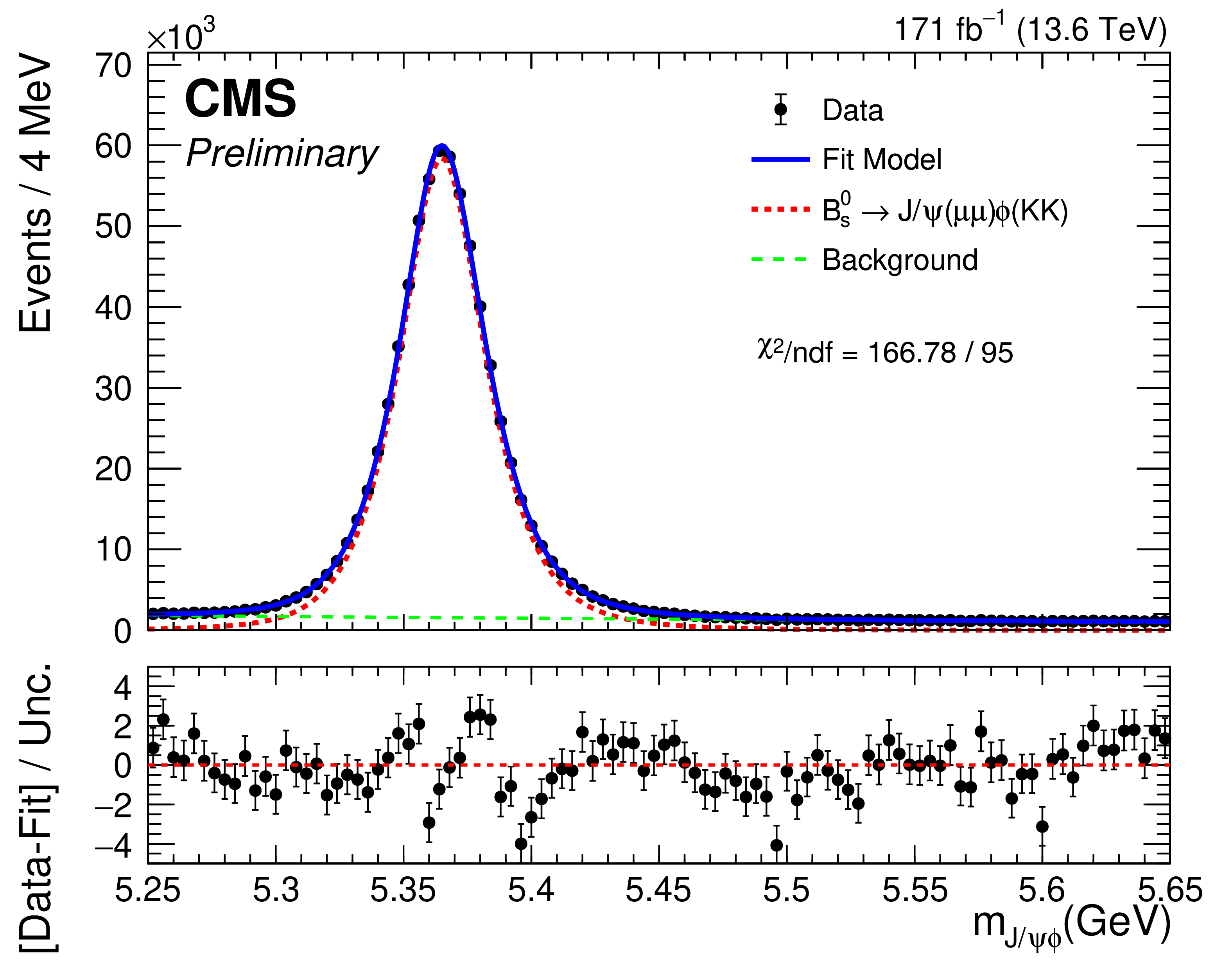
Additional Figure 1:
Fit to the $\mu\mu KK$ invariant mass distribution. The two kaon candidate tracks are assigned the K mass. The dimuon (dikaon) mass is forced to the $\mathrm{J}\!/\!\psi$ ($\phi$) mass to improve the resolution. |
png pdf |
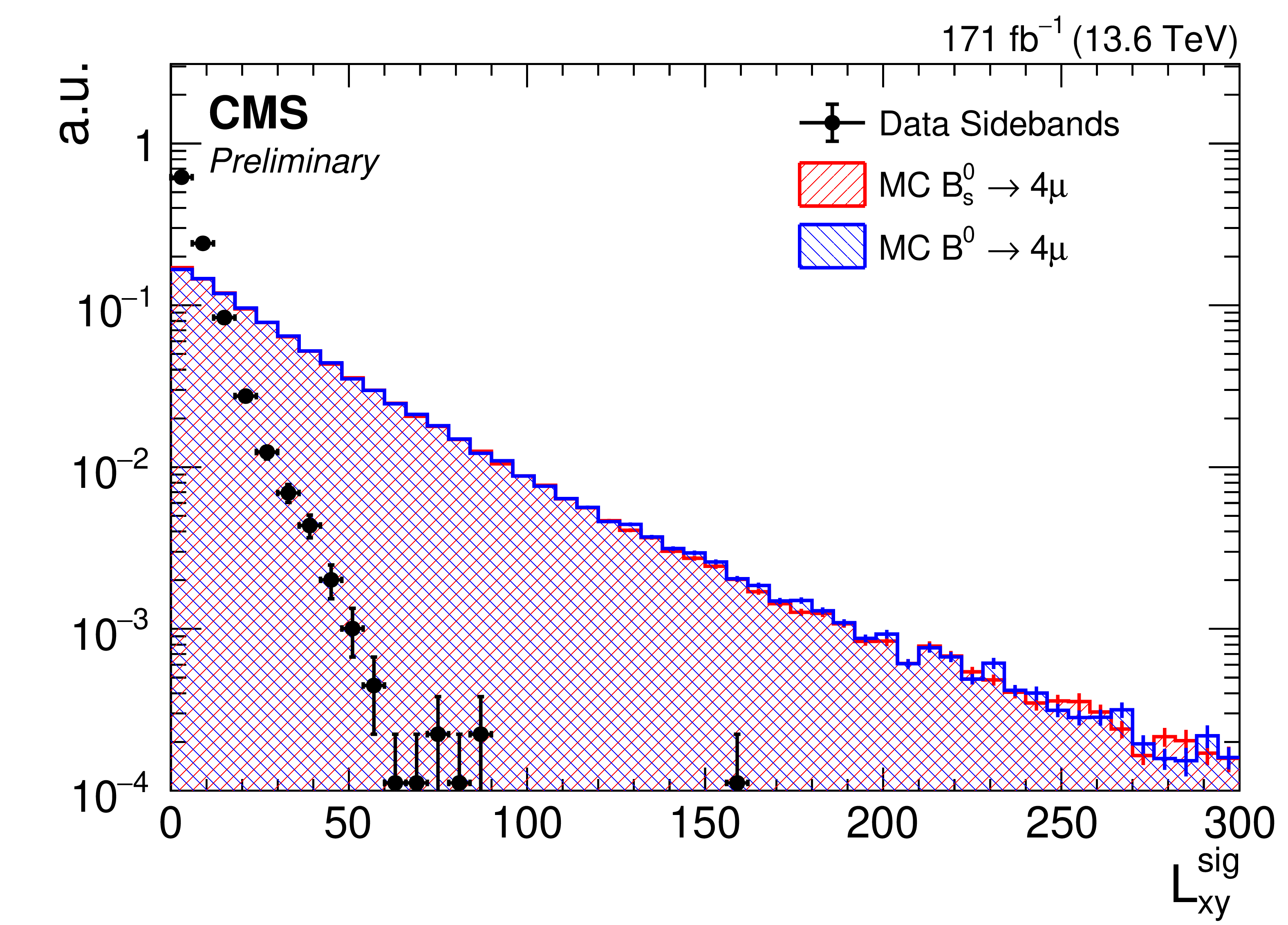
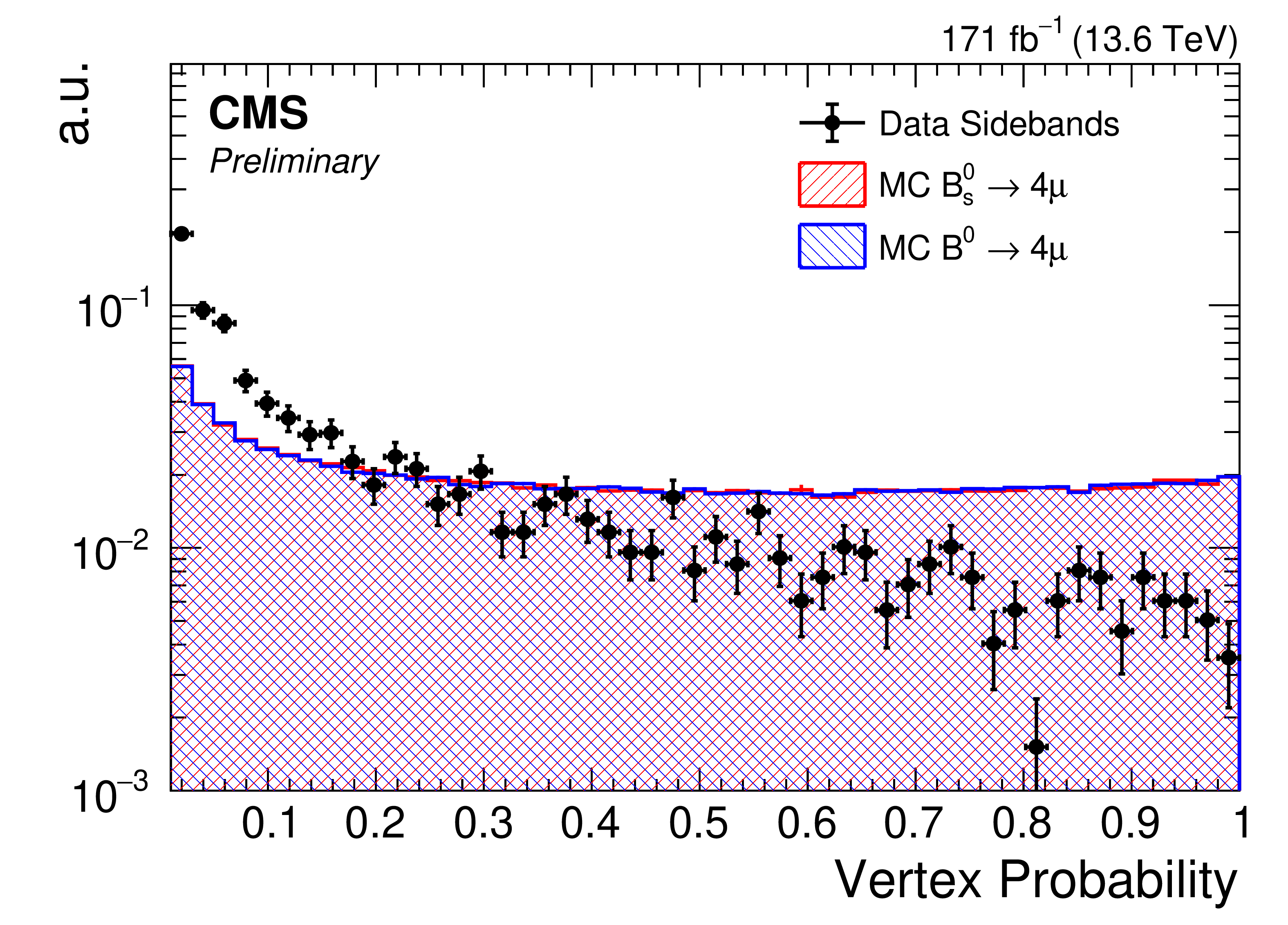
Additional Figure 2-a:
$L_{xy}^{sig}$ and Vertex probability distributions in signal MC and data sidebands. |
png pdf |
Additional Figure 2-b:
$L_{xy}^{sig}$ and Vertex probability distributions in signal MC and data sidebands. |
png pdf |
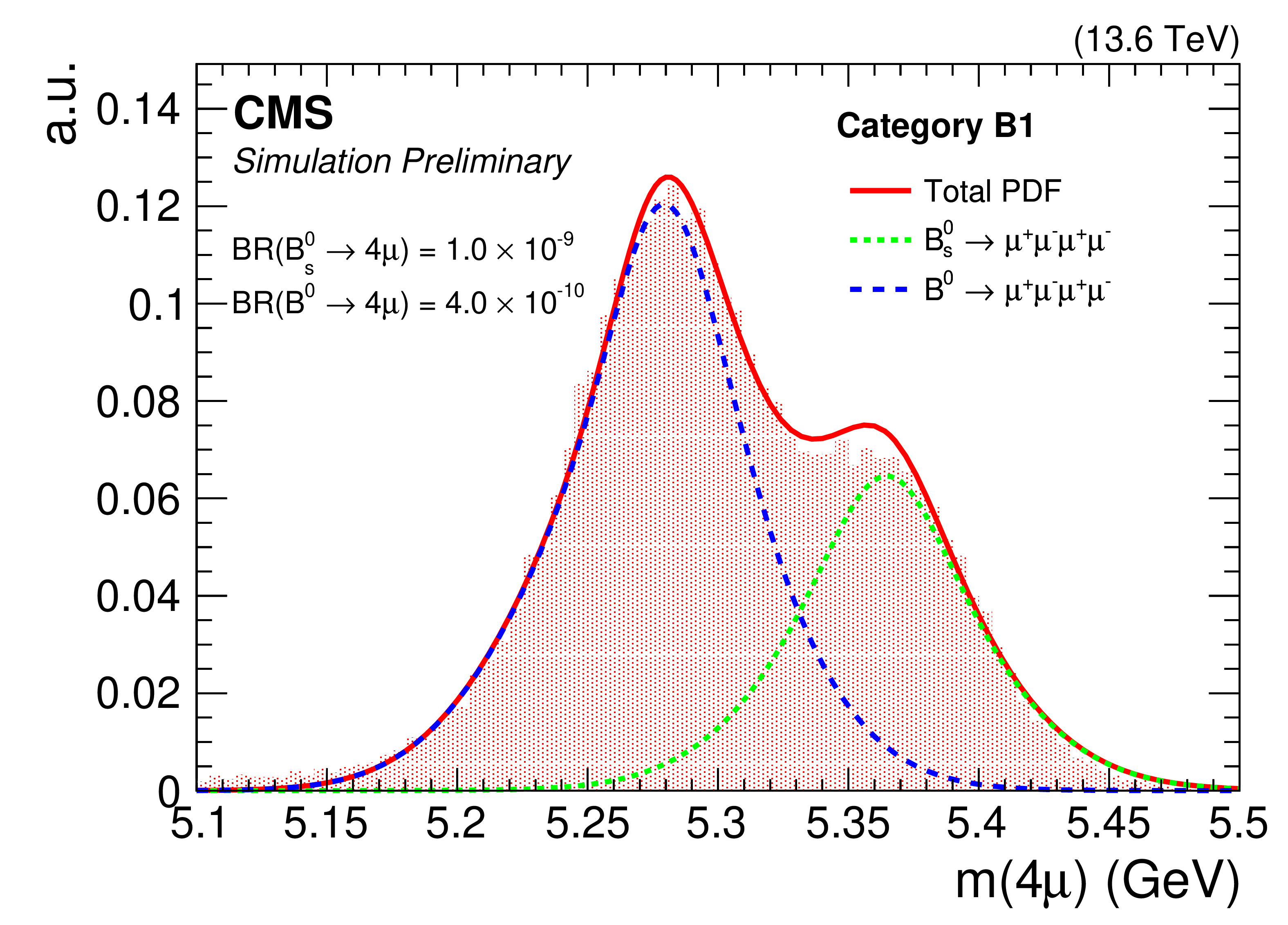
Additional Figure 3-a:
Combined signal PDF in the B1 and C1 categories, for $\mathcal{B}(\mathrm{B}^0_s \to 4\mu)=1.0\times 10^{-9}$ and $\mathcal{B}(\mathrm{B}^0 \to 4\mu) = 4\times 10^{-10}$. |
png pdf |
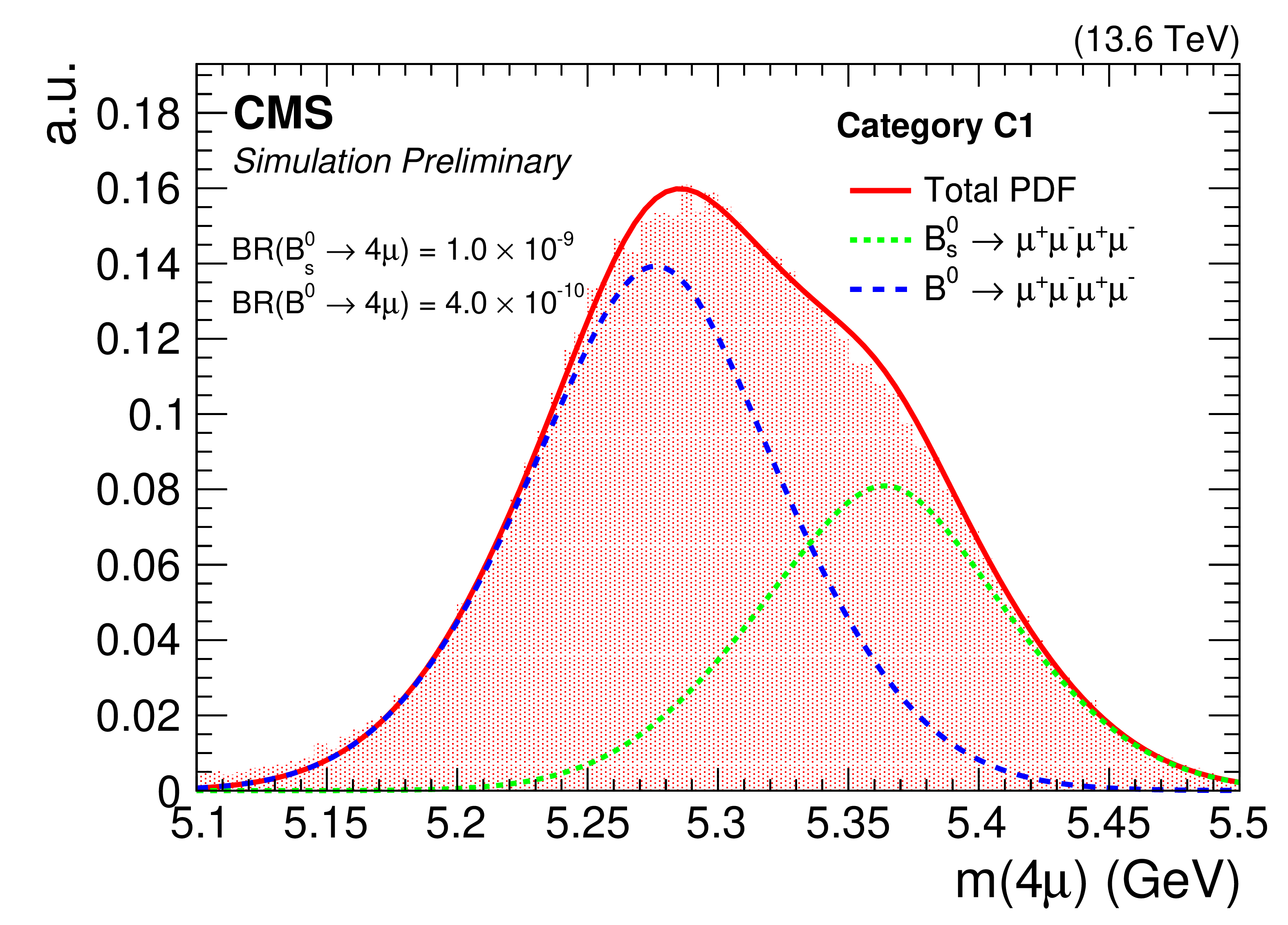
Additional Figure 3-b:
Combined signal PDF in the B1 and C1 categories, for $\mathcal{B}(\mathrm{B}^0_s \to 4\mu)=1.0\times 10^{-9}$ and $\mathcal{B}(\mathrm{B}^0 \to 4\mu) = 4\times 10^{-10}$. |
png pdf |
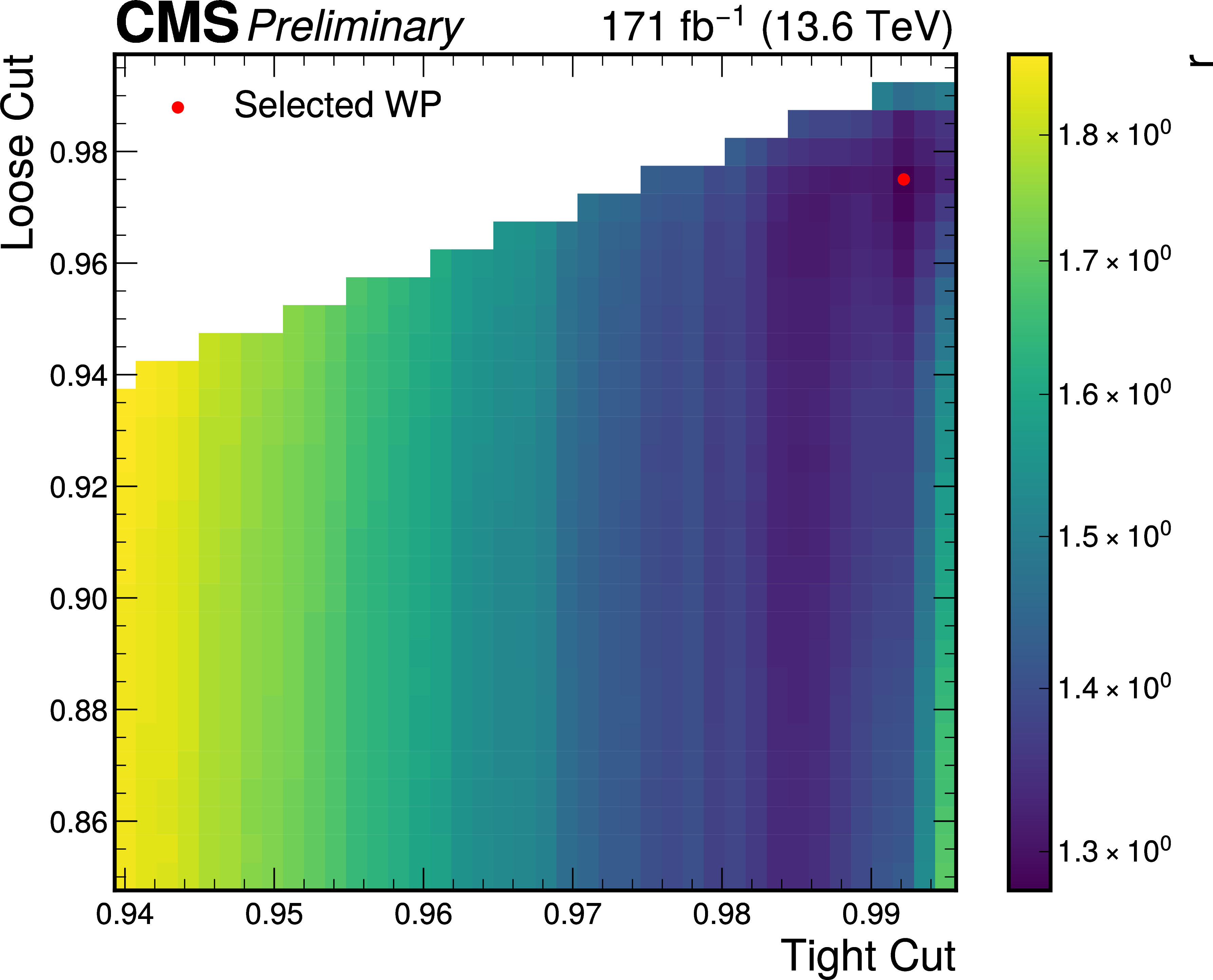
Additional Figure 4:
Signal strength multiplier $r$ as a function of BDT cuts category C. |
png pdf |
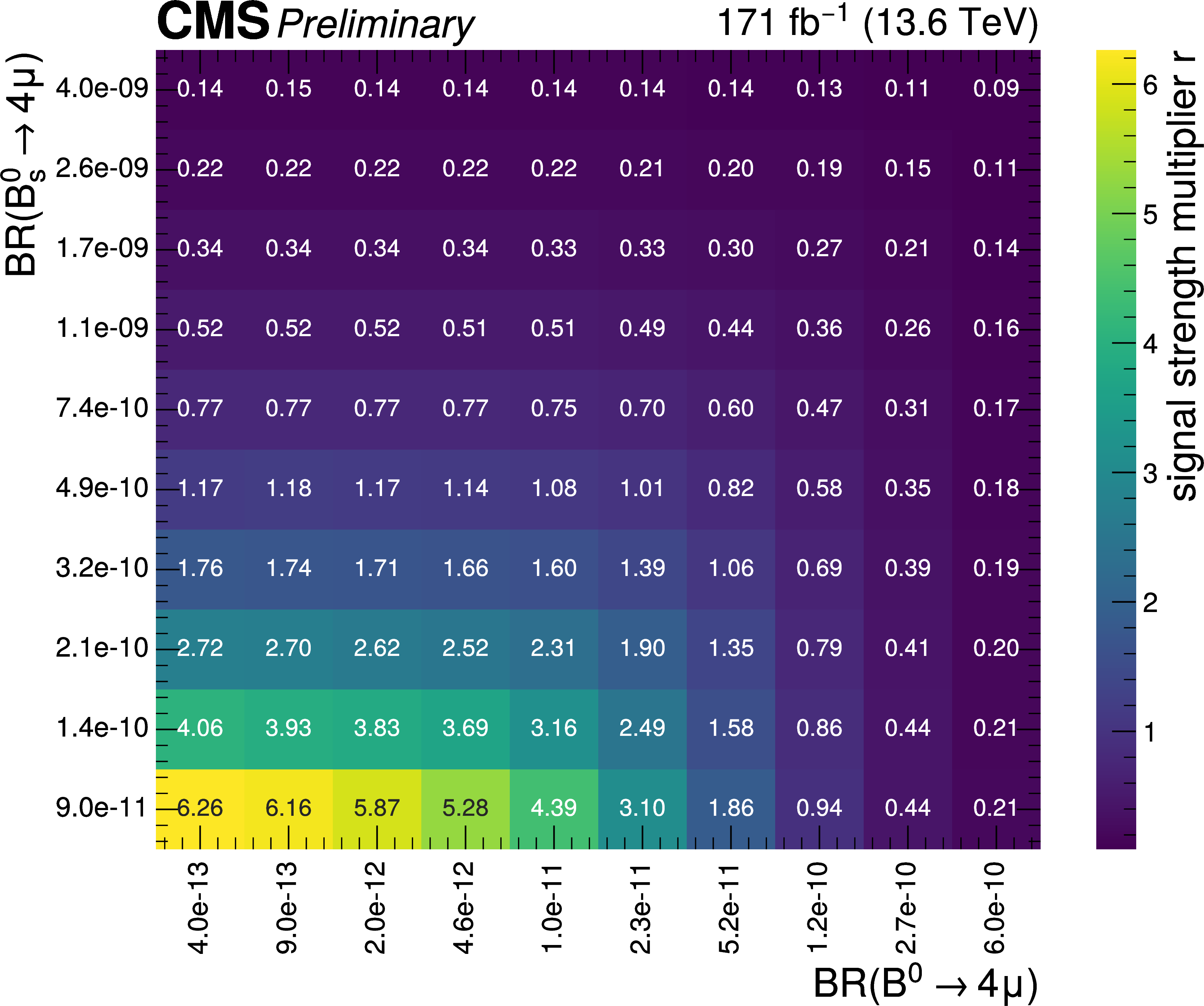
Additional Figure 5:
Observed signal strength multiplier $r$ as a function of different branching ratio combinations for $ \mathrm{B}^0 \to \mu^+ \mu^- \mu^+ \mu^- $ and $ \mathrm{B}^0_s \to \mu^+ \mu^- \mu^+ \mu^- $. |
| References | ||||
| 1 | CMS Collaboration | Measurement of the B$ ^0_\mathrm{s} \to \mu^+\mu^- $ decay properties and search for the B$ ^0 \to \mu^+\mu^- $ decay in proton-proton collisions at $ \sqrt{s} = $ 13 TeV | PLB 842 (2023) 137955 | CMS-BPH-21-006 2212.10311 |
| 2 | LHCb Collaboration | Analysis of neutral B-meson decays into two muons | PRL 128 (2022) 041801 | 2108.09284 |
| 3 | ATLAS Collaboration | Study of the rare decays of $ B^0_s $ and $ B^0 $ mesons into muon pairs using data collected during 2015 and 2016 with the ATLAS detector | JHEP 04 (2019) 098 | 1812.03017 |
| 4 | G. Isidori, F. Wilsch, and D. Wyler | The standard model effective field theory at work | Rev. Mod. Phys. 96 (2024) 015006 | 2303.16922 |
| 5 | S. Bruggisser, D. van Dyk, and S. Westhoff | Resolving the flavor structure in the MFV-SMEFT | JHEP 02 (2023) 225 | 2212.02532 |
| 6 | A. Greljo, A. Palavri\'c, and A. E. Thomsen | Adding flavor to the SMEFT | JHEP 10 (2022) 010 | 2203.09561 |
| 7 | A. Falkowski and D. Straub | Flavourful SMEFT likelihood for Higgs and electroweak data | JHEP 04 (2020) 066 | 1911.07866 |
| 8 | J. Aebischer, J. Kumar, P. Stangl, and D. M. Straub | A global likelihood for precision constraints and flavour anomalies | EPJC 79 (2019) 509 | 1810.07698 |
| 9 | W. Buchmuller and D. Wyler | Effective Lagrangian analysis of new interactions and flavor conservation | NPB 268 (1986) 621 | |
| 10 | M. E. Peskin and D. V. Schroeder | An Introduction to quantum field theory | Addison-Wesley, Reading, USA, 1995 link |
|
| 11 | M. Alguer \'o et al. | Emerging patterns of New Physics with and without Lepton Flavour Universal contributions | EPJC 79 (2019) 714 | 1903.09578 |
| 12 | A. K. Alok, A. Dighe, S. Gangal, and D. Kumar | Continuing search for new physics in $ b \to s \mu \mu $ decays: two operators at a time | JHEP 06 (2019) 089 | 1903.09617 |
| 13 | A. Datta, J. Kumar, and D. London | The $ B $ anomalies and new physics in $ b \to s e^+ e^- $ | PLB 797 (2019) 134858 | 1903.10086 |
| 14 | K. Kowalska, D. Kumar, and E. M. Sessolo | Implications for new physics in $ b\rightarrow s \mu \mu $ transitions after recent measurements by Belle and LHCb | EPJC 79 (2019) 840 | 1903.10932 |
| 15 | J. Bhom et al. | A model-independent analysis of $ b{\rightarrow }s\mu ^{+}\mu ^{-} $transitions with GAMBIT \textquoterights FlavBit | EPJC 81 (2021) 1076 | 2006.03489 |
| 16 | A. Biswas, S. Nandi, S. K. Patra, and I. Ray | New physics in $ \mathrm{b}\to\mathrm{s}\to\ell\ell $ decays with complex Wilson coefficients | NPB 969 (2021) 115479 | 2004.14687 |
| 17 | T. Hurth, F. Mahmoudi, and S. Neshatpour | Model independent analysis of the angular observables in $ B^{0} \to K^{*0} \mu^+ \mu^- $ and $ B^{+} \to K^{*+} \mu^+ \mu^- $ | PRD 103 (2021) 095020 | 2012.12207 |
| 18 | M. Ciuchini et al. | Constraints on lepton universality violation from rare B decays | PRD 107 (2023) 055036 | 2212.10516 |
| 19 | M. Alguer \'o et al. | To (b)e or not to (b)e: no electrons at LHCb | EPJC 83 (2023) 648 | 2304.07330 |
| 20 | M. I. Ali, U. Chattopadhyay, D. K. Ghosh, and N. Rajeev | Constraints on lepton flavor universal and non-universal New Physics in $ b \to s \ell^+ \ell^- $ decays: a global SMEFT survey | 2502.20145 | |
| 21 | CMS Collaboration | Angular analysis of the $ B^0\to K^*(892)^0\mu^+\mu^- $ decay in proton-proton collisions at $ \sqrt{s} = $ 13 TeV | PLB 864 (2025) 139406 | CMS-BPH-21-002 2411.11820 |
| 22 | LHCb Collaboration | Angular analysis of the rare decay $ {B}_s^0 to \phi \mu^+\mu^- $ | JHEP 11 (2021) 043 | 2107.13428 |
| 23 | LHCb Collaboration | Amplitude Analysis of the $ B^0{\rightarrow}K^{*0}{\mu}^+{\mu}^- $- Decay | PRL 132 (2024) 131801 | 2312.09115 |
| 24 | LHCb Collaboration | Branching fraction measurements of the rare $ B^0_s\rightarrow\phi\mu^+\mu^- $ and $ B^0_s\rightarrow f_2^\prime(1525)\mu^+\mu^- $- Decays | PRL 127 (2021) 151801 | 2105.14007 |
| 25 | CMS and LHCb Collaborations | Observation of the rare $ \mathrm{B}_{s}^{0}\to \mu^{+}\mu^{-} $ decay from the combined analysis of CMS and LHCb data | Nature 522 (2015) 68 | 1411.4413 |
| 26 | LHCb Collaboration | Measurement of the $ B^0_s\to\mu^+\mu^- $ decay properties and search for the $ B^0\to\mu^+\mu^- $ and $ B^0_s\to\mu^+\mu^-\gamma $ decays | PRD 105 (2022) 012010 | 2108.09283 |
| 27 | T. Hurth, F. Mahmoudi, Y. Monceaux, and S. Neshatpour | Data-driven analyses and model-independent fits for present $ b\to s \ell \ell $ results | 2508.09986 | |
| 28 | X.-Q. Li, J. Lu, and A. Pich | $ B_{s,d}^0 \to \ell^+\ell^- $ decays in the aligned two-Higgs-doublet model | JHEP 06 (2014) 022 | 1404.5865 |
| 29 | A. V. Danilina and N. V. Nikitin | Four-leptonic decays of charged and neutral $ B $ mesons within the Standard Model | Phys. Atom. Nucl. 81 (2018) 347 | |
| 30 | LHCb Collaboration | Searches for rare $ {B}_s^0 $ and B$ ^{0} $ decays into four muons | JHEP 03 (2022) 109 | 2111.11339 |
| 31 | CMS Collaboration | The CMS experiment at the CERN LHC | JINST 3 (2008) S08004 | |
| 32 | CMS Collaboration | Development of the CMS detector for the CERN LHC Run 3 | JINST 19 (2024) P05064 | CMS-PRF-21-001 2309.05466 |
| 33 | CMS Collaboration | Electron and photon reconstruction and identification with the CMS experiment at the CERN LHC | JINST 16 (2021) P05014 | CMS-EGM-17-001 2012.06888 |
| 34 | CMS Collaboration | Performance of the CMS muon detector and muon reconstruction with proton-proton collisions at $ \sqrt{s}= $ 13 TeV | JINST 13 (2018) P06015 | CMS-MUO-16-001 1804.04528 |
| 35 | CMS Collaboration | Description and performance of track and primary-vertex reconstruction with the CMS tracker | JINST 9 (2014) P10009 | CMS-TRK-11-001 1405.6569 |
| 36 | CMS Collaboration | Particle-flow reconstruction and global event description with the CMS detector | JINST 12 (2017) P10003 | CMS-PRF-14-001 1706.04965 |
| 37 | CMS Collaboration | Performance of reconstruction and identification of $ \tau $ leptons decaying to hadrons and $ \nu_\tau $ in pp collisions at $ \sqrt{s}= $ 13 TeV | JINST 13 (2018) P10005 | CMS-TAU-16-003 1809.02816 |
| 38 | CMS Collaboration | Jet energy scale and resolution in the CMS experiment in pp collisions at 8 TeV | JINST 12 (2017) P02014 | CMS-JME-13-004 1607.03663 |
| 39 | CMS Collaboration | Performance of missing transverse momentum reconstruction in proton-proton collisions at $ \sqrt{s} = $ 13 TeV using the CMS detector | JINST 14 (2019) P07004 | CMS-JME-17-001 1903.06078 |
| 40 | CMS Collaboration | Performance of the CMS Level-1 trigger in proton-proton collisions at $ \sqrt{s} = $ 13 TeV | JINST 15 (2020) P10017 | CMS-TRG-17-001 2006.10165 |
| 41 | CMS Collaboration | The CMS trigger system | JINST 12 (2017) P01020 | CMS-TRG-12-001 1609.02366 |
| 42 | CMS Collaboration | Enriching the physics program of the CMS experiment via data scouting and data parking | Phys. Rept. 1115 (2025) 678 | CMS-EXO-23-007 2403.16134 |
| 43 | K. Prokofiev and T. Speer | A kinematic and a decay chain reconstruction library | in 14th Int. Conf. on Computing in High-Energy and Nuclear Physics, 2005 | |
| 44 | Particle Data Group , S. Navas et al. | Review of particle physics | PRD 110 (2024) 030001 | |
| 45 | T. Chen and C. Guestrin | Xgboost: A scalable tree boosting system | in ACM SIGKDD International Conference on Knowledge Discovery and Data Mining, KDD '16, Association for Computing Machinery, New York, NY, USA, 2016 Proceedings of the 2 (2016) 785794 |
|
| 46 | T. Sjöstrand et al. | An introduction to PYTHIA 8.2 | Comput. Phys. Commun. 191 (2015) 159 | 1410.3012 |
| 47 | C. Bierlich et al. | A comprehensive guide to the physics and usage of PYTHIA 8.3 | SciPost Phys. Codebases 8, 2022 link |
2203.11601 |
| 48 | I. Pierzchala et al. | Evtgen: a monte carlo event generator for exclusive decays of heavy flavor hadrons. version 2 | Comput. Phys. Commun. 195 (2015) 261 | |
| 49 | N. Davidson, T. Przedzinski, and Z. W \c a s | PHOTOS interface in C++: technical and physics documentation | Comput. Phys. Commun. 199 (2016) 86 | 1011.0937 |
| 50 | GEANT4 Collaboration | GEANT 4---a simulation toolkit | NIM A 506 (2003) 250 | |
| 51 | M. Pivk and F. R. Le Diberder | SPlot: a statistical tool to unfold data distributions | NIM A 555 (2005) 356 | physics/0402083 |
| 52 | N. L. Johnson | Systems of frequency curves generated by methods of translation | Biometrika 36 (1949) 149 | |
| 53 | N. L. Johnson | Bivariate distributions based on simple translation systems | Biometrika 36 (1949) 297 | |
| 54 | CMS Collaboration | Measurement of the dependence of the hadron production fraction ratio $ f_\mathrm{s} / f_\mathrm{u} $ and $ f_\mathrm{d} / f_ \mathrm{u} $ on B meson kinematic variables in proton-proton collisions at $ \sqrt{s} = $ 13 TeV | PRL 131 (2023) 121901 | CMS-BPH-21-001 2212.02309 |
| 55 | CMS Collaboration | The CMS statistical analysis and combination tool: Combine | Comput. Softw. Big Sci. 8 (2024) 19 | CMS-CAT-23-001 2404.06614 |
| 56 | P. D. Dauncey, M. Kenzie, N. Wardle, and G. J. Davies | Handling uncertainties in background shapes: the discrete profiling method | JINST 10 (2015) P04015 | 1408.6865 |
| 57 | Student | The probable error of a mean | Biometrika 6 (1908) 1 | |
| 58 | CMS Collaboration | Evidence for $ CP $ violation and measurement of $ CP $-violating parameters in B$ ^0_\mathrm{s} \to $ J/$ \psi \phi $(1020) decays in pp collisions at $ \sqrt{s} = $ 13 TeV | CMS-BPH-23-004 2412.19952 |
|
|
|
Compact Muon Solenoid LHC, CERN |

|
|
|
|
|
|