Compact Muon Solenoid
LHC, CERN
 Visit us: CMS Public Website, CMS Physics ;
Contact us: CMS Publications Committee
Visit us: CMS Public Website, CMS Physics ;
Contact us: CMS Publications Committee
| CMS-HIN-25-010 ; CERN-EP-2026-153 | ||
| Centrality dependence of charged-hadron pseudorapidity distributions in oxygen-oxygen collisions at $ \sqrt{\smash[b]{s_{_{\mathrm{NN}}}}} = $ 5.36 TeV | ||
| CMS Collaboration | ||
| 1 June 2026 | ||
| Submitted to Physics Letters B | ||
| Abstract: We report the first measurement of charged-hadron pseudorapidity ($ \eta $) distributions in oxygen-oxygen ($ \mathrm{OO} $) collisions at a nucleon-nucleon center-of-mass energy of $ \sqrt{\smash[b]{s_{_{\mathrm{NN}}}}} = $ 5.36 TeV. The data were recorded by the CMS experiment at the LHC in 2025. Primary charged-hadron yields are measured in the range $ |\eta| < $ 2.4 as a function of centrality (the overlap of the two nuclei). The results are compared with previous measurements in lead-lead ($ \mathrm{PbPb} $) and xenon-xenon collisions at similar energies, as well as predictions from several Monte Carlo event generators and a hydrodynamic model. The charged-hadron pseudorapidity density in the midrapidity region ($ |\eta| < $ 0.5) is $ \langle \mathrm{d} N_{\text{ch}}/\mathrm{d} \eta \rangle = $ 41.8 $ \pm $ 1.1 (syst) integrated over centrality and 135.0 $ \pm $ 4.0 (syst) for the most central (i.e.,, largest nuclear overlap) events. The hydrodynamic model TRAJECTUM provides the best overall description of the data, particularly in central collisions. The particle density at midrapidity divided by the number of nucleons participating in the interaction in central $ \mathrm{OO} $ collisions is consistent with that observed in central $ \mathrm{PbPb} $ collisions at similar collision energy. While the overall energy-scaling behavior observed in other nucleus-nucleus collisions is preserved, the data exhibit deviations from simple participant and system-size scaling, highlighting the role of collision geometry and finite-size effects in light ion collisions. | ||
| Links: e-print arXiv:2606.09567 [hep-ex] (PDF) ; CDS record ; inSPIRE record ; HepData record ; CADI line (restricted) ; | ||
| Figures | |
png pdf |
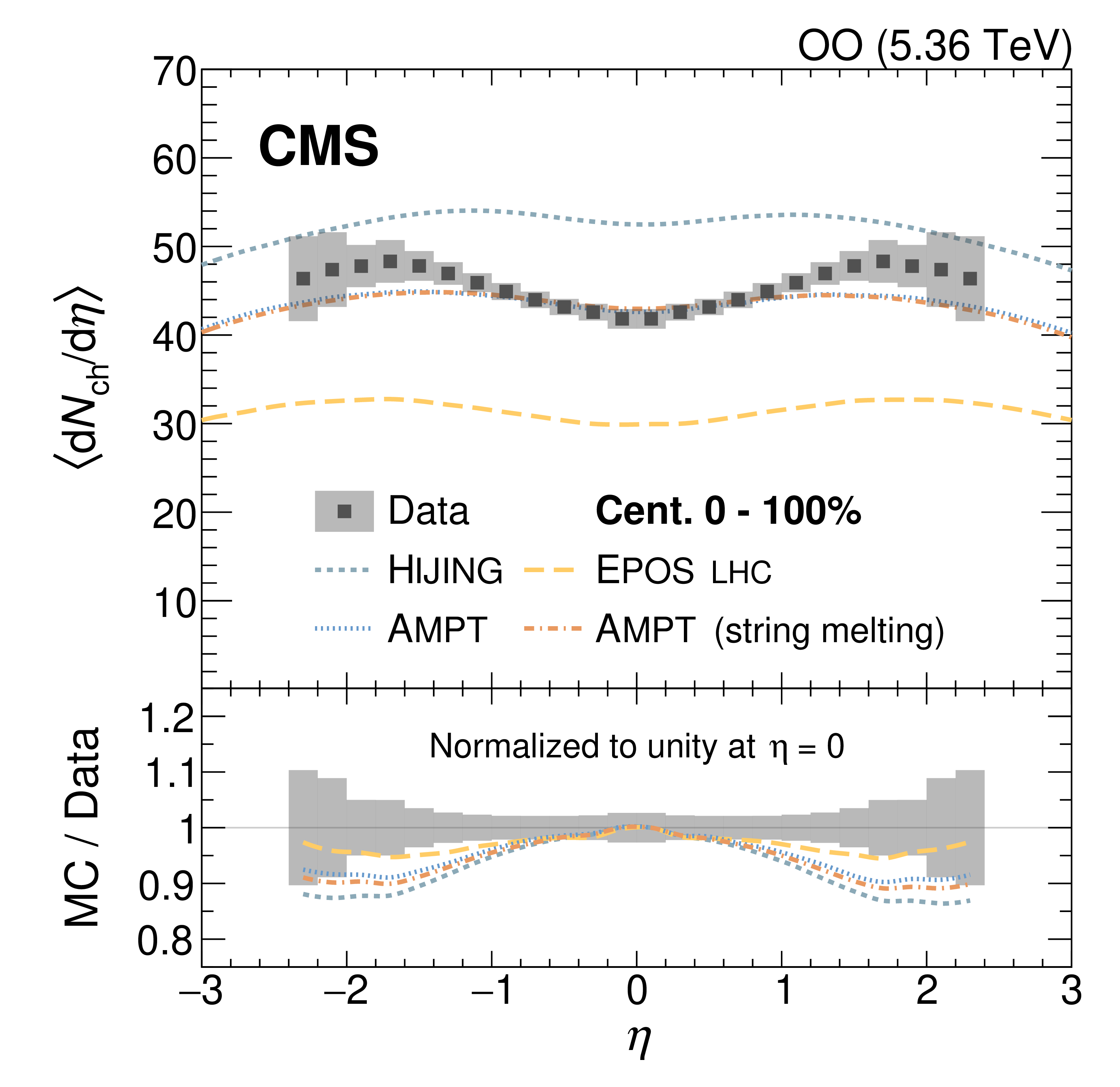
Figure 1:
The $ \mathrm{d} N_{\text{ch}}/\mathrm{d} \eta $ distribution in $ \mathrm{OO} $ collisions at $ \sqrt{\smash[b]{s_{_{\mathrm{NN}}}}} = $ 5.36 TeV for the 0--100% centrality class. The result is symmetrized about $ \eta= $ 0. Predictions from the HIJING [39], EPOS LHC [40,25], and AMPT [47] event generators are also shown. The lower panel shows the ratios of the model predictions to the data, normalized to unity at midrapidity. In the upper panel, the gray boxes indicate the total systematic uncertainties, while statistical uncertainties are negligible. In the lower panel, the boxes represent the relative uncertainties of the data. |
png pdf |
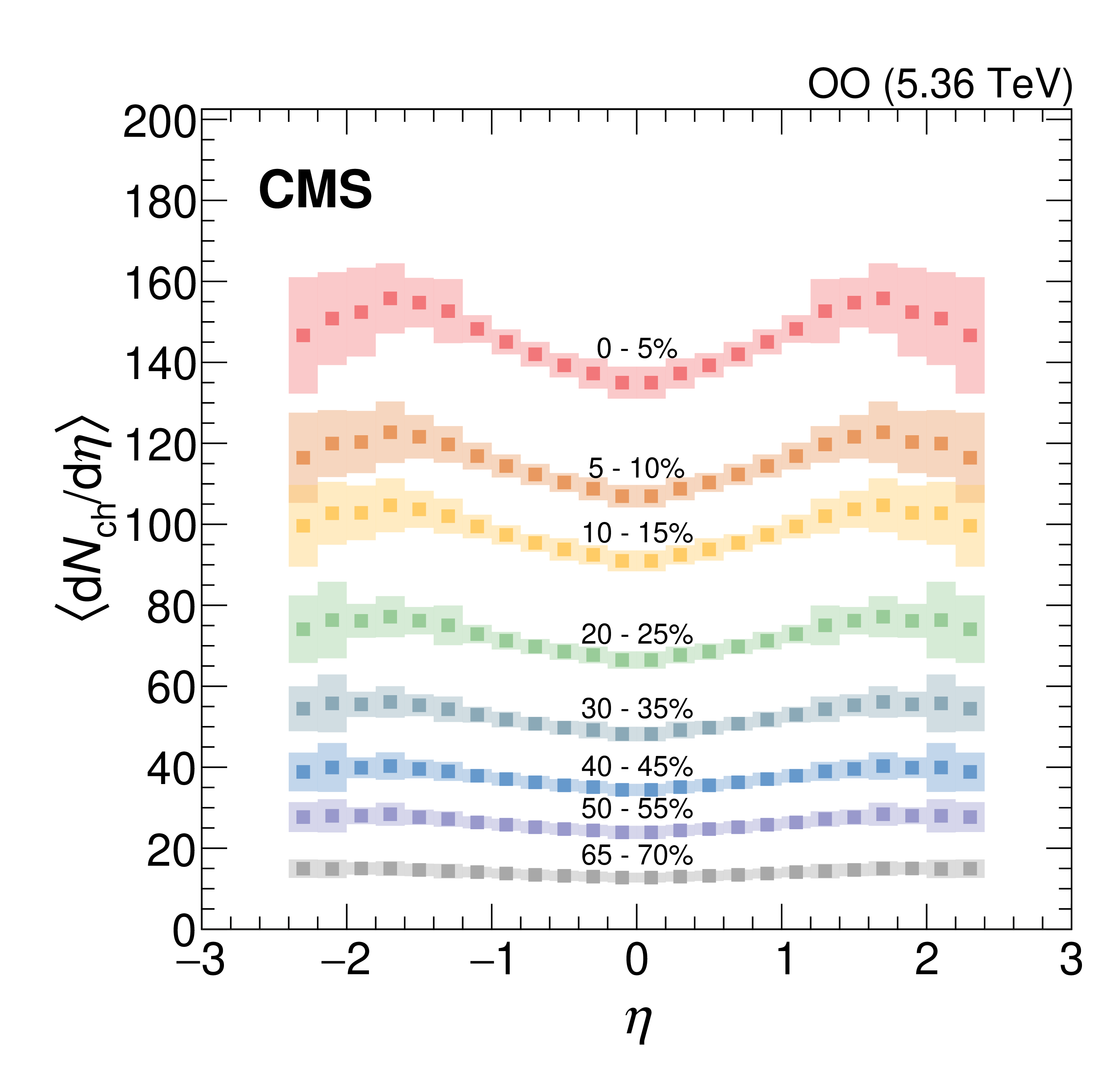
Figure 2:
The $ \mathrm{d} N_{\text{ch}}/\mathrm{d} \eta $ distribution in $ \mathrm{OO} $ collisions at $ \sqrt{\smash[b]{s_{_{\mathrm{NN}}}}} = $ 5.36 TeV for several centrality classes. In all cases, the data are symmetrized about $ \eta= $ 0. Boxes indicate the total systematic uncertainties, while statistical uncertainties are negligible. |
png pdf |
Figure 3:
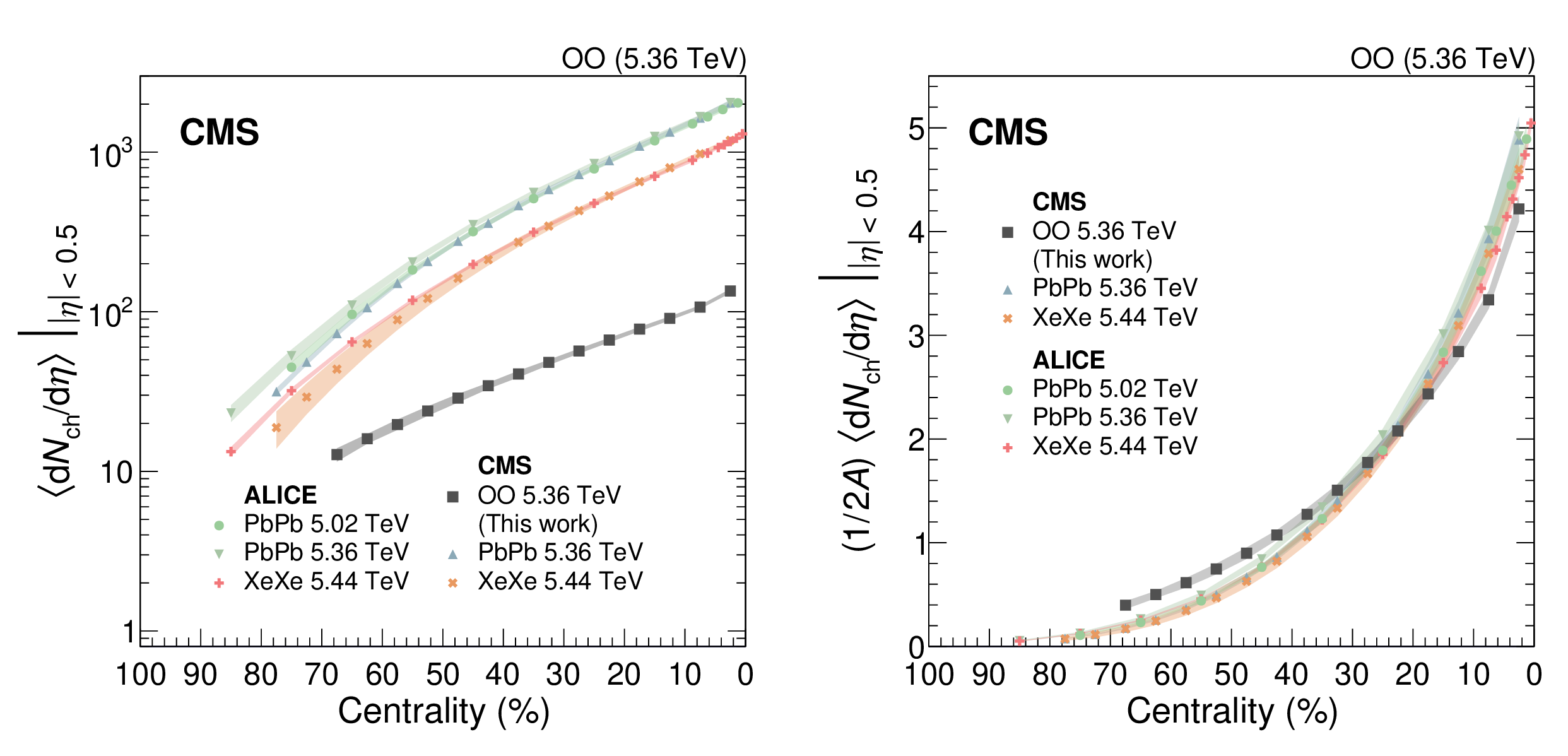
Charged-hadron $ \mathrm{d} N_{\text{ch}}/\mathrm{d} \eta $ at midrapidity in $ \mathrm{OO} $ collisions at $ \sqrt{\smash[b]{s_{_{\mathrm{NN}}}}} = $ 5.36 TeV as a function of event centrality, shown for the measured values (left) and normalized by 2 $ A $ (right), where $ A $ is the mass number of the colliding nuclei. The results are compared with measurements in $ \mathrm{PbPb} $ and $ \mathrm{XeXe} $ collisions at similar collision energies by the CMS [17,22] and ALICE [21,18,23] Collaborations. The bands around the data points denote the total systematic uncertainties, while the statistical uncertainties are negligible. |
png pdf |
Figure 3-a:
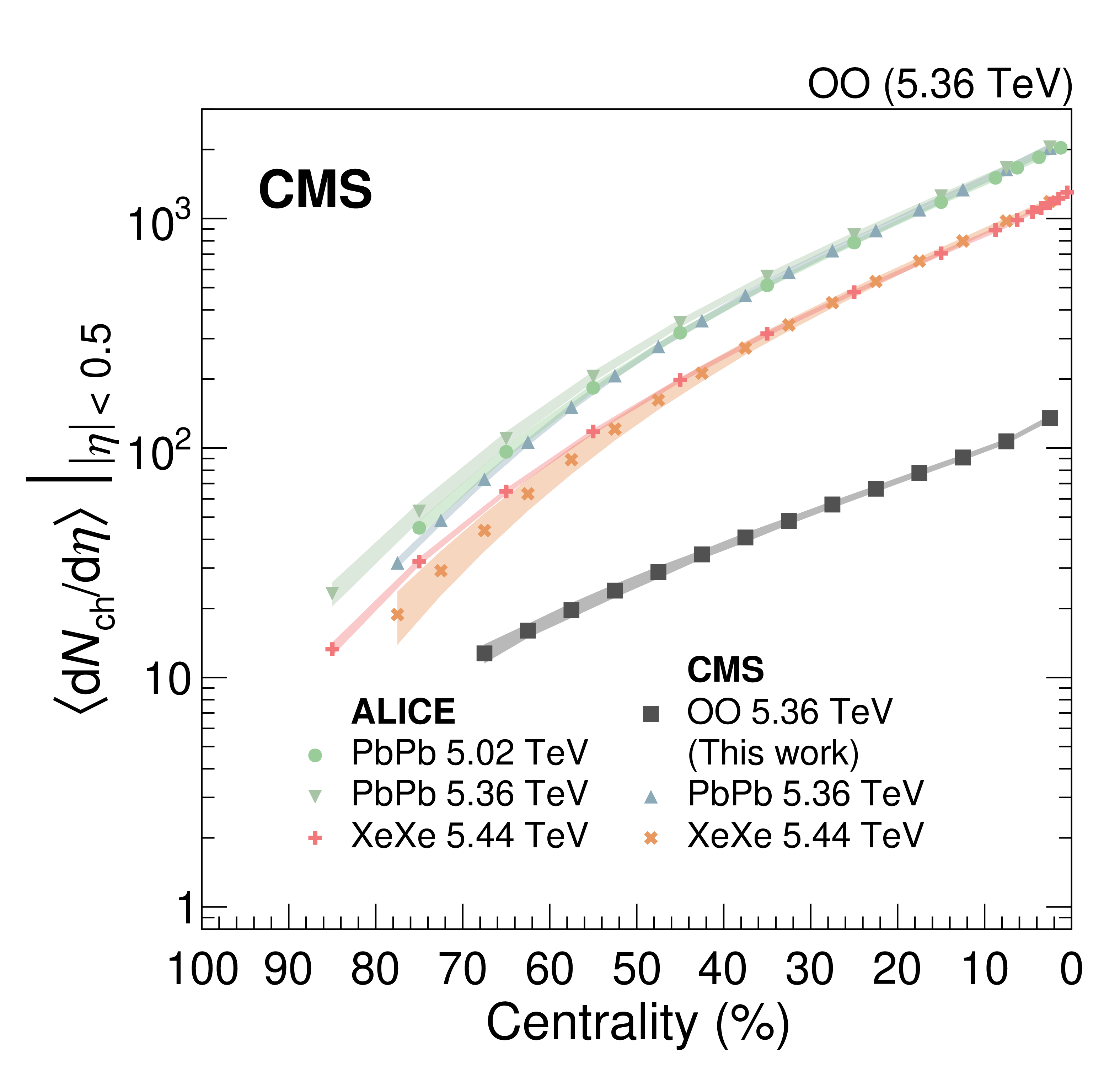
Charged-hadron $ \mathrm{d} N_{\text{ch}}/\mathrm{d} \eta $ at midrapidity in $ \mathrm{OO} $ collisions at $ \sqrt{\smash[b]{s_{_{\mathrm{NN}}}}} = $ 5.36 TeV as a function of event centrality, shown for the measured values (left) and normalized by 2 $ A $ (right), where $ A $ is the mass number of the colliding nuclei. The results are compared with measurements in $ \mathrm{PbPb} $ and $ \mathrm{XeXe} $ collisions at similar collision energies by the CMS [17,22] and ALICE [21,18,23] Collaborations. The bands around the data points denote the total systematic uncertainties, while the statistical uncertainties are negligible. |
png pdf |
Figure 3-b:
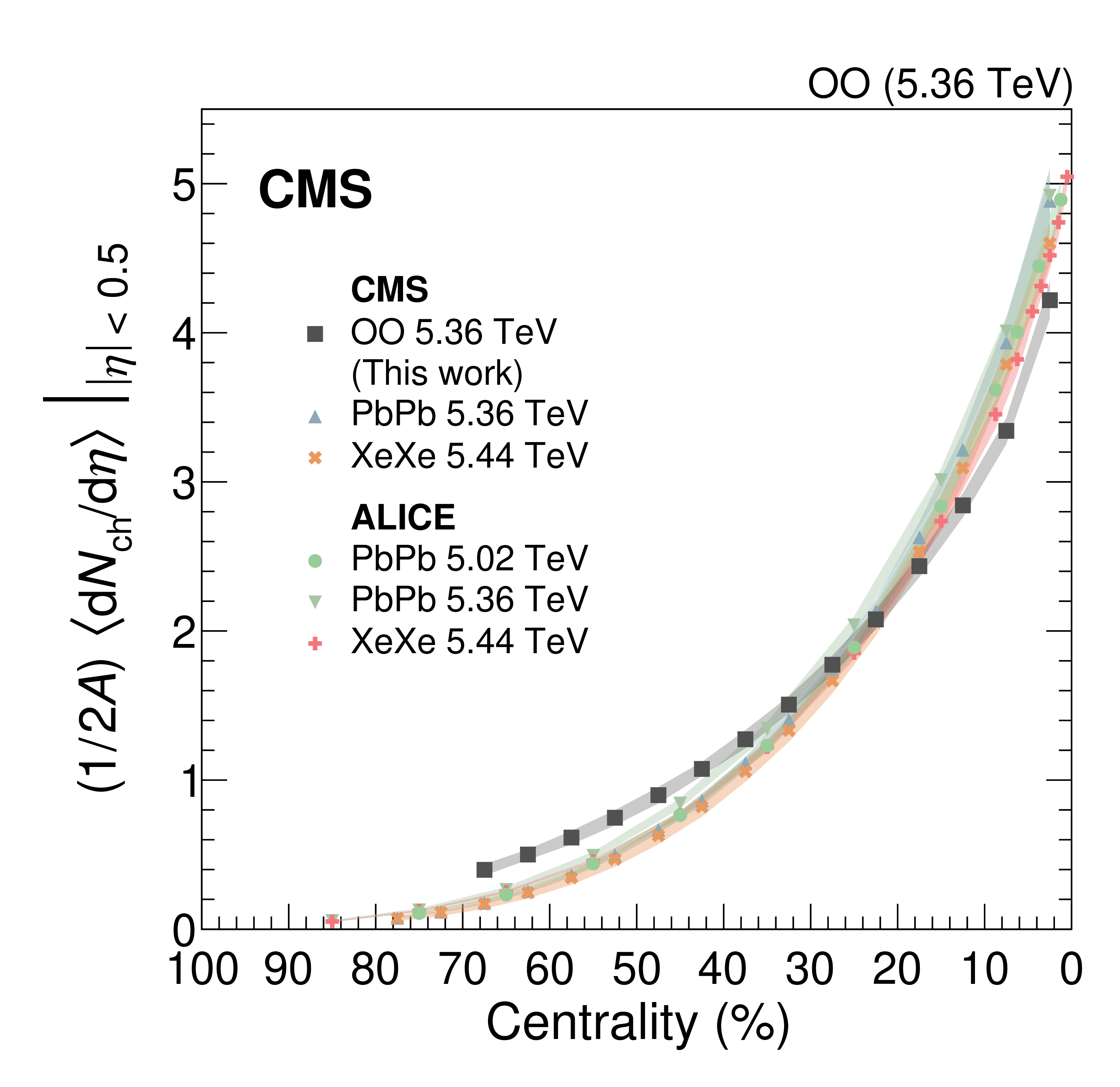
Charged-hadron $ \mathrm{d} N_{\text{ch}}/\mathrm{d} \eta $ at midrapidity in $ \mathrm{OO} $ collisions at $ \sqrt{\smash[b]{s_{_{\mathrm{NN}}}}} = $ 5.36 TeV as a function of event centrality, shown for the measured values (left) and normalized by 2 $ A $ (right), where $ A $ is the mass number of the colliding nuclei. The results are compared with measurements in $ \mathrm{PbPb} $ and $ \mathrm{XeXe} $ collisions at similar collision energies by the CMS [17,22] and ALICE [21,18,23] Collaborations. The bands around the data points denote the total systematic uncertainties, while the statistical uncertainties are negligible. |
png pdf |
Figure 4:
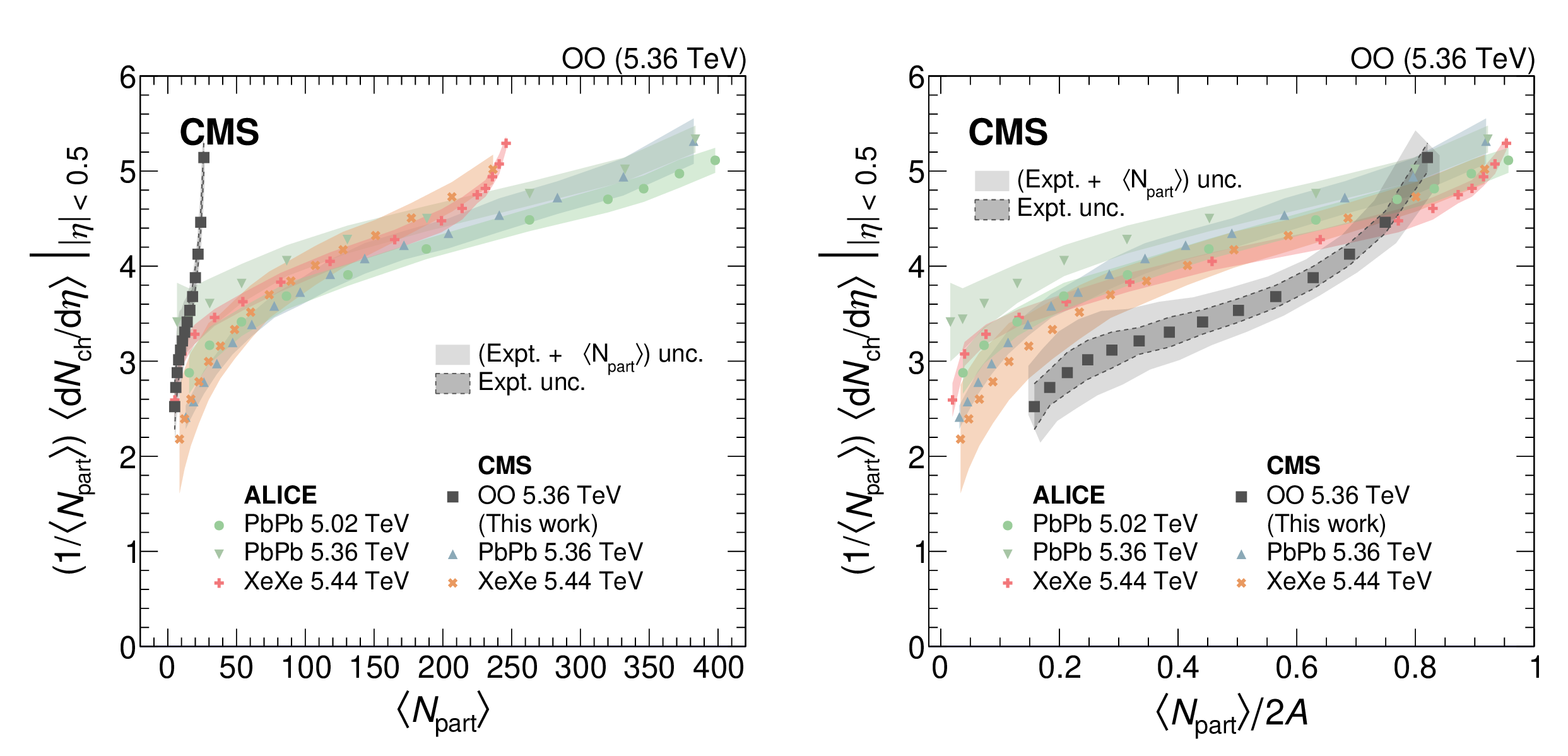
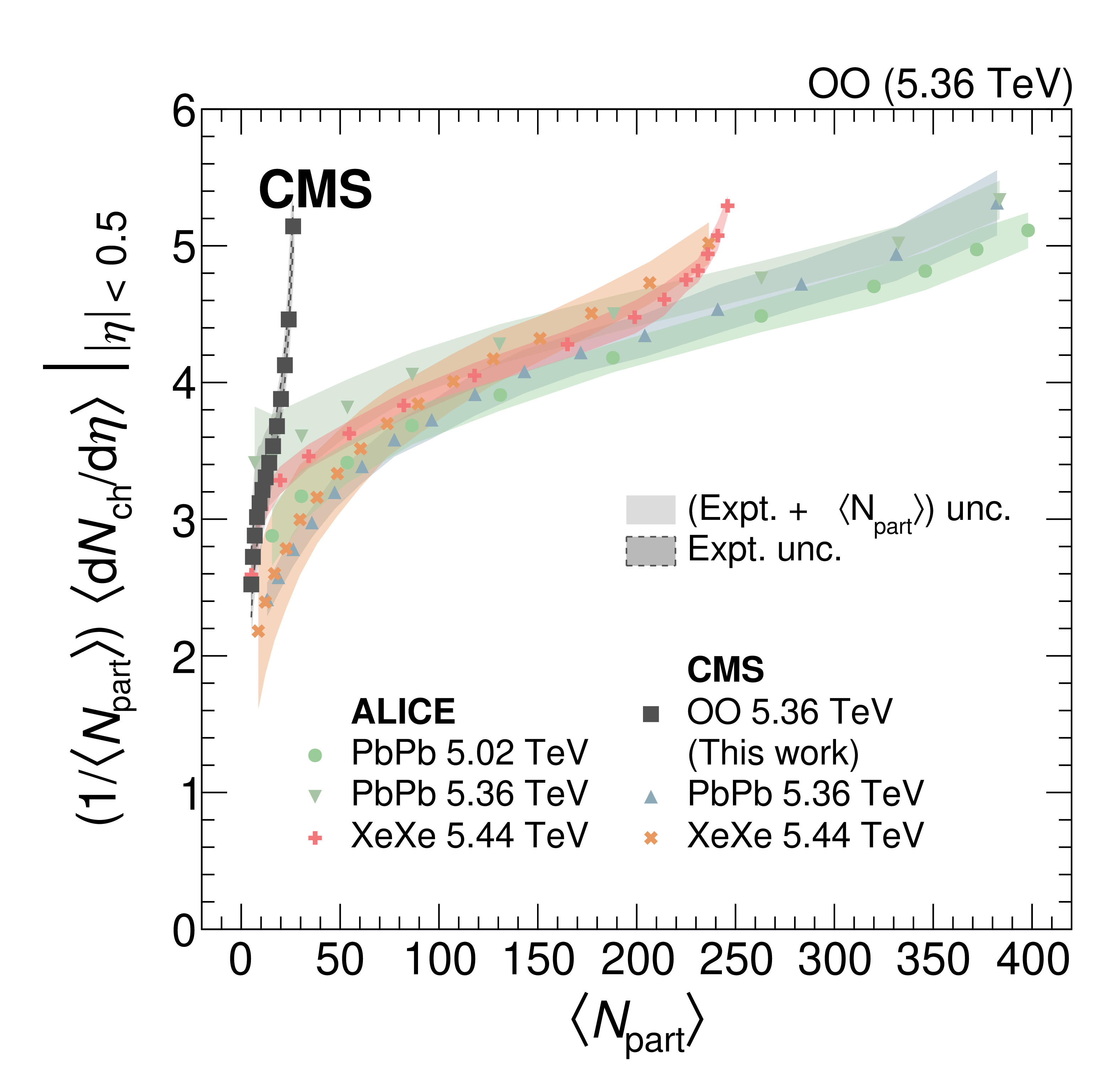
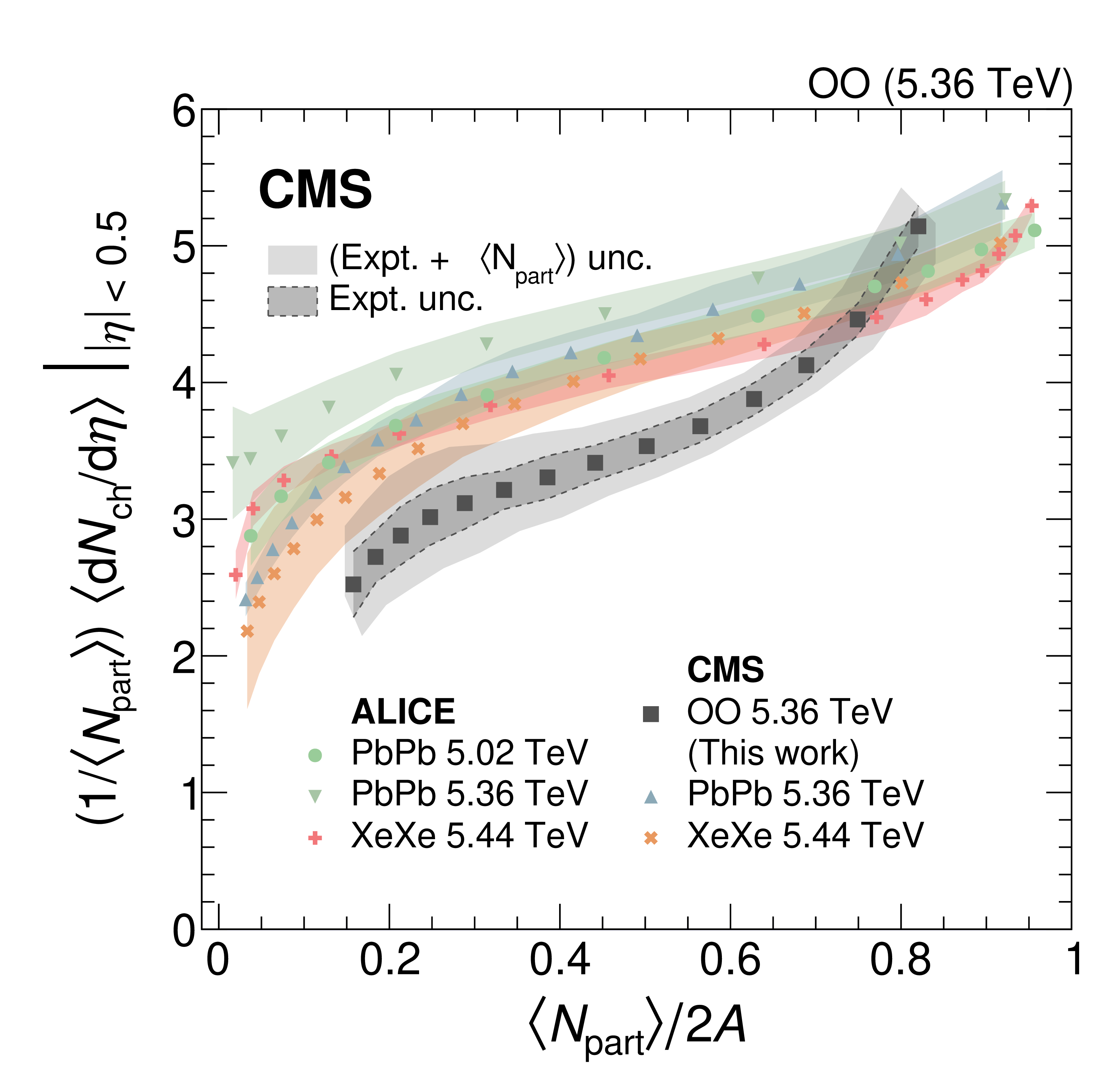
Charged-hadron $ \mathrm{d} N_{\text{ch}}/\mathrm{d} \eta $ at midrapidity, normalized by $ \langle N_{\text{part}} \rangle $, in $ \mathrm{OO} $ collisions at $ \sqrt{\smash[b]{s_{_{\mathrm{NN}}}}} = $ 5.36 TeV shown as a function of $ \langle N_{\text{part}} \rangle $ (left) and $ \langle N_{\text{part}} \rangle/2A $ (right), where $ A $ is the mass number of the colliding nuclei. The results are compared with measurements in $ \mathrm{PbPb} $ and $ \mathrm{XeXe} $ collisions by the CMS [22,17] and ALICE [23,21,18] Collaborations. The bands around the data points denote the systematic uncertainties, while the statistical uncertainties are negligible. For the $ \mathrm{OO} $ data, the inner band shows the experimental uncertainties, while the outer band includes both the experimental and $ \langle N_\mathrm{part}\rangle $ uncertainties. |
png pdf |
Figure 4-a:
Charged-hadron $ \mathrm{d} N_{\text{ch}}/\mathrm{d} \eta $ at midrapidity, normalized by $ \langle N_{\text{part}} \rangle $, in $ \mathrm{OO} $ collisions at $ \sqrt{\smash[b]{s_{_{\mathrm{NN}}}}} = $ 5.36 TeV shown as a function of $ \langle N_{\text{part}} \rangle $ (left) and $ \langle N_{\text{part}} \rangle/2A $ (right), where $ A $ is the mass number of the colliding nuclei. The results are compared with measurements in $ \mathrm{PbPb} $ and $ \mathrm{XeXe} $ collisions by the CMS [22,17] and ALICE [23,21,18] Collaborations. The bands around the data points denote the systematic uncertainties, while the statistical uncertainties are negligible. For the $ \mathrm{OO} $ data, the inner band shows the experimental uncertainties, while the outer band includes both the experimental and $ \langle N_\mathrm{part}\rangle $ uncertainties. |
png pdf |
Figure 4-b:
Charged-hadron $ \mathrm{d} N_{\text{ch}}/\mathrm{d} \eta $ at midrapidity, normalized by $ \langle N_{\text{part}} \rangle $, in $ \mathrm{OO} $ collisions at $ \sqrt{\smash[b]{s_{_{\mathrm{NN}}}}} = $ 5.36 TeV shown as a function of $ \langle N_{\text{part}} \rangle $ (left) and $ \langle N_{\text{part}} \rangle/2A $ (right), where $ A $ is the mass number of the colliding nuclei. The results are compared with measurements in $ \mathrm{PbPb} $ and $ \mathrm{XeXe} $ collisions by the CMS [22,17] and ALICE [23,21,18] Collaborations. The bands around the data points denote the systematic uncertainties, while the statistical uncertainties are negligible. For the $ \mathrm{OO} $ data, the inner band shows the experimental uncertainties, while the outer band includes both the experimental and $ \langle N_\mathrm{part}\rangle $ uncertainties. |
png pdf |
Figure 5:
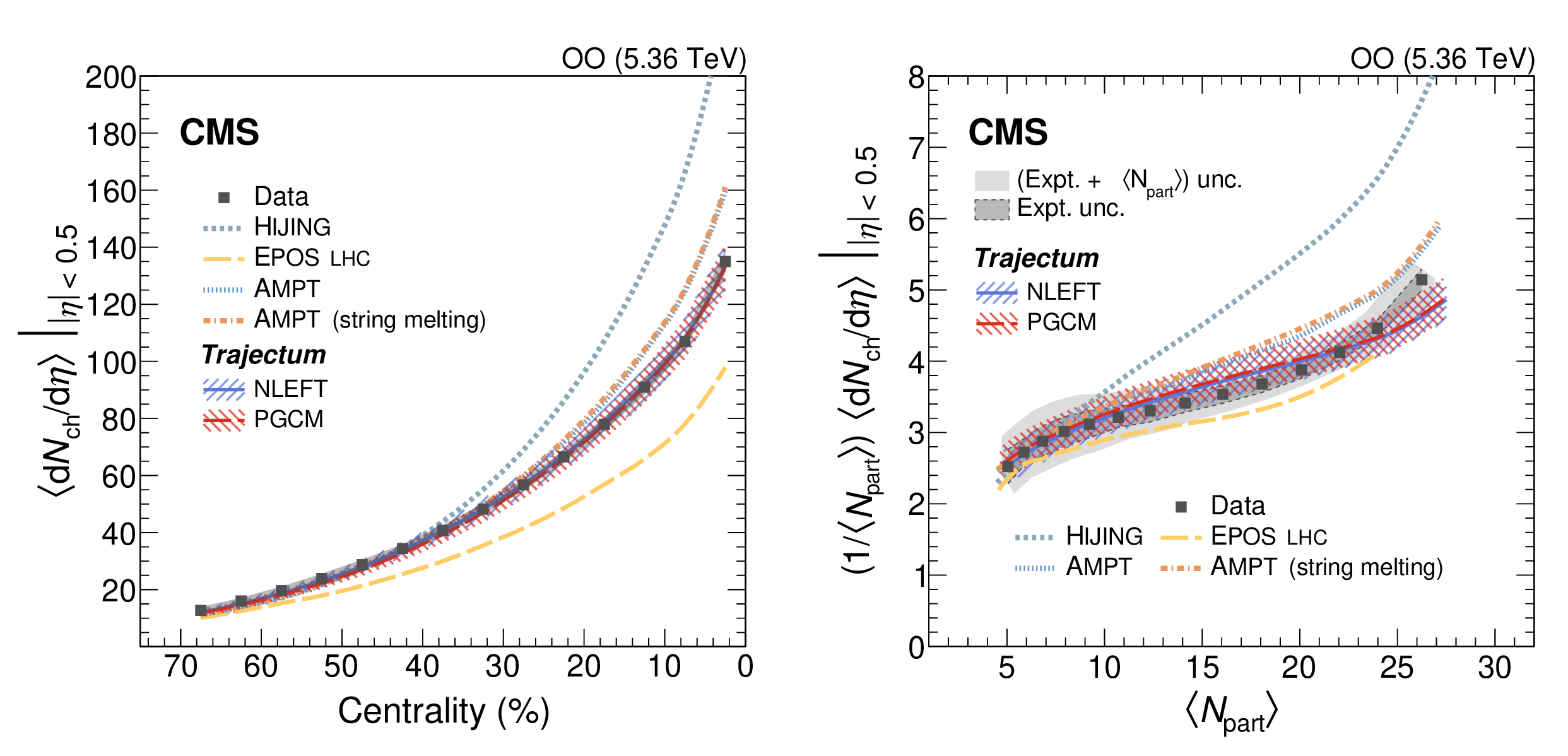
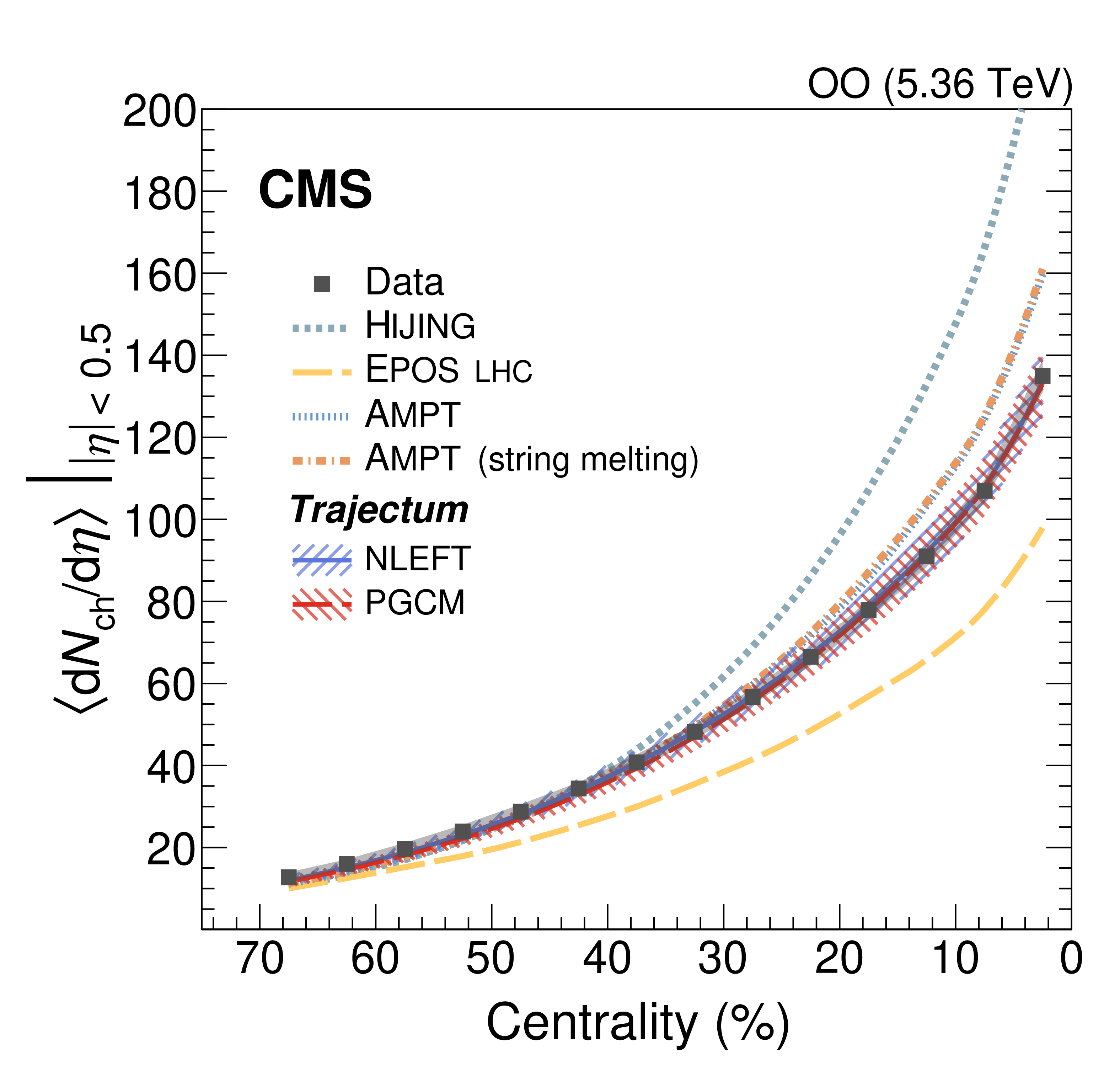
Charged-hadron $ \mathrm{d} N_{\text{ch}}/\mathrm{d} \eta $ at midrapidity in $ \mathrm{OO} $ collisions at $ \sqrt{\smash[b]{s_{_{\mathrm{NN}}}}} = $ 5.36 TeV as a function of event centrality (left) and $ \mathrm{d} N_{\text{ch}}/\mathrm{d} \eta $ normalized to $ \langle N_{\text{part}} \rangle $ as a function of $ \langle N_{\text{part}} \rangle $ (right). The results are compared to predictions from the HIJING [39], EPOS LHC [40,25], and AMPT [47] event generators, as well as the hydrodynamic model TRAJECTUM [52] using two different nuclear density descriptions for oxygen. The bands around the data points denote the systematic uncertainties, while the statistical uncertainties are negligible. For the $ \mathrm{OO} $ data, the inner band shows the experimental uncertainties, while the outer band includes both the experimental and $ \langle N_\mathrm{part}\rangle $ uncertainties. |
png pdf |
Figure 5-a:
Charged-hadron $ \mathrm{d} N_{\text{ch}}/\mathrm{d} \eta $ at midrapidity in $ \mathrm{OO} $ collisions at $ \sqrt{\smash[b]{s_{_{\mathrm{NN}}}}} = $ 5.36 TeV as a function of event centrality (left) and $ \mathrm{d} N_{\text{ch}}/\mathrm{d} \eta $ normalized to $ \langle N_{\text{part}} \rangle $ as a function of $ \langle N_{\text{part}} \rangle $ (right). The results are compared to predictions from the HIJING [39], EPOS LHC [40,25], and AMPT [47] event generators, as well as the hydrodynamic model TRAJECTUM [52] using two different nuclear density descriptions for oxygen. The bands around the data points denote the systematic uncertainties, while the statistical uncertainties are negligible. For the $ \mathrm{OO} $ data, the inner band shows the experimental uncertainties, while the outer band includes both the experimental and $ \langle N_\mathrm{part}\rangle $ uncertainties. |
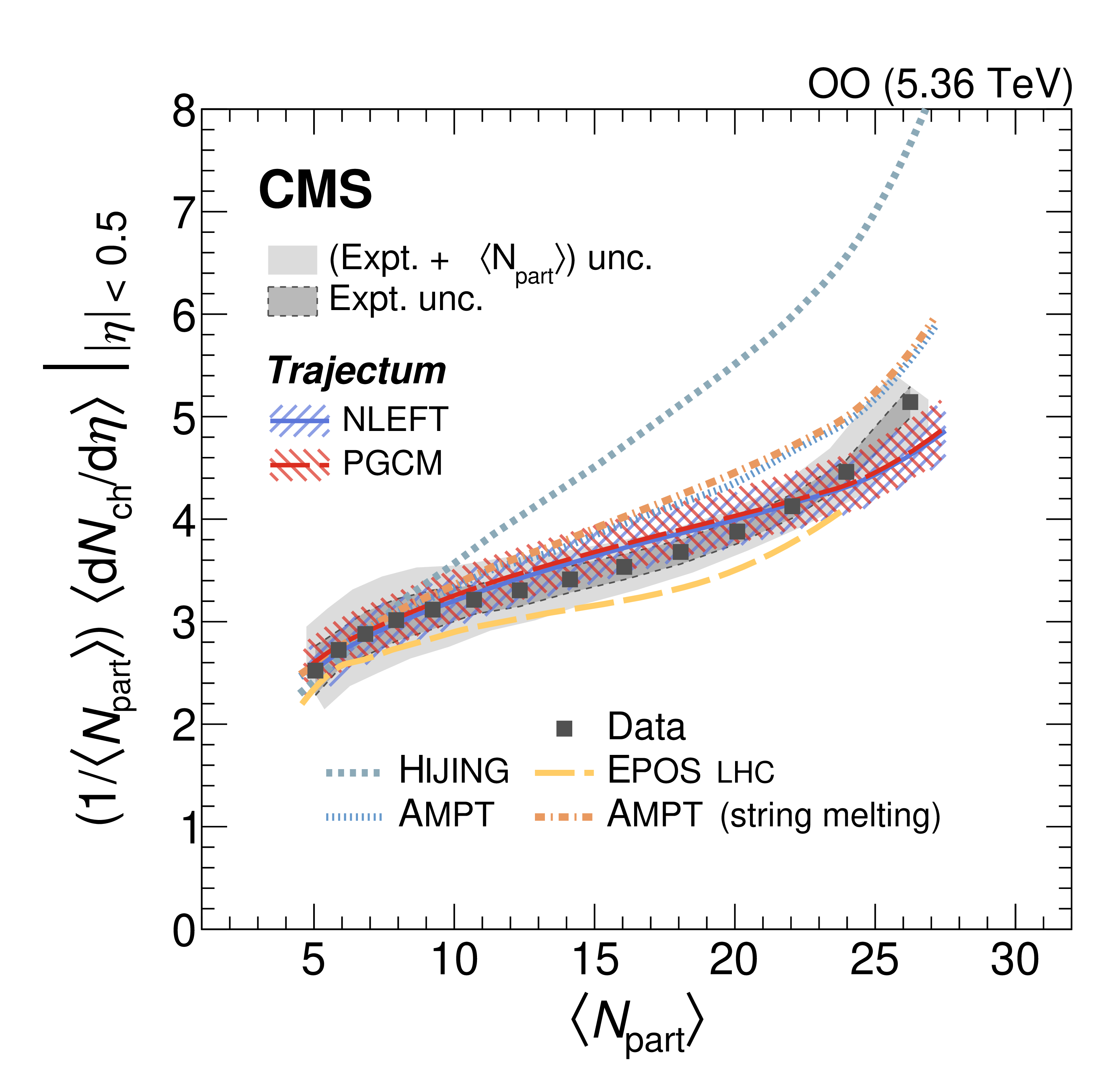
png pdf |
Figure 5-b:
Charged-hadron $ \mathrm{d} N_{\text{ch}}/\mathrm{d} \eta $ at midrapidity in $ \mathrm{OO} $ collisions at $ \sqrt{\smash[b]{s_{_{\mathrm{NN}}}}} = $ 5.36 TeV as a function of event centrality (left) and $ \mathrm{d} N_{\text{ch}}/\mathrm{d} \eta $ normalized to $ \langle N_{\text{part}} \rangle $ as a function of $ \langle N_{\text{part}} \rangle $ (right). The results are compared to predictions from the HIJING [39], EPOS LHC [40,25], and AMPT [47] event generators, as well as the hydrodynamic model TRAJECTUM [52] using two different nuclear density descriptions for oxygen. The bands around the data points denote the systematic uncertainties, while the statistical uncertainties are negligible. For the $ \mathrm{OO} $ data, the inner band shows the experimental uncertainties, while the outer band includes both the experimental and $ \langle N_\mathrm{part}\rangle $ uncertainties. |
png pdf |
Figure 6:
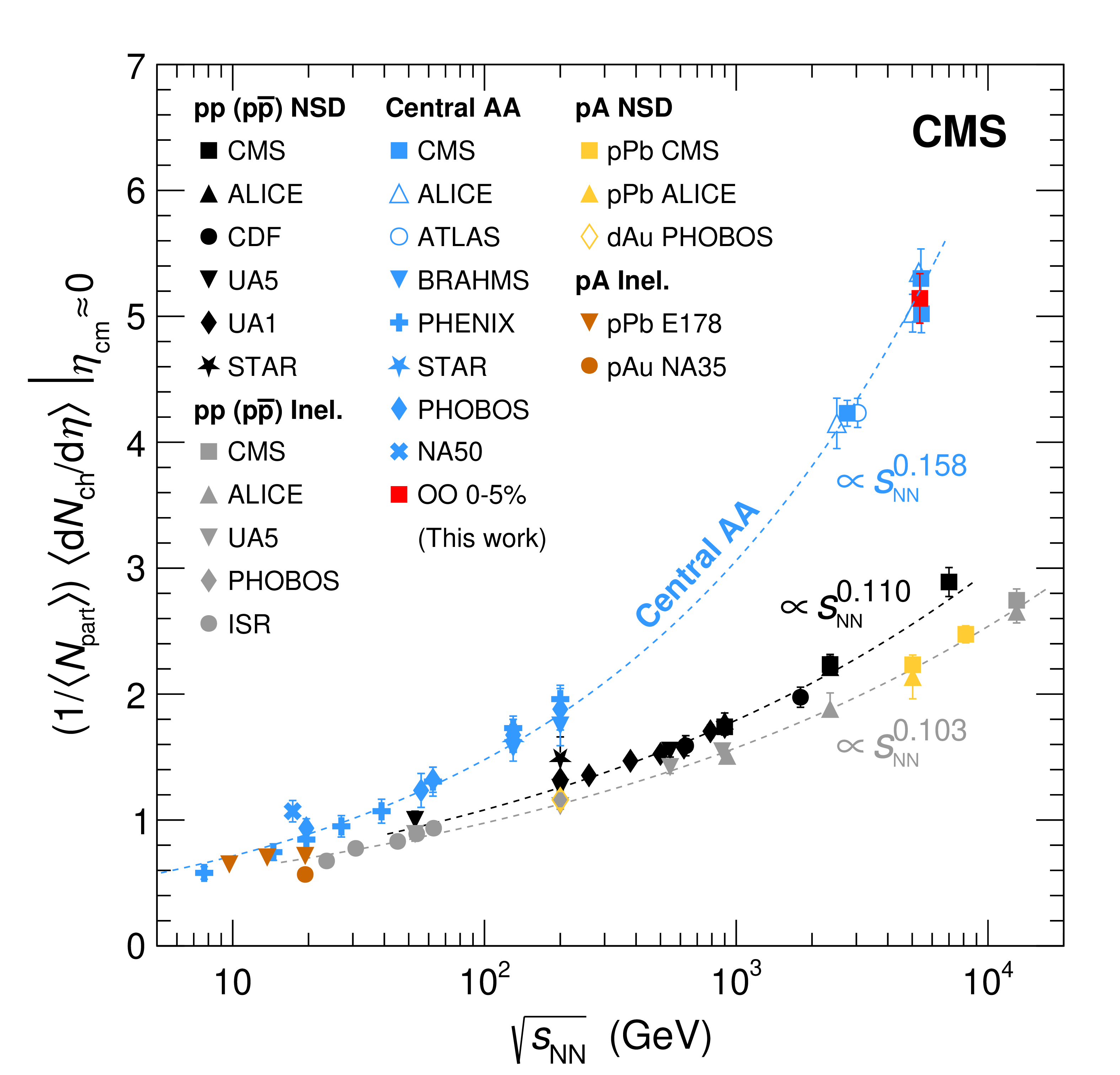
Comparison of average $ \mathrm{d} N_{\text{ch}}/\mathrm{d} \eta $ at midrapidity, scaled by $ \langle N_{\text{part}} \rangle $ in $ \mathrm{p} \mathrm{Pb} $ [53,32], $ \mathrm{p} \mathrm{Au} $ [54], $ \mathrm{dAu} $ [55,56,57], and central heavy ion collisions [20,22,17,58,59,60,61,16,62,63,64,65,66,23,56,67,68], as well as nonsingle-diffractive (NSD) [27,28,68,69,70,71] and inelastic [31,58,72,73] pp collisions. The data points for nucleus-nucleus ($ \mathrm{AA} $) collisions at $ \sqrt{\smash[b]{s_{_{\mathrm{NN}}}}} = $ 2.76 TeV have been shifted horizontally by $ \pm $10% for visibility. The dashed curves, reproduced from Ref. [32], are included to guide the eye and correspond to a power law functional form. |
| Tables | |
png pdf |
Table 1:
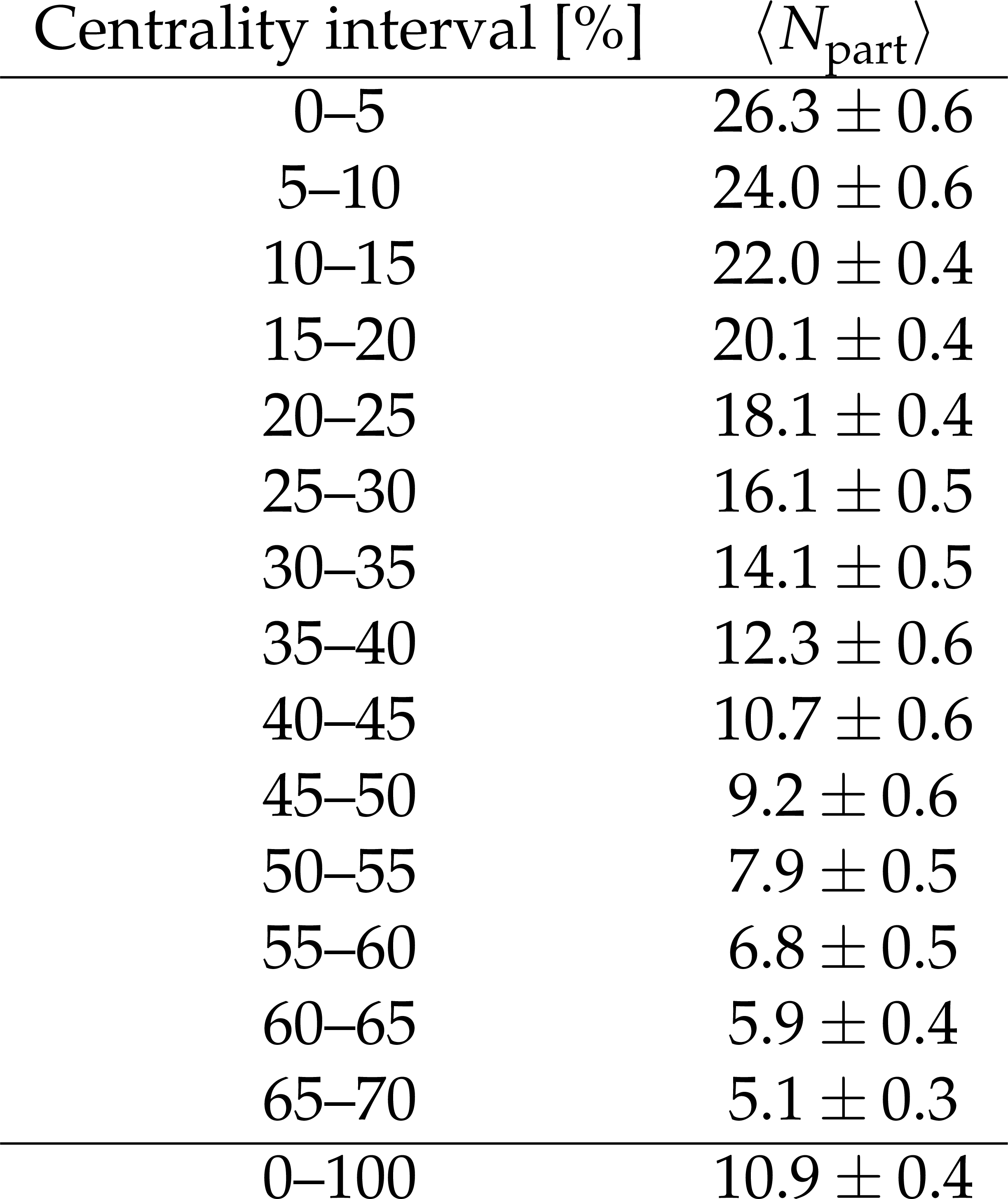
Centrality intervals and corresponding $ \langle N_{\text{part}} \rangle $ values for 5.36 TeV $ \mathrm{OO} $ collisions, reported up to 70% centrality, while the 0--100% interval corresponds to the fully centrality-integrated event sample. |
png pdf |
Table 2:
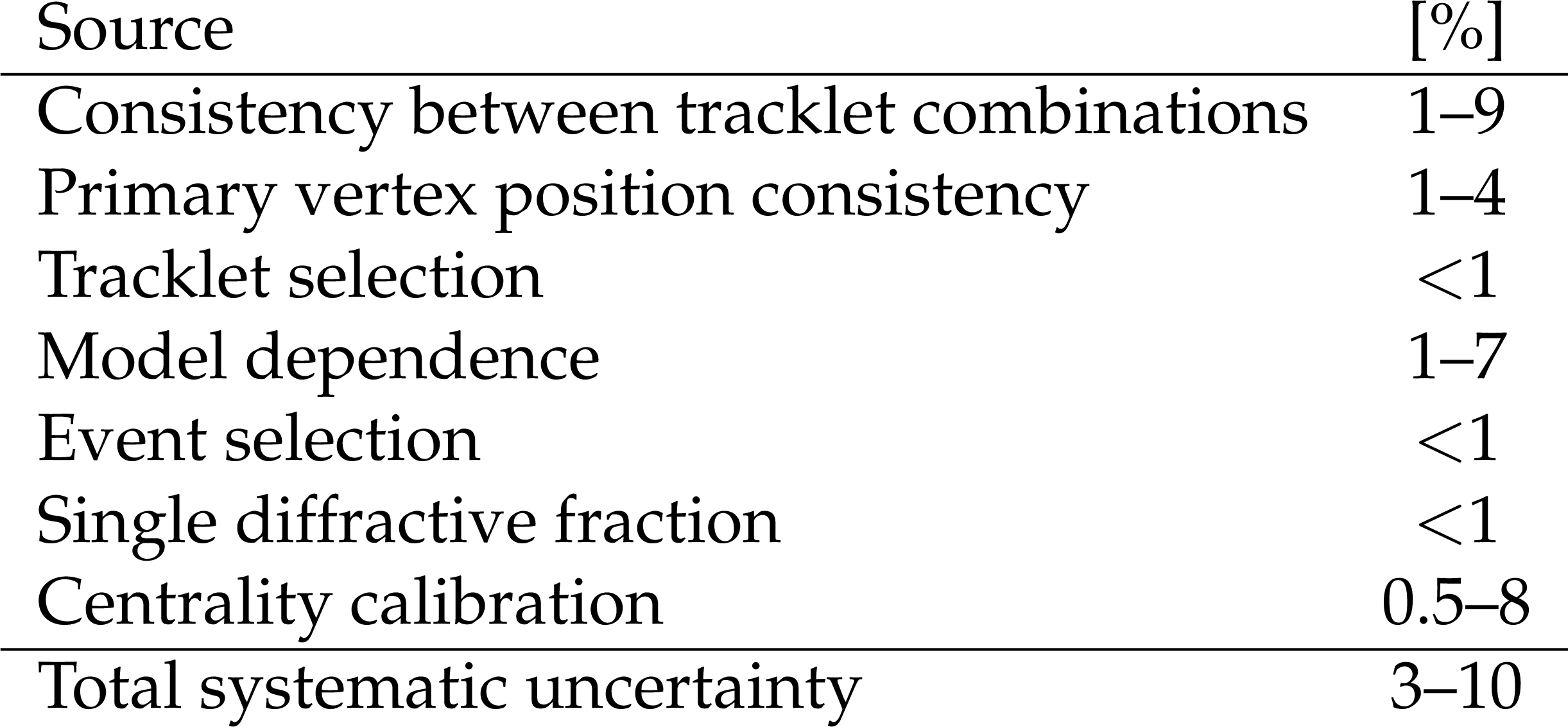
Sources of systematic uncertainty affecting the measurement of charged-hadron multiplicities as functions of $ \eta $ and centrality classes in $ \mathrm{OO} $ collisions at $ \sqrt{\smash[b]{s_{_{\mathrm{NN}}}}} = $ 5.36 TeV. For each source, the quoted range reflects the spread of the uncertainty across individual $ \eta $ bins and centrality intervals; no averaging over $ \eta $ or centrality is implied. |
| Summary |
| The pseudorapidity ($ \eta $) distributions of charged hadrons are measured for the first time in oxygen-oxygen ($ \mathrm{OO} $) collisions at a center-of-mass collision energy per nucleon pair $ \sqrt{\smash[b]{s_{_{\mathrm{NN}}}}} = $ 5.36 TeV. The measurements are performed in the range $ |\eta| < $ 2.4 for multiple centrality intervals. The charged-hadron pseudorapidity density in the midrapidity region ($ |\eta| < $ 0.5) is measured to be $ \langle \mathrm{d} N_{\text{ch}}/\mathrm{d} \eta \rangle = $ 41.8 $ \pm $ 1.1 (syst) integrated over centrality. The $ \eta $ dependence of the centrality-integrated charged-hadron pseudorapidity density is compared to predictions from the HIJING, EPOS LHC, and AMPT event generators. Among these calculations, AMPT best reproduces the absolute yields, while EPOS LHC provides the best description of the $ \eta $ dependence. For the 5% most central collisions, the charged-hadron density at midrapidity ($ |\eta| < $ 0.5) is measured to be $ \mathrm{d} N_{\text{ch}}/\mathrm{d} \eta = $ 135.0 $ \pm $ 4.0 (syst). The corresponding per-participant charged-hadron density is consistent with that observed in central $ \mathrm{PbPb} $ collisions at similar collision energies, indicating that particle production per participating nucleon in central collisions remains comparable even in substantially smaller collision systems. The centrality dependence of the midrapidity results is compared with previous measurements in lead-lead ($ \mathrm{PbPb} $) collisions at $ \sqrt{\smash[b]{s_{_{\mathrm{NN}}}}} = $ 5.02 and 5.36 TeV and xenon-xenon ($ \mathrm{XeXe} $) collisions at $ \sqrt{\smash[b]{s_{_{\mathrm{NN}}}}} = $ 5.44 TeV. The expected system-size ordering is observed, with $ \mathrm{d} N_{\text{ch}}/\mathrm{d} \eta $ increasing from $ \mathrm{OO} $ to $ \mathrm{XeXe} $ to $ \mathrm{PbPb} $ at fixed centrality. After normalization by the maximum number of nucleons in the colliding system, the $ \mathrm{OO} $ results follow this trend approximately, but exhibit a less steep centrality dependence. At a given participant fraction, the per-participant yields are consistent between $ \mathrm{PbPb} $ and $ \mathrm{XeXe} $ collisions, while those in $ \mathrm{OO} $ collisions show a clear deviation. These observations indicate that, while the overall energy-scaling behavior observed in nucleus-nucleus collisions is preserved, the centrality dependence of normalized particle production deviates from the trends observed in larger collision systems. This behavior highlights the increased importance of collision geometry and finite-size effects in the smallest ion-ion system studied at the LHC. The hydrodynamic model TRAJECTUM provides the best overall description of the midrapidity data, particularly in central collisions. The $ \mathrm{OO} $ data provide new constraints on models of initial-state entropy production and particle production dynamics in light ion-ion collisions. |
| References | ||||
| 1 | W. Busza, K. Rajagopal, and W. van der Schee | Heavy ion collisions: The big picture, and the big questions | Ann. Rev. of Nucl. Part Sci. 68 (2018) 339 | 1802.04801 |
| 2 | P. Romatschke and U. Romatschke | Relativistic fluid dynamics in and out of equilibrium | Cambridge Monographs on Mathematical Physics. Cambridge University Press,, ISBN 978-1-108-48368-1, 978-1-108-75002-8, 2019 link |
|
| 3 | J. L. Albacete and C. Marquet | Gluon saturation and initial conditions for relativistic heavy ion collisions | Prog. Part. Nucl. Phys. 76 (2014) 1 | 1401.4866 |
| 4 | D. Kharzeev and M. Nardi | Hadron production in nuclear collisions at RHIC and high density QCD | PLB 507 (2001) 121 | nucl-th/0012025 |
| 5 | D. d'Enterria et al. | Constraints from the first LHC data on hadronic event generators for ultra-high energy cosmic-ray physics | Astropart. Phys. 35 (2011) 98 | 1101.5596 |
| 6 | CMS Collaboration | Overview of high-density QCD studies with the CMS experiment at the LHC | Phys. Rept. 1115 (2025) 219 | CMS-HIN-23-011 2405.10785 |
| 7 | L. Apolin \'a rio, Y.-J. Lee, and M. Winn | Heavy quarks and jets as probes of the QGP | Prog. Part. Nucl. Phys. 127 (2022) 103990 | 2203.16352 |
| 8 | D. Sharma et al. | Effect of \ensuremath\alpha clusters on particle production in OO and pO collisions at energies available at the CERN Large Hadron Collider | Phys. Rev. C 112 (2025) 034905 | 2503.20339 |
| 9 | Z. Citron et al. | Future physics opportunities for high-density QCD at the LHC with heavy-ion and proton beams | CERN Yellow Rep. Monogr. 7 (2019) 1159 | 1812.06772 |
| 10 | C. Zhang et al. | Ab-initio nucleon-nucleon correlations and their impact on high energy 16O+16O collisions | PLB 862 (2025) 139322 | 2404.08385 |
| 11 | ALICE Collaboration | Evidence of nuclear geometry-driven anisotropic flow in OO and Ne-Ne collisions at $ \sqrt{\smash[b]{s_{_{\mathrm{NN}}}}} = $ 5.36 TeV | Submitted to Phys. Rev. Lett, 2025 | 2509.06428 |
| 12 | ATLAS Collaboration | Measurement of the azimuthal anisotropy of charged particles in $ \sqrt{\smash[b]{s_{_{\mathrm{NN}}}}}= $ 5.36 TeV $ ^{16} $O$ +^{16} $O and $ ^{20} $Ne$ +^{20} $Ne collisions with the ATLAS detector | Phys. Rev. C 113 (2026) 045205 | 2509.05171 |
| 13 | CMS Collaboration | Observation of long-range collective flow in OO and NeNe collisions and implications for nuclear structure studies | Submitted to Phys. Rev. Lett, 2025 | CMS-HIN-25-009 2510.02580 |
| 14 | PHOBOS Collaboration | System size, energy and centrality dependence of pseudorapidity distributions of charged particles in relativistic heavy ion collisions | PRL 102 (2009) 142301 | 0709.4008 |
| 15 | PHOBOS Collaboration | Charged-particle pseudorapidity distributions in Au+Au collisions at $ \sqrt{\smash[b]{s_{_{\mathrm{NN}}}}} = $ 62.4 GeV | Phys. Rev. C 74 (2006) 021901 | nucl-ex/0509034 |
| 16 | BRAHMS Collaboration | Pseudorapidity distributions of charged particles from Au+Au collisions at the maximum RHIC energy | PRL 88 (2002) 202301 | nucl-ex/0112001 |
| 17 | CMS Collaboration | Pseudorapidity distributions of charged hadrons in xenon-xenon collisions at $ \sqrt{\smash[b]{s_{_{\mathrm{NN}}}}}= $ 5.44 TeV | PLB 799 (2019) 135049 | CMS-HIN-17-006 1902.03603 |
| 18 | ALICE Collaboration | Centrality and pseudorapidity dependence of the charged-particle multiplicity density in Xe-Xe collisions at $ \sqrt{\smash[b]{s_{_{\mathrm{NN}}}}} = $ 5.44 TeV | PLB 790 (2019) 35 | 1805.04432 |
| 19 | ALICE Collaboration | Centrality dependence of the charged-particle multiplicity density at mid-rapidity in Pb-Pb collisions at $ \sqrt{\smash[b]{s_{_{\mathrm{NN}}}}}= $ 2.76 TeV | PRL 106 (2011) 032301 | 1012.1657 |
| 20 | CMS Collaboration | Dependence on pseudorapidity and on centrality of charged hadron production in PbPb collisions at $ \sqrt{\smash[b]{s_{_{\mathrm{NN}}}}} = $ 2.76 TeV | JHEP 08 (2011) 141 | CMS-HIN-10-001 1107.4800 |
| 21 | ALICE Collaboration | Centrality dependence of the charged-particle multiplicity density at midrapidity in Pb-Pb collisions at $ \sqrt{\smash[b]{s_{_{\mathrm{NN}}}}} = $ 5.02 TeV | PRL 116 (2016) 222302 | 1512.06104 |
| 22 | CMS Collaboration | Pseudorapidity distributions of charged hadrons in lead-lead collisions at $ \sqrt{\smash[b]{s_{_{\mathrm{NN}}}}}= $ 5.36 TeV | PLB 861 (2025) 139279 | CMS-HIN-23-007 2409.00838 |
| 23 | ALICE Collaboration | Centrality dependence of charged-particle pseudorapidity density at midrapidity in Pb-Pb collisions at $ \sqrt{\smash[b]{s_{_{\mathrm{NN}}}}} = $ 5.36 TeV | Submitted to Phys. Lett. B, 2025 | 2504.02505 |
| 24 | W.-T. Deng, X.-N. Wang, and R. Xu | Gluon shadowing and hadron production in heavy-ion collisions at LHC | PLB 701 (2011) 133 | 1011.5907 |
| 25 | T. Pierog et al. | EPOS LHC: Test of collective hadronization with data measured at the CERN Large Hadron Collider | Phys. Rev. C 92 (2015) 034906 | 1306.0121 |
| 26 | I. P. Lokhtin and A. M. Snigirev | A model of jet quenching in ultrarelativistic heavy ion collisions and high-$ p_{\mathrm{T}} $ hadron spectra at RHIC | EPJC 45 (2006) 211 | hep-ph/0506189 |
| 27 | CMS Collaboration | Transverse momentum and pseudorapidity distributions of charged hadrons in pp collisions at $ \sqrt{s} = $ 0.9 and 2.36 TeV | JHEP 02 (2010) 041 | CMS-QCD-09-010 1002.0621 |
| 28 | CMS Collaboration | Transverse-momentum and pseudorapidity distributions of charged hadrons in pp collisions at $ \sqrt{s}= $ 7 TeV | PRL 105 (2010) 022002 | CMS-QCD-10-006 1005.3299 |
| 29 | CMS Collaboration | Charged particle multiplicities in pp interactions at $ \sqrt{s} = $ 0.9, 2.36, and 7 TeV | JHEP 01 (2011) 079 | CMS-QCD-10-004 1011.5531 |
| 30 | CMS and TOTEM Collaborations | Measurement of pseudorapidity distributions of charged particles in proton-proton collisions at $ \sqrt{s} = $ 8 TeV by the CMS and TOTEM experiments | EPJC 74 (2014) 3053 | 1405.0722 |
| 31 | CMS Collaboration | Pseudorapidity distribution of charged hadrons in proton-proton collisions at $ \sqrt{s} = $ 13 TeV | PLB 751 (2015) 143 | CMS-FSQ-15-001 1507.05915 |
| 32 | CMS Collaboration | Pseudorapidity distributions of charged hadrons in proton-lead collisions at $ \sqrt{\smash[b]{s_{_{\mathrm{NN}}}}} = $ 5.02 and 8.16 TeV | JHEP 01 (2018) 045 | CMS-HIN-16-021 1710.09355 |
| 33 | M. L. Miller, K. Reygers, S. J. Sanders, and P. Steinberg | Glauber modeling in high energy nuclear collisions | Ann. Rev. Nucl. Part. Sci. 57 (2007) 205 | nucl-ex/0701025 |
| 34 | D. d'Enterria and C. Loizides | Progress in the Glauber model at collider energies | Ann. Rev. Nucl. Part. Sci. 71 (2021) 315 | 2011.14909 |
| 35 | CMS Collaboration | HEPData record for this analysis | link | |
| 36 | CMS Collaboration | The CMS experiment at the CERN LHC | JINST 3 (2008) S08004 | |
| 37 | CMS Collaboration | Development of the CMS detector for the CERN LHC Run 3 | JINST 19 (2024) P05064 | CMS-PRF-21-001 2309.05466 |
| 38 | CMS Collaboration | CMS technical design report for the pixel detector upgrade | technical report, 2012 link |
|
| 39 | X.-N. Wang and M. Gyulassy | HIJING: A Monte Carlo model for multiple jet production in pp, pA and AA collisions | PRD 44 (1991) 3501 | |
| 40 | K. Werner, F.-M. Liu, and T. Pierog | Parton ladder splitting and the rapidity dependence of transverse momentum spectra in deuteron-gold collisions at the BNL Relativistic Heavy Ion Collider | Phys. Rev. C 74 (2006) 044902 | hep-ph/0506232 |
| 41 | S. R. Klein et al. | STARlight: A Monte Carlo simulation program for ultra-peripheral collisions of relativistic ions | Comput. Phys. Commun. 212 (2017) 258 | 1607.03838 |
| 42 | S. Roesler, R. Engel, and J. Ranft | The Monte Carlo event generator DPMJET-III | Advanced Monte Carlo for radiation physics, particle transport simulation and applications. Proceedings, Conference, MC, Lisbon, Portugal, -26,, 2000 October 2 (2000) 3 |
hep-ph/0012252 |
| 43 | S. J. Das and A. Baty | Data-driven method to estimate contamination from light ion beam transmutation at colliders | Phys. Rev. C 113 (2026) 044907 | 2509.09736 |
| 44 | CMS Collaboration | Observation and studies of jet quenching in PbPb collisions at $ \sqrt{\smash[b]{s_{_{\mathrm{NN}}}}} = $ 2.76 TeV | Phys. Rev. C 84 (2011) 024906 | CMS-HIN-10-004 1102.1957 |
| 45 | C. Loizides | Glauber predictions for oxygen and neon collisions at energies available at the CERN Large Hadron Collider | Phys. Rev. C 113 (2026) 014914 | 2507.05853 |
| 46 | GEANT4 Collaboration | GEANT 4---a simulation toolkit | NIM A 506 (2003) 250 | |
| 47 | Z.-W. Lin et al. | A multi-phase transport model for relativistic heavy ion collisions | Phys. Rev. C 72 (2005) 064901 | nucl-th/0411110 |
| 48 | C. Bierlich, G. Gustafson, L. Lönnblad, and H. Shah | The Angantyr model for heavy-ion collisions in PYTHIA8 | JHEP 10 (2018) 134 | 1806.10820 |
| 49 | B. Zhang | ZPC 1.0.1: A parton cascade for ultrarelativistic heavy ion collisions | Comput. Phys. Commun. 109 (1998) 193 | nucl-th/9709009 |
| 50 | B.-A. Li and C. M. Ko | Formation of superdense hadronic matter in high energy heavy-ion collisions | Phys. Rev. C 52 (1995) 2037 | nucl-th/9505016 |
| 51 | Z.-W. Lin | Evolution of transverse flow and effective temperatures in the parton phase from a multi-phase transport model | Phys. Rev. C 90 (2014) 014904 | 1403.6321 |
| 52 | G. Giacalone et al. | Exploiting $ ^{20} $Ne Isotopes for Precision Characterizations of Collectivity in Small Systems | PRL 135 (2025) 012302 | 2402.05995 |
| 53 | ALICE Collaboration | Pseudorapidity density of charged particles in $ \mathrm{p} $+Pb collisions at $ \sqrt{\smash[b]{s_{_{\mathrm{NN}}}}}= $ 5.02 TeV | PRL 110 (2013) 032301 | 1210.3615 |
| 54 | NA35 Collaboration | Charged particle production in proton-, deuteron-, oxygen- and sulphur-nucleus collisions at 200 GeV per nucleon | EPJC 2 (1998) 643 | hep-ex/9711001 |
| 55 | PHOBOS Collaboration | Pseudorapidity distribution of charged particles in d+Au collisions at $ \sqrt{\smash[b]{s_{_{\mathrm{NN}}}}} = $ 200 GeV | PRL 93 (2004) 082301 | nucl-ex/0311009 |
| 56 | PHENIX Collaboration | Transverse energy production and charged-particle multiplicity at midrapidity in various systems from $ \sqrt{\smash[b]{s_{_{\mathrm{NN}}}}}= $ 7.7 to 200 GeV | Phys. Rev. C 93 (2016) 024901 | 1509.06727 |
| 57 | PHENIX Collaboration | Measurements of azimuthal anisotropy and charged-particle multiplicity in d+Au collisions at $ \sqrt{\smash[b]{s_{_{\mathrm{NN}}}}} = $ 200, 62.4, 39, and 19.6 GeV | Phys. Rev. C 96 (2017) 064905 | 1708.06983 |
| 58 | PHOBOS Collaboration | Phobos results on charged particle multiplicity and pseudorapidity distributions in Au+Au, Cu+Cu, d+Au, and p+p collisions at ultra-relativistic energies | Phys. Rev. C 83 (2011) 024913 | 1011.1940 |
| 59 | NA50 Collaboration | Scaling of charged particle multiplicity in PbPb collisions at SPS energies | PLB 530 (2002) 43 | |
| 60 | STAR Collaboration | Multiplicity distribution and spectra of negatively charged hadrons in Au+Au collisions at $ \sqrt{\smash[b]{s_{_{\mathrm{NN}}}}} = $ 130 GeV | PRL 87 (2001) 112303 | nucl-ex/0106004 |
| 61 | BRAHMS Collaboration | Charged particle densities from Au+Au collisions at $ \sqrt{\smash[b]{s_{_{\mathrm{NN}}}}} = $ 130 GeV | PLB 523 (2001) 227 | nucl-ex/0108016 |
| 62 | PHENIX Collaboration | Centrality dependence of charged particle multiplicity in Au-Au collisions at $ \sqrt{\smash[b]{s_{_{\mathrm{NN}}}}} = $ 130 GeV | PRL 86 (2001) 3500 | nucl-ex/0012008 |
| 63 | PHOBOS Collaboration | Charged-particle multiplicity near midrapidity in central Au+Au collisions at $ \sqrt{\smash[b]{s_{_{\mathrm{NN}}}}} = $ 56 and 130 GeV | PRL 85 (2000) 3100 | hep-ex/0007036 |
| 64 | PHOBOS Collaboration | Charged-particle pseudorapidity density distributions from Au+Au collisions at $ \sqrt{\smash[b]{s_{_{\mathrm{NN}}}}} = $ 130 GeV | PRL 87 (2001) 102303 | nucl-ex/0106006 |
| 65 | ALICE Collaboration | Charged-particle multiplicity density at midrapidity in central Pb-Pb collisions at $ \sqrt{\smash[b]{s_{_{\mathrm{NN}}}}} = $ 2.76 TeV | PRL 105 (2010) 252301 | 1011.3916 |
| 66 | ATLAS Collaboration | Measurement of the centrality dependence of the charged particle pseudorapidity distribution in lead-lead collisions at $ \sqrt{\smash[b]{s_{_{\mathrm{NN}}}}}= $ 2.76 TeV with the ATLAS detector | PLB 710 (2012) 363 | 1108.6027 |
| 67 | STAR Collaboration | Identified particle production, azimuthal anisotropy, and interferometry measurements in Au+Au collisions at $ \sqrt{\smash[b]{s_{_{\mathrm{NN}}}}} = $ 9.2 GeV | Phys. Rev. C 81 (2010) 024911 | 0909.4131 |
| 68 | STAR Collaboration | Systematic measurements of identified particle spectra in pp, d+Au and Au+Au collisions from STAR | Phys. Rev. C 79 (2009) 034909 | 0808.2041 |
| 69 | UA1 Collaboration | A study of the general characteristics of $ \mathrm{p}\bar{\mathrm{p}} $ collisions at $ \sqrt{s} = $ 0.2 TeV to 0.9 TeV | NPB 335 (1990) 261 | |
| 70 | UA5 Collaboration | Particle multiplicities in $ \mathrm{p}\bar{\mathrm{p}} $ interactions at $ \sqrt{s} = $ 540 GeV | PLB 121 (1983) 209 | |
| 71 | CDF Collaboration | Pseudorapidity distributions of charged particles produced in $ \bar{\mathrm{p}} \mathrm{p} $ interactions at $ \sqrt{s} = $ 630 GeV and 1800 GeV | PRD 41 (1990) 2330 | |
| 72 | Aachen-CERN-Heidelberg-Munich Collaboration | Charged particle multiplicity distributions in pp collisions at ISR Energies | NPB 129 (1977) 365 | |
| 73 | ALICE Collaboration | Charged-particle multiplicity measurement in proton-proton collisions at $ \sqrt{s}= $ 0.9 and 2.36 TeV with ALICE at LHC | EPJC 68 (2010) 89 | 1004.3034 |
|
|
Compact Muon Solenoid LHC, CERN |

|
|
|
|
|
|