Compact Muon Solenoid
LHC, CERN
 Visit us: CMS Public Website, CMS Physics ;
Contact us: CMS Publications Committee
Visit us: CMS Public Website, CMS Physics ;
Contact us: CMS Publications Committee
| CMS-HIN-23-006 ; CERN-EP-2025-046 | ||
| Evidence of medium response to hard probes using correlations of Z bosons with hadrons in heavy ion collisions | ||
| CMS Collaboration | ||
| 12 July 2025 | ||
| PLB 874 (2026) 140120 | ||
| Abstract: The first measurement of pseudorapidity and azimuthal angle distributions relative to the momentum vector of a Z boson for low transverse momentum ($ p_{\mathrm{T}} $) charged hadrons in lead-lead (PbPb) collisions is presented. By studying the hadrons produced in an event with a high-$ p_{\mathrm{T}} \mathrm{Z} $ boson (40 $ < p_{\mathrm{T}} < $ 350 GeV), the analysis probes how the quark-gluon plasma (QGP) medium created in these collisions affects the parton recoiling opposite to the Z boson. Utilizing PbPb data at a nucleon-nucleon center-of-mass energy $ \sqrt{\smash[b]{s_{_{\mathrm{NN}}}}} = $ 5.02 TeV from 2018 with an integrated luminosity of 1.67 nb$^{-1}$ and proton-proton (pp) data at the same energy from 2017 with 301 pb$^{-1}$, the distributions are examined in bins of charged-hadron $ p_{\mathrm{T}} $. A significant modification of the distributions for charged hadrons in the range 1 $ < p_{\mathrm{T}} < $ 2 GeV in PbPb collisions is observed when compared to reference measurements from pp collisions. The data provide new information about the correlation between hard and soft particles in heavy ion collisions, which can be used to test predictions of various jet quenching models. The results are consistent with expectations of a hydrodynamic wake created when the QGP is depleted of energy by the parton propagating through it. Based on comparisons of PbPb data with pp references and predictions from theoretical models, this Letter presents the first evidence of medium-recoil and medium-hole effects caused by a hard probe. | ||
| Links: e-print arXiv:2507.09307 [hep-ex] (PDF) ; CDS record ; inSPIRE record ; HepData record ; CADI line (restricted) ; | ||
| Figures | |
png pdf |
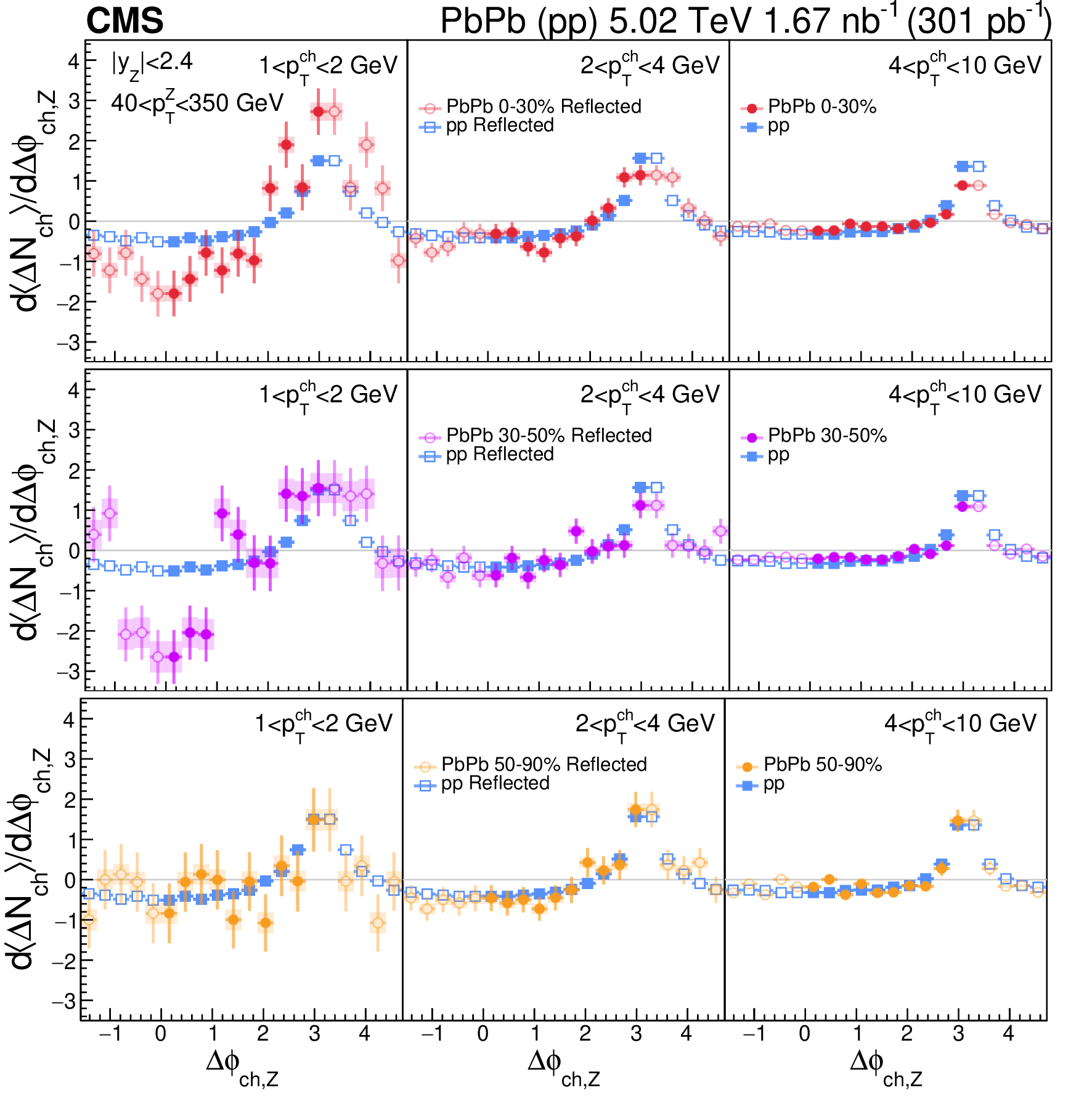
Figure 1:
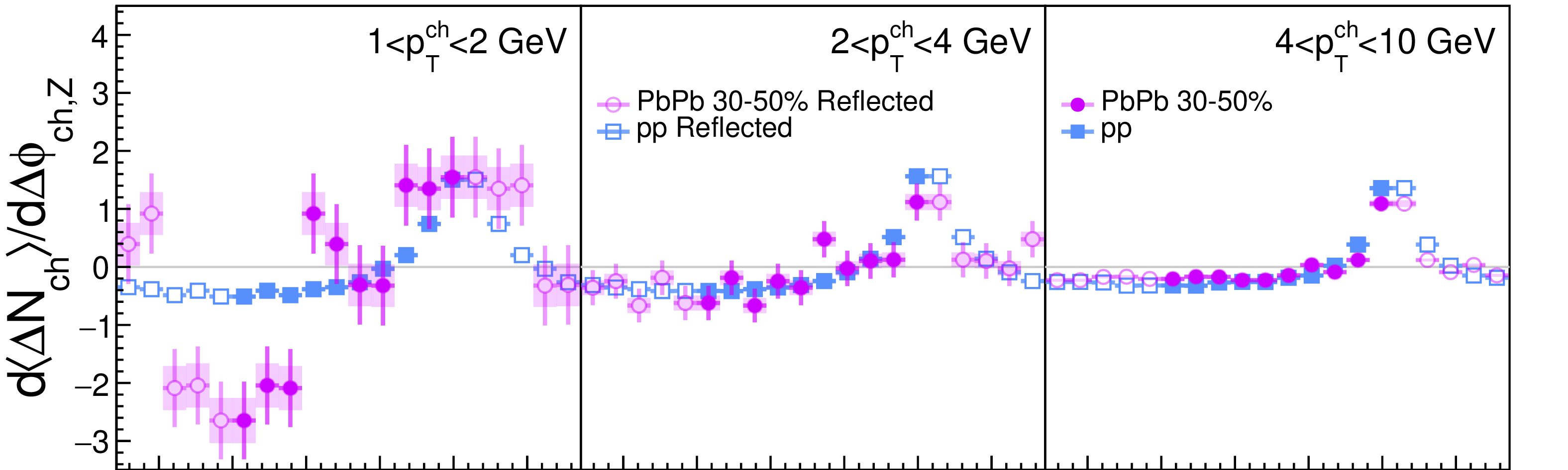
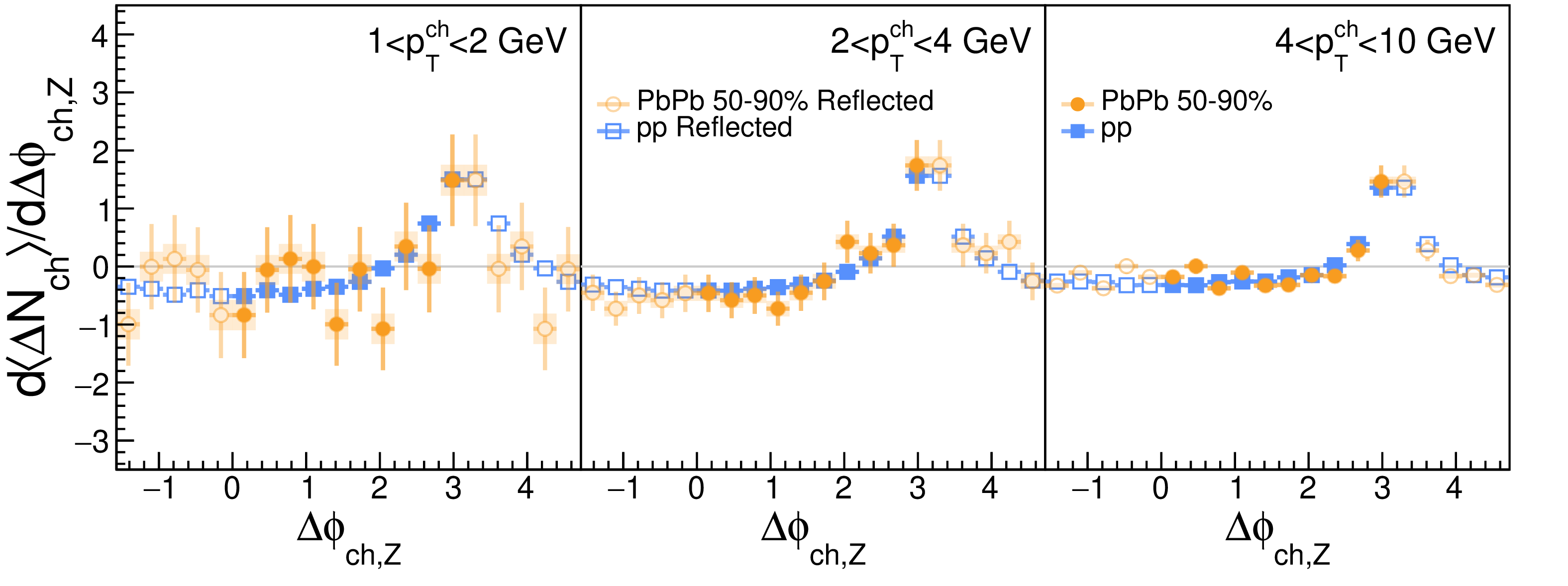
The $ \Delta\phi_{\mathrm{ch,Z}} $ spectra for events with Z boson $ p_{\mathrm{T}}^{\mathrm{Z}} > $ 40 GeV in pp and PbPb collisions. The filled circles (squares) are the PbPb (pp) data and the open circles (squares) are reflected data. The pp data are identical across panels with different centrality intervals. The vertical bars and shaded boxes represent the statistical and systematic uncertainties, respectively. The results are presented in centrality intervals of 0--30% (top row, red), 30--50% (middle row, purple), and 50--90% (bottom row, yellow) and in the charged-hadron $ p_{\mathrm{T}}^\text{ch} $ intervals of 1--2 (left column), 2--4 (middle column) and 4--10 GeV (right column). |
png pdf |
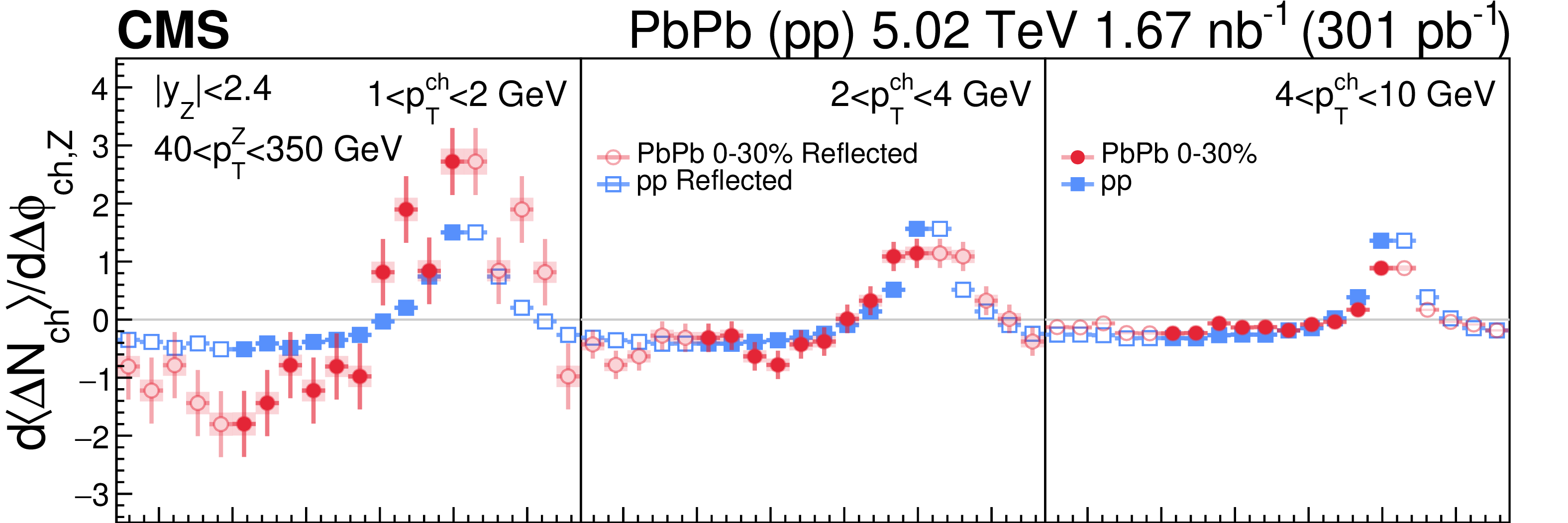
Figure 1-a:
The $ \Delta\phi_{\mathrm{ch,Z}} $ spectra for events with Z boson $ p_{\mathrm{T}}^{\mathrm{Z}} > $ 40 GeV in pp and PbPb collisions. The filled circles (squares) are the PbPb (pp) data and the open circles (squares) are reflected data. The pp data are identical across panels with different centrality intervals. The vertical bars and shaded boxes represent the statistical and systematic uncertainties, respectively. The results are presented in centrality intervals of 0--30% (top row, red), 30--50% (middle row, purple), and 50--90% (bottom row, yellow) and in the charged-hadron $ p_{\mathrm{T}}^\text{ch} $ intervals of 1--2 (left column), 2--4 (middle column) and 4--10 GeV (right column). |
png pdf |
Figure 1-b:
The $ \Delta\phi_{\mathrm{ch,Z}} $ spectra for events with Z boson $ p_{\mathrm{T}}^{\mathrm{Z}} > $ 40 GeV in pp and PbPb collisions. The filled circles (squares) are the PbPb (pp) data and the open circles (squares) are reflected data. The pp data are identical across panels with different centrality intervals. The vertical bars and shaded boxes represent the statistical and systematic uncertainties, respectively. The results are presented in centrality intervals of 0--30% (top row, red), 30--50% (middle row, purple), and 50--90% (bottom row, yellow) and in the charged-hadron $ p_{\mathrm{T}}^\text{ch} $ intervals of 1--2 (left column), 2--4 (middle column) and 4--10 GeV (right column). |
png pdf |
Figure 1-c:
The $ \Delta\phi_{\mathrm{ch,Z}} $ spectra for events with Z boson $ p_{\mathrm{T}}^{\mathrm{Z}} > $ 40 GeV in pp and PbPb collisions. The filled circles (squares) are the PbPb (pp) data and the open circles (squares) are reflected data. The pp data are identical across panels with different centrality intervals. The vertical bars and shaded boxes represent the statistical and systematic uncertainties, respectively. The results are presented in centrality intervals of 0--30% (top row, red), 30--50% (middle row, purple), and 50--90% (bottom row, yellow) and in the charged-hadron $ p_{\mathrm{T}}^\text{ch} $ intervals of 1--2 (left column), 2--4 (middle column) and 4--10 GeV (right column). |
png pdf |
Figure 2:
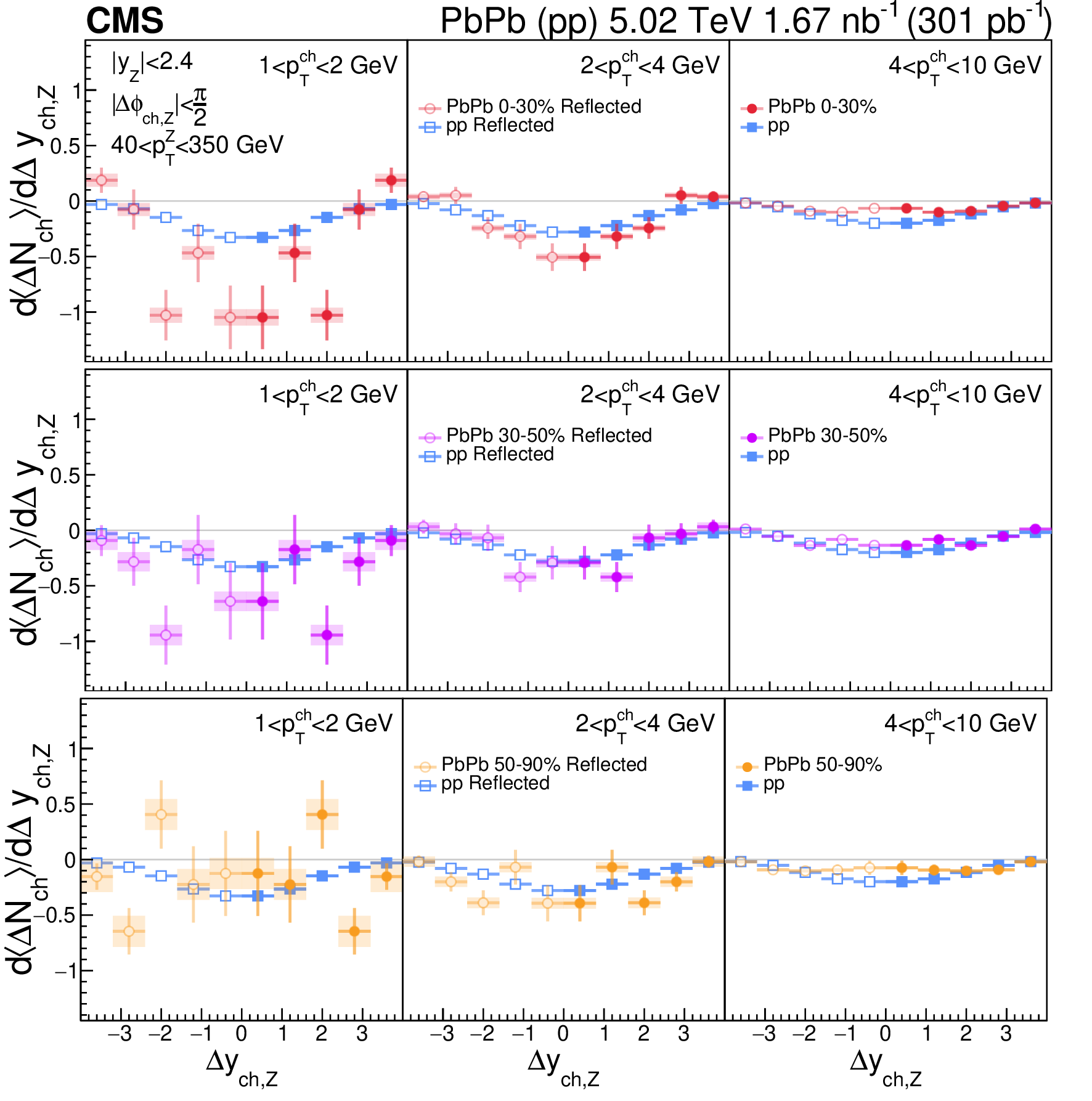
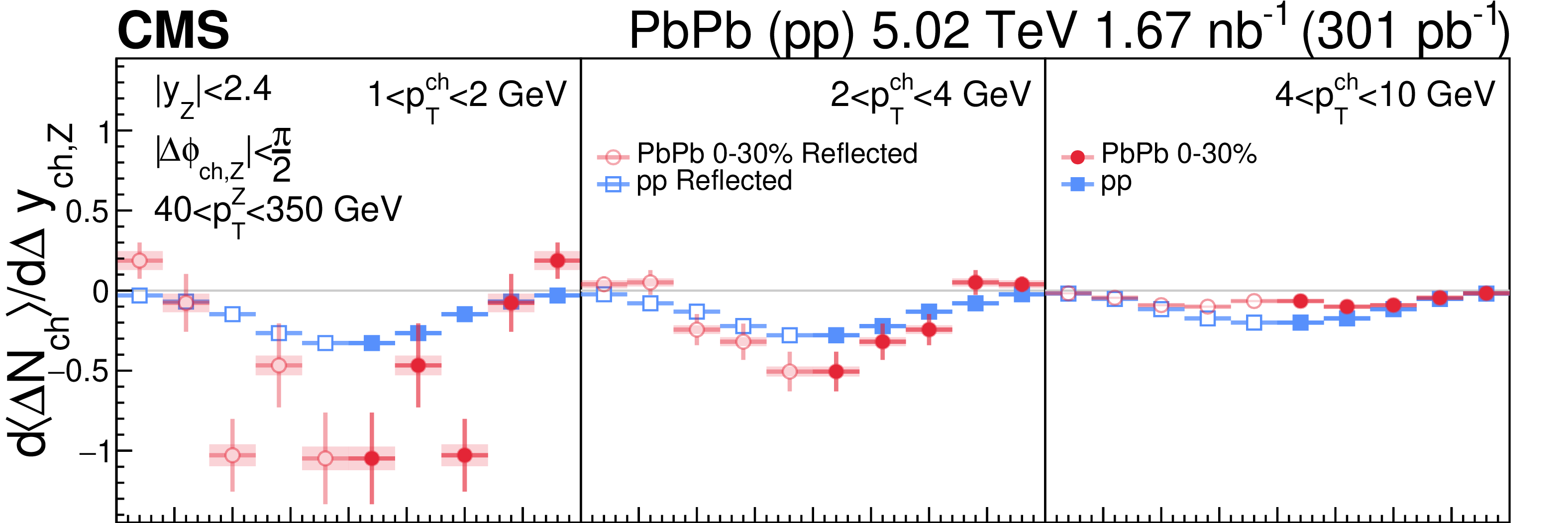
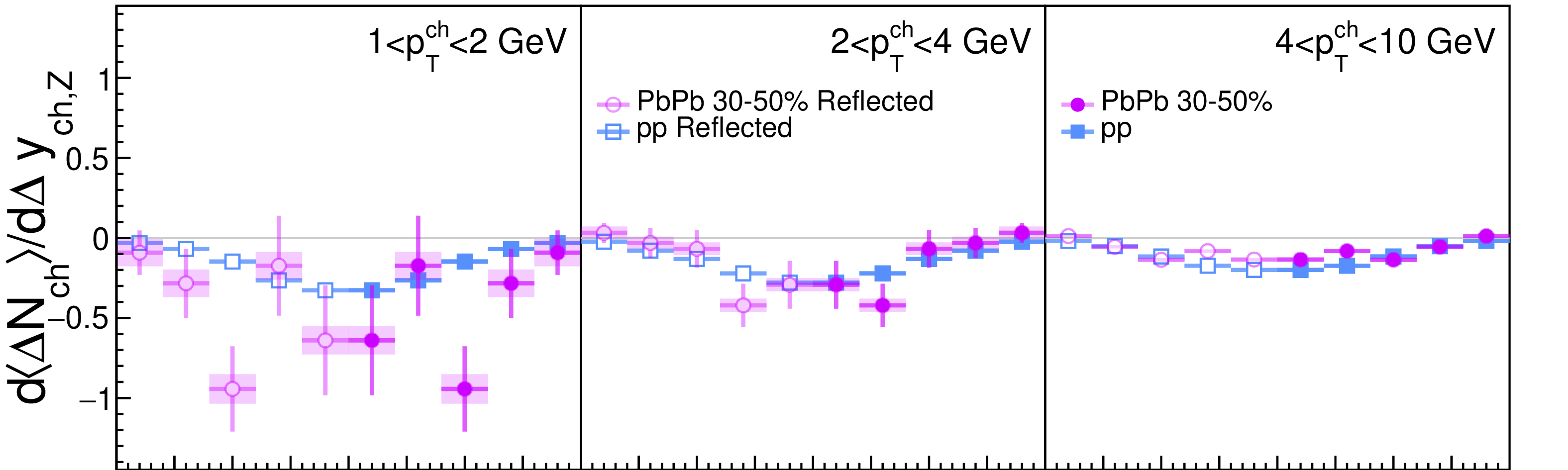
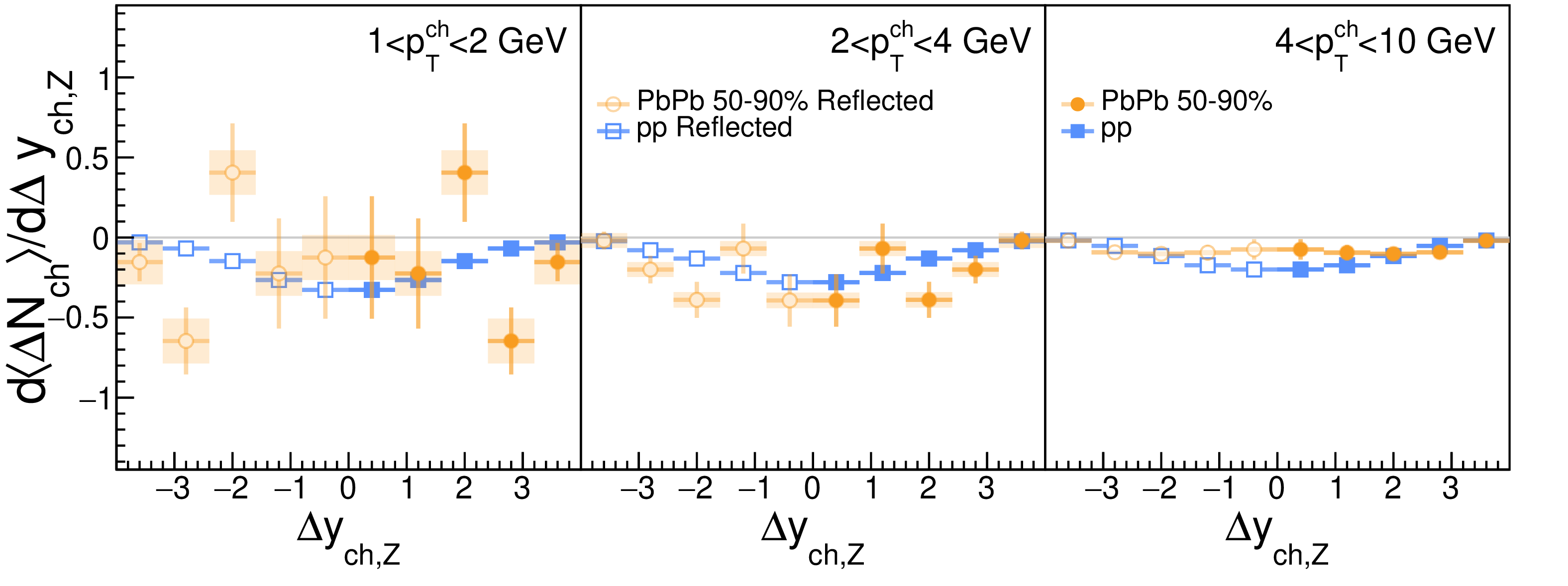
The $ \Delta y_{\mathrm{ch,Z}} $ spectra in the Z boson side ($ |\Delta\phi_{\mathrm{ch,Z}}| < \pi/ $ 2) for events with Z boson $ p_{\mathrm{T}}^{\mathrm{Z}} > $ 40 GeV in pp and PbPb collisions. The filled circles (squares) are the PbPb (pp) data and the open circles (squares) are reflected data. The vertical bars and shaded boxes represent the statistical and systematic uncertainties, respectively. The results are presented in centrality intervals of 0--30% (top row, red), 30--50% (middle row, purple), and 50--90% (bottom row, yellow) and in the charged-hadron $ p_{\mathrm{T}}^\text{ch} $ intervals of 1--2 (left column), 2--4 (middle column) and 4--10 GeV (right column). The pp data are identical across panels with different centrality intervals. |
png pdf |
Figure 2-a:
The $ \Delta y_{\mathrm{ch,Z}} $ spectra in the Z boson side ($ |\Delta\phi_{\mathrm{ch,Z}}| < \pi/ $ 2) for events with Z boson $ p_{\mathrm{T}}^{\mathrm{Z}} > $ 40 GeV in pp and PbPb collisions. The filled circles (squares) are the PbPb (pp) data and the open circles (squares) are reflected data. The vertical bars and shaded boxes represent the statistical and systematic uncertainties, respectively. The results are presented in centrality intervals of 0--30% (top row, red), 30--50% (middle row, purple), and 50--90% (bottom row, yellow) and in the charged-hadron $ p_{\mathrm{T}}^\text{ch} $ intervals of 1--2 (left column), 2--4 (middle column) and 4--10 GeV (right column). The pp data are identical across panels with different centrality intervals. |
png pdf |
Figure 2-b:
The $ \Delta y_{\mathrm{ch,Z}} $ spectra in the Z boson side ($ |\Delta\phi_{\mathrm{ch,Z}}| < \pi/ $ 2) for events with Z boson $ p_{\mathrm{T}}^{\mathrm{Z}} > $ 40 GeV in pp and PbPb collisions. The filled circles (squares) are the PbPb (pp) data and the open circles (squares) are reflected data. The vertical bars and shaded boxes represent the statistical and systematic uncertainties, respectively. The results are presented in centrality intervals of 0--30% (top row, red), 30--50% (middle row, purple), and 50--90% (bottom row, yellow) and in the charged-hadron $ p_{\mathrm{T}}^\text{ch} $ intervals of 1--2 (left column), 2--4 (middle column) and 4--10 GeV (right column). The pp data are identical across panels with different centrality intervals. |
png pdf |
Figure 2-c:
The $ \Delta y_{\mathrm{ch,Z}} $ spectra in the Z boson side ($ |\Delta\phi_{\mathrm{ch,Z}}| < \pi/ $ 2) for events with Z boson $ p_{\mathrm{T}}^{\mathrm{Z}} > $ 40 GeV in pp and PbPb collisions. The filled circles (squares) are the PbPb (pp) data and the open circles (squares) are reflected data. The vertical bars and shaded boxes represent the statistical and systematic uncertainties, respectively. The results are presented in centrality intervals of 0--30% (top row, red), 30--50% (middle row, purple), and 50--90% (bottom row, yellow) and in the charged-hadron $ p_{\mathrm{T}}^\text{ch} $ intervals of 1--2 (left column), 2--4 (middle column) and 4--10 GeV (right column). The pp data are identical across panels with different centrality intervals. |
png pdf |
Figure 3:
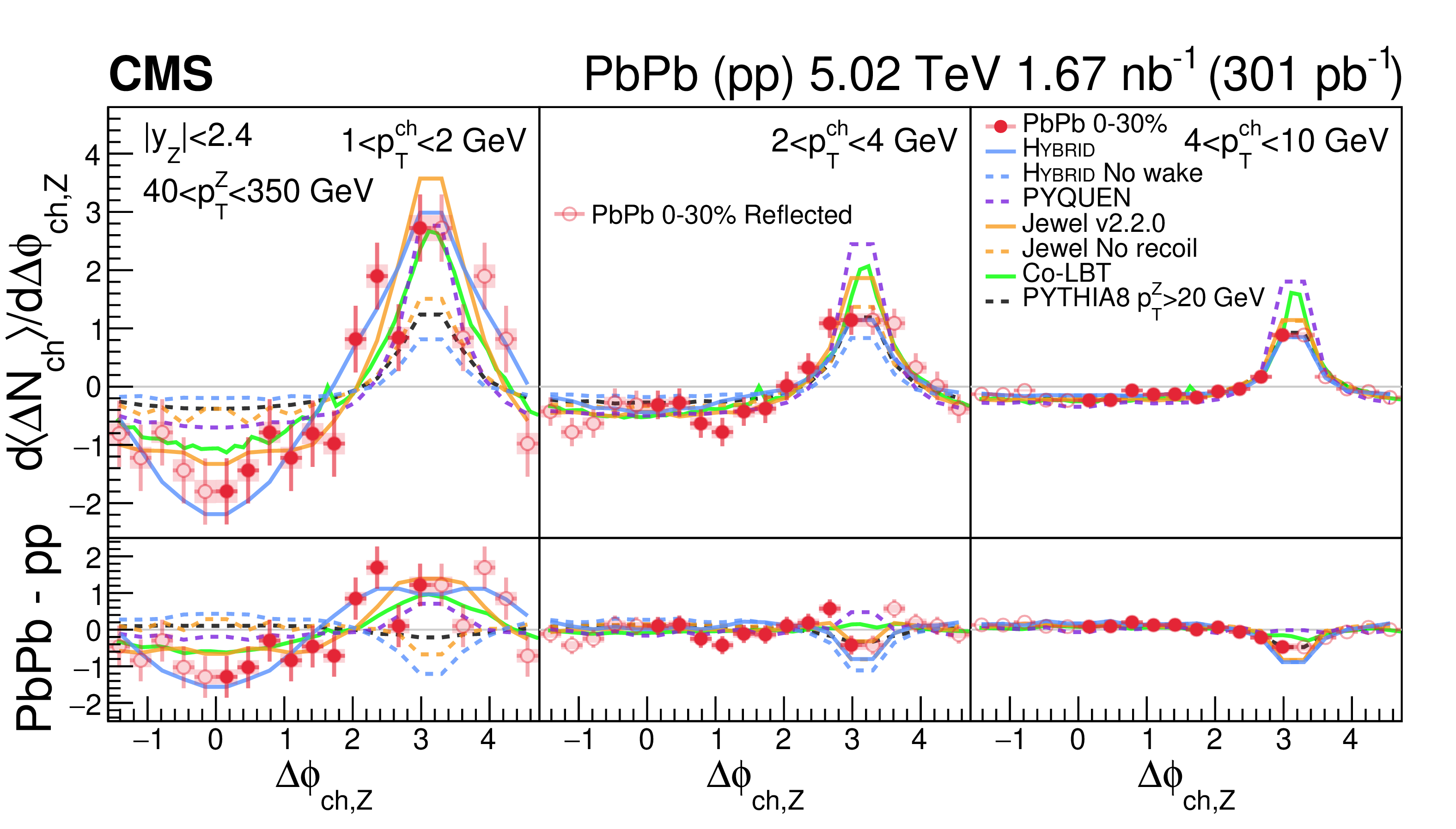
Upper row: Distributions of $ \Delta\phi_{\mathrm{ch,Z}} $ in 0--30% centrality PbPb collisions in the charged hadron $ p_{\mathrm{T}}^\text{ch} $ intervals of 1--2 (left column), 2--4 (middle column) and 4--10 GeV (right column). Lower row: The differences between the PbPb and pp distributions. The filled circles are PbPb data and the open circles are reflected data. The vertical bars and shaded boxes represent the statistical and systematic uncertainties, respectively. The results are compared to predictions from theoretical models. |
png pdf |
Figure 4:
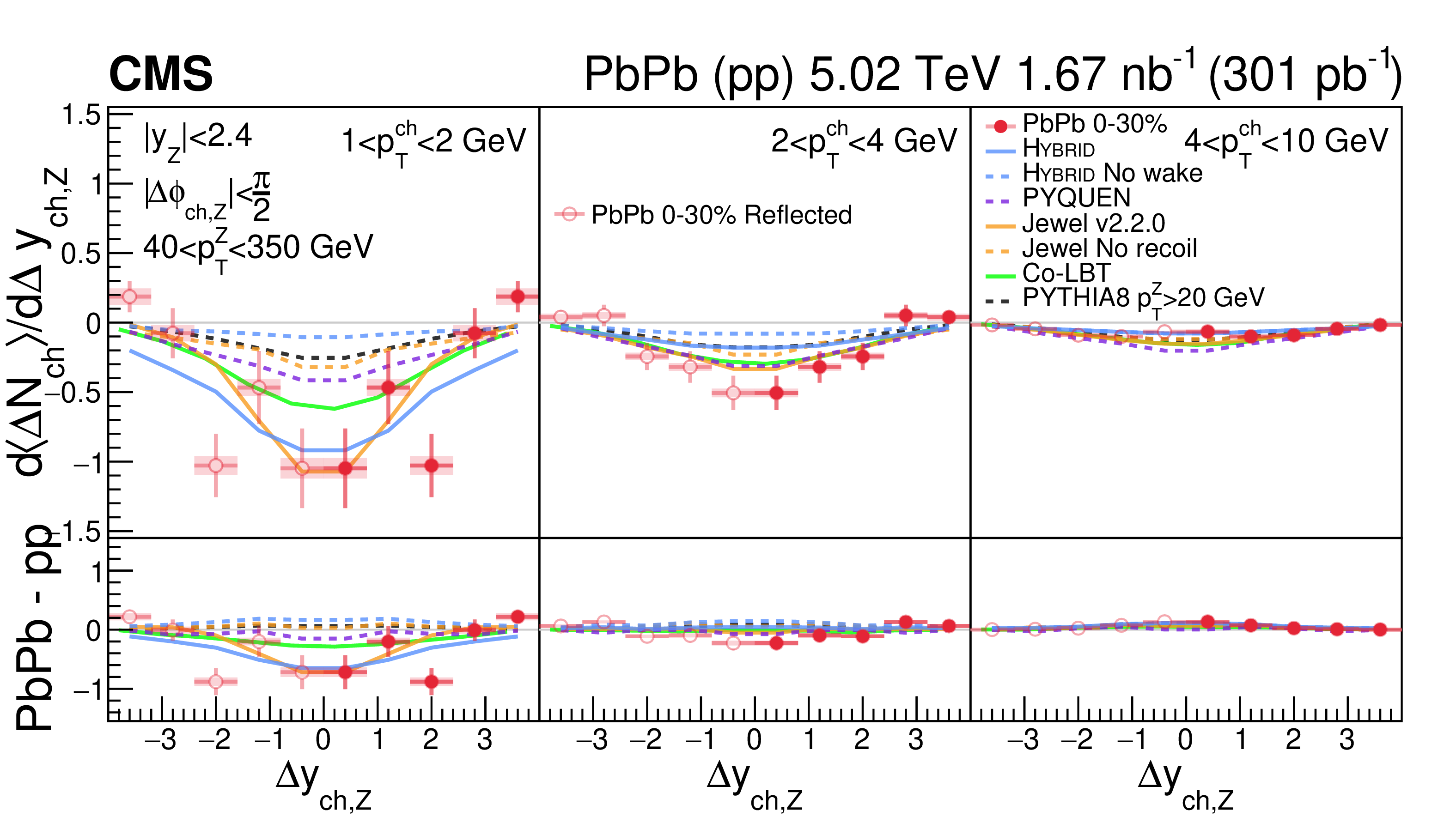
Upper row: Distributions of $ \Delta y_{\mathrm{ch,Z}} $ in 0--30% centrality PbPb collisions in the charged hadron $ p_{\mathrm{T}}^\text{ch} $ intervals of 1--2 (left column), 2--4 (middle column) and 4--10 GeV (right column). Lower row: The differences between the PbPb and pp distributions. The filled circles are PbPb data and the open circles are reflected data. The vertical bars and shaded boxes represent the statistical and systematic uncertainties, respectively. The results are compared to predictions from theoretical models. |
| Summary |
| This Letter presents the first measurement of correlations between Z bosons and charged hadrons in bins of charged-hadron transverse momentum ($ p_{\mathrm{T}} $) and event centrality for lead-lead (PbPb) collisions at a nucleon-nucleon center of mass energy of 5.02 TeV and proton-proton (pp) collisions at the same energy. By studying the hadrons produced along with the Z boson, the analysis probes parton-medium interactions, including modifications to parton showers and medium response. The charged-hadron rapidity and azimuthal angle distributions relative to the direction of Z bosons with 40 $ < p_{\mathrm{T}}^{\mathrm{Z}} < $ 350 GeV are extracted. The analysis utilizes pp (PbPb) data from 2017 (2018) with an integrated luminosity of 301 pb$^{-1}$ (1.67 nb$^{-1}$). The normalized associated yield of charged hadrons in Z boson-tagged events is measured in bins of the differences in azimuthal angle ($ \Delta\phi_{\mathrm{ch,Z}} $) and in rapidity ($ \Delta y_{\mathrm{ch,Z}} $) and is compared between the PbPb and reference pp data. For low-$ p_{\mathrm{T}} $ (1 $ < p_{\mathrm{T}} < $ 2 GeV) charged hadrons in PbPb collisions, a dip at $ \Delta\phi_{\mathrm{ch,Z}} \sim $ 0 indicates the presence of a negative medium wake or medium holes. An excess at $ \Delta\phi_{\mathrm{ch,Z}} \sim \pi $ suggests medium-induced radiation, medium recoils, and/or momentum-broadening effects. Central PbPb collisions show larger modulation in the $ \Delta\phi_{\mathrm{ch,Z}} $ distribution than pp data for these low-$ p_{\mathrm{T}} $ charged hadrons, a difference which diminishes in more peripheral events. For particles with higher $ p_{\mathrm{T}} $ ( of 4-10 GeV), a reduction in the jet-side normalized associated yield is consistent with jet quenching. The $ \Delta y_{\mathrm{ch,Z}} $ distribution shows significant deviations in central PbPb collisions with respect to the pp reference, especially at low charged-hadron $ p_{\mathrm{T}} $, where the PbPb yield is lower than that in pp collisions near the Z boson ($ |\Delta y_{\mathrm{ch,Z}}| \sim $ 0). The PbPb data are then compared to a variety of theoretical models including different implementations of jet energy loss and the medium response. Models that do not include medium response effects fail to describe the dip in the data at small $ \Delta\phi_{\mathrm{ch,Z}} $ and $ \Delta y_{\mathrm{ch,Z}} $ expected from negative response contributions, and an excess at $ \Delta\phi_{\mathrm{ch,Z}} \sim \pi $ due to the positive response contributions. In comparison, the models including such response effects provide a better description of the PbPb data. Amongst the different medium response implementations, for example that of a hydrodynamic positive and negative wake or medium recoils with corresponding hole contributions, it is not clear within the current statistical uncertainty which provides the best description of the data. Overall, the differences between the PbPb and pp data, with a significance greater than 3 $ \sigma $, provide the first evidence of medium-recoil and medium-hole effects caused by a hard probe since the PbPb data are better described by theoretical models that include these effects. Comparisons with theoretical models highlight the unique insights these approaches offer into the properties of the QGP medium, especially its response to the energy loss experienced by partons which pass through it. |
| References | ||||
| 1 | J. C. Collins and M. J. Perry | Superdense matter: Neutrons or asymptotically free quarks? | PRL 34 (1975) 1353 | |
| 2 | F. Karsch | The phase transition to the quark gluon plasma: recent results from lattice calculations | Nucl. Phys. A 590 (1995) 367 | hep-lat/9503010 |
| 3 | W. Busza, K. Rajagopal, and W. van der Schee | Heavy ion Collisions: The big picture, and the big questions | Ann. Rev. Nucl. Part. Sci. 68 (2018) 339 | 1802.04801 |
| 4 | STAR Collaboration | Experimental and theoretical challenges in the search for the quark gluon plasma: The STAR Collaboration's critical assessment of the evidence from RHIC collisions | Nucl. Phys. A 757 (2005) 102 | nucl-ex/0501009 |
| 5 | PHENIX Collaboration | Formation of dense partonic matter in relativistic nucleus-nucleus collisions at RHIC: Experimental evaluation by the PHENIX collaboration | Nucl. Phys. A 757 (2005) 184 | nucl-ex/0410003 |
| 6 | PHOBOS Collaboration | The PHOBOS perspective on discoveries at RHIC | Nucl. Phys. A 757 (2005) 28 | nucl-ex/0410022 |
| 7 | BRAHMS Collaboration | Quark gluon plasma and color glass condensate at RHIC? The perspective from the BRAHMS experiment | Nucl. Phys. A 757 (2005) 1 | nucl-ex/0410020 |
| 8 | ALICE Collaboration | The ALICE experiment: a journey through QCD | EPJC 84 (2024) 813 | 2211.04384 |
| 9 | CMS Collaboration | Overview of high-density QCD studies with the CMS experiment at the LHC | Physics Reports 1115 (2025) 219 | CMS-HIN-23-011 2405.10785 |
| 10 | J. D. Bjorken | Highly relativistic nucleus-nucleus collisions: The central rapidity region | PRD 27 (1983) 140 | |
| 11 | M. Gyulassy and M. Plümer | Jet quenching in dense matter | PLB 243 (1990) 432 | |
| 12 | STAR Collaboration | Transverse-momentum and collision-energy dependence of high-$ p_{\mathrm{t}} $ hadron suppression in Au+Au collisions at ultrarelativistic energies | PRL 91 (2003) 172302 | nucl-ex/0305015 |
| 13 | PHENIX Collaboration | Suppression pattern of neutral pions at high transverse momentum in Au+Au collisions at $ \sqrt{\smash[b]{s_{_{\mathrm{NN}}}}} = $ 200 GeV and constraints on medium transport coefficients | PRL 101 (2008) 232301 | 0801.4020 |
| 14 | ALICE Collaboration | Centrality dependence of charged particle production at large transverse momentum in Pb--Pb collisions at $ \sqrt{\smash[b]{s_{_{\mathrm{NN}}}}} = $ 2.76 TeV | PLB 720 (2013) 52 | 1208.2711 |
| 15 | ATLAS Collaboration | Measurement of charged-particle spectra in Pb+Pb collisions at $ \sqrt{\smash[b]{s_{_{\mathrm{NN}}}}} = $ 2.76 TeV with the ATLAS detector at the LHC | JHEP 09 (2015) 050 | 1504.04337 |
| 16 | CMS Collaboration | Study of high-$ p_{\rm{T}} $ charged particle suppression in PbPb compared to pp collisions at $ \sqrt{\smash[b]{s_{_{\mathrm{NN}}}}}= $ 2.76 TeV | EPJC 72 (2012) 1945 | CMS-HIN-10-005 1202.2554 |
| 17 | CMS Collaboration | Charged-particle nuclear modification factors in PbPb and pPb collisions at $ \sqrt{\smash[b]{s_{_{\mathrm{NN}}}}}= $ 5.02 TeV | JHEP 04 (2017) 039 | CMS-HIN-15-015 1611.01664 |
| 18 | CMS Collaboration | Observation and studies of jet quenching in PbPb collisions at $ \sqrt{\smash[b]{s_{_{\mathrm{NN}}}}} = $ 2.76 TeV | Phys. Rev. C 84 (2011) 024906 | CMS-HIN-10-004 1102.1957 |
| 19 | ATLAS Collaboration | Observation of a centrality-dependent dijet asymmetry in lead-lead collisions at $ \sqrt{\smash[b]{s_{_{\mathrm{NN}}}}}= $ 2.76 TeV with the ATLAS detector at the LHC | PRL 105 (2010) 252303 | 1011.6182 |
| 20 | ATLAS Collaboration | Centrality and rapidity dependence of inclusive jet production in $ \sqrt{\smash[b]{s_{_{\mathrm{NN}}}}} = $ 5.02 TeV proton--lead collisions with the ATLAS detector | PLB 748 (2015) 392 | 1412.4092 |
| 21 | ALICE Collaboration | Measurement of jet quenching with semi-inclusive hadron-jet distributions in central Pb-Pb collisions at $ \sqrt{\smash[b]{s_{_{\mathrm{NN}}}}}= $ 2.76 TeV | JHEP 09 (2015) 170 | 1506.03984 |
| 22 | CMS Collaboration | Measurement of inclusive jet cross sections in pp and PbPb collisions at $ \sqrt{\smash[b]{s_{_{\mathrm{NN}}}}}= $ 2.76 TeV | Phys. Rev. C 96 (2017) 015202 | CMS-HIN-13-005 1609.05383 |
| 23 | ALICE Collaboration | Measurement of jet suppression in central Pb-Pb collisions at $ \sqrt{\smash[b]{s_{_{\mathrm{NN}}}}} = $ 2.76 TeV | PLB 746 (2015) 1 | 1502.01689 |
| 24 | STAR Collaboration | Dijet imbalance measurements in Au+Au and pp collisions at $ \sqrt{s_{_{\mathrm{NN}}}} = $ 200 GeV at STAR | PRL 119 (2017) 062301 | 1609.03878 |
| 25 | J. Casalderrey-Solana et al. | A hybrid strong/weak coupling approach to jet quenching | JHEP 10 (2014) 019 | 1405.3864 |
| 26 | S. Cao and X.-N. Wang | Jet quenching and medium response in high-energy heavy-ion collisions: a review | Rept. Prog. Phys. 84 (2021) 024301 | 2002.04028 |
| 27 | L. Apolinário , Y.-J. Lee, and M. Winn | Heavy quarks and jets as probes of the QGP | Prog. Part. Nucl. Phys. 127 (2022) 103990 | 2203.16352 |
| 28 | S. Cao and G.-Y. Qin | Medium response and jet-hadron correlations in relativistic heavy-ion collisions | Ann. Rev. Nucl. Part. Sci. 73 (2023) 205 | 2211.16821 |
| 29 | CMS Collaboration | Measurement of isolated photon production in pp and PbPb collisions at $ \sqrt{\smash[b]{s_{_{\mathrm{NN}}}}} = $ 2.76 TeV | PLB 710 (2012) 256 | CMS-HIN-11-002 1201.3093 |
| 30 | CMS Collaboration | Study of W boson production in PbPb and pp collisions at $ \sqrt{\smash[b]{s_{_{\mathrm{NN}}}}}= $ 2.76 TeV | PLB 715 (2012) 66 | CMS-HIN-11-008 1205.6334 |
| 31 | CMS Collaboration | Study of Z production in PbPb and pp collisions at $ \sqrt{\smash[b]{s_{_{\mathrm{NN}}}}} = $ 2.76 TeV in the dimuon and dielectron decay channels | JHEP 03 (2015) 022 | CMS-HIN-13-004 1410.4825 |
| 32 | ATLAS Collaboration | Centrality, rapidity and transverse momentum dependence of isolated prompt photon production in lead-lead collisions at $ \sqrt{\smash[b]{s_{_{\mathrm{NN}}}}} = $ 2.76 TeV measured with the ATLAS detector | Phys. Rev. C 93 (2016) 034914 | 1506.08552 |
| 33 | CMS Collaboration | The production of isolated photons in PbPb and pp collisions at $ \sqrt{\smash[b]{s_{_{\mathrm{NN}}}}} = $ 5.02 TeV | JHEP 07 (2020) 116 | CMS-HIN-18-016 2003.12797 |
| 34 | CMS Collaboration | Constraints on the initial state of Pb-Pb collisions via measurements of $ Z $ Boson yields and azimuthal anisotropy at $ \sqrt{\smash[b]{s_{_{\mathrm{NN}}}}} = $ 5.02 TeV | PRL 127 (2021) 102002 | CMS-HIN-19-003 2103.14089 |
| 35 | V. Kartvelishvili, R. Kvatadze, and R. Shanidze | On Z and Z+jet production in heavy ion collisions | PLB 356 (1995) 589 | hep-ph/9505418 |
| 36 | X.-N. Wang, Z. Huang, and I. Sarcevic | Jet quenching in the opposite direction of a tagged photon in high-energy heavy ion collisions | PRL 77 (1996) 231 | hep-ph/9605213 |
| 37 | X.-N. Wang and Z. Huang | Medium-induced parton energy loss in $ \gamma $+jet events of high-energy heavy-ion collisions | Phys. Rev. C 55 (1997) 3047 | hep-ph/9701227 |
| 38 | J. Brewer, Q. Brodsky, and K. Rajagopal | Disentangling jet modification in jet simulations and in Z+jet data | JHEP 02 (2022) 175 | 2110.13159 |
| 39 | W. Dai, I. Vitev, and B.-W. Zhang | Momentum imbalance of isolated photon-tagged jet production at RHIC and LHC | PRL 110 (2013) 142001 | 1207.5177 |
| 40 | Z.-B. Kang, I. Vitev, and H. Xing | Vector-boson-tagged jet production in heavy ion collisions at energies available at the CERN large hadron collider | Phys. Rev. C 96 (2017) 014912 | 1702.07276 |
| 41 | CMS Collaboration | Observation of medium-induced modifications of jet fragmentation in Pb-Pb collisions at $ \sqrt{\smash[b]{s_{_{\mathrm{NN}}}}}= $ 5.02 TeV using isolated photon-tagged jets | PRL 121 (2018) 242301 | CMS-HIN-16-014 1801.04895 |
| 42 | CMS Collaboration | Jet shapes of isolated photon-tagged jets in Pb-Pb and pp collisions at $ \sqrt{\smash[b]{s_{_{\mathrm{NN}}}}}= $ 5.02 TeV | PRL 122 (2019) 152001 | CMS-HIN-18-006 1809.08602 |
| 43 | CMS Collaboration | Study of jet quenching with $ Z+ $jet correlations in Pb-Pb and pp collisions at $ \sqrt{\smash[b]{s_{_{\mathrm{NN}}}}}= $ 5.02 TeV | PRL 119 (2017) 082301 | CMS-HIN-15-013 1702.01060 |
| 44 | CMS Collaboration | Using Z boson events to study parton-medium interactions in Pb-Pb collisions | PRL 128 (2022) 122301 | CMS-HIN-19-006 2103.04377 |
| 45 | Z. Yang et al. | Search for the elusive jet-induced diffusion wake in $ Z/\gamma $-jets with 2D jet tomography in high-energy heavy-ion collisions | PRL 127 (2021) 082301 | 2101.05422 |
| 46 | Z. Yang et al. | 3D Structure of jet-induced diffusion wake in an expanding quark-gluon plasma | PRL 130 (2023) 052301 | 2203.03683 |
| 47 | ATLAS Collaboration | Search for the jet-induced diffusion wake in the quark-gluon plasma via measurements of jet-track correlations in photon-jet events in Pb+Pb collisions at $ \sqrt{\smash[b]{s_{_{\mathrm{NN}}}}} = $ 5.02 TeV with the ATLAS detector | submitted to Phys. Rev. C, 2024 | 2408.08599 |
| 48 | F. D'Eramo, M. Lekaveckas, H. Liu, and K. Rajagopal | Momentum broadening in weakly coupled quark-gluon plasma (with a view to finding the quasiparticles within liquid quark-gluon plasma) | JHEP 05 (2013) 031 | 1211.1922 |
| 49 | Y. He, T. Luo, X.-N. Wang, and Y. Zhu | Linear Boltzmann transport for jet propagation in the quark-gluon plasma: Elastic processes and medium recoil | Phys. Rev. C 91 (2015) 054908 | 1503.03313 |
| 50 | CMS Collaboration | Luminosity measurement for lead-lead collisions at $ \sqrt{s_{\mathrm{NN}}} = $ 5.02 TeV in 2015 and 2018 at CMS | Submitted to EPJC, 2025 | CMS-LUM-20-002 2503.03946 |
| 51 | CMS Collaboration | HEPData record for this analysis | link | |
| 52 | CMS Collaboration | The CMS experiment at the CERN LHC | JINST 3 (2008) S08004 | |
| 53 | J. Alwall et al. | The automated computation of tree-level and next-to-leading order differential cross sections, and their matching to parton shower simulations | JHEP 07 (2014) 079 | 1405.0301 |
| 54 | T. Sjöstrand et al. | An Introduction to PYTHIA 8.2 | Comput. Phys. Commun. 191 (2015) 159 | 1410.3012 |
| 55 | CMS Collaboration | Extraction and validation of a new set of CMS PYTHIA8 tunes from underlying-event measurements | EPJC 80 (2020) 4 | CMS-GEN-17-001 1903.12179 |
| 56 | I. P. Lokhtin and A. M. Snigirev | A model of jet quenching in ultrarelativistic heavy ion collisions and high-$ p_{\mathrm{T}} $ hadron spectra at RHIC | EPJC 45 (2006) 211 | hep-ph/0506189 |
| 57 | GEANT4 Collaboration | GEANT 4---a simulation toolkit | NIM A 506 (2003) 250 | |
| 58 | CMS Collaboration | The CMS trigger system | JINST 12 (2017) P01020 | CMS-TRG-12-001 1609.02366 |
| 59 | CMS Collaboration | Performance of CMS muon reconstruction from proton-proton to heavy ion collisions | JINST 19 (2024) P09012 | CMS-MUO-21-001 2404.17377 |
| 60 | CMS Collaboration | Measurements of inclusive $ {W} $and $ {Z} $ cross sections in pp collisions at $ \sqrt {s} = $ 7 TeV | JHEP 10 (2011) 132 | CMS-EWK-10-005 1107.4789 |
| 61 | CMS Collaboration | Description and performance of track and primary-vertex reconstruction with the CMS tracker | JINST 9 (2014) P10009 | CMS-TRK-11-001 1405.6569 |
| 62 | CMS Collaboration | Performance of CMS muon reconstruction in pp collision events at $ \sqrt{s}= $ 7 TeV | JINST 7 (2012) P10002 | CMS-MUO-10-004 1206.4071 |
| 63 | I. Lokhtin, A. Belyaev, and A. Snigirev | Jet quenching pattern at LHC in PYQUEN model | EPJC 71 (2011) 1650 | 1103.1853 |
| 64 | K. Zapp et al. | A Monte Carlo model for 'jet quenching' | EPJC 60 (2009) 617 | 0804.3568 |
| 65 | K. C. Zapp, F. Krauss, and U. A. Wiedemann | A perturbative framework for jet quenching | JHEP 03 (2013) 080 | 1212.1599 |
| 66 | K. C. Zapp | JEWEL 2.0.0: directions for use | EPJC 74 (2014) 2762 | 1311.0048 |
| 67 | R. Kunnawalkam Elayavalli and K. C. Zapp | Medium response in JEWEL and its impact on jet shape observables in heavy ion collisions | JHEP 07 (2017) 141 | 1707.01539 |
| 68 | J. Casalderrey-Solana et al. | Jet wake from linearized hydrodynamics | JHEP 05 (2021) 230 | 2010.01140 |
| 69 | W. Chen et al. | Effects of jet-induced medium excitation in $ \gamma $-hadron correlation in A+A collisions | PLB 777 (2018) 86 | 1704.03648 |
|
|
Compact Muon Solenoid LHC, CERN |

|
|
|
|
|
|