
Compact Muon Solenoid
LHC, CERN
 Visit us: CMS Public Website, CMS Physics ;
Contact us: CMS Publications Committee
Visit us: CMS Public Website, CMS Physics ;
Contact us: CMS Publications Committee
| CMS-HIN-22-003 ; CERN-EP-2026-119 | ||
| Study of $ \chi_{c} $ production in $ \mathrm{p}\mathrm{Pb} $ collisions at $ \sqrt{s_{\mathrm{NN}}}= $ 8.16 TeV | ||
| CMS Collaboration | ||
| 17 July 2026 | ||
| Submitted to Physics Letters B | ||
| Abstract: Production of prompt P-wave charmonium states $ {\chi}_{c1} $(1P) and $ {\chi}_{c2} $(1P) is studied in proton-lead (pPb) collisions at a center-of-mass energy per nucleon pair of $ \sqrt{\smash[b]{s_{_{\mathrm{NN}}}}} = $ 8.16 TeV. The analysis is based on data corresponding to an integrated luminosity of 175$ \text{nb}^{-1}$ collected by the CMS experiment at the CERN LHC. The $ \chi_{c} $ states are measured via their decay $ \chi_{c} \to {\mathrm{J}/\psi} \gamma $. The $ \mathrm{J}/\psi $ meson is reconstructed via its decay to a muon pair, while the photon is reconstructed through its conversion to an electron-positron pair. The ratio of production cross sections times branching fractions for the two charmonium states, $ [\sigma({\chi}_{c2} ) \mathcal{B}({\chi}_{c2} \to {\mathrm{J}/\psi} \gamma)] / [\sigma({\chi}_{c1} ) \mathcal{B}({\chi}_{c1} \to {\mathrm{J}/\psi} \gamma)] $, is reported in the rapidity range $ |y({\mathrm{J}/\psi} )| < $ 2.4 for the transverse momentum range 6.5 $ < p_{\mathrm{T}}({\mathrm{J}/\psi} ) < $ 30 GeV. The $ {\chi}_{c2} $-to-$ {\chi}_{c1} $ ratio is found to be independent of event charged-particle multiplicity, as well as of the rapidity and $ p_\mathrm{T} $ of the $ \mathrm{J}/\psi $. The consistency of this ratio with proton-proton measurements at $ \sqrt{s} = $ 7 TeV indicates an absence of strong relative modification for $ \chi_{c} $ states in pPb collisions, in contrast to the behavior observed in the $ \psi(2S) $-to- $ \mathrm{J}/\psi $ ratio. | ||
| Links: e-print arXiv:2607.17847 [hep-ex] (PDF) ; CDS record ; inSPIRE record ; HepData record ; CADI line (restricted) ; | ||
| Figures | |
png pdf |
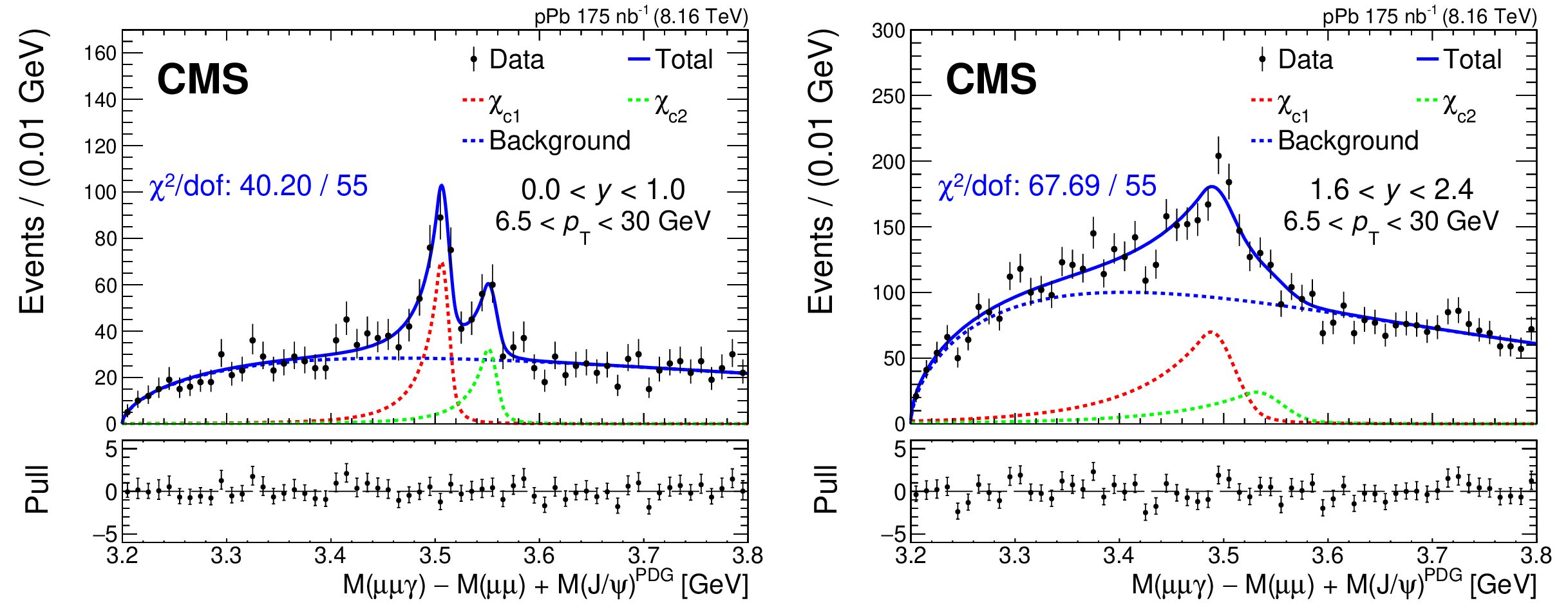
Figure 1:
Examples of fits for $ \chi_{c} $ candidates, integrated over $ p_{\mathrm{T}} $( $ \mathrm{J}/\psi $) and $ N_{\text{tracks}} $. Left: midrapidity bin (0.0 $ < y_{\mathrm{lab, p}}({\mathrm{J}/\psi} ) < $ 1.0), right: forward rapidity bin (1.6 $ < y_{\mathrm{lab, p}}({\mathrm{J}/\psi} ) < $ 2.4). The vertical lines of data points represent the statistical uncertainties. The overall fit is shown in blue; the dashed blue line is the background. The individual peak DCB functions are shown in red for $ \chi $c1 and green for $ \chi $c2. |
png pdf |
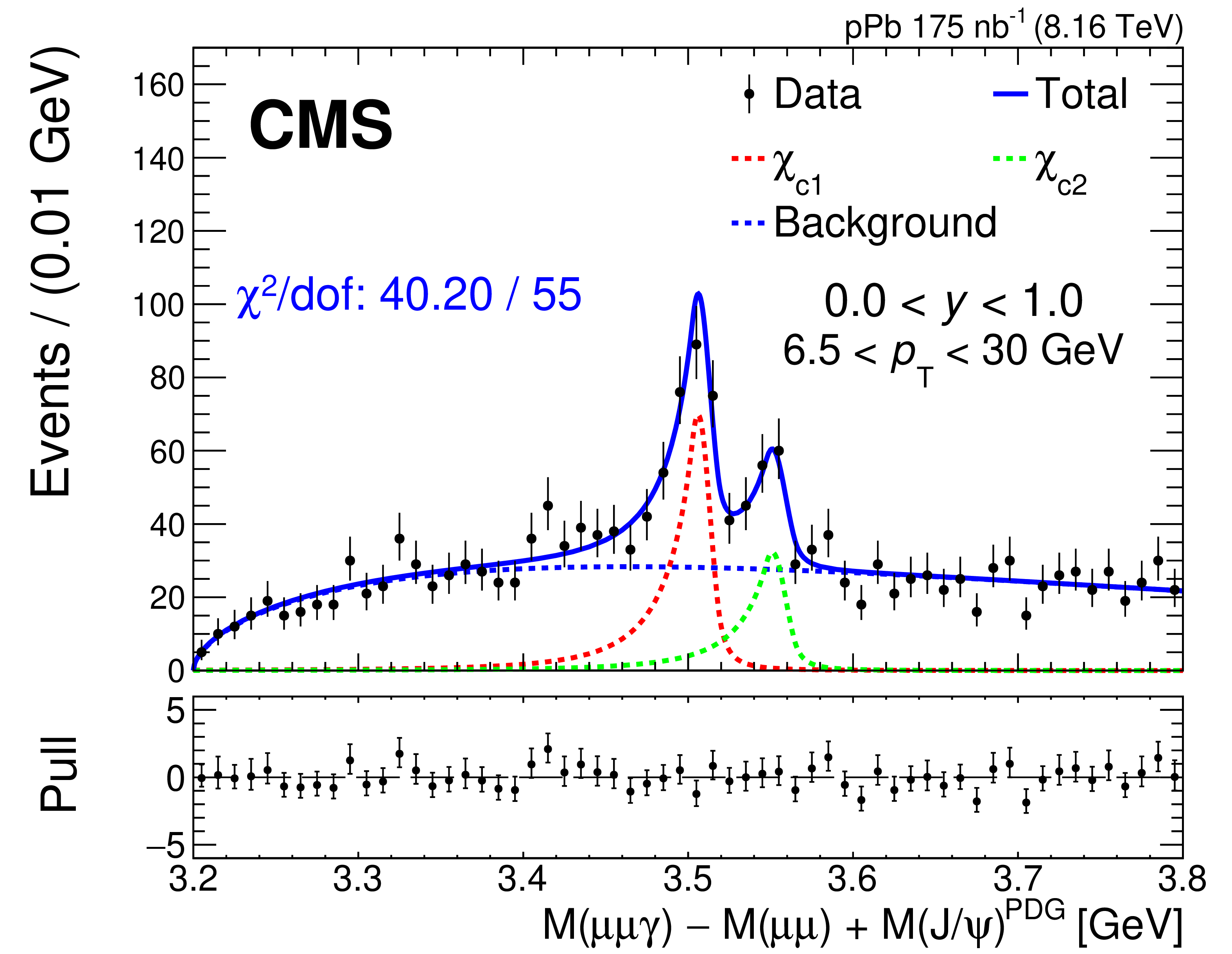
Figure 1-a:
Examples of fits for $ \chi_{c} $ candidates, integrated over $ p_{\mathrm{T}} $( $ \mathrm{J}/\psi $) and $ N_{\text{tracks}} $. Left: midrapidity bin (0.0 $ < y_{\mathrm{lab, p}}({\mathrm{J}/\psi} ) < $ 1.0), right: forward rapidity bin (1.6 $ < y_{\mathrm{lab, p}}({\mathrm{J}/\psi} ) < $ 2.4). The vertical lines of data points represent the statistical uncertainties. The overall fit is shown in blue; the dashed blue line is the background. The individual peak DCB functions are shown in red for $ \chi $c1 and green for $ \chi $c2. |
png pdf |
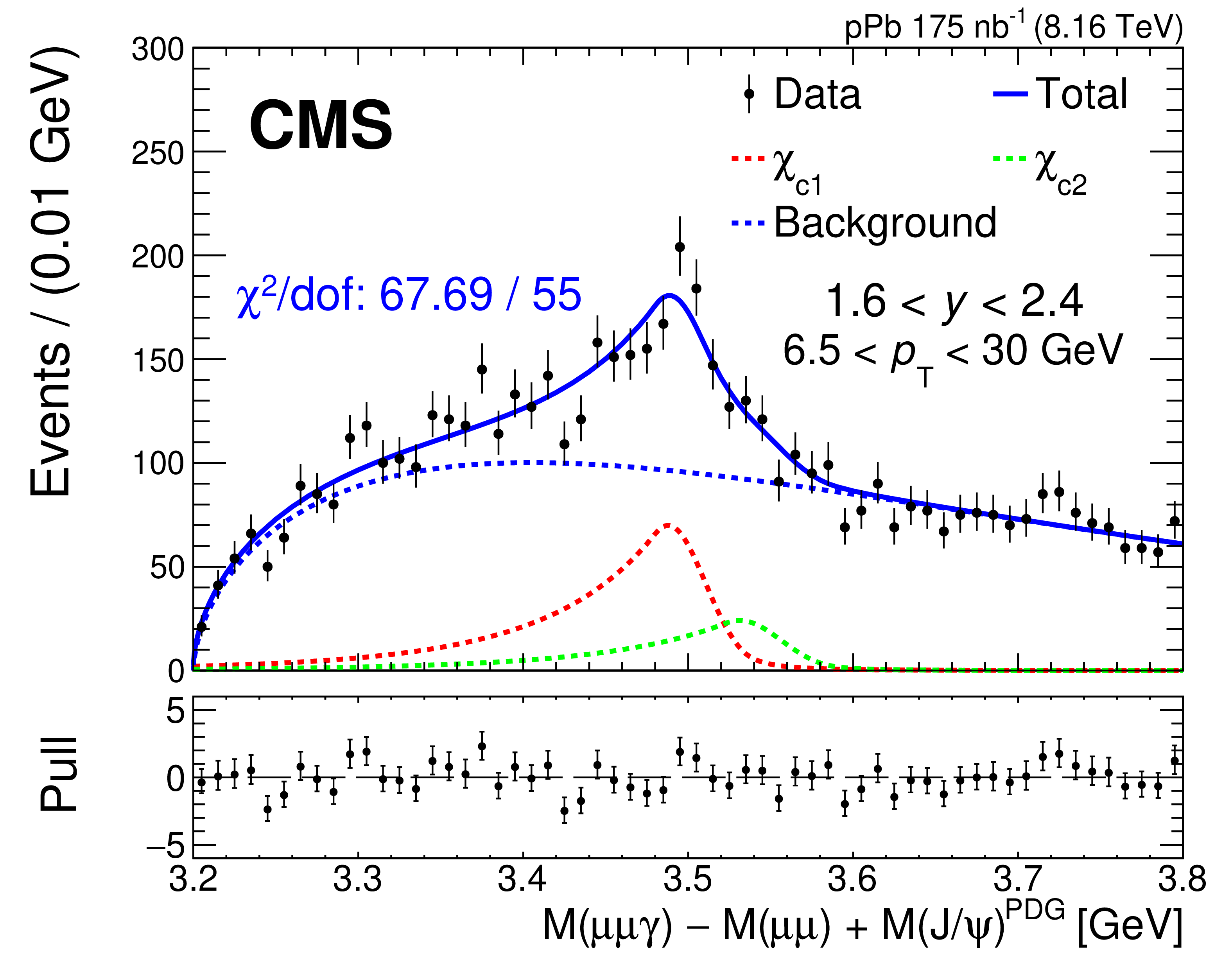
Figure 1-b:
Examples of fits for $ \chi_{c} $ candidates, integrated over $ p_{\mathrm{T}} $( $ \mathrm{J}/\psi $) and $ N_{\text{tracks}} $. Left: midrapidity bin (0.0 $ < y_{\mathrm{lab, p}}({\mathrm{J}/\psi} ) < $ 1.0), right: forward rapidity bin (1.6 $ < y_{\mathrm{lab, p}}({\mathrm{J}/\psi} ) < $ 2.4). The vertical lines of data points represent the statistical uncertainties. The overall fit is shown in blue; the dashed blue line is the background. The individual peak DCB functions are shown in red for $ \chi $c1 and green for $ \chi $c2. |
png pdf |
Figure 2:
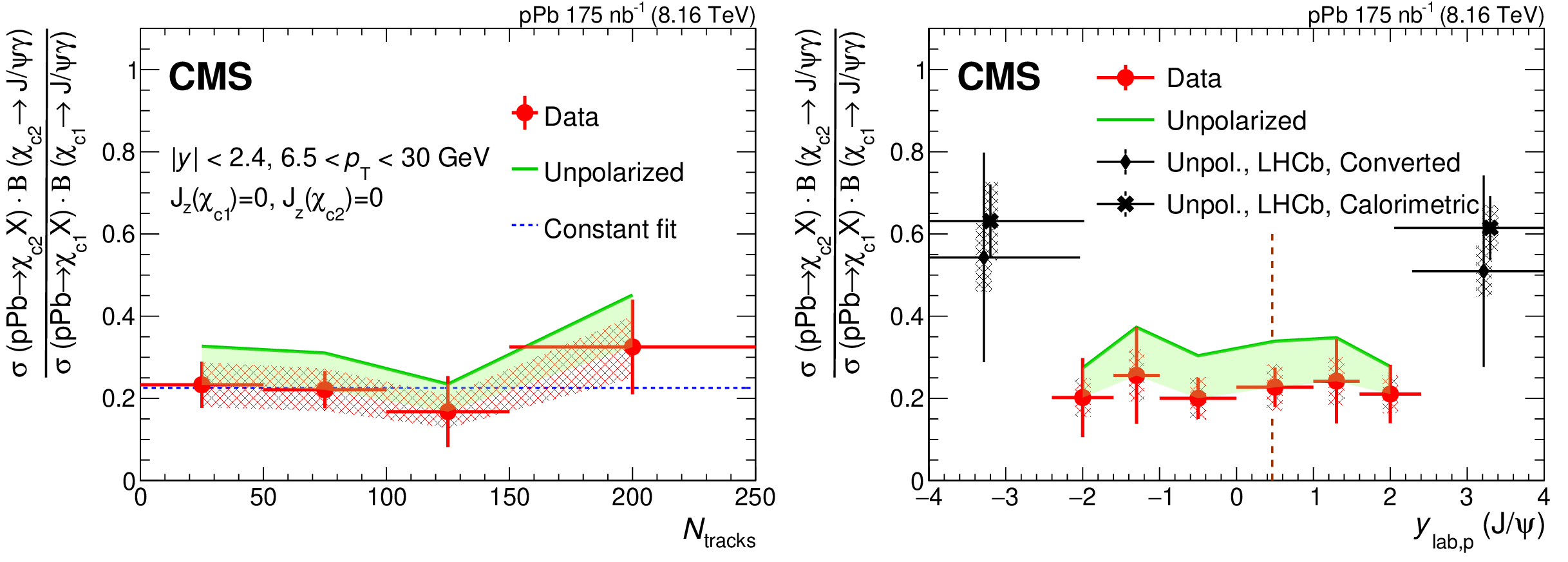
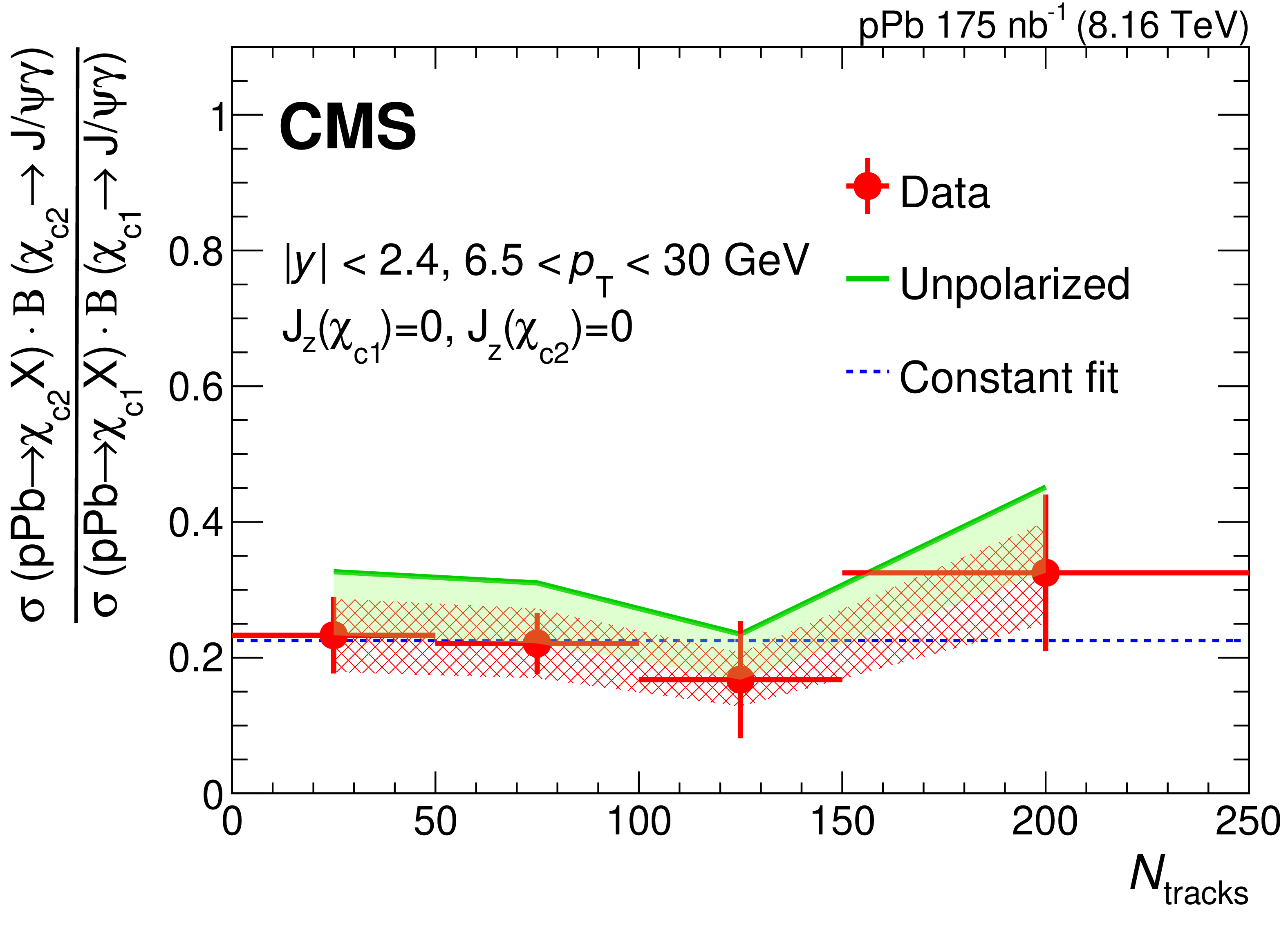
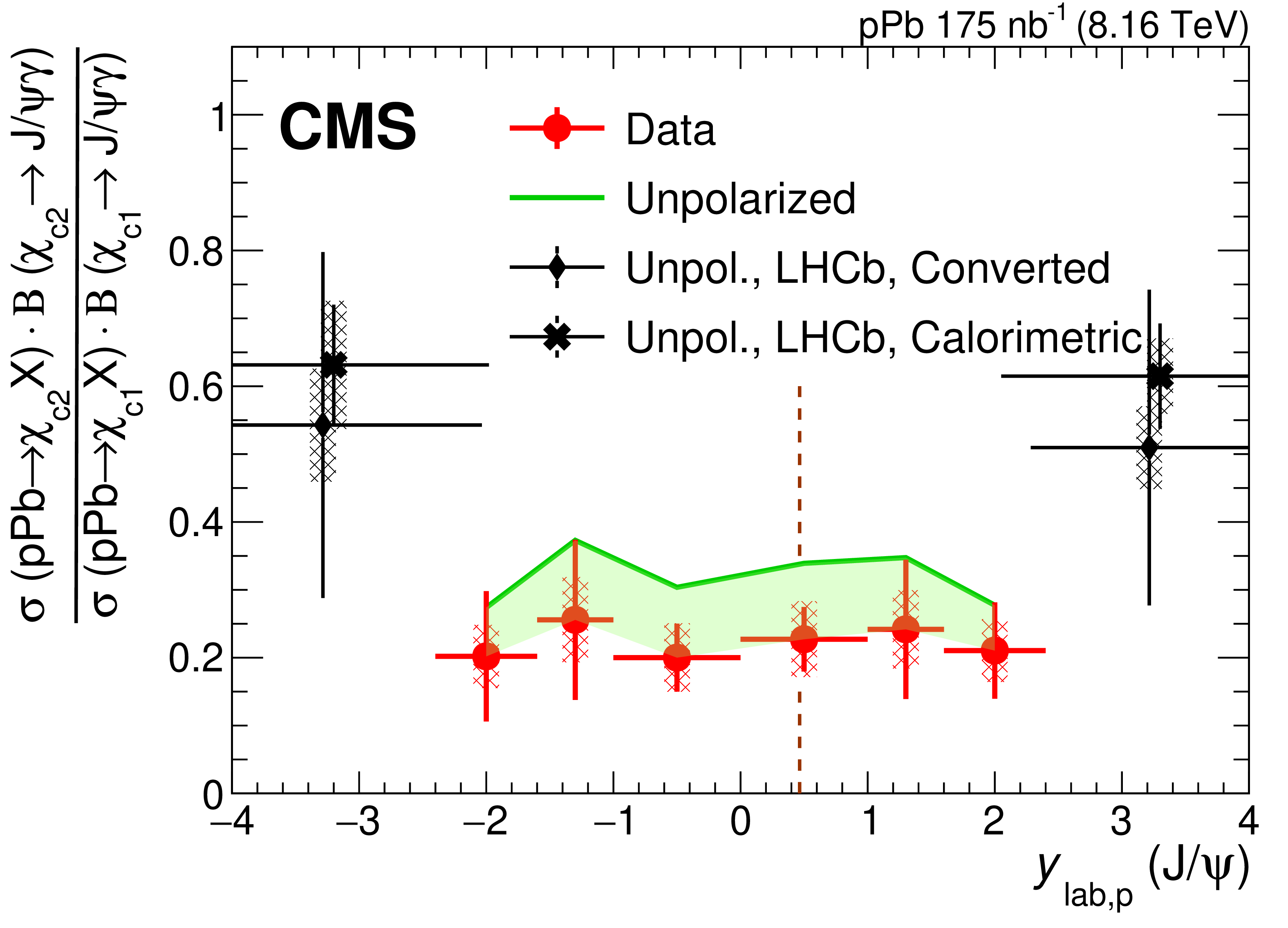
The $ \chi $c2 -to-$ \chi $c1 ratio as a function of $ N_{\text{tracks}} $ (left) and as a function of rapidity $ y_{\mathrm{lab, p}} $ (right). The red points are for the $ J_{z}({\chi}_{c1} )=0, J_{z}({\chi}_{c2} )= $ 0 scenario, while the green line represents the unpolarized case. The light green band indicates the difference between the results obtained under the unpolarized and polarization hypotheses. The hashed boxes on the points represent the systematic uncertainties. The blue dashed line shows the result of a constant fit to the points in the left panel. The rapidity is defined in the lab frame, with the p-going direction being positive. In the right panel, the center-of-mass rapidity is shown by the brown dashed vertical line at $ y_{\mathrm{lab}} = $ 0.465. Measurements reported by LHCb are shown in black [16]. |
png pdf |
Figure 2-a:
The $ \chi $c2 -to-$ \chi $c1 ratio as a function of $ N_{\text{tracks}} $ (left) and as a function of rapidity $ y_{\mathrm{lab, p}} $ (right). The red points are for the $ J_{z}({\chi}_{c1} )=0, J_{z}({\chi}_{c2} )= $ 0 scenario, while the green line represents the unpolarized case. The light green band indicates the difference between the results obtained under the unpolarized and polarization hypotheses. The hashed boxes on the points represent the systematic uncertainties. The blue dashed line shows the result of a constant fit to the points in the left panel. The rapidity is defined in the lab frame, with the p-going direction being positive. In the right panel, the center-of-mass rapidity is shown by the brown dashed vertical line at $ y_{\mathrm{lab}} = $ 0.465. Measurements reported by LHCb are shown in black [16]. |
png pdf |
Figure 2-b:
The $ \chi $c2 -to-$ \chi $c1 ratio as a function of $ N_{\text{tracks}} $ (left) and as a function of rapidity $ y_{\mathrm{lab, p}} $ (right). The red points are for the $ J_{z}({\chi}_{c1} )=0, J_{z}({\chi}_{c2} )= $ 0 scenario, while the green line represents the unpolarized case. The light green band indicates the difference between the results obtained under the unpolarized and polarization hypotheses. The hashed boxes on the points represent the systematic uncertainties. The blue dashed line shows the result of a constant fit to the points in the left panel. The rapidity is defined in the lab frame, with the p-going direction being positive. In the right panel, the center-of-mass rapidity is shown by the brown dashed vertical line at $ y_{\mathrm{lab}} = $ 0.465. Measurements reported by LHCb are shown in black [16]. |
png pdf |
Figure 3:
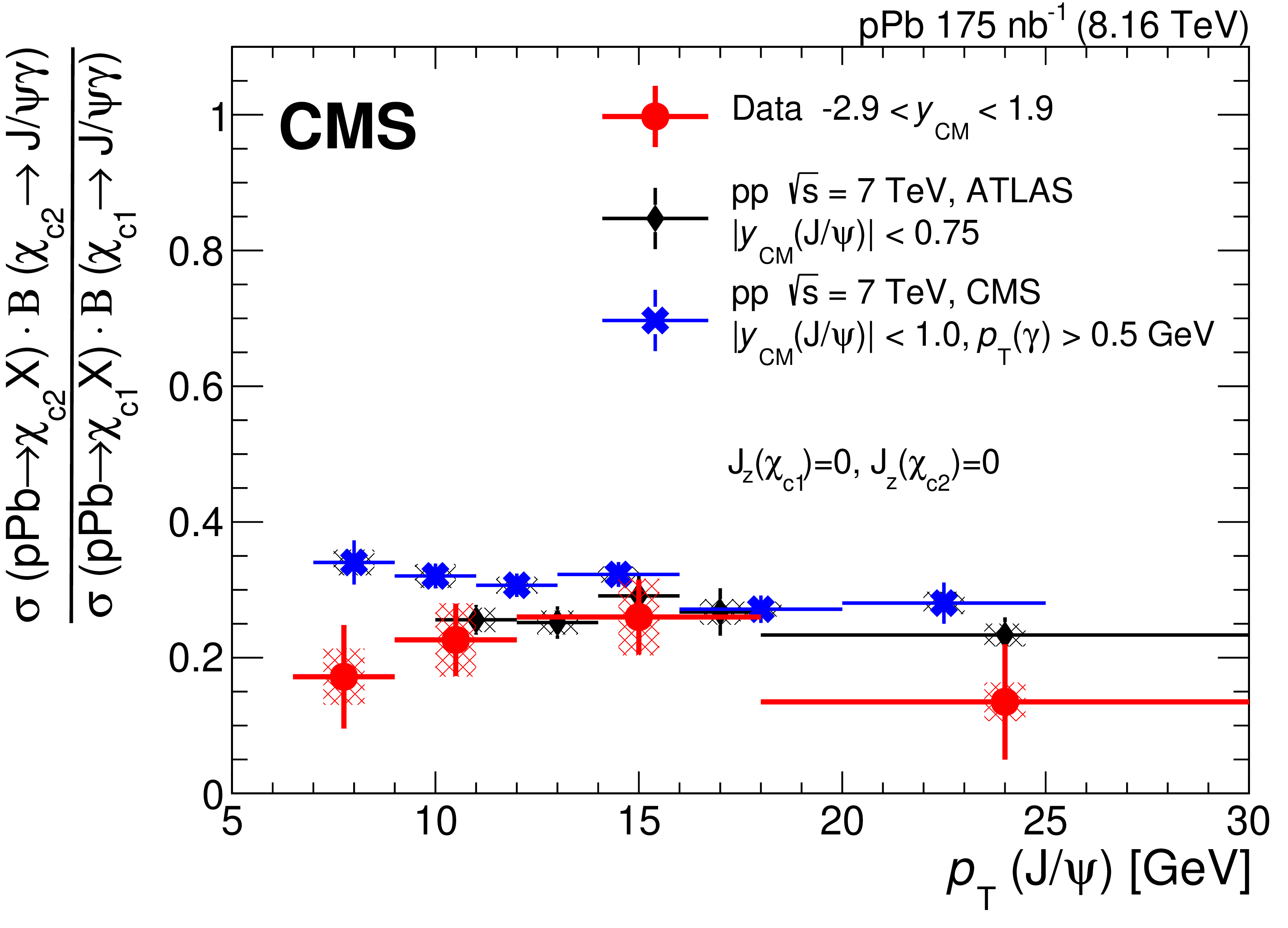
The $ \chi $c2 -to-$ \chi $c1 ratio as a function of $ p_{\mathrm{T}}({\mathrm{J}/\psi} ) $, shown by red points for the $ J_{z}({\chi}_{c1} )=0, J_{z}({\chi}_{c2} )= $ 0 polarization assumption. The results are integrated over all the detector acceptance $ |y_{\mathrm{lab}}({\mathrm{J}/\psi} )| < $ 2.4, corresponding to $ -2.9 < y_{\mathrm{CM}} < $ 1.9, and over the full charged-particle multiplicity range. The hashed boxes on the points represent the systematic uncertainties. The $ \chi $c2 -to-$ \chi $c1 ratio is compared with existing pp measurements by ATLAS [18] (black diamonds) and CMS [20] (blue crosses) with the same polarization assumption. |
| Tables | |
png pdf |
Table 1:
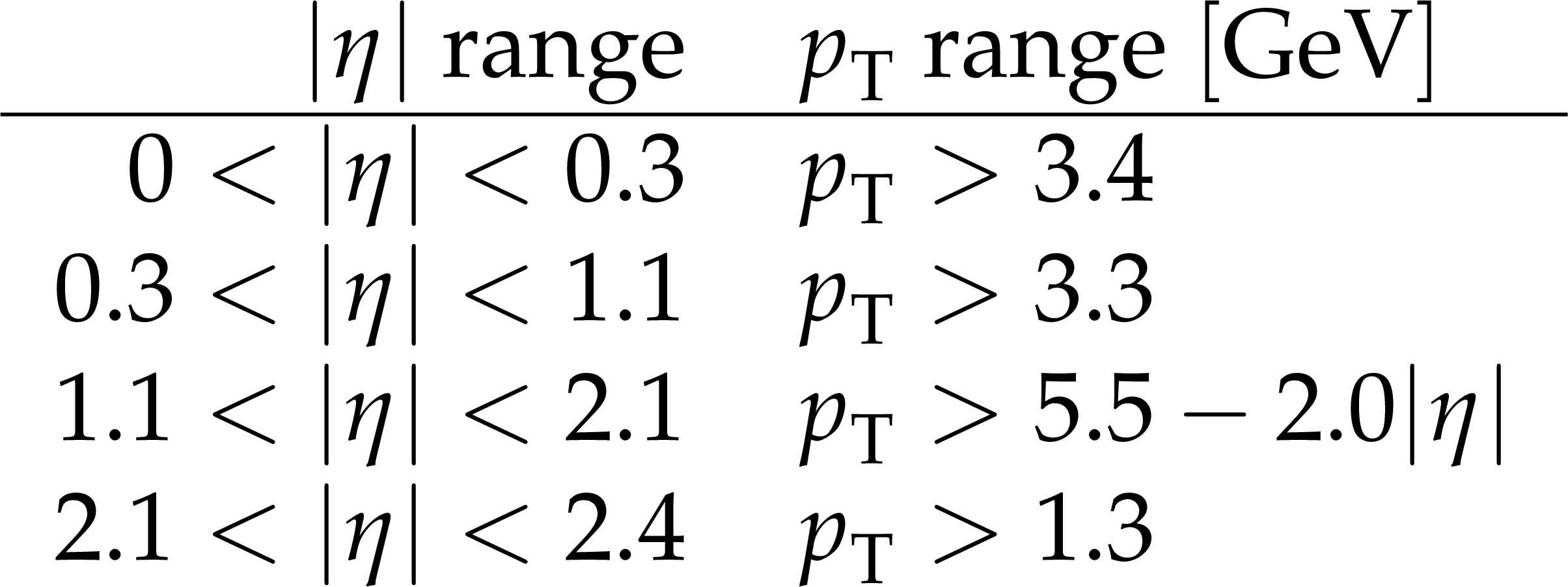
Muon $ |\eta| $ and $ p_{\mathrm{T}} $ acceptance used in the analysis. |
png pdf |
Table 2:
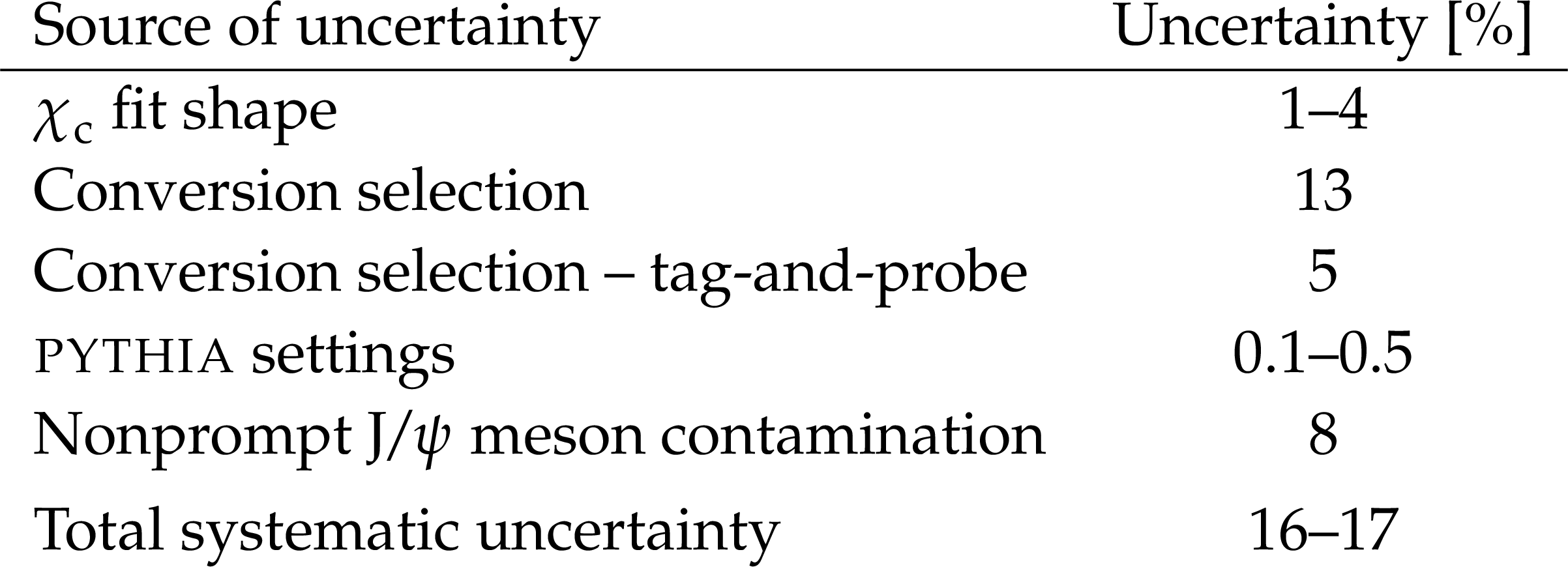
Overview of the systematic uncertainties. |
| Summary |
| The measurement of the ratio $ [\sigma ({\chi}_{c2} ) \mathcal{B}({\chi}_{c2} \to{\mathrm{J}/\psi} \gamma)] / [\sigma ({\chi}_{c1} ) \mathcal{B}({\chi}_{c1} \to{\mathrm{J}/\psi} \gamma)] $ was presented in $ \mathrm{p}\mathrm{Pb} $ collisions at $ \sqrt{\smash[b]{s_{_{\mathrm{NN}}}}}=8.16 \text{Te\hspace{-.08em}V} $. The results are reported as a function of event charged-particle multiplicity $ N_{\text{tracks}} $, rapidity $ y_{\mathrm{lab, p}}({\mathrm{J}/\psi} ) $, and transverse momentum $ p_{\mathrm{T}}({\mathrm{J}/\psi} ) $ of the $ \mathrm{J}/\psi $. The $ \chi $c1 and $ \chi $c2 states were reconstructed through the decay $ \chi_{c} \to {\mathrm{J}/\psi} \gamma \to \mu^{+} \mu^{-} + \mathrm{e}^+ \mathrm{e}^- $. The measurements were reported in the CMS detector acceptance region 6.5 $ < p_{\mathrm{T}}({\mathrm{J}/\psi} ) < $ 30 GeV and $ |y_{\mathrm{lab, p}}({\mathrm{J}/\psi} )| < $ 2.4, corresponding approximately to $ -2.9 < y_{\mathrm{CM}}({\mathrm{J}/\psi} ) < $ 1.9 in the proton-nucleon center-of-mass system. No significant dependence of the $ \chi $c2 -to-$ \chi $c1 ratio on $ N_{\text{tracks}} $, $ p_{\mathrm{T}}({\mathrm{J}/\psi} ) $, or $ y_{\mathrm{lab, p}}({\mathrm{J}/\psi} ) $ was observed, and the results are consistent with existing pp measurements. These findings demonstrate that the relative production of these P-wave states remains unmodified in $ \mathrm{p}\mathrm{Pb} $ collisions. This absence of a significant multiplicity dependence stands in contrast to the S-wave sector, where $ \psi(2S) $ suppression has been interpreted as evidence for final-state effects in pPb collisions. The multiplicity independence of the $ \chi_{c} $ ratio suggests that any dissociation or final-state modification mechanism does not produce a measurable difference between the $ \chi $c1 and $ \chi $c2 states within the current uncertainties. The $ \mathrm{p}\mathrm{Pb} $ medium appears capable of resolving the large size disparities between S-wave states, leading to sequential suppression, while for the P-wave states $ \chi $c1 and $ \chi $c2, the results do not indicate a clear sensitivity to their more subtle internal differences. |
| References | ||||
| 1 | E. Chapon et al. | Prospects for quarkonium studies at the high-luminosity LHC | Prog. Part. Nucl. Phys. 122 (2022) 1 | 2012.14161 |
| 2 | F. Arleo and S. Peigne | Heavy-quarkonium suppression in p-A collisions from parton energy loss in cold QCD matter | JHEP 03 (2013) 122 | 1212.0434 |
| 3 | E. G. Ferreiro | Excited charmonium suppression in proton-nucleus collisions as a consequence of comovers | PLB 749 (2015) 98 | 1411.0549 |
| 4 | A. Capella, A. Kaidalov, A. Kouider Akil, and C. Gerschel | $ J/\psi $ and $ \psi^\prime $ suppression in heavy ion collisions | PLB 393 (1997) 431 | hep-ph/9607265 |
| 5 | CMS Collaboration | Overview of high-density QCD studies with the CMS experiment at LHC | Phys. Rept. 1115 (2025) 219 | CMS-HIN-23-011 2405.10785 |
| 6 | LHCb Collaboration | Prompt and nonprompt J/$ \psi $ production and nuclear modification in pPb collisions at $ \sqrt{s_{\mathrm{NN}}} = $ 8.16 TeV | PLB 774 (2017) 159 | 1706.07122 |
| 7 | PHENIX Collaboration | Measurement of the relative yields of $ \psi(2S) $ to $ \psi(1S) $ mesons produced at forward and backward rapidity in p+p, p+Al, p+Au, and $ ^{3} $He$ + $Au collisions at $ \sqrt{s_{\mathrm{NN}}} = $ 200 GeV | Phys. Rev. C 95 (2017) 034904 | 1609.06550 |
| 8 | CMS Collaboration | Nuclear modification of $ \Upsilon $ states in pPb collisions at $ \sqrt {\smash [b]{s_{_{\mathrm {NN}}}}} = $ 5.02 TeV | PLB 835 (2022) 137397 | |
| 9 | ATLAS Collaboration | Measurement of quarkonium production in proton-lead and proton-proton collisions at 5.02 $ \mathrm {TeV} $ with the ATLAS detector | EPJC 78 (2018) 171 | 1709.03089 |
| 10 | ALICE Collaboration | Centrality dependence of $ \psi(2S) $ suppression in p-Pb collisions at 5.02 TeV | JHEP 06 (2016) 50 | 1603.02816 |
| 11 | PHENIX Collaboration | Nuclear Modification of $ \psi^\prime, \chi_c $, and J/\ensuremath\psi Production in d+Au Collisions at $ \sqrt{s_{\mathrm{NN}}} = $ 200 GeV | PRL 111 (2013) 202301 | 1305.5516 |
| 12 | LHCb Collaboration | Study of $ \Upsilon $ production in pPb collisions at $ \sqrt{s_{\mathrm{NN}}} = $ 8.16 TeV | JHEP 11 (2018) 194 | 1810.07655 |
| 13 | H. Satz | Colour deconfinement and quarkonium binding | Journal of Physics G:, 2006 Nuclear and Particle Physics 32 (2006) R25 |
hep-ph/0512217 |
| 14 | T. Matsui and H. Satz | $ J/\psi $ Suppression by Quark-Gluon Plasma Formation | PLB 178 (1986) 416 | |
| 15 | S. Gupta and H. Satz | Final state $ J/\psi $ suppression in nuclear collisions | AIP Conf. Proc. 272 (1992) 991 | |
| 16 | LHCb Collaboration | Measurement of prompt-production cross-section ratio $ \sigma(\chi_{c2})/\sigma(\chi_{c1}) $ in pPb collisions at $ \sqrt{s_{\mathrm{NN}}} = $ 8.16 TeV | Phys. Rev. C 103 (2021) 064905 | 2103.07349 |
| 17 | LHCb Collaboration | Fraction of $ \chi_{c} $ decays in prompt $ \mathrm{J}/\psi $ production measured in pPb collisions at $ \sqrt{s_{\mathrm{NN}}} = $ 8.16 TeV | PRL 132 (2024) 102302 | |
| 18 | ATLAS Collaboration | Measurement of $ \chi_{c1} $ and $ \chi_{c2} $ production with $ \sqrt{s} = $ 7 TeV pp collisions at ATLAS | JHEP 07 (2014) 154 | 1404.7035 |
| 19 | LHCb Collaboration | Measurement of the ratio of prompt $ \chi_{c} $ to $ J/\psi $ production in pp collisions at $ \sqrt{s}= $ 7 TeV | PLB 718 (2012) 431 | 1204.1462 |
| 20 | CMS Collaboration | Measurement of the Relative Prompt Production Rate of $ \chi_{c2} $ and $ \chi_{c1} $ in pp Collisions at $ \sqrt{s}= $ 7 TeV | EPJC 72 (2012) 2251 | CMS-BPH-11-010 1210.0875 |
| 21 | LHCb Collaboration | Measurement of the cross-section ratio $ \sigma(\chi_{c2})/\sigma(\chi_{c1}) $ for prompt $ \chi_c $ production at $ \sqrt{s}= $ 7 TeV | PLB 714 (2012) 215 | 1202.1080 |
| 22 | CMS Collaboration | CMS luminosity measurement using 2016 proton-nucleus collisions at $ \sqrt{s_{\mathrm{NN}}} = $ 8.16 TeV | CMS Physics Analysis Summary, 2018 CMS-PAS-LUM-17-002 |
CMS-PAS-LUM-17-002 |
| 23 | CMS Collaboration | Precision luminosity measurement in proton-proton collisions at $ \sqrt{s} = $ 13 TeV in 2015 and 2016 at CMS | EPJC 81 (2021) 800 | CMS-LUM-17-003 2104.01927 |
| 24 | CMSnoop | none | \hrefHEPData record for this analysis, 2026 link |
|
| 25 | CMS Collaboration | The CMS Experiment at the CERN LHC | JINST 3 (2008) S08004 | |
| 26 | CMS Collaboration | The CMS trigger system | JINST 12 (2017) P01020 | CMS-TRG-12-001 1609.02366 |
| 27 | CMS Collaboration | Particle-flow reconstruction and global event description with the CMS detector | JINST 12 (2017) P10003 | |
| 28 | CMS Collaboration | Description and performance of track and primary-vertex reconstruction with the CMS tracker | JINST 9 (2014) P10009 | CMS-TRK-11-001 1405.6569 |
| 29 | CMS Collaboration | Performance of Photon Reconstruction and Identification with the CMS Detector in Proton-Proton Collisions at $ \sqrt{s} = $ 8 TeV | JINST 10 (2015) P08010 | CMS-EGM-14-001 1502.02702 |
| 30 | T. Sjöstrand et al. | An Introduction to PYTHIA 8.2 | Comput. Phys. Commun. 191 (2015) 159 | 1410.3012 |
| 31 | D. J. Lange | The EvtGen particle decay simulation package | NIM A 462 (2001) 152 | |
| 32 | N. Davidson, T. Przedzinski, and Z. Was | PHOTOS interface in C++: Technical and Physics Documentation | Comput. Phys. Commun. 199 (2016) 86 | 1011.0937 |
| 33 | T. Pierog et al. | EPOS LHC: test of collective hadronization with data measured at the CERN Large Hadron Collider | Phys. Rev. C 92 (2015) 034906 | 1306.0121 |
| 34 | GEANT4 Collaboration | GEANT 4---a simulation toolkit | NIM A 506 (2003) 250 | |
| 35 | CMS Collaboration | Performance of muon identification in pp collisions at $ \sqrt{s} = $ 7 TeV | technical report, 2012 link |
CMS-MUO-10-004 1206.4071 |
| 36 | CMS Collaboration | Performance of the CMS muon detector and muon reconstruction with proton-proton collisions at $ \sqrt{s}= $ 13 TeV | JINST 13 (2018) P06015 | CMS-MUO-16-001 1804.04528 |
| 37 | Particle Data Group | Review of Particle Physics | PRD 110 (2024) 030001 | |
| 38 | CMS Collaboration | Measurement of the production cross section ratio $ \sigma(\chi_{b2}{\rm (1P)}) / \sigma(\chi_{b1}{\rm (1P)}) $ in pp collisions at $ \sqrt{s} = $ 8 TeV | PLB 743 (2015) 383 | CMS-BPH-13-005 1409.5761 |
| 39 | CMS Collaboration | Observation of the $ {\chi}_{b1}(3P) $ and $ {\chi}_{b2}(3P) $ and Measurement of their Masses | PRL 121 (2018) 092002 | CMS-BPH-17-008 1805.11192 |
| 40 | CMS Collaboration | Constraints on the $ \chi_\mathrm{c1} $ versus $ \chi_\mathrm{c2} $ Polarizations in Proton-Proton Collisions at $ \sqrt{s} = $ 8 TeV | PRL 124 (2020) 162002 | CMS-BPH-13-001 1912.07706 |
| 41 | P. Faccioli, C. Louren ç o, and T. Madlener | From prompt to direct J/$ \psi $ production: new insights on the $ \chi_{c1} $ and $ \chi_{c2} $ polarizations and feed-down contributions from a global-fit analysis of mid-rapidity LHC data | EPJC 80 (2020) 623 | 2006.15446 |
| 42 | CMS Collaboration | Measurement of the Prompt $ J/\psi $ and $ \psi $(2S) Polarizations in pp Collisions at $ \sqrt{s} = $ 7 TeV | PLB 727 (2013) 381 | CMS-BPH-13-003 1307.6070 |
| 43 | ALICE Collaboration | Measurement of the inclusive J/ $ \psi $ polarization at forward rapidity in pp collisions at $ \sqrt{s} = $ 8 TeV | EPJC 78 (2018) 562 | 1805.04374 |
| 44 | P. Faccioli, C. Louren ç o, J. Seixas, and H. K. Wöhri | Determination of $ \chi_c $ and $ \chi_b $ polarizations from dilepton angular distributions in radiative decays | PRD 83 (2011) 096001 | 1103.4882 |
| 45 | CMS Collaboration | Observation of the charged-particle multiplicity dependence of $ \sigma_{\psi(2S)}/\sigma_{J/\psi} $ in p-Pb collisions at 8.16 TeV | PRL 135 (2025) 092301 | CMS-HIN-24-001 2503.02139 |
| 46 | H. Satz | Quarkonium Binding and Dissociation: The Spectral Analysis of the QGP | Nucl. Phys. A 783 (2007) 249 | hep-ph/0609197 |
|
|
Compact Muon Solenoid LHC, CERN |

|
|
|
|
|
|