Compact Muon Solenoid
LHC, CERN
 Visit us: CMS Public Website, CMS Physics ;
Contact us: CMS Publications Committee
Visit us: CMS Public Website, CMS Physics ;
Contact us: CMS Publications Committee
| CMS-HIN-21-016 ; CERN-EP-2024-135 | ||
| Multiplicity dependence of charm baryon and baryon meson production in pPb collisions at $ \sqrt{\smash[b]{s_{_{\mathrm{NN}}}}} = $ 8.16 TeV | ||
| CMS Collaboration | ||
| 18 July 2024 | ||
| PLB 868 (2025) 139672 | ||
| Abstract: Measurements of the production yields of charm baryons ($ \Lambda_{c}^{+} $) and charm mesons ($ \mathrm{D^0} $) in proton-lead collisions at a nucleon-nucleon center-of-mass energy of 8.16 TeV are presented. The data were collected in 2016 with the CMS experiment and correspond to an integrated luminosity of 186 nb$^{-1}$. The $ \Lambda_{c}^{+} $ baryon is reconstructed from the decay channel $ \Lambda_{c}^{+} \to \mathrm{K^0_S}\mathrm{p} $, while the $ \mathrm{D^0} $ meson is reconstructed via $ \mathrm{D^0}\to\mathrm{K^-}\pi^{+} $. The $ \Lambda_{c}^{+} $ baryon and $ \mathrm{D^0} $ meson yields are extracted in several charged-particle multiplicity classes. No strong multiplicity dependence of the $ \Lambda_{c}^{+} $-to-$ \mathrm{D^0} $ yield ratio is observed, unlike the observed strange baryon to strange meson yield ratio of $ \Lambda $/$ \overline{\Lambda} $ to $ \mathrm{K^0_S} $, which shows a strong multiplicity dependence. This observation indicates different mechanisms for the multiplicity evolution of hadronization processes for charm and strange quarks and provides new constraints to the understanding of heavy flavor production and collectivity in small collision systems. | ||
| Links: e-print arXiv:2407.13615 [hep-ex] (PDF) ; CDS record ; inSPIRE record ; CADI line (restricted) ; | ||
| Figures | |
png pdf |
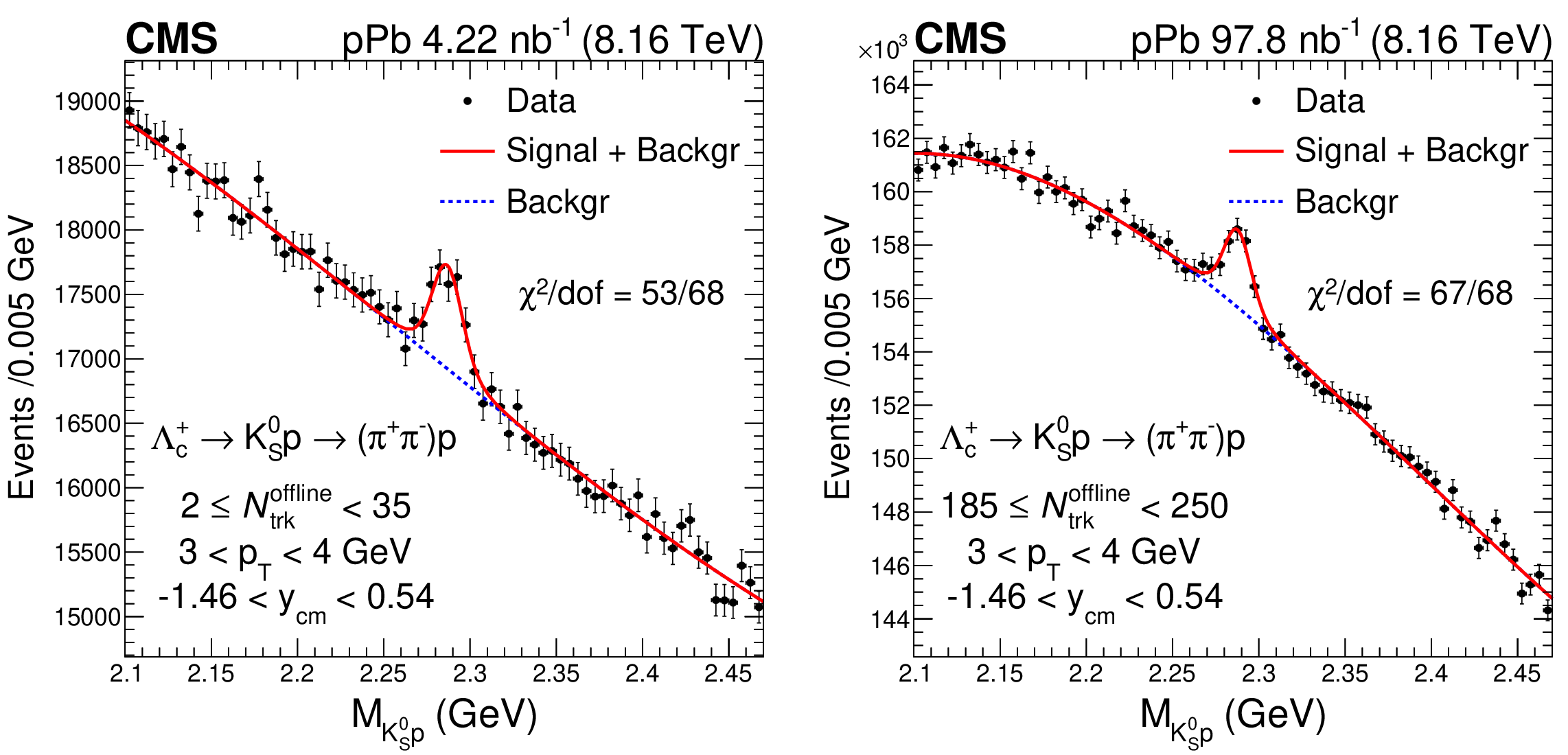
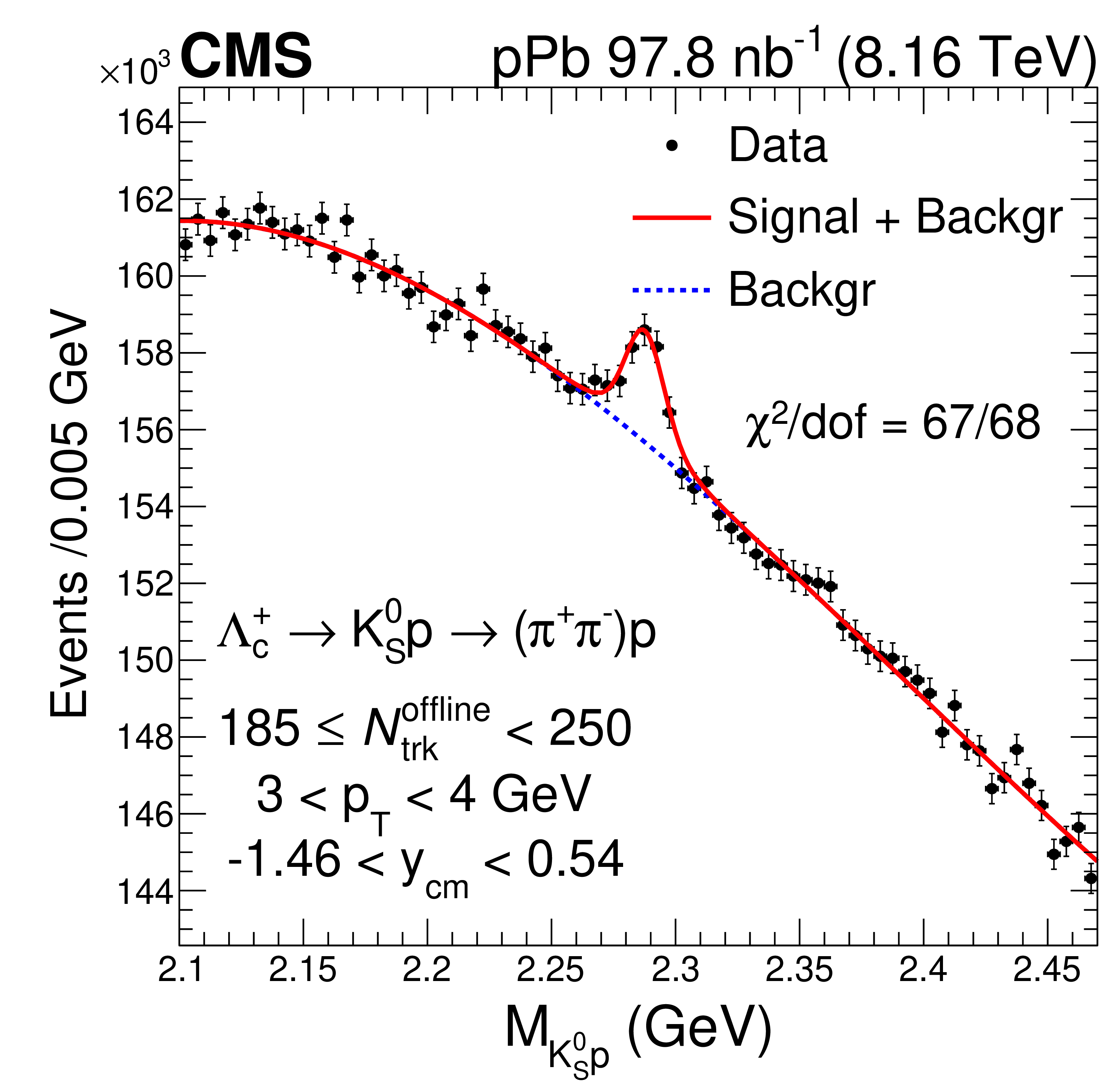
Figure 1:
The fitted mass spectra, along with the goodness-of-fit values, for $ \Lambda_{c}^{+} $ candidates with 3 $ < p_{\mathrm{T}} < $ 4 GeV and $ -1.46 < y_{\text{cm}} < 0.54$. The spectrum for the multiplicity class with 2 $ \leq N_\text{trk}^\text{offline} < $ 35 is shown in the left plot, and the spectrum for 185 $ \leq N_\text{trk}^\text{offline} < $ 250 is shown in the right plot. |
png pdf |
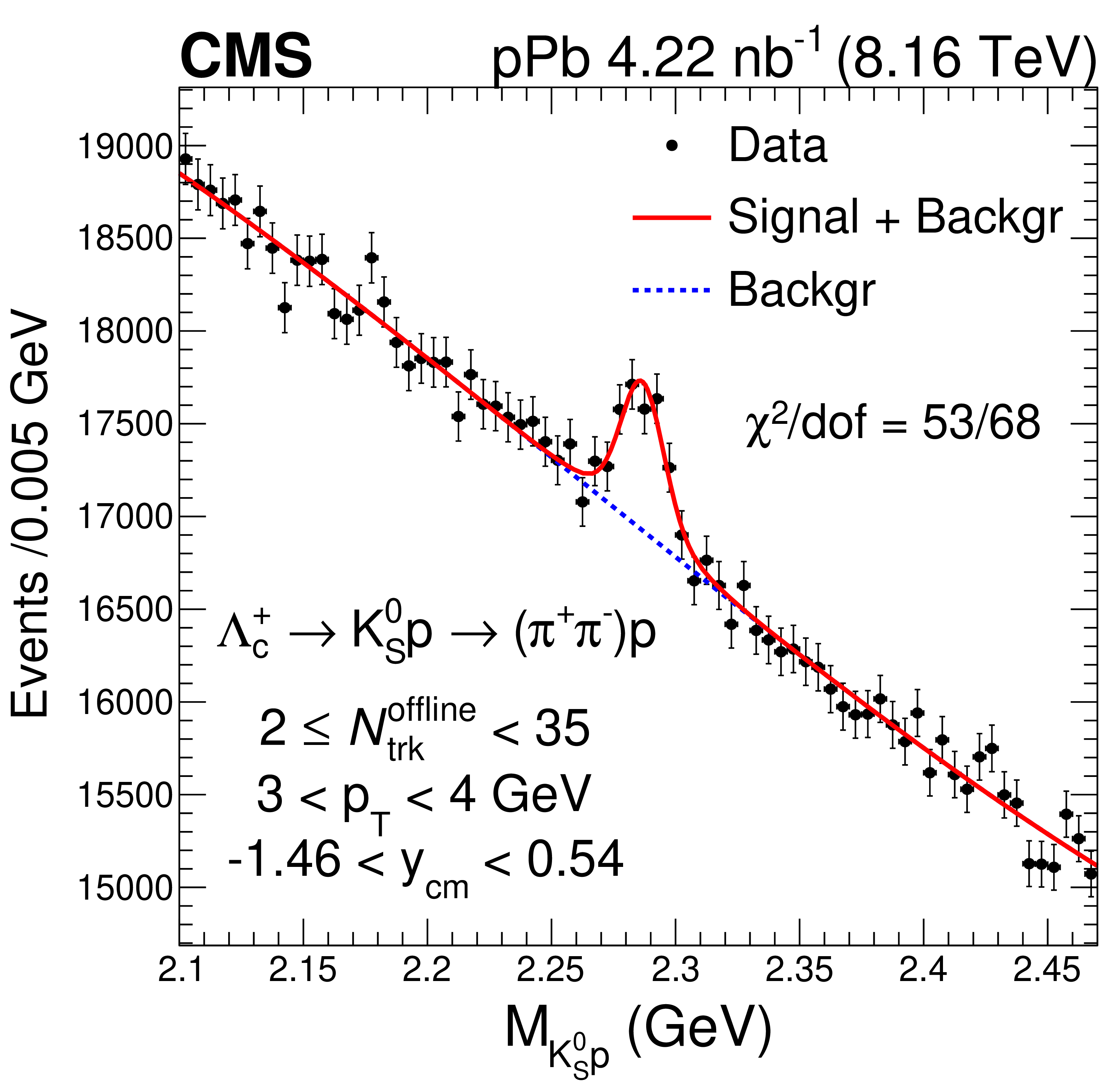
Figure 1-a:
The fitted mass spectra, along with the goodness-of-fit values, for $ \Lambda_{c}^{+} $ candidates with 3 $ < p_{\mathrm{T}} < $ 4 GeV and $ -1.46 < y_{\text{cm}} < 0.54$. The spectrum for the multiplicity class with 2 $ \leq N_\text{trk}^\text{offline} < $ 35 is shown in the left plot, and the spectrum for 185 $ \leq N_\text{trk}^\text{offline} < $ 250 is shown in the right plot. |
png pdf |
Figure 1-b:
The fitted mass spectra, along with the goodness-of-fit values, for $ \Lambda_{c}^{+} $ candidates with 3 $ < p_{\mathrm{T}} < $ 4 GeV and $ -1.46 < y_{\text{cm}} < 0.54$. The spectrum for the multiplicity class with 2 $ \leq N_\text{trk}^\text{offline} < $ 35 is shown in the left plot, and the spectrum for 185 $ \leq N_\text{trk}^\text{offline} < $ 250 is shown in the right plot. |
png pdf |
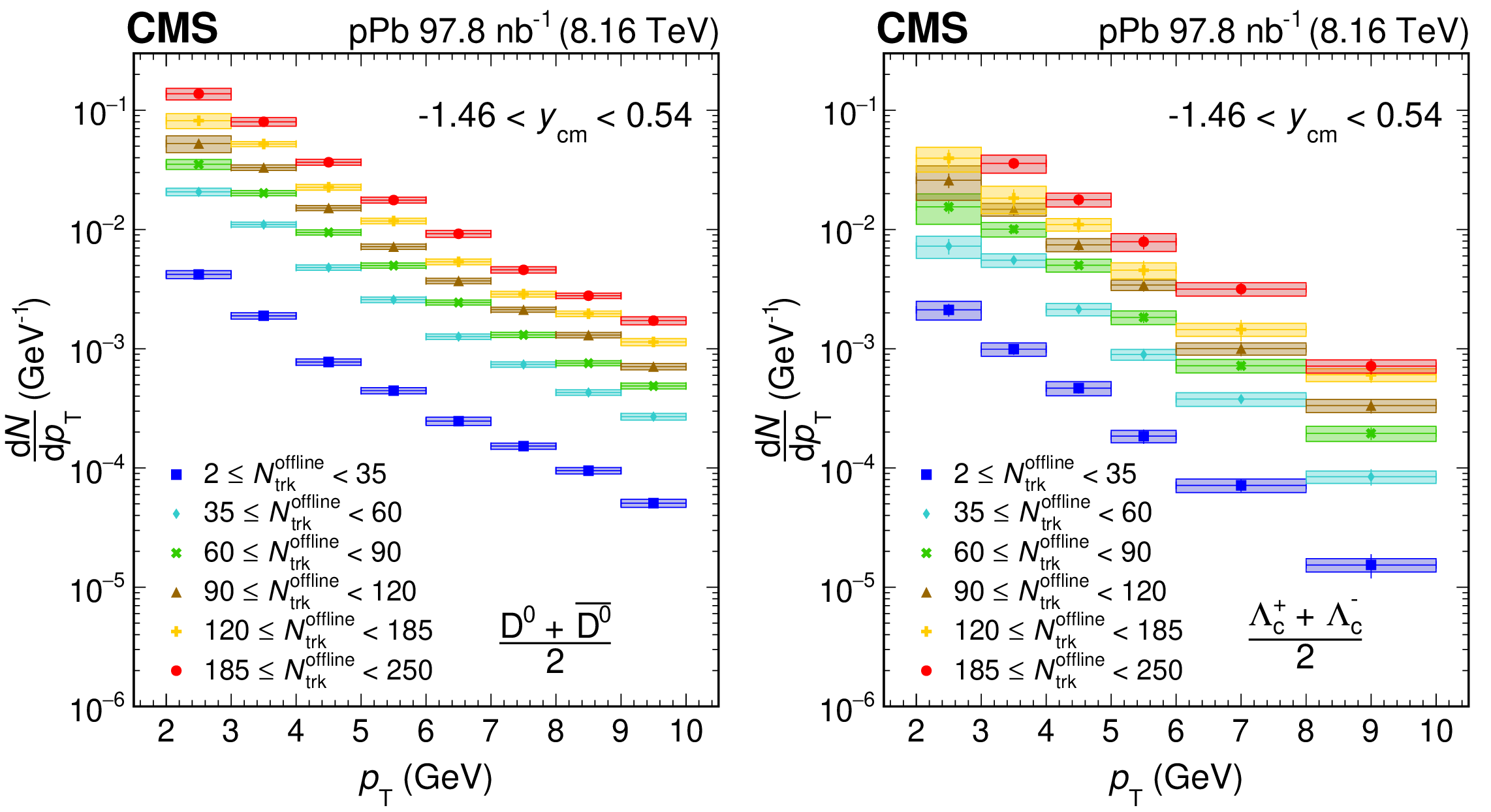
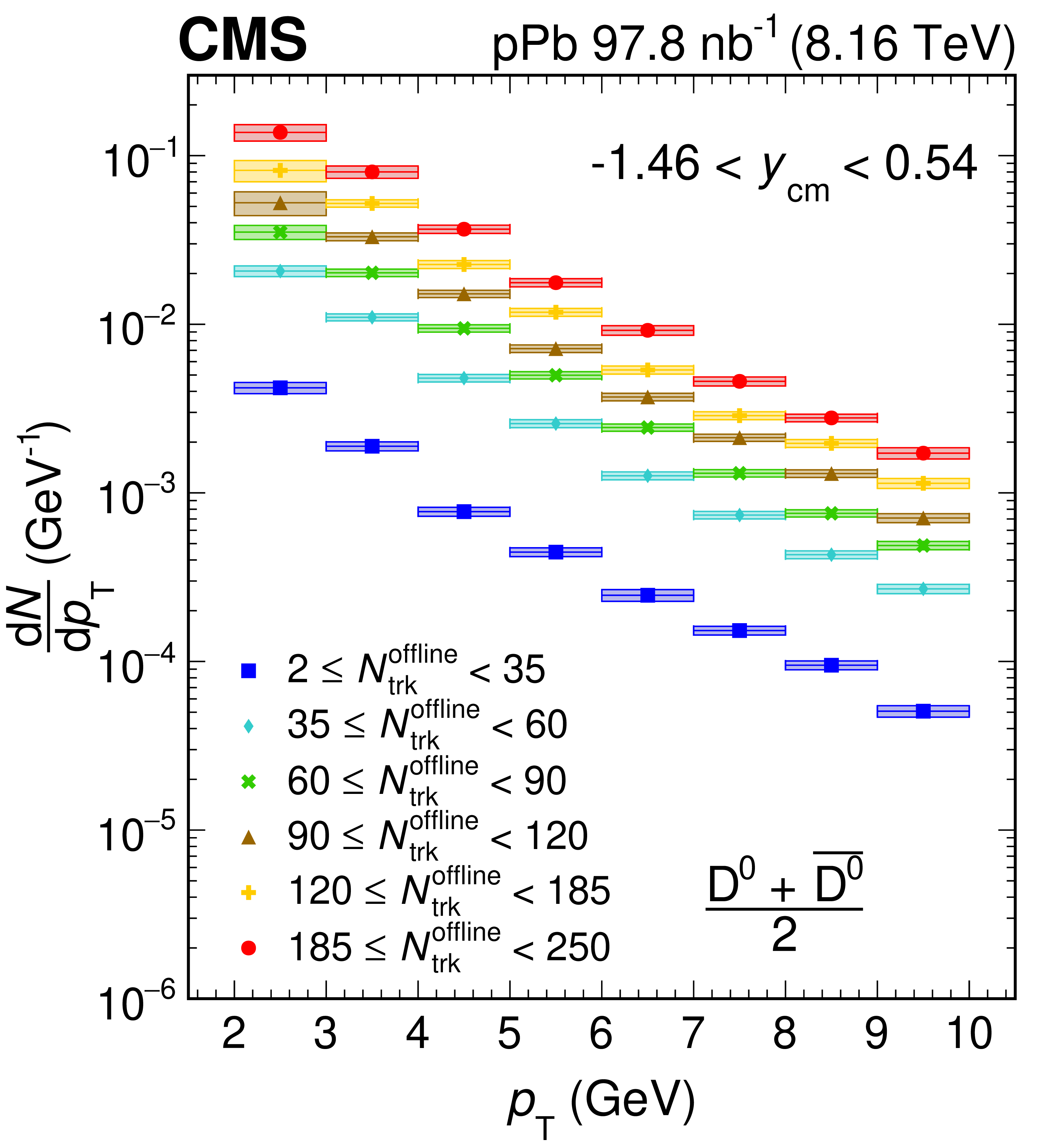
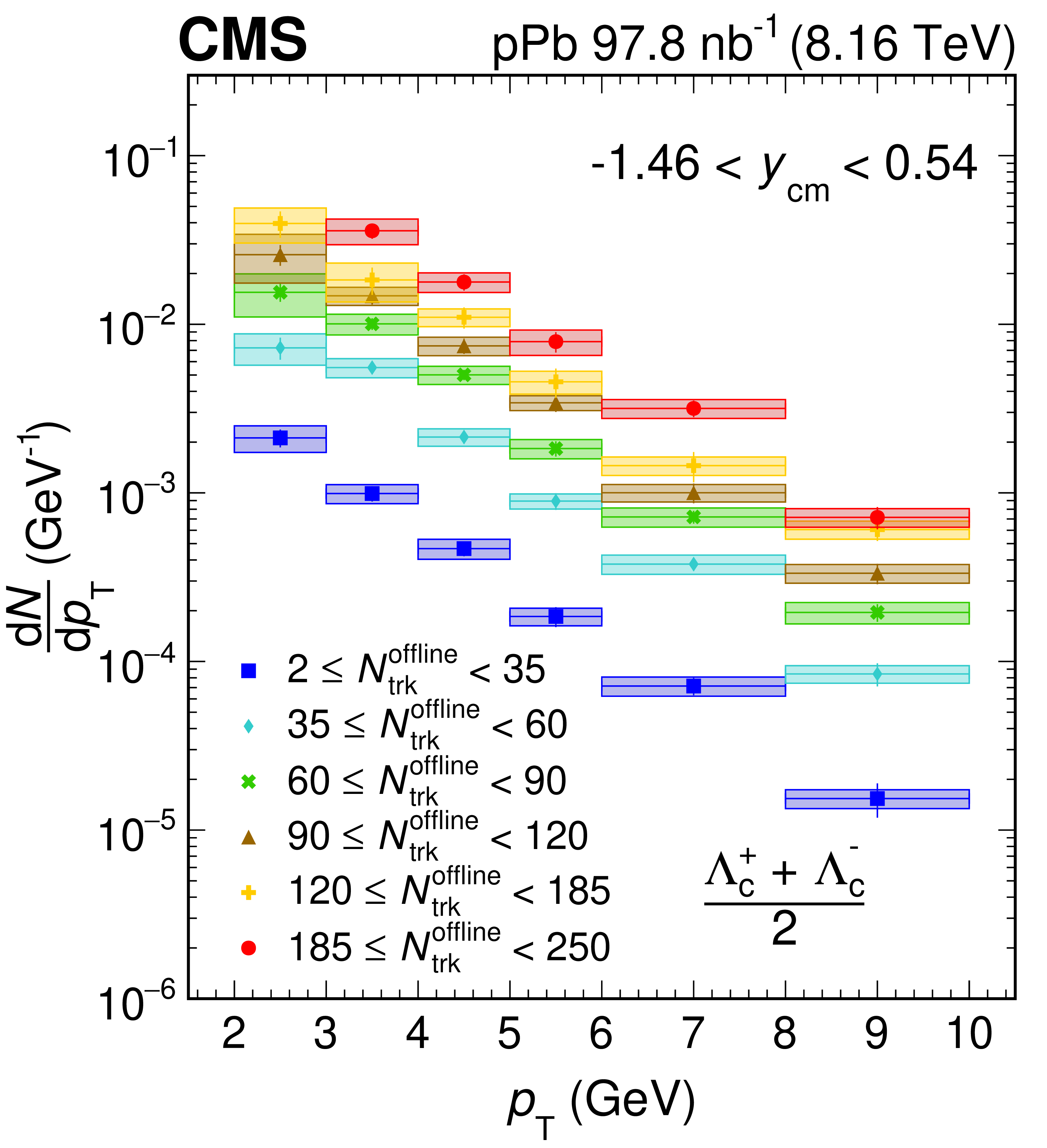
Figure 2:
Transverse momentum spectra for $ \Lambda_{c}^{+} $ baryons (left) and $ \mathrm{D^0} $ mesons (right) with $ -1.46 < y_{\text{cm}} < $ 0.54 in different multiplicity classes. The vertical bars show the statistical uncertainties while the shaded areas represent the systematic uncertainties. |
png pdf |
Figure 2-a:
Transverse momentum spectra for $ \Lambda_{c}^{+} $ baryons (left) and $ \mathrm{D^0} $ mesons (right) with $ -1.46 < y_{\text{cm}} < $ 0.54 in different multiplicity classes. The vertical bars show the statistical uncertainties while the shaded areas represent the systematic uncertainties. |
png pdf |
Figure 2-b:
Transverse momentum spectra for $ \Lambda_{c}^{+} $ baryons (left) and $ \mathrm{D^0} $ mesons (right) with $ -1.46 < y_{\text{cm}} < $ 0.54 in different multiplicity classes. The vertical bars show the statistical uncertainties while the shaded areas represent the systematic uncertainties. |
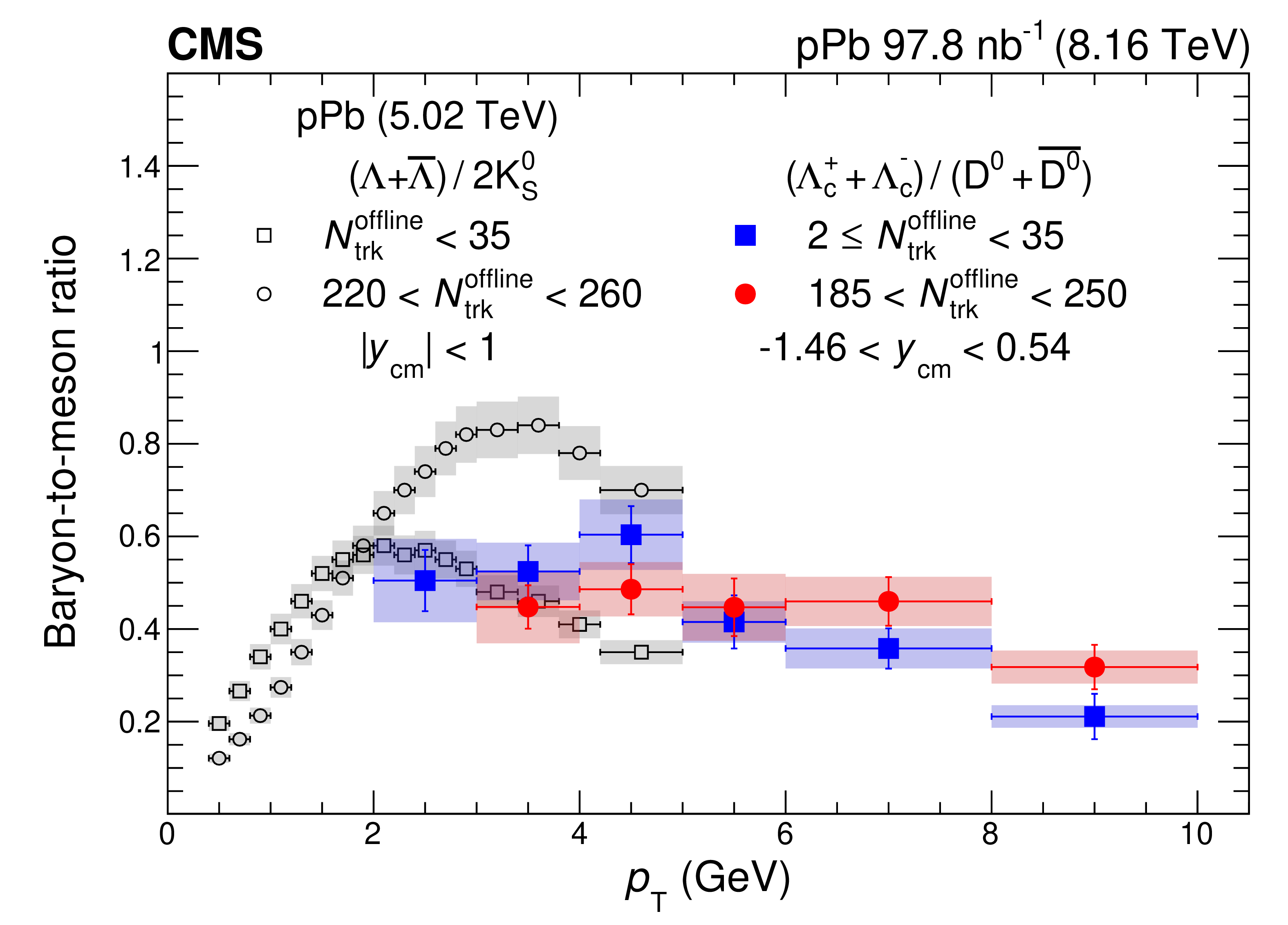
png pdf |
Figure 3:
Ratio of $ \Lambda_{c}^{+} $ baryons to $ \mathrm{D^0} $ mesons production in pPb collisions at $ \sqrt{\smash[b]{s_{_{\mathrm{NN}}}}}= $ 8.16 TeV with 2 $ \leq N_\text{trk}^\text{offline} < $ 35 and 185 $ \leq N_\text{trk}^\text{offline} < $ 250. The vertical bars show the statistical uncertainties while the shaded areas represent the systematic uncertainties. The grey markers are for $ \Lambda $ baryon to (two times) $ \mathrm{K^0_S} $ meson production at $ \sqrt{\smash[b]{s_{_{\mathrm{NN}}}}}= $ 5.02 TeV from Ref. [53]. |
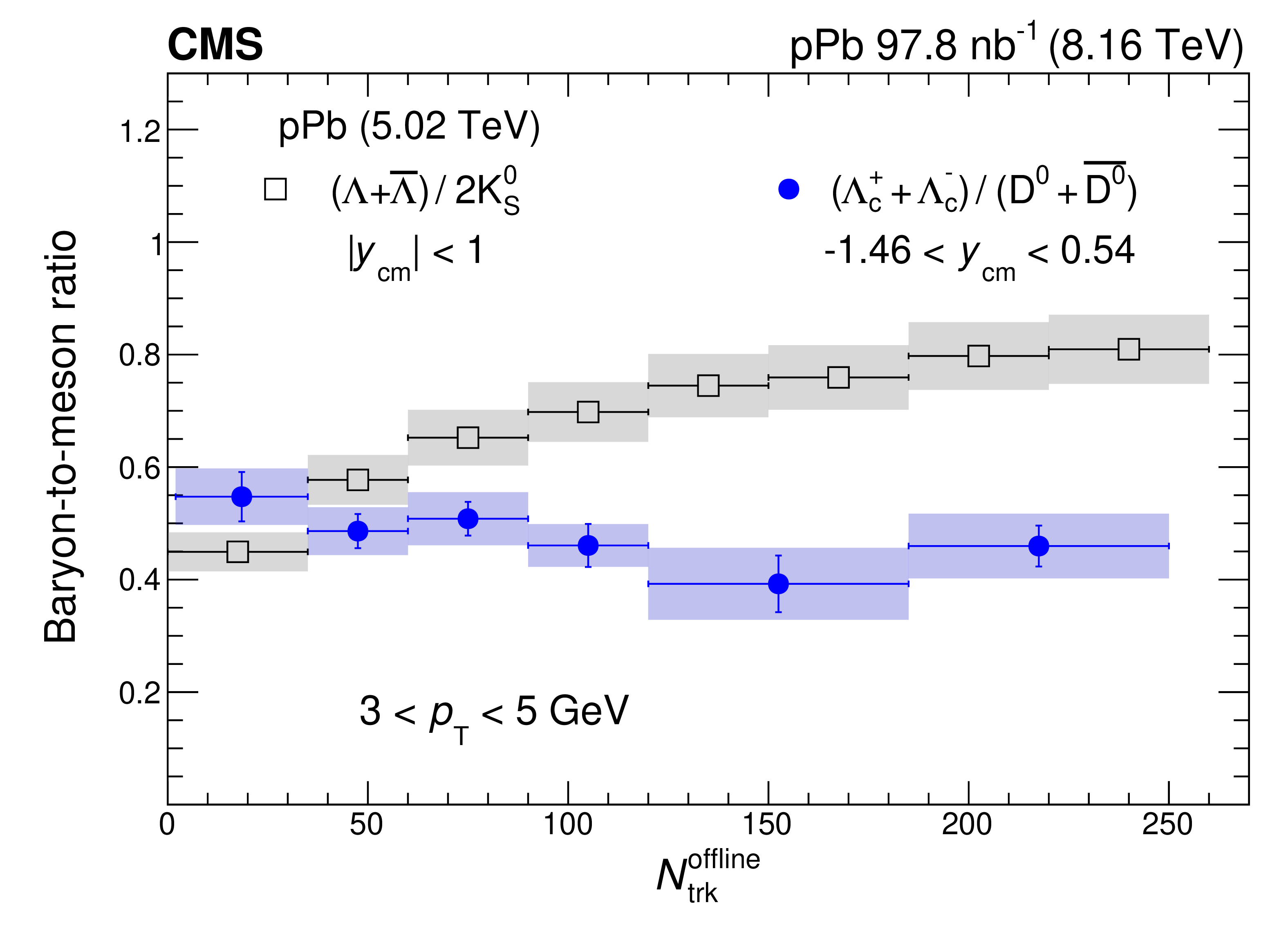
png pdf |
Figure 4:
Ratio of $ \Lambda_{c}^{+} $ baryon to $ \mathrm{D^0} $ meson production with $ -1.46 < y_{\text{cm}} < 0.54 $ in pPb collisions at $ \sqrt{\smash[b]{s_{_{\mathrm{NN}}}}}= $ 8.16 TeV as a function of $ N_\text{trk}^\text{offline} $. The vertical bars show the statistical uncertainties while the shaded areas represent the systematic uncertainties. The ratio of $ \Lambda $ baryon to (two times) $ \mathrm{K^0_S} $ meson production at $ \sqrt{\smash[b]{s_{_{\mathrm{NN}}}}}= $ 5.02 TeV obtained from data in Ref. [54] is also shown for comparisons, denoted by grey markers. |
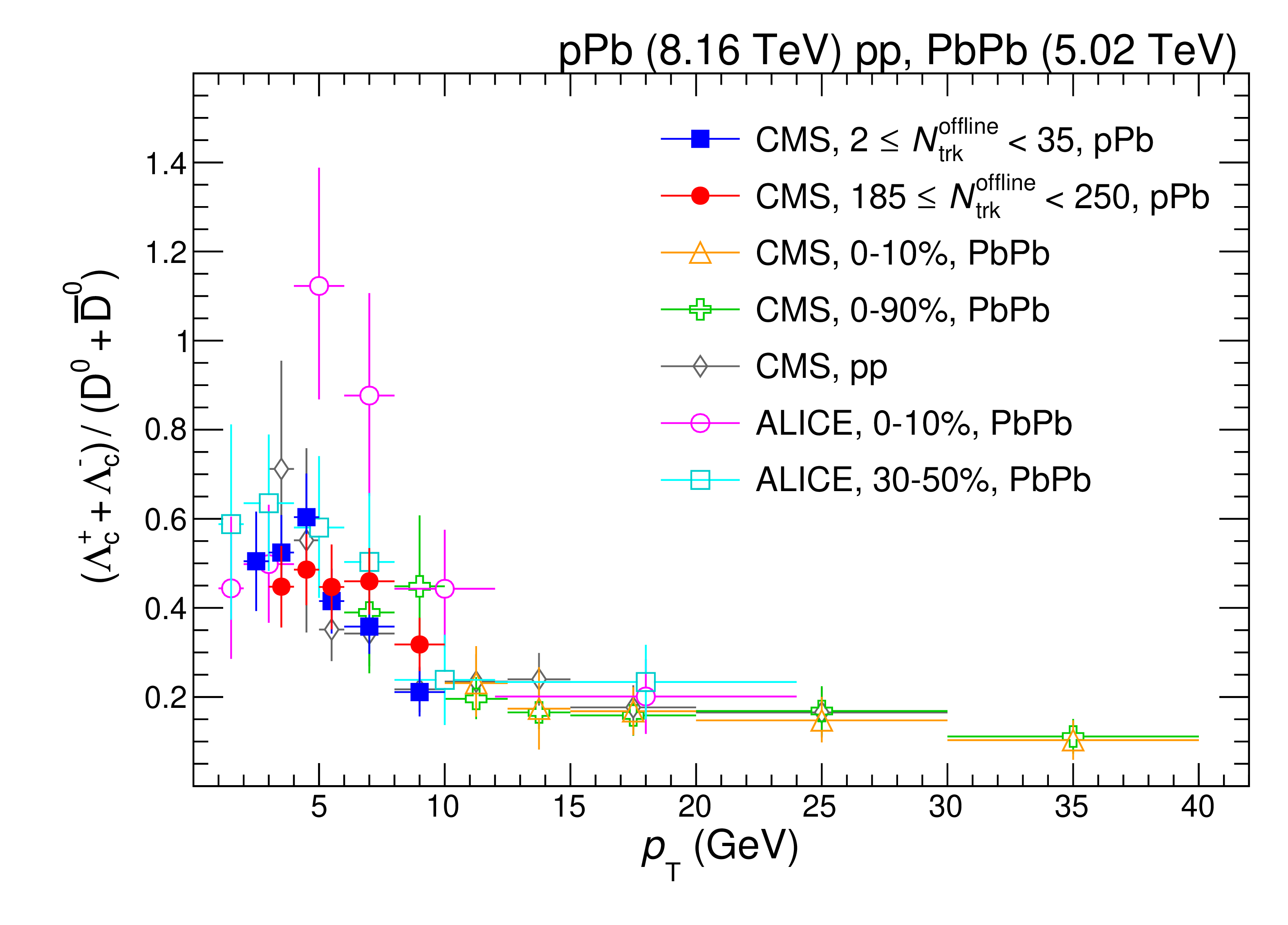
png pdf |
Figure 5:
Comparison between the $ \Lambda_{c}^{+} $-to-$ \mathrm{D^0} $ ratio as a function of $ p_{\mathrm{T}} $ in pp, pPb, and PbPb (different centrality ranges) collisions at the nucleon-nucleon center-of-mass energies of 5.02, 8.16, and 5.02 TeV, respectively [53,87]. The uncertainties are denoted by vertical bars. The ratio is measured with the rapidity ranges $ -1.46 < y_{\text{cm}} < 0.54 $ in pPb collisions and $ |y_{\text{cm}}| < $ 1 in pp and PbPb collisions by the CMS Collaboration [87] and $ |y_{\text{cm}}| < $ 0.5 by the ALICE Collaboration [53]. |
| Tables | |
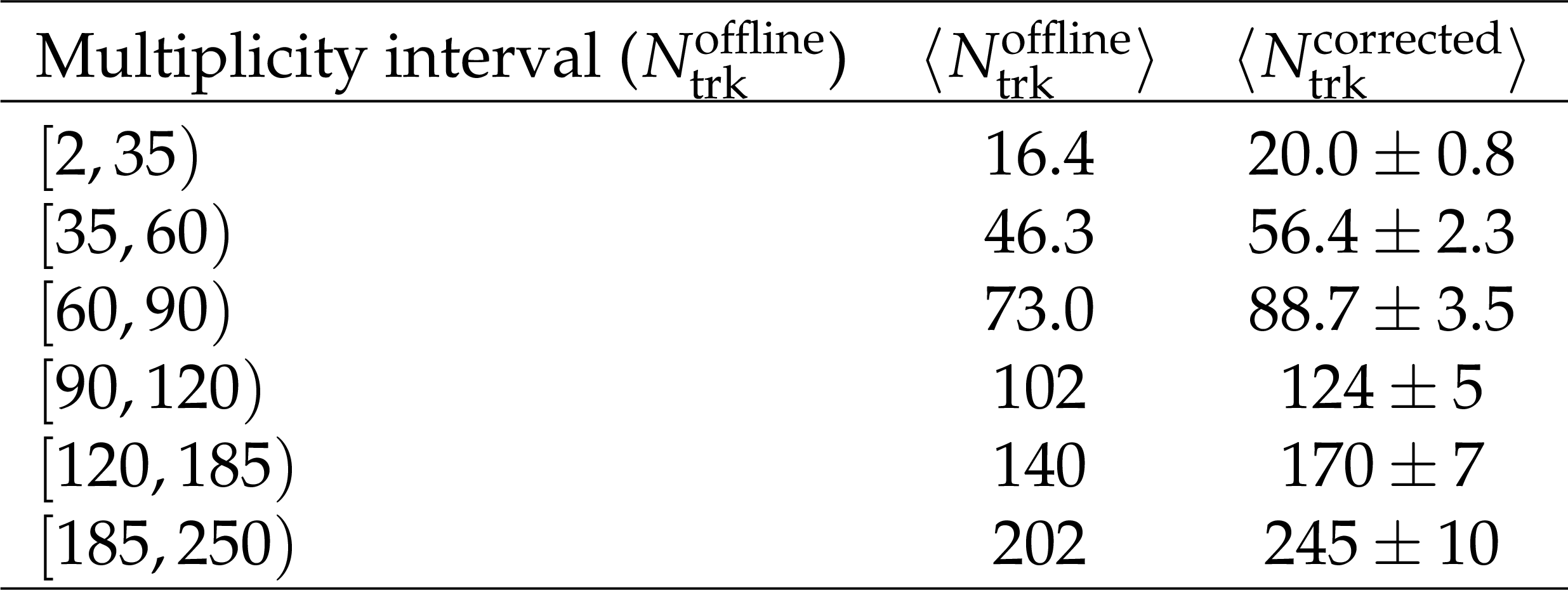
png pdf |
Table 1:
The average multiplicity before (and after) corrections, $ \langle N_\text{trk}^\text{offline}\rangle $ ($ \langle N_\text{trk}^\text{corrected} \rangle $) with track $ p_{\mathrm{T}} > $ 0.4 GeV and $ |\eta_{\text{lab}}| < $ 2.4 in each multiplicity interval. The uncertainties reported for $ \langle N_\text{trk}^\text{corrected} \rangle $ are systematic uncertainties, as the statistical uncertainties have been found to be negligible. |
png pdf |
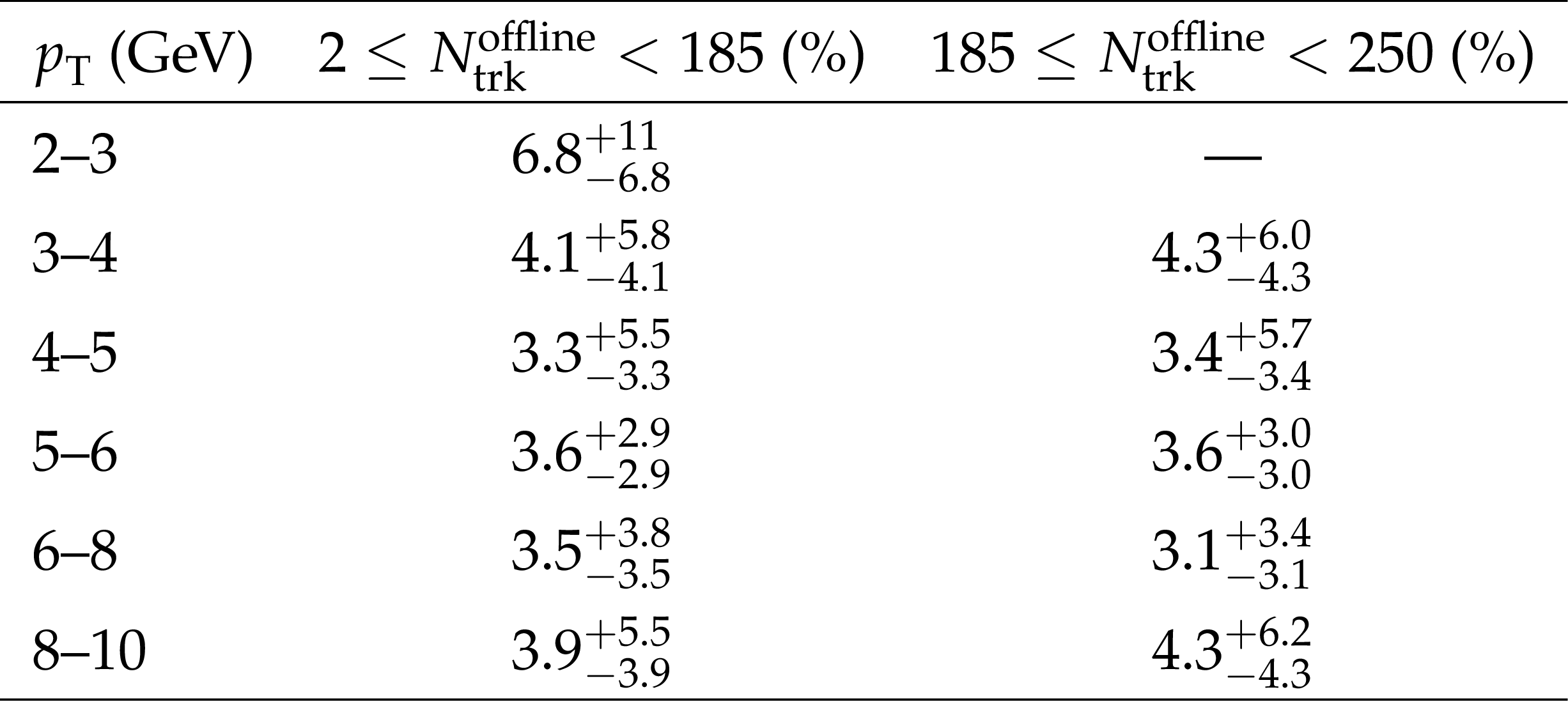
Table 2:
Summary table for the fraction of nonprompt $ \Lambda_{c}^{+} $ baryons (1-$ f^{\text{prompt}} $) relative to inclusive $ \Lambda_{c}^{+} $ baryons. The fraction is evaluated in different multiplicity ranges. Details regarding the systematic uncertainties are described in Section 4. |
png pdf |
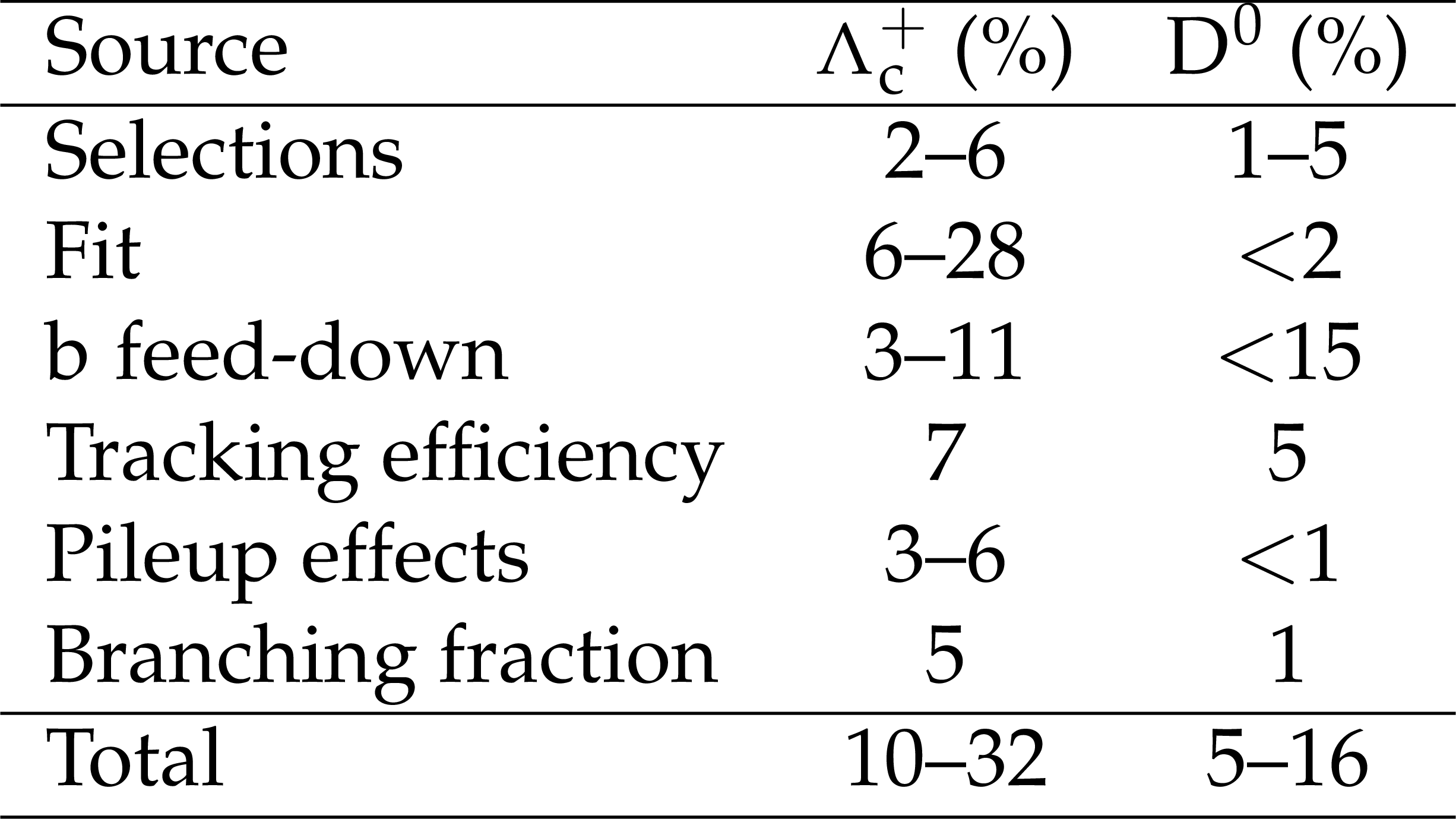
Table 3:
Summary of relative uncertainties in the differential yields. |
| Summary |
| The first measurements of $ \Lambda_{c}^{+} $ baryon and $ \mathrm{D^0} $ meson yields, as well as their yield ratios, as a function of the charged-particle multiplicity in proton-lead (pPb) collisions are presented. At a nucleon-nucleon center-of-mass energy of 8.16 TeV, the $ \Lambda_{c}^{+} $ baryon is reconstructed using the decay channel $ \Lambda_{c}^{+} \to \mathrm{K^0_S} \mathrm{p} $, while the $ \mathrm{D^0} $ meson is reconstructed from $ \mathrm{D^0}\to\mathrm{K^-}\pi^{+} $. The $ \Lambda_{c}^{+} $ and $ \mathrm{D^0} $ production yields, and the $ \Lambda_{c}^{+} $-to-$ \mathrm{D^0} $ yield ratio are studied as a function of transverse momentum and charged-particle multiplicity. No strong multiplicity dependence is observed within the experimental uncertainties. The absence of any significant multiplicity dependence of the yield ratio differs strikingly from that for strange hadrons, which is observed to increase with multiplicity. The difference between these results for charm quarks and those for strange quarks might indicate that the conjectured coalescence processes of heavy quarks happen earlier than those of strange quarks. |
| References | ||||
| 1 | ALICE Collaboration | Elliptic flow of charged particles in Pb-Pb collisions at 2.76 TeV | PRL 105 (2010) 252302 | 1011.3914 |
| 2 | CMS Collaboration | Measurement of the elliptic anisotropy of charged particles produced in PbPb collisions at nucleon-nucleon center-of-mass energy = 2.76 TeV | Phys. Rev. C 87 (2013) 014902 | CMS-HIN-10-002 1204.1409 |
| 3 | ALICE Collaboration | The ALICE experiment: a journey through QCD | EPJC 84 (2024) 813 | 2211.04384 |
| 4 | CMS Collaboration | Overview of high-density QCD studies with the CMS experiment at the LHC | Submitted to Physics Reports, 2024 | CMS-HIN-23-011 2405.10785 |
| 5 | STAR Collaboration | Elliptic flow in Au+Au collisions at $ \sqrt{\smash[b]{s_{_{\mathrm{NN}}}}} = $ 130 GeV | PRL 86 (2001) 402 | nucl-ex/0009011 |
| 6 | PHENIX Collaboration | Elliptic flow of identified hadrons in Au+Au collisions at $ \sqrt{\smash[b]{s_{_{\mathrm{NN}}}}} = $ 200 GeV | PRL 91 (2003) 182301 | nucl-ex/0305013 |
| 7 | STAR Collaboration | Distributions of charged hadrons associated with high transverse momentum particles in pp and Au+Au collisions at $ \sqrt{\smash[b]{s_{_{\mathrm{NN}}}}} = $ 200 GeV | PRL 95 (2005) 152301 | nucl-ex/0501016 |
| 8 | PHOBOS Collaboration | System size dependence of cluster properties from two- particle angular correlations in Cu+Cu and Au+Au collisions at $ \sqrt{\smash[b]{s_{_{\mathrm{NN}}}}} = $ 200 GeV | Phys. Rev. C 81 (2010) 024904 | 0812.1172 |
| 9 | PHOBOS Collaboration | High transverse momentum triggered correlations over a large pseudorapidity acceptance in Au+Au collisions at $ \sqrt{\smash[b]{s_{_{\mathrm{NN}}}}} = $ 200 GeV | PRL 104 (2010) 062301 | 0903.2811 |
| 10 | STAR Collaboration | Long range rapidity correlations and jet production in high energy nuclear collisions | Phys. Rev. C 80 (2009) 064912 | 0909.0191 |
| 11 | CMS Collaboration | Long-range and short-range dihadron angular correlations in central PbPb collisions at a nucleon-nucleon center of mass energy of 2.76 TeV | JHEP 07 (2011) 076 | CMS-HIN-11-001 1105.2438 |
| 12 | CMS Collaboration | Centrality dependence of dihadron correlations and azimuthal anisotropy harmonics in PbPb collisions at $ \sqrt{\smash[b]{s_{_{\mathrm{NN}}}}} = $ 2.76 TeV | EPJC 72 (2012) 2012 | CMS-HIN-11-006 1201.3158 |
| 13 | ATLAS Collaboration | Measurement of the azimuthal anisotropy for charged particle production in $ \sqrt{\smash[b]{s_{_{\mathrm{NN}}}}} = $ 2.76 TeV lead-lead collisions with the ATLAS detector | Phys. Rev. C 86 (2012) 014907 | 1203.3087 |
| 14 | CMS Collaboration | Studies of azimuthal dihadron correlations in ultra-central PbPb collisions at $ \sqrt{\smash[b]{s_{_{\mathrm{NN}}}}} = $ 2.76 TeV | JHEP 02 (2014) 088 | CMS-HIN-12-011 1312.1845 |
| 15 | J.-Y. Ollitrault | Anisotropy as a signature of transverse collective flow | PRD 46 (1992) 229 | |
| 16 | U. Heinz and R. Snellings | Collective flow and viscosity in relativistic heavy-ion collisions | Ann. Rev. Nucl. Part. Sci. 63 (2013) 123 | 1301.2826 |
| 17 | C. Gale, S. Jeon, and B. Schenke | Hydrodynamic modeling of heavy-ion collisions | Int. J. Mod. Phys. A 28 (2013) 1340011 | 1301.5893 |
| 18 | ALICE Collaboration | $ \mathrm{D} $-meson azimuthal anisotropy in midcentral Pb-Pb collisions at $ \sqrt{\smash[b]{s_{_{\mathrm{NN}}}}}= $ 5.02 TeV | PRL 120 (2018) 102301 | 1707.01005 |
| 19 | CMS Collaboration | Elliptic flow of charm and strange hadrons in high-multiplicity pPb collisions at $ \sqrt{\smash[b]{s_{_{\mathrm{NN}}}}} = $ 8.16 TeV | PRL 121 (2018) 082301 | CMS-HIN-17-003 1804.09767 |
| 20 | CMS Collaboration | Measurement of prompt $ \mathrm{D^0} $ and $ {\mathrm{\overline{D}}^0} $ meson azimuthal anisotropy and search for strong electric fields in PbPb collisions at $ \sqrt{\smash[b]{s_{_{\mathrm{NN}}}}}= $ 5.02 TeV | PLB 816 (2021) 136253 | CMS-HIN-19-008 2009.12628 |
| 21 | ALICE Collaboration | Elliptic flow of electrons from beauty-hadron decays in Pb-Pb collisions at $ \sqrt{\smash[b]{s_{_{\mathrm{NN}}}}}= $ 5.02 TeV | PRL 126 (2021) 162001 | 2005.11130 |
| 22 | ATLAS Collaboration | Measurement of azimuthal anisotropy of muons from charm and bottom hadrons in Pb+Pb collisions at $ \sqrt{\smash[b]{s_{_{\mathrm{NN}}}}}= $ 5.02 TeV with the ATLAS detector | PLB 807 (2020) 135595 | 2003.03565 |
| 23 | CMS Collaboration | Measurements of azimuthal anisotropy of nonprompt $ \mathrm{D^0} $ mesons in PbPb collisions at $ \sqrt{\smash[b]{s_{_{\mathrm{NN}}}}}= $ 5.02 TeV | PLB 850 (2024) 138389 | CMS-HIN-21-003 2212.01636 |
| 24 | CMS Collaboration | Observation of long-range near-side angular correlations in proton-proton collisions at the LHC | JHEP 09 (2010) 091 | CMS-QCD-10-002 1009.4122 |
| 25 | ATLAS Collaboration | Observation of long-range elliptic azimuthal anisotropies in $ \sqrt{s} = $ 13 and 2.76 TeV pp collisions with the ATLAS detector | PRL 116 (2016) 172301 | 1509.04776 |
| 26 | CMS Collaboration | Measurement of long-range near-side two-particle angular correlations in pp collisions at $ \sqrt{s} = $13 TeV | PRL 116 (2016) 172302 | CMS-FSQ-15-002 1510.03068 |
| 27 | CMS Collaboration | Evidence for collectivity in pp collisions at the LHC | PLB 765 (2017) 193 | CMS-HIN-16-010 1606.06198 |
| 28 | CMS Collaboration | Observation of long-range near-side angular correlations in proton-lead collisions at the LHC | PLB 718 (2013) 795 | CMS-HIN-12-015 1210.5482 |
| 29 | ALICE Collaboration | Long-range angular correlations on the near and away side in $ \mathrm{p}\text{Pb} $\ collisions at $ \sqrt{\smash[b]{s_{_{\mathrm{NN}}}}} = $ 5.02 TeV | PLB 719 (2013) 29 | 1212.2001 |
| 30 | ATLAS Collaboration | Observation of associated near-side and away-side long-range correlations in $ \sqrt{\smash[b]{s_{_{\mathrm{NN}}}}} = $ 5.02 TeV proton-lead collisions with the ATLAS detector | PRL 110 (2013) 182302 | 1212.5198 |
| 31 | CMS Collaboration | Multiplicity and transverse momentum dependence of two- and four-particle correlations in $ \mathrm{p}\text{Pb} $\ and PbPb\ collisions | PLB 724 (2013) 213 | CMS-HIN-13-002 1305.0609 |
| 32 | LHCb Collaboration | Measurements of long-range near-side angular correlations in $ \sqrt{\smash[b]{s_{_{\mathrm{NN}}}}} = $ 5 TeV proton-lead collisions in the forward region | PLB 762 (2016) 473 | 1512.00439 |
| 33 | ALICE Collaboration | Long-range angular correlations of $ \pi $, K and p in p-Pb collisions at $ \sqrt{\smash[b]{s_{_{\mathrm{NN}}}}} = $ 5.02 TeV | PLB 726 (2013) 164 | 1307.3237 |
| 34 | CMS Collaboration | Long-range two-particle correlations of strange hadrons with charged particles in pPb and PbPb collisions at LHC energies | PLB 742 (2015) 200 | CMS-HIN-14-002 1409.3392 |
| 35 | CMS Collaboration | Evidence for collective multi-particle correlations in pPb collisions | PRL 115 (2015) 012301 | CMS-HIN-14-006 1502.05382 |
| 36 | ATLAS Collaboration | Measurement of multi-particle azimuthal correlations in pp, p+Pb and low-multiplicity Pb+Pb collisions with the ATLAS detector | EPJC 77 (2017) 428 | 1705.04176 |
| 37 | ATLAS Collaboration | Measurement of long-range multiparticle azimuthal correlations with the subevent cumulant method in pp and p+Pb collisions with the ATLAS detector at the CERN Large Hadron Collider | Phys. Rev. C 97 (2018) 024904 | 1708.03559 |
| 38 | PHENIX Collaboration | Creation of quark-gluon plasma droplets with three distinct geometries | Nature Phys. 15 (2019) 214 | 1805.02973 |
| 39 | CMS Collaboration | Studies of charm and beauty hadron long-range correlations in pp and pPb collisions at LHC energies | PLB 813 (2021) 136036 | CMS-HIN-19-009 2009.07065 |
| 40 | ALICE Collaboration | Search for collectivity with azimuthal J/$ \psi $-hadron correlations in high multiplicity p-Pb collisions at $ \sqrt{\smash[b]{s_{_{\mathrm{NN}}}}} = $ 5.02 and 8.16 TeV | PLB 780 (2018) 7 | 1709.06807 |
| 41 | CMS Collaboration | Observation of prompt $ \mathrm{J}/\psi $ meson elliptic flow in high-multiplicity pPb collisions at $ \sqrt{\smash[b]{s_{_{\mathrm{NN}}}}} = $ 8.16 TeV | PLB 791 (2019) 172 | CMS-HIN-18-010 1810.01473 |
| 42 | ATLAS Collaboration | Measurement of azimuthal anisotropy of muons from charm and bottom hadrons in pp collisions at $ \sqrt{s}= $ 13 TeV with the ATLAS detector | PRL 124 (2020) 082301 | 1909.01650 |
| 43 | K. Dusling, W. Li, and B. Schenke | Novel collective phenomena in high-energy proton-proton and proton-nucleus collisions | Int. J. Mod. Phys. E 25 (2016) 1630002 | 1509.07939 |
| 44 | J. L. Nagle and W. A. Zajc | Small system collectivity in relativistic hadronic and nuclear collisions | Ann. Rev. Nucl. Part. Sci. 68 (2018) 211 | 1801.03477 |
| 45 | X. Du and R. Rapp | In-medium charmonium production in proton-nucleus collisions | JHEP 03 (2019) 015 | 1808.10014 |
| 46 | C. Zhang et al. | Elliptic flow of heavy quarkonia in pA collisions | PRL 122 (2019) 172302 | 1901.10320 |
| 47 | R. J. Fries, B. Muller, C. Nonaka, and S. A. Bass | Hadronization in heavy ion collisions: recombination and fragmentation of partons | PRL 90 (2003) 202303 | nucl-th/0301087 |
| 48 | R. J. Fries, B. Muller, C. Nonaka, and S. A. Bass | Hadron production in heavy ion collisions: fragmentation and recombination from a dense parton phase | Phys. Rev. C 68 (2003) 044902 | nucl-th/0306027 |
| 49 | S. Plumari et al. | Charmed hadrons from coalescence plus fragmentation in relativistic nucleus-nucleus collisions at RHIC and LHC | EPJC 78 (2018) 348 | 1712.00730 |
| 50 | M. He and R. Rapp | Hadronization and charm-hadron ratios in heavy-ion collisions | PRL 124 (2020) 042301 | 1905.09216 |
| 51 | STAR Collaboration | First measurement of $ \Lambda_{c}^{+} $ baryon production in AuAu collisions at $ \sqrt{\smash[b]{s_{_{\mathrm{NN}}}}} = $ 200 GeV | PRL 124 (2020) 172301 | 1910.14628 |
| 52 | CMS Collaboration | Production of $ \Lambda_{c}^{+} $ baryons in proton-proton and lead-lead collisions at $ \sqrt{\smash[b]{s_{_{\mathrm{NN}}}}}= $ 5.02 TeV | PLB 803 (2020) 135328 | CMS-HIN-18-009 1906.03322 |
| 53 | ALICE Collaboration | Constraining hadronization mechanisms with $ \Lambda_{c}^{+}/\mathrm{D^0} $ production ratios in PbPb collisions at $ \sqrt{\smash[b]{s_{_{\mathrm{NN}}}}} = $ 5.02 TeV | PLB 839 (2023) 137796 | 2112.08156 |
| 54 | CMS Collaboration | Multiplicity and rapidity dependence of strange hadron production in pp, $ \mathrm{p}\text{Pb} $, and PbPb collisions at the LHC | PLB 768 (2017) 103 | CMS-HIN-15-006 1605.06699 |
| 55 | H.-H. Li, F.-L. Shao, J. Song, and R.-Q. Wang | Production of single-charm hadrons by quark combination mechanism in \PpPb collisions at $ \sqrt{\smash[b]{s_{_{\mathrm{NN}}}}}= $ 5.02 TeV | Phys. Rev. C 97 (2018) 064915 | 1712.08921 |
| 56 | V. Minissale, S. Plumari, and V. Greco | Charm hadrons in pp collisions at LHC energy within a coalescence plus fragmentation approach | PLB 821 (2021) 136622 | 2012.12001 |
| 57 | ALICE Collaboration | $ \Lambda_{c}^{+} $ production and baryon-to-meson ratios in pp and pPb collisions at $ \sqrt{\smash[b]{s_{_{\mathrm{NN}}}}}= $ 5.02 TeV at the LHC | PRL 127 (2021) 202301 | 2011.06078 |
| 58 | ALICE Collaboration | $ \Lambda_{c}^{+} $ production in pp and in \PpPb collisions at $ \sqrt{\smash[b]{s_{_{\mathrm{NN}}}}}= $ 5.02 TeV | Phys. Rev. C 104 (2021) 054905 | 2011.06079 |
| 59 | ALICE Collaboration | First measurement of $ \Lambda_{c}^{+} $ production down to $ p_{\mathrm{T}} = $ 0 in pp and pPb collisions at $ \sqrt{\smash[b]{s_{_{\mathrm{NN}}}}} = $ 5.02 TeV | Phys. Rev. C 107 (2023) 064901 | 2211.14032 |
| 60 | ALICE Collaboration | Observation of a multiplicity dependence in the $ p_{\rm T} $-differential charm baryon-to-meson ratios in proton-proton collisions at $ \sqrt{s} = $ 13 TeV | PLB 829 (2022) 137065 | 2111.11948 |
| 61 | M. He and R. Rapp | Charm-baryon production in proton-proton collisions | PLB 795 (2019) 117 | 1902.08889 |
| 62 | CMS Collaboration | HEPData record for this analysis | link | |
| 63 | G. Bayatian et al. | Design, performance and calibration of the CMS forward calorimeter wedges | EPJC 53 (2008) 139 | |
| 64 | CMS Collaboration | The CMS experiment at the CERN LHC | JINST 3 (2008) S08004 | |
| 65 | CMS Collaboration | Description and performance of track and primary-vertex reconstruction with the CMS tracker | JINST 9 (2014) P10009 | CMS-TRK-11-001 1405.6569 |
| 66 | CMS Collaboration | Performance of the CMS Level-1 trigger in proton-proton collisions at $ \sqrt{s} = $ 13\,TeV | JINST 15 (2020) P10017 | CMS-TRG-17-001 2006.10165 |
| 67 | CMS Collaboration | The CMS trigger system | JINST 12 (2017) P01020 | CMS-TRG-12-001 1609.02366 |
| 68 | CMS Collaboration | CMS luminosity measurement using 2016 proton-nucleus collisions at nucleon-nucleon center-of-mass energy of 8.16 TeV | Physics Analysis Summary, 2018 CMS-PAS-LUM-17-002 |
CMS-PAS-LUM-17-002 |
| 69 | CMS Collaboration | Constraints on the chiral magnetic effect using charge-dependent azimuthal correlations in $ \mathrm{p}\text{Pb} $ and PbPb collisions at the CERN Large Hadron Collider | Phys. Rev. C 97 (2018) 044912 | CMS-HIN-17-001 1708.01602 |
| 70 | CMS Collaboration | Observation of correlated azimuthal anisotropy fourier harmonics in pp and p+Pb collisions at the LHC | PRL 120 (2018) 092301 | CMS-HIN-16-022 1709.09189 |
| 71 | T. Sjöstrand et al. | An introduction to PYTHIA 8.2 | Comput. Phys. Commun. 191 (2015) 159 | 1410.3012 |
| 72 | CMS Collaboration | Extraction and validation of a new set of CMS PYTHIA8 tunes from underlying-event measurements | EPJC 80 (2020) 4 | CMS-GEN-17-001 1903.12179 |
| 73 | T. Pierog et al. | EPOS LHC: Test of collective hadronization with data measured at the CERN Large Hadron Collider | Phys. Rev. C 92 (2015) 034906 | 1306.0121 |
| 74 | Geant4 Collaboration | GEANT 4---a simulation toolkit | Nucl. Instrum. and Meth. A 506 (2003) 250 | |
| 75 | D. J. Lange | The EVTGEN particle decay simulation package | NIM A 462 (2001) 152 | |
| 76 | Particle Data Group Collaboration | Review of particle physics | PRD 110 (2024) 030001 | |
| 77 | H. Voss, A. Höcker, J. Stelzer, and F. Tegenfeldt | TMVA, the toolkit for multivariate data analysis with ROOT | in XIth International Workshop on Advanced Computing and Analysis Techniques in Physics Research (ACAT), . . . [PoS(ACAT)040], 2007 link |
physics/0703039 |
| 78 | A. Giammanco | Particle identification with energy loss in the CMS silicon strip tracker | CMS Note CERN-CMS-NOTE-2008-005, 2008 | |
| 79 | M. J. Oreglia | A study of the reactions $ \psi^\prime \to \gamma \gamma \psi $ | PhD thesis, Stanford University, . SLAC Report SLAC-R-236, 1980 link |
|
| 80 | M. Cacciari et al. | Theoretical predictions for charm and bottom production at the LHC | JHEP 10 (2012) 137 | 1205.6344 |
| 81 | LHCb Collaboration | Measurement of b hadron fractions in 13 TeV pp collisions | PRD 100 (2019) 031102 | 1902.06794 |
| 82 | ALICE Collaboration | Study of flavor dependence of the baryon-to-meson ratio in proton-proton collisions at $ \sqrt{s}= $ 13 TeV | PRD 108 (2023) 112003 | 2308.04873 |
| 83 | LHCb Collaboration | Measurement of $ {\mathrm{B}^{+}} $, $ {\mathrm{B}^0} $ and $ \Lambda_{b}^{0} $ production in $ \mathrm{p}\mathrm{Pb} $ collisions at $ \sqrt{\smash[b]{s_{_{\mathrm{NN}}}}}= $ 8.16 TeV | PRD 99 (2019) 052011 | 1902.05599 |
| 84 | CMS Collaboration | Tracking POG results for pion efficiency with the $ D^{*} $ meson using data from 2016 and 2017 | technical report, 2018 CDS |
|
| 85 | A. Beraudo et al. | In-medium hadronization of heavy quarks and its effect on charmed meson and baryon distributions in heavy-ion collisions | EPJC 82 (2022) 607 | 2202.08732 |
| 86 | C. Zhang et al. | Collectivity of heavy mesons in proton-nucleus collisions | PRD 102 (2020) 034010 | 2002.09878 |
| 87 | CMS Collaboration | Study of charm hadronization with prompt $ \Lambda_{c}^{+} $ baryons in proton-proton and lead-lead collisions at $ \sqrt{\smash[b]{s_{_{\mathrm{NN}}}}} = $ 5.02 TeV | JHEP 01 (2024) 128 | CMS-HIN-21-004 2307.11186 |
|
|
Compact Muon Solenoid LHC, CERN |

|
|
|
|
|
|