
Compact Muon Solenoid
LHC, CERN
 Visit us: CMS Public Website, CMS Physics ;
Contact us: CMS Publications Committee
Visit us: CMS Public Website, CMS Physics ;
Contact us: CMS Publications Committee
| CMS-BPH-24-001 ; CERN-EP-2026-023 | ||
| Observation of the rare decay $ \eta\to\mu^{+}\mu^{-}\mathrm{e}^+\mathrm{e}^- $ | ||
| CMS Collaboration | ||
| 1 May 2026 | ||
| Accepted for publication in Physical Review Letters | ||
| Abstract: A first observation of the rare decay $ \eta\to\mu^{+}\mu^{-}\mathrm{e}^+\mathrm{e}^- $ is reported by the CMS Collaboration at the CERN LHC. The result is based on a proton-proton collision data sample at $ \sqrt{s} = $ 13.6 TeV corresponding to an integrated luminosity of 38.0 fb$ ^{-1} $, acquired in 2022 using a high-rate dimuon trigger. Using the $ \eta\to\mu^{+}\mu^{-}\gamma $ decay channel for normalization, the branching fraction is measured to be $ \mathcal{B}(\eta\to\mu^{+}\mu^{-}\mathrm{e}^+\mathrm{e}^-) = ( $ 2.4 $ \pm $ 0.8 $)\times 10^{-6} $, with the uncertainty including statistical and systematic sources as well as the $ \mathcal{B}(\eta\to\mu^{+}\mu^{-}\gamma) $ uncertainty. This result is close to two orders of magnitude smaller than the existing limit, and is consistent with recent theoretical predictions. | ||
| Links: e-print arXiv:2605.00615 [hep-ex] (PDF) ; CDS record ; inSPIRE record ; HepData record ; Physics Briefing ; CADI line (restricted) ; | ||
| Figures | |
png pdf |
Figure 1:
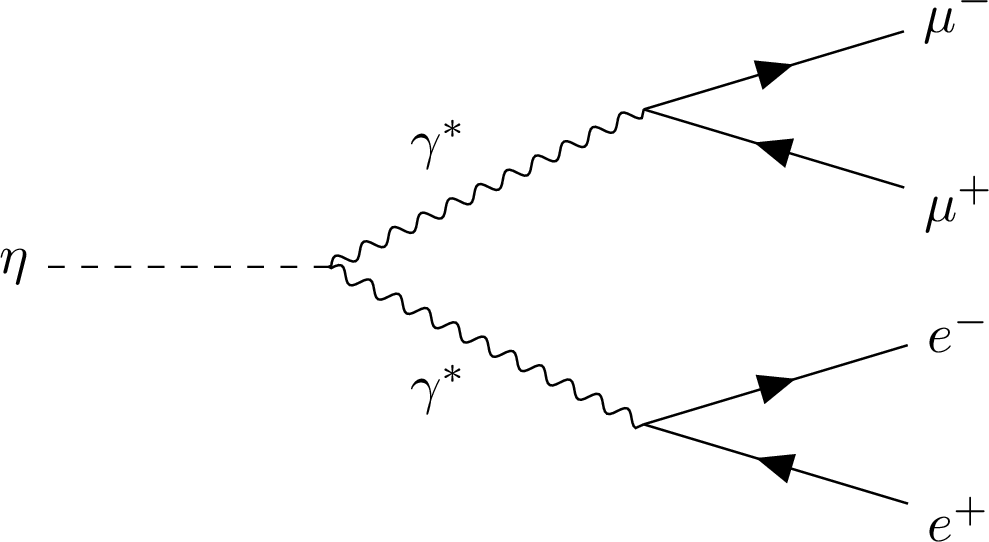
Leading order standard model Feynman diagram for the decay $ \eta\to\mu^{+}\mu^{-}\mathrm{e}^+\mathrm{e}^- $. |
png pdf |
Figure 2:
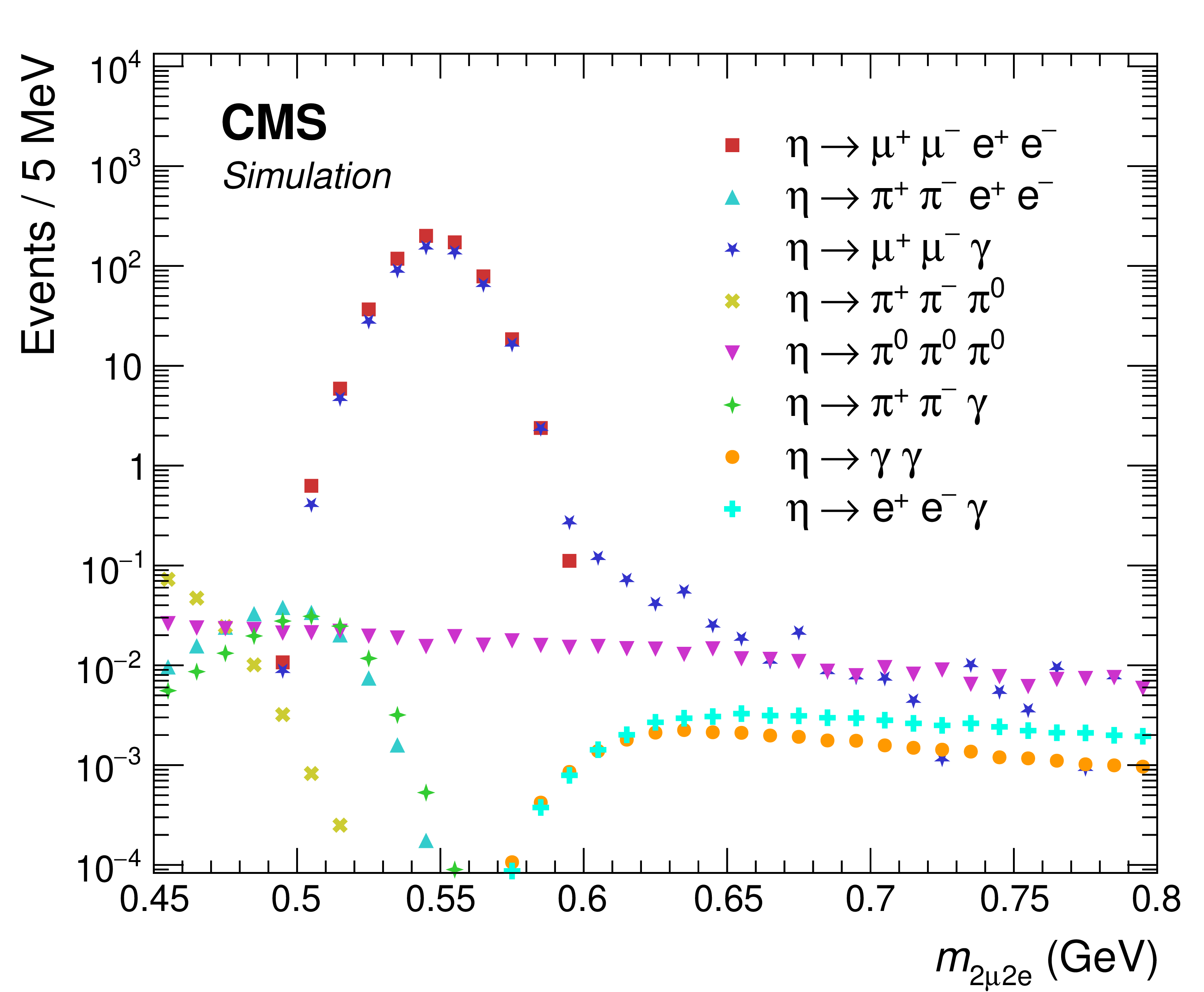
Summary of expected background contributions to the yield measured in the signal channel based on a simplified MC simulation. The signal channel is shown in red squares, and is closely mimicked by the $ \eta\to\mu^{+}\mu^{-}\gamma $ channel, shown in blue stars. Uncertainties are not shown. The equivalent luminosity for the simulation is 38.0 fb$ ^{-1} $. |
png pdf |
Figure 3:
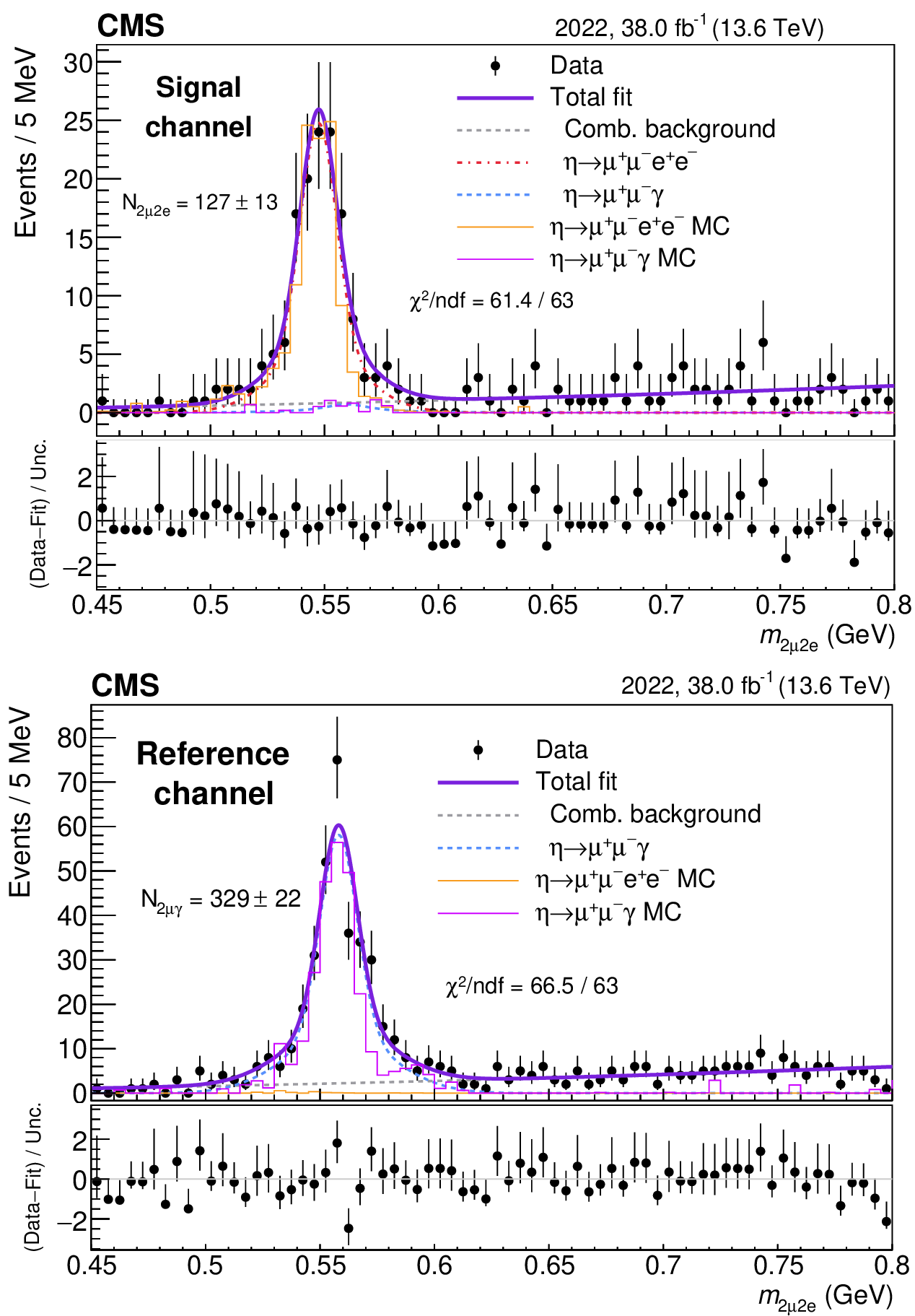
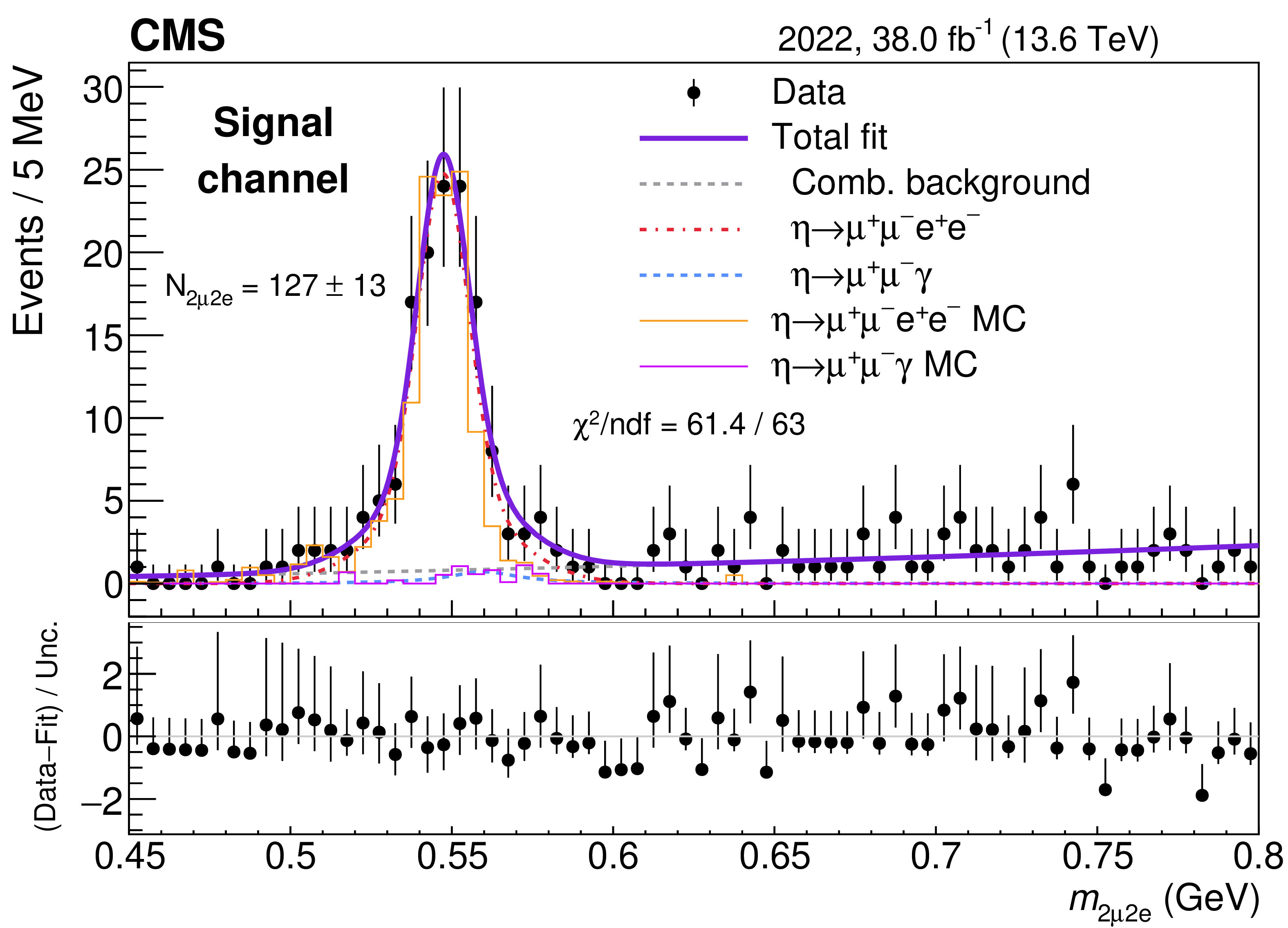
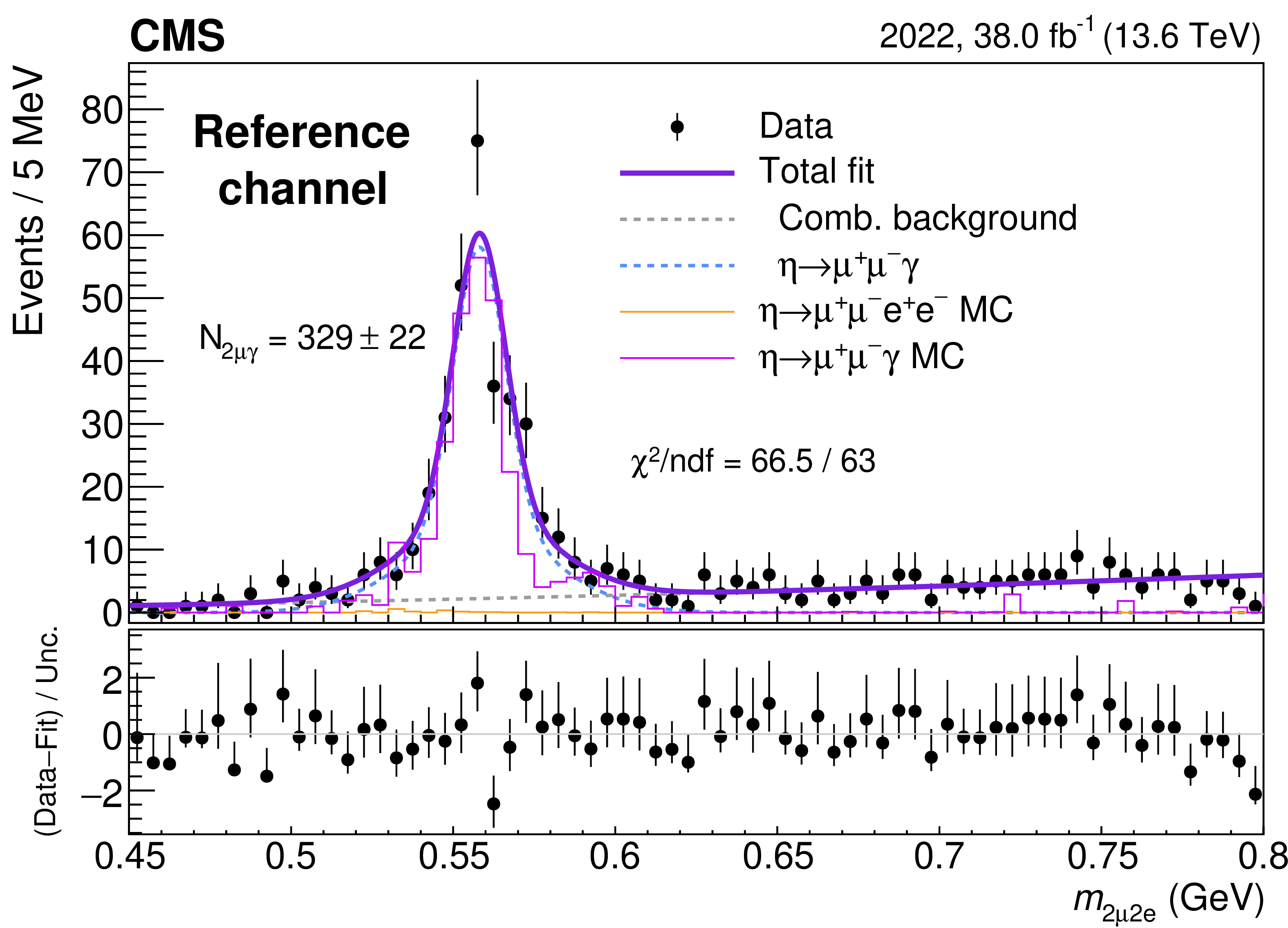
Fit of the four-lepton invariant mass spectra in data for the signal (upper) and reference (lower) channels. Black points denote the data, the dashed grey curve is the combinatorial background fit to a threshold function, the cyan dashed curve is the $ \eta\to\mu^{+}\mu^{-}\gamma $ component of the fit, the red dot-dashed curve (signal channel only) is the $ \eta\to\mu^{+}\mu^{-}\mathrm{e}^+\mathrm{e}^- $ component of the fit, and the solid blue-violet curve is the overall fit including signal and background contributions. The orange distribution is the signal MC simulation (normalized to the BF prediction of 2.4 $ \times10^{-6} $ by Ref. [11]), and the magenta distribution is the $ \eta\to\mu^{+}\mu^{-}\mathrm{e}^+\mathrm{e}^- $ resonant background MC simulation (normalized to the world average BF measurement of 3.1 $ \times 10^{-4} $ [1]), both also normalized using the approximate cross section derived from the $ \eta\to\mu^{+}\mu^{-} $ channel. Points in the lower panel are pulls relative to the full fit model, (data-fit)/$ \sqrt{\smash[b]{\sigma_{\textrm{data}}^2 - \sigma_{\textrm{fit}}^2}} $. |
png pdf |
Figure 3-a:
Fit of the four-lepton invariant mass spectra in data for the signal (upper) and reference (lower) channels. Black points denote the data, the dashed grey curve is the combinatorial background fit to a threshold function, the cyan dashed curve is the $ \eta\to\mu^{+}\mu^{-}\gamma $ component of the fit, the red dot-dashed curve (signal channel only) is the $ \eta\to\mu^{+}\mu^{-}\mathrm{e}^+\mathrm{e}^- $ component of the fit, and the solid blue-violet curve is the overall fit including signal and background contributions. The orange distribution is the signal MC simulation (normalized to the BF prediction of 2.4 $ \times10^{-6} $ by Ref. [11]), and the magenta distribution is the $ \eta\to\mu^{+}\mu^{-}\mathrm{e}^+\mathrm{e}^- $ resonant background MC simulation (normalized to the world average BF measurement of 3.1 $ \times 10^{-4} $ [1]), both also normalized using the approximate cross section derived from the $ \eta\to\mu^{+}\mu^{-} $ channel. Points in the lower panel are pulls relative to the full fit model, (data-fit)/$ \sqrt{\smash[b]{\sigma_{\textrm{data}}^2 - \sigma_{\textrm{fit}}^2}} $. |
png pdf |
Figure 3-b:
Fit of the four-lepton invariant mass spectra in data for the signal (upper) and reference (lower) channels. Black points denote the data, the dashed grey curve is the combinatorial background fit to a threshold function, the cyan dashed curve is the $ \eta\to\mu^{+}\mu^{-}\gamma $ component of the fit, the red dot-dashed curve (signal channel only) is the $ \eta\to\mu^{+}\mu^{-}\mathrm{e}^+\mathrm{e}^- $ component of the fit, and the solid blue-violet curve is the overall fit including signal and background contributions. The orange distribution is the signal MC simulation (normalized to the BF prediction of 2.4 $ \times10^{-6} $ by Ref. [11]), and the magenta distribution is the $ \eta\to\mu^{+}\mu^{-}\mathrm{e}^+\mathrm{e}^- $ resonant background MC simulation (normalized to the world average BF measurement of 3.1 $ \times 10^{-4} $ [1]), both also normalized using the approximate cross section derived from the $ \eta\to\mu^{+}\mu^{-} $ channel. Points in the lower panel are pulls relative to the full fit model, (data-fit)/$ \sqrt{\smash[b]{\sigma_{\textrm{data}}^2 - \sigma_{\textrm{fit}}^2}} $. |
| Summary |
| In summary, the decay $ \eta\to\mu^{+}\mu^{-}\mathrm{e}^+\mathrm{e}^- $ has been observed for the first time, with a significance much larger than 5 standard deviations, with data collected by the CMS experiment at the LHC in 2022. The branching fraction of this decay is measured with respect to the $ \eta\to\mu^{+}\mu^{-}\gamma $ decay mode: $ \mathcal{B}(\eta\to\mu^{+}\mu^{-}\mathrm{e}^+\mathrm{e}^-) = (7.3 \pm 2.2)\times 10^{-3}$.Incorporating the world-average value of $ \eta\to\mu^{+}\mu^{-}\gamma $ results in an $ \eta\to\mu^{+}\mu^{-}\mathrm{e}^+\mathrm{e}^- $ branching fraction of $(2.4 \pm 0.8) \times 10^{-6}$, which is close to two orders of magnitude below the previous upper limit and is consistent with the latest standard model predictions.This measurement provides useful information for the determination of transition form factors that are used for theoretical calculations, such as the muon anomalous magnetic moment. |
| References | ||||
| 1 | Particle Data Group , S. Navas et al. | Review of particle physics | PRD 110 (2024) 030001 | |
| 2 | M. Knecht, S. Narison, A. Rabemananjara, and D. Rabetiarivony | Scalar meson contributions to $ a_\mu $ from hadronic light-by-light scattering | PLB 787 (2018) 111 | 1808.03848 |
| 3 | CMS Collaboration | Observation of the rare decay of the $ \eta $ meson to four muons | PRL 131 (2023) 31 | CMS-BPH-22-003 2305.04904 |
| 4 | L. Gan, B. Kubis, E. Passemar, and S. Tulin | Precision tests of fundamental physics with $ \eta $ and $ \eta^\prime $ mesons | Phys. Rept. 945 (2022) 1 | 2007.00664 |
| 5 | E. Goudzovski et al. | New physics searches at kaon and hyperon factories | Rept. Prog. Phys. 86 (2023) 016201 | 2201.07805 |
| 6 | J. Bijnens and J. Gasser | Eta decays at and beyond $ p^4 $ in chiral perturbation theory | Phys. Scripta T 99 (2002) 34 | hep-ph/0202242 |
| 7 | T. Fujiwara et al. | Non-Abelian anomaly and vector mesons as dynamical gauge bosons of hidden local symmetries | Prog. Theor. Phys. 73 (1985) 926 | |
| 8 | M. Bando, T. Kugo, and K. Yamawaki | On the vector mesons as dynamical gauge bosons of hidden local symmetries | NPB 259 (1985) 493 | |
| 9 | T. Petri | Anomalous decays of pseudoscalar mesons | Masters thesis, University of Bonn, Germany, 2010 | |
| 10 | C.-C. Lih | Study of $ \pi^0 $ and $ \eta $ decays containing dilepton | J. Phys. G: Nucl. Part. Phys 38 (2011) 065001 | 0912.2147 |
| 11 | R. Escribano and S. Gonz \`a lez-Sol \'i s | A data-driven approach to $ \pi^0 $, $ \eta $ and $ \eta^\prime $ single and double Dalitz decays | Chin. Phys. C 42 (2018) 023109 | 1511.04916 |
| 12 | K. Kampf, J. Novotn \'y , and P. Sanchez-Puertas | Radiative corrections to double-Dalitz decays revisited | PRD 97 (2018) 056010 | 1801.06067 |
| 13 | T. Aoyama et al. | The anomalous magnetic moment of the muon in the Standard Model | Phys. Rept. 887 (2020) 1 | 2006.04822 |
| 14 | R. Aliberti et al. | The anomalous magnetic moment of the muon in the Standard Model: an update | Phys. Rept. 1143 (2025) 1 | 2505.21476 |
| 15 | R. Abegg et al. | Measurement of the branching ratio for the decay $ \eta\rightarrow\mu^{+}\mu^{-} $ | PRD 50 (1994) 92 | |
| 16 | BESIII Collaboration | Measurement of the branching fraction of $ \eta \to \mu^+\mu^- $ and search for $ \eta \to e^+e^- $ | PRD 113 (2026) 072002 | 2512.07144 |
| 17 | KLOE, KLOE-2 Collaboration | Observation of the rare $ \eta\to e^+e^-e^+e^- $ decay with the KLOE experiment | PLB 702 (2011) 324 | 1105.6067 |
| 18 | BESIII Collaboration | Observation of the double Dalitz decay $ {\eta}^{'}\rightarrow{e}^{+}{e}^{-}{e}^{+}{e}^{-} $ | PRD 105 (2022) 11 | 2203.12229 |
| 19 | CELSIUS/WASA Collaboration | Measurement of $ \eta $ meson decays into lepton-antilepton pairs | PRD 77 (2008) 032004 | 0711.3531 |
| 20 | CMS Collaboration | HEPData record for this analysis | link | |
| 21 | CMS Collaboration | The CMS experiment at the CERN LHC | JINST 3 (2008) S08004 | |
| 22 | CMS Collaboration | Development of the CMS detector for the CERN LHC Run 3 | JINST 19 (2024) P05064 | CMS-PRF-21-001 2309.05466 |
| 23 | CMS Collaboration | Performance of the CMS Level-1 trigger in proton-proton collisions at $ \sqrt{s} = $ 13 TeV | JINST 15 (2020) P10017 | CMS-TRG-17-001 2006.10165 |
| 24 | CMS Collaboration | The CMS trigger system | JINST 12 (2017) P01020 | CMS-TRG-12-001 1609.02366 |
| 25 | CMS Collaboration | Performance of the CMS high-level trigger during LHC Run 2 | JINST 19 (2024) P11021 | CMS-TRG-19-001 2410.17038 |
| 26 | CMS Collaboration | Electron and photon reconstruction and identification with the CMS experiment at the CERN LHC | JINST 16 (2021) P05014 | CMS-EGM-17-001 2012.06888 |
| 27 | CMS Collaboration | Performance of the CMS muon detector and muon reconstruction with proton-proton collisions at $ \sqrt{s}= $ 13 TeV | JINST 13 (2018) P06015 | CMS-MUO-16-001 1804.04528 |
| 28 | CMS Collaboration | Description and performance of track and primary-vertex reconstruction with the CMS tracker | JINST 9 (2014) P10009 | CMS-TRK-11-001 1405.6569 |
| 29 | CMS Collaboration | Performance of photon reconstruction and identification with the CMS detector in proton-proton collisions at $ \sqrt{s} = $ 8 TeV | JINST 10 (2015) P08010 | CMS-EGM-14-001 1502.02702 |
| 30 | CMS Collaboration | Enriching the physics program of the CMS experiment via data scouting and data parking | Phys. Rept. 1115 (2025) 678 | CMS-EXO-23-007 2403.16134 |
| 31 | R. Fr \"u hwirth | Application of Kalman filtering to track and vertex fitting | NIM A 262 (1987) 444 | |
| 32 | C. Bierlich et al | A comprehensive guide to the physics and usage of PYTHIA 8.3 | SciPost Phys. Codebases 8 (2022) | 2203.11601 |
| 33 | CMS Collaboration | Extraction and validation of a new set of CMS PYTHIA8 tunes from underlying-event measurements | EPJC 80 (2020) 4 | CMS-GEN-17-001 1903.12179 |
| 34 | R. I. Djhelyadin et al. | Investigation of the electromagnetic structure of the $ \eta $ meson in the decay $ \eta \rightarrow \mu^+\mu^-\gamma $ | PLB 94 (1980) 548 | |
| 35 | R. H. Dalitz | On higher Born approximations in potential scattering | Proc. R. Soc. A 206 (1951) 509 | |
| 36 | N. M. Kroll and W. Wada | Internal pair production associated with the emission of high-energy gamma rays | PR 98 (1955) 1355 | |
| 37 | GEANT4 Collaboration | GEANT 4---a simulation toolkit | NIM A 506 (2003) 250 | |
| 38 | I. Fröhlich et al. | Pluto: A Monte Carlo simulation tool for hadronic physics | PoS ACAT 07 (2007) 6 | 0708.2382 |
| 39 | M. J. Oreglia | A study of the reactions $ \psi^\prime \to \gamma \gamma \psi $ | PhD thesis, Stanford University, SLAC Report SLAC-R-236, 1980 link |
|
| 40 | CMS Collaboration | Search for long-lived heavy neutral leptons with displaced vertices in proton-proton collisions at $ \sqrt{s}=13 $TeV | JHEP 07 (2022) 81 | CMS-EXO-20-009 2201.05578 |
|
|
Compact Muon Solenoid LHC, CERN |

|
|
|
|
|
|