Compact Muon Solenoid
LHC, CERN
 Visit us: CMS Public Website, CMS Physics ;
Contact us: CMS Publications Committee
Visit us: CMS Public Website, CMS Physics ;
Contact us: CMS Publications Committee
| CMS-PAS-HIN-26-005 | ||
| Azimuthal anisotropy of charged particles with transverse momentum up to 50 GeV in oxygen-oxygen, neon-neon, and lead-lead collisions | ||
| CMS Collaboration | ||
| 2026-07-23 | ||
| Abstract: The azimuthal anisotropy of charged particles with transverse momenta ranging from 0.3 to 50 GeV is measured in oxygen-oxygen (OO), neon-neon (NeNe), and lead-lead (PbPb) collisions at a nucleon-nucleon center-of-mass energy of $ \sqrt{s_{_\mathrm{NN}}} = $ 5.36 TeV with the CMS detector at the CERN LHC. The analyzed data samples correspond to integrated luminosities of 8.10 $ \mathrm{nb}^{-1} $ for OO, 0.76 $ \mathrm{nb}^{-1} $ for NeNe, and 1.35 $ \mathrm{nb}^{-1} $ for PbPb collisions. The anisotropy coefficients $ v_{2} $ and $ v_{3} $ are extracted using the scalar-product method for different pseudorapidity separations $ \Delta\eta $ among the produced particles in order to suppress short-range nonflow correlations. These coefficients are measured as functions of $ p_\mathrm{T} $ and collision centrality. To estimate residual nonflow contributions, the same analysis is performed using zero-bias proton-proton collisions at the same center-of-mass energy. Results obtained with and without subtraction of nonflow contributions are presented. Comparing these coefficients across distinct collision systems provides a unique way to probe how the system size and geometry influence the creation, lifetime, and initial-state fluctuations of the quark-gluon plasma. The measured high-$ p_\mathrm{T} $ anisotropies are compared with predictions from parton energy loss models. These measurements provide new insights into the underlying mechanisms of high-$ p_\mathrm{T} $ azimuthal anisotropy observed in small partonic systems. | ||
| Links: CDS record (PDF) ; CADI line (restricted) ; | ||
| Figures | |
png pdf |
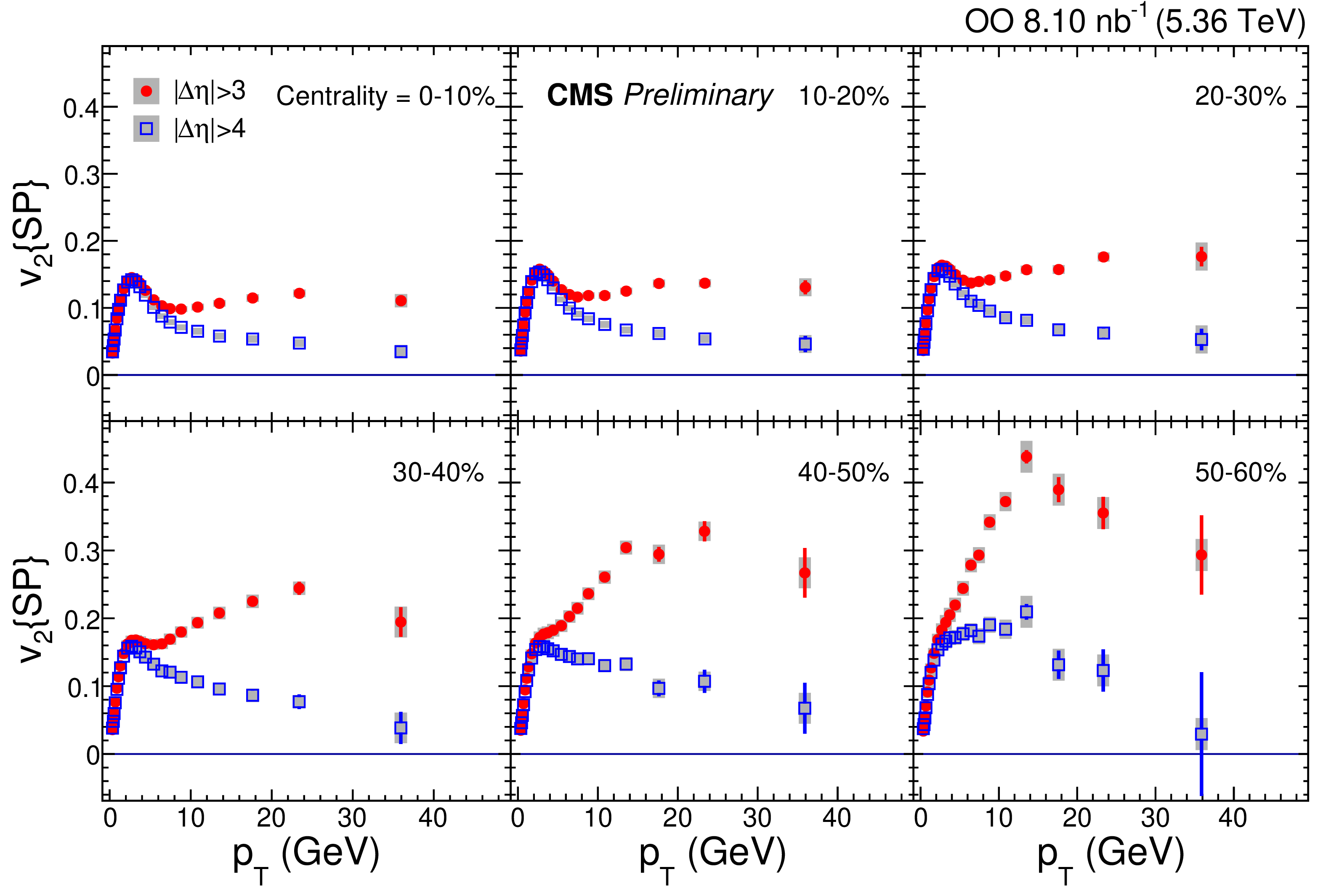
Figure 1:
Scalar product $ v_2(p_{\mathrm{T}}) $ distribution measured in $ \text{OO} $ collisions in six centrality ranges from 0--10% to 50--60%, for $ |\Delta\eta| > $ 3 (red filled circles) and 4 (blue open squares) separations. Vertical bars denote statistical uncertainties and shaded boxes denote systematic uncertainties. |
png pdf |
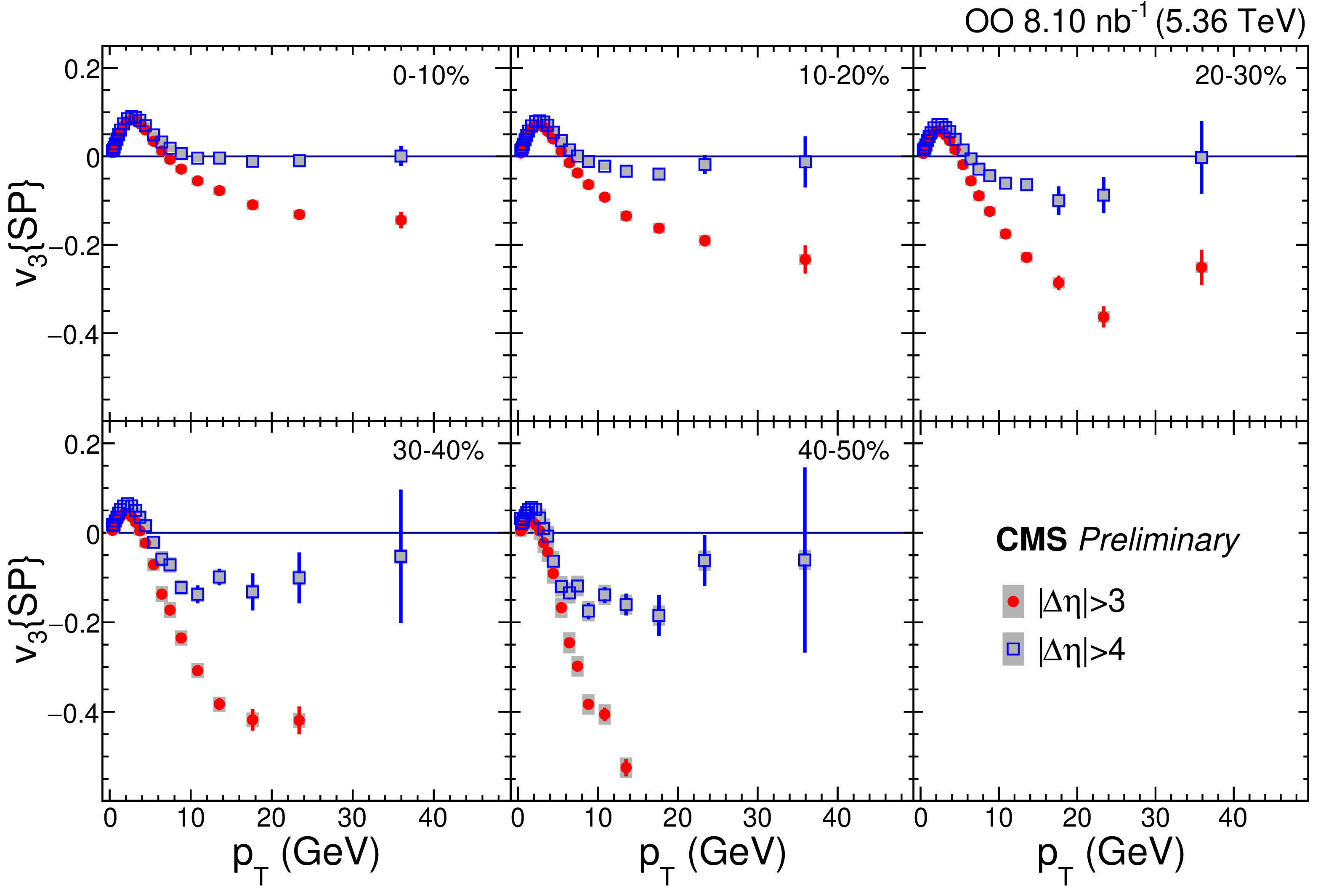
Figure 2:
Scalar product $ v_3(p_{\mathrm{T}}) $ distribution measured in $ \text{OO} $ collisions in five centrality ranges from 0--10% to 40--50%, for $ |\Delta\eta| > $ 3 (red filled circles) and 4 (blue open squares) separations. Vertical bars denote statistical uncertainties and shaded boxes denote systematic uncertainties. |
png pdf |
Figure 3:
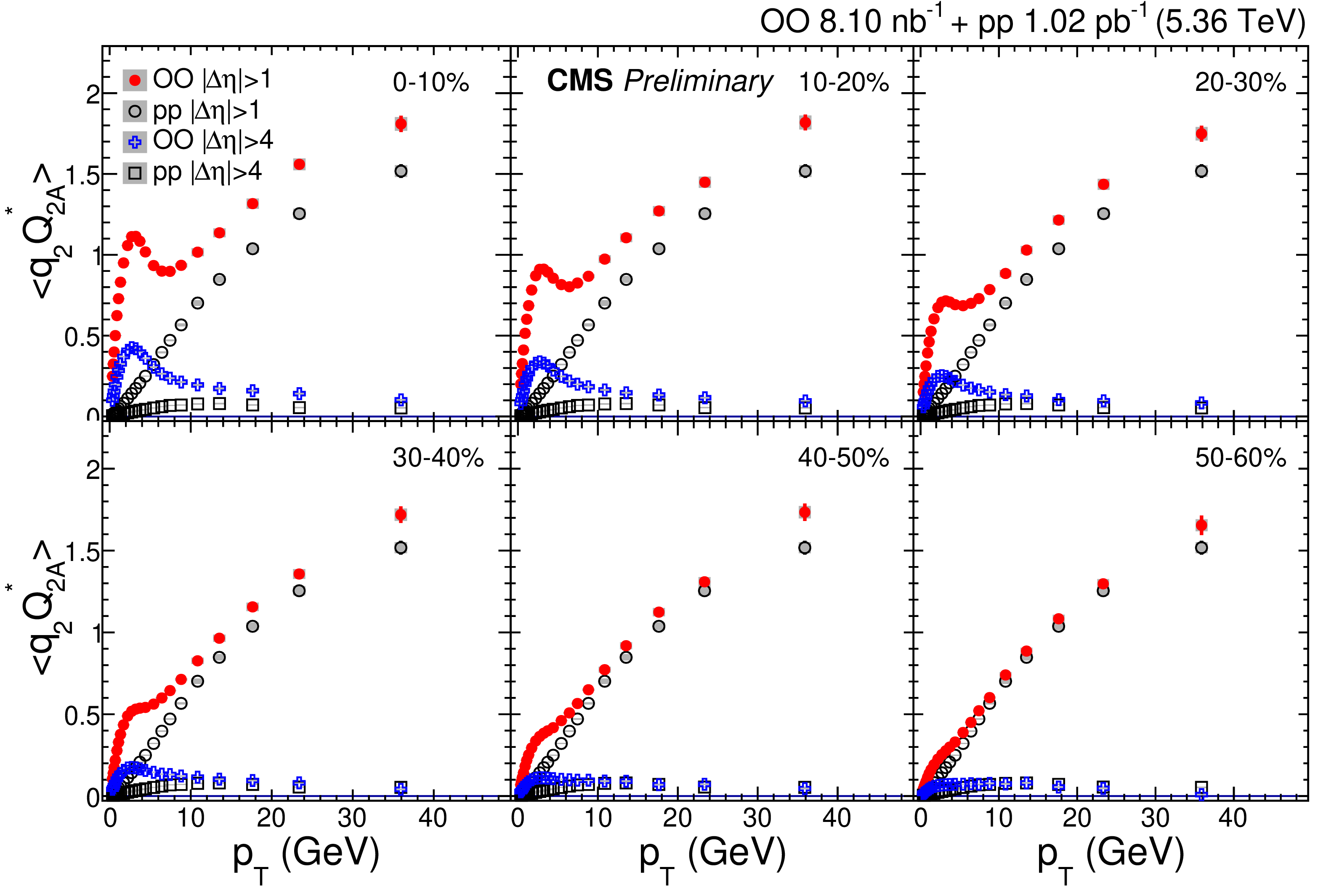
Distribution of azimuthal accumulative correlations $ \left\langle {{q_2}Q_{2A}^*} \right\rangle(p_{\mathrm{T}}) $ measured in $ \text{OO} $ collisions in six centrality ranges from 0--10% to 50--60%, for $ |\Delta\eta| > $ 1 (red filled circles) and 4 (blue open crosses) separations. The distributions measured in pp zero-bias events for $ |\Delta\eta| > $ 1 (black open circles) and 4 (black open squares) separations are added in all plots for comparison. Vertical bars denote statistical uncertainties and shaded boxes denote systematic uncertainties. |
png pdf |
Figure 4:
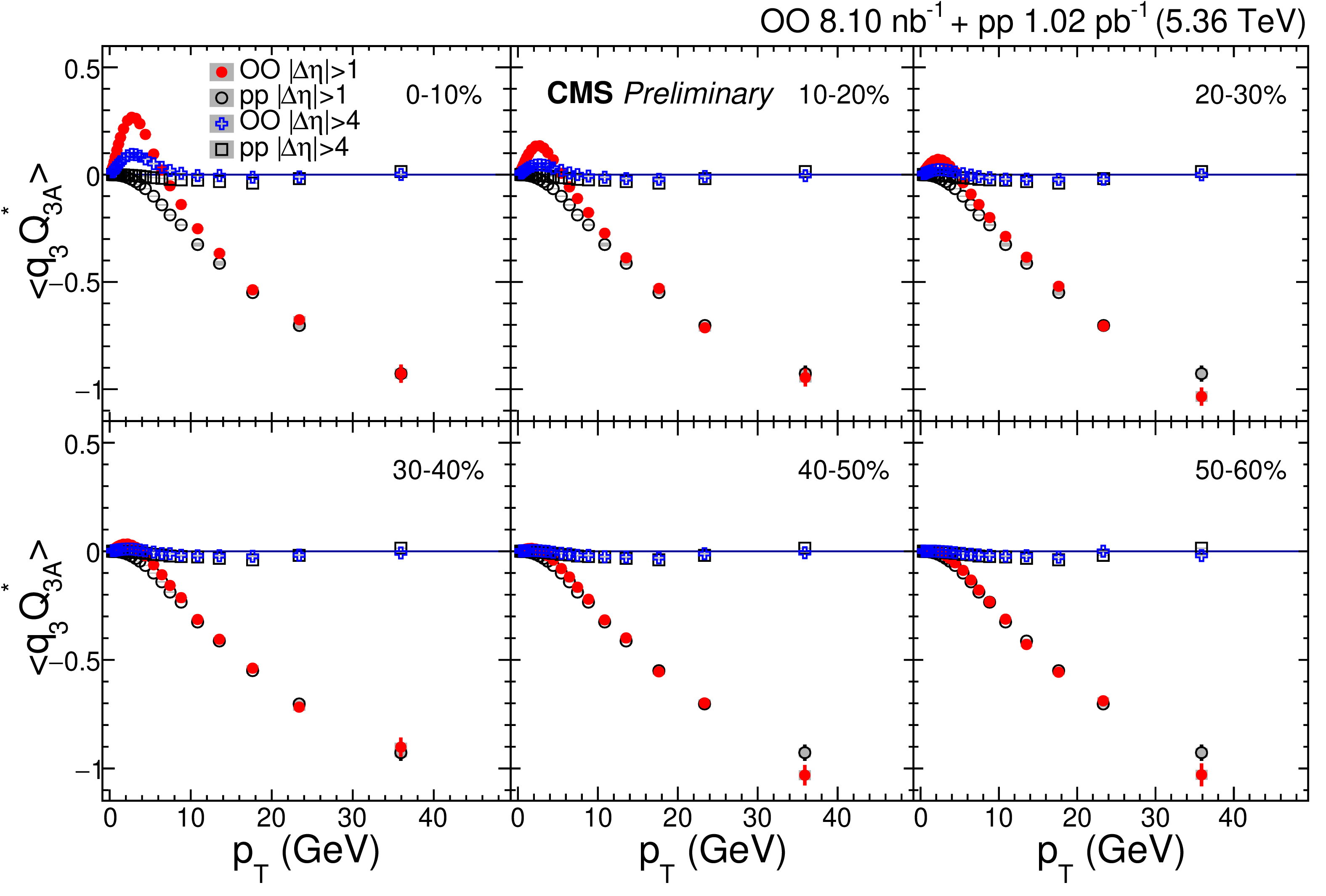
Distribution of azimuthal accumulative correlations $ \left\langle {{q_3}Q_{3A}^*} \right\rangle(p_{\mathrm{T}}) $ measured in $ \text{OO} $ collisions in six centrality ranges from 0--10% to 50--60%, for $ |\Delta\eta| > $ 1 (red filled circles) and 4 (blue open crosses) separations. The distributions measured in pp zero-bias events for $ |\Delta\eta| > $ 1 (black open circles) and 4 (black open squares) are added in all plots for comparison. Vertical bars denote statistical uncertainties and shaded boxes denote systematic uncertainties. |
png pdf |
Figure 5:
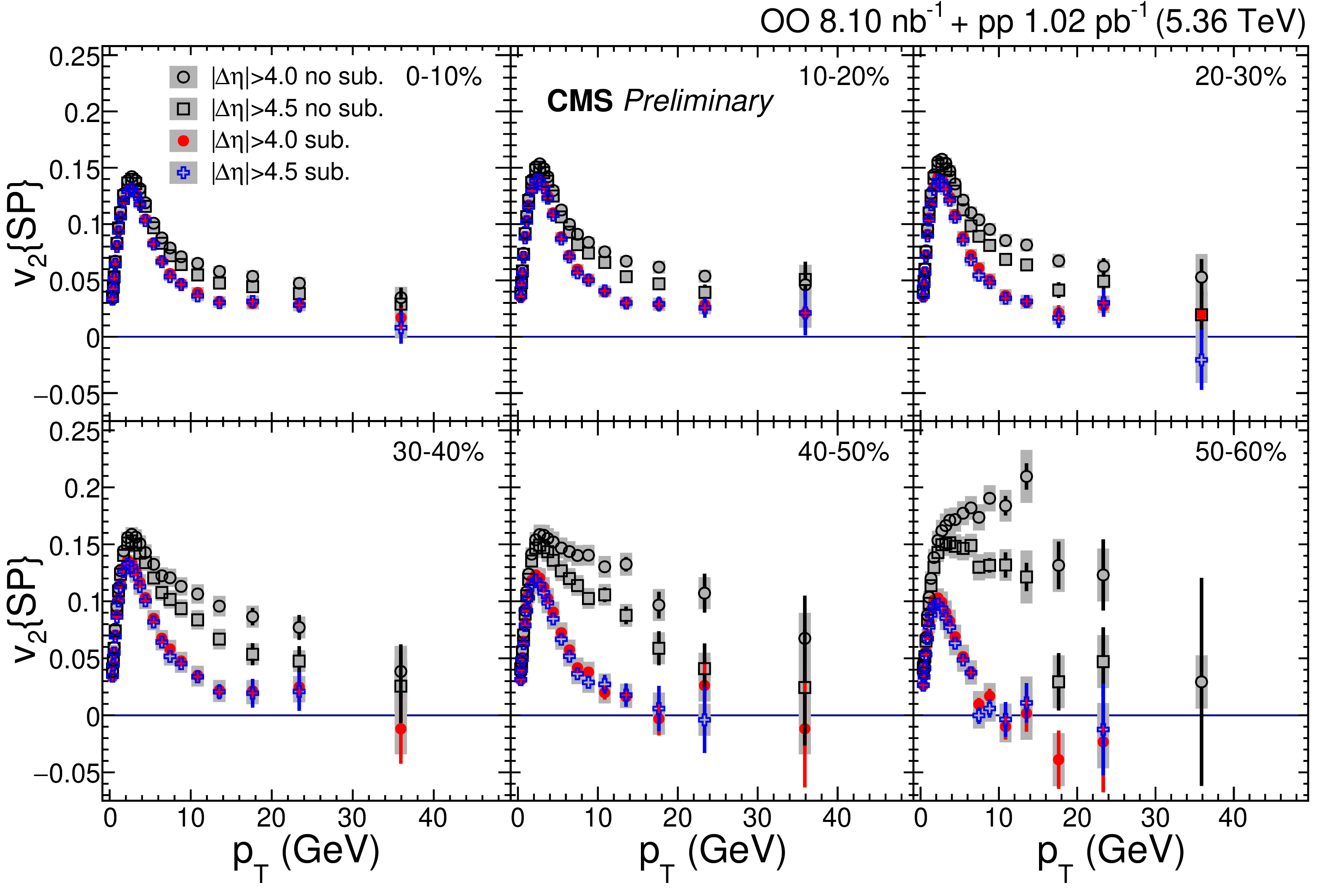
Scalar product $ v_2(p_{\mathrm{T}}) $ distribution measured in $ \text{OO} $ collisions in six centrality ranges from 0--10% to 50--60%. Black open circles and open squares represent results without pp baseline nonflow subtraction for $ |\Delta\eta| > $ 4 and 4.5, respectively. Red filled circles and blue open crosses represent results with pp baseline nonflow subtraction for $ |\Delta\eta| > $ 4 and 4.5, respectively. Vertical bars denote statistical uncertainties and shaded boxes denote systematic uncertainties. |
png pdf |
Figure 6:
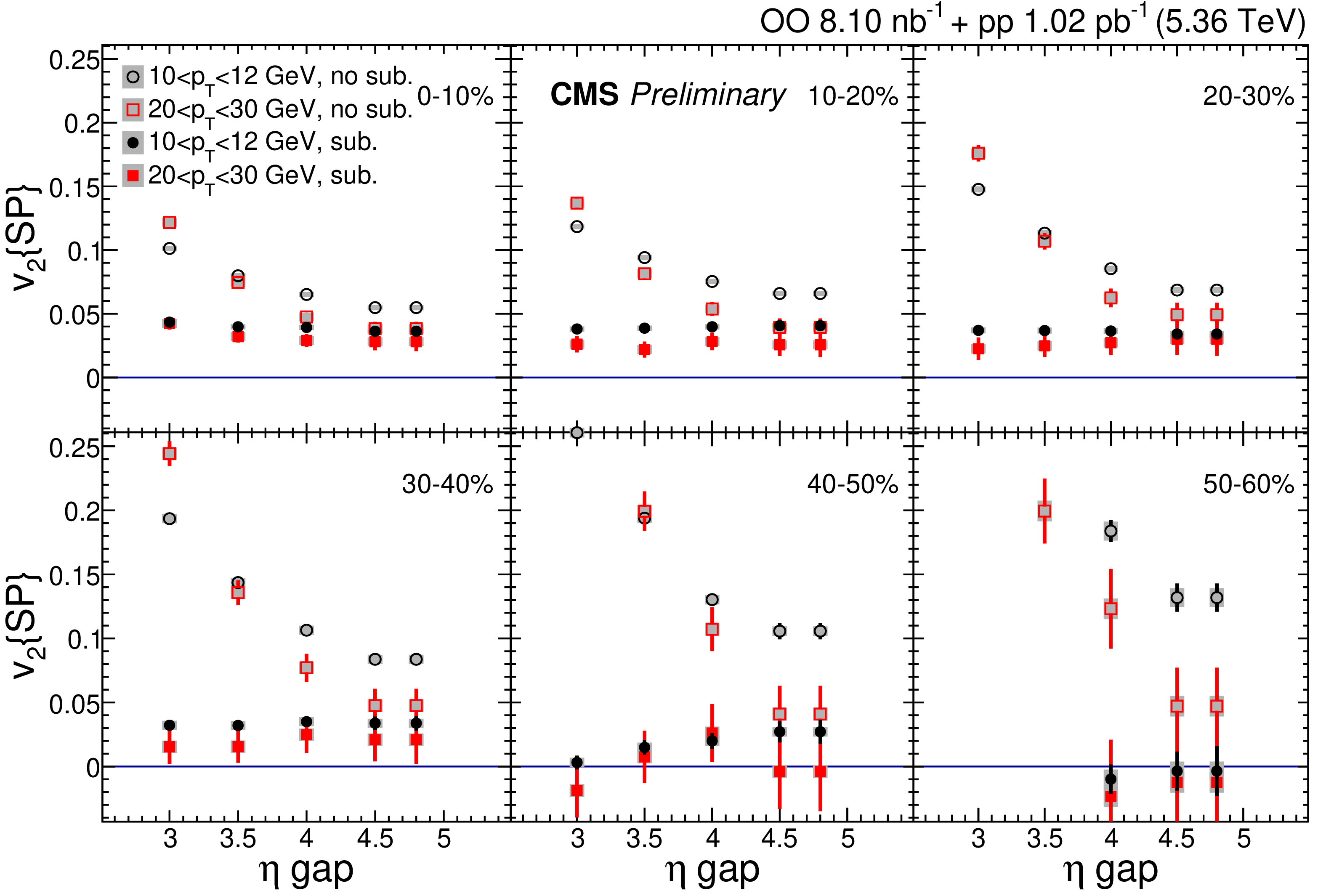
Scalar product $ v_2 $ distribution measured in $ \text{OO} $ collisions as a function of $ \Delta\eta $ separation, in six centrality ranges from 0--10% to 50--60%. Black circle markers represent $ v_{2} $ extracted for 10 $ < p_{\mathrm{T}} < $ 12 GeV; black open circles are without pp subtraction, while black filled circles are with pp subtraction. Red square markers represent $ v_{2} $ extracted for 20 $ < p_{\mathrm{T}} < $ 30 GeV; red open squares are without pp subtraction, while red filled squares are with pp subtraction. Vertical bars denote statistical uncertainties and shaded boxes denote systematic uncertainties. |
png pdf |
Figure 7:
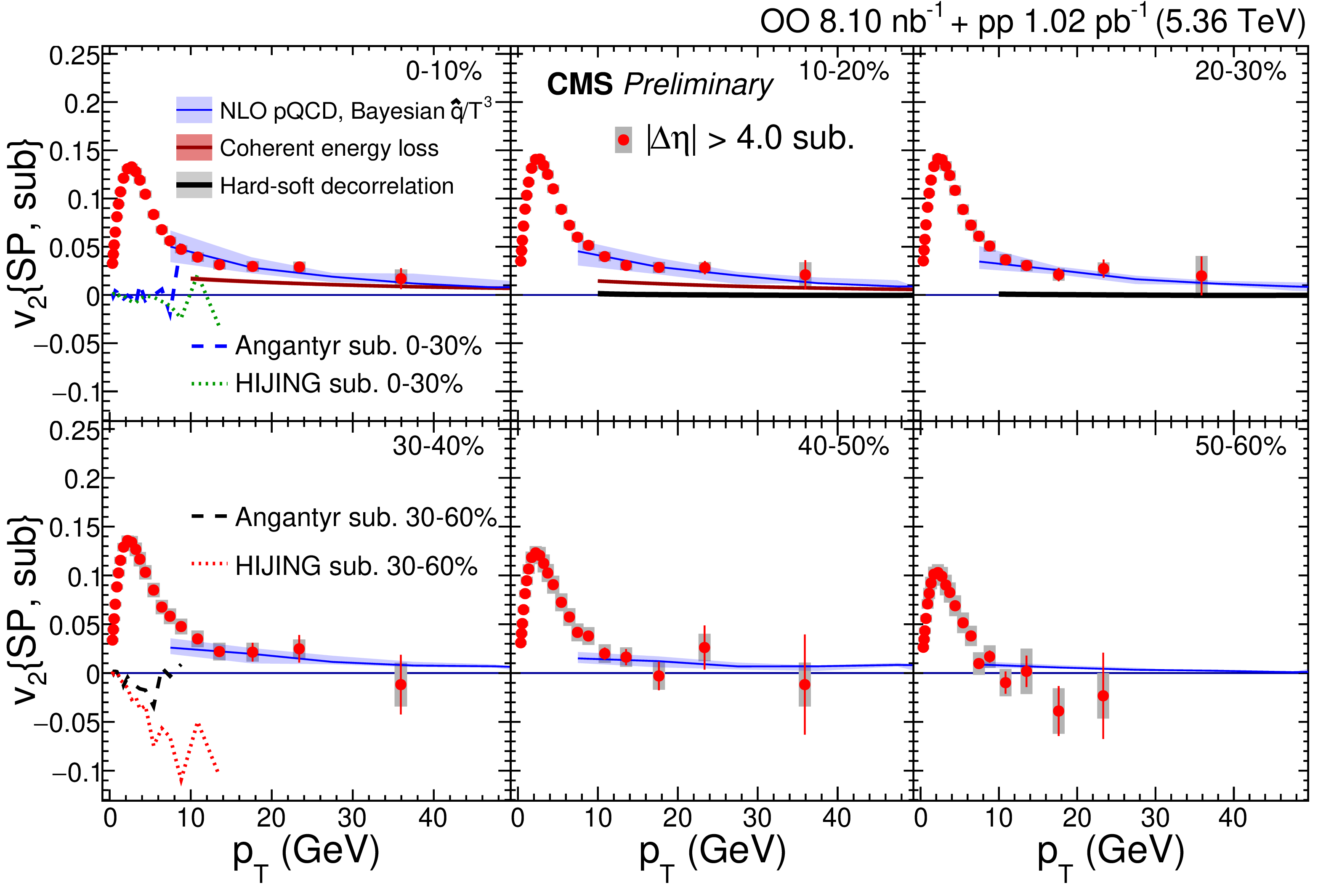
Scalar product $ v_2(p_{\mathrm{T}}) $ distribution (red filled circles) measured in $ \text{OO} $ collisions, after pp baseline nonflow subtraction, in six centrality ranges from 0--10% to 50--60% using the $ |\Delta\eta| > $ 4 separation. Vertical bars denote statistical uncertainties and shaded boxes denote systematic uncertainties. The blue bands represent the NLO pQCD parton model predictions with median value of $ \hat{q}/T^3 $ from Bayesian extraction [54]. The red bands represent a coherent energy loss model within a semi-analytic jet quenching framework incorporating pre-equilibrium effects [55]. The black curves with gray uncertainty bands represent a pQCD-based model including hard-soft geometric decorrelation effects [56]. The dashed and dotted lines represent the calculations from the $ \textrm{Angantyr} $ [57] and HIJING [46] models, respectively. |
png pdf |
Figure 8:
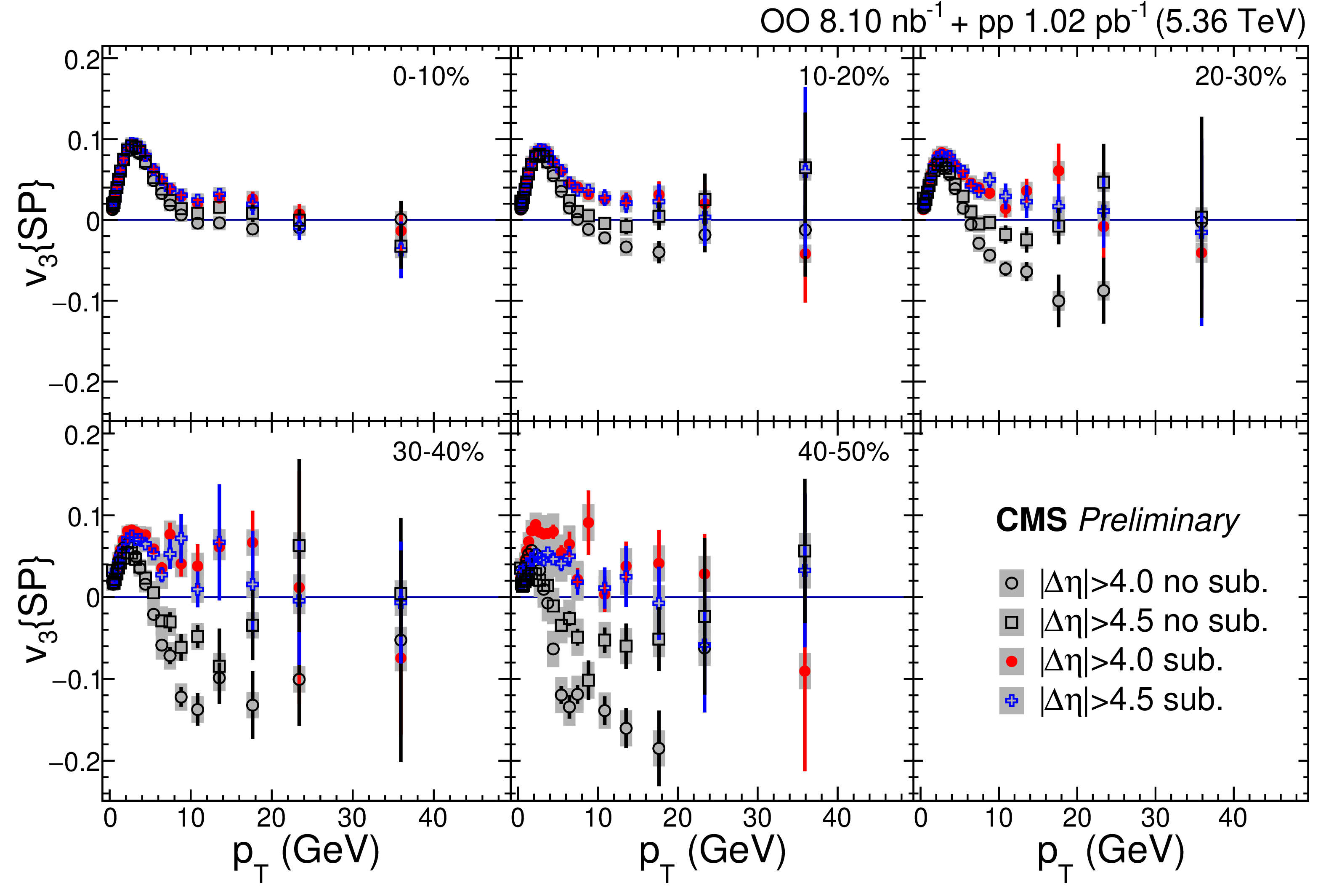
Scalar product $ v_3(p_{\mathrm{T}}) $ distribution measured in $ \text{OO} $ collisions in five centrality ranges from 0--10% to 40--50%. Black open circles and open squares represent results without pp baseline nonflow subtraction for $ |\Delta\eta| > $ 4 and 4.5, respectively. Red filled circles ($ |\Delta\eta| > $ 4) and blue open crosses ($ |\Delta\eta| > $ 4.5) represent results with pp baseline nonflow subtraction. Vertical bars denote statistical uncertainties and shaded boxes denote systematic uncertainties. |
png pdf |
Figure 9:
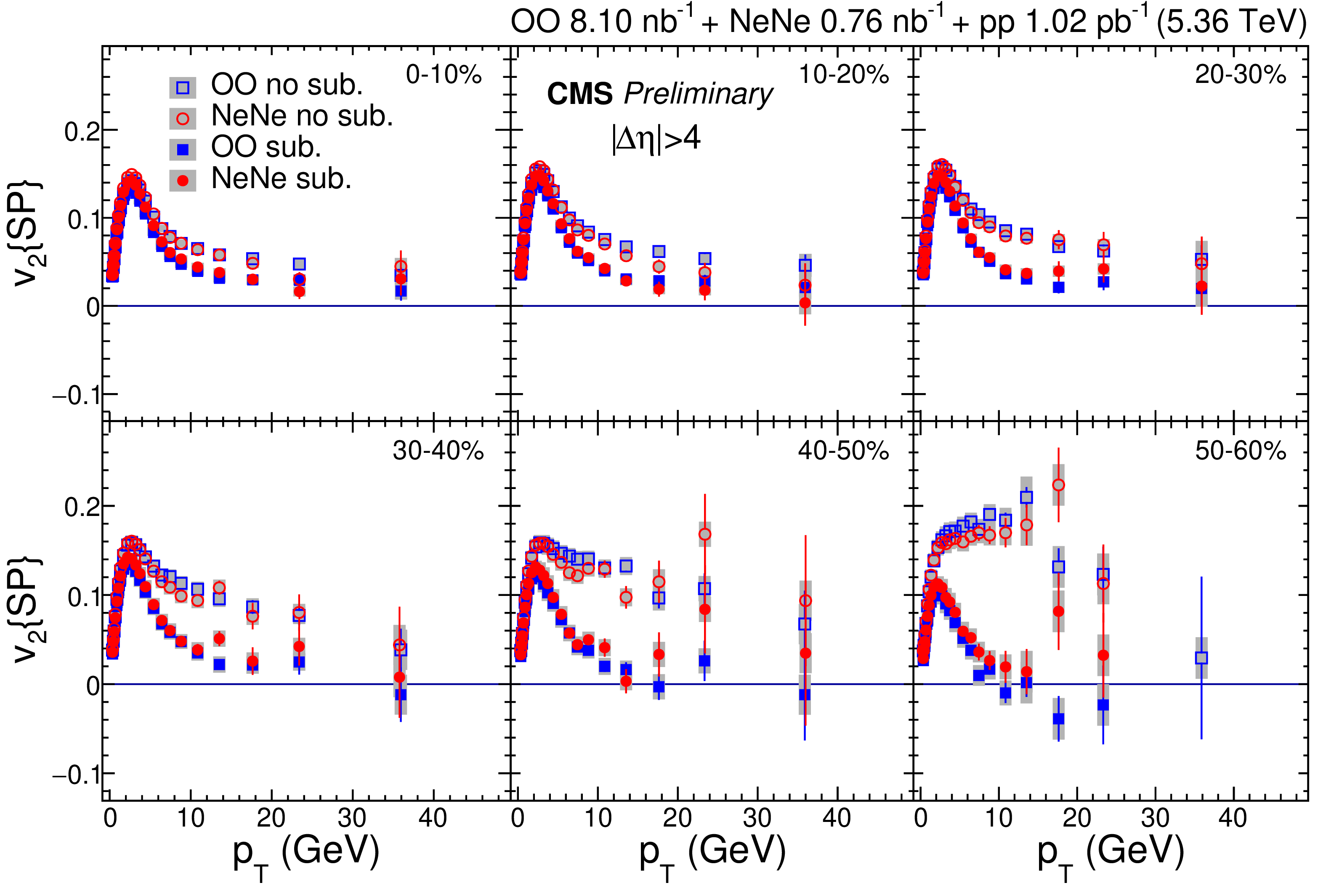
Scalar product $ v_2(p_{\mathrm{T}}) $ distribution measured in $ \text{OO} $ and $ \text{NeNe} $ collisions in six centrality ranges from 0--10% to 50--60% using a $ |\Delta\eta| > $ 4 separation. Results for $ \text{OO} $ collisions are shown by blue open squares (without pp baseline nonflow subtraction) and blue filled squares (with subtraction). Results for $ \text{NeNe} $ collisions are shown by red open circles (without subtraction) and red filled circles (with subtraction). Vertical bars denote statistical uncertainties and shaded boxes denote systematic uncertainties. |
png pdf |
Figure 10:
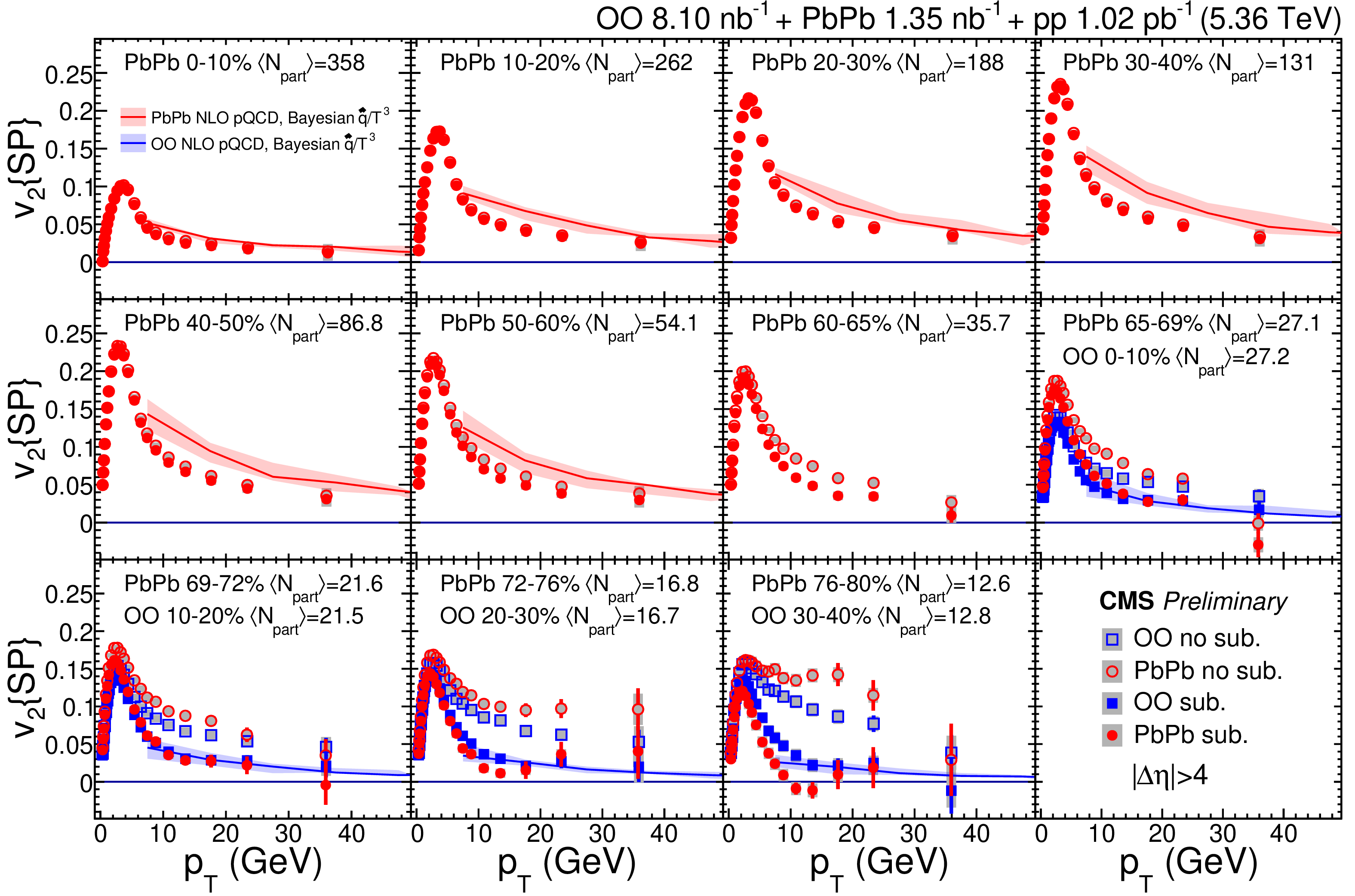
Scalar product $ v_2(p_{\mathrm{T}}) $ distribution measured using a $ |\Delta\eta| > $ 4 separation in twelve PbPb centrality ranges from 0--10% to 76--80% and four $ \text{OO} $ centrality ranges from 0--10% to 30--40%. Results for $ \text{OO} $ collisions are shown by blue open squares (without pp baseline nonflow subtraction) and blue filled squares (with subtraction). Results for PbPb collisions are shown by red open circles (without subtraction) and red filled circles (with subtraction). Vertical bars denote statistical uncertainties and shaded boxes denote systematic uncertainties. The blue and red bands represent the NLO pQCD parton model predictions in $ \text{OO} $ and PbPb collisions with median value of $ \hat{q}/T^3 $ from Bayesian extraction [54]. |
| Summary |
| The elliptic ($ v_2 $) and triangular ($ v_3 $) azimuthal anisotropy coefficients of charged particles produced in oxygen-oxygen ($ \text{OO} $), neon-neon ($ \text{NeNe} $), and lead-lead (PbPb) collisions at a nucleon-nucleon center-of-mass energy of $ \sqrt{s_{_\mathrm{NN}}} = 5.36 \text{TeV} $ have been measured by the CMS detector at the CERN LHC, as functions of transverse momentum $ p_{\mathrm{T}} = $ 0.3--50 GeV and collision centrality. The anisotropy coefficients $ v_{2} $ and $ v_{3} $ are extracted using the scalar-product method for different pseudorapidity separations ($ \Delta\eta $) among the produced particles in order to suppress short-range nonflow correlations. Prior to nonflow subtraction, the measurements present a significant sensitivity to the $ \Delta\eta $ separation used for their derivation. For $ \text{OO} $ collisions, increasing the separation from 3 to 4 reduces the $ v_{2} $ values by more than half for $ p_{\mathrm{T}} > $ 20 GeV and also drives $ v_{3}(p_{\mathrm{T}}) $ closer to zero, highlighting the substantial influence of short-range nonflow correlations on high-$ p_{\mathrm{T}} $ anisotropy in light-ion collision systems. To account for nonflow effects, a comparison of the azimuthal accumulative correlations, $ \langle q_{n}Q_{nA}^{*} \rangle $ per trigger particle, has been performed between $ \text{OO} $ and zero-bias pp collisions at the same center-of-mass energy. The correlations from the two systems approach one another at high $ p_{\mathrm{T}} $ across all centrality ranges. In particular, the large negative values observed for $ \langle q_{3}Q_{3A}^{*} \rangle $ in $ \text{OO} $ collisions are well reproduced by the pp baseline, suggesting that per-trigger-particle nonflow effects in light nuclear environments are consistent with those in more elementary pp interactions. Consequently, the final $ v_{n} $ coefficients have been extracted utilizing a pp-baseline nonflow subtraction procedure. While the unsubtracted signals depend heavily on the $ \Delta\eta $ separation size, the results from different separations converge after subtraction, indicating that residual nonflow contributions are greatly reduced. The measured $ v_2(p_{\mathrm{T}}) $ distributions have been compared with perturbative parton energy loss calculations including a jet transport parameter $ \hat{q}/T^{3} $ constrained via Bayesian inference. The extracted anisotropies agree well with the model predictions for $ p_{\mathrm{T}} > $ 10 GeV. Our measurements are further compared with calculations from a coherent energy loss framework incorporating pre-equilibrium effects, which systematically underpredict the observed anisotropy in 0--20% collisions. Furthermore, comparison with a model incorporating hard-soft geometric decorrelation reveals that the data significantly exceed the prediction of a vanishing $ v_2 $, indicating that a distinct azimuthal correlation between high-$ p_{\mathrm{T}} $ partons and the bulk event plane is preserved. Finally, the $ v_2(p_{\mathrm{T}}) $ measurements in $ \text{OO} $ collisions are compared with those in $ \text{NeNe} $ collisions within matching centrality intervals, as well as with PbPb data at equivalent values of average participating nucleons, to systematically investigate the system-size dependence of the high-$ p_{\mathrm{T}} v_2 $ behaviour. Together, these results provide valuable new insights into the underlying mechanisms driving high-$ p_{\mathrm{T}} $ azimuthal anisotropy in small and light-ion nuclear collision systems. |
| References | ||||
| 1 | E. V. Shuryak | Theory of hadronic plasma | Sov. Phys. JETP 47 (1978) 212 | |
| 2 | J. C. Collins and M. J. Perry | Superdense matter: neutrons or asymptotically free quarks? | PRL 34 (1975) 1353 | |
| 3 | J.-Y. Ollitrault | Anisotropy as a signature of transverse collective flow | PRD 46 (1992) 229 | |
| 4 | CMS Collaboration | Overview of high-density QCD studies with the CMS experiment at the LHC | Phys. Rept. 1115 (2025) 219 | CMS-HIN-23-011 2405.10785 |
| 5 | ALICE Collaboration | The ALICE experiment: a journey through QCD | EPJC 84 (2024) 813 | 2211.04384 |
| 6 | STAR Collaboration | Experimental and theoretical challenges in the search for the quark gluon plasma: The STAR collaboration's critical assessment of the evidence from RHIC collisions | Nucl. Phys. A 757 (2005) 102 | nucl-ex/0501009 |
| 7 | PHENIX Collaboration | Formation of dense partonic matter in relativistic nucleus-nucleus collisions at RHIC: Experimental evaluation by the PHENIX collaboration | Nucl. Phys. A 757 (2005) 184 | nucl-ex/0410003 |
| 8 | E. V. Shuryak | Strongly Coupled Quark-Gluon Plasma: The Status Report | in 7th Workshop on Continuous Advances in QCD, 2006 link |
hep-ph/0608177 |
| 9 | B. H. Alver, C. Gombeaud, M. Luzum, and J.-Y. Ollitrault | Triangular flow in hydrodynamics and transport theory | Phys. Rev. C 82 (2010) 034913 | 1007.5469 |
| 10 | CMS Collaboration | Observation of long-range near-side angular correlations in proton-proton collisions at the LHC | JHEP 09 (2010) 091 | CMS-QCD-10-002 1009.4122 |
| 11 | CMS Collaboration | Evidence for collectivity in pp collisions at the LHC | PLB 765 (2017) 193 | CMS-HIN-16-010 1606.06198 |
| 12 | CMS Collaboration | Observation of long-range near-side angular correlations in proton-lead collisions at the LHC | PLB 718 (2013) 795 | CMS-HIN-12-015 1210.5482 |
| 13 | CMS Collaboration | Multiplicity and transverse momentum dependence of two- and four-particle correlations in $ \mathrm{p}\text{Pb} $\ and PbPb\ collisions | PLB 724 (2013) 213 | CMS-HIN-13-002 1305.0609 |
| 14 | ALICE Collaboration | Long-range angular correlations on the near and away side in $ \mathrm{p}\text{Pb} $ collisions at $ \sqrt{\smash[b]{s_{_{\mathrm{NN}}}}}= $ 5.02 TeV | PLB 719 (2013) 29 | 1212.2001 |
| 15 | ATLAS Collaboration | Observation of associated near-side and away-side long-range correlations in $ \sqrt{\smash[b]{s_{_{\mathrm{NN}}}}}= $ 5.02 TeV proton-lead collisions with the ATLAS detector | PRL 110 (2013) 182302 | 1212.5198 |
| 16 | PHENIX Collaboration | Creation of quark-gluon plasma droplets with three distinct geometries | Nature Phys. 15 (2019) 214 | 1805.02973 |
| 17 | STAR Collaboration | Measurements of the elliptic and triangular azimuthal anisotropies in central $ ^{3}\mathrm{He}+\mathrm{Au} $, $ \mathrm{d}+\mathrm{Au} $ and $ {\mathrm{p}}+\mathrm{Au} $ collisions at $ \sqrt{\smash[b]{s_{_{\mathrm{NN}}}}}= $ 200 GeV | PRL 130 (2023) 242301 | 2210.11352 |
| 18 | J. L. Nagle and W. A. Zajc | Small system collectivity in relativistic hadronic and nuclear collisions | Ann. Rev. Nucl. Part. Sci. 68 (2018) 211 | 1801.03477 |
| 19 | B. Schenke | The smallest fluid on Earth | Rept. Prog. Phys. 84 (2021) 082301 | 2102.11189 |
| 20 | B. Betz and M. Gyulassy | Constraints on the Path-Length Dependence of Jet Quenching in Nuclear Collisions at RHIC and LHC | [Erratum: JHEP 10, 043 ()], 2014 JHEP 08 (2014) 090 |
1404.6378 |
| 21 | CMS Collaboration | Azimuthal anisotropy of charged particles with transverse momentum up to 100 GeV/c in PbPb collisions at $ {\sqrt{\smash[b]{s_{_{\mathrm{NN}}}}}} = $ 5.02 TeV | PLB 776 (2018) 195 | CMS-HIN-15-014 1702.00630 |
| 22 | ATLAS Collaboration | Azimuthal anisotropies of charged particles with high transverse momentum in Pb+Pb collisions at $ {\sqrt{\smash[b]{s_{_{\mathrm{NN}}}}}} = $ 5.02 TeV with the ATLAS detector | Phys. Rev. C 112 (2025) 024910 | 2412.15658 |
| 23 | ALICE Collaboration | Azimuthal anisotropy of charged jet production in $ {\sqrt{\smash[b]{s_{_{\mathrm{NN}}}}}} = $ 2.76 TeV Pb-Pb collisions | PLB 753 (2016) 511 | 1509.07334 |
| 24 | ATLAS Collaboration | Transverse momentum and process dependent azimuthal anisotropies in $ {\sqrt{\smash[b]{s_{_{\mathrm{NN}}}}}} = $ 8.16 TeV p+Pb collisions with the ATLAS detector | EPJC 80 (2020) 73 | 1910.13978 |
| 25 | ALICE Collaboration | Azimuthal anisotropy of jet particles in p-Pb and Pb-Pb collisions at $ {\sqrt{\smash[b]{s_{_{\mathrm{NN}}}}}} = $ 5.02 TeV | JHEP 08 (2024) 234 | 2212.12609 |
| 26 | CMS Collaboration | Evidence for similar collectivity of high transverse-momentum particles in p-Pb and Pb-Pb collisions | PRL 135 (2025) 071903 | CMS-HIN-23-002 2502.07525 |
| 27 | I. Soudi and A. Majumder | Azimuthal anisotropy at high transverse momentum in p-p and p-A collisions | PLB 859 (2024) 139105 | 2308.14702 |
| 28 | E. Carri \'o and D. Pablos | Elliptic Anisotropy from Quantum Diffraction | 2603.12346 | |
| 29 | CMS Collaboration | Observation of long-range collective flow in OO and NeNe collisions and implications for nuclear structure studies | CMS-HIN-25-009 2510.02580 |
|
| 30 | ATLAS Collaboration | Measurement of the azimuthal anisotropy of charged particles in $ {\sqrt{\smash[b]{s_{_{\mathrm{NN}}}}}} = $ 5.36 TeV $ ^{16} $O$ +^{16} $O and $ ^{20} $Ne$ +^{20} $Ne collisions with the ATLAS detector | Phys. Rev. C 113 (2026) 045205 | 2509.05171 |
| 31 | ALICE Collaboration | Evidence of nuclear geometry-driven anisotropic flow in OO and Ne-Ne collisions at $ {\sqrt{\smash[b]{s_{_{\mathrm{NN}}}}}} = $ 5.36 TeV | 2509.06428 | |
| 32 | A. Huss et al. | Discovering partonic rescattering in light nucleus collisions | PRL 126 (2021) 192301 | 2007.13754 |
| 33 | A. Huss et al. | Predicting parton energy loss in small collision systems | Phys. Rev. C 103 (2021) 054903 | 2007.13758 |
| 34 | C. Loizides and A. Morsch | Absence of jet quenching in peripheral nucleus-nucleus collisions | PLB 773 (2017) 408 | 1705.08856 |
| 35 | CMS Collaboration | Observation of suppressed charged-particle production in ultrarelativistic oxygen-oxygen collisions | PRL 136 (2026) 162301 | CMS-HIN-25-008 2510.09864 |
| 36 | CMS Collaboration | Description and performance of track and primary-vertex reconstruction with the CMS tracker | JINST 9 (2014) P10009 | CMS-TRK-11-001 1405.6569 |
| 37 | CMS Collaboration | The CMS experiment at the CERN LHC | JINST 3 (2008) S08004 | |
| 38 | O. Sur\ányi et al. | Performance of the CMS zero degree calorimeters in pPb collisions at the LHC | JINST 16 (2021) P05008 | 2102.06640 |
| 39 | CMS Collaboration | Observation and studies of jet quenching in PbPb collisions at nucleon-nucleon center-of-mass energy $ {\sqrt{\smash[b]{s_{_{\mathrm{NN}}}}}} = $ 2.76 TeV | Phys. Rev. C 84 (2011) 024906 | CMS-HIN-10-004 1102.1957 |
| 40 | D. d'Enterria and C. Loizides | Progress in the Glauber model at collider energies | Ann. Rev. Nucl. Part. Sci. 71 (2021) 315 | 2011.14909 |
| 41 | C. Loizides | Glauber predictions for oxygen and neon collisions at energies available at the CERN Large Hadron Collider | Phys. Rev. C 113 (2026) 014914 | 2507.05853 |
| 42 | CMS Collaboration | Particle-flow reconstruction and global event description with the CMS detector | JINST 12 (2017) P10003 | CMS-PRF-14-001 1706.04965 |
| 43 | STAR Collaboration | Elliptic flow from two and four particle correlations in Au+Au collisions at $ {\sqrt{\smash[b]{s_{_{\mathrm{NN}}}}}} = $ 130 GeV | Phys. Rev. C 66 (2002) 034904 | nucl-ex/0206001 |
| 44 | STAR Collaboration | Azimuthal anisotropy in Au+Au collisions at $ {\sqrt{\smash[b]{s_{_{\mathrm{NN}}}}}} = $ 200 GeV | Phys. Rev. C 72 (2005) 014904 | nucl-ex/0409033 |
| 45 | M. Luzum and J.-Y. Ollitrault | Eliminating experimental bias in anisotropic-flow measurements of high-energy nuclear collisions | Phys. Rev. C 87 (2013) 044907 | 1209.2323 |
| 46 | X.-N. Wang and M. Gyulassy | HIJING: A Monte Carlo model for multiple jet production in pp, $ \mathrm{p}\text{A} $ and $ \text{AA} $ collisions | PRD 44 (1991) 3501 | |
| 47 | GEANT4 Collaboration | GEANT 4---a simulation toolkit | NIM A 506 (2003) 250 | |
| 48 | CMS Collaboration | Measurement of the Elliptic Anisotropy of Charged Particles Produced in PbPb Collisions at $ {\sqrt{\smash[b]{s_{_{\mathrm{NN}}}}}} = $ 2.76 TeV | Phys. Rev. C 87 (2013) 014902 | CMS-HIN-10-002 1204.1409 |
| 49 | CMS Collaboration | Mixed higher-order anisotropic flow and nonlinear response coefficients of charged particles in $ \mathrm {PbPb} $ collisions at $ {\sqrt{\smash[b]{s_{_{\mathrm{NN}}}}}} = $ 2.76 and 5.02 TeV | EPJC 80 (2020) 534 | CMS-HIN-17-005 1910.08789 |
| 50 | CMS Collaboration | Evidence for collective multiparticle correlations in $ \mathrm{p}\text{Pb} $ collisions | PRL 115 (2015) 012301 | CMS-HIN-14-006 1502.05382 |
| 51 | Y. Feng and F. Wang | Review of nonflow estimation methods and uncertainties in relativistic heavy-ion collisions | JPG 52 (2025) 013001 | 2407.12731 |
| 52 | STAR Collaboration | Azimuthal anisotropy and correlations at large transverse momenta in p+p and Au+Au collisions at $ {\sqrt{\smash[b]{s_{_{\mathrm{NN}}}}}} = $ 200 GeV | PRL 93 (2004) 252301 | nucl-ex/0407007 |
| 53 | I. A. Pshenichnov et al. | Nuclear multifragmentation induced by electromagnetic fields of ultrarelativistic heavy ions | Phys. Rev. C 57 (1998) 1920 | nucl-th/9711030 |
| 54 | M. Xie, W. Ke, H. Zhang, and X.-N. Wang | Global constraint on the jet transport coefficient from single-hadron, dihadron, and \ensuremath\gamma-hadron spectra in high-energy heavy-ion collisions | Phys. Rev. C 109 (2024) 064917 | 2208.14419 |
| 55 | D. Pablos and A. Takacs | Bayesian constraints on pre-equilibrium jet quenching and predictions for oxygen collisions | Phys. Rev. C 113 (2026) 044913 | 2509.19430 |
| 56 | B. Bert, C. Faraday, and W. A. Horowitz | Energy loss predicts no $ v_2 $ in small systems | 2603.21861 | |
| 57 | C. Bierlich, G. Gustafson, L. Lönnblad, and H. Shah | The Angantyr model for heavy-ion collisions in PYTHIA8 | JHEP 10 (2018) 134 | 1806.10820 |
|
|
Compact Muon Solenoid LHC, CERN |

|
|
|
|
|
|