
Compact Muon Solenoid
LHC, CERN
 Visit us: CMS Public Website, CMS Physics ;
Contact us: CMS Publications Committee
Visit us: CMS Public Website, CMS Physics ;
Contact us: CMS Publications Committee
| CMS-PAS-BPH-26-004 | ||
| Observation of $ \eta \to \mu^+\mu^-\pi^+\pi^- $ and improved measurement of the branching fraction for $ \eta \to 2\mu^+2\mu^- $ | ||
| CMS Collaboration | ||
| 2026-07-23 | ||
| Abstract: A search for the rare decay $ \eta\to\mu^{+}\mu^{-}\pi^{+}\pi^{-} $ is performed using proton-proton collision data collected by the CMS experiment at the CERN LHC, corresponding to an integrated luminosity of 62.6 fb$ ^{-1} $ recorded in 2022 and 2023. In addition, the branching fraction ratio of $ \eta\to\mu^{+}\mu^{-}\mu^{+}\mu^{-} $ relative to $ \eta\to\mu^{+}\mu^{-} $ is measured with a precision improved by 60% compared with the previous CMS measurement. Using $ \eta\to\mu^{+}\mu^{-} $ as the normalization channel, the branching fraction ratios are measured to be $ \mathcal{B}(\eta\to\mu^{+}\mu^{-}\pi^{+}\pi^{-})/\mathcal{B}(\eta\to\mu^{+}\mu^{-}) = ( $ 2.89 $ \pm $ 0.48 $ \mathrm{(stat)}^{+0.42}_{-0.29} \mathrm{(syst)})\times10^{-3} $ and $ \mathcal{B}(\eta\to\mu^{+}\mu^{-}\mu^{+}\mu^{-})/\mathcal{B}(\eta\to\mu^{+}\mu^{-}) = ( $ 0.86 $ \pm $ 0.06 $ \mathrm{(stat)}^{+0.09}_{-0.08} \mathrm{(syst)})\times10^{-3} $. | ||
| Links: CDS record (PDF) ; CADI line (restricted) ; | ||
| Figures | |
png pdf |
Figure 1:
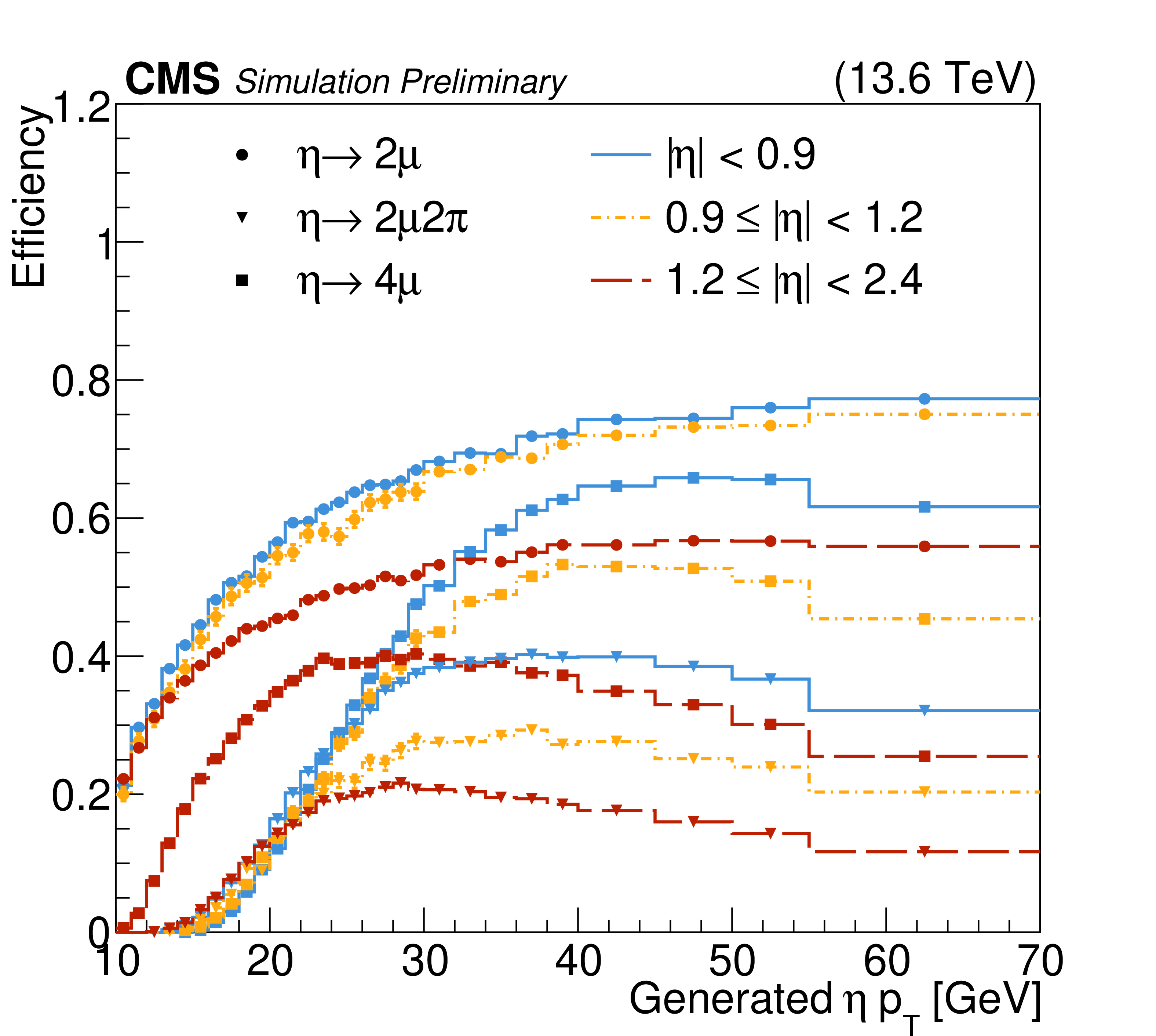
Total reconstruction and selection efficiencies versus $ p_{\mathrm{T}} $ for the $ \eta\to\mu^{+}\mu^{-} $, $ \eta\to\mu^{+}\mu^{-}\pi^{+}\pi^{-} $, and $ \eta\to\mu^{+}\mu^{-}\mu^{+}\mu^{-} $ channels in different $ |\eta| $ ranges. Circles (triangles, squares) denote $ \eta\to\mu^{+}\mu^{-} $ ($ \eta\to\mu^{+}\mu^{-}\pi^{+}\pi^{-} $, $ \eta\to\mu^{+}\mu^{-}\mu^{+}\mu^{-} $). Colors indicate $ |\eta| $ intervals: blue ($ |\eta| < $ 0.9), orange (0.9 $ \leq|\eta| < $ 1.2), red (1.2 $ \leq|\eta| < $ 2.4). |
png pdf |
Figure 2:
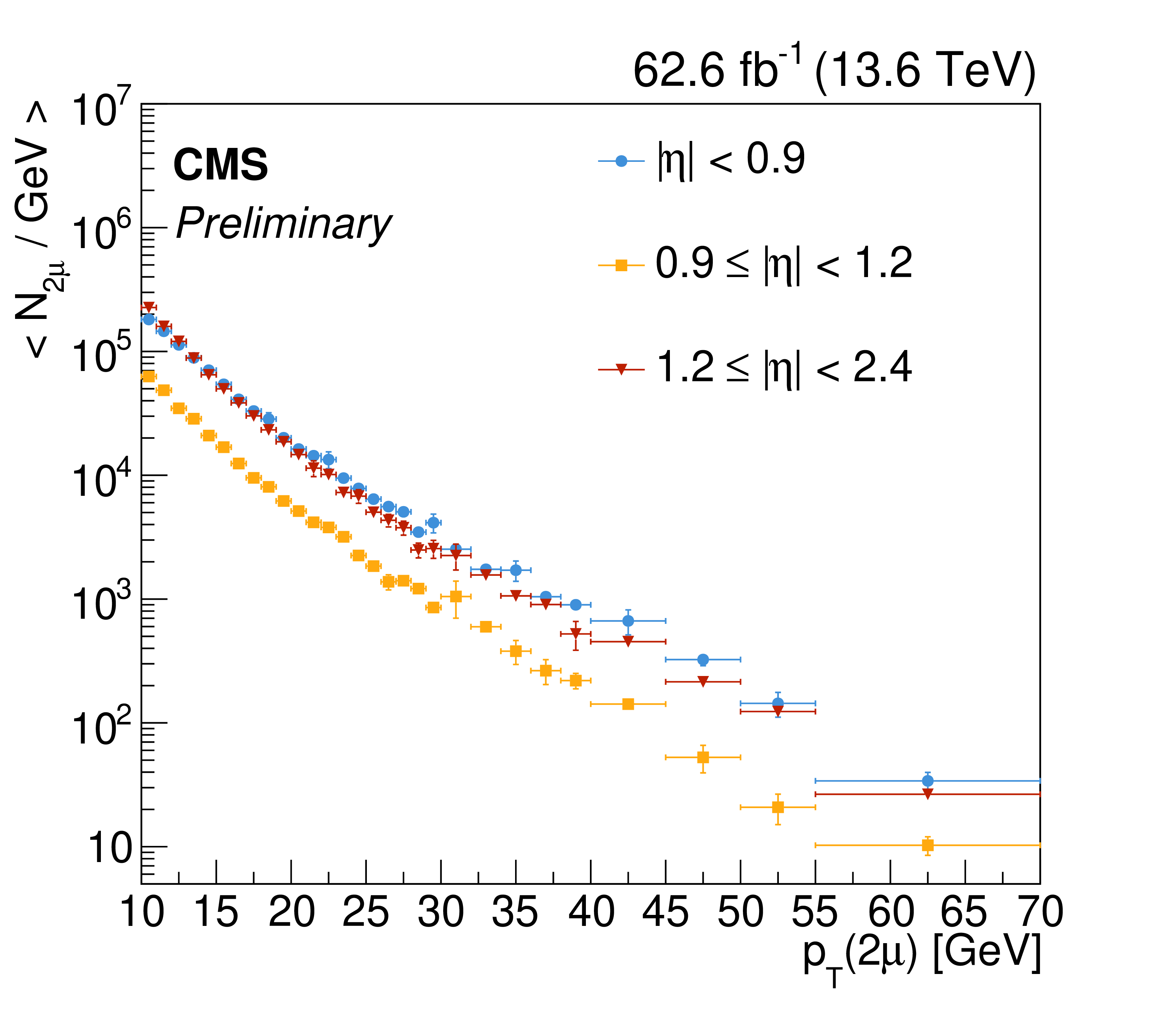
Observed $ \eta\to\mu^{+}\mu^{-} $ yields, $ N_{2\mu}^{i,j} $, in bins of $ p_{\mathrm{T}} $ and $ \eta $, divided by the bin width in $ p_{\mathrm{T}} $. Colors indicate $ |\eta| $ intervals: blue ($ |\eta| < $ 0.9), orange (0.9 $ \leq|\eta| < $ 1.2), red (1.2 $ \leq|\eta| < $ 2.4). |
png pdf |
Figure 3:
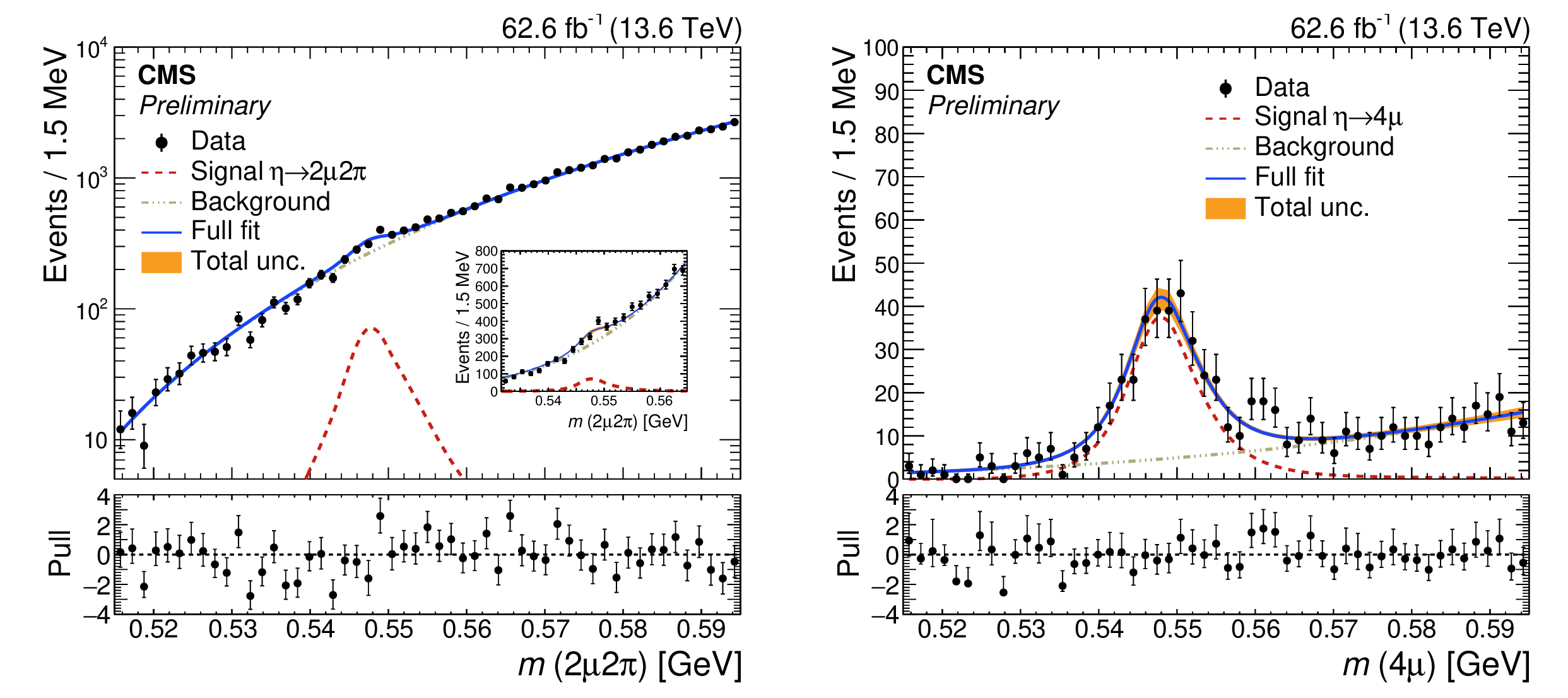
Fits to the invariant mass of the $ \eta\to\mu^{+}\mu^{-}\pi^{+}\pi^{-} $ (left) and $ \eta\to\mu^{+}\mu^{-}\mu^{+}\mu^{-} $ (right) systems using the nominal background model $ (m_\eta - m_0)^{p_0} $. The inset in the left plot shows the same fit in an expanded region around the eta mass, with a linear vertical scale. Black points denote data; the gray curve represents the background component, the red curve the signal component, and the blue curve the total fit (signal + background). The yellow fit-uncertainty band includes both statistical and systematic effects. The lower panel shows the pulls with respect to the full fit model, defined as (data}-\text{fit) $ /\sqrt{\sigma_{\text{data}}^{2}-\sigma_{\text{fit}}^{2}} $. |
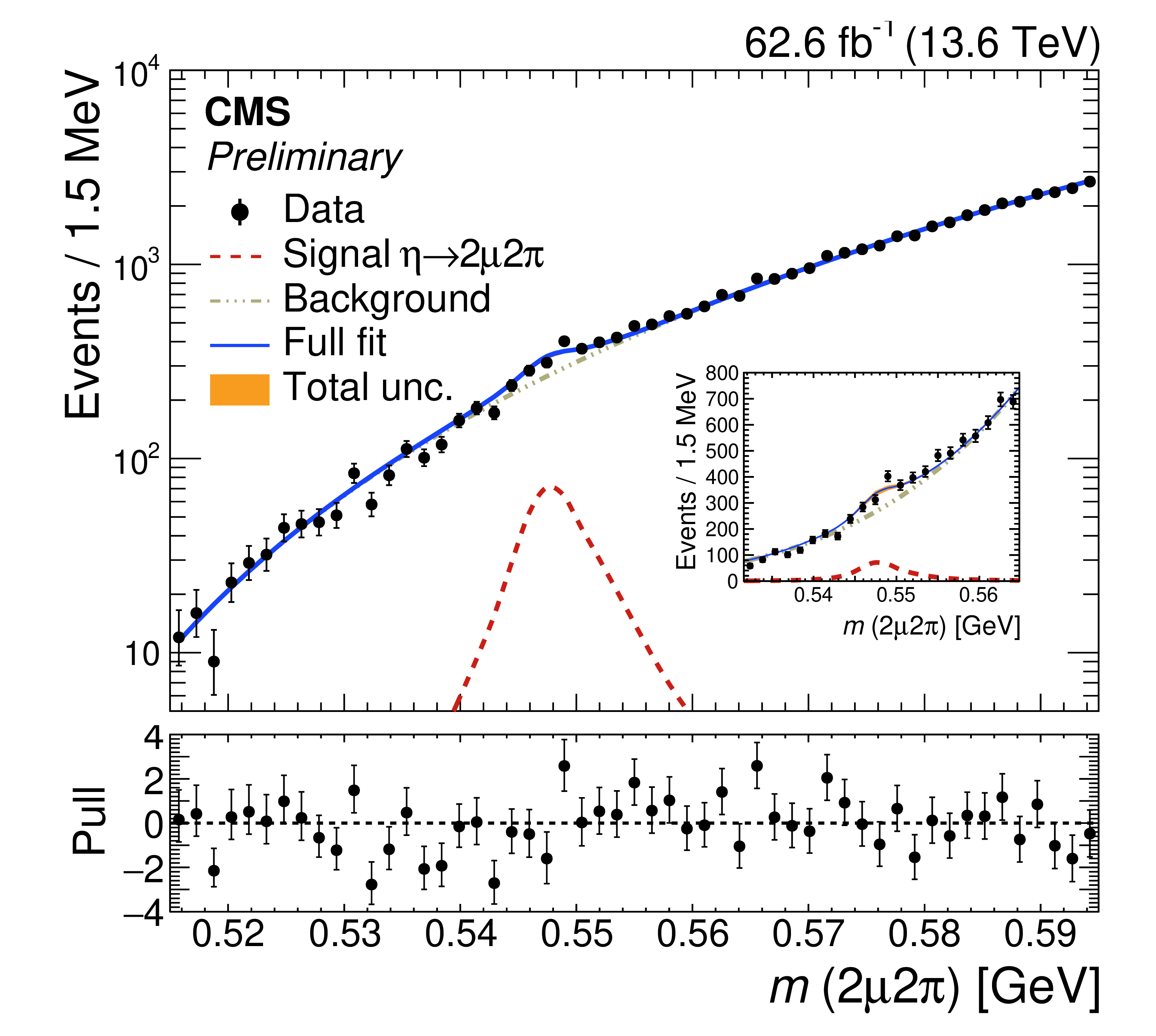
png pdf |
Figure 3-a:
Fits to the invariant mass of the $ \eta\to\mu^{+}\mu^{-}\pi^{+}\pi^{-} $ (left) and $ \eta\to\mu^{+}\mu^{-}\mu^{+}\mu^{-} $ (right) systems using the nominal background model $ (m_\eta - m_0)^{p_0} $. The inset in the left plot shows the same fit in an expanded region around the eta mass, with a linear vertical scale. Black points denote data; the gray curve represents the background component, the red curve the signal component, and the blue curve the total fit (signal + background). The yellow fit-uncertainty band includes both statistical and systematic effects. The lower panel shows the pulls with respect to the full fit model, defined as (data}-\text{fit) $ /\sqrt{\sigma_{\text{data}}^{2}-\sigma_{\text{fit}}^{2}} $. |
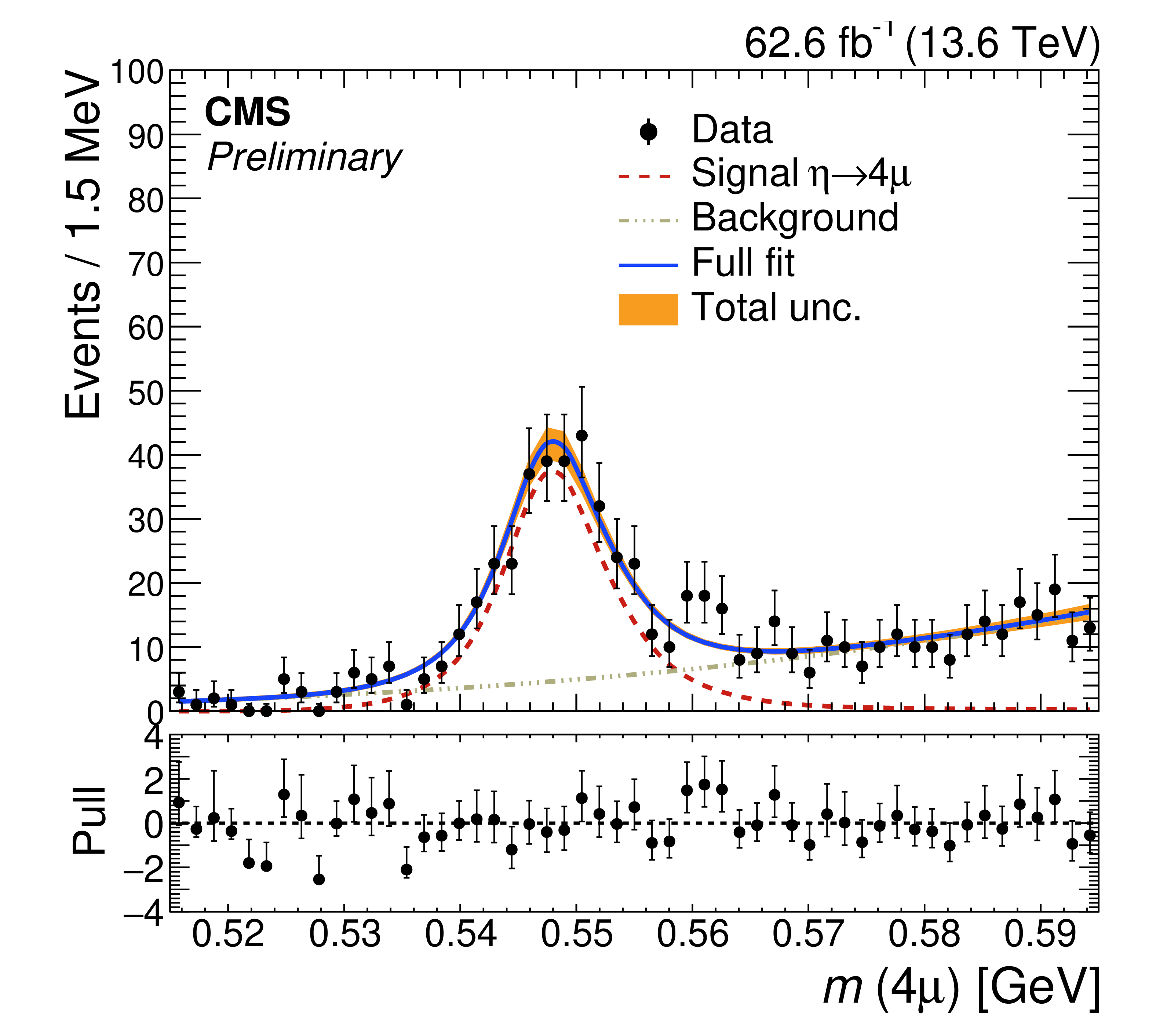
png pdf |
Figure 3-b:
Fits to the invariant mass of the $ \eta\to\mu^{+}\mu^{-}\pi^{+}\pi^{-} $ (left) and $ \eta\to\mu^{+}\mu^{-}\mu^{+}\mu^{-} $ (right) systems using the nominal background model $ (m_\eta - m_0)^{p_0} $. The inset in the left plot shows the same fit in an expanded region around the eta mass, with a linear vertical scale. Black points denote data; the gray curve represents the background component, the red curve the signal component, and the blue curve the total fit (signal + background). The yellow fit-uncertainty band includes both statistical and systematic effects. The lower panel shows the pulls with respect to the full fit model, defined as (data}-\text{fit) $ /\sqrt{\sigma_{\text{data}}^{2}-\sigma_{\text{fit}}^{2}} $. |
| Tables | |
png pdf |
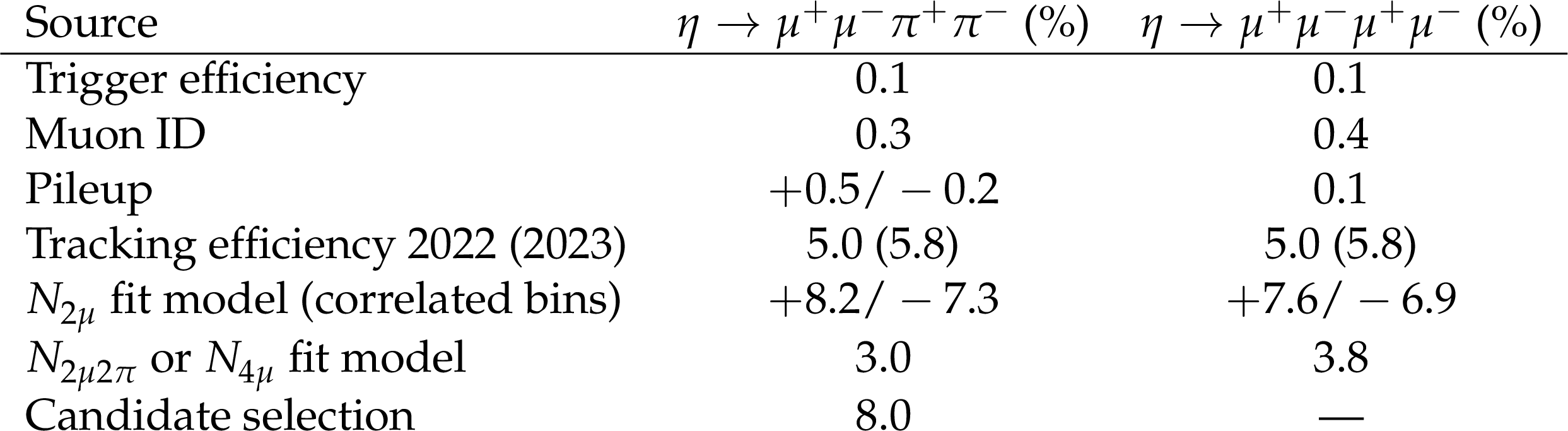
Table 1:
Summary of relative systematic uncertainties in the $ \eta\to\mu^{+}\mu^{-}\pi^{+}\pi^{-} $ and $ \eta\to\mu^{+}\mu^{-}\mu^{+}\mu^{-} $ signal yields. |
| Summary |
| In summary, the first observation of $ \eta\to\mu^{+}\mu^{-}\pi^{+}\pi^{-} $ decays and an improved measurement of $\eta\to\mu^{+}\mu^{-}\mu^{+}\mu^{-}$ are presented using proton-proton collision data collected by the CMS experiment at $\sqrt{s}=13.6$ TeV. The measured branching fraction ratios are the most precise to date, with the $\eta\to\mu^{+}\mu^{-}\mu^{+}\mu^{-}$ result improving upon the previous CMS measurement. These results provide new experimental constraints on pseudoscalar transition form factors and precision studies of hadronic effects relevant to the anomalous magnetic moment of the muon. They also establish benchmarks for future studies of rare $\eta$ decays and for searches for low-mass mediators that could modify these decay rates. |
| References | ||||
| 1 | J. Bijnens and J. Gasser | Eta decays at and beyond $ p^4 $ in chiral perturbation theory | Phys. Scripta T 99 (2002) 34 | hep-ph/0202242 |
| 2 | T. Fujiwara et al. | Non-abelian anomaly and vector mesons as dynamical gauge bosons of hidden local symmetries | Progress of Theoretical Physics 73 (1985) 926 | |
| 3 | M. Bando, T. Kugo, and K. Yamawaki | On the vector mesons as dynamical gauge bosons of hidden local symmetries | NPB 259 (1985) 493 | |
| 4 | R. Escribano and S. Gonz \`a lez-Sol \'i s | A data-driven approach to $ \pi^0 $, $ \eta $ and $ \eta^\prime $ single and double Dalitz decays | Chinese Phys. C 42 (2018) 023109 | 1511.04916 |
| 5 | L. Gan, B. Kubis, E. Passemar, and S. Tulin | Precision tests of fundamental physics with $ \eta $ and $ \eta^\prime $ mesons | Phys. Rept. 945 (2022) 1 | 2007.00664 |
| 6 | Particle Data Group | Review of particle physics | Int. J. Mod. Phys. A 41 (2026) 2630011 | |
| 7 | B. Borasoy and R. Ni \ss ler | $ \eta,\eta{^\prime} \to \pi^+\pi^- l^+ l^- $ in a chiral unitary approach | Eur. Phys. J. A 33 (2007) 95 | 0705.0954 |
| 8 | R. Escribano, P. Masjuan, and P. Sanchez-Puertas | The $ \eta $ transition form factor from space- and time-like experimental data | EPJC 75 (2015) | 1504.07742 |
| 9 | M. Zillinger, B. Kubis, and P. S \'a nchez-Puertas | CP violation in $ \eta^{\prime} \to \pi^{+} \pi^{-} \mu^{+} \mu^{-} $ decays | JHEP 12 (2022) 001 | 2210.14925 |
| 10 | CMS Collaboration | Observation of the rare decay of the $ \eta $ meson to four muons | PRL 131 (2023) 31 | CMS-BPH-22-003 2305.04904 |
| 11 | CMS Collaboration | Observation of the rare decay $ \eta\to\mu^{+}\mu^{-}e^{+}e^{-} $ | CMS-BPH-24-001 2605.00615 |
|
| 12 | BESIII Collaboration | Study of $ \eta\rightarrow\pi^+\pi^-l^+l^- $ | PRD 111 (2025) 072008 | 2501.10130 |
| 13 | CMS Collaboration | The CMS experiment at the CERN LHC | JINST 3 (2008) S08004 | |
| 14 | CMS Collaboration | Development of the CMS detector for the CERN LHC Run 3 | JINST 19 (2024) P05064 | |
| 15 | CMS Collaboration | Electron and photon reconstruction and identification with the CMS experiment at the CERN LHC | JINST 16 (2021) P05014 | CMS-EGM-17-001 2012.06888 |
| 16 | CMS Collaboration | Performance of the CMS muon detector and muon reconstruction with proton-proton collisions at $ \sqrt{s}= $ 13 TeV | JINST 13 (2018) P06015 | CMS-MUO-16-001 1804.04528 |
| 17 | CMS Collaboration | Description and performance of track and primary-vertex reconstruction with the CMS tracker | JINST 9 (2014) P10009 | CMS-TRK-11-001 1405.6569 |
| 18 | CMS Collaboration | Performance of the CMS Level-1 trigger in proton-proton collisions at $ \sqrt{s} = $ 13 TeV | JINST 15 (2020) P10017 | CMS-TRG-17-001 2006.10165 |
| 19 | CMS Collaboration | The CMS trigger system | JINST 12 (2017) P01020 | CMS-TRG-12-001 1609.02366 |
| 20 | CMS Collaboration | Performance of the CMS high-level trigger during LHC run 2 | JINST 19 (2024) P11021 | CMS-TRG-19-001 2410.17038 |
| 21 | CMS Collaboration | Enriching the physics program of the CMS experiment via data scouting and data parking | Phys. Rep. 1115 (2025) 678 | CMS-EXO-23-007 2403.16134 |
| 22 | I. Fröhlich et al. | Pluto: A Monte Carlo simulation tool for hadronic physics | PoS ACAT 07 (2007) 6 | 0708.2382 |
| 23 | J. J. Sakurai | Theory of strong interactions | Ann. Phys. 11 (1960) 1 | |
| 24 | R. Escribano, S. Gonz\`alez-Sol\'ıs, P. Masjuan, and P. Sanchez-Puertas | $ \eta^{\prime} $ transition form factor from space- and timelike experimental data | PRD 94 (2016) 054033 | |
| 25 | T. Sjöstrand et al. | An introduction to PYTHIA 8.2 | Comput. Phys. Commun. 191 (2015) 159 | 1410.3012 |
| 26 | CMS Collaboration | Extraction and validation of a new set of CMS PYTHIA8 tunes from underlying-event measurements | EPJC 80 (2020) 4 | CMS-GEN-17-001 1903.12179 |
| 27 | D. J. Lange | The EvtGen particle decay simulation package | NIM A 462 (2001) 152 | |
| 28 | \GEANTfour Collaboration | $ GEANT $ 4\textemdash a simulation toolkit | NIM A 506 (2003) 250 | |
| 29 | M. J. Oreglia | A study of the reactions $ \psi^\prime \to \gamma \gamma \psi $ | PhD thesis, Stanford University, SLAC-R-236, 1980 link |
|
| 30 | CMS Collaboration | Measurement of the inelastic proton-proton cross section at $ \sqrt{s} = $ 13 TeV | JHEP 07 (2018) 161 | CMS-FSQ-15-005 1802.02613 |
| 31 | CMS Collaboration | The CMS statistical analysis and combination tool: Combine | Comput. Softw. Big Sci. 8 (2024) 19 | CMS-CAT-23-001 2404.06614 |
|
|
Compact Muon Solenoid LHC, CERN |

|
|
|
|
|
|