
Compact Muon Solenoid
LHC, CERN
 Visit us: CMS Public Website, CMS Physics ;
Contact us: CMS Publications Committee
Visit us: CMS Public Website, CMS Physics ;
Contact us: CMS Publications Committee
| CMS-PAS-B2G-25-011 | ||
| Search for leptoquarks coupling to third-generation quarks and first- or second-generation leptons at $ \sqrt{s}= $ 13.6 TeV | ||
| CMS Collaboration | ||
| 2026-05-19 | ||
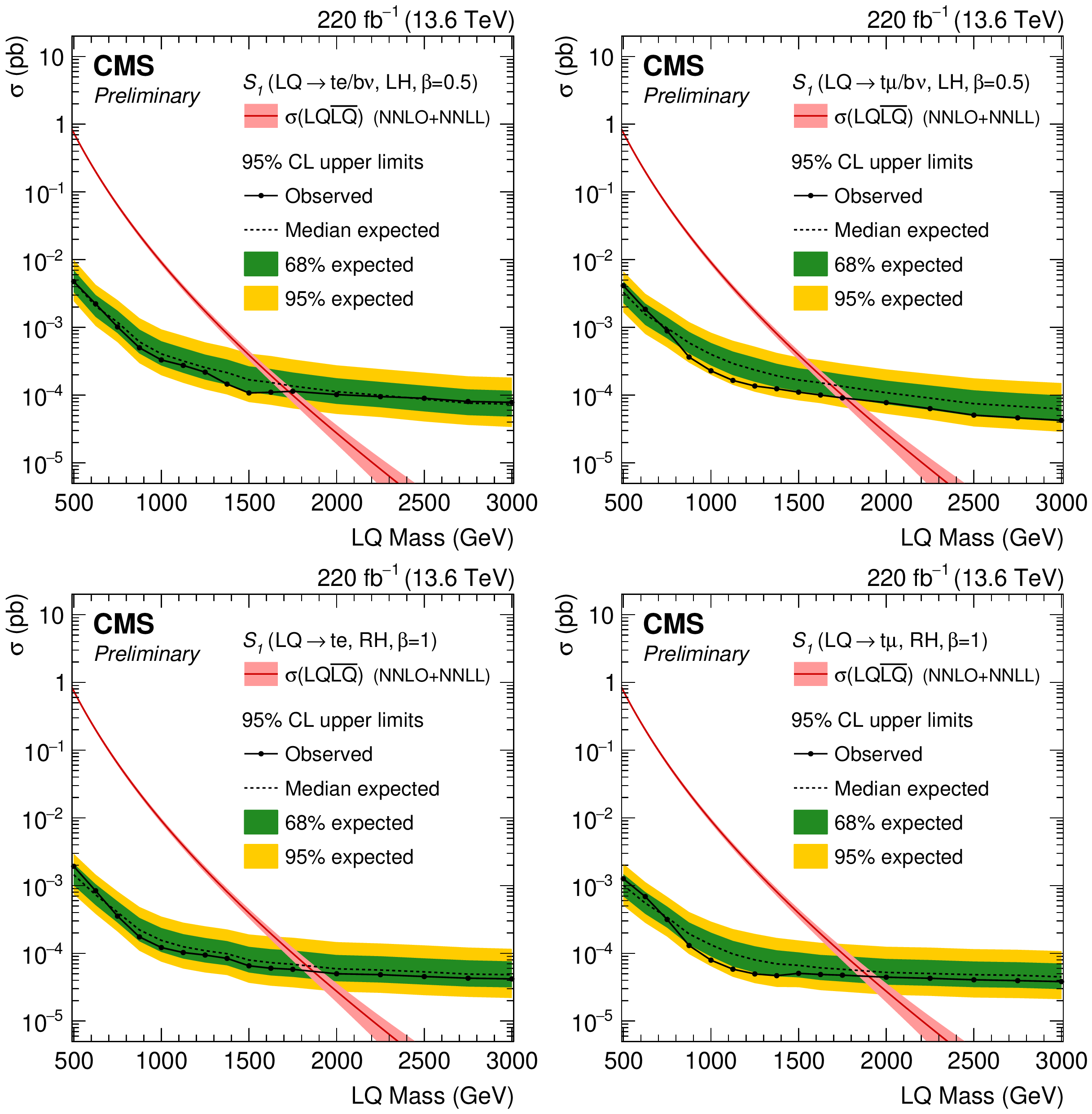
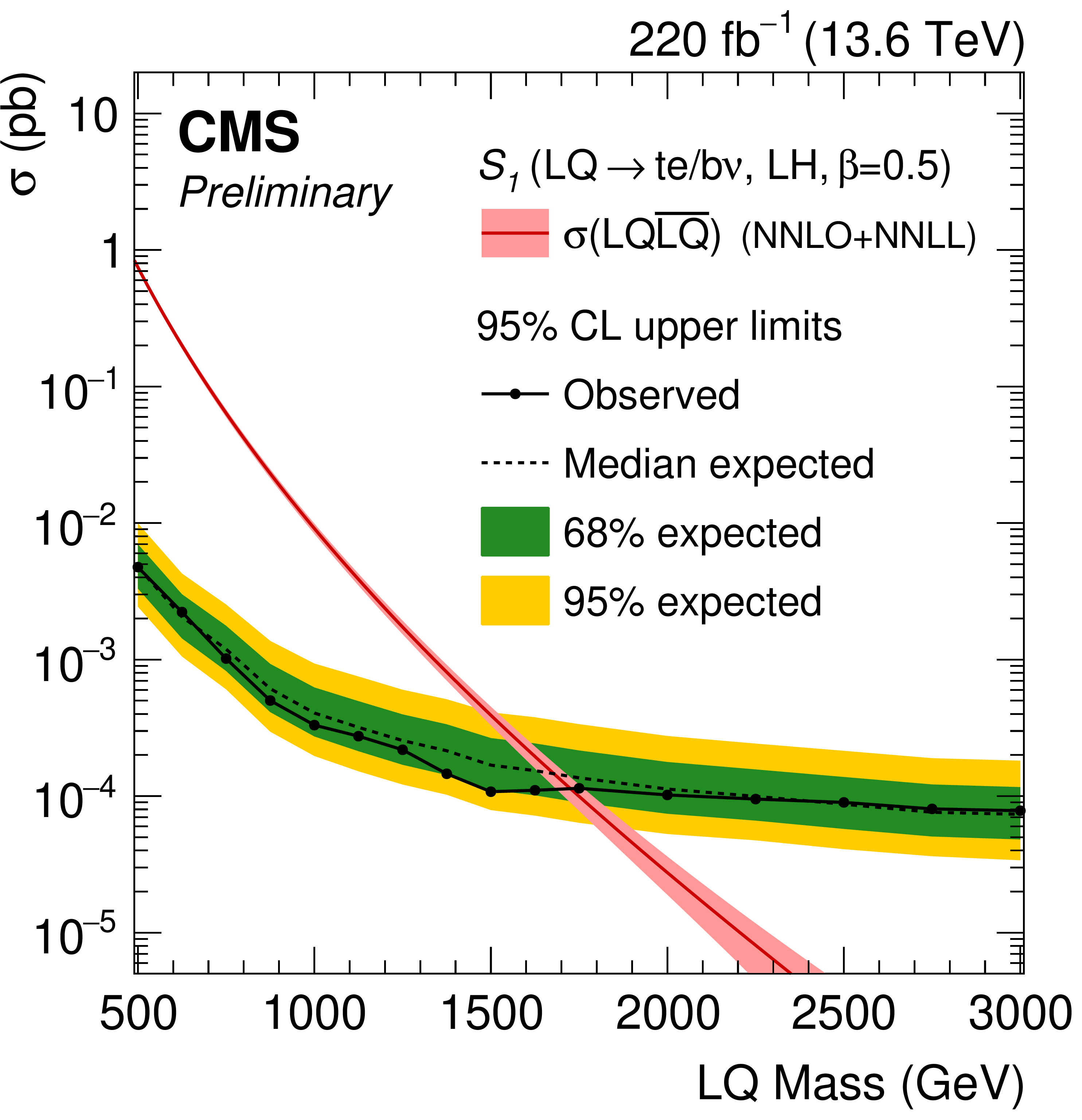
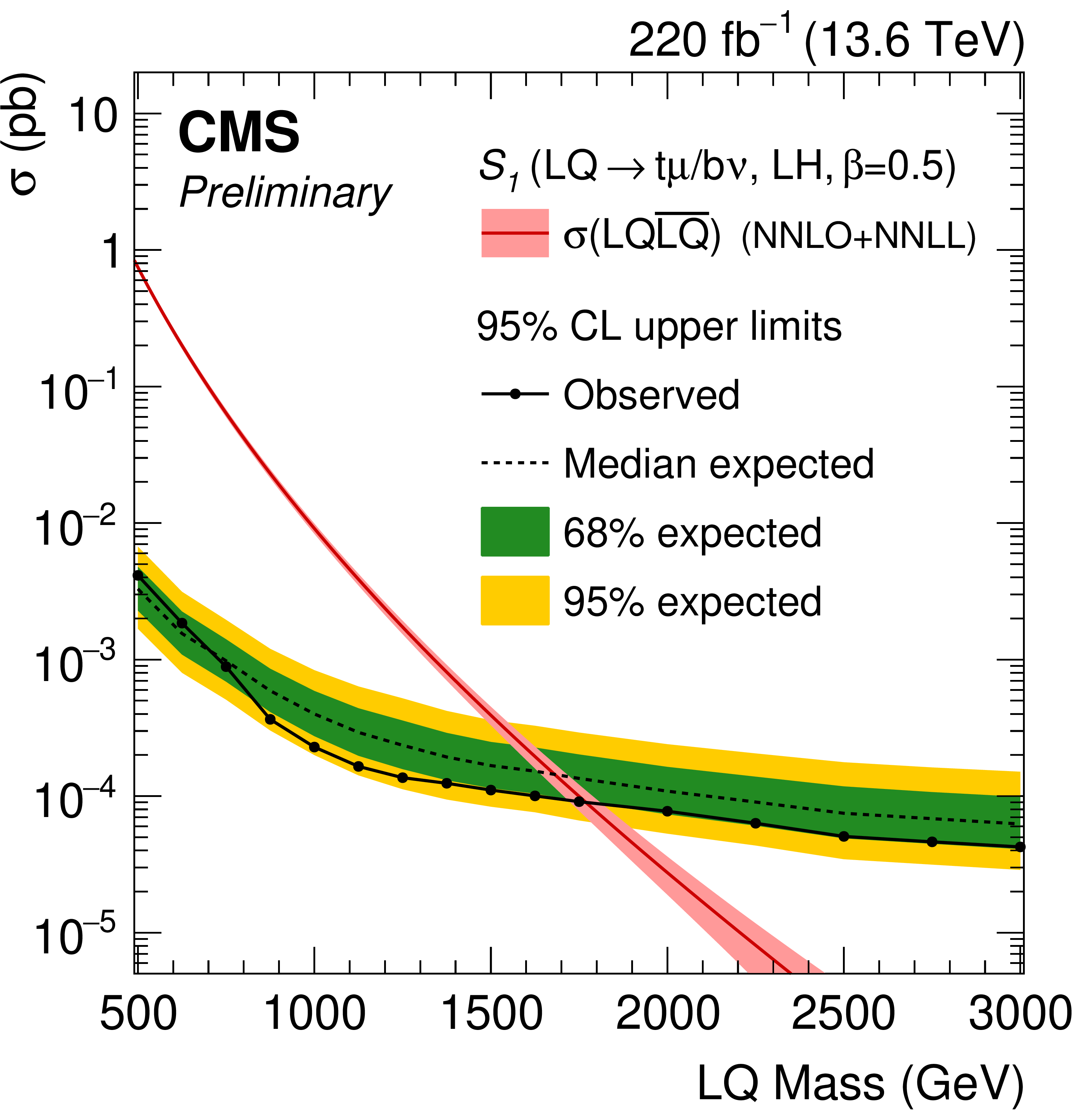
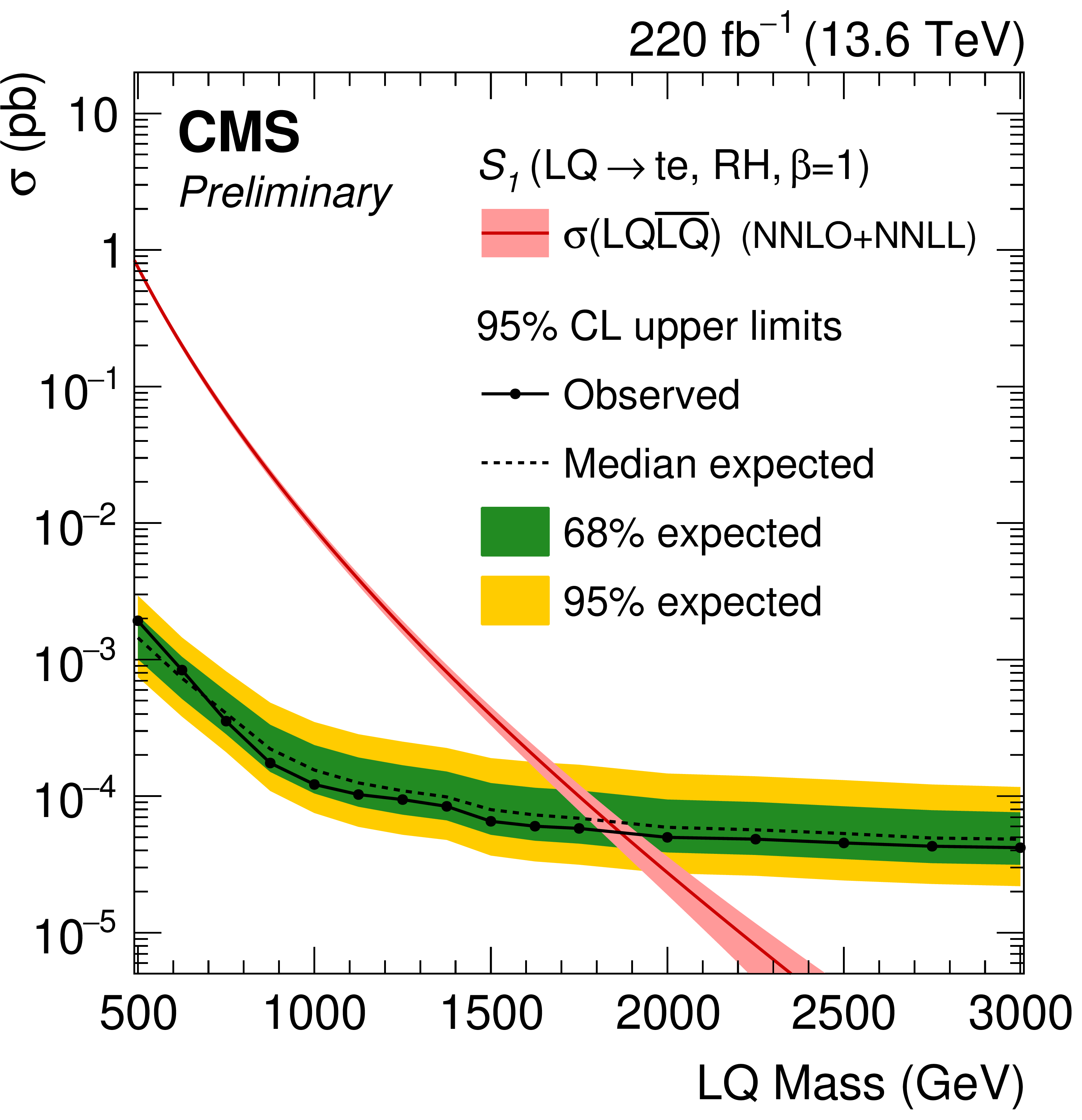
| Abstract: A search for pair production of scalar leptoquarks with Yukawa couplings to a third-generation quark and a first- or second-generation lepton is presented. The analysis uses a data sample corresponding to an integrated luminosity of 220 fb$ ^{-1} $ of proton-proton collisions at $ \sqrt{s} = $ 13.6 TeV recorded by the CMS detector at the LHC in 2024--2025. The search targets events with at least one charged lepton, at least one b-tagged jet, and additional hadronic activity consistent with hadronic top-quark decays. No significant deviation from the background expectation is observed. The results are interpreted in terms of scalar leptoquarks decaying to a top quark and a charged lepton, or to a bottom quark and a neutrino, with a branching ratio that depends on the coupling type. Such scalar particles are excluded at 95% confidence level for masses below 1720 and 1860 GeV in the electron channel, and below 1760 and 1890 GeV in the muon channel, for left- and right-handed Yukawa couplings, respectively. These constraints are the most stringent to date. | ||
| Links: CDS record (PDF) ; CADI line (restricted) ; | ||
| Figures | |

png pdf |
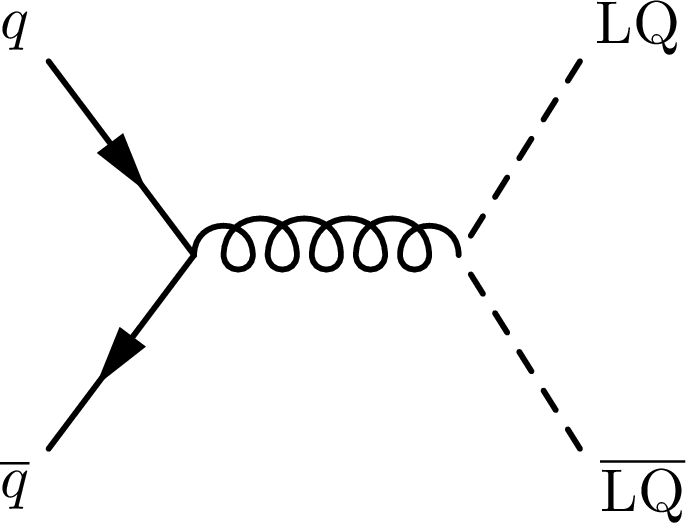
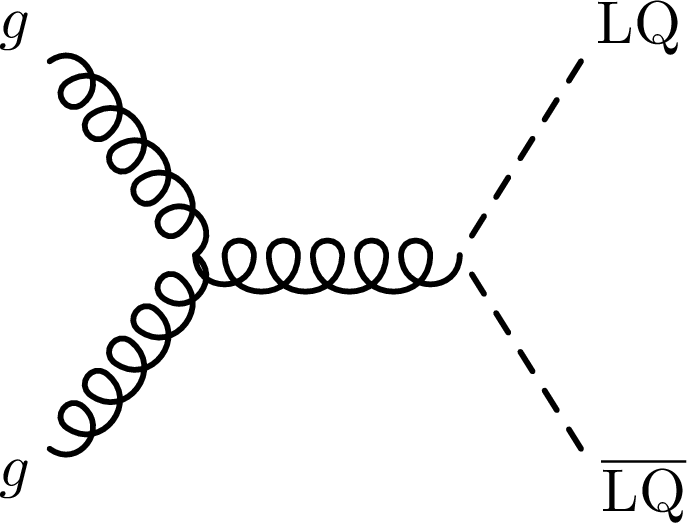
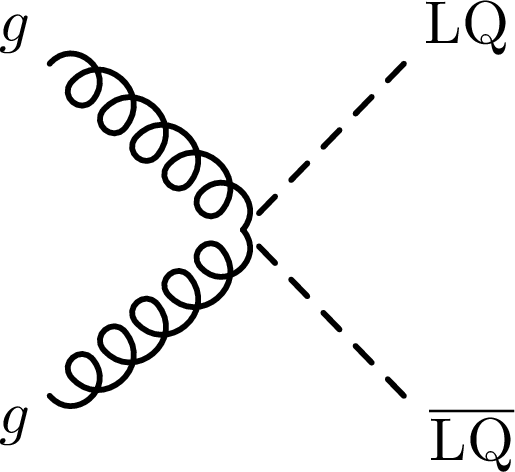
Figure 1:
Feynman diagrams illustrating LO quark- and gluon-initiated pair production processes of scalar leptoquarks in pp collisions at the LHC. |
png pdf |
Figure 1-a:
Feynman diagrams illustrating LO quark- and gluon-initiated pair production processes of scalar leptoquarks in pp collisions at the LHC. |
png pdf |
Figure 1-b:
Feynman diagrams illustrating LO quark- and gluon-initiated pair production processes of scalar leptoquarks in pp collisions at the LHC. |
png pdf |
Figure 1-c:
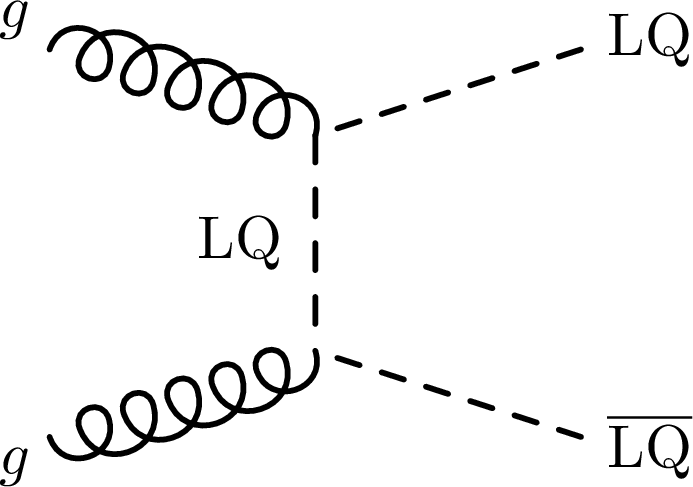
Feynman diagrams illustrating LO quark- and gluon-initiated pair production processes of scalar leptoquarks in pp collisions at the LHC. |
png pdf |
Figure 1-d:
Feynman diagrams illustrating LO quark- and gluon-initiated pair production processes of scalar leptoquarks in pp collisions at the LHC. |
png pdf |
Figure 2:
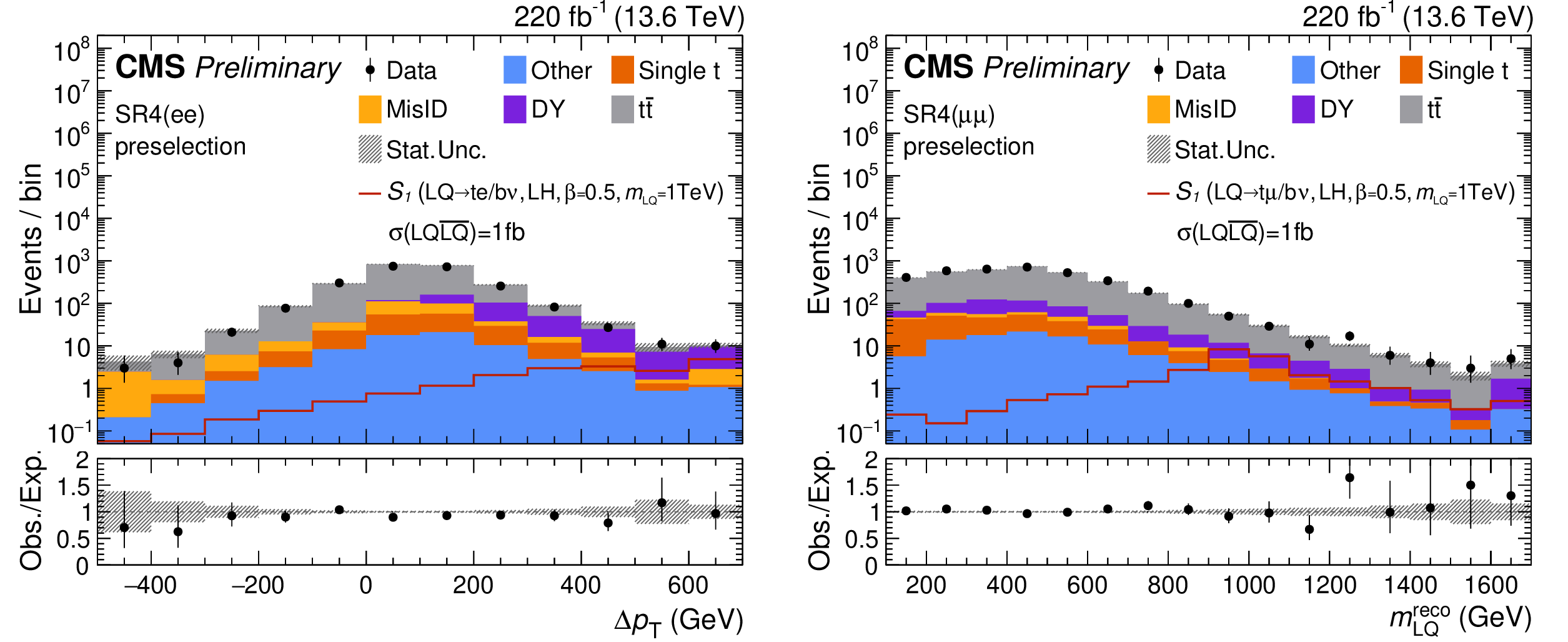
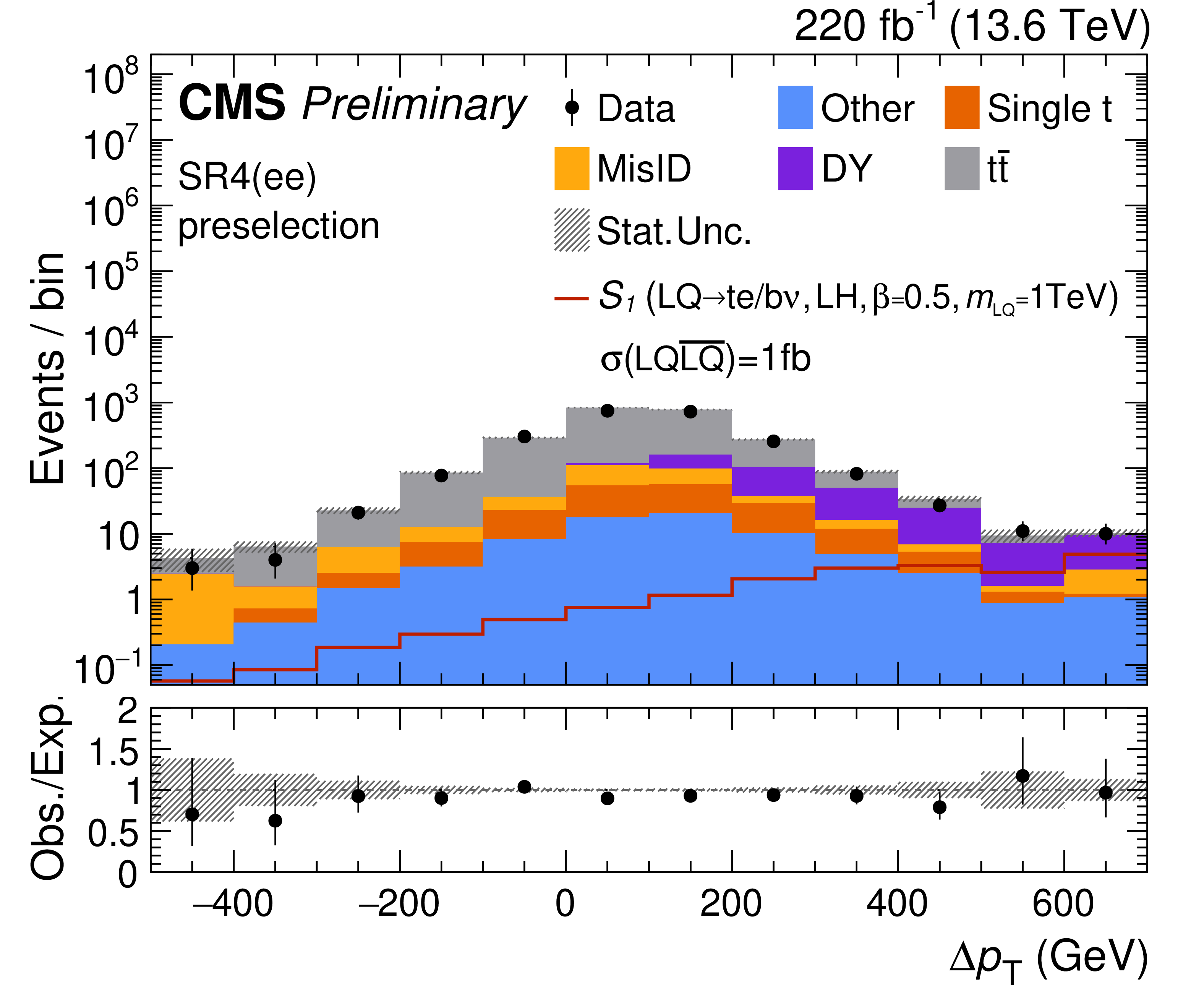
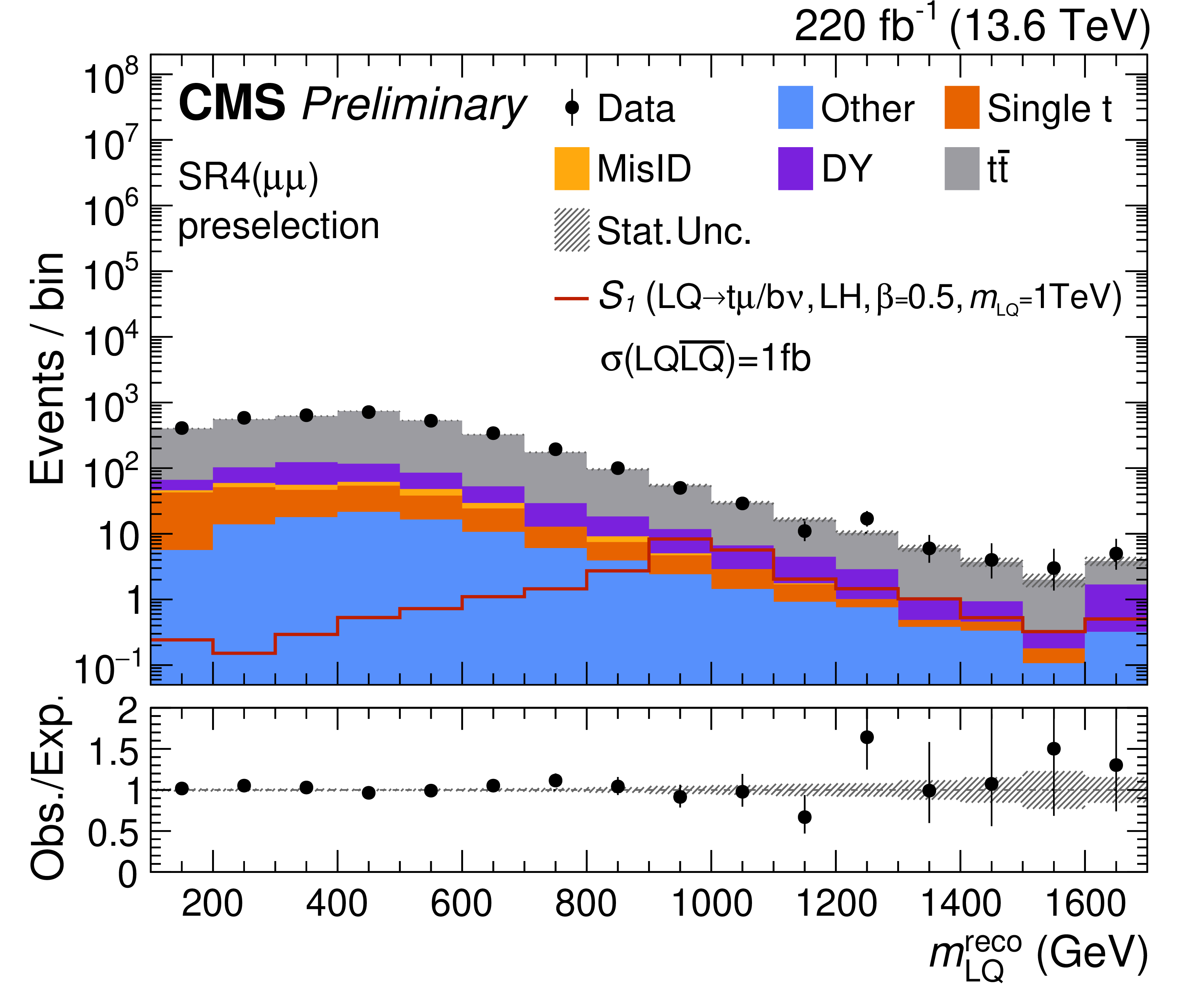
Distributions of the $ \Delta p_{\mathrm{T}} $ (left) and $ m^{\text{reco}}_{\text{LQ}} $ (right) variables in SR4($ \mathrm{e}\mathrm{e} $) and SR4($ \mu\mu $) preselection events, respectively. In these preselections, relaxed criteria are applied as described in the text. Also shown are the predicted yields for scalar $ \text{LQ} $ pair production (LH, $ \beta= $ 0.5) with a mass of 1 TeV, normalized to a cross section of 1\unitfb. Uncertainties are statistical only. |
png pdf |
Figure 2-a:
Distributions of the $ \Delta p_{\mathrm{T}} $ (left) and $ m^{\text{reco}}_{\text{LQ}} $ (right) variables in SR4($ \mathrm{e}\mathrm{e} $) and SR4($ \mu\mu $) preselection events, respectively. In these preselections, relaxed criteria are applied as described in the text. Also shown are the predicted yields for scalar $ \text{LQ} $ pair production (LH, $ \beta= $ 0.5) with a mass of 1 TeV, normalized to a cross section of 1\unitfb. Uncertainties are statistical only. |
png pdf |
Figure 2-b:
Distributions of the $ \Delta p_{\mathrm{T}} $ (left) and $ m^{\text{reco}}_{\text{LQ}} $ (right) variables in SR4($ \mathrm{e}\mathrm{e} $) and SR4($ \mu\mu $) preselection events, respectively. In these preselections, relaxed criteria are applied as described in the text. Also shown are the predicted yields for scalar $ \text{LQ} $ pair production (LH, $ \beta= $ 0.5) with a mass of 1 TeV, normalized to a cross section of 1\unitfb. Uncertainties are statistical only. |
png pdf |
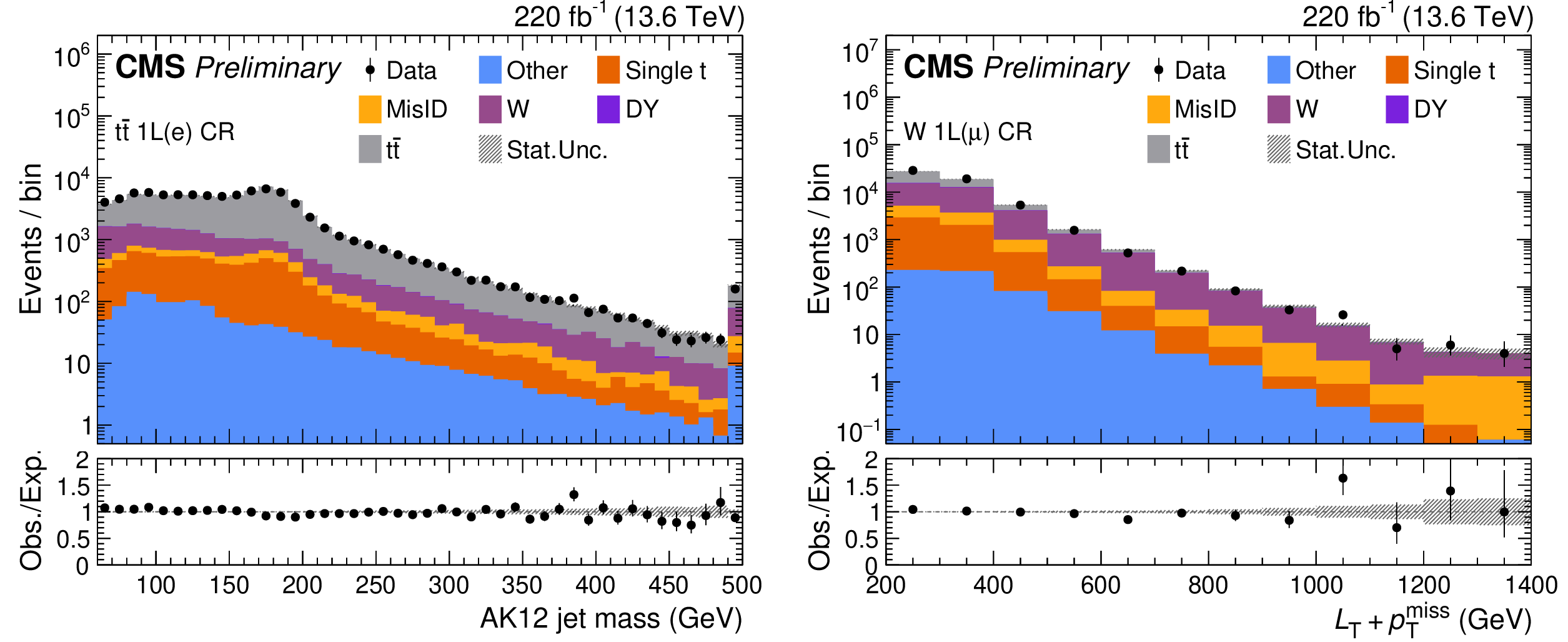
Figure 3:
Distributions of AK12 jet mass (left) and $ L_{\mathrm{T}}+p_{\mathrm{T}}^\text{miss} $ (right) in the $ {\mathrm{t}\overline{\mathrm{t}}} $ 1L(e) and W 1L($ \mu $) CRs, respectively. Uncertainties are statistical only. |
png pdf |
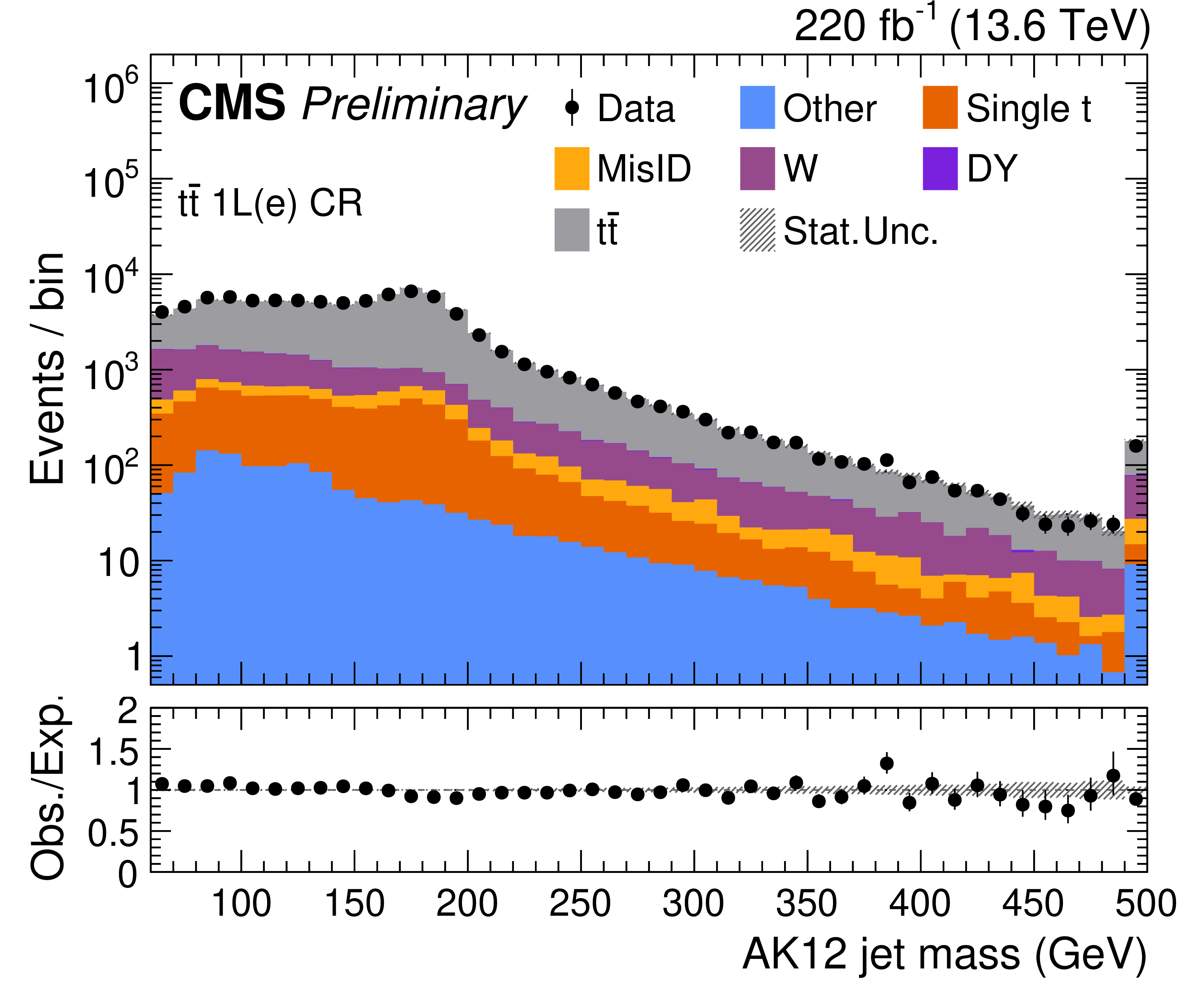
Figure 3-a:
Distributions of AK12 jet mass (left) and $ L_{\mathrm{T}}+p_{\mathrm{T}}^\text{miss} $ (right) in the $ {\mathrm{t}\overline{\mathrm{t}}} $ 1L(e) and W 1L($ \mu $) CRs, respectively. Uncertainties are statistical only. |
png pdf |
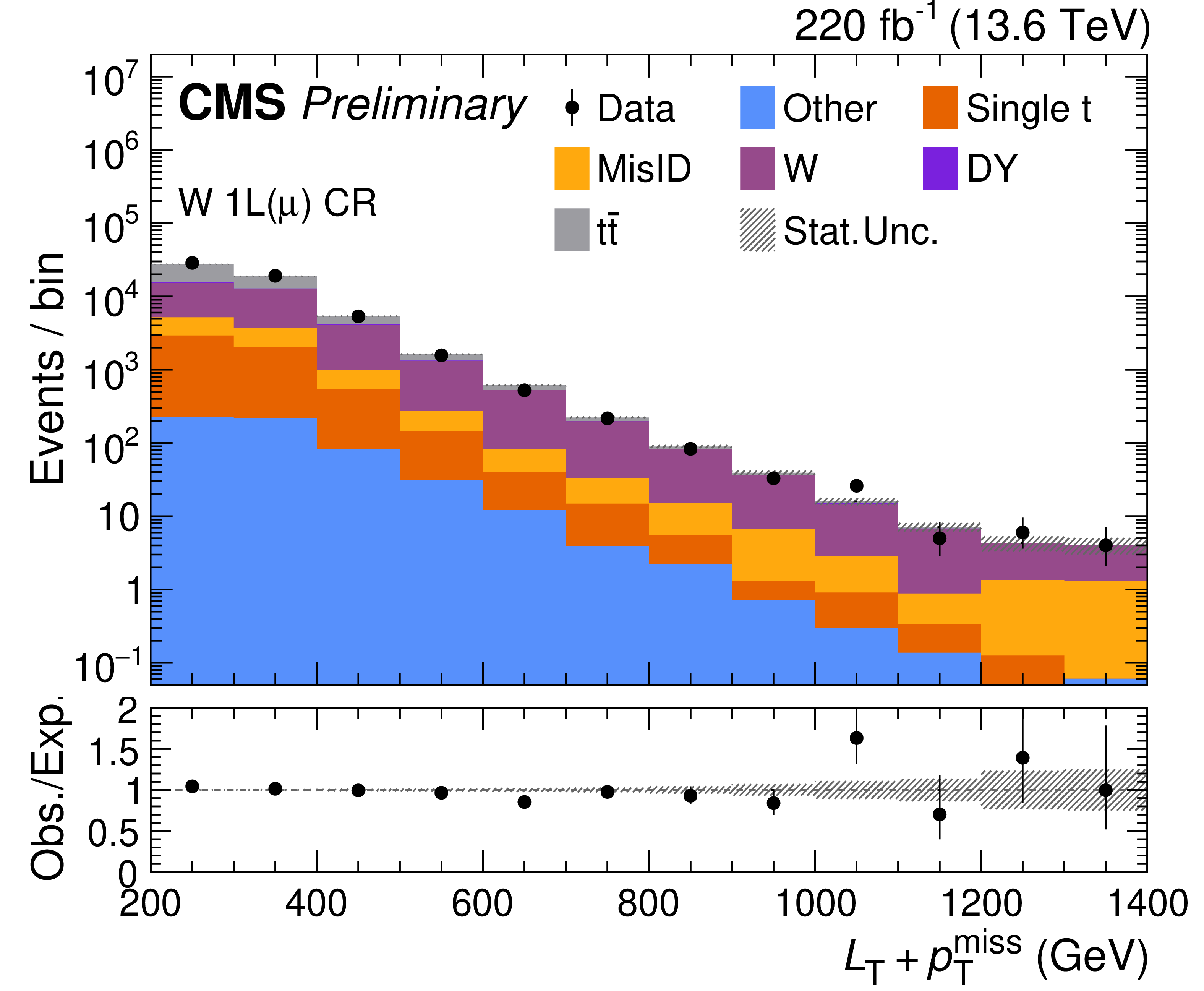
Figure 3-b:
Distributions of AK12 jet mass (left) and $ L_{\mathrm{T}}+p_{\mathrm{T}}^\text{miss} $ (right) in the $ {\mathrm{t}\overline{\mathrm{t}}} $ 1L(e) and W 1L($ \mu $) CRs, respectively. Uncertainties are statistical only. |
png pdf |
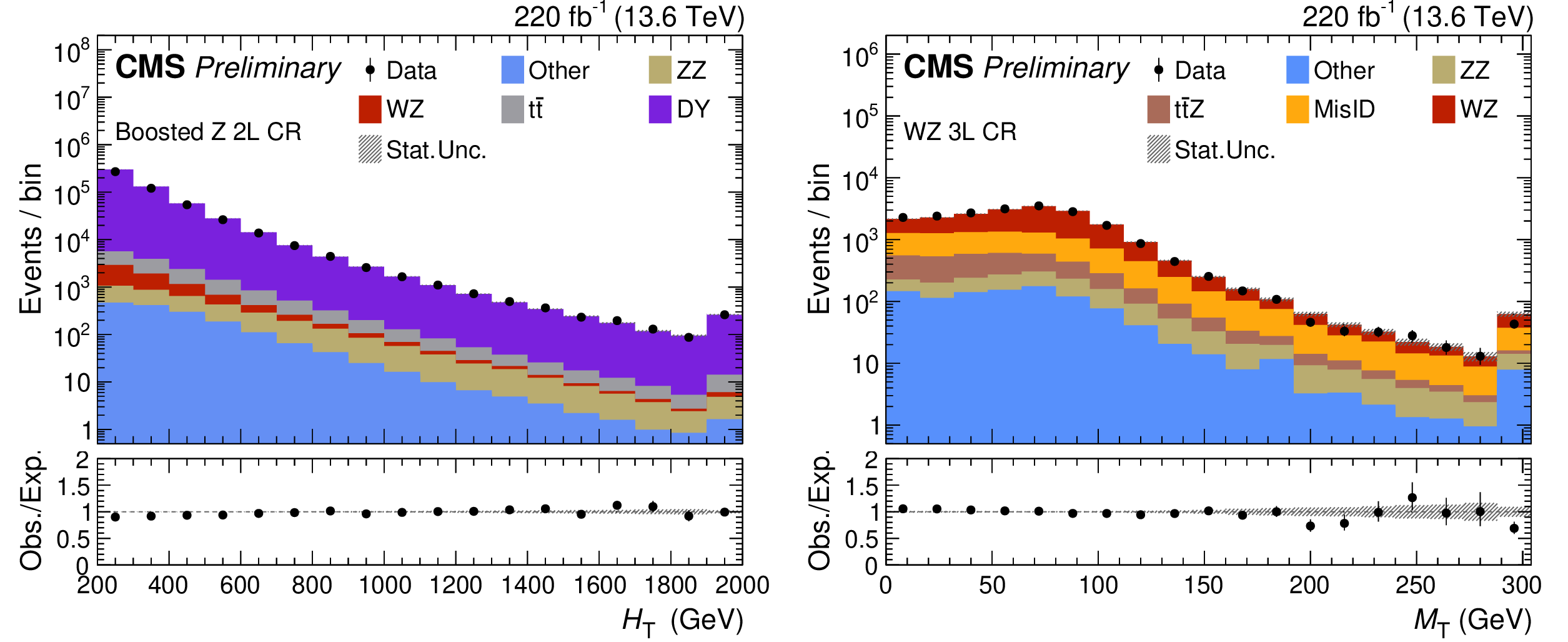
Figure 4:
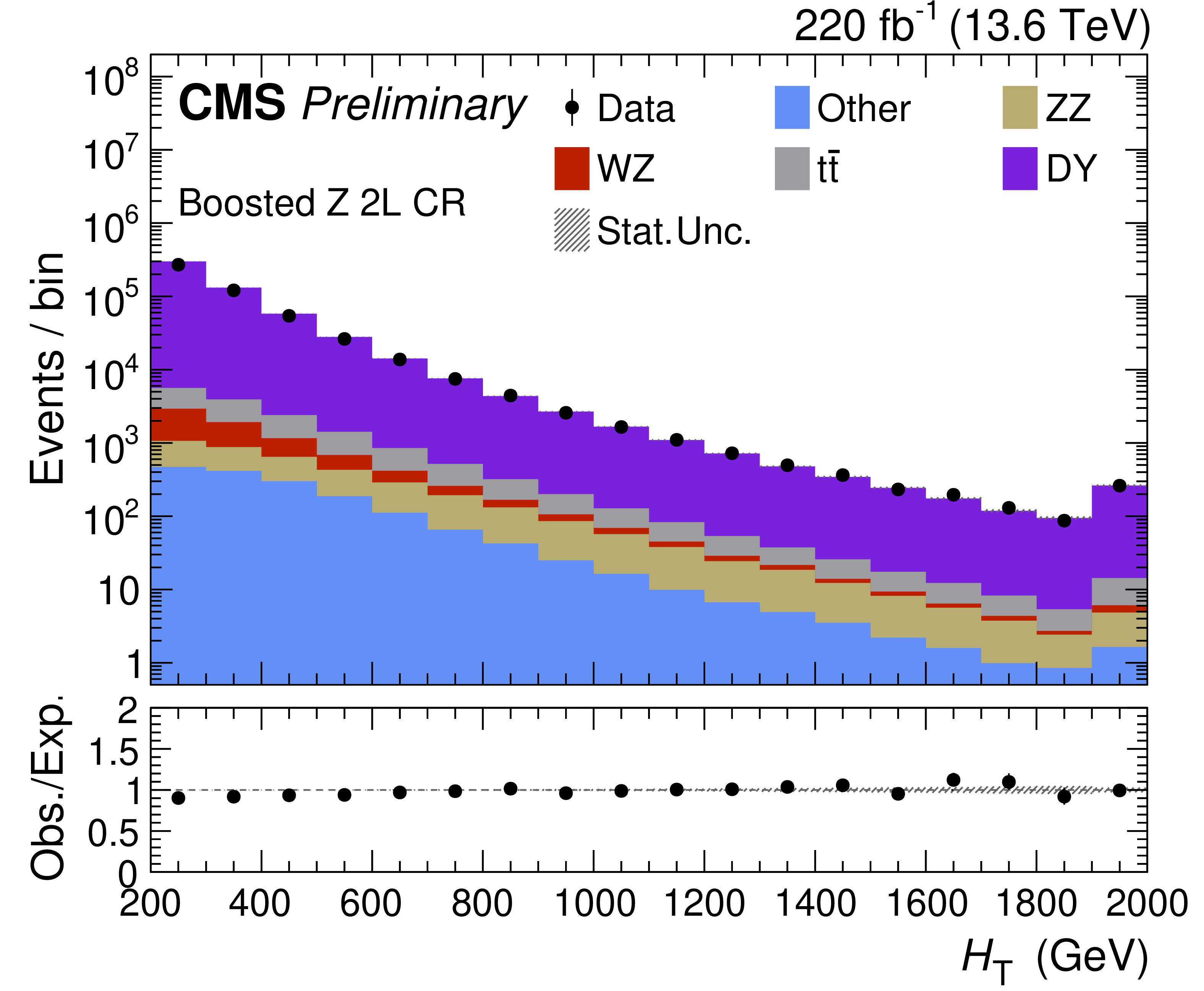
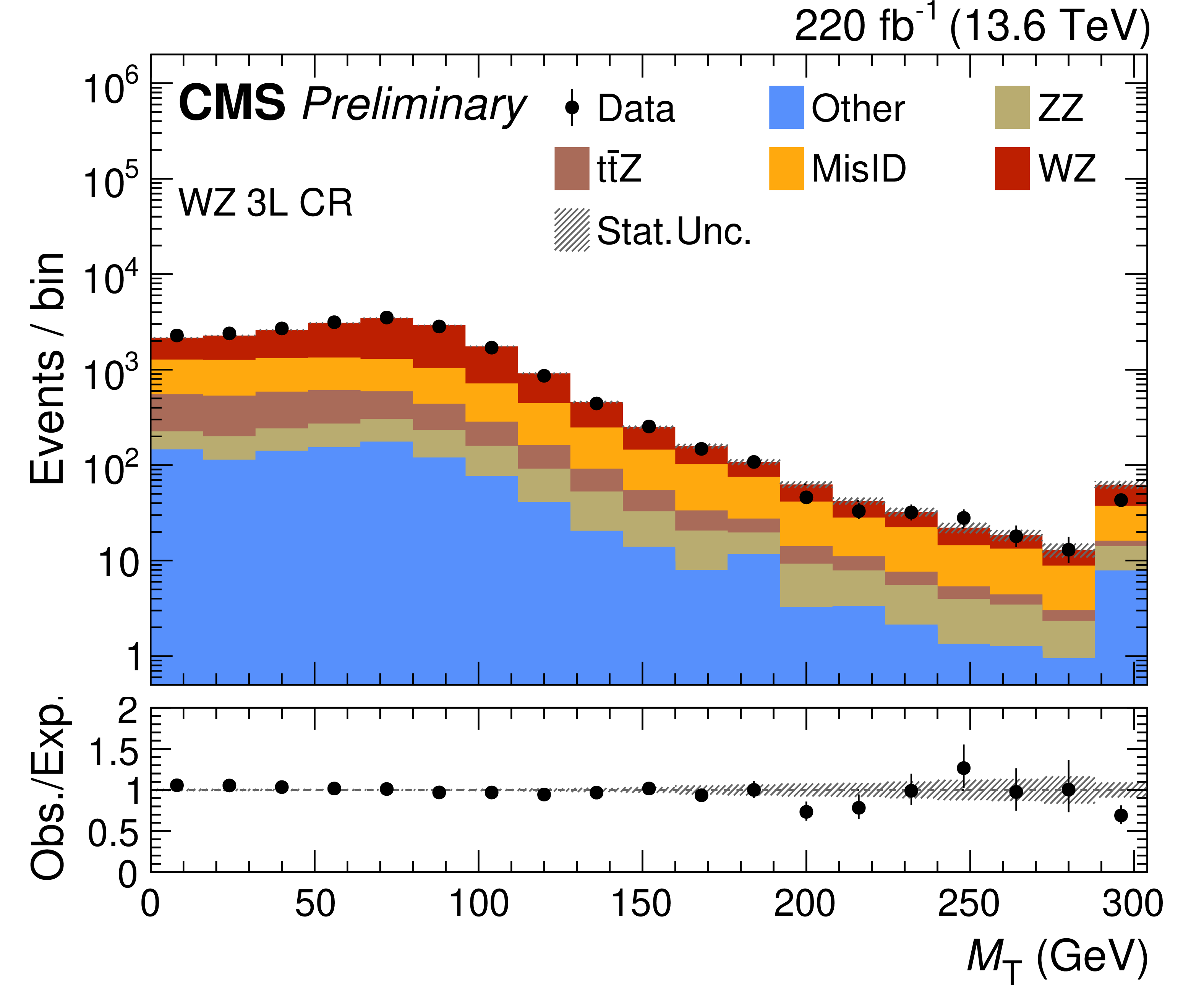
Distributions of $ H_{\mathrm{T}} $ (left) and $ M_{\rm T} $ (right) in the boosted Z 2L and WZ 3L CR, respectively. Uncertainties are statistical only. |
png pdf |
Figure 4-a:
Distributions of $ H_{\mathrm{T}} $ (left) and $ M_{\rm T} $ (right) in the boosted Z 2L and WZ 3L CR, respectively. Uncertainties are statistical only. |
png pdf |
Figure 4-b:
Distributions of $ H_{\mathrm{T}} $ (left) and $ M_{\rm T} $ (right) in the boosted Z 2L and WZ 3L CR, respectively. Uncertainties are statistical only. |
png pdf |
Figure 5:
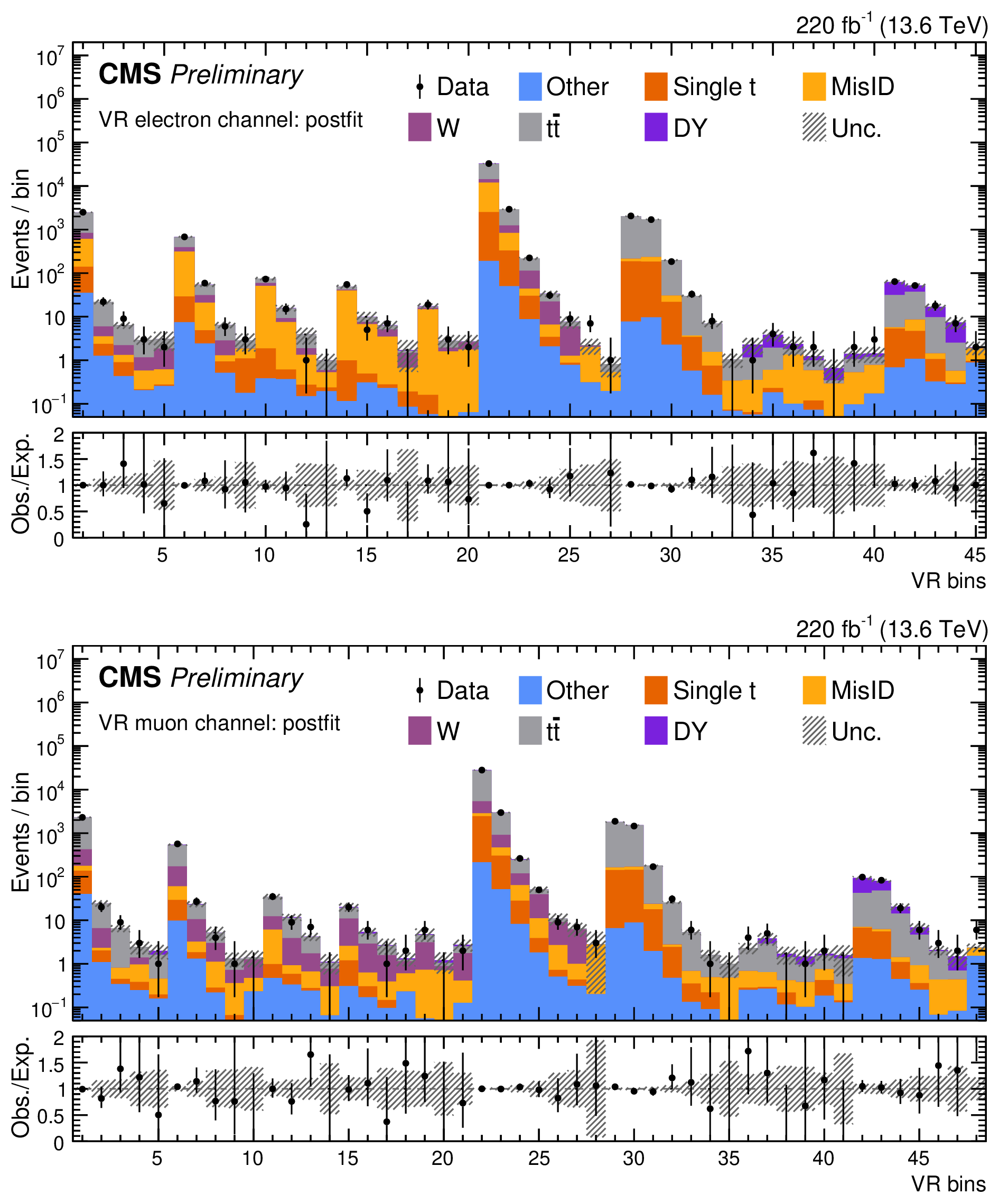
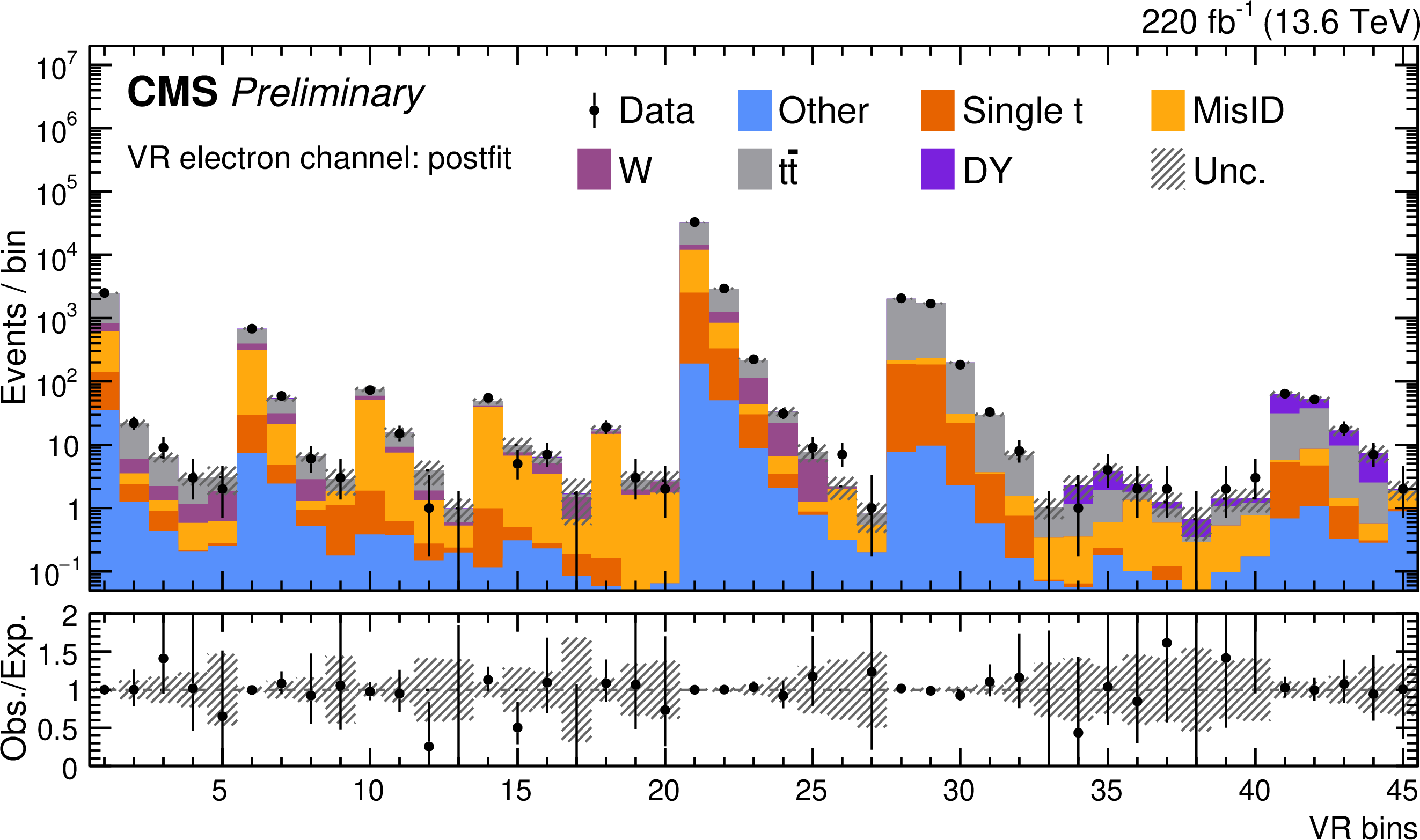
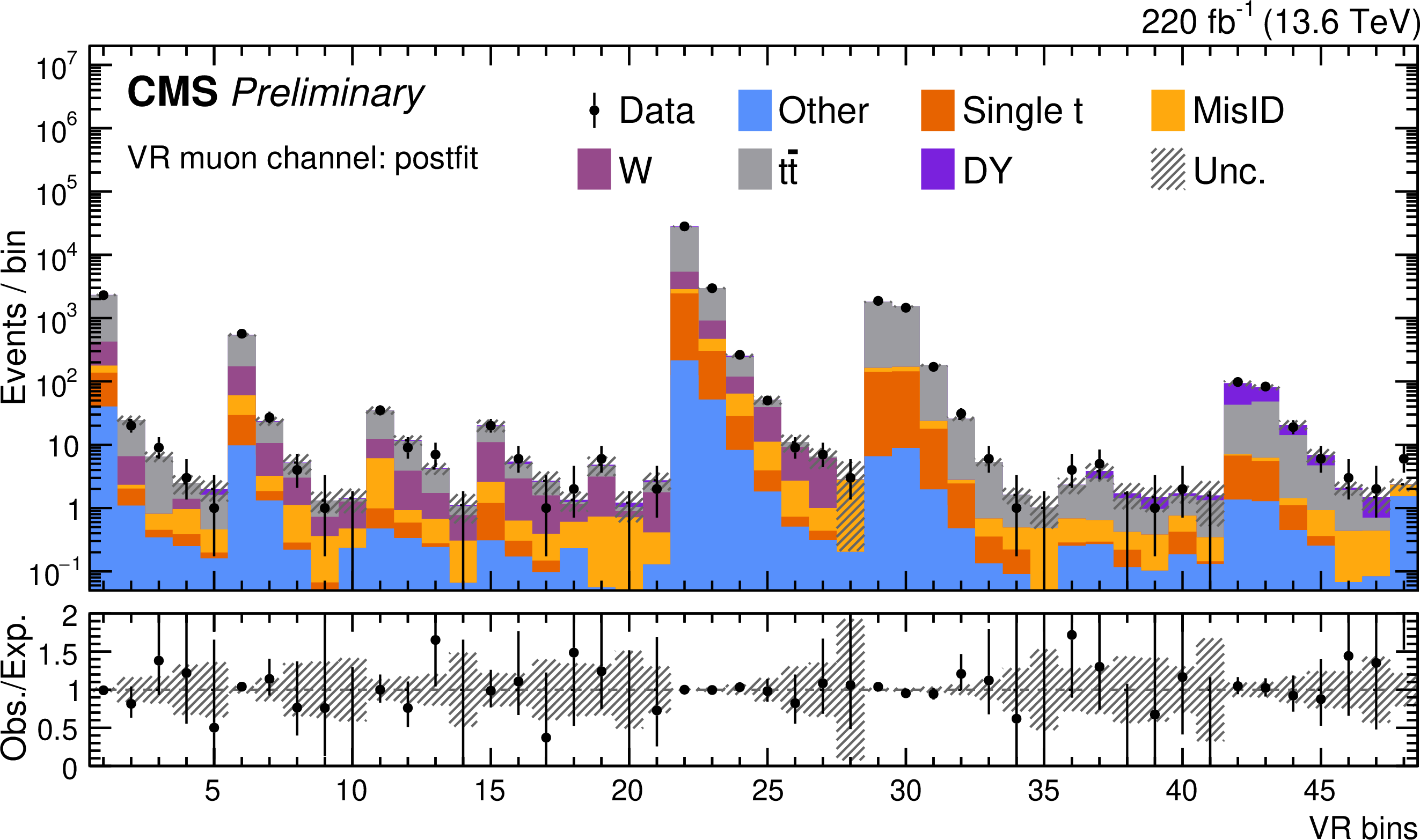
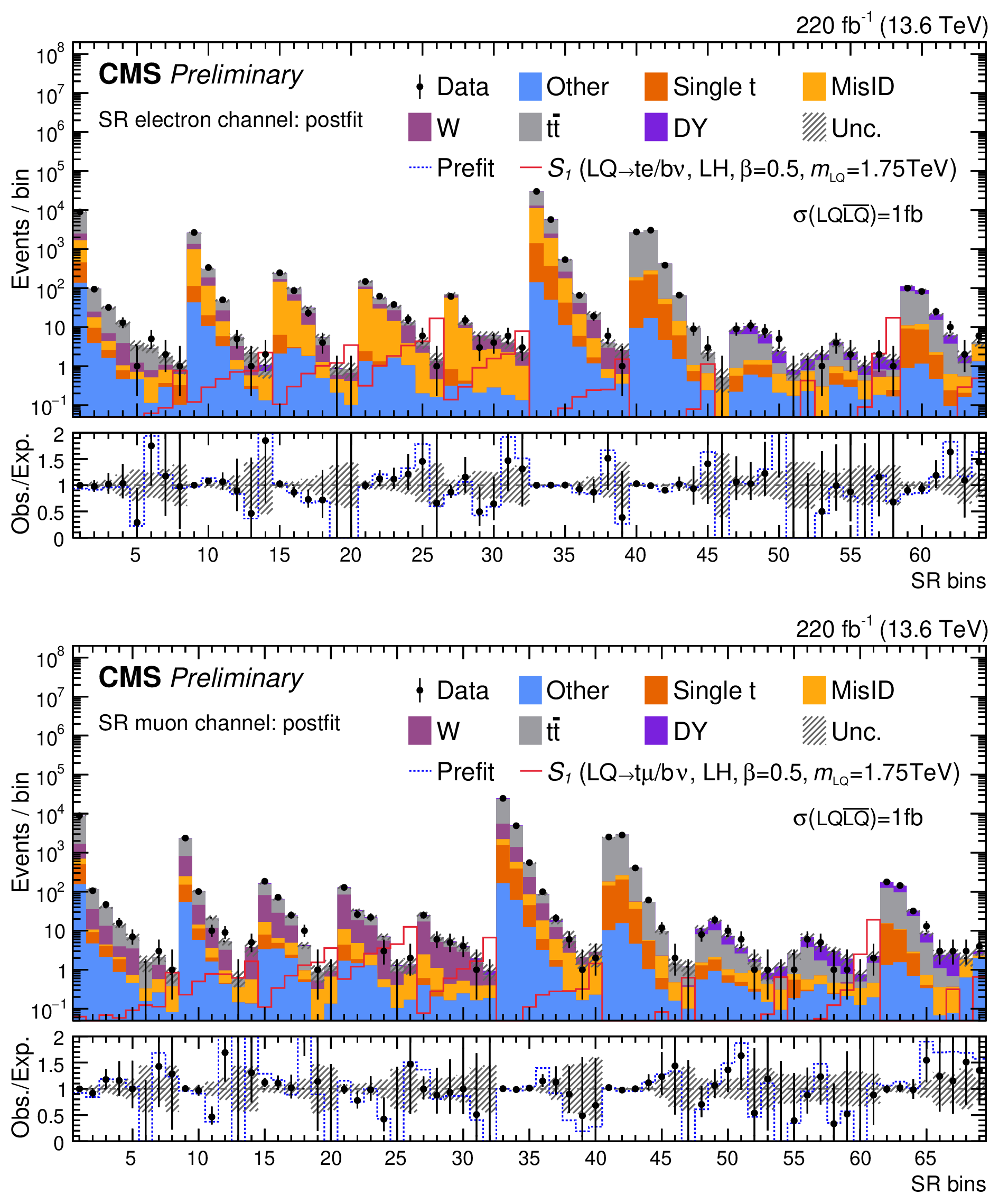
VRs for the electron (upper) and muon (lower) channels, where the distributions and uncertainties are obtained after separately performing the binned maximum likelihood fit to the data under the background-only hypothesis in each channel. The total SM background is shown as a stacked histogram of all contributing processes. The lower panels show the ratio of observed to expected events for the postfit distributions. The gray hatched bands in the upper and lower panels represent the total (systematic and statistical) uncertainty in the expected background in each bin. |
png pdf |
Figure 5-a:
VRs for the electron (upper) and muon (lower) channels, where the distributions and uncertainties are obtained after separately performing the binned maximum likelihood fit to the data under the background-only hypothesis in each channel. The total SM background is shown as a stacked histogram of all contributing processes. The lower panels show the ratio of observed to expected events for the postfit distributions. The gray hatched bands in the upper and lower panels represent the total (systematic and statistical) uncertainty in the expected background in each bin. |
png pdf |
Figure 5-b:
VRs for the electron (upper) and muon (lower) channels, where the distributions and uncertainties are obtained after separately performing the binned maximum likelihood fit to the data under the background-only hypothesis in each channel. The total SM background is shown as a stacked histogram of all contributing processes. The lower panels show the ratio of observed to expected events for the postfit distributions. The gray hatched bands in the upper and lower panels represent the total (systematic and statistical) uncertainty in the expected background in each bin. |
png pdf |
Figure 6:
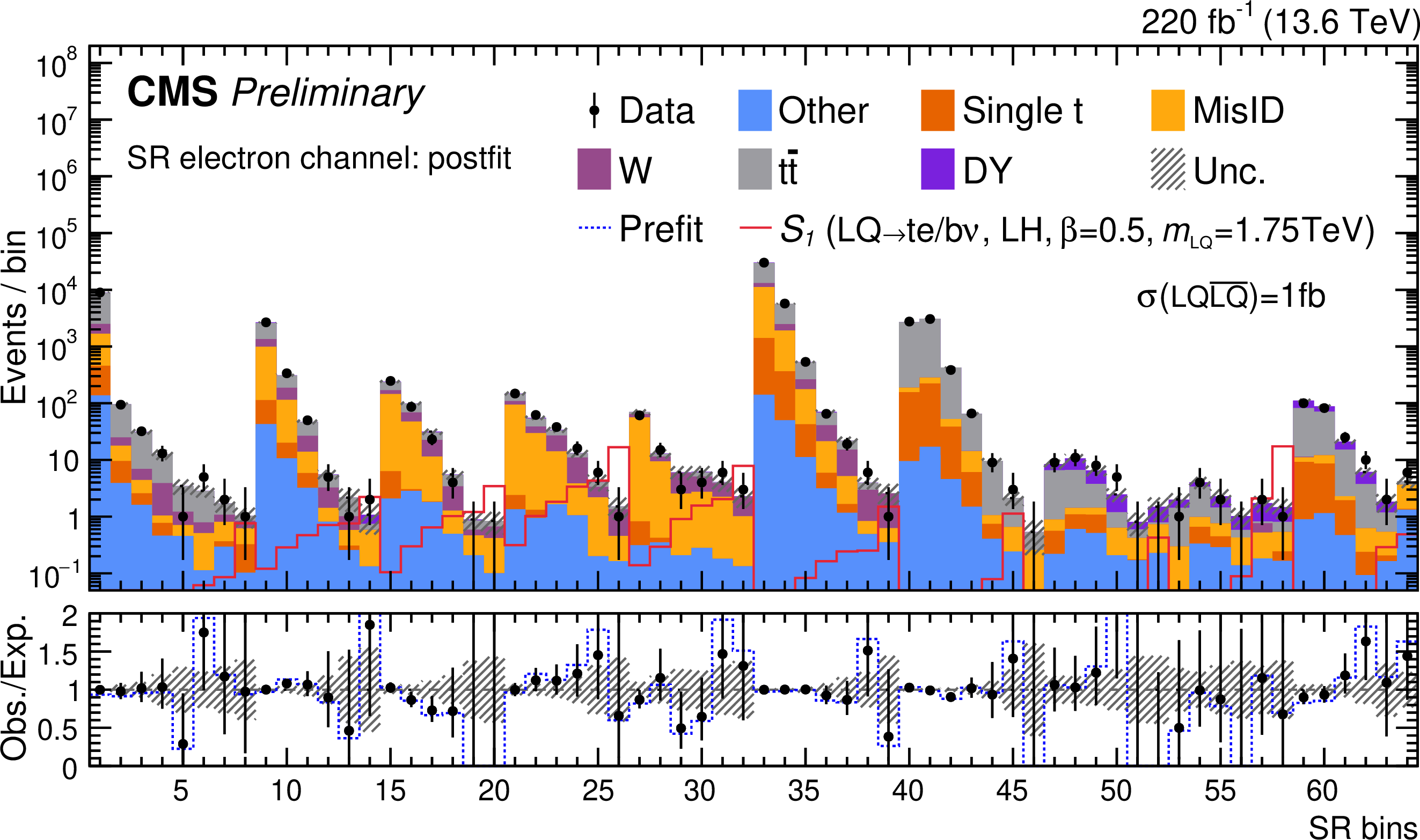
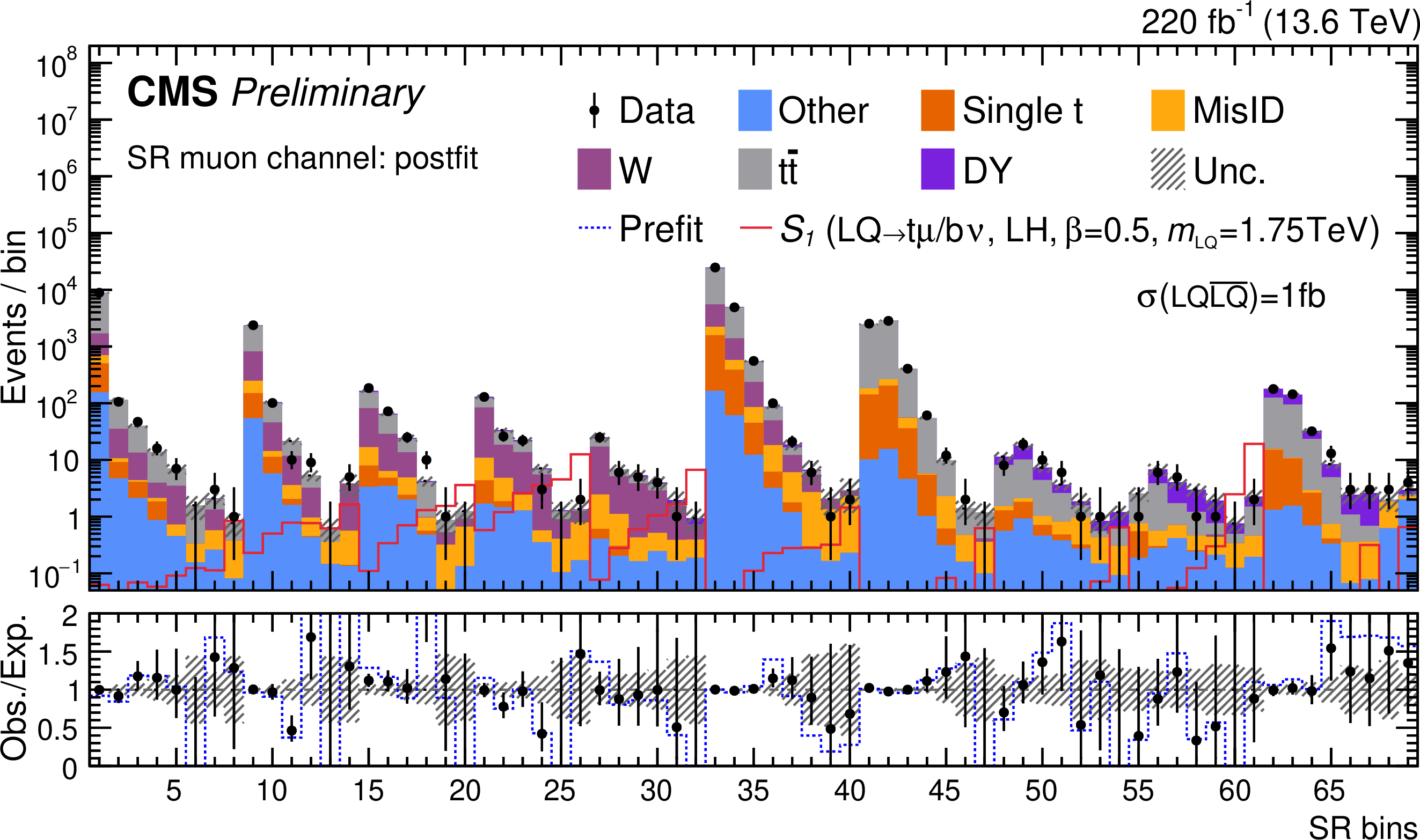
SRs for the electron (upper) and muon (lower) channels, where the distributions and uncertainties are obtained after separately performing the binned maximum likelihood fit to the data under the background-only hypothesis in each channel. The total SM background is shown as a stacked histogram of all contributing processes. Also shown are the predicted yields for scalar $ \text{LQ} $ pair production (LH, $ \beta= $ 0.5) with a mass of 1.75 TeV, normalized to a cross section of 1\unitfb. The lower panels show the ratio of observed to expected events for the postfit (black dotted markers) and prefit (blue dashed lines) distributions. The gray hatched bands in the upper and lower panels represent the total (systematic and statistical) uncertainty in the expected background in each bin. |
png pdf |
Figure 6-a:
SRs for the electron (upper) and muon (lower) channels, where the distributions and uncertainties are obtained after separately performing the binned maximum likelihood fit to the data under the background-only hypothesis in each channel. The total SM background is shown as a stacked histogram of all contributing processes. Also shown are the predicted yields for scalar $ \text{LQ} $ pair production (LH, $ \beta= $ 0.5) with a mass of 1.75 TeV, normalized to a cross section of 1\unitfb. The lower panels show the ratio of observed to expected events for the postfit (black dotted markers) and prefit (blue dashed lines) distributions. The gray hatched bands in the upper and lower panels represent the total (systematic and statistical) uncertainty in the expected background in each bin. |
png pdf |
Figure 6-b:
SRs for the electron (upper) and muon (lower) channels, where the distributions and uncertainties are obtained after separately performing the binned maximum likelihood fit to the data under the background-only hypothesis in each channel. The total SM background is shown as a stacked histogram of all contributing processes. Also shown are the predicted yields for scalar $ \text{LQ} $ pair production (LH, $ \beta= $ 0.5) with a mass of 1.75 TeV, normalized to a cross section of 1\unitfb. The lower panels show the ratio of observed to expected events for the postfit (black dotted markers) and prefit (blue dashed lines) distributions. The gray hatched bands in the upper and lower panels represent the total (systematic and statistical) uncertainty in the expected background in each bin. |
png pdf |
Figure 7:
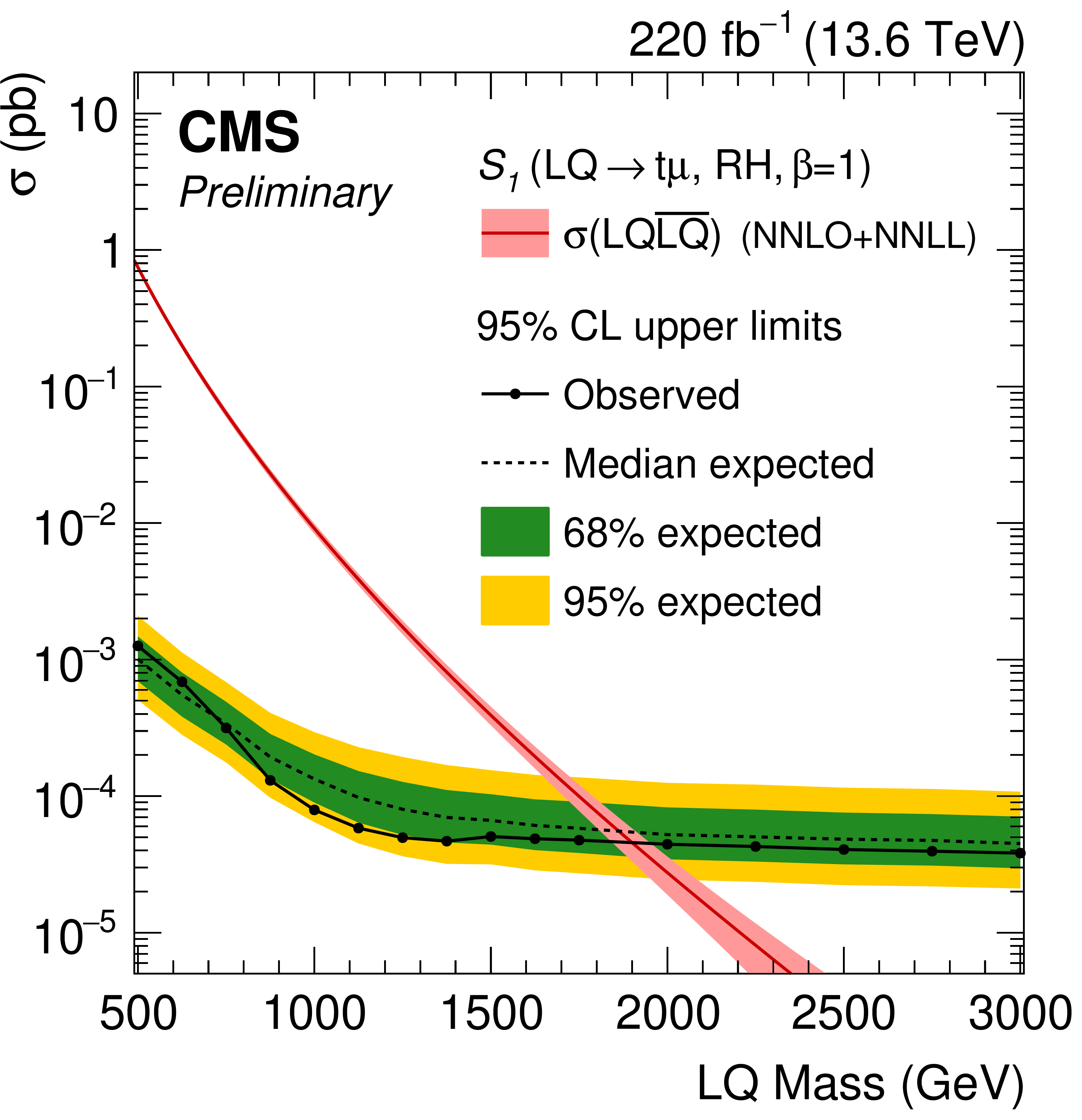
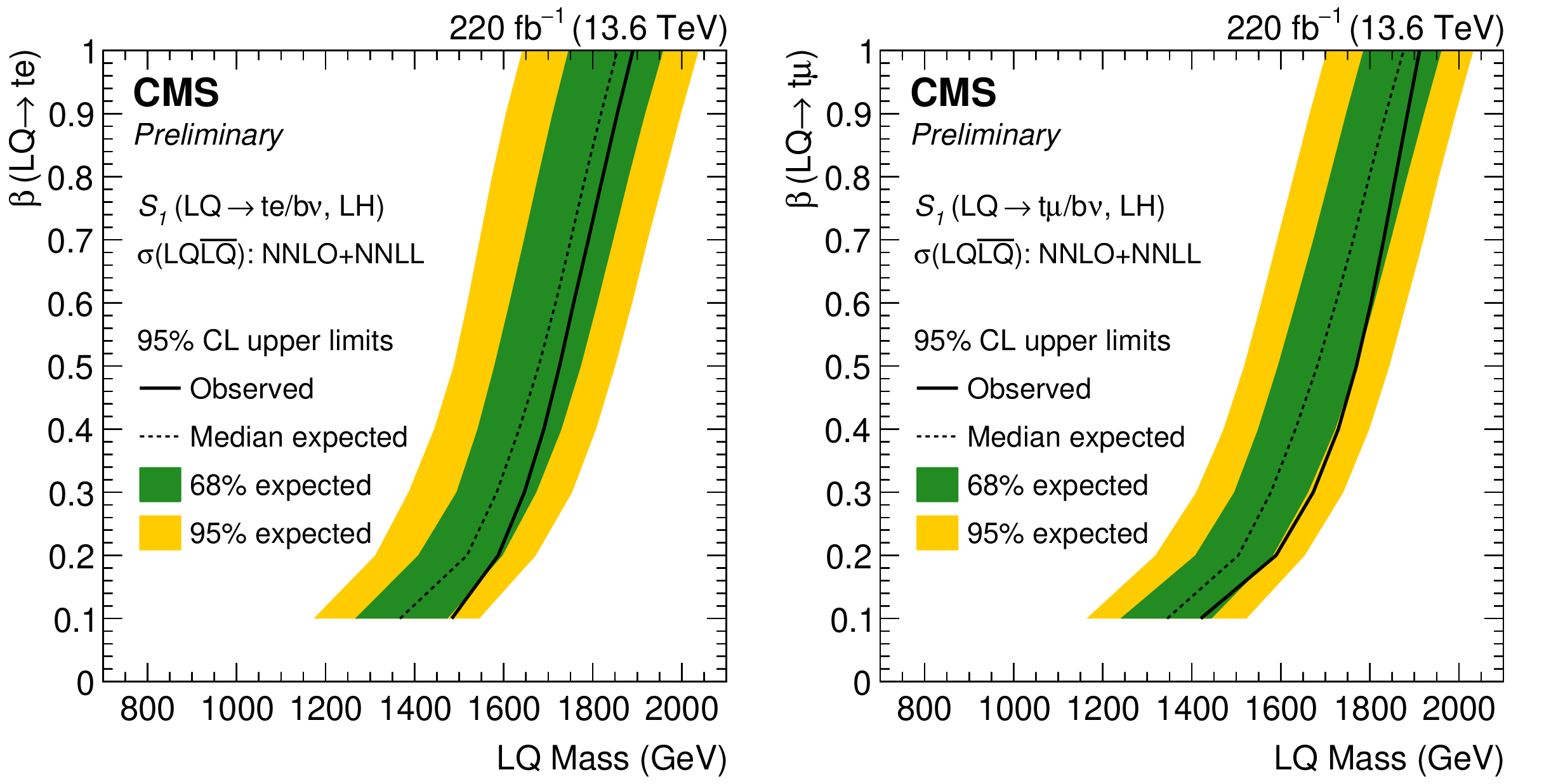
Observed and expected upper limits at 95% CL on the pair production cross section of $ S_{1} $ scalar $ \text{LQ} $s with LH (upper) and RH (lower) Yukawa couplings to third-generation quarks and first- (left) or second-generation (right) leptons. |
png pdf |
Figure 7-a:
Observed and expected upper limits at 95% CL on the pair production cross section of $ S_{1} $ scalar $ \text{LQ} $s with LH (upper) and RH (lower) Yukawa couplings to third-generation quarks and first- (left) or second-generation (right) leptons. |
png pdf |
Figure 7-b:
Observed and expected upper limits at 95% CL on the pair production cross section of $ S_{1} $ scalar $ \text{LQ} $s with LH (upper) and RH (lower) Yukawa couplings to third-generation quarks and first- (left) or second-generation (right) leptons. |
png pdf |
Figure 7-c:
Observed and expected upper limits at 95% CL on the pair production cross section of $ S_{1} $ scalar $ \text{LQ} $s with LH (upper) and RH (lower) Yukawa couplings to third-generation quarks and first- (left) or second-generation (right) leptons. |
png pdf |
Figure 7-d:
Observed and expected upper limits at 95% CL on the pair production cross section of $ S_{1} $ scalar $ \text{LQ} $s with LH (upper) and RH (lower) Yukawa couplings to third-generation quarks and first- (left) or second-generation (right) leptons. |
png pdf |
Figure 8:
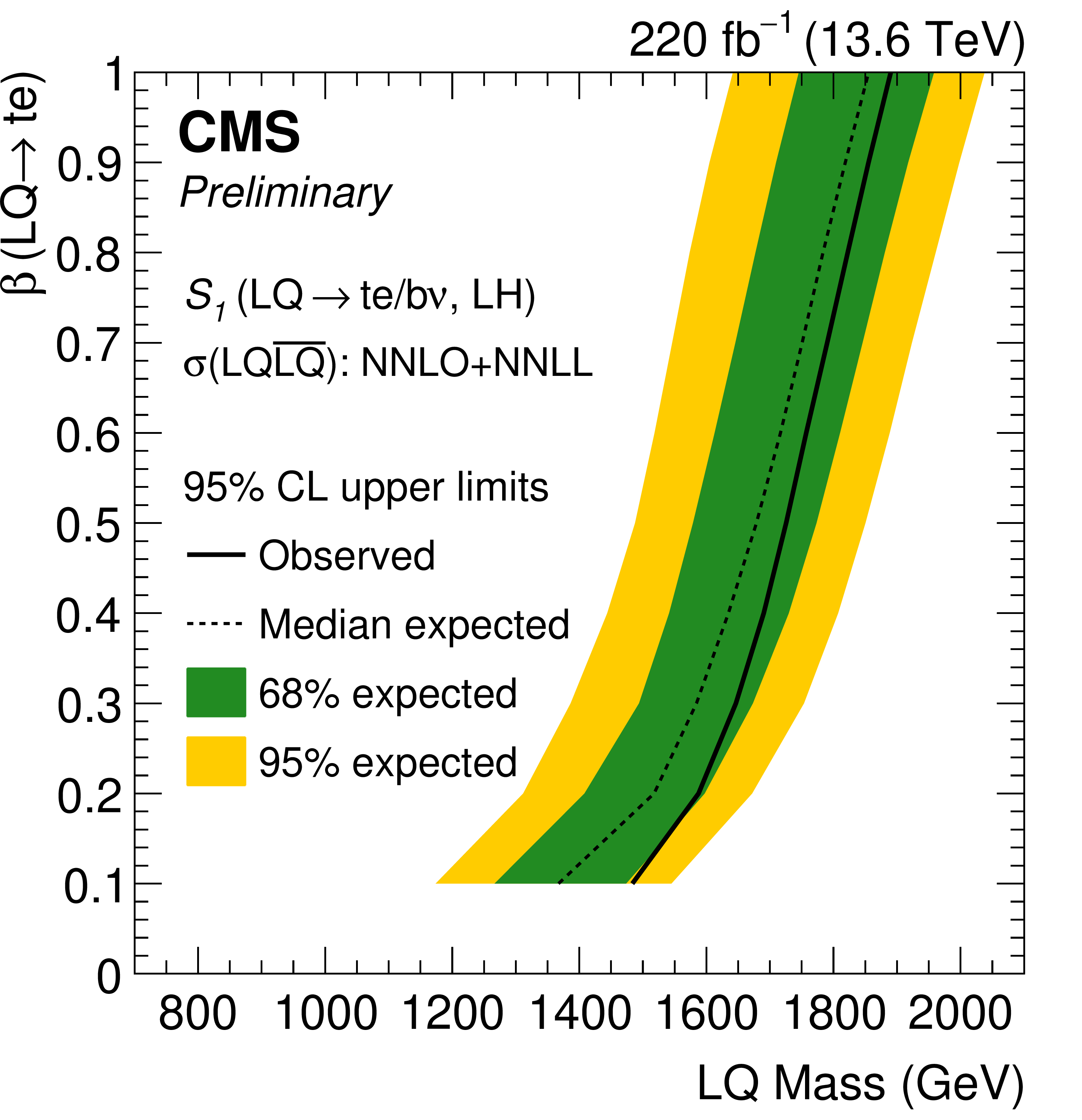
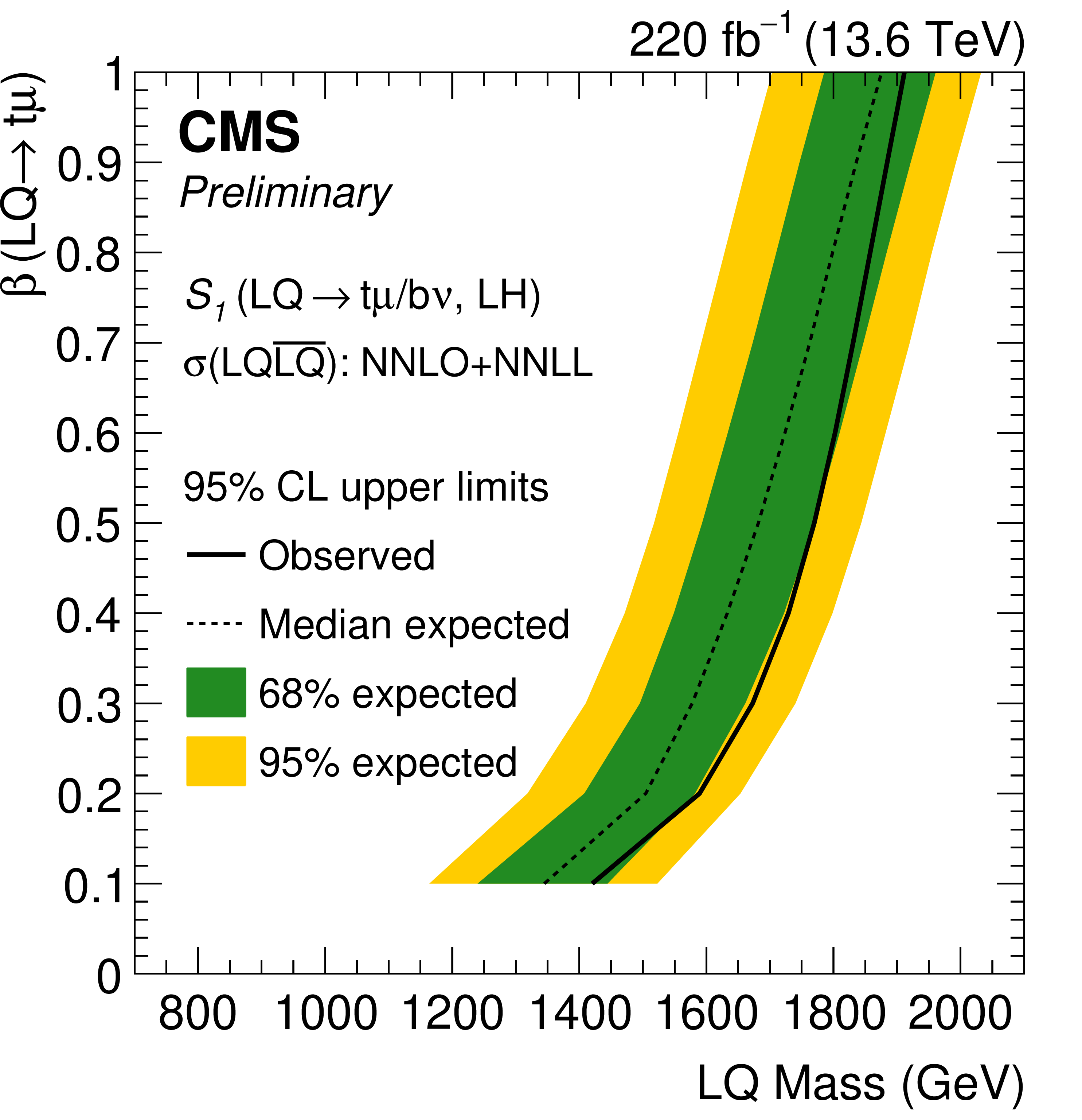
Observed and expected upper limits 95% CL in the plane of the $ \text{LQ} $ mass vs. the branching ratio $ \beta(\text{LQ} \rightarrow\mathrm{t}\ell) $, for $ S_{1} $ scalar $ \text{LQ} $s with LH Yukawa couplings to third generation quarks and first- (left) or second-generation (right) leptons. |
png pdf |
Figure 8-a:
Observed and expected upper limits 95% CL in the plane of the $ \text{LQ} $ mass vs. the branching ratio $ \beta(\text{LQ} \rightarrow\mathrm{t}\ell) $, for $ S_{1} $ scalar $ \text{LQ} $s with LH Yukawa couplings to third generation quarks and first- (left) or second-generation (right) leptons. |
png pdf |
Figure 8-b:
Observed and expected upper limits 95% CL in the plane of the $ \text{LQ} $ mass vs. the branching ratio $ \beta(\text{LQ} \rightarrow\mathrm{t}\ell) $, for $ S_{1} $ scalar $ \text{LQ} $s with LH Yukawa couplings to third generation quarks and first- (left) or second-generation (right) leptons. |
| Tables | |
png pdf |
Table 1:
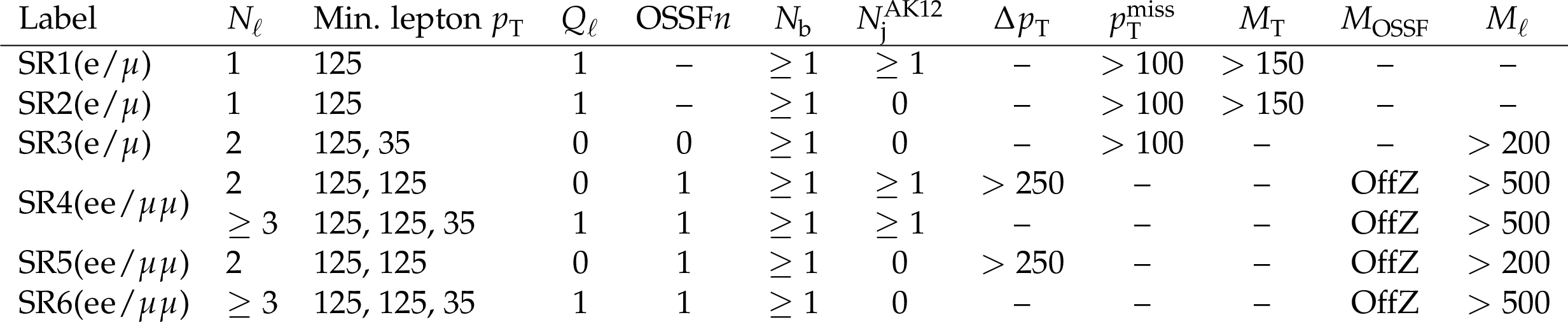
Signal region definitions. Each SR is split into an electron-like and a muon-like component where the lepton flavors specified in the label correspond to the leading lepton(s) in the selection. Lepton $ p_{\mathrm{T}} $, $ \Delta p_{\mathrm{T}} $, $ p_{\mathrm{T}}^\text{miss} $, $ M_{\rm T} $, and $ M_{\ell} $ values are in units of GeV. In events with more than four leptons, only the four leading leptons in $ p_{\mathrm{T}} $ are considered. SR1 and SR4 are further subdivided into five and three categories, respectively, based on the reconstructed $ \text{LQ} $ mass. |
png pdf |
Table 2:
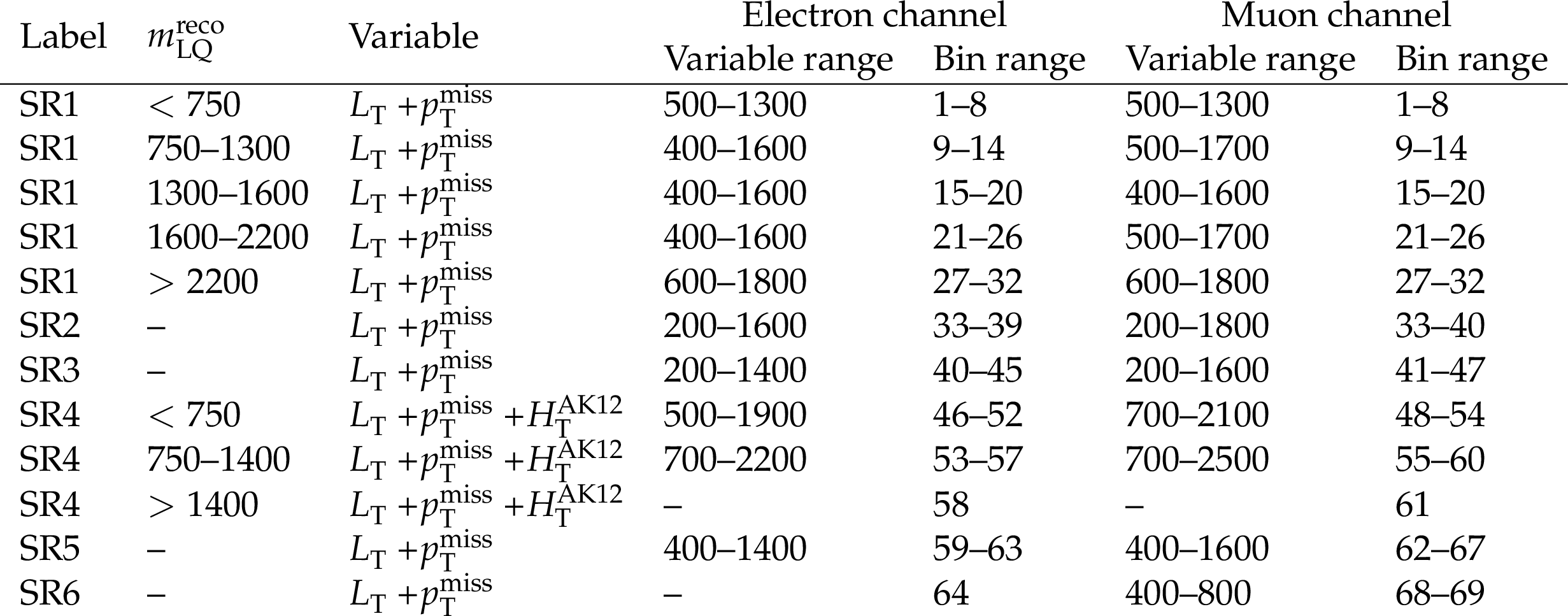
Summary of electron and muon channel signal regions, with a total of 64 and 69 bins, respectively. The resonant mass $ m^{\text{reco}}_{\text{LQ}} $ and $ L_{\mathrm{T}}+p_{\mathrm{T}}^\text{miss}(+H_{\mathrm{T}}^{\rm{AK12}} ) $ values are in units of GeV. Each $ L_{\mathrm{T}}+p_{\mathrm{T}}^\text{miss}(+H_{\mathrm{T}}^{\rm{AK12}} ) $ range is divided into bins of uniform width, and the first and last bins in each binning scheme include underflow and overflow events, respectively. |

png pdf |
Table 3:
Summary of CR selection criteria. All one- and two-lepton CR events are selected with the high-$ p_{\mathrm{T}} $ lepton triggers, whereas three- and four-lepton CR events are selected with the isolated single-lepton triggers with lower $ p_{\mathrm{T}} $ thresholds. Values of $ p_{\mathrm{T}} $, $ \Delta p_{\mathrm{T}} $, $ p_{\mathrm{T}}^\text{miss} $, $ M_{\rm T} $, $ M_{\ell} $, and $ H_{\mathrm{T}} $ are in units of GeV. |
png pdf |
Table 4:
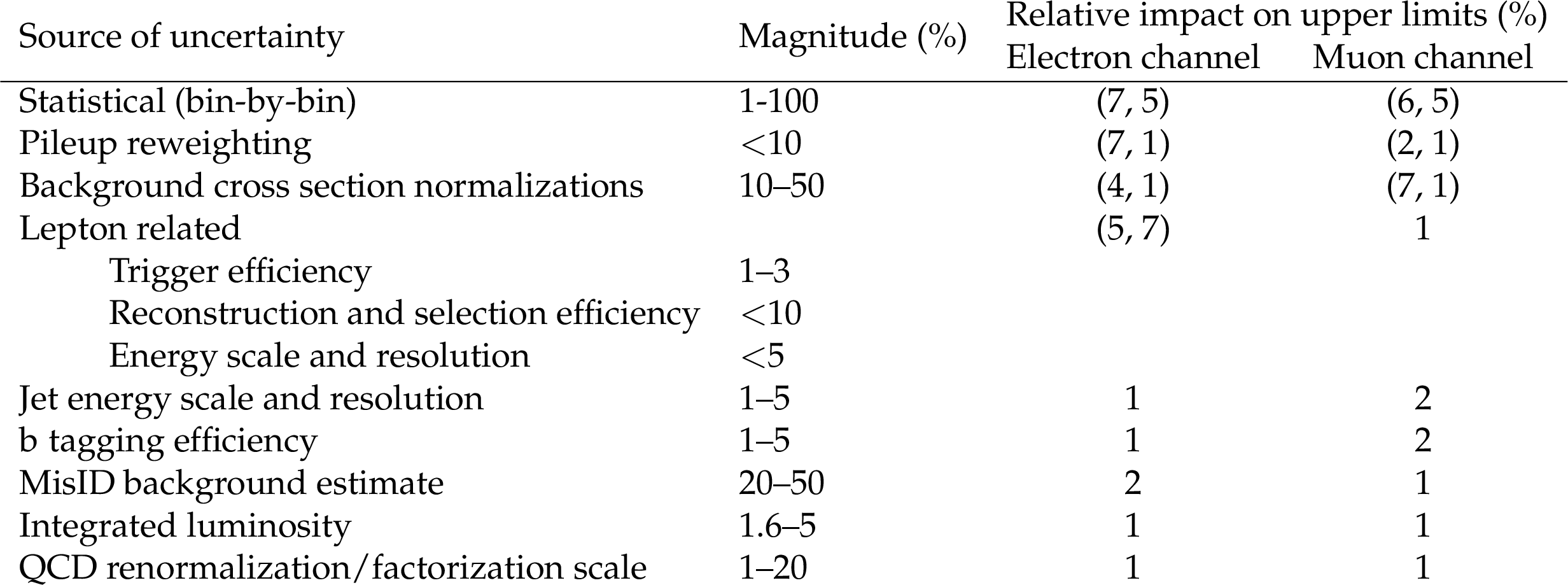
Summary of the systematic uncertainties considered in this analysis, along with their typical magnitudes and relative impact on the expected upper limits on \text{LQ} cross sections. The magnitude column reflects the typical relative variations observed in the affected signal and background distributions across the SR bins. The impact of the uncertainties varies with the \text{LQ} mass; entries given as pairs correspond to the impacts for the 750 GeV and 2 TeV signal mass hypotheses, respectively. |
png pdf |
Table 5:
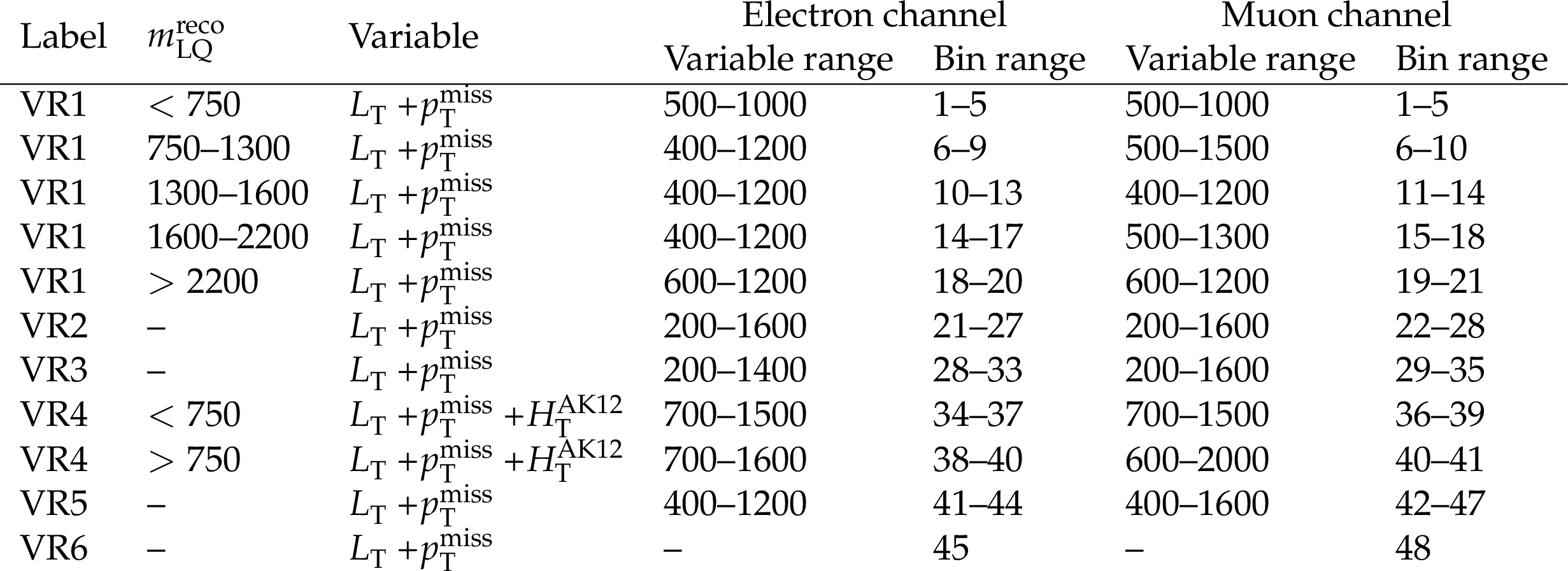
Summary of electron and muon channel validation regions, with a total of 45 and 48 bins, respectively. Each VR$ i $ selection corresponds to SR$ i $ defined in Table 1, differing only by the inversion of the b-tagged jet $ p_{\mathrm{T}} $ requirement, 50 $ < p_{\mathrm{T}} < $ 100 GeV. The resonant mass $ m^{\text{reco}}_{\text{LQ}} $ and $ L_{\mathrm{T}}+p_{\mathrm{T}}^\text{miss}(+H_{\mathrm{T}}^{\rm{AK12}} ) $ values are in units of GeV. Each $ L_{\mathrm{T}}+p_{\mathrm{T}}^\text{miss}(+H_{\mathrm{T}}^{\rm{AK12}} ) $ range is divided into bins of uniform width, and the first and last bins in each binning scheme include underflow and overflow events, respectively. |
| Summary |
| A search for physics beyond the standard model is performed using events with at least one charged lepton and additional hadronic activity in proton--proton collision data at $ \sqrt{s} = $ 13.6 TeV. The data were collected by the CMS experiment at the LHC during 2024--2025 and correspond to an integrated luminosity of 220 fb$^{-1}$. No statistically significant, signal-like deviation of the data from the SM background is observed in the probed phase space. Constraints are set on the pair-production cross section of scalar leptoquarks with electric charge $ \pm1/ $ 3 and cross-generational couplings between quarks and leptons. For leptoquarks coupling to first-generation (second-generation) leptons, masses below 1720 (1760) GeV are excluded at 95% confidence level for left-handed couplings, and 1860 (1890) GeV for right-handed couplings. These are the most stringent limits on such models to date. |
| References | ||||
| 1 | A. Greljo and B. A. Stefanek | Third family quark-lepton unification at the TeV scale | PLB 782 (2018) 131 | 1802.04274 |
| 2 | G. Chauhan et al. | Phenomenology of lepton masses and mixing with discrete flavor symmetries | Prog. Part. Nucl. Phys. 138 (2024) 104126 | 2310.20681 |
| 3 | A. Doff, J. P. Pinheiro, and C. A. de S. Pires | Leptoquark-induced radiative masses for active and sterile neutrinos within the framework of the 3-3-1 model | PLB 863 (2025) 139375 | 2412.15055 |
| 4 | W. Buchm \"u ller, R. R \"u ckl, and D. Wyler | Leptoquarks in lepton-quark collisions | PLB 191 (1987) 442 | |
| 5 | Particle Data Group Collaboration | Review of particle physics | PRD 110 (2024) 030001 | |
| 6 | J. C. Pati and A. Salam | Lepton number as the fourth color | PRD 10 (1974) 275 | |
| 7 | H. Georgi and S. L. Glashow | Unity of all elementary particle forces | PRL 32 (1974) 438 | |
| 8 | H. Fritzsch and P. Minkowski | Unified interactions of leptons and hadrons | Annals Phys. 93 (1975) 193 | |
| 9 | B. Gripaios, M. Nardecchia, and S. A. Renner | Composite leptoquarks and anomalies in $ b $-meson decays | JHEP 05 (2015) 006 | 1412.1791 |
| 10 | L. Da Rold and F. Lamagna | Composite higgs and leptoquarks from a simple group | JHEP 03 (2019) 135 | 1812.08678 |
| 11 | S. Weinberg | Supersymmetry at ordinary energies. Masses and conservation laws | PRD 26 (1982) 287 | |
| 12 | R. Barbier et al. | $ {R} $-parity violating supersymmetry | Phys. Rept. 420 (2005) 1 | hep-ph/0406039 |
| 13 | R. Mandal and A. Pich | Constraints on scalar leptoquarks from lepton and kaon physics | JHEP 12 (2019) 089 | 1908.11155 |
| 14 | B. Diaz, M. Schmaltz, and Y.-M. Zhong | The leptoquark hunter\textquoterights guide: Pair production | JHEP 10 (2017) 097 | 1706.05033 |
| 15 | G. Hiller, D. Loose, and K. Schönwald | Leptoquark Flavor Patterns \& B Decay Anomalies | JHEP 12 (2016) 027 | 1609.08895 |
| 16 | E. Alvarez et al. | A composite pngb leptoquark at the LHC | JHEP 12 (2018) 027 | 1808.02063 |
| 17 | A. Angelescu, D. Be \v c irevi \'c , D. A. Faroughy, and O. Sumensari | Closing the window on single leptoquark solutions to the $ b $-physics anomalies | JHEP 10 (2018) 183 | 1808.08179 |
| 18 | D. Be \v c irevi \'c et al. | Scalar leptoquarks from grand unified theories to accommodate the $ B $-physics anomalies | PRD 98 (2018) 055003 | 1806.05689 |
| 19 | A. Crivellin, D. M \"u ller, and F. Saturnino | Flavor phenomenology of the leptoquark singlet-triplet model | JHEP 06 (2020) 020 | 1912.04224 |
| 20 | S. Saad and A. Thapa | Common origin of neutrino masses and $ r_{D^{(\ast)}} $, $ r_{K^{(\ast)}} $ anomalies | PRD 102 (2020) 015014 | 2004.07880 |
| 21 | U. Haisch and G. Polesello | Resonant third-generation leptoquark signatures at the large hadron collider | JHEP 05 (2021) 057 | 2012.11474 |
| 22 | G. Belanger et al. | Leptoquark manoeuvres in the dark: a simultaneous solution of the dark matter problem and the $ {R}_{D^{\left(\ast \right)}} $ anomalies | JHEP 02 (2022) 042 | 2111.08027 |
| 23 | D. Zhang | Radiative neutrino masses, lepton flavor mixing and muon g\ensuremath-2 in a leptoquark model | JHEP 07 (2021) 069 | 2105.08670 |
| 24 | A. Greljo, P. Stangl, and A. E. Thomsen | A model of muon anomalies | PLB 820 (2021) 136554 | 2103.13991 |
| 25 | P. Fileviez Perez, C. Murgui, and A. D. Plascencia | Leptoquarks and matter unification: Flavor anomalies and the muon g-2 | PRD 104 (2021) 035041 | 2104.11229 |
| 26 | H. M. Lee | Leptoquark option for B-meson anomalies and leptonic signatures | PRD 104 (2021) 015007 | 2104.02982 |
| 27 | A. Crivellin, B. Fuks, and L. Schnell | Explaining the hints for lepton flavour universality violation with three S$ _{2} $ leptoquark generations | JHEP 06 (2022) 169 | 2203.10111 |
| 28 | S. Parashar et al. | Phenomenology of scalar leptoquarks at the LHC in explaining the radiative neutrino masses, muon g-2, and lepton flavor violating observables | PRD 106 (2022) 095040 | 2209.05890 |
| 29 | S.-L. Chen, W.-w. Jiang, and Z.-K. Liu | Combined explanations of B-physics anomalies, $ (g-2)_{e, \mu } $ and neutrino masses by scalar leptoquarks | EPJC 82 (2022) 959 | 2205.15794 |
| 30 | L. Da Rold | The flavor of a minimal composite S$ _{1} $ leptoquark and the $ b\to c\tau \overline{\nu} $ anomaly | JHEP 06 (2024) 152 | 2311.04062 |
| 31 | BaBar Collaboration | Measurement of an Excess of $ \bar{B} \to D^{(*)}\tau^- \bar{\nu}_\tau $ Decays and Implications for Charged Higgs Bosons | PRD 88 (2013) 072012 | 1303.0571 |
| 32 | Belle Collaboration | Measurement of $ \mathcal{R}(D) $ and $ \mathcal{R}(D^*) $ with a semileptonic tagging method | PRL 124 (2020) 161803 | 1910.05864 |
| 33 | LHCb Collaboration | Measurement of the ratio of branching fractions $ \mathcal{B}(B_c^+ \to J/\psi\tau^+\nu_\tau) $/$ \mathcal{B}(B_c^+ \to J/\psi\mu^+\nu_\mu) $ | PRL 120 (2018) 121801 | 1711.05623 |
| 34 | LHCb Collaboration | Measurement of the ratio of the $ B^0 \to D^{*-} \tau^+ \nu_{\tau} $ and $ B^0 \to D^{*-} \mu^+ \nu_{\mu} $ branching fractions using three-prong $ \tau $-lepton decays | PRL 120 (2018) 171802 | 1708.08856 |
| 35 | LHCb Collaboration | Test of lepton universality in beauty-quark decays | [Addendum: Nature Phys. 19, ()], 2022 Nature Phys. 18 (2022) 277 |
2103.11769 |
| 36 | LHCb Collaboration | Measurement of the ratios of branching fractions $ \mathcal{R}(D^{*}) $ and $ \mathcal{R}(D^{0}) $ | PRL 131 (2023) 111802 | 2302.02886 |
| 37 | Heavy Flavor Averaging Group (HFLAV) Collaboration | Averages of $ b $-hadron, $ c $-hadron, and $ \tau $-lepton properties as of 2023 | 2411.18639 | |
| 38 | Muon g-2 Collaboration | Measurement of the Positive Muon Anomalous Magnetic Moment to 0.46 ppm | PRL 126 (2021) 141801 | 2104.03281 |
| 39 | Muon g-2 Collaboration | Measurement of the Positive Muon Anomalous Magnetic Moment to 0.20 ppm | PRL 131 (2023) 161802 | 2308.06230 |
| 40 | Muon g-2 Collaboration | Measurement of the Positive Muon Anomalous Magnetic Moment to 127 ppb | PRL 135 (2025) 101802 | 2506.03069 |
| 41 | ATLAS Collaboration | Combination of searches for pair-produced leptoquarks at s=13 TeV with the ATLAS detector | PLB 854 (2024) 138736 | 2401.11928 |
| 42 | ATLAS Collaboration | Search for leptoquark pair production decaying into $ te^- \bar{t}e^+ $ or $ t\mu ^- \bar{t}\mu ^+ $ in multi-lepton final states in pp collisions at $ \sqrt{s} = 13 \textrm{TeV} $ with the ATLAS detector | EPJC 84 (2024) 818 | 2306.17642 |
| 43 | ATLAS Collaboration | Search for pair-produced scalar and vector leptoquarks decaying into third-generation quarks and first- or second-generation leptons in pp collisions with the ATLAS detector | JHEP 2306 (2023) 188 | 2210.04517 |
| 44 | ATLAS Collaboration | Search for new phenomena in final states with $ b $-jets and missing transverse momentum in $ \sqrt{s}= $ 13 TeV $ pp $ collisions with the ATLAS detector | JHEP 05 (2021) 093 | 2101.12527 |
| 45 | ATLAS Collaboration | Search for pair production of third-generation scalar leptoquarks decaying into a top quark and a $ \tau $-lepton in $ pp $ collisions at $ \sqrt{s} = $ 13 TeV with the ATLAS detector | JHEP 06 (2021) 179 | 2101.11582 |
| 46 | ATLAS Collaboration | Search for pair production of scalar leptoquarks decaying into first- or second-generation leptons and top quarks in proton-proton collisions at $ \sqrt{s} = $ 13 TeV with the ATLAS detector | EPJC 81 (2021) 313 | 2010.02098 |
| 47 | ATLAS Collaboration | Searches for third-generation scalar leptoquarks in $ \sqrt{s} = $ 13 TeV pp collisions with the ATLAS detector | JHEP 06 (2019) 144 | 1902.08103 |
| 48 | CMS Collaboration | Inclusive nonresonant multilepton probes of new phenomena at $ \sqrt{s} = 13 \textrm{TeV} $ | PRD 105 (2022) 112007 | CMS-EXO-21-002 2202.08676 |
| 49 | CMS Collaboration | Search for singly and pair-produced leptoquarks coupling to third-generation fermions in proton-proton collisions at s=13 TeV | PLB 819 (2021) 136446 | CMS-EXO-19-015 2012.04178 |
| 50 | CMS Collaboration | Search for leptoquarks coupled to third-generation quarks in proton-proton collisions at $ \sqrt{s}= $ 13 TeV | PRL 121 (2018) 241802 | 1809.05558 |
| 51 | CMS Collaboration | Search for third-generation scalar leptoquarks decaying to a top quark and a $ \tau $ lepton at $ \sqrt{s}= $ 13 TeV | EPJC 78 (2018) 707 | 1803.02864 |
| 52 | CMS Collaboration | Constraints on models of scalar and vector leptoquarks decaying to a quark and a neutrino at $ \sqrt{s}= $ 13 TeV | PRD 98 (2018) 032005 | CMS-SUS-18-001 1805.10228 |
| 53 | CMS Collaboration | Search for Third-Generation Scalar Leptoquarks in the t$ \tau $ Channel in Proton-Proton Collisions at $ \sqrt{s} = $ 8 TeV | [Erratum: JHEP 11, 056 ()], 2015 JHEP 07 (2015) 042 |
CMS-EXO-14-008 1503.09049 |
| 54 | CMS Collaboration | Search for Third-Generation Leptoquarks and Scalar Bottom Quarks in $ pp $ Collisions at $ \sqrt{s}= $ 7 TeV | JHEP 12 (2012) 055 | CMS-EXO-11-030 1210.5627 |
| 55 | CMS Collaboration | The CMS experiment at the CERN LHC | JINST 3 (2008) S08004 | |
| 56 | CMS Collaboration | Development of the CMS detector for the CERN LHC Run 3 | JINST 19 (2024) P05064 | CMS-PRF-21-001 2309.05466 |
| 57 | CMS Collaboration | Performance of the CMS Level-1 trigger in proton-proton collisions at $ \sqrt{s} = $ 13 TeV | JINST 15 (2020) P10017 | CMS-TRG-17-001 2006.10165 |
| 58 | CMS Collaboration | The CMS trigger system | JINST 12 (2017) P01020 | CMS-TRG-12-001 1609.02366 |
| 59 | CMS Collaboration | Performance of the CMS high-level trigger during LHC Run 2 | JINST 19 (2024) P11021 | CMS-TRG-19-001 2410.17038 |
| 60 | CMS Collaboration | Electron and photon reconstruction and identification with the CMS experiment at the CERN LHC | JINST 16 (2021) P05014 | CMS-EGM-17-001 2012.06888 |
| 61 | CMS Collaboration | Performance of the CMS muon detector and muon reconstruction with proton-proton collisions at $ \sqrt{s}= $ 13 TeV | JINST 13 (2018) P06015 | CMS-MUO-16-001 1804.04528 |
| 62 | CMS Collaboration | Description and Performance of Track and Primary-Vertex Reconstruction with the CMS Tracker | JINST 9 (2014) P10009 | CMS-TRK-11-001 1405.6569 |
| 63 | J. Alwall et al. | The automated computation of tree-level and next-to-leading order differential cross sections, and their matching to parton shower simulations | JHEP 07 (2014) 079 | 1405.0301 |
| 64 | P. Nason | A New method for combining NLO QCD with shower Monte Carlo algorithms | JHEP 11 (2004) 040 | hep-ph/0409146 |
| 65 | S. Frixione, P. Nason, and C. Oleari | Matching NLO QCD computations with Parton Shower simulations: the POWHEG method | JHEP 11 (2007) 070 | 0709.2092 |
| 66 | S. Alioli, P. Nason, C. Oleari, and E. Re | A general framework for implementing NLO calculations in shower Monte Carlo programs: the POWHEG BOX | JHEP 06 (2010) 043 | 1002.2581 |
| 67 | J. M. Campbell and R. K. Ellis | MCFM for the Tevatron and the LHC | -206 10, 2010 Nucl. Phys. B Proc. Suppl. 20 (2010) 5 |
1007.3492 |
| 68 | Y. Gao et al. | Spin Determination of Single-Produced Resonances at Hadron Colliders | PRD 81 (2010) 075022 | 1001.3396 |
| 69 | S. Bolognesi et al. | On the Spin and Parity of a Single-Produced Resonance at the LHC | PRD 86 (2012) 095031 | 1208.4018 |
| 70 | I. Anderson et al. | Constraining Anomalous HVV Interactions at Proton and Lepton Colliders | PRD 89 (2014) 035007 | 1309.4819 |
| 71 | A. V. Gritsan, R. Röntsch, M. Schulze, and M. Xiao | Constraining anomalous Higgs boson couplings to the heavy flavor fermions using matrix element techniques | PRD 94 (2016) 055023 | 1606.03107 |
| 72 | W. Beenakker et al. | NNLL-fast 2.0: Coloured sparticle production at the LHC run 3 with $ \sqrt{S} = $ 13.6 TeV | SciPost Phys. Core 7 (2024) 072 | 2404.18837 |
| 73 | W. Beenakker et al. | NNLL-fast: predictions for coloured supersymmetric particle production at the LHC with threshold and Coulomb resummation | JHEP 12 (2016) 133 | 1607.07741 |
| 74 | W. Beenakker et al. | Supersymmetric top and bottom squark production at hadron colliders | JHEP 08 (2010) 098 | 1006.4771 |
| 75 | NNPDF Collaboration | Parton distributions from high-precision collider data | EPJC 77 (2017) 663 | 1706.00428 |
| 76 | M. R. Whalley, D. Bourilkov, and R. C. Group | The Les Houches accord PDFs (LHAPDF) and LHAGLUE | in HERA and the LHC: A Workshop on the Implications of HERA and LHC Physics (Startup Meeting, CERN, 26-27; Midterm Meeting, CERN, 11-13 October ), 8, 2004 March 200 (2004) 575 |
hep-ph/0508110 |
| 77 | D. Bourilkov, R. C. Group, and M. R. Whalley | LHAPDF: PDF use from the Tevatron to the LHC | in TeV4LHC Workshop - 4th meeting. 5, 2006 | hep-ph/0605240 |
| 78 | A. Buckley et al. | LHAPDF6: parton density access in the LHC precision era | EPJC 75 (2015) 132 | 1412.7420 |
| 79 | C. Bierlich et al. | A comprehensive guide to the physics and usage of PYTHIA 8.3 | SciPost Phys. Codeb. 2022 (2022) 8 | 2203.11601 |
| 80 | CMS Collaboration | CMS pythia 8 colour reconnection tunes based on underlying-event data | EPJC 83 (2023) 587 | CMS-GEN-17-002 2205.02905 |
| 81 | R. Frederix and S. Frixione | Merging meets matching in MC@NLO | JHEP 12 (2012) 061 | 1209.6215 |
| 82 | GEANT4 Collaboration | GEANT 4---a simulation toolkit | NIM A 506 (2003) 250 | |
| 83 | CMS Collaboration | Technical proposal for the Phase-II upgrade of the Compact Muon Solenoid | CMS Technical Proposal CERN-LHCC-2015-010, CMS-TDR-15-02, 2015 CDS |
|
| 84 | M. Cacciari, G. P. Salam, and G. Soyez | The anti-$ k_{\mathrm{T}} $ jet clustering algorithm | JHEP 04 (2008) 063 | 0802.1189 |
| 85 | M. Cacciari, G. P. Salam, and G. Soyez | FastJet User Manual | EPJC 72 (2012) 1896 | 1111.6097 |
| 86 | CMS Collaboration | Particle-flow reconstruction and global event description with the CMS detector | JINST 12 (2017) P10003 | CMS-PRF-14-001 1706.04965 |
| 87 | CMS Collaboration | Pileup mitigation at CMS in 13 TeV data | JINST 15 (2020) P09018 | CMS-JME-18-001 2003.00503 |
| 88 | D. Bertolini, P. Harris, M. Low, and N. Tran | Pileup Per Particle Identification | JHEP 10 (2014) 059 | 1407.6013 |
| 89 | CMS Collaboration | Jet energy scale and resolution in the CMS experiment in pp collisions at 8 TeV | JINST 12 (2017) P02014 | CMS-JME-13-004 1607.03663 |
| 90 | CMS Collaboration | Determination of jet identification criteria with proton-proton collision at 13.6 TeV data collected with the CMS detector at the CERN LHC | CMS Performance Note CMS-DP-2024-028, 2024 CDS |
|
| 91 | CMS Collaboration | Identification of heavy-flavour jets with the CMS detector in pp collisions at 13 TeV | JINST 13 (2018) P05011 | CMS-BTV-16-002 1712.07158 |
| 92 | CMS Collaboration | A unified approach for jet tagging in Run 3 at $ \sqrt{s} = $ 13.6 TeV in CMS | CMS Performance Note CMS-DP-2024-066, 2024 CDS |
|
| 93 | CMS Collaboration | Transformer models for heavy flavor jet identification | CMS Performance Note CMS-DP-2022-050, 2022 CDS |
|
| 94 | H. Qu, C. Li, and S. Qian | Particle transformer for jet tagging | in th International Conference on Machine Learning, K. Chaudhuri et al., eds., volume 162 of Proceedings of Machine Learning Research, p--18292. PMLR, 17--23 Jul, 2022 Proceedings of the 3 (2022) 18281 |
2202.03772 |
| 95 | CMS Collaboration | Performance of missing transverse momentum reconstruction in proton-proton collisions at $ \sqrt{s} = $ 13 TeV using the CMS detector | JINST 14 (2019) P07004 | CMS-JME-17-001 1903.06078 |
| 96 | CMS Collaboration | Performance of the reconstruction and identification of high-momentum muons in proton-proton collisions at $ \sqrt{s} = $ 13 TeV | JINST 15 (2020) P02027 | CMS-MUO-17-001 1912.03516 |
| 97 | ATLAS Collaboration | Tools for estimating fake/non-prompt lepton backgrounds with the ATLAS detector at the LHC | JINST 18 (2023) T11004 | 2211.16178 |
| 98 | CMS Collaboration | Search for New Physics in Jet Multiplicity Patterns of Multilepton Events at s=13 TeV | PRL 135 (2025) 231804 | CMS-SUS-23-015 2503.06726 |
| 99 | R. J. Barlow and C. Beeston | Fitting using finite Monte Carlo samples | Comput. Phys. Commun. 77 (1993) 219 | |
| 100 | J. S. Conway | Incorporating Nuisance Parameters in Likelihoods for Multisource Spectra | in, 2011 PHYSTAT 201 (2011) 115 |
1103.0354 |
| 101 | CMS Collaboration | Measurement of the integrated luminosity with the CMS proton-proton dataset at $ \sqrt{s}= $ 13.6 TeV recorded in 2024 | CMS Detector Performance Note CMS-DP-2026-003, 2026 CDS |
|
| 102 | G. Cowan, K. Cranmer, E. Gross, and O. Vitells | Asymptotic formulae for likelihood-based tests of new physics | [Erratum: Eur.Phys.J.C 73, 2501 ()], 2011 EPJC 71 (2011) 1554 |
1007.1727 |
| 103 | CMS Collaboration | The CMS Statistical Analysis and Combination Tool: Combine | Comput. Softw. Big Sci. 8 (2024) 19 | CMS-CAT-23-001 2404.06614 |
| 104 | W. Verkerke and D. Kirkby | The RooFit toolkit for data modeling | in th International Conference on Computing in High Energy and Nuclear Physics (CHEP ): La Jolla CA, United States, March 24--28,.. [eConf C0303241 MOLT007], 2003 Proc. 1 (2003) 3 |
physics/0306116 |
| 105 | L. Moneta et al. | The RooStats project | in th International Workshop on Advanced Computing and Analysis Techniques in Physics Research (ACAT ): Jaipur, India, February 22--27,.. [PoS (ACAT) 057], 2010 Proc. 1 (2010) 3 |
1009.1003 |
| 106 | T. Junk | Confidence level computation for combining searches with small statistics | NIM A 434 (1999) 435 | hep-ex/9902006 |
| 107 | A. L. Read | Presentation of search results: The $ CL_s $ technique | JPG 28 (2002) 2693 | |
|
|
Compact Muon Solenoid LHC, CERN |

|
|
|
|
|
|